Animation
Principles of Animation
Animation
What is Animation?
• Working with the person next to you, write
a definition of animation.
– You cannot use any resources (dictionary,
Internet, etc).
– You must come up with the definition by
yourselves.
– You will be sharing your definition with the
rest of the class.
– Write your definition in your notes.
Animation
What is Animation?
• Animation is the art of creating a series of
differing images that create the
appearance of movement when played in
rapid succession over time.
• Websters: The act or process of imparting life,
spirit or motion.
• Art in movement
• The art of movement
Animation
Movement
• Movement makes static drawings come
alive.
• It is the quality of the movement (the life)
that matters, not the quality of a particular
image or drawing or frame of film.
• Whether it is a drawing or a lump of clay,
the animator places life and meaning into
the material by making it move!
Animation
What does it take to be an Animator?
• A fascination with the way things move.
• Sharp observational skills
• A willingness to be an actor!
• Problem solving skills
• Lots of patience
• A little bit of perseverance!
Animation
How do pictures move?
• A trick of the human eye and the brain
• Obviously, the images don’t actually move!
• The illusion of movement is created by a
physiological phenomenon called
persistence of vision.
Animation
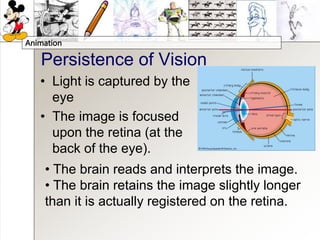
Persistence of Vision
• Light is captured by the
eye
• The image is focused
upon the retina (at the
back of the eye).
• The brain reads and interprets the image.
• The brain retains the image slightly longer
than it is actually registered on the retina.
Animation
Timeline: A History of Animation
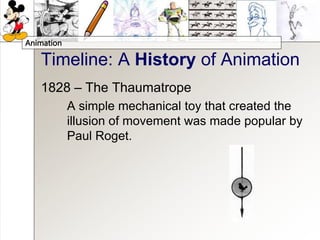
1828 – The Thaumatrope
A simple mechanical toy that created the
illusion of movement was made popular by
Paul Roget.
Animation
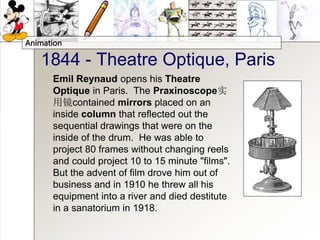
1844 - Theatre Optique, Paris
Emil Reynaud opens his Theatre
Optique in Paris. The Praxinoscope实
用镜contained mirrors placed on an
inside column that reflected out the
sequential drawings that were on the
inside of the drum. He was able to
project 80 frames without changing reels
and could project 10 to 15 minute "films".
But the advent of film drove him out of
business and in 1910 he threw all his
equipment into a river and died destitute
in a sanatorium in 1918.
Animation
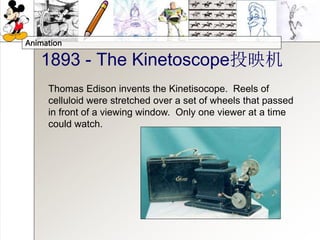
1893 - The Kinetoscope投映机
Thomas Edison invents the Kinetisocope. Reels of
celluloid were stretched over a set of wheels that passed
in front of a viewing window. Only one viewer at a time
could watch.
Animation
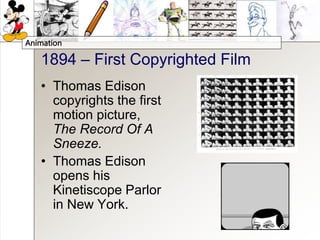
1894 – First Copyrighted Film
• Thomas Edison
copyrights the first
motion picture,
The Record Of A
Sneeze.
• Thomas Edison
opens his
Kinetiscope Parlor
in New York.
Animation
1906 – First example of Frame-By-
Frame Animation
• James Stuart Blackton makes Humorous
Phases Of Funny Faces. This film is usually
considered the first known example of
animation as some of the drawn sequences are
shot frame-by-frame. Blackton used a
combination of blackboard and chalk drawing
and cutouts to achieve animation.
Play Movie
Animation
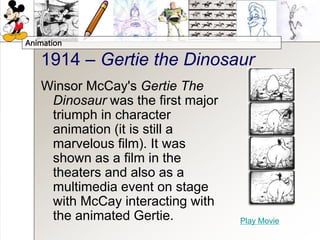
1914 – Gertie the Dinosaur
Winsor McCay's Gertie The
Dinosaur was the first major
triumph in character
animation (it is still a
marvelous film). It was
shown as a film in the
theaters and also as a
multimedia event on stage
with McCay interacting with
the animated Gertie. Play Movie
Animation
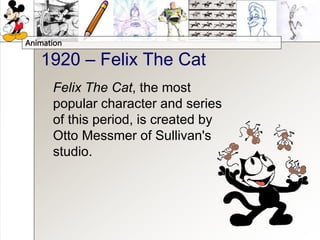
1920 – Felix The Cat
Felix The Cat, the most
popular character and series
of this period, is created by
Otto Messmer of Sullivan's
studio.
Animation
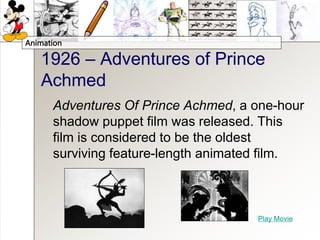
1926 – Adventures of Prince
Achmed
Adventures Of Prince Achmed, a one-hour
shadow puppet film was released. This
film is considered to be the oldest
surviving feature-length animated film.
Play Movie
Animation
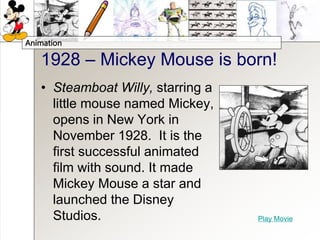
1928 – Mickey Mouse is born!
• Steamboat Willy, starring a
little mouse named Mickey,
opens in New York in
November 1928. It is the
first successful animated
film with sound. It made
Mickey Mouse a star and
launched the Disney
Studios. Play Movie
Animation
1932 – Animation Wins an Oscar
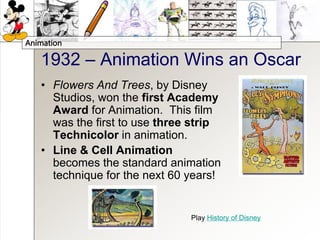
• Flowers And Trees, by Disney
Studios, won the first Academy
Award for Animation. This film
was the first to use three strip
Technicolor in animation.
• Line & Cell Animation
becomes the standard animation
technique for the next 60 years!
Play History of Disney
Animation
1993 – Stop-Motion Animation
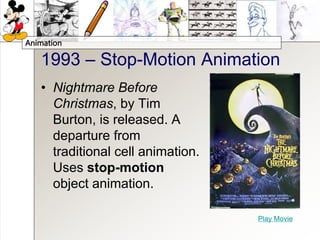
• Nightmare Before
Christmas, by Tim
Burton, is released. A
departure from
traditional cell animation.
Uses stop-motion
object animation.
Play Movie
Animation
1994 – A Billion Dollar Animation
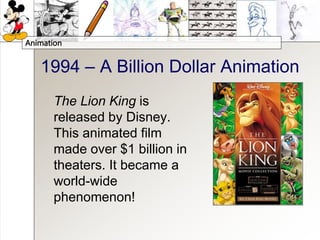
The Lion King is
released by Disney.
This animated film
made over $1 billion in
theaters. It became a
world-wide
phenomenon!
Animation
1995 – Computer Animated Film
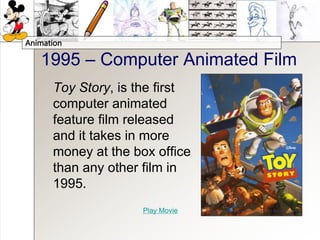
Toy Story, is the first
computer animated
feature film released
and it takes in more
money at the box office
than any other film in
1995.
Play Movie

Introduction to Animation.ppt

  • 1.
  • 2.
    Animation What is Animation? •Working with the person next to you, write a definition of animation. – You cannot use any resources (dictionary, Internet, etc). – You must come up with the definition by yourselves. – You will be sharing your definition with the rest of the class. – Write your definition in your notes.
  • 3.
    Animation What is Animation? •Animation is the art of creating a series of differing images that create the appearance of movement when played in rapid succession over time. • Websters: The act or process of imparting life, spirit or motion. • Art in movement • The art of movement
  • 4.
    Animation Movement • Movement makesstatic drawings come alive. • It is the quality of the movement (the life) that matters, not the quality of a particular image or drawing or frame of film. • Whether it is a drawing or a lump of clay, the animator places life and meaning into the material by making it move!
  • 5.
    Animation What does ittake to be an Animator? • A fascination with the way things move. • Sharp observational skills • A willingness to be an actor! • Problem solving skills • Lots of patience • A little bit of perseverance!
  • 6.
    Animation How do picturesmove? • A trick of the human eye and the brain • Obviously, the images don’t actually move! • The illusion of movement is created by a physiological phenomenon called persistence of vision.
  • 7.
    Animation Persistence of Vision •Light is captured by the eye • The image is focused upon the retina (at the back of the eye). • The brain reads and interprets the image. • The brain retains the image slightly longer than it is actually registered on the retina.
  • 8.
    Animation Timeline: A Historyof Animation 1828 – The Thaumatrope A simple mechanical toy that created the illusion of movement was made popular by Paul Roget.
  • 9.
    Animation 1844 - TheatreOptique, Paris Emil Reynaud opens his Theatre Optique in Paris. The Praxinoscope实 用镜contained mirrors placed on an inside column that reflected out the sequential drawings that were on the inside of the drum. He was able to project 80 frames without changing reels and could project 10 to 15 minute "films". But the advent of film drove him out of business and in 1910 he threw all his equipment into a river and died destitute in a sanatorium in 1918.
  • 10.
    Animation 1893 - TheKinetoscope投映机 Thomas Edison invents the Kinetisocope. Reels of celluloid were stretched over a set of wheels that passed in front of a viewing window. Only one viewer at a time could watch.
  • 11.
    Animation 1894 – FirstCopyrighted Film • Thomas Edison copyrights the first motion picture, The Record Of A Sneeze. • Thomas Edison opens his Kinetiscope Parlor in New York.
  • 12.
    Animation 1906 – Firstexample of Frame-By- Frame Animation • James Stuart Blackton makes Humorous Phases Of Funny Faces. This film is usually considered the first known example of animation as some of the drawn sequences are shot frame-by-frame. Blackton used a combination of blackboard and chalk drawing and cutouts to achieve animation. Play Movie
  • 13.
    Animation 1914 – Gertiethe Dinosaur Winsor McCay's Gertie The Dinosaur was the first major triumph in character animation (it is still a marvelous film). It was shown as a film in the theaters and also as a multimedia event on stage with McCay interacting with the animated Gertie. Play Movie
  • 14.
    Animation 1920 – FelixThe Cat Felix The Cat, the most popular character and series of this period, is created by Otto Messmer of Sullivan's studio.
  • 15.
    Animation 1926 – Adventuresof Prince Achmed Adventures Of Prince Achmed, a one-hour shadow puppet film was released. This film is considered to be the oldest surviving feature-length animated film. Play Movie
  • 16.
    Animation 1928 – MickeyMouse is born! • Steamboat Willy, starring a little mouse named Mickey, opens in New York in November 1928. It is the first successful animated film with sound. It made Mickey Mouse a star and launched the Disney Studios. Play Movie
  • 17.
    Animation 1932 – AnimationWins an Oscar • Flowers And Trees, by Disney Studios, won the first Academy Award for Animation. This film was the first to use three strip Technicolor in animation. • Line & Cell Animation becomes the standard animation technique for the next 60 years! Play History of Disney
  • 18.
    Animation 1993 – Stop-MotionAnimation • Nightmare Before Christmas, by Tim Burton, is released. A departure from traditional cell animation. Uses stop-motion object animation. Play Movie
  • 19.
    Animation 1994 – ABillion Dollar Animation The Lion King is released by Disney. This animated film made over $1 billion in theaters. It became a world-wide phenomenon!
  • 20.
    Animation 1995 – ComputerAnimated Film Toy Story, is the first computer animated feature film released and it takes in more money at the box office than any other film in 1995. Play Movie