Centre for Rural Policy Research
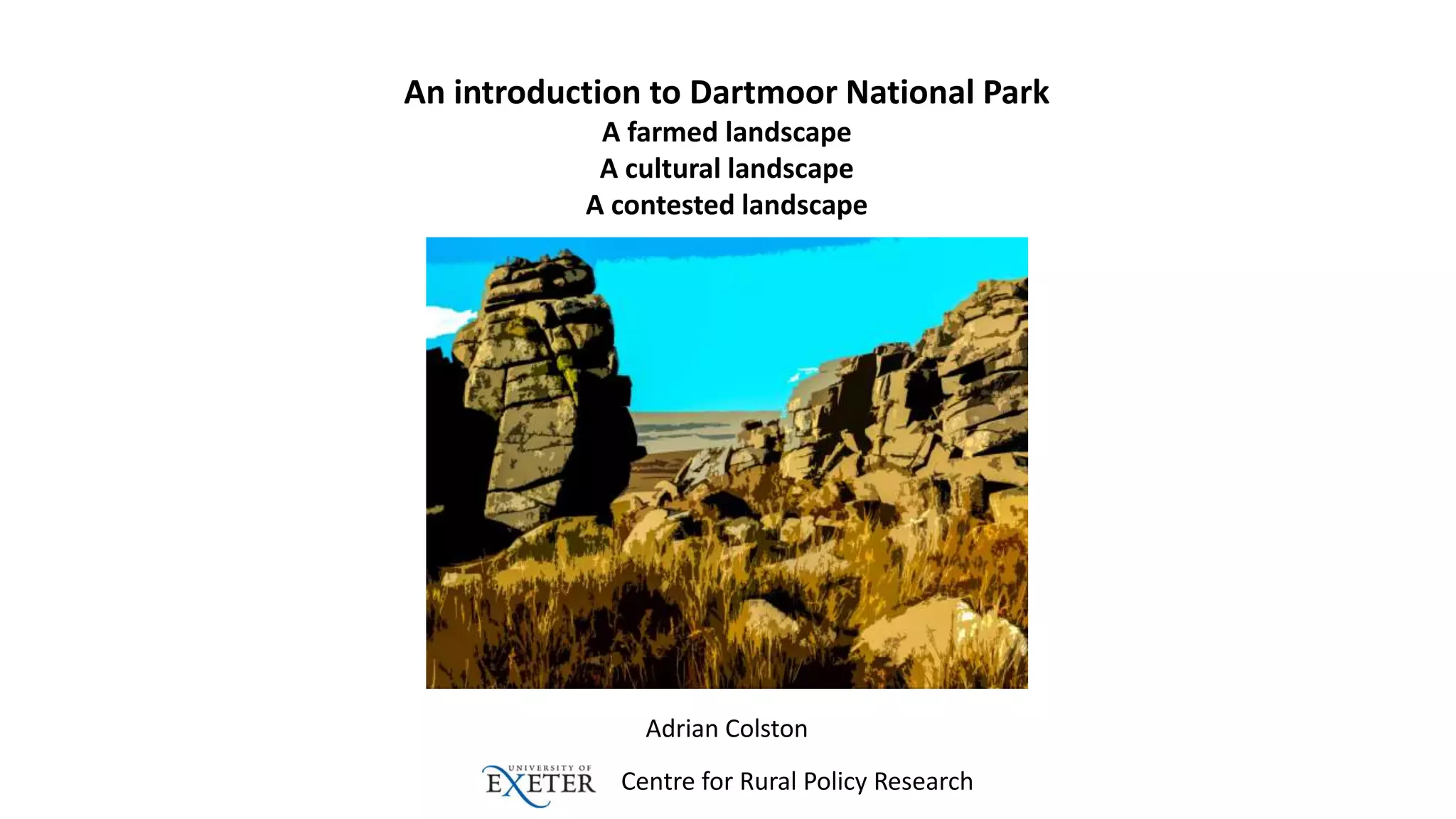
An introduction to Dartmoor National Park
A farmed landscape
A cultural landscape
A contested landscape
Adrian Colston
Centre for Rural Policy Research
Who am I?
I am a third year PhD Researcher in the Centre for Rural Policy Research
and I’m looking at
Stakeholder attitudes to the narratives of the Dartmoor Commons:
tradition and the search for consensus in an age of Brexit, atmospheric pollution and climate change
BUT
I have also spent 35 years as a conservationist and environmental practitioner
and prior to stating my PhD
I worked for 12 years for the National Trust (Europe’s largest conservation charity with 5m members) as
the General Manager for Dartmoor who own around 3000 ha of the National Park
Centre for Rural Policy Research
Dartmoor – some characteristics
Dartmoor is 95,400 ha, the Commons are 35,882ha = 37.6%
20,673ha of Commons SSSI/SAC 57.6% of total
Upland area – granite and peat – blanket bogs, mires, heather moorland,
woodlands, valley pastures and hay meadows
Contains highest point in south England at 621m High Willhays
Much of the higher land is designated as ‘Less Favoured Areas’ i.e. it is
poor quality agricultural land only suitable for grazing by sheep and cattle
Sheep occupy live over around 4m ha. of the UK’s uplands, roughly the
same amount of land as is used to grow all the cereals, oilseeds, potatoes,
fruit, vegetables and other crops this country produces. Lamb and mutton
provide just 1.2% of our diet.
In the UK 80% of productivity comes from 20% of businesses on 50% of
the land – none in the uplands
Centre for Rural Policy Research
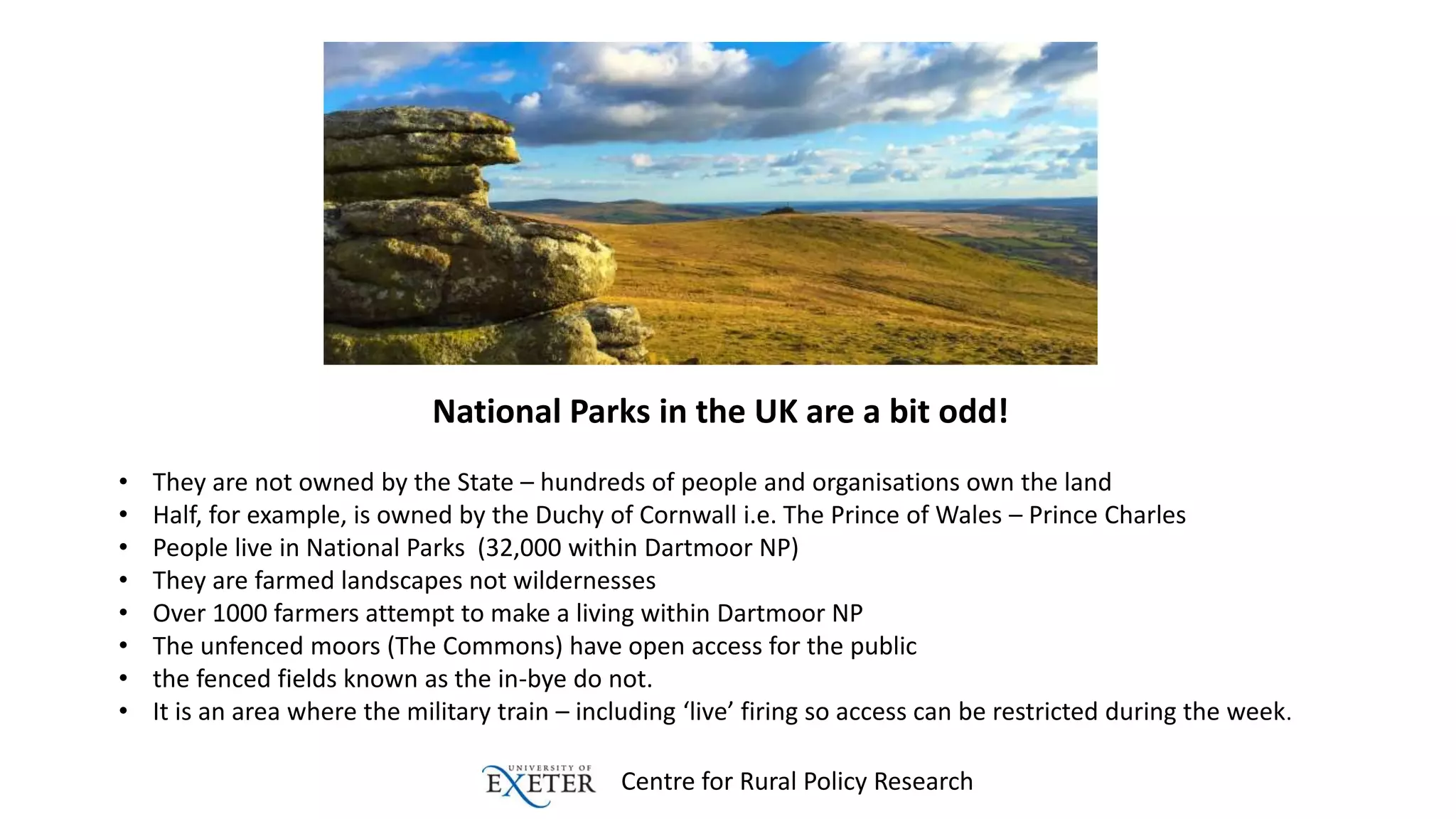
National Parks in the UK are a bit odd!
• They are not owned by the State – hundreds of people and organisations own the land
• Half, for example, is owned by the Duchy of Cornwall i.e. The Prince of Wales – Prince Charles
• People live in National Parks (32,000 within Dartmoor NP)
• They are farmed landscapes not wildernesses
• Over 1000 farmers attempt to make a living within Dartmoor NP
• The unfenced moors (The Commons) have open access for the public
• the fenced fields known as the in-bye do not.
• It is an area where the military train – including ‘live’ firing so access can be restricted during the week.
Centre for Rural Policy Research
8000 years ago Dartmoor was a much more wooded landscape and was inhabited by small groups of
hunter gatherers – the Paleolithic people
Between 8000 - 6000 BP the Mesolithic era occurred – a transition between hunter gatherers and
settled farmers and the woodlands began to be cleared
6000-4500 BP – the Neolithic – the growing of crops and the domestication of animals – further
clearance of woodland
4500-2700 BP – the Bronze Age – hut circles, standing stones, ceremonial monuments – further
clearance of woodlands – a farmed landscape
2700-1950 BP The Iron Age – impressive hillforts and further clearance of woodlands and more farming
Centre for Rural Policy Research
By the Iron Age Dartmoor looked pretty much as it does today – an open and treeless landscape
As the climate changed cultivation declined and a pastoral agriculture dominated
Communal summer grazing of the Commons along with associated transhumance
Levancy and couchancy
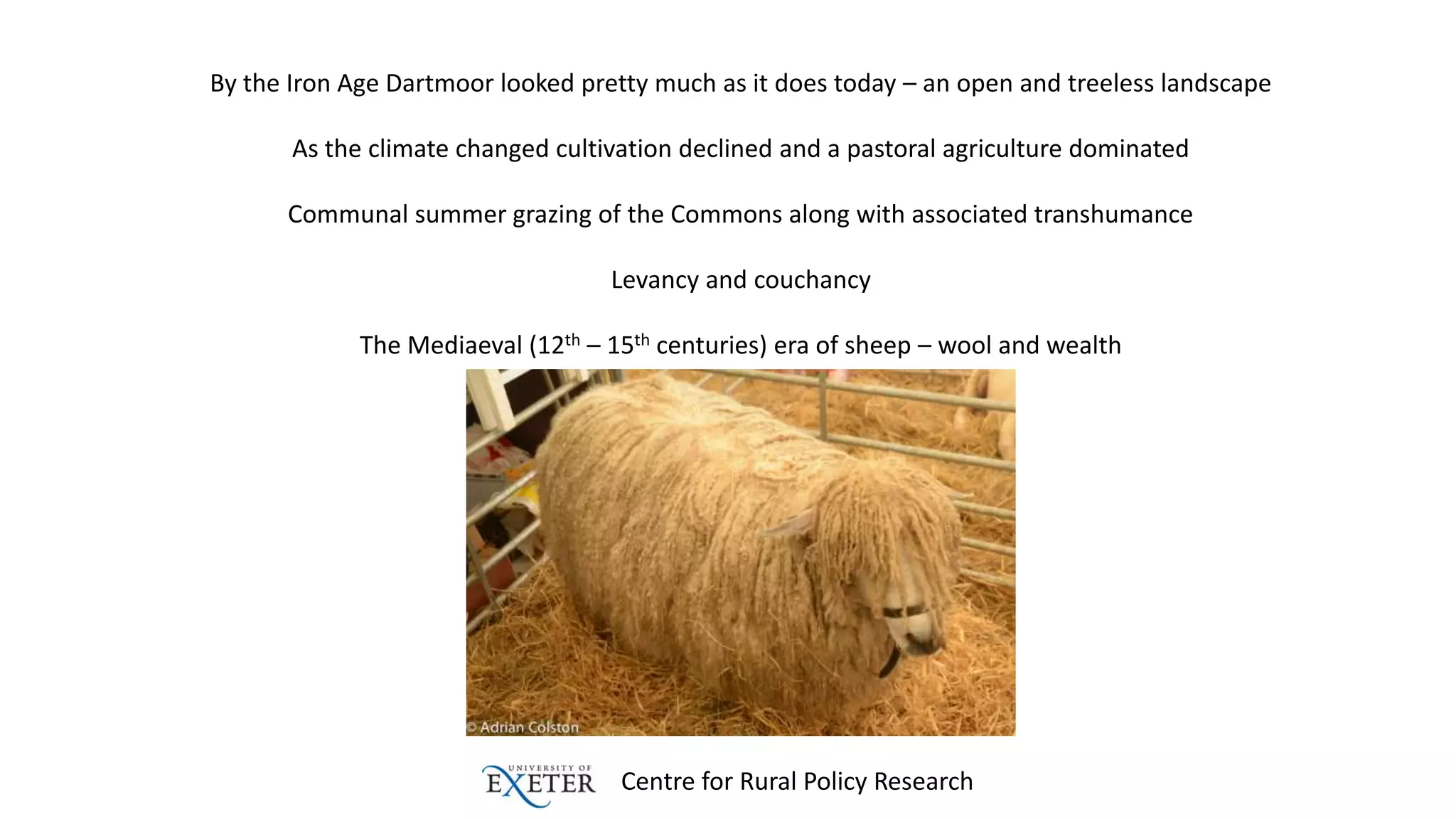
The Mediaeval (12th – 15th centuries) era of sheep – wool and wealth
Centre for Rural Policy Research
By the 19th century agriculturalists are looking to ‘improve’ Dartmoor to make it more productive
The era of Enclosure
By the end of the 19th century transhumance
has all but disappeared
Levancy and couchancy is abandoned
All year round grazing begins – new breeds of
hardier sheep and cattle
Bred for lamb (ie meat and not wool)
Centre for Rural Policy Research
Many Commoners’ families have lived on
Dartmoor for centuries
Only 180 active Commoners are now left
Carrying on the traditions of centuries?
Heavily reliant on EU subsidies
Heavily reliant on diversification
The enormous threat of Brexit
Traditions and the hill-farming culture
under threat
Dartmoor produces 76,000 lambs and
13,000 calves per annum
The culture of Dartmoor’s hill-farmers
Centre for Rural Policy Research
The Dartmoor hill-farmers narrative
Over thousands of years the hill-farmers of Dartmoor have created the landscape we know today. They are
farmers first and foremost who want to primarily produce quality lambs and cattle.
They are the guardians of the moor but are not park rangers. Today their traditions are threatened by
increasing government interference, unsustainable farm incomes, Brexit, their age and the difficulty of
encouraging new entrants to hill-farming.
Centre for Rural Policy Research
Since the middle of the 20th century Dartmoor’s hill-farmers have been at the
centre of a series of conflicts about how they manage the Commons
The hill-farmers ‘share’ the moors with many different other interest groups
Walkers
Wildlife enthusiasts
Cyclists
Ecologists
Conservationists
Runners
Archaeologists
Historians
Re-wilders
Water companies
Forestry interests
The military
etc
Centre for Rural Policy Research
1947 Agriculture Act
UK joins EU
Agri-environment schemes start
Foot
and
Mouth
20th century intensification – sheep numbers at the heart of the conflicts
Zayed J. (2016) Agriculture: historical
statistics. Briefing paper 03339. House of
Commons Library.
Centre for Rural Policy Research
Overgrazing and overburning – impacts 1
Centre for Rural Policy Research
The Impacts 2
etc
etc
Centre for Rural Policy Research
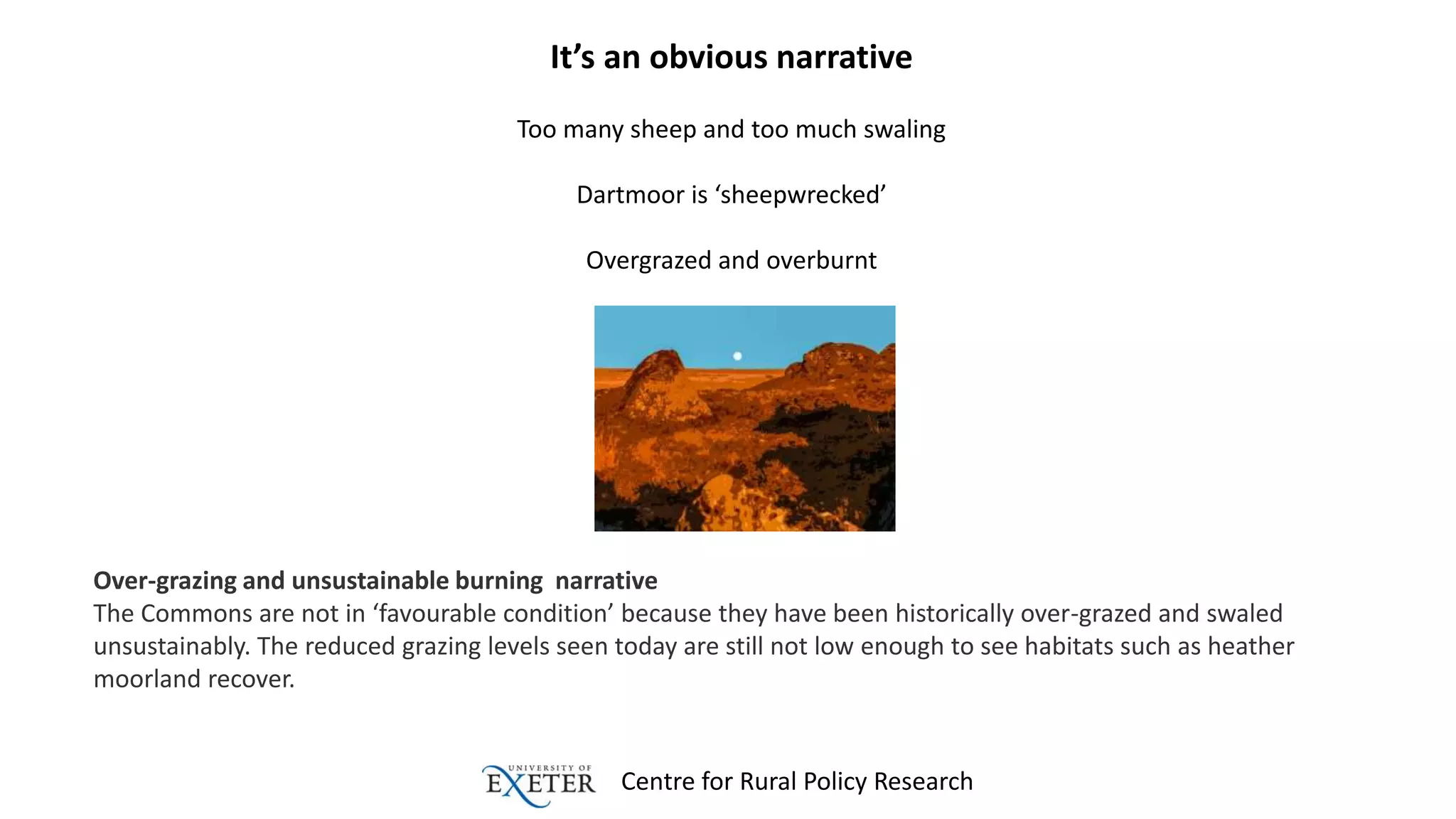
It’s an obvious narrative
Too many sheep and too much swaling
Dartmoor is ‘sheepwrecked’
Overgrazed and overburnt
Over-grazing and unsustainable burning narrative
The Commons are not in ‘favourable condition’ because they have been historically over-grazed and swaled
unsustainably. The reduced grazing levels seen today are still not low enough to see habitats such as heather
moorland recover.
Centre for Rural Policy Research
Agri-environment Schemes to the rescue
The aim of the agri-environment schemes (Countryside Stewardship, ESAs, Higher Level Stewardship etc) has
been to use financial incentives to reduce grazing pressure and make sward burning more sustainable.
£6m per annum on Dartmoor is paid to hill-farmers to reduce grazing
Centre for Rural Policy Research
But then this happened
Why when the sheep and cattle numbers on the moor had been reduced was the heather
continuing to disappear whilst the purple moor grass took over and dominated the Commons with
its eerie and stifling ‘raffia’?
In 1989/90 less than 1% of
Dartmoor was dominated by
Molinia – now 20%+
Centre for Rural Policy Research
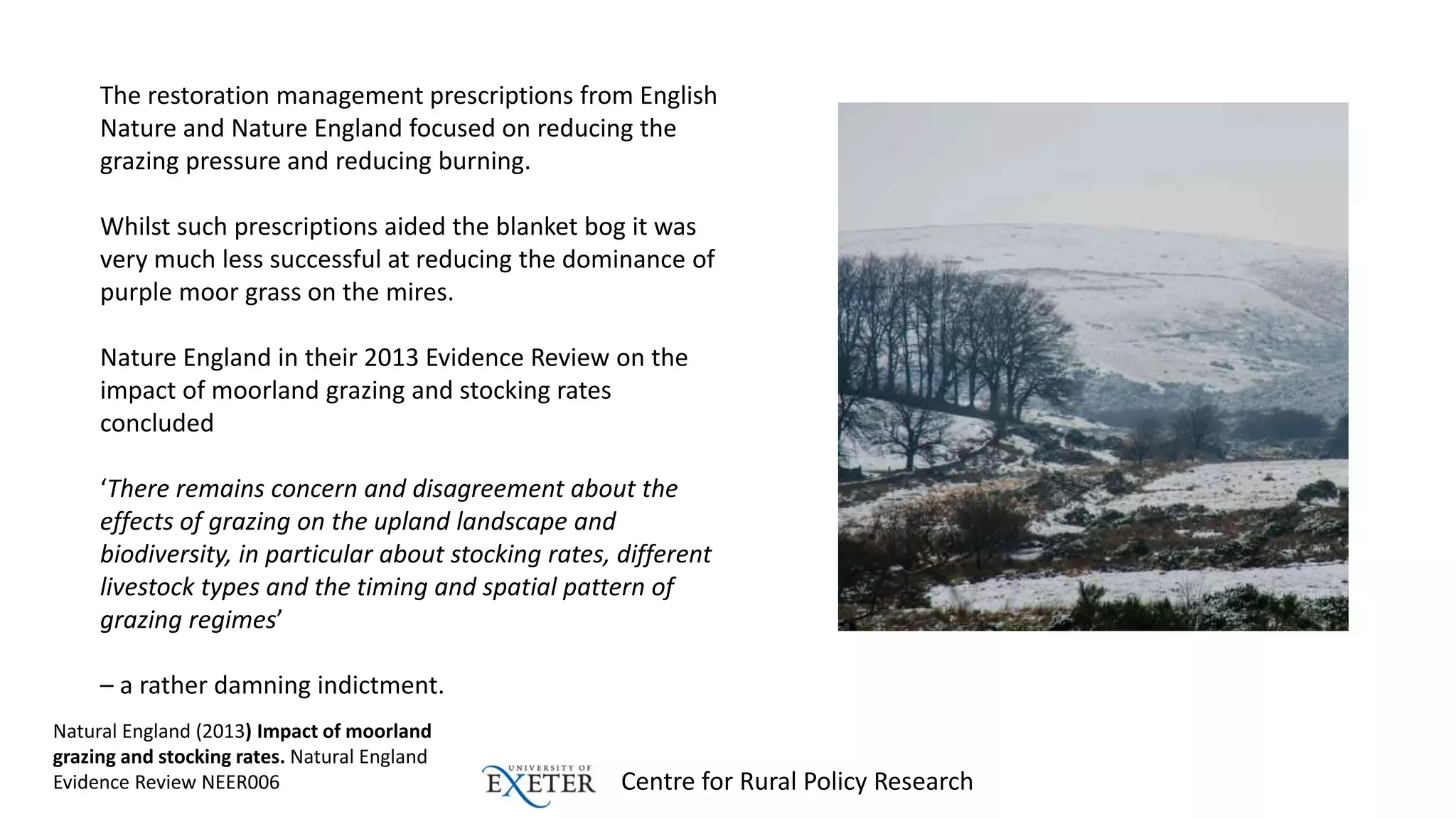
The restoration management prescriptions from English
Nature and Nature England focused on reducing the
grazing pressure and reducing burning.
Whilst such prescriptions aided the blanket bog it was
very much less successful at reducing the dominance of
purple moor grass on the mires.
Nature England in their 2013 Evidence Review on the
impact of moorland grazing and stocking rates
concluded
‘There remains concern and disagreement about the
effects of grazing on the upland landscape and
biodiversity, in particular about stocking rates, different
livestock types and the timing and spatial pattern of
grazing regimes’
– a rather damning indictment.
Natural England (2013) Impact of moorland
grazing and stocking rates. Natural England
Evidence Review NEER006
Centre for Rural Policy Research
‘Some of us are beginning to form the view that some of the grass-dominated vegetation types of
the southern uplands may be the product of nitrogen deposition and heavy grazing pressures.
Hence, a reduction in grazing pressures alone may not necessarily result in an improvement in
habitats’ Des Thompson 2002
So what is going on?  The atmospheric pollution narrative is born
But these views did not translate into policy changes or action
So ecologists and conservationists have been aware of the problems caused by atmospheric
pollution, particularly nitrogen deposition but they have seen it as an obstacle to restoration and
one to be navigated around rather than a driving force to changes in the uplands.
And it’s not just atmospheric nitrogen deposition,
it is also ozone pollution
and carbon dioxide increases
Centre for Rural Policy Research
Nitrogen - Critical Load Exceedance
As a result, many parts of the UK have been receiving high levels of nitrogen deposition for decades. English Nature
showed that between 1989-92 93% of Dartmoor exceeded nitrogen deposition critical loads
Brown M. & Farmer A. (1996) Excess sulphur and nitrogen deposition in England’s Natural Areas. English Nature Research Reports No. 201.
SACs SPAsCEH data and mapping
Natural England maps
Centre for Rural Policy Research
These maps show the O3 concentrations in the UK between March to May and May to July. It is clear that upland
areas (amongst others) receive high levels of O3 during these months. O3 concentrations on Dartmoor are
amongst the highest in the country (RoTAP 2012).
Ozone
Centre for Rural Policy Research
And finally …. carbon dioxide
Atmospheric carbon dioxide levels have risen from 320 ppm in 1960 to just over 400 ppm by 2015
The history of research on photosynthesis and carbon dioxide suggests that these changes in
carbon dioxide levels would cause an immediate and significant stimulation of photosynthesis.
Centre for Rural Policy Research
Atmospheric pollution narrative
The ‘unfavourable condition’ of the Commons were initially caused by overgrazing but today their recovery is
impeded by high levels of atmospheric pollution and climate change which are now the main drivers of
habitat change. The habitats on the Commons are undergoing a reconfiguration and cannot be restored to
their former condition.
Centre for Rural Policy Research
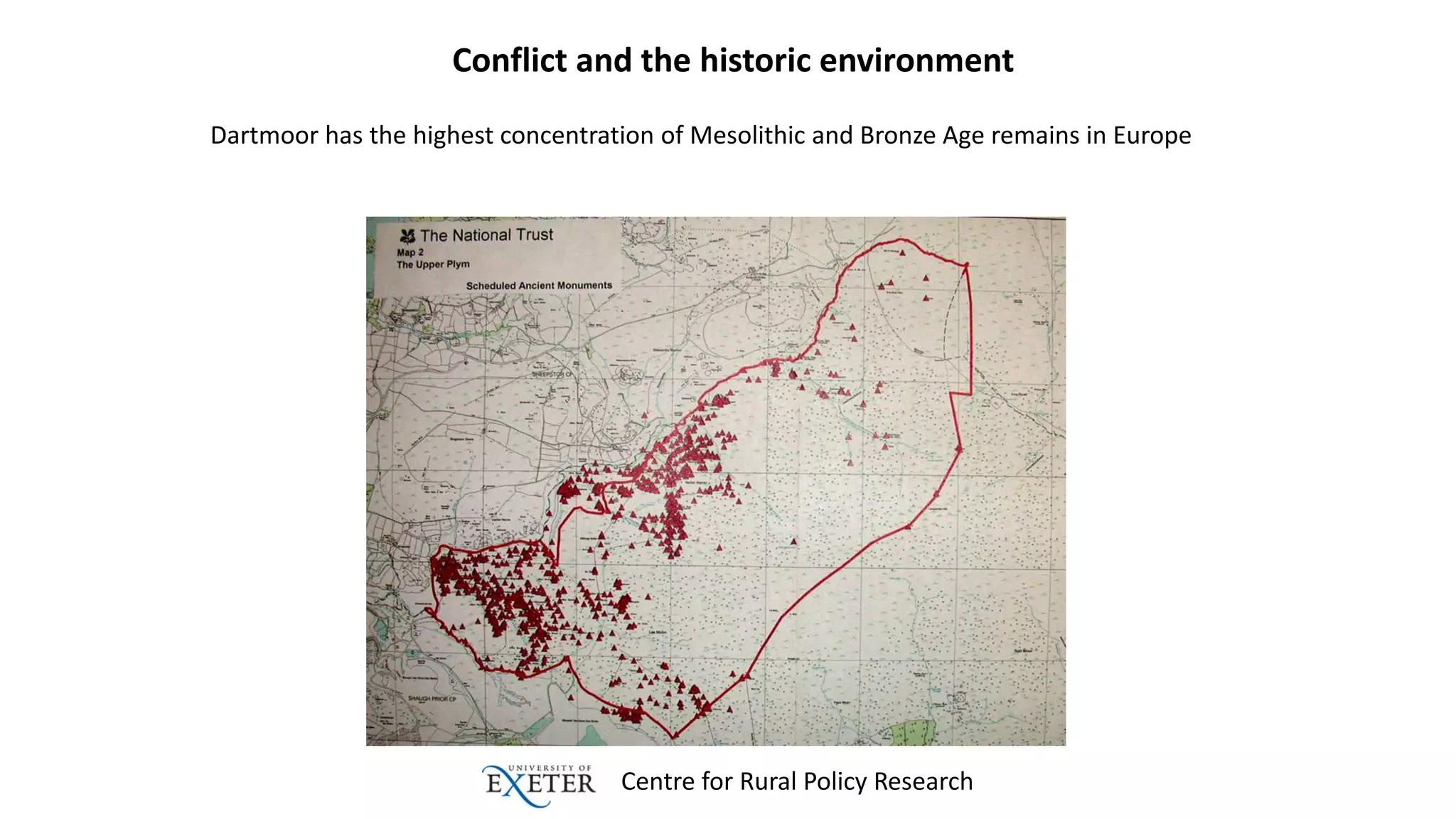
Conflict and the historic environment
Dartmoor has the highest concentration of Mesolithic and Bronze Age remains in Europe
Centre for Rural Policy Research
Some archaeologists and cultural historians believe that Dartmoor is undergrazed not overgrazed
The cultural landscape narrative
Dartmoor contains one of the richest archaeological landscape in Europe some of which dates back to the
Neolithic. Recent policies which have reduced grazing levels to enhance wildlife have been a failure allowing
scrub and coarse grasses to dominate thus hiding and damaging the important historic landscape. Grazing
levels need to increase dramatically.
Centre for Rural Policy Research
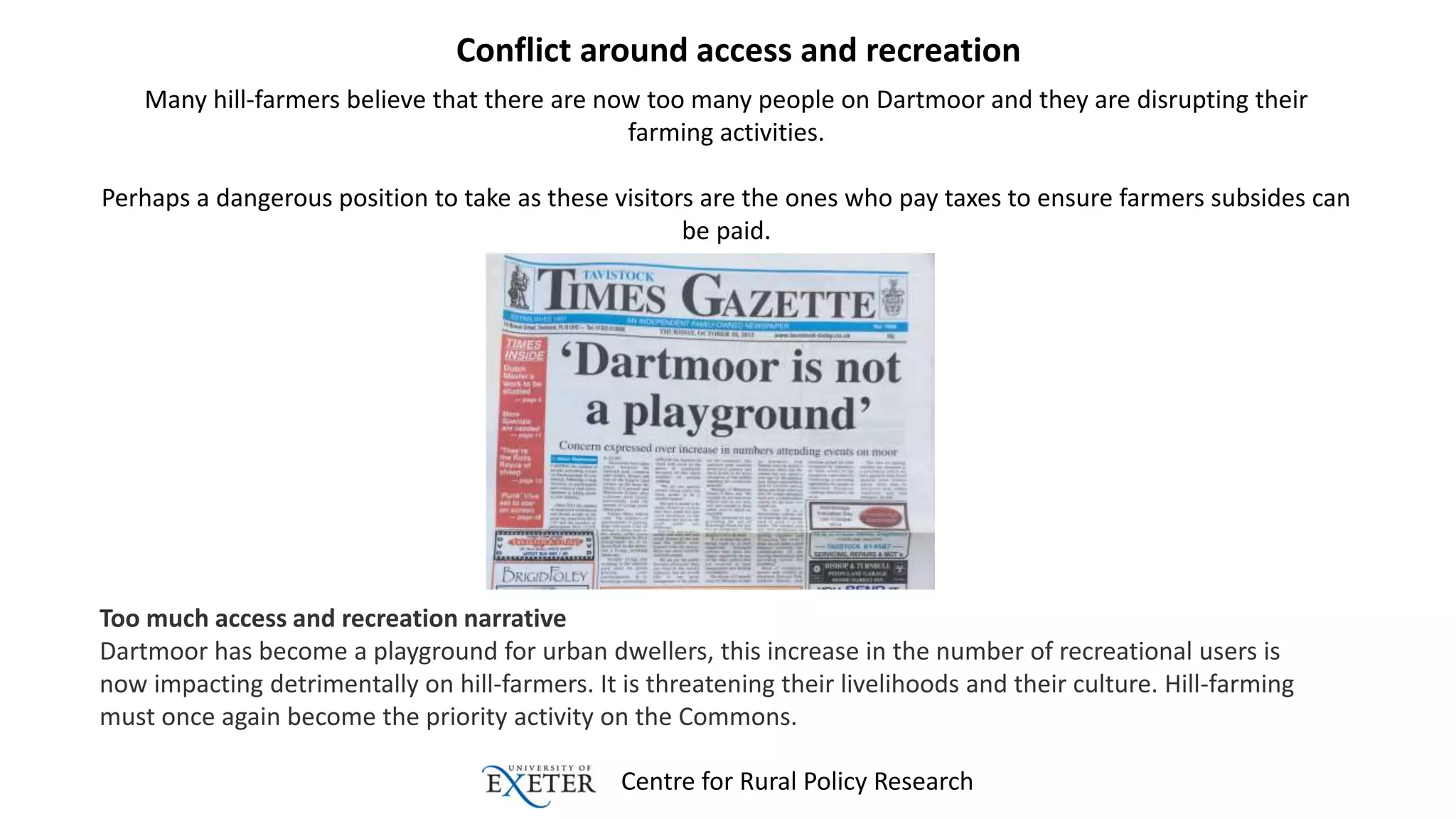
Conflict around access and recreation
Many hill-farmers believe that there are now too many people on Dartmoor and they are disrupting their
farming activities.
Perhaps a dangerous position to take as these visitors are the ones who pay taxes to ensure farmers subsides can
be paid.
Too much access and recreation narrative
Dartmoor has become a playground for urban dwellers, this increase in the number of recreational users is
now impacting detrimentally on hill-farmers. It is threatening their livelihoods and their culture. Hill-farming
must once again become the priority activity on the Commons.
Centre for Rural Policy Research
Conflict around rewilding
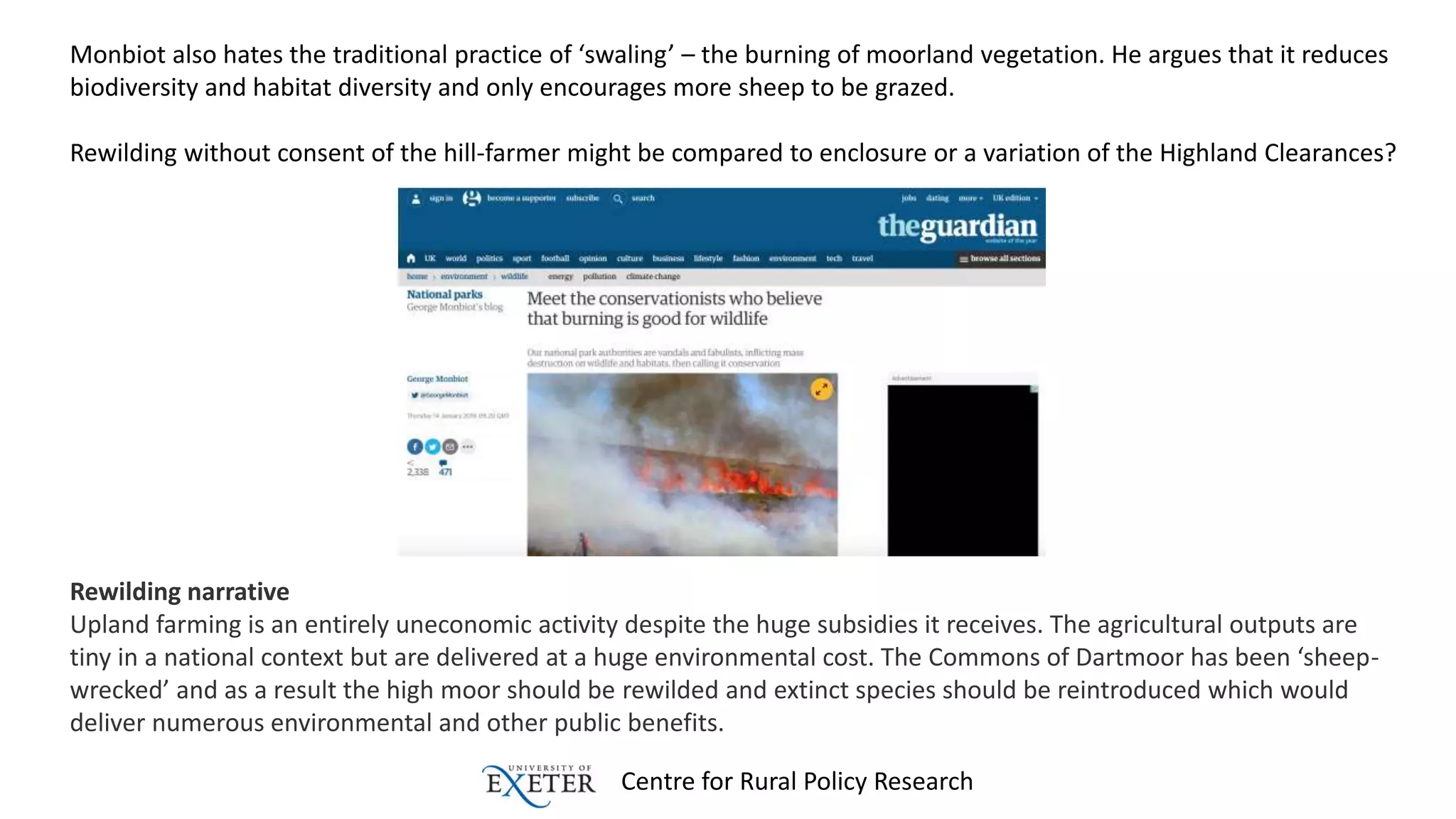
George Monbiot, the environmental campaigner and Guardian
journalist has advocated rewilding Dartmoor as it is ’sheepwrecked’.
Hill farmers absolutely hate him!
Centre for Rural Policy Research
Monbiot also hates the traditional practice of ‘swaling’ – the burning of moorland vegetation. He argues that it reduces
biodiversity and habitat diversity and only encourages more sheep to be grazed.
Rewilding without consent of the hill-farmer might be compared to enclosure or a variation of the Highland Clearances?
Rewilding narrative
Upland farming is an entirely uneconomic activity despite the huge subsidies it receives. The agricultural outputs are
tiny in a national context but are delivered at a huge environmental cost. The Commons of Dartmoor has been ‘sheep-
wrecked’ and as a result the high moor should be rewilded and extinct species should be reintroduced which would
deliver numerous environmental and other public benefits.
Centre for Rural Policy Research
Conflicts abound rewetting the mires
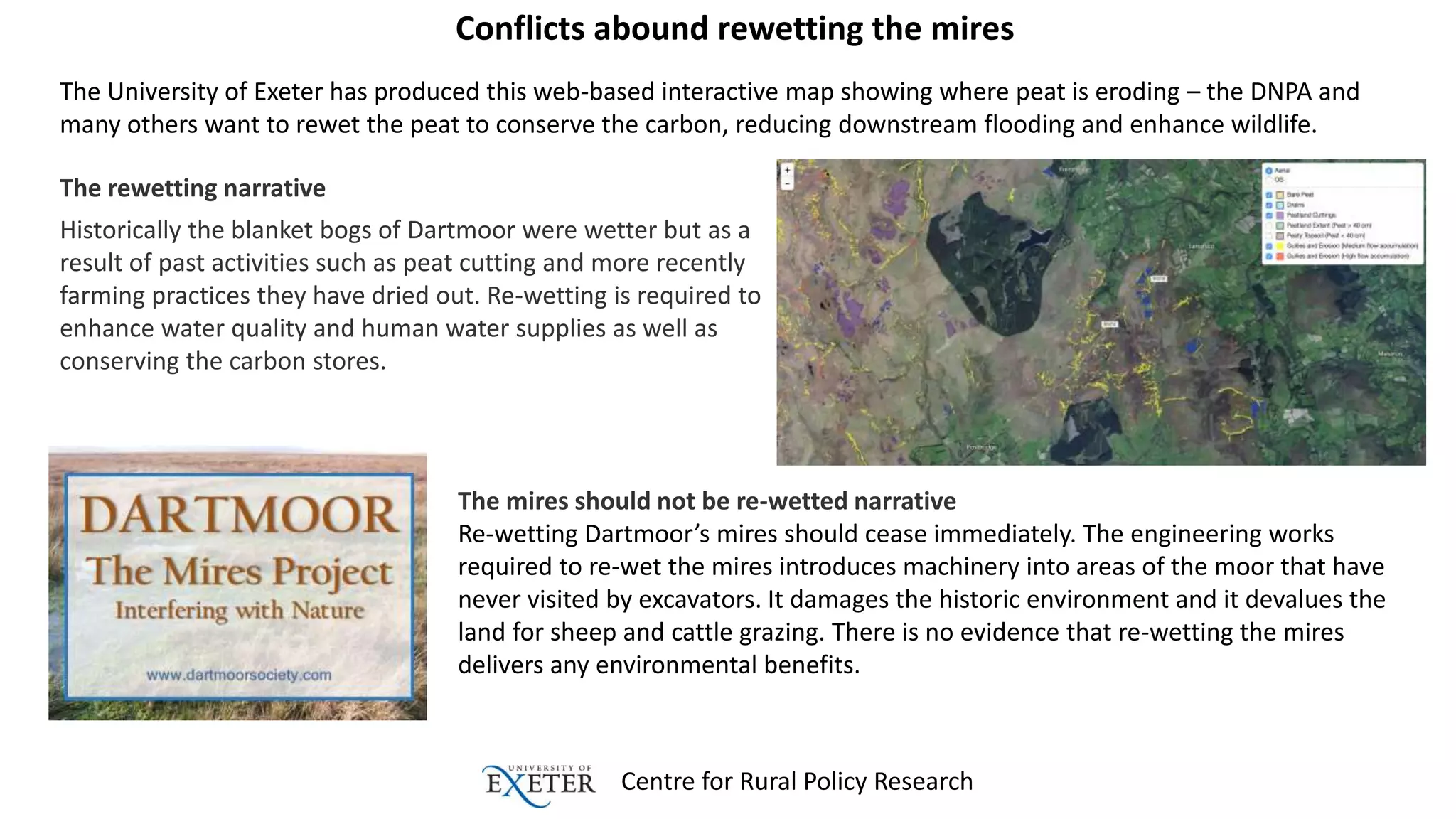
The University of Exeter has produced this web-based interactive map showing where peat is eroding – the DNPA and
many others want to rewet the peat to conserve the carbon, reducing downstream flooding and enhance wildlife.
The rewetting narrative
Historically the blanket bogs of Dartmoor were wetter but as a
result of past activities such as peat cutting and more recently
farming practices they have dried out. Re-wetting is required to
enhance water quality and human water supplies as well as
conserving the carbon stores.
The mires should not be re-wetted narrative
Re-wetting Dartmoor’s mires should cease immediately. The engineering works
required to re-wet the mires introduces machinery into areas of the moor that have
never visited by excavators. It damages the historic environment and it devalues the
land for sheep and cattle grazing. There is no evidence that re-wetting the mires
delivers any environmental benefits.
Centre for Rural Policy Research
There are many other conflicts on the Commons …… I could mention …
• Why can’t we have some ‘soft’ rewilding’? – not wolves or lynx but some more trees
• The agri-environment schemes have caused bracken to spread
• The ‘banned’ herbicide asulam is being used to control bracken – it threatens to pollute the rivers
• Plans to re-introduce hen harriers
• Military training
• etc
But I hope you get the idea …..
The various narratives are complicated, often highly technical and multidisciplinary
And to complicate things further climate change and atmospheric pollution continue to change the habitats,
species and natural processes.
Centre for Rural Policy Research
Dartmoor Farming Futures narrative –
the search for consensus
Held by the Dartmoor Moorland Vision
Group which consists of the Dartmoor
Commoners Council, Natural England,
Historic England, Defence Estates, the
Rural Development Service and the
Dartmoor National Park Authority.
Their position is that they see the
moorland areas of the National Park as a
grazed open landscape that delivers
multiple public benefits, including public
access, biodiversity, conservation of key
archaeological features, water and carbon
management and high quality food
production.
Outcomes approach
– not prescriptions
Putting hill-farmers
back in control
Centre for Rural Policy Research
Brexit hangs menacingly over the heads of Dartmoor’s hill-farmers and the
landscape itself
Will they receive subsidy money in the future which allows
them to stay on the moors?
Are they prepared to receive ‘public money for public
goods’?
Most just want to be left alone and farm their sheep and
cattle and thus produce food for the nation.
Most don’t want their farming diluted by having to become
‘park keepers’.
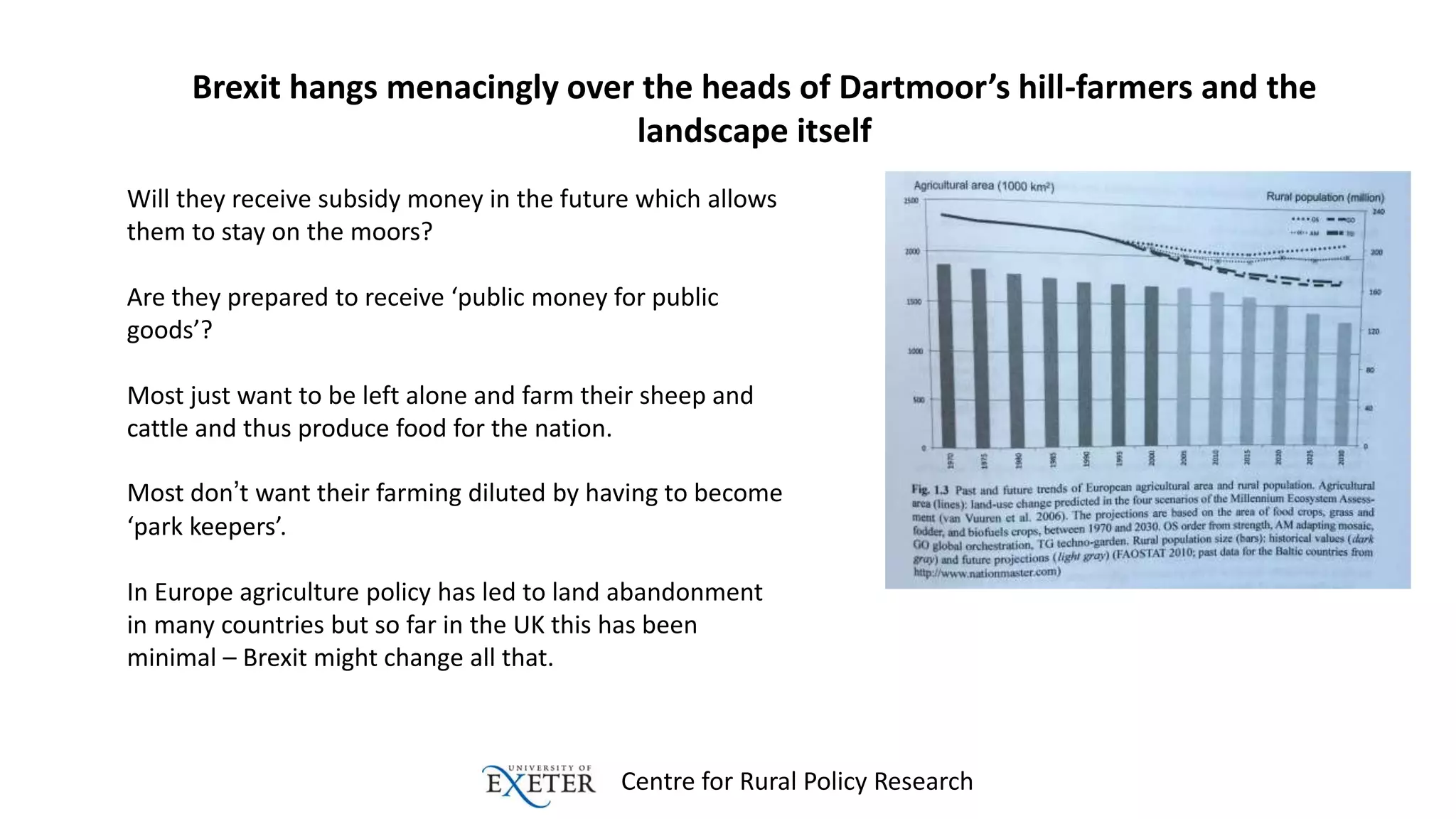
In Europe agriculture policy has led to land abandonment
in many countries but so far in the UK this has been
minimal – Brexit might change all that.
Centre for Rural Policy Research
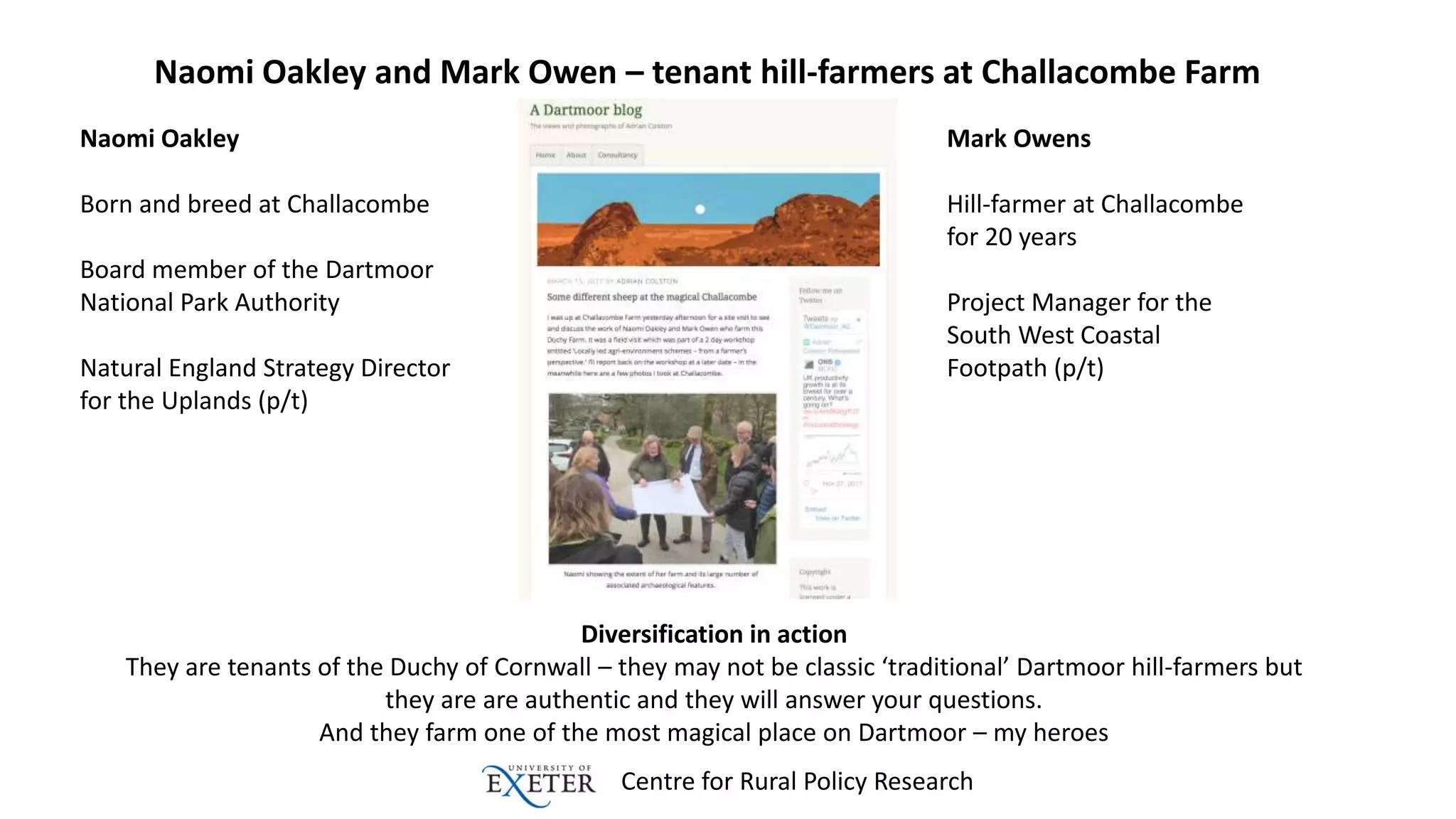
Naomi Oakley and Mark Owen – tenant hill-farmers at Challacombe Farm
Diversification in action
They are tenants of the Duchy of Cornwall – they may not be classic ‘traditional’ Dartmoor hill-farmers but
they are are authentic and they will answer your questions.
And they farm one of the most magical place on Dartmoor – my heroes
Naomi Oakley
Born and breed at Challacombe
Board member of the Dartmoor
National Park Authority
Natural England Strategy Director
for the Uplands (p/t)
Mark Owens
Hill-farmer at Challacombe
for 20 years
Project Manager for the
South West Coastal
Footpath (p/t)
Centre for Rural Policy Research
https://adriancolston.wordpress.com
Twitter - @Dartmoor_AC
If you would like a copy of this .ppt email me
and I will send it to you via WeTransfer
https://wetransfer.com
Adrian Colston ac766@exeter.ac.uk

Introduction to Dartmoor

  • 1.
    Centre for RuralPolicy Research An introduction to Dartmoor National Park A farmed landscape A cultural landscape A contested landscape Adrian Colston
  • 2.
    Centre for RuralPolicy Research Who am I? I am a third year PhD Researcher in the Centre for Rural Policy Research and I’m looking at Stakeholder attitudes to the narratives of the Dartmoor Commons: tradition and the search for consensus in an age of Brexit, atmospheric pollution and climate change BUT I have also spent 35 years as a conservationist and environmental practitioner and prior to stating my PhD I worked for 12 years for the National Trust (Europe’s largest conservation charity with 5m members) as the General Manager for Dartmoor who own around 3000 ha of the National Park
  • 3.
    Centre for RuralPolicy Research Dartmoor – some characteristics Dartmoor is 95,400 ha, the Commons are 35,882ha = 37.6% 20,673ha of Commons SSSI/SAC 57.6% of total Upland area – granite and peat – blanket bogs, mires, heather moorland, woodlands, valley pastures and hay meadows Contains highest point in south England at 621m High Willhays Much of the higher land is designated as ‘Less Favoured Areas’ i.e. it is poor quality agricultural land only suitable for grazing by sheep and cattle Sheep occupy live over around 4m ha. of the UK’s uplands, roughly the same amount of land as is used to grow all the cereals, oilseeds, potatoes, fruit, vegetables and other crops this country produces. Lamb and mutton provide just 1.2% of our diet. In the UK 80% of productivity comes from 20% of businesses on 50% of the land – none in the uplands
  • 4.
    Centre for RuralPolicy Research National Parks in the UK are a bit odd! • They are not owned by the State – hundreds of people and organisations own the land • Half, for example, is owned by the Duchy of Cornwall i.e. The Prince of Wales – Prince Charles • People live in National Parks (32,000 within Dartmoor NP) • They are farmed landscapes not wildernesses • Over 1000 farmers attempt to make a living within Dartmoor NP • The unfenced moors (The Commons) have open access for the public • the fenced fields known as the in-bye do not. • It is an area where the military train – including ‘live’ firing so access can be restricted during the week.
  • 5.
    Centre for RuralPolicy Research 8000 years ago Dartmoor was a much more wooded landscape and was inhabited by small groups of hunter gatherers – the Paleolithic people Between 8000 - 6000 BP the Mesolithic era occurred – a transition between hunter gatherers and settled farmers and the woodlands began to be cleared 6000-4500 BP – the Neolithic – the growing of crops and the domestication of animals – further clearance of woodland 4500-2700 BP – the Bronze Age – hut circles, standing stones, ceremonial monuments – further clearance of woodlands – a farmed landscape 2700-1950 BP The Iron Age – impressive hillforts and further clearance of woodlands and more farming
  • 6.
    Centre for RuralPolicy Research By the Iron Age Dartmoor looked pretty much as it does today – an open and treeless landscape As the climate changed cultivation declined and a pastoral agriculture dominated Communal summer grazing of the Commons along with associated transhumance Levancy and couchancy The Mediaeval (12th – 15th centuries) era of sheep – wool and wealth
  • 7.
    Centre for RuralPolicy Research By the 19th century agriculturalists are looking to ‘improve’ Dartmoor to make it more productive The era of Enclosure By the end of the 19th century transhumance has all but disappeared Levancy and couchancy is abandoned All year round grazing begins – new breeds of hardier sheep and cattle Bred for lamb (ie meat and not wool)
  • 8.
    Centre for RuralPolicy Research Many Commoners’ families have lived on Dartmoor for centuries Only 180 active Commoners are now left Carrying on the traditions of centuries? Heavily reliant on EU subsidies Heavily reliant on diversification The enormous threat of Brexit Traditions and the hill-farming culture under threat Dartmoor produces 76,000 lambs and 13,000 calves per annum The culture of Dartmoor’s hill-farmers
  • 9.
    Centre for RuralPolicy Research
  • 10.
    Centre for RuralPolicy Research The Dartmoor hill-farmers narrative Over thousands of years the hill-farmers of Dartmoor have created the landscape we know today. They are farmers first and foremost who want to primarily produce quality lambs and cattle. They are the guardians of the moor but are not park rangers. Today their traditions are threatened by increasing government interference, unsustainable farm incomes, Brexit, their age and the difficulty of encouraging new entrants to hill-farming.
  • 11.
    Centre for RuralPolicy Research Since the middle of the 20th century Dartmoor’s hill-farmers have been at the centre of a series of conflicts about how they manage the Commons The hill-farmers ‘share’ the moors with many different other interest groups Walkers Wildlife enthusiasts Cyclists Ecologists Conservationists Runners Archaeologists Historians Re-wilders Water companies Forestry interests The military etc
  • 12.
    Centre for RuralPolicy Research 1947 Agriculture Act UK joins EU Agri-environment schemes start Foot and Mouth 20th century intensification – sheep numbers at the heart of the conflicts Zayed J. (2016) Agriculture: historical statistics. Briefing paper 03339. House of Commons Library.
  • 13.
    Centre for RuralPolicy Research Overgrazing and overburning – impacts 1
  • 14.
    Centre for RuralPolicy Research The Impacts 2 etc etc
  • 15.
    Centre for RuralPolicy Research It’s an obvious narrative Too many sheep and too much swaling Dartmoor is ‘sheepwrecked’ Overgrazed and overburnt Over-grazing and unsustainable burning narrative The Commons are not in ‘favourable condition’ because they have been historically over-grazed and swaled unsustainably. The reduced grazing levels seen today are still not low enough to see habitats such as heather moorland recover.
  • 16.
    Centre for RuralPolicy Research Agri-environment Schemes to the rescue The aim of the agri-environment schemes (Countryside Stewardship, ESAs, Higher Level Stewardship etc) has been to use financial incentives to reduce grazing pressure and make sward burning more sustainable. £6m per annum on Dartmoor is paid to hill-farmers to reduce grazing
  • 17.
    Centre for RuralPolicy Research But then this happened Why when the sheep and cattle numbers on the moor had been reduced was the heather continuing to disappear whilst the purple moor grass took over and dominated the Commons with its eerie and stifling ‘raffia’? In 1989/90 less than 1% of Dartmoor was dominated by Molinia – now 20%+
  • 18.
    Centre for RuralPolicy Research The restoration management prescriptions from English Nature and Nature England focused on reducing the grazing pressure and reducing burning. Whilst such prescriptions aided the blanket bog it was very much less successful at reducing the dominance of purple moor grass on the mires. Nature England in their 2013 Evidence Review on the impact of moorland grazing and stocking rates concluded ‘There remains concern and disagreement about the effects of grazing on the upland landscape and biodiversity, in particular about stocking rates, different livestock types and the timing and spatial pattern of grazing regimes’ – a rather damning indictment. Natural England (2013) Impact of moorland grazing and stocking rates. Natural England Evidence Review NEER006
  • 19.
    Centre for RuralPolicy Research ‘Some of us are beginning to form the view that some of the grass-dominated vegetation types of the southern uplands may be the product of nitrogen deposition and heavy grazing pressures. Hence, a reduction in grazing pressures alone may not necessarily result in an improvement in habitats’ Des Thompson 2002 So what is going on?  The atmospheric pollution narrative is born But these views did not translate into policy changes or action So ecologists and conservationists have been aware of the problems caused by atmospheric pollution, particularly nitrogen deposition but they have seen it as an obstacle to restoration and one to be navigated around rather than a driving force to changes in the uplands. And it’s not just atmospheric nitrogen deposition, it is also ozone pollution and carbon dioxide increases
  • 20.
    Centre for RuralPolicy Research Nitrogen - Critical Load Exceedance As a result, many parts of the UK have been receiving high levels of nitrogen deposition for decades. English Nature showed that between 1989-92 93% of Dartmoor exceeded nitrogen deposition critical loads Brown M. & Farmer A. (1996) Excess sulphur and nitrogen deposition in England’s Natural Areas. English Nature Research Reports No. 201. SACs SPAsCEH data and mapping Natural England maps
  • 21.
    Centre for RuralPolicy Research These maps show the O3 concentrations in the UK between March to May and May to July. It is clear that upland areas (amongst others) receive high levels of O3 during these months. O3 concentrations on Dartmoor are amongst the highest in the country (RoTAP 2012). Ozone
  • 22.
    Centre for RuralPolicy Research And finally …. carbon dioxide Atmospheric carbon dioxide levels have risen from 320 ppm in 1960 to just over 400 ppm by 2015 The history of research on photosynthesis and carbon dioxide suggests that these changes in carbon dioxide levels would cause an immediate and significant stimulation of photosynthesis.
  • 23.
    Centre for RuralPolicy Research Atmospheric pollution narrative The ‘unfavourable condition’ of the Commons were initially caused by overgrazing but today their recovery is impeded by high levels of atmospheric pollution and climate change which are now the main drivers of habitat change. The habitats on the Commons are undergoing a reconfiguration and cannot be restored to their former condition.
  • 24.
    Centre for RuralPolicy Research Conflict and the historic environment Dartmoor has the highest concentration of Mesolithic and Bronze Age remains in Europe
  • 25.
    Centre for RuralPolicy Research Some archaeologists and cultural historians believe that Dartmoor is undergrazed not overgrazed The cultural landscape narrative Dartmoor contains one of the richest archaeological landscape in Europe some of which dates back to the Neolithic. Recent policies which have reduced grazing levels to enhance wildlife have been a failure allowing scrub and coarse grasses to dominate thus hiding and damaging the important historic landscape. Grazing levels need to increase dramatically.
  • 26.
    Centre for RuralPolicy Research Conflict around access and recreation Many hill-farmers believe that there are now too many people on Dartmoor and they are disrupting their farming activities. Perhaps a dangerous position to take as these visitors are the ones who pay taxes to ensure farmers subsides can be paid. Too much access and recreation narrative Dartmoor has become a playground for urban dwellers, this increase in the number of recreational users is now impacting detrimentally on hill-farmers. It is threatening their livelihoods and their culture. Hill-farming must once again become the priority activity on the Commons.
  • 27.
    Centre for RuralPolicy Research Conflict around rewilding George Monbiot, the environmental campaigner and Guardian journalist has advocated rewilding Dartmoor as it is ’sheepwrecked’. Hill farmers absolutely hate him!
  • 28.
    Centre for RuralPolicy Research Monbiot also hates the traditional practice of ‘swaling’ – the burning of moorland vegetation. He argues that it reduces biodiversity and habitat diversity and only encourages more sheep to be grazed. Rewilding without consent of the hill-farmer might be compared to enclosure or a variation of the Highland Clearances? Rewilding narrative Upland farming is an entirely uneconomic activity despite the huge subsidies it receives. The agricultural outputs are tiny in a national context but are delivered at a huge environmental cost. The Commons of Dartmoor has been ‘sheep- wrecked’ and as a result the high moor should be rewilded and extinct species should be reintroduced which would deliver numerous environmental and other public benefits.
  • 29.
    Centre for RuralPolicy Research Conflicts abound rewetting the mires The University of Exeter has produced this web-based interactive map showing where peat is eroding – the DNPA and many others want to rewet the peat to conserve the carbon, reducing downstream flooding and enhance wildlife. The rewetting narrative Historically the blanket bogs of Dartmoor were wetter but as a result of past activities such as peat cutting and more recently farming practices they have dried out. Re-wetting is required to enhance water quality and human water supplies as well as conserving the carbon stores. The mires should not be re-wetted narrative Re-wetting Dartmoor’s mires should cease immediately. The engineering works required to re-wet the mires introduces machinery into areas of the moor that have never visited by excavators. It damages the historic environment and it devalues the land for sheep and cattle grazing. There is no evidence that re-wetting the mires delivers any environmental benefits.
  • 30.
    Centre for RuralPolicy Research There are many other conflicts on the Commons …… I could mention … • Why can’t we have some ‘soft’ rewilding’? – not wolves or lynx but some more trees • The agri-environment schemes have caused bracken to spread • The ‘banned’ herbicide asulam is being used to control bracken – it threatens to pollute the rivers • Plans to re-introduce hen harriers • Military training • etc But I hope you get the idea ….. The various narratives are complicated, often highly technical and multidisciplinary And to complicate things further climate change and atmospheric pollution continue to change the habitats, species and natural processes.
  • 31.
    Centre for RuralPolicy Research Dartmoor Farming Futures narrative – the search for consensus Held by the Dartmoor Moorland Vision Group which consists of the Dartmoor Commoners Council, Natural England, Historic England, Defence Estates, the Rural Development Service and the Dartmoor National Park Authority. Their position is that they see the moorland areas of the National Park as a grazed open landscape that delivers multiple public benefits, including public access, biodiversity, conservation of key archaeological features, water and carbon management and high quality food production. Outcomes approach – not prescriptions Putting hill-farmers back in control
  • 32.
    Centre for RuralPolicy Research Brexit hangs menacingly over the heads of Dartmoor’s hill-farmers and the landscape itself Will they receive subsidy money in the future which allows them to stay on the moors? Are they prepared to receive ‘public money for public goods’? Most just want to be left alone and farm their sheep and cattle and thus produce food for the nation. Most don’t want their farming diluted by having to become ‘park keepers’. In Europe agriculture policy has led to land abandonment in many countries but so far in the UK this has been minimal – Brexit might change all that.
  • 33.
    Centre for RuralPolicy Research Naomi Oakley and Mark Owen – tenant hill-farmers at Challacombe Farm Diversification in action They are tenants of the Duchy of Cornwall – they may not be classic ‘traditional’ Dartmoor hill-farmers but they are are authentic and they will answer your questions. And they farm one of the most magical place on Dartmoor – my heroes Naomi Oakley Born and breed at Challacombe Board member of the Dartmoor National Park Authority Natural England Strategy Director for the Uplands (p/t) Mark Owens Hill-farmer at Challacombe for 20 years Project Manager for the South West Coastal Footpath (p/t)
  • 34.
    Centre for RuralPolicy Research https://adriancolston.wordpress.com Twitter - @Dartmoor_AC If you would like a copy of this .ppt email me and I will send it to you via WeTransfer https://wetransfer.com Adrian Colston ac766@exeter.ac.uk