Presented by Jean
Samuel AJAVON
The proliferation of mobile money services is imminent. They
promise many new benefits for users, and are undoubtedly
going to shape the telecommunications, technology and
financial services industries. Technology innovation and
new transaction types are changing the mobile money
landscape, and opening up opportunities for a range of
industry participants. The contactless system is poised to
take off, offering multiple service capabilities and a unified
platform to generate greater convenience for users.As it
develops, each market will need to understand customers’
demands, and develop its own ecosystem and business
models. A key facilitator will be converging regulation and
legislation which needs to address fraud and money
laundering issues. A favorable platform for industry
stakeholders to collaborate will be one that maximizes the
benefits to all parties.
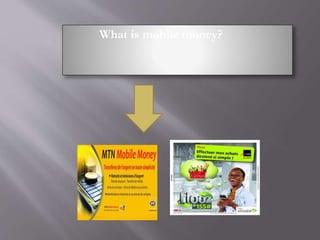
What is mobile money?
“mobile money” varies across the industry as it
covers a wide scope of overlapping applications.
In general, mobile money is a term describing the
services that allow electronic money
 transactions over a mobile phone. It is also
referred to as mobile financial services, mobile
wallet and mobile payment. In this report, we
define mobile money as a broader term that
includes all types of monetary transactions
executed via mobile phones
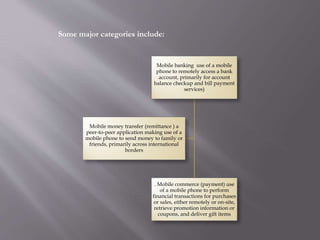
Mobile banking use of a mobile
phone to remotely access a bank
account, primarily for account
balance checkup and bill payment
services)
. Mobile commerce (payment) use
of a mobile phone to perform
financial transactions for purchases
or sales, either remotely or on-site,
retrieve promotion information or
coupons, and deliver gift items
Mobile money transfer (remittance ) a
peer-to-peer application making use of a
mobile phone to send money to family or
friends, primarily across international
borders
Some major categories include:
 Mobile financial services and mobile commerce are not new
concepts in the telecom industry. Mobile network operators
began exploring the concept of mobile payments in 2000
with little success. However, recent advances in handset
functionality, chip and mobile network technologies, and
upgrades to point-of-sale infrastructure have dramatically
improved the environment for mobile money solutions,
bringing together different industry groups, such as banks
and operators.
 Many countries have not yet developed regulations to
govern the transaction of electronic money. However, the
cross-industry nature of mobile money prompts regulators,
in both the telecom and financial sectors, to confront
important questions
 and develop a new generation of financial regulation. This
leads to the emergence of
 new regulatory concepts of e-money and payment
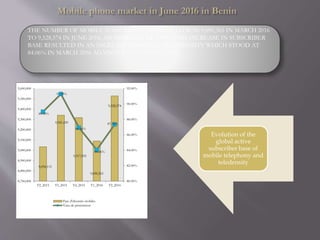
THE NUMBER OF MOBILE SUBSCRIBERS INCREASED FROM 9,090,365 IN MARCH 2016
TO 9,528,574 IN JUNE 2016, AN INCREASE OF 4.59%. THIS INCREASE IN SUBSCRIBER
BASE RESULTED IN AN INCREASE IN MOBILE TELEDENSITY WHICH STOOD AT
84.06% IN MARCH 2016 AGAINST 87.35% IN JUNE 2016.
9,034,115
9,341,429
9,317,955
9,090,365
9,528,574
89.00%
91.29%
86.96%
84.06%
87.35%
80.00%
82.00%
84.00%
86.00%
88.00%
90.00%
92.00%
8,700,000
8,800,000
8,900,000
9,000,000
9,100,000
9,200,000
9,300,000
9,400,000
9,500,000
9,600,000
T2_2015 T3_2015 T4_2015 T1_2016 T2_2016
Parc d'abonnés mobiles
Taux de pénétration
Evolution of the
global active
subscriber base of
mobile telephony and
teledensity
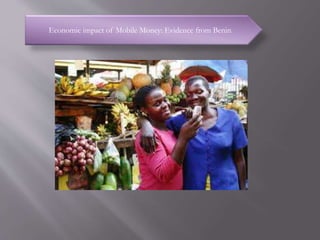
Economic impact of Mobile Money: Evidence from Benin
0
2E+10
4E+10
6E+10
8E+10
1E+11
1.2E+11
Suscribers depot d'argent retrait dargent Transfert d'argent Transfert d'argent vers
l'international
Chart Title
2e trimestre 2016 3e trimestre 2016
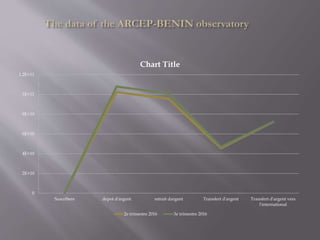
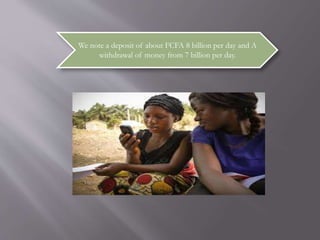
We note a deposit of about FCFA 8 billion per day and A
withdrawal of money from 7 billion per day.
The mobile money stimulates the economy in
Benin and significantly reduces financial
inclusion. It reaches the majority of the
population because the mobile penetration
rate is around 87%. This rate shows that out of
100 inhabitants, more than 87 has a mobile
phone. The banking rate in Benin is around
10%. This shows that more than 90% of the
population does not have access to the
Bank. In Benin, and mainly in Cotonou, a
prefectoral order bearing dematerialized
payment in supermarkets and markets is taken
to avoid the risks of robberies. So to make
your purchases in the market or the super
markets, you have to use the mobile.
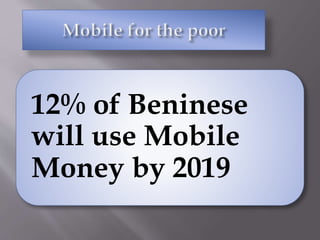
12% of Beninese
will use Mobile
Money by 2019
Increase the use of digital financial services
in Benin to reach 12% of the adult
population. This is the objective of Mobile
Money for the Poor, a program of the
United Nations Capital Development
Fund (UNCDF), which has just been
launched in Cotonou
The current organization of the mobile money market implies that banks and mobile network operators still remain very
dependent on each other. Indeed, mobile operators always require the need to go through a bank, so that the
bank in their place, holds deposits corresponding to the electronic value of the purse of their customers.
Conversely, for any bank that decides to issue electronic money, it is necessary to use a mobile network operator
to at least allow the various operations to be carried out on a mobile terminalToday, however, no structure or
establishment can carry out activities for issuing electronic money without having been duly authorized or
authorized in advance by the national financial regulatory authority, ie the Central Bank. While in most cases
banks are automatically empowered (through laws governing banking regulations) to carry out the activities of
issuing electronic money, the situation is quite different with regard to mobile network operators. Of the 89
global markets where electronic money services are present, 42 still prohibit these operators from owning directly
a mobile banking license. For the latter, however, owners of the service, the only solution is then to resort to
partnerships with banking institutions, which act as licensee and manager of relations with the supervisory
authority.This regulatory barrier, which obliges the main players in a market to systematically depend on another
category of players, considerably hinders the development of the electronic money market. Yet, even when they
are authorized, few mobile operators have so far decided to free themselves from a partnership with a bank in
order to obtain a license in their own name. This is the case, for example, in the West African Monetary Union
(UMOA) zone, which includes Benin, Burkina Faso, Côte d'Ivoire, Guinea-Bissau, Mali, Niger, Senegal and Togo.
There, despite the possibility granted by the Central Bank (BCEAO), none of the mobile operators has for the
moment made the approach to obtain a license alone. The latter would, however, provide them with the authority
to issue and distribute means of payment in the form of electronic money. However, in view of the technical and
administrative burdens they have to rely on at the central authority, operators still choose bank dependence. But
the situation is changing. Some operators, like MTN, are increasingly beginning to articulate the idea of obtaining
a license. This would liberate it from any dependence on a bank and put the operator in a position of strength in
order to negotiate more advantageous contract terms. The next few years are likely to mark a turning point, with
the emergence of mobile operators that would act as genuine electronic banks.

Mobile money, a development tool for benin powerpoint

  • 1.
  • 2.
    The proliferation ofmobile money services is imminent. They promise many new benefits for users, and are undoubtedly going to shape the telecommunications, technology and financial services industries. Technology innovation and new transaction types are changing the mobile money landscape, and opening up opportunities for a range of industry participants. The contactless system is poised to take off, offering multiple service capabilities and a unified platform to generate greater convenience for users.As it develops, each market will need to understand customers’ demands, and develop its own ecosystem and business models. A key facilitator will be converging regulation and legislation which needs to address fraud and money laundering issues. A favorable platform for industry stakeholders to collaborate will be one that maximizes the benefits to all parties.
  • 3.
  • 4.
    “mobile money” variesacross the industry as it covers a wide scope of overlapping applications. In general, mobile money is a term describing the services that allow electronic money  transactions over a mobile phone. It is also referred to as mobile financial services, mobile wallet and mobile payment. In this report, we define mobile money as a broader term that includes all types of monetary transactions executed via mobile phones
  • 7.
    Mobile banking useof a mobile phone to remotely access a bank account, primarily for account balance checkup and bill payment services) . Mobile commerce (payment) use of a mobile phone to perform financial transactions for purchases or sales, either remotely or on-site, retrieve promotion information or coupons, and deliver gift items Mobile money transfer (remittance ) a peer-to-peer application making use of a mobile phone to send money to family or friends, primarily across international borders Some major categories include:
  • 8.
     Mobile financialservices and mobile commerce are not new concepts in the telecom industry. Mobile network operators began exploring the concept of mobile payments in 2000 with little success. However, recent advances in handset functionality, chip and mobile network technologies, and upgrades to point-of-sale infrastructure have dramatically improved the environment for mobile money solutions, bringing together different industry groups, such as banks and operators.  Many countries have not yet developed regulations to govern the transaction of electronic money. However, the cross-industry nature of mobile money prompts regulators, in both the telecom and financial sectors, to confront important questions  and develop a new generation of financial regulation. This leads to the emergence of  new regulatory concepts of e-money and payment
  • 9.
    THE NUMBER OFMOBILE SUBSCRIBERS INCREASED FROM 9,090,365 IN MARCH 2016 TO 9,528,574 IN JUNE 2016, AN INCREASE OF 4.59%. THIS INCREASE IN SUBSCRIBER BASE RESULTED IN AN INCREASE IN MOBILE TELEDENSITY WHICH STOOD AT 84.06% IN MARCH 2016 AGAINST 87.35% IN JUNE 2016. 9,034,115 9,341,429 9,317,955 9,090,365 9,528,574 89.00% 91.29% 86.96% 84.06% 87.35% 80.00% 82.00% 84.00% 86.00% 88.00% 90.00% 92.00% 8,700,000 8,800,000 8,900,000 9,000,000 9,100,000 9,200,000 9,300,000 9,400,000 9,500,000 9,600,000 T2_2015 T3_2015 T4_2015 T1_2016 T2_2016 Parc d'abonnés mobiles Taux de pénétration Evolution of the global active subscriber base of mobile telephony and teledensity
  • 10.
    Economic impact ofMobile Money: Evidence from Benin
  • 11.
    0 2E+10 4E+10 6E+10 8E+10 1E+11 1.2E+11 Suscribers depot d'argentretrait dargent Transfert d'argent Transfert d'argent vers l'international Chart Title 2e trimestre 2016 3e trimestre 2016
  • 12.
    We note adeposit of about FCFA 8 billion per day and A withdrawal of money from 7 billion per day.
  • 13.
    The mobile moneystimulates the economy in Benin and significantly reduces financial inclusion. It reaches the majority of the population because the mobile penetration rate is around 87%. This rate shows that out of 100 inhabitants, more than 87 has a mobile phone. The banking rate in Benin is around 10%. This shows that more than 90% of the population does not have access to the Bank. In Benin, and mainly in Cotonou, a prefectoral order bearing dematerialized payment in supermarkets and markets is taken to avoid the risks of robberies. So to make your purchases in the market or the super markets, you have to use the mobile.
  • 14.
    12% of Beninese willuse Mobile Money by 2019
  • 15.
    Increase the useof digital financial services in Benin to reach 12% of the adult population. This is the objective of Mobile Money for the Poor, a program of the United Nations Capital Development Fund (UNCDF), which has just been launched in Cotonou
  • 16.
    The current organizationof the mobile money market implies that banks and mobile network operators still remain very dependent on each other. Indeed, mobile operators always require the need to go through a bank, so that the bank in their place, holds deposits corresponding to the electronic value of the purse of their customers. Conversely, for any bank that decides to issue electronic money, it is necessary to use a mobile network operator to at least allow the various operations to be carried out on a mobile terminalToday, however, no structure or establishment can carry out activities for issuing electronic money without having been duly authorized or authorized in advance by the national financial regulatory authority, ie the Central Bank. While in most cases banks are automatically empowered (through laws governing banking regulations) to carry out the activities of issuing electronic money, the situation is quite different with regard to mobile network operators. Of the 89 global markets where electronic money services are present, 42 still prohibit these operators from owning directly a mobile banking license. For the latter, however, owners of the service, the only solution is then to resort to partnerships with banking institutions, which act as licensee and manager of relations with the supervisory authority.This regulatory barrier, which obliges the main players in a market to systematically depend on another category of players, considerably hinders the development of the electronic money market. Yet, even when they are authorized, few mobile operators have so far decided to free themselves from a partnership with a bank in order to obtain a license in their own name. This is the case, for example, in the West African Monetary Union (UMOA) zone, which includes Benin, Burkina Faso, Côte d'Ivoire, Guinea-Bissau, Mali, Niger, Senegal and Togo. There, despite the possibility granted by the Central Bank (BCEAO), none of the mobile operators has for the moment made the approach to obtain a license alone. The latter would, however, provide them with the authority to issue and distribute means of payment in the form of electronic money. However, in view of the technical and administrative burdens they have to rely on at the central authority, operators still choose bank dependence. But the situation is changing. Some operators, like MTN, are increasingly beginning to articulate the idea of obtaining a license. This would liberate it from any dependence on a bank and put the operator in a position of strength in order to negotiate more advantageous contract terms. The next few years are likely to mark a turning point, with the emergence of mobile operators that would act as genuine electronic banks.