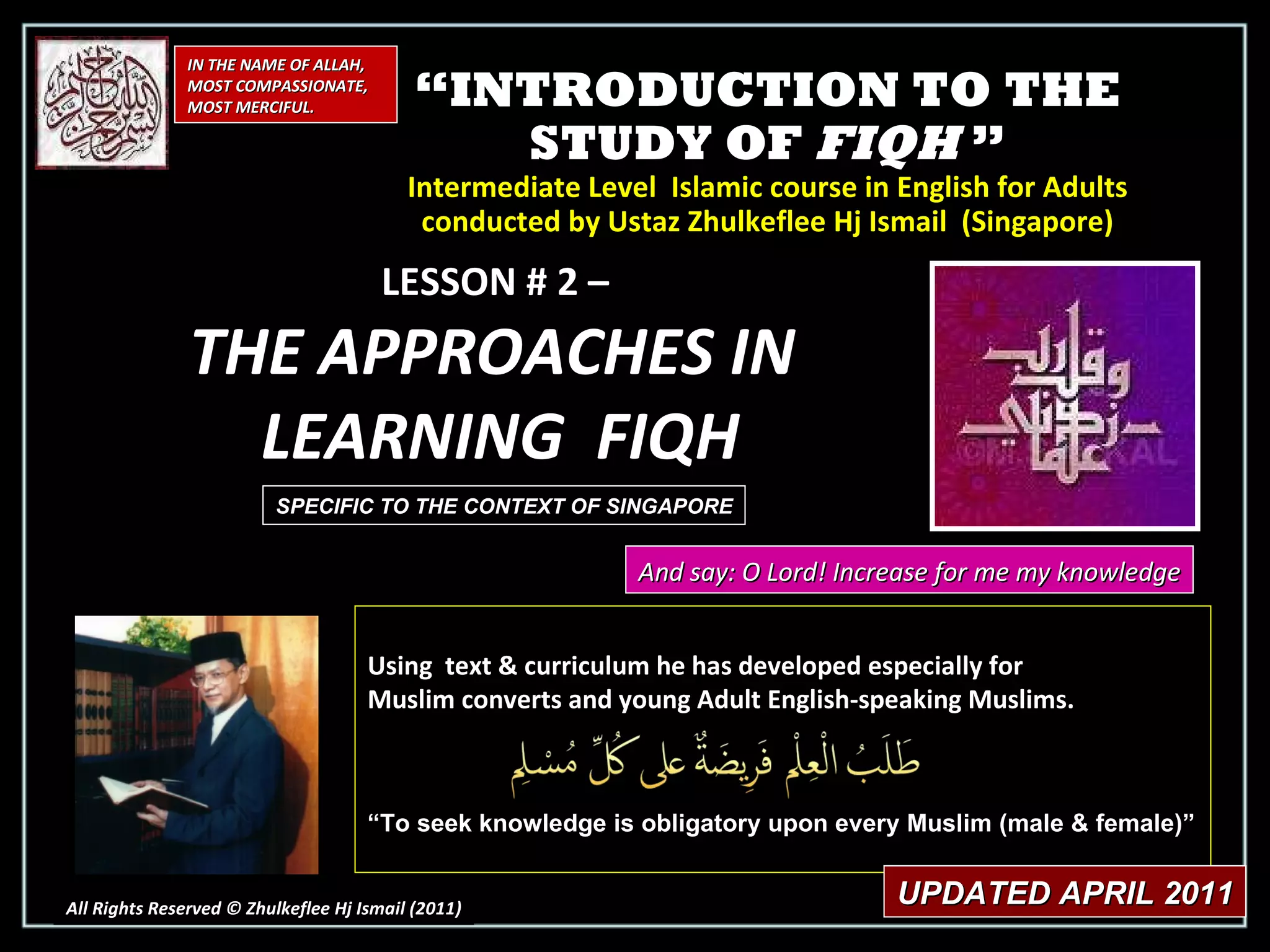
“ INTRODUCTION TO THE STUDY OF  FIQH  ” Intermediate Level  Islamic course in English for Adults conducted by Ustaz Zhulkeflee Hj Ismail  (Singapore) IN THE NAME OF ALLAH, MOST COMPASSIONATE, MOST MERCIFUL. All Rights Reserved © Zhulkeflee Hj Ismail (2011 ) LESSON # 2 –  THE APPROACHES IN  LEARNING  FIQH And say: O Lord! Increase for me my knowledge Using  text & curriculum he has developed especially for  Muslim converts and young Adult English-speaking Muslims.  “ To seek knowledge is obligatory upon every Muslim (male & female)” UPDATED APRIL 2011 SPECIFIC TO THE CONTEXT OF SINGAPORE
All Rights Reserved © Zhulkeflee Hj Ismail (2011 )
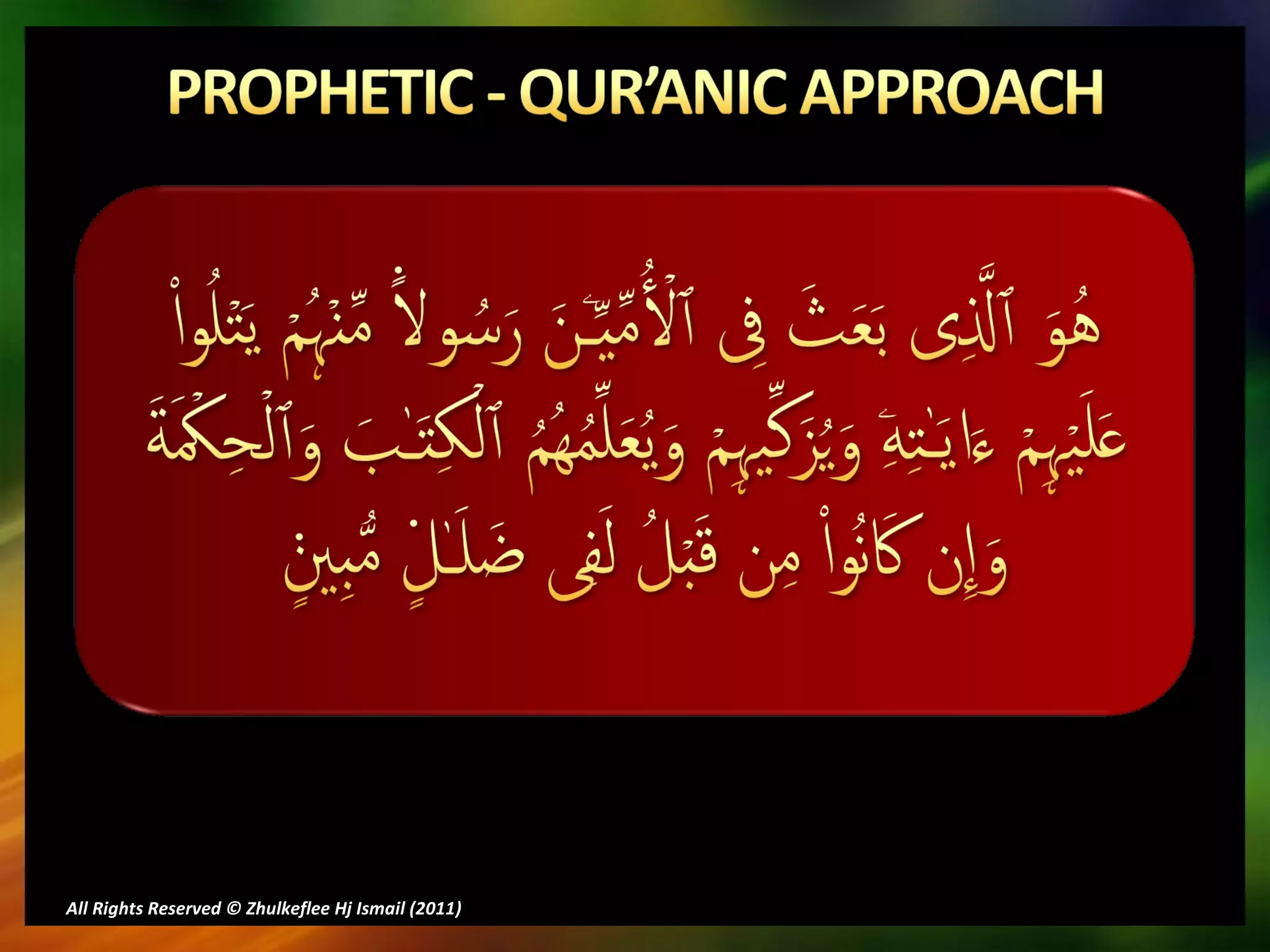
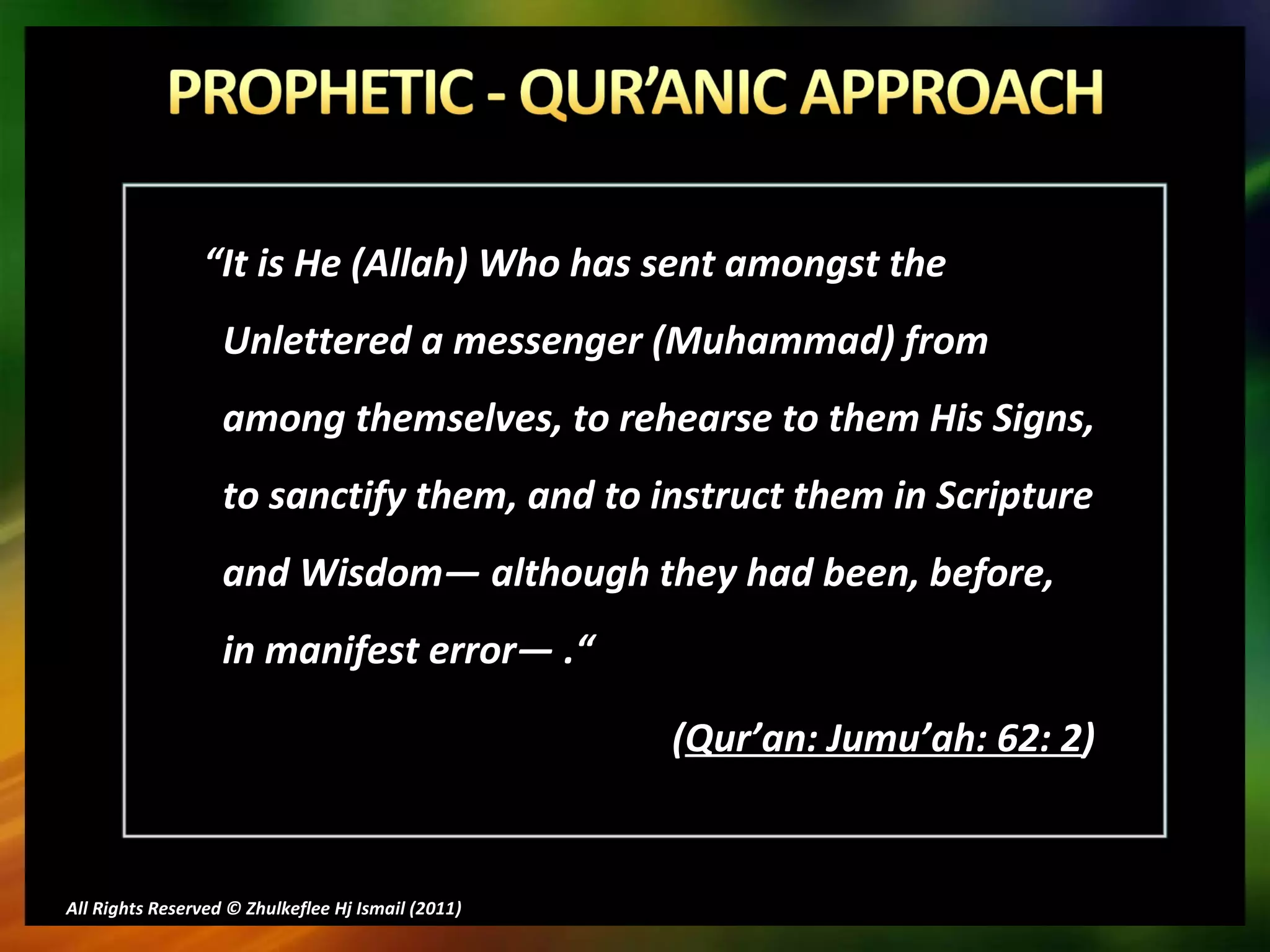
“ It is He (Allah) Who has sent amongst the Unlettered a messenger (Muhammad) from among themselves, to rehearse to them His Signs, to sanctify them, and to instruct them in Scripture and Wisdom― although they had been, before, in manifest error―  .“ ( Qur’an: Jumu’ah: 62: 2 ) All Rights Reserved © Zhulkeflee Hj Ismail (2011 )
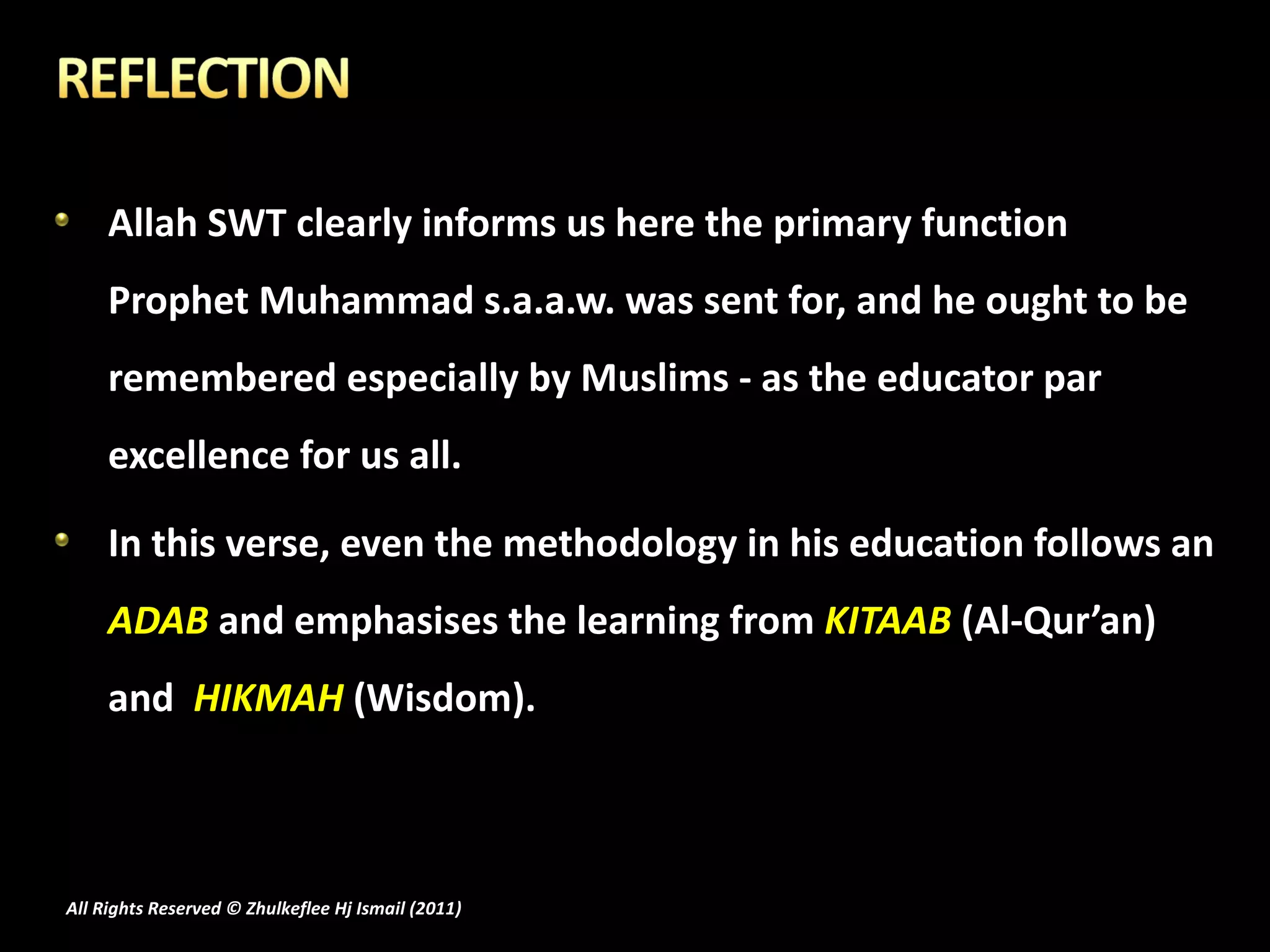
Allah SWT clearly informs us here the primary function Prophet Muhammad s.a.a.w. was sent for, and he ought to be remembered especially by Muslims - as the educator par excellence for us all. In this verse, even the methodology in his education follows an  ADAB  and emphasises the learning from  KITAAB  (Al-Qur’an) and  HIKMAH  (Wisdom). All Rights Reserved © Zhulkeflee Hj Ismail (2011 )
All Rights Reserved © Zhulkeflee Hj Ismail (2011 )
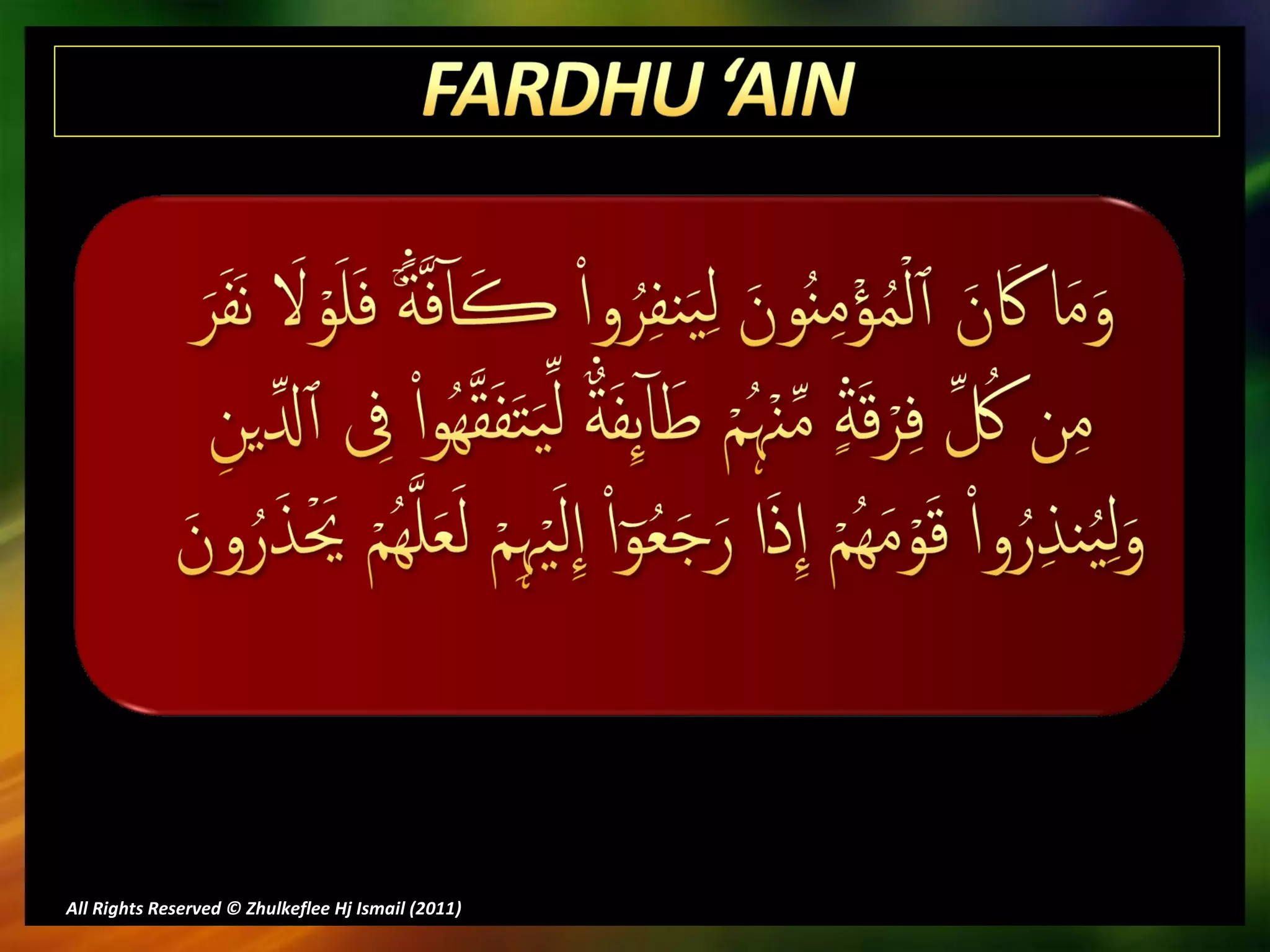
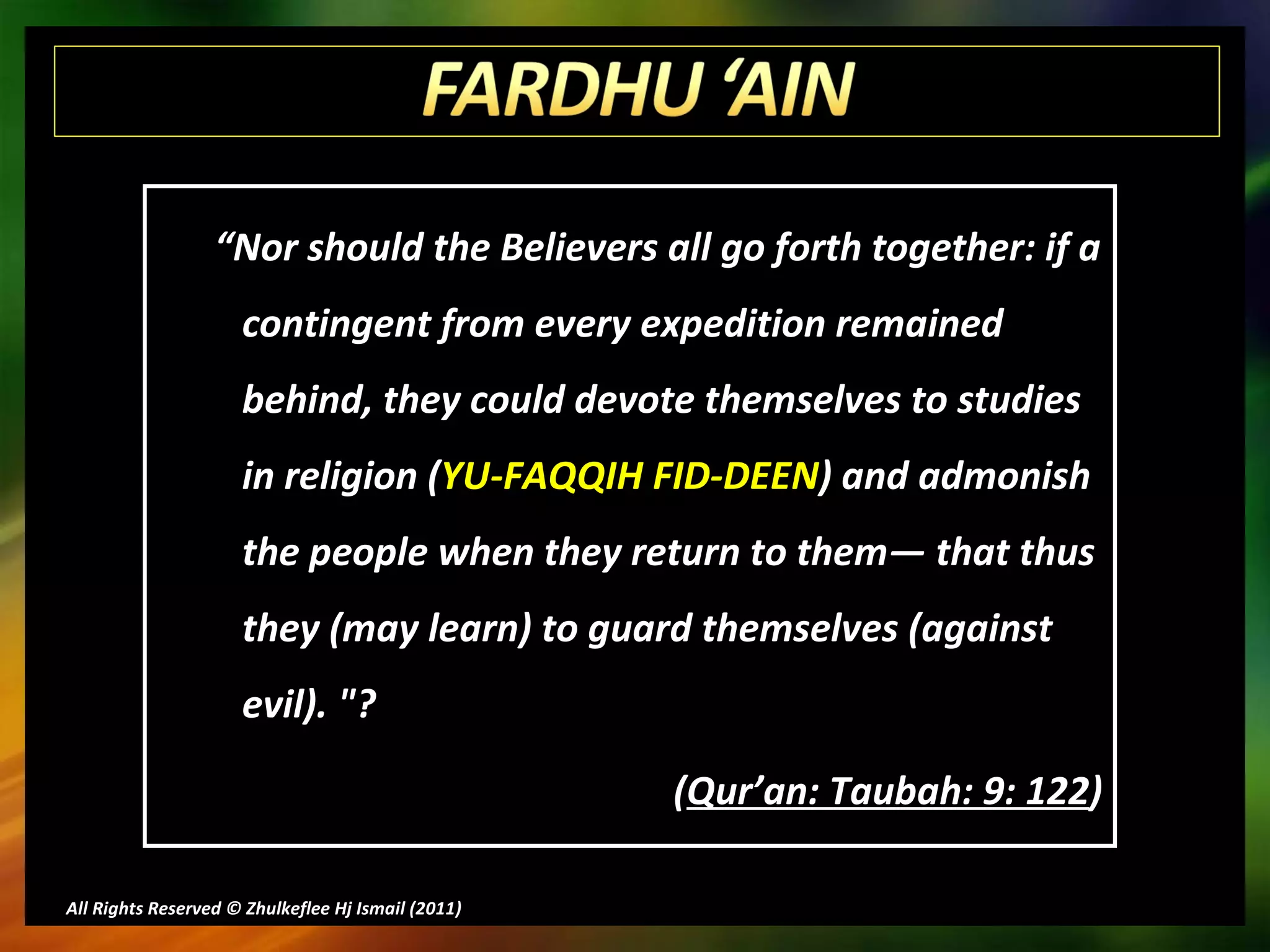
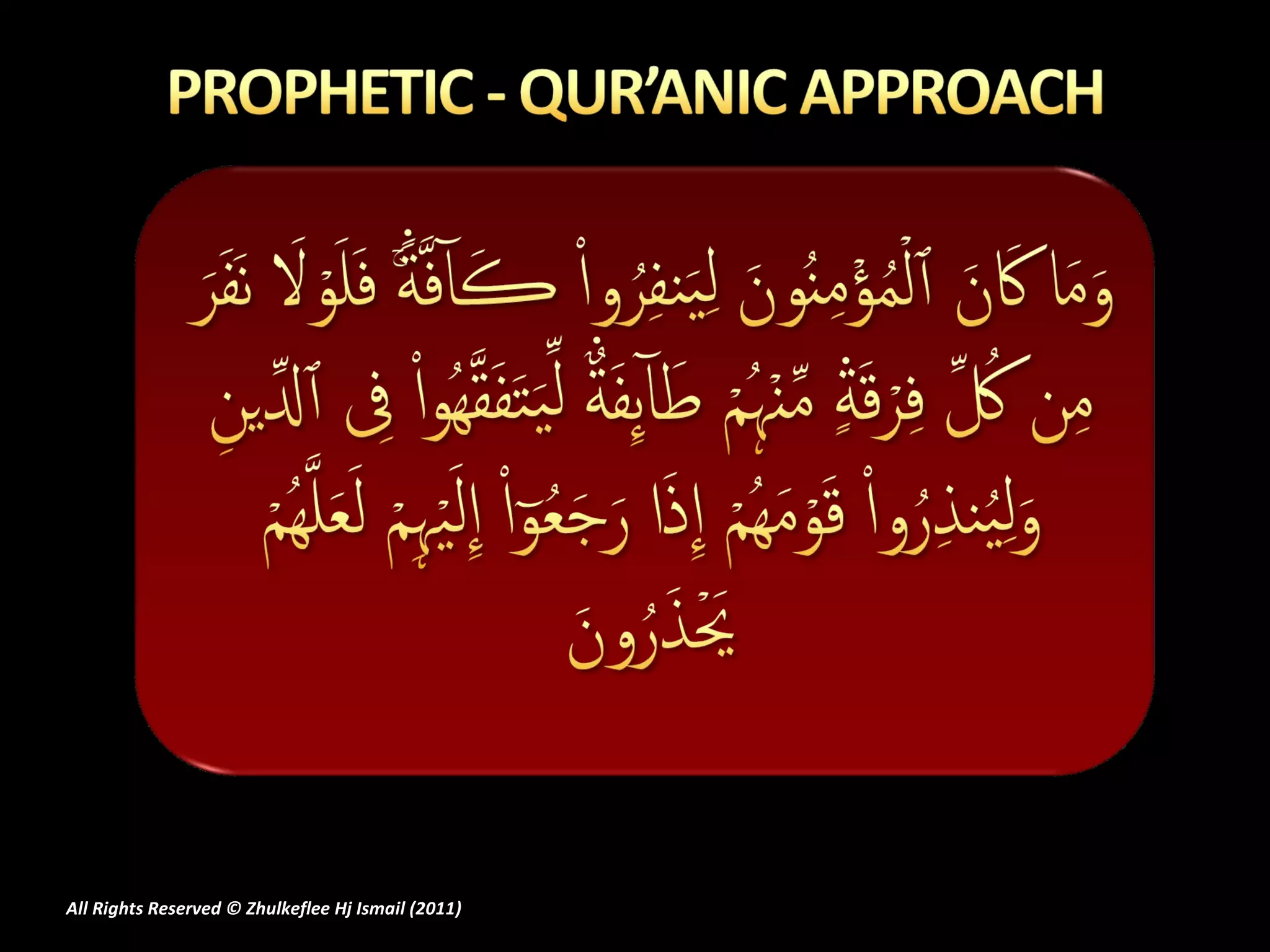
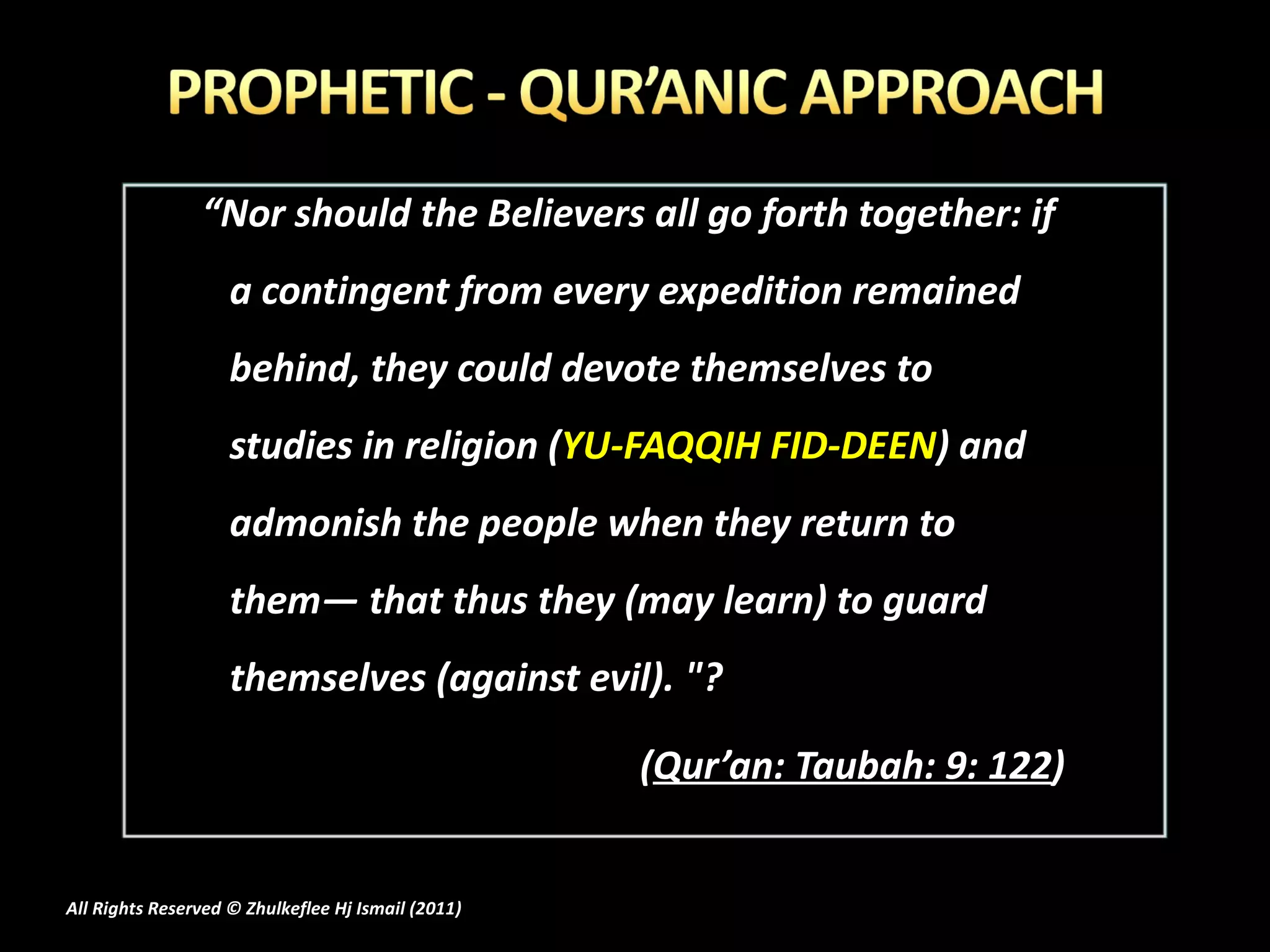
“ Nor should the Believers all go forth together: if a contingent from every expedition remained behind, they could devote themselves to studies in religion ( YU-FAQQIH FID-DEEN ) and admonish the people when they return to them― that thus they (may learn) to guard themselves (against evil). "? ( Qur’an: Taubah: 9: 122 ) All Rights Reserved © Zhulkeflee Hj Ismail (2011 )
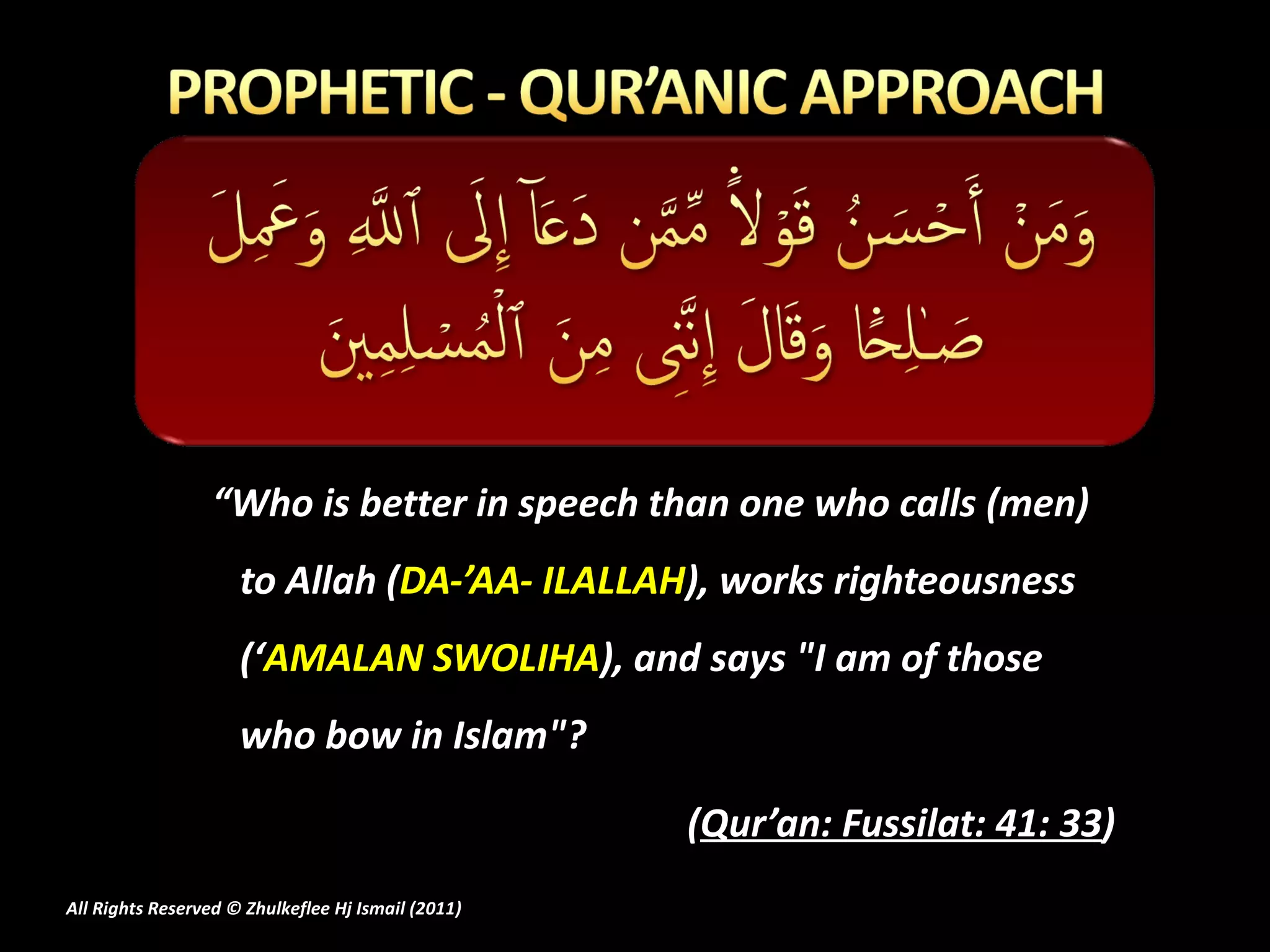
“ Who is better in speech than one who calls (men) to Allah ( DA-’AA- ILALLAH ), works righteousness (‘ AMALAN SWOLIHA ), and says "I am of those who bow in Islam"? ( Qur’an: Fussilat: 41: 33 ) All Rights Reserved © Zhulkeflee Hj Ismail (2011 )
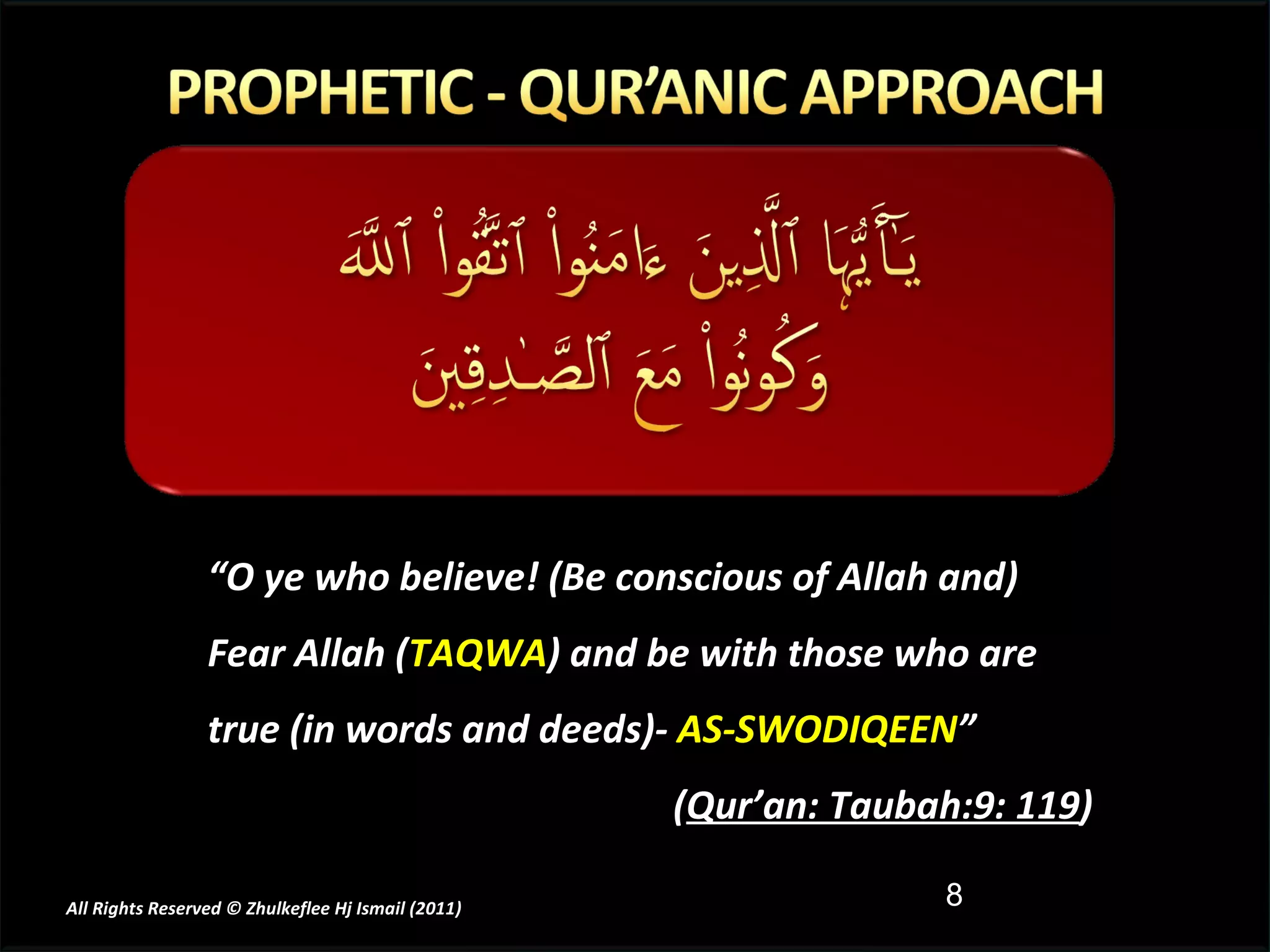
All Rights Reserved © Zhulkeflee Hj Ismail (2011 ) “ O ye who believe! (Be conscious of Allah and) Fear Allah ( TAQWA ) and be with those who are true (in words and deeds)-  AS-SWODIQEEN ”  ( Qur’an: Taubah:9: 119 )
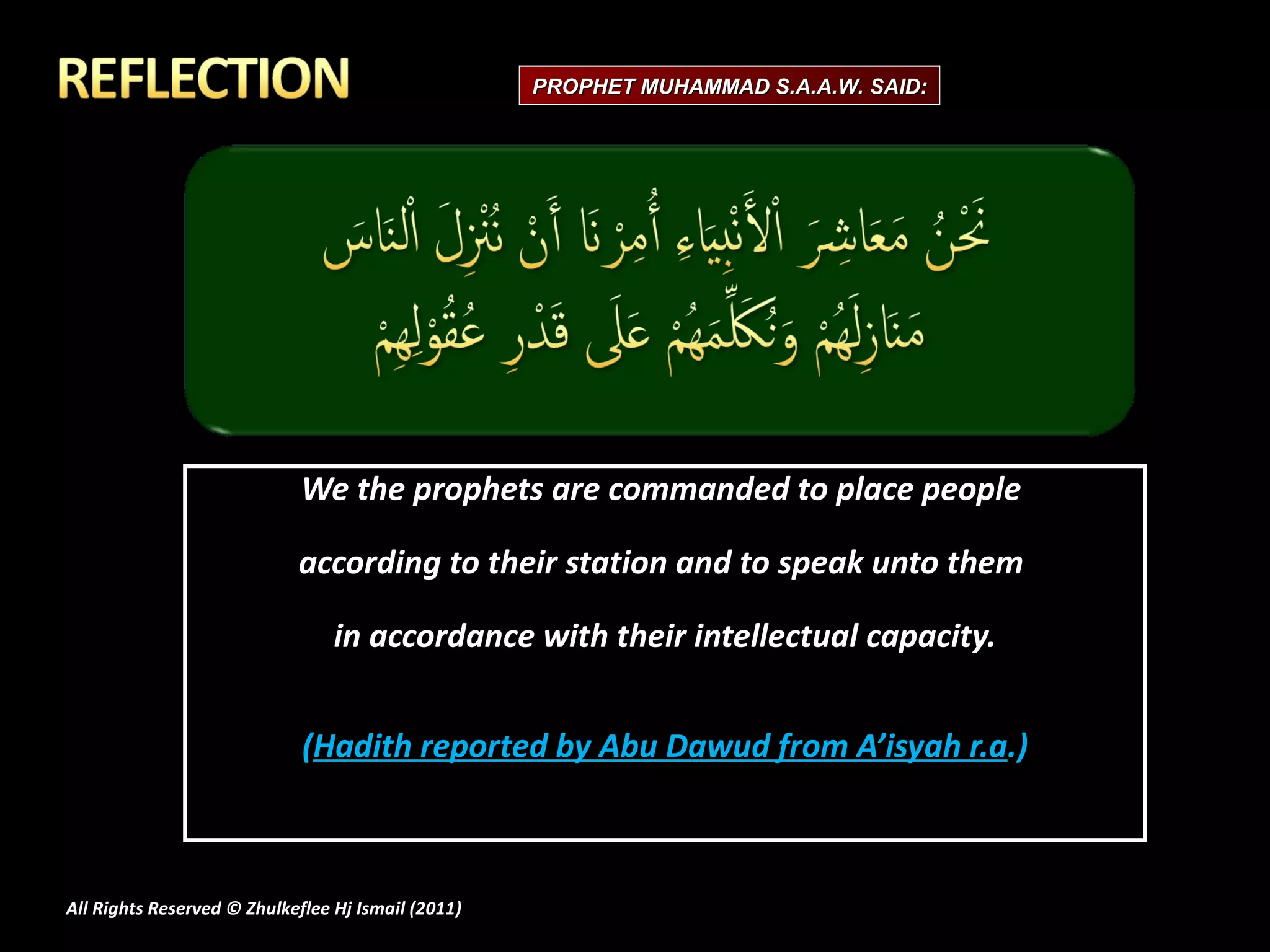
We the prophets are commanded to place people  according to their station and to speak unto them  in accordance with their intellectual capacity. ( Hadith reported by Abu Dawud from A’isyah r.a .) All Rights Reserved © Zhulkeflee Hj Ismail (2011 ) PROPHET MUHAMMAD S.A.A.W. SAID:
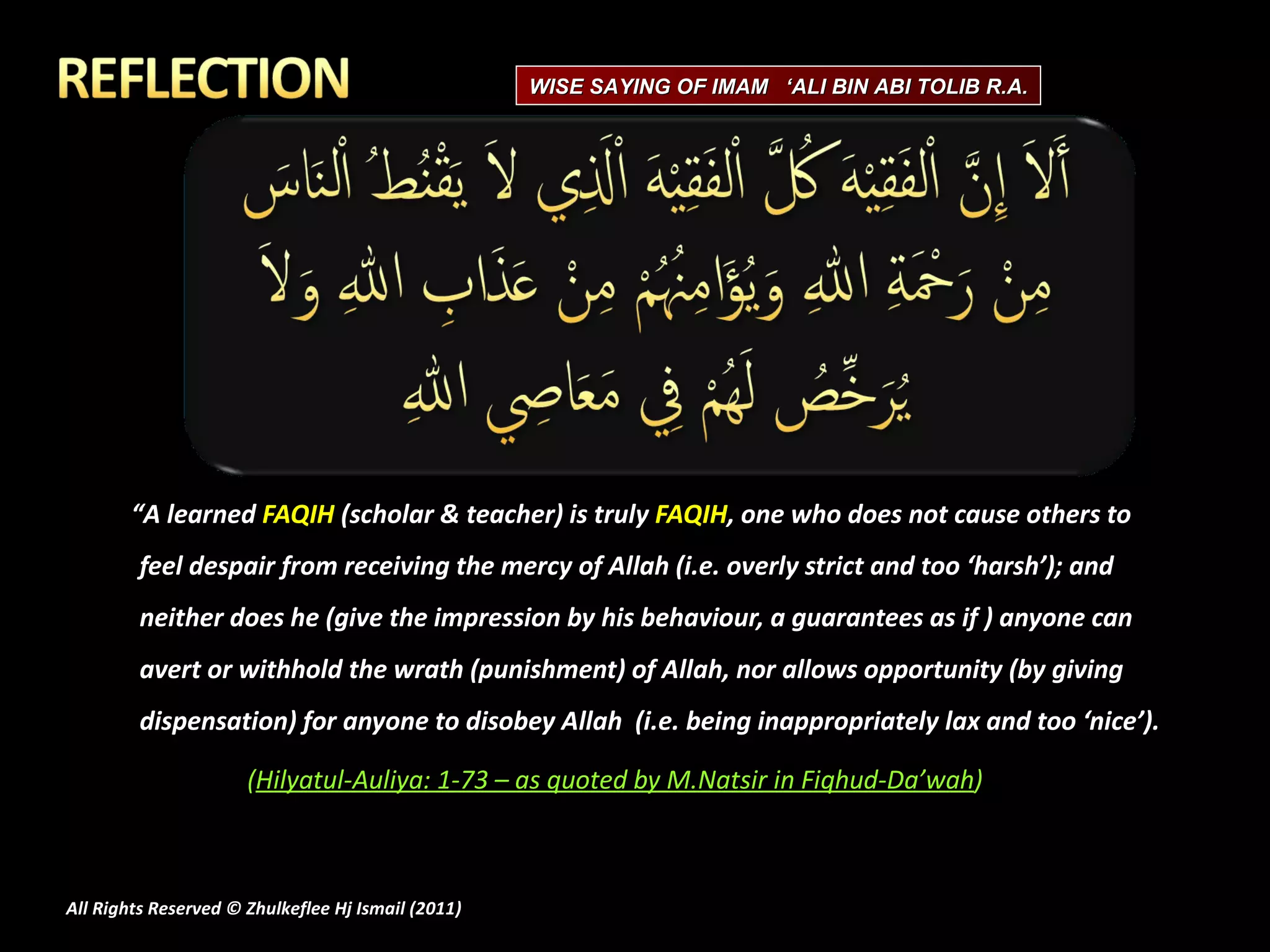
“ A learned  FAQIH  (scholar & teacher) is truly  FAQIH , one who does not cause others to feel despair from receiving the mercy of Allah (i.e. overly strict and too ‘harsh’); and neither does he (give the impression by his behaviour, a guarantees as if ) anyone can avert or withhold the wrath (punishment) of Allah, nor allows opportunity (by giving dispensation) for anyone to disobey Allah  (i.e. being inappropriately lax and too ‘nice’). ( Hilyatul-Auliya: 1-73 – as quoted by M.Natsir in Fiqhud-Da’wah ) All Rights Reserved © Zhulkeflee Hj Ismail (2011 ) WISE SAYING OF IMAM  ‘ALI BIN ABI TOLIB R.A.
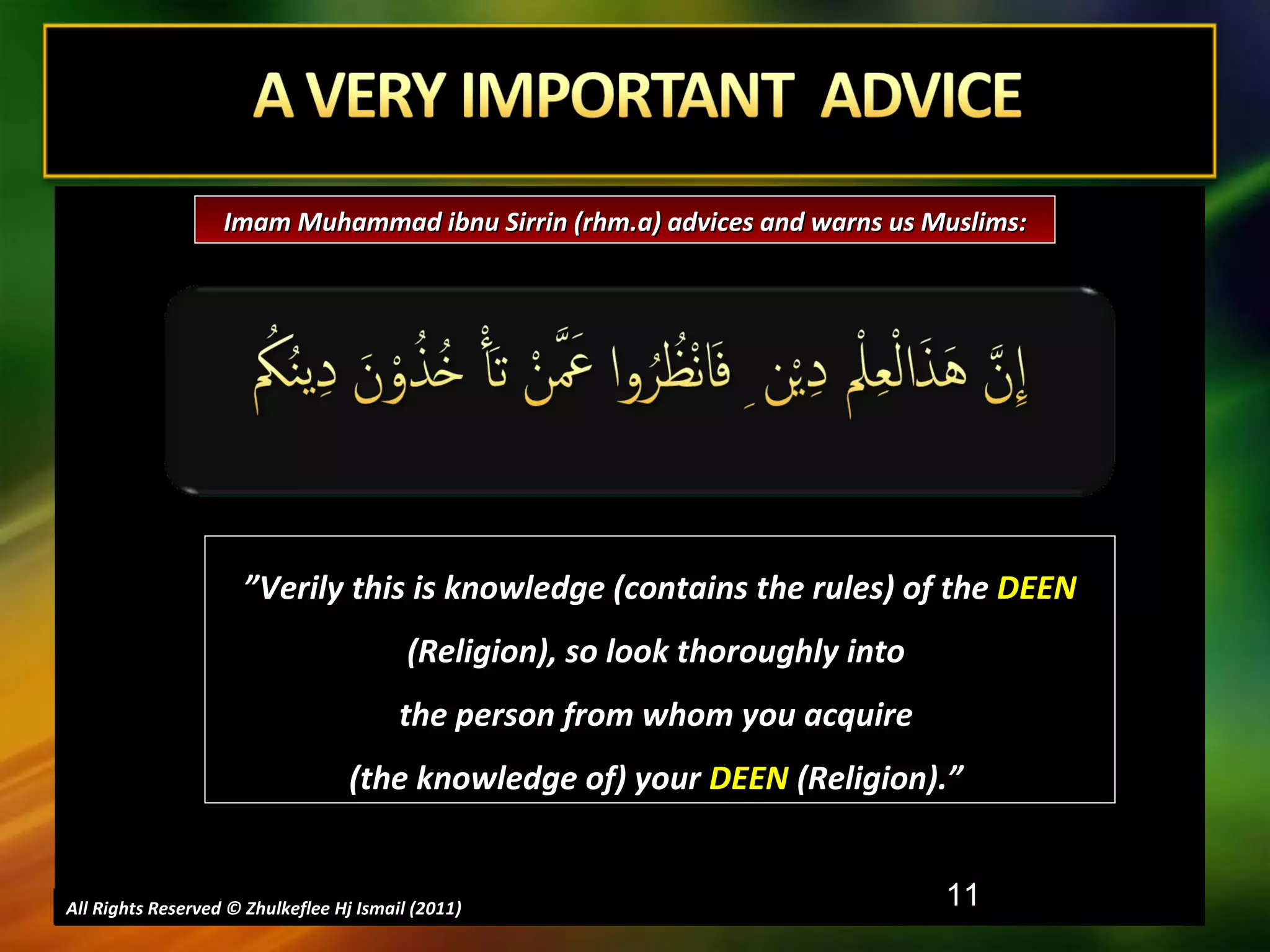
All Rights Reserved © Zhulkeflee Hj Ismail (2011 ) ” Verily this is knowledge (contains the rules) of the  DEEN  (Religion), so look thoroughly into  the person from whom you acquire  (the knowledge of) your  DEEN  (Religion).”  Imam Muhammad ibnu Sirrin (rhm.a) advices and warns us Muslims:
All Rights Reserved © Zhulkeflee Hj Ismail (2011 )
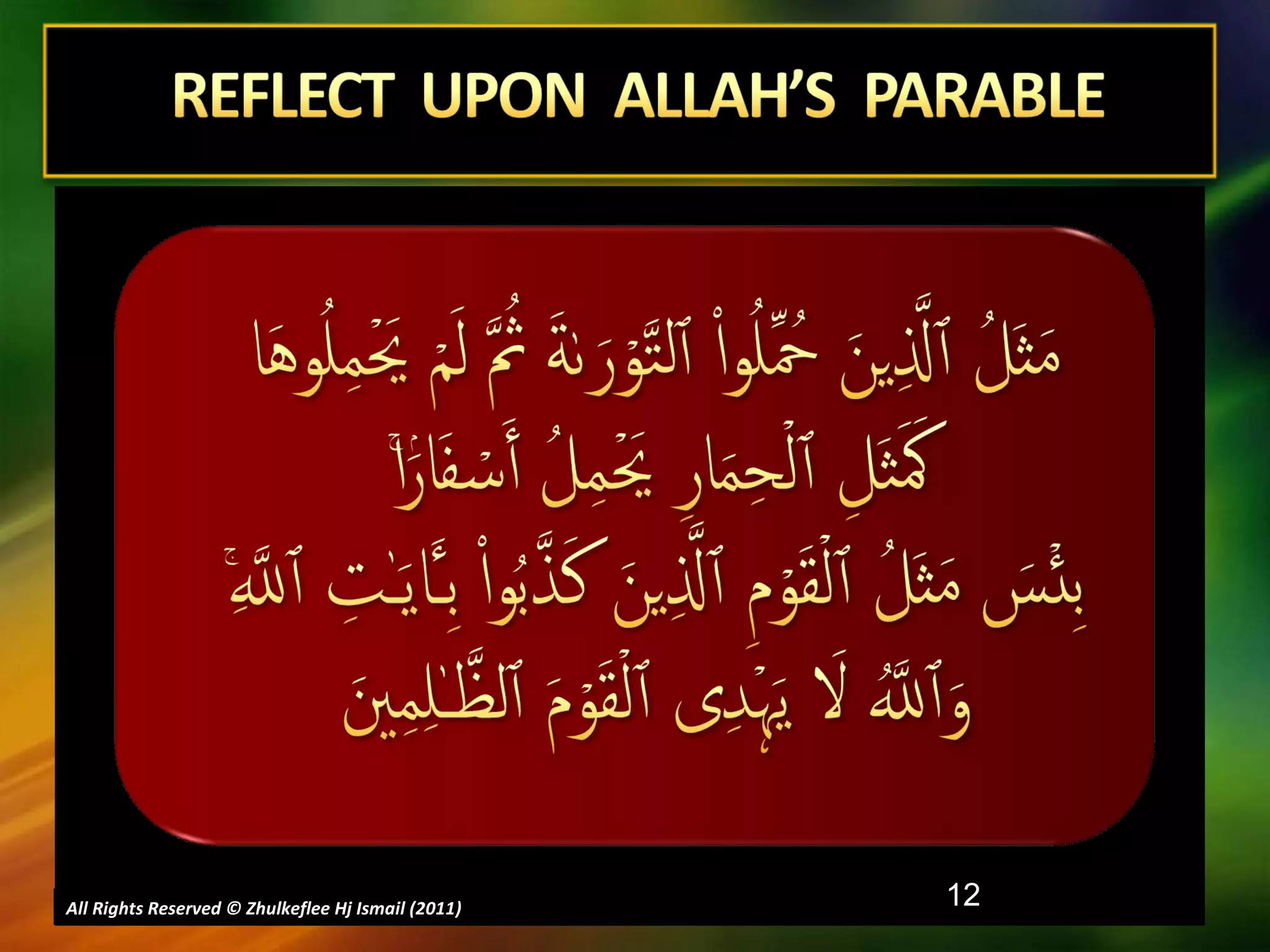
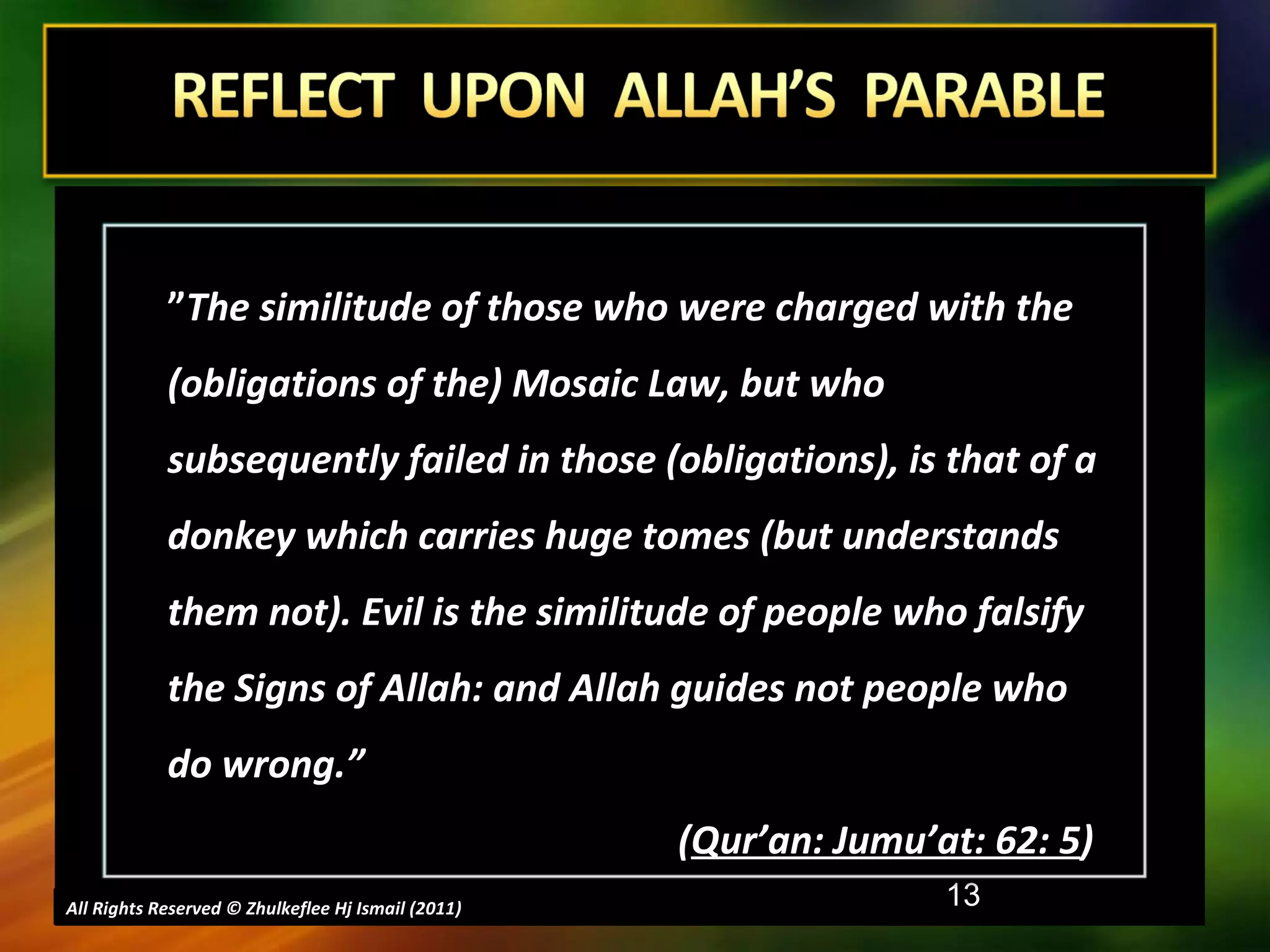
All Rights Reserved © Zhulkeflee Hj Ismail (2011 ) ” The similitude of those who were charged with the (obligations of the) Mosaic Law, but who subsequently failed in those (obligations), is that of a donkey which carries huge tomes (but understands them not). Evil is the similitude of people who falsify the Signs of Allah: and Allah guides not people who do wrong.”  ( Qur’an: Jumu’at: 62: 5 ) 
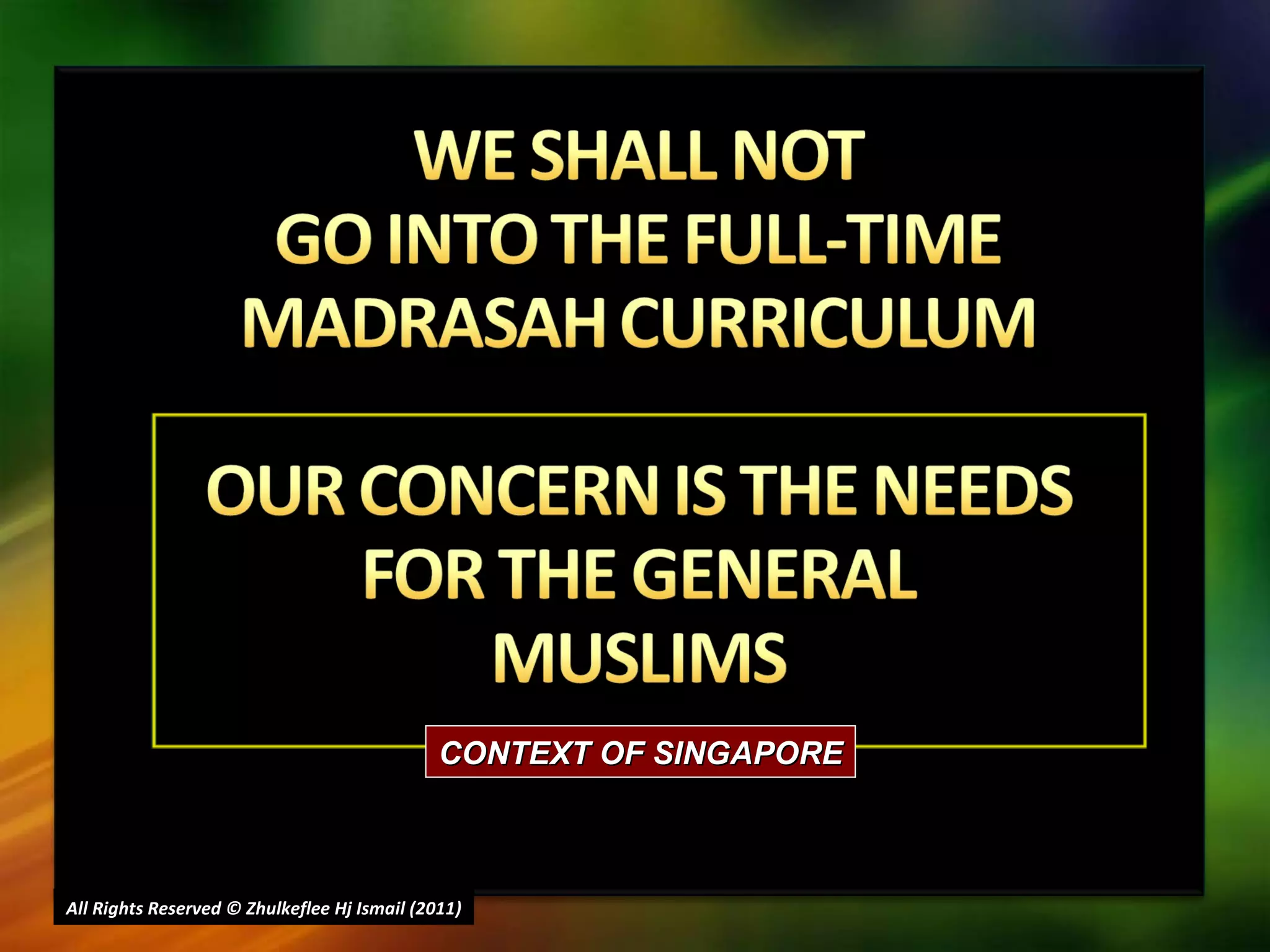
All Rights Reserved © Zhulkeflee Hj Ismail (2011 ) CONTEXT OF SINGAPORE
Ever since the colonial days, the education of Muslims  has been dualistic :- [1] In learning their religion & religious duty, traditionally it was carried out by the community, as before the coming of the British. [2] Then came the state schooling system – for Malay/Muslims it began with vernacular schools with Islamic knowledge. [3] Later even this conflated into the English medium with IRK (Islamic religious knowledge) – but later IRK was scrapped. All Rights Reserved © Zhulkeflee Hj Ismail (2011 )
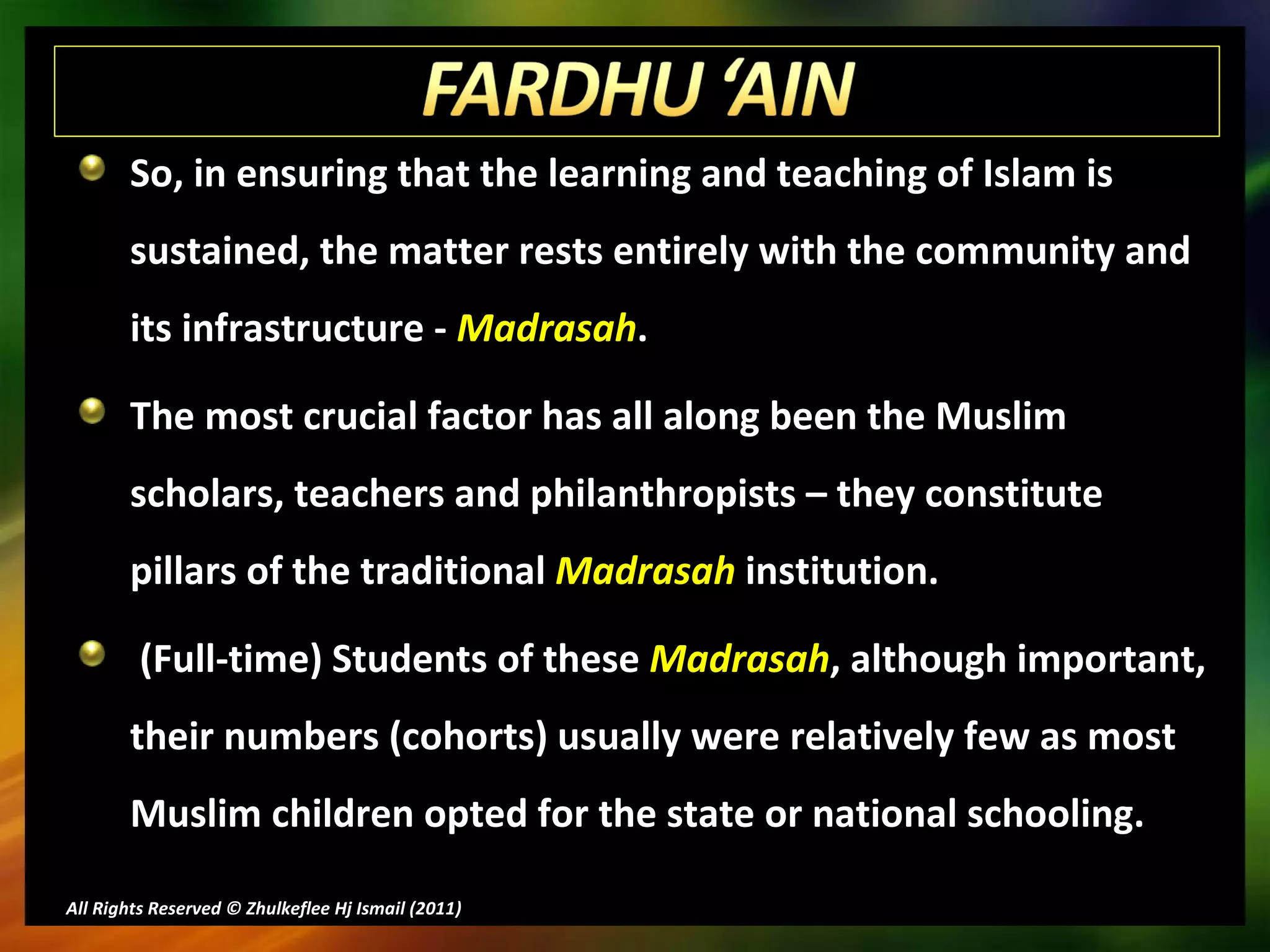
So, in ensuring that the learning and teaching of Islam is sustained, the matter rests entirely with the community and its infrastructure -  Madrasah .  The most crucial factor has all along been the Muslim scholars, teachers and philanthropists – they constitute pillars of the traditional  Madrasah  institution.  (Full-time) Students of these  Madrasah , although important, their numbers (cohorts) usually were relatively few as most Muslim children opted for the state or national schooling. All Rights Reserved © Zhulkeflee Hj Ismail (2011 )
All Rights Reserved © Zhulkeflee Hj Ismail (2011 )
All Rights Reserved © Zhulkeflee Hj Ismail (2011 ) “ Nor should the Believers all go forth together: if a contingent from every expedition remained behind, they could devote themselves to studies in religion ( YU-FAQQIH FID-DEEN ) and admonish the people when they return to them― that thus they (may learn) to guard themselves (against evil). "? ( Qur’an: Taubah: 9: 122 )
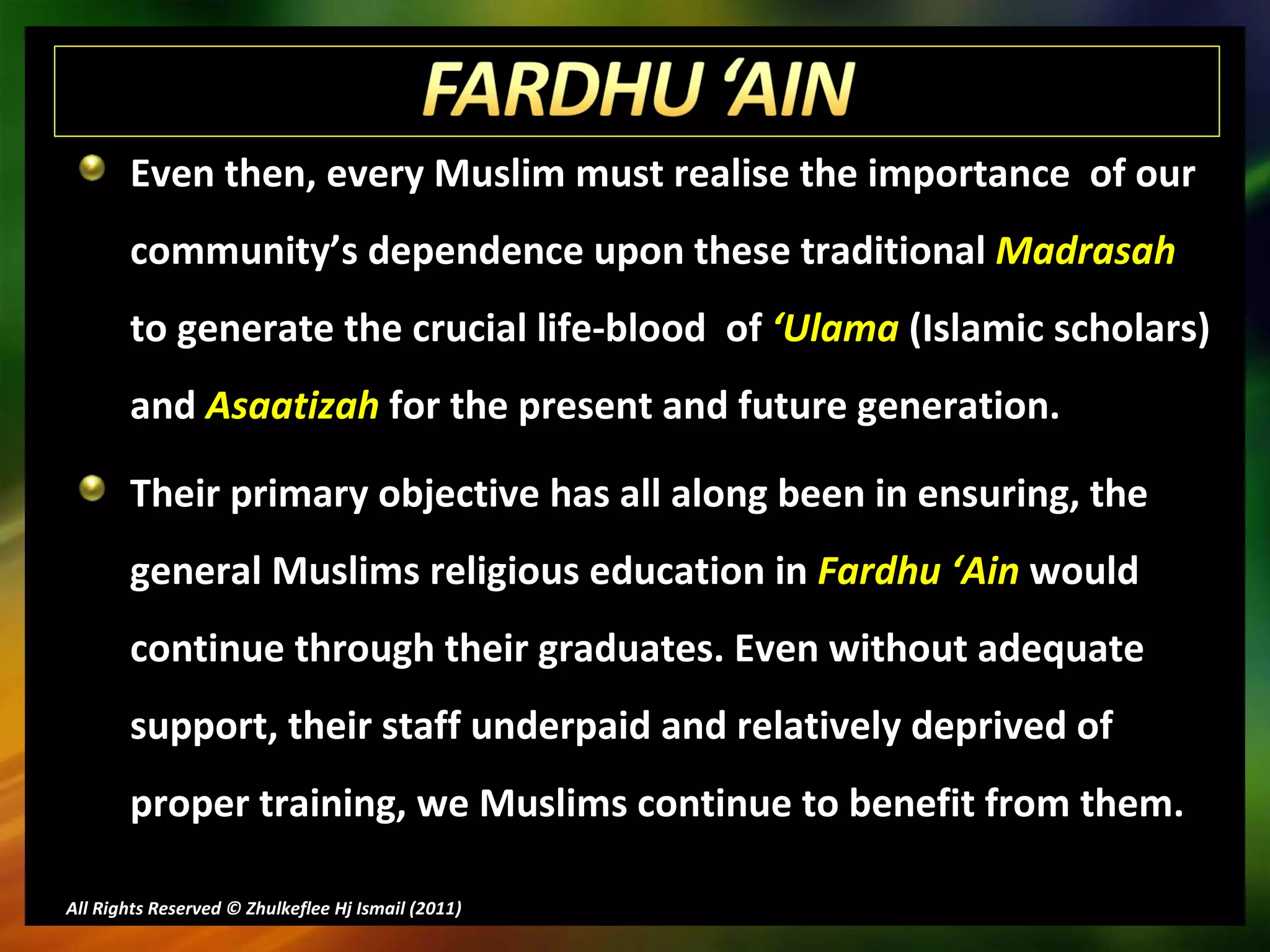
Even then, every Muslim must realise the importance  of our community’s dependence upon these traditional  Madrasah  to generate the crucial life-blood  of  ‘Ulama  (Islamic scholars) and  Asaatizah  for the present and future generation.  Their primary objective has all along been in ensuring, the general Muslims religious education in  Fardhu ‘Ain  would continue through their graduates. Even without adequate support, their staff underpaid and relatively deprived of proper training, we Muslims continue to benefit from them.  All Rights Reserved © Zhulkeflee Hj Ismail (2011 )
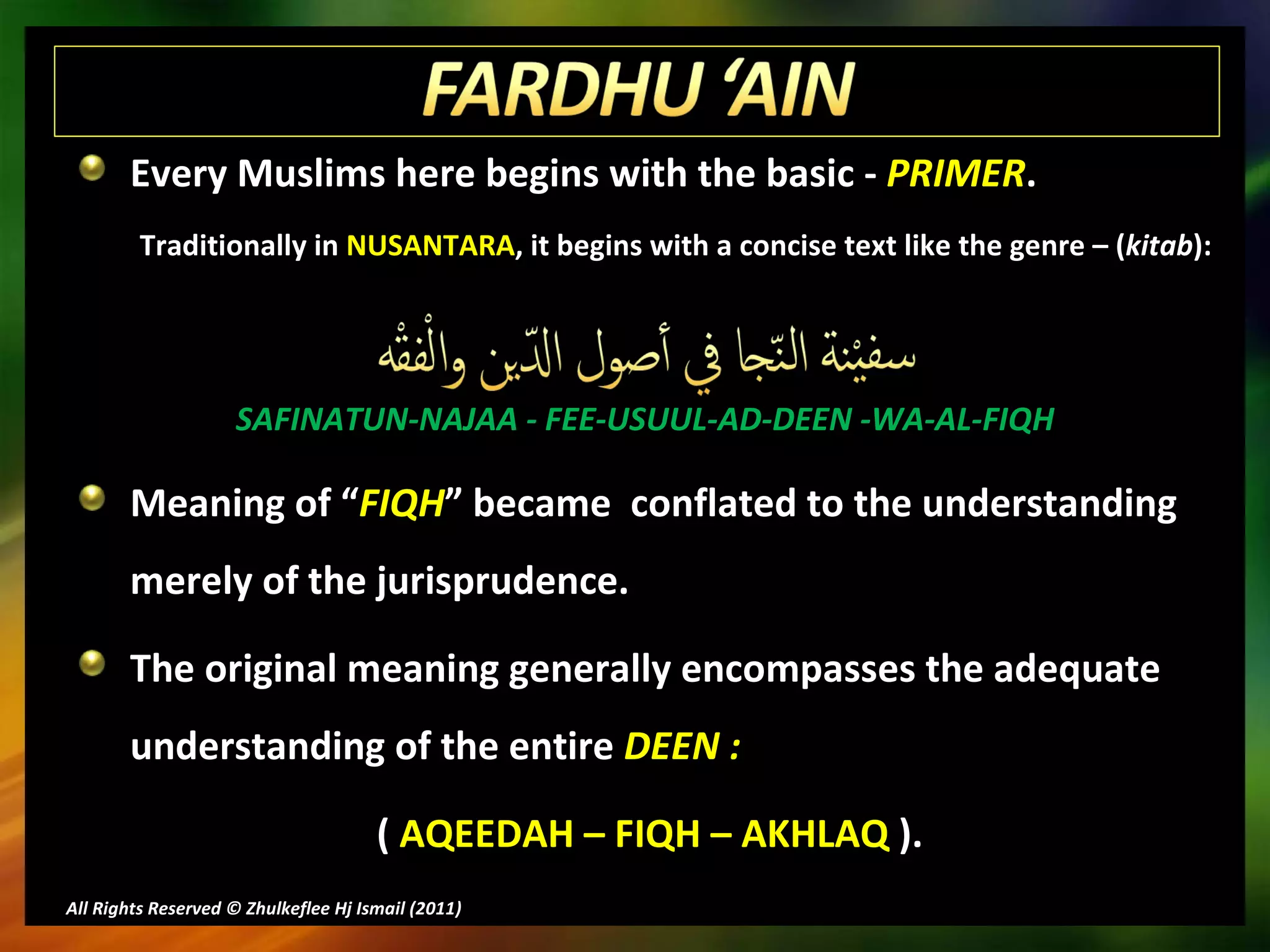
Every Muslims here begins with the basic -  PRIMER . Traditionally in  NUSANTARA , it begins with a concise text like the genre – ( kitab ): SAFINATUN-NAJAA - FEE-USUUL-AD-DEEN -WA-AL-FIQH Meaning of “ FIQH ” became  conflated to the understanding merely of the jurisprudence. The original meaning generally encompasses the adequate understanding of the entire  DEEN : (  AQEEDAH – FIQH – AKHLAQ  ). All Rights Reserved © Zhulkeflee Hj Ismail (2011 )
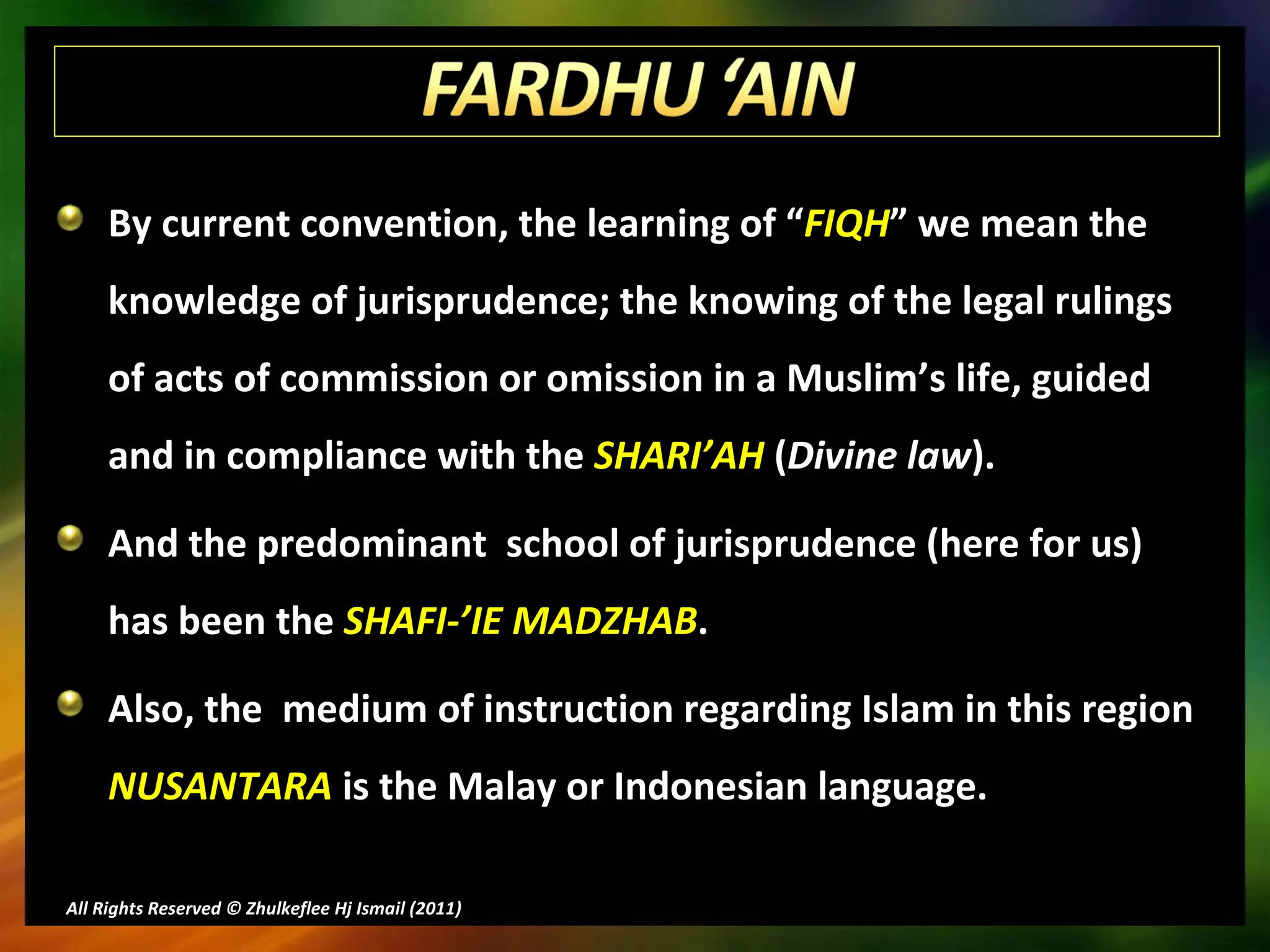
By current convention, the learning of “ FIQH ” we mean the knowledge of jurisprudence; the knowing of the legal rulings of acts of commission or omission in a Muslim’s life, guided and in compliance with the  SHARI’AH  ( Divine law ). And the predominant  school of jurisprudence (here for us) has been the  SHAFI-’IE MADZHAB . Also, the  medium of instruction regarding Islam in this region  NUSANTARA  is the Malay or Indonesian language. All Rights Reserved © Zhulkeflee Hj Ismail (2011 )
All Rights Reserved © Zhulkeflee Hj Ismail (2011 ) CONTEXT OF SINGAPORE
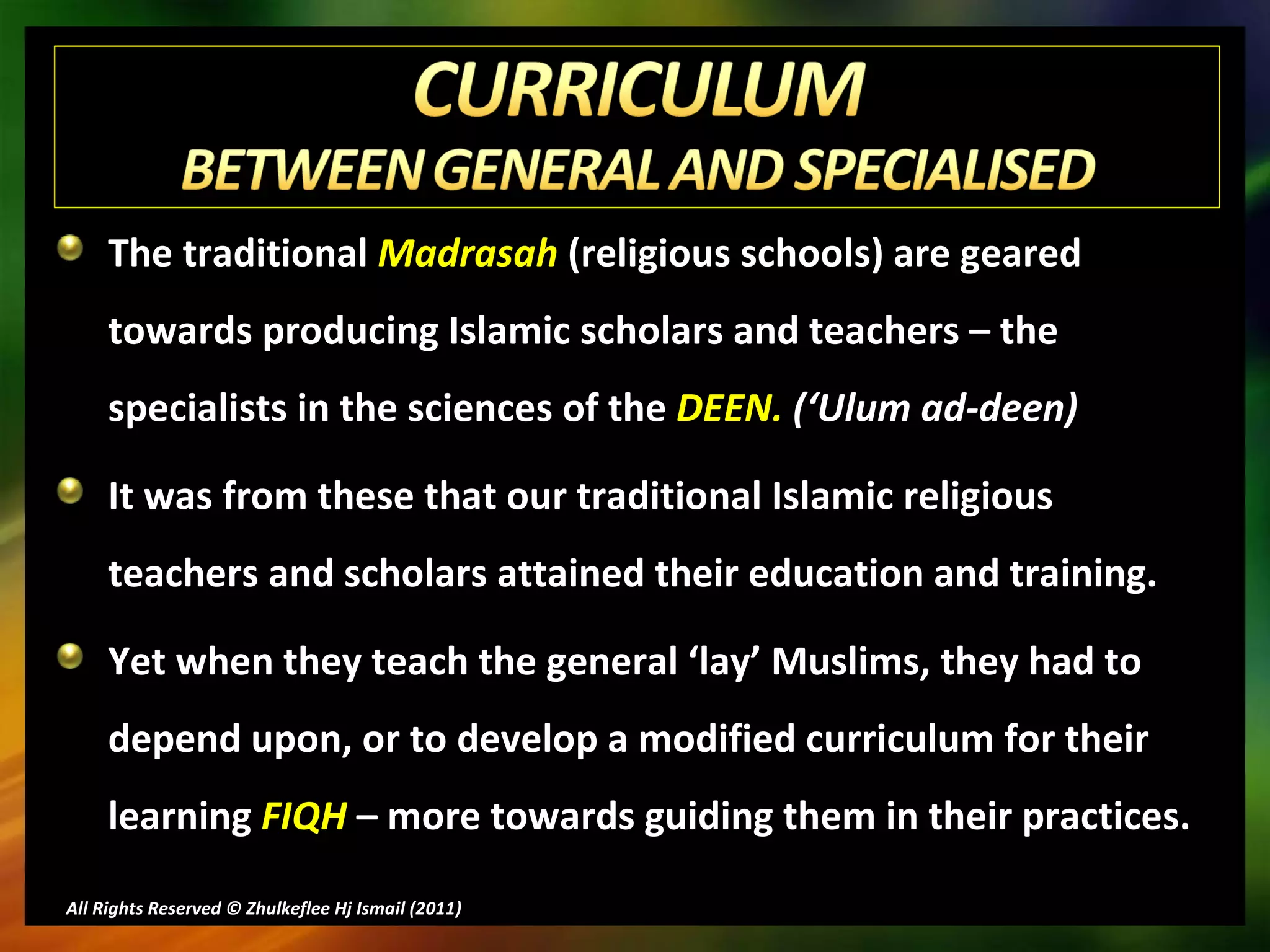
The traditional  Madrasah  (religious schools) are geared towards producing Islamic scholars and teachers – the specialists in the sciences of the  DEEN.  (‘Ulum ad-deen) It was from these that our traditional Islamic religious teachers and scholars attained their education and training.  Yet when they teach the general ‘lay’ Muslims, they had to depend upon, or to develop a modified curriculum for their learning  FIQH  – more towards guiding them in their practices. All Rights Reserved © Zhulkeflee Hj Ismail (2011 )
Thus we were fortunate for such capable Islamic scholars / teachers (although only very few) in the past who were able to present, what was needed by general Muslims for their education on Islam, rather than a wholesale regurgitation of the traditional  Madrasah  curriculum which they themselves had learnt. All Rights Reserved © Zhulkeflee Hj Ismail (2011 )
Although this approach may have proven to be the most effective and prevalent for the general masses in the past, yet we must ensure that it be constantly revised and further  developed in accordance with the context of evolving societal conditions of Muslims. As for those in the full-time  Madrasah , due to the specialised nature of their education, it should be separately assessed regarding their contextual needs. All Rights Reserved © Zhulkeflee Hj Ismail (2011 )
Our suggestion here is for Muslims in general learning Islam outside the  Madrasah  – which do not need to have similar curriculum. Notwithstanding these general Muslims, there has been a few exceptions amongst them, those more committed who wished for a specialised traditional Curriculum – usually comprising working adults engaged in a life-long continual learning  path similar to the full-time  Madrasah  students. All Rights Reserved © Zhulkeflee Hj Ismail (2011 )
They were usually enrolled in a private ‘ HALAQAH ’ (study circle) outside the  Madrasah , usually conducted by very senior  Sheikh  , for only small selected group of very dedicated  ‘lay’ Muslims with passion for such knowledge, and with aspirations to follow in the footsteps of their teachers.  Many of whom were granted permission to even became Islamic teachers and scholars, after undergoing tutelage and mentoring over  some years. All Rights Reserved © Zhulkeflee Hj Ismail (2011 )
All Rights Reserved © Zhulkeflee Hj Ismail (2011 ) CONTEXT OF SINGAPORE
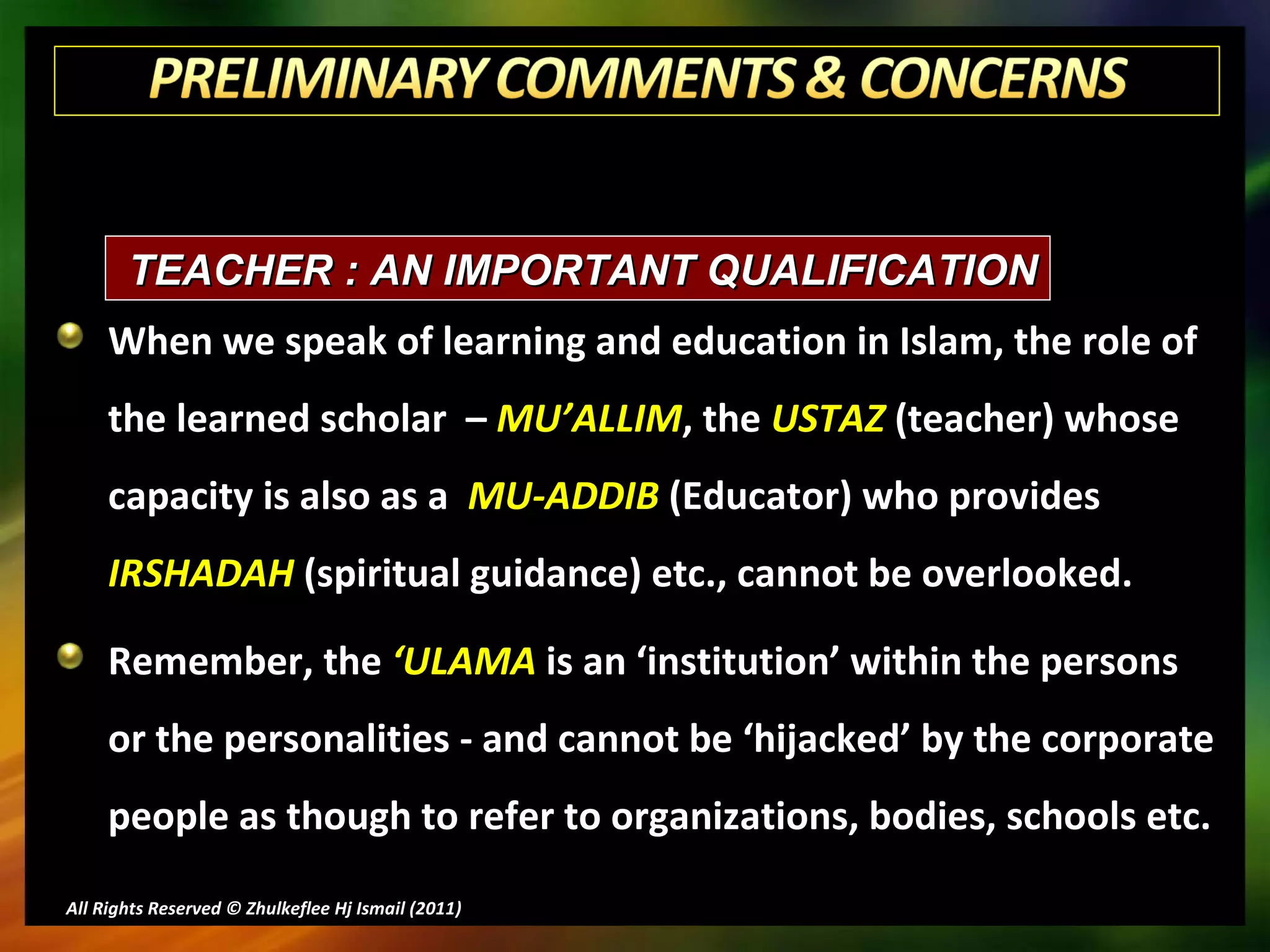
When we speak of learning and education in Islam, the role of the learned scholar  –  MU’ALLIM , the  USTAZ  (teacher) whose capacity is also as a  MU-ADDIB  (Educator) who provides  IRSHADAH  (spiritual guidance) etc., cannot be overlooked.  Remember, the  ‘ULAMA  is an ‘institution’ within the persons or the personalities - and cannot be ‘hijacked’ by the corporate people as though to refer to organizations, bodies, schools etc. All Rights Reserved © Zhulkeflee Hj Ismail (2011 ) TEACHER : AN IMPORTANT QUALIFICATION
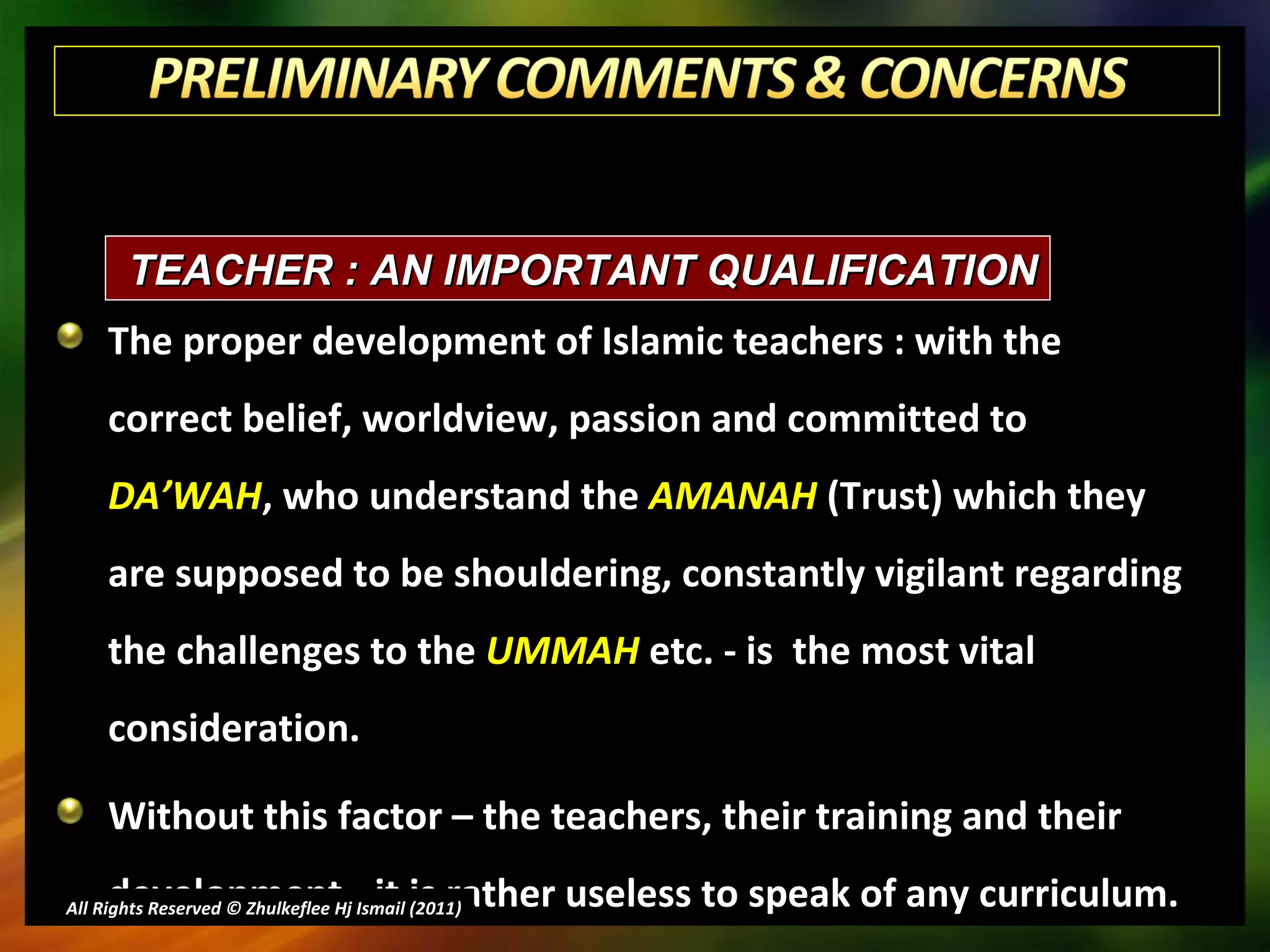
The proper development of Islamic teachers : with the correct belief, worldview, passion and committed to  DA’WAH , who understand the  AMANAH  (Trust) which they are supposed to be shouldering, constantly vigilant regarding the challenges to the  UMMAH  etc. - is  the most vital consideration. Without this factor – the teachers, their training and their development - it is rather useless to speak of any curriculum. All Rights Reserved © Zhulkeflee Hj Ismail (2011 ) TEACHER : AN IMPORTANT QUALIFICATION
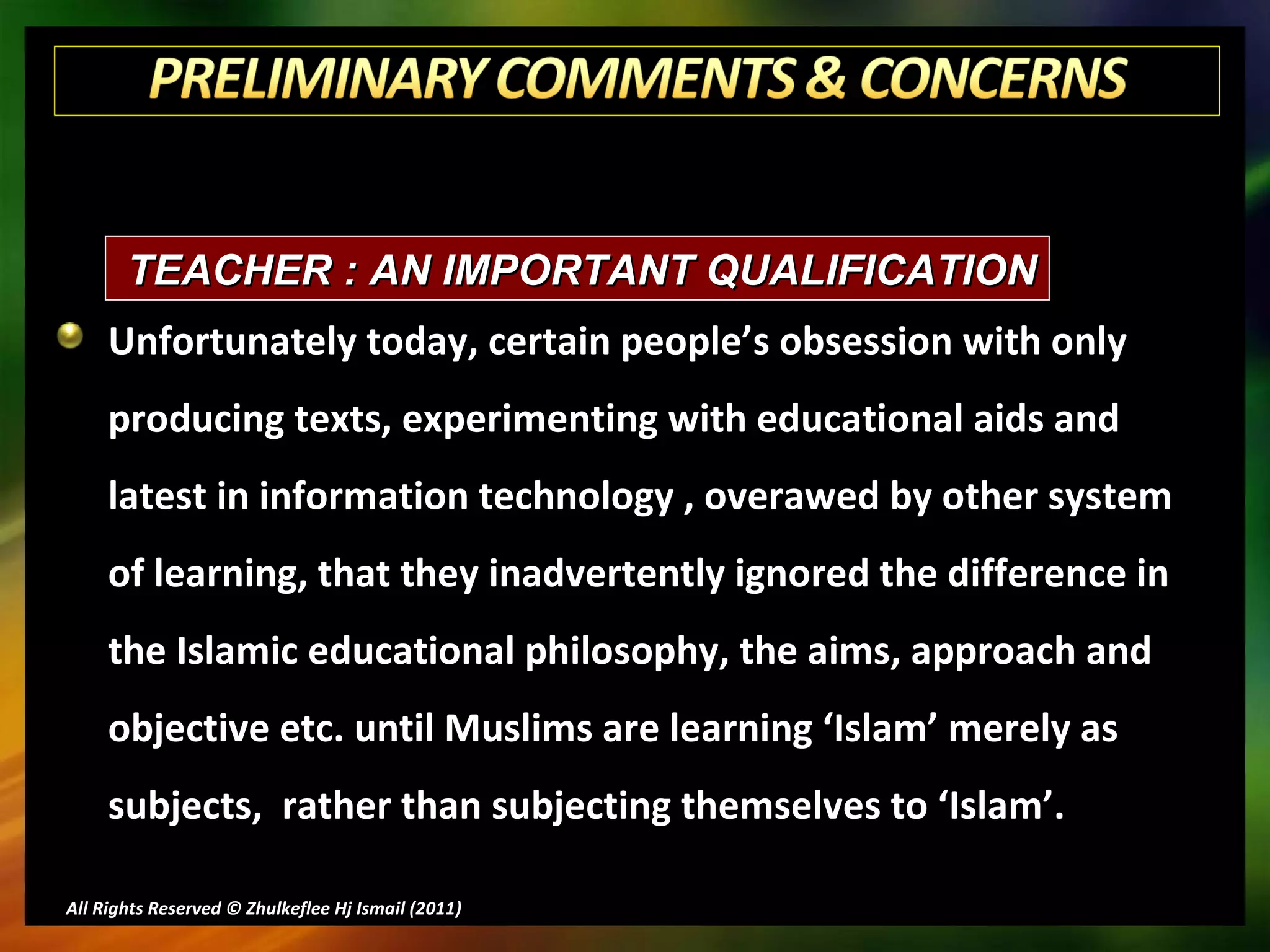
Unfortunately today, certain people’s obsession with only producing texts, experimenting with educational aids and latest in information technology , overawed by other system of learning, that they inadvertently ignored the difference in the Islamic educational philosophy, the aims, approach and objective etc. until Muslims are learning ‘Islam’ merely as subjects,  rather than subjecting themselves to ‘Islam’. All Rights Reserved © Zhulkeflee Hj Ismail (2011 ) TEACHER : AN IMPORTANT QUALIFICATION
Thus, the tendency towards teaching  FIQH  as subjects to be taught according to whatever text / books popularly chosen may be predominant. And given that most of these books were  written as reference manual on  FIQH , the class should rather focus on students understanding, inculcating the appreciation  of how relevant these rulings are to Muslims in life. Therefore this depends much upon who is teaching  FIQH . All Rights Reserved © Zhulkeflee Hj Ismail (2011 ) TEACHER : AN IMPORTANT QUALIFICATION
It must be noted that today, with the availability of easy access to books and information on the internet; with greater reliance to self-study rather than undergoing right tutelage under the guidance of competent teachers; with the proliferations of ideologies of  groups promoting unknown agendas in the name of Islam; - Muslims being deprived of a competent teacher’s guidance in  FIQH  should be a very grave concern - indeed. All Rights Reserved © Zhulkeflee Hj Ismail (2011 ) CHALLENGES AND DEVELOPMENT
Indeed it is alarming, with people entering discourses and meddling in Islam beyond their competency  (by Muslims and even non-Muslims), and compounded by the relative ignorance of general Muslims regarding their own basics knowledge of their  DEEN . Especially when this involves specialized fields and subjects, for which they do not have any authority to be giving their opinion to the public. All Rights Reserved © Zhulkeflee Hj Ismail (2011 ) CHALLENGES AND DEVELOPMENT
Can any one claim the right to be involved in giving or engaging in serious discourse in other specialised fields like medicine or engineering without adequate knowledge?  Or even if one knows something about draughtsmanship or have read medical journals, without the proper training and approval of the true practitioners in their respective fields, messing in these would be deemed a crime – wouldn’t it? All Rights Reserved © Zhulkeflee Hj Ismail (2011 ) CHALLENGES AND DEVELOPMENT
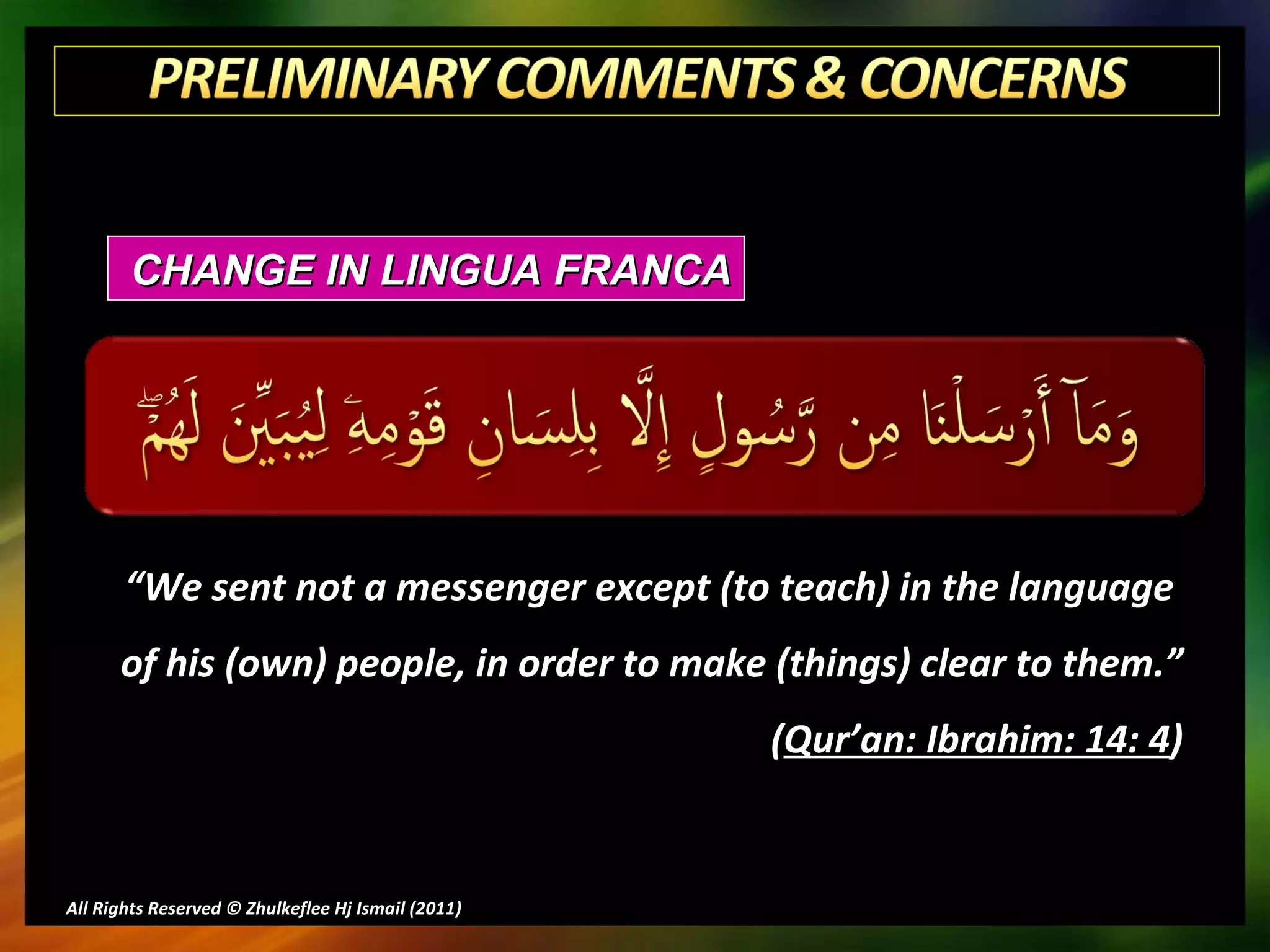
All Rights Reserved © Zhulkeflee Hj Ismail (2011 ) CHANGE IN LINGUA FRANCA “ We sent not a messenger except (to teach) in the language  of his (own) people, in order to make (things) clear to them.” ( Qur’an: Ibrahim: 14: 4 )
When the  lingua franca  for Islamic discourse is predominantly in Malay, the presence of so many of our traditionally trained  ASAATIZAH  has ensured adequate supervision to oversee and correct whatever misconceptions that may arise amongst general Muslims. But the trend now is that discourses in English has become more predominant and may replace the  lingua franca . All Rights Reserved © Zhulkeflee Hj Ismail (2011 ) CHANGE IN LINGUA FRANCA
Teaching Islam in English now is increasingly in demand and many classes are eagerly started. Who are teaching? Yet, from my experience in this field, the approach and curriculum cannot merely be by translating or converting whatever has been done in Malay into English (as some may have simplistically presumed). Or even by transplanting these from other (Western) country. All Rights Reserved © Zhulkeflee Hj Ismail (2011 ) CHANGE IN LINGUA FRANCA
Also the  MAD’U  (the audience for  DA’WAH  and students) their exposure and background, may require special responses –  viz. be they converts from other religion, youth, adults, an agnostics, secularist, sceptics, atheists, etc. A concern too, is the proficiency (or rather the lack of it) of many  ASAATIZAH  in use of English, since the teaching of Faith requires  convincing and very engaging , communication skills. All Rights Reserved © Zhulkeflee Hj Ismail (2011 ) CHANGE IN LINGUA FRANCA
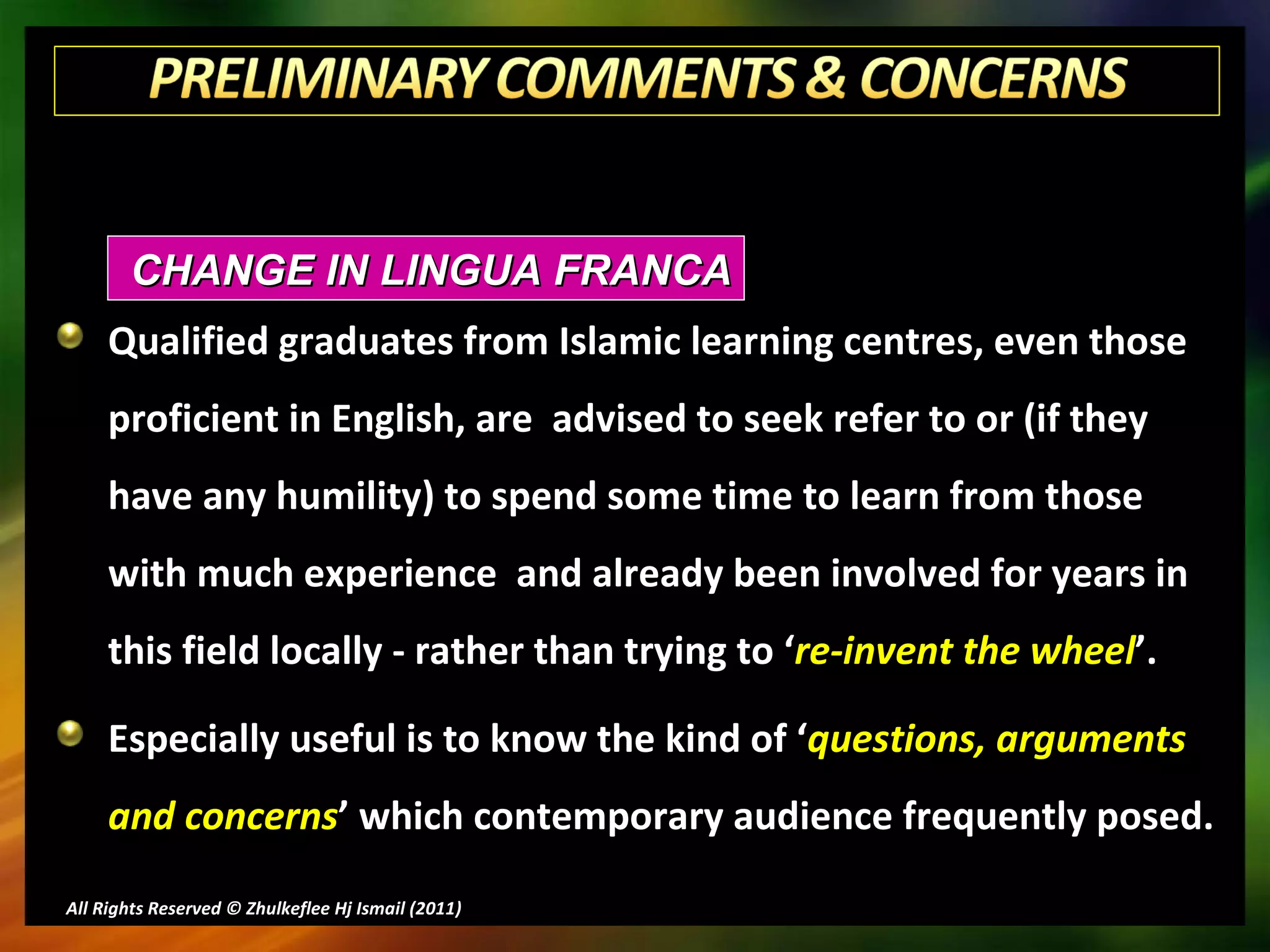
Qualified graduates from Islamic learning centres, even those proficient in English, are  advised to seek refer to or (if they have any humility) to spend some time to learn from those with much experience  and already been involved for years in this field locally - rather than trying to ‘ re-invent the wheel ’. Especially useful is to know the kind of ‘ questions, arguments and concerns ’ which contemporary audience frequently posed. All Rights Reserved © Zhulkeflee Hj Ismail (2011 ) CHANGE IN LINGUA FRANCA
All Rights Reserved © Zhulkeflee Hj Ismail (2011 ) CONTEXT OF SINGAPORE
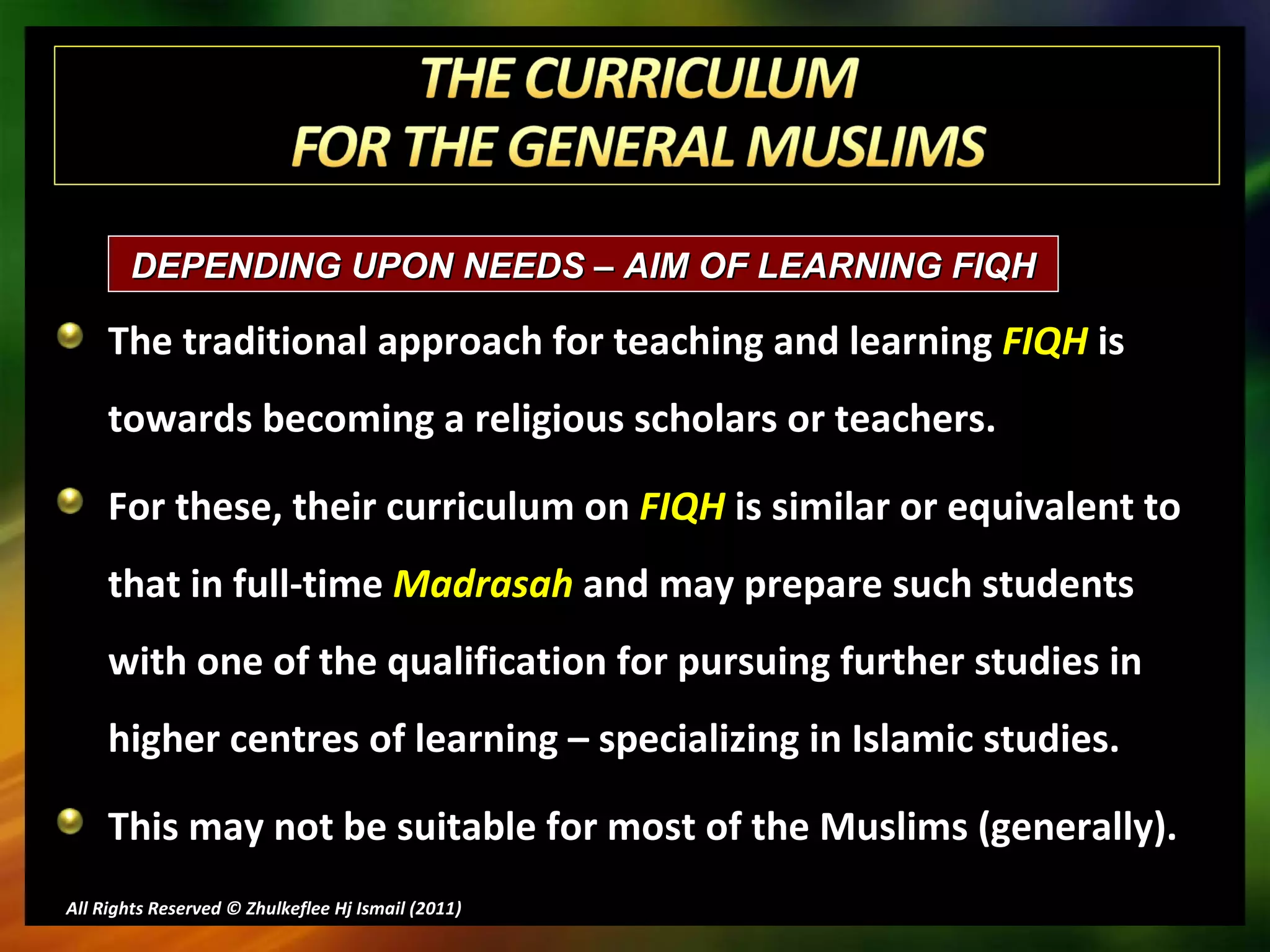
The traditional approach for teaching and learning  FIQH  is towards becoming a religious scholars or teachers.  For these, their curriculum on  FIQH  is similar or equivalent to that in full-time  Madrasah  and may prepare such students  with one of the qualification for pursuing further studies in higher centres of learning – specializing in Islamic studies. This may not be suitable for most of the Muslims (generally). All Rights Reserved © Zhulkeflee Hj Ismail (2011 ) DEPENDING UPON NEEDS – AIM OF LEARNING FIQH
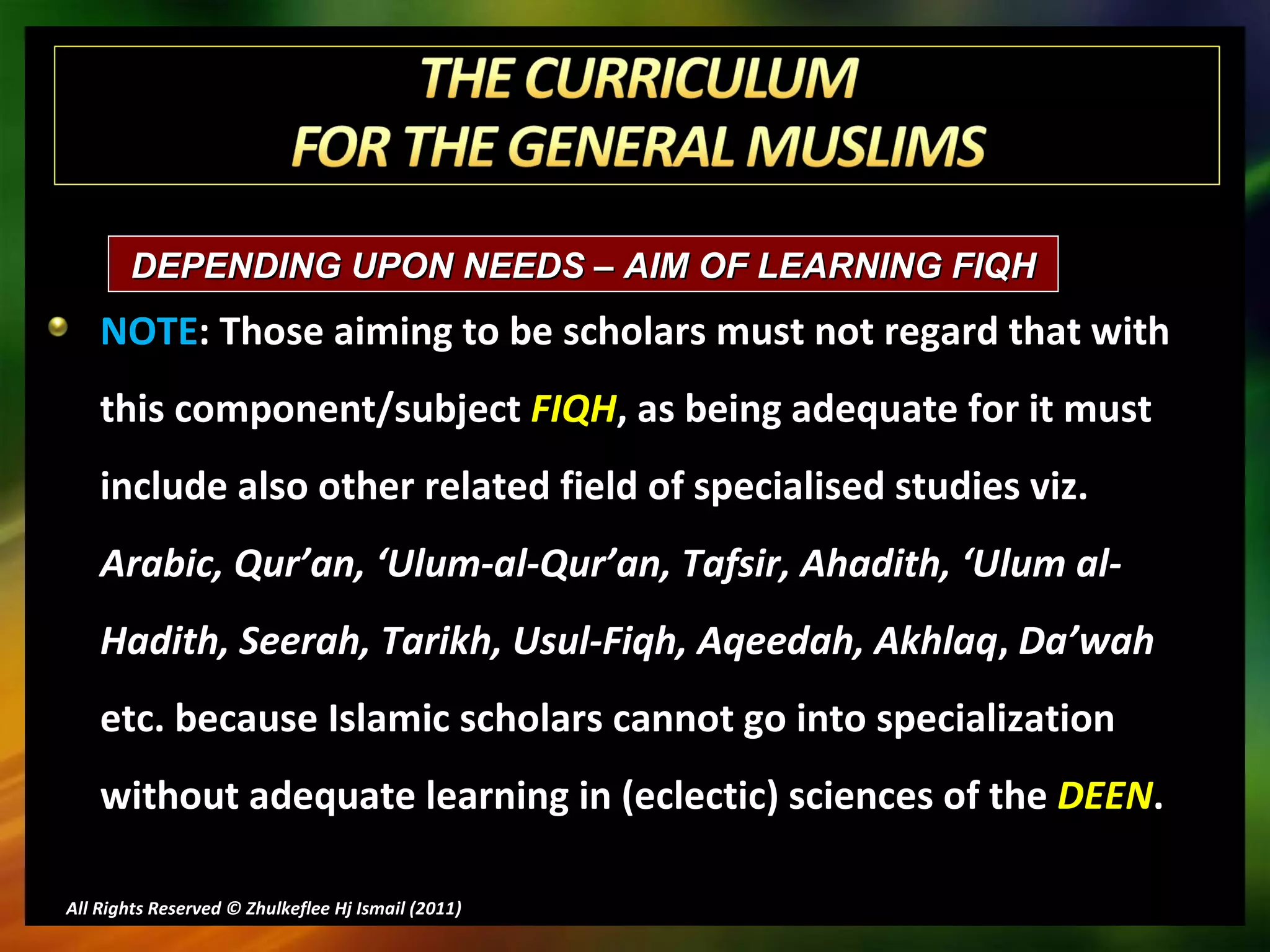
NOTE : Those aiming to be scholars must not regard that with this component/subject  FIQH , as being adequate for it must include also other related field of specialised studies viz.  Arabic, Qur’an, ‘Ulum-al-Qur’an, Tafsir, Ahadith, ‘Ulum al-Hadith, Seerah, Tarikh, Usul-Fiqh, Aqeedah, Akhlaq ,  Da’wah  etc. because Islamic scholars cannot go into specialization without adequate learning in (eclectic) sciences of the  DEEN . All Rights Reserved © Zhulkeflee Hj Ismail (2011 ) DEPENDING UPON NEEDS – AIM OF LEARNING FIQH
Here, I am sharing what I’ve envisaged (and which I am continuously implementing) as the curriculum in learning  FIQH  for new Muslims (in English) – or for those who may only be able to attend classes for a short duration (perhaps once a week). Their needs in  FIQH   are somewhat different from those intending to be specialist in the knowledge of the  DEEN . All Rights Reserved © Zhulkeflee Hj Ismail (2011 ) THE CURRICULUM – (GENERAL)
Also of late, many confusion did arose when matters of “ KHILAAFIYAH ” (Difference of opinion amongst the  MADZAAHIB ) were callously introduced by certain groups. Perhaps in seeking followers, they may resort with utter inconsiderate (even stooping to instigation)  ‘critique’ or by belittling certain opinions of predominant school  MADZHAB   which most Muslims here have already been earlier taught. All Rights Reserved © Zhulkeflee Hj Ismail (2011 ) THE CURRICULUM – (GENERAL)
Also, many may have gone on to study  FIQH  without being adequately introduced to this field of study - how it is placed  within the overall educational need of a Muslim – the bigger schema; aim and purpose of the study; relevant history of its development; how to learn; etc. This knowledge is crucial. In accordance with  ADAB , all these should be provided in what we termed  “Introductory Module” -  MUQADDIMAH  . All Rights Reserved © Zhulkeflee Hj Ismail (2011 ) THE CURRICULUM – (GENERAL)
We fear for possible loss of  ADAB  amongst these students and the danger of ‘anarchy’ as some in their ignorance, even are advocating the doing away of the need to follow  MADZHAB . We are not against their learning comparative  MADZAAHIB   (as advance study) but this is reserved only for those who are already competent in the initial  MADZHAB  they were on, and who knows and have the  ADAB  in matters of  KHILAAFIYAH . All Rights Reserved © Zhulkeflee Hj Ismail (2011 ) THE CURRICULUM – (GENERAL)
REVISITING THE “TAU H EEDIC PARADIGM”  CHART - IN A MUSLIM’S  EDUCATION *   From Fardhu ‘Ain class slides &  “Beginners Manual on Islam” - Addendum All Rights Reserved © Zhulkeflee Hj Ismail (2011 )
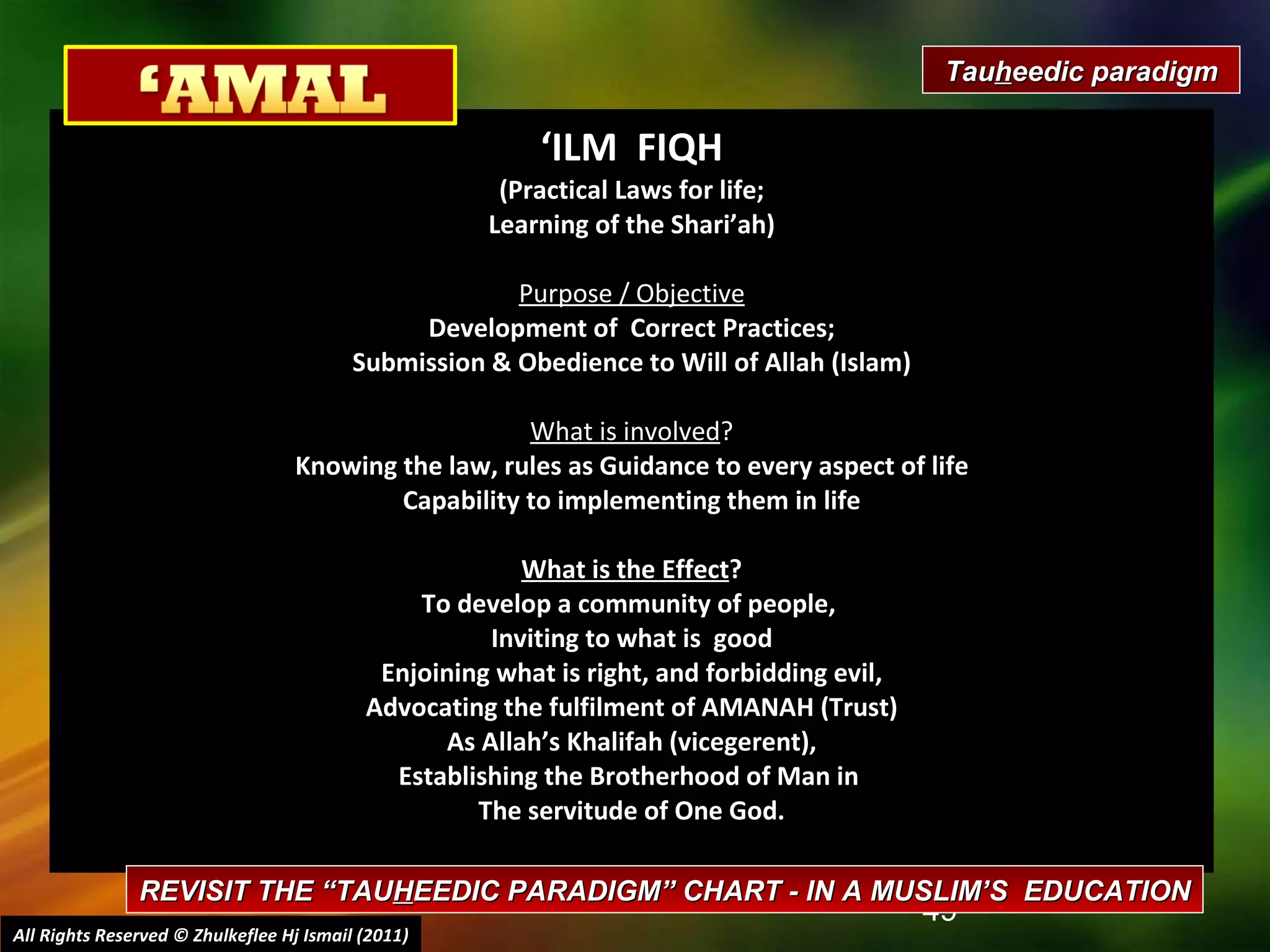
‘ ILM  FIQH (Practical Laws for life; Learning of the Shari’ah)   Purpose / Objective Development of  Correct Practices; Submission & Obedience to Will of Allah (Islam) What is involved ? Knowing the law, rules as Guidance to every aspect of life Capability to implementing them in life    What is the Effect ? To develop a community of people,  Inviting to what is  good Enjoining what is right, and forbidding evil, Advocating the fulfilment of AMANAH (Trust) As Allah’s Khalifah (vicegerent), Establishing the Brotherhood of Man in  The servitude of One God. Tau h eedic paradigm REVISIT THE “TAU H EEDIC PARADIGM” CHART - IN A MUSLIM’S  EDUCATION All Rights Reserved © Zhulkeflee Hj Ismail (2011 )
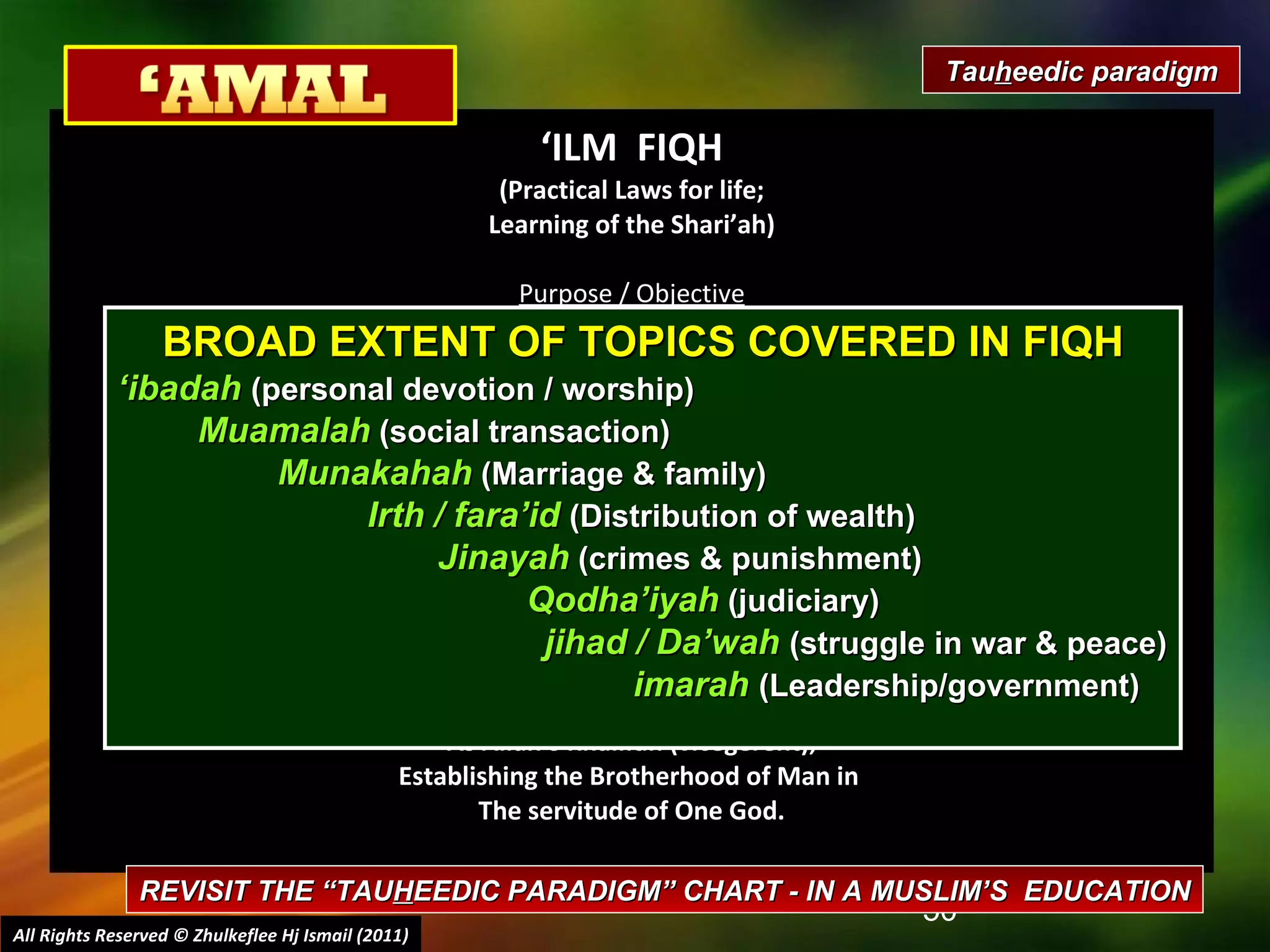
‘ ILM  FIQH (Practical Laws for life; Learning of the Shari’ah)   Purpose / Objective Development of  Correct Practices; Submission & Obedience to Will of Allah (Islam) What is involved ? Knowing the law, rules as Guidance to every aspect of life Capability to implementing them in life    What is the Effect ? To develop a community of people,  Inviting to what is  good Enjoining what is right, and forbidding evil, Advocating the fulfilment of AMANAH (Trust) As Allah’s Khalifah (vicegerent), Establishing the Brotherhood of Man in  The servitude of One God. BROAD EXTENT OF TOPICS COVERED IN FIQH ‘ ibadah  (personal devotion / worship)  Muamalah  (social transaction)  Munakahah  (Marriage & family)  Irth / fara’id  (Distribution of wealth) Jinayah  (crimes & punishment) Qodha’iyah   (judiciary) jihad / Da’wah  (struggle in war & peace) imarah   (Leadership/government) Tau h eedic paradigm REVISIT THE “TAU H EEDIC PARADIGM” CHART - IN A MUSLIM’S  EDUCATION All Rights Reserved © Zhulkeflee Hj Ismail (2011 )
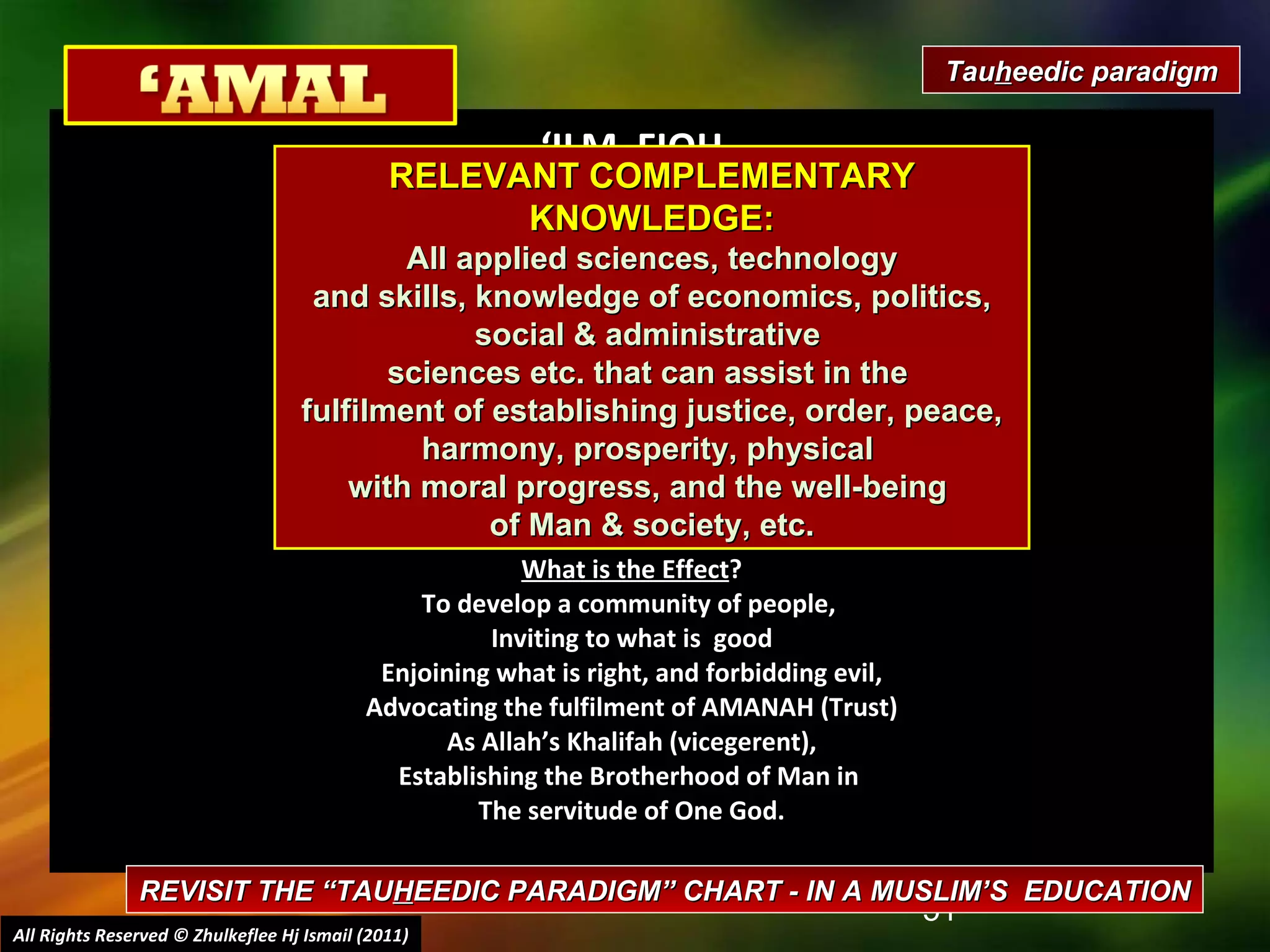
‘ ILM  FIQH (Practical Laws for life; Learning of the Shari’ah)   Purpose / Objective Development of  Correct Practices; Submission & Obedience to Will of Allah (Islam) What is involved ? Knowing the law, rules as Guidance to every aspect of life Capability to implementing them in life    What is the Effect ? To develop a community of people,  Inviting to what is  good Enjoining what is right, and forbidding evil, Advocating the fulfilment of AMANAH (Trust) As Allah’s Khalifah (vicegerent), Establishing the Brotherhood of Man in  The servitude of One God. RELEVANT COMPLEMENTARY KNOWLEDGE: All applied sciences, technology and skills, knowledge of economics, politics, social & administrative  sciences etc. that can assist in the  fulfilment of establishing justice, order, peace, harmony, prosperity, physical  with moral progress, and the well-being  of Man & society, etc. Tau h eedic paradigm REVISIT THE “TAU H EEDIC PARADIGM” CHART - IN A MUSLIM’S  EDUCATION All Rights Reserved © Zhulkeflee Hj Ismail (2011 )
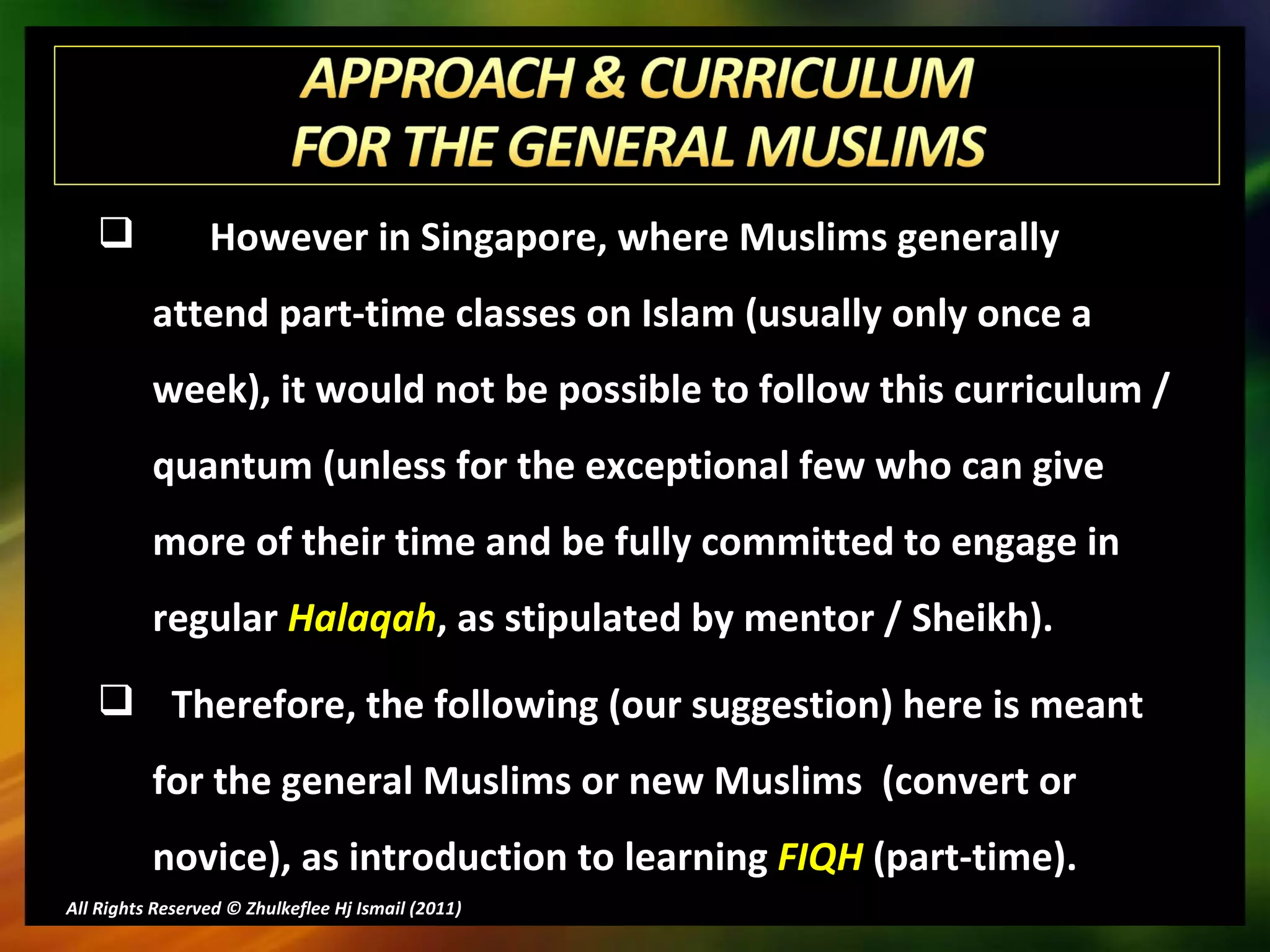
However in Singapore, where Muslims generally attend part-time classes on Islam (usually only once a week), it would not be possible to follow this curriculum / quantum (unless for the exceptional few who can give more of their time and be fully committed to engage in regular  Halaqah , as stipulated by mentor / Sheikh). Therefore, the following (our suggestion) here is meant for the general Muslims or new Muslims  (convert or novice), as introduction to learning  FIQH  (part-time). All Rights Reserved © Zhulkeflee Hj Ismail (2011 )
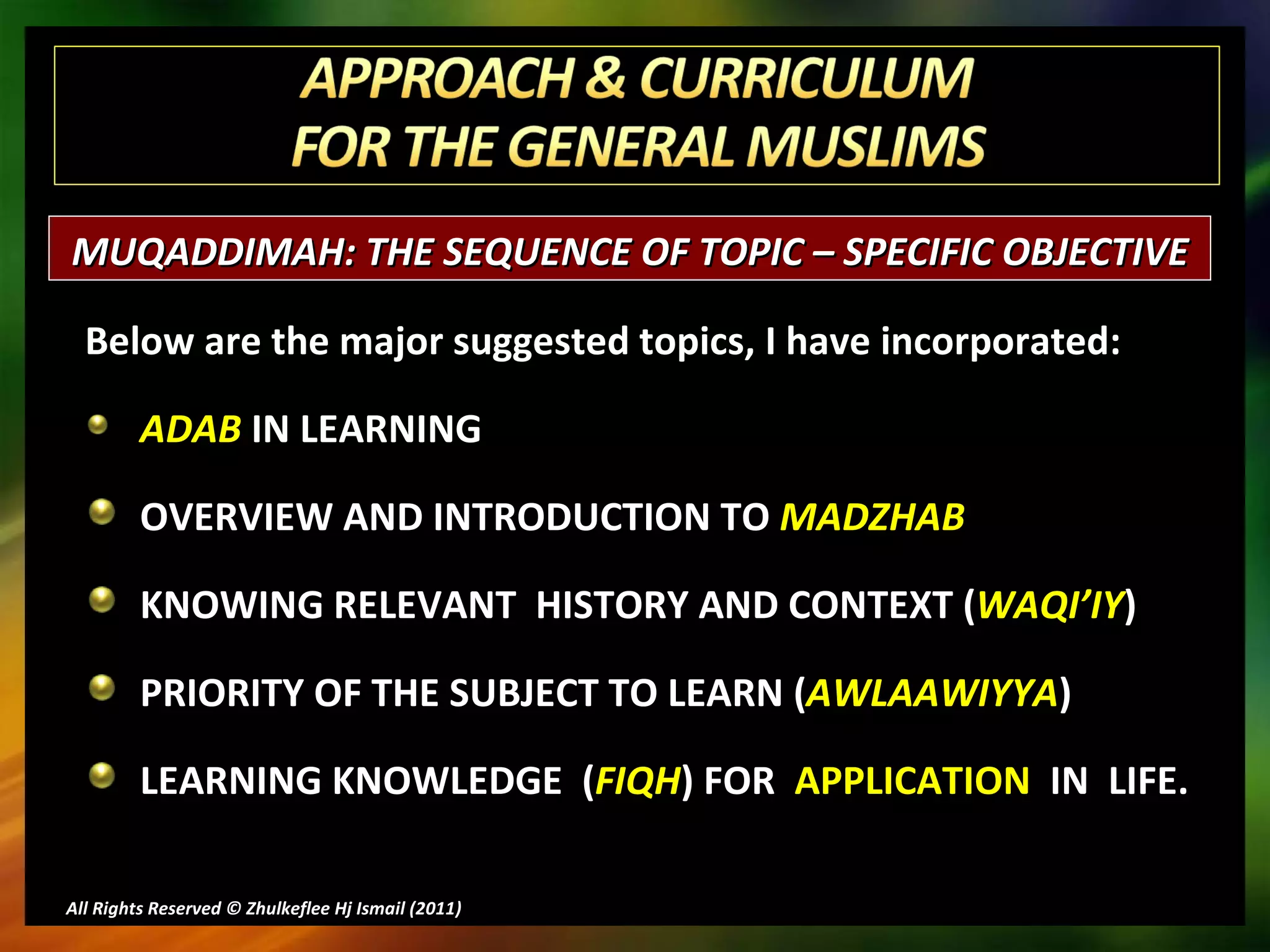
Below are the major suggested topics, I have incorporated: ADAB  IN LEARNING OVERVIEW AND INTRODUCTION TO  MADZHAB KNOWING RELEVANT  HISTORY AND CONTEXT ( WAQI’IY ) PRIORITY OF THE SUBJECT TO LEARN ( AWLAAWIYYA ) LEARNING KNOWLEDGE  ( FIQH ) FOR  APPLICATION  IN  LIFE. All Rights Reserved © Zhulkeflee Hj Ismail (2011 ) MUQADDIMAH: THE SEQUENCE OF TOPIC – SPECIFIC OBJECTIVE
All welcome to visit my web-blog: http://an-naseehah.blogspot.com/ http://introductiontotauhid.blogspot.com/ http://oyoubelievers.blogspot.com/ http://al-amthaal.blogspot.com/ http://zhulkeflee-archive.blogspot.com/  http://criteriaforaholybook-quran.blogspot.com/ http://with-the-truthful.blogspot.com/  http ://muqaddam-nurul.blogspot.com/ All Rights Reserved © Zhulkeflee Hj Ismail [2011]

[Slideshare]fiqh course#2-approach2 learning(2011)

  • 1.
    “ INTRODUCTION TOTHE STUDY OF FIQH ” Intermediate Level Islamic course in English for Adults conducted by Ustaz Zhulkeflee Hj Ismail (Singapore) IN THE NAME OF ALLAH, MOST COMPASSIONATE, MOST MERCIFUL. All Rights Reserved © Zhulkeflee Hj Ismail (2011 ) LESSON # 2 – THE APPROACHES IN LEARNING FIQH And say: O Lord! Increase for me my knowledge Using text & curriculum he has developed especially for Muslim converts and young Adult English-speaking Muslims. “ To seek knowledge is obligatory upon every Muslim (male & female)” UPDATED APRIL 2011 SPECIFIC TO THE CONTEXT OF SINGAPORE
  • 2.
    All Rights Reserved© Zhulkeflee Hj Ismail (2011 )
  • 3.
    “ It isHe (Allah) Who has sent amongst the Unlettered a messenger (Muhammad) from among themselves, to rehearse to them His Signs, to sanctify them, and to instruct them in Scripture and Wisdom― although they had been, before, in manifest error― .“ ( Qur’an: Jumu’ah: 62: 2 ) All Rights Reserved © Zhulkeflee Hj Ismail (2011 )
  • 4.
    Allah SWT clearlyinforms us here the primary function Prophet Muhammad s.a.a.w. was sent for, and he ought to be remembered especially by Muslims - as the educator par excellence for us all. In this verse, even the methodology in his education follows an ADAB and emphasises the learning from KITAAB (Al-Qur’an) and HIKMAH (Wisdom). All Rights Reserved © Zhulkeflee Hj Ismail (2011 )
  • 5.
    All Rights Reserved© Zhulkeflee Hj Ismail (2011 )
  • 6.
    “ Nor shouldthe Believers all go forth together: if a contingent from every expedition remained behind, they could devote themselves to studies in religion ( YU-FAQQIH FID-DEEN ) and admonish the people when they return to them― that thus they (may learn) to guard themselves (against evil). "? ( Qur’an: Taubah: 9: 122 ) All Rights Reserved © Zhulkeflee Hj Ismail (2011 )
  • 7.
    “ Who isbetter in speech than one who calls (men) to Allah ( DA-’AA- ILALLAH ), works righteousness (‘ AMALAN SWOLIHA ), and says "I am of those who bow in Islam"? ( Qur’an: Fussilat: 41: 33 ) All Rights Reserved © Zhulkeflee Hj Ismail (2011 )
  • 8.
    All Rights Reserved© Zhulkeflee Hj Ismail (2011 ) “ O ye who believe! (Be conscious of Allah and) Fear Allah ( TAQWA ) and be with those who are true (in words and deeds)- AS-SWODIQEEN ” ( Qur’an: Taubah:9: 119 )
  • 9.
    We the prophetsare commanded to place people according to their station and to speak unto them in accordance with their intellectual capacity. ( Hadith reported by Abu Dawud from A’isyah r.a .) All Rights Reserved © Zhulkeflee Hj Ismail (2011 ) PROPHET MUHAMMAD S.A.A.W. SAID:
  • 10.
    “ A learned FAQIH (scholar & teacher) is truly FAQIH , one who does not cause others to feel despair from receiving the mercy of Allah (i.e. overly strict and too ‘harsh’); and neither does he (give the impression by his behaviour, a guarantees as if ) anyone can avert or withhold the wrath (punishment) of Allah, nor allows opportunity (by giving dispensation) for anyone to disobey Allah (i.e. being inappropriately lax and too ‘nice’). ( Hilyatul-Auliya: 1-73 – as quoted by M.Natsir in Fiqhud-Da’wah ) All Rights Reserved © Zhulkeflee Hj Ismail (2011 ) WISE SAYING OF IMAM ‘ALI BIN ABI TOLIB R.A.
  • 11.
    All Rights Reserved© Zhulkeflee Hj Ismail (2011 ) ” Verily this is knowledge (contains the rules) of the DEEN (Religion), so look thoroughly into the person from whom you acquire (the knowledge of) your DEEN (Religion).” Imam Muhammad ibnu Sirrin (rhm.a) advices and warns us Muslims:
  • 12.
    All Rights Reserved© Zhulkeflee Hj Ismail (2011 )
  • 13.
    All Rights Reserved© Zhulkeflee Hj Ismail (2011 ) ” The similitude of those who were charged with the (obligations of the) Mosaic Law, but who subsequently failed in those (obligations), is that of a donkey which carries huge tomes (but understands them not). Evil is the similitude of people who falsify the Signs of Allah: and Allah guides not people who do wrong.” ( Qur’an: Jumu’at: 62: 5 ) 
  • 14.
    All Rights Reserved© Zhulkeflee Hj Ismail (2011 ) CONTEXT OF SINGAPORE
  • 15.
    Ever since thecolonial days, the education of Muslims has been dualistic :- [1] In learning their religion & religious duty, traditionally it was carried out by the community, as before the coming of the British. [2] Then came the state schooling system – for Malay/Muslims it began with vernacular schools with Islamic knowledge. [3] Later even this conflated into the English medium with IRK (Islamic religious knowledge) – but later IRK was scrapped. All Rights Reserved © Zhulkeflee Hj Ismail (2011 )
  • 16.
    So, in ensuringthat the learning and teaching of Islam is sustained, the matter rests entirely with the community and its infrastructure - Madrasah . The most crucial factor has all along been the Muslim scholars, teachers and philanthropists – they constitute pillars of the traditional Madrasah institution. (Full-time) Students of these Madrasah , although important, their numbers (cohorts) usually were relatively few as most Muslim children opted for the state or national schooling. All Rights Reserved © Zhulkeflee Hj Ismail (2011 )
  • 17.
    All Rights Reserved© Zhulkeflee Hj Ismail (2011 )
  • 18.
    All Rights Reserved© Zhulkeflee Hj Ismail (2011 ) “ Nor should the Believers all go forth together: if a contingent from every expedition remained behind, they could devote themselves to studies in religion ( YU-FAQQIH FID-DEEN ) and admonish the people when they return to them― that thus they (may learn) to guard themselves (against evil). "? ( Qur’an: Taubah: 9: 122 )
  • 19.
    Even then, everyMuslim must realise the importance of our community’s dependence upon these traditional Madrasah to generate the crucial life-blood of ‘Ulama (Islamic scholars) and Asaatizah for the present and future generation. Their primary objective has all along been in ensuring, the general Muslims religious education in Fardhu ‘Ain would continue through their graduates. Even without adequate support, their staff underpaid and relatively deprived of proper training, we Muslims continue to benefit from them. All Rights Reserved © Zhulkeflee Hj Ismail (2011 )
  • 20.
    Every Muslims herebegins with the basic - PRIMER . Traditionally in NUSANTARA , it begins with a concise text like the genre – ( kitab ): SAFINATUN-NAJAA - FEE-USUUL-AD-DEEN -WA-AL-FIQH Meaning of “ FIQH ” became conflated to the understanding merely of the jurisprudence. The original meaning generally encompasses the adequate understanding of the entire DEEN : ( AQEEDAH – FIQH – AKHLAQ ). All Rights Reserved © Zhulkeflee Hj Ismail (2011 )
  • 21.
    By current convention,the learning of “ FIQH ” we mean the knowledge of jurisprudence; the knowing of the legal rulings of acts of commission or omission in a Muslim’s life, guided and in compliance with the SHARI’AH ( Divine law ). And the predominant school of jurisprudence (here for us) has been the SHAFI-’IE MADZHAB . Also, the medium of instruction regarding Islam in this region NUSANTARA is the Malay or Indonesian language. All Rights Reserved © Zhulkeflee Hj Ismail (2011 )
  • 22.
    All Rights Reserved© Zhulkeflee Hj Ismail (2011 ) CONTEXT OF SINGAPORE
  • 23.
    The traditional Madrasah (religious schools) are geared towards producing Islamic scholars and teachers – the specialists in the sciences of the DEEN. (‘Ulum ad-deen) It was from these that our traditional Islamic religious teachers and scholars attained their education and training. Yet when they teach the general ‘lay’ Muslims, they had to depend upon, or to develop a modified curriculum for their learning FIQH – more towards guiding them in their practices. All Rights Reserved © Zhulkeflee Hj Ismail (2011 )
  • 24.
    Thus we werefortunate for such capable Islamic scholars / teachers (although only very few) in the past who were able to present, what was needed by general Muslims for their education on Islam, rather than a wholesale regurgitation of the traditional Madrasah curriculum which they themselves had learnt. All Rights Reserved © Zhulkeflee Hj Ismail (2011 )
  • 25.
    Although this approachmay have proven to be the most effective and prevalent for the general masses in the past, yet we must ensure that it be constantly revised and further developed in accordance with the context of evolving societal conditions of Muslims. As for those in the full-time Madrasah , due to the specialised nature of their education, it should be separately assessed regarding their contextual needs. All Rights Reserved © Zhulkeflee Hj Ismail (2011 )
  • 26.
    Our suggestion hereis for Muslims in general learning Islam outside the Madrasah – which do not need to have similar curriculum. Notwithstanding these general Muslims, there has been a few exceptions amongst them, those more committed who wished for a specialised traditional Curriculum – usually comprising working adults engaged in a life-long continual learning path similar to the full-time Madrasah students. All Rights Reserved © Zhulkeflee Hj Ismail (2011 )
  • 27.
    They were usuallyenrolled in a private ‘ HALAQAH ’ (study circle) outside the Madrasah , usually conducted by very senior Sheikh , for only small selected group of very dedicated ‘lay’ Muslims with passion for such knowledge, and with aspirations to follow in the footsteps of their teachers. Many of whom were granted permission to even became Islamic teachers and scholars, after undergoing tutelage and mentoring over some years. All Rights Reserved © Zhulkeflee Hj Ismail (2011 )
  • 28.
    All Rights Reserved© Zhulkeflee Hj Ismail (2011 ) CONTEXT OF SINGAPORE
  • 29.
    When we speakof learning and education in Islam, the role of the learned scholar – MU’ALLIM , the USTAZ (teacher) whose capacity is also as a MU-ADDIB (Educator) who provides IRSHADAH (spiritual guidance) etc., cannot be overlooked. Remember, the ‘ULAMA is an ‘institution’ within the persons or the personalities - and cannot be ‘hijacked’ by the corporate people as though to refer to organizations, bodies, schools etc. All Rights Reserved © Zhulkeflee Hj Ismail (2011 ) TEACHER : AN IMPORTANT QUALIFICATION
  • 30.
    The proper developmentof Islamic teachers : with the correct belief, worldview, passion and committed to DA’WAH , who understand the AMANAH (Trust) which they are supposed to be shouldering, constantly vigilant regarding the challenges to the UMMAH etc. - is the most vital consideration. Without this factor – the teachers, their training and their development - it is rather useless to speak of any curriculum. All Rights Reserved © Zhulkeflee Hj Ismail (2011 ) TEACHER : AN IMPORTANT QUALIFICATION
  • 31.
    Unfortunately today, certainpeople’s obsession with only producing texts, experimenting with educational aids and latest in information technology , overawed by other system of learning, that they inadvertently ignored the difference in the Islamic educational philosophy, the aims, approach and objective etc. until Muslims are learning ‘Islam’ merely as subjects, rather than subjecting themselves to ‘Islam’. All Rights Reserved © Zhulkeflee Hj Ismail (2011 ) TEACHER : AN IMPORTANT QUALIFICATION
  • 32.
    Thus, the tendencytowards teaching FIQH as subjects to be taught according to whatever text / books popularly chosen may be predominant. And given that most of these books were written as reference manual on FIQH , the class should rather focus on students understanding, inculcating the appreciation of how relevant these rulings are to Muslims in life. Therefore this depends much upon who is teaching FIQH . All Rights Reserved © Zhulkeflee Hj Ismail (2011 ) TEACHER : AN IMPORTANT QUALIFICATION
  • 33.
    It must benoted that today, with the availability of easy access to books and information on the internet; with greater reliance to self-study rather than undergoing right tutelage under the guidance of competent teachers; with the proliferations of ideologies of groups promoting unknown agendas in the name of Islam; - Muslims being deprived of a competent teacher’s guidance in FIQH should be a very grave concern - indeed. All Rights Reserved © Zhulkeflee Hj Ismail (2011 ) CHALLENGES AND DEVELOPMENT
  • 34.
    Indeed it isalarming, with people entering discourses and meddling in Islam beyond their competency (by Muslims and even non-Muslims), and compounded by the relative ignorance of general Muslims regarding their own basics knowledge of their DEEN . Especially when this involves specialized fields and subjects, for which they do not have any authority to be giving their opinion to the public. All Rights Reserved © Zhulkeflee Hj Ismail (2011 ) CHALLENGES AND DEVELOPMENT
  • 35.
    Can any oneclaim the right to be involved in giving or engaging in serious discourse in other specialised fields like medicine or engineering without adequate knowledge? Or even if one knows something about draughtsmanship or have read medical journals, without the proper training and approval of the true practitioners in their respective fields, messing in these would be deemed a crime – wouldn’t it? All Rights Reserved © Zhulkeflee Hj Ismail (2011 ) CHALLENGES AND DEVELOPMENT
  • 36.
    All Rights Reserved© Zhulkeflee Hj Ismail (2011 ) CHANGE IN LINGUA FRANCA “ We sent not a messenger except (to teach) in the language of his (own) people, in order to make (things) clear to them.” ( Qur’an: Ibrahim: 14: 4 )
  • 37.
    When the lingua franca for Islamic discourse is predominantly in Malay, the presence of so many of our traditionally trained ASAATIZAH has ensured adequate supervision to oversee and correct whatever misconceptions that may arise amongst general Muslims. But the trend now is that discourses in English has become more predominant and may replace the lingua franca . All Rights Reserved © Zhulkeflee Hj Ismail (2011 ) CHANGE IN LINGUA FRANCA
  • 38.
    Teaching Islam inEnglish now is increasingly in demand and many classes are eagerly started. Who are teaching? Yet, from my experience in this field, the approach and curriculum cannot merely be by translating or converting whatever has been done in Malay into English (as some may have simplistically presumed). Or even by transplanting these from other (Western) country. All Rights Reserved © Zhulkeflee Hj Ismail (2011 ) CHANGE IN LINGUA FRANCA
  • 39.
    Also the MAD’U (the audience for DA’WAH and students) their exposure and background, may require special responses – viz. be they converts from other religion, youth, adults, an agnostics, secularist, sceptics, atheists, etc. A concern too, is the proficiency (or rather the lack of it) of many ASAATIZAH in use of English, since the teaching of Faith requires convincing and very engaging , communication skills. All Rights Reserved © Zhulkeflee Hj Ismail (2011 ) CHANGE IN LINGUA FRANCA
  • 40.
    Qualified graduates fromIslamic learning centres, even those proficient in English, are advised to seek refer to or (if they have any humility) to spend some time to learn from those with much experience and already been involved for years in this field locally - rather than trying to ‘ re-invent the wheel ’. Especially useful is to know the kind of ‘ questions, arguments and concerns ’ which contemporary audience frequently posed. All Rights Reserved © Zhulkeflee Hj Ismail (2011 ) CHANGE IN LINGUA FRANCA
  • 41.
    All Rights Reserved© Zhulkeflee Hj Ismail (2011 ) CONTEXT OF SINGAPORE
  • 42.
    The traditional approachfor teaching and learning FIQH is towards becoming a religious scholars or teachers. For these, their curriculum on FIQH is similar or equivalent to that in full-time Madrasah and may prepare such students with one of the qualification for pursuing further studies in higher centres of learning – specializing in Islamic studies. This may not be suitable for most of the Muslims (generally). All Rights Reserved © Zhulkeflee Hj Ismail (2011 ) DEPENDING UPON NEEDS – AIM OF LEARNING FIQH
  • 43.
    NOTE : Thoseaiming to be scholars must not regard that with this component/subject FIQH , as being adequate for it must include also other related field of specialised studies viz. Arabic, Qur’an, ‘Ulum-al-Qur’an, Tafsir, Ahadith, ‘Ulum al-Hadith, Seerah, Tarikh, Usul-Fiqh, Aqeedah, Akhlaq , Da’wah etc. because Islamic scholars cannot go into specialization without adequate learning in (eclectic) sciences of the DEEN . All Rights Reserved © Zhulkeflee Hj Ismail (2011 ) DEPENDING UPON NEEDS – AIM OF LEARNING FIQH
  • 44.
    Here, I amsharing what I’ve envisaged (and which I am continuously implementing) as the curriculum in learning FIQH for new Muslims (in English) – or for those who may only be able to attend classes for a short duration (perhaps once a week). Their needs in FIQH are somewhat different from those intending to be specialist in the knowledge of the DEEN . All Rights Reserved © Zhulkeflee Hj Ismail (2011 ) THE CURRICULUM – (GENERAL)
  • 45.
    Also of late,many confusion did arose when matters of “ KHILAAFIYAH ” (Difference of opinion amongst the MADZAAHIB ) were callously introduced by certain groups. Perhaps in seeking followers, they may resort with utter inconsiderate (even stooping to instigation) ‘critique’ or by belittling certain opinions of predominant school MADZHAB which most Muslims here have already been earlier taught. All Rights Reserved © Zhulkeflee Hj Ismail (2011 ) THE CURRICULUM – (GENERAL)
  • 46.
    Also, many mayhave gone on to study FIQH without being adequately introduced to this field of study - how it is placed within the overall educational need of a Muslim – the bigger schema; aim and purpose of the study; relevant history of its development; how to learn; etc. This knowledge is crucial. In accordance with ADAB , all these should be provided in what we termed “Introductory Module” - MUQADDIMAH . All Rights Reserved © Zhulkeflee Hj Ismail (2011 ) THE CURRICULUM – (GENERAL)
  • 47.
    We fear forpossible loss of ADAB amongst these students and the danger of ‘anarchy’ as some in their ignorance, even are advocating the doing away of the need to follow MADZHAB . We are not against their learning comparative MADZAAHIB (as advance study) but this is reserved only for those who are already competent in the initial MADZHAB they were on, and who knows and have the ADAB in matters of KHILAAFIYAH . All Rights Reserved © Zhulkeflee Hj Ismail (2011 ) THE CURRICULUM – (GENERAL)
  • 48.
    REVISITING THE “TAUH EEDIC PARADIGM” CHART - IN A MUSLIM’S EDUCATION * From Fardhu ‘Ain class slides & “Beginners Manual on Islam” - Addendum All Rights Reserved © Zhulkeflee Hj Ismail (2011 )
  • 49.
    ‘ ILM FIQH (Practical Laws for life; Learning of the Shari’ah)   Purpose / Objective Development of Correct Practices; Submission & Obedience to Will of Allah (Islam) What is involved ? Knowing the law, rules as Guidance to every aspect of life Capability to implementing them in life    What is the Effect ? To develop a community of people, Inviting to what is good Enjoining what is right, and forbidding evil, Advocating the fulfilment of AMANAH (Trust) As Allah’s Khalifah (vicegerent), Establishing the Brotherhood of Man in The servitude of One God. Tau h eedic paradigm REVISIT THE “TAU H EEDIC PARADIGM” CHART - IN A MUSLIM’S EDUCATION All Rights Reserved © Zhulkeflee Hj Ismail (2011 )
  • 50.
    ‘ ILM FIQH (Practical Laws for life; Learning of the Shari’ah)   Purpose / Objective Development of Correct Practices; Submission & Obedience to Will of Allah (Islam) What is involved ? Knowing the law, rules as Guidance to every aspect of life Capability to implementing them in life    What is the Effect ? To develop a community of people, Inviting to what is good Enjoining what is right, and forbidding evil, Advocating the fulfilment of AMANAH (Trust) As Allah’s Khalifah (vicegerent), Establishing the Brotherhood of Man in The servitude of One God. BROAD EXTENT OF TOPICS COVERED IN FIQH ‘ ibadah (personal devotion / worship) Muamalah (social transaction) Munakahah (Marriage & family) Irth / fara’id (Distribution of wealth) Jinayah (crimes & punishment) Qodha’iyah (judiciary) jihad / Da’wah (struggle in war & peace) imarah (Leadership/government) Tau h eedic paradigm REVISIT THE “TAU H EEDIC PARADIGM” CHART - IN A MUSLIM’S EDUCATION All Rights Reserved © Zhulkeflee Hj Ismail (2011 )
  • 51.
    ‘ ILM FIQH (Practical Laws for life; Learning of the Shari’ah)   Purpose / Objective Development of Correct Practices; Submission & Obedience to Will of Allah (Islam) What is involved ? Knowing the law, rules as Guidance to every aspect of life Capability to implementing them in life    What is the Effect ? To develop a community of people, Inviting to what is good Enjoining what is right, and forbidding evil, Advocating the fulfilment of AMANAH (Trust) As Allah’s Khalifah (vicegerent), Establishing the Brotherhood of Man in The servitude of One God. RELEVANT COMPLEMENTARY KNOWLEDGE: All applied sciences, technology and skills, knowledge of economics, politics, social & administrative sciences etc. that can assist in the fulfilment of establishing justice, order, peace, harmony, prosperity, physical with moral progress, and the well-being of Man & society, etc. Tau h eedic paradigm REVISIT THE “TAU H EEDIC PARADIGM” CHART - IN A MUSLIM’S EDUCATION All Rights Reserved © Zhulkeflee Hj Ismail (2011 )
  • 52.
    However in Singapore,where Muslims generally attend part-time classes on Islam (usually only once a week), it would not be possible to follow this curriculum / quantum (unless for the exceptional few who can give more of their time and be fully committed to engage in regular Halaqah , as stipulated by mentor / Sheikh). Therefore, the following (our suggestion) here is meant for the general Muslims or new Muslims (convert or novice), as introduction to learning FIQH (part-time). All Rights Reserved © Zhulkeflee Hj Ismail (2011 )
  • 53.
    Below are themajor suggested topics, I have incorporated: ADAB IN LEARNING OVERVIEW AND INTRODUCTION TO MADZHAB KNOWING RELEVANT HISTORY AND CONTEXT ( WAQI’IY ) PRIORITY OF THE SUBJECT TO LEARN ( AWLAAWIYYA ) LEARNING KNOWLEDGE ( FIQH ) FOR APPLICATION IN LIFE. All Rights Reserved © Zhulkeflee Hj Ismail (2011 ) MUQADDIMAH: THE SEQUENCE OF TOPIC – SPECIFIC OBJECTIVE
  • 54.
    All welcome tovisit my web-blog: http://an-naseehah.blogspot.com/ http://introductiontotauhid.blogspot.com/ http://oyoubelievers.blogspot.com/ http://al-amthaal.blogspot.com/ http://zhulkeflee-archive.blogspot.com/ http://criteriaforaholybook-quran.blogspot.com/ http://with-the-truthful.blogspot.com/ http ://muqaddam-nurul.blogspot.com/ All Rights Reserved © Zhulkeflee Hj Ismail [2011]