Finding a Good Ontology:
              The Open Ontology Repository
                       Initiative
                                    Ken Baclawski, kenb@ccs.neu.edu
                                      Mike Dean, mdean@bbn.com
                              Todd Schneider, todd.schneider@raytheon.com
                                     Peter Yim, peter.yim@cim3.com

                                     Semantic Technology Conference
                                        San Francisco, California
                                              24 June 2010


These slides: http://ontolog.cim3.net/file/work/OOR/OOR_presentations_publications/OOR-SemTech_Jun2010.pdf

                                                                                                             1
Outline

•   Introduction
•   Demonstration
•   Requirements and Challenges
•   Current Efforts
•   How to Participate


                                  2
Open Ontology Repository

• Community effort since January 2008
• Promote global use and sharing of ontologies
  – Modular open source registry/repository software
  – 1 or more public instances
  – Best practices for ontology sharing and
    management


                                                   3
OOR Software Target

• Allow modular choices among
  – Registry functions (search, etc.)
  – Repository functions (persistence, versioning, etc.)
  – KR languages (OWL, Common Logic, etc.)
  – Gatekeeping policies (open, curated, market, etc.)
  – Intellectual Property Rights policies
  – Federation mechanisms (OOR, RSS, OMV, etc.)
  – Value-added services (alignment, translation, etc.)
  –…
                                                       4
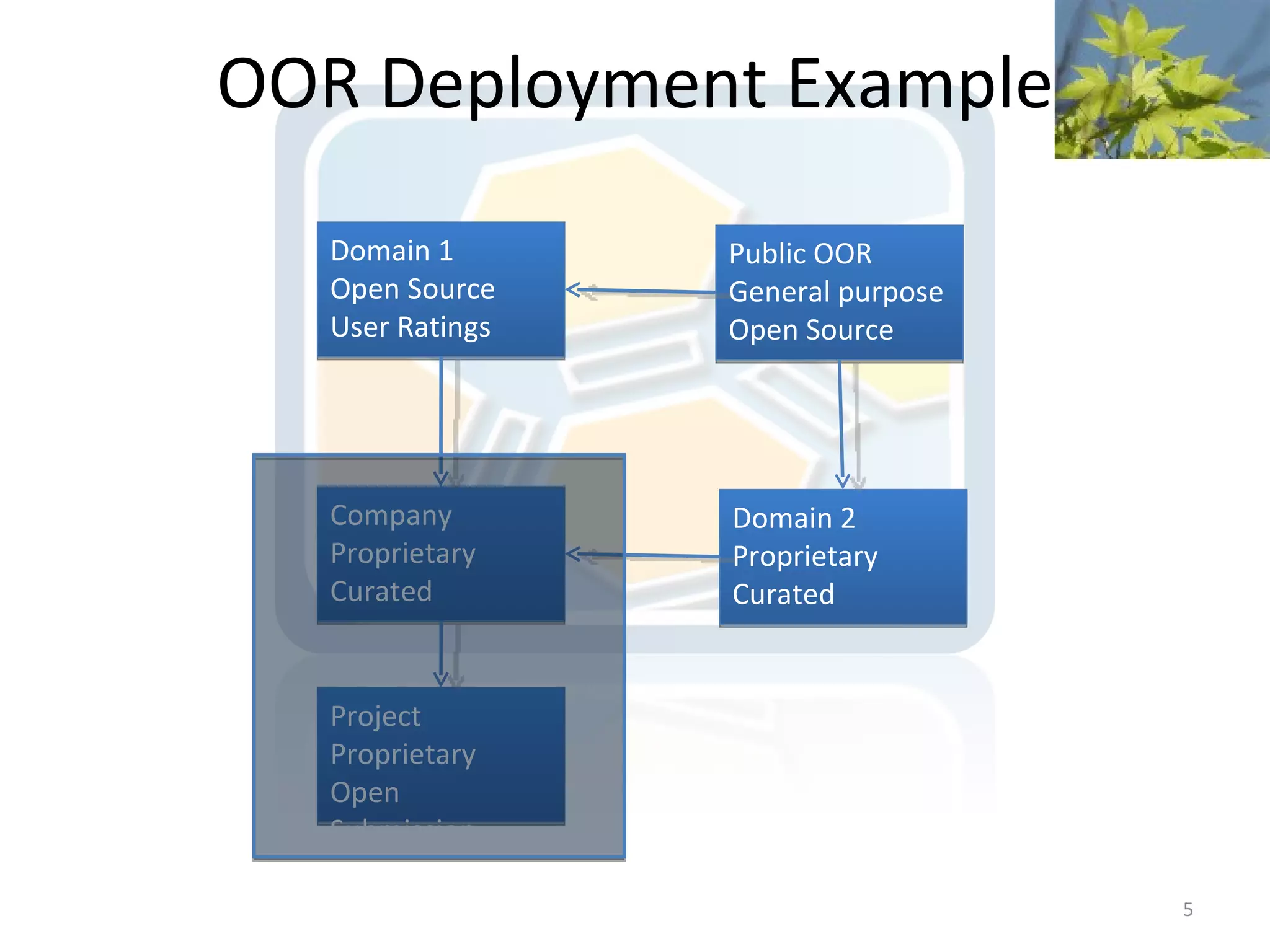
OOR Deployment Example
  Domain 1       Public OOR
  Open Source    General purpose
  User Ratings   Open Source


  Company        Domain 2
  Proprietary    Proprietary
  Curated        Curated


  Project
  Proprietary
  Open
  Submission

                                   5
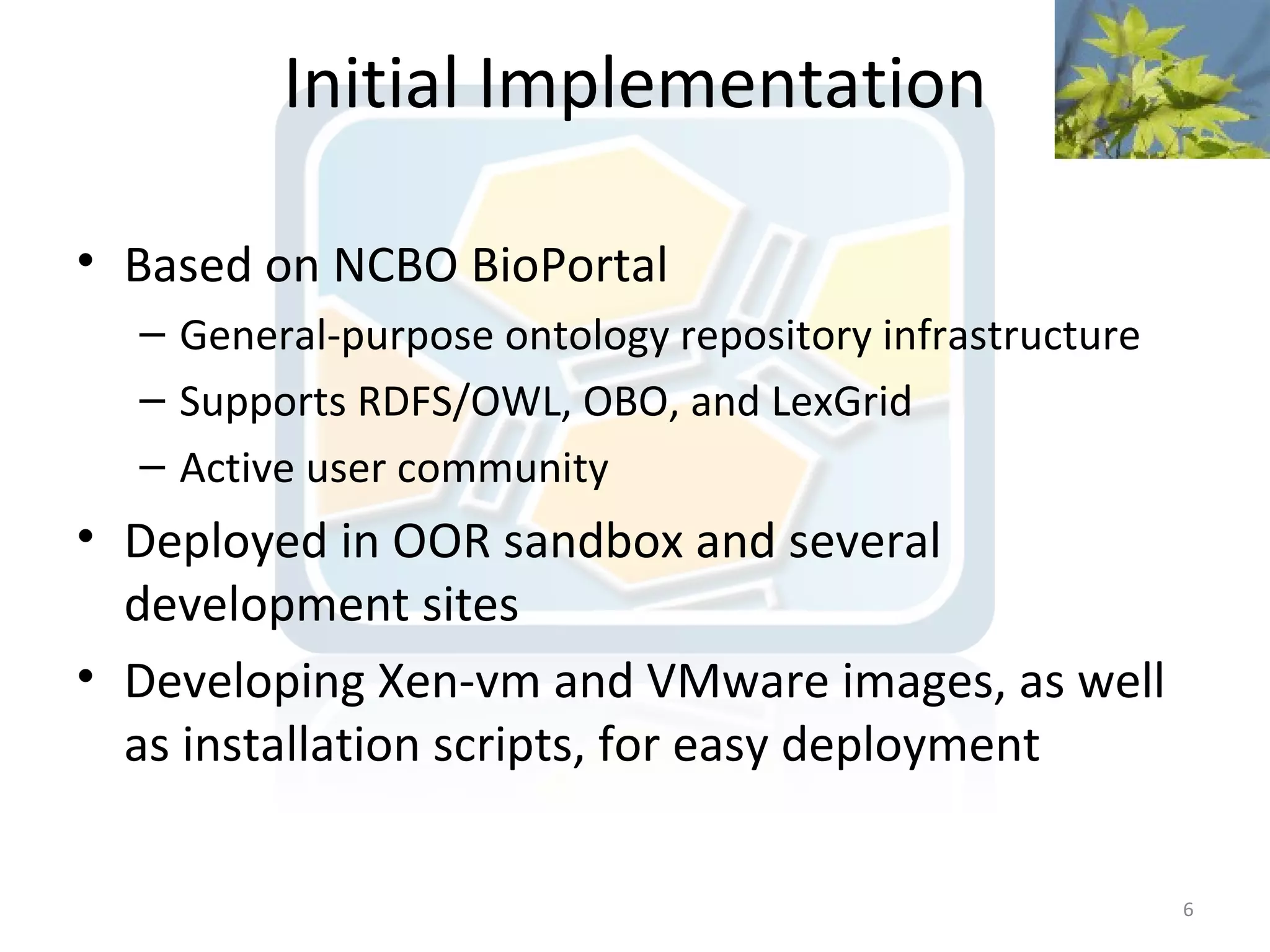
Initial Implementation

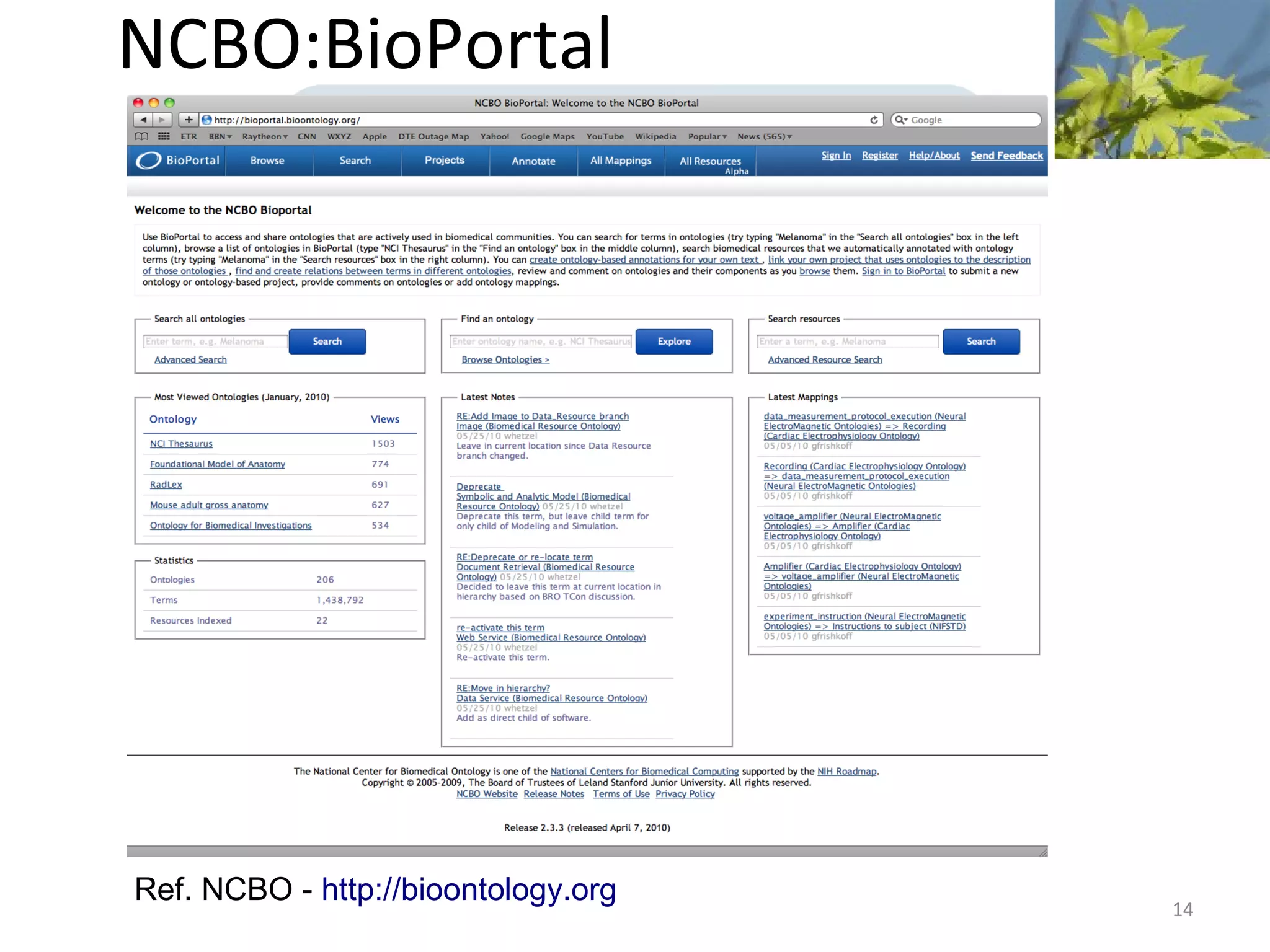
• Based on NCBO BioPortal
  – General-purpose ontology repository infrastructure
  – Supports RDFS/OWL, OBO, and LexGrid
  – Active user community
• Deployed in OOR sandbox and several
  development sites
• Developing Xen-vm and VMware images, as well
  as installation scripts, for easy deployment

                                                         6
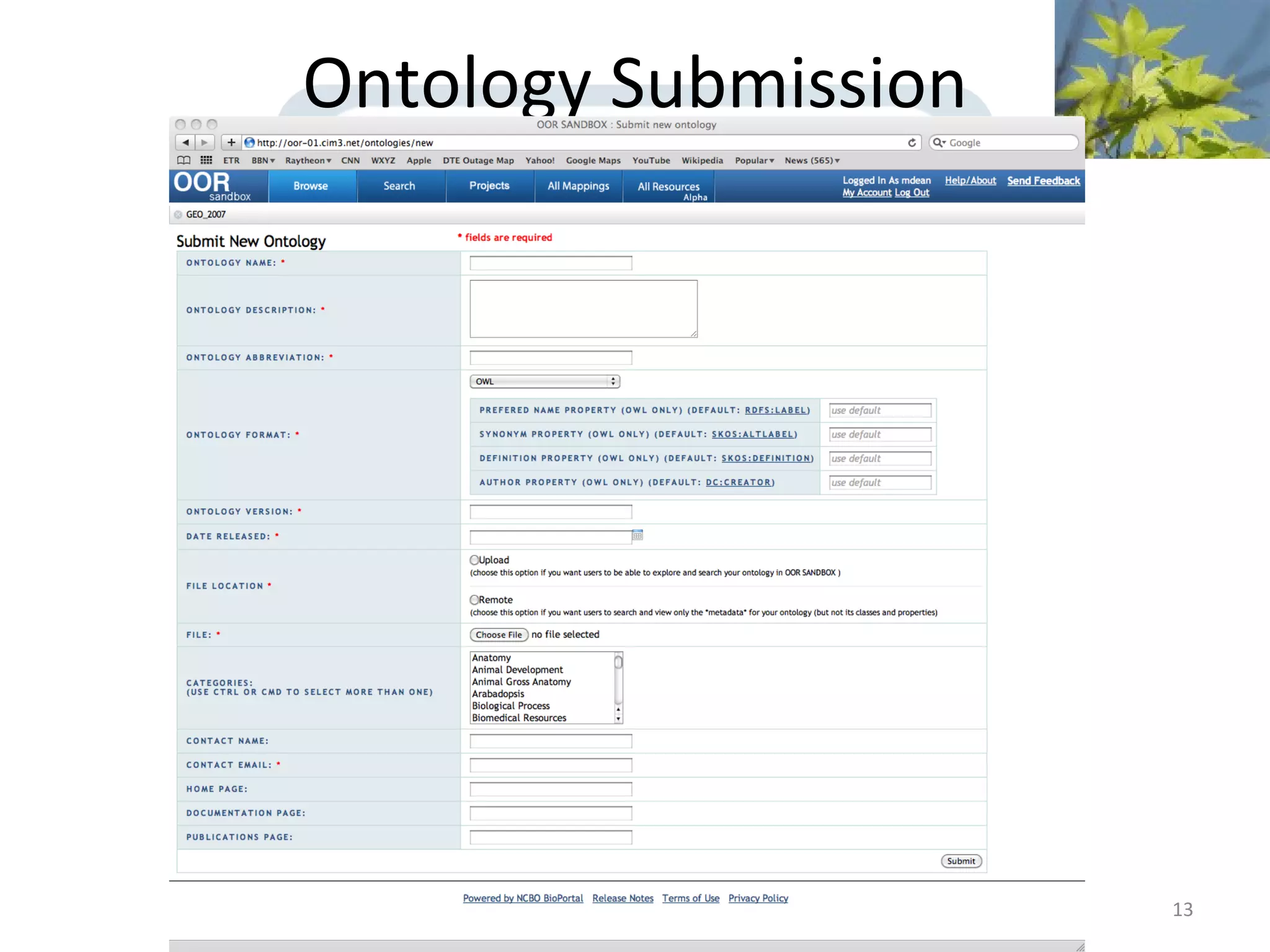
Live Demonstration

• OOR sandbox
  – http://oor-01.cim3.net
• Selected screenshots included for the archival
  record


                                                   7
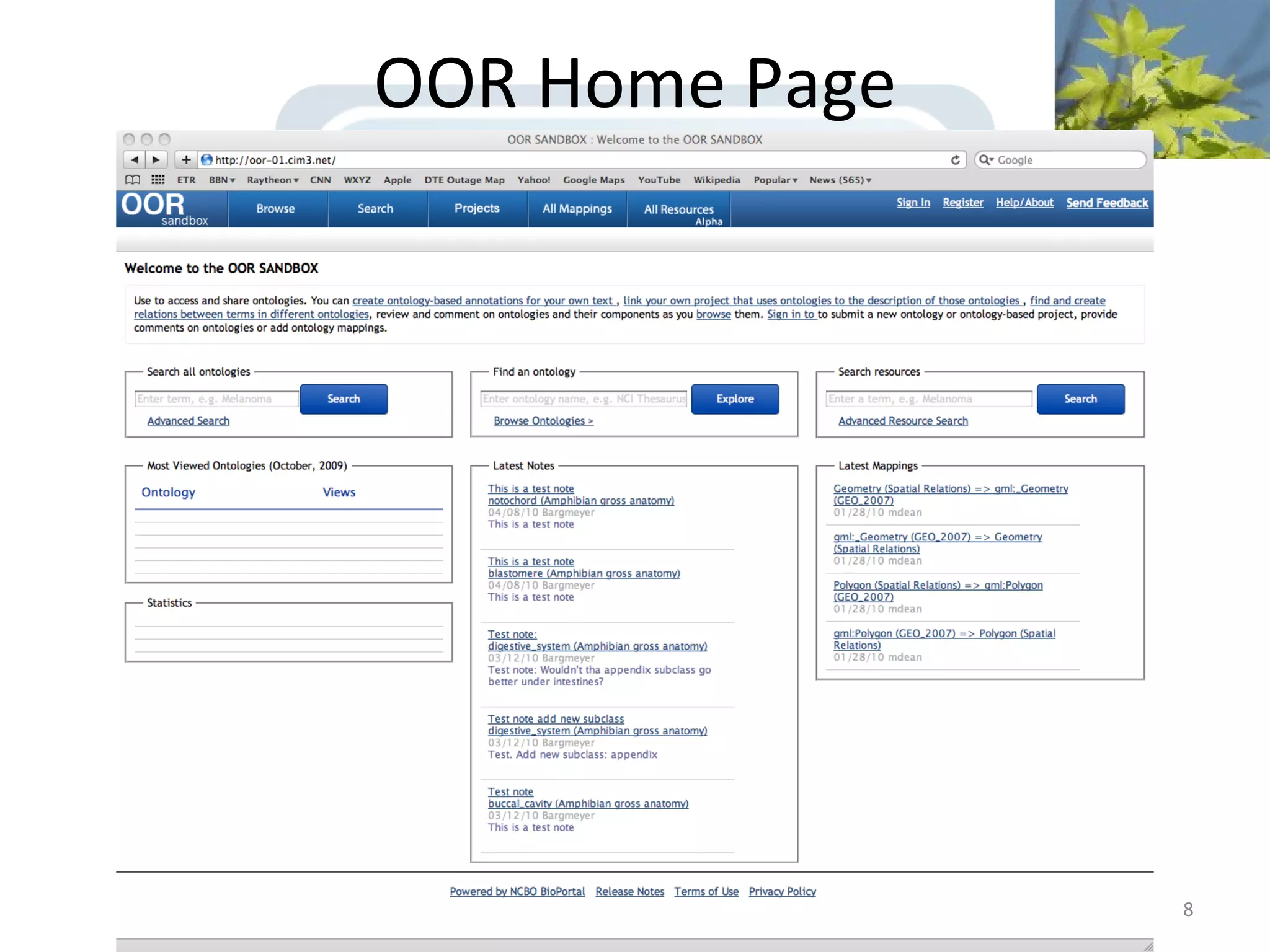
OOR Home Page


                8
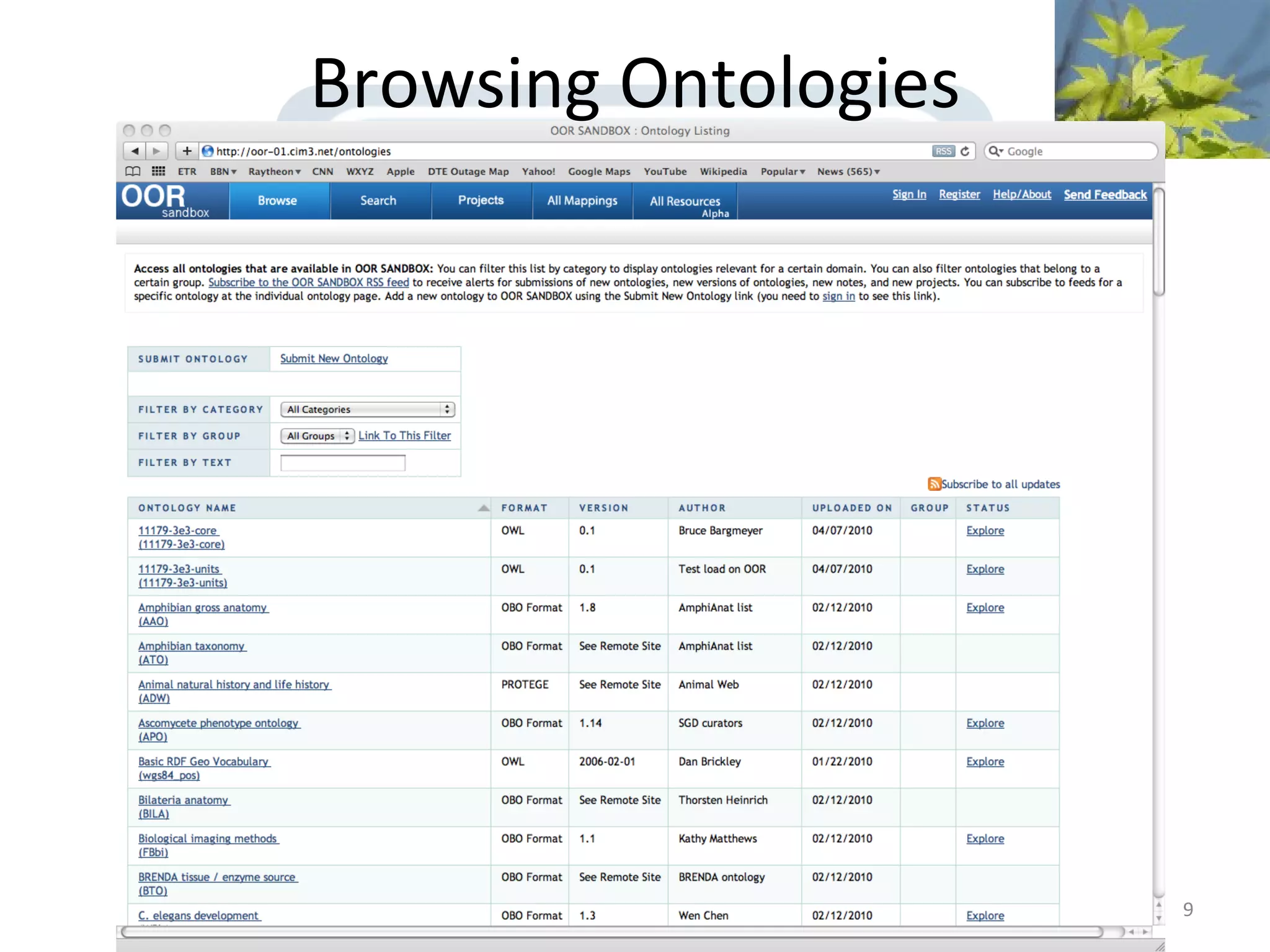
Browsing Ontologies


                      9
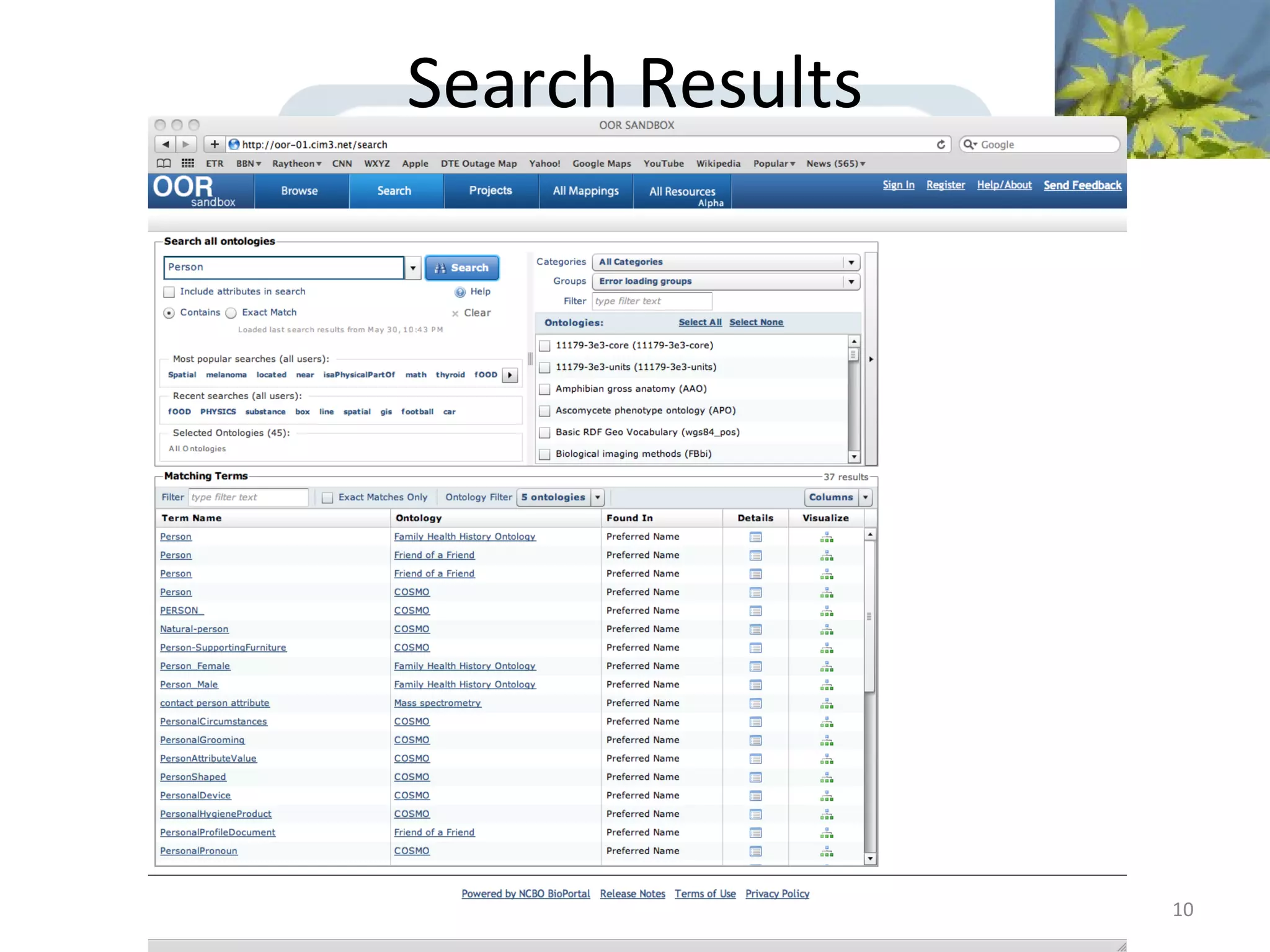
Search Results


                 10
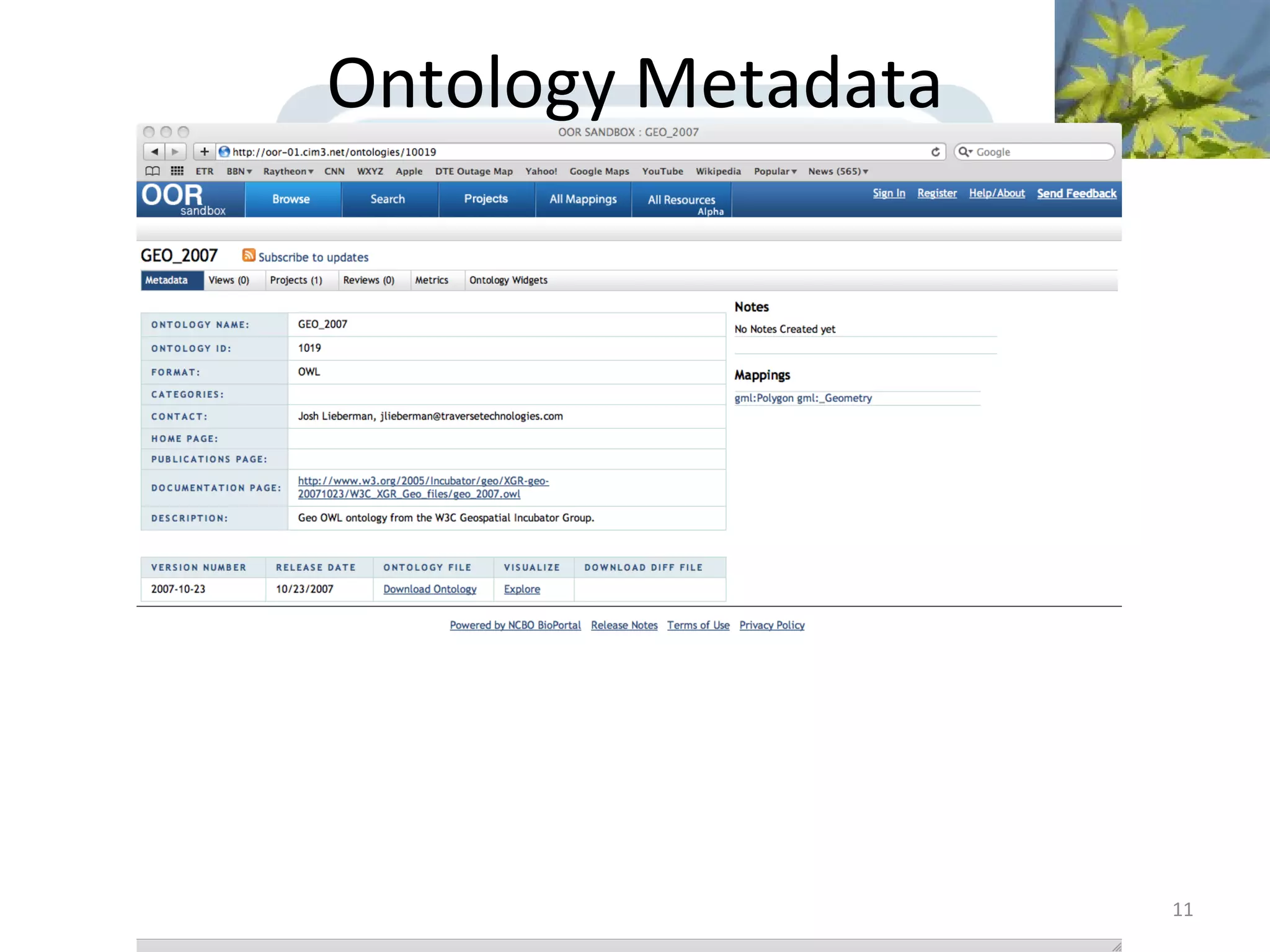
Ontology Metadata


                    11
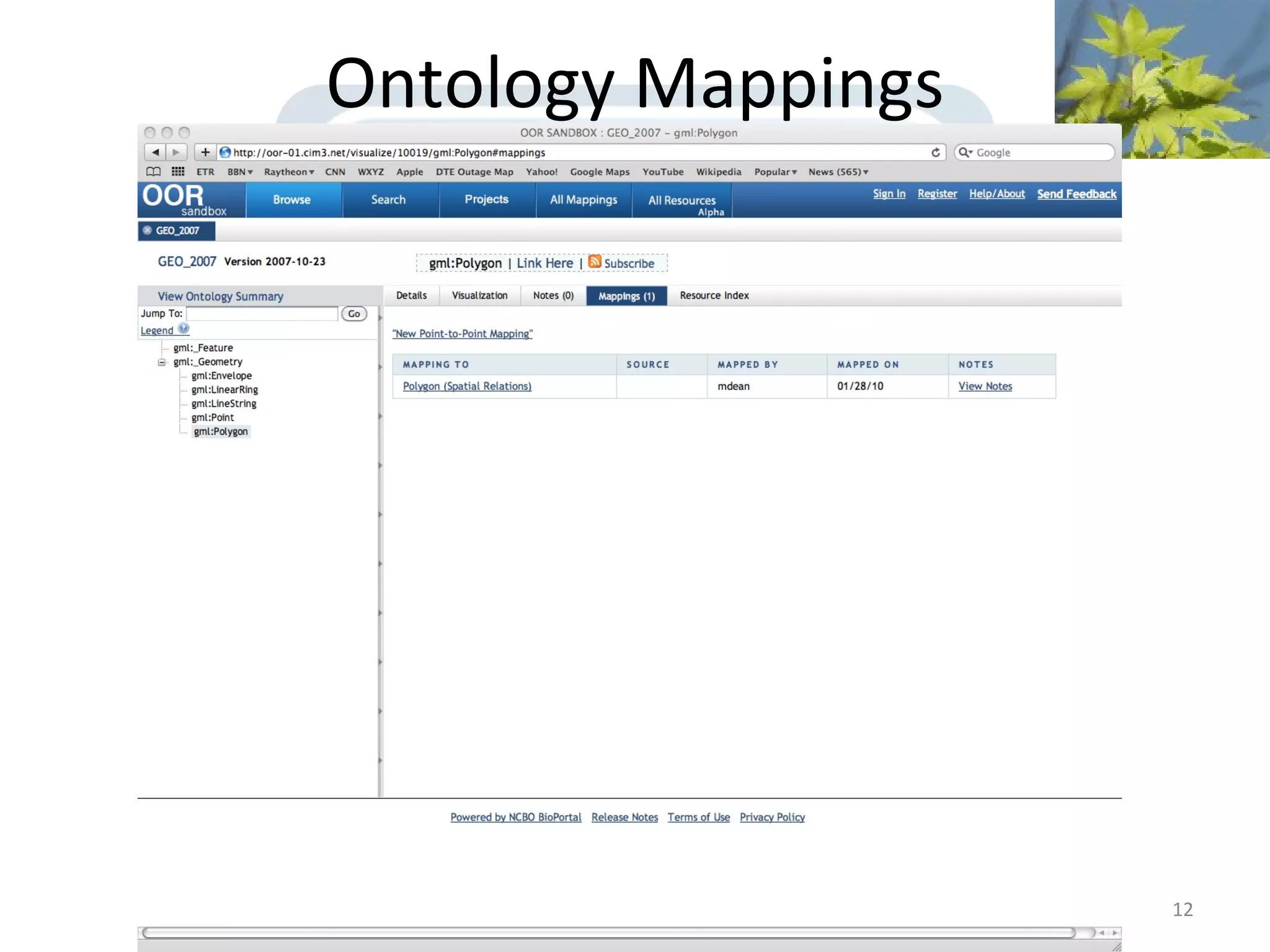
Ontology Mappings


                    12
Ontology Submission


                      13
NCBO:BioPortal


Ref. NCBO - http://bioontology.org
                                     14
Why OOR?


           15
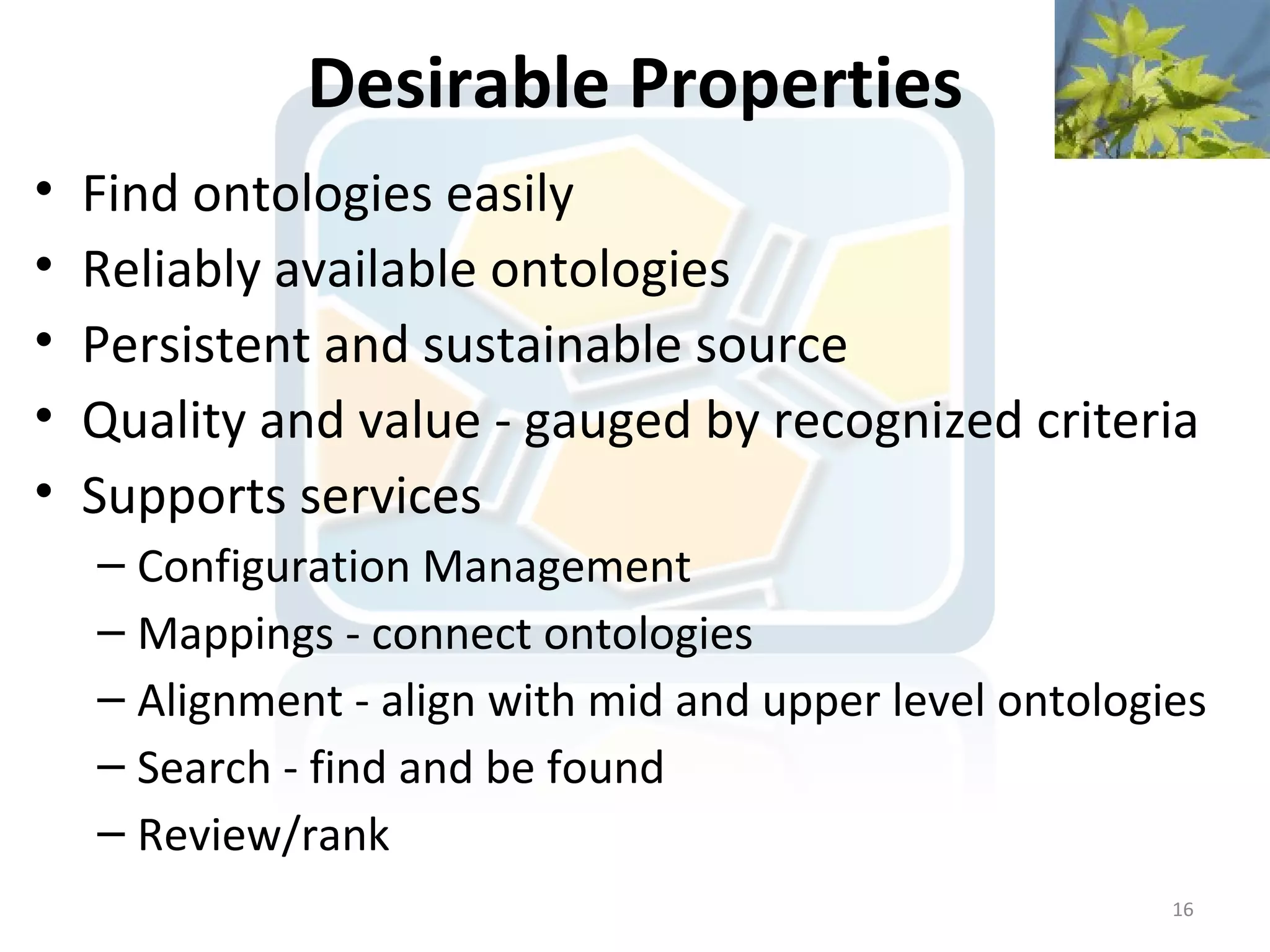
Desirable Properties
•   Find ontologies easily
•   Reliably available ontologies
•   Persistent and sustainable source
•   Quality and value - gauged by recognized criteria
•   Supports services
    – Configuration Management
    – Mappings - connect ontologies
    – Alignment - align with mid and upper level ontologies
    – Search - find and be found
    – Review/rank
                                                         16
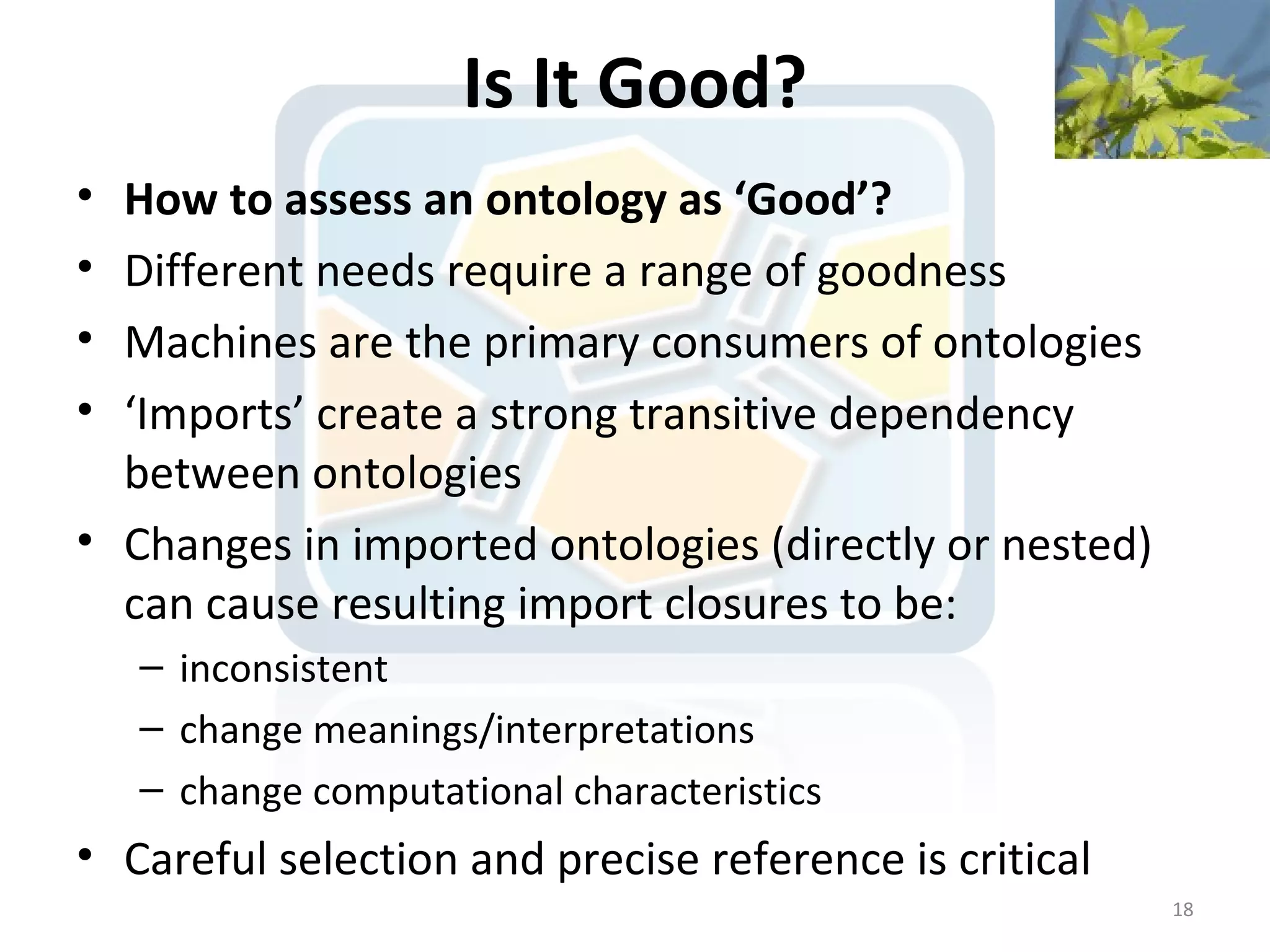
Desirable Properties (con’t)
• Confidence when committing to use
  – Ontologies are registered with metadata
  – Metadata provides
       •   Subject Domain
       •   Purpose – Current Uses/Users
       •   KR language
       •   Originating organization
• Information about ontology changes
  –   When
  –   Why
  –   How
  –   Usability                               17
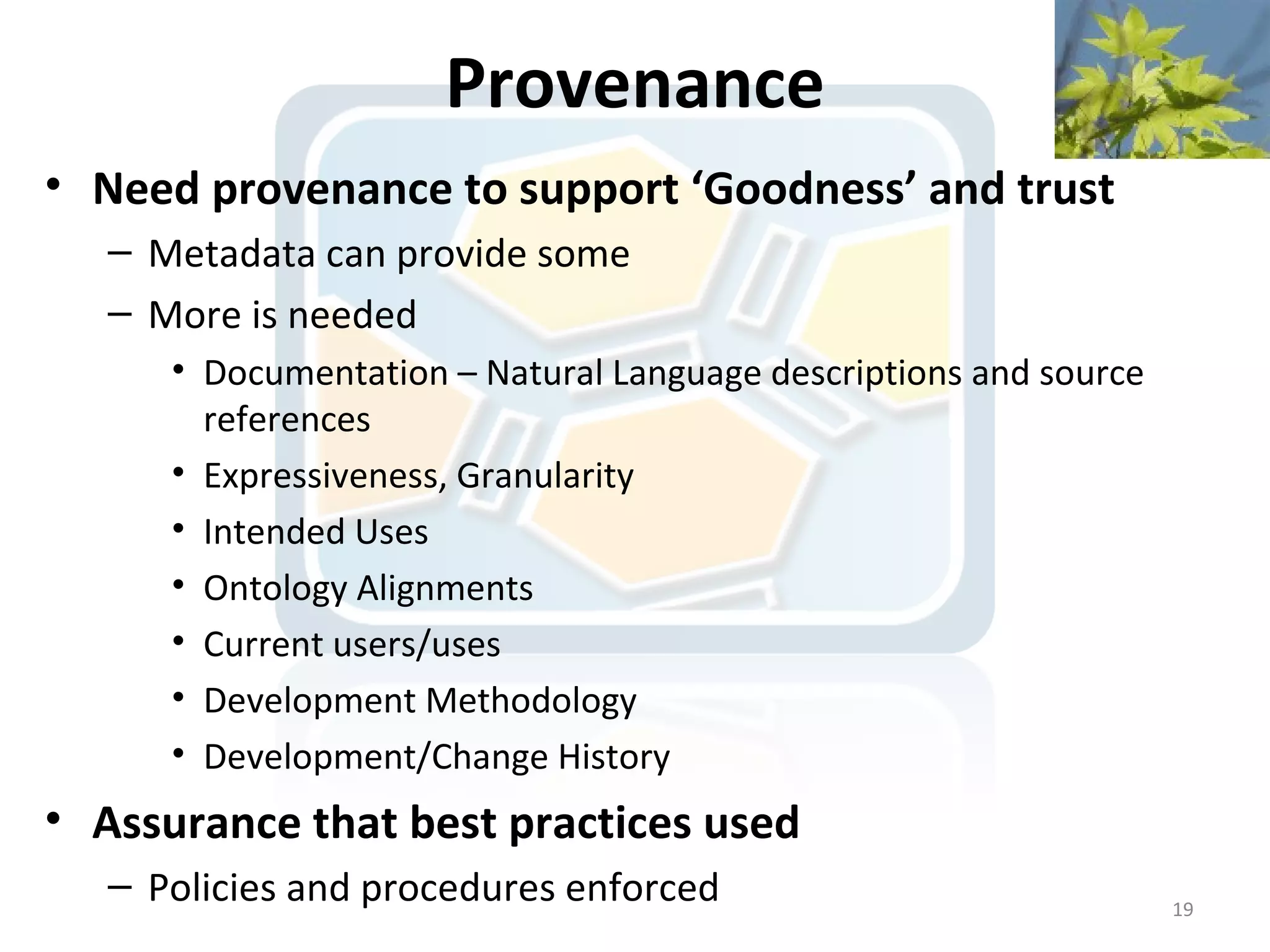
Is It Good?
• How to assess an ontology as ‘Good’?
• Different needs require a range of goodness
• Machines are the primary consumers of ontologies
• ‘Imports’ create a strong transitive dependency
  between ontologies
• Changes in imported ontologies (directly or nested)
  can cause resulting import closures to be:
    – inconsistent
    – change meanings/interpretations
    – change computational characteristics
• Careful selection and precise reference is critical
                                                        18
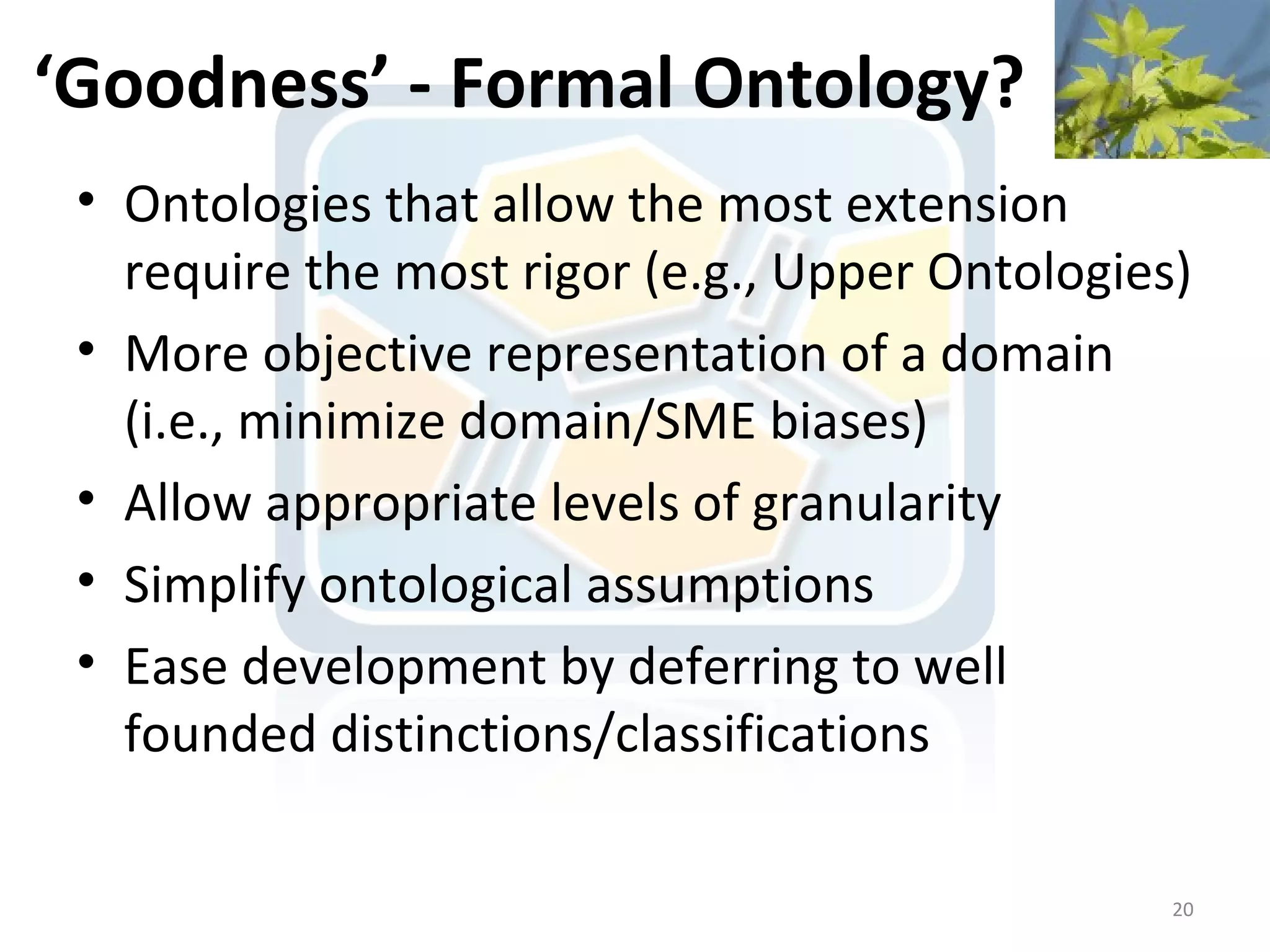
Provenance
• Need provenance to support ‘Goodness’ and trust
   – Metadata can provide some
   – More is needed
      • Documentation – Natural Language descriptions and source
        references
      • Expressiveness, Granularity
      • Intended Uses
      • Ontology Alignments
      • Current users/uses
      • Development Methodology
      • Development/Change History
• Assurance that best practices used
   – Policies and procedures enforced                              19
‘Goodness’ - Formal Ontology?
 • Ontologies that allow the most extension
   require the most rigor (e.g., Upper Ontologies)
 • More objective representation of a domain
   (i.e., minimize domain/SME biases)
 • Allow appropriate levels of granularity
 • Simplify ontological assumptions
 • Ease development by deferring to well
   founded distinctions/classifications

                                                 20
OOR Goals
• A well-maintained persistent store (with high availability
  and performance) where ontological work can be stored,
  shared and accessed consistently;
• Mechanisms for registering and “governing” ontologies,
  with provenance and versioning, made available
  (logically) in one place so that they can be browsed,
  discovered, queried, analyzed, validated and reused;
• Services across disparate ontological artifacts supporting
  cross-domain interoperability, mapping, application and
  inferencing; and
• Registration of semantic services to support peer OORs
                                                         21
OOR Charter
Promote the global use and sharing of ontologies
  by:
  – Establishing a hosted registry-repository;
  – Enabling and facilitating open, federated,
    collaborative ontology repositories, and
  – Establishing best practices for expressing
    interoperable ontology and taxonomy work in
    registry-repositories.


     http://OpenOntologyRepository.org
                                                  22
OOR Initiative
• Started in January 2008 by Peter Yim, Leo Obrst, and
  Mike Dean
• OOR is an independent initiative, emerged from and
  incubated in the Ontolog Forum's collaborative work
  environment .
• ONTOLOG (a.k.a. "Ontolog Forum")
   – An open, international, virtual community of practice
     devoted to advancing the field of ontology, ontological
     architecture and engineering and semantic technologies,
     and advocating their adoption into mainstream
     applications and international standards
   – http://ontolog.cim3.net/cgi-bin/wiki.pl?WikiHomePage

                                                               23
OOR Requirements
• The repository architecture shall be scalable.
• The repository shall be distributed.
• The specification of the repository shall be sufficiently
  detailed and platform independent to allow multiple
  implementations.
• The repository shall be capable of supporting ontologies in
  languages that have reasoners [supporting inferencing].
• The repository architecture shall support distributed
  repositories.
• The repository architecture shall not require a hierarchical
  structure.
http://ontolog.cim3.net/cgi-bin/wiki.pl?OpenOntologyRepository_Requirement
                                                                        24
OOR Architecture
• OOR requires an open and well documented architecture
  to
   – Allow multiple communities and organizations to participate in
     the OOR
   – Produce standard OOR functionalities and behaviors.
• OOR Architectural Principles
   – Decoupling of responsibilities – To support multiple knowledge
     representations/languages repository will not be there tightly
     coupled with the content.
   – Implementation/Platform independence – To support
     acceptance, multiple instances, and evolution, no particular
     implementation or platform dependence can be allowed.
   – Ontologically driven – To allow for evolution of the OOR and
     reduce overall development costs, the use of an ontologically
     based development environment is sought.                     25
Current Participation
• Mailing list with 100+ subscribers worldwide
• Between Jan 2008 and now: more than 60
  meetings and virtual events (team meetings,
  invited talks, panel discussions in the form of
  augmented conference calls)
• Featured at major events:
  OntologySummit2008, ISWC 2009,
  CENDI/NKOS 2008 & 2009, SOCoP 2009, ESWC
  2010, SemTech 2010, ISWC 2010

                                                26
Current Participation (con’t)
• Technology contributions from
  – NCBO / Stanford-BMIR
  – CIM Engineering (CIM3)
  – Raytheon BBN
  – Northeastern University
  – University of Toronto
  – University of Bremen
  – … (more – Your Organization?)
                                    27
Current Participation (con’t)

• Contributing to the discourse: communities
  and projects like BioPortal, ORATE, COLORE,
  NEU-Courses, SIO, XMDR, MMI, NeOn, SOCoP,
  … and dozens of individuals from the
  ontology, semantic web, data modeling,
  enterprise architecture and software
  engineering communities


                                            28
Organizing the Effort
• Design, architecture - Virtual panels sessions on
  Requirements, Use Cases; bi-weekly team conf calls;
  email list
• Technology - Open source project (in the style of
  Apache)
• Content - Looking for “content” down two tracks:
   – The more “traditional” ontologies (in RDF, SKOS, OWL, KIF,
     CLIF, etc.)
   – From the communities developing KOS/NKOS,
     classification schema, taxonomies, XML vocabulary &
     schema, database schema, etc.
• Discourse on Issues - e.g. IPR for ontologies and
  ontology repositories and registries
                                                              29
Ongoing Efforts
• Standing up an OOR-sandbox instance
  (Stanford/CIM3/NEU) -
       http://oor-01.cim3.net/ontologies
• Standing up an OOR code-repository
  (BBN/NEU) - http://oor.semwebcentral.org/
• Positioning to stand up an OOR-production
  instance, which requires to be in place
  – Gatekeeping mechanisms
  – Proper policies
                                              30
Ongoing Efforts (con’t)
• OOR-development instances
  – NCBO: BioPortal - Stanford U. / Mark Musen,
    Natasha Noy, et al. - whose technology we are
    running, as our code-base
  – NEU: gatekeeping and policy dev - Northeastern
    U. / Ken Baclawski, et al. - via a Use Case
    Description Ontology (UCDO)
  – Raytheon BBN: federation - BBN / Mike Dean, Jim
    Chatigny, Dan Cerys
  – others: Bremen, MMI, Ryerson, MetHet, ORNL, ...
                                                      31
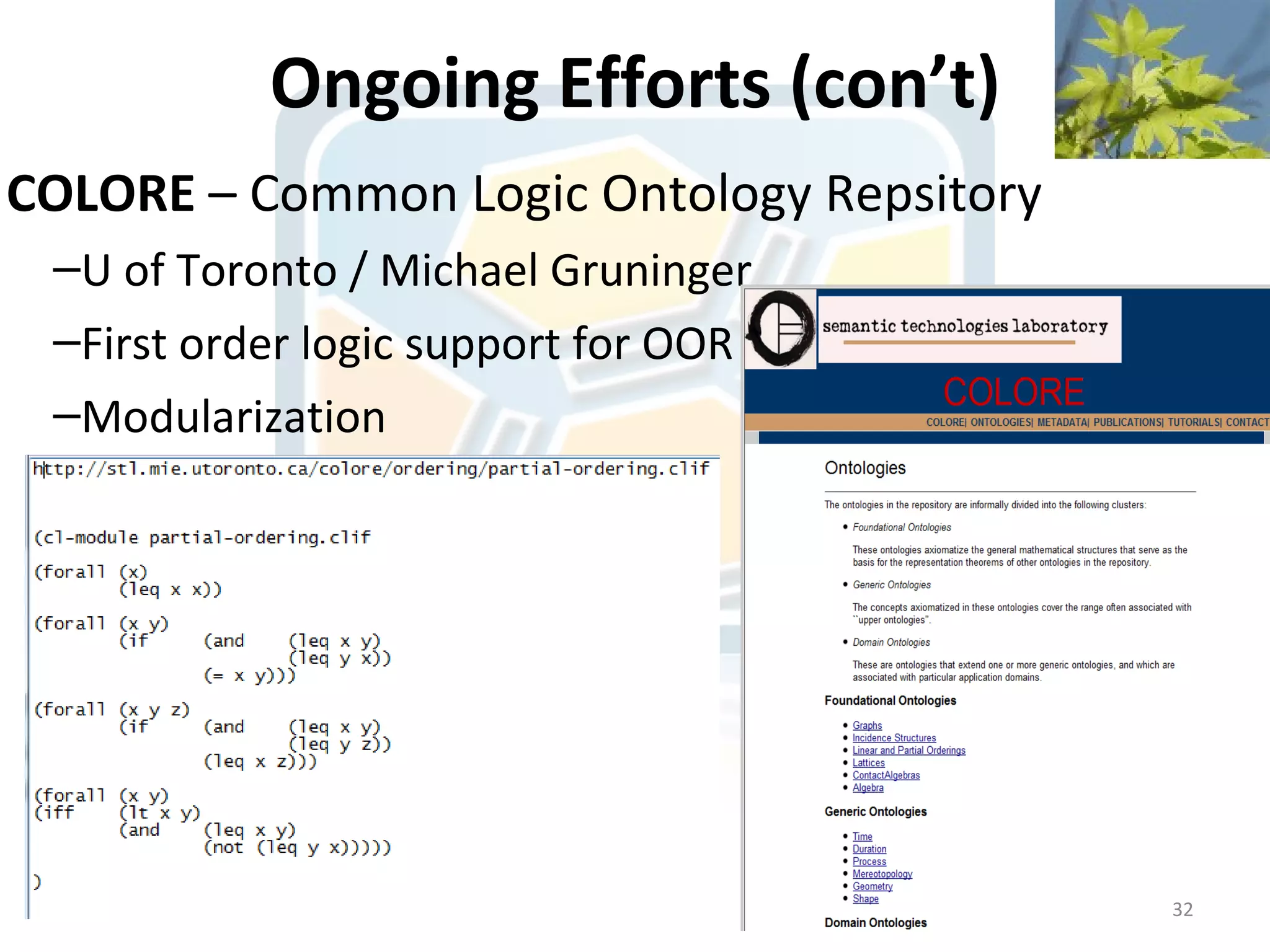
Ongoing Efforts (con’t)
COLORE – Common Logic Ontology Repsitory
 –U of Toronto / Michael Gruninger
 –First order logic support for OOR
 –Modularization


                                           32
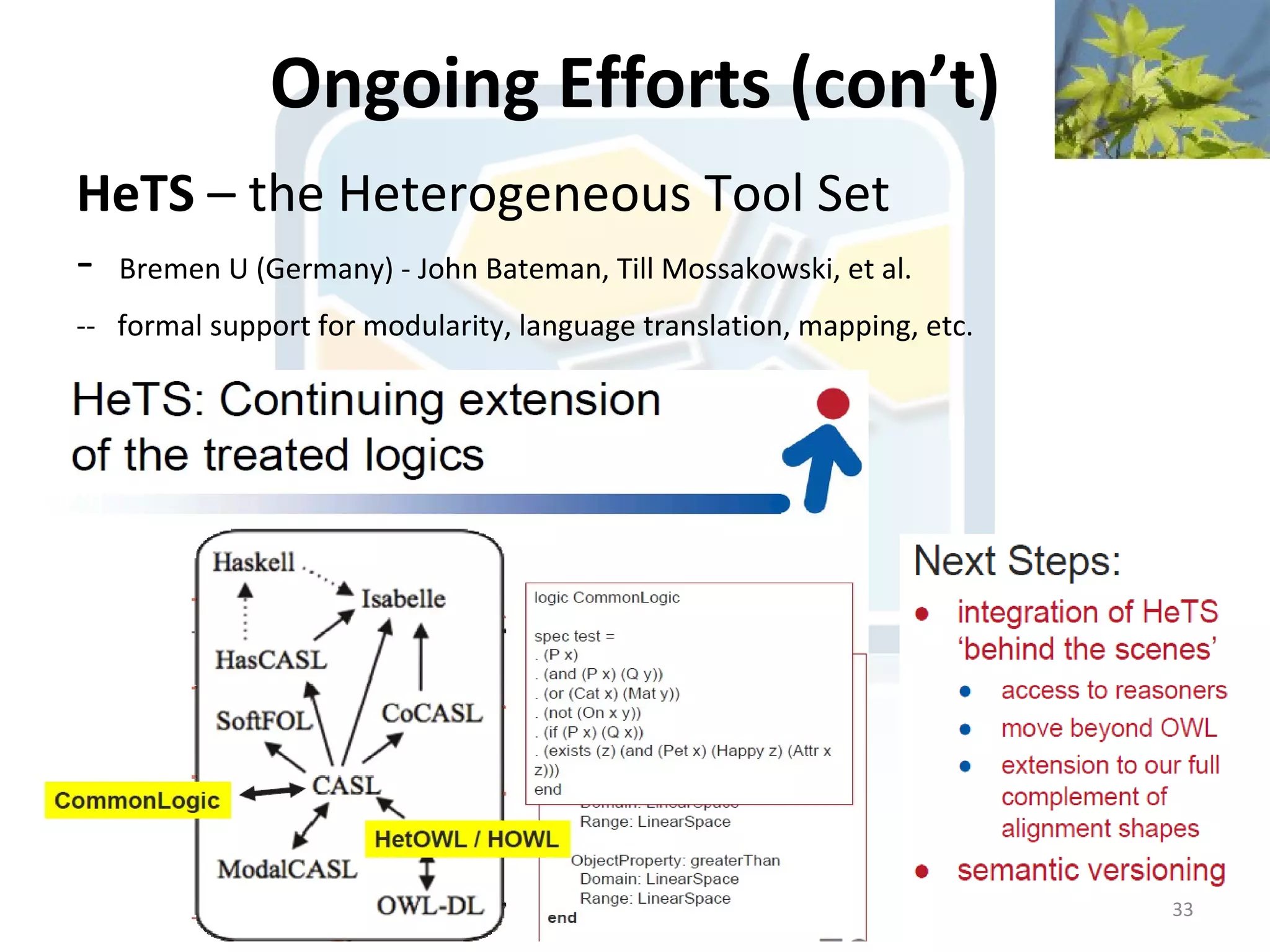
Ongoing Efforts (con’t)
HeTS – the Heterogeneous Tool Set
- Bremen U (Germany) - John Bateman, Till Mossakowski, et al.
-- formal support for modularity, language translation, mapping, etc.


                                                                        33
Ongoing Efforts (con’t)
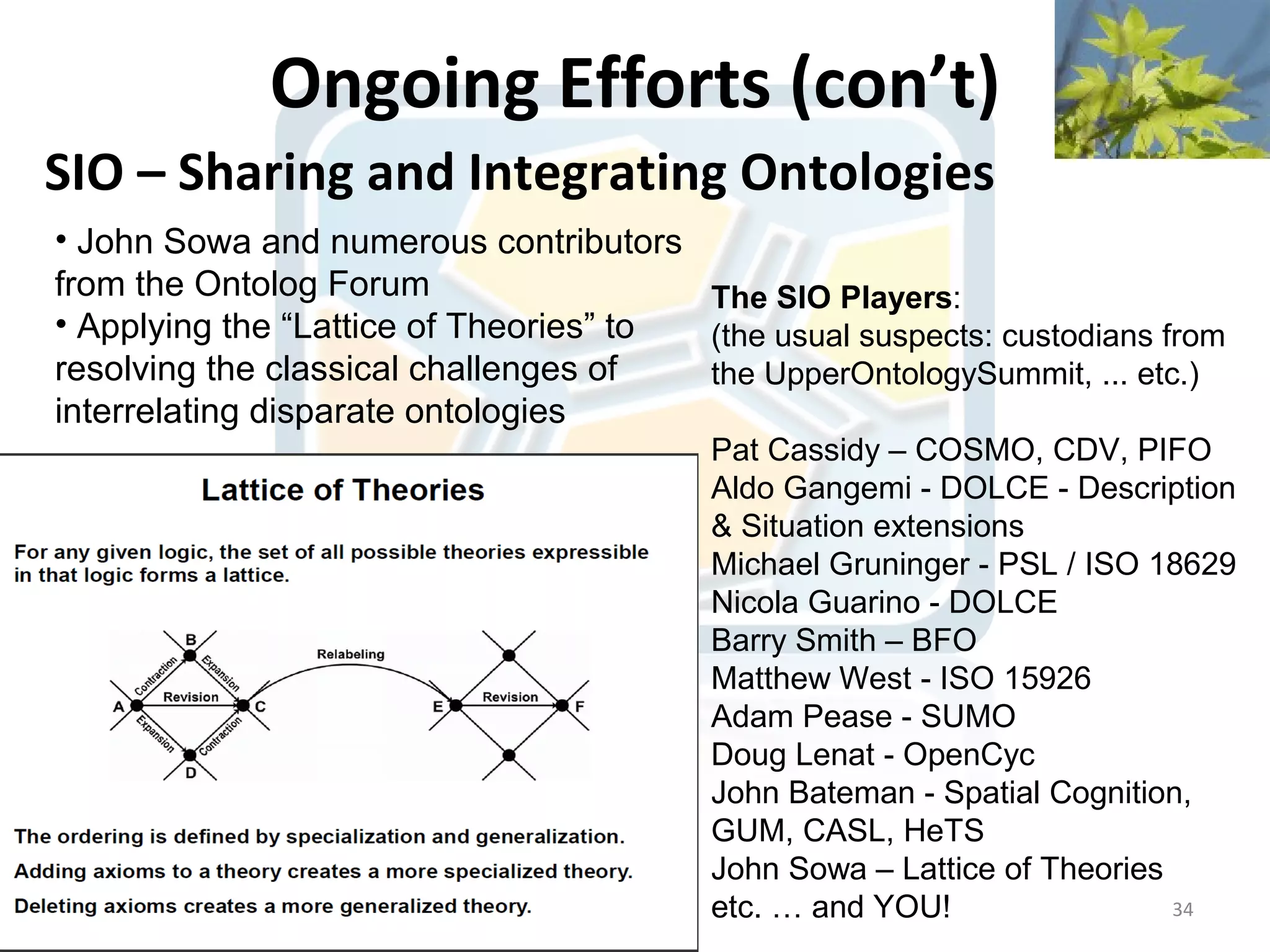
SIO – Sharing and Integrating Ontologies
• John Sowa and numerous contributors
from the Ontolog Forum                  The SIO Players:
• Applying the “Lattice of Theories” to (the usual suspects: custodians from
resolving the classical challenges of   the UpperOntologySummit, ... etc.)
interrelating disparate ontologies
                                          Pat Cassidy – COSMO, CDV, PIFO
                                          Aldo Gangemi - DOLCE - Description
                                          & Situation extensions
                                          Michael Gruninger - PSL / ISO 18629
                                          Nicola Guarino - DOLCE
                                          Barry Smith – BFO
                                          Matthew West - ISO 15926
                                          Adam Pease - SUMO
                                          Doug Lenat - OpenCyc
                                          John Bateman - Spatial Cognition,
                                          GUM, CASL, HeTS
                                          John Sowa – Lattice of Theories
                                          etc. … and YOU!                 34
Current OOR Priorities
• Continue to push OOR development and get more contributors
• Set up policies and process - policies for contributing to OOR
  work
   – Clear and easy policies and process to engage developers and have them
     contribute code
   – Build out "gatekeeping" and move from just having an OOR-sandbox to
     having available instances of an OOR-sandbox and an OOR-production
   – Clear and easy policies and process to engage content stewards and have
     them contribute ontologies to our public instance of OOR
• Get funding to continue and extend the work
• Systematically solicit content contribution
• Regularly review requirements and existing standards to make
  sure we are on track
• Continue efforts in publicity and outreach
                                                                          35
Join the Fun !

• Join the [oor-forum] mailing list - mailto:
   oor-forum-join@ontolog.cim3.net
• Come to our OOR-team conference calls -
  Fridays (noon Eastern Time), every other week
• See: http://OpenOntologyRepository.org
• E-mail any one one of us if you have a
  question (our email addresses are on the
  cover slide)
                                              36

OOR--Open-Ontology-Repository--jun2010

  • 1.
    Finding a GoodOntology: The Open Ontology Repository Initiative Ken Baclawski, kenb@ccs.neu.edu Mike Dean, mdean@bbn.com Todd Schneider, todd.schneider@raytheon.com Peter Yim, peter.yim@cim3.com Semantic Technology Conference San Francisco, California 24 June 2010 These slides: http://ontolog.cim3.net/file/work/OOR/OOR_presentations_publications/OOR-SemTech_Jun2010.pdf 1
  • 2.
    Outline • Introduction • Demonstration • Requirements and Challenges • Current Efforts • How to Participate 2
  • 3.
    Open Ontology Repository •Community effort since January 2008 • Promote global use and sharing of ontologies – Modular open source registry/repository software – 1 or more public instances – Best practices for ontology sharing and management 3
  • 4.
    OOR Software Target •Allow modular choices among – Registry functions (search, etc.) – Repository functions (persistence, versioning, etc.) – KR languages (OWL, Common Logic, etc.) – Gatekeeping policies (open, curated, market, etc.) – Intellectual Property Rights policies – Federation mechanisms (OOR, RSS, OMV, etc.) – Value-added services (alignment, translation, etc.) –… 4
  • 5.
    OOR Deployment Example Domain 1 Public OOR Open Source General purpose User Ratings Open Source Company Domain 2 Proprietary Proprietary Curated Curated Project Proprietary Open Submission 5
  • 6.
    Initial Implementation • Basedon NCBO BioPortal – General-purpose ontology repository infrastructure – Supports RDFS/OWL, OBO, and LexGrid – Active user community • Deployed in OOR sandbox and several development sites • Developing Xen-vm and VMware images, as well as installation scripts, for easy deployment 6
  • 7.
    Live Demonstration • OORsandbox – http://oor-01.cim3.net • Selected screenshots included for the archival record 7
  • 8.
  • 9.
  • 10.
  • 11.
  • 12.
  • 13.
  • 14.
    NCBO:BioPortal Ref. NCBO -http://bioontology.org 14
  • 15.
  • 16.
    Desirable Properties • Find ontologies easily • Reliably available ontologies • Persistent and sustainable source • Quality and value - gauged by recognized criteria • Supports services – Configuration Management – Mappings - connect ontologies – Alignment - align with mid and upper level ontologies – Search - find and be found – Review/rank 16
  • 17.
    Desirable Properties (con’t) •Confidence when committing to use – Ontologies are registered with metadata – Metadata provides • Subject Domain • Purpose – Current Uses/Users • KR language • Originating organization • Information about ontology changes – When – Why – How – Usability 17
  • 18.
    Is It Good? •How to assess an ontology as ‘Good’? • Different needs require a range of goodness • Machines are the primary consumers of ontologies • ‘Imports’ create a strong transitive dependency between ontologies • Changes in imported ontologies (directly or nested) can cause resulting import closures to be: – inconsistent – change meanings/interpretations – change computational characteristics • Careful selection and precise reference is critical 18
  • 19.
    Provenance • Need provenanceto support ‘Goodness’ and trust – Metadata can provide some – More is needed • Documentation – Natural Language descriptions and source references • Expressiveness, Granularity • Intended Uses • Ontology Alignments • Current users/uses • Development Methodology • Development/Change History • Assurance that best practices used – Policies and procedures enforced 19
  • 20.
    ‘Goodness’ - FormalOntology? • Ontologies that allow the most extension require the most rigor (e.g., Upper Ontologies) • More objective representation of a domain (i.e., minimize domain/SME biases) • Allow appropriate levels of granularity • Simplify ontological assumptions • Ease development by deferring to well founded distinctions/classifications 20
  • 21.
    OOR Goals • Awell-maintained persistent store (with high availability and performance) where ontological work can be stored, shared and accessed consistently; • Mechanisms for registering and “governing” ontologies, with provenance and versioning, made available (logically) in one place so that they can be browsed, discovered, queried, analyzed, validated and reused; • Services across disparate ontological artifacts supporting cross-domain interoperability, mapping, application and inferencing; and • Registration of semantic services to support peer OORs 21
  • 22.
    OOR Charter Promote theglobal use and sharing of ontologies by: – Establishing a hosted registry-repository; – Enabling and facilitating open, federated, collaborative ontology repositories, and – Establishing best practices for expressing interoperable ontology and taxonomy work in registry-repositories. http://OpenOntologyRepository.org 22
  • 23.
    OOR Initiative • Startedin January 2008 by Peter Yim, Leo Obrst, and Mike Dean • OOR is an independent initiative, emerged from and incubated in the Ontolog Forum's collaborative work environment . • ONTOLOG (a.k.a. "Ontolog Forum") – An open, international, virtual community of practice devoted to advancing the field of ontology, ontological architecture and engineering and semantic technologies, and advocating their adoption into mainstream applications and international standards – http://ontolog.cim3.net/cgi-bin/wiki.pl?WikiHomePage 23
  • 24.
    OOR Requirements • Therepository architecture shall be scalable. • The repository shall be distributed. • The specification of the repository shall be sufficiently detailed and platform independent to allow multiple implementations. • The repository shall be capable of supporting ontologies in languages that have reasoners [supporting inferencing]. • The repository architecture shall support distributed repositories. • The repository architecture shall not require a hierarchical structure. http://ontolog.cim3.net/cgi-bin/wiki.pl?OpenOntologyRepository_Requirement 24
  • 25.
    OOR Architecture • OORrequires an open and well documented architecture to – Allow multiple communities and organizations to participate in the OOR – Produce standard OOR functionalities and behaviors. • OOR Architectural Principles – Decoupling of responsibilities – To support multiple knowledge representations/languages repository will not be there tightly coupled with the content. – Implementation/Platform independence – To support acceptance, multiple instances, and evolution, no particular implementation or platform dependence can be allowed. – Ontologically driven – To allow for evolution of the OOR and reduce overall development costs, the use of an ontologically based development environment is sought. 25
  • 26.
    Current Participation • Mailinglist with 100+ subscribers worldwide • Between Jan 2008 and now: more than 60 meetings and virtual events (team meetings, invited talks, panel discussions in the form of augmented conference calls) • Featured at major events: OntologySummit2008, ISWC 2009, CENDI/NKOS 2008 & 2009, SOCoP 2009, ESWC 2010, SemTech 2010, ISWC 2010 26
  • 27.
    Current Participation (con’t) •Technology contributions from – NCBO / Stanford-BMIR – CIM Engineering (CIM3) – Raytheon BBN – Northeastern University – University of Toronto – University of Bremen – … (more – Your Organization?) 27
  • 28.
    Current Participation (con’t) •Contributing to the discourse: communities and projects like BioPortal, ORATE, COLORE, NEU-Courses, SIO, XMDR, MMI, NeOn, SOCoP, … and dozens of individuals from the ontology, semantic web, data modeling, enterprise architecture and software engineering communities 28
  • 29.
    Organizing the Effort •Design, architecture - Virtual panels sessions on Requirements, Use Cases; bi-weekly team conf calls; email list • Technology - Open source project (in the style of Apache) • Content - Looking for “content” down two tracks: – The more “traditional” ontologies (in RDF, SKOS, OWL, KIF, CLIF, etc.) – From the communities developing KOS/NKOS, classification schema, taxonomies, XML vocabulary & schema, database schema, etc. • Discourse on Issues - e.g. IPR for ontologies and ontology repositories and registries 29
  • 30.
    Ongoing Efforts • Standingup an OOR-sandbox instance (Stanford/CIM3/NEU) - http://oor-01.cim3.net/ontologies • Standing up an OOR code-repository (BBN/NEU) - http://oor.semwebcentral.org/ • Positioning to stand up an OOR-production instance, which requires to be in place – Gatekeeping mechanisms – Proper policies 30
  • 31.
    Ongoing Efforts (con’t) •OOR-development instances – NCBO: BioPortal - Stanford U. / Mark Musen, Natasha Noy, et al. - whose technology we are running, as our code-base – NEU: gatekeeping and policy dev - Northeastern U. / Ken Baclawski, et al. - via a Use Case Description Ontology (UCDO) – Raytheon BBN: federation - BBN / Mike Dean, Jim Chatigny, Dan Cerys – others: Bremen, MMI, Ryerson, MetHet, ORNL, ... 31
  • 32.
    Ongoing Efforts (con’t) COLORE– Common Logic Ontology Repsitory –U of Toronto / Michael Gruninger –First order logic support for OOR –Modularization 32
  • 33.
    Ongoing Efforts (con’t) HeTS– the Heterogeneous Tool Set - Bremen U (Germany) - John Bateman, Till Mossakowski, et al. -- formal support for modularity, language translation, mapping, etc. 33
  • 34.
    Ongoing Efforts (con’t) SIO– Sharing and Integrating Ontologies • John Sowa and numerous contributors from the Ontolog Forum The SIO Players: • Applying the “Lattice of Theories” to (the usual suspects: custodians from resolving the classical challenges of the UpperOntologySummit, ... etc.) interrelating disparate ontologies Pat Cassidy – COSMO, CDV, PIFO Aldo Gangemi - DOLCE - Description & Situation extensions Michael Gruninger - PSL / ISO 18629 Nicola Guarino - DOLCE Barry Smith – BFO Matthew West - ISO 15926 Adam Pease - SUMO Doug Lenat - OpenCyc John Bateman - Spatial Cognition, GUM, CASL, HeTS John Sowa – Lattice of Theories etc. … and YOU! 34
  • 35.
    Current OOR Priorities •Continue to push OOR development and get more contributors • Set up policies and process - policies for contributing to OOR work – Clear and easy policies and process to engage developers and have them contribute code – Build out "gatekeeping" and move from just having an OOR-sandbox to having available instances of an OOR-sandbox and an OOR-production – Clear and easy policies and process to engage content stewards and have them contribute ontologies to our public instance of OOR • Get funding to continue and extend the work • Systematically solicit content contribution • Regularly review requirements and existing standards to make sure we are on track • Continue efforts in publicity and outreach 35
  • 36.
    Join the Fun! • Join the [oor-forum] mailing list - mailto: oor-forum-join@ontolog.cim3.net • Come to our OOR-team conference calls - Fridays (noon Eastern Time), every other week • See: http://OpenOntologyRepository.org • E-mail any one one of us if you have a question (our email addresses are on the cover slide) 36