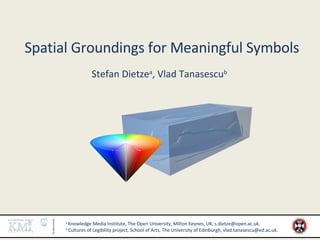
Spatial Groundings for Meaningful Symbols

Loading...

Flash Player 9 (or above) is needed to view presentations.
We have detected that you do not have it on your computer. To install it, go here.

0 comments

Post a comment

    Post a comment
    Embed Video
    Edit your comment Cancel

    Favorites, Groups & Events

    Spatial Groundings for Meaningful Symbols - Presentation Transcript

    1. Spatial Groundings for Meaningful Symbols Stefan Dietze a , Vlad Tanasescu b a Knowledge Media Institute, The Open University, Milton Keynes, UK, s.dietze@open.ac.uk. b Cultures of Legibility project, School of Arts, The University of Edinburgh, vlad.tanasescu@ed.ac.uk.
    2. Meaning – Similarity - Interoperability <owl:Class rdf:ID=&quot;Color&quot;> <rdfs:subClassOf> <owl:Class rdf:ID=&quot;PhysicalQuality&quot;/> </rdfs:subClassOf> </owl:Class> <Color rdf:ID=&quot;Lilac&quot;/> <owl:Class rdf:ID=&quot;Colour&quot;> <rdfs:subClassOf> <owl:Class rdf:ID=&quot;Quality&quot;/> </rdfs:subClassOf> </owl:Class> <Colour rdf:ID=&quot;Purple&quot;/> ?
      • Symbol grounding problem:
      • Ontological symbols lack meaningful grounding in reality (or cognitive dimensions)
      Stefan Dietze & Vlad Tanasescu - Spatial Groundings for Meaningful Symbols Workshop on Matching and Meaning, AISB, April 9th 2009, Edinburgh, UK
    3. Meaning – Similarity - Interoperability <owl:Class rdf:ID=&quot;Color&quot;> <rdfs:subClassOf> <owl:Class rdf:ID=&quot;PhysicalQuality&quot;/> </rdfs:subClassOf> </owl:Class> <Color rdf:ID=&quot;Lilac&quot;/> <owl:Class rdf:ID=&quot;Colour&quot;> <rdfs:subClassOf> <owl:Class rdf:ID=&quot;Quality&quot;/> </rdfs:subClassOf> </owl:Class> <Colour rdf:ID=&quot;Purple&quot;/>
      • Symbol grounding problem:
      • Ontological symbols lack meaningful grounding in reality (or cognitive dimensions)
      • Reasoning about similarity between symbols difficult
      Stefan Dietze & Vlad Tanasescu - Spatial Groundings for Meaningful Symbols Workshop on Matching and Meaning, AISB, April 9th 2009, Edinburgh, UK ?
    4. Meaning – Similarity - Interoperability <owl:Class rdf:ID=&quot;Color&quot;> <rdfs:subClassOf> <owl:Class rdf:ID=&quot;PhysicalQuality&quot;/> </rdfs:subClassOf> </owl:Class> <Color rdf:ID=&quot;Lilac&quot;/> <owl:Class rdf:ID=&quot;Colour&quot;> <rdfs:subClassOf> <owl:Class rdf:ID=&quot;Quality&quot;/> </rdfs:subClassOf> </owl:Class> <Colour rdf:ID=&quot;Purple&quot;/> linguistic similarity? linguistic similarity? structural similarity?
      • Symbol grounding problem:
      • Ontological symbols lack meaningful grounding in reality (or cognitive dimensions)
      • Reasoning about similarity between symbols difficult
      • Ontology interoperability needs to be based on (a) manual mappings or (b) linguistic or structural similarities (costly and error-prone)
      • Need for grounded symbols allowing for implicit similarity representations
      Stefan Dietze & Vlad Tanasescu - Spatial Groundings for Meaningful Symbols Workshop on Matching and Meaning, AISB, April 9th 2009, Edinburgh, UK
    5. Meaning – Similarity - Interoperability
      • Two approaches to more meaningful symbols…
      • … based on grounding ontologies in:
      • Conceptual Spaces (b) Processual Spacetime
      Stefan Dietze & Vlad Tanasescu - Spatial Groundings for Meaningful Symbols Workshop on Matching and Meaning, AISB, April 9th 2009, Edinburgh, UK car user1 user2 user3 wheels wheel travel vehicle
    6. Grounding ontologies in Conceptual Spaces Stefan Dietze & Vlad Tanasescu - Spatial Groundings for Meaningful Symbols Workshop on Matching and Meaning, AISB, April 9th 2009, Edinburgh, UK
        • Enhancing ontologies through CS -based representations (through CS ontology)
        • Multiple CS (each representing one concept C in one ontology O ),
        • Instances I of C represented as members M in CS .
    7. Grounding ontologies in Conceptual Spaces Stefan Dietze & Vlad Tanasescu - Spatial Groundings for Meaningful Symbols Workshop on Matching and Meaning, AISB, April 9th 2009, Edinburgh, UK
        • Enhancing ontologies through CS -based representations (through CS ontology)
        • Multiple CS (each representing one concept C in one ontology O ),
        • Instances I of C represented as members M in CS .
        • Similarity-computation between instances across ontologies by means of spatial distances
        • Requires common agreement at concept (i.e. CS) level …
        • … common case due to (a) usage of upper-level ontologies or (b) usage of ontologies within (virtual) organisations.
    8. Grounding ontologies in Conceptual Spaces Stefan Dietze & Vlad Tanasescu - Spatial Groundings for Meaningful Symbols Workshop on Matching and Meaning, AISB, April 9th 2009, Edinburgh, UK
      • Several applications utilising CS-based groundings for:
      • Ontology interoperability
    9. Grounding ontologies in Conceptual Spaces Stefan Dietze & Vlad Tanasescu - Spatial Groundings for Meaningful Symbols Workshop on Matching and Meaning, AISB, April 9th 2009, Edinburgh, UK
      • Several applications utilising CS-based groundings for:
      • Ontology interoperability
      • Semantic Web Service discovery / interoperability
    10. Grounding ontologies in Conceptual Spaces Stefan Dietze & Vlad Tanasescu - Spatial Groundings for Meaningful Symbols Workshop on Matching and Meaning, AISB, April 9th 2009, Edinburgh, UK
      • Several applications utilising CS-based groundings for:
      • Ontology interoperability
      • Semantic Web Service discovery / interoperability
      • Bridging between sensor data and symbolic ontologies
    11. Grounding ontologies in Processual Spacetime I Stefan Dietze & Vlad Tanasescu - Spatial Groundings for Meaningful Symbols Workshop on Matching and Meaning, AISB, April 9th 2009, Edinburgh, UK Processual spacetime : Extreme Tagging Systems (ETS) :
      • Instances considered as Processes in space and time rather than Things .
      • Concepts as abstract process occurrences, i.e. probabilities that a process has a given set of characteristics.
      • Copresence or cooccurrence relations: indicator of a significant probability that entities occur in the same spacetime region. E.g. `university’ and `campus’.
      • Entities are the result of discrimination (Harnad 1990), they are differences .
      • Collaborative tagging systems provide an appropriate model for descriptive discrimination.
      • Extreme Tagging Systems (ETS), or Tagging the Tags, provides an appropriate model for spatiotemporal process exploration. How?
      car user1 user2 user3 wheels wheel travel vehicle
    12. Grounding ontologies in Processual Spacetime II We adopt an associative network model in which a limited number of mental relations can be used to describe the association processes:
      • Co-occurrence : significant probability of co-presence of the two elements in a region of spacetime. E.g. ‘car’ and ‘wheels’.
      • Similarity : the concepts appear similar. E.g. ‘pub’ and ‘bar’.
      • Cause-effect : causal relation. E.g. ‘weapon’ and ‘death’
      Stefan Dietze & Vlad Tanasescu - Spatial Groundings for Meaningful Symbols Workshop on Matching and Meaning, AISB, April 9th 2009, Edinburgh, UK
      • Application: in the Cultures of Legibility project, interview data about places and itineraries is projected on an ETS for automatic inference
    13. Stefan Dietze & Vlad Tanasescu - Spatial Groundings for Meaningful Symbols Workshop on Matching and Meaning, AISB, April 9th 2009, Edinburgh, UK More during the poster session… … or via: [ http://people.kmi.open.ac.uk/dietze ] [ http://archipelagos.eu (soon) ]
    SlideShare Zeitgeist 2009

    + vladtnvladtn Nominate

    custom

    733 views, 0 favs, 0 embeds more stats

    A short AISB 2009 presentation

    More info about this document

    © All Rights Reserved

    Go to text version

    • Total Views 733
      • 733 on SlideShare
      • 0 from embeds
    • Comments 0
    • Favorites 0
    • Downloads 2
    Most viewed embeds

    more

    All embeds

    less

    Flagged as inappropriate Flag as inappropriate
    Flag as inappropriate

    Select your reason for flagging this presentation as inappropriate. If needed, use the feedback form to let us know more details.

    Cancel
    File a copyright complaint
    Having problems? Go to our helpdesk?

    Categories