[C++ Korea 2nd Seminar] C++17 Key Features Summary
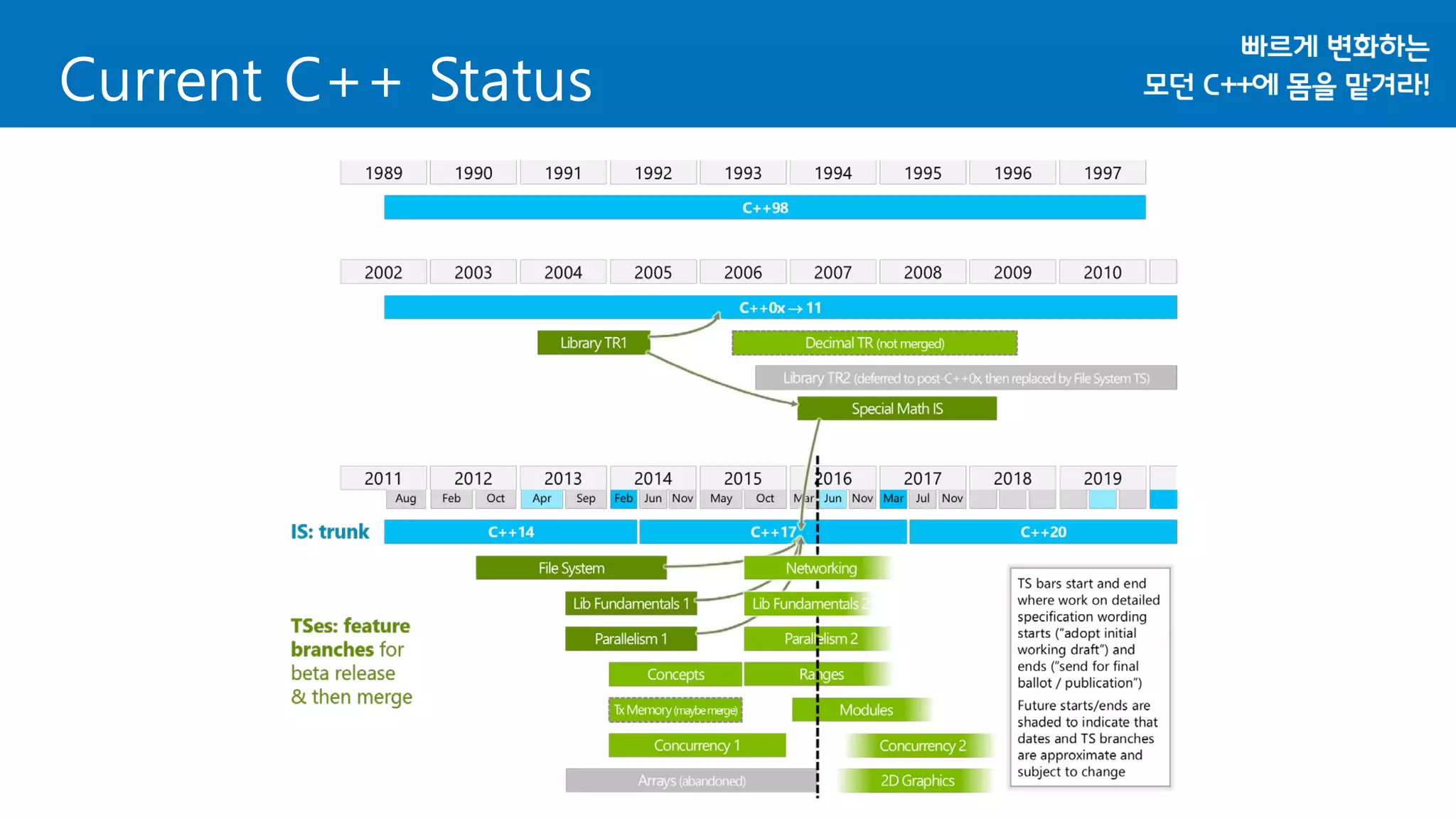
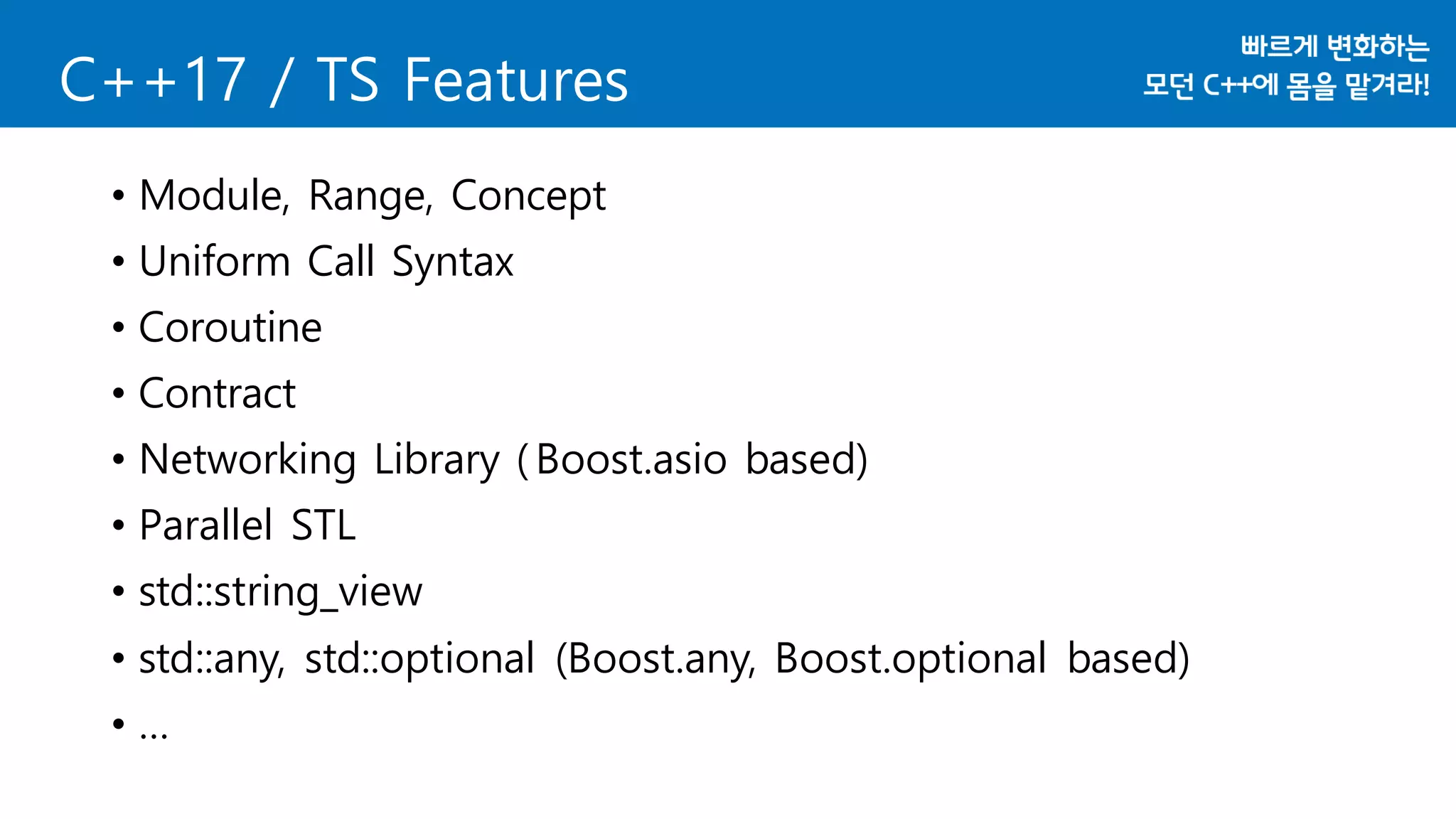
C++은 10년 만에 C++11/14를 발표하면서 '모던 C++'이라는 이름으로 발전했습니다. 그만큼 새로운 기능들이 많이 추가되었습니다. 그리고 2017년, C++은 C++17이라는 이름으로 또 한 번의 발전을 준비하고 있습니다. 3년 주기로 빠르게 변화하는 모던 C++에 대비하기 위해, C++17에 추가될 주요 기능들을 살펴보고자 합니다.
[C++ Korea 2nd Seminar] C++17 Key Features Summary
2.
옥찬호 / NexonKorea, C++ Korea
C++17 Key Features Summary
3.
시작하기 전에…
• C++17에추가될 주요 기능들을 설명합니다.
• C++17에 추가될 주요 기능 뿐만 아니라,
이후 TS(Technical Specification)에 추가될 기능들도 소개합니다.
• C++17에 추가될 기능 중 C++11/14 지식이 필요한 경우,
이해를 돕기 위해 사전 지식을 먼저 설명합니다.
• 모든 예제 코드는 발표 이후 Github를 통해 제공됩니다.
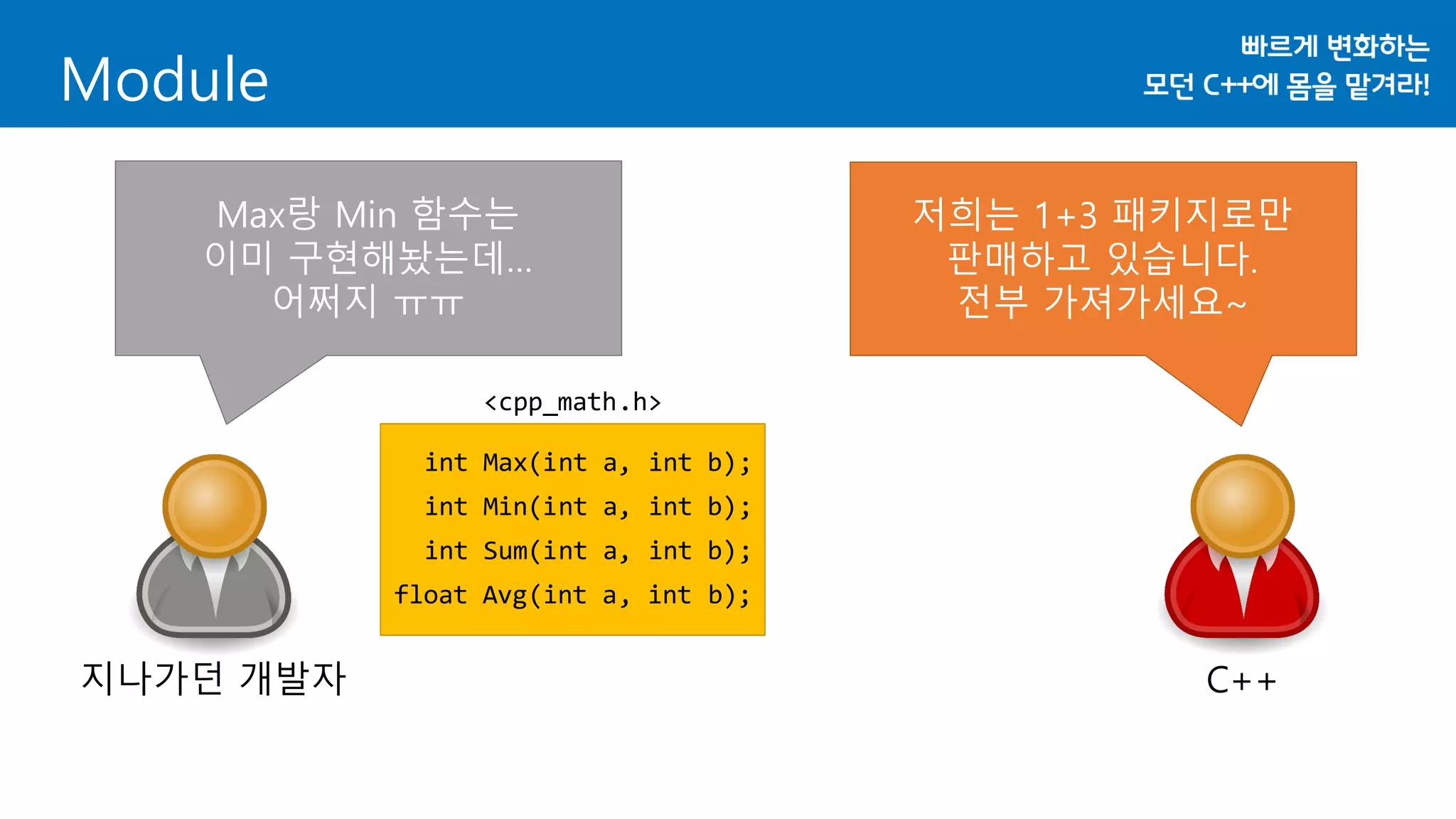
Module
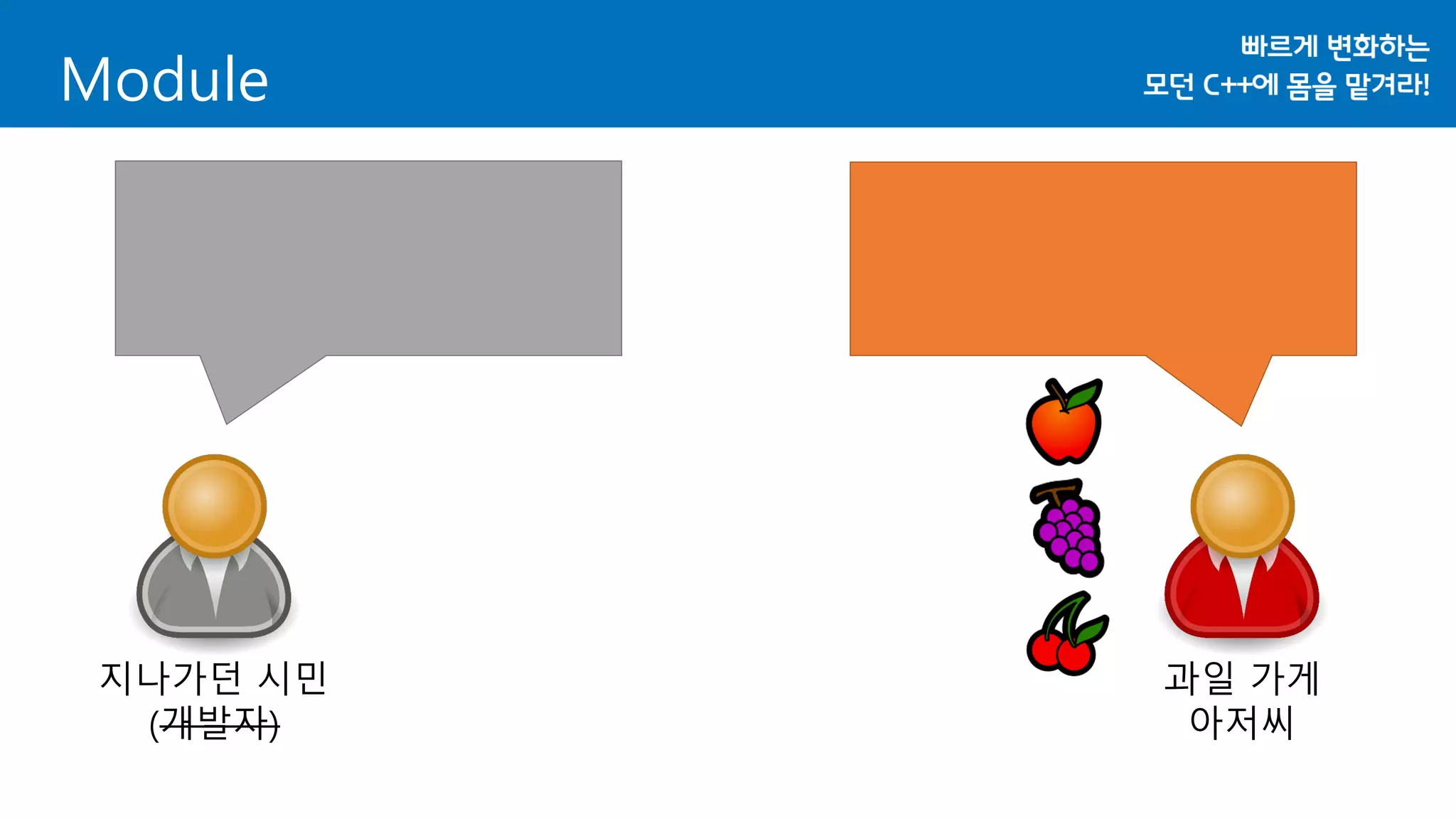
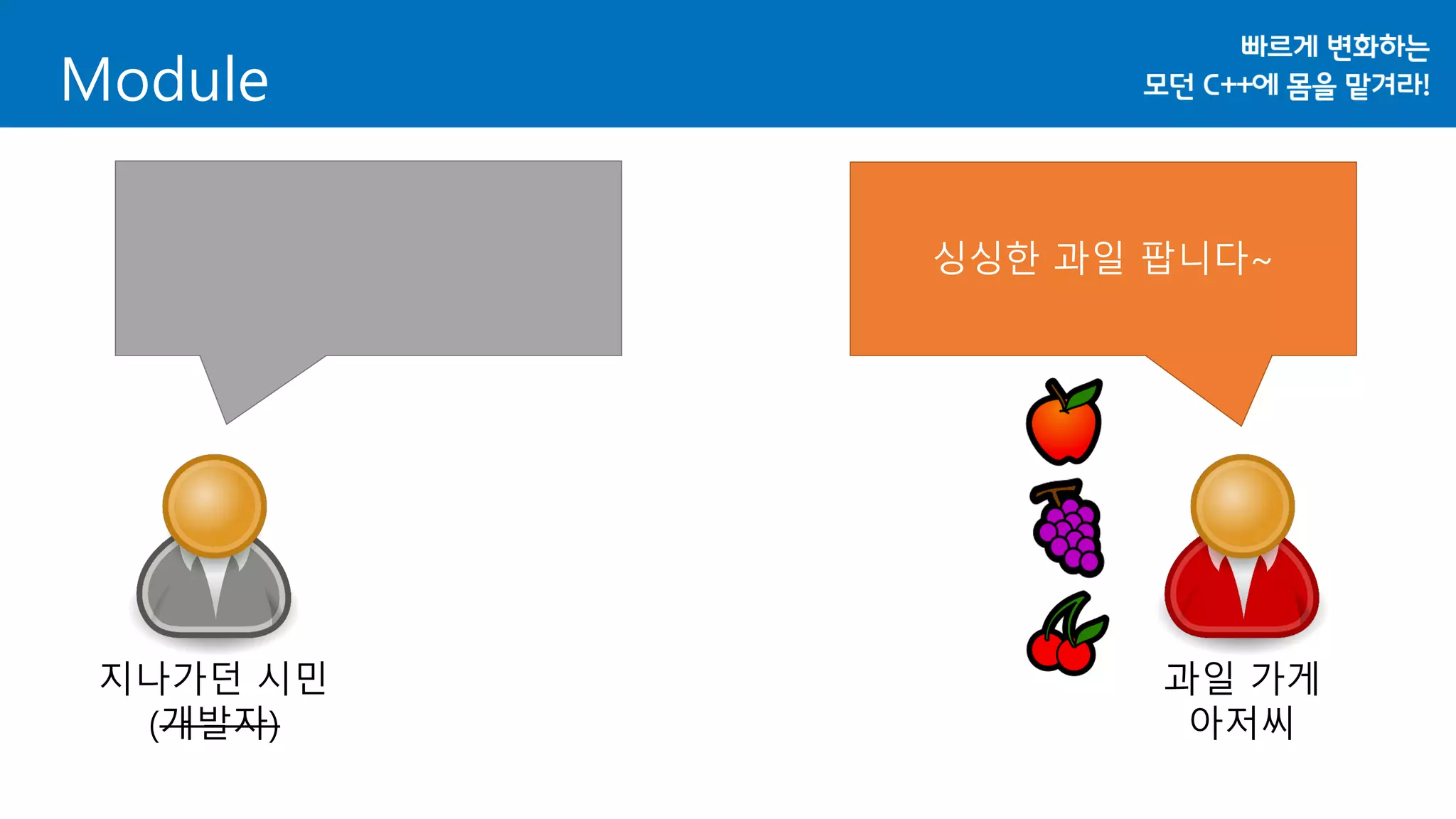
지나가던 개발자 C++
싱싱한함수 팝니다~
int Max(int a, int b);
int Min(int a, int b);
int Sum(int a, int b);
float Avg(int a, int b);
<cpp_math.h>
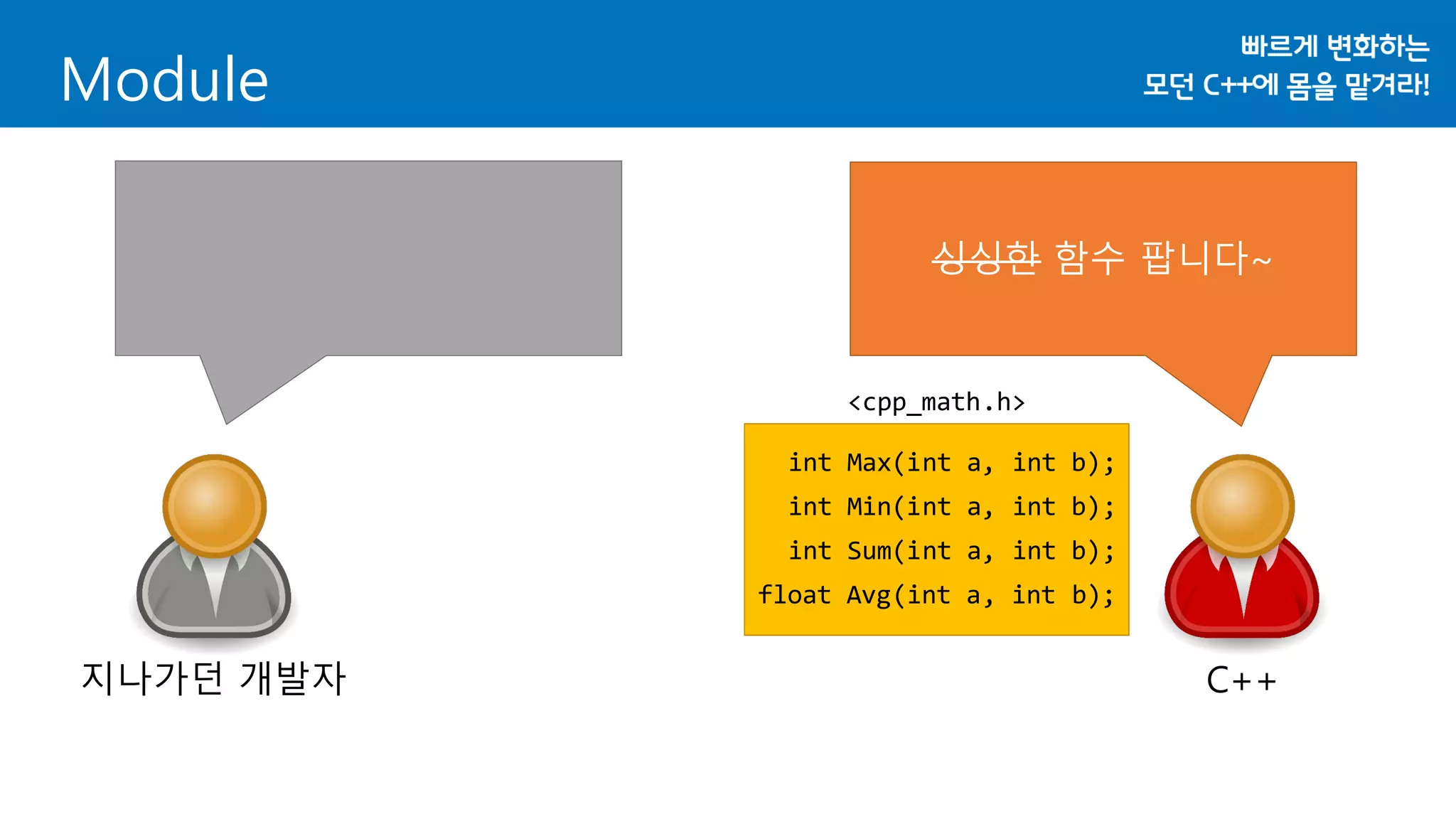
16.
Module
지나가던 개발자 C++
싱싱한함수 팝니다~
오, sum 함수 필요했는데…
sum 함수 하나 주세요!
int Max(int a, int b);
int Min(int a, int b);
int Sum(int a, int b);
float Avg(int a, int b);
<cpp_math.h>
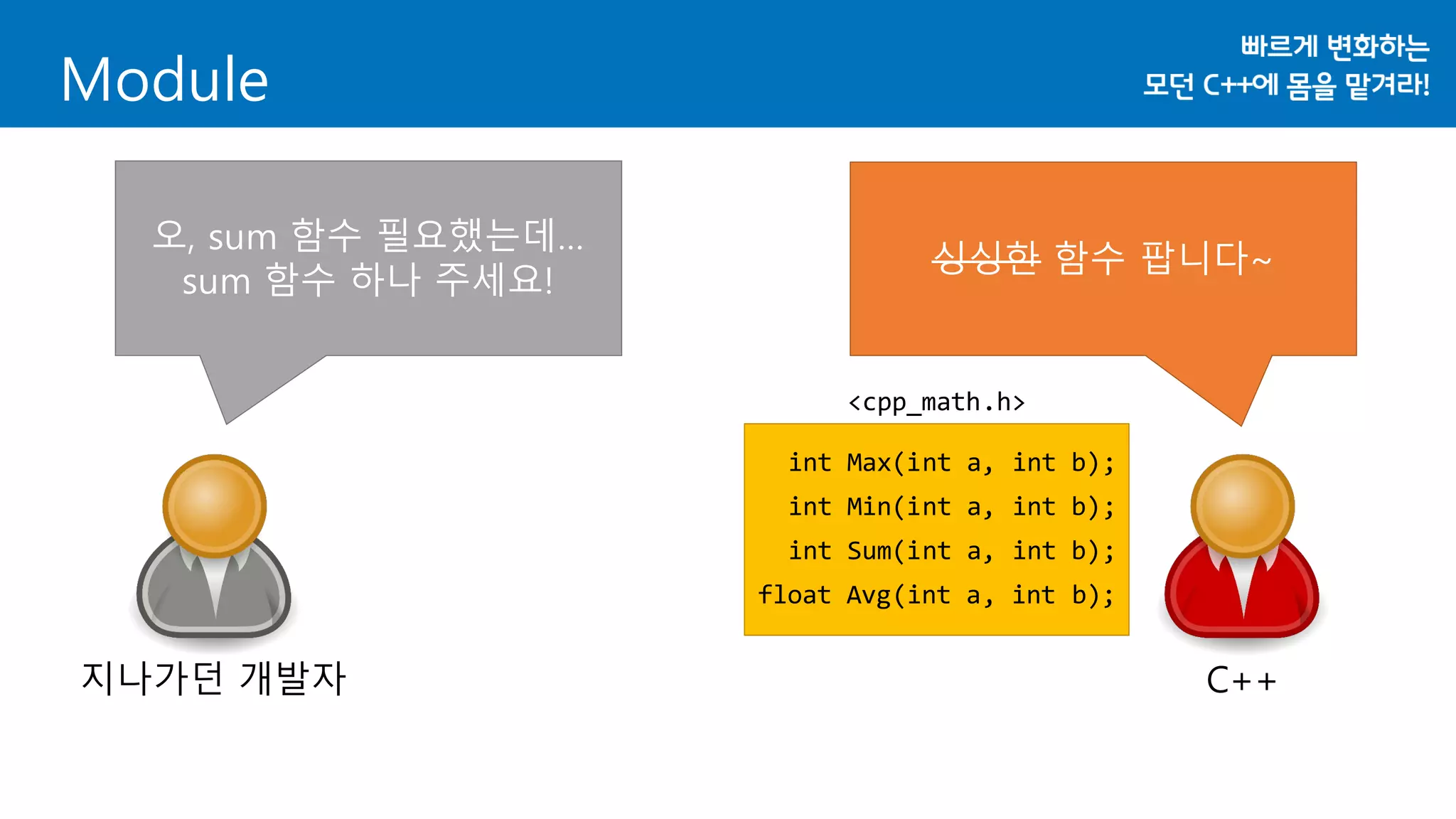
17.
Module
지나가던 개발자 C++
저희는1+3 패키지로만
판매하고 있습니다.
전부 가져가세요~
오, sum 함수 필요했는데…
sum 함수 하나 주세요!
int Max(int a, int b);
int Min(int a, int b);
int Sum(int a, int b);
float Avg(int a, int b);
<cpp_math.h>
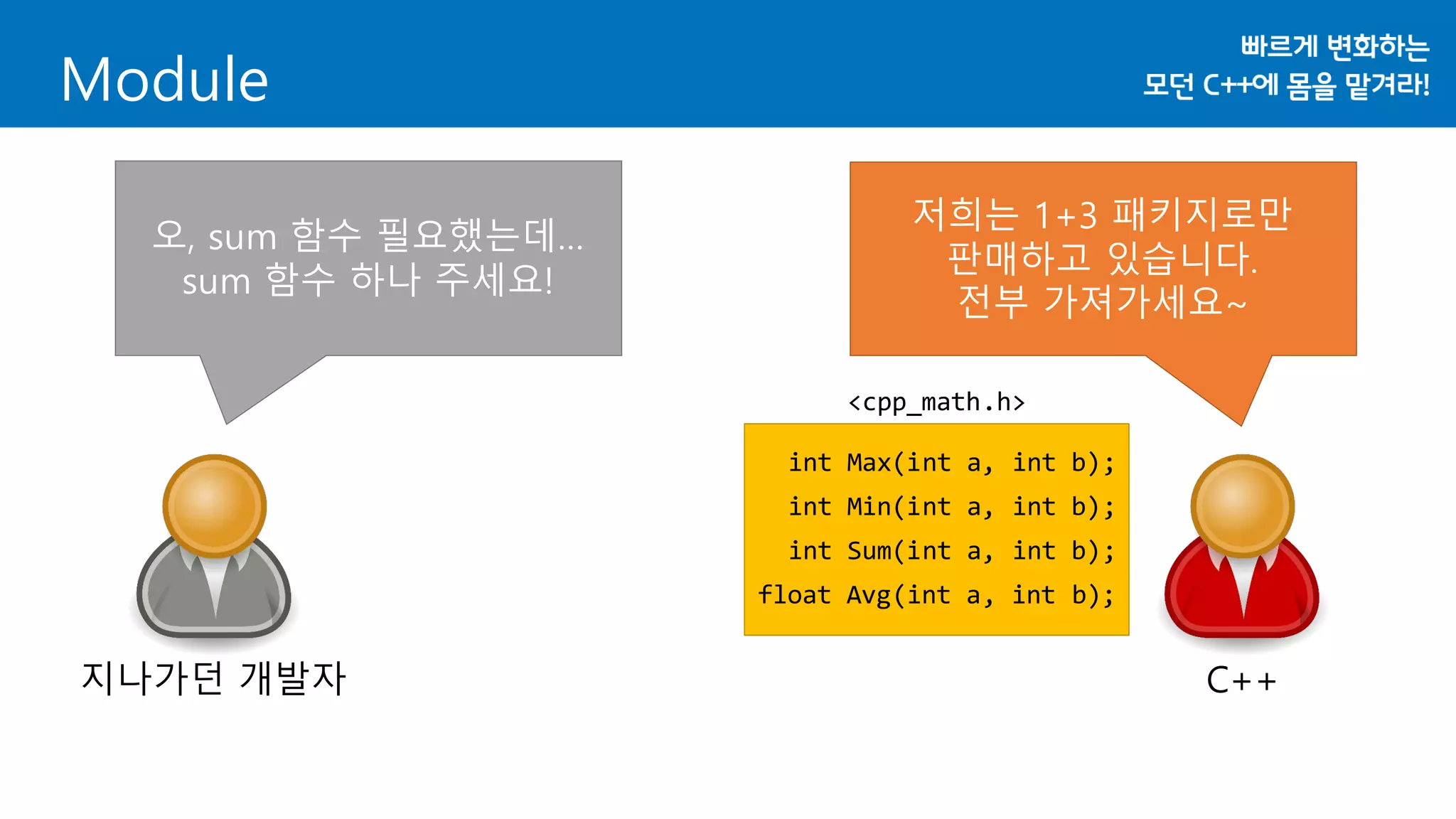
18.
Module
지나가던 개발자 C++
저희는1+3 패키지로만
판매하고 있습니다.
전부 가져가세요~
Max랑 Min 함수는
이미 구현해놨는데…
어쩌지 ㅠㅠ
int Max(int a, int b);
int Min(int a, int b);
int Sum(int a, int b);
float Avg(int a, int b);
<cpp_math.h>
19.
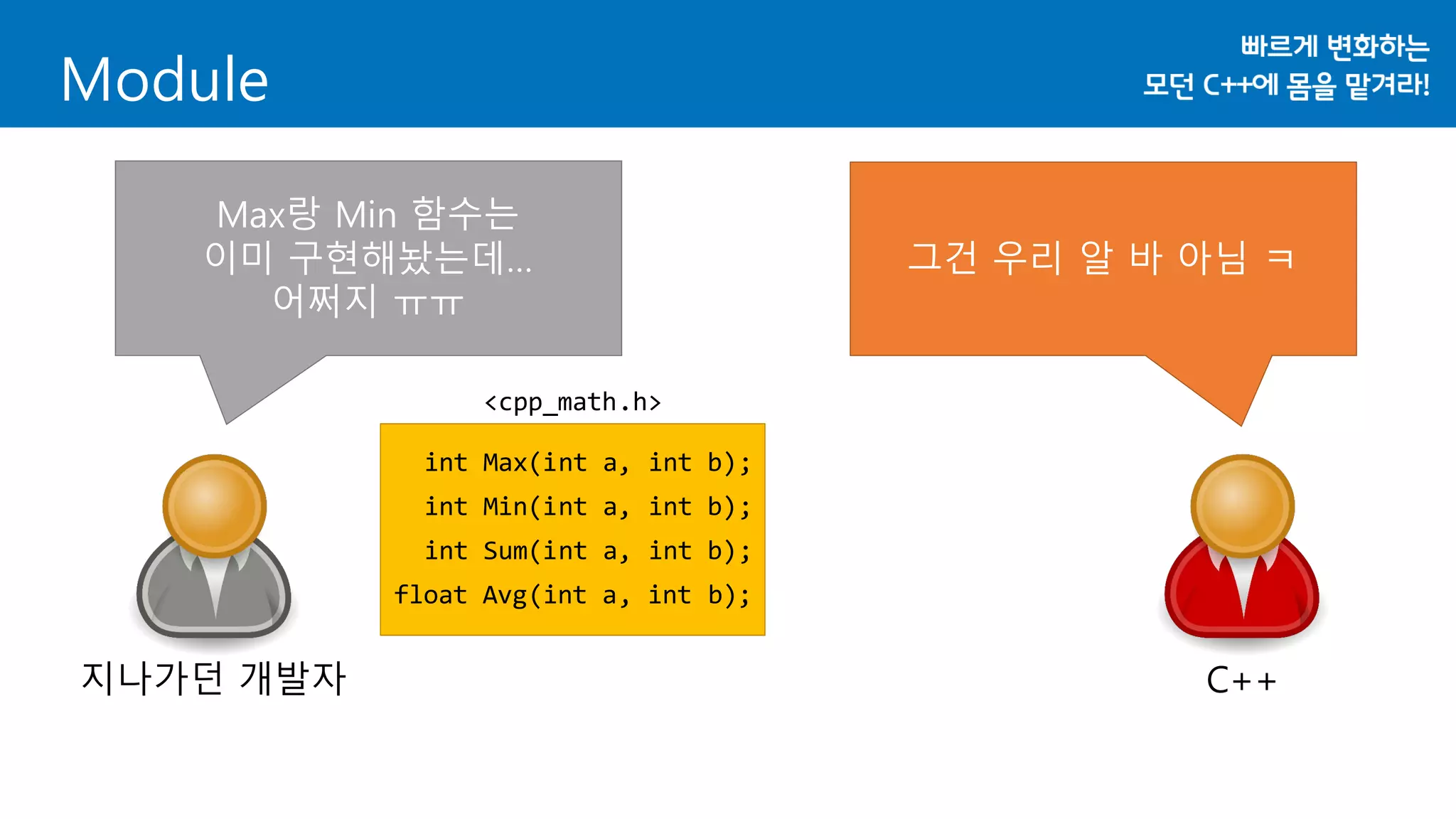
Module
지나가던 개발자 C++
그건우리 알 바 아님 ㅋ
Max랑 Min 함수는
이미 구현해놨는데…
어쩌지 ㅠㅠ
int Max(int a, int b);
int Min(int a, int b);
int Sum(int a, int b);
float Avg(int a, int b);
<cpp_math.h>
20.
Module
지나가던 개발자 C++
그건우리 알 바 아님 ㅋ
Max랑 Min 함수는
이미 구현해놨는데…
어쩌지 ㅠㅠ
int Max(int a, int b);
int Min(int a, int b);
int Sum(int a, int b);
float Avg(int a, int b);
<cpp_math.h>
21.
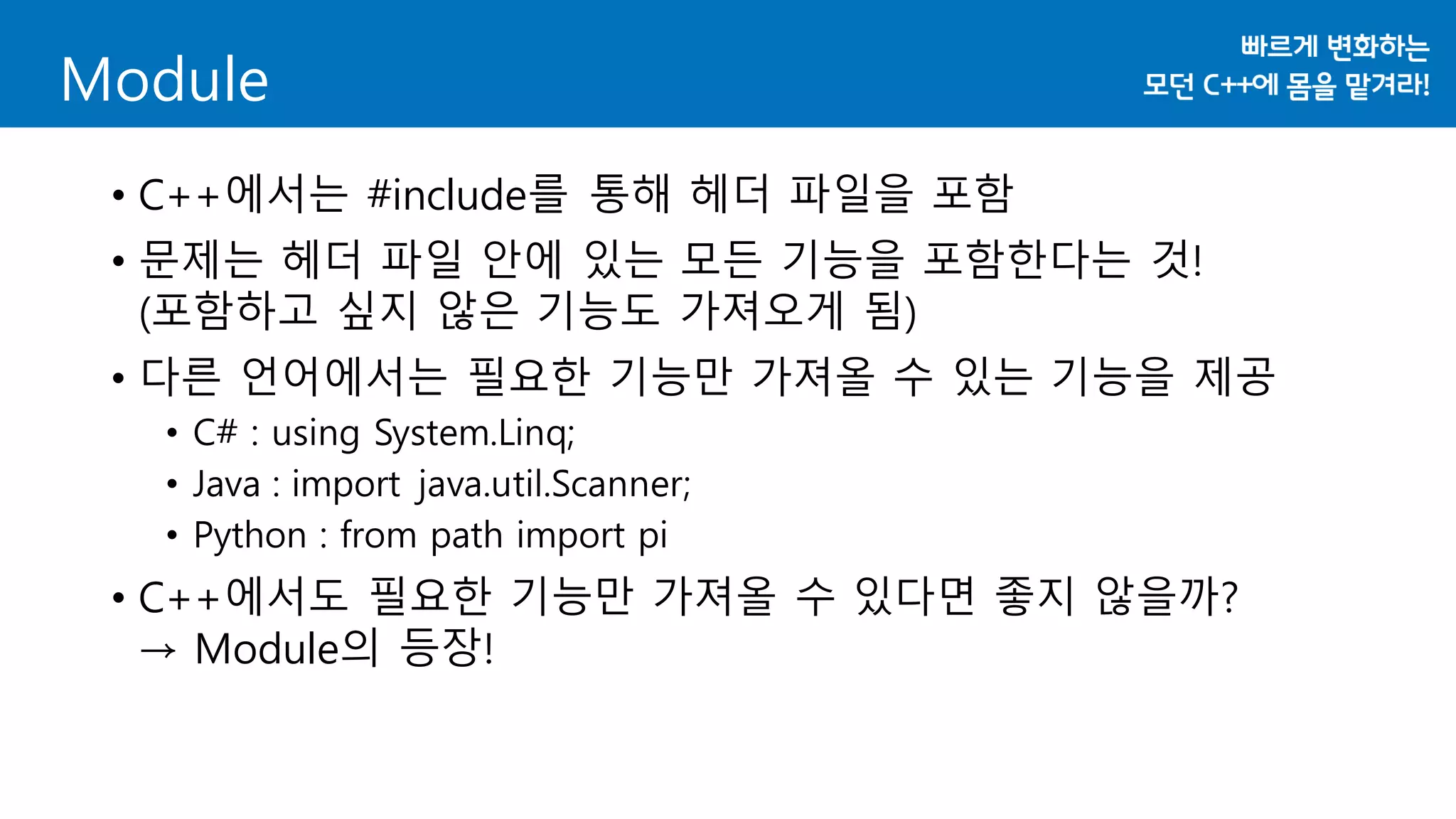
• C++에서는 #include를통해 헤더 파일을 포함
• 문제는 헤더 파일 안에 있는 모든 기능을 포함한다는 것!
(포함하고 싶지 않은 기능도 가져오게 됨)
• 다른 언어에서는 필요한 기능만 가져올 수 있는 기능을 제공
• C# : using System.Linq;
• Java : import java.util.Scanner;
• Python : from path import pi
• C++에서도 필요한 기능만 가져올 수 있다면 좋지 않을까?
→ Module의 등장!
Module
22.
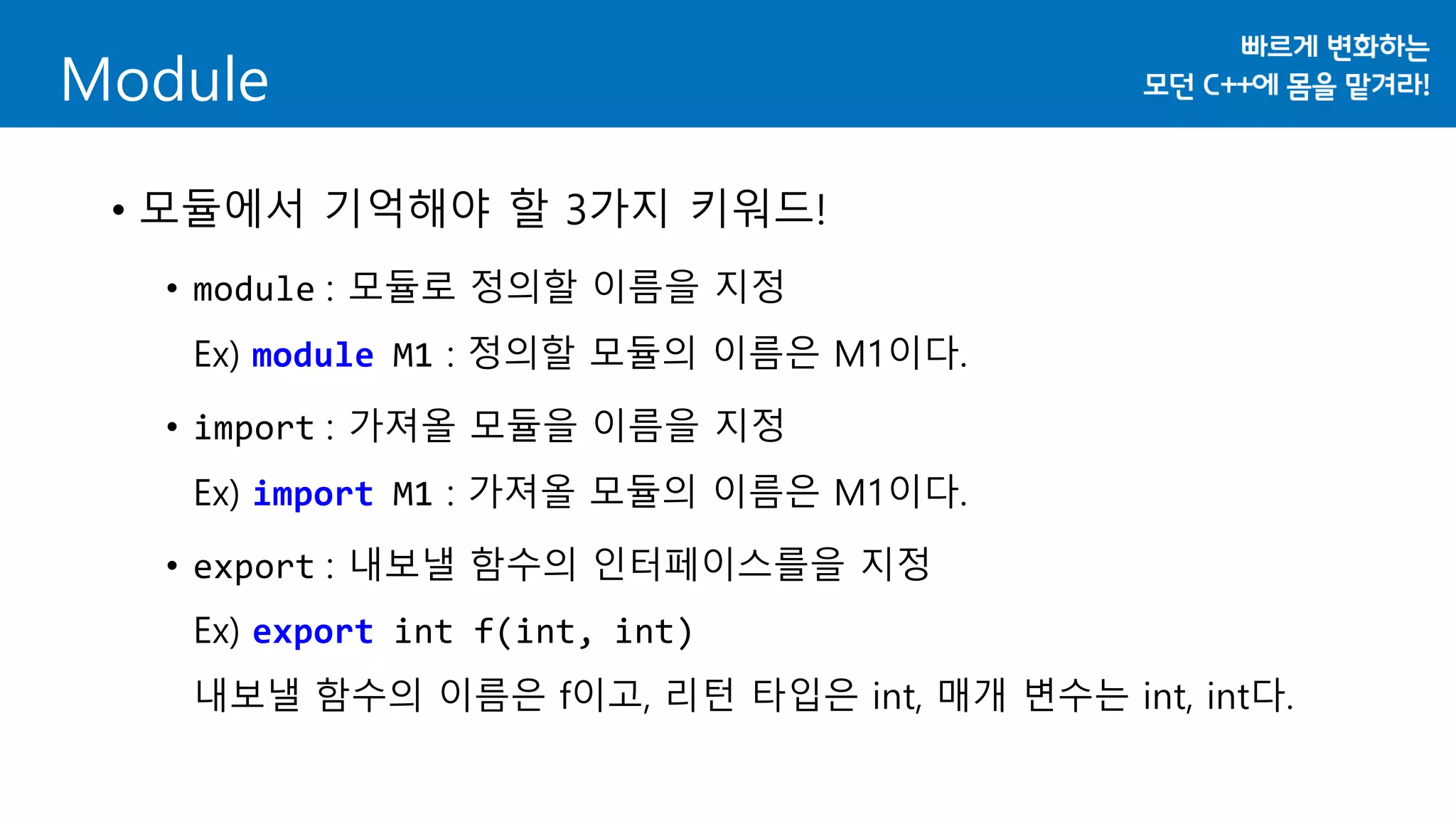
• 모듈에서 기억해야할 3가지 키워드!
• module : 모듈로 정의할 이름을 지정
Ex) module M1 : 정의할 모듈의 이름은 M1이다.
• import : 가져올 모듈을 이름을 지정
Ex) import M1 : 가져올 모듈의 이름은 M1이다.
• export : 내보낼 함수의 인터페이스를을 지정
Ex) export int f(int, int)
내보낼 함수의 이름은 f이고, 리턴 타입은 int, 매개 변수는 int, int다.
Module
23.
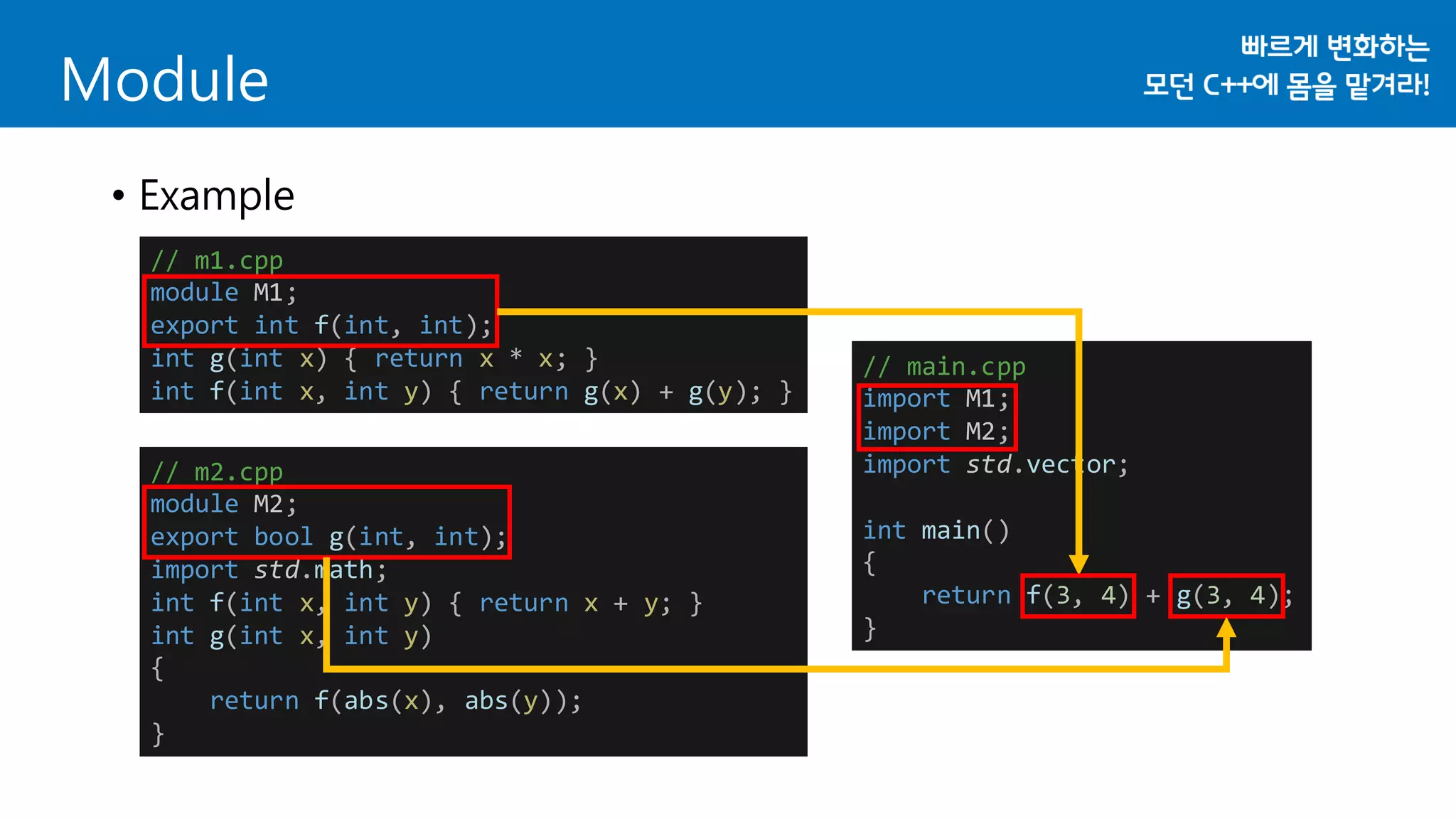
• Example
Module
// m1.cpp
moduleM1;
export int f(int, int);
int g(int x) { return x * x; }
int f(int x, int y) { return g(x) + g(y); }
// m2.cpp
module M2;
export bool g(int, int);
import std.math;
int f(int x, int y) { return x + y; }
int g(int x, int y)
{
return f(abs(x), abs(y));
}
// main.cpp
import M1;
import M2;
import std.vector;
int main()
{
return f(3, 4) + g(3, 4);
}
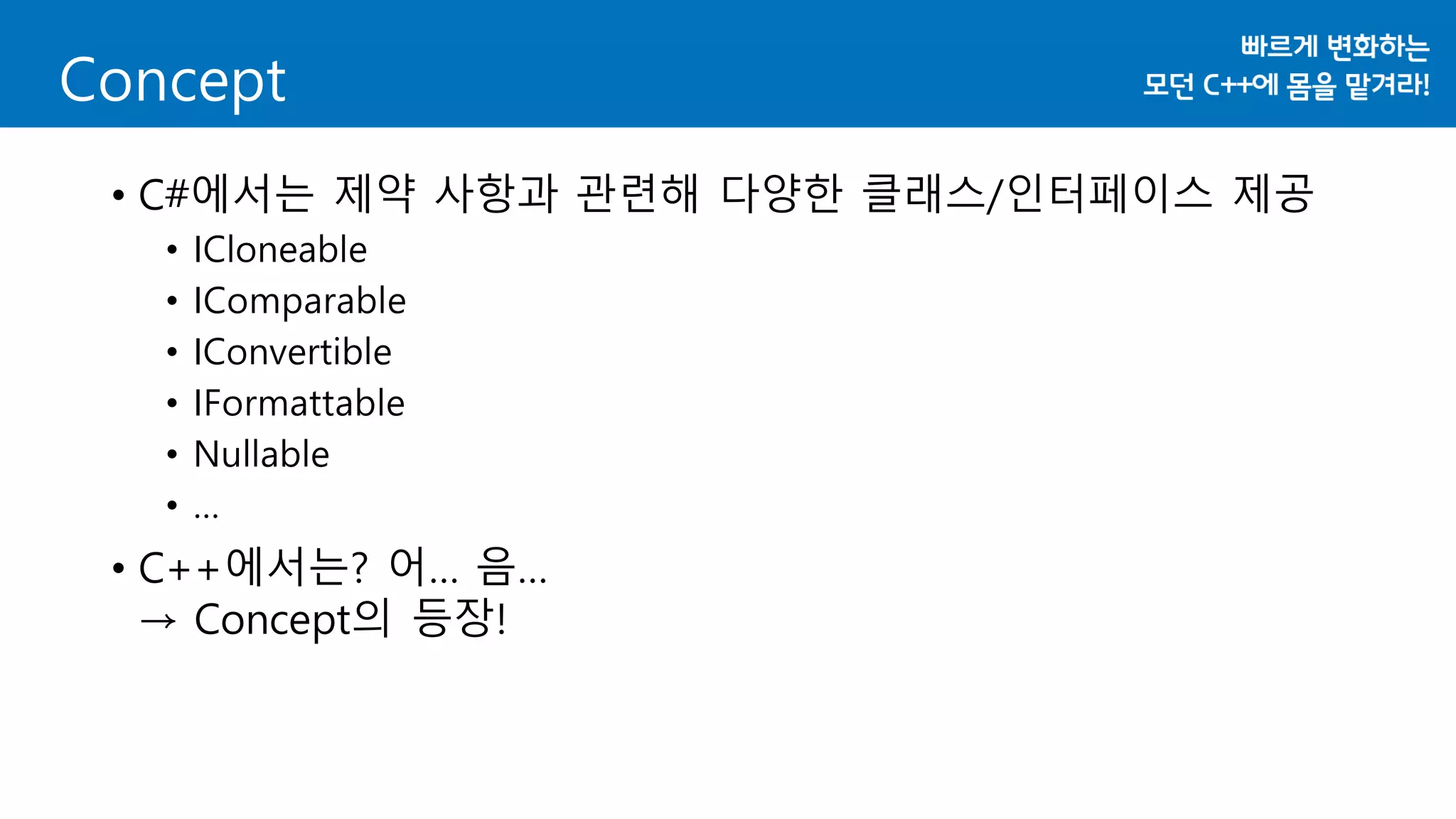
• C#에서는 제약사항과 관련해 다양한 클래스/인터페이스 제공
• ICloneable
• IComparable
• IConvertible
• IFormattable
• Nullable
• …
• C++에서는? 어… 음…
→ Concept의 등장!
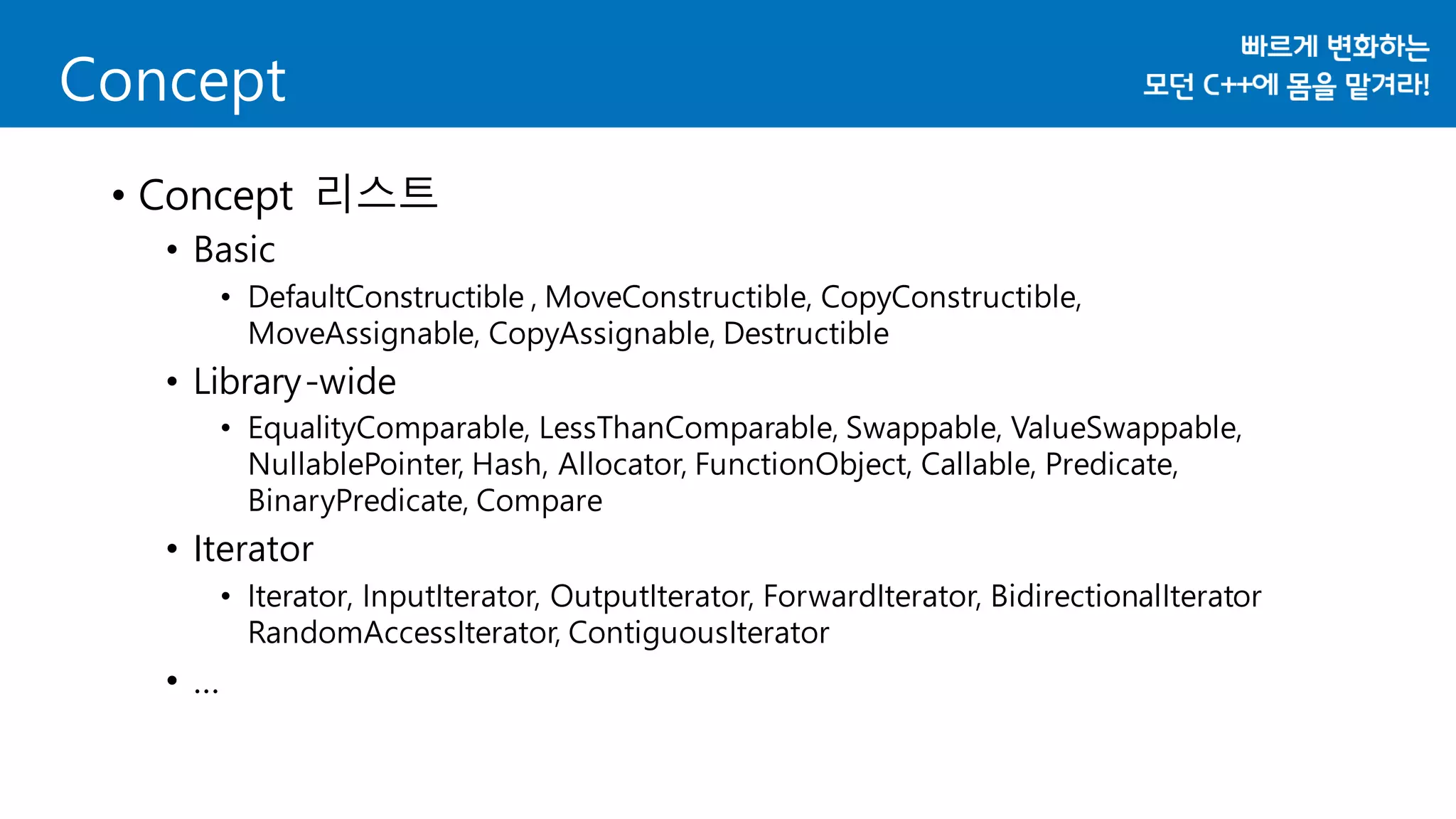
Concept
32.
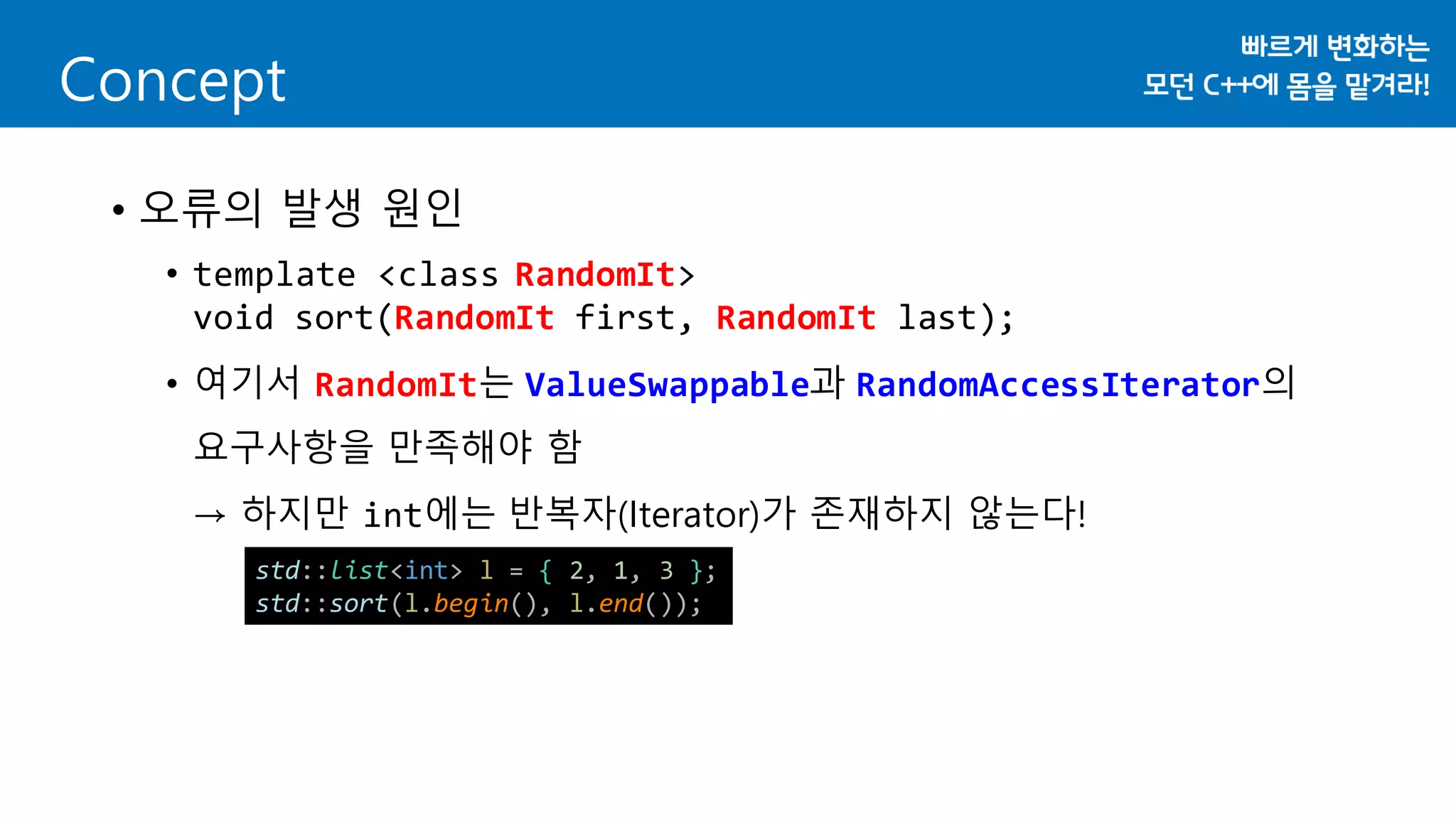
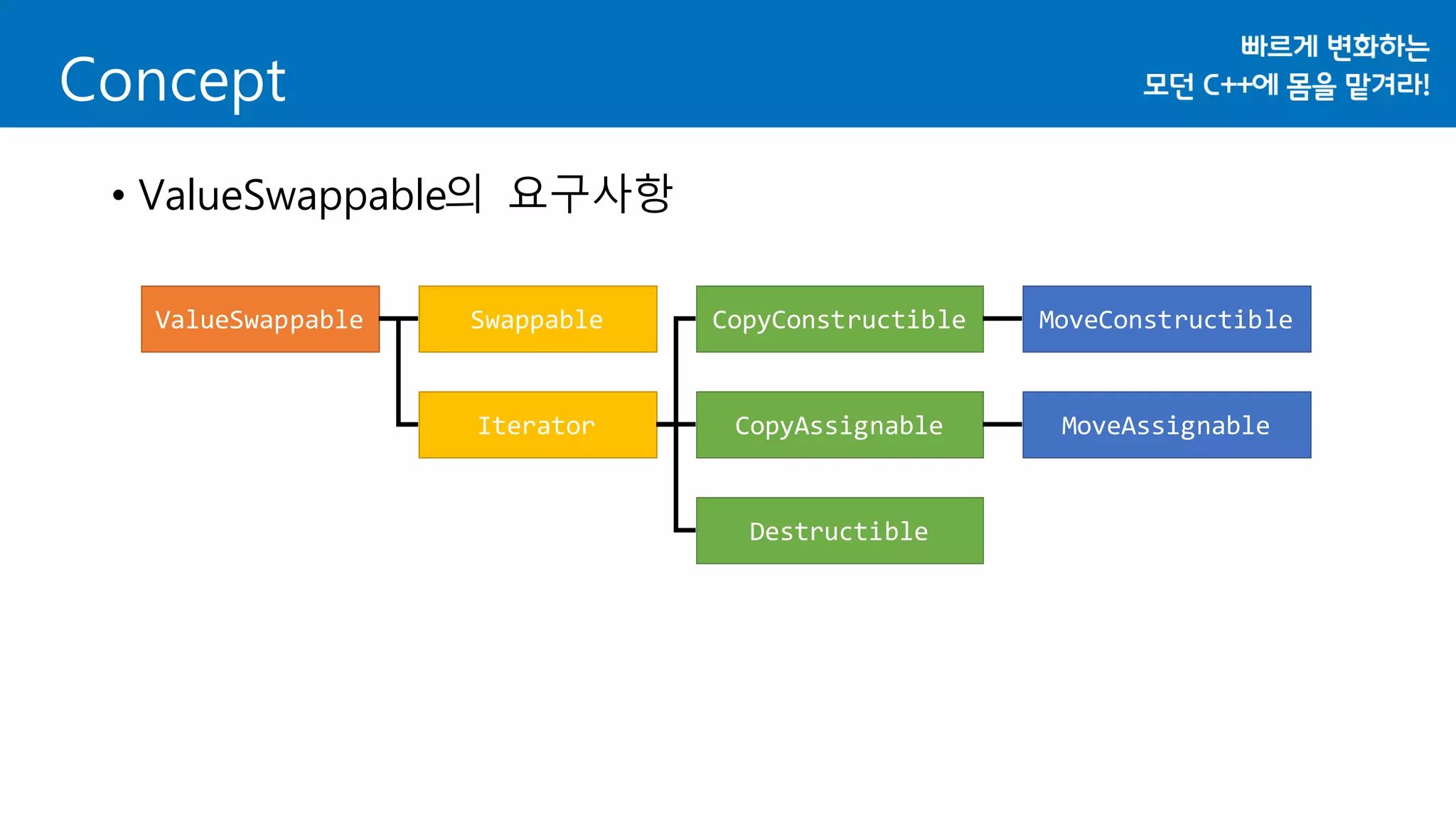
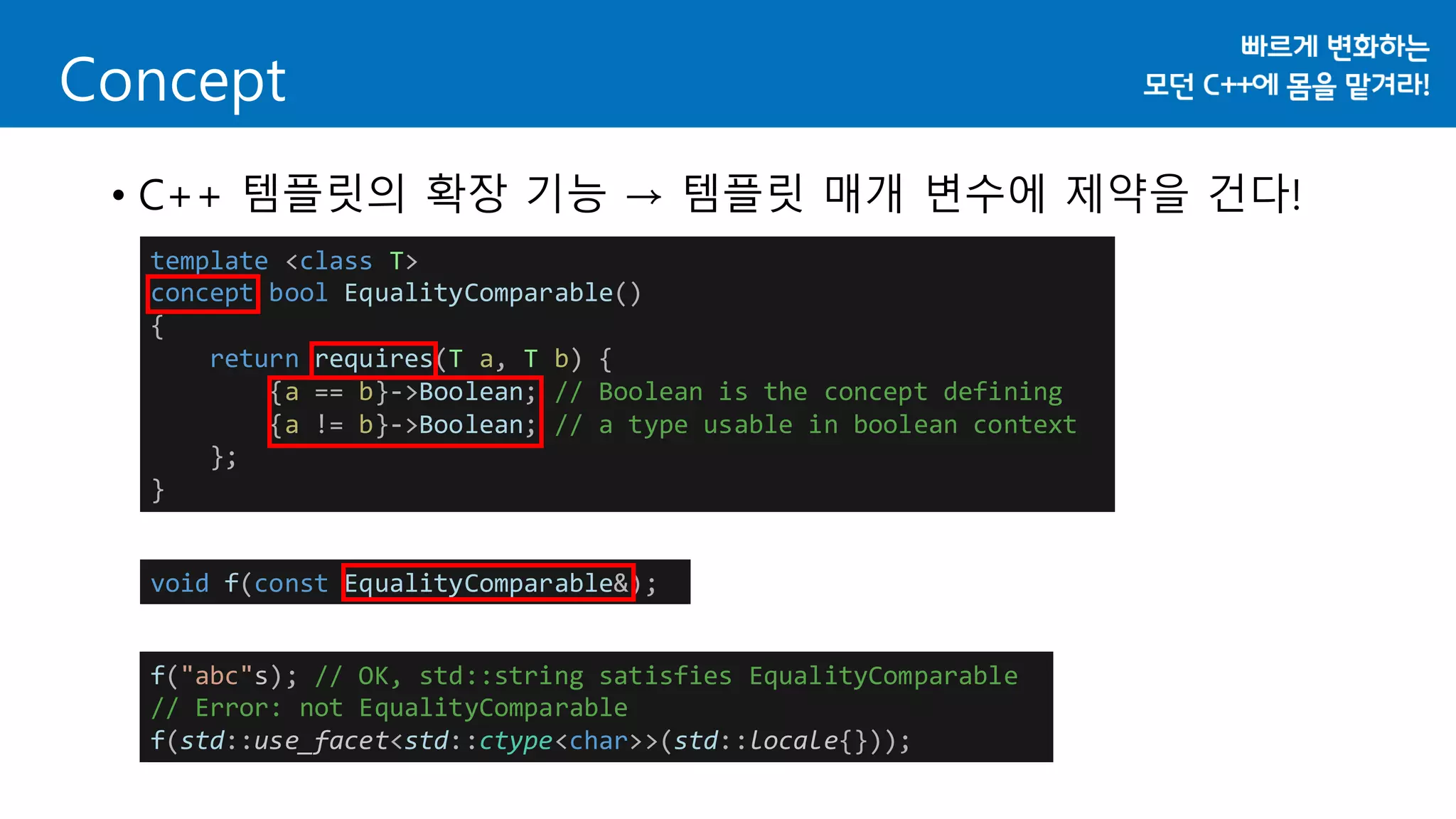
• C++ 템플릿의확장 기능 → 템플릿 매개 변수에 제약을 건다!
Concept
template <class T>
concept bool EqualityComparable()
{
return requires(T a, T b) {
{a == b}->Boolean; // Boolean is the concept defining
{a != b}->Boolean; // a type usable in boolean context
};
}
void f(const EqualityComparable&);
f("abc"s); // OK, std::string satisfies EqualityComparable
// Error: not EqualityComparable
f(std::use_facet<std::ctype<char>>(std::locale{}));
33.
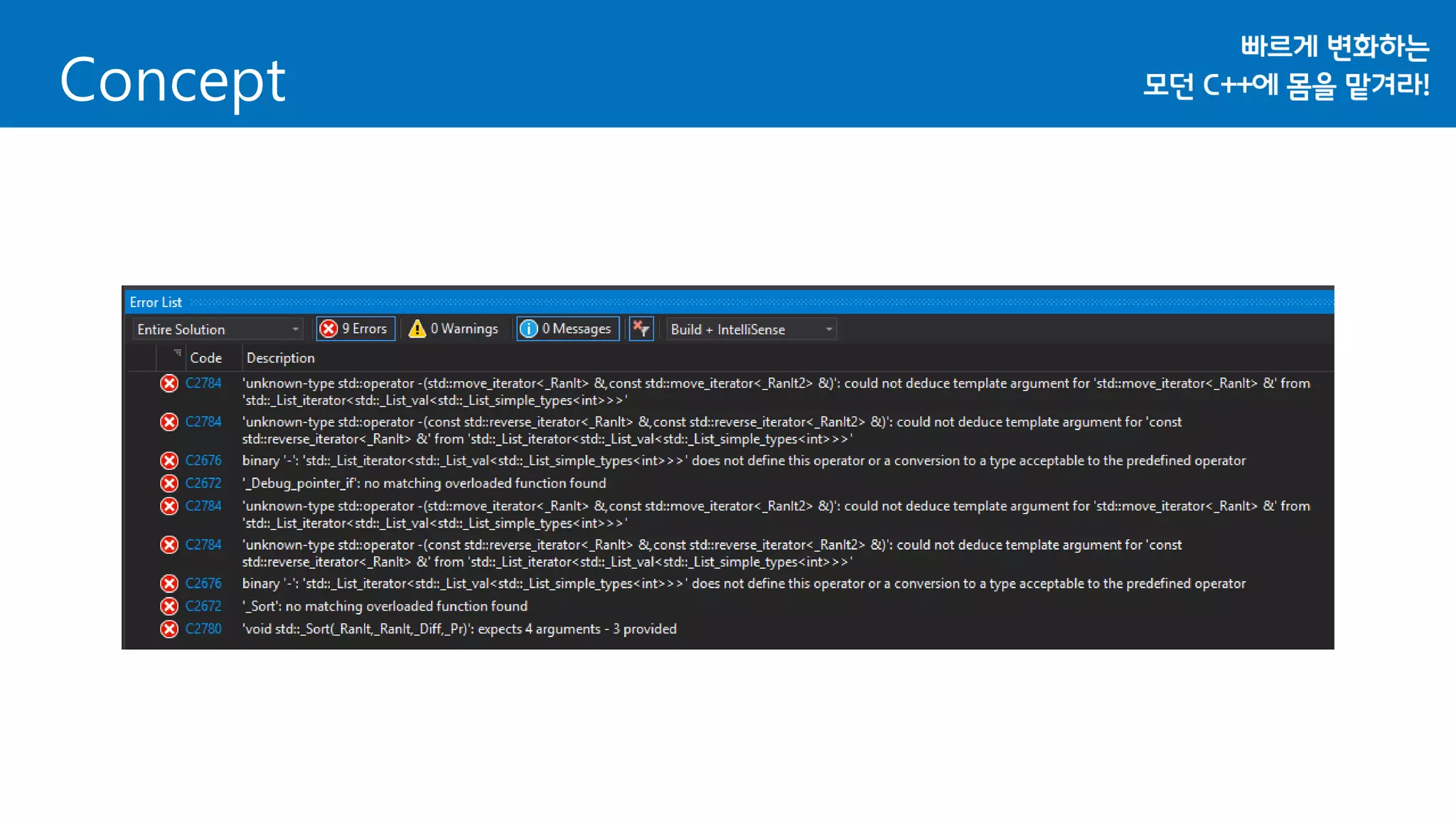
• 이제 컴파일러의오류 메시지가 명확해진다!
Concept
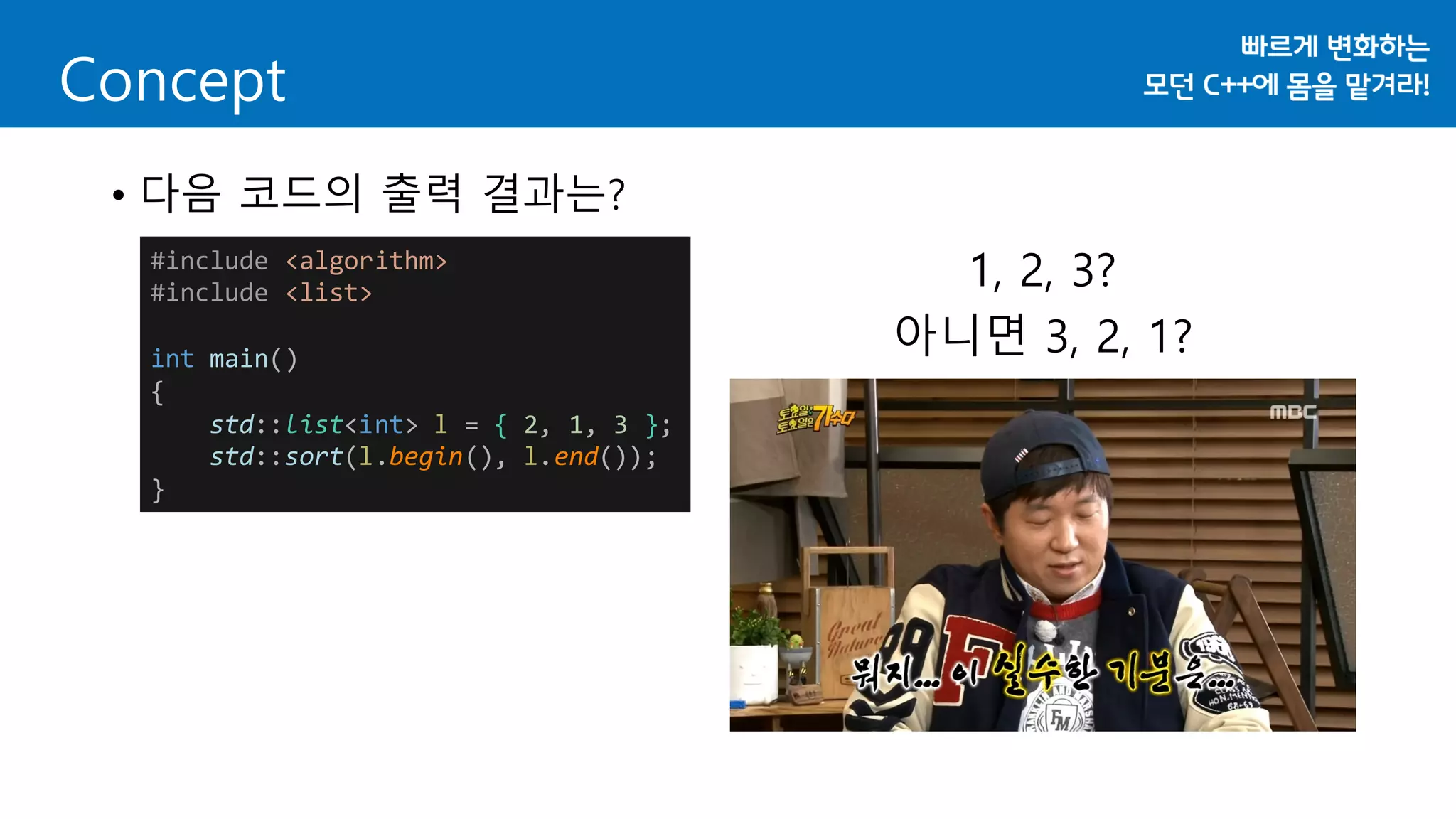
In instantiation of 'void std::__sort(_RandomAccessIterator,
_RandomAccessIterator, _Compare) [with _RandomAccessIterator =
std::_List_iterator<int>; _Compare = __gnu_cxx::__ops::_Iter_less_iter]':
error: no match for 'operator-' (operand types are
'std::_List_iterator<int>' and 'std::_List_iterator<int>')
std::__lg(__last - __first) * 2,
error: cannot call function 'void std::sort(_RAIter, _RAIter) [with _RAIter
= std::_List_iterator<int>]'
note: concept 'RandomAccessIterator()' was not satisfied
34.
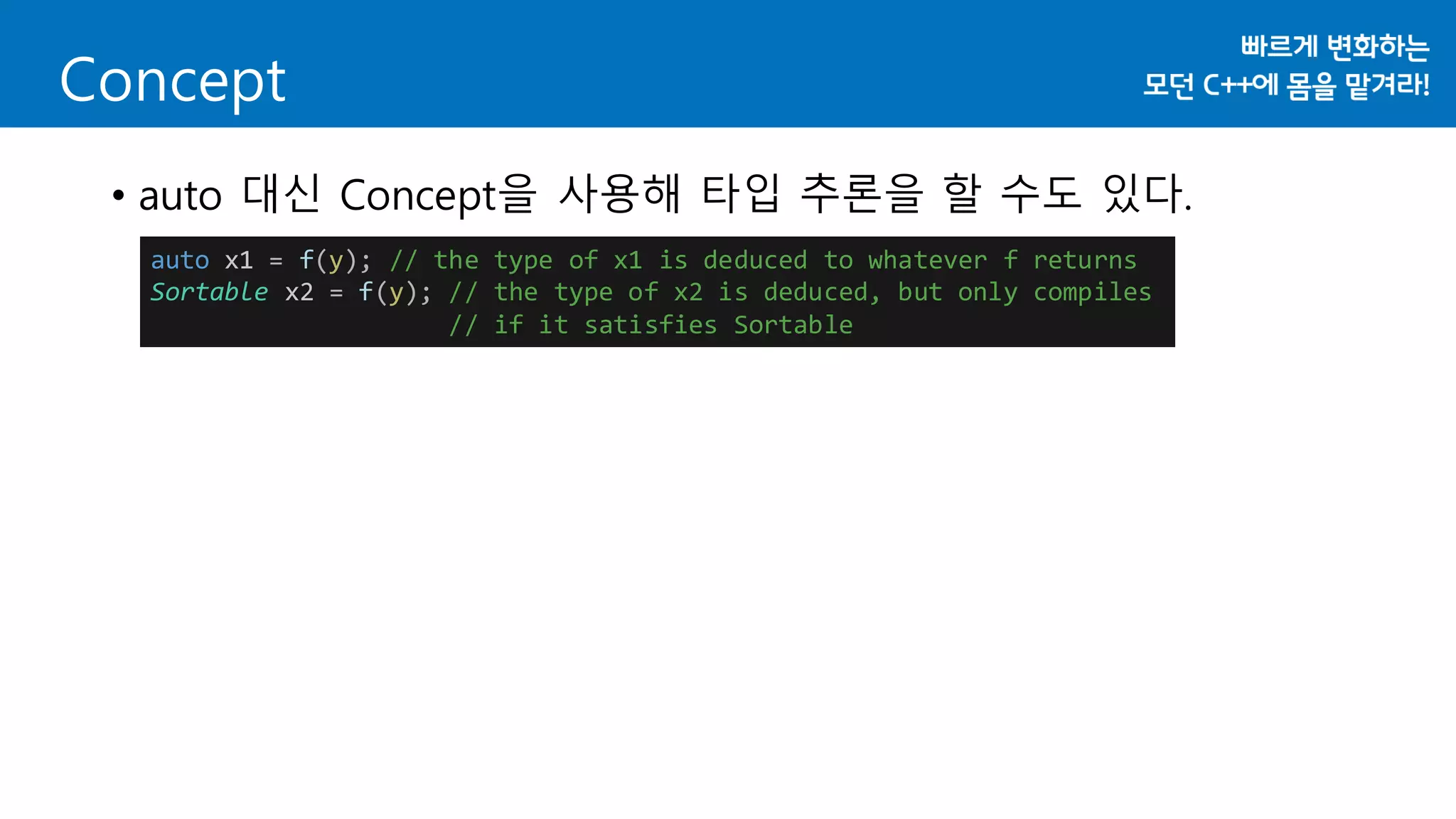
• auto 대신Concept을 사용해 타입 추론을 할 수도 있다.
Concept
auto x1 = f(y); // the type of x1 is deduced to whatever f returns
Sortable x2 = f(y); // the type of x2 is deduced, but only compiles
// if it satisfies Sortable
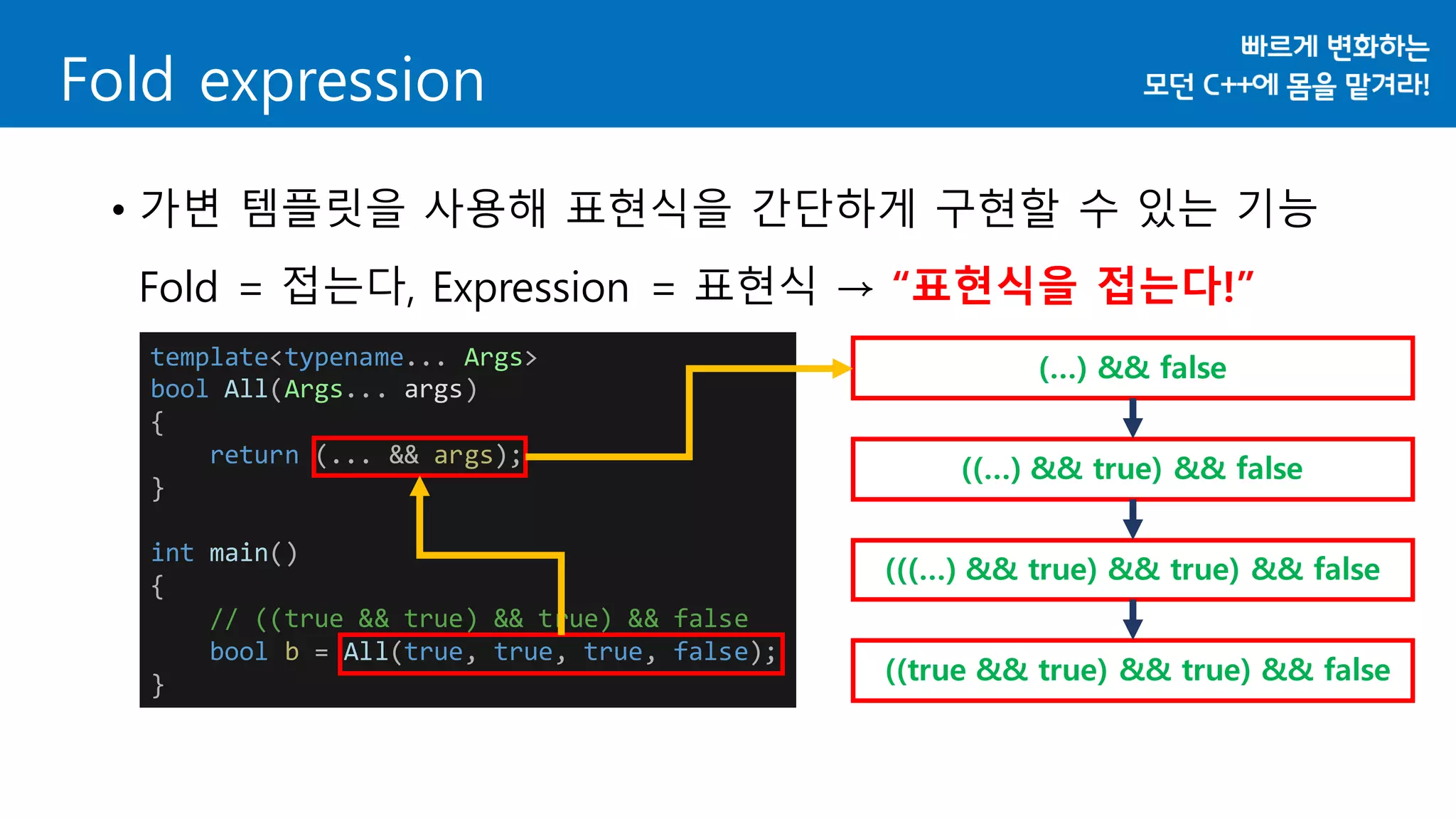
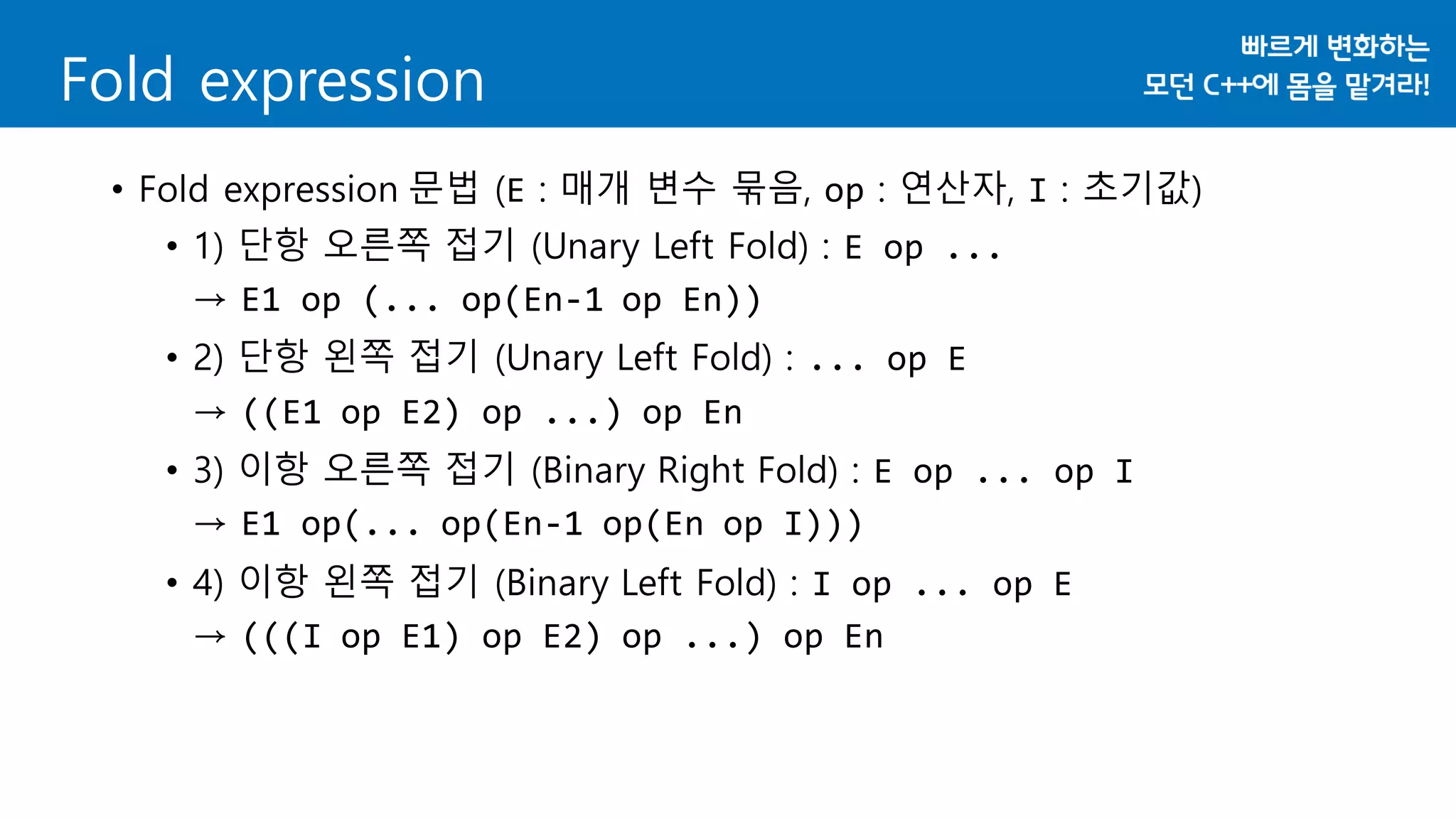
• Fold expression문법 (E : 매개 변수 묶음, op : 연산자, I : 초기값)
• 1) 단항 오른쪽 접기 (Unary Left Fold) : E op ...
→ E1 op (... op(En-1 op En))
• 2) 단항 왼쪽 접기 (Unary Left Fold) : ... op E
→ ((E1 op E2) op ...) op En
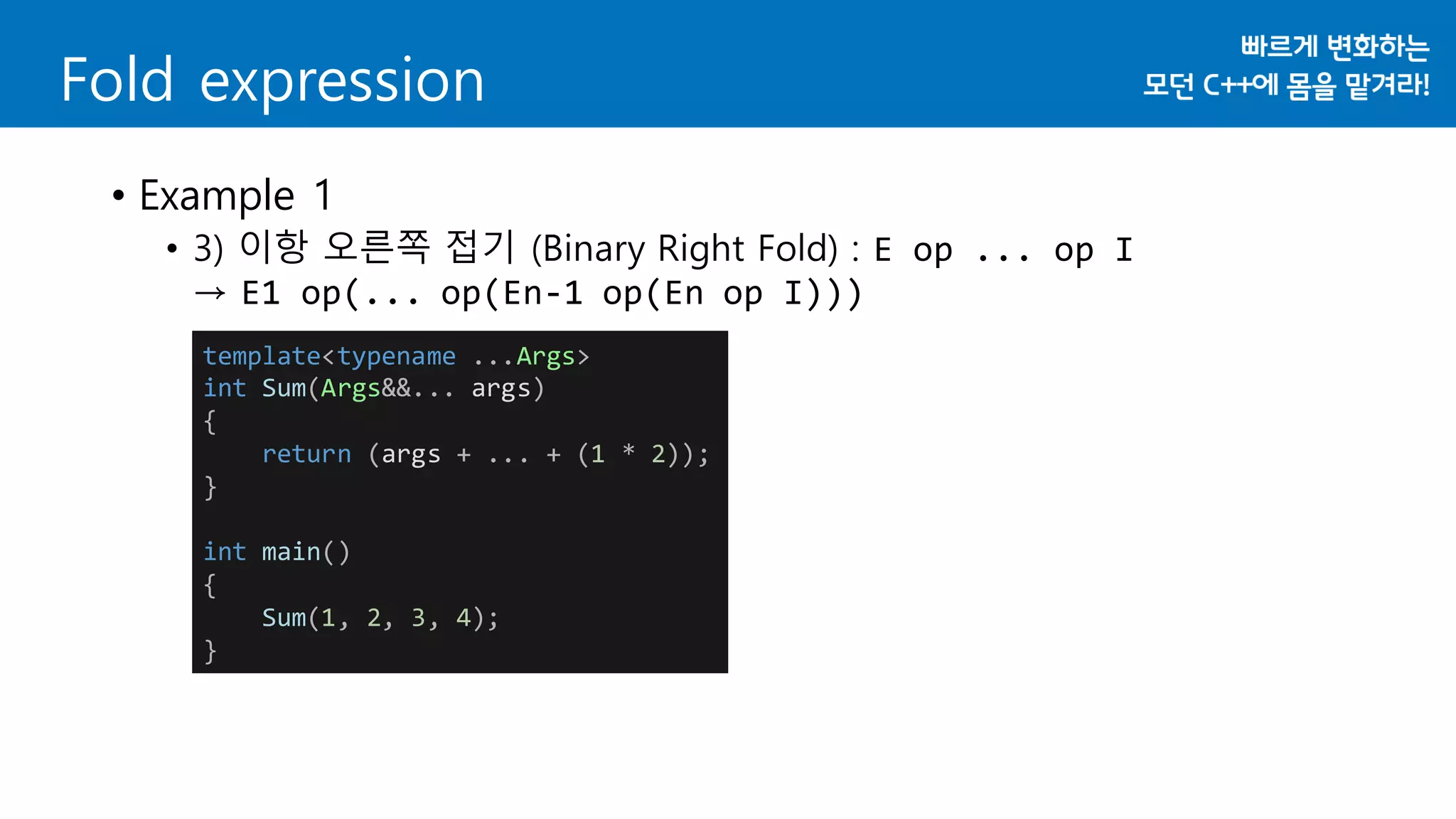
• 3) 이항 오른쪽 접기 (Binary Right Fold) : E op ... op I
→ E1 op(... op(En-1 op(En op I)))
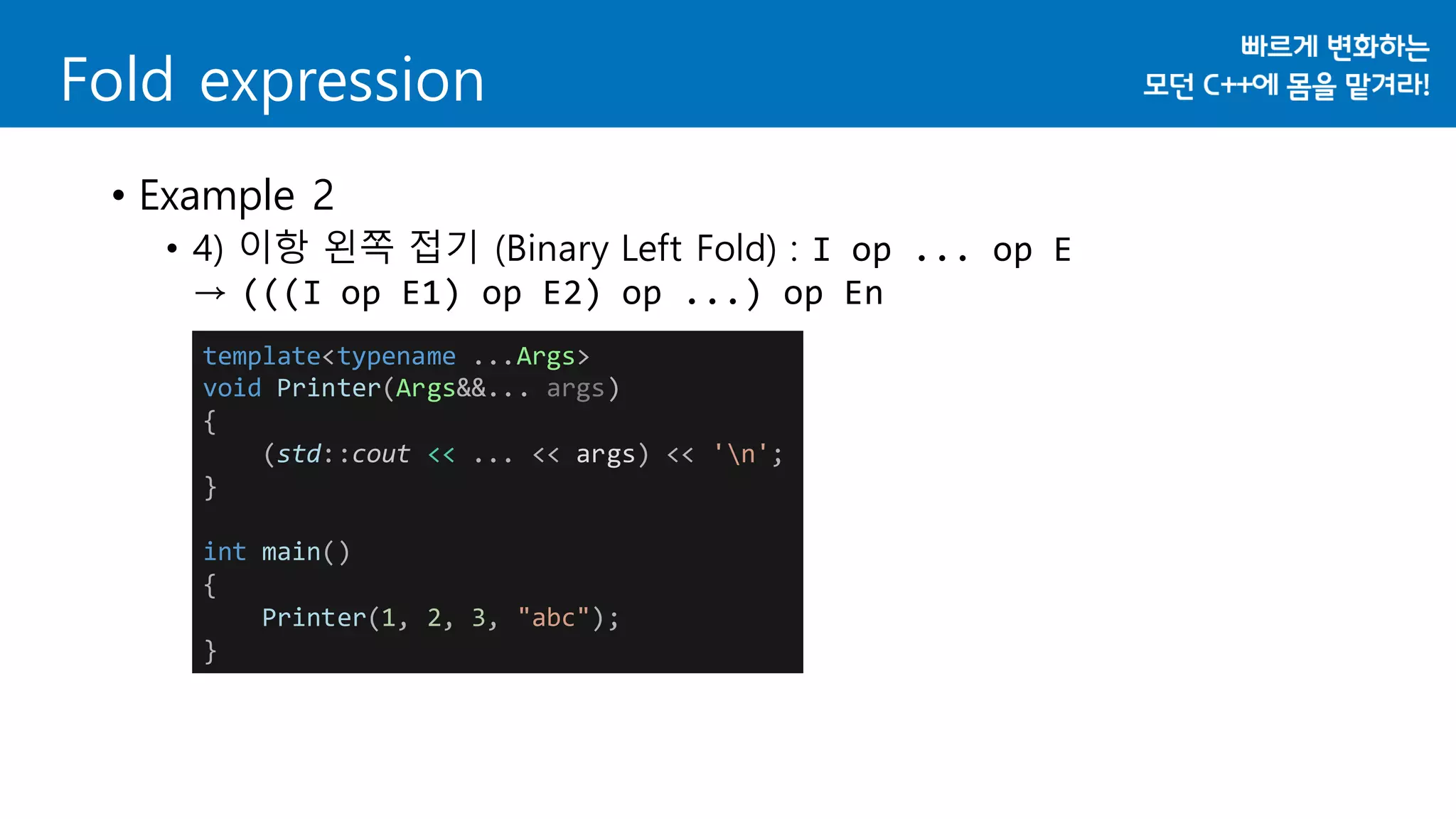
• 4) 이항 왼쪽 접기 (Binary Left Fold) : I op ... op E
→ (((I op E1) op E2) op ...) op En
Fold expression
43.
• Example 1
•3) 이항 오른쪽 접기 (Binary Right Fold) : E op ... op I
→ E1 op(... op(En-1 op(En op I)))
Fold expression
template<typename ...Args>
int Sum(Args&&... args)
{
return (args + ... + (1 * 2));
}
int main()
{
Sum(1, 2, 3, 4);
}
44.
• Example 2
•4) 이항 왼쪽 접기 (Binary Left Fold) : I op ... op E
→ (((I op E1) op E2) op ...) op En
Fold expression
template<typename ...Args>
void Printer(Args&&... args)
{
(std::cout << ... << args) << 'n';
}
int main()
{
Printer(1, 2, 3, "abc");
}
45.
Attribute
• 타입, 객체,코드 등에 구현 정의 특성을 부여
• C++14에 추가된 특성
• [[noreturn]] : 이 함수는 리턴하지 않음
• [[carries_dependency]] : 종속성 체인이 함수 안팎으로 전파됨
• [[deprecated]] : 사용할 수 있지만, 권장하지 않음 (더 이상 사용 X)
• C++17에 추가된 특성
• [[fallthrough]] : switch-case 문에서 사용, 완료되지 않음을 나타냄
• [[nodiscard]] : 함수의 리턴 값이 있는데 버리는 경우 경고문을 표시
• [[maybe_unused]] : 사용하지 않는 변수에 대해 경고문을 표시하지 않음
46.
Attribute
• Example 1
[[noreturn]]void f()
{
throw "error"; // OK
}
[[noreturn]] void q(int i)
{
// behavior is undefined
// if called with an argument <= 0
if (i > 0) { throw "positive"; }
}
47.
void f(int n)
{
voidg(), h(), i();
switch (n)
{
case 1:
case 2:
g();
[[fallthrough]];
case 3: // no warning on fallthrough
h();
case 4: // compiler may warn on fallthrough
i();
[[fallthrough]]; // illformed, not before a case label
}
}
Attribute
• Example 2
48.
struct [[nodiscard]] error_info{ };
error_info enable_missile_safety_mode();
void launch_missiles();
void test_missiles()
{
enable_missile_safety_mode(); // compiler may warn
// on discarding a nodiscard value
launch_missiles();
}
error_info& foo();
void f1()
{
foo(); // nodiscard type is not returned by value, no warning
}
Attribute
• Example 3
49.
Attribute
• Example 4
[[maybe_unused]]void f([[maybe_unused]] bool thing1,
[[maybe_unused]] bool thing2)
{
[[maybe_unused]] bool b = thing1 && thing2;
assert(b); // in release mode, assert is compiled out, and b is unused
// no warning because it is declared [[maybe_unused]]
} // parameters thing1 and thing2 are not used, no warning
50.
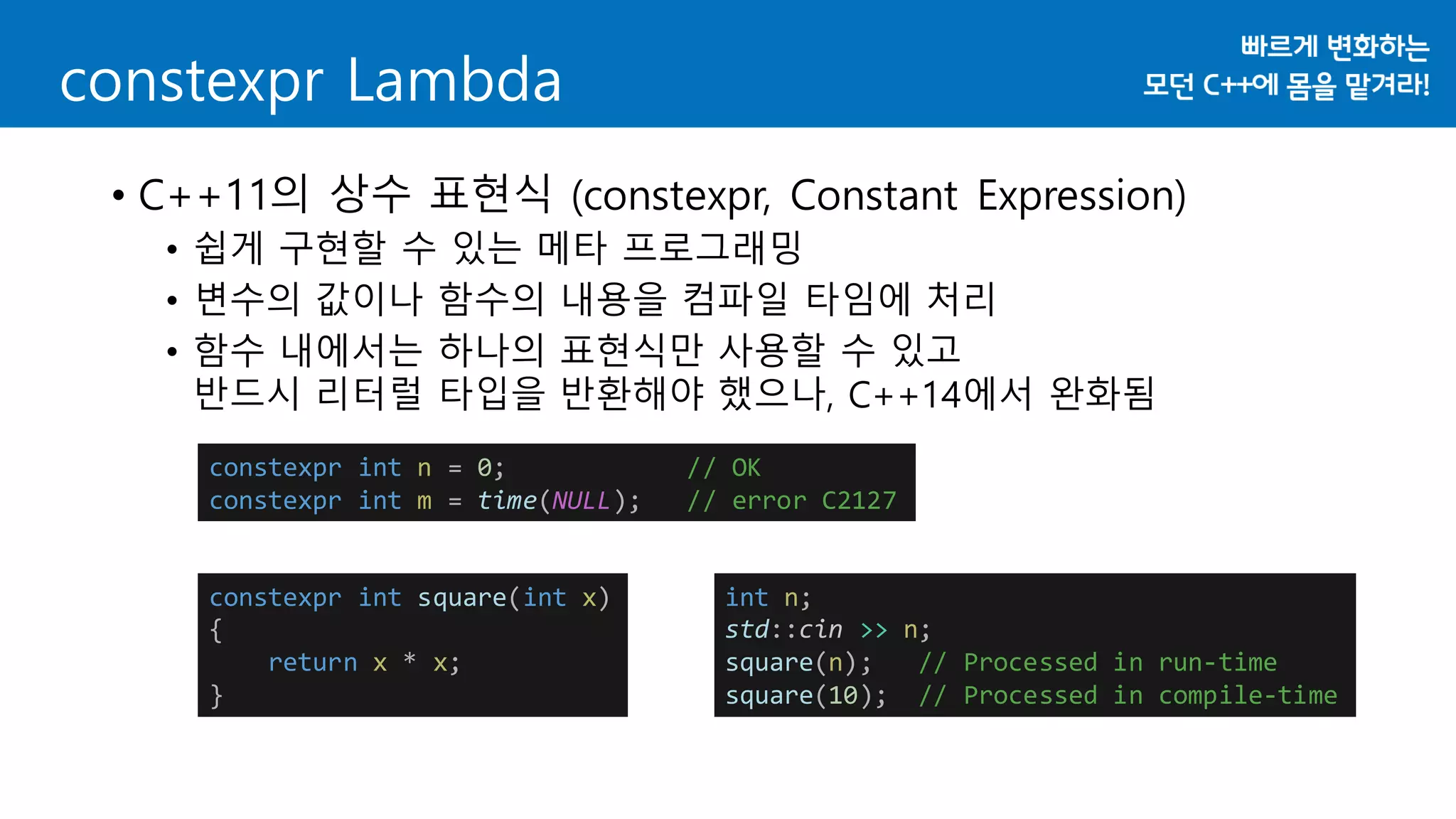
constexpr Lambda
• C++11의상수 표현식 (constexpr, Constant Expression)
• 쉽게 구현할 수 있는 메타 프로그래밍
• 변수의 값이나 함수의 내용을 컴파일 타임에 처리
• 함수 내에서는 하나의 표현식만 사용할 수 있고
반드시 리터럴 타입을 반환해야 했으나, C++14에서 완화됨
constexpr int n = 0; // OK
constexpr int m = time(NULL); // error C2127
constexpr int square(int x)
{
return x * x;
}
int n;
std::cin >> n;
square(n); // Processed in run-time
square(10); // Processed in compile-time
51.
constexpr Lambda
• C++11의람다식 (Lambda Expression)
[my_mod] (int v) -> int { return v % my_mod; }
개시자
(Introducer Capture)
인자
(Arguments)
반환 타입
(Return Type)
함수의 몸통
(Statement)
52.
constexpr Lambda
• C++11의람다식 (Lambda Expression)
int x = 10, y = 20;
[] {}; // Do not capture
[x] (int arg) { return x; }; // value(Copy) capture x
[=] { return x; }; // value(Copy) capture all
[&] { return y; }; // reference capture all
[&, x] { return y; }; // reference capture all except x
[=, &y] { return x; }; // value(Copy) capture all except y
[this] { return this->something; }; // this capture
[=, x] {}; // error
[&, &x] {}; // error
[=, this] {}; // error
[x, x] {}; // error
53.
constexpr Lambda
• “람다식에constexpr를 허하노라!”
int main()
{
constexpr auto add = [](int a, int b) { return a + b; };
Test<add(1, 2)> t1;
auto add2 = [](int a, int b) constexpr { return a + b; };
Test<add2(1, 2)> t2;
auto add3 = [](int a, int b) { return a + b; };
constexpr int c = add3(1, 2);
constexpr int(*f)(int, int) = add3;
Test<add3(1, 2)> t3;
}
54.
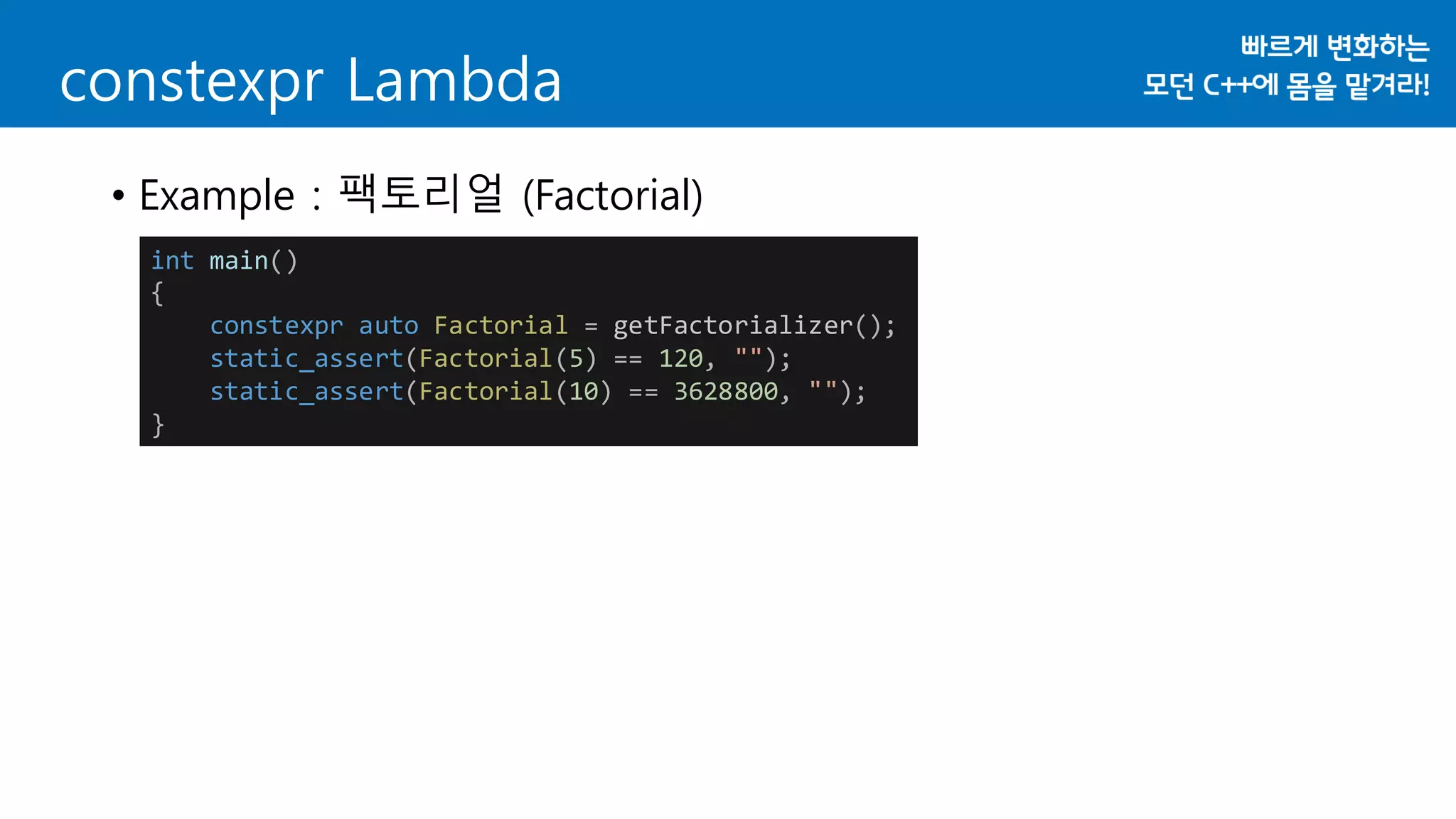
• Example :팩토리얼 (Factorial)
constexpr Lambda
int main()
{
constexpr auto Factorial = getFactorializer();
static_assert(Factorial(5) == 120, "");
static_assert(Factorial(10) == 3628800, "");
}
55.
constexpr auto getFactorializer= [] {
unsigned int optimization[6] = {};
auto for_each = [](auto* b, auto* e, auto pred) {
auto* it = b;
while (it != e) pred(it++ - b);
};
for_each(optimization, optimization + 6, [&](int n) {
if (!n) optimization[n] = 1;
else optimization[n] = n * optimization[n - 1];
});
auto FacImpl = [=](auto fac, unsigned n) {
if (n <= 5) return optimization[n];
return n * fac(fac, n - 1);
};
auto Fact = [=](int n) {
return FacImpl(FacImpl, n);
};
return Fact;
};
constexpr Lambda
56.
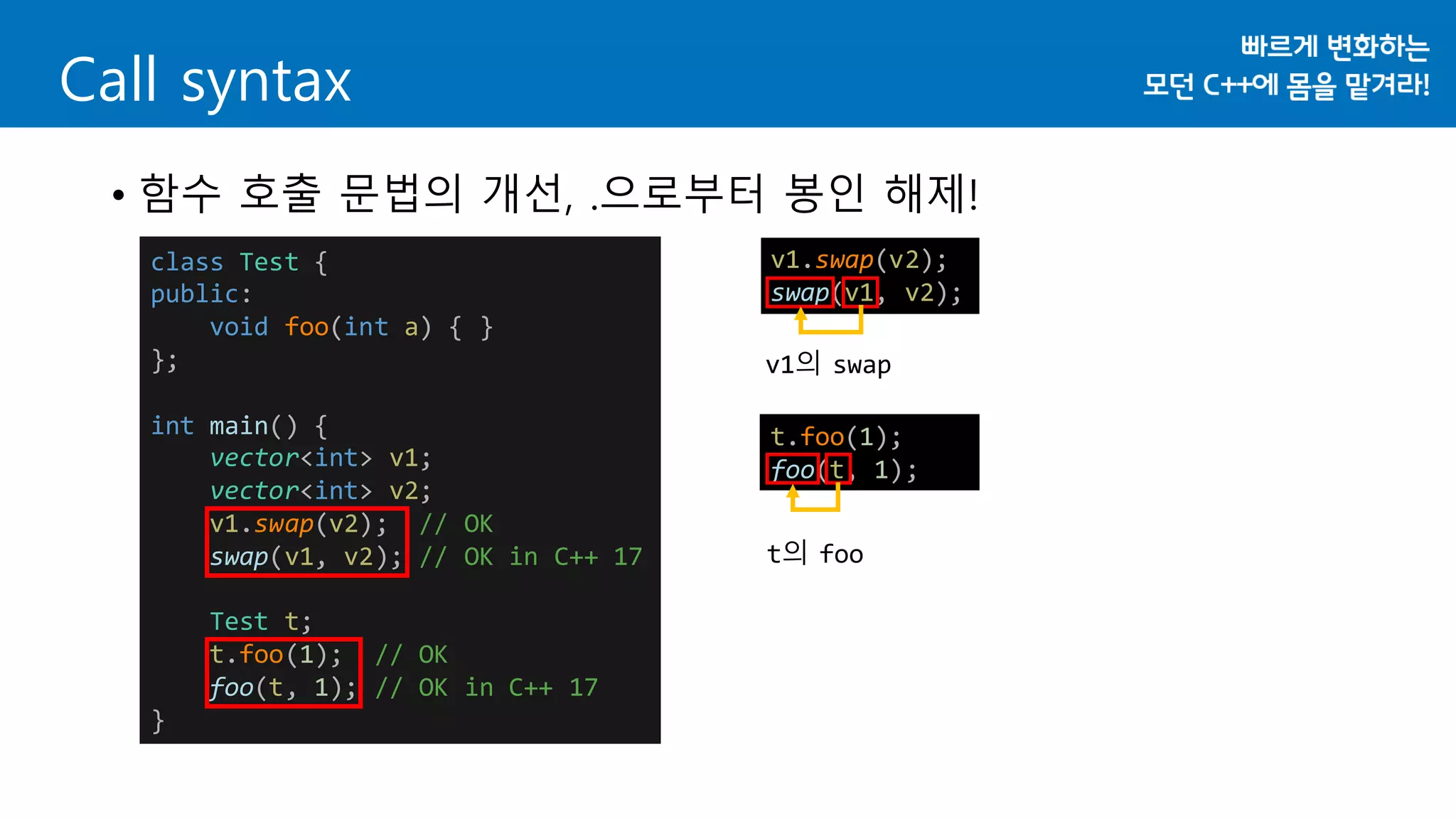
Call syntax
• 함수호출 문법의 개선, .으로부터 봉인 해제!
class Test {
public:
void foo(int a) { }
};
int main() {
vector<int> v1;
vector<int> v2;
v1.swap(v2); // OK
swap(v1, v2); // OK in C++ 17
Test t;
t.foo(1); // OK
foo(t, 1); // OK in C++ 17
}
v1.swap(v2);
swap(v1, v2);
v1의 swap
t.foo(1);
foo(t, 1);
t의 foo
57.
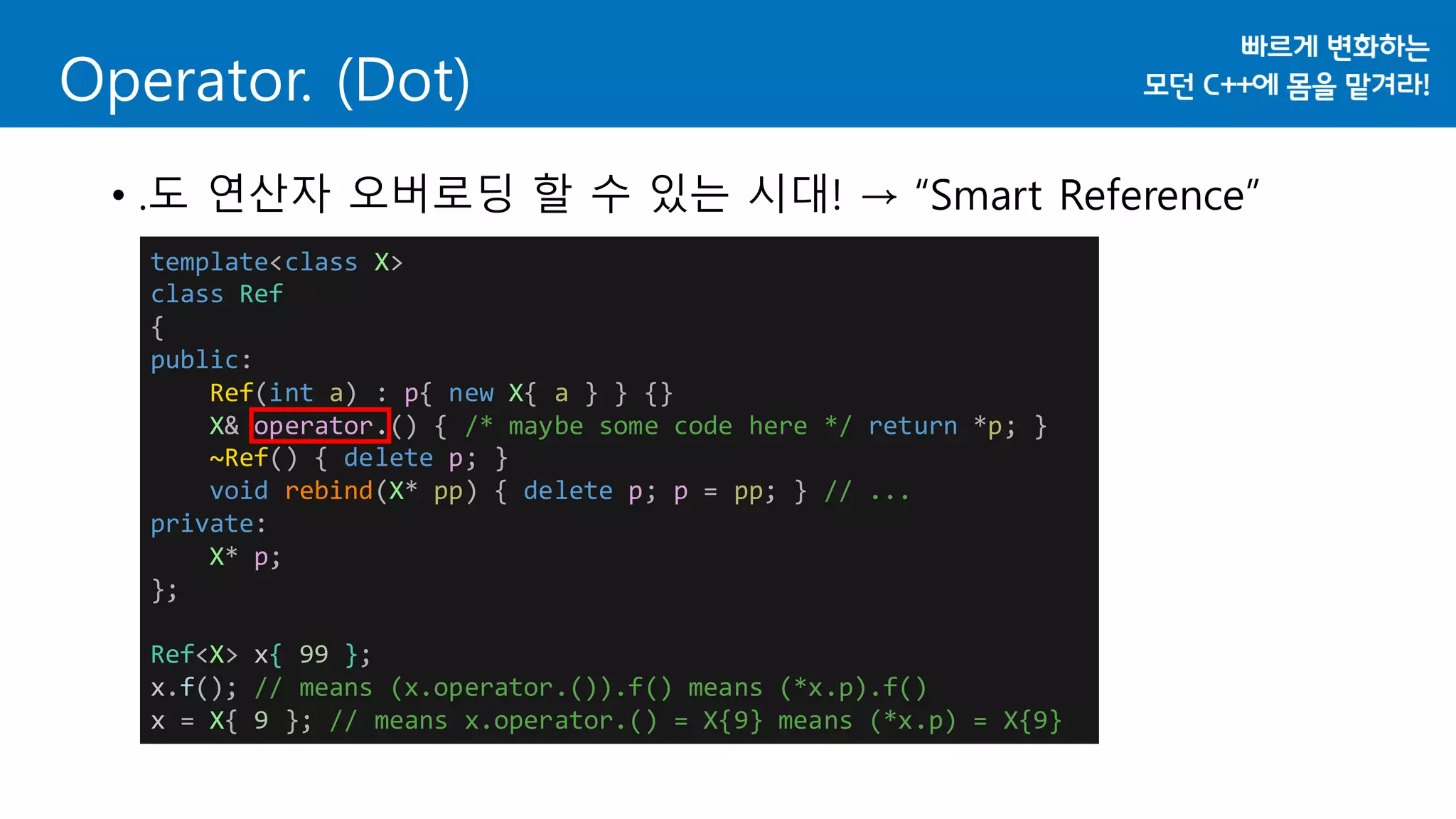
Operator. (Dot)
• .도연산자 오버로딩 할 수 있는 시대! → “Smart Reference”
template<class X>
class Ref
{
public:
Ref(int a) : p{ new X{ a } } {}
X& operator.() { /* maybe some code here */ return *p; }
~Ref() { delete p; }
void rebind(X* pp) { delete p; p = pp; } // ...
private:
X* p;
};
Ref<X> x{ 99 };
x.f(); // means (x.operator.()).f() means (*x.p).f()
x = X{ 9 }; // means x.operator.() = X{9} means (*x.p) = X{9}
58.
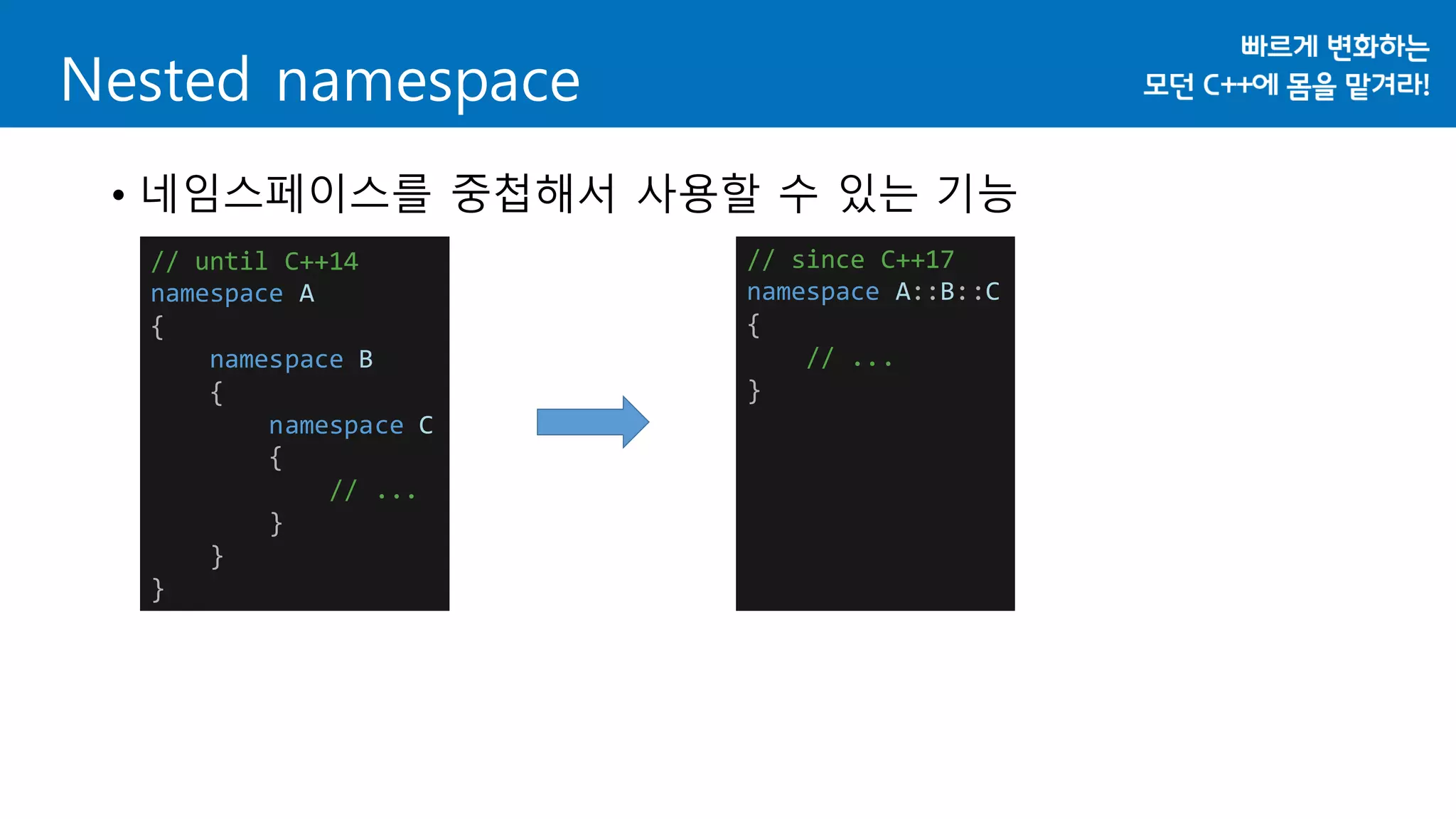
Nested namespace
• 네임스페이스를중첩해서 사용할 수 있는 기능
// until C++14
namespace A
{
namespace B
{
namespace C
{
// ...
}
}
}
// since C++17
namespace A::B::C
{
// ...
}
Contract
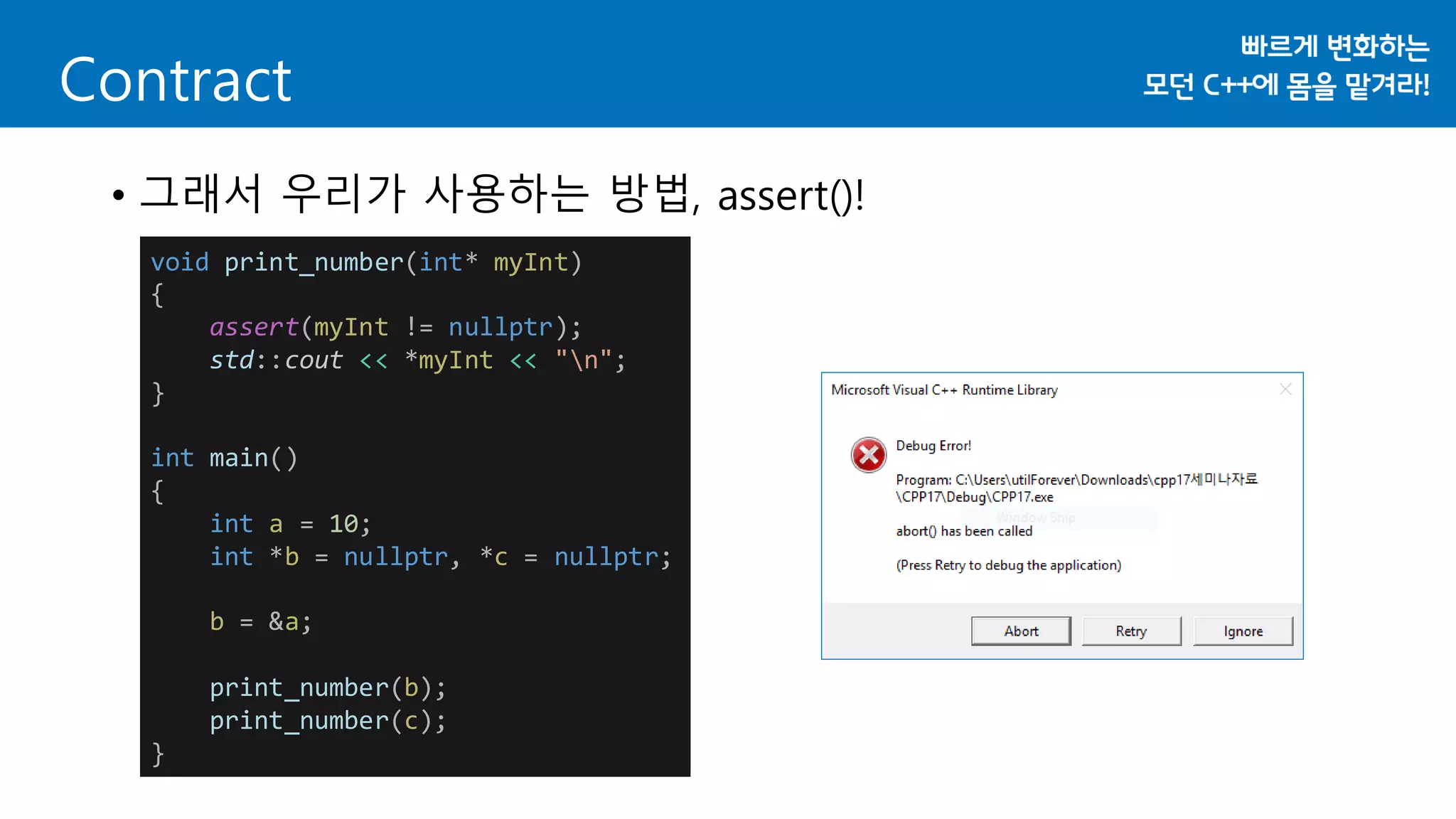
• 그래서 우리가사용하는 방법, assert()!
void print_number(int* myInt)
{
assert(myInt != nullptr);
std::cout << *myInt << "n";
}
int main()
{
int a = 10;
int *b = nullptr, *c = nullptr;
b = &a;
print_number(b);
print_number(c);
}
61.
Contract
• 계약(Contract)이란, 함수앞에 사전 조건과 사후 조건을 추가해
assert()처럼 특정 조건을 만족하는지 검사할 수 있는 기능
(assert()보다 가독성이 좋아 더 직관적이다)
• 사전 조건(Pre-condition) : expects
• 사후 조건(Post-condition) : ensures
template<typename T>
class ArrayView
{
T& operator[](size_t i)[[expects:i < size()]];
ArrayView(const vector<T>& v)[[ensures:data() == v.data()]];
};
62.
Contract
• Examples
struct A
{
boolf() const; bool g() const;
virtual std::string bhar()[[expects:f() && g()]];
virtual int hash()[[ensures:g()]];
virtual void gash()[[expects:g()]];
virtual double fash(int i) const[[expects:i > 0]];
};
struct B : A
{
std::string bhar() override[[expects:f()]]; // ERROR: weakening.
int hash() override[[ensures:f() && g()]]; // ERROR: strengthening.
void gash() override[[expects:g()]]; // OK: repeat from base.
double fash(int) override; // OK: inherited from base.
};
63.
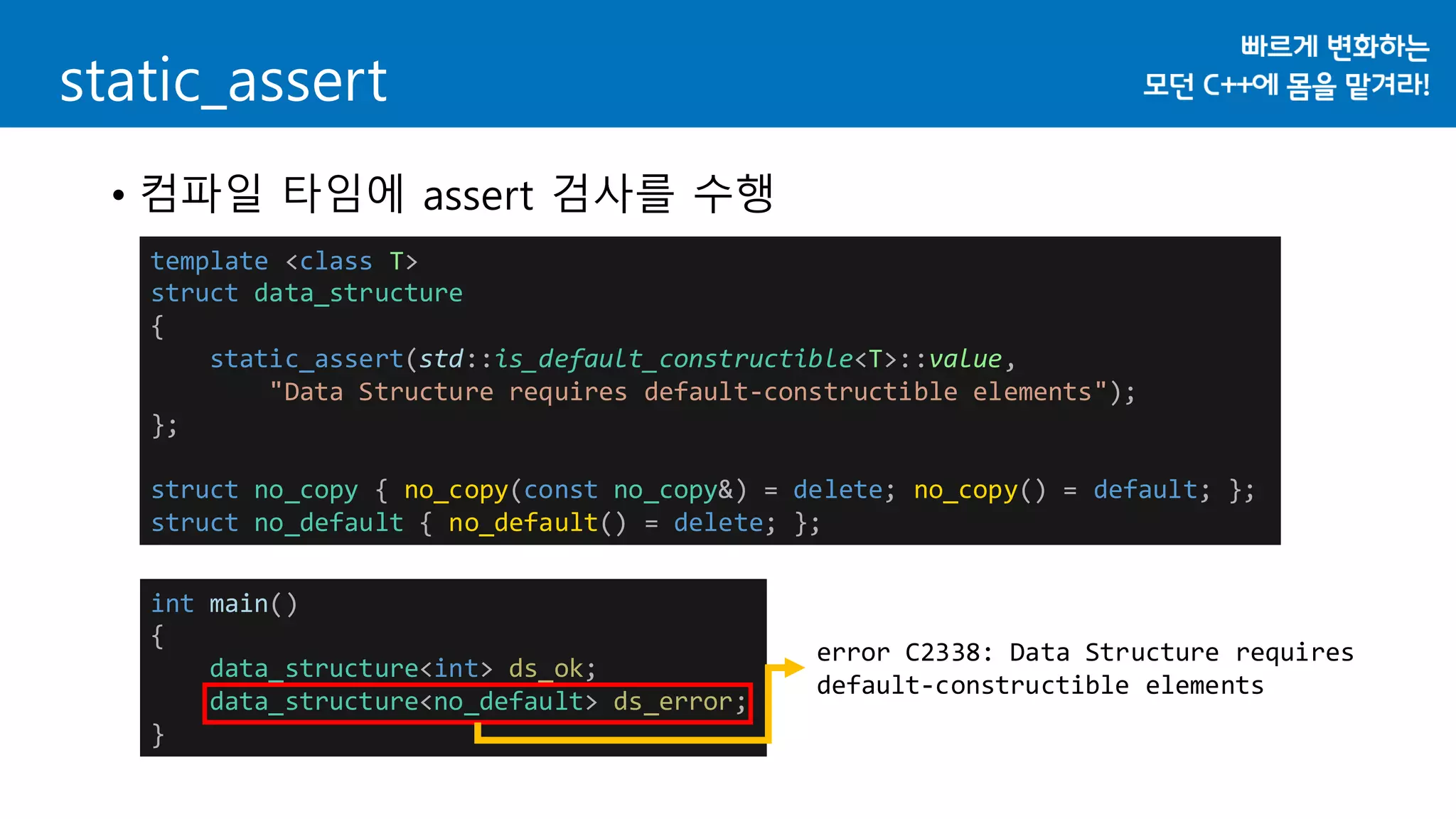
static_assert
• 컴파일 타임에assert 검사를 수행
template <class T>
void swap(T& a, T& b)
{
static_assert(std::is_copy_constructible<T>::value, "Swap requires copying");
static_assert(std::is_nothrow_move_constructible<T>::value &&
std::is_nothrow_move_assignable<T>::value, "Swap may throw");
auto c = b; b = a; a = c;
}
int main()
{
int a, b; swap(a, b);
no_copy nc_a, nc_b; swap(nc_a, nc_b);
}
error C2338: Swap requires copying
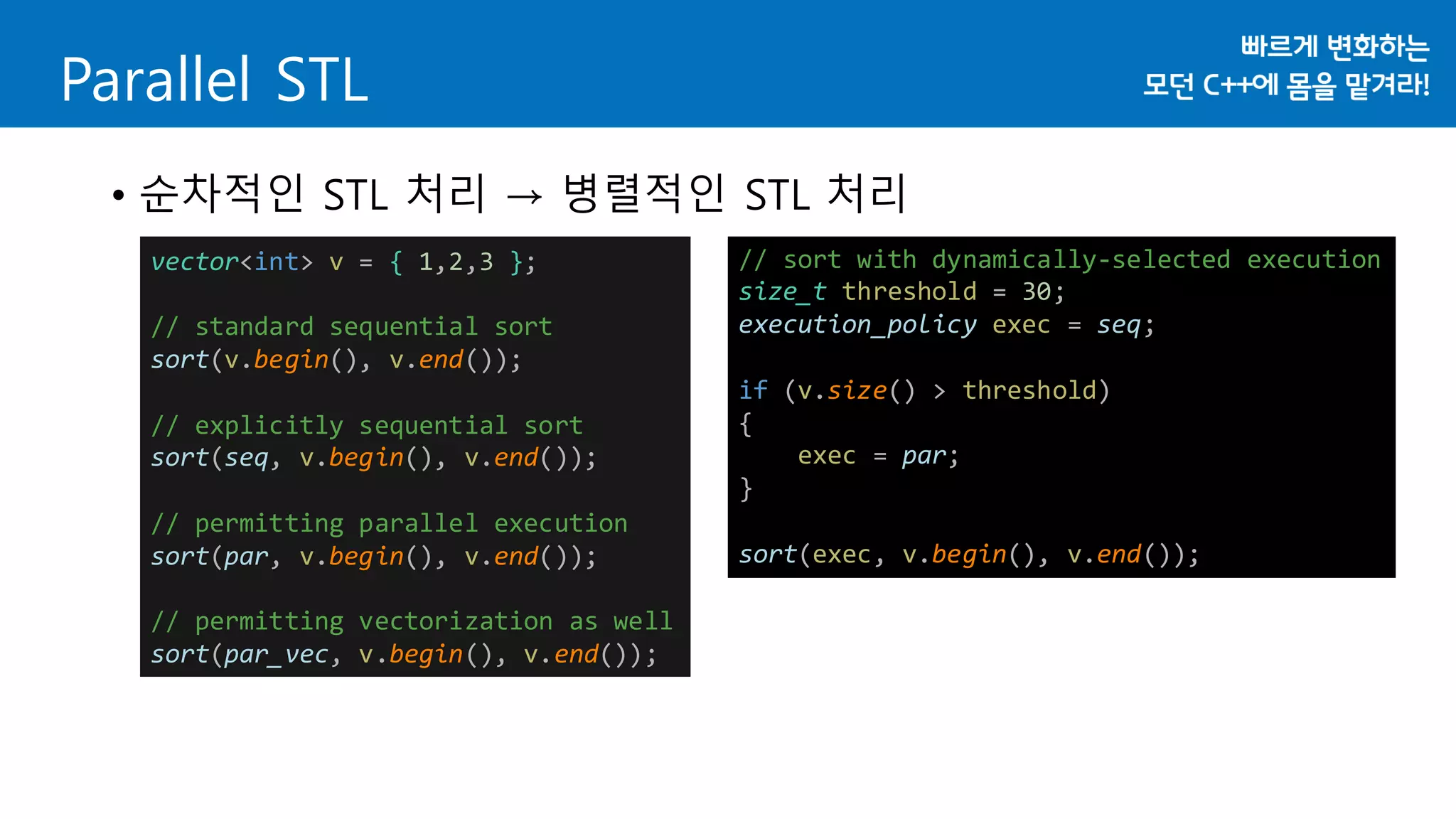
Parallel STL
• 순차적인STL 처리 → 병렬적인 STL 처리
vector<int> v = { 1,2,3 };
// standard sequential sort
sort(v.begin(), v.end());
// explicitly sequential sort
sort(seq, v.begin(), v.end());
// permitting parallel execution
sort(par, v.begin(), v.end());
// permitting vectorization as well
sort(par_vec, v.begin(), v.end());
// sort with dynamically-selected execution
size_t threshold = 30;
execution_policy exec = seq;
if (v.size() > threshold)
{
exec = par;
}
sort(exec, v.begin(), v.end());
70.
Coroutine
• Stackless ResumableFunctions
• Lightweight, customizable coroutines
• Targeted to another technical specifications
• Experimental implementation in Visual Studio 2015 Update 1
• 2 × 2 × 2
• Two new keywords : await, yield
• Two new concepts : Awaitable, Coroutine Promise
• Two new types : resumable_handle, resumable_traits
• 자세한 내용은 [CppCon 2014: Gor Nishanov,
“await 2.0: Stackless Resumable Function”] 참조
(https://www.youtube.com/watch?v=KUhSjfSbINE)
71.
Coroutine
• Example 1: 비동기 작업 (Asynchronous Operations)
// this could be some long running computation or I/O
future<int> CalculateTheAnswer()
{
return std::async([] {
this_thread::sleep_for(1s);
return 42;
});
}
// Here is a resumable function
future<void> Coroutine()
{
std::cout << "Started waiting... n";
auto result = __await CalculateTheAnswer();
std::cout << "Got " << result << "n";
}
int main()
{
Coroutine().get();
}
72.
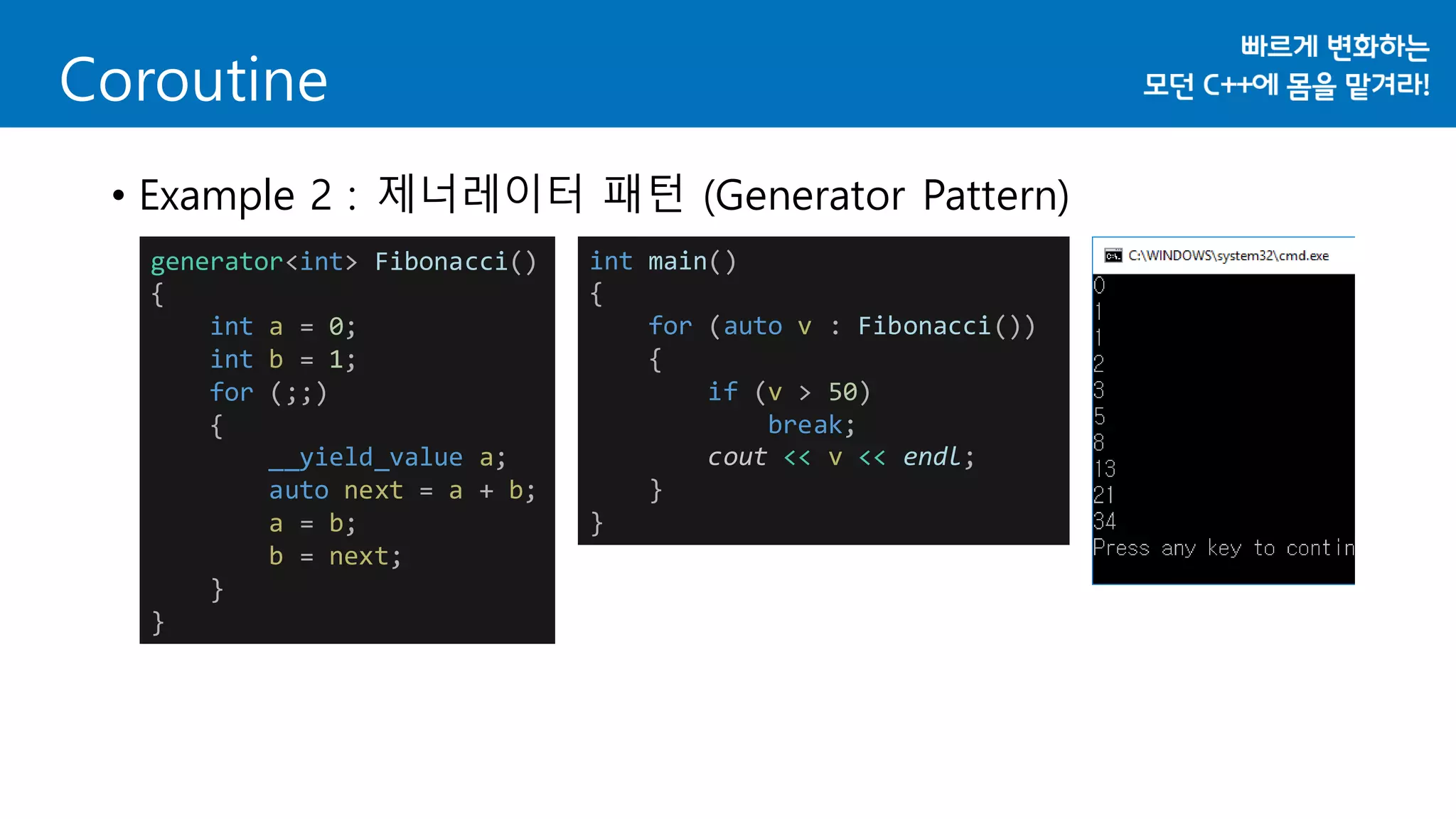
Coroutine
• Example 2: 제너레이터 패턴 (Generator Pattern)
generator<int> Fibonacci()
{
int a = 0;
int b = 1;
for (;;)
{
__yield_value a;
auto next = a + b;
a = b;
b = next;
}
}
int main()
{
for (auto v : Fibonacci())
{
if (v > 50)
break;
cout << v << endl;
}
}
73.
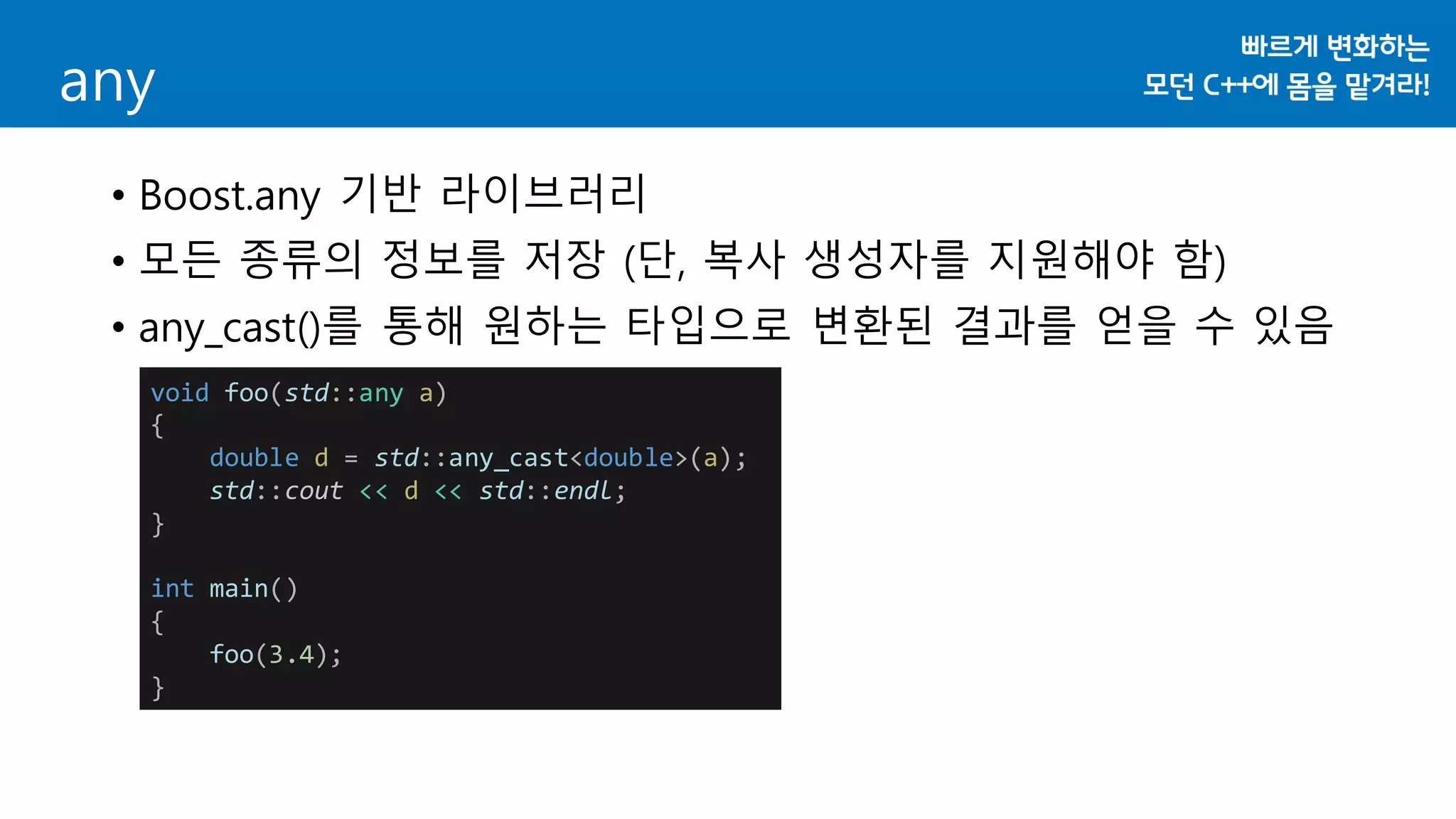
any
• Boost.any 기반라이브러리
• 모든 종류의 정보를 저장 (단, 복사 생성자를 지원해야 함)
• any_cast()를 통해 원하는 타입으로 변환된 결과를 얻을 수 있음
void foo(std::any a)
{
double d = std::any_cast<double>(a);
std::cout << d << std::endl;
}
int main()
{
foo(3.4);
}
74.
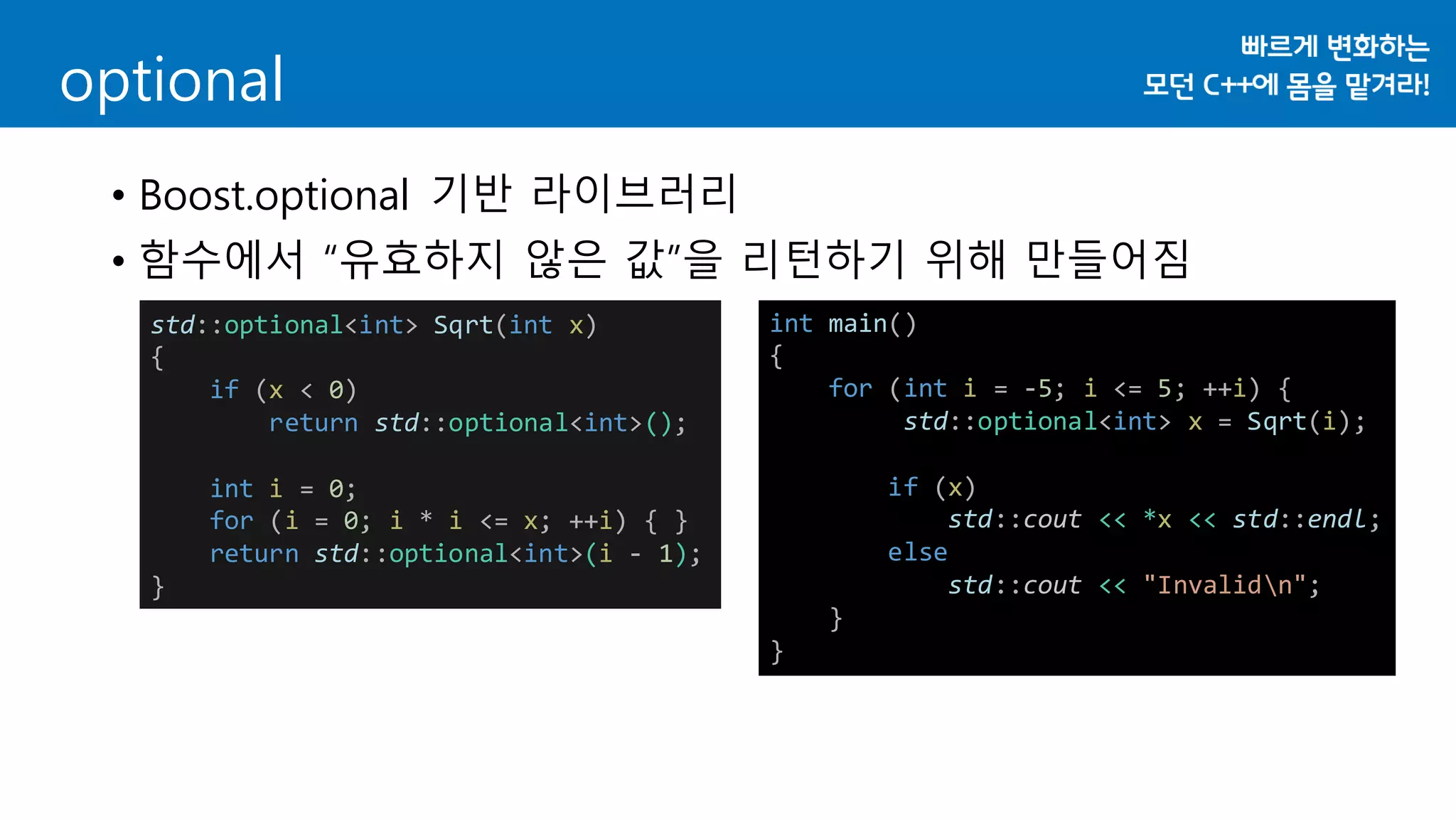
optional
• Boost.optional 기반라이브러리
• 함수에서 “유효하지 않은 값”을 리턴하기 위해 만들어짐
std::optional<int> Sqrt(int x)
{
if (x < 0)
return std::optional<int>();
int i = 0;
for (i = 0; i * i <= x; ++i) { }
return std::optional<int>(i - 1);
}
int main()
{
for (int i = -5; i <= 5; ++i) {
std::optional<int> x = Sqrt(i);
if (x)
std::cout << *x << std::endl;
else
std::cout << "Invalidn";
}
}
75.
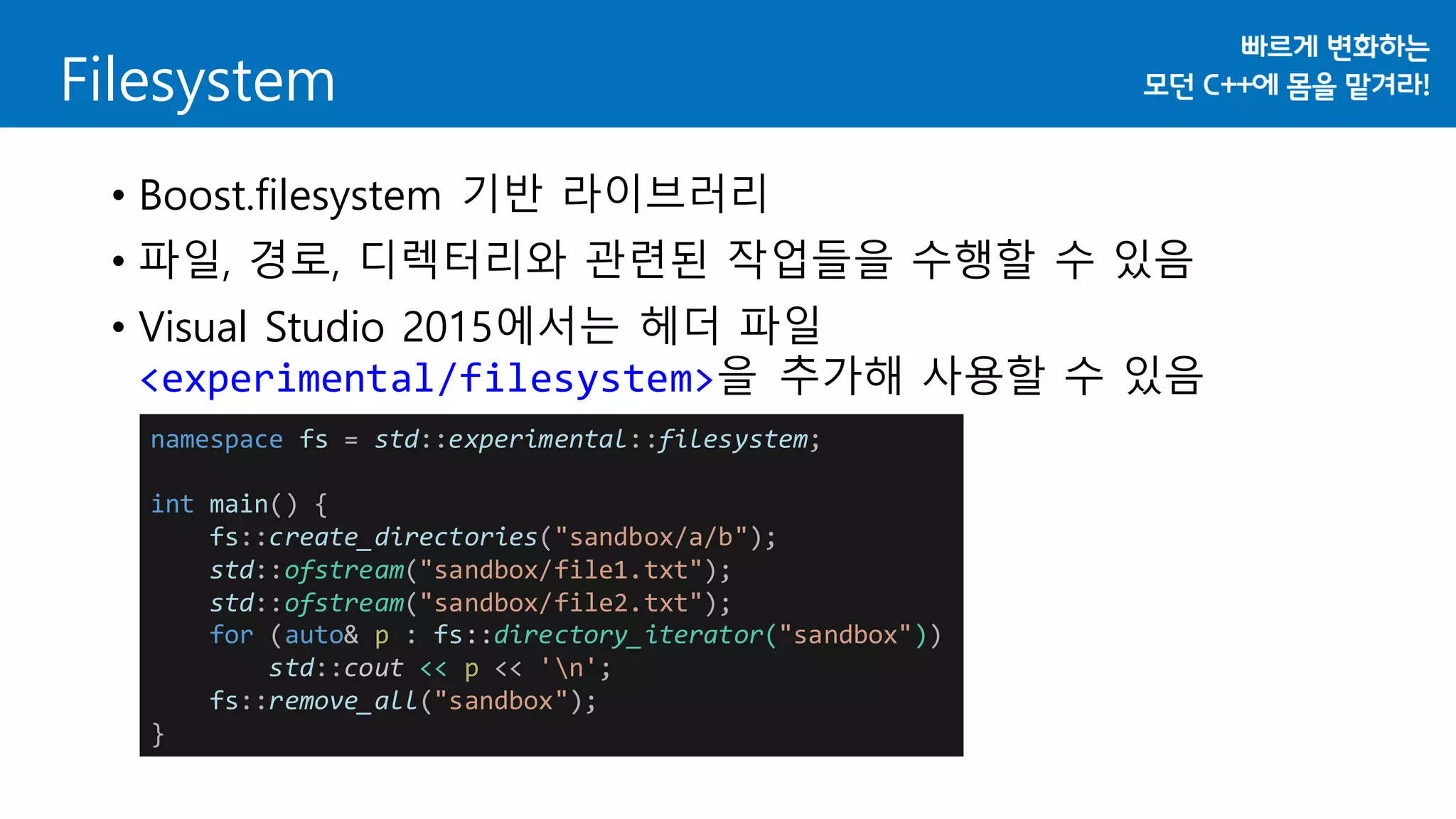
Filesystem
• Boost.filesystem 기반라이브러리
• 파일, 경로, 디렉터리와 관련된 작업들을 수행할 수 있음
• Visual Studio 2015에서는 헤더 파일
<experimental/filesystem>을 추가해 사용할 수 있음
namespace fs = std::experimental::filesystem;
int main() {
fs::create_directories("sandbox/a/b");
std::ofstream("sandbox/file1.txt");
std::ofstream("sandbox/file2.txt");
for (auto& p : fs::directory_iterator("sandbox"))
std::cout << p << 'n';
fs::remove_all("sandbox");
}
76.
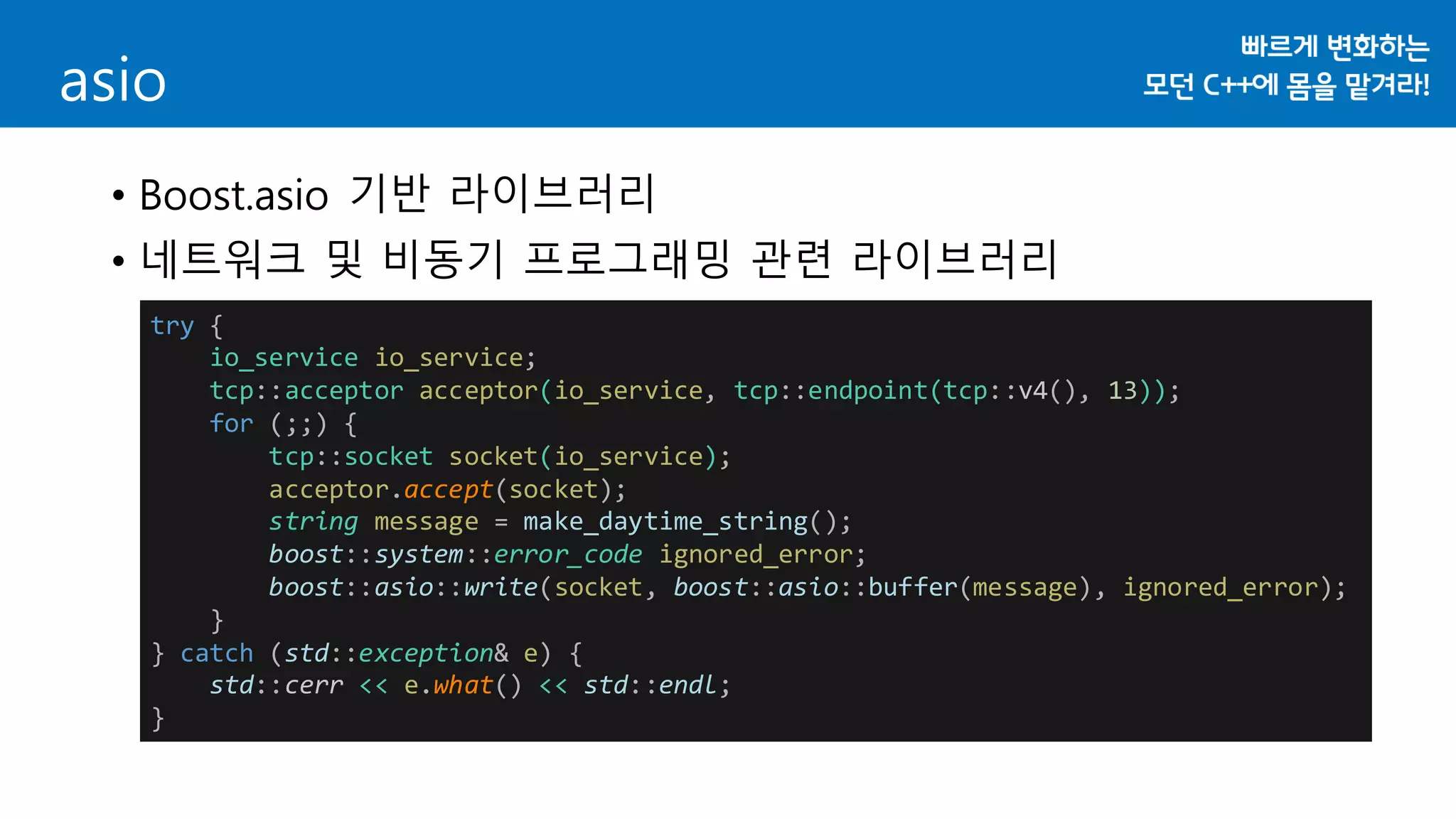
asio
• Boost.asio 기반라이브러리
• 네트워크 및 비동기 프로그래밍 관련 라이브러리
try {
io_service io_service;
tcp::acceptor acceptor(io_service, tcp::endpoint(tcp::v4(), 13));
for (;;) {
tcp::socket socket(io_service);
acceptor.accept(socket);
string message = make_daytime_string();
boost::system::error_code ignored_error;
boost::asio::write(socket, boost::asio::buffer(message), ignored_error);
}
} catch (std::exception& e) {
std::cerr << e.what() << std::endl;
}
77.
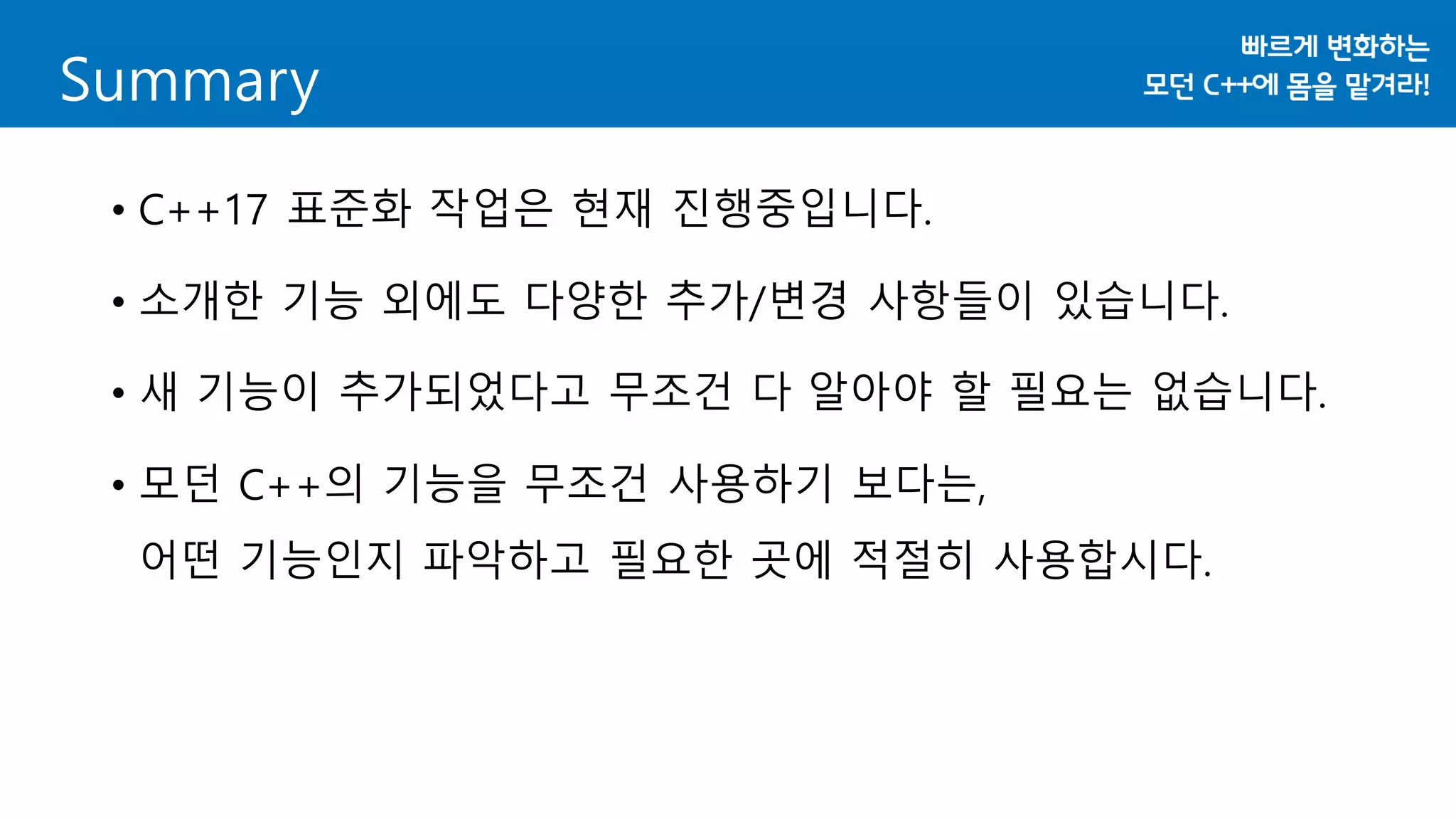
Summary
• C++17 표준화작업은 현재 진행중입니다.
• 소개한 기능 외에도 다양한 추가/변경 사항들이 있습니다.
• 새 기능이 추가되었다고 무조건 다 알아야 할 필요는 없습니다.
• 모던 C++의 기능을 무조건 사용하기 보다는,
어떤 기능인지 파악하고 필요한 곳에 적절히 사용합시다.

![• 이제 컴파일러의 오류 메시지가 명확해진다!
Concept
In instantiation of 'void std::__sort(_RandomAccessIterator,
_RandomAccessIterator, _Compare) [with _RandomAccessIterator =
std::_List_iterator<int>; _Compare = __gnu_cxx::__ops::_Iter_less_iter]':
error: no match for 'operator-' (operand types are
'std::_List_iterator<int>' and 'std::_List_iterator<int>')
std::__lg(__last - __first) * 2,
error: cannot call function 'void std::sort(_RAIter, _RAIter) [with _RAIter
= std::_List_iterator<int>]'
note: concept 'RandomAccessIterator()' was not satisfied](https://image.slidesharecdn.com/ckorea2ndseminarc17keyfeaturessummary-publish-160529025757/75/C-Korea-2nd-Seminar-C-17-Key-Features-Summary-33-2048.jpg)
![Attribute
• 타입, 객체, 코드 등에 구현 정의 특성을 부여
• C++14에 추가된 특성
• [[noreturn]] : 이 함수는 리턴하지 않음
• [[carries_dependency]] : 종속성 체인이 함수 안팎으로 전파됨
• [[deprecated]] : 사용할 수 있지만, 권장하지 않음 (더 이상 사용 X)
• C++17에 추가된 특성
• [[fallthrough]] : switch-case 문에서 사용, 완료되지 않음을 나타냄
• [[nodiscard]] : 함수의 리턴 값이 있는데 버리는 경우 경고문을 표시
• [[maybe_unused]] : 사용하지 않는 변수에 대해 경고문을 표시하지 않음](https://image.slidesharecdn.com/ckorea2ndseminarc17keyfeaturessummary-publish-160529025757/75/C-Korea-2nd-Seminar-C-17-Key-Features-Summary-45-2048.jpg)
![Attribute
• Example 1
[[noreturn]] void f()
{
throw "error"; // OK
}
[[noreturn]] void q(int i)
{
// behavior is undefined
// if called with an argument <= 0
if (i > 0) { throw "positive"; }
}](https://image.slidesharecdn.com/ckorea2ndseminarc17keyfeaturessummary-publish-160529025757/75/C-Korea-2nd-Seminar-C-17-Key-Features-Summary-46-2048.jpg)
![void f(int n)
{
void g(), h(), i();
switch (n)
{
case 1:
case 2:
g();
[[fallthrough]];
case 3: // no warning on fallthrough
h();
case 4: // compiler may warn on fallthrough
i();
[[fallthrough]]; // illformed, not before a case label
}
}
Attribute
• Example 2](https://image.slidesharecdn.com/ckorea2ndseminarc17keyfeaturessummary-publish-160529025757/75/C-Korea-2nd-Seminar-C-17-Key-Features-Summary-47-2048.jpg)
![struct [[nodiscard]] error_info { };
error_info enable_missile_safety_mode();
void launch_missiles();
void test_missiles()
{
enable_missile_safety_mode(); // compiler may warn
// on discarding a nodiscard value
launch_missiles();
}
error_info& foo();
void f1()
{
foo(); // nodiscard type is not returned by value, no warning
}
Attribute
• Example 3](https://image.slidesharecdn.com/ckorea2ndseminarc17keyfeaturessummary-publish-160529025757/75/C-Korea-2nd-Seminar-C-17-Key-Features-Summary-48-2048.jpg)
![Attribute
• Example 4
[[maybe_unused]] void f([[maybe_unused]] bool thing1,
[[maybe_unused]] bool thing2)
{
[[maybe_unused]] bool b = thing1 && thing2;
assert(b); // in release mode, assert is compiled out, and b is unused
// no warning because it is declared [[maybe_unused]]
} // parameters thing1 and thing2 are not used, no warning](https://image.slidesharecdn.com/ckorea2ndseminarc17keyfeaturessummary-publish-160529025757/75/C-Korea-2nd-Seminar-C-17-Key-Features-Summary-49-2048.jpg)
![constexpr Lambda
• C++11의 람다식 (Lambda Expression)
[my_mod] (int v) -> int { return v % my_mod; }
개시자
(Introducer Capture)
인자
(Arguments)
반환 타입
(Return Type)
함수의 몸통
(Statement)](https://image.slidesharecdn.com/ckorea2ndseminarc17keyfeaturessummary-publish-160529025757/75/C-Korea-2nd-Seminar-C-17-Key-Features-Summary-51-2048.jpg)
![constexpr Lambda
• C++11의 람다식 (Lambda Expression)
int x = 10, y = 20;
[] {}; // Do not capture
[x] (int arg) { return x; }; // value(Copy) capture x
[=] { return x; }; // value(Copy) capture all
[&] { return y; }; // reference capture all
[&, x] { return y; }; // reference capture all except x
[=, &y] { return x; }; // value(Copy) capture all except y
[this] { return this->something; }; // this capture
[=, x] {}; // error
[&, &x] {}; // error
[=, this] {}; // error
[x, x] {}; // error](https://image.slidesharecdn.com/ckorea2ndseminarc17keyfeaturessummary-publish-160529025757/75/C-Korea-2nd-Seminar-C-17-Key-Features-Summary-52-2048.jpg)
 { return a + b; };
Test<add(1, 2)> t1;
auto add2 = [](int a, int b) constexpr { return a + b; };
Test<add2(1, 2)> t2;
auto add3 = [](int a, int b) { return a + b; };
constexpr int c = add3(1, 2);
constexpr int(*f)(int, int) = add3;
Test<add3(1, 2)> t3;
}](https://image.slidesharecdn.com/ckorea2ndseminarc17keyfeaturessummary-publish-160529025757/75/C-Korea-2nd-Seminar-C-17-Key-Features-Summary-53-2048.jpg)
![constexpr auto getFactorializer = [] {
unsigned int optimization[6] = {};
auto for_each = [](auto* b, auto* e, auto pred) {
auto* it = b;
while (it != e) pred(it++ - b);
};
for_each(optimization, optimization + 6, [&](int n) {
if (!n) optimization[n] = 1;
else optimization[n] = n * optimization[n - 1];
});
auto FacImpl = [=](auto fac, unsigned n) {
if (n <= 5) return optimization[n];
return n * fac(fac, n - 1);
};
auto Fact = [=](int n) {
return FacImpl(FacImpl, n);
};
return Fact;
};
constexpr Lambda](https://image.slidesharecdn.com/ckorea2ndseminarc17keyfeaturessummary-publish-160529025757/75/C-Korea-2nd-Seminar-C-17-Key-Features-Summary-55-2048.jpg)
[[expects:i < size()]];
ArrayView(const vector<T>& v)[[ensures:data() == v.data()]];
};](https://image.slidesharecdn.com/ckorea2ndseminarc17keyfeaturessummary-publish-160529025757/75/C-Korea-2nd-Seminar-C-17-Key-Features-Summary-61-2048.jpg)
![Contract
• Examples
struct A
{
bool f() const; bool g() const;
virtual std::string bhar()[[expects:f() && g()]];
virtual int hash()[[ensures:g()]];
virtual void gash()[[expects:g()]];
virtual double fash(int i) const[[expects:i > 0]];
};
struct B : A
{
std::string bhar() override[[expects:f()]]; // ERROR: weakening.
int hash() override[[ensures:f() && g()]]; // ERROR: strengthening.
void gash() override[[expects:g()]]; // OK: repeat from base.
double fash(int) override; // OK: inherited from base.
};](https://image.slidesharecdn.com/ckorea2ndseminarc17keyfeaturessummary-publish-160529025757/75/C-Korea-2nd-Seminar-C-17-Key-Features-Summary-62-2048.jpg)

![Removed keywords
• C++17부터 사라지는 키워드들
// 1. register
register int a;
// 2. bool increment
bool b = 0;
++b; // bool increment
// 3. auto_ptr
auto_ptr<int> ap;
// 4. random_shuffle
int x[10] = { 1, 2, 3, 4, 5, 6, 7, 8, 9, 10 };
random_shuffle(x, x + 10);](https://image.slidesharecdn.com/ckorea2ndseminarc17keyfeaturessummary-publish-160529025757/75/C-Korea-2nd-Seminar-C-17-Key-Features-Summary-67-2048.jpg)
![Coroutine
• Stackless Resumable Functions
• Lightweight, customizable coroutines
• Targeted to another technical specifications
• Experimental implementation in Visual Studio 2015 Update 1
• 2 × 2 × 2
• Two new keywords : await, yield
• Two new concepts : Awaitable, Coroutine Promise
• Two new types : resumable_handle, resumable_traits
• 자세한 내용은 [CppCon 2014: Gor Nishanov,
“await 2.0: Stackless Resumable Function”] 참조
(https://www.youtube.com/watch?v=KUhSjfSbINE)](https://image.slidesharecdn.com/ckorea2ndseminarc17keyfeaturessummary-publish-160529025757/75/C-Korea-2nd-Seminar-C-17-Key-Features-Summary-70-2048.jpg)
![Coroutine
• Example 1 : 비동기 작업 (Asynchronous Operations)
// this could be some long running computation or I/O
future<int> CalculateTheAnswer()
{
return std::async([] {
this_thread::sleep_for(1s);
return 42;
});
}
// Here is a resumable function
future<void> Coroutine()
{
std::cout << "Started waiting... n";
auto result = __await CalculateTheAnswer();
std::cout << "Got " << result << "n";
}
int main()
{
Coroutine().get();
}](https://image.slidesharecdn.com/ckorea2ndseminarc17keyfeaturessummary-publish-160529025757/75/C-Korea-2nd-Seminar-C-17-Key-Features-Summary-71-2048.jpg)


![[Td 2015]녹슨 c++ 코드에 모던 c++로 기름칠하기(옥찬호)](https://cdn.slidesharecdn.com/ss_thumbnails/td2015cc-151104051810-lva1-app6891-thumbnail.jpg?width=640&height=640&fit=bounds)
![[C++ Korea 3rd Seminar] 새 C++은 새 Visual Studio에, 좌충우돌 마이그레이션 이야기](https://cdn.slidesharecdn.com/ss_thumbnails/ckorea3rdseminarcvisualstudio-170218150400-thumbnail.jpg?width=640&height=640&fit=bounds)


![[KGC 2011]Boost 라이브러리와 C++11](https://cdn.slidesharecdn.com/ss_thumbnails/kgc2011boostcpp11-111125022526-phpapp01-thumbnail.jpg?width=640&height=640&fit=bounds)


![[TechDays Korea 2015] 녹슨 C++ 코드에 모던 C++로 기름칠하기](https://cdn.slidesharecdn.com/ss_thumbnails/techdayskorea2015cc-151029112639-lva1-app6891-thumbnail.jpg?width=640&height=640&fit=bounds)
![[NDC2015] C++11 고급 기능 - Crow에 사용된 기법 중심으로](https://cdn.slidesharecdn.com/ss_thumbnails/ndc2015crowv3-150529000226-lva1-app6891-thumbnail.jpg?width=640&height=640&fit=bounds)

![[C++ Korea] Effective Modern C++ Study, Item 1 - 3](https://cdn.slidesharecdn.com/ss_thumbnails/ckoreaeffectivemoderncstudy-item1-3-150202202213-conversion-gate01-thumbnail.jpg?width=640&height=640&fit=bounds)

![[KGC 2012]Boost.asio를 이용한 네트웍 프로그래밍](https://cdn.slidesharecdn.com/ss_thumbnails/kgc2012boost-asio-121011023325-phpapp02-thumbnail.jpg?width=640&height=640&fit=bounds)


![[C++ Korea] Effective Modern C++ MVA item 9 Prefer alias declarations to type...](https://cdn.slidesharecdn.com/ss_thumbnails/ckoreaeffectivemoderncmvaitem9preferaliasdeclarationstotypedefs-150508005758-lva1-app6891-thumbnail.jpg?width=640&height=640&fit=bounds)
![[devil's camp] - 알고리즘 대회와 STL (박인서)](https://cdn.slidesharecdn.com/ss_thumbnails/stl-160830021024-thumbnail.jpg?width=640&height=640&fit=bounds)


![[델리만주] 대학원 캐슬 - 석사에서 게임 프로그래머까지](https://cdn.slidesharecdn.com/ss_thumbnails/asdf-190219141801-thumbnail.jpg?width=640&height=640&fit=bounds)

![[NDC 2018] 유체역학 엔진 개발기](https://cdn.slidesharecdn.com/ss_thumbnails/ndc18fluidenginedevelopmentverfinal-180427164620-thumbnail.jpg?width=640&height=640&fit=bounds)


![[RLKorea] <하스스톤> 강화학습 환경 개발기](https://cdn.slidesharecdn.com/ss_thumbnails/rlkorea-hearthstonesimulationforreinforcementlearningver1-190826145318-thumbnail.jpg?width=640&height=640&fit=bounds)

![[NDC 2019] 하스스톤 강화학습 환경 개발기](https://cdn.slidesharecdn.com/ss_thumbnails/ndc19hearthstonedevelopmentforreinforcementlearningverfinal-190426141251-thumbnail.jpg?width=640&height=640&fit=bounds)

