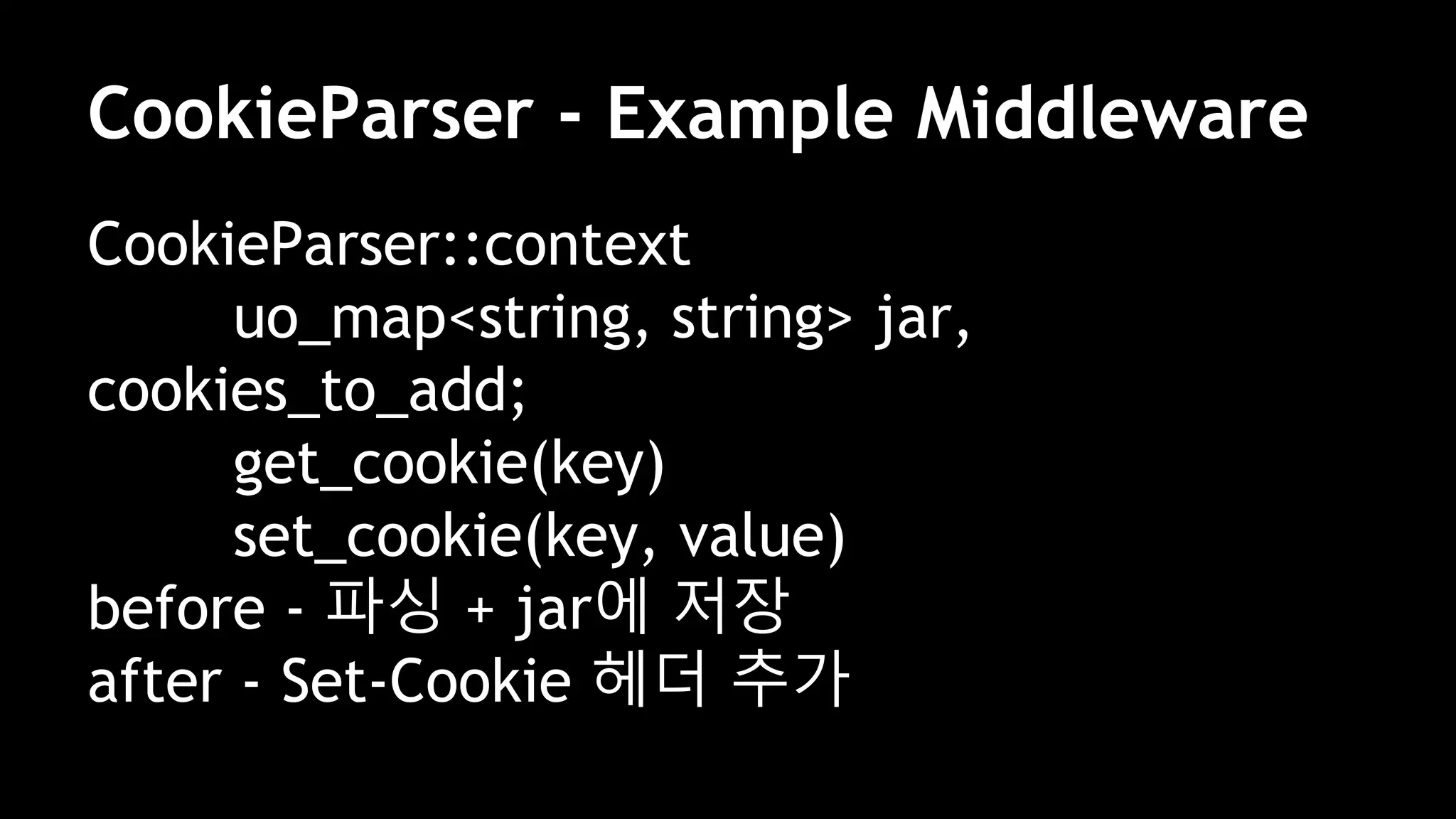
http://github.com/ipkn/crow
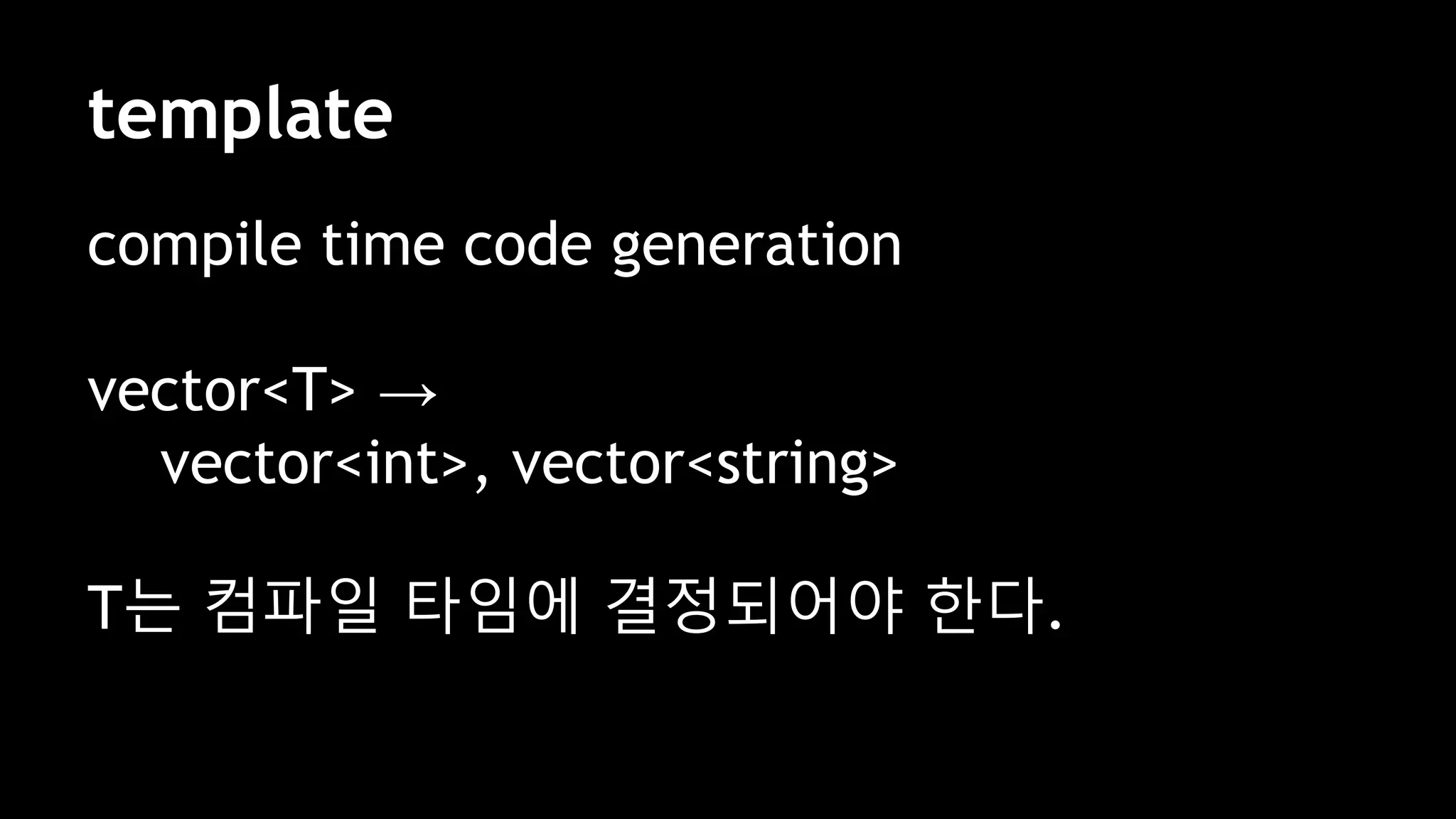
Crow 프로젝트에서 사용한 C++11 기법들을 실제 구현에 대한 설명을 포함하여 자세히 설명한 발표자료입니다.
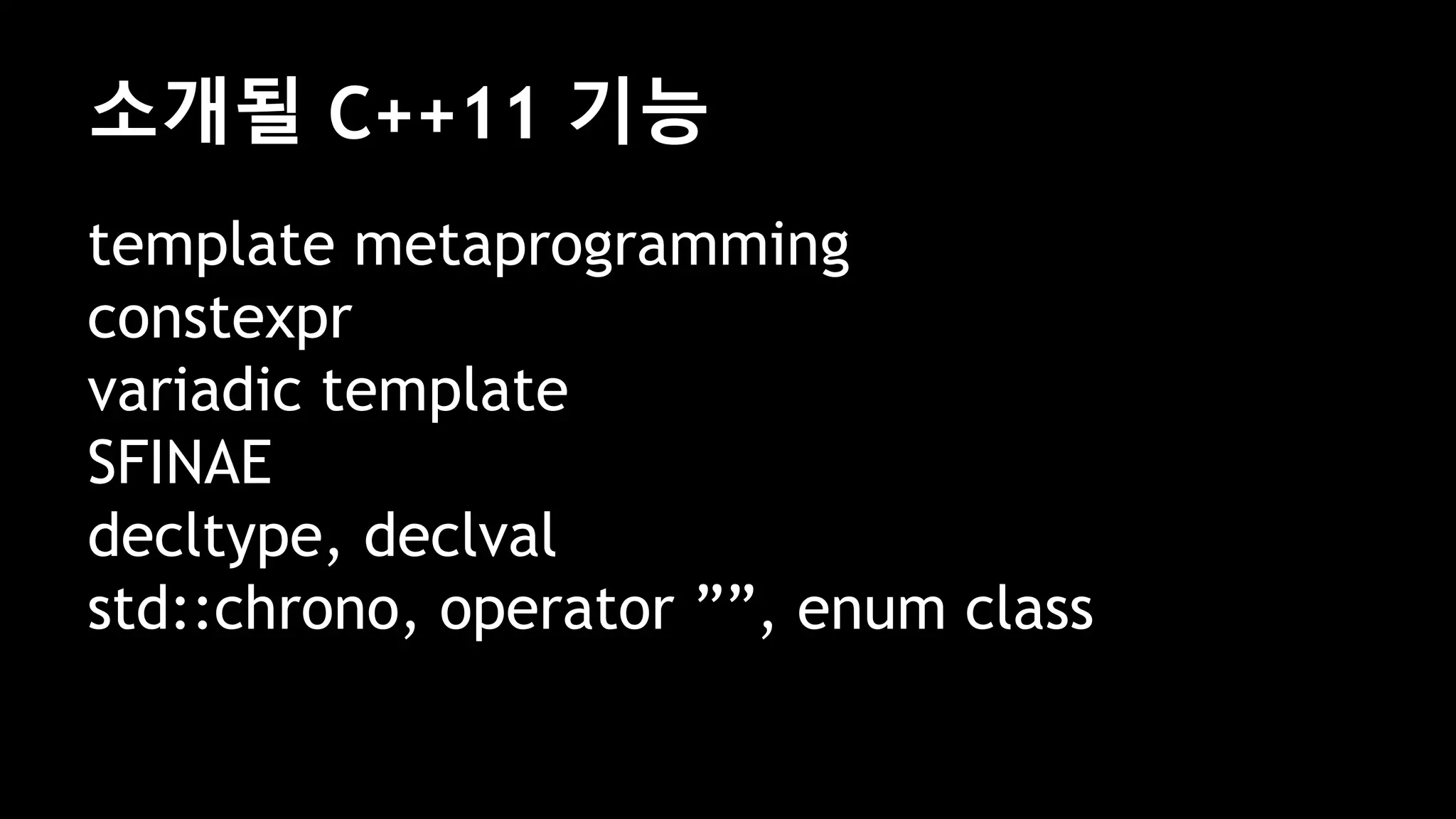
C++11 features used in Crow
video:
http://youtu.be/MixS9c3mE6U
https://vimeo.com/119627253
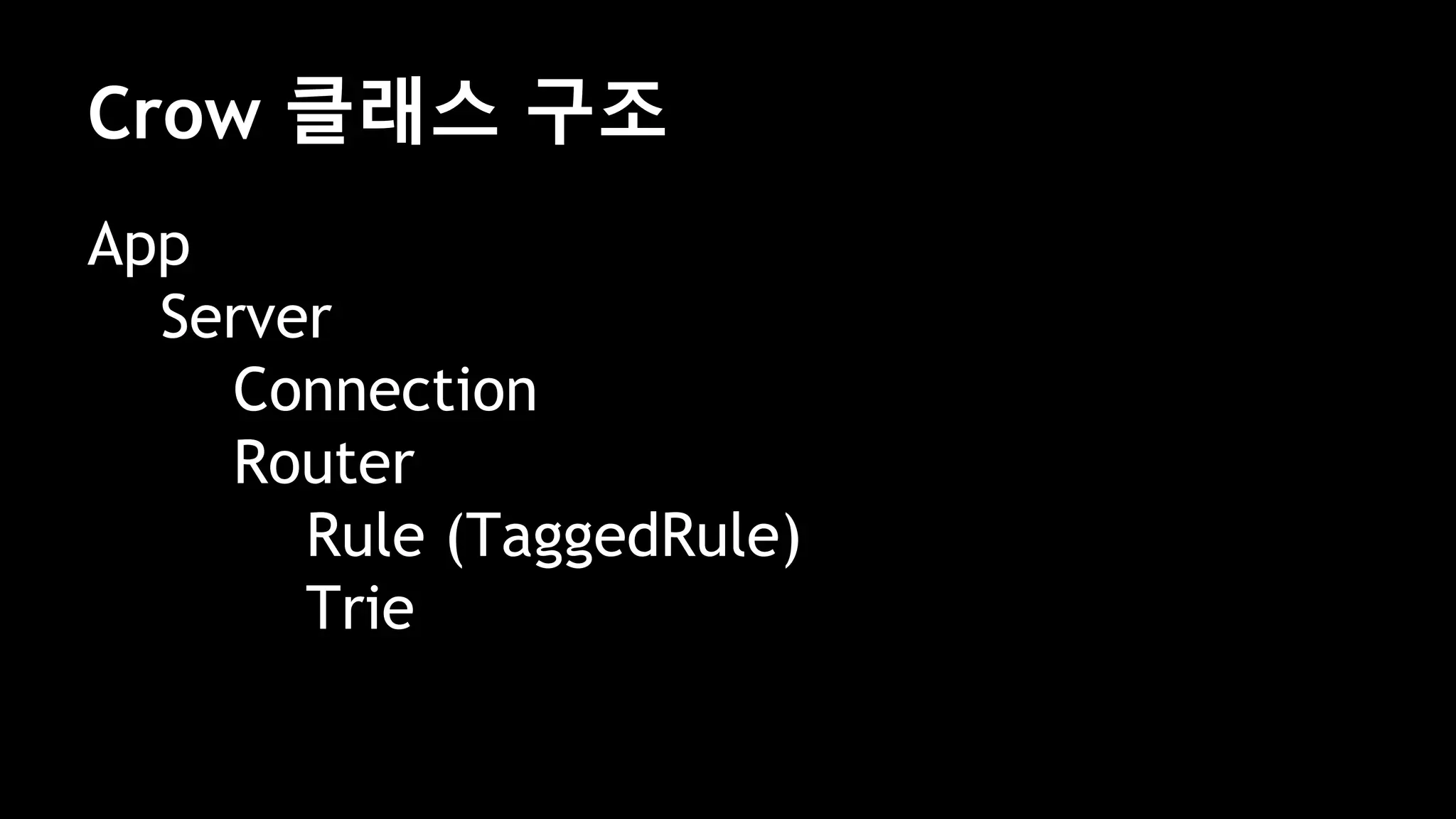
Crow
C++ Framework forwriting Web server
http://github.com/ipkn/crow
GitHub Star 1063개
Hacker News vote 194
https://news.ycombinator.com/item?id=8002604
5.
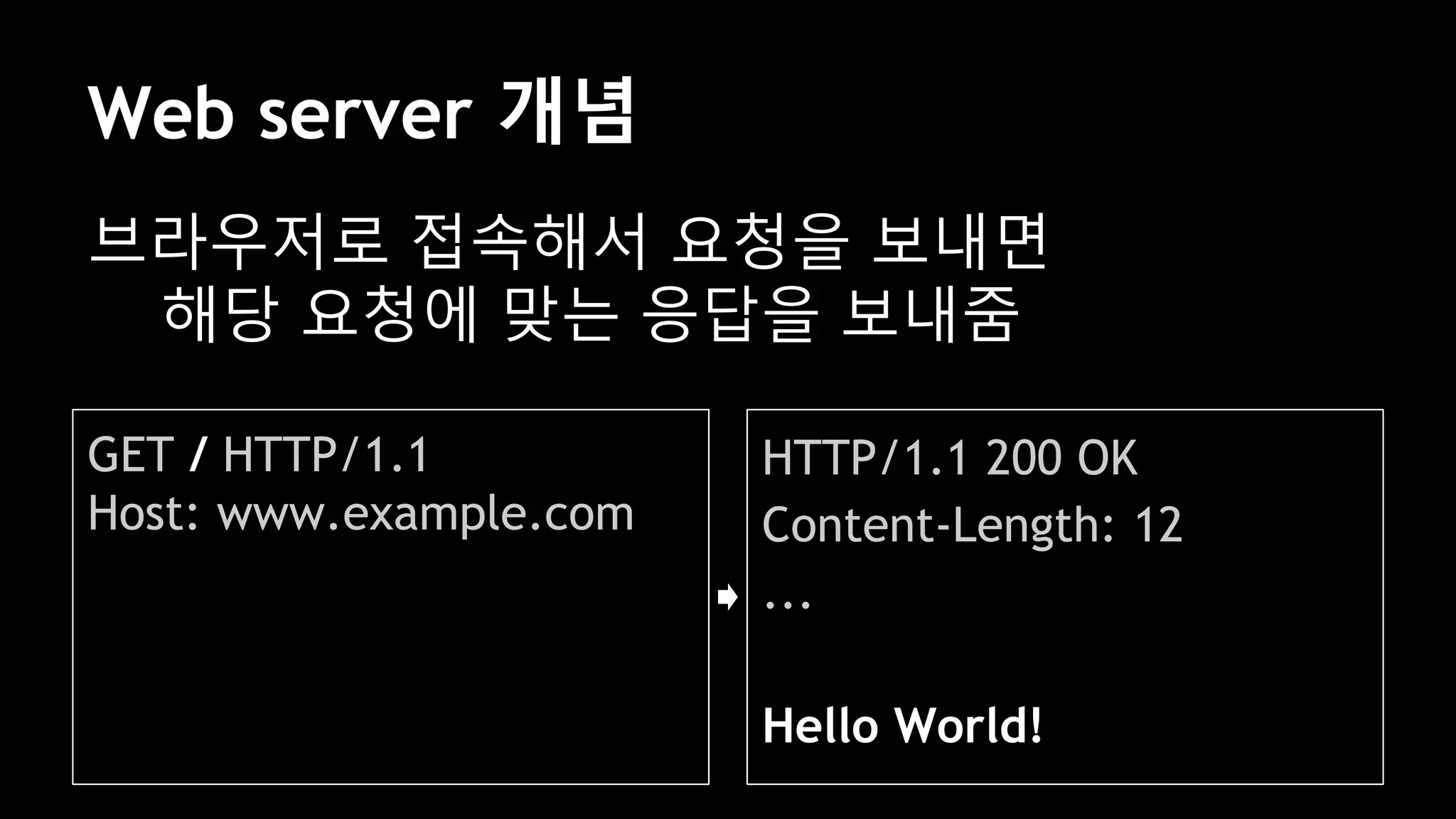
Web server 개념
브라우저로접속해서 요청을 보내면
해당 요청에 맞는 응답을 보내줌
GET / HTTP/1.1
Host: www.example.com
HTTP/1.1 200 OK
Content-Length: 12
...
Hello World!
6.
간단한 Crow 예제
#include“crow_all.h”
int main() {
crow::SimpleApp app;
CROW_ROUTE(app, “/”)
([]{
return “Hello world!”;
});
app.port(8080).run();
return 0;
}
7.
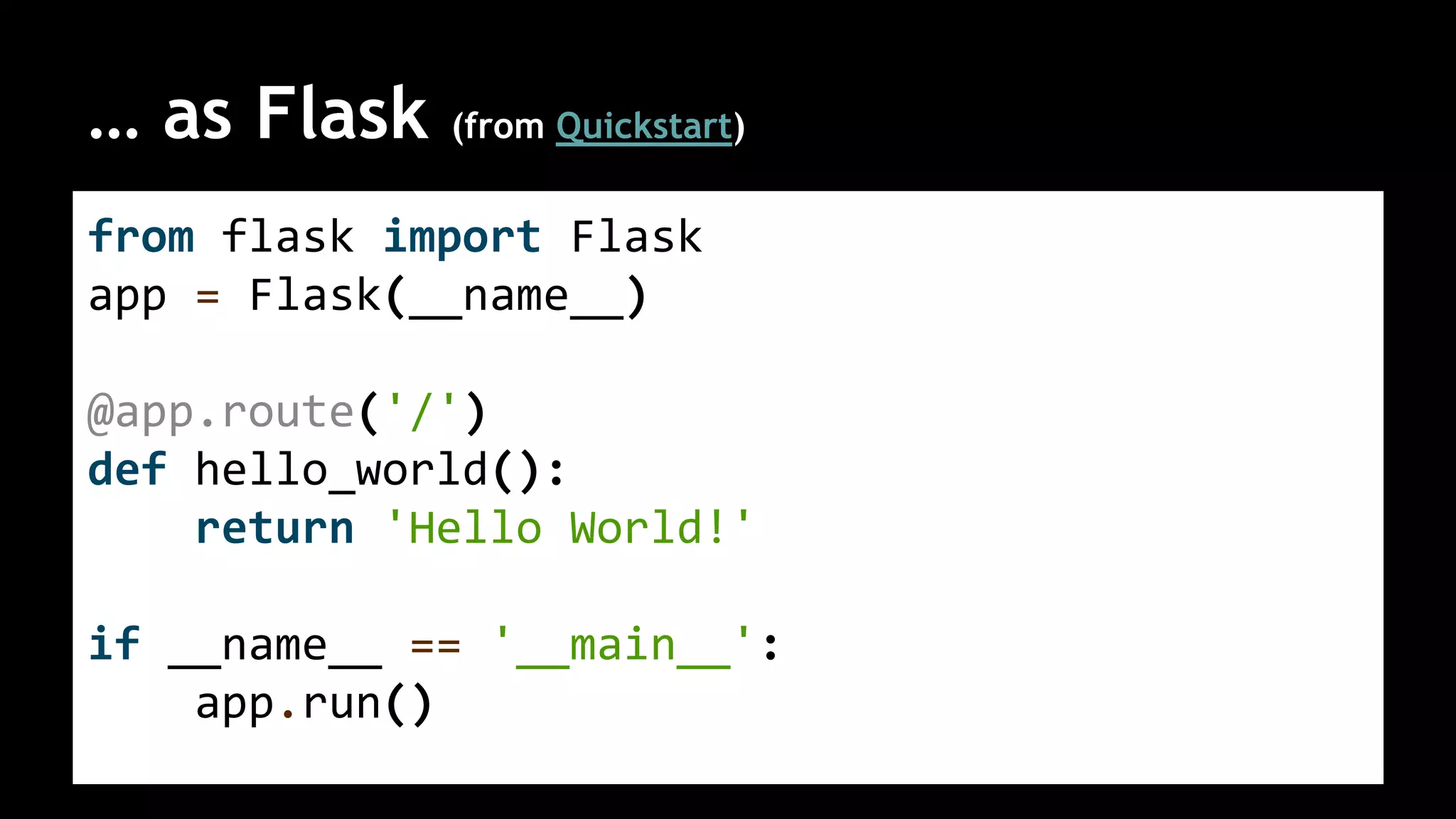
… as Flask(from Quickstart)
from flask import Flask
app = Flask(__name__)
@app.route('/')
def hello_world():
return 'Hello World!'
if __name__ == '__main__':
app.run()
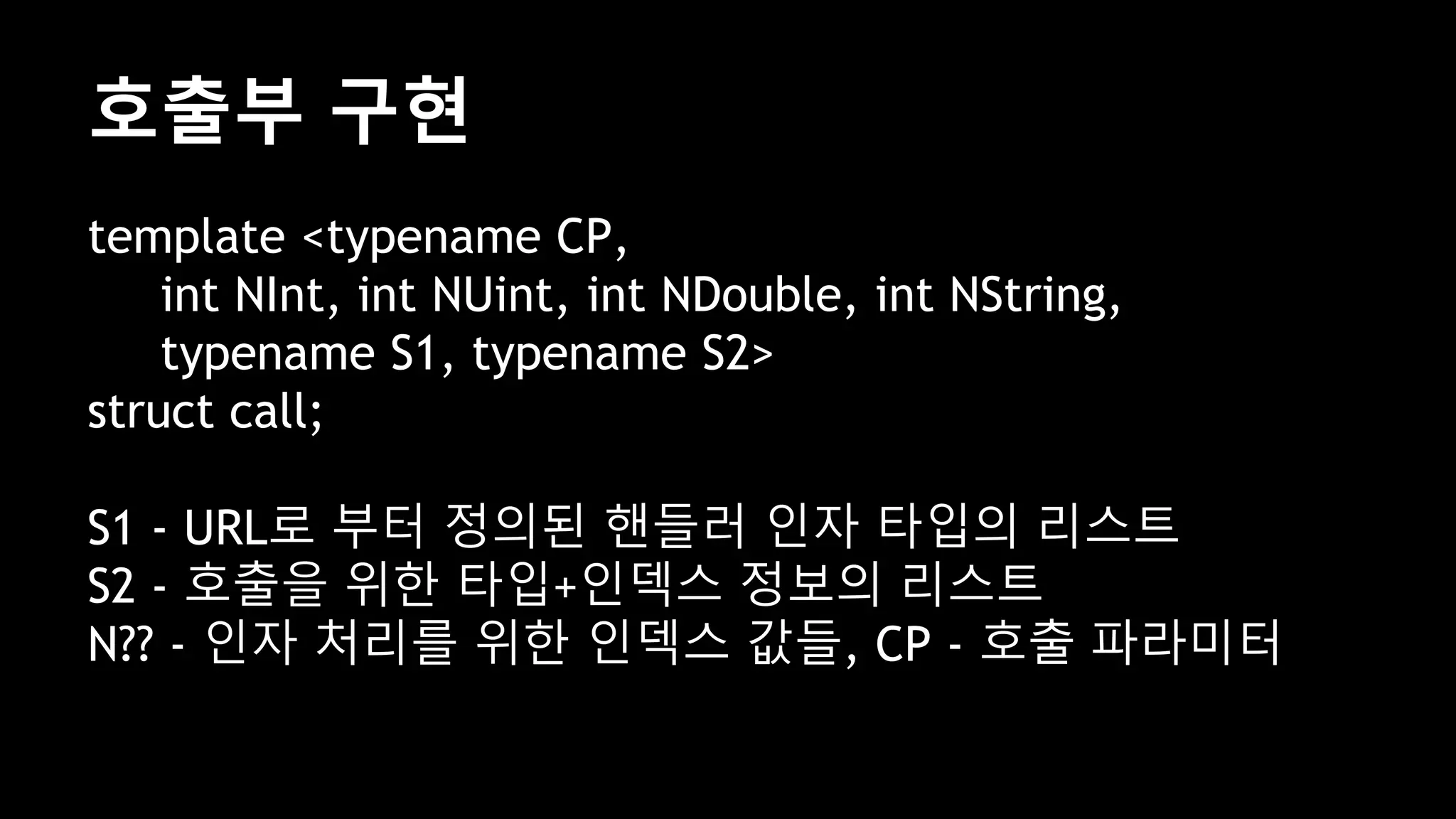
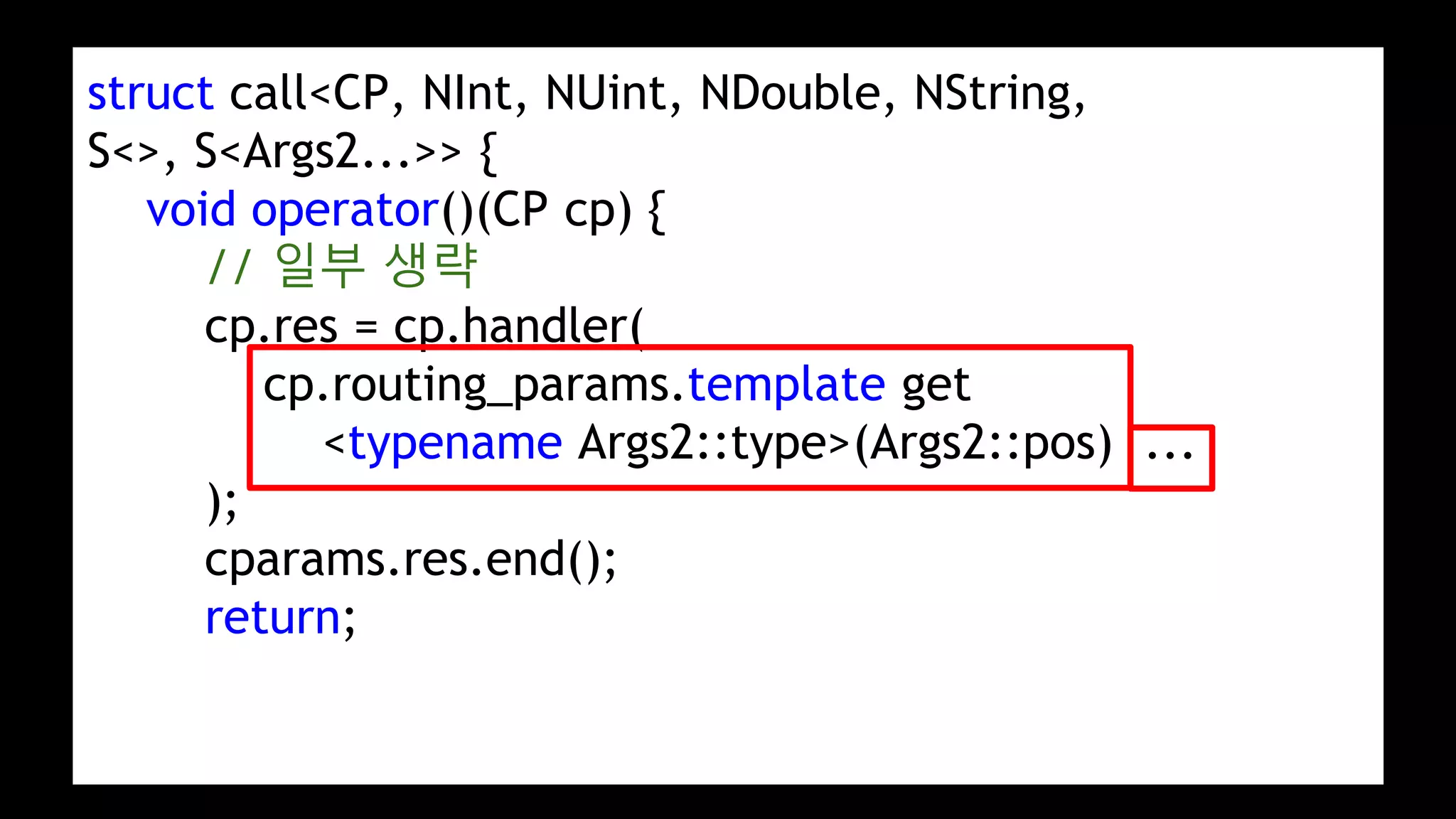
호출부 구현
template <typenameCP,
int NInt, int NUint, int NDouble, int NString,
typename S1, typename S2>
struct call;
S1 - URL로 부터 정의된 핸들러 인자 타입의 리스트
S2 - 호출을 위한 타입+인덱스 정보의 리스트
N?? - 인자 처리를 위한 인덱스 값들, CP - 호출 파라미터
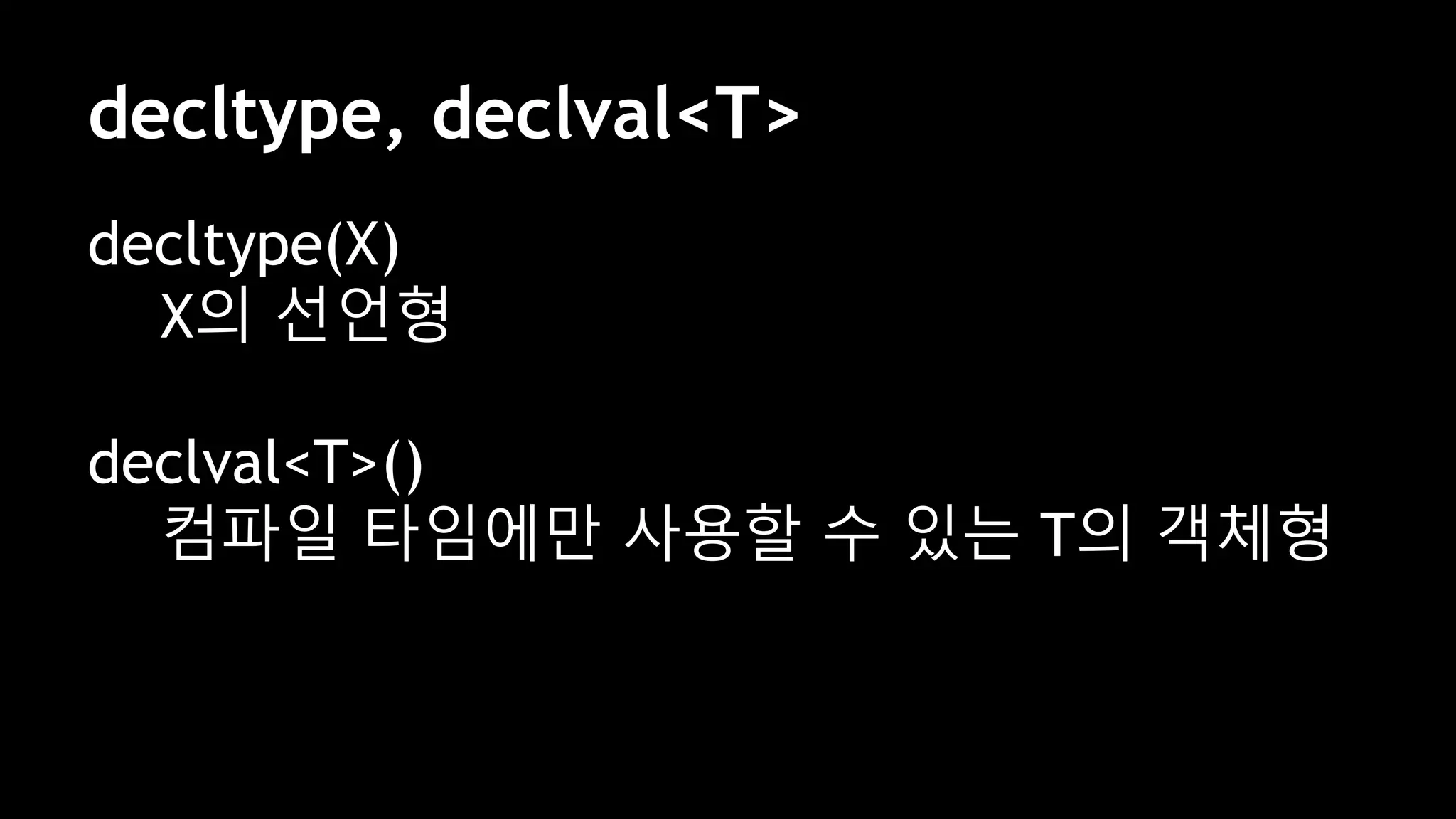
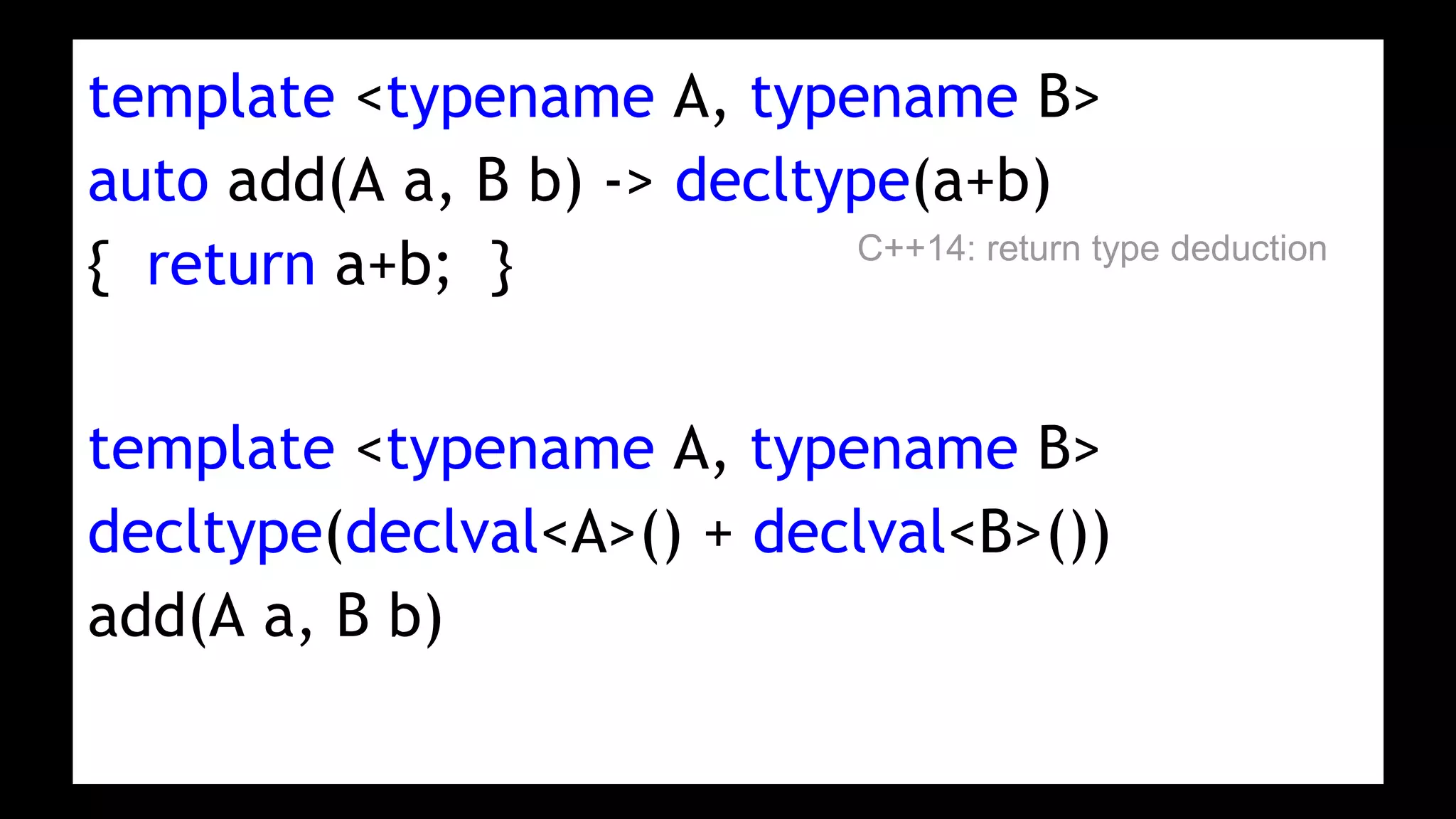
template <typename A,typename B>
auto add(A a, B b) -> decltype(a+b)
{ return a+b; }
template <typename A, typename B>
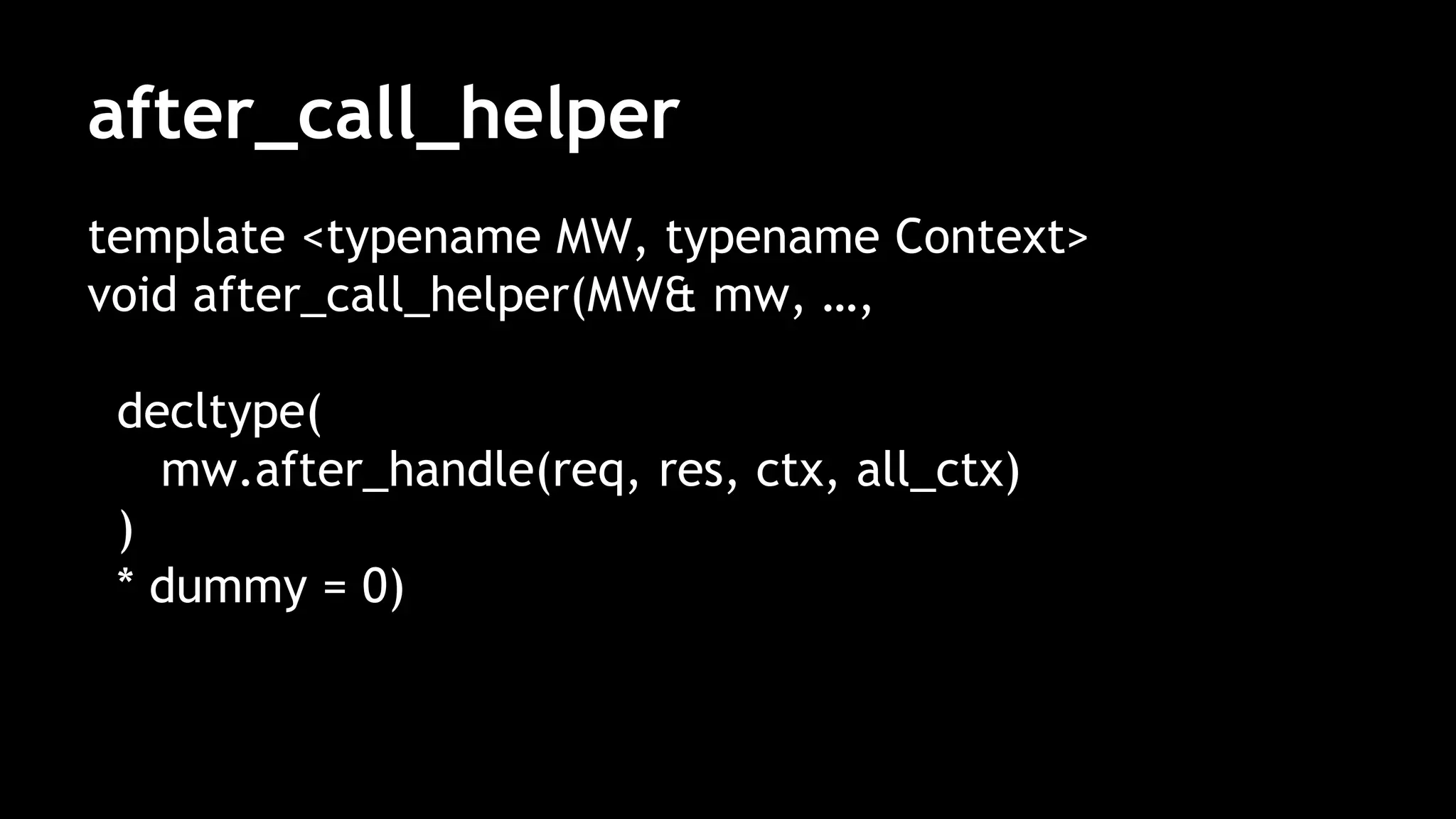
decltype(declval<A>() + declval<B>())
add(A a, B b)
C++14: return type deduction
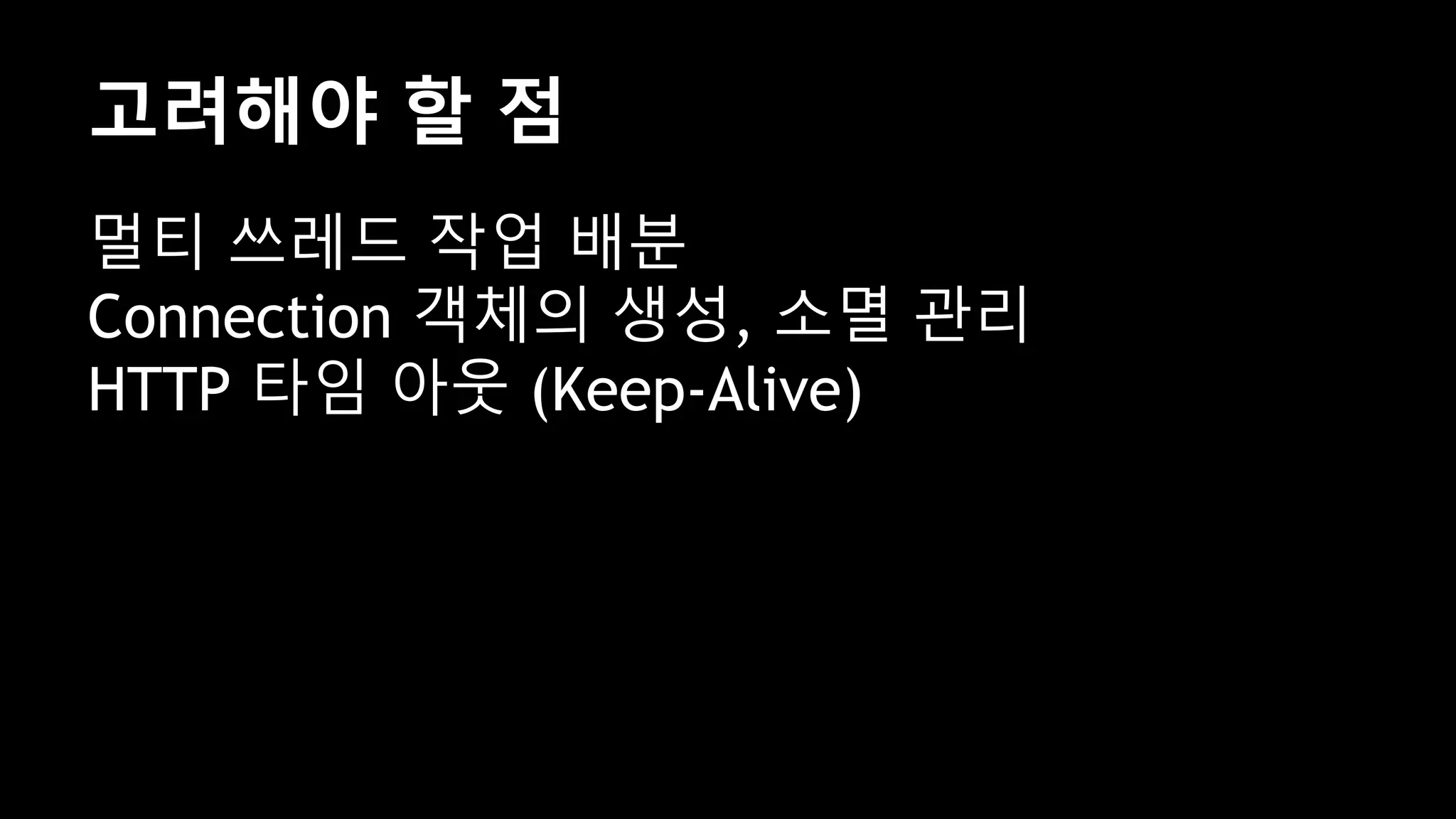
고려해야 할 점
멀티쓰레드 작업 배분
Connection 객체의 생성, 소멸 관리
HTTP 타임 아웃 (Keep-Alive)
102.
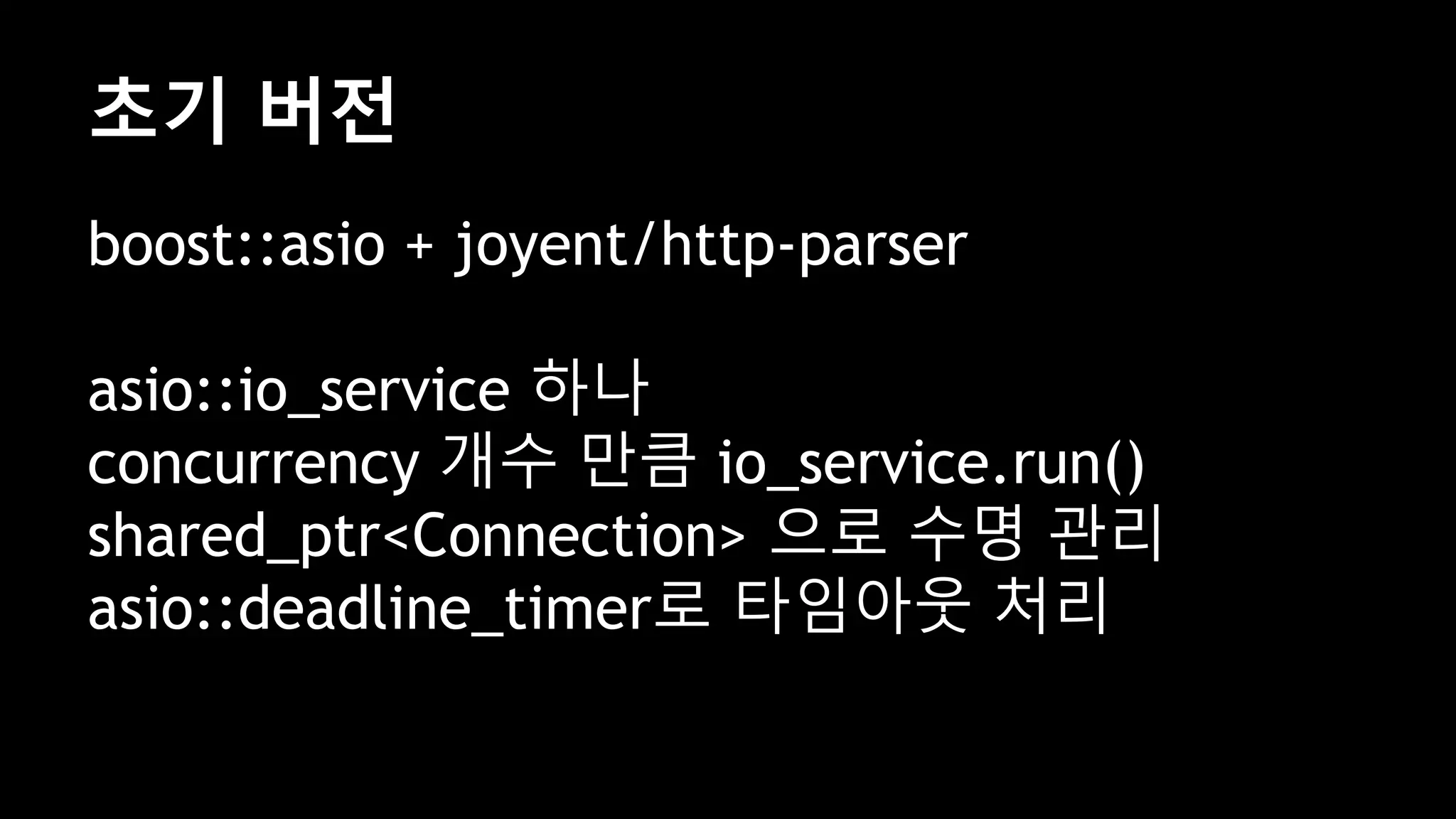
초기 버전
boost::asio +joyent/http-parser
asio::io_service 하나
concurrency 개수 만큼 io_service.run()
shared_ptr<Connection> 으로 수명 관리
asio::deadline_timer로 타임아웃 처리
103.
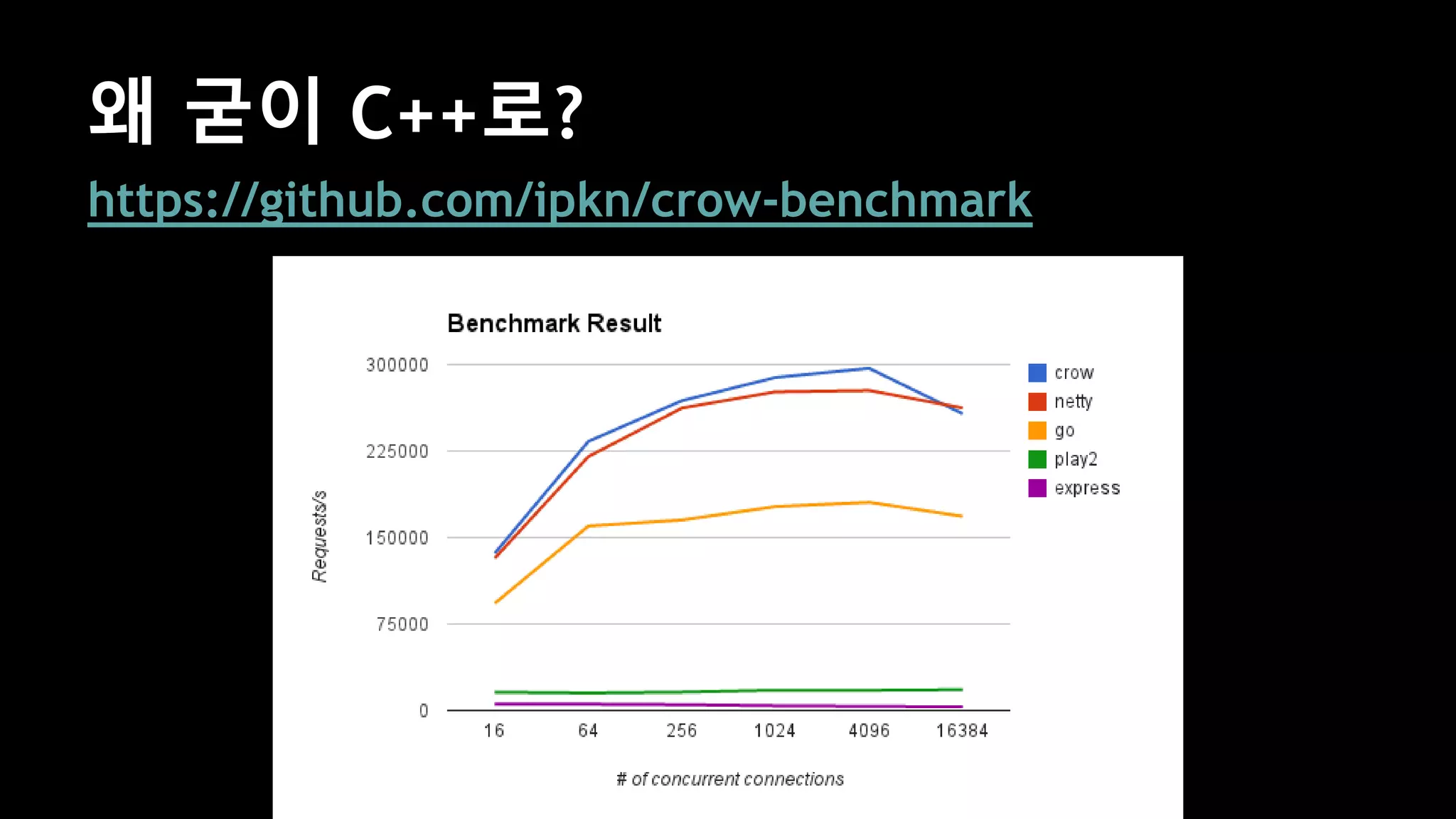
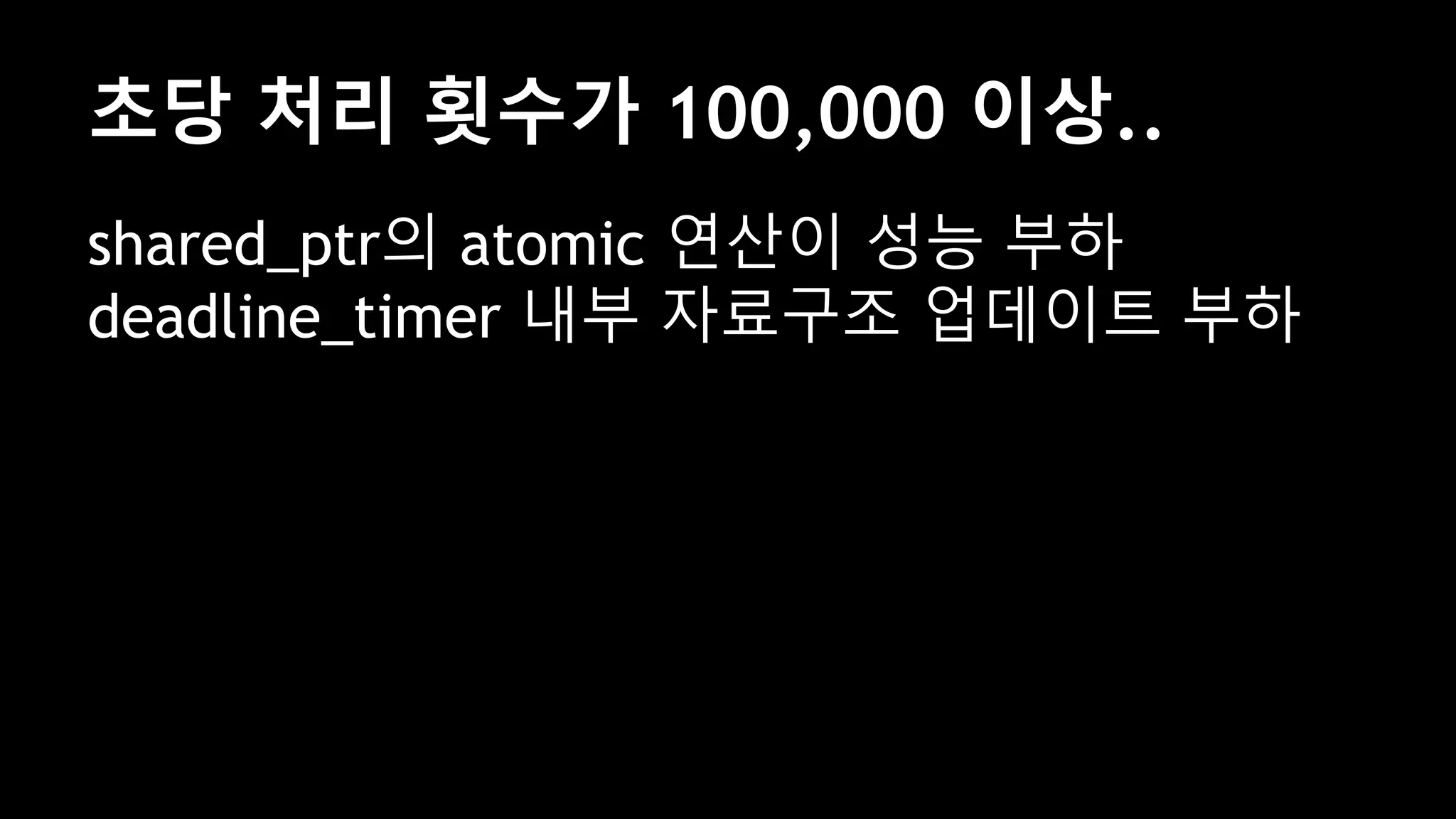
초당 처리 횟수가100,000 이상..
shared_ptr의 atomic 연산이 성능 부하
deadline_timer 내부 자료구조 업데이트 부하
104.
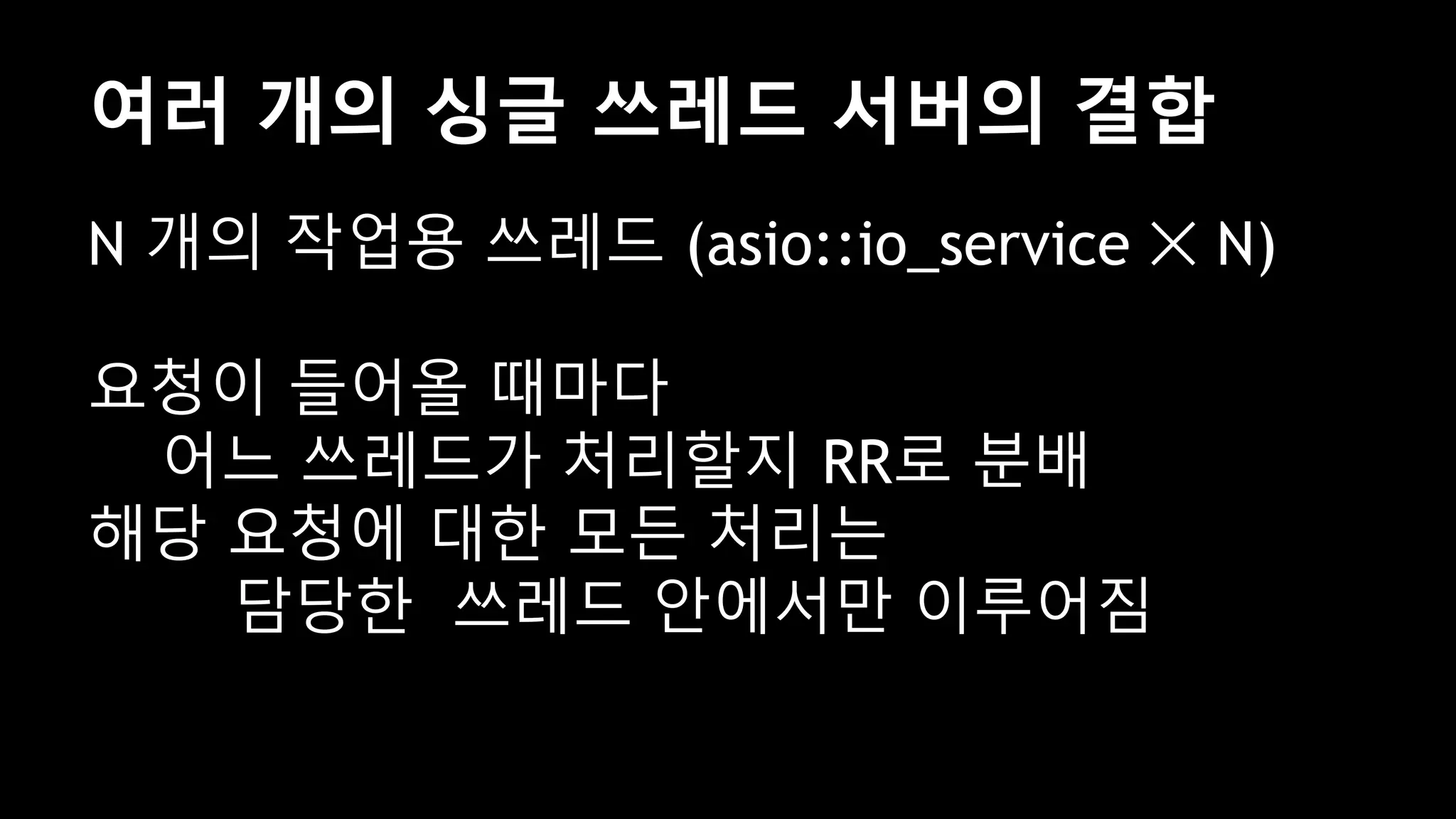
여러 개의 싱글쓰레드 서버의 결합
N 개의 작업용 쓰레드 (asio::io_service ✕ N)
요청이 들어올 때마다
어느 쓰레드가 처리할지 RR로 분배
해당 요청에 대한 모든 처리는
담당한 쓰레드 안에서만 이루어짐


![간단한 Crow 예제
#include “crow_all.h”
int main() {
crow::SimpleApp app;
CROW_ROUTE(app, “/”)
([]{
return “Hello world!”;
});
app.port(8080).run();
return 0;
}](https://image.slidesharecdn.com/20150212c11featuresusedincrow-150212205127-conversion-gate02/75/20150212-c-11-features-used-in-crow-6-2048.jpg)

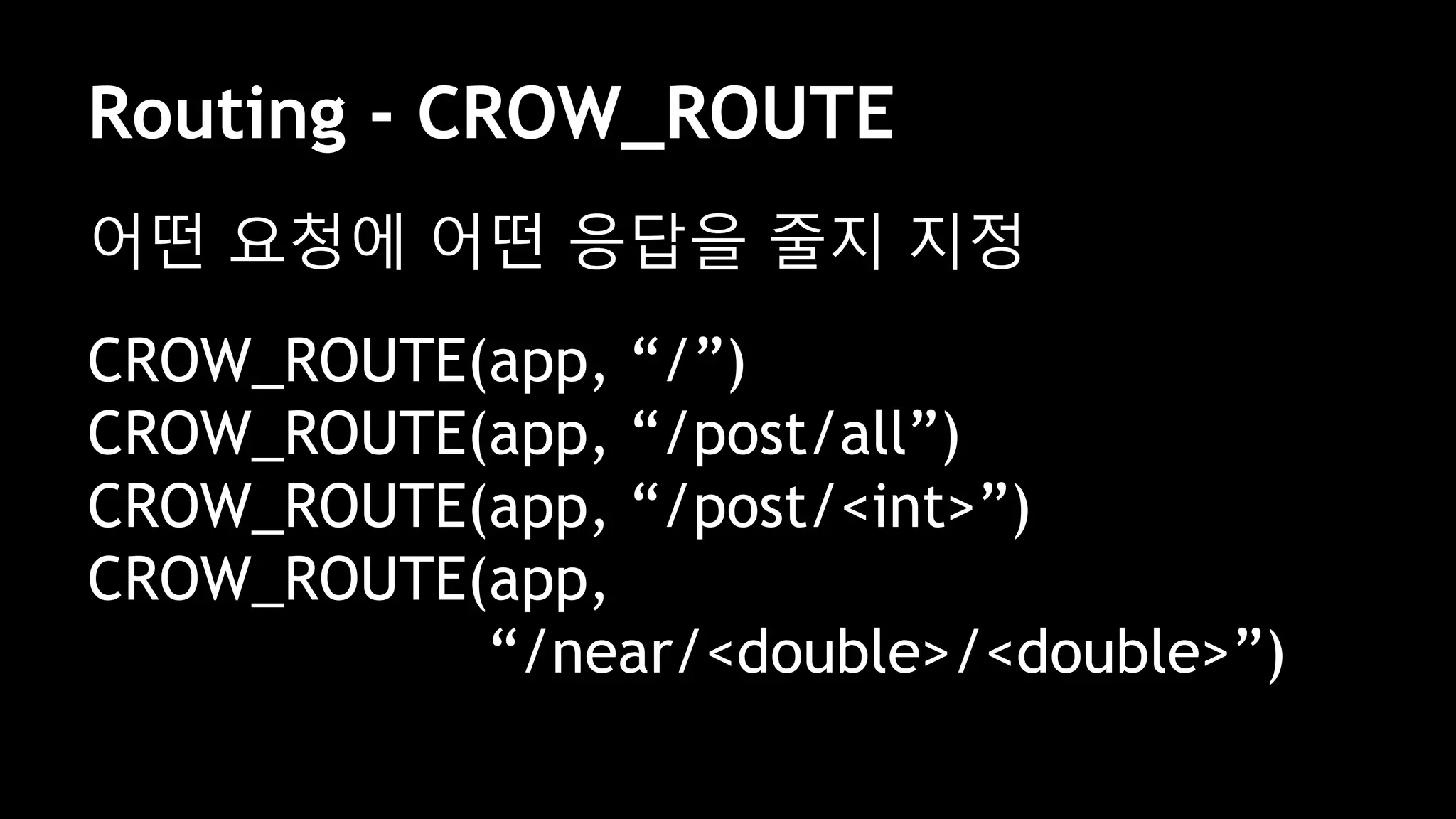
 …
([](int a, int b) …
([](int a) ...](https://image.slidesharecdn.com/20150212c11featuresusedincrow-150212205127-conversion-gate02/75/20150212-c-11-features-used-in-crow-18-2048.jpg)

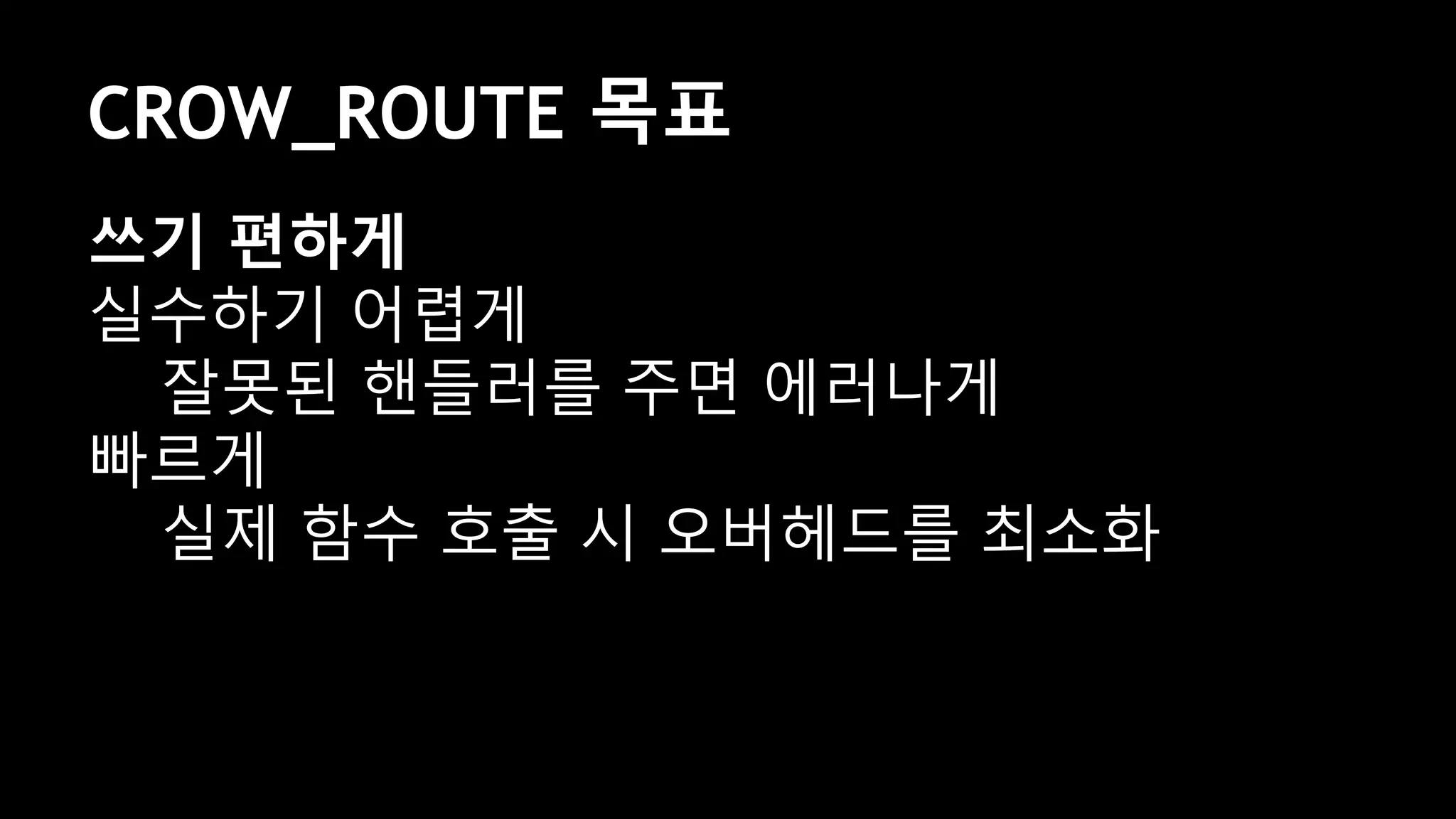
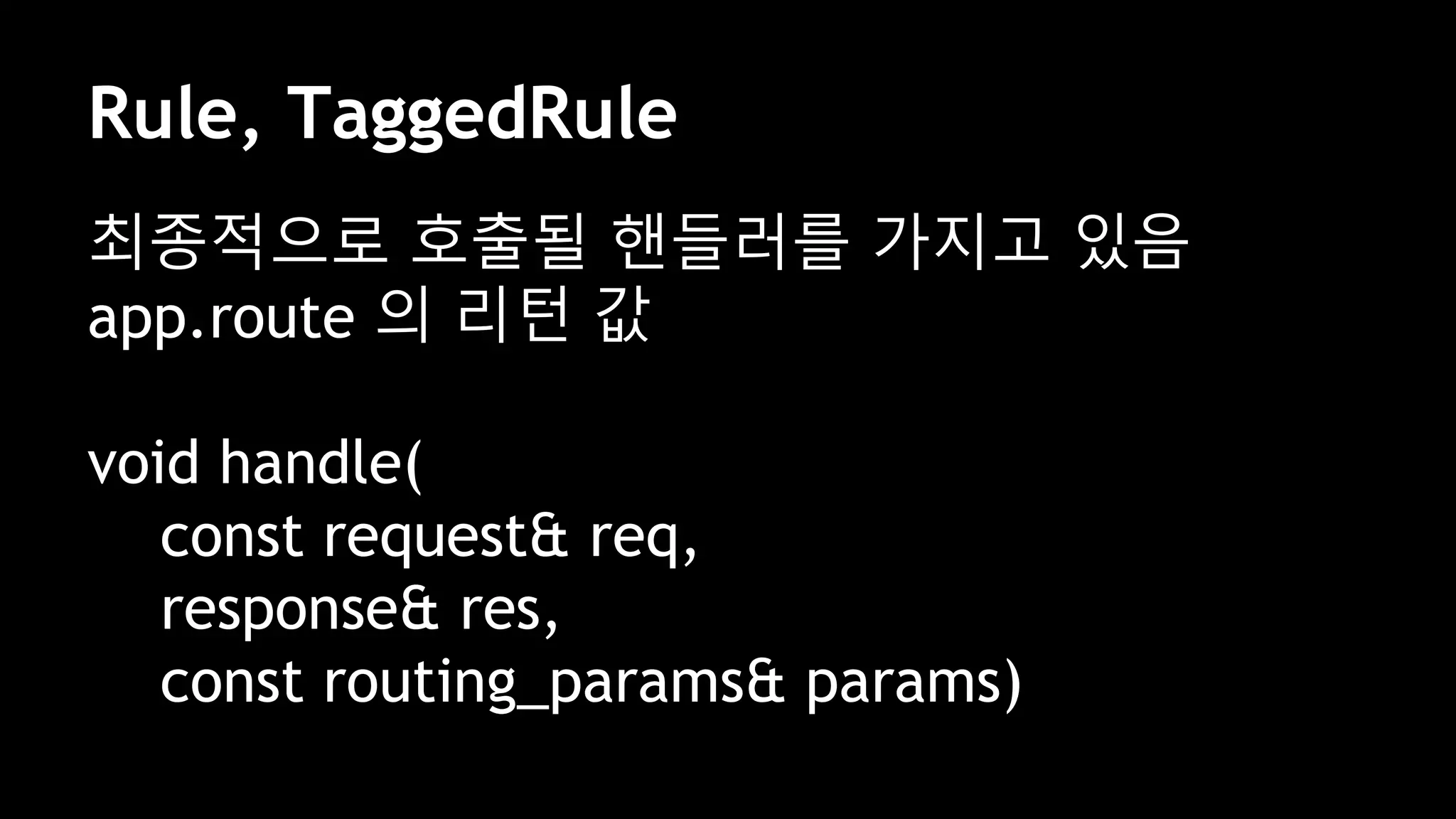
[](const request& req, …)
[](const request& req, response& res, …)
* 어떻게 여러 종류를 지원하는지에 관해선 나중에 설명 예정](https://image.slidesharecdn.com/20150212c11featuresusedincrow-150212205127-conversion-gate02/75/20150212-c-11-features-used-in-crow-19-2048.jpg)

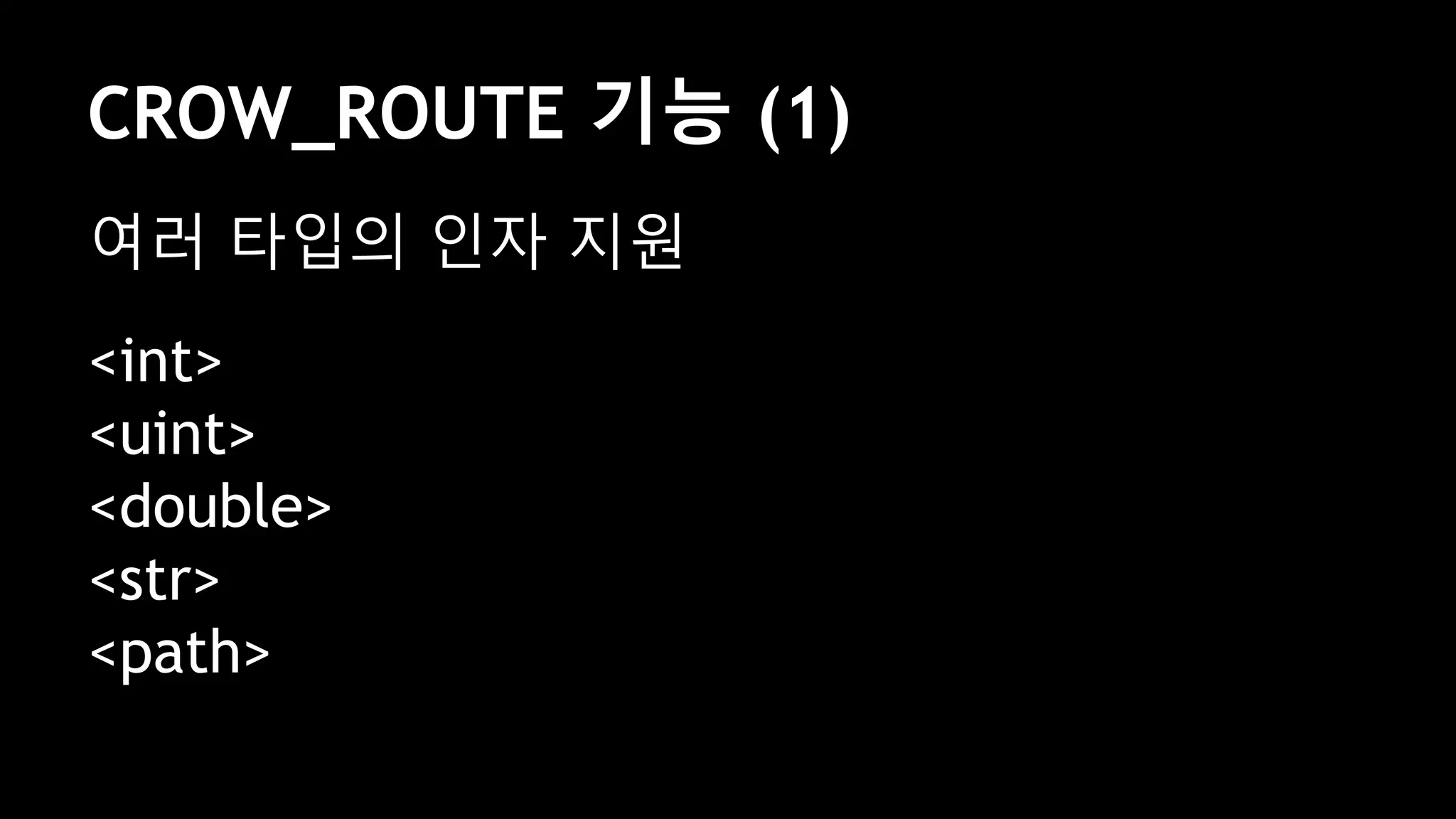
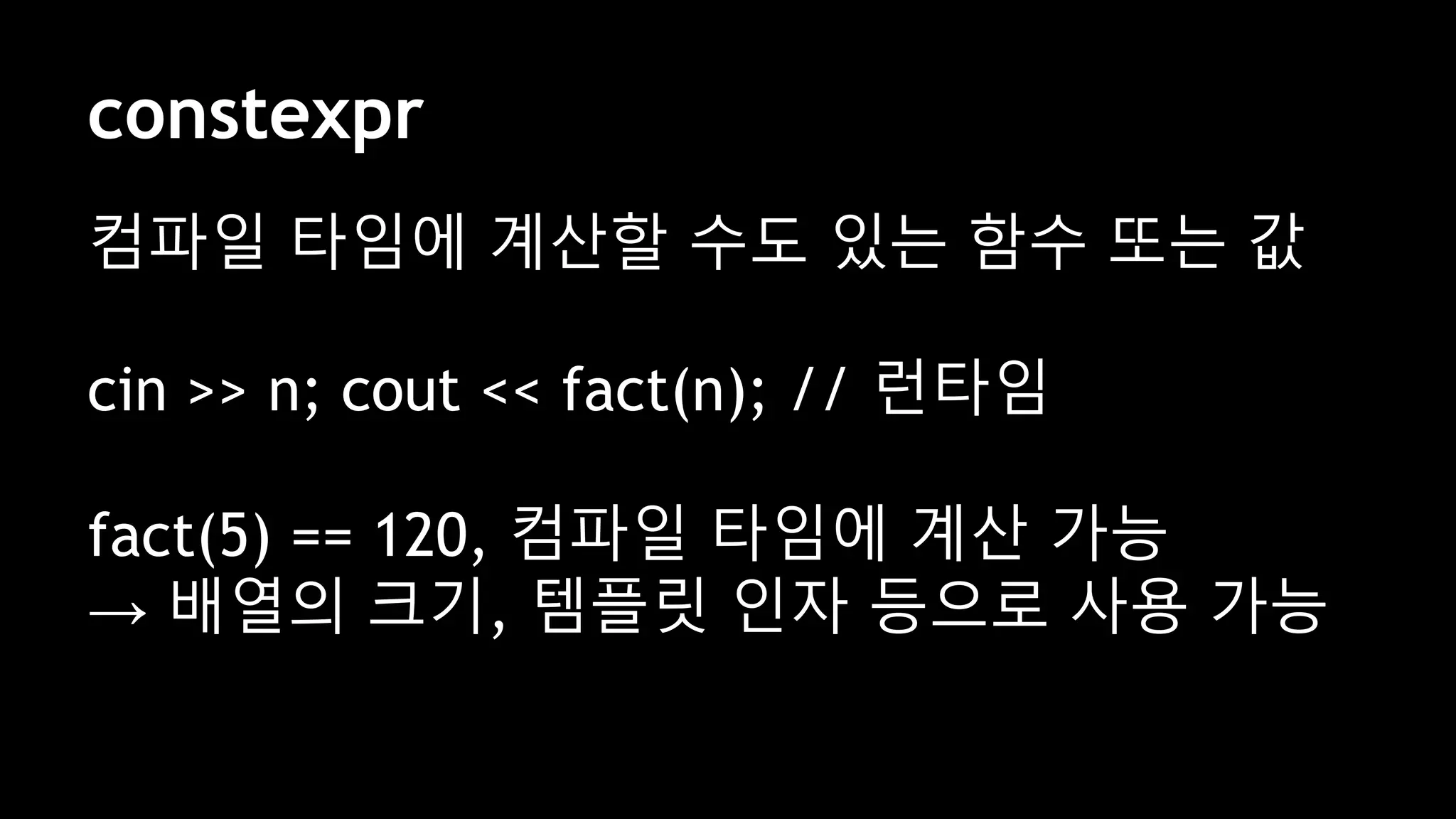
![constexpr function
constexpr int fact(int n) {
return (n <= 1)
? 1
: fact(n-1)*n;
}
char arr[fact(5)];](https://image.slidesharecdn.com/20150212c11featuresusedincrow-150212205127-conversion-gate02/75/20150212-c-11-features-used-in-crow-26-2048.jpg)
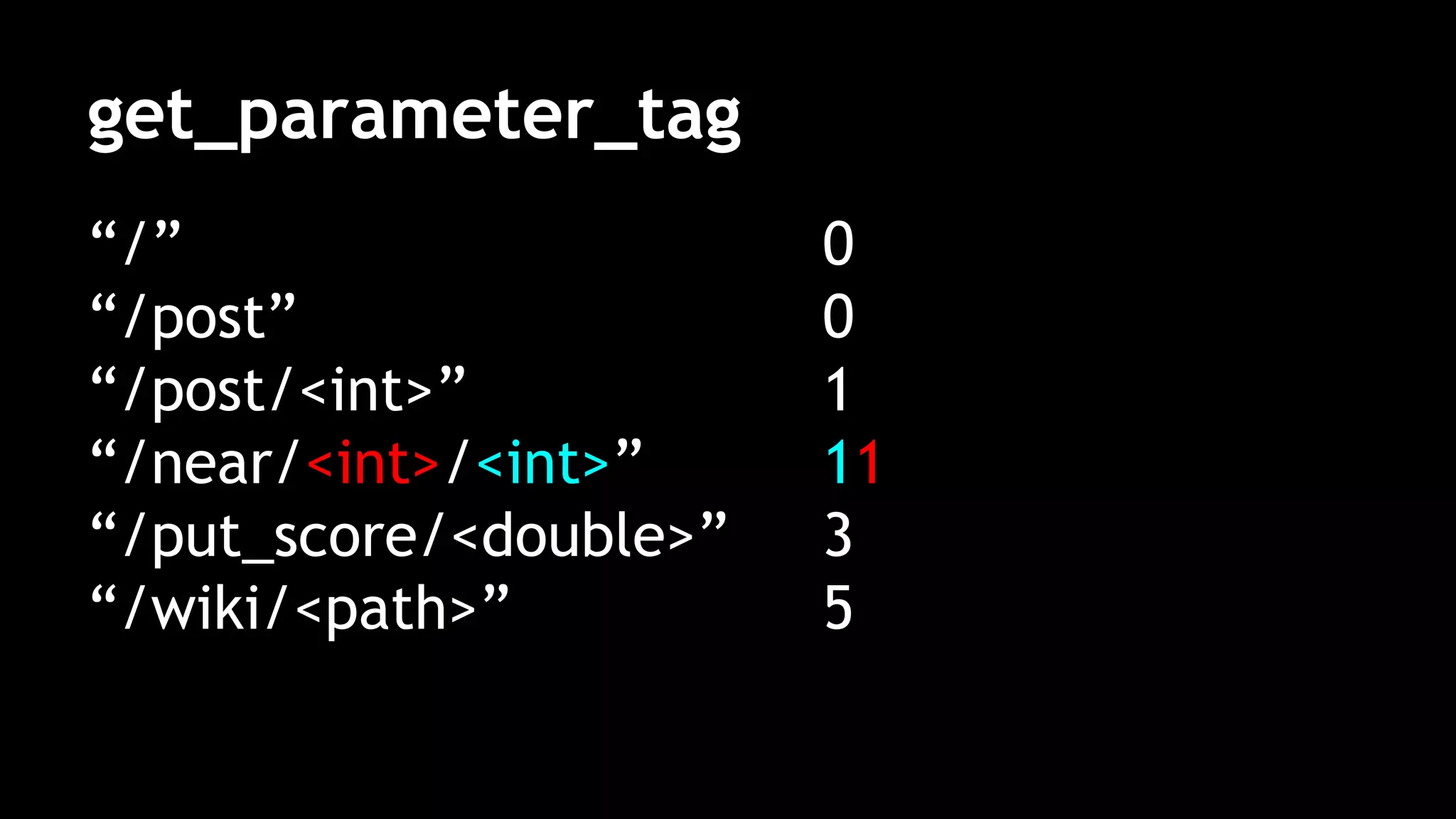
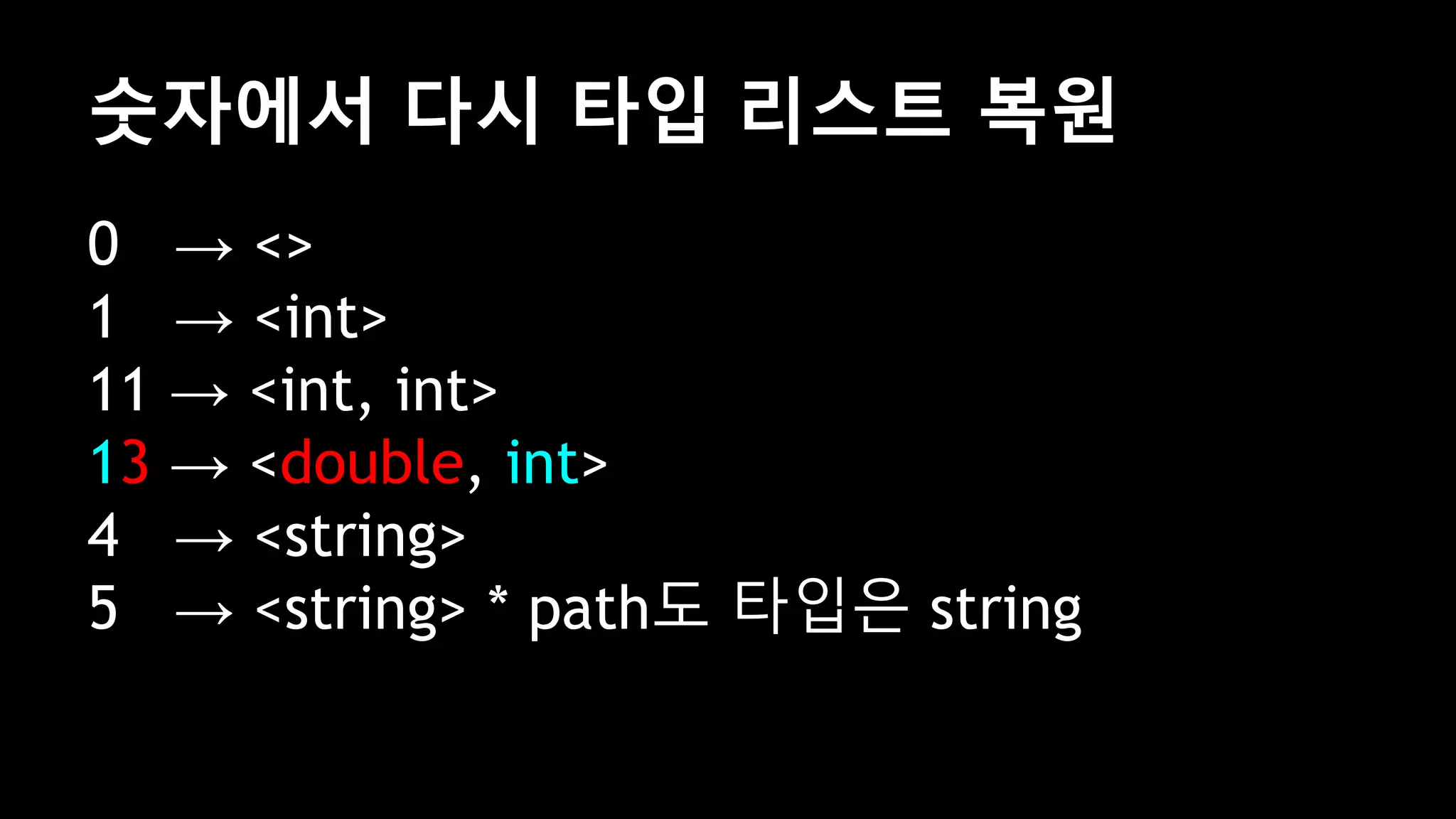
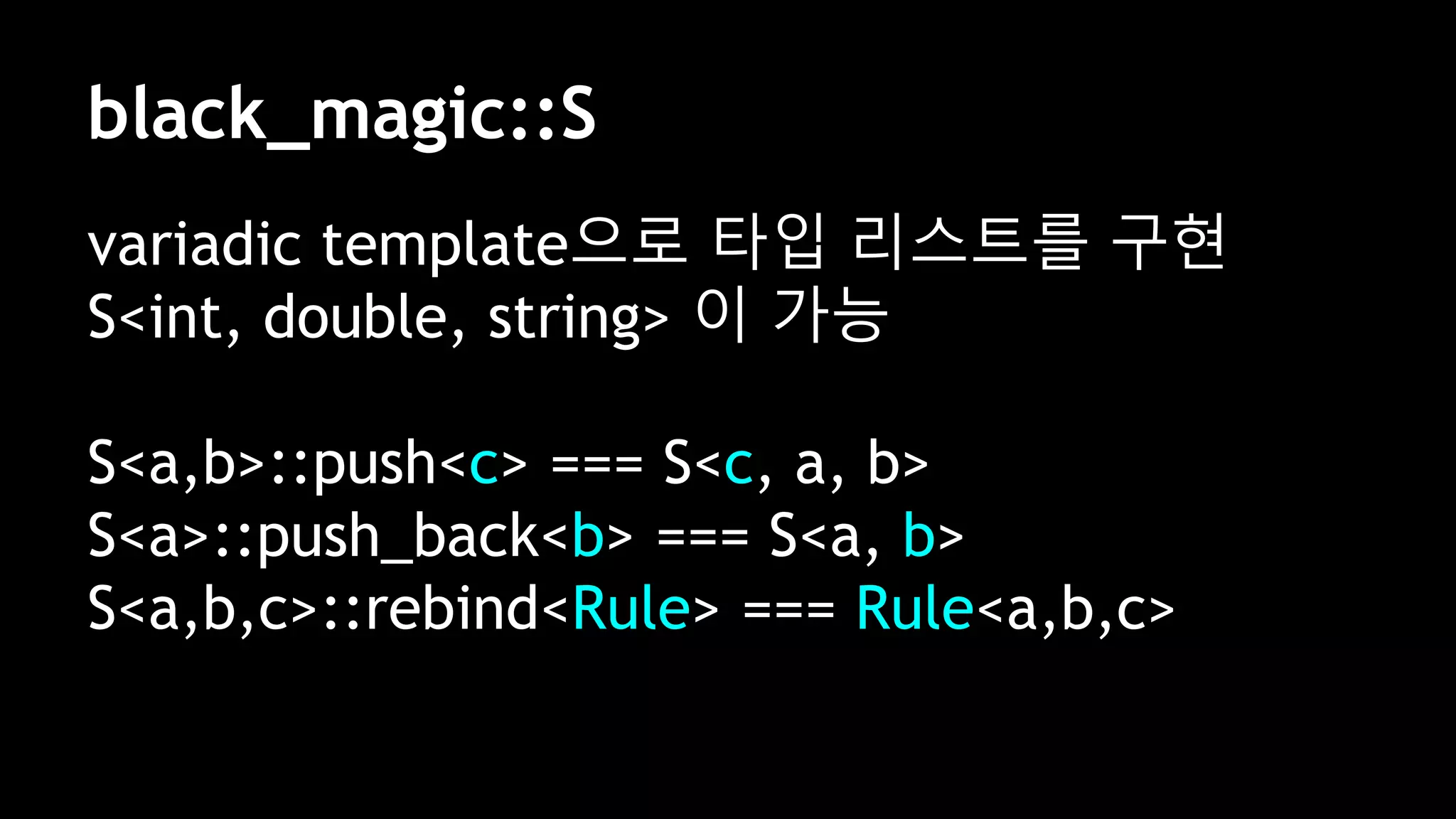
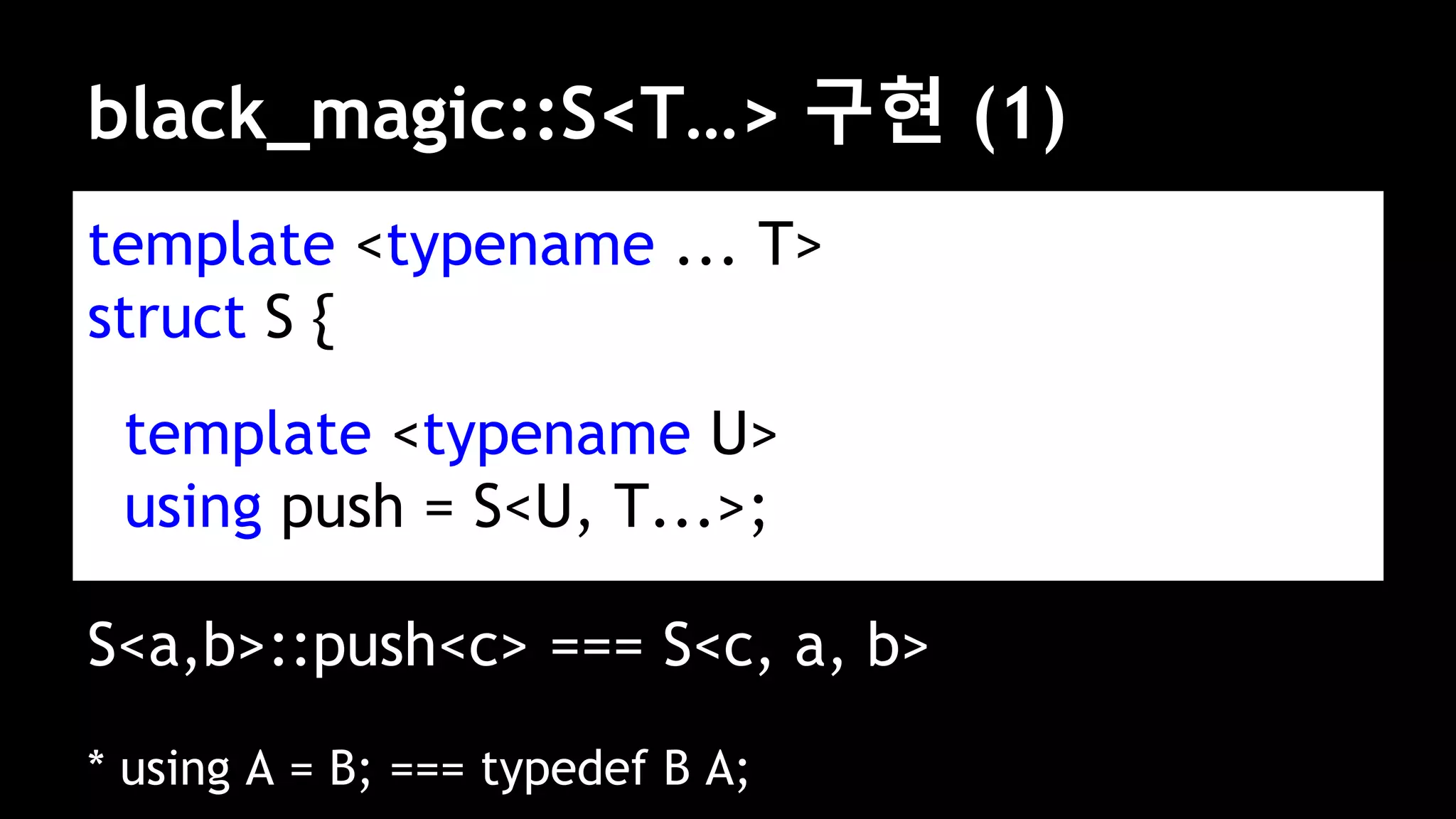

](https://image.slidesharecdn.com/20150212c11featuresusedincrow-150212205127-conversion-gate02/75/20150212-c-11-features-used-in-crow-42-2048.jpg)
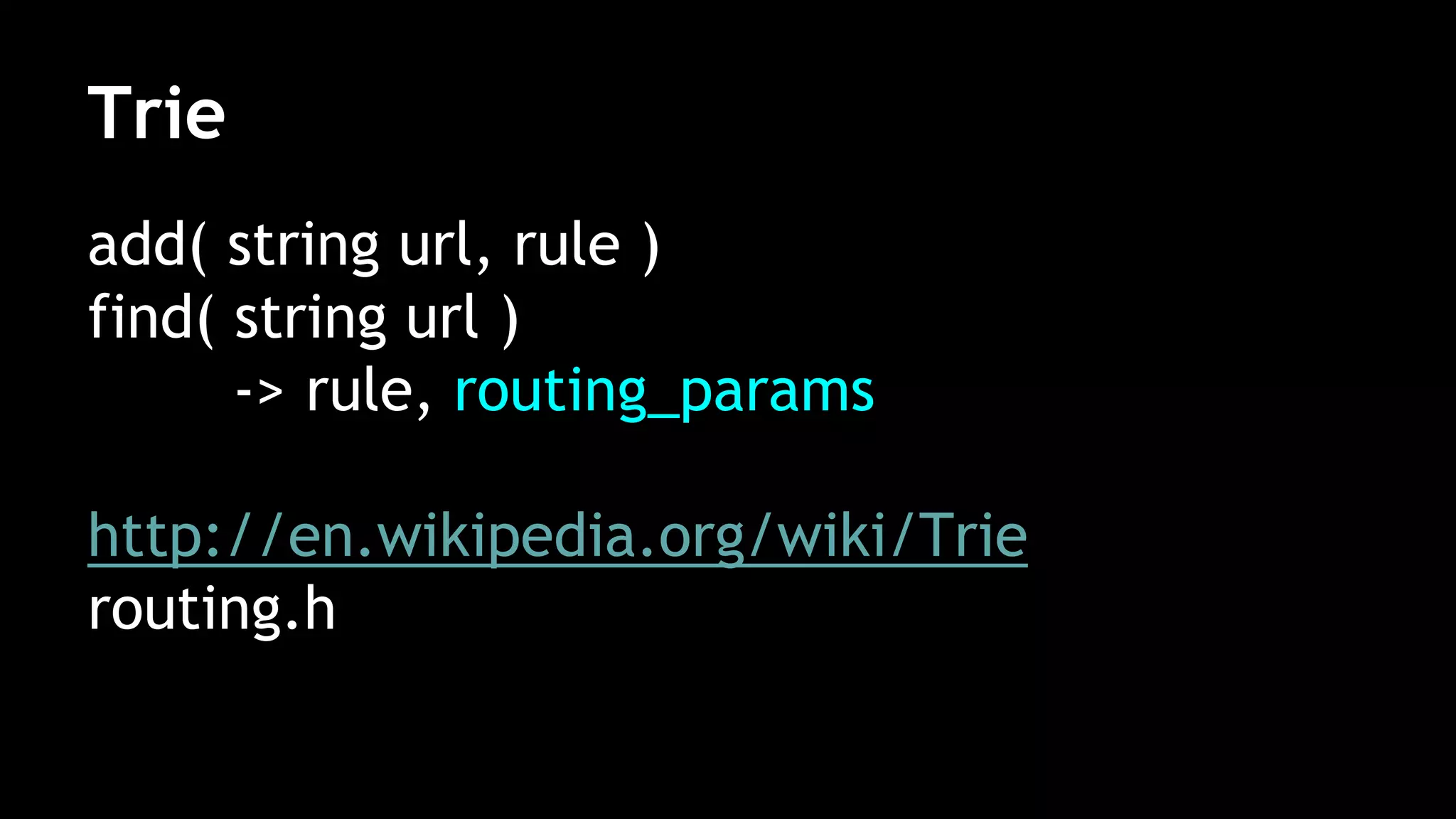
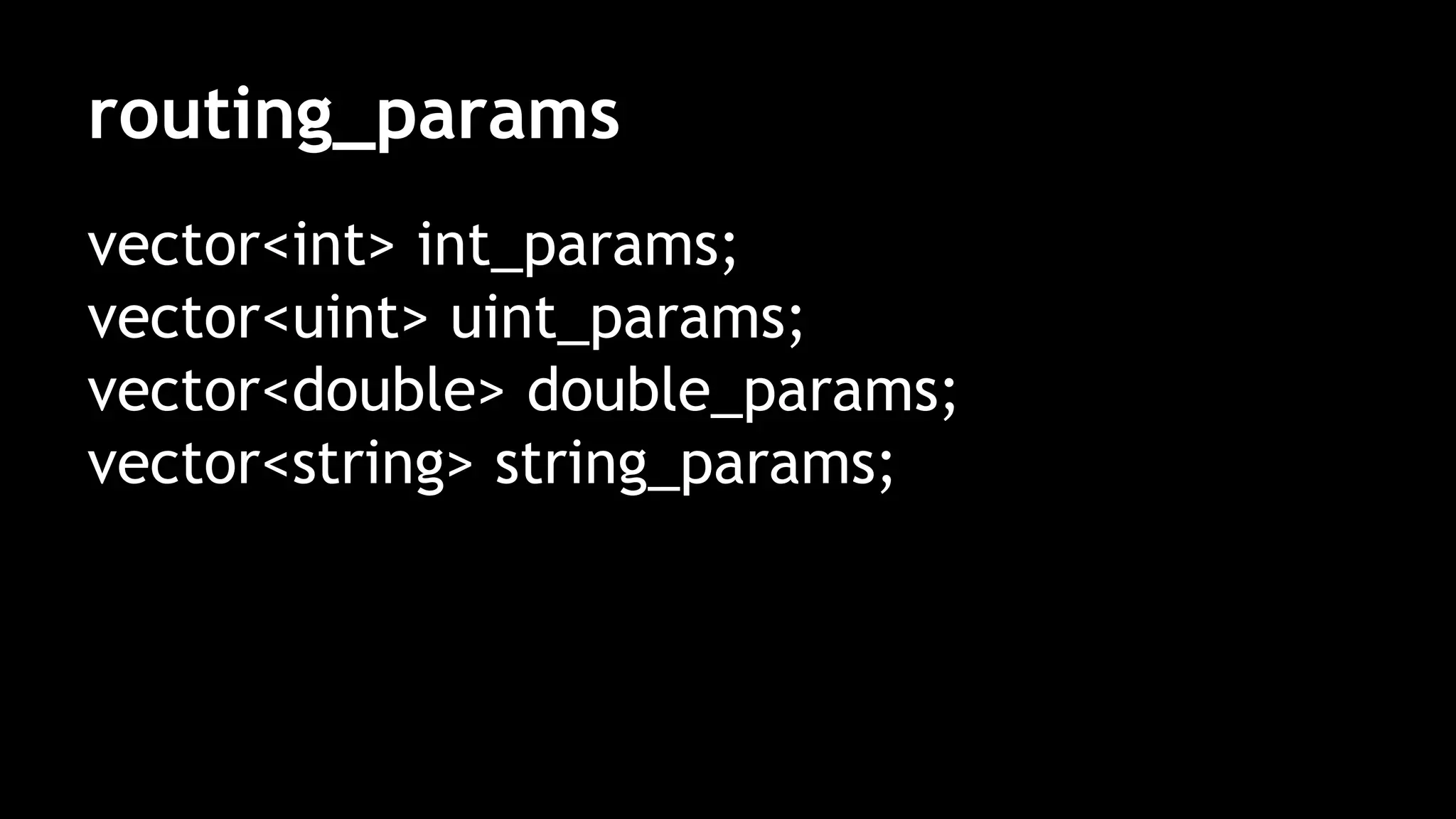
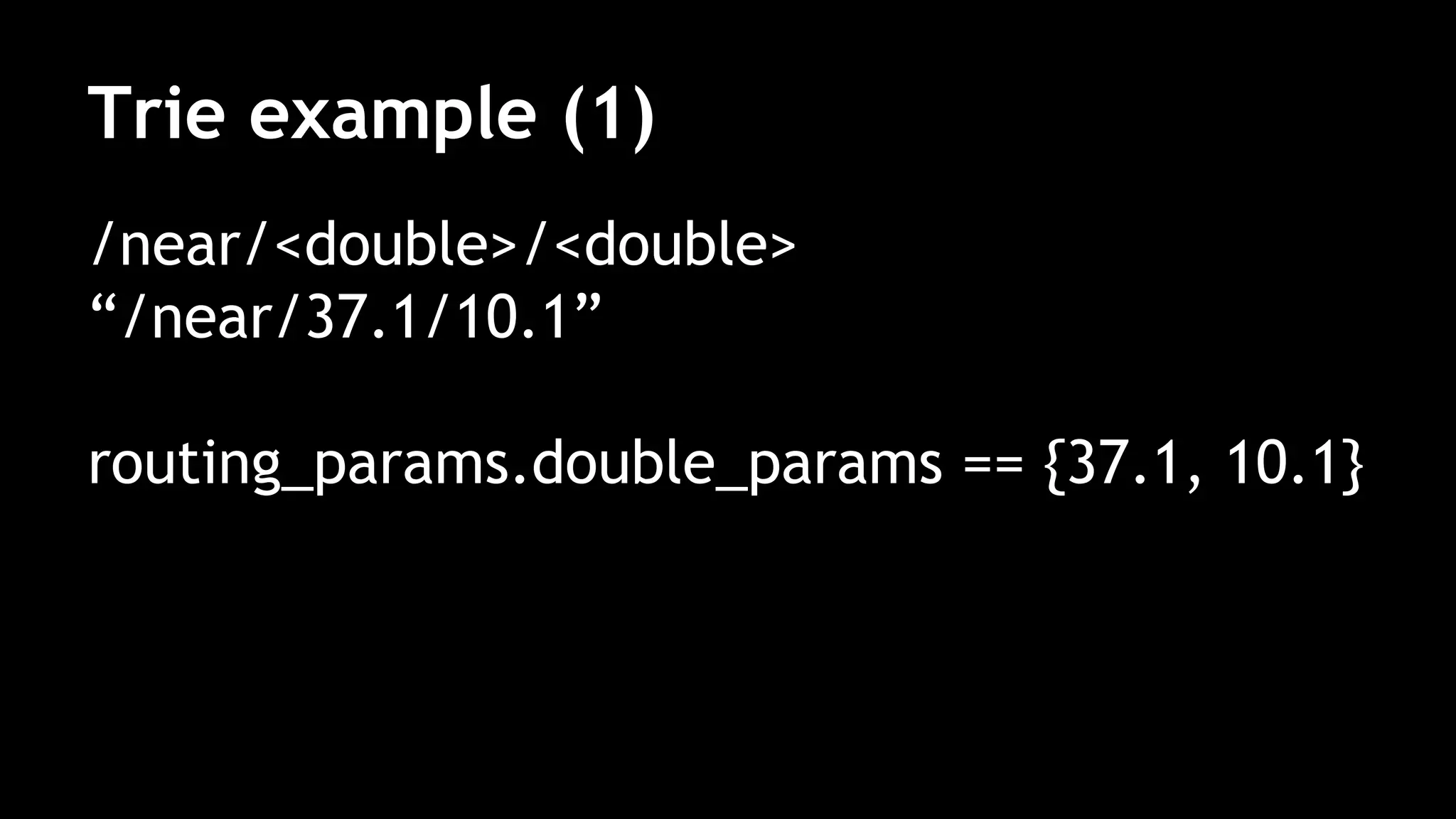
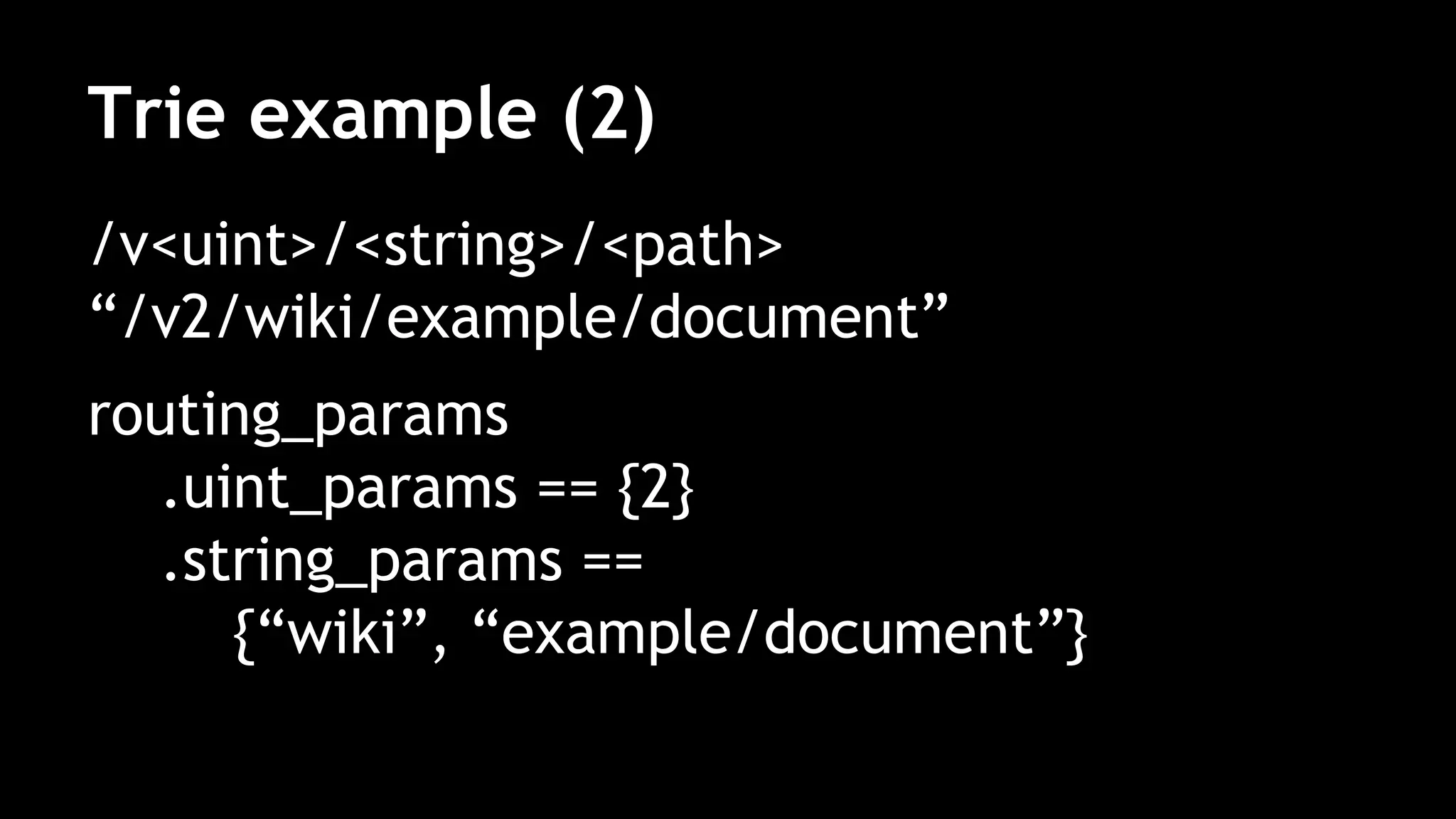

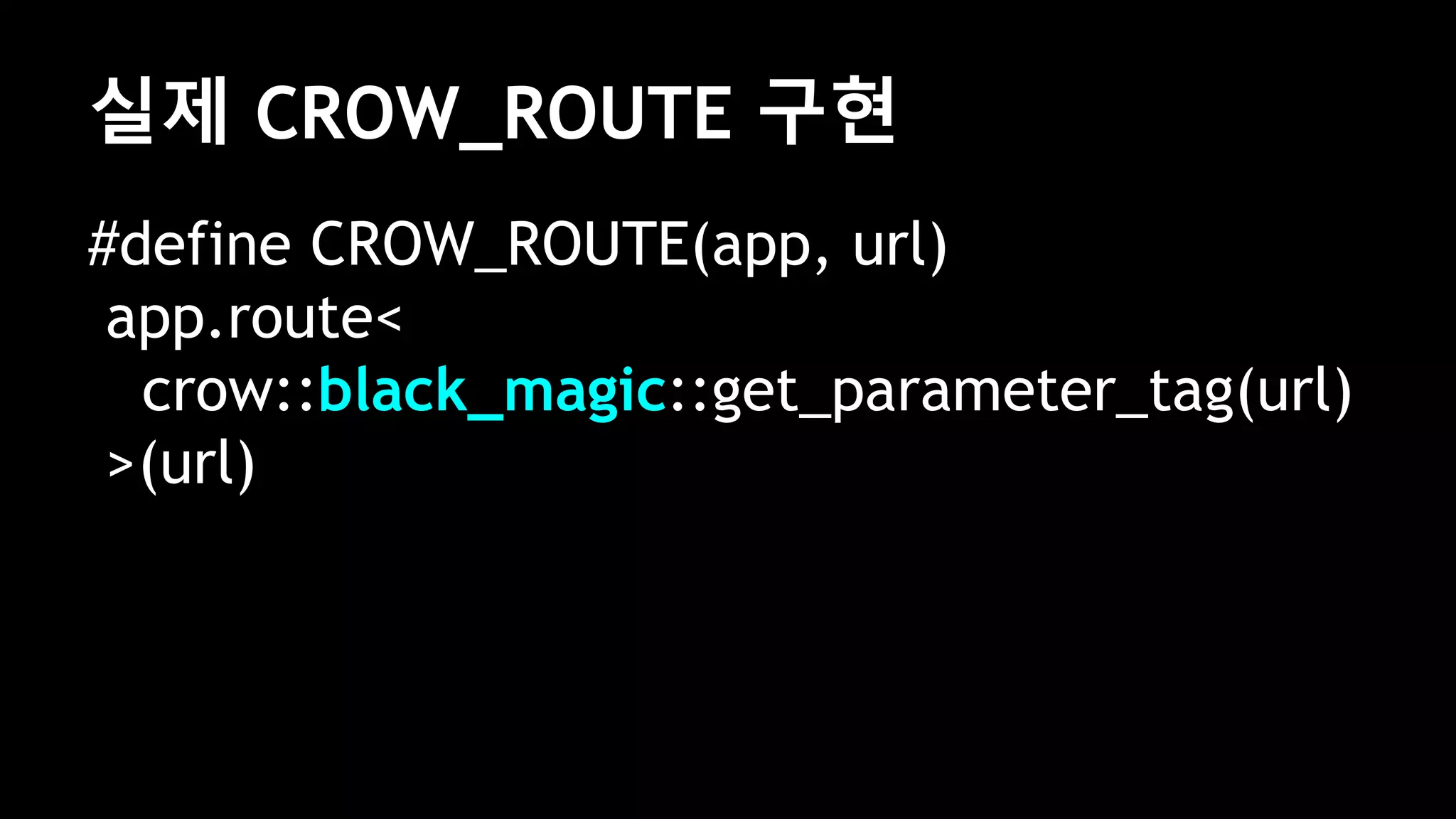
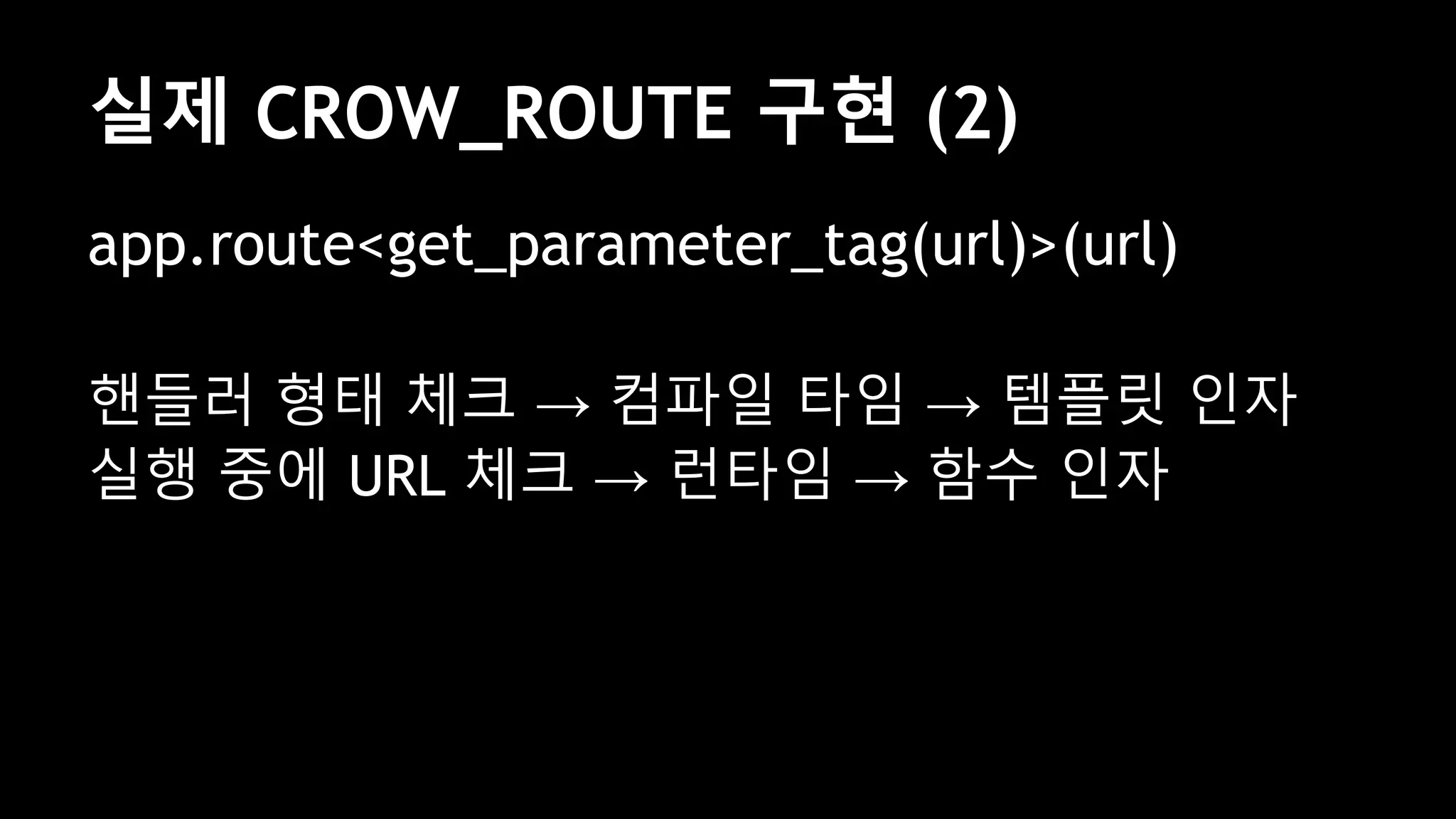
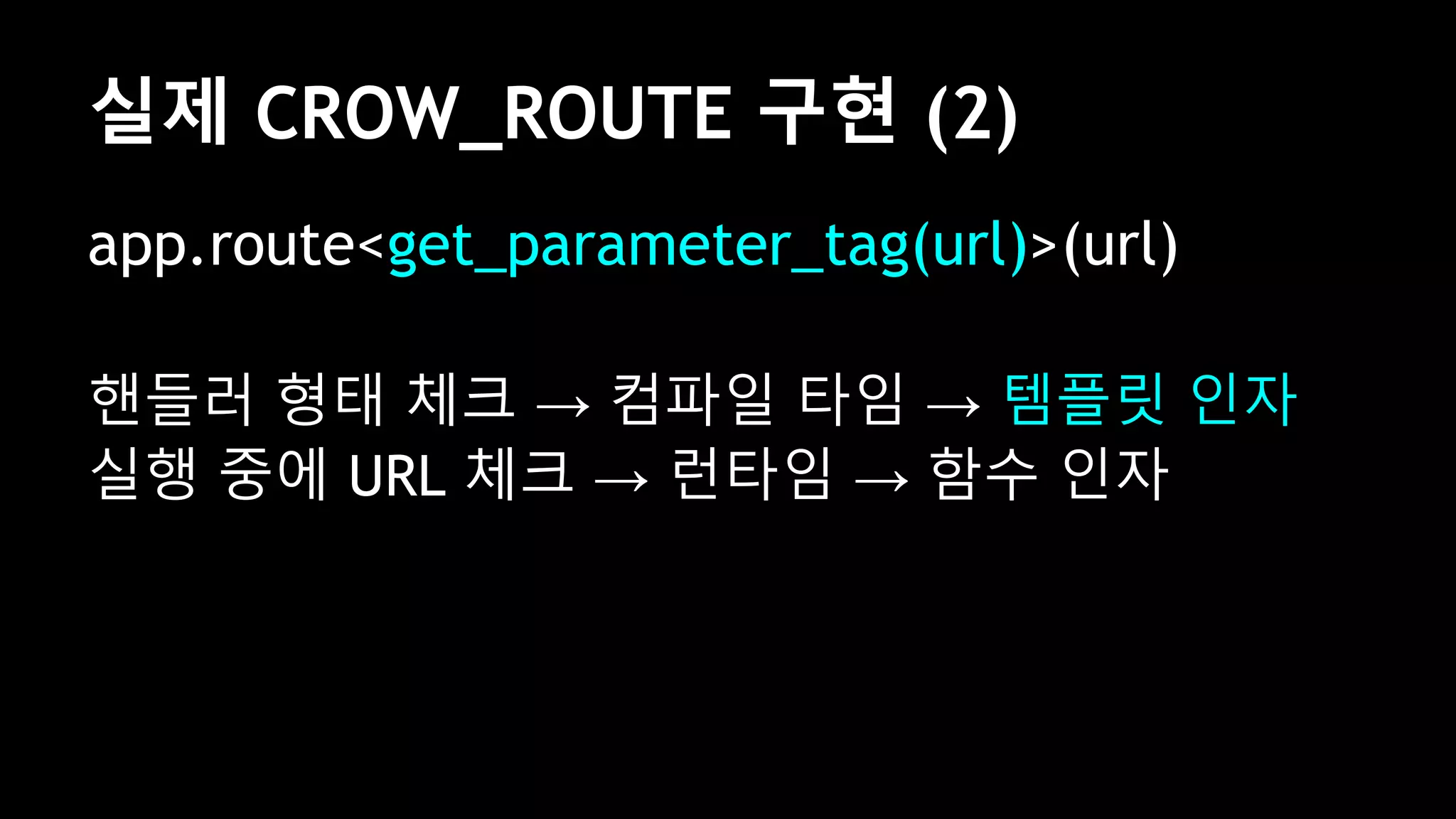
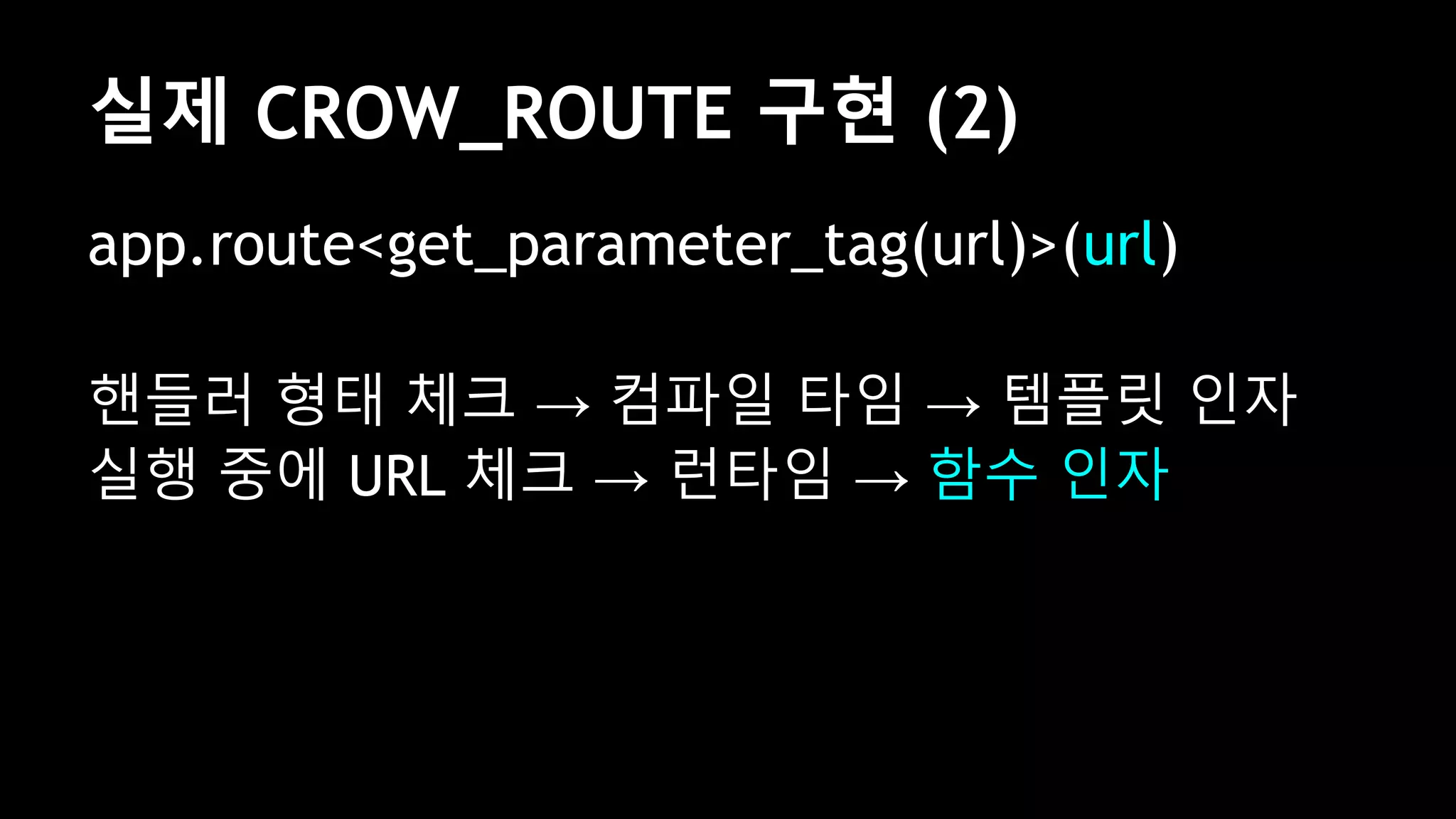
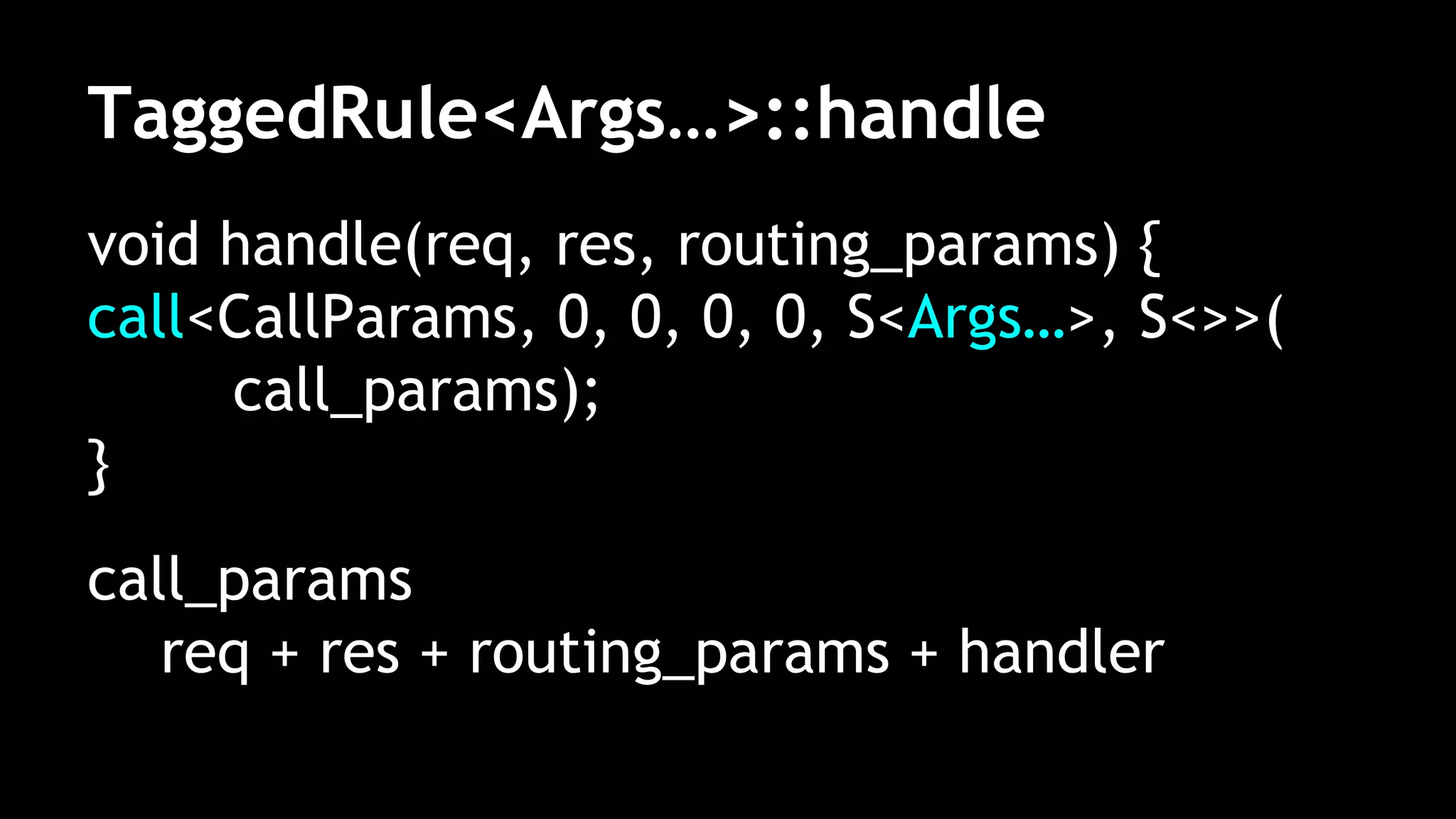
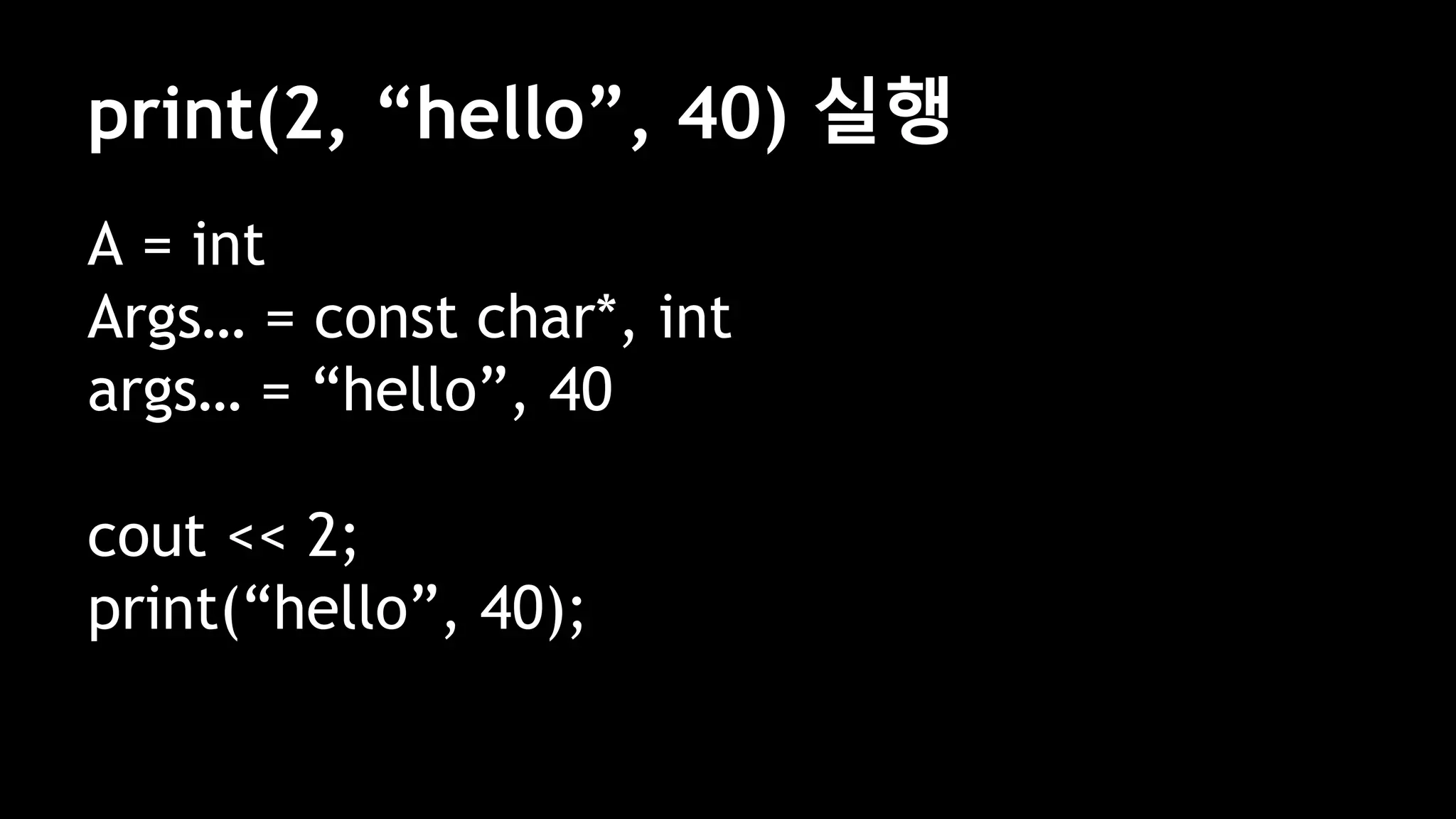
handler(rp.uint_params[0],
rp.string_params[0],
rp.string_params[1])
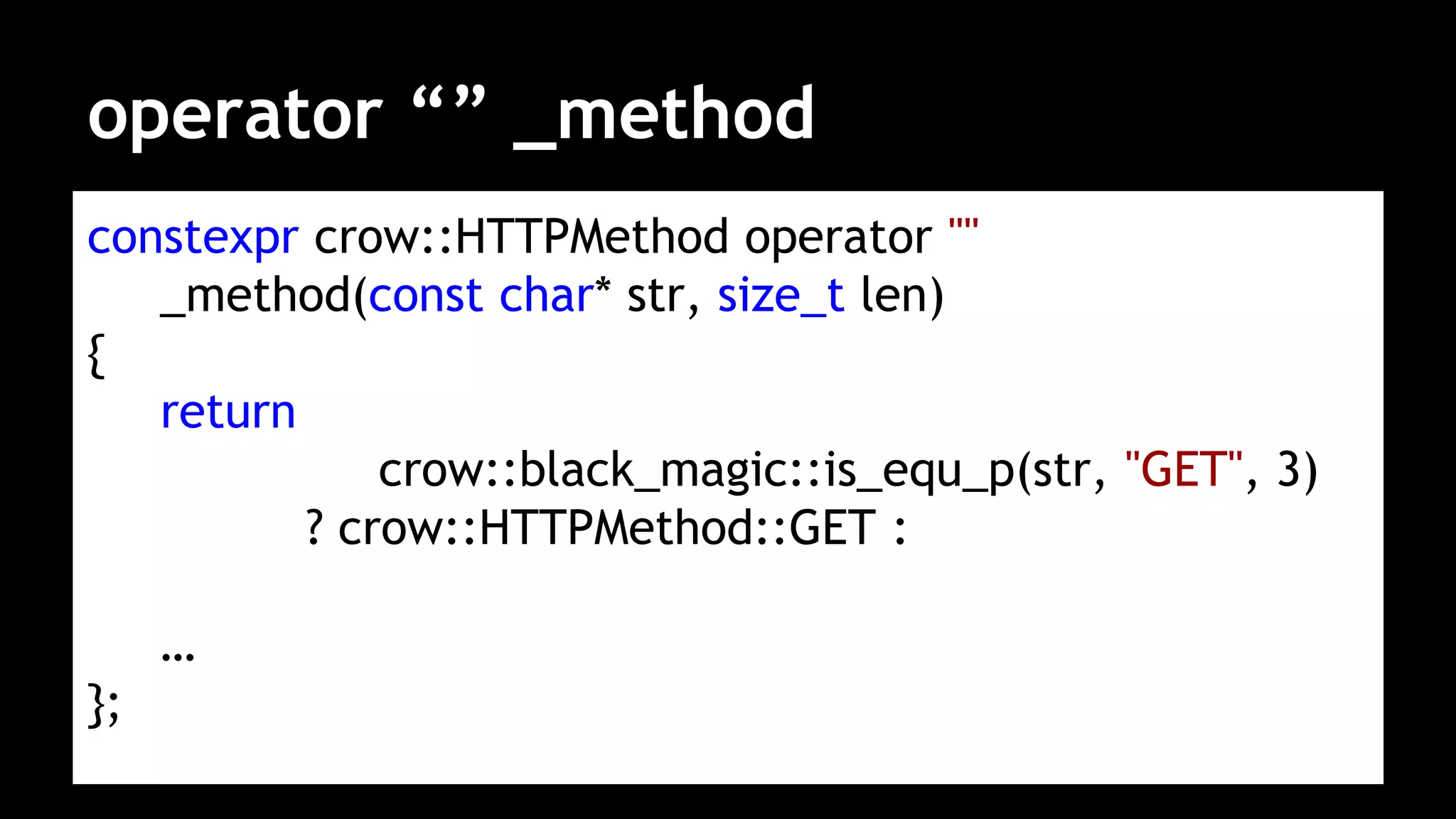
compile time](https://image.slidesharecdn.com/20150212c11featuresusedincrow-150212205127-conversion-gate02/75/20150212-c-11-features-used-in-crow-51-2048.jpg)
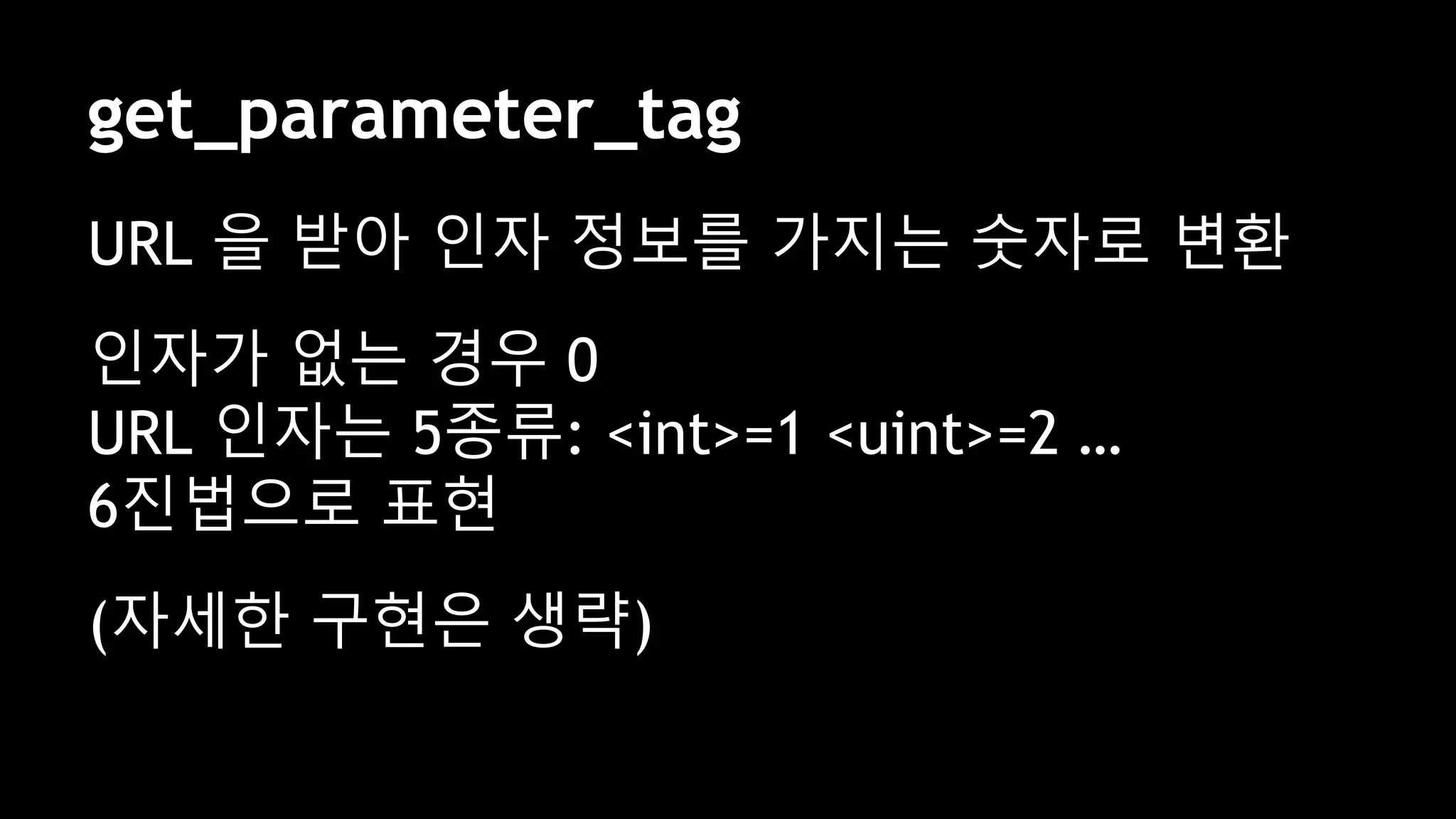
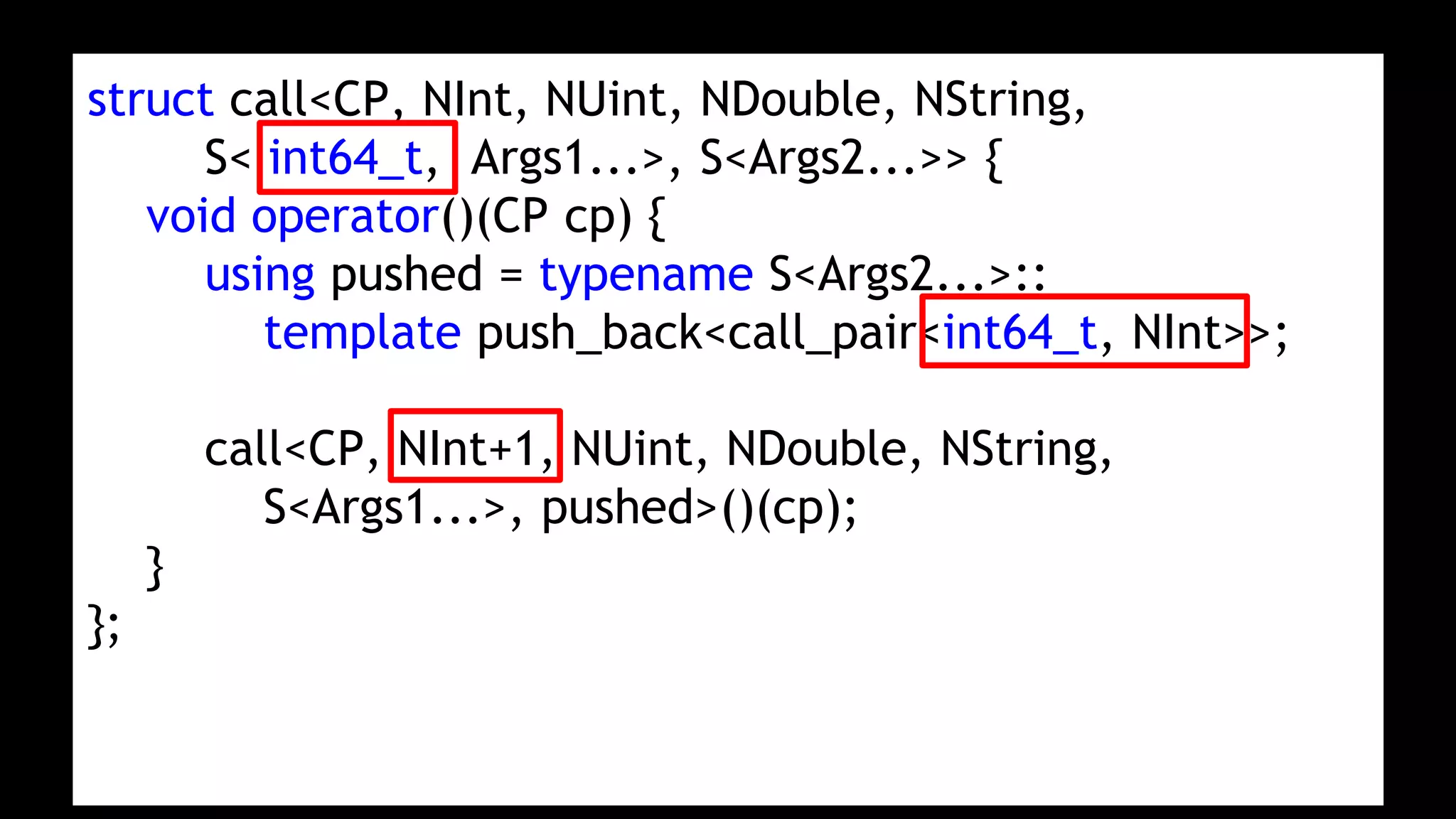
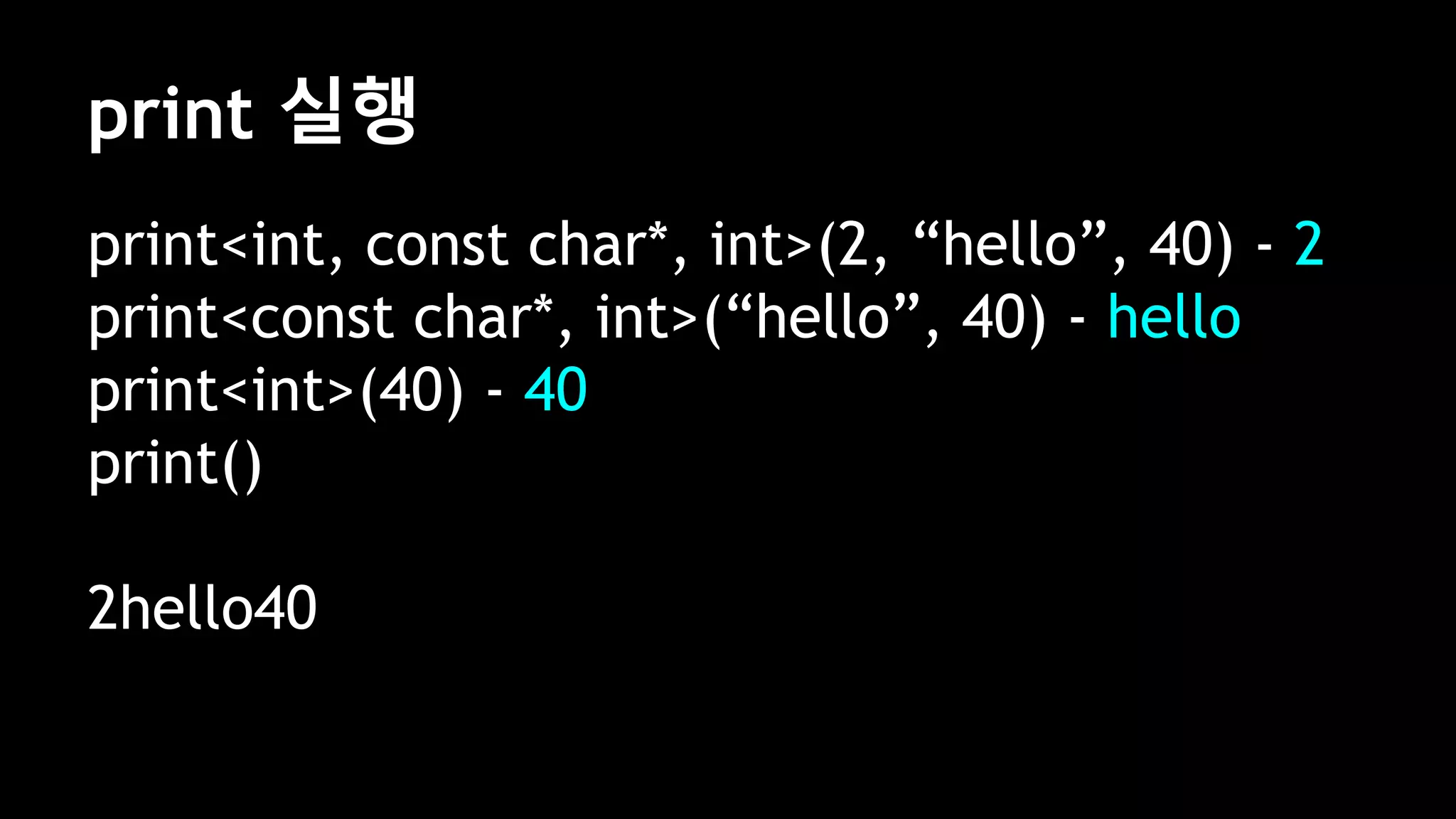
![call 호출 과정 - /v<uint>/<string>/<path>
0 0 [uint, str, str] []
1 0 [str, str] [(uint, 0)]
1 1 [str] [(uint, 0) (str, 0)]
1 2 [] [(uint, 0) (str, 0) (str, 1)]
call을 재귀호출
NUint NStr S1 S2](https://image.slidesharecdn.com/20150212c11featuresusedincrow-150212205127-conversion-gate02/75/20150212-c-11-features-used-in-crow-54-2048.jpg)
![call 호출 과정 - /v<uint>/<string>/<path>
0 0 [uint, str, str] []
NUint NStr S1 S2](https://image.slidesharecdn.com/20150212c11featuresusedincrow-150212205127-conversion-gate02/75/20150212-c-11-features-used-in-crow-55-2048.jpg)
![call 호출 과정 - /v<uint>/<string>/<path>
0 0 [uint, str, str] []
→ 1 0 [str, str] [<uint, 0>]
NUint NStr S1 S2](https://image.slidesharecdn.com/20150212c11featuresusedincrow-150212205127-conversion-gate02/75/20150212-c-11-features-used-in-crow-56-2048.jpg)
![call 호출 과정 - /v<uint>/<string>/<path>
0 0 [uint, str, str] []
1 0 [str, str] [<uint, 0>]
→ 1 1 [str] [<uint, 0> <str, 0>]
NUint NStr S1 S2](https://image.slidesharecdn.com/20150212c11featuresusedincrow-150212205127-conversion-gate02/75/20150212-c-11-features-used-in-crow-58-2048.jpg)
![call 호출 과정 - /v<uint>/<string>/<path>
0 0 [uint, str, str] []
1 0 [str, str] [<uint, 0>]
1 1 [str] [<uint, 0> <str, 0>]
→ 1 2 [] [<uint, 0>, <str, 0>, <str, 1>]
NUint NStr S1 S2](https://image.slidesharecdn.com/20150212c11featuresusedincrow-150212205127-conversion-gate02/75/20150212-c-11-features-used-in-crow-59-2048.jpg)
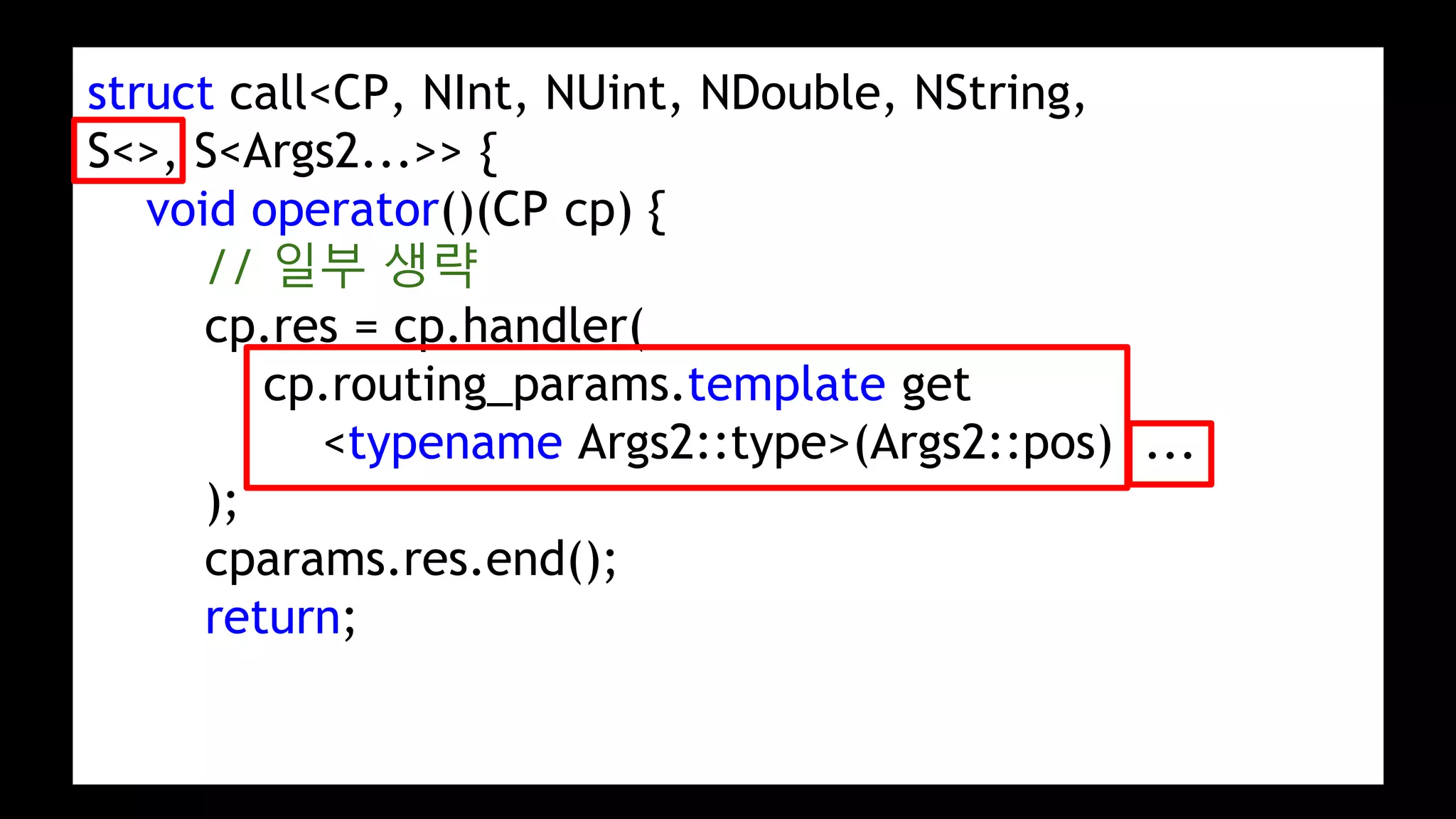
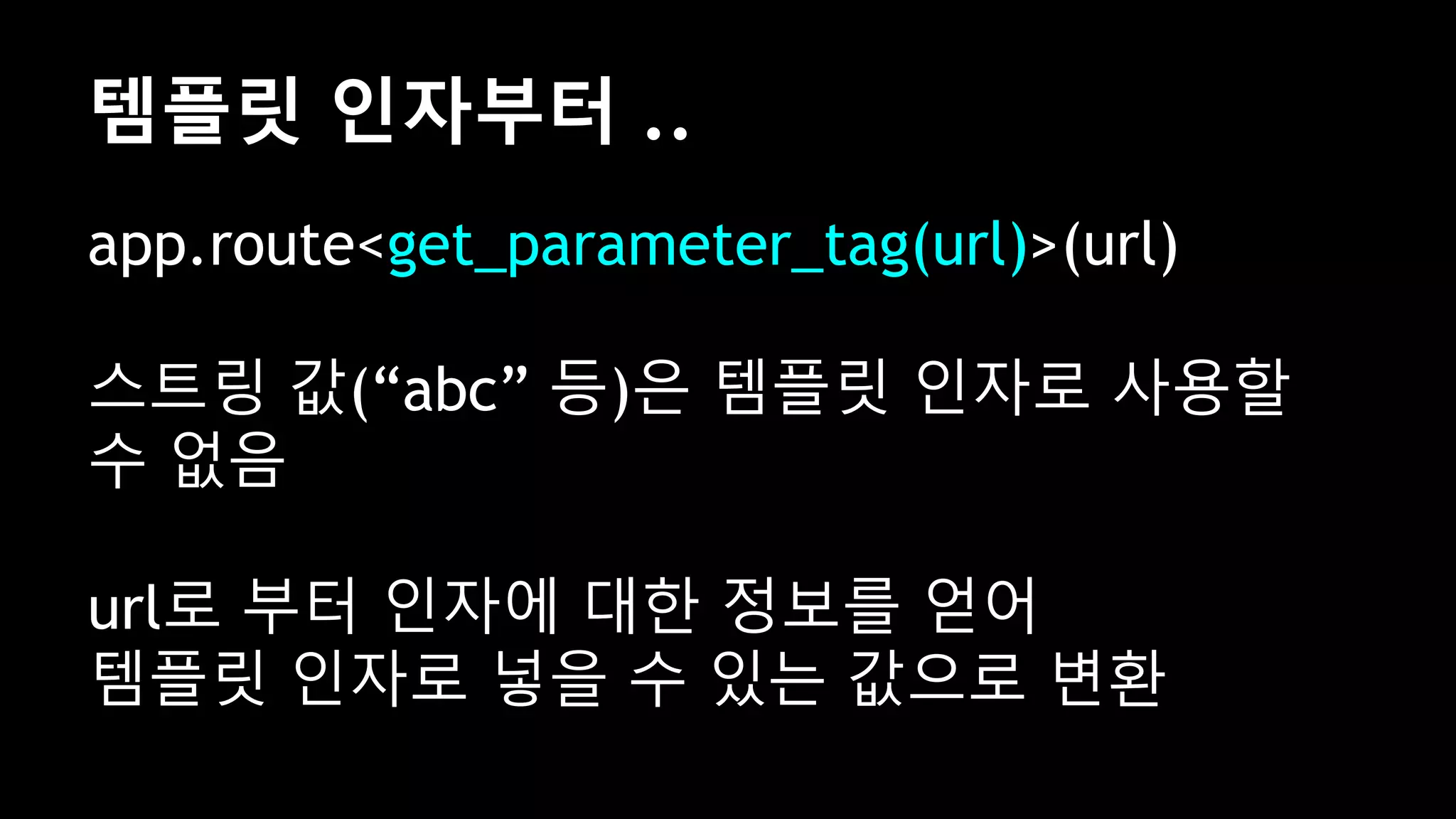
![T routing_params::get<T>(index)
template<> string
routing_params::get<string>(index) const
{
return string_params[index];
}](https://image.slidesharecdn.com/20150212c11featuresusedincrow-150212205127-conversion-gate02/75/20150212-c-11-features-used-in-crow-61-2048.jpg)
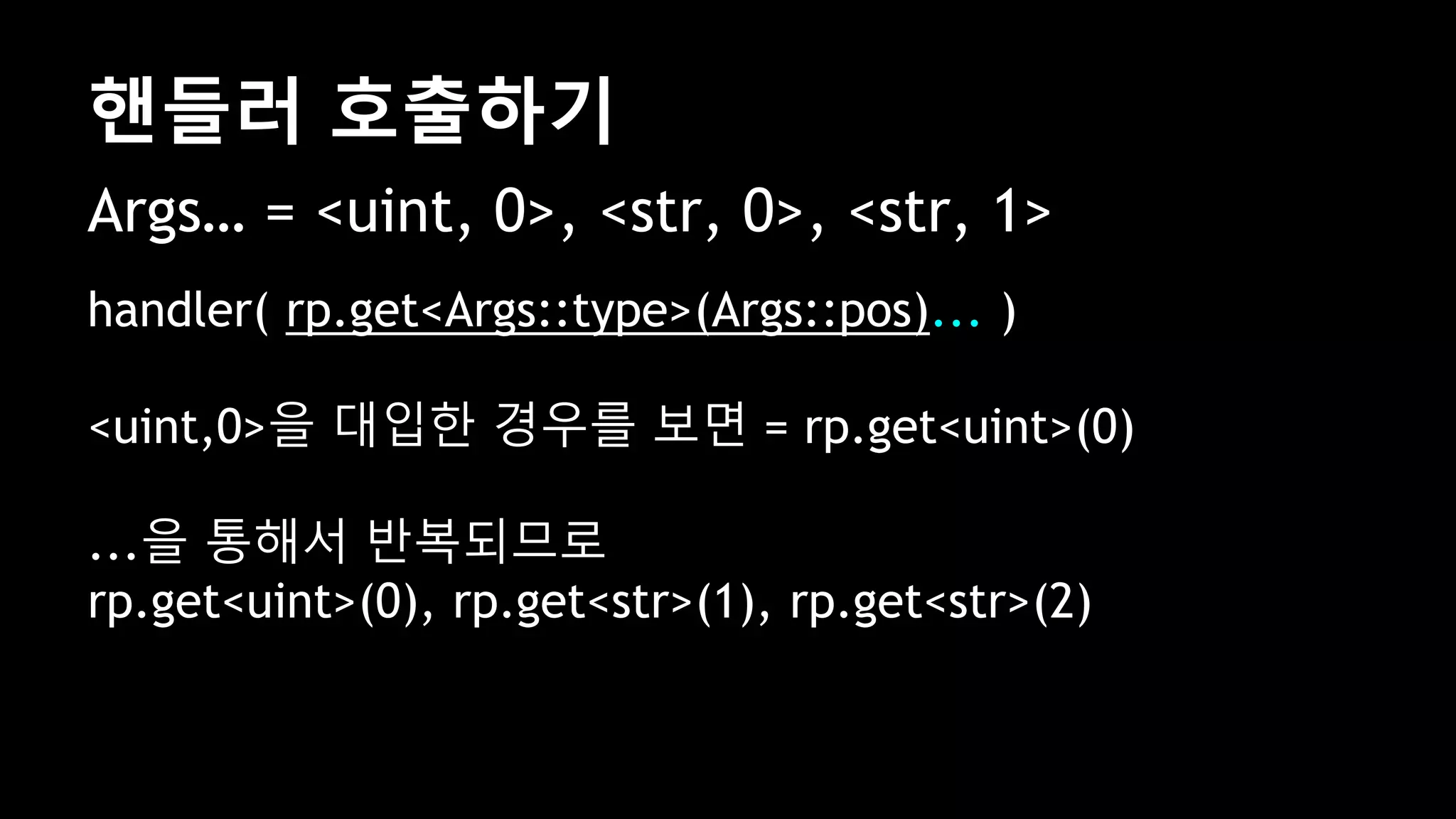
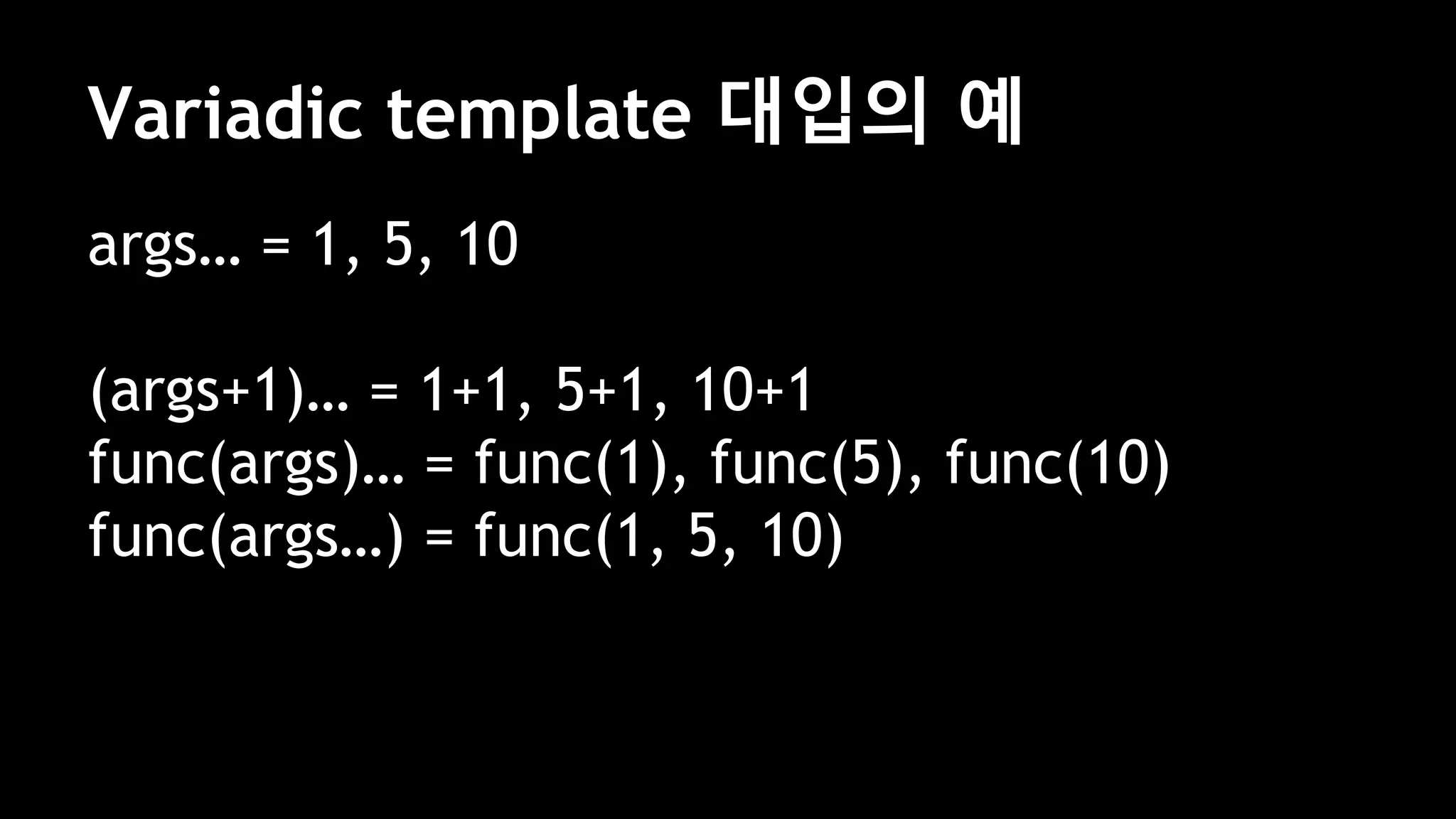
![핸들러 호출하기
handler(rp.uint_params[0],
rp.string_params[0],
rp.string_params[1]);
handler(rp.get<uint>(0),
rp.get<string>(0),
rp.get<string>(1));
handler( rp.get<Args2::type>(Args2::pos)... )](https://image.slidesharecdn.com/20150212c11featuresusedincrow-150212205127-conversion-gate02/75/20150212-c-11-features-used-in-crow-62-2048.jpg)

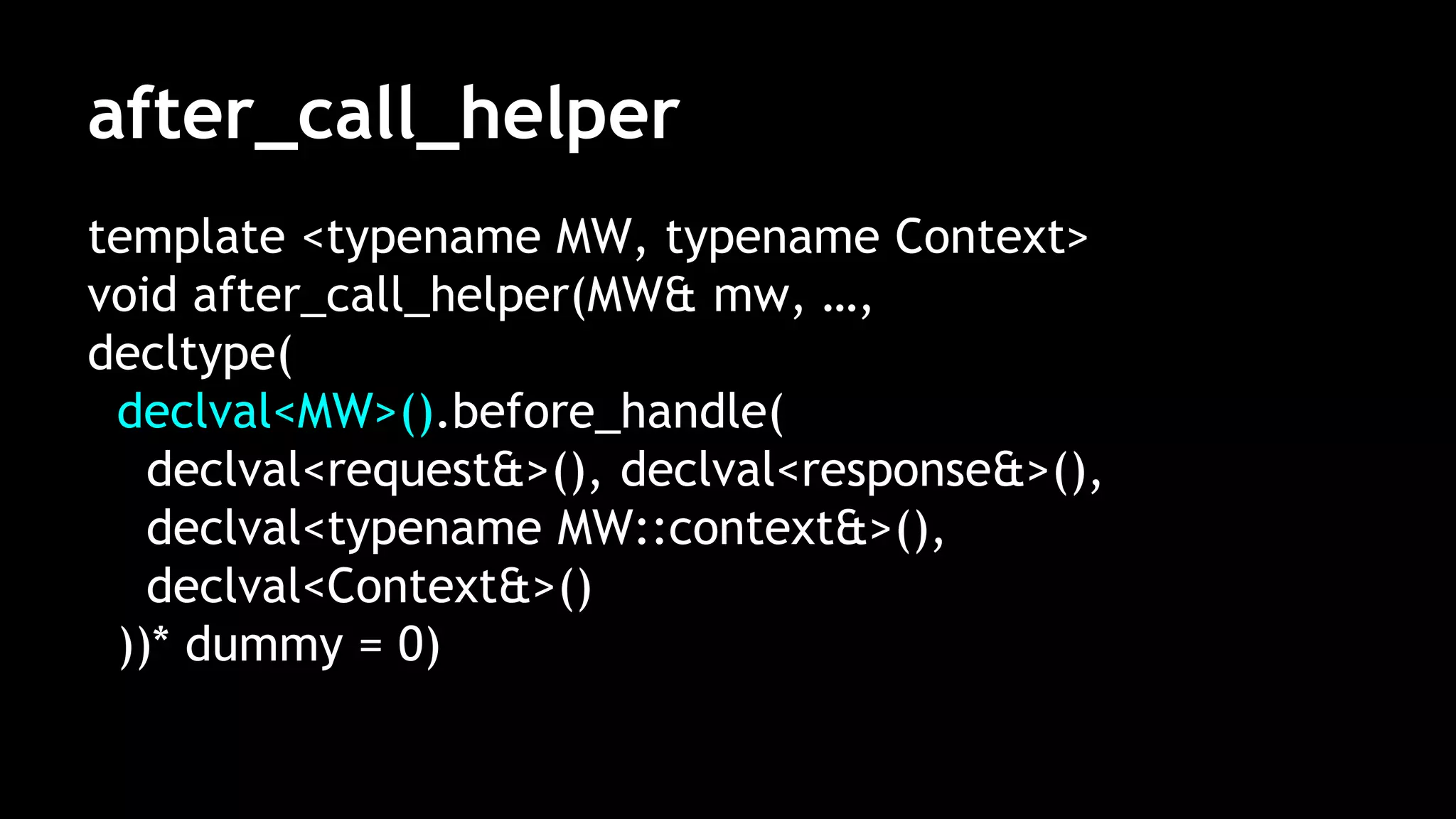
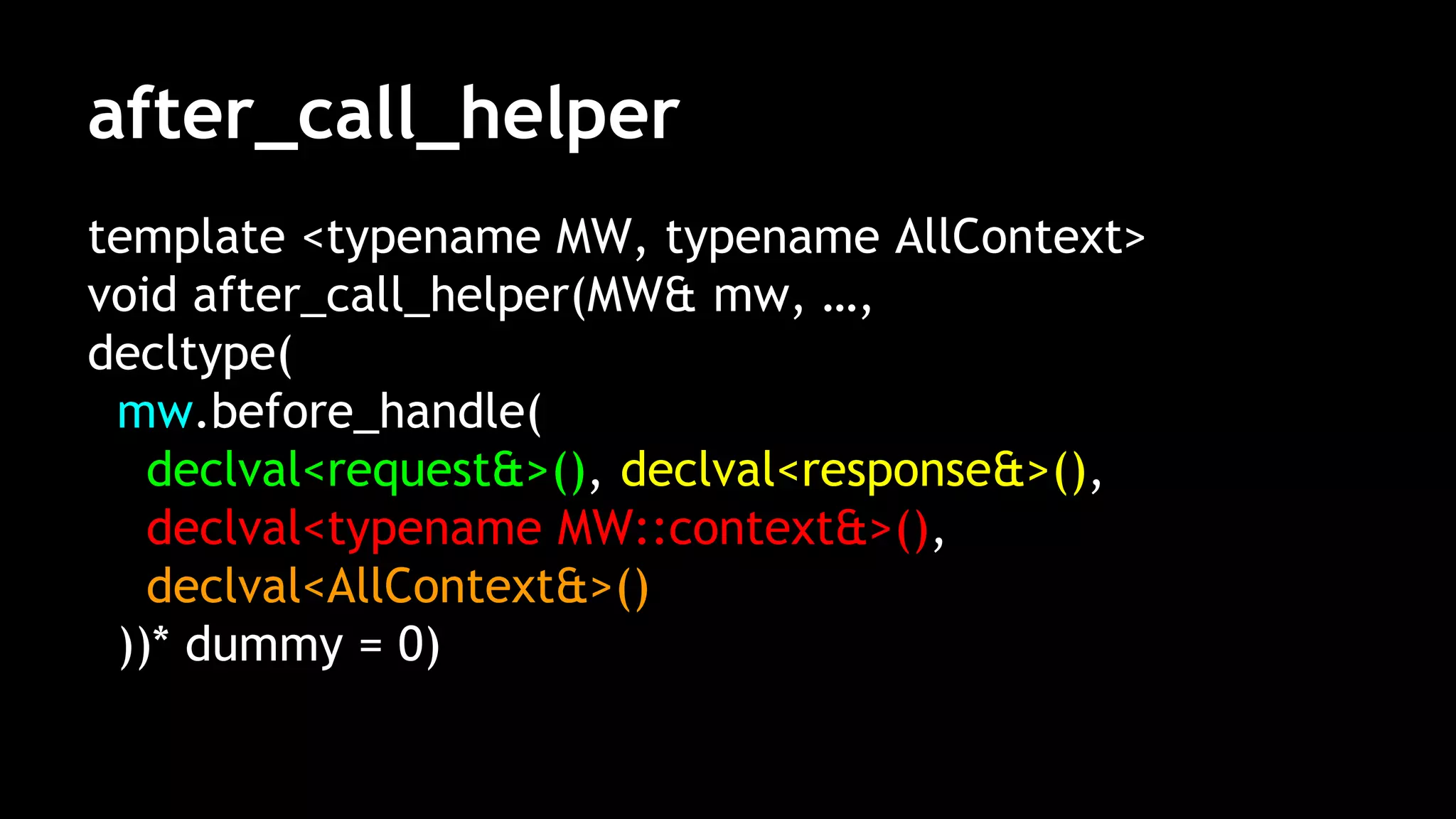
![Middleware?
C 요청 -> S 응답 -> C 받음
요청 --[MW]--> 응답 --[MW]--> 받음
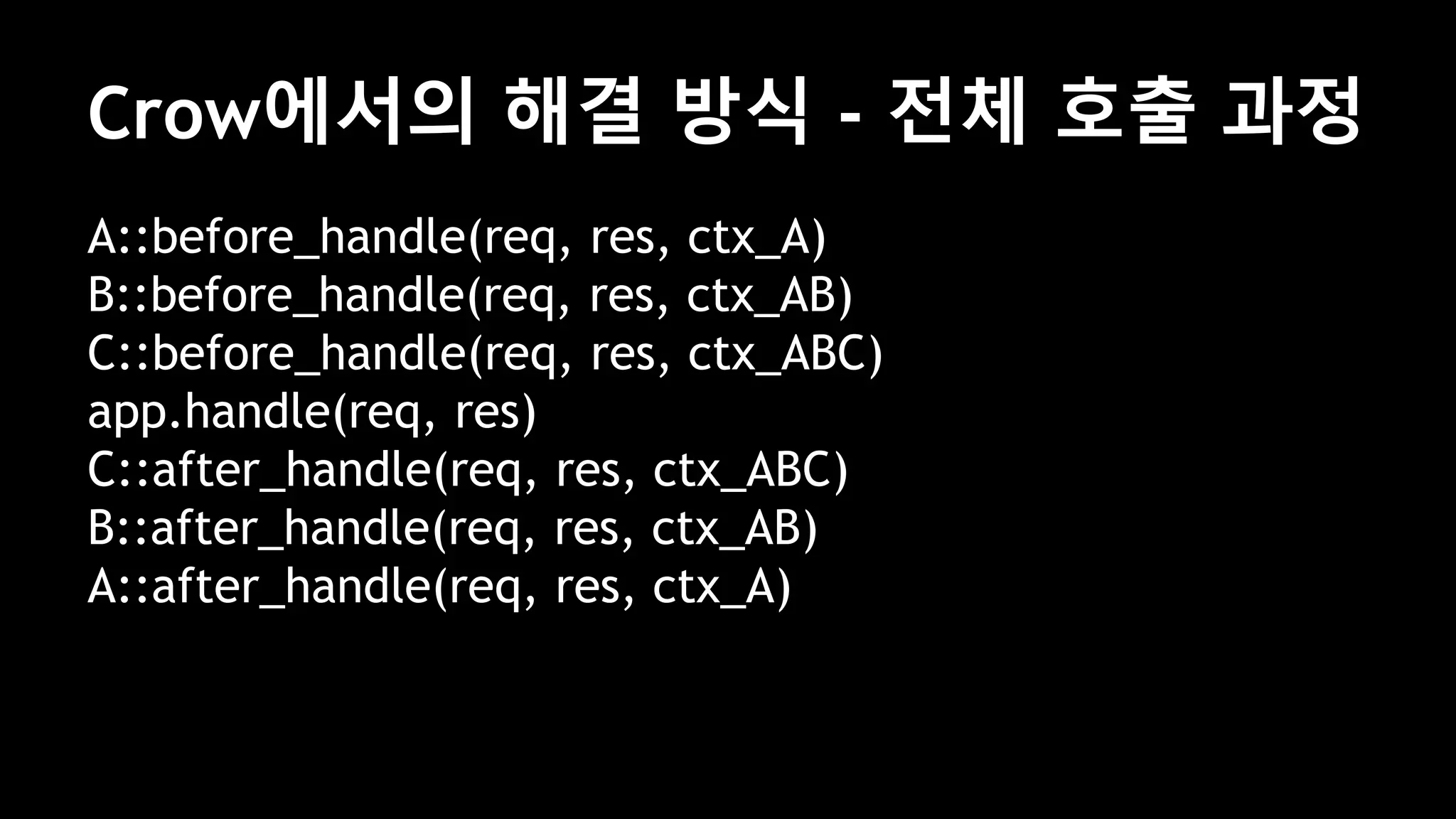
before_handle(req, res)
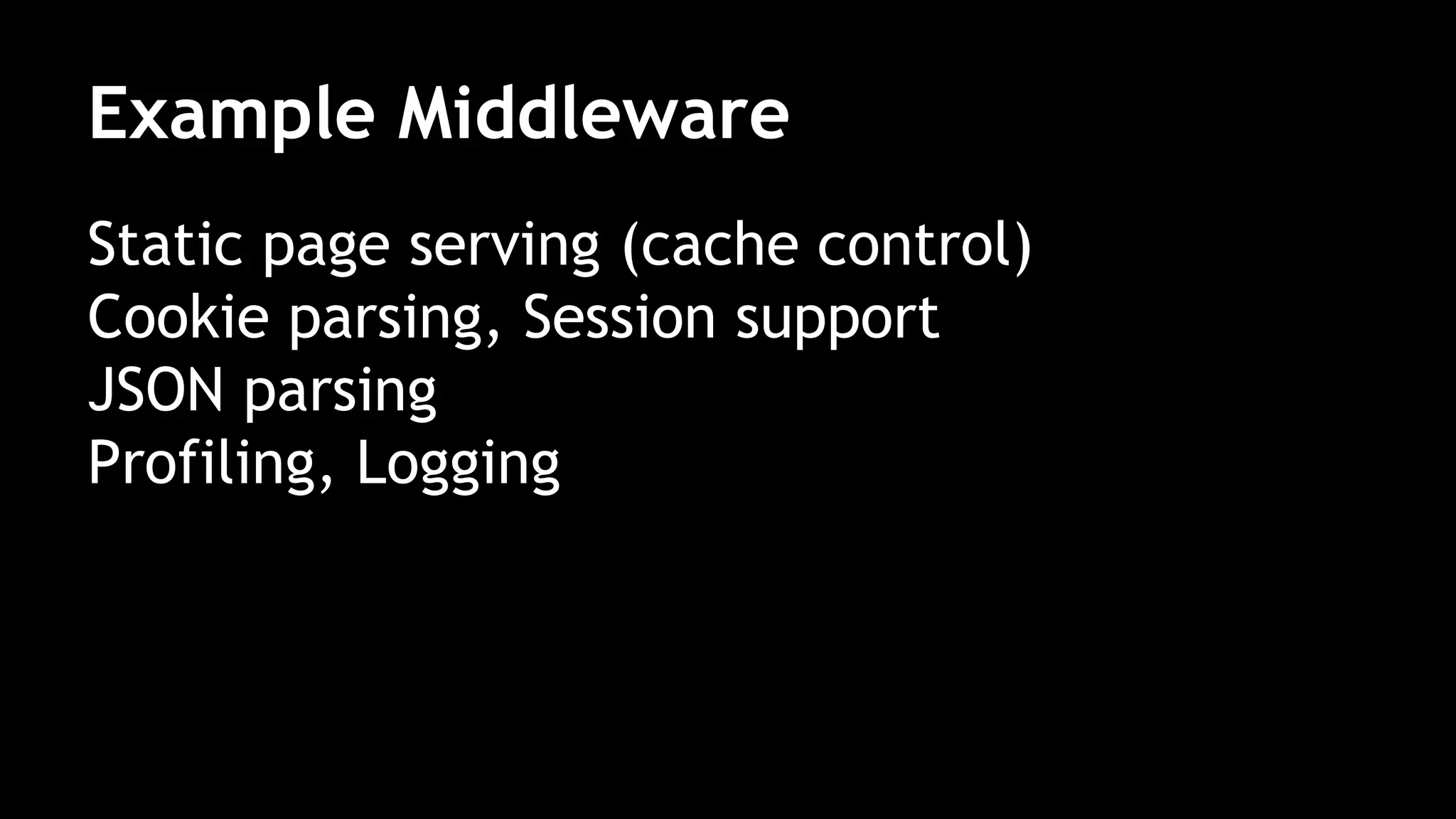
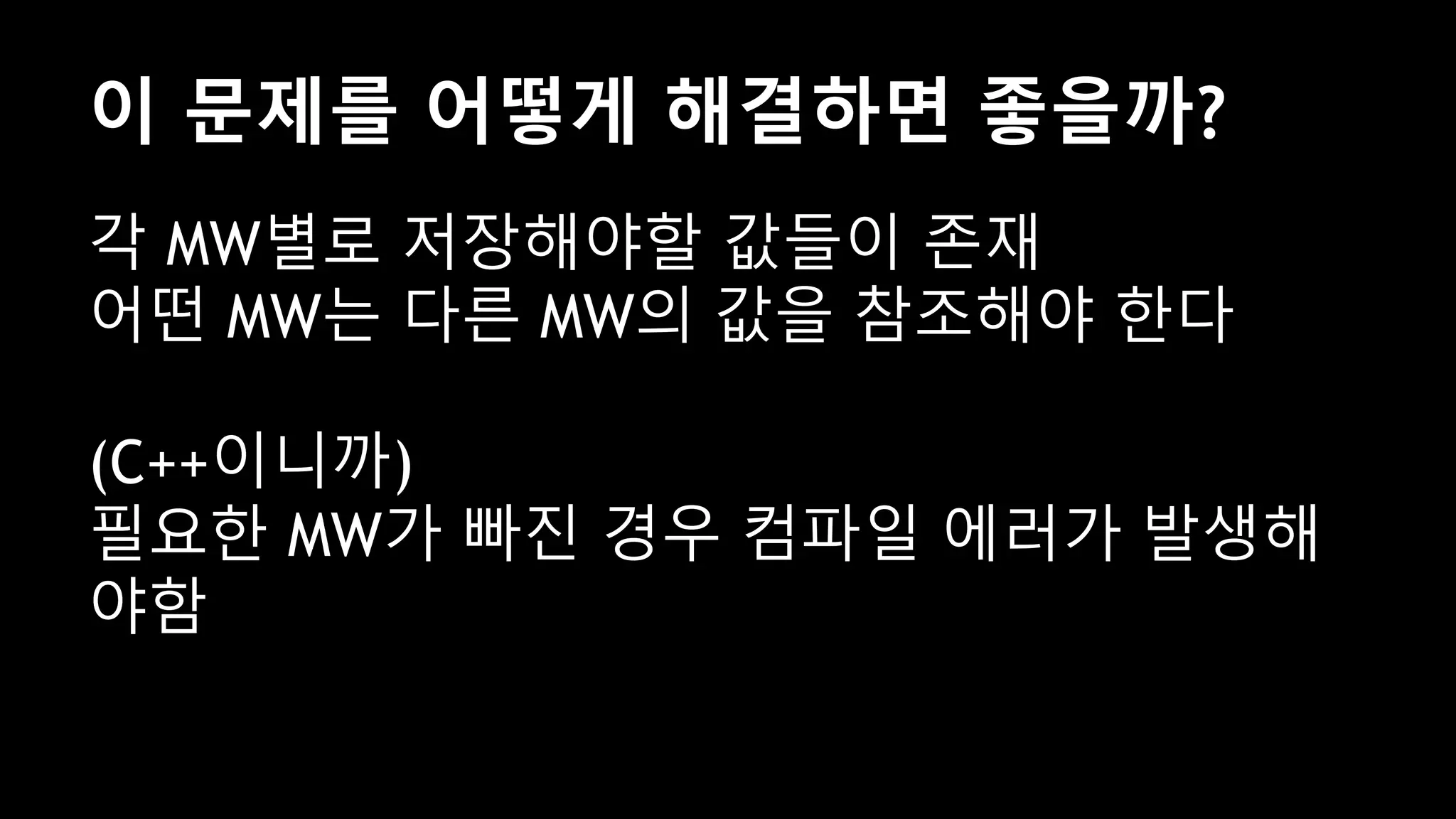
after_handle(req, res)](https://image.slidesharecdn.com/20150212c11featuresusedincrow-150212205127-conversion-gate02/75/20150212-c-11-features-used-in-crow-72-2048.jpg)
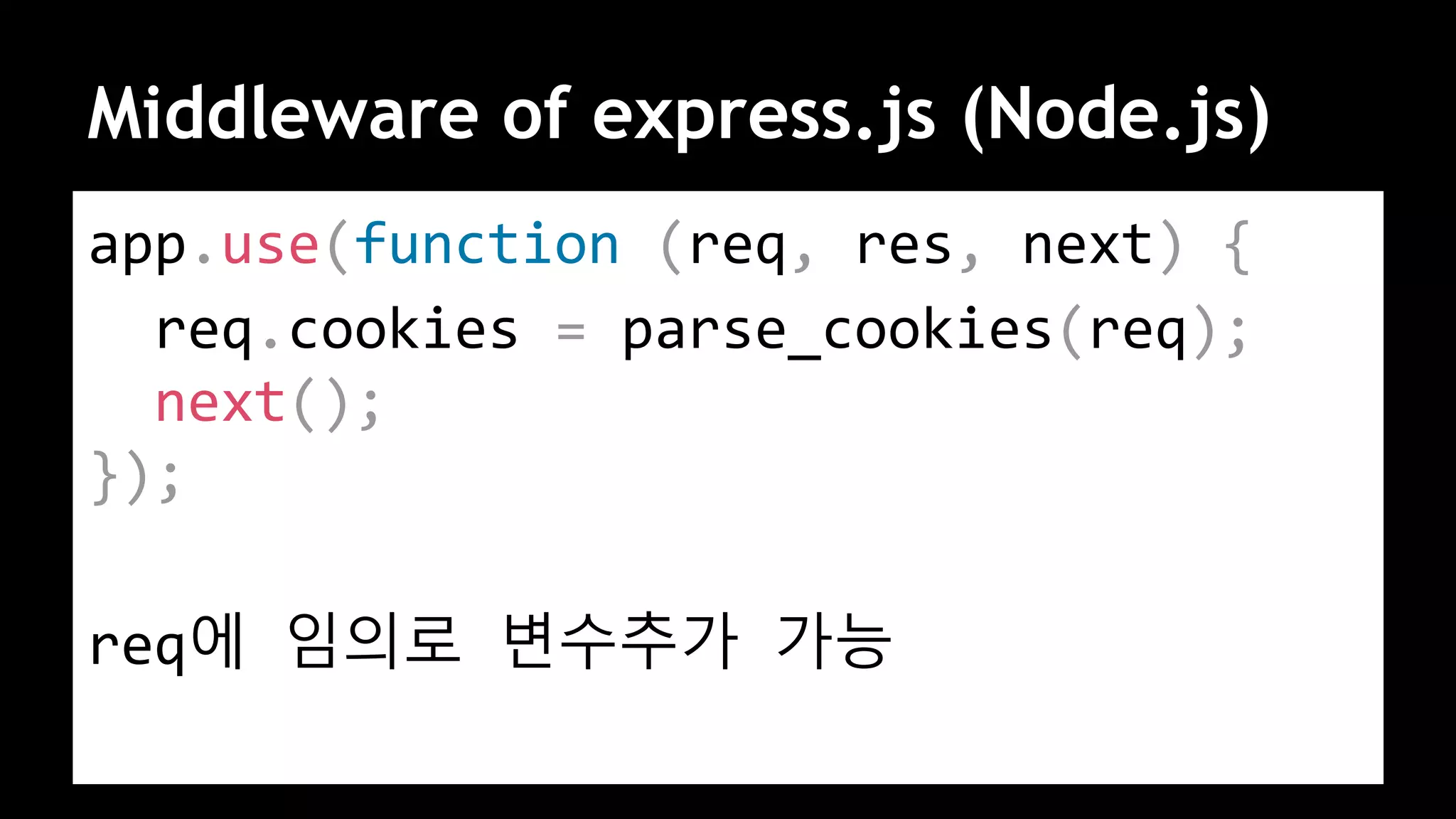
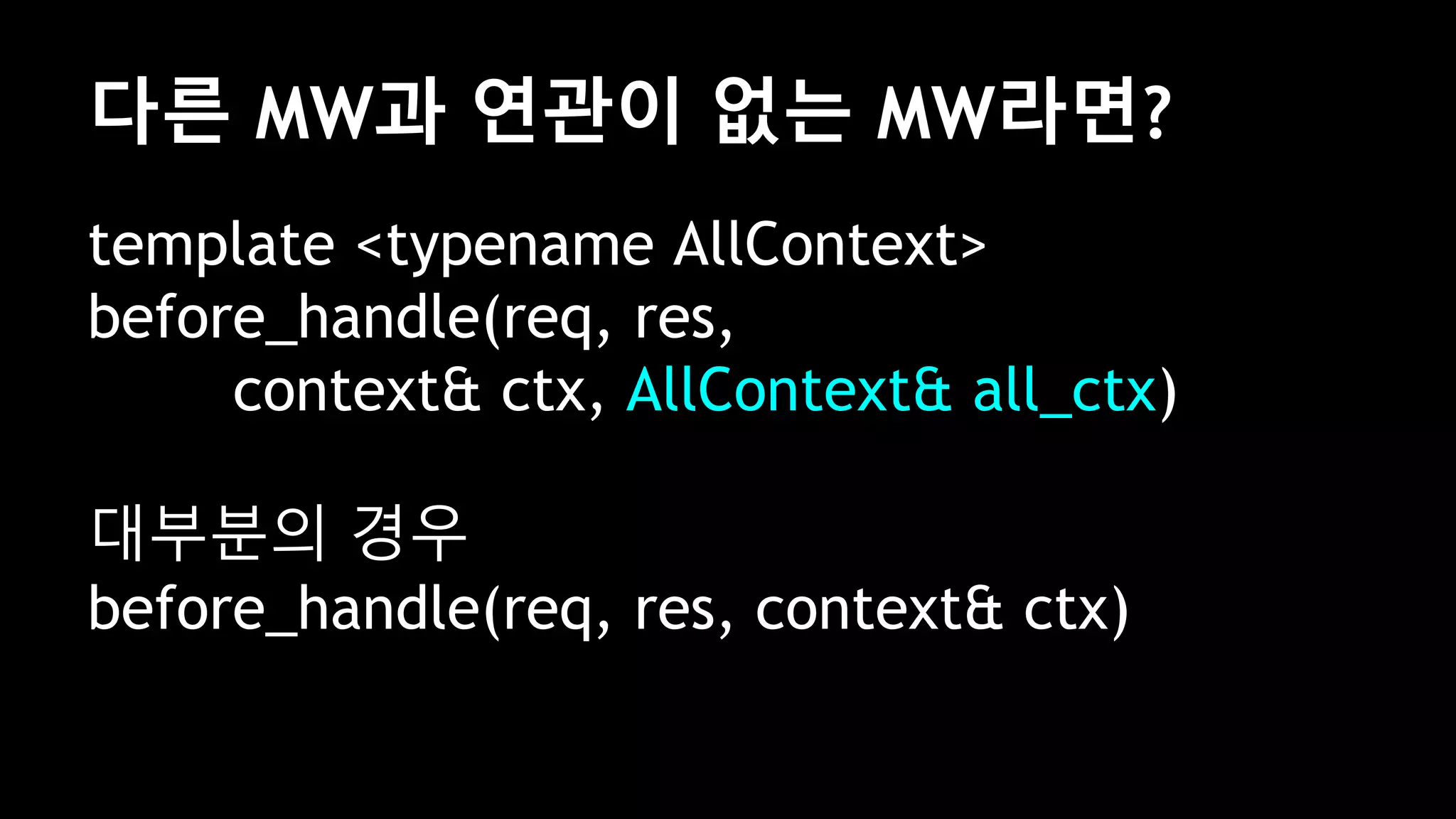
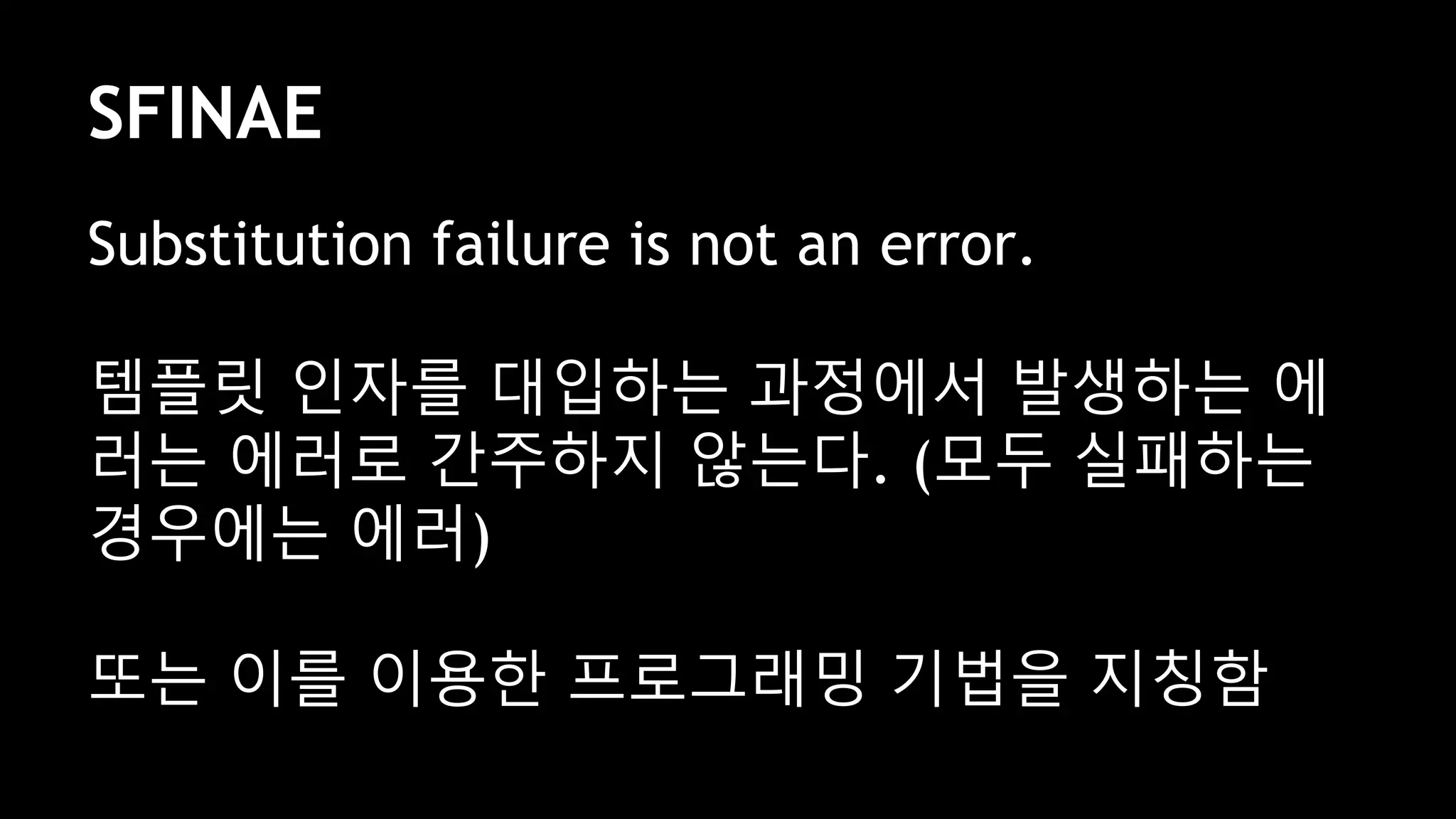
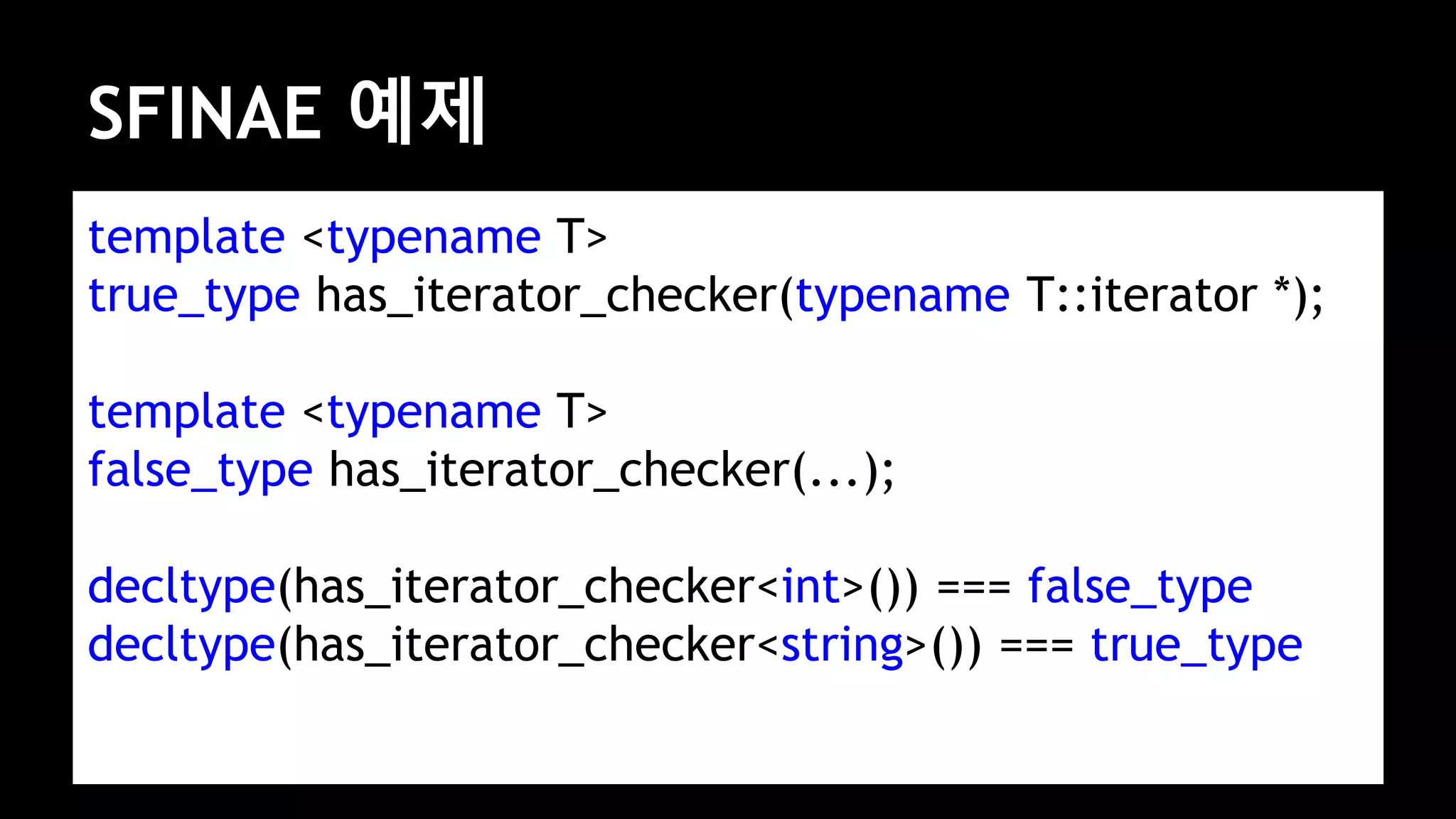
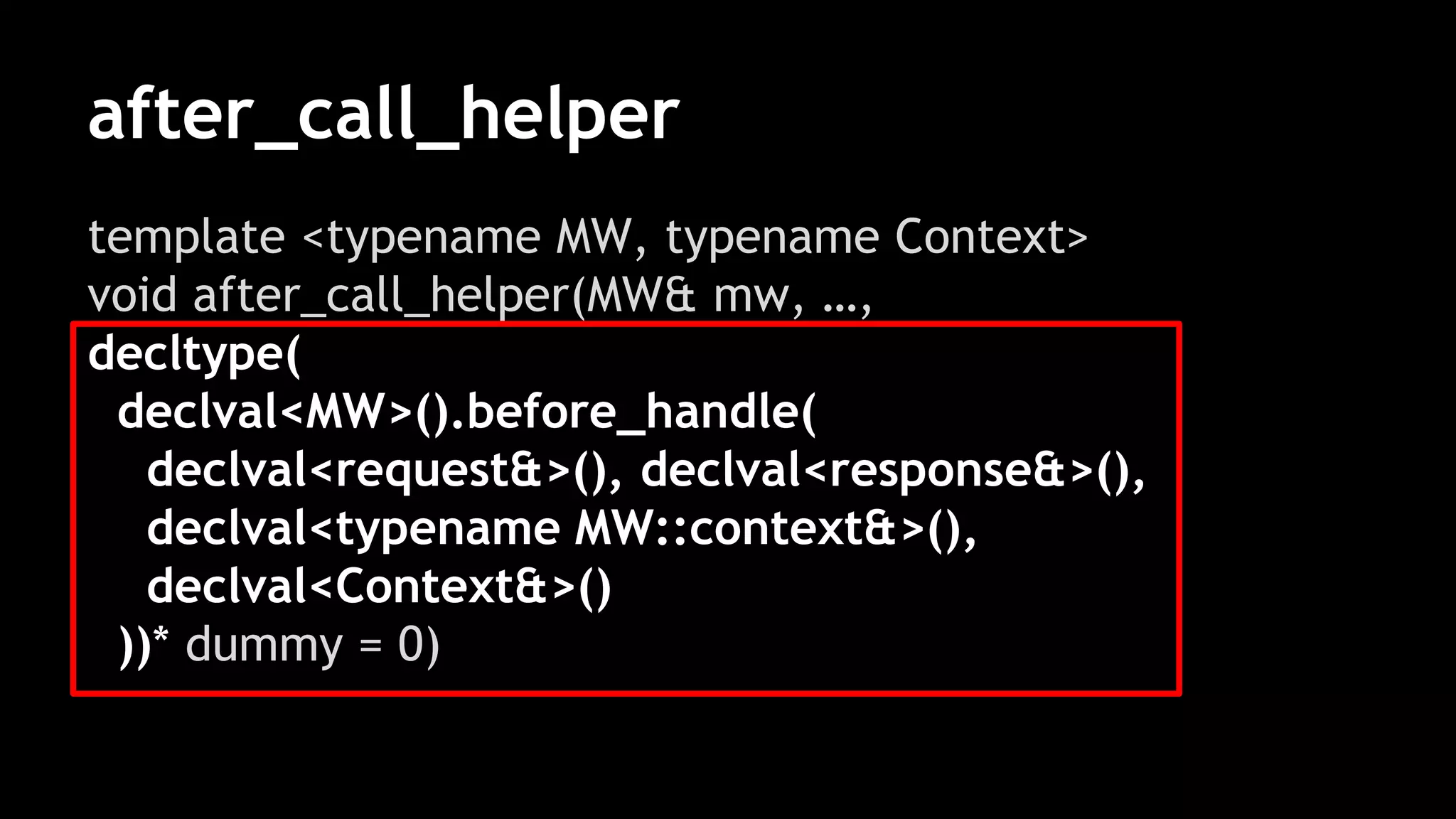



{
auto json = crow::json::load(req.body);
...
});](https://image.slidesharecdn.com/20150212c11featuresusedincrow-150212205127-conversion-gate02/75/20150212-c-11-features-used-in-crow-112-2048.jpg)





{return a + x + y;};](https://image.slidesharecdn.com/20150212c11featuresusedincrow-150212205127-conversion-gate02/75/20150212-c-11-features-used-in-crow-121-2048.jpg)
{
[](...){}((s<<x,1)...);
};
p(cout, 42, "hello?");
위 코드의 실행 결과를 설명하시오. (3점)](https://image.slidesharecdn.com/20150212c11featuresusedincrow-150212205127-conversion-gate02/75/20150212-c-11-features-used-in-crow-123-2048.jpg)


![[NDC2015] C++11 고급 기능 - Crow에 사용된 기법 중심으로](https://cdn.slidesharecdn.com/ss_thumbnails/ndc2015crowv3-150529000226-lva1-app6891-thumbnail.jpg?width=640&height=640&fit=bounds)

![[KGC 2012]Boost.asio를 이용한 네트웍 프로그래밍](https://cdn.slidesharecdn.com/ss_thumbnails/kgc2012boost-asio-121011023325-phpapp02-thumbnail.jpg?width=640&height=640&fit=bounds)

![[Td 2015]녹슨 c++ 코드에 모던 c++로 기름칠하기(옥찬호)](https://cdn.slidesharecdn.com/ss_thumbnails/td2015cc-151104051810-lva1-app6891-thumbnail.jpg?width=640&height=640&fit=bounds)

![[KGC 2011]Boost 라이브러리와 C++11](https://cdn.slidesharecdn.com/ss_thumbnails/kgc2011boostcpp11-111125022526-phpapp01-thumbnail.jpg?width=640&height=640&fit=bounds)

![[NDC2016] TERA 서버의 Modern C++ 활용기](https://cdn.slidesharecdn.com/ss_thumbnails/v09teramodernc20160425-160427044156-thumbnail.jpg?width=640&height=640&fit=bounds)
![[143] Modern C++ 무조건 써야 해?](https://cdn.slidesharecdn.com/ss_thumbnails/143deview2018modernc9-181011024146-thumbnail.jpg?width=640&height=640&fit=bounds)


![[C++ Korea 2nd Seminar] C++17 Key Features Summary](https://cdn.slidesharecdn.com/ss_thumbnails/ckorea2ndseminarc17keyfeaturessummary-publish-160529025757-thumbnail.jpg?width=640&height=640&fit=bounds)


![[D2 COMMUNITY] ECMAScript 2015 S67 seminar - 1. primitive](https://cdn.slidesharecdn.com/ss_thumbnails/1primitive-161207024601-thumbnail.jpg?width=640&height=640&fit=bounds)


![[NDC2015] 언제 어디서나 프로파일링 가능한 코드네임 JYP 작성기 - 라이브 게임 배포 후에도 프로파일링 하기](https://cdn.slidesharecdn.com/ss_thumbnails/ndc2015jypv3-150529000151-lva1-app6892-thumbnail.jpg?width=640&height=640&fit=bounds)
![[야생의 땅: 듀랑고] 서버 아키텍처 Vol. 2 (자막)](https://cdn.slidesharecdn.com/ss_thumbnails/vol2-160427160825-thumbnail.jpg?width=640&height=640&fit=bounds)


![[C++ adv] c++11](https://cdn.slidesharecdn.com/ss_thumbnails/cadvc11-140425000913-phpapp02-thumbnail.jpg?width=640&height=640&fit=bounds)
![[1116 박민근] c++11에 추가된 새로운 기능들](https://cdn.slidesharecdn.com/ss_thumbnails/1116c11-131118002832-phpapp01-thumbnail.jpg?width=640&height=640&fit=bounds)
![[NHN NEXT 14] [Pl in c++] 1. 수업 내용 및 진행 방법](https://cdn.slidesharecdn.com/ss_thumbnails/jzlyjgpesbgfhtjt3gyl-signature-b2cf003799da520be6972a6113b2db8b272689c60fc051bc416a15d0ef3c029a-poli-140707212124-phpapp02-thumbnail.jpg?width=640&height=640&fit=bounds)


![[Swift] Data Structure - Graph(BFS)](https://cdn.slidesharecdn.com/ss_thumbnails/swiftdatastructure-graphbfs-200603005912-thumbnail.jpg?width=640&height=640&fit=bounds)


