Defining the ethics
and purpose of the ethics
Presented by :Tabassum Ansar
Roll-no 4
University of GUJRAT
When did code of ethics begin and how did it
originate?
• Ethics is a branch of philosophy concerned with
how humans should live, and what should be
considered right and wrong.
•The word originates from the early Greek word
"ethos," but the concept is much older, with every
society possessing its own code of ethics.
Con…
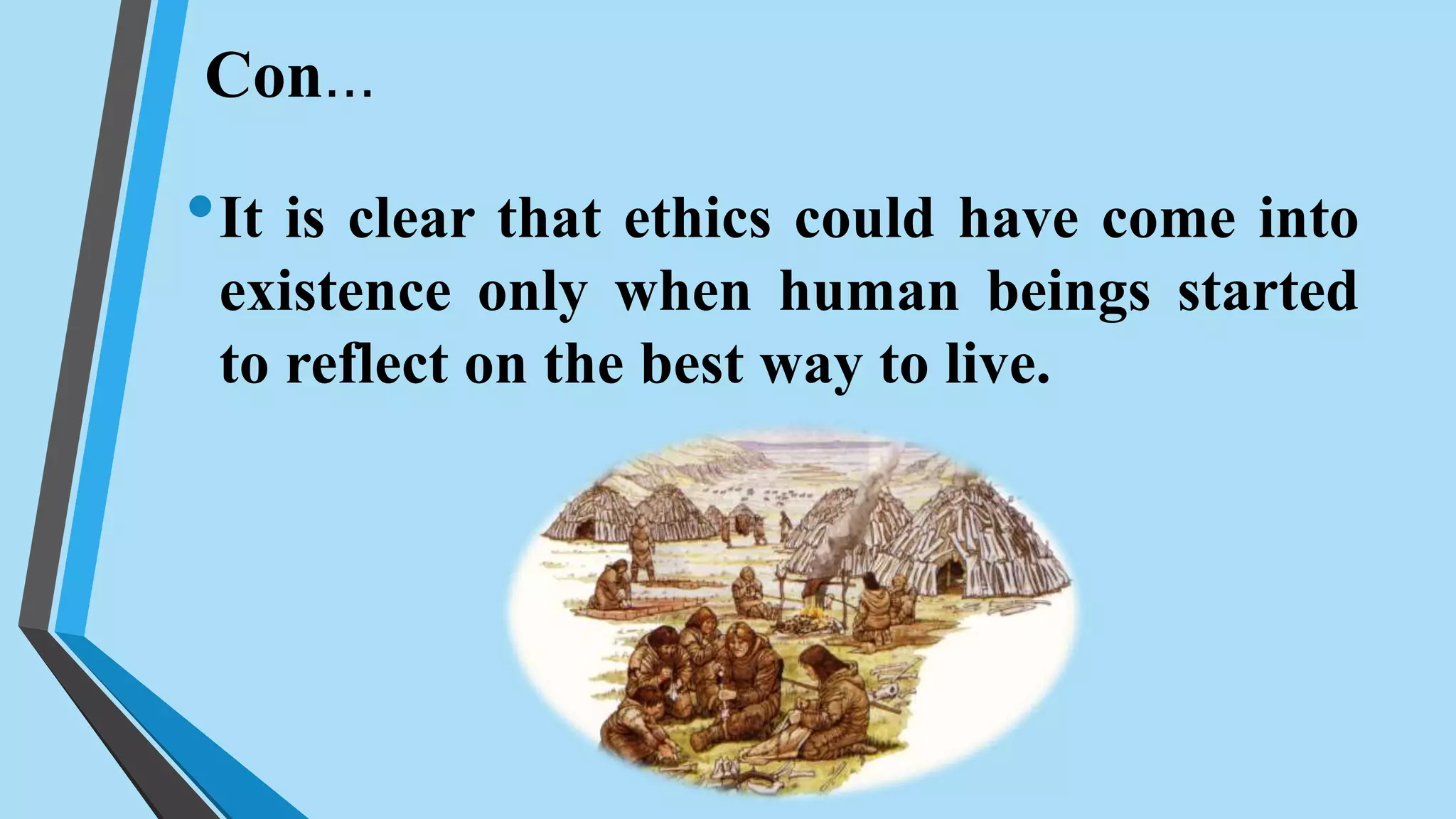
•It is clear that ethics could have come into
existence only when human beings started
to reflect on the best way to live.
What is Ethics?
• Moral principles that govern a person's behavior or the
conducting of an activity.
• The branch of knowledge that deals with moral principles.
• The systematic study of what is morally right and wrong.
WHY A CODE OF ETHICS?
•A code of ethics helps an organization as a
"guiding light", enabling its members to
make morally sound decisions and deal with
situations without any prejudice
•The basic ethical values of honesty, fairness,
trustworthiness, respect and tolerance.
Purpose of code of ethics
• Every organization needs to have a code of ethics
that must be followed by students, faculty and
staff.
• The purpose of a code of ethics within an
organization is to define acceptable standards
• Provide general principles of professional behavior
which should be followed by members of the
organization.
• In other words, a code of conduct outlines
for the members of an organization how to
become true professionals by applying
ethical concepts in everyday.
•In the final analysis, without an
institutional code of ethics, it remains
impossible.
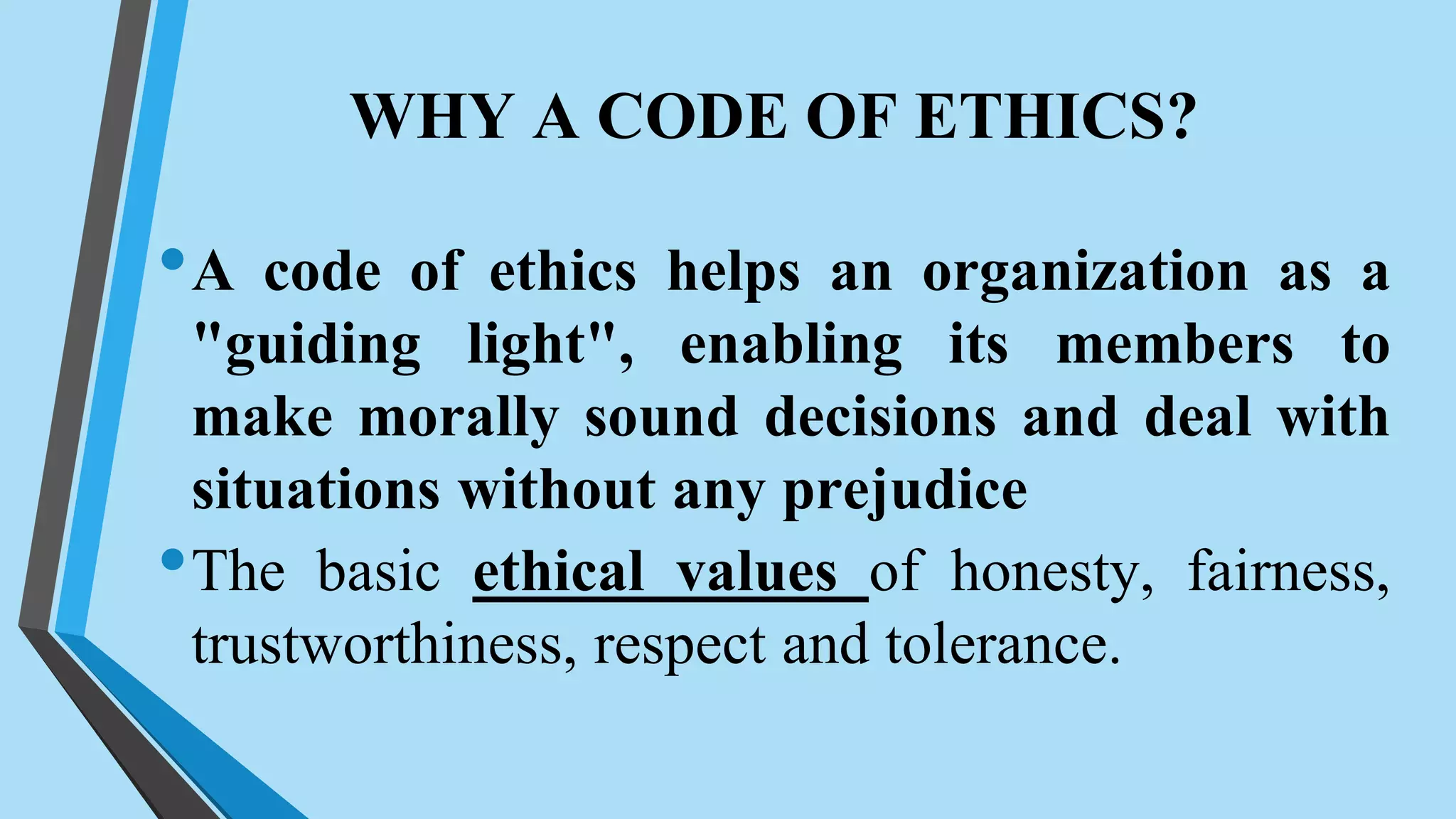
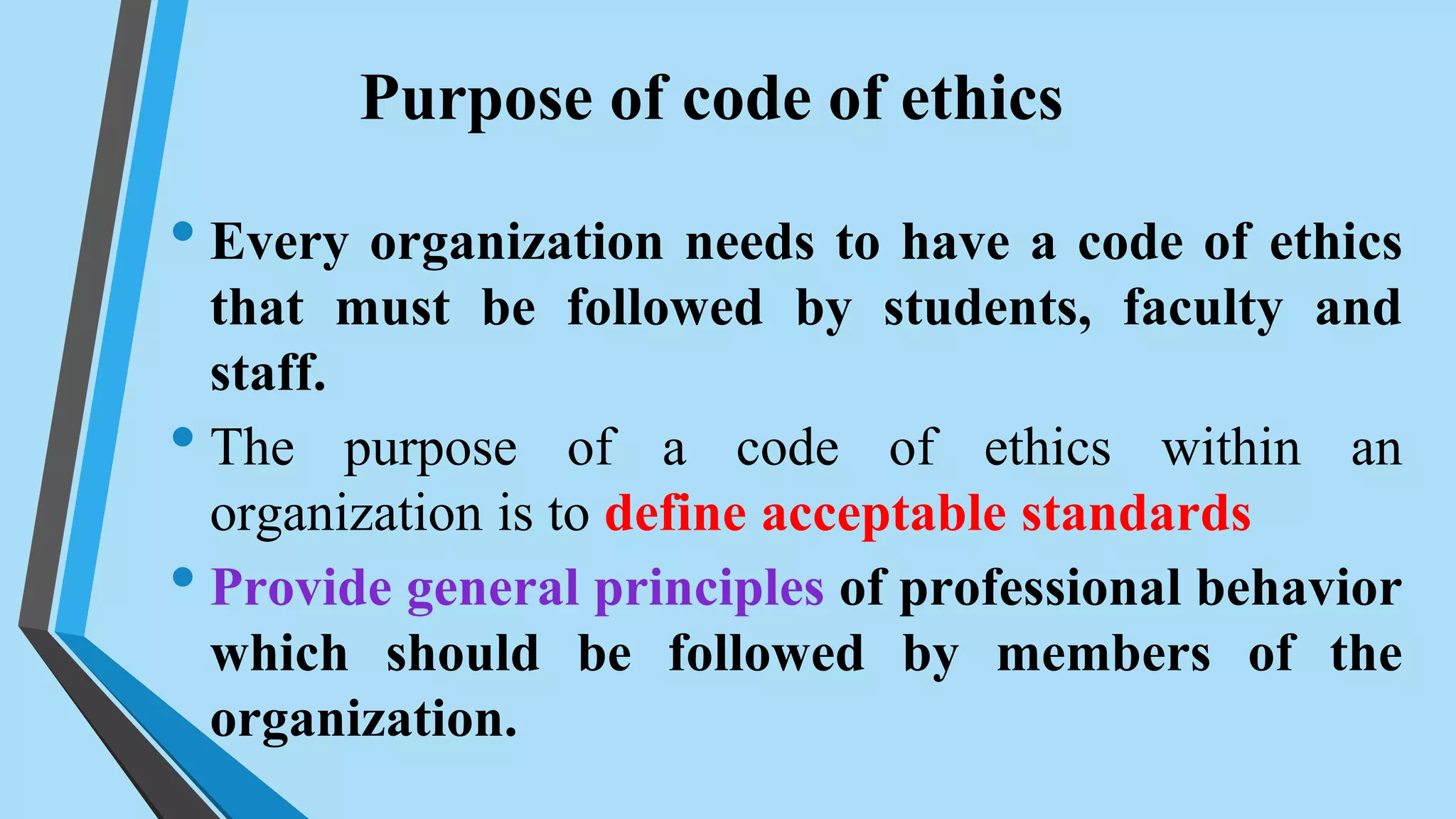
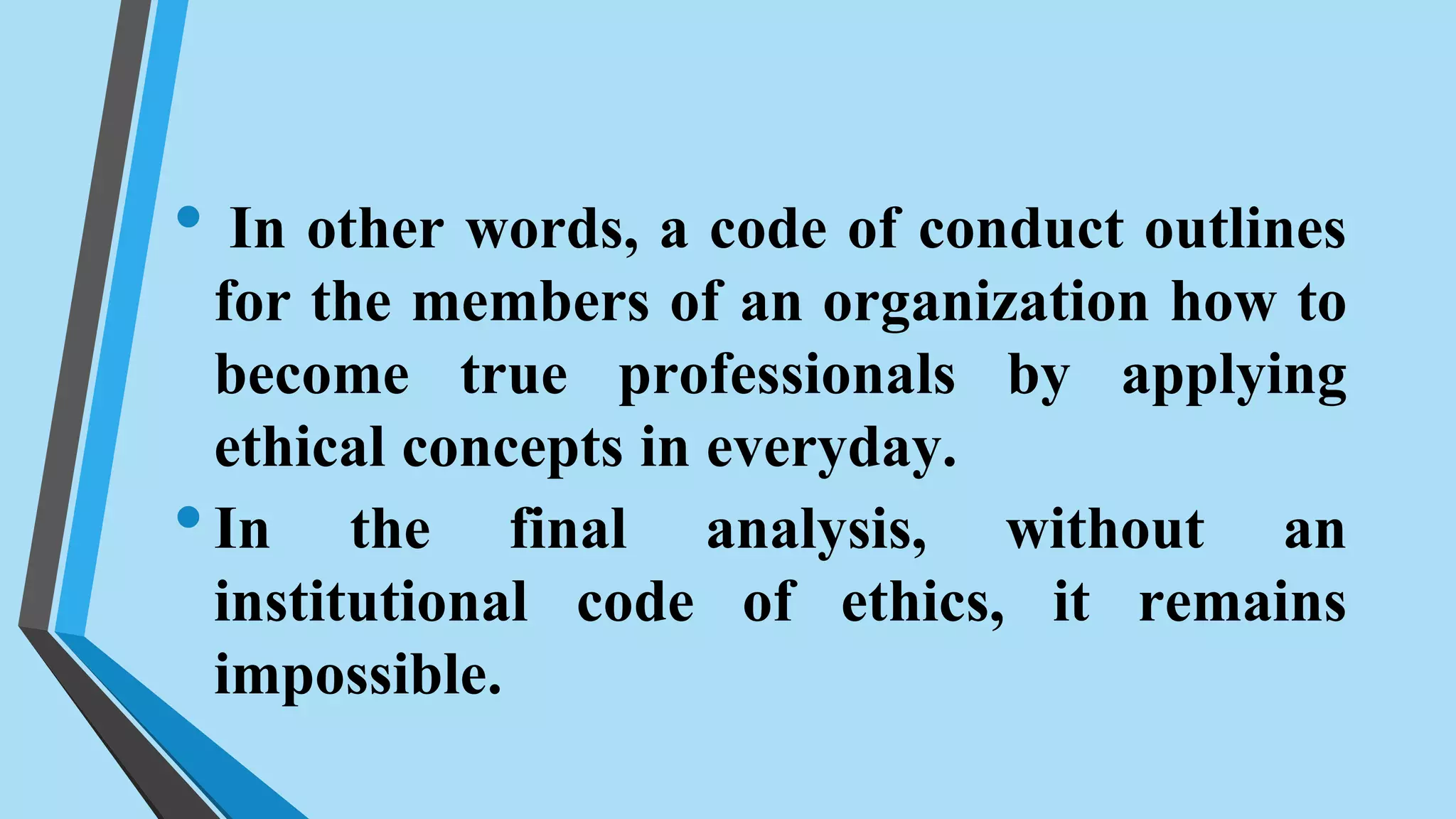
The principles for preparing a code of ethics
are different from organization to
organization due to the nature of job.
The Nature of Islamic Code of Ethics
• Islam presents a comprehensive way of life. It means some
universal fundamental rights for humanity as a whole, which
are to be observed in all conditions.
• Islam provided legal defends along with a very effective moral
system.
• Thus, whatever leads to the welfare of the individual or the
society and does not oppose any maxims of the religion is
morally good in Islam, and whatever is harmful is morally
bad.
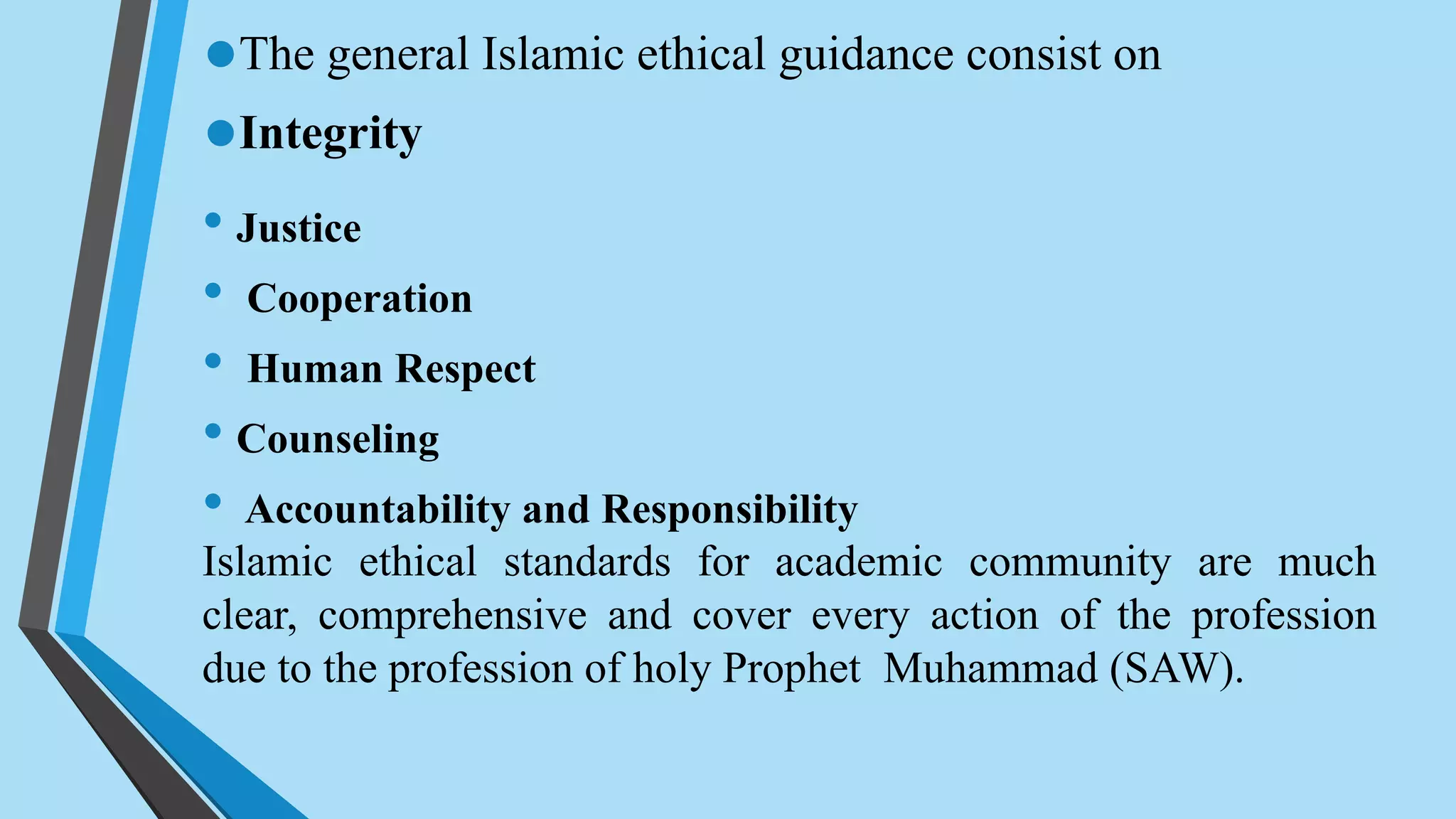
•The general Islamic ethical guidance consist on
•Integrity
• Justice
• Cooperation
• Human Respect
• Counseling
• Accountability and Responsibility
Islamic ethical standards for academic community are much
clear, comprehensive and cover every action of the profession
due to the profession of holy Prophet Muhammad (SAW).
•The professional educator deals kindly and justly
with each student, and seeks to resolve problems,
including discipline, according to law and school
plan.
•The professional educator endeavors to present
facts without distortion, bias
Code of Ethics of Professional Teachers:
•The professional educator fulfills with written local
school policies and applicable laws and regulations
that are not in conflict with this code of ethics.
•The professional educator does not intentionally
misrepresent official rules of the school or educational
organizations, and clearly distinguishes those views from
his or her own personal opinions.
•The professional educator honestly accounts for all funds
committed to his or her charge.
•The professional educator does not willfully make false
statements about a colleague or the school system.
•The professional educator does not interfere with a
colleague's freedom of choice, and individual
professional integrity.
•The professional educator makes concerted efforts to
communicate to parents all information that should be
revealed in the interest of the student.
•The professional educator manifests a positive and
active role in school/community relations
Thank you

Code of ethics

  • 2.
    Defining the ethics andpurpose of the ethics Presented by :Tabassum Ansar Roll-no 4 University of GUJRAT
  • 3.
    When did codeof ethics begin and how did it originate? • Ethics is a branch of philosophy concerned with how humans should live, and what should be considered right and wrong. •The word originates from the early Greek word "ethos," but the concept is much older, with every society possessing its own code of ethics.
  • 4.
    Con… •It is clearthat ethics could have come into existence only when human beings started to reflect on the best way to live.
  • 5.
    What is Ethics? •Moral principles that govern a person's behavior or the conducting of an activity. • The branch of knowledge that deals with moral principles. • The systematic study of what is morally right and wrong.
  • 6.
    WHY A CODEOF ETHICS? •A code of ethics helps an organization as a "guiding light", enabling its members to make morally sound decisions and deal with situations without any prejudice •The basic ethical values of honesty, fairness, trustworthiness, respect and tolerance.
  • 7.
    Purpose of codeof ethics • Every organization needs to have a code of ethics that must be followed by students, faculty and staff. • The purpose of a code of ethics within an organization is to define acceptable standards • Provide general principles of professional behavior which should be followed by members of the organization.
  • 8.
    • In otherwords, a code of conduct outlines for the members of an organization how to become true professionals by applying ethical concepts in everyday. •In the final analysis, without an institutional code of ethics, it remains impossible.
  • 9.
    The principles forpreparing a code of ethics are different from organization to organization due to the nature of job.
  • 10.
    The Nature ofIslamic Code of Ethics • Islam presents a comprehensive way of life. It means some universal fundamental rights for humanity as a whole, which are to be observed in all conditions. • Islam provided legal defends along with a very effective moral system. • Thus, whatever leads to the welfare of the individual or the society and does not oppose any maxims of the religion is morally good in Islam, and whatever is harmful is morally bad.
  • 11.
    •The general Islamicethical guidance consist on •Integrity • Justice • Cooperation • Human Respect • Counseling • Accountability and Responsibility Islamic ethical standards for academic community are much clear, comprehensive and cover every action of the profession due to the profession of holy Prophet Muhammad (SAW).
  • 12.
    •The professional educatordeals kindly and justly with each student, and seeks to resolve problems, including discipline, according to law and school plan. •The professional educator endeavors to present facts without distortion, bias Code of Ethics of Professional Teachers:
  • 13.
    •The professional educatorfulfills with written local school policies and applicable laws and regulations that are not in conflict with this code of ethics. •The professional educator does not intentionally misrepresent official rules of the school or educational organizations, and clearly distinguishes those views from his or her own personal opinions. •The professional educator honestly accounts for all funds committed to his or her charge.
  • 14.
    •The professional educatordoes not willfully make false statements about a colleague or the school system. •The professional educator does not interfere with a colleague's freedom of choice, and individual professional integrity. •The professional educator makes concerted efforts to communicate to parents all information that should be revealed in the interest of the student. •The professional educator manifests a positive and active role in school/community relations
  • 15.