A Summary of Hosting
           Packages
            © Stuart Mitchell
Introduction
This slideshow outlines the various types of web hosting available
   on the market. For each hosting platform the following slides
   highlight:
•  features
•  benefits
•  drawbacks


It is important to bear in mind what you actually need from your
    hosting provider when you weigh these up. Broadly, the two
    areas to consider are
•   performance & uptime
•   cost
Hosting Considerations
Depending on the type of hosting package in question, the other
  features to consider are:
• the ability to control and customise hardware and software if
  the site needs bespoke or non-standard configurations
• the access to bandwidth - high bandwidth connections allow
  large amounts of traffic to flow quickly to and from the web
  server and so are more important for websites which experience
  high traffic volumes (i.e., page requests) or need to display a lot
  of content
• the amount of disk space (i.e., storage) on offer which will
  determine how big the site can grow and how much content can
  be stored
• the digital security of the platform, especially for sites that are
  obtaining or using sensitive data such as e-commerce sites.
Background to Data Centres
Data centres are purpose built facilities which are designed to
  house servers which meet these aims at affordable costs for the
  clients. They offer:

• complex security and safety systems
     o to ensure that the servers are not compromised whilst they
        are running
•   extensive systems in place to generate the optimal conditions
     o e.g., heat and humidity
     o for the servers to run smoothly and efficiently
Shared Hosting
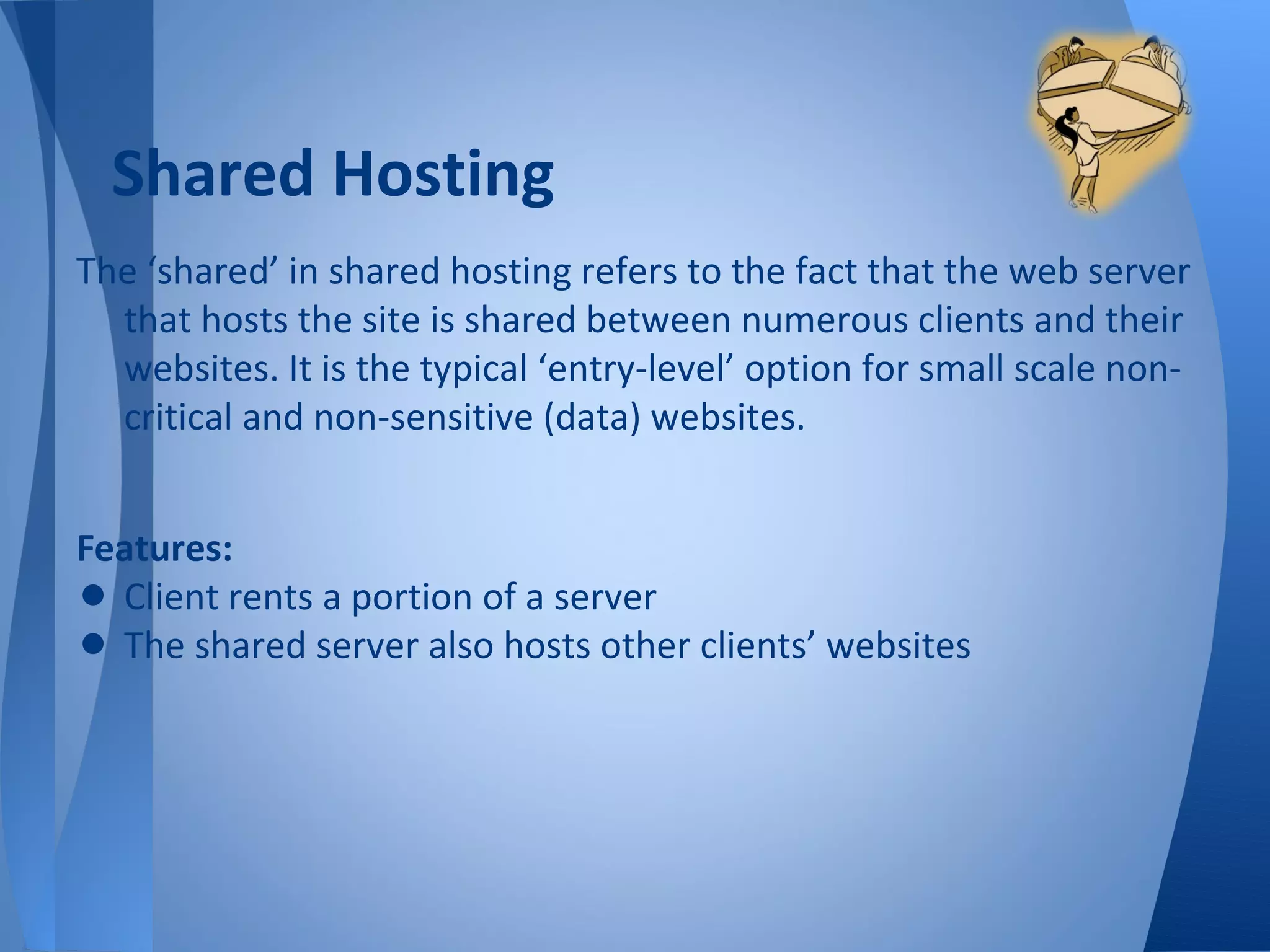
The ‘shared’ in shared hosting refers to the fact that the web server
  that hosts the site is shared between numerous clients and their
  websites. It is the typical ‘entry-level’ option for small scale non-
  critical and non-sensitive (data) websites.


Features:
• Client rents a portion of a server
• The shared server also hosts other clients’ websites
Shared Hosting
Benefits:
  Inexpensive in comparison to other hosting platforms
  Simple hosting platform for clients with limited hosting
  expertise
  Physical security of data center location
  Physical safety of data center location


Drawbacks:
o Higher risk of security issues spreading from other websites
o Higher risk of software failures caused activities by other clients
  etc
o Limited physical resources such as bandwidth and disk space
o Limited scope for configuration of the software platform (
  operating system etc)
Virtual Dedicated Servers
Usually shortened to VPS, this type of hosting still shares a single
  server across multiple sites/clients but each site has its own
  operating system partition and so it offers more control and
  security whilst remaining cost effective.


Features:
• Client rents a virtual partition on a server
• The shared server also hosts other clients’ websites on separate
  partitions
Virtual Dedicated Servers
Benefits:
  Inexpensive in comparison to other hosting platforms
  Allows greater customisation of each operating system
  Physical security of data center location
  Physical safety of data center location


Drawbacks:
o Some risk of security issues spreading from other websites
o Some risk of software failures caused activities by other clients
  etc
o Limited physical resources such as bandwidth and disk space
Dedicated Hosting
Dedicated hosting is popular with larger business clients where
  performance and security are paramount and the budget is in
  place to do pay for it, because it offers complete control, high
  security and uncompromised physical resources.


Features:
• Client rents an entire single server
• Web site has access to all physical resource and connectivity
• Often comes with managed hosting
Dedicated Hosting
Benefits:
  Scope for complete control over server configuration
  No competition for bandwidth resource
  No competition for processor resource
  Access to entire server’s disk space
  No security threats from other sites/partitions on the server


Drawbacks:
o Cost of renting entire server
o Potential for wasted capacity if higher spec hardware is rented
  than the site requires
Co-location
Sometimes referred to as Colocation or simply Colo, this form of
  hosting allows clients to reap the benefits of a data center
  location but still retain ownership of the hardware.


Features:
• Client buys and owns server(s)
• Servers are housed in a data center
• Client rents space for servers
Co-location
Benefits:
  Physical security of data center location
  Physical safety of data center location
  Access to high bandwidth connections
  Retained value of the hardware as company assets


Drawbacks:
o Initial cost of purchasing servers
o Less scalability due to cost of replacing hardware
o Potential for wasted capacity if high spec hardware is purchased
  to future-proof the platform
Cloud Hosting
Cloud hosting essentially uses a large pool of physical hardware and
   resource to build virtualised hosting environments which are
   therefore not restricted to physical limitations. It can provide a
   solution for those who want a flexible platform where complete
   control and customisation is not a requirement.


Features:
• Client rents virtual hosting resource
• Hardware resource taken from multiple servers
• Hosting resource (bandwidth, disk space etc) supplied on
  demand
Cloud Hosting
Benefits:
  Not reliant on one server - less risk of failures/downtime
  Clients only pay for what they use
  Seamlessly scalable - extra virtual resource can be assigned as
  and when it is required


Drawbacks:
o Limitations on the ability to configure the platform
o No scope for customising hardware
o Risk of security issues spreading from other websites
Managed Hosting
Managed hosting is a type of hosting where the features refer to
  the support that the client receives rather than the type of
  server it comes with and therefore it can incorporate any type of
  hosting/server set up such as shared or dedicated. A fully
  managed platform is effectively the deluxe package for clients
  with larger budgets and a shortage of expertise in-house.


Features:
• Expert support and advice
• Technicians available to make configuration changes
• Performance monitoring
• Usually a dedicated server
Managed Hosting
Benefits (depending on the type of support):
  Access to the expertise and knowledge of hosting provider
  Round the clock support in case of performance issues or
  downtime
  Proactive and reactive support for changes in the web site or
  web site usage
  Help to effectively scale and configure platform


Drawbacks:
o Will tend to be expensive in comparison to self-managed
  packages

A Summary of Hosting Packages

  • 1.
    A Summary ofHosting Packages © Stuart Mitchell
  • 2.
    Introduction This slideshow outlinesthe various types of web hosting available on the market. For each hosting platform the following slides highlight: • features • benefits • drawbacks It is important to bear in mind what you actually need from your hosting provider when you weigh these up. Broadly, the two areas to consider are • performance & uptime • cost
  • 3.
    Hosting Considerations Depending onthe type of hosting package in question, the other features to consider are: • the ability to control and customise hardware and software if the site needs bespoke or non-standard configurations • the access to bandwidth - high bandwidth connections allow large amounts of traffic to flow quickly to and from the web server and so are more important for websites which experience high traffic volumes (i.e., page requests) or need to display a lot of content • the amount of disk space (i.e., storage) on offer which will determine how big the site can grow and how much content can be stored • the digital security of the platform, especially for sites that are obtaining or using sensitive data such as e-commerce sites.
  • 4.
    Background to DataCentres Data centres are purpose built facilities which are designed to house servers which meet these aims at affordable costs for the clients. They offer: • complex security and safety systems o to ensure that the servers are not compromised whilst they are running • extensive systems in place to generate the optimal conditions o e.g., heat and humidity o for the servers to run smoothly and efficiently
  • 5.
    Shared Hosting The ‘shared’in shared hosting refers to the fact that the web server that hosts the site is shared between numerous clients and their websites. It is the typical ‘entry-level’ option for small scale non- critical and non-sensitive (data) websites. Features: • Client rents a portion of a server • The shared server also hosts other clients’ websites
  • 6.
    Shared Hosting Benefits:  Inexpensive in comparison to other hosting platforms  Simple hosting platform for clients with limited hosting expertise  Physical security of data center location  Physical safety of data center location Drawbacks: o Higher risk of security issues spreading from other websites o Higher risk of software failures caused activities by other clients etc o Limited physical resources such as bandwidth and disk space o Limited scope for configuration of the software platform ( operating system etc)
  • 7.
    Virtual Dedicated Servers Usuallyshortened to VPS, this type of hosting still shares a single server across multiple sites/clients but each site has its own operating system partition and so it offers more control and security whilst remaining cost effective. Features: • Client rents a virtual partition on a server • The shared server also hosts other clients’ websites on separate partitions
  • 8.
    Virtual Dedicated Servers Benefits:  Inexpensive in comparison to other hosting platforms  Allows greater customisation of each operating system  Physical security of data center location  Physical safety of data center location Drawbacks: o Some risk of security issues spreading from other websites o Some risk of software failures caused activities by other clients etc o Limited physical resources such as bandwidth and disk space
  • 9.
    Dedicated Hosting Dedicated hostingis popular with larger business clients where performance and security are paramount and the budget is in place to do pay for it, because it offers complete control, high security and uncompromised physical resources. Features: • Client rents an entire single server • Web site has access to all physical resource and connectivity • Often comes with managed hosting
  • 10.
    Dedicated Hosting Benefits:  Scope for complete control over server configuration  No competition for bandwidth resource  No competition for processor resource  Access to entire server’s disk space  No security threats from other sites/partitions on the server Drawbacks: o Cost of renting entire server o Potential for wasted capacity if higher spec hardware is rented than the site requires
  • 11.
    Co-location Sometimes referred toas Colocation or simply Colo, this form of hosting allows clients to reap the benefits of a data center location but still retain ownership of the hardware. Features: • Client buys and owns server(s) • Servers are housed in a data center • Client rents space for servers
  • 12.
    Co-location Benefits:  Physicalsecurity of data center location  Physical safety of data center location  Access to high bandwidth connections  Retained value of the hardware as company assets Drawbacks: o Initial cost of purchasing servers o Less scalability due to cost of replacing hardware o Potential for wasted capacity if high spec hardware is purchased to future-proof the platform
  • 13.
    Cloud Hosting Cloud hostingessentially uses a large pool of physical hardware and resource to build virtualised hosting environments which are therefore not restricted to physical limitations. It can provide a solution for those who want a flexible platform where complete control and customisation is not a requirement. Features: • Client rents virtual hosting resource • Hardware resource taken from multiple servers • Hosting resource (bandwidth, disk space etc) supplied on demand
  • 14.
    Cloud Hosting Benefits:  Not reliant on one server - less risk of failures/downtime  Clients only pay for what they use  Seamlessly scalable - extra virtual resource can be assigned as and when it is required Drawbacks: o Limitations on the ability to configure the platform o No scope for customising hardware o Risk of security issues spreading from other websites
  • 15.
    Managed Hosting Managed hostingis a type of hosting where the features refer to the support that the client receives rather than the type of server it comes with and therefore it can incorporate any type of hosting/server set up such as shared or dedicated. A fully managed platform is effectively the deluxe package for clients with larger budgets and a shortage of expertise in-house. Features: • Expert support and advice • Technicians available to make configuration changes • Performance monitoring • Usually a dedicated server
  • 16.
    Managed Hosting Benefits (dependingon the type of support):  Access to the expertise and knowledge of hosting provider  Round the clock support in case of performance issues or downtime  Proactive and reactive support for changes in the web site or web site usage  Help to effectively scale and configure platform Drawbacks: o Will tend to be expensive in comparison to self-managed packages