October 2011


ZendDi
Who Am I?


    •Ralph Schindler (ralphschindler)
     Software Engineer on the Zend Framework team
      •At Zend for almost 4 years
      •Before that TippingPoint/3Com
    Programming PHP for 13+ years
    Live in New Orleans, LA.
      •Lived in Austin, Tx for 5 years

    My background with Di
      •I was part of the original roundtable 3yr ago @ zendcon
       –Fabien + Stephan + Myself
2
First Some Background


    •Background
     Di Definitions
     Some generic patterns


3
Dependency Injection


    •Subject matter expert: Martin Fowler
     not the only one, but has a nice take on it
    •http://martinfowler.com/articles/
     injection.html


4
Di vs. DiC
    •Di is a pattern
     This is non-negotiable
     DI is about Inversion Of Control (IoC)
       –sometimes not an easy concept to grasp for
        beginner and intermediate developers
    •DiC is a tool
     Subject to a developer’s or a group of
     developers requirements
     I.E.: no formal definition
      •as such, lots of frameworks provide this in some
       way shape or form
5
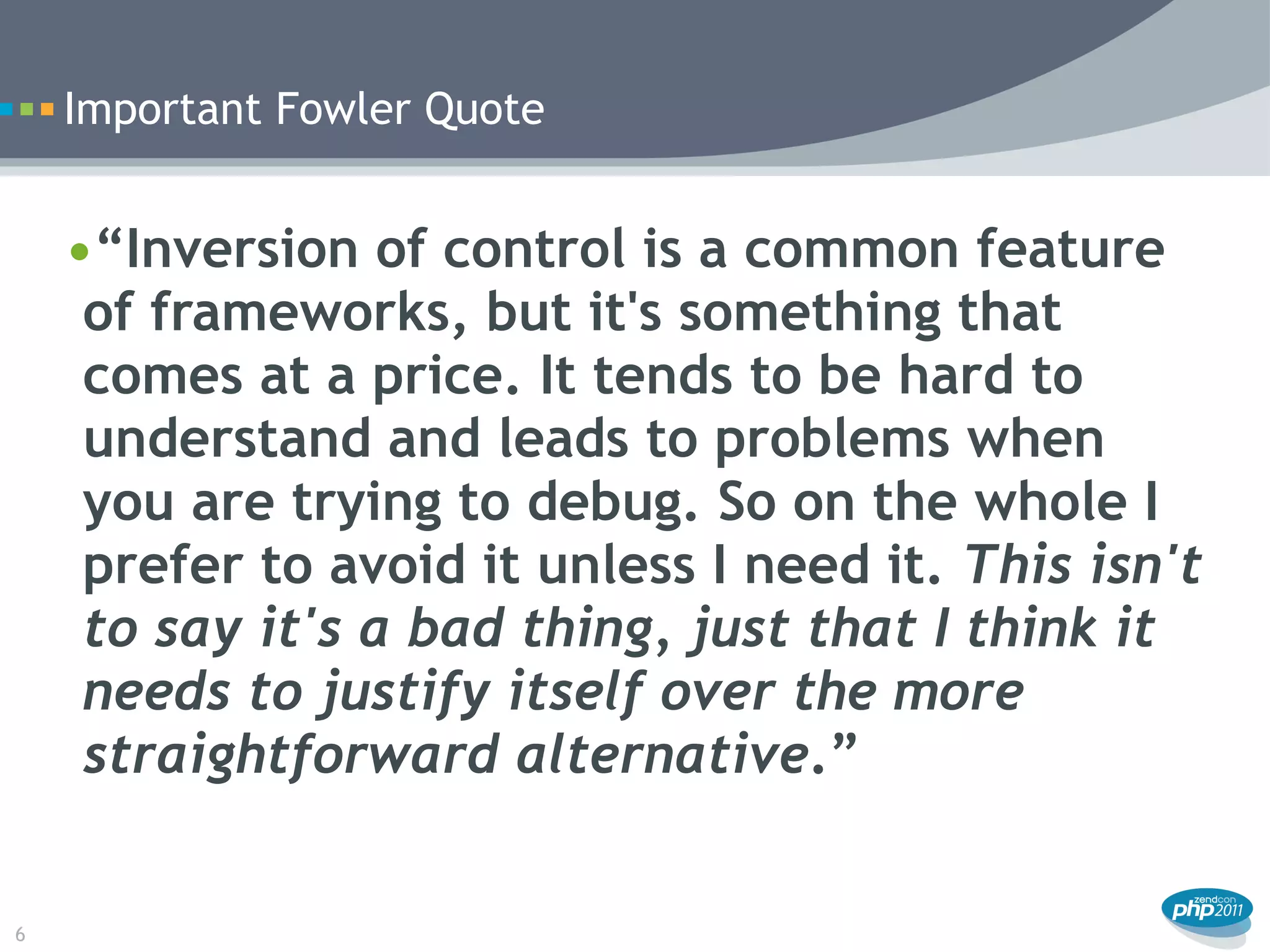
Important Fowler Quote


    •“Inversion of control is a common feature
     of frameworks, but it's something that
     comes at a price. It tends to be hard to
     understand and leads to problems when
     you are trying to debug. So on the whole I
     prefer to avoid it unless I need it. This isn't
     to say it's a bad thing, just that I think it
     needs to justify itself over the more
     straightforward alternative.”


6
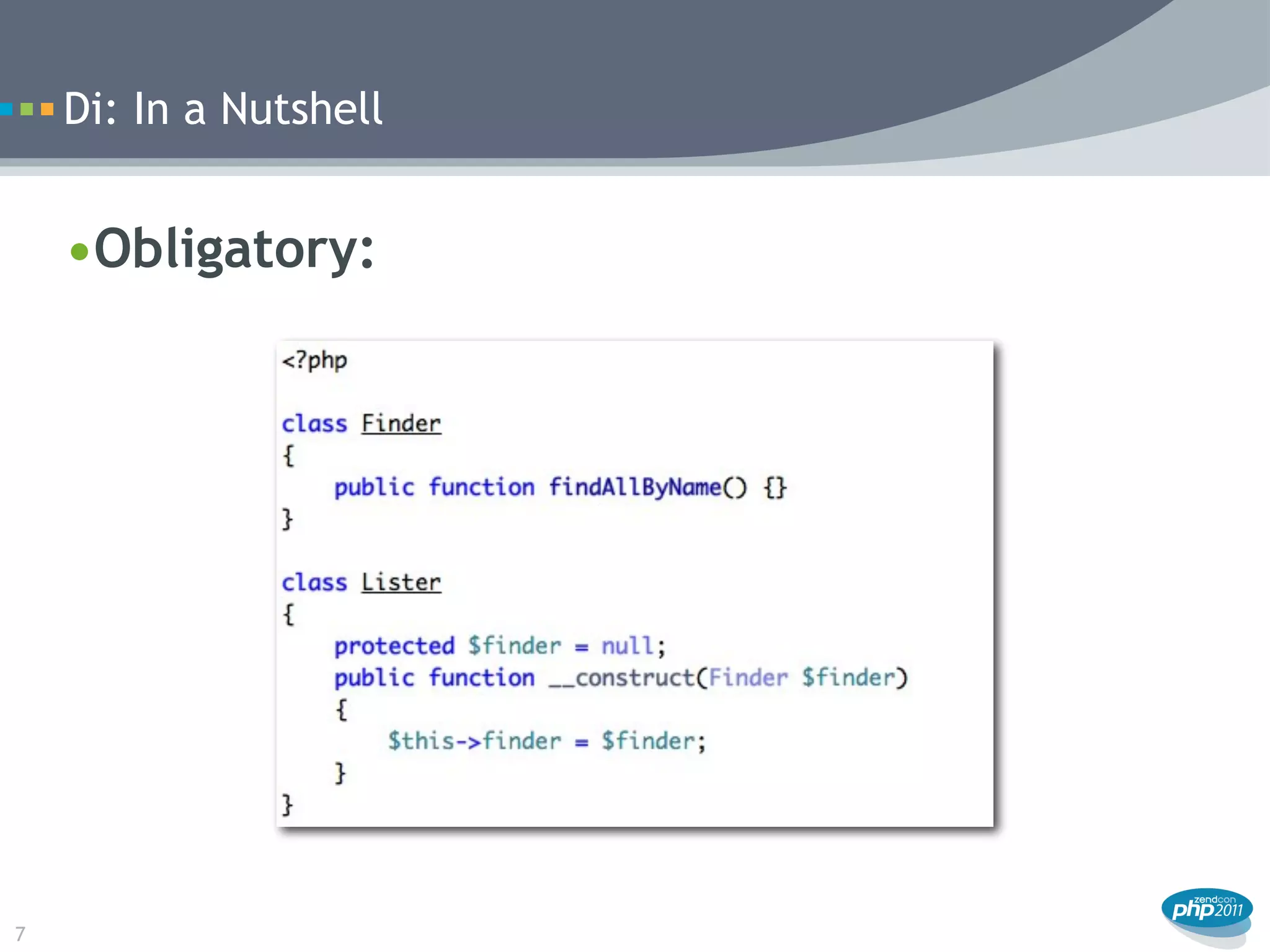
Di: In a Nutshell


    •Obligatory:


7
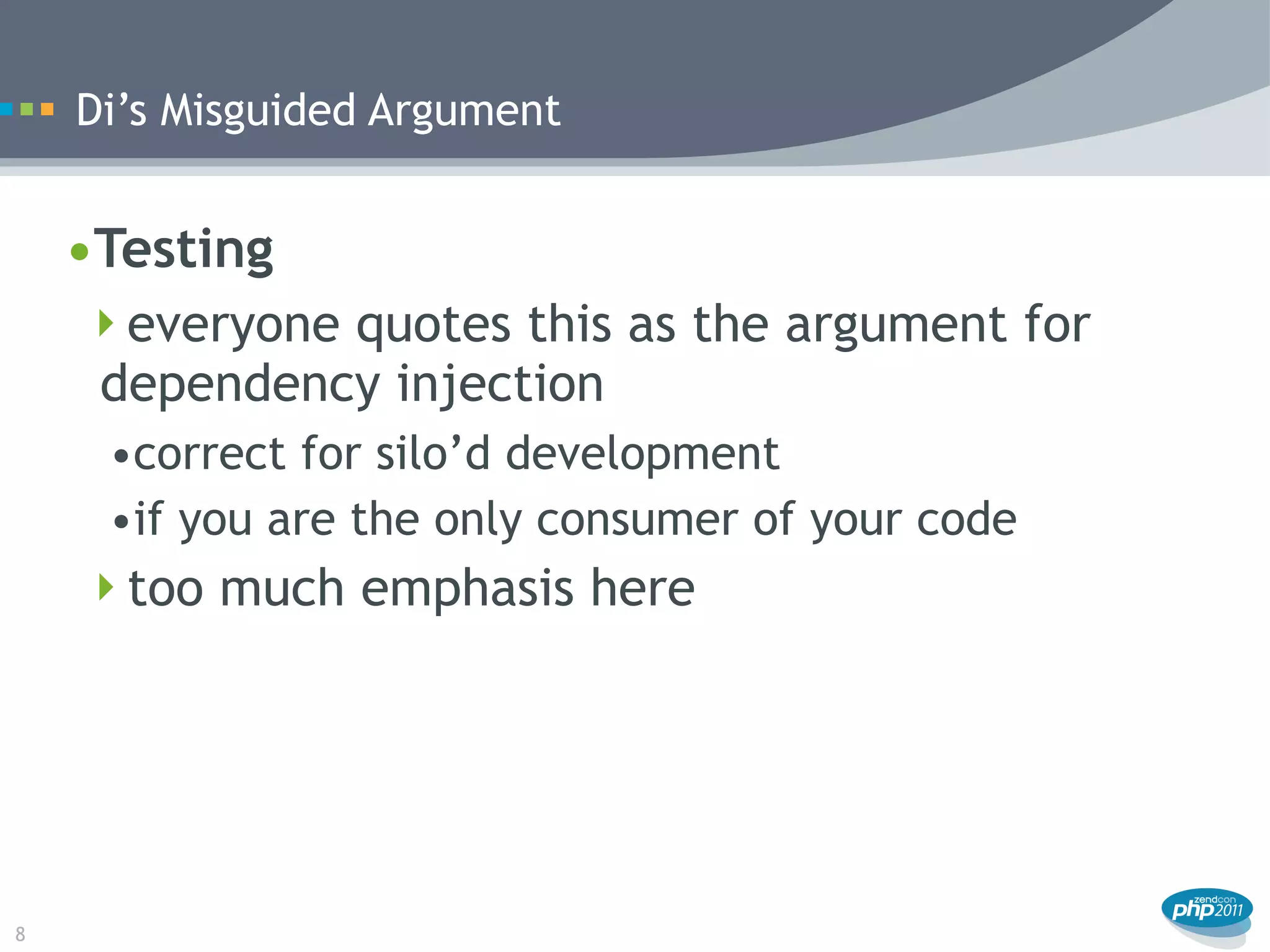
Di’s Misguided Argument


    •Testing
     everyone quotes this as the argument for
     dependency injection
     •correct for silo’d development
     •if you are the only consumer of your code
    too much emphasis here


8
The Better Di Argument


      •Makes it easy for developers to swap
       out implementation
      •Paddy Brady:
       ... “it helps ensure source code can be
        maintained in a highly decoupled state.
        Which make it easier to subclass the Zend
        Framework to death, and modify it’s
        components before use.”


9
Di Identified Types


     •Constructor
      Favored by PicoContainer derivatives
     •Setter
      Favored by Spring Container derivatives


10
Di 3rd Injection Type


     •Interface Injection
      but first as segue ...


11
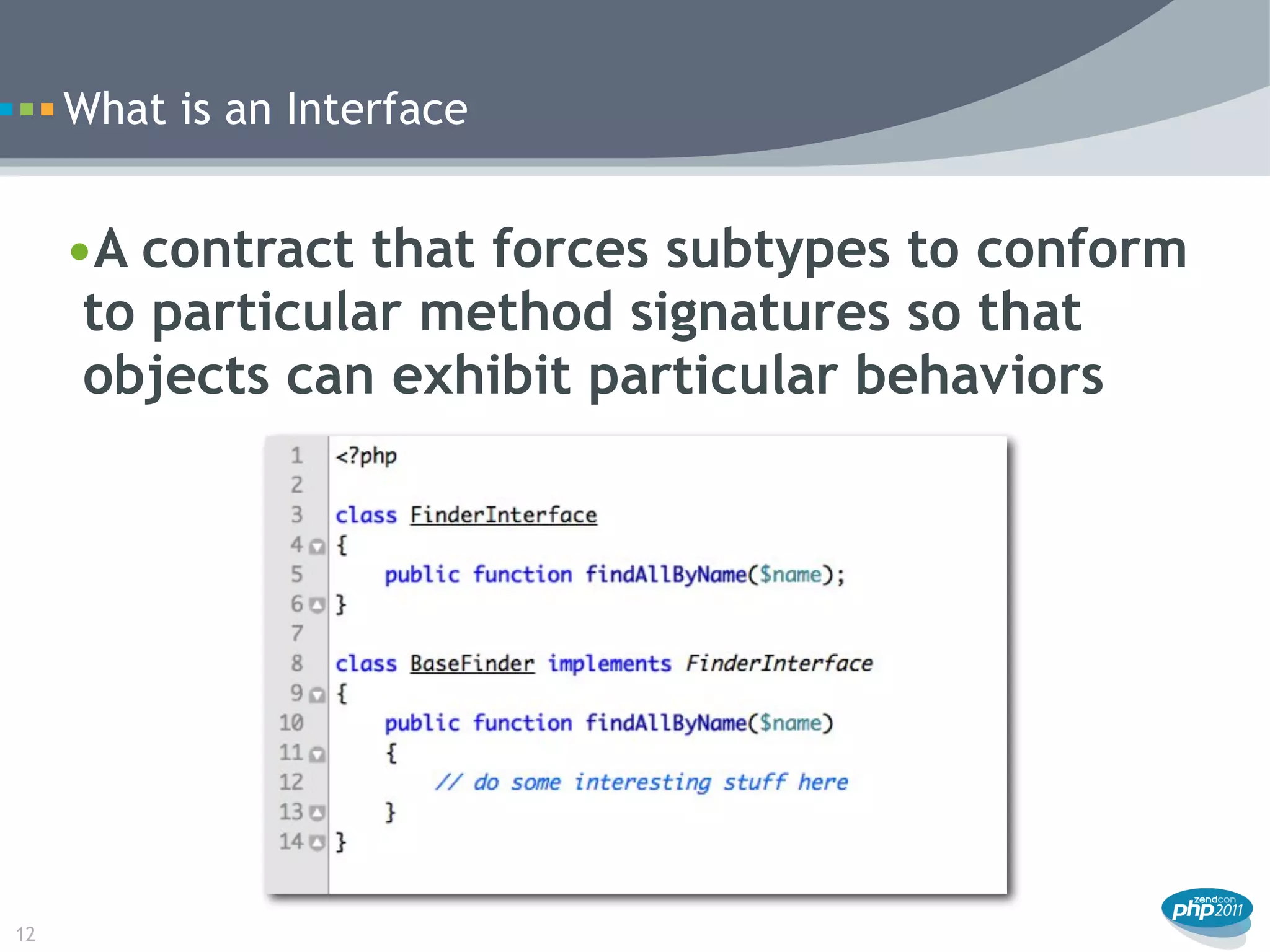
What is an Interface


     •A contract that forces subtypes to conform
      to particular method signatures so that
      objects can exhibit particular behaviors


12
Interfaces


     •Interface best practices
      No constructors
      No static methods
     •Why? Because interfaces are about
      “alternate implementations”
     •PHP allows statics and constructors in
      interfaces
      for better or worse


13
Interfaces explained


     •A better way to think about it
      Interfaces are about contracts in behavior
      between developers
      Point in case, search for “friends” in this
      page:
       •http://martinfowler.com/articles/injection.html


14
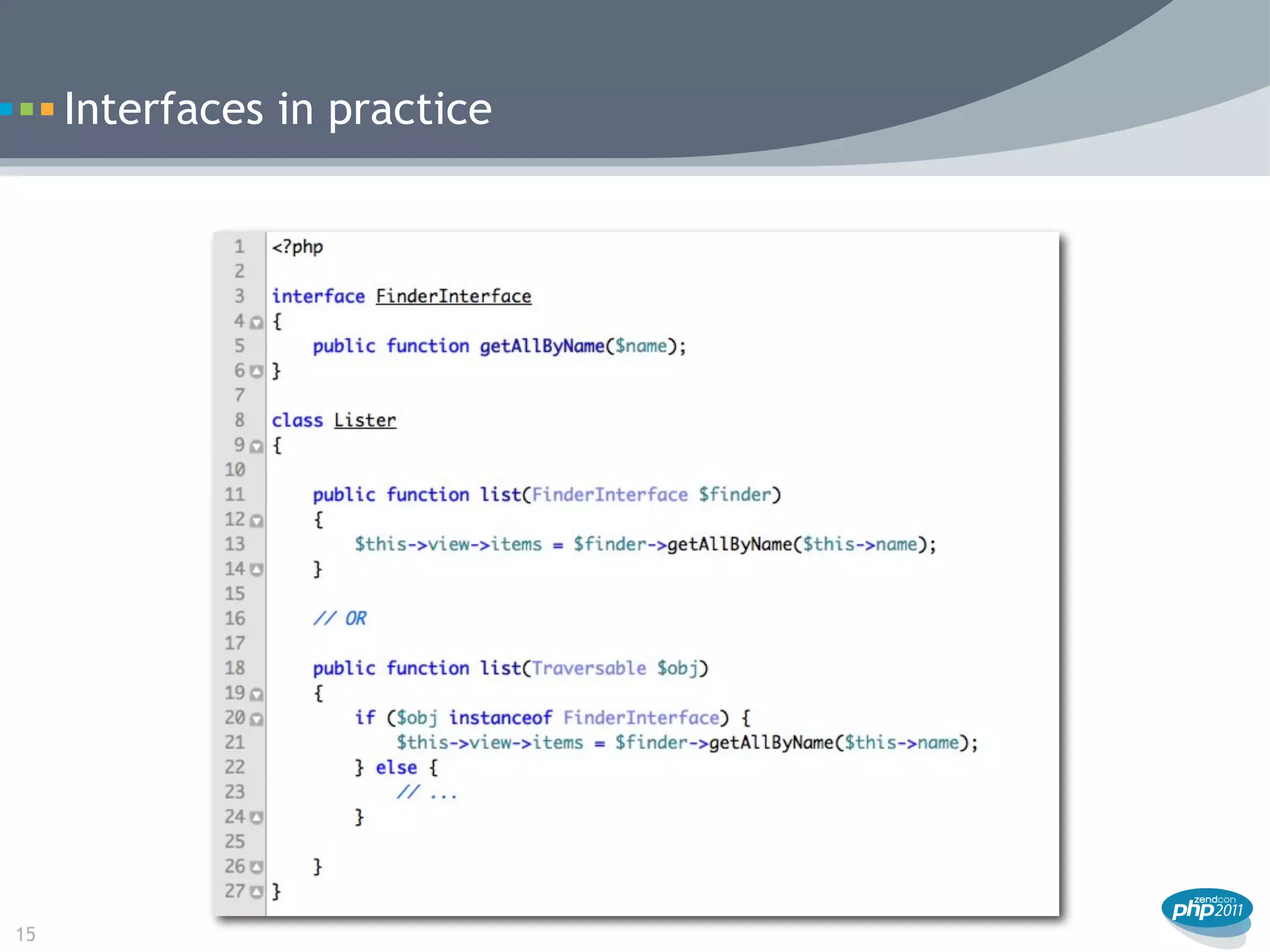
Interfaces in practice


15
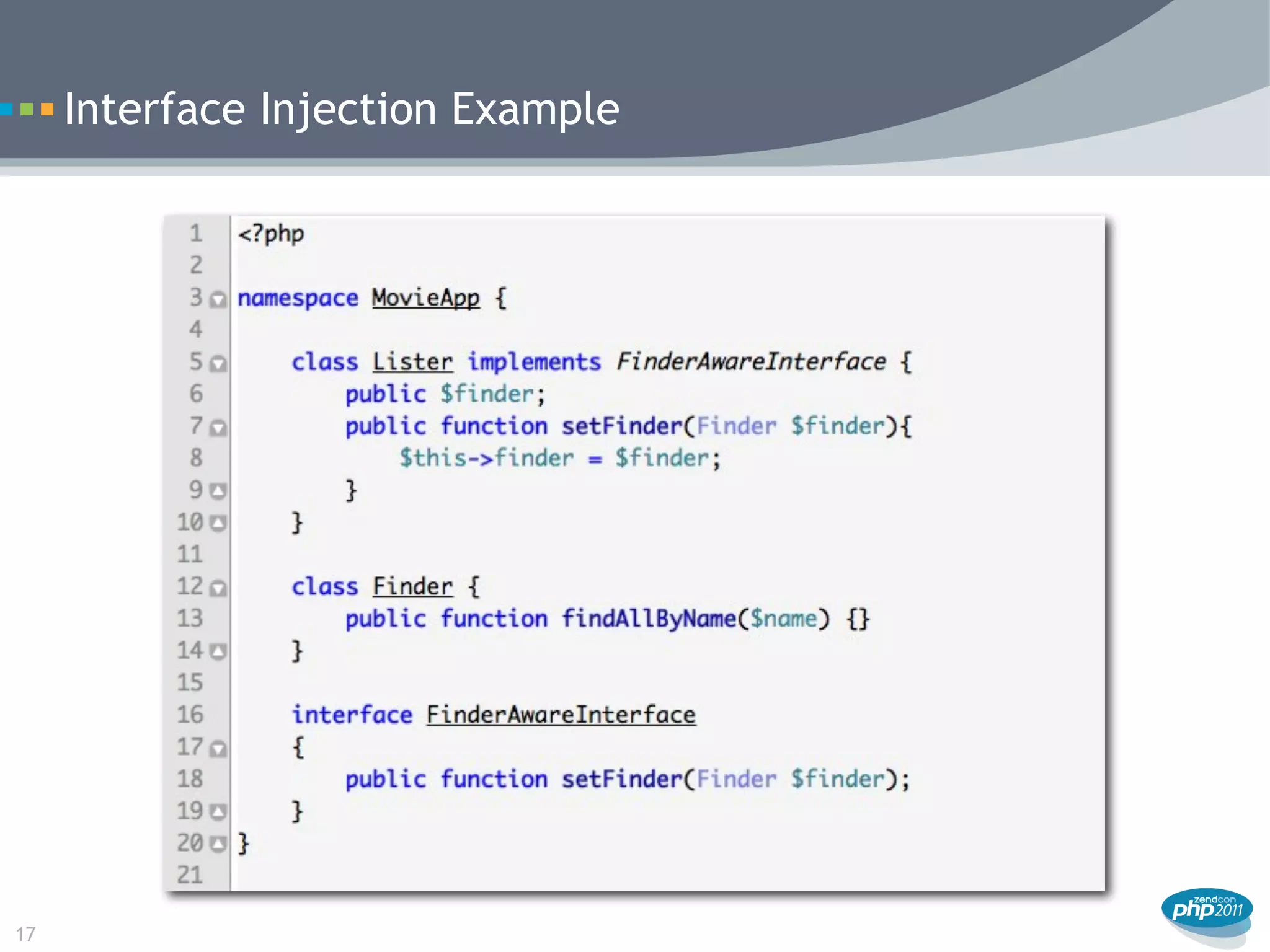
Back To Interface Injection


     •First and foremost: a communication tool
     •Form of setter injection (or, injection via
      method)
     •The dependency is implied by the
      interface and the injection point is forced
      by the interface
      Always part of the type’s hierarchy
     •Rely’s on a managing/consuming object/
      framework for execution - or a really strict
      developer
16
Interface Injection Example


17
Interface Injection Pattern


     •Not formal / it is semi-de-facto
     •Interface injection is tricker to understand
      without context
     •(Semi) Well known pattern at play
      the “Aware” interface name


18
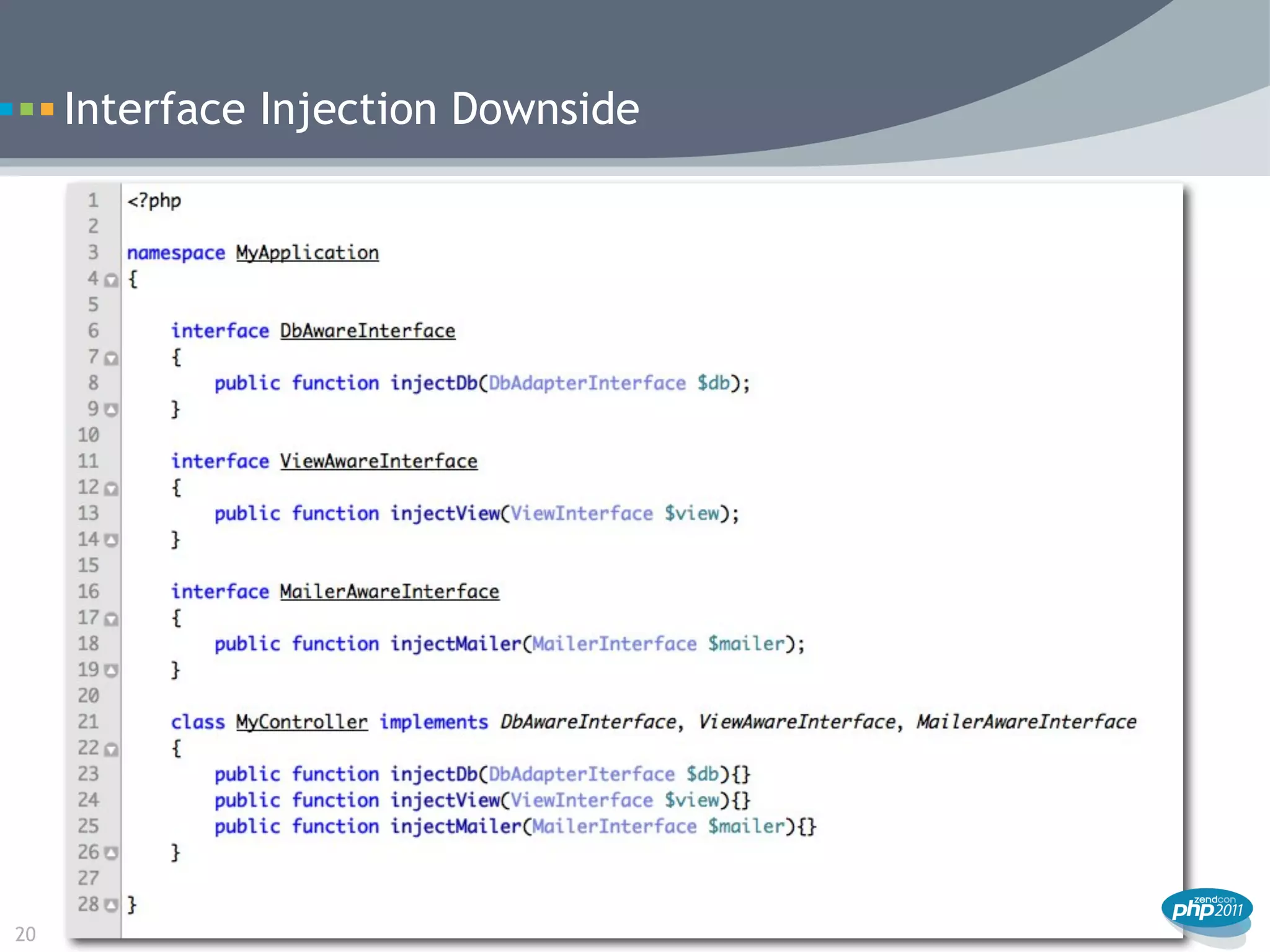
Interface Injection Downside


     •At the application layer, it leads to having
      to write and consume lots of interfaces to
      get things sorted out


19
Interface Injection Downside


20
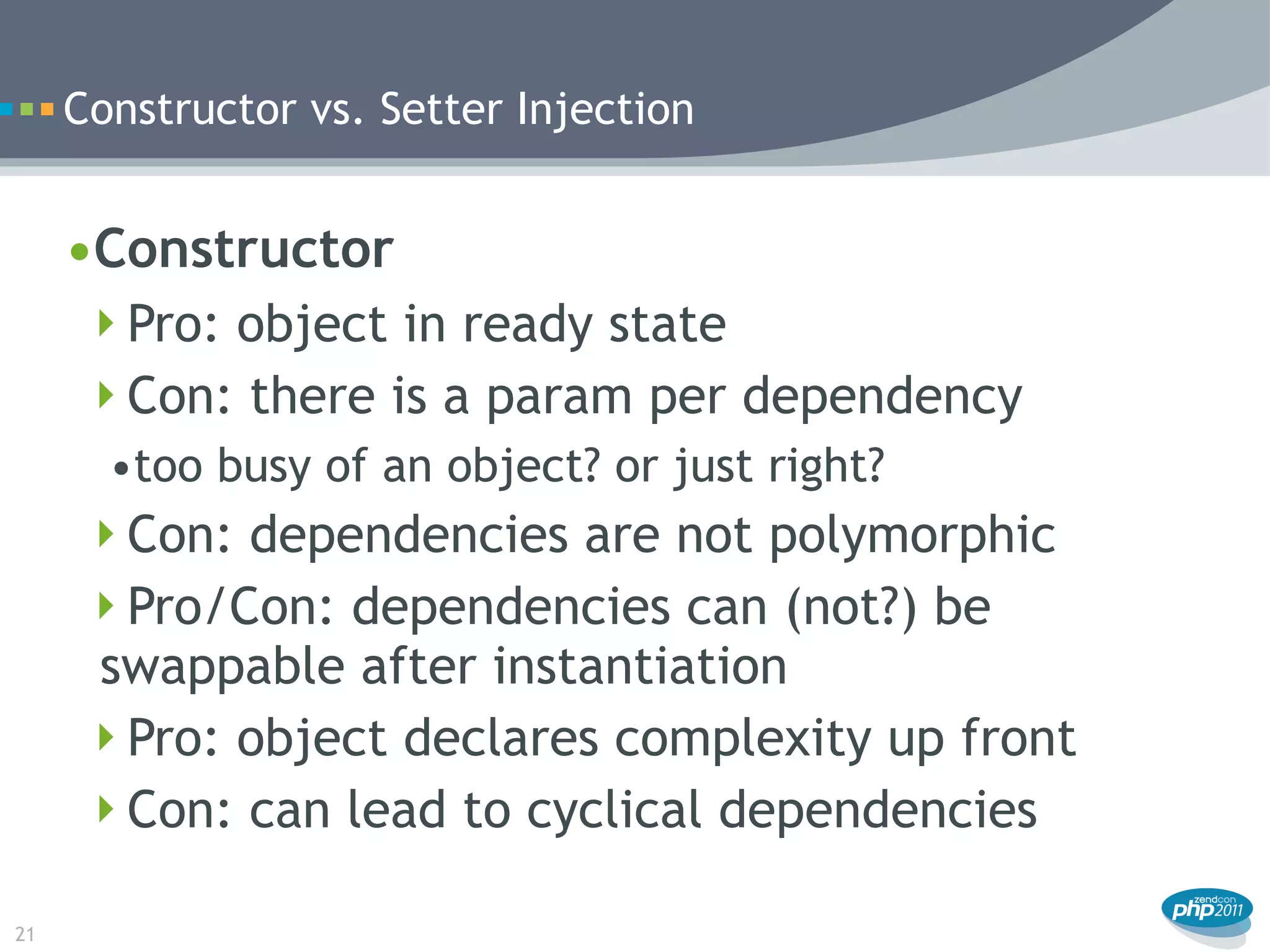
Constructor vs. Setter Injection


     •Constructor
      Pro: object in ready state
      Con: there is a param per dependency
       •too busy of an object? or just right?
     Con: dependencies are not polymorphic
     Pro/Con: dependencies can (not?) be
     swappable after instantiation
     Pro: object declares complexity up front
     Con: can lead to cyclical dependencies

21
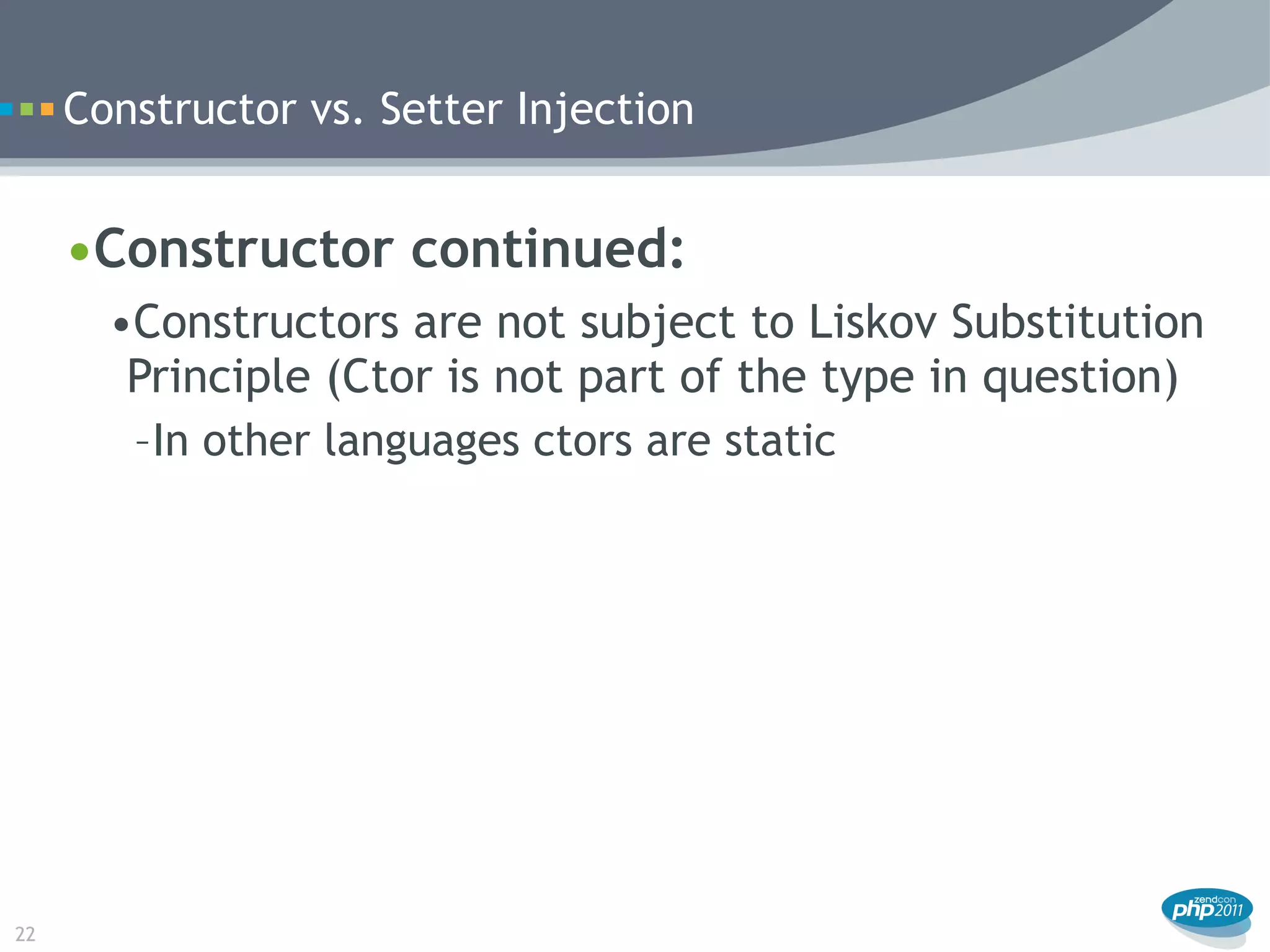
Constructor vs. Setter Injection


     •Constructor continued:
       •Constructors are not subject to Liskov Substitution
        Principle (Ctor is not part of the type in question)
        –In other languages ctors are static


22
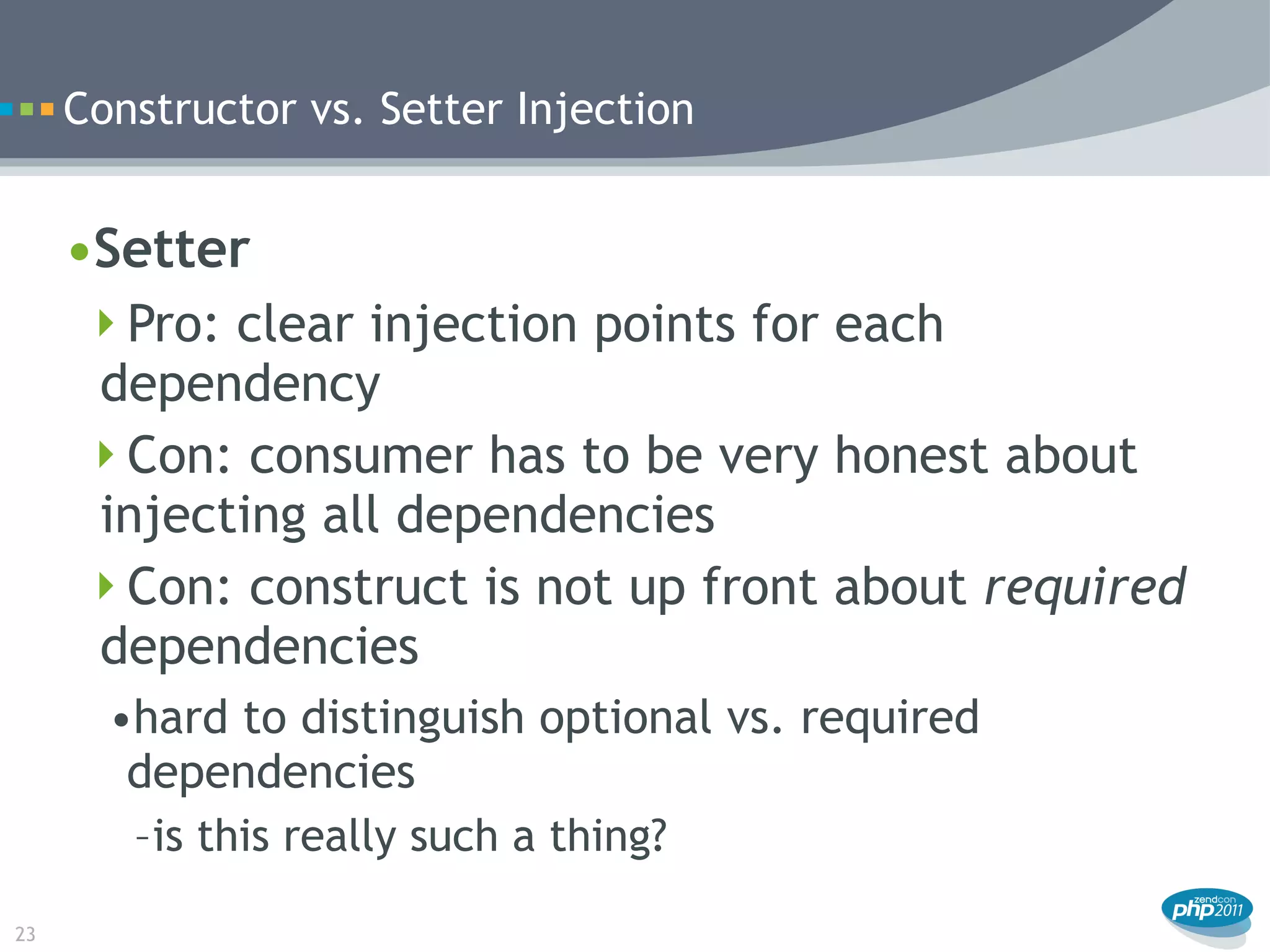
Constructor vs. Setter Injection


     •Setter
      Pro: clear injection points for each
      dependency
      Con: consumer has to be very honest about
      injecting all dependencies
      Con: construct is not up front about required
      dependencies
       •hard to distinguish optional vs. required
        dependencies
        –is this really such a thing?

23
Misconceptions?


     •(SL) Service Locators !== (DiC) Dependency
      Injection Containers
     •But DiC == SL
      DiC’s can be the foundation of consumed for
       service location


24
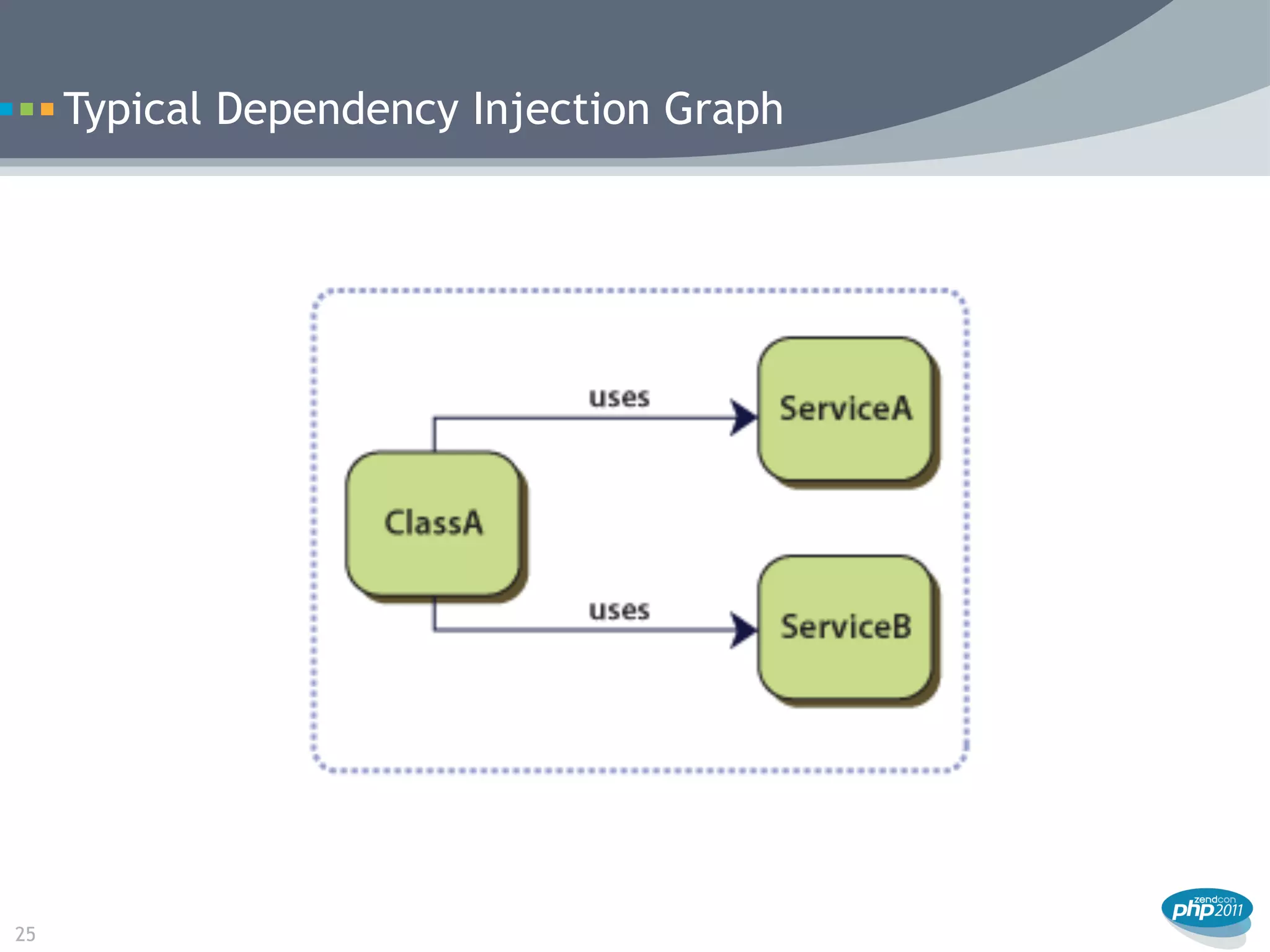
Typical Dependency Injection Graph


25
Service Locator


     •It is understood that services to be locator
      aware
     •Pros:
      not all code paths in the consuming object
       might use all the dependencies
       •Example: controller
     •Cons:
      service locator becomes the dependency


26
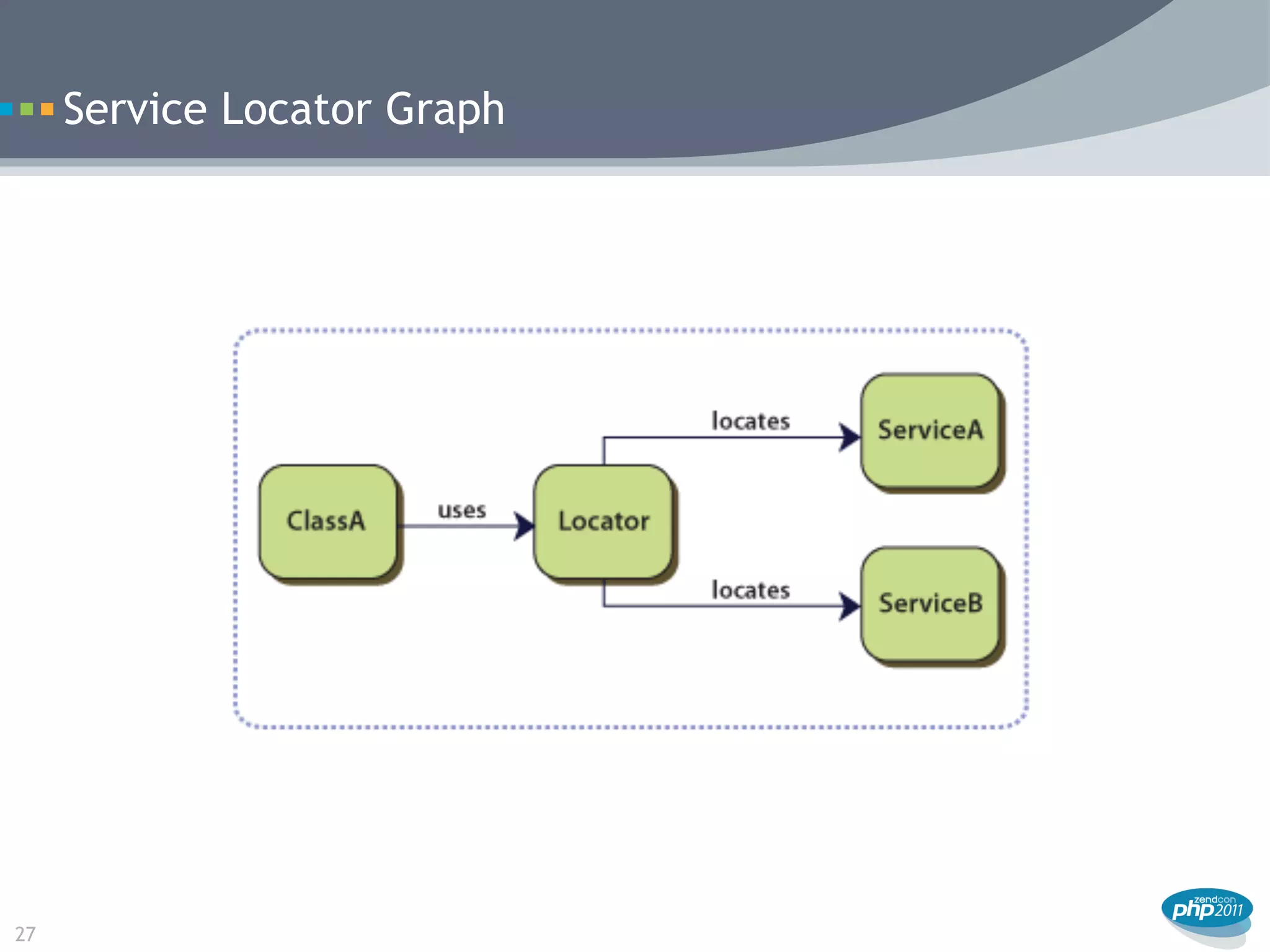
Service Locator Graph


27
•ZendDi


28
Why Di For Zend


     •Considering a DiC is a first world problem
      for developers
     •Why did we create this component?
      You’re afraid of “new”?
      You asked for it
     •Having a DI Container that tries to
      understand your code makes you code
      better


29
Questions Raised


     •But is it really possible to force developers
      to write better code?
     •How do we look at a use case and tell if
      the DiC is falling short, or the developer is
      writing bad code?
      There is a fine line


30
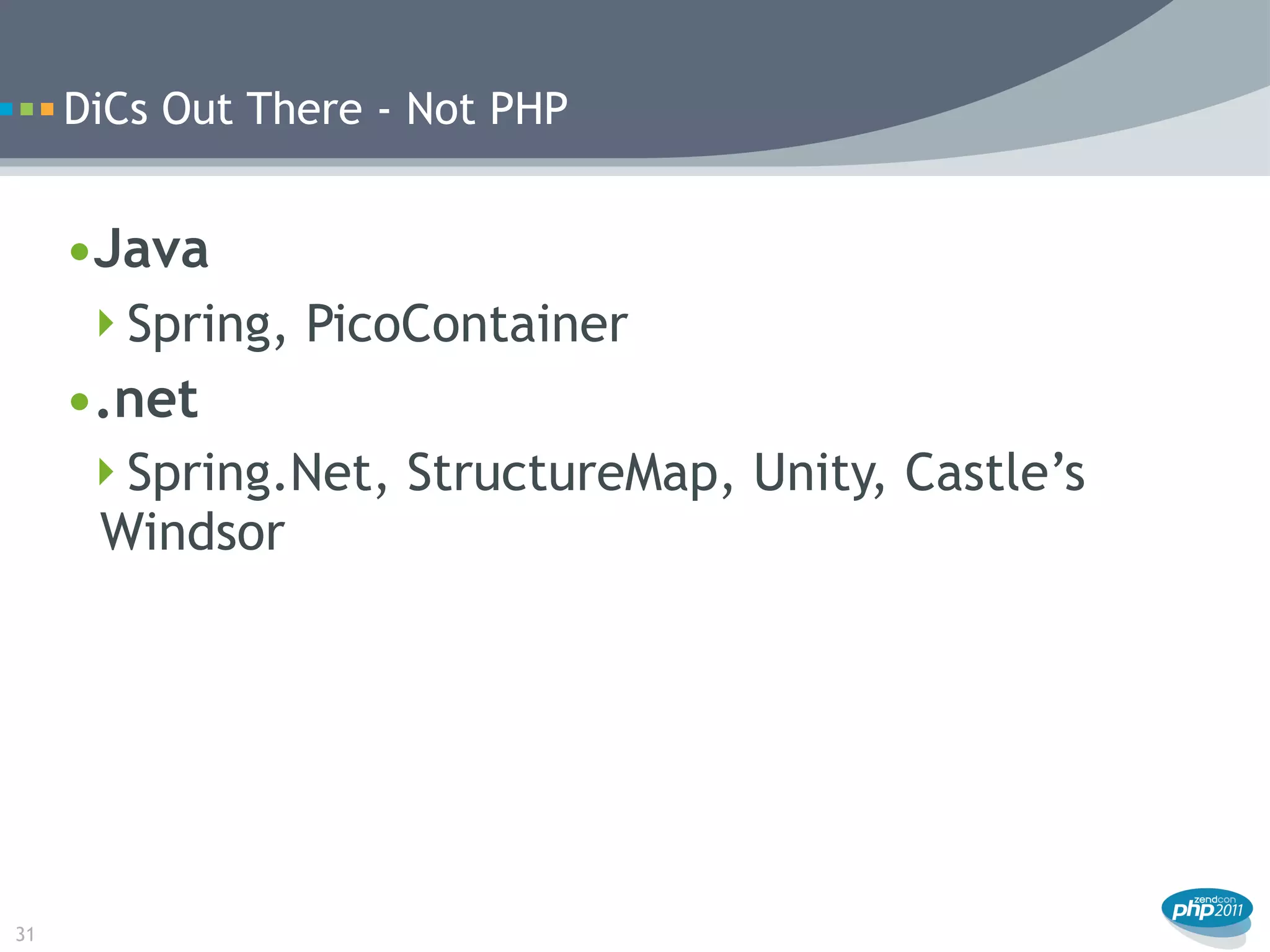
DiCs Out There - Not PHP


     •Java
      Spring, PicoContainer
     •.net
      Spring.Net, StructureMap, Unity, Castle’s
      Windsor


31
ZendDi perspective


     •we support both:
      "This issue has led to a lot of debate between
      the various teams who provide dependency
      injectors as part of their frameworks. However
      it seems that most people who build these
      frameworks have realized that it's important to
      support both mechanisms, even if there's a
      preference for one of them."
       •-Martin Fowler


32
Developing ZendDi


     •Development of ZendDi


33
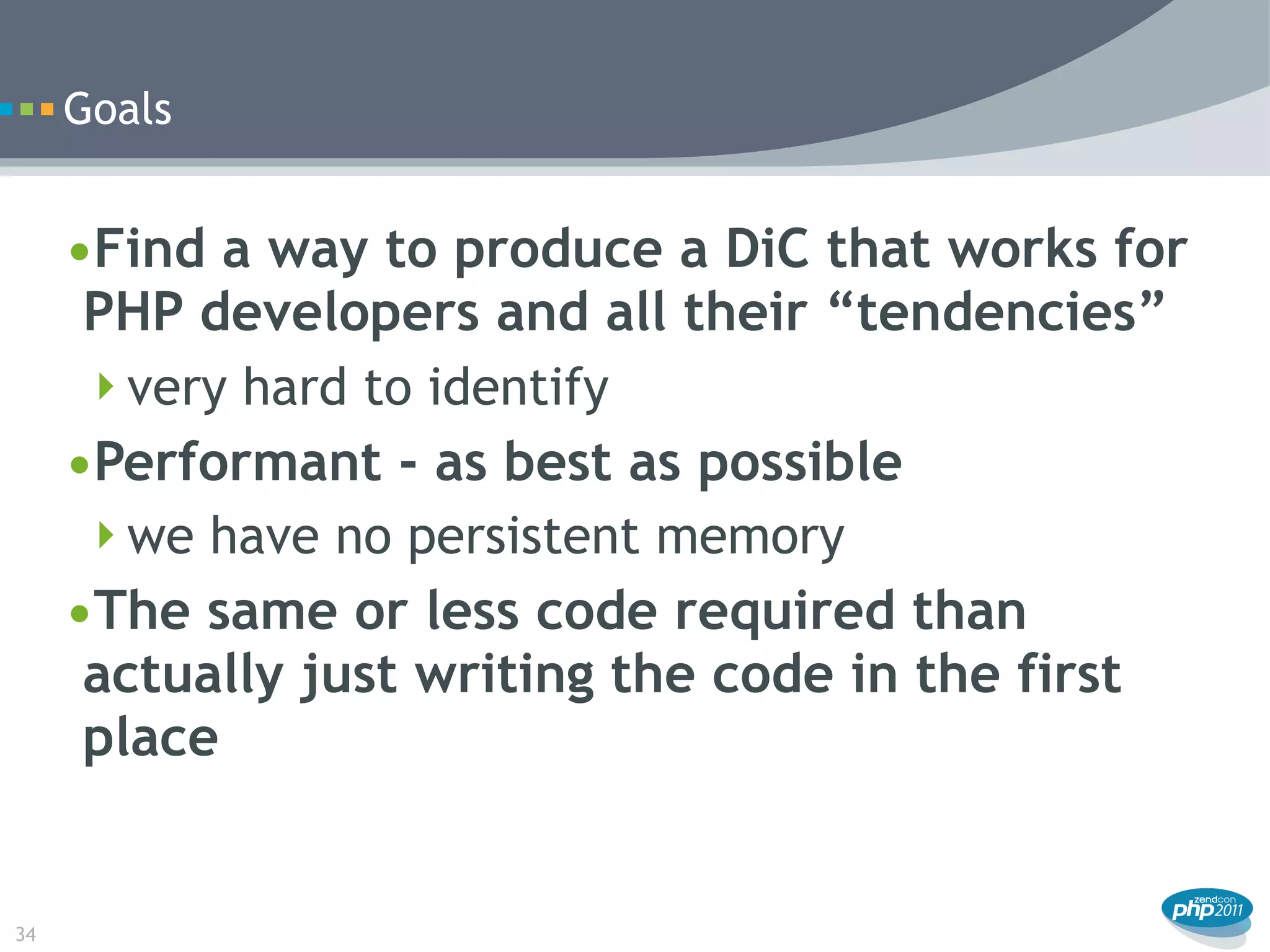
Goals


     •Find a way to produce a DiC that works for
      PHP developers and all their “tendencies”
      very hard to identify
     •Performant - as best as possible
      we have no persistent memory
     •The same or less code required than
      actually just writing the code in the first
      place


34
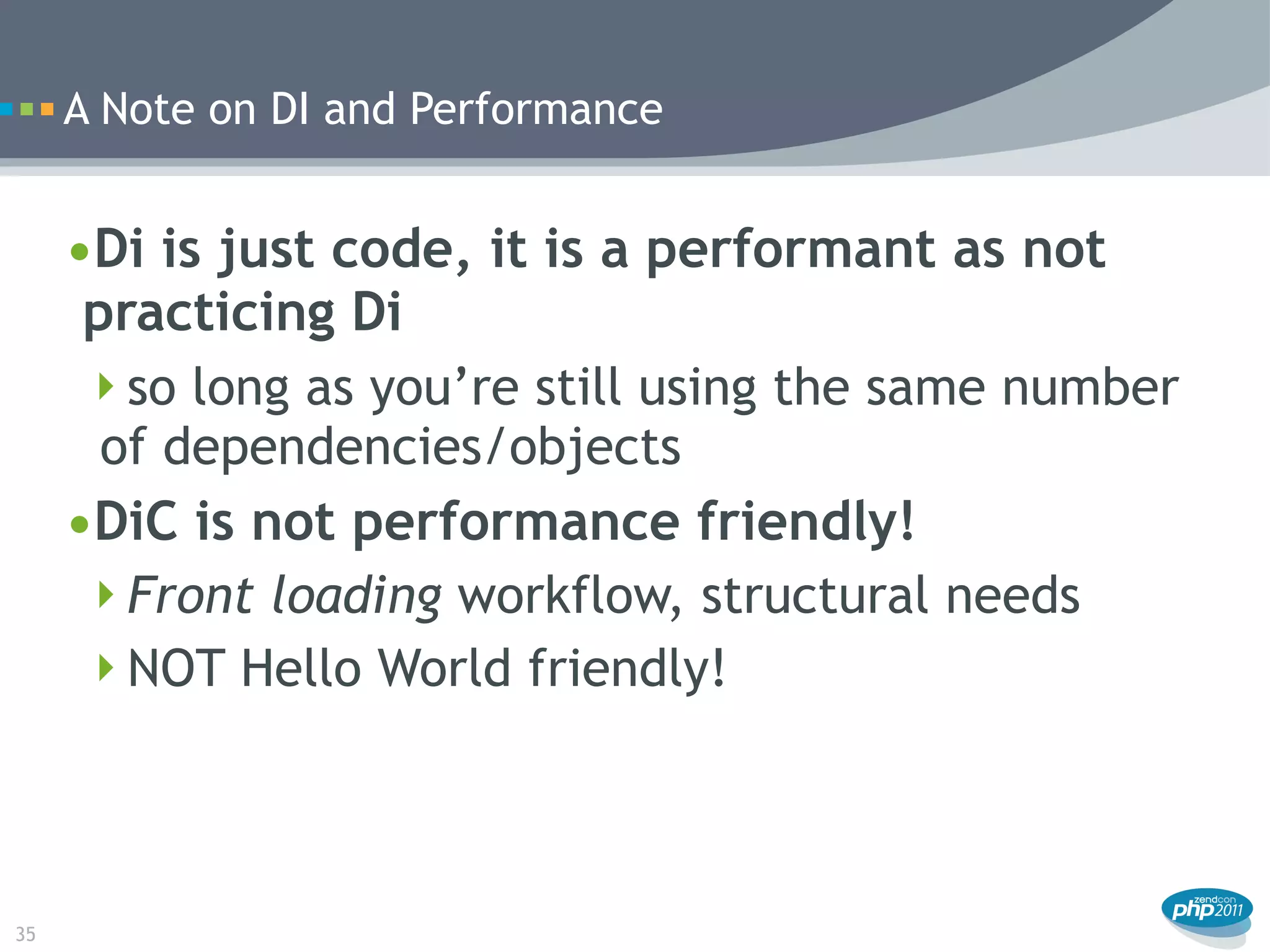
A Note on DI and Performance


     •Di is just code, it is a performant as not
      practicing Di
      so long as you’re still using the same number
       of dependencies/objects
     •DiC is not performance friendly!
      Front loading workflow, structural needs
      NOT Hello World friendly!


35
ZendDi Parts


     •Two main components
      Definition
      Instance Configuration
       •Runtime concerns


36
ZendDi Definition


     •Goals
      Explain what the code looks like, what it
      expects
      Identify which classes have dependencies
      Identify injection points
      Names for all the moving parts


37
ZendDi Definition


     •Instantiation:
      Constructor (new keyword)
      Callback (factory pattern)
       •Via object factory
       •Via static factory method


38
ZendDi Definition


     •From a very fundamental level, injection
      always comes in the two forms
      Via constructor params
      Via method injection
     •We (currently) do not support public
      property setting


39
ZendDi Definition


     •Naming dependency/configuration entry
      points
      Is an object expected? Is there a type hint?
       •Where does it originate from?
     Is a scalar expected? Is it optional?


40
ZendDi Configuration


     •Goals
      Encapsulate runtime data required to wire
      instances
       •Could be environment specific (dev. different than
        production)
     Be able to identify which objects fulfill a
      dependency (preferred types)


41
Definition & Configuration


     •A better understanding:
      Definitions can be shipped with your code,
      they are independent of how they are used
      Configuration is what is expected of anyone
      consuming ZendDi


42
Building Definitions


     •At Runtime (on-demand)
      Great for development, terrible for
      production, esp. with annotations turned on
     •Compiler (Reflection+Scanner)
      (yesterday’s talk on ZendCode)
      Compiled into an array; used with
      ArrayDefinition
     •By-Hand
      ClassDefinition
      BuilderDefinition
43
Demo Time


     •Live Demo Time

     •Code:
      https://github.com/ralphschindler/Zend_DI-
      Examples
      Uses ZF2 Beta Phars


44
Other Containers


     •Yadif (beberlei)
     •Pimple (Fabien Potencier)
     •Symfony Di Container for 5.3
     •PicoContainer
      more than 5 years old


45
ZendDi Todo


     •Further divorce the Service Locator /
      Dependency Injection Container
     •Service locators can be defined by
      callbacks (closures)


46
Thanks!


     •Questions, Concerns?
     •Thanks!


47

Zend Di in ZF 2.0

  • 1.
  • 2.
    Who Am I? •Ralph Schindler (ralphschindler) Software Engineer on the Zend Framework team •At Zend for almost 4 years •Before that TippingPoint/3Com Programming PHP for 13+ years Live in New Orleans, LA. •Lived in Austin, Tx for 5 years My background with Di •I was part of the original roundtable 3yr ago @ zendcon –Fabien + Stephan + Myself 2
  • 3.
    First Some Background •Background Di Definitions Some generic patterns 3
  • 4.
    Dependency Injection •Subject matter expert: Martin Fowler not the only one, but has a nice take on it •http://martinfowler.com/articles/ injection.html 4
  • 5.
    Di vs. DiC •Di is a pattern This is non-negotiable DI is about Inversion Of Control (IoC) –sometimes not an easy concept to grasp for beginner and intermediate developers •DiC is a tool Subject to a developer’s or a group of developers requirements I.E.: no formal definition •as such, lots of frameworks provide this in some way shape or form 5
  • 6.
    Important Fowler Quote •“Inversion of control is a common feature of frameworks, but it's something that comes at a price. It tends to be hard to understand and leads to problems when you are trying to debug. So on the whole I prefer to avoid it unless I need it. This isn't to say it's a bad thing, just that I think it needs to justify itself over the more straightforward alternative.” 6
  • 7.
    Di: In aNutshell •Obligatory: 7
  • 8.
    Di’s Misguided Argument •Testing everyone quotes this as the argument for dependency injection •correct for silo’d development •if you are the only consumer of your code too much emphasis here 8
  • 9.
    The Better DiArgument •Makes it easy for developers to swap out implementation •Paddy Brady: ... “it helps ensure source code can be maintained in a highly decoupled state. Which make it easier to subclass the Zend Framework to death, and modify it’s components before use.” 9
  • 10.
    Di Identified Types •Constructor Favored by PicoContainer derivatives •Setter Favored by Spring Container derivatives 10
  • 11.
    Di 3rd InjectionType •Interface Injection but first as segue ... 11
  • 12.
    What is anInterface •A contract that forces subtypes to conform to particular method signatures so that objects can exhibit particular behaviors 12
  • 13.
    Interfaces •Interface best practices No constructors No static methods •Why? Because interfaces are about “alternate implementations” •PHP allows statics and constructors in interfaces for better or worse 13
  • 14.
    Interfaces explained •A better way to think about it Interfaces are about contracts in behavior between developers Point in case, search for “friends” in this page: •http://martinfowler.com/articles/injection.html 14
  • 15.
  • 16.
    Back To InterfaceInjection •First and foremost: a communication tool •Form of setter injection (or, injection via method) •The dependency is implied by the interface and the injection point is forced by the interface Always part of the type’s hierarchy •Rely’s on a managing/consuming object/ framework for execution - or a really strict developer 16
  • 17.
  • 18.
    Interface Injection Pattern •Not formal / it is semi-de-facto •Interface injection is tricker to understand without context •(Semi) Well known pattern at play the “Aware” interface name 18
  • 19.
    Interface Injection Downside •At the application layer, it leads to having to write and consume lots of interfaces to get things sorted out 19
  • 20.
  • 21.
    Constructor vs. SetterInjection •Constructor Pro: object in ready state Con: there is a param per dependency •too busy of an object? or just right? Con: dependencies are not polymorphic Pro/Con: dependencies can (not?) be swappable after instantiation Pro: object declares complexity up front Con: can lead to cyclical dependencies 21
  • 22.
    Constructor vs. SetterInjection •Constructor continued: •Constructors are not subject to Liskov Substitution Principle (Ctor is not part of the type in question) –In other languages ctors are static 22
  • 23.
    Constructor vs. SetterInjection •Setter Pro: clear injection points for each dependency Con: consumer has to be very honest about injecting all dependencies Con: construct is not up front about required dependencies •hard to distinguish optional vs. required dependencies –is this really such a thing? 23
  • 24.
    Misconceptions? •(SL) Service Locators !== (DiC) Dependency Injection Containers •But DiC == SL DiC’s can be the foundation of consumed for service location 24
  • 25.
  • 26.
    Service Locator •It is understood that services to be locator aware •Pros: not all code paths in the consuming object might use all the dependencies •Example: controller •Cons: service locator becomes the dependency 26
  • 27.
  • 28.
  • 29.
    Why Di ForZend •Considering a DiC is a first world problem for developers •Why did we create this component? You’re afraid of “new”? You asked for it •Having a DI Container that tries to understand your code makes you code better 29
  • 30.
    Questions Raised •But is it really possible to force developers to write better code? •How do we look at a use case and tell if the DiC is falling short, or the developer is writing bad code? There is a fine line 30
  • 31.
    DiCs Out There- Not PHP •Java Spring, PicoContainer •.net Spring.Net, StructureMap, Unity, Castle’s Windsor 31
  • 32.
    ZendDi perspective •we support both: "This issue has led to a lot of debate between the various teams who provide dependency injectors as part of their frameworks. However it seems that most people who build these frameworks have realized that it's important to support both mechanisms, even if there's a preference for one of them." •-Martin Fowler 32
  • 33.
    Developing ZendDi •Development of ZendDi 33
  • 34.
    Goals •Find a way to produce a DiC that works for PHP developers and all their “tendencies” very hard to identify •Performant - as best as possible we have no persistent memory •The same or less code required than actually just writing the code in the first place 34
  • 35.
    A Note onDI and Performance •Di is just code, it is a performant as not practicing Di so long as you’re still using the same number of dependencies/objects •DiC is not performance friendly! Front loading workflow, structural needs NOT Hello World friendly! 35
  • 36.
    ZendDi Parts •Two main components Definition Instance Configuration •Runtime concerns 36
  • 37.
    ZendDi Definition •Goals Explain what the code looks like, what it expects Identify which classes have dependencies Identify injection points Names for all the moving parts 37
  • 38.
    ZendDi Definition •Instantiation: Constructor (new keyword) Callback (factory pattern) •Via object factory •Via static factory method 38
  • 39.
    ZendDi Definition •From a very fundamental level, injection always comes in the two forms Via constructor params Via method injection •We (currently) do not support public property setting 39
  • 40.
    ZendDi Definition •Naming dependency/configuration entry points Is an object expected? Is there a type hint? •Where does it originate from? Is a scalar expected? Is it optional? 40
  • 41.
    ZendDi Configuration •Goals Encapsulate runtime data required to wire instances •Could be environment specific (dev. different than production) Be able to identify which objects fulfill a dependency (preferred types) 41
  • 42.
    Definition & Configuration •A better understanding: Definitions can be shipped with your code, they are independent of how they are used Configuration is what is expected of anyone consuming ZendDi 42
  • 43.
    Building Definitions •At Runtime (on-demand) Great for development, terrible for production, esp. with annotations turned on •Compiler (Reflection+Scanner) (yesterday’s talk on ZendCode) Compiled into an array; used with ArrayDefinition •By-Hand ClassDefinition BuilderDefinition 43
  • 44.
    Demo Time •Live Demo Time •Code: https://github.com/ralphschindler/Zend_DI- Examples Uses ZF2 Beta Phars 44
  • 45.
    Other Containers •Yadif (beberlei) •Pimple (Fabien Potencier) •Symfony Di Container for 5.3 •PicoContainer more than 5 years old 45
  • 46.
    ZendDi Todo •Further divorce the Service Locator / Dependency Injection Container •Service locators can be defined by callbacks (closures) 46
  • 47.
    Thanks! •Questions, Concerns? •Thanks! 47

Editor's Notes