DATA TYPES
      By:-Nokesh prabhakar.
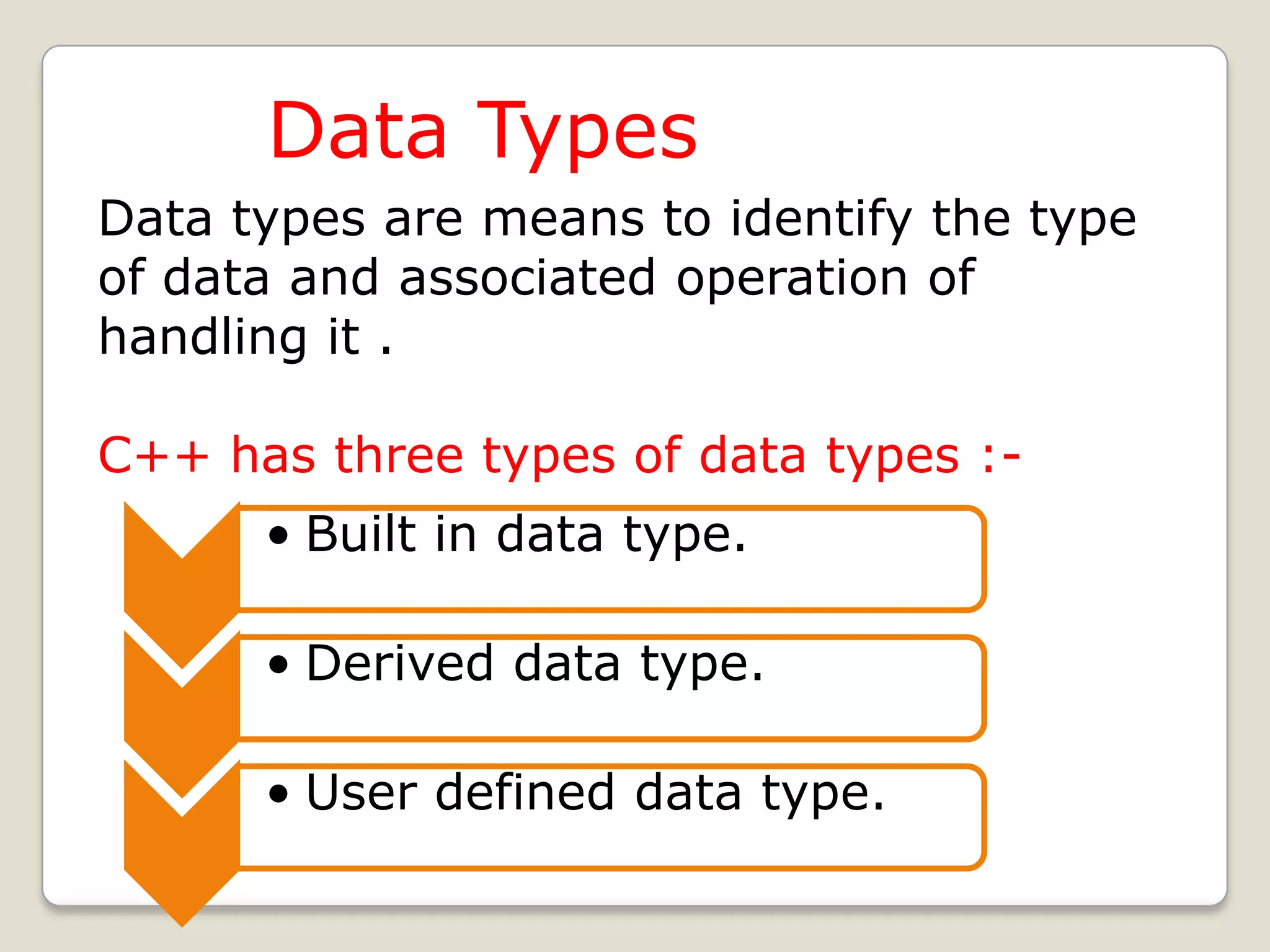
Data Types
Data types are means to identify the type
of data and associated operation of
handling it .

C++ has three types of data types :-
      • Built in data type.

      • Derived data type.

      • User defined data type.
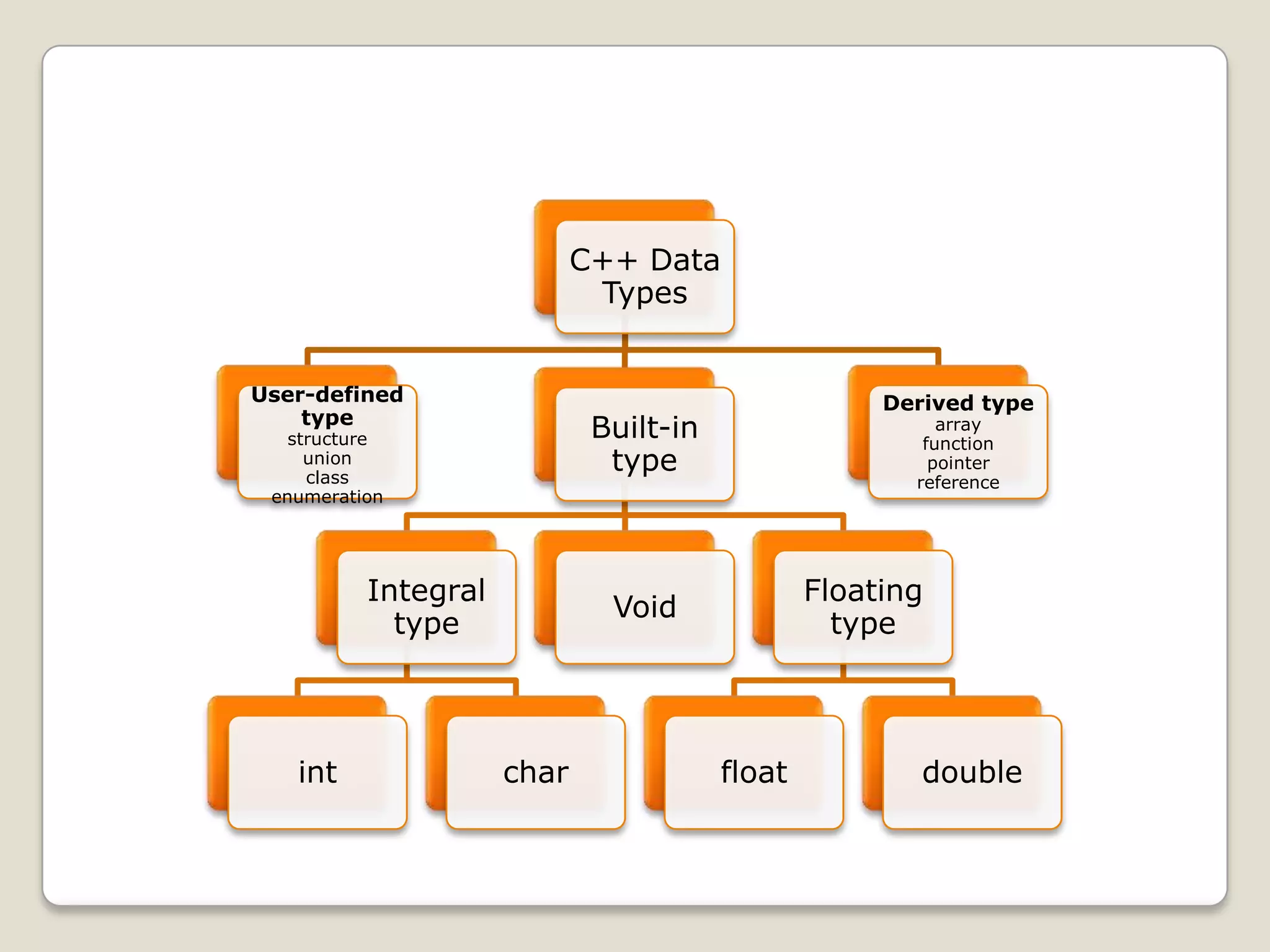
C++ Data
                             Types


User-defined                                         Derived type
    type
   structure                 Built-in                     array
                                                        function
     union
     class
                              type                       pointer
                                                       reference
 enumeration


          Integral                              Floating
                              Void
            type                                  type


   int               char               float           double
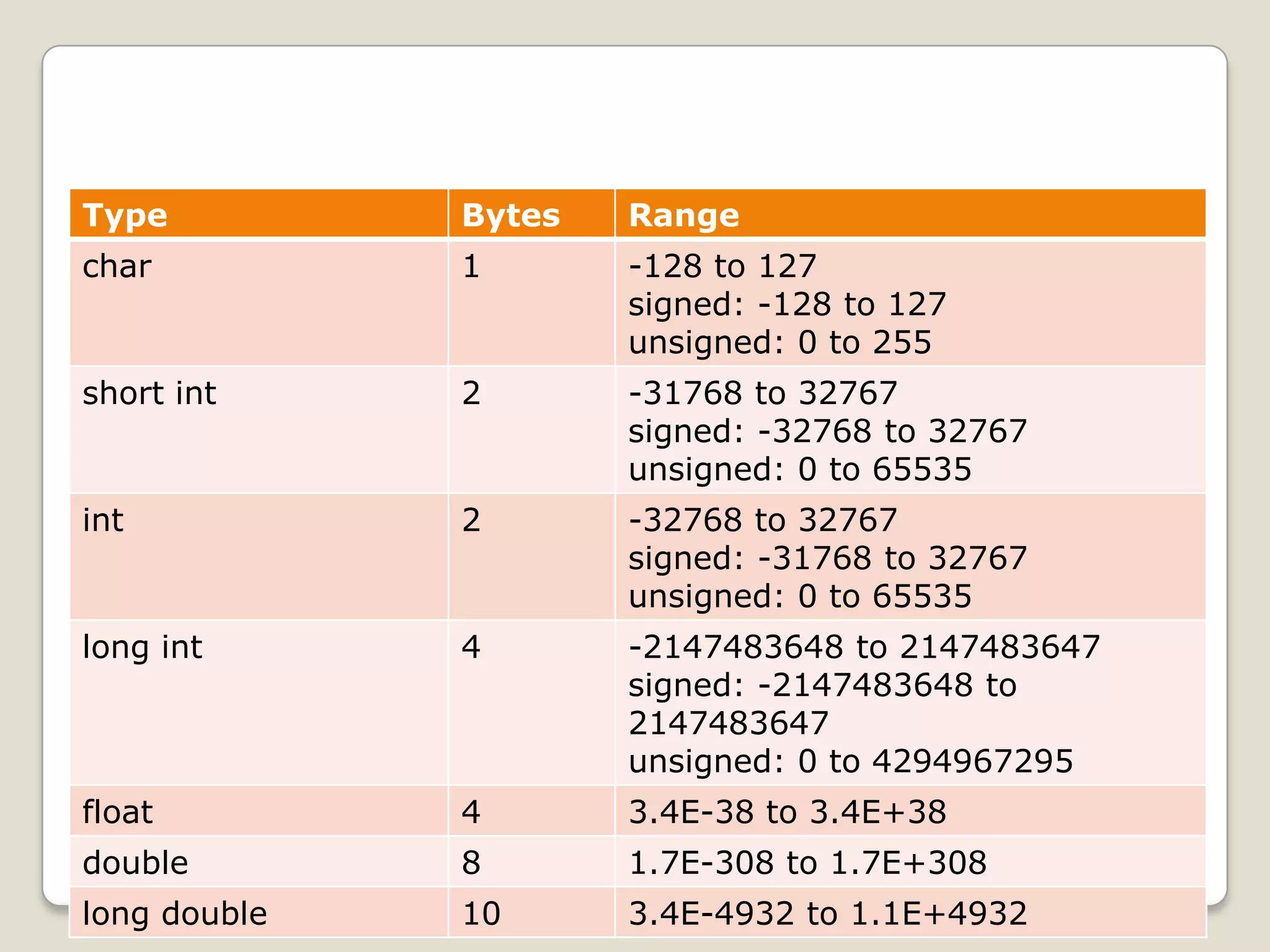
Type          Bytes   Range
char          1       -128 to 127
                      signed: -128 to 127
                      unsigned: 0 to 255
short int     2       -31768 to 32767
                      signed: -32768 to 32767
                      unsigned: 0 to 65535
int           2       -32768 to 32767
                      signed: -31768 to 32767
                      unsigned: 0 to 65535
long int      4       -2147483648 to 2147483647
                      signed: -2147483648 to
                      2147483647
                      unsigned: 0 to 4294967295
float         4       3.4E-38 to 3.4E+38
double        8       1.7E-308 to 1.7E+308
long double   10      3.4E-4932 to 1.1E+4932
Built in data type
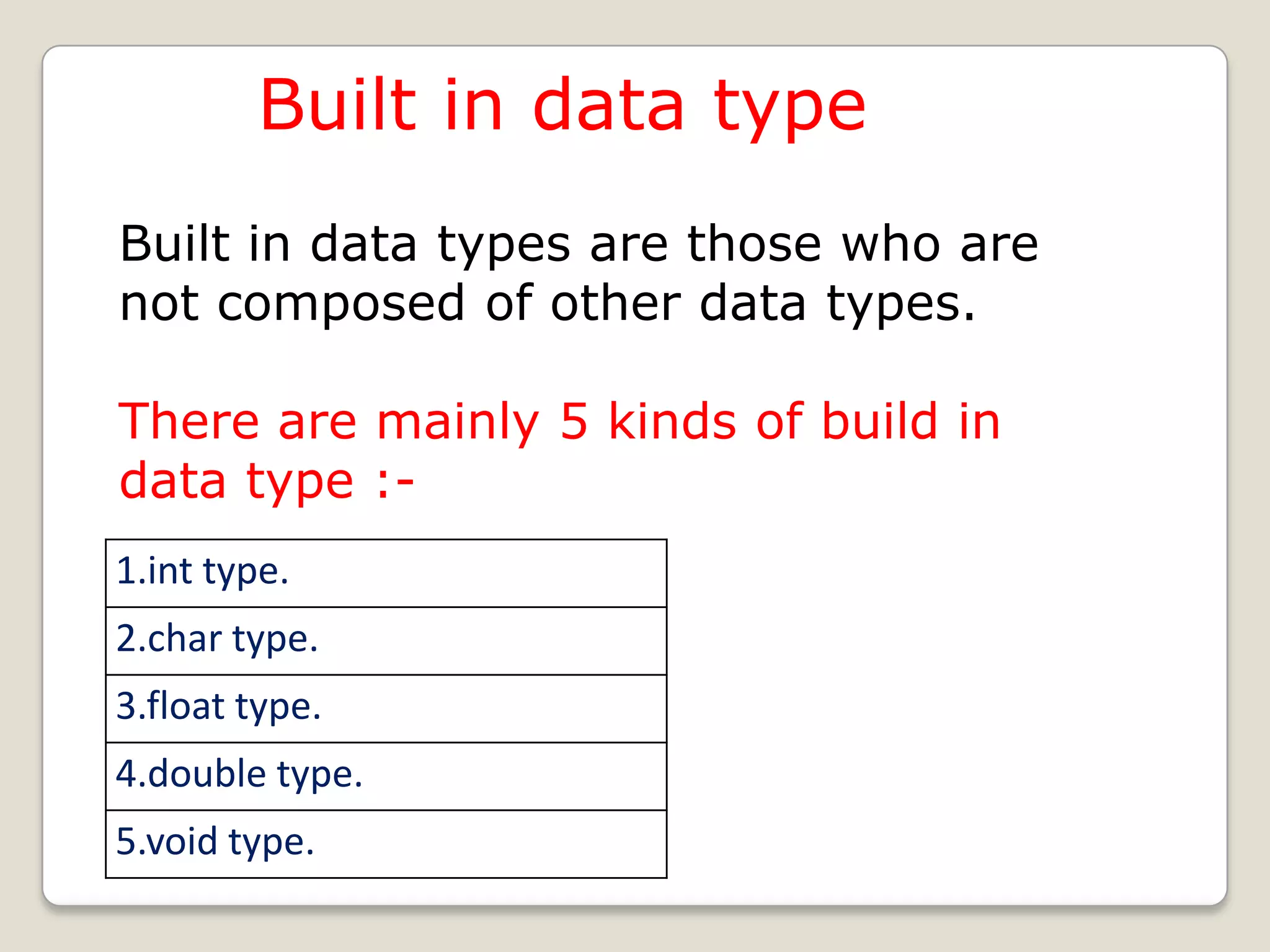
Built in data types are those who are
not composed of other data types.

There are mainly 5 kinds of build in
data type :-
1.int type.
2.char type.
3.float type.
4.double type.
5.void type.
Void data type
 The void data type specifies an
empty set of values .

  It is used as the return type for
functions that do not return a
value.
Int data type

 Integers are whole number such as 5,39,-
1917,0 etc.

they have no fractional part.

 Integers can have positive as well as
negative value .

 An identifiers declared as int cannot have
fractional part.
Char data type

 characters can store any member of
the c++ implementation’s basic
character set .

 An identifiers declared as char
becomes character variable .

  char set is often said to be a integer
type .
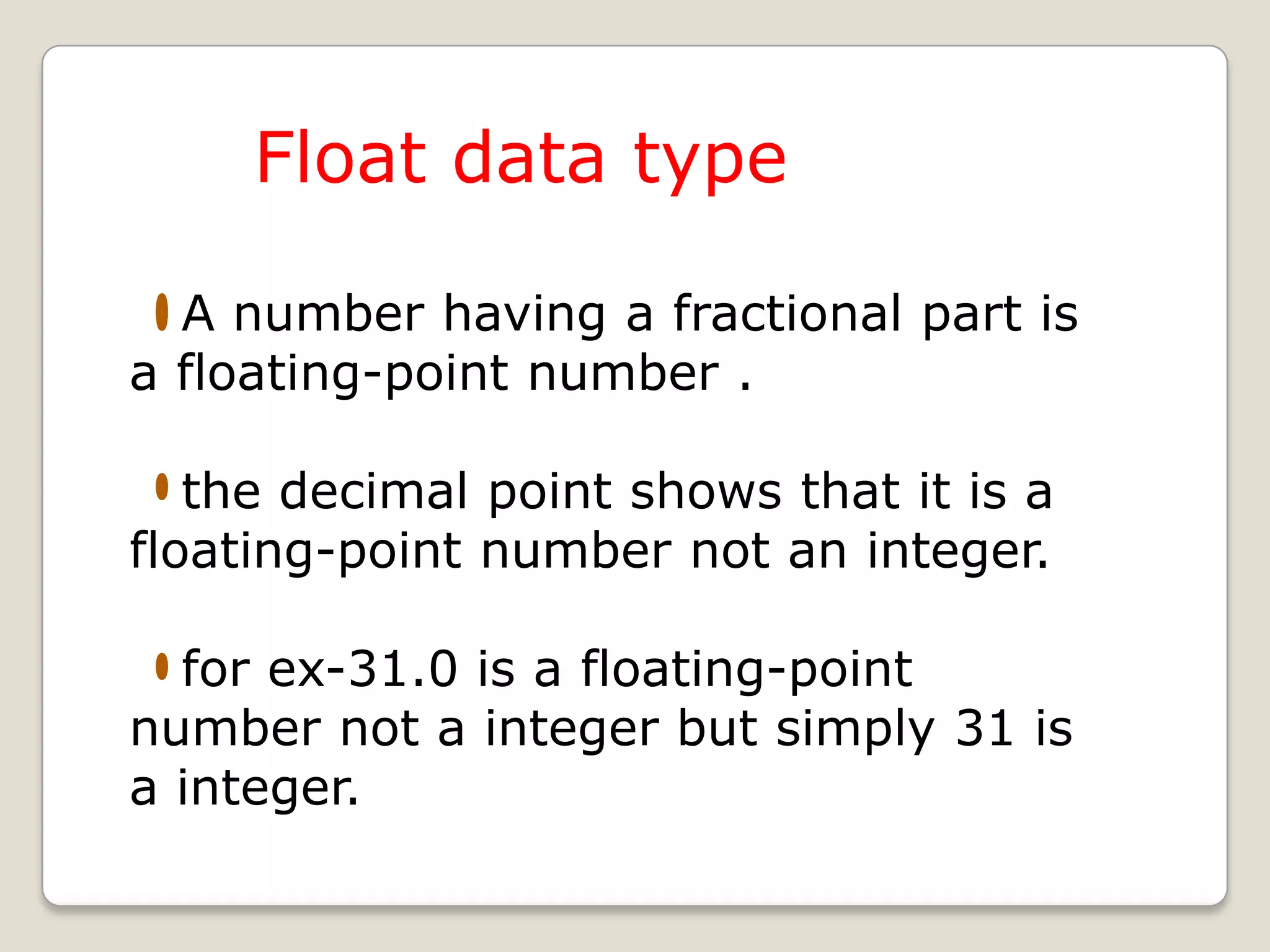
Float data type

  A number having a fractional part is
a floating-point number .

   the decimal point shows that it is a
floating-point number not an integer.

  for ex-31.0 is a floating-point
number not a integer but simply 31 is
a integer.
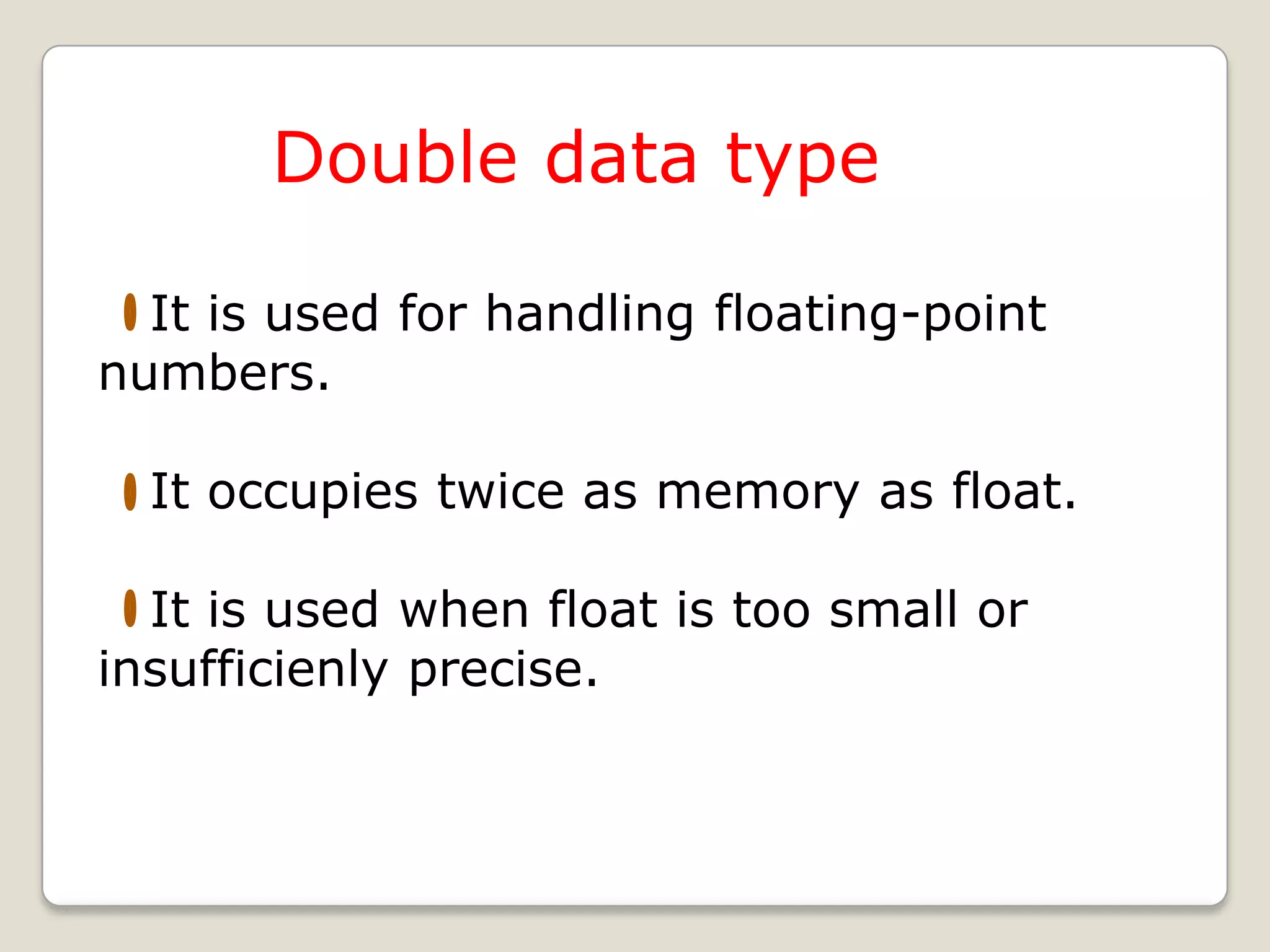
Double data type

  It is used for handling floating-point
numbers.

  It occupies twice as memory as float.

  It is used when float is too small or
insufficienly precise.
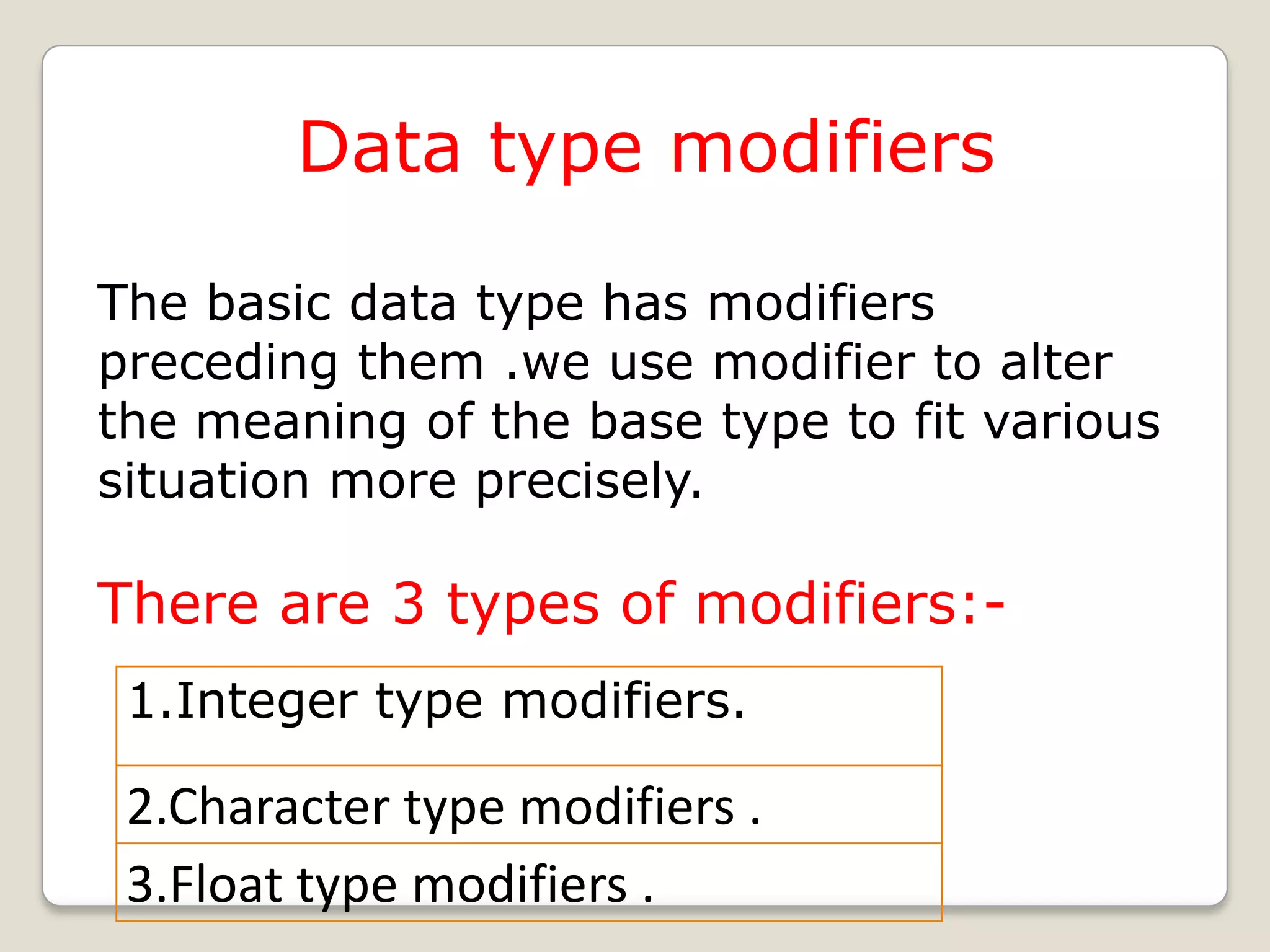
Data type modifiers

The basic data type has modifiers
preceding them .we use modifier to alter
the meaning of the base type to fit various
situation more precisely.

There are 3 types of modifiers:-
 1.Integer type modifiers.

 2.Character type modifiers .
 3.Float type modifiers .
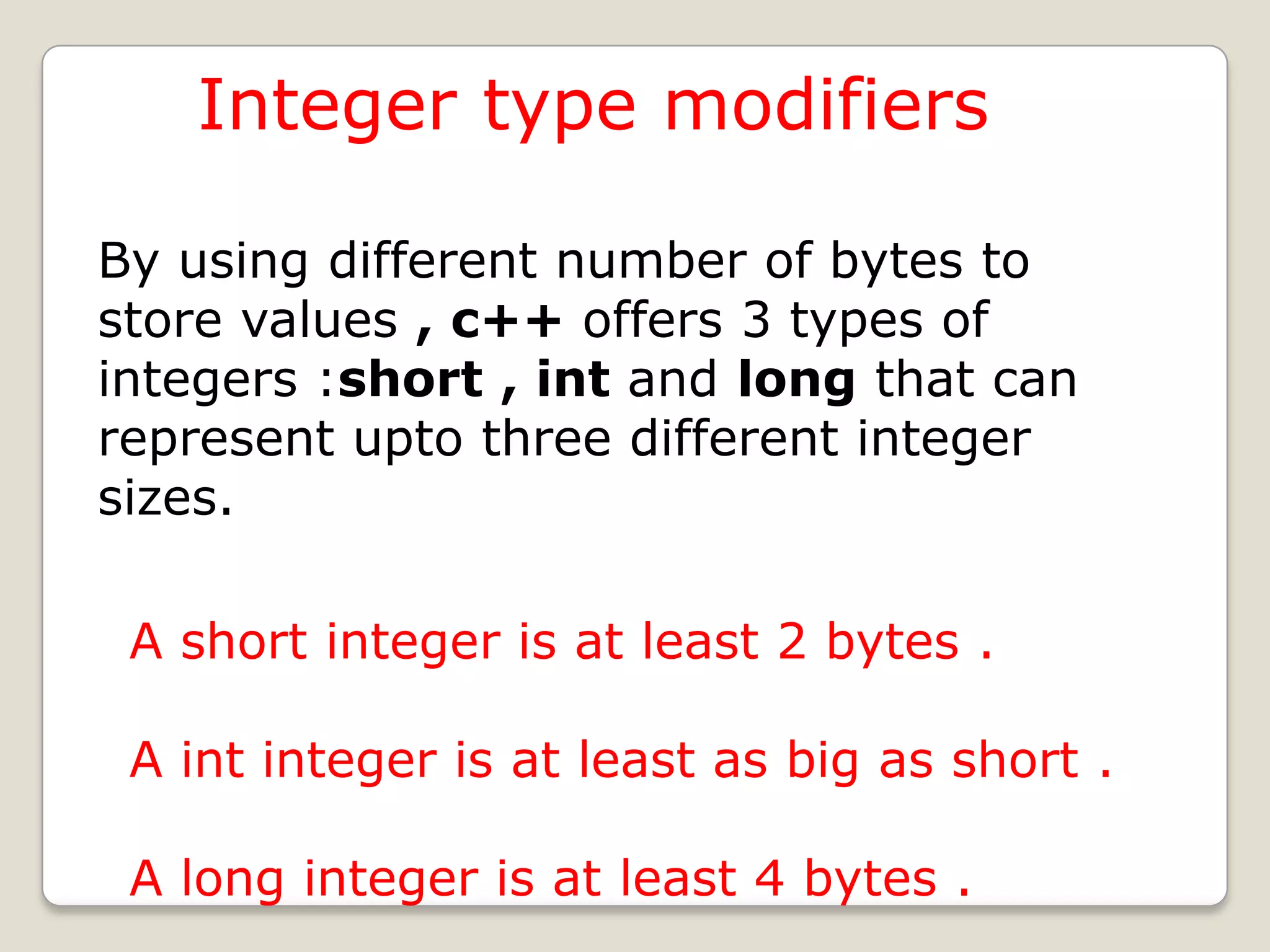
Integer type modifiers

By using different number of bytes to
store values , c++ offers 3 types of
integers :short , int and long that can
represent upto three different integer
sizes.

 A short integer is at least 2 bytes .

 A int integer is at least as big as short .

 A long integer is at least 4 bytes .
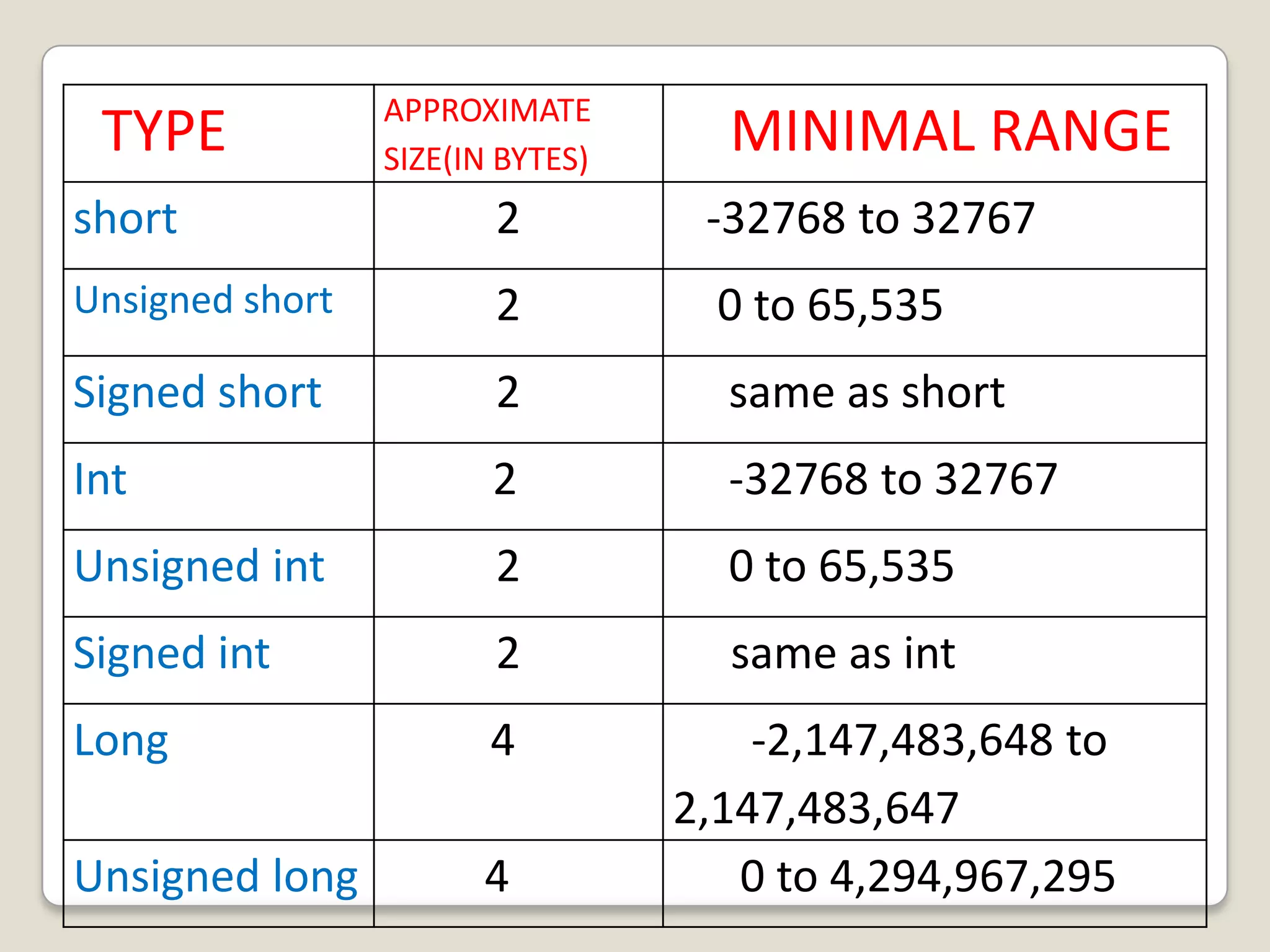
APPROXIMATE
 TYPE            SIZE(IN BYTES)
                                    MINIMAL RANGE
short                   2          -32768 to 32767
Unsigned short          2           0 to 65,535
Signed short            2           same as short
Int                     2           -32768 to 32767
Unsigned int            2           0 to 65,535
Signed int              2           same as int
Long                    4             -2,147,483,648 to
                                  2,147,483,647
Unsigned long          4             0 to 4,294,967,295
character type modifiers

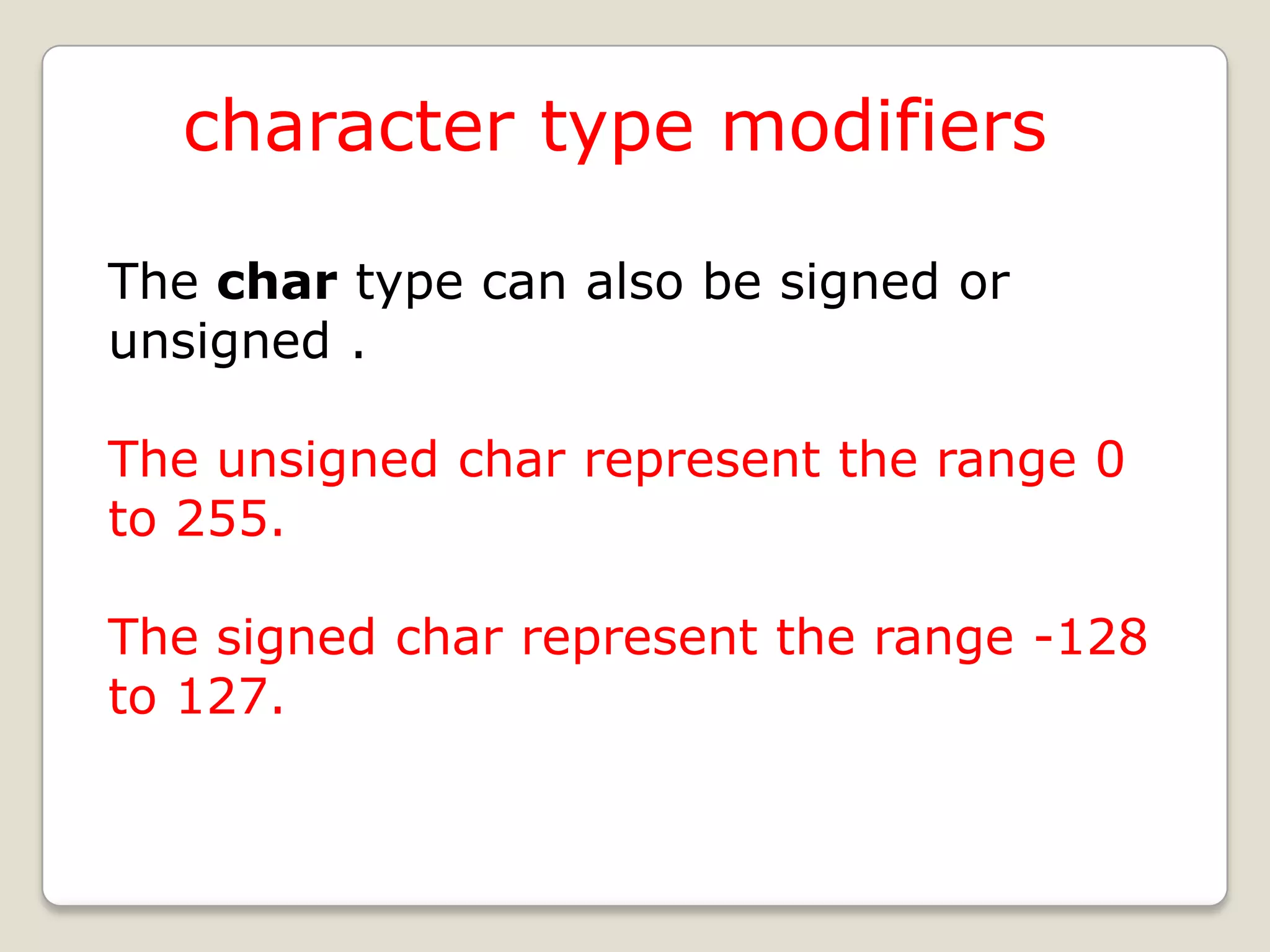
The char type can also be signed or
unsigned .

The unsigned char represent the range 0
to 255.

The signed char represent the range -128
to 127.
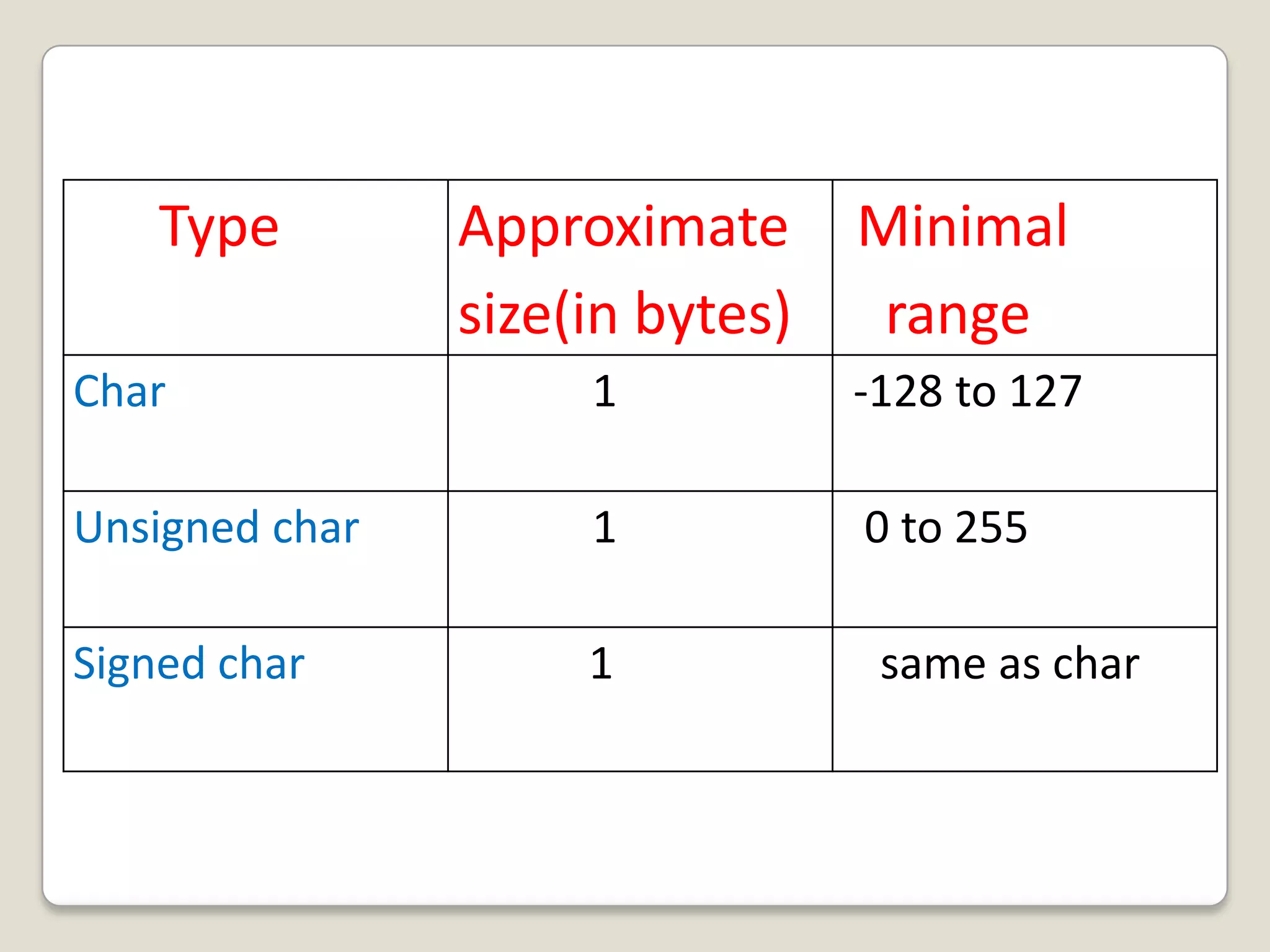
Type        Approximate      Minimal
                size(in bytes)    range
Char                 1           -128 to 127

Unsigned char        1           0 to 255

Signed char          1            same as char
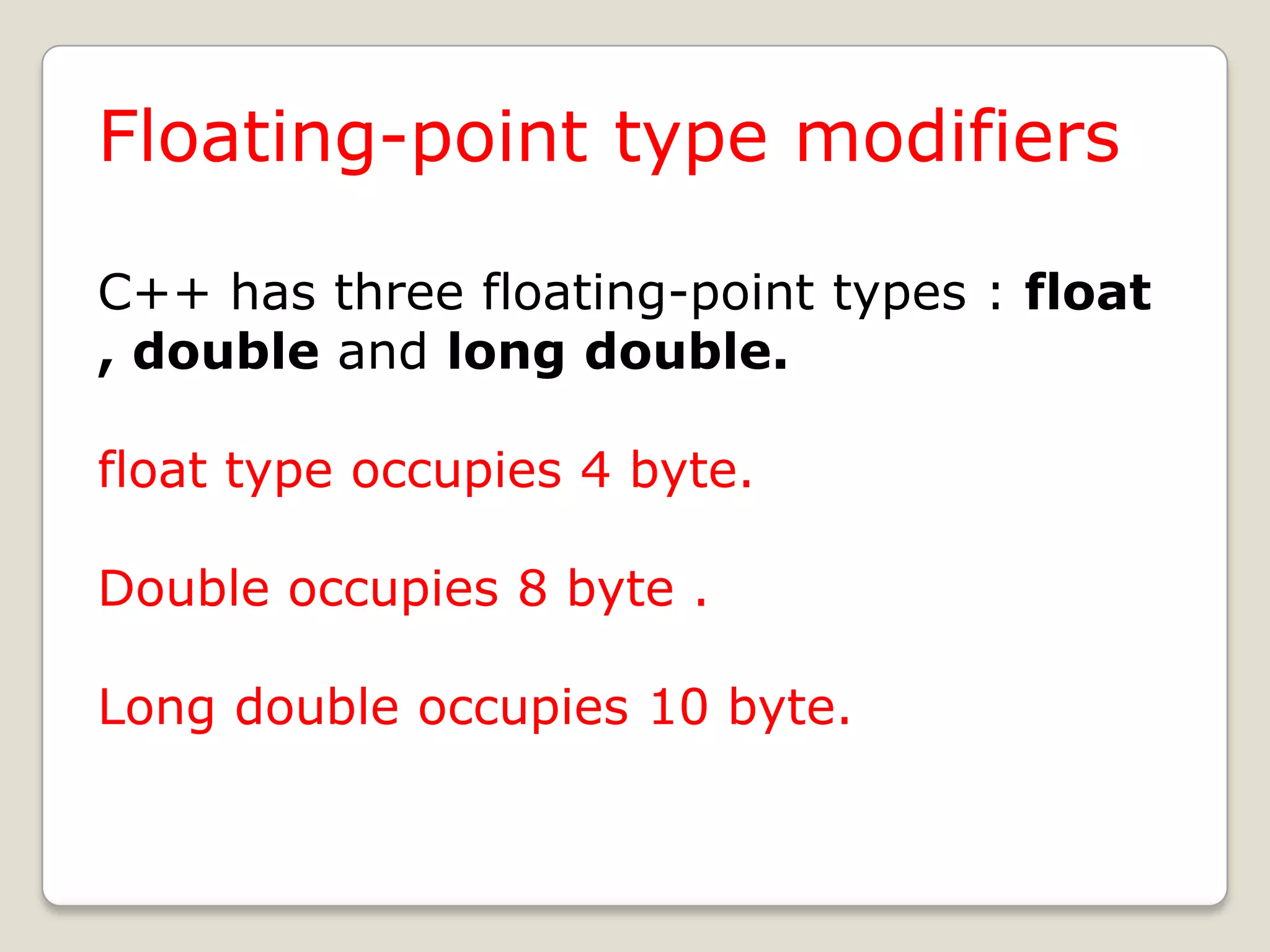
Floating-point type modifiers

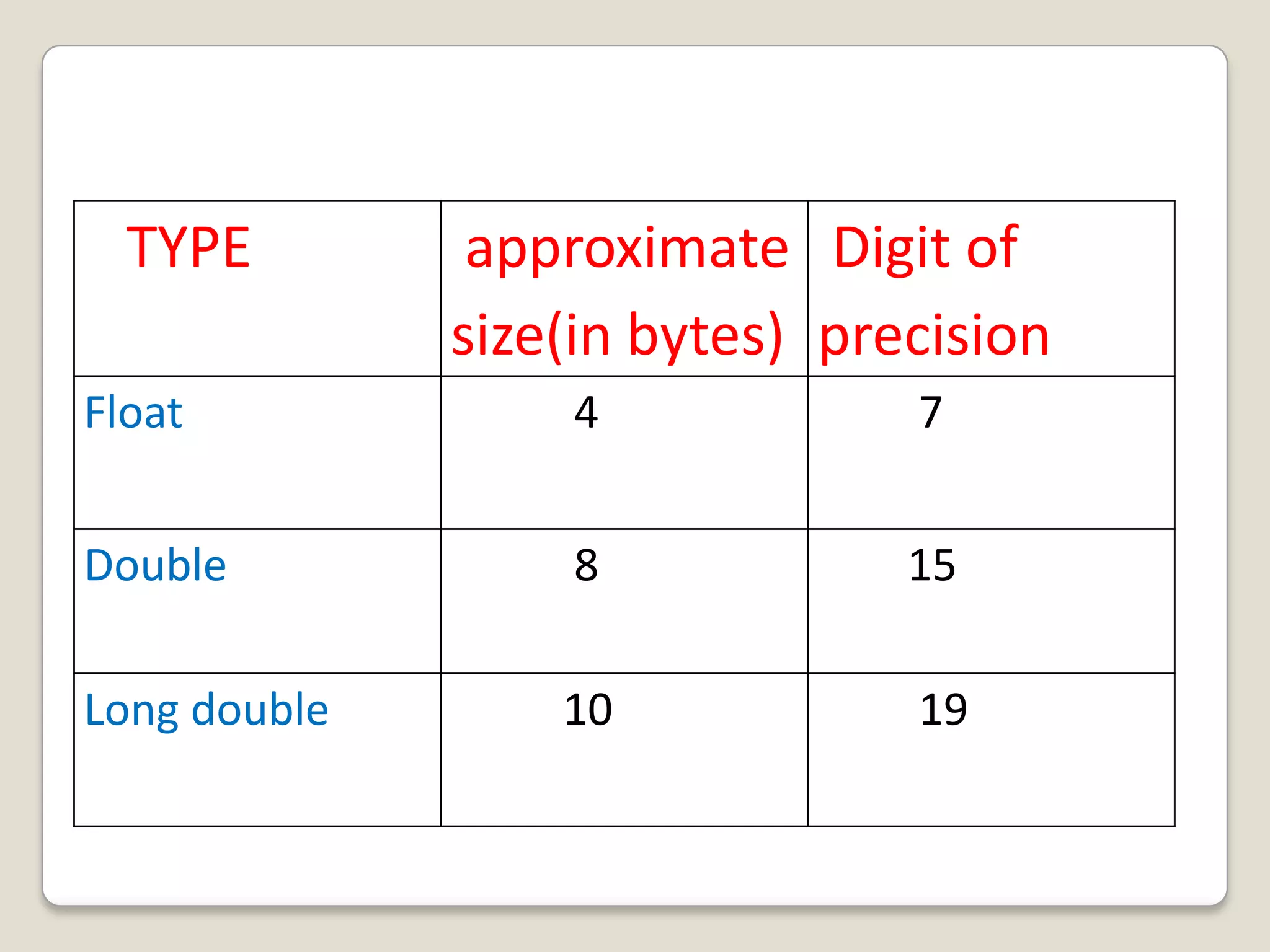
C++ has three floating-point types : float
, double and long double.

float type occupies 4 byte.

Double occupies 8 byte .

Long double occupies 10 byte.
TYPE         approximate Digit of
              size(in bytes) precision
Float             4             7


Double            8             15

Long double       10            19
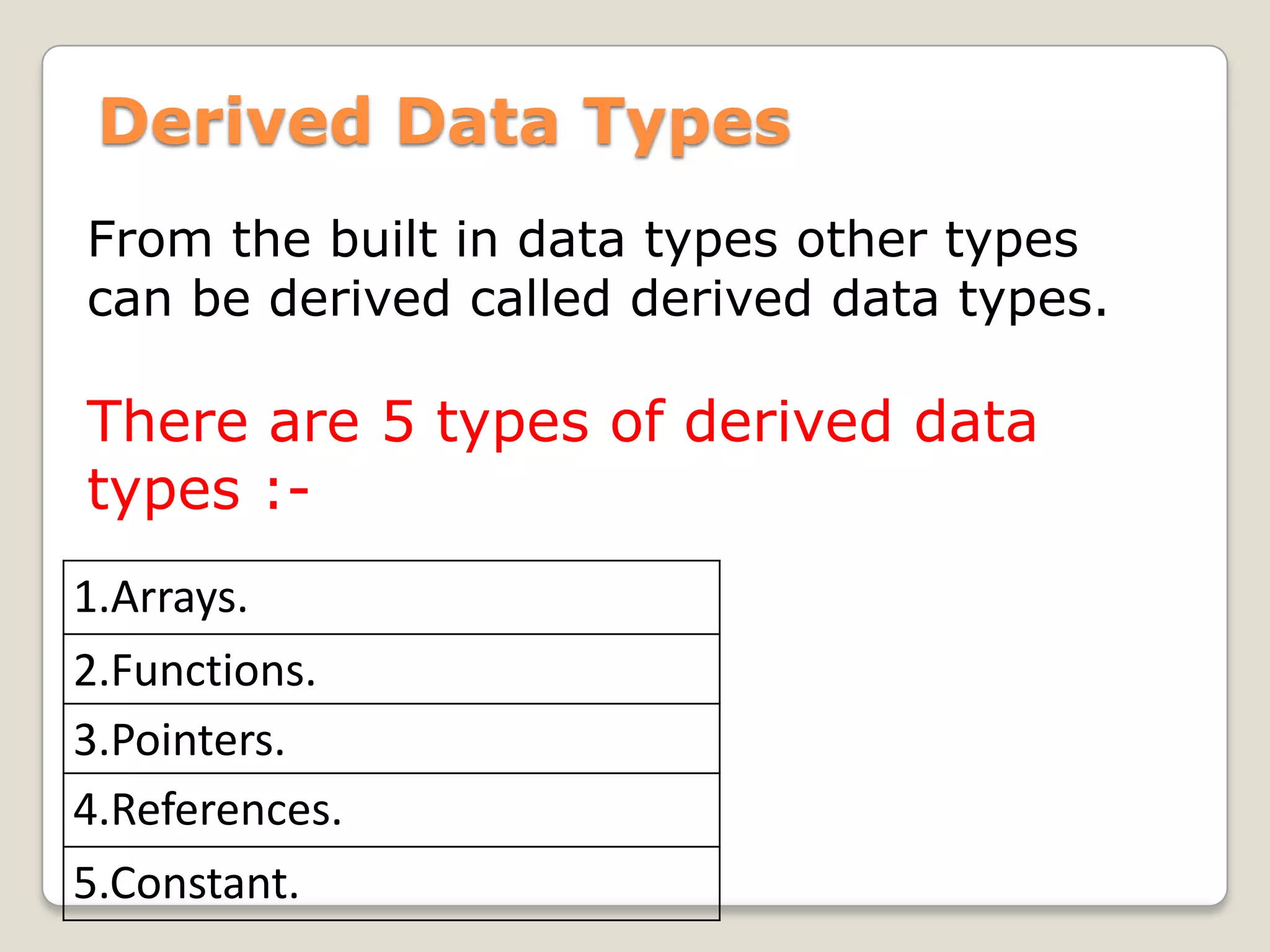
Derived Data Types
From the built in data types other types
can be derived called derived data types.

There are 5 types of derived data
types :-
1.Arrays.
2.Functions.
3.Pointers.
4.References.
5.Constant.
ARRAYS
Values of similar type stored in continuous
memory locations.

int a[10]; char string[3]=“xyz”;

Array can be one dimensional , two
dimensional , multi dimensional.

For ex-float a[3]; //declares array of three
floats :a[0],a[1],a[2].

Int b[2][4]; //declares a 2 dimension array
of integer:b[0][0], b[0][1], b[0][2], b[0][3],
           b[1][0], b[1][1], b[1][2], b[1][3].
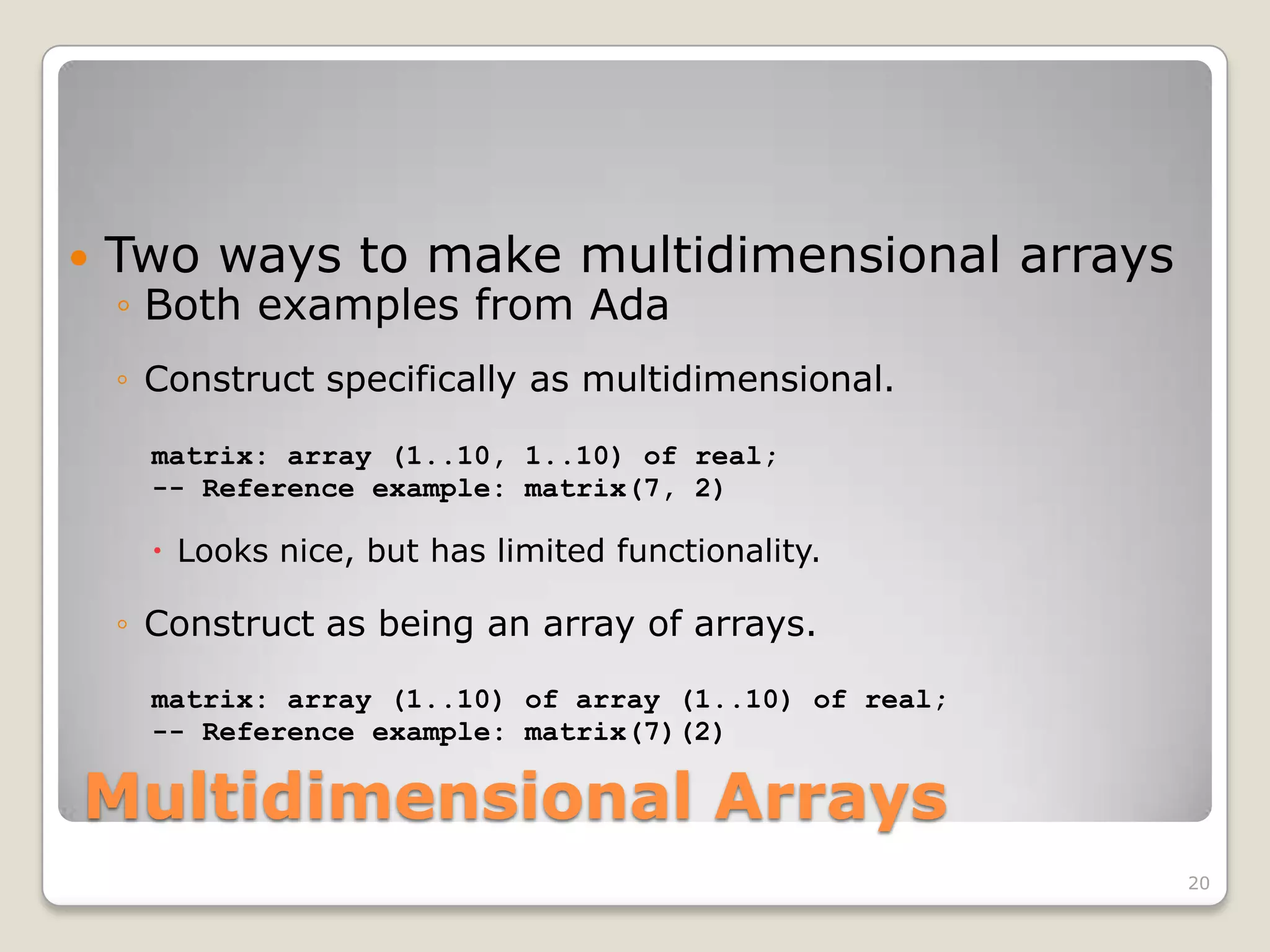
   Two ways to make multidimensional arrays
    ◦ Both examples from Ada
    ◦ Construct specifically as multidimensional.

      matrix: array (1..10, 1..10) of real;
      -- Reference example: matrix(7, 2)

       Looks nice, but has limited functionality.

    ◦ Construct as being an array of arrays.

      matrix: array (1..10) of array (1..10) of real;
      -- Reference example: matrix(7)(2)

Multidimensional Arrays
                                                        20
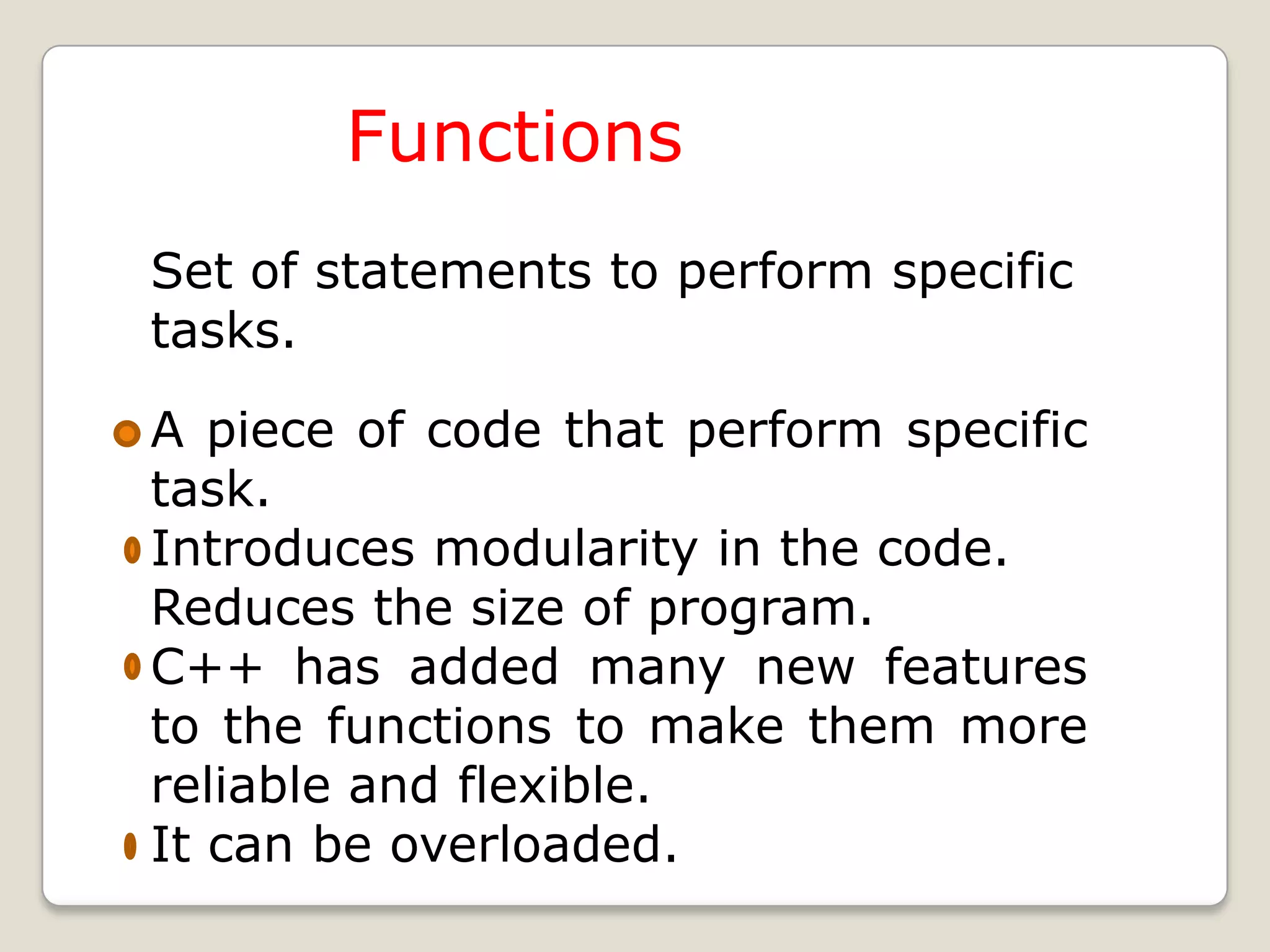
Functions
Set of statements to perform specific
tasks.

A piece of code that perform specific
task.
Introduces modularity in the code.
Reduces the size of program.
C++ has added many new features
to the functions to make them more
reliable and flexible.
It can be overloaded.
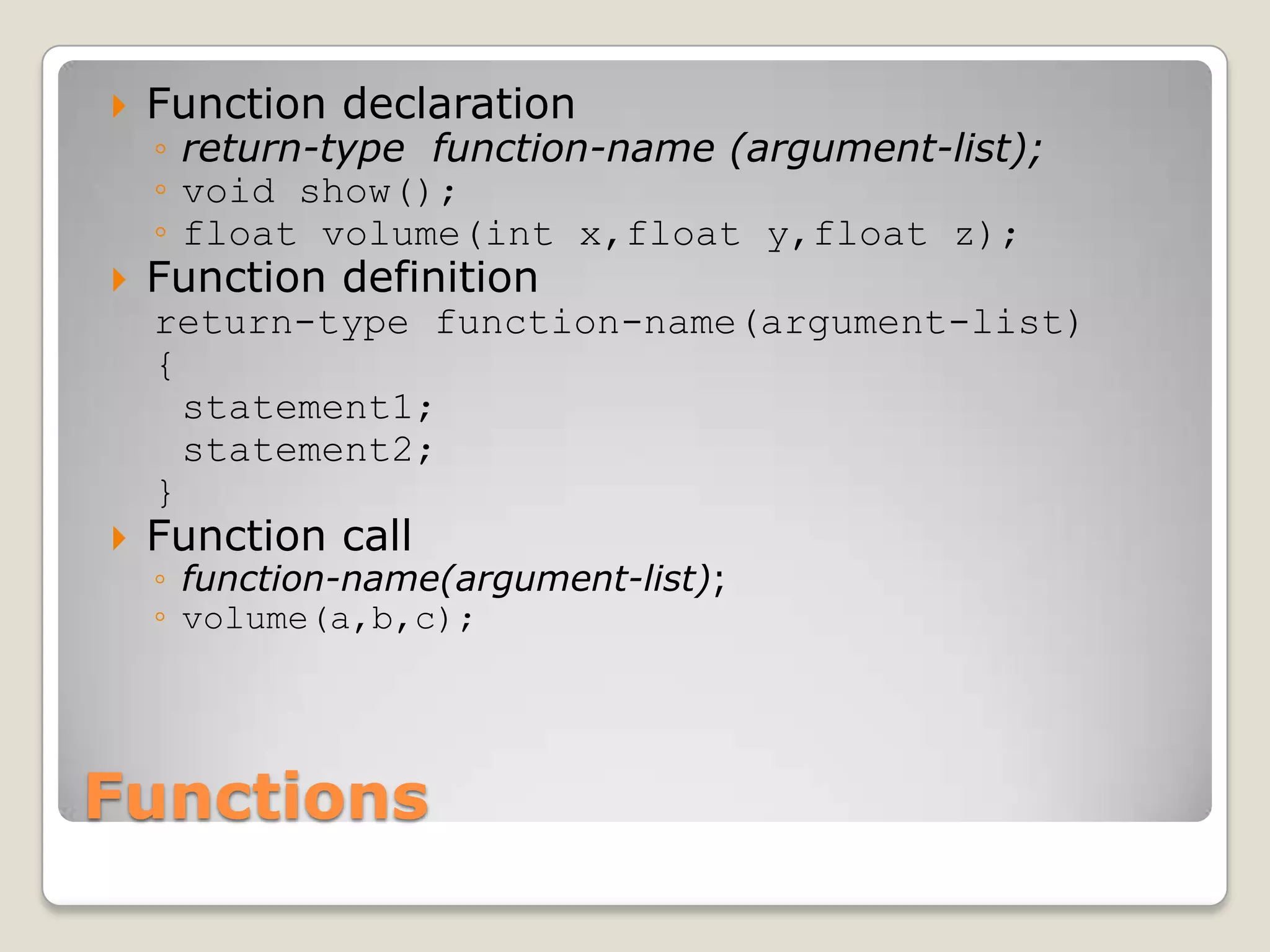
   Function declaration
    ◦ return-type function-name (argument-list);
    ◦ void show();
    ◦ float volume(int x,float y,float z);
   Function definition
    return-type function-name(argument-list)
    {
      statement1;
      statement2;
    }
   Function call
    ◦ function-name(argument-list);
    ◦ volume(a,b,c);


Functions
Pointers
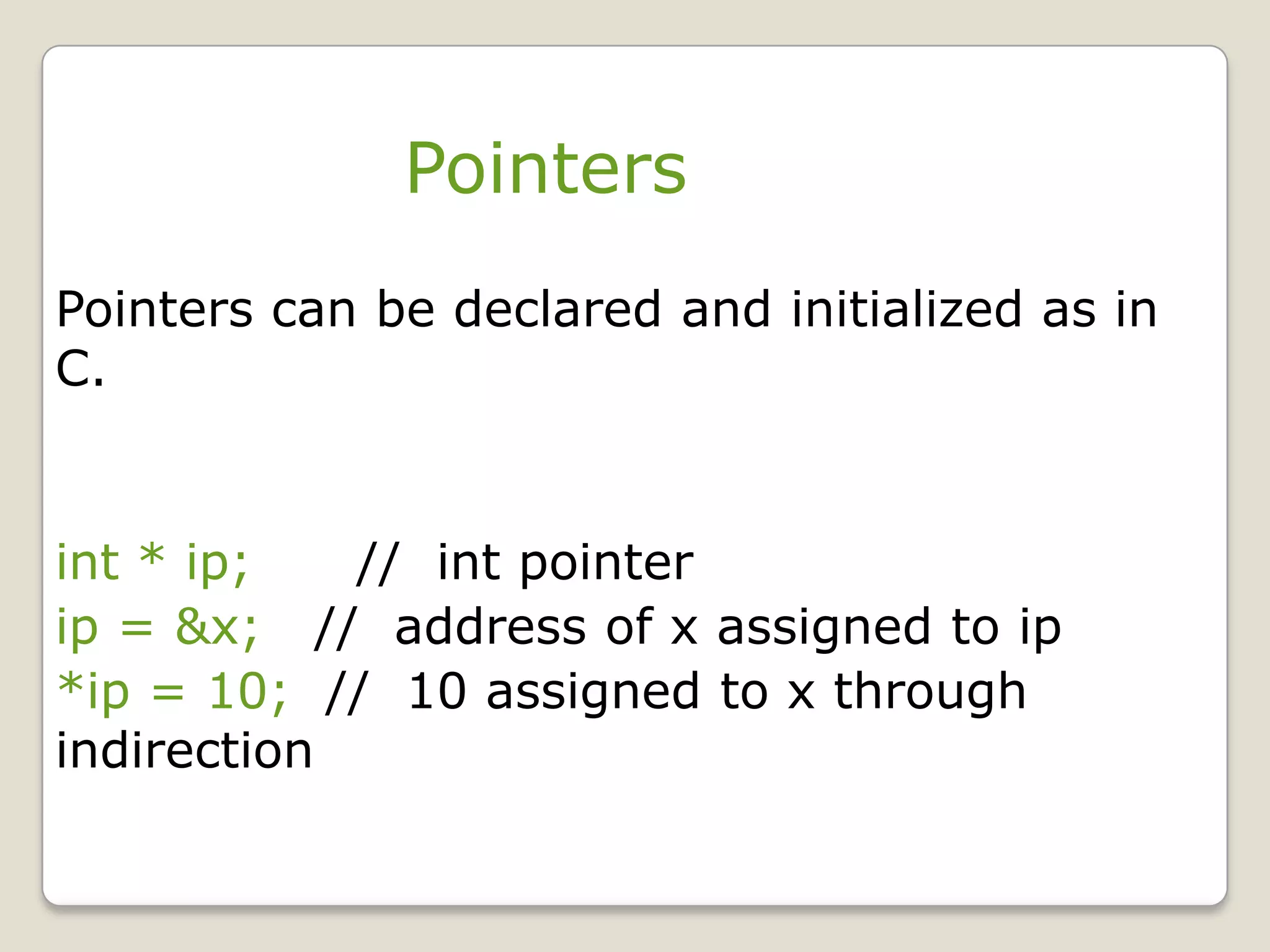
Pointers can be declared and initialized as in
C.


int * ip;   // int pointer
ip = &x; // address of x assigned to ip
*ip = 10; // 10 assigned to x through
indirection
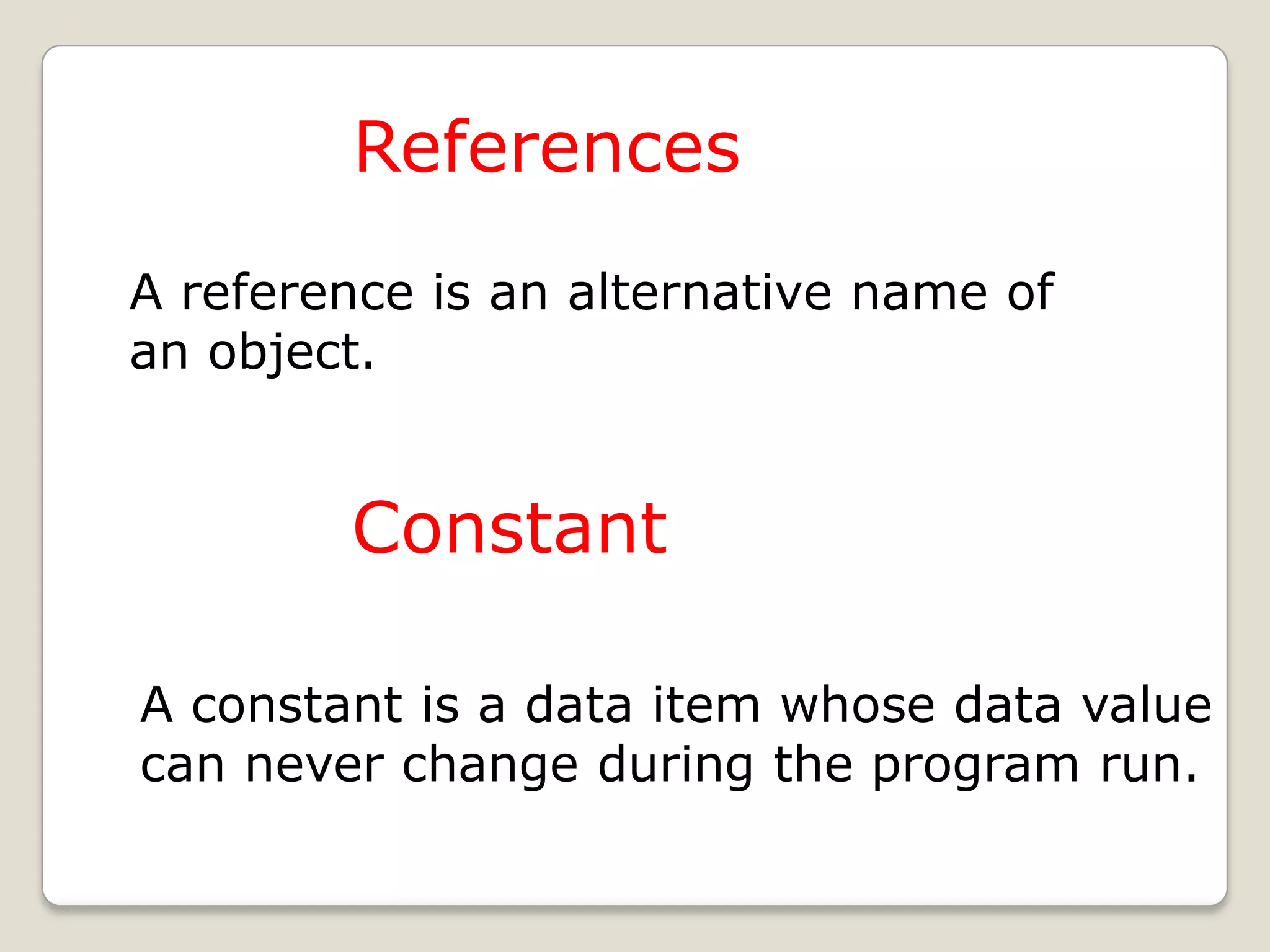
References
A reference is an alternative name of
an object.


        Constant

A constant is a data item whose data value
can never change during the program run.
Classes and Objects
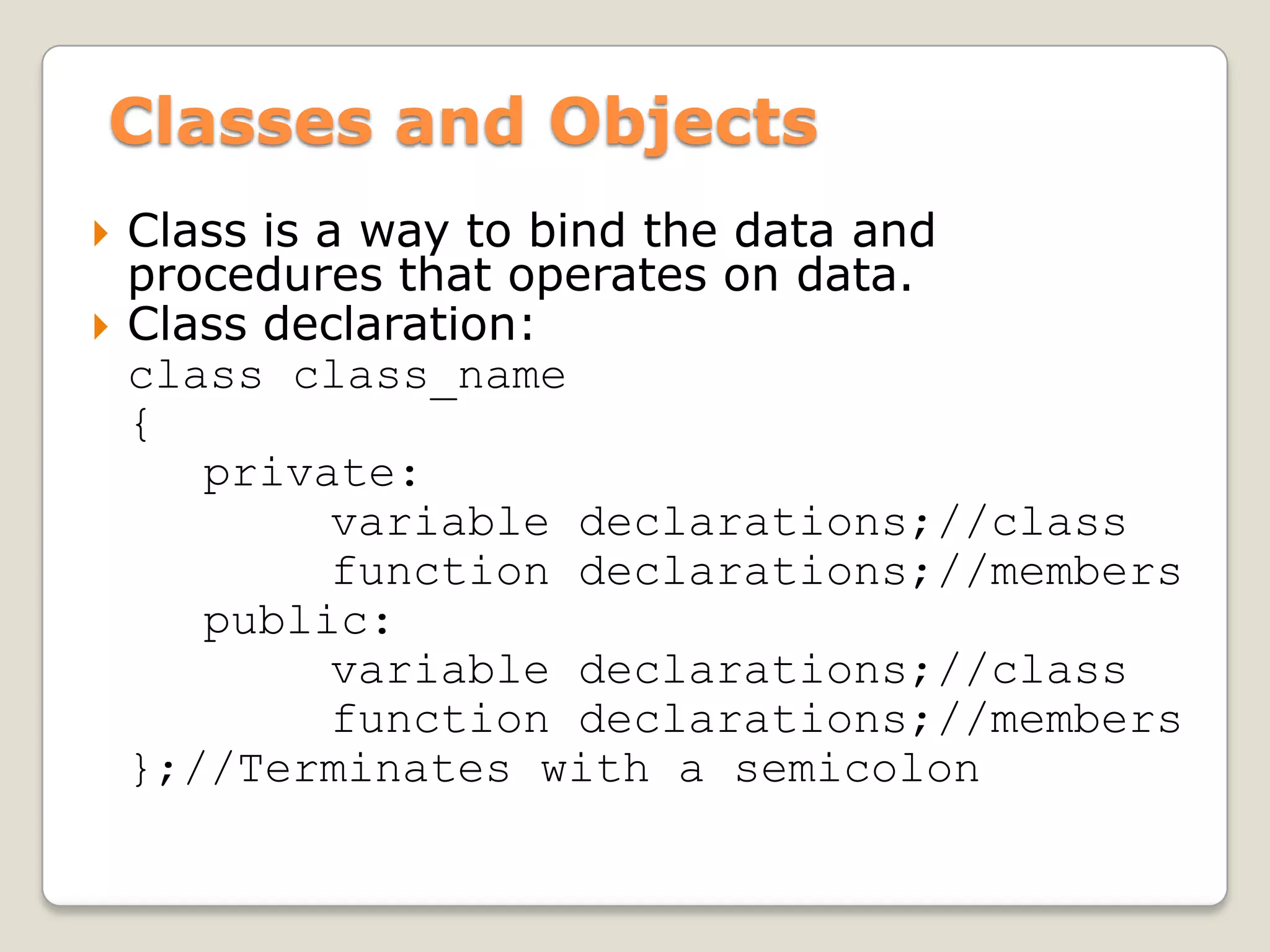
   Class is a way to bind the data and
    procedures that operates on data.
   Class declaration:
    class class_name
    {
       private:
              variable declarations;//class
              function declarations;//members
       public:
              variable declarations;//class
              function declarations;//members
    };//Terminates with a semicolon
Classes and Objects

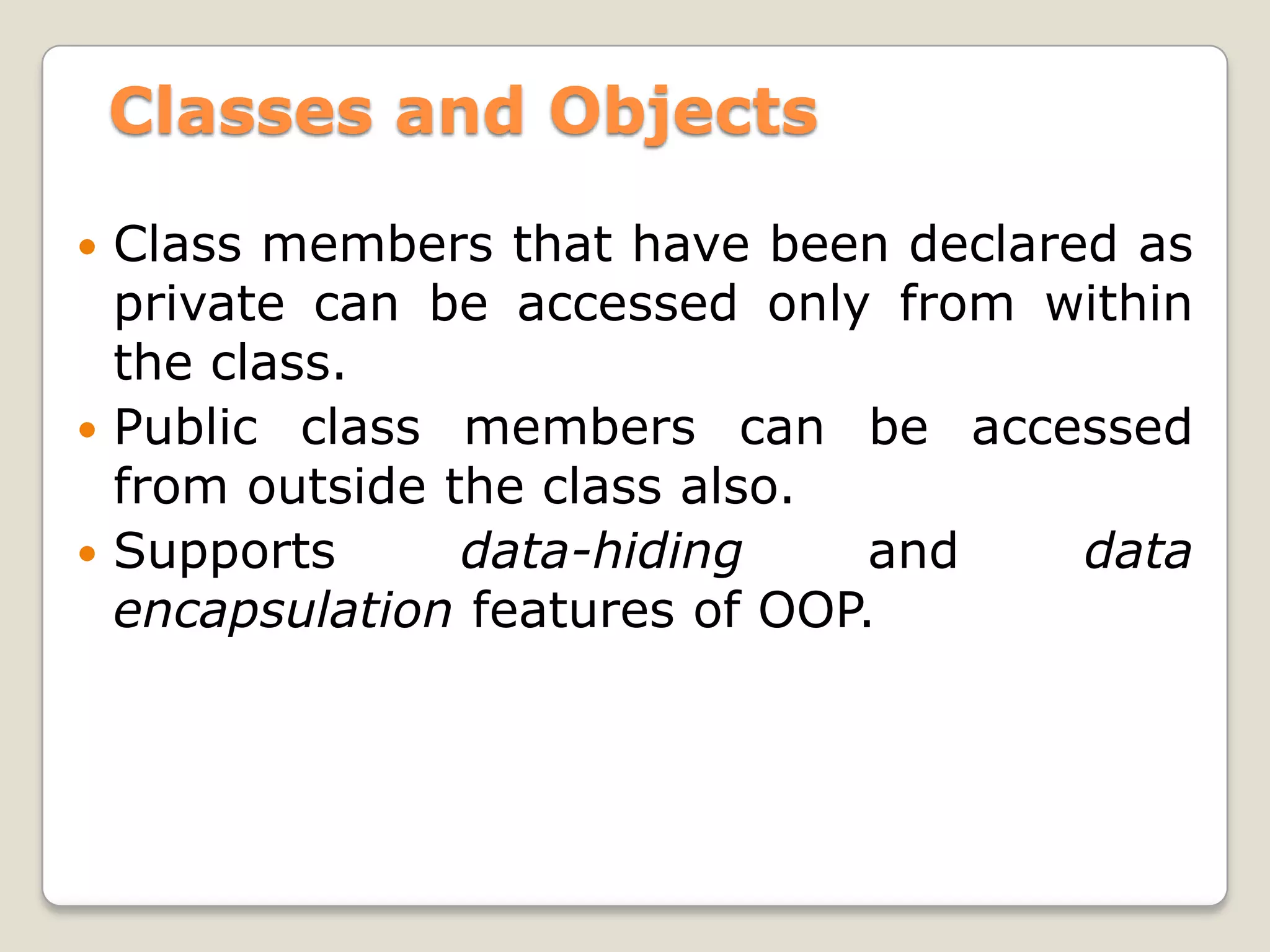
 Class members that have been declared as
  private can be accessed only from within
  the class.
 Public class members can be accessed
  from outside the class also.
 Supports      data-hiding     and   data
  encapsulation features of OOP.
Classes and Objects

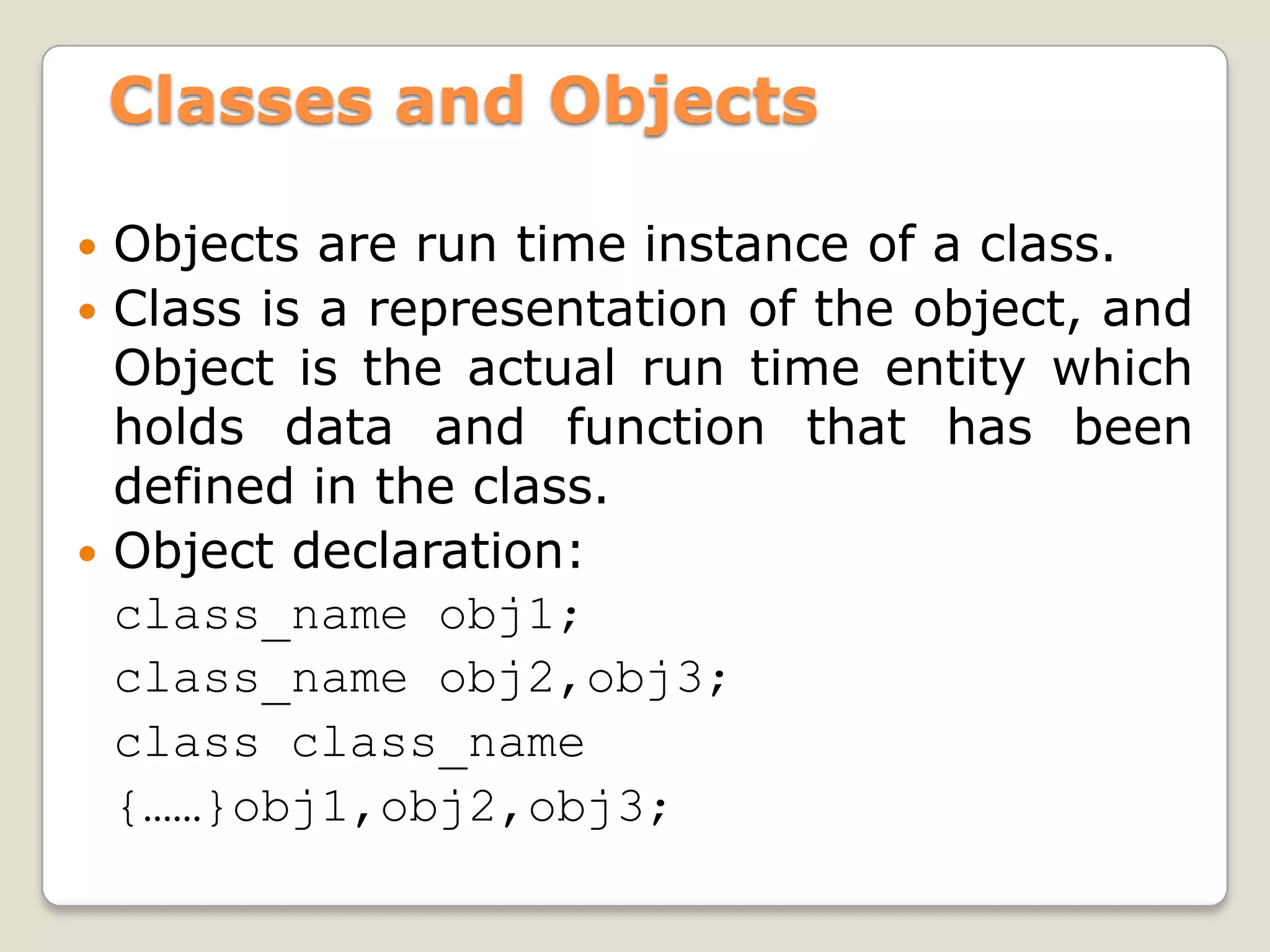
 Objects are run time instance of a class.
 Class is a representation of the object, and
  Object is the actual run time entity which
  holds data and function that has been
  defined in the class.
 Object declaration:
  class_name obj1;
  class_name obj2,obj3;
  class class_name
  {……}obj1,obj2,obj3;
Classes and Objects

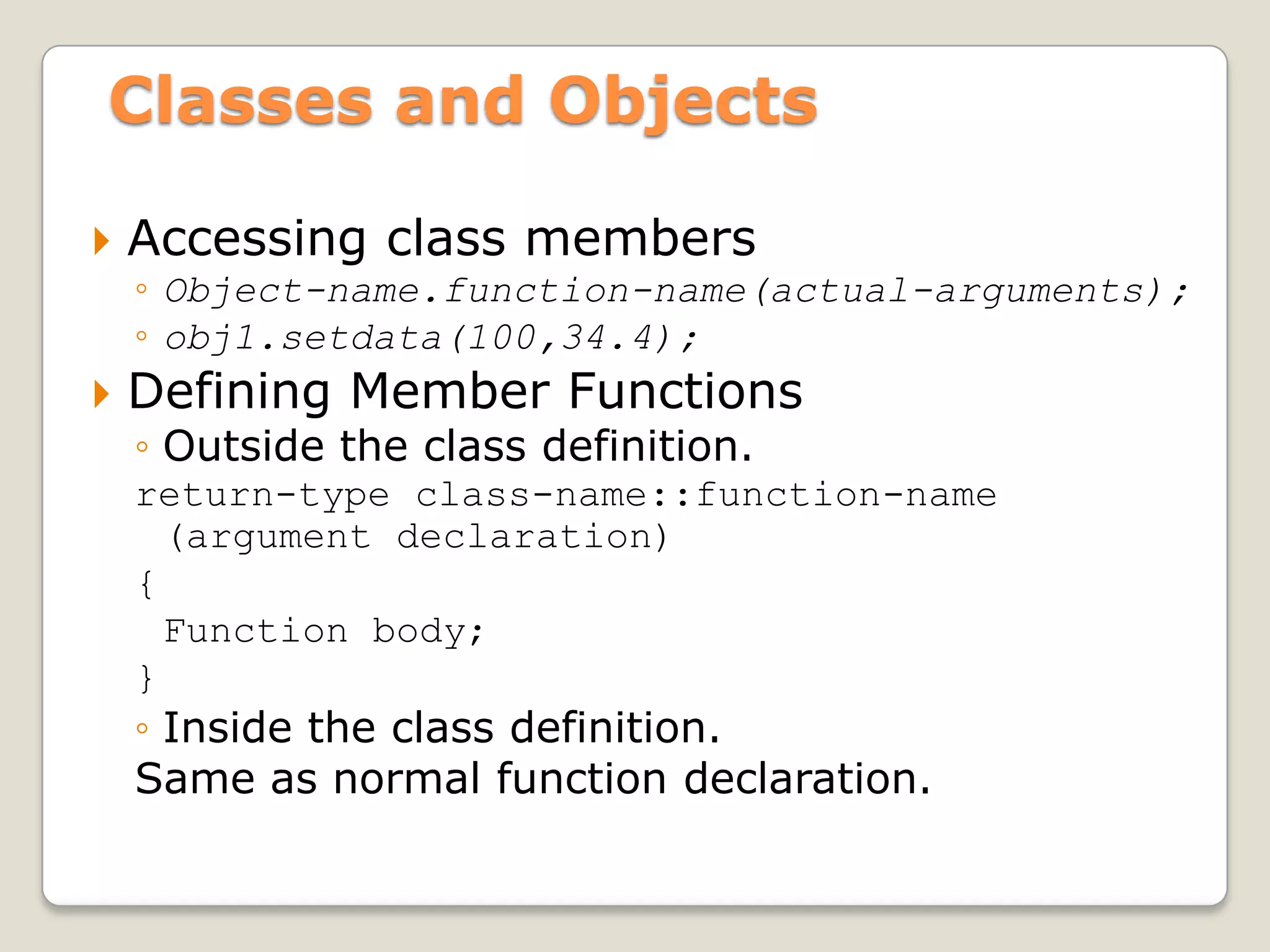
   Accessing class members
    ◦ Object-name.function-name(actual-arguments);
    ◦ obj1.setdata(100,34.4);
   Defining Member Functions
    ◦ Outside the class definition.
    return-type class-name::function-name
      (argument declaration)
    {
      Function body;
    }
    ◦ Inside the class definition.
    Same as normal function declaration.
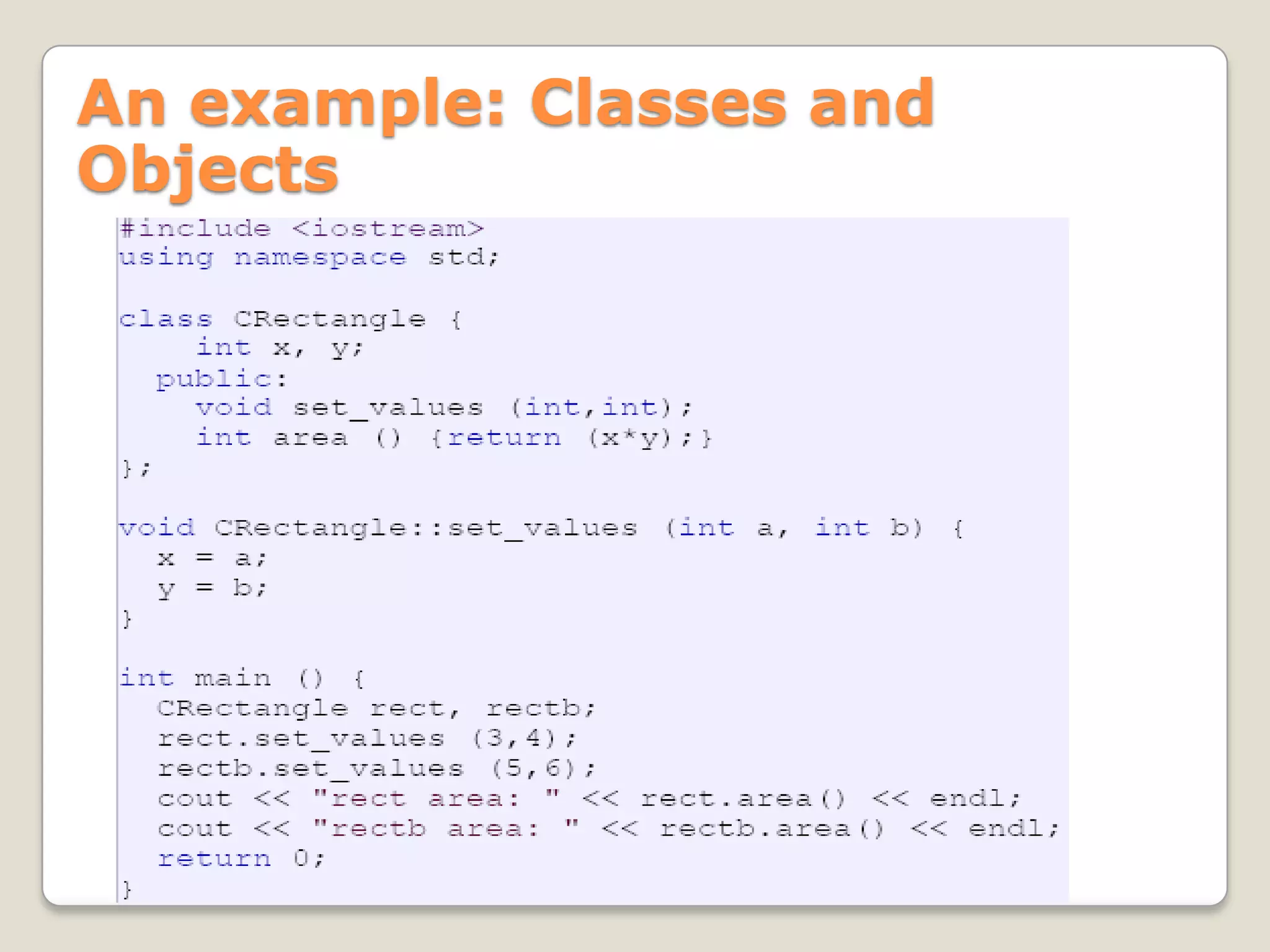
An example: Classes and
Objects
Structures
   Structures Revisited
    ◦ Makes convenient to handle a group of logically
      related data items.
    struct student //declaration
    {
        char name[20];
        int roll_number;
        float total_marks;
    };
    struct student A;// C declaration
    student A;            //C++ declaration
    A.roll_number=999;
    A.total_marks=595.5;
    Final_Total=A.total_marks + 5;
Structures
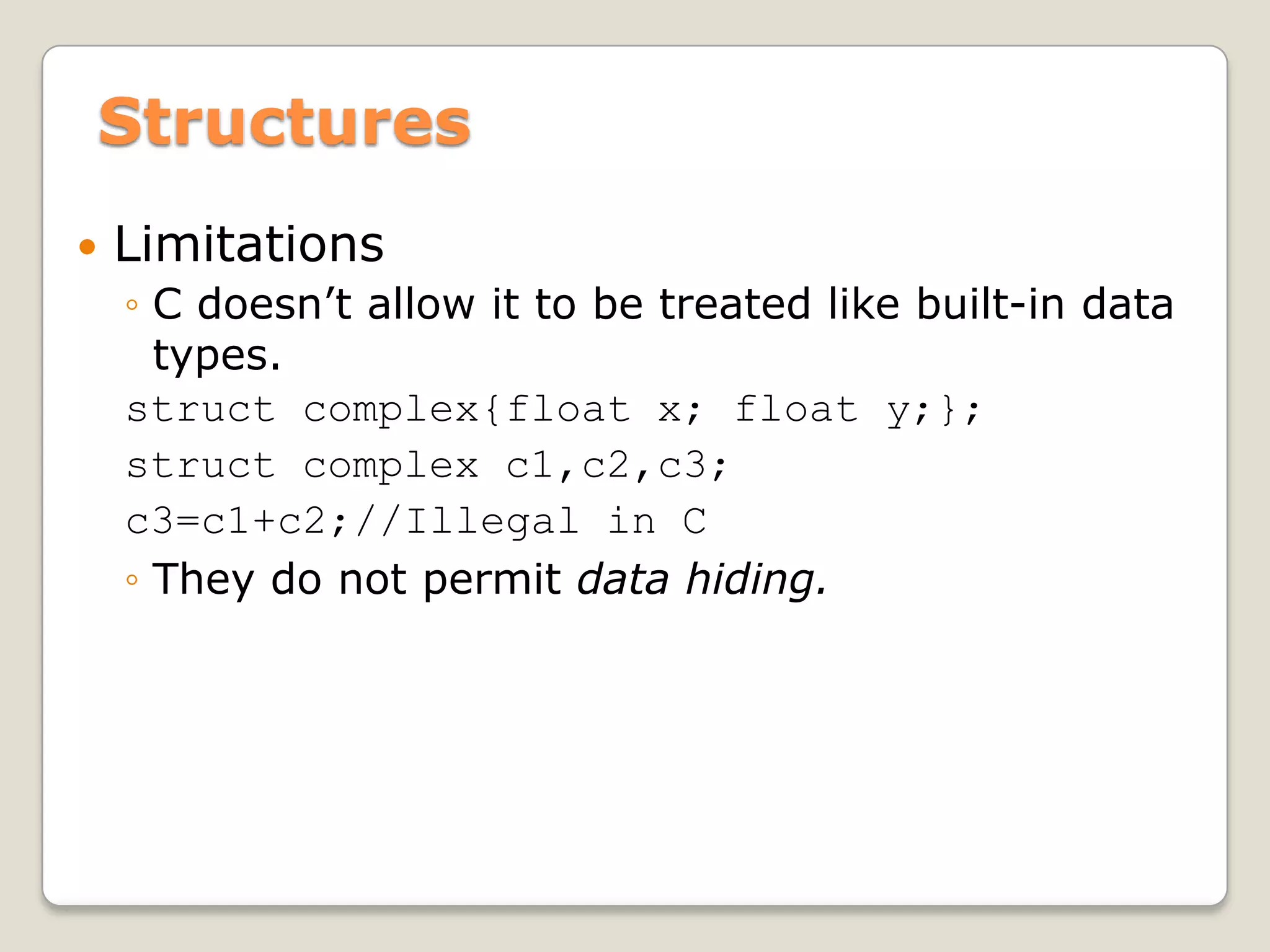
   Limitations
    ◦ C doesn’t allow it to be treated like built-in data
      types.
    struct complex{float x; float y;};
    struct complex c1,c2,c3;
    c3=c1+c2;//Illegal in C
    ◦ They do not permit data hiding.
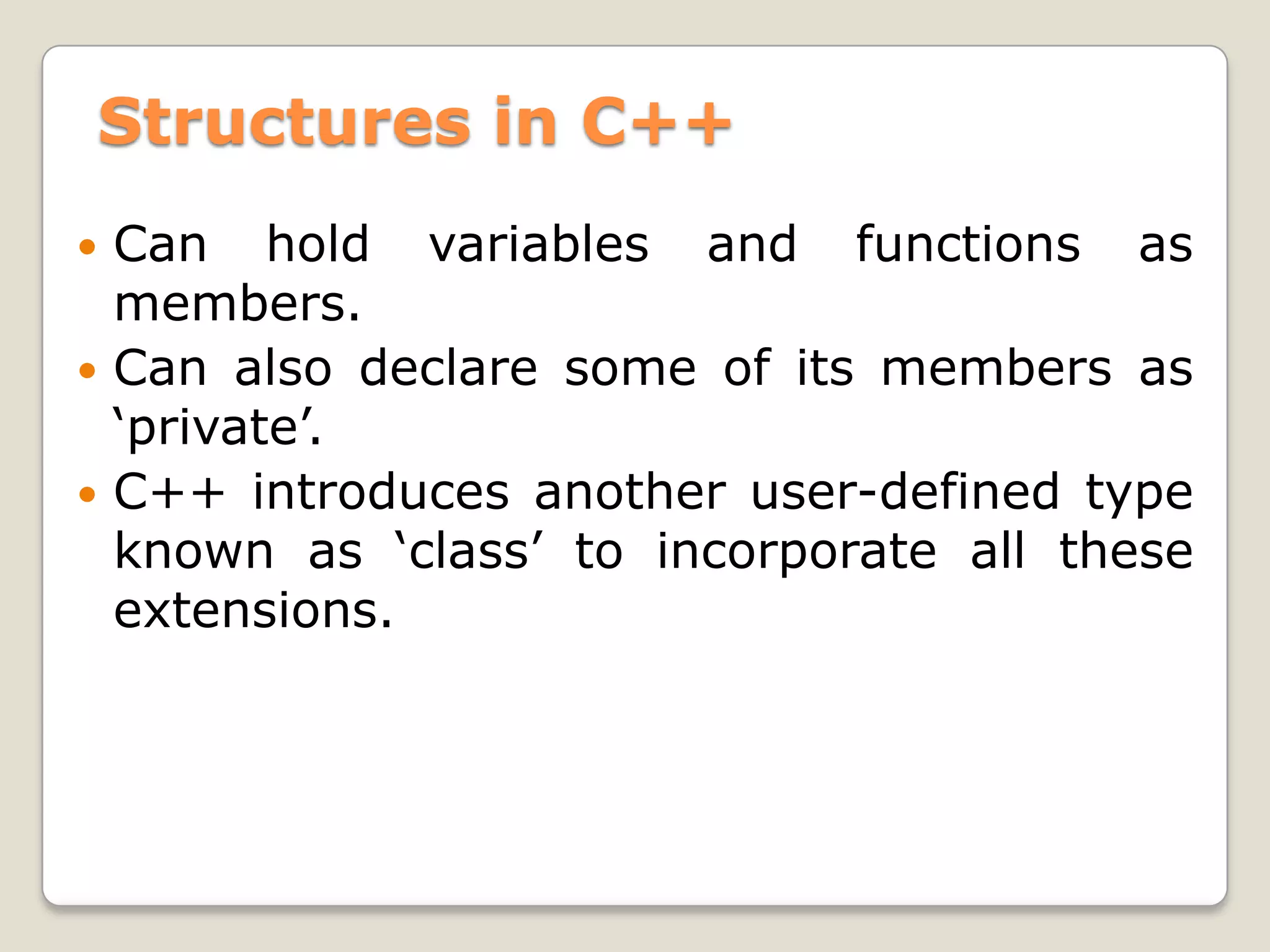
Structures in C++
 Can hold variables and functions as
  members.
 Can also declare some of its members as
  ‘private’.
 C++ introduces another user-defined type
  known as ‘class’ to incorporate all these
  extensions.
Unions
   A union is like a record
    ◦ But the different fields take up the same space
      within memory

    union foo {
        int i;
        float f;
        char c[4];
    }

   Union size is 4 bytes!
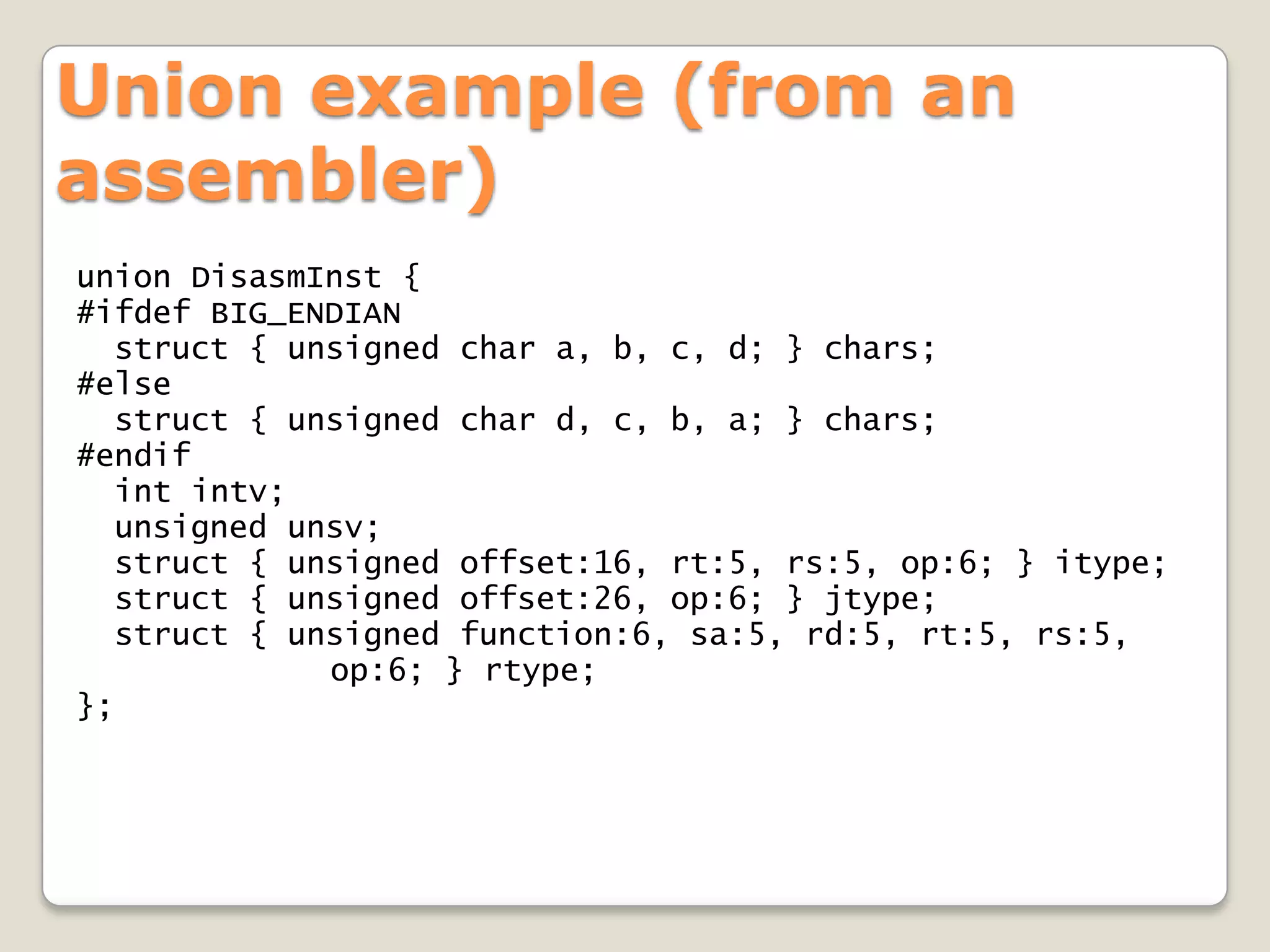
Union example (from an
assembler)
union DisasmInst {
#ifdef BIG_ENDIAN
  struct { unsigned char a, b, c, d; } chars;
#else
  struct { unsigned char d, c, b, a; } chars;
#endif
  int intv;
  unsigned unsv;
  struct { unsigned offset:16, rt:5, rs:5, op:6; } itype;
  struct { unsigned offset:26, op:6; } jtype;
  struct { unsigned function:6, sa:5, rd:5, rt:5, rs:5,
             op:6; } rtype;
};
void CheckEndian() {

                              Another union
  union {
    char charword[4];
    unsigned int intword;

                              example
  } check;

 check.charword[0]   =   1;
 check.charword[1]   =   2;
 check.charword[2]   =   3;
 check.charword[3]   =   4;

#ifdef BIG_ENDIAN
  if (check.intword != 0x01020304) {                /* big */
    cout << "ERROR: Host machine is not Big Endian.nExiting.n";
    exit (1);
  }
#else
#ifdef LITTLE_ENDIAN
  if (check.intword != 0x04030201) {                /* little */
    cout << "ERROR: Host machine is not Little Endian.nExiting.n";
    exit (1);
  }
#else
  cout << "ERROR: Host machine not defined as Big or Little Endian.n";
  cout << "Exiting.n";
  exit (1);
#endif // LITTLE_ENDIAN
#endif // BIG_ENDIAN
}
Data types

Data types

  • 1.
    DATA TYPES By:-Nokesh prabhakar.
  • 2.
    Data Types Data typesare means to identify the type of data and associated operation of handling it . C++ has three types of data types :- • Built in data type. • Derived data type. • User defined data type.
  • 3.
    C++ Data Types User-defined Derived type type structure Built-in array function union class type pointer reference enumeration Integral Floating Void type type int char float double
  • 4.
    Type Bytes Range char 1 -128 to 127 signed: -128 to 127 unsigned: 0 to 255 short int 2 -31768 to 32767 signed: -32768 to 32767 unsigned: 0 to 65535 int 2 -32768 to 32767 signed: -31768 to 32767 unsigned: 0 to 65535 long int 4 -2147483648 to 2147483647 signed: -2147483648 to 2147483647 unsigned: 0 to 4294967295 float 4 3.4E-38 to 3.4E+38 double 8 1.7E-308 to 1.7E+308 long double 10 3.4E-4932 to 1.1E+4932
  • 5.
    Built in datatype Built in data types are those who are not composed of other data types. There are mainly 5 kinds of build in data type :- 1.int type. 2.char type. 3.float type. 4.double type. 5.void type.
  • 6.
    Void data type The void data type specifies an empty set of values . It is used as the return type for functions that do not return a value.
  • 7.
    Int data type Integers are whole number such as 5,39,- 1917,0 etc. they have no fractional part. Integers can have positive as well as negative value . An identifiers declared as int cannot have fractional part.
  • 8.
    Char data type characters can store any member of the c++ implementation’s basic character set . An identifiers declared as char becomes character variable . char set is often said to be a integer type .
  • 9.
    Float data type A number having a fractional part is a floating-point number . the decimal point shows that it is a floating-point number not an integer. for ex-31.0 is a floating-point number not a integer but simply 31 is a integer.
  • 10.
    Double data type It is used for handling floating-point numbers. It occupies twice as memory as float. It is used when float is too small or insufficienly precise.
  • 11.
    Data type modifiers Thebasic data type has modifiers preceding them .we use modifier to alter the meaning of the base type to fit various situation more precisely. There are 3 types of modifiers:- 1.Integer type modifiers. 2.Character type modifiers . 3.Float type modifiers .
  • 12.
    Integer type modifiers Byusing different number of bytes to store values , c++ offers 3 types of integers :short , int and long that can represent upto three different integer sizes. A short integer is at least 2 bytes . A int integer is at least as big as short . A long integer is at least 4 bytes .
  • 13.
    APPROXIMATE TYPE SIZE(IN BYTES) MINIMAL RANGE short 2 -32768 to 32767 Unsigned short 2 0 to 65,535 Signed short 2 same as short Int 2 -32768 to 32767 Unsigned int 2 0 to 65,535 Signed int 2 same as int Long 4 -2,147,483,648 to 2,147,483,647 Unsigned long 4 0 to 4,294,967,295
  • 14.
    character type modifiers Thechar type can also be signed or unsigned . The unsigned char represent the range 0 to 255. The signed char represent the range -128 to 127.
  • 15.
    Type Approximate Minimal size(in bytes) range Char 1 -128 to 127 Unsigned char 1 0 to 255 Signed char 1 same as char
  • 16.
    Floating-point type modifiers C++has three floating-point types : float , double and long double. float type occupies 4 byte. Double occupies 8 byte . Long double occupies 10 byte.
  • 17.
    TYPE approximate Digit of size(in bytes) precision Float 4 7 Double 8 15 Long double 10 19
  • 18.
    Derived Data Types Fromthe built in data types other types can be derived called derived data types. There are 5 types of derived data types :- 1.Arrays. 2.Functions. 3.Pointers. 4.References. 5.Constant.
  • 19.
    ARRAYS Values of similartype stored in continuous memory locations. int a[10]; char string[3]=“xyz”; Array can be one dimensional , two dimensional , multi dimensional. For ex-float a[3]; //declares array of three floats :a[0],a[1],a[2]. Int b[2][4]; //declares a 2 dimension array of integer:b[0][0], b[0][1], b[0][2], b[0][3], b[1][0], b[1][1], b[1][2], b[1][3].
  • 20.
    Two ways to make multidimensional arrays ◦ Both examples from Ada ◦ Construct specifically as multidimensional. matrix: array (1..10, 1..10) of real; -- Reference example: matrix(7, 2)  Looks nice, but has limited functionality. ◦ Construct as being an array of arrays. matrix: array (1..10) of array (1..10) of real; -- Reference example: matrix(7)(2) Multidimensional Arrays 20
  • 21.
    Functions Set of statementsto perform specific tasks. A piece of code that perform specific task. Introduces modularity in the code. Reduces the size of program. C++ has added many new features to the functions to make them more reliable and flexible. It can be overloaded.
  • 22.
    Function declaration ◦ return-type function-name (argument-list); ◦ void show(); ◦ float volume(int x,float y,float z);  Function definition return-type function-name(argument-list) { statement1; statement2; }  Function call ◦ function-name(argument-list); ◦ volume(a,b,c); Functions
  • 23.
    Pointers Pointers can bedeclared and initialized as in C. int * ip; // int pointer ip = &x; // address of x assigned to ip *ip = 10; // 10 assigned to x through indirection
  • 24.
    References A reference isan alternative name of an object. Constant A constant is a data item whose data value can never change during the program run.
  • 25.
    Classes and Objects  Class is a way to bind the data and procedures that operates on data.  Class declaration: class class_name { private: variable declarations;//class function declarations;//members public: variable declarations;//class function declarations;//members };//Terminates with a semicolon
  • 26.
    Classes and Objects Class members that have been declared as private can be accessed only from within the class.  Public class members can be accessed from outside the class also.  Supports data-hiding and data encapsulation features of OOP.
  • 27.
    Classes and Objects Objects are run time instance of a class.  Class is a representation of the object, and Object is the actual run time entity which holds data and function that has been defined in the class.  Object declaration: class_name obj1; class_name obj2,obj3; class class_name {……}obj1,obj2,obj3;
  • 28.
    Classes and Objects  Accessing class members ◦ Object-name.function-name(actual-arguments); ◦ obj1.setdata(100,34.4);  Defining Member Functions ◦ Outside the class definition. return-type class-name::function-name (argument declaration) { Function body; } ◦ Inside the class definition. Same as normal function declaration.
  • 29.
  • 30.
    Structures  Structures Revisited ◦ Makes convenient to handle a group of logically related data items. struct student //declaration { char name[20]; int roll_number; float total_marks; }; struct student A;// C declaration student A; //C++ declaration A.roll_number=999; A.total_marks=595.5; Final_Total=A.total_marks + 5;
  • 31.
    Structures  Limitations ◦ C doesn’t allow it to be treated like built-in data types. struct complex{float x; float y;}; struct complex c1,c2,c3; c3=c1+c2;//Illegal in C ◦ They do not permit data hiding.
  • 32.
    Structures in C++ Can hold variables and functions as members.  Can also declare some of its members as ‘private’.  C++ introduces another user-defined type known as ‘class’ to incorporate all these extensions.
  • 33.
    Unions  A union is like a record ◦ But the different fields take up the same space within memory union foo { int i; float f; char c[4]; }  Union size is 4 bytes!
  • 34.
    Union example (froman assembler) union DisasmInst { #ifdef BIG_ENDIAN struct { unsigned char a, b, c, d; } chars; #else struct { unsigned char d, c, b, a; } chars; #endif int intv; unsigned unsv; struct { unsigned offset:16, rt:5, rs:5, op:6; } itype; struct { unsigned offset:26, op:6; } jtype; struct { unsigned function:6, sa:5, rd:5, rt:5, rs:5, op:6; } rtype; };
  • 35.
    void CheckEndian() { Another union union { char charword[4]; unsigned int intword; example } check; check.charword[0] = 1; check.charword[1] = 2; check.charword[2] = 3; check.charword[3] = 4; #ifdef BIG_ENDIAN if (check.intword != 0x01020304) { /* big */ cout << "ERROR: Host machine is not Big Endian.nExiting.n"; exit (1); } #else #ifdef LITTLE_ENDIAN if (check.intword != 0x04030201) { /* little */ cout << "ERROR: Host machine is not Little Endian.nExiting.n"; exit (1); } #else cout << "ERROR: Host machine not defined as Big or Little Endian.n"; cout << "Exiting.n"; exit (1); #endif // LITTLE_ENDIAN #endif // BIG_ENDIAN }