Working Effectively With Legacy Code

Loading...

Flash Player 9 (or above) is needed to view presentations.
We have detected that you do not have it on your computer. To install it, go here.

0 comments

Post a comment

    Post a comment
    Embed Video
    Edit your comment Cancel

    Notes on slide 1

    Notes 2/5/2004 Michael Feathers

    5 Favorites

    Working Effectively With Legacy Code - Presentation Transcript

    1. Working Effectively with Legacy Code Michael Feathers [email_address]
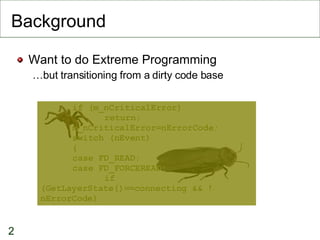
    2. Background
      • Want to do Extreme Programming
        • … but transitioning from a dirty code base
      if (m_nCriticalError)‏ return; m_nCriticalError=nErrorCode; switch (nEvent)‏ { case FD_READ: case FD_FORCEREAD: if (GetLayerState()==connecting && !nErrorCode)‏
    3. First Reaction
      • Pretend the code isn’t there
      • Use TDD to create new classes, make direct changes to the old ones, hope that they are correct
      • We’d actually like to be even more conservative. We’d like to avoid having to go back to that code ever again.
      • Is this viable?
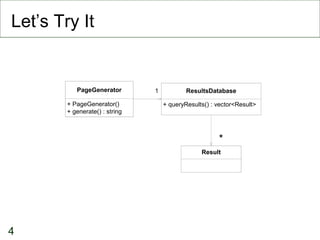
    4. Let’s Try It
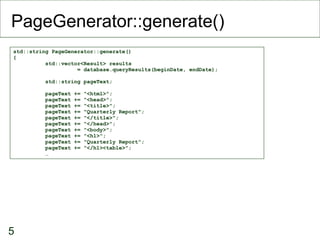
    5. PageGenerator::generate()‏ std::string PageGenerator::generate()‏ { std::vector<Result> results = database.queryResults(beginDate, endDate); std::string pageText; pageText += &quot;<html>&quot;; pageText += &quot;<head>&quot;; pageText += &quot;<title>&quot;; pageText += &quot;Quarterly Report&quot;; pageText += &quot;</title>&quot;; pageText += &quot;</head>&quot;; pageText += &quot;<body>&quot;; pageText += &quot;<h1>&quot;; pageText += &quot;Quarterly Report&quot;; pageText += &quot;</h1><table>&quot;; …
    6. Continued.. … if (results.size() != 0) { pageText += &quot;<table border=&quot;1&quot;>&quot;; for (std::vector<Result>::iterator it = results.begin(); it != results.end(); ++it) { pageText += &quot;<tr border=&quot;1&quot;>&quot;; pageText += &quot;<td>&quot; + it->department + &quot;</td>&quot;; pageText += &quot;<td>&quot; + it->manager + &quot;</td>&quot;; char buffer [128]; sprintf(buffer, &quot;<td>$%d</td>&quot;, it->netProfit / 100); pageText += std::string(buffer); sprintf(buffer, &quot;<td>$%d</td>&quot;, it->operatingExpense / 100); pageText += std::string(buffer); pageText += &quot;</tr>&quot;; } pageText += &quot;</table>&quot;; } else { …
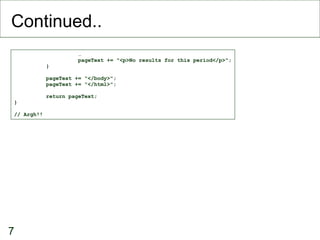
    7. Continued.. … pageText += &quot;<p>No results for this period</p>&quot;; } pageText += &quot;</body>&quot;; pageText += &quot;</html>&quot;; return pageText; } // Argh!!
    8. Changes
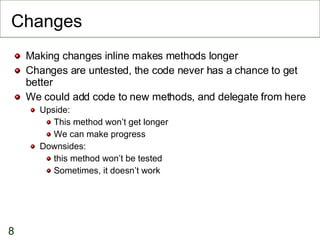
      • Making changes inline makes methods longer
      • Changes are untested, the code never has a chance to get better
      • We could add code to new methods, and delegate from here
        • Upside:
          • This method won’t get longer
          • We can make progress
        • Downsides:
          • this method won’t be tested
          • Sometimes, it doesn’t work
    9. Chia Pet Pattern
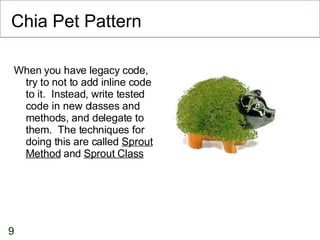
      • When you have legacy code, try to not to add inline code to it. Instead, write tested code in new classes and methods, and delegate to them. The techniques for doing this are called Sprout Method and Sprout Class
    10. Why are we so Conservative?
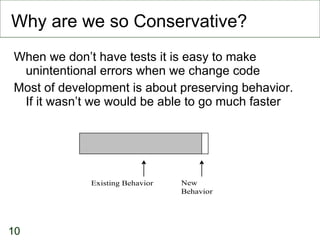
      • When we don’t have tests it is easy to make unintentional errors when we change code
      • Most of development is about preserving behavior. If it wasn’t we would be able to go much faster
    11. The Refactoring Dilemma
      • When we refactor, we should have tests. To put tests in place, we often have to refactor
    12. Most applications are glued together
      • We don’t know this until we try to test pieces in isolation
    13. Kinds of Glue
      • Singletons (a.k.a. global variables)‏
        • If there can only be one of an object you’d better hope that it is good for your tests too
      • Internal instantiation
        • When a class creates an instance of a hard coded class, you’d better hope that class runs well in tests
      • Concrete Dependency
        • When a class uses a concrete class, you’d better hope that class lets you know what is happening to it
    14. Breaking Dependencies
      • The way that we break dependencies depends upon the tools available to us. If we have safe extract method and safe extract interface in an IDE, We can do a lot
      • If we don’t, we have to refactor manually, and very conservatively . We have to break dependencies as directly and simply as possible.
      • Sometimes breaking dependencies is ugly
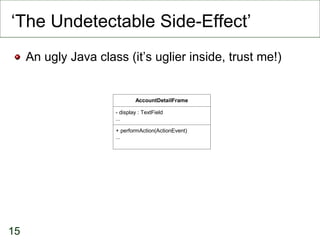
    15. ‘ The Undetectable Side-Effect’
      • An ugly Java class (it’s uglier inside, trust me!)‏
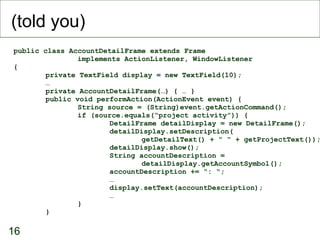
    16. (told you)‏ public class AccountDetailFrame extends Frame implements ActionListener, WindowListener { private TextField display = new TextField(10); … private AccountDetailFrame(…) { … } public void performAction(ActionEvent event) { String source = (String)event.getActionCommand(); if (source.equals(“project activity”)) { DetailFrame detailDisplay = new DetailFrame(); detailDisplay.setDescription( getDetailText() + “ “ + getProjectText()); detailDisplay.show(); String accountDescription = detailDisplay.getAccountSymbol(); accountDescription += “: “; … display.setText(accountDescription); … } }
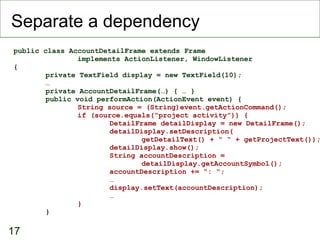
    17. Separate a dependency public class AccountDetailFrame extends Frame implements ActionListener, WindowListener { private TextField display = new TextField(10); … private AccountDetailFrame(…) { … } public void performAction(ActionEvent event) { String source = (String)event.getActionCommand(); if (source.equals(“project activity”)) { DetailFrame detailDisplay = new DetailFrame(); detailDisplay.setDescription( getDetailText() + “ “ + getProjectText()); detailDisplay.show(); String accountDescription = detailDisplay.getAccountSymbol(); accountDescription += “: “; … display.setText(accountDescription); … } }
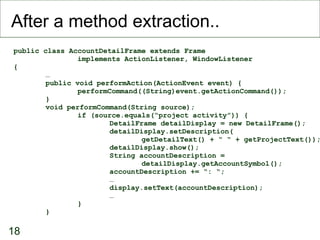
    18. After a method extraction.. public class AccountDetailFrame extends Frame implements ActionListener, WindowListener { … public void performAction(ActionEvent event) { performCommand((String)event.getActionCommand()); } void performCommand(String source); if (source.equals(“project activity”)) { DetailFrame detailDisplay = new DetailFrame(); detailDisplay.setDescription( getDetailText() + “ “ + getProjectText()); detailDisplay.show(); String accountDescription = detailDisplay.getAccountSymbol(); accountDescription += “: “; … display.setText(accountDescription); … } }
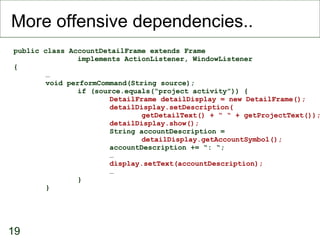
    19. More offensive dependencies.. public class AccountDetailFrame extends Frame implements ActionListener, WindowListener { … void performCommand(String source); if (source.equals(“project activity”)) { DetailFrame detailDisplay = new DetailFrame(); detailDisplay.setDescription( getDetailText() + “ “ + getProjectText()); detailDisplay.show(); String accountDescription = detailDisplay.getAccountSymbol(); accountDescription += “: “; … display.setText(accountDescription); … } }
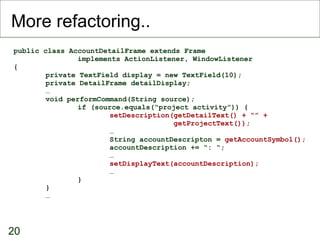
    20. More refactoring.. public class AccountDetailFrame extends Frame implements ActionListener, WindowListener { private TextField display = new TextField(10); private DetailFrame detailDisplay; … void performCommand(String source); if (source.equals(“project activity”)) { setDescription(getDetailText() + “” + getProjectText()); … String accountDescripton = getAccountSymbol(); accountDescription += “: “; … setDisplayText(accountDescription); … } } …
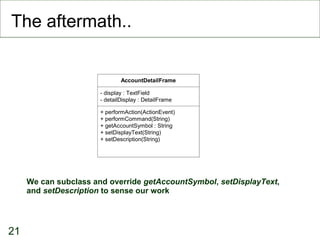
    21. The aftermath.. We can subclass and override getAccountSymbol , setDisplayText , and setDescription to sense our work
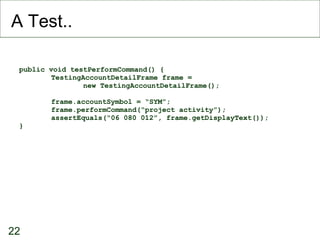
    22. A Test.. public void testPerformCommand() { TestingAccountDetailFrame frame = new TestingAccountDetailFrame(); frame.accountSymbol = “SYM”; frame.performCommand(“project activity”); assertEquals(“06 080 012”, frame.getDisplayText()); }
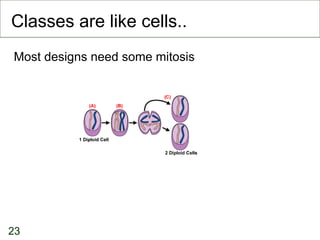
    23. Classes are like cells..
      • Most designs need some mitosis
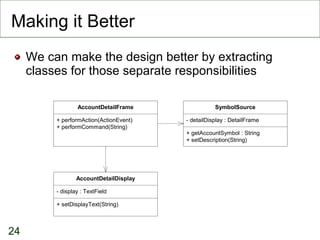
    24. Making it Better
      • We can make the design better by extracting classes for those separate responsibilities
    25. Better vs. Best
      • “ Best is the enemy of good” – Voltaire (paraphrased)‏
    26. Automated Tool Moves
      • If you have a safe refactoring tool and you are going to use it to break dependencies without tests, do a refactoring series : a series of automated refactorings with no other edits.
      • When tool operations are safe, all that does is move the risk to your edits. Minimize them by leaning on the tool
    27. Manual Moves
      • Lean on the Compiler
      • Preserve Signatures
      • Single Goal Editing
    28. Leaning on the Compiler
      • You can use the compiler to navigate to needed points of change by deliberately producing errors
      • Most common case:
        • Change a declaration
        • Compile to find the references that need changes
    29. Signature Preservation
      • When you are trying to get tests in place favor refactorings which allow you to cut/copy and paste signatures without modification
      • Less error prone
    30. Single Goal Editing
      • Do one thing at a time
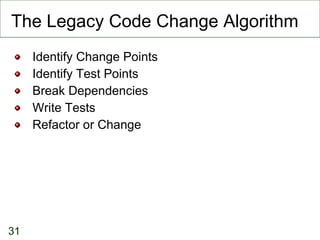
    31. The Legacy Code Change Algorithm
      • Identify Change Points
      • Identify Test Points
      • Break Dependencies
      • Write Tests
      • Refactor or Change
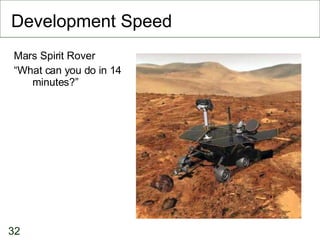
    32. Development Speed
      • Mars Spirit Rover
      • “ What can you do in 14 minutes?”
    33. Breaking Dependencies 0 Extract Interface Extract Implementor
    34. Extract Interface
      • A key refactoring for legacy code
      • Safe
        • With a few rules in mind you can do this without a chance of breaking your software
      • Can take a little time
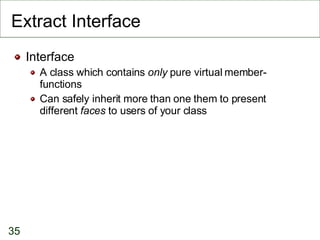
    35. Extract Interface
      • Interface
        • A class which contains only pure virtual member-functions
        • Can safely inherit more than one them to present different faces to users of your class
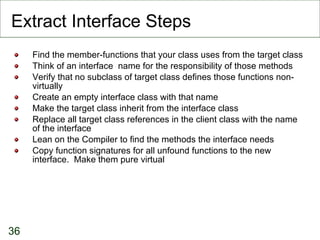
    36. Extract Interface Steps
      • Find the member-functions that your class uses from the target class
      • Think of an interface name for the responsibility of those methods
      • Verify that no subclass of target class defines those functions non-virtually
      • Create an empty interface class with that name
      • Make the target class inherit from the interface class
      • Replace all target class references in the client class with the name of the interface
      • Lean on the Compiler to find the methods the interface needs
      • Copy function signatures for all unfound functions to the new interface. Make them pure virtual
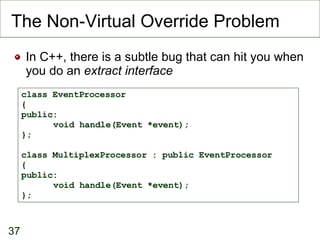
    37. The Non-Virtual Override Problem
      • In C++, there is a subtle bug that can hit you when you do an extract interface
      class EventProcessor { public: void handle(Event *event); }; class MultiplexProcessor : public EventProcessor { public: void handle(Event *event); };
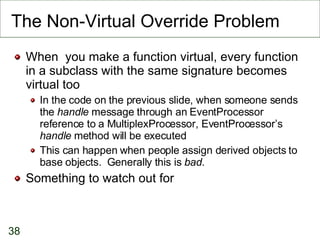
    38. The Non-Virtual Override Problem
      • When you make a function virtual, every function in a subclass with the same signature becomes virtual too
        • In the code on the previous slide, when someone sends the handle message through an EventProcessor reference to a MultiplexProcessor, EventProcessor’s handle method will be executed
        • This can happen when people assign derived objects to base objects. Generally this is bad .
      • Something to watch out for
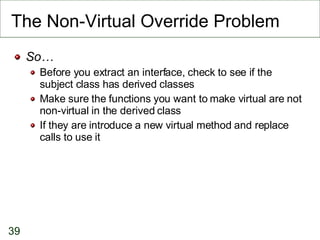
    39. The Non-Virtual Override Problem
      • So…
        • Before you extract an interface, check to see if the subject class has derived classes
        • Make sure the functions you want to make virtual are not non-virtual in the derived class
        • If they are introduce a new virtual method and replace calls to use it
    40. Extract Implementor
      • Same as Extract Interface only we push down instead of pull up.
    41. Breaking Dependencies 1 Parameterize Method Extract and Override Call
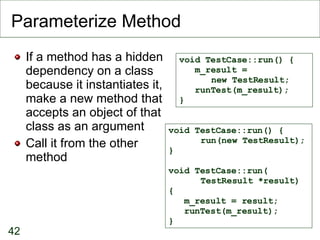
    42. Parameterize Method
      • If a method has a hidden dependency on a class because it instantiates it, make a new method that accepts an object of that class as an argument
      • Call it from the other method
      void TestCase::run() { m_result = new TestResult; runTest(m_result); } void TestCase::run() { run(new TestResult); } void TestCase::run( TestResult *result) { m_result = result; runTest(m_result); }
    43. Steps – Parameterize Method
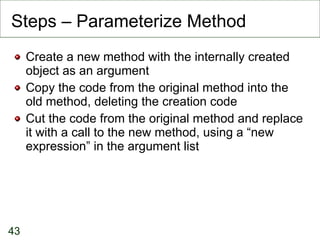
      • Create a new method with the internally created object as an argument
      • Copy the code from the original method into the old method, deleting the creation code
      • Cut the code from the original method and replace it with a call to the new method, using a “new expression” in the argument list
    44. Extract and Override Call
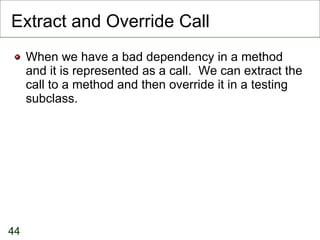
      • When we have a bad dependency in a method and it is represented as a call. We can extract the call to a method and then override it in a testing subclass.
    45. Steps – Extract and Override Call
      • Extract a method for the call (remember to preserve signatures)‏
      • Make the method virtual
      • Create a testing subclass that overrides that method
    46. Breaking Dependencies 2 Link-Time Polymorphism
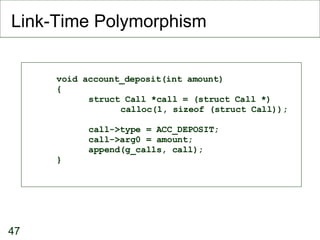
    47. Link-Time Polymorphism void account_deposit(int amount)‏ { struct Call *call = (struct Call *)‏ calloc(1, sizeof (struct Call)); call->type = ACC_DEPOSIT; call->arg0 = amount; append(g_calls, call); }
    48. Steps – Link-Time Polymorphism
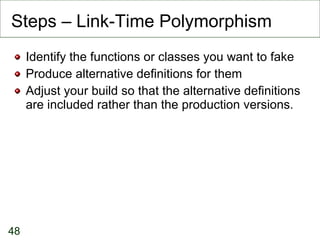
      • Identify the functions or classes you want to fake
      • Produce alternative definitions for them
      • Adjust your build so that the alternative definitions are included rather than the production versions.
    49. Breaking Dependencies 3 Expose Static Method
    50. Expose Static Method
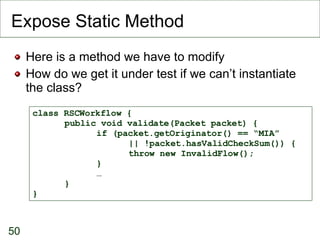
      • Here is a method we have to modify
      • How do we get it under test if we can’t instantiate the class?
      class RSCWorkflow { public void validate(Packet packet) { if (packet.getOriginator() == “MIA” || !packet.hasValidCheckSum()) { throw new InvalidFlow(); } … } }
    51. Expose Static Method
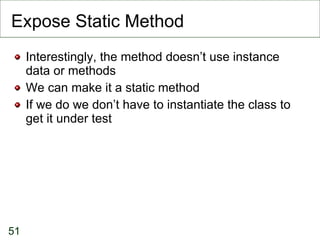
      • Interestingly, the method doesn’t use instance data or methods
      • We can make it a static method
      • If we do we don’t have to instantiate the class to get it under test
    52. Expose Static Method
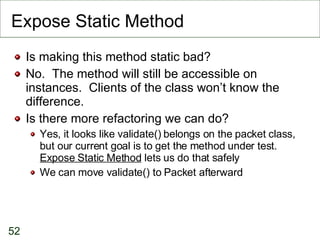
      • Is making this method static bad?
      • No. The method will still be accessible on instances. Clients of the class won’t know the difference.
      • Is there more refactoring we can do?
        • Yes, it looks like validate() belongs on the packet class, but our current goal is to get the method under test. Expose Static Method lets us do that safely
        • We can move validate() to Packet afterward
    53. Steps – Expose Static Method
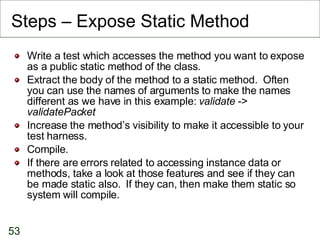
      • Write a test which accesses the method you want to expose as a public static method of the class.
      • Extract the body of the method to a static method. Often you can use the names of arguments to make the names different as we have in this example: validate -> validatePacket
      • Increase the method’s visibility to make it accessible to your test harness.
      • Compile.
      • If there are errors related to accessing instance data or methods, take a look at those features and see if they can be made static also. If they can, then make them static so system will compile.
    54. Breaking Dependencies 4 Introduce Instance Delegator
    55. Introduce Instance Delegator
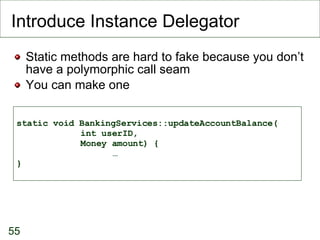
      • Static methods are hard to fake because you don’t have a polymorphic call seam
      • You can make one
      static void BankingServices::updateAccountBalance( int userID, Money amount) { … }
    56. Introduce Instance Delegator
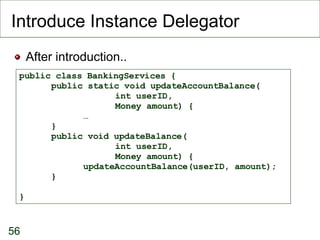
      • After introduction..
      public class BankingServices { public static void updateAccountBalance( int userID, Money amount) { … } public void updateBalance( int userID, Money amount) { updateAccountBalance(userID, amount); } }
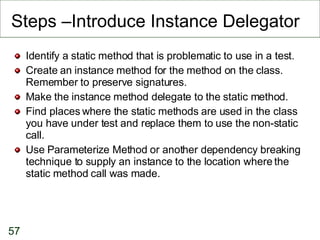
    57. Steps –Introduce Instance Delegator
      • Identify a static method that is problematic to use in a test.
      • Create an instance method for the method on the class. Remember to preserve signatures.
      • Make the instance method delegate to the static method.
      • Find places where the static methods are used in the class you have under test and replace them to use the non-static call.
      • Use Parameterize Method or another dependency breaking technique to supply an instance to the location where the static method call was made.
    58. Dependency Breaking 5 Template Redefinition
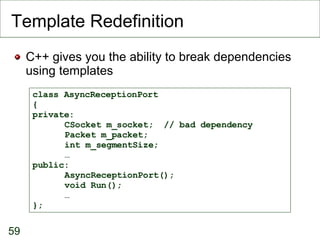
    59. Template Redefinition
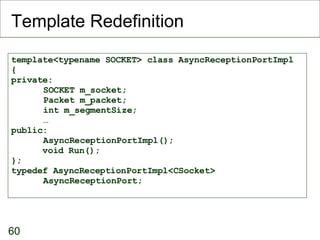
      • C++ gives you the ability to break dependencies using templates
      class AsyncReceptionPort { private: CSocket m_socket; // bad dependency Packet m_packet; int m_segmentSize; … public: AsyncReceptionPort(); void Run(); … };
    60. Template Redefinition template<typename SOCKET> class AsyncReceptionPortImpl { private: SOCKET m_socket; Packet m_packet; int m_segmentSize; … public: AsyncReceptionPortImpl(); void Run(); }; typedef AsyncReceptionPortImpl<CSocket> AsyncReceptionPort;
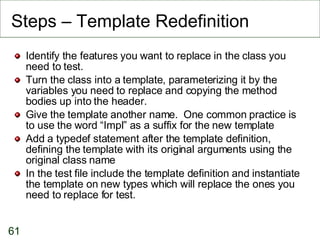
    61. Steps – Template Redefinition
      • Identify the features you want to replace in the class you need to test.
      • Turn the class into a template, parameterizing it by the variables you need to replace and copying the method bodies up into the header.
      • Give the template another name. One common practice is to use the word “Impl” as a suffix for the new template
      • Add a typedef statement after the template definition, defining the template with its original arguments using the original class name
      • In the test file include the template definition and instantiate the template on new types which will replace the ones you need to replace for test.
    62. Writing Tests
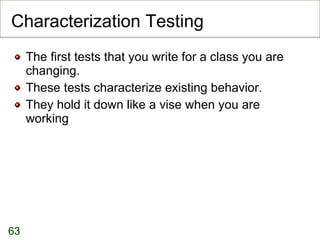
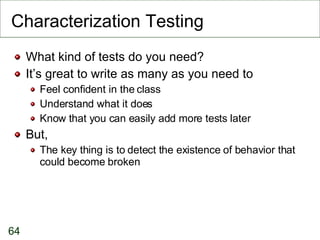
    63. Characterization Testing
      • The first tests that you write for a class you are changing.
      • These tests characterize existing behavior.
      • They hold it down like a vise when you are working
    64. Characterization Testing
      • What kind of tests do you need?
      • It’s great to write as many as you need to
        • Feel confident in the class
        • Understand what it does
        • Know that you can easily add more tests later
      • But,
        • The key thing is to detect the existence of behavior that could become broken
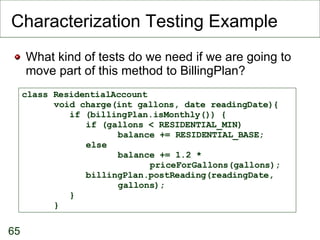
    65. Characterization Testing Example
      • What kind of tests do we need if we are going to move part of this method to BillingPlan?
      class ResidentialAccount void charge(int gallons, date readingDate){ if (billingPlan.isMonthly()) { if (gallons < RESIDENTIAL_MIN) balance += RESIDENTIAL_BASE; else balance += 1.2 * priceForGallons(gallons); billingPlan.postReading(readingDate, gallons); } }
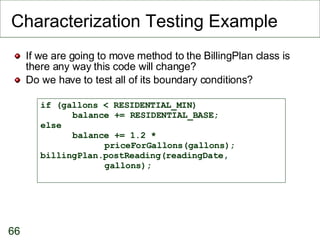
    66. Characterization Testing Example
      • If we are going to move method to the BillingPlan class is there any way this code will change?
      • Do we have to test all of its boundary conditions?
      if (gallons < RESIDENTIAL_MIN) balance += RESIDENTIAL_BASE; else balance += 1.2 * priceForGallons(gallons); billingPlan.postReading(readingDate, gallons);
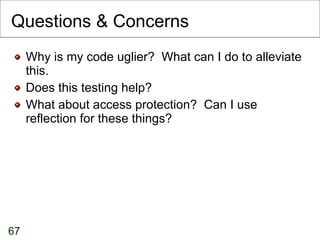
    67. Questions & Concerns
      • Why is my code uglier? What can I do to alleviate this.
      • Does this testing help?
      • What about access protection? Can I use reflection for these things?
    68. WELC Understanding, Isolating, Testing, and Changing ..Untested Code www.objectmentor.com www.michaelfeathers.com

    + Naresh JainNaresh Jain, 2 years ago

    custom

    2359 views, 5 favs, 5 embeds more stats

    Michael Feather's Working Effectively with Legacy C more

    More info about this document

    © All Rights Reserved

    Go to text version

    • Total Views 2359
      • 2272 on SlideShare
      • 87 from embeds
    • Comments 0
    • Favorites 5
    • Downloads 115
    Most viewed embeds
    • 47 views on http://wiki.directi.com
    • 37 views on http://agileindia.org
    • 1 views on http://localhost:3000
    • 1 views on http://www.agileindia.org
    • 1 views on http://74.125.95.132

    more

    All embeds
    • 47 views on http://wiki.directi.com
    • 37 views on http://agileindia.org
    • 1 views on http://localhost:3000
    • 1 views on http://www.agileindia.org
    • 1 views on http://74.125.95.132

    less

    Flagged as inappropriate Flag as inappropriate
    Flag as inappropriate

    Select your reason for flagging this presentation as inappropriate. If needed, use the feedback form to let us know more details.

    Cancel
    File a copyright complaint
    Having problems? Go to our helpdesk?

    Categories