Privacy	
  and	
  Security	
  in	


Mul1-­‐modal	
  User	
  Interface	
  Modeling	


            for	
  Social	
  Media	
  
       Mohamed	
  Bourimi1,3,	
  Ricardo	
  Tesoriero2,	
  Pedro	
  G.	
  
        Villanueva2,	
  Fa<h	
  Karatas1,	
  Philipp	
  Schwarte1	


        1University	
  of	
  Siegen,	
  Chair	
  for	
  IT	
  Security,	
  Germany	
  
    2Compu1ng	
  Systems	
  Department.	
  University	
  of	
  Cas1lla-­‐La	
  
                             Mancha,	
  Spain	
  
3FernUniversität	
  in	
  Hagen,	
  Coopera1ve	
  Systems	
  Group,	
  Germany	
  
Overview	
  

§  Background	
  and	
  Mo2va2on	
  
§  Problem	
  Statement(s)	
  
§  Requirements	
  Analysis	
  
§  Proposed	
  Approach	
  
§  Example	
  
§  Eclipse	
  Security	
  Model	
  Editor	
  
§  Future	
  Work	
  and	
  Conclusion	
  
Background	
  and	
  Mo2va2on	
  
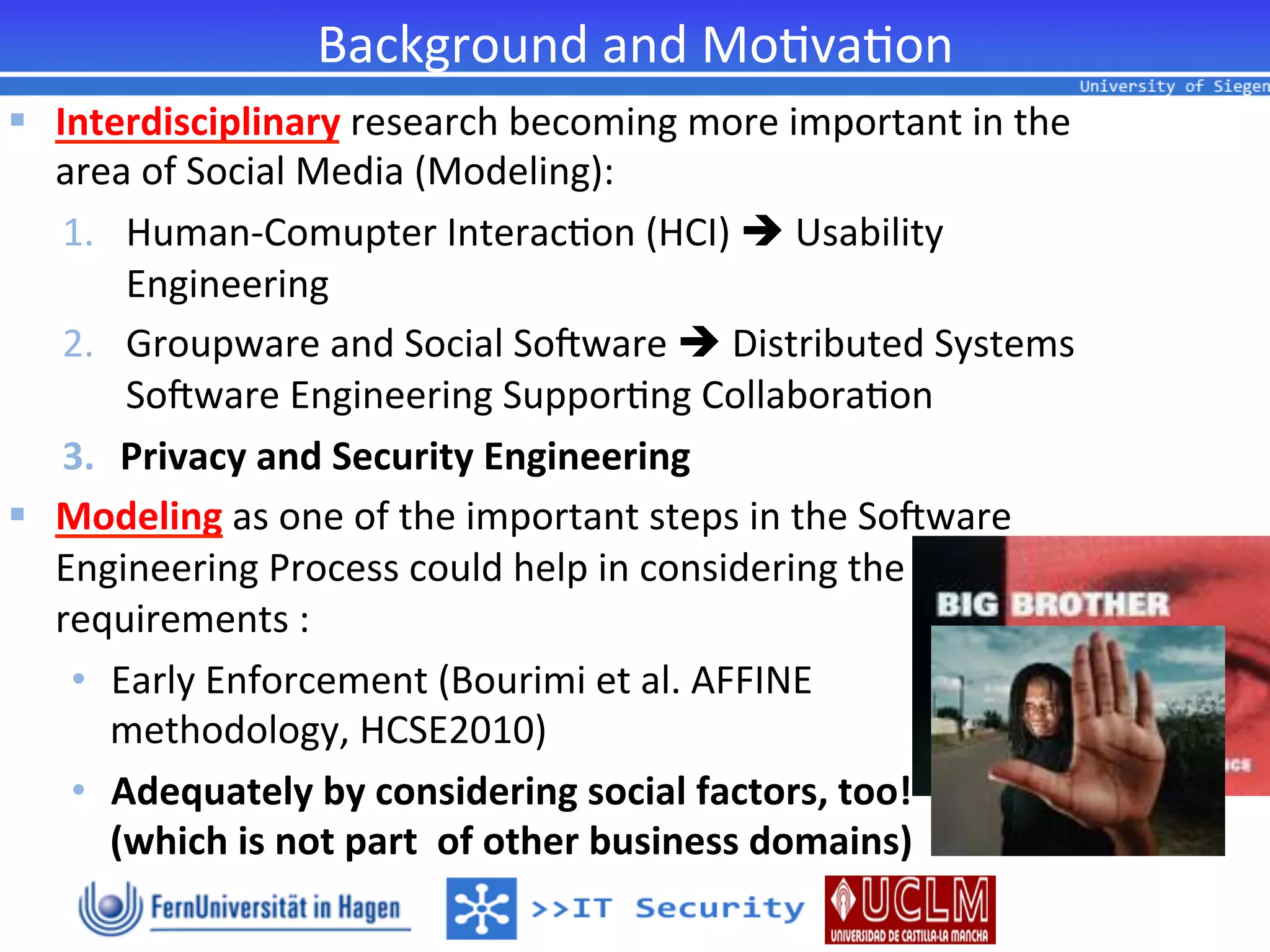
§  Interdisciplinary	
  research	
  becoming	
  more	
  important	
  in	
  the	
  
    area	
  of	
  Social	
  Media	
  (Modeling):	
  
     1.  Human-­‐Comupter	
  Interac2on	
  (HCI)	
  è	
  Usability	
  
          Engineering	
  
     2.  Groupware	
  and	
  Social	
  SoQware	
  è	
  Distributed	
  Systems	
  
          SoQware	
  Engineering	
  Suppor2ng	
  Collabora2on	
  
     3.  Privacy	
  and	
  Security	
  Engineering	
  	
  
§  Modeling	
  as	
  one	
  of	
  the	
  important	
  steps	
  in	
  the	
  SoQware	
  
    Engineering	
  Process	
  could	
  help	
  in	
  considering	
  the	
  
    requirements	
  :	
  
     •  Early	
  Enforcement	
  (Bourimi	
  et	
  al.	
  AFFINE	
  	
  
         methodology,	
  HCSE2010)	
  
     •  Adequately	
  by	
  considering	
  social	
  factors,	
  too!	
  
         (which	
  is	
  not	
  part	
  	
  of	
  other	
  business	
  domains)	
  
Abuses,	
  risks	
  and	
  threats	
  when	
  using	
  Social	
  Media!	
  
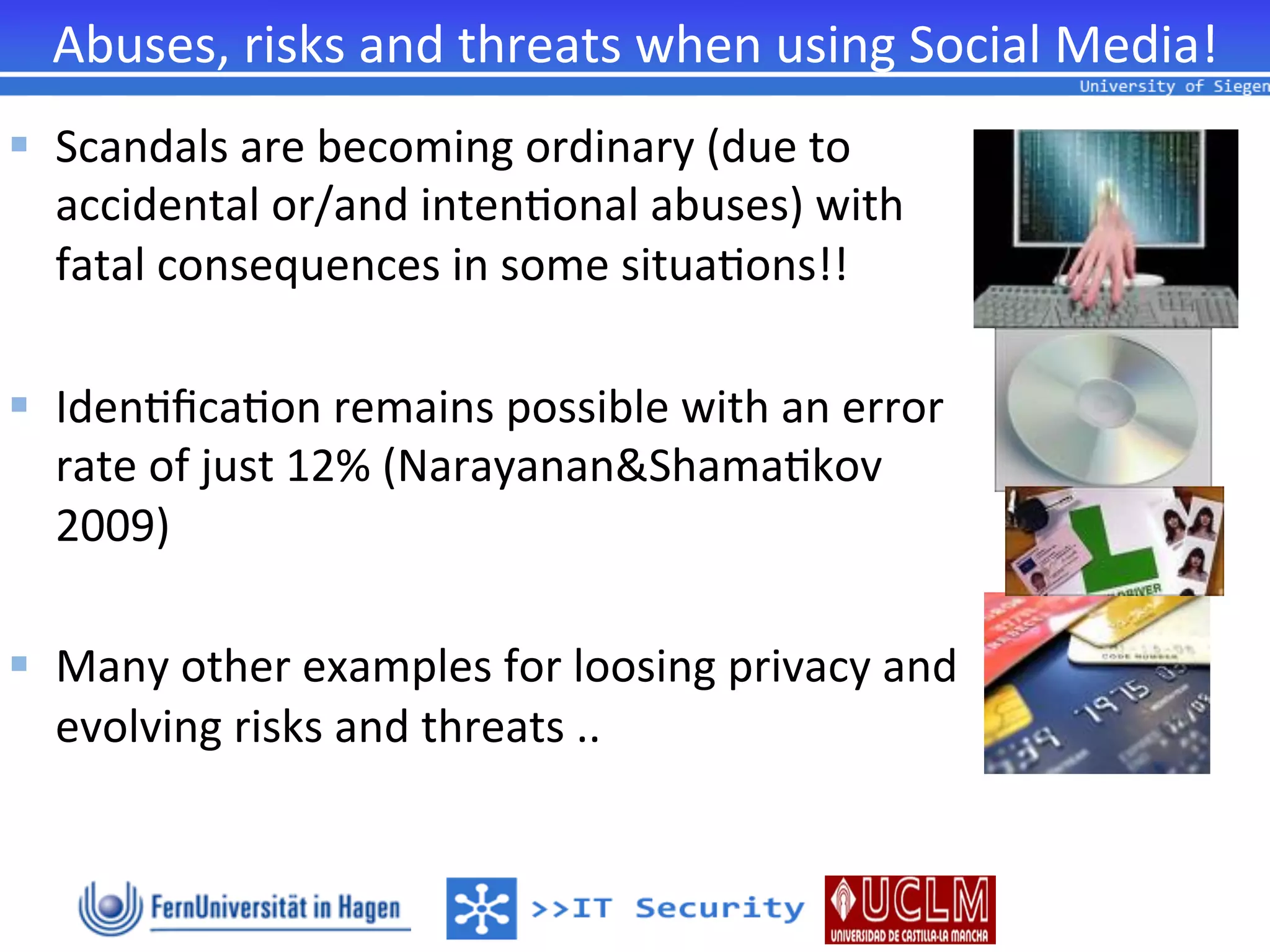
§  Scandals	
  are	
  becoming	
  ordinary	
  (due	
  to	
  	
  
    accidental	
  or/and	
  inten2onal	
  abuses)	
  with	
  	
  
    fatal	
  consequences	
  in	
  some	
  situa2ons!!	
  

§  Iden2fica2on	
  remains	
  possible	
  with	
  an	
  error	
  	
  
    rate	
  of	
  just	
  12%	
  (Narayanan&Shama2kov	
  	
  
    2009)	


§  Many	
  other	
  examples	
  for	
  loosing	
  privacy	
  and	
  	
  
    evolving	
  risks	
  and	
  threats	
  ..	
  
Problem	
  Statement(s)	
  
§  General	
  problem	
  statement:	
  Improving	
  the	
  
    modeling	
  of	
  systems	
  suppor<ng	
  social	
  interac<on	
  in	
  
    general	
  (considering	
  all	
  involved	
  research	
  fields	
  
    togetherè	
  Targe<ng	
  Synergy	
  Effect)	
  
§  Specific	
  problem	
  statement	
  (here):	
  Using	
  
    standard(s)	
  for	
  efficient	
  support	
  of	
  generated	
  user	
  
    interfaces	
  by	
  considering	
  mul<-­‐modality	
  (Web,	
  
    Mobile,	
  Desktop	
  etc.)	
  when	
  using	
  social	
  media	
  
    systems	
  (e.g.,	
  for	
  evalua<on	
  based	
  research,	
  
    frequent	
  provision/adap<on	
  of	
  prototypes	
  is	
  
    needed!)	
  
Requirements	
  Analysis:	
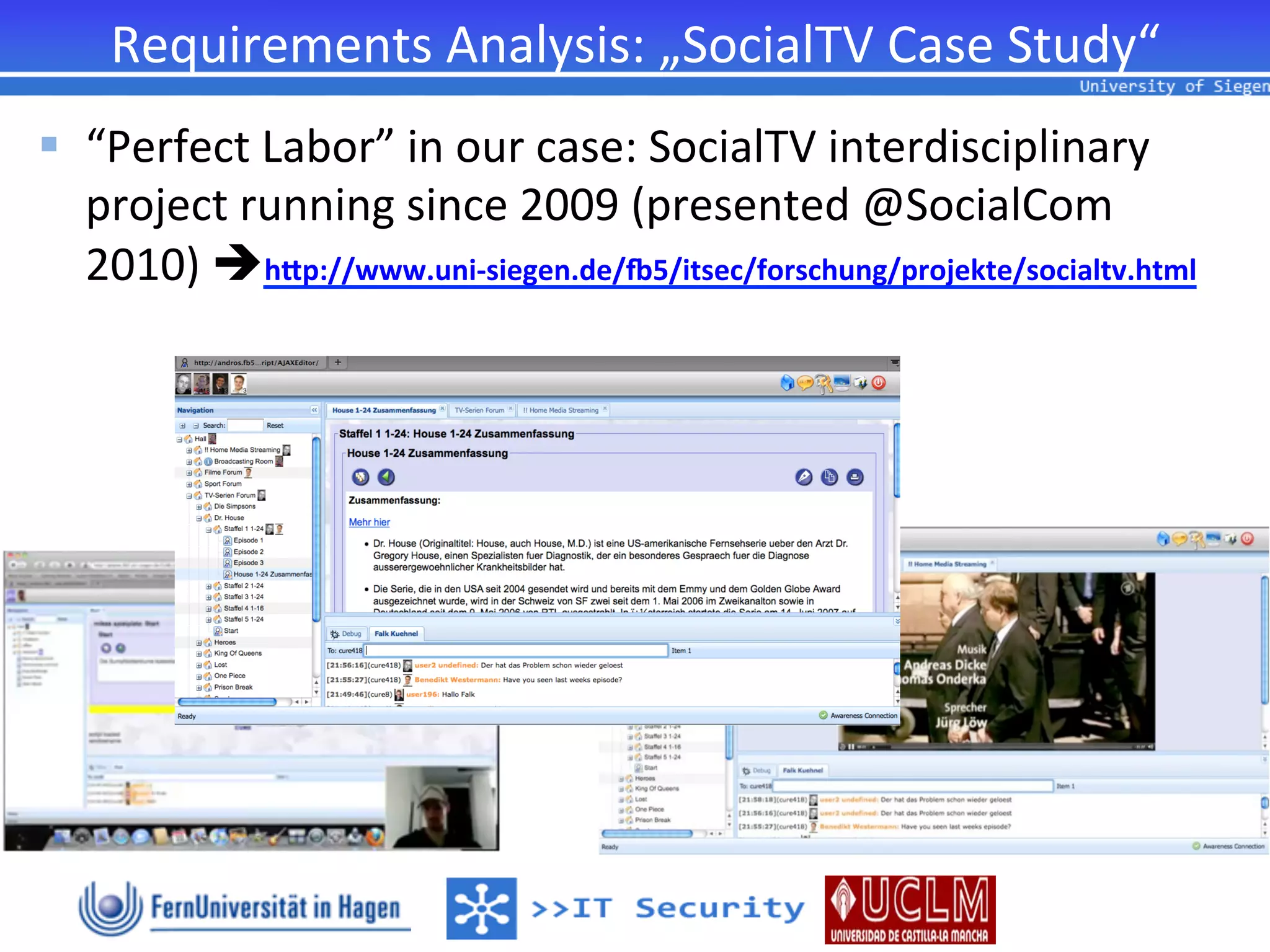
  „SocialTV	
  Case	
  Study“	
  
§  “Perfect	
  Labor”	
  in	
  our	
  case:	
  SocialTV	
  interdisciplinary	
  
    project	
  running	
  since	
  2009	
  (presented	
  @SocialCom	
  
    2010)	
  èhQp://www.uni-­‐siegen.de/T5/itsec/forschung/projekte/socialtv.html	
  
Requirements	
  Analysis:	
  Further	
  Gathered	
  Requirements	
  

§  R1:	
  	
  Reflec2ng	
  realis2c	
  SocialTV	
  situa2ons	
  (individual	
  
    and	
  group	
  interac2ons)	
  
§  R2:	
  	
  Allowing	
  for	
  flexible	
  parallel	
  interac2on	
  of	
  the	
  
    involved	
  people	
  
§  R3:	
  	
  Flexibility	
  in	
  terms	
  of	
  costs	
  emerging	
  from	
  
    adapta2ons	
  to	
  new	
  situa2ons	
  and	
  tests	
  
§  R4:	
  	
  Suppor2ng	
  thereby	
  secure	
  and	
  privacy-­‐
    preserving	
  interac2on	
  
Approach	
  
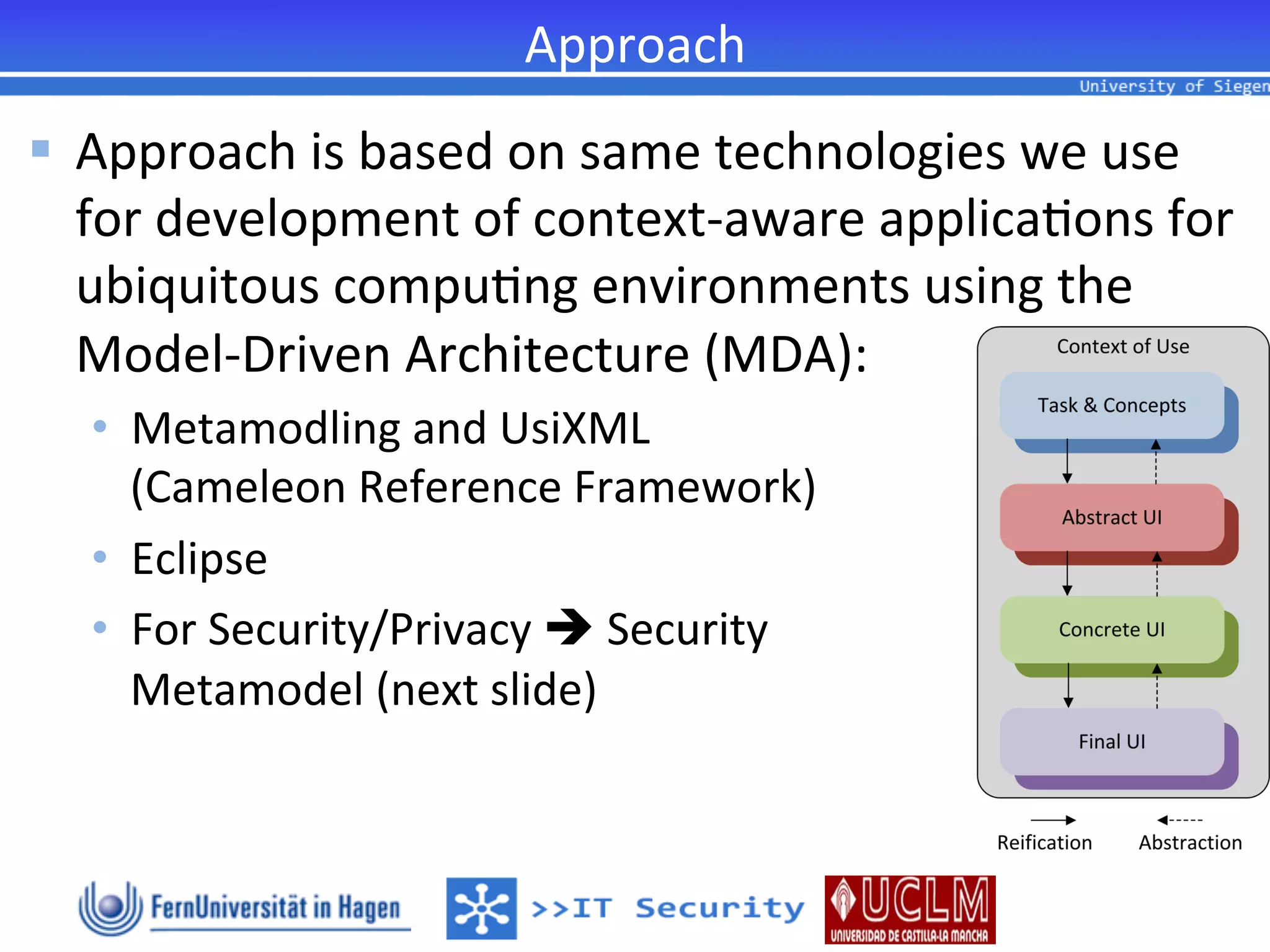
§  Approach	
  is	
  based	
  on	
  same	
  technologies	
  we	
  use	
  
    for	
  development	
  of	
  context-­‐aware	
  applica2ons	
  for	
  
    ubiquitous	
  compu2ng	
  environments	
  using	
  the	
  
    Model-­‐Driven	
  Architecture	
  (MDA):	
  
   •  Metamodling	
  and	
  UsiXML	
  	
  
        (Cameleon	
  Reference	
  Framework)	
  
   •  Eclipse	
  
   •  For	
  Security/Privacy	
  è	
  Security	
  	
  
        Metamodel	
  (next	
  slide)	


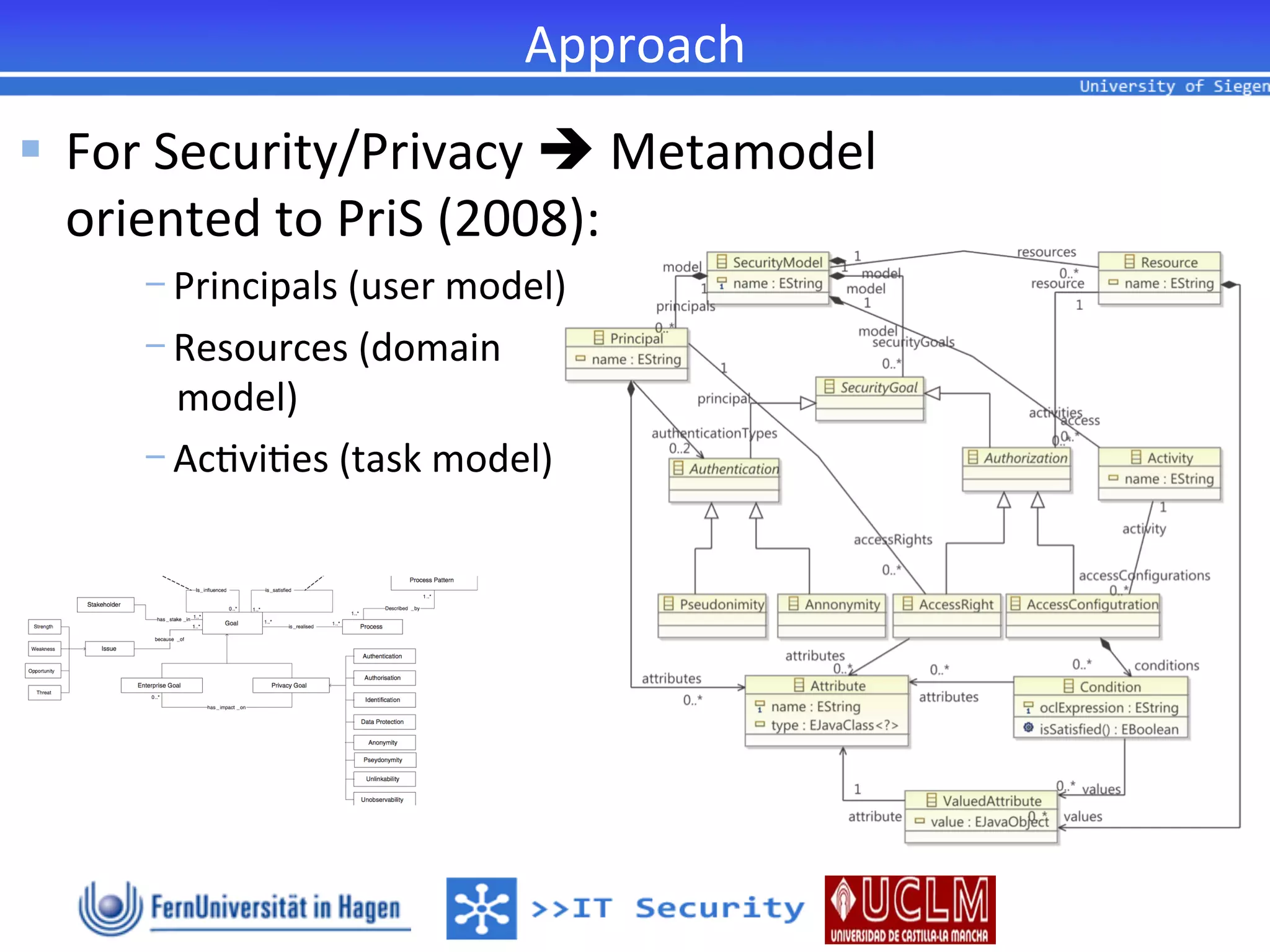
Approach	
  
§  For	
  Security/Privacy	
  è	
  Metamodel	
  
    oriented	
  to	
  PriS	
  (2008):	
  
          - Principals	
  (user	
  model)	
  
          - Resources	
  (domain	
  	
  
            model)	
  
          - Ac2vi2es	
  (task	
  model)	


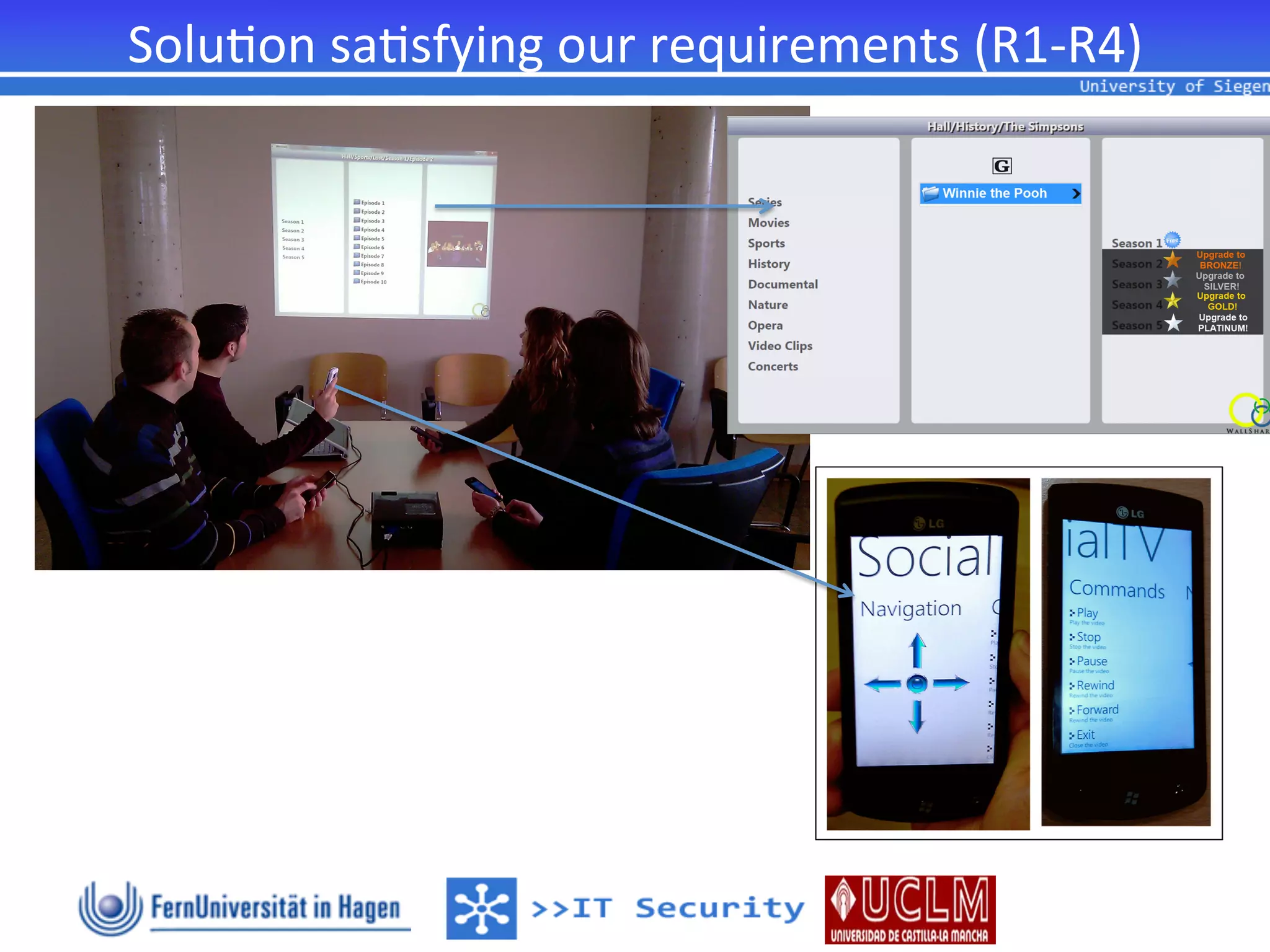
Solu2on	
  sa2sfying	
  our	
  requirements	
  (R1-­‐R4)	
  
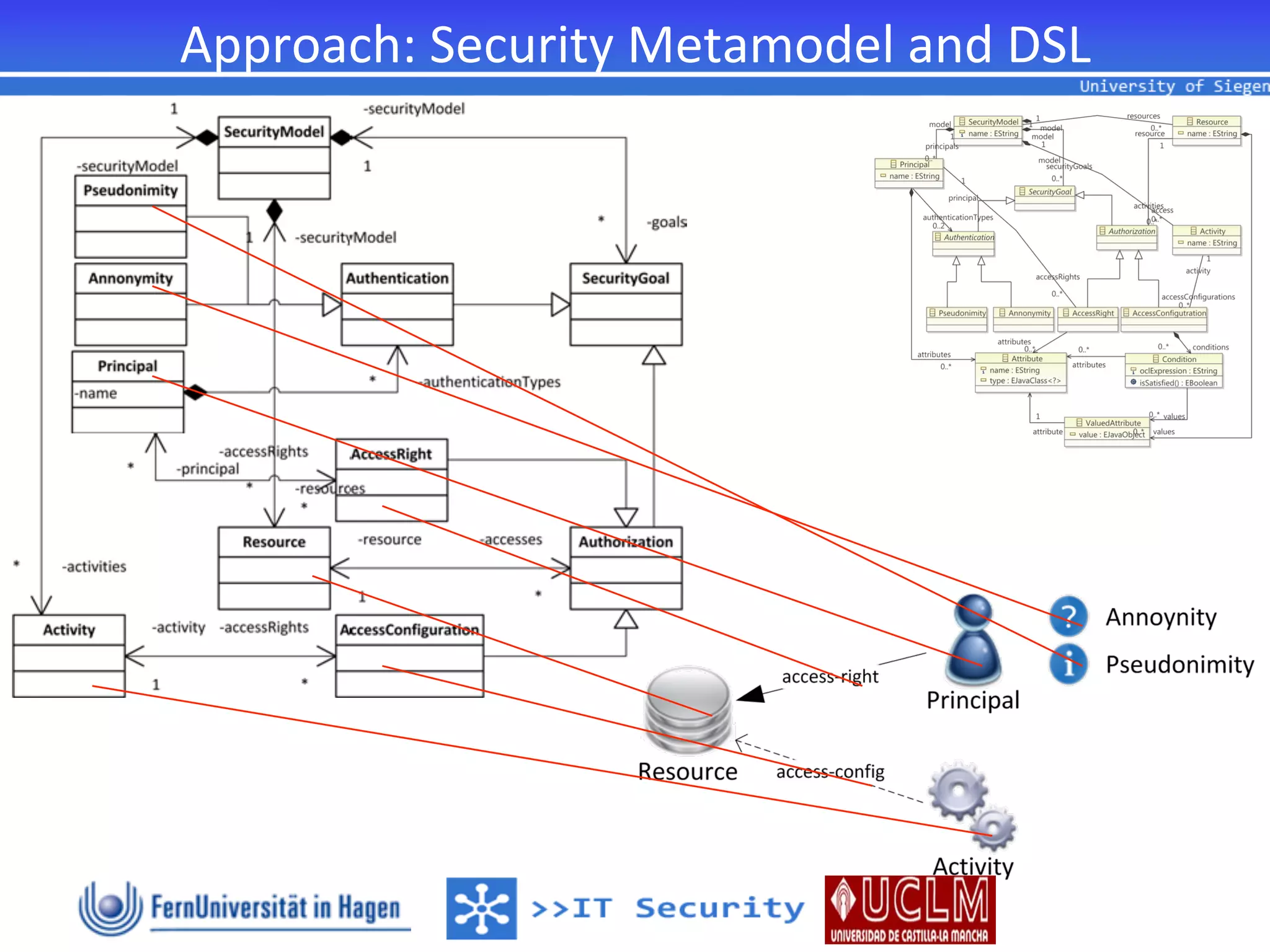
Approach:	
  Security	
  Metamodel	
  and	
  DSL
                                               	
  
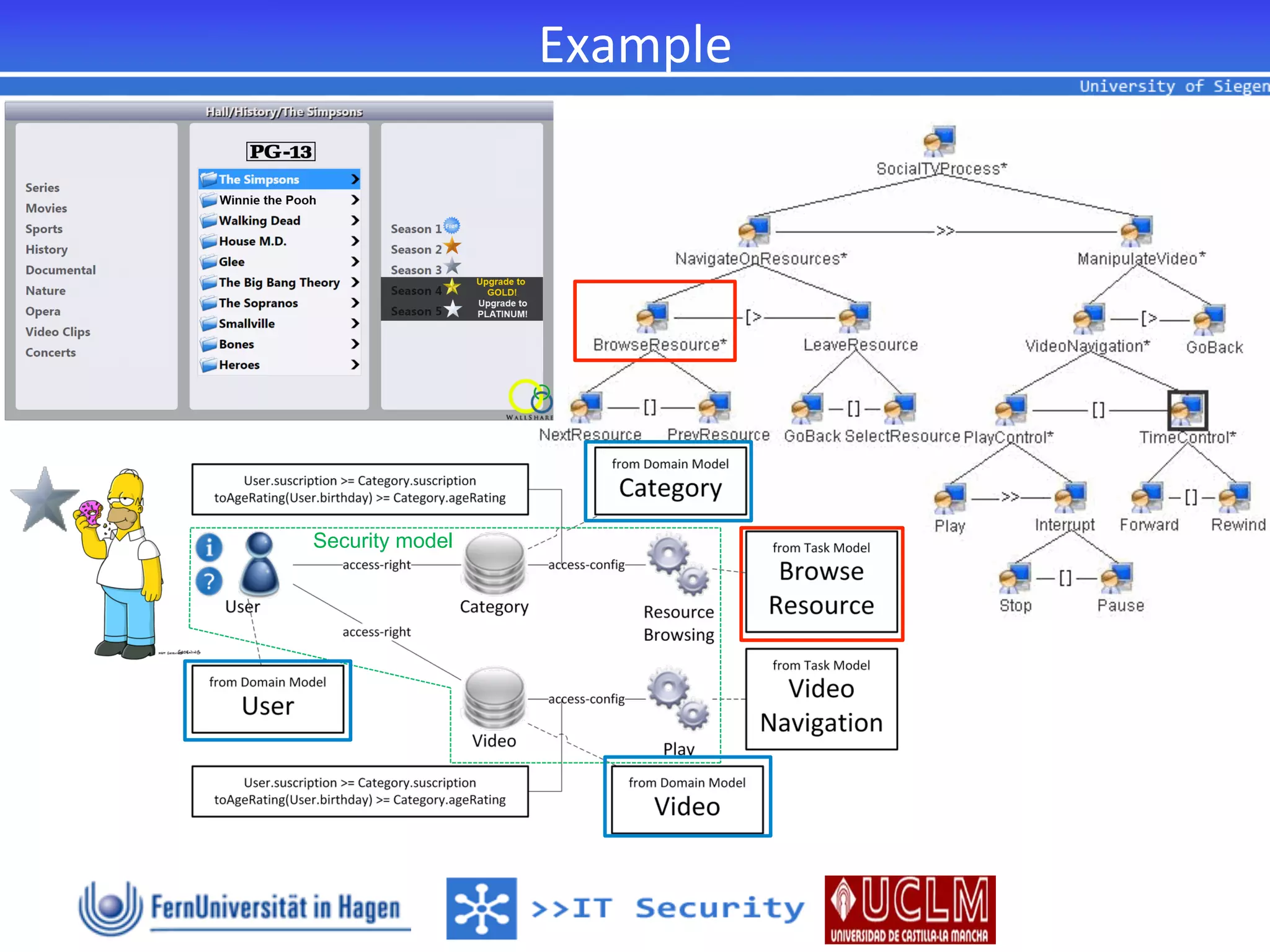
Example	


Security model
Current	
  State:	
  Security	
  Modeling	
  Editor


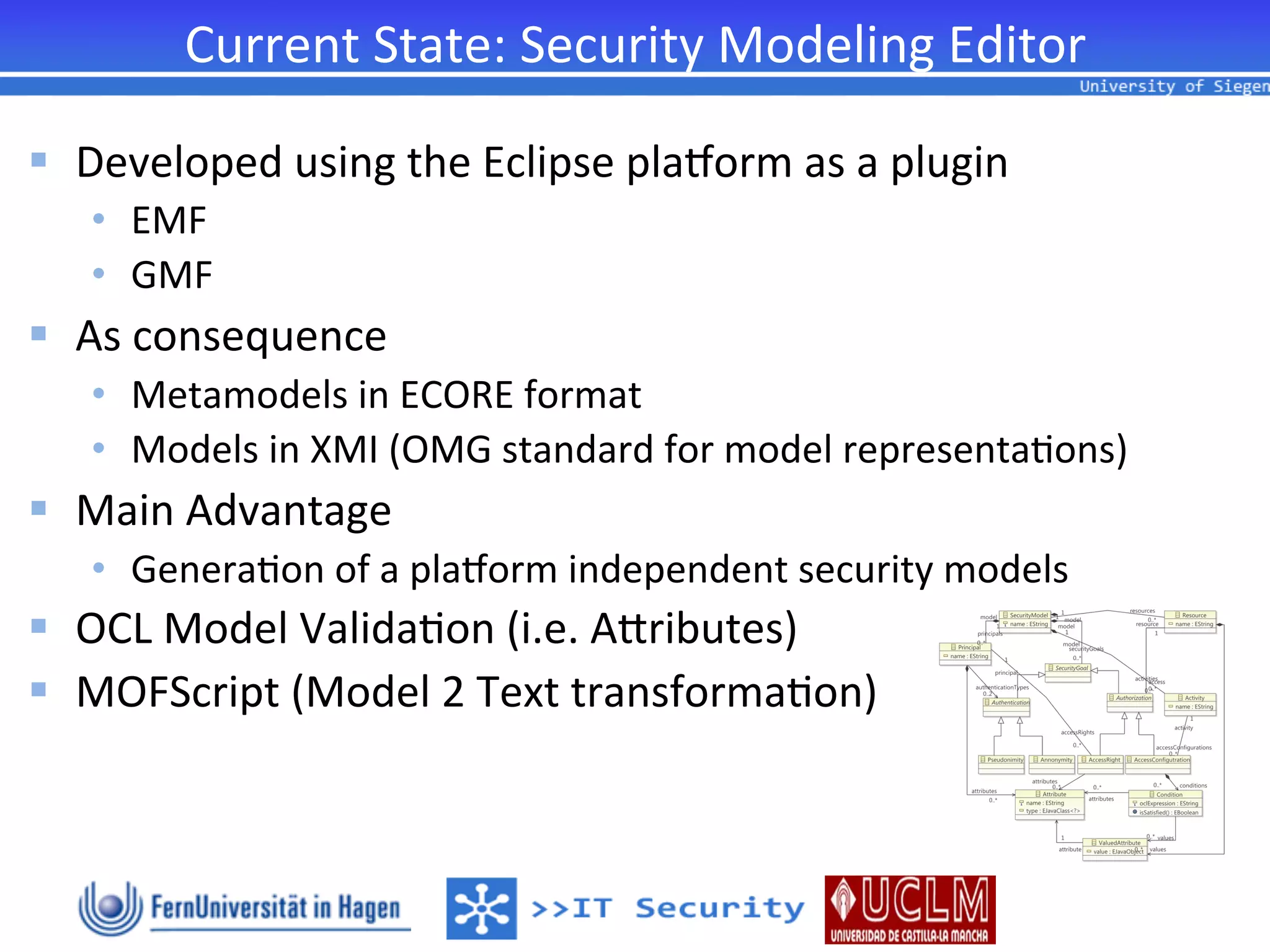
§  Developed	
  using	
  the	
  Eclipse	
  plahorm	
  as	
  a	
  plugin	
  
    •  EMF	
  	
  
    •  GMF	
  
§  As	
  consequence	
  
    •  Metamodels	
  in	
  ECORE	
  format	
  
    •  Models	
  in	
  XMI	
  (OMG	
  standard	
  for	
  model	
  representa2ons)	
  
§  Main	
  Advantage	
  
    •  Genera2on	
  of	
  a	
  plahorm	
  independent	
  security	
  models	
  
§  OCL	
  Model	
  Valida2on	
  (i.e.	
  Aiributes)	
  
§  MOFScript	
  (Model	
  2	
  Text	
  transforma2on)	
  
First	
  Results	
  (Modeling)	
  

§  In	
  total,	
  we	
  conducted	
  interviews,	
  walkthroughs	
  and	
  
    collected	
  first	
  usage	
  experiences	
  of	
  the	
  current	
  modeling	
  
    framework	
  (including	
  the	
  first	
  primi2ve	
  version	
  of	
  the	
  
    Security	
  Metamodeling	
  Eclipse-­‐based	
  Editor)	
  with	
  21	
  
    par2cipants	
  from	
  the	
  educa2onal	
  and	
  industrial	
  field	
  
§  We	
  are	
  currently	
  suppor2ng	
  various	
  widgets	
  such	
  as	
  	
  fields	
  
    for	
  entering	
  different	
  data	
  (e.g.,	
  username	
  and	
  password),	
  
    combo	
  boxes,	
  etc.	
  (Official	
  Status	
  will	
  be	
  announced	
  this	
  
    week	
  in	
  a	
  presenta2on	
  for	
  OMG)	
  	
  
Experiences	
  (for	
  Current	
  Status)	
  

§  Requirements	
  resulted/s2ll	
  resul2ng	
  mainly	
  from	
  
     interdisciplinary	
  research	
  projects	
  è	
  Students	
  and	
  
     researchers	
  working	
  together	
  in	
  academic	
  evalua2on!	


§  We	
  received	
  wishes	
  for	
  improvements	
  from	
  industrial	
  
     contacts	
  and	
  partners	
  in	
  other	
  projects	
  è	
  Interac2ve	
  TV	
  
     por2ng	
  (s2ll	
  needing	
  access	
  to	
  special	
  HW	
  suppor2ng	
  our	
  
     technologies	
  such	
  as	
  TVs	
  suppor2ng	
  HTML5	
  or	
  Android	
  
     Plahorm)	
  
Future	
  work	
  and	
  conclusion	
  
§  Future	
  work	
  is	
  primarily	
  focused	
  on:	
  
     •  Improving	
  the	
  Security	
  Metamodel	
  by	
  adding	
  itera2vely	
  
        further	
  security	
  and	
  privacy	
  requirements!	
  
     •  Improving	
  the	
  used	
  Security	
  Metamodling	
  Editor	
  for	
  
        easing	
  the	
  modeling	
  of	
  related	
  design/modeling/
        development	
  tasks	
  

§  This	
  needs	
  improving	
  the	
  underlying	
  UsiXML	
  framework	
  
    which	
  is	
  in	
  evolu2on	
  for	
  the	
  moment	
  for	
  mee2ng	
  standards	
  
    (OMG	
  /	
  W3C	
  proposals	
  submiied!)	
  
Thank you for
                 your attention!

        Privacy	
  and	
  Security	
  in	


Mul1-­‐modal	
  User	
  Interface	
  Modeling	


            for	
  Social	
  Media


            Bourimi@wiwi.uni-­‐siegen.de	


         Mohamed.Bourimi@fernuni-­‐hagen.de  	


Privacy and Security in Multi-modal User Interface Modeling for Social Media

  • 1.
    Privacy  and  Security  in     Mul1-­‐modal  User  Interface  Modeling     for  Social  Media   Mohamed  Bourimi1,3,  Ricardo  Tesoriero2,  Pedro  G.   Villanueva2,  Fa<h  Karatas1,  Philipp  Schwarte1     1University  of  Siegen,  Chair  for  IT  Security,  Germany   2Compu1ng  Systems  Department.  University  of  Cas1lla-­‐La   Mancha,  Spain   3FernUniversität  in  Hagen,  Coopera1ve  Systems  Group,  Germany  
  • 2.
    Overview   §  Background  and  Mo2va2on   §  Problem  Statement(s)   §  Requirements  Analysis   §  Proposed  Approach   §  Example   §  Eclipse  Security  Model  Editor   §  Future  Work  and  Conclusion  
  • 3.
    Background  and  Mo2va2on   §  Interdisciplinary  research  becoming  more  important  in  the   area  of  Social  Media  (Modeling):   1.  Human-­‐Comupter  Interac2on  (HCI)  è  Usability   Engineering   2.  Groupware  and  Social  SoQware  è  Distributed  Systems   SoQware  Engineering  Suppor2ng  Collabora2on   3.  Privacy  and  Security  Engineering     §  Modeling  as  one  of  the  important  steps  in  the  SoQware   Engineering  Process  could  help  in  considering  the   requirements  :   •  Early  Enforcement  (Bourimi  et  al.  AFFINE     methodology,  HCSE2010)   •  Adequately  by  considering  social  factors,  too!   (which  is  not  part    of  other  business  domains)  
  • 4.
    Abuses,  risks  and  threats  when  using  Social  Media!   §  Scandals  are  becoming  ordinary  (due  to     accidental  or/and  inten2onal  abuses)  with     fatal  consequences  in  some  situa2ons!!   §  Iden2fica2on  remains  possible  with  an  error     rate  of  just  12%  (Narayanan&Shama2kov     2009)     §  Many  other  examples  for  loosing  privacy  and     evolving  risks  and  threats  ..  
  • 5.
    Problem  Statement(s)   § General  problem  statement:  Improving  the   modeling  of  systems  suppor<ng  social  interac<on  in   general  (considering  all  involved  research  fields   togetherè  Targe<ng  Synergy  Effect)   §  Specific  problem  statement  (here):  Using   standard(s)  for  efficient  support  of  generated  user   interfaces  by  considering  mul<-­‐modality  (Web,   Mobile,  Desktop  etc.)  when  using  social  media   systems  (e.g.,  for  evalua<on  based  research,   frequent  provision/adap<on  of  prototypes  is   needed!)  
  • 6.
    Requirements  Analysis:  „SocialTV  Case  Study“   §  “Perfect  Labor”  in  our  case:  SocialTV  interdisciplinary   project  running  since  2009  (presented  @SocialCom   2010)  èhQp://www.uni-­‐siegen.de/T5/itsec/forschung/projekte/socialtv.html  
  • 7.
    Requirements  Analysis:  Further  Gathered  Requirements   §  R1:    Reflec2ng  realis2c  SocialTV  situa2ons  (individual   and  group  interac2ons)   §  R2:    Allowing  for  flexible  parallel  interac2on  of  the   involved  people   §  R3:    Flexibility  in  terms  of  costs  emerging  from   adapta2ons  to  new  situa2ons  and  tests   §  R4:    Suppor2ng  thereby  secure  and  privacy-­‐ preserving  interac2on  
  • 8.
    Approach   §  Approach  is  based  on  same  technologies  we  use   for  development  of  context-­‐aware  applica2ons  for   ubiquitous  compu2ng  environments  using  the   Model-­‐Driven  Architecture  (MDA):   •  Metamodling  and  UsiXML     (Cameleon  Reference  Framework)   •  Eclipse   •  For  Security/Privacy  è  Security     Metamodel  (next  slide)      
  • 9.
    Approach   §  For  Security/Privacy  è  Metamodel   oriented  to  PriS  (2008):   - Principals  (user  model)   - Resources  (domain     model)   - Ac2vi2es  (task  model)      
  • 10.
    Solu2on  sa2sfying  our  requirements  (R1-­‐R4)  
  • 11.
  • 12.
  • 13.
    Current  State:  Security  Modeling  Editor   §  Developed  using  the  Eclipse  plahorm  as  a  plugin   •  EMF     •  GMF   §  As  consequence   •  Metamodels  in  ECORE  format   •  Models  in  XMI  (OMG  standard  for  model  representa2ons)   §  Main  Advantage   •  Genera2on  of  a  plahorm  independent  security  models   §  OCL  Model  Valida2on  (i.e.  Aiributes)   §  MOFScript  (Model  2  Text  transforma2on)  
  • 14.
    First  Results  (Modeling)   §  In  total,  we  conducted  interviews,  walkthroughs  and   collected  first  usage  experiences  of  the  current  modeling   framework  (including  the  first  primi2ve  version  of  the   Security  Metamodeling  Eclipse-­‐based  Editor)  with  21   par2cipants  from  the  educa2onal  and  industrial  field   §  We  are  currently  suppor2ng  various  widgets  such  as    fields   for  entering  different  data  (e.g.,  username  and  password),   combo  boxes,  etc.  (Official  Status  will  be  announced  this   week  in  a  presenta2on  for  OMG)    
  • 15.
    Experiences  (for  Current  Status)   §  Requirements  resulted/s2ll  resul2ng  mainly  from   interdisciplinary  research  projects  è  Students  and   researchers  working  together  in  academic  evalua2on!       §  We  received  wishes  for  improvements  from  industrial   contacts  and  partners  in  other  projects  è  Interac2ve  TV   por2ng  (s2ll  needing  access  to  special  HW  suppor2ng  our   technologies  such  as  TVs  suppor2ng  HTML5  or  Android   Plahorm)  
  • 16.
    Future  work  and  conclusion   §  Future  work  is  primarily  focused  on:   •  Improving  the  Security  Metamodel  by  adding  itera2vely   further  security  and  privacy  requirements!   •  Improving  the  used  Security  Metamodling  Editor  for   easing  the  modeling  of  related  design/modeling/ development  tasks   §  This  needs  improving  the  underlying  UsiXML  framework   which  is  in  evolu2on  for  the  moment  for  mee2ng  standards   (OMG  /  W3C  proposals  submiied!)  
  • 17.
    Thank you for your attention! Privacy  and  Security  in     Mul1-­‐modal  User  Interface  Modeling     for  Social  Media     Bourimi@wiwi.uni-­‐siegen.de     Mohamed.Bourimi@fernuni-­‐hagen.de