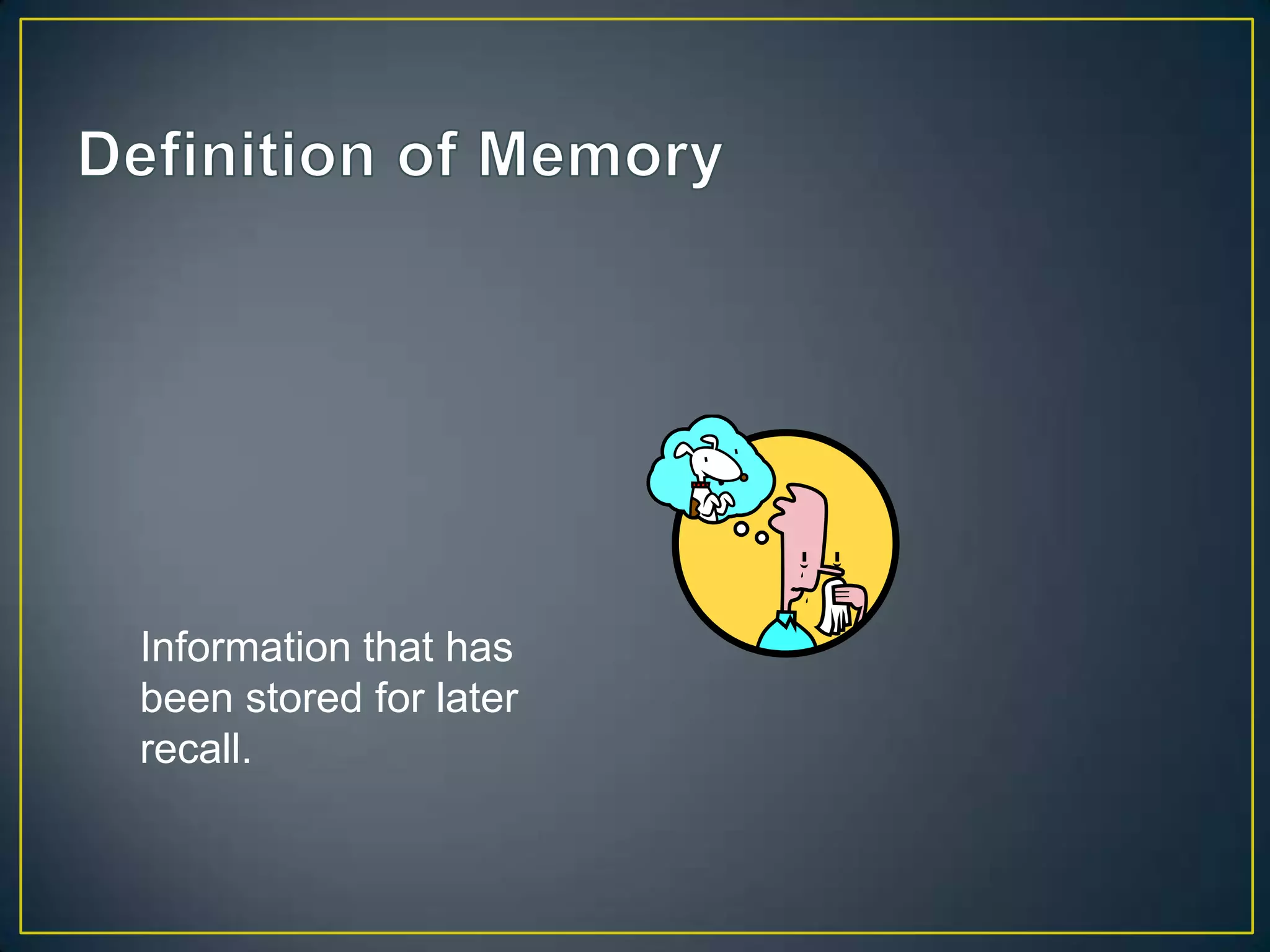
Information that has
been stored for later
recall.
• Sensory Memory – recognition of information received by
  any of the senses.

• Short Term Memory – Also called Working Memory.
  Temporarily holds between 5 and 7 “chunks” of information.

• Long Term Memory – Allows the storage of virtually an
  unlimited amount of information.
• Visual Memory – This type of memory holds an
  impression of everything we look at for a brief moment.
  Stare at something for a long period of time and then look
  away and the object is still viewable.

• Echoic Memory – Sounds may seem to linger in our mind
  even after it has ceased.
That is exactly what happened to
British Conductor and musician
Clive Wearing.

A brain infection left him with a
memory of only 10 seconds.

He still plays the piano very well but
does not remember ever playing in
the past.

You would have to introduce
yourself to him every 10 seconds.

He still remembers his wife, but
every 10 seconds he thinks she just
Memory loss can occur from many things.
Two of the most common are:


• Brain Injury – In some cases reversible.


• Alzheimer's – No cure yet. Although
  caffeine is showing some promising
  results with rats.
Stage 1 – Encoding
Perceiving and categorizing information received from
sensory memory.

Stage 2 – Storing
Moving information from sensory to short term memory and to
long term memory if needed.

Stage 3 – Retrieval
Accessing information that has been stored.
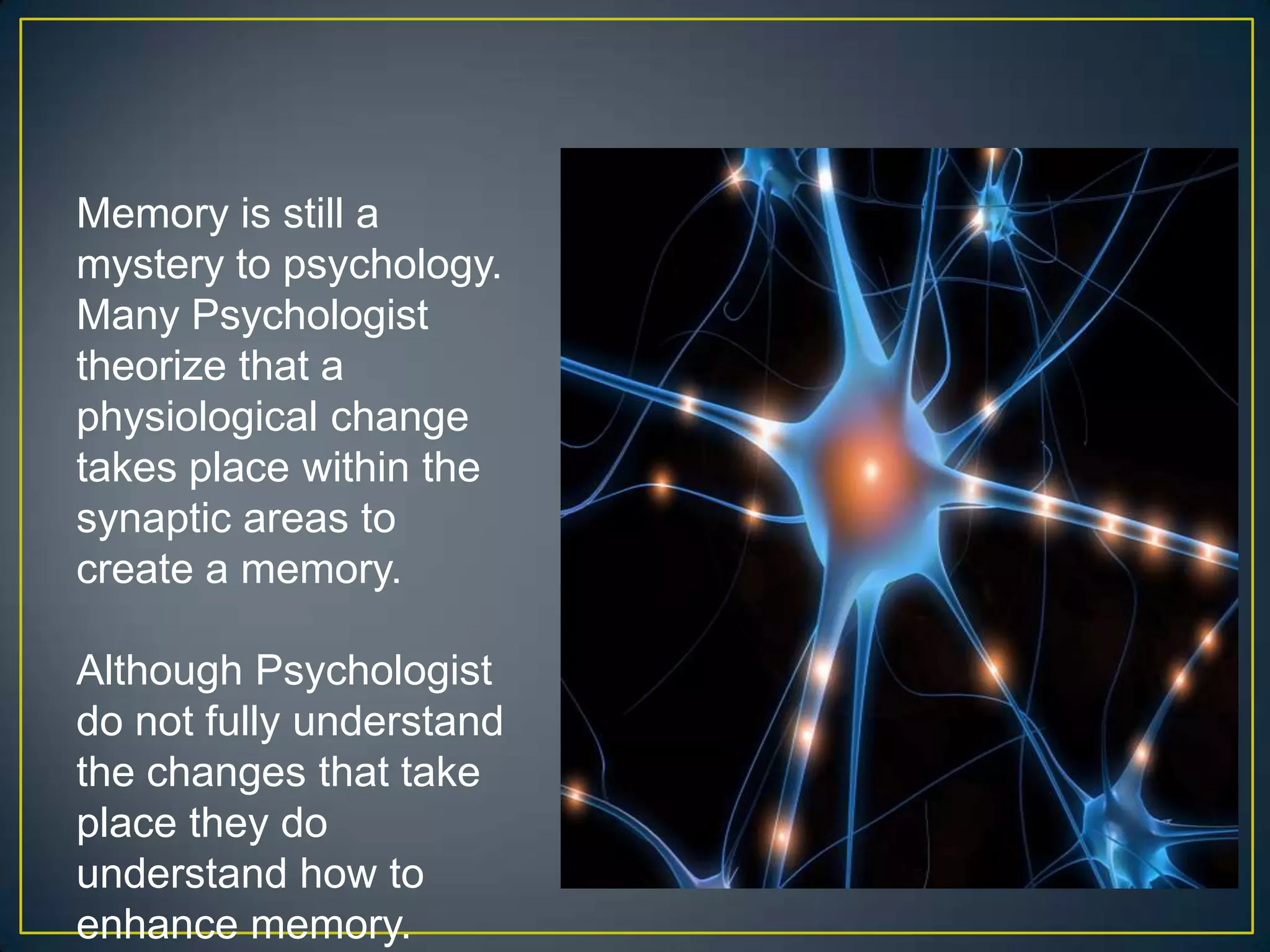
Memory is still a
mystery to psychology.
Many Psychologist
theorize that a
physiological change
takes place within the
synaptic areas to
create a memory.

Although Psychologist
do not fully understand
the changes that take
place they do
understand how to
enhance memory.
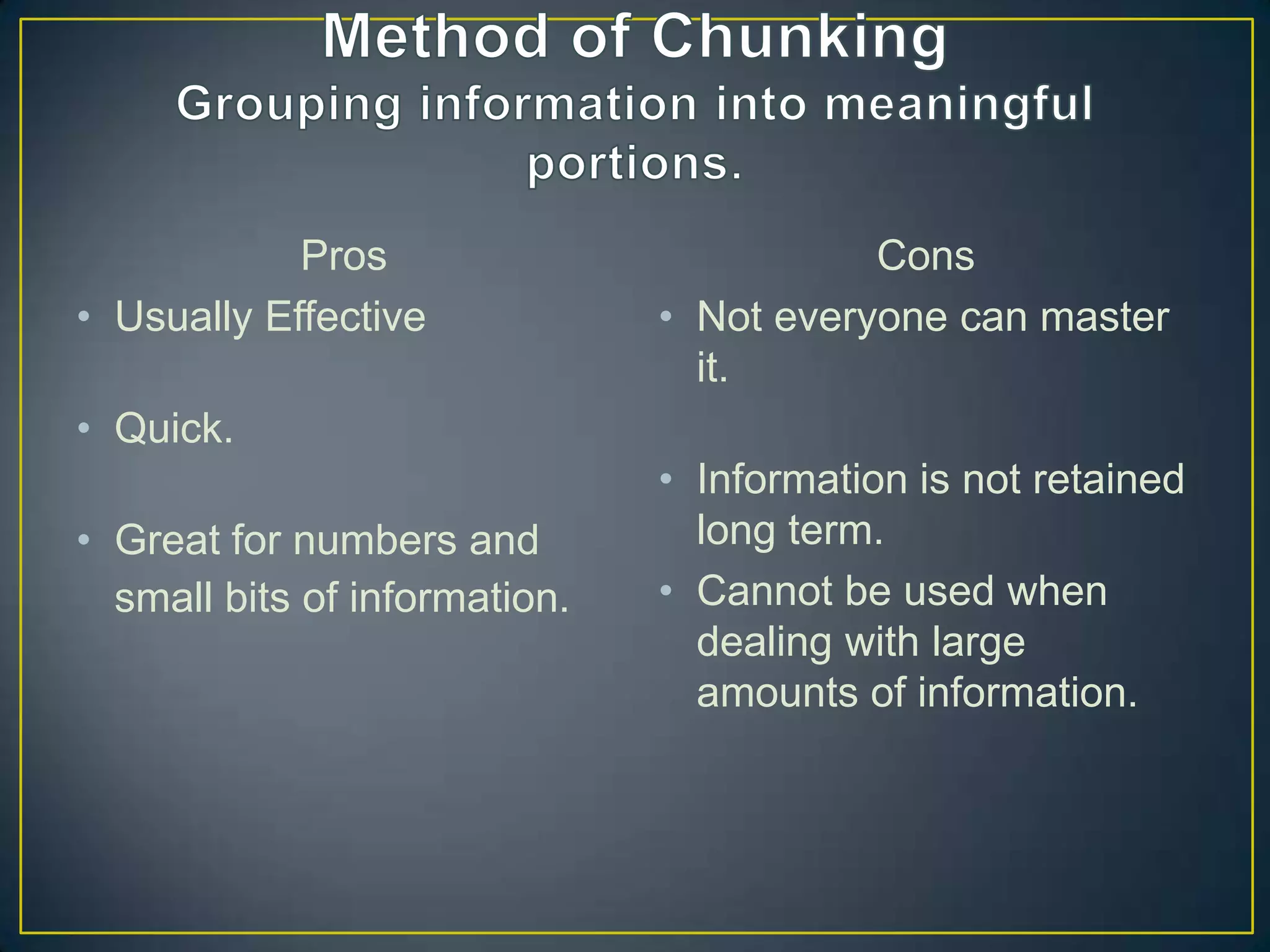
Pros                          Cons
• Usually Effective            • Not everyone can master
                                 it.
• Quick.
                               • Information is not retained
• Great for numbers and          long term.
  small bits of information.   • Cannot be used when
                                 dealing with large
                                 amounts of information.
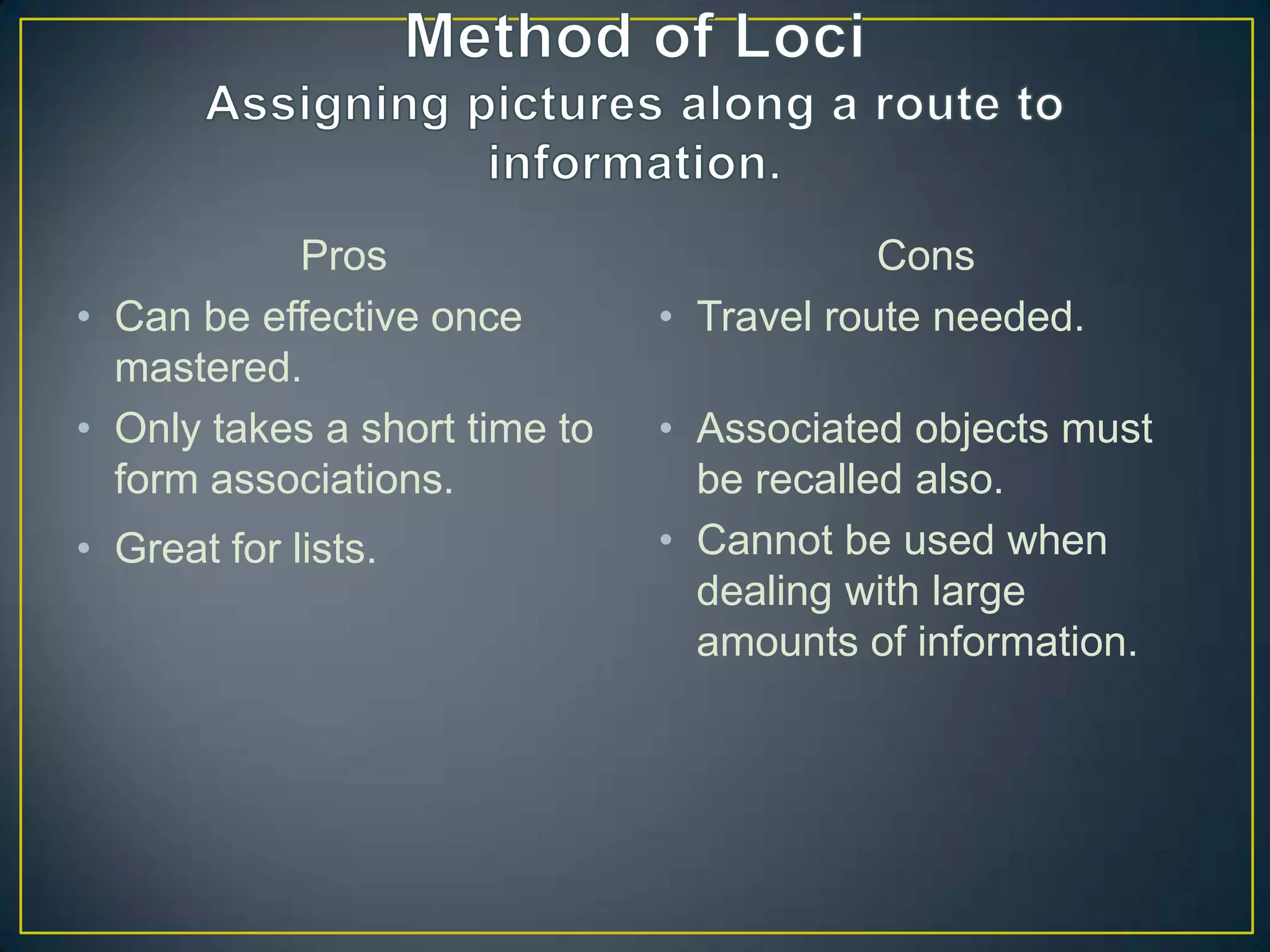
Pros                            Cons
• Can be effective once        • Travel route needed.
  mastered.
• Only takes a short time to   • Associated objects must
  form associations.             be recalled also.
• Great for lists.             • Cannot be used when
                                 dealing with large
                                 amounts of information.
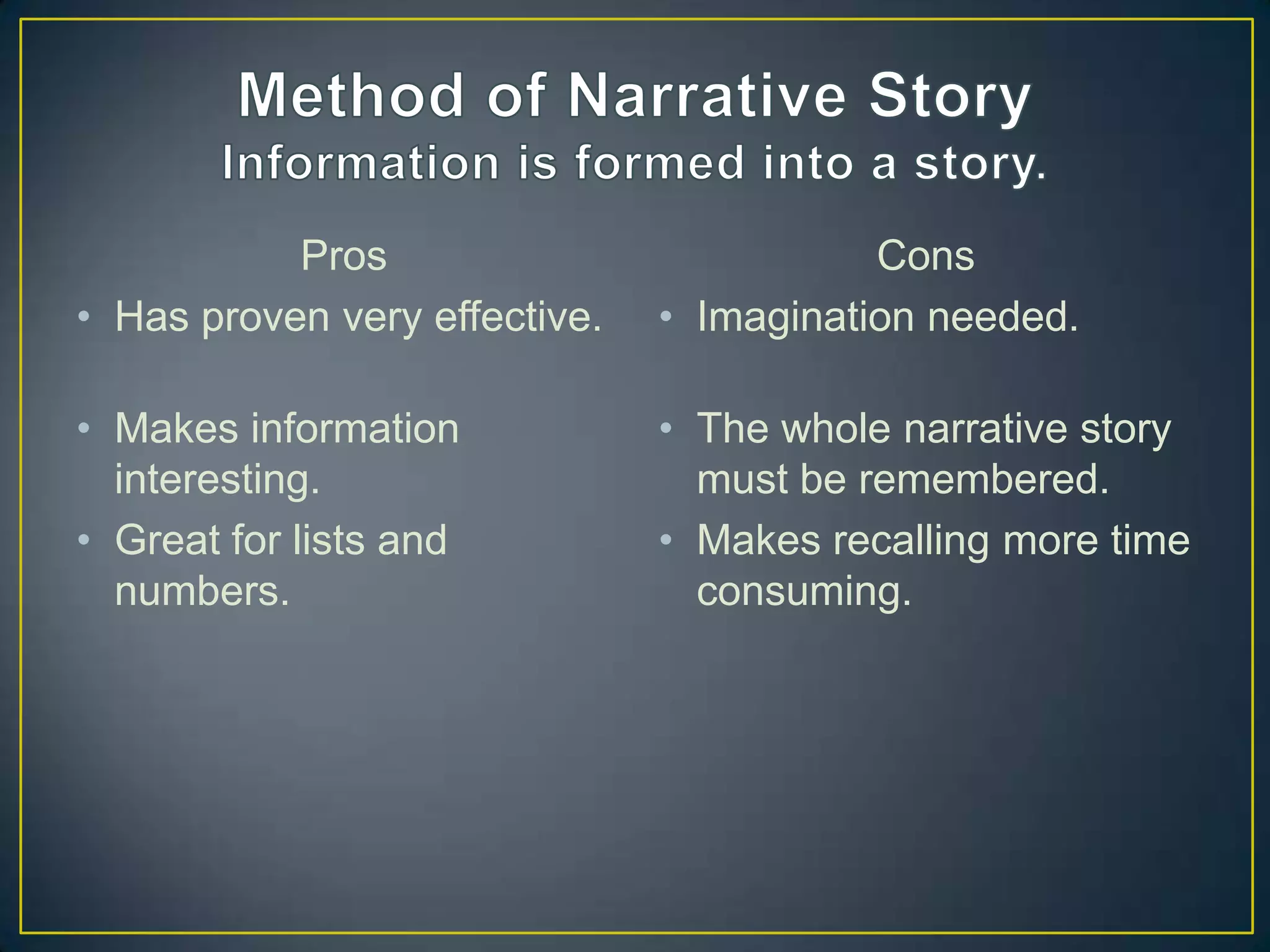
Pros                           Cons
• Has proven very effective.   • Imagination needed.

• Makes information            • The whole narrative story
  interesting.                   must be remembered.
• Great for lists and          • Makes recalling more time
  numbers.                       consuming.
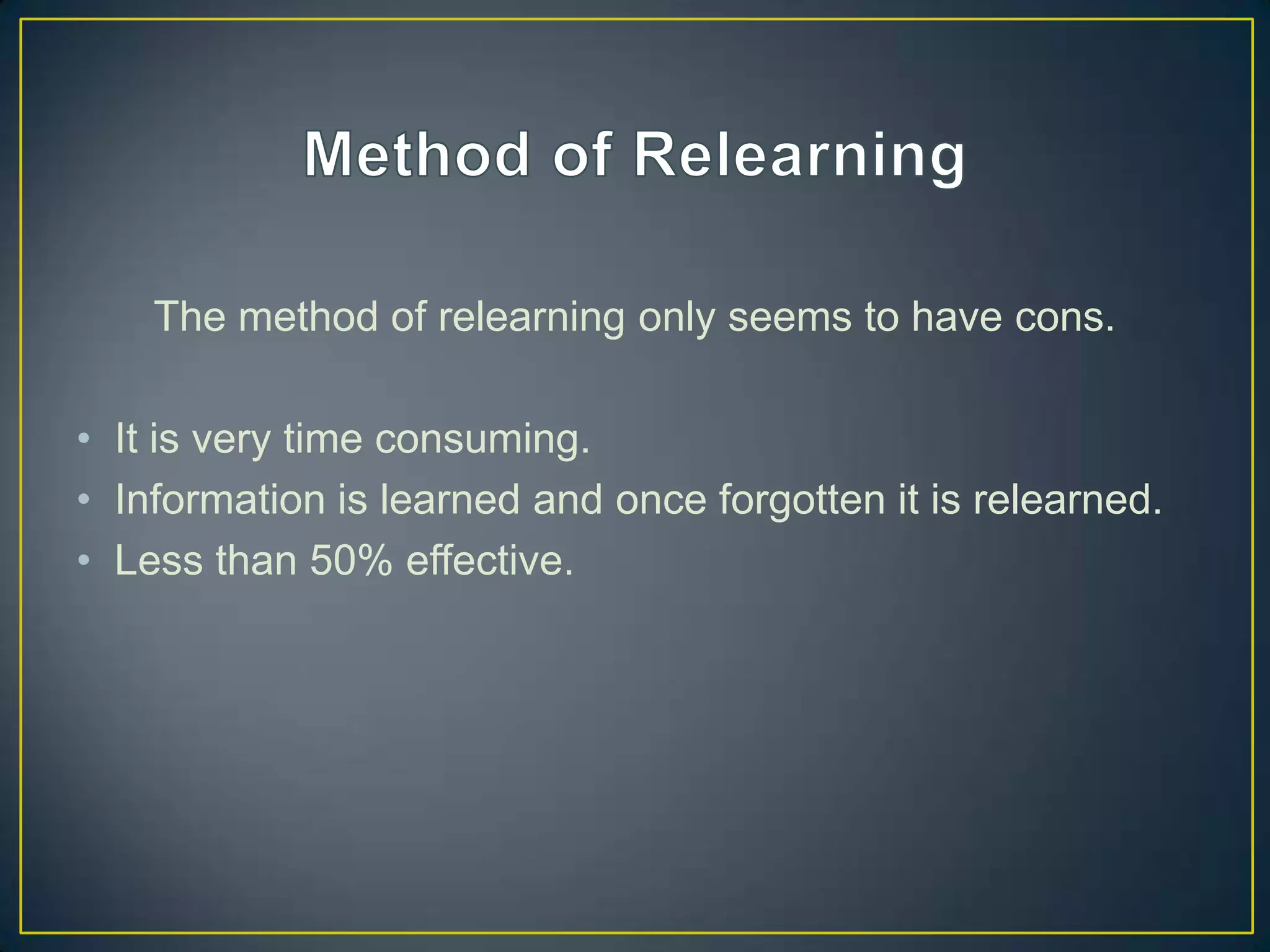
The method of relearning only seems to have cons.

• It is very time consuming.
• Information is learned and once forgotten it is relearned.
• Less than 50% effective.
This theory states that an individual will recall information
more effectively if he or she is in the same state as when
the information was first encoded.

Some examples would be:
• Taking a test in the same room where the lecture was
  given.

• Studying without music if the same music will not be
  available during the test.
Information is understood and studied continually after
learning.

• Extremely effective because information is always being
  reintroduced to the mind.

• Can be used when learning small or large amounts of
  information.

• Has a very high likelihood of permanent memory
  retention.
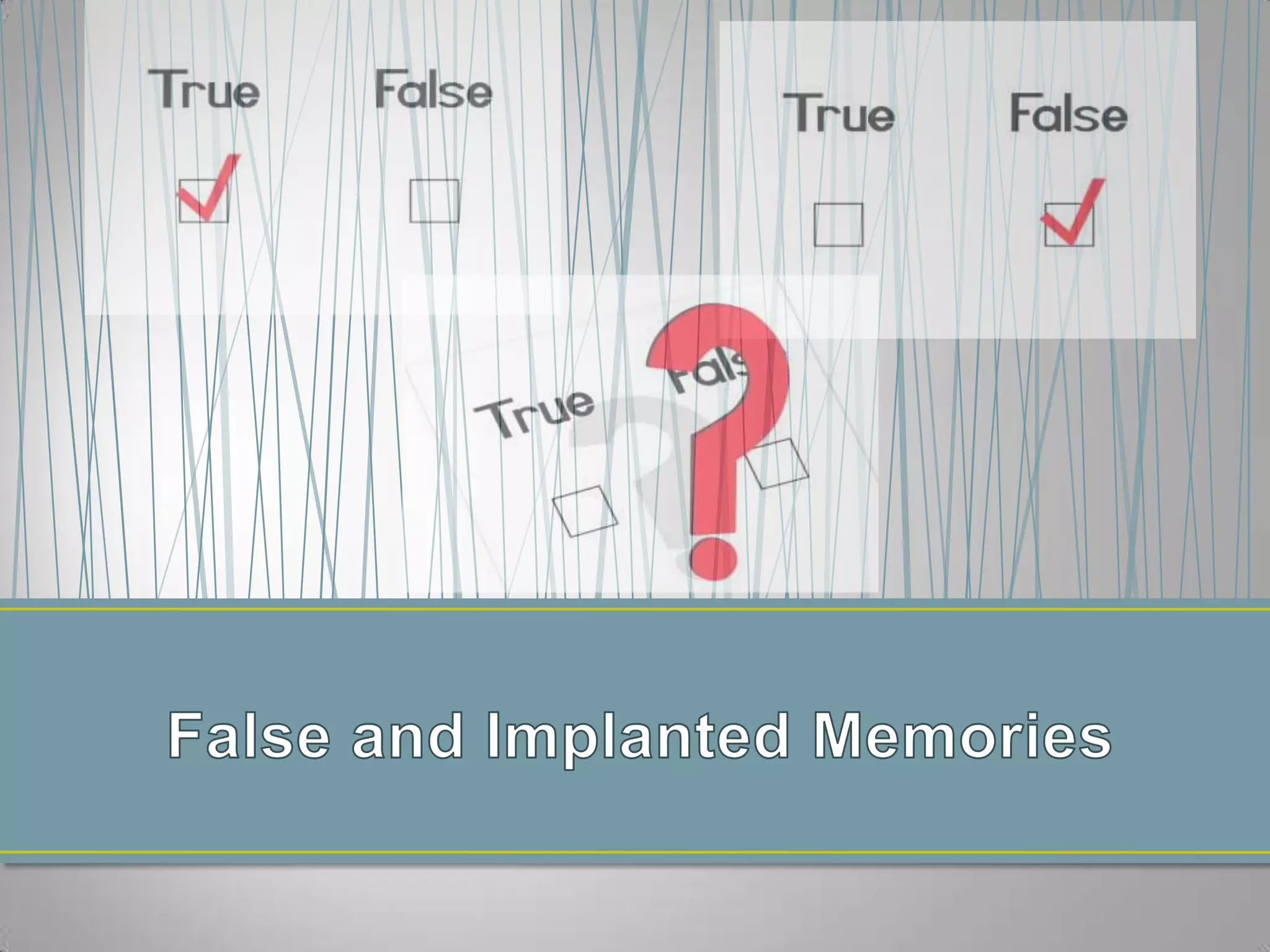
• False and implanted memories are memories of events
  that never occurred.

• These memories can be implanted by other people.

• Dreams from childhood may seem to be a memory now
  and not a dream.

• Many innocent people have been incarcerated due to
  false memories.
• Memory is stored information.

• Damage to the brain can cause various memory
  problems.

• Most effective ways to memory retention are:
  • Writing what we hear and reading aloud what we write.
  • Continually reviewing the information. (Overlearning)
  • Have an understanding and interest in what is being learned.

• It is possible to have memories of events that never
  occurred.

Memory

  • 2.
    Information that has beenstored for later recall.
  • 4.
    • Sensory Memory– recognition of information received by any of the senses. • Short Term Memory – Also called Working Memory. Temporarily holds between 5 and 7 “chunks” of information. • Long Term Memory – Allows the storage of virtually an unlimited amount of information.
  • 5.
    • Visual Memory– This type of memory holds an impression of everything we look at for a brief moment. Stare at something for a long period of time and then look away and the object is still viewable. • Echoic Memory – Sounds may seem to linger in our mind even after it has ceased.
  • 7.
    That is exactlywhat happened to British Conductor and musician Clive Wearing. A brain infection left him with a memory of only 10 seconds. He still plays the piano very well but does not remember ever playing in the past. You would have to introduce yourself to him every 10 seconds. He still remembers his wife, but every 10 seconds he thinks she just
  • 8.
    Memory loss canoccur from many things. Two of the most common are: • Brain Injury – In some cases reversible. • Alzheimer's – No cure yet. Although caffeine is showing some promising results with rats.
  • 10.
    Stage 1 –Encoding Perceiving and categorizing information received from sensory memory. Stage 2 – Storing Moving information from sensory to short term memory and to long term memory if needed. Stage 3 – Retrieval Accessing information that has been stored.
  • 11.
    Memory is stilla mystery to psychology. Many Psychologist theorize that a physiological change takes place within the synaptic areas to create a memory. Although Psychologist do not fully understand the changes that take place they do understand how to enhance memory.
  • 13.
    Pros Cons • Usually Effective • Not everyone can master it. • Quick. • Information is not retained • Great for numbers and long term. small bits of information. • Cannot be used when dealing with large amounts of information.
  • 14.
    Pros Cons • Can be effective once • Travel route needed. mastered. • Only takes a short time to • Associated objects must form associations. be recalled also. • Great for lists. • Cannot be used when dealing with large amounts of information.
  • 15.
    Pros Cons • Has proven very effective. • Imagination needed. • Makes information • The whole narrative story interesting. must be remembered. • Great for lists and • Makes recalling more time numbers. consuming.
  • 16.
    The method ofrelearning only seems to have cons. • It is very time consuming. • Information is learned and once forgotten it is relearned. • Less than 50% effective.
  • 17.
    This theory statesthat an individual will recall information more effectively if he or she is in the same state as when the information was first encoded. Some examples would be: • Taking a test in the same room where the lecture was given. • Studying without music if the same music will not be available during the test.
  • 18.
    Information is understoodand studied continually after learning. • Extremely effective because information is always being reintroduced to the mind. • Can be used when learning small or large amounts of information. • Has a very high likelihood of permanent memory retention.
  • 20.
    • False andimplanted memories are memories of events that never occurred. • These memories can be implanted by other people. • Dreams from childhood may seem to be a memory now and not a dream. • Many innocent people have been incarcerated due to false memories.
  • 21.
    • Memory isstored information. • Damage to the brain can cause various memory problems. • Most effective ways to memory retention are: • Writing what we hear and reading aloud what we write. • Continually reviewing the information. (Overlearning) • Have an understanding and interest in what is being learned. • It is possible to have memories of events that never occurred.

Editor's Notes

  • #2 We will be discussing Memory.
  • #3 Note that all memory types do not permit later recall.
  • #5 Next slide has more info on Sensory
  • #7 Ask audience. Is there any questions on the previous slides.
  • #8 Clive Wearing can be found on youtube.com
  • #9 Elaborate on the symptom's of brain injury involving amnesia. Discuss Alzheimer's disease.
  • #11 Discuss the 3 process more in depth.
  • #13 Next few slides will discuss enhancing our memory.
  • #14 Explain how chunking is performed.
  • #15 Explain how loci is performed.
  • #16 Explain how narrative is performed. Also explain why it takes longer for recall.
  • #19 Explain some of the methods used in overlearning, such as note cards and small dry erase board.
  • #21 Discuss how memories can be implanted. Explain the experiment Lost In a Shopping Mall by Elizabeth Loftus.
  • #22 Questions will be answered at this time.