Lesson 12: Distributing Expressions
Date: 3/27/14 125
©2013CommonCore,Inc. Some rights reserved.commoncore.org
This work is licensed under a
Creative Commons Attribution-NonCommercial-ShareAlike 3.0 Unported License.
NYS COMMON CORE MATHEMATICS CURRICULUM 6•4Lesson 12
Lesson 12:Distributing Expressions
Student Outcomes
 Students model and write equivalent expressions using the distributive property. They move from a factored
form to an expanded form of an expression.
Classwork
Opening Exercise (3 minutes)
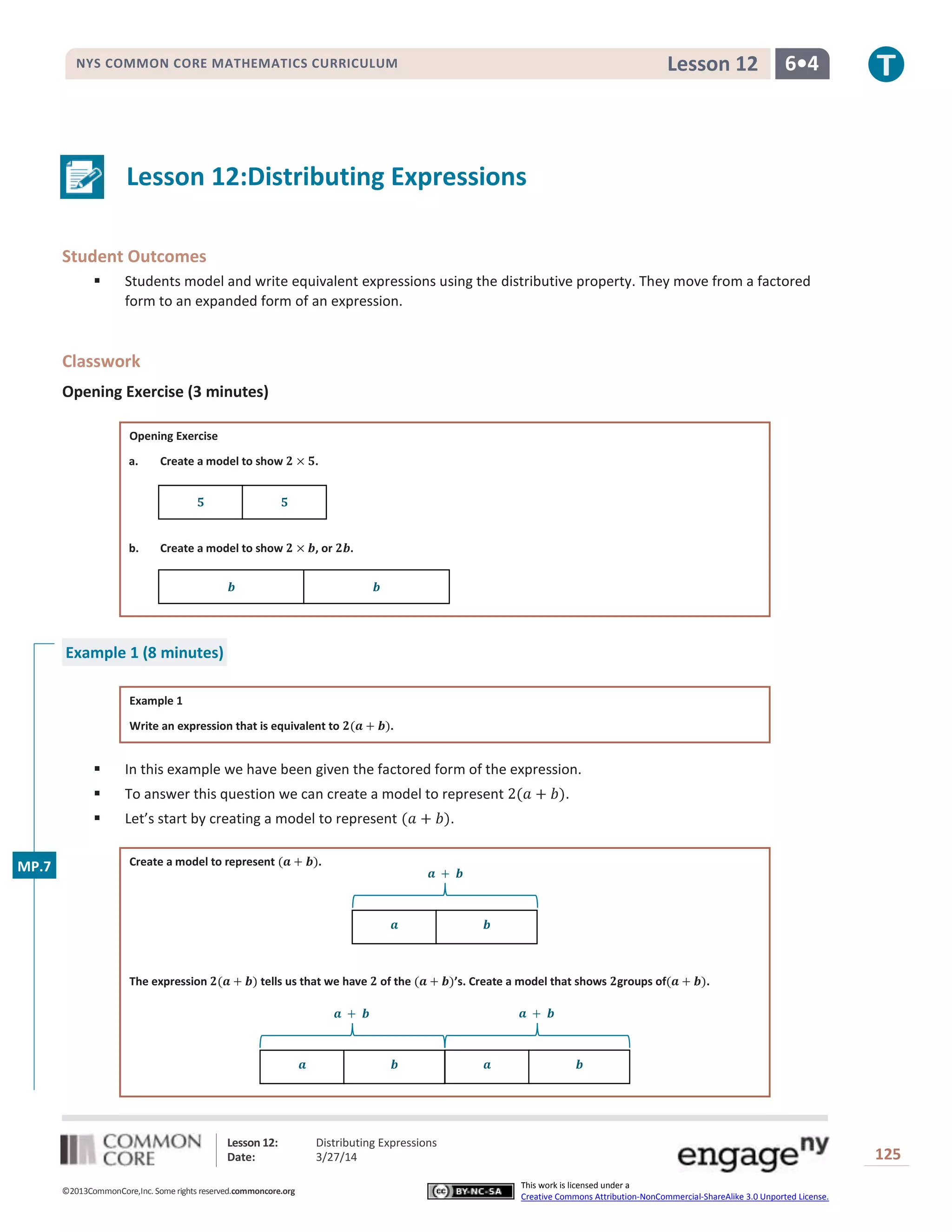
Opening Exercise
a. Create a model to show .
b. Create a model to show , or .
Example 1 (8 minutes)
Example 1
Write an expression that is equivalent to .
 In this example we have been given the factored form of the expression.
 To answer this question we can create a model to represent .
 Let’s start by creating a model to represent .
Create a model to represent .
The expression tells us that we have of the ’s. Create a model that shows groups of .
MP.7
Lesson 12: Distributing Expressions
Date: 3/27/14 126
©2013CommonCore,Inc. Some rights reserved.commoncore.org
This work is licensed under a
Creative Commons Attribution-NonCommercial-ShareAlike 3.0 Unported License.
NYS COMMON CORE MATHEMATICS CURRICULUM 6•4Lesson 12
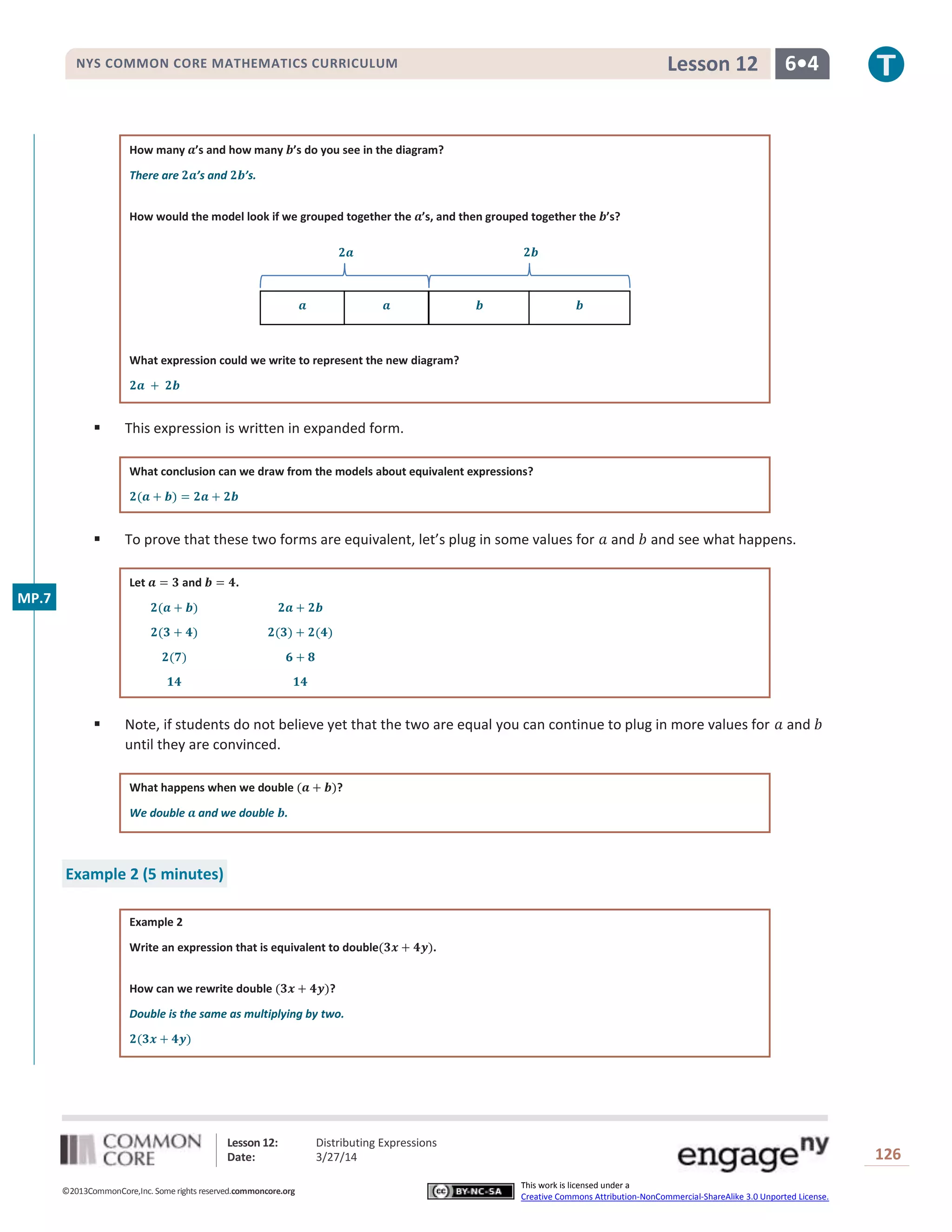
How many ’s and how many ’s do you see in the diagram?
There are ’s and ’s.
How would the model look if we grouped together the ’s, and then grouped together the ’s?
What expression could we write to represent the new diagram?
 This expression is written in expanded form.
What conclusion can we draw from the models about equivalent expressions?
 To prove that these two forms are equivalent, let’s plug in some values for and and see what happens.
Let and .
 Note, if students do not believe yet that the two are equal you can continue to plug in more values for and
until they are convinced.
What happens when we double ?
We double and we double .
Example 2 (5 minutes)
Example 2
Write an expression that is equivalent to double .
How can we rewrite double ?
Double is the same as multiplying by two.
MP.7
Lesson 12: Distributing Expressions
Date: 3/27/14 127
©2013CommonCore,Inc. Some rights reserved.commoncore.org
This work is licensed under a
Creative Commons Attribution-NonCommercial-ShareAlike 3.0 Unported License.
NYS COMMON CORE MATHEMATICS CURRICULUM 6•4Lesson 12
Is this expression in factored form, expanded form, or neither?
This expression is in factored form.
Let’s start this problem the same way that we started the first example. What should we do?
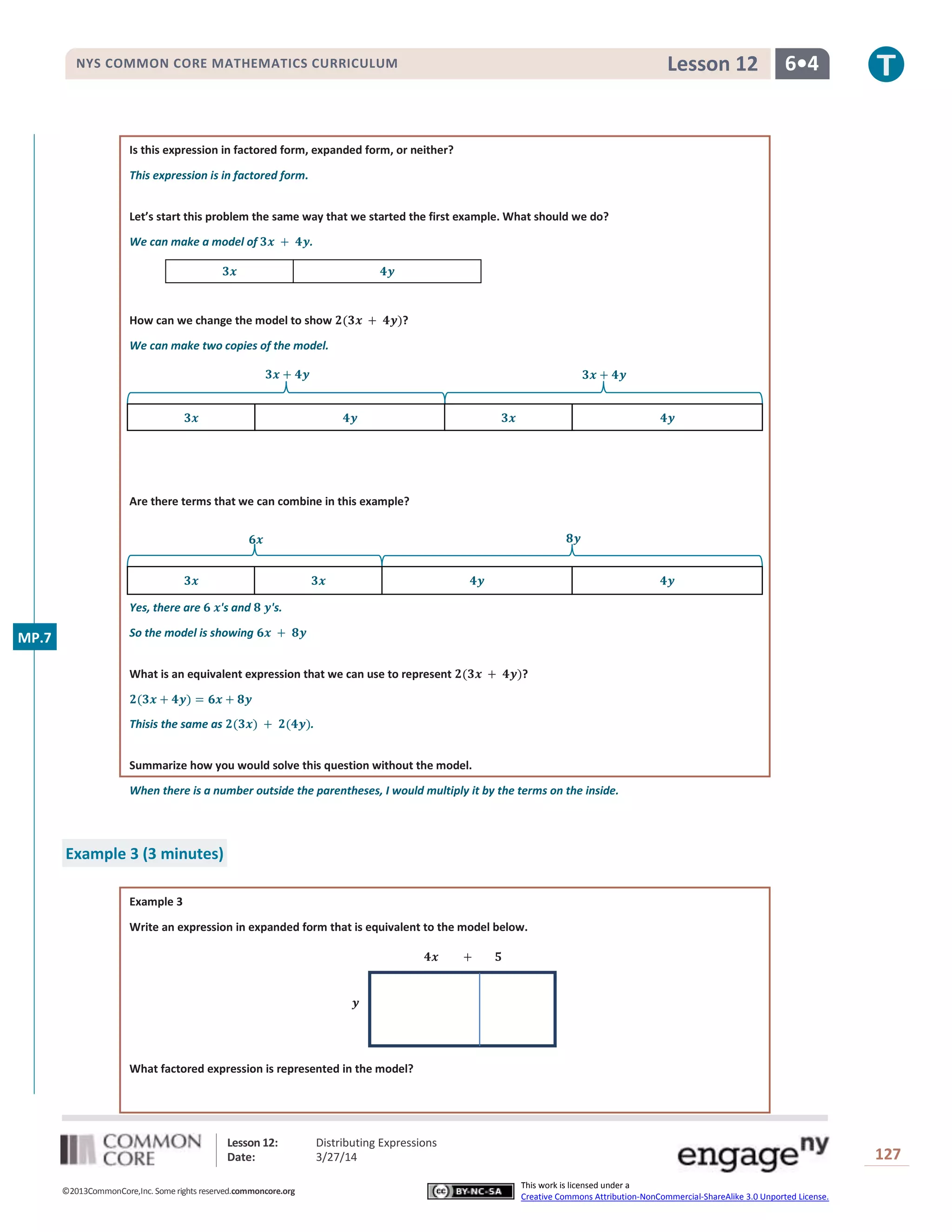
We can make a model of .
How can we change the model to show ?
We can make two copies of the model.
Are there terms that we can combine in this example?
Yes, there are 's and 's.
So the model is showing
What is an equivalent expression that we can use to represent ?
Thisis the same as .
Summarize how you would solve this question without the model.
When there is a number outside the parentheses, I would multiply it by the terms on the inside.
Example 3 (3 minutes)
Example 3
Write an expression in expanded form that is equivalent to the model below.
What factored expression is represented in the model?
MP.7
Lesson 12: Distributing Expressions
Date: 3/27/14 128
©2013CommonCore,Inc. Some rights reserved.commoncore.org
This work is licensed under a
Creative Commons Attribution-NonCommercial-ShareAlike 3.0 Unported License.
NYS COMMON CORE MATHEMATICS CURRICULUM 6•4Lesson 12
How can we rewrite this expression?
Example 4 (3 minutes)
 How can we use our work in the previous examples to write the following expression?
Example 4
Write an expression that is equivalent to .
We will multiply and .
We would get . So, .
Exercises (15 minutes)
Exercises
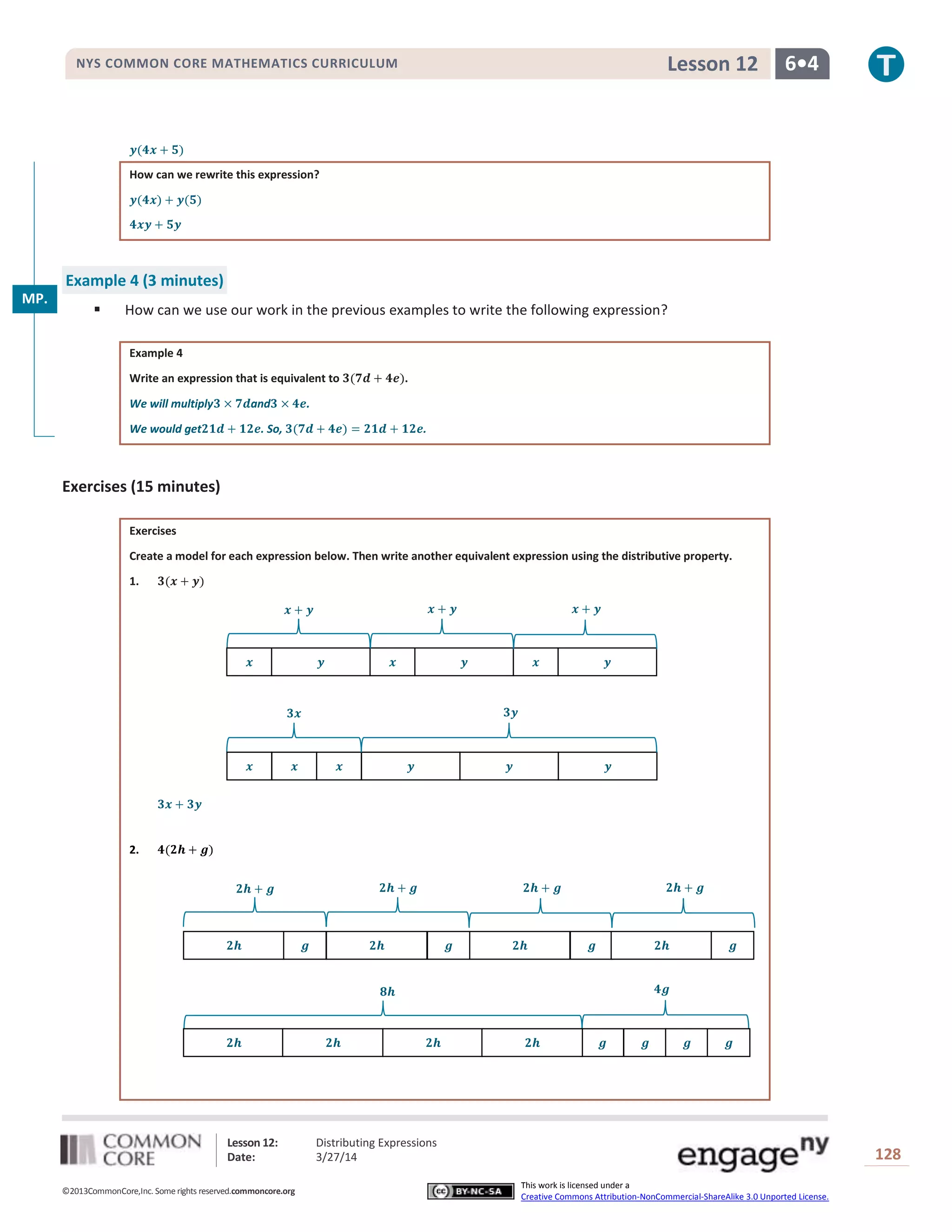
Create a model for each expression below. Then write another equivalent expression using the distributive property.
1.
2.
MP.
7
Lesson 12: Distributing Expressions
Date: 3/27/14 129
©2013CommonCore,Inc. Some rights reserved.commoncore.org
This work is licensed under a
Creative Commons Attribution-NonCommercial-ShareAlike 3.0 Unported License.
NYS COMMON CORE MATHEMATICS CURRICULUM 6•4Lesson 12
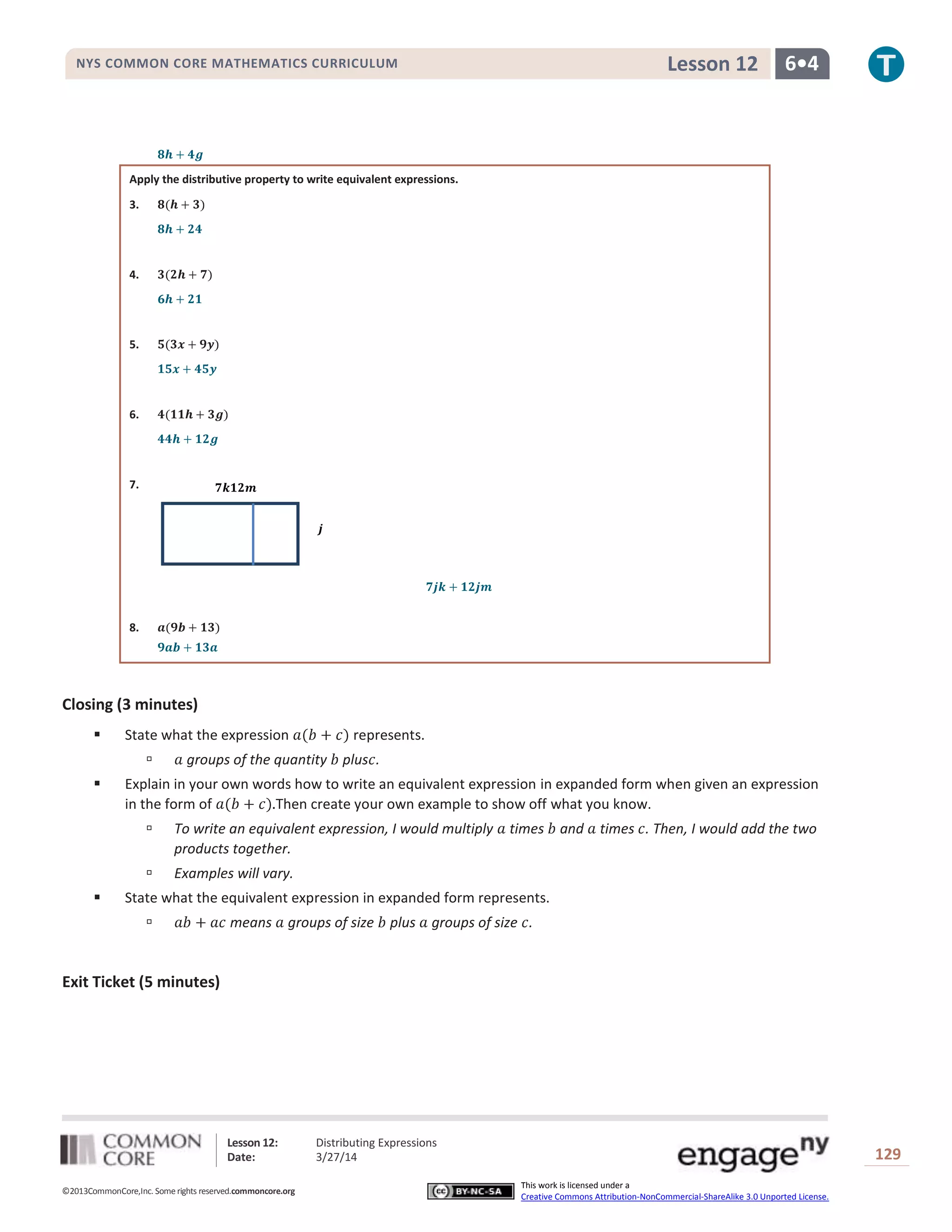
Apply the distributive property to write equivalent expressions.
3.
4.
5.
6.
7.
8.
Closing (3 minutes)
 State what the expression represents.
 groups of the quantity plus .
 Explain in your own words how to write an equivalent expression in expanded form when given an expression
in the form of Then create your own example to show off what you know.
 To write an equivalent expression, I would multiply times and times . Then, I would add the two
products together.
 Examples will vary.
 State what the equivalent expression in expanded form represents.
 means groups of size plus groups of size .
Exit Ticket (5 minutes)
Lesson 12: Distributing Expressions
Date: 3/27/14 130
©2013CommonCore,Inc. Some rights reserved.commoncore.org
This work is licensed under a
Creative Commons Attribution-NonCommercial-ShareAlike 3.0 Unported License.
NYS COMMON CORE MATHEMATICS CURRICULUM 6•4Lesson 12
Name Date
Lesson 12: Distributing Expressions
Exit Ticket
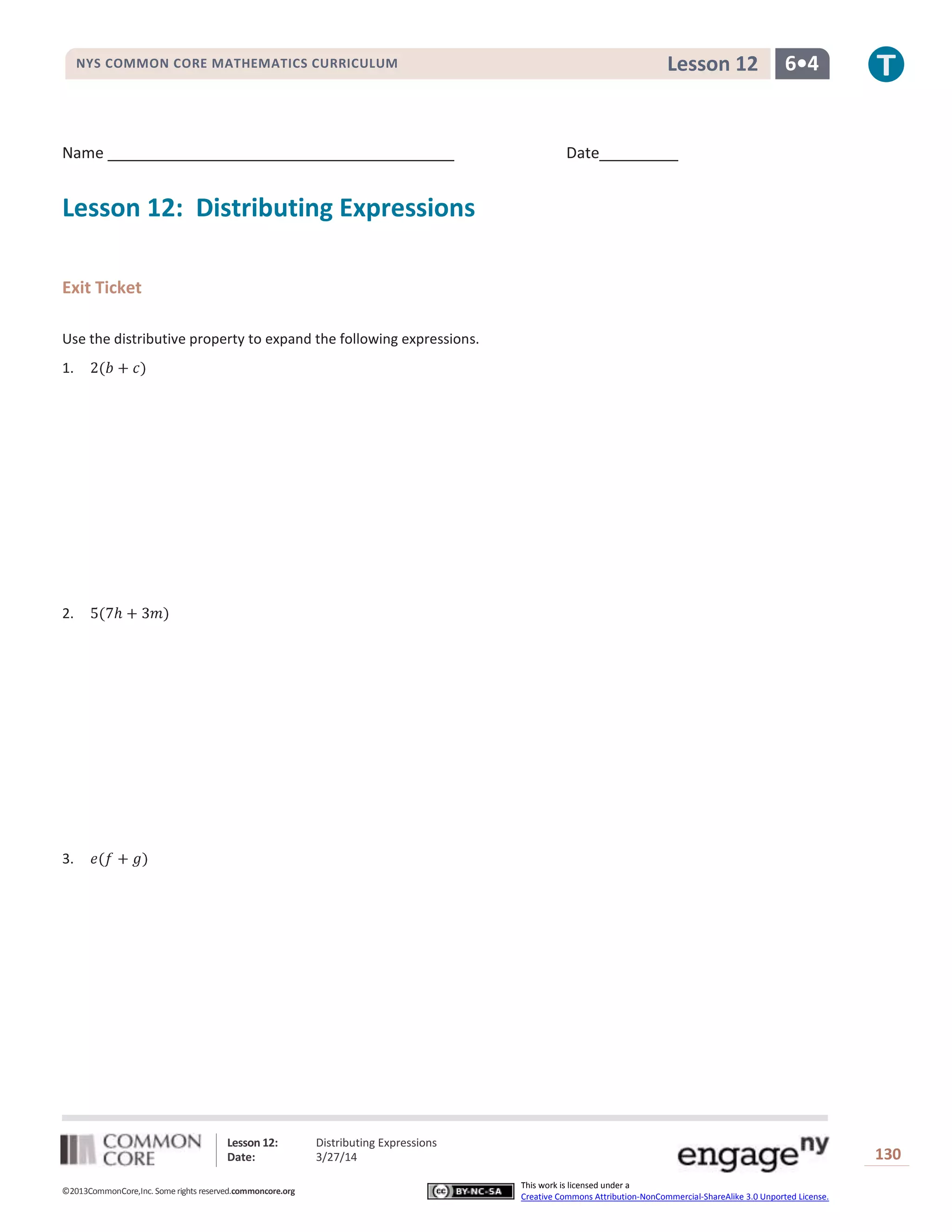
Use the distributive property to expand the following expressions.
1.
2.
3.
Lesson 12: Distributing Expressions
Date: 3/27/14 131
©2013CommonCore,Inc. Some rights reserved.commoncore.org
This work is licensed under a
Creative Commons Attribution-NonCommercial-ShareAlike 3.0 Unported License.
NYS COMMON CORE MATHEMATICS CURRICULUM 6•4Lesson 12
Exit Ticket Sample Solutions
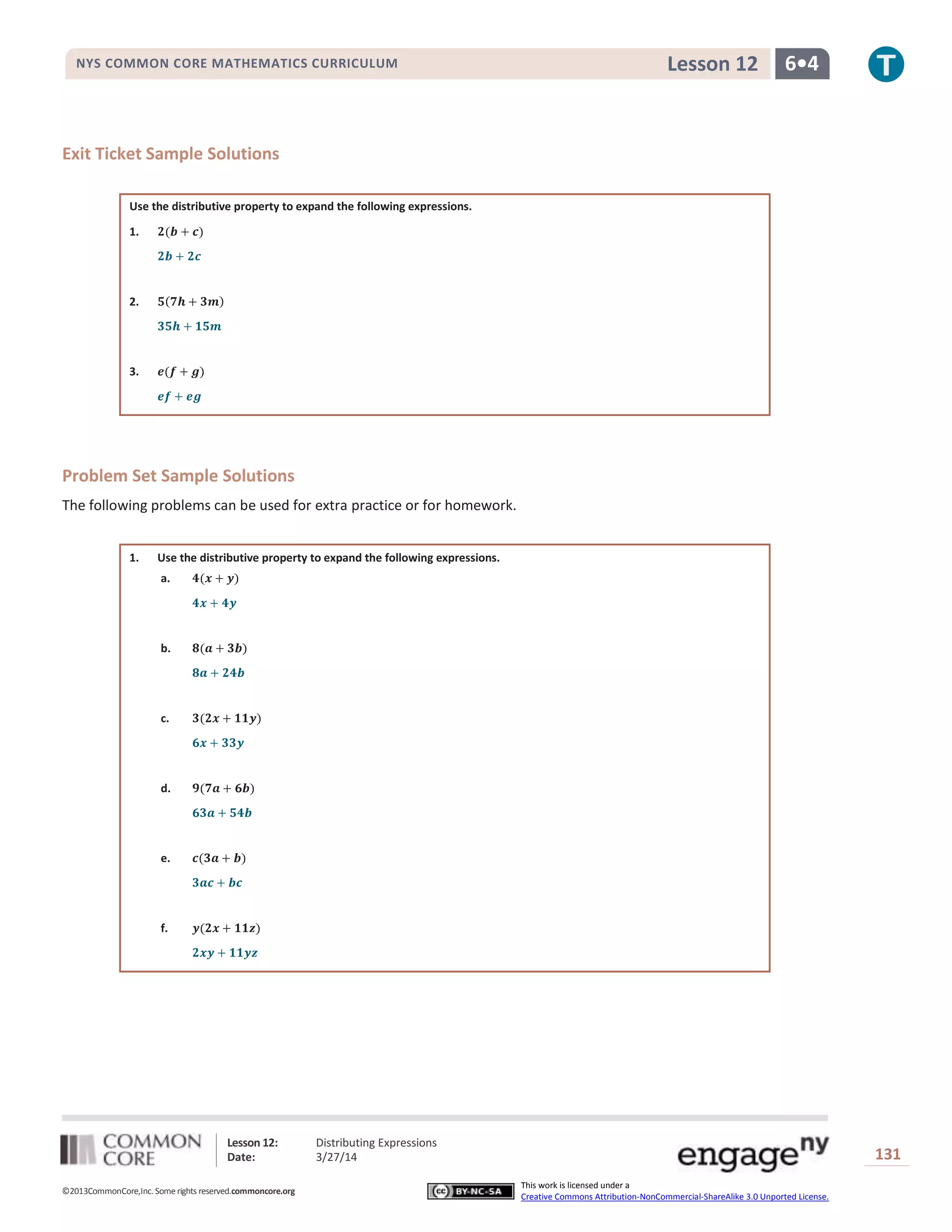
Use the distributive property to expand the following expressions.
1.
2.
3.
Problem Set Sample Solutions
The following problems can be used for extra practice or for homework.
1. Use the distributive property to expand the following expressions.
a.
b.
c.
d.
e.
f.
Lesson 12: Distributing Expressions
Date: 3/27/14 132
©2013CommonCore,Inc. Some rights reserved.commoncore.org
This work is licensed under a
Creative Commons Attribution-NonCommercial-ShareAlike 3.0 Unported License.
NYS COMMON CORE MATHEMATICS CURRICULUM 6•4Lesson 12
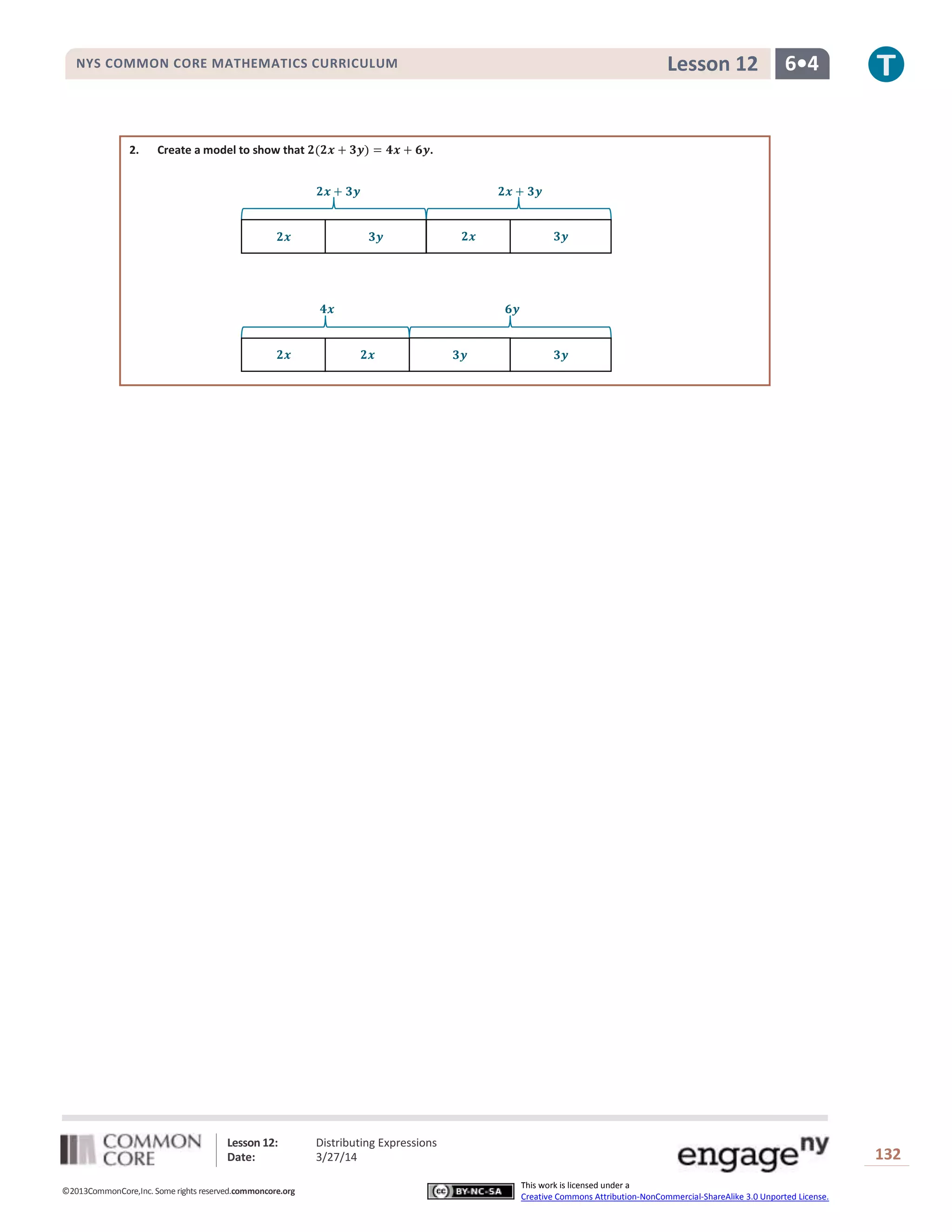
2. Create a model to show that .

G6 m4-d-lesson 12-t

  • 1.
    Lesson 12: DistributingExpressions Date: 3/27/14 125 ©2013CommonCore,Inc. Some rights reserved.commoncore.org This work is licensed under a Creative Commons Attribution-NonCommercial-ShareAlike 3.0 Unported License. NYS COMMON CORE MATHEMATICS CURRICULUM 6•4Lesson 12 Lesson 12:Distributing Expressions Student Outcomes  Students model and write equivalent expressions using the distributive property. They move from a factored form to an expanded form of an expression. Classwork Opening Exercise (3 minutes) Opening Exercise a. Create a model to show . b. Create a model to show , or . Example 1 (8 minutes) Example 1 Write an expression that is equivalent to .  In this example we have been given the factored form of the expression.  To answer this question we can create a model to represent .  Let’s start by creating a model to represent . Create a model to represent . The expression tells us that we have of the ’s. Create a model that shows groups of . MP.7
  • 2.
    Lesson 12: DistributingExpressions Date: 3/27/14 126 ©2013CommonCore,Inc. Some rights reserved.commoncore.org This work is licensed under a Creative Commons Attribution-NonCommercial-ShareAlike 3.0 Unported License. NYS COMMON CORE MATHEMATICS CURRICULUM 6•4Lesson 12 How many ’s and how many ’s do you see in the diagram? There are ’s and ’s. How would the model look if we grouped together the ’s, and then grouped together the ’s? What expression could we write to represent the new diagram?  This expression is written in expanded form. What conclusion can we draw from the models about equivalent expressions?  To prove that these two forms are equivalent, let’s plug in some values for and and see what happens. Let and .  Note, if students do not believe yet that the two are equal you can continue to plug in more values for and until they are convinced. What happens when we double ? We double and we double . Example 2 (5 minutes) Example 2 Write an expression that is equivalent to double . How can we rewrite double ? Double is the same as multiplying by two. MP.7
  • 3.
    Lesson 12: DistributingExpressions Date: 3/27/14 127 ©2013CommonCore,Inc. Some rights reserved.commoncore.org This work is licensed under a Creative Commons Attribution-NonCommercial-ShareAlike 3.0 Unported License. NYS COMMON CORE MATHEMATICS CURRICULUM 6•4Lesson 12 Is this expression in factored form, expanded form, or neither? This expression is in factored form. Let’s start this problem the same way that we started the first example. What should we do? We can make a model of . How can we change the model to show ? We can make two copies of the model. Are there terms that we can combine in this example? Yes, there are 's and 's. So the model is showing What is an equivalent expression that we can use to represent ? Thisis the same as . Summarize how you would solve this question without the model. When there is a number outside the parentheses, I would multiply it by the terms on the inside. Example 3 (3 minutes) Example 3 Write an expression in expanded form that is equivalent to the model below. What factored expression is represented in the model? MP.7
  • 4.
    Lesson 12: DistributingExpressions Date: 3/27/14 128 ©2013CommonCore,Inc. Some rights reserved.commoncore.org This work is licensed under a Creative Commons Attribution-NonCommercial-ShareAlike 3.0 Unported License. NYS COMMON CORE MATHEMATICS CURRICULUM 6•4Lesson 12 How can we rewrite this expression? Example 4 (3 minutes)  How can we use our work in the previous examples to write the following expression? Example 4 Write an expression that is equivalent to . We will multiply and . We would get . So, . Exercises (15 minutes) Exercises Create a model for each expression below. Then write another equivalent expression using the distributive property. 1. 2. MP. 7
  • 5.
    Lesson 12: DistributingExpressions Date: 3/27/14 129 ©2013CommonCore,Inc. Some rights reserved.commoncore.org This work is licensed under a Creative Commons Attribution-NonCommercial-ShareAlike 3.0 Unported License. NYS COMMON CORE MATHEMATICS CURRICULUM 6•4Lesson 12 Apply the distributive property to write equivalent expressions. 3. 4. 5. 6. 7. 8. Closing (3 minutes)  State what the expression represents.  groups of the quantity plus .  Explain in your own words how to write an equivalent expression in expanded form when given an expression in the form of Then create your own example to show off what you know.  To write an equivalent expression, I would multiply times and times . Then, I would add the two products together.  Examples will vary.  State what the equivalent expression in expanded form represents.  means groups of size plus groups of size . Exit Ticket (5 minutes)
  • 6.
    Lesson 12: DistributingExpressions Date: 3/27/14 130 ©2013CommonCore,Inc. Some rights reserved.commoncore.org This work is licensed under a Creative Commons Attribution-NonCommercial-ShareAlike 3.0 Unported License. NYS COMMON CORE MATHEMATICS CURRICULUM 6•4Lesson 12 Name Date Lesson 12: Distributing Expressions Exit Ticket Use the distributive property to expand the following expressions. 1. 2. 3.
  • 7.
    Lesson 12: DistributingExpressions Date: 3/27/14 131 ©2013CommonCore,Inc. Some rights reserved.commoncore.org This work is licensed under a Creative Commons Attribution-NonCommercial-ShareAlike 3.0 Unported License. NYS COMMON CORE MATHEMATICS CURRICULUM 6•4Lesson 12 Exit Ticket Sample Solutions Use the distributive property to expand the following expressions. 1. 2. 3. Problem Set Sample Solutions The following problems can be used for extra practice or for homework. 1. Use the distributive property to expand the following expressions. a. b. c. d. e. f.
  • 8.
    Lesson 12: DistributingExpressions Date: 3/27/14 132 ©2013CommonCore,Inc. Some rights reserved.commoncore.org This work is licensed under a Creative Commons Attribution-NonCommercial-ShareAlike 3.0 Unported License. NYS COMMON CORE MATHEMATICS CURRICULUM 6•4Lesson 12 2. Create a model to show that .