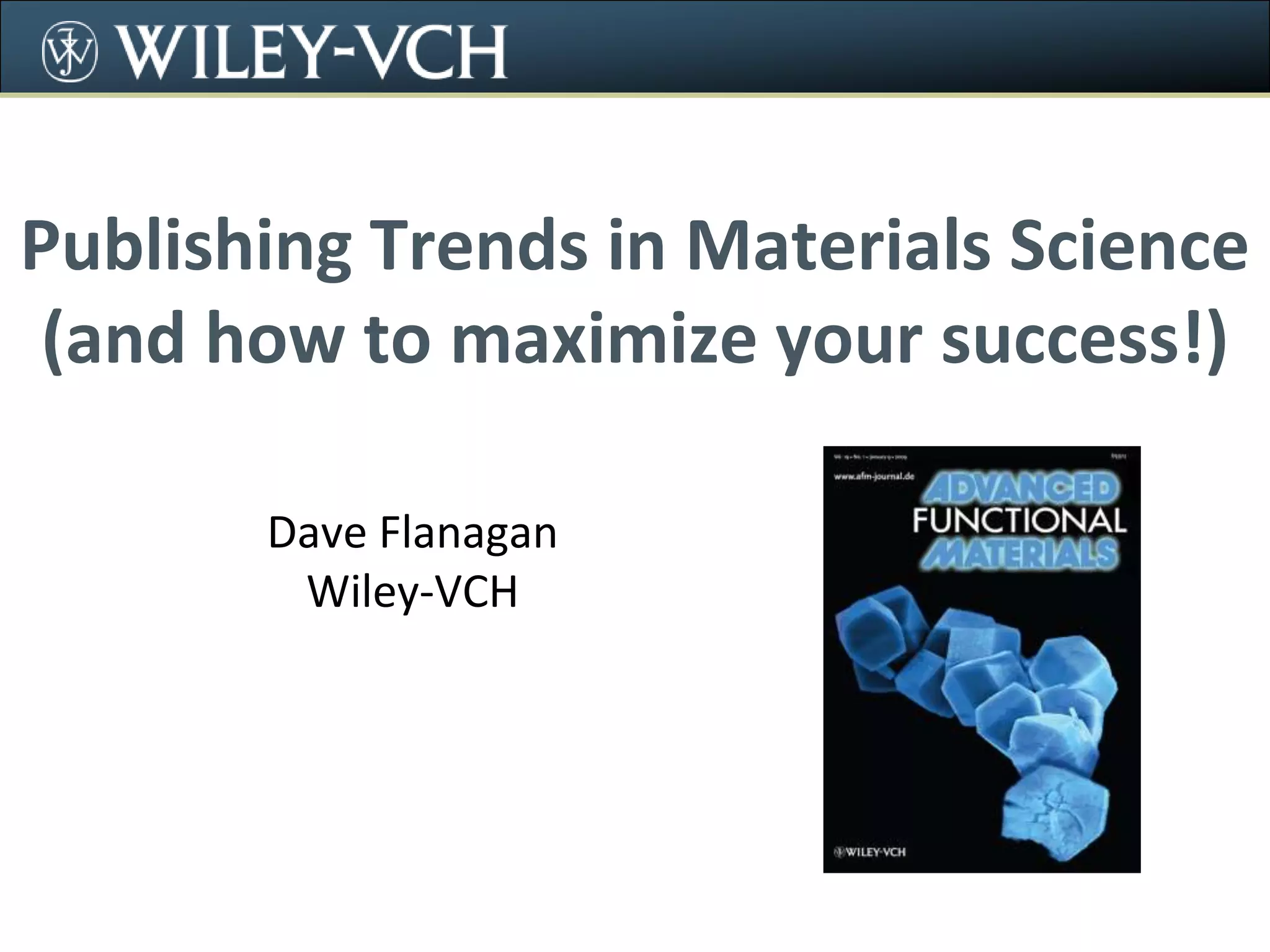
Publishing Trends in Materials Science(and how to maximize your success!)Dave FlanaganWiley-VCH
OutlineWhy publish?Why peer review?What editors look forAccept, reject, or revise: how decisions are made and how to respondPublishing ethicsSummary and discussion
Our Flagship Materials Science Journals材料科学头牌期刊
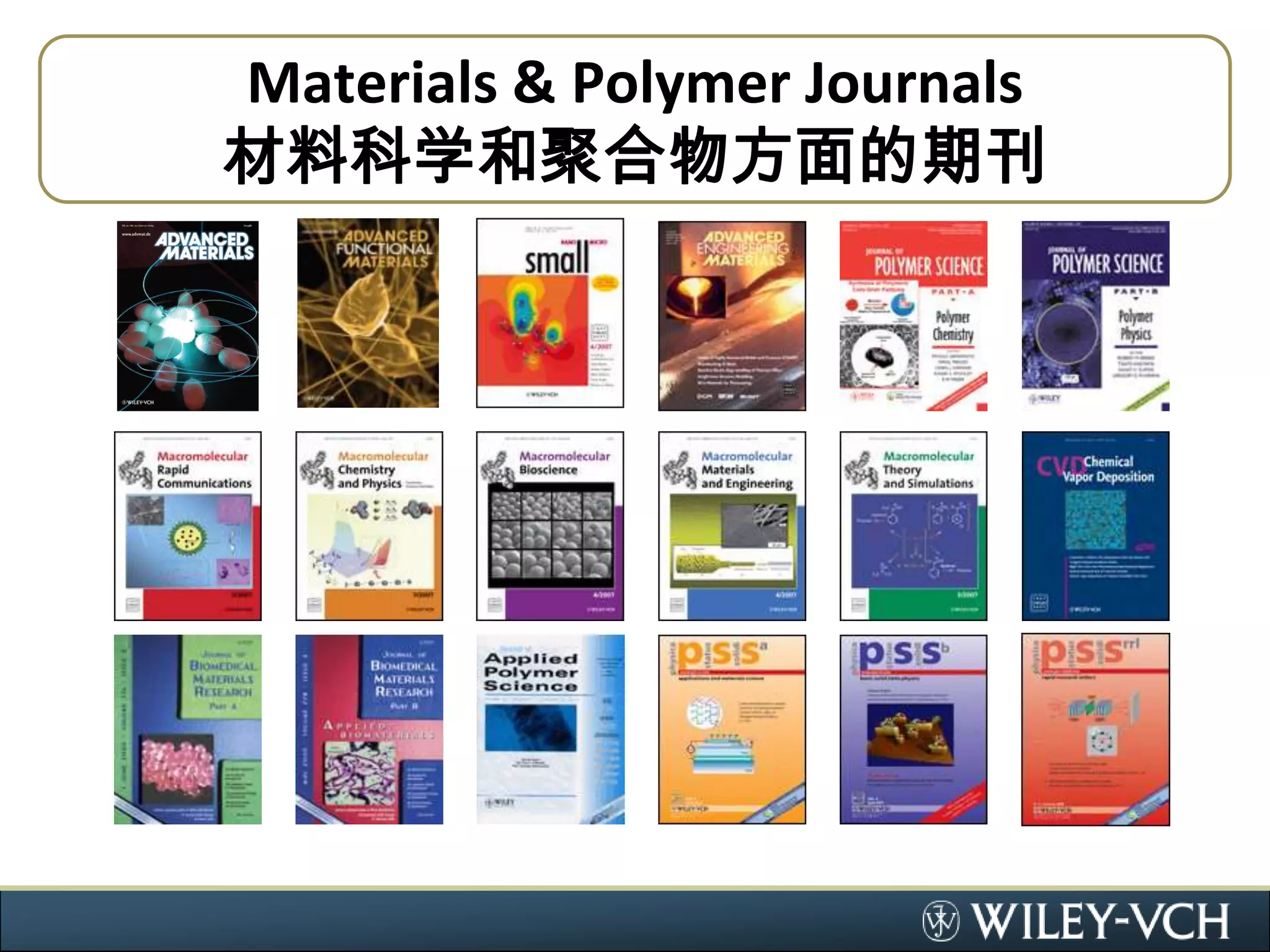
Materials & Polymer Journals材料科学和聚合物方面的期刊
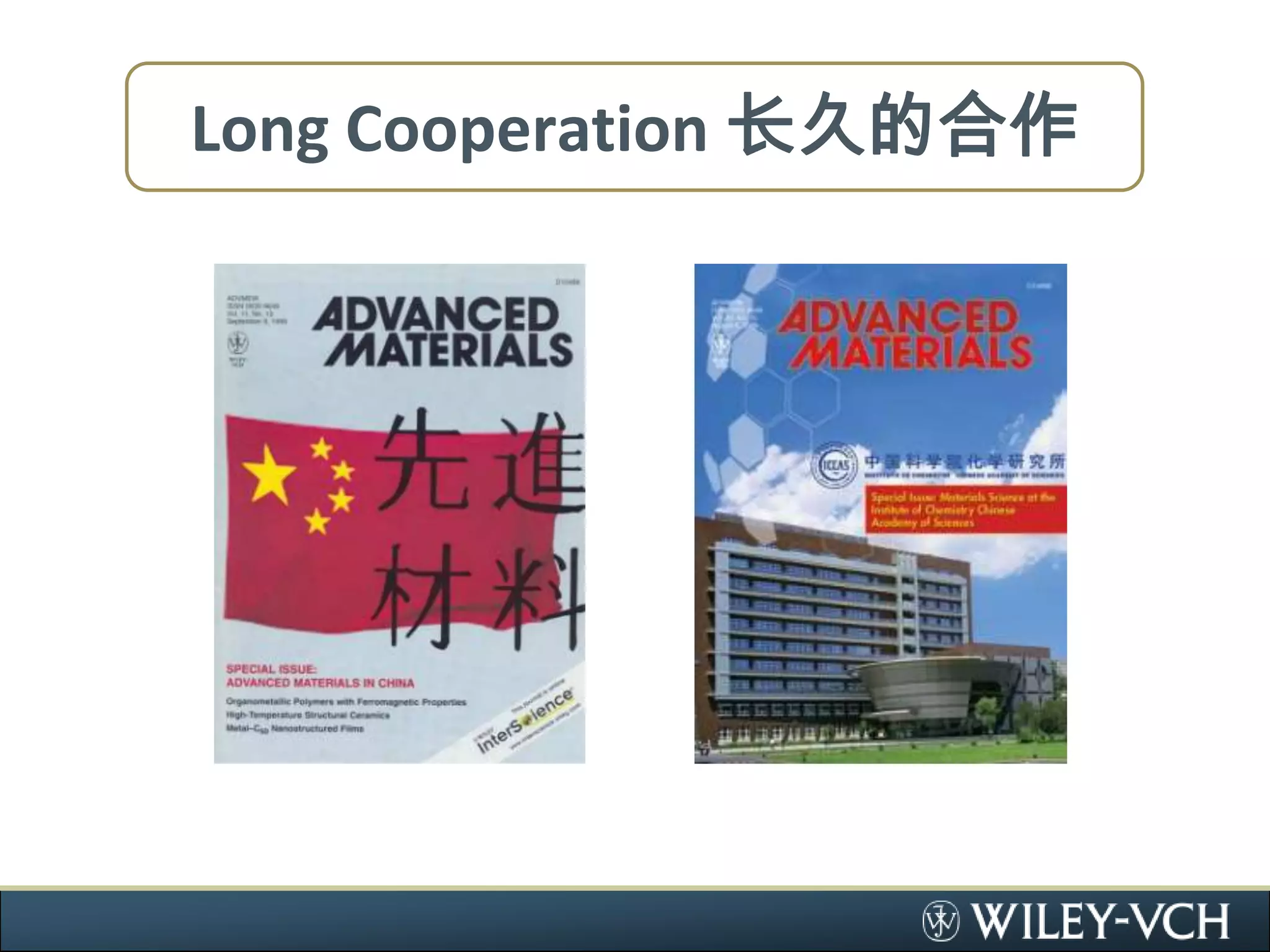
Long Cooperation长久的合作
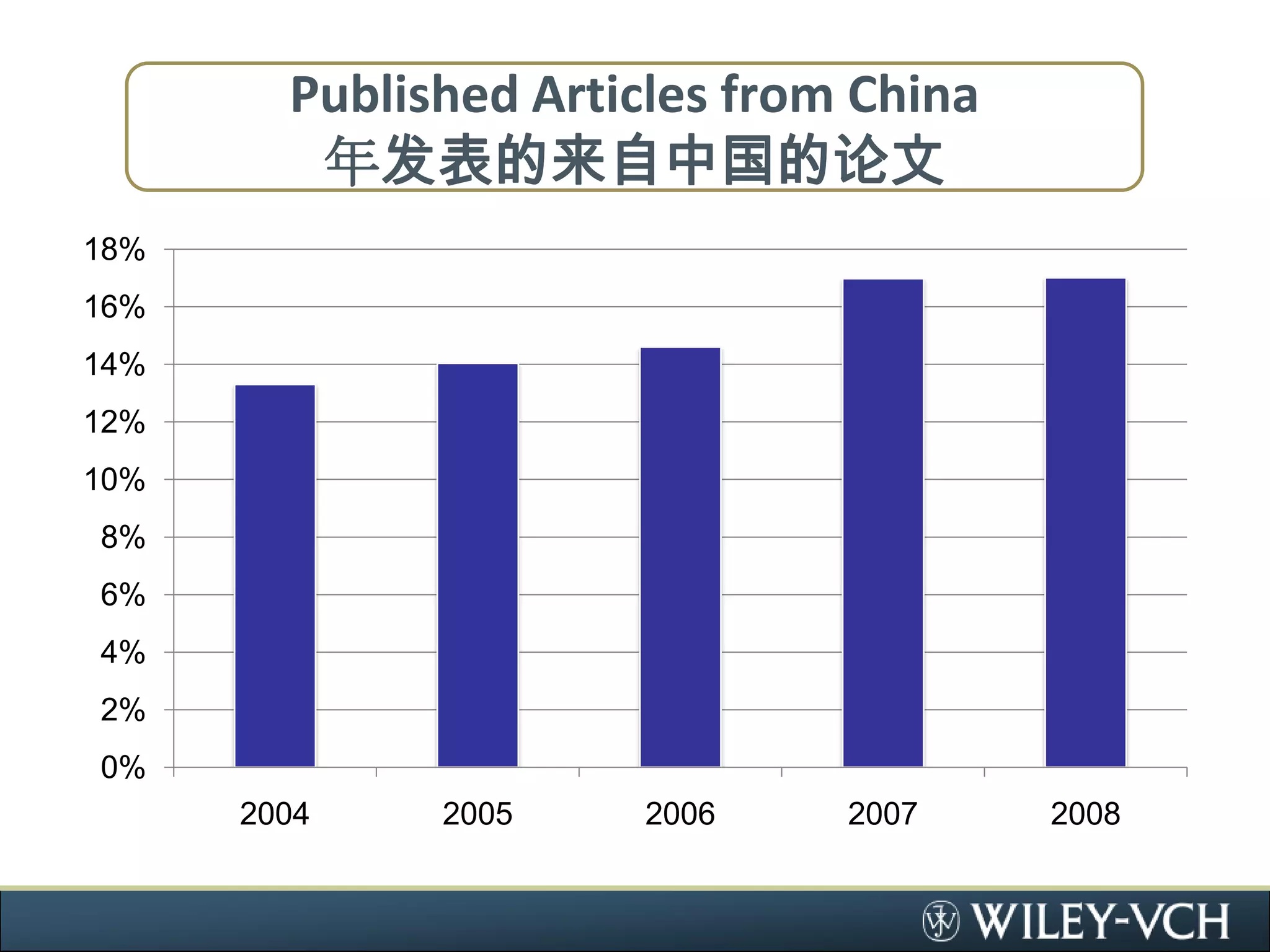
Published Articles from China年发表的来自中国的论文
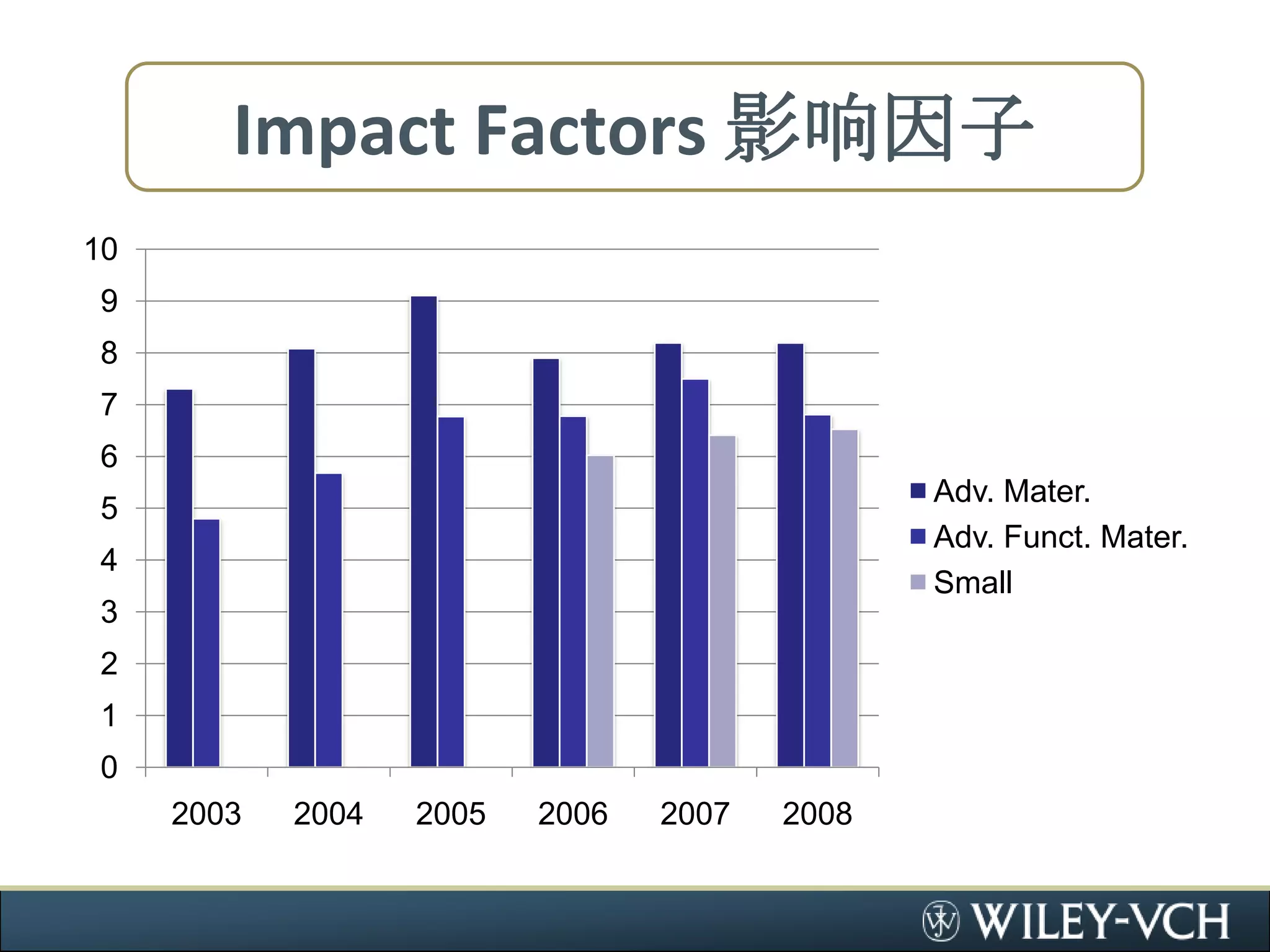
Impact Factors 影响因子
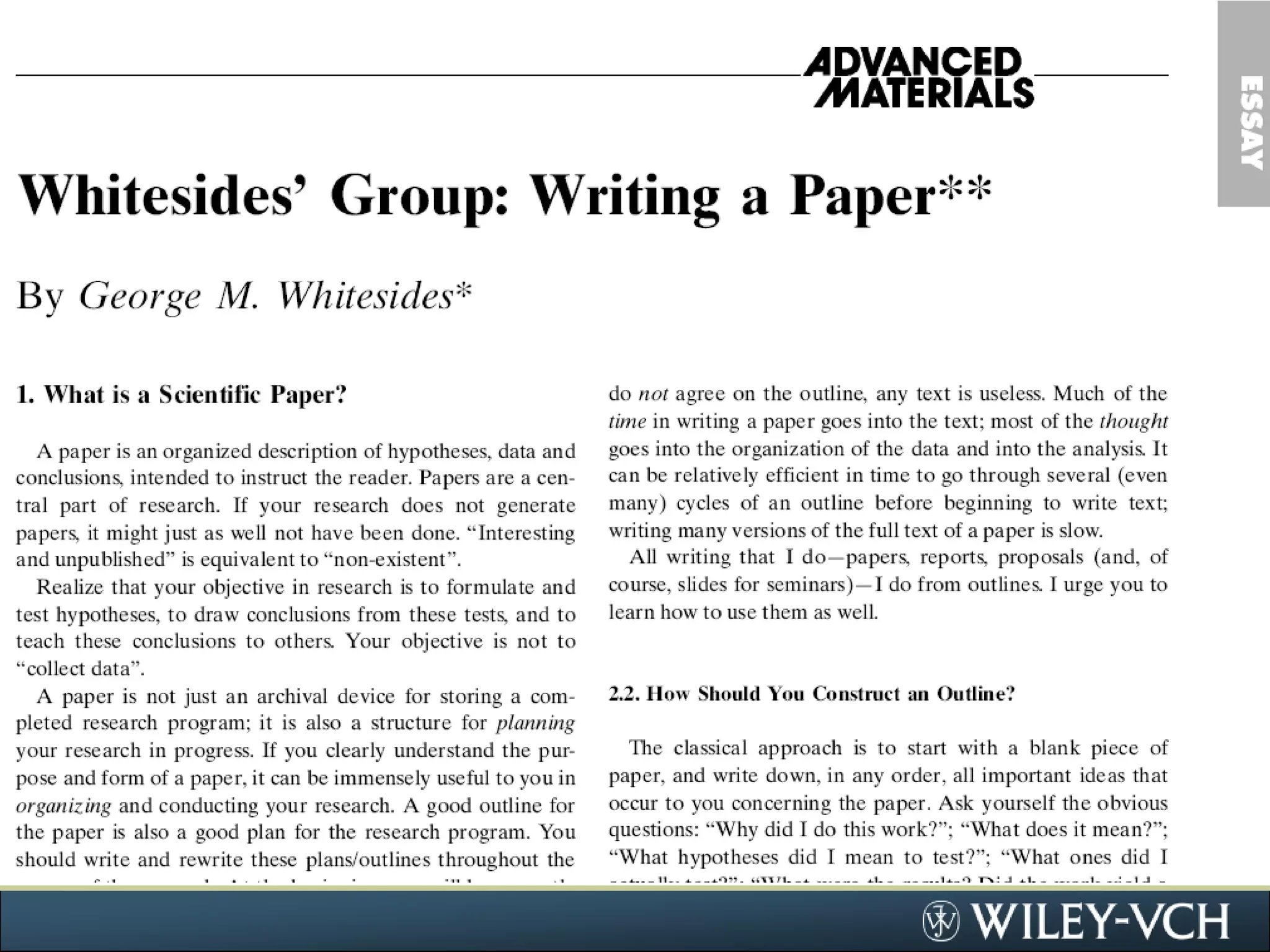
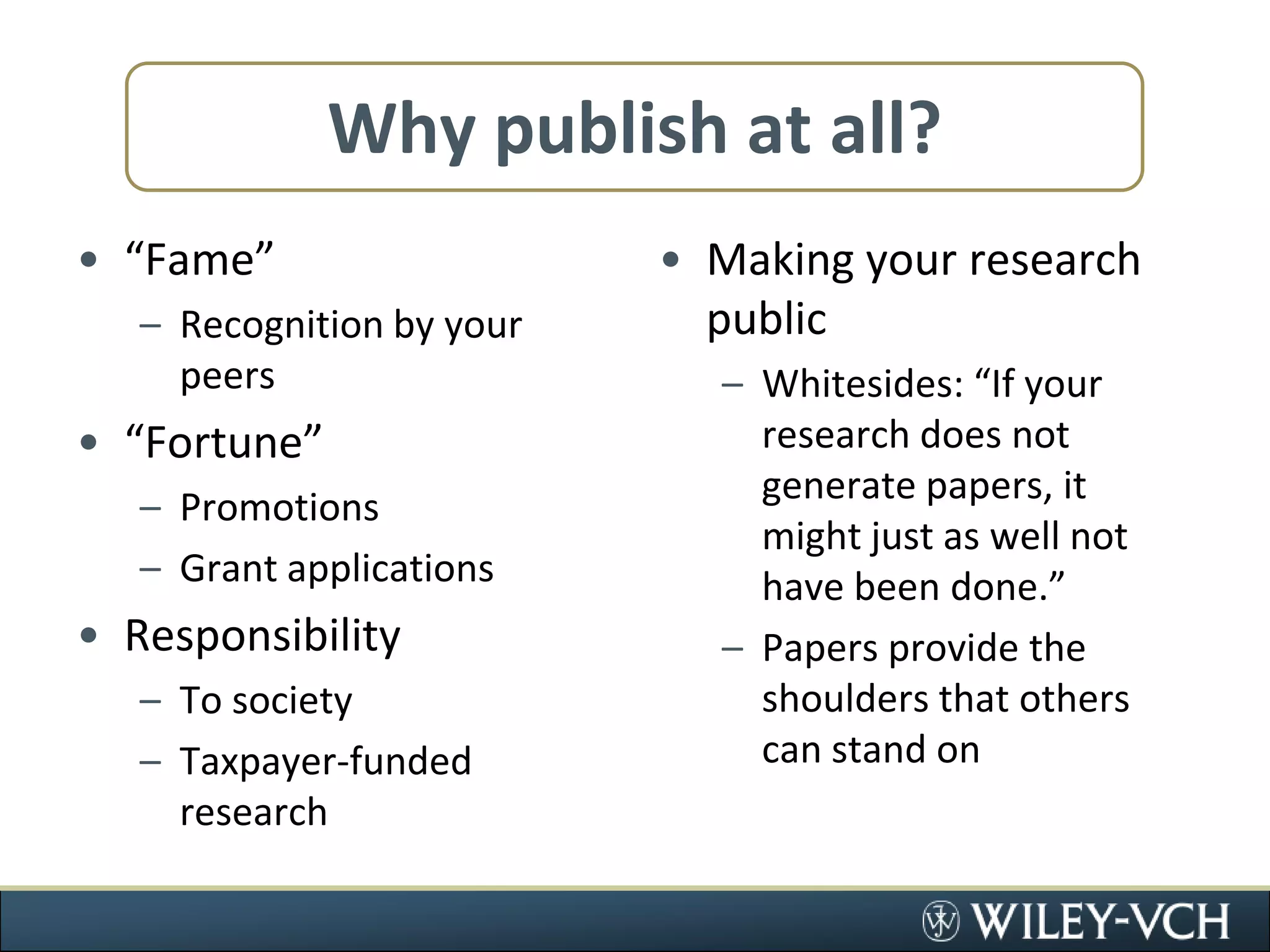
Why publish at all?“Fame”Recognition by your peers“Fortune”PromotionsGrant applicationsResponsibilityTo societyTaxpayer-funded researchMaking your research publicWhitesides: “If your research does not generate papers, it might just as well not have been done.”Papers provide the shoulders that others can stand on
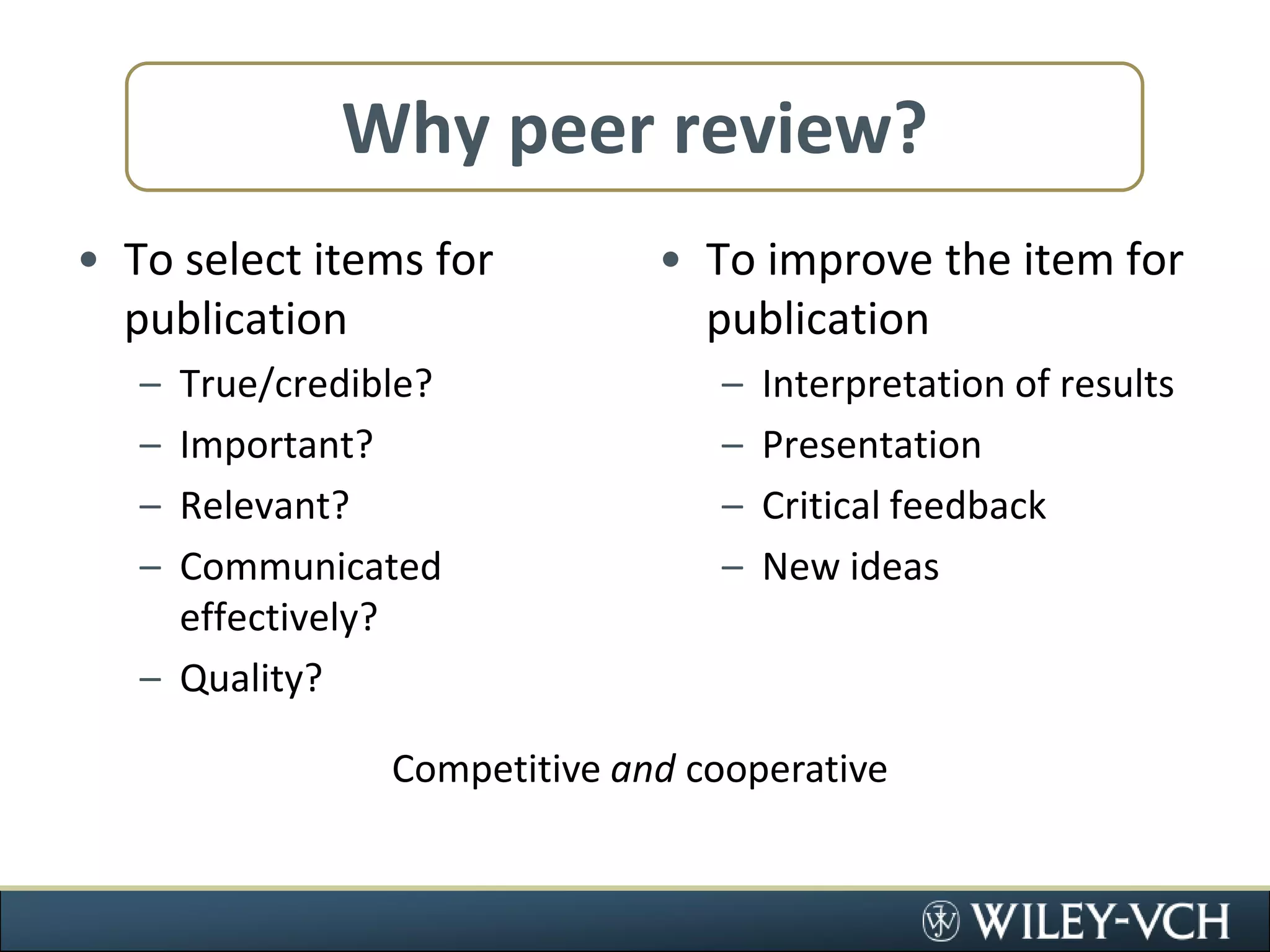
Why peer review?To select items for publicationTrue/credible?Important?Relevant?Communicated effectively?Quality?To improve the item for publicationInterpretation of resultsPresentationCritical feedbackNew ideasCompetitive and cooperative
Why peer review?“[Peer review] is the worst form of [research evaluation] except all those other forms that have been tried from time to time.”Winston Churchill, 1947 (paraphrased)
What editors look forWhat all editors look for:ScopeDoes the topic fit the journal?FormatCommunication, full paper, review…What some journals require (to varying degrees):NoveltyHow different is it from previous work?ImportanceIn those in specific fieldTo those in related fieldsInterest
What AM editors look forSynthesis/fabricationIs it a new material or material system?CharacterizationIs it fully characterized?PropertiesDoes it have new properties that are superior to previously reported materials?ApplicationDoes it have a technological application or solve a scientific problem?
How reviewers are chosenReviewer database>10,000 in Wiley-VCH databaseKeywords, interests, historySuggestions from authorsVery helpful!Not just the big names pleaseFrom related papersCited in manuscriptLiterature searchesEditor’s knowledge and experience
What reviewers look forIs the motivation clear?Is the motivation important?Is the work novel and original?Are the conclusions supported by the data?Are the results important?Are the results interesting?Are there ethical questions?Is the presentation clear?
Planning your manuscript“A paper is not just an archival device for storing a completed research program; it is also a structure for planning your research in progress.”Whitesides, “Writing a Paper”, 2004.
Planning your manuscriptUse an outline to plan a paper, including the data.IdeasFiguresSchemesDataQuestionsHypothesesObjectivesReferences…
Planning your manuscriptOrganize into three piles:Introduction: Why did I do it?Results and Discussion: What did I do?Conclusions: What does it mean?Organize each pile:Organize the dataSketch figuresPut things in orderImportant: Figure out what data / figures / results are still needed to complete the outline—and complete the paperThis becomes an iterative process between you and your advisor, collaborators, etc. of refining the outline.
Preparing your submissionSelecting the journalPreparing your manuscriptFiguresTextWriting the cover letterSubmitting the package
Selecting the journalJournal Impact Factor is not everything!What are the implications of your research?How important will others find your research?In your field?In related fields?Where do you read papers related to your research? Which do you like the most?What is the scope of your candidate journal?What is the format of your candidate journal?
Selecting the journalWhat is the journal’s policy on prior publication?In peer-reviewed printed journalsIn peer-reviewed online-only journalsIn printed conference proceedingsIn online-only conference proceedingsIn online preprint serversOn your website
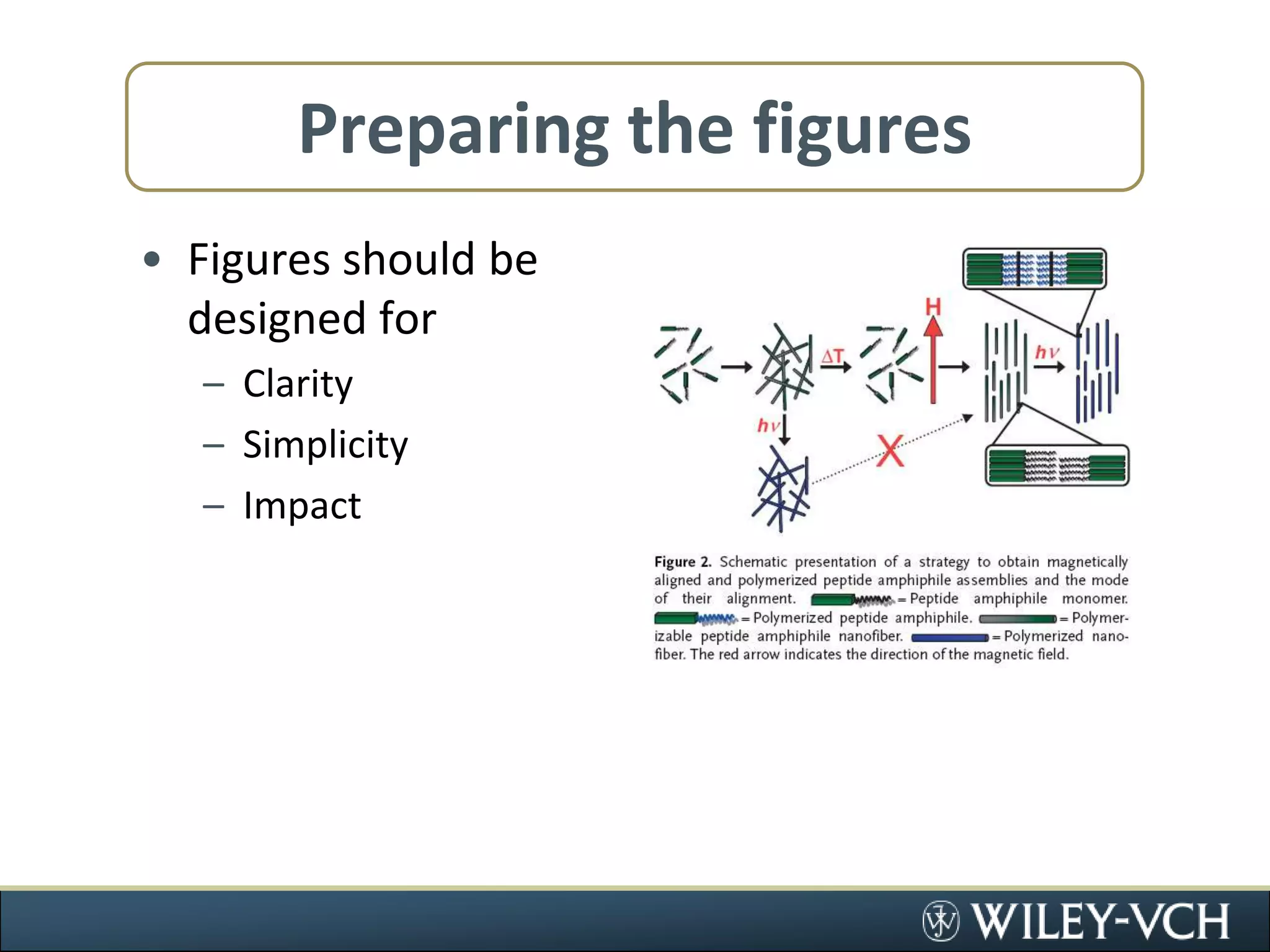
Preparing the figuresFigures (and schemes, tables, equations) are critical:Figures summarize the resultsFigures are “read” firstBy editors, by referees, by readersThe text in the paper is secondary!The text explains the data in the figures
Preparing the figuresFigures should be designed forClaritySimplicityImpact
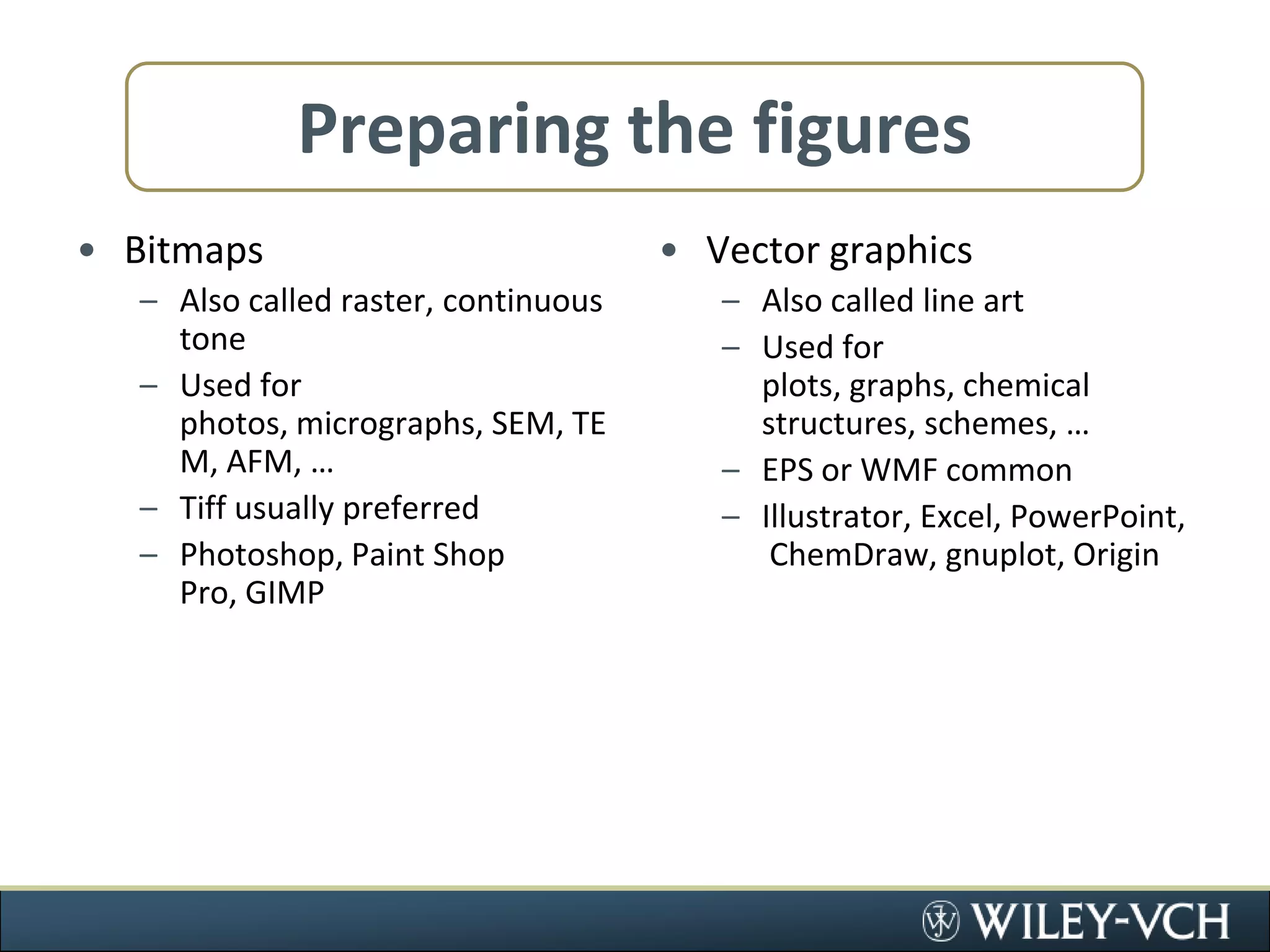
Preparing the figuresBitmapsAlso called raster, continuous toneUsed for photos, micrographs, SEM, TEM, AFM, …Tiff usually preferredPhotoshop, Paint Shop Pro, GIMPVector graphicsAlso called line artUsed for plots, graphs, chemical structures, schemes, …EPS or WMF commonIllustrator, Excel, PowerPoint, ChemDraw, gnuplot, Origin
Preparing the textConsult the guide for authorsLook at a recent copy of the journalObtain a style guideACS Style GuideChicago Manual of StyleUse the text to explain the data, figures, schemes organized in the outlineNot arranged chronologically, but by importanceConsider a native English speaker or copyediting service
Abstract and keywordsAbstract and keywords are more important than everAt time of submissionSummarizing the resultsIdentifying relevance and scopeIdentifying potential refereesAfter publicationIndexing and searchingPapers need to be found to have an impact!
Preparing the textRTF or Word .docMicrosoft WordOpenOffice.orgAbiWord…Reference manager softwareEndNoteBibTeXLaTeXCheck journal guidelines firstManuscript formattingJournal templateDouble-spaced, 12 pt, reasonable marginsFigures at endPlease put captions with figures!
What about Supporting Information?Supporting Information should support the manuscript:NMR spectra, diffraction data, movies, calculations…The manuscript should still be convincing if the SI is unavailableIf you need to refer to SI in the main text, it may not be SI!SI should not be used to squeeze full papers into communications
Writing the cover letterWhy is this topic important?Why are the results significant?What is the key result?Why is it an advance on previous work?Why are you submitting to this journal?Why will this journal’s readers read it?
Writing the cover letterDisclose conflicts of interestProvide reviewer suggestionsList related papers in press or under considerationOther tips:Get the editor’s name right!Moved, dead, etc.Get the journal’s name right!Especially if not your first-choice journal…
Conflicts of interestPotential conflicts of interest:Competitor that could “scoop” youCurrent or former collaborators, grant co-applicantsMembers of your institutionCurrent or former thesis or postdoc advisorAnyone you believe could not give an impartial reportwithin reason…
Should I appeal?Usually, noRisk of long time to publicationGood papers are citedEditors and referees know journalCriticisms may be valid!Occasionally, yesImportance / impact / novelty missed by editor/refereesNeed for a good cover letter!Factual errors in referee reports that led to rejection
RevisionCarefully consider reviewer commentsNot all changes have to be made……but need convincing arguments for changes not madePrepare revisionRevise manuscriptHighlight changes in manuscriptPoint-by-point response to all reviewer issuesChanges madeWhy changes not madeResponse may go back to reviewers!Need to convince editor and reviewers
Author responsibilitiesPresent data honestly and accurately, not fabricate or falsify dataReference and cite properly, not plagiarize or ignore related workAvoid fragmentation and redundant publicationInform the editor of related manuscripts under consideration or in pressSubmit to only one journal at a timeDisclose conflicts of interestMore information under “For Authors” at www.advmat.de.
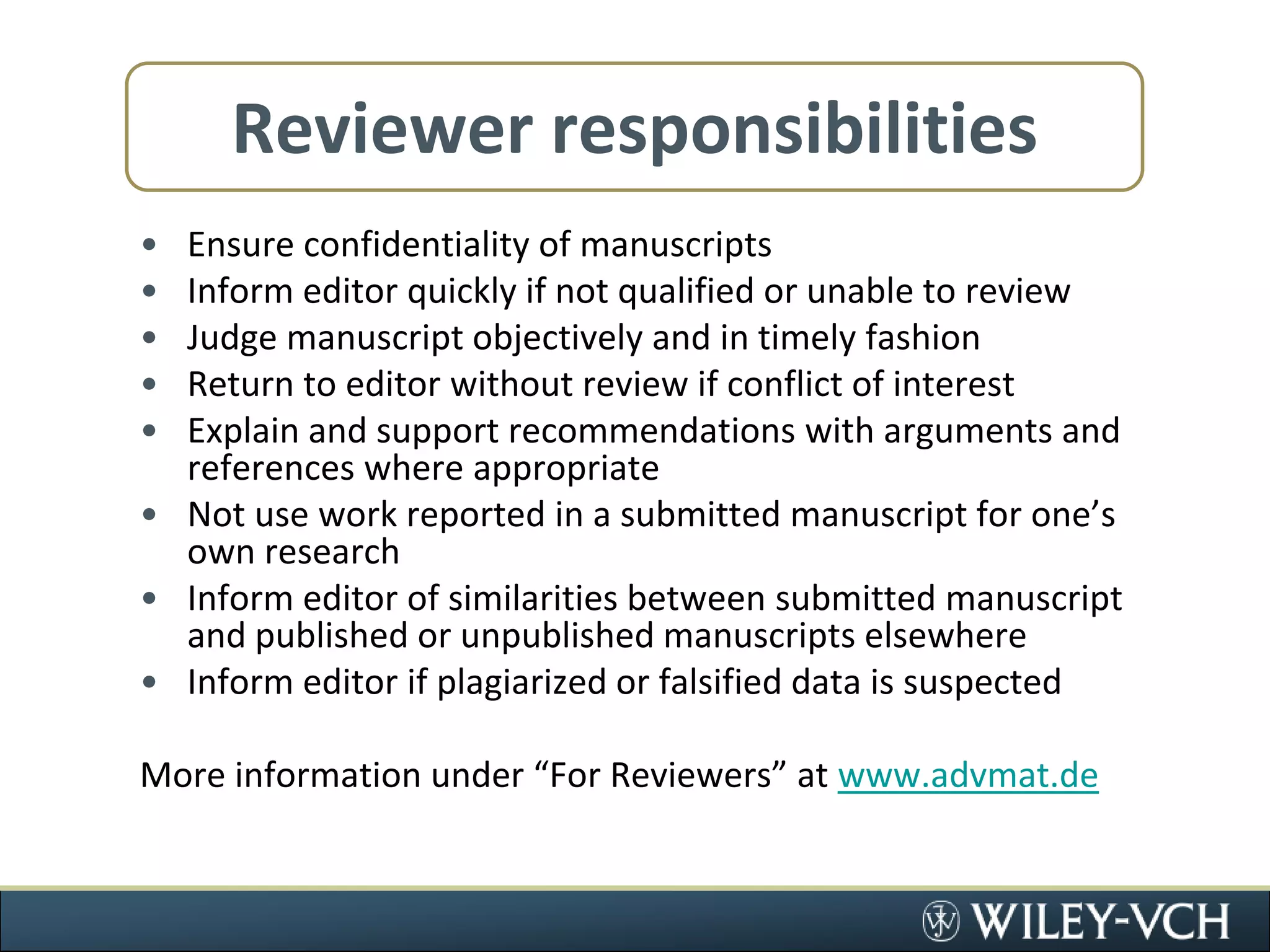
Reviewer responsibilitiesEnsure confidentiality of manuscriptsInform editor quickly if not qualified or unable to reviewJudge manuscript objectively and in timely fashionReturn to editor without review if conflict of interestExplain and support recommendations with arguments and references where appropriateNot use work reported in a submitted manuscript for one’s own researchInform editor of similarities between submitted manuscript and published or unpublished manuscripts elsewhereInform editor if plagiarized or falsified data is suspectedMore information under “For Reviewers” at www.advmat.de
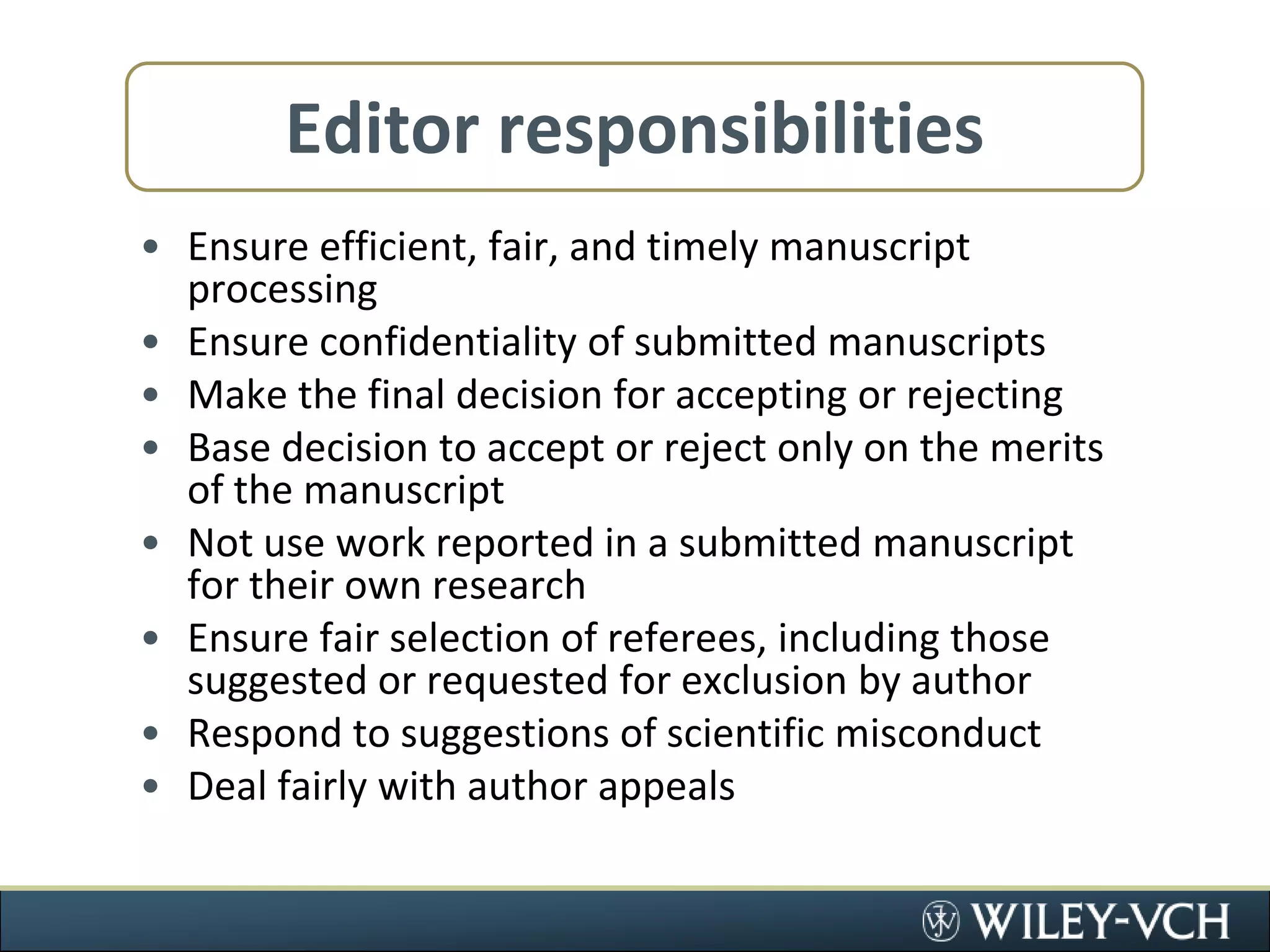
Editor responsibilitiesEnsure efficient, fair, and timely manuscript processingEnsure confidentiality of submitted manuscriptsMake the final decision for accepting or rejectingBase decision to accept or reject only on the merits of the manuscriptNot use work reported in a submitted manuscript for their own researchEnsure fair selection of referees, including those suggested or requested for exclusion by authorRespond to suggestions of scientific misconductDeal fairly with author appeals
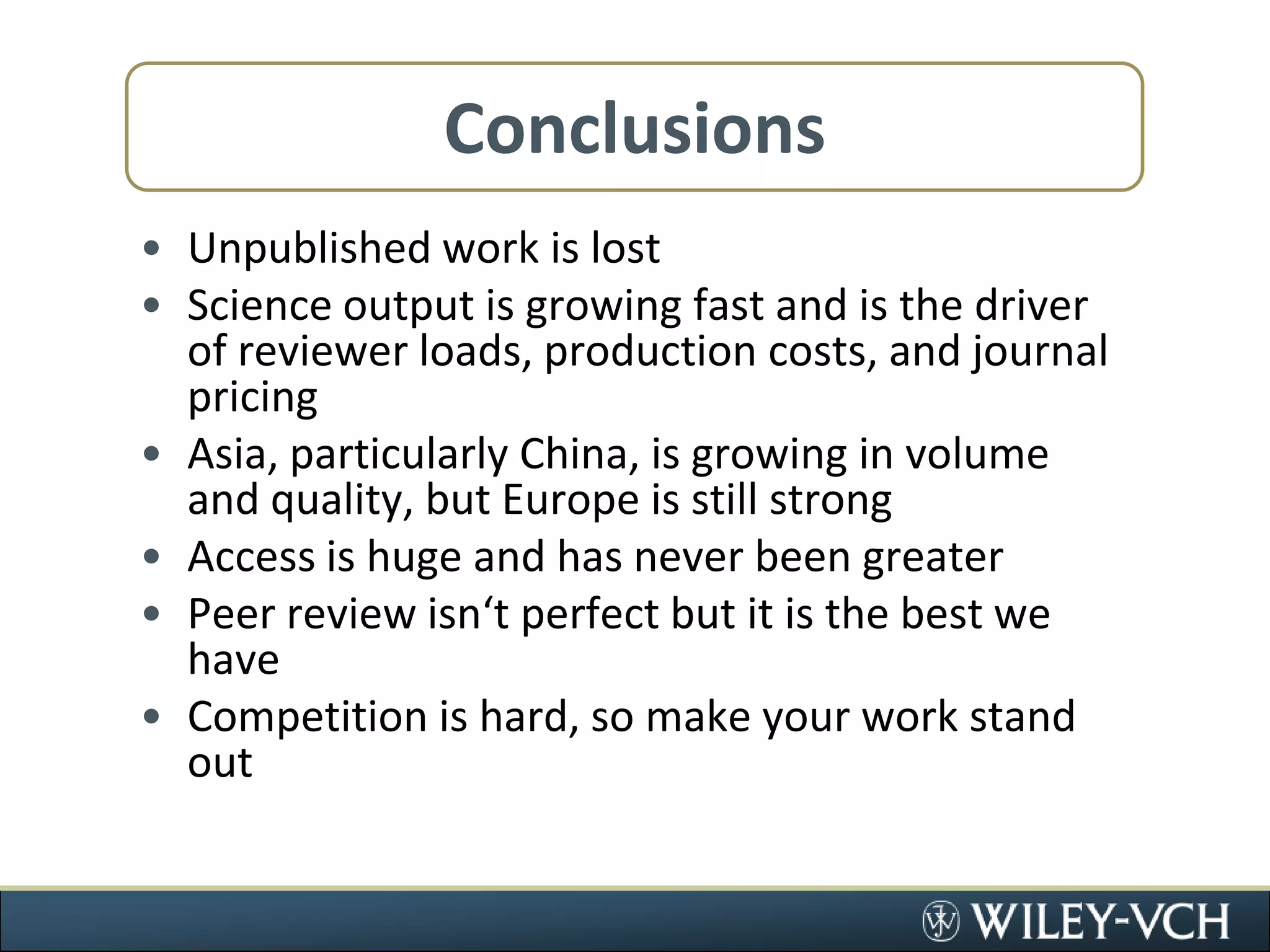
ConclusionsUnpublished work is lostScience output is growing fast and is the driver of reviewer loads, production costs, and journal pricingAsia, particularly China, is growing in volume and quality, but Europe is still strongAccess is huge and has never been greaterPeer review isn‘t perfect but it is the best we haveCompetition is hard, so make your work stand out
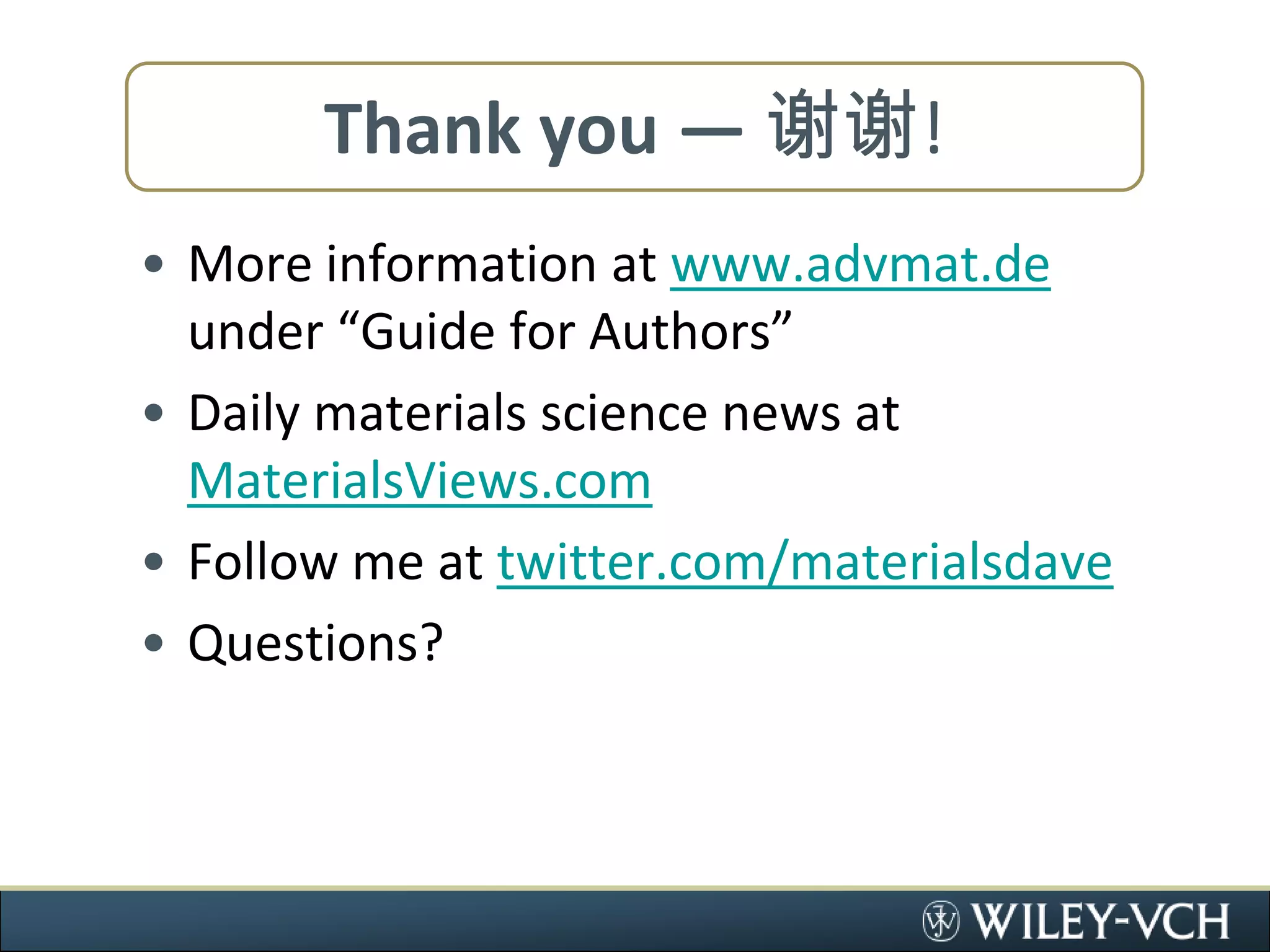
Thank you — 谢谢!More information at www.advmat.de under “Guide for Authors”Daily materials science news at MaterialsViews.comFollow me at twitter.com/materialsdaveQuestions?

Publishing Trends In Materials Science

  • 1.
    Publishing Trends inMaterials Science(and how to maximize your success!)Dave FlanaganWiley-VCH
  • 2.
    OutlineWhy publish?Why peerreview?What editors look forAccept, reject, or revise: how decisions are made and how to respondPublishing ethicsSummary and discussion
  • 3.
    Our Flagship MaterialsScience Journals材料科学头牌期刊
  • 4.
    Materials & PolymerJournals材料科学和聚合物方面的期刊
  • 5.
  • 6.
    Published Articles fromChina年发表的来自中国的论文
  • 7.
    Published Articles fromChina年发表的来自中国的论文
  • 8.
  • 11.
    Why publish atall?“Fame”Recognition by your peers“Fortune”PromotionsGrant applicationsResponsibilityTo societyTaxpayer-funded researchMaking your research publicWhitesides: “If your research does not generate papers, it might just as well not have been done.”Papers provide the shoulders that others can stand on
  • 12.
    Why peer review?Toselect items for publicationTrue/credible?Important?Relevant?Communicated effectively?Quality?To improve the item for publicationInterpretation of resultsPresentationCritical feedbackNew ideasCompetitive and cooperative
  • 13.
    Why peer review?“[Peerreview] is the worst form of [research evaluation] except all those other forms that have been tried from time to time.”Winston Churchill, 1947 (paraphrased)
  • 14.
    What editors lookforWhat all editors look for:ScopeDoes the topic fit the journal?FormatCommunication, full paper, review…What some journals require (to varying degrees):NoveltyHow different is it from previous work?ImportanceIn those in specific fieldTo those in related fieldsInterest
  • 15.
    What AM editorslook forSynthesis/fabricationIs it a new material or material system?CharacterizationIs it fully characterized?PropertiesDoes it have new properties that are superior to previously reported materials?ApplicationDoes it have a technological application or solve a scientific problem?
  • 16.
    How reviewers arechosenReviewer database>10,000 in Wiley-VCH databaseKeywords, interests, historySuggestions from authorsVery helpful!Not just the big names pleaseFrom related papersCited in manuscriptLiterature searchesEditor’s knowledge and experience
  • 17.
    What reviewers lookforIs the motivation clear?Is the motivation important?Is the work novel and original?Are the conclusions supported by the data?Are the results important?Are the results interesting?Are there ethical questions?Is the presentation clear?
  • 19.
    Planning your manuscript“Apaper is not just an archival device for storing a completed research program; it is also a structure for planning your research in progress.”Whitesides, “Writing a Paper”, 2004.
  • 20.
    Planning your manuscriptUsean outline to plan a paper, including the data.IdeasFiguresSchemesDataQuestionsHypothesesObjectivesReferences…
  • 21.
    Planning your manuscriptOrganizeinto three piles:Introduction: Why did I do it?Results and Discussion: What did I do?Conclusions: What does it mean?Organize each pile:Organize the dataSketch figuresPut things in orderImportant: Figure out what data / figures / results are still needed to complete the outline—and complete the paperThis becomes an iterative process between you and your advisor, collaborators, etc. of refining the outline.
  • 22.
    Preparing your submissionSelectingthe journalPreparing your manuscriptFiguresTextWriting the cover letterSubmitting the package
  • 23.
    Selecting the journalJournalImpact Factor is not everything!What are the implications of your research?How important will others find your research?In your field?In related fields?Where do you read papers related to your research? Which do you like the most?What is the scope of your candidate journal?What is the format of your candidate journal?
  • 24.
    Selecting the journalWhatis the journal’s policy on prior publication?In peer-reviewed printed journalsIn peer-reviewed online-only journalsIn printed conference proceedingsIn online-only conference proceedingsIn online preprint serversOn your website
  • 25.
    Preparing the figuresFigures(and schemes, tables, equations) are critical:Figures summarize the resultsFigures are “read” firstBy editors, by referees, by readersThe text in the paper is secondary!The text explains the data in the figures
  • 26.
    Preparing the figuresFiguresshould be designed forClaritySimplicityImpact
  • 27.
    Preparing the figuresBitmapsAlsocalled raster, continuous toneUsed for photos, micrographs, SEM, TEM, AFM, …Tiff usually preferredPhotoshop, Paint Shop Pro, GIMPVector graphicsAlso called line artUsed for plots, graphs, chemical structures, schemes, …EPS or WMF commonIllustrator, Excel, PowerPoint, ChemDraw, gnuplot, Origin
  • 28.
    Preparing the textConsultthe guide for authorsLook at a recent copy of the journalObtain a style guideACS Style GuideChicago Manual of StyleUse the text to explain the data, figures, schemes organized in the outlineNot arranged chronologically, but by importanceConsider a native English speaker or copyediting service
  • 29.
    Abstract and keywordsAbstractand keywords are more important than everAt time of submissionSummarizing the resultsIdentifying relevance and scopeIdentifying potential refereesAfter publicationIndexing and searchingPapers need to be found to have an impact!
  • 30.
    Preparing the textRTFor Word .docMicrosoft WordOpenOffice.orgAbiWord…Reference manager softwareEndNoteBibTeXLaTeXCheck journal guidelines firstManuscript formattingJournal templateDouble-spaced, 12 pt, reasonable marginsFigures at endPlease put captions with figures!
  • 31.
    What about SupportingInformation?Supporting Information should support the manuscript:NMR spectra, diffraction data, movies, calculations…The manuscript should still be convincing if the SI is unavailableIf you need to refer to SI in the main text, it may not be SI!SI should not be used to squeeze full papers into communications
  • 32.
    Writing the coverletterWhy is this topic important?Why are the results significant?What is the key result?Why is it an advance on previous work?Why are you submitting to this journal?Why will this journal’s readers read it?
  • 33.
    Writing the coverletterDisclose conflicts of interestProvide reviewer suggestionsList related papers in press or under considerationOther tips:Get the editor’s name right!Moved, dead, etc.Get the journal’s name right!Especially if not your first-choice journal…
  • 34.
    Conflicts of interestPotentialconflicts of interest:Competitor that could “scoop” youCurrent or former collaborators, grant co-applicantsMembers of your institutionCurrent or former thesis or postdoc advisorAnyone you believe could not give an impartial reportwithin reason…
  • 35.
    Should I appeal?Usually,noRisk of long time to publicationGood papers are citedEditors and referees know journalCriticisms may be valid!Occasionally, yesImportance / impact / novelty missed by editor/refereesNeed for a good cover letter!Factual errors in referee reports that led to rejection
  • 36.
    RevisionCarefully consider reviewercommentsNot all changes have to be made……but need convincing arguments for changes not madePrepare revisionRevise manuscriptHighlight changes in manuscriptPoint-by-point response to all reviewer issuesChanges madeWhy changes not madeResponse may go back to reviewers!Need to convince editor and reviewers
  • 37.
    Author responsibilitiesPresent datahonestly and accurately, not fabricate or falsify dataReference and cite properly, not plagiarize or ignore related workAvoid fragmentation and redundant publicationInform the editor of related manuscripts under consideration or in pressSubmit to only one journal at a timeDisclose conflicts of interestMore information under “For Authors” at www.advmat.de.
  • 38.
    Reviewer responsibilitiesEnsure confidentialityof manuscriptsInform editor quickly if not qualified or unable to reviewJudge manuscript objectively and in timely fashionReturn to editor without review if conflict of interestExplain and support recommendations with arguments and references where appropriateNot use work reported in a submitted manuscript for one’s own researchInform editor of similarities between submitted manuscript and published or unpublished manuscripts elsewhereInform editor if plagiarized or falsified data is suspectedMore information under “For Reviewers” at www.advmat.de
  • 39.
    Editor responsibilitiesEnsure efficient,fair, and timely manuscript processingEnsure confidentiality of submitted manuscriptsMake the final decision for accepting or rejectingBase decision to accept or reject only on the merits of the manuscriptNot use work reported in a submitted manuscript for their own researchEnsure fair selection of referees, including those suggested or requested for exclusion by authorRespond to suggestions of scientific misconductDeal fairly with author appeals
  • 40.
    ConclusionsUnpublished work islostScience output is growing fast and is the driver of reviewer loads, production costs, and journal pricingAsia, particularly China, is growing in volume and quality, but Europe is still strongAccess is huge and has never been greaterPeer review isn‘t perfect but it is the best we haveCompetition is hard, so make your work stand out
  • 41.
    Thank you —谢谢!More information at www.advmat.de under “Guide for Authors”Daily materials science news at MaterialsViews.comFollow me at twitter.com/materialsdaveQuestions?