
FUSE

 MANISH GUPTA
 Civil Engineering Department
 National Institute of Technology,
 Durgapur
Overview
 Earthquake
 Fuse

 Earthquake Fuse

 The Fuse Concept

 Structural Fuse

 Our Focus: Plastic Hinge

 Conclusions

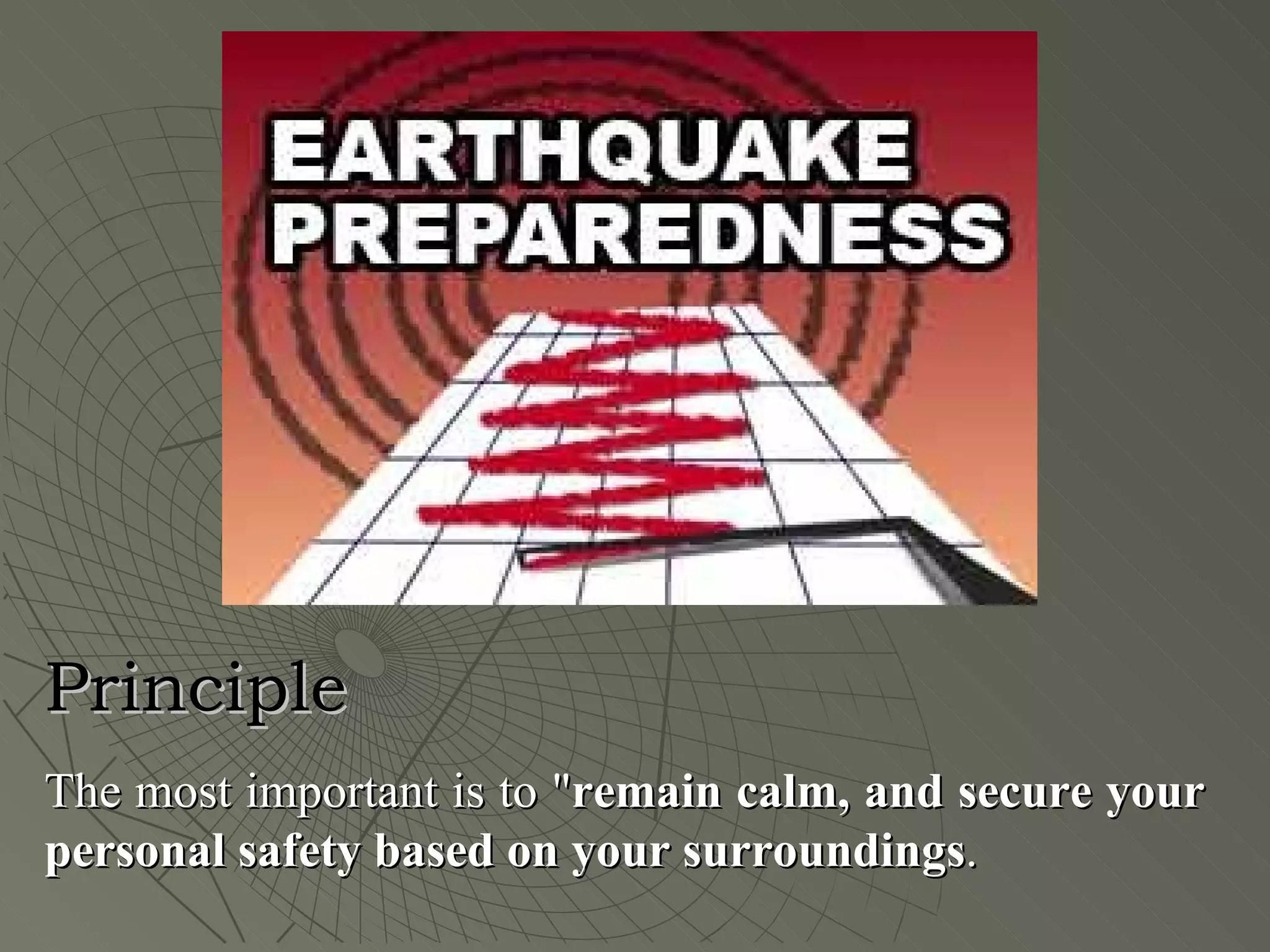
 Earthquake Preparedness
Earthquake
   An earthquake (also known as a tremor or
    temblor) is the result of a sudden release of
    energy in the Earth's crust that creates
    seismic waves.

   Earthquakes are recorded with a seismometer,
    also known as a seismograph.
WHAT CAUSES EARTHQUAKES?

    Earthquakes are caused mostly by rupture of
     geological faults, but also by volcanic activity,
     landslides, mine blasts, and nuclear experiments.

    But most naturally-occurring earthquakes are
     caused by the movement of the earth's tectonic
     plates.
ONE OF THE MOST DIFFICULT
   SETS OF FORCES FOR
 ENGINEERS TO ASSESS IS
     THAT CAUSED BY
      EARTHQUAKES.
   The base shear and distribution of forces are based on the
    properties of the building itself, as well as the ground motions
    of an earthquake, which are impossible to predict.

   In addition, the actual stiffness of a building is only an
    estimate and can change during the earthquake as members
    yield.
A Possible Solution to the
         EARTHQUAKES
   To survive a large earthquake, a building’s structure
    must dissipate the energy imparted by the ground
    accelerations.

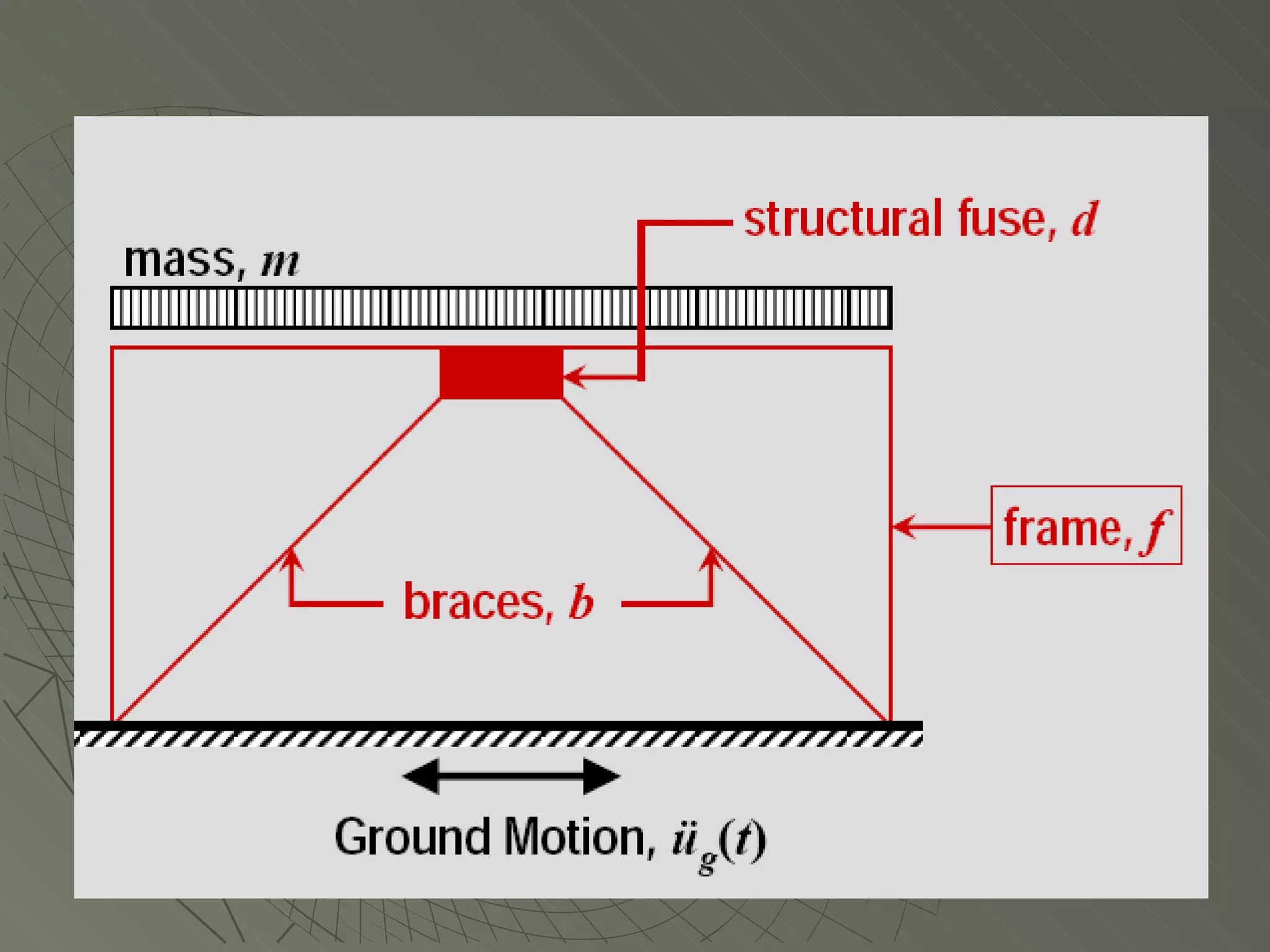
   Introducing a fuse into the structural frame can
    provide this dissipation, as well as create a
    predictable structural response to an unpredictable set
    of forces.
FUSE
The word fuse has several meanings:
 Fuse (electrical), a device used in electrical systems

  to protect against excessive current.
 Fuse (hydraulic), a device used in hydraulic systems

  to protect against sudden loss of fluid pressure
 Fuse (explosives), a trigger for an explosive device or

  fireworks, also spelled fuze to distinguish between a
  simple burning fuse and one which contains
  mechanical and/or electronic components
Earthquake Fuse

It is an Analogy of an Electrical Fuse
that allows the dissipation of extra
energy from the system by
disconnecting itself from the main
Structure thereby making the
remaining structure less affected.
The Fuse Concept
 Non- Structural components (i.e. other than main
  structure) having mass are added to the structure
  so that at the time of Ground Motion they allow
  the dissipation of extra energy from the system.
 The Fuse gets disconnected from the main

  Structure thereby making the remaining structure
  less affected.
 By forcing the ductility demand to the fuses, the

  behavior of the system becomes more
  predictable.
 These members are generally required to have
  low width-to-thickness ratios to avoid local
  buckling, and eventually fractures, well into
  the elastic range.
 The remaining frame members are designed to

  remain essentially elastic while the fuse yields
  dissipate the energy.
 These members are often sized based on the

  expectation that the fuse is the overloaded
  element in the system.
The Structural Fuse:
An Inelastic Approach
   to Earthquake-
 Resistant Design of
      Buildings
The Structural Fuse
   An alternative to the empirical approach to
    earthquake-resistant design of buildings is the
    Structural Fuse.

     Instead of strengthening every member to resist
    deformation under earthquake loads, deliberately
    makes some members, mostly beams, weaker, so that
    they will yield in a controlled fashion during an
    earthquake.

   Yielding beams dissipate energy, reducing stress on
    the more crucial columns and walls.
Structural Fuse
   Structural fuses help increase the
    predictability of a building’s behavior and
    dissipate seismic energy in the event of
    an earthquake.

   The FUSE must be highly DUCTILE, it
    will have to accommodate most of the
    Imposed Deformations.
Why Structural Fuse ?
   In seismic design, the loads resulting from an
    earthquake are reduced by a response modification
    factor, which allows the structure to undergo inelastic
    deformations.

   This methodology relies on the ability of the
    structural elements to accommodate inelastic
    deformations.

   Furthermore, inelastic behavior translates into some
    level of damage on these elements.
   This damage leads to permanent system deformations
    following an earthquake, leading to high cost for
    repair works, in the cases when repairs are possible.

   To achieve stringent seismic performance objective
    for buildings, an alternative design Approach is
    desirable.

   In that perspective, it would be attractive to
    concentrate damage on disposable and easy to repair
    structural elements (i.e., “structural fuse”), while the
    main structure would be designed to remain elastic or
    with minor inelastic deformations.
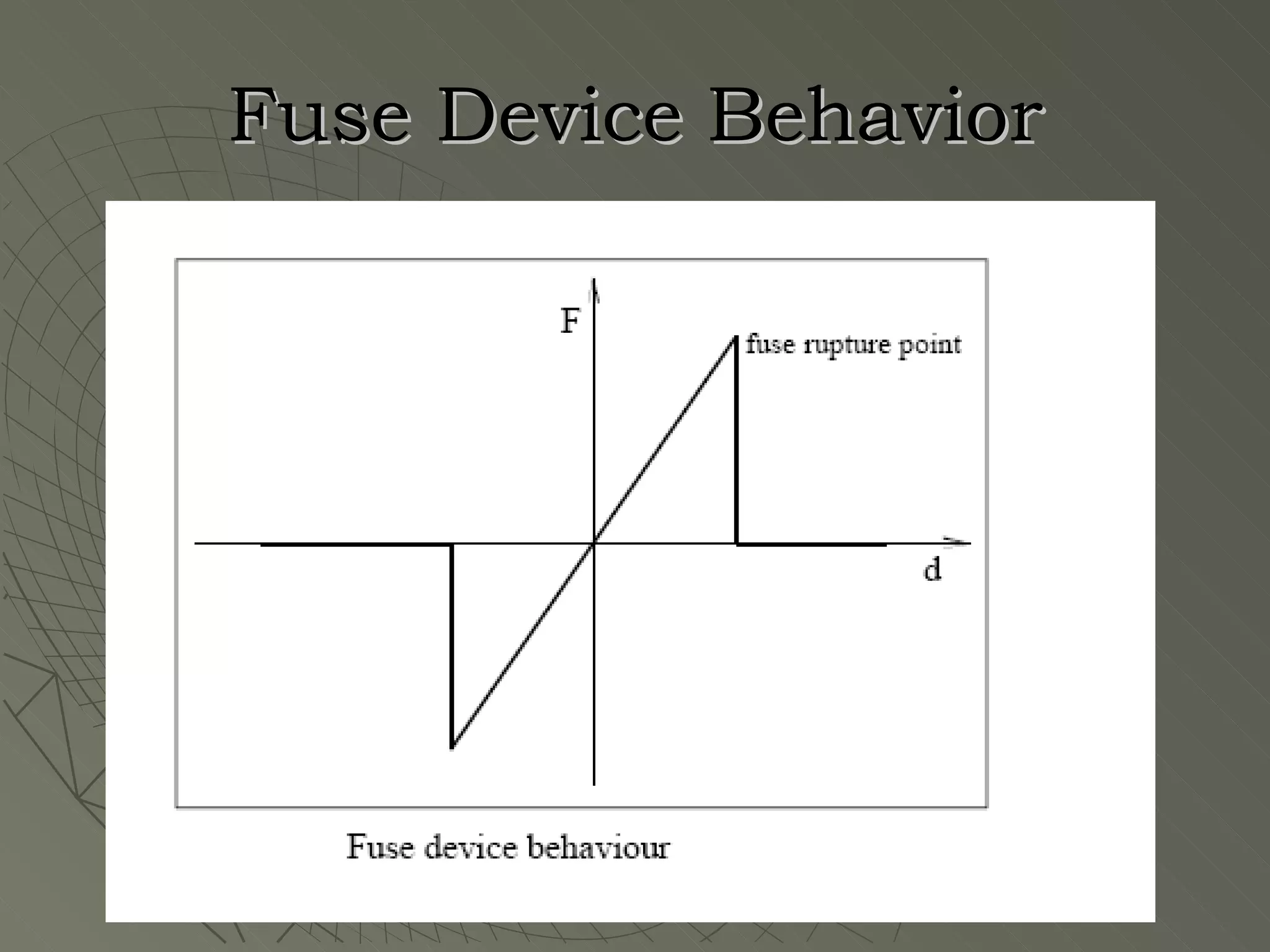
Fuse Device Behavior
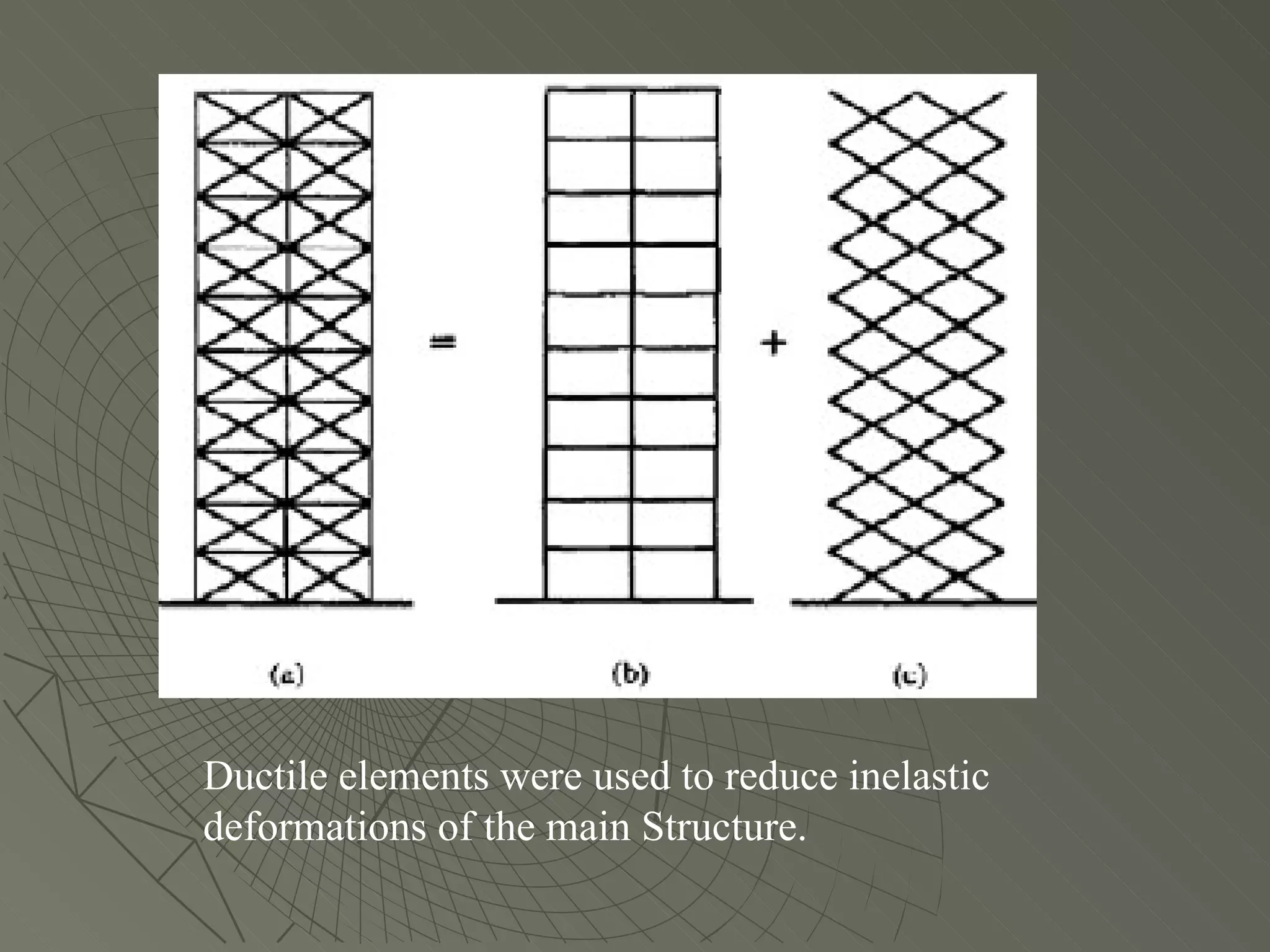
Ductile elements were used to reduce inelastic
deformations of the main Structure.
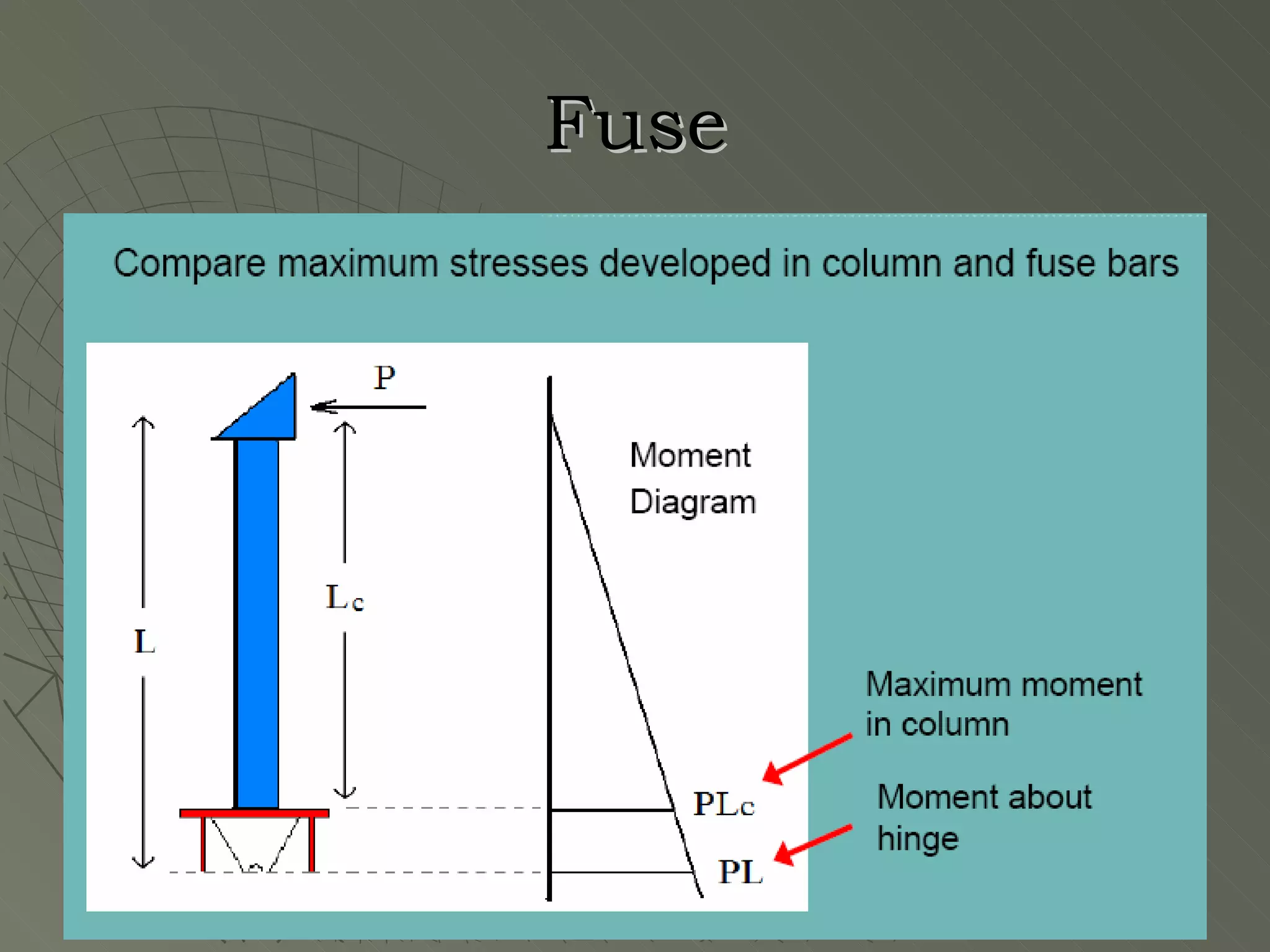
Our Focus: Plastic Hinge

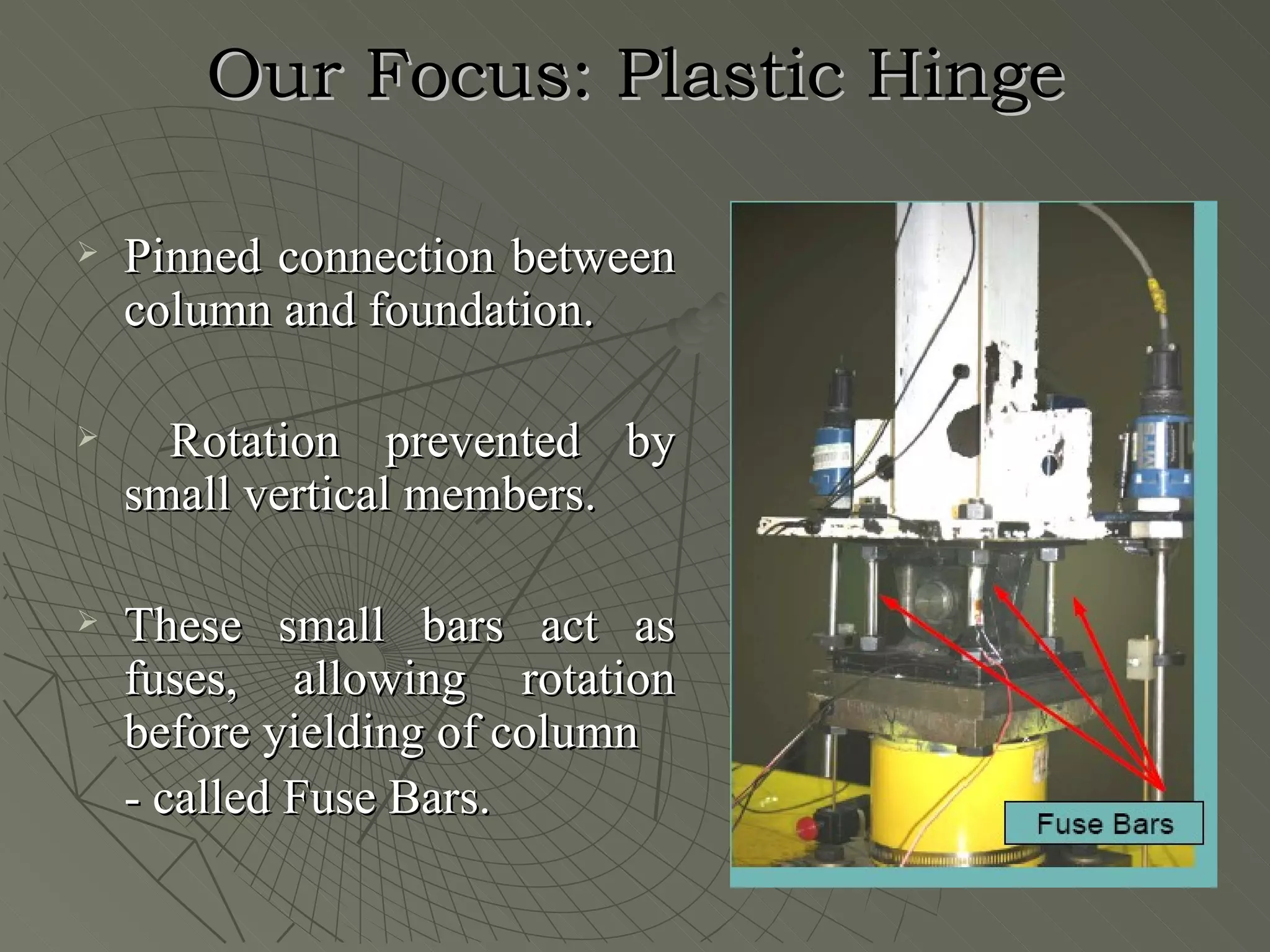
   Pinned connection between
    column and foundation.

     Rotation prevented by
    small vertical members.

   These small bars act as
    fuses, allowing rotation
    before yielding of column
    - called Fuse Bars.
Functions of Plastic Hinge
   Type of energy dampening device.
   Yielding and subsequent deflection of fuse
    bars absorb energy.
   Reduces fatigue in column during repeated
    ground motion.
   Post-earthquake, fuse bars can be replaced
    relatively easily.
   Column-hinge system is then restored to
    original condition.
Fuse
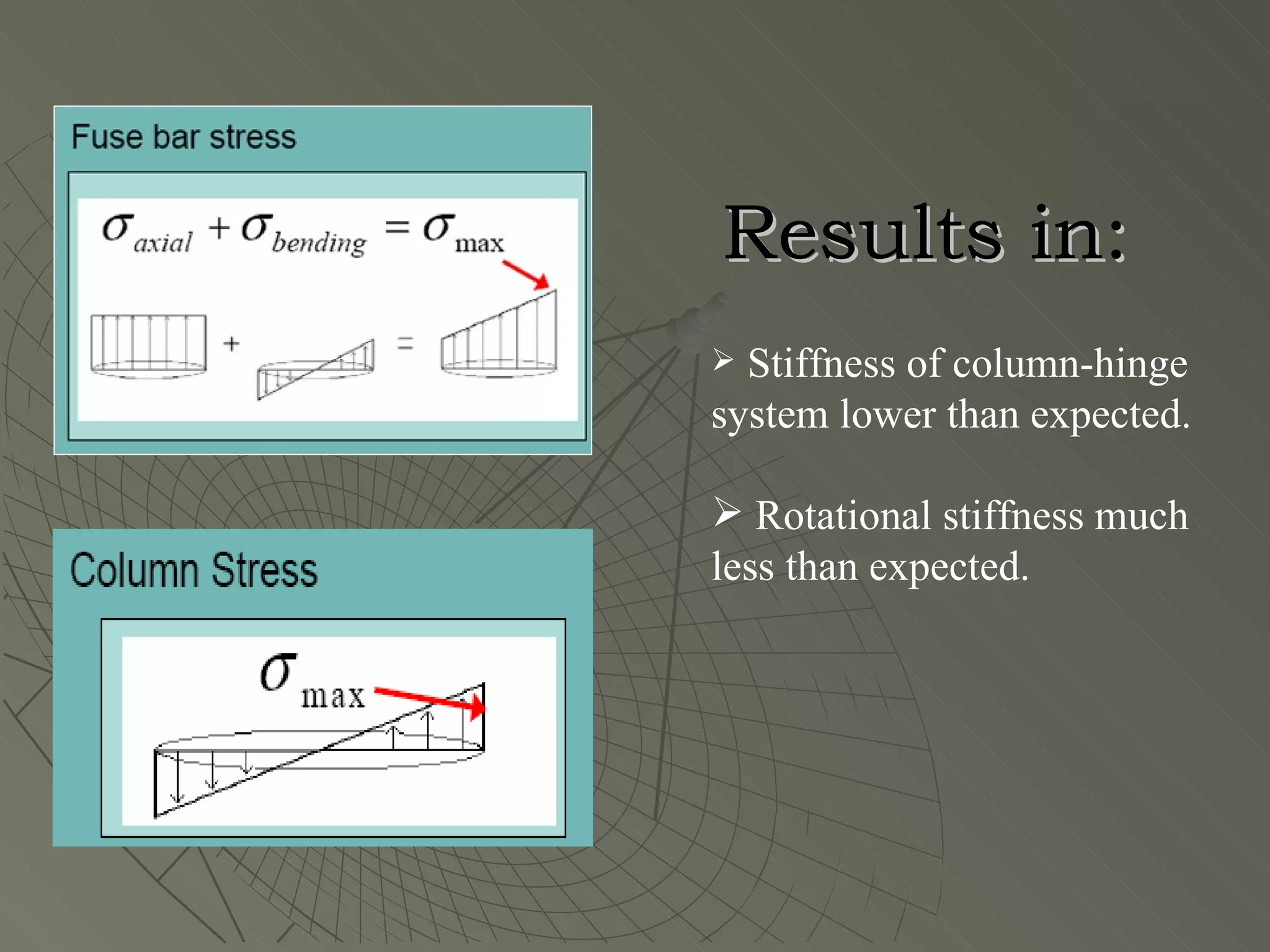
Results in:
 Stiffness of column-hinge
system lower than expected.

 Rotational stiffness much
less than expected.
Benefits of Fuse Concept
   Seismically induced damage is concentrated on the
    fuses.

   Following a damaging earthquake only the fuses
    would need to be replaced.

   Once the structural fuses are removed, the elastic
    structure returns to its original position.
Conclusions
   Energy dissipation protects column from excess strain
    and fatigue.

   Fuse-bars designed to be replaced easily after they
    wear out.

   Additional energy can be absorbed by small
    component yielding or slipping.
    (Not desired, may wear out component over time )
Principle
The most important is to "remain calm, and secure your
personal safety based on your surroundings.
What To Do In the Event of an
Earthquake
   Prepare a Home Earthquake Plan.
   Prepare a Disaster Supplies Kit for home and car.
   Identify what to do after the shaking stops.
   Examine walls, floors, doors, staircases, and windows
    for damage.
   Look for fire hazards.
   Check for gas leaks or electrical system damage.
   Help injured or trapped persons.
   Use the telephone only for emergency calls.
REFERENCES
   Analysis of Rotational Column with Plastic Hinge Michael
    Long and Corey Bergad retrieved November 5, 2006.
   "Plastic Hinge Integration Methods for Force-Based Beam-
    Column Elements." Scott, M.H. and G.L. Fenves. Journal of
    Structural Engineering, 132(2):244-252, February 2006.
   Seismic Fuses (BY JASON ERICKSEN, S.E).
   Understanding the basics of earthquake design (BY DAVE
    TIPLER, P.ENG).
   Investigation of the Structural Fuse Concept
    Ramiro Vargas and Michel Bruneau
Thank You

Earthquake Fuse

  • 1.
    FUSE MANISH GUPTA Civil Engineering Department National Institute of Technology, Durgapur
  • 2.
    Overview  Earthquake  Fuse Earthquake Fuse  The Fuse Concept  Structural Fuse  Our Focus: Plastic Hinge  Conclusions  Earthquake Preparedness
  • 3.
    Earthquake  An earthquake (also known as a tremor or temblor) is the result of a sudden release of energy in the Earth's crust that creates seismic waves.  Earthquakes are recorded with a seismometer, also known as a seismograph.
  • 4.
    WHAT CAUSES EARTHQUAKES?  Earthquakes are caused mostly by rupture of geological faults, but also by volcanic activity, landslides, mine blasts, and nuclear experiments.  But most naturally-occurring earthquakes are caused by the movement of the earth's tectonic plates.
  • 5.
    ONE OF THEMOST DIFFICULT SETS OF FORCES FOR ENGINEERS TO ASSESS IS THAT CAUSED BY EARTHQUAKES.  The base shear and distribution of forces are based on the properties of the building itself, as well as the ground motions of an earthquake, which are impossible to predict.  In addition, the actual stiffness of a building is only an estimate and can change during the earthquake as members yield.
  • 6.
    A Possible Solutionto the EARTHQUAKES  To survive a large earthquake, a building’s structure must dissipate the energy imparted by the ground accelerations.  Introducing a fuse into the structural frame can provide this dissipation, as well as create a predictable structural response to an unpredictable set of forces.
  • 7.
    FUSE The word fusehas several meanings:  Fuse (electrical), a device used in electrical systems to protect against excessive current.  Fuse (hydraulic), a device used in hydraulic systems to protect against sudden loss of fluid pressure  Fuse (explosives), a trigger for an explosive device or fireworks, also spelled fuze to distinguish between a simple burning fuse and one which contains mechanical and/or electronic components
  • 8.
    Earthquake Fuse It isan Analogy of an Electrical Fuse that allows the dissipation of extra energy from the system by disconnecting itself from the main Structure thereby making the remaining structure less affected.
  • 9.
    The Fuse Concept Non- Structural components (i.e. other than main structure) having mass are added to the structure so that at the time of Ground Motion they allow the dissipation of extra energy from the system.  The Fuse gets disconnected from the main Structure thereby making the remaining structure less affected.  By forcing the ductility demand to the fuses, the behavior of the system becomes more predictable.
  • 10.
     These membersare generally required to have low width-to-thickness ratios to avoid local buckling, and eventually fractures, well into the elastic range.  The remaining frame members are designed to remain essentially elastic while the fuse yields dissipate the energy.  These members are often sized based on the expectation that the fuse is the overloaded element in the system.
  • 11.
    The Structural Fuse: AnInelastic Approach to Earthquake- Resistant Design of Buildings
  • 12.
    The Structural Fuse  An alternative to the empirical approach to earthquake-resistant design of buildings is the Structural Fuse.  Instead of strengthening every member to resist deformation under earthquake loads, deliberately makes some members, mostly beams, weaker, so that they will yield in a controlled fashion during an earthquake.  Yielding beams dissipate energy, reducing stress on the more crucial columns and walls.
  • 13.
    Structural Fuse  Structural fuses help increase the predictability of a building’s behavior and dissipate seismic energy in the event of an earthquake.  The FUSE must be highly DUCTILE, it will have to accommodate most of the Imposed Deformations.
  • 14.
    Why Structural Fuse?  In seismic design, the loads resulting from an earthquake are reduced by a response modification factor, which allows the structure to undergo inelastic deformations.  This methodology relies on the ability of the structural elements to accommodate inelastic deformations.  Furthermore, inelastic behavior translates into some level of damage on these elements.
  • 15.
    This damage leads to permanent system deformations following an earthquake, leading to high cost for repair works, in the cases when repairs are possible.  To achieve stringent seismic performance objective for buildings, an alternative design Approach is desirable.  In that perspective, it would be attractive to concentrate damage on disposable and easy to repair structural elements (i.e., “structural fuse”), while the main structure would be designed to remain elastic or with minor inelastic deformations.
  • 16.
  • 17.
    Ductile elements wereused to reduce inelastic deformations of the main Structure.
  • 19.
    Our Focus: PlasticHinge  Pinned connection between column and foundation.  Rotation prevented by small vertical members.  These small bars act as fuses, allowing rotation before yielding of column - called Fuse Bars.
  • 20.
    Functions of PlasticHinge  Type of energy dampening device.  Yielding and subsequent deflection of fuse bars absorb energy.  Reduces fatigue in column during repeated ground motion.  Post-earthquake, fuse bars can be replaced relatively easily.  Column-hinge system is then restored to original condition.
  • 21.
  • 22.
    Results in:  Stiffnessof column-hinge system lower than expected.  Rotational stiffness much less than expected.
  • 23.
    Benefits of FuseConcept  Seismically induced damage is concentrated on the fuses.  Following a damaging earthquake only the fuses would need to be replaced.  Once the structural fuses are removed, the elastic structure returns to its original position.
  • 24.
    Conclusions  Energy dissipation protects column from excess strain and fatigue.  Fuse-bars designed to be replaced easily after they wear out.  Additional energy can be absorbed by small component yielding or slipping. (Not desired, may wear out component over time )
  • 25.
    Principle The most importantis to "remain calm, and secure your personal safety based on your surroundings.
  • 26.
    What To DoIn the Event of an Earthquake  Prepare a Home Earthquake Plan.  Prepare a Disaster Supplies Kit for home and car.  Identify what to do after the shaking stops.  Examine walls, floors, doors, staircases, and windows for damage.  Look for fire hazards.  Check for gas leaks or electrical system damage.  Help injured or trapped persons.  Use the telephone only for emergency calls.
  • 27.
    REFERENCES  Analysis of Rotational Column with Plastic Hinge Michael Long and Corey Bergad retrieved November 5, 2006.  "Plastic Hinge Integration Methods for Force-Based Beam- Column Elements." Scott, M.H. and G.L. Fenves. Journal of Structural Engineering, 132(2):244-252, February 2006.  Seismic Fuses (BY JASON ERICKSEN, S.E).  Understanding the basics of earthquake design (BY DAVE TIPLER, P.ENG).  Investigation of the Structural Fuse Concept Ramiro Vargas and Michel Bruneau
  • 28.