Securing Solr Documents with
         ManifoldCF

     How to Enforce Repository
      Authorization with Solr


                 2
What I Will Cover
§  What ManifoldCF does and the problem it is
    designed to solve
§  ManifoldCF’s way of mapping repository
    security to documents indexed by Solr/
    Lucene
§  A Q&A panel session describing real-world
    usage of the ManifoldCF security projection
    model


                      3
Who am I?
§  I am:
   •  Karl Wright (kwright@apache.org)
   •  Principal Software Engineer at Nokia, Inc.
   •  Formerly Principal Software Engineer at
      MetaCarta, Inc.
§  What I do:
   •  Work at Nokia on making location search better
   •  Designer and original implementer of
      ManifoldCF
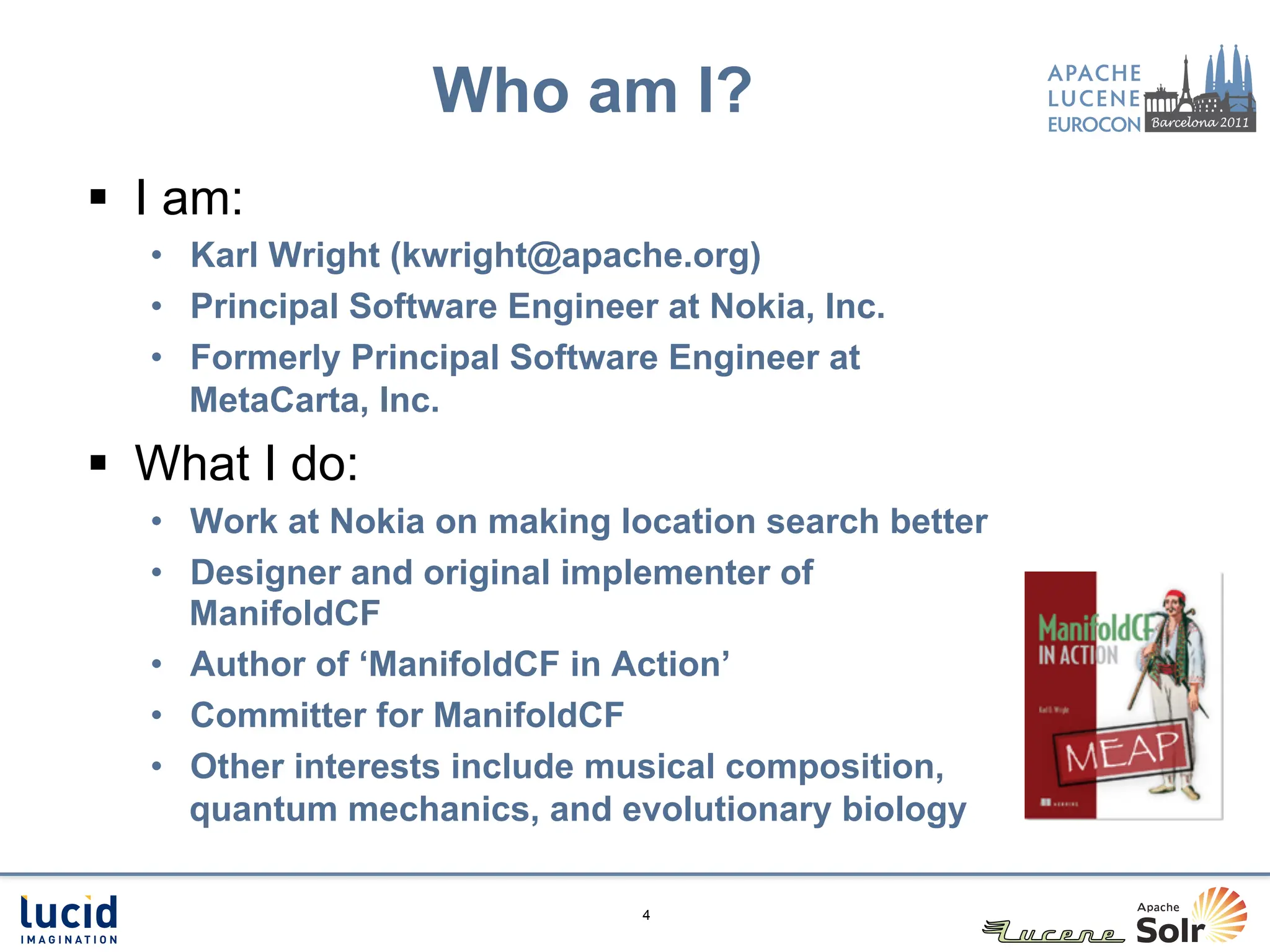
   •  Author of ‘ManifoldCF in Action’
   •  Committer for ManifoldCF
   •  Other interests include musical composition,
      quantum mechanics, and evolutionary biology

                                 4
Let’s search our repository using Solr!

§  But first, we have to get our repository
    documents indexed by Solr
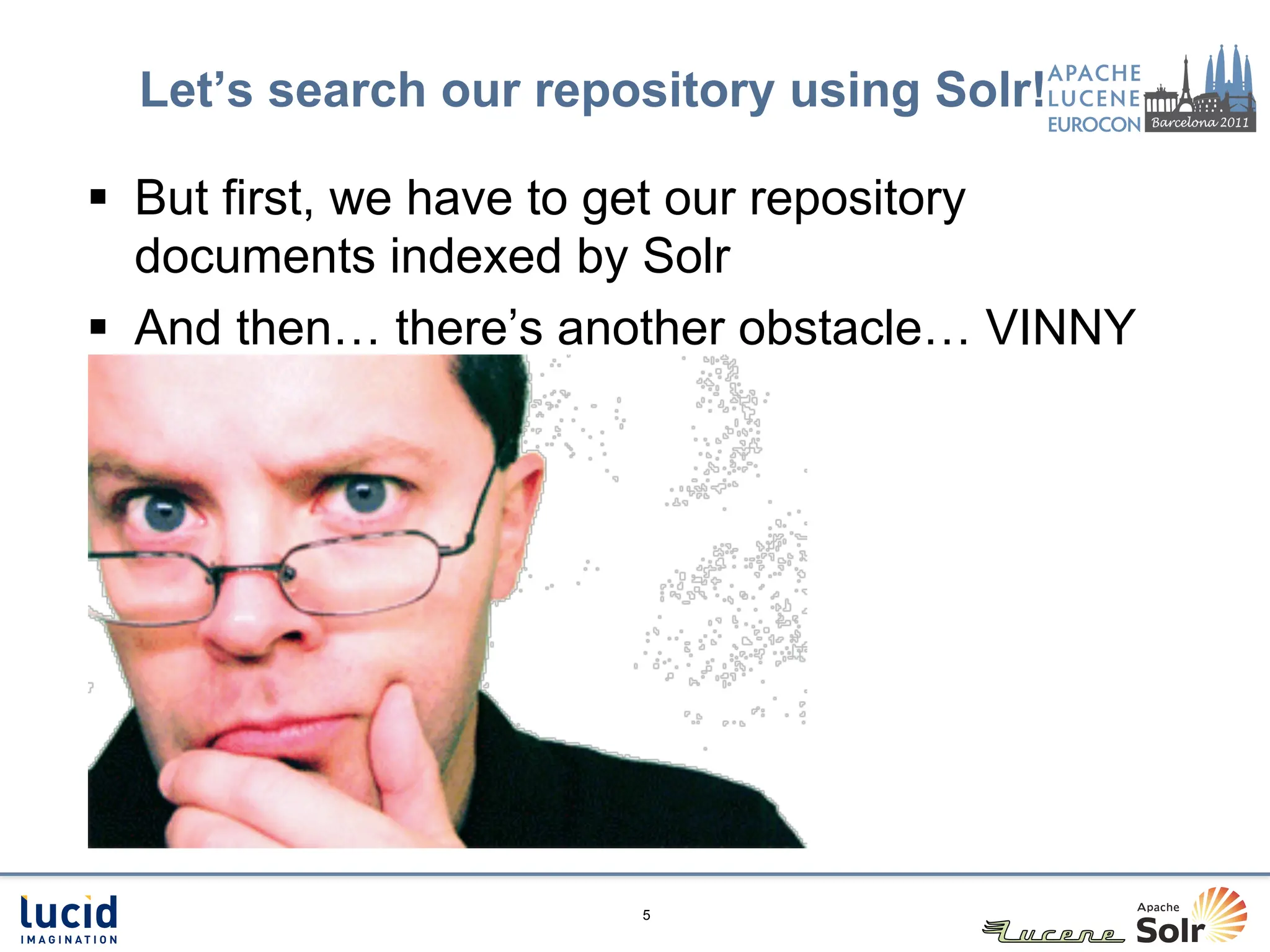
§  And then… there’s another obstacle… VINNY


                       5
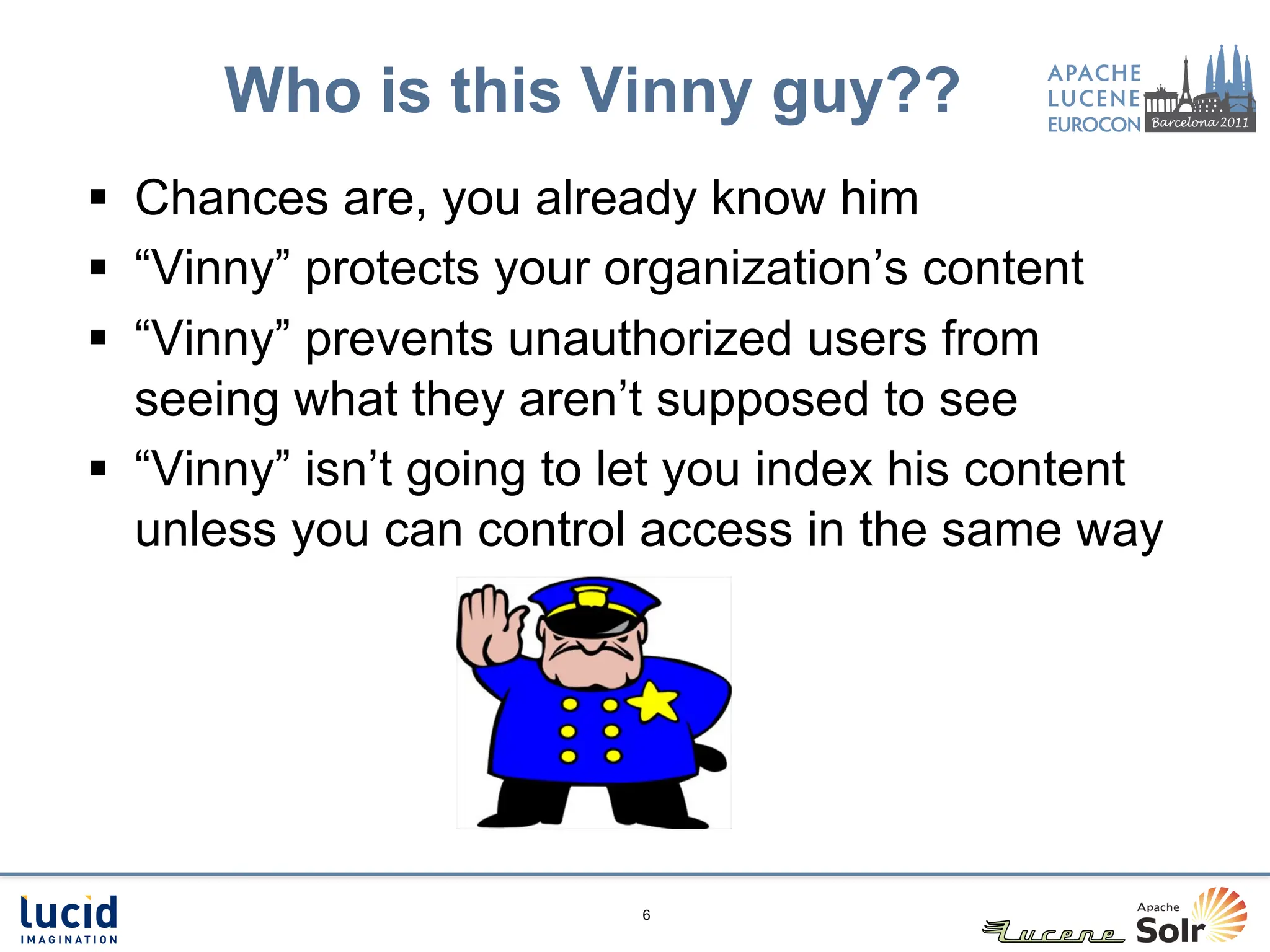
Who is this Vinny guy??
§  Chances are, you already know him
§  “Vinny” protects your organization’s content
§  “Vinny” prevents unauthorized users from
    seeing what they aren’t supposed to see
§  “Vinny” isn’t going to let you index his content
    unless you can control access in the same way


                          6
ManifoldCF to the Rescue!
§  Plug-in architecture allows connectors
    to easily be written, if they don’t exist
    already
§  Existing repository connectors for web,
    RSS, JDBC, CIFS (shared file
    system), SharePoint, Meridio, FileNet,
    LiveLink, Documentum, CMIS
§  Existing output connectors for Solr,
    GTS, and OpenSearchServer
§  Includes a user-facing UI, an API, and
    an Authorization Service
                           7
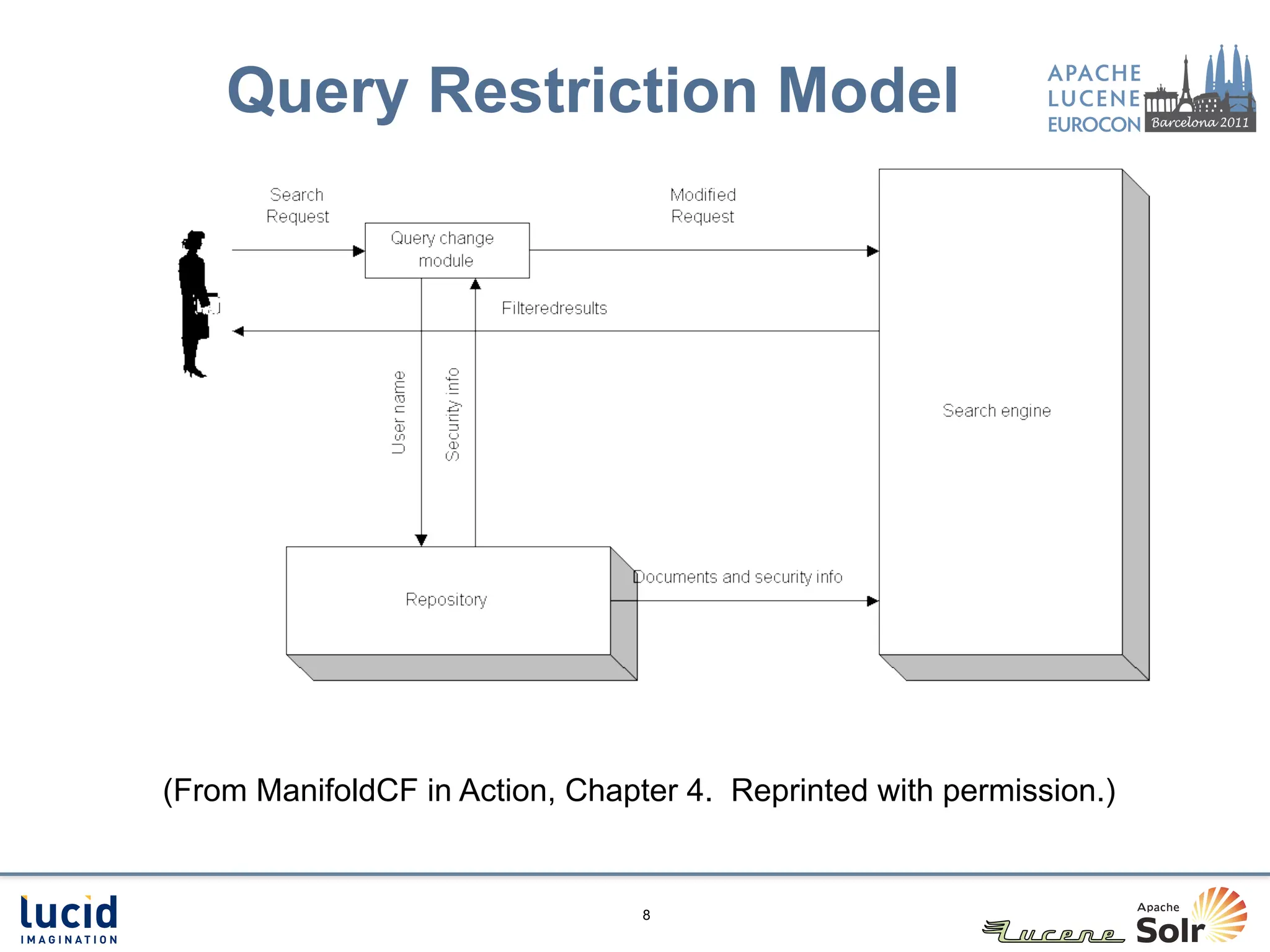
Query Restriction Model


(From ManifoldCF in Action, Chapter 4. Reprinted with permission.)


                                 8
How ManifoldCF Implements
       Query Restriction
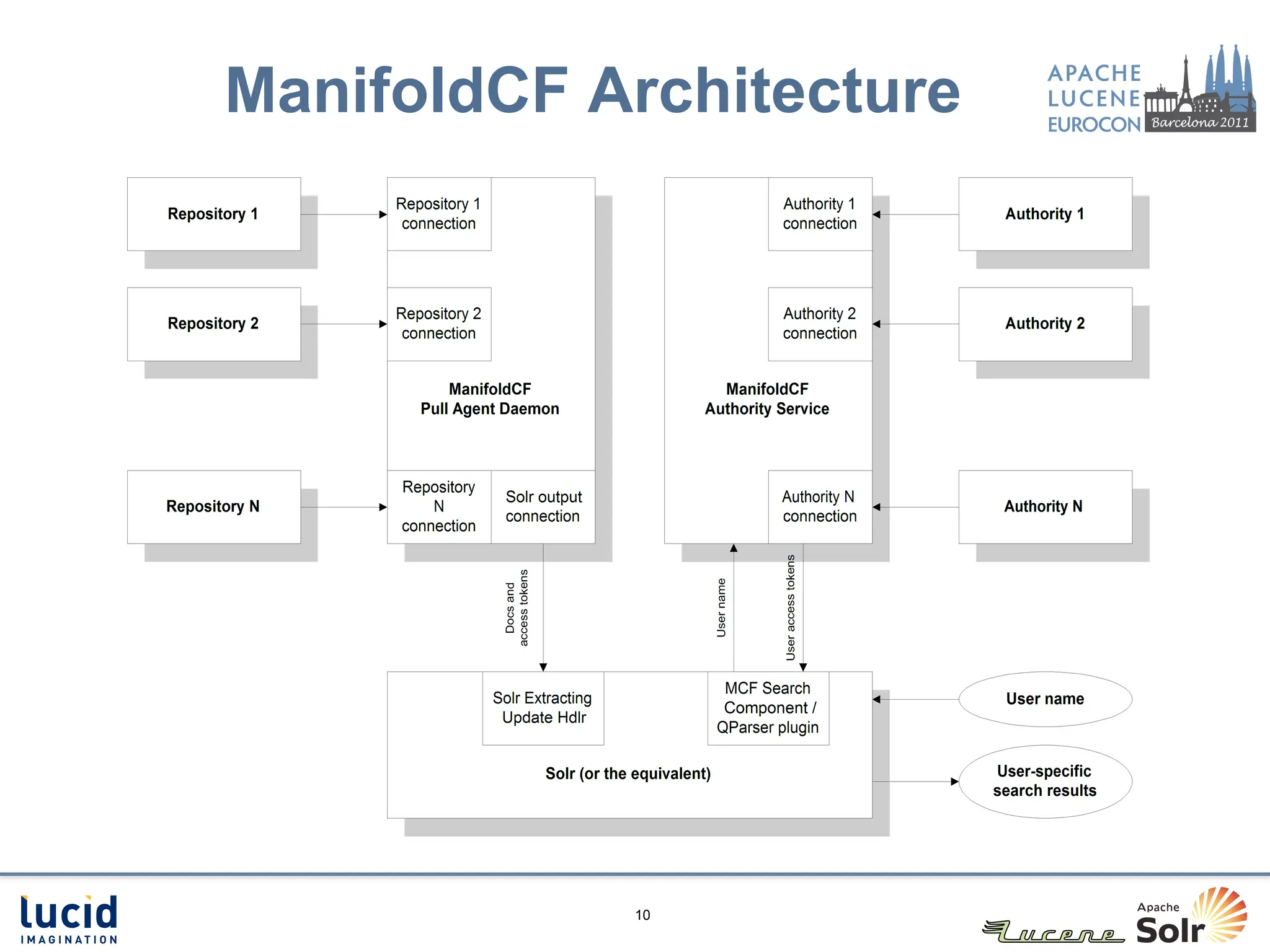
§  Document access tokens are sent to the search
    index along with the document content
§  Separate bins for “allow” tokens, “deny” tokens
    – for “file”, multiple “folder”, and “share” levels
§  In practice, only “file” and “share” levels are
    needed
§  ManifoldCF Authority Service maps user names
    to a user’s access tokens
§  Solr SearchComponent or QParserPlugin
    communicates with the MCF Authority Service
    and performs the query modification
                           9
ManifoldCF Architecture


            10
What does the Pull-Agent
           daemon do?
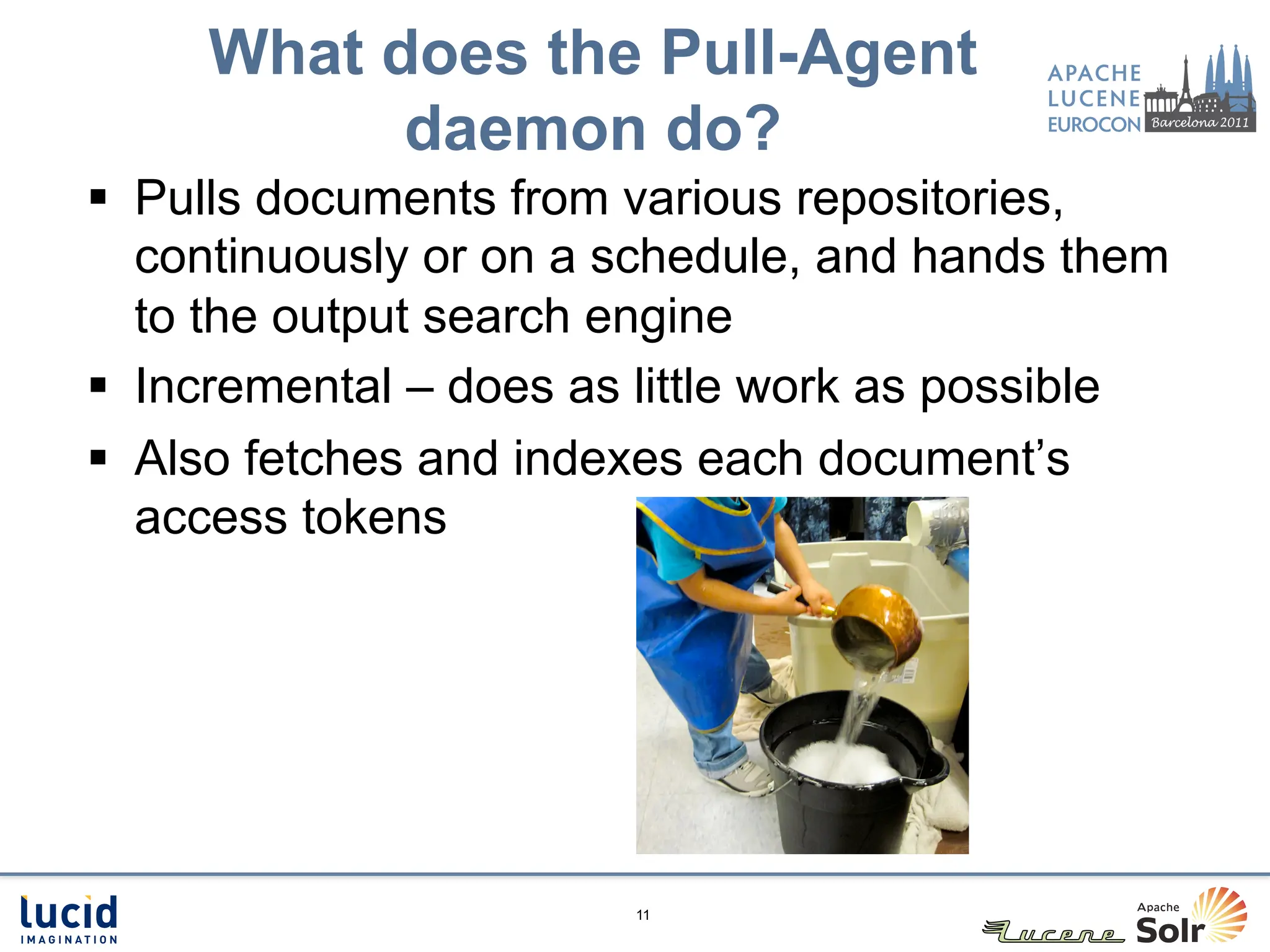
§  Pulls documents from various repositories,
    continuously or on a schedule, and hands them
    to the output search engine
§  Incremental – does as little work as possible
§  Also fetches and indexes each document’s
    access tokens


                        11
What does the Authority
     Service do?


            12
Ok, what does the Authority
       Service REALLY do?
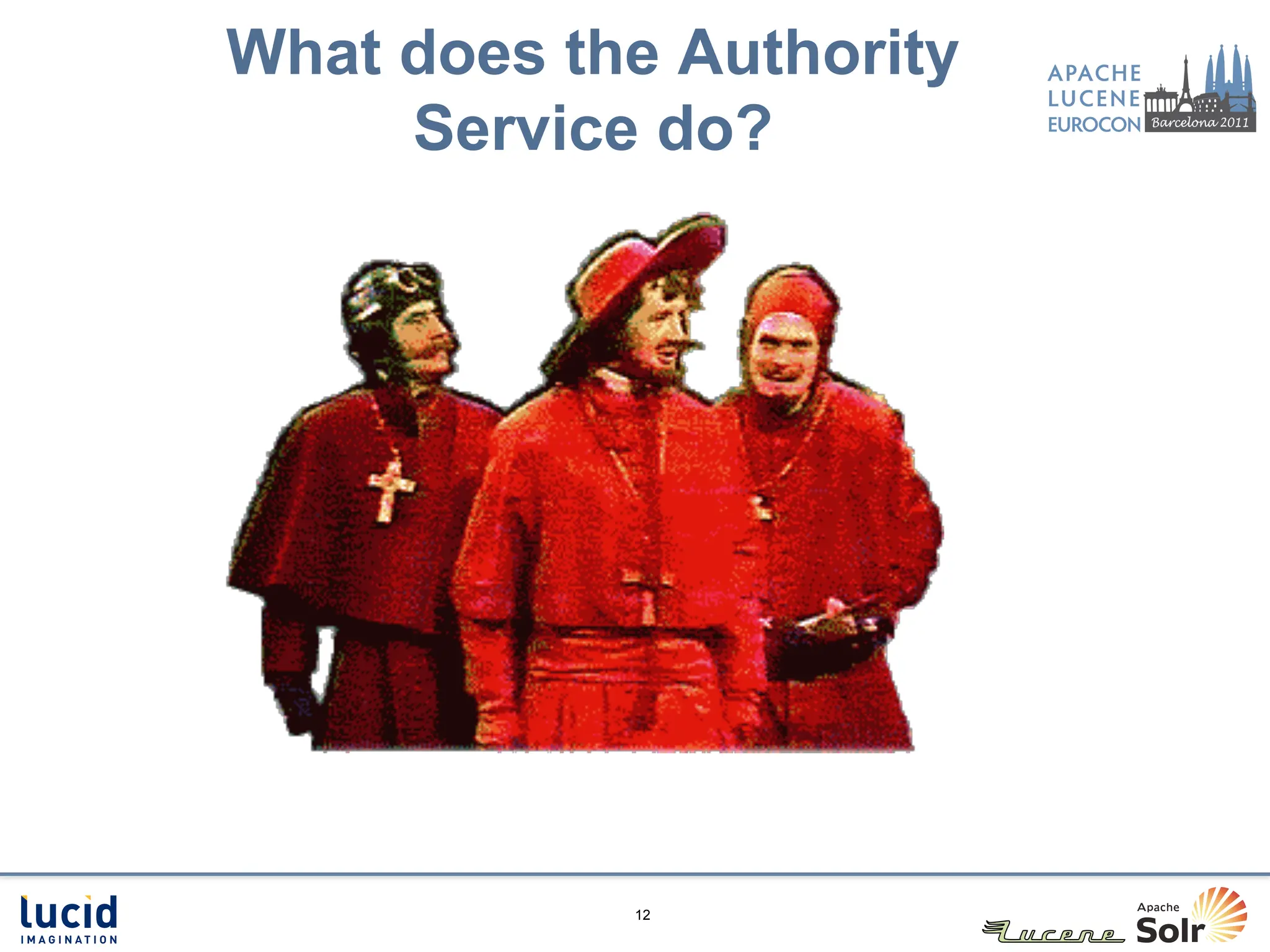
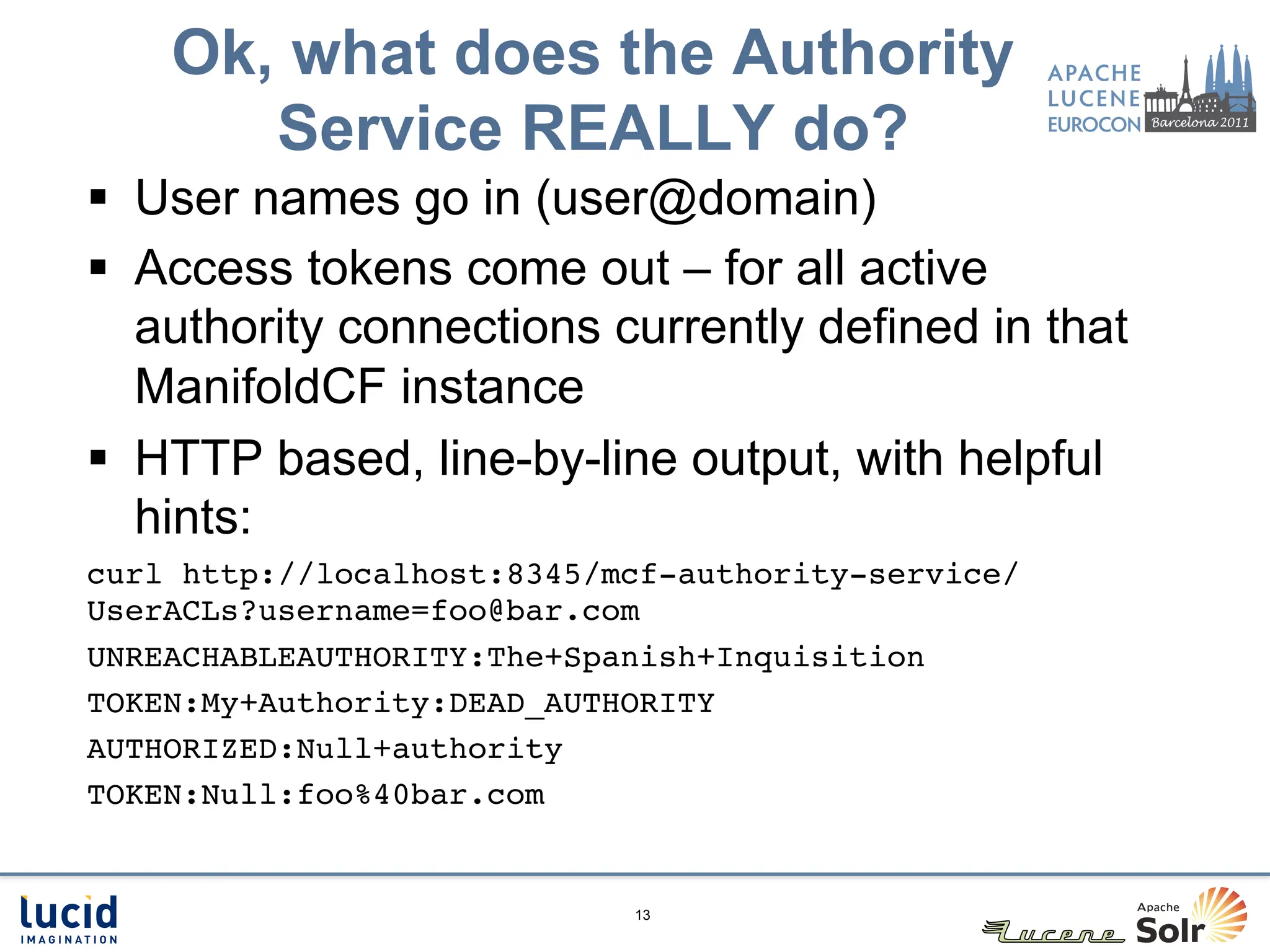
§  User names go in (user@domain)
§  Access tokens come out – for all active
    authority connections currently defined in that
    ManifoldCF instance
§  HTTP based, line-by-line output, with helpful
    hints:
curl http://localhost:8345/mcf-authority-service/
UserACLs?username=foo@bar.com!
UNREACHABLEAUTHORITY:The+Spanish+Inquisition!
TOKEN:My+Authority:DEAD_AUTHORITY!
AUTHORIZED:Null+authority!
TOKEN:Null:foo%40bar.com!


                            13
What do you have to do to Solr
   to make this all work?
    §  Add fields to the schema to contain
        document access tokens
       •  A field for document-level “allow”
          tokens
       •  A field for document-level “deny” tokens
       •  A field for share-level “allow” tokens
       •  A field for share-level “deny” tokens
    §  Add something that authenticates a
        user and obtains a user name
    §  Add a SearchComponent or Query
        Parser to restrict incoming query
                      14
The Solr component is
     NOT where the magic is…
§  Each access token returned by
    the Authority Service adds a
    clause to a BooleanQuery
§  It is rare for a user to have more
    than one hundred access tokens
    – except for Documentum!!
§  ManifoldCF in Action provides an
    example Solr SearchComponent
§  dist/solr-integration provides
    a Solr SearchComponent and
    QParserPlugin (MCF trunk)
                          15
How are the four token types
             related?
§  Share and document levels computed
    independently; an included document must
    pass both
§  For each level, DENY tokens exclude and
    ALLOW tokens permit, but DENY tokens
    always win over ALLOW
§  Special meaning for no tokens at all at a level –
    no ALLOW nor DENY tokens means “public” –
    handled by a default token in Solr
§  Active Directory does it exactly the same way,
    oddly enough, using SIDs for tokens
                          16
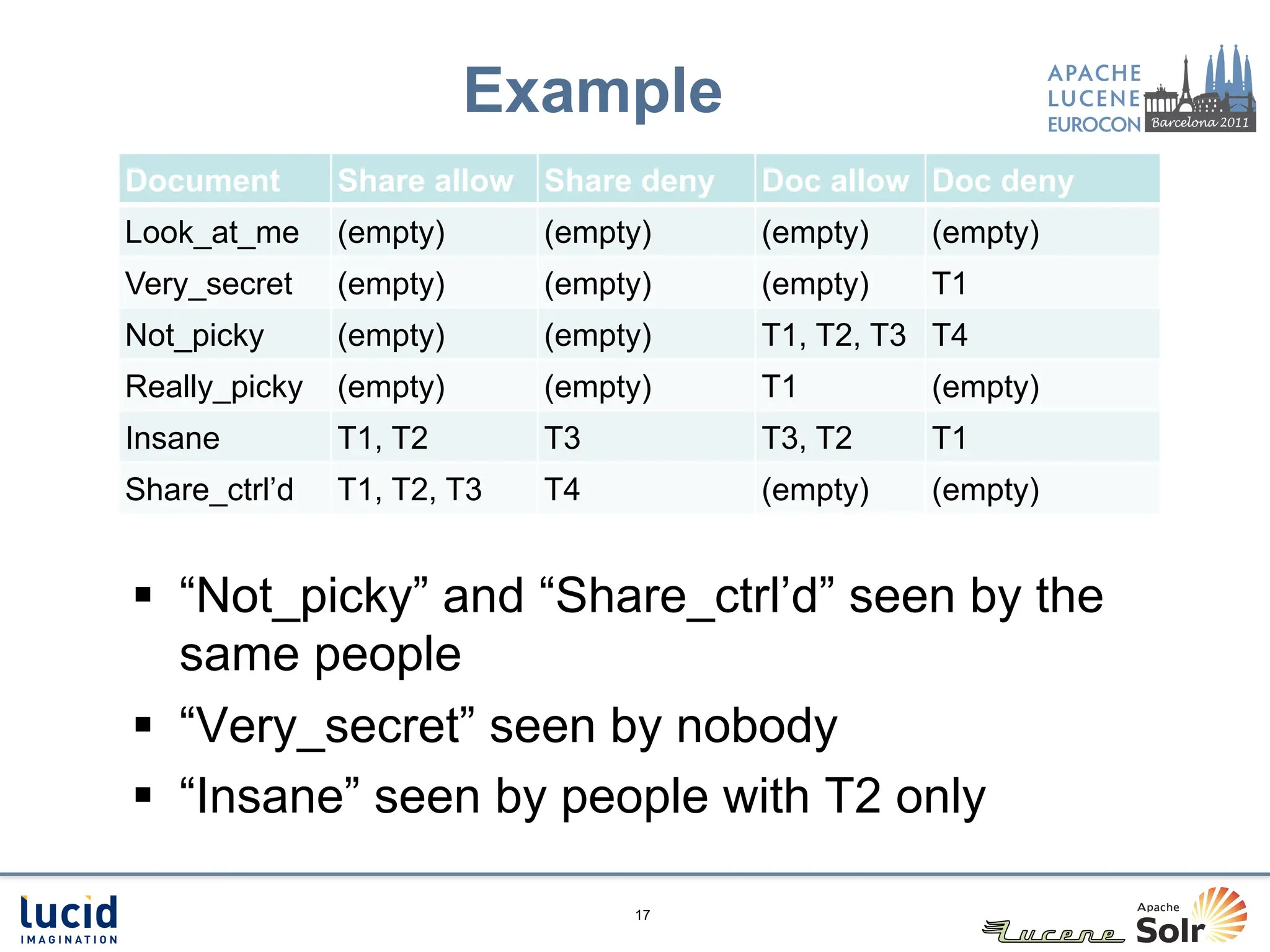
Example
Document       Share allow Share deny   Doc allow Doc deny
Look_at_me     (empty)      (empty)     (empty)   (empty)
Very_secret    (empty)      (empty)     (empty)   T1
Not_picky      (empty)      (empty)     T1, T2, T3 T4
Really_picky   (empty)      (empty)     T1        (empty)
Insane         T1, T2       T3          T3, T2    T1
Share_ctrl’d   T1, T2, T3   T4          (empty)   (empty)


§  “Not_picky” and “Share_ctrl’d” seen by the
    same people
§  “Very_secret” seen by nobody
§  “Insane” seen by people with T2 only

                                 17
What is still missing from the
              picture?
§  Well, getting documents and authorization info
    into Solr is covered…
§  Getting authorization information for a user is
    covered…
§  Modifying the search to enforce authorization is
    covered…
§  Authentication is NOT covered!
   •  ManifoldCF does not help you with this problem
      – yet
   •  Consider JAAS in Tomcat
   •  Apache web server’s mod-auth-kerb also works
                          18
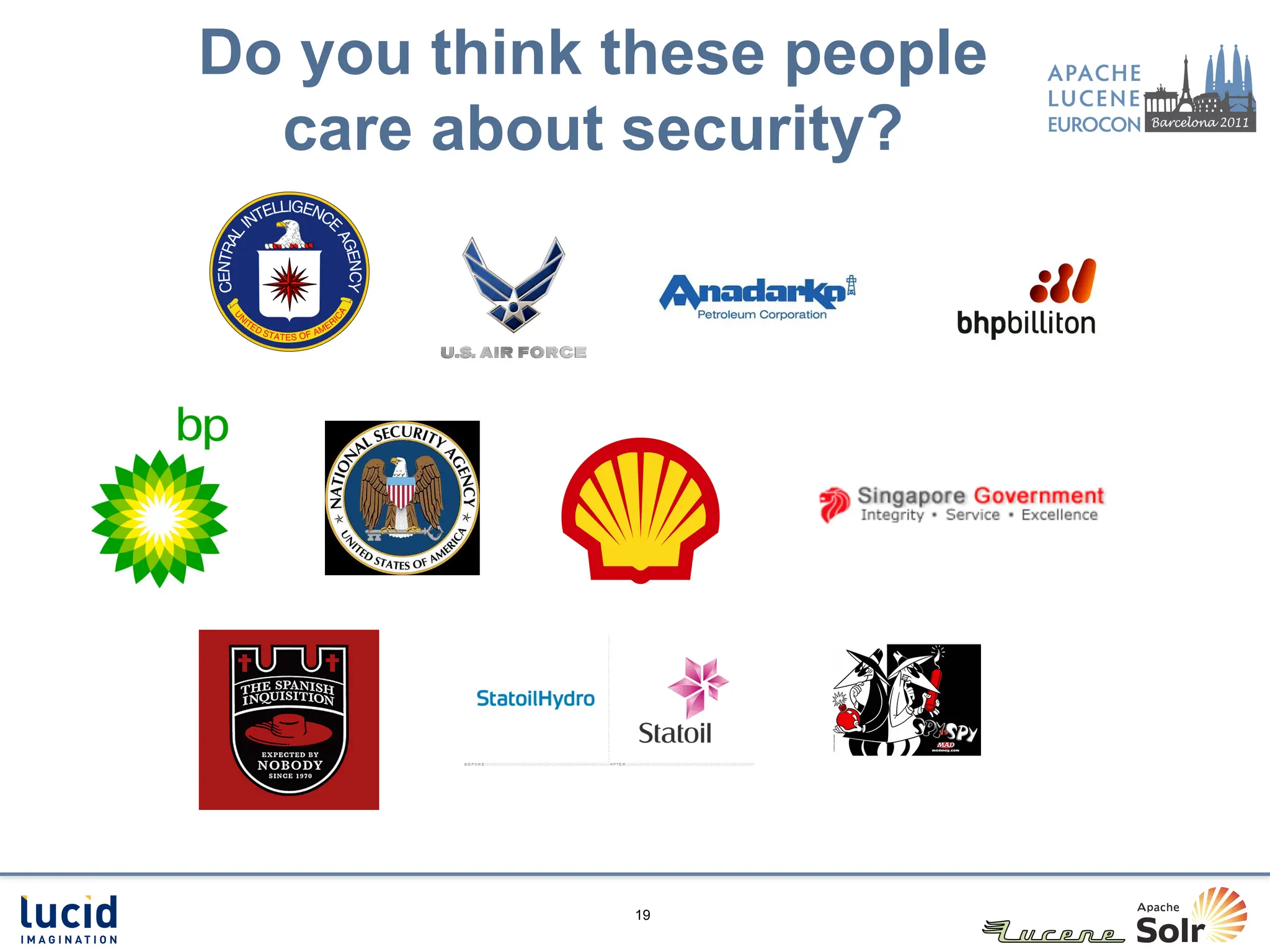
Do you think these people
  care about security?


             19
Wrap Up
§  ManifoldCF provides a great way to project
    repository security into Solr
§  ManifoldCF effectively converts repository
    security into an AD-like token model
§  As long as you can provide the authentication,
    MCF and Solr can provide the rest
§  Nobody ever expects the Spanish Inquisition


                         20
Our Panel Today
§  Karl Wright
§  Eric Pugh
§  Shinichiro Abe


                     21
Sources
§  ManifoldCF in Action
   •  http://www.manning.com/wright
   •  http://manifoldcfinaction.googlecode.com/svn/
      trunk/edition_1/security_example


                           22
Contacts
§  Shinichiro Abe
   •  shinichiro@apache.org
   •  http://www.rondhuit.com/apache-
      manifoldcf.html (In Japanese)
§  Eric Pugh
   •  epugh@opensourceconnections.com
§  Karl Wright
   •  kwright@apache.org
   •  http://manifoldcfinaction.blogspot.com


                           23

Securing Documents in Solr with Manifold CF - Karl Wright

  • 1.
    Securing Solr Documentswith ManifoldCF How to Enforce Repository Authorization with Solr 2
  • 2.
    What I WillCover §  What ManifoldCF does and the problem it is designed to solve §  ManifoldCF’s way of mapping repository security to documents indexed by Solr/ Lucene §  A Q&A panel session describing real-world usage of the ManifoldCF security projection model 3
  • 3.
    Who am I? § I am: •  Karl Wright (kwright@apache.org) •  Principal Software Engineer at Nokia, Inc. •  Formerly Principal Software Engineer at MetaCarta, Inc. §  What I do: •  Work at Nokia on making location search better •  Designer and original implementer of ManifoldCF •  Author of ‘ManifoldCF in Action’ •  Committer for ManifoldCF •  Other interests include musical composition, quantum mechanics, and evolutionary biology 4
  • 4.
    Let’s search ourrepository using Solr! §  But first, we have to get our repository documents indexed by Solr §  And then… there’s another obstacle… VINNY 5
  • 5.
    Who is thisVinny guy?? §  Chances are, you already know him §  “Vinny” protects your organization’s content §  “Vinny” prevents unauthorized users from seeing what they aren’t supposed to see §  “Vinny” isn’t going to let you index his content unless you can control access in the same way 6
  • 6.
    ManifoldCF to theRescue! §  Plug-in architecture allows connectors to easily be written, if they don’t exist already §  Existing repository connectors for web, RSS, JDBC, CIFS (shared file system), SharePoint, Meridio, FileNet, LiveLink, Documentum, CMIS §  Existing output connectors for Solr, GTS, and OpenSearchServer §  Includes a user-facing UI, an API, and an Authorization Service 7
  • 7.
    Query Restriction Model (FromManifoldCF in Action, Chapter 4. Reprinted with permission.) 8
  • 8.
    How ManifoldCF Implements Query Restriction §  Document access tokens are sent to the search index along with the document content §  Separate bins for “allow” tokens, “deny” tokens – for “file”, multiple “folder”, and “share” levels §  In practice, only “file” and “share” levels are needed §  ManifoldCF Authority Service maps user names to a user’s access tokens §  Solr SearchComponent or QParserPlugin communicates with the MCF Authority Service and performs the query modification 9
  • 9.
  • 10.
    What does thePull-Agent daemon do? §  Pulls documents from various repositories, continuously or on a schedule, and hands them to the output search engine §  Incremental – does as little work as possible §  Also fetches and indexes each document’s access tokens 11
  • 11.
    What does theAuthority Service do? 12
  • 12.
    Ok, what doesthe Authority Service REALLY do? §  User names go in (user@domain) §  Access tokens come out – for all active authority connections currently defined in that ManifoldCF instance §  HTTP based, line-by-line output, with helpful hints: curl http://localhost:8345/mcf-authority-service/ UserACLs?username=foo@bar.com! UNREACHABLEAUTHORITY:The+Spanish+Inquisition! TOKEN:My+Authority:DEAD_AUTHORITY! AUTHORIZED:Null+authority! TOKEN:Null:foo%40bar.com! 13
  • 13.
    What do youhave to do to Solr to make this all work? §  Add fields to the schema to contain document access tokens •  A field for document-level “allow” tokens •  A field for document-level “deny” tokens •  A field for share-level “allow” tokens •  A field for share-level “deny” tokens §  Add something that authenticates a user and obtains a user name §  Add a SearchComponent or Query Parser to restrict incoming query 14
  • 14.
    The Solr componentis NOT where the magic is… §  Each access token returned by the Authority Service adds a clause to a BooleanQuery §  It is rare for a user to have more than one hundred access tokens – except for Documentum!! §  ManifoldCF in Action provides an example Solr SearchComponent §  dist/solr-integration provides a Solr SearchComponent and QParserPlugin (MCF trunk) 15
  • 15.
    How are thefour token types related? §  Share and document levels computed independently; an included document must pass both §  For each level, DENY tokens exclude and ALLOW tokens permit, but DENY tokens always win over ALLOW §  Special meaning for no tokens at all at a level – no ALLOW nor DENY tokens means “public” – handled by a default token in Solr §  Active Directory does it exactly the same way, oddly enough, using SIDs for tokens 16
  • 16.
    Example Document Share allow Share deny Doc allow Doc deny Look_at_me (empty) (empty) (empty) (empty) Very_secret (empty) (empty) (empty) T1 Not_picky (empty) (empty) T1, T2, T3 T4 Really_picky (empty) (empty) T1 (empty) Insane T1, T2 T3 T3, T2 T1 Share_ctrl’d T1, T2, T3 T4 (empty) (empty) §  “Not_picky” and “Share_ctrl’d” seen by the same people §  “Very_secret” seen by nobody §  “Insane” seen by people with T2 only 17
  • 17.
    What is stillmissing from the picture? §  Well, getting documents and authorization info into Solr is covered… §  Getting authorization information for a user is covered… §  Modifying the search to enforce authorization is covered… §  Authentication is NOT covered! •  ManifoldCF does not help you with this problem – yet •  Consider JAAS in Tomcat •  Apache web server’s mod-auth-kerb also works 18
  • 18.
    Do you thinkthese people care about security? 19
  • 19.
    Wrap Up §  ManifoldCFprovides a great way to project repository security into Solr §  ManifoldCF effectively converts repository security into an AD-like token model §  As long as you can provide the authentication, MCF and Solr can provide the rest §  Nobody ever expects the Spanish Inquisition 20
  • 20.
    Our Panel Today § Karl Wright §  Eric Pugh §  Shinichiro Abe 21
  • 21.
    Sources §  ManifoldCF inAction •  http://www.manning.com/wright •  http://manifoldcfinaction.googlecode.com/svn/ trunk/edition_1/security_example 22
  • 22.
    Contacts §  Shinichiro Abe •  shinichiro@apache.org •  http://www.rondhuit.com/apache- manifoldcf.html (In Japanese) §  Eric Pugh •  epugh@opensourceconnections.com §  Karl Wright •  kwright@apache.org •  http://manifoldcfinaction.blogspot.com 23