This document summarizes a bibliometric analysis of global Drosophila melanogaster research from 1900 to 2008. Some key findings include:
- Over 48,000 documents were found in the Science Citation Index with "Drosophila" in the title, with most papers being research articles in English published in the United States.
- The top countries publishing on Drosophila research were the US, France, UK, Germany, and others. The most prolific institutions were from the US, France, Germany, and the UK.
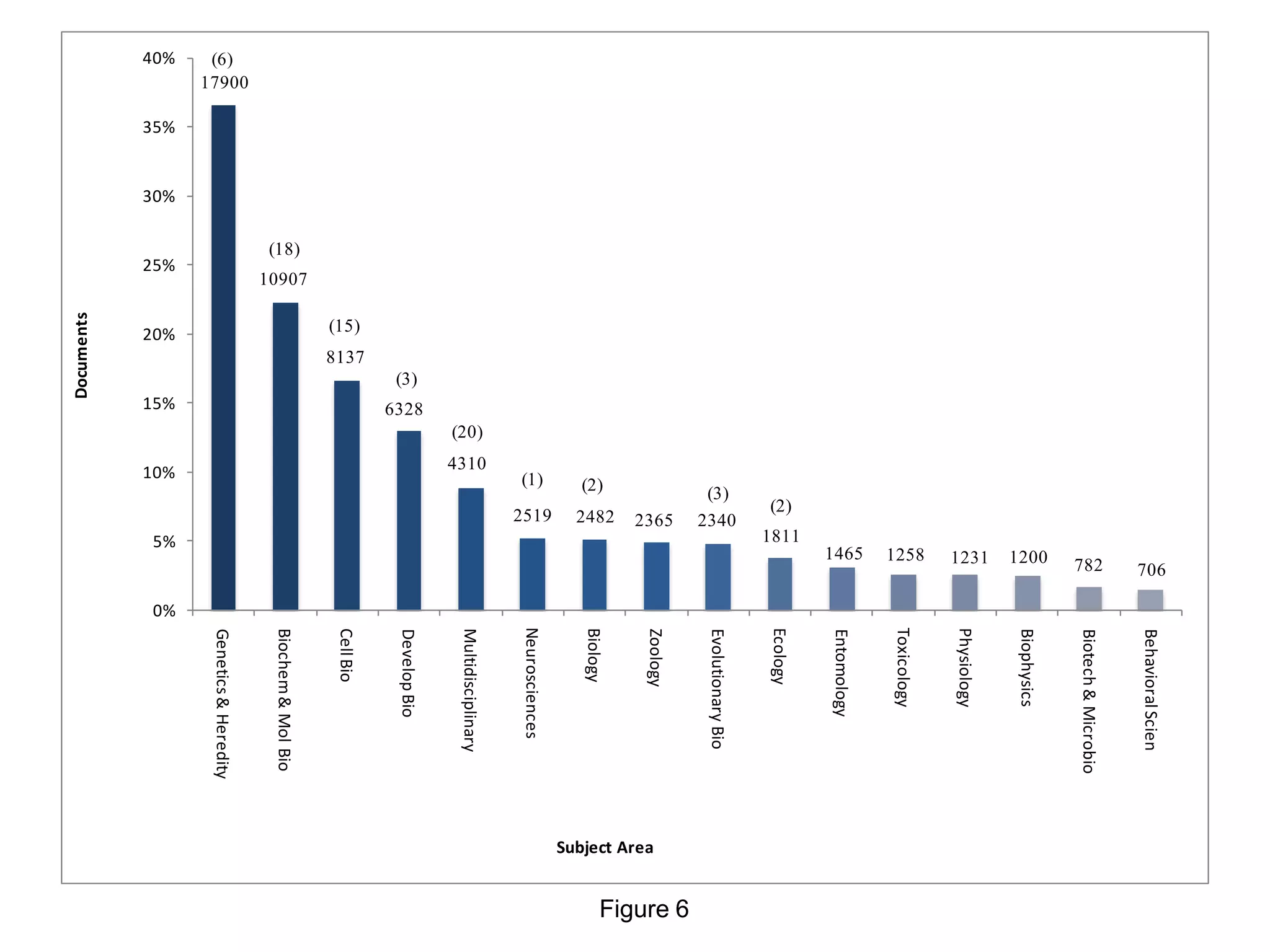
- The most common subject areas were genetics and heredity, biochemistry, molecular biology, cell biology, and developmental biology. The most influential journals were Genetics and PNAS.









![12%
[4.002]
(6%)
4860
10%
8%
Documents
6%
[6.812]
[4.416]
(4%) [9.380]
1765 (6%)
4% 1689
1528 [31.434] [3.198]*
[31.253] [5.558]
(22%) [5.520] [4.737] [9.120]
(26%) [1.980] [8.295]
1039
891 (2%)
843 837 (2%)
2% 784 731 699 693 660 649 605
0%
PNAS
Nature
Genetika
Genetics
Development
Japan J Genetics
Cell
Genetica
Evolution
Mutation Research
Devel Biol
J Bio Chemistry
Mol Bio Cell
J Cell Biol
Embo J
Figure 13](https://image.slidesharecdn.com/globaldrosophila-110218095923-phpapp02/75/Global-drosophila-21-2048.jpg)

![Discussion
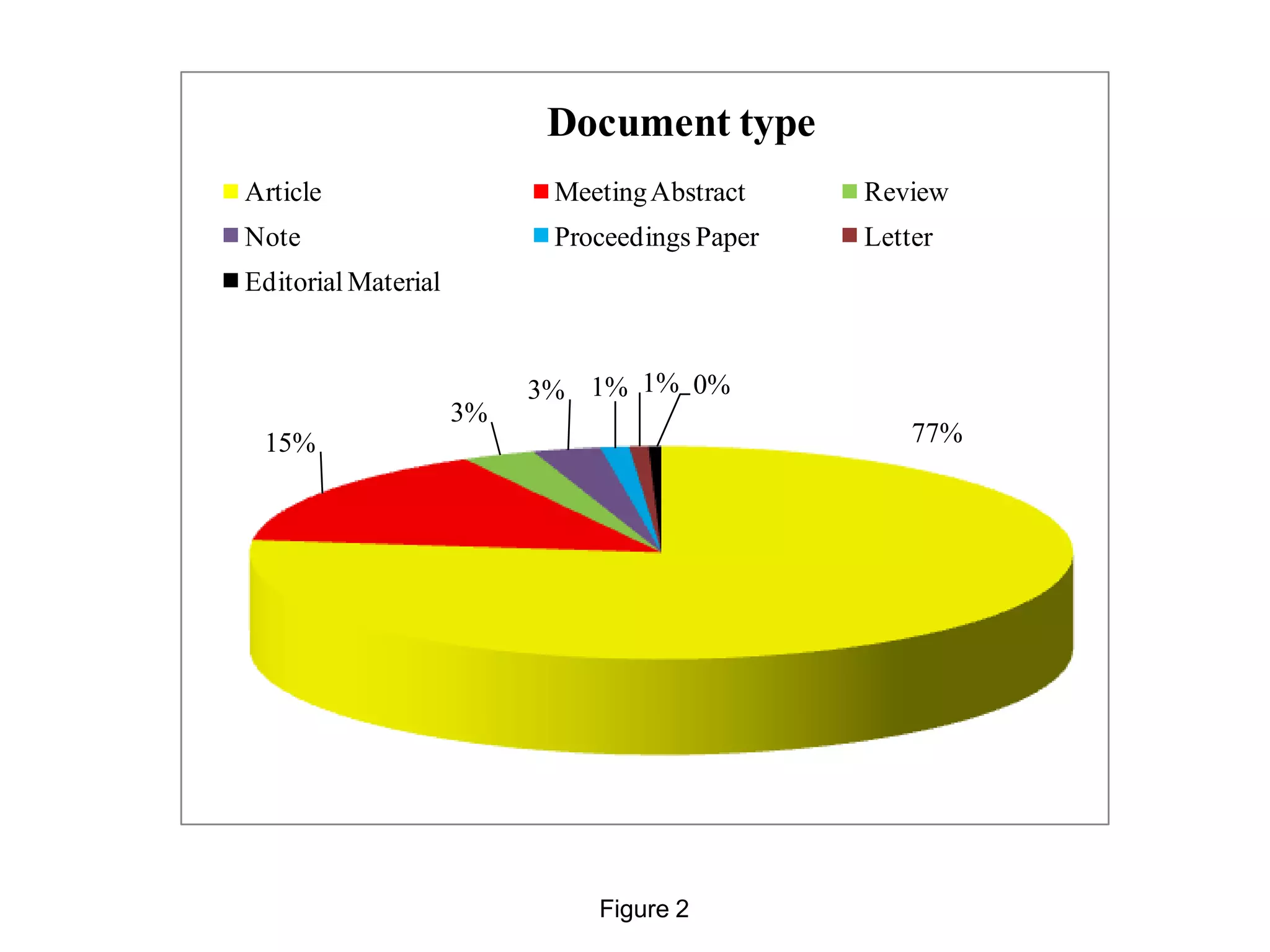
• We have analyzed 48,981 documents in the Science Citation Index (Figure 1), mostly articles
(nearly 77%) (Figure 2), the majority written in English (95%) (Figure 3).
• Temporal scientific production in Drosophila research is fairly similar (and with similar
exponential growth in both SCI and PubMed. There is a continuous increase from 1950 to 2007,
with a decrease in 2008 (Figure 1). This decrease may only be apparent and reflect a usual
delay in the indexation process. The comparison with other biological models is interesting: Zea
and Chlamydomonas show a reasonably stable publication trend (after 1970). From
approximately 1980 on, Arabidopsis and Caenorhabditis exhibit exponential growth, while
Neurospora and Dictyostelium decrease. Escherichia is the most extensively used model
organism for genetics research; from 1950 till 2007, nearly twice as many articles are published
as for Drosophila.
• One factor contributing to the extensive research with Drosophila may have been the free flow
of materials and ideas among its researchers [79]. Morgan's style of research and leadership
was distinctively focused on an experimental, rather than a descriptive approach to science.
Between 1940 and 1970 new techniques were developed, mutants increased in number and
complexity, all fairly freely shared by a gradually increasing number of investigators.
• In the 1970s and 1980s, genetics, developmental, and molecular biology came together in a
successful combination, which brought Drosophila research to a climax. Molecular biology rose
later than the other subjects, associated mostly with the ability to manipulate DNA and RNA, so
that researchers could work with individual genes that produced phenotypic alterations. E.B.
Lewis [80] studied mutations which caused bizarre transformations of the body plan: mutations
in genes in the 'bithorax complex' led to flies with two sets of wings or legs on abdominal
segments. The strangeness of the changes produced became a clue to discover the crucial role
of master control genes that program the final body plan of the organism. 23](https://image.slidesharecdn.com/globaldrosophila-110218095923-phpapp02/75/Global-drosophila-23-2048.jpg)
![• Christiane Nüsslein-Volhard and Eric Wieschaus (1980) [81] began working together with Drosophila
flies in a laboratory in Heidelberg, Germany. They systematically searched for mutant genes that
affect the formation of segments in the fly embryo. They identified a series of new genes that drive the
early development of the organism, and also were able to classify the genes into functional groups.
They showed that these genes are conserved in vertebrates. It would soon become clear that close
relatives of these genes, performing similar roles, exist in many other different organisms, including
humans. Indeed, it is now thought that more than 60 percent of the genes involved in human diseases
may have counterparts in the fly.
• An important breakthrough for manipulating the genome was made in 1982 by A.C. Spradling and
G.M. Rubin [82]. They developed a method for making transgenic flies by means of transposable
element vectors. They used this method to achieve the first rescue of a mutant phenotype in an
animal by gene transfer.
• New technologies are also being brought to bear on the study of Drosophila. Since 1999, the genome
sequence of Drosophila has been available, and researchers are using functional genomics to
investigate global patterns of gene and protein expression. The genome sequences of several other
Drosophila species have now become available, which opens up new opportunities for functional
genomics studies, looking at gene and protein expression on a large scale. Such experiments can
produce huge amounts of data, difficult to interpret, organize, and store.
• As pointed out, genetics and heredity, biochemistry, molecular biology and cell biology are the leading
research subjects in SCI. Some journals in our survey are multidisciplinary, such as Nature and
Science. We have shown that there are temporal trends with respect to research subject as well as to
model organisms and prevailing methodologies: toxicology, cell biology, and descriptive
developmental research are decreasing, while evolutionary biology, biochemistry, and molecular
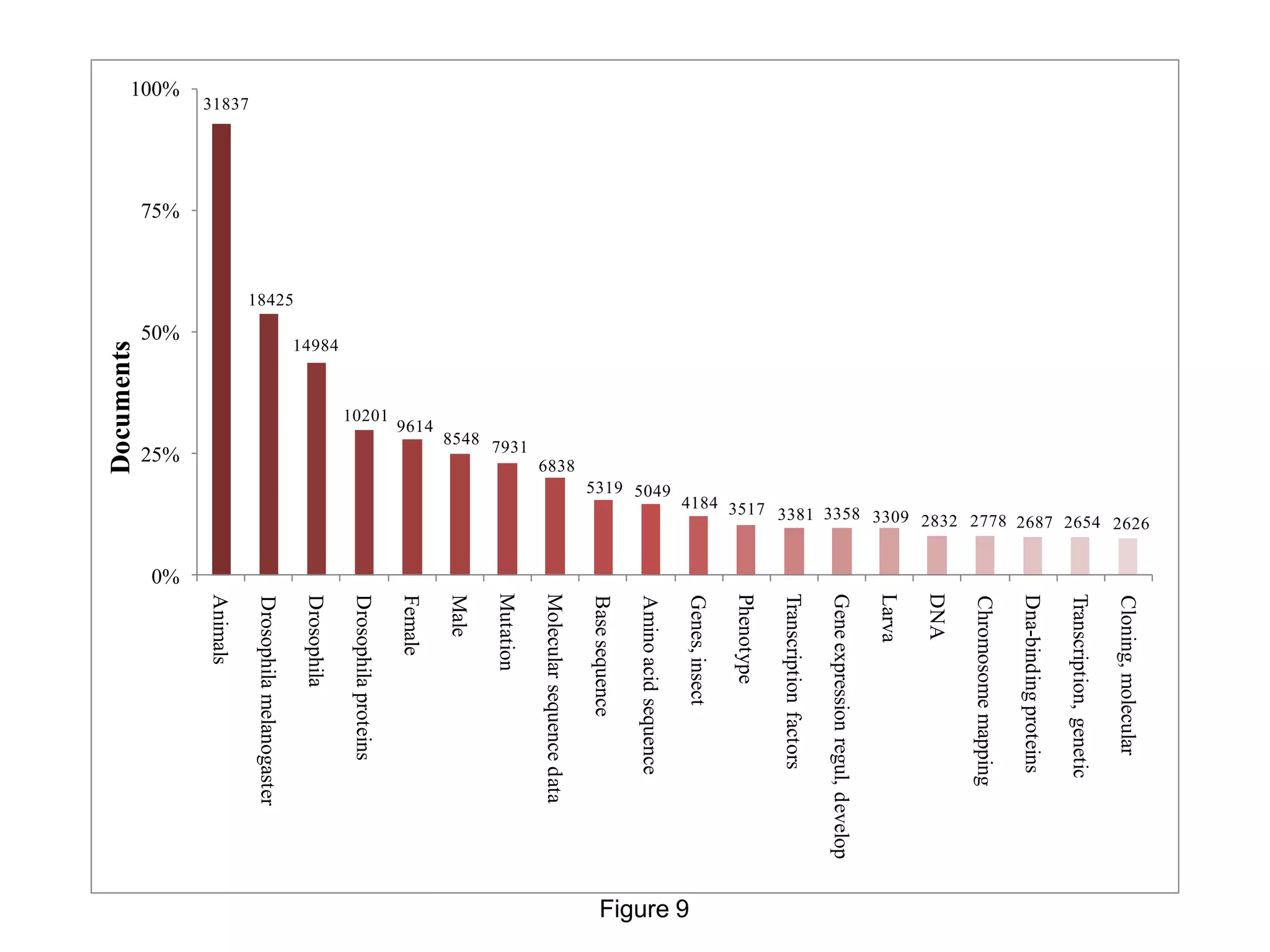
biology are increasing. The most frequent terms in Drosophila research have genetics, heredity, or a
molecular connotation.
• The most cited paper, providing the complete sequence of the euchromatic region of the Drosophila
genome was published in Science in 2000, with 2,751 citations at the time of our survey.
24](https://image.slidesharecdn.com/globaldrosophila-110218095923-phpapp02/75/Global-drosophila-24-2048.jpg)


