Ethics of Perception in
Nanocognition
(Nanorobot-aided
Cognition)
Melanie Swan
Futurist Philosopher
MS Futures Group
+1-650-681-9482
m@MelanieSwan.com
9th Annual Workshop on Geoethical
Nanotechnology - July 20, 2013
Slides: http://slideshare.net/LaBlogga
2
Melanie Swan
• Hedge fund manager, futurist, startup
entrepreneur (DIYgenomics), philosopher
• Singularity University Instructor, IEET
Affiliate Scholar, EDGE contributor
• Work experience: Fidelity, JP Morgan,
Arthur Andersen, iPass, RHK/Ovum
• Education: MBA Finance, Wharton; BA
French/Economics, Georgetown Univ.
• Sample publications: MelanieSwan.com
– Swan, M. The Quantified Self: Fundamental Disruption in Big Data Science and
Biological Discovery. Big Data 2013, 1(2): 85-99.
– Swan, M. Crowdsourced Health Research Studies: An Important Complement to
Clinical Trials. J Med Internet Res 2012, Mar;14(2):e46.
– Swan, M. Multigenic Condition Risk Assessment in Direct-to-Consumer Genomic
Services. Genet. Med. 2010, May;12(5):279-88.
– Swan, M. Translational antiaging research. Rejuvenation Research 2010,
Feb;13(1):115-7.
– Swan, M. Engineering Life into Technology: the Application of Complexity Theory to
a Potential Phase Transition of Intelligence. Symmetry 2010, 2, 150:183.
Source: http://melanieswan.com/publications.htm
Agenda
3
• What are Cognitive Nanorobots?
• Geoethics of Cognitive Nanorobots
• Cognition: Perception and Memory
• Models of Ethics
• Killer Apps of Cognitive Nanorobots
• Ethics of Cognitive Nanorobots
What are Cognitive Nanorobots?
4
• Analog to Medical Nanorobots
• Cognition is just another…
– Biological function
– ‘Pathology’ to ameliorate
• Biocompatibility of medical
nanorobots with neural cells1
– Mechanical
– Physiological
– Immunological
– Cytological
– Biochemical
1Freitas, R Jr. Nanomedicine, Volume IIA: Biocompatibility. 15.3.6.5 Biocompatibility with Neural Cells.
http://www.nanomedicine.com/NMIIA/15.3.6.5.htm
Images: corporeality.net, fineartamerica.com
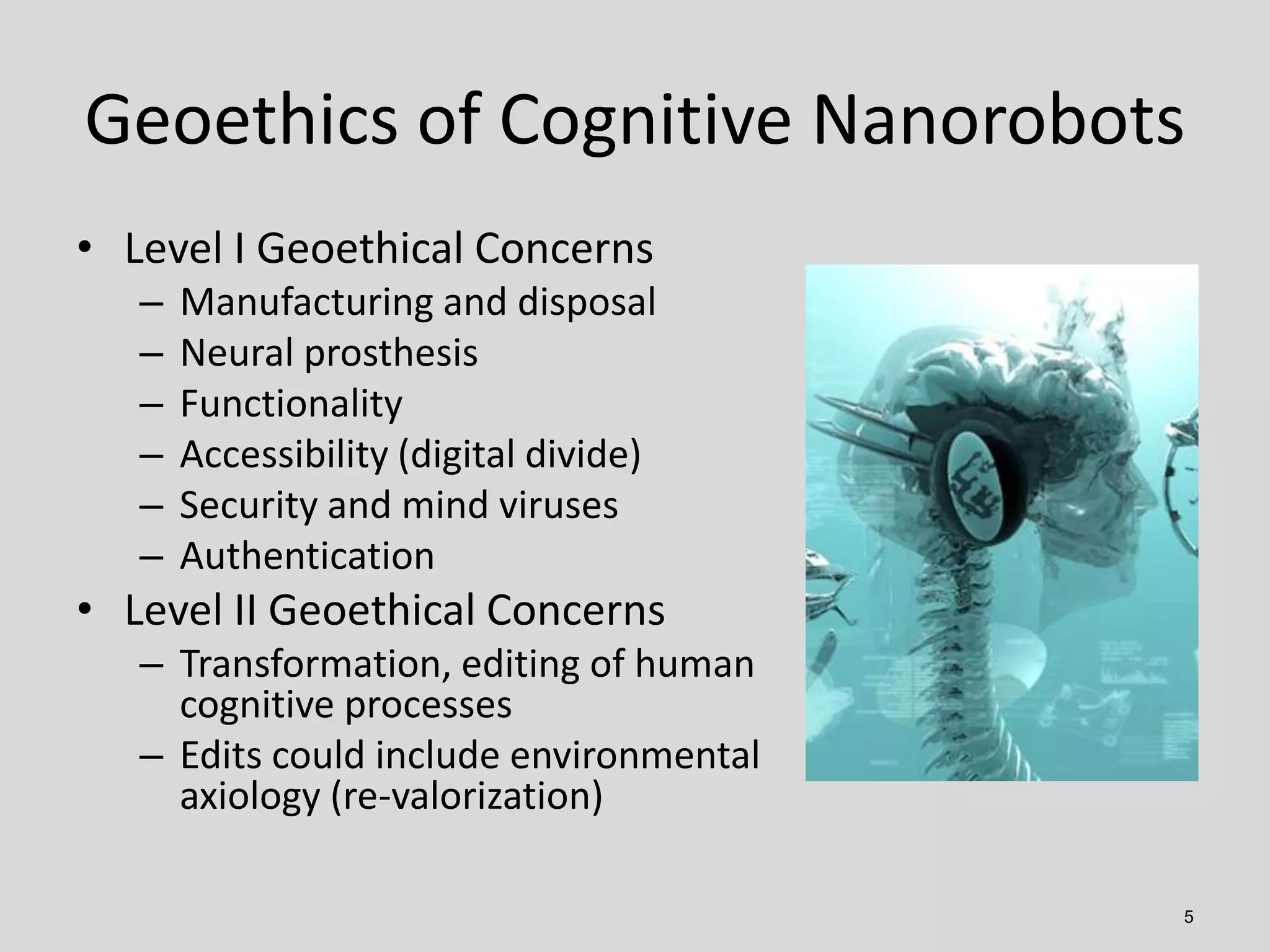
Geoethics of Cognitive Nanorobots
5
• Level I Geoethical Concerns
– Manufacturing and disposal
– Neural prosthesis
– Functionality
– Accessibility (digital divide)
– Security and mind viruses
– Authentication
• Level II Geoethical Concerns
– Transformation, editing of human
cognitive processes
– Edits could include environmental
axiology (re-valorization)
Cognition: Perception and Memory
6
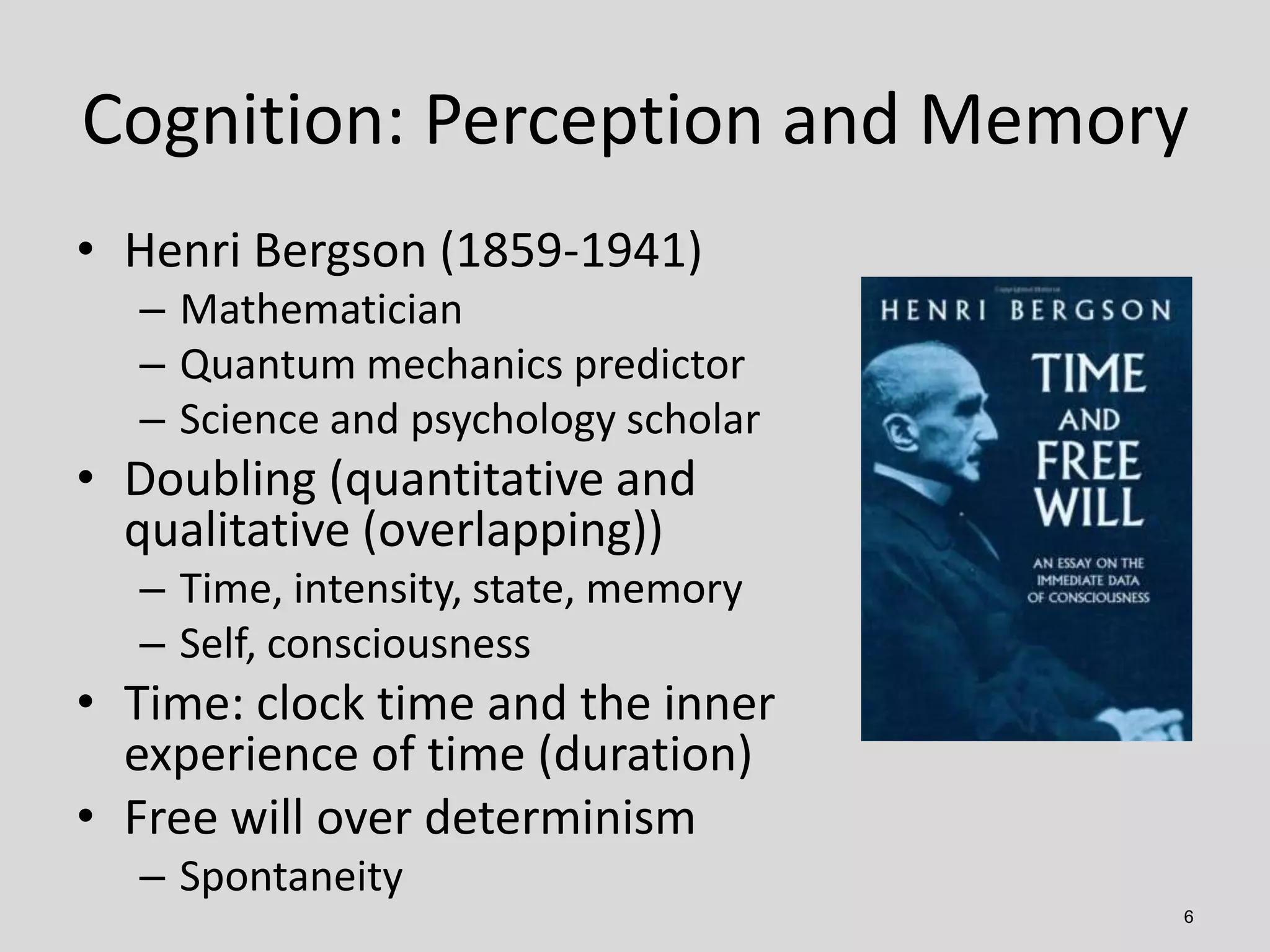
• Henri Bergson (1859-1941)
– Mathematician
– Quantum mechanics predictor
– Science and psychology scholar
• Doubling (quantitative and
qualitative (overlapping))
– Time, intensity, state, memory
– Self, consciousness
• Time: clock time and the inner
experience of time (duration)
• Free will over determinism
– Spontaneity
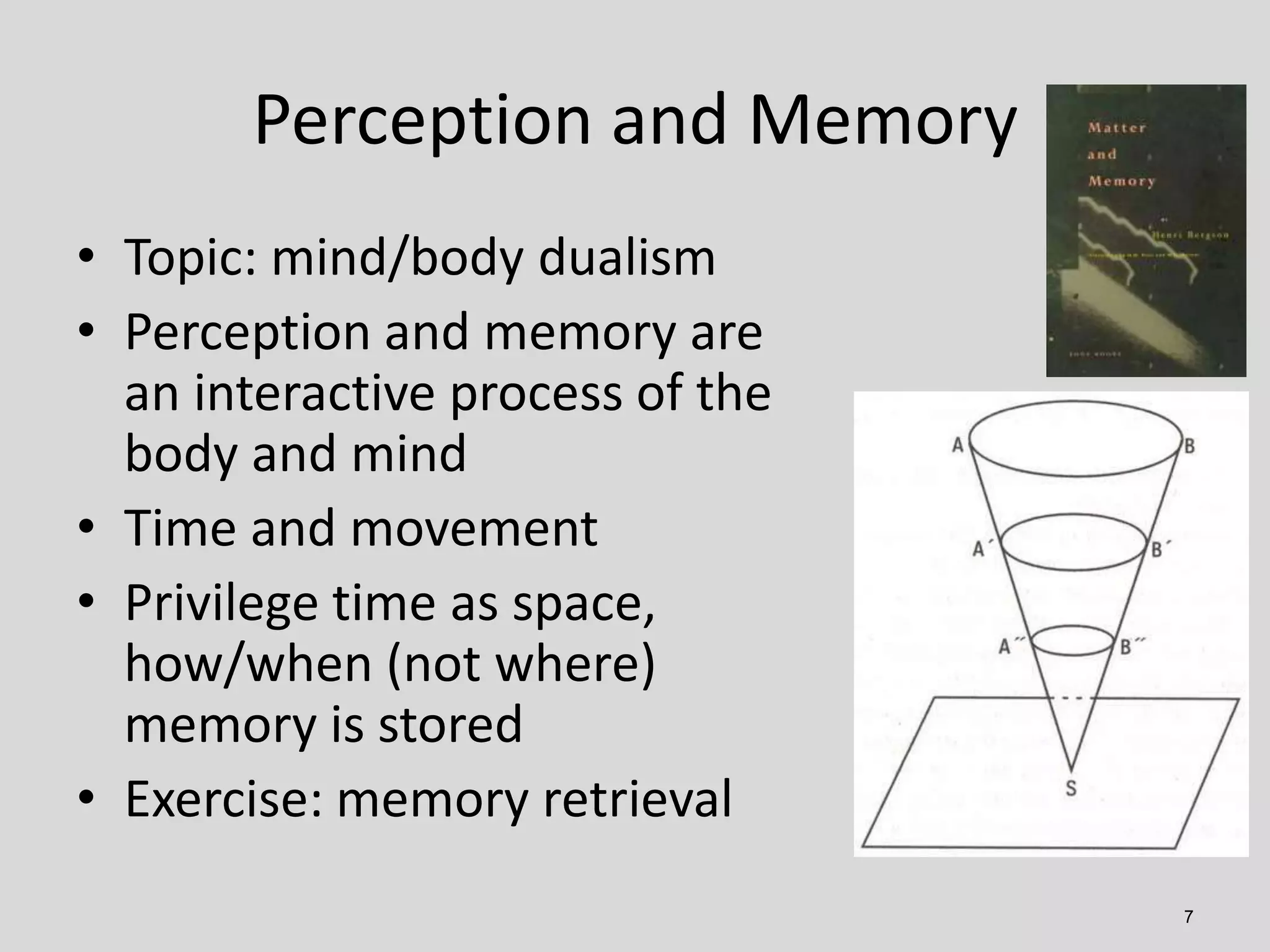
Perception and Memory
7
• Topic: mind/body dualism
• Perception and memory are
an interactive process of the
body and mind
• Time and movement
• Privilege time as space,
how/when (not where)
memory is stored
• Exercise: memory retrieval
8
• Act-based (right act with right motive)
– Categorical Imperative (always right/wrong) (Kant)
– Utilitarianism (outcome maximization) and
Consequentialism (end justifies means) (Bentham, Mill)
• Agent-based
– Virtue ethics: role of character (Aristotle, Aquinas)
– Dispositionism: individual traits predict behavior
• Situation, context, and ecosystem-based (1968)
– Situationism: social context produces behavior
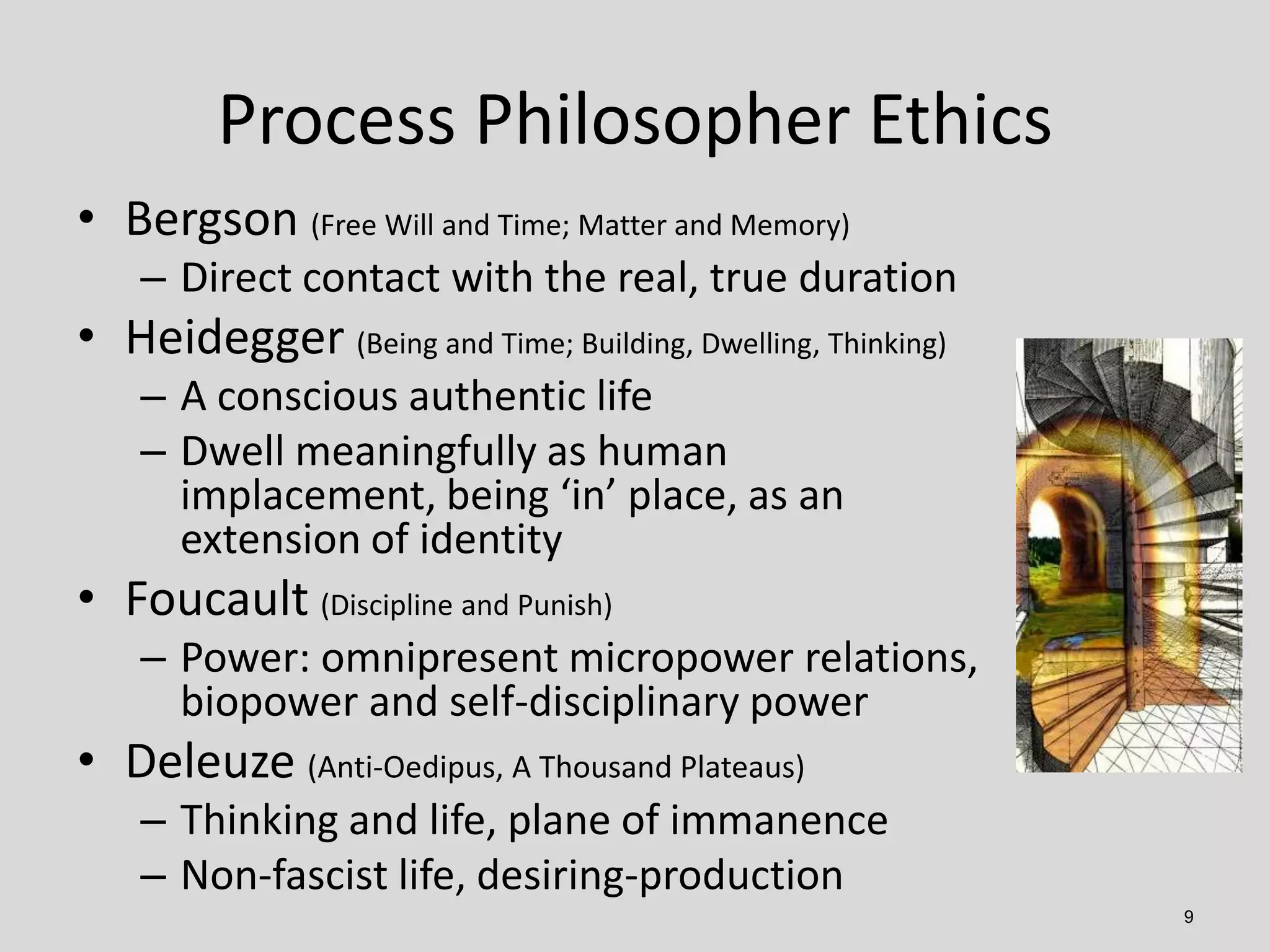
– Ethics of Care (Gilligan): morality arises from interaction
Models of Ethics
9
• Bergson (Free Will and Time; Matter and Memory)
– Direct contact with the real, true duration
• Heidegger (Being and Time; Building, Dwelling, Thinking)
– A conscious authentic life
– Dwell meaningfully as human
implacement, being ‘in’ place, as an
extension of identity
• Foucault (Discipline and Punish)
– Power: omnipresent micropower relations,
biopower and self-disciplinary power
• Deleuze (Anti-Oedipus, A Thousand Plateaus)
– Thinking and life, plane of immanence
– Non-fascist life, desiring-production
Process Philosopher Ethics
10
Connecting Perception to Ethics:
Machine Ethics Interfaces
• Possibility of ‘objective’
reality as an input?
• Many-tiered existing biases
– Biology
– Society/culture
– Individual/group
• Ethics of Reality
• UX issues
11
• Bias reduction
• Memory management
• Value system elicitation and
optimization
• Perceptual enhancement
– Different ‘objective’ realities
– See time, see movement in
time and space
– Notice subjective experience
• Desire elicitation and
modification
Killer Apps of Cognitive Nanorobotics
12
• Trend of self-awareness, disclosure,
destigmatization, taboo removal
• Group ethics models
– Old: okay unless harms others, ‘do unto others’
– New: Negotiation per disclosure, automated
mediation through anonymous disclosure
Individual / Group Ethics
Medicine (genomics), behavior
(QS), personal/professional life
blending, sexual orientation,
gender identification
Neurodiversity:
mental health, mental
performance
Desires
Time now
13
• Overt consideration of
machine ethics modules
• Subjective experience
enhancement
• Ethics/values/desires
elicitation and optimization
• Progression and
transformation in ethics
paradigms
Geoethics of Cognitive Nanorobots
Ethics of Perception
and Nanocognition
(Nanorobot-aided
Cognition)
Melanie Swan
Futurist Philosopher
MS Futures Group
+1-650-681-9482
m@MelanieSwan.com
9th Annual Workshop on Geoethical
Nanotechnology - July 20, 2013
Slides: http://slideshare.net/LaBlogga
Thank you!

Ethics of Perception in Nanocognition

  • 1.
    Ethics of Perceptionin Nanocognition (Nanorobot-aided Cognition) Melanie Swan Futurist Philosopher MS Futures Group +1-650-681-9482 m@MelanieSwan.com 9th Annual Workshop on Geoethical Nanotechnology - July 20, 2013 Slides: http://slideshare.net/LaBlogga
  • 2.
    2 Melanie Swan • Hedgefund manager, futurist, startup entrepreneur (DIYgenomics), philosopher • Singularity University Instructor, IEET Affiliate Scholar, EDGE contributor • Work experience: Fidelity, JP Morgan, Arthur Andersen, iPass, RHK/Ovum • Education: MBA Finance, Wharton; BA French/Economics, Georgetown Univ. • Sample publications: MelanieSwan.com – Swan, M. The Quantified Self: Fundamental Disruption in Big Data Science and Biological Discovery. Big Data 2013, 1(2): 85-99. – Swan, M. Crowdsourced Health Research Studies: An Important Complement to Clinical Trials. J Med Internet Res 2012, Mar;14(2):e46. – Swan, M. Multigenic Condition Risk Assessment in Direct-to-Consumer Genomic Services. Genet. Med. 2010, May;12(5):279-88. – Swan, M. Translational antiaging research. Rejuvenation Research 2010, Feb;13(1):115-7. – Swan, M. Engineering Life into Technology: the Application of Complexity Theory to a Potential Phase Transition of Intelligence. Symmetry 2010, 2, 150:183. Source: http://melanieswan.com/publications.htm
  • 3.
    Agenda 3 • What areCognitive Nanorobots? • Geoethics of Cognitive Nanorobots • Cognition: Perception and Memory • Models of Ethics • Killer Apps of Cognitive Nanorobots • Ethics of Cognitive Nanorobots
  • 4.
    What are CognitiveNanorobots? 4 • Analog to Medical Nanorobots • Cognition is just another… – Biological function – ‘Pathology’ to ameliorate • Biocompatibility of medical nanorobots with neural cells1 – Mechanical – Physiological – Immunological – Cytological – Biochemical 1Freitas, R Jr. Nanomedicine, Volume IIA: Biocompatibility. 15.3.6.5 Biocompatibility with Neural Cells. http://www.nanomedicine.com/NMIIA/15.3.6.5.htm Images: corporeality.net, fineartamerica.com
  • 5.
    Geoethics of CognitiveNanorobots 5 • Level I Geoethical Concerns – Manufacturing and disposal – Neural prosthesis – Functionality – Accessibility (digital divide) – Security and mind viruses – Authentication • Level II Geoethical Concerns – Transformation, editing of human cognitive processes – Edits could include environmental axiology (re-valorization)
  • 6.
    Cognition: Perception andMemory 6 • Henri Bergson (1859-1941) – Mathematician – Quantum mechanics predictor – Science and psychology scholar • Doubling (quantitative and qualitative (overlapping)) – Time, intensity, state, memory – Self, consciousness • Time: clock time and the inner experience of time (duration) • Free will over determinism – Spontaneity
  • 7.
    Perception and Memory 7 •Topic: mind/body dualism • Perception and memory are an interactive process of the body and mind • Time and movement • Privilege time as space, how/when (not where) memory is stored • Exercise: memory retrieval
  • 8.
    8 • Act-based (rightact with right motive) – Categorical Imperative (always right/wrong) (Kant) – Utilitarianism (outcome maximization) and Consequentialism (end justifies means) (Bentham, Mill) • Agent-based – Virtue ethics: role of character (Aristotle, Aquinas) – Dispositionism: individual traits predict behavior • Situation, context, and ecosystem-based (1968) – Situationism: social context produces behavior – Ethics of Care (Gilligan): morality arises from interaction Models of Ethics
  • 9.
    9 • Bergson (FreeWill and Time; Matter and Memory) – Direct contact with the real, true duration • Heidegger (Being and Time; Building, Dwelling, Thinking) – A conscious authentic life – Dwell meaningfully as human implacement, being ‘in’ place, as an extension of identity • Foucault (Discipline and Punish) – Power: omnipresent micropower relations, biopower and self-disciplinary power • Deleuze (Anti-Oedipus, A Thousand Plateaus) – Thinking and life, plane of immanence – Non-fascist life, desiring-production Process Philosopher Ethics
  • 10.
    10 Connecting Perception toEthics: Machine Ethics Interfaces • Possibility of ‘objective’ reality as an input? • Many-tiered existing biases – Biology – Society/culture – Individual/group • Ethics of Reality • UX issues
  • 11.
    11 • Bias reduction •Memory management • Value system elicitation and optimization • Perceptual enhancement – Different ‘objective’ realities – See time, see movement in time and space – Notice subjective experience • Desire elicitation and modification Killer Apps of Cognitive Nanorobotics
  • 12.
    12 • Trend ofself-awareness, disclosure, destigmatization, taboo removal • Group ethics models – Old: okay unless harms others, ‘do unto others’ – New: Negotiation per disclosure, automated mediation through anonymous disclosure Individual / Group Ethics Medicine (genomics), behavior (QS), personal/professional life blending, sexual orientation, gender identification Neurodiversity: mental health, mental performance Desires Time now
  • 13.
    13 • Overt considerationof machine ethics modules • Subjective experience enhancement • Ethics/values/desires elicitation and optimization • Progression and transformation in ethics paradigms Geoethics of Cognitive Nanorobots
  • 14.
    Ethics of Perception andNanocognition (Nanorobot-aided Cognition) Melanie Swan Futurist Philosopher MS Futures Group +1-650-681-9482 m@MelanieSwan.com 9th Annual Workshop on Geoethical Nanotechnology - July 20, 2013 Slides: http://slideshare.net/LaBlogga Thank you!

Editor's Notes

  • #10 Building, Dwelling, Thinking (Heidegger 1951); BT/LoH - years
  • #13 Different notion of self/othering - creativity