Introduction to pair trading
  -Based on cointegration-

       ・Shinichi Takayanagi
         ・Kohta Ishikawa

                               1
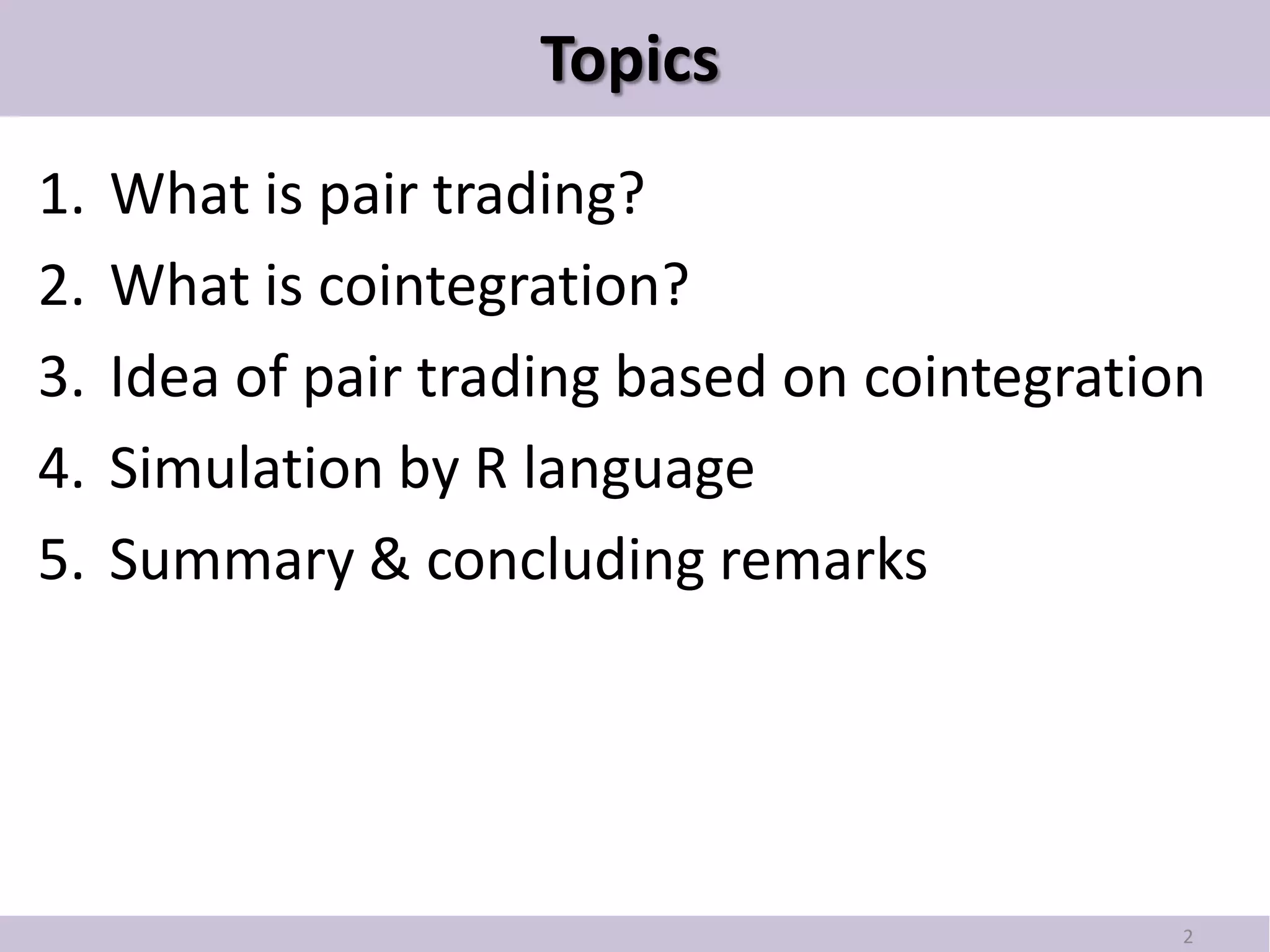
Topics
1.   What is pair trading?
2.   What is cointegration?
3.   Idea of pair trading based on cointegration
4.   Simulation by R language
5.   Summary & concluding remarks


                                               2
1. What is pair trading?


                       3
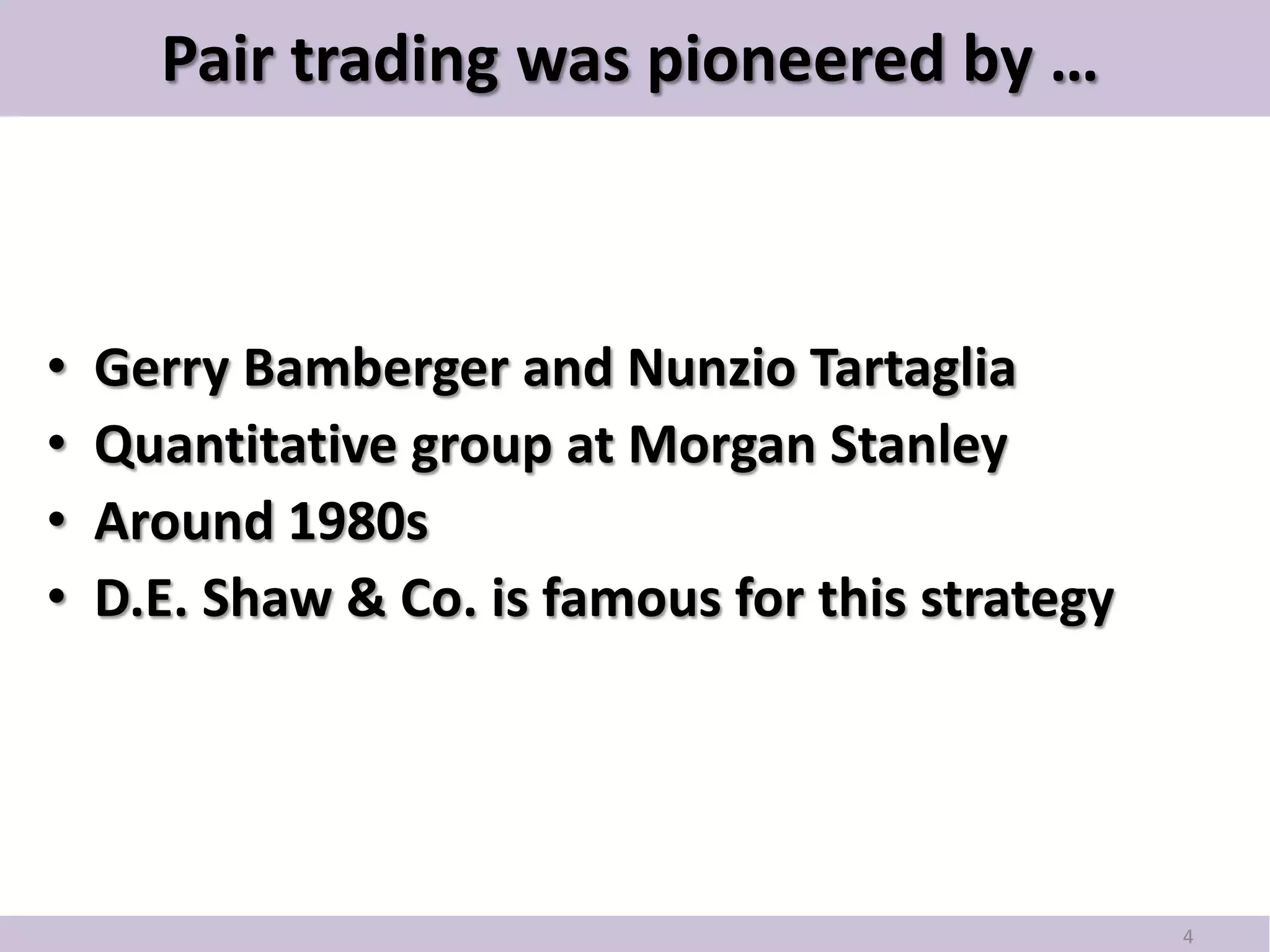
Pair trading was pioneered by …


•   Gerry Bamberger and Nunzio Tartaglia
•   Quantitative group at Morgan Stanley
•   Around 1980s
•   D.E. Shaw & Co. is famous for this strategy


                                                  4
Pair trading is …


Market neutral trading strategy


                              5
Pair trading belongs to …


Statistical Arbitrage


                               6
Basic idea of pair trading …


 Select two stocks
which move similarly

                                 7
Basic idea of pair trading …


Sell high priced stock
Buy low priced stock

                                 8
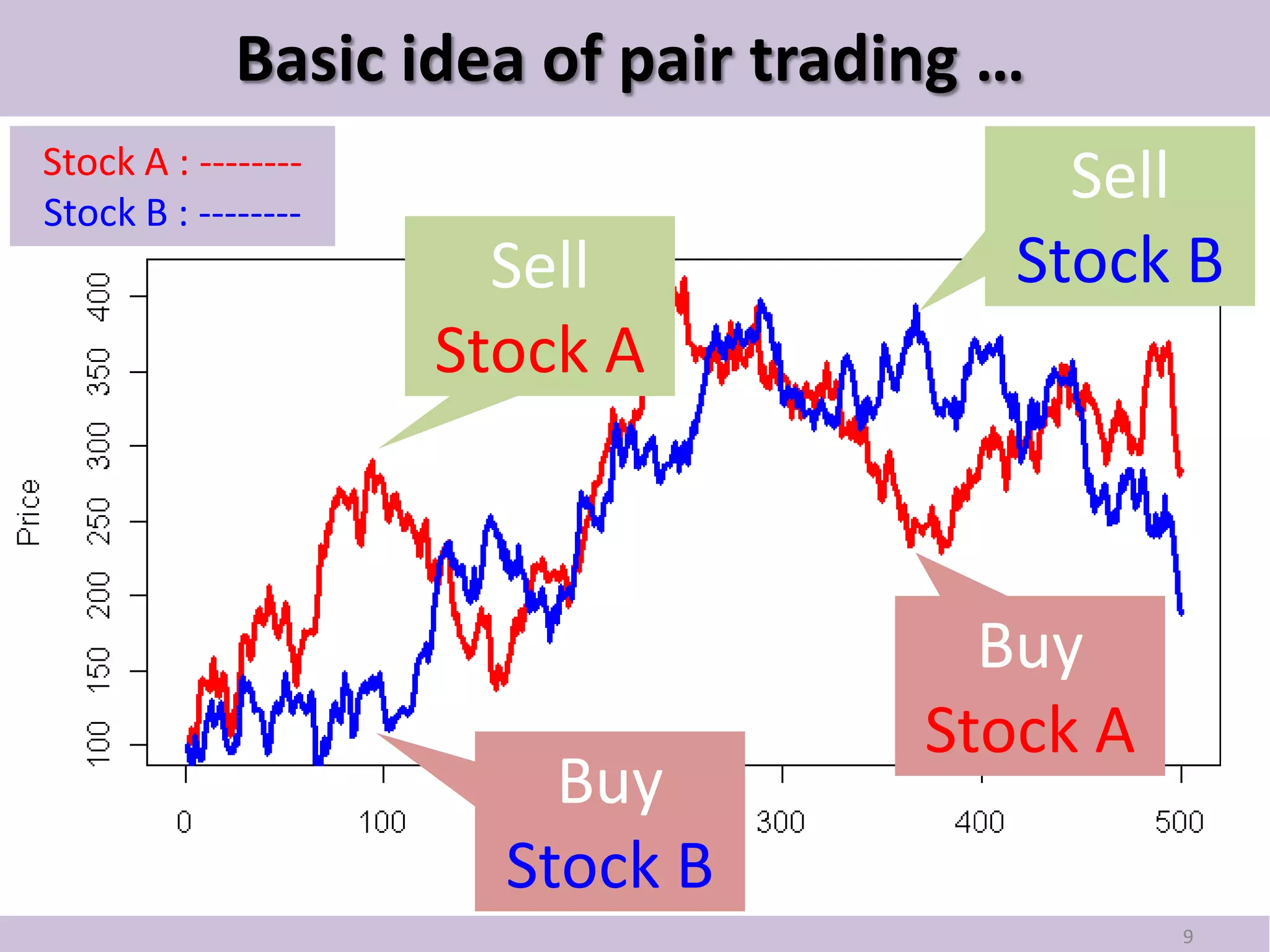
Basic idea of pair trading …
Stock A : --------
Stock B : --------
                                          Sell
                       Sell             Stock B
                     Stock A


                                       Buy
                                     Stock A
                         Buy
                       Stock B
                                               9
Basic idea of pair trading …


    Usually, monitor
     the difference
between two stock prices

                                  10
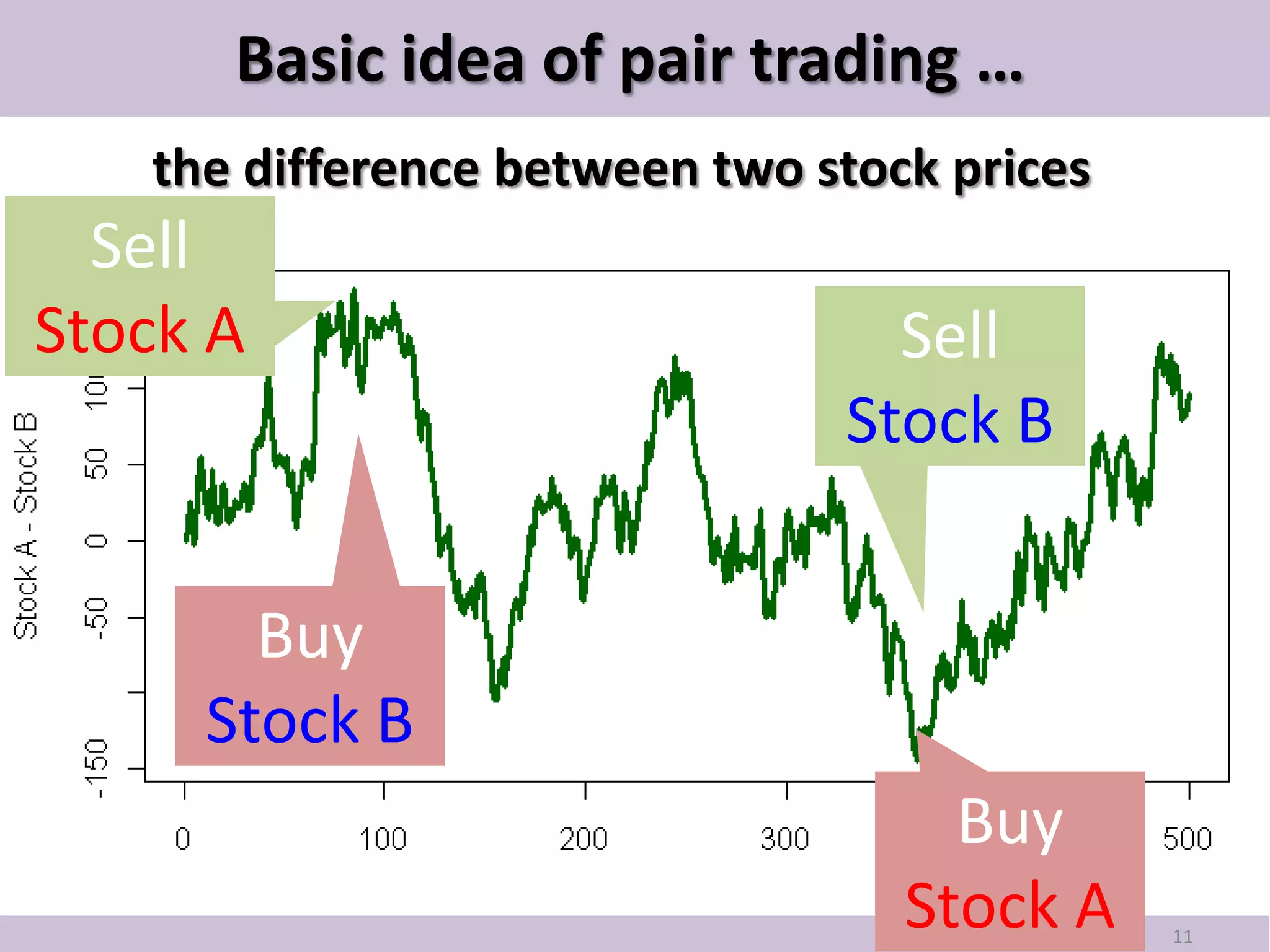
Basic idea of pair trading …
   the difference between two stock prices
  Sell
Stock A                          Sell
                               Stock B


       Buy
     Stock B
                                    Buy
                                  Stock A    11
2. What is cointegration?


                       12
Cointegration is …


• Pioneered by Engle and Granger
• Statistical property of time series
• Around 1990s


                                   13
Cointegration is …


Not correlation

                        14
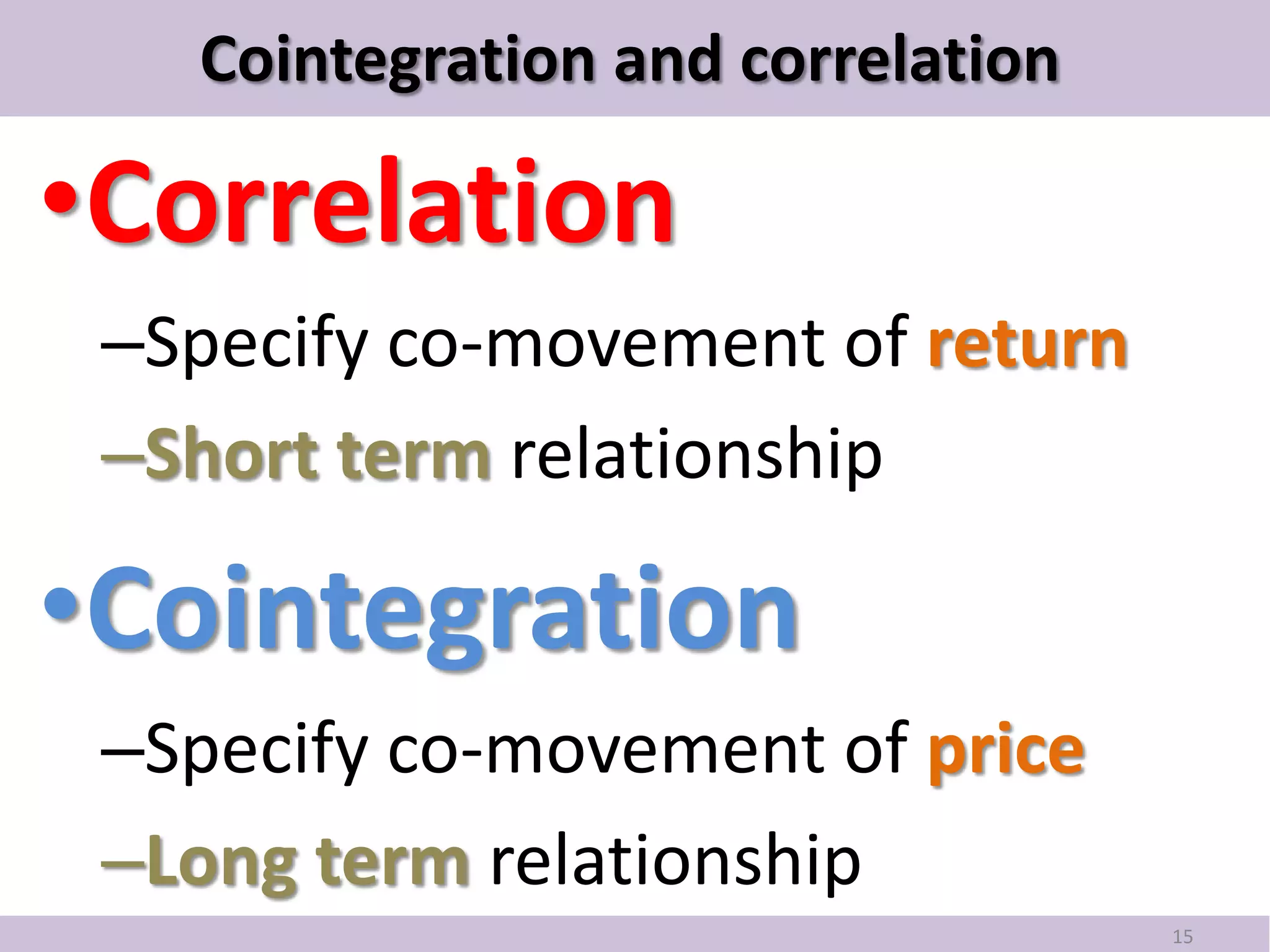
Cointegration and correlation

•Correlation
 –Specify co-movement of return
 –Short term relationship

•Cointegration
 –Specify co-movement of price
 –Long term relationship
                                   15
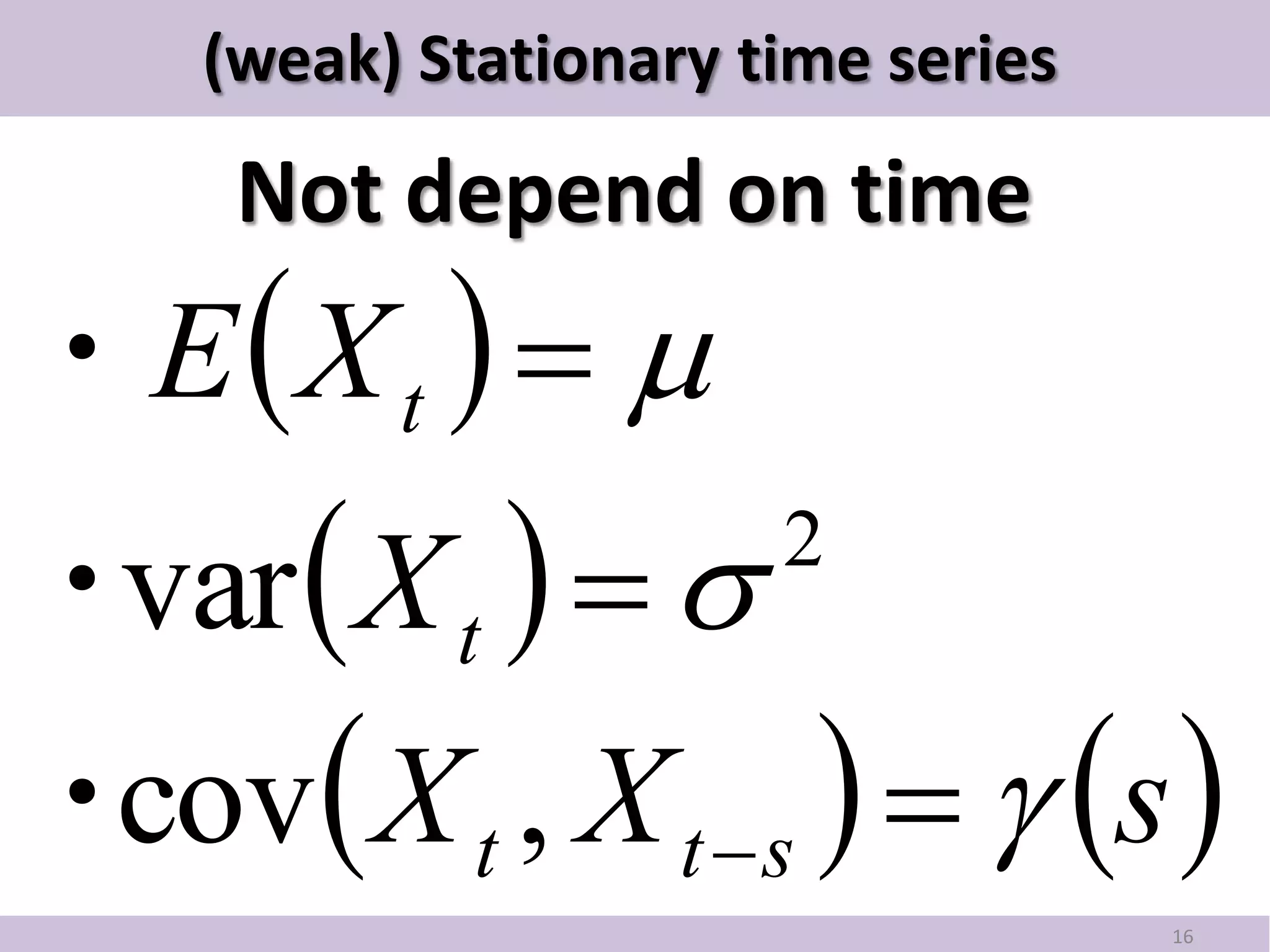
(weak) Stationary time series

     Not depend on time
・E  X t   
・ X t   
 var                   2


・  X t , X t  s    s 
 cov
                                    16
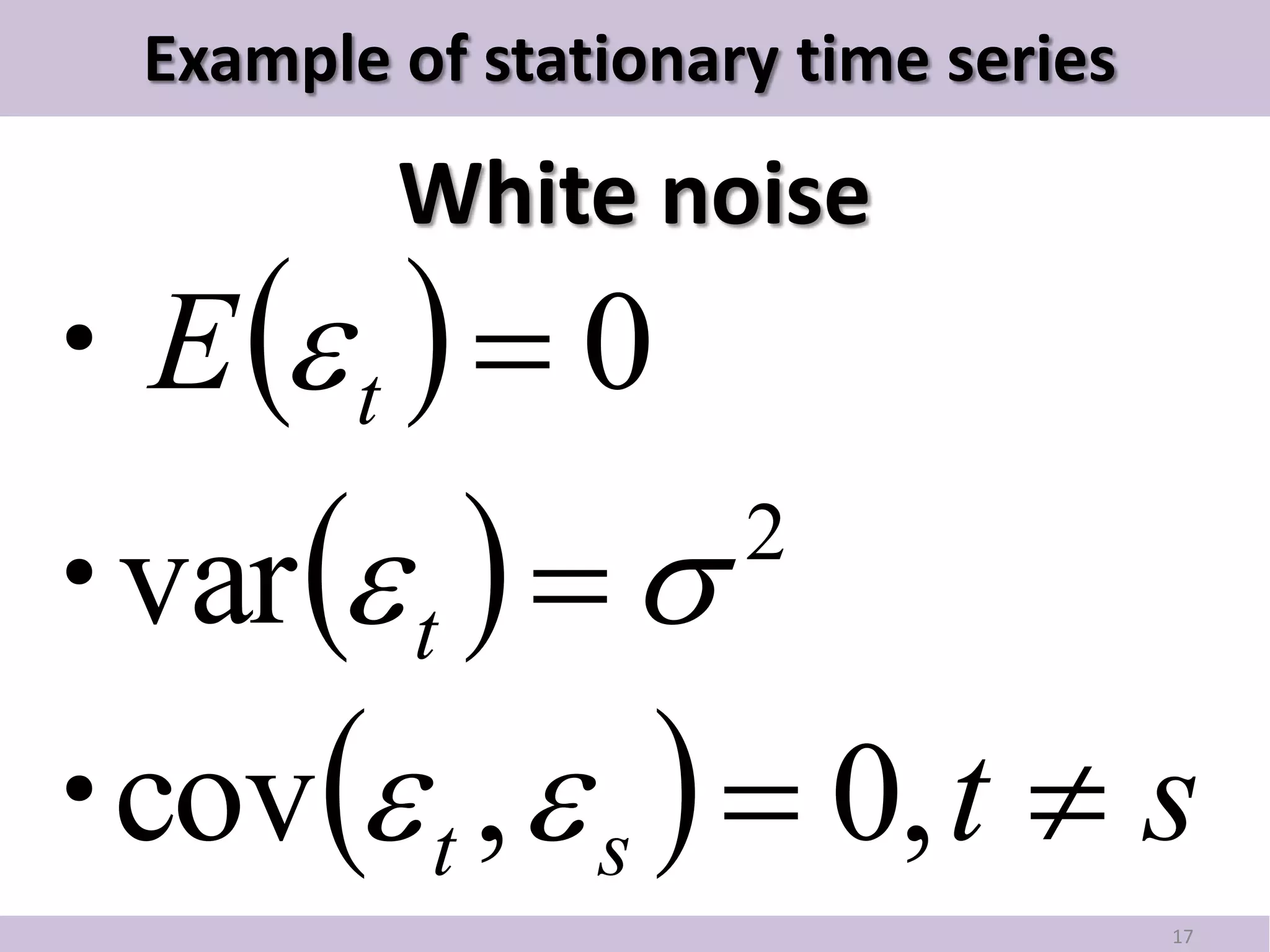
Example of stationary time series

          White noise
・E  t   0
・  t   
 var                  2


・  t ,  s   0, t  s
 cov
                                      17
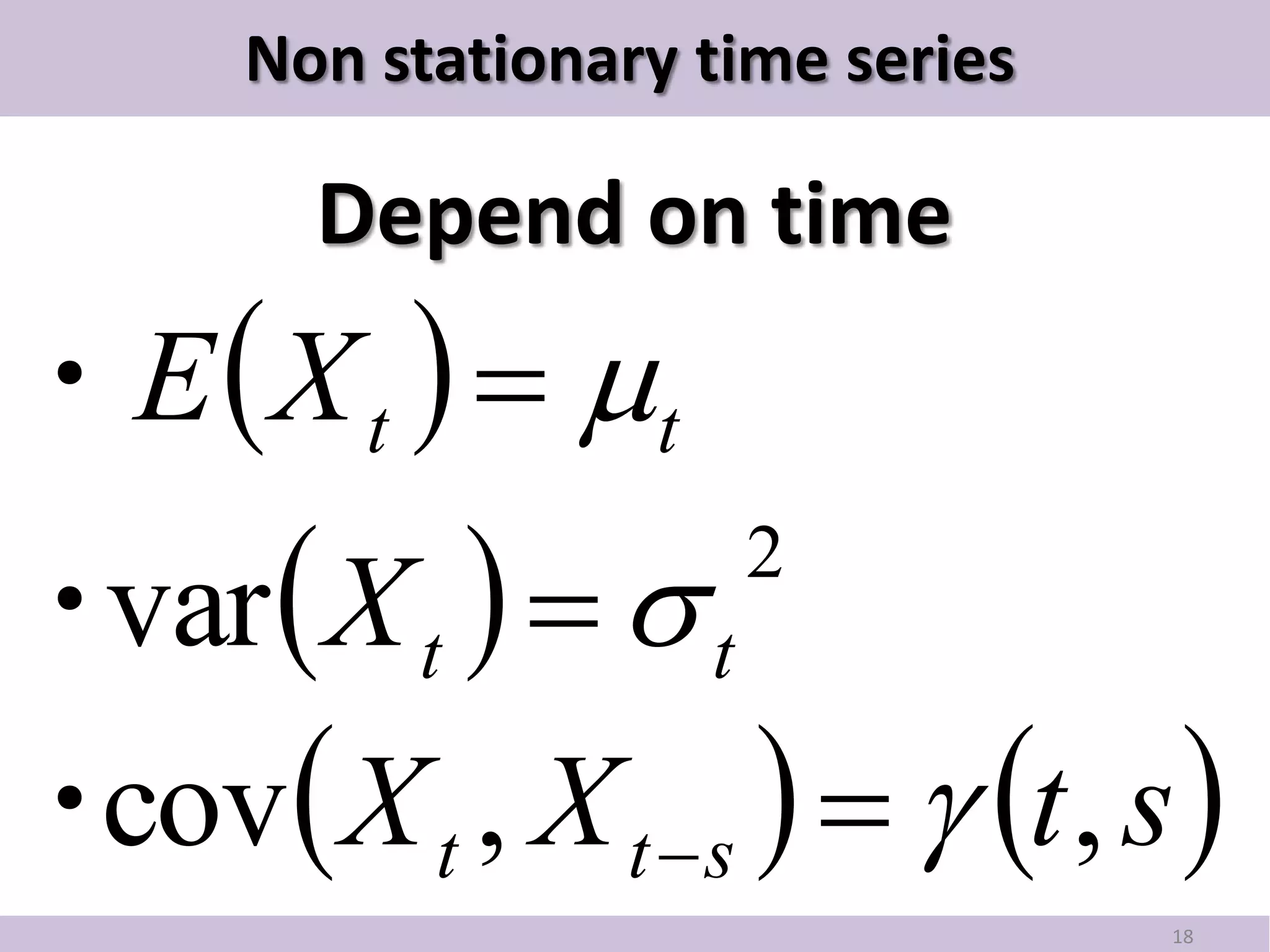
Non stationary time series

        Depend on time
・E  X t   t
・ X t    t
                      2
 var
・  X t , X t  s    t , s 
 cov
                                   18
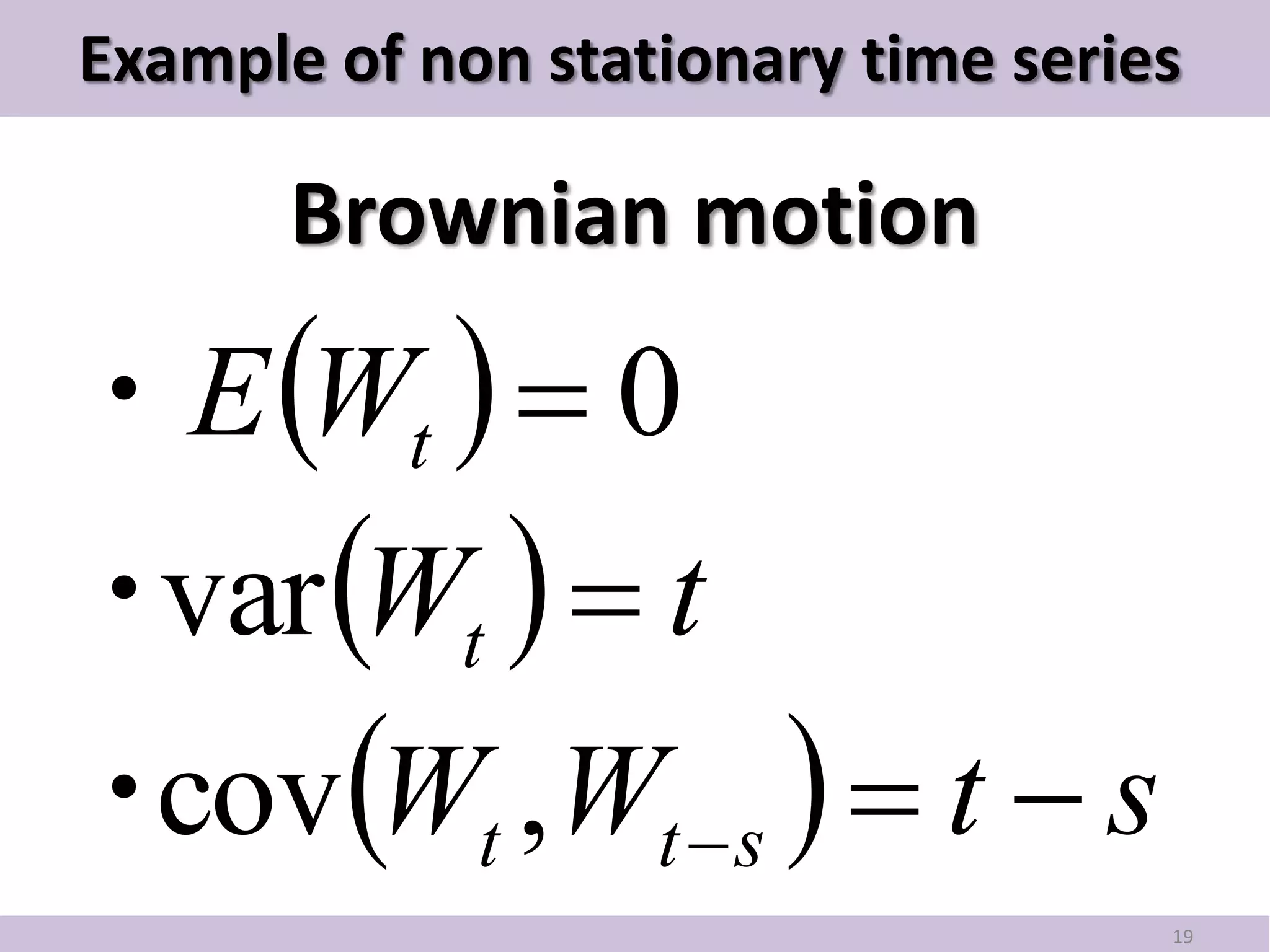
Example of non stationary time series

       Brownian motion

・E Wt   0
・ Wt   t
 var
・ Wt ,Wt  s   t  s
 cov
                                    19
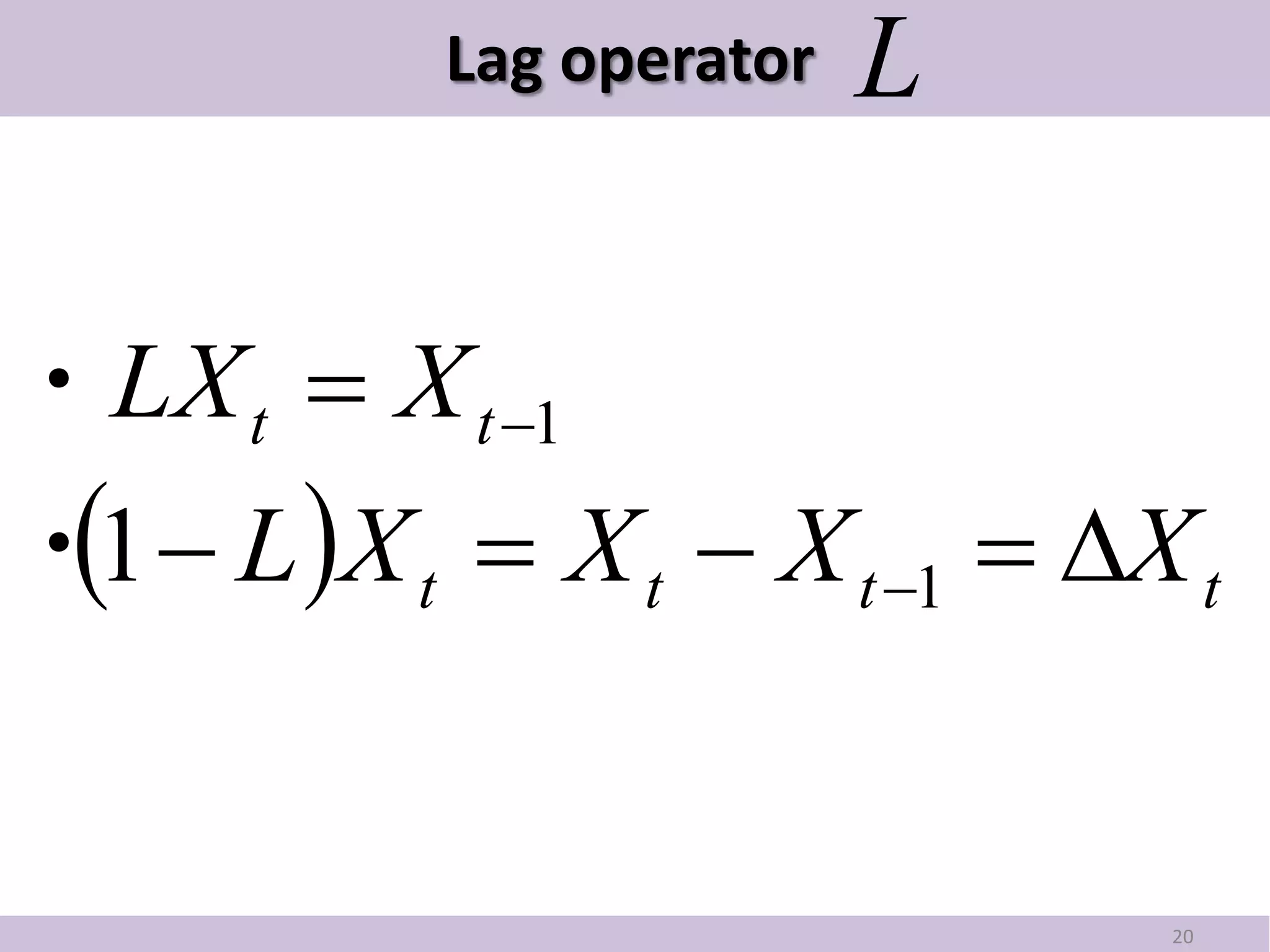
Lag operator   L

・LX t  X t 1
・1  L X t  X t  X t 1  X t
 

                               20
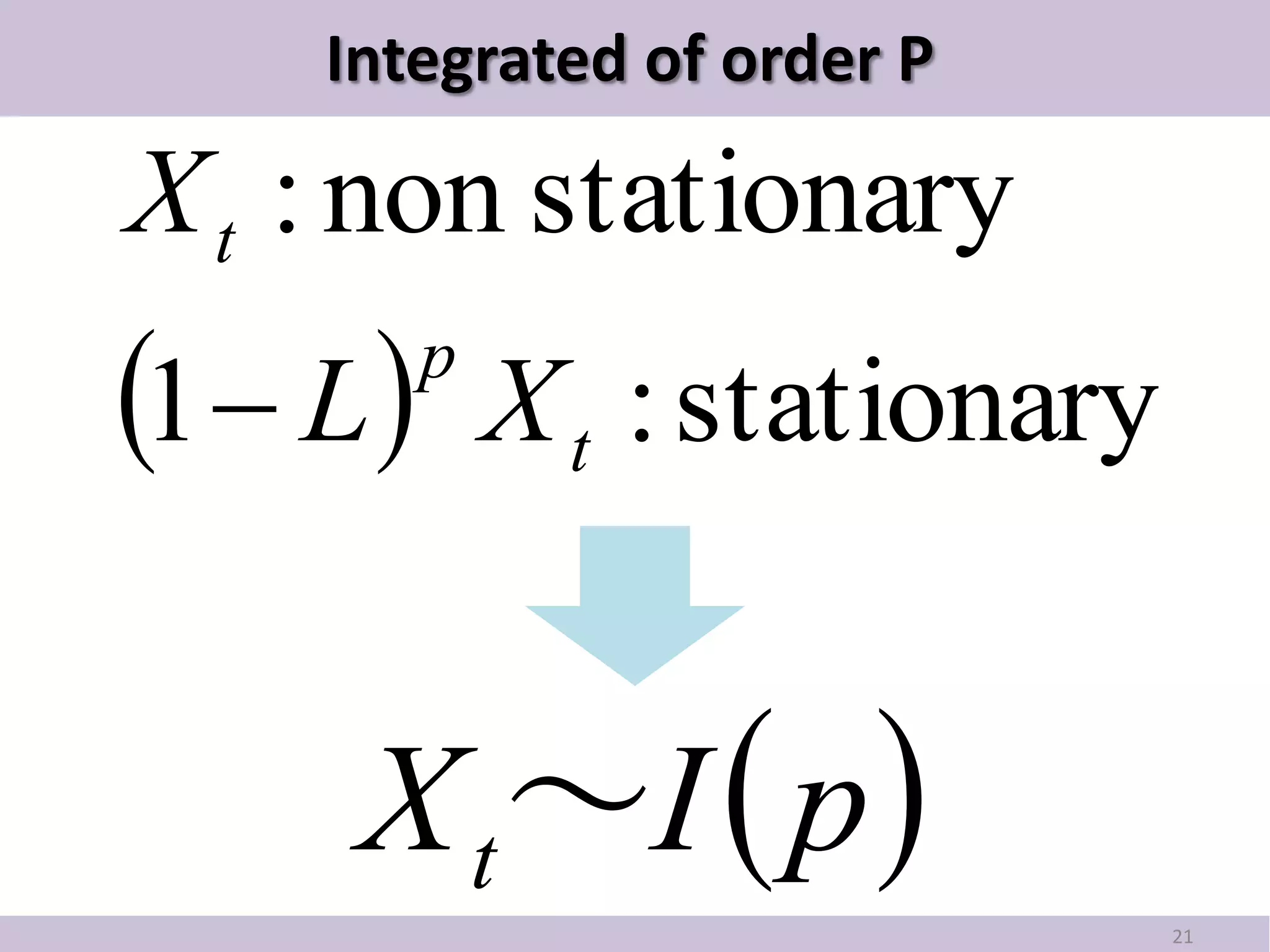
Integrated of order P

X t : non stationary
1  L    p
               X t : stationary


      X t~I  p 
                                  21
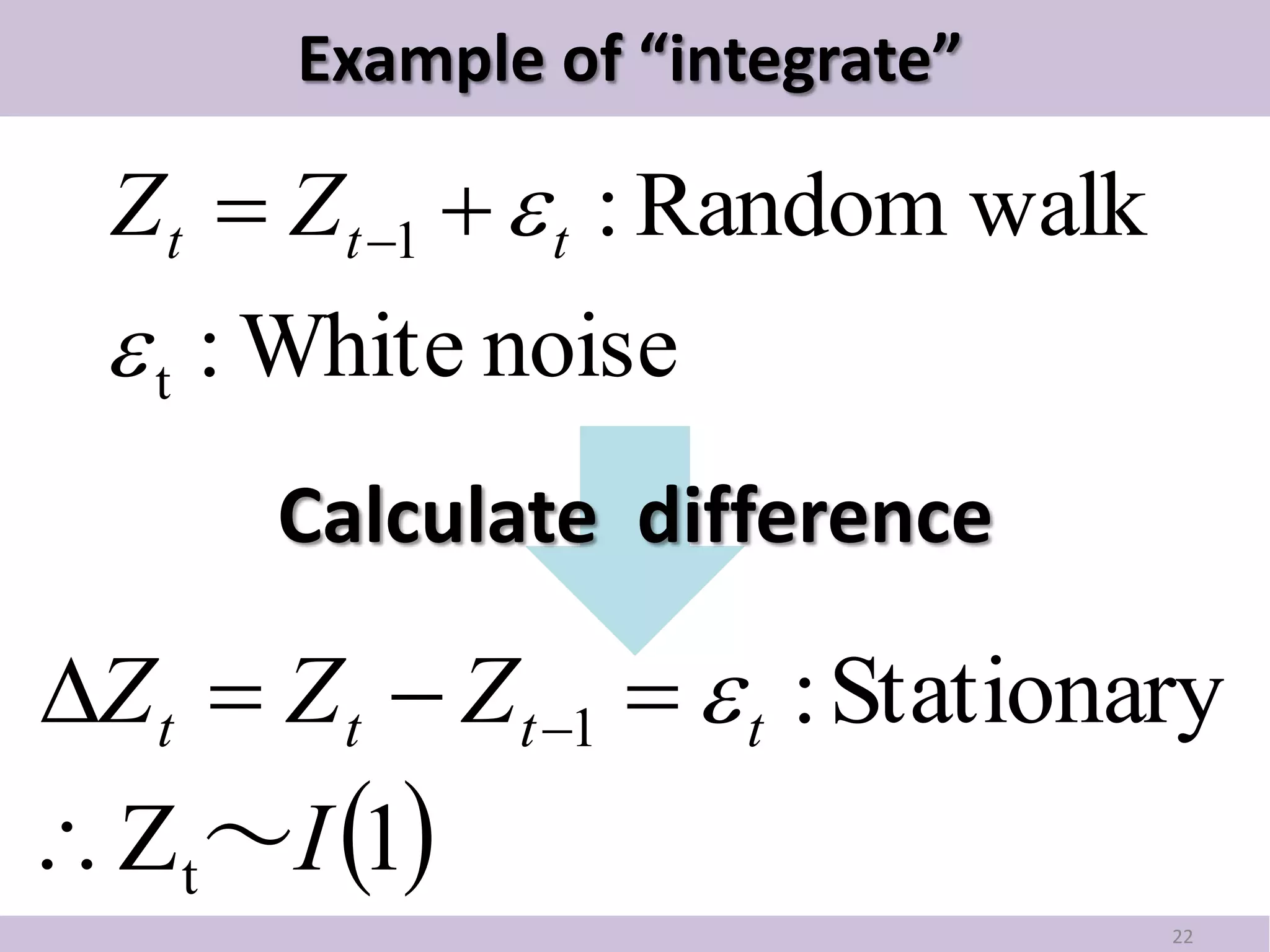
Example of “integrate”

  Z t  Z t 1   t : Random walk
   t : White noise
       Calculate difference

Z t  Z t  Z t 1   t : Stationary
 Z t~I 1
                                     22
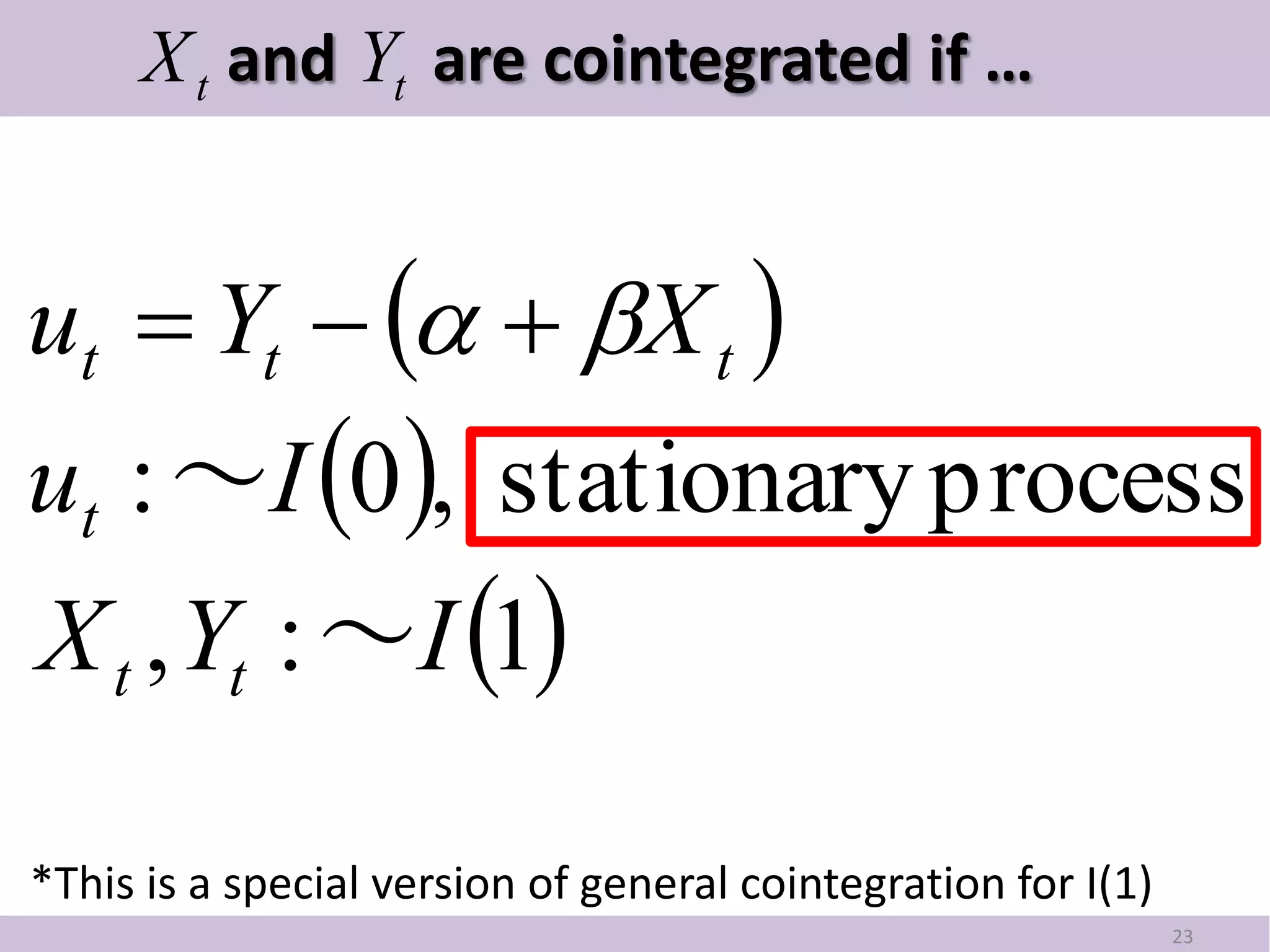
X t and Yt are cointegrated if …


ut  Yt    X t 
ut : ~I 0, stationary process
X t , Yt : ~I 1

*This is a special version of general cointegration for I(1)
                                                               23
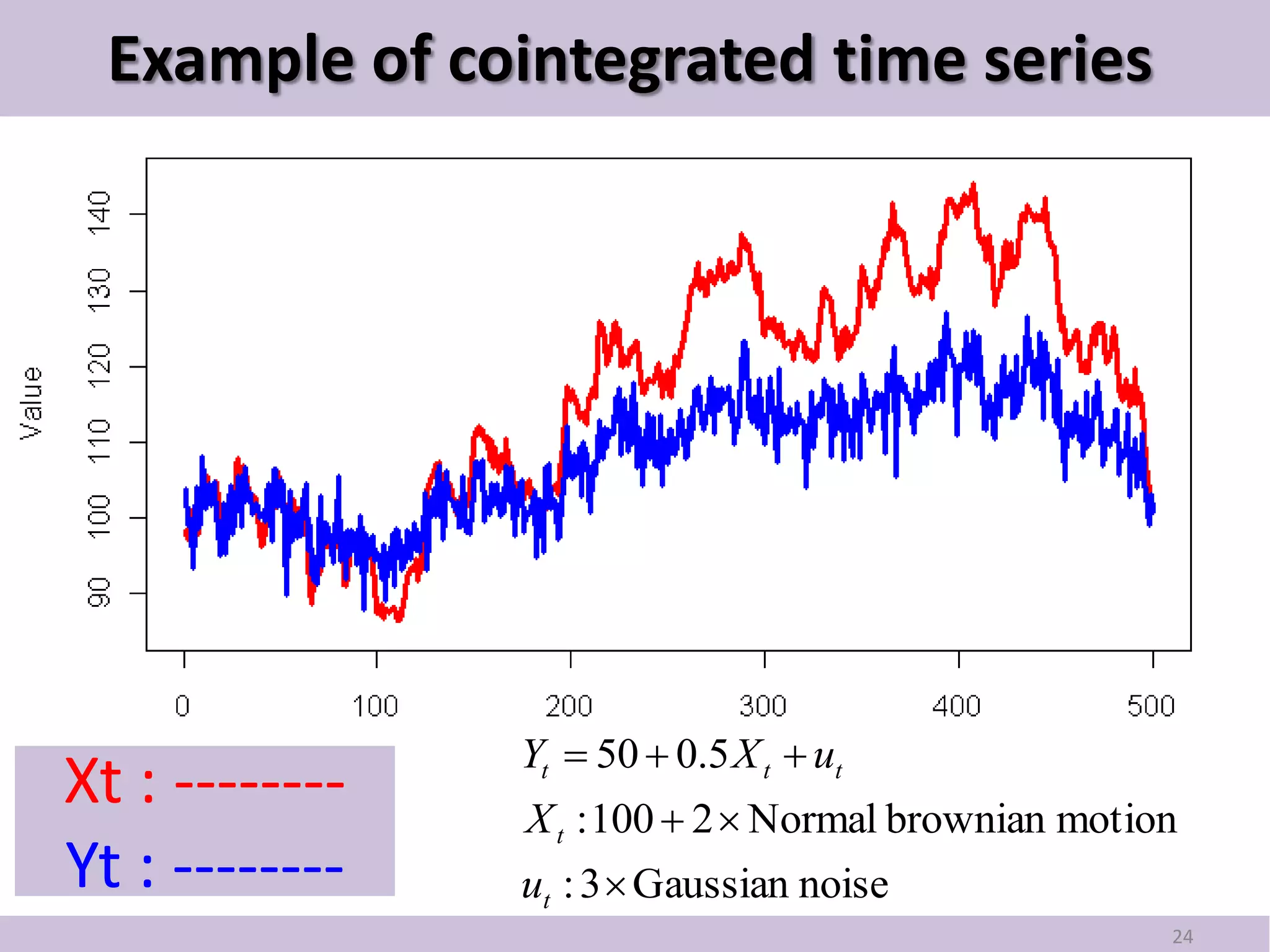
Example of cointegrated time series


                Yt  50  0.5 X t  ut
Xt : --------   X t : 100  2  Normal brownian motion
Yt : --------   ut : 3  Gaussian noise
                                                     24
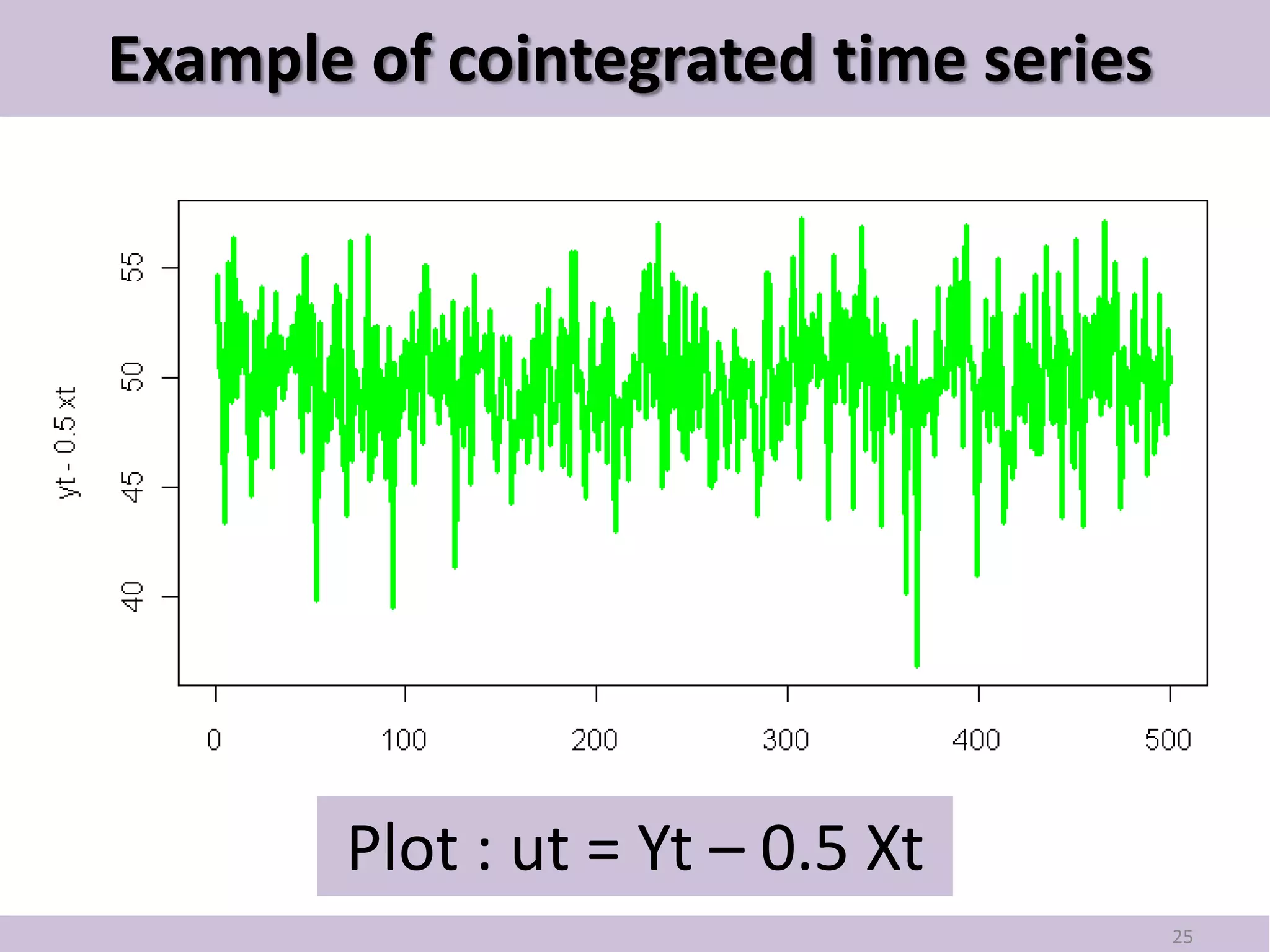
Example of cointegrated time series


       Plot : ut = Yt – 0.5 Xt
                                      25
ut seems to be…


 Stationary
      &
Mean reversion
                     26
Question


Can we apply this idea
  to trading strategy?

                     27
3. Idea of pair trading
based on cointegration


                      28
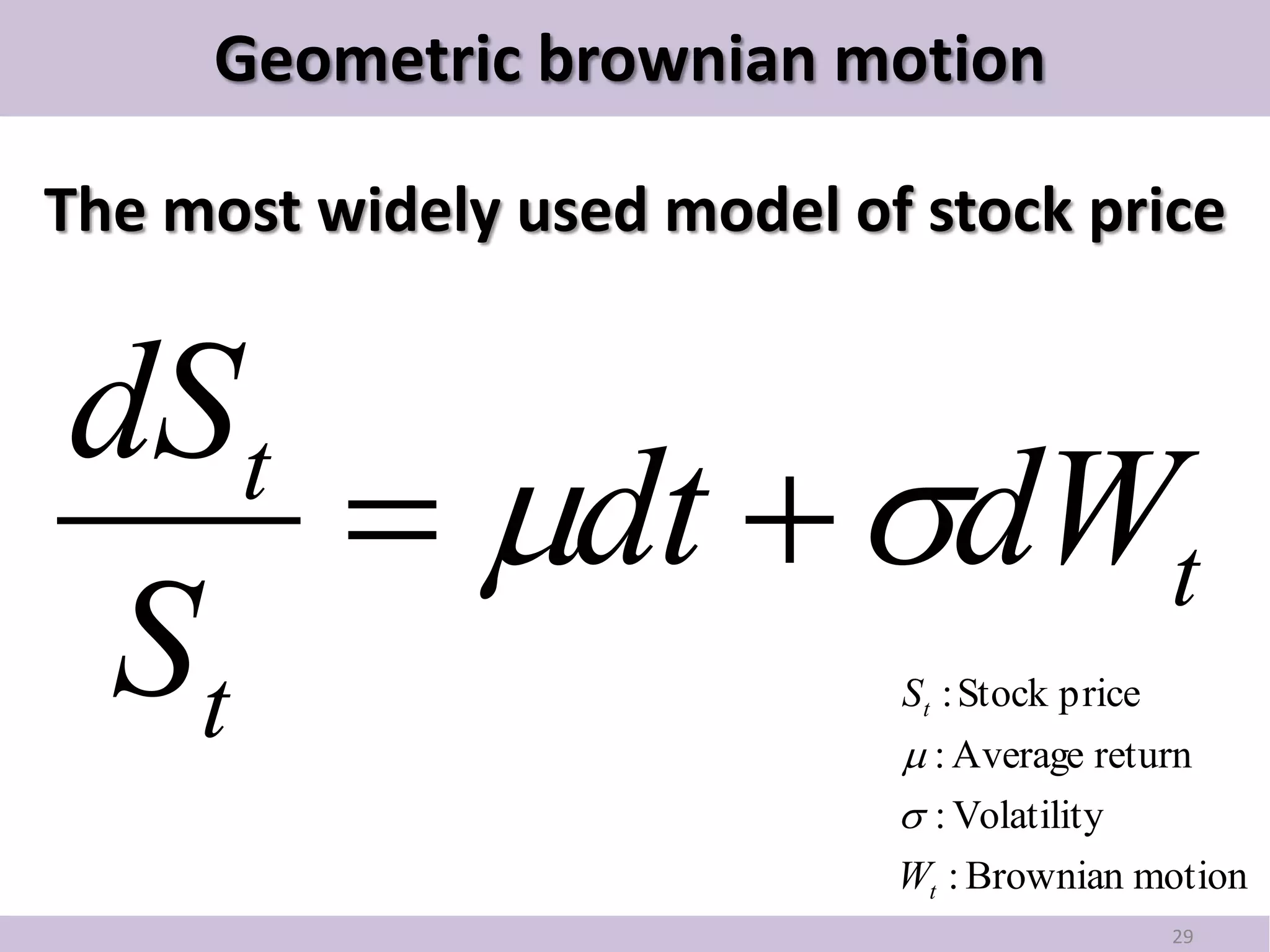
Geometric brownian motion

The most widely used model of stock price


dSt
     dt  dWt
 St                          St : Stock price
                              : Average return
                              : Volatility
                             Wt : Brownian motion
                                                29
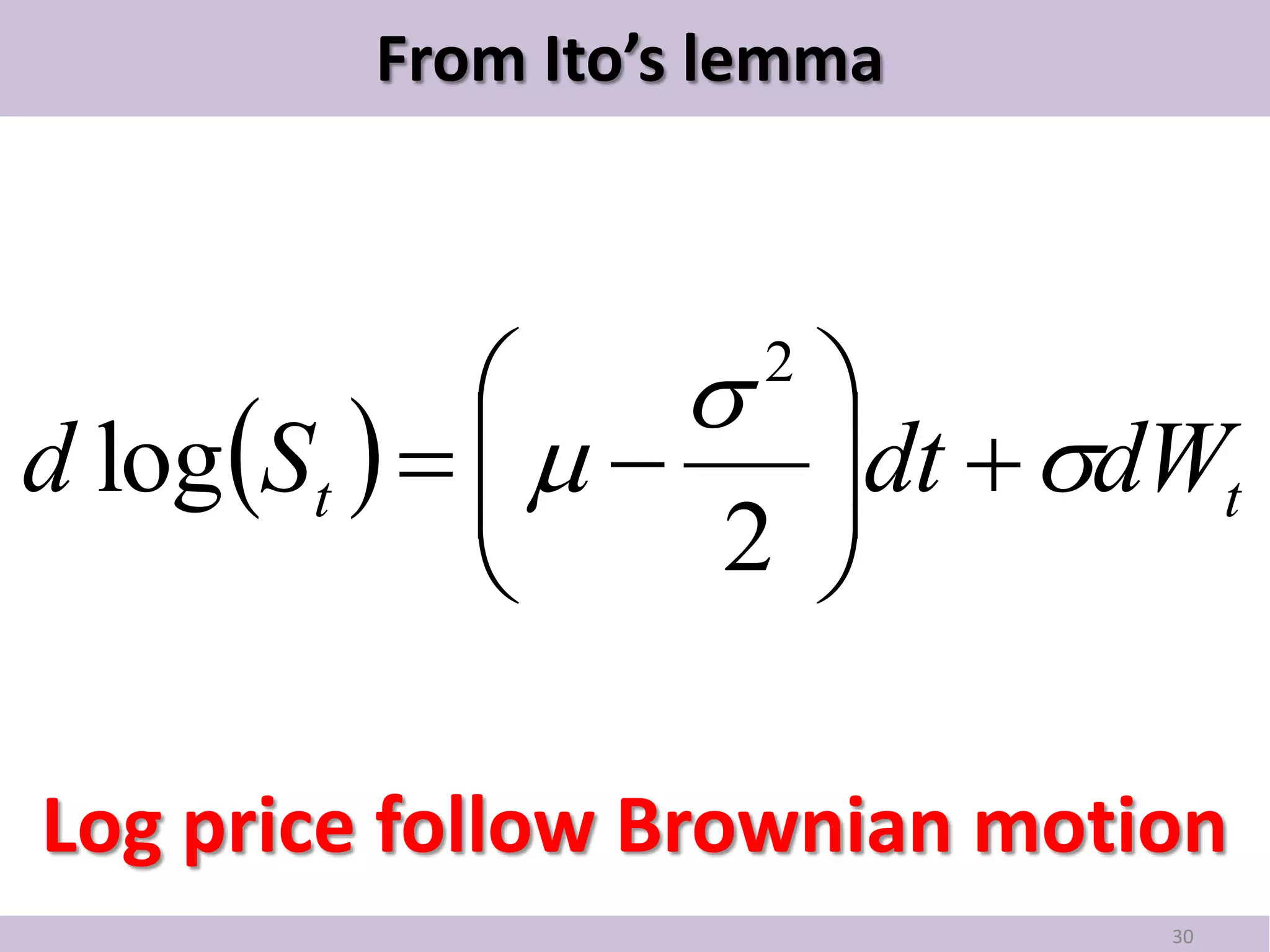
From Ito’s lemma


                    2
                          
d log St     
                         dt  dWt
                          
                    2    

Log price follow Brownian motion
                                  30
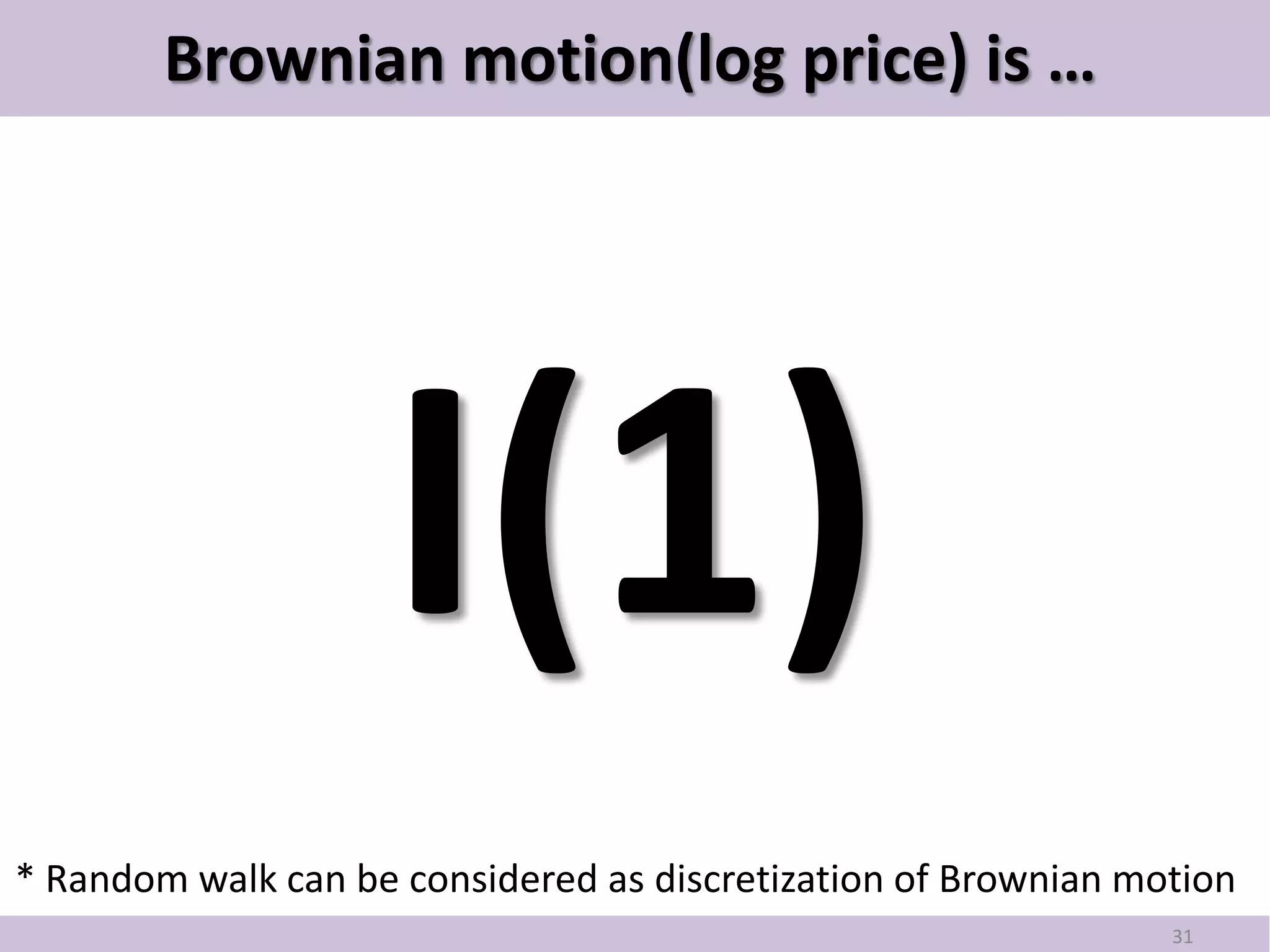
Brownian motion(log price) is …


                    I(1)
* Random walk can be considered as discretization of Brownian motion
                                                                31
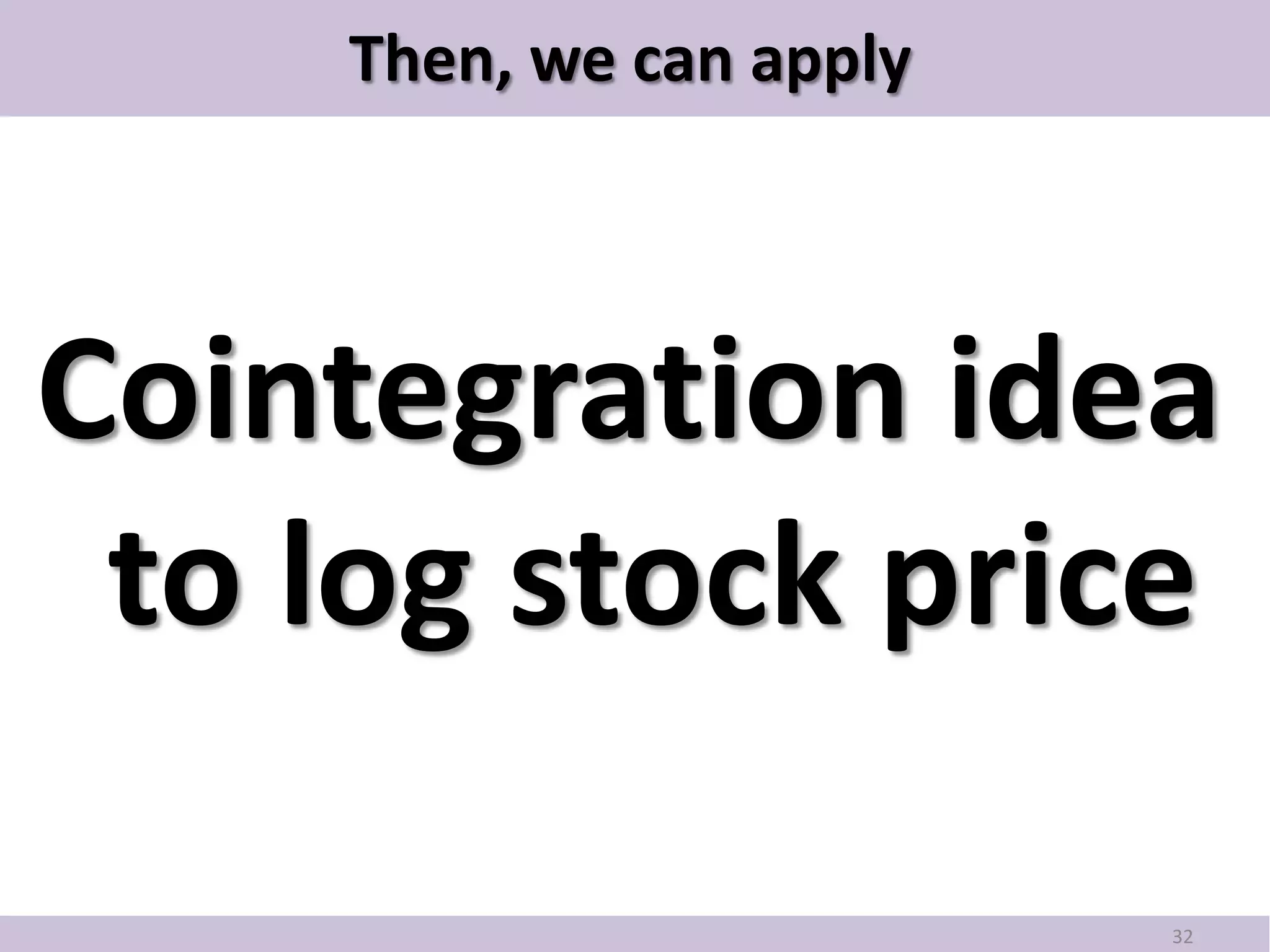
Then, we can apply


Cointegration idea
 to log stock price

                          32
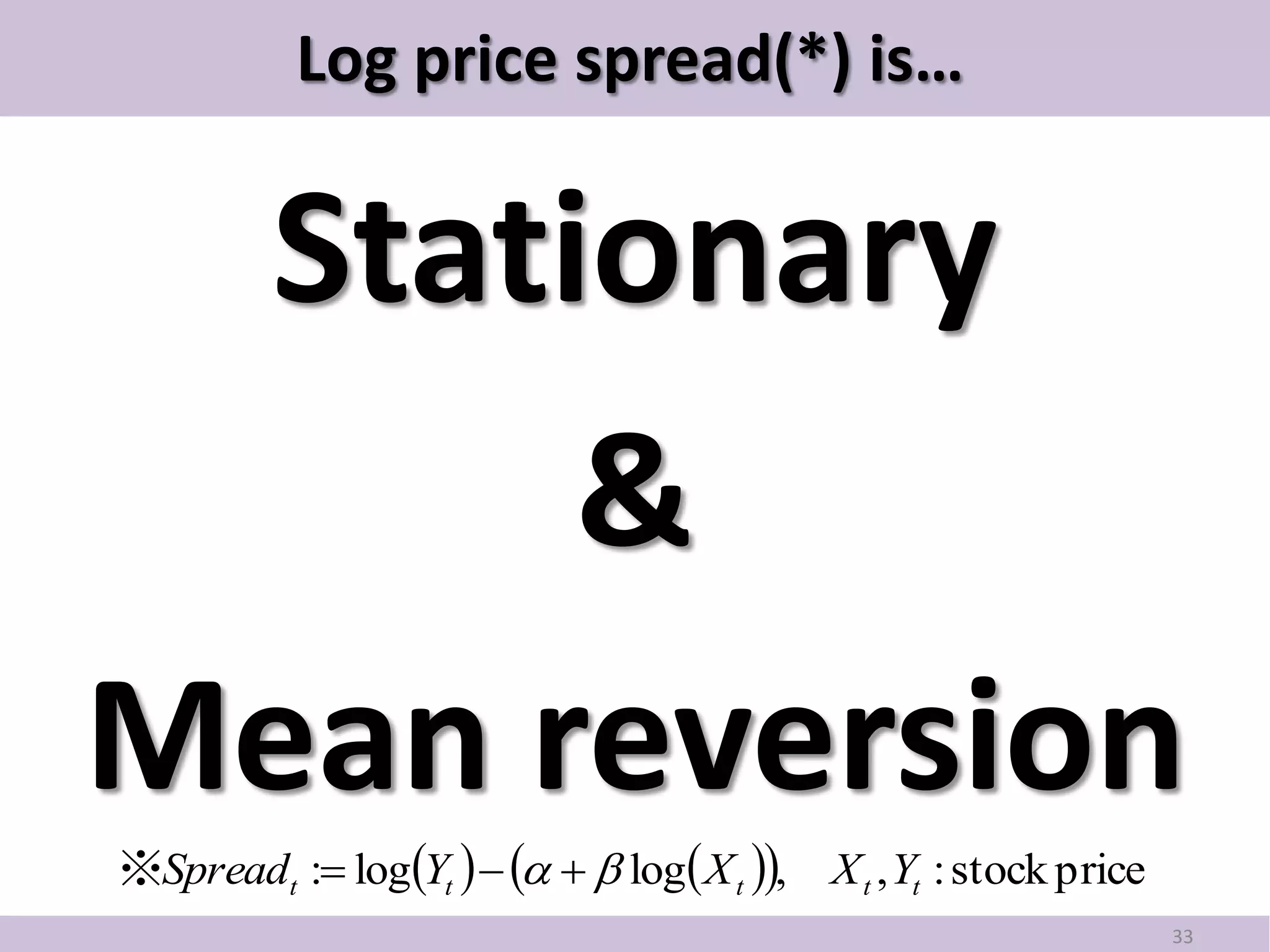
Log price spread(*) is…


 Stationary
      &
Mean reversion
※Spreadt : logYt      log X t ,   X t , Yt : stock price
                                                                      33
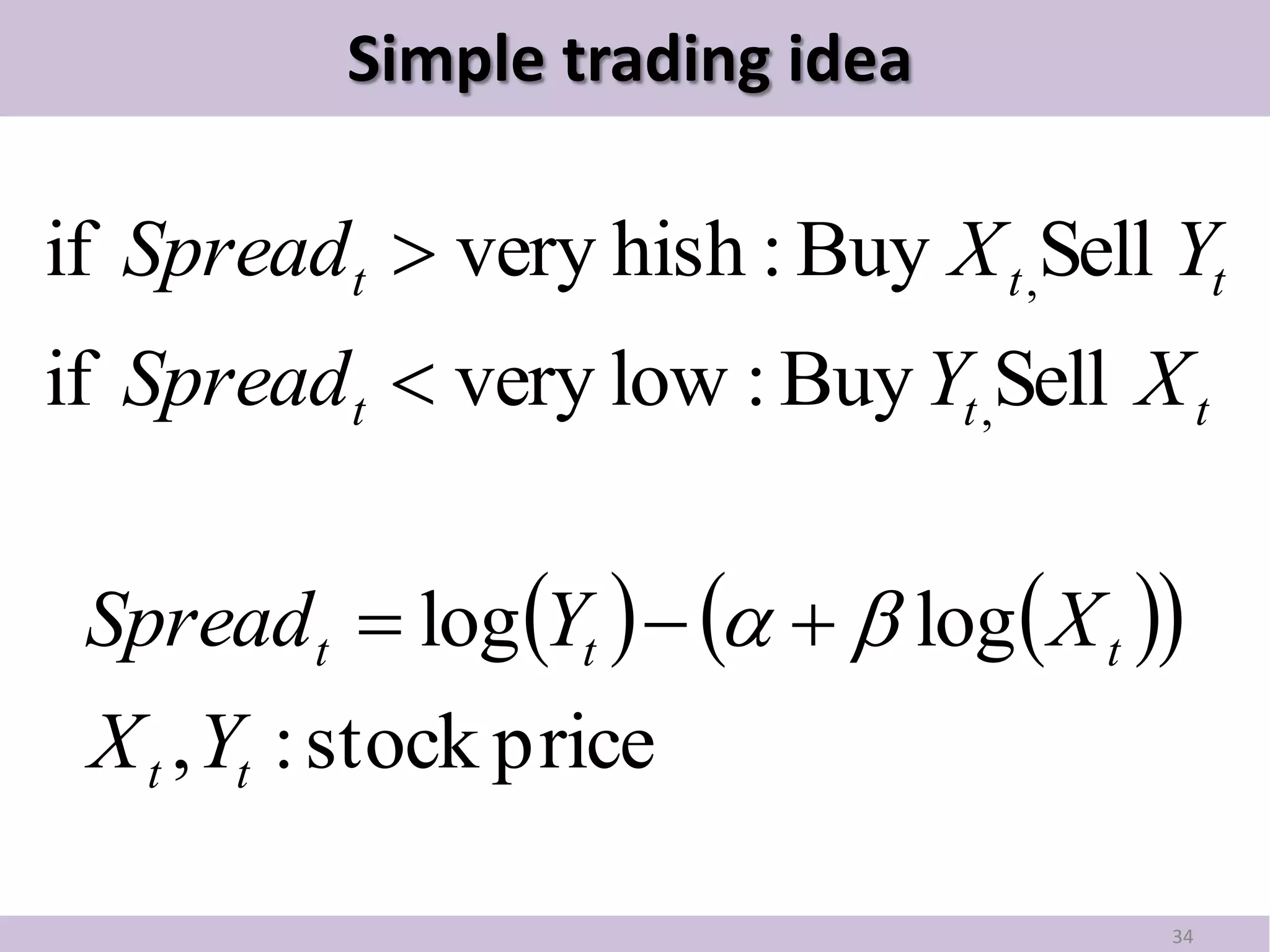
Simple trading idea

if Spread t  very hish : Buy X t ,Sell Yt
if Spread t  very low : Buy Yt ,Sell X t


 Spread t  log Yt      log  X t 
 X t , Yt : stock price

                                          34
4. Simulation by R language


                         35
Process
1.   Find two likely cointegrated stocks
2.   Estimate spreads
3.   Check stationarity
4.   Create trading signal
5.   Run back-test


                                           36
1.Find two likely cointegrated stocks
> library(PairTrading)
> #load sample stock price data
> data(stock.price)
> #select 2 stocks
> price.pair <- stock.price[,1:2]["2008-12-31::"]
> head(price.pair)
       7201 7203
2009-01-05 333 3010
2009-01-06 341 3050
2009-01-07 374 3200
2009-01-08 361 3140

* Just load sample data in this case….
                                                    37
2. Estimate spreads
> reg <- EstimateParameters(price.pair, method = lm)
> str(reg)
List of 3
 $ spread :An ‘xts’ object from 2008-12-30 to 2011-08-05 containing:
  Data: num [1:635, 1] -0.08544 -0.0539 -0.04306 -0.00426 -0.01966 ...
 - attr(*, "dimnames")=List of 2
  ..$ : NULL
  ..$ : chr "B"
  Indexed by objects of class: [Date] TZ:
  xts Attributes:
 NULL
 $ hedge.ratio: num 0.0997
 $ premium : num 7.48
                                                                  38
2. Estimate spreads
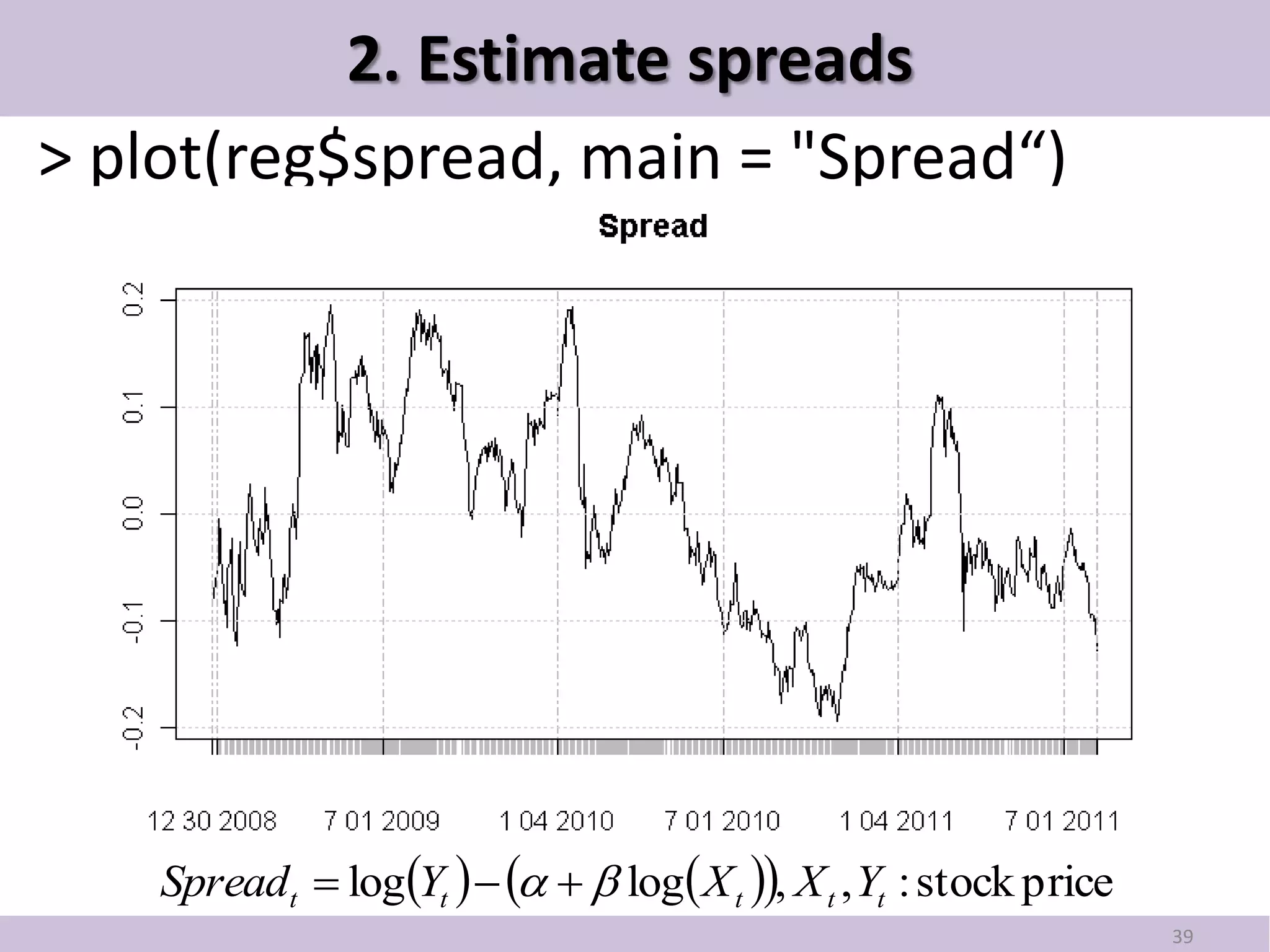
> plot(reg$spread, main = "Spread“)


    Spreadt  logYt      log X t , X t , Yt : stock price
                                                                      39
3. Check stationarity
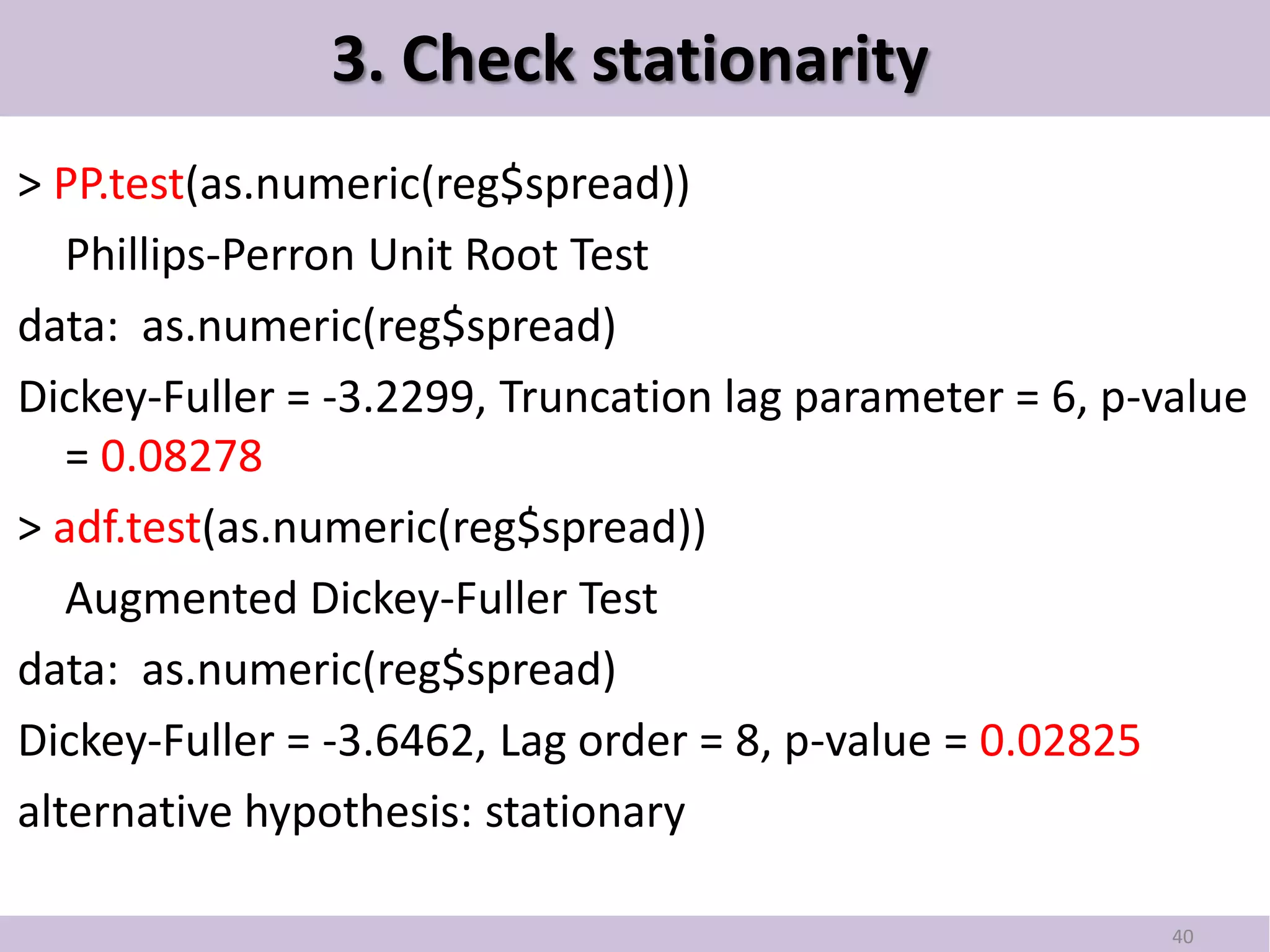
> PP.test(as.numeric(reg$spread))
   Phillips-Perron Unit Root Test
data: as.numeric(reg$spread)
Dickey-Fuller = -3.2299, Truncation lag parameter = 6, p-value
   = 0.08278
> adf.test(as.numeric(reg$spread))
   Augmented Dickey-Fuller Test
data: as.numeric(reg$spread)
Dickey-Fuller = -3.6462, Lag order = 8, p-value = 0.02825
alternative hypothesis: stationary

                                                          40
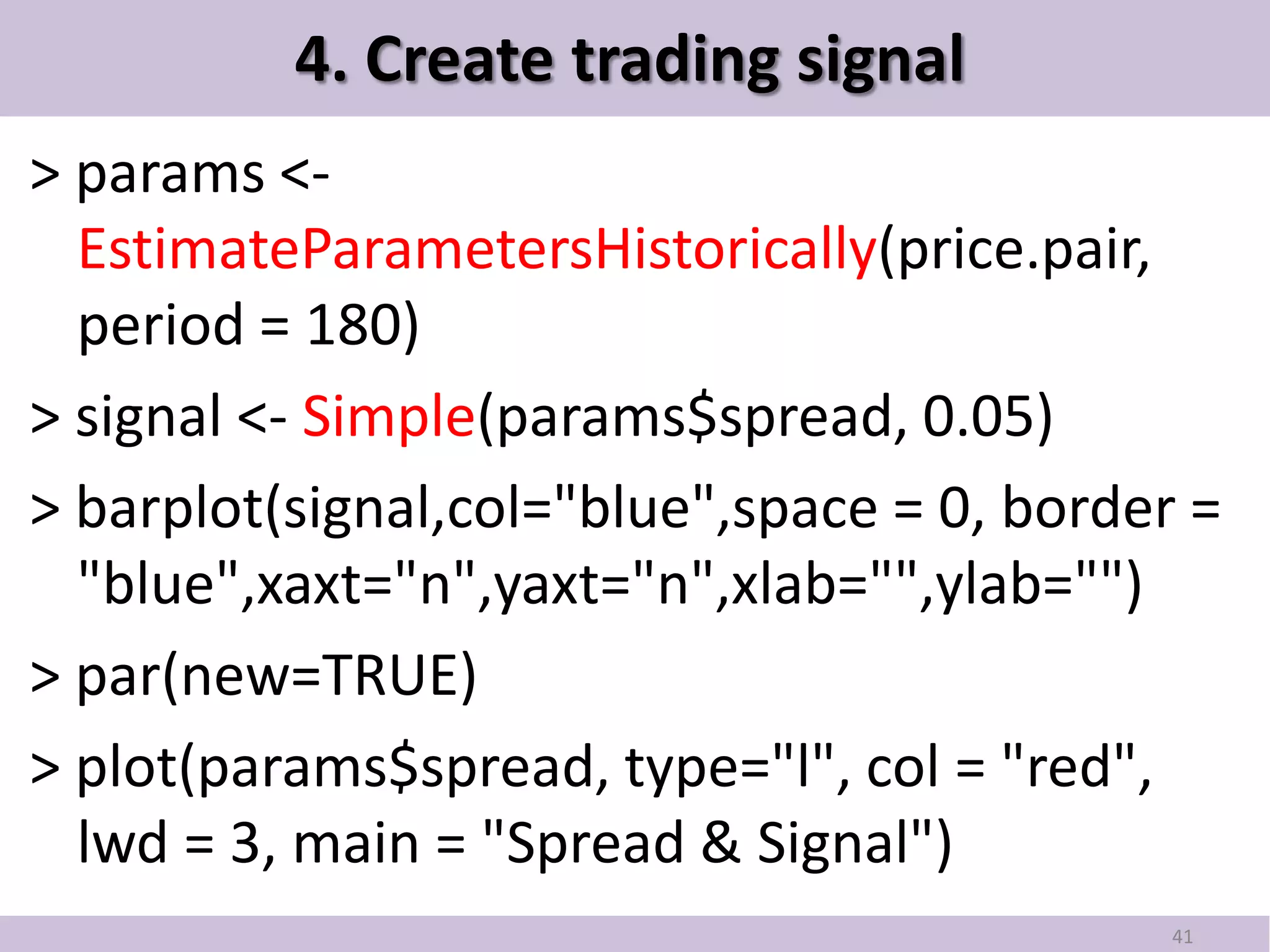
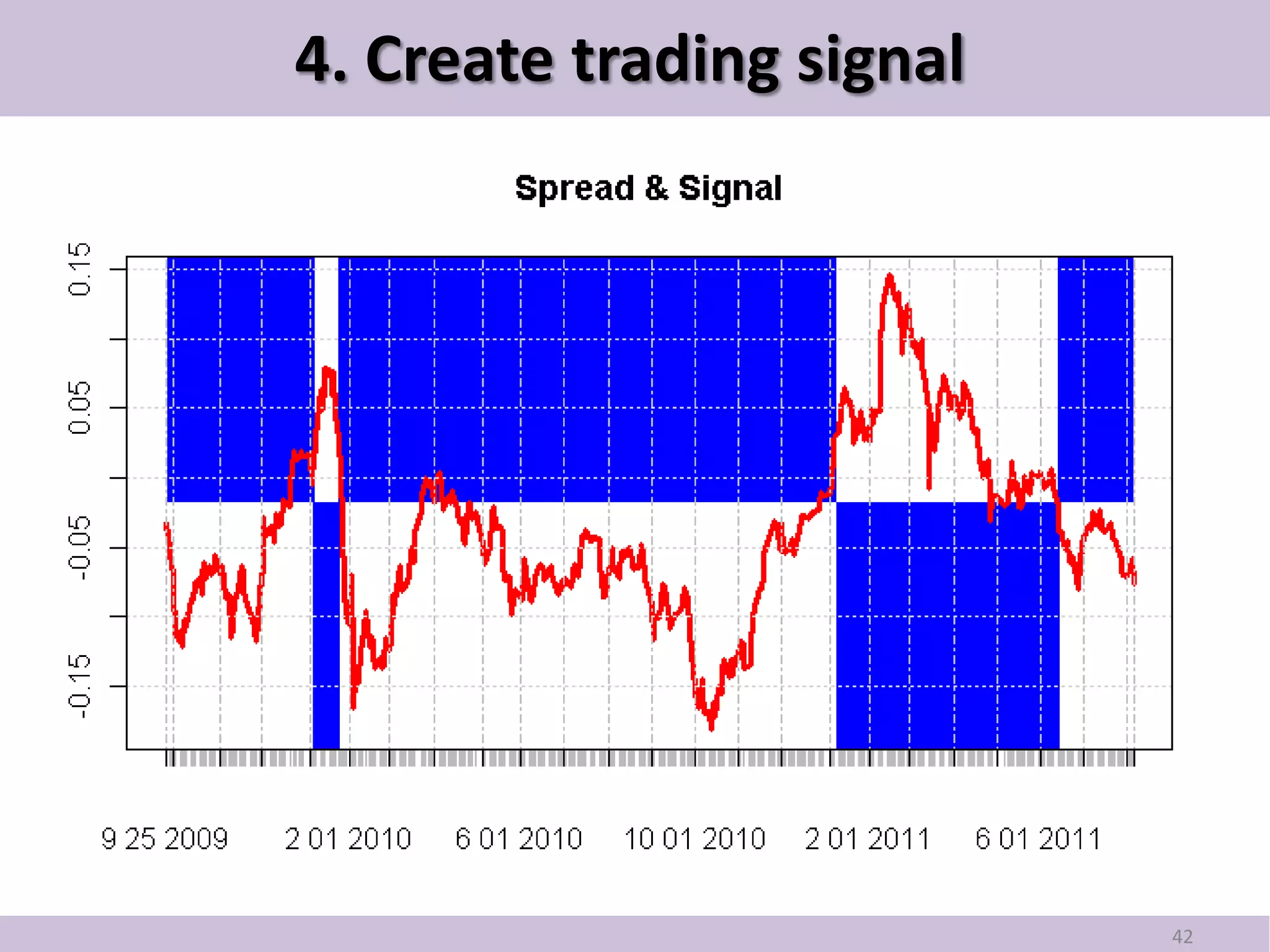
4. Create trading signal
> params <-
  EstimateParametersHistorically(price.pair,
  period = 180)
> signal <- Simple(params$spread, 0.05)
> barplot(signal,col="blue",space = 0, border =
  "blue",xaxt="n",yaxt="n",xlab="",ylab="")
> par(new=TRUE)
> plot(params$spread, type="l", col = "red",
  lwd = 3, main = "Spread & Signal")
                                             41
4. Create trading signal


                           42
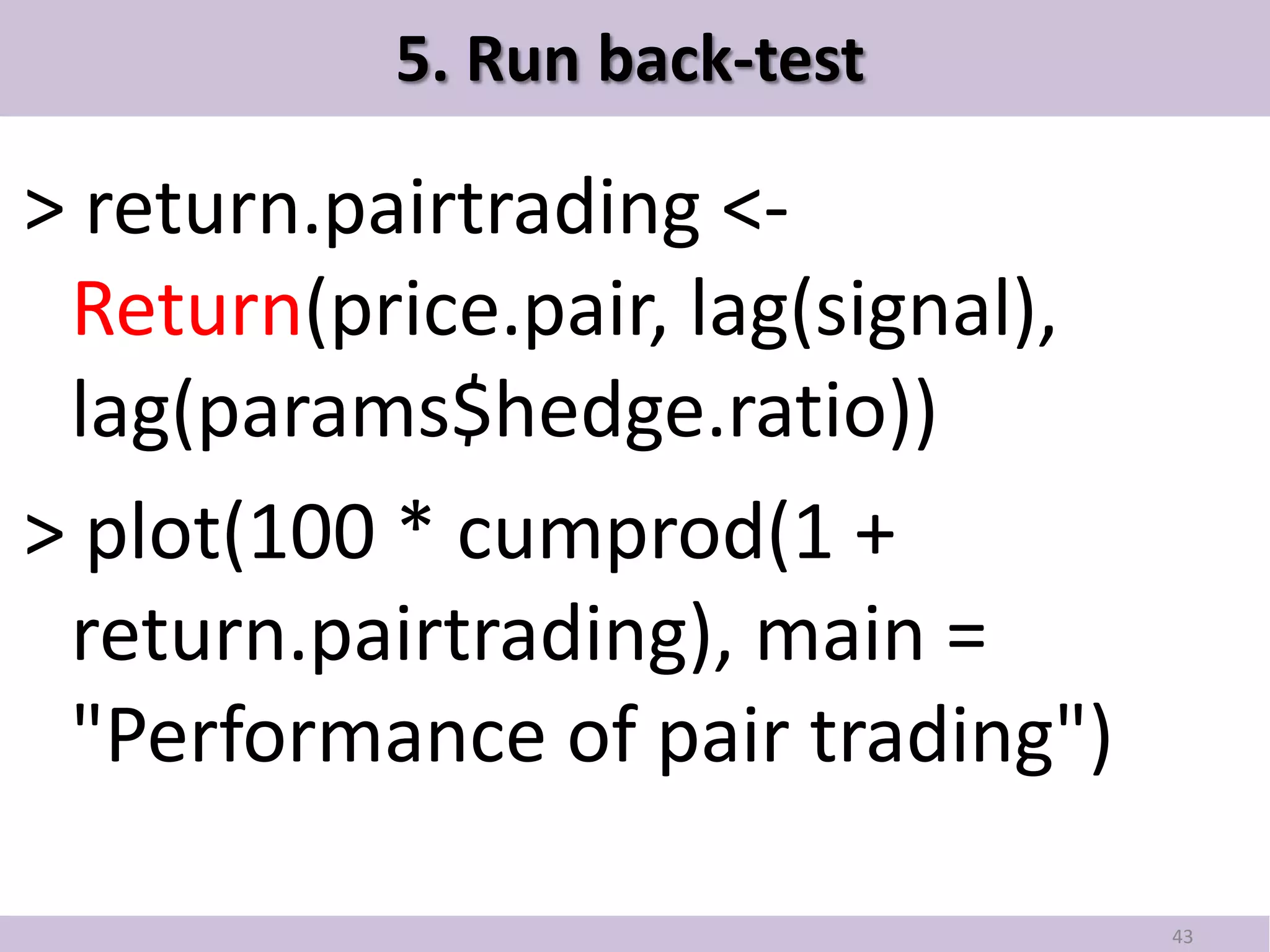
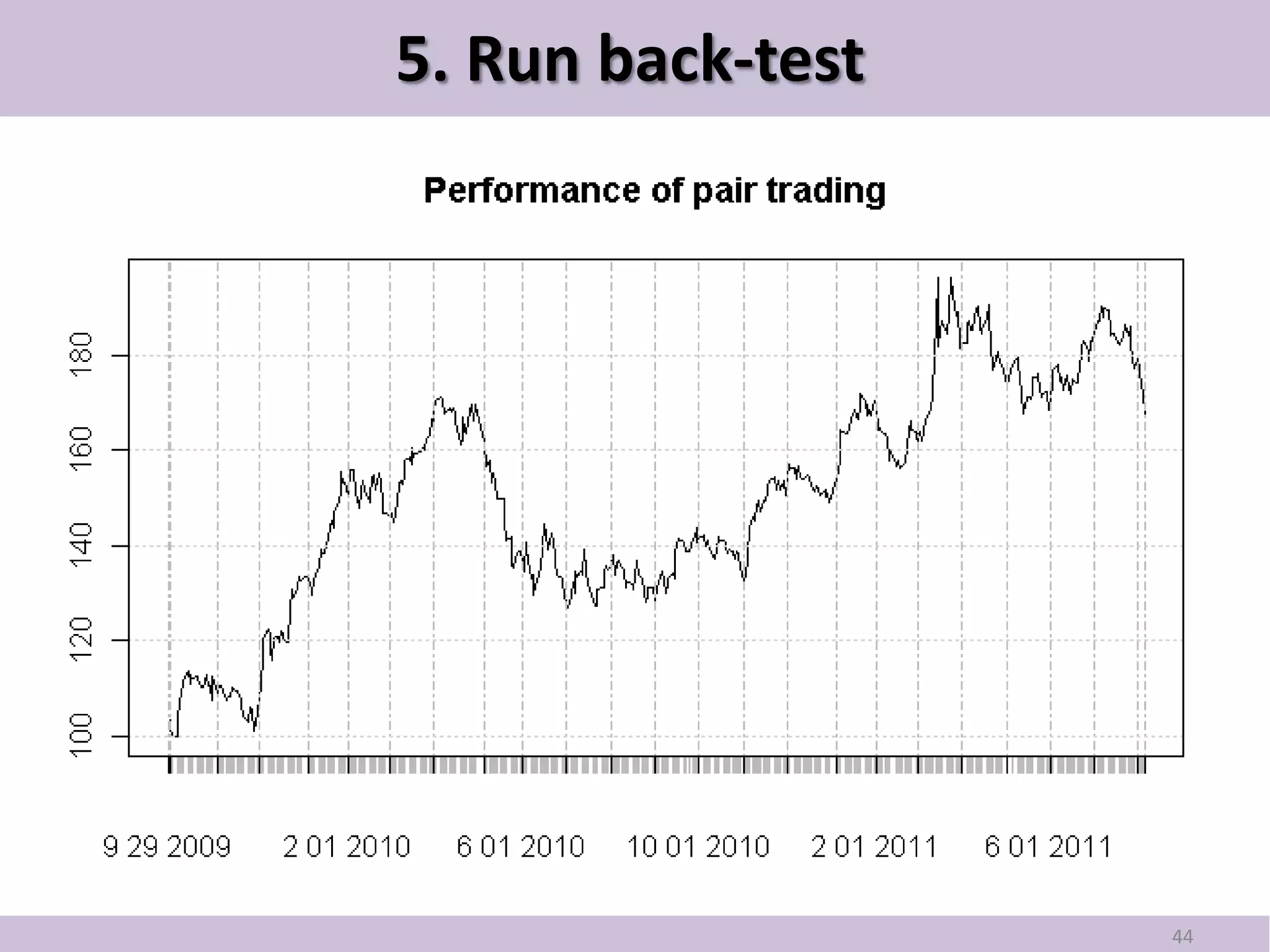
5. Run back-test

> return.pairtrading <-
 Return(price.pair, lag(signal),
 lag(params$hedge.ratio))
> plot(100 * cumprod(1 +
 return.pairtrading), main =
 "Performance of pair trading")

                                   43
5. Run back-test


                   44
5. Summary &
concluding remarks


                     45
Summary & concluding remarks
• Pair trading is simple quantitative trading strategy
• Cointegration is long term relation ship of time
  series
• Idea of cointegration may give a chance to make a
  profit from financial market by pair trading

• Next step ….
  – Sophisticate parameter estimation & trading rule
  – Make a simulation close to real

                                                       46
Reference
• Pairs trade(http://en.wikipedia.org/wiki/Pairs_trade)
• Cointegration(http://en.wikipedia.org/wiki/Cointegration)
• Andrew Neil Burgess, “A Computational Methodology for
  Modeling the Dynamics of Statistical Arbitrage”
• Russell Wojcik, “Pairs Trading: A Professional Approach”
• Daniel Herlemont, “Pairs trading, convergence trading,
  cointegration”
• Paul Teetor, “Using R to Test Pairs of Securities for
  Cointegration”(http://quanttrader.info/public/testForCoint.html)
• Ganapathy Vidyamurthy, “Pairs Trading: Quantitative Methods
  and Analysis “


                                                                47

Introduction to pairtrading

  • 1.
    Introduction to pairtrading -Based on cointegration- ・Shinichi Takayanagi ・Kohta Ishikawa 1
  • 2.
    Topics 1. What is pair trading? 2. What is cointegration? 3. Idea of pair trading based on cointegration 4. Simulation by R language 5. Summary & concluding remarks 2
  • 3.
    1. What ispair trading? 3
  • 4.
    Pair trading waspioneered by … • Gerry Bamberger and Nunzio Tartaglia • Quantitative group at Morgan Stanley • Around 1980s • D.E. Shaw & Co. is famous for this strategy 4
  • 5.
    Pair trading is… Market neutral trading strategy 5
  • 6.
    Pair trading belongsto … Statistical Arbitrage 6
  • 7.
    Basic idea ofpair trading … Select two stocks which move similarly 7
  • 8.
    Basic idea ofpair trading … Sell high priced stock Buy low priced stock 8
  • 9.
    Basic idea ofpair trading … Stock A : -------- Stock B : -------- Sell Sell Stock B Stock A Buy Stock A Buy Stock B 9
  • 10.
    Basic idea ofpair trading … Usually, monitor the difference between two stock prices 10
  • 11.
    Basic idea ofpair trading … the difference between two stock prices Sell Stock A Sell Stock B Buy Stock B Buy Stock A 11
  • 12.
    2. What iscointegration? 12
  • 13.
    Cointegration is … •Pioneered by Engle and Granger • Statistical property of time series • Around 1990s 13
  • 14.
  • 15.
    Cointegration and correlation •Correlation –Specify co-movement of return –Short term relationship •Cointegration –Specify co-movement of price –Long term relationship 15
  • 16.
    (weak) Stationary timeseries Not depend on time ・E  X t    ・ X t    var 2 ・  X t , X t  s    s  cov 16
  • 17.
    Example of stationarytime series White noise ・E  t   0 ・  t    var 2 ・  t ,  s   0, t  s cov 17
  • 18.
    Non stationary timeseries Depend on time ・E  X t   t ・ X t    t 2 var ・  X t , X t  s    t , s  cov 18
  • 19.
    Example of nonstationary time series Brownian motion ・E Wt   0 ・ Wt   t var ・ Wt ,Wt  s   t  s cov 19
  • 20.
    Lag operator L ・LX t  X t 1 ・1  L X t  X t  X t 1  X t  20
  • 21.
    Integrated of orderP X t : non stationary 1  L  p X t : stationary X t~I  p  21
  • 22.
    Example of “integrate” Z t  Z t 1   t : Random walk  t : White noise Calculate difference Z t  Z t  Z t 1   t : Stationary  Z t~I 1 22
  • 23.
    X t andYt are cointegrated if … ut  Yt    X t  ut : ~I 0, stationary process X t , Yt : ~I 1 *This is a special version of general cointegration for I(1) 23
  • 24.
    Example of cointegratedtime series Yt  50  0.5 X t  ut Xt : -------- X t : 100  2  Normal brownian motion Yt : -------- ut : 3  Gaussian noise 24
  • 25.
    Example of cointegratedtime series Plot : ut = Yt – 0.5 Xt 25
  • 26.
    ut seems tobe… Stationary & Mean reversion 26
  • 27.
    Question Can we applythis idea to trading strategy? 27
  • 28.
    3. Idea ofpair trading based on cointegration 28
  • 29.
    Geometric brownian motion Themost widely used model of stock price dSt  dt  dWt St St : Stock price  : Average return  : Volatility Wt : Brownian motion 29
  • 30.
    From Ito’s lemma   2  d log St       dt  dWt   2  Log price follow Brownian motion 30
  • 31.
    Brownian motion(log price)is … I(1) * Random walk can be considered as discretization of Brownian motion 31
  • 32.
    Then, we canapply Cointegration idea to log stock price 32
  • 33.
    Log price spread(*)is… Stationary & Mean reversion ※Spreadt : logYt      log X t , X t , Yt : stock price 33
  • 34.
    Simple trading idea ifSpread t  very hish : Buy X t ,Sell Yt if Spread t  very low : Buy Yt ,Sell X t Spread t  log Yt      log  X t  X t , Yt : stock price 34
  • 35.
    4. Simulation byR language 35
  • 36.
    Process 1. Find two likely cointegrated stocks 2. Estimate spreads 3. Check stationarity 4. Create trading signal 5. Run back-test 36
  • 37.
    1.Find two likelycointegrated stocks > library(PairTrading) > #load sample stock price data > data(stock.price) > #select 2 stocks > price.pair <- stock.price[,1:2]["2008-12-31::"] > head(price.pair) 7201 7203 2009-01-05 333 3010 2009-01-06 341 3050 2009-01-07 374 3200 2009-01-08 361 3140 * Just load sample data in this case…. 37
  • 38.
    2. Estimate spreads >reg <- EstimateParameters(price.pair, method = lm) > str(reg) List of 3 $ spread :An ‘xts’ object from 2008-12-30 to 2011-08-05 containing: Data: num [1:635, 1] -0.08544 -0.0539 -0.04306 -0.00426 -0.01966 ... - attr(*, "dimnames")=List of 2 ..$ : NULL ..$ : chr "B" Indexed by objects of class: [Date] TZ: xts Attributes: NULL $ hedge.ratio: num 0.0997 $ premium : num 7.48 38
  • 39.
    2. Estimate spreads >plot(reg$spread, main = "Spread“) Spreadt  logYt      log X t , X t , Yt : stock price 39
  • 40.
    3. Check stationarity >PP.test(as.numeric(reg$spread)) Phillips-Perron Unit Root Test data: as.numeric(reg$spread) Dickey-Fuller = -3.2299, Truncation lag parameter = 6, p-value = 0.08278 > adf.test(as.numeric(reg$spread)) Augmented Dickey-Fuller Test data: as.numeric(reg$spread) Dickey-Fuller = -3.6462, Lag order = 8, p-value = 0.02825 alternative hypothesis: stationary 40
  • 41.
    4. Create tradingsignal > params <- EstimateParametersHistorically(price.pair, period = 180) > signal <- Simple(params$spread, 0.05) > barplot(signal,col="blue",space = 0, border = "blue",xaxt="n",yaxt="n",xlab="",ylab="") > par(new=TRUE) > plot(params$spread, type="l", col = "red", lwd = 3, main = "Spread & Signal") 41
  • 42.
  • 43.
    5. Run back-test >return.pairtrading <- Return(price.pair, lag(signal), lag(params$hedge.ratio)) > plot(100 * cumprod(1 + return.pairtrading), main = "Performance of pair trading") 43
  • 44.
  • 45.
  • 46.
    Summary & concludingremarks • Pair trading is simple quantitative trading strategy • Cointegration is long term relation ship of time series • Idea of cointegration may give a chance to make a profit from financial market by pair trading • Next step …. – Sophisticate parameter estimation & trading rule – Make a simulation close to real 46
  • 47.
    Reference • Pairs trade(http://en.wikipedia.org/wiki/Pairs_trade) •Cointegration(http://en.wikipedia.org/wiki/Cointegration) • Andrew Neil Burgess, “A Computational Methodology for Modeling the Dynamics of Statistical Arbitrage” • Russell Wojcik, “Pairs Trading: A Professional Approach” • Daniel Herlemont, “Pairs trading, convergence trading, cointegration” • Paul Teetor, “Using R to Test Pairs of Securities for Cointegration”(http://quanttrader.info/public/testForCoint.html) • Ganapathy Vidyamurthy, “Pairs Trading: Quantitative Methods and Analysis “ 47