Graphs, Edges &
    Nodes
  Untangling the social web.
What’s a graph?
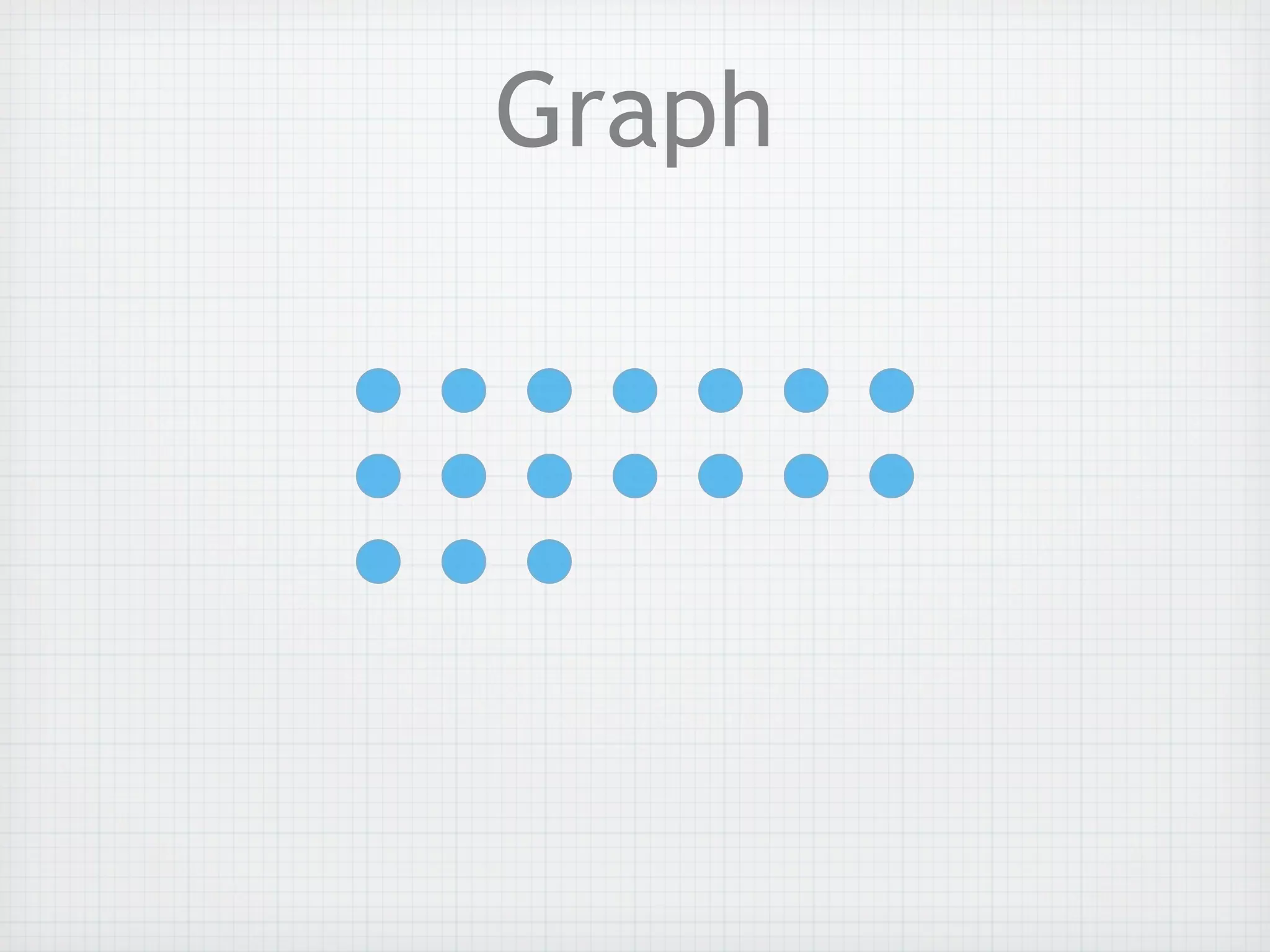
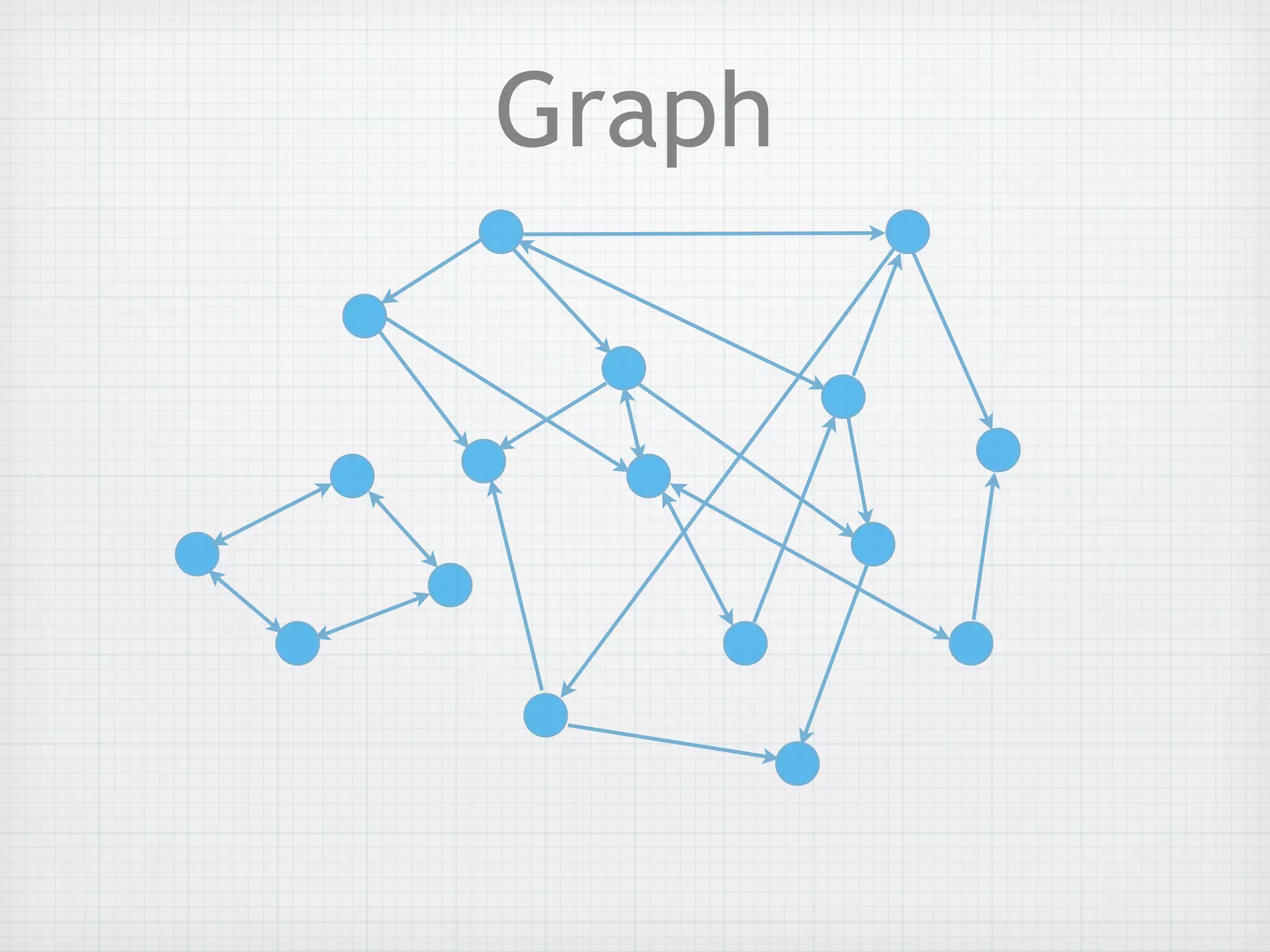
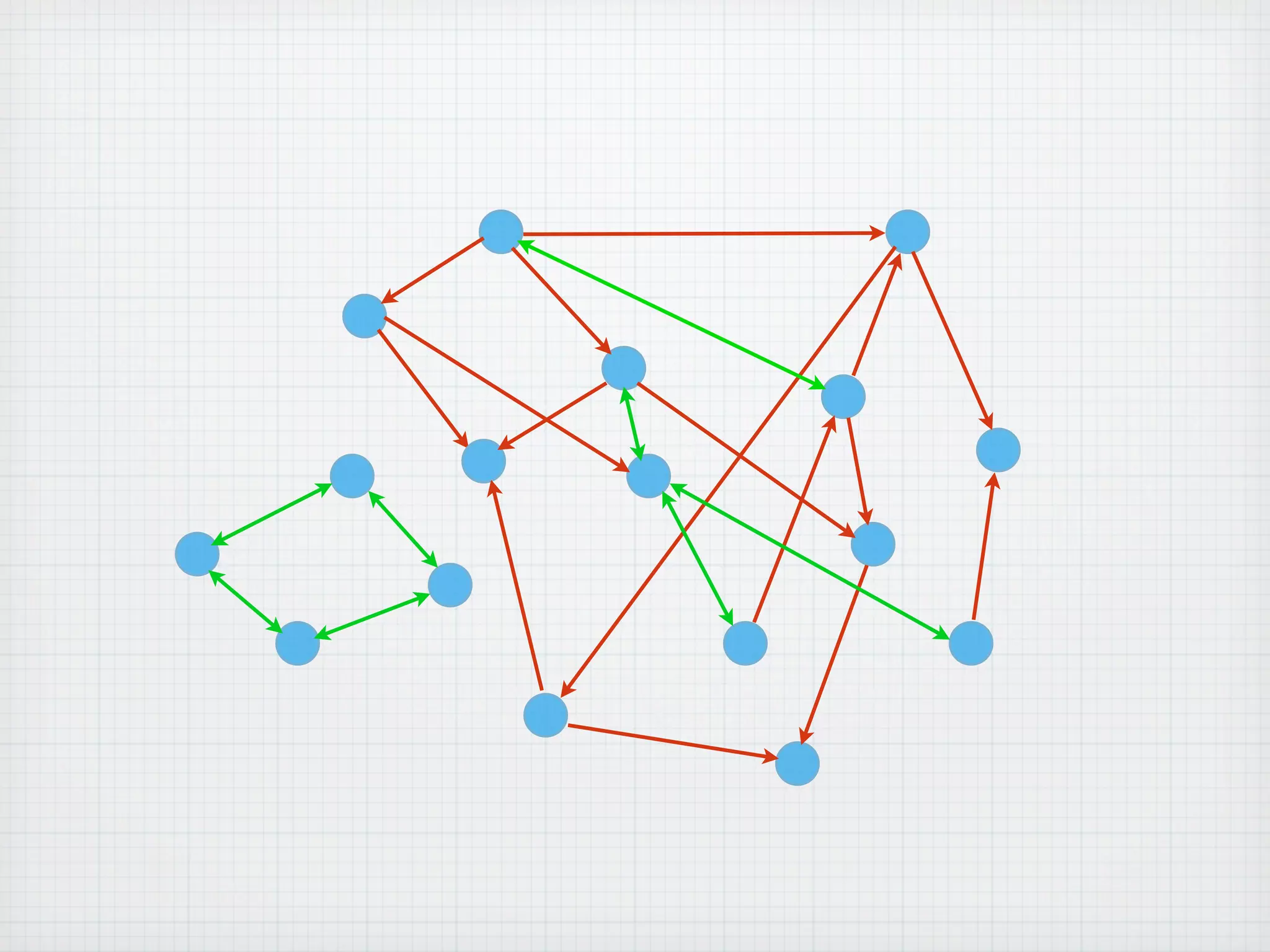
Graph
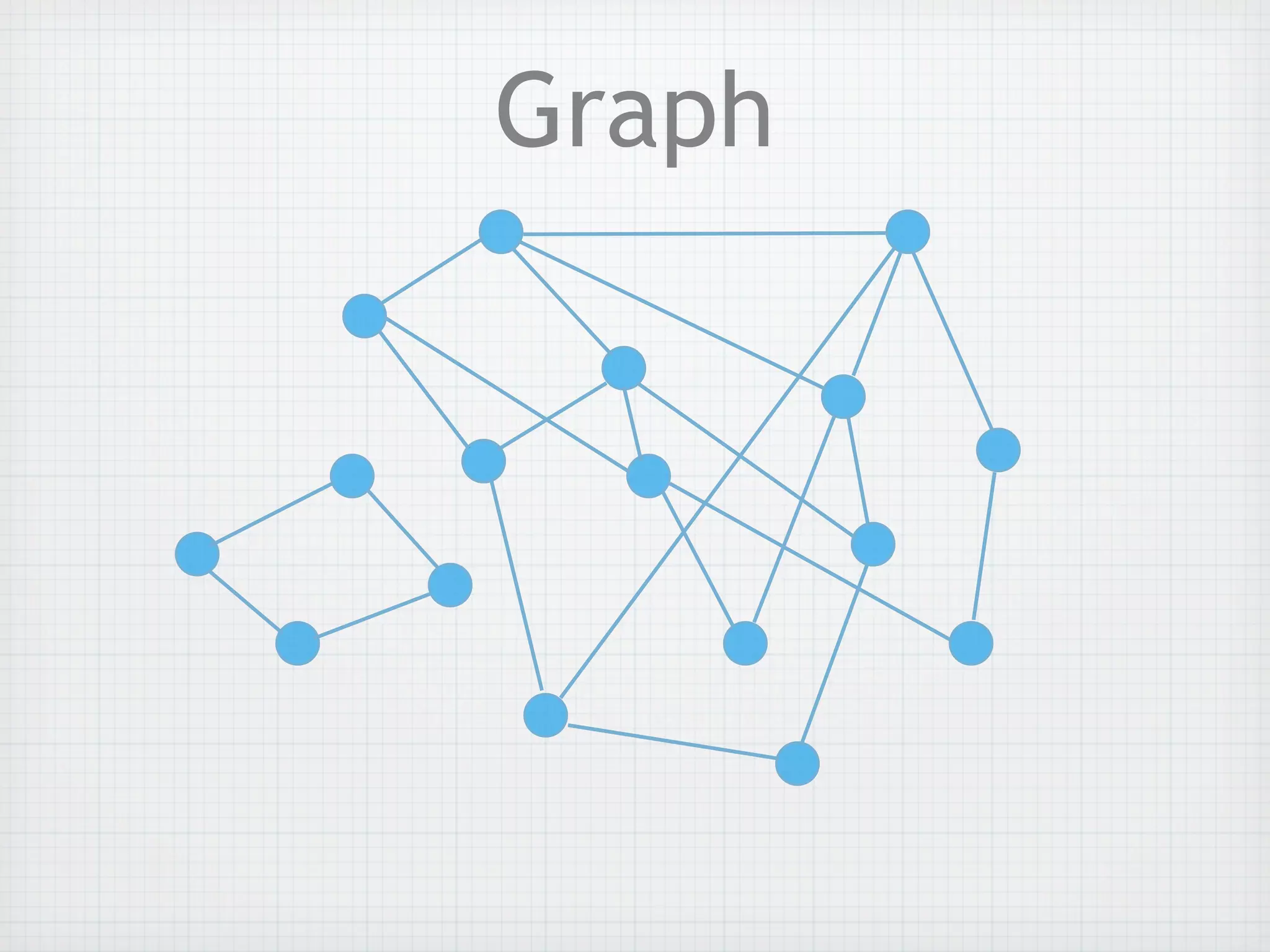
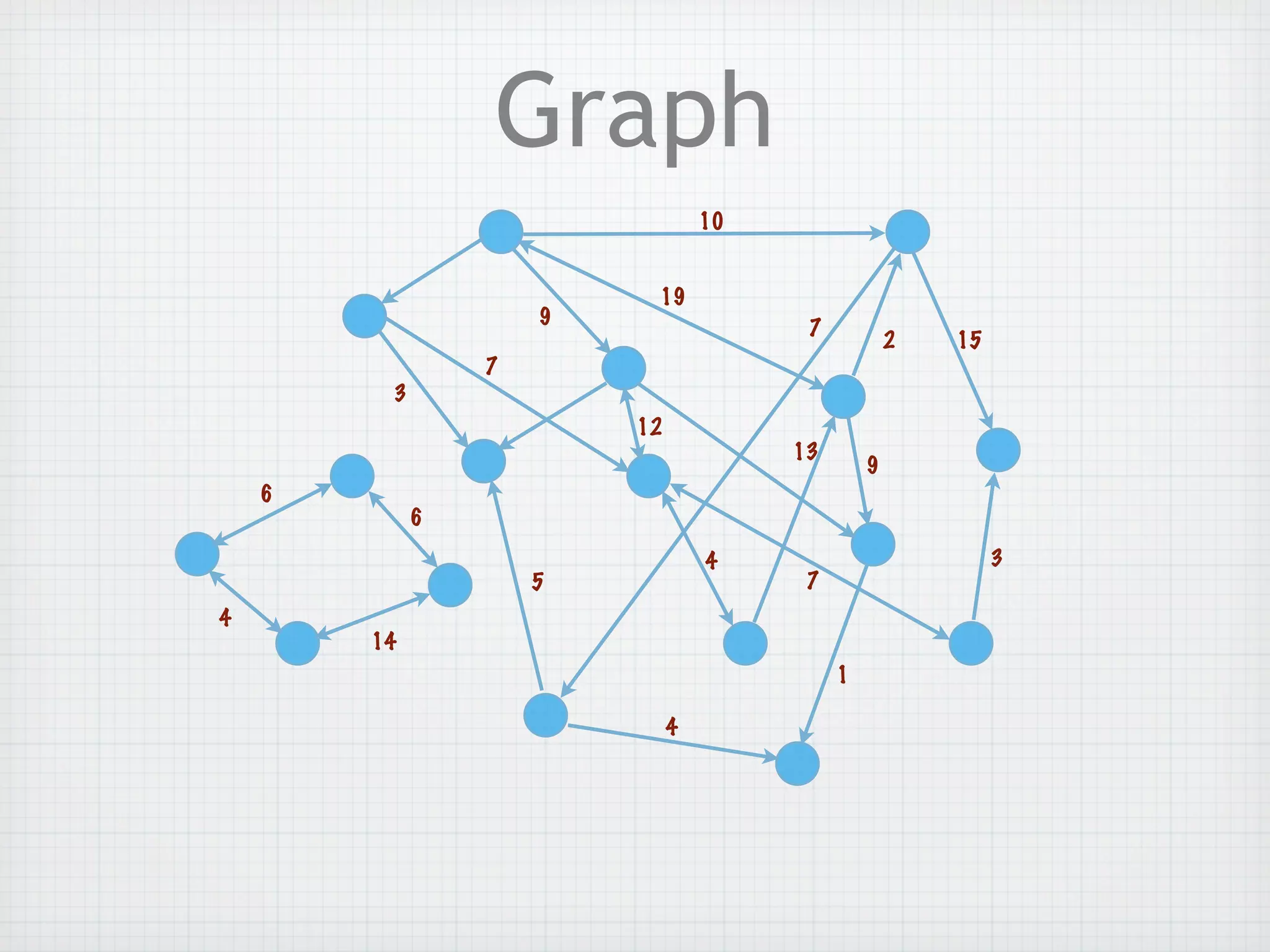
Graph
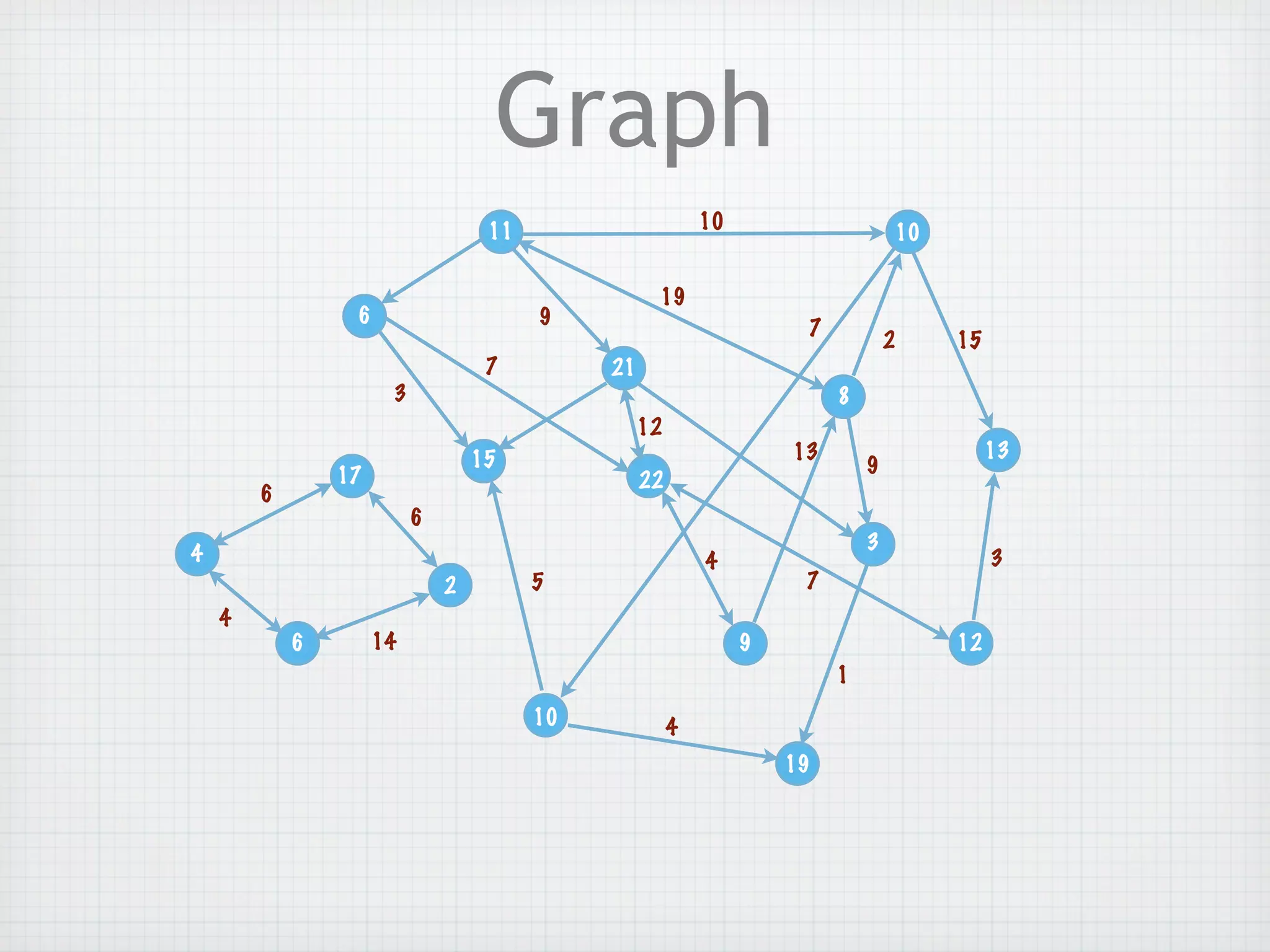
Graph
Graph
                                  10


                          19
                     9                  7
                                                    2   15
                 7
         3
                         12
                                       13
                                                9
    6
             6
                                  4                          3
                     5                  7
4
        14
                                            1

                              4
Graph
                                   11                      10                    10

                                                   19
                 6                      9                            7
                                                                                 2    15
                                   7         21
                      3                                                  8
                                                  12
                                  15                                13                     13
                17                                                           9
                                                  22
        6
                          6
                                                                             3
4                                                          4                               3
                              2         5                            7
    4
            6        14                                         9                     12
                                                                         1
                                        10             4
                                                                    19
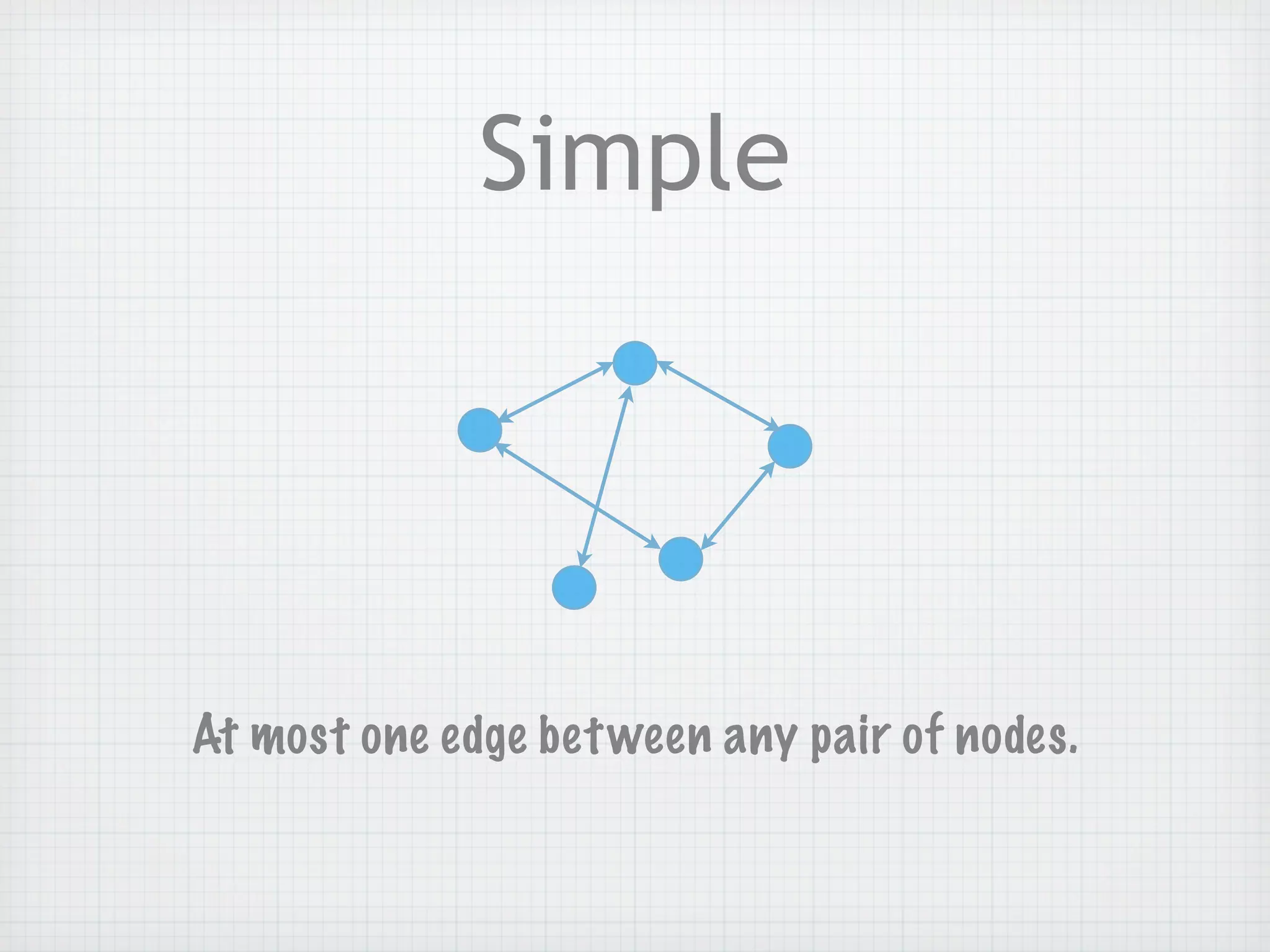
Simple


At most one edge bet ween any pair of nodes.
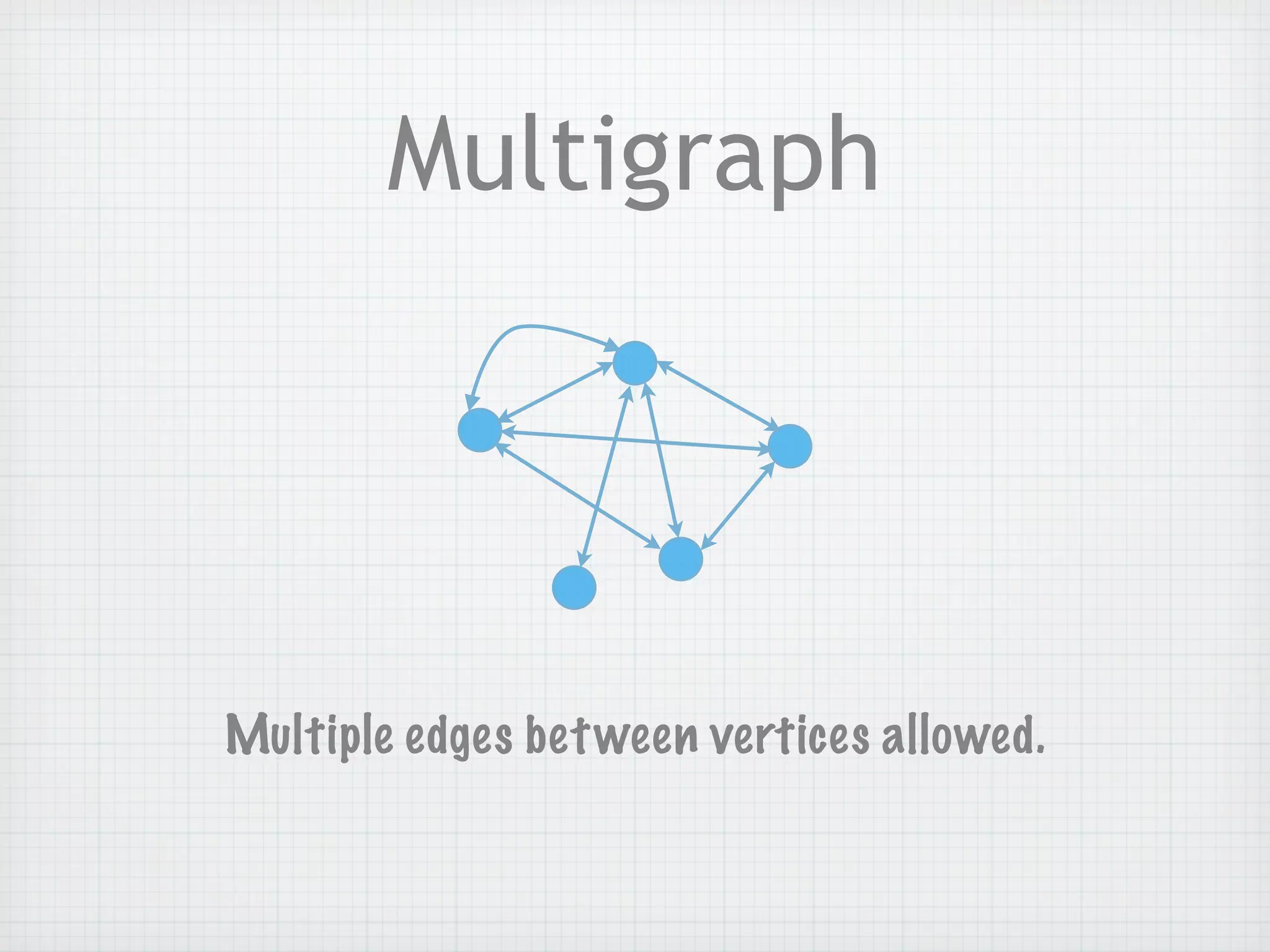
Multigraph


Multiple edges bet ween vertices allowed.
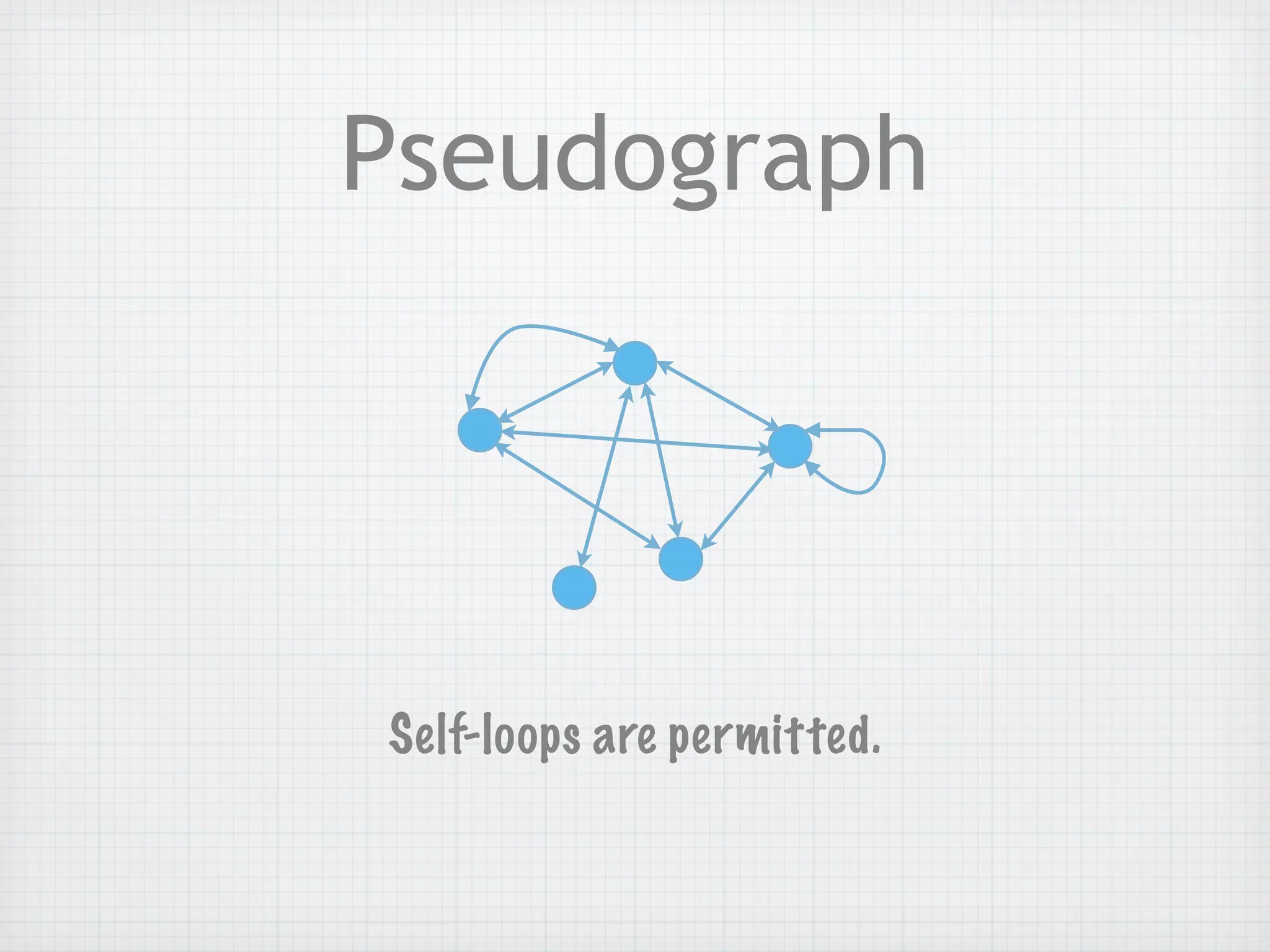
Pseudograph


Self-loops are permitted.
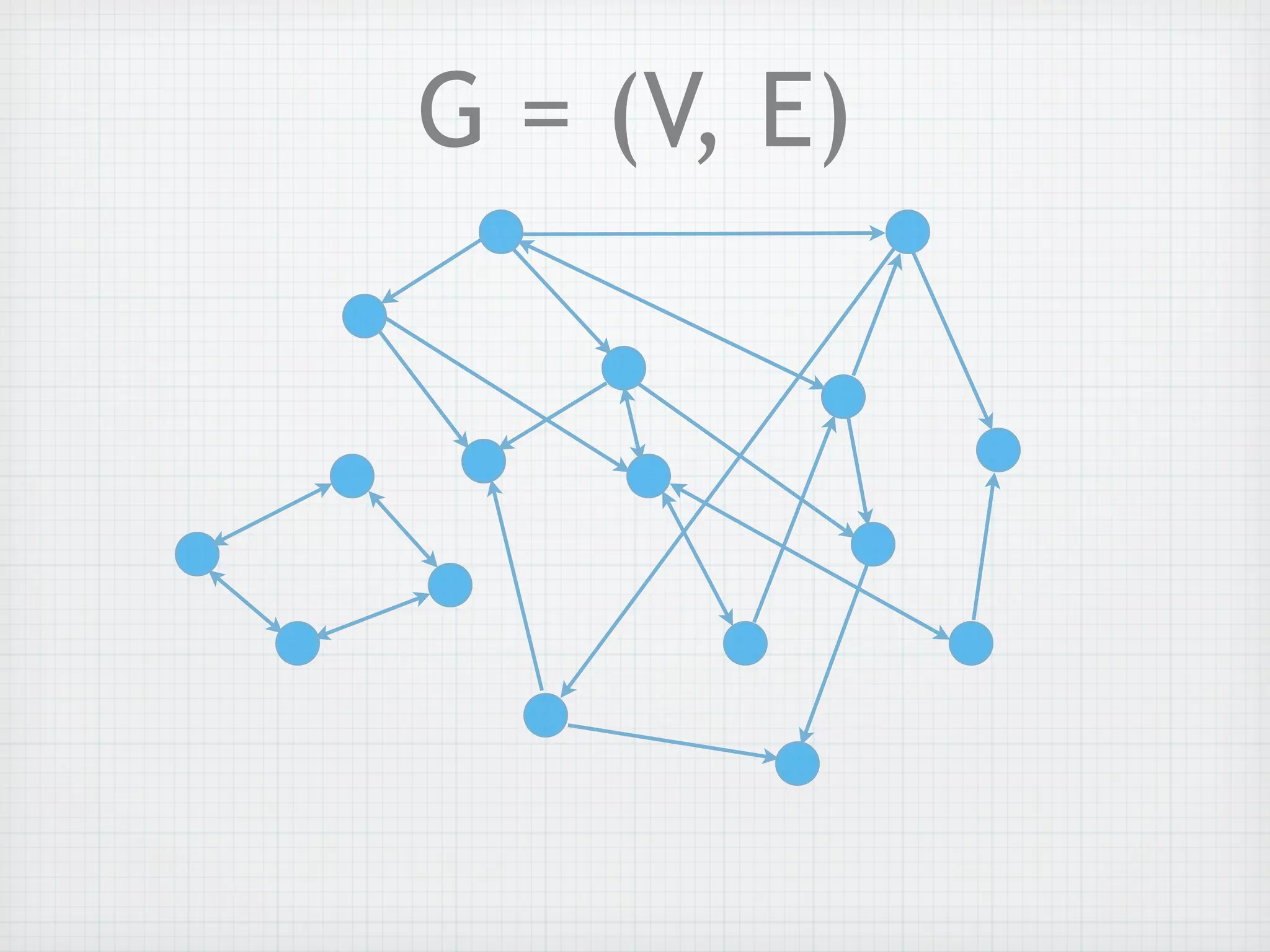
G = (V, E)
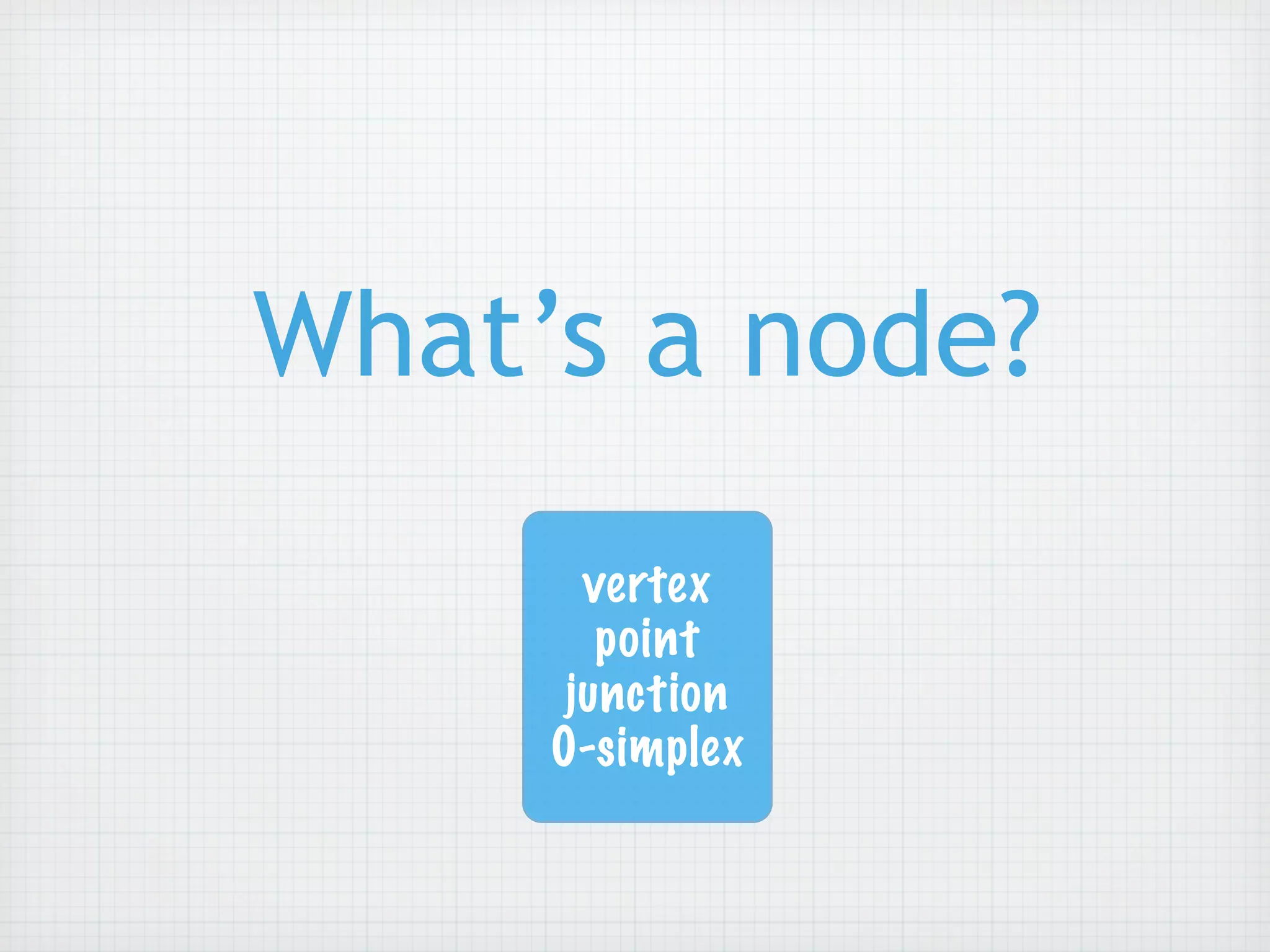
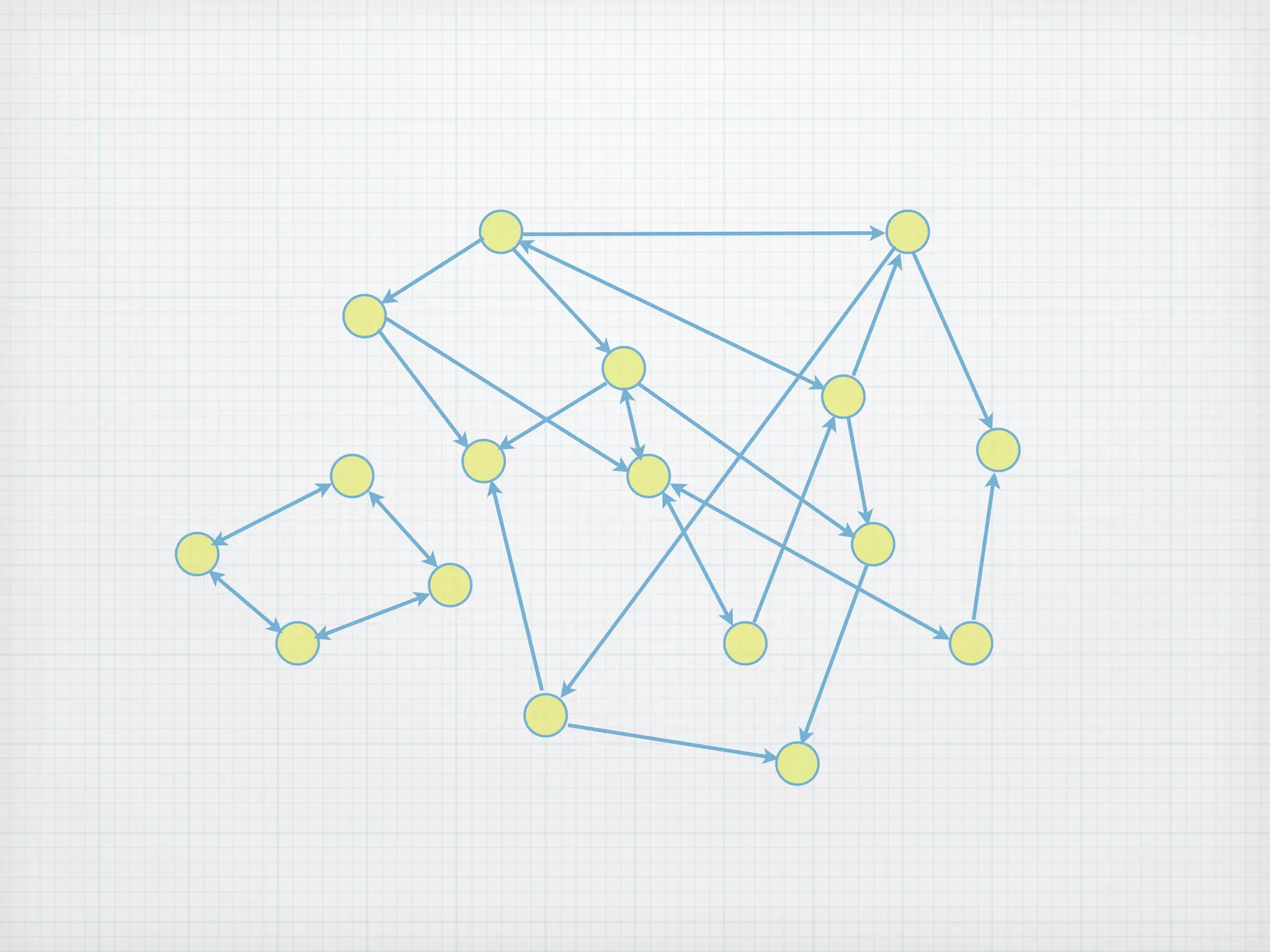
What’s a node?
       vertex
        point
      junction
     0-simplex
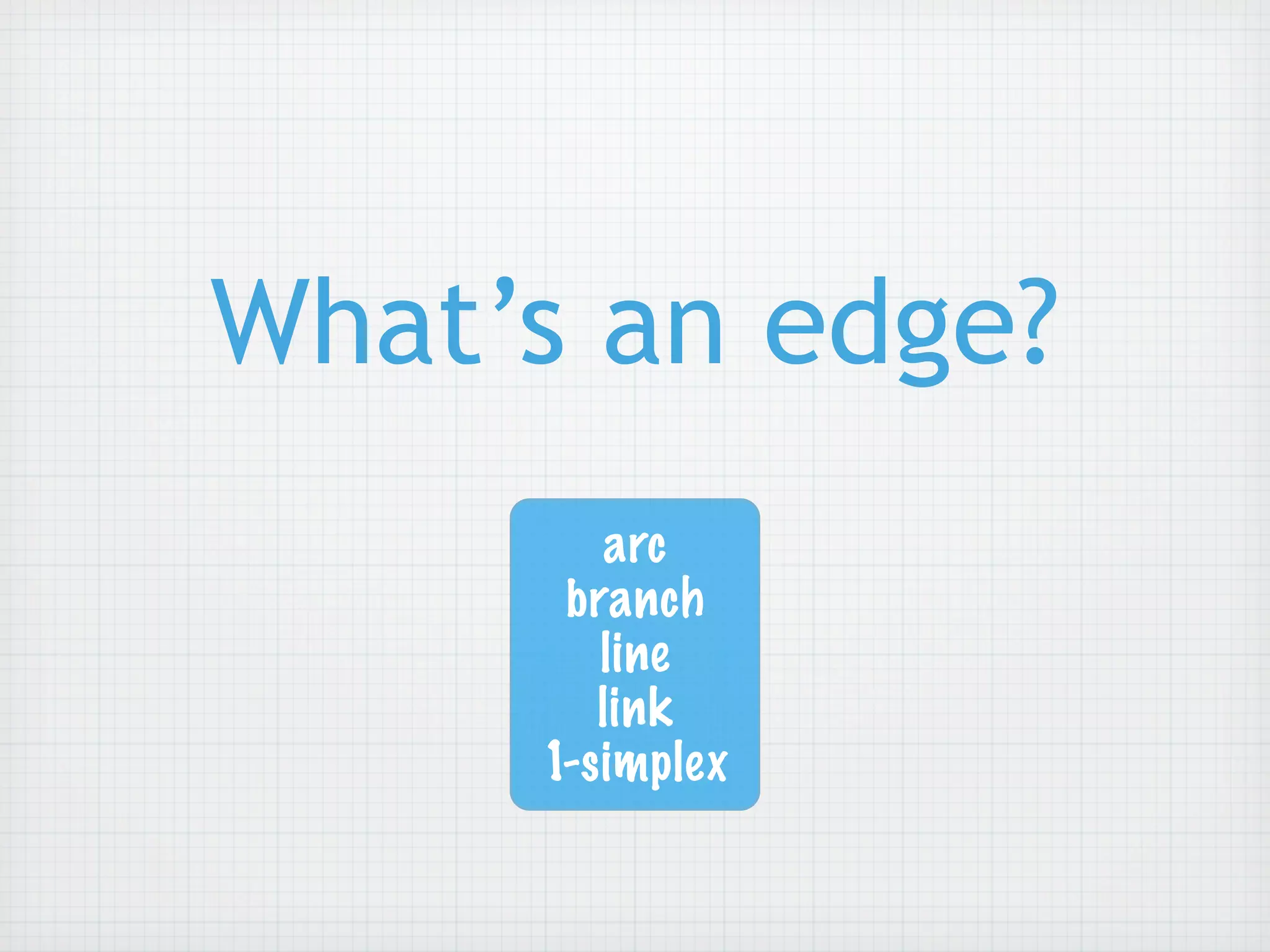
What’s an edge?
        arc
      branch
        line
        link
     1-simplex
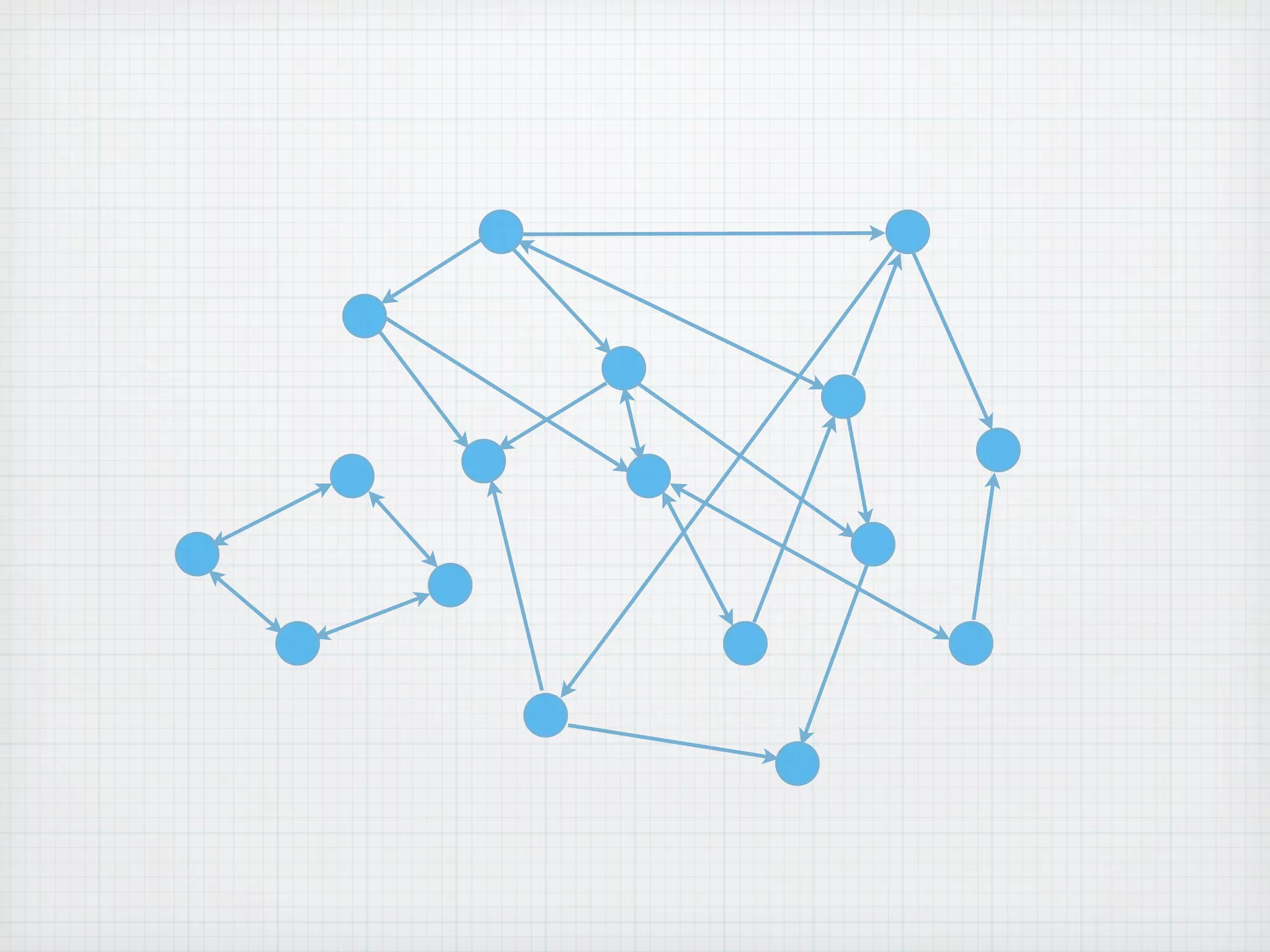
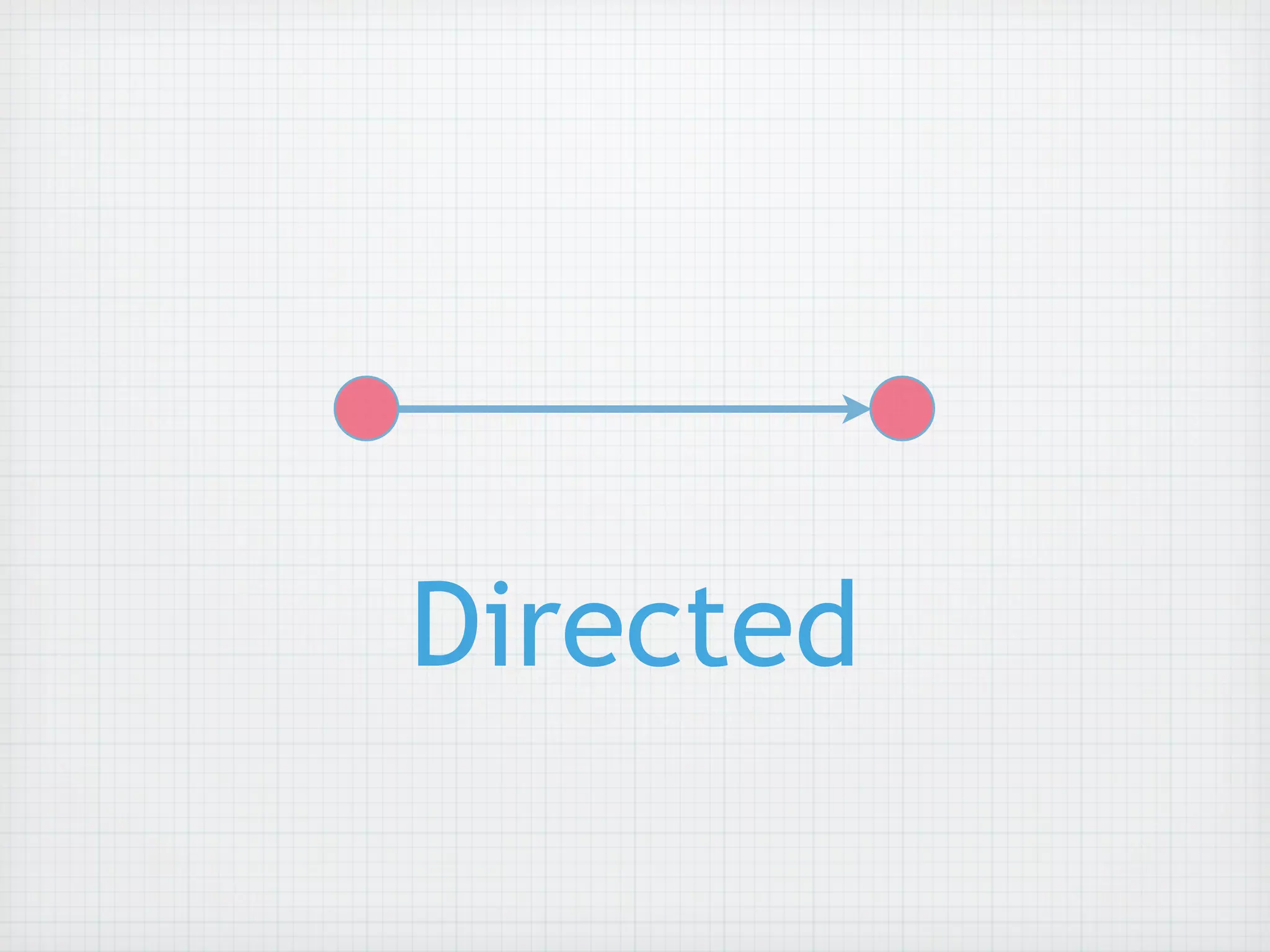
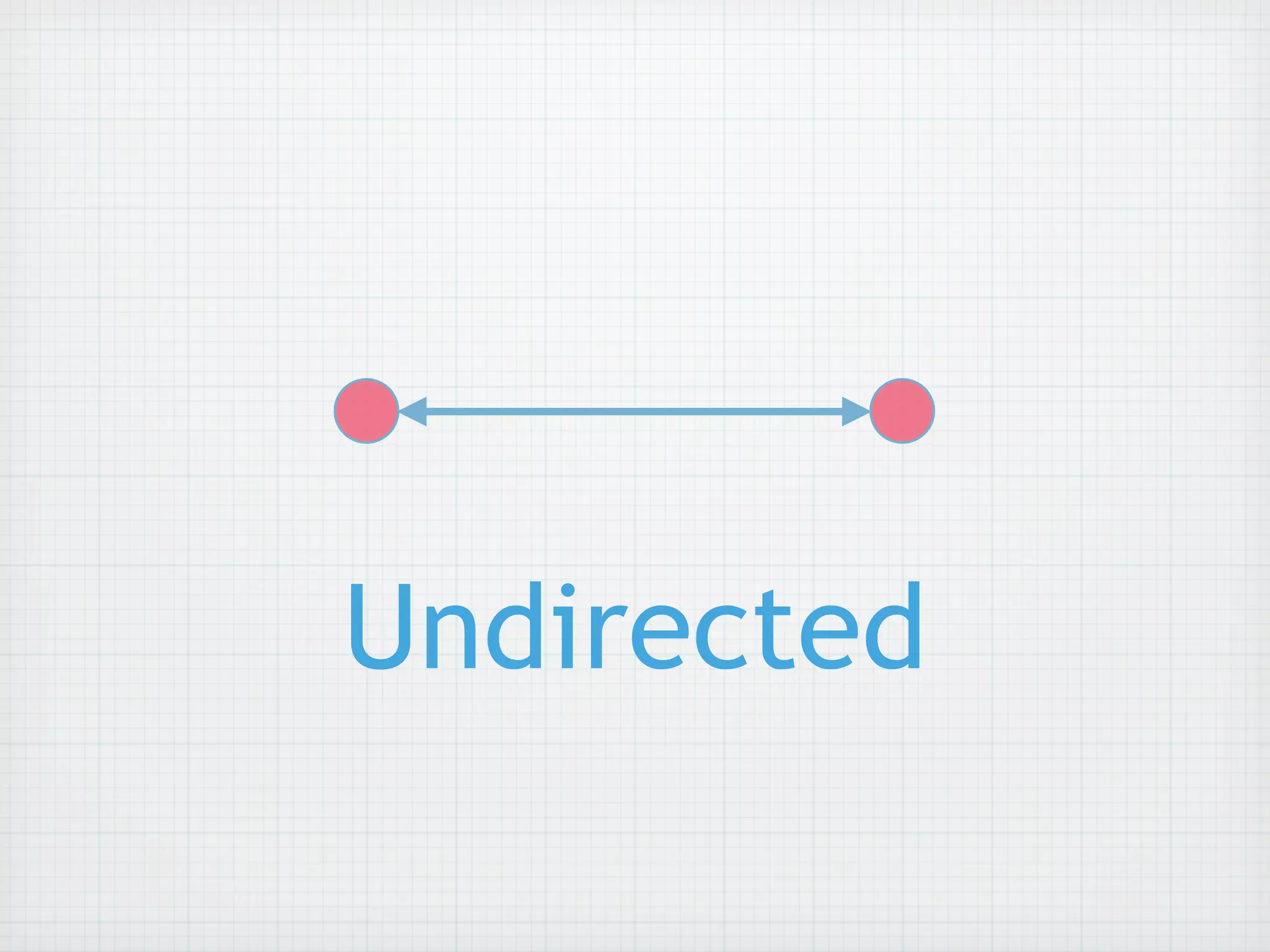
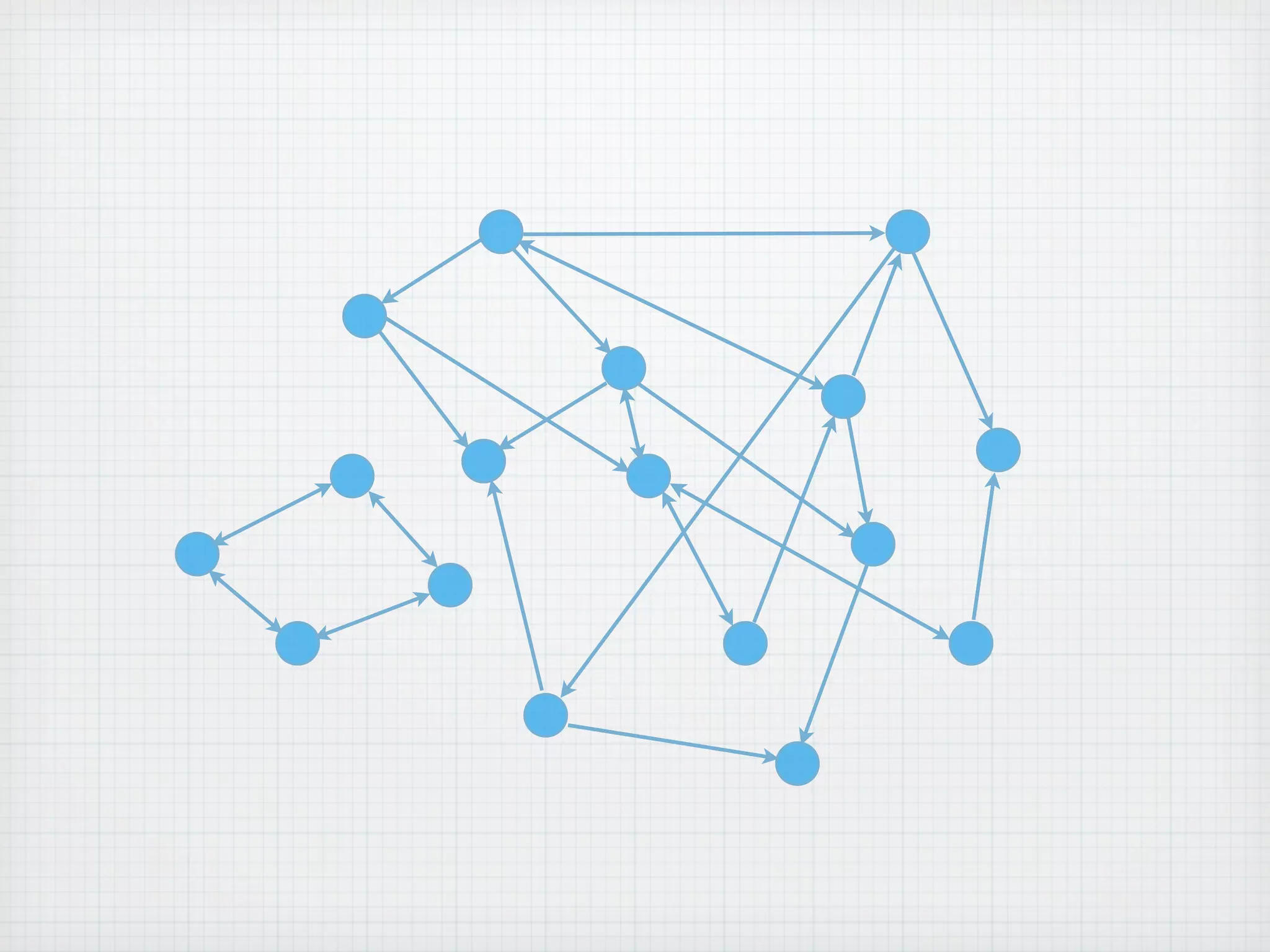
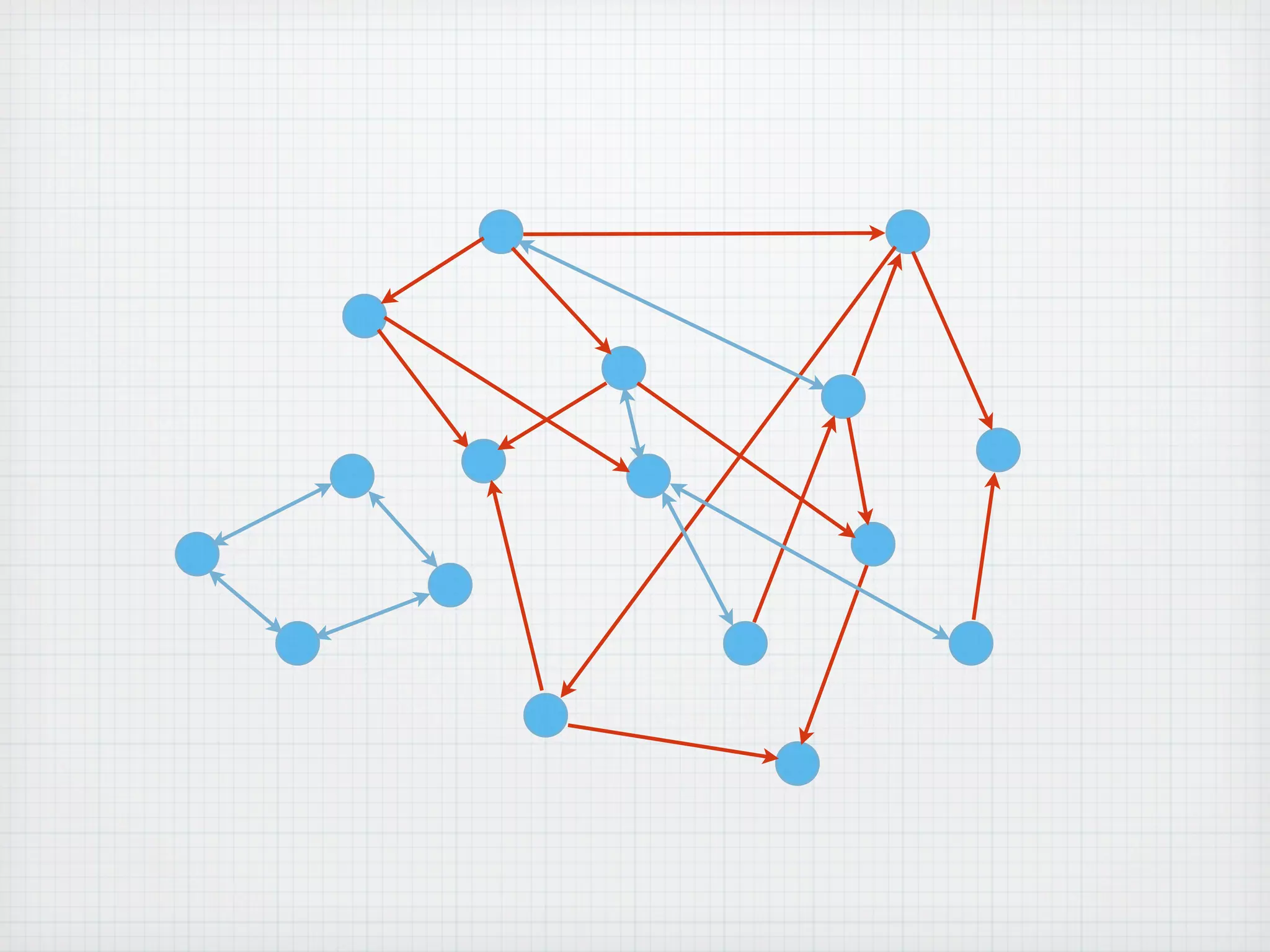
Directed
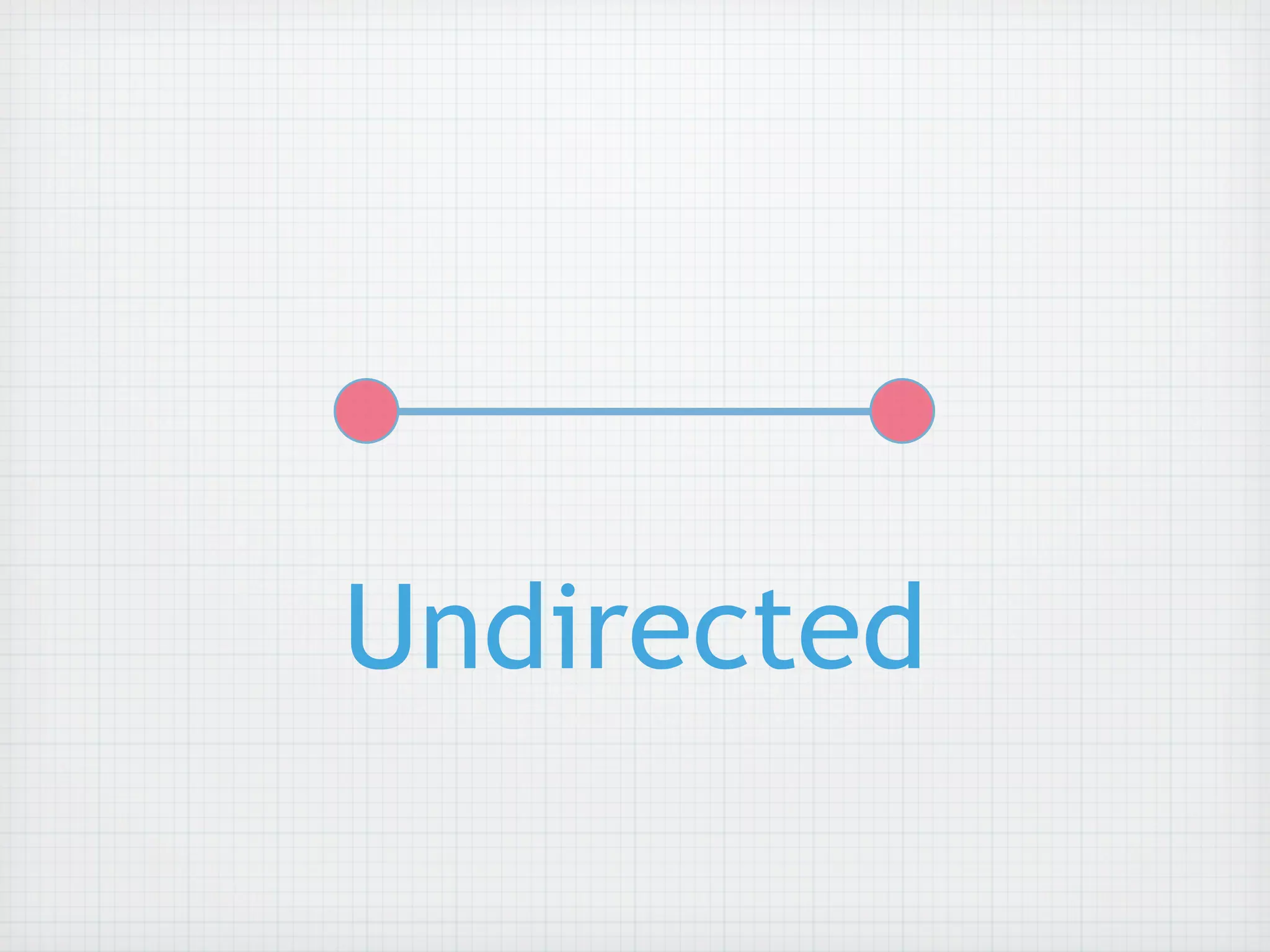
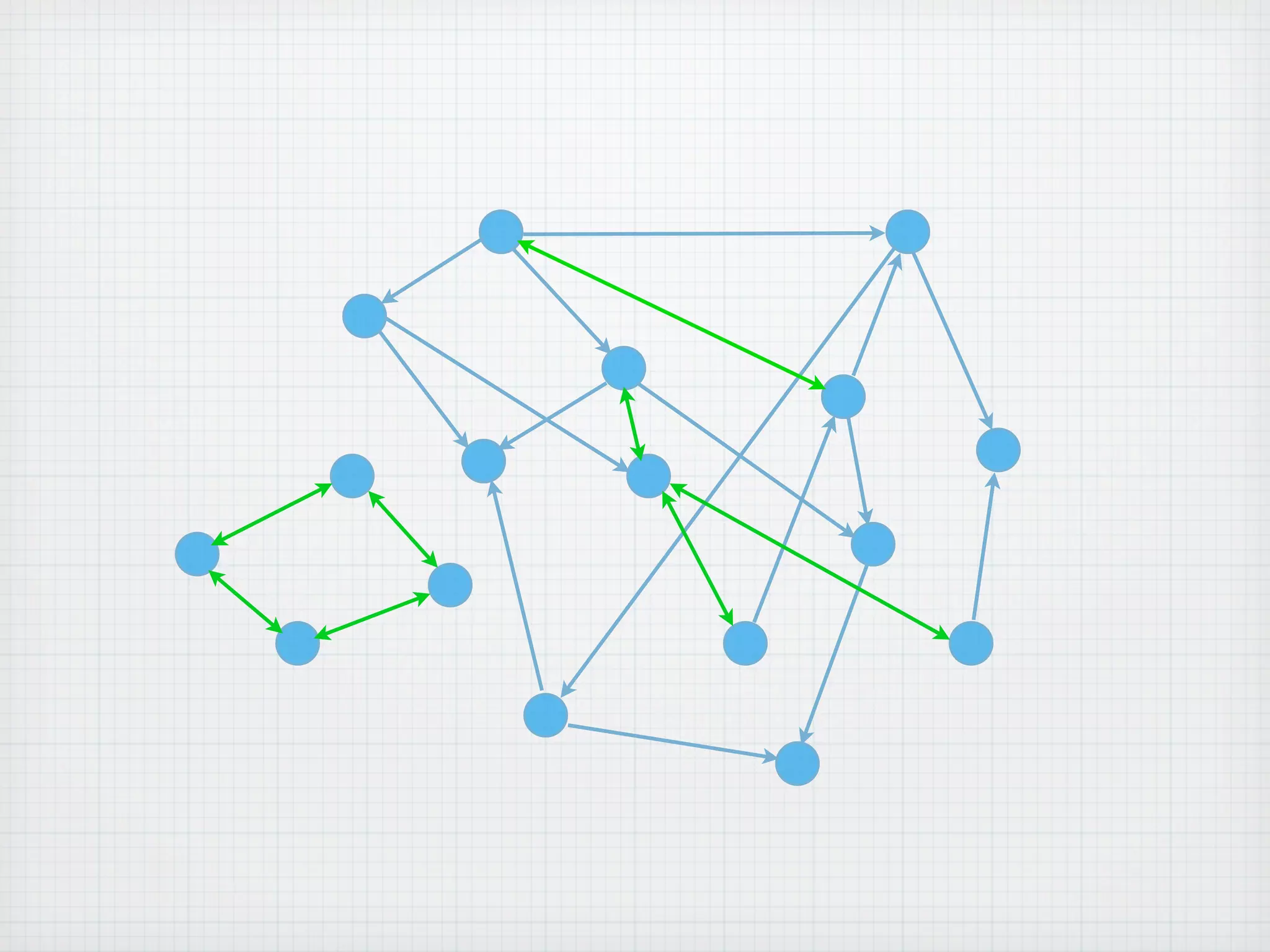
Undirected
Undirected
Visualizations
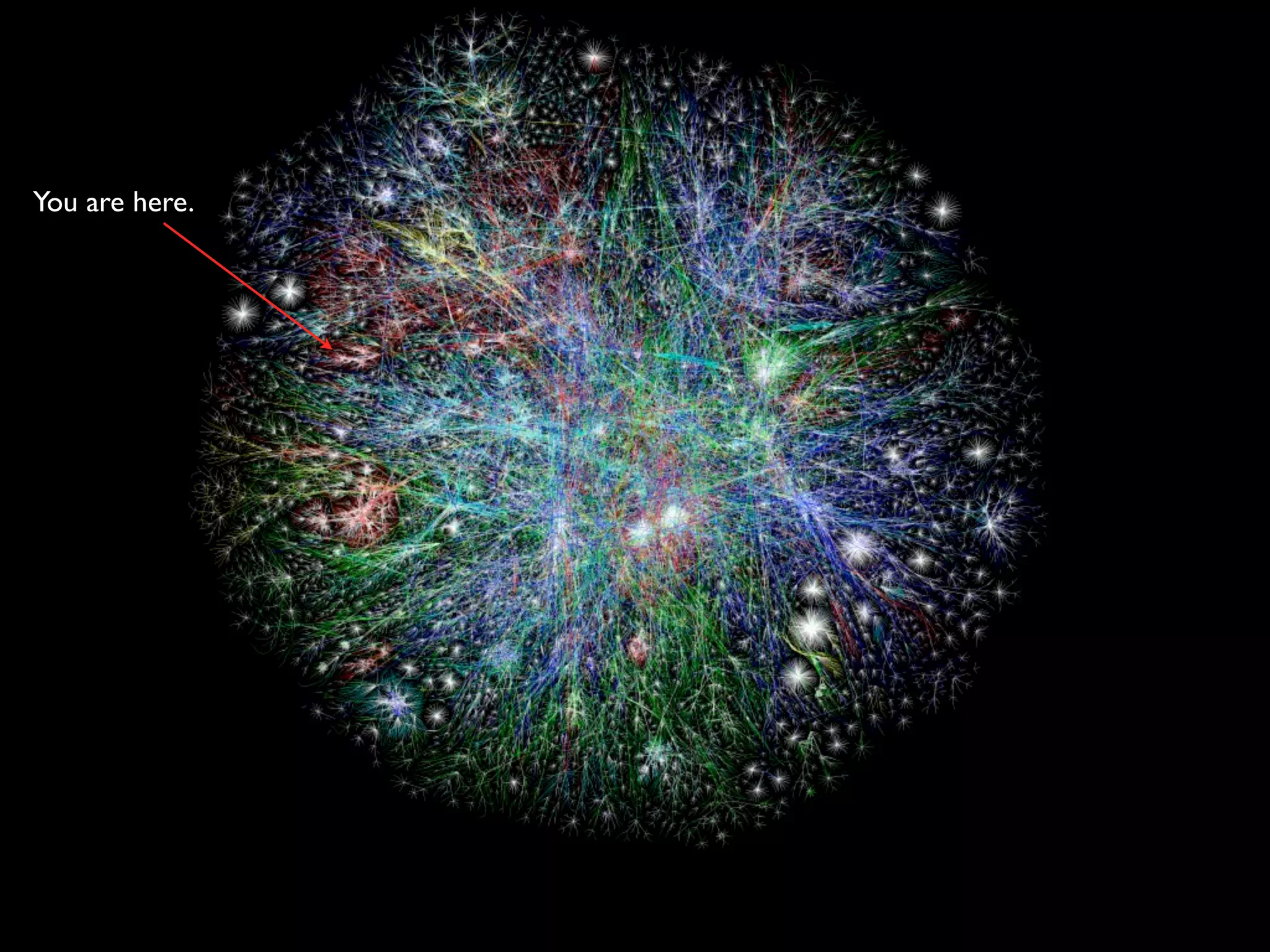
You are here.
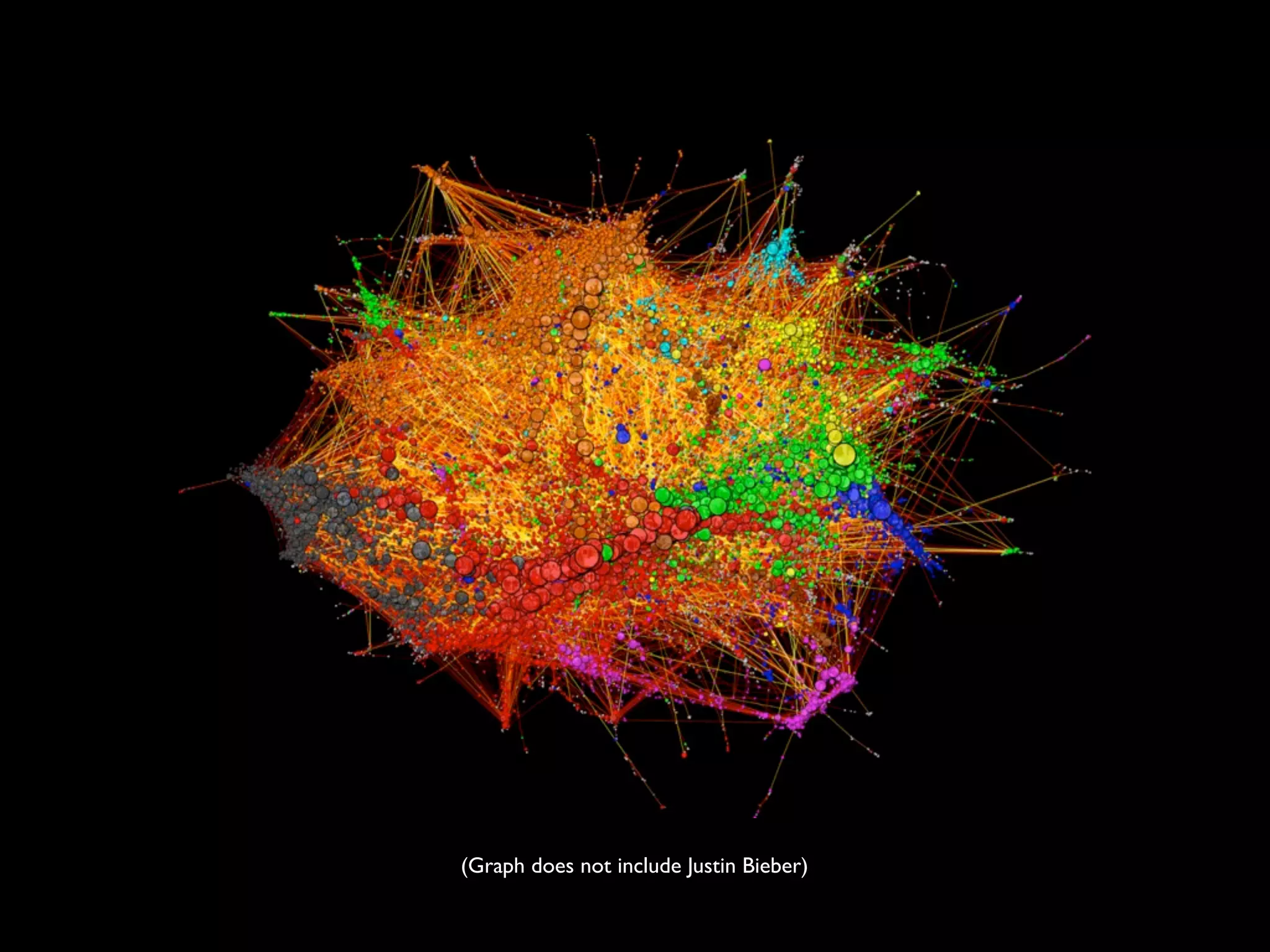
(Graph does not include Justin Bieber)
Social Graphs
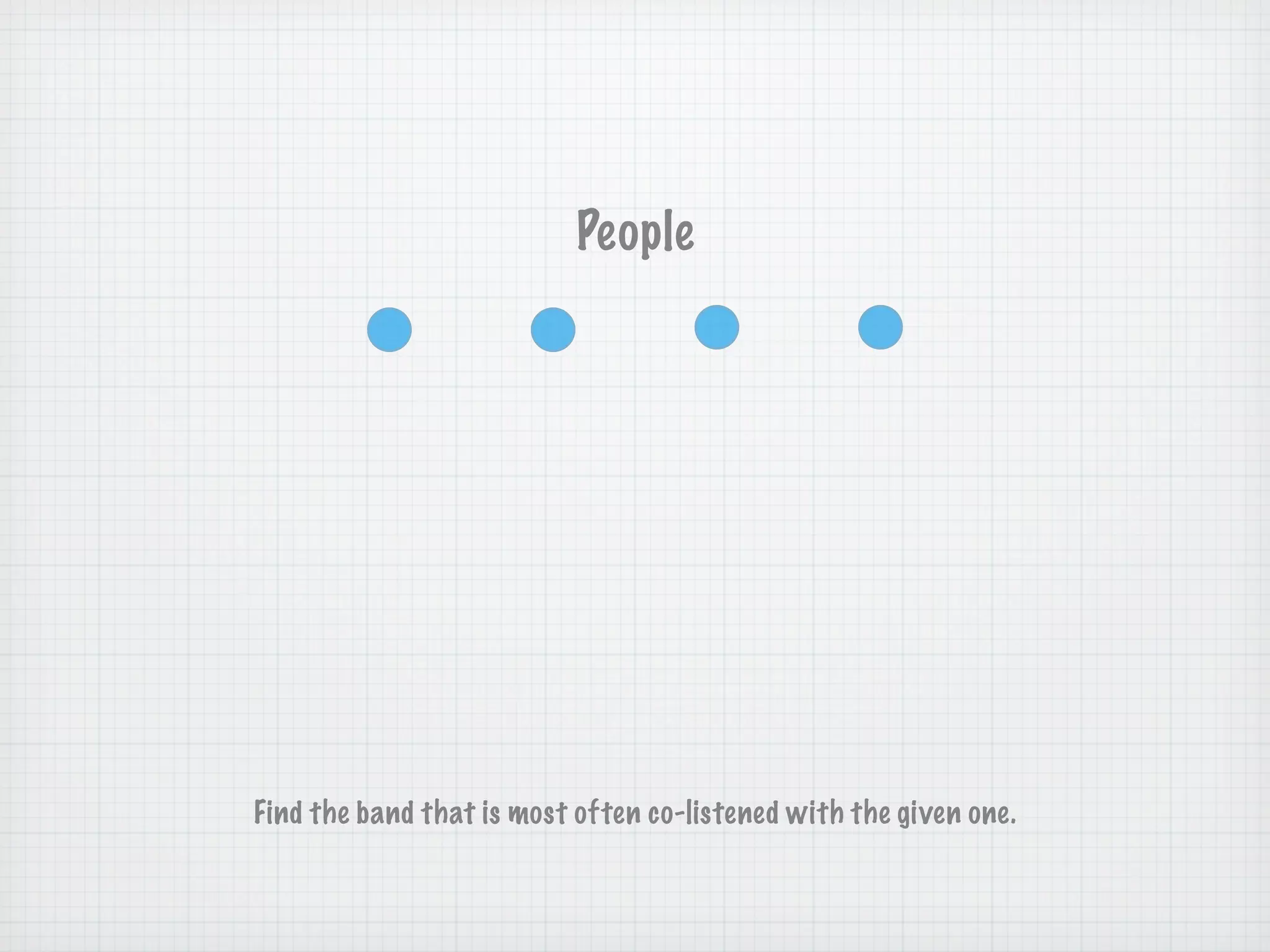
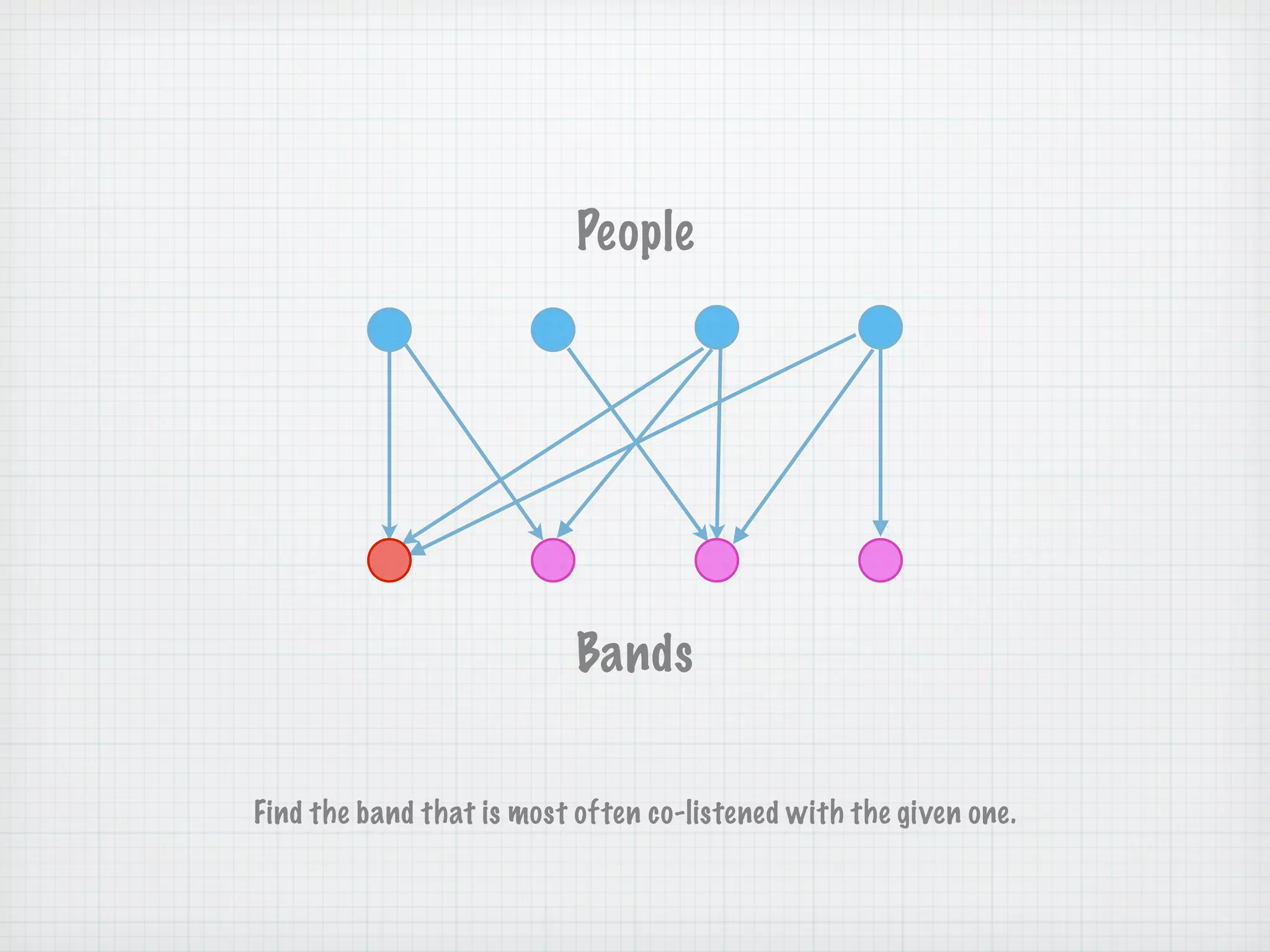
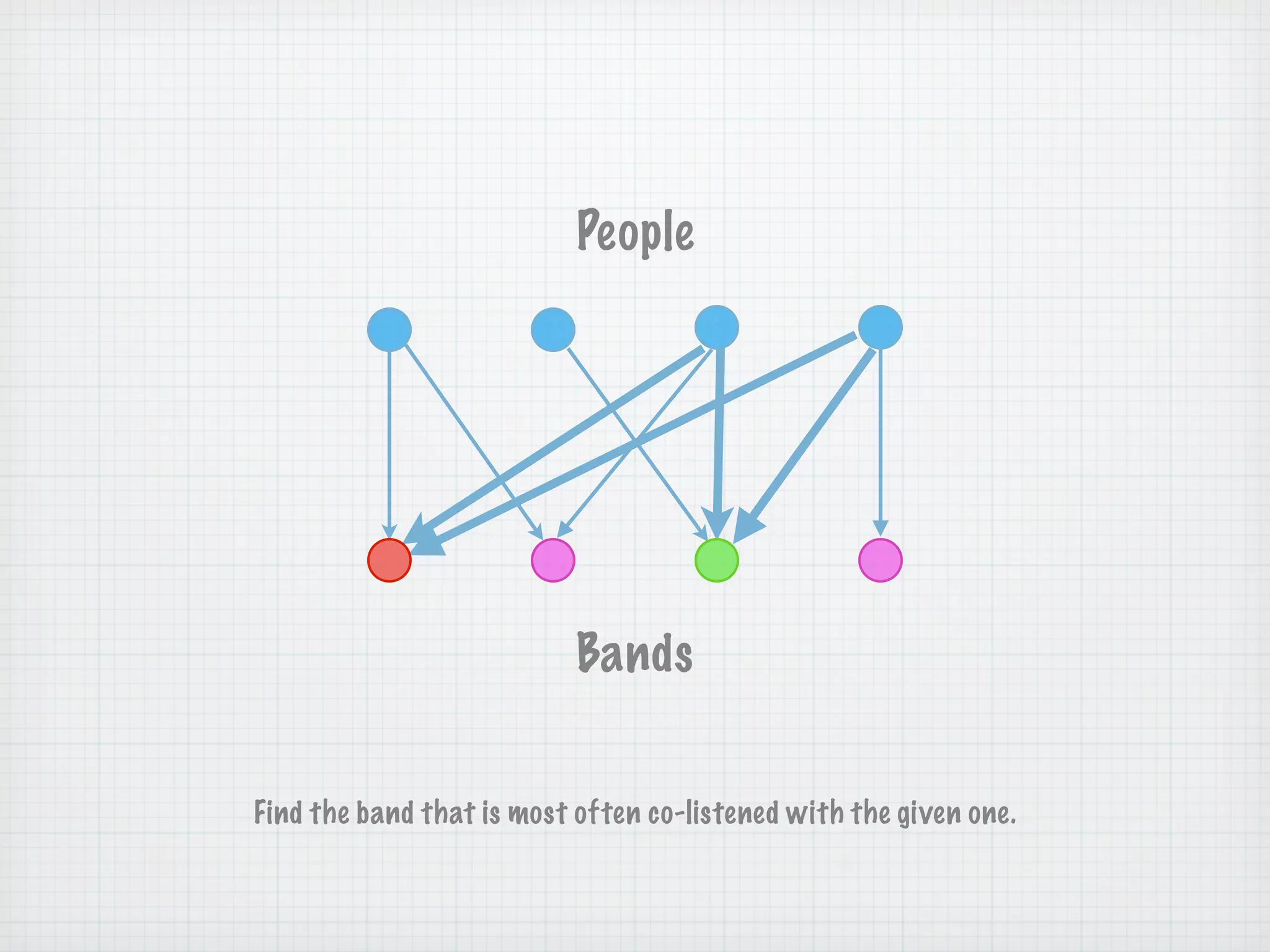
Find the band that is most often co-listened with the given one.
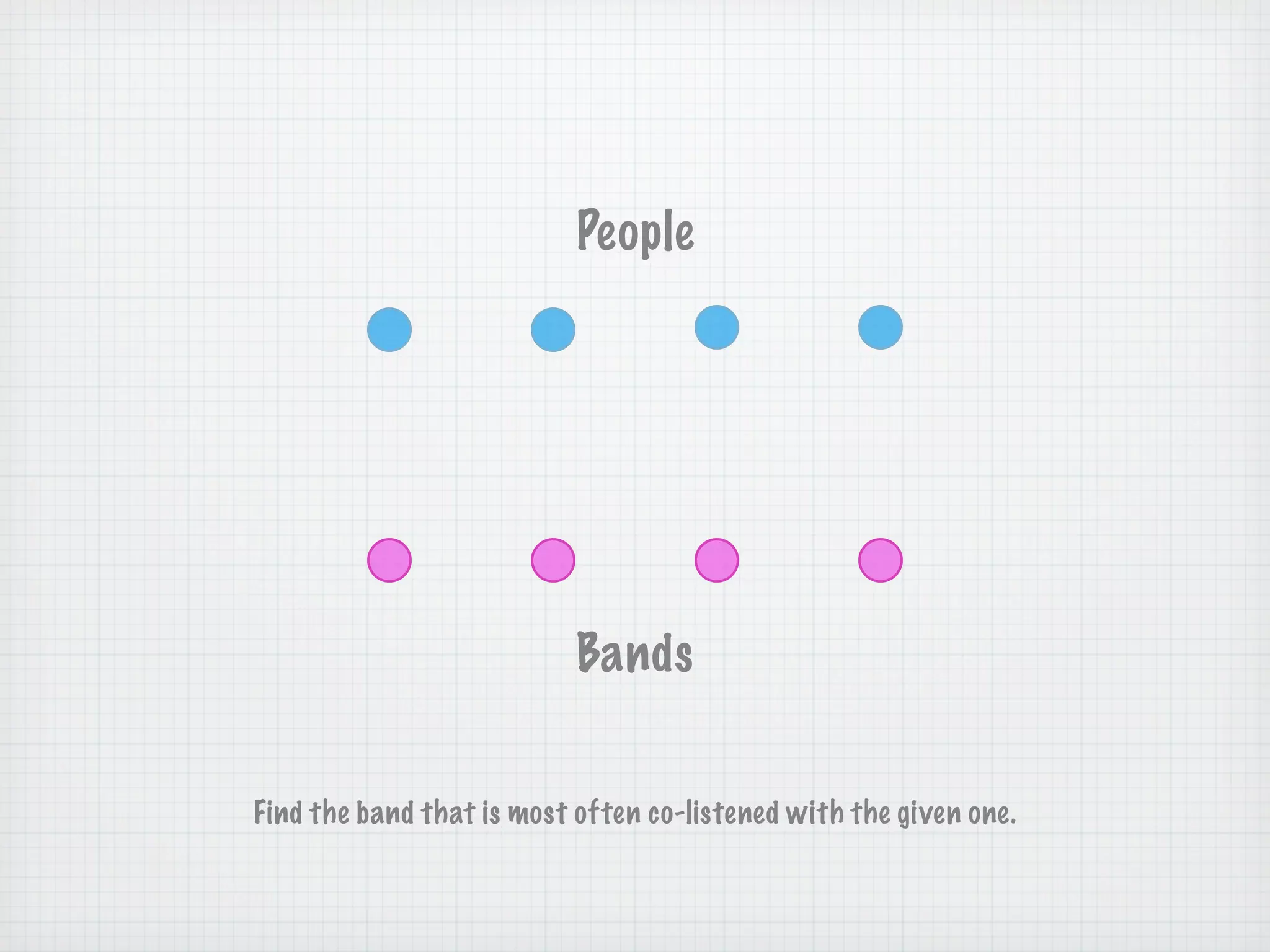
People


Find the band that is most often co-listened with the given one.
People


                           Bands


Find the band that is most often co-listened with the given one.
People


                           Bands


Find the band that is most often co-listened with the given one.
People


                           Bands


Find the band that is most often co-listened with the given one.
People


                           Bands


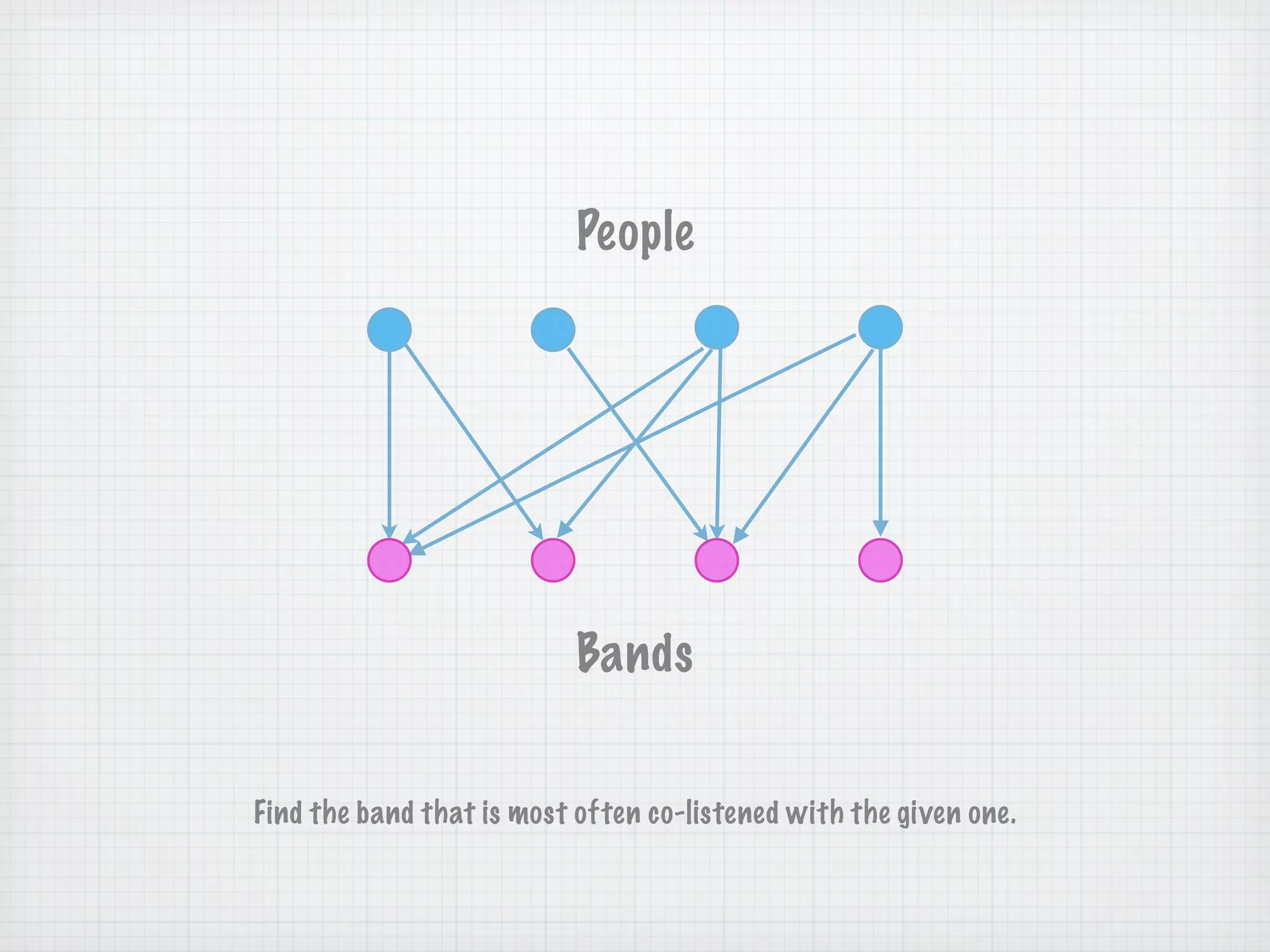
Find the band that is most often co-listened with the given one.
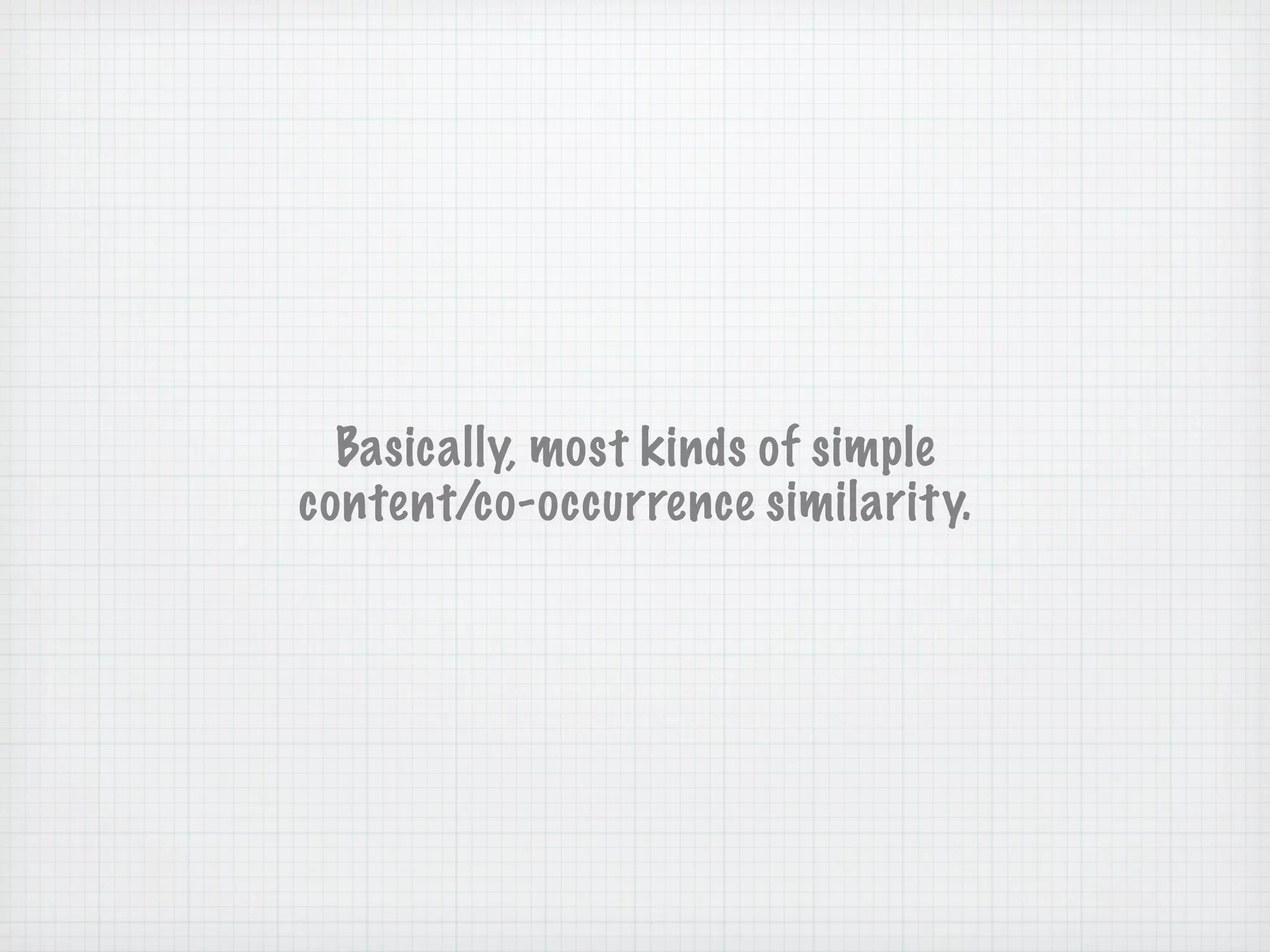
Basically, most kinds of simple
content/co-occurrence similarity.
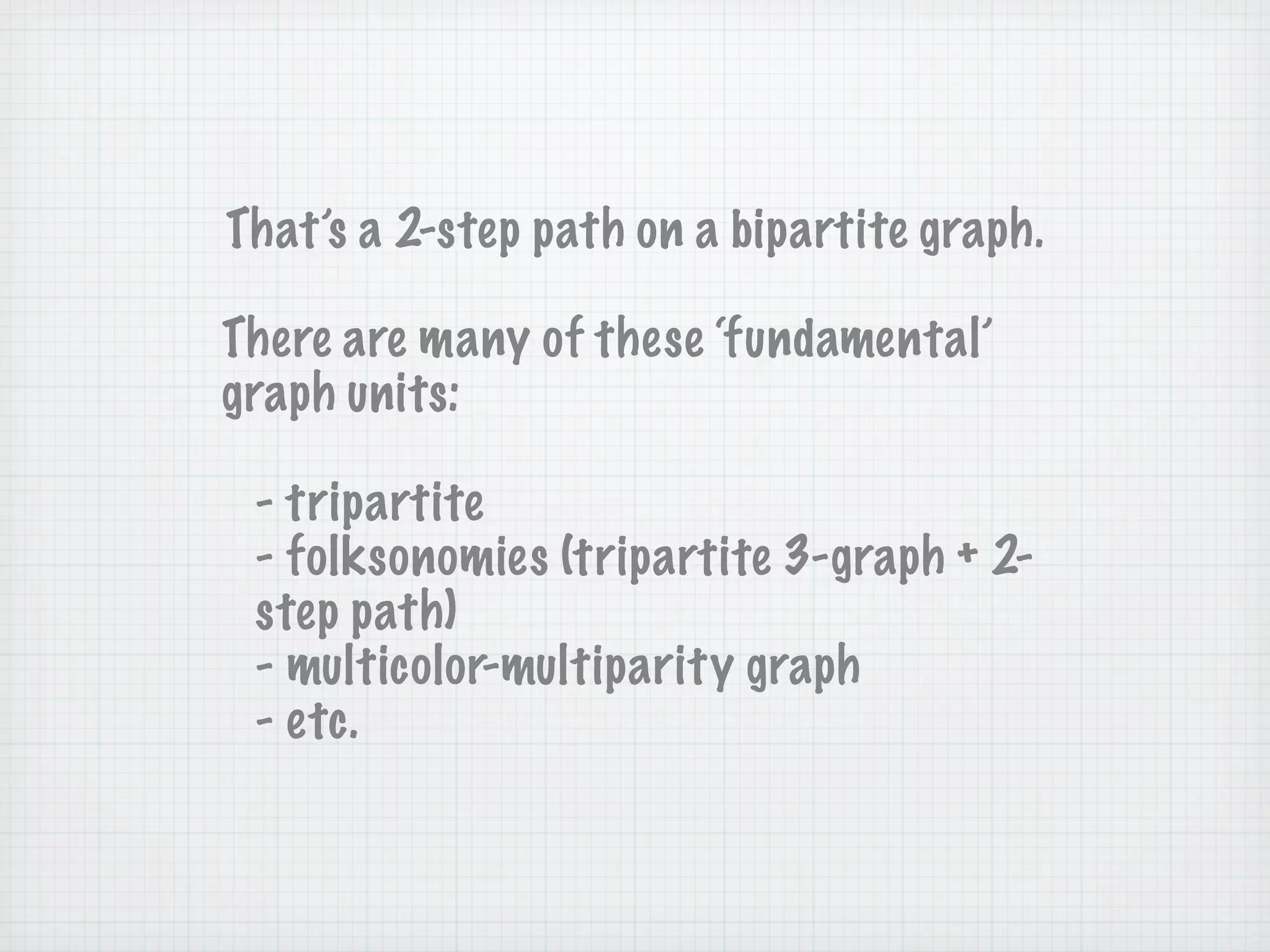
That’s a 2-step path on a bipartite graph.

There are many of these ‘fundamental’
graph units:

 - tripartite
 - folksonomies (tripartite 3-graph + 2-
 step path)
 - multicolor-multiparity graph
 - etc.
Graph Storage
   Engines
Neo4j
“An embedded, disk-based, fully transactional Java persistence engine
    that stores data structured in graphs rather than in tables.”

                         http://neo4j.org
HypergraphDB
  “A general purpose, extensible, portable, distributed, embeddable,
open-source data storage mechanism. It is a graph database designed
   specifically for artificial intelligence and semantic web projects.”

                   http://kobrix.org/hgdb.jsp
Special Purpose
Storage Engines
FlockDB
 “FlockDB is a database that stores graph data, but it isn't a database optimized for
  graph-traversal operations. Instead, it's optimized for very large adjacency lists,
              fast reads and writes, and page-able set arithmetic queries.”


http://engineering.t witter.com/2010/05/introducing-
                      flockdb.html
Redis
“Redis is an advanced key-value store. [...] the dataset is not volatile, and values can be strings,
exactly like in memcached, but also lists, sets, and ordered sets. All this data types can be
manipulated with atomic operations to push/pop elements, add/remove elements, perform
server side union, intersection, difference bet ween sets, etc.”


                       http://code.google.com/p/redis
A Redis Friends/
Followers Example
Redis makes you think in terms of datastructures,
       and operations on those structures.
Set:
 Finite (for our cases) collection of objects in which
 order has no significance and multiplicity is generally
 ignored.
                  S = { Alice, Bob, Carol }

List:
  Finite (for our cases) collection of objects in which
  order *is* significant and multiplicity is allowed.
                    L = [ X, Y, X, Z, Q]
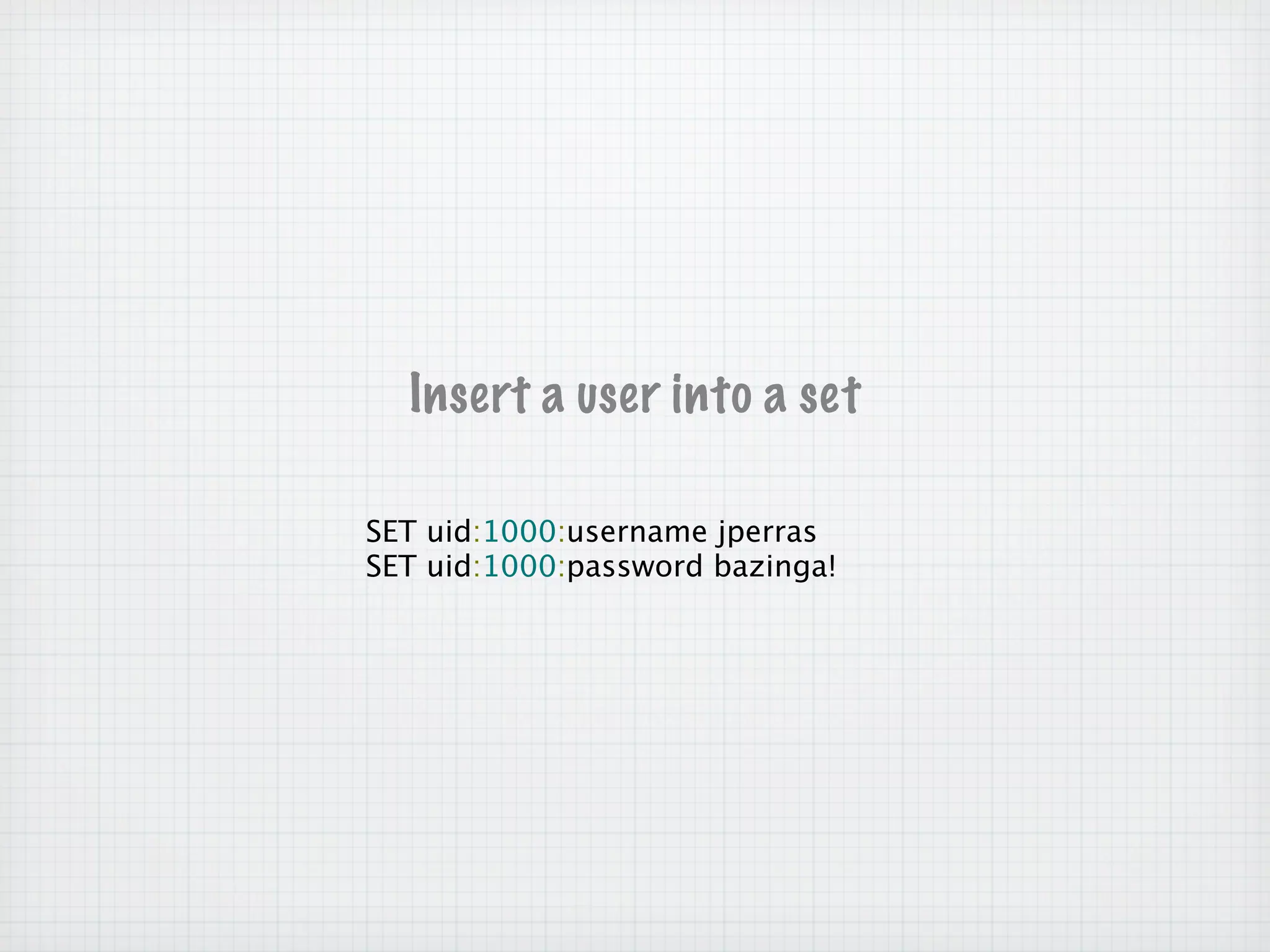
Insert a user into a set

SET uid:1000:username jperras
SET uid:1000:password bazinga!
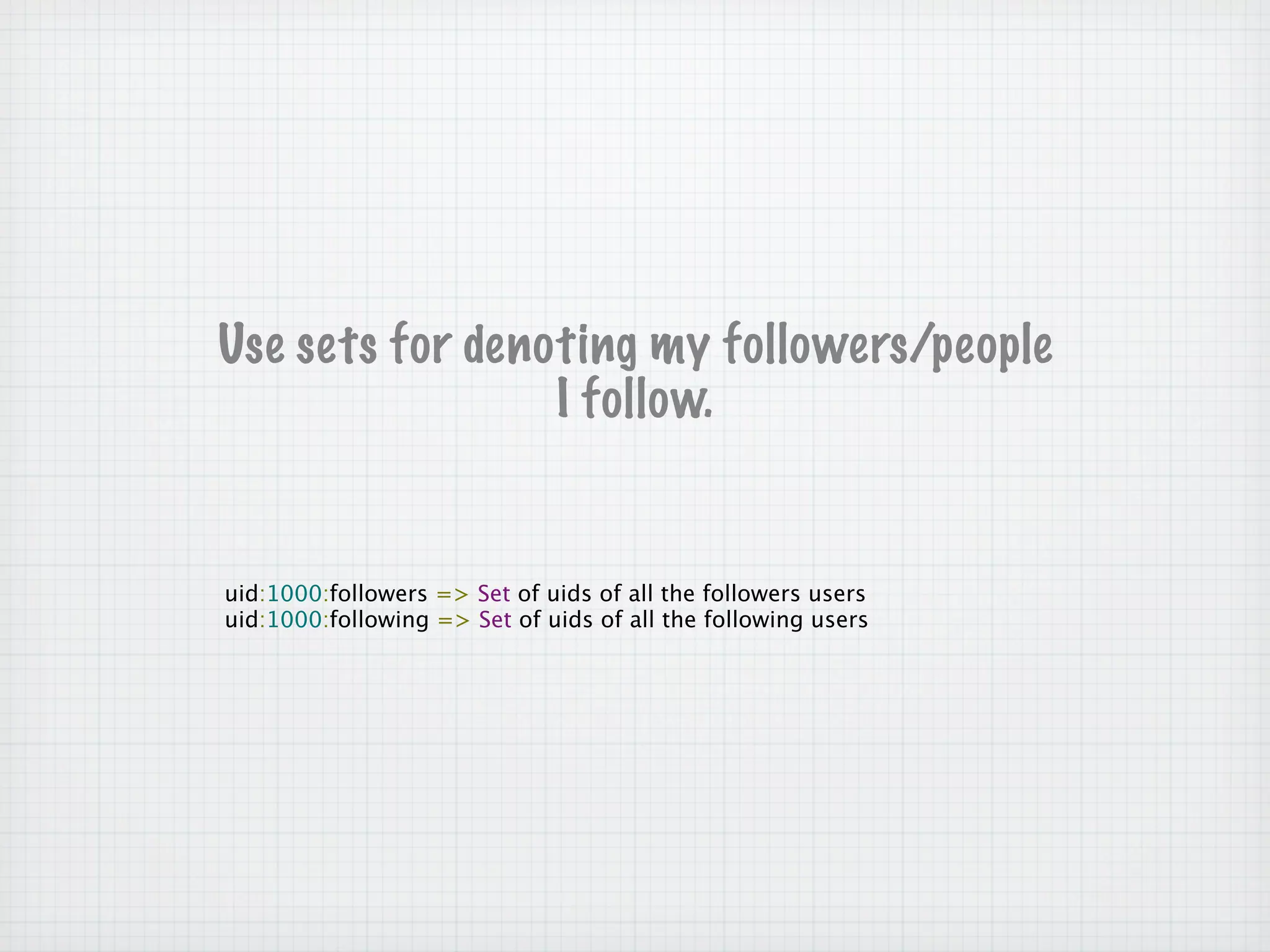
Use sets for denoting my followers/people
                 I follow.


uid:1000:followers => Set of uids of all the followers users
uid:1000:following => Set of uids of all the following users
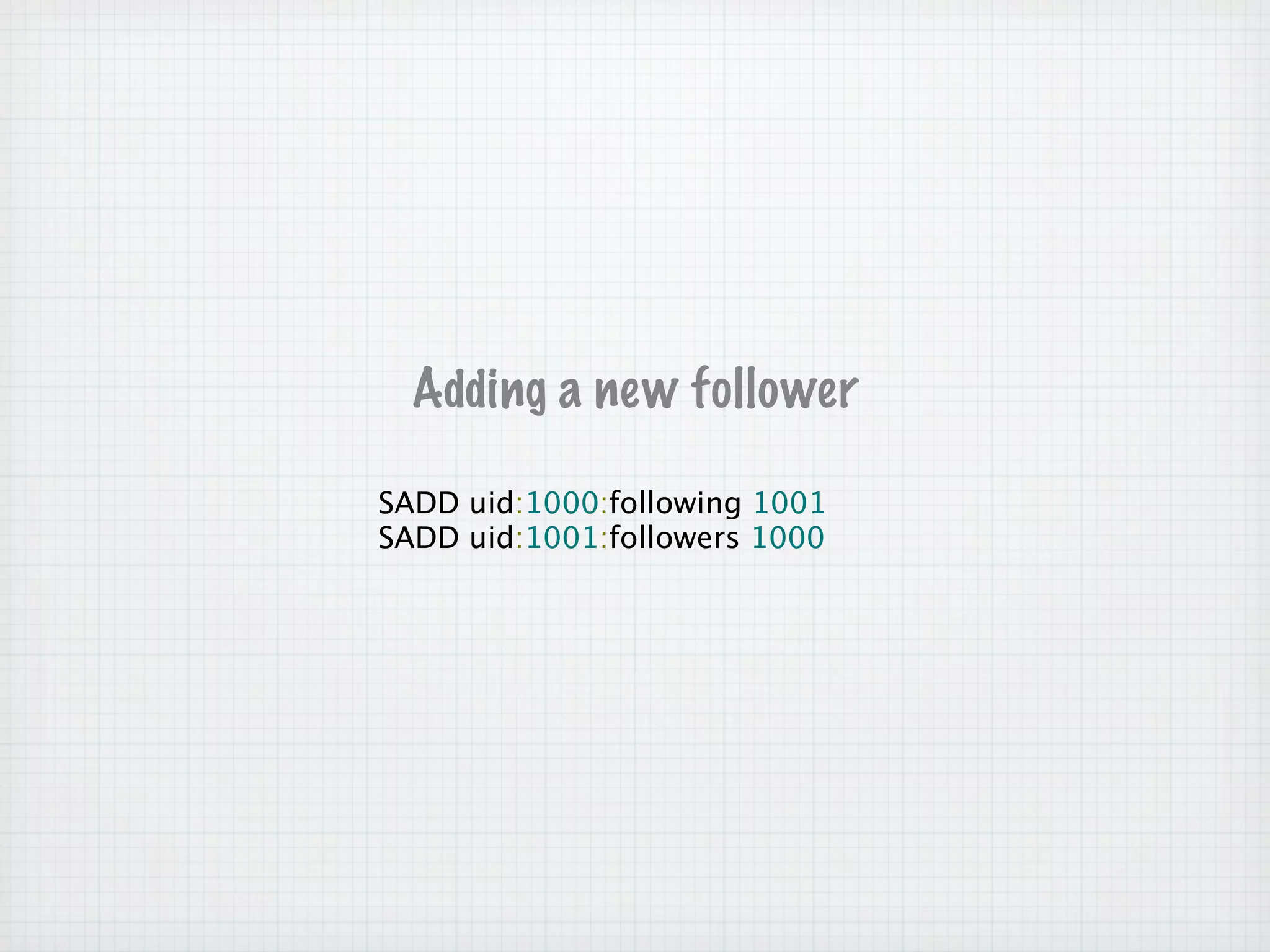
Adding a new follower

SADD uid:1000:following 1001
SADD uid:1001:followers 1000
Posting Updates

$r = Redis();
$postid = $r->incr("global:nextPostId");
$post = $User['id'] ."|". time() ."|". $status;
$r->set("post:$postid", $post);
$followers = $r->smembers("uid:".$User['id'].":followers");

if ($followers === false) $followers = Array();
$followers[] = $User['id']; /* Add the post to our own posts too */

foreach($followers as $fid) {
    $r->push("uid:$fid:posts", $postid, false);
}
# Push the post on the timeline, and trim the timeline to the
# newest 1000 elements.
$r->push("global:timeline", $postid, false);
$r->ltrim("global:timeline",0,1000);
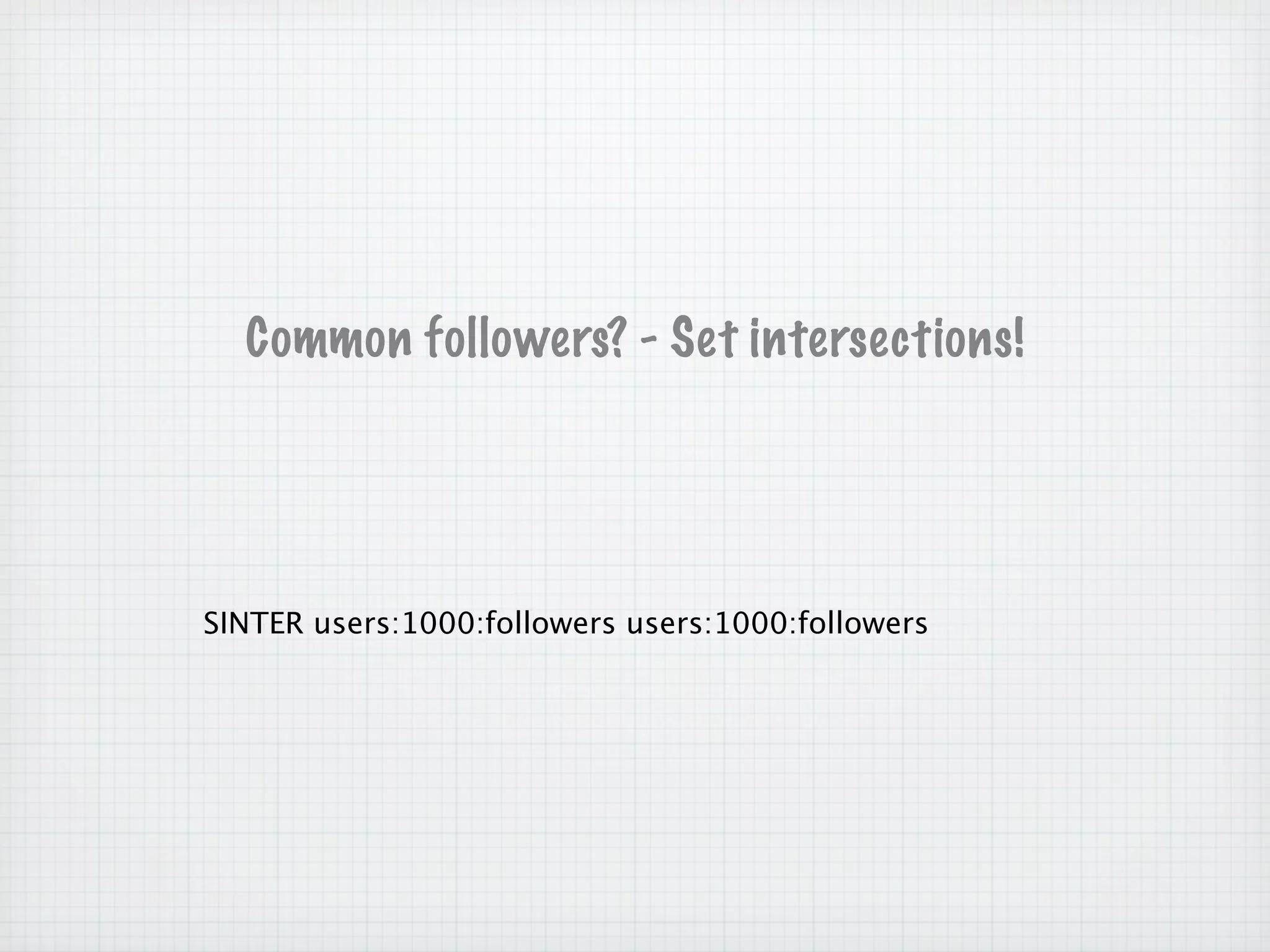
Common followers? - Set intersections!


SINTER users:1000:followers users:1000:followers
Let’s compare that
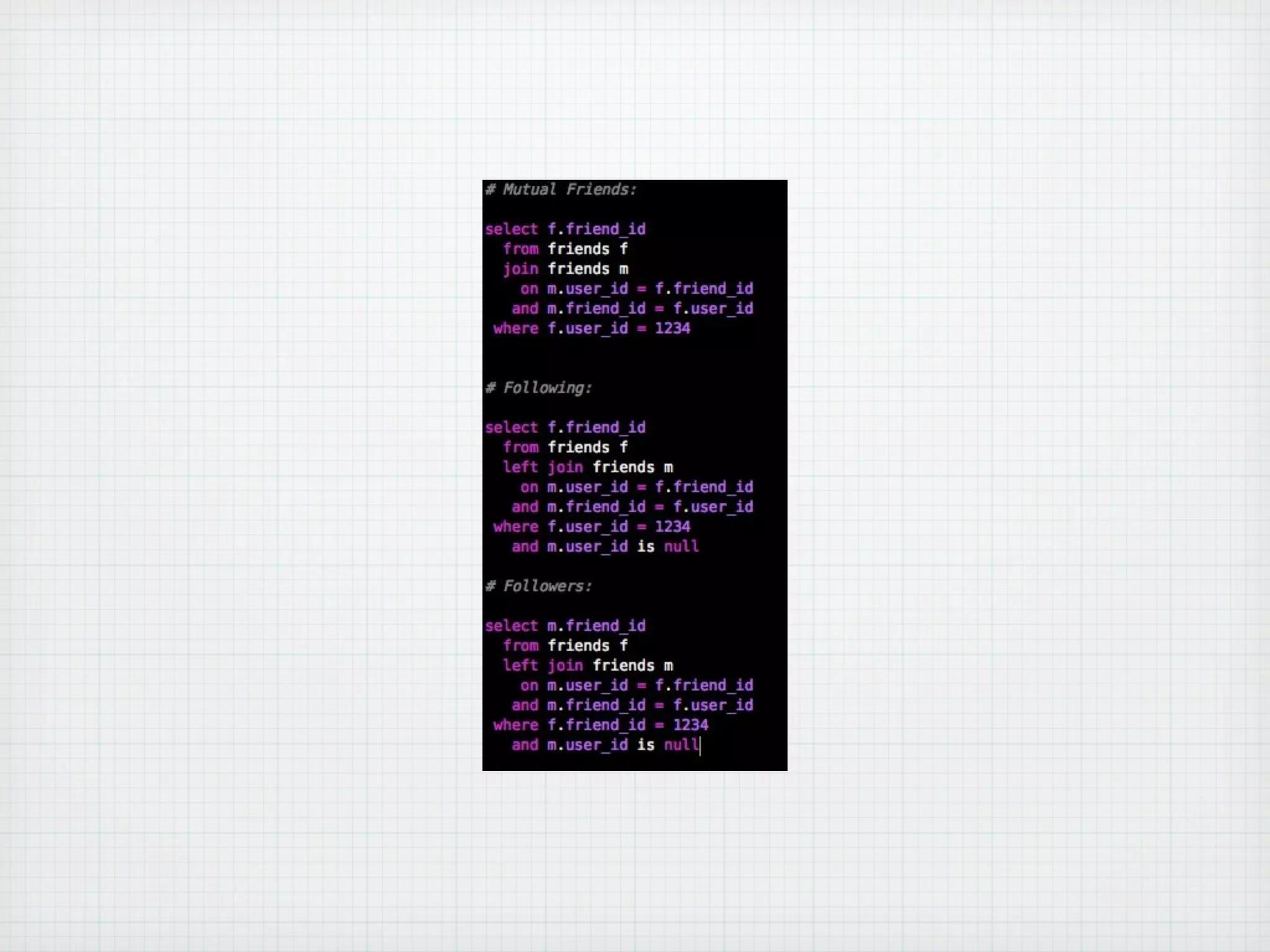
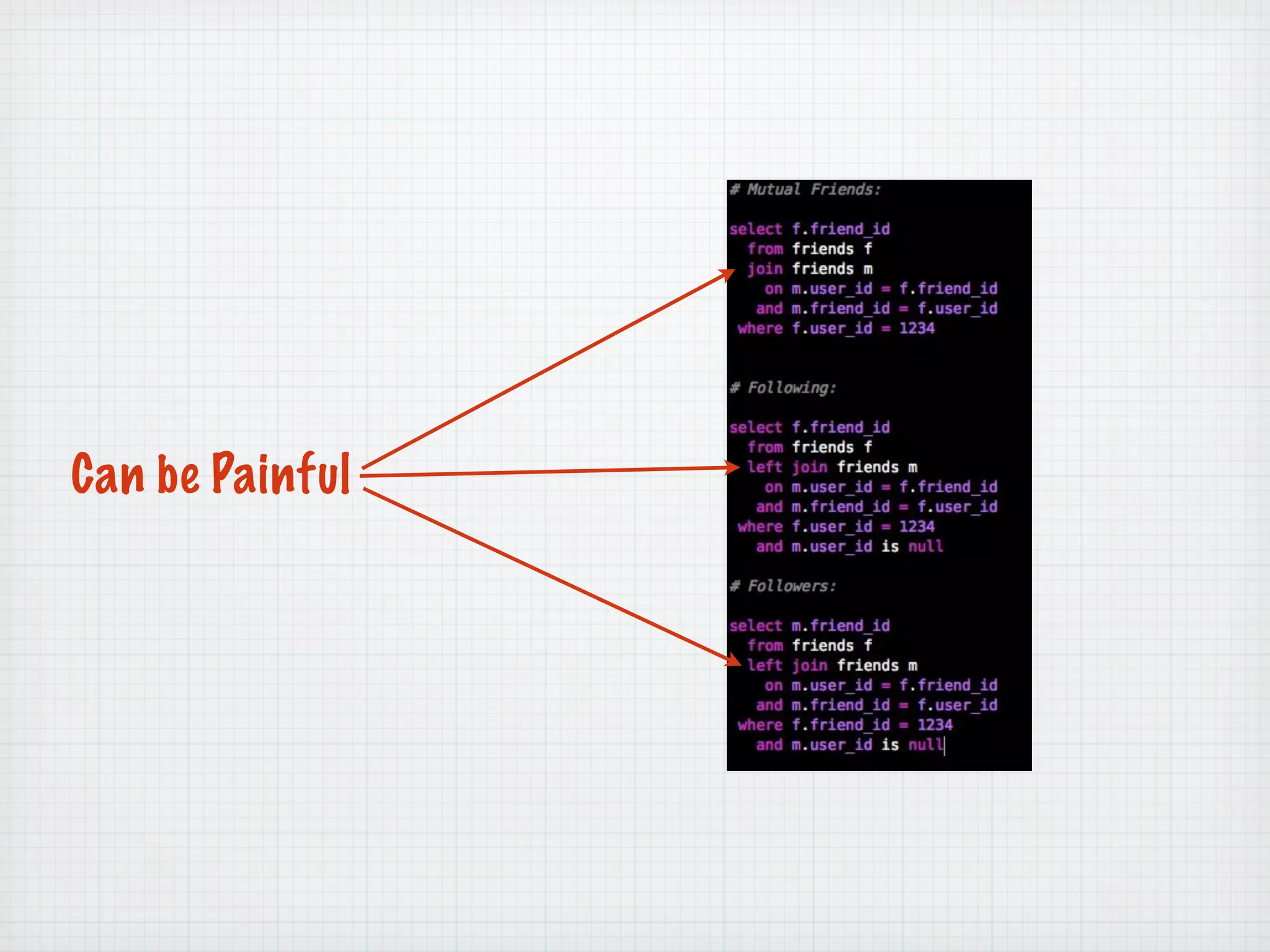
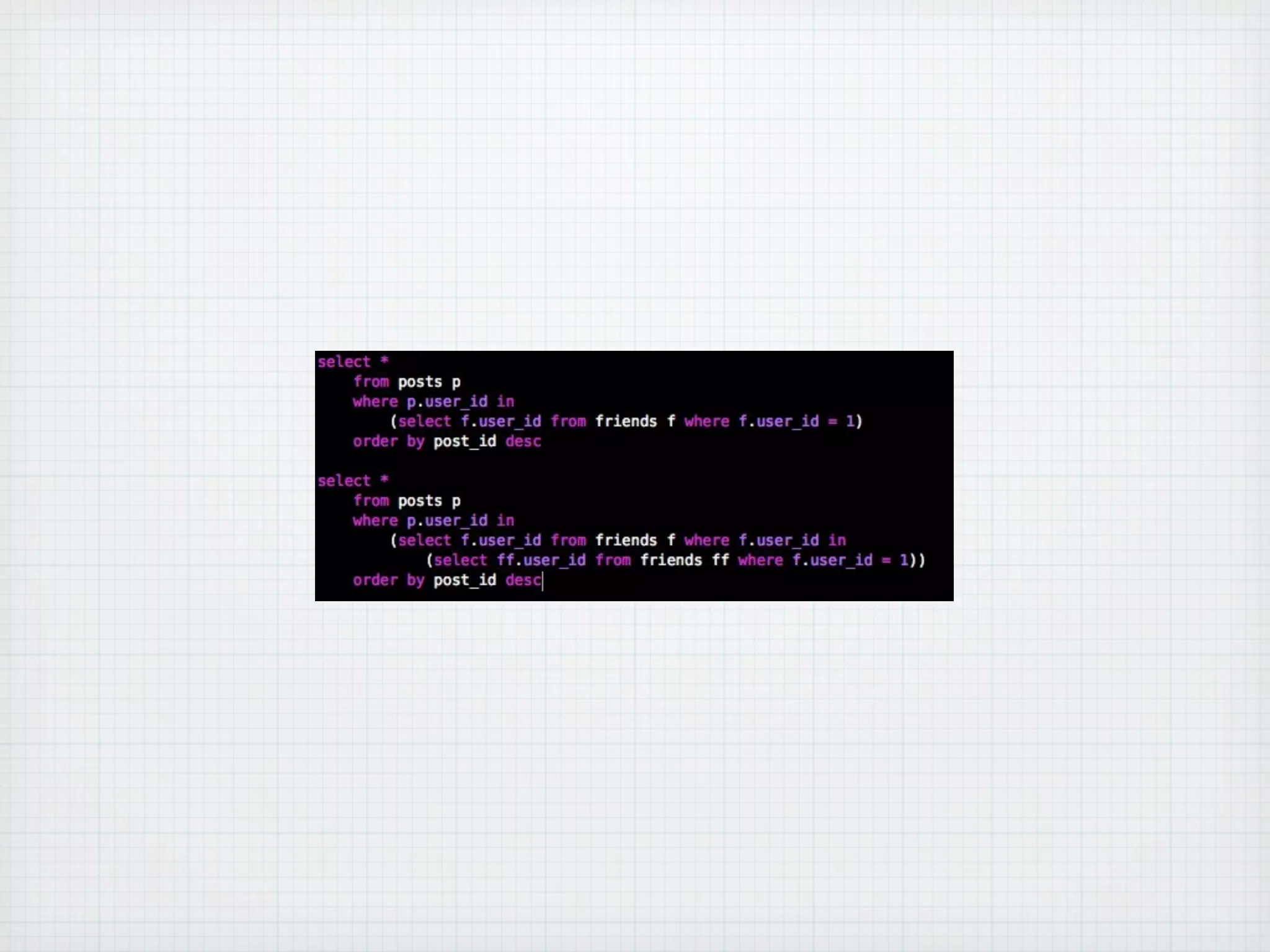
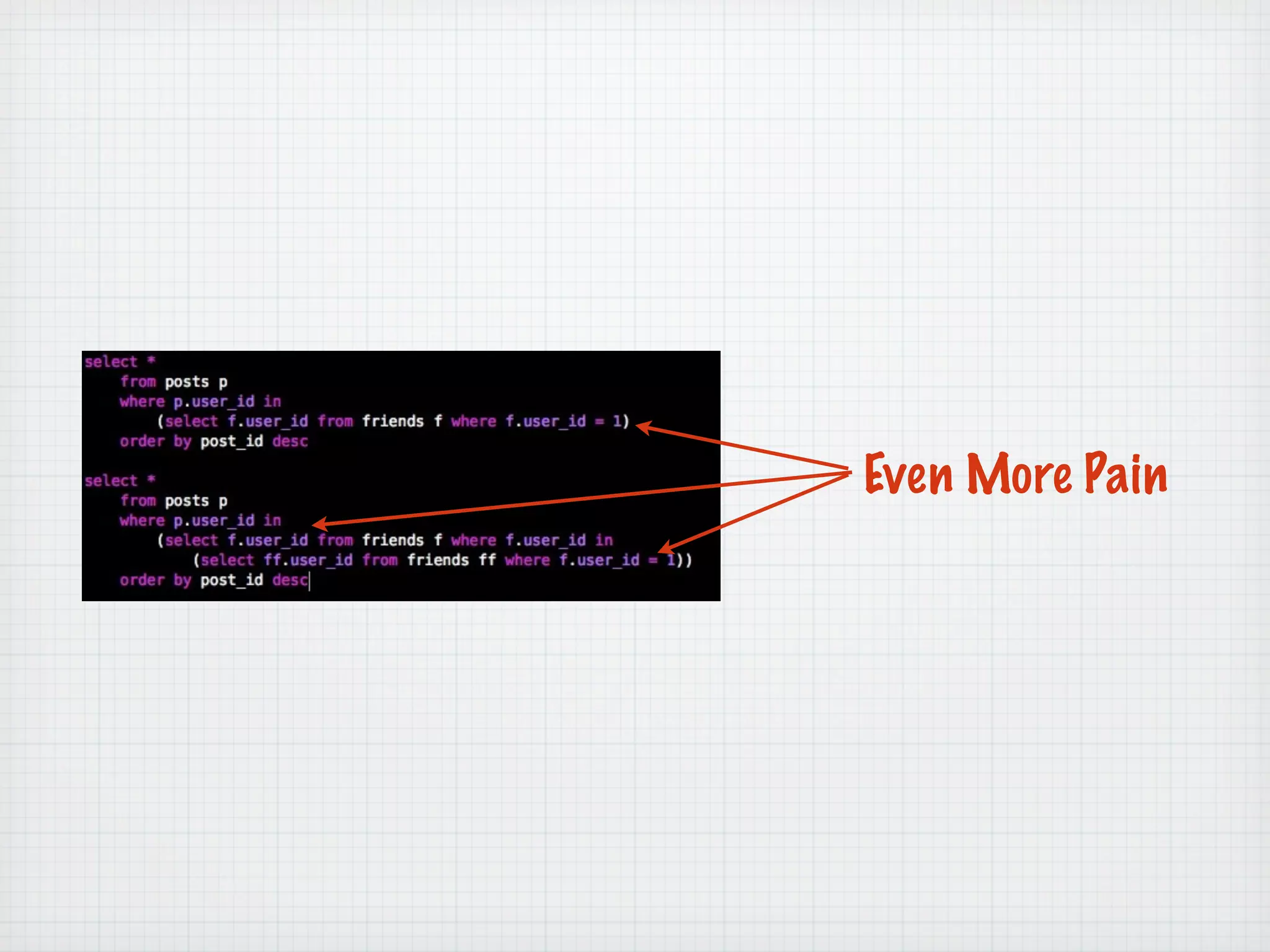
     to MySQL
Can be Painful
Even More Pain
Relational databases can work for the simplest
of cases, but fail horribly at nearly all graph-related
               operations/algorithms.
Graphs and graph-databases are only
  going to be more and more useful.
However, graph algorithms are hard.

            So don’t write your own.

And make sure you use a persistent storage engine
   that is best suited for the type of queries
             you will be performing.
Resources
Resources
The Algorithm Design Manual,
Steve S. Skiena
Programming Collective
Intelligence, Toby Segaran
Introduction to Algorithms,
Cormen, Leiserson, Rivest
@jperras
Photo Credits


Graph of the internet, circa 2003: http://www.duniacyber.com/freebies/education/what-
is-internet-lookslike/ (built from partial troll of public servers using traceroute)

My real friends for letting me use their Facebook profile images.
References

Large Scale Graph Algorithms (class lectures), Yuri Lifshits, Steklov Institute of
Mathematics at St. Petersburg

http://mathworld.wolfram.com/Set.html

Programming Collective Intelligence, Toby Segaran

The Algorithm Design Manual, Steve S. Skiena

Graphs, Edges & Nodes - Untangling the Social Web

  • 1.
    Graphs, Edges & Nodes Untangling the social web.
  • 2.
  • 3.
  • 4.
  • 5.
  • 6.
    Graph 10 19 9 7 2 15 7 3 12 13 9 6 6 4 3 5 7 4 14 1 4
  • 7.
    Graph 11 10 10 19 6 9 7 2 15 7 21 3 8 12 15 13 13 17 9 22 6 6 3 4 4 3 2 5 7 4 6 14 9 12 1 10 4 19
  • 8.
    Simple At most oneedge bet ween any pair of nodes.
  • 9.
    Multigraph Multiple edges between vertices allowed.
  • 10.
  • 11.
  • 13.
    What’s a node? vertex point junction 0-simplex
  • 16.
    What’s an edge? arc branch line link 1-simplex
  • 17.
  • 20.
  • 21.
  • 26.
  • 27.
  • 29.
    (Graph does notinclude Justin Bieber)
  • 30.
  • 41.
    Find the bandthat is most often co-listened with the given one.
  • 42.
    People Find the bandthat is most often co-listened with the given one.
  • 43.
    People Bands Find the band that is most often co-listened with the given one.
  • 44.
    People Bands Find the band that is most often co-listened with the given one.
  • 45.
    People Bands Find the band that is most often co-listened with the given one.
  • 46.
    People Bands Find the band that is most often co-listened with the given one.
  • 47.
    Basically, most kindsof simple content/co-occurrence similarity.
  • 48.
    That’s a 2-steppath on a bipartite graph. There are many of these ‘fundamental’ graph units: - tripartite - folksonomies (tripartite 3-graph + 2- step path) - multicolor-multiparity graph - etc.
  • 49.
  • 50.
    Neo4j “An embedded, disk-based,fully transactional Java persistence engine that stores data structured in graphs rather than in tables.” http://neo4j.org
  • 51.
    HypergraphDB “Ageneral purpose, extensible, portable, distributed, embeddable, open-source data storage mechanism. It is a graph database designed specifically for artificial intelligence and semantic web projects.” http://kobrix.org/hgdb.jsp
  • 52.
  • 53.
    FlockDB “FlockDB isa database that stores graph data, but it isn't a database optimized for graph-traversal operations. Instead, it's optimized for very large adjacency lists, fast reads and writes, and page-able set arithmetic queries.” http://engineering.t witter.com/2010/05/introducing- flockdb.html
  • 54.
    Redis “Redis is anadvanced key-value store. [...] the dataset is not volatile, and values can be strings, exactly like in memcached, but also lists, sets, and ordered sets. All this data types can be manipulated with atomic operations to push/pop elements, add/remove elements, perform server side union, intersection, difference bet ween sets, etc.” http://code.google.com/p/redis
  • 55.
  • 56.
    Redis makes youthink in terms of datastructures, and operations on those structures.
  • 57.
    Set: Finite (forour cases) collection of objects in which order has no significance and multiplicity is generally ignored. S = { Alice, Bob, Carol } List: Finite (for our cases) collection of objects in which order *is* significant and multiplicity is allowed. L = [ X, Y, X, Z, Q]
  • 58.
    Insert a userinto a set SET uid:1000:username jperras SET uid:1000:password bazinga!
  • 59.
    Use sets fordenoting my followers/people I follow. uid:1000:followers => Set of uids of all the followers users uid:1000:following => Set of uids of all the following users
  • 60.
    Adding a newfollower SADD uid:1000:following 1001 SADD uid:1001:followers 1000
  • 61.
    Posting Updates $r =Redis(); $postid = $r->incr("global:nextPostId"); $post = $User['id'] ."|". time() ."|". $status; $r->set("post:$postid", $post); $followers = $r->smembers("uid:".$User['id'].":followers"); if ($followers === false) $followers = Array(); $followers[] = $User['id']; /* Add the post to our own posts too */ foreach($followers as $fid) {     $r->push("uid:$fid:posts", $postid, false); } # Push the post on the timeline, and trim the timeline to the # newest 1000 elements. $r->push("global:timeline", $postid, false); $r->ltrim("global:timeline",0,1000);
  • 62.
    Common followers? -Set intersections! SINTER users:1000:followers users:1000:followers
  • 63.
  • 65.
  • 67.
  • 68.
    Relational databases canwork for the simplest of cases, but fail horribly at nearly all graph-related operations/algorithms.
  • 69.
    Graphs and graph-databasesare only going to be more and more useful.
  • 70.
    However, graph algorithmsare hard. So don’t write your own. And make sure you use a persistent storage engine that is best suited for the type of queries you will be performing.
  • 71.
  • 72.
    Resources The Algorithm DesignManual, Steve S. Skiena Programming Collective Intelligence, Toby Segaran Introduction to Algorithms, Cormen, Leiserson, Rivest
  • 73.
  • 74.
    Photo Credits Graph ofthe internet, circa 2003: http://www.duniacyber.com/freebies/education/what- is-internet-lookslike/ (built from partial troll of public servers using traceroute) My real friends for letting me use their Facebook profile images.
  • 75.
    References Large Scale GraphAlgorithms (class lectures), Yuri Lifshits, Steklov Institute of Mathematics at St. Petersburg http://mathworld.wolfram.com/Set.html Programming Collective Intelligence, Toby Segaran The Algorithm Design Manual, Steve S. Skiena

Editor's Notes

  • #2 Many of the most popular web applications today deal with highly organized and structured data that represent entities, and the relationships between these entities. LinkedIn can tell you how many degrees of separation there are between yourself and the CEO of Samsung, Facebook can figure out people that you might already know, Digg can recommend article submissions that you might like, and LastFM suggests music based on your current listening habits. We’ll take a look at the basic theory behind how some of these features can be implemented (no computer science degree required!), and take a quick look at the current landscape of graph-based datastores that simplify many of these operations.
  • #3 Start with some definitions.
  • #4 Collection of points - e.g. Users (Twitter/Facebook), songs (iTunes)
  • #5 Add relationships between data points
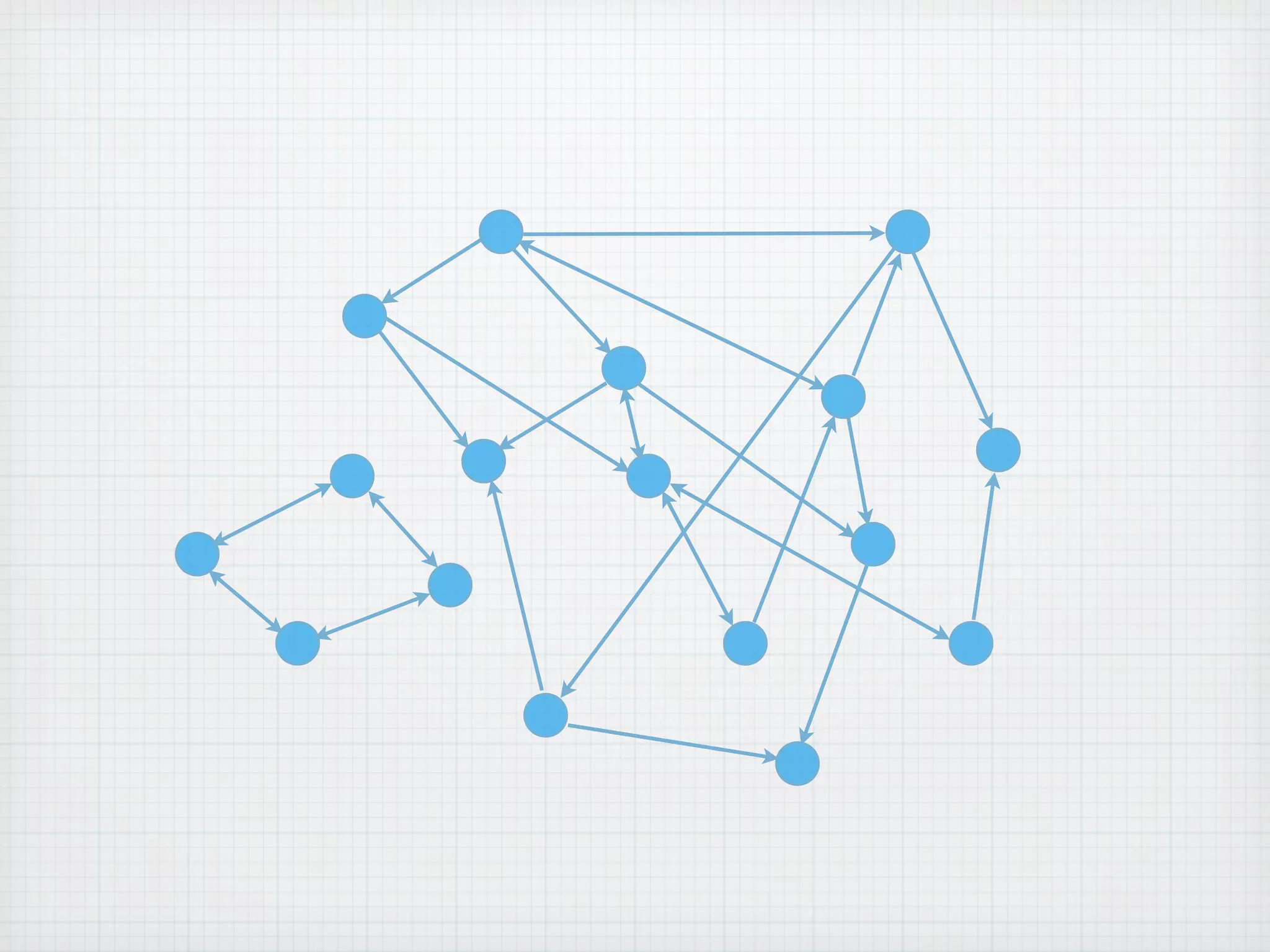
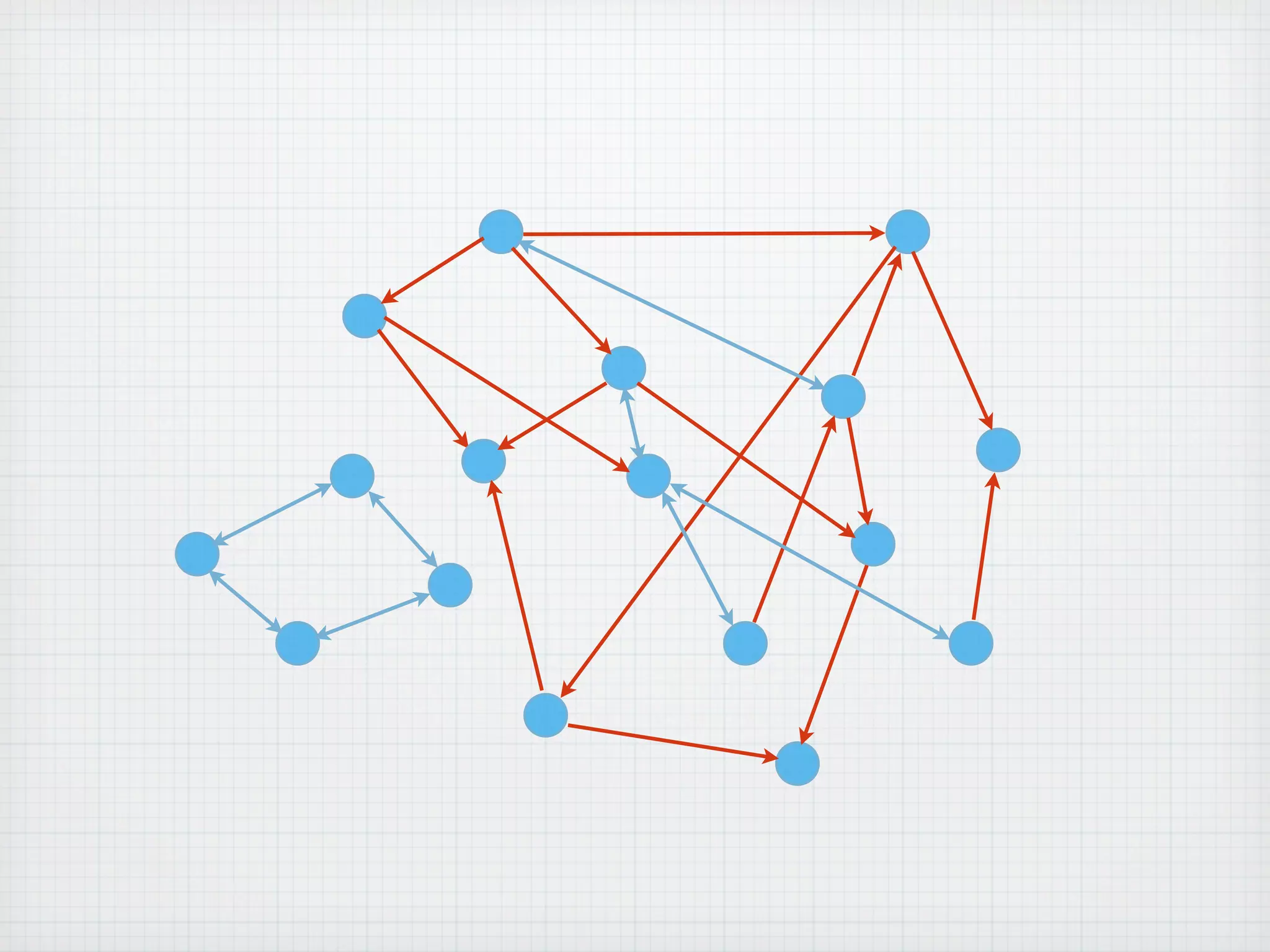
  • #6 Some relations are not symmetric - e.g. `friend` vs. following/follower is asymmetric.
  • #7 Your relationships might have a weight - e.g. # of Scrabulous games they have played together.
  • #8 Data points can also have weight - e.g. `reputation` score on social news sites like Digg, Reddit.
  • #9 Simple graph - at most one edge between vertex pair.
  • #10 Simple graph - at most one edge between vertex pair.
  • #11 Self-loops are allowed. e.g. if your application needs the ability for you to be your own ‘follower’ or ‘friend’.
  • #12 Notation that you might see - G is the ‘name’ of the graph, and is composed of ‘V’ vertices (nodes) and ‘E’ edges.
  • #14 "Vertex" is a synonym for a node of a graph, i.e., one of the points on which the graph is defined and which may be connected by graph edges.
  • #17 An ordered (or unordered) pair of nodes. Different types of edges: directed. In geometry, a simplex (plural simplexes or simplices) is a generalization of the notion of a triangle or tetrahedron to arbitrary dimension. Specifically, an n-simplex is an n-dimensional polytope with n + 1 vertices, of which the simplex is the convex hull. For example, a 2-simplex is a triangle, a 3-simplex is a tetrahedron, and a 4-simplex is apentachoron. A single point may be considered a 0-simplex, and a line segment may be viewed as a 1-simplex. A simplex may be defined as the smallest convex set which contains the given vertices.
  • #18 The edge is an ordered pair of nodes. The terms "arc", "branch" "line", "link" and "1-simplex" are sometimes used instead of edge
  • #19 Edge highlight on next slide.
  • #21  an unordered pair of nodes that specify a line joining these two nodes are said to form an edge
  • #22  an unordered pair of nodes that specify a line joining these two nodes are said to form an edge
  • #28 Partial map of the internet, culled in 2003 using traceroute.
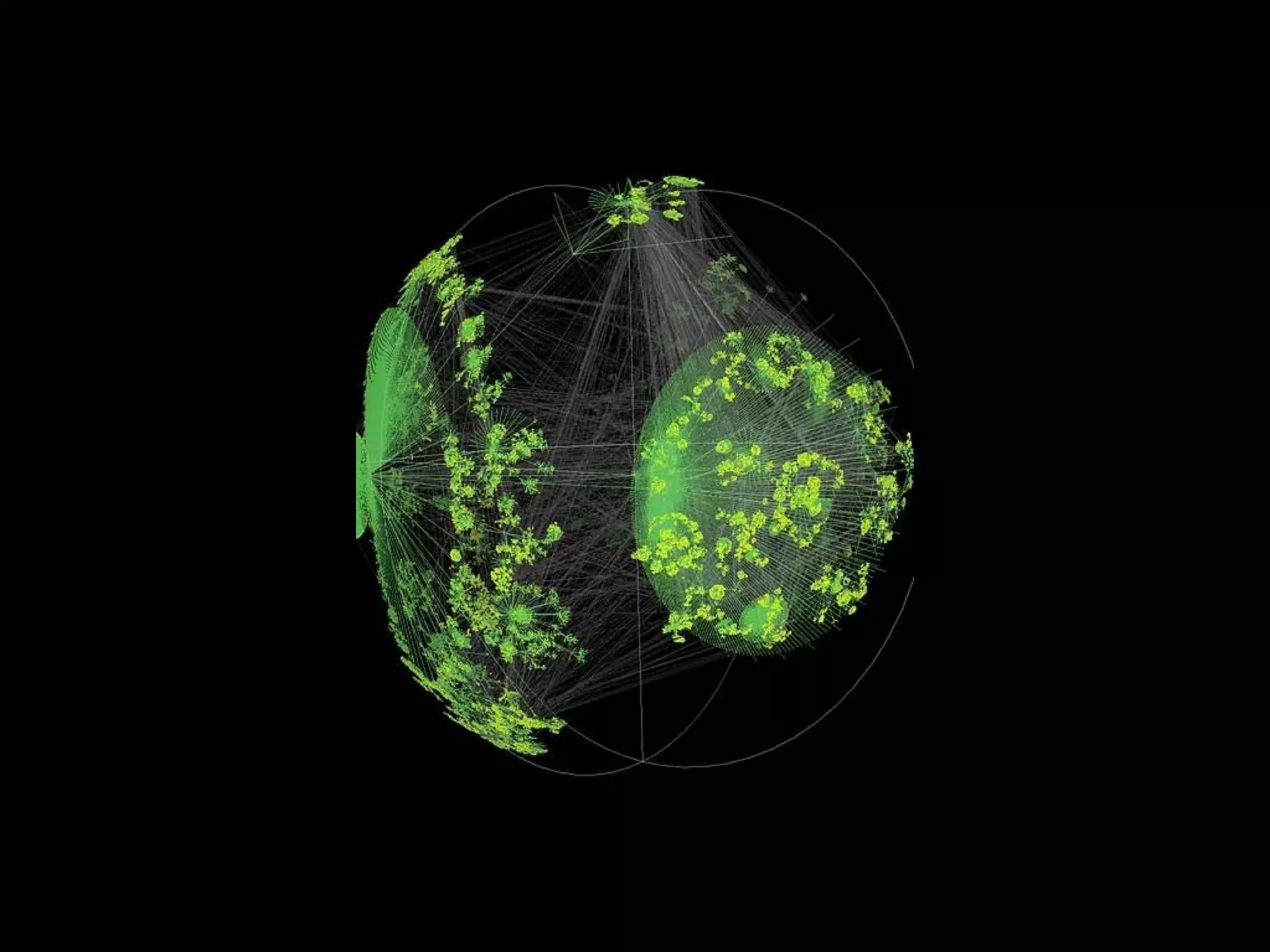
  • #29 Graph visualizations have also become quite important - displaying information on billions of points and edges in a useful manner is quite difficult. The graph is projected inside a 3D sphere using a special kind of space based hyperbolic geometry. This is a non-Euclidean space, which has useful distorting properties of making elements at the center of the display much larger than those on the periphery. Hyperbolic space projection is commonly know as “focus+context” in the field of information visualization and has been used to display all kinds of data that can be represented as large graphs in either two and three dimensions.
  • #30 This is a graph representation of the similarity relationships derived from the database of Last.fm. The circles (vertices) on the left hand side figure are bands, musicians, composers, whatever you will find in theMusic section of the site. Lines (edges) connect similar artists.  Vertex sizes vary according to the popularity of the artists. I Vertex colors correspond to musical genres, identified by tags attached to the artists by the users of Last.fm
  • #31 You are already a part of and use several social graphs.
  • #32 Twitter is one giant graph (users, followers, following) + timeline attached to users
  • #33 Linkedin is another giant graph. It’s basically in their name!
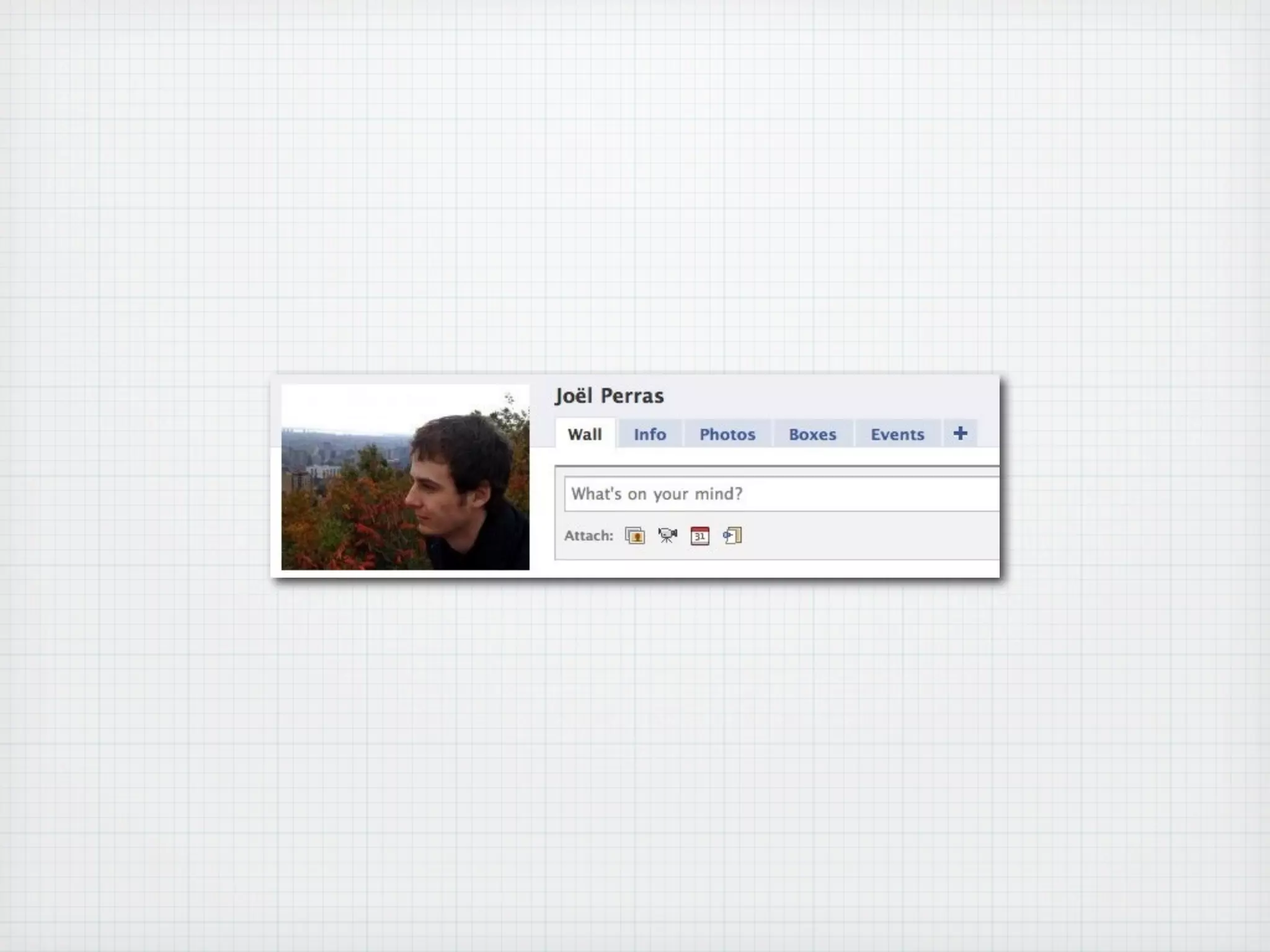
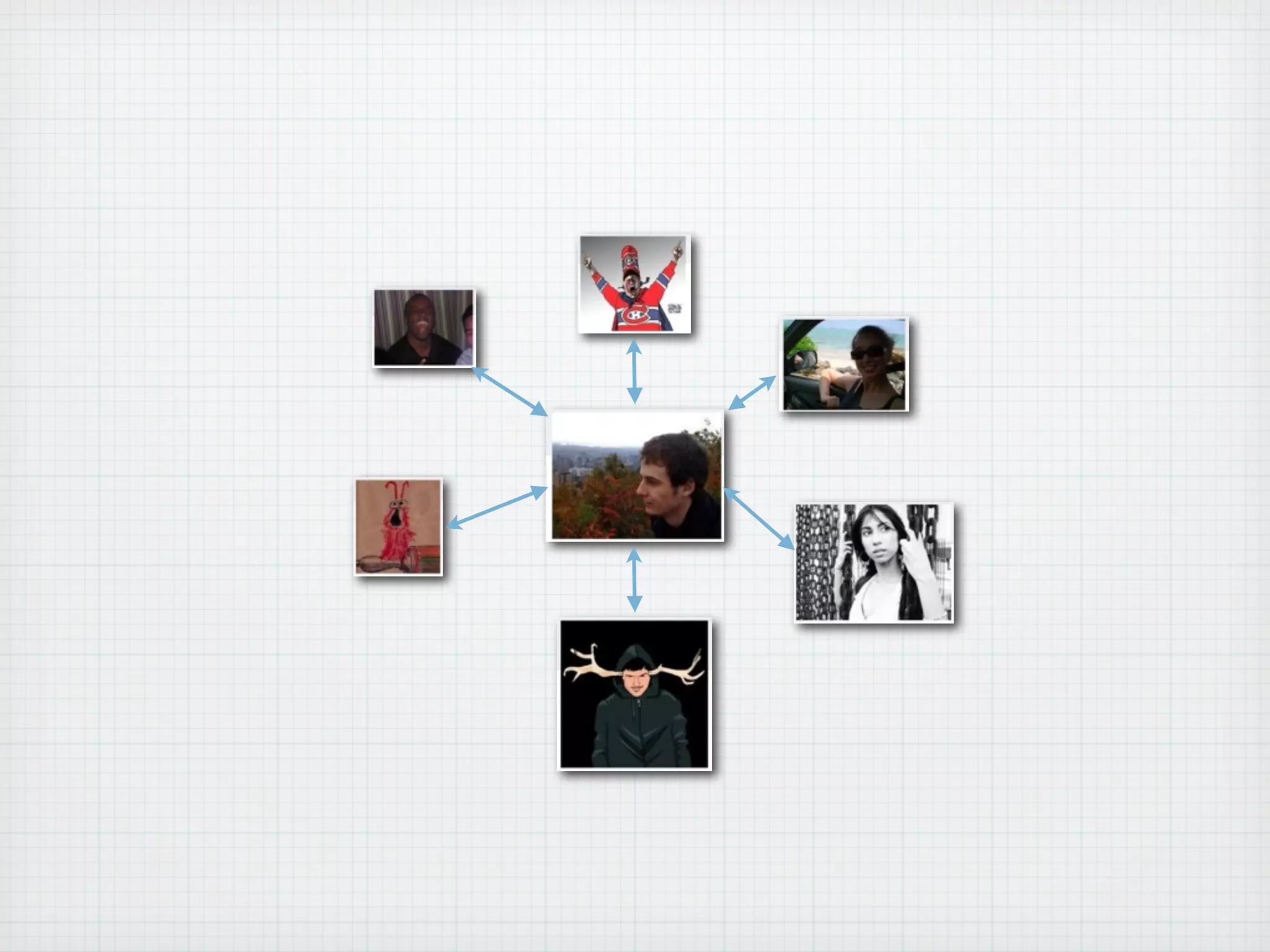
  • #35 Me
  • #36 I’m the center of the world.
  • #37 Relationships with my friends
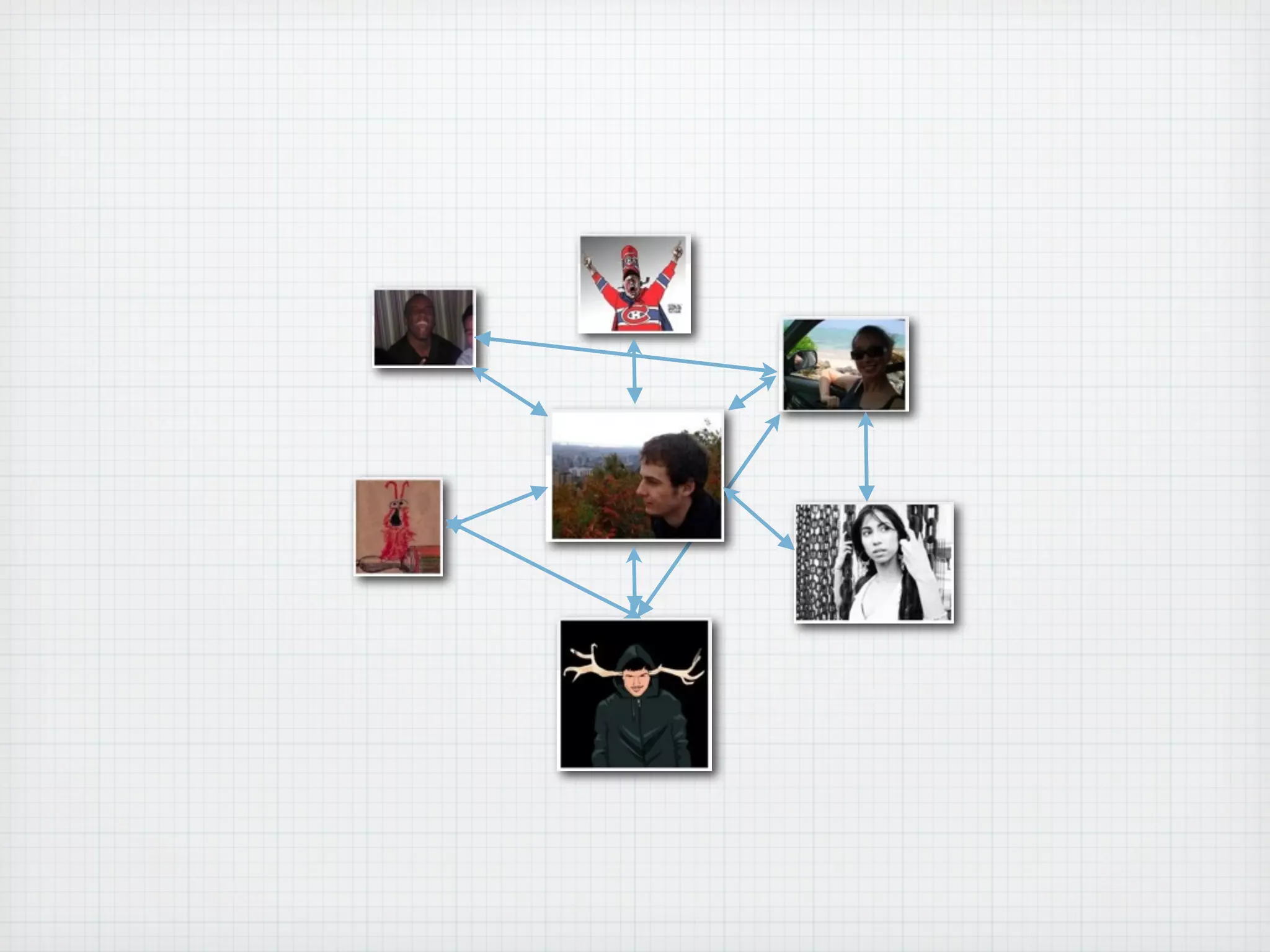
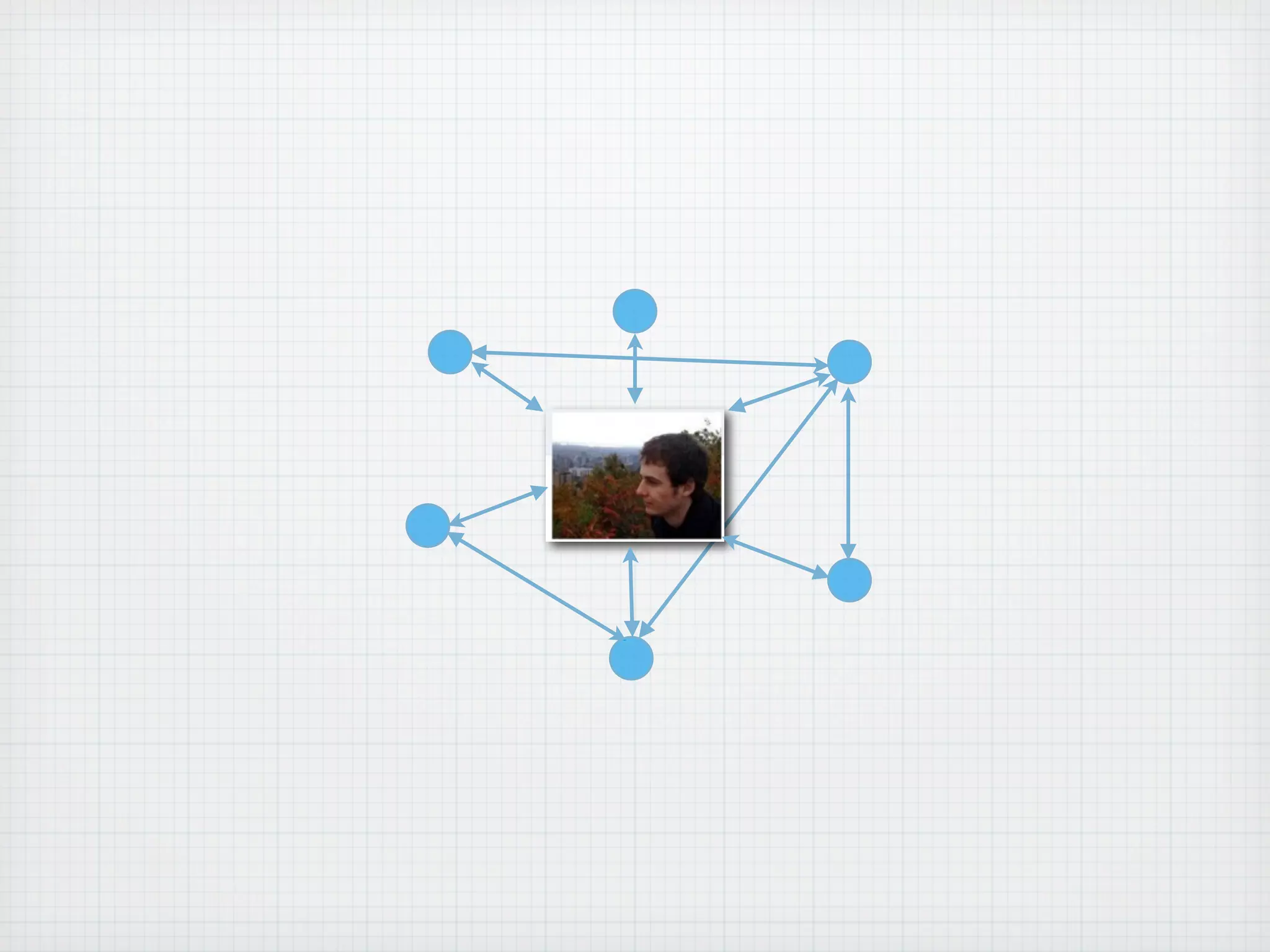
  • #38 My friends also have relationships between themselves
  • #39 Let’s get rid of the pictures for a second
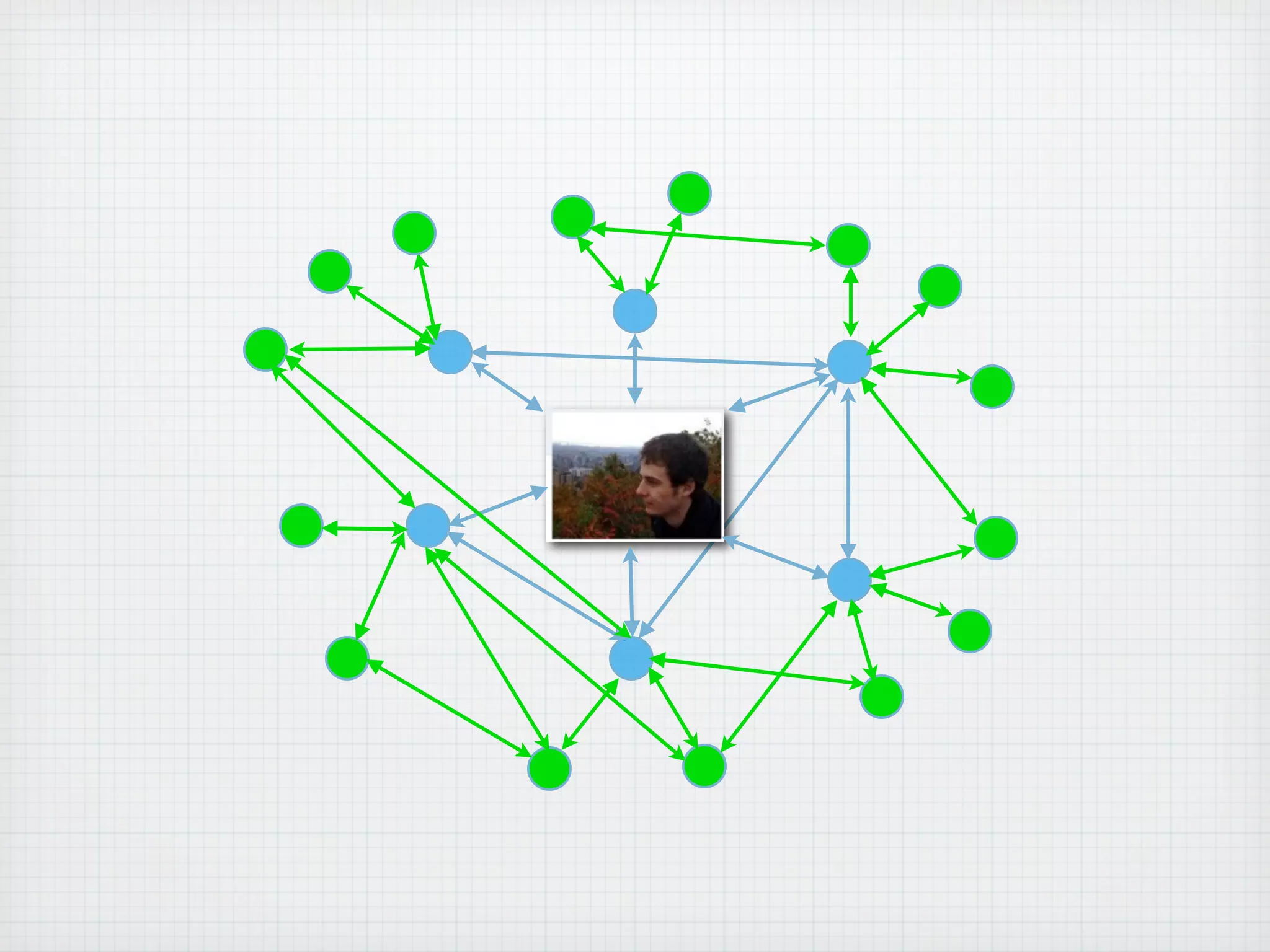
  • #40 My friends also have friends, and those friends can be friends with my other immediate friends.
  • #49 Important problems: max-intersection + strongest connection problem.
  • #54 From Twitter - solves their problems
  • #58 Sets are great when the order of your data doesn’t matter, and when you know that the objects need to be unique. Example: USERS Lists are best for things that need to be displayed in a given order, e.g. POST TIMELINE
  • #63 Sets are great when the order of your data doesn’t matter, and when you know that the objects need to be unique. Example: USERS Lists are best for things that need to be displayed in a given order, e.g. POST TIMELINE