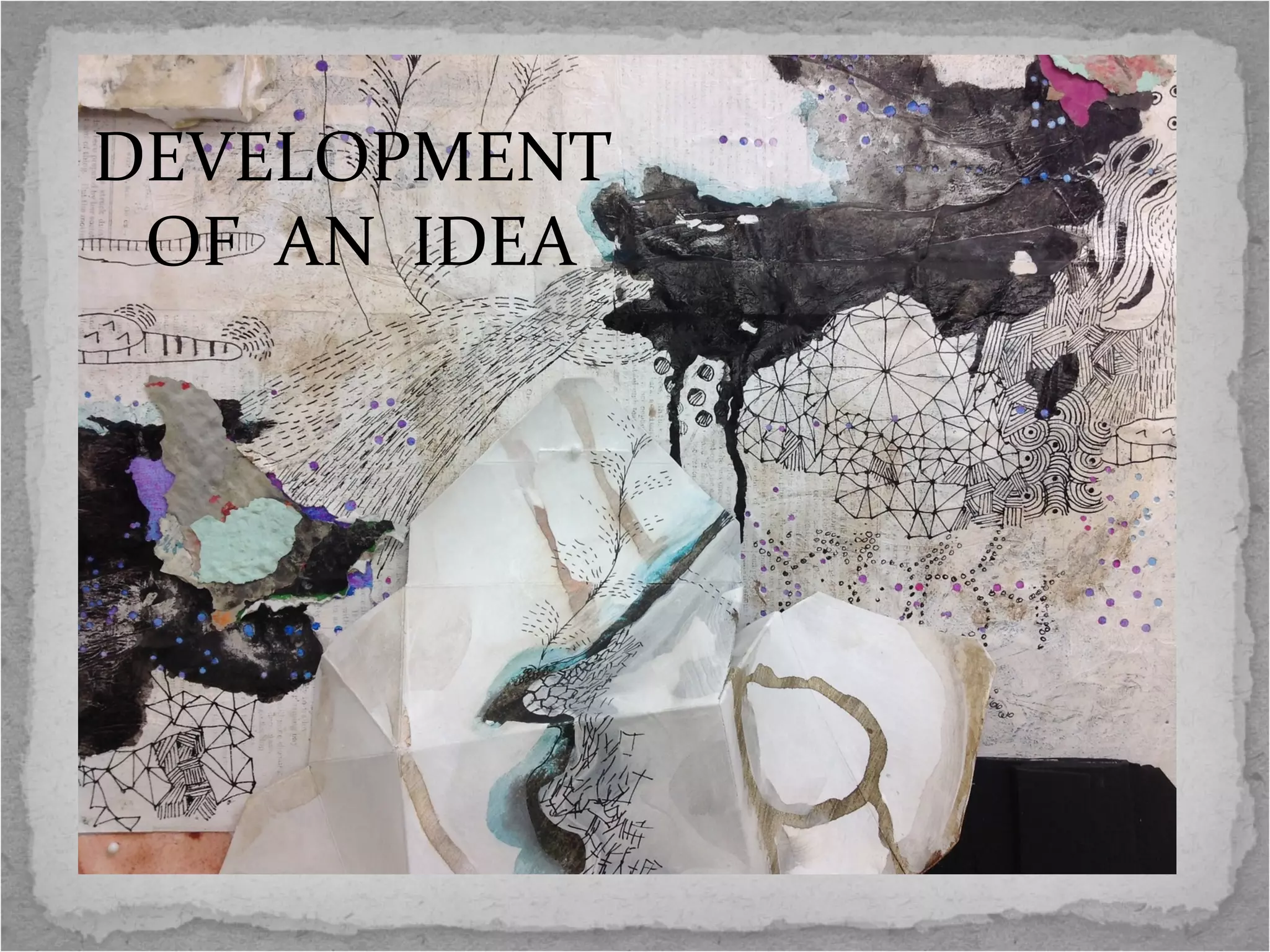
DEVELOPMENT
OF AN IDEA
IDEAIDEA
Through your ideas and research, you develop “process and form”Through your ideas and research, you develop “process and form”
PROCESS
This is the physical activity related to how you work; your decisions, choice of
techniques, the materials you select and how they are used. Process can
affect an idea.
“It is the essence and spirit of the subject that should be
the motivating force and not the paint, paper or media”
FORM
The “form” that your idea develops into is a result of your process and
choices, such as: surface, media, materials, composition & design.
How do you get from an idea and concept to final work?
SELECTION
Focus on an idea in order to structure your looking
A theme liberates you from a continual problem of choice
What is the essence of the feeling behind the image
you wish to describe?
Infuse the spirit of the subject into your work
with unique qualities
The following 12 slides illustrateThe following 12 slides illustrate
the development stagesthe development stages
ofof
two large workstwo large works
LandForms I and Landforms IILandForms I and Landforms II
Collaborative drawing by: Jennifer Starkweather & Amanda Hughen
IDEA SUBJECT THEME
o Connection to land
o Geological formations
of Lethbridge, Alberta
o Man-made structures
o Topographical changes
oColour idea:
Deep earth tones contrasted with areas
of high-intensity colour, which
corresponds to man-made colour
legends from geological time-scales.
Natural vs. man-made.
o Geology
o Geography
o Geomorphology
Study of landforms and the processes that
create them.
o Cartography
o Erosion
o Crystalline patterns
o Sedimentary deposits
o Cellular structure of coal
o Rivers
o Roadways and bridges
oPhysical nature of
land.
oThe manifestation of
time revealed in strata
and landforms, layered
with topographical
changes.
Lethbridge Viaduct, 1909 - 5,331 feet long and 314 feet high – the world’s longest and highest trestle bridge
My initial drawing with all the elements –My initial drawing with all the elements –
Lethbridge viaduct, landforms, river, cellular structure of coal & roadwaysLethbridge viaduct, landforms, river, cellular structure of coal & roadways..
COLOUR IDEACOLOUR IDEA
Deep earth tones contrasted with areas of
high-intensity colour that corresponds to
man-made colour legends from
geological time-scales.
Earthy colour vs. contemporary colour.
SUPPORT MATERIALS PROCESS
o Variety of drawing papers
o Mylar and Yupo paper
o Plastic
o Cardboard packaging
o Map pages
o Books/Geomorphology
o Envelopes
o 1928 Magazine pages
o Tracing paper
o Parchment
o Kraft paper
o Paper lace doily
o Found/layered paint chip
o Plaster, paint and paper
mixture
oWatercolour
oAcrylic paint
oGolden flow acrylics
oAcrylic line markers
oInks
oWalnut ink
oPencil
oPencil crayons
oPastels
oGesso washes
oAcrylic grounds
Clear gesso
Watercolour ground
Pastel ground
Fibre paste
Coarse molding paste
Distress and alter
substrates to visually and
metaphorically suggest
those natural processes
that shape the earth.
Ink and paint runs and
flow.
Erasure through veils of
white paint.
Distress through rubbing,
laminate, fold, carve,
incise, layer…
Experiment with different materials & techniques – which one satisfies your intentions?
"LandForms I " 56" " X 79" © Jill Ehlert - 2014"LandForms I " 56" " X 79" © Jill Ehlert - 2014
"LandForms II" 64.5" X 74.5" © Jill Ehlert 2014"LandForms II" 64.5" X 74.5" © Jill Ehlert 2014
PRIMARY SOURCES OF INSPIRATIONPRIMARY SOURCES OF INSPIRATION
How do you pursue themes and ideas once you have decided on a subject?How do you pursue themes and ideas once you have decided on a subject?
What do you do with your idea? What attitude and approach do you take?What do you do with your idea? What attitude and approach do you take?
IDEA BOOK/SKETCHBOOKIDEA BOOK/SKETCHBOOK
I.Observations, thoughts, emotional responses, poems, quotes, colour
notes, descriptions and essential info on your subject. Photos of art work
by other artists who inspire your ideas – what are the elements in their
work that you could use in your own work. Mind Maps.
II.Drawing, sketching and painting; interpreting surfaces and patterns;
experiment with techniques and compositional ideas; collage, mark –
making, texture, cross hatching, value, brush and ink…
““Reproduce your feeling of the subject”Reproduce your feeling of the subject”
NEW IDEAS WILL FLOW ONCE YOU ARE ABSORBED IN YOUR SUBJECT.NEW IDEAS WILL FLOW ONCE YOU ARE ABSORBED IN YOUR SUBJECT.
MIND MAPMIND MAP
BLOCKS - THESE ARE USUALLY THINGS THAT:
oWe don’t like to do.
oWe don’t know how to do something, or just a particular step.
oWe don’t know how to start.
Perfectionism sometimes makes us create too big of a taskPerfectionism sometimes makes us create too big of a task
that is impossible to do. Break this into doable chunks.that is impossible to do. Break this into doable chunks.
ACTION – TRY THESE STEPS TO GET STARTED:
oLearn how to do it.
oLearn when to start a particular step. Ask for advice.
oDo things one small step at a time.
oSometimes we need help! Someone could be doing certain things for us.
oHire someone to teach you or to help you.
SKETCHBOOKSSKETCHBOOKS
OBSERVING, RECORDING AND COLLECTING MARKSOBSERVING, RECORDING AND COLLECTING MARKS
IDEAS SUBJECT THEME
oLandForms III
oDrawings on paper and found
surfaces
oPersonal connection to intertidal
zones of Vancouver Island.
oNatural phenomena in the
intertidal area.
oProcesses of weather’s rhythms
and repetitions; the visible and
invisible forces of nature and the
transformations they sustain on
the landscape and the objects in it
through:
oAir, wind, water, light and sound.
oMovement, notation of time and its
rhythm
oColours of the natural world
contrasted to colour from found
plastic debris.
oIntertidal Zone
oTide Pools
oKnotted Seaweed
Clusters
oGeological features
oCellular structure of
seaweed, plankton,
barnacles and other
marine life.
oPlastic jetsam
oProcesses of change
that occur in a coastal
environment
oPhysical nature of a
coastal landscape
oPersonal experience
oSense of place
oFor consideration as
work builds:
“Beauty & the
Grotesque”
Development of an Idea

Development of an Idea

  • 1.
  • 2.
    IDEAIDEA Through your ideasand research, you develop “process and form”Through your ideas and research, you develop “process and form” PROCESS This is the physical activity related to how you work; your decisions, choice of techniques, the materials you select and how they are used. Process can affect an idea. “It is the essence and spirit of the subject that should be the motivating force and not the paint, paper or media” FORM The “form” that your idea develops into is a result of your process and choices, such as: surface, media, materials, composition & design. How do you get from an idea and concept to final work?
  • 3.
    SELECTION Focus on anidea in order to structure your looking A theme liberates you from a continual problem of choice What is the essence of the feeling behind the image you wish to describe? Infuse the spirit of the subject into your work with unique qualities
  • 4.
    The following 12slides illustrateThe following 12 slides illustrate the development stagesthe development stages ofof two large workstwo large works LandForms I and Landforms IILandForms I and Landforms II
  • 5.
    Collaborative drawing by:Jennifer Starkweather & Amanda Hughen
  • 6.
    IDEA SUBJECT THEME oConnection to land o Geological formations of Lethbridge, Alberta o Man-made structures o Topographical changes oColour idea: Deep earth tones contrasted with areas of high-intensity colour, which corresponds to man-made colour legends from geological time-scales. Natural vs. man-made. o Geology o Geography o Geomorphology Study of landforms and the processes that create them. o Cartography o Erosion o Crystalline patterns o Sedimentary deposits o Cellular structure of coal o Rivers o Roadways and bridges oPhysical nature of land. oThe manifestation of time revealed in strata and landforms, layered with topographical changes.
  • 8.
    Lethbridge Viaduct, 1909- 5,331 feet long and 314 feet high – the world’s longest and highest trestle bridge
  • 10.
    My initial drawingwith all the elements –My initial drawing with all the elements – Lethbridge viaduct, landforms, river, cellular structure of coal & roadwaysLethbridge viaduct, landforms, river, cellular structure of coal & roadways..
  • 11.
    COLOUR IDEACOLOUR IDEA Deepearth tones contrasted with areas of high-intensity colour that corresponds to man-made colour legends from geological time-scales. Earthy colour vs. contemporary colour.
  • 12.
    SUPPORT MATERIALS PROCESS oVariety of drawing papers o Mylar and Yupo paper o Plastic o Cardboard packaging o Map pages o Books/Geomorphology o Envelopes o 1928 Magazine pages o Tracing paper o Parchment o Kraft paper o Paper lace doily o Found/layered paint chip o Plaster, paint and paper mixture oWatercolour oAcrylic paint oGolden flow acrylics oAcrylic line markers oInks oWalnut ink oPencil oPencil crayons oPastels oGesso washes oAcrylic grounds Clear gesso Watercolour ground Pastel ground Fibre paste Coarse molding paste Distress and alter substrates to visually and metaphorically suggest those natural processes that shape the earth. Ink and paint runs and flow. Erasure through veils of white paint. Distress through rubbing, laminate, fold, carve, incise, layer… Experiment with different materials & techniques – which one satisfies your intentions?
  • 13.
    "LandForms I "56" " X 79" © Jill Ehlert - 2014"LandForms I " 56" " X 79" © Jill Ehlert - 2014
  • 15.
    "LandForms II" 64.5"X 74.5" © Jill Ehlert 2014"LandForms II" 64.5" X 74.5" © Jill Ehlert 2014
  • 18.
    PRIMARY SOURCES OFINSPIRATIONPRIMARY SOURCES OF INSPIRATION
  • 22.
    How do youpursue themes and ideas once you have decided on a subject?How do you pursue themes and ideas once you have decided on a subject? What do you do with your idea? What attitude and approach do you take?What do you do with your idea? What attitude and approach do you take? IDEA BOOK/SKETCHBOOKIDEA BOOK/SKETCHBOOK I.Observations, thoughts, emotional responses, poems, quotes, colour notes, descriptions and essential info on your subject. Photos of art work by other artists who inspire your ideas – what are the elements in their work that you could use in your own work. Mind Maps. II.Drawing, sketching and painting; interpreting surfaces and patterns; experiment with techniques and compositional ideas; collage, mark – making, texture, cross hatching, value, brush and ink… ““Reproduce your feeling of the subject”Reproduce your feeling of the subject” NEW IDEAS WILL FLOW ONCE YOU ARE ABSORBED IN YOUR SUBJECT.NEW IDEAS WILL FLOW ONCE YOU ARE ABSORBED IN YOUR SUBJECT.
  • 23.
  • 24.
    BLOCKS - THESEARE USUALLY THINGS THAT: oWe don’t like to do. oWe don’t know how to do something, or just a particular step. oWe don’t know how to start. Perfectionism sometimes makes us create too big of a taskPerfectionism sometimes makes us create too big of a task that is impossible to do. Break this into doable chunks.that is impossible to do. Break this into doable chunks. ACTION – TRY THESE STEPS TO GET STARTED: oLearn how to do it. oLearn when to start a particular step. Ask for advice. oDo things one small step at a time. oSometimes we need help! Someone could be doing certain things for us. oHire someone to teach you or to help you.
  • 26.
    SKETCHBOOKSSKETCHBOOKS OBSERVING, RECORDING ANDCOLLECTING MARKSOBSERVING, RECORDING AND COLLECTING MARKS
  • 34.
    IDEAS SUBJECT THEME oLandFormsIII oDrawings on paper and found surfaces oPersonal connection to intertidal zones of Vancouver Island. oNatural phenomena in the intertidal area. oProcesses of weather’s rhythms and repetitions; the visible and invisible forces of nature and the transformations they sustain on the landscape and the objects in it through: oAir, wind, water, light and sound. oMovement, notation of time and its rhythm oColours of the natural world contrasted to colour from found plastic debris. oIntertidal Zone oTide Pools oKnotted Seaweed Clusters oGeological features oCellular structure of seaweed, plankton, barnacles and other marine life. oPlastic jetsam oProcesses of change that occur in a coastal environment oPhysical nature of a coastal landscape oPersonal experience oSense of place oFor consideration as work builds: “Beauty & the Grotesque”

Editor's Notes

  • #6 Jennifer Starkweather Amanda Hughen --- Yerba Buena, Ink, gouache, and pencil on paper, 22 x 30 inches, 2011 In seeing this work I was really excited by the ink work, the connection with land and geology. Instantly I thought how I could create a series with Lethbridge, the coulees, thee viaduct, the river, coal mining, the celluar structure of coal, maps of the area.