
















From Enterprise IA to Enterprise UXCreating a User Experience Framework for a (Big) BankBy ReynhardtUys (Standard Bank of South Africa) and Jason Hobbs (jh-01)26th September 2009
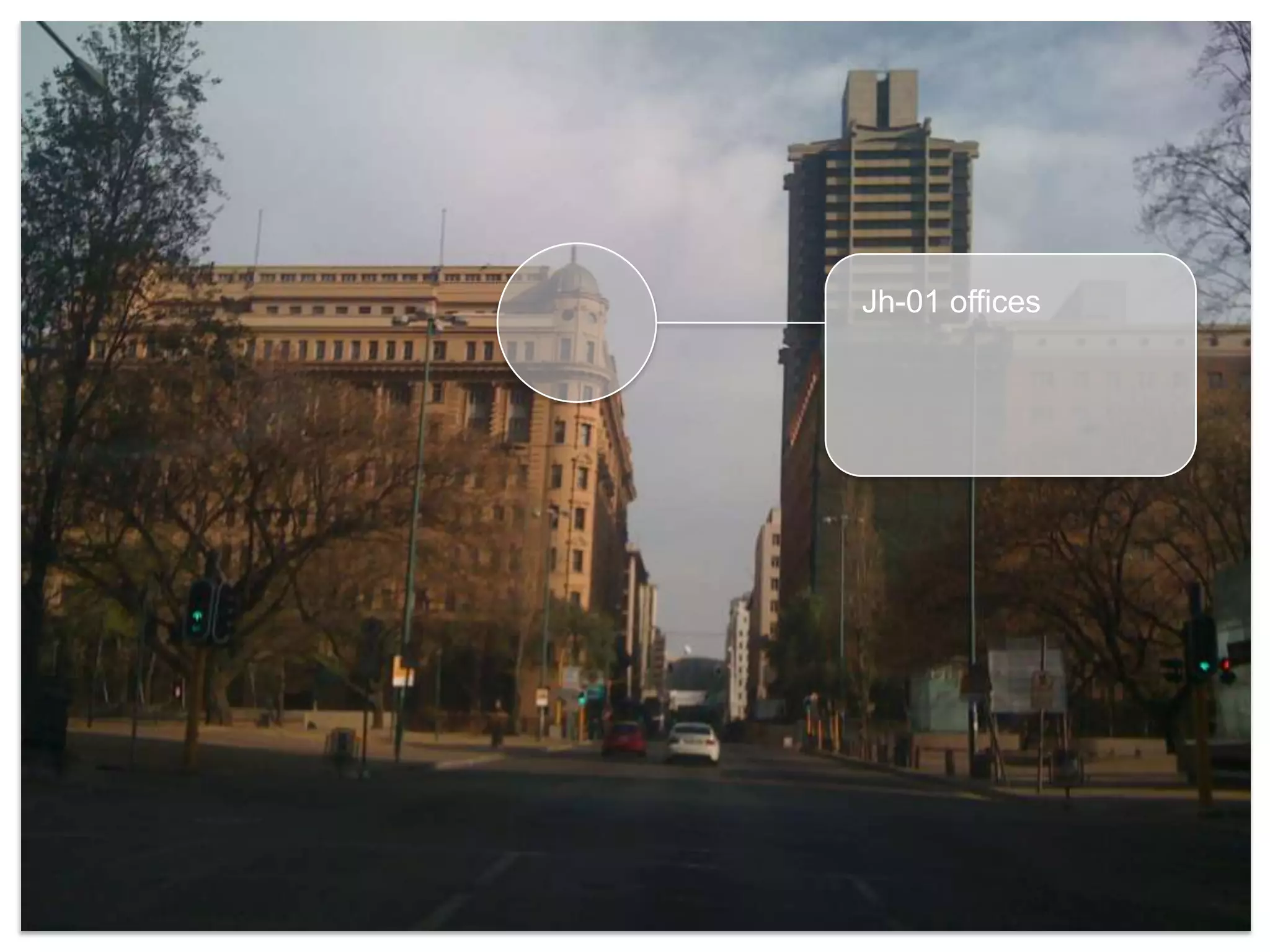
Jh-01 offices
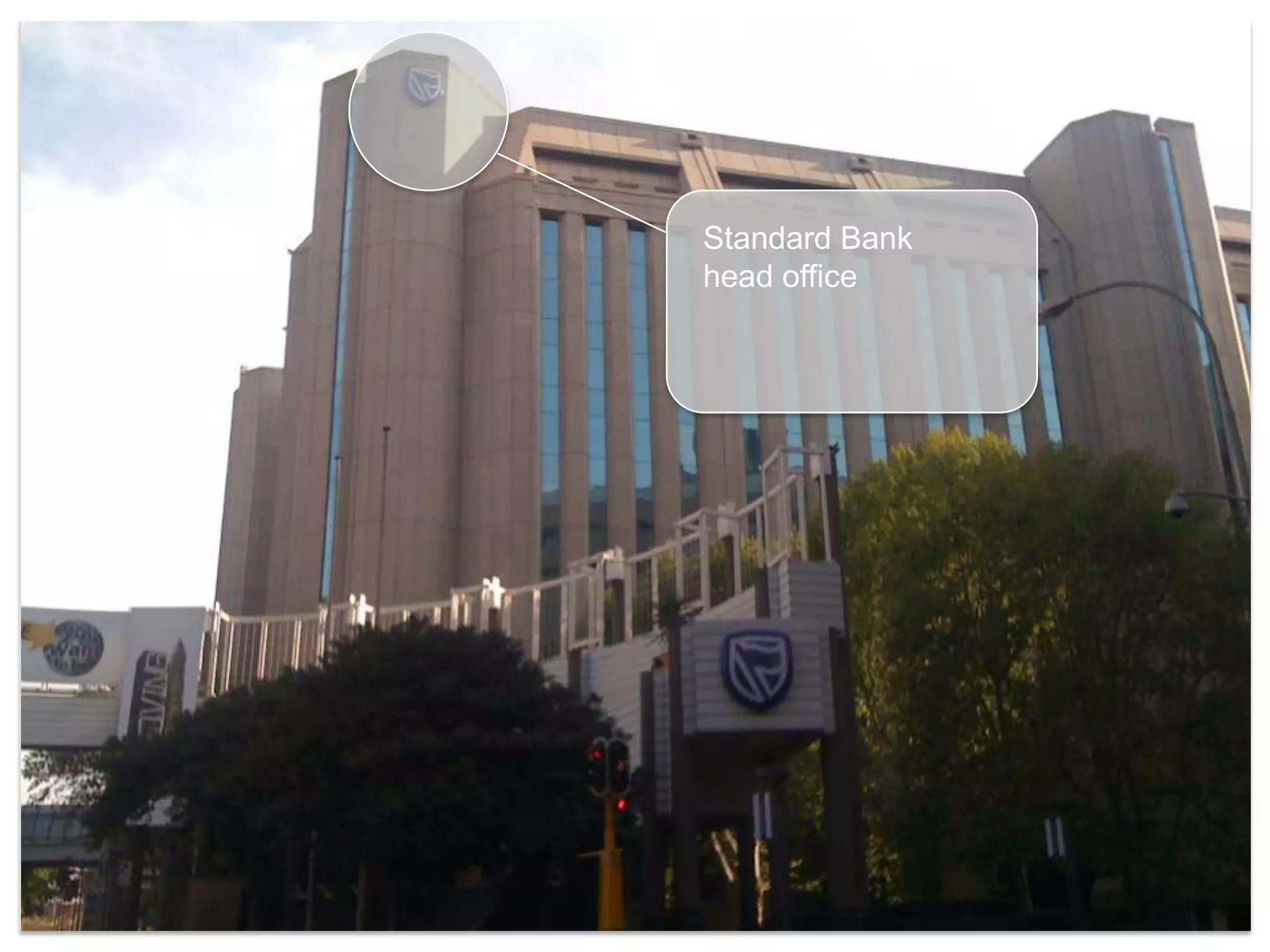
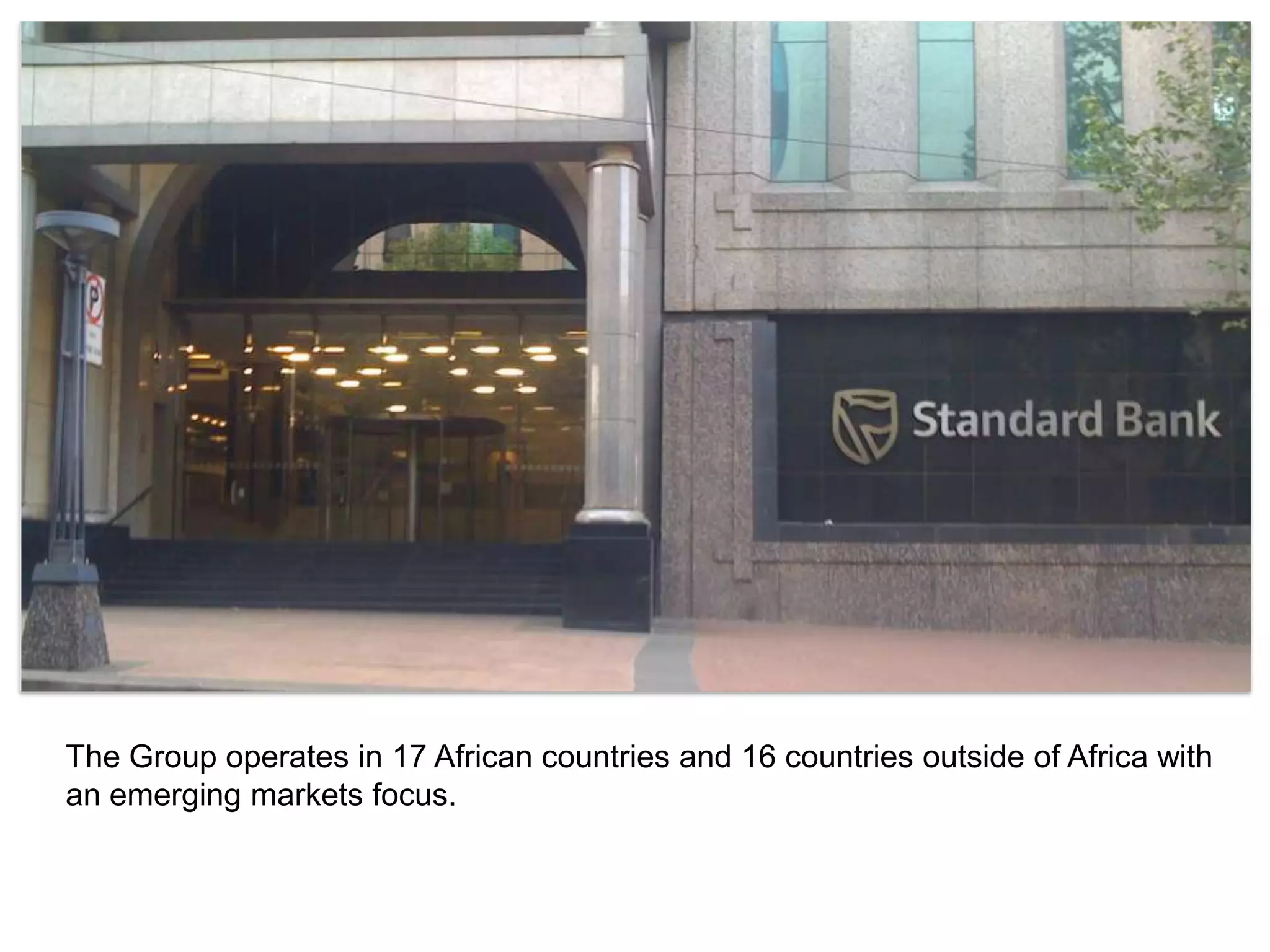
Standard Bank head office
The Group operates in 17 African countries and 16 countries outside of Africa with an emerging markets focus.
International research has found that for the past 10 years or more banks have been chasing the ideal of full service, self service channel based models (neglecting branch)...and it hasn't worked.  Banks have discovered that the branch remains the cornerstone of the customer relationship but that its role needs to change. The move is ‘from teller to seller'; from being transactionally basedto advice and sales oriented. 1. “Multichannel sales productivity” November 2007. Finalta & EFMA2. “The five pillars of retail excellence in retail banking 2007: a global benchmarking review” 2007. SAP & EFMA3. “The future role of the ‘bank store’ and its interconnectivity with other channels: a report by EFMA Banking Advisory Council in partnership with Microsoft” 2007. Microsoft & EFMA
There is agreement that the way forward will be based in greater levels of customer centricity, customisation and personalisation across integrated channels, empowering customers with what they need, where they are, when they need it.  1. “Multichannel sales productivity” November 2007. Finalta & EFMA2. “The five pillars of retail excellence in retail banking 2007: a global benchmarking review” 2007. SAP & EFMA3. “The future role of the ‘bank store’ and its interconnectivity with other channels: a report by EFMA Banking Advisory Council in partnership with Microsoft” 2007. Microsoft & EFMA
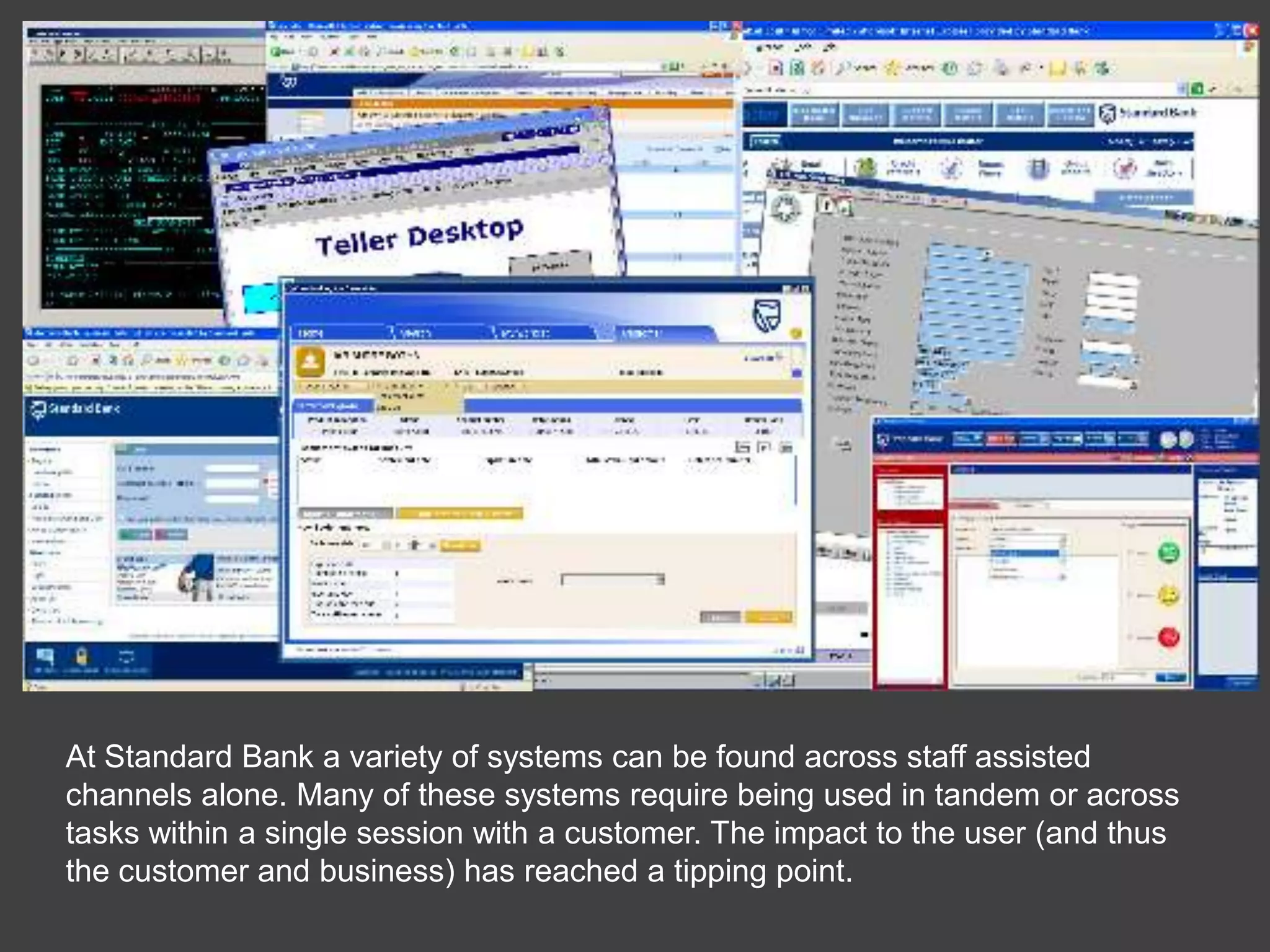
At Standard Bank a variety of systems can be found across staff assisted channels alone. Many of these systems require being used in tandem or across tasks within a single session with a customer. The impact to the user (and thus the customer and business) has reached a tipping point.
The solution: A Bank wide user experience framework (“The User Interface Design Framework”) which was completed early in 2009. The version 0 scope spanned staff assisted channels with self-service channels to follow.
The purpose: Create a unified set of design artifacts to govern, standardise and optimise user experience and interface design across multiple channels to fundamentally impact the customer experience.
The context and legacyThe project journeySustainabilityRecommendations
Context & legacy
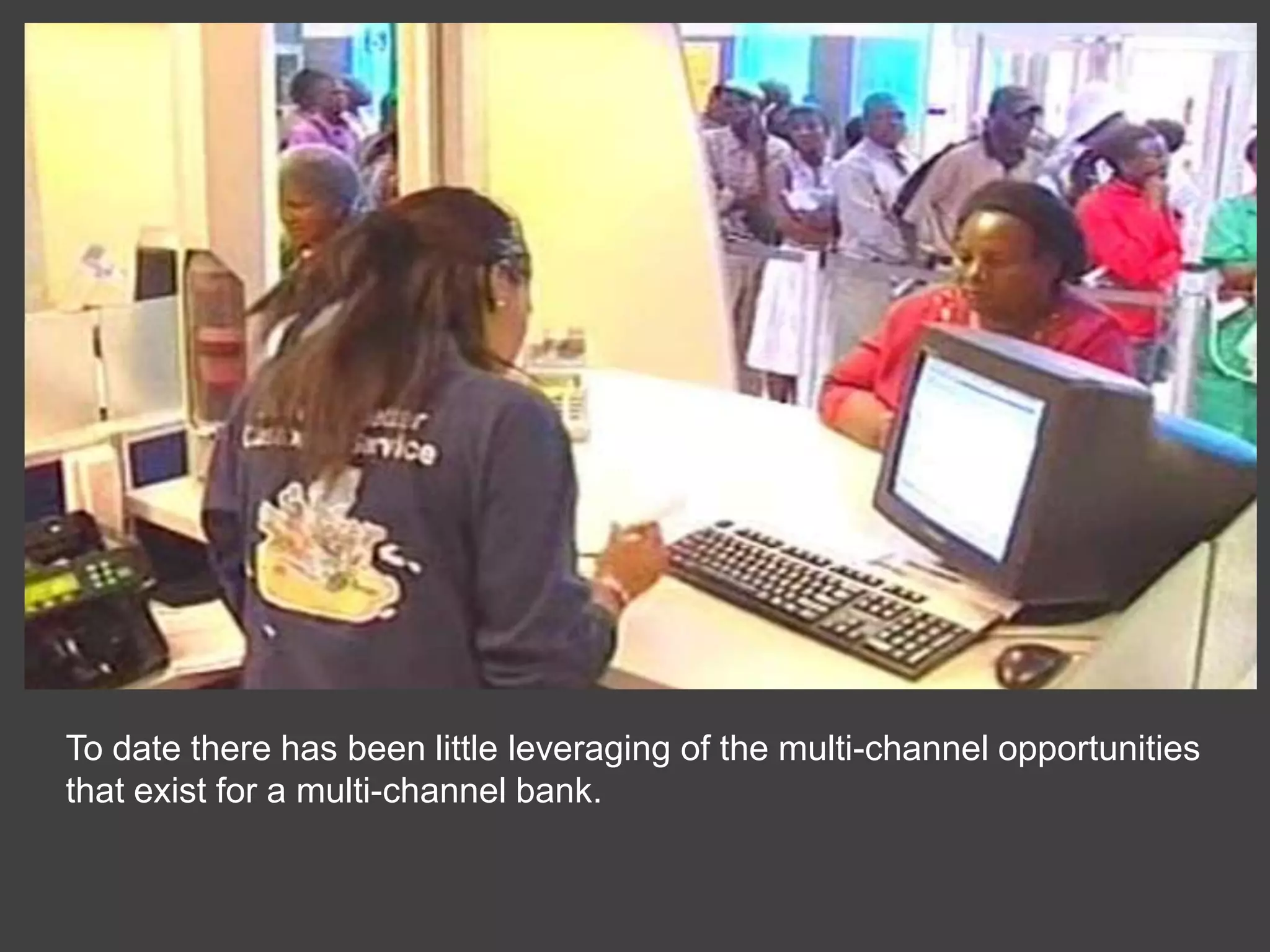
To date there has been little leveraging of the multi-channel opportunities that exist for a multi-channel bank.
Prior to the launch of the Framework Project there were only isolated instances of the application of usability within the Bank. The development methodology followed the traditional SDLC and user centered thinking had not been integrated.
It is key to develop buy-in to these new design philosophies at an enterprise level. Further more, if you wish to sustain such a design culture you will need to grow it across business units and channels from the ground up.
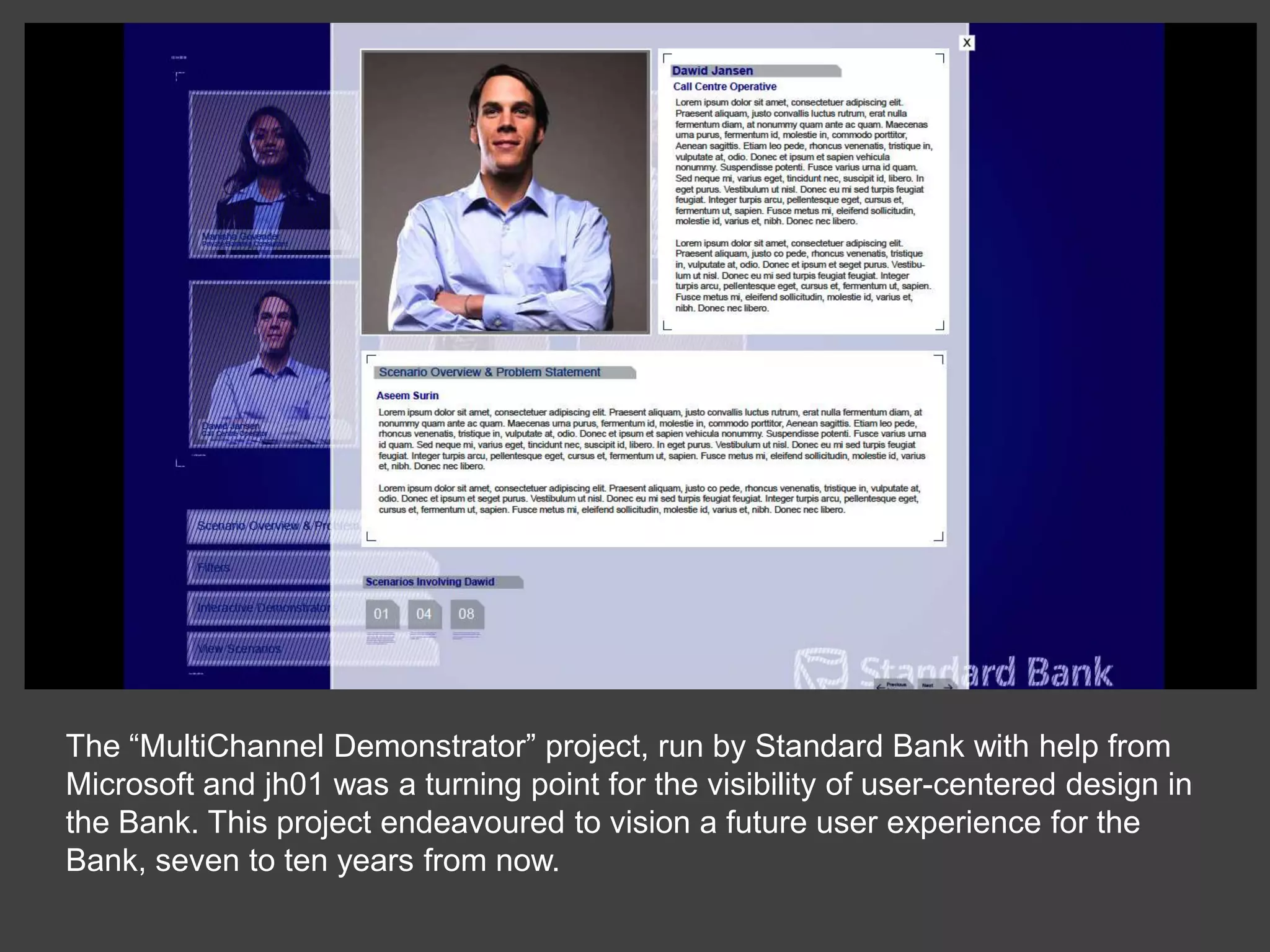
The “MultiChannel Demonstrator” project, run by Standard Bank with help from Microsoft and jh01 was a turning point for the visibility of user-centered design in the Bank. This project endeavoured to vision a future user experience for the Bank, seven to ten years from now.
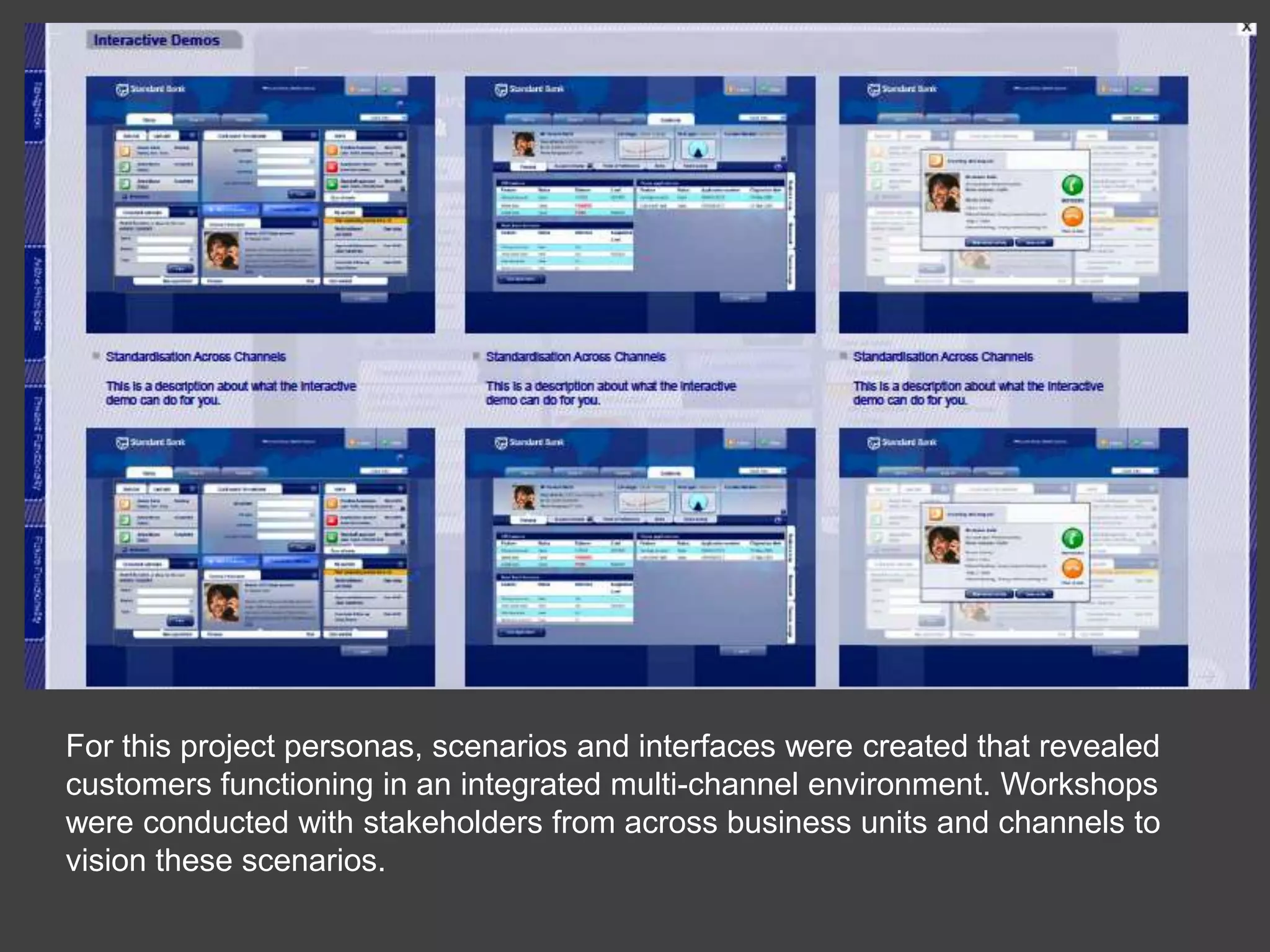
For this project personas, scenarios and interfaces were created that revealed customers functioning in an integrated multi-channel environment. Workshops were conducted with stakeholders from across business units and channels to vision these scenarios.
It was at this time that the concept of a user experience ‘Framework’ emerged.
User experience framework
}}}User experience framework
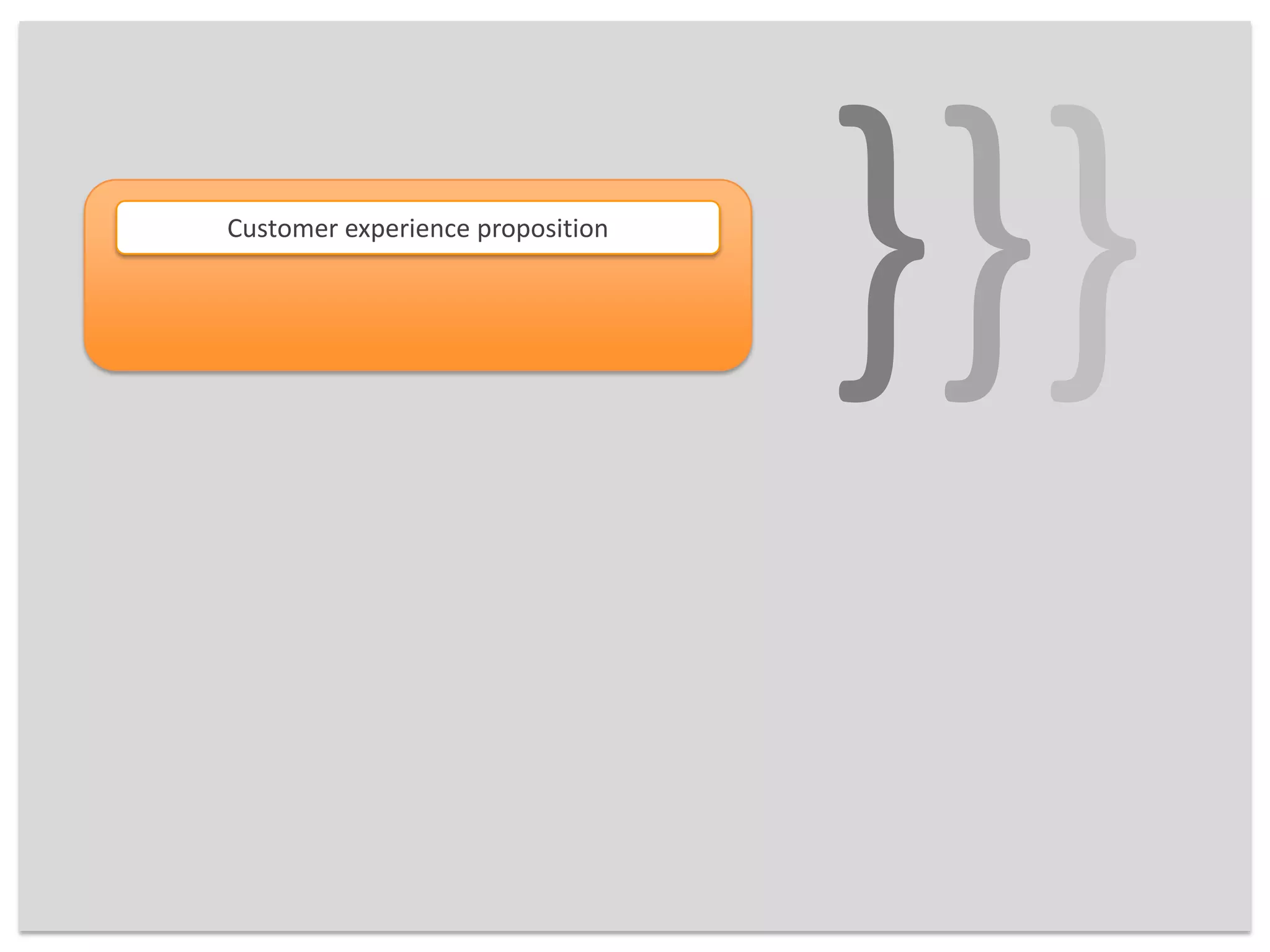
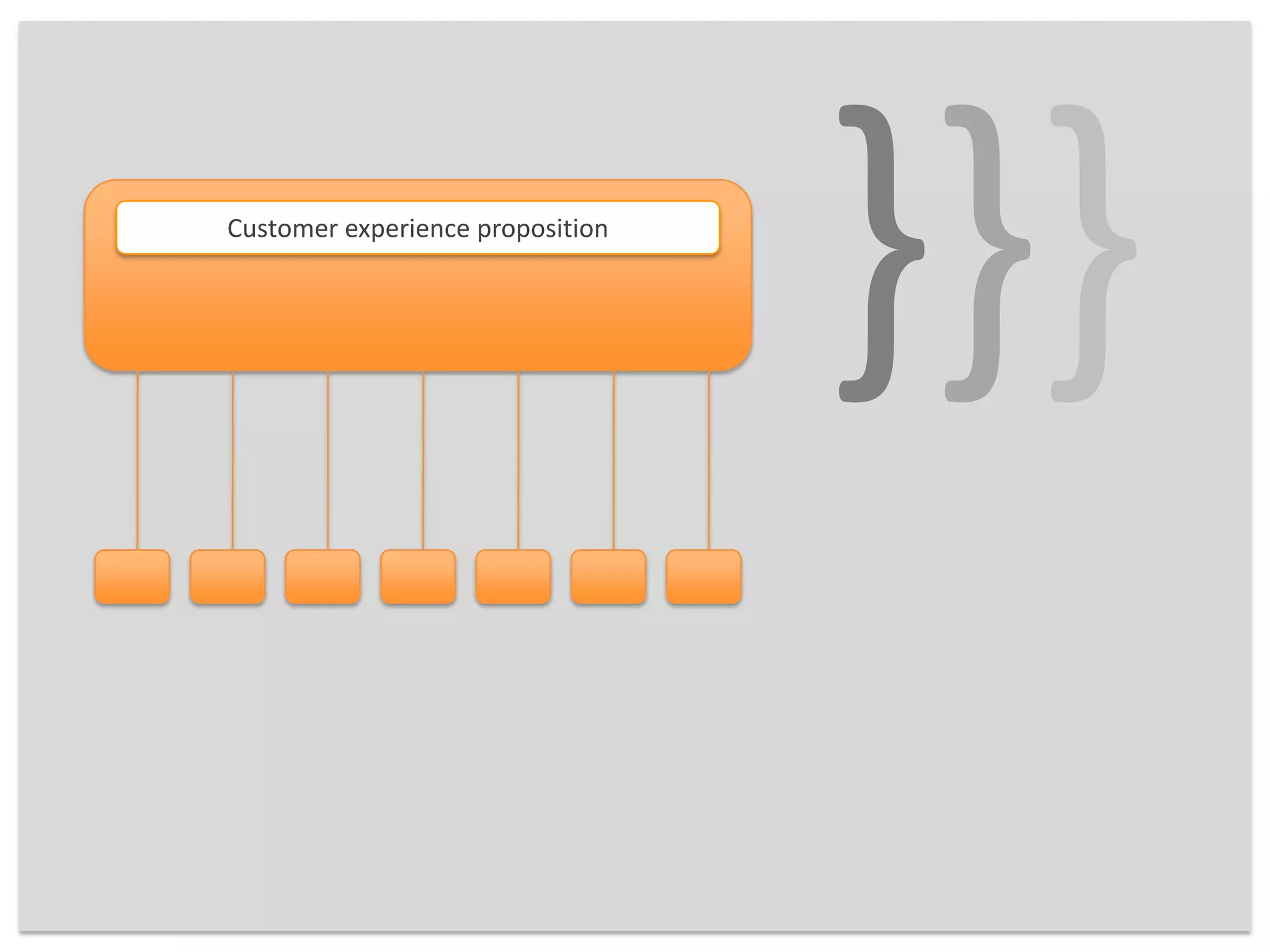
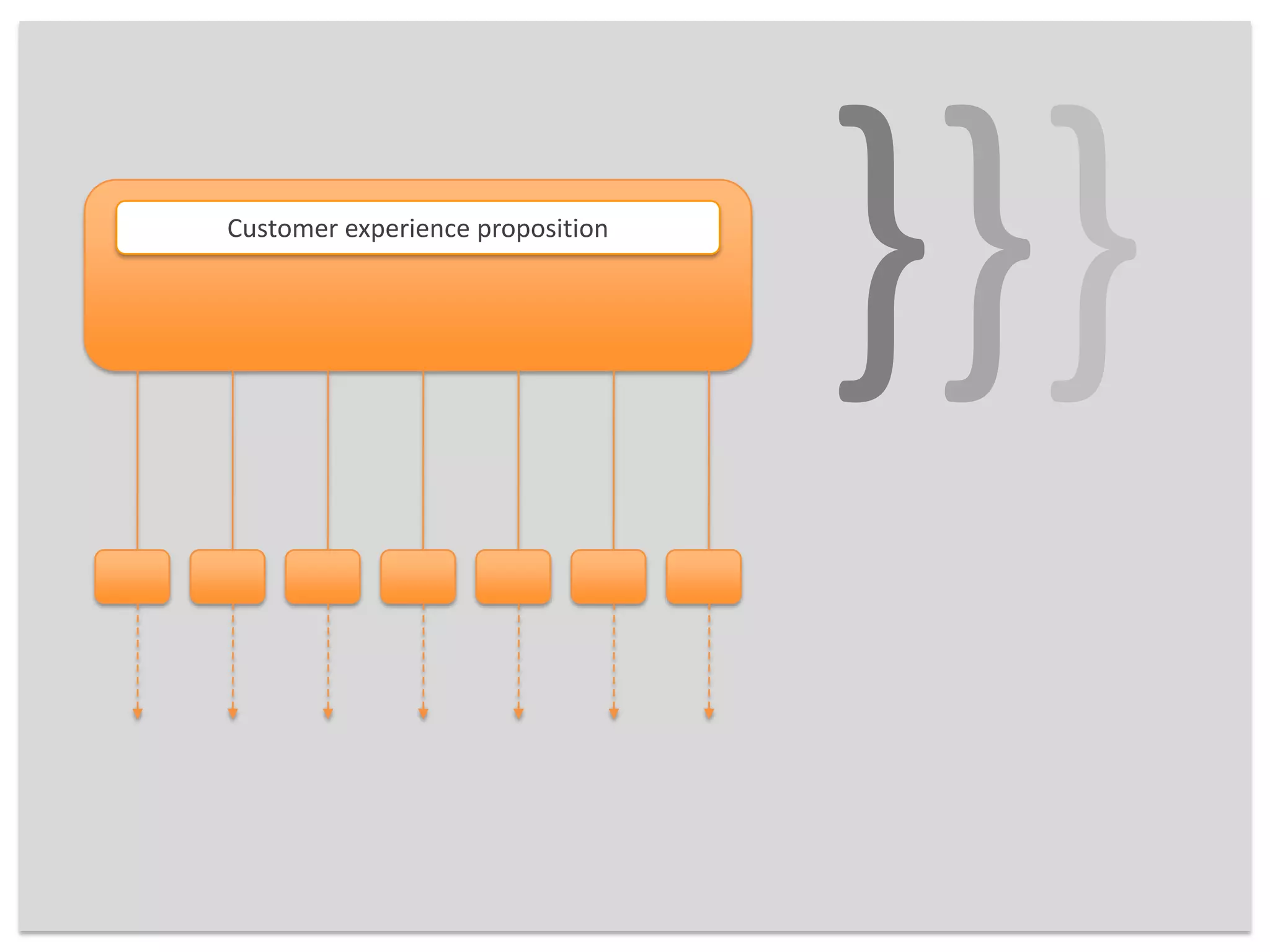
}}}Customer experience proposition
There are numerous benefits for the application of a framework at an enterprise level.
A framework is visionary: multi-channel experiences can be defined, unlocking channel relationship opportunities and breaking down silos – for customers and staff.
A framework is visionary: multi-channel experiences can be defined, unlocking channel relationship opportunities and breaking down silos – for customers and staff. Considering the customer across all touch points allows one to describe a 'total enterprise experience' where experiences across channels can be standardised and rules can be developed for a multi-channel space.
A framework is visionary: multi-channel experiences can be defined, unlocking channel relationship opportunities and breaking down silos – for customers and staff. Considering the customer across all touch points allows one to describe a 'total enterprise experience' where experiences across channels can be standardised and rules can be developed for a multi-channel space. A Framework provides a platform for sustaining, maintaining and improving the customer and user experience.
A framework is visionary: multi-channel experiences can be defined, unlocking channel relationship opportunities and breaking down silos – for customers and staff. Considering the customer across all touch points allows one to describe a 'total enterprise experience' where experiences across channels can be standardised and rules can be developed for a multi-channel space. A Framework provides a platform for sustaining, maintaining and improving the customer and user experience. It provides a 'central view' of channels (assisting with governance) and centralisation assists multi-channel management (sharing knowledge, resource, etc).
A framework is visionary: multi-channel experiences can be defined, unlocking channel relationship opportunities and breaking down silos – for customers and staff. Considering the customer across all touch points allows one to describe a 'total enterprise experience' where experiences across channels can be standardised and rules can be developed for a multi-channel space. A Framework provides a platform for sustaining, maintaining and improving the customer and user experience. It provides a 'central view' of channels (assisting with governance) and centralisation assists multi-channel management (sharing knowledge, resource, etc). At the individual channel level, future projects benefit from the Framework via inheritance and because it is visionary, it helps individual channels define future business requirements.
A framework is visionary: multi-channel experiences can be defined, unlocking channel relationship opportunities and breaking down silos – for customers and staff. Considering the customer across all touch points allows one to describe a 'total enterprise experience' where experiences across channels can be standardised and rules can be developed for a multi-channel space. A Framework provides a platform for sustaining, maintaining and improving the customer and user experience. It provides a 'central view' of channels (assisting with governance) and centralisation assists multi-channel management (sharing knowledge, resource, etc). At the individual channel level, future projects benefit from the Framework via inheritance and because it is visionary, it helps individual channels define future business requirements. The front end (UX) framework integrates multiple frameworks (people, process, product, etc) and feeds back into their ongoing development (with inherent user centricity). Strategically, it closes the loop from customer to product to channel
The Project Journey
There were two sets of deliverables: analytical artifacts and design artifacts.
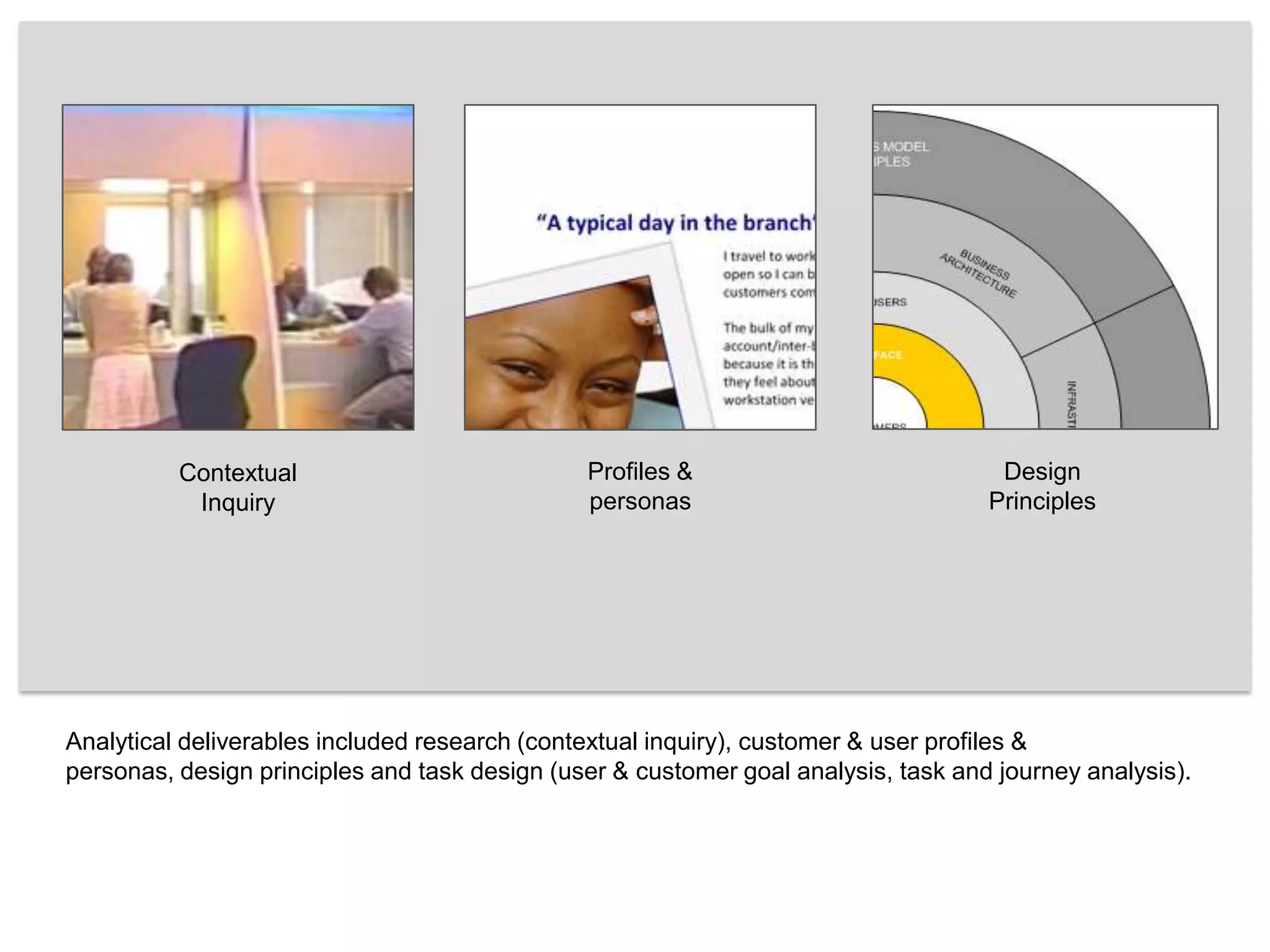
Profiles & personasDesign PrinciplesContextual InquiryAnalytical deliverables included research (contextual inquiry), customer & user profiles & personas, design principles and task design (user & customer goal analysis, task and journey analysis).
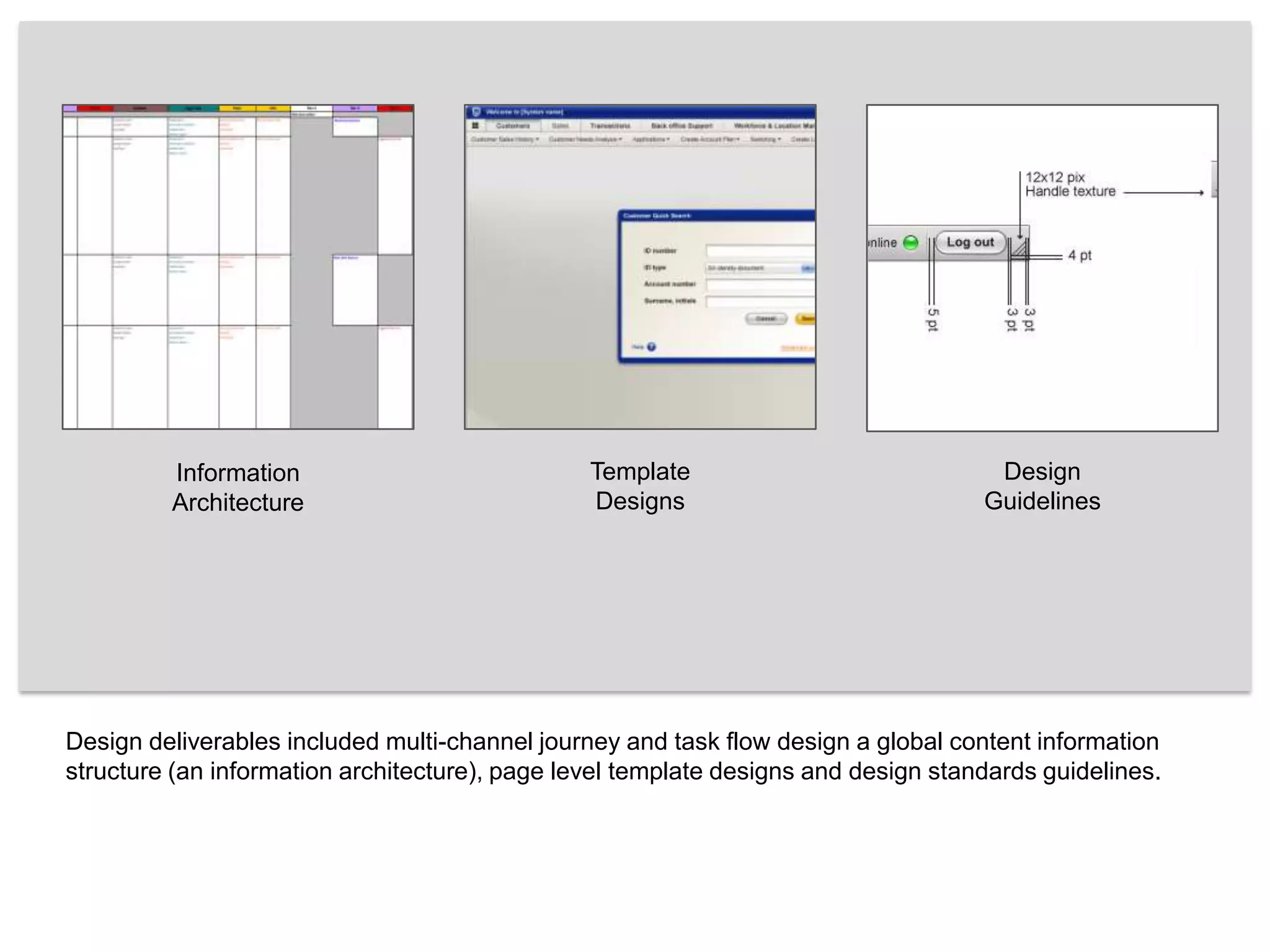
Template DesignsDesign GuidelinesInformation ArchitectureDesign deliverables included multi-channel journey and task flow design a global content information structure (an information architecture), page level template designs and design standards guidelines.
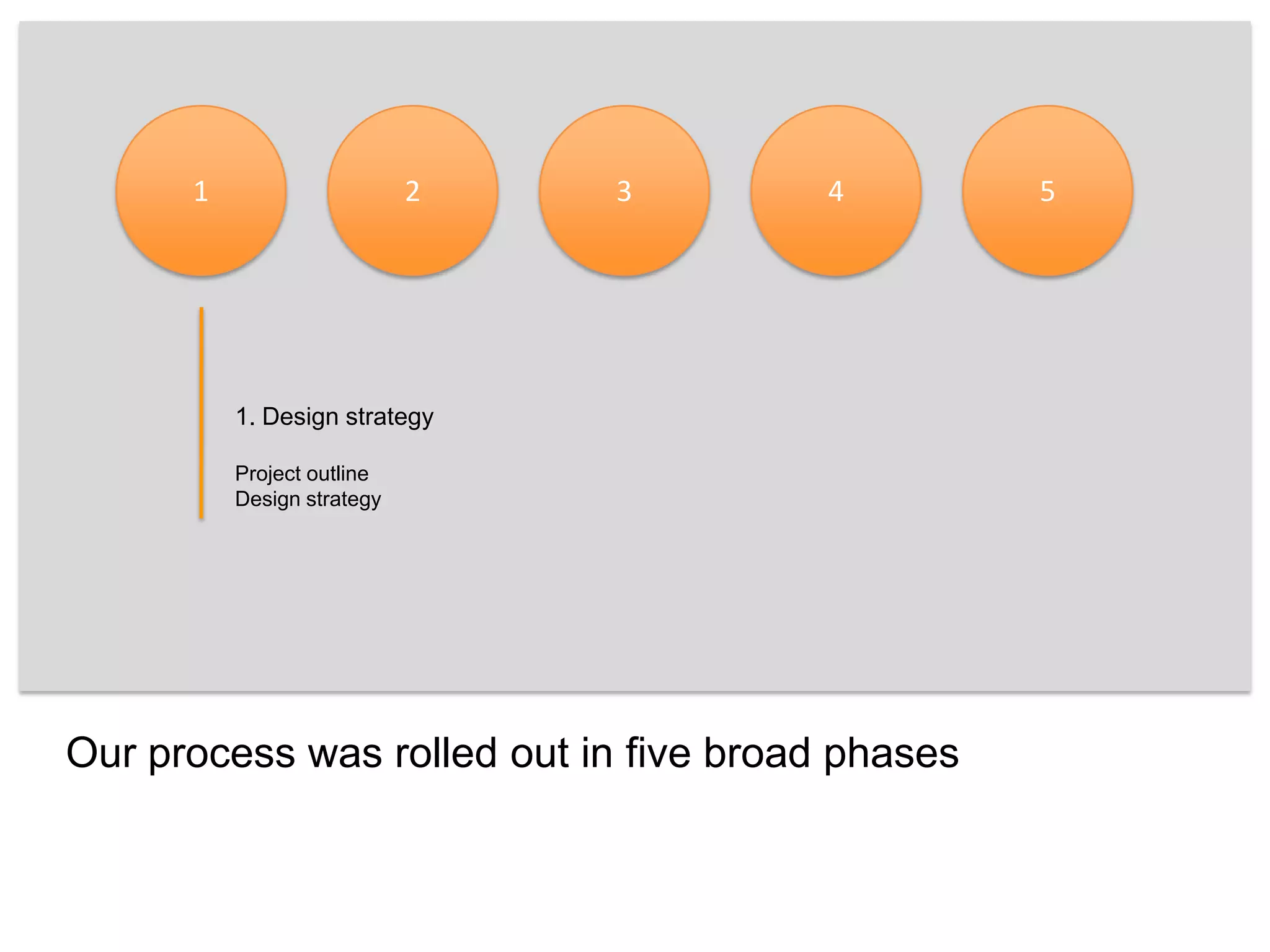
123451. Design strategyProject outlineDesign strategyOur process was rolled out in five broad phases
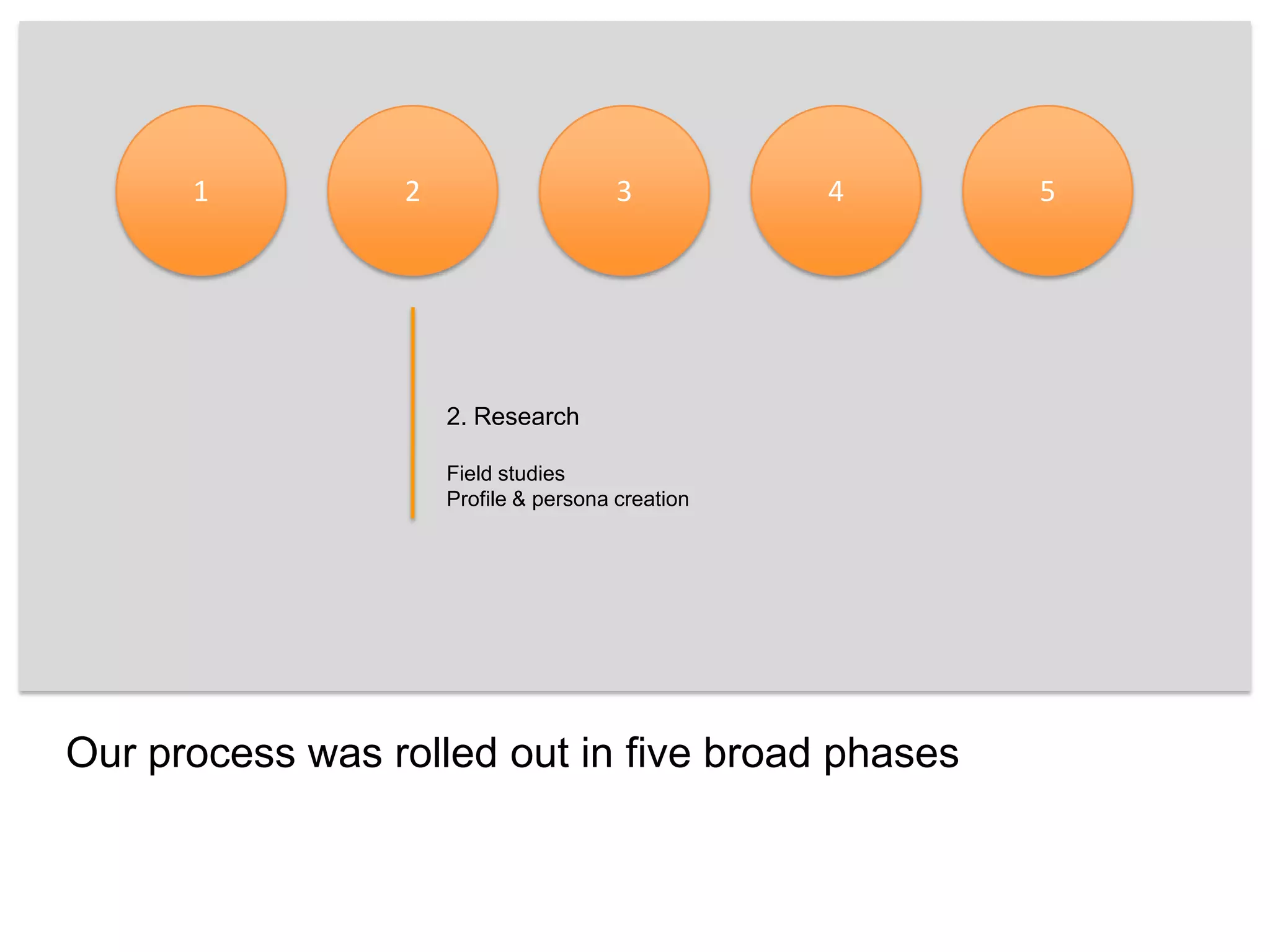
123452. ResearchField studiesProfile & persona creationOur process was rolled out in five broad phases
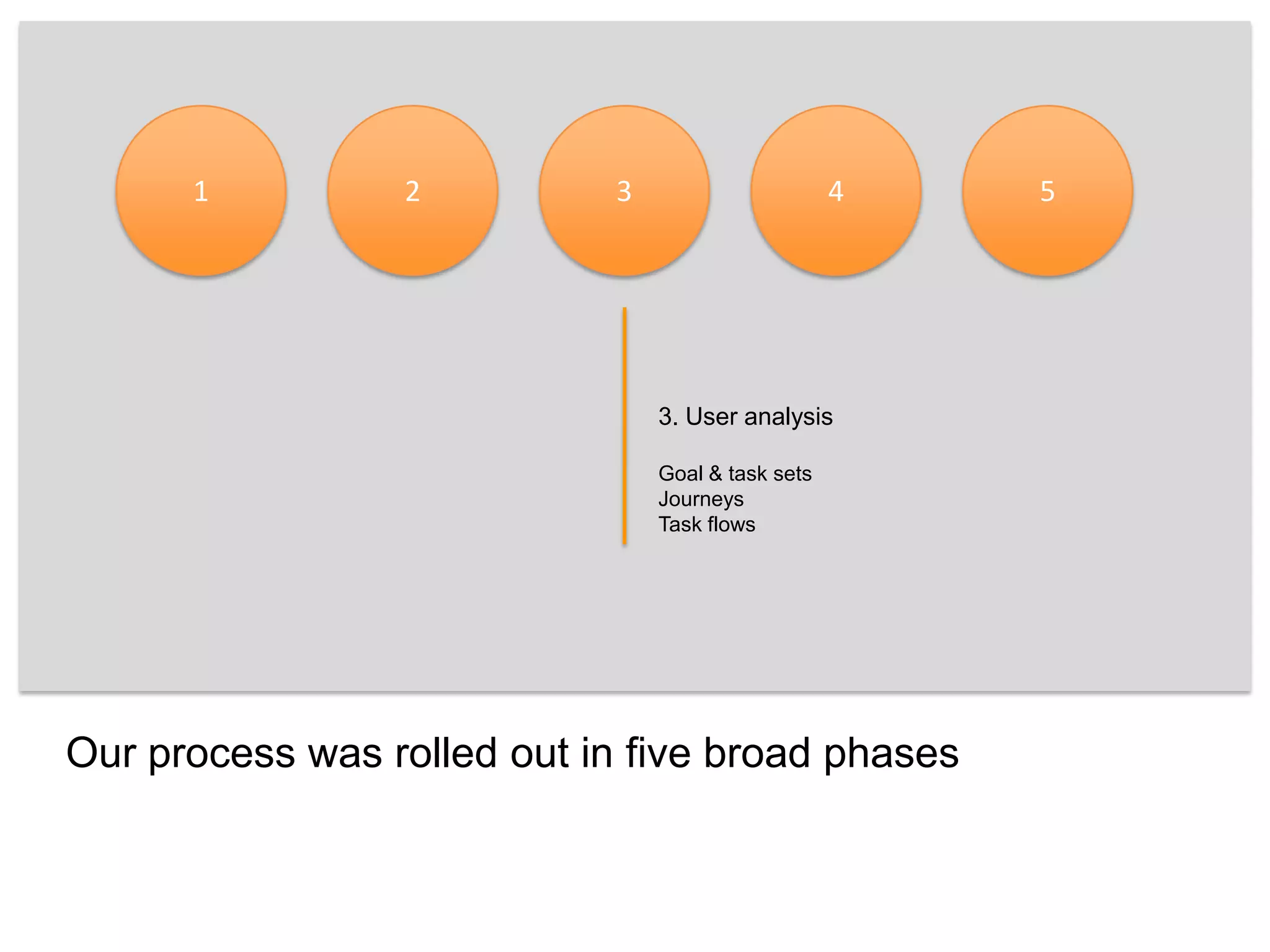
123453. User analysisGoal & task setsJourneysTask flowsOur process was rolled out in five broad phases
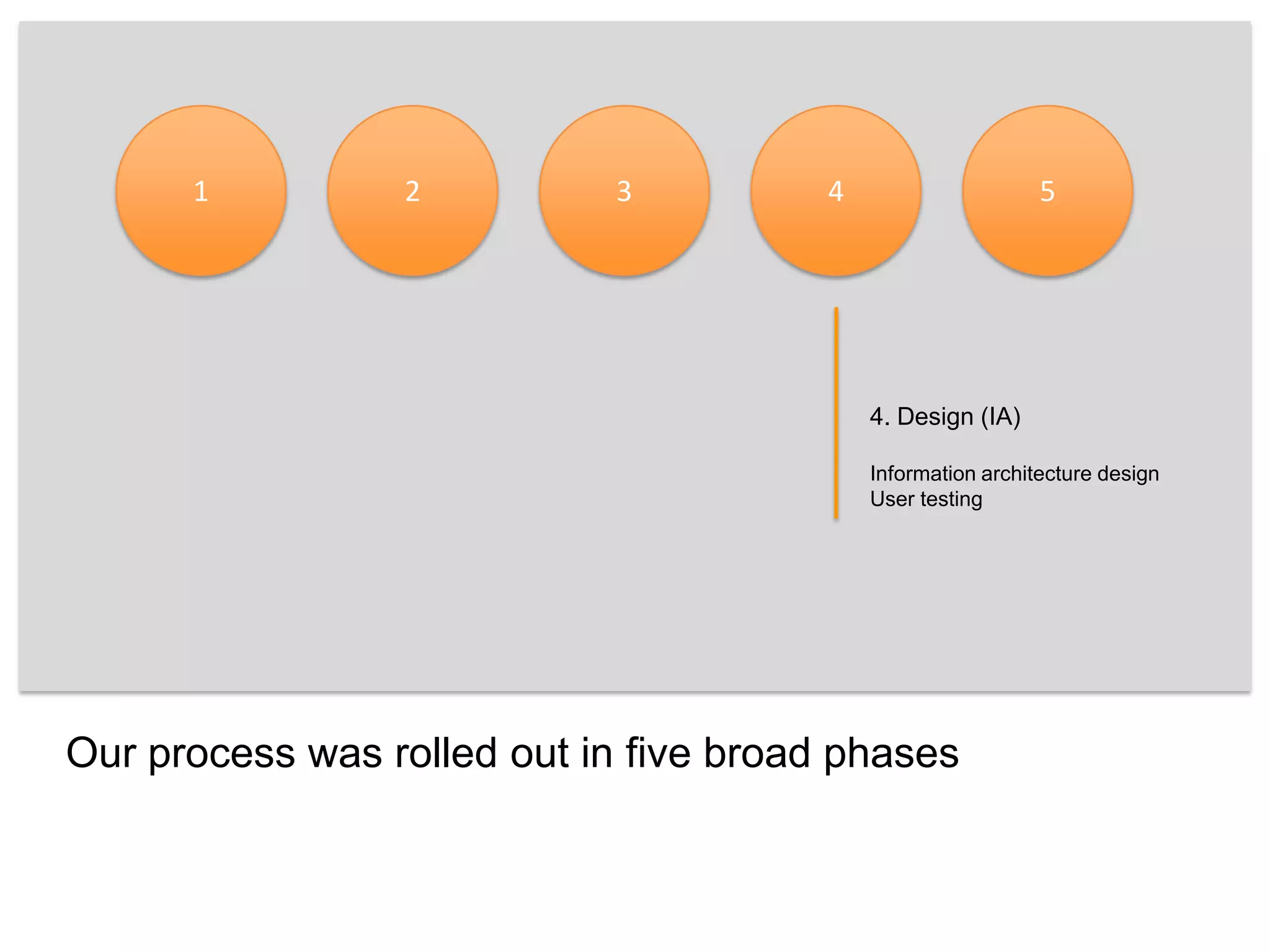
123454. Design (IA)Information architecture designUser testingOur process was rolled out in five broad phases
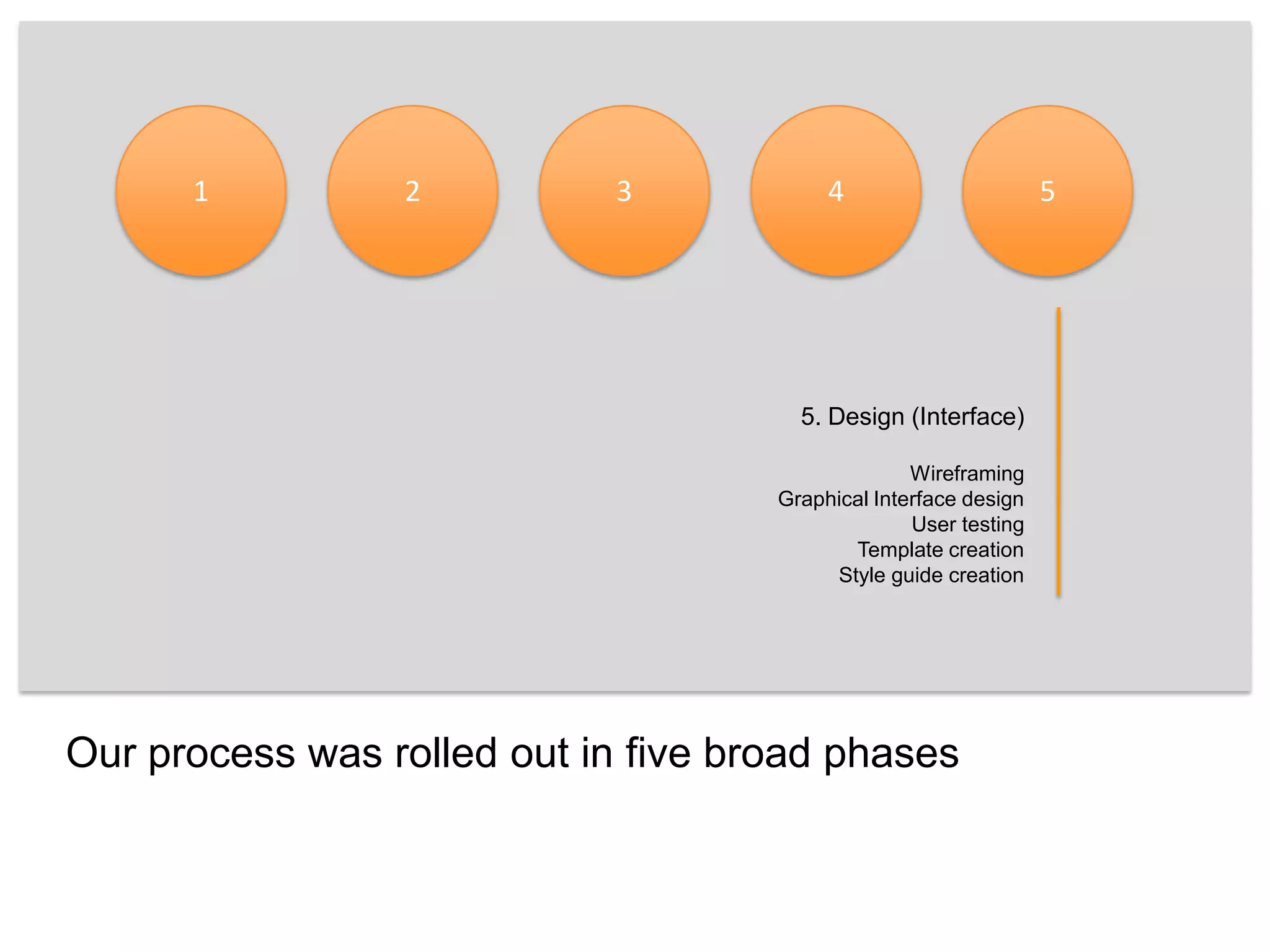
123455. Design (Interface)WireframingGraphical Interface designUser testingTemplate creationStyle guide creationOur process was rolled out in five broad phases
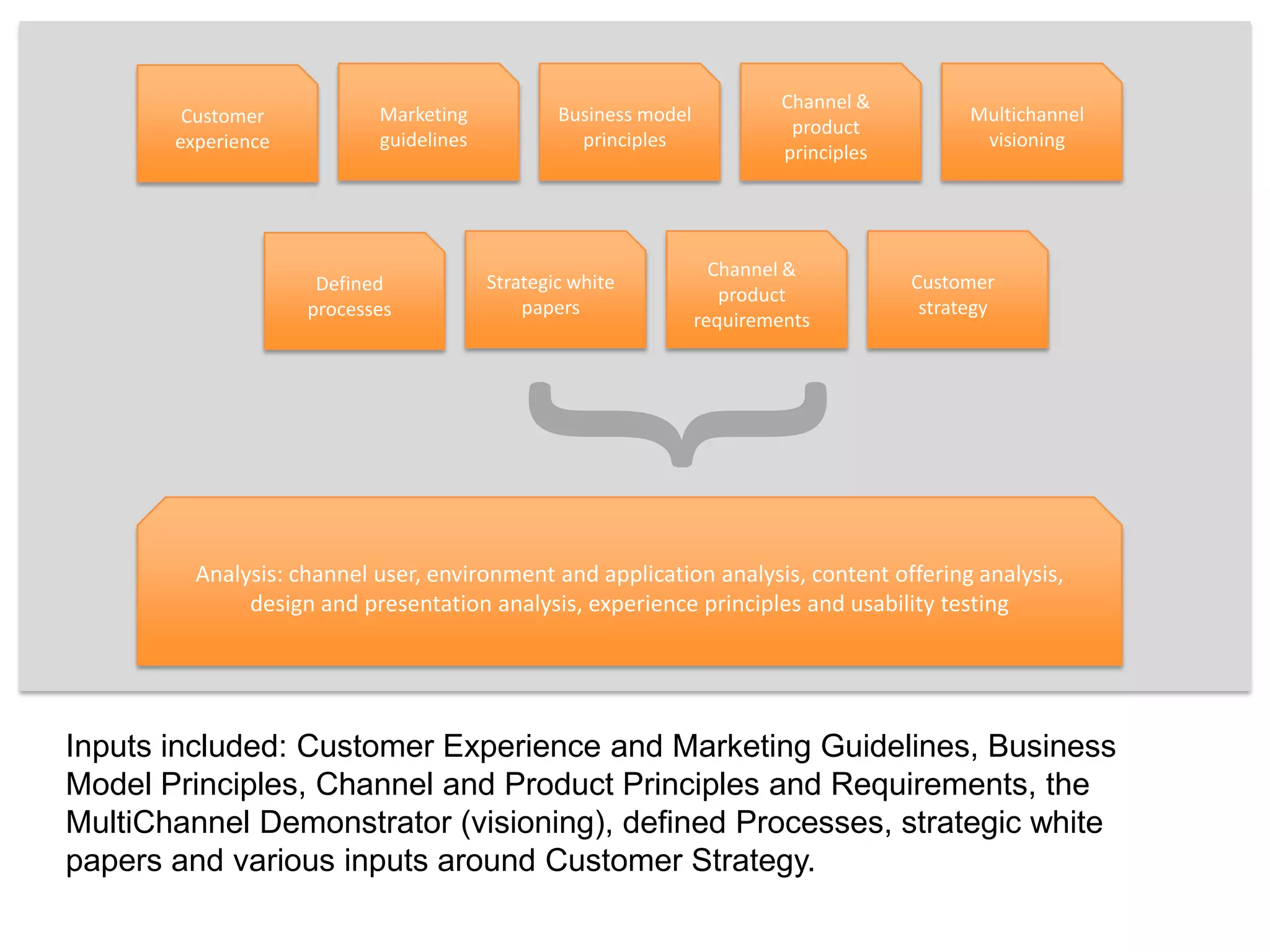
Business inputs to the initial analysis phases required a massive integration effort.
}Marketing guidelinesBusiness model principlesChannel & product principlesMultichannel visioningCustomer experienceStrategic white papersChannel & product requirementsCustomer strategyDefined processesAnalysis: channel user, environment and application analysis, content offering analysis, design and presentation analysis, experience principles and usability testing Inputs included: Customer Experience and Marketing Guidelines, Business Model Principles, Channel and Product Principles and Requirements, the MultiChannel Demonstrator (visioning), defined Processes, strategic white papers and various inputs around Customer Strategy.
Customer experienceFramework challenge
A direction was required for a customer experience model that would underpin the desired user experience. We took this from a variety of service drivers that existed in the Bank.
A set of User Experience Principles (objectives) were then created to bridge the Service Drivers and the desired experience-based outcomes of the interface, system and interactions.
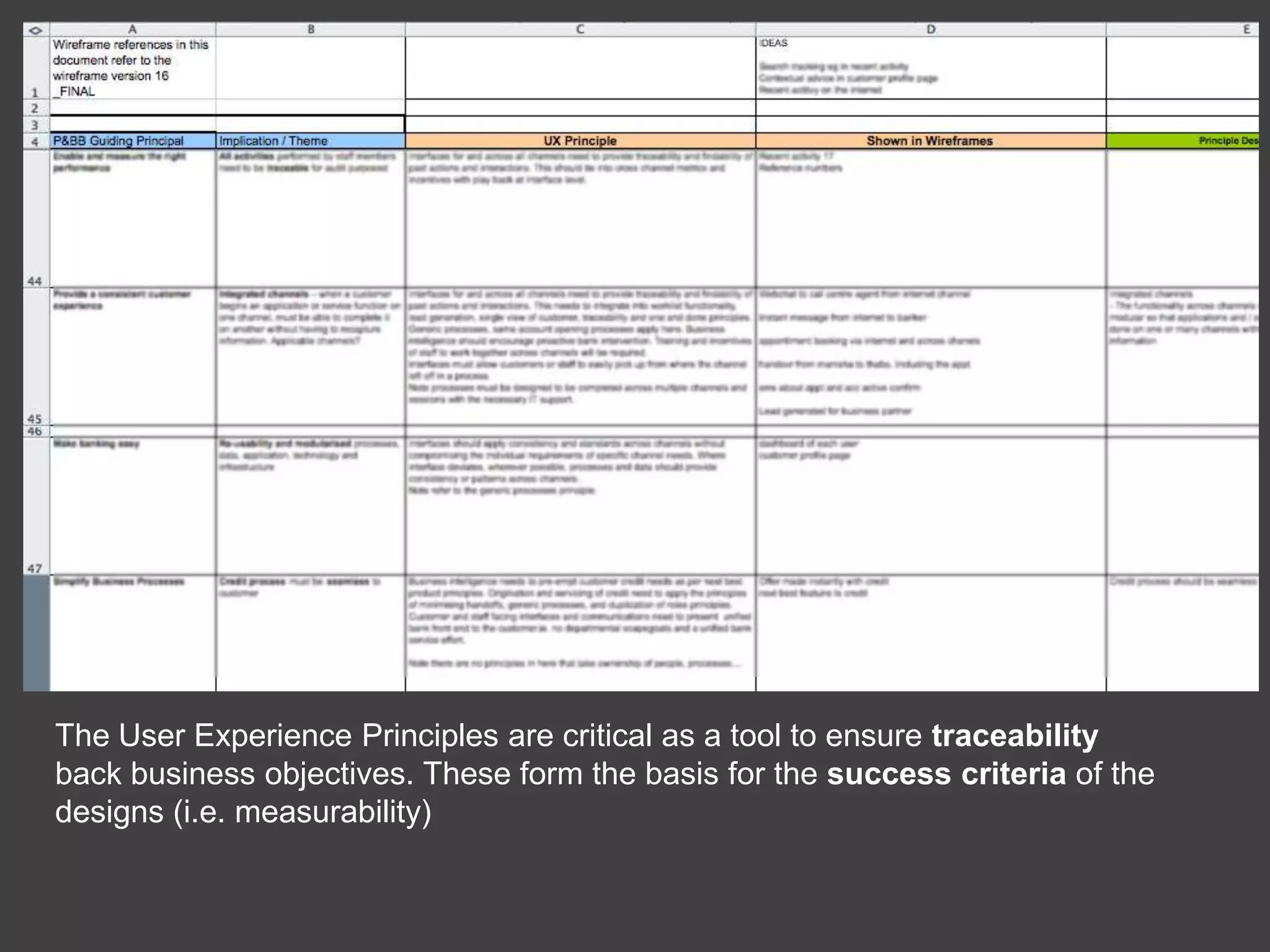
The User Experience Principles are critical as a tool to ensure traceability back business objectives. These form the basis for the success criteria of the designs (i.e. measurability)
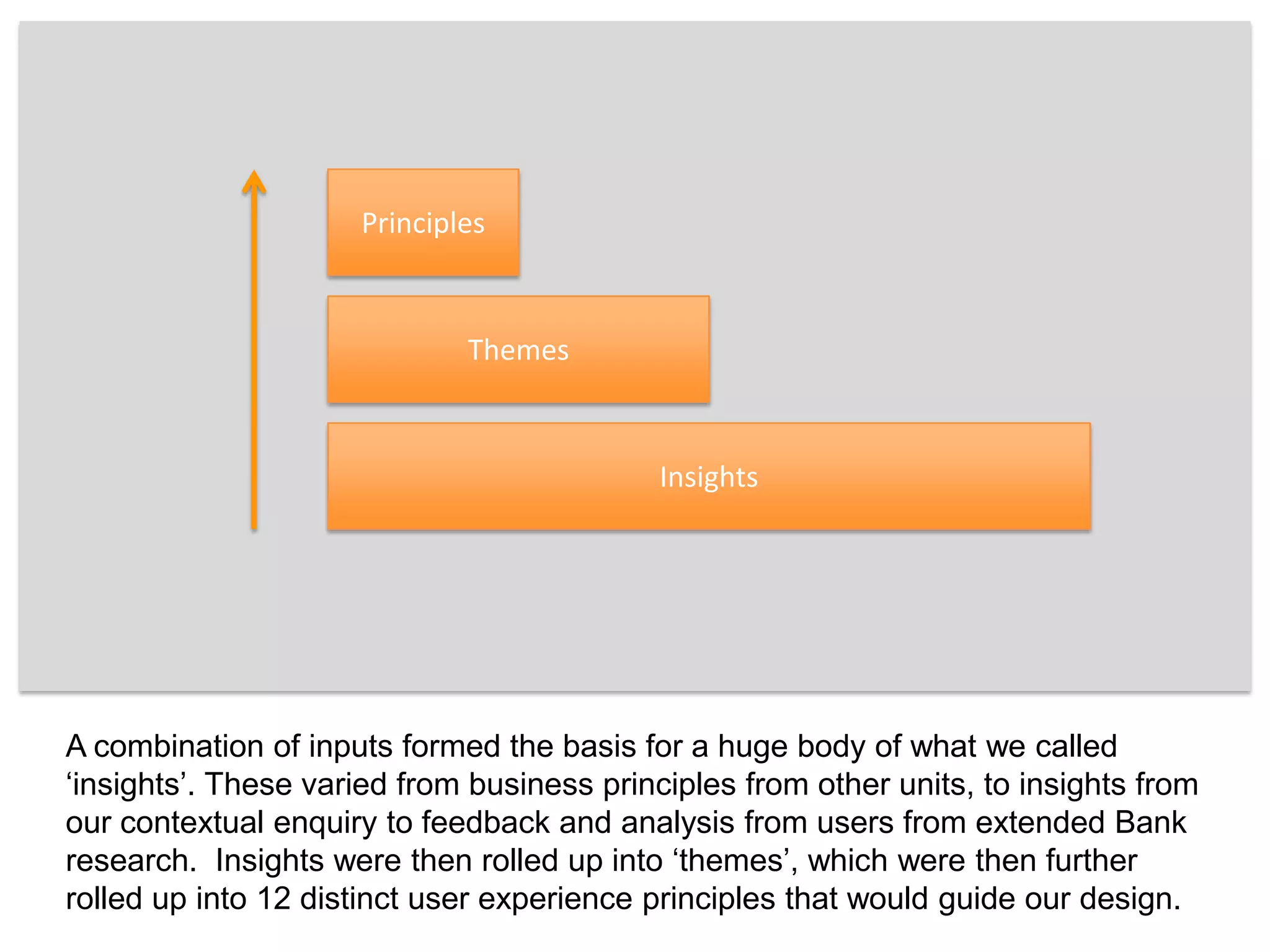
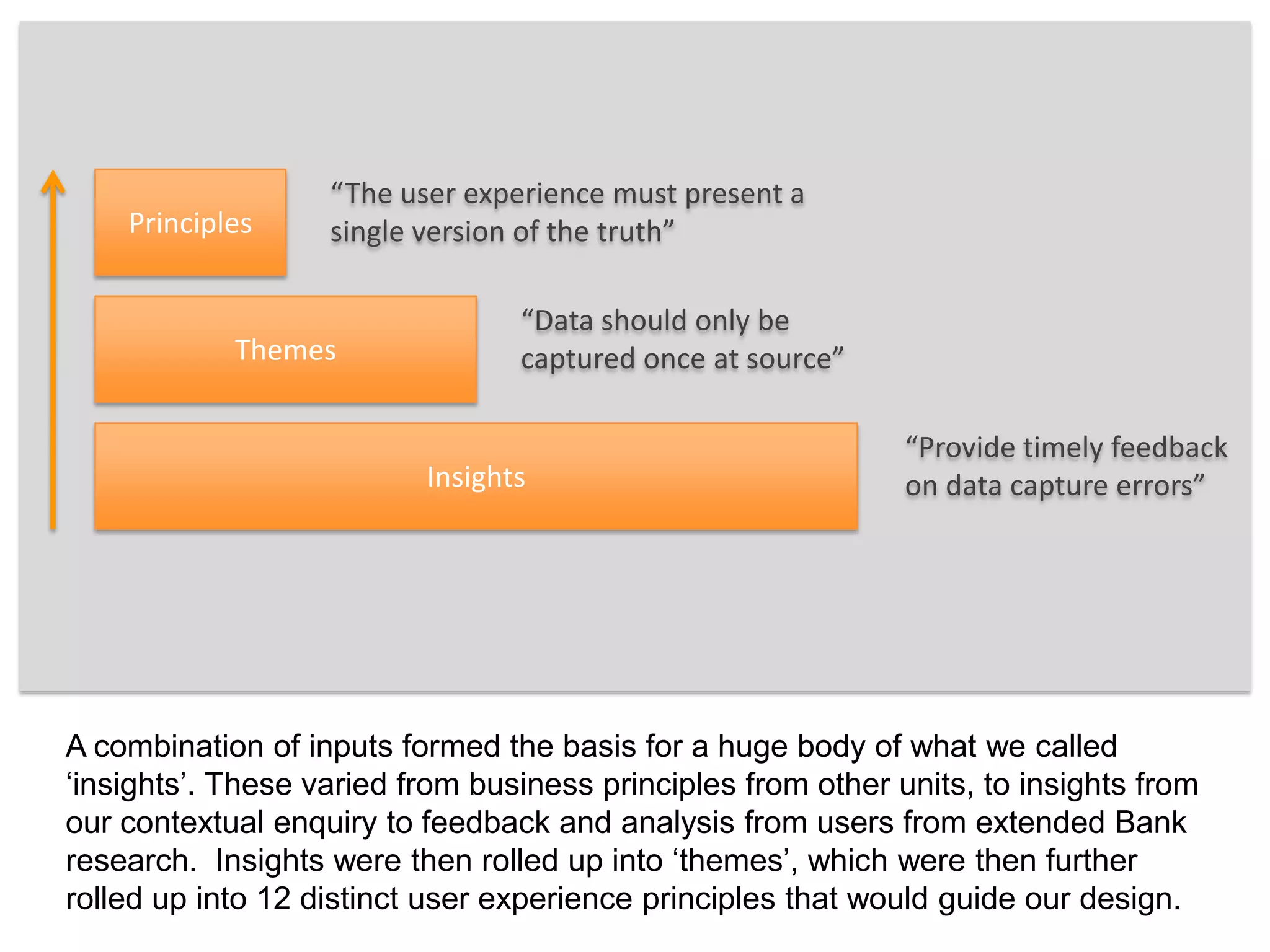
PrinciplesThemesInsightsA combination of inputs formed the basis for a huge body of what we called ‘insights’. These varied from business principles from other units, to insights from our contextual enquiry to feedback and analysis from users from extended Bank research.  Insights were then rolled up into ‘themes’, which were then further rolled up into 12 distinct user experience principles that would guide our design.
“The user experience must present a single version of the truth”Principles“Data should only be captured once at source”Themes“Provide timely feedback on data capture errors”InsightsA combination of inputs formed the basis for a huge body of what we called ‘insights’. These varied from business principles from other units, to insights from our contextual enquiry to feedback and analysis from users from extended Bank research.  Insights were then rolled up into ‘themes’, which were then further rolled up into 12 distinct user experience principles that would guide our design.
Along with the benefit of traceability, principles allow you to identify a fair number of broad areas where trade-offs are inevitable or likely. Our dominant challenge was in the space of balancing effectiveness and efficiency – and although the Framework was only able to address these issues at a conceptual level the benefit is still great.
Framework integration and maturityFramework challenge
Integrate with people who hold the vision for these spaces How to develop with a reliance on other frameworks at differing levels of maturity?
Integrate with people who hold the vision for these spaces Utilise strategic future position papers that outline best practice across areas and absorb guiding principles for the future (in our case for banking; in the creation of the User Experience Principles) How to develop with a reliance on other frameworks at differing levels of maturity?
Integrate with people who hold the vision for these spaces Utilise strategic future position papers that outline best practice across areas and absorb guiding principles for the future (in our case for banking; in the creation of the User Experience Principles) Focus on the journey: develop user and customer personas and the modeling of optimal multi-channel experiences true to the vision of the enterprise.How to develop with a reliance on other frameworks at differing levels of maturity?
Multi-channel journeysFramework challenge
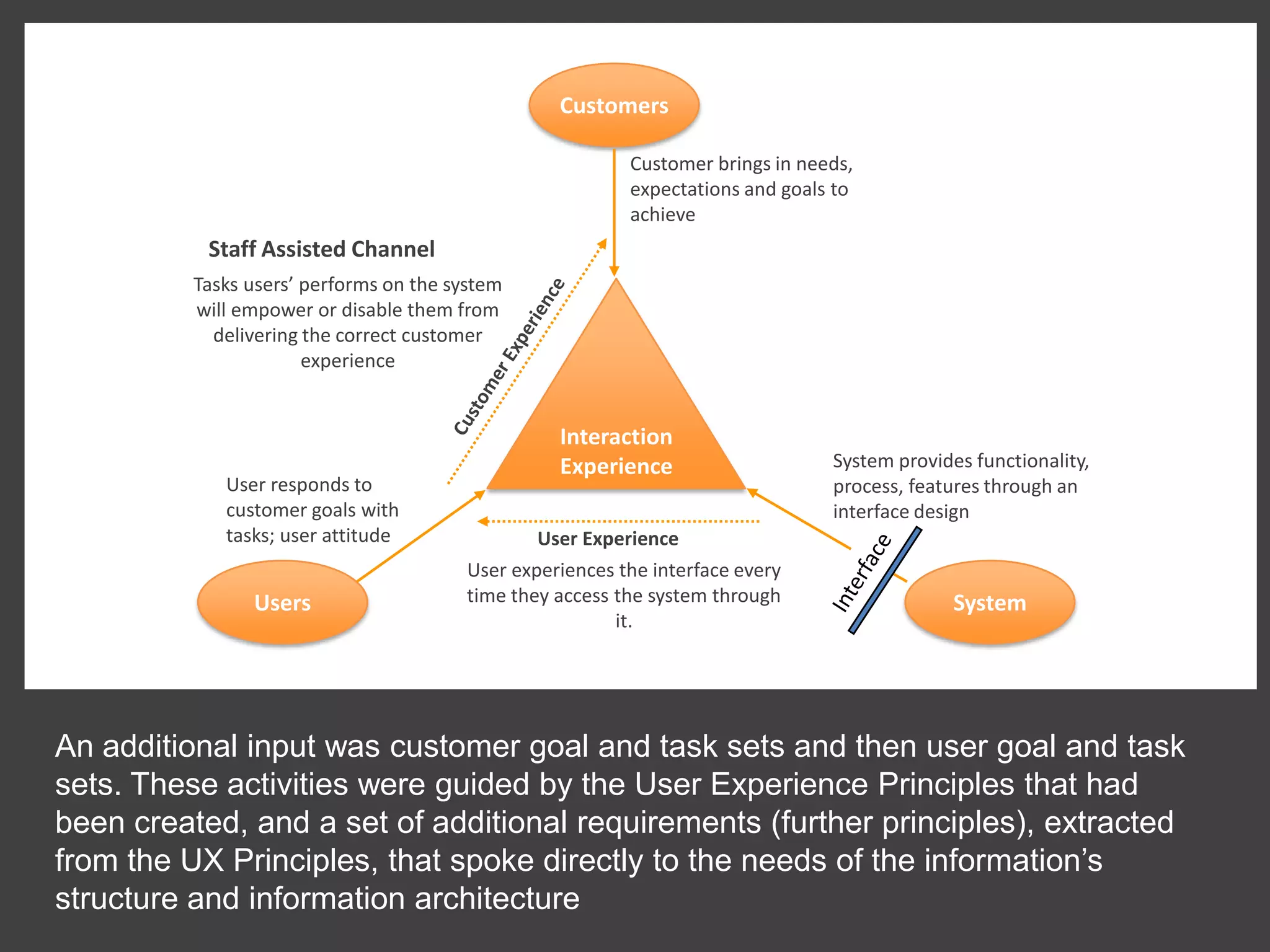
CustomersCustomer brings in needs, expectations and goals to achieveStaff Assisted ChannelTasks users’ performs on the system will empower or disable them from delivering the correct customer experienceInteractionExperienceCustomer ExperienceSystem provides functionality, process, features through an interface designUser responds to customer goals with tasks; user attitudeUser ExperienceInterfaceUser experiences the interface every time they access the system through it.UsersSystemAn additional input was customer goal and task sets and then user goal and task sets. These activities were guided by the User Experience Principles that had been created, and a set of additional requirements (further principles), extracted from the UX Principles, that spoke directly to the needs of the information’s structure and information architecture
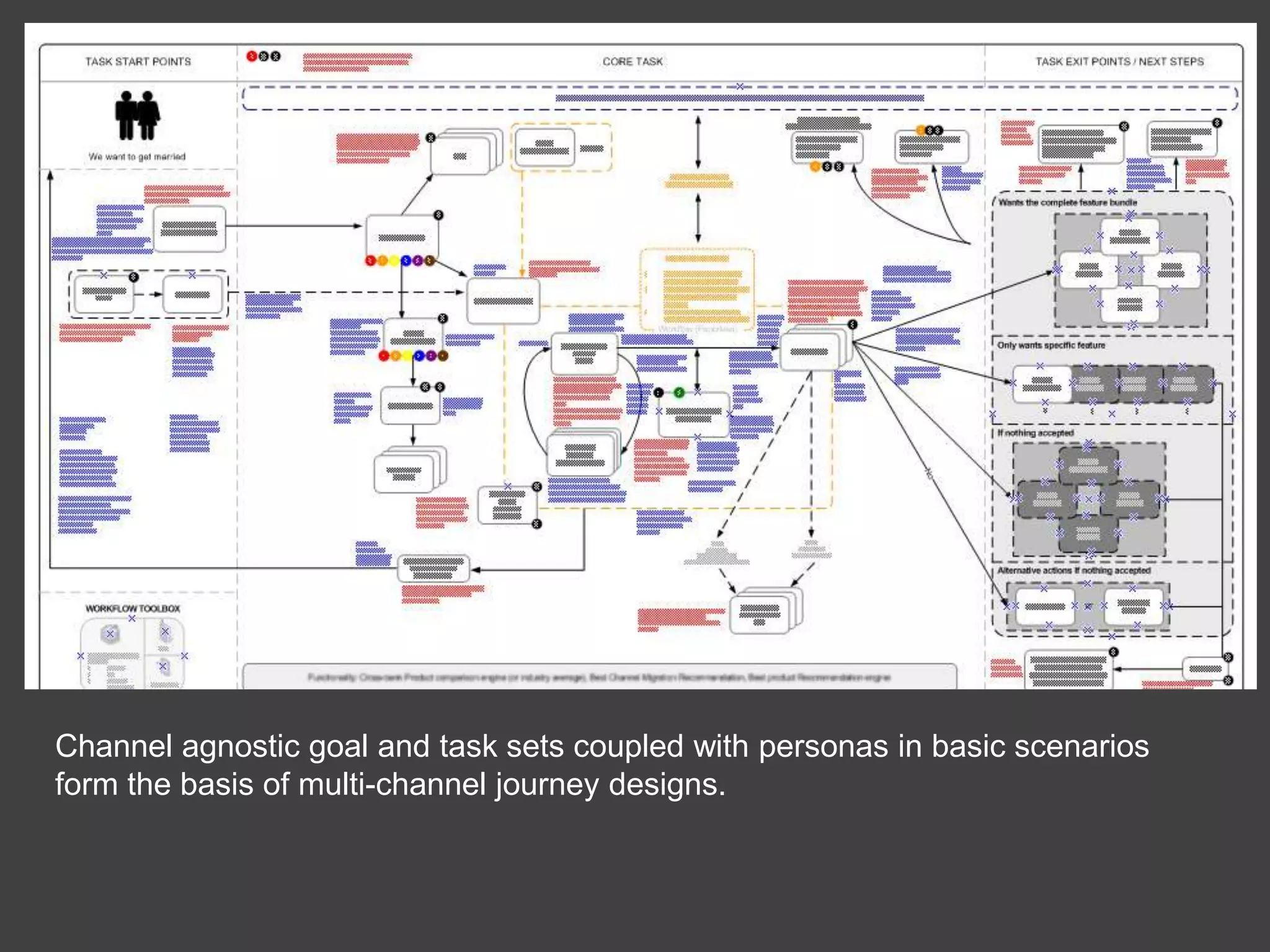
Channel agnostic goal and task sets coupled with personas in basic scenarios form the basis of multi-channel journey designs.
Multi-channel journeys become customised in channel specific task flow design.
The information architecture was multi-channel in its scope and conception and developed an experiential dimension from multi-channel scenarios and journeys.
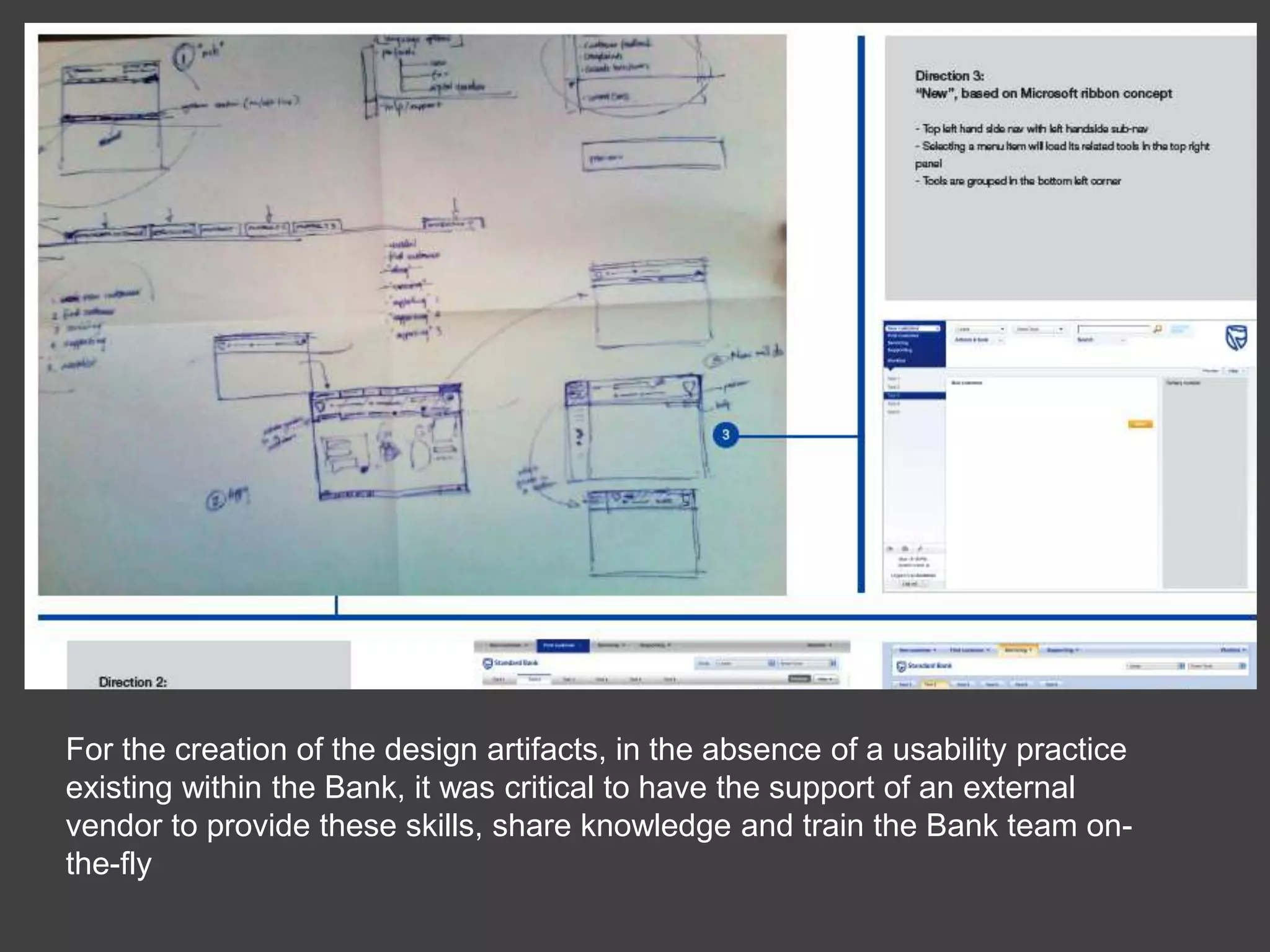
For the creation of the design artifacts, in the absence of a usability practice existing within the Bank, it was critical to have the support of an external vendor to provide these skills, share knowledge and train the Bank team on-the-fly
It is critical to understand that an enterprise-wide framework cannot be sustained without a long-term plan to institutionalize User Centered Design within an organization for the ongoing iteration and support that is needed.
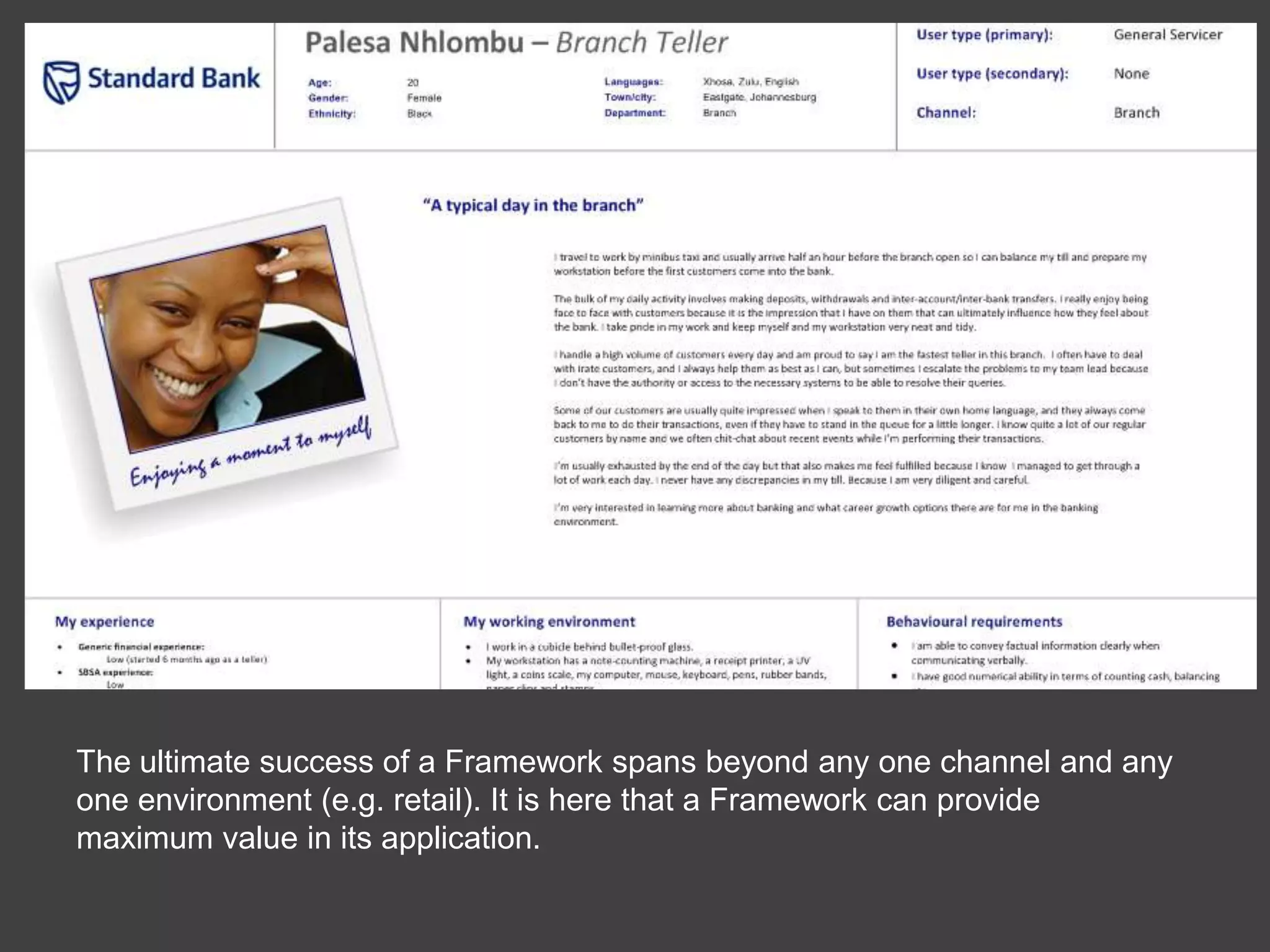
The ultimate success of a Framework spans beyond any one channel and any one environment (e.g. retail). It is here that a Framework can provide maximum value in its application.
At the level of design, growing a broad enough base of capability and capacity will remain a key challenge for any enterprise. In our case, the capacity and capability requirement alone is daunting with a projected twenty-two odd projects potentially running concurrently within the Bank.Understanding what is needed for the sustainability of a Framework is crucial for its success.
Sustainability
CapabilityFramework challenge
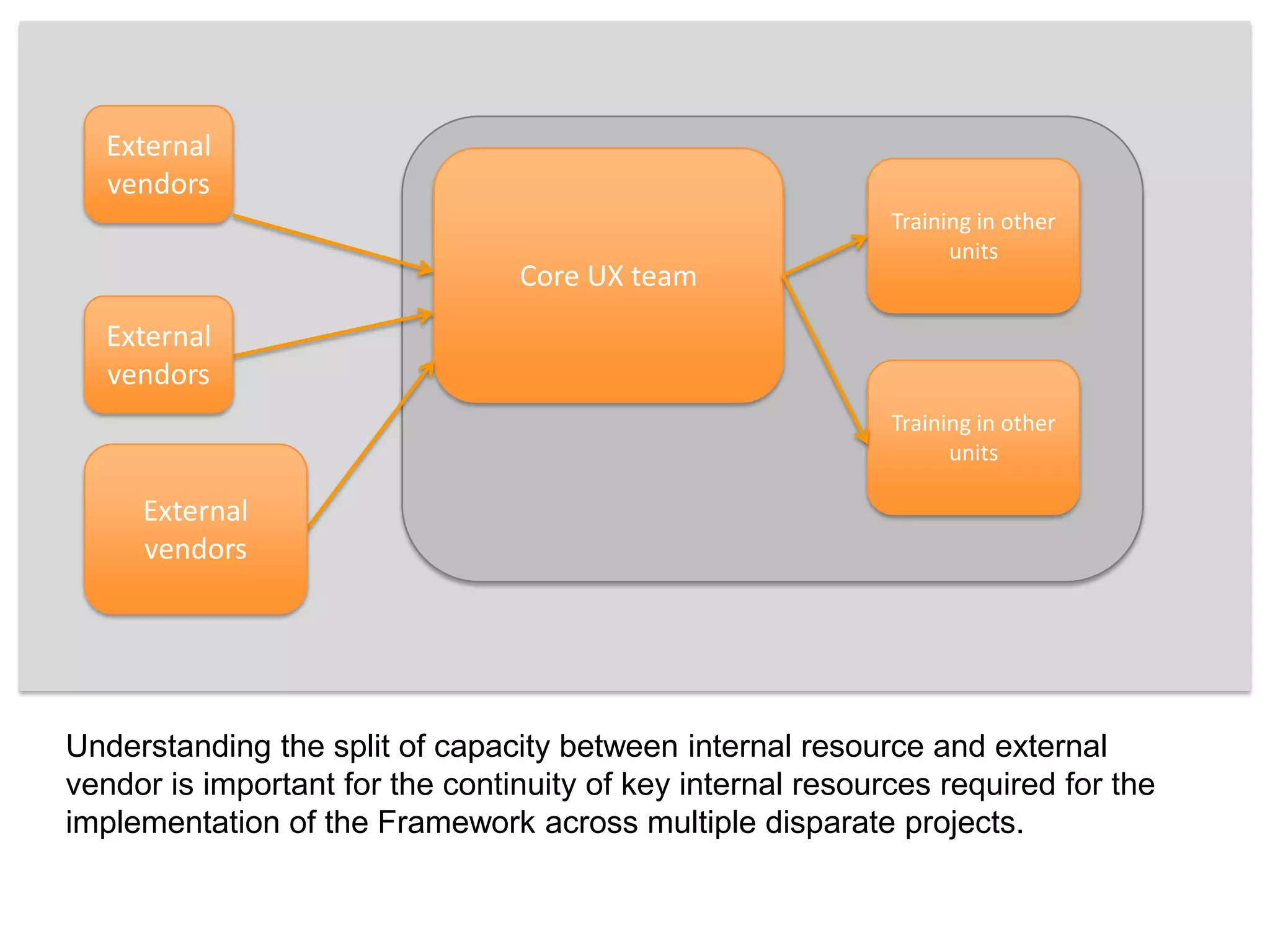
External vendorsCore UX teamTraining in other unitsExternal vendorsTraining in other unitsExternal vendorsUnderstanding the split of capacity between internal resource and external vendor is important for the continuity of key internal resources required for the implementation of the Framework across multiple disparate projects.
Because of the nature of the UCD process, solutioning occurs as part of the design; these solutions will span beyond any one business unit and may involve multiple units working together.It is here that trade-offs will become a challenge and managing trade-offs can only be effectively achieved if you are a part of the debate at the ‘solution-level’.
Your influence will always be cosmetic if you can’t fight for your solutions effectively in the enterprise environment. You’ll need to be able to fight for such solutions at the correct levels if you wish to make a meaningful impact through User Centered Design.     So try to have representatives of the Framework team  featuring in the key governance forums within the organization.
Continuous improvementFramework challenge
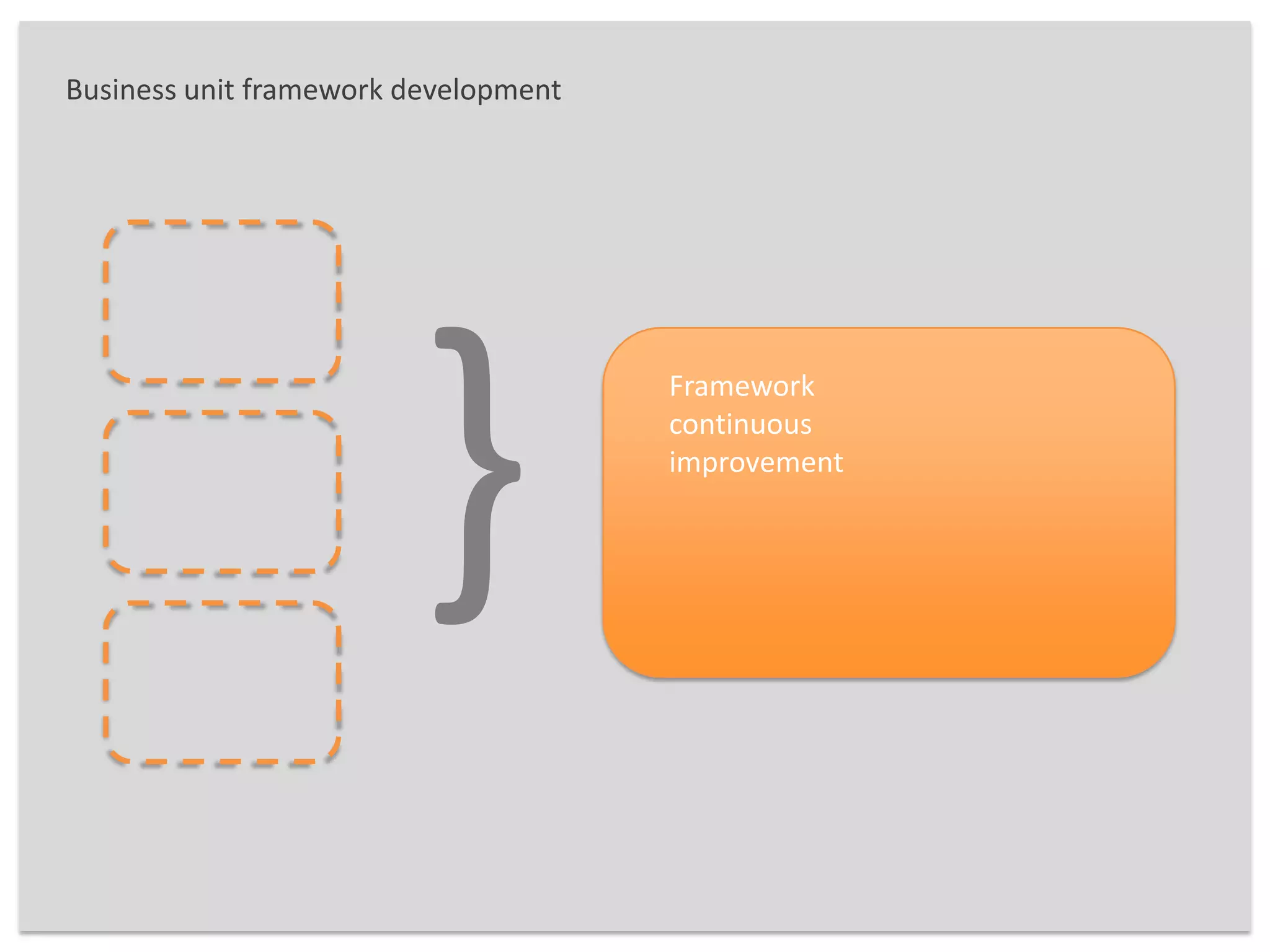
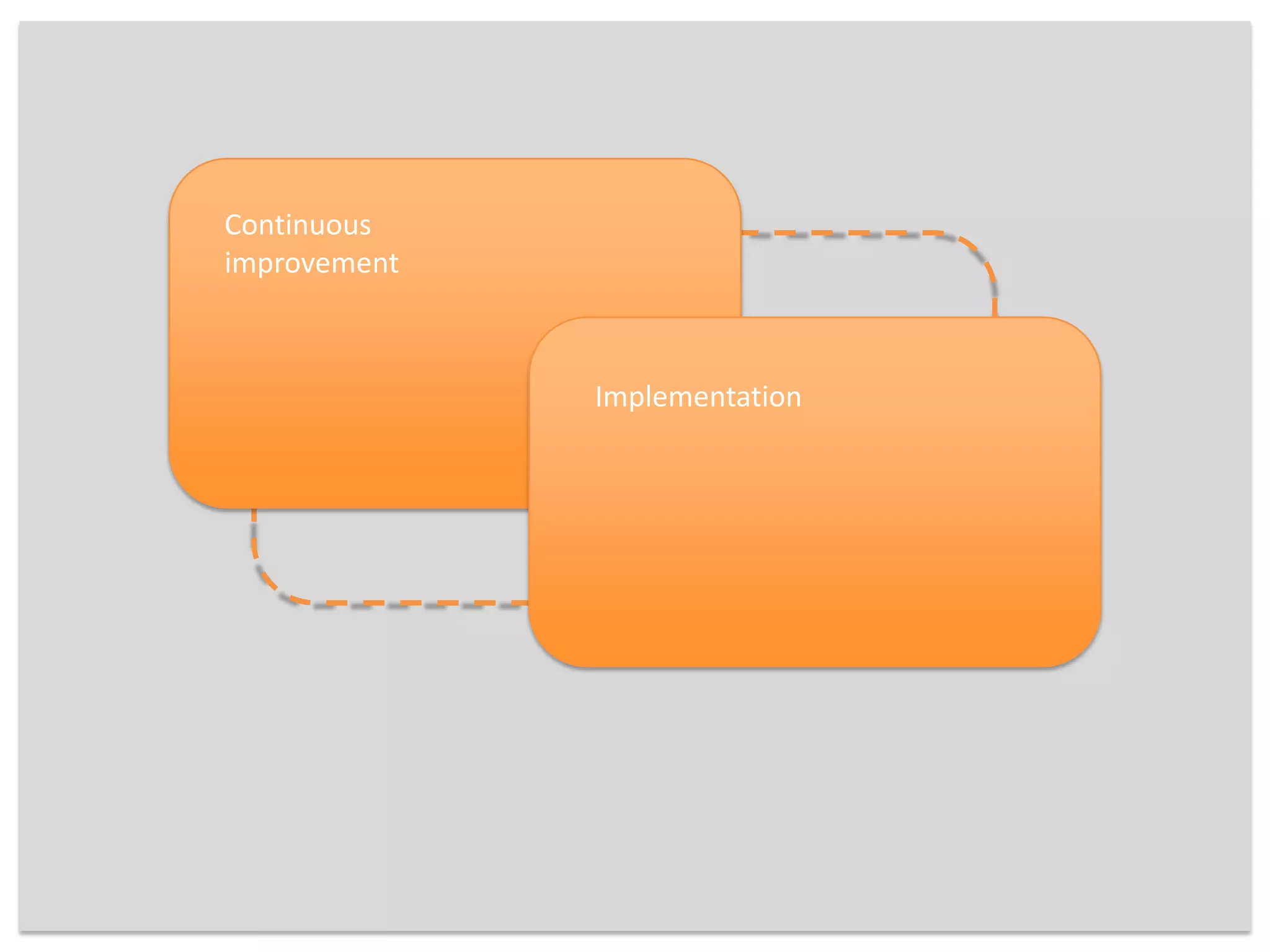
Managing the value of UCD for the business as a whole is needed over time (for example, the influence on product, process, people, etc), and the vision offered by the Framework can assist here, but also requires iteration. For the purposes of continuous improvement the Framework has to have flexibility built into it.
For a Version 0 Framework you want a broad and shallow, but robustly broad, platform from which to continue developing. In other words, you need a strong ‘container’ that will be able to withstand a variety of ‘unknown’ requirements (screen concepts and templates) which will come in time.
Business unit framework development}Framework continuous improvement
Continuous improvement Implementation
A framework will never be implemented in one go, but rather in pieces over time. It is in this sense that it needs to be visionary. Your first iteration needs to establish a core behaviour & layout, robust enough to last, with flexibility for iteration at the detailed design level.
Recommendations
Don't get too lost in detail. A framework is firstly a vision for interface interaction; secondly a robust general structure that can hold the screens and interactions for the future; and only then detailed business requirements.
Don't get too lost in detail. A framework is firstly a vision for interface interaction; secondly a robust general structure that can hold the screens and interactions for the future; and only then detailed business requirements. Use professionals. This particular piece of work is far harder than detailed screen design on a project. If you are going to invest in getting it right, here is the place to do it.
Don't get too lost in detail. A framework is firstly a vision for interface interaction; secondly a robust general structure that can hold the screens and interactions for the future; and only then detailed business requirements. Use professionals. This particular piece of work is far harder than detailed screen design on a project. If you are going to invest in getting it right, here is the place to do it.Ensure that you have an executive champion for User Centred Design supporting you.
Don't get too lost in detail. A framework is firstly a vision for interface interaction; secondly a robust general structure that can hold the screens and interactions for the future; and only then detailed business requirements. Use professionals. This particular piece of work is far harder than detailed screen design on a project. If you are going to invest in getting it right, here is the place to do it.Ensure that you have an executive champion for User Centred Design supporting you. Be inclusive and integrate viewpoints. There are pockets of excellence and knowledge in many spaces (one may not even be aware of the other). You’ll need to unearth all relevant parties and model viewpoints together. The interface needs to integrate all parts in the context of the user to help business visualize the impact of their ideas.
Don't get too lost in detail. A framework is firstly a vision for interface interaction; secondly a robust general structure that can hold the screens and interactions for the future; and only then detailed business requirements. Use professionals. This particular piece of work is far harder than detailed screen design on a project. If you are going to invest in getting it right, here is the place to do it.Ensure that you have an executive champion for User Centred Design supporting you. Be inclusive and integrate viewpoints. There are pockets of excellence and knowledge in many spaces (one may not even be aware of the other). You’ll need to unearth all relevant parties and model viewpoints together. The interface needs to integrate all parts in the context of the user to help business visualize the impact of their ideas.Be prepared and make plans for iteration. You won't get it right first time.
Don't get too lost in detail. A framework is firstly a vision for interface interaction; secondly a robust general structure that can hold the screens and interactions for the future; and only then detailed business requirements. Use professionals. This particular piece of work is far harder than detailed screen design on a project. If you are going to invest in getting it right, here is the place to do it.Ensure that you have an executive champion for User Centred Design supporting you. Be inclusive and integrate viewpoints. There are pockets of excellence and knowledge in many spaces (one may not even be aware of the other). You’ll need to unearth all relevant parties and model viewpoints together. The interface needs to integrate all parts in the context of the user to help business visualize the impact of their ideas.Be prepared and make plans for iteration. You won't get it right first time.Focus on the user’s mental models: more than just business requirements, the project must be able to demonstrate user’s mental models as an output.
Thanks!

From Enterprise IA To Enterprise UX

  • 1.
    From Enterprise IAto Enterprise UXCreating a User Experience Framework for a (Big) BankBy ReynhardtUys (Standard Bank of South Africa) and Jason Hobbs (jh-01)26th September 2009
  • 9.
  • 18.
  • 20.
    The Group operatesin 17 African countries and 16 countries outside of Africa with an emerging markets focus.
  • 21.
    International research hasfound that for the past 10 years or more banks have been chasing the ideal of full service, self service channel based models (neglecting branch)...and it hasn't worked. Banks have discovered that the branch remains the cornerstone of the customer relationship but that its role needs to change. The move is ‘from teller to seller'; from being transactionally basedto advice and sales oriented. 1. “Multichannel sales productivity” November 2007. Finalta & EFMA2. “The five pillars of retail excellence in retail banking 2007: a global benchmarking review” 2007. SAP & EFMA3. “The future role of the ‘bank store’ and its interconnectivity with other channels: a report by EFMA Banking Advisory Council in partnership with Microsoft” 2007. Microsoft & EFMA
  • 22.
    There is agreementthat the way forward will be based in greater levels of customer centricity, customisation and personalisation across integrated channels, empowering customers with what they need, where they are, when they need it. 1. “Multichannel sales productivity” November 2007. Finalta & EFMA2. “The five pillars of retail excellence in retail banking 2007: a global benchmarking review” 2007. SAP & EFMA3. “The future role of the ‘bank store’ and its interconnectivity with other channels: a report by EFMA Banking Advisory Council in partnership with Microsoft” 2007. Microsoft & EFMA
  • 23.
    At Standard Banka variety of systems can be found across staff assisted channels alone. Many of these systems require being used in tandem or across tasks within a single session with a customer. The impact to the user (and thus the customer and business) has reached a tipping point.
  • 24.
    The solution: ABank wide user experience framework (“The User Interface Design Framework”) which was completed early in 2009. The version 0 scope spanned staff assisted channels with self-service channels to follow.
  • 25.
    The purpose: Createa unified set of design artifacts to govern, standardise and optimise user experience and interface design across multiple channels to fundamentally impact the customer experience.
  • 26.
    The context andlegacyThe project journeySustainabilityRecommendations
  • 27.
  • 28.
    To date therehas been little leveraging of the multi-channel opportunities that exist for a multi-channel bank.
  • 29.
    Prior to thelaunch of the Framework Project there were only isolated instances of the application of usability within the Bank. The development methodology followed the traditional SDLC and user centered thinking had not been integrated.
  • 30.
    It is keyto develop buy-in to these new design philosophies at an enterprise level. Further more, if you wish to sustain such a design culture you will need to grow it across business units and channels from the ground up.
  • 31.
    The “MultiChannel Demonstrator”project, run by Standard Bank with help from Microsoft and jh01 was a turning point for the visibility of user-centered design in the Bank. This project endeavoured to vision a future user experience for the Bank, seven to ten years from now.
  • 32.
    For this projectpersonas, scenarios and interfaces were created that revealed customers functioning in an integrated multi-channel environment. Workshops were conducted with stakeholders from across business units and channels to vision these scenarios.
  • 33.
    It was atthis time that the concept of a user experience ‘Framework’ emerged.
  • 34.
  • 35.
  • 36.
  • 37.
  • 38.
  • 39.
    There are numerousbenefits for the application of a framework at an enterprise level.
  • 40.
    A framework isvisionary: multi-channel experiences can be defined, unlocking channel relationship opportunities and breaking down silos – for customers and staff.
  • 41.
    A framework isvisionary: multi-channel experiences can be defined, unlocking channel relationship opportunities and breaking down silos – for customers and staff. Considering the customer across all touch points allows one to describe a 'total enterprise experience' where experiences across channels can be standardised and rules can be developed for a multi-channel space.
  • 42.
    A framework isvisionary: multi-channel experiences can be defined, unlocking channel relationship opportunities and breaking down silos – for customers and staff. Considering the customer across all touch points allows one to describe a 'total enterprise experience' where experiences across channels can be standardised and rules can be developed for a multi-channel space. A Framework provides a platform for sustaining, maintaining and improving the customer and user experience.
  • 43.
    A framework isvisionary: multi-channel experiences can be defined, unlocking channel relationship opportunities and breaking down silos – for customers and staff. Considering the customer across all touch points allows one to describe a 'total enterprise experience' where experiences across channels can be standardised and rules can be developed for a multi-channel space. A Framework provides a platform for sustaining, maintaining and improving the customer and user experience. It provides a 'central view' of channels (assisting with governance) and centralisation assists multi-channel management (sharing knowledge, resource, etc).
  • 44.
    A framework isvisionary: multi-channel experiences can be defined, unlocking channel relationship opportunities and breaking down silos – for customers and staff. Considering the customer across all touch points allows one to describe a 'total enterprise experience' where experiences across channels can be standardised and rules can be developed for a multi-channel space. A Framework provides a platform for sustaining, maintaining and improving the customer and user experience. It provides a 'central view' of channels (assisting with governance) and centralisation assists multi-channel management (sharing knowledge, resource, etc). At the individual channel level, future projects benefit from the Framework via inheritance and because it is visionary, it helps individual channels define future business requirements.
  • 45.
    A framework isvisionary: multi-channel experiences can be defined, unlocking channel relationship opportunities and breaking down silos – for customers and staff. Considering the customer across all touch points allows one to describe a 'total enterprise experience' where experiences across channels can be standardised and rules can be developed for a multi-channel space. A Framework provides a platform for sustaining, maintaining and improving the customer and user experience. It provides a 'central view' of channels (assisting with governance) and centralisation assists multi-channel management (sharing knowledge, resource, etc). At the individual channel level, future projects benefit from the Framework via inheritance and because it is visionary, it helps individual channels define future business requirements. The front end (UX) framework integrates multiple frameworks (people, process, product, etc) and feeds back into their ongoing development (with inherent user centricity). Strategically, it closes the loop from customer to product to channel
  • 46.
  • 47.
    There were twosets of deliverables: analytical artifacts and design artifacts.
  • 48.
    Profiles & personasDesignPrinciplesContextual InquiryAnalytical deliverables included research (contextual inquiry), customer & user profiles & personas, design principles and task design (user & customer goal analysis, task and journey analysis).
  • 49.
    Template DesignsDesign GuidelinesInformationArchitectureDesign deliverables included multi-channel journey and task flow design a global content information structure (an information architecture), page level template designs and design standards guidelines.
  • 50.
    123451. Design strategyProjectoutlineDesign strategyOur process was rolled out in five broad phases
  • 51.
    123452. ResearchField studiesProfile& persona creationOur process was rolled out in five broad phases
  • 52.
    123453. User analysisGoal& task setsJourneysTask flowsOur process was rolled out in five broad phases
  • 53.
    123454. Design (IA)Informationarchitecture designUser testingOur process was rolled out in five broad phases
  • 54.
    123455. Design (Interface)WireframingGraphicalInterface designUser testingTemplate creationStyle guide creationOur process was rolled out in five broad phases
  • 55.
    Business inputs tothe initial analysis phases required a massive integration effort.
  • 56.
    }Marketing guidelinesBusiness modelprinciplesChannel & product principlesMultichannel visioningCustomer experienceStrategic white papersChannel & product requirementsCustomer strategyDefined processesAnalysis: channel user, environment and application analysis, content offering analysis, design and presentation analysis, experience principles and usability testing Inputs included: Customer Experience and Marketing Guidelines, Business Model Principles, Channel and Product Principles and Requirements, the MultiChannel Demonstrator (visioning), defined Processes, strategic white papers and various inputs around Customer Strategy.
  • 57.
  • 58.
    A direction wasrequired for a customer experience model that would underpin the desired user experience. We took this from a variety of service drivers that existed in the Bank.
  • 59.
    A set ofUser Experience Principles (objectives) were then created to bridge the Service Drivers and the desired experience-based outcomes of the interface, system and interactions.
  • 60.
    The User ExperiencePrinciples are critical as a tool to ensure traceability back business objectives. These form the basis for the success criteria of the designs (i.e. measurability)
  • 61.
    PrinciplesThemesInsightsA combination ofinputs formed the basis for a huge body of what we called ‘insights’. These varied from business principles from other units, to insights from our contextual enquiry to feedback and analysis from users from extended Bank research. Insights were then rolled up into ‘themes’, which were then further rolled up into 12 distinct user experience principles that would guide our design.
  • 62.
    “The user experiencemust present a single version of the truth”Principles“Data should only be captured once at source”Themes“Provide timely feedback on data capture errors”InsightsA combination of inputs formed the basis for a huge body of what we called ‘insights’. These varied from business principles from other units, to insights from our contextual enquiry to feedback and analysis from users from extended Bank research. Insights were then rolled up into ‘themes’, which were then further rolled up into 12 distinct user experience principles that would guide our design.
  • 63.
    Along with thebenefit of traceability, principles allow you to identify a fair number of broad areas where trade-offs are inevitable or likely. Our dominant challenge was in the space of balancing effectiveness and efficiency – and although the Framework was only able to address these issues at a conceptual level the benefit is still great.
  • 64.
    Framework integration andmaturityFramework challenge
  • 65.
    Integrate with peoplewho hold the vision for these spaces How to develop with a reliance on other frameworks at differing levels of maturity?
  • 66.
    Integrate with peoplewho hold the vision for these spaces Utilise strategic future position papers that outline best practice across areas and absorb guiding principles for the future (in our case for banking; in the creation of the User Experience Principles) How to develop with a reliance on other frameworks at differing levels of maturity?
  • 67.
    Integrate with peoplewho hold the vision for these spaces Utilise strategic future position papers that outline best practice across areas and absorb guiding principles for the future (in our case for banking; in the creation of the User Experience Principles) Focus on the journey: develop user and customer personas and the modeling of optimal multi-channel experiences true to the vision of the enterprise.How to develop with a reliance on other frameworks at differing levels of maturity?
  • 68.
  • 69.
    CustomersCustomer brings inneeds, expectations and goals to achieveStaff Assisted ChannelTasks users’ performs on the system will empower or disable them from delivering the correct customer experienceInteractionExperienceCustomer ExperienceSystem provides functionality, process, features through an interface designUser responds to customer goals with tasks; user attitudeUser ExperienceInterfaceUser experiences the interface every time they access the system through it.UsersSystemAn additional input was customer goal and task sets and then user goal and task sets. These activities were guided by the User Experience Principles that had been created, and a set of additional requirements (further principles), extracted from the UX Principles, that spoke directly to the needs of the information’s structure and information architecture
  • 70.
    Channel agnostic goaland task sets coupled with personas in basic scenarios form the basis of multi-channel journey designs.
  • 71.
    Multi-channel journeys becomecustomised in channel specific task flow design.
  • 72.
    The information architecturewas multi-channel in its scope and conception and developed an experiential dimension from multi-channel scenarios and journeys.
  • 73.
    For the creationof the design artifacts, in the absence of a usability practice existing within the Bank, it was critical to have the support of an external vendor to provide these skills, share knowledge and train the Bank team on-the-fly
  • 74.
    It is criticalto understand that an enterprise-wide framework cannot be sustained without a long-term plan to institutionalize User Centered Design within an organization for the ongoing iteration and support that is needed.
  • 75.
    The ultimate successof a Framework spans beyond any one channel and any one environment (e.g. retail). It is here that a Framework can provide maximum value in its application.
  • 76.
    At the levelof design, growing a broad enough base of capability and capacity will remain a key challenge for any enterprise. In our case, the capacity and capability requirement alone is daunting with a projected twenty-two odd projects potentially running concurrently within the Bank.Understanding what is needed for the sustainability of a Framework is crucial for its success.
  • 77.
  • 78.
  • 79.
    External vendorsCore UXteamTraining in other unitsExternal vendorsTraining in other unitsExternal vendorsUnderstanding the split of capacity between internal resource and external vendor is important for the continuity of key internal resources required for the implementation of the Framework across multiple disparate projects.
  • 80.
    Because of thenature of the UCD process, solutioning occurs as part of the design; these solutions will span beyond any one business unit and may involve multiple units working together.It is here that trade-offs will become a challenge and managing trade-offs can only be effectively achieved if you are a part of the debate at the ‘solution-level’.
  • 81.
    Your influence willalways be cosmetic if you can’t fight for your solutions effectively in the enterprise environment. You’ll need to be able to fight for such solutions at the correct levels if you wish to make a meaningful impact through User Centered Design. So try to have representatives of the Framework team featuring in the key governance forums within the organization.
  • 82.
  • 83.
    Managing the valueof UCD for the business as a whole is needed over time (for example, the influence on product, process, people, etc), and the vision offered by the Framework can assist here, but also requires iteration. For the purposes of continuous improvement the Framework has to have flexibility built into it.
  • 84.
    For a Version0 Framework you want a broad and shallow, but robustly broad, platform from which to continue developing. In other words, you need a strong ‘container’ that will be able to withstand a variety of ‘unknown’ requirements (screen concepts and templates) which will come in time.
  • 85.
    Business unit frameworkdevelopment}Framework continuous improvement
  • 86.
  • 87.
    A framework willnever be implemented in one go, but rather in pieces over time. It is in this sense that it needs to be visionary. Your first iteration needs to establish a core behaviour & layout, robust enough to last, with flexibility for iteration at the detailed design level.
  • 88.
  • 89.
    Don't get toolost in detail. A framework is firstly a vision for interface interaction; secondly a robust general structure that can hold the screens and interactions for the future; and only then detailed business requirements.
  • 90.
    Don't get toolost in detail. A framework is firstly a vision for interface interaction; secondly a robust general structure that can hold the screens and interactions for the future; and only then detailed business requirements. Use professionals. This particular piece of work is far harder than detailed screen design on a project. If you are going to invest in getting it right, here is the place to do it.
  • 91.
    Don't get toolost in detail. A framework is firstly a vision for interface interaction; secondly a robust general structure that can hold the screens and interactions for the future; and only then detailed business requirements. Use professionals. This particular piece of work is far harder than detailed screen design on a project. If you are going to invest in getting it right, here is the place to do it.Ensure that you have an executive champion for User Centred Design supporting you.
  • 92.
    Don't get toolost in detail. A framework is firstly a vision for interface interaction; secondly a robust general structure that can hold the screens and interactions for the future; and only then detailed business requirements. Use professionals. This particular piece of work is far harder than detailed screen design on a project. If you are going to invest in getting it right, here is the place to do it.Ensure that you have an executive champion for User Centred Design supporting you. Be inclusive and integrate viewpoints. There are pockets of excellence and knowledge in many spaces (one may not even be aware of the other). You’ll need to unearth all relevant parties and model viewpoints together. The interface needs to integrate all parts in the context of the user to help business visualize the impact of their ideas.
  • 93.
    Don't get toolost in detail. A framework is firstly a vision for interface interaction; secondly a robust general structure that can hold the screens and interactions for the future; and only then detailed business requirements. Use professionals. This particular piece of work is far harder than detailed screen design on a project. If you are going to invest in getting it right, here is the place to do it.Ensure that you have an executive champion for User Centred Design supporting you. Be inclusive and integrate viewpoints. There are pockets of excellence and knowledge in many spaces (one may not even be aware of the other). You’ll need to unearth all relevant parties and model viewpoints together. The interface needs to integrate all parts in the context of the user to help business visualize the impact of their ideas.Be prepared and make plans for iteration. You won't get it right first time.
  • 94.
    Don't get toolost in detail. A framework is firstly a vision for interface interaction; secondly a robust general structure that can hold the screens and interactions for the future; and only then detailed business requirements. Use professionals. This particular piece of work is far harder than detailed screen design on a project. If you are going to invest in getting it right, here is the place to do it.Ensure that you have an executive champion for User Centred Design supporting you. Be inclusive and integrate viewpoints. There are pockets of excellence and knowledge in many spaces (one may not even be aware of the other). You’ll need to unearth all relevant parties and model viewpoints together. The interface needs to integrate all parts in the context of the user to help business visualize the impact of their ideas.Be prepared and make plans for iteration. You won't get it right first time.Focus on the user’s mental models: more than just business requirements, the project must be able to demonstrate user’s mental models as an output.
  • 95.

Editor's Notes

  • #11 The Standard Bank of South Africa is the oldest bank in South Africa with branches around the globe, numerous call centres and an array of self-service channels in various International investment and retail markets.
  • #36 It was understood that the Framework would evolve over time,
  • #37 …that it would contain a unified customer experience proposition at its core,
  • #38 …that it would span channels,
  • #39 …and that its rollout within specific channels would be customized. The Framework would create design standards at a template level for application across multiple channels and multiple projects.
  • #50 The process adopted loosely followed the Usability Engineering Methodology and was comprised of five broad phases.
  • #58 Understanding the desired Customer Experience was critical as it offers a targeted, differentiated experience to and for customers.
  • #59 Example of service driver: customer care, safety & security
  • #65 Many of the foundational business requirements that were peripheral to our framework only existed at a high level. With so many key spaces in varying levels of maturity, it was a real challenge proceeding into a detailed understanding of the future interface position.
  • #76 For instance, our core personas managed at a Framework level by a core Framework team, can be provided across Banking units, channels and projects.
  • #80 Beyond the formation of a core ‘Framework’ team there is a need for training and integrated skills development for the effective rollout of the Framework in other business units and channels.
  • #81 As apposed to the project or design-level (for example User Experience Principles competing with Technical Architecture Principles).
  • #86 As other frameworks continue to mature (at a ‘content’ level) the UX Framework must be able to improve and adapt. Expect a huge amount of integration work between units to achieve this. Ongoing validation and benchmarking of the Framework is also required over time as it continues to evolve and grow as a result of enterprise growth and Framework maintenance.
  • #87 Ultimately the Framework will become a set of standards across segments and channels (for example staff assisted and self service segments). Maintaining the Framework across many project environments is a huge challenge: multiple environments will feed into the maintenance and continuous improvement of the Framework; and the evolution and improvements of the Framework will have to feed back again into the multiple project environments.