openness & the commons
glyn moody
  
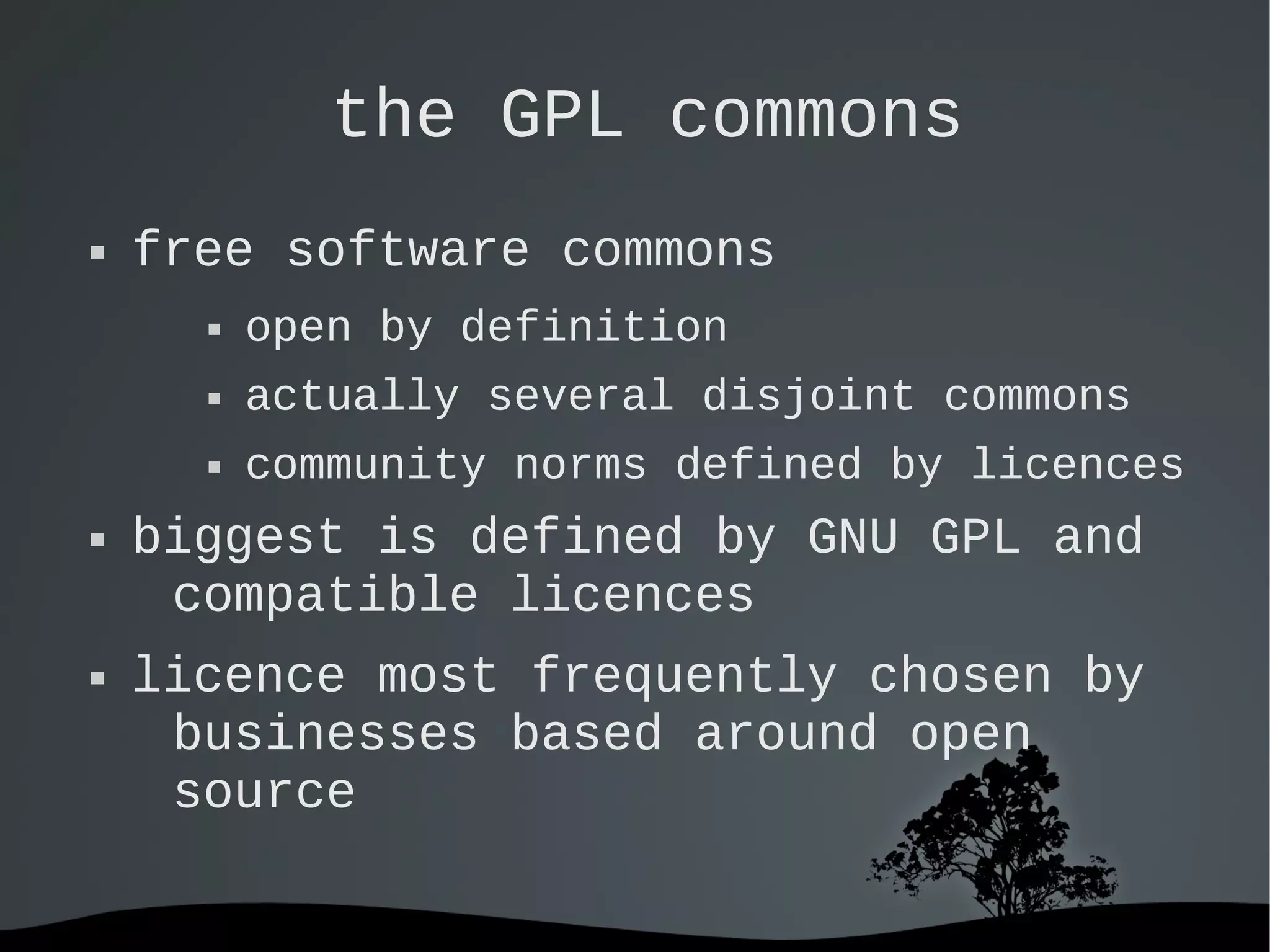
the GPL commons
 free software commons
 open by definition
 actually several disjoint commons
 community norms defined by licences
 biggest is defined by GNU GPL and
compatible licences
 licence most frequently chosen by
businesses based around open
source
  
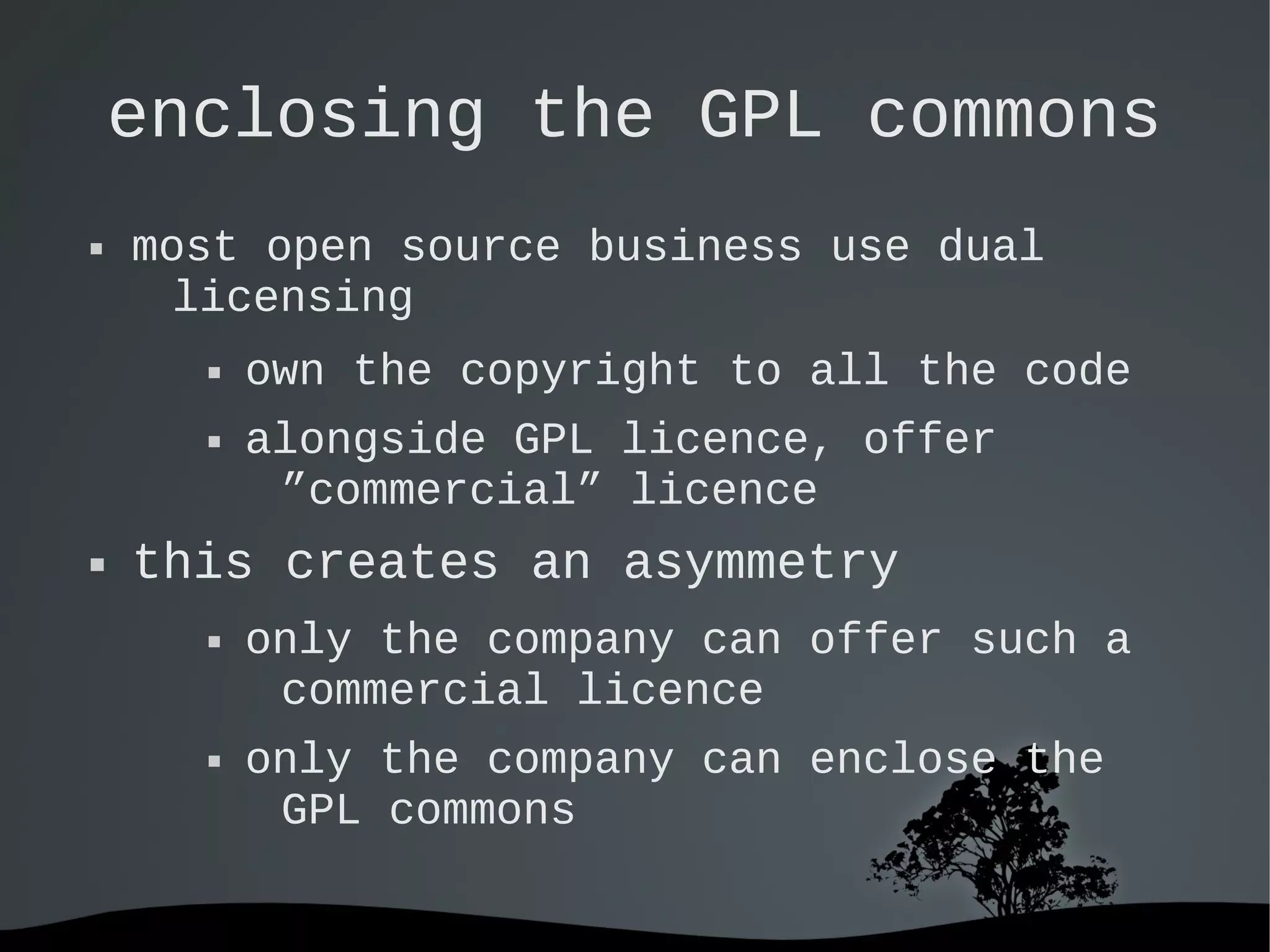
enclosing the GPL commons
 most open source business use dual
licensing
 own the copyright to all the code
 alongside GPL licence, offer
”commercial” licence
 this creates an asymmetry
 only the company can offer such a
commercial licence
 only the company can enclose the
GPL commons
  
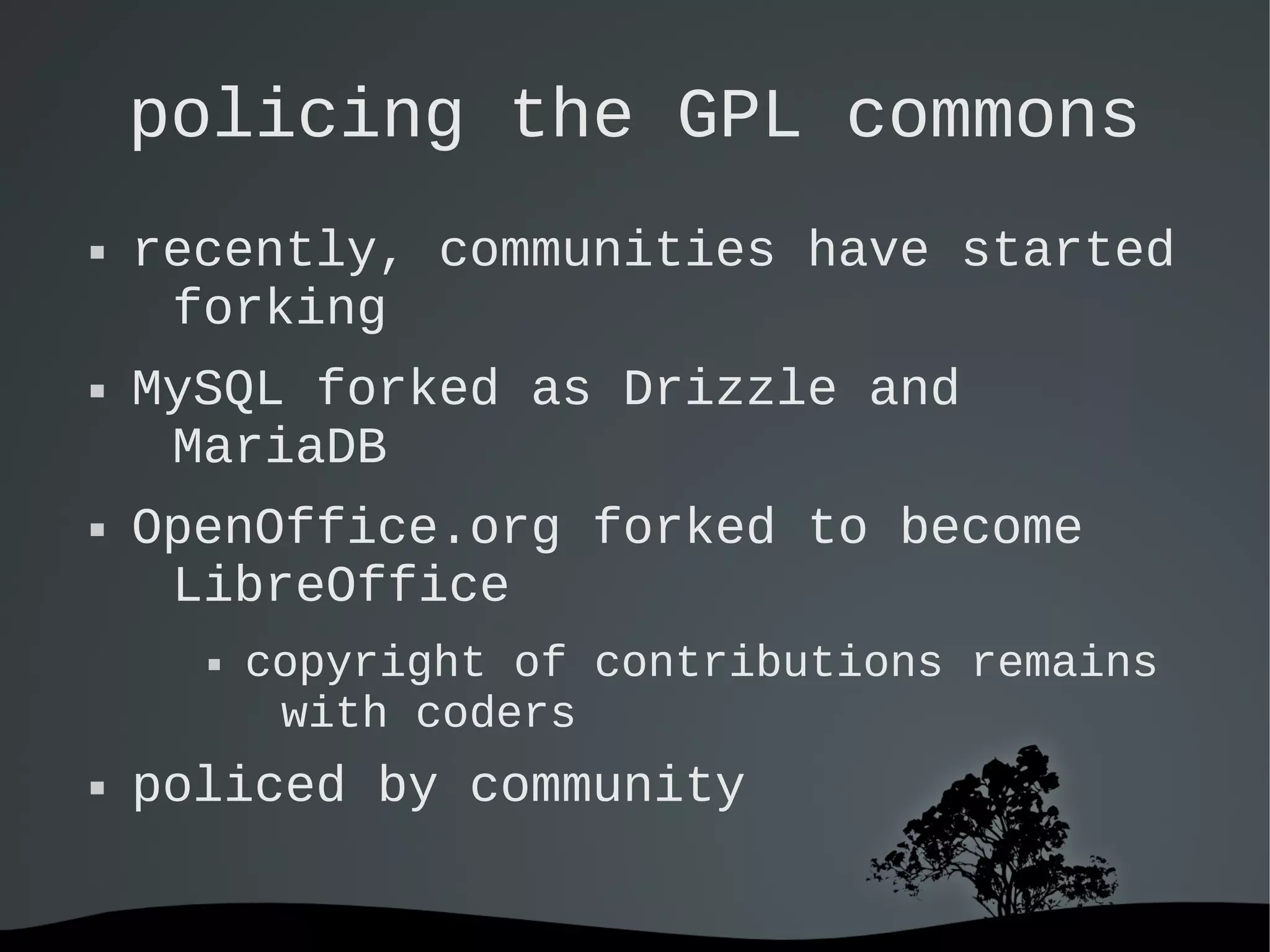
policing the GPL commons
 recently, communities have started
forking
 MySQL forked as Drizzle and
MariaDB
 OpenOffice.org forked to become
LibreOffice
 copyright of contributions remains
with coders
 policed by community
  
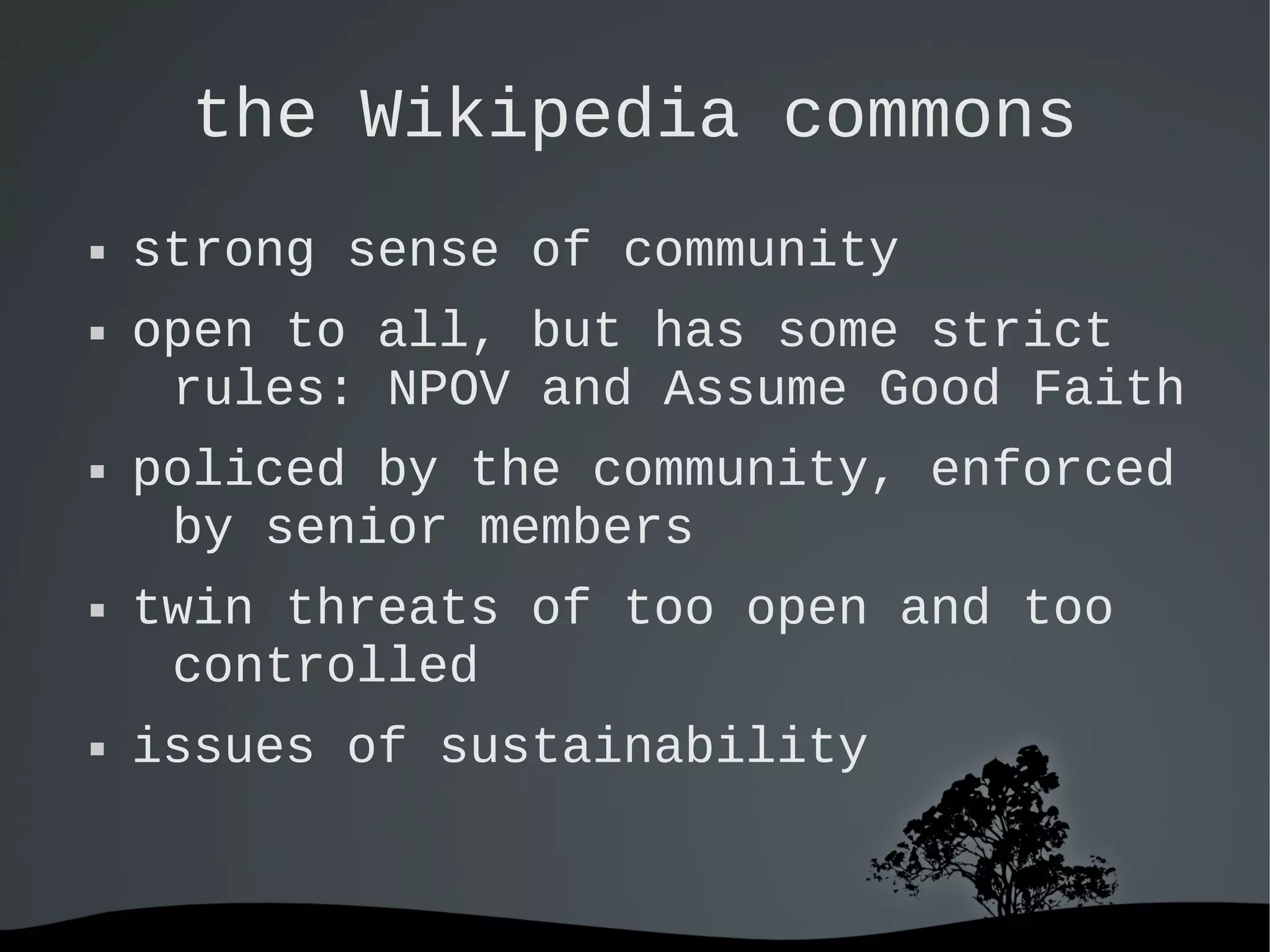
the Wikipedia commons
 strong sense of community
 open to all, but has some strict
rules: NPOV and Assume Good Faith
 policed by the community, enforced
by senior members
 twin threats of too open and too
controlled
 issues of sustainability
  
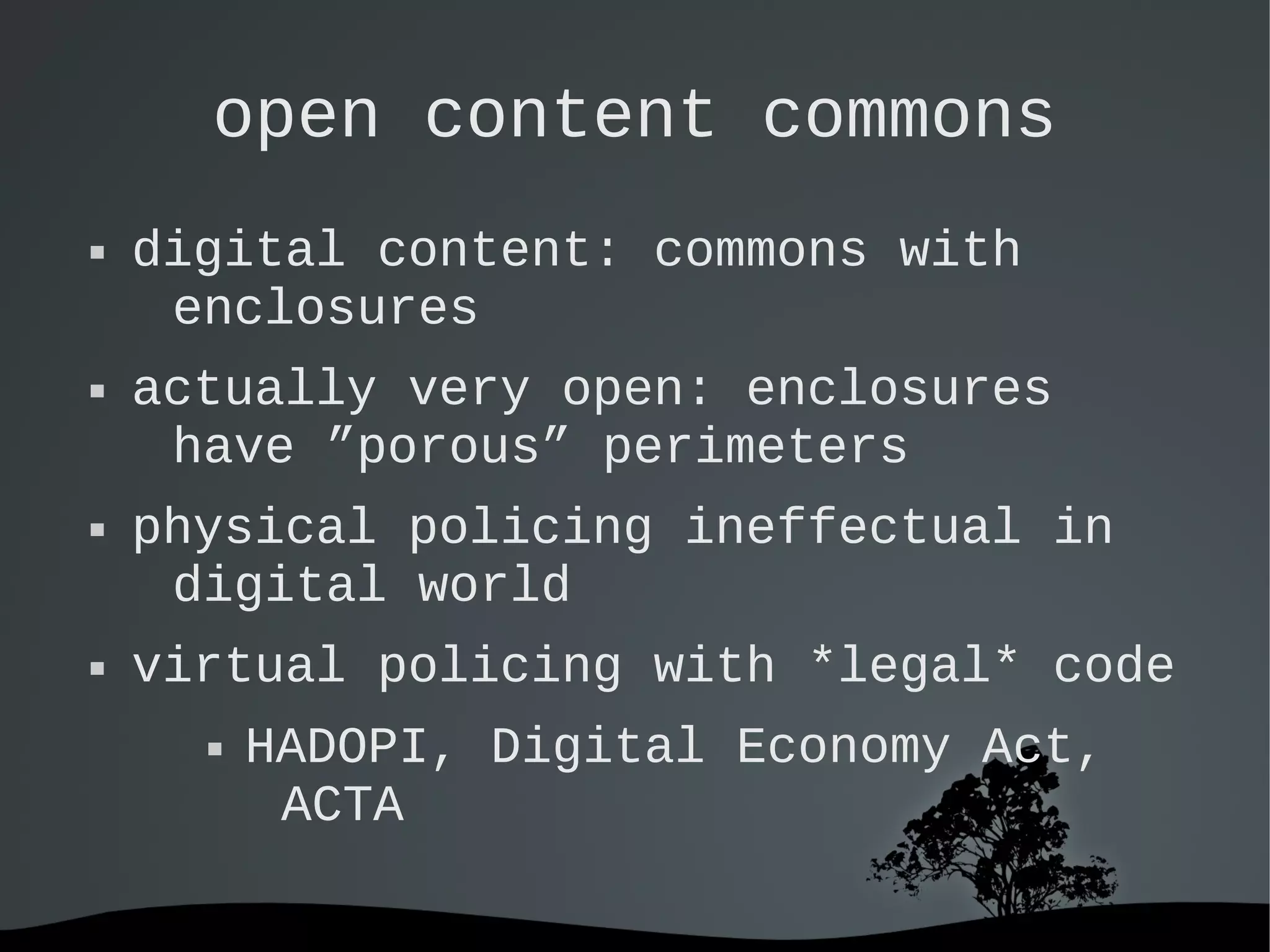
open content commons
 digital content: commons with
enclosures
 actually very open: enclosures
have ”porous” perimeters
 physical policing ineffectual in
digital world
 virtual policing with *legal* code
 HADOPI, Digital Economy Act,
ACTA
  
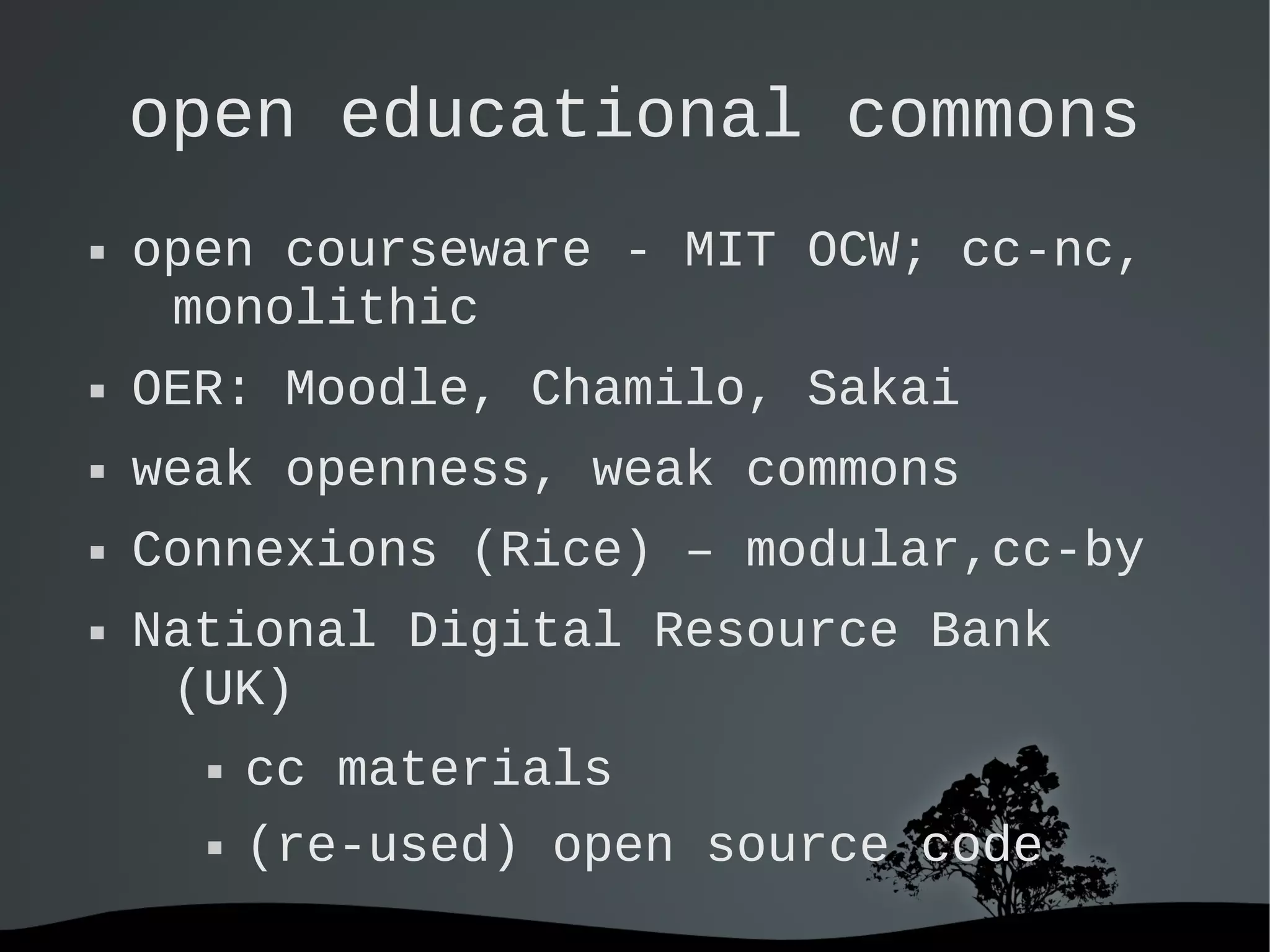
open educational commons
 open courseware - MIT OCW; cc-nc,
monolithic
 OER: Moodle, Chamilo, Sakai
 weak openness, weak commons
 Connexions (Rice) – modular,cc-by
 National Digital Resource Bank
(UK)
 cc materials
 (re-used) open source code
  
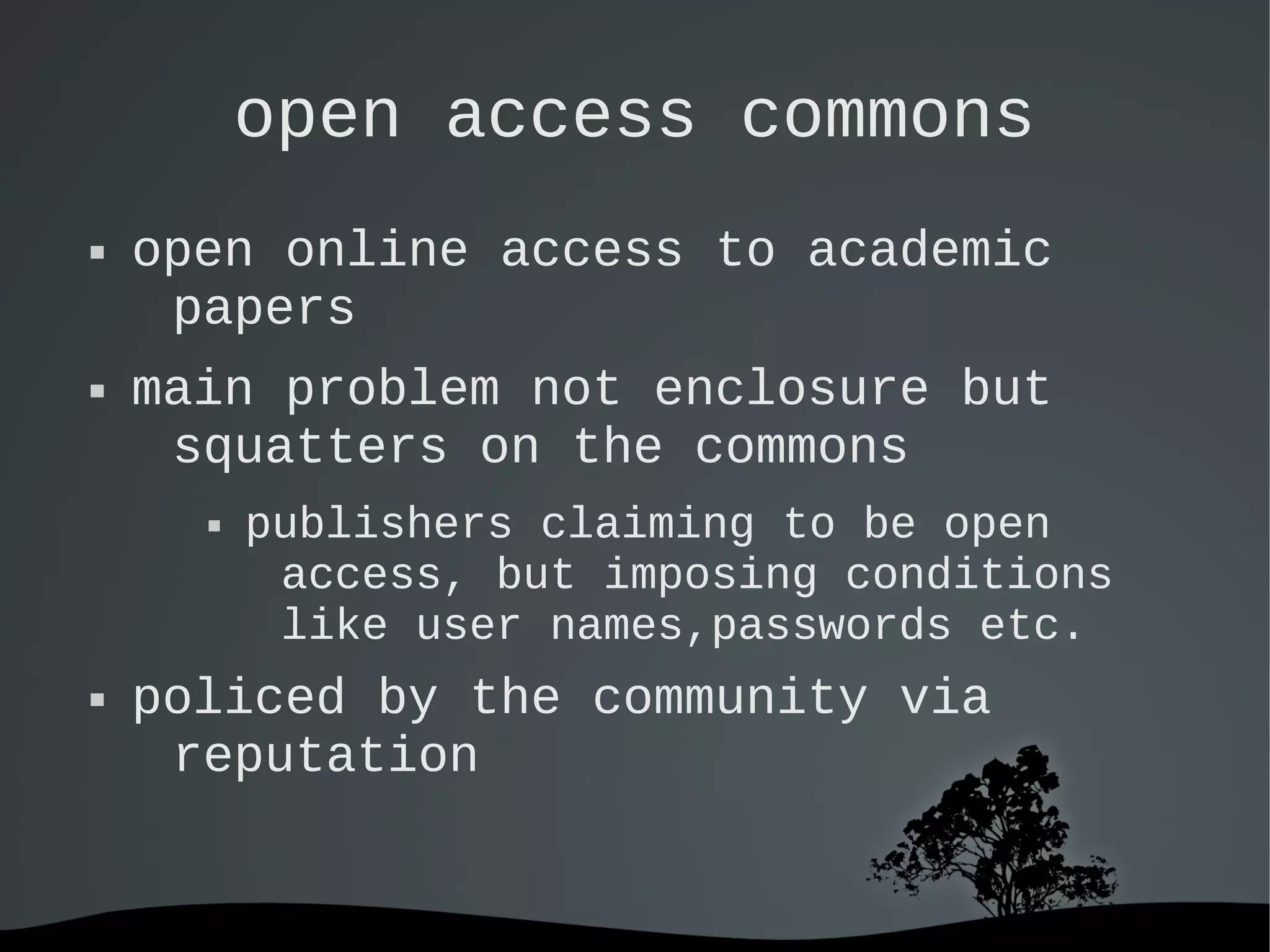
open access commons
 open online access to academic
papers
 main problem not enclosure but
squatters on the commons
 publishers claiming to be open
access, but imposing conditions
like user names,passwords etc.
 policed by the community via
reputation
  
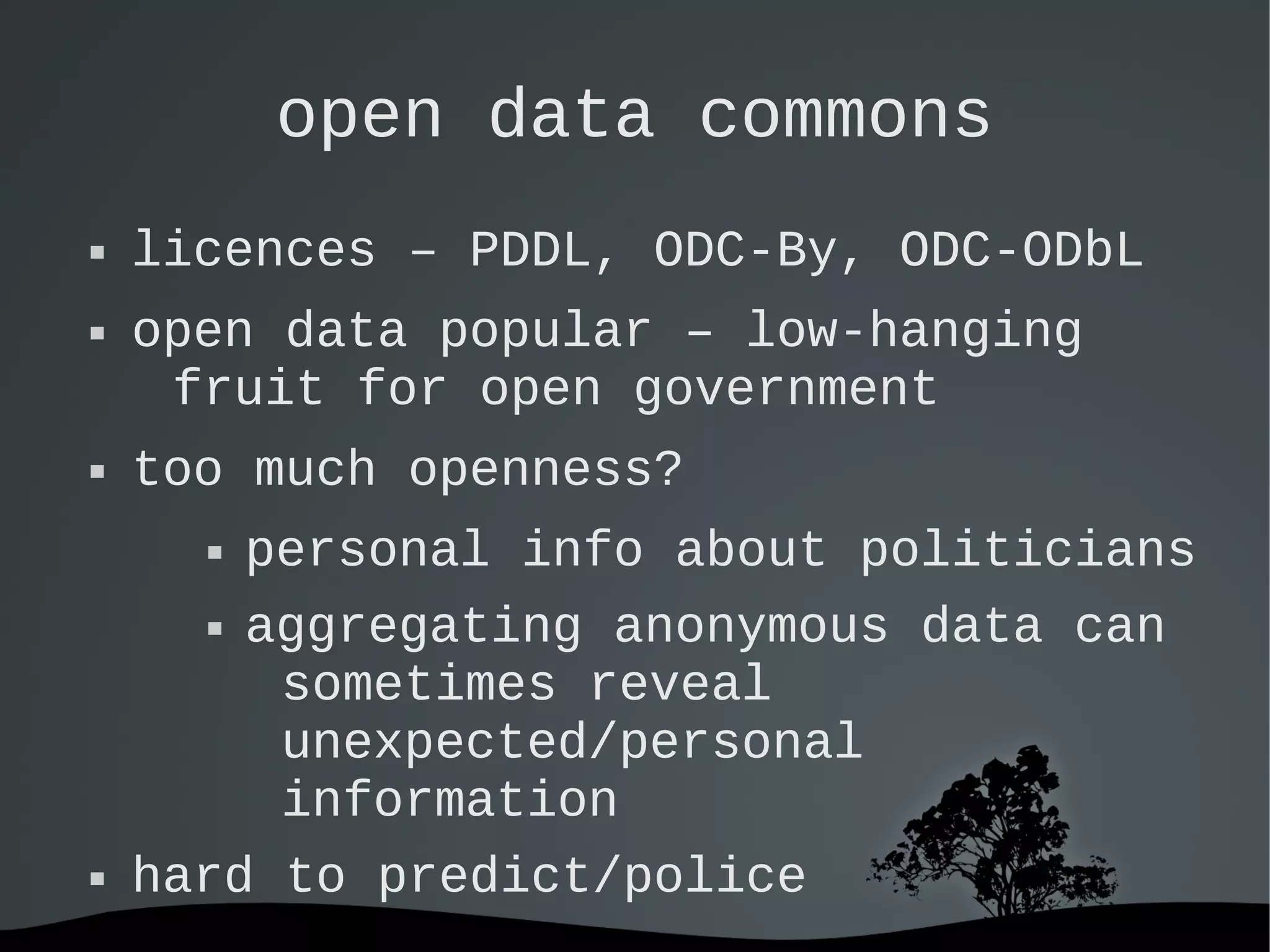
open data commons
 licences – PDDL, ODC-By, ODC-ODbL
 open data popular – low-hanging
fruit for open government
 too much openness?
 personal info about politicians
 aggregating anonymous data can
sometimes reveal
unexpected/personal
information
 hard to predict/police
  
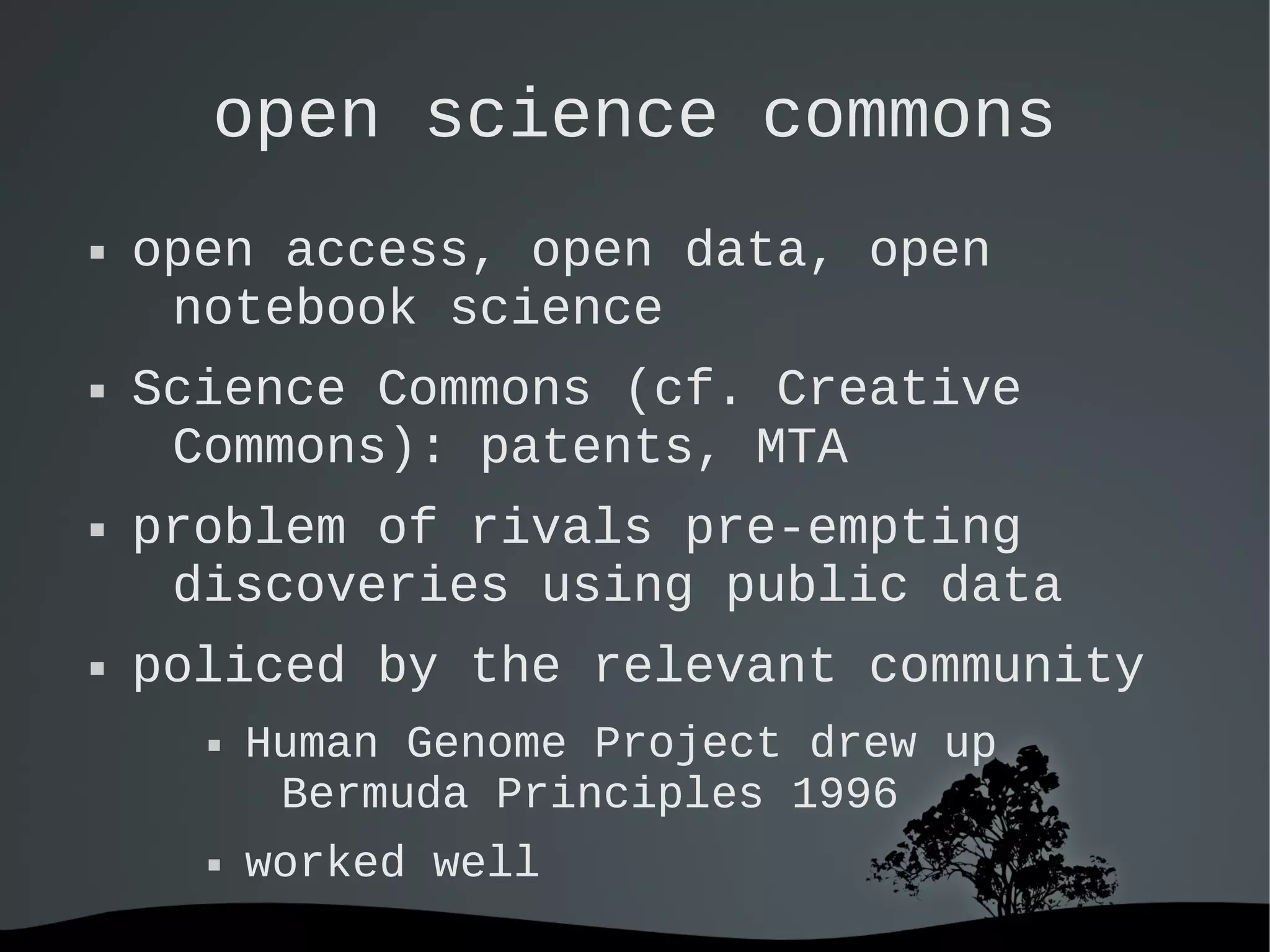
open science commons
 open access, open data, open
notebook science
 Science Commons (cf. Creative
Commons): patents, MTA
 problem of rivals pre-empting
discoveries using public data
 policed by the relevant community
 Human Genome Project drew up
Bermuda Principles 1996
 worked well
  
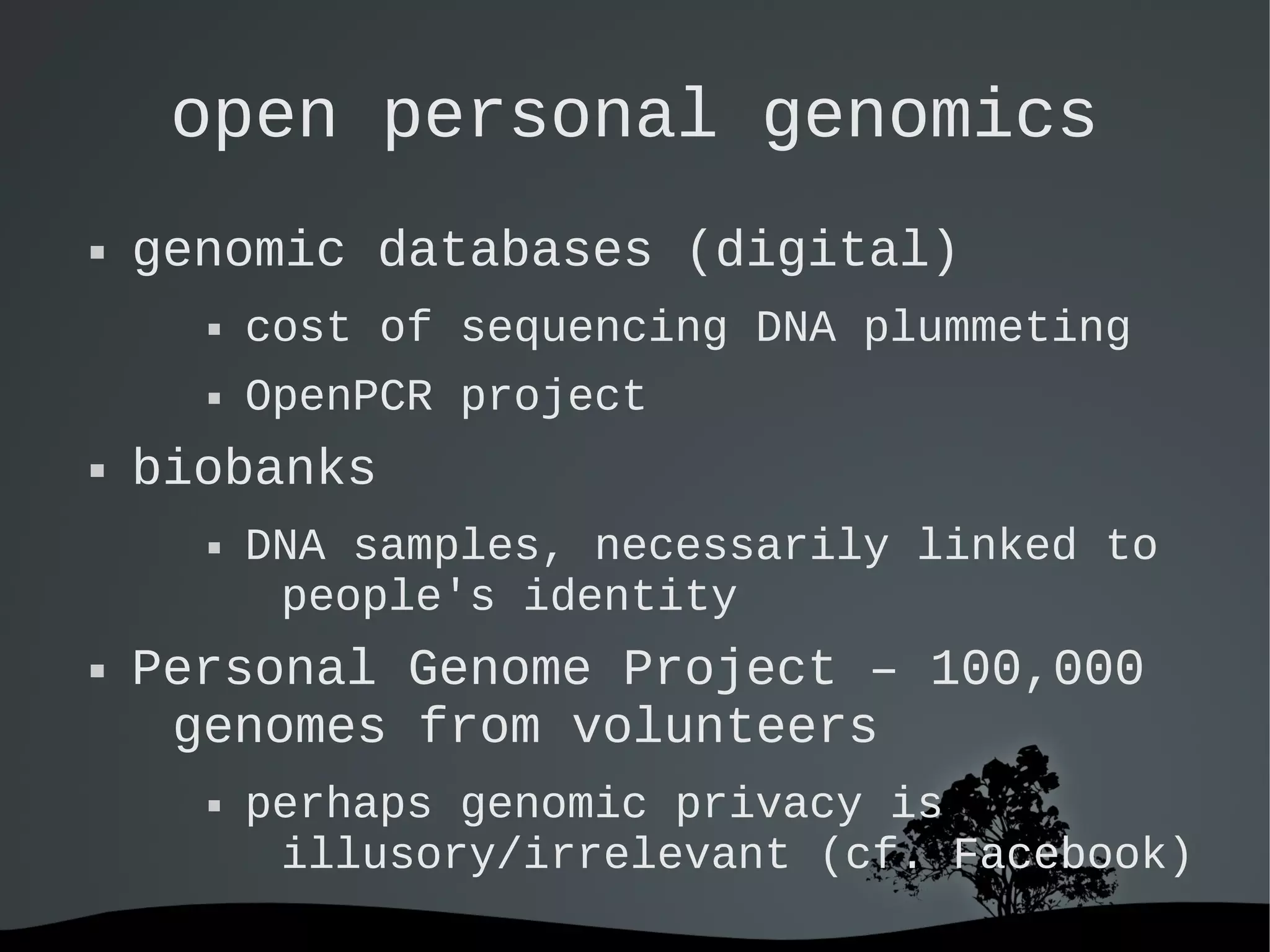
open personal genomics
 genomic databases (digital)
 cost of sequencing DNA plummeting
 OpenPCR project
 biobanks
 DNA samples, necessarily linked to
people's identity
 Personal Genome Project – 100,000
genomes from volunteers
 perhaps genomic privacy is
illusory/irrelevant (cf. Facebook)
  
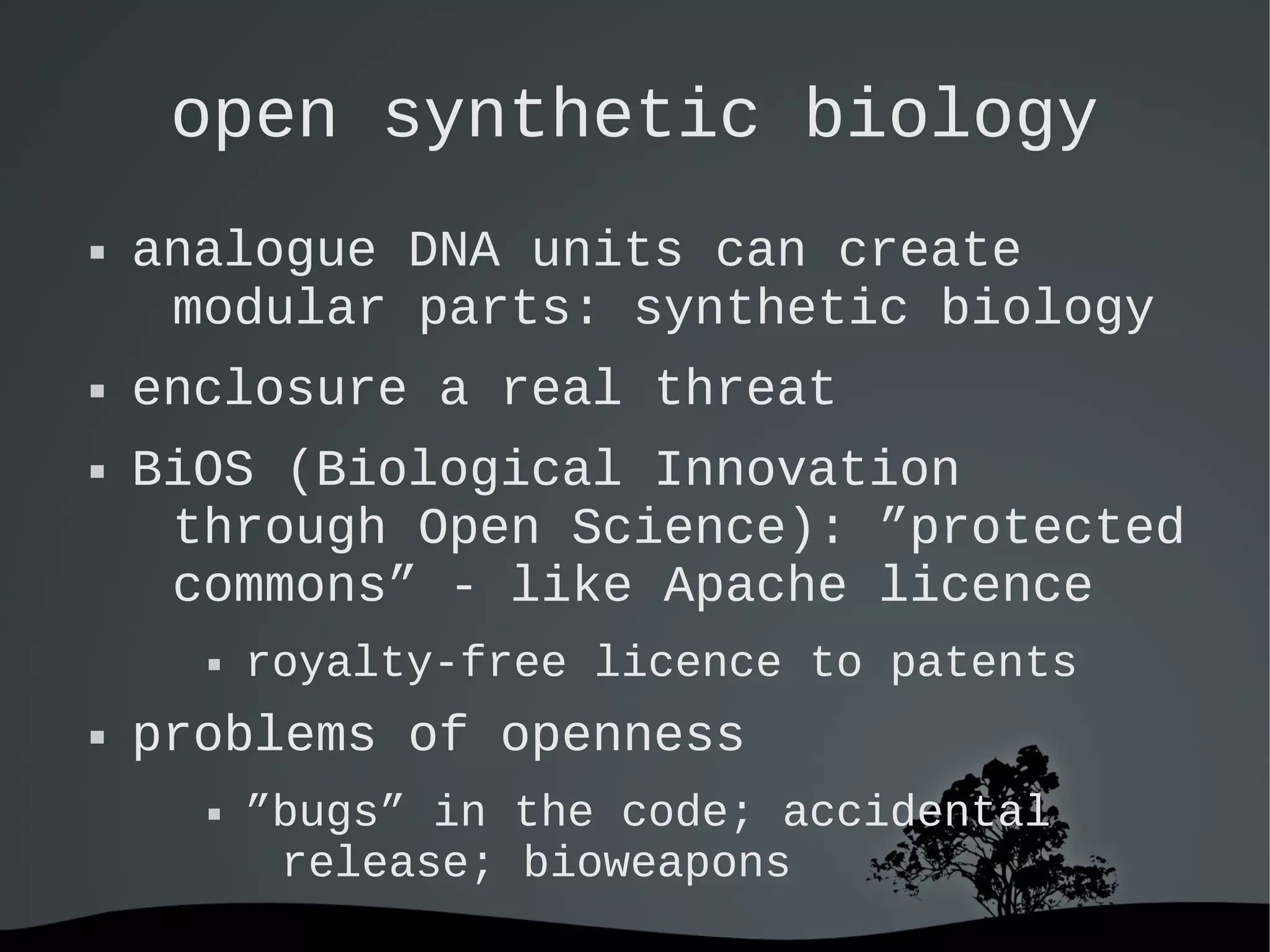
open synthetic biology
 analogue DNA units can create
modular parts: synthetic biology
 enclosure a real threat
 BiOS (Biological Innovation
through Open Science): ”protected
commons” - like Apache licence
 royalty-free licence to patents
 problems of openness
 ”bugs” in the code; accidental
release; bioweapons
  
open hardware commons (1)
 Arduino
 hardware reference designs under CC
licence
 software released under GPL
 99.9% open: ”Arduino” name is only
for offical products
 trademark issues
 Freeduino fork for 100% freedom
 minimal policing by
company/community
  
open hardware commons (2)
 open source car
 OSCar
 c,mm,n
 Open Source Green Vehicle (OSGV)
 digital designs freely available
under open licences
 crucial constraint on openness is
safety
 policed by regulatory authorities
  
open hardware commons (3)
 fabbers (3D printers)
 MakerBot Thing-O-Matic Kit;
Fab@Home; RepRap
 shared digital files for analogue
objects
 Thingiverse.com: mainly GPL, cc
 safety is a constraint
 what happens when you can print
guns etc.?
  
problems of openness
 attacks (copyright, patents, ACTA)
 equilibrium (anarchy/authority)
 impersonation (false community)
 introversion (community failure)
 intrusion (privacy/aggregation)
 occlusion (false reputation)
 safety (accidental harm)
 security (intentional harm)
  
between the commons
glyn.moody@gmail.com
@glynmoody on identi.ca/Twitter
opendotdotdot.blogspot.com

Glyn moody commons versus openness - berlin commons conference

  • 1.
       openness & thecommons glyn moody
  • 2.
       the GPL commons free software commons  open by definition  actually several disjoint commons  community norms defined by licences  biggest is defined by GNU GPL and compatible licences  licence most frequently chosen by businesses based around open source
  • 3.
       enclosing the GPLcommons  most open source business use dual licensing  own the copyright to all the code  alongside GPL licence, offer ”commercial” licence  this creates an asymmetry  only the company can offer such a commercial licence  only the company can enclose the GPL commons
  • 4.
       policing the GPLcommons  recently, communities have started forking  MySQL forked as Drizzle and MariaDB  OpenOffice.org forked to become LibreOffice  copyright of contributions remains with coders  policed by community
  • 5.
       the Wikipedia commons strong sense of community  open to all, but has some strict rules: NPOV and Assume Good Faith  policed by the community, enforced by senior members  twin threats of too open and too controlled  issues of sustainability
  • 6.
       open content commons digital content: commons with enclosures  actually very open: enclosures have ”porous” perimeters  physical policing ineffectual in digital world  virtual policing with *legal* code  HADOPI, Digital Economy Act, ACTA
  • 7.
       open educational commons open courseware - MIT OCW; cc-nc, monolithic  OER: Moodle, Chamilo, Sakai  weak openness, weak commons  Connexions (Rice) – modular,cc-by  National Digital Resource Bank (UK)  cc materials  (re-used) open source code
  • 8.
       open access commons open online access to academic papers  main problem not enclosure but squatters on the commons  publishers claiming to be open access, but imposing conditions like user names,passwords etc.  policed by the community via reputation
  • 9.
       open data commons licences – PDDL, ODC-By, ODC-ODbL  open data popular – low-hanging fruit for open government  too much openness?  personal info about politicians  aggregating anonymous data can sometimes reveal unexpected/personal information  hard to predict/police
  • 10.
       open science commons open access, open data, open notebook science  Science Commons (cf. Creative Commons): patents, MTA  problem of rivals pre-empting discoveries using public data  policed by the relevant community  Human Genome Project drew up Bermuda Principles 1996  worked well
  • 11.
       open personal genomics genomic databases (digital)  cost of sequencing DNA plummeting  OpenPCR project  biobanks  DNA samples, necessarily linked to people's identity  Personal Genome Project – 100,000 genomes from volunteers  perhaps genomic privacy is illusory/irrelevant (cf. Facebook)
  • 12.
       open synthetic biology analogue DNA units can create modular parts: synthetic biology  enclosure a real threat  BiOS (Biological Innovation through Open Science): ”protected commons” - like Apache licence  royalty-free licence to patents  problems of openness  ”bugs” in the code; accidental release; bioweapons
  • 13.
       open hardware commons(1)  Arduino  hardware reference designs under CC licence  software released under GPL  99.9% open: ”Arduino” name is only for offical products  trademark issues  Freeduino fork for 100% freedom  minimal policing by company/community
  • 14.
       open hardware commons(2)  open source car  OSCar  c,mm,n  Open Source Green Vehicle (OSGV)  digital designs freely available under open licences  crucial constraint on openness is safety  policed by regulatory authorities
  • 15.
       open hardware commons(3)  fabbers (3D printers)  MakerBot Thing-O-Matic Kit; Fab@Home; RepRap  shared digital files for analogue objects  Thingiverse.com: mainly GPL, cc  safety is a constraint  what happens when you can print guns etc.?
  • 16.
       problems of openness attacks (copyright, patents, ACTA)  equilibrium (anarchy/authority)  impersonation (false community)  introversion (community failure)  intrusion (privacy/aggregation)  occlusion (false reputation)  safety (accidental harm)  security (intentional harm)
  • 17.
       between the commons glyn.moody@gmail.com @glynmoodyon identi.ca/Twitter opendotdotdot.blogspot.com