Keypoint: planning for "One Step Further" !!
How to plan in an iteration including setting timing, participant, activities for an iteration planning meeting.
To process the conflit btw customers vs. developers...
User Stories Applied:
ForAgile Software Development
–
Ch 10. Planning an iteration
Chen Jing Fung @iii
2011/6/23
Ref: other Agile solutions How to write,
gather ideas, estimate the approach
2.
Planning an iteration
• Best time:
– the start of each iteration
– Take a release(/planning process) one step further
• Participant:
– customers as well as all of developers
• Key:
– not much detail but enough planning for action-based
– Ideal for planning a release
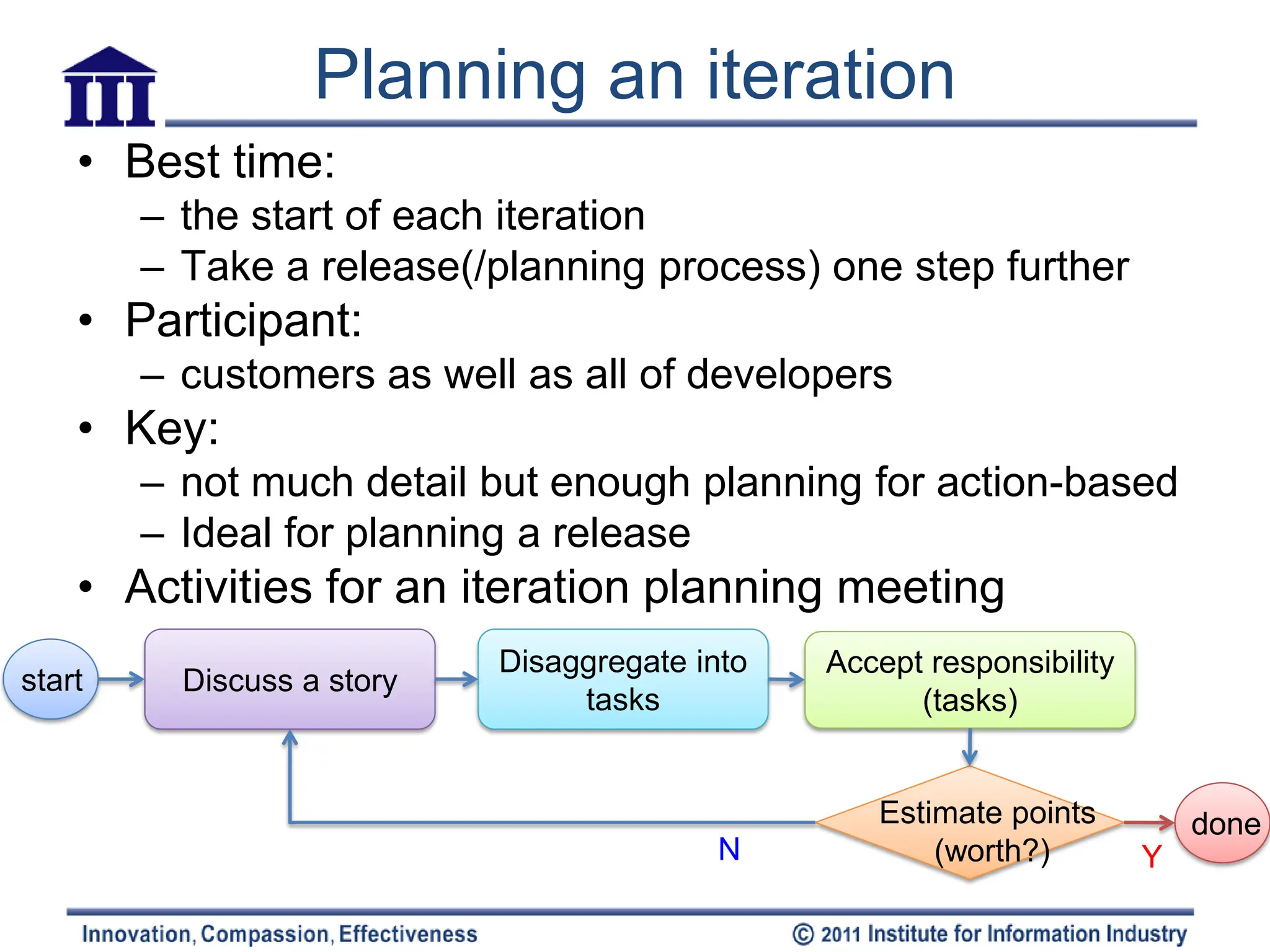
• Activities for an iteration planning meeting
Disaggregate into Accept responsibility
start Discuss a story
tasks (tasks)
Estimate points done
N (worth?) Y
3.
Discussing the stories
start
Discuss a Disaggregate into
Accept responsibility (tasks)
story tasks
Estimate points done
N (worth?) Y
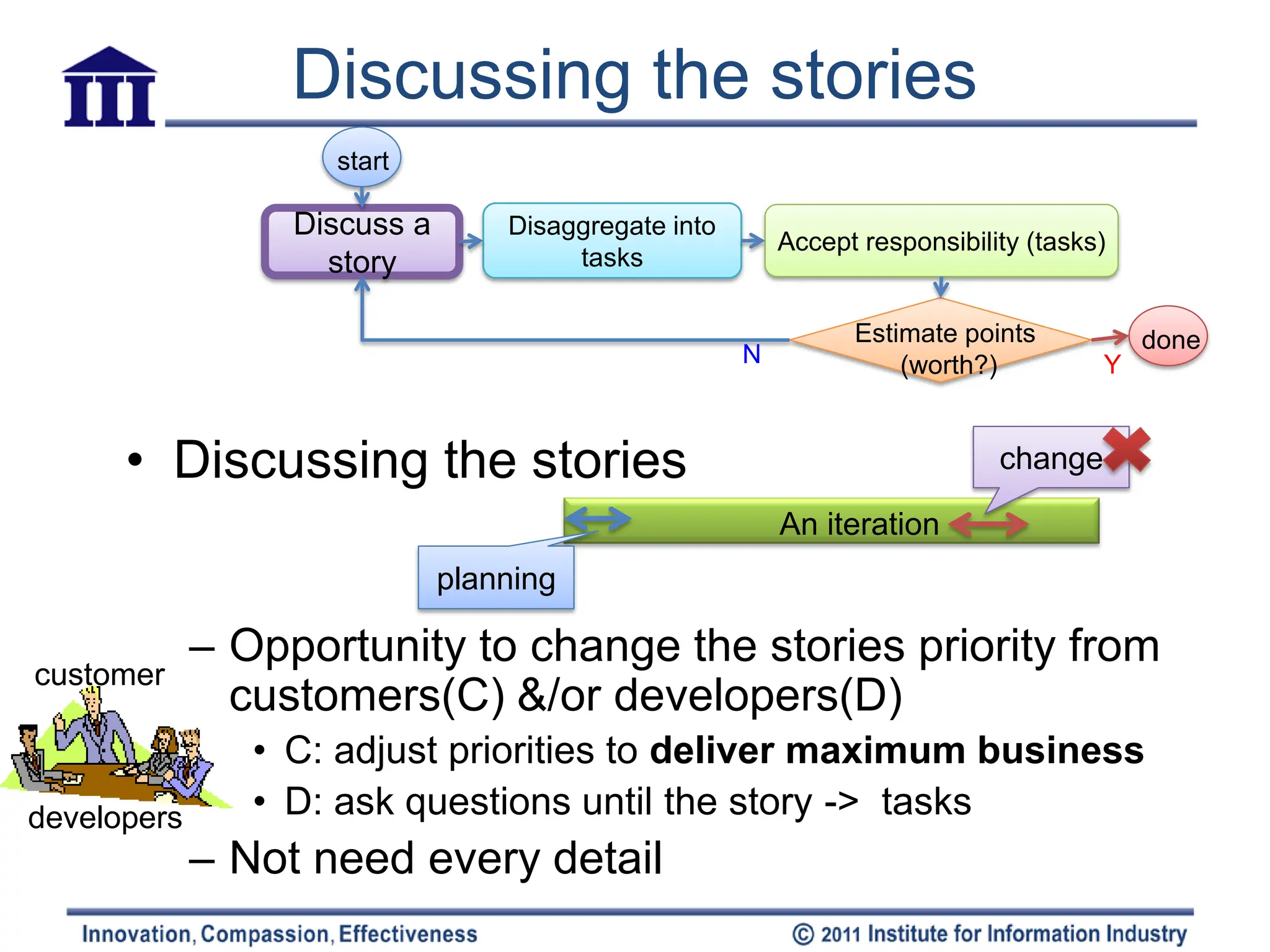
• Discussing the stories change
An iteration
planning
– Opportunity to change the stories priority from
customer
customers(C) &/or developers(D)
• C: adjust priorities to deliver maximum business
developers • D: ask questions until the story -> tasks
– Not need every detail
4.
Disaggregating into tasks
Discuss Disaggregate
Accept responsibility (tasks)
a story into tasks
• Reason: N Estimate points Y
– Not just one developer (worth?)
– Stories descript the user/customer-valued
functionality (not to-do list)
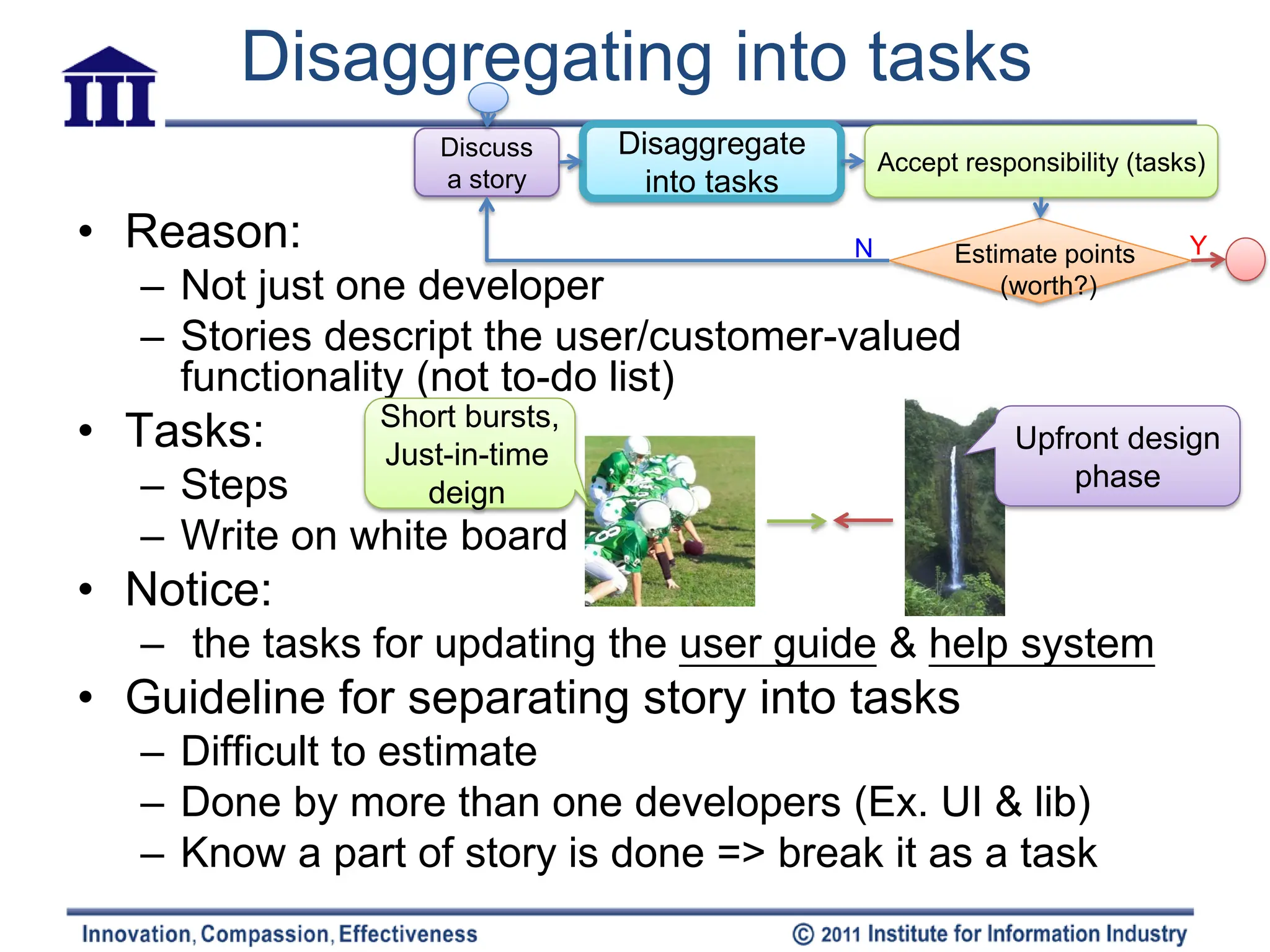
• Tasks: Short bursts,
Just-in-time
Upfront design
– Steps deign
phase
– Write on white board
• Notice:
– the tasks for updating the user guide & help system
• Guideline for separating story into tasks
– Difficult to estimate
– Done by more than one developers (Ex. UI & lib)
– Know a part of story is done => break it as a task
5.
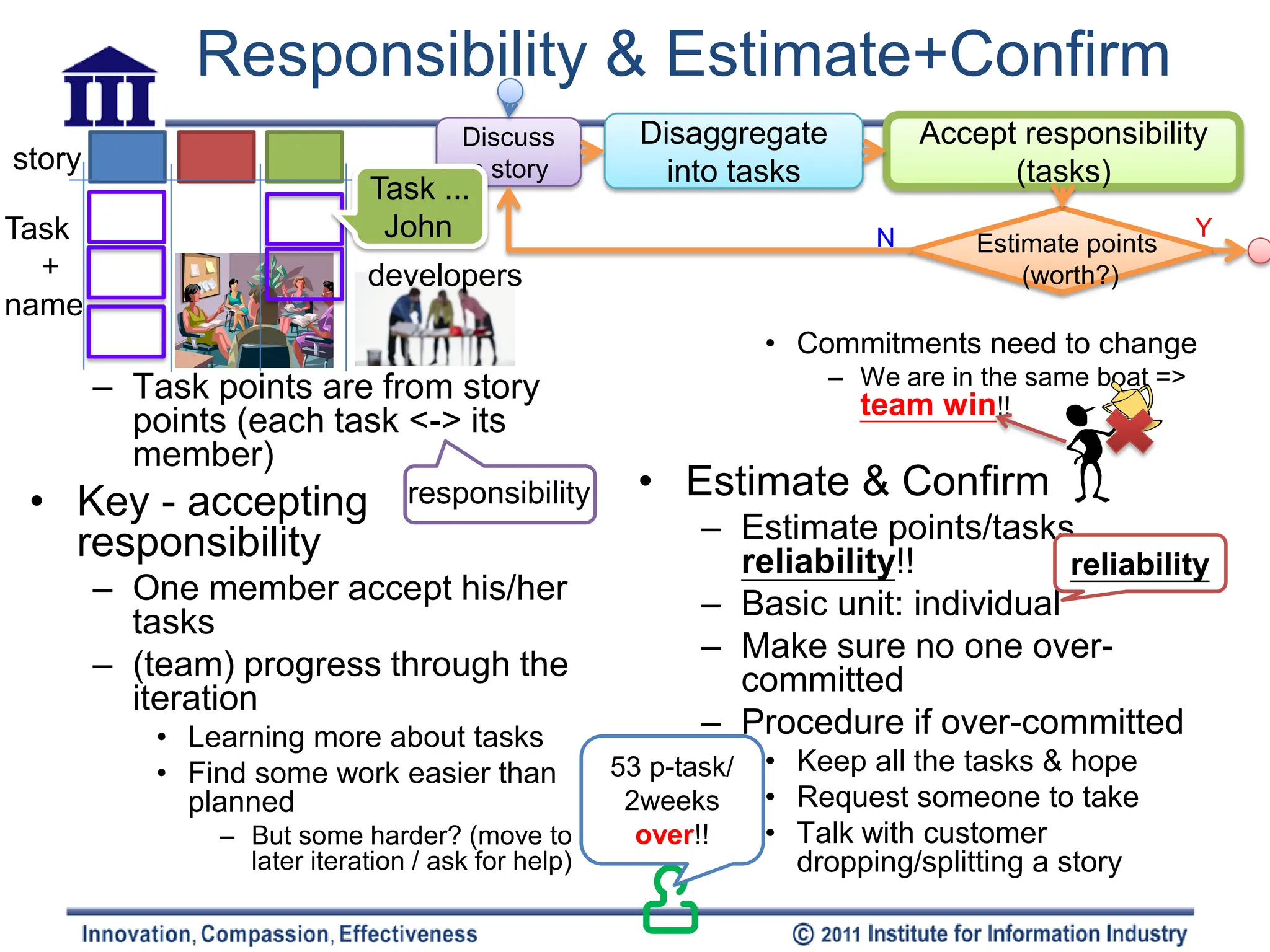
Responsibility & Estimate+Confirm
Discuss Disaggregate Accept responsibility
story a story into tasks (tasks)
Task ...
Task John N Estimate points
Y
+ developers (worth?)
name
• Commitments need to change
– Task points are from story – We are in the same boat =>
team win!!
points (each task <-> its
member)
• Key - accepting responsibility • Estimate & Confirm
responsibility – Estimate points/tasks
reliability!! reliability
– One member accept his/her – Basic unit: individual
tasks
– Make sure no one over-
– (team) progress through the committed
iteration
• Learning more about tasks – Procedure if over-committed
• Find some work easier than 53 p-task/ • Keep all the tasks & hope
planned 2weeks • Request someone to take
– But some harder? (move to over!! • Talk with customer
later iteration / ask for help) dropping/splitting a story
6.
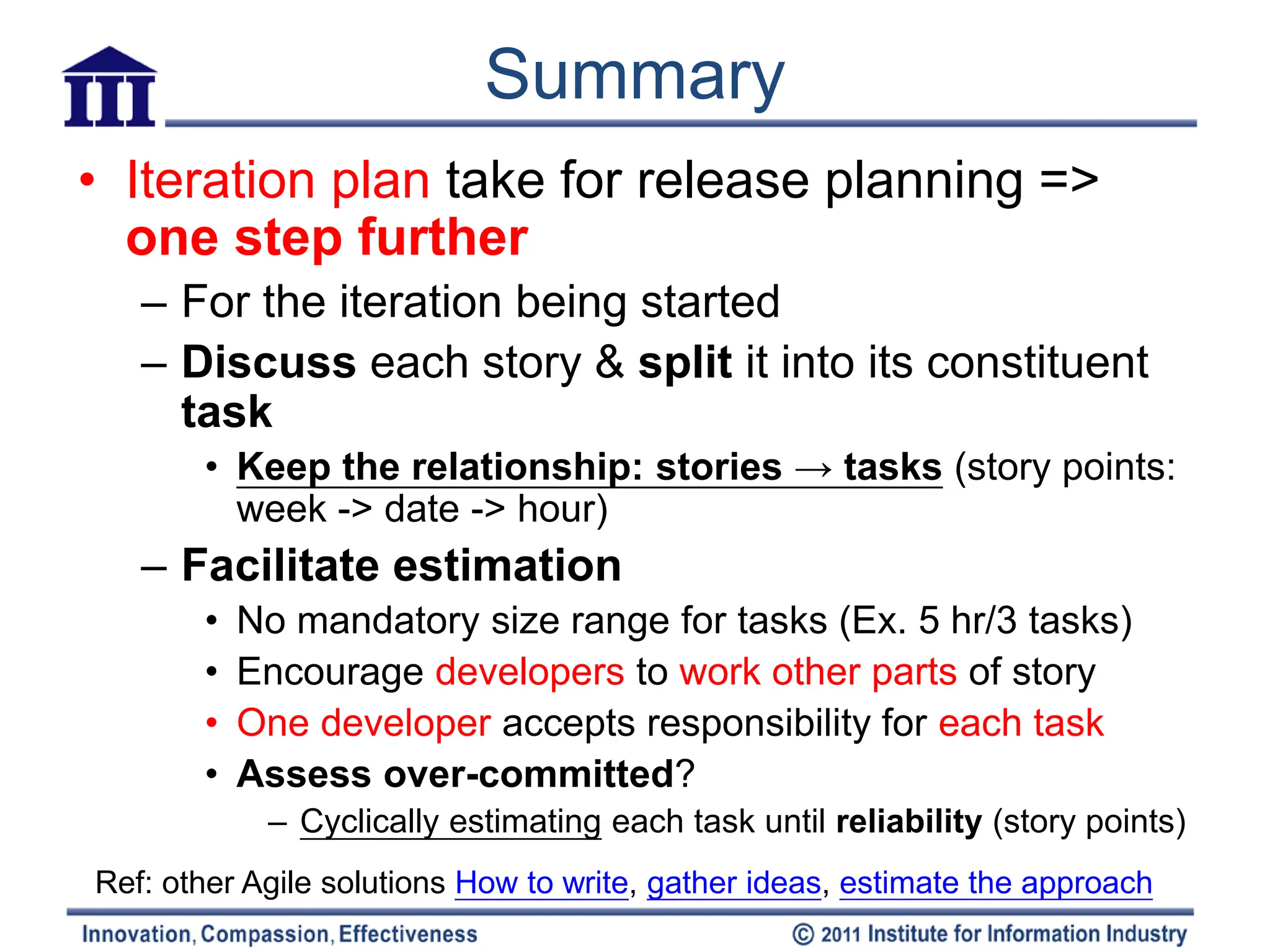
Summary
• Iteration plantake for release planning =>
one step further
– For the iteration being started
– Discuss each story & split it into its constituent
task
• Keep the relationship: stories → tasks (story points:
week -> date -> hour)
– Facilitate estimation
• No mandatory size range for tasks (Ex. 5 hr/3 tasks)
• Encourage developers to work other parts of story
• One developer accepts responsibility for each task
• Assess over-committed?
– Cyclically estimating each task until reliability (story points)
Ref: other Agile solutions How to write, gather ideas, estimate the approach