Page 0 of 59

Reaching for the Future With
Web Components and Polymer

Michael Labriola - @mlabriola
Senior Consultant w/ Digital Primates
Web Components
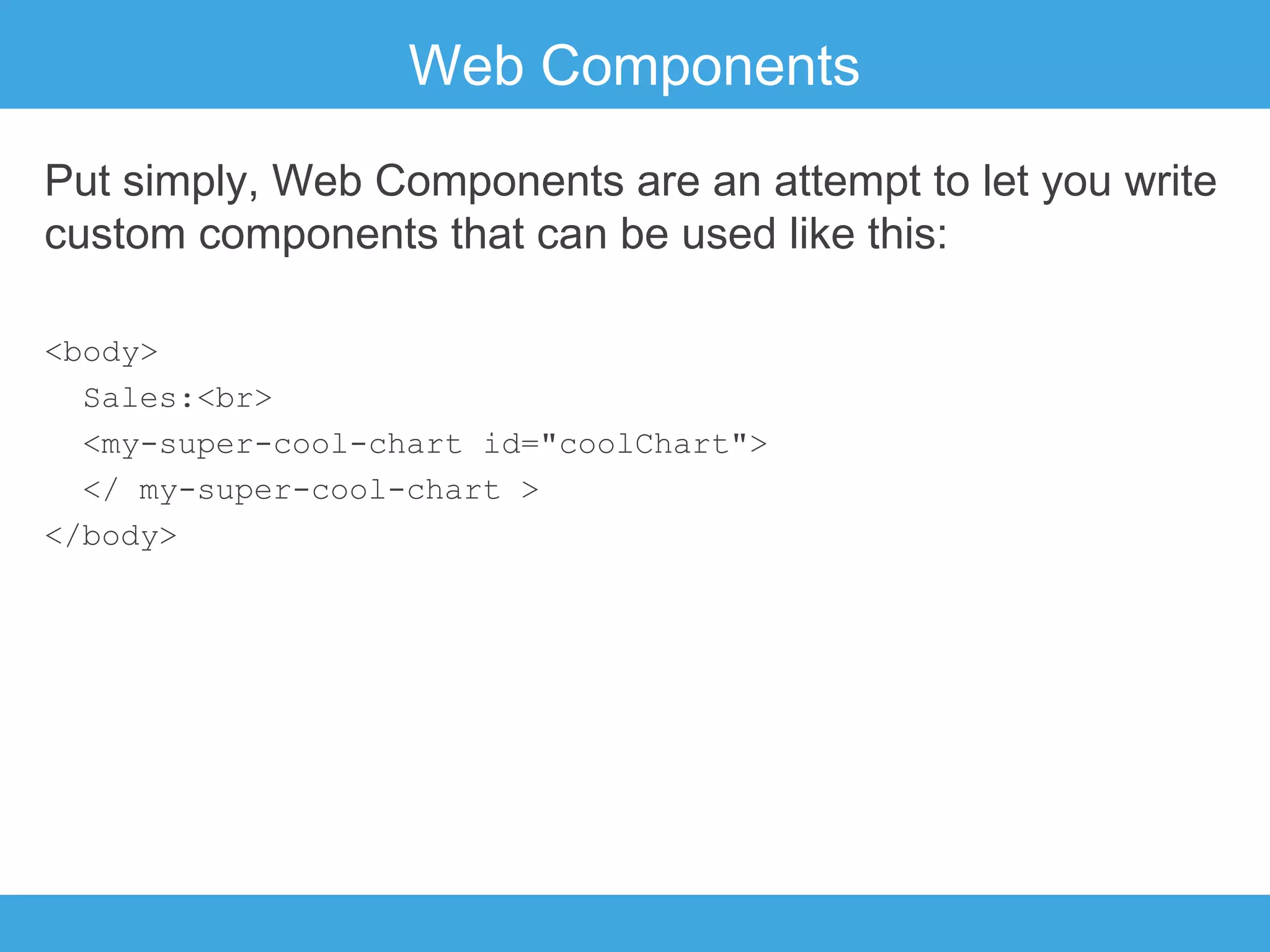
Put simply, Web Components are an attempt to let you write
custom components that can be used like this:
<body>
Sales:<br>
<my-super-cool-chart id="coolChart">
</ my-super-cool-chart >
</body>
What in the world is Polymer?
A library built on top of Web Components.
Allows us to use Web Components today in modern
browsers
3 main pieces
• A set of polyfills
• Web application framework
• Set of UI components
What are we going to cover?
Web Components, specifically:
What in the world are web components?
What problem are they trying to solve?
How do they work?
Can I actually use these things?
What does it mean to my app/development process?
Bleeding Edge
Web Components are beyond leading edge.
As of this moment, they do not work in their entirety in
any browser
A good portion of the functionality is available in Chrome
Canary if you turn on all of the experimental WebKit and
JavaScript features
Why am I talking about this?
I do believe web components are a significant part of our
future
I think understand their goal and vision is crucial to the next
few years
I think they will change a lot before they are final
...and?
You can still play with flavors of Web Components to a large
extent through polyfills today
Unless you skydive to work or love framework code more
than sleep, you may want to avoid putting this all into
production today
Given that... Why Components?
A few minor reasons you may like the idea, first:
Encapsulation
•
•
•
•

Manageable Reuse
Hiding complexity and implementation
Dealing with duplicated IDs
Dealing with CSS scoping / propagation
Why?
And then:
[More] even playing field
• Using the same tricks the browser uses

Ease of distribution
Appropriate technology uses
• Markup in markup not strings or code
How do they work?
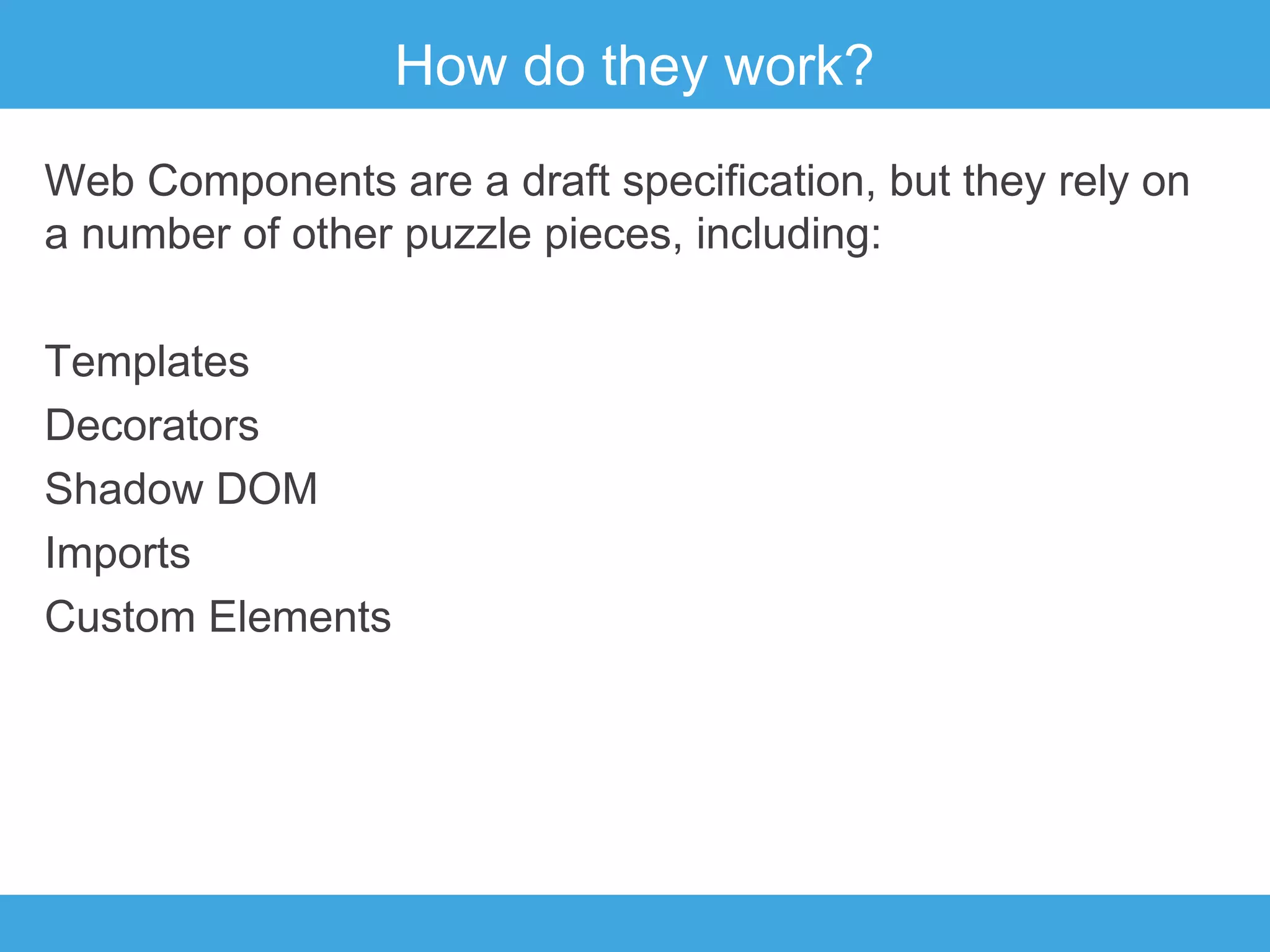
Web Components are a draft specification, but they rely on
a number of other puzzle pieces, including:
Templates
Decorators
Shadow DOM
Imports
Custom Elements
Templates
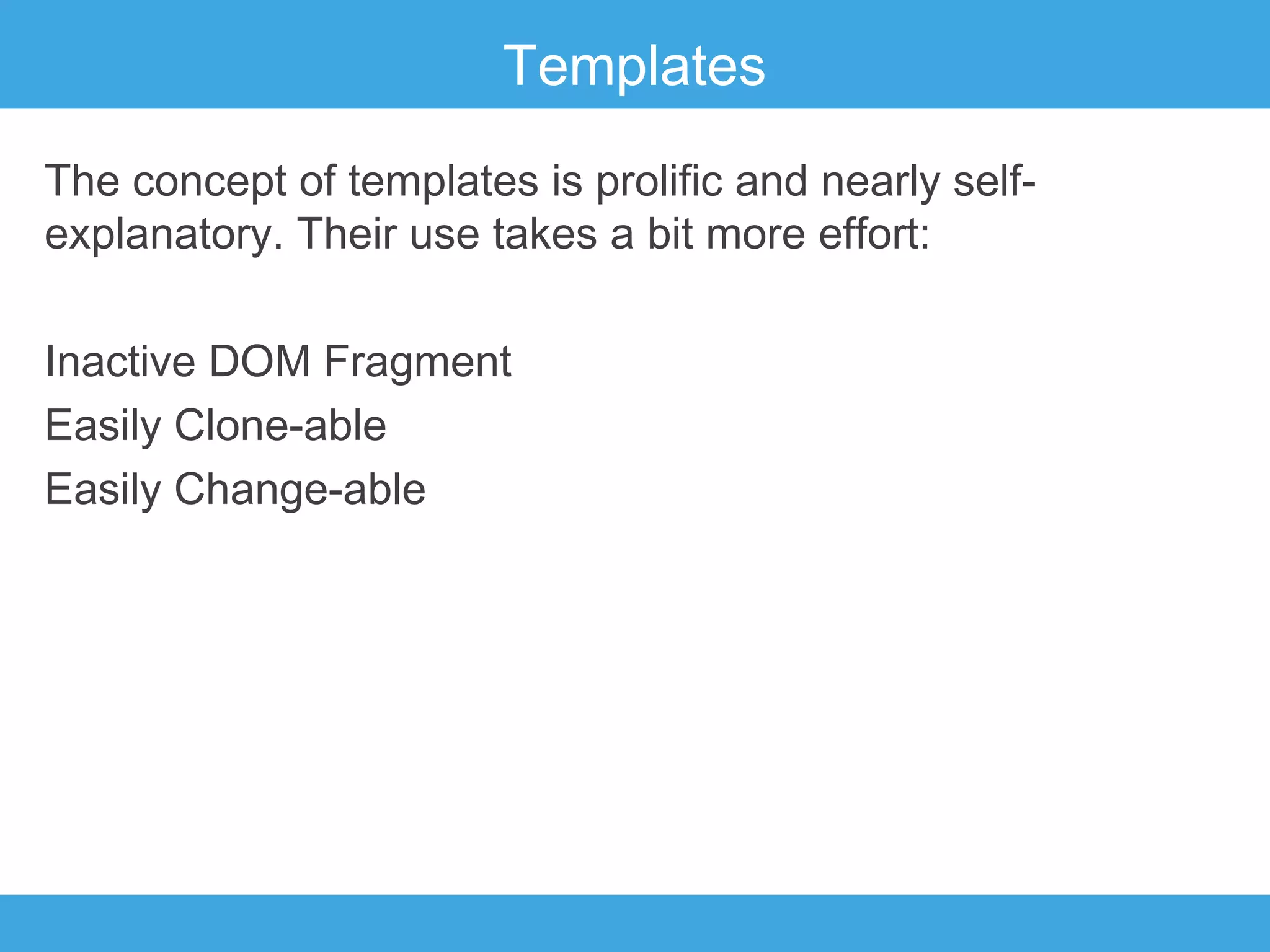
The concept of templates is prolific and nearly selfexplanatory. Their use takes a bit more effort:
Inactive DOM Fragment
Easily Clone-able
Easily Change-able
State of the Intersection
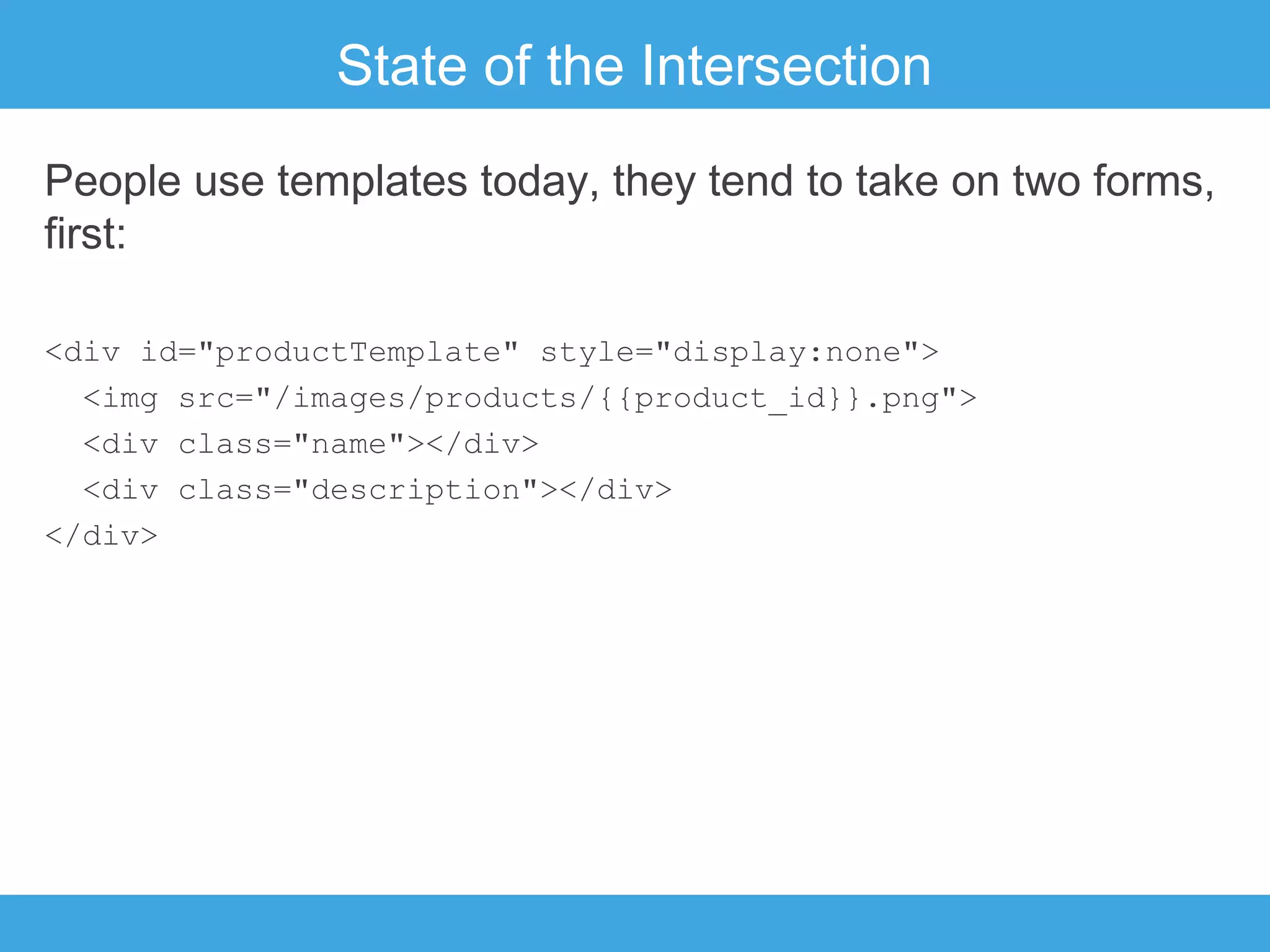
People use templates today, they tend to take on two forms,
first:
<div id="productTemplate" style="display:none">
<img src="/images/products/{{product_id}}.png">
<div class="name"></div>
<div class="description"></div>
</div>
The Reality
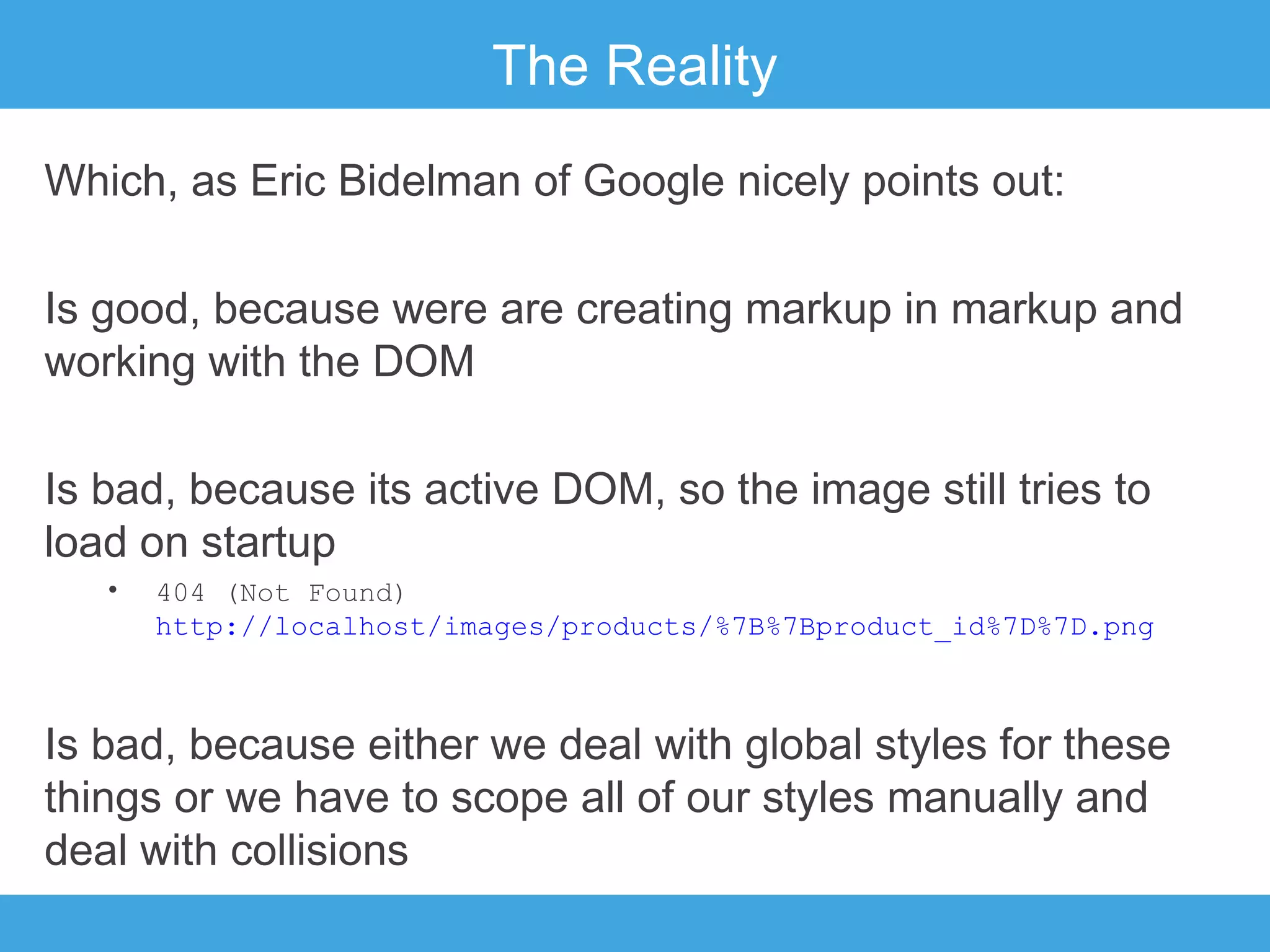
Which, as Eric Bidelman of Google nicely points out:
Is good, because were are creating markup in markup and
working with the DOM
Is bad, because its active DOM, so the image still tries to
load on startup
•

404 (Not Found)
http://localhost/images/products/%7B%7Bproduct_id%7D%7D.png

Is bad, because either we deal with global styles for these
things or we have to scope all of our styles manually and
deal with collisions
State of the Intersection
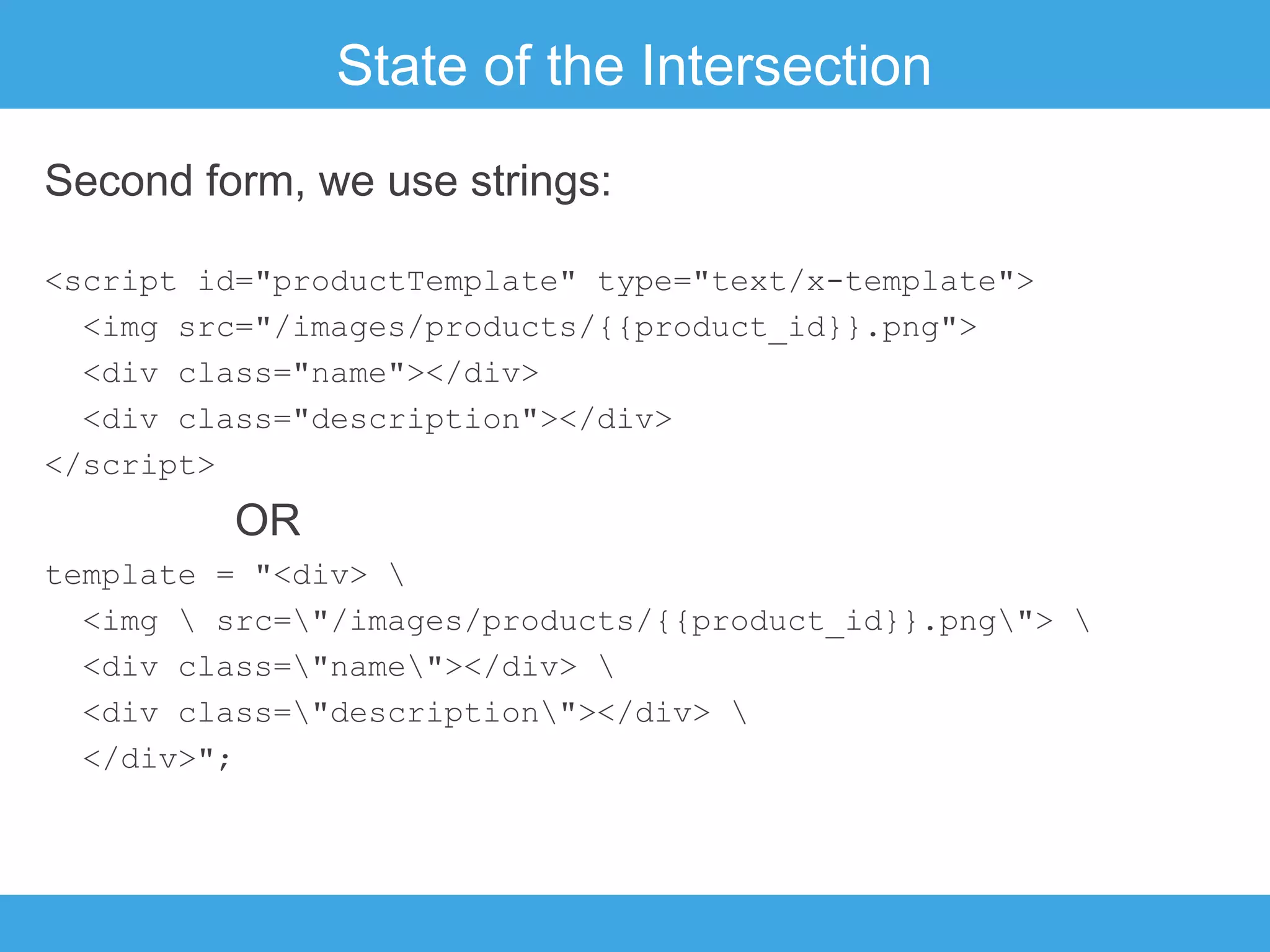
Second form, we use strings:
<script id="productTemplate" type="text/x-template">
<img src="/images/products/{{product_id}}.png">
<div class="name"></div>
<div class="description"></div>
</script>

OR
template = "<div> 
<img  src="/images/products/{{product_id}}.png"> 
<div class="name"></div> 
<div class="description"></div> 
</div>";
The Reality
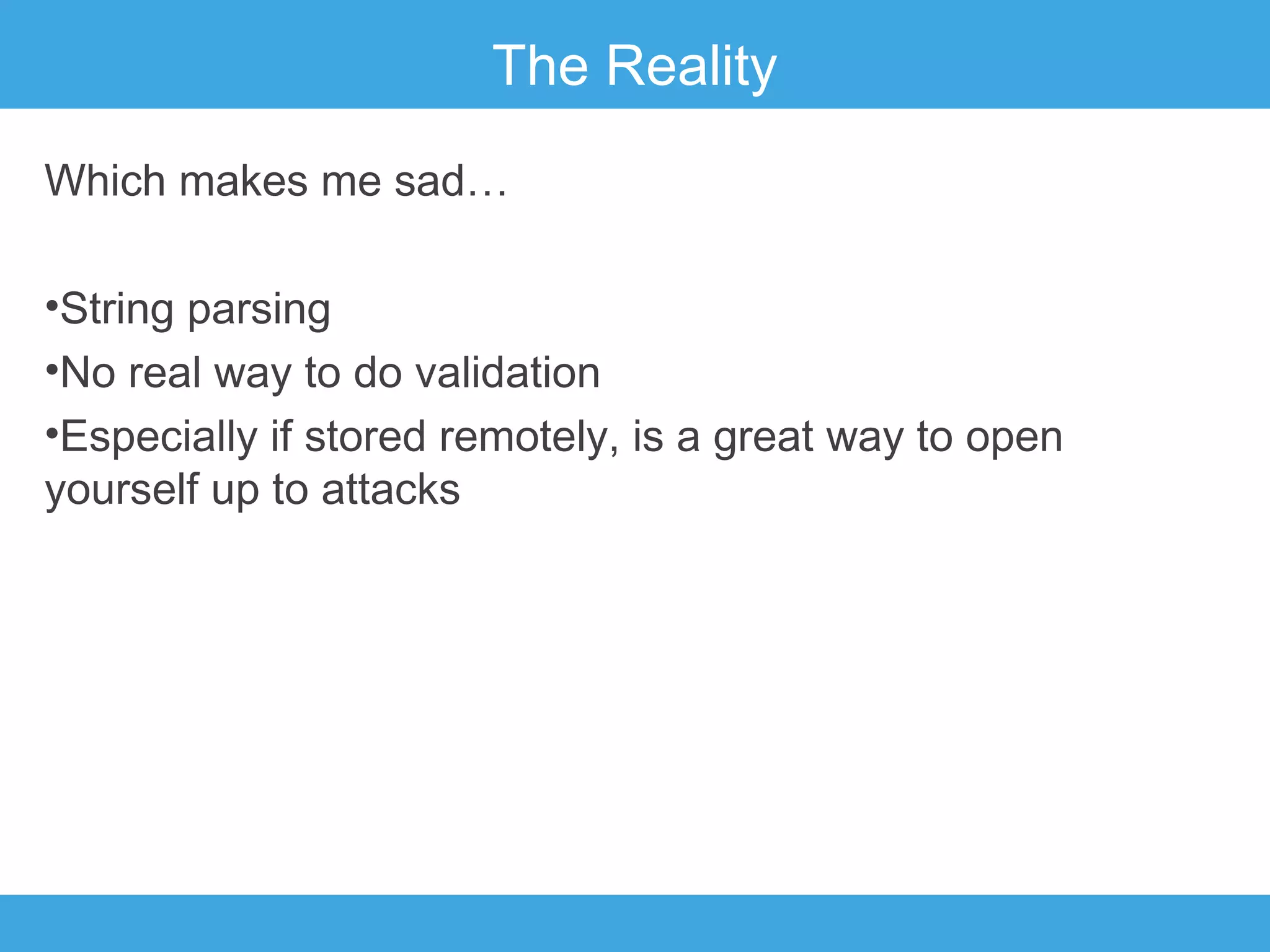
Which makes me sad…
•String parsing
•No real way to do validation
•Especially if stored remotely, is a great way to open
yourself up to attacks
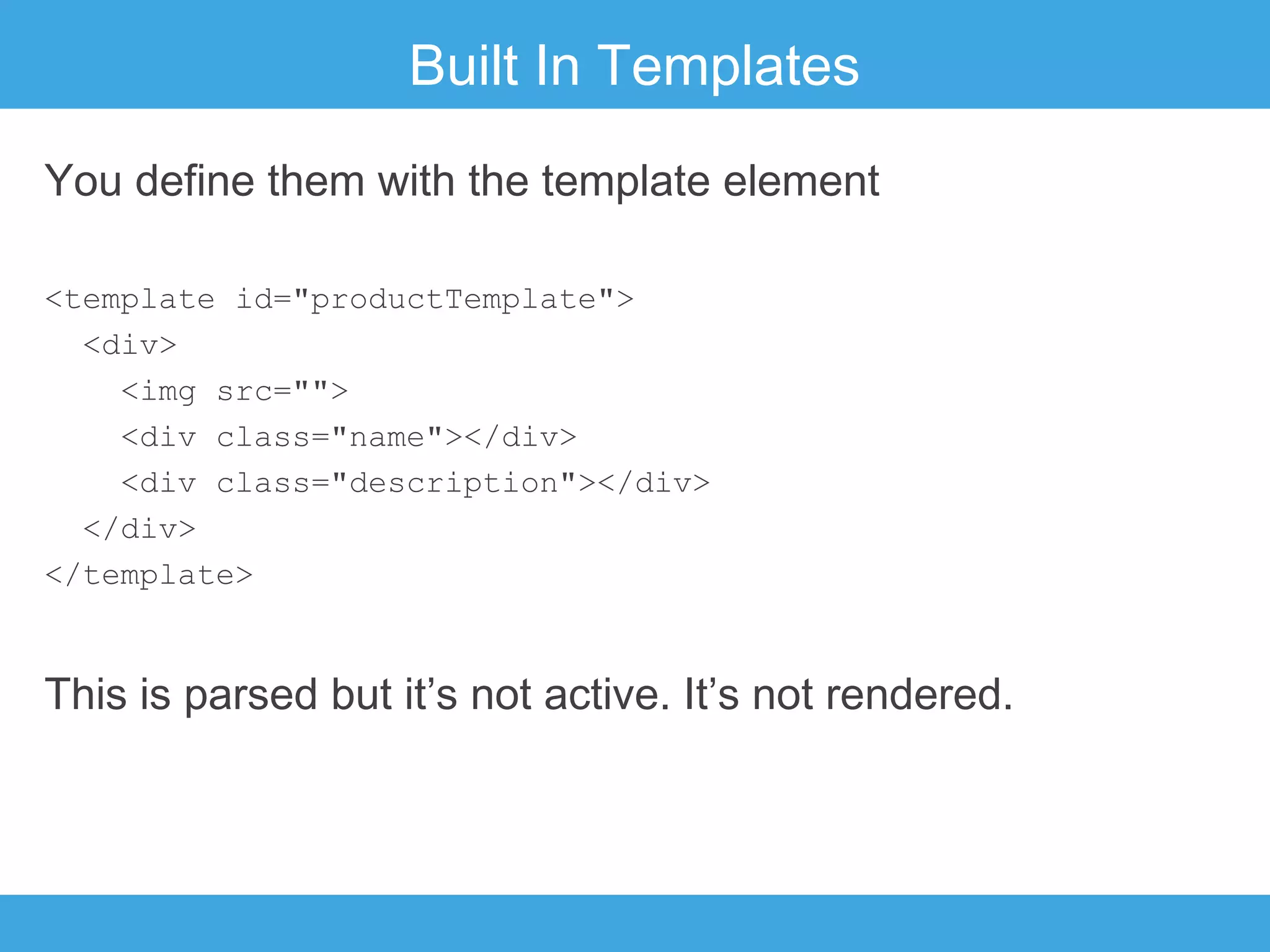
Built In Templates
You define them with the template element
<template id="productTemplate">
<div>
<img src="">
<div class="name"></div>
<div class="description"></div>
</div>
</template>

This is parsed but it’s not active. It’s not rendered.
Using It

DEMO, if you will
Decorators
Decorators are the next concept in the web component
stack but…
“Decorators, unlike other parts of Web Components, do not have a
specification yet.” –W3C
…so, lets go ahead and skip these for today.
Shadow DOM
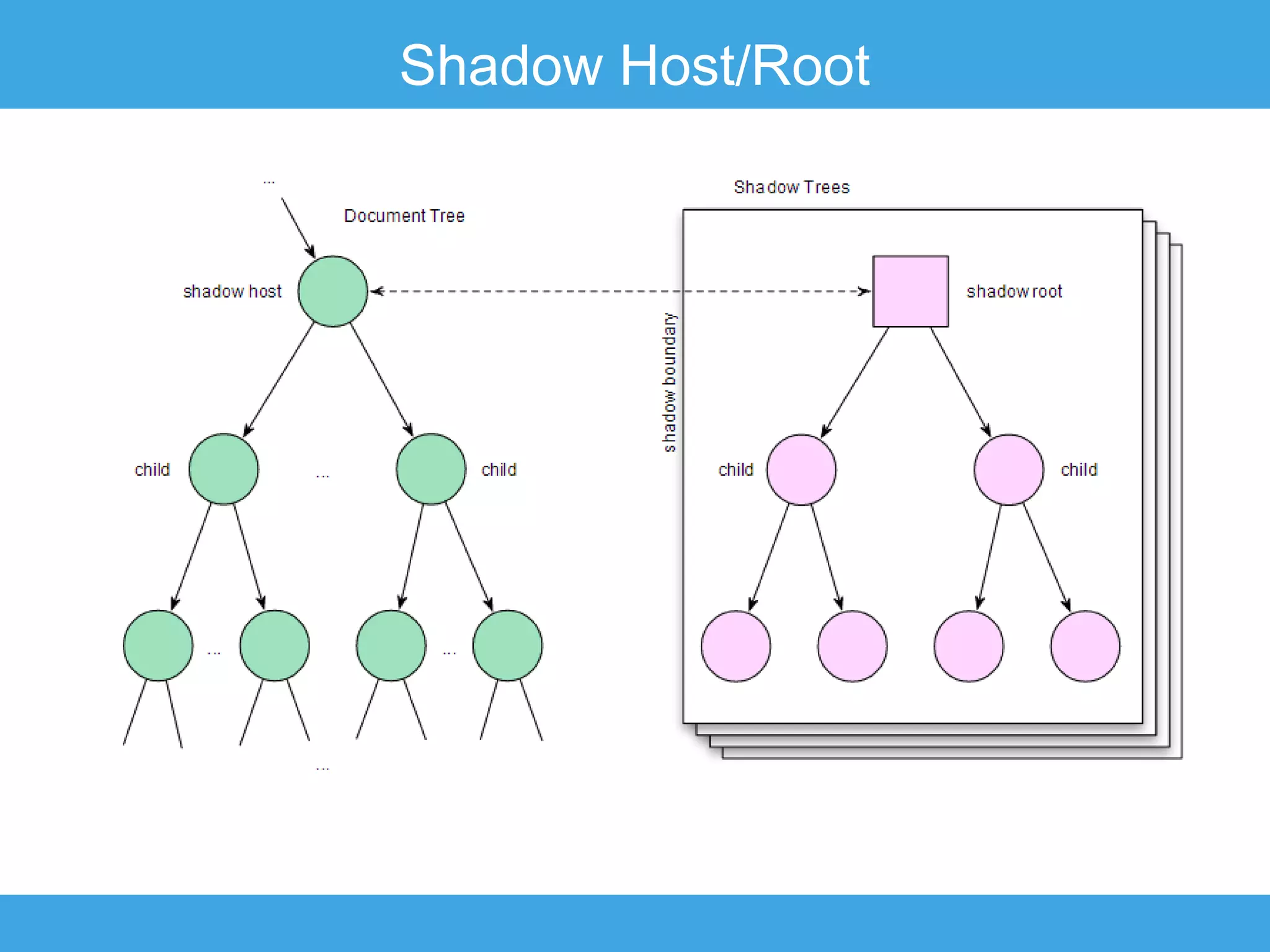
Shadow DOM is at the heart of the whole component
concepts
It’s encapsulation.
Its used by the browsers today to implement their own
controls
Ultimately its about hiding implementation details and
exposing an interface… music to my ears
Shadow DOM
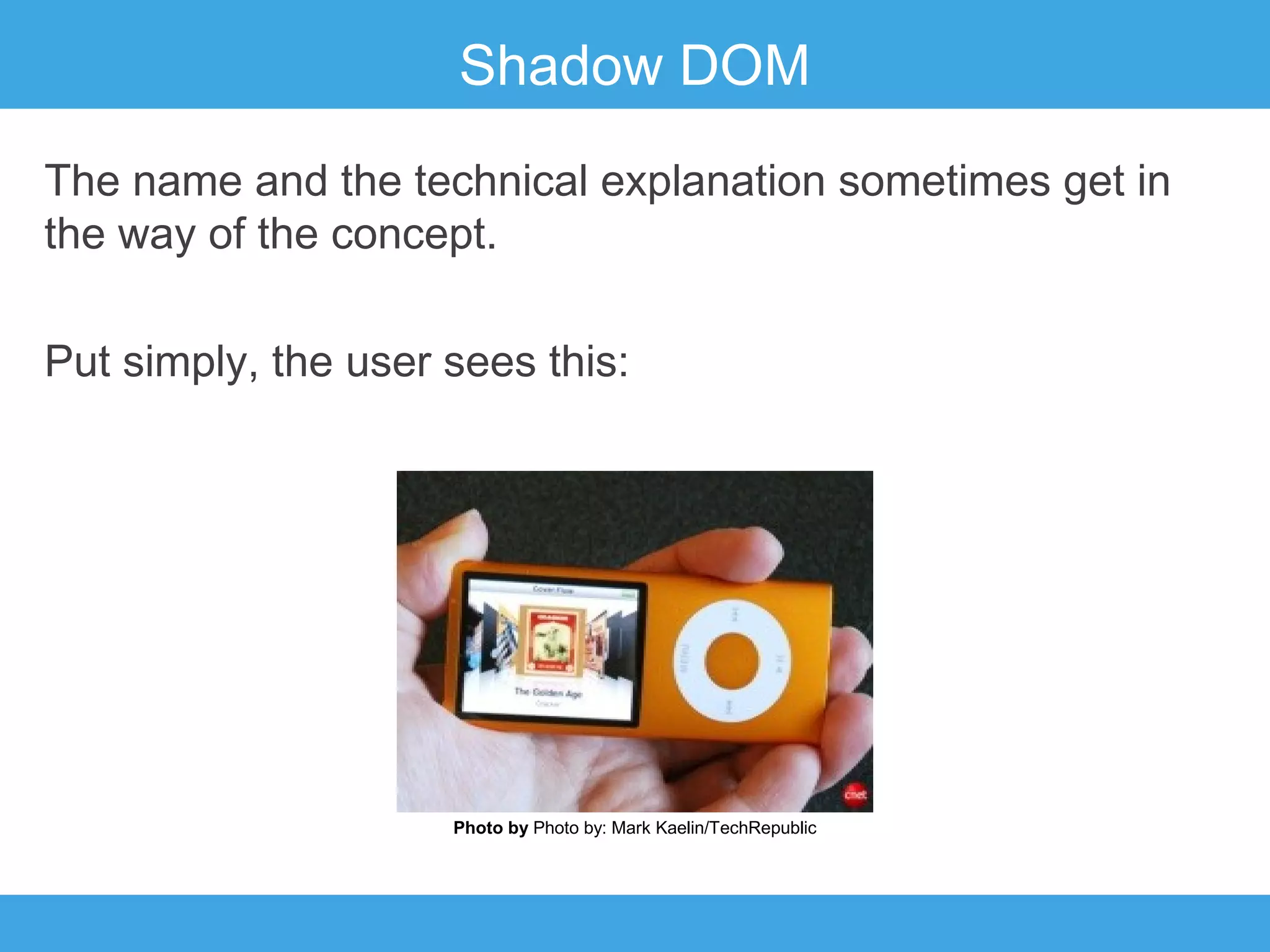
The name and the technical explanation sometimes get in
the way of the concept.
Put simply, the user sees this:

Photo by Photo by: Mark Kaelin/TechRepublic
Shadow DOM
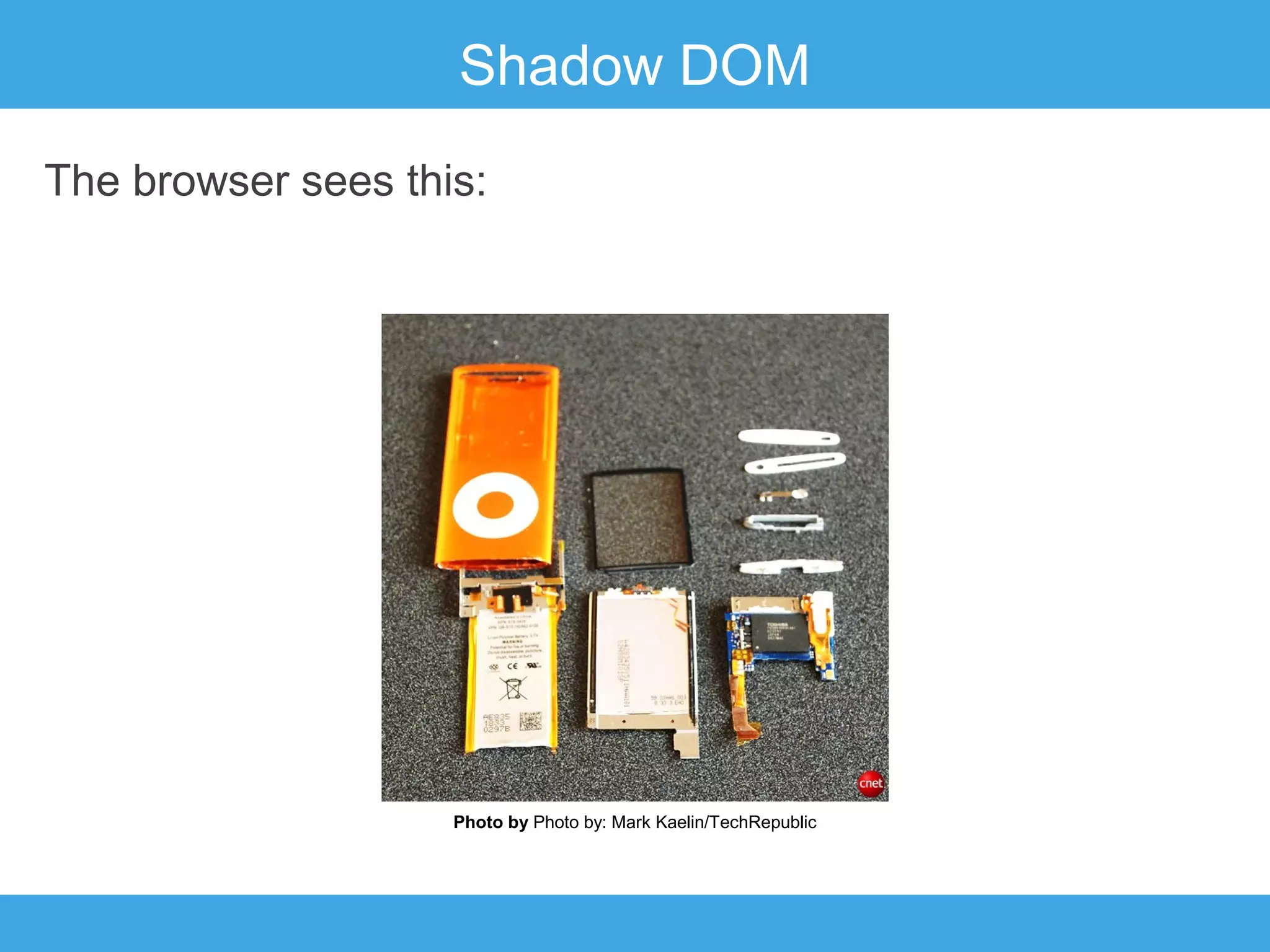
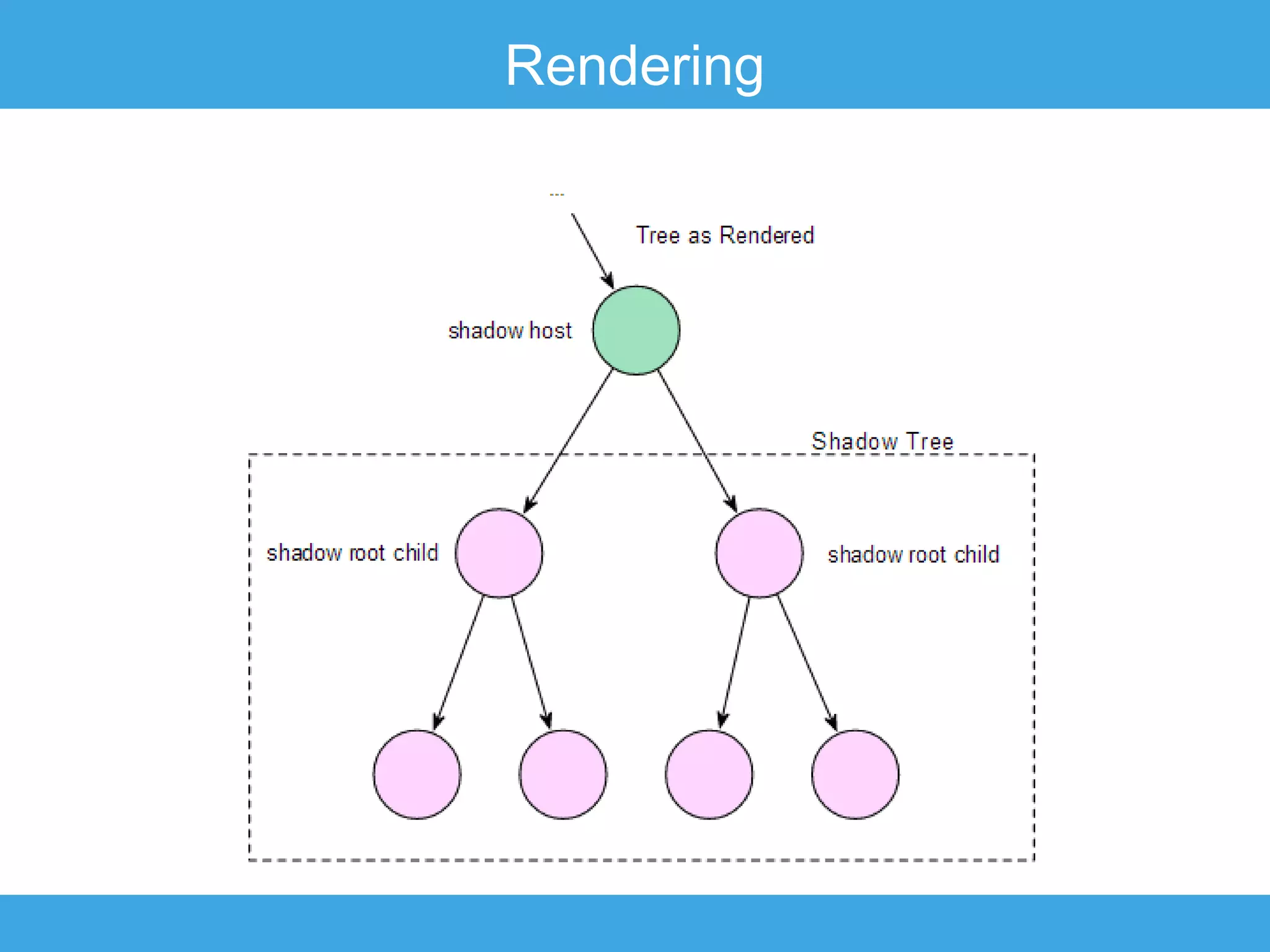
The browser sees this:

Photo by Photo by: Mark Kaelin/TechRepublic
Shadow Host/Root
Rendering
Styles
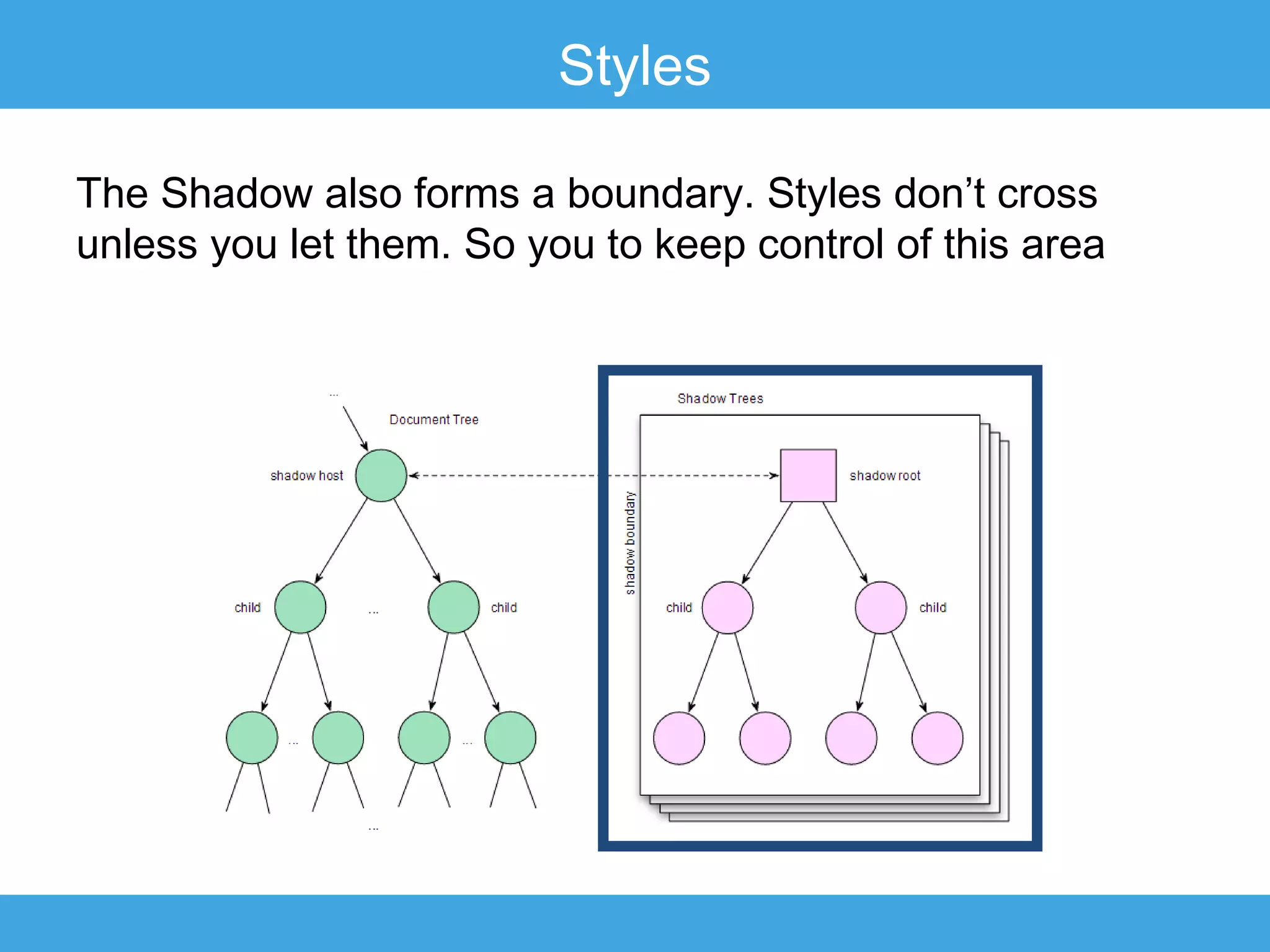
The Shadow also forms a boundary. Styles don’t cross
unless you let them. So you to keep control of this area
Styles
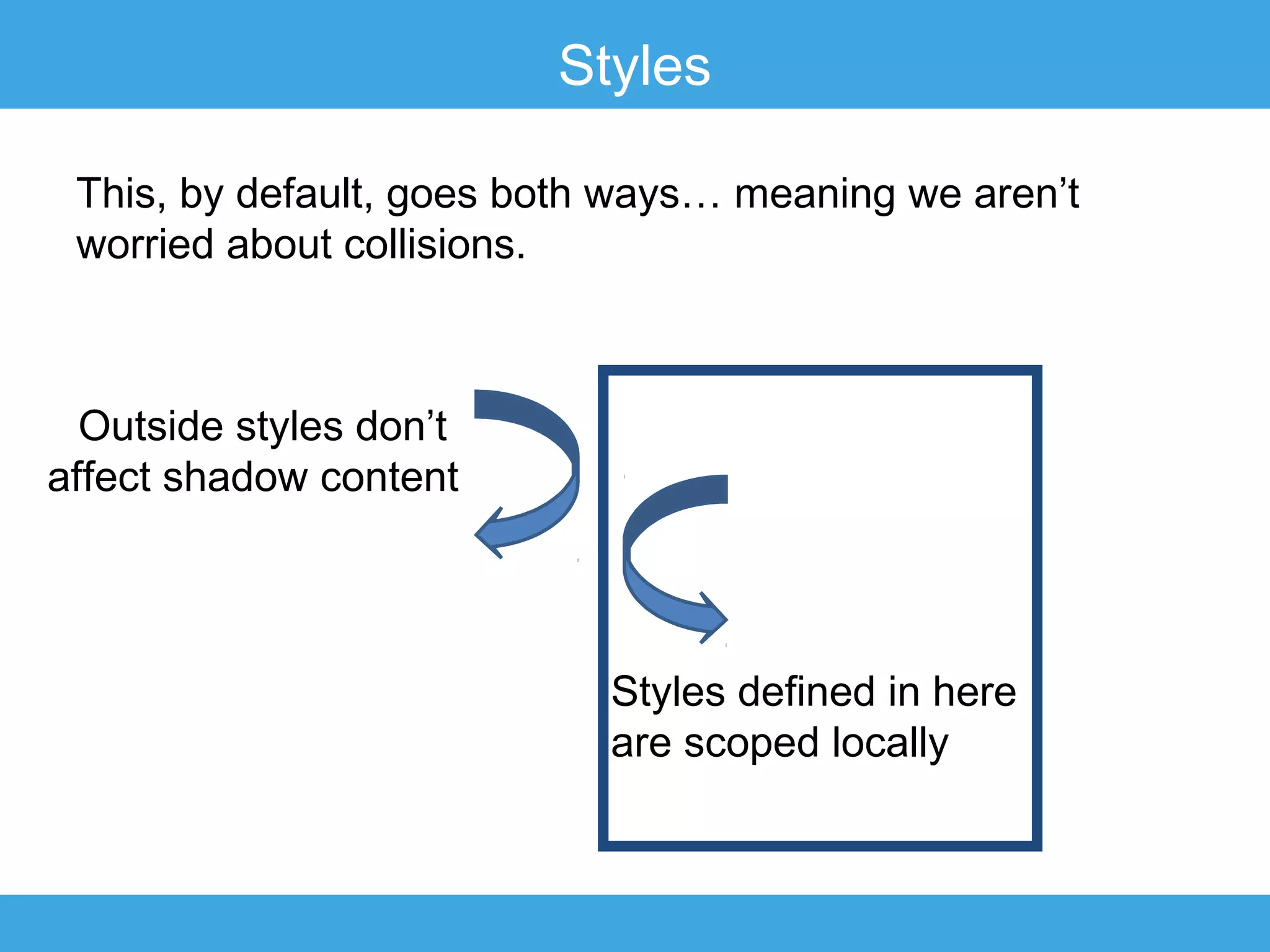
This, by default, goes both ways… meaning we aren’t
worried about collisions.

Outside styles don’t
affect shadow content

Styles defined in here
are scoped locally
Shadow DOM Demo

Another DEMO, please
HTML Imports
HTML imports are about importing and sharing HTML
content.
Why? Well, reuse, it facilitates the reuse of templates
and provides us a fundamental need if we are going
to share an encapsulated chunk we might call a
component.
<link rel="import" href="goodies.html">
HTML Imports
Last word on this…
Imports aren’t supported pretty much anywhere yet,
however, there are polyfills.
Imports are blocking. So, your page will act as though
it needs this content before it can render.
Custom Elements
Elements are the key to putting this together.
Custom Elements are DOM elements that can be
defined by a developer.
They are allowed to manage state and provide a
scriptable interface.
In other words, they are the shell of what will become
our component
Custom Elements
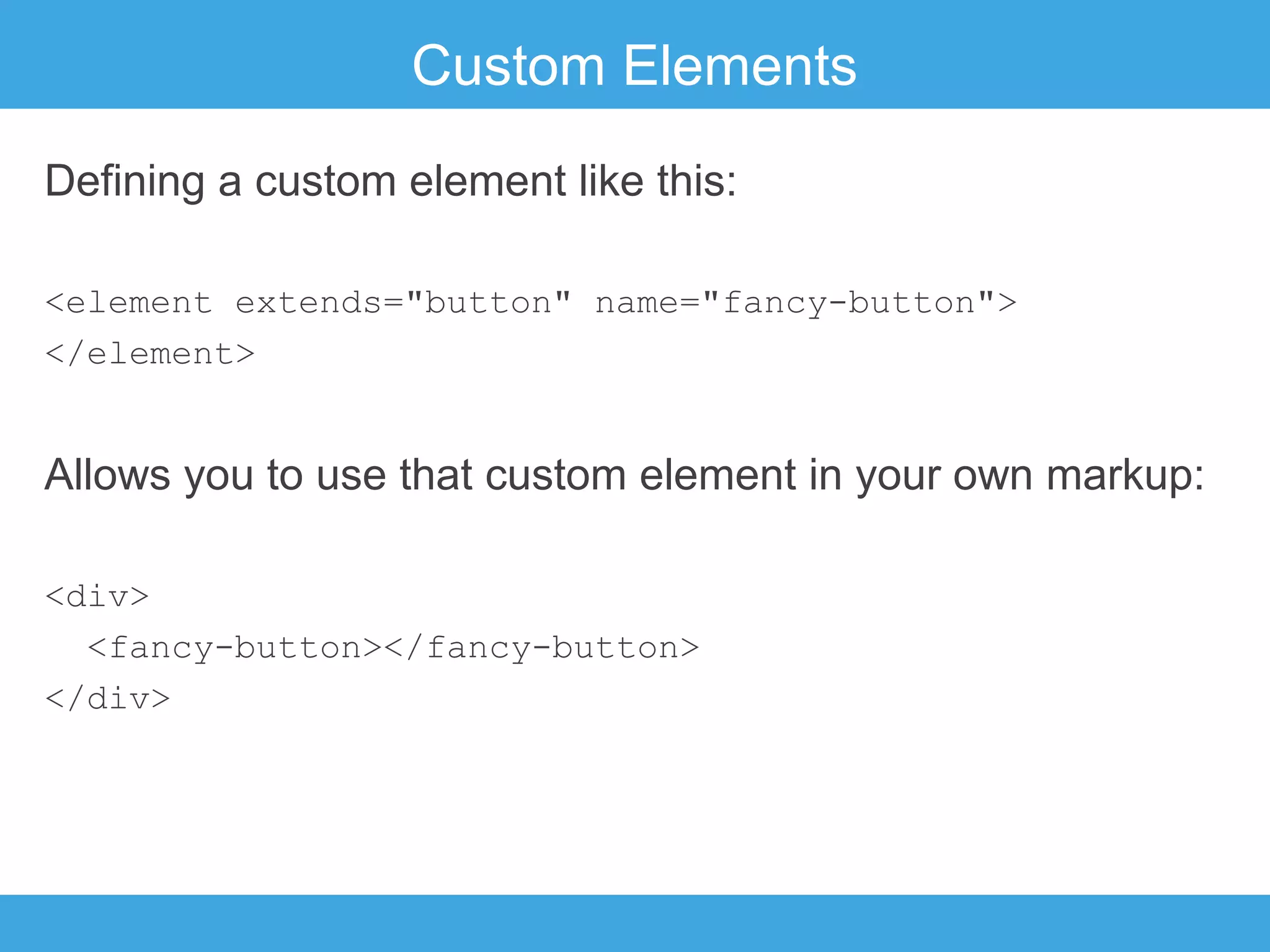
Defining a custom element like this:
<element extends="button" name="fancy-button">
</element>

Allows you to use that custom element in your own markup:
<div>
<fancy-button></fancy-button>
</div>
Custom Elements
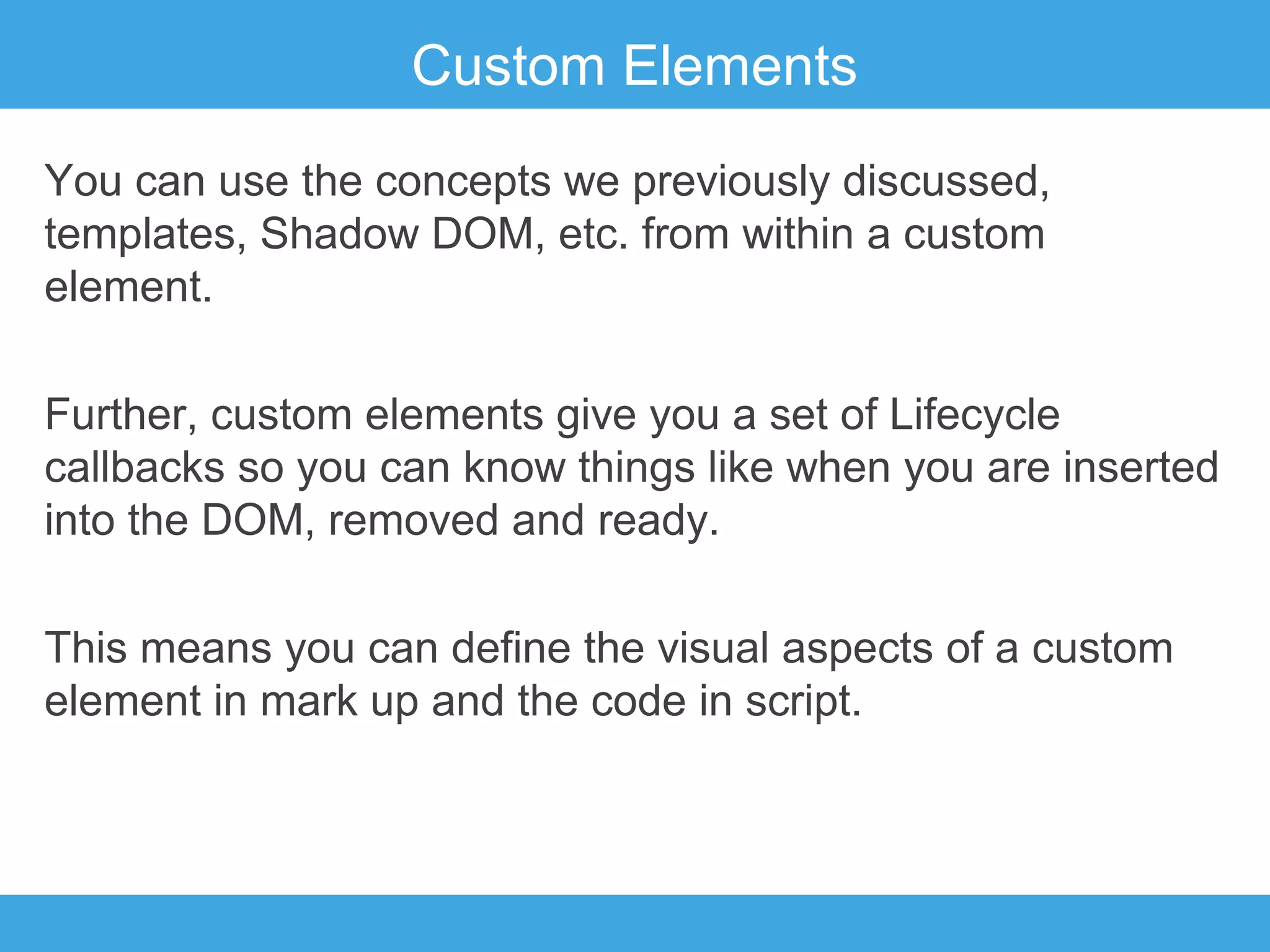
You can use the concepts we previously discussed,
templates, Shadow DOM, etc. from within a custom
element.
Further, custom elements give you a set of Lifecycle
callbacks so you can know things like when you are inserted
into the DOM, removed and ready.
This means you can define the visual aspects of a custom
element in mark up and the code in script.
Custom Element in Script
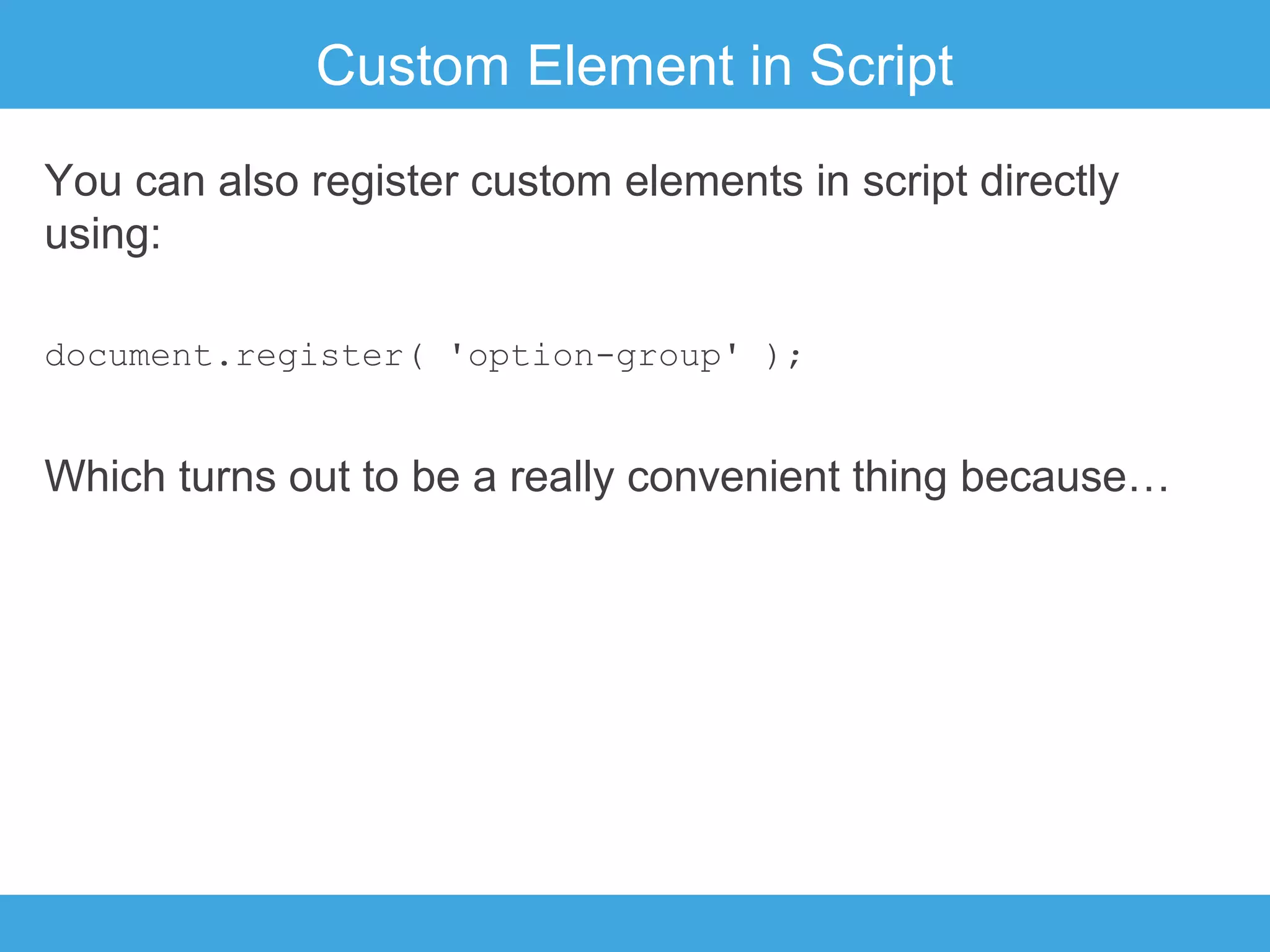
You can also register custom elements in script directly
using:
document.register( 'option-group' );

Which turns out to be a really convenient thing because…
Reality Check
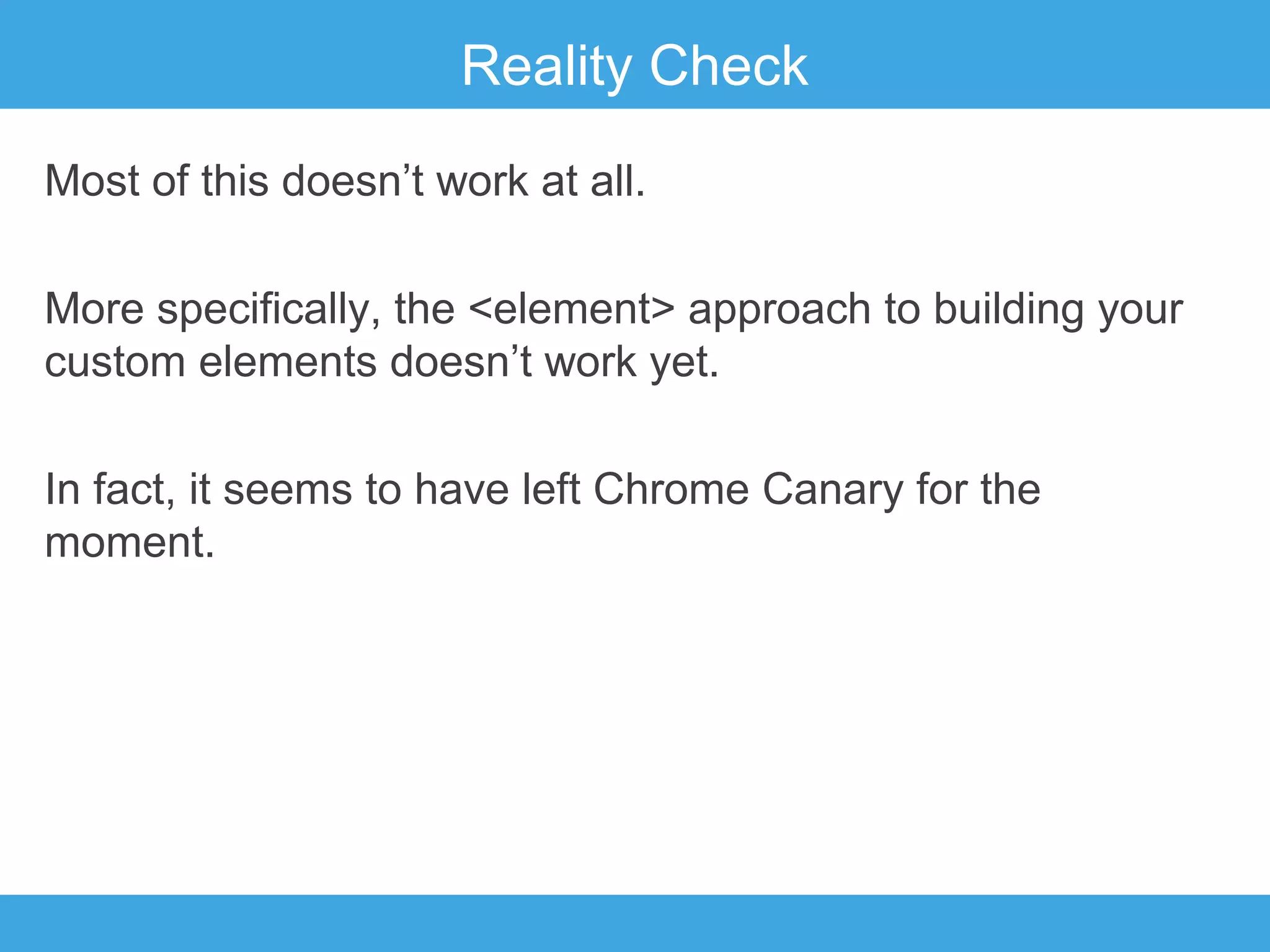
Most of this doesn’t work at all.
More specifically, the <element> approach to building your
custom elements doesn’t work yet.
In fact, it seems to have left Chrome Canary for the
moment.
Light, tunnel, something
This is where Polymer and other polyfills (such as x-tags)
come in
They let us play today and give feedback for tomorrow
Please remember, this is pre-alpha software
In the meantime… explore
http://www.polymer-project.org/
http://www.x-tags.org/
http://www.w3.org/TR/2013/WD-components-intro20130606/
Page 0 of 59

Reaching for the Future With
Web Components and Polymer

Michael Labriola - @mlabriola
Senior Consultant w/ Digital Primates

Reaching for the Future with Web Components and Polymer

  • 1.
    Page 0 of59 Reaching for the Future With Web Components and Polymer Michael Labriola - @mlabriola Senior Consultant w/ Digital Primates
  • 2.
    Web Components Put simply,Web Components are an attempt to let you write custom components that can be used like this: <body> Sales:<br> <my-super-cool-chart id="coolChart"> </ my-super-cool-chart > </body>
  • 3.
    What in theworld is Polymer? A library built on top of Web Components. Allows us to use Web Components today in modern browsers 3 main pieces • A set of polyfills • Web application framework • Set of UI components
  • 4.
    What are wegoing to cover? Web Components, specifically: What in the world are web components? What problem are they trying to solve? How do they work? Can I actually use these things? What does it mean to my app/development process?
  • 5.
    Bleeding Edge Web Componentsare beyond leading edge. As of this moment, they do not work in their entirety in any browser A good portion of the functionality is available in Chrome Canary if you turn on all of the experimental WebKit and JavaScript features
  • 6.
    Why am Italking about this? I do believe web components are a significant part of our future I think understand their goal and vision is crucial to the next few years I think they will change a lot before they are final
  • 7.
    ...and? You can stillplay with flavors of Web Components to a large extent through polyfills today Unless you skydive to work or love framework code more than sleep, you may want to avoid putting this all into production today
  • 8.
    Given that... WhyComponents? A few minor reasons you may like the idea, first: Encapsulation • • • • Manageable Reuse Hiding complexity and implementation Dealing with duplicated IDs Dealing with CSS scoping / propagation
  • 9.
    Why? And then: [More] evenplaying field • Using the same tricks the browser uses Ease of distribution Appropriate technology uses • Markup in markup not strings or code
  • 10.
    How do theywork? Web Components are a draft specification, but they rely on a number of other puzzle pieces, including: Templates Decorators Shadow DOM Imports Custom Elements
  • 11.
    Templates The concept oftemplates is prolific and nearly selfexplanatory. Their use takes a bit more effort: Inactive DOM Fragment Easily Clone-able Easily Change-able
  • 12.
    State of theIntersection People use templates today, they tend to take on two forms, first: <div id="productTemplate" style="display:none"> <img src="/images/products/{{product_id}}.png"> <div class="name"></div> <div class="description"></div> </div>
  • 13.
    The Reality Which, asEric Bidelman of Google nicely points out: Is good, because were are creating markup in markup and working with the DOM Is bad, because its active DOM, so the image still tries to load on startup • 404 (Not Found) http://localhost/images/products/%7B%7Bproduct_id%7D%7D.png Is bad, because either we deal with global styles for these things or we have to scope all of our styles manually and deal with collisions
  • 14.
    State of theIntersection Second form, we use strings: <script id="productTemplate" type="text/x-template"> <img src="/images/products/{{product_id}}.png"> <div class="name"></div> <div class="description"></div> </script> OR template = "<div> <img src="/images/products/{{product_id}}.png"> <div class="name"></div> <div class="description"></div> </div>";
  • 15.
    The Reality Which makesme sad… •String parsing •No real way to do validation •Especially if stored remotely, is a great way to open yourself up to attacks
  • 16.
    Built In Templates Youdefine them with the template element <template id="productTemplate"> <div> <img src=""> <div class="name"></div> <div class="description"></div> </div> </template> This is parsed but it’s not active. It’s not rendered.
  • 17.
  • 18.
    Decorators Decorators are thenext concept in the web component stack but… “Decorators, unlike other parts of Web Components, do not have a specification yet.” –W3C …so, lets go ahead and skip these for today.
  • 19.
    Shadow DOM Shadow DOMis at the heart of the whole component concepts It’s encapsulation. Its used by the browsers today to implement their own controls Ultimately its about hiding implementation details and exposing an interface… music to my ears
  • 20.
    Shadow DOM The nameand the technical explanation sometimes get in the way of the concept. Put simply, the user sees this: Photo by Photo by: Mark Kaelin/TechRepublic
  • 21.
    Shadow DOM The browsersees this: Photo by Photo by: Mark Kaelin/TechRepublic
  • 22.
  • 23.
  • 24.
    Styles The Shadow alsoforms a boundary. Styles don’t cross unless you let them. So you to keep control of this area
  • 25.
    Styles This, by default,goes both ways… meaning we aren’t worried about collisions. Outside styles don’t affect shadow content Styles defined in here are scoped locally
  • 26.
  • 27.
    HTML Imports HTML importsare about importing and sharing HTML content. Why? Well, reuse, it facilitates the reuse of templates and provides us a fundamental need if we are going to share an encapsulated chunk we might call a component. <link rel="import" href="goodies.html">
  • 28.
    HTML Imports Last wordon this… Imports aren’t supported pretty much anywhere yet, however, there are polyfills. Imports are blocking. So, your page will act as though it needs this content before it can render.
  • 29.
    Custom Elements Elements arethe key to putting this together. Custom Elements are DOM elements that can be defined by a developer. They are allowed to manage state and provide a scriptable interface. In other words, they are the shell of what will become our component
  • 30.
    Custom Elements Defining acustom element like this: <element extends="button" name="fancy-button"> </element> Allows you to use that custom element in your own markup: <div> <fancy-button></fancy-button> </div>
  • 31.
    Custom Elements You canuse the concepts we previously discussed, templates, Shadow DOM, etc. from within a custom element. Further, custom elements give you a set of Lifecycle callbacks so you can know things like when you are inserted into the DOM, removed and ready. This means you can define the visual aspects of a custom element in mark up and the code in script.
  • 32.
    Custom Element inScript You can also register custom elements in script directly using: document.register( 'option-group' ); Which turns out to be a really convenient thing because…
  • 33.
    Reality Check Most ofthis doesn’t work at all. More specifically, the <element> approach to building your custom elements doesn’t work yet. In fact, it seems to have left Chrome Canary for the moment.
  • 34.
    Light, tunnel, something Thisis where Polymer and other polyfills (such as x-tags) come in They let us play today and give feedback for tomorrow Please remember, this is pre-alpha software
  • 35.
    In the meantime…explore http://www.polymer-project.org/ http://www.x-tags.org/ http://www.w3.org/TR/2013/WD-components-intro20130606/
  • 36.
    Page 0 of59 Reaching for the Future With Web Components and Polymer Michael Labriola - @mlabriola Senior Consultant w/ Digital Primates