RECALLING CONFUCIANISM FOR

 SUSTAINABLE DEVELOPMENT


             7/30/2011   Dr.Padma Shankar   1
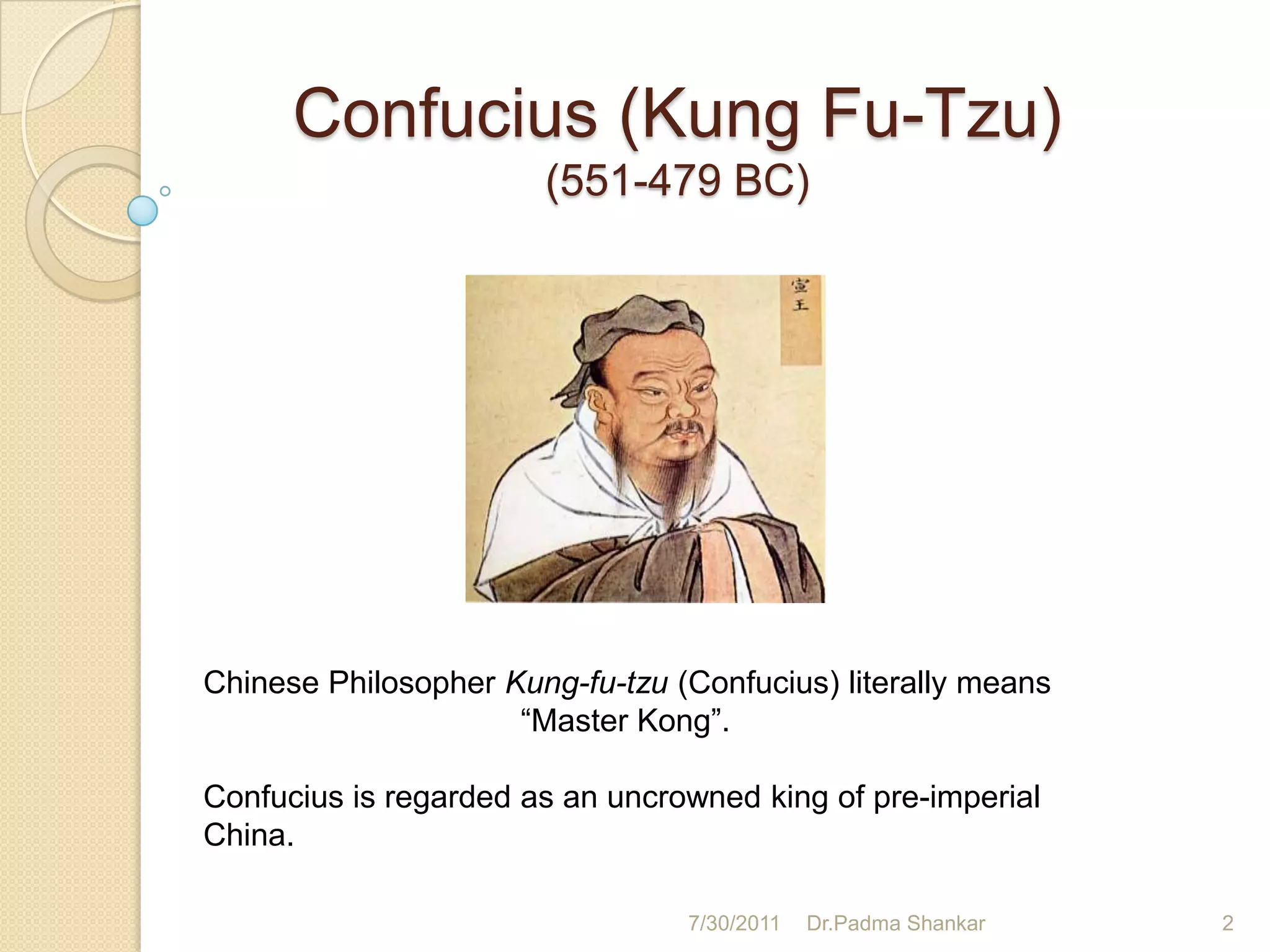
Confucius (Kung Fu-Tzu)
                       (551-479 BC)


Chinese Philosopher Kung-fu-tzu (Confucius) literally means
                     “Master Kong”.

Confucius is regarded as an uncrowned king of pre-imperial
China.

                                 7/30/2011   Dr.Padma Shankar   2
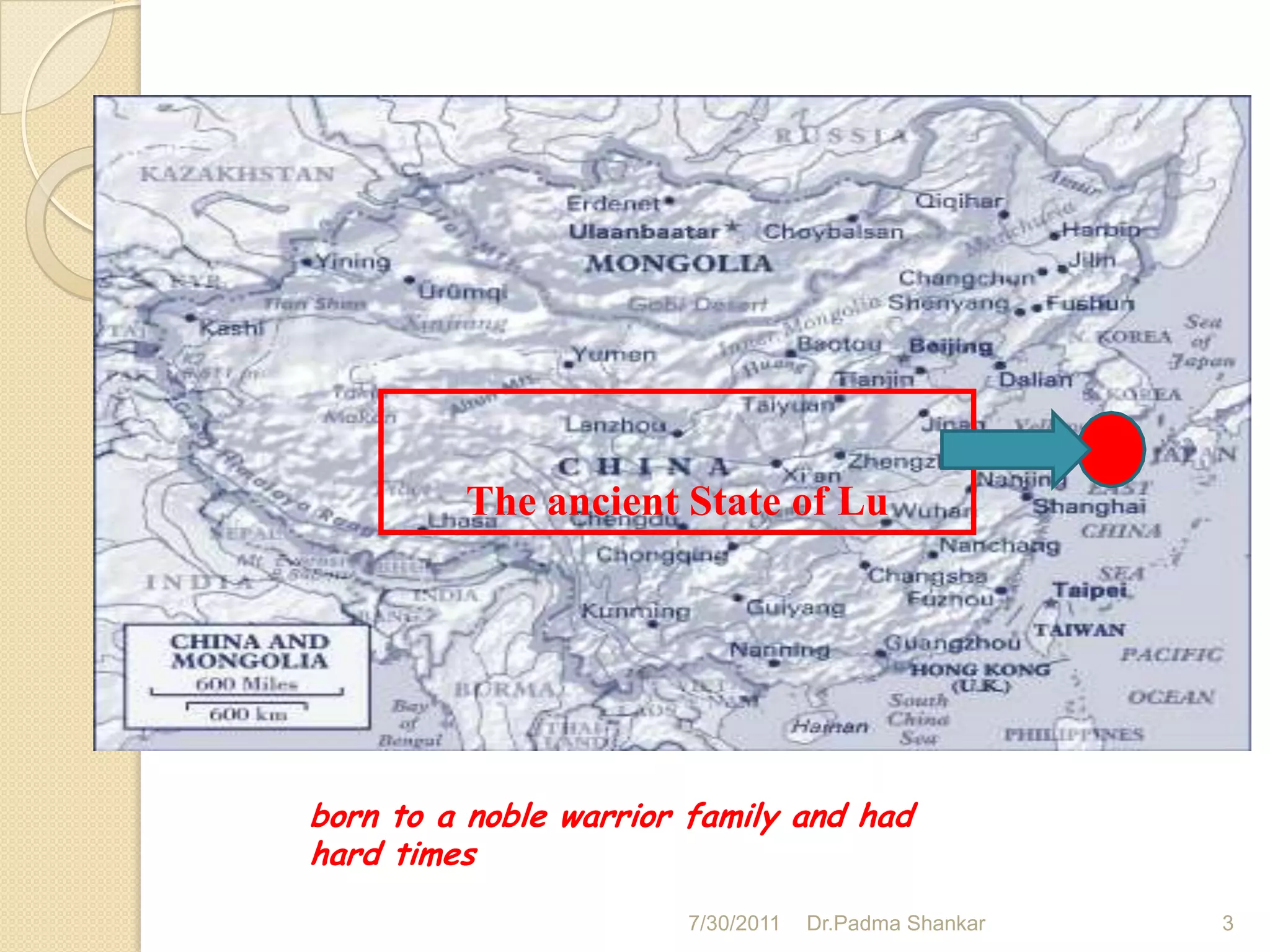
The ancient State of Lu


born to a noble warrior family and had
hard times
                       7/30/2011   Dr.Padma Shankar   3
   Confucius mastered to 6 ancient arts –
    ritual performance, music, archery, chariot
    riding, reading and arithmetic.

   worked as a shepherd, cowherd, clerk,
    and a book-keeper and rose up to the
    position of Minister.

   spend his last years teaching disciples via
    a set of classics called “Five Classics”.

   he died at the age of 73
                        7/30/2011   Dr.Padma Shankar   4
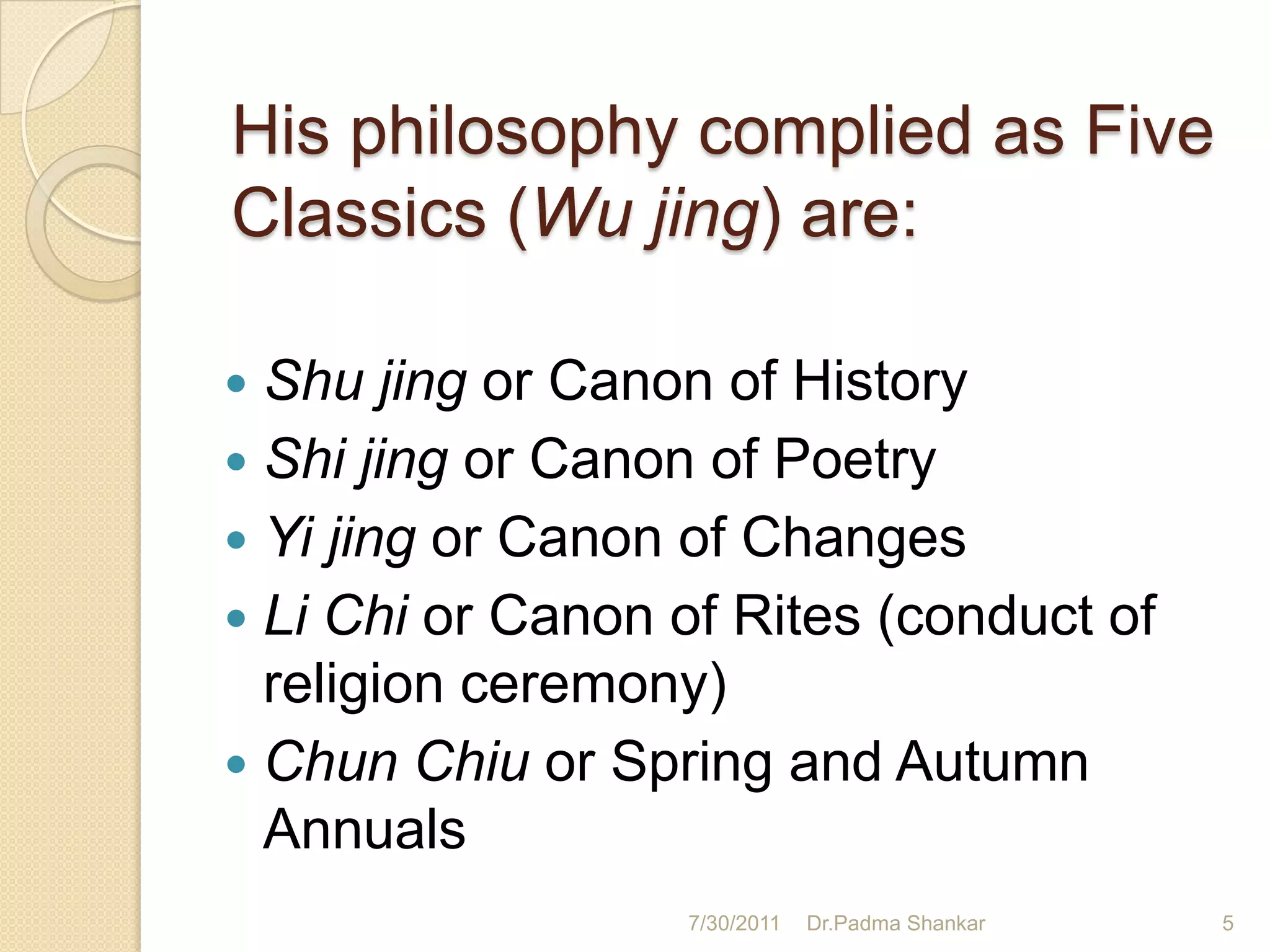
His philosophy complied as Five
Classics (Wu jing) are:

 Shu jing or Canon of History
 Shi jing or Canon of Poetry
 Yi jing or Canon of Changes
 Li Chi or Canon of Rites (conduct of
  religion ceremony)
 Chun Chiu or Spring and Autumn
  Annuals
                  7/30/2011   Dr.Padma Shankar   5
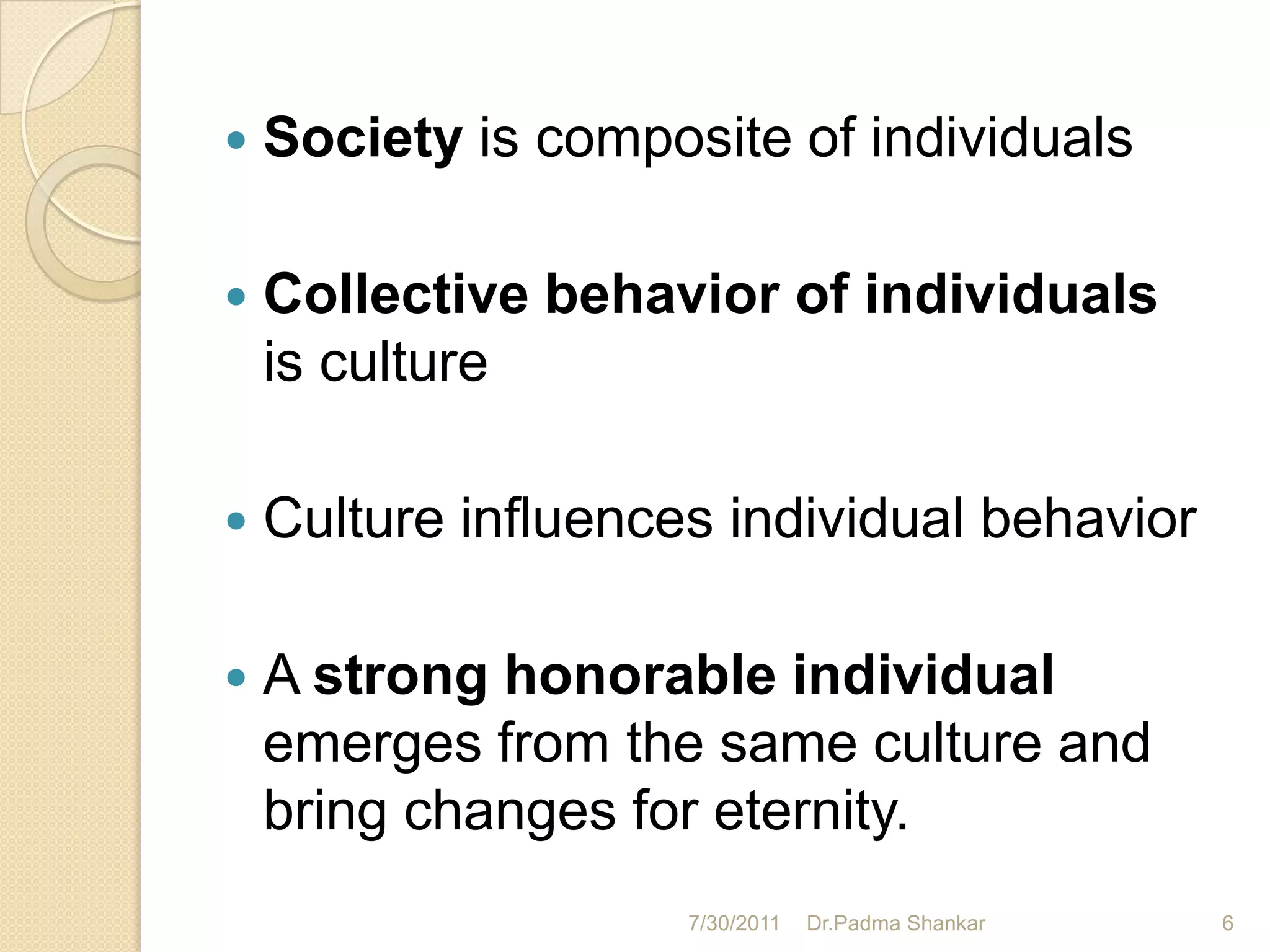
   Society is composite of individuals

   Collective behavior of individuals
    is culture

   Culture influences individual behavior

   A strong honorable individual
    emerges from the same culture and
    bring changes for eternity.
                     7/30/2011   Dr.Padma Shankar   6
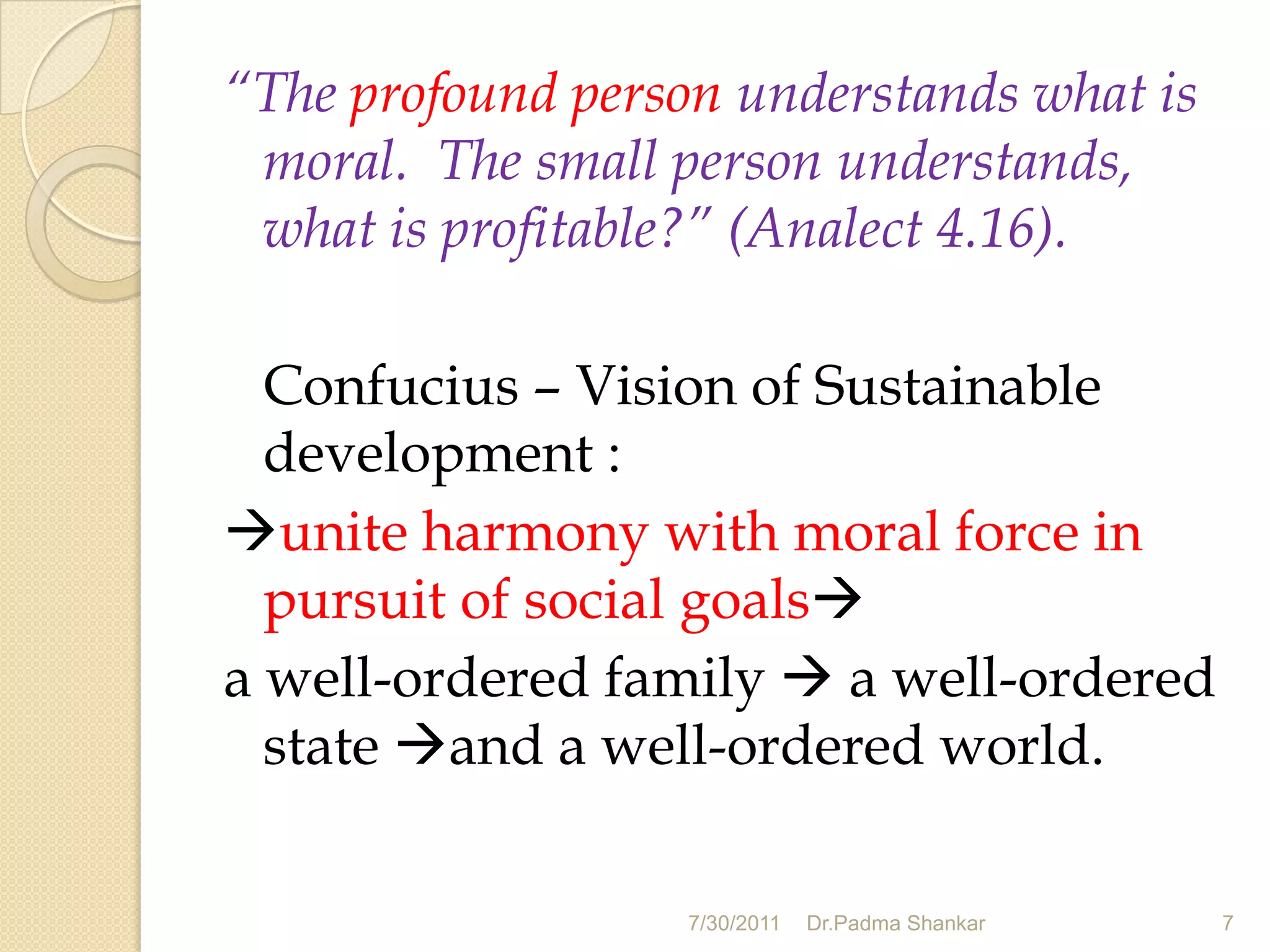
“The profound person understands what is
 moral. The small person understands,
 what is profitable?” (Analect 4.16).

  Confucius – Vision of Sustainable
  development :
unite harmony with moral force in
  pursuit of social goals
a well-ordered family  a well-ordered
  state and a well-ordered world.

                   7/30/2011   Dr.Padma Shankar   7
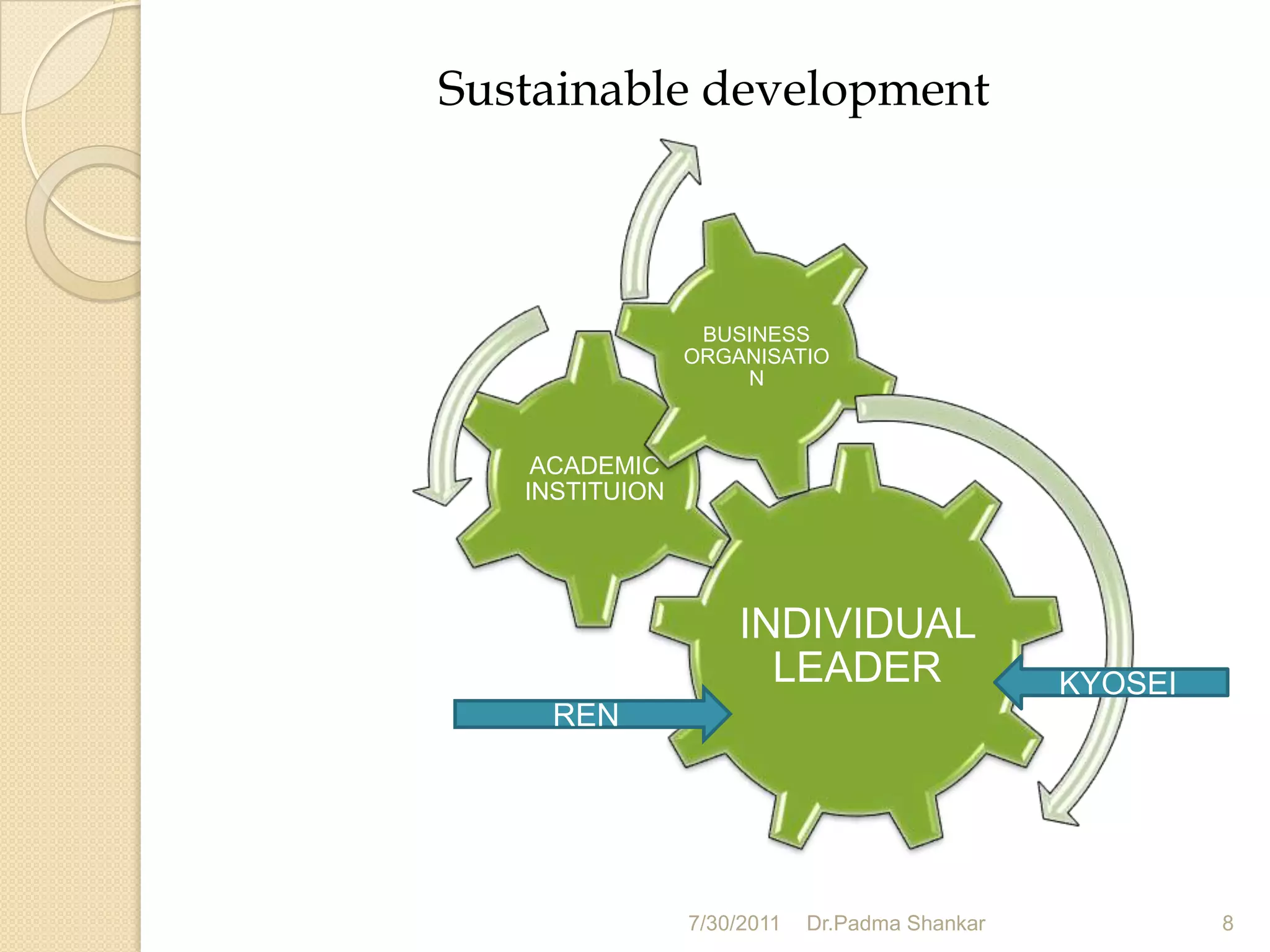
Sustainable development


                 BUSINESS
                ORGANISATIO
                    N


    ACADEMIC
   INSTITUION


                    INDIVIDUAL
                      LEADER                   KYOSEI
     REN


                7/30/2011   Dr.Padma Shankar            8
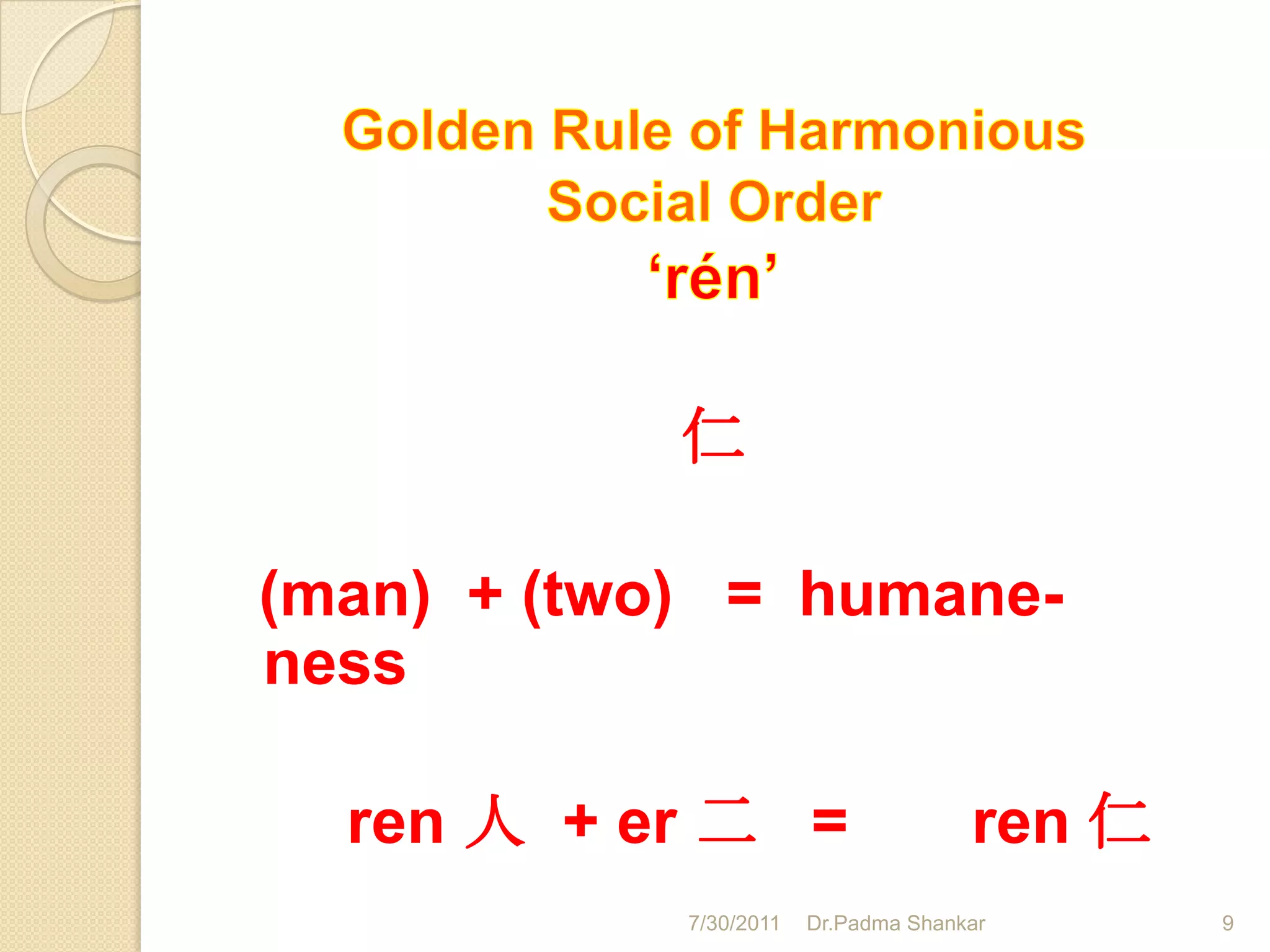
仁

(man) + (two) = humane-
ness

  ren 人 + er 二 =                      ren 仁
            7/30/2011   Dr.Padma Shankar      9
relies heavily on the relationships
    between two people,

   Implies that one was never alone, and
    that everyone has relationship to fall
    back on being a member of a family, the
    state about the world.


                      7/30/2011   Dr.Padma Shankar   10
is translated as “benevolence”,
    “perfect virtue”, “goodness” or forever
    with “human heart”.

   if the ruler lacks    , it is difficult if not
    impossible for his subjects to behave
    humanly.

   maxim of         is :
    ◦ One should treat others as one would like
      others to treat oneself (positive form, Golden
      rule).

    ◦ One should not treat others in ways that one
      would not like to be treated (negative form
      also called Silver Rule).
                            7/30/2011   Dr.Padma Shankar   11
   Direct the people with moral force and
    regulate them with ritual and they will
    possess shame, and moreover, they will be
    righteous.
                                 (Analects 2.3).


   One who rules by moral force may be
    compared to the North Star.

                                     (Analects 2.1)”

                         7/30/2011   Dr.Padma Shankar   12
The profound person understands
what is moral. The moral force of the
small person is like the grass. “Let the
wind blow over the grass and it is sure
to bend.”
                        (Analects
12.19).

Thus Confucian Harmonious order of
Relationship is not merely personal, but
                     7/30/2011   Dr.Padma Shankar   13
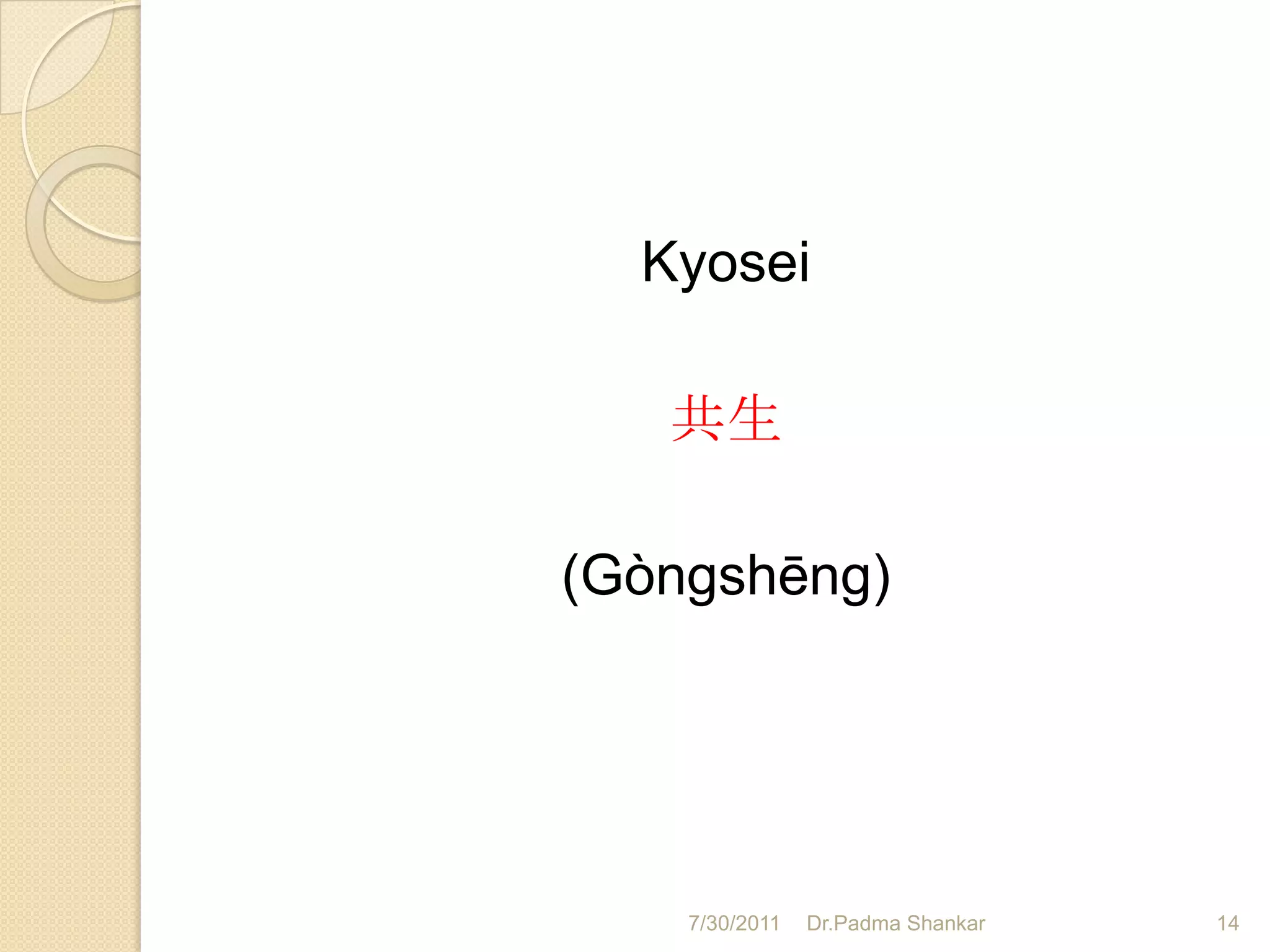
Kyosei

   共生

(Gòngshēng)


    7/30/2011   Dr.Padma Shankar   14
Kyosei

   “Kyo” means working together,

   “sei” means life.

   Kyosei is a Japanese word, literally
    meaning, “Co-existence”, “living
    together” or “symbiosis”.

                        7/30/2011   Dr.Padma Shankar   15
   “On this account, the ruler will first take pains about
    his own virtue.

   Possessing virtue will give him the people.

   Possessing the people will give him the territory.

   Possessing the territory will give him its wealth.

   Possessing the wealth, he will have resources for
    expenditure.

   Virtue is the root; wealth is the result”

    (The Great Learning X, 6-7).
                               7/30/2011   Dr.Padma Shankar   16
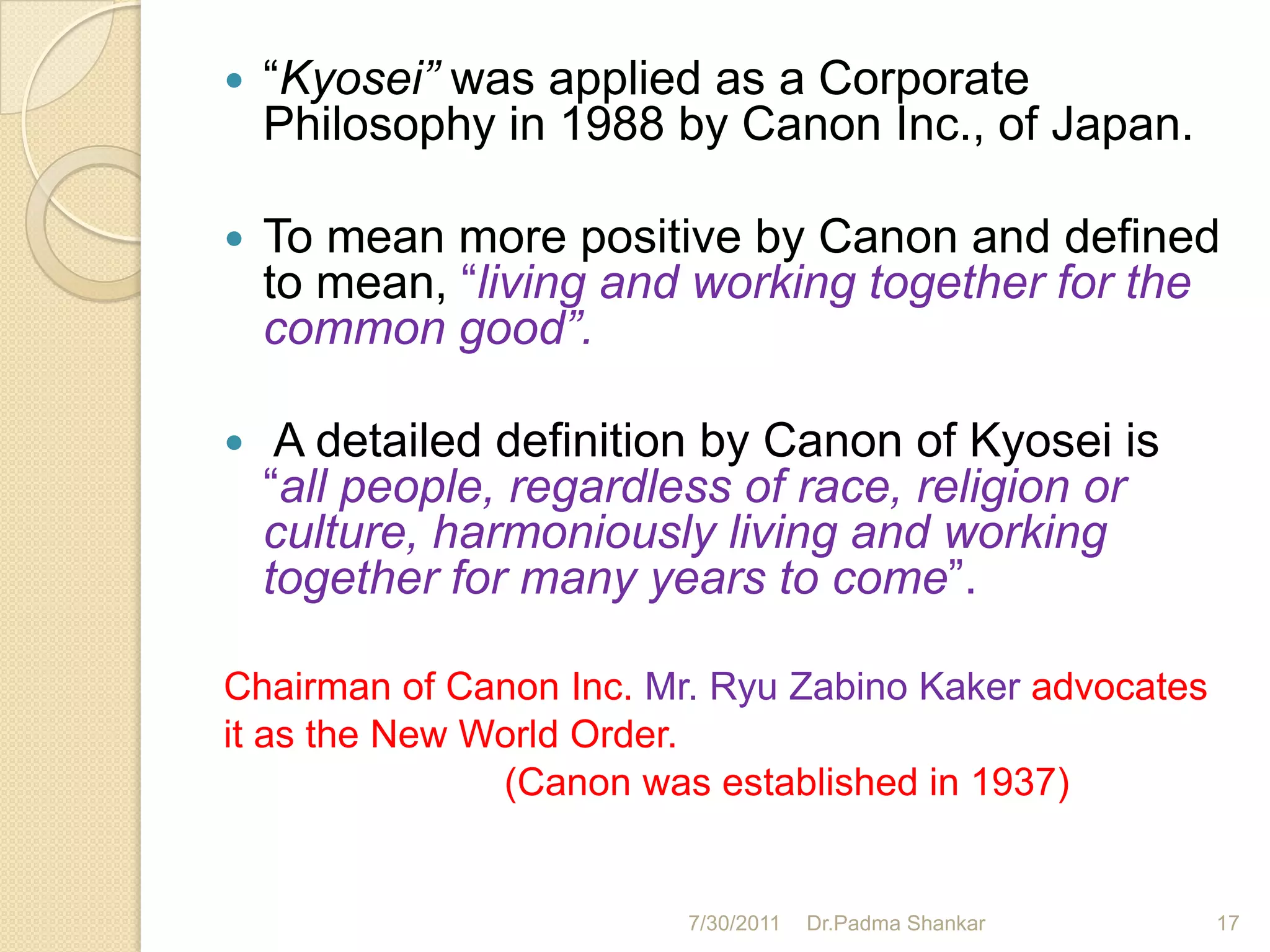
   “Kyosei” was applied as a Corporate
    Philosophy in 1988 by Canon Inc., of Japan.

   To mean more positive by Canon and defined
    to mean, “living and working together for the
    common good”.

    A detailed definition by Canon of Kyosei is
    “all people, regardless of race, religion or
    culture, harmoniously living and working
    together for many years to come”.

Chairman of Canon Inc. Mr. Ryu Zabino Kaker advocates
it as the New World Order.
               (Canon was established in 1937)


                         7/30/2011   Dr.Padma Shankar   17
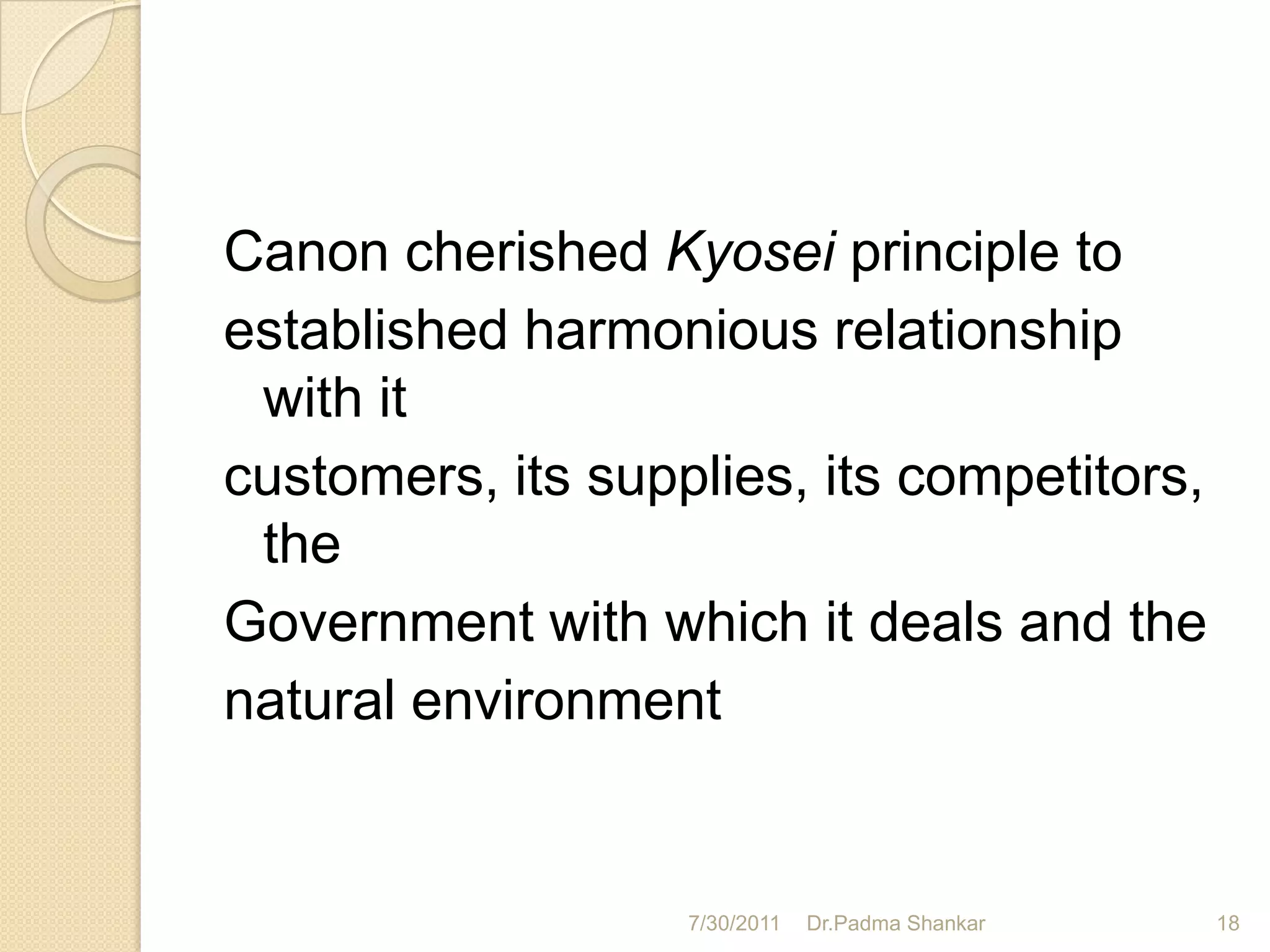
Canon cherished Kyosei principle to
established harmonious relationship
 with it
customers, its supplies, its competitors,
 the
Government with which it deals and the
natural environment


                   7/30/2011   Dr.Padma Shankar   18
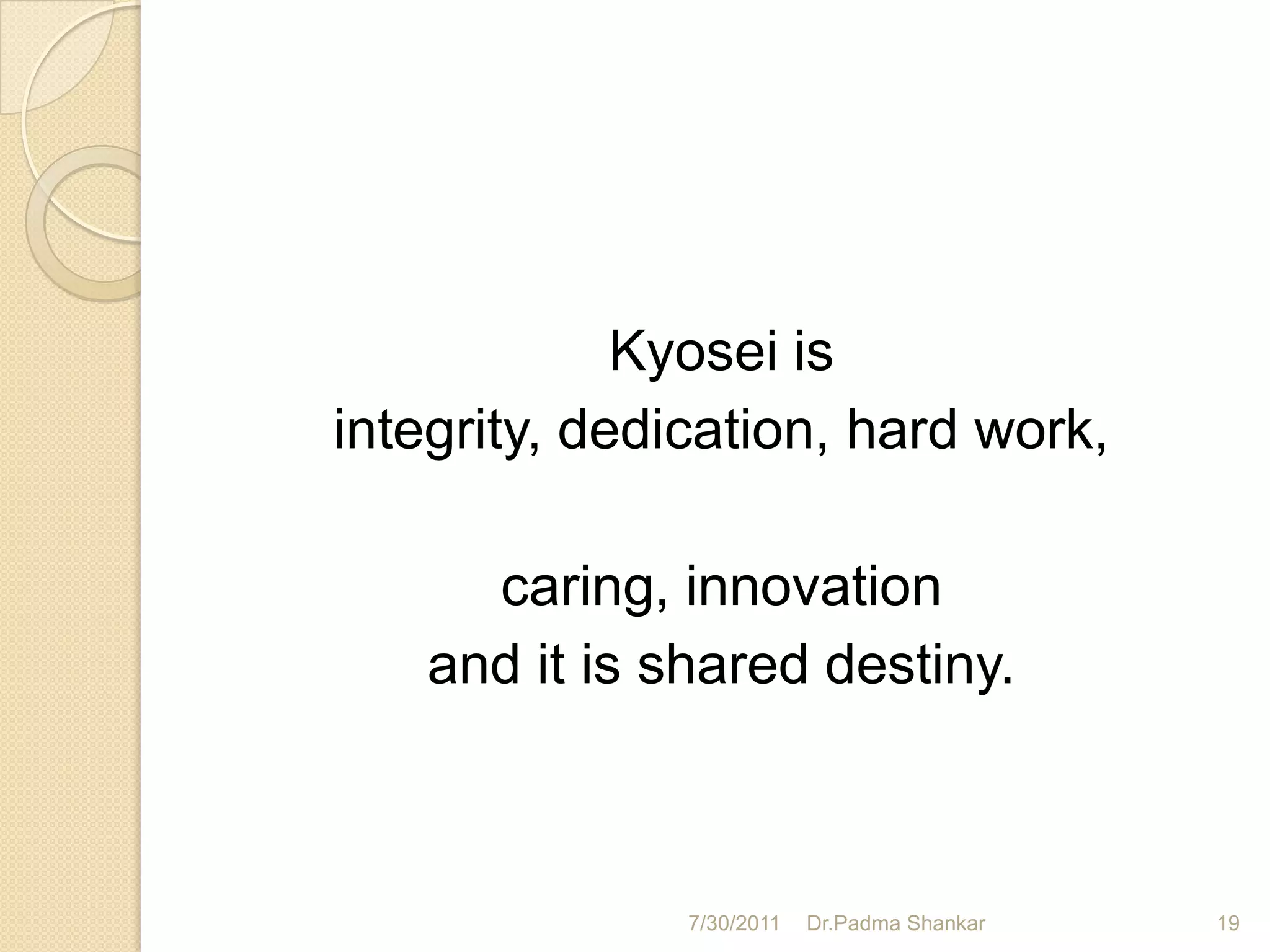
Kyosei is
integrity, dedication, hard work,

     caring, innovation
   and it is shared destiny.


               7/30/2011   Dr.Padma Shankar   19
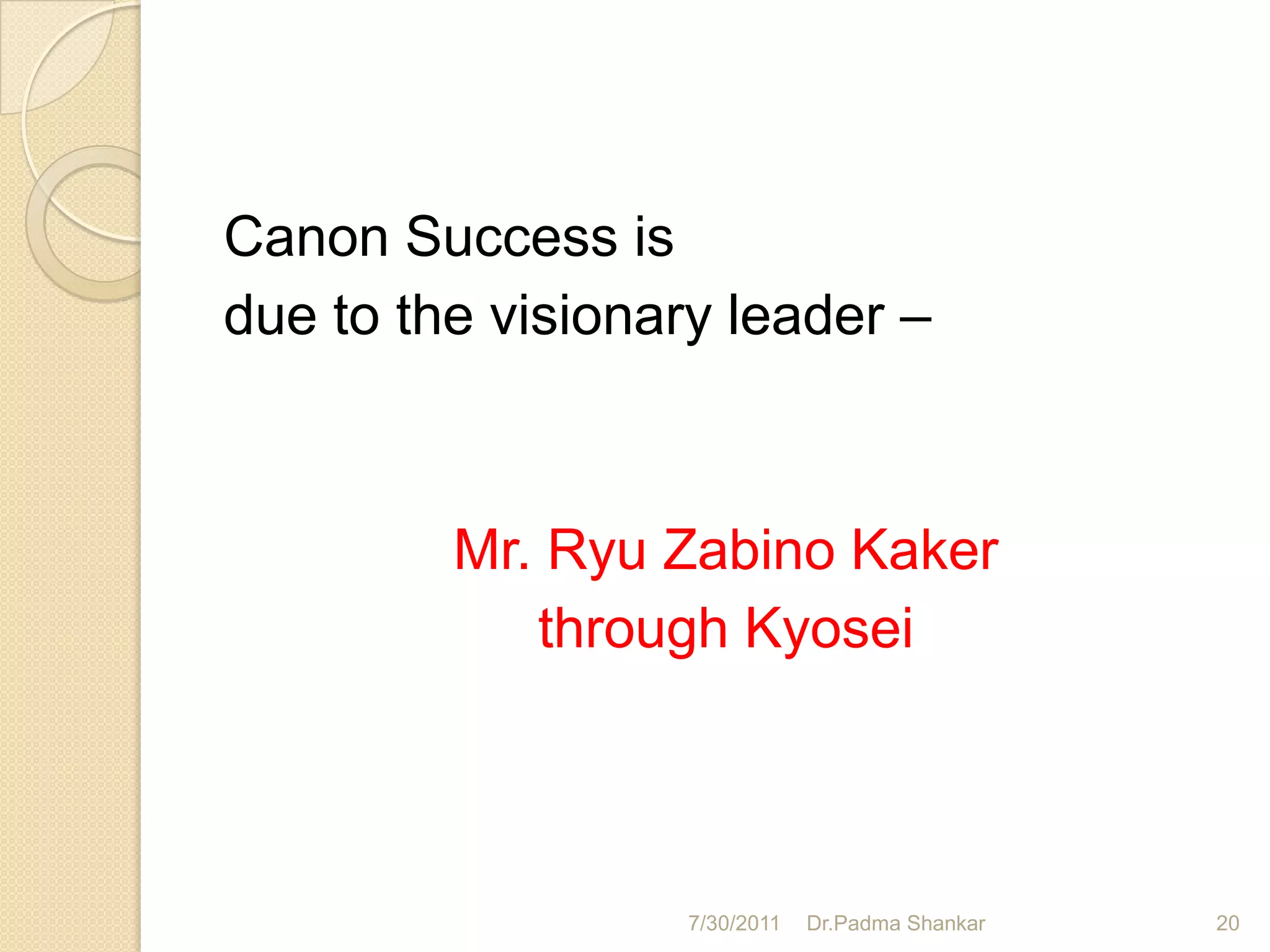
Canon Success is
due to the visionary leader –


         Mr. Ryu Zabino Kaker
            through Kyosei


                   7/30/2011   Dr.Padma Shankar   20
   140 years of existence
   Nation’s Pride
   Exemplary value system

Mumbai attacks
 A young lady trainee saved the HLL
  dignitaries.
 Thomas George saved about 54 and later
  succumbed to bullets.
 A general manager who insisted on staying
  put and help direct a response to the attack
  even after learning that his wife and sons had
  died in a fire on the hotel's top floor.
                      7/30/2011   Dr.Padma Shankar   21
The heroic response by employees of
  Mumbai's
landmark Taj Hotel during the 26/11terror
  attacks is
now a case study at Harvard Business School
  –
Prof. Rohit Deshpande. He asks:

   A dozen Taj employees died trying to save
    the lives of the hotel guests during the
    attacks.
   "The natural human instinct would be to flee.
    These are people who instinctively did the
    right thing. And in the process, some of them,
    unfortunately,     gave their lives to save
    guests."              7/30/2011 Dr.Padma Shankar 22
Prof. Rohit Deshpande Concludes:

 leadership  displayed by people in the
    bottom rank to the top levels.

    It is Tata DNA injected in the culture
    by its founder ---
    in 1868 by Jamsetji Nusserwanji Tata
     Continued by Ratan Tata till date. --
                     Leaders

                     7/30/2011   Dr.Padma Shankar   23
Infosys --- 30 years
 From 50 customers to 620 cusomers
 From 10 projects to 6500 projects
 From 100 employees to 130,820
  employees
 From 100 sq.ft to 28 million sq ft of
  built in space
 From 100 investors to 450,000
  investors

                  7/30/2011   Dr.Padma Shankar   24
Shri Narayana Murthy in his
Farewell address says;
   Good people are the primary assets of
    a great organization

   One aspect that marks out a truly
    superior organization is the ability of
    its employees at all levels to be driven
    by values and to ensure adherence
    and compliance under any
    circumstances
                     7/30/2011   Dr.Padma Shankar   25
“There is no external enemy. Our
  failures are because of our lack of
  commitment to our cause, our inability
  to accept meritocracy and our
  indifference to honesty and want of
  good work ethic amongst our
  leaders……. .”

             …….Shri Narayana
 Murthy
                  7/30/2011   Dr.Padma Shankar   26
Leader
   Values of the leader is the base and
    sequence of the company’s DNA for a
    Sustainable development
   Leadership is Legacy, who start out with great
    ideas and a deep sense of commitment.
   Leaders create more leaders who will carry
    out the mission after he/she is gone.
   Mahatma had no money /guns but created
    trust.
   Leaders are living examples not characters of
    fiction.
   Leadership = Moving confidently on a
                 firm foundation of values
                        7/30/2011   Dr.Padma Shankar   27
WINNING LEADER

   Power of Personality (Charisma)

                       +

    Power of Principles (Character,
    values, beliefs, courage, conviction
    and integrity.)

                    7/30/2011   Dr.Padma Shankar   28
Sustainable development depends
                 on
                  a
 leader who commands the highest
               respect
    because he is trust worthy,
             dependable
                and
gives strength and courage to those
              round him
                7/30/2011   Dr.Padma Shankar   29
Summarizing Confucius principles of
     Kyosei
I. reciprocity should be practiced
     throughout one’s life;
II. virtue, not profit is always the goal of
     the superior man;
III. Respect to relations, obedience to and
     respect for one’s own parents is
     paramount;
IV. Confucianism reiterates human kind do
     not exist in isolation;

                    7/30/2011   Dr.Padma Shankar   30
A right balance of
                Leadership
             Vision, Values,
  Competence, Courage and Character
   leads to Sustainable development

        We need more people like
Mr. Ryu Zabino, Mahatma, Tata. Narayana
                   Murthy
      for Sustainable Development
    may it be an academic institution of
           business organization.

                  7/30/2011   Dr.Padma Shankar   31
To conclude……


Sustainable development

= Leaders with Values and Ethical
 Behavior

          There is a Need for
                   a
           Profound Person
                  7/30/2011   Dr.Padma Shankar   32
Bibliography
   www.iep.utm.edu
   “Why Confucius has been reverenced as the Model Teacher of all
    ages”, St. John’s University Press (NY), 1976, pp. 14-17.
   “Calvin M. Boardman, Hideake Kiyoshi Kato, (2003) “The Confucian
    roots of Business Kyosei, Journal of Business Ethics 48 : 317-333;,
    Kluwer Academic Publications, Netherlands
   www.wikeipadia.com.
   www.ethicsmorals.com.
   Nordu,B N . “Value ethics and confucians”
    http://faculty.vassar.edu/brvannor/mypapers/virtueethics.pdf.
    Ioana Agatha Filimon, (2009), “Kyosei- an example of cultural
    keyword argumentatively exploited in corporate reporting discourse”,
    Studies of Communication Sciences 9/2 131-151.
   Ryuzabyuro Kaku, Ethical Standards, Development, Business and
    Human Rights, Canon Inc., Human Rights- The New Consensus p
    128-129
   Shiv Khera – Living with Honor
   www.tata.com
   www.timesofindia .com

                                  7/30/2011   Dr.Padma Shankar         33
THANK YOU


    7/30/2011   Dr.Padma Shankar   34

Confucius (kung fu tzu)

  • 1.
    RECALLING CONFUCIANISM FOR SUSTAINABLE DEVELOPMENT 7/30/2011 Dr.Padma Shankar 1
  • 2.
    Confucius (Kung Fu-Tzu) (551-479 BC) Chinese Philosopher Kung-fu-tzu (Confucius) literally means “Master Kong”. Confucius is regarded as an uncrowned king of pre-imperial China. 7/30/2011 Dr.Padma Shankar 2
  • 3.
    The ancient Stateof Lu born to a noble warrior family and had hard times 7/30/2011 Dr.Padma Shankar 3
  • 4.
    Confucius mastered to 6 ancient arts – ritual performance, music, archery, chariot riding, reading and arithmetic.  worked as a shepherd, cowherd, clerk, and a book-keeper and rose up to the position of Minister.  spend his last years teaching disciples via a set of classics called “Five Classics”.  he died at the age of 73 7/30/2011 Dr.Padma Shankar 4
  • 5.
    His philosophy compliedas Five Classics (Wu jing) are:  Shu jing or Canon of History  Shi jing or Canon of Poetry  Yi jing or Canon of Changes  Li Chi or Canon of Rites (conduct of religion ceremony)  Chun Chiu or Spring and Autumn Annuals 7/30/2011 Dr.Padma Shankar 5
  • 6.
    Society is composite of individuals  Collective behavior of individuals is culture  Culture influences individual behavior  A strong honorable individual emerges from the same culture and bring changes for eternity. 7/30/2011 Dr.Padma Shankar 6
  • 7.
    “The profound personunderstands what is moral. The small person understands, what is profitable?” (Analect 4.16). Confucius – Vision of Sustainable development : unite harmony with moral force in pursuit of social goals a well-ordered family  a well-ordered state and a well-ordered world. 7/30/2011 Dr.Padma Shankar 7
  • 8.
    Sustainable development BUSINESS ORGANISATIO N ACADEMIC INSTITUION INDIVIDUAL LEADER KYOSEI REN 7/30/2011 Dr.Padma Shankar 8
  • 9.
    仁 (man) + (two)= humane- ness ren 人 + er 二 = ren 仁 7/30/2011 Dr.Padma Shankar 9
  • 10.
    relies heavily onthe relationships between two people,  Implies that one was never alone, and that everyone has relationship to fall back on being a member of a family, the state about the world. 7/30/2011 Dr.Padma Shankar 10
  • 11.
    is translated as“benevolence”, “perfect virtue”, “goodness” or forever with “human heart”.  if the ruler lacks , it is difficult if not impossible for his subjects to behave humanly.  maxim of is : ◦ One should treat others as one would like others to treat oneself (positive form, Golden rule). ◦ One should not treat others in ways that one would not like to be treated (negative form also called Silver Rule). 7/30/2011 Dr.Padma Shankar 11
  • 12.
    Direct the people with moral force and regulate them with ritual and they will possess shame, and moreover, they will be righteous. (Analects 2.3).  One who rules by moral force may be compared to the North Star. (Analects 2.1)” 7/30/2011 Dr.Padma Shankar 12
  • 13.
    The profound personunderstands what is moral. The moral force of the small person is like the grass. “Let the wind blow over the grass and it is sure to bend.” (Analects 12.19). Thus Confucian Harmonious order of Relationship is not merely personal, but 7/30/2011 Dr.Padma Shankar 13
  • 14.
    Kyosei 共生 (Gòngshēng) 7/30/2011 Dr.Padma Shankar 14
  • 15.
    Kyosei  “Kyo” means working together,  “sei” means life.  Kyosei is a Japanese word, literally meaning, “Co-existence”, “living together” or “symbiosis”. 7/30/2011 Dr.Padma Shankar 15
  • 16.
    “On this account, the ruler will first take pains about his own virtue.  Possessing virtue will give him the people.  Possessing the people will give him the territory.  Possessing the territory will give him its wealth.  Possessing the wealth, he will have resources for expenditure.  Virtue is the root; wealth is the result” (The Great Learning X, 6-7). 7/30/2011 Dr.Padma Shankar 16
  • 17.
    “Kyosei” was applied as a Corporate Philosophy in 1988 by Canon Inc., of Japan.  To mean more positive by Canon and defined to mean, “living and working together for the common good”.  A detailed definition by Canon of Kyosei is “all people, regardless of race, religion or culture, harmoniously living and working together for many years to come”. Chairman of Canon Inc. Mr. Ryu Zabino Kaker advocates it as the New World Order. (Canon was established in 1937) 7/30/2011 Dr.Padma Shankar 17
  • 18.
    Canon cherished Kyoseiprinciple to established harmonious relationship with it customers, its supplies, its competitors, the Government with which it deals and the natural environment 7/30/2011 Dr.Padma Shankar 18
  • 19.
    Kyosei is integrity, dedication,hard work, caring, innovation and it is shared destiny. 7/30/2011 Dr.Padma Shankar 19
  • 20.
    Canon Success is dueto the visionary leader – Mr. Ryu Zabino Kaker through Kyosei 7/30/2011 Dr.Padma Shankar 20
  • 21.
    140 years of existence  Nation’s Pride  Exemplary value system Mumbai attacks  A young lady trainee saved the HLL dignitaries.  Thomas George saved about 54 and later succumbed to bullets.  A general manager who insisted on staying put and help direct a response to the attack even after learning that his wife and sons had died in a fire on the hotel's top floor. 7/30/2011 Dr.Padma Shankar 21
  • 22.
    The heroic responseby employees of Mumbai's landmark Taj Hotel during the 26/11terror attacks is now a case study at Harvard Business School – Prof. Rohit Deshpande. He asks:  A dozen Taj employees died trying to save the lives of the hotel guests during the attacks.  "The natural human instinct would be to flee. These are people who instinctively did the right thing. And in the process, some of them, unfortunately, gave their lives to save guests." 7/30/2011 Dr.Padma Shankar 22
  • 23.
    Prof. Rohit DeshpandeConcludes:  leadership displayed by people in the bottom rank to the top levels.  It is Tata DNA injected in the culture by its founder --- in 1868 by Jamsetji Nusserwanji Tata Continued by Ratan Tata till date. -- Leaders 7/30/2011 Dr.Padma Shankar 23
  • 24.
    Infosys --- 30years  From 50 customers to 620 cusomers  From 10 projects to 6500 projects  From 100 employees to 130,820 employees  From 100 sq.ft to 28 million sq ft of built in space  From 100 investors to 450,000 investors 7/30/2011 Dr.Padma Shankar 24
  • 25.
    Shri Narayana Murthyin his Farewell address says;  Good people are the primary assets of a great organization  One aspect that marks out a truly superior organization is the ability of its employees at all levels to be driven by values and to ensure adherence and compliance under any circumstances 7/30/2011 Dr.Padma Shankar 25
  • 26.
    “There is noexternal enemy. Our failures are because of our lack of commitment to our cause, our inability to accept meritocracy and our indifference to honesty and want of good work ethic amongst our leaders……. .” …….Shri Narayana Murthy 7/30/2011 Dr.Padma Shankar 26
  • 27.
    Leader  Values of the leader is the base and sequence of the company’s DNA for a Sustainable development  Leadership is Legacy, who start out with great ideas and a deep sense of commitment.  Leaders create more leaders who will carry out the mission after he/she is gone.  Mahatma had no money /guns but created trust.  Leaders are living examples not characters of fiction.  Leadership = Moving confidently on a firm foundation of values 7/30/2011 Dr.Padma Shankar 27
  • 28.
    WINNING LEADER  Power of Personality (Charisma) +  Power of Principles (Character, values, beliefs, courage, conviction and integrity.) 7/30/2011 Dr.Padma Shankar 28
  • 29.
    Sustainable development depends on a leader who commands the highest respect because he is trust worthy, dependable and gives strength and courage to those round him 7/30/2011 Dr.Padma Shankar 29
  • 30.
    Summarizing Confucius principlesof Kyosei I. reciprocity should be practiced throughout one’s life; II. virtue, not profit is always the goal of the superior man; III. Respect to relations, obedience to and respect for one’s own parents is paramount; IV. Confucianism reiterates human kind do not exist in isolation; 7/30/2011 Dr.Padma Shankar 30
  • 31.
    A right balanceof Leadership Vision, Values, Competence, Courage and Character leads to Sustainable development We need more people like Mr. Ryu Zabino, Mahatma, Tata. Narayana Murthy for Sustainable Development may it be an academic institution of business organization. 7/30/2011 Dr.Padma Shankar 31
  • 32.
    To conclude…… Sustainable development =Leaders with Values and Ethical Behavior There is a Need for a Profound Person 7/30/2011 Dr.Padma Shankar 32
  • 33.
    Bibliography  www.iep.utm.edu  “Why Confucius has been reverenced as the Model Teacher of all ages”, St. John’s University Press (NY), 1976, pp. 14-17.  “Calvin M. Boardman, Hideake Kiyoshi Kato, (2003) “The Confucian roots of Business Kyosei, Journal of Business Ethics 48 : 317-333;, Kluwer Academic Publications, Netherlands  www.wikeipadia.com.  www.ethicsmorals.com.  Nordu,B N . “Value ethics and confucians” http://faculty.vassar.edu/brvannor/mypapers/virtueethics.pdf.  Ioana Agatha Filimon, (2009), “Kyosei- an example of cultural keyword argumentatively exploited in corporate reporting discourse”, Studies of Communication Sciences 9/2 131-151.  Ryuzabyuro Kaku, Ethical Standards, Development, Business and Human Rights, Canon Inc., Human Rights- The New Consensus p 128-129  Shiv Khera – Living with Honor  www.tata.com  www.timesofindia .com 7/30/2011 Dr.Padma Shankar 33
  • 34.
    THANK YOU 7/30/2011 Dr.Padma Shankar 34