Guide Right™ Surgical Guide System


                          INTRODUCTION
           use of Guide Right™ COMPONENTS

           use with a SINGLE IMPLANT CASE
           verification with PA X-ray
            includes:   mesio-distal correction only (not bucco-lingual)


   2.3013
Challenges with Current 3D Surgical Guides


 Most require off-site fabrication

 Costly and time delay, several days to two weeks

 May result in difficulty fitting the patient when placed at the
  time of surgery

 May require a 2nd cone beam X-ray of cast
Best Practices for Implant Success


 Implants should be placed within the envelope of available bone to
  increase clinical success.

 Pre-surgical radiographs facilitate evaluation of the proposed angle of
  the long axis of the guide sleeve and proposed implant placement.

 3D Radiographs allow us to determine if planned implant placement
  conflicts with the adjacent roots, the maxillary sinuses, nerves,
  and if it is within the envelope of available bone.
A System of Components
for the fabrication and correction of diagnostic & surgical guides
                     in one or two dimensions


                   In-office or lab fabrication

                   Evaluate with 2D & 3D imaging

                   Allows linear and angular correction

                   Enables precision implant placement

                   Cost effective
DéPlaque


    Guide Right™ Surgical Guide System
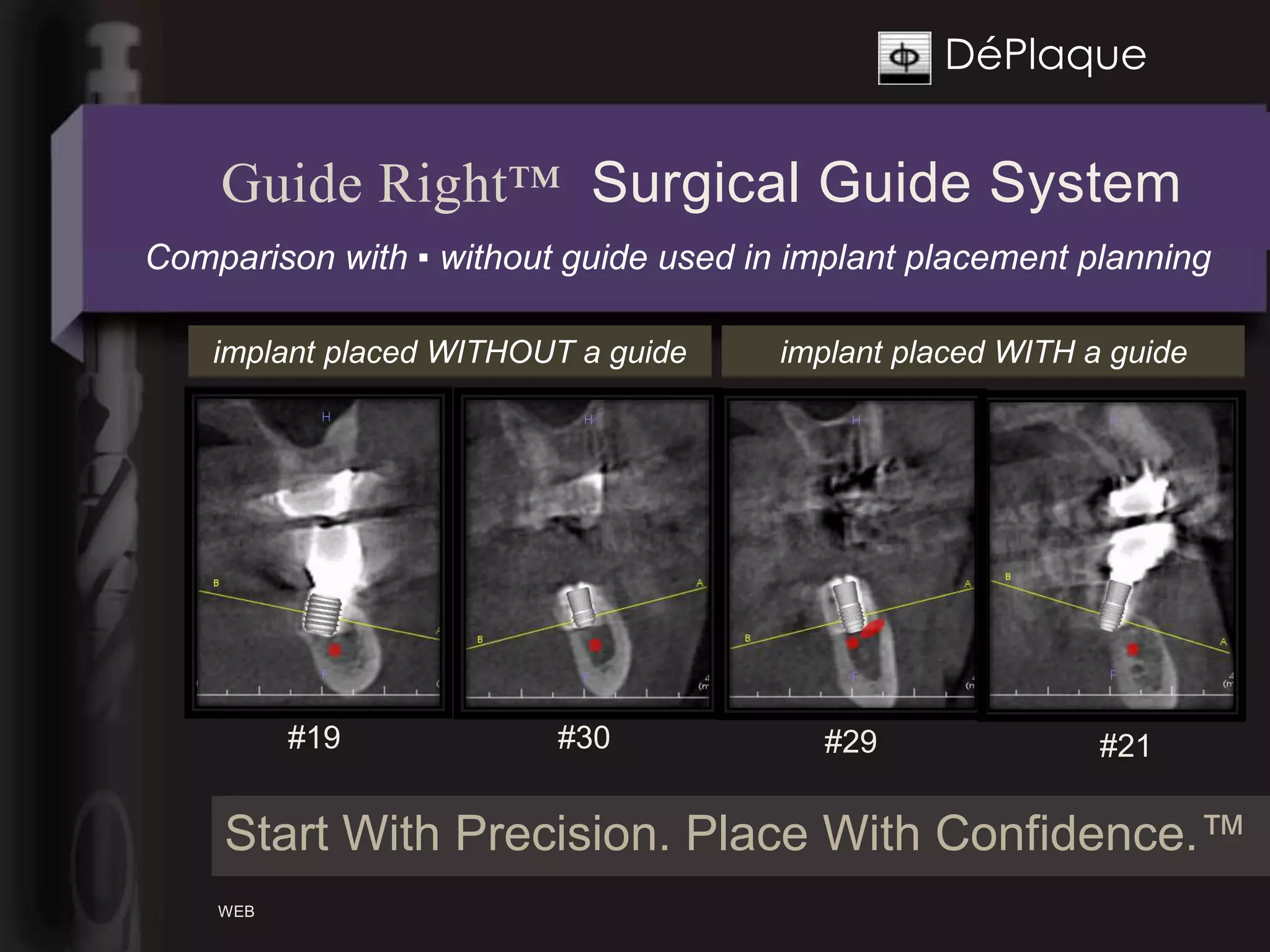
Comparison with ▪ without guide used in implant placement planning

    implant placed WITHOUT a guide     implant placed WITH a guide


          #19            #30              #29               #21

    Start With Precision. Place With Confidence.™
    WEB
Basic Fabrication & Correction
                      of
DIAGNOSTIC and SURGICAL Guides
                    Featuring

         GUIDE RIGHT COMPONENTS
        standard & magnetic guide posts
        cylindrical & open guide sleeves

        GUIDE POST BENDING TOOL
               angular correction
               linear correction

            PERIAPICAL X-RAYS
               FABRICATION OF
             DIAGNOSTIC guide
             SURGICAL   guide
Guide Right™ COMPONENTS
                     used in
Fabrication of DIAGNOSTIC & SURGICAL Guides


         Guide Posts:   standard · magnetic offset

         Guide Sleeves: cylindrical · open

         Drills

         Pin-vice

         Guide Post Bending Tool
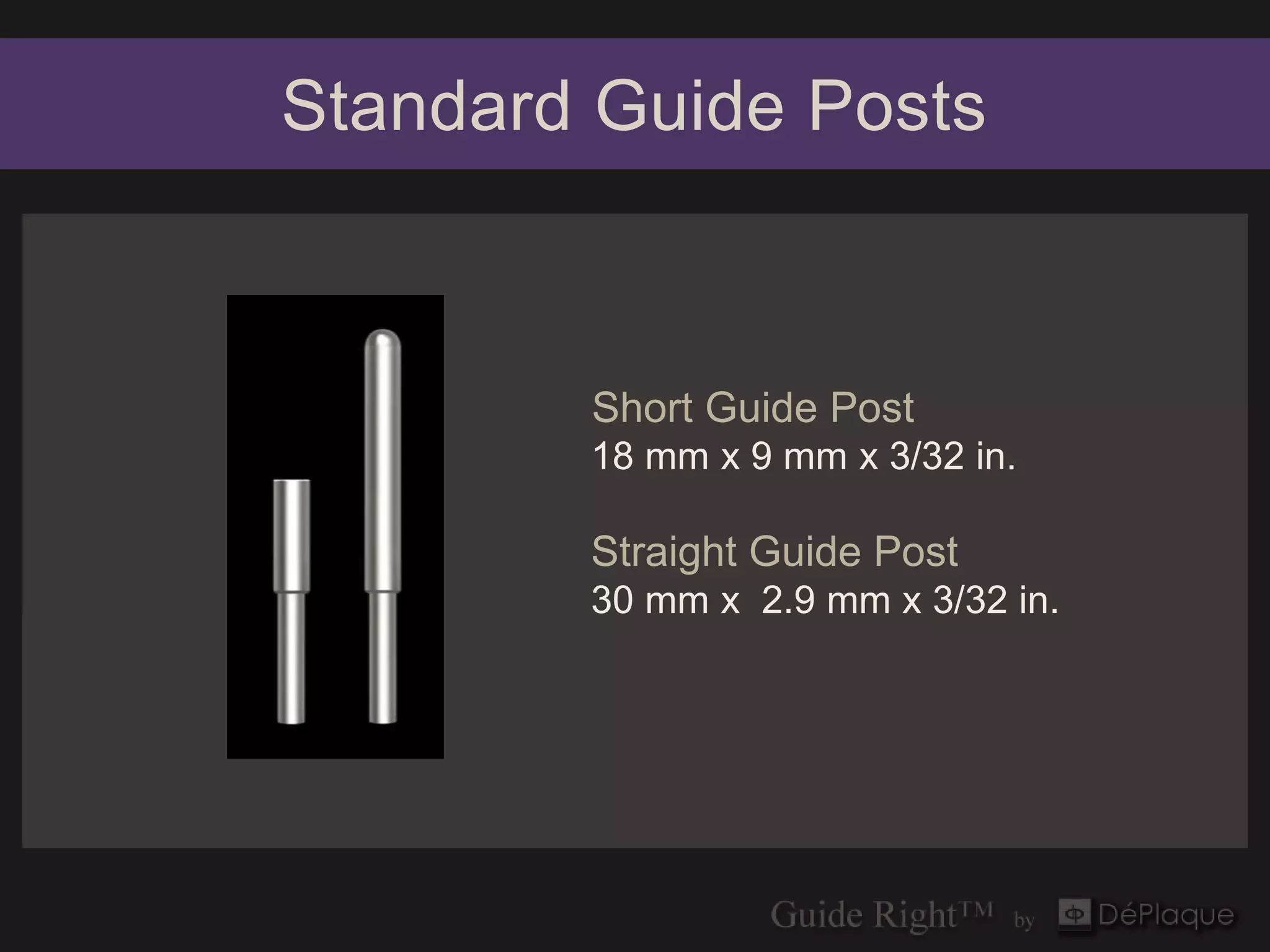
Standard Guide Posts


        Short Guide Post
        18 mm x 9 mm x 3/32 in.

        Straight Guide Post
        30 mm x 2.9 mm x 3/32 in.
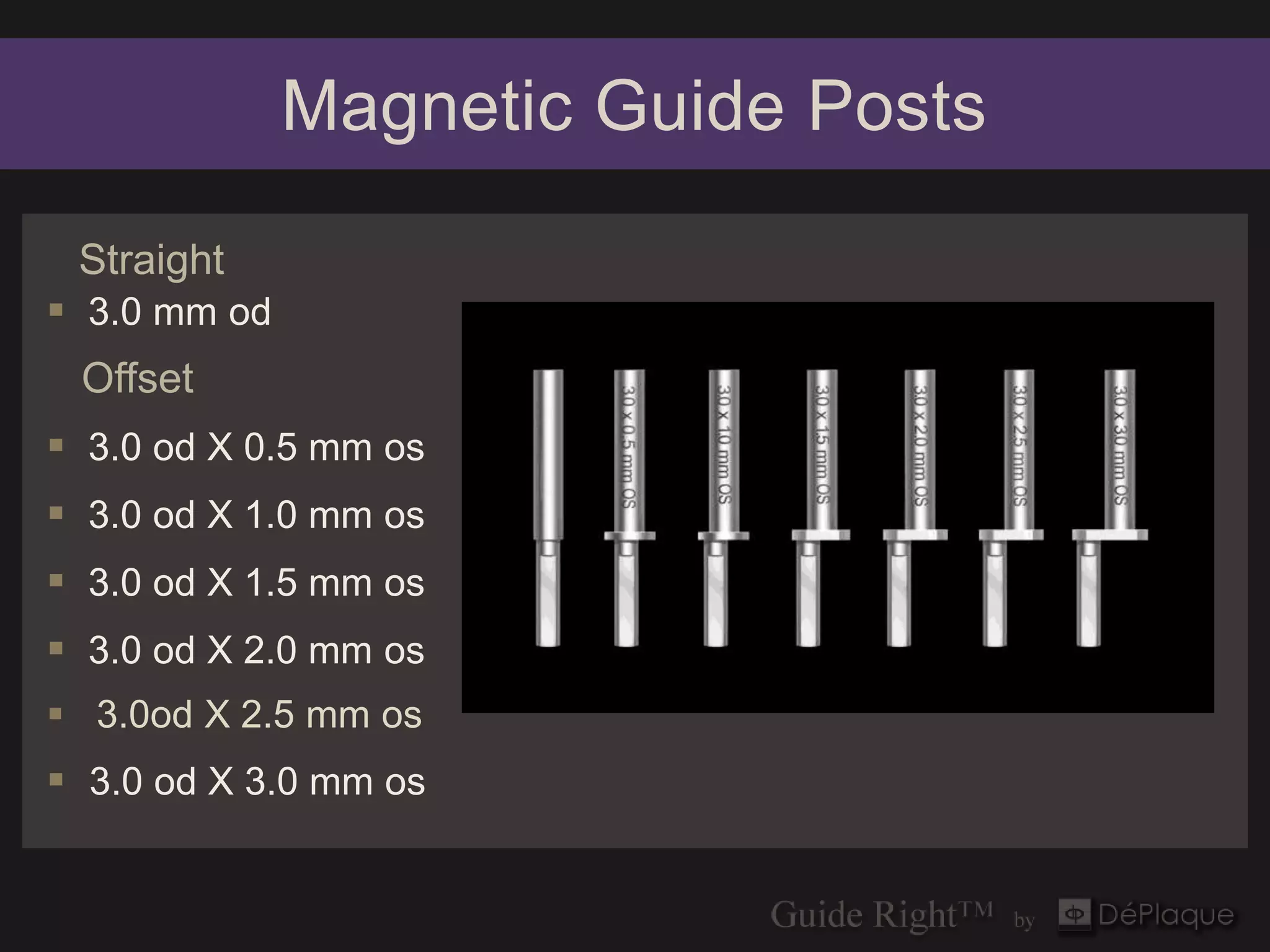
Magnetic Guide Posts

 Straight
 3.0 mm od
 Offset
 3.0 od X 0.5 mm os
 3.0 od X 1.0 mm os
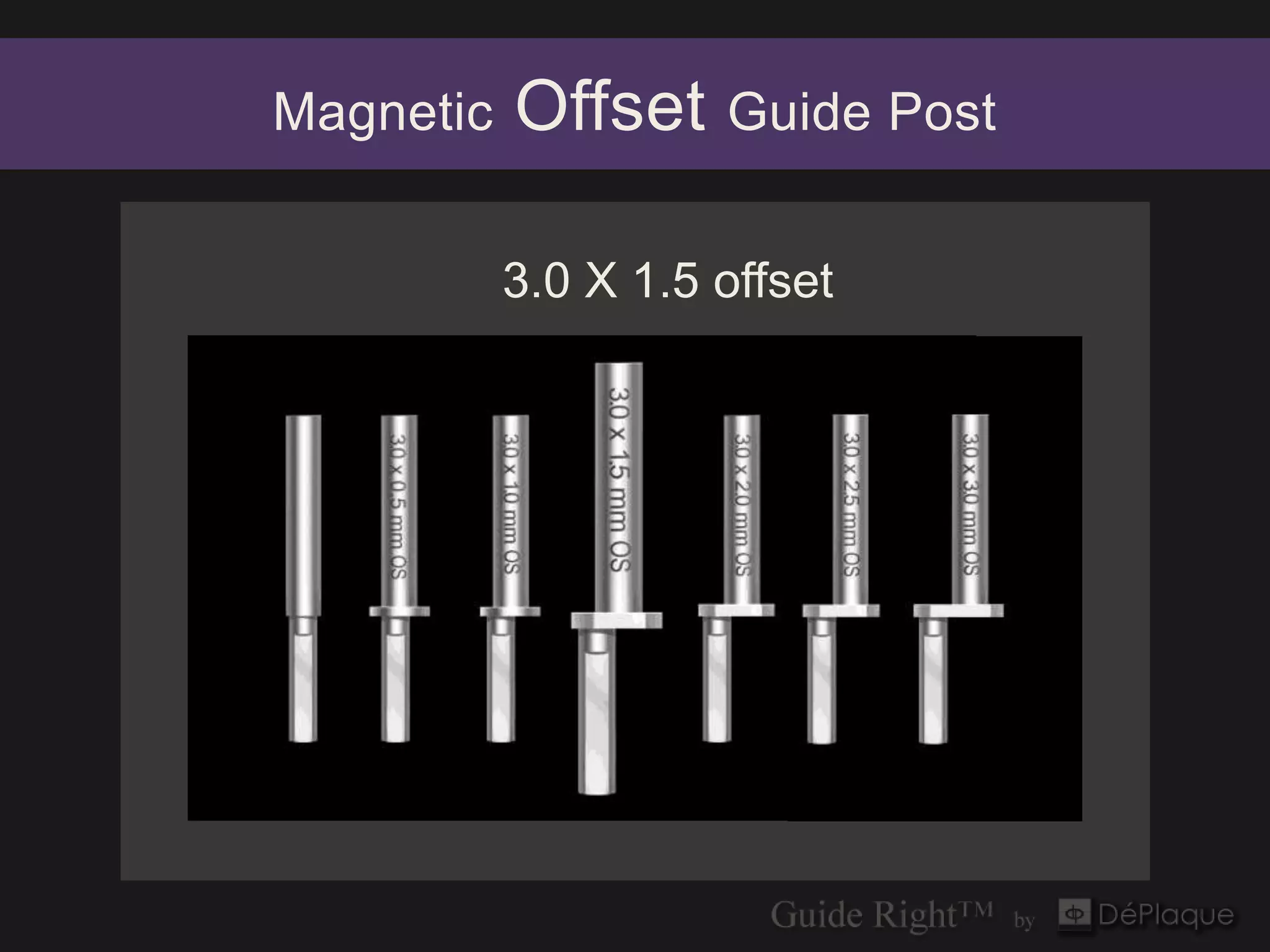
 3.0 od X 1.5 mm os
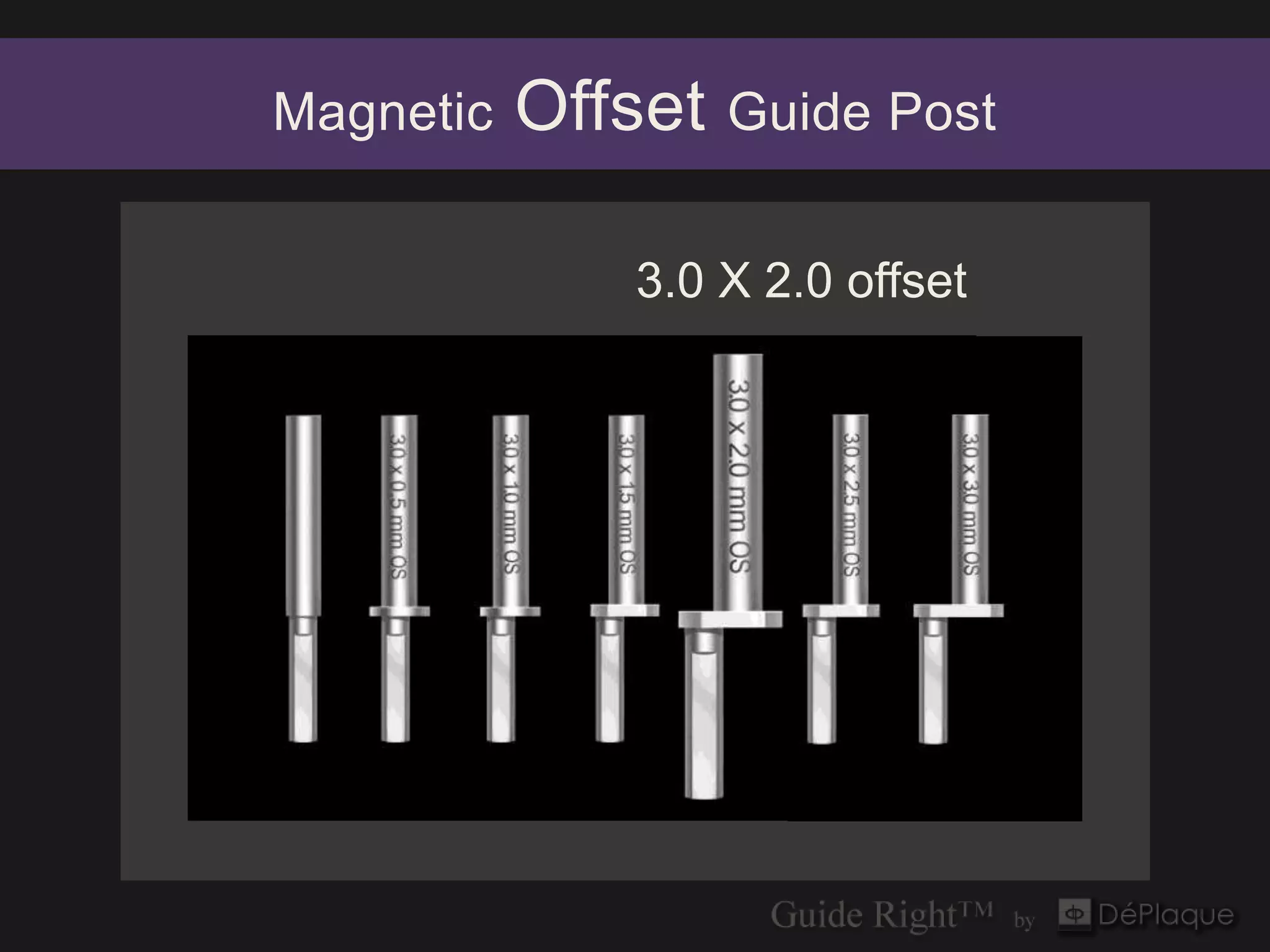
 3.0 od X 2.0 mm os
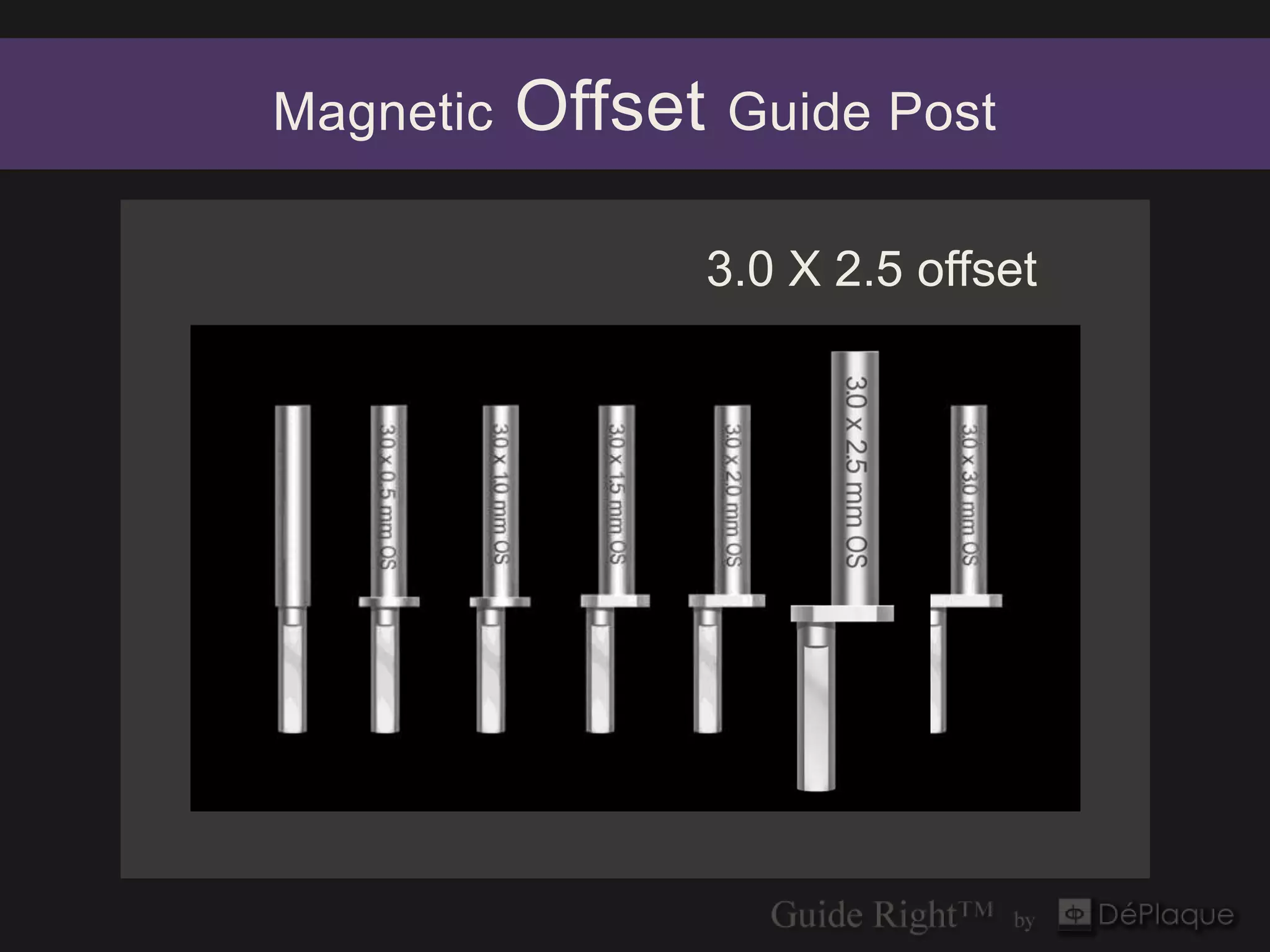
 3.0od X 2.5 mm os
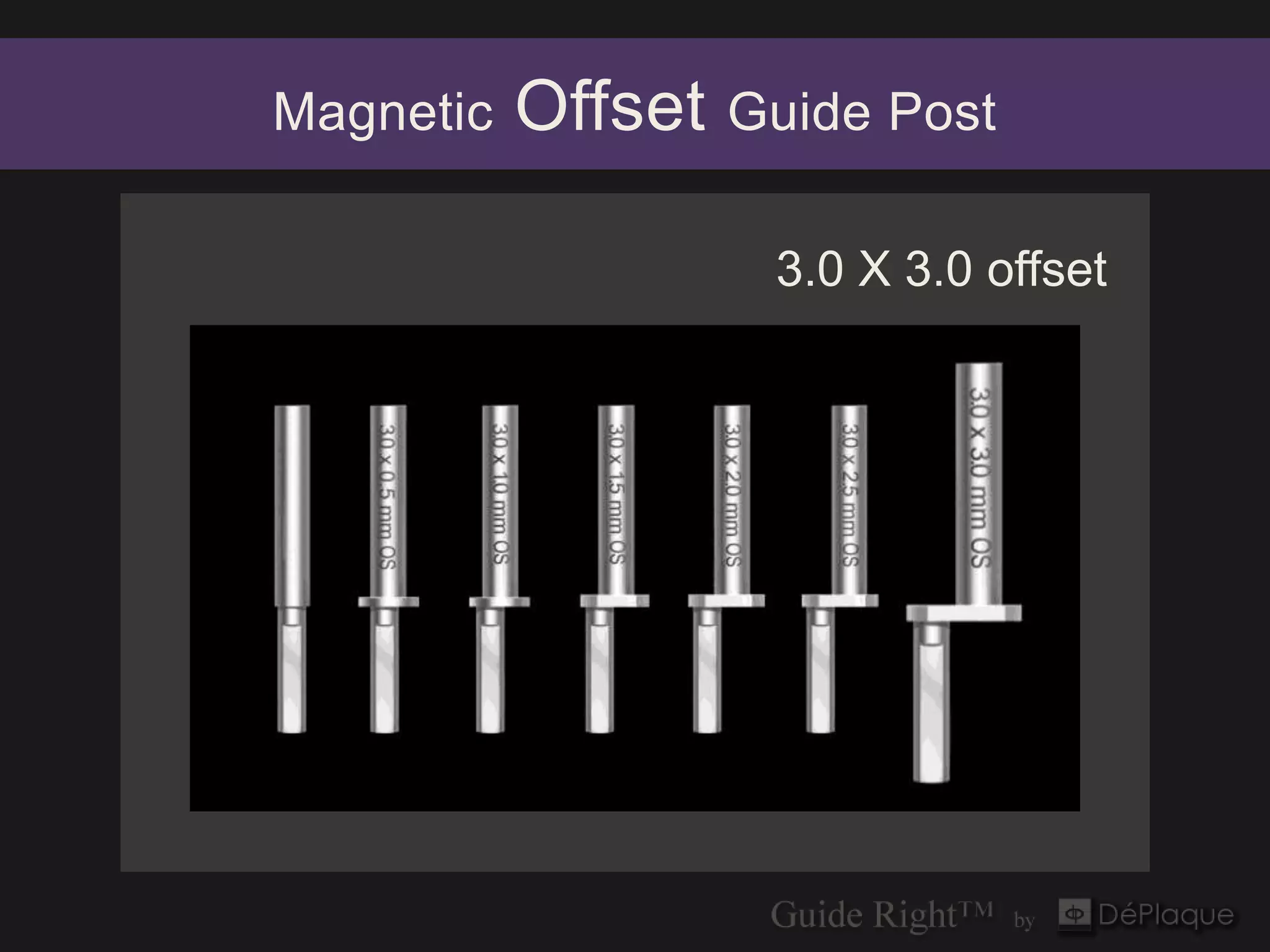
 3.0 od X 3.0 mm os
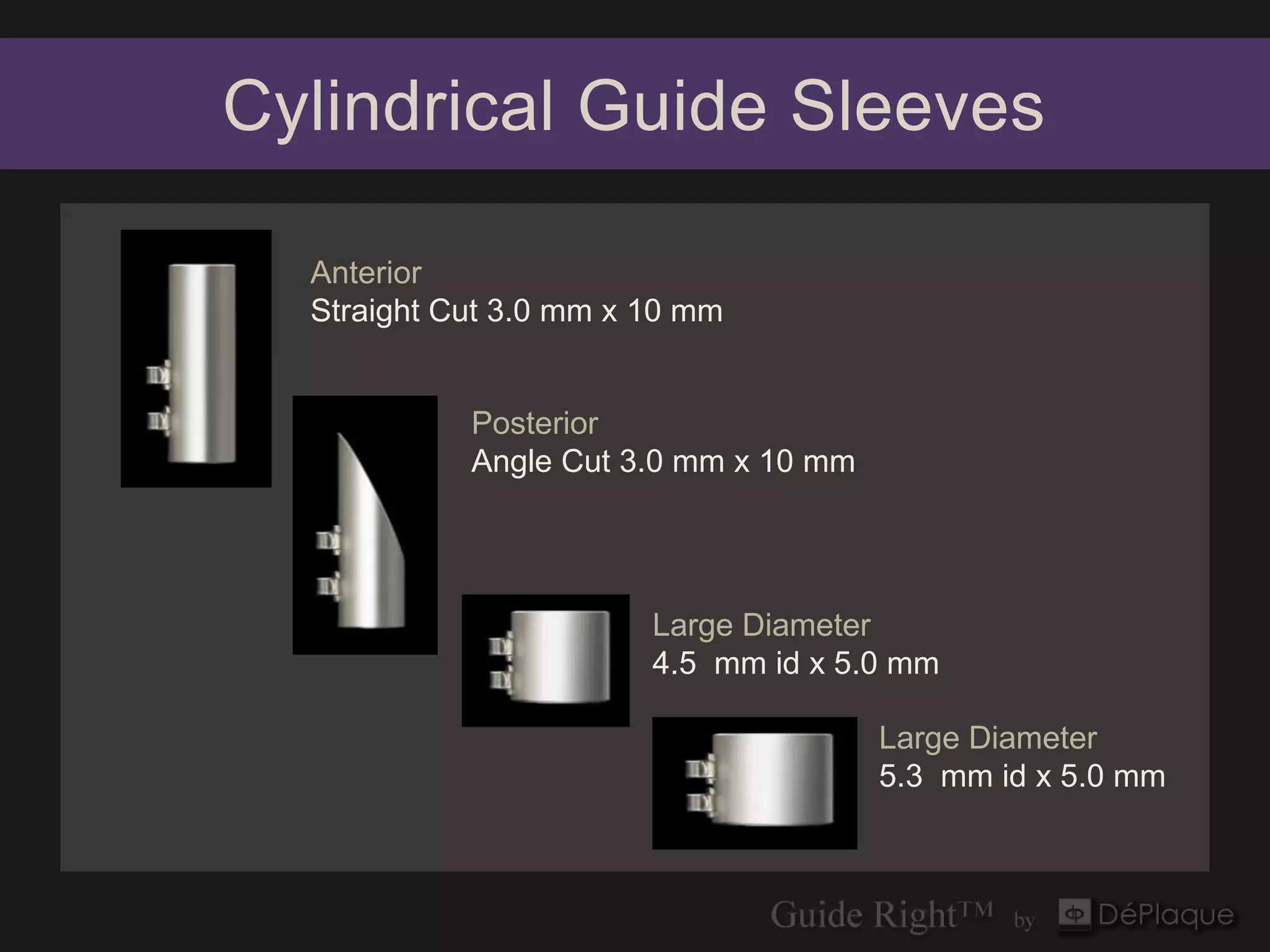
Cylindrical Guide Sleeves

  Anterior
  Straight Cut 3.0 mm x 10 mm


            Posterior
            Angle Cut 3.0 mm x 10 mm


                        Large Diameter
                        4.5 mm id x 5.0 mm

                                       Large Diameter
                                       5.3 mm id x 5.0 mm
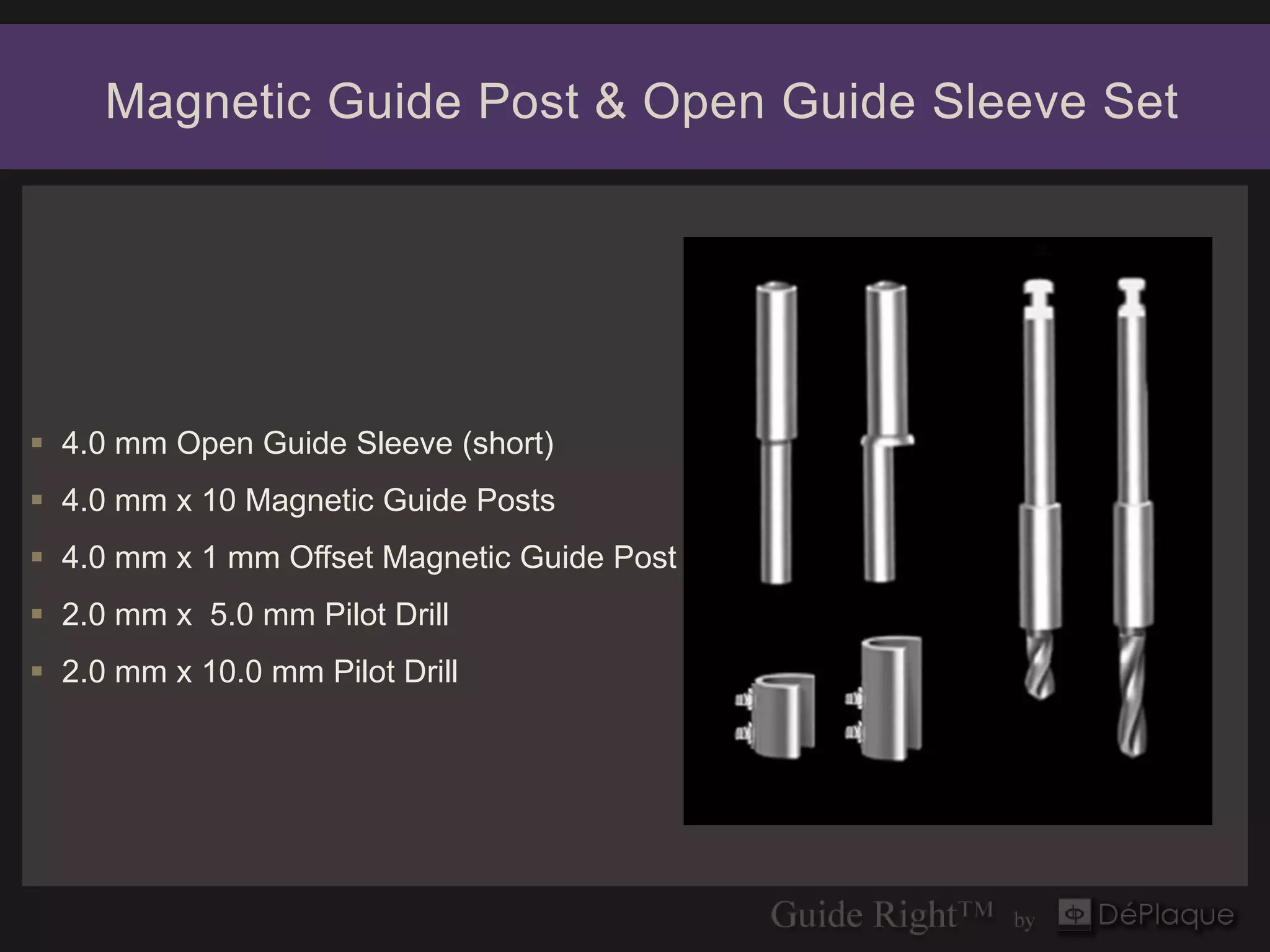
Magnetic Guide Post & Open Guide Sleeve Set


 4.0 mm Open Guide Sleeve (short)
 4.0 mm x 10 Magnetic Guide Posts
 4.0 mm x 1 mm Offset Magnetic Guide Post
 2.0 mm x 5.0 mm Pilot Drill
 2.0 mm x 10.0 mm Pilot Drill
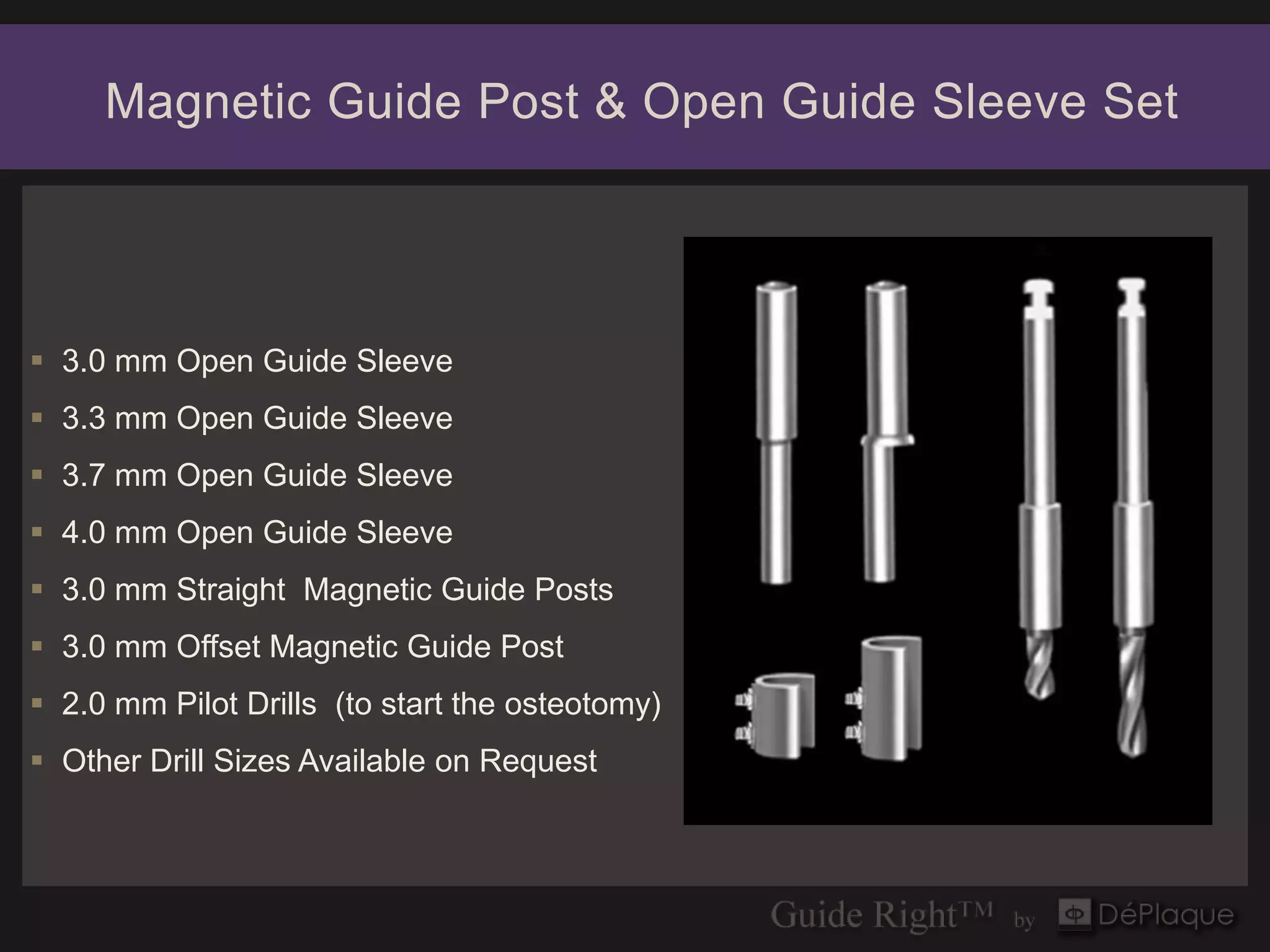
Magnetic Guide Post & Open Guide Sleeve Set


 3.0 mm Open Guide Sleeve
 3.3 mm Open Guide Sleeve
 3.7 mm Open Guide Sleeve
 4.0 mm Open Guide Sleeve
 3.0 mm Straight Magnetic Guide Posts
 3.0 mm Offset Magnetic Guide Post
 2.0 mm Pilot Drills (to start the osteotomy)
 Other Drill Sizes Available on Request
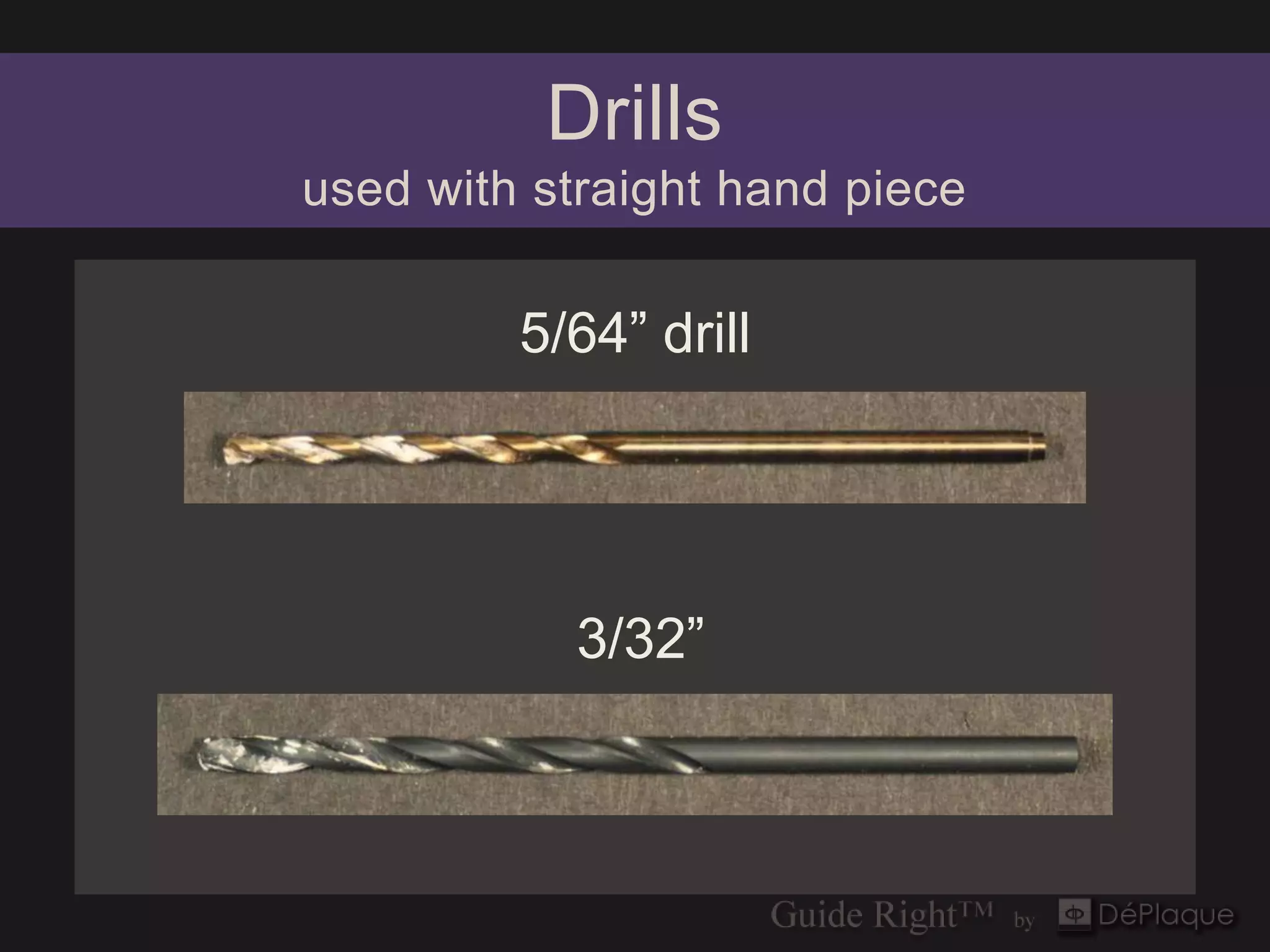
Drills
used with straight hand piece

         5/64” drill


           3/32”
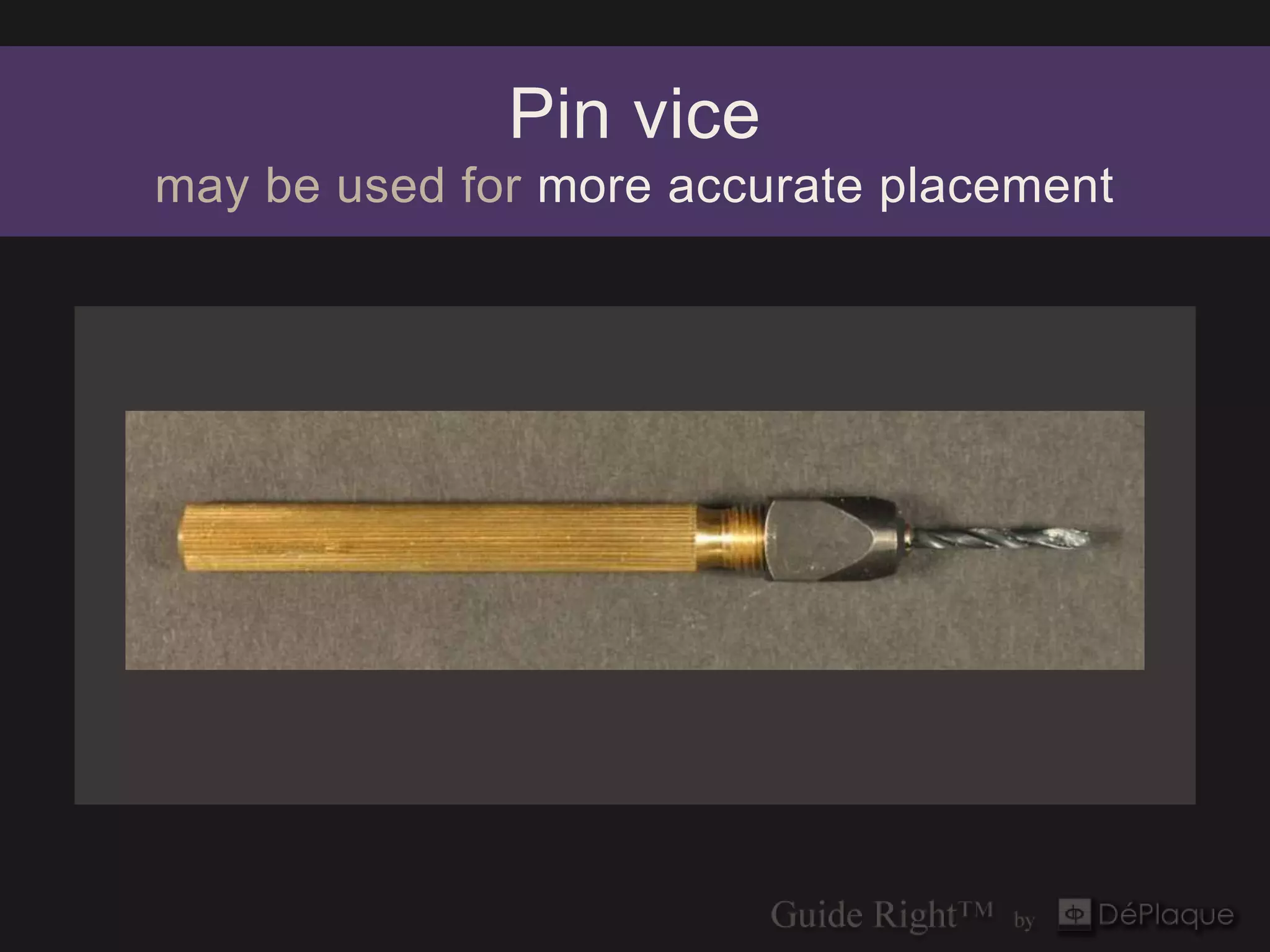
Pin vice
may be used for more accurate placement
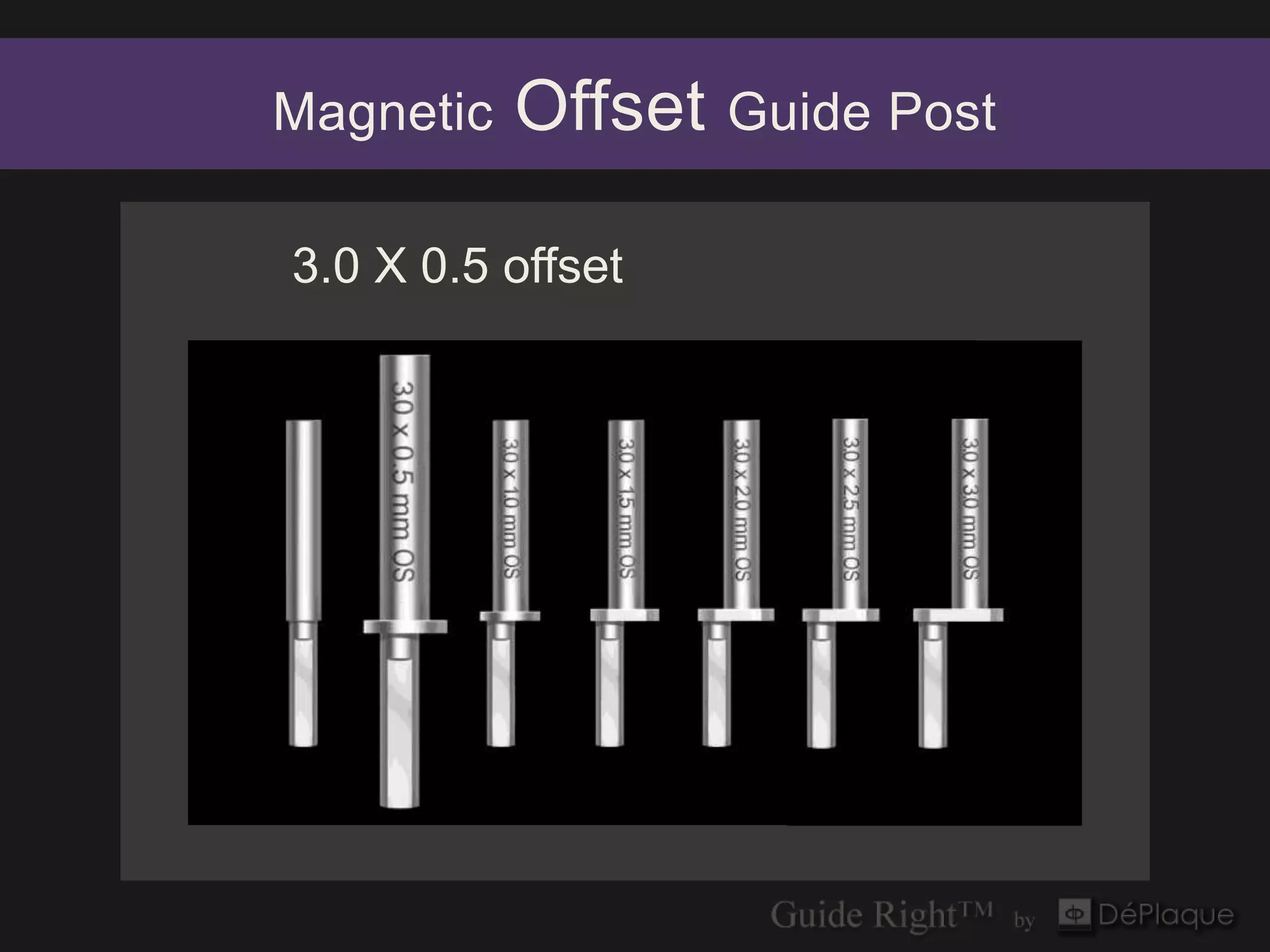
Magnetic   Offset   Guide Post

3.0 X 0.5 offset
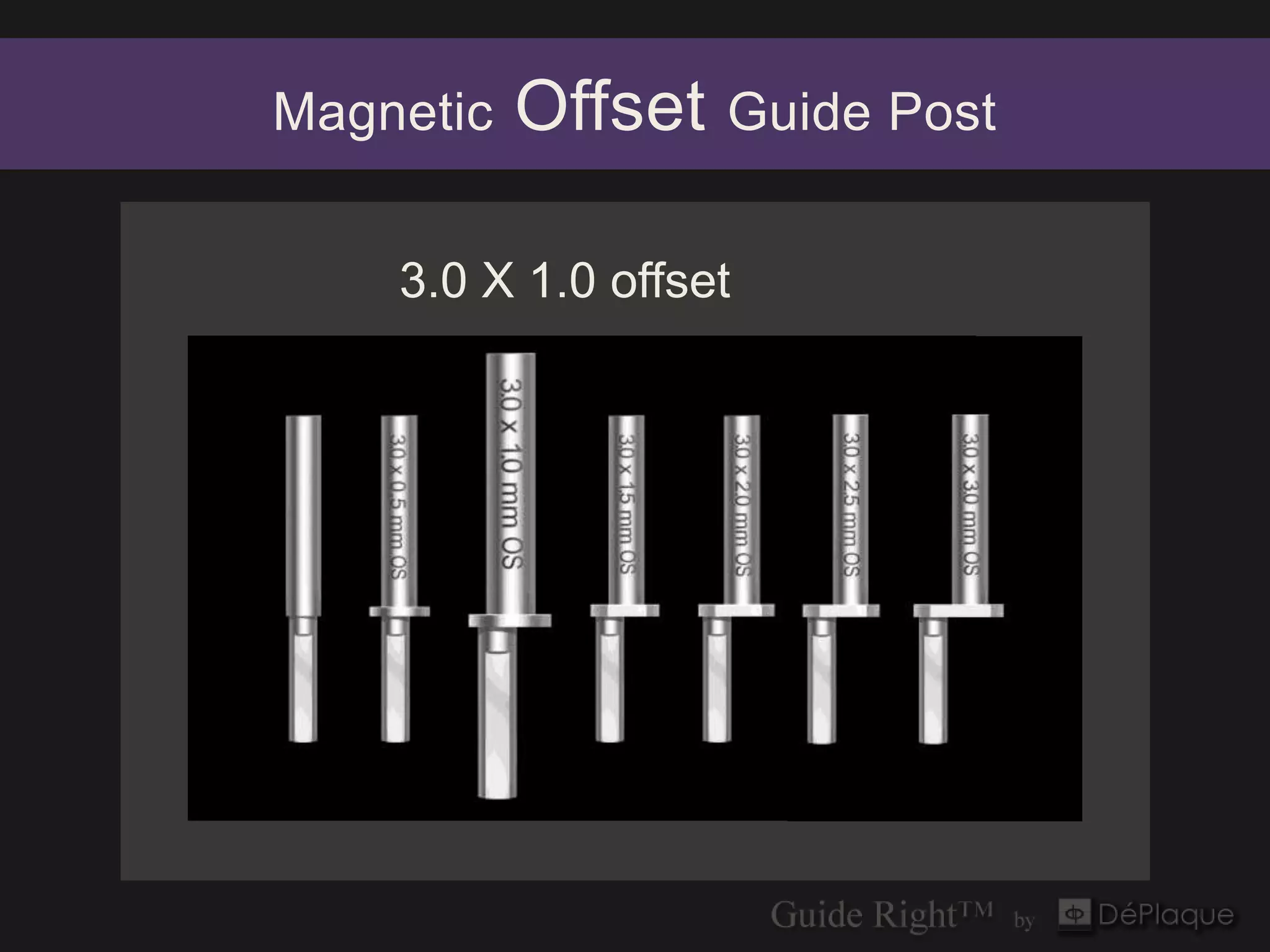
Magnetic   Offset   Guide Post


    3.0 X 1.0 offset
Magnetic   Offset    Guide Post


           3.0 X 1.5 offset
Magnetic   Offset   Guide Post


              3.0 X 2.0 offset
Magnetic   Offset    Guide Post

                    3.0 X 2.5 offset
Magnetic   Offset   Guide Post

                     3.0 X 3.0 offset
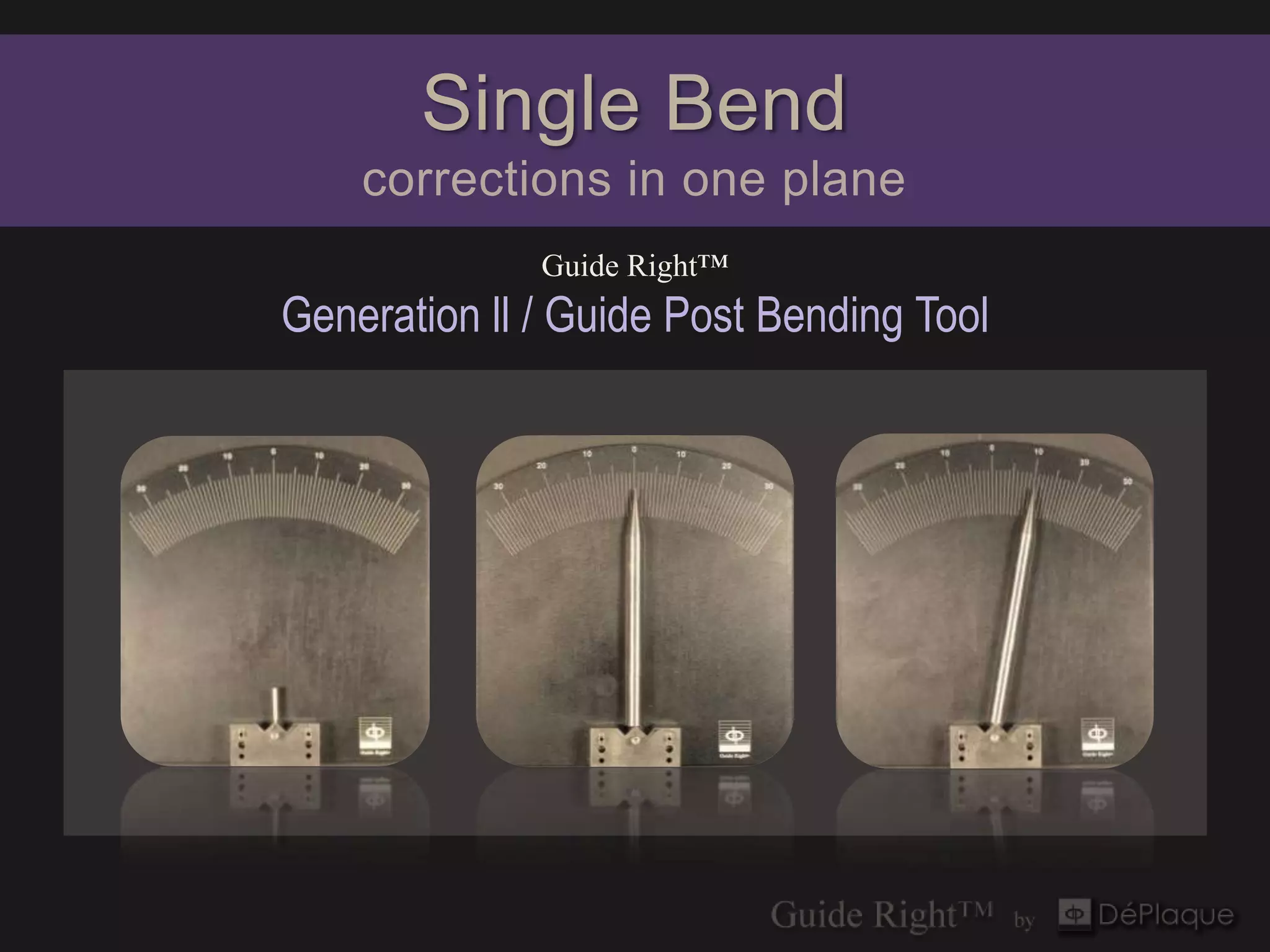
Single Bend
    corrections in one plane
              Guide Right™
Generation ll / Guide Post Bending Tool
Guide Right™
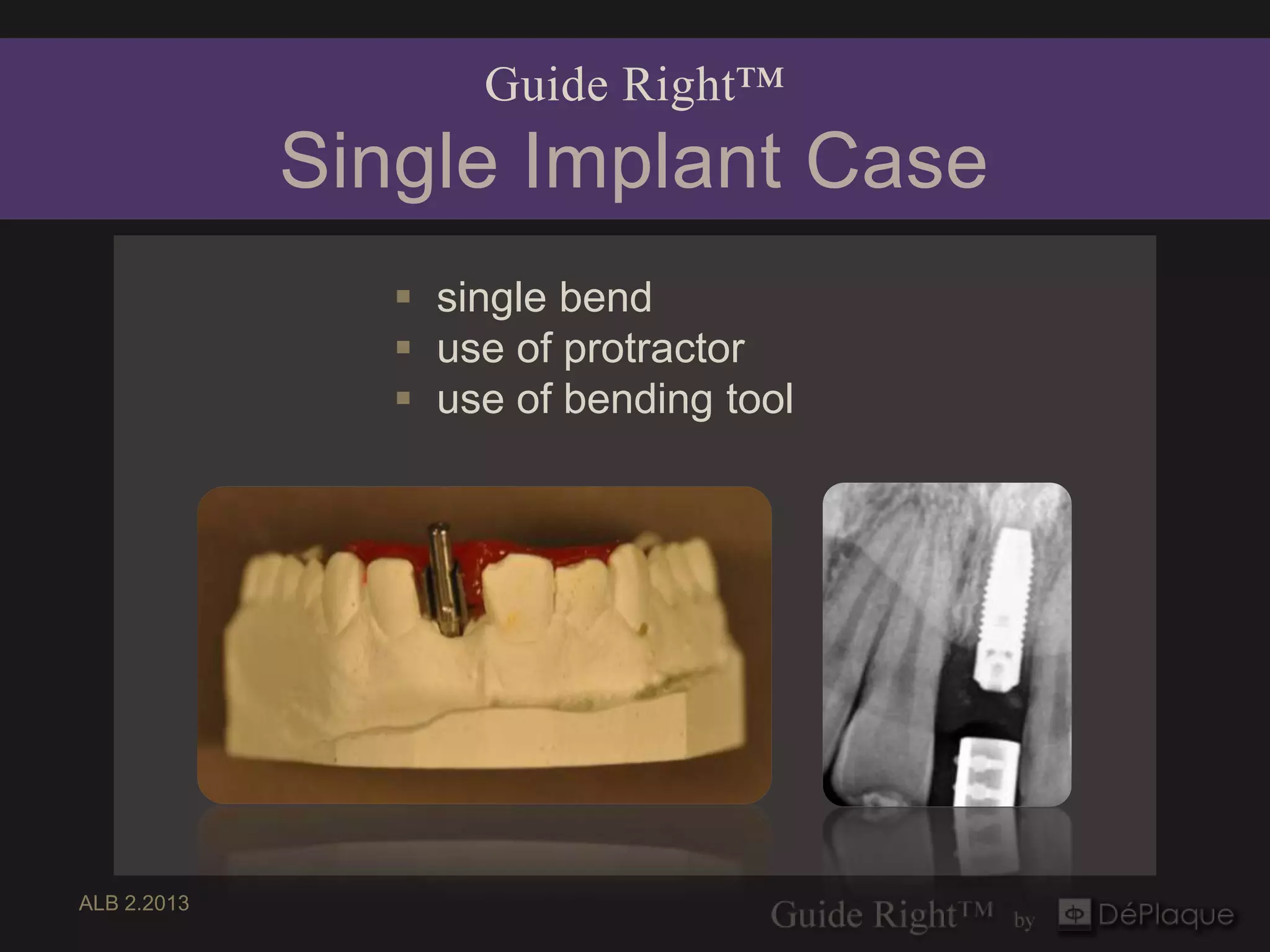
             Single Implant Case
                 single bend
                 use of protractor
                 use of bending tool


ALB 2.2013
Fabrication of DIAGNOSTIC Guide
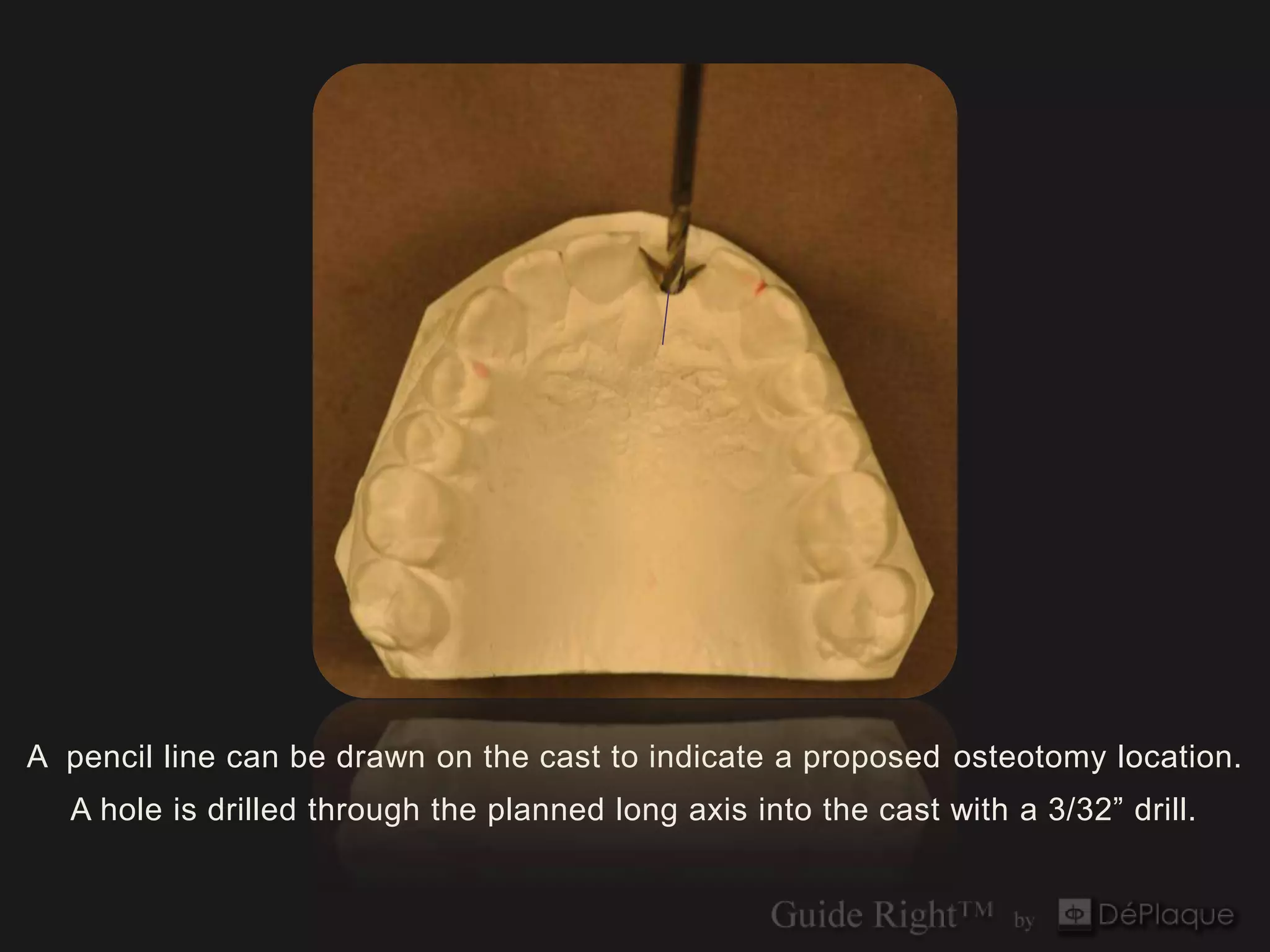
A pencil line can be drawn on the cast to indicate a proposed osteotomy location.
  A hole is drilled through the planned long axis into the cast with a 3/32” drill.
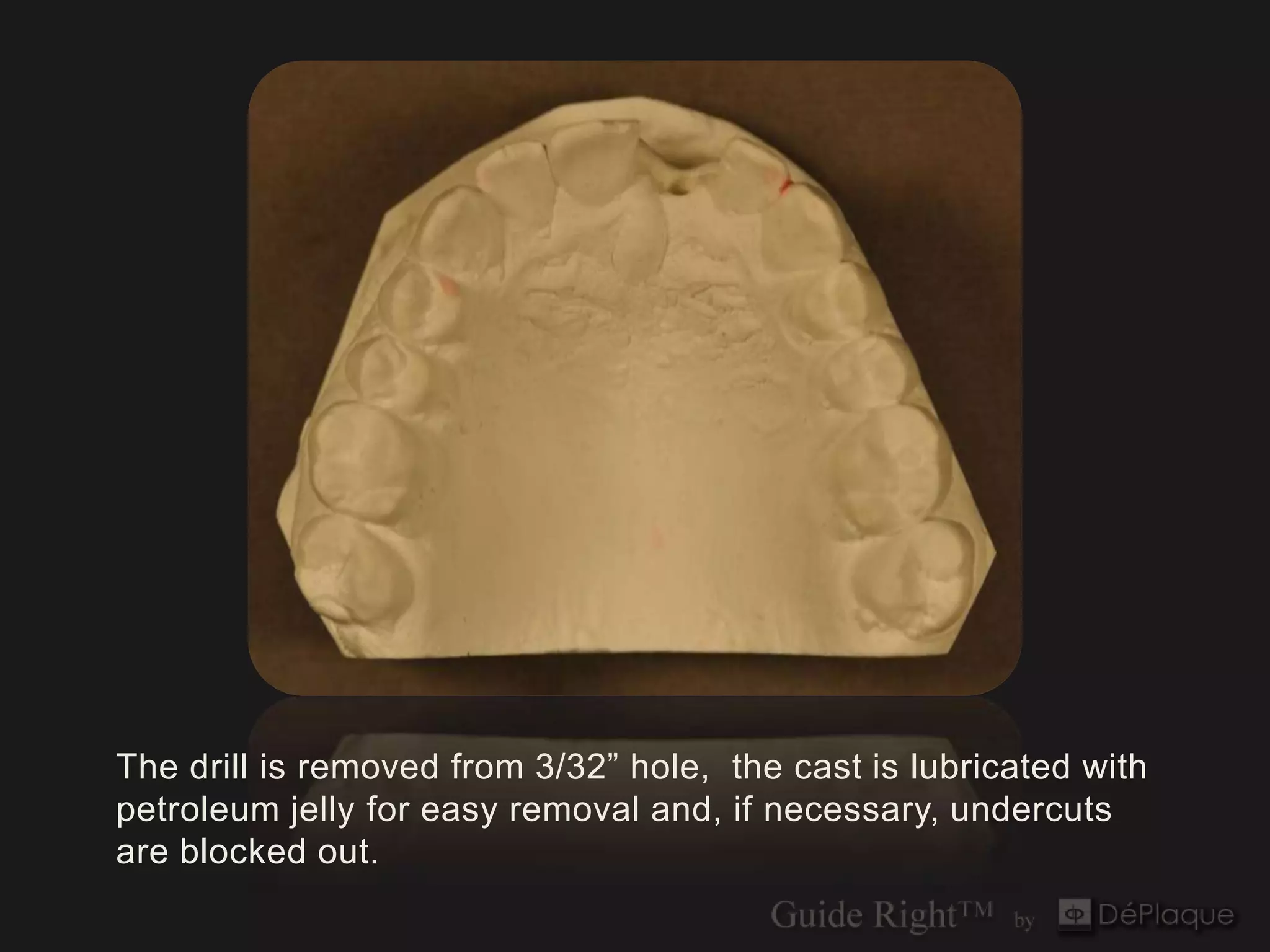
The drill is removed from 3/32” hole, the cast is lubricated with
petroleum jelly for easy removal and, if necessary, undercuts
are blocked out.
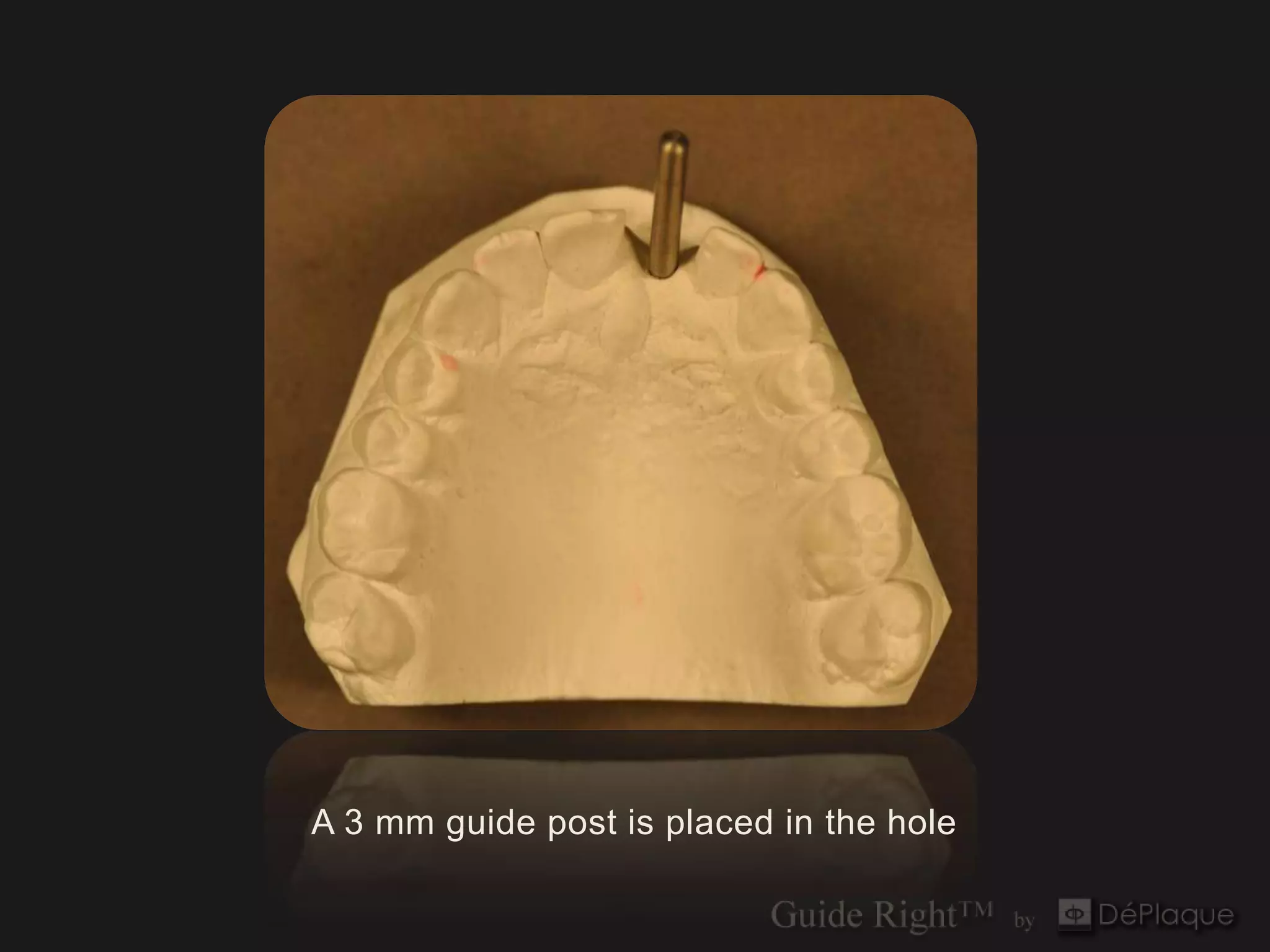
A 3 mm guide post is placed in the hole
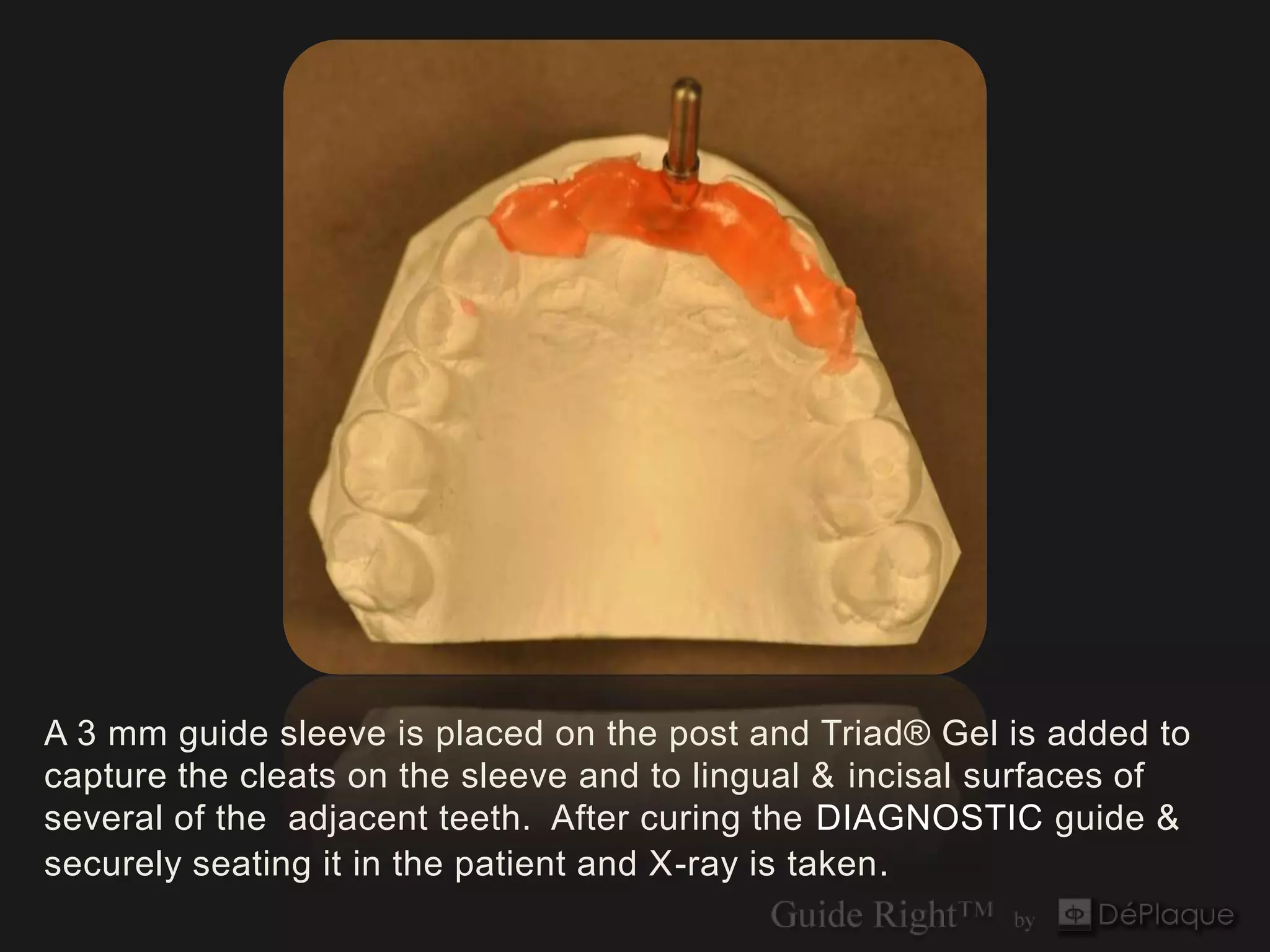
A 3 mm guide sleeve is placed on the post and Triad® Gel is added to
capture the cleats on the sleeve and to lingual & incisal surfaces of
several of the adjacent teeth. After curing the DIAGNOSTIC guide &
securely seating it in the patient and X-ray is taken .
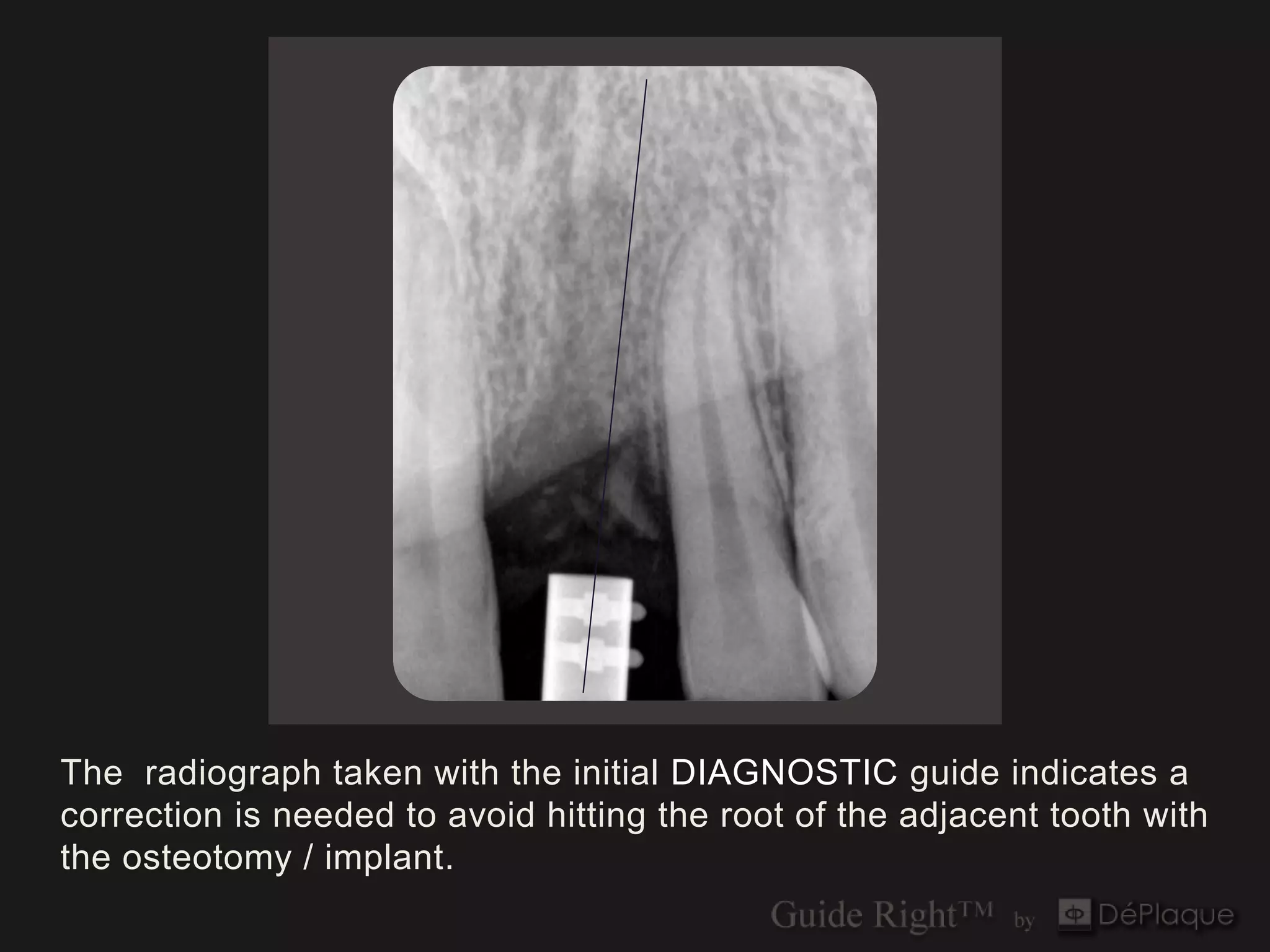
The radiograph taken with the initial DIAGNOSTIC guide indicates a
correction is needed to avoid hitting the root of the adjacent tooth with
the osteotomy / implant.
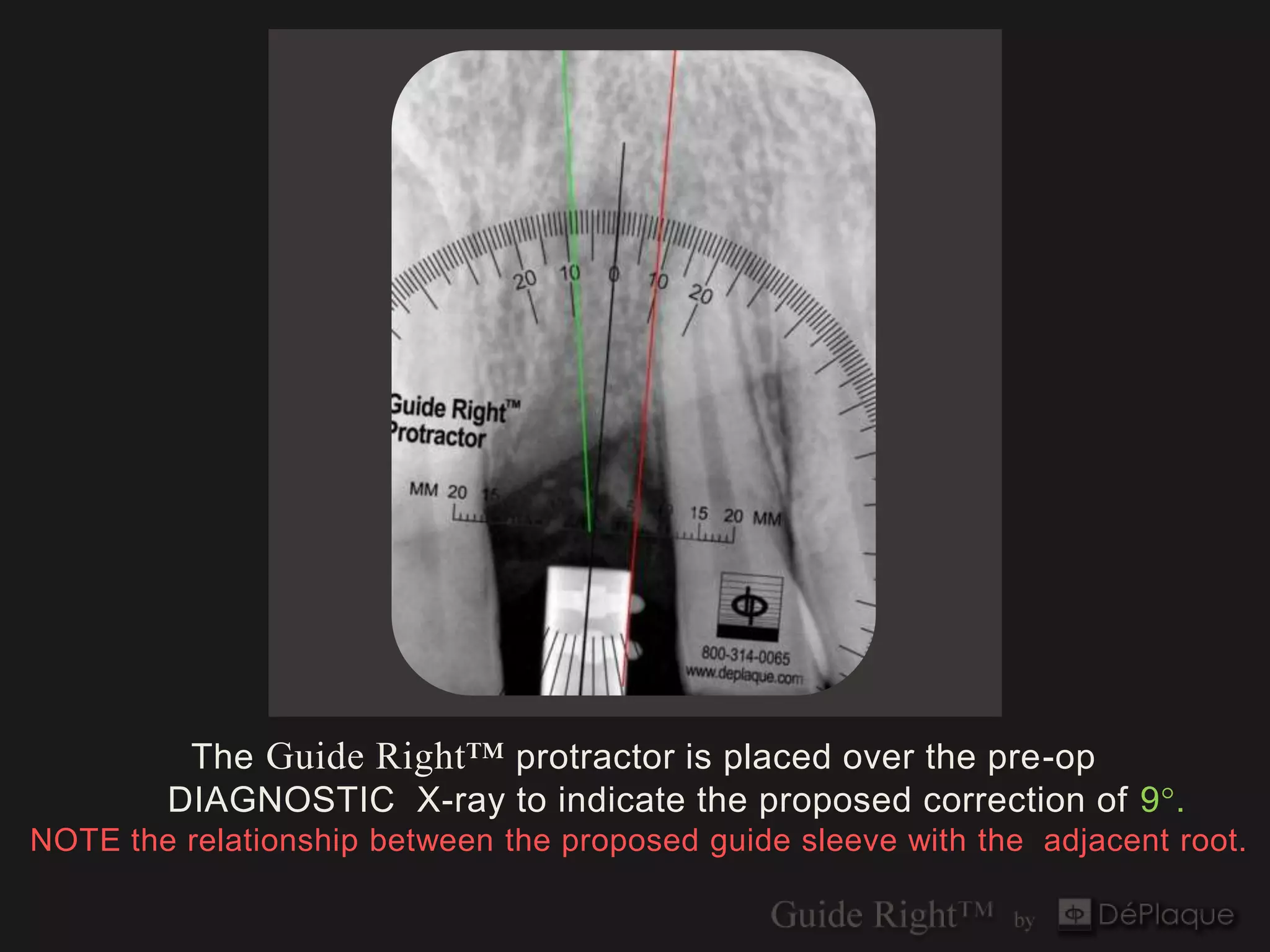
The Guide Right™ protractor is placed over the pre-op
        DIAGNOSTIC X-ray to indicate the proposed correction of 9°.
NOTE the relationship between the proposed guide sleeve with the adjacent root.
Guide Right™
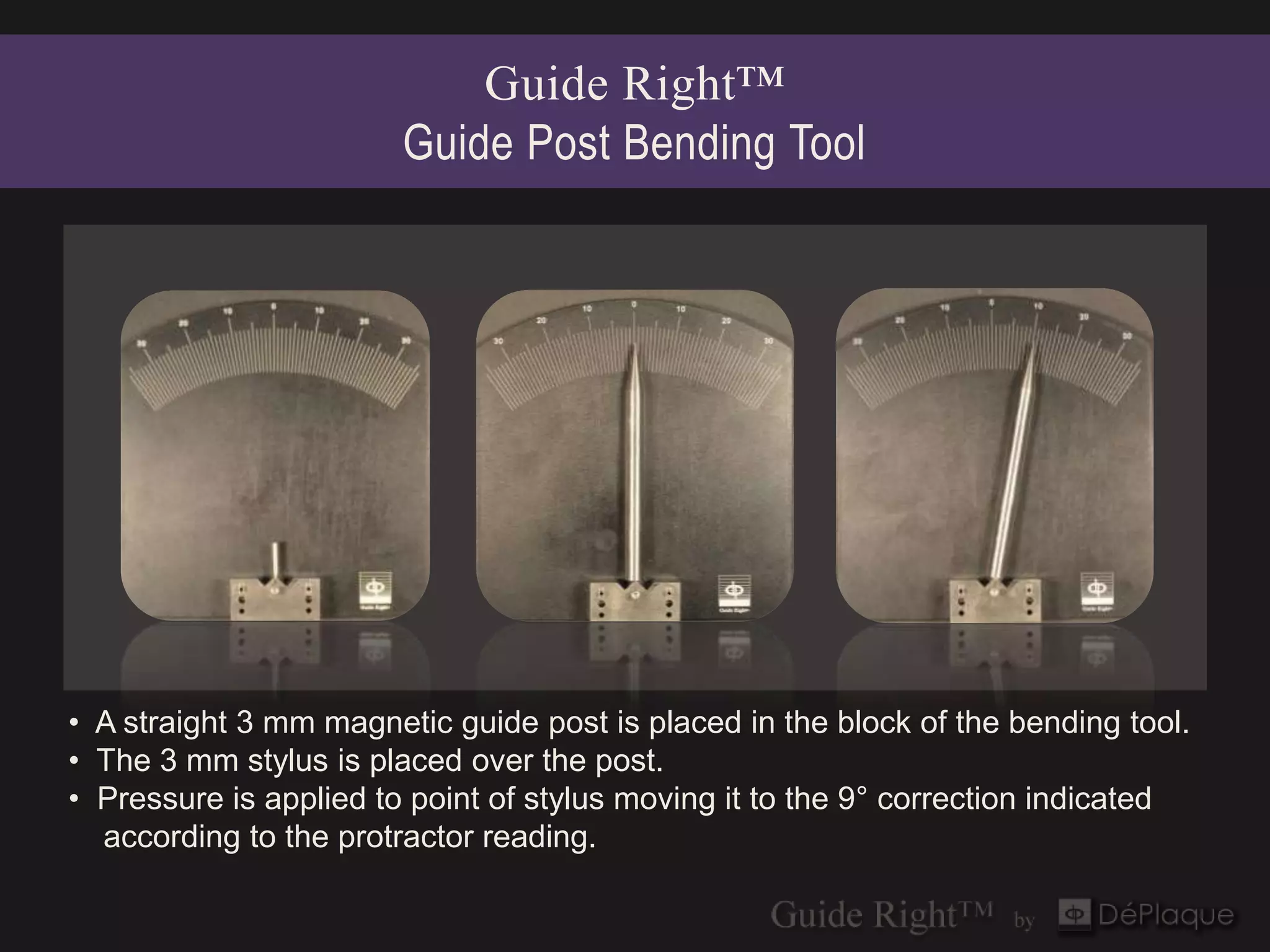
                        Guide Post Bending Tool


• A straight 3 mm magnetic guide post is placed in the block of the bending tool.
• The 3 mm stylus is placed over the post.
• Pressure is applied to point of stylus moving it to the 9° correction indicated
  according to the protractor reading.
Guide Right™
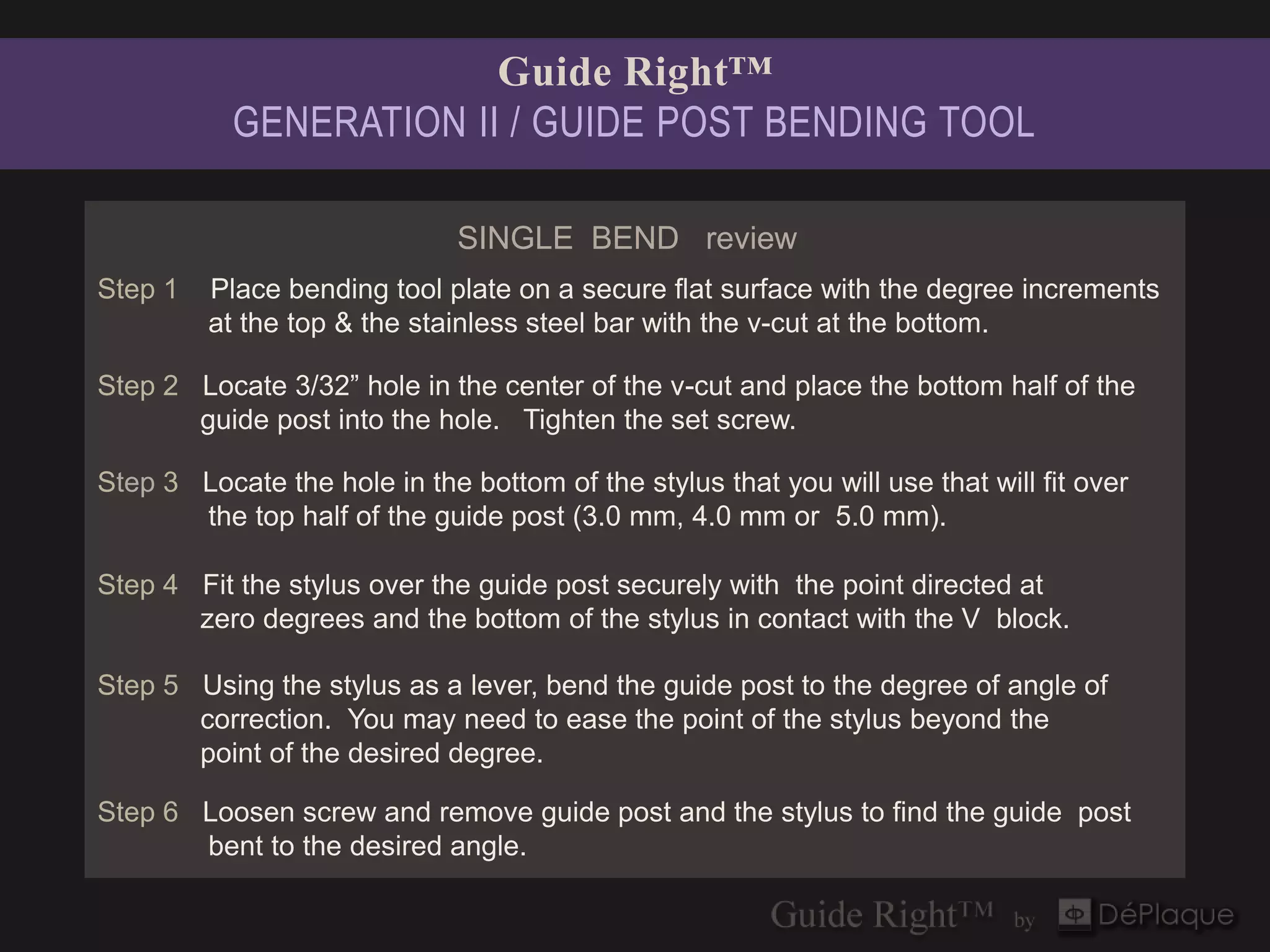
           GENERATION II / GUIDE POST BENDING TOOL

                              SINGLE BEND review
Step 1   Place bending tool plate on a secure flat surface with the degree increments
         at the top & the stainless steel bar with the v-cut at the bottom.

Step 2 Locate 3/32” hole in the center of the v-cut and place the bottom half of the
       guide post into the hole. Tighten the set screw.

Step 3 Locate the hole in the bottom of the stylus that you will use that will fit over
       the top half of the guide post (3.0 mm, 4.0 mm or 5.0 mm).

Step 4 Fit the stylus over the guide post securely with the point directed at
       zero degrees and the bottom of the stylus in contact with the V block.

Step 5 Using the stylus as a lever, bend the guide post to the degree of angle of
       correction. You may need to ease the point of the stylus beyond the
       point of the desired degree.

Step 6 Loosen screw and remove guide post and the stylus to find the guide post
       bent to the desired angle.
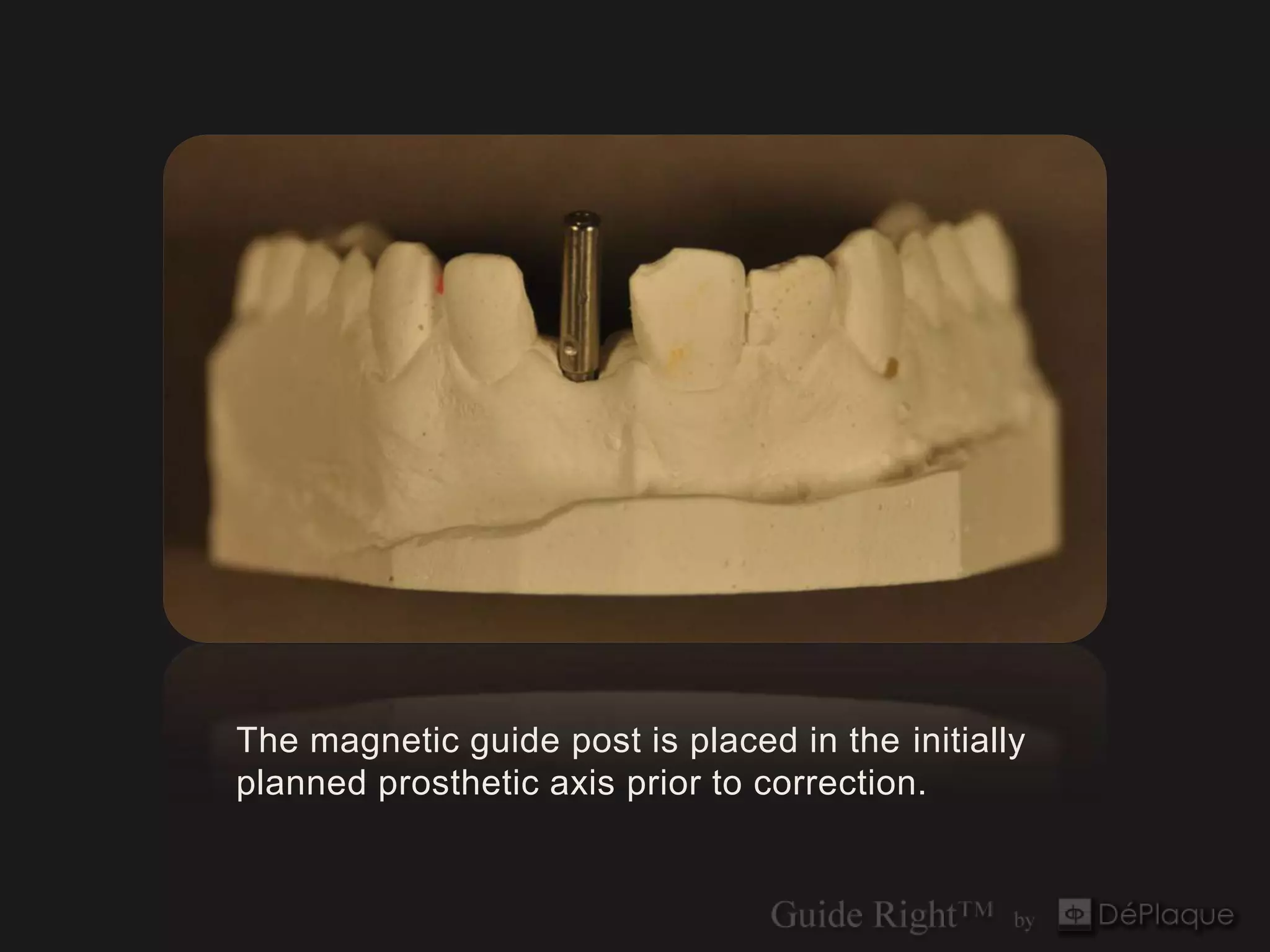
The magnetic guide post is placed in the initially
planned prosthetic axis prior to correction.
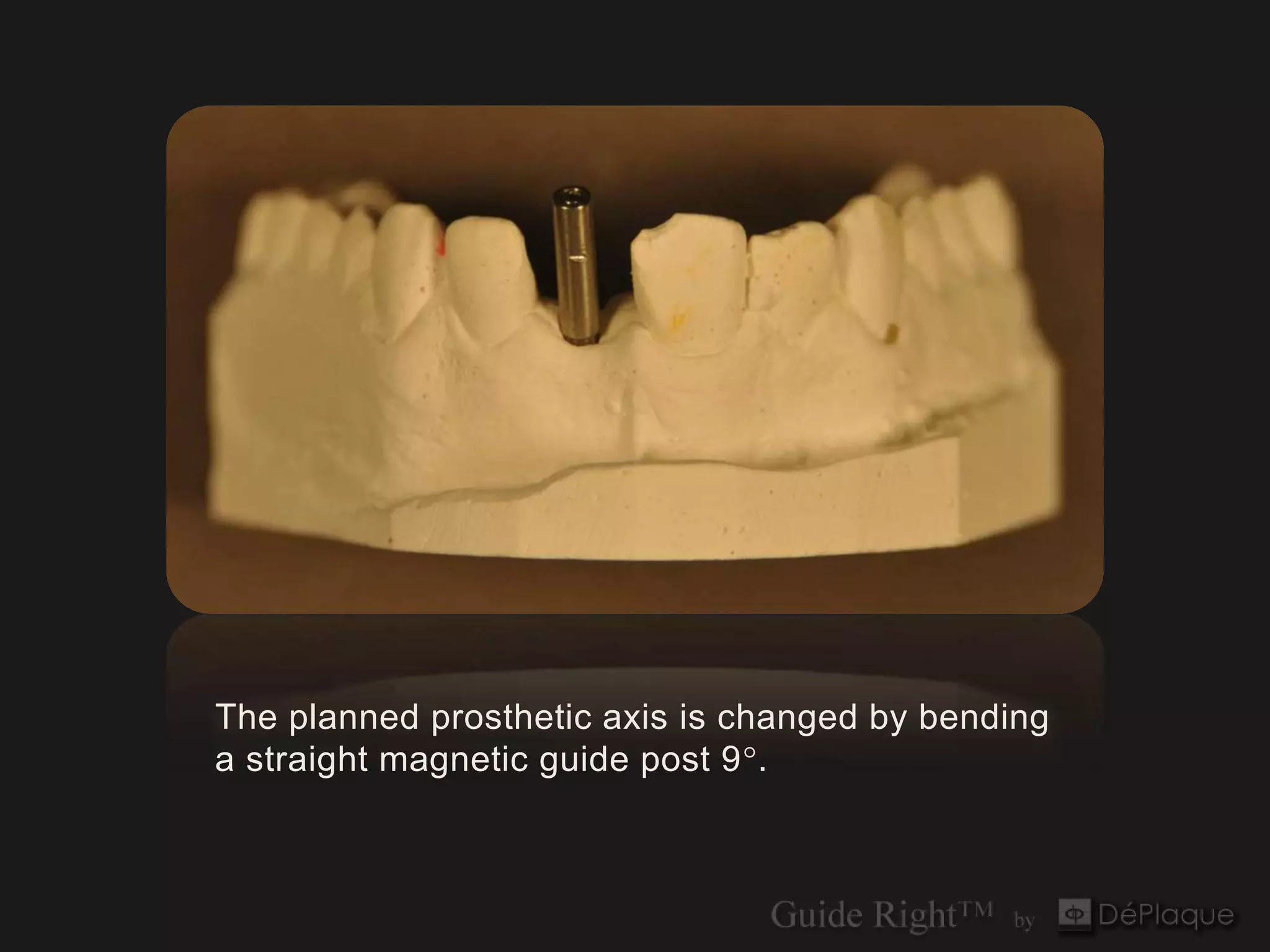
The planned prosthetic axis is changed by bending
a straight magnetic guide post 9°.
Fabrication of SURGICAL Guide
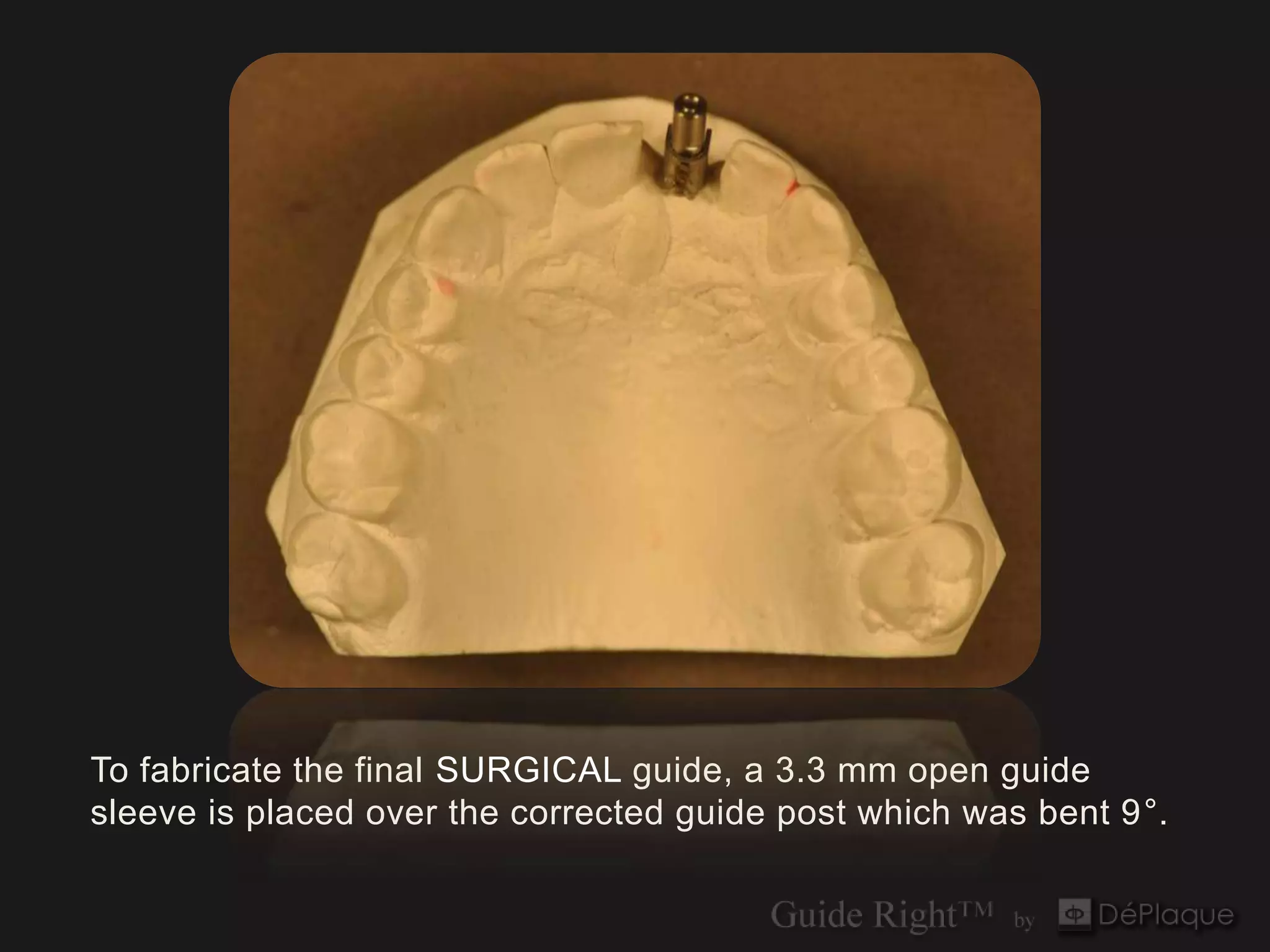
To fabricate the final SURGICAL guide, a 3.3 mm open guide
sleeve is placed over the corrected guide post which was bent 9°.
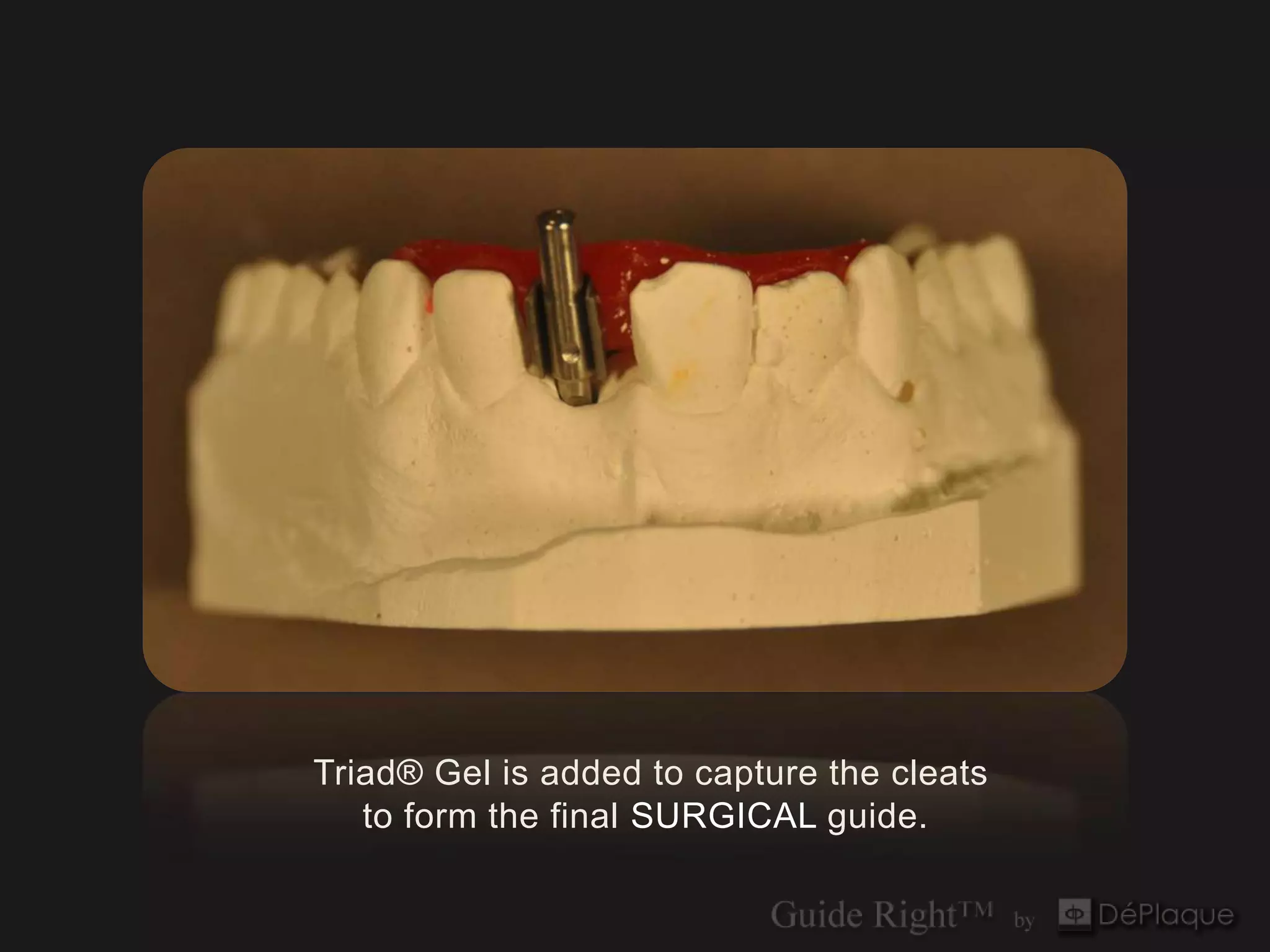
Triad® Gel is added to capture the cleats
   to form the final SURGICAL guide.
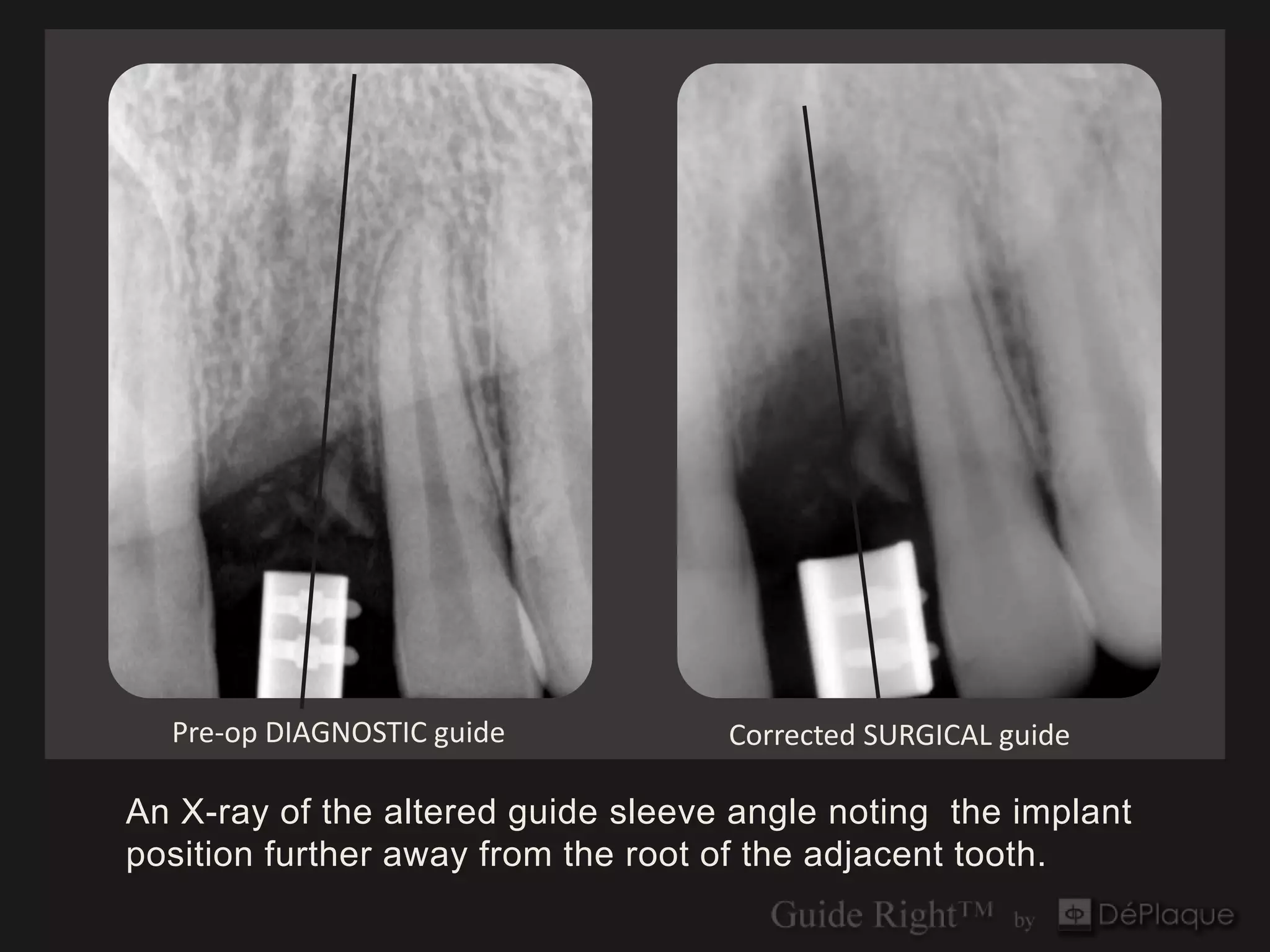
Pre-op DIAGNOSTIC guide           Corrected SURGICAL guide

An X-ray of the altered guide sleeve angle noting the implant
position further away from the root of the adjacent tooth.
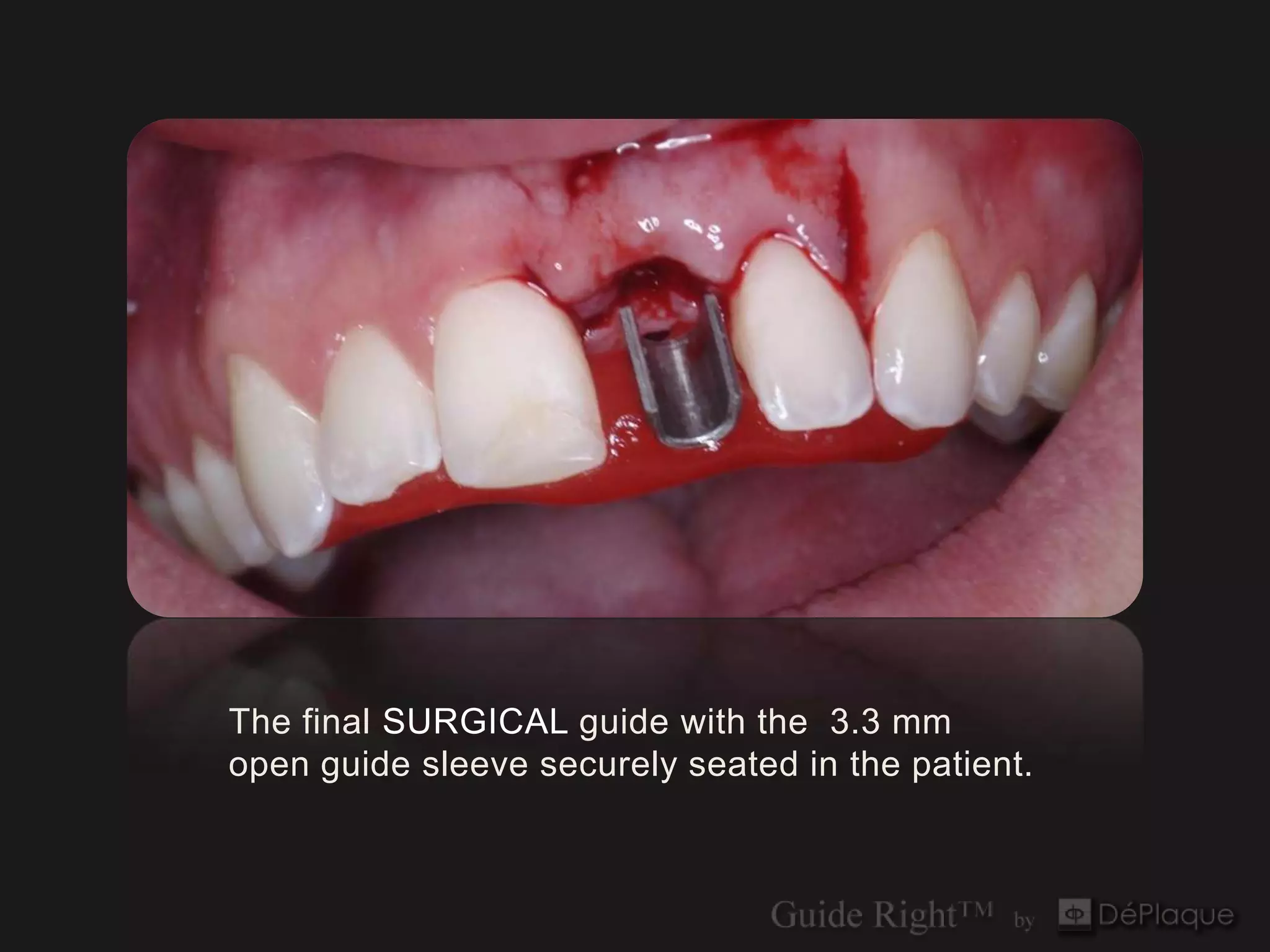
The final SURGICAL guide with the 3.3 mm
open guide sleeve securely seated in the patient.
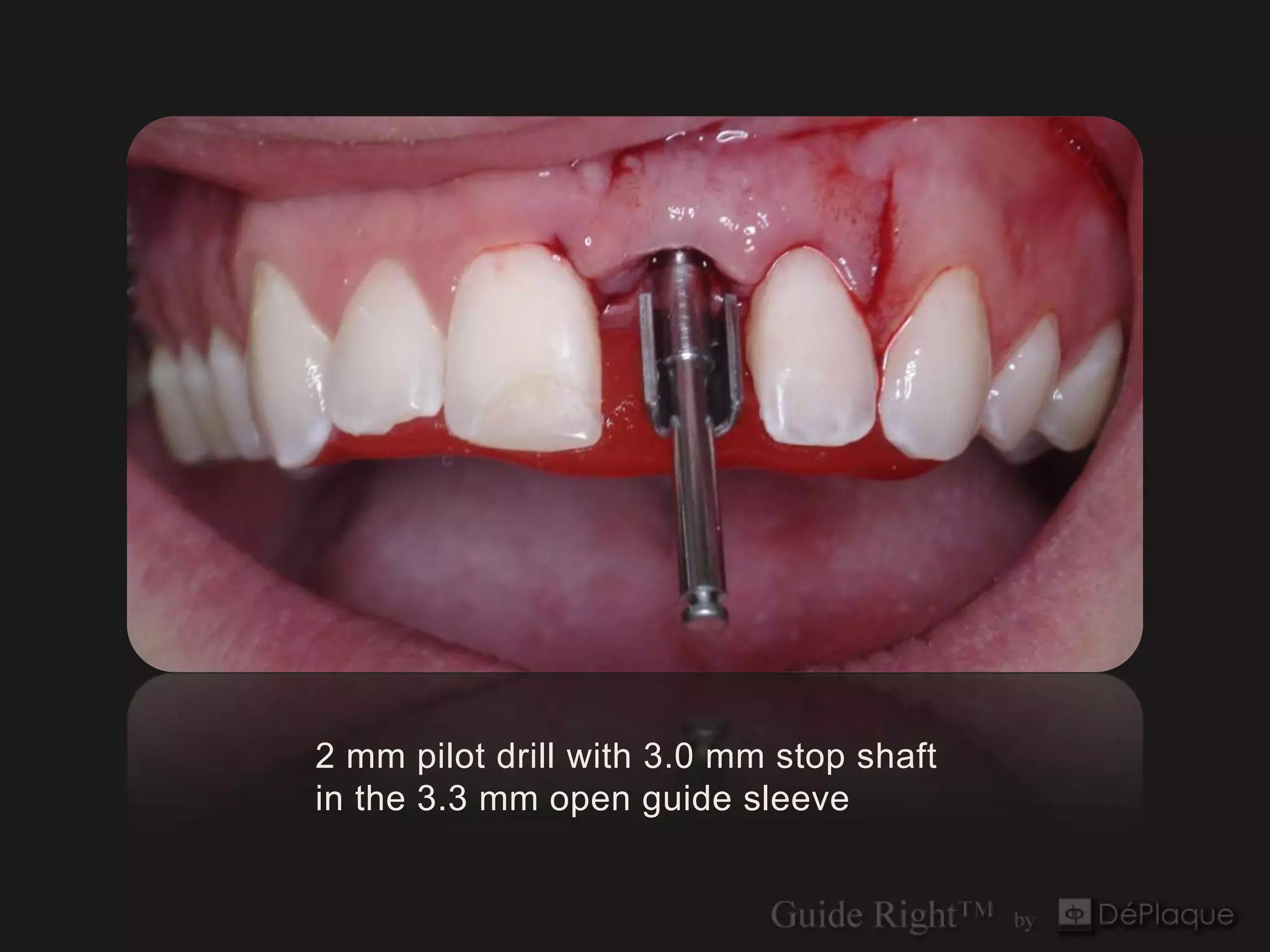
2 mm pilot drill with 3.0 mm stop shaft
in the 3.3 mm open guide sleeve
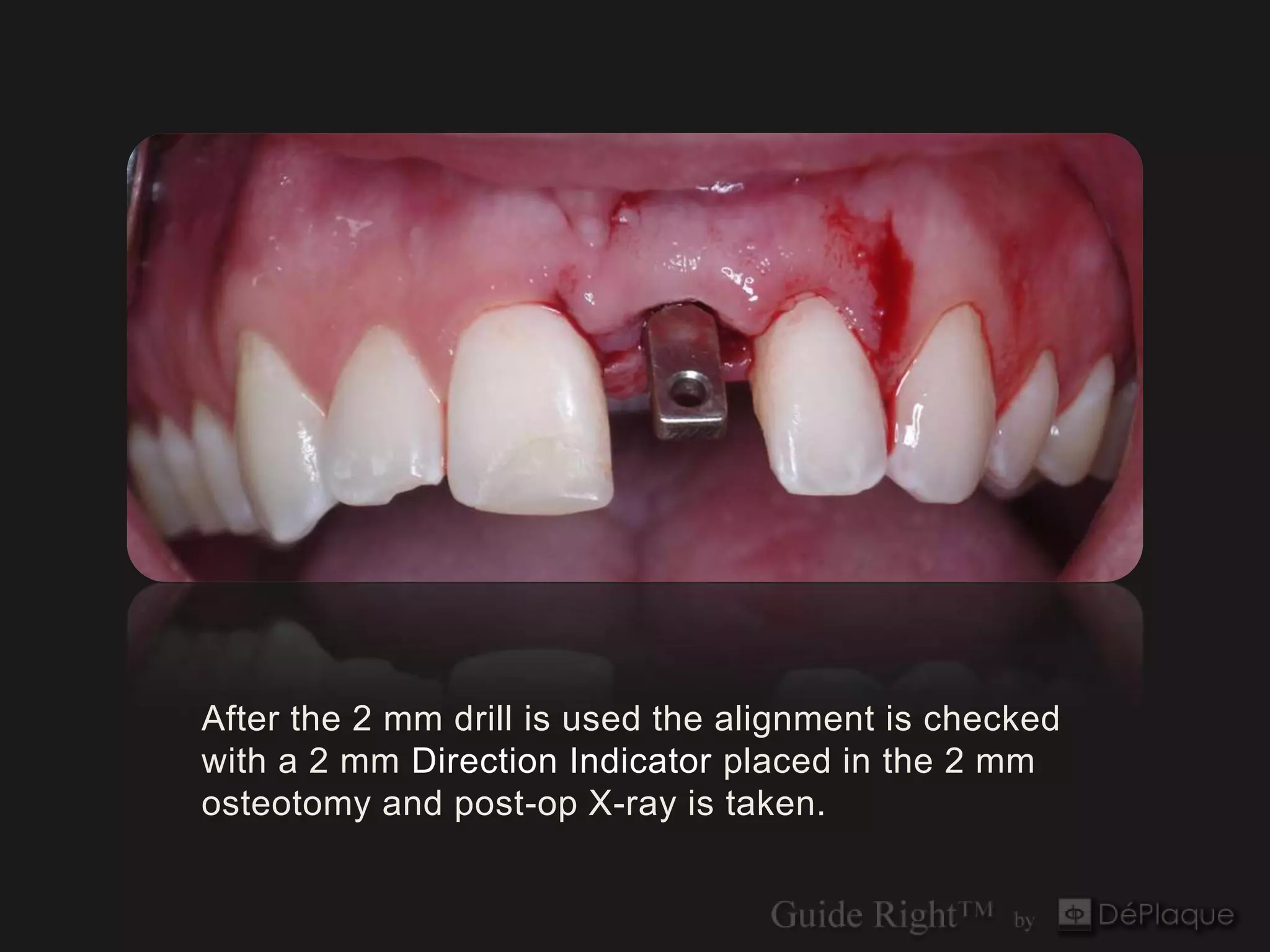
After the 2 mm drill is used the alignment is checked
with a 2 mm Direction Indicator placed in the 2 mm
osteotomy and post-op X-ray is taken.
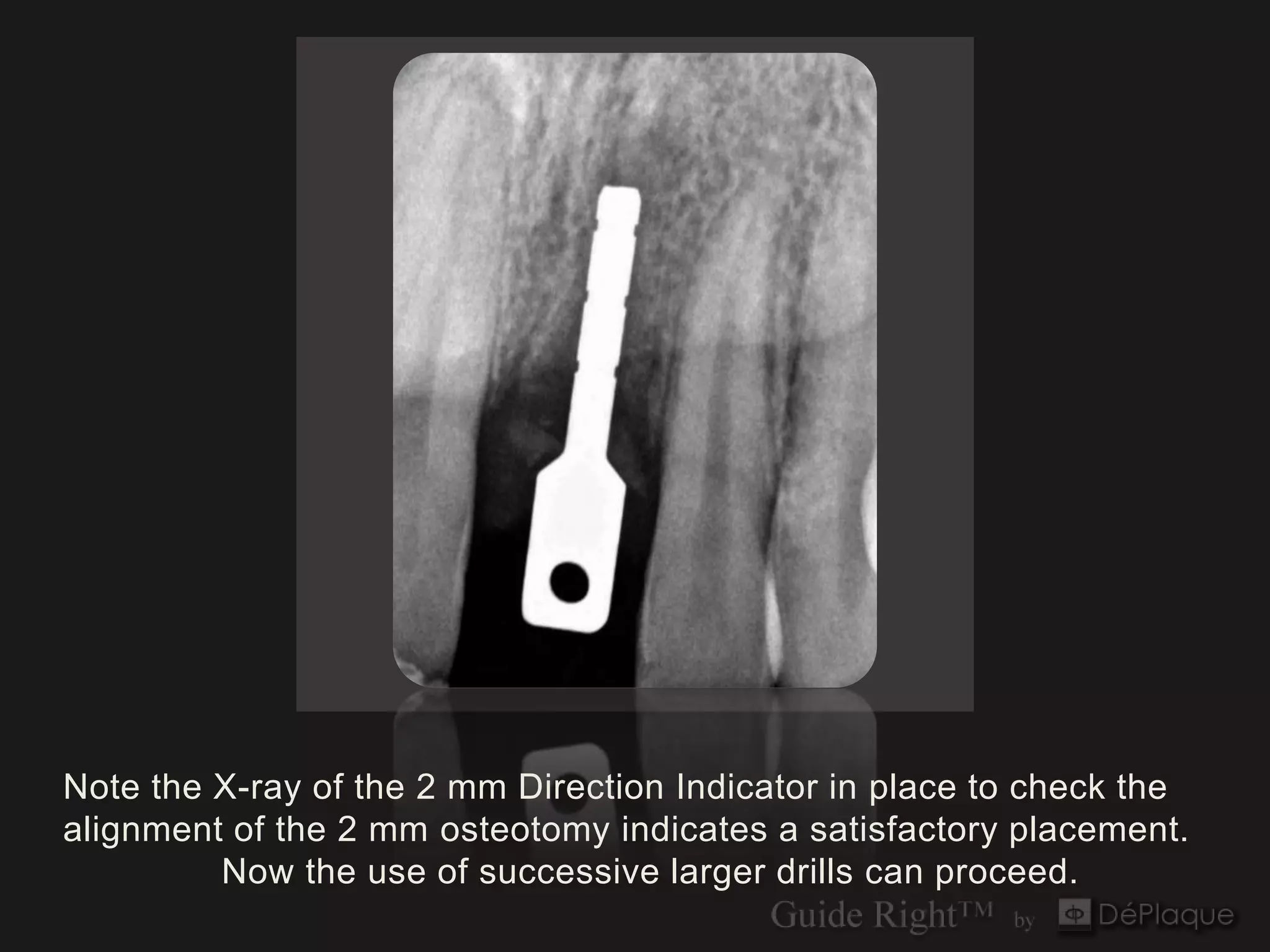
Note the X-ray of the 2 mm Direction Indicator in place to check the
alignment of the 2 mm osteotomy indicates a satisfactory placement.
         Now the use of successive larger drills can proceed.
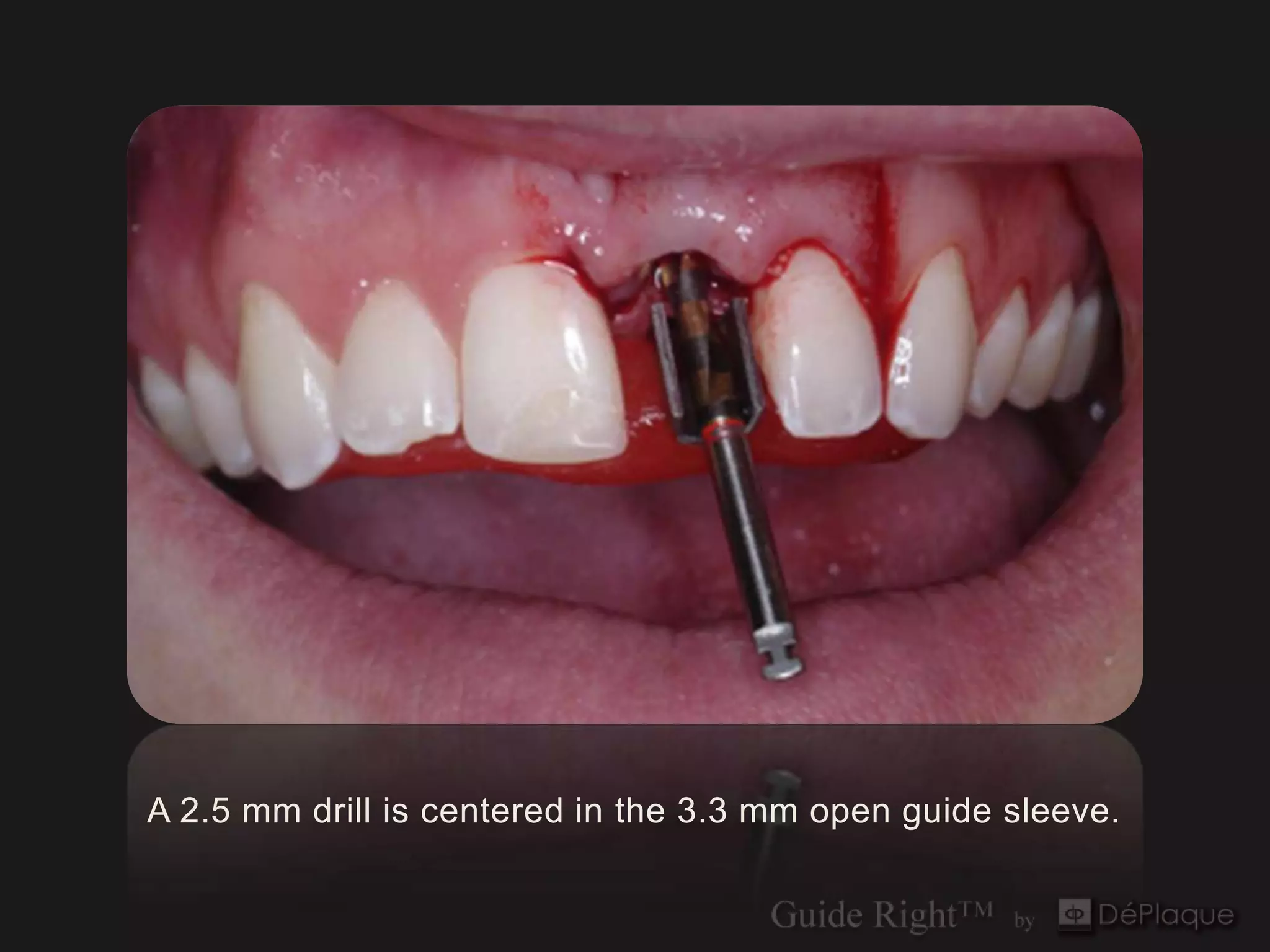
A 2.5 mm drill is centered in the 3.3 mm open guide sleeve.
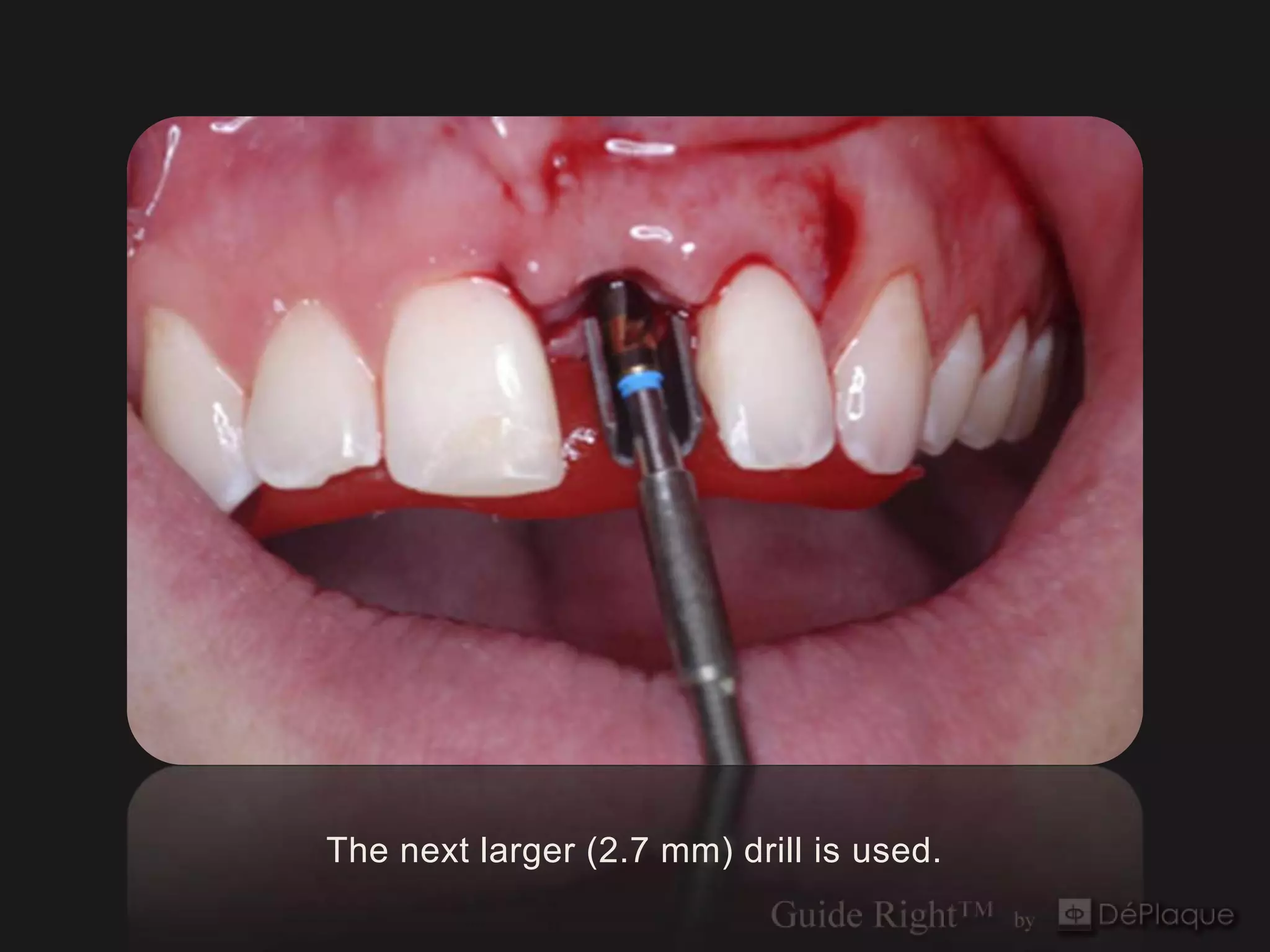
The next larger (2.7 mm) drill is used.
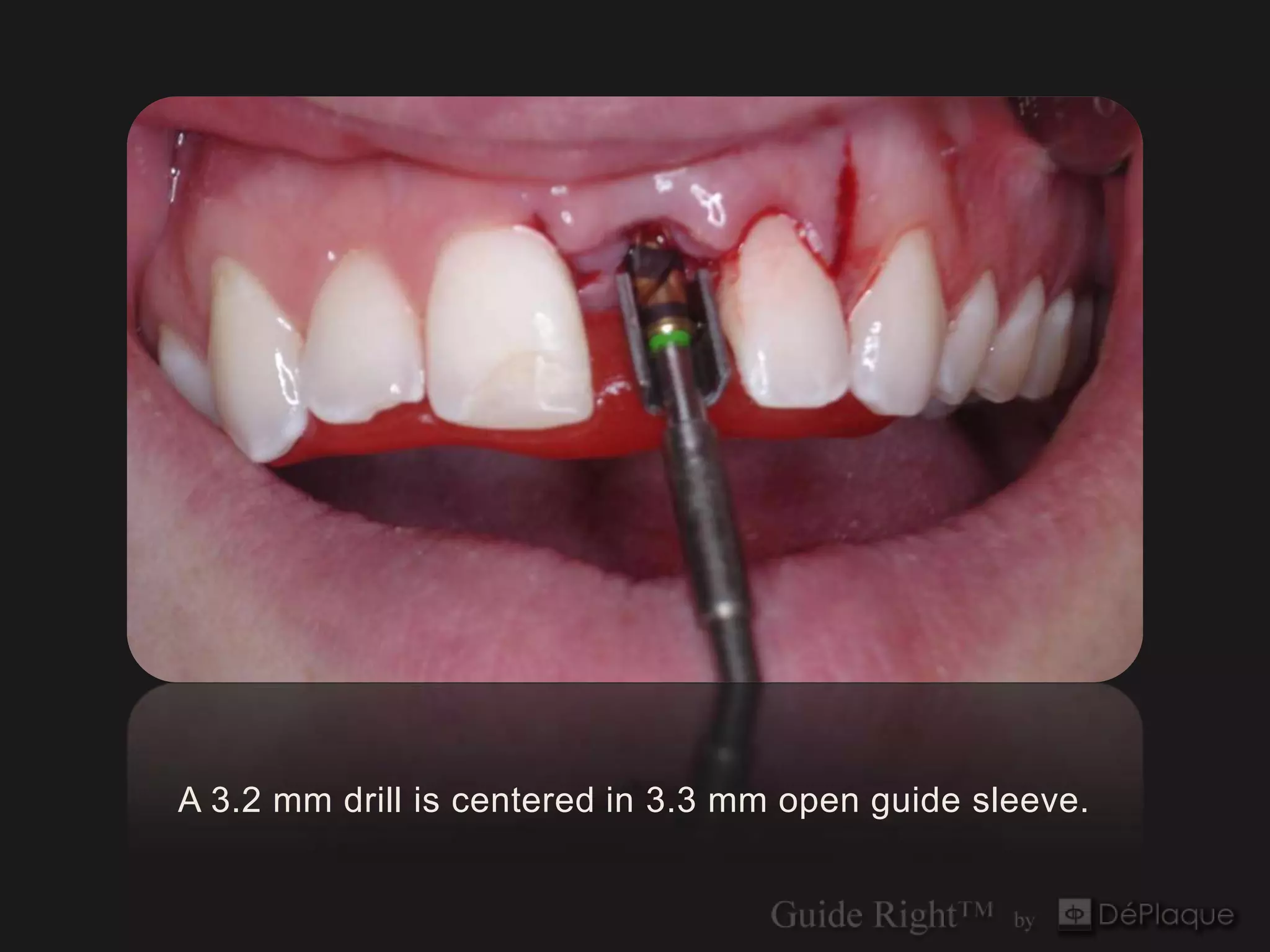
A 3.2 mm drill is centered in 3.3 mm open guide sleeve.
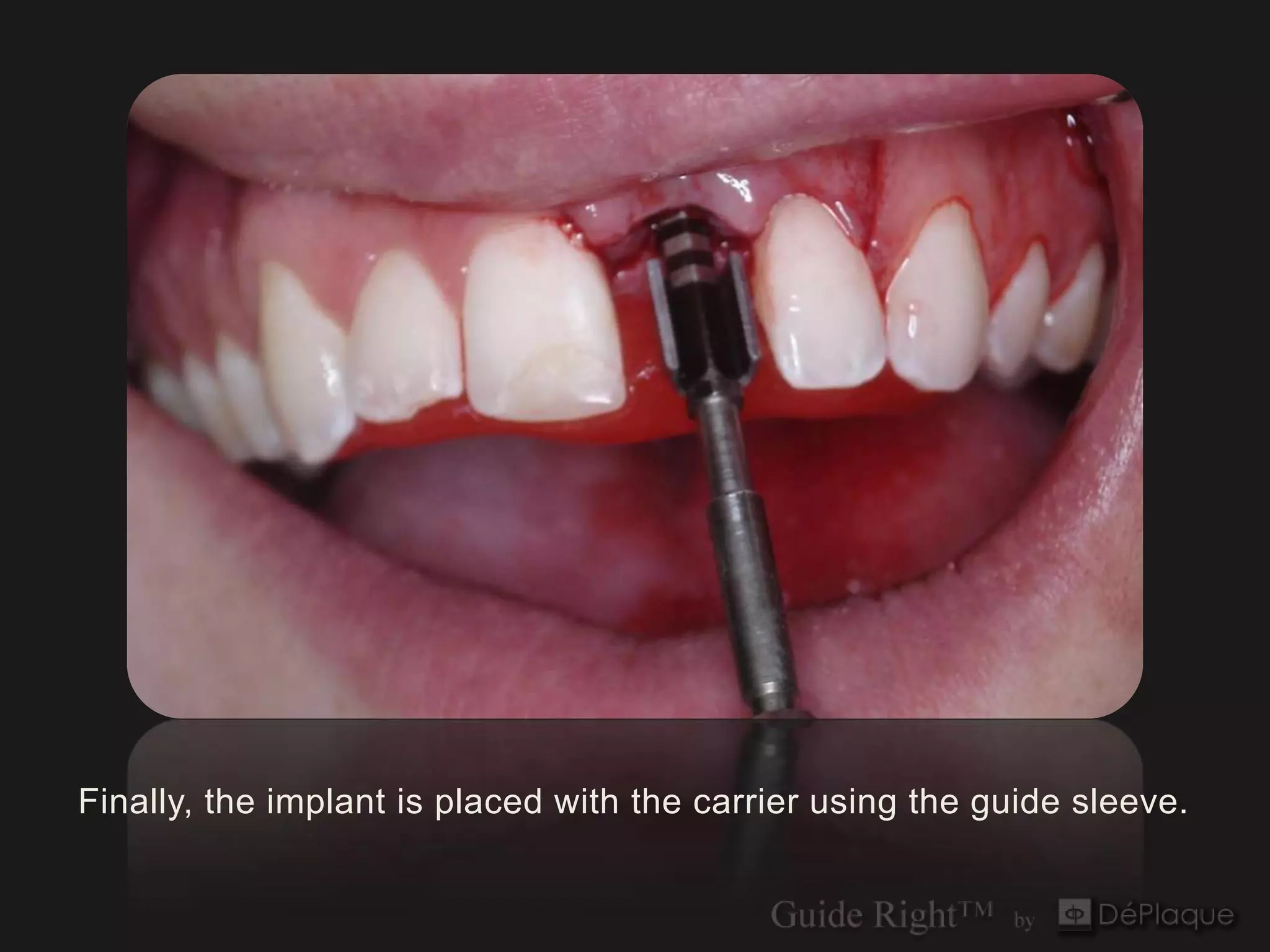
Finally, the implant is placed with the carrier using the guide sleeve.
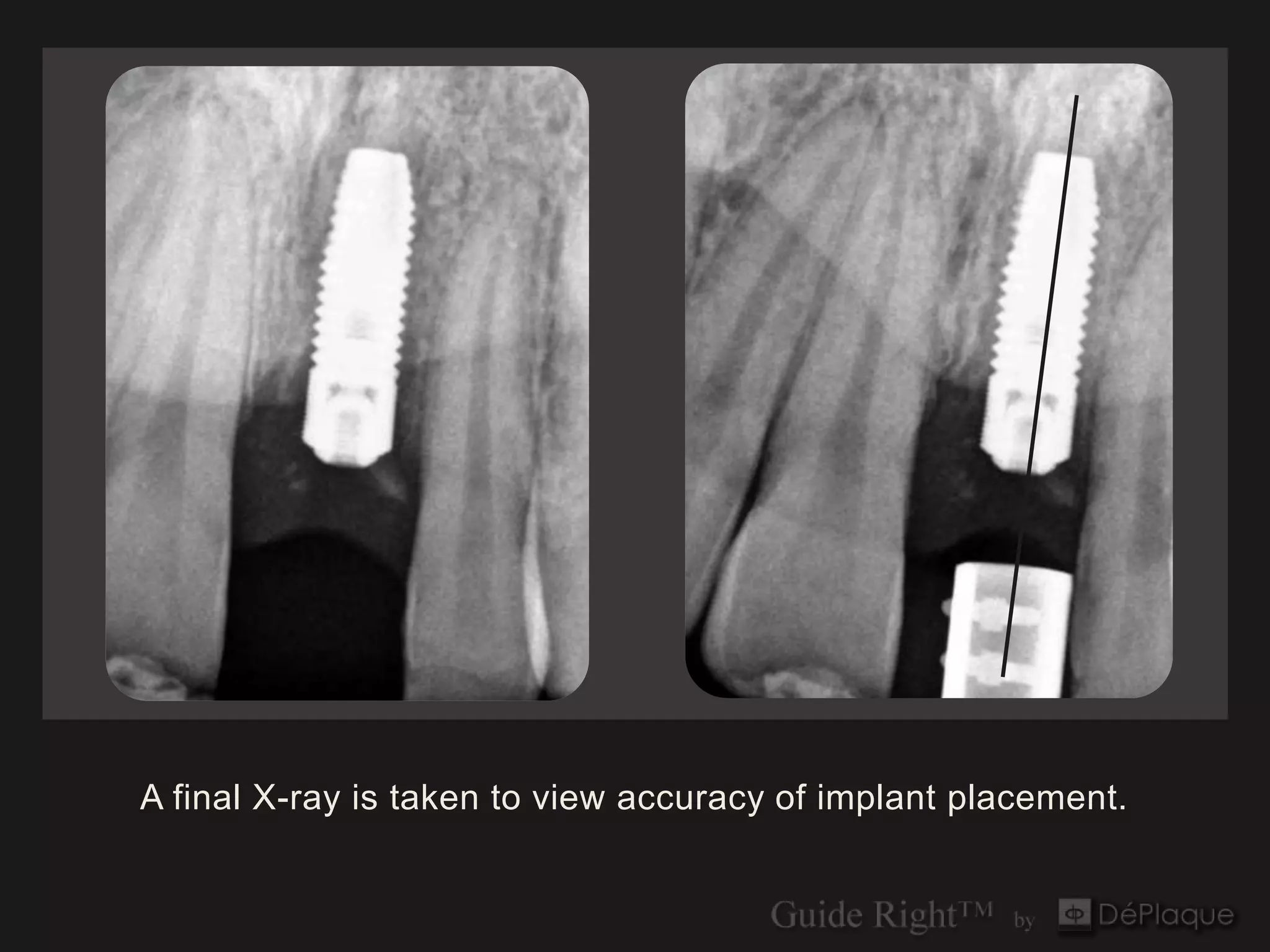
A final X-ray is taken to view accuracy of implant placement.
Products used in this presentation

 (1) 3/32” drill
 (1) 2 mm pilot drill with / 8.5 long / 3 mm stop
 (1) 3 mm Straight Stainless Guide Post
 (1) 3 mm Cylindrical Guide Sleeve
 (1) 3.3 mm Open Guide Sleeve
 (1) 3 mm Magnetic Guide Post
 (1) Generation ll / Guide Post Bending Tool & 3 mm Stylus
 (1) Direction Indicator
 Guide Right™ Protractor
 Triad® Gel


           1.800.314.0065 •     www.deplaque.com
Guide Right™
                 GENERATION II BENDING TOOL

                              SINGLE BEND review
Step 1   Place bending tool plate on a secure flat surface with the degree increments
         at the top & the stainless steel bar with the v-cut at the bottom.

Step 2 Locate 3/32” hole in the center of the v-cut and place the bottom half of the
       guide post into the hole. Tighten the set screw.

Step 3 Locate the hole in the bottom of the stylus that you will use that will fit over
       the top half of the guide post (3.0 mm, 4.0 mm or 5.0 mm).

Step 4 Fit the stylus over the guide post securely with the point directed at
       zero degrees and the bottom of the stylus in contact with the V block.

Step 5 Using the stylus as a lever, bend the guide post to the degree of angle of
       correction. You may need to ease the point of the stylus beyond the
       point of the desired degree.

Step 6 Loosen screw and remove guide post and the stylus to find the guide post
       bent to the desired angle.
Guide Right™
                 GENERATION II BENDING TOOL

                           COMPOUND BEND overview
Step 1   Position a straight or offset guide post in the bending plate, tightening the set
         screw against one of the flat surfaces on the lower half of the guide post.
Step 2   The 1st bend can be made to the right or left direction.
Step 3   The set screw is loosened and the guide post is rotated 90 ° next flat surface.
Step 4   The 2nd bend in the second plane is made after rotating the guide post up away
         from the surface of the bending plate to register the stylus point back at 0 degrees.
Step 5 Slide the stylus support bar down under the stylus until it supports the stylus.
       Tighten the side screws before making the second bend.

Step 6   The second bend can be made in either direction according to the x-ray.

Step 7 Remove the stylus and place the guide post back in the cast with the
       appropriate side indicated by a mark facing the buccal or lingual surface.

                            Be sure the post is in the correct position.
   If the post needs to be corrected by a linear movement an offset guide post can be used.
               Off sets available in the 3 mm guide post: 0.5,1,1.5, 2.0 ,or 3.0 mm.
Guide Right™     Surgical Guide System


   Start With Precision. Place With Confidence.

       1.800.314.0065 •   www.deplaque.com

1 introduction to guide right compnents single implant

  • 1.
    Guide Right™ SurgicalGuide System INTRODUCTION  use of Guide Right™ COMPONENTS  use with a SINGLE IMPLANT CASE  verification with PA X-ray includes: mesio-distal correction only (not bucco-lingual) 2.3013
  • 2.
    Challenges with Current3D Surgical Guides  Most require off-site fabrication  Costly and time delay, several days to two weeks  May result in difficulty fitting the patient when placed at the time of surgery  May require a 2nd cone beam X-ray of cast
  • 3.
    Best Practices forImplant Success  Implants should be placed within the envelope of available bone to increase clinical success.  Pre-surgical radiographs facilitate evaluation of the proposed angle of the long axis of the guide sleeve and proposed implant placement.  3D Radiographs allow us to determine if planned implant placement conflicts with the adjacent roots, the maxillary sinuses, nerves, and if it is within the envelope of available bone.
  • 4.
    A System ofComponents for the fabrication and correction of diagnostic & surgical guides in one or two dimensions  In-office or lab fabrication  Evaluate with 2D & 3D imaging  Allows linear and angular correction  Enables precision implant placement  Cost effective
  • 5.
    DéPlaque Guide Right™ Surgical Guide System Comparison with ▪ without guide used in implant placement planning implant placed WITHOUT a guide implant placed WITH a guide #19 #30 #29 #21 Start With Precision. Place With Confidence.™ WEB
  • 6.
    Basic Fabrication &Correction of DIAGNOSTIC and SURGICAL Guides Featuring GUIDE RIGHT COMPONENTS standard & magnetic guide posts cylindrical & open guide sleeves GUIDE POST BENDING TOOL angular correction linear correction PERIAPICAL X-RAYS FABRICATION OF DIAGNOSTIC guide SURGICAL guide
  • 7.
    Guide Right™ COMPONENTS used in Fabrication of DIAGNOSTIC & SURGICAL Guides  Guide Posts: standard · magnetic offset  Guide Sleeves: cylindrical · open  Drills  Pin-vice  Guide Post Bending Tool
  • 8.
    Standard Guide Posts Short Guide Post 18 mm x 9 mm x 3/32 in. Straight Guide Post 30 mm x 2.9 mm x 3/32 in.
  • 9.
    Magnetic Guide Posts Straight  3.0 mm od Offset  3.0 od X 0.5 mm os  3.0 od X 1.0 mm os  3.0 od X 1.5 mm os  3.0 od X 2.0 mm os  3.0od X 2.5 mm os  3.0 od X 3.0 mm os
  • 10.
    Cylindrical Guide Sleeves Anterior Straight Cut 3.0 mm x 10 mm Posterior Angle Cut 3.0 mm x 10 mm Large Diameter 4.5 mm id x 5.0 mm Large Diameter 5.3 mm id x 5.0 mm
  • 11.
    Magnetic Guide Post& Open Guide Sleeve Set  4.0 mm Open Guide Sleeve (short)  4.0 mm x 10 Magnetic Guide Posts  4.0 mm x 1 mm Offset Magnetic Guide Post  2.0 mm x 5.0 mm Pilot Drill  2.0 mm x 10.0 mm Pilot Drill
  • 12.
    Magnetic Guide Post& Open Guide Sleeve Set  3.0 mm Open Guide Sleeve  3.3 mm Open Guide Sleeve  3.7 mm Open Guide Sleeve  4.0 mm Open Guide Sleeve  3.0 mm Straight Magnetic Guide Posts  3.0 mm Offset Magnetic Guide Post  2.0 mm Pilot Drills (to start the osteotomy)  Other Drill Sizes Available on Request
  • 13.
    Drills used with straighthand piece 5/64” drill 3/32”
  • 14.
    Pin vice may beused for more accurate placement
  • 15.
    Magnetic Offset Guide Post 3.0 X 0.5 offset
  • 16.
    Magnetic Offset Guide Post 3.0 X 1.0 offset
  • 17.
    Magnetic Offset Guide Post 3.0 X 1.5 offset
  • 18.
    Magnetic Offset Guide Post 3.0 X 2.0 offset
  • 19.
    Magnetic Offset Guide Post 3.0 X 2.5 offset
  • 20.
    Magnetic Offset Guide Post 3.0 X 3.0 offset
  • 21.
    Single Bend corrections in one plane Guide Right™ Generation ll / Guide Post Bending Tool
  • 22.
    Guide Right™ Single Implant Case  single bend  use of protractor  use of bending tool ALB 2.2013
  • 23.
  • 24.
    A pencil linecan be drawn on the cast to indicate a proposed osteotomy location. A hole is drilled through the planned long axis into the cast with a 3/32” drill.
  • 25.
    The drill isremoved from 3/32” hole, the cast is lubricated with petroleum jelly for easy removal and, if necessary, undercuts are blocked out.
  • 26.
    A 3 mmguide post is placed in the hole
  • 27.
    A 3 mmguide sleeve is placed on the post and Triad® Gel is added to capture the cleats on the sleeve and to lingual & incisal surfaces of several of the adjacent teeth. After curing the DIAGNOSTIC guide & securely seating it in the patient and X-ray is taken .
  • 28.
    The radiograph takenwith the initial DIAGNOSTIC guide indicates a correction is needed to avoid hitting the root of the adjacent tooth with the osteotomy / implant.
  • 29.
    The Guide Right™protractor is placed over the pre-op DIAGNOSTIC X-ray to indicate the proposed correction of 9°. NOTE the relationship between the proposed guide sleeve with the adjacent root.
  • 30.
    Guide Right™ Guide Post Bending Tool • A straight 3 mm magnetic guide post is placed in the block of the bending tool. • The 3 mm stylus is placed over the post. • Pressure is applied to point of stylus moving it to the 9° correction indicated according to the protractor reading.
  • 31.
    Guide Right™ GENERATION II / GUIDE POST BENDING TOOL SINGLE BEND review Step 1 Place bending tool plate on a secure flat surface with the degree increments at the top & the stainless steel bar with the v-cut at the bottom. Step 2 Locate 3/32” hole in the center of the v-cut and place the bottom half of the guide post into the hole. Tighten the set screw. Step 3 Locate the hole in the bottom of the stylus that you will use that will fit over the top half of the guide post (3.0 mm, 4.0 mm or 5.0 mm). Step 4 Fit the stylus over the guide post securely with the point directed at zero degrees and the bottom of the stylus in contact with the V block. Step 5 Using the stylus as a lever, bend the guide post to the degree of angle of correction. You may need to ease the point of the stylus beyond the point of the desired degree. Step 6 Loosen screw and remove guide post and the stylus to find the guide post bent to the desired angle.
  • 32.
    The magnetic guidepost is placed in the initially planned prosthetic axis prior to correction.
  • 33.
    The planned prostheticaxis is changed by bending a straight magnetic guide post 9°.
  • 34.
  • 35.
    To fabricate thefinal SURGICAL guide, a 3.3 mm open guide sleeve is placed over the corrected guide post which was bent 9°.
  • 36.
    Triad® Gel isadded to capture the cleats to form the final SURGICAL guide.
  • 37.
    Pre-op DIAGNOSTIC guide Corrected SURGICAL guide An X-ray of the altered guide sleeve angle noting the implant position further away from the root of the adjacent tooth.
  • 38.
    The final SURGICALguide with the 3.3 mm open guide sleeve securely seated in the patient.
  • 39.
    2 mm pilotdrill with 3.0 mm stop shaft in the 3.3 mm open guide sleeve
  • 40.
    After the 2mm drill is used the alignment is checked with a 2 mm Direction Indicator placed in the 2 mm osteotomy and post-op X-ray is taken.
  • 41.
    Note the X-rayof the 2 mm Direction Indicator in place to check the alignment of the 2 mm osteotomy indicates a satisfactory placement. Now the use of successive larger drills can proceed.
  • 42.
    A 2.5 mmdrill is centered in the 3.3 mm open guide sleeve.
  • 43.
    The next larger(2.7 mm) drill is used.
  • 44.
    A 3.2 mmdrill is centered in 3.3 mm open guide sleeve.
  • 45.
    Finally, the implantis placed with the carrier using the guide sleeve.
  • 46.
    A final X-rayis taken to view accuracy of implant placement.
  • 47.
    Products used inthis presentation  (1) 3/32” drill  (1) 2 mm pilot drill with / 8.5 long / 3 mm stop  (1) 3 mm Straight Stainless Guide Post  (1) 3 mm Cylindrical Guide Sleeve  (1) 3.3 mm Open Guide Sleeve  (1) 3 mm Magnetic Guide Post  (1) Generation ll / Guide Post Bending Tool & 3 mm Stylus  (1) Direction Indicator  Guide Right™ Protractor  Triad® Gel 1.800.314.0065 • www.deplaque.com
  • 48.
    Guide Right™ GENERATION II BENDING TOOL SINGLE BEND review Step 1 Place bending tool plate on a secure flat surface with the degree increments at the top & the stainless steel bar with the v-cut at the bottom. Step 2 Locate 3/32” hole in the center of the v-cut and place the bottom half of the guide post into the hole. Tighten the set screw. Step 3 Locate the hole in the bottom of the stylus that you will use that will fit over the top half of the guide post (3.0 mm, 4.0 mm or 5.0 mm). Step 4 Fit the stylus over the guide post securely with the point directed at zero degrees and the bottom of the stylus in contact with the V block. Step 5 Using the stylus as a lever, bend the guide post to the degree of angle of correction. You may need to ease the point of the stylus beyond the point of the desired degree. Step 6 Loosen screw and remove guide post and the stylus to find the guide post bent to the desired angle.
  • 49.
    Guide Right™ GENERATION II BENDING TOOL COMPOUND BEND overview Step 1 Position a straight or offset guide post in the bending plate, tightening the set screw against one of the flat surfaces on the lower half of the guide post. Step 2 The 1st bend can be made to the right or left direction. Step 3 The set screw is loosened and the guide post is rotated 90 ° next flat surface. Step 4 The 2nd bend in the second plane is made after rotating the guide post up away from the surface of the bending plate to register the stylus point back at 0 degrees. Step 5 Slide the stylus support bar down under the stylus until it supports the stylus. Tighten the side screws before making the second bend. Step 6 The second bend can be made in either direction according to the x-ray. Step 7 Remove the stylus and place the guide post back in the cast with the appropriate side indicated by a mark facing the buccal or lingual surface. Be sure the post is in the correct position. If the post needs to be corrected by a linear movement an offset guide post can be used. Off sets available in the 3 mm guide post: 0.5,1,1.5, 2.0 ,or 3.0 mm.
  • 50.
    Guide Right™ Surgical Guide System Start With Precision. Place With Confidence. 1.800.314.0065 • www.deplaque.com