Slides of my talk from the December 4, 2015 event "Wikipedia as the front matter to all research" https://meta.wikimedia.org/wiki/Wikipedia_as_the_front_matter_to_all_research
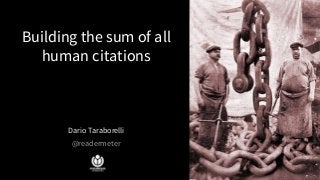
Building the sumof all
human citations
Dario Taraborelli
@readermeter
2.
How a collaborativelycreated, free online
encyclopedia can accelerate access to expert-
vetted knowledge.
3.
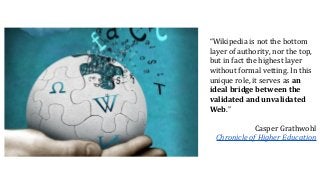
“Wikipedia is notthe bottom
layer of authority, nor the top,
but in fact the highest layer
without formal vetting. In this
unique role, it serves as an
ideal bridge between the
validated and unvalidated
Web.”
Casper Grathwohl
Chronicle of Higher Education
Linking is asmall act of generosity that sends people away from
your site to some other that you think shows the world in a way
worth considering. [...]
[Sources] that are not generous with linking [...] are a stopping
point in the ecology of information. That’s the operational
definition of authority: The last place you visit when you’re
looking for an answer. If you are satisfied with the answer, you
stop your pursuit of it. Take the links out and you think you look
like more of an authority.
D. Weinberger (2012) Linking is a public good
http://www.hyperorg.com/blogger/2012/02/26/2b2k-linking-is-a-public-good/
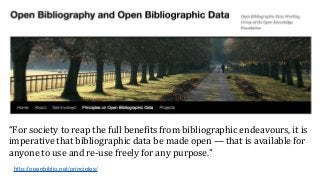
“For society toreap the full benefits from bibliographic endeavours, it is
imperative that bibliographic data be made open — that is available for
anyone to use and re-use freely for any purpose.”
http://openbiblio.net/principles/
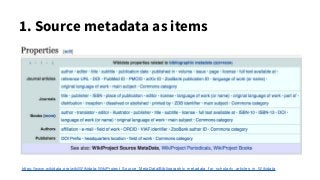
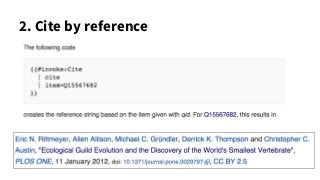
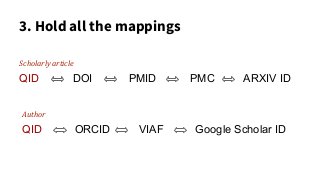
2. Cite byreference
The molecular origins of insulin go at least as far back as
the simplest unicellular [[eukaryotes]].<ref name='LeRoith'>
{{cite journal | vauthors = LeRoith D, Shiloach J, Heffron R,
Rubinovitz C, Tanenbaum R, Roth J | title = Insulin-related
material in microbes: similarities and differences from
mammalian insulins | journal = Can. J. Biochem. Cell Biol. |
volume = 63 | issue = 8 | pages = 839–49 | year = 1985 | pmid
= 3933801 | doi = 10.1139/o85-106 }}</ref> Apart from animals,
insulin-like proteins are also known to exist in Fungi and
Protista kingdoms.
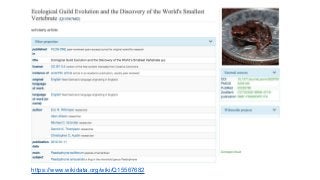
4. Link conceptsand sources
main subject Paedophryne swiftorum [Q2169503]
parent taxon Paedophryne [Q132975]
author Eric N. Rittmeyer [Q20745424]
affiliation Louisiana Museum of Natural History [Q15958804]
location Baton Rouge [Q28218]
Ecological guild evolution and the discovery of the world's smallest
vertebrate [Q15567682]
33.
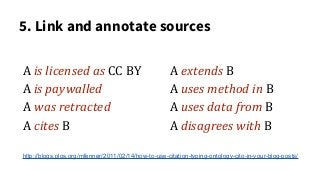
5. Link andannotate sources
A is licensed as CC BY
A is paywalled
A was retracted
A cites B
A extends B
A uses method in B
A uses data from B
A disagrees with B
http://blogs.plos.org/mfenner/2011/02/14/how-to-use-citation-typing-ontology-cito-in-your-blog-posts/
34.
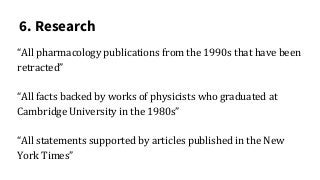
6. Research
“All pharmacologypublications from the 1990s that have been
retracted”
“All facts backed by works of physicists who graduated at
Cambridge University in the 1980s”
“All statements supported by articles published in the New
York Times”
35.
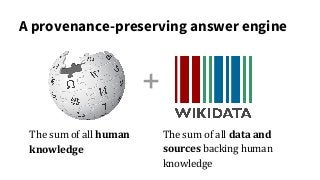
A provenance-preserving answerengine
The sum of all human
knowledge
The sum of all data and
sources backing human
knowledge
+
36.
What’s next
● Runa pilot to populate source metadata for a specific discipline
● Design strategies for automatically importing source metadata and cross-
linking the corresponding statements
● Refine the source data model, entity disambiguation
● Design a scalable human curation workflows to verify the quality of
source metadata and the relevance of their use.
Image credits
Anchor Men- Mauretania
https://www.flickr.com/photos/twm_news/5161439712
CC0
King Billy of Dalkey Island
https://www.flickr.com/photos/paulodonnell/5937678226
CC BY
Boston Daily Advertiser Almanac
https://commons.wikimedia.org/wiki/File:1875_BostonDailyAdvertiser_Almanac.jpg
CC0
Angora Ram
https://www.flickr.com/photos/roseannadana/3759787744
CC BY ND
screenshots included under fair use
![Linking is a small act of generosity that sends people away from
your site to some other that you think shows the world in a way
worth considering. [...]
[Sources] that are not generous with linking [...] are a stopping
point in the ecology of information. That’s the operational
definition of authority: The last place you visit when you’re
looking for an answer. If you are satisfied with the answer, you
stop your pursuit of it. Take the links out and you think you look
like more of an authority.
D. Weinberger (2012) Linking is a public good
http://www.hyperorg.com/blogger/2012/02/26/2b2k-linking-is-a-public-good/](https://image.slidesharecdn.com/thesumofallhumancitations-151204225022-lva1-app6892/85/Building-the-sum-of-all-human-citations-14-320.jpg?cb=1454894183)
![2. Cite by reference
The molecular origins of insulin go at least as far back as
the simplest unicellular [[eukaryotes]].<ref name='LeRoith'>
{{cite journal | vauthors = LeRoith D, Shiloach J, Heffron R,
Rubinovitz C, Tanenbaum R, Roth J | title = Insulin-related
material in microbes: similarities and differences from
mammalian insulins | journal = Can. J. Biochem. Cell Biol. |
volume = 63 | issue = 8 | pages = 839–49 | year = 1985 | pmid
= 3933801 | doi = 10.1139/o85-106 }}</ref> Apart from animals,
insulin-like proteins are also known to exist in Fungi and
Protista kingdoms.](https://image.slidesharecdn.com/thesumofallhumancitations-151204225022-lva1-app6892/85/Building-the-sum-of-all-human-citations-28-320.jpg?cb=1454894183)
![4. Link concepts and sources
main subject Paedophryne swiftorum [Q2169503]
parent taxon Paedophryne [Q132975]
author Eric N. Rittmeyer [Q20745424]
affiliation Louisiana Museum of Natural History [Q15958804]
location Baton Rouge [Q28218]
Ecological guild evolution and the discovery of the world's smallest
vertebrate [Q15567682]](https://image.slidesharecdn.com/thesumofallhumancitations-151204225022-lva1-app6892/85/Building-the-sum-of-all-human-citations-32-320.jpg?cb=1454894183)


![Number_Guessing_Game_Dsbsbssbzboc[1].pptx](https://cdn.slidesharecdn.com/ss_thumbnails/numberguessinggamedoc1-251206215042-a076fc05-thumbnail.jpg?width=640&height=640&fit=bounds)


