Webinar:
Language learning with flipped ELT
classrooms and mobile devices
Christine Bauer-Ramazani
Saint Michael's College, Colchester, Vermont
December 2, 2014
RESIDENTIAL SESSIONS 2014-02
Questions to the audience …
Web: PollEv.com/christinebau885
Christine Bauer-Ramazani 2
Webinar,UniversidaddelaSabana,Dec.2,2014:LanguagelearningwithflippedELTclassroomsandmobiledevices
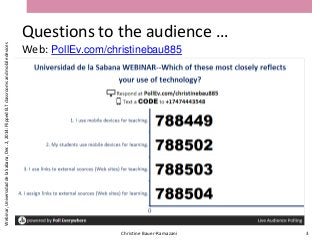
Questions to the audience …
Web: PollEv.com/christinebau885
Christine Bauer-Ramazani 3
Webinar,UniversidaddelaSabana,Dec.2,2014:FlippedELTclassroomsandmobiledevices
If you use any of these approaches to
technology, you are ready for the Flipped
Classroom and mobile learning.
Christine Bauer-Ramazani 4
Webinar,UniversidaddelaSabana,Dec.2,2014:LanguagelearningwithflippedELTclassroomsandmobiledevices
Learning Outcome
1. Definitions
• The Flipped Classroom (FC)
• Mobile Devices and BYOD (Bring your Own Device)
• Project-Based Learning (PBL)
2. Methodology: pedagogical and technological
framework
3. Sample project of language learning in a FC using BYOD
and Project-based Learning in ELT
4. Outcome of the project
5. Implications & challenges for the teacher and the
learners
6. Resources for further reading
7. Questions
Christine Bauer-Ramazani 5
Webinar,UniversidaddelaSabana,Dec.2,2014:LanguagelearningwithflippedELTclassroomsandmobiledevices
Breaking news
1. Columbia Launches Hybrid Learning Initiative, Campus
Technology, 11/10/2014 (http://tinyurl.com/mo6xxpd)
– “Columbia University has launched an initiative to turn more of its
traditional lecture courses into hybrid learning experiences that
would incorporate the use of audiovisual materials, social media,
flipped classrooms and real-time feedback from students.”
2. Professors’ Place in the Classroom Is Shifting to the Side,
11/13/2014, Chronicle of Higher Education
(http://tinyurl.com/nmwmc29)
– “A new survey finds that teaching methods are changing to put
learners—not the professor—at the center of the classroom, and that
in about six years that change could become permanent.”
– “The ‘student-centered’ classroom may be close to a breakthrough.”
– “In learner-centered classrooms, students and professors ‘work equally
hard’."
Christine Bauer-Ramazani 6
Webinar,UniversidaddelaSabana,Dec.2,2014:FlippedELTclassroomsandmobiledevices
Definition—The Flipped Classroom (FC)
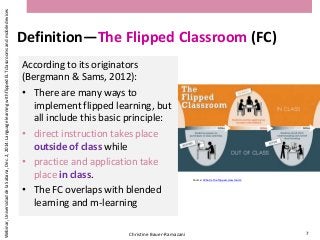
According to its originators
(Bergmann & Sams, 2012):
• There are many ways to
implement flipped learning, but
all include this basic principle:
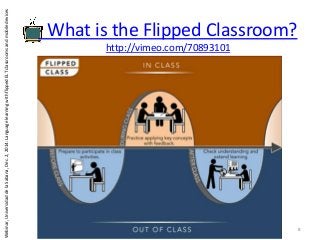
• direct instruction takes place
outside of class while
• practice and application take
place in class.
• The FC overlaps with blended
learning and m-learning
Christine Bauer-Ramazani 7
Webinar,UniversidaddelaSabana,Dec.2,2014:LanguagelearningwithflippedELTclassroomsandmobiledevices
Source: What is the flipped classroom?
Christine Bauer-Ramazani 8
What is the Flipped Classroom?
http://vimeo.com/70893101
Webinar,UniversidaddelaSabana,Dec.2,2014:LanguagelearningwithflippedELTclassroomsandmobiledevices
Definition—Mobile Devices &
Mobile Learning (m-learning)
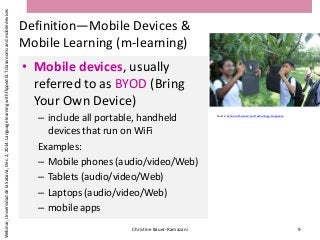
• Mobile devices, usually
referred to as BYOD (Bring
Your Own Device)
– include all portable, handheld
devices that run on WiFi
Examples:
– Mobile phones (audio/video/Web)
– Tablets (audio/video/Web)
– Laptops (audio/video/Web)
– mobile apps
Christine Bauer-Ramazani 9
Webinar,UniversidaddelaSabana,Dec.2,2014:LanguagelearningwithflippedELTclassroomsandmobiledevices
Source: School of Science and Technology, Singapore
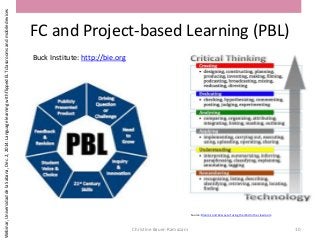
FC and Project-based Learning (PBL)
Christine Bauer-Ramazani 10
Source: Emerging EdTech
Source: Bloom's and 62 ways of using the iPad in the classroom
Webinar,UniversidaddelaSabana,Dec.2,2014:LanguagelearningwithflippedELTclassroomsandmobiledevices
Buck Institute: http://bie.org
Flipped Learning
with FC, ML, and PBL
Christine Bauer-Ramazani 11
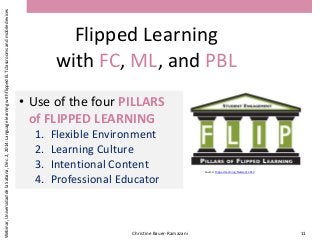
• Use of the four PILLARS
of FLIPPED LEARNING
1. Flexible Environment
2. Learning Culture
3. Intentional Content
4. Professional Educator
Source: Flipped Learning Network 2013
Webinar,UniversidaddelaSabana,Dec.2,2014:LanguagelearningwithflippedELTclassroomsandmobiledevices
Our mission as teachers
• to harness these technologies for
educational benefits and leverage them in
and out of the classroom for teaching and
learning!
Christine Bauer-Ramazani 12
Webinar,UniversidaddelaSabana,Dec.2,2014:LanguagelearningwithflippedELTclassroomsandmobiledevices
Methodology for FC, ML, & PBL
Input: outside-of-class
External resources
– Christine’s Resources for listening (http://tinyurl.com/ccr6oo)
– Christine’s Resources for reading (http://tinyurl.com/74wf2cz)
– Teacher-made videos with screen-capture software
(Free: CamStudio, Jing, ScreenRecorder)
(Not free: lecture-capture tools--Tegrity, Panopto)
– narrated PowerPoint instructions
– Open Educational Resources (OER)—Jorum (UK),
SPARC, OER Commons, Creative Commons, MOOCs
(Coursera, EdX, Udacity)
Christine Bauer-Ramazani 13
Webinar,UniversidaddelaSabana,Dec.2,2014:LanguagelearningwithflippedELTclassroomsandmobiledevices
Methodology for FC, ML, & PBL
Christine Bauer-Ramazani 14
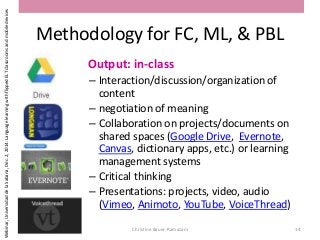
Output: in-class
– Interaction/discussion/organization of
content
– negotiation of meaning
– Collaboration on projects/documents on
shared spaces (Google Drive, Evernote,
Canvas, dictionary apps, etc.) or learning
management systems
– Critical thinking
– Presentations: projects, video, audio
(Vimeo, Animoto, YouTube, VoiceThread)
Webinar,UniversidaddelaSabana,Dec.2,2014:LanguagelearningwithflippedELTclassroomsandmobiledevices
Pedagogical shift
Christine Bauer-Ramazani 15
• Monitoring students’ performance in
small groups or individually
• Provide help for individual learners who
need it (guide, coach)
• More efficient and enriching use of
class time
Webinar,UniversidaddelaSabana,Dec.2,2014:LanguagelearningwithflippedELTclassroomsandmobiledevices
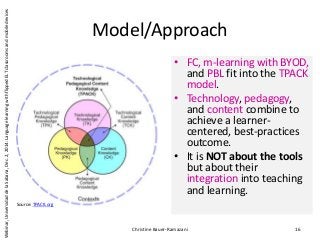
Model/Approach
• FC, m-learning with BYOD,
and PBL fit into the TPACK
model.
• Technology, pedagogy,
and content combine to
achieve a learner-
centered, best-practices
outcome.
• It is NOT about the tools
but about their
integration into teaching
and learning.
Christine Bauer-Ramazani 16
Source: TPACK.org
Webinar,UniversidaddelaSabana,Dec.2,2014:LanguagelearningwithflippedELTclassroomsandmobiledevices
The Flipped Classroom, Mobile
Learning, and Project-based
Learning in an ELT classroom
Webinar,UniversidaddelaSabana,Dec.2,2014:LanguagelearningwithflippedELTclassroomsandmobiledevices
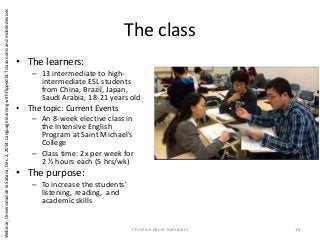
The class
• The learners:
– 13 intermediate to high-
intermediate ESL students
from China, Brazil, Japan,
Saudi Arabia, 18-21 years old
• The topic: Current Events
– An 8-week elective class in
the Intensive English
Program at Saint Michael’s
College
– Class time: 2x per week for
2 ½ hours each (5 hrs/wk)
• The purpose:
– To increase the students’
listening, reading, and
academic skills
Christine Bauer-Ramazani 18
Webinar,UniversidaddelaSabana,Dec.2,2014:LanguagelearningwithflippedELTclassroomsandmobiledevices
The Flipped Classroom in Action
Course Structure
Christine Bauer-Ramazani 19
Webinar,UniversidaddelaSabana,Dec.2,2014:LanguagelearningwithflippedELTclassroomsandmobiledevices
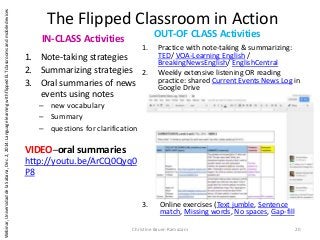
OUT-OF CLASS Activities
1. Practice with note-taking & summarizing:
TED/ VOA-Learning English /
BreakingNewsEnglish/ EnglishCentral
2. Weekly extensive listening OR reading
practice: shared Current Events News Log in
Google Drive
3. Online exercises (Text jumble, Sentence
match, Missing words, No spaces, Gap-fill
IN-CLASS Activities
1. Note-taking strategies
2. Summarizing strategies
3. Oral summaries of news
events using notes
– new vocabulary
– Summary
– questions for clarification
VIDEO–oral summaries
http://youtu.be/ArCQ0Qyq0
P8
Christine Bauer-Ramazani 20
Webinar,UniversidaddelaSabana,Dec.2,2014:LanguagelearningwithflippedELTclassroomsandmobiledevices
The Flipped Classroom in Action
The Newscast Project:
adapted FLIP, BYOD, & PBL
in action
Length: a portion of 8 class periods
The process:
• In-class: discussion of the project elements/overview
• In-class: choice of partners and topics
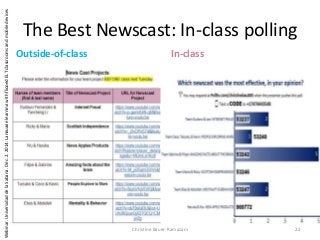
• Out-of-class: Research on the topic, 3 examples of newscasts
(YouTube)
• In-class: discussion of elements of newscasts
• In-class: creating storyboards (= outlines) for the newscast project
(cont’d outside of class)
• In- /out-of-class: collaborations/Google Drive
(Discussing/composing/revising/pronouncing/practicing/recording)  analysis/
synthesis/ creation
– VIDEO 1 – team discussion/pronunciation (18 sec)
http://tinyurl.com/p92tvrv
– VIDEO 2 – teams using BYOD/practicing storyboards (28 sec)
http://tinyurl.com/kc9ozof
Christine Bauer-Ramazani 21
Webinar,UniversidaddelaSabana,Dec.2,2014:LanguagelearningwithflippedELTclassroomsandmobiledevices
The Best Newscast: In-class polling
Christine Bauer-Ramazani 22
Outside-of-class In-class
Webinar,UniversidaddelaSabana,Dec.2,2014:LanguagelearningwithflippedELTclassroomsandmobiledevices
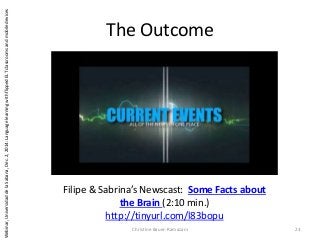
The Outcome
Christine Bauer-Ramazani 23
Filipe & Sabrina’s Newscast: Some Facts about
the Brain (2:10 min.)
http://tinyurl.com/l83bopu
Webinar,UniversidaddelaSabana,Dec.2,2014:LanguagelearningwithflippedELTclassroomsandmobiledevices
Implications/challenges of the
adapted FLIP for teaching and
learning (Pros and cons)
Christine Bauer-Ramazani 24
Webinar,UniversidaddelaSabana,Dec.2,2014:LanguagelearningwithflippedELTclassroomsandmobiledevices
Pros/cons of the FLIP for the Teacher
 Blended learning:
increased student
exposure to English
 Increased focus on
formative assessment
 More class time for
discussing, analyzing,
and debating
 Better-prepared
students
 More preparation time
 More need for
monitoring
 Assessment
Christine Bauer-Ramazani 25
Advantages Disadvantages
Webinar,UniversidaddelaSabana,Dec.2,2014:LanguagelearningwithflippedELTclassroomsandmobiledevices
Pros/cons of the FLIP for the Students
 Increased student
interaction
 Increased flexibility &
customized learning
 Increased autonomy
 Fits with students’
expectations of 21st
century instruction
 More home/online work
 Necessary access to
external sources at home
 Concerns: IT security,
technology gap, and
platform neutrality
“. . . a growing number of
models in practice are paving
the way for BYOD to enter
the mainstream” (NMC
Horizon Report: K-12, 2014,
p. 34)
Christine Bauer-Ramazani 26
Advantages Disadvantages
Webinar,UniversidaddelaSabana,Dec.2,2014:LanguagelearningwithflippedELTclassroomsandmobiledevices
What does the research say?
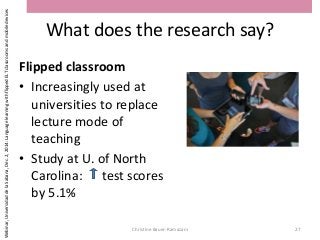
Flipped classroom
• Increasingly used at
universities to replace
lecture mode of
teaching
• Study at U. of North
Carolina: test scores
by 5.1%
Christine Bauer-Ramazani 27
Webinar,UniversidaddelaSabana,Dec.2,2014:LanguagelearningwithflippedELTclassroomsandmobiledevices
What does the research say?
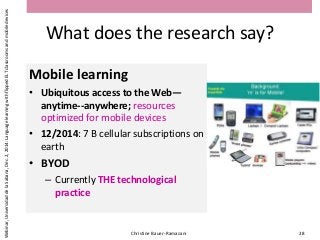
Mobile learning
• Ubiquitous access to the Web—
anytime--anywhere; resources
optimized for mobile devices
• 12/2014: 7 B cellular subscriptions on
earth
• BYOD
– Currently THE technological
practice
Christine Bauer-Ramazani 28
Webinar,UniversidaddelaSabana,Dec.2,2014:LanguagelearningwithflippedELTclassroomsandmobiledevices
Resources for further reading
Beatty, K. (2013). Beyond the Classroom: Mobile Learning in the Wider World. The International Research Foundation for English Language Education
(TIRF).
Berge, Z. L. & Muilenburg, L. (Eds.) 2013. Handbook of Mobile Learning. Routledge.
Bergmann, J., & Sams, A. (2012, April 27). Flipping the classroom. Excerpt from the book Flip your classroom (2012). International Society for
Technology in Education (ISTE) and ASCD. Tech&Learning.
Bolkan, J. (2013, Nov. 19). Report: Half of university faculty have flipped their classroom or will in the next year. Campus Technology.
de Haan, Jac (2011, Oct. 7). Creating interactive online video using YouTube. Technology with Intention.
Flipping your classroom. (2013, Aug.). 21 Things 4 the 21st Century.
Flipped Learning Network (FLN) (2014). The Four Pillars of F-L-I-P™. Retrieved from
Hamdan, N., & McKnight, P., McKnight, K., & Arfstrom, K. (2013). A review of flipped learning. Flipped Learning Network.
Hart, M. (2014, 10/22). Flipping the traditional lecture hall. Campus Technology.
Herreid, C., & Schiller, N. (2013, May). Case studies and the flipped classroom. Journal of College Science Teaching, 42(5), 62-67.
Hockly, N. (2013). Designer learning: The teacher as designer of mobile-based classroom learning experiences. The International Research
Foundation for English Language Education (TIRF).
Hockly, N. (2012). Mobile learning: What is it and why should you care? Modern English Teacher 21(2).
Hockly, N. (2012). Substitute or redefine? Mobile learning in and out of class . Modern English Teacher 21(3).
Hockly, N. (2012). Tech-savvy teaching: BYOD . Modern English Teacher 21(4).
Kukulsa-Hulme, A. (2013). Re-skilling language learners for a mobile world. The International Research Foundation for English Language Education
(TIRF).
Marshall, Helaine (2013). The Flipped Learning Approach in Adult ESL Classrooms.
Mishra & Koehler (2006). Technological pedagogical content knowledge: A framework for teacher knowledge. Teachers College Record, 108(6),
1017-1054.
mLearning in Practice Course Resources (2003-2014). The Consultants-E Ltd.
Musallam, Ramsey (2011, Oct. 26). Should you flip your classroom? Edutopia.
Nielsen, L. (2012, Dec. 11). Why the flip’s a flop. The Innovative Educator.
NMC Horizon Report : 2013 K-12 Edition (2013). The New Media Consortium.
NMC Horizon Report: 2014 Higher Education Edition (2014). The New Media Consortium.
Raths, David (2014, Jan. 15). How to make the most of the flipped classroom. Campus Technology.
Raths, David (2014, Jan. 22). Assessing the flipped classroom’s impact on learning. Campus Technology.
Sams, A. (2013). Flipped classroom meets mobile learning. In Berge, Z. L. & Muilenburg, L. (Eds.) 2013. Handbook of Mobile Learning. Routledge.
Savery, J. R., & Duffy, T. M. (1995). Problem based learning: An instructional model and its constructivist framework. Center for Research on Learning
and Technology, Indiana University, Bloomington, IN.
Schaffhauser, Dian (2013, Nov. 13). Beyond the basics of the flipped classroom.T.H.E. Journal.
7 things you should know about ...flipped classrooms. (2012, Feb.). Educause.
Stockwell, G., & Hubbard, P. (2013). Some Emerging Principles for Mobile-assisted Language Learning .The International Research Foundation for
English Language Education (TIRF).
TIRF Commissions Research on Mobile-assisted Language Learning (2013, Oct. ). The International Research Foundation for English Language
Education. Christine Bauer-Ramazani 29
Webinar,UniversidaddelaSabana,Dec.2,2014:LanguagelearningwithflippedELTclassroomsandmobiledevices
QUESTIONS/Comments?
Online audience: Please post your
questions/comments in the chat area.
Live audience in Bogota: Please ask for
the microphone to pose your question so that it can
be heard by the online audience.
Christine Bauer-Ramazani 30
Many thanks for your attendance
and participation!
Email: cbauer-ramazani@smcvt.edu
Christine Bauer-Ramazani 31

Participants lang-learn-flip-elt-class+mobile-devices

  • 1.
    Webinar: Language learning withflipped ELT classrooms and mobile devices Christine Bauer-Ramazani Saint Michael's College, Colchester, Vermont December 2, 2014 RESIDENTIAL SESSIONS 2014-02
  • 2.
    Questions to theaudience … Web: PollEv.com/christinebau885 Christine Bauer-Ramazani 2 Webinar,UniversidaddelaSabana,Dec.2,2014:LanguagelearningwithflippedELTclassroomsandmobiledevices
  • 3.
    Questions to theaudience … Web: PollEv.com/christinebau885 Christine Bauer-Ramazani 3 Webinar,UniversidaddelaSabana,Dec.2,2014:FlippedELTclassroomsandmobiledevices
  • 4.
    If you useany of these approaches to technology, you are ready for the Flipped Classroom and mobile learning. Christine Bauer-Ramazani 4 Webinar,UniversidaddelaSabana,Dec.2,2014:LanguagelearningwithflippedELTclassroomsandmobiledevices
  • 5.
    Learning Outcome 1. Definitions •The Flipped Classroom (FC) • Mobile Devices and BYOD (Bring your Own Device) • Project-Based Learning (PBL) 2. Methodology: pedagogical and technological framework 3. Sample project of language learning in a FC using BYOD and Project-based Learning in ELT 4. Outcome of the project 5. Implications & challenges for the teacher and the learners 6. Resources for further reading 7. Questions Christine Bauer-Ramazani 5 Webinar,UniversidaddelaSabana,Dec.2,2014:LanguagelearningwithflippedELTclassroomsandmobiledevices
  • 6.
    Breaking news 1. ColumbiaLaunches Hybrid Learning Initiative, Campus Technology, 11/10/2014 (http://tinyurl.com/mo6xxpd) – “Columbia University has launched an initiative to turn more of its traditional lecture courses into hybrid learning experiences that would incorporate the use of audiovisual materials, social media, flipped classrooms and real-time feedback from students.” 2. Professors’ Place in the Classroom Is Shifting to the Side, 11/13/2014, Chronicle of Higher Education (http://tinyurl.com/nmwmc29) – “A new survey finds that teaching methods are changing to put learners—not the professor—at the center of the classroom, and that in about six years that change could become permanent.” – “The ‘student-centered’ classroom may be close to a breakthrough.” – “In learner-centered classrooms, students and professors ‘work equally hard’." Christine Bauer-Ramazani 6 Webinar,UniversidaddelaSabana,Dec.2,2014:FlippedELTclassroomsandmobiledevices
  • 7.
    Definition—The Flipped Classroom(FC) According to its originators (Bergmann & Sams, 2012): • There are many ways to implement flipped learning, but all include this basic principle: • direct instruction takes place outside of class while • practice and application take place in class. • The FC overlaps with blended learning and m-learning Christine Bauer-Ramazani 7 Webinar,UniversidaddelaSabana,Dec.2,2014:LanguagelearningwithflippedELTclassroomsandmobiledevices Source: What is the flipped classroom?
  • 8.
    Christine Bauer-Ramazani 8 Whatis the Flipped Classroom? http://vimeo.com/70893101 Webinar,UniversidaddelaSabana,Dec.2,2014:LanguagelearningwithflippedELTclassroomsandmobiledevices
  • 9.
    Definition—Mobile Devices & MobileLearning (m-learning) • Mobile devices, usually referred to as BYOD (Bring Your Own Device) – include all portable, handheld devices that run on WiFi Examples: – Mobile phones (audio/video/Web) – Tablets (audio/video/Web) – Laptops (audio/video/Web) – mobile apps Christine Bauer-Ramazani 9 Webinar,UniversidaddelaSabana,Dec.2,2014:LanguagelearningwithflippedELTclassroomsandmobiledevices Source: School of Science and Technology, Singapore
  • 10.
    FC and Project-basedLearning (PBL) Christine Bauer-Ramazani 10 Source: Emerging EdTech Source: Bloom's and 62 ways of using the iPad in the classroom Webinar,UniversidaddelaSabana,Dec.2,2014:LanguagelearningwithflippedELTclassroomsandmobiledevices Buck Institute: http://bie.org
  • 11.
    Flipped Learning with FC,ML, and PBL Christine Bauer-Ramazani 11 • Use of the four PILLARS of FLIPPED LEARNING 1. Flexible Environment 2. Learning Culture 3. Intentional Content 4. Professional Educator Source: Flipped Learning Network 2013 Webinar,UniversidaddelaSabana,Dec.2,2014:LanguagelearningwithflippedELTclassroomsandmobiledevices
  • 12.
    Our mission asteachers • to harness these technologies for educational benefits and leverage them in and out of the classroom for teaching and learning! Christine Bauer-Ramazani 12 Webinar,UniversidaddelaSabana,Dec.2,2014:LanguagelearningwithflippedELTclassroomsandmobiledevices
  • 13.
    Methodology for FC,ML, & PBL Input: outside-of-class External resources – Christine’s Resources for listening (http://tinyurl.com/ccr6oo) – Christine’s Resources for reading (http://tinyurl.com/74wf2cz) – Teacher-made videos with screen-capture software (Free: CamStudio, Jing, ScreenRecorder) (Not free: lecture-capture tools--Tegrity, Panopto) – narrated PowerPoint instructions – Open Educational Resources (OER)—Jorum (UK), SPARC, OER Commons, Creative Commons, MOOCs (Coursera, EdX, Udacity) Christine Bauer-Ramazani 13 Webinar,UniversidaddelaSabana,Dec.2,2014:LanguagelearningwithflippedELTclassroomsandmobiledevices
  • 14.
    Methodology for FC,ML, & PBL Christine Bauer-Ramazani 14 Output: in-class – Interaction/discussion/organization of content – negotiation of meaning – Collaboration on projects/documents on shared spaces (Google Drive, Evernote, Canvas, dictionary apps, etc.) or learning management systems – Critical thinking – Presentations: projects, video, audio (Vimeo, Animoto, YouTube, VoiceThread) Webinar,UniversidaddelaSabana,Dec.2,2014:LanguagelearningwithflippedELTclassroomsandmobiledevices
  • 15.
    Pedagogical shift Christine Bauer-Ramazani15 • Monitoring students’ performance in small groups or individually • Provide help for individual learners who need it (guide, coach) • More efficient and enriching use of class time Webinar,UniversidaddelaSabana,Dec.2,2014:LanguagelearningwithflippedELTclassroomsandmobiledevices
  • 16.
    Model/Approach • FC, m-learningwith BYOD, and PBL fit into the TPACK model. • Technology, pedagogy, and content combine to achieve a learner- centered, best-practices outcome. • It is NOT about the tools but about their integration into teaching and learning. Christine Bauer-Ramazani 16 Source: TPACK.org Webinar,UniversidaddelaSabana,Dec.2,2014:LanguagelearningwithflippedELTclassroomsandmobiledevices
  • 17.
    The Flipped Classroom,Mobile Learning, and Project-based Learning in an ELT classroom Webinar,UniversidaddelaSabana,Dec.2,2014:LanguagelearningwithflippedELTclassroomsandmobiledevices
  • 18.
    The class • Thelearners: – 13 intermediate to high- intermediate ESL students from China, Brazil, Japan, Saudi Arabia, 18-21 years old • The topic: Current Events – An 8-week elective class in the Intensive English Program at Saint Michael’s College – Class time: 2x per week for 2 ½ hours each (5 hrs/wk) • The purpose: – To increase the students’ listening, reading, and academic skills Christine Bauer-Ramazani 18 Webinar,UniversidaddelaSabana,Dec.2,2014:LanguagelearningwithflippedELTclassroomsandmobiledevices
  • 19.
    The Flipped Classroomin Action Course Structure Christine Bauer-Ramazani 19 Webinar,UniversidaddelaSabana,Dec.2,2014:LanguagelearningwithflippedELTclassroomsandmobiledevices
  • 20.
    OUT-OF CLASS Activities 1.Practice with note-taking & summarizing: TED/ VOA-Learning English / BreakingNewsEnglish/ EnglishCentral 2. Weekly extensive listening OR reading practice: shared Current Events News Log in Google Drive 3. Online exercises (Text jumble, Sentence match, Missing words, No spaces, Gap-fill IN-CLASS Activities 1. Note-taking strategies 2. Summarizing strategies 3. Oral summaries of news events using notes – new vocabulary – Summary – questions for clarification VIDEO–oral summaries http://youtu.be/ArCQ0Qyq0 P8 Christine Bauer-Ramazani 20 Webinar,UniversidaddelaSabana,Dec.2,2014:LanguagelearningwithflippedELTclassroomsandmobiledevices The Flipped Classroom in Action
  • 21.
    The Newscast Project: adaptedFLIP, BYOD, & PBL in action Length: a portion of 8 class periods The process: • In-class: discussion of the project elements/overview • In-class: choice of partners and topics • Out-of-class: Research on the topic, 3 examples of newscasts (YouTube) • In-class: discussion of elements of newscasts • In-class: creating storyboards (= outlines) for the newscast project (cont’d outside of class) • In- /out-of-class: collaborations/Google Drive (Discussing/composing/revising/pronouncing/practicing/recording)  analysis/ synthesis/ creation – VIDEO 1 – team discussion/pronunciation (18 sec) http://tinyurl.com/p92tvrv – VIDEO 2 – teams using BYOD/practicing storyboards (28 sec) http://tinyurl.com/kc9ozof Christine Bauer-Ramazani 21 Webinar,UniversidaddelaSabana,Dec.2,2014:LanguagelearningwithflippedELTclassroomsandmobiledevices
  • 22.
    The Best Newscast:In-class polling Christine Bauer-Ramazani 22 Outside-of-class In-class Webinar,UniversidaddelaSabana,Dec.2,2014:LanguagelearningwithflippedELTclassroomsandmobiledevices
  • 23.
    The Outcome Christine Bauer-Ramazani23 Filipe & Sabrina’s Newscast: Some Facts about the Brain (2:10 min.) http://tinyurl.com/l83bopu Webinar,UniversidaddelaSabana,Dec.2,2014:LanguagelearningwithflippedELTclassroomsandmobiledevices
  • 24.
    Implications/challenges of the adaptedFLIP for teaching and learning (Pros and cons) Christine Bauer-Ramazani 24 Webinar,UniversidaddelaSabana,Dec.2,2014:LanguagelearningwithflippedELTclassroomsandmobiledevices
  • 25.
    Pros/cons of theFLIP for the Teacher  Blended learning: increased student exposure to English  Increased focus on formative assessment  More class time for discussing, analyzing, and debating  Better-prepared students  More preparation time  More need for monitoring  Assessment Christine Bauer-Ramazani 25 Advantages Disadvantages Webinar,UniversidaddelaSabana,Dec.2,2014:LanguagelearningwithflippedELTclassroomsandmobiledevices
  • 26.
    Pros/cons of theFLIP for the Students  Increased student interaction  Increased flexibility & customized learning  Increased autonomy  Fits with students’ expectations of 21st century instruction  More home/online work  Necessary access to external sources at home  Concerns: IT security, technology gap, and platform neutrality “. . . a growing number of models in practice are paving the way for BYOD to enter the mainstream” (NMC Horizon Report: K-12, 2014, p. 34) Christine Bauer-Ramazani 26 Advantages Disadvantages Webinar,UniversidaddelaSabana,Dec.2,2014:LanguagelearningwithflippedELTclassroomsandmobiledevices
  • 27.
    What does theresearch say? Flipped classroom • Increasingly used at universities to replace lecture mode of teaching • Study at U. of North Carolina: test scores by 5.1% Christine Bauer-Ramazani 27 Webinar,UniversidaddelaSabana,Dec.2,2014:LanguagelearningwithflippedELTclassroomsandmobiledevices
  • 28.
    What does theresearch say? Mobile learning • Ubiquitous access to the Web— anytime--anywhere; resources optimized for mobile devices • 12/2014: 7 B cellular subscriptions on earth • BYOD – Currently THE technological practice Christine Bauer-Ramazani 28 Webinar,UniversidaddelaSabana,Dec.2,2014:LanguagelearningwithflippedELTclassroomsandmobiledevices
  • 29.
    Resources for furtherreading Beatty, K. (2013). Beyond the Classroom: Mobile Learning in the Wider World. The International Research Foundation for English Language Education (TIRF). Berge, Z. L. & Muilenburg, L. (Eds.) 2013. Handbook of Mobile Learning. Routledge. Bergmann, J., & Sams, A. (2012, April 27). Flipping the classroom. Excerpt from the book Flip your classroom (2012). International Society for Technology in Education (ISTE) and ASCD. Tech&Learning. Bolkan, J. (2013, Nov. 19). Report: Half of university faculty have flipped their classroom or will in the next year. Campus Technology. de Haan, Jac (2011, Oct. 7). Creating interactive online video using YouTube. Technology with Intention. Flipping your classroom. (2013, Aug.). 21 Things 4 the 21st Century. Flipped Learning Network (FLN) (2014). The Four Pillars of F-L-I-P™. Retrieved from Hamdan, N., & McKnight, P., McKnight, K., & Arfstrom, K. (2013). A review of flipped learning. Flipped Learning Network. Hart, M. (2014, 10/22). Flipping the traditional lecture hall. Campus Technology. Herreid, C., & Schiller, N. (2013, May). Case studies and the flipped classroom. Journal of College Science Teaching, 42(5), 62-67. Hockly, N. (2013). Designer learning: The teacher as designer of mobile-based classroom learning experiences. The International Research Foundation for English Language Education (TIRF). Hockly, N. (2012). Mobile learning: What is it and why should you care? Modern English Teacher 21(2). Hockly, N. (2012). Substitute or redefine? Mobile learning in and out of class . Modern English Teacher 21(3). Hockly, N. (2012). Tech-savvy teaching: BYOD . Modern English Teacher 21(4). Kukulsa-Hulme, A. (2013). Re-skilling language learners for a mobile world. The International Research Foundation for English Language Education (TIRF). Marshall, Helaine (2013). The Flipped Learning Approach in Adult ESL Classrooms. Mishra & Koehler (2006). Technological pedagogical content knowledge: A framework for teacher knowledge. Teachers College Record, 108(6), 1017-1054. mLearning in Practice Course Resources (2003-2014). The Consultants-E Ltd. Musallam, Ramsey (2011, Oct. 26). Should you flip your classroom? Edutopia. Nielsen, L. (2012, Dec. 11). Why the flip’s a flop. The Innovative Educator. NMC Horizon Report : 2013 K-12 Edition (2013). The New Media Consortium. NMC Horizon Report: 2014 Higher Education Edition (2014). The New Media Consortium. Raths, David (2014, Jan. 15). How to make the most of the flipped classroom. Campus Technology. Raths, David (2014, Jan. 22). Assessing the flipped classroom’s impact on learning. Campus Technology. Sams, A. (2013). Flipped classroom meets mobile learning. In Berge, Z. L. & Muilenburg, L. (Eds.) 2013. Handbook of Mobile Learning. Routledge. Savery, J. R., & Duffy, T. M. (1995). Problem based learning: An instructional model and its constructivist framework. Center for Research on Learning and Technology, Indiana University, Bloomington, IN. Schaffhauser, Dian (2013, Nov. 13). Beyond the basics of the flipped classroom.T.H.E. Journal. 7 things you should know about ...flipped classrooms. (2012, Feb.). Educause. Stockwell, G., & Hubbard, P. (2013). Some Emerging Principles for Mobile-assisted Language Learning .The International Research Foundation for English Language Education (TIRF). TIRF Commissions Research on Mobile-assisted Language Learning (2013, Oct. ). The International Research Foundation for English Language Education. Christine Bauer-Ramazani 29 Webinar,UniversidaddelaSabana,Dec.2,2014:LanguagelearningwithflippedELTclassroomsandmobiledevices
  • 30.
    QUESTIONS/Comments? Online audience: Pleasepost your questions/comments in the chat area. Live audience in Bogota: Please ask for the microphone to pose your question so that it can be heard by the online audience. Christine Bauer-Ramazani 30
  • 31.
    Many thanks foryour attendance and participation! Email: cbauer-ramazani@smcvt.edu Christine Bauer-Ramazani 31
Editor's Notes