FIFtH edItIoN
10	 The State of
Quality 2013
12	 Quality Assurance Budgets:
Continued Growth, Shifting
Priorities
18	 Transforming the Testing
Organization
24	 Mobile Testing: A Shift from
Tools to Methods
30	 Cloud: Taking a Considered
Approach
36	 Testing in the Agile
Development Environment
40	 Test Infrastructure and
Data Management: Building
Environments to Ensure Quality
Previous editions
First Edition
2009 World Quality Report
Second Edition
2010-11 World Quality Report
Third Edition
2011-12 World Quality Report
Fourth Edition
2012-13 World Quality Report
04	Introduction
06	Executive
Summary
58	About
the Study
62	 About the
Sponsors
Regional and country reports are available online from www.worldqualityreport.com or from Capgemini,
Sogeti and HP local offices covering: Australia and New Zealand, Benelux, Brazil (in Brazilian Portuguese),
China (in Simplified Chinese), Eastern Europe (covering The Czech Republic, Hungary and Poland), France
(in French), Germany (in German), North America, the Nordic Region and United Kingdom
|}
46	 Sector
analysis
48	 Consumer Products,
Retail and Distribution
50	 Energy and Utilities
52	 Financial Services
54	 Public Sector
56	 Telecom, Media
and Entertainment
03
CONTENTS
Introduction
Michel de Meijer
Senior Vice President
Leader Testing Global Service Line
Capgemini & Sogeti
Matthew Morgan
Vice President
Product Marketing
HP Software
Welcome to the fifth World Quality Report
which is recognized as the industry’s largest
research study and most comprehensive
source of market analysis and commentary on
the state of enterprise application quality and
testing practices from around the world.
Since the World Quality Report was first published in 2009,
Capgemini, Sogeti and HP have each year commissioned
a new global research study of application quality and
testing practices. The results from the quantitative research
have then been used to inform and validate the market
analysis and commentary contributed to the report by
senior Capgemini and Sogeti Testing Managers and subject
matter experts. In the majority of cases, the research
supported what our section authors already knew from
working with clients in their respective markets, but it
sometimes also uncovered new topics that required further
analysis and investigation.
The research study has also provided us with an unrivalled
data set which can be tracked over time and analyzed by
industry vertical, country, size of organization, and job
function, and which we are keen to share with our clients, to
help inform their plans for Testing and Quality Assurance.
As sponsors, we also benefit from the research findings
as they guide and validate the strategic direction of our
professional services and product development. For example,
Capgemini Group launched its comprehensive mobile
testing service to address the mobile testing issues raised by
executives interviewed for last year’s report. Research findings
also helped inform the development of the Test Data and Test
Environment Management services.
Similarly, HP took into account this research when enhancing
its flagship test automation products for testing mobile apps
faster on different devices, as well as supporting automated
testing in agile environments. Over the past year, HP has also
added new offerings like HP Agile Manager for agile project
management and test lab management automation, which is
tightly integrated into HP ALM.
World Quality Report 2013-14
04
For the first time this year, we have also included a regional
commentary for Eastern Europe, covering the Czech Republic,
Hungary and Poland. Together with the other nine regional
sections, it can be found at: www.worldqualityreport.com.
As in previous years, the research was carried out by
telephone interviews in seven different languages (at a time
pre-arranged with each interviewee), each of which took on
average 35-40 minutes. If you are reading this as one of the
1,500 people who took part in the research study this year,
we would like to thank you for your time and contribution to
the report.
Otherwise, if you would like to see how the testing practices
in your own organization compare to the research sample, we
have developed a self-service benchmarking tool for you to
use which can be found at Capgemini, Sogeti and HP websites.
Similarly, if you would like to see the research results for a
specific data sub-set, such as for a country or an industry
vertical, please contact your Capgemini or Sogeti account
manager, who will be able to arrange for a specific report to
be produced for you.
We hope you enjoy reading the research, analysis and
commentary contained in this year’s report, and that it both
informs your own testing and quality assurance decisions and
maybe even challenges some of your current thinking.
The World Quality Report is the result of close
collaboration between Capgemini Group and HP, both
leaders in their respective fields of outsourced testing
and Application Lifecycle Management tools, services,
and products developed to improve the efficiency and
effectiveness of enterprise applications.
+
05
Introduction
In this, the fifth edition of the World Quality
Report, jointly published by Capgemini,
Sogeti and HP, we are seeing evidence of the
continuing impact of the slow global economic
recovery, with pressures on organizations to
re-evaluate the basic components of their IT
operations, including the Testing function.
Additionally, three interrelated IT business drivers appear
to be influencing much of today’s corporate IT agenda,
irrespective of region or industry. These trends cover a
renewed focus on customer experience, combined with
ever greater globalization and cross-border trade, and
an expectation that IT departments will take on more
business accountability.
Overall, we find encouraging evidence of QA and Testing
developing a more structured and methodical approach
to its role within IT, and the critical role of ensuring the
quality standards of business systems, but a counter trend
of recognizing the constraints imposed by lack of specialist
expertise and methodologies.
World Quality Report Key Findings
1
The QA function is adapting to business demands by
streamlining and centralizing its structure, to achieve
efficiency and cost optimization
This year’s research indicates the Testing function is
undergoing a transformation of its own. There is a growing
trend towards streamlining and centralizing the in-house
Testing function as a single stream across the entire
organization, with 26% reporting using this organizational
model, up from 8% in 2012.
We interpret this as a strong indicator of the continuing
maturity of Testing as a function, adopting a model that better
reflects the business, supports overall IT modernization and
optimization activities, accelerates operational efficiencies and
spreads best practice. Cost optimization remains an important
factor, with 57% of respondents interviewed reporting cost
reduction as the main driver for outsourcing QA.
This move to centralization is further evidenced in the striking
growth in the number of respondents who have a fully
operational Test Center of Excellence (TCOE), from just 6%
last year to 19% this year (a threefold increase). This focus is
Executive Summary
Mark Buenen
Vice President
Business Development
Testing Global Service Line
Capgemini & Sogeti
Makarand Teje
Senior Vice President
Applications North America
Capgemini
World Quality Report 2013-14
06
supported by a growing demand for business and domain
knowledge in the Testing team, with 63% citing this as an
important capability, to add value to test execution.
An in-house TCOE is one option for providing greater
efficiency, innovation and cost savings. Looking at the
engagement models adopted, respondents indicate that the
number of testing projects that companies work on with a
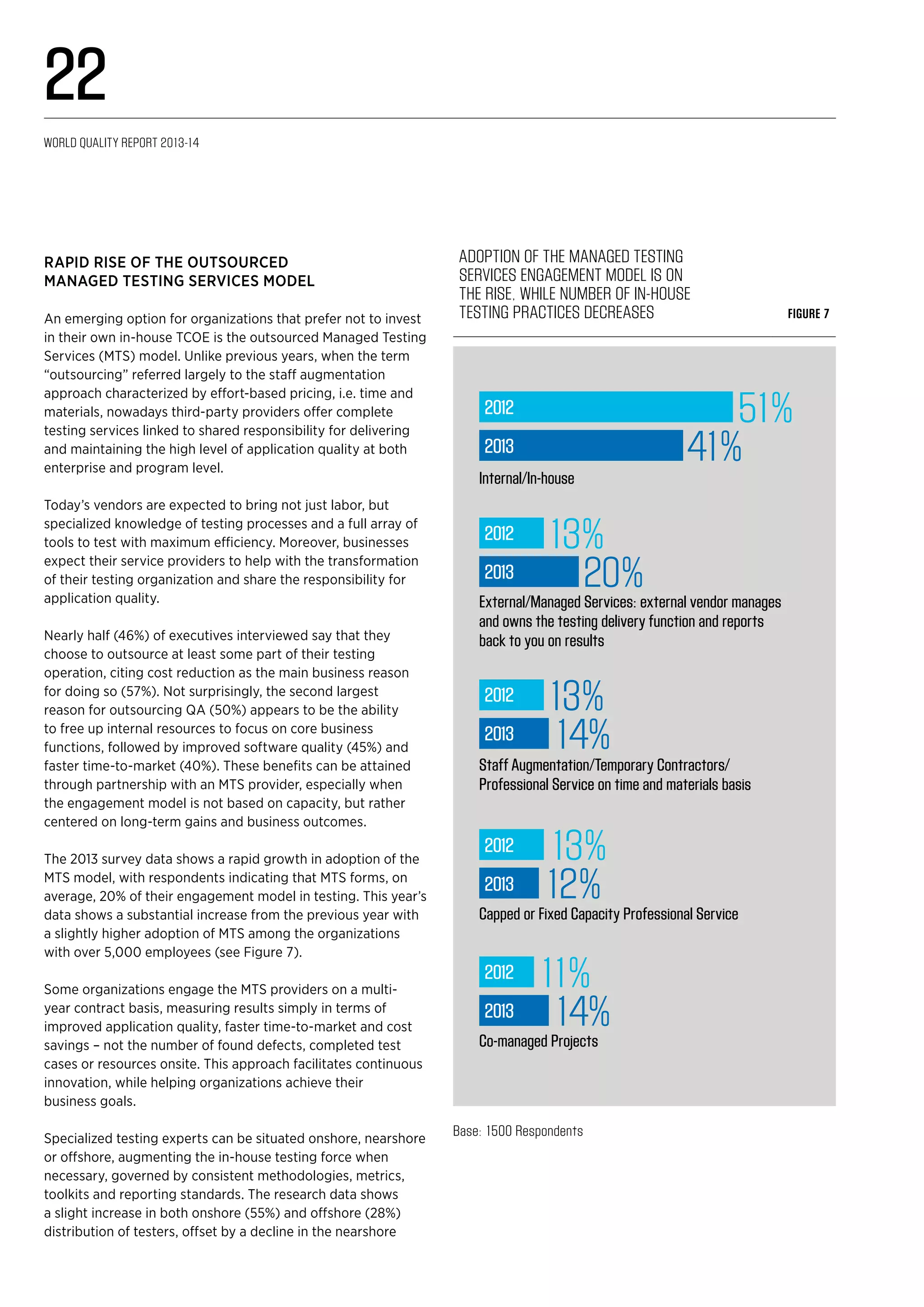
purely internal team has dropped from 51% to 41%, and at
the other end of the spectrum, engaging an external vendor
to manage the testing delivery function, a Managed Testing
Service, has grown from 13% to 20%.
2
A higher proportion of overall IT budget
is being invested in testing and focused on
transformational projects
Our research shows that businesses are continuing to increase
the proportion of their overall IT budgets allocated to application
quality, from 18% in 2012 to 23% in 2013. This rate of growth
is outpacing the generally acknowledged year-on-year global
average increase of 2-3% in IT budgets, and is expected to
increase further to 28% in 2015. This can be partly explained by
the need of the business for higher levels of quality software that
is consistently usable, secure and available, a response to rising
user expectations – whether private or enterprise – for ‘right first
time’ apps. The growth also comes from a general recognition of
the need to invest in the Testing function.
In addition, QA funding priorities indicate that a rising share
of this budget is being directed towards ‘transformational’
projects – those involving new technologies and delivery
platforms – rather than ‘business as usual activities’. The share
of total testing budget allocated to transformational projects
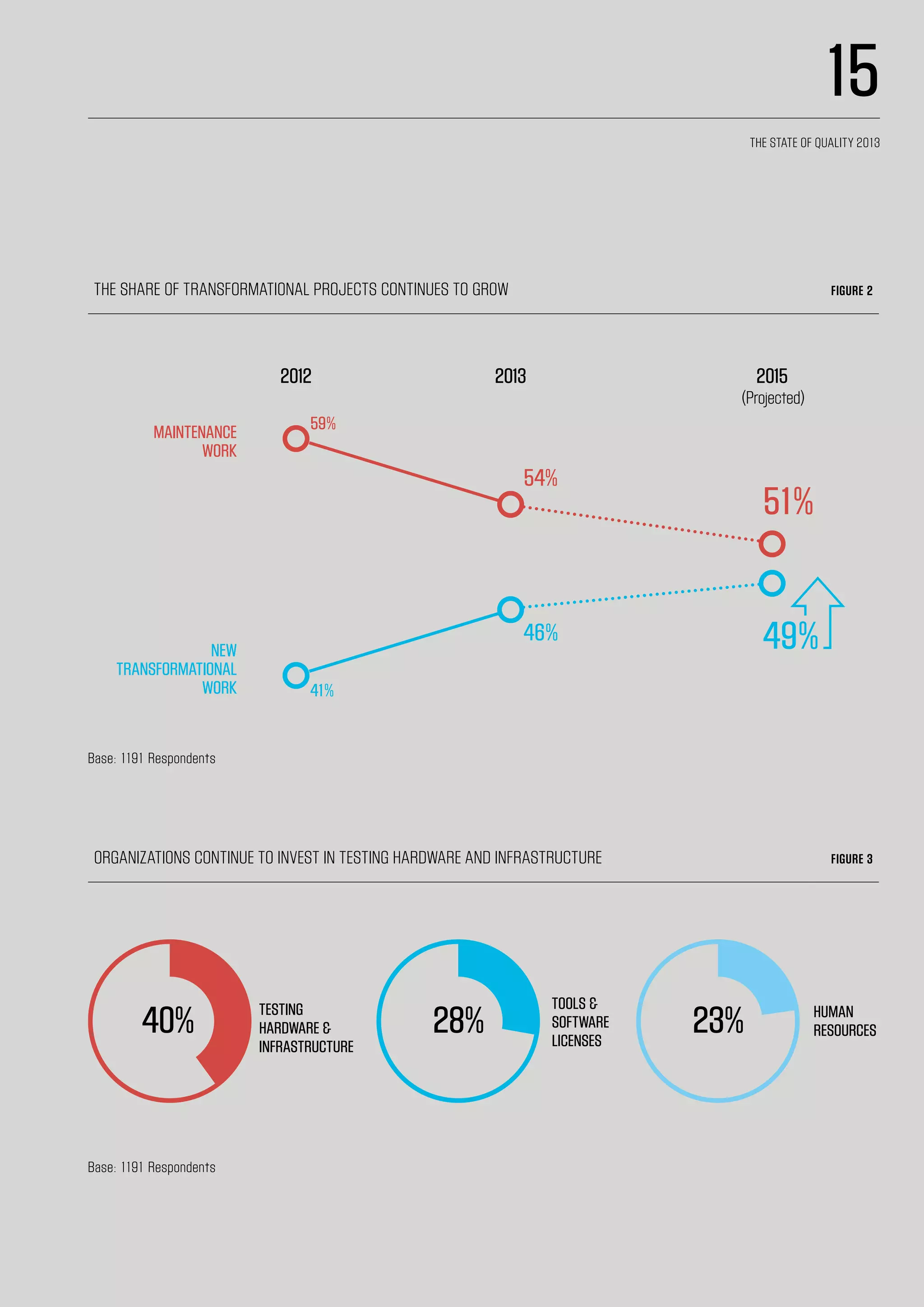
has grown from 41% in 2012 to 46% in 2013, and by 2015, this
emphasis on new IT initiatives is predicted to rise further.
Evaluating the finding, this could indicate that organizations
are now more able to maintain the quality of existing IT
systems with less effort, thanks to technology enablers such
as improved regression testing and test automation. It might
also be business cycle related, which can affect investments in
new projects.
Organizations are also looking for ways to modernize their
legacy systems using new technologies and approaches.
Legacy application transformation is identified as one of the
two top business priorities for 62% of our interviewees, after
cost optimization.
Overall, the increased proportion of corporate IT budgets
being spent each year on QA and Testing suggests that
many QA and Testing practice leaders need, in future, to
identify and implement further operational efficiencies, since
continuous year-on-year budget increases are not sustainable
over the longer term.
3
Testing’s late engagement in the application delivery
lifecycle and its reliance on basic IT metrics is possibly
applying a negative brake on this increasing maturity
The fact that organizations are willing to invest a larger share
of their IT budgets in supporting and functionally restructuring
testing is certainly positive. But conversely, a reason why
budgets need to rise so much could be because testing is
engaged late in the development process and, in addition, the
function may not be measuring its activities as ‘smartly’ as
it could. It’s generally recognized that earlier defect detection
can help reduce the subsequent cost to remedy.
Many businesses still engage in what could be described as
reactive testing practices, involving QA teams too late in the
application delivery lifecycle. Nearly half of the organizations
interviewed (45%) start the testing process during or after
the development phase – too late to influence application
quality beyond finding and fixing defects, especially taking
account of shorter and more frequent development lifecycles.
Furthermore, 61% say that they have no plans to introduce
quality earlier in the lifecycle.
Metrics also have a role to play here. Our analysis indicates
that many Testing functions still rely on the commonly used
operational quality metrics – e.g. number of defects found
(73%) and cost per test cases executed (55%). While these
metrics remain essential, testers could be doing more to
demonstrate the tangible business value-add of testing,
through, for example, quantifying QA’s contribution to
achieving reduced time-to-market for products and services.
4
Mobile Testing has increased in importance as a key
discipline within the function, but lacks specialized
methods, expertise and environment
This year, our respondents report a significant increase in
mobile testing activity, including functionality, performance
and security of mobile applications and devices. Mobile testing
is now carried out by 55% of organizations, compared to
31% last year, a rise that is reflected across all sectors, with
Healthcare and Life Sciences setting the pace.
The testing of mobile application efficiency and performance
remains the primary focus (59%). However, security has jumped
up to a close second place (56% – up from 18% last year). This,
we believe, is a reflection of organizations’ increasing reliance
on the use of mobile devices for core customer or operational
transactions, and therefore the need for greater mobile app
data security and privacy. We expect mobile security to be the
number one QA focus area within the next two years.
The barriers to successful mobile testing have also shifted.
Previously, those businesses that actively tested mobile
applications cited a lack of tools as impacting on their ability.
07
Executive Summary
This year, we see a marked shift to a broader set of challenges.
The biggest changes in emphasis are the lack of appropriate
testing processes or methods (up to 56% from 34%), lack of
mobile testing expertise (48% compared to 29%) and access
to in-house test environment (doubled from 19%). Mobile
Testing typically needs to cover hundreds of different devices
operating across multiple mobile platforms, including mobile
devices that are no longer being sold or even supported but
that are still used in the marketplace. This trend away from
tools and towards methods and environments suggests
that organizations are recognizing that Mobile Testing
is a specialized and skilled QA discipline with its own
particular requirements.
5
Cloud adoption and cloud-based testing has slowed as
organizations continue to manage concerns regarding
data security and performance
Overall, executives interviewed remain positive about the
growth in cloud-based applications. Despite a small dip (from
22% in 2012 to 20% in 2013) in software applications currently
hosted in the Cloud, they predict that by 2015 the number of
applications migrated to, or hosted in, the Cloud will increase
to 26% on average.
This current dip is probably due to a range of factors, such
as an enterprise’s legacy investment and the complexity of
its application landscape. But our respondents indicate this
is a short- to medium-term challenge, no doubt as cloud
computing becomes increasingly part of the IT mainstream.
This non-linear trend is also reflected in the proportion of
testing performed in a cloud-based environment, which has
dipped in 2013 to 24% but is expected to rise by 2015 to 32%.
Regarding testing Software as a Service (SaaS) applications,
71% of respondents have developed a specific approach
to this additional testing activity. As with mobile apps,
performance requirements and risks, and data security
are considered the most important aspects when testing
SaaS apps. This circumspect approach is also mirrored in
our respondents’ approach to testing application migration
to the Cloud. Security remains the number one priority for
52% of interviewees, followed by 45% focused on validating
functionality and 38% on peak load requirements.
6
Significant investment in Test
environments may also be undermined
by a lack of specialist expertise
Test environments and supporting tools are essential to
ensuring application quality, which is reflected in our findings
that a significant proportion (40%) of Testing and QA budgets
is allocated to test infrastructure and hardware, with a
further 28% spent on testing tool licenses. The majority of
organizations have invested in and use a permanent testing
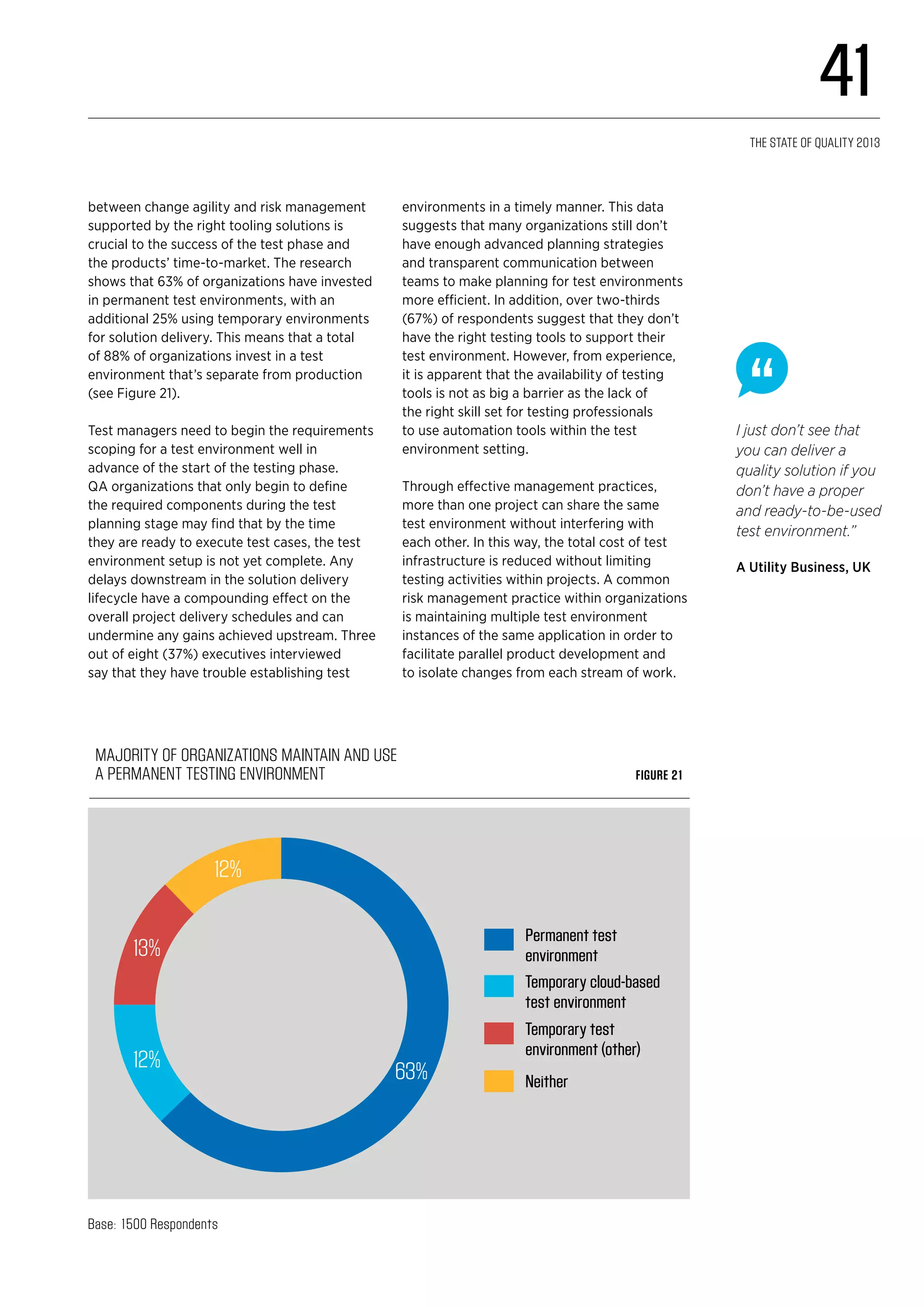
environment (63%), with an additional 25% using temporary
environments for solution delivery.
Importantly, this investment could be underleveraged. Over
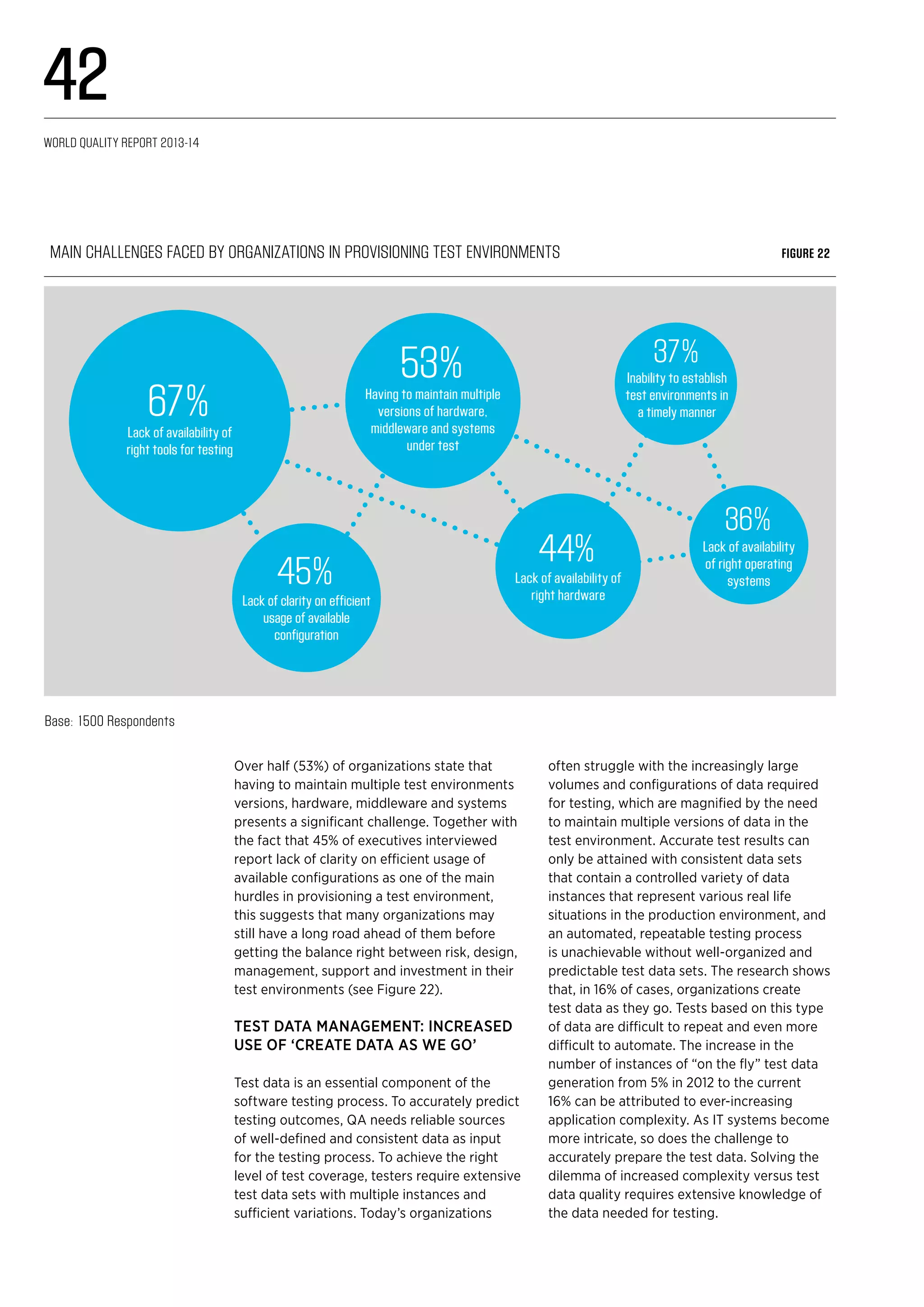
two-thirds (67%) of respondents indicate that they don’t
have the right testing tools to support their test environment,
despite the investment; 53% struggle to maintain multiple
test environments, comprising hardware, middleware and
systems; and 37% of executives have trouble establishing test
environments quickly enough.
However, these barriers may be masking concerns: 55%
identify Test Environment Management as the specialized
testing skill most lacking in-house. Without the appropriate
level of specialist planning and execution expertise, the testing
team could be wasting valuable time and expensive resources,
which could offset any broader gains achieved through
centralization, automation and process optimization.
Our research results also show that organizations are finding it
difficult to provide test data that is representative, consistent
and sufficiently comprehensive for today’s complex and
multi-vendor application landscape. Analysis of the test data
generation methods reveals that organizations surveyed
prefer, in 54% of cases, to create new test data (including 16%
created ‘on the go’) as opposed to reusing existing/production
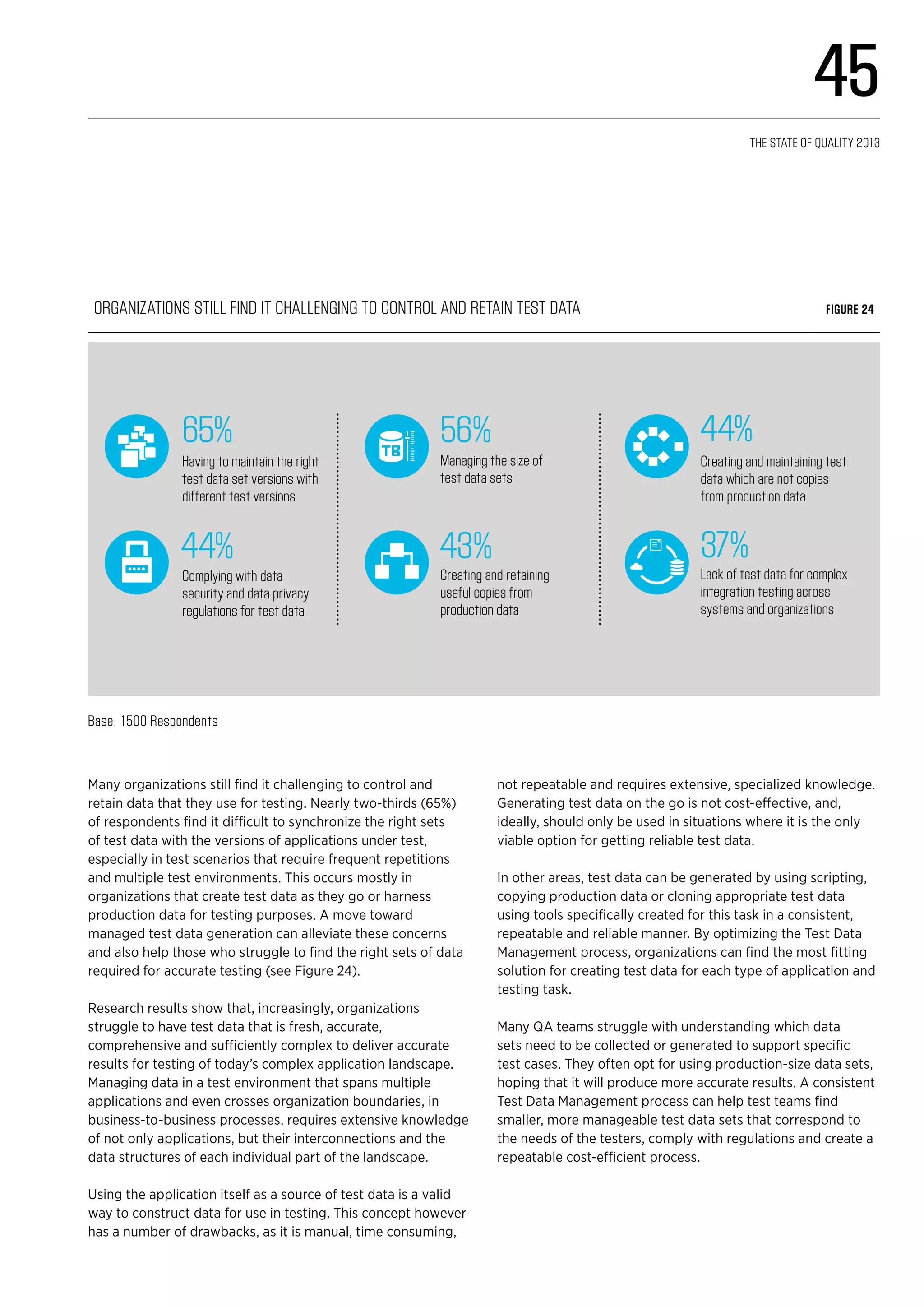
data sets. And nearly two-thirds (65%) of organizations find it
difficult to synchronize the right sets of test data with versions
of applications under test, especially in test scenarios requiring
frequent repetitions and multiple test environments.
7
Agile development is now widely adopted but still
gives rise to problems for testing, particularly in
relation to specific methodologies and expertise
This year’s research finds that the proportion of organizations
reporting that they use Agile methods for all or some of their
application development has now reached 83%, probably
indicative of Agile’s promise of delivering applications
that are more adaptable to market conditions and more
responsive to change. However, 46% of organizations
claim lack of a consistent testing approach for their Agile
development projects.
Delving further, an absence of adequate specialized testing
methods is a major concern for 64% of respondents, with
other impediments being inability to apply test automation
(56%), inability to identify an Agile testing focus (49%),
and lack of testing tools (39%). Agile teams continue to be
broadly a movable split of three groups: developers, testers
and business analysts, but over a third of executives cite lack
of professional testing expertise as an obstacle to achieving
effective integration of testing into Agile projects.
World Quality Report 2013-14
08
World Quality Report Recommendations
As guidance for users of Quality Assurance and Testing, we offer
these suggestions on how to apply the findings of this year’s World
Quality Report.
1.	 Improve reporting of business-oriented
metrics to demonstrate the value of QA
Although more organizations are beginning to centralize QA practices
and develop TCOEs (which is generally accepted as a sign of growing
testing maturity), most still need to prove the business value of QA by
reporting operational metrics linked to specific business outcomes.
For this, QA organizations should focus on reporting business-
oriented metrics that demonstrate the contribution that QA
operations make, such as reduced time-to-market for IT projects,
cost savings in IT operations, and improved quality of software in
production linked to increased user satisfaction – and by implication
customer retention.
Interestingly, in our experience, few clients currently require that
business outcomes are built into complex testing services deal
structures even in large TCOE projects.
2.	Innovate and optimize QA operations
for return on investment
The proportion of the IT budget assigned to QA/Testing is rising
fast – maybe too fast for some businesses. To ensure that your
organization is receiving a strong return on this investment, it
is essential to invest in implementing standardized, structured
QA methodologies, improving the levels of test automation, and
improving the qualifications and skills of the dedicated QA and
testing teams.
Many organizations are already taking this route, as is evident from
the rapidly growing number of centralized testing functions and
industrialized Testing Centers of Excellence (TCOEs) that deliver
measured cost efficiency and provide a platform for improved
professionalism and innovation. Further, investment in testing of
new transformational projects must be safeguarded by early and
systematic analysis of the potential risk elements of these projects.
3.	Establish a specialized function
for mobile testing
Testing of mobile applications and devices is a rapidly growing
field, with its own unique set of technology challenges, and high
requirements for secure apps. While specialized tools are available,
organizations continue to struggle with lack of available mobile
testing environments, test expertise and specialized methods.
One way to address these challenges effectively is to establish a
dedicated mobile TCOE, complete with a professional team of mobile
testing experts, managing a set of specialist test platforms that meet
primary IT and business goals.
4.	Make greater use of the Cloud for testing
Organizations are taking a cautious approach to Testing in the
Cloud, so our recommendations reflect an incremental and
considered approach. We advise developing a specific strategy for
migrating testing to the Cloud, factoring in explicit requirements,
tools and opportunities that the Cloud offers.
In addition, we believe there are opportunities to reduce functional
testing effort associated with cloud-based software services, by
engaging in early risk analysis to provide an accurate assessment of
the required levels of testing. Similarly, for testing applications hosted
in the Cloud, it is important to fully understand the differences from
testing on infrastructure hosted in-house, particularly the allocation
of effort and focus.
5.	Establish test environment and
test data management practices
Test environment and test data management are two areas where
specific challenges for QA teams are emerging. For example, the
lack of the appropriate test platform and test data can quickly
erase efficiency gains realized elsewhere, such as from investing in
structured testing processes or automation tools. We also recognize
that many QA organizations struggle to strike the right balance
between risk, design, management and support, and identify the
optimum level of investment in their test environments.
To manage these issues we assert that organizations must establish
specific teams with dedicated experts, within, say, a TCOE, to take
explicit responsibility for a properly configured test environment and
reliable sets of representative test data. This would include putting in
place the appropriate processes to ensure consistency and maximize
return on testing investment. This team should also develop advanced
planning strategies and transparent communication between teams
to get the right balance between change agility and risk management,
supported by the right tooling solutions.
6.	Integrate testing into agile projects
For an agile approach to succeed, each iteration must be driven by
business value. The most common cause of failure of agile projects is
that teams focus solely on speed of delivery, arbitrarily favoring some
process elements and discarding others.
Organizations should focus on finding an approach that allows
structured quality and agile to coexist, integrating testing
methodologies and experts within agile development projects.
Summary
This year’s report has identified a structural shift in the QA operating
models adopted by organizations to optimize their throughput,
processes and resources to deliver better-quality applications.
Without this shift toward centralization and industrialization,
organizations will not be able to deliver the level of quality required
to sustain business growth – even with a bigger QA budget. Improved
operational efficiency must remain the key goal for the Testing and
QA function – through specialist skill sets, methodologies and tight
organization, rather than increased budgets.
09
Executive Summary
The State of
Quality 2013
12
Quality Assurance
Budgets: Continued
Growth, Shifting Priorities
18
Transforming the
Testing Organization
24
Mobile Testing: A Shift
from Tools to Methods
30
Cloud: Taking a
Considered Approach
36
Testing in the Agile
Development Environment
40
Test Infrastructure
and Data Management:
Building Environments
to Ensure Quality
World Quality Report 2013-14
10
Over the last three
years, the investment
we have made in
testing has increased,
driven by a continual
need to improve the
output from IS into
the business. However,
I think we have got to
a point in the lifecycle
where we are now
thinking how we can
be more efficient in
testing and introduce
a little more risk in our
testing approach.”
A Utility Business, UK
for reliability. Similarly, consumers demand
ever higher quality for all types of customer-
facing applications, driving organizations to
deliver applications not only faster and with
more features, but also with more attention to
usability, security and availability.
In an era increasingly dominated by browser
and touch screen navigation, when alternative
applications are just a few clicks away, end-
users are becoming less tolerant of faults or
errors in functionality, service interruptions or
poor performance. If an application doesn’t
respond or function as expected the first time,
today’s end-users are more likely to abandon it
and never return.
The fact that organizations are willing
to shift their resources from other areas
of IT and allocate them to QA suggests
that they are taking quality seriously and
realize that it cannot be achieved without
considerable investment.
Another positive aspect of increased QA
spending is that some organizations are
now able to attract and retain the best
QA talent and offer a competitive career
path across the business. In the past, QA
engineers typically had fewer opportunities
to advance beyond a certain level. Highly
capable, ambitious IT professionals preferred
a career in development, rather than QA or
quality management.
Nowadays, many organizations are willing
to invest in hiring skilled engineers and
analysts for QA roles, offering them not only
competitive salaries, but also fulfilling career
growth opportunities. They are beginning
to view QA professionals as people who
are entrusted with the quality of their core
business applications, and are willing to
allocate budgets to recruit and retain top
talent in this area.
Rising quality assurance
(QA) awareness
As predicated in last year’s World Quality
Report, the latest research data shows a
further increase in the proportion of budget
being spent on application quality. The
average spending on QA as a percentage of
the total IT budget has grown from 18% in 2012
to 23% in 2013.
Furthermore, over a fifth (21%) of executives
(CIOs, VPs of applications and IT directors)
interviewed indicate that they spend between
31% and 40% of their IT budgets on quality –
compared to just 8% last year. The 5% increase
in the proportion of testing budgets outpaces
the generally acknowledged year-on-year
increase of 2–3% in overall IT budgets. The
portion of the budget allocated to the testing
function is expected to grow further in the
next two years – with the respondents this
year predicting that 28% of their organization’s
IT funds will be spent on quality (see Figure 1).
The significant QA budget increase is a clear
demonstration of rise in awareness, levels
of organizational maturity and growing
understanding of the role and business
contribution of quality and application testing.
Across all industry sectors and geographies,
both commercial firms and Public Sector
organizations rely heavily on their IT systems
and expect these systems to support their core
business functions without interruption. This
contributes to increased awareness among
organizations of the potential reputational
damage caused by defects in their software
systems – at the point of use.
Many organizations are not investing in new IT
infrastructure, yet performance expectations
are continuously rising, increasing the
pressure to deliver new functionality with
minimal investment and high expectations
Quality Assurance Budgets: 	
Continued Growth, Shifting Priorities
World Quality Report 2013-14
12
23%
28%
2012
18%
Continued growth of QA budgets from 2012 through 2015 (Projected) Figure 1
2013
2015
(projected)
Base: 1191 Respondents
13
The State of Quality 2013
Lacking efficiency in QA
On the flip side, however, a fast, continuous
budget growth reveals a potentially
troubling trend. The fact that organizations
are willing to spend on average close to 30%
of their IT funds on quality suggests that
they may not be using the money in the most
efficient way, and lack the necessary tools,
metrics, processes and skills to develop a
competent cost structure for QA that will
create long-term savings.
Whereas, in the past several years, labor
arbitrage could often provide an effective
means of reducing the cost of quality – even
for organizations with highly decentralized,
fragmented QA teams – simply lowering the
labor costs is no longer enough to keep the
cost of QA under control. Businesses that
wish to stay competitive and increase their
application quality need to fundamentally
change the way they look at quality processes,
automation and metrics.
Technology is changing rapidly. Yet many
testing organizations are slow to adapt their
business practices to the new ways required
to support growing business demands.
Without a shift toward optimization, even with
continuous QA budget increase, organizations
won’t be able to deliver the level of quality
required to sustain business growth.
Focus on transformation
initiatives
Fast-changing technology and competitive
pressures continue to influence where
organizations allocate their testing resources.
In fact, a very positive trend is evident
from the analysis of how different forms
of QA work are funded. Although the
respondents indicated last year that only
41% of their testing effort was being spent
on transformational initiatives, this year the
data shows that the share of new projects
has grown to 46%. The remaining 54% of
testing resources is dedicated to maintenance
work, such as testing new releases of existing
applications, supporting integration initiatives
and other “business as usual” activities.
We are moving to
a digital space and
investing heavily. Some
of the investment
is funding new
development and
some of it is to
enhance business
requirements
like SEPA. Overall,
there is a lot of
new activity and
less maintenance.”
A Financial Services
Business, Europe
Looking ahead, respondents predict that
by 2015, the gap between QA spend on
new IT initiatives and maintenance projects
will narrow even further, approaching the
50/50 split. Breaking the 50% barrier will mark
a significant milestone (see Figure 2).
In many organizations, it is often easier
to secure IT funding for high-visibility
transformation projects involving new
technology trends. Additionally, testing
of existing applications can typically be
performed more cost-efficiently using
automation and reusable testing assets such as
requirements, test cases and scripts, therefore
requiring less funding.
QA budgets are still largely
spent on infrastructure
Last year, over half of the IT executives
interviewed indicated that they were
allocating the greatest increase in QA spend
to the upgrading of their existing testing
tools and licenses, followed by staffing
costs related to employing their own in-
house QA professionals. When asked about
future QA spend, most respondents last
year forecasted increased spending on
external, outsourced test resources and new
testing tools. The research findings this year
are consistent with last year’s projections
for 2015. Organizations continue to spend on
infrastructure, but invest less for in-house
testing professionals and testing software
licenses (see Figure 3).
For those organizations that have increased
spending on transformational projects, new
technologies and delivery platforms require
continued investment in testing infrastructure
and environments, and frequently create a
need for new types of testing tools and highly
specialized QA expertise and knowledge.
World Quality Report 2013-14
14
The share of transformational projects continues to grow Figure 2
Organizations continue to invest in testing hardware and infrastructure Figure 3
MAINTENANCE
WORK
NEW
TRANSFORMATIONAL
WORK
51%
54%
46%
59%
41%
49%
2012 2013 2015
(Projected)
TESTING
HARDWARE &
INFRASTRUCTURE
40% 23%28% HUMAN
RESOURCES
TOOLS &
SOFTWARE
LICENSES
Base: 1191 Respondents
15
The State of Quality 2013
Increasingly, market and competitive demands require
organizations to focus on their core business competencies.
For IT departments, this can mean investing in systems
and processes that directly support day-to-day
business operations. Testing and QA are often not among their
core skills, and after many years of trying to build in-house
testing expertise, organizations are beginning to look at
implementation partners to provide a complete set of testing
services and share the responsibility for quality outcomes.
This trend is evident in lower reported spending on internal
testing personnel, and continued investment in testing
infrastructure as the organizations embark on centralizing
their testing operations – often in-house – with the help of
third-party providers.
QA spend levels remain consistent
across most regions and verticals
Budget trends remain consistent across regions and industries,
with the mean average of 23% of the total IT funds being
allocated to QA.
According to the research findings, North American
organizations allot a slightly higher proportion of their IT
budgets for QA function, with the testing accounting for
26% of the total. North America also has one of the highest
percentages of testing functions handled entirely by
external testing vendors (15% in North America versus 12%
global average). American organizations seem to be willing
to invest more in QA over the next few years in order to
realize long-term cost savings through managed services,
industrialized processes and test automation frameworks.
Organizations in the Eastern European countries included
in the research (Hungary, Poland and the Czech Republic)
are among those that show the greatest increase in testing
budgets as a portion of the IT budget – from 16% last year to
21% in 2013. Such growth can be attributed to the continuing
sweeping change in attitudes towards testing, the growing
importance of application quality and the increasing maturity
of the QA organizations. Eastern European businesses are
quickly ramping up their investment in tools (31% of their
testing budget is spent on testing software and licenses,
compared to 28% global average) and are open to the concept
of managed services and outsourced testing models.
Among different industries, Healthcare and Life Sciences,
Financial Services and Telecom, Media and Entertainment
lead the way, with 25%, 24% and 24% respectively of their
IT budgets allocated to quality. All three of these industries
have a long tradition of quality and a thorough understanding
of connecting software quality directly to business results
and customer satisfaction. Interestingly, the verticals whose
quality spending measures are above the industry average
share common challenges: market and customer demands
on one side, and regulatory compliance issues on the other.
And all seem to view application quality as essential to
satisfying both.
Last year, the World Quality Report identified the Public Sector
as one of the surprising leaders in the QA budget increase.
This year’s data reveals that government organizations
continue to maintain higher levels of spending on QA (22%),
despite widespread Public Sector budget cuts and tighter
control of IT spending worldwide. This demonstrates the
Public Sector organizations’ lasting commitment to quality
– both to meet the growing demands of citizens and to help
government IT organizations deliver applications within
tighter budgets and time constraints. Government IT is
under considerable pressure to reduce spending, and Public
Sector organizations realize that delivering applications
with more predictable quality will help them meet their
cost-cutting requirements.
World Quality Report 2013-14
16
Investment priorities reflect maturity
levels and long-term goals
Consistent with last year’s research findings, the 2013 data
confirms that regions with a well-established quality and
testing tradition continue to move towards more centralized,
managed service models. On the other hand, organizations
operating in what could be considered an emerging market
are typically still establishing the fundamental structure of
their in-house testing practices, requiring them to invest more
heavily in software testing product licenses and infrastructure.
Many organizations in Eastern Europe, for example, are rapidly
catching up with those in more mature testing markets by
building solid testing practices, infrastructure and toolkits.
In summary, despite improvements in the economic outlook
and increased consumer confidence in several of the markets
covered by this research, nearly all organizations remain
cautious about spending significant sums of money on large-
scale transformational IT projects. Instead, they are choosing
to invest in improving the quality of their existing applications
and establishing new quality practices to support emerging
technologies and sales distribution channels.
Although spend on quality and testing activities continues to
rise as a proportion of overall IT budgets, CIOs are still under
pressure to reduce the total cost of QA and Testing. The fact
that most executives interviewed cite cost reduction as the
main driver for outsourcing QA suggests that testing teams
are striving for greater efficiency and doing “more with less”.
17
The State of Quality 2013
As information technology continues to
advance, organizations feel an increased
need to change the way they deliver
software applications. Businesses of all types
and sizes face similar pressures: to bring
products to market faster, to satisfy the
growing consumer demand for new features
and services, and to comply with privacy and
data security regulations and requirements.
As part of overall IT modernization and
optimization, the quality assurance (QA)
function is adapting to changing business
demands by undergoing a transformation of
its own.
This year’s research data reveals a growing
level of QA functional maturity in organizations
across all geographies and vertical markets, as
is evident from the percentage of businesses
that indicate that their QA function is
centralized as a single stream across the
entire organization. Compared to last year’s
8%, in 2013 over a quarter (26%) of all CIOs
and IT directors interviewed say that they have
consolidated their QA function across projects,
lines of business or the whole company
(see Figure 4).
The growing trend towards centralization
represents a significant milestone in how QA
function and application quality in general
are perceived by the business. Not only are
organizations becoming more committed
to quality, but they are also willing to invest
in aligning their testing and development
teams across projects. Organizations are
also becoming more aware of the correlation
between consistent testing processes,
centralized delivery models and reliable quality
metrics – and business outcomes.
Compared with previous years, one of the
trends emerging this year is a growing demand
by senior managers for business and domain
knowledge among testers. This year, nearly
two-thirds (63%) of executives interviewed
say that an understanding of the business
side is an important capability in their testers.
Moreover, the skills that were found to be more
important last year – namely knowledge of
testing management, metrics and reporting
– have now fallen to the sixth place, with only
37% of executives rating it among the critical
skills for their QA professionals.
The research data suggests that QA
organizations are becoming more in tune
with business objectives and looking to
align their goals with business priorities. The
higher demand for business knowledge is also
directly aligned with the growing number of
centralized testing organizations: by building
specialized testing centers, organizations
relieve their business professionals of any
testing-related tasks, enabling them to
focus on the core business. This, however,
also means that QA professionals within the
industrialized Testing function need to gain
more profound knowledge of a company’s
strategies, processes and systems.
Transforming the Testing Organization
We have moved to a far more centralized operation than before. The CIO and QA
manager used to have different expectations on testing and development but now
centralization of our testing operations has created greater alignment between the two.
The CIO can see the benefits that centralization brings, like reduced costs, better skills
development, higher quality and faster time-to-market. The QA manager also sees
the same benefits and is better positioned to demand more resources. The improved
alignment between the two is a key issue.”
A Financial Institution, Northern Europe
World Quality Report 2013-14
18
A growing number of organizations are moving towards 	
centralizing their QA activities across the entire business Figure 4
Centralized as one stream
across the organization
8%
26%
2012
2013
A combination of centralized
and decentralized teams
43%
35%
2012
2013
Highly decentralized across
different Business Units/
Geographies/Divisions
27%
13%
2012
2013
No separate testing stream
exists within the
organization
20%
14%
2012
2013
Testing execution function is
handled by an external vendor
(Managed Testing Service)
2%
12%
2012
2013
Base: 895 Respondents
19
The State of Quality 2013
We have had an
operational TCOE
now for 5 years.
We saw that our
efficiency increased.
We also reduced our
costs and are better
aligned with business.”
A Healthcare Business,
Finland
growth for Testing Centers
of Excellence (TCOEs)
Two years ago, the World Quality Report
identified a trend toward building Testing
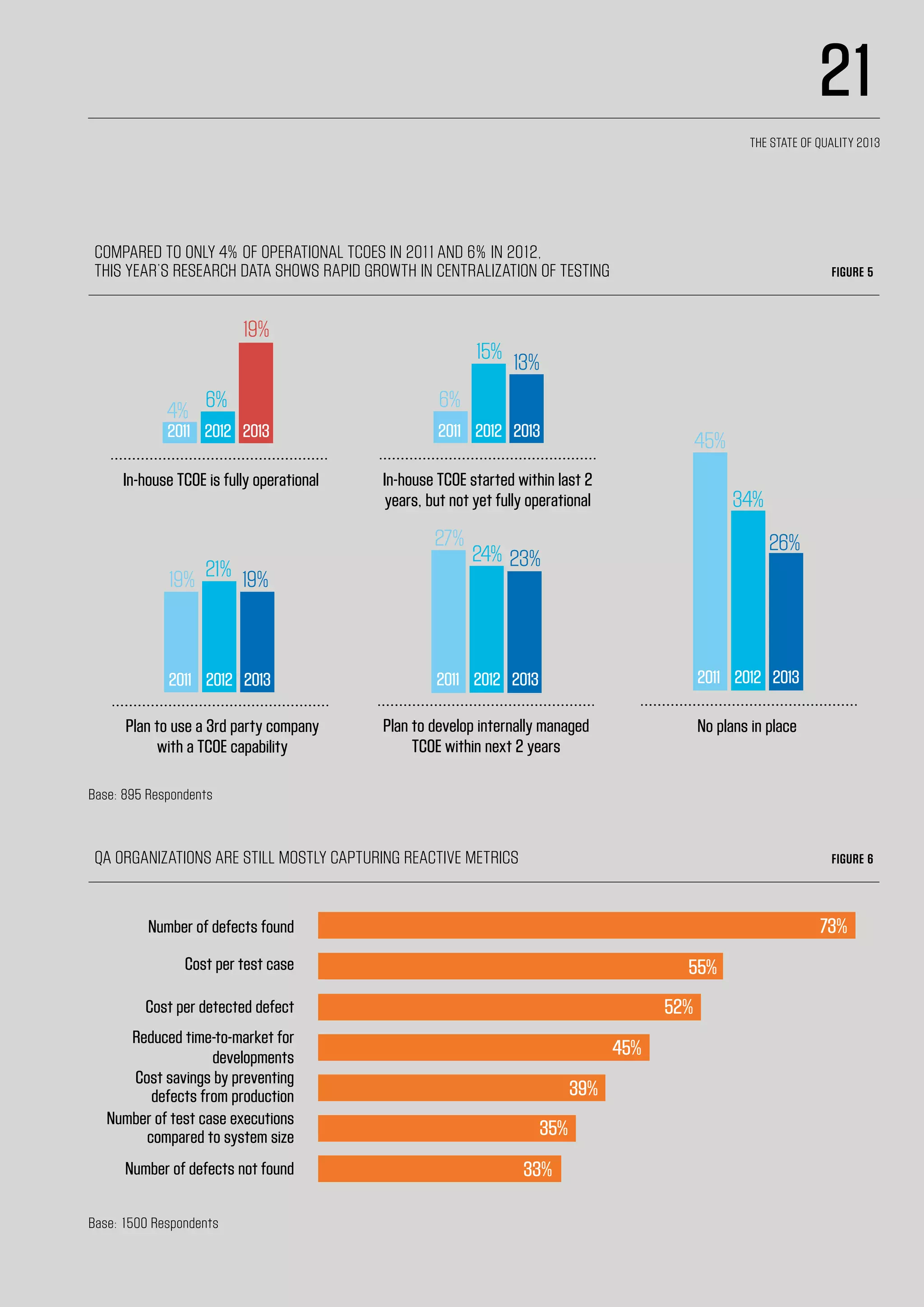
Centers of Excellence (TCOEs). In 2011,
only 4% of organizations said that they had
established fully functional TCOEs, but nearly
half (46%) of respondents reported that
they had plans to industrialize their testing
operations using either in-house or third-party
TCOE capabilities.
In 2012, the number of operational TCOEs grew
to 6%, with an additional 15% of IT leaders
saying that their transformation toward
TCOEs had already begun, but they were not
yet online. This year, nearly one in five (19%) of
organizations surveyed reports having a fully
operational TCOE, with another 13% having
started the transformation within the last two
years (see Figure 5).
Among the sectors, the leaders in fully
operational TCOEs are the Consumer Products,
Retail and Distribution (31%) and Telecom,
Media and Entertainment (23%) verticals.
Both of these industries face increasingly
intense competition and the emergence of new
disruptive technologies. Executives working in
both sectors view quality as a key element in
their market success, and value QA efficiency
as a strong competitive differentiator.
By comparison, only 8% of Energy and
Utilities (E&U) organizations have established
TCOEs – largely due to the highly specialized
nature of energy delivery applications and
the large number of vendors involved with
various aspects of the business. However,
even among the E&U businesses, movement
toward establishing a central governance body
for all testing activities is gaining momentum,
with over half of CIOs and IT directors (52%)
suggesting that their companies have plans
to develop TCOEs using either in-house
capabilities or third-party providers.
Across all verticals and industries, the trend
is unmistakable – organizations are creating
a foundation for greater efficiency, resulting
in cost savings, better coverage and closer
alignment between QA and the business.
However, one in four (26%) of the surveyed
CIOs and IT directors reports that they are
still hesitant to make the transition to a more
standardized and industrialized QA model.
An analysis of the QA metrics shows that,
although TCOEs are gaining popularity, many
of them are not yet sufficiently ‘mature’ to
clearly demonstrate the business value to
internal stakeholders.
The research found that the majority of
organizations are only capturing and reporting
operational information, such as the number
of defects found (73%) or cost per test case
(55%). These metrics do not show the value-
add of testing services and don’t allow the CIO
to accurately judge the level of investment
required by QA.
A smaller number of companies are capturing
the metrics related to the business value-add,
such as the contribution of QA to reduced
time-to-market, cost savings by preventing
defects, or the relationship between testing
coverage and the risks and complexities of
the systems. It remains one of the greater
challenges to both existing and future TCOEs
– to proactively demonstrate their value-add
through hard data (see Figure 6).
Based on the research, senior IT leaders often
don’t feel confident that their organizations
possess the required methodology (66%) and
skilled resources (52%) in-house to implement
a successful centralized Testing function. Many
CIOs don’t view testing as their companies’
core function and would prefer an alternative
engagement model for ensuring consistent
application quality.
World Quality Report 2013-14
20
Compared to only 4% of operational TCOEs in 2011and 6% in 2012, 	
this year’s research data shows rapid growth in centralization of testing Figure 5
QA organizations are still mostly capturing reactive metrics Figure 6
34%
26%
15% 13%
6%
19%
24% 23%21%
45%
6%4%
27%
19% 19%
Plan to develop internally managed
TCOE within next 2 years
Plan to use a 3rd party company
with a TCOE capability
In-house TCOE started within last 2
years, but not yet fully operational
No plans in place
In-house TCOE is fully operational
2012 2013
2012 20132012 2013
2012 20132012 2011
20112011
20112011 2013
Number of defects found 73%
Cost per test case 55%
Cost per detected defect 52%
Reduced time-to-market for
developments 45%
Cost savings by preventing
defects from production 39%
Number of test case executions
compared to system size 35%
Number of defects not found 33%
Base: 1500 Respondents
Base: 895 Respondents
21
The State of Quality 2013
Adoption of the Managed Testing
Services engagement model is on
the rise, while number of in-house
testing practices decreases Figure 7
Internal/In-house
External/Managed Services: external vendor manages
and owns the testing delivery function and reports
back to you on results
Capped or Fixed Capacity Professional Service
Co-managed Projects
Staff Augmentation/Temporary Contractors/
Professional Service on time and materials basis
51%
41%
13%
20%
13%
14%
13%
12%
11%
14%
2012
2013
2012
2013
2012
2013
2012
2013
2012
2013
Base: 1500 Respondents
Rapid rise of the outsourced
managed testing services model
An emerging option for organizations that prefer not to invest
in their own in-house TCOE is the outsourced Managed Testing
Services (MTS) model. Unlike previous years, when the term
“outsourcing” referred largely to the staff augmentation
approach characterized by effort-based pricing, i.e. time and
materials, nowadays third-party providers offer complete
testing services linked to shared responsibility for delivering
and maintaining the high level of application quality at both
enterprise and program level.
Today’s vendors are expected to bring not just labor, but
specialized knowledge of testing processes and a full array of
tools to test with maximum efficiency. Moreover, businesses
expect their service providers to help with the transformation
of their testing organization and share the responsibility for
application quality.
Nearly half (46%) of executives interviewed say that they
choose to outsource at least some part of their testing
operation, citing cost reduction as the main business reason
for doing so (57%). Not surprisingly, the second largest
reason for outsourcing QA (50%) appears to be the ability
to free up internal resources to focus on core business
functions, followed by improved software quality (45%) and
faster time-to-market (40%). These benefits can be attained
through partnership with an MTS provider, especially when
the engagement model is not based on capacity, but rather
centered on long-term gains and business outcomes.
The 2013 survey data shows a rapid growth in adoption of the
MTS model, with respondents indicating that MTS forms, on
average, 20% of their engagement model in testing. This year’s
data shows a substantial increase from the previous year with
a slightly higher adoption of MTS among the organizations
with over 5,000 employees (see Figure 7).
Some organizations engage the MTS providers on a multi-
year contract basis, measuring results simply in terms of
improved application quality, faster time-to-market and cost
savings – not the number of found defects, completed test
cases or resources onsite. This approach facilitates continuous
innovation, while helping organizations achieve their
business goals.
Specialized testing experts can be situated onshore, nearshore
or offshore, augmenting the in-house testing force when
necessary, governed by consistent methodologies, metrics,
toolkits and reporting standards. The research data shows
a slight increase in both onshore (55%) and offshore (28%)
distribution of testers, offset by a decline in the nearshore
World Quality Report 2013-14
22
Nearly half of organizations get QA involved
too late in the application delivery lifecycle Figure 8
22%
20%
20%
15%
10%
6% 6%
Project planning phase
Requirements definition phase
Implementation phase
Production or maintenance phase
Realization or system development phase
High level design phase
Low level design phase
Base: 1500 Respondents
(17%) location, supporting the view that more organizations
are adopting an industrialized approach to testing, in
which in-house testing teams can work in parallel with
outsourced groups.
The reduction in the share of nearshore workforce could also
demonstrate the growing level of organizations’ comfort in
the onshore/offshore model, and robust delivery governance
processes by the service providers.
The journey up the QA maturity
ladder is just beginning
According to comments made by executives during some
of the interviews, many organizations have not yet reached
maturity in terms of understanding the value of testing and
how centralization can successfully drive the change. Those
companies continue to engage in traditional testing practices,
where QA gets involved late in the application delivery
lifecycle, and operates largely in a reactive mode – ensuring
that the application works, rather than helping find ways to
build quality into the delivery process.
As evident from the research data, nearly half (45%) of
organizations get their QA and testing leads involved at the
development phase or later, which is clearly too far into the
delivery process to influence application quality beyond just
finding and fixing defects (see Figure 8). Additionally, three
out of five (61%) of the IT executives interviewed say that they
have no plans to introduce quality earlier in the lifecycle.
In organizations where testing still plays a reactive role,
some senior managers often find it difficult to articulate
the value of transformation and demonstrating the ROI
of testing. Often test managers can’t get executive buy-in on
large-scale transformation initiatives, and QA organizations
remain hesitant to centralize their testing functions or
relinquish even part of the control over application quality to
third-party providers.
It is important to understand that a Testing Center of
Excellence (TCOE) is not simply about organizational
changes, onshore versus offshore test execution or adopting
consistent metrics. It is the beginning of growing awareness
of testing as part of the business assurance function, and not
just a “find and repair” service. A TCOE is just the first step
along the multi-level quality maturity journey that can help
organizations achieve considerably better quality for the same
amount of investment – through process industrialization
and innovative engagement models with trusted outsourced
service providers.
23
The State of Quality 2013
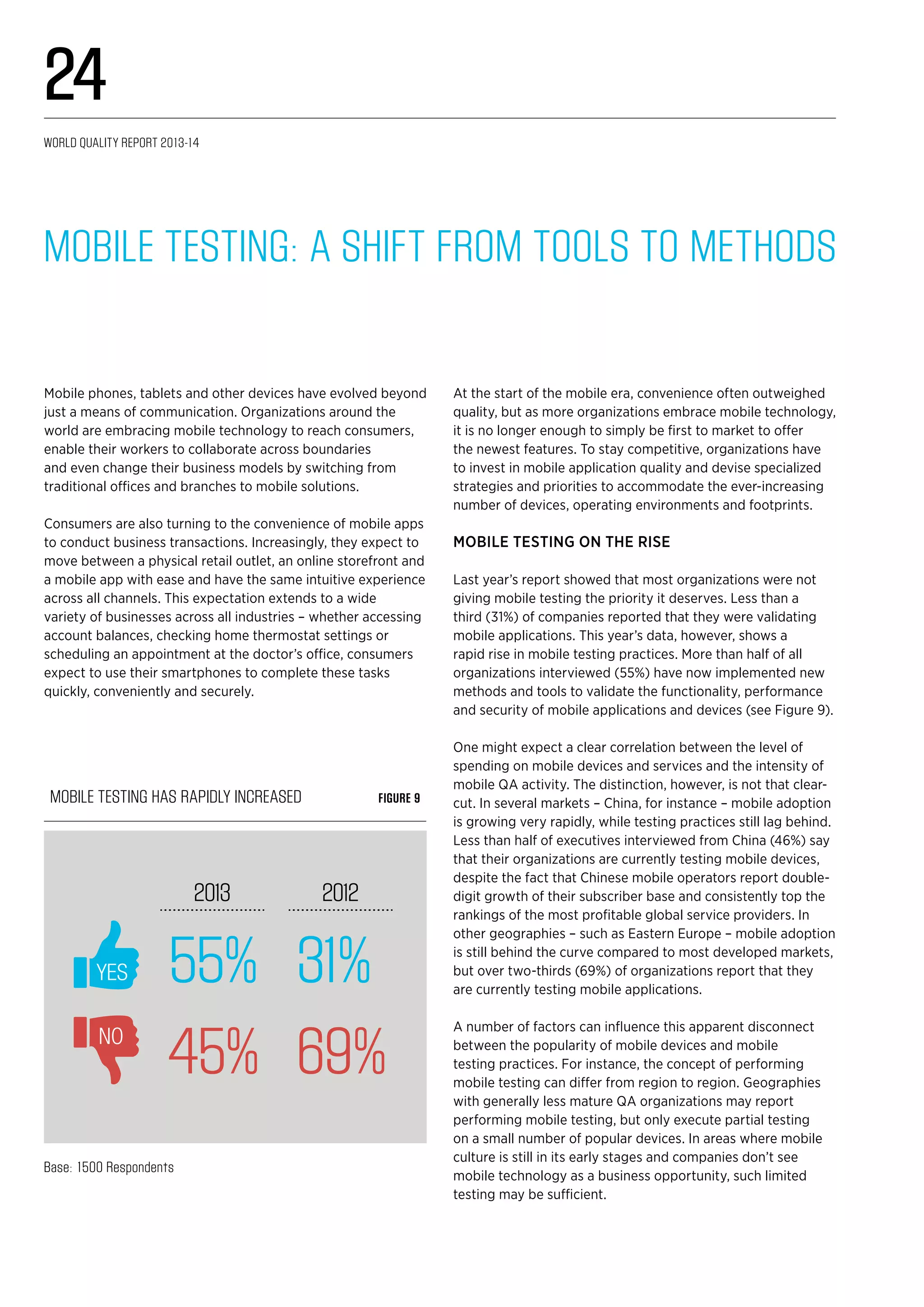
55% 31%
45% 69%
2013 2012
YES
NO
Mobile testing has rapidly increased Figure 9
Base: 1500 Respondents
Mobile Testing: A Shift from Tools to Methods
Mobile phones, tablets and other devices have evolved beyond
just a means of communication. Organizations around the
world are embracing mobile technology to reach consumers,
enable their workers to collaborate across boundaries
and even change their business models by switching from
traditional offices and branches to mobile solutions.
Consumers are also turning to the convenience of mobile apps
to conduct business transactions. Increasingly, they expect to
move between a physical retail outlet, an online storefront and
a mobile app with ease and have the same intuitive experience
across all channels. This expectation extends to a wide
variety of businesses across all industries – whether accessing
account balances, checking home thermostat settings or
scheduling an appointment at the doctor’s office, consumers
expect to use their smartphones to complete these tasks
quickly, conveniently and securely.
At the start of the mobile era, convenience often outweighed
quality, but as more organizations embrace mobile technology,
it is no longer enough to simply be first to market to offer
the newest features. To stay competitive, organizations have
to invest in mobile application quality and devise specialized
strategies and priorities to accommodate the ever-increasing
number of devices, operating environments and footprints.
Mobile testing on the rise
Last year’s report showed that most organizations were not
giving mobile testing the priority it deserves. Less than a
third (31%) of companies reported that they were validating
mobile applications. This year’s data, however, shows a
rapid rise in mobile testing practices. More than half of all
organizations interviewed (55%) have now implemented new
methods and tools to validate the functionality, performance
and security of mobile applications and devices (see Figure 9).
One might expect a clear correlation between the level of
spending on mobile devices and services and the intensity of
mobile QA activity. The distinction, however, is not that clear-
cut. In several markets – China, for instance – mobile adoption
is growing very rapidly, while testing practices still lag behind.
Less than half of executives interviewed from China (46%) say
that their organizations are currently testing mobile devices,
despite the fact that Chinese mobile operators report double-
digit growth of their subscriber base and consistently top the
rankings of the most profitable global service providers. In
other geographies – such as Eastern Europe – mobile adoption
is still behind the curve compared to most developed markets,
but over two-thirds (69%) of organizations report that they
are currently testing mobile applications.
A number of factors can influence this apparent disconnect
between the popularity of mobile devices and mobile
testing practices. For instance, the concept of performing
mobile testing can differ from region to region. Geographies
with generally less mature QA organizations may report
performing mobile testing, but only execute partial testing
on a small number of popular devices. In areas where mobile
culture is still in its early stages and companies don’t see
mobile technology as a business opportunity, such limited
testing may be sufficient.
World Quality Report 2013-14
24
Organizations across all sectors show considerable increase in mobile testing Figure 10
CONSUMER PRODUCTS,
RETAIL, AND DISTRIBUTION
TRANSPORTATION
ENERGY AND UTILITIES
FINANCIAL SERVICES
MANUFACTURING
HIGH TECH
HEALTHCARE AND LIFE
SCIENCES
TELECOM, MEDIA AND
ENTERTAINMENT
PUBLIC SECTOR
34%
54%
2012
2013
31%
54%
2012
2013
35%
61%
2012
2013
31%
53%
2012
2013
37%
48%
2012
2013
30%
56%
2012
2013
35%
55%
2012
2013
30%
48%
2012
2013
27%
58%
2012
2013
Base: 1500 Respondents
Other regions – such as Western Europe – have a more
mature QA function, and are more likely to answer “no” to
the question about mobile testing if they don’t have a truly
structured mobile testing strategy. In Asia, consumers have
access to a much greater variety of mobile devices and
platforms than do European or American consumers, and this
further complicates the testing task for QA organizations,
which are often ill equipped to handle the unique demands of
mobile testing.
Among the different industries, the pacesetter in mobile
testing is the Healthcare and Life Sciences sector, with
61% of respondents stating that they currently test mobile
applications – a significant increase from 35% in 2012. In the
US, for example, healthcare organizations have embraced
mobile technology, with applications touching every aspect
of patient care and administration. From smartphone-based
heart monitors that wirelessly send data from cardiac patients
to their doctors, to handheld portable ultrasound systems
used in remote areas, to mobile apps for paying hospital bills,
healthcare organizations are clearly in the forefront of the
mobile revolution.
The Telecom, Media and Entertainment (TME) sector boasts a
26% increase in the number of organizations that test mobile
applications and devices. Most large operators continue to
focus their QA efforts on the mobile infrastructure, and the
mobile application testing growth can probably be attributed
to the validation of their customer-facing applications by the
medium sized organizations (1,000–5,000 employees) that
participated in the research (see Figure 10).
25
The State of Quality 2013
Lack of processes and
methods still hinders
mobile testing efforts
In 2012, most of the executives interviewed
reported that their mobile testing lagged
behind other testing activities, largely due
to lack of tools and available devices. Nearly
two-thirds of organizations that test mobile
applications (65%) acknowledged that they
didn’t have the right testing tools to effectively
validate mobile applications, and a further 52%
stated that they couldn’t secure the required
devices to fully test applications’ compatibility
and interoperability on different platforms.
This year, just three out of eight (37%)
participants suggest that lack of tools presents
a challenge in testing mobile applications.
However, the number of respondents who see
the lack of an in-house testing environment
as an obstacle to mobile testing has doubled
from 19% in 2012 to 38% in 2013. Over half of
the executives interviewed in 2013 (56%) cite
the lack of specialized methods as the biggest
barrier to mobile testing, and an additional
48% report that they lack mobile testing
experts – a significant increase from just 29%
last year.
This shift from tools to methods and
environments suggests that organizations are
becoming more aware of the wide scope of
mobile technologies and devices on the market
and are beginning to see mobile testing
as an industrialized discipline, with its own
sets of consistent and repeatable processes.
Although the availability of testing tools is
no longer seen as the number one obstacle,
growing concern about the availability of
test environments and lack of time to test
suggests that organizations still don’t have
at their disposal all the required means for
mobile testing. Most importantly, without
a well-defined method, QA teams cannot
clearly plan, define objectives, set up test
environments or measure the success of their
mobile testing effort (see Figure 11).
Nearly all new
applications have
some sort of mobile
functionality whereas
testing mobile is quite
new for us. This can
create challenges for
each project because
mobile technology is
constantly evolving
and we find it hard
to plan for - which
ultimately adds more
time to each project.”
A Technology Business,
Brazil
World Quality Report 2013-14
26
The barriers to successful mobile testing have shifted from tools to methods Figure 11
34%
56%
52%52%
29%
48%
19%
38%
65%
37%
18%
33%
Do not have the right
testing process/method
Do not have the devices
readily available
No mobile testing
experts available
Do not have in-house
testing environment
Do not have the right
tools to test
Not enough time to test
2012 2013 2012 2013 2012 2013
2012 2013 2012 2013 2012 2013
Base: 825 Respondents
27
The State of Quality 2013
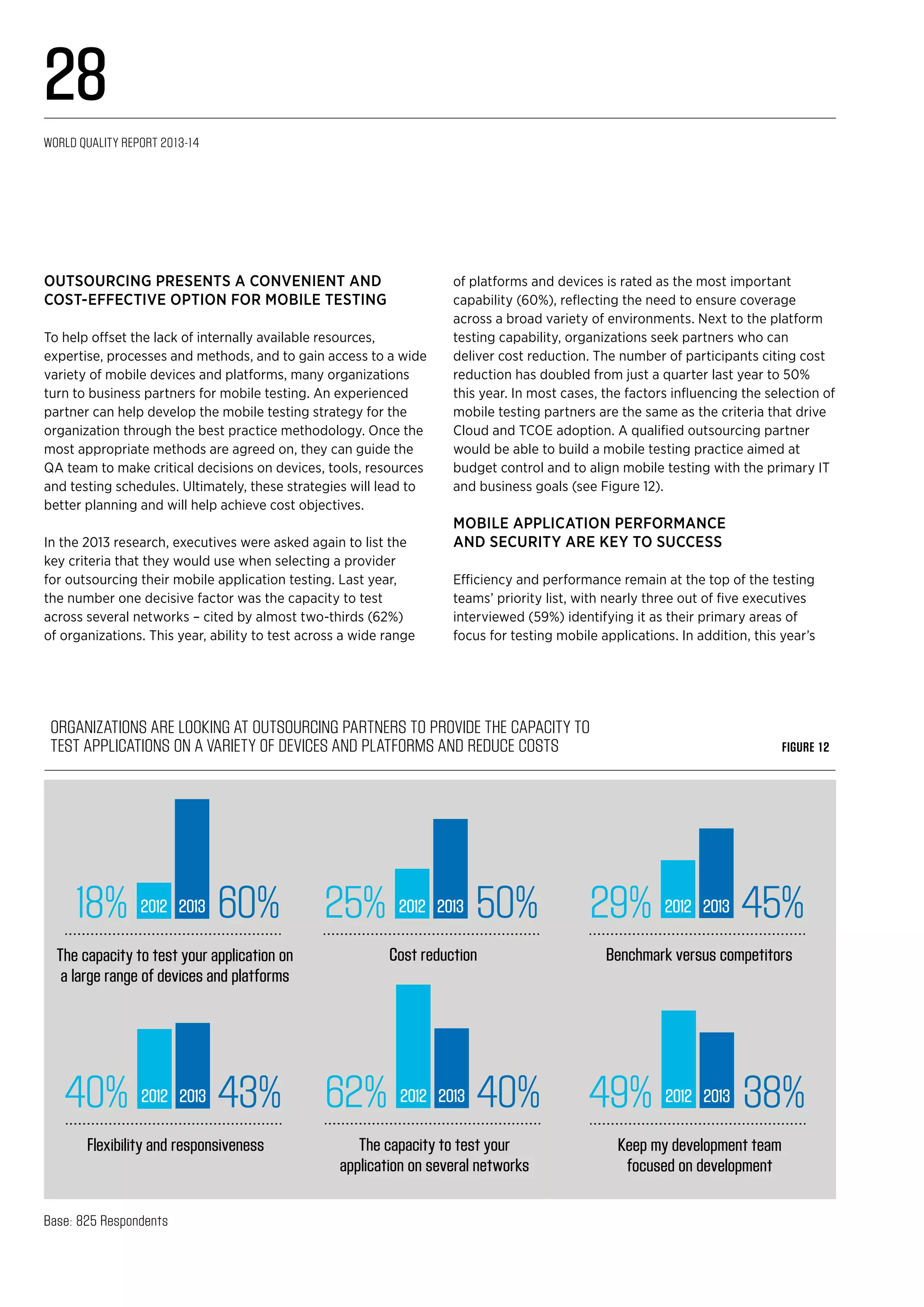
62% 40%
The capacity to test your
application on several networks
2012 2013 49% 38%
Keep my development team
focused on development
2012 201340% 43%
Flexibility and responsiveness
2012 2013
29% 45%
Benchmark versus competitors
2012 201325% 50%
Cost reduction
2012 201318% 60%
The capacity to test your application on
a large range of devices and platforms
2012 2013
Organizations are looking at outsourcing partners to provide the capacity to
test applications on a variety of devices and platforms and reduce costs Figure 12
Base: 825 Respondents
Outsourcing presents a convenient and
cost-effective option for mobile testing
To help offset the lack of internally available resources,
expertise, processes and methods, and to gain access to a wide
variety of mobile devices and platforms, many organizations
turn to business partners for mobile testing. An experienced
partner can help develop the mobile testing strategy for the
organization through the best practice methodology. Once the
most appropriate methods are agreed on, they can guide the
QA team to make critical decisions on devices, tools, resources
and testing schedules. Ultimately, these strategies will lead to
better planning and will help achieve cost objectives.
In the 2013 research, executives were asked again to list the
key criteria that they would use when selecting a provider
for outsourcing their mobile application testing. Last year,
the number one decisive factor was the capacity to test
across several networks – cited by almost two-thirds (62%)
of organizations. This year, ability to test across a wide range
of platforms and devices is rated as the most important
capability (60%), reflecting the need to ensure coverage
across a broad variety of environments. Next to the platform
testing capability, organizations seek partners who can
deliver cost reduction. The number of participants citing cost
reduction has doubled from just a quarter last year to 50%
this year. In most cases, the factors influencing the selection of
mobile testing partners are the same as the criteria that drive
Cloud and TCOE adoption. A qualified outsourcing partner
would be able to build a mobile testing practice aimed at
budget control and to align mobile testing with the primary IT
and business goals (see Figure 12).
Mobile application performance
and security are key to success
Efficiency and performance remain at the top of the testing
teams’ priority list, with nearly three out of five executives
interviewed (59%) identifying it as their primary areas of
focus for testing mobile applications. In addition, this year’s
World Quality Report 2013-14
28
Organizations focus their testing efforts on mobile applications’
performance, security and functionality Figure 13
64% 59%
Efficiency/performance
(including network-related)
2012 2013 18% 56%
Security (protection of sensitive
data on the phone or over the air)
2012 2013 48% 43%
Functionality
2012 2013
46% 38%
Portability
2012 2013 36% 36%
User interface/ease of use
2012 2013
31% 29%
Compatibility/regression testing
2012 2013
14% 34%
Certification of application
2012 2013
Base: 825 Respondents
survey data shows that testing for security and data integrity
has risen sharply compared to 2012. Last year, less than a
fifth of organizations testing mobile applications and devices
mentioned Security Testing as their mobile testing priority.
In 2013 however, security has moved up to second place,
with 56% of respondents citing its importance in the
mobile testing process. As mobile devices evolve beyond
communications function and become platforms for business
transactions, customers expect their personal information
to be safeguarded with the same level of security across all
channels – including mobile. Mobile security is expected to
occupy the top position among the QA focus areas within the
next two years (see Figure 13).
For us, the number of devices we have makes mobile
testing quite challenging. We started out like everyone
else with a few applications that ran on mobile devices
and getting those to work across different platforms e.g.
websites. Now there are many more dimensions to
consider and we’ve had to learn and remain confident that
what we deliver works. Testing security on mobile devices
is growing and a lot of people are embarking on it for the
first time and still learning. Security awareness is also a lot
higher these days with growing ID theft and other things
that people need to be aware of.”
A Retail Business, Australia
29
The State of Quality 2013
We are thinking
about how to migrate
our legacy and
mission-critical systems.
However the problem
is we started the
process of creating new
replacements before
cloud migration became
a reality. We now have
to work out a way that
enables us to migrate
the new replacement
systems to the Cloud
which abides by
company regulations.”
A Consumer Goods
Business, Sweden
Cloud-based computing continues to generate
high levels of interest among senior executives
across all geographies and market segments
because of the expectation of potential
benefits for an organization. Key advantages
of Cloud include: reduced infrastructure and
support costs; usage-based pricing; scalability;
faster time-to-market; and reallocation of
IT costs on the balance sheet from capital
expenditure to operating expense.
Cloud technologies are evolving constantly,
and as more cloud platform solutions become
commercially available, companies continue
to migrate existing applications to the Cloud.
Last year, the World Quality Report research
revealed that 22% of software applications
were being hosted in the Cloud, and so it
might therefore be reasonable to assume that
this trend would continue. However, this year’s
research results show a slight decrease in the
number of cloud-based applications – down
to 20%.1
Analysis of both this year’s data and market
insight indicates that this marginal dip
might be attributed to a number of factors.
First, many organizations began migrating
applications to public clouds a number of years
ago, but didn’t immediately see the expected
results, and are now working to refine their
migration policies and procedures to ensure
value in the future is clearly delivered.
Additionally, many organizations have already
migrated their more recently developed
applications, and are now looking for ways
to safely move their larger, mission-critical
legacy applications to the most appropriate
cloud infrastructure.
Many large companies still rely on extremely
complex, specialized and interconnected
legacy systems to enable their core
business processes. Some applications
were first deployed many years ago and
cannot easily be migrated to the Cloud,
due to complex architecture or absence of
source code. The cost and risks of moving such
applications to the Cloud, without modernizing
and virtualizing them first, mean that many
organizations are taking a cautious approach.
Further, many of today’s core legacy
applications rely on multiple storage systems,
which cannot be easily replicated in a cloud
environment, and a number of industries
still run on previous generations of mid-
range computer systems, which cannot be
supported in external cloud environments
designed for more recent applications.
Finally, there is the issue of depreciation and
amortization of existing assets: organizations
that have invested in multi-year software and
infrastructure licenses have less imperative to
move applications to the Cloud while they are
under contract to pay ongoing fees.
However, the interviewed IT professionals
remain positive about the future growth
of cloud-based applications, despite this
current minor dip in cloud adoption. By 2015,
they predict that the number of applications
migrated or hosted in the Cloud will increase
from 20% in 2013 to 26%. From this we can
deduce that the Cloud is increasingly accepted
as a significant component of the mainstream
IT infrastructure landscape (see Figure 14).
Cloud: Taking a Considered Approach
1	Note the audience difference for this question: in 2012, all respondents were asked the question related to
Cloud adoption, but in 2013, the question was put to all respondents except QA and testing managers.
World Quality Report 2013-14
30
Cloud adoption is slower in the near term, but poised for future
growth (percentage of applications hosted in the Cloud) Figure 14
22% 20% 26%
2012 2013 2015
(Projected)
Base: 1191 Respondents
Cloud adoption patterns are consistent
across sectors and geographies
Among industry verticals, Healthcare and Life Sciences and
Telecom, Media and Entertainment (TME) organizations
exhibit a small lead in Cloud adoption, with an average
of 22% of applications hosted in the Cloud, compared to
other sectors. In the Healthcare and Life Sciences market in
particular, new cloud-based offerings are emerging to help
modernize medical practice management, improve patient
communications and streamline the storage and handling
of health records. This is partly due to strict government
regulations in both the US and many European countries,
which require that healthcare providers maintain electronic
records for all transactions, and safeguard the security and
privacy of patient data.
In the TME sector, new market entrants, such as Mobile Virtual
Network Operators (MVNO), were the first to capitalize on the
cloud opportunity, because of their prime focus on managing
the customer-facing aspects of the telecom supply chain. But,
the larger TME players are also beginning to increase their
presence in the cloud services area to take advantage of cost-
saving potential and flexibility, as evidenced in this research.
Regional data privacy and security regulations can also prove
to be a major hurdle in cloud services adoption, particularly
for sectors where there are significant data security concerns.
The European Union and individual European countries have
their own laws and directives that restrict the geographical
location where organizations can store data – in Germany,
for instance, rules suggest that personal data should not be
moved outside the country. Therefore, organizations need to
adopt a cloud strategy that takes these considerations into
account and respects the necessary local data requirements –
security, governance or sovereignty.
The fastest regional adopters of applications hosted in the
Cloud are Australia and New Zealand, China and North
America, at 24%, 22% and 21% adoption rates respectively.
China’s fast pace of adoption is largely due to significant
national government investment.
North America’s position among the leaders in Cloud adoption
is not unexpected, given its IT industry’s lead in developing
cloud computing platforms. Most Australian organizations
have been able to maintain investment levels in recent years
because the domestic economy has not been impacted to
the same extent by the global economic downturn. Western
Europe shows slower adoption rates (18%), largely due to the
regulatory aspects mentioned.
31
The State of Quality 2013
After the initial surge of cloud-based testing initiatives,
many organizations have paused to assess the results, make
necessary adjustments and fine-tune the process before
making further changes in testing environments. The multi-
tenant nature of the public cloud makes some QA managers
uneasy about placing commercially confidential data into the
same virtual environment as that of their competitors. As QA
organizations mature and become more aware of test data
management practices, like data masking for testing purposes,
these concerns should dissipate and enable wider adoption of
the Cloud for testing.
However, as with Cloud adoption trends, the dip in take-up of
cloud-based testing is predicted to be short term. Executives
interviewed suggest that nearly a third (32%) of all their
testing activities will be migrated to the Cloud by 2015, while
one in 10 (10%) IT professionals says that they don’t perform
any testing in the Cloud, and only 2% believe that Cloud will
still not be part of their testing strategy in some capacity by
2015 (see Figure 15).
It is important to note that even though organizations may be
focusing their Cloud adoption strategy around supporting new
“edge” applications and business initiatives, it does not mean
that those applications are not critical to the business or are
primarily internally focused. In fact, the largest portion (30%)
of cloud-based testing is performed on critical, externally
facing applications – a significant increase from just 20%
in 2012.
Testing in the Cloud mirrors
general adoption pattern
Test environments can be difficult and expensive to build and
maintain, are often underutilized or idle, and maintenance
and downtime issues can impact on testing availability
and deadlines. Running load and performance tests creates
additional pressure on QA resources, particularly when testing
efforts need to be scaled up only for short periods of time.
But test environments need to be constructed so that they
accurately represent production conditions, and kept up
to date to avoid inconsistent and misleading results. Test
Environment Management is covered later in the report in
more detail.
Cloud infrastructure offers a convenient solution to these
issues: testers can use the inbuilt scale-up/scale-down
elasticity of a cloud ecosystem to generate load on their
applications or access a shared resource pool on demand.
Infrastructure components and resources, such as networks,
applications, databases or software licenses, can be
provisioned almost instantly – reducing downtime, lowering
costs through usage-based pricing and helping deliver
applications to market faster.
This year’s research, however, shows that, as with the overall
Cloud adoption trend in 2013, migration of testing to the Cloud
has also slowed down by a few percentage points. In 2012,
the research found that 28% of testing took place in cloud-
based environments, but the 2013 data indicates that this
has dropped to 24% of testing performed in the Cloud. It is
probable that the same factors that influence an organization’s
overall willingness to move to a cloud-based environment
are playing a role in decisions over whether to migrate test
environments to the Cloud.
We have to contend with a lot of security regulations and
keep our applications in-house, so we don’t have cloud-based
applications to test at the moment. However, in the future, we
may see our applications moving to a cloud and if that happens
we will start testing cloud-based applications.”
A Financial Services Business, Luxembourg
World Quality Report 2013-14
32
Proportion of testing performed in a cloud-based environment is 
slightly lower in 2013 but is expected to rise by 2015 Figure 15
32%
2012
28%
24%
2013
(projected)
2015
Base: 1500 Respondents
33
The State of Quality 2013
We do not use a specific approach to test
cloud-based services
29%
We pay special attention to peak load
requirements and risks
44%
We pay special attention to data security
requirements and risks
48%
We pay special attention to performance
requirements and risks
54%
Performance testing ranked highest 
when validating SaaS applications Figure 16
Base: 1357 Respondents
Growing demand for testing of
Software as A Service applications
The rapid adoption of software applications delivered on
demand has created the need for QA organizations to offer
specific strategies to validate the functionality, security and
performance of Software as a Service (SaaS) applications.
SaaS vendors perform their own rigorous testing to ensure
that their applications are delivered free of major problems,
but individual organizations still need to perform a variety of
testing activities to verify all customizations, API integration
components, upgrade paths and end-to-end security of
the business processes. Nearly three-quarters (71%) of
respondents confirm that they have developed specific
approaches for testing cloud-based services, paying special
attention to performance (54%) and data security (48%)
(See Figure 16).
World Quality Report 2013-14
34
We pay special attention
to system recovery test
32%
We pay special attention to performance
requirements and risks
31%
We do not use a specific approach to test
migration of applications to the Cloud
25%
We pay special attention to peak load
and requirements and risks
38%
We validate that the functionality works for
an application that is migrated to the Cloud
45%
We pay special attention to data security
requirements and risks
52%
Organizations Prioritize Data Security When
Testing Application Migration to the Cloud Figure 17
Base: 1398 Respondents
Paying special attention to data security
Data security and safeguarding access to the cloud
infrastructure remain a priority for CIOs and other IT leaders
– especially given the number of highly publicized recent
security breaches resulting in reputational damage and loss
of trust. Although cloud service providers have implemented
thorough data encryption and security controls, most
organizations that place sensitive or confidential data in the
(mainly public) Cloud implement their own additional security
validation activities.
The hybrid cloud option is becoming more popular, as it allows
companies to split their environments between public and
private cloud infrastructures. In the hybrid cloud scenario,
organizations could deploy their development and test
environments on a public cloud, and host their production
environment on-premise or in a private cloud. This ensures the
security of production data, while still taking full advantage of
the benefits of cloud infrastructure. Security Testing remains
the number one priority when testing application migration to
the Cloud, with over half of all respondents (52%) stating that
they pay special attention to data security requirements and
risks (see Figure 17).
The rapid growth of a centralized approach to testing is
helping organizations to ramp up the adoption of cloud-based
“pay-as-you-go” models for testing tools and services. As the
trend towards further industrialization of testing practices
continues to gain momentum, and cloud technology becomes
more flexible, testing in the Cloud will probably be adopted
more than it is today.
35
The State of Quality 2013
Agile is built on the principles of close collaboration between
business and IT, with empowered application delivery teams
working in a self-improving project environment. When
followed correctly, these basic principles of agile will help IT
regain control over their projects and deliver applications that
are more adaptable to market conditions and more responsive
to change. Amid tighter IT budgets and growing competitive
pressures, what grabs the attention of today’s IT leaders is
being able to bring applications to market faster and deliver
tangible value to business.
The growing popularity of agile is also fueled by the
emergence of new technologies and organizations’ need
to respond fast to technology changes in order to maintain
and expand their competitive position. Perhaps the most
significant is the rapid advancement of mobile systems. Mobile
applications lend themselves well to short development
sprints, fast feedback cycles and constant demand for
changes, upgrades and improvements.
Over time, agile methods have proven to deliver applications
faster and with higher quality in many business situations.
Agile is undoubtedly gaining momentum. In 2010, the World
Quality Report first identified that over three out of five
organizations had adopted agile software development
methods, or were planning to do so in the near future.
This year’s data shows that the number of organizations working
with agile methods has increased to 83%. Such soaring adoption
rates don’t come as a surprise, as many traditional waterfall
projects have failed to deliver value and to stay within reasonable
time and budget objectives. As the share of new transformational
projects grows in the coming years, organizations are expected
to continue employing more agile methods and practices.
Agile development methodologies are based on a set of
compelling principles that promise to avoid the issues that
can detrimentally impact projects developed using traditional
development approaches. The agile method’s priority is to
meet the customer requirements through early and continuous
delivery of valuable components. It can easily accommodate
changes in requirements – even late in the development
stage, and offers iterative delivery of working applications in
short cycles.
Testing in the Agile
Development Environment
World Quality Report 2013-14
36
Most organizations don’t have a specific approach to testing agile projects Figure 18
No, we do not have a specific approach for agile testing
We use exploratory testing
We use DSDM test principles
We use agile TMap® principles
Not applicable as we do not use agile development methods
We use other
46%
42%
40%
37%
17%
8%
Base: 1500 Respondents
I think that a lot of
the issue with agile
and/or scrum is the
fact that people
are unsure of how
best to approach it.
People have run many
waterfall projects, so
they understand the
needs and when to
perform testing. Scrum
is more difficult.”
A Technology Business,
Asia-Pacific
Organizations still
struggle with agile testing
methodologies and tools
Although agile methods are widely used across
all industries, many organizations still struggle
to implement a good testing approach that
fits with the principles of agile development.
This comes as no surprise, because the agile
methodologies such as Scrum or DSDM
(Dynamic System Development Model) provide
little or no real guidance for integrating testing
into the agile processes.
In fact, most of today’s available testing
methodologies are historically based on
traditional waterfall development methods.
As a result, many organizations are still trying
to apply traditional methods to the new
realities of agile testing – the research found
that nearly half (46%) of organizations are
not using a specific approach to agile testing
(See Figure 18).
The absence of specialized testing methods is
proving to be a major concern to organizations,
which is evident from the fact that 64% of
executives interviewed say that lack of an
adequate testing approach that fits with the
agile development method is a major concern.
An additional 49% cite difficulties in identifying
the right area on which to focus their testing
efforts, and a further 39% indicate that they
don’t have the right testing tools to create
reusable test sets. Over a third (35%) of
respondents are having trouble with reusing
and repeating tests across sprints. The lack of
repeatability presents a major challenge: due
to the iterative nature of agile projects, re-runs
of tests (especially re-running regression
tests) are essential to ensure consistent
application quality.
These factors essentially point to the same
conclusion – many organizations cannot
perform the testing activities properly
within agile projects and do not have the
methodologies and testing strategies that
could help plan, adapt and execute agile
testing adeptly and cost-effectively.
An essential success factor for agile projects is
to have the right skill set within the application
delivery team. Despite the fact that the
responsibility for testing and quality is shared
among all team members, a specialized testing
professional must fulfill the role of guardian for
the quality levels of application components
delivered with each sprint or iteration. During
sprint planning, the role of a professional
tester is to identify the required types and
depth of testing for each item that’s being
37
The State of Quality 2013
More than half of organizations interviewed can’t find ways 
to apply test automation at appropriate levels Figure 19
Lack of a good testing approach that
fits with the agile development method 64%
Inability to apply test automation
at appropriate levels
Difficulty in identifying the right areas
on which test should focus
Lack of the right test tools to create
re-usable test sets
Lack of professional test expertise
in agile teams
Difficulty in re-using and repeating
tests across sprints/iterations
No real difficulties with testing in agile
56%
49%
39%
36%
35%
13%
Base: 1240 Respondents
built, based on requirement and risk analysis. Testing activities
must be fully integrated into the core of the agile development
process itself. It should not be viewed as a separate, sequential
phase that follows the development stage. It must be
embedded in the agile techniques of sprint planning, daily
scrums and the acceptance criteria. The team cannot finalize
the product until it has been tested and any uncovered defects
have been sufficiently corrected.
The research data reveals that more than half of organizations
interviewed (56%) can’t find ways to apply test automation
at appropriate levels in their agile projects, which is a rather
troubling finding. Agile projects promise fast delivery, and
their iterative nature requires multiple runs of test cases.
This cannot be accomplished in a timely manner without
appropriate use of automation tools. If test automation
is not implemented, the success of agile projects will be
compromised by delays in application delivery schedules, or
substandard quality due to insufficient testing (see Figure 19).
Agile creates a change in the development organization
– a shift from traditional linear process mentality toward
adaptability and flexibility. To be successful with agile, QA
organizations need to adjust their own processes and mindset
as well, finding a balance between maintaining a clear focus,
strategy and set of priorities, and adapting to the fast-moving,
at times chaotic, and highly collaborative world of agile.
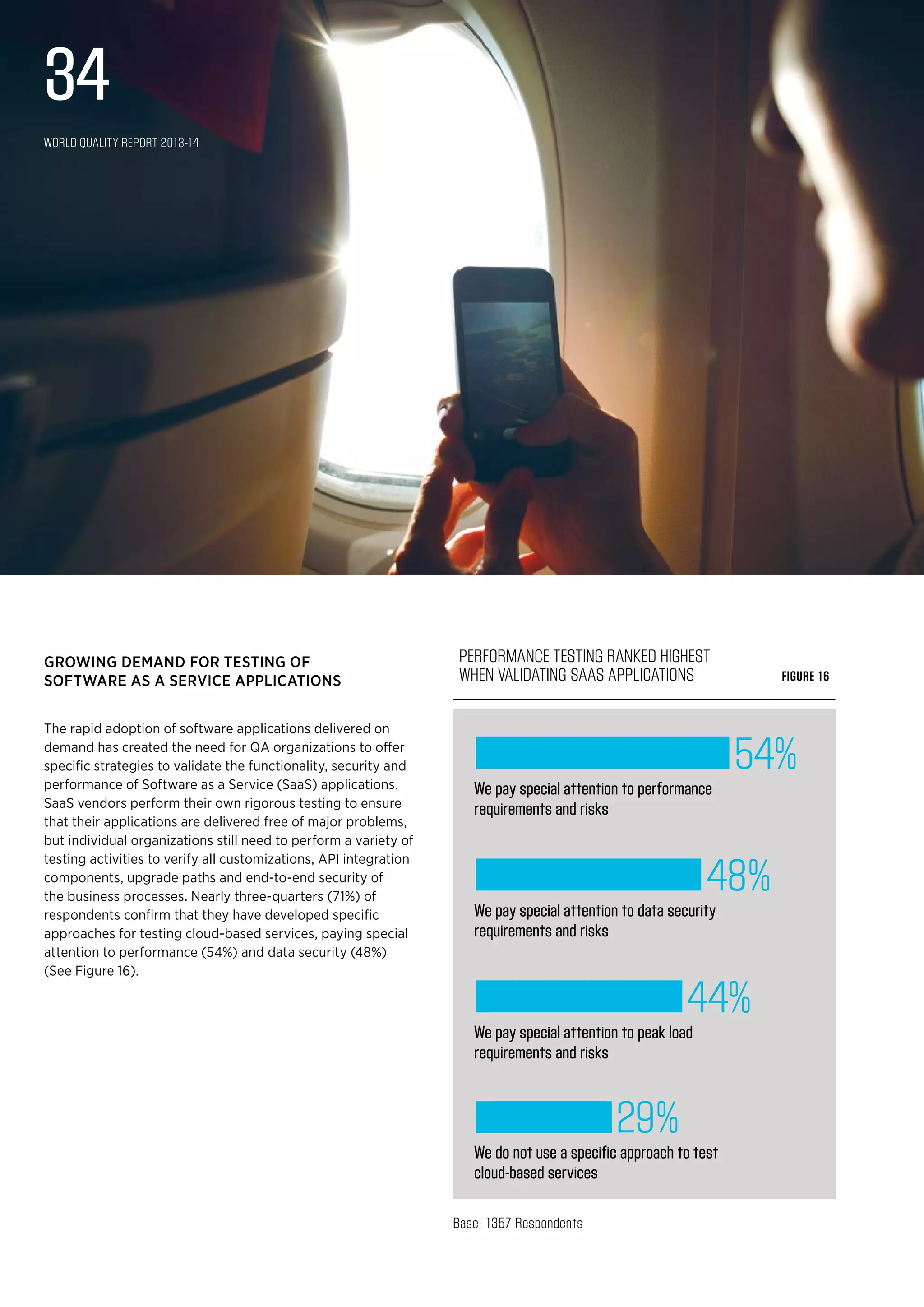
The most significant challenge is in the fact that there isn’t an adequate
testing approach that fits the agile development environment. We are trying
to use traditional methods of testing designed for waterfall development.”
A Retail Business, Denmark
World Quality Report 2013-14
38
34% 26%
Business analysts
2012 2013 37% 36%
QA/Testers
2012 2013 2012 2013 38%
Developers
29%
All agile team members are involved in the testing process Figure 20
Base: 1500 Respondents
Why are developers doing testing?
The 2013 research reveals that 38% of agile testing is
performed by developers – up from 29% in the 2012 results.
The share of QA testers involved in testing activities is reduced
slightly to 36%, while the number of business analysts doing
testing fell by 8% from the previous year – from 34% to 26%
(see Figure 20).
With agile projects, the responsibility for testing is shared
among all members of the project team, so it’s not surprising
that developers are playing a part in the testing activities. In
agile, the roles of developers and testers move closer together,
and team members are expected to take on multiple tasks.
On the other hand, if the agile team doesn’t have a dedicated
professional tester position, testing will be carried out without
a good quality transparent risk analysis and, importantly,
reusability and repeatability of test cases will not be secured.
Today, more than a third of executives interviewed cite
the lack of professional testing expertise in agile teams as
one of the obstacles to applying testing in agile projects
(See Figure 20).
Agile and outsourcing
Agile processes focus on producing deliverables, and
inherently use lean principles that lead to eliminating parts
and documents that don’t add value. This process is heavily
based on teams working together in close collaboration. Not
surprisingly, agile projects work best when the entire agile
team is based in the same location. However, as organizations
engage in offshoring and outsourcing practices, they can still
successfully implement agile methods.
The key, once again, is to have a consistent process and clear
communications channels across all parties involved with
agile projects. A web collaboration solution that includes video
can streamline communication between team members and
help distributed teams work together more effectively. The
advancement of test and requirements management solutions
makes it possible to maintain all testing assets in a central,
accessible repository, while sharing and reusing them across
multiple locations.
Organizations adapt their
own models for agile
Organizations that adopt agile typically find their
own paths – often carefully combining elements from
traditional and agile delivery methods. It is important to
find the right balance between the speed of delivery and
application quality. Sometimes agile means developing
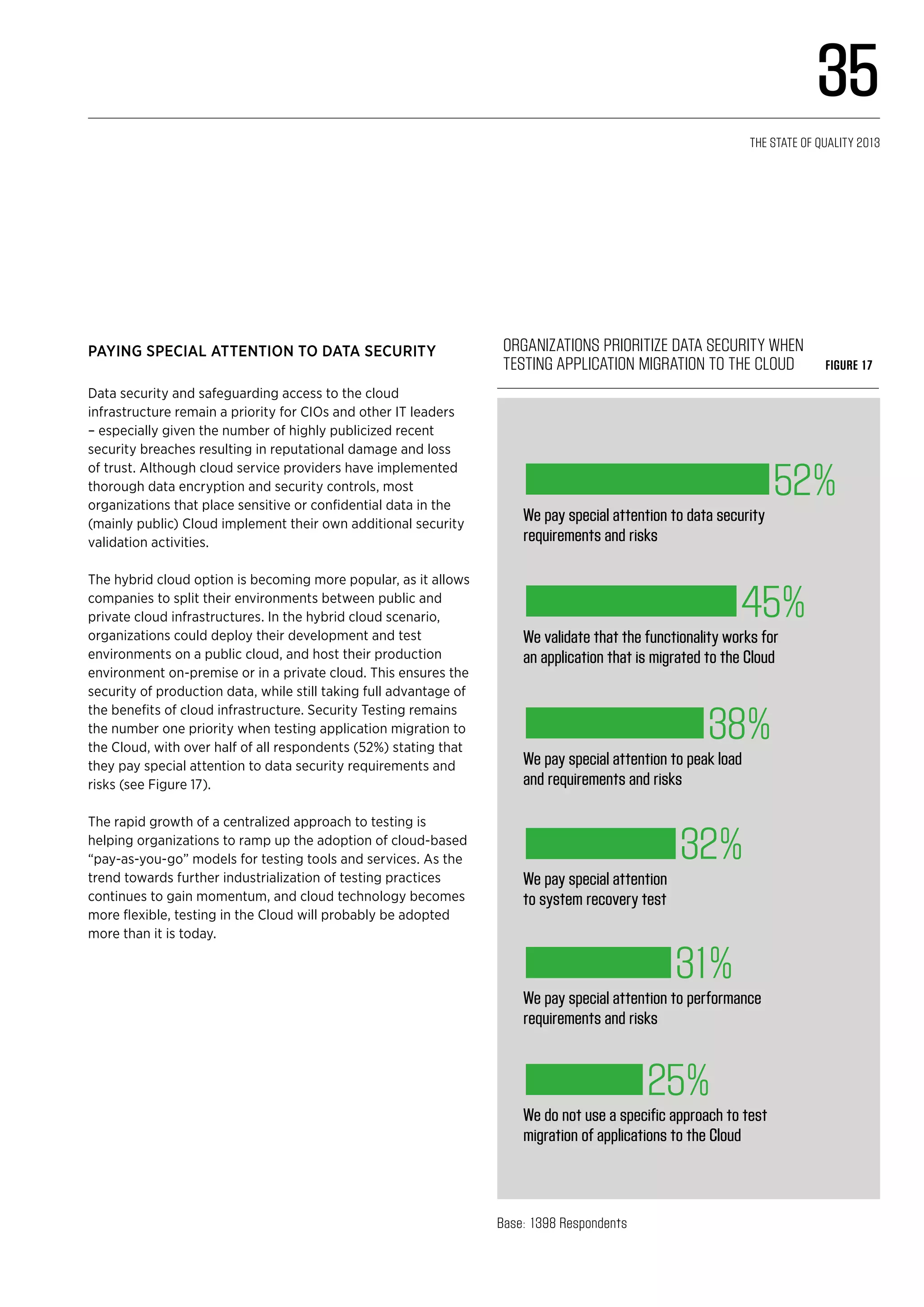
applications in short sprints, but testing them with traditional
waterfall-type methods.
Similarly, certain testing tasks, such as end-to-end integration,
are best performed as a separate phase after the agile
iteration, because these types of testing often demand
longer preparation time with cross-domain interaction.
In certain industries, organizations may still be required
to produce detailed project documentation to satisfy
compliance requirements. In each case, they need to find a
model that fits within their overall IT and business priorities.
39
The State of Quality 2013
Test Infrastructure and Data Management:
Building Environments to Ensure Quality
This year’s research has found that organizations have
become more mature in testing and more aware of
quality requirements. This is clearly demonstrated by the
rapid growth in the number of companies centralizing their
testing function and building Testing Centers of Excellence
(TCOEs). However, as organizations focus on adapting their
processes, operational models and testing tools to maximize
QA efficiency, a new area of concern emerges — the setup and
management of test environments.
Research participants identify Test Environment Management
as the specialized testing skill that their organization most
lacks in-house (55%). This comes as no surprise, because
the provisioning and maintaining of test environments is
usually left out of the initial scope of the TCOE, leaving
the responsibility to the Infrastructure team or an
outsourced partner.
A suitable test environment is one of the most fundamental
requirements for effective software testing, and
organizations typically require multiple separate instances
of test environments. Businesses already spend a large
portion of their IT resources on test infrastructure setup
and management. Managing test infrastructure is becoming
a challenge due to the growing complexity in architecture
and the variety of demand made on test environments.
In addition, the separation of responsibilities between
the testing organization that defines and uses the test
environments and an Infrastructure team that provides
those environments is making this even more challenging.
Therefore more organizations today are looking to transfer
the responsibility for Test Environment Management to their
testing organization.
The research shows that on average 40% of today’s testing
budgets is being allocated to test infrastructure and hardware,
with an additional 28% spent on testing tools. Yet, despite
the considerable resources spent on test environments,
many organizations still struggle to provide quality test
infrastructure at the right time, and properly change-control
it in a shared services arrangement. An inadequately planned,
implemented and managed test environment can cause
delays and critical errors in application testing activities
and counteract any efficiency gains that QA teams achieve
through centralization, automation and process improvement.
It is not uncommon for QA teams to lose 20% or more of
their testing time due to the lack of properly functioning test
environment solutions.
The quality and availability of a test environment have a direct
impact on the entire IT products’ quality outcome. However,
while most QA organizations have a good understanding
of their core production systems and data, they lack
sufficient capacity and capability to deliver and manage test
environments to meet the demanding development schedules
and cost expectations.
A test environment is inherently different from production
configurations. It is not always required to be the exact
copy of a production environment, because it is being used
differently from production. Test requirements have to be set
up to accommodate frequent backup and restore procedures,
and be able to manage multiple versions of test data sets,
as well as run specialized software for testing, such as stubs,
drivers and data generation tools.
Testing methodologies describe the need for a separate
environment for testing which is independent from
development and production environments. The degree
to which the test environment represents the production
conditions depends on the overarching test goals. For testing
the application functionality early in the development process,
a laboratory environment is usually sufficient. For user
acceptance testing or performance testing, testers need a
setup that more closely mirrors a production environment.
Not all parts of testing require permanent environments.
The research shows that a quarter of respondents use only a
temporary environment; and cloud-based testing platform-
as-a-service solutions account for almost half of those
temporary environments. However, hardware and software
that’s set up exclusively for testing purposes is a standard pre-
requisite for efficient, predictable and repeatable testing.
As with all stages of the application delivery cycle, Test
Environment Management needs to be closely aligned with
project delivery and release schedules. If a QA organization
maintains a permanent test environment but lacks the
right levels of controls and change movement policies, it
will likely run into project delays. Getting the right balance
World Quality Report 2013-14
40
Majority of organizations maintain and use
a permanent testing environment Figure 21
63%12%
13%
12%
Permanent test
environment
Temporary cloud-based
test environment
Temporary test
environment (other)
Neither
Base: 1500 Respondents
I just don’t see that
you can deliver a
quality solution if you
don’t have a proper
and ready-to-be-used
test environment.”
A Utility Business, UK
between change agility and risk management
supported by the right tooling solutions is
crucial to the success of the test phase and
the products’ time-to-market. The research
shows that 63% of organizations have invested
in permanent test environments, with an
additional 25% using temporary environments
for solution delivery. This means that a total
of 88% of organizations invest in a test
environment that’s separate from production
(see Figure 21).
Test managers need to begin the requirements
scoping for a test environment well in
advance of the start of the testing phase.
QA organizations that only begin to define
the required components during the test
planning stage may find that by the time
they are ready to execute test cases, the test
environment setup is not yet complete. Any
delays downstream in the solution delivery
lifecycle have a compounding effect on the
overall project delivery schedules and can
undermine any gains achieved upstream. Three
out of eight (37%) executives interviewed
say that they have trouble establishing test
environments in a timely manner. This data
suggests that many organizations still don’t
have enough advanced planning strategies
and transparent communication between
teams to make planning for test environments
more efficient. In addition, over two-thirds
(67%) of respondents suggest that they don’t
have the right testing tools to support their
test environment. However, from experience,
it is apparent that the availability of testing
tools is not as big a barrier as the lack of
the right skill set for testing professionals
to use automation tools within the test
environment setting.
Through effective management practices,
more than one project can share the same
test environment without interfering with
each other. In this way, the total cost of test
infrastructure is reduced without limiting
testing activities within projects. A common
risk management practice within organizations
is maintaining multiple test environment
instances of the same application in order to
facilitate parallel product development and
to isolate changes from each stream of work.
41
The State of Quality 2013
Main challenges faced by organizations in provisioning test environments Figure 22
67%Lack of availability of
right tools for testing
53%Having to maintain multiple
versions of hardware,
middleware and systems
under test
45%
Lack of clarity on efficient
usage of available
configuration
44%
Lack of availability of
right hardware
37%
Inability to establish
test environments in
a timely manner
36%
Lack of availability
of right operating
systems
Base: 1500 Respondents
Over half (53%) of organizations state that
having to maintain multiple test environments
versions, hardware, middleware and systems
presents a significant challenge. Together with
the fact that 45% of executives interviewed
report lack of clarity on efficient usage of
available configurations as one of the main
hurdles in provisioning a test environment,
this suggests that many organizations may
still have a long road ahead of them before
getting the balance right between risk, design,
management, support and investment in their
test environments (see Figure 22).
Test Data Management: increased
use of ‘Create data as we go’
Test data is an essential component of the
software testing process. To accurately predict
testing outcomes, QA needs reliable sources
of well-defined and consistent data as input
for the testing process. To achieve the right
level of test coverage, testers require extensive
test data sets with multiple instances and
sufficient variations. Today’s organizations
often struggle with the increasingly large
volumes and configurations of data required
for testing, which are magnified by the need
to maintain multiple versions of data in the
test environment. Accurate test results can
only be attained with consistent data sets
that contain a controlled variety of data
instances that represent various real life
situations in the production environment, and
an automated, repeatable testing process
is unachievable without well-organized and
predictable test data sets. The research shows
that, in 16% of cases, organizations create
test data as they go. Tests based on this type
of data are difficult to repeat and even more
difficult to automate. The increase in the
number of instances of “on the fly” test data
generation from 5% in 2012 to the current
16% can be attributed to ever-increasing
application complexity. As IT systems become
more intricate, so does the challenge to
accurately prepare the test data. Solving the
dilemma of increased complexity versus test
data quality requires extensive knowledge of
the data needed for testing.
World Quality Report 2013-14
42
The State of Quality 2013
43
Organizations create new data for testing
more often than using static test data Figure 23
Restore backend with each iteration to
allow same test to be reused
Use purchased automation tools to generate
new test data
Use in-house, custom-built automation
tools to generate new test data
Use spreadsheets to manually generate
new test data
Copy production data that we anonymize
before testing
Copy production data without further
manipulation
Create data as we go
13%
13%
12%
12%
16%
13%
21%
Base: 1500 Respondents
The operational need to obtain large quantities of
representative test data of sufficient complexity drives many
organizations to use production data as a source for test
data – especially when the testing process doesn’t clearly
define requirements for test data sets. Executives interviewed
state that they use copies of production information for
testing purposes as much as 25% of the time. This approach
also makes it easier for QA to closely emulate production
conditions and, if needed, volumes. However, copies of
production data are not always the best option – especially
for functional testing. Pre-defined or specially crafted test
data sets with appropriate variations serve much better for
validating application functionality. A cause for concern is that
many respondents report that their organizations don’t apply
any anonymization to their production information in half the
instances when using production data for testing. Test data
that is taken directly from production sources without first
manipulating it can create data privacy and security issues.
Data masking and sub-setting should be employed to reduce
security risks while maintaining data quality. Alternatively,
using test data that doesn’t contain any personal or sensitive
information can also be considered appropriate for cloud-
based testing.
Organizations often use a combination of methods for
obtaining test data — the most popular approach being to
restore backend data with each iteration and then allow its
reuse for the same tests (21%). The use of managed test data
sets and restoring backend methods allows testers to create a
repeatable process and is ideally suited for automated testing.
Research data suggests that over a quarter of all methods
used involve automated test generation – employing
both custom-built and commercial test generation tools.
Automatically created test data also lends itself well to
repeatability and automation, provided that it is properly
stored and maintained (see Figure 23).
The analysis of the test generation methods reveals that
organizations prefer to create new test data, as opposed
to reusing existing data sets. In order to deliver accurate
results, QA organizations need to carefully consider and
apply knowledge of application functionality and design to
ensure that they are building the right sets of data to properly
validate the features for each release.
We do sometimes use production data without manipulating it and know the risks of
doing this but as an organization we are not knowledgeable enough about the data
management techniques for testing and are looking for a proper methodology to use.”
An Energy & Utilities Business, South America
World Quality Report 2013-14
44
Organizations still find it challenging to control and retain test data Figure 24
Having to maintain the right
test data set versions with
different test versions
Complying with data
security and data privacy
regulations for test data
Managing the size of
test data sets
Creating and retaining
useful copies from
production data
Creating and maintaining test
data which are not copies
from production data
Lack of test data for complex
integration testing across
systems and organizations
65% 56% 44%
44% 43% 37%
Base: 1500 Respondents
Many organizations still find it challenging to control and
retain data that they use for testing. Nearly two-thirds (65%)
of respondents find it difficult to synchronize the right sets
of test data with the versions of applications under test,
especially in test scenarios that require frequent repetitions
and multiple test environments. This occurs mostly in
organizations that create test data as they go or harness
production data for testing purposes. A move toward
managed test data generation can alleviate these concerns
and also help those who struggle to find the right sets of data
required for accurate testing (see Figure 24).
Research results show that, increasingly, organizations
struggle to have test data that is fresh, accurate,
comprehensive and sufficiently complex to deliver accurate
results for testing of today’s complex application landscape.
Managing data in a test environment that spans multiple
applications and even crosses organization boundaries, in
business-to-business processes, requires extensive knowledge
of not only applications, but their interconnections and the
data structures of each individual part of the landscape.
Using the application itself as a source of test data is a valid
way to construct data for use in testing. This concept however
has a number of drawbacks, as it is manual, time consuming,
not repeatable and requires extensive, specialized knowledge.
Generating test data on the go is not cost-effective, and,
ideally, should only be used in situations where it is the only
viable option for getting reliable test data.
In other areas, test data can be generated by using scripting,
copying production data or cloning appropriate test data
using tools specifically created for this task in a consistent,
repeatable and reliable manner. By optimizing the Test Data
Management process, organizations can find the most fitting
solution for creating test data for each type of application and
testing task.
Many QA teams struggle with understanding which data
sets need to be collected or generated to support specific
test cases. They often opt for using production-size data sets,
hoping that it will produce more accurate results. A consistent
Test Data Management process can help test teams find
smaller, more manageable test data sets that correspond to
the needs of the testers, comply with regulations and create a
repeatable cost-efficient process.
45
The State of Quality 2013
54
Public Sector
56
Telecom, Media
and Entertainment
Sector
analysis
48
Consumer Products,
Retail and Distribution
50
Energy and Utilities
52
Financial Services
World Quality Report 2013-14
46
Most firms operating in the Consumer
Products, Retail and Distribution (CPRD)
sector are undergoing radical business
transformations in response to rapidly
changing market conditions and consumer
behaviors – impacting quality assurance (QA)
processes and methods. Many companies
are investing in modernizing their application
landscapes and upgrading or replacing legacy
systems with industry-standard packaged
ERP and CRM applications. Businesses along
the entire retail value chain are creating the
“all-channel” experience for the consumer,
using technologies leveraging analytics, cloud
computing plus social and mobile platforms.
In addition, CPRD companies are implementing
innovative quality practices in response to
reduced time-to-market and competitive
pressures, customer data privacy requirements
and the growing consumer demand for a
consistent, secure and error-free experience
across all channels.
Corporate reputation is also extremely
important to CPRD companies – especially
retailers, with many routinely monitoring the
social media channels for customer feedback
to remedy any issues before they can damage
the company’s standing. Five out of nine
executives interviewed (56%) in the CPRD
sector report that a specific department
in the company is tasked with monitoring
user feedback via social media channels
to improve testing – the second highest
number across all industries, behind only the
Transportation vertical.
Last year’s research showed that CPRD
businesses were among the leaders in the
proportion of the IT budget spent on testing
and QA – with an average of 22% of IT funds
allocated to the QA function, compared to
approximately 18% across all industries.
This year, although the cross-sector average
has risen to nearly 23%, the figure for CPRD
companies is slightly lower at 21%. But this
does not indicate any reduced attention to
application quality; it is, however, closely
connected to the growing number of
portfolio rationalization projects and the
considerable increase in efficiency when
testing packaged applications compared
to legacy systems. Another probable cause
for the slight reduction is that an increasing
number of CPRD companies are adopting agile
application delivery methods.
In agile, QA and development occur side-
by-side, and companies that use an agile
approach don’t count resources spent on
quality as a separate QA line item. Many agile
projects are still focused on smaller, web-
based or mobile applications; the cost-saving
benefits of agile, shorter development cycles
and tighter control over application quality are
gradually winning over larger development
teams in the sector.
An additional source of efficiency gains,
which may have translated into the lower
spend, is the advancement of Testing Centers
of Excellence (TCOEs). In 2012, only 6% of
CPRD respondents indicated that they had
fully operational TCOEs in-house; with an
additional 25% saying that they were in
the process of developing their TCOEs or
planned to develop them internally in the next
two years. This year, it is evident that many
of those testing centers have come on line.
The CPRD sector respondents report a record
number of fully functional TCOEs (31%),
compared to a 19% mean across industries.
CPRD QA organizations are becoming more
mature as they advance toward establishing
a centralized Testing function that acts as
custodian of quality processes and tools, ideas
and innovation.
Consumer Products, Retail and Distribution
Transforming Quality Assurance for a seamless all-channel experience
Bernard Helders
Global Leader, Consumer
Products & Retail Sector
Capgemini
Rashmi Singh
Associate Director
Capgemini
Etienne Cartigny
Senior Test Manager
Capgemini
World Quality Report 2013-14
48
However, another aspect of the research
reveals that centralization may only be the
start of the quality transformation process.
Nearly half (45%) of the CPRD respondents
report that their QA teams still get involved
in the application delivery lifecycle at a
later stage – during implementation and
production and maintenance phases. Only
23% indicate that their organizations begin
preparing for QA during the project planning
phase, with an additional 13% saying that
the QA/Testing leads get included in the
requirements definition activities. Based on
these findings, the CPRD firms have much
to gain from implementing the “Shift Left”
approach to testing – involving QA much
earlier in the application delivery lifecycle,
with the result that it becomes significantly
cheaper to implement quality processes and
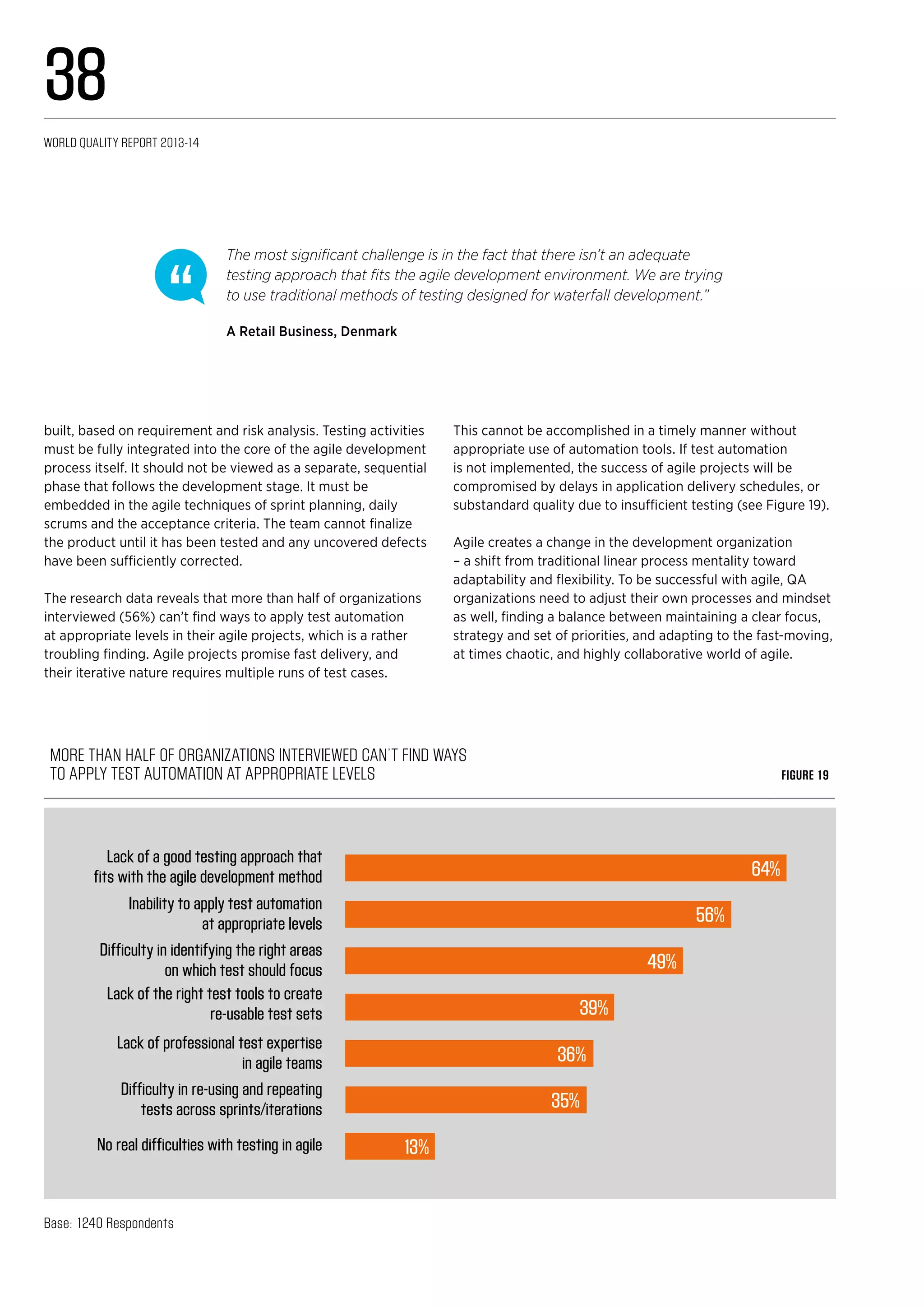
fix potential problems.
Perhaps in the future, “Shift Left” will take
place across a wider range of CPRD companies
as they increase their level of partnership with
third-party managed service providers. In a
similar way to many other industries, CPRD
firms increasingly choose to focus on their
core business competencies and outsource
the majority of the application quality tasks to
experienced service providers, especially those
with vertical market expertise. In the CPRD
sector, one in five CIOs and IT directors (20%)
reports that their TCOEs are already managed
via third-party providers, while an additional
11% say they plan to involve a third-party
company with TCOE capabilities in the future.
Although 46% of CPRD executives interviewed
report that their organizations currently don’t
test mobile applications and devices, it’s likely
that in the future the incidence of mobile
testing, especially among retailers, will grow
ahead of other sectors, corresponding with the
need to support multiple sales channels.
The impact of cloud technology is also poised
for future growth in the sector, although today
most of the CPRD companies are still cautious
about moving their production applications to
the Cloud – largely due to security and data
privacy concerns. The research shows that
there is a slight decline in the percentage of
applications hosted in the Cloud from last year
to this year (from 21% to 20%).
Today’s cloud-based applications are typically
web-based marketing or customer-facing
systems, not yet the business-critical ERP
and CRM implementations that support the
core business processes. Although the sector
results show a higher percentage of cloud-
based applications forecasted for 2015 than
the global average (28%), it is still early days
for the Cloud being used as a testing platform.
Due to the fact that many of the CPRD IT
systems are rather homogeneous, the task of
setting up test environments in the company’s
own data center is not as complex as in many
other industries, making the Cloud slightly less
attractive as a cost-saving platform. However,
as consumers demand newer, faster and more
convenient ways to shop, CPRD companies
will continue to invest in new technologies
that can help them cut costs, increase
efficiency and build innovative customer
experience solutions.
Consumer Products, Retail
and Distribution
31%
of companies indicate
that they have a fully
functional TCOE
46%
of firms report that
they don’t test mobile
applications and devices
49
Sector analysis
The number one IT trend in the Energy and
Utilities (E&U) sector is modernization. IT
groups are undertaking major transformation
programs around key business initiatives
such as smart metering, smart grid,
demand-response programs and integration
of renewable energy sources. As well as
spending more on operational technologies
and control systems, E&U companies are
investing in innovative ways to engage
consumers via a variety of channels
and devices. New regulations around the
world require Utilities providers to inform their
residential and business customers about
their energy consumption. In the light of rising
energy prices, this knowledge helps consumers
reduce their utility bills and better understand
energy efficiency and conservation.
New smart meters, programmable thermostats
and other advances in technology encourage
better communication between providers
and consumers and better demand-
response mechanisms to link them, as well
as helping to improve grid stability. However,
new application layers also add a level of
complexity to IT systems that are already
intricate and specialized for the sector.
Despite ongoing efforts to modernize
the IT landscape and retire obsolete
components, a number of core business
processes are still supported by custom
legacy applications. Many network elements
continue to run on analog technology,
and need to be upgraded before they can
integrate with new smart systems. As with
all other industries, IT and QA teams have to
divide their budgets between maintenance
and transformational projects. Although
maintenance work still takes up more than
half of all testing resources (53%), CIOs, VPs
of applications and IT directors interviewed
say that they spend 47% on new technologies
and projects, which is an increase from last
year’s 42%.
In the E&U industry, poor software quality
means more than just application downtime
or frustrating errors. The ability of IT systems
to support all aspects of energy distribution
and provide accurate information at all times
is vital to managing the grid safely. Not
surprisingly, nearly a quarter (22%) of the
overall IT budget is allocated to quality (an
increase from last year) and the proportion is
expected to grow to a full 25% by 2015.
When companies seek to improve testing
efficiency, they often turn to outsourcing
partners who can help add expertise,
knowledge, methodology and structure to
the in-house testing organization. In the E&U
sector, however, outsourcing is not a simple
task – largely because of the highly specialized
nature of their software applications. Five out
of eight executives interviewed (62%) say that
they have chosen not to outsource any part
of their testing service – the second highest
rate across all industries, behind only the
Manufacturing sector. Typically, specialized
niche vendors are involved in aspects of the
E&U business, and professional testers with
vertical knowledge are used to supplement the
in-house workforce.
Similarly, when asked about Testing Centers
of Excellence (TCOEs), none of the Energy
sector CIOs and IT directors say that they
have fully functional TCOEs operated entirely
by third-party providers. However, 8%
of respondents say that they have a fully
functional in-house TCOE, and a further 13%
say that they have established an internal
TCOE within the past two years, but that it is
not yet operational. Interestingly, though, one
in five (20%) of the surveyed IT leaders reports
that their companies have plans to involve
third-party providers with TCOE capabilities.
This suggests an emerging trend not only
to establish a central governance body for
testing across projects, but also to turn to
expert providers to help build industrialized
testing practices.
Energy and Utilities
Modernizing the Grid and Improving QA Efficiency
Perry Stoneman
Utilities Global
Sector Leader
Capgemini
Rakesh Khetarpal
Testing Services Director
Capgemini
World Quality Report 2013-14
50
Nearly three-quarters (73%) of E&U
respondents cite lack of methods as the
biggest barrier to centralizing their testing
function, followed by lack of skilled resources
(53%). Although traditional outsourcing
models may not be suitable for E&U
companies, they will perhaps begin to engage
partners more actively, based on service
contracts, both to improve the quality of
their applications and to modernize their
testing practices.
While modernization remains the main
theme of the E&U sector, adopting modern
application delivery methods – such as agile
– appears to be low on the CIOs’ priority lists.
Despite the fact that over four-fifths (83%)
of respondents say that they use some
variation of agile methodologies, projects
built using agile typically do not include large
core applications. Most IT systems that are at
the heart of E&U operations take several years
to define, implement and deploy, rendering
them largely unsuitable for agile. On the
other hand, applications that interact with
the consumer, such as smartphone apps that
deliver average daily consumption data, have
quick turnarounds, fast feedback cycles and
frequent releases, making them a good fit for
agile delivery model.
Cloud computing is an emerging trend across
all industries and company sizes, although E&U
enterprises are only at the beginning of the
Cloud journey. Executives interviewed indicate
that today, a little more than a fifth (21%) of
their testing occurs in the Cloud, although
they expect this proportion to grow to as
much as 28% by 2015 (in both cases, lower
than the cross-industry average). Protecting
the security and privacy of consumer data
remains the main concern of IT leaders when
making decisions about moving applications
to the Cloud (respondents say that 18% of
their applications are hosted in the Cloud now,
down from 23% last year).
The same consumer data, however – large
amounts of smart meter readings and usage
statistics – is beginning to congest Utility
companies’ IT infrastructure and is compelling
CIOs to consider migration to the Cloud. The
potential benefits of the Cloud for the E&U
companies extend beyond customer data. The
ability to perform real-time analytics based
on large amounts of data promises substantial
operational improvements. For example,
information about outages can be collected
and analyzed, creating a precise picture of
how long outages last, where assets may need
to be replaced, and where the grid is being
stressed or not operating at optimal capacity.
Big data analytics in the Cloud promises to
become a fast-growing field in the near future.
Another fast-growing area is mobility. Some
55% of the E&U executives interviewed say
they are testing mobile applications. This
figure might be attributed to E&U sector
respondents including in their answers
only customer-facing mobile applications
– applications that customers use on their
smartphones or tablets to review consumption
rates or check power outage information. The
definition of “mobility” seems not to be clear
among companies within the sector. Therefore
it is possible that their answers do not fully
address internally facing applications that
provide mobile connections within companies
– communicating with the maintenance crews
in the field, dispatching inspection teams
and monitoring their progress. However, it
is evident that both internal and customer-
focused mobile applications are proliferating
fast, and that their adoption and testing rates
are increasing.
Energy and Utilities
47%
of testing budgets is
stated to be spent on new
transformational work
73%
of companies indicate
lack of testing methods
as the biggest barrier in
setting up a TCOE
51
Sector analysis
The role of IT in the Financial Services (FS)
industry is continuing to shift from being a
tactical tool to being a strategic business asset
that helps companies gain a competitive edge.
Retail and commercial banks, capital market
firms and insurance companies alike view IT
as an enabler for bringing new, attractively
priced financial products to market faster,
and they invest in developing applications
using the latest tools and technologies. Most
FS companies see time-to-market as their
greatest priority, and feel constant pressure
to launch new products, increase customer
retention and comply with strict government
guidelines and regulations.
Naturally, the IT landscape in a diverse
industry such as FS is complex – ranging from
the mostly packaged applications employed by
many banks to the highly specialized, custom-
built systems used by insurance companies.
However, the entire industry shares the
same set of IT priorities: all these systems
need to interact with a multitude of
external applications. Even legacy back-end
systems need to support the interconnected
business processes that bring together traded
markets, financial institutions and customers.
This complexity creates additional demands
on application quality – a software defect
introduced in one system can impact many
different applications, intensifying in severity
and causing even greater problems down
the line.
As a result, even though IT budgets are
generally constant and companies remain
extremely cautious about launching large-
scale projects, QA spending in the FS sector
continues to rise, reaffirming that companies
don’t want to take chances with the quality of
their software applications. The research data
shows continued growth of QA budgets in the
FS vertical. Last year’s research suggested
that nearly 20% of overall IT budgets was
allocated to application quality – compared
to the average of 18% across all verticals. This
year’s research participants report that, on
average, nearly a quarter (24%) of the total IT
spend is now allocated to quality and testing
activities, making the FS industry one of the
leaders in QA spending. Furthermore, this
figure is projected to increase in the next two
years to 28%.
The additional resources allocated to
QA suggest both greater awareness of
application quality and the growing maturity
of FS companies. Many of the top-tier financial
organizations are continuing to transform
their QA function from fragmented and de-
centralized to a shared services model.
This transformation first became evident
two years ago, when the World Quality
Report 2011–12 noted that FS companies
were beginning to streamline their quality
management function and set up the first
Testing Centers of Excellence (TCOEs). Back
in 2011, only 1% of respondents reported that
they had a fully operational TCOE, although an
additional 27% said that their companies were
planning to develop a TCOE within two years.
These TCOEs are now coming online and
becoming fully operational – as is evident from
this year’s data. In 2013, a staggering 20% of
respondents report that they have functional
TCOEs either in-house or through a third-party
service provider.
Financial Services 
Rapidly Moving Towards the Shared Services Model
Manoj Shikarkhane
Vice President, Testing
Practice, Financial
Services
Capgemini
Manoj Narayanan
Principal, Testing Practice,
Financial Services
Capgemini
World Quality Report 2013-14
52
The transformation process began with
the larger companies, which have both the
resources to fund the establishment of a
TCOE and a high volume of applications
and projects, so that the investment in
transformation outweighs the costs. However,
the movement toward QA centralization is now
spreading from the largest banks to the mid-
size financial organizations. Of the three sub-
sectors of the FS industry, the capital markets
segment appears to be the most mature, and
is leading the trend toward centralizing the
QA function across geographies, locations and
lines of business.
When asked about the barriers that prevent
companies from adopting a more standardized
approach to testing, most executives
interviewed from the FS sector indicate
that their organizations lack the necessary
methodology (70%) and skilled resources
(44%) to make the transition successful. To
address the skilled labor shortage, the majority
of FS companies have turned to outsourcing.
Moving all or part of the testing function to a
specialized service provider has been standard
practice among FS companies for many years.
However, what used to be pure labor
arbitrage has evolved into a model whereby
the customer and the specialist testing
partner jointly share responsibility for final
product quality. As companies embark on the
journey toward QA transformation, third-party
providers are engaged to guide them through
the entire process and provide solutions that
will help them get to the next level of maturity
and achieve the operational efficiencies of
managed testing.
One of the fastest-growing areas of
partnership between third-party providers
and FS companies is mobile testing. Some
54% of the FS executives interviewed state
that their organization currently tests mobile
applications and devices. As companies
develop new services to offer to their
customers, they face an urgent need to modify
their testing practices to include mobile testing
– including verifying the almost limitless
number of varieties of mobile devices and
operating systems. Because FS companies
typically lack expertise and infrastructure
to cope with the added demands of mobile
testing in-house, they tend to rely on
implementation partners to put in place
adequate testing procedures to ensure that
ever-changing mobile applications remain
reliable and meet consumer demands.
Another new trend that many FS
companies are exploring is testing in
cloud-based environments. To the cost-
conscious IT organizations in the FS sector,
cloud computing promises an effective way
to build and maintain test environments
and infrastructures. However, data security
concerns prevent many FS firms from
fully adopting the Cloud. To date, security
and data confidentiality concerns have
dissuaded many FS firms from actively
migrating their core applications and tools
to a cloud-based environment. Some 51%
of the executives interviewed say that they
pay attention to data security requirements
and risks in testing application migration to
the Cloud. However, most survey respondents
agree that the Cloud is an emerging trend
and foresee an increase in the proportion of
their testing in the Cloud from the current
24% to as much as 32% in the next two years.
This finding highlights the fact that many
FS organizations expect that their data
security concerns can be addressed as cloud
technology develops further.
Financial services
24%
of the total IT budget is
allocated to Testing
51%
of firms say that they pay
special attention to data
security requirements and
risks in testing application
migration to the Cloud
53
Sector analysis
Government and public sector agencies
in different countries face different sets
of challenges and constraints, yet their IT
priorities are generally very similar: to do more
with less, develop new IT systems successfully
the first time and within budget, increase
efficiency of their internal processes and
satisfy customer demands for faster, easier
and more secure access to available public
records and services.
In the United States, for instance, the Public
Sector is dealing with tremendous budget
pressures due to federal spending cuts ($85
billion in automatic cuts) and the Continuing
Resolution (CR) passed by Congress, a
measure for funding government operating
budgets through to the end of the government
fiscal year (September 2013). Even after
the spending cuts have been lifted and the
US government is able to pass a budget for
2014, it is unlikely that overall IT budgets
will increase. In Europe, too, countries are
facing substantial cuts in public spending and
increased financial scrutiny over large-scale
IT projects.
In a similar way to other sectors, Public
Sector organizations split their IT resources
between maintenance work and investing
in new transformational initiatives; and
although many modernization projects are
now underway, it’s going to take many years
to completely replace old legacy systems. The
transformation process is frequently further
complicated by the intricacy of government
procurement processes. Citizens now expect
government IT systems to provide the same
reliable, predictable and secure services as
those provided by the commercial sector; and
the gap continues to grow between people’s
expectations and what the Public Sector
agencies’ IT is able to provide in many cases.
According to the Public Sector executives
interviewed for this research, the percentage
of the budget to be spent on maintenance
work in 2015 is predicted to remain the
same as this year (53%) – whereas the
cross-industry average drops because most
organizations state that they focus more on
new transformational projects.
In order to deliver more value for money,
react faster to changing conditions and stay
within budgets and timelines, government
agencies are beginning to re-examine
their quality processes. The Public Sector
respondents say that their organizations are
increasing the share of IT budgets that they
spend on quality. This year’s data shows
that 22% of overall IT funds are dedicated
to application quality – up from 18% in 2012;
and participants predict that the portion of IT
resources allocated to the testing function will
increase to 28% in the next two years.
In Public Sector organizations, Quality
Assurance (QA) can cover many
different forms. For instance, QA can often be
performed internally by a PMO on a project.
Similarly, QA can be covered under an
Independent Verification and Validation (IV&V)
program, in which a third party provides
oversight of a project, which may include
independent testing.
Just over half (55%) of interviewed IT
professionals working in the Public Sector
report that their organizations involve
QA/testing leads early in the application
delivery lifecycle – during project planning
(21%), requirements definitions (24%) and
design phases (10%). However, nearly as
many Public Sector agencies still delay QA
activities until the final stages of application
development (9%), implementation (24%)
and even production (12%), which suggests
that they may still have a long way to go
before QA can truly become an integral part
of the application delivery lifecycle. The high
percentage of reactive QA metrics (some 72%
of organizations simply measure numbers
of defects found) also suggests that many
organizations still struggle to prove the
tangible value of QA to their stakeholders.
Public Sector
Modernizing Technologies and Methods to Respond to Citizens’ Demands
Nancy Meiers
Principal, IV&V Solution
Lead, NA Public Sector
Capgemini
Alexander Van Ewijk
Testing Practice Leader
Sogeti
World Quality Report 2013-14
54
Despite the slower rate of change, focus on
quality continues to grow, and is beginning
to extend into Public Sector agencies’
relationship with their partners. For every large
system implementation project, Public Sector
organizations are requesting that vendors
include quality and testing considerations along
with the other project deliverables. As Public
Sector agencies continue to implement new
technologies and modernize their IT landscape,
they often find that they lack the required
testing expertise and processes to adapt their
testing to new environments and objectives.
Increasingly, government and other Public
Sector agencies view the third-party service
providers not just as a temporary staff
augmentation resource, but also as a source
of testing best practice and methodologies.
More than half (55%) of surveyed CIOs and IT
directors from the Public Sector organizations
state that they outsource at least some part
of their testing tasks; and they see improving
software quality (54%), cost reduction (53%)
and freeing up of internal resources to focus
on core business (54%) as the primary reasons
for involving a third-party provider. However,
in certain countries, such as Germany, the
incidence of outsourcing by Public Sector
agencies remains below other comparable
countries due to strict regulations governing
data privacy laws.
With tighter budgets and growing pressure
to deliver concrete, measurable results,
many Public Sector agencies are turning to
agile development methods in an effort to
build applications faster. More than four out
of five executives interviewed (85%) state
that their organizations use agile methods.
However, traditional hierarchical structures
within many government organizations do
not easily accommodate agile principles.
At the heart of agile are close-knit teams of
professionals who fulfill multiple roles and
work in close collaboration. Often government
IT teams are more structured and allocate
more resources to producing detailed
documentation, which can take priority over
daily communication. To achieve better results
with agile, Public Sector agencies need to
re-examine their operational models, types of
projects that are suitable for agile delivery and
required skill sets to support agile development
and testing. Today, nearly two-thirds of Public
Sector respondents (63%) report that their
organizations lack a good testing approach
that fits with the agile development method,
and almost half (48%) say that they don’t have
a specific approach for agile testing.
The Public Sector also appears to be taking
a more considered approach in the area of
Cloud adoption. Although the research data
shows that the percentage of applications
hosted in the Cloud among government
agencies is similar to that across all industry
verticals (20%), most of this represents data
in a private cloud infrastructure – often used
for application testing and shared across
teams and locations within an organization.
The adoption of the public cloud for hosting
core applications remains low. Placing
citizens’ personal information in a public cloud
infrastructure presents high security concerns,
and many regional and national governments
have specific regulations mandating that data
cannot be moved outside a specific country
or region.
The Public Sector has made much progress
in modernizing their applications and
methods to offer citizens more convenient
and reliable access to government services. In
the near future, there will probably be more
e-government initiatives and faster adoption
of innovative technologies such as interactive
services, mobility, cloud infrastructure and
data analytics, along with a continued increase
in QA maturity. Mobile access has already been
identified by many government agencies as
the next big IT initiative regarding interaction
with citizens; and organizations will probably
engage experienced outsourced partners
to set up QA practices that are specific to
mobile applications.
Public Sector
53%
of the testing budget is
expected to be spent on
maintenance work in 2015,
the same as this year
54%
of organizations cite
improving software quality
and freeing up internal
resources as the two main
reasons to involve a third-
party provider
55
Sector analysis
The Telecom, Media and Entertainment (TME)
industry continues to be among the most
innovative and adaptable. The fast-changing
world of technology is forcing TME companies
to constantly seek new business models,
customer engagement channels, pricing options
and revenue sources. Voice communications,
which once provided the vast majority of
telecom companies’ revenues and profits, is
quickly losing ground to data communications
and digital services – simultaneously presenting
revenue stream challenges and opening up new
opportunities for the telecom operators.
The relationship between consumers
and service providers is becoming a
multi-channel experience. Whether buying a
phone, selecting a plan or monitoring usage
patterns, customers expect to have the same
consistent experience when interacting with
their provider at the store, on the phone,
online or via a mobile device.
Similarly to in other industries, telecom
operators experience ongoing competitive
pressures – especially in Europe, where the
launch of new high-speed LTE (Long Term
Evolution) services is pushing operators to
win and retain customers. Corporate IT teams
strive to get new products out as fast as
possible, but being first to market no longer
guarantees success.
TME companies spend proportionately more
on quality than do most other verticals,
except Healthcare and Life Sciences and
Financial Services. This year’s respondents
from the TME sector indicate that their
organizations spend 24% of the overall IT
budget on QA personnel, processes and
tools, and that this amount is likely to increase
to 29% by 2015. In addition to common
market drivers and consumer demands, TME
companies have to deal with a unique set of
challenges that necessitates additional budget
allocation to QA. Perhaps the main one is the
sheer complexity of telecom operations, many
of which run on legacy systems.
The rapid growth of communications
technologies fueled the swift introduction
of new services – often without sufficient
consideration for the impact of new systems
on a company’s existing IT platforms. As a
result, most large telecom companies now
have extremely complex IT landscapes,
with hundreds of highly customized,
fragmented applications. Furthermore, the
need to create a seamless multi-channel
experience for the customer and links
with social media application layers forces
IT to build additional interfaces between
applications, further increasing the complexity
and driving up the cost of quality.
To deliver quality more efficiently, TME
companies are looking at optimizing their
QA operations. Compared to 2012, when
only 6% of respondents said that they had a
fully operational Testing Center of Excellence
(TCOE), this year 23% of IT leaders indicate
that their TCOEs are up and running. Not only
is it a tremendous increase, but the number
of standardized TCOEs in the TME sector is
also notably higher than the average across all
industries (19%).
Moreover, nearly half of those TCOEs are
operated by third-party partners, suggesting
that testing service providers are becoming
paramount for the success of telecoms’
quality initiatives. They are able to provide
flexible and skilled resources quickly and
cost-effectively, and also deliver best-in-class
processes, tools, metrics and accelerators
to assist with the transformation of
QA organizations.
Telecom, Media and Entertainment 
Investing in Quality to Help Meet Market Demands
Pierre Blanchard
Vice President
Strategic Sales & Alliances
TME Global Sector
Capgemini
Darren Coupland
Vice President
Testing Services
Sogeti
World Quality Report 2013-14
56
TME companies are spending slightly less on
internal QA staffing and human resources
(22%) compared to the cross-industry
average (23%). Additionally, a high number of
interviewed IT leaders say that their companies
engage external vendors. The breakdown
of their current engagement model is 14%
for staff augmentation; 12% for capped or
fixed capacity services; 14% for co-managed
testing activities and 21% for external
managed services. Together, these numbers
suggest that telecom firms are looking to
reduce their internal headcount and focus on
strategic aspects of quality, while entrusting
the delivery to a service provider.
The complexity of the IT environments
also affects telecom firms’ views on
agile development. Whereas agile promises
faster time-to-market – an essential
capability for the highly competitive telecom
industry – it may not be an easy fit for
large, interconnected enterprise systems
that support telecoms’ core processes
such as provisioning, billing and fulfillment.
Although 84% of respondents say that their
organizations use agile development methods,
those projects typically target smaller
systems or components that are not as closely
intertwined with the large core applications.
Furthermore, 46% of respondents state
that they do not use a specific approach for
agile testing.
In the immediate future, although agile will
probably continue to gain more influence,
it will almost certainly remain in targeted
areas, based on the type of application
– mostly ecommerce systems, portals or
web applications.
Size, complexity and the integrated nature
of IT systems also present a challenge when
larger, established telecom operators consider
moving their applications to the Cloud. To
be transitioned to the Cloud, IT systems
need to be virtualized. However, most large
telecom companies still rely on many legacy
applications that were built more than a
decade ago, and cannot be virtualized in a
cost-effective way.
Alongside the slight decrease in the
percentage of applications hosted in the
Cloud this year (from 24% to 22%), the cost
savings and flexibility benefits of the Cloud
are beginning to attract the attention of the
Telecom IT and business leaders slightly
more, compared to other industries (except
Healthcare and Life Sciences), and companies
are starting to invest in virtualization and
private cloud infrastructure projects. This trend
is evident in testing as well. In an attempt to
reduce the time and effort required to deploy
and maintain test environments and to quickly
ramp up capacity when needed, telecom firms
are beginning to migrate some of their testing
to the Cloud. This year, respondents indicate
that a quarter (25%) of their testing occurs in
the Cloud, and they expect this proportion to
grow to a third (33%) by 2015 (slightly higher
than the worldwide average).
Mobile testing is also expected to grow in
the next few years. Although over half (56%)
of surveyed telecom IT professionals say
that they already test mobile applications,
their efforts are often focused on validating
customer-facing apps, not the complete
end-to-end business process. When asked
about barriers to mobile testing, most of the
telecom respondents cite a lack of specialized
methods and processes (61%) and qualified
mobile testing experts (57%). Once again,
many companies are turning to third-party
providers to help them set up efficient mobile
testing practices.
Telecom, Media and
Entertainment 
46%
of companies indicate that
they do not use a specific
approach for agile testing
25%
of Testing currently occurs
in the Cloud
57
Sector analysis
About 	
the Study
The World Quality Report 2013-14 is based on a total
of 1,500 telephone interviews carried out during April
and May 2013, with senior executives from a range of
IT management functions in medium and large private
companies and Public Sector organizations across
25 countries. The average length of each interview
was 35-40 minutes. The research data was enhanced
by further in-depth interviews with a selected number
of respondents.
Survey Sample
Adopting the same approach as for the 2012-13 report, we focused this
year on organizations with more than 1,000 employees. A breakdown of
the number of interviews by organizational size and country is shown in the
table on page 60. The number of interviews conducted in Eastern Europe
(The Czech Republic, Hungary and Poland) has been increased to create
the new Eastern Europe regional section.
Interviews were required to cover a range of vertical markets to provide
specific insight into the Testing and QA issues within each industry sector,
with the number of interviews conducted shown in the graph on page 61.
The sample size for the Financial Services vertical was increased to provide
improved coverage of the Capital Markets sector. For this year, healthcare
providers operating within the Public Sector were transferred to the
Healthcare and Life Sciences vertical.
As shown in the graph on page 60, more than half (54%) of the
respondents in this year’s research sample are either CIOs or VP
of applications.
To ensure a dependable and substantive piece of market research, the
recruited sample must be statistically representative of the population in
terms of its size and profile. The required sample size varies depending on
the population it represents – usually expressed as a ratio or incidence rate.
World Quality Report 2013-14
58
COUNTRY NUMBER OF
RESPONDENTS
SIZE OF COMPANY
10,000+ 5,000-9,999 1,000-4,999
USA 270 104 96 70
CANADA 25 10 8 7
BRAZIL 80 32 28 20
FRANCE 150 52 56 42
GERMANY 125 50 43 32
NETHERLANDS 100 35 35 30
BELGIUM AND LUXEMBOURG 30 10 10 10
SWITZERLAND 25 10 8 7
UK 125 50 44 31
IRELAND 25 10 9 6
SWEDEN 85 34 30 21
NORWAY 30 12 11 7
DENMARK 30 12 10 8
FINLAND 30 12 11 7
THE CZECH REPUBLIC 25 5 8 12
POLAND 35 5 15 15
HUNGARY 30 5 10 15
ITALY 20 8 7 5
SPAIN 20 8 7 5
PORTUGAL 20 8 7 5
AUSTRALIA 80 32 28 20
NEW ZEALAND 10 4 3 3
CHINA 70 24 22 24
HONG KONG 30 12 11 7
SINGAPORE 30 12 10 8
TOTAL 1500 556 527 417
Interviews by Country and Size of Company Figure 25
Interviews by Job Title Figure 26
296
385
309
510
CIO
VP of applications
IT directors
QA/Testing managers
Base: 1500 Respondents
The average business-to-consumer market
research (B2C) recommends a sample of 1,000
adults, providing a statistically representative
sample of the average consumer market. In a
business-to-business market research (B2B),
the average recommended sample size is 100
companies (due to the lower population size).
The B2B market research conducted for the
World Quality Report 2013-14 is based on a
highly robust sample of 1,500 enterprises
with more than 1,000 employees. This
provides a sampling ratio of less than 1 in
25 organizations, highlighting the quality
and reliability of the information overall.
In addition, this level of interviewing
also provides highly robust data at the
sub-category level. Maintaining strength in
the robustness of the research carried out
for the World Quality Report means direct
comparisons can be made year on year to
previous reports.
During the telephone interviews, the research
questions were posed based on the relevance
to the respondent’s job title and answers to
previous questions where applicable. For this
reason, the base number of respondents for
each survey question shown in the graphs is
not always the full 1,500 sample size.
Questionnaire and Methodology
The survey questionnaire was devised
by QA and testing experts in the three
sponsoring organizations involved in
commissioning the research, in consultation
with Coleman-Parkes Research. The
42-question survey covered a range of QA and
Testing subjects, enriched by the collection
of qualitative data in additional in-depth
interviews, a few of which are included as
quotations in the report.
World Quality Report 2013-14
60
Interviews by Region Figure 27
Interviews by sector Figure 28
295 NORTH 
AMERICA
80 south
AMERICA
90 Eastern
europe
150 uk and
ireland
60 southern
europe
130 asia
175 nordics
90 australia and
new zeAland
western
europe
430
79
86
396
88
146
257
274
87
87
Financial Services including Capital
Markets, Banking and Insurance
Public Sector
Telecom, Media and Entertainment
Healthcare and Life Sciences
Manufacturing
Energy and Utilities
Consumer Products, Retail
and Distribution
High Tech
Transportation
Base: 1500 Respondents
61
About  the Study
Capgemini and Sogeti
With more than 125,000 people in 44 countries, Capgemini
is one of the world’s foremost providers of consulting,
technology and outsourcing services. The Group reported
2012 global revenues of EUR 10.3 billion. Together with
its clients, Capgemini creates and delivers business and
technology solutions that fit their needs and drive the results
they want. A deeply multicultural organization, Capgemini has
developed its own way of working, the Collaborative Business
Experience™ and draws on Rightshore®, its worldwide
delivery model.
Sogeti is a leading provider of technology and software
testing, specializing in Application, Infrastructure and
Engineering Services. Sogeti offers cutting-edge solutions
around Testing, Business Intelligence & Analytics, Mobile,
Cloud and Cyber Security. Sogeti brings together more than
20,000 professionals in 15 countries and has a strong local
presence in over 100 locations in Europe, USA and India.
Sogeti is a wholly-owned subsidiary of Cap Gemini S.A., listed
on the Paris Stock Exchange
Together Capgemini and Sogeti have developed innovative,
business-driven quality assurance (QA) and Testing services,
combining best-in-class testing methodologies (TMap®
and TPI®) to help organizations achieve their Testing and
QA goals. The Capgemini Group has created one of the
largest dedicated testing practices in the world, with over
12,000 test professionals (as of end June 2013) and a further
14,500 application specialists, notably through a common
center of excellence with testing specialists developed
in India.
Learn more about us at:
www.capgemini.com/testing
www.sogeti.com/testing
HP
HP creates new possibilities
for technology to have a
meaningful impact on people,
businesses, governments
and society. The world’s
largest technology company,
HP brings together a portfolio
that spans printing, personal
computing, software, services
and IT infrastructure to solve
customer problems.
More information about HP
(NYSE: HPQ) is available at
www.hp.com
About the
Sponsors
World Quality Report 2013-14
62
ThAnk you
The sponsors would like to thank all of the respondents who
provided their in-market experience, expert opinion, and input into
this year’s survey. In accordance with the UK’s Market Research
Society Code of Conduct (under which this survey was carried out),
all respondents are anonymous, but we appreciate the time that each
interviewee provided on the call with our research agency.
We would like to thank all of the business leaders and subject
matter experts who provided valuable insight into their respective
areas of expertise and market experience, including the authors of
country and industry pull-outs and additional contributions from
Capgemini and Sogeti experts: Andreas Sjöström, Dirkjan Kaper,
Jean-Pascal Duniau, Nico Steenkamp, Shane Lonergan, Jakob Boos
and Clare Argent.
Main Report Authors Mark Buenen and Makarand Teje
Writer Irina Carrel
project Management Melis Partington
partner Management Jean-Philippe Favrot, Alain Mey,
Karthik Ranganathan, Mary Johnson
Core project Team Stephen Davis, Melis Partington,
Guillaume Runser, Marilyn Strothmann
Market Research Stephen Saw and Ian Parkes
(Coleman Parkes Research)*
proofreading Alison Classe and Eleanor Patrick
print and distribution Annie Bates and David Cole (Crucial Colour)
*Ian Parkes, CEO and a founder of Coleman Parkes Research, is a full
member of the Market Research Society (MRS). All research carried
out by Coleman Parkes Research is conducted in compliance with the
code of conduct and guidelines set out by the MRS in the UK, as well
as the legal obligations under the Data Protection Act 1998.
www.worldqualityreport.com
©2013 Capgemini, Sogeti and HP. All Rights Reserved.
Capgemini, Sogeti and HP and their respective marks and logos used herein,
are trademarks or registered trademarks of their respective companies. All
other company, product and service names mentioned are the trademarks
of their respective owners and are used herein with no intention of
trademark infringement.
No part of this document may be reproduced or copied in any form or by any
means without written permission from Capgemini, Sogeti and HP.
Rightshore® is a trademark belonging to Capgemini. TMap®, TMap NEXT®,
TPI® and TPI NEXT® are registered trademarks of Sogeti, part of the
Capgemini Group.
Michelle Walker
Testing Practice Leader
Capgemini Apps North America
michelle.walker@capgemini.com
Govindarajan Muthukrishnan
Vice President
Financial Services
Testing Practice Leader
govindarajan.muthukrishnan@capgemini.com
Mark Buenen
Vice President, Business Development
Testing Global Service Line
mark.buenen@sogeti.com
Vincent Groener
Testing Services Leader Sogeti
vincent.groener@sogeti.de
Jean-Philippe Favrot
Global Alliance Manager
jp.favrot@hp.com
CApgeMInI SogeTI
hp

World Quality Report 2013 14

  • 1.
  • 3.
    10 The Stateof Quality 2013 12 Quality Assurance Budgets: Continued Growth, Shifting Priorities 18 Transforming the Testing Organization 24 Mobile Testing: A Shift from Tools to Methods 30 Cloud: Taking a Considered Approach 36 Testing in the Agile Development Environment 40 Test Infrastructure and Data Management: Building Environments to Ensure Quality Previous editions First Edition 2009 World Quality Report Second Edition 2010-11 World Quality Report Third Edition 2011-12 World Quality Report Fourth Edition 2012-13 World Quality Report 04 Introduction 06 Executive Summary 58 About the Study 62 About the Sponsors Regional and country reports are available online from www.worldqualityreport.com or from Capgemini, Sogeti and HP local offices covering: Australia and New Zealand, Benelux, Brazil (in Brazilian Portuguese), China (in Simplified Chinese), Eastern Europe (covering The Czech Republic, Hungary and Poland), France (in French), Germany (in German), North America, the Nordic Region and United Kingdom |} 46 Sector analysis 48 Consumer Products, Retail and Distribution 50 Energy and Utilities 52 Financial Services 54 Public Sector 56 Telecom, Media and Entertainment 03 CONTENTS
  • 4.
    Introduction Michel de Meijer SeniorVice President Leader Testing Global Service Line Capgemini & Sogeti Matthew Morgan Vice President Product Marketing HP Software Welcome to the fifth World Quality Report which is recognized as the industry’s largest research study and most comprehensive source of market analysis and commentary on the state of enterprise application quality and testing practices from around the world. Since the World Quality Report was first published in 2009, Capgemini, Sogeti and HP have each year commissioned a new global research study of application quality and testing practices. The results from the quantitative research have then been used to inform and validate the market analysis and commentary contributed to the report by senior Capgemini and Sogeti Testing Managers and subject matter experts. In the majority of cases, the research supported what our section authors already knew from working with clients in their respective markets, but it sometimes also uncovered new topics that required further analysis and investigation. The research study has also provided us with an unrivalled data set which can be tracked over time and analyzed by industry vertical, country, size of organization, and job function, and which we are keen to share with our clients, to help inform their plans for Testing and Quality Assurance. As sponsors, we also benefit from the research findings as they guide and validate the strategic direction of our professional services and product development. For example, Capgemini Group launched its comprehensive mobile testing service to address the mobile testing issues raised by executives interviewed for last year’s report. Research findings also helped inform the development of the Test Data and Test Environment Management services. Similarly, HP took into account this research when enhancing its flagship test automation products for testing mobile apps faster on different devices, as well as supporting automated testing in agile environments. Over the past year, HP has also added new offerings like HP Agile Manager for agile project management and test lab management automation, which is tightly integrated into HP ALM. World Quality Report 2013-14 04
  • 5.
    For the firsttime this year, we have also included a regional commentary for Eastern Europe, covering the Czech Republic, Hungary and Poland. Together with the other nine regional sections, it can be found at: www.worldqualityreport.com. As in previous years, the research was carried out by telephone interviews in seven different languages (at a time pre-arranged with each interviewee), each of which took on average 35-40 minutes. If you are reading this as one of the 1,500 people who took part in the research study this year, we would like to thank you for your time and contribution to the report. Otherwise, if you would like to see how the testing practices in your own organization compare to the research sample, we have developed a self-service benchmarking tool for you to use which can be found at Capgemini, Sogeti and HP websites. Similarly, if you would like to see the research results for a specific data sub-set, such as for a country or an industry vertical, please contact your Capgemini or Sogeti account manager, who will be able to arrange for a specific report to be produced for you. We hope you enjoy reading the research, analysis and commentary contained in this year’s report, and that it both informs your own testing and quality assurance decisions and maybe even challenges some of your current thinking. The World Quality Report is the result of close collaboration between Capgemini Group and HP, both leaders in their respective fields of outsourced testing and Application Lifecycle Management tools, services, and products developed to improve the efficiency and effectiveness of enterprise applications. + 05 Introduction
  • 6.
    In this, thefifth edition of the World Quality Report, jointly published by Capgemini, Sogeti and HP, we are seeing evidence of the continuing impact of the slow global economic recovery, with pressures on organizations to re-evaluate the basic components of their IT operations, including the Testing function. Additionally, three interrelated IT business drivers appear to be influencing much of today’s corporate IT agenda, irrespective of region or industry. These trends cover a renewed focus on customer experience, combined with ever greater globalization and cross-border trade, and an expectation that IT departments will take on more business accountability. Overall, we find encouraging evidence of QA and Testing developing a more structured and methodical approach to its role within IT, and the critical role of ensuring the quality standards of business systems, but a counter trend of recognizing the constraints imposed by lack of specialist expertise and methodologies. World Quality Report Key Findings 1 The QA function is adapting to business demands by streamlining and centralizing its structure, to achieve efficiency and cost optimization This year’s research indicates the Testing function is undergoing a transformation of its own. There is a growing trend towards streamlining and centralizing the in-house Testing function as a single stream across the entire organization, with 26% reporting using this organizational model, up from 8% in 2012. We interpret this as a strong indicator of the continuing maturity of Testing as a function, adopting a model that better reflects the business, supports overall IT modernization and optimization activities, accelerates operational efficiencies and spreads best practice. Cost optimization remains an important factor, with 57% of respondents interviewed reporting cost reduction as the main driver for outsourcing QA. This move to centralization is further evidenced in the striking growth in the number of respondents who have a fully operational Test Center of Excellence (TCOE), from just 6% last year to 19% this year (a threefold increase). This focus is Executive Summary Mark Buenen Vice President Business Development Testing Global Service Line Capgemini & Sogeti Makarand Teje Senior Vice President Applications North America Capgemini World Quality Report 2013-14 06
  • 7.
    supported by agrowing demand for business and domain knowledge in the Testing team, with 63% citing this as an important capability, to add value to test execution. An in-house TCOE is one option for providing greater efficiency, innovation and cost savings. Looking at the engagement models adopted, respondents indicate that the number of testing projects that companies work on with a purely internal team has dropped from 51% to 41%, and at the other end of the spectrum, engaging an external vendor to manage the testing delivery function, a Managed Testing Service, has grown from 13% to 20%. 2 A higher proportion of overall IT budget is being invested in testing and focused on transformational projects Our research shows that businesses are continuing to increase the proportion of their overall IT budgets allocated to application quality, from 18% in 2012 to 23% in 2013. This rate of growth is outpacing the generally acknowledged year-on-year global average increase of 2-3% in IT budgets, and is expected to increase further to 28% in 2015. This can be partly explained by the need of the business for higher levels of quality software that is consistently usable, secure and available, a response to rising user expectations – whether private or enterprise – for ‘right first time’ apps. The growth also comes from a general recognition of the need to invest in the Testing function. In addition, QA funding priorities indicate that a rising share of this budget is being directed towards ‘transformational’ projects – those involving new technologies and delivery platforms – rather than ‘business as usual activities’. The share of total testing budget allocated to transformational projects has grown from 41% in 2012 to 46% in 2013, and by 2015, this emphasis on new IT initiatives is predicted to rise further. Evaluating the finding, this could indicate that organizations are now more able to maintain the quality of existing IT systems with less effort, thanks to technology enablers such as improved regression testing and test automation. It might also be business cycle related, which can affect investments in new projects. Organizations are also looking for ways to modernize their legacy systems using new technologies and approaches. Legacy application transformation is identified as one of the two top business priorities for 62% of our interviewees, after cost optimization. Overall, the increased proportion of corporate IT budgets being spent each year on QA and Testing suggests that many QA and Testing practice leaders need, in future, to identify and implement further operational efficiencies, since continuous year-on-year budget increases are not sustainable over the longer term. 3 Testing’s late engagement in the application delivery lifecycle and its reliance on basic IT metrics is possibly applying a negative brake on this increasing maturity The fact that organizations are willing to invest a larger share of their IT budgets in supporting and functionally restructuring testing is certainly positive. But conversely, a reason why budgets need to rise so much could be because testing is engaged late in the development process and, in addition, the function may not be measuring its activities as ‘smartly’ as it could. It’s generally recognized that earlier defect detection can help reduce the subsequent cost to remedy. Many businesses still engage in what could be described as reactive testing practices, involving QA teams too late in the application delivery lifecycle. Nearly half of the organizations interviewed (45%) start the testing process during or after the development phase – too late to influence application quality beyond finding and fixing defects, especially taking account of shorter and more frequent development lifecycles. Furthermore, 61% say that they have no plans to introduce quality earlier in the lifecycle. Metrics also have a role to play here. Our analysis indicates that many Testing functions still rely on the commonly used operational quality metrics – e.g. number of defects found (73%) and cost per test cases executed (55%). While these metrics remain essential, testers could be doing more to demonstrate the tangible business value-add of testing, through, for example, quantifying QA’s contribution to achieving reduced time-to-market for products and services. 4 Mobile Testing has increased in importance as a key discipline within the function, but lacks specialized methods, expertise and environment This year, our respondents report a significant increase in mobile testing activity, including functionality, performance and security of mobile applications and devices. Mobile testing is now carried out by 55% of organizations, compared to 31% last year, a rise that is reflected across all sectors, with Healthcare and Life Sciences setting the pace. The testing of mobile application efficiency and performance remains the primary focus (59%). However, security has jumped up to a close second place (56% – up from 18% last year). This, we believe, is a reflection of organizations’ increasing reliance on the use of mobile devices for core customer or operational transactions, and therefore the need for greater mobile app data security and privacy. We expect mobile security to be the number one QA focus area within the next two years. The barriers to successful mobile testing have also shifted. Previously, those businesses that actively tested mobile applications cited a lack of tools as impacting on their ability. 07 Executive Summary
  • 8.
    This year, wesee a marked shift to a broader set of challenges. The biggest changes in emphasis are the lack of appropriate testing processes or methods (up to 56% from 34%), lack of mobile testing expertise (48% compared to 29%) and access to in-house test environment (doubled from 19%). Mobile Testing typically needs to cover hundreds of different devices operating across multiple mobile platforms, including mobile devices that are no longer being sold or even supported but that are still used in the marketplace. This trend away from tools and towards methods and environments suggests that organizations are recognizing that Mobile Testing is a specialized and skilled QA discipline with its own particular requirements. 5 Cloud adoption and cloud-based testing has slowed as organizations continue to manage concerns regarding data security and performance Overall, executives interviewed remain positive about the growth in cloud-based applications. Despite a small dip (from 22% in 2012 to 20% in 2013) in software applications currently hosted in the Cloud, they predict that by 2015 the number of applications migrated to, or hosted in, the Cloud will increase to 26% on average. This current dip is probably due to a range of factors, such as an enterprise’s legacy investment and the complexity of its application landscape. But our respondents indicate this is a short- to medium-term challenge, no doubt as cloud computing becomes increasingly part of the IT mainstream. This non-linear trend is also reflected in the proportion of testing performed in a cloud-based environment, which has dipped in 2013 to 24% but is expected to rise by 2015 to 32%. Regarding testing Software as a Service (SaaS) applications, 71% of respondents have developed a specific approach to this additional testing activity. As with mobile apps, performance requirements and risks, and data security are considered the most important aspects when testing SaaS apps. This circumspect approach is also mirrored in our respondents’ approach to testing application migration to the Cloud. Security remains the number one priority for 52% of interviewees, followed by 45% focused on validating functionality and 38% on peak load requirements. 6 Significant investment in Test environments may also be undermined by a lack of specialist expertise Test environments and supporting tools are essential to ensuring application quality, which is reflected in our findings that a significant proportion (40%) of Testing and QA budgets is allocated to test infrastructure and hardware, with a further 28% spent on testing tool licenses. The majority of organizations have invested in and use a permanent testing environment (63%), with an additional 25% using temporary environments for solution delivery. Importantly, this investment could be underleveraged. Over two-thirds (67%) of respondents indicate that they don’t have the right testing tools to support their test environment, despite the investment; 53% struggle to maintain multiple test environments, comprising hardware, middleware and systems; and 37% of executives have trouble establishing test environments quickly enough. However, these barriers may be masking concerns: 55% identify Test Environment Management as the specialized testing skill most lacking in-house. Without the appropriate level of specialist planning and execution expertise, the testing team could be wasting valuable time and expensive resources, which could offset any broader gains achieved through centralization, automation and process optimization. Our research results also show that organizations are finding it difficult to provide test data that is representative, consistent and sufficiently comprehensive for today’s complex and multi-vendor application landscape. Analysis of the test data generation methods reveals that organizations surveyed prefer, in 54% of cases, to create new test data (including 16% created ‘on the go’) as opposed to reusing existing/production data sets. And nearly two-thirds (65%) of organizations find it difficult to synchronize the right sets of test data with versions of applications under test, especially in test scenarios requiring frequent repetitions and multiple test environments. 7 Agile development is now widely adopted but still gives rise to problems for testing, particularly in relation to specific methodologies and expertise This year’s research finds that the proportion of organizations reporting that they use Agile methods for all or some of their application development has now reached 83%, probably indicative of Agile’s promise of delivering applications that are more adaptable to market conditions and more responsive to change. However, 46% of organizations claim lack of a consistent testing approach for their Agile development projects. Delving further, an absence of adequate specialized testing methods is a major concern for 64% of respondents, with other impediments being inability to apply test automation (56%), inability to identify an Agile testing focus (49%), and lack of testing tools (39%). Agile teams continue to be broadly a movable split of three groups: developers, testers and business analysts, but over a third of executives cite lack of professional testing expertise as an obstacle to achieving effective integration of testing into Agile projects. World Quality Report 2013-14 08
  • 9.
    World Quality ReportRecommendations As guidance for users of Quality Assurance and Testing, we offer these suggestions on how to apply the findings of this year’s World Quality Report. 1. Improve reporting of business-oriented metrics to demonstrate the value of QA Although more organizations are beginning to centralize QA practices and develop TCOEs (which is generally accepted as a sign of growing testing maturity), most still need to prove the business value of QA by reporting operational metrics linked to specific business outcomes. For this, QA organizations should focus on reporting business- oriented metrics that demonstrate the contribution that QA operations make, such as reduced time-to-market for IT projects, cost savings in IT operations, and improved quality of software in production linked to increased user satisfaction – and by implication customer retention. Interestingly, in our experience, few clients currently require that business outcomes are built into complex testing services deal structures even in large TCOE projects. 2. Innovate and optimize QA operations for return on investment The proportion of the IT budget assigned to QA/Testing is rising fast – maybe too fast for some businesses. To ensure that your organization is receiving a strong return on this investment, it is essential to invest in implementing standardized, structured QA methodologies, improving the levels of test automation, and improving the qualifications and skills of the dedicated QA and testing teams. Many organizations are already taking this route, as is evident from the rapidly growing number of centralized testing functions and industrialized Testing Centers of Excellence (TCOEs) that deliver measured cost efficiency and provide a platform for improved professionalism and innovation. Further, investment in testing of new transformational projects must be safeguarded by early and systematic analysis of the potential risk elements of these projects. 3. Establish a specialized function for mobile testing Testing of mobile applications and devices is a rapidly growing field, with its own unique set of technology challenges, and high requirements for secure apps. While specialized tools are available, organizations continue to struggle with lack of available mobile testing environments, test expertise and specialized methods. One way to address these challenges effectively is to establish a dedicated mobile TCOE, complete with a professional team of mobile testing experts, managing a set of specialist test platforms that meet primary IT and business goals. 4. Make greater use of the Cloud for testing Organizations are taking a cautious approach to Testing in the Cloud, so our recommendations reflect an incremental and considered approach. We advise developing a specific strategy for migrating testing to the Cloud, factoring in explicit requirements, tools and opportunities that the Cloud offers. In addition, we believe there are opportunities to reduce functional testing effort associated with cloud-based software services, by engaging in early risk analysis to provide an accurate assessment of the required levels of testing. Similarly, for testing applications hosted in the Cloud, it is important to fully understand the differences from testing on infrastructure hosted in-house, particularly the allocation of effort and focus. 5. Establish test environment and test data management practices Test environment and test data management are two areas where specific challenges for QA teams are emerging. For example, the lack of the appropriate test platform and test data can quickly erase efficiency gains realized elsewhere, such as from investing in structured testing processes or automation tools. We also recognize that many QA organizations struggle to strike the right balance between risk, design, management and support, and identify the optimum level of investment in their test environments. To manage these issues we assert that organizations must establish specific teams with dedicated experts, within, say, a TCOE, to take explicit responsibility for a properly configured test environment and reliable sets of representative test data. This would include putting in place the appropriate processes to ensure consistency and maximize return on testing investment. This team should also develop advanced planning strategies and transparent communication between teams to get the right balance between change agility and risk management, supported by the right tooling solutions. 6. Integrate testing into agile projects For an agile approach to succeed, each iteration must be driven by business value. The most common cause of failure of agile projects is that teams focus solely on speed of delivery, arbitrarily favoring some process elements and discarding others. Organizations should focus on finding an approach that allows structured quality and agile to coexist, integrating testing methodologies and experts within agile development projects. Summary This year’s report has identified a structural shift in the QA operating models adopted by organizations to optimize their throughput, processes and resources to deliver better-quality applications. Without this shift toward centralization and industrialization, organizations will not be able to deliver the level of quality required to sustain business growth – even with a bigger QA budget. Improved operational efficiency must remain the key goal for the Testing and QA function – through specialist skill sets, methodologies and tight organization, rather than increased budgets. 09 Executive Summary
  • 10.
    The State of Quality2013 12 Quality Assurance Budgets: Continued Growth, Shifting Priorities 18 Transforming the Testing Organization 24 Mobile Testing: A Shift from Tools to Methods 30 Cloud: Taking a Considered Approach 36 Testing in the Agile Development Environment 40 Test Infrastructure and Data Management: Building Environments to Ensure Quality World Quality Report 2013-14 10
  • 12.
    Over the lastthree years, the investment we have made in testing has increased, driven by a continual need to improve the output from IS into the business. However, I think we have got to a point in the lifecycle where we are now thinking how we can be more efficient in testing and introduce a little more risk in our testing approach.” A Utility Business, UK for reliability. Similarly, consumers demand ever higher quality for all types of customer- facing applications, driving organizations to deliver applications not only faster and with more features, but also with more attention to usability, security and availability. In an era increasingly dominated by browser and touch screen navigation, when alternative applications are just a few clicks away, end- users are becoming less tolerant of faults or errors in functionality, service interruptions or poor performance. If an application doesn’t respond or function as expected the first time, today’s end-users are more likely to abandon it and never return. The fact that organizations are willing to shift their resources from other areas of IT and allocate them to QA suggests that they are taking quality seriously and realize that it cannot be achieved without considerable investment. Another positive aspect of increased QA spending is that some organizations are now able to attract and retain the best QA talent and offer a competitive career path across the business. In the past, QA engineers typically had fewer opportunities to advance beyond a certain level. Highly capable, ambitious IT professionals preferred a career in development, rather than QA or quality management. Nowadays, many organizations are willing to invest in hiring skilled engineers and analysts for QA roles, offering them not only competitive salaries, but also fulfilling career growth opportunities. They are beginning to view QA professionals as people who are entrusted with the quality of their core business applications, and are willing to allocate budgets to recruit and retain top talent in this area. Rising quality assurance (QA) awareness As predicated in last year’s World Quality Report, the latest research data shows a further increase in the proportion of budget being spent on application quality. The average spending on QA as a percentage of the total IT budget has grown from 18% in 2012 to 23% in 2013. Furthermore, over a fifth (21%) of executives (CIOs, VPs of applications and IT directors) interviewed indicate that they spend between 31% and 40% of their IT budgets on quality – compared to just 8% last year. The 5% increase in the proportion of testing budgets outpaces the generally acknowledged year-on-year increase of 2–3% in overall IT budgets. The portion of the budget allocated to the testing function is expected to grow further in the next two years – with the respondents this year predicting that 28% of their organization’s IT funds will be spent on quality (see Figure 1). The significant QA budget increase is a clear demonstration of rise in awareness, levels of organizational maturity and growing understanding of the role and business contribution of quality and application testing. Across all industry sectors and geographies, both commercial firms and Public Sector organizations rely heavily on their IT systems and expect these systems to support their core business functions without interruption. This contributes to increased awareness among organizations of the potential reputational damage caused by defects in their software systems – at the point of use. Many organizations are not investing in new IT infrastructure, yet performance expectations are continuously rising, increasing the pressure to deliver new functionality with minimal investment and high expectations Quality Assurance Budgets: Continued Growth, Shifting Priorities World Quality Report 2013-14 12
  • 13.
    23% 28% 2012 18% Continued growth ofQA budgets from 2012 through 2015 (Projected) Figure 1 2013 2015 (projected) Base: 1191 Respondents 13 The State of Quality 2013
  • 14.
    Lacking efficiency inQA On the flip side, however, a fast, continuous budget growth reveals a potentially troubling trend. The fact that organizations are willing to spend on average close to 30% of their IT funds on quality suggests that they may not be using the money in the most efficient way, and lack the necessary tools, metrics, processes and skills to develop a competent cost structure for QA that will create long-term savings. Whereas, in the past several years, labor arbitrage could often provide an effective means of reducing the cost of quality – even for organizations with highly decentralized, fragmented QA teams – simply lowering the labor costs is no longer enough to keep the cost of QA under control. Businesses that wish to stay competitive and increase their application quality need to fundamentally change the way they look at quality processes, automation and metrics. Technology is changing rapidly. Yet many testing organizations are slow to adapt their business practices to the new ways required to support growing business demands. Without a shift toward optimization, even with continuous QA budget increase, organizations won’t be able to deliver the level of quality required to sustain business growth. Focus on transformation initiatives Fast-changing technology and competitive pressures continue to influence where organizations allocate their testing resources. In fact, a very positive trend is evident from the analysis of how different forms of QA work are funded. Although the respondents indicated last year that only 41% of their testing effort was being spent on transformational initiatives, this year the data shows that the share of new projects has grown to 46%. The remaining 54% of testing resources is dedicated to maintenance work, such as testing new releases of existing applications, supporting integration initiatives and other “business as usual” activities. We are moving to a digital space and investing heavily. Some of the investment is funding new development and some of it is to enhance business requirements like SEPA. Overall, there is a lot of new activity and less maintenance.” A Financial Services Business, Europe Looking ahead, respondents predict that by 2015, the gap between QA spend on new IT initiatives and maintenance projects will narrow even further, approaching the 50/50 split. Breaking the 50% barrier will mark a significant milestone (see Figure 2). In many organizations, it is often easier to secure IT funding for high-visibility transformation projects involving new technology trends. Additionally, testing of existing applications can typically be performed more cost-efficiently using automation and reusable testing assets such as requirements, test cases and scripts, therefore requiring less funding. QA budgets are still largely spent on infrastructure Last year, over half of the IT executives interviewed indicated that they were allocating the greatest increase in QA spend to the upgrading of their existing testing tools and licenses, followed by staffing costs related to employing their own in- house QA professionals. When asked about future QA spend, most respondents last year forecasted increased spending on external, outsourced test resources and new testing tools. The research findings this year are consistent with last year’s projections for 2015. Organizations continue to spend on infrastructure, but invest less for in-house testing professionals and testing software licenses (see Figure 3). For those organizations that have increased spending on transformational projects, new technologies and delivery platforms require continued investment in testing infrastructure and environments, and frequently create a need for new types of testing tools and highly specialized QA expertise and knowledge. World Quality Report 2013-14 14
  • 15.
    The share oftransformational projects continues to grow Figure 2 Organizations continue to invest in testing hardware and infrastructure Figure 3 MAINTENANCE WORK NEW TRANSFORMATIONAL WORK 51% 54% 46% 59% 41% 49% 2012 2013 2015 (Projected) TESTING HARDWARE & INFRASTRUCTURE 40% 23%28% HUMAN RESOURCES TOOLS & SOFTWARE LICENSES Base: 1191 Respondents Base: 1191 Respondents 15 The State of Quality 2013
  • 16.
    Increasingly, market andcompetitive demands require organizations to focus on their core business competencies. For IT departments, this can mean investing in systems and processes that directly support day-to-day business operations. Testing and QA are often not among their core skills, and after many years of trying to build in-house testing expertise, organizations are beginning to look at implementation partners to provide a complete set of testing services and share the responsibility for quality outcomes. This trend is evident in lower reported spending on internal testing personnel, and continued investment in testing infrastructure as the organizations embark on centralizing their testing operations – often in-house – with the help of third-party providers. QA spend levels remain consistent across most regions and verticals Budget trends remain consistent across regions and industries, with the mean average of 23% of the total IT funds being allocated to QA. According to the research findings, North American organizations allot a slightly higher proportion of their IT budgets for QA function, with the testing accounting for 26% of the total. North America also has one of the highest percentages of testing functions handled entirely by external testing vendors (15% in North America versus 12% global average). American organizations seem to be willing to invest more in QA over the next few years in order to realize long-term cost savings through managed services, industrialized processes and test automation frameworks. Organizations in the Eastern European countries included in the research (Hungary, Poland and the Czech Republic) are among those that show the greatest increase in testing budgets as a portion of the IT budget – from 16% last year to 21% in 2013. Such growth can be attributed to the continuing sweeping change in attitudes towards testing, the growing importance of application quality and the increasing maturity of the QA organizations. Eastern European businesses are quickly ramping up their investment in tools (31% of their testing budget is spent on testing software and licenses, compared to 28% global average) and are open to the concept of managed services and outsourced testing models. Among different industries, Healthcare and Life Sciences, Financial Services and Telecom, Media and Entertainment lead the way, with 25%, 24% and 24% respectively of their IT budgets allocated to quality. All three of these industries have a long tradition of quality and a thorough understanding of connecting software quality directly to business results and customer satisfaction. Interestingly, the verticals whose quality spending measures are above the industry average share common challenges: market and customer demands on one side, and regulatory compliance issues on the other. And all seem to view application quality as essential to satisfying both. Last year, the World Quality Report identified the Public Sector as one of the surprising leaders in the QA budget increase. This year’s data reveals that government organizations continue to maintain higher levels of spending on QA (22%), despite widespread Public Sector budget cuts and tighter control of IT spending worldwide. This demonstrates the Public Sector organizations’ lasting commitment to quality – both to meet the growing demands of citizens and to help government IT organizations deliver applications within tighter budgets and time constraints. Government IT is under considerable pressure to reduce spending, and Public Sector organizations realize that delivering applications with more predictable quality will help them meet their cost-cutting requirements. World Quality Report 2013-14 16
  • 17.
    Investment priorities reflectmaturity levels and long-term goals Consistent with last year’s research findings, the 2013 data confirms that regions with a well-established quality and testing tradition continue to move towards more centralized, managed service models. On the other hand, organizations operating in what could be considered an emerging market are typically still establishing the fundamental structure of their in-house testing practices, requiring them to invest more heavily in software testing product licenses and infrastructure. Many organizations in Eastern Europe, for example, are rapidly catching up with those in more mature testing markets by building solid testing practices, infrastructure and toolkits. In summary, despite improvements in the economic outlook and increased consumer confidence in several of the markets covered by this research, nearly all organizations remain cautious about spending significant sums of money on large- scale transformational IT projects. Instead, they are choosing to invest in improving the quality of their existing applications and establishing new quality practices to support emerging technologies and sales distribution channels. Although spend on quality and testing activities continues to rise as a proportion of overall IT budgets, CIOs are still under pressure to reduce the total cost of QA and Testing. The fact that most executives interviewed cite cost reduction as the main driver for outsourcing QA suggests that testing teams are striving for greater efficiency and doing “more with less”. 17 The State of Quality 2013
  • 18.
    As information technologycontinues to advance, organizations feel an increased need to change the way they deliver software applications. Businesses of all types and sizes face similar pressures: to bring products to market faster, to satisfy the growing consumer demand for new features and services, and to comply with privacy and data security regulations and requirements. As part of overall IT modernization and optimization, the quality assurance (QA) function is adapting to changing business demands by undergoing a transformation of its own. This year’s research data reveals a growing level of QA functional maturity in organizations across all geographies and vertical markets, as is evident from the percentage of businesses that indicate that their QA function is centralized as a single stream across the entire organization. Compared to last year’s 8%, in 2013 over a quarter (26%) of all CIOs and IT directors interviewed say that they have consolidated their QA function across projects, lines of business or the whole company (see Figure 4). The growing trend towards centralization represents a significant milestone in how QA function and application quality in general are perceived by the business. Not only are organizations becoming more committed to quality, but they are also willing to invest in aligning their testing and development teams across projects. Organizations are also becoming more aware of the correlation between consistent testing processes, centralized delivery models and reliable quality metrics – and business outcomes. Compared with previous years, one of the trends emerging this year is a growing demand by senior managers for business and domain knowledge among testers. This year, nearly two-thirds (63%) of executives interviewed say that an understanding of the business side is an important capability in their testers. Moreover, the skills that were found to be more important last year – namely knowledge of testing management, metrics and reporting – have now fallen to the sixth place, with only 37% of executives rating it among the critical skills for their QA professionals. The research data suggests that QA organizations are becoming more in tune with business objectives and looking to align their goals with business priorities. The higher demand for business knowledge is also directly aligned with the growing number of centralized testing organizations: by building specialized testing centers, organizations relieve their business professionals of any testing-related tasks, enabling them to focus on the core business. This, however, also means that QA professionals within the industrialized Testing function need to gain more profound knowledge of a company’s strategies, processes and systems. Transforming the Testing Organization We have moved to a far more centralized operation than before. The CIO and QA manager used to have different expectations on testing and development but now centralization of our testing operations has created greater alignment between the two. The CIO can see the benefits that centralization brings, like reduced costs, better skills development, higher quality and faster time-to-market. The QA manager also sees the same benefits and is better positioned to demand more resources. The improved alignment between the two is a key issue.” A Financial Institution, Northern Europe World Quality Report 2013-14 18
  • 19.
    A growing numberof organizations are moving towards centralizing their QA activities across the entire business Figure 4 Centralized as one stream across the organization 8% 26% 2012 2013 A combination of centralized and decentralized teams 43% 35% 2012 2013 Highly decentralized across different Business Units/ Geographies/Divisions 27% 13% 2012 2013 No separate testing stream exists within the organization 20% 14% 2012 2013 Testing execution function is handled by an external vendor (Managed Testing Service) 2% 12% 2012 2013 Base: 895 Respondents 19 The State of Quality 2013
  • 20.
    We have hadan operational TCOE now for 5 years. We saw that our efficiency increased. We also reduced our costs and are better aligned with business.” A Healthcare Business, Finland growth for Testing Centers of Excellence (TCOEs) Two years ago, the World Quality Report identified a trend toward building Testing Centers of Excellence (TCOEs). In 2011, only 4% of organizations said that they had established fully functional TCOEs, but nearly half (46%) of respondents reported that they had plans to industrialize their testing operations using either in-house or third-party TCOE capabilities. In 2012, the number of operational TCOEs grew to 6%, with an additional 15% of IT leaders saying that their transformation toward TCOEs had already begun, but they were not yet online. This year, nearly one in five (19%) of organizations surveyed reports having a fully operational TCOE, with another 13% having started the transformation within the last two years (see Figure 5). Among the sectors, the leaders in fully operational TCOEs are the Consumer Products, Retail and Distribution (31%) and Telecom, Media and Entertainment (23%) verticals. Both of these industries face increasingly intense competition and the emergence of new disruptive technologies. Executives working in both sectors view quality as a key element in their market success, and value QA efficiency as a strong competitive differentiator. By comparison, only 8% of Energy and Utilities (E&U) organizations have established TCOEs – largely due to the highly specialized nature of energy delivery applications and the large number of vendors involved with various aspects of the business. However, even among the E&U businesses, movement toward establishing a central governance body for all testing activities is gaining momentum, with over half of CIOs and IT directors (52%) suggesting that their companies have plans to develop TCOEs using either in-house capabilities or third-party providers. Across all verticals and industries, the trend is unmistakable – organizations are creating a foundation for greater efficiency, resulting in cost savings, better coverage and closer alignment between QA and the business. However, one in four (26%) of the surveyed CIOs and IT directors reports that they are still hesitant to make the transition to a more standardized and industrialized QA model. An analysis of the QA metrics shows that, although TCOEs are gaining popularity, many of them are not yet sufficiently ‘mature’ to clearly demonstrate the business value to internal stakeholders. The research found that the majority of organizations are only capturing and reporting operational information, such as the number of defects found (73%) or cost per test case (55%). These metrics do not show the value- add of testing services and don’t allow the CIO to accurately judge the level of investment required by QA. A smaller number of companies are capturing the metrics related to the business value-add, such as the contribution of QA to reduced time-to-market, cost savings by preventing defects, or the relationship between testing coverage and the risks and complexities of the systems. It remains one of the greater challenges to both existing and future TCOEs – to proactively demonstrate their value-add through hard data (see Figure 6). Based on the research, senior IT leaders often don’t feel confident that their organizations possess the required methodology (66%) and skilled resources (52%) in-house to implement a successful centralized Testing function. Many CIOs don’t view testing as their companies’ core function and would prefer an alternative engagement model for ensuring consistent application quality. World Quality Report 2013-14 20
  • 21.
    Compared to only4% of operational TCOEs in 2011and 6% in 2012, this year’s research data shows rapid growth in centralization of testing Figure 5 QA organizations are still mostly capturing reactive metrics Figure 6 34% 26% 15% 13% 6% 19% 24% 23%21% 45% 6%4% 27% 19% 19% Plan to develop internally managed TCOE within next 2 years Plan to use a 3rd party company with a TCOE capability In-house TCOE started within last 2 years, but not yet fully operational No plans in place In-house TCOE is fully operational 2012 2013 2012 20132012 2013 2012 20132012 2011 20112011 20112011 2013 Number of defects found 73% Cost per test case 55% Cost per detected defect 52% Reduced time-to-market for developments 45% Cost savings by preventing defects from production 39% Number of test case executions compared to system size 35% Number of defects not found 33% Base: 1500 Respondents Base: 895 Respondents 21 The State of Quality 2013
  • 22.
    Adoption of theManaged Testing Services engagement model is on the rise, while number of in-house testing practices decreases Figure 7 Internal/In-house External/Managed Services: external vendor manages and owns the testing delivery function and reports back to you on results Capped or Fixed Capacity Professional Service Co-managed Projects Staff Augmentation/Temporary Contractors/ Professional Service on time and materials basis 51% 41% 13% 20% 13% 14% 13% 12% 11% 14% 2012 2013 2012 2013 2012 2013 2012 2013 2012 2013 Base: 1500 Respondents Rapid rise of the outsourced managed testing services model An emerging option for organizations that prefer not to invest in their own in-house TCOE is the outsourced Managed Testing Services (MTS) model. Unlike previous years, when the term “outsourcing” referred largely to the staff augmentation approach characterized by effort-based pricing, i.e. time and materials, nowadays third-party providers offer complete testing services linked to shared responsibility for delivering and maintaining the high level of application quality at both enterprise and program level. Today’s vendors are expected to bring not just labor, but specialized knowledge of testing processes and a full array of tools to test with maximum efficiency. Moreover, businesses expect their service providers to help with the transformation of their testing organization and share the responsibility for application quality. Nearly half (46%) of executives interviewed say that they choose to outsource at least some part of their testing operation, citing cost reduction as the main business reason for doing so (57%). Not surprisingly, the second largest reason for outsourcing QA (50%) appears to be the ability to free up internal resources to focus on core business functions, followed by improved software quality (45%) and faster time-to-market (40%). These benefits can be attained through partnership with an MTS provider, especially when the engagement model is not based on capacity, but rather centered on long-term gains and business outcomes. The 2013 survey data shows a rapid growth in adoption of the MTS model, with respondents indicating that MTS forms, on average, 20% of their engagement model in testing. This year’s data shows a substantial increase from the previous year with a slightly higher adoption of MTS among the organizations with over 5,000 employees (see Figure 7). Some organizations engage the MTS providers on a multi- year contract basis, measuring results simply in terms of improved application quality, faster time-to-market and cost savings – not the number of found defects, completed test cases or resources onsite. This approach facilitates continuous innovation, while helping organizations achieve their business goals. Specialized testing experts can be situated onshore, nearshore or offshore, augmenting the in-house testing force when necessary, governed by consistent methodologies, metrics, toolkits and reporting standards. The research data shows a slight increase in both onshore (55%) and offshore (28%) distribution of testers, offset by a decline in the nearshore World Quality Report 2013-14 22
  • 23.
    Nearly half oforganizations get QA involved too late in the application delivery lifecycle Figure 8 22% 20% 20% 15% 10% 6% 6% Project planning phase Requirements definition phase Implementation phase Production or maintenance phase Realization or system development phase High level design phase Low level design phase Base: 1500 Respondents (17%) location, supporting the view that more organizations are adopting an industrialized approach to testing, in which in-house testing teams can work in parallel with outsourced groups. The reduction in the share of nearshore workforce could also demonstrate the growing level of organizations’ comfort in the onshore/offshore model, and robust delivery governance processes by the service providers. The journey up the QA maturity ladder is just beginning According to comments made by executives during some of the interviews, many organizations have not yet reached maturity in terms of understanding the value of testing and how centralization can successfully drive the change. Those companies continue to engage in traditional testing practices, where QA gets involved late in the application delivery lifecycle, and operates largely in a reactive mode – ensuring that the application works, rather than helping find ways to build quality into the delivery process. As evident from the research data, nearly half (45%) of organizations get their QA and testing leads involved at the development phase or later, which is clearly too far into the delivery process to influence application quality beyond just finding and fixing defects (see Figure 8). Additionally, three out of five (61%) of the IT executives interviewed say that they have no plans to introduce quality earlier in the lifecycle. In organizations where testing still plays a reactive role, some senior managers often find it difficult to articulate the value of transformation and demonstrating the ROI of testing. Often test managers can’t get executive buy-in on large-scale transformation initiatives, and QA organizations remain hesitant to centralize their testing functions or relinquish even part of the control over application quality to third-party providers. It is important to understand that a Testing Center of Excellence (TCOE) is not simply about organizational changes, onshore versus offshore test execution or adopting consistent metrics. It is the beginning of growing awareness of testing as part of the business assurance function, and not just a “find and repair” service. A TCOE is just the first step along the multi-level quality maturity journey that can help organizations achieve considerably better quality for the same amount of investment – through process industrialization and innovative engagement models with trusted outsourced service providers. 23 The State of Quality 2013
  • 24.
    55% 31% 45% 69% 20132012 YES NO Mobile testing has rapidly increased Figure 9 Base: 1500 Respondents Mobile Testing: A Shift from Tools to Methods Mobile phones, tablets and other devices have evolved beyond just a means of communication. Organizations around the world are embracing mobile technology to reach consumers, enable their workers to collaborate across boundaries and even change their business models by switching from traditional offices and branches to mobile solutions. Consumers are also turning to the convenience of mobile apps to conduct business transactions. Increasingly, they expect to move between a physical retail outlet, an online storefront and a mobile app with ease and have the same intuitive experience across all channels. This expectation extends to a wide variety of businesses across all industries – whether accessing account balances, checking home thermostat settings or scheduling an appointment at the doctor’s office, consumers expect to use their smartphones to complete these tasks quickly, conveniently and securely. At the start of the mobile era, convenience often outweighed quality, but as more organizations embrace mobile technology, it is no longer enough to simply be first to market to offer the newest features. To stay competitive, organizations have to invest in mobile application quality and devise specialized strategies and priorities to accommodate the ever-increasing number of devices, operating environments and footprints. Mobile testing on the rise Last year’s report showed that most organizations were not giving mobile testing the priority it deserves. Less than a third (31%) of companies reported that they were validating mobile applications. This year’s data, however, shows a rapid rise in mobile testing practices. More than half of all organizations interviewed (55%) have now implemented new methods and tools to validate the functionality, performance and security of mobile applications and devices (see Figure 9). One might expect a clear correlation between the level of spending on mobile devices and services and the intensity of mobile QA activity. The distinction, however, is not that clear- cut. In several markets – China, for instance – mobile adoption is growing very rapidly, while testing practices still lag behind. Less than half of executives interviewed from China (46%) say that their organizations are currently testing mobile devices, despite the fact that Chinese mobile operators report double- digit growth of their subscriber base and consistently top the rankings of the most profitable global service providers. In other geographies – such as Eastern Europe – mobile adoption is still behind the curve compared to most developed markets, but over two-thirds (69%) of organizations report that they are currently testing mobile applications. A number of factors can influence this apparent disconnect between the popularity of mobile devices and mobile testing practices. For instance, the concept of performing mobile testing can differ from region to region. Geographies with generally less mature QA organizations may report performing mobile testing, but only execute partial testing on a small number of popular devices. In areas where mobile culture is still in its early stages and companies don’t see mobile technology as a business opportunity, such limited testing may be sufficient. World Quality Report 2013-14 24
  • 25.
    Organizations across allsectors show considerable increase in mobile testing Figure 10 CONSUMER PRODUCTS, RETAIL, AND DISTRIBUTION TRANSPORTATION ENERGY AND UTILITIES FINANCIAL SERVICES MANUFACTURING HIGH TECH HEALTHCARE AND LIFE SCIENCES TELECOM, MEDIA AND ENTERTAINMENT PUBLIC SECTOR 34% 54% 2012 2013 31% 54% 2012 2013 35% 61% 2012 2013 31% 53% 2012 2013 37% 48% 2012 2013 30% 56% 2012 2013 35% 55% 2012 2013 30% 48% 2012 2013 27% 58% 2012 2013 Base: 1500 Respondents Other regions – such as Western Europe – have a more mature QA function, and are more likely to answer “no” to the question about mobile testing if they don’t have a truly structured mobile testing strategy. In Asia, consumers have access to a much greater variety of mobile devices and platforms than do European or American consumers, and this further complicates the testing task for QA organizations, which are often ill equipped to handle the unique demands of mobile testing. Among the different industries, the pacesetter in mobile testing is the Healthcare and Life Sciences sector, with 61% of respondents stating that they currently test mobile applications – a significant increase from 35% in 2012. In the US, for example, healthcare organizations have embraced mobile technology, with applications touching every aspect of patient care and administration. From smartphone-based heart monitors that wirelessly send data from cardiac patients to their doctors, to handheld portable ultrasound systems used in remote areas, to mobile apps for paying hospital bills, healthcare organizations are clearly in the forefront of the mobile revolution. The Telecom, Media and Entertainment (TME) sector boasts a 26% increase in the number of organizations that test mobile applications and devices. Most large operators continue to focus their QA efforts on the mobile infrastructure, and the mobile application testing growth can probably be attributed to the validation of their customer-facing applications by the medium sized organizations (1,000–5,000 employees) that participated in the research (see Figure 10). 25 The State of Quality 2013
  • 26.
    Lack of processesand methods still hinders mobile testing efforts In 2012, most of the executives interviewed reported that their mobile testing lagged behind other testing activities, largely due to lack of tools and available devices. Nearly two-thirds of organizations that test mobile applications (65%) acknowledged that they didn’t have the right testing tools to effectively validate mobile applications, and a further 52% stated that they couldn’t secure the required devices to fully test applications’ compatibility and interoperability on different platforms. This year, just three out of eight (37%) participants suggest that lack of tools presents a challenge in testing mobile applications. However, the number of respondents who see the lack of an in-house testing environment as an obstacle to mobile testing has doubled from 19% in 2012 to 38% in 2013. Over half of the executives interviewed in 2013 (56%) cite the lack of specialized methods as the biggest barrier to mobile testing, and an additional 48% report that they lack mobile testing experts – a significant increase from just 29% last year. This shift from tools to methods and environments suggests that organizations are becoming more aware of the wide scope of mobile technologies and devices on the market and are beginning to see mobile testing as an industrialized discipline, with its own sets of consistent and repeatable processes. Although the availability of testing tools is no longer seen as the number one obstacle, growing concern about the availability of test environments and lack of time to test suggests that organizations still don’t have at their disposal all the required means for mobile testing. Most importantly, without a well-defined method, QA teams cannot clearly plan, define objectives, set up test environments or measure the success of their mobile testing effort (see Figure 11). Nearly all new applications have some sort of mobile functionality whereas testing mobile is quite new for us. This can create challenges for each project because mobile technology is constantly evolving and we find it hard to plan for - which ultimately adds more time to each project.” A Technology Business, Brazil World Quality Report 2013-14 26
  • 27.
    The barriers tosuccessful mobile testing have shifted from tools to methods Figure 11 34% 56% 52%52% 29% 48% 19% 38% 65% 37% 18% 33% Do not have the right testing process/method Do not have the devices readily available No mobile testing experts available Do not have in-house testing environment Do not have the right tools to test Not enough time to test 2012 2013 2012 2013 2012 2013 2012 2013 2012 2013 2012 2013 Base: 825 Respondents 27 The State of Quality 2013
  • 28.
    62% 40% The capacityto test your application on several networks 2012 2013 49% 38% Keep my development team focused on development 2012 201340% 43% Flexibility and responsiveness 2012 2013 29% 45% Benchmark versus competitors 2012 201325% 50% Cost reduction 2012 201318% 60% The capacity to test your application on a large range of devices and platforms 2012 2013 Organizations are looking at outsourcing partners to provide the capacity to test applications on a variety of devices and platforms and reduce costs Figure 12 Base: 825 Respondents Outsourcing presents a convenient and cost-effective option for mobile testing To help offset the lack of internally available resources, expertise, processes and methods, and to gain access to a wide variety of mobile devices and platforms, many organizations turn to business partners for mobile testing. An experienced partner can help develop the mobile testing strategy for the organization through the best practice methodology. Once the most appropriate methods are agreed on, they can guide the QA team to make critical decisions on devices, tools, resources and testing schedules. Ultimately, these strategies will lead to better planning and will help achieve cost objectives. In the 2013 research, executives were asked again to list the key criteria that they would use when selecting a provider for outsourcing their mobile application testing. Last year, the number one decisive factor was the capacity to test across several networks – cited by almost two-thirds (62%) of organizations. This year, ability to test across a wide range of platforms and devices is rated as the most important capability (60%), reflecting the need to ensure coverage across a broad variety of environments. Next to the platform testing capability, organizations seek partners who can deliver cost reduction. The number of participants citing cost reduction has doubled from just a quarter last year to 50% this year. In most cases, the factors influencing the selection of mobile testing partners are the same as the criteria that drive Cloud and TCOE adoption. A qualified outsourcing partner would be able to build a mobile testing practice aimed at budget control and to align mobile testing with the primary IT and business goals (see Figure 12). Mobile application performance and security are key to success Efficiency and performance remain at the top of the testing teams’ priority list, with nearly three out of five executives interviewed (59%) identifying it as their primary areas of focus for testing mobile applications. In addition, this year’s World Quality Report 2013-14 28
  • 29.
    Organizations focus theirtesting efforts on mobile applications’ performance, security and functionality Figure 13 64% 59% Efficiency/performance (including network-related) 2012 2013 18% 56% Security (protection of sensitive data on the phone or over the air) 2012 2013 48% 43% Functionality 2012 2013 46% 38% Portability 2012 2013 36% 36% User interface/ease of use 2012 2013 31% 29% Compatibility/regression testing 2012 2013 14% 34% Certification of application 2012 2013 Base: 825 Respondents survey data shows that testing for security and data integrity has risen sharply compared to 2012. Last year, less than a fifth of organizations testing mobile applications and devices mentioned Security Testing as their mobile testing priority. In 2013 however, security has moved up to second place, with 56% of respondents citing its importance in the mobile testing process. As mobile devices evolve beyond communications function and become platforms for business transactions, customers expect their personal information to be safeguarded with the same level of security across all channels – including mobile. Mobile security is expected to occupy the top position among the QA focus areas within the next two years (see Figure 13). For us, the number of devices we have makes mobile testing quite challenging. We started out like everyone else with a few applications that ran on mobile devices and getting those to work across different platforms e.g. websites. Now there are many more dimensions to consider and we’ve had to learn and remain confident that what we deliver works. Testing security on mobile devices is growing and a lot of people are embarking on it for the first time and still learning. Security awareness is also a lot higher these days with growing ID theft and other things that people need to be aware of.” A Retail Business, Australia 29 The State of Quality 2013
  • 30.
    We are thinking abouthow to migrate our legacy and mission-critical systems. However the problem is we started the process of creating new replacements before cloud migration became a reality. We now have to work out a way that enables us to migrate the new replacement systems to the Cloud which abides by company regulations.” A Consumer Goods Business, Sweden Cloud-based computing continues to generate high levels of interest among senior executives across all geographies and market segments because of the expectation of potential benefits for an organization. Key advantages of Cloud include: reduced infrastructure and support costs; usage-based pricing; scalability; faster time-to-market; and reallocation of IT costs on the balance sheet from capital expenditure to operating expense. Cloud technologies are evolving constantly, and as more cloud platform solutions become commercially available, companies continue to migrate existing applications to the Cloud. Last year, the World Quality Report research revealed that 22% of software applications were being hosted in the Cloud, and so it might therefore be reasonable to assume that this trend would continue. However, this year’s research results show a slight decrease in the number of cloud-based applications – down to 20%.1 Analysis of both this year’s data and market insight indicates that this marginal dip might be attributed to a number of factors. First, many organizations began migrating applications to public clouds a number of years ago, but didn’t immediately see the expected results, and are now working to refine their migration policies and procedures to ensure value in the future is clearly delivered. Additionally, many organizations have already migrated their more recently developed applications, and are now looking for ways to safely move their larger, mission-critical legacy applications to the most appropriate cloud infrastructure. Many large companies still rely on extremely complex, specialized and interconnected legacy systems to enable their core business processes. Some applications were first deployed many years ago and cannot easily be migrated to the Cloud, due to complex architecture or absence of source code. The cost and risks of moving such applications to the Cloud, without modernizing and virtualizing them first, mean that many organizations are taking a cautious approach. Further, many of today’s core legacy applications rely on multiple storage systems, which cannot be easily replicated in a cloud environment, and a number of industries still run on previous generations of mid- range computer systems, which cannot be supported in external cloud environments designed for more recent applications. Finally, there is the issue of depreciation and amortization of existing assets: organizations that have invested in multi-year software and infrastructure licenses have less imperative to move applications to the Cloud while they are under contract to pay ongoing fees. However, the interviewed IT professionals remain positive about the future growth of cloud-based applications, despite this current minor dip in cloud adoption. By 2015, they predict that the number of applications migrated or hosted in the Cloud will increase from 20% in 2013 to 26%. From this we can deduce that the Cloud is increasingly accepted as a significant component of the mainstream IT infrastructure landscape (see Figure 14). Cloud: Taking a Considered Approach 1 Note the audience difference for this question: in 2012, all respondents were asked the question related to Cloud adoption, but in 2013, the question was put to all respondents except QA and testing managers. World Quality Report 2013-14 30
  • 31.
    Cloud adoption isslower in the near term, but poised for future growth (percentage of applications hosted in the Cloud) Figure 14 22% 20% 26% 2012 2013 2015 (Projected) Base: 1191 Respondents Cloud adoption patterns are consistent across sectors and geographies Among industry verticals, Healthcare and Life Sciences and Telecom, Media and Entertainment (TME) organizations exhibit a small lead in Cloud adoption, with an average of 22% of applications hosted in the Cloud, compared to other sectors. In the Healthcare and Life Sciences market in particular, new cloud-based offerings are emerging to help modernize medical practice management, improve patient communications and streamline the storage and handling of health records. This is partly due to strict government regulations in both the US and many European countries, which require that healthcare providers maintain electronic records for all transactions, and safeguard the security and privacy of patient data. In the TME sector, new market entrants, such as Mobile Virtual Network Operators (MVNO), were the first to capitalize on the cloud opportunity, because of their prime focus on managing the customer-facing aspects of the telecom supply chain. But, the larger TME players are also beginning to increase their presence in the cloud services area to take advantage of cost- saving potential and flexibility, as evidenced in this research. Regional data privacy and security regulations can also prove to be a major hurdle in cloud services adoption, particularly for sectors where there are significant data security concerns. The European Union and individual European countries have their own laws and directives that restrict the geographical location where organizations can store data – in Germany, for instance, rules suggest that personal data should not be moved outside the country. Therefore, organizations need to adopt a cloud strategy that takes these considerations into account and respects the necessary local data requirements – security, governance or sovereignty. The fastest regional adopters of applications hosted in the Cloud are Australia and New Zealand, China and North America, at 24%, 22% and 21% adoption rates respectively. China’s fast pace of adoption is largely due to significant national government investment. North America’s position among the leaders in Cloud adoption is not unexpected, given its IT industry’s lead in developing cloud computing platforms. Most Australian organizations have been able to maintain investment levels in recent years because the domestic economy has not been impacted to the same extent by the global economic downturn. Western Europe shows slower adoption rates (18%), largely due to the regulatory aspects mentioned. 31 The State of Quality 2013
  • 32.
    After the initialsurge of cloud-based testing initiatives, many organizations have paused to assess the results, make necessary adjustments and fine-tune the process before making further changes in testing environments. The multi- tenant nature of the public cloud makes some QA managers uneasy about placing commercially confidential data into the same virtual environment as that of their competitors. As QA organizations mature and become more aware of test data management practices, like data masking for testing purposes, these concerns should dissipate and enable wider adoption of the Cloud for testing. However, as with Cloud adoption trends, the dip in take-up of cloud-based testing is predicted to be short term. Executives interviewed suggest that nearly a third (32%) of all their testing activities will be migrated to the Cloud by 2015, while one in 10 (10%) IT professionals says that they don’t perform any testing in the Cloud, and only 2% believe that Cloud will still not be part of their testing strategy in some capacity by 2015 (see Figure 15). It is important to note that even though organizations may be focusing their Cloud adoption strategy around supporting new “edge” applications and business initiatives, it does not mean that those applications are not critical to the business or are primarily internally focused. In fact, the largest portion (30%) of cloud-based testing is performed on critical, externally facing applications – a significant increase from just 20% in 2012. Testing in the Cloud mirrors general adoption pattern Test environments can be difficult and expensive to build and maintain, are often underutilized or idle, and maintenance and downtime issues can impact on testing availability and deadlines. Running load and performance tests creates additional pressure on QA resources, particularly when testing efforts need to be scaled up only for short periods of time. But test environments need to be constructed so that they accurately represent production conditions, and kept up to date to avoid inconsistent and misleading results. Test Environment Management is covered later in the report in more detail. Cloud infrastructure offers a convenient solution to these issues: testers can use the inbuilt scale-up/scale-down elasticity of a cloud ecosystem to generate load on their applications or access a shared resource pool on demand. Infrastructure components and resources, such as networks, applications, databases or software licenses, can be provisioned almost instantly – reducing downtime, lowering costs through usage-based pricing and helping deliver applications to market faster. This year’s research, however, shows that, as with the overall Cloud adoption trend in 2013, migration of testing to the Cloud has also slowed down by a few percentage points. In 2012, the research found that 28% of testing took place in cloud- based environments, but the 2013 data indicates that this has dropped to 24% of testing performed in the Cloud. It is probable that the same factors that influence an organization’s overall willingness to move to a cloud-based environment are playing a role in decisions over whether to migrate test environments to the Cloud. We have to contend with a lot of security regulations and keep our applications in-house, so we don’t have cloud-based applications to test at the moment. However, in the future, we may see our applications moving to a cloud and if that happens we will start testing cloud-based applications.” A Financial Services Business, Luxembourg World Quality Report 2013-14 32
  • 33.
    Proportion of testingperformed in a cloud-based environment is slightly lower in 2013 but is expected to rise by 2015 Figure 15 32% 2012 28% 24% 2013 (projected) 2015 Base: 1500 Respondents 33 The State of Quality 2013
  • 34.
    We do notuse a specific approach to test cloud-based services 29% We pay special attention to peak load requirements and risks 44% We pay special attention to data security requirements and risks 48% We pay special attention to performance requirements and risks 54% Performance testing ranked highest when validating SaaS applications Figure 16 Base: 1357 Respondents Growing demand for testing of Software as A Service applications The rapid adoption of software applications delivered on demand has created the need for QA organizations to offer specific strategies to validate the functionality, security and performance of Software as a Service (SaaS) applications. SaaS vendors perform their own rigorous testing to ensure that their applications are delivered free of major problems, but individual organizations still need to perform a variety of testing activities to verify all customizations, API integration components, upgrade paths and end-to-end security of the business processes. Nearly three-quarters (71%) of respondents confirm that they have developed specific approaches for testing cloud-based services, paying special attention to performance (54%) and data security (48%) (See Figure 16). World Quality Report 2013-14 34
  • 35.
    We pay specialattention to system recovery test 32% We pay special attention to performance requirements and risks 31% We do not use a specific approach to test migration of applications to the Cloud 25% We pay special attention to peak load and requirements and risks 38% We validate that the functionality works for an application that is migrated to the Cloud 45% We pay special attention to data security requirements and risks 52% Organizations Prioritize Data Security When Testing Application Migration to the Cloud Figure 17 Base: 1398 Respondents Paying special attention to data security Data security and safeguarding access to the cloud infrastructure remain a priority for CIOs and other IT leaders – especially given the number of highly publicized recent security breaches resulting in reputational damage and loss of trust. Although cloud service providers have implemented thorough data encryption and security controls, most organizations that place sensitive or confidential data in the (mainly public) Cloud implement their own additional security validation activities. The hybrid cloud option is becoming more popular, as it allows companies to split their environments between public and private cloud infrastructures. In the hybrid cloud scenario, organizations could deploy their development and test environments on a public cloud, and host their production environment on-premise or in a private cloud. This ensures the security of production data, while still taking full advantage of the benefits of cloud infrastructure. Security Testing remains the number one priority when testing application migration to the Cloud, with over half of all respondents (52%) stating that they pay special attention to data security requirements and risks (see Figure 17). The rapid growth of a centralized approach to testing is helping organizations to ramp up the adoption of cloud-based “pay-as-you-go” models for testing tools and services. As the trend towards further industrialization of testing practices continues to gain momentum, and cloud technology becomes more flexible, testing in the Cloud will probably be adopted more than it is today. 35 The State of Quality 2013
  • 36.
    Agile is builton the principles of close collaboration between business and IT, with empowered application delivery teams working in a self-improving project environment. When followed correctly, these basic principles of agile will help IT regain control over their projects and deliver applications that are more adaptable to market conditions and more responsive to change. Amid tighter IT budgets and growing competitive pressures, what grabs the attention of today’s IT leaders is being able to bring applications to market faster and deliver tangible value to business. The growing popularity of agile is also fueled by the emergence of new technologies and organizations’ need to respond fast to technology changes in order to maintain and expand their competitive position. Perhaps the most significant is the rapid advancement of mobile systems. Mobile applications lend themselves well to short development sprints, fast feedback cycles and constant demand for changes, upgrades and improvements. Over time, agile methods have proven to deliver applications faster and with higher quality in many business situations. Agile is undoubtedly gaining momentum. In 2010, the World Quality Report first identified that over three out of five organizations had adopted agile software development methods, or were planning to do so in the near future. This year’s data shows that the number of organizations working with agile methods has increased to 83%. Such soaring adoption rates don’t come as a surprise, as many traditional waterfall projects have failed to deliver value and to stay within reasonable time and budget objectives. As the share of new transformational projects grows in the coming years, organizations are expected to continue employing more agile methods and practices. Agile development methodologies are based on a set of compelling principles that promise to avoid the issues that can detrimentally impact projects developed using traditional development approaches. The agile method’s priority is to meet the customer requirements through early and continuous delivery of valuable components. It can easily accommodate changes in requirements – even late in the development stage, and offers iterative delivery of working applications in short cycles. Testing in the Agile Development Environment World Quality Report 2013-14 36
  • 37.
    Most organizations don’thave a specific approach to testing agile projects Figure 18 No, we do not have a specific approach for agile testing We use exploratory testing We use DSDM test principles We use agile TMap® principles Not applicable as we do not use agile development methods We use other 46% 42% 40% 37% 17% 8% Base: 1500 Respondents I think that a lot of the issue with agile and/or scrum is the fact that people are unsure of how best to approach it. People have run many waterfall projects, so they understand the needs and when to perform testing. Scrum is more difficult.” A Technology Business, Asia-Pacific Organizations still struggle with agile testing methodologies and tools Although agile methods are widely used across all industries, many organizations still struggle to implement a good testing approach that fits with the principles of agile development. This comes as no surprise, because the agile methodologies such as Scrum or DSDM (Dynamic System Development Model) provide little or no real guidance for integrating testing into the agile processes. In fact, most of today’s available testing methodologies are historically based on traditional waterfall development methods. As a result, many organizations are still trying to apply traditional methods to the new realities of agile testing – the research found that nearly half (46%) of organizations are not using a specific approach to agile testing (See Figure 18). The absence of specialized testing methods is proving to be a major concern to organizations, which is evident from the fact that 64% of executives interviewed say that lack of an adequate testing approach that fits with the agile development method is a major concern. An additional 49% cite difficulties in identifying the right area on which to focus their testing efforts, and a further 39% indicate that they don’t have the right testing tools to create reusable test sets. Over a third (35%) of respondents are having trouble with reusing and repeating tests across sprints. The lack of repeatability presents a major challenge: due to the iterative nature of agile projects, re-runs of tests (especially re-running regression tests) are essential to ensure consistent application quality. These factors essentially point to the same conclusion – many organizations cannot perform the testing activities properly within agile projects and do not have the methodologies and testing strategies that could help plan, adapt and execute agile testing adeptly and cost-effectively. An essential success factor for agile projects is to have the right skill set within the application delivery team. Despite the fact that the responsibility for testing and quality is shared among all team members, a specialized testing professional must fulfill the role of guardian for the quality levels of application components delivered with each sprint or iteration. During sprint planning, the role of a professional tester is to identify the required types and depth of testing for each item that’s being 37 The State of Quality 2013
  • 38.
    More than halfof organizations interviewed can’t find ways to apply test automation at appropriate levels Figure 19 Lack of a good testing approach that fits with the agile development method 64% Inability to apply test automation at appropriate levels Difficulty in identifying the right areas on which test should focus Lack of the right test tools to create re-usable test sets Lack of professional test expertise in agile teams Difficulty in re-using and repeating tests across sprints/iterations No real difficulties with testing in agile 56% 49% 39% 36% 35% 13% Base: 1240 Respondents built, based on requirement and risk analysis. Testing activities must be fully integrated into the core of the agile development process itself. It should not be viewed as a separate, sequential phase that follows the development stage. It must be embedded in the agile techniques of sprint planning, daily scrums and the acceptance criteria. The team cannot finalize the product until it has been tested and any uncovered defects have been sufficiently corrected. The research data reveals that more than half of organizations interviewed (56%) can’t find ways to apply test automation at appropriate levels in their agile projects, which is a rather troubling finding. Agile projects promise fast delivery, and their iterative nature requires multiple runs of test cases. This cannot be accomplished in a timely manner without appropriate use of automation tools. If test automation is not implemented, the success of agile projects will be compromised by delays in application delivery schedules, or substandard quality due to insufficient testing (see Figure 19). Agile creates a change in the development organization – a shift from traditional linear process mentality toward adaptability and flexibility. To be successful with agile, QA organizations need to adjust their own processes and mindset as well, finding a balance between maintaining a clear focus, strategy and set of priorities, and adapting to the fast-moving, at times chaotic, and highly collaborative world of agile. The most significant challenge is in the fact that there isn’t an adequate testing approach that fits the agile development environment. We are trying to use traditional methods of testing designed for waterfall development.” A Retail Business, Denmark World Quality Report 2013-14 38
  • 39.
    34% 26% Business analysts 20122013 37% 36% QA/Testers 2012 2013 2012 2013 38% Developers 29% All agile team members are involved in the testing process Figure 20 Base: 1500 Respondents Why are developers doing testing? The 2013 research reveals that 38% of agile testing is performed by developers – up from 29% in the 2012 results. The share of QA testers involved in testing activities is reduced slightly to 36%, while the number of business analysts doing testing fell by 8% from the previous year – from 34% to 26% (see Figure 20). With agile projects, the responsibility for testing is shared among all members of the project team, so it’s not surprising that developers are playing a part in the testing activities. In agile, the roles of developers and testers move closer together, and team members are expected to take on multiple tasks. On the other hand, if the agile team doesn’t have a dedicated professional tester position, testing will be carried out without a good quality transparent risk analysis and, importantly, reusability and repeatability of test cases will not be secured. Today, more than a third of executives interviewed cite the lack of professional testing expertise in agile teams as one of the obstacles to applying testing in agile projects (See Figure 20). Agile and outsourcing Agile processes focus on producing deliverables, and inherently use lean principles that lead to eliminating parts and documents that don’t add value. This process is heavily based on teams working together in close collaboration. Not surprisingly, agile projects work best when the entire agile team is based in the same location. However, as organizations engage in offshoring and outsourcing practices, they can still successfully implement agile methods. The key, once again, is to have a consistent process and clear communications channels across all parties involved with agile projects. A web collaboration solution that includes video can streamline communication between team members and help distributed teams work together more effectively. The advancement of test and requirements management solutions makes it possible to maintain all testing assets in a central, accessible repository, while sharing and reusing them across multiple locations. Organizations adapt their own models for agile Organizations that adopt agile typically find their own paths – often carefully combining elements from traditional and agile delivery methods. It is important to find the right balance between the speed of delivery and application quality. Sometimes agile means developing applications in short sprints, but testing them with traditional waterfall-type methods. Similarly, certain testing tasks, such as end-to-end integration, are best performed as a separate phase after the agile iteration, because these types of testing often demand longer preparation time with cross-domain interaction. In certain industries, organizations may still be required to produce detailed project documentation to satisfy compliance requirements. In each case, they need to find a model that fits within their overall IT and business priorities. 39 The State of Quality 2013
  • 40.
    Test Infrastructure andData Management: Building Environments to Ensure Quality This year’s research has found that organizations have become more mature in testing and more aware of quality requirements. This is clearly demonstrated by the rapid growth in the number of companies centralizing their testing function and building Testing Centers of Excellence (TCOEs). However, as organizations focus on adapting their processes, operational models and testing tools to maximize QA efficiency, a new area of concern emerges — the setup and management of test environments. Research participants identify Test Environment Management as the specialized testing skill that their organization most lacks in-house (55%). This comes as no surprise, because the provisioning and maintaining of test environments is usually left out of the initial scope of the TCOE, leaving the responsibility to the Infrastructure team or an outsourced partner. A suitable test environment is one of the most fundamental requirements for effective software testing, and organizations typically require multiple separate instances of test environments. Businesses already spend a large portion of their IT resources on test infrastructure setup and management. Managing test infrastructure is becoming a challenge due to the growing complexity in architecture and the variety of demand made on test environments. In addition, the separation of responsibilities between the testing organization that defines and uses the test environments and an Infrastructure team that provides those environments is making this even more challenging. Therefore more organizations today are looking to transfer the responsibility for Test Environment Management to their testing organization. The research shows that on average 40% of today’s testing budgets is being allocated to test infrastructure and hardware, with an additional 28% spent on testing tools. Yet, despite the considerable resources spent on test environments, many organizations still struggle to provide quality test infrastructure at the right time, and properly change-control it in a shared services arrangement. An inadequately planned, implemented and managed test environment can cause delays and critical errors in application testing activities and counteract any efficiency gains that QA teams achieve through centralization, automation and process improvement. It is not uncommon for QA teams to lose 20% or more of their testing time due to the lack of properly functioning test environment solutions. The quality and availability of a test environment have a direct impact on the entire IT products’ quality outcome. However, while most QA organizations have a good understanding of their core production systems and data, they lack sufficient capacity and capability to deliver and manage test environments to meet the demanding development schedules and cost expectations. A test environment is inherently different from production configurations. It is not always required to be the exact copy of a production environment, because it is being used differently from production. Test requirements have to be set up to accommodate frequent backup and restore procedures, and be able to manage multiple versions of test data sets, as well as run specialized software for testing, such as stubs, drivers and data generation tools. Testing methodologies describe the need for a separate environment for testing which is independent from development and production environments. The degree to which the test environment represents the production conditions depends on the overarching test goals. For testing the application functionality early in the development process, a laboratory environment is usually sufficient. For user acceptance testing or performance testing, testers need a setup that more closely mirrors a production environment. Not all parts of testing require permanent environments. The research shows that a quarter of respondents use only a temporary environment; and cloud-based testing platform- as-a-service solutions account for almost half of those temporary environments. However, hardware and software that’s set up exclusively for testing purposes is a standard pre- requisite for efficient, predictable and repeatable testing. As with all stages of the application delivery cycle, Test Environment Management needs to be closely aligned with project delivery and release schedules. If a QA organization maintains a permanent test environment but lacks the right levels of controls and change movement policies, it will likely run into project delays. Getting the right balance World Quality Report 2013-14 40
  • 41.
    Majority of organizationsmaintain and use a permanent testing environment Figure 21 63%12% 13% 12% Permanent test environment Temporary cloud-based test environment Temporary test environment (other) Neither Base: 1500 Respondents I just don’t see that you can deliver a quality solution if you don’t have a proper and ready-to-be-used test environment.” A Utility Business, UK between change agility and risk management supported by the right tooling solutions is crucial to the success of the test phase and the products’ time-to-market. The research shows that 63% of organizations have invested in permanent test environments, with an additional 25% using temporary environments for solution delivery. This means that a total of 88% of organizations invest in a test environment that’s separate from production (see Figure 21). Test managers need to begin the requirements scoping for a test environment well in advance of the start of the testing phase. QA organizations that only begin to define the required components during the test planning stage may find that by the time they are ready to execute test cases, the test environment setup is not yet complete. Any delays downstream in the solution delivery lifecycle have a compounding effect on the overall project delivery schedules and can undermine any gains achieved upstream. Three out of eight (37%) executives interviewed say that they have trouble establishing test environments in a timely manner. This data suggests that many organizations still don’t have enough advanced planning strategies and transparent communication between teams to make planning for test environments more efficient. In addition, over two-thirds (67%) of respondents suggest that they don’t have the right testing tools to support their test environment. However, from experience, it is apparent that the availability of testing tools is not as big a barrier as the lack of the right skill set for testing professionals to use automation tools within the test environment setting. Through effective management practices, more than one project can share the same test environment without interfering with each other. In this way, the total cost of test infrastructure is reduced without limiting testing activities within projects. A common risk management practice within organizations is maintaining multiple test environment instances of the same application in order to facilitate parallel product development and to isolate changes from each stream of work. 41 The State of Quality 2013
  • 42.
    Main challenges facedby organizations in provisioning test environments Figure 22 67%Lack of availability of right tools for testing 53%Having to maintain multiple versions of hardware, middleware and systems under test 45% Lack of clarity on efficient usage of available configuration 44% Lack of availability of right hardware 37% Inability to establish test environments in a timely manner 36% Lack of availability of right operating systems Base: 1500 Respondents Over half (53%) of organizations state that having to maintain multiple test environments versions, hardware, middleware and systems presents a significant challenge. Together with the fact that 45% of executives interviewed report lack of clarity on efficient usage of available configurations as one of the main hurdles in provisioning a test environment, this suggests that many organizations may still have a long road ahead of them before getting the balance right between risk, design, management, support and investment in their test environments (see Figure 22). Test Data Management: increased use of ‘Create data as we go’ Test data is an essential component of the software testing process. To accurately predict testing outcomes, QA needs reliable sources of well-defined and consistent data as input for the testing process. To achieve the right level of test coverage, testers require extensive test data sets with multiple instances and sufficient variations. Today’s organizations often struggle with the increasingly large volumes and configurations of data required for testing, which are magnified by the need to maintain multiple versions of data in the test environment. Accurate test results can only be attained with consistent data sets that contain a controlled variety of data instances that represent various real life situations in the production environment, and an automated, repeatable testing process is unachievable without well-organized and predictable test data sets. The research shows that, in 16% of cases, organizations create test data as they go. Tests based on this type of data are difficult to repeat and even more difficult to automate. The increase in the number of instances of “on the fly” test data generation from 5% in 2012 to the current 16% can be attributed to ever-increasing application complexity. As IT systems become more intricate, so does the challenge to accurately prepare the test data. Solving the dilemma of increased complexity versus test data quality requires extensive knowledge of the data needed for testing. World Quality Report 2013-14 42
  • 43.
    The State ofQuality 2013 43
  • 44.
    Organizations create newdata for testing more often than using static test data Figure 23 Restore backend with each iteration to allow same test to be reused Use purchased automation tools to generate new test data Use in-house, custom-built automation tools to generate new test data Use spreadsheets to manually generate new test data Copy production data that we anonymize before testing Copy production data without further manipulation Create data as we go 13% 13% 12% 12% 16% 13% 21% Base: 1500 Respondents The operational need to obtain large quantities of representative test data of sufficient complexity drives many organizations to use production data as a source for test data – especially when the testing process doesn’t clearly define requirements for test data sets. Executives interviewed state that they use copies of production information for testing purposes as much as 25% of the time. This approach also makes it easier for QA to closely emulate production conditions and, if needed, volumes. However, copies of production data are not always the best option – especially for functional testing. Pre-defined or specially crafted test data sets with appropriate variations serve much better for validating application functionality. A cause for concern is that many respondents report that their organizations don’t apply any anonymization to their production information in half the instances when using production data for testing. Test data that is taken directly from production sources without first manipulating it can create data privacy and security issues. Data masking and sub-setting should be employed to reduce security risks while maintaining data quality. Alternatively, using test data that doesn’t contain any personal or sensitive information can also be considered appropriate for cloud- based testing. Organizations often use a combination of methods for obtaining test data — the most popular approach being to restore backend data with each iteration and then allow its reuse for the same tests (21%). The use of managed test data sets and restoring backend methods allows testers to create a repeatable process and is ideally suited for automated testing. Research data suggests that over a quarter of all methods used involve automated test generation – employing both custom-built and commercial test generation tools. Automatically created test data also lends itself well to repeatability and automation, provided that it is properly stored and maintained (see Figure 23). The analysis of the test generation methods reveals that organizations prefer to create new test data, as opposed to reusing existing data sets. In order to deliver accurate results, QA organizations need to carefully consider and apply knowledge of application functionality and design to ensure that they are building the right sets of data to properly validate the features for each release. We do sometimes use production data without manipulating it and know the risks of doing this but as an organization we are not knowledgeable enough about the data management techniques for testing and are looking for a proper methodology to use.” An Energy & Utilities Business, South America World Quality Report 2013-14 44
  • 45.
    Organizations still findit challenging to control and retain test data Figure 24 Having to maintain the right test data set versions with different test versions Complying with data security and data privacy regulations for test data Managing the size of test data sets Creating and retaining useful copies from production data Creating and maintaining test data which are not copies from production data Lack of test data for complex integration testing across systems and organizations 65% 56% 44% 44% 43% 37% Base: 1500 Respondents Many organizations still find it challenging to control and retain data that they use for testing. Nearly two-thirds (65%) of respondents find it difficult to synchronize the right sets of test data with the versions of applications under test, especially in test scenarios that require frequent repetitions and multiple test environments. This occurs mostly in organizations that create test data as they go or harness production data for testing purposes. A move toward managed test data generation can alleviate these concerns and also help those who struggle to find the right sets of data required for accurate testing (see Figure 24). Research results show that, increasingly, organizations struggle to have test data that is fresh, accurate, comprehensive and sufficiently complex to deliver accurate results for testing of today’s complex application landscape. Managing data in a test environment that spans multiple applications and even crosses organization boundaries, in business-to-business processes, requires extensive knowledge of not only applications, but their interconnections and the data structures of each individual part of the landscape. Using the application itself as a source of test data is a valid way to construct data for use in testing. This concept however has a number of drawbacks, as it is manual, time consuming, not repeatable and requires extensive, specialized knowledge. Generating test data on the go is not cost-effective, and, ideally, should only be used in situations where it is the only viable option for getting reliable test data. In other areas, test data can be generated by using scripting, copying production data or cloning appropriate test data using tools specifically created for this task in a consistent, repeatable and reliable manner. By optimizing the Test Data Management process, organizations can find the most fitting solution for creating test data for each type of application and testing task. Many QA teams struggle with understanding which data sets need to be collected or generated to support specific test cases. They often opt for using production-size data sets, hoping that it will produce more accurate results. A consistent Test Data Management process can help test teams find smaller, more manageable test data sets that correspond to the needs of the testers, comply with regulations and create a repeatable cost-efficient process. 45 The State of Quality 2013
  • 46.
    54 Public Sector 56 Telecom, Media andEntertainment Sector analysis 48 Consumer Products, Retail and Distribution 50 Energy and Utilities 52 Financial Services World Quality Report 2013-14 46
  • 48.
    Most firms operatingin the Consumer Products, Retail and Distribution (CPRD) sector are undergoing radical business transformations in response to rapidly changing market conditions and consumer behaviors – impacting quality assurance (QA) processes and methods. Many companies are investing in modernizing their application landscapes and upgrading or replacing legacy systems with industry-standard packaged ERP and CRM applications. Businesses along the entire retail value chain are creating the “all-channel” experience for the consumer, using technologies leveraging analytics, cloud computing plus social and mobile platforms. In addition, CPRD companies are implementing innovative quality practices in response to reduced time-to-market and competitive pressures, customer data privacy requirements and the growing consumer demand for a consistent, secure and error-free experience across all channels. Corporate reputation is also extremely important to CPRD companies – especially retailers, with many routinely monitoring the social media channels for customer feedback to remedy any issues before they can damage the company’s standing. Five out of nine executives interviewed (56%) in the CPRD sector report that a specific department in the company is tasked with monitoring user feedback via social media channels to improve testing – the second highest number across all industries, behind only the Transportation vertical. Last year’s research showed that CPRD businesses were among the leaders in the proportion of the IT budget spent on testing and QA – with an average of 22% of IT funds allocated to the QA function, compared to approximately 18% across all industries. This year, although the cross-sector average has risen to nearly 23%, the figure for CPRD companies is slightly lower at 21%. But this does not indicate any reduced attention to application quality; it is, however, closely connected to the growing number of portfolio rationalization projects and the considerable increase in efficiency when testing packaged applications compared to legacy systems. Another probable cause for the slight reduction is that an increasing number of CPRD companies are adopting agile application delivery methods. In agile, QA and development occur side- by-side, and companies that use an agile approach don’t count resources spent on quality as a separate QA line item. Many agile projects are still focused on smaller, web- based or mobile applications; the cost-saving benefits of agile, shorter development cycles and tighter control over application quality are gradually winning over larger development teams in the sector. An additional source of efficiency gains, which may have translated into the lower spend, is the advancement of Testing Centers of Excellence (TCOEs). In 2012, only 6% of CPRD respondents indicated that they had fully operational TCOEs in-house; with an additional 25% saying that they were in the process of developing their TCOEs or planned to develop them internally in the next two years. This year, it is evident that many of those testing centers have come on line. The CPRD sector respondents report a record number of fully functional TCOEs (31%), compared to a 19% mean across industries. CPRD QA organizations are becoming more mature as they advance toward establishing a centralized Testing function that acts as custodian of quality processes and tools, ideas and innovation. Consumer Products, Retail and Distribution Transforming Quality Assurance for a seamless all-channel experience Bernard Helders Global Leader, Consumer Products & Retail Sector Capgemini Rashmi Singh Associate Director Capgemini Etienne Cartigny Senior Test Manager Capgemini World Quality Report 2013-14 48
  • 49.
    However, another aspectof the research reveals that centralization may only be the start of the quality transformation process. Nearly half (45%) of the CPRD respondents report that their QA teams still get involved in the application delivery lifecycle at a later stage – during implementation and production and maintenance phases. Only 23% indicate that their organizations begin preparing for QA during the project planning phase, with an additional 13% saying that the QA/Testing leads get included in the requirements definition activities. Based on these findings, the CPRD firms have much to gain from implementing the “Shift Left” approach to testing – involving QA much earlier in the application delivery lifecycle, with the result that it becomes significantly cheaper to implement quality processes and fix potential problems. Perhaps in the future, “Shift Left” will take place across a wider range of CPRD companies as they increase their level of partnership with third-party managed service providers. In a similar way to many other industries, CPRD firms increasingly choose to focus on their core business competencies and outsource the majority of the application quality tasks to experienced service providers, especially those with vertical market expertise. In the CPRD sector, one in five CIOs and IT directors (20%) reports that their TCOEs are already managed via third-party providers, while an additional 11% say they plan to involve a third-party company with TCOE capabilities in the future. Although 46% of CPRD executives interviewed report that their organizations currently don’t test mobile applications and devices, it’s likely that in the future the incidence of mobile testing, especially among retailers, will grow ahead of other sectors, corresponding with the need to support multiple sales channels. The impact of cloud technology is also poised for future growth in the sector, although today most of the CPRD companies are still cautious about moving their production applications to the Cloud – largely due to security and data privacy concerns. The research shows that there is a slight decline in the percentage of applications hosted in the Cloud from last year to this year (from 21% to 20%). Today’s cloud-based applications are typically web-based marketing or customer-facing systems, not yet the business-critical ERP and CRM implementations that support the core business processes. Although the sector results show a higher percentage of cloud- based applications forecasted for 2015 than the global average (28%), it is still early days for the Cloud being used as a testing platform. Due to the fact that many of the CPRD IT systems are rather homogeneous, the task of setting up test environments in the company’s own data center is not as complex as in many other industries, making the Cloud slightly less attractive as a cost-saving platform. However, as consumers demand newer, faster and more convenient ways to shop, CPRD companies will continue to invest in new technologies that can help them cut costs, increase efficiency and build innovative customer experience solutions. Consumer Products, Retail and Distribution 31% of companies indicate that they have a fully functional TCOE 46% of firms report that they don’t test mobile applications and devices 49 Sector analysis
  • 50.
    The number oneIT trend in the Energy and Utilities (E&U) sector is modernization. IT groups are undertaking major transformation programs around key business initiatives such as smart metering, smart grid, demand-response programs and integration of renewable energy sources. As well as spending more on operational technologies and control systems, E&U companies are investing in innovative ways to engage consumers via a variety of channels and devices. New regulations around the world require Utilities providers to inform their residential and business customers about their energy consumption. In the light of rising energy prices, this knowledge helps consumers reduce their utility bills and better understand energy efficiency and conservation. New smart meters, programmable thermostats and other advances in technology encourage better communication between providers and consumers and better demand- response mechanisms to link them, as well as helping to improve grid stability. However, new application layers also add a level of complexity to IT systems that are already intricate and specialized for the sector. Despite ongoing efforts to modernize the IT landscape and retire obsolete components, a number of core business processes are still supported by custom legacy applications. Many network elements continue to run on analog technology, and need to be upgraded before they can integrate with new smart systems. As with all other industries, IT and QA teams have to divide their budgets between maintenance and transformational projects. Although maintenance work still takes up more than half of all testing resources (53%), CIOs, VPs of applications and IT directors interviewed say that they spend 47% on new technologies and projects, which is an increase from last year’s 42%. In the E&U industry, poor software quality means more than just application downtime or frustrating errors. The ability of IT systems to support all aspects of energy distribution and provide accurate information at all times is vital to managing the grid safely. Not surprisingly, nearly a quarter (22%) of the overall IT budget is allocated to quality (an increase from last year) and the proportion is expected to grow to a full 25% by 2015. When companies seek to improve testing efficiency, they often turn to outsourcing partners who can help add expertise, knowledge, methodology and structure to the in-house testing organization. In the E&U sector, however, outsourcing is not a simple task – largely because of the highly specialized nature of their software applications. Five out of eight executives interviewed (62%) say that they have chosen not to outsource any part of their testing service – the second highest rate across all industries, behind only the Manufacturing sector. Typically, specialized niche vendors are involved in aspects of the E&U business, and professional testers with vertical knowledge are used to supplement the in-house workforce. Similarly, when asked about Testing Centers of Excellence (TCOEs), none of the Energy sector CIOs and IT directors say that they have fully functional TCOEs operated entirely by third-party providers. However, 8% of respondents say that they have a fully functional in-house TCOE, and a further 13% say that they have established an internal TCOE within the past two years, but that it is not yet operational. Interestingly, though, one in five (20%) of the surveyed IT leaders reports that their companies have plans to involve third-party providers with TCOE capabilities. This suggests an emerging trend not only to establish a central governance body for testing across projects, but also to turn to expert providers to help build industrialized testing practices. Energy and Utilities Modernizing the Grid and Improving QA Efficiency Perry Stoneman Utilities Global Sector Leader Capgemini Rakesh Khetarpal Testing Services Director Capgemini World Quality Report 2013-14 50
  • 51.
    Nearly three-quarters (73%)of E&U respondents cite lack of methods as the biggest barrier to centralizing their testing function, followed by lack of skilled resources (53%). Although traditional outsourcing models may not be suitable for E&U companies, they will perhaps begin to engage partners more actively, based on service contracts, both to improve the quality of their applications and to modernize their testing practices. While modernization remains the main theme of the E&U sector, adopting modern application delivery methods – such as agile – appears to be low on the CIOs’ priority lists. Despite the fact that over four-fifths (83%) of respondents say that they use some variation of agile methodologies, projects built using agile typically do not include large core applications. Most IT systems that are at the heart of E&U operations take several years to define, implement and deploy, rendering them largely unsuitable for agile. On the other hand, applications that interact with the consumer, such as smartphone apps that deliver average daily consumption data, have quick turnarounds, fast feedback cycles and frequent releases, making them a good fit for agile delivery model. Cloud computing is an emerging trend across all industries and company sizes, although E&U enterprises are only at the beginning of the Cloud journey. Executives interviewed indicate that today, a little more than a fifth (21%) of their testing occurs in the Cloud, although they expect this proportion to grow to as much as 28% by 2015 (in both cases, lower than the cross-industry average). Protecting the security and privacy of consumer data remains the main concern of IT leaders when making decisions about moving applications to the Cloud (respondents say that 18% of their applications are hosted in the Cloud now, down from 23% last year). The same consumer data, however – large amounts of smart meter readings and usage statistics – is beginning to congest Utility companies’ IT infrastructure and is compelling CIOs to consider migration to the Cloud. The potential benefits of the Cloud for the E&U companies extend beyond customer data. The ability to perform real-time analytics based on large amounts of data promises substantial operational improvements. For example, information about outages can be collected and analyzed, creating a precise picture of how long outages last, where assets may need to be replaced, and where the grid is being stressed or not operating at optimal capacity. Big data analytics in the Cloud promises to become a fast-growing field in the near future. Another fast-growing area is mobility. Some 55% of the E&U executives interviewed say they are testing mobile applications. This figure might be attributed to E&U sector respondents including in their answers only customer-facing mobile applications – applications that customers use on their smartphones or tablets to review consumption rates or check power outage information. The definition of “mobility” seems not to be clear among companies within the sector. Therefore it is possible that their answers do not fully address internally facing applications that provide mobile connections within companies – communicating with the maintenance crews in the field, dispatching inspection teams and monitoring their progress. However, it is evident that both internal and customer- focused mobile applications are proliferating fast, and that their adoption and testing rates are increasing. Energy and Utilities 47% of testing budgets is stated to be spent on new transformational work 73% of companies indicate lack of testing methods as the biggest barrier in setting up a TCOE 51 Sector analysis
  • 52.
    The role ofIT in the Financial Services (FS) industry is continuing to shift from being a tactical tool to being a strategic business asset that helps companies gain a competitive edge. Retail and commercial banks, capital market firms and insurance companies alike view IT as an enabler for bringing new, attractively priced financial products to market faster, and they invest in developing applications using the latest tools and technologies. Most FS companies see time-to-market as their greatest priority, and feel constant pressure to launch new products, increase customer retention and comply with strict government guidelines and regulations. Naturally, the IT landscape in a diverse industry such as FS is complex – ranging from the mostly packaged applications employed by many banks to the highly specialized, custom- built systems used by insurance companies. However, the entire industry shares the same set of IT priorities: all these systems need to interact with a multitude of external applications. Even legacy back-end systems need to support the interconnected business processes that bring together traded markets, financial institutions and customers. This complexity creates additional demands on application quality – a software defect introduced in one system can impact many different applications, intensifying in severity and causing even greater problems down the line. As a result, even though IT budgets are generally constant and companies remain extremely cautious about launching large- scale projects, QA spending in the FS sector continues to rise, reaffirming that companies don’t want to take chances with the quality of their software applications. The research data shows continued growth of QA budgets in the FS vertical. Last year’s research suggested that nearly 20% of overall IT budgets was allocated to application quality – compared to the average of 18% across all verticals. This year’s research participants report that, on average, nearly a quarter (24%) of the total IT spend is now allocated to quality and testing activities, making the FS industry one of the leaders in QA spending. Furthermore, this figure is projected to increase in the next two years to 28%. The additional resources allocated to QA suggest both greater awareness of application quality and the growing maturity of FS companies. Many of the top-tier financial organizations are continuing to transform their QA function from fragmented and de- centralized to a shared services model. This transformation first became evident two years ago, when the World Quality Report 2011–12 noted that FS companies were beginning to streamline their quality management function and set up the first Testing Centers of Excellence (TCOEs). Back in 2011, only 1% of respondents reported that they had a fully operational TCOE, although an additional 27% said that their companies were planning to develop a TCOE within two years. These TCOEs are now coming online and becoming fully operational – as is evident from this year’s data. In 2013, a staggering 20% of respondents report that they have functional TCOEs either in-house or through a third-party service provider. Financial Services Rapidly Moving Towards the Shared Services Model Manoj Shikarkhane Vice President, Testing Practice, Financial Services Capgemini Manoj Narayanan Principal, Testing Practice, Financial Services Capgemini World Quality Report 2013-14 52
  • 53.
    The transformation processbegan with the larger companies, which have both the resources to fund the establishment of a TCOE and a high volume of applications and projects, so that the investment in transformation outweighs the costs. However, the movement toward QA centralization is now spreading from the largest banks to the mid- size financial organizations. Of the three sub- sectors of the FS industry, the capital markets segment appears to be the most mature, and is leading the trend toward centralizing the QA function across geographies, locations and lines of business. When asked about the barriers that prevent companies from adopting a more standardized approach to testing, most executives interviewed from the FS sector indicate that their organizations lack the necessary methodology (70%) and skilled resources (44%) to make the transition successful. To address the skilled labor shortage, the majority of FS companies have turned to outsourcing. Moving all or part of the testing function to a specialized service provider has been standard practice among FS companies for many years. However, what used to be pure labor arbitrage has evolved into a model whereby the customer and the specialist testing partner jointly share responsibility for final product quality. As companies embark on the journey toward QA transformation, third-party providers are engaged to guide them through the entire process and provide solutions that will help them get to the next level of maturity and achieve the operational efficiencies of managed testing. One of the fastest-growing areas of partnership between third-party providers and FS companies is mobile testing. Some 54% of the FS executives interviewed state that their organization currently tests mobile applications and devices. As companies develop new services to offer to their customers, they face an urgent need to modify their testing practices to include mobile testing – including verifying the almost limitless number of varieties of mobile devices and operating systems. Because FS companies typically lack expertise and infrastructure to cope with the added demands of mobile testing in-house, they tend to rely on implementation partners to put in place adequate testing procedures to ensure that ever-changing mobile applications remain reliable and meet consumer demands. Another new trend that many FS companies are exploring is testing in cloud-based environments. To the cost- conscious IT organizations in the FS sector, cloud computing promises an effective way to build and maintain test environments and infrastructures. However, data security concerns prevent many FS firms from fully adopting the Cloud. To date, security and data confidentiality concerns have dissuaded many FS firms from actively migrating their core applications and tools to a cloud-based environment. Some 51% of the executives interviewed say that they pay attention to data security requirements and risks in testing application migration to the Cloud. However, most survey respondents agree that the Cloud is an emerging trend and foresee an increase in the proportion of their testing in the Cloud from the current 24% to as much as 32% in the next two years. This finding highlights the fact that many FS organizations expect that their data security concerns can be addressed as cloud technology develops further. Financial services 24% of the total IT budget is allocated to Testing 51% of firms say that they pay special attention to data security requirements and risks in testing application migration to the Cloud 53 Sector analysis
  • 54.
    Government and publicsector agencies in different countries face different sets of challenges and constraints, yet their IT priorities are generally very similar: to do more with less, develop new IT systems successfully the first time and within budget, increase efficiency of their internal processes and satisfy customer demands for faster, easier and more secure access to available public records and services. In the United States, for instance, the Public Sector is dealing with tremendous budget pressures due to federal spending cuts ($85 billion in automatic cuts) and the Continuing Resolution (CR) passed by Congress, a measure for funding government operating budgets through to the end of the government fiscal year (September 2013). Even after the spending cuts have been lifted and the US government is able to pass a budget for 2014, it is unlikely that overall IT budgets will increase. In Europe, too, countries are facing substantial cuts in public spending and increased financial scrutiny over large-scale IT projects. In a similar way to other sectors, Public Sector organizations split their IT resources between maintenance work and investing in new transformational initiatives; and although many modernization projects are now underway, it’s going to take many years to completely replace old legacy systems. The transformation process is frequently further complicated by the intricacy of government procurement processes. Citizens now expect government IT systems to provide the same reliable, predictable and secure services as those provided by the commercial sector; and the gap continues to grow between people’s expectations and what the Public Sector agencies’ IT is able to provide in many cases. According to the Public Sector executives interviewed for this research, the percentage of the budget to be spent on maintenance work in 2015 is predicted to remain the same as this year (53%) – whereas the cross-industry average drops because most organizations state that they focus more on new transformational projects. In order to deliver more value for money, react faster to changing conditions and stay within budgets and timelines, government agencies are beginning to re-examine their quality processes. The Public Sector respondents say that their organizations are increasing the share of IT budgets that they spend on quality. This year’s data shows that 22% of overall IT funds are dedicated to application quality – up from 18% in 2012; and participants predict that the portion of IT resources allocated to the testing function will increase to 28% in the next two years. In Public Sector organizations, Quality Assurance (QA) can cover many different forms. For instance, QA can often be performed internally by a PMO on a project. Similarly, QA can be covered under an Independent Verification and Validation (IV&V) program, in which a third party provides oversight of a project, which may include independent testing. Just over half (55%) of interviewed IT professionals working in the Public Sector report that their organizations involve QA/testing leads early in the application delivery lifecycle – during project planning (21%), requirements definitions (24%) and design phases (10%). However, nearly as many Public Sector agencies still delay QA activities until the final stages of application development (9%), implementation (24%) and even production (12%), which suggests that they may still have a long way to go before QA can truly become an integral part of the application delivery lifecycle. The high percentage of reactive QA metrics (some 72% of organizations simply measure numbers of defects found) also suggests that many organizations still struggle to prove the tangible value of QA to their stakeholders. Public Sector Modernizing Technologies and Methods to Respond to Citizens’ Demands Nancy Meiers Principal, IV&V Solution Lead, NA Public Sector Capgemini Alexander Van Ewijk Testing Practice Leader Sogeti World Quality Report 2013-14 54
  • 55.
    Despite the slowerrate of change, focus on quality continues to grow, and is beginning to extend into Public Sector agencies’ relationship with their partners. For every large system implementation project, Public Sector organizations are requesting that vendors include quality and testing considerations along with the other project deliverables. As Public Sector agencies continue to implement new technologies and modernize their IT landscape, they often find that they lack the required testing expertise and processes to adapt their testing to new environments and objectives. Increasingly, government and other Public Sector agencies view the third-party service providers not just as a temporary staff augmentation resource, but also as a source of testing best practice and methodologies. More than half (55%) of surveyed CIOs and IT directors from the Public Sector organizations state that they outsource at least some part of their testing tasks; and they see improving software quality (54%), cost reduction (53%) and freeing up of internal resources to focus on core business (54%) as the primary reasons for involving a third-party provider. However, in certain countries, such as Germany, the incidence of outsourcing by Public Sector agencies remains below other comparable countries due to strict regulations governing data privacy laws. With tighter budgets and growing pressure to deliver concrete, measurable results, many Public Sector agencies are turning to agile development methods in an effort to build applications faster. More than four out of five executives interviewed (85%) state that their organizations use agile methods. However, traditional hierarchical structures within many government organizations do not easily accommodate agile principles. At the heart of agile are close-knit teams of professionals who fulfill multiple roles and work in close collaboration. Often government IT teams are more structured and allocate more resources to producing detailed documentation, which can take priority over daily communication. To achieve better results with agile, Public Sector agencies need to re-examine their operational models, types of projects that are suitable for agile delivery and required skill sets to support agile development and testing. Today, nearly two-thirds of Public Sector respondents (63%) report that their organizations lack a good testing approach that fits with the agile development method, and almost half (48%) say that they don’t have a specific approach for agile testing. The Public Sector also appears to be taking a more considered approach in the area of Cloud adoption. Although the research data shows that the percentage of applications hosted in the Cloud among government agencies is similar to that across all industry verticals (20%), most of this represents data in a private cloud infrastructure – often used for application testing and shared across teams and locations within an organization. The adoption of the public cloud for hosting core applications remains low. Placing citizens’ personal information in a public cloud infrastructure presents high security concerns, and many regional and national governments have specific regulations mandating that data cannot be moved outside a specific country or region. The Public Sector has made much progress in modernizing their applications and methods to offer citizens more convenient and reliable access to government services. In the near future, there will probably be more e-government initiatives and faster adoption of innovative technologies such as interactive services, mobility, cloud infrastructure and data analytics, along with a continued increase in QA maturity. Mobile access has already been identified by many government agencies as the next big IT initiative regarding interaction with citizens; and organizations will probably engage experienced outsourced partners to set up QA practices that are specific to mobile applications. Public Sector 53% of the testing budget is expected to be spent on maintenance work in 2015, the same as this year 54% of organizations cite improving software quality and freeing up internal resources as the two main reasons to involve a third- party provider 55 Sector analysis
  • 56.
    The Telecom, Mediaand Entertainment (TME) industry continues to be among the most innovative and adaptable. The fast-changing world of technology is forcing TME companies to constantly seek new business models, customer engagement channels, pricing options and revenue sources. Voice communications, which once provided the vast majority of telecom companies’ revenues and profits, is quickly losing ground to data communications and digital services – simultaneously presenting revenue stream challenges and opening up new opportunities for the telecom operators. The relationship between consumers and service providers is becoming a multi-channel experience. Whether buying a phone, selecting a plan or monitoring usage patterns, customers expect to have the same consistent experience when interacting with their provider at the store, on the phone, online or via a mobile device. Similarly to in other industries, telecom operators experience ongoing competitive pressures – especially in Europe, where the launch of new high-speed LTE (Long Term Evolution) services is pushing operators to win and retain customers. Corporate IT teams strive to get new products out as fast as possible, but being first to market no longer guarantees success. TME companies spend proportionately more on quality than do most other verticals, except Healthcare and Life Sciences and Financial Services. This year’s respondents from the TME sector indicate that their organizations spend 24% of the overall IT budget on QA personnel, processes and tools, and that this amount is likely to increase to 29% by 2015. In addition to common market drivers and consumer demands, TME companies have to deal with a unique set of challenges that necessitates additional budget allocation to QA. Perhaps the main one is the sheer complexity of telecom operations, many of which run on legacy systems. The rapid growth of communications technologies fueled the swift introduction of new services – often without sufficient consideration for the impact of new systems on a company’s existing IT platforms. As a result, most large telecom companies now have extremely complex IT landscapes, with hundreds of highly customized, fragmented applications. Furthermore, the need to create a seamless multi-channel experience for the customer and links with social media application layers forces IT to build additional interfaces between applications, further increasing the complexity and driving up the cost of quality. To deliver quality more efficiently, TME companies are looking at optimizing their QA operations. Compared to 2012, when only 6% of respondents said that they had a fully operational Testing Center of Excellence (TCOE), this year 23% of IT leaders indicate that their TCOEs are up and running. Not only is it a tremendous increase, but the number of standardized TCOEs in the TME sector is also notably higher than the average across all industries (19%). Moreover, nearly half of those TCOEs are operated by third-party partners, suggesting that testing service providers are becoming paramount for the success of telecoms’ quality initiatives. They are able to provide flexible and skilled resources quickly and cost-effectively, and also deliver best-in-class processes, tools, metrics and accelerators to assist with the transformation of QA organizations. Telecom, Media and Entertainment Investing in Quality to Help Meet Market Demands Pierre Blanchard Vice President Strategic Sales & Alliances TME Global Sector Capgemini Darren Coupland Vice President Testing Services Sogeti World Quality Report 2013-14 56
  • 57.
    TME companies arespending slightly less on internal QA staffing and human resources (22%) compared to the cross-industry average (23%). Additionally, a high number of interviewed IT leaders say that their companies engage external vendors. The breakdown of their current engagement model is 14% for staff augmentation; 12% for capped or fixed capacity services; 14% for co-managed testing activities and 21% for external managed services. Together, these numbers suggest that telecom firms are looking to reduce their internal headcount and focus on strategic aspects of quality, while entrusting the delivery to a service provider. The complexity of the IT environments also affects telecom firms’ views on agile development. Whereas agile promises faster time-to-market – an essential capability for the highly competitive telecom industry – it may not be an easy fit for large, interconnected enterprise systems that support telecoms’ core processes such as provisioning, billing and fulfillment. Although 84% of respondents say that their organizations use agile development methods, those projects typically target smaller systems or components that are not as closely intertwined with the large core applications. Furthermore, 46% of respondents state that they do not use a specific approach for agile testing. In the immediate future, although agile will probably continue to gain more influence, it will almost certainly remain in targeted areas, based on the type of application – mostly ecommerce systems, portals or web applications. Size, complexity and the integrated nature of IT systems also present a challenge when larger, established telecom operators consider moving their applications to the Cloud. To be transitioned to the Cloud, IT systems need to be virtualized. However, most large telecom companies still rely on many legacy applications that were built more than a decade ago, and cannot be virtualized in a cost-effective way. Alongside the slight decrease in the percentage of applications hosted in the Cloud this year (from 24% to 22%), the cost savings and flexibility benefits of the Cloud are beginning to attract the attention of the Telecom IT and business leaders slightly more, compared to other industries (except Healthcare and Life Sciences), and companies are starting to invest in virtualization and private cloud infrastructure projects. This trend is evident in testing as well. In an attempt to reduce the time and effort required to deploy and maintain test environments and to quickly ramp up capacity when needed, telecom firms are beginning to migrate some of their testing to the Cloud. This year, respondents indicate that a quarter (25%) of their testing occurs in the Cloud, and they expect this proportion to grow to a third (33%) by 2015 (slightly higher than the worldwide average). Mobile testing is also expected to grow in the next few years. Although over half (56%) of surveyed telecom IT professionals say that they already test mobile applications, their efforts are often focused on validating customer-facing apps, not the complete end-to-end business process. When asked about barriers to mobile testing, most of the telecom respondents cite a lack of specialized methods and processes (61%) and qualified mobile testing experts (57%). Once again, many companies are turning to third-party providers to help them set up efficient mobile testing practices. Telecom, Media and Entertainment 46% of companies indicate that they do not use a specific approach for agile testing 25% of Testing currently occurs in the Cloud 57 Sector analysis
  • 58.
    About the Study TheWorld Quality Report 2013-14 is based on a total of 1,500 telephone interviews carried out during April and May 2013, with senior executives from a range of IT management functions in medium and large private companies and Public Sector organizations across 25 countries. The average length of each interview was 35-40 minutes. The research data was enhanced by further in-depth interviews with a selected number of respondents. Survey Sample Adopting the same approach as for the 2012-13 report, we focused this year on organizations with more than 1,000 employees. A breakdown of the number of interviews by organizational size and country is shown in the table on page 60. The number of interviews conducted in Eastern Europe (The Czech Republic, Hungary and Poland) has been increased to create the new Eastern Europe regional section. Interviews were required to cover a range of vertical markets to provide specific insight into the Testing and QA issues within each industry sector, with the number of interviews conducted shown in the graph on page 61. The sample size for the Financial Services vertical was increased to provide improved coverage of the Capital Markets sector. For this year, healthcare providers operating within the Public Sector were transferred to the Healthcare and Life Sciences vertical. As shown in the graph on page 60, more than half (54%) of the respondents in this year’s research sample are either CIOs or VP of applications. To ensure a dependable and substantive piece of market research, the recruited sample must be statistically representative of the population in terms of its size and profile. The required sample size varies depending on the population it represents – usually expressed as a ratio or incidence rate. World Quality Report 2013-14 58
  • 60.
    COUNTRY NUMBER OF RESPONDENTS SIZEOF COMPANY 10,000+ 5,000-9,999 1,000-4,999 USA 270 104 96 70 CANADA 25 10 8 7 BRAZIL 80 32 28 20 FRANCE 150 52 56 42 GERMANY 125 50 43 32 NETHERLANDS 100 35 35 30 BELGIUM AND LUXEMBOURG 30 10 10 10 SWITZERLAND 25 10 8 7 UK 125 50 44 31 IRELAND 25 10 9 6 SWEDEN 85 34 30 21 NORWAY 30 12 11 7 DENMARK 30 12 10 8 FINLAND 30 12 11 7 THE CZECH REPUBLIC 25 5 8 12 POLAND 35 5 15 15 HUNGARY 30 5 10 15 ITALY 20 8 7 5 SPAIN 20 8 7 5 PORTUGAL 20 8 7 5 AUSTRALIA 80 32 28 20 NEW ZEALAND 10 4 3 3 CHINA 70 24 22 24 HONG KONG 30 12 11 7 SINGAPORE 30 12 10 8 TOTAL 1500 556 527 417 Interviews by Country and Size of Company Figure 25 Interviews by Job Title Figure 26 296 385 309 510 CIO VP of applications IT directors QA/Testing managers Base: 1500 Respondents The average business-to-consumer market research (B2C) recommends a sample of 1,000 adults, providing a statistically representative sample of the average consumer market. In a business-to-business market research (B2B), the average recommended sample size is 100 companies (due to the lower population size). The B2B market research conducted for the World Quality Report 2013-14 is based on a highly robust sample of 1,500 enterprises with more than 1,000 employees. This provides a sampling ratio of less than 1 in 25 organizations, highlighting the quality and reliability of the information overall. In addition, this level of interviewing also provides highly robust data at the sub-category level. Maintaining strength in the robustness of the research carried out for the World Quality Report means direct comparisons can be made year on year to previous reports. During the telephone interviews, the research questions were posed based on the relevance to the respondent’s job title and answers to previous questions where applicable. For this reason, the base number of respondents for each survey question shown in the graphs is not always the full 1,500 sample size. Questionnaire and Methodology The survey questionnaire was devised by QA and testing experts in the three sponsoring organizations involved in commissioning the research, in consultation with Coleman-Parkes Research. The 42-question survey covered a range of QA and Testing subjects, enriched by the collection of qualitative data in additional in-depth interviews, a few of which are included as quotations in the report. World Quality Report 2013-14 60
  • 61.
    Interviews by RegionFigure 27 Interviews by sector Figure 28 295 NORTH AMERICA 80 south AMERICA 90 Eastern europe 150 uk and ireland 60 southern europe 130 asia 175 nordics 90 australia and new zeAland western europe 430 79 86 396 88 146 257 274 87 87 Financial Services including Capital Markets, Banking and Insurance Public Sector Telecom, Media and Entertainment Healthcare and Life Sciences Manufacturing Energy and Utilities Consumer Products, Retail and Distribution High Tech Transportation Base: 1500 Respondents Base: 1500 Respondents 61 About the Study
  • 62.
    Capgemini and Sogeti Withmore than 125,000 people in 44 countries, Capgemini is one of the world’s foremost providers of consulting, technology and outsourcing services. The Group reported 2012 global revenues of EUR 10.3 billion. Together with its clients, Capgemini creates and delivers business and technology solutions that fit their needs and drive the results they want. A deeply multicultural organization, Capgemini has developed its own way of working, the Collaborative Business Experience™ and draws on Rightshore®, its worldwide delivery model. Sogeti is a leading provider of technology and software testing, specializing in Application, Infrastructure and Engineering Services. Sogeti offers cutting-edge solutions around Testing, Business Intelligence & Analytics, Mobile, Cloud and Cyber Security. Sogeti brings together more than 20,000 professionals in 15 countries and has a strong local presence in over 100 locations in Europe, USA and India. Sogeti is a wholly-owned subsidiary of Cap Gemini S.A., listed on the Paris Stock Exchange Together Capgemini and Sogeti have developed innovative, business-driven quality assurance (QA) and Testing services, combining best-in-class testing methodologies (TMap® and TPI®) to help organizations achieve their Testing and QA goals. The Capgemini Group has created one of the largest dedicated testing practices in the world, with over 12,000 test professionals (as of end June 2013) and a further 14,500 application specialists, notably through a common center of excellence with testing specialists developed in India. Learn more about us at: www.capgemini.com/testing www.sogeti.com/testing HP HP creates new possibilities for technology to have a meaningful impact on people, businesses, governments and society. The world’s largest technology company, HP brings together a portfolio that spans printing, personal computing, software, services and IT infrastructure to solve customer problems. More information about HP (NYSE: HPQ) is available at www.hp.com About the Sponsors World Quality Report 2013-14 62
  • 63.
    ThAnk you The sponsorswould like to thank all of the respondents who provided their in-market experience, expert opinion, and input into this year’s survey. In accordance with the UK’s Market Research Society Code of Conduct (under which this survey was carried out), all respondents are anonymous, but we appreciate the time that each interviewee provided on the call with our research agency. We would like to thank all of the business leaders and subject matter experts who provided valuable insight into their respective areas of expertise and market experience, including the authors of country and industry pull-outs and additional contributions from Capgemini and Sogeti experts: Andreas Sjöström, Dirkjan Kaper, Jean-Pascal Duniau, Nico Steenkamp, Shane Lonergan, Jakob Boos and Clare Argent. Main Report Authors Mark Buenen and Makarand Teje Writer Irina Carrel project Management Melis Partington partner Management Jean-Philippe Favrot, Alain Mey, Karthik Ranganathan, Mary Johnson Core project Team Stephen Davis, Melis Partington, Guillaume Runser, Marilyn Strothmann Market Research Stephen Saw and Ian Parkes (Coleman Parkes Research)* proofreading Alison Classe and Eleanor Patrick print and distribution Annie Bates and David Cole (Crucial Colour) *Ian Parkes, CEO and a founder of Coleman Parkes Research, is a full member of the Market Research Society (MRS). All research carried out by Coleman Parkes Research is conducted in compliance with the code of conduct and guidelines set out by the MRS in the UK, as well as the legal obligations under the Data Protection Act 1998. www.worldqualityreport.com ©2013 Capgemini, Sogeti and HP. All Rights Reserved. Capgemini, Sogeti and HP and their respective marks and logos used herein, are trademarks or registered trademarks of their respective companies. All other company, product and service names mentioned are the trademarks of their respective owners and are used herein with no intention of trademark infringement. No part of this document may be reproduced or copied in any form or by any means without written permission from Capgemini, Sogeti and HP. Rightshore® is a trademark belonging to Capgemini. TMap®, TMap NEXT®, TPI® and TPI NEXT® are registered trademarks of Sogeti, part of the Capgemini Group.
  • 64.
    Michelle Walker Testing PracticeLeader Capgemini Apps North America michelle.walker@capgemini.com Govindarajan Muthukrishnan Vice President Financial Services Testing Practice Leader govindarajan.muthukrishnan@capgemini.com Mark Buenen Vice President, Business Development Testing Global Service Line mark.buenen@sogeti.com Vincent Groener Testing Services Leader Sogeti vincent.groener@sogeti.de Jean-Philippe Favrot Global Alliance Manager jp.favrot@hp.com CApgeMInI SogeTI hp