An interdisciplinary approach to
alternative representations for images

 Bruno Splendiani, Mireia Ribera, Roberto García, Marina Salse
                               ICCHP Conference 2012 – ULD track
Overview


•   Introduction
•   Proposal
•   Scenario
•   Conclusions


                    Bruno Splendiani (2012)   2
Introduction (1)
          Basic Recommendation in Accessibility
      “Provide text alternatives for any non-text content”
                                                    [Source: WCAG 2.0]
                               But
Accessibility guidelines only offer general recommendations
No standards defining:
• the analysis and creation of visual content
   □ Relevant exceptions

• the process of image description in publishing workflow
   □ Relevant exception
                          Bruno Splendiani (2012)                 3
Introduction(2)

   So, we have to offer a text alternative, but HOW?

• How to improve the accessibility to visual content
  and the retrieval of images?
• How to make easier the creation of alternative
  representations?
• How to adapt visual information to specific contexts
  of use?


                       Bruno Splendiani (2012)         4
Proposal

                Interdisciplinary approach

                        Accessibility
             Information Visualization (InfoVis)
           Library and Information Science (LIS)
                      Semantic Web
                     Computer Vision

How can the cross-fertilization of these disciplines help us
to improve accessibility and retrieval of images?
                   Let’s see an example!
                          Bruno Splendiani (2012)              5
Scenario /Biomedical image

                               We have an image
            A digital, visual representation that convey data
            and information with the intention “to describe,
            explain, inform or instruct” [Source: Engelhardt]

                              Biomedical image


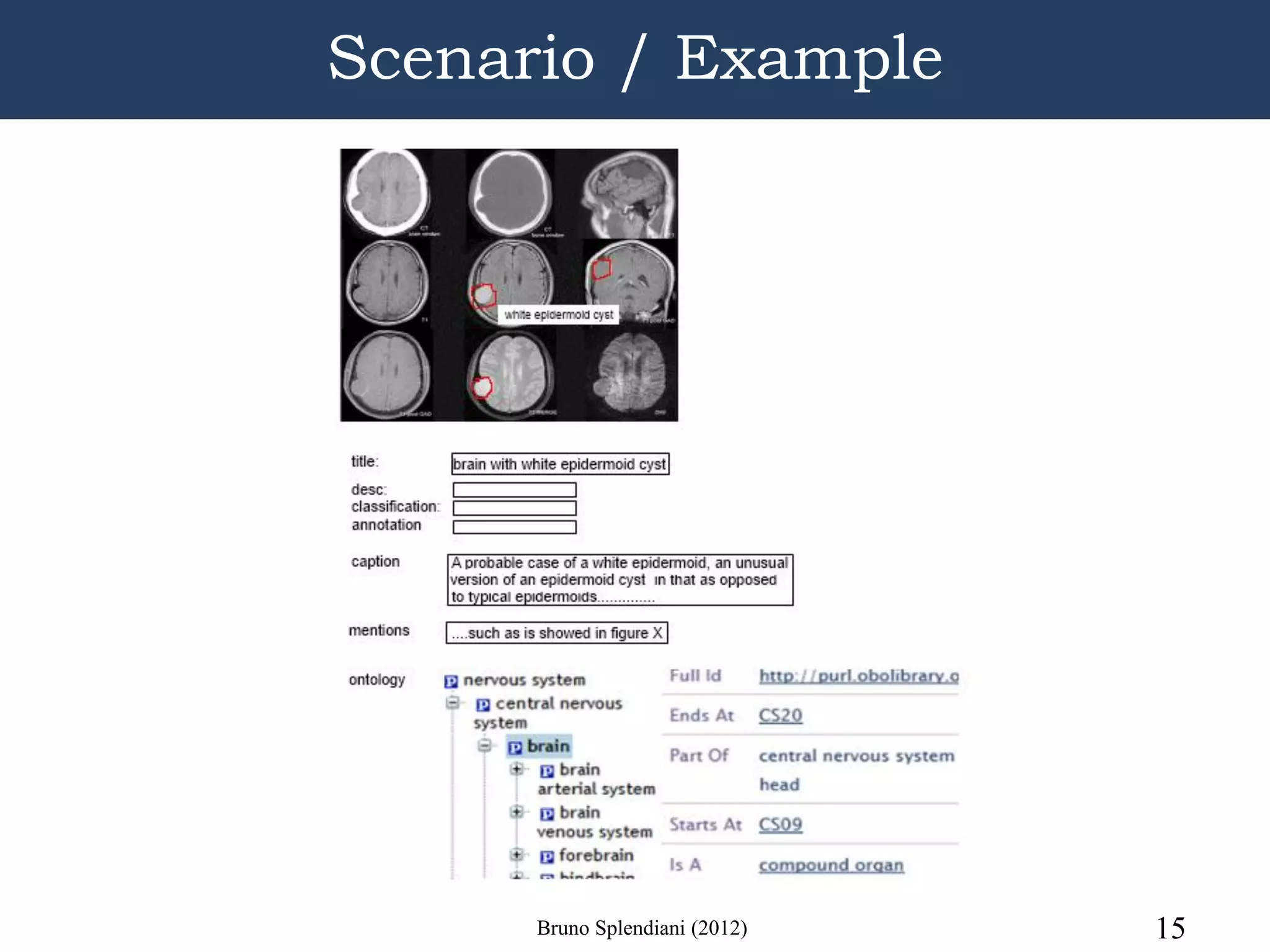
“Magnetic resonance imaging of a brain with a probable case of white epidermoid cyst”
                                   Bruno Splendiani (2012)                     6
Scenario /Life cycle (1)
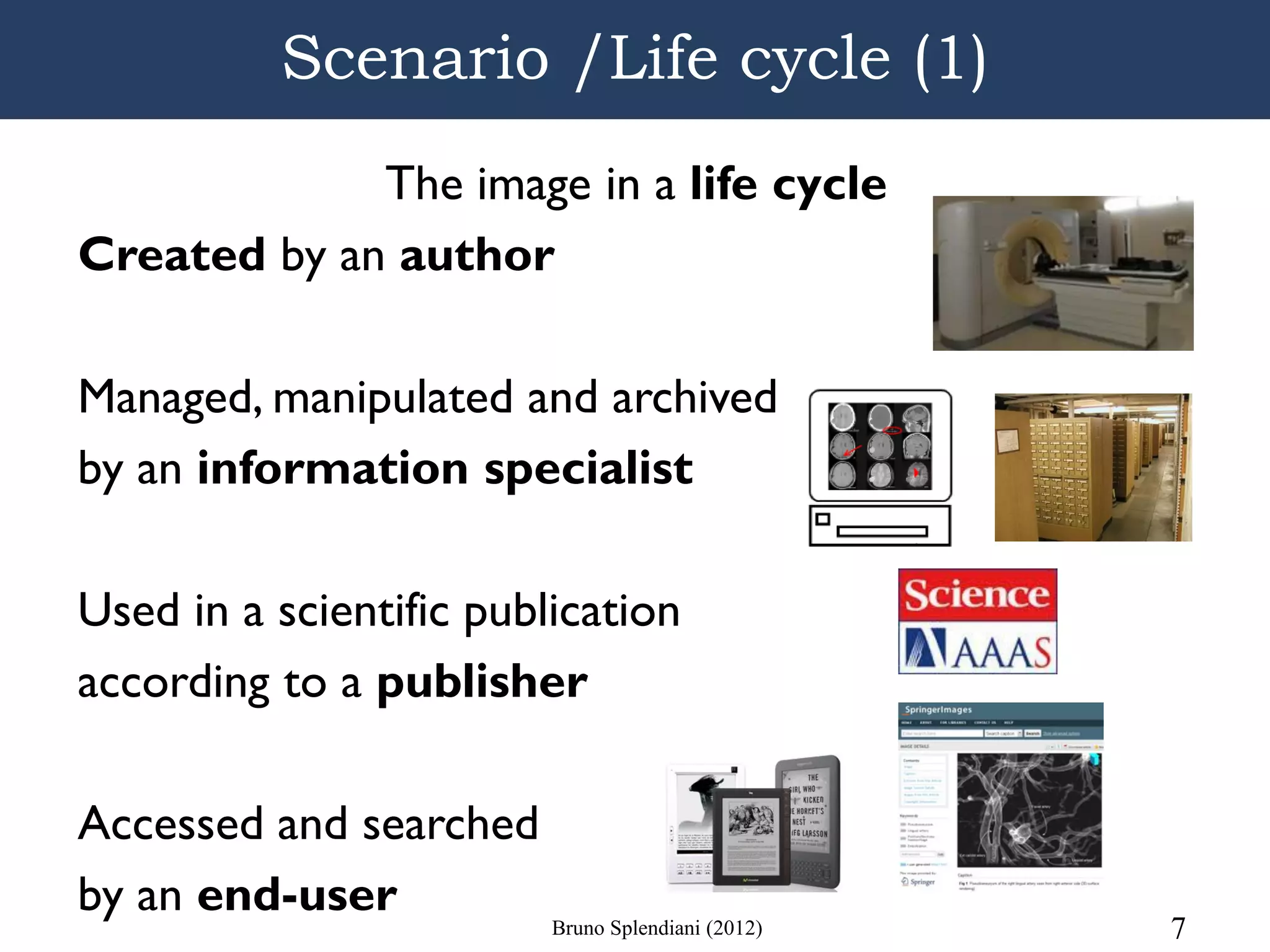
             The image in a life cycle
Created by an author

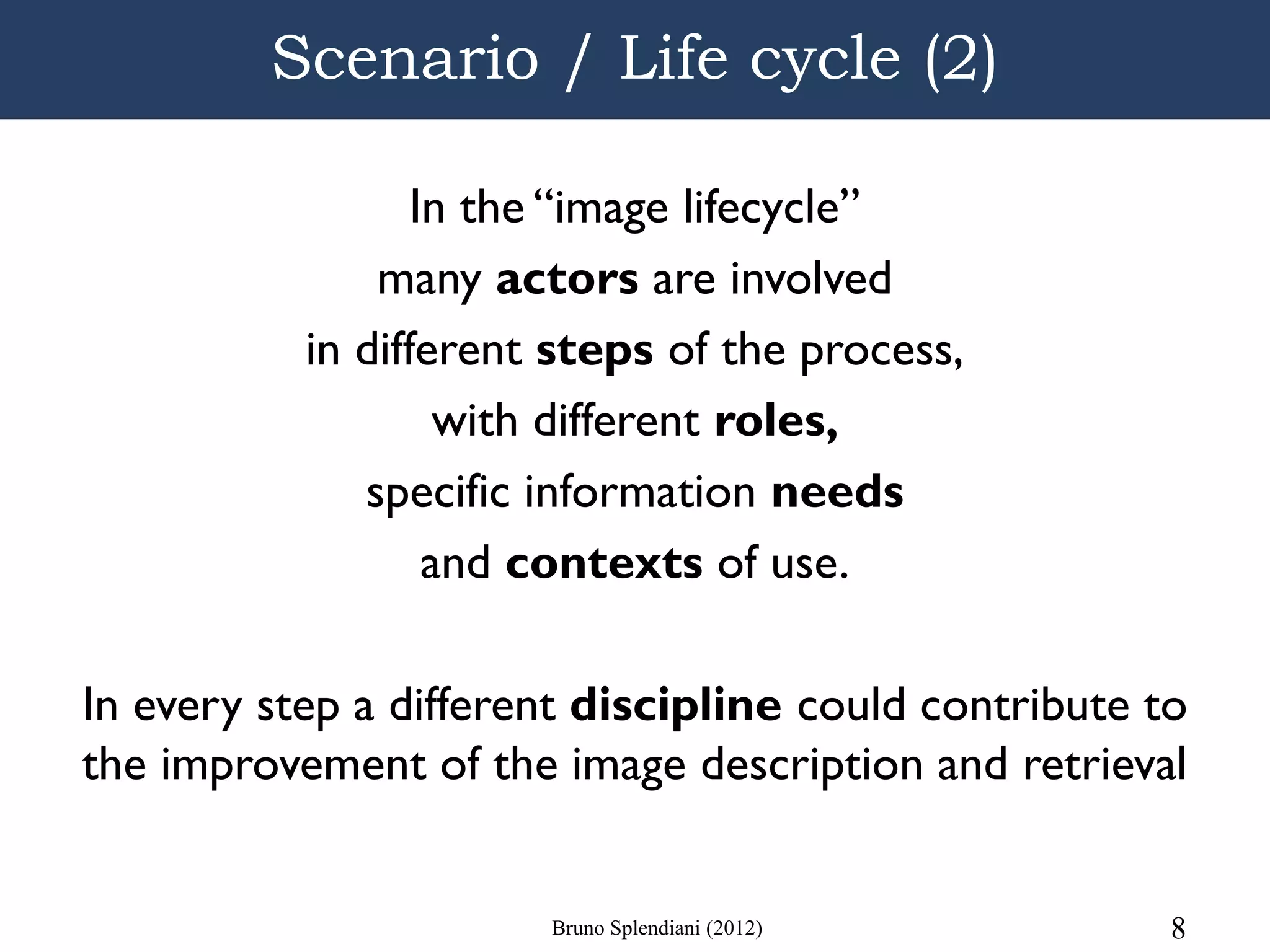
Managed, manipulated and archived
by an information specialist

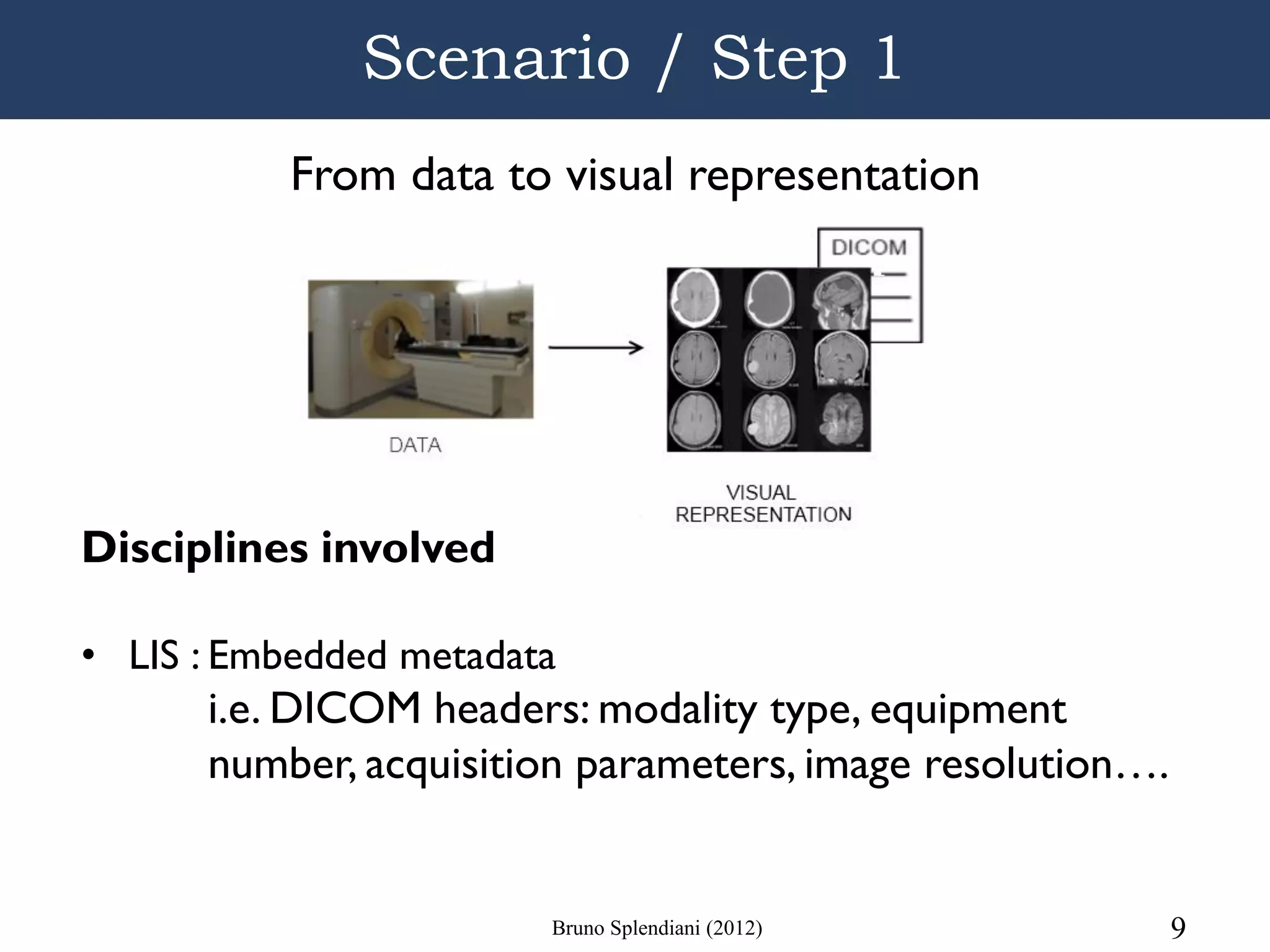
Used in a scientific publication
according to a publisher

Accessed and searched
by an end-user        Bruno Splendiani (2012)   7
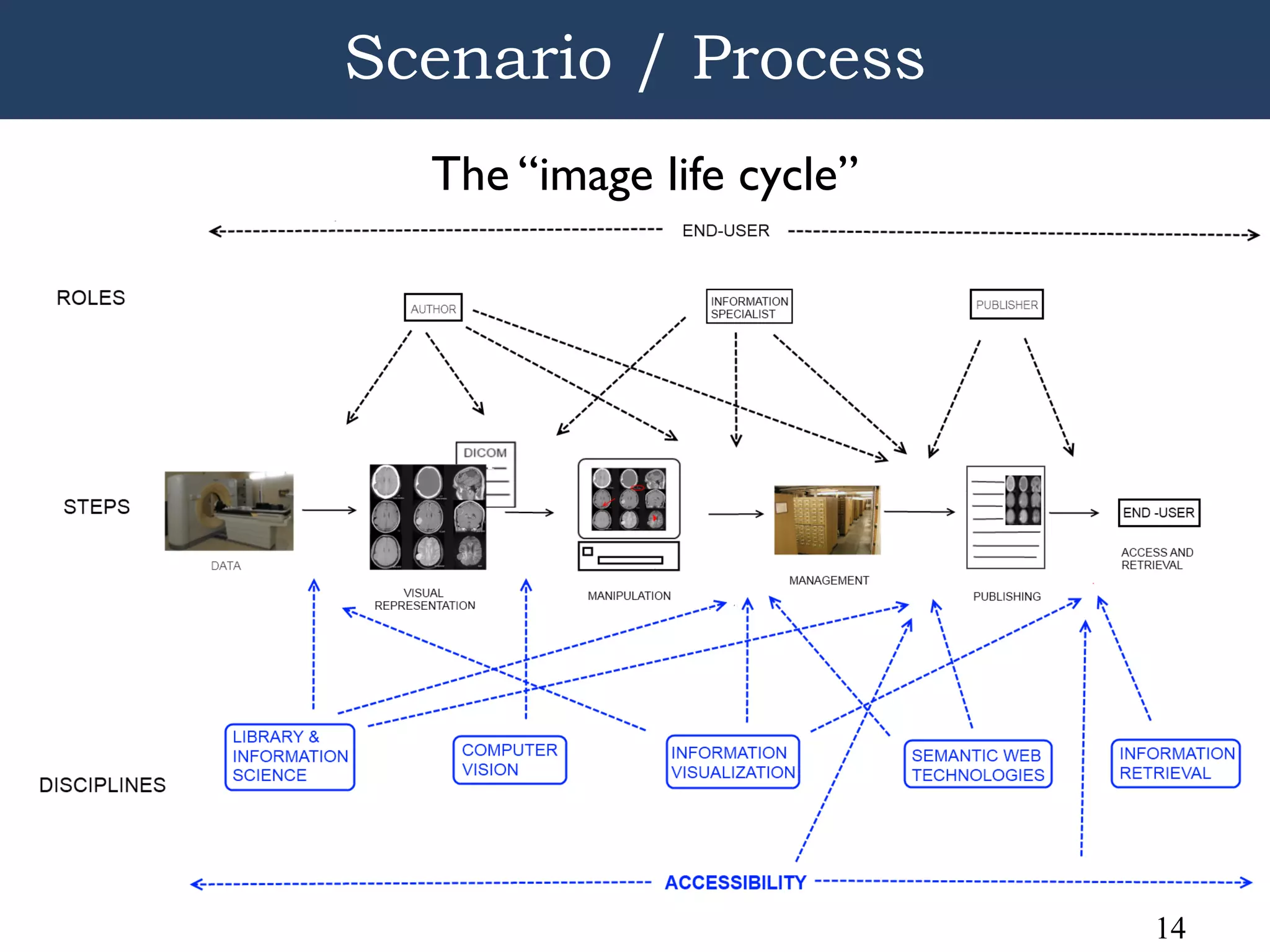
Scenario / Life cycle (2)

                  In the “image lifecycle”
               many actors are involved
           in different steps of the process,
                    with different roles,
              specific information needs
                   and contexts of use.

In every step a different discipline could contribute to
the improvement of the image description and retrieval


                       Bruno Splendiani (2012)         8
Scenario / Step 1
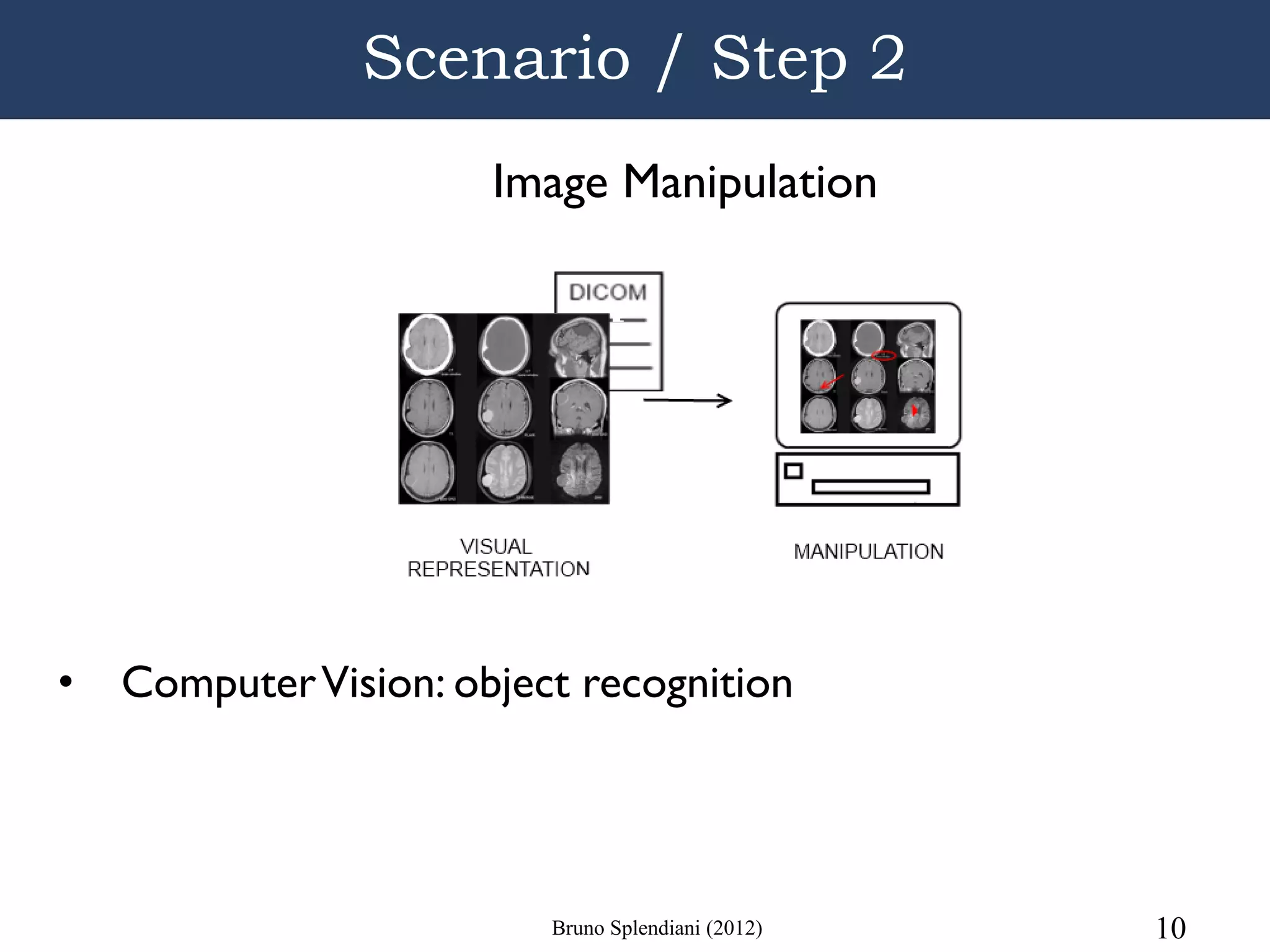
           From data to visual representation


Disciplines involved

• LIS : Embedded metadata
      i.e. DICOM headers: modality type, equipment
      number, acquisition parameters, image resolution….


                        Bruno Splendiani (2012)            9
Scenario / Step 2
                       Image Manipulation


•   Computer Vision: object recognition


                          Bruno Splendiani (2012)   10
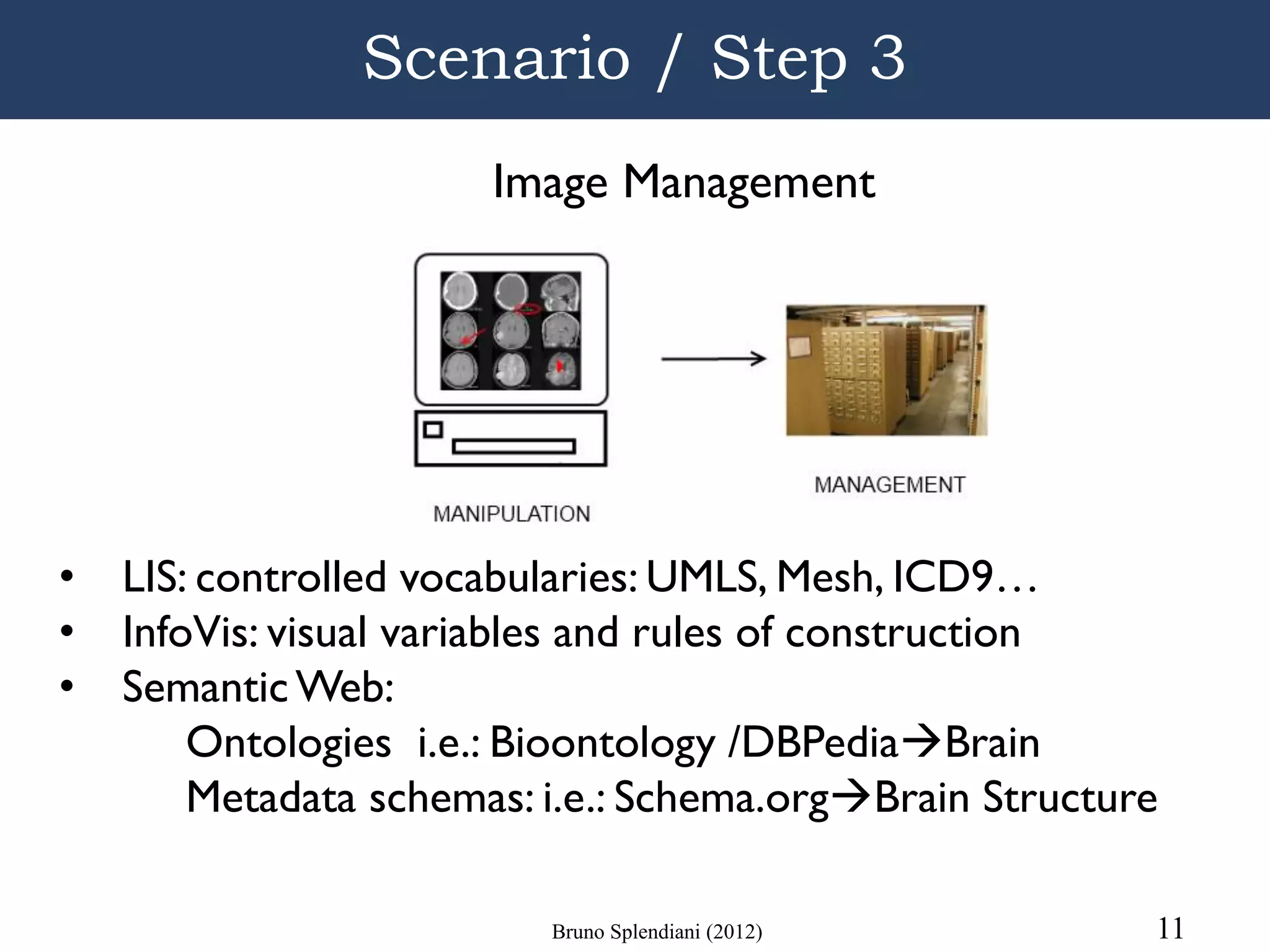
Scenario / Step 3
                       Image Management


•   LIS: controlled vocabularies: UMLS, Mesh, ICD9…
•   InfoVis: visual variables and rules of construction
•   Semantic Web:
        Ontologies i.e.: Bioontology /DBPediaBrain
        Metadata schemas: i.e.: Schema.orgBrain Structure

                          Bruno Splendiani (2012)        11
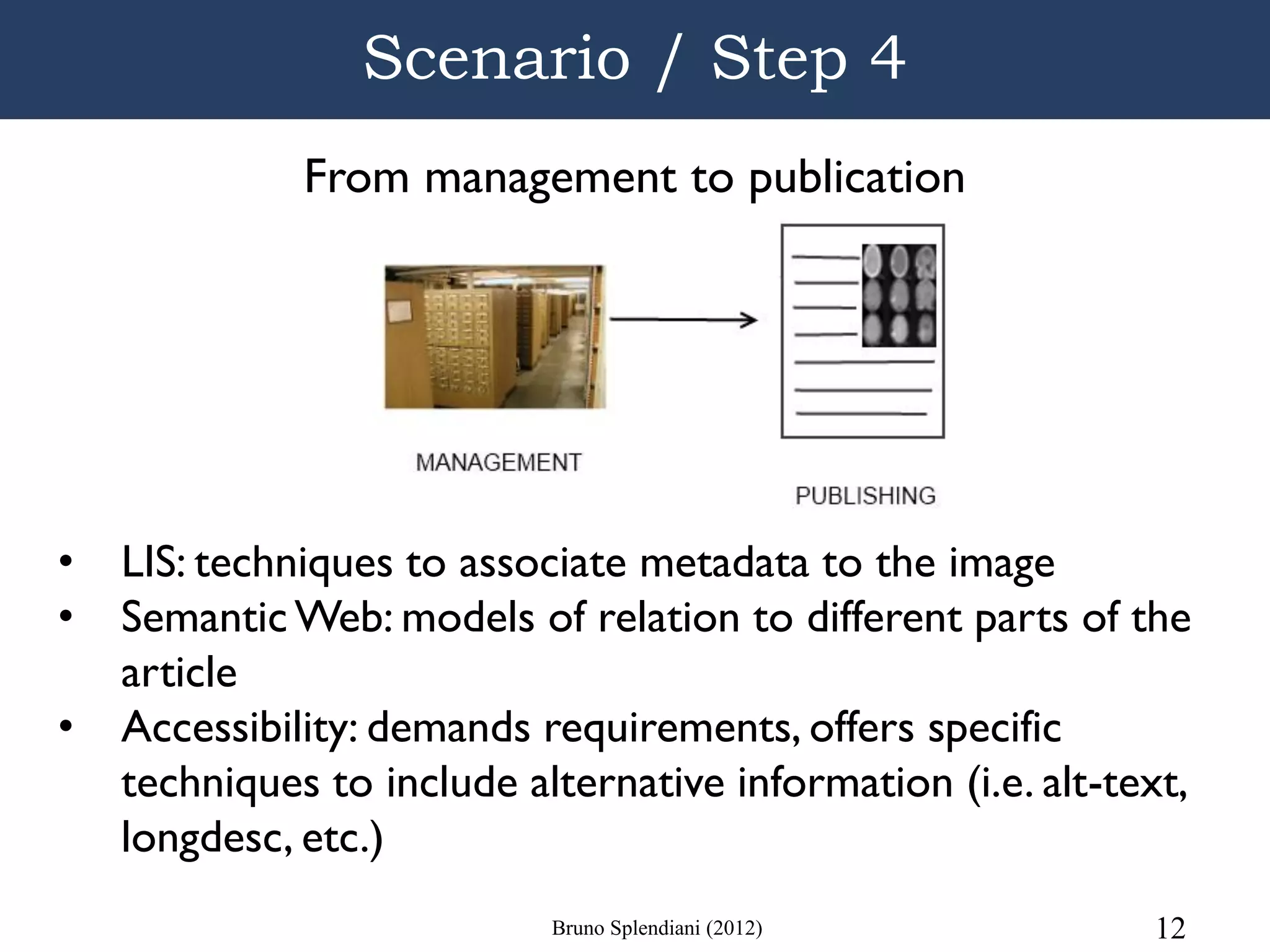
Scenario / Step 4
              From management to publication


•   LIS: techniques to associate metadata to the image
•   Semantic Web: models of relation to different parts of the
    article
•   Accessibility: demands requirements, offers specific
    techniques to include alternative information (i.e. alt-text,
    longdesc, etc.)
                            Bruno Splendiani (2012)           12
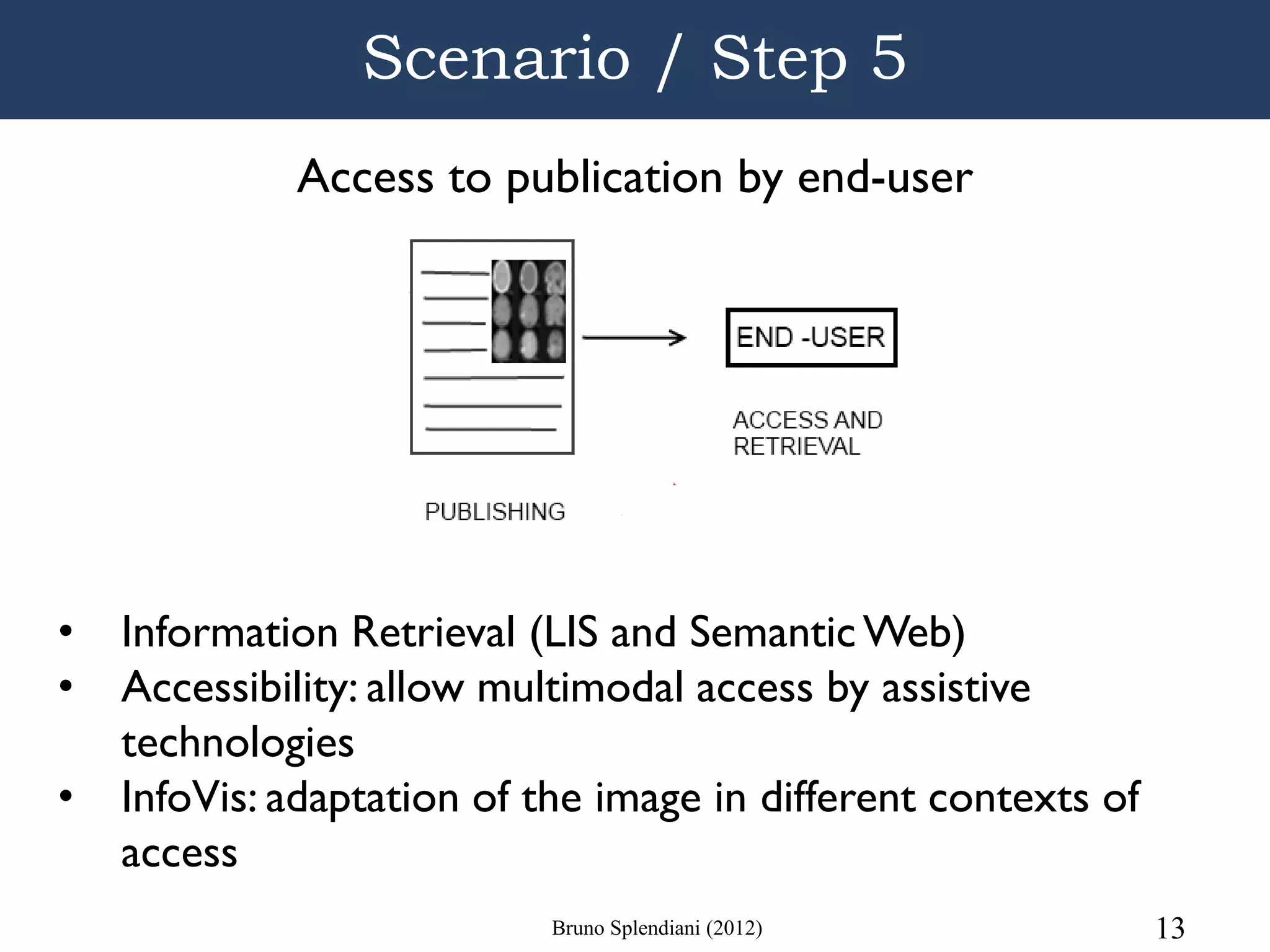
Scenario / Step 5
             Access to publication by end-user


•   Information Retrieval (LIS and Semantic Web)
•   Accessibility: allow multimodal access by assistive
    technologies
•   InfoVis: adaptation of the image in different contexts of
    access
                            Bruno Splendiani (2012)             13
Scenario / Process
  The “image life cycle”


                           14
Scenario / Example


      Bruno Splendiani (2012)   15
Conclusions
           The interdisciplinary approach
                   could improve

access to images for people
with disabilities


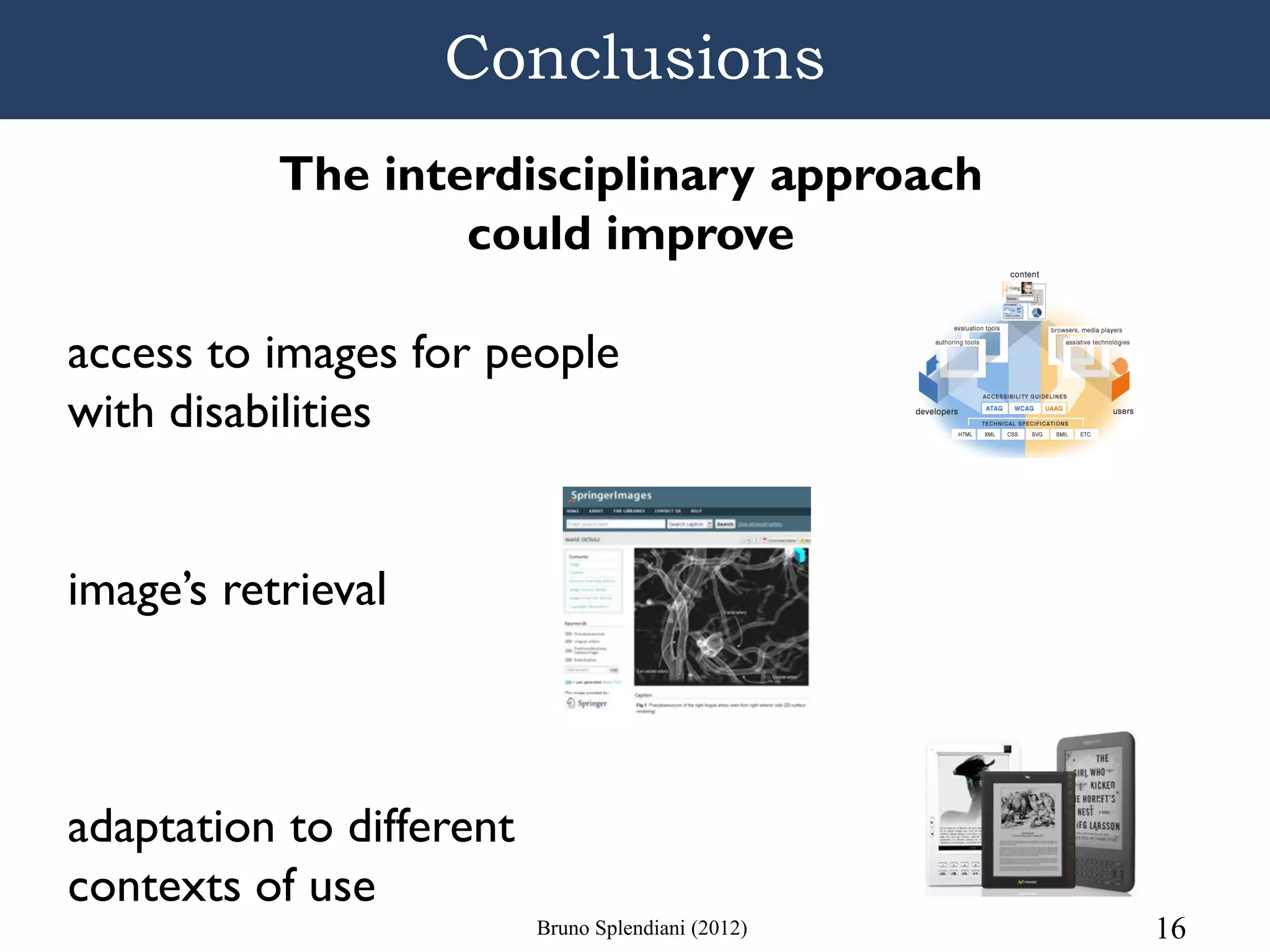
image’s retrieval


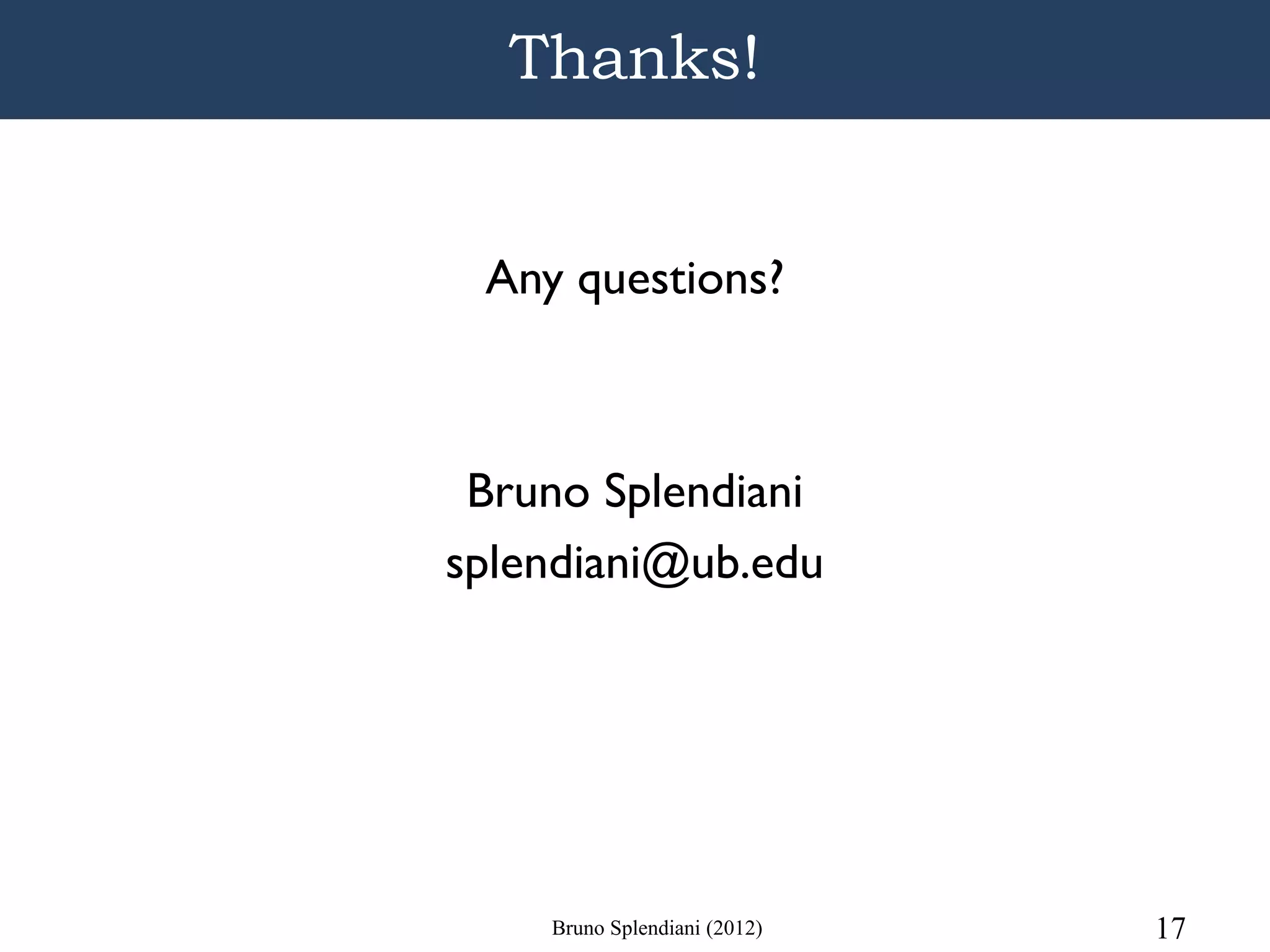
adaptation to different
contexts of use
                          Bruno Splendiani (2012)   16
Thanks!


 Any questions?


 Bruno Splendiani
splendiani@ub.edu


    Bruno Splendiani (2012)   17

An interdisciplinary approach to alternative representations for images

  • 1.
    An interdisciplinary approachto alternative representations for images Bruno Splendiani, Mireia Ribera, Roberto García, Marina Salse ICCHP Conference 2012 – ULD track
  • 2.
    Overview • Introduction • Proposal • Scenario • Conclusions Bruno Splendiani (2012) 2
  • 3.
    Introduction (1) Basic Recommendation in Accessibility “Provide text alternatives for any non-text content” [Source: WCAG 2.0] But Accessibility guidelines only offer general recommendations No standards defining: • the analysis and creation of visual content □ Relevant exceptions • the process of image description in publishing workflow □ Relevant exception Bruno Splendiani (2012) 3
  • 4.
    Introduction(2) So, we have to offer a text alternative, but HOW? • How to improve the accessibility to visual content and the retrieval of images? • How to make easier the creation of alternative representations? • How to adapt visual information to specific contexts of use? Bruno Splendiani (2012) 4
  • 5.
    Proposal Interdisciplinary approach Accessibility Information Visualization (InfoVis) Library and Information Science (LIS) Semantic Web Computer Vision How can the cross-fertilization of these disciplines help us to improve accessibility and retrieval of images? Let’s see an example! Bruno Splendiani (2012) 5
  • 6.
    Scenario /Biomedical image We have an image A digital, visual representation that convey data and information with the intention “to describe, explain, inform or instruct” [Source: Engelhardt] Biomedical image “Magnetic resonance imaging of a brain with a probable case of white epidermoid cyst” Bruno Splendiani (2012) 6
  • 7.
    Scenario /Life cycle(1) The image in a life cycle Created by an author Managed, manipulated and archived by an information specialist Used in a scientific publication according to a publisher Accessed and searched by an end-user Bruno Splendiani (2012) 7
  • 8.
    Scenario / Lifecycle (2) In the “image lifecycle” many actors are involved in different steps of the process, with different roles, specific information needs and contexts of use. In every step a different discipline could contribute to the improvement of the image description and retrieval Bruno Splendiani (2012) 8
  • 9.
    Scenario / Step1 From data to visual representation Disciplines involved • LIS : Embedded metadata i.e. DICOM headers: modality type, equipment number, acquisition parameters, image resolution…. Bruno Splendiani (2012) 9
  • 10.
    Scenario / Step2 Image Manipulation • Computer Vision: object recognition Bruno Splendiani (2012) 10
  • 11.
    Scenario / Step3 Image Management • LIS: controlled vocabularies: UMLS, Mesh, ICD9… • InfoVis: visual variables and rules of construction • Semantic Web: Ontologies i.e.: Bioontology /DBPediaBrain Metadata schemas: i.e.: Schema.orgBrain Structure Bruno Splendiani (2012) 11
  • 12.
    Scenario / Step4 From management to publication • LIS: techniques to associate metadata to the image • Semantic Web: models of relation to different parts of the article • Accessibility: demands requirements, offers specific techniques to include alternative information (i.e. alt-text, longdesc, etc.) Bruno Splendiani (2012) 12
  • 13.
    Scenario / Step5 Access to publication by end-user • Information Retrieval (LIS and Semantic Web) • Accessibility: allow multimodal access by assistive technologies • InfoVis: adaptation of the image in different contexts of access Bruno Splendiani (2012) 13
  • 14.
    Scenario / Process The “image life cycle” 14
  • 15.
    Scenario / Example Bruno Splendiani (2012) 15
  • 16.
    Conclusions The interdisciplinary approach could improve access to images for people with disabilities image’s retrieval adaptation to different contexts of use Bruno Splendiani (2012) 16
  • 17.
    Thanks! Any questions? Bruno Splendiani splendiani@ub.edu Bruno Splendiani (2012) 17