Initial Fieldwork for LWAZI: A Telephone-Based Spoken Dialog System for Rural South Africa

Loading...

Flash Player 9 (or above) is needed to view presentations.
We have detected that you do not have it on your computer. To install it, go here.

0 comments

Post a comment

    Post a comment
    Embed Video
    Edit your comment Cancel

    Favorites, Groups & Events

    Initial Fieldwork for LWAZI: A Telephone-Based Spoken Dialog System for Rural South Africa - Presentation Transcript

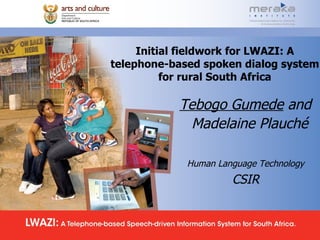
    1. Initial fieldwork for LWAZI: A telephone-based spoken dialog system for rural South Africa Tebogo Gumede and Madelaine Plauché Human Language Technology CSIR
    2. Outline
      • Introduction
      • Project Lwazi
      • Application selection
      • Selected application
        • Visited communities
        • Source of information
        • Transport
        • Providers
        • Languages
      • Discussion
      • Challenges
    3. Introduction
      • Growing interest in deploying spoken dialog systems (SDSs)
      • South Africa is the leader in Information and Communications Technology (ICT) in Africa
      • Illiteracy
        • Population with no schooling stood at 10.3% in 2007 (StatSA)
    4. Introduction
      • Mobile phone use is widespread
      • Challenge of accessing government information – opting not to access
      • Introducing project Lwazi
    5.  
    6. Project Lwazi
      • Lwazi IsiZulu for Knowledge
      • Three years funded by DAC
      • Telephone-based information system
      • In language of choice - 11 official languages
    7. Project Lwazi
      • Nationally available - Through a single number
      • Toll-free
      • Some key outputs
        • TTS in eleven languages
        • Quality ASR
        • MA and PHD
        • Application selection
    8.  
    9. Application selection
      • Key Informant Interviews,
      • Focus group Discussions
      • Community survey
      • Household surveys and
      • Workshops
        • Morphological analysis
        • Application selection
    10.  
    11.  
    12. The selected application
      • Community Development Workers (CDW)
        • ‘ Foot solders’ between government services and communities, especially the rural poor
        • Then follow up to ensure citizens successfully receive services.
      • CDWs at work
        • example
    13. Communities visited
      • Rural
      • High unemployment
      • Old and technically challenged
      • Suitability of Lwazi system
      • User expertise of telephony
      • Source of information
    14.  
    15.  
    16.  
    17.  
    18. Potential uptake
      • Two potential areas
        • Community and government (easy flow and cheaper and by-in)
          • Key is localised information
        • Within government officials (they were excited about L potential )
    19. Challenges
      • Diversity of end users will require investment in time and resource to gather accurate information
      • Ambitious (stakeholders, 11 languages)
      • Not everyone in our targeted group will be excited about Lwazi.
    20.  
    21. THANK YOU www.meraka.org.za/lwazi
    SlideShare Zeitgeist 2009

    + Guy De PauwGuy De Pauw Nominate

    custom

    436 views, 0 favs, 2 embeds more stats

    by Tebogo Gumede and Madelaine Plauché
    More info about this document

    © All Rights Reserved

    Go to text version

    • Total Views 436
      • 431 on SlideShare
      • 5 from embeds
    • Comments 0
    • Favorites 0
    • Downloads 1
    Most viewed embeds
    • 3 views on http://aflat.org
    • 2 views on http://www.aflat.org

    more

    All embeds
    • 3 views on http://aflat.org
    • 2 views on http://www.aflat.org

    less

    Flagged as inappropriate Flag as inappropriate
    Flag as inappropriate

    Select your reason for flagging this presentation as inappropriate. If needed, use the feedback form to let us know more details.

    Cancel
    File a copyright complaint
    Having problems? Go to our helpdesk?

    Categories