Automatic structuring and
correction suggestion system for
   Hungarian clinical records

Borbála Siklósi1, György Orosz1,2, Attila Novák1,2 , Gábor Prószéky1,2

        1Pázmány  Péter Catholic University, Faculty of Information Technology
                siklosi.borbala@itk.ppke.hu, orosz.gyorgy@itk.ppke.hu

                 2MTA-PPKE     Language Technology Research Group
                   novak.attila@itk.ppke.hu, proszeky@itk.ppke.hu


 This work was partially supported by TÁMOP-4.2.1.B-11/2/KMR-2011-0002
Outline
• Motivation
• Where to start
• Uniform representation
  – Separation of structural units
  – Correction of spelling errors
• Results
• Examples
• Typical errors
               This work was partially supported by TÁMOP-4.2.1.B-11/2/KMR-2011-0002
Motivation
•   Processing clinical records
•   Revealing deeper relations
•   Exploration of hidden information
•   Support searchability
•   Aid doctors and researchers
•   …


               This work was partially supported by TÁMOP-4.2.1.B-11/2/KMR-2011-0002
Where to start
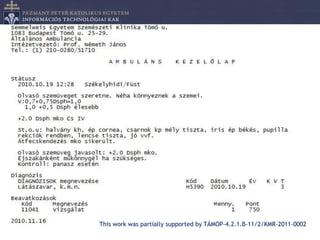
• Serious shortcomings of clinical documentation
  systems of Hungarian clinics
• Missing medical histories
• Flowing texts lacking any structure
• Misused, mixed language – of Hungarian and
  “medical Latin”


             This work was partially supported by TÁMOP-4.2.1.B-11/2/KMR-2011-0002
This work was partially supported by TÁMOP-4.2.1.B-11/2/KMR-2011-0002
Uniform representation
•   Separation of structural units
•   Tagging basic metadata
•   Separation of textual from tabular data
•   Spelling correction


                This work was partially supported by TÁMOP-4.2.1.B-11/2/KMR-2011-0002
Separation of structural units
• XML structure based on (not uniform)
  formatting elements and basic surface patterns
  – Keeping the whole copy of original document
  – Content (header, diagnosis, applied treatments, status, operations,
    symptoms, etc)
  – Metadata (document type, institution and department IDs, tables,
    medical codes)
  – Named entities (dates, doctors, operations)
  – Medical history

                     This work was partially supported by TÁMOP-4.2.1.B-11/2/KMR-2011-0002
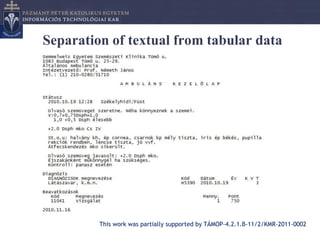
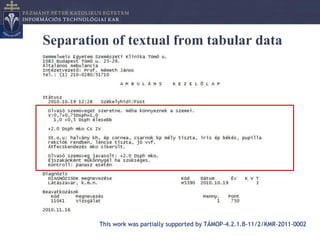
Separation of textual from tabular data


         This work was partially supported by TÁMOP-4.2.1.B-11/2/KMR-2011-0002
Separation of textual from tabular data


         This work was partially supported by TÁMOP-4.2.1.B-11/2/KMR-2011-0002
Separation of textual from tabular data
• Rules and pattern matching do not work
• Clustering (k-means)
   – Input: „concatenated” lines
   – Output: manual selection from several clusters
• Classification (Naive-Bayes)
   – Applied to new documents
   – Trained on output of clustering
   – 98%
                This work was partially supported by TÁMOP-4.2.1.B-11/2/KMR-2011-0002
Spelling correction
• Domain and language specific difficulties
• Standardized corpus     „0th” goal
• Approaching an error model with language
  models
  – Stopword list
  – Abbreviations list – automatic generation
  – Judgment of morphological analyzer (spell checker)
     • Licensed
     • Non licensed            if frequent, then “correct”
  – General and domain specific word lists
               This work was partially supported by TÁMOP-4.2.1.B-11/2/KMR-2011-0002
Spelling correction
• Tokenization (abbreviations, punctuation, imperfect
  syntactic structures)
• Generation of candidate corrections:
   – One edit distance from original form
   – Suggestions of the speller
• Scoring:
   – Weighted language models
   – Weighted edit distance generation (e.g. accents)
   – Features of the original form
                  This work was partially supported by TÁMOP-4.2.1.B-11/2/KMR-2011-0002
Results
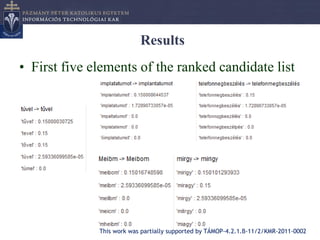
• First five elements of the ranked candidate list


              This work was partially supported by TÁMOP-4.2.1.B-11/2/KMR-2011-0002
Results
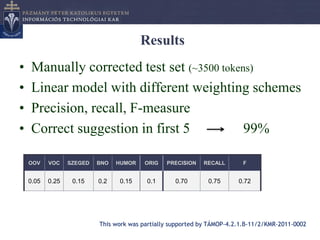
•   Manually corrected test set (~3500 tokens)
•   Linear model with different weighting schemes
•   Precision, recall, F-measure
•   Correct suggestion in first 5           99%

    OOV    VOC    SZEGED   BNO   HUMOR    ORIG   PRECISION   RECALL       F


    0.05   0.25    0.15    0.2   0.15     0.1       0.70       0.75      0.72


                           This work was partially supported by TÁMOP-4.2.1.B-11/2/KMR-2011-0002
Results
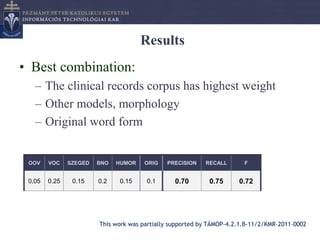
• Best combination:
   – The clinical records corpus has highest weight
   – Other models, morphology
   – Original word form


 OOV    VOC    SZEGED   BNO   HUMOR    ORIG   PRECISION    RECALL       F


 0.05   0.25    0.15    0.2   0.15     0.1       0.70       0.75      0.72


                        This work was partially supported by TÁMOP-4.2.1.B-11/2/KMR-2011-0002
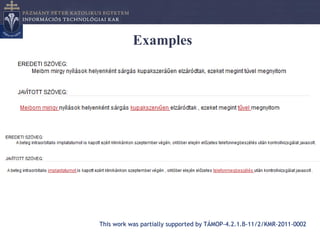
Examples


This work was partially supported by TÁMOP-4.2.1.B-11/2/KMR-2011-0002
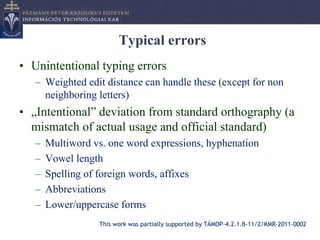
Typical errors
• Unintentional typing errors
   – Weighted edit distance can handle these (except for non
     neighboring letters)
• „Intentional” deviation from standard orthography (a
  mismatch of actual usage and official standard)
   –   Multiword vs. one word expressions, hyphenation
   –   Vowel length
   –   Spelling of foreign words, affixes
   –   Abbreviations
   –   Lower/uppercase forms
                  This work was partially supported by TÁMOP-4.2.1.B-11/2/KMR-2011-0002
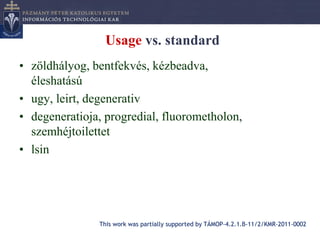
Usage vs. standard
• zöldhályog, bentfekvés, kézbeadva,
  éleshatású
• ugy, leirt, degenerativ
• degeneratioja, progredial, fluorometholon,
  szemhéjtoilettet
• lsin


               This work was partially supported by TÁMOP-4.2.1.B-11/2/KMR-2011-0002
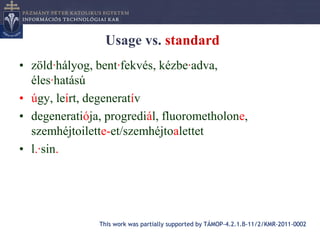
Usage vs. standard
• zöld∙hályog, bent∙fekvés, kézbe∙adva,
  éles∙hatású
• úgy, leírt, degeneratív
• degeneratiója, progrediál, fluorometholone,
  szemhéjtoilette-et/szemhéjtoalettet
• l.∙sin.


               This work was partially supported by TÁMOP-4.2.1.B-11/2/KMR-2011-0002
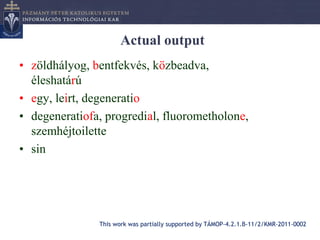
Actual output
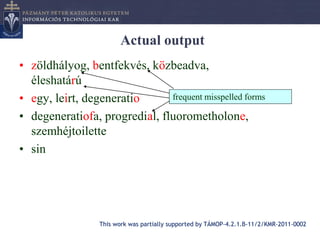
• zöldhályog, bentfekvés, közbeadva,
  éleshatárú
• egy, leirt, degeneratio
• degeneratiofa, progredial, fluorometholone,
  szemhéjtoilette
• sin


               This work was partially supported by TÁMOP-4.2.1.B-11/2/KMR-2011-0002
Actual output
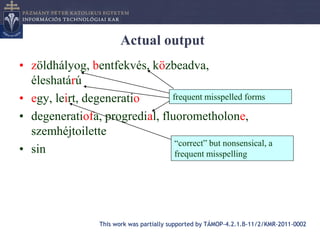
• zöldhályog, bentfekvés, közbeadva,
  éleshatárú
• egy, leirt, degeneratio      frequent misspelled forms

• degeneratiofa, progredial, fluorometholone,
  szemhéjtoilette
• sin


                  This work was partially supported by TÁMOP-4.2.1.B-11/2/KMR-2011-0002
Actual output
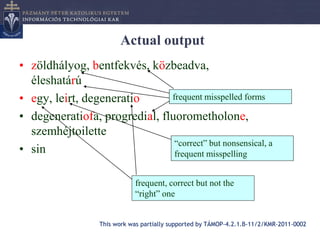
• zöldhályog, bentfekvés, közbeadva,
  éleshatárú
• egy, leirt, degeneratio      frequent misspelled forms

• degeneratiofa, progredial, fluorometholone,
  szemhéjtoilette
                                “correct” but nonsensical, a
• sin                           frequent misspelling


                   This work was partially supported by TÁMOP-4.2.1.B-11/2/KMR-2011-0002
Actual output
• zöldhályog, bentfekvés, közbeadva,
  éleshatárú
• egy, leirt, degeneratio      frequent misspelled forms

• degeneratiofa, progredial, fluorometholone,
  szemhéjtoilette
                                “correct” but nonsensical, a
• sin                           frequent misspelling


                              frequent, correct but not the
                              “right” one


                   This work was partially supported by TÁMOP-4.2.1.B-11/2/KMR-2011-0002
Because
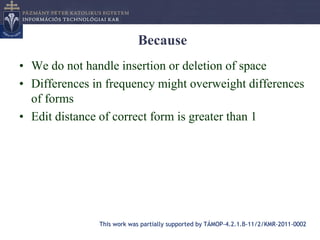
• We do not handle insertion or deletion of space
• Differences in frequency might overweight differences
  of forms
• Edit distance of correct form is greater than 1


               This work was partially supported by TÁMOP-4.2.1.B-11/2/KMR-2011-0002
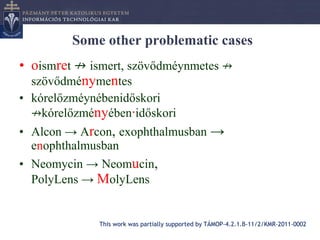
Or because
• Morphology does not recognize word and it is not
  frequent either
• The morphology accepts the misspelled form (we do
  not check word context)
• Our word lists and corpus are not big enough – they do
  not compensate for the overgeneration of morphology


               This work was partially supported by TÁMOP-4.2.1.B-11/2/KMR-2011-0002
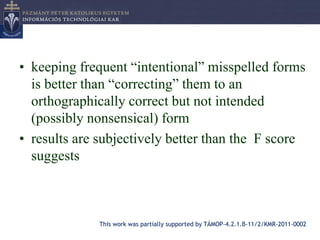
Some other problematic cases
• oismret ↛ ismert, szövődméynmetes ↛
  szövődménymentes
• kórelőzméynébenidőskori
  ↛kórelőzményében∙időskori
• Alcon → Arcon, exophthalmusban →
  enophthalmusban
• Neomycin → Neomucin,
  PolyLens → MolyLens


             This work was partially supported by TÁMOP-4.2.1.B-11/2/KMR-2011-0002
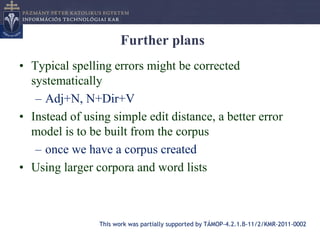
• keeping frequent “intentional” misspelled forms
  is better than “correcting” them to an
  orthographically correct but not intended
  (possibly nonsensical) form
• results are subjectively better than the F score
  suggests


              This work was partially supported by TÁMOP-4.2.1.B-11/2/KMR-2011-0002
Further plans
• Typical spelling errors might be corrected
  systematically
   – Adj+N, N+Dir+V
• Instead of using simple edit distance, a better error
  model is to be built from the corpus
   – once we have a corpus created
• Using larger corpora and word lists


                This work was partially supported by TÁMOP-4.2.1.B-11/2/KMR-2011-0002
Teh Edn


This work was partially supported by TÁMOP-4.2.1.B-11/2/KMR-2011-0002
The End


This work was partially supported by TÁMOP-4.2.1.B-11/2/KMR-2011-0002

Automatic Structuring and Correction Suggestion System for Hungarian Clinical Records

  • 1.
    Automatic structuring and correctionsuggestion system for Hungarian clinical records Borbála Siklósi1, György Orosz1,2, Attila Novák1,2 , Gábor Prószéky1,2 1Pázmány Péter Catholic University, Faculty of Information Technology siklosi.borbala@itk.ppke.hu, orosz.gyorgy@itk.ppke.hu 2MTA-PPKE Language Technology Research Group novak.attila@itk.ppke.hu, proszeky@itk.ppke.hu This work was partially supported by TÁMOP-4.2.1.B-11/2/KMR-2011-0002
  • 2.
    Outline • Motivation • Whereto start • Uniform representation – Separation of structural units – Correction of spelling errors • Results • Examples • Typical errors This work was partially supported by TÁMOP-4.2.1.B-11/2/KMR-2011-0002
  • 3.
    Motivation • Processing clinical records • Revealing deeper relations • Exploration of hidden information • Support searchability • Aid doctors and researchers • … This work was partially supported by TÁMOP-4.2.1.B-11/2/KMR-2011-0002
  • 4.
    Where to start •Serious shortcomings of clinical documentation systems of Hungarian clinics • Missing medical histories • Flowing texts lacking any structure • Misused, mixed language – of Hungarian and “medical Latin” This work was partially supported by TÁMOP-4.2.1.B-11/2/KMR-2011-0002
  • 5.
    This work waspartially supported by TÁMOP-4.2.1.B-11/2/KMR-2011-0002
  • 6.
    Uniform representation • Separation of structural units • Tagging basic metadata • Separation of textual from tabular data • Spelling correction This work was partially supported by TÁMOP-4.2.1.B-11/2/KMR-2011-0002
  • 7.
    Separation of structuralunits • XML structure based on (not uniform) formatting elements and basic surface patterns – Keeping the whole copy of original document – Content (header, diagnosis, applied treatments, status, operations, symptoms, etc) – Metadata (document type, institution and department IDs, tables, medical codes) – Named entities (dates, doctors, operations) – Medical history This work was partially supported by TÁMOP-4.2.1.B-11/2/KMR-2011-0002
  • 8.
    Separation of textualfrom tabular data This work was partially supported by TÁMOP-4.2.1.B-11/2/KMR-2011-0002
  • 9.
    Separation of textualfrom tabular data This work was partially supported by TÁMOP-4.2.1.B-11/2/KMR-2011-0002
  • 10.
    Separation of textualfrom tabular data • Rules and pattern matching do not work • Clustering (k-means) – Input: „concatenated” lines – Output: manual selection from several clusters • Classification (Naive-Bayes) – Applied to new documents – Trained on output of clustering – 98% This work was partially supported by TÁMOP-4.2.1.B-11/2/KMR-2011-0002
  • 11.
    Spelling correction • Domainand language specific difficulties • Standardized corpus „0th” goal • Approaching an error model with language models – Stopword list – Abbreviations list – automatic generation – Judgment of morphological analyzer (spell checker) • Licensed • Non licensed if frequent, then “correct” – General and domain specific word lists This work was partially supported by TÁMOP-4.2.1.B-11/2/KMR-2011-0002
  • 12.
    Spelling correction • Tokenization(abbreviations, punctuation, imperfect syntactic structures) • Generation of candidate corrections: – One edit distance from original form – Suggestions of the speller • Scoring: – Weighted language models – Weighted edit distance generation (e.g. accents) – Features of the original form This work was partially supported by TÁMOP-4.2.1.B-11/2/KMR-2011-0002
  • 13.
    Results • First fiveelements of the ranked candidate list This work was partially supported by TÁMOP-4.2.1.B-11/2/KMR-2011-0002
  • 14.
    Results • Manually corrected test set (~3500 tokens) • Linear model with different weighting schemes • Precision, recall, F-measure • Correct suggestion in first 5 99% OOV VOC SZEGED BNO HUMOR ORIG PRECISION RECALL F 0.05 0.25 0.15 0.2 0.15 0.1 0.70 0.75 0.72 This work was partially supported by TÁMOP-4.2.1.B-11/2/KMR-2011-0002
  • 15.
    Results • Best combination: – The clinical records corpus has highest weight – Other models, morphology – Original word form OOV VOC SZEGED BNO HUMOR ORIG PRECISION RECALL F 0.05 0.25 0.15 0.2 0.15 0.1 0.70 0.75 0.72 This work was partially supported by TÁMOP-4.2.1.B-11/2/KMR-2011-0002
  • 16.
    Examples This work waspartially supported by TÁMOP-4.2.1.B-11/2/KMR-2011-0002
  • 17.
    Typical errors • Unintentionaltyping errors – Weighted edit distance can handle these (except for non neighboring letters) • „Intentional” deviation from standard orthography (a mismatch of actual usage and official standard) – Multiword vs. one word expressions, hyphenation – Vowel length – Spelling of foreign words, affixes – Abbreviations – Lower/uppercase forms This work was partially supported by TÁMOP-4.2.1.B-11/2/KMR-2011-0002
  • 18.
    Usage vs. standard •zöldhályog, bentfekvés, kézbeadva, éleshatású • ugy, leirt, degenerativ • degeneratioja, progredial, fluorometholon, szemhéjtoilettet • lsin This work was partially supported by TÁMOP-4.2.1.B-11/2/KMR-2011-0002
  • 19.
    Usage vs. standard •zöld∙hályog, bent∙fekvés, kézbe∙adva, éles∙hatású • úgy, leírt, degeneratív • degeneratiója, progrediál, fluorometholone, szemhéjtoilette-et/szemhéjtoalettet • l.∙sin. This work was partially supported by TÁMOP-4.2.1.B-11/2/KMR-2011-0002
  • 20.
    Actual output • zöldhályog,bentfekvés, közbeadva, éleshatárú • egy, leirt, degeneratio • degeneratiofa, progredial, fluorometholone, szemhéjtoilette • sin This work was partially supported by TÁMOP-4.2.1.B-11/2/KMR-2011-0002
  • 21.
    Actual output • zöldhályog,bentfekvés, közbeadva, éleshatárú • egy, leirt, degeneratio frequent misspelled forms • degeneratiofa, progredial, fluorometholone, szemhéjtoilette • sin This work was partially supported by TÁMOP-4.2.1.B-11/2/KMR-2011-0002
  • 22.
    Actual output • zöldhályog,bentfekvés, közbeadva, éleshatárú • egy, leirt, degeneratio frequent misspelled forms • degeneratiofa, progredial, fluorometholone, szemhéjtoilette “correct” but nonsensical, a • sin frequent misspelling This work was partially supported by TÁMOP-4.2.1.B-11/2/KMR-2011-0002
  • 23.
    Actual output • zöldhályog,bentfekvés, közbeadva, éleshatárú • egy, leirt, degeneratio frequent misspelled forms • degeneratiofa, progredial, fluorometholone, szemhéjtoilette “correct” but nonsensical, a • sin frequent misspelling frequent, correct but not the “right” one This work was partially supported by TÁMOP-4.2.1.B-11/2/KMR-2011-0002
  • 24.
    Because • We donot handle insertion or deletion of space • Differences in frequency might overweight differences of forms • Edit distance of correct form is greater than 1 This work was partially supported by TÁMOP-4.2.1.B-11/2/KMR-2011-0002
  • 25.
    Or because • Morphologydoes not recognize word and it is not frequent either • The morphology accepts the misspelled form (we do not check word context) • Our word lists and corpus are not big enough – they do not compensate for the overgeneration of morphology This work was partially supported by TÁMOP-4.2.1.B-11/2/KMR-2011-0002
  • 26.
    Some other problematiccases • oismret ↛ ismert, szövődméynmetes ↛ szövődménymentes • kórelőzméynébenidőskori ↛kórelőzményében∙időskori • Alcon → Arcon, exophthalmusban → enophthalmusban • Neomycin → Neomucin, PolyLens → MolyLens This work was partially supported by TÁMOP-4.2.1.B-11/2/KMR-2011-0002
  • 27.
    • keeping frequent“intentional” misspelled forms is better than “correcting” them to an orthographically correct but not intended (possibly nonsensical) form • results are subjectively better than the F score suggests This work was partially supported by TÁMOP-4.2.1.B-11/2/KMR-2011-0002
  • 28.
    Further plans • Typicalspelling errors might be corrected systematically – Adj+N, N+Dir+V • Instead of using simple edit distance, a better error model is to be built from the corpus – once we have a corpus created • Using larger corpora and word lists This work was partially supported by TÁMOP-4.2.1.B-11/2/KMR-2011-0002
  • 29.
    Teh Edn This workwas partially supported by TÁMOP-4.2.1.B-11/2/KMR-2011-0002
  • 30.
    The End This workwas partially supported by TÁMOP-4.2.1.B-11/2/KMR-2011-0002