
Building a World Class  Web 2.0 Product Organization Adam Nash LinkedIn
Context: LinkedIn LinkedIn is the world’s largest global professional network, with over 27m members. Average member is 41, with household income of $110K Organization has grown over 500% in the past two years. Revenue has grown faster… We deliver code to production every week
Questions for Today Does Web 2.0 need product managers? How does a distributed architecture for product function? How do you empower user experience? How do you balance an agile process with organization visibility? Anything else?
Answers for Today Yes, Web 2.0 does need product. The best software is designed & built by small, cross-functional teams. Including web development in the organization empowers user experience. Distributed teams must communicate constantly & transparently to scale. We’re still learning what world-class product means for Web 2.0.
Reflection on Web 2.0 Like all great revolutions, the seeds were planted long ago (1990s) and grew aggressively post-bubble. A few Web 2.0 realizations: Social fabrics generate engagement Viral distribution models generate nearly costless organic traffic Users can and will generate content
Does Web 2.0 Need Product Managers? Several years ago, this was the fashionable debate in Silicon Valley. Why can’t you just connect engineers with customers, iterate, and go?
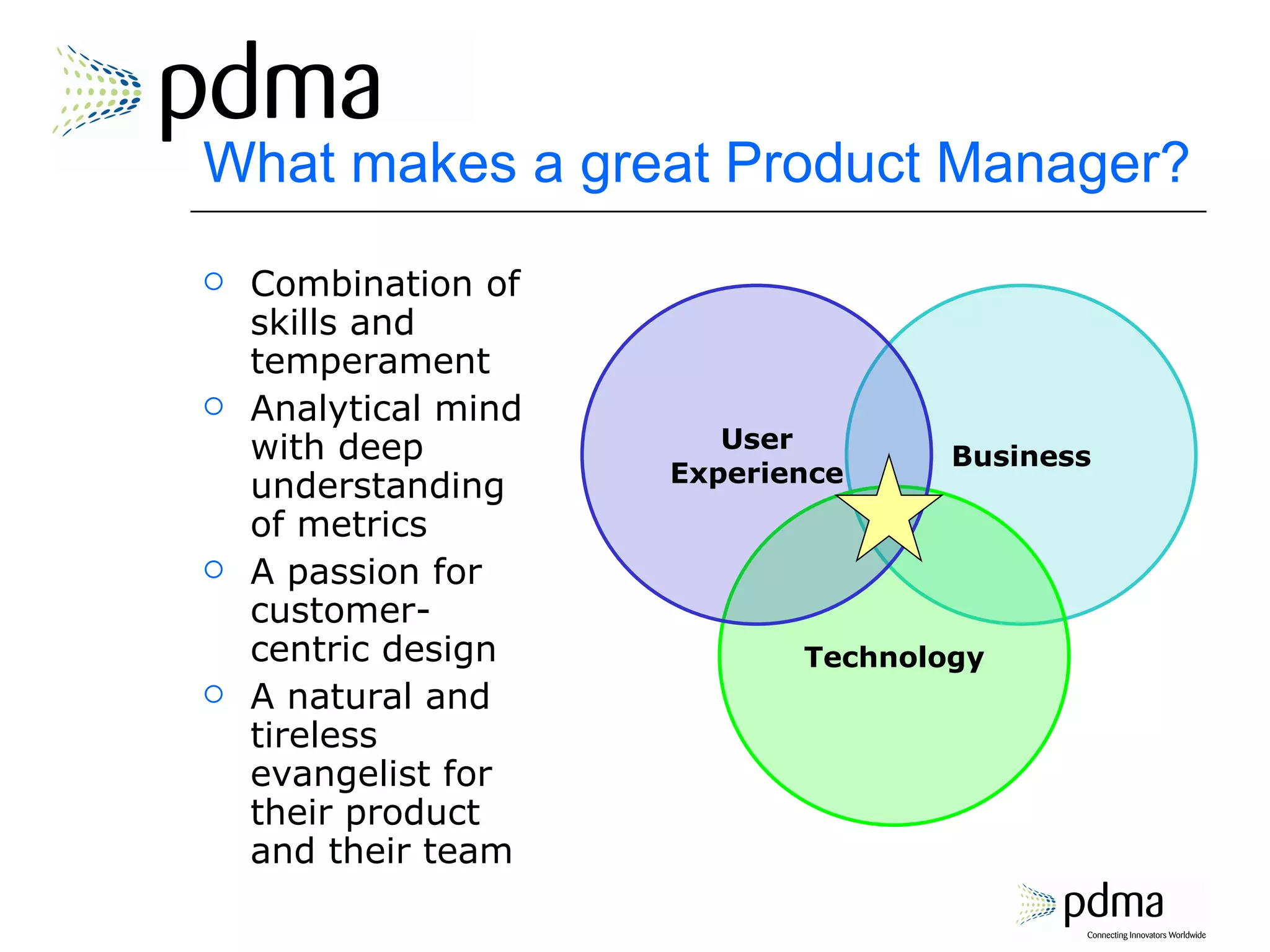
What makes a great Product Manager? Combination of skills and temperament Analytical mind with deep understanding of metrics A passion for customer-centric design A natural and tireless evangelist for their product and their team Business Technology User Experience
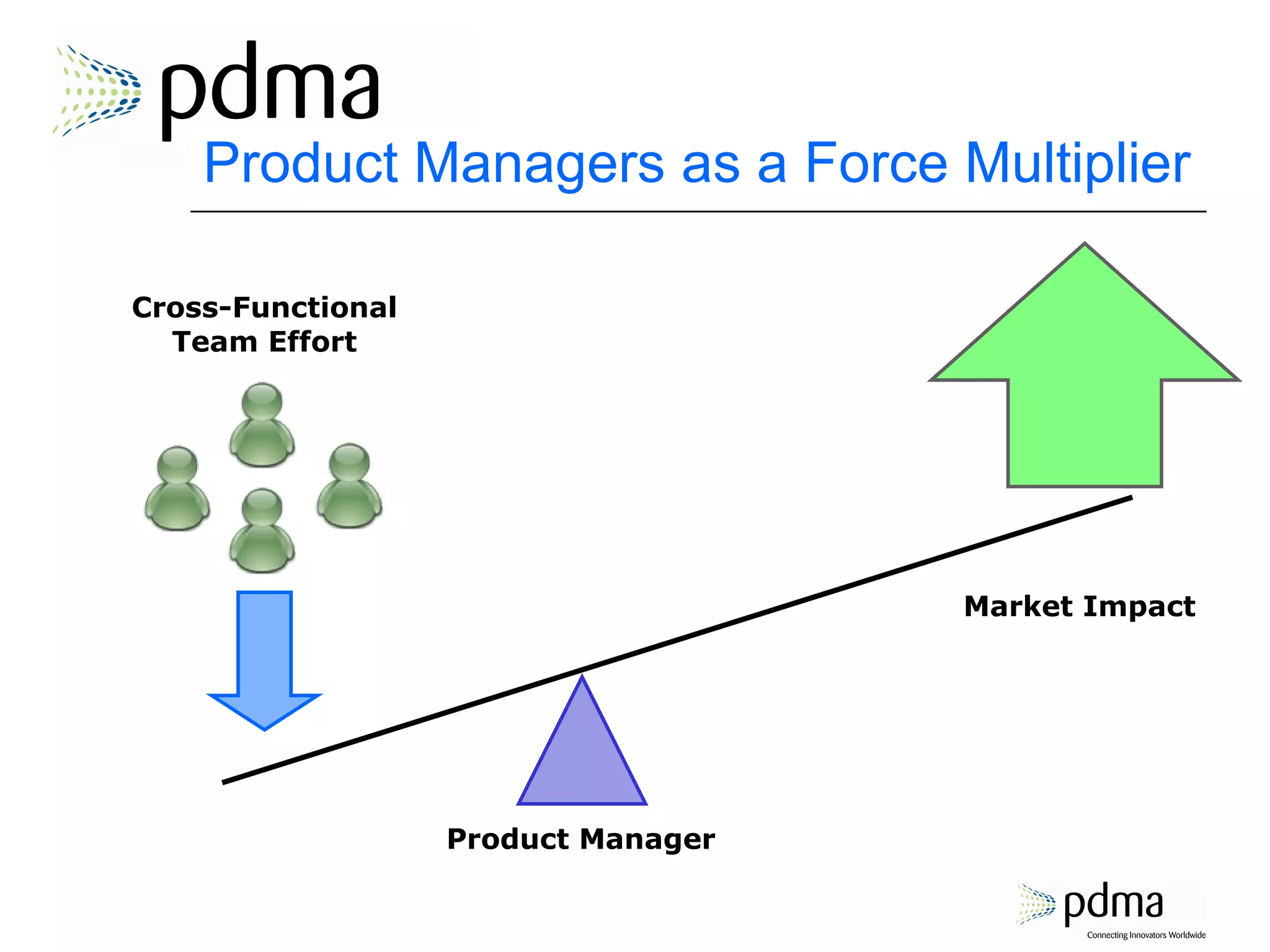
Product Managers as a Force Multiplier Product Manager Cross-Functional Team Effort Market Impact
What do you expect from Product? Prioritization
What do you expect from Product? Prioritization (!) Deliverables Product specification Product roadmap Product strategy Metrics Translating use cases into data, and  data into use cases Correlation vs. causality Flexibility Conditional planning Leadership & Responsibility Framing the problem defines the solution Clarity on what you need to win  before  you play the game
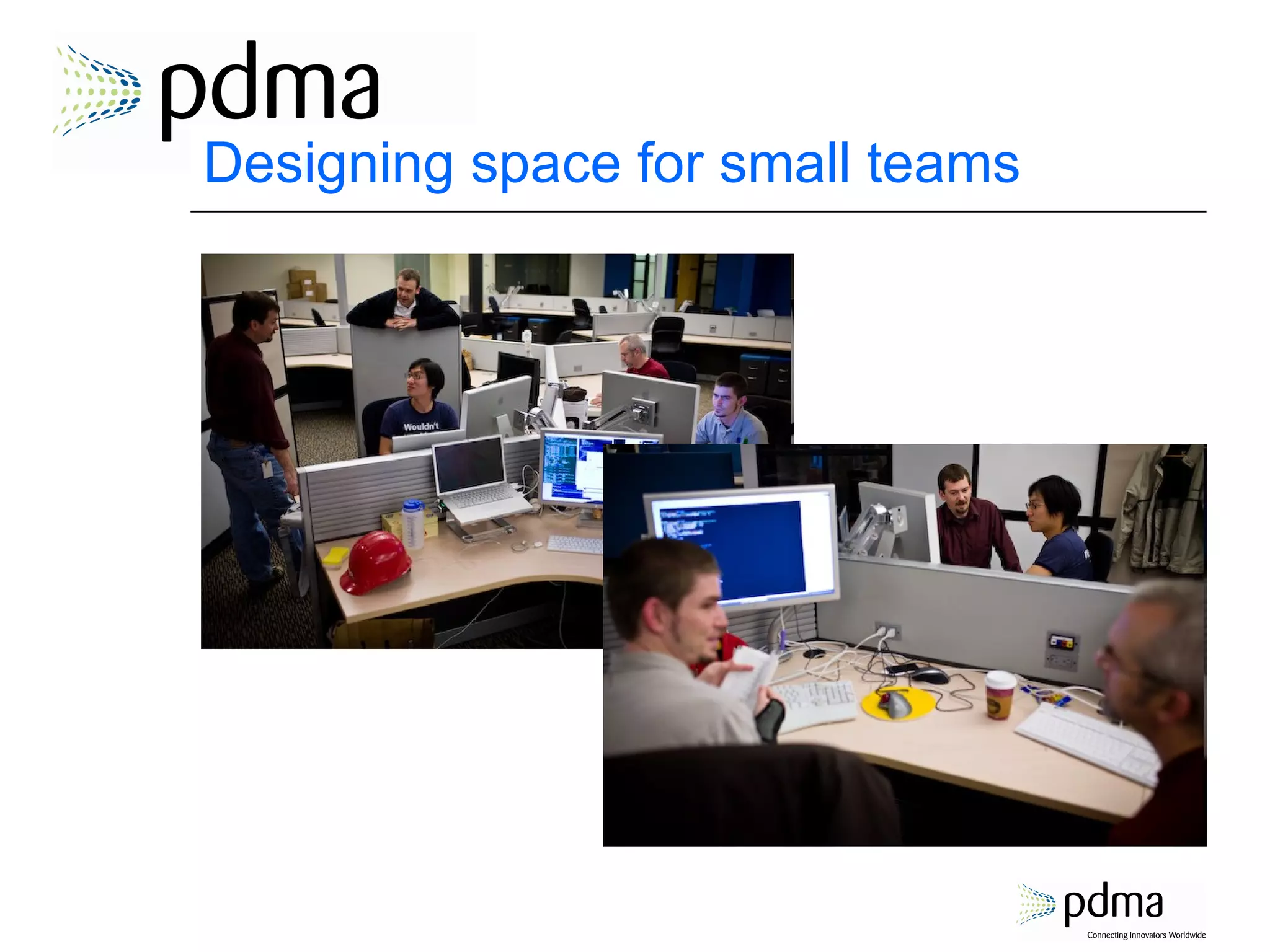
Building a distributed product organization The best software is designed & developed by small, cross-functional teams. At it’s heart, the team is a close partnership between product & engineering. Organize the teams around the product, while preserving functional reporting. They sit together, work together, design together, ship together. The team is responsible for their products & platforms.
Designing space for small teams
The role of central functions Centralized functions preserve: Acquisition of great talent Career development and mentorship End-to-end consistency, strategy, and architecture Cross-team pollination of concepts, techniques, and issues Central functions need to avoid: Introducing bottlenecks Stifling vertical innovation on teams This solution to the matrix optimizes for both scale and innovation. Highly parallelized function is not dissimilar to the modern distributed systems we build.
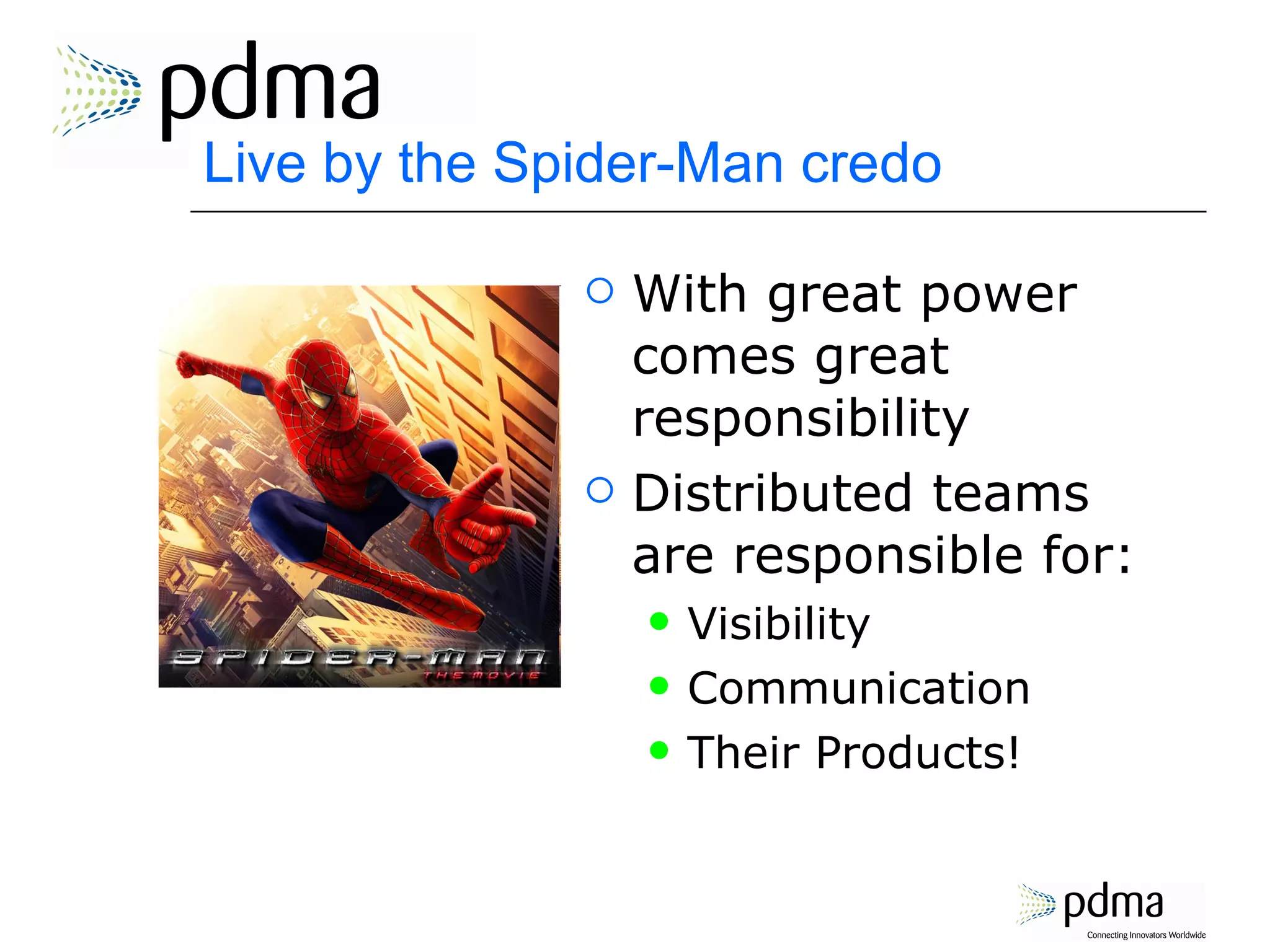
Live by the Spider-Man credo  With great power comes great responsibility Distributed teams are responsible for: Visibility Communication Their Products!
How do you manage in a distributed org? Carefully   Management is responsible for: Providing traffic control & rationalization Providing perspective & experience Identifying and defining the culture, vision, goals and priorities for the organization Setting & enforcing high standards in behavior and execution for the people reporting to them Regular, but infrequent, resource reallocation Beware of the delegation trap People always want decisions pushed down to their level in the organization… and no further.
Empowering User Experience Great user experience begins with a customer-centric culture. Small, cross-functional teams with a diversity of backgrounds and expertise are crucial. Be voracious in your appetite for product & customer data from all sources. Remember the role of intuition and inspiration in design.  Beware of design by committee (or worse, by executives).
User Experience & Web Development One of the challenges in Web 1.0 companies has been the interaction between design and web development Most large companies place web development in engineering. This often forces web developers to prioritize technical issues over customer issues This does not, in general, make web developers happy, as the best are passionate user advocates This also can lead user experience teams to fail to incorporate technical constructs into their design frameworks effectively. Result:  CONFLICT
Empowering user experience We have taken a different route. Web development is a part of the user experience team. Empowers web developers as user experience advocates Empowers the user experience team to actually control the execution of design. Self selects for web developers with a passion for user experience Requires constant vigilance to make sure web development is included in all engineering functions & process.
The key to our product process* A.B.S. * Credit to Ken Norton, former VP Product @ JotSpot for these two slides
 
Managing a distributed product process Agile methodologies are great Cross functional Adaptive Innovative Quality through iteration But there are issues Visibility Long term predictability Functional excellence
A distributed process: blending concepts Product definition Quick, but detailed product & design work up front, on wiki. Fragment product into cards/tasks Iteration, including product & design, to final deliverable Specification is finalized in parallel with development Integration with other features for testing & weekly release
Leveraging a distributed roadmap LinkedIn organizes around the wiki Teams are assigned slots on the roadmap on a round-robin basis Regular, frequent slots allow teams to be quality driven rather than date driven Teams are expected to provide 6-8 weeks visibility to the organization for expected deliverables, with documentation Visibility allows horizontal functions (Operations, Customer Service, etc) to raise issues and plan in advance Bug fixes go out weekly, if not more often
Our goal: a truly distributed architecture A true, end-to-end, service-oriented architecture across the board. Truly independent paths for teams to deliver enhancements to production. Daily access to release, if not faster. Preserve the benefits of the small team structure, while scaling to thousands.
A few last thoughts The pace of innovation is accelerating, not just in terms of technology, but also business process. New products & new markets require open-minded thinking about new optimum solutions for organizations and product process The best thing about Web 2.0 is that it is social.  Everyone is working to figure out what world-class product means, and is generally willing to share & discuss & debate.
Answers for Today Yes, Web 2.0 does need product. The best software is designed & built by small, cross-functional teams. Including web development in the organization empowers user experience. Distributed teams must communicate constantly & transparently to scale. We’re still learning what world-class product means for Web 2.0.
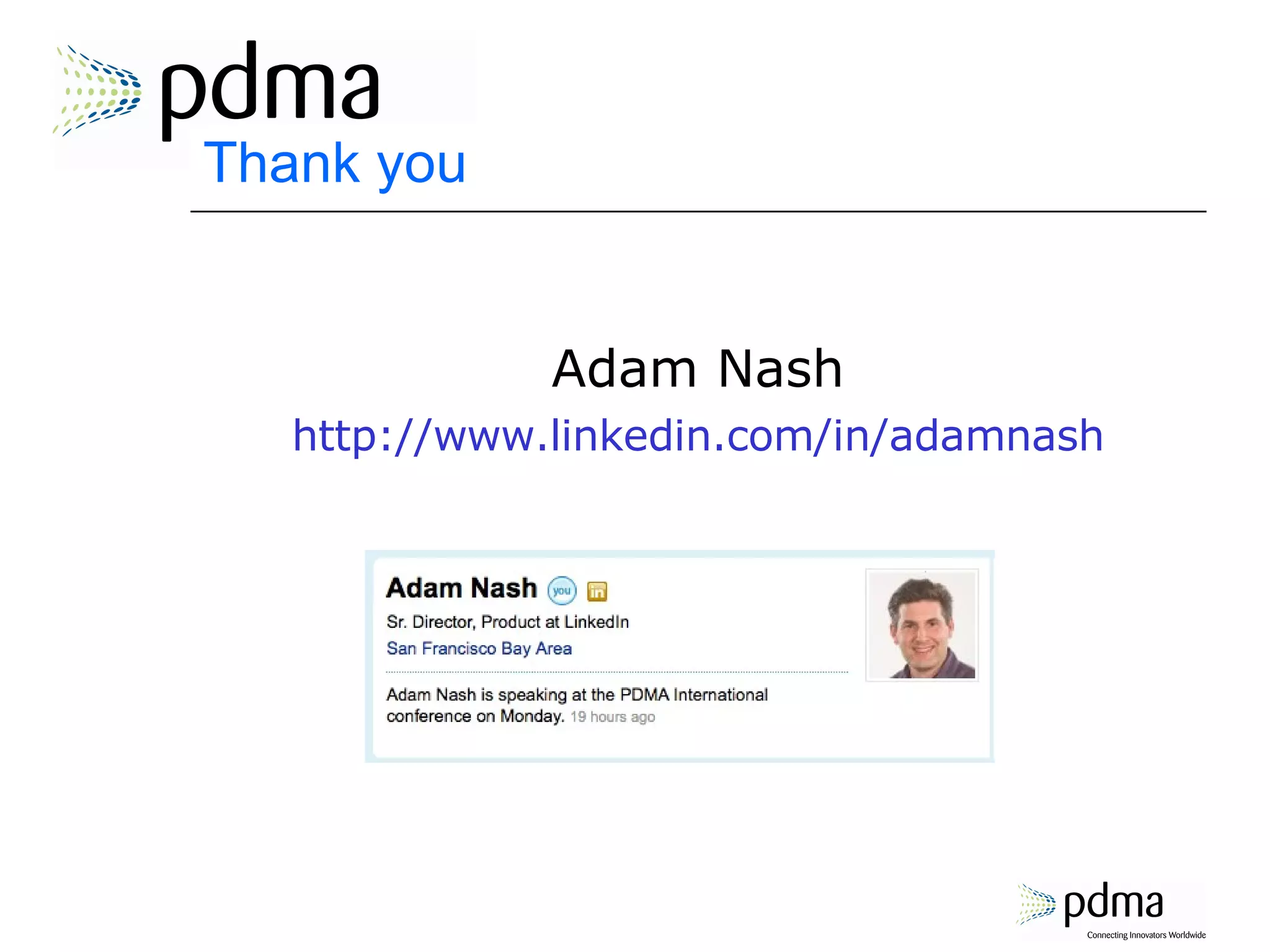
Thank you Adam Nash http://www.linkedin.com/in/adamnash

PDMA 2008 World Class Web 2.0 Product Org

  • 1.
    Building a WorldClass Web 2.0 Product Organization Adam Nash LinkedIn
  • 2.
    Context: LinkedIn LinkedInis the world’s largest global professional network, with over 27m members. Average member is 41, with household income of $110K Organization has grown over 500% in the past two years. Revenue has grown faster… We deliver code to production every week
  • 3.
    Questions for TodayDoes Web 2.0 need product managers? How does a distributed architecture for product function? How do you empower user experience? How do you balance an agile process with organization visibility? Anything else?
  • 4.
    Answers for TodayYes, Web 2.0 does need product. The best software is designed & built by small, cross-functional teams. Including web development in the organization empowers user experience. Distributed teams must communicate constantly & transparently to scale. We’re still learning what world-class product means for Web 2.0.
  • 5.
    Reflection on Web2.0 Like all great revolutions, the seeds were planted long ago (1990s) and grew aggressively post-bubble. A few Web 2.0 realizations: Social fabrics generate engagement Viral distribution models generate nearly costless organic traffic Users can and will generate content
  • 6.
    Does Web 2.0Need Product Managers? Several years ago, this was the fashionable debate in Silicon Valley. Why can’t you just connect engineers with customers, iterate, and go?
  • 7.
    What makes agreat Product Manager? Combination of skills and temperament Analytical mind with deep understanding of metrics A passion for customer-centric design A natural and tireless evangelist for their product and their team Business Technology User Experience
  • 8.
    Product Managers asa Force Multiplier Product Manager Cross-Functional Team Effort Market Impact
  • 9.
    What do youexpect from Product? Prioritization
  • 10.
    What do youexpect from Product? Prioritization (!) Deliverables Product specification Product roadmap Product strategy Metrics Translating use cases into data, and data into use cases Correlation vs. causality Flexibility Conditional planning Leadership & Responsibility Framing the problem defines the solution Clarity on what you need to win before you play the game
  • 11.
    Building a distributedproduct organization The best software is designed & developed by small, cross-functional teams. At it’s heart, the team is a close partnership between product & engineering. Organize the teams around the product, while preserving functional reporting. They sit together, work together, design together, ship together. The team is responsible for their products & platforms.
  • 12.
  • 13.
    The role ofcentral functions Centralized functions preserve: Acquisition of great talent Career development and mentorship End-to-end consistency, strategy, and architecture Cross-team pollination of concepts, techniques, and issues Central functions need to avoid: Introducing bottlenecks Stifling vertical innovation on teams This solution to the matrix optimizes for both scale and innovation. Highly parallelized function is not dissimilar to the modern distributed systems we build.
  • 14.
    Live by theSpider-Man credo With great power comes great responsibility Distributed teams are responsible for: Visibility Communication Their Products!
  • 15.
    How do youmanage in a distributed org? Carefully  Management is responsible for: Providing traffic control & rationalization Providing perspective & experience Identifying and defining the culture, vision, goals and priorities for the organization Setting & enforcing high standards in behavior and execution for the people reporting to them Regular, but infrequent, resource reallocation Beware of the delegation trap People always want decisions pushed down to their level in the organization… and no further.
  • 16.
    Empowering User ExperienceGreat user experience begins with a customer-centric culture. Small, cross-functional teams with a diversity of backgrounds and expertise are crucial. Be voracious in your appetite for product & customer data from all sources. Remember the role of intuition and inspiration in design. Beware of design by committee (or worse, by executives).
  • 17.
    User Experience &Web Development One of the challenges in Web 1.0 companies has been the interaction between design and web development Most large companies place web development in engineering. This often forces web developers to prioritize technical issues over customer issues This does not, in general, make web developers happy, as the best are passionate user advocates This also can lead user experience teams to fail to incorporate technical constructs into their design frameworks effectively. Result: CONFLICT
  • 18.
    Empowering user experienceWe have taken a different route. Web development is a part of the user experience team. Empowers web developers as user experience advocates Empowers the user experience team to actually control the execution of design. Self selects for web developers with a passion for user experience Requires constant vigilance to make sure web development is included in all engineering functions & process.
  • 19.
    The key toour product process* A.B.S. * Credit to Ken Norton, former VP Product @ JotSpot for these two slides
  • 20.
  • 21.
    Managing a distributedproduct process Agile methodologies are great Cross functional Adaptive Innovative Quality through iteration But there are issues Visibility Long term predictability Functional excellence
  • 22.
    A distributed process:blending concepts Product definition Quick, but detailed product & design work up front, on wiki. Fragment product into cards/tasks Iteration, including product & design, to final deliverable Specification is finalized in parallel with development Integration with other features for testing & weekly release
  • 23.
    Leveraging a distributedroadmap LinkedIn organizes around the wiki Teams are assigned slots on the roadmap on a round-robin basis Regular, frequent slots allow teams to be quality driven rather than date driven Teams are expected to provide 6-8 weeks visibility to the organization for expected deliverables, with documentation Visibility allows horizontal functions (Operations, Customer Service, etc) to raise issues and plan in advance Bug fixes go out weekly, if not more often
  • 24.
    Our goal: atruly distributed architecture A true, end-to-end, service-oriented architecture across the board. Truly independent paths for teams to deliver enhancements to production. Daily access to release, if not faster. Preserve the benefits of the small team structure, while scaling to thousands.
  • 25.
    A few lastthoughts The pace of innovation is accelerating, not just in terms of technology, but also business process. New products & new markets require open-minded thinking about new optimum solutions for organizations and product process The best thing about Web 2.0 is that it is social. Everyone is working to figure out what world-class product means, and is generally willing to share & discuss & debate.
  • 26.
    Answers for TodayYes, Web 2.0 does need product. The best software is designed & built by small, cross-functional teams. Including web development in the organization empowers user experience. Distributed teams must communicate constantly & transparently to scale. We’re still learning what world-class product means for Web 2.0.
  • 27.
    Thank you AdamNash http://www.linkedin.com/in/adamnash