
Playability & Player Experience Research
•
17 likes•5,503 views

As the game industry matures and games become more and more complex, there is an increasing need to develop methodologies for analyzing and measuring player experience, in order to develop a better understanding of the relationship and interactions between players and games. This panel gathers distinguished European playability and user experience experts to discuss current findings and methodological advancements within player experience and playability research.

Recommended
Recommended
More Related Content
What's hot
What's hot (18)
Similar to Playability & Player Experience Research
Similar to Playability & Player Experience Research (20)
More from Lennart Nacke
More from Lennart Nacke (20)
Recently uploaded
Recently uploaded (20)
Playability & Player Experience Research
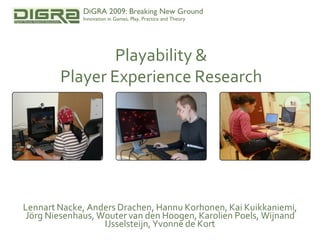
- 1. DiGRA 2009: Breaking New Ground Innovation in Games, Play, Practice and Theory Playability & Player Experience Research Lennart Nacke, Anders Drachen, Hannu Korhonen, Kai Kuikkaniemi, Jörg Niesenhaus, Wouter van den Hoogen, Karolien Poels, Wijnand IJsselsteijn, Yvonne de Kort
- 2. Overview Games, gamers or gaming? (for Staffan) Player research studies a bit of all three Games – Provide logging mechanisms and tools Gamers/Players – Affective, emotional, and cognitive responses Gaming – Studying the interaction of players with games – Research knowledge feeds back into game design – Empirical basis for design and development
- 3. Why Player Experience Research Now? Game studies in need of empirical perspectives User Experience of growing interest in HCI research No common methods – Qualitative gameplay investigations – Quantitative gameplay investigations Gameplay is the gaming process of player with game – Good gameplay == good game – Good game == good sales – Good sales == industry interest – Industry interest ≈ academic funding
- 4. Playability and Player Experience Playability – Directed toward Games Player Experience – Directed toward Players
- 5. The Player Experience Design Process? Design Playability Player Game Player Experience
- 6. This Panel People – User Experience Specialists and Researchers Topics – Perspectives on Playability Research – Biometrics and Player Experience – Gameplay Metrics and Player Experience – A Multi-method Approach to Measuring Player Experience Discussion
- 8. Lennart Nacke Blekinge Institute of Technology – PhD Candidate – Digital Game Development and Human Computer Interaction EU FUGA Project Fun and Player Experience Research – Psychophysiology (i.e. Biometrics), Game Metrics, UX, HCI Consulting on using biometrics for game evaluation
- 9. Kai Kuikanniemi Helsinki Institute of Information Technology – PhD Candidate – Digital Content Communities (DCC) research group Experimental game designs – Biofeedback gaming – Cinema gaming – Design games Action research – Design – Prototyping – Experiments – Business models EU FUGA Project and several national research projects
- 10. Anders Drachen & Alessandro Canossa Center for Computer Games Research, ITU Copenhagen – Post. doc. – Game Development, Human Computer Interaction, User Experience & Data Mining, Player Behavior Modeling – drachen@itu.dk IO Interactive & Danish Design School – PhD-candidate – Game & Level Design, User Experience, Player Behavior Modeling – alessandroc@ioi.dk Consulting on using game metrics for user-oriented testing/game development
- 11. Hannu Korhonen Nokia Research Tampere (Finland) – Senior Researcher – PhD Candidate at University of Tampere Playful Experiences and Game Evaluation Methods – Usability Engineering – Mobile HCI – UX Research
- 12. Jörg Niesenhaus University of Duisburg-Essen (Germany) – Research Associate, PhD Candidate – Chair of Interactive Systems and Interaction Design Game Usability & Game Interface Design Research – Usability Engineering, HCI, Game Development Game Developer & Publisher Consulting – User tests & expert reviews – Concept work
- 13. Wouter van den Hoogen Eindhoven University of Technology (TU/e) – Post-doc at Game Experience Lab Areas of interest – People's behavior, emotions, and cognitions while interacting with their physical & virtual environments – Conservation and consumer behavior – Attitude formation and the underlying cognitive processes – Real time measurement of people's experiences
- 14. Karolien Poels Eindhoven University of Technology (TU/e) – Post-doc at Game Experience Lab Research areas – Categorizing dimensions of digital game experience and developing a game experience questionnaire – Observational coding of players' behavior as a continuous measure of digital game experience
- 15. PERSPECTIVES ON PLAYABILITY RESEARCH Jörg Niesenhaus & Hannu Korhonen
- 16. Expert Reviews & Heuristics Tradition of expert reviews and heuristics in the ‘traditional’ usability & software engineering Games demand specifically designed heuristics Easy implementation in the game design and development process
- 17. General Gameplay and Game Interface Heuristics Desurvire et al.: Heuristics for evaluating playability – Gameplay – Game story – Mechanics – Usability Federoff: Game heuristics – Gameplay – Game Mechanics – Game Interface Korhonen and Koivisto: Playability heuristics – Game Usability – Gameplay – Mobility
- 18. Focused Game Usability Heuristics Mobile games / mobile multiplayer games (Korhonen and Koivisto) Action games (Fabricatore et al.) Technical aspects (Pinelle et al.) Game-based learning (Malone)
- 19. Pros of Heuristics & Expert Reviews Cost-efficient; only small groups of experts needed Time-efficient; The evaluation can be conducted in few hours Can be implemented at any stage of a project & used iteratively Experts able to identify majority of existing bugs and playability problems Several sets of heuristics to choose from
- 20. Cons of Heuristics & Expert Reviews Diversification of – Game genres – Input devices – Goals Challenges Heuristics Lack of game usability & playability experts in the game industry
- 21. Future Research Questions Need for more focused heuristics and / or customizable sets of heuristics – Depending on genre, platform, interaction, context Standardized Heuristics and Questionnaires – Developers demand (standardized) test instruments – Better comparison between research projects – Trade-offs: Questionnaires only for mainstream products? Ranking & Priorities of heuristics – What heuristics are most important for what kind of game? – Weight of single heuristics Case studies & Evaluation of heuristics
- 22. Overview of Expert Reviews & Heuristics Design Alpha Release Release Beta Concepting Implementation Release Game Development Project Playability Player Experience Evaluations Evaluations
- 23. BIOMETRICS AND PLAYER EXPERIENCE Lennart Nacke & Kai Kuikanniemi
- 24. Biometric Assessment of Player Experience EKG EMG EEG EDA Eye fMRI Gameplay Tracking
- 25. Psychophysiological Instrumentation Electrodermal activity (EDA) – Electrical conductance between two electrodes – Hands, feet (eccrine sweat glands) Cardiovascular measures (EKG, HRV, IBI, BVP, BP) Electromyography of the face (EMG) – Muscle tension, – Face (cheek, brow, eyelid) Electroencephalography (EEG) – Nerve cells activity in cerebral cortex – Frequency bands (δθαβγ frequency ranges between 1-50Hz)
- 26. Full Biometric Game Testing Lab A full biometric testing lab with EEG, EMG, EDA, Eye Tracker, logging software and gaming hardware (Game Systems and Interaction Research Lab)
- 27. EEG Frequency Power Bands Analysis of EEG data is done in the frequency domain using FFTs
- 28. Pro & Con of Psychophysiological Testing PRO CON Objective Complicated setup Covert & continuous Expensive recording Artifact scoring Quantifiable Data amount Reliable Hard to interpret Replicable Difficult and time- High temporal accuracy consuming analysis
- 29. EEG and Eye Tracker
- 30. Some Hardware www.brainfingers.com www.ocztechnology.com ~ $120 www.biosemi.com www.emotiv.com www.neurosky.com ~ $300 www.tobii.com www.wilddivine.com www.emsense.com
- 31. Biofeedback Gaming Psychophysiological measurements are used in making adaptive games. Emotional adaptation, new challenge, interface, virtual social expression.
- 32. Future of Psychophysiological Measurements Better sensors – Cheaper – Lighter – More sensitive – Wireless – Long battery life Better understanding – Correlation between Behavior Physiological response Emotion – Long experiment sessions
- 33. GAMEPLAY METRICS AND PLAYER EXPERIENCE Anders Drachen & Alessandro Canossa
- 34. About Gameplay Metrics Gameplay metrics are – objective data about the – behavior of players within game environments Anything recordable in a game engine Examples – Player movement – Firing weapons – Interacting with NPCs – Interface interaction – Game economy behavior ...
- 35. Metrics Collection System Metrics are collected from games using custom logging software
- 36. Metrics Example
- 37. Metrics Example
- 38. Metrics Example
- 39. Pros of Gameplay Metrics (1) Allow data collection from entire population of players – not just a sample – Examples Everyone playing Tomb Raider: Underworld on Xbox Live! EIDOS metrics suite has logged data from 1.5+ million players Data can be collected in natural environment (homes, internet cafés, etc.) – No bias of introducing players to laboratory-based studies
- 40. Pros of Gameplay Metrics (2) Provide highly detailed information about – What players do in the game Permit – linking PXP measures with actual game features – Example Combining GSR with metrics we can show exactly when in the game players are aroused, and what they were doing at the time
- 41. Cons of Gameplay Metrics Cannot provide any contextual data – Only records information from the specific game software Is player having fun? Is player male or female? Are there other players present? Need to be combined with other PXP data – Provides linkage between User behavior Game experience – Examples Surveys Interviews Observations Physiological and Psychophysiological
- 42. Gameplay Metrics Gameplay metrics highly useful to evaluate game design – Do players experience all the content in the game? – Do people play the game as we expected? – Adapting games in real-time to the players UX research in games hindered by linking problem – PXP – Actual player behavior – Game itself With gameplay metrics this linking problem is overcome
- 43. Gameplay Metrics Supplement existing methods Game industry is investing in metrics-based tracking Bolsters user-oriented testing methods – Usability testing How easy can the users operate the game controls? – Playability testing Are users having a good playing experience? – Metrics testing How do the users actually play the game?
- 44. A MULTI-METHOD APPROACH TO MEASURING PLAYER EXPERIENCE Wouter van den Hoogen & Karolien Poels
- 45. Player Experiences are Myriad
- 46. Multi Method Approach @
- 47. Self-Report and Behavioral Player Experience Measures Game Experience Questionnaire (GEQ) – important, yet after the fact – Subjective self-report measurement Observational Coding of Player Behavior – Facial expressions – Body movement Development of Automated Behavioral Measures – Explorative – Objective – Real-time
- 48. Game Experience Questionnaire (GEQ) Broad Easily applicable Robust Agnostic to the type of game, platform, or gamer Sensitive to changes in game interface, content and setting Reliable Valid
- 49. GEQ Development & Structure Development – Existing game experience literature – Related existing experience questionnaires – Conceptualizations of game experience through focus groups – Two large scale surveys with factor and scale analysis Final Structure (7 components) – Immersion – Tension – Competence – Flow – Negative affect – Challenge – Positive affect
- 50. Observational Coding of Player Behaviour Facial expressions: – smile – compressing lips Body movement: – forwards movement – backwards movement Inter-rater reliability only clear expressions and movements were coded
- 51. Behavioral Indicators Pros – natural responses – display during game-play (i.e. continuous real time) – integrated in game-peripherals (e.g. game-pad) Cons – Individual differences Button presses Movement intensity
- 52. Body Position Pressure Sensitive Chair
- 53. Pressure Sensitive Devices Keyboard and Mouse Force on Interface Devices
- 54. Conclusions Game Experience Questionnaire – Reliable, sensitive, and multi-dimensional – Long (5 items per dimension) – Short (iGEQ, 2 items) Behavioral Indicators Indicate Player Experience – Correlate with specific experiences – Reliable – Multiple behaviors show similar relation with self report – Intensity of behavior and actions indicative of arousal – Related to future game preferences
- 55. #thankUX FUGA: Measuring the human experience of media enjoyment