December 6, 2012
Network of Australasian Tertiary Associations (NATA) Project Overview Document
Network of Australasian Tertiary Associations
COMMUNICATING – TRANSFORMING - NETWORKING
ACODE, ascilite, ODLAA, HERDSA, CADAD, AARNet, Netspot & OLT
VISION
The overarching vision for the Network of Australasian Tertiary Associations (NATA) is to facilitate a
sustainable collaborative network between established higher education associations with the intent of
fostering best practice in networks to engage members more strongly with Australian higher education
learning and teaching.
MISSION
Improve engagement and practice through network leadership.
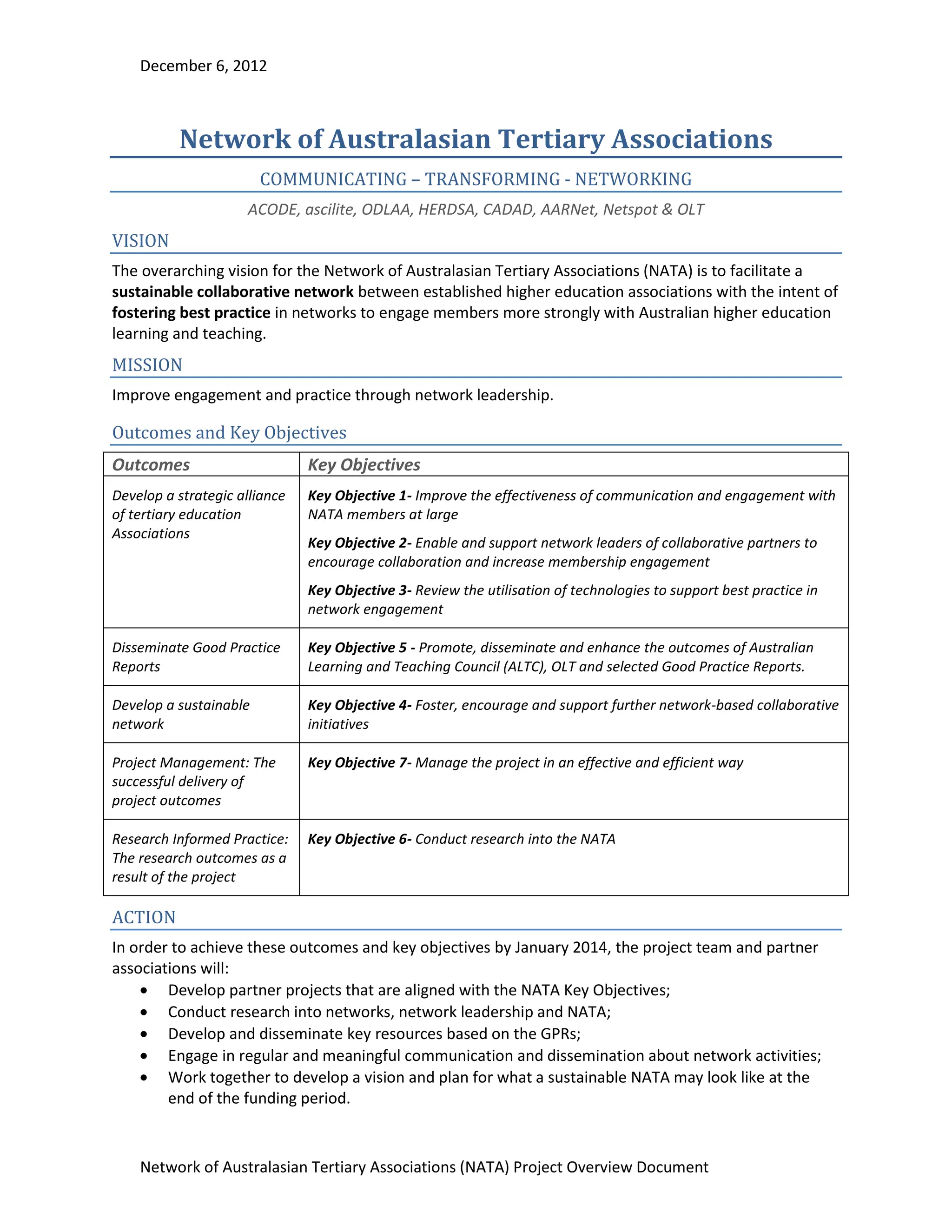
Outcomes and Key Objectives
Outcomes Key Objectives
Develop a strategic alliance
of tertiary education
Associations
Key Objective 1- Improve the effectiveness of communication and engagement with
NATA members at large
Key Objective 2- Enable and support network leaders of collaborative partners to
encourage collaboration and increase membership engagement
Key Objective 3- Review the utilisation of technologies to support best practice in
network engagement
Disseminate Good Practice
Reports
Key Objective 5 - Promote, disseminate and enhance the outcomes of Australian
Learning and Teaching Council (ALTC), OLT and selected Good Practice Reports.
Develop a sustainable
network
Key Objective 4- Foster, encourage and support further network-based collaborative
initiatives
Project Management: The
successful delivery of
project outcomes
Key Objective 7- Manage the project in an effective and efficient way
Research Informed Practice:
The research outcomes as a
result of the project
Key Objective 6- Conduct research into the NATA
ACTION
In order to achieve these outcomes and key objectives by January 2014, the project team and partner
associations will:
Develop partner projects that are aligned with the NATA Key Objectives;
Conduct research into networks, network leadership and NATA;
Develop and disseminate key resources based on the GPRs;
Engage in regular and meaningful communication and dissemination about network activities;
Work together to develop a vision and plan for what a sustainable NATA may look like at the
end of the funding period.
December 6, 2012
Network of Australasian Tertiary Associations (NATA) Project Overview Document
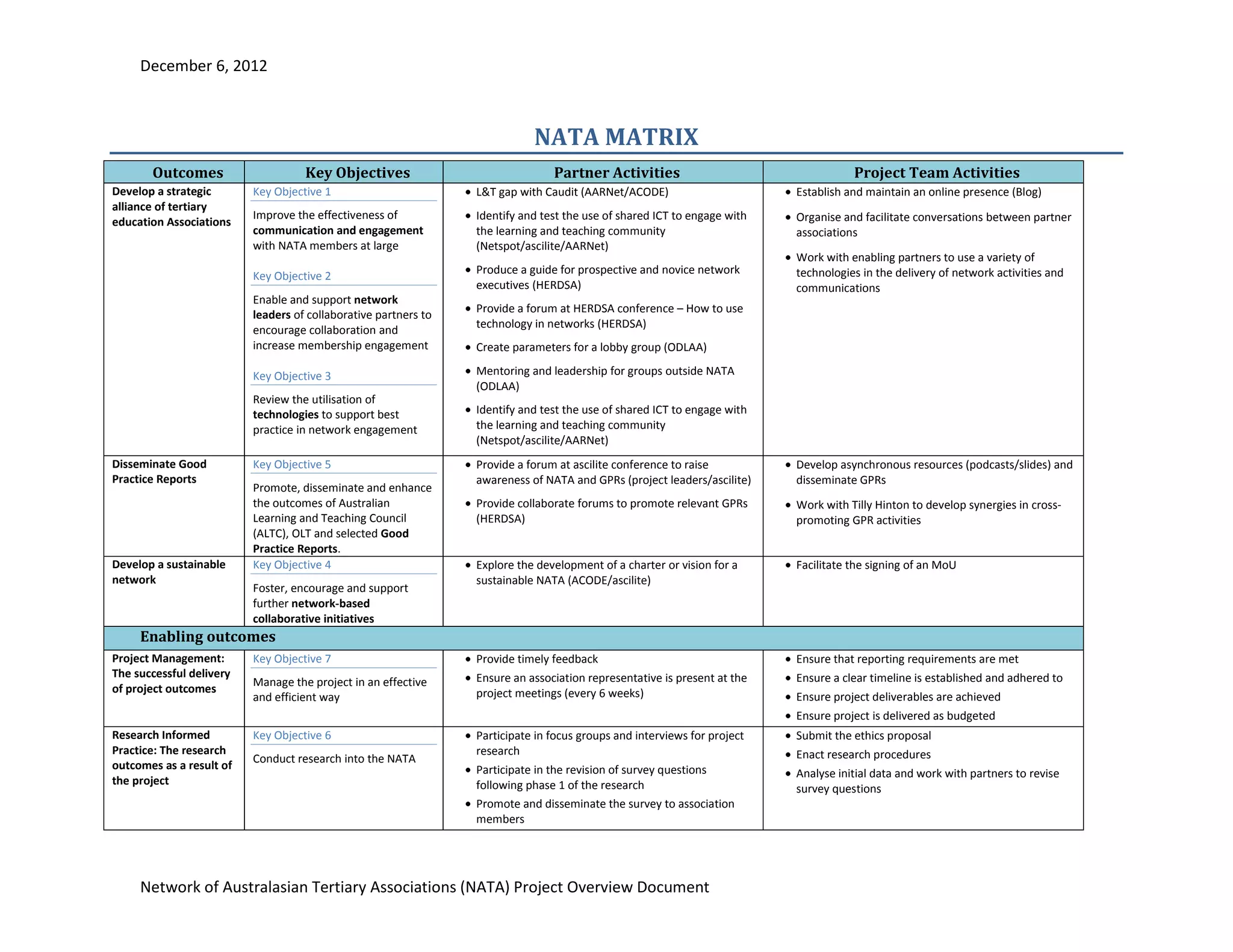
NATA MATRIX
Outcomes Key Objectives Partner Activities Project Team Activities
Develop a strategic
alliance of tertiary
education Associations
Key Objective 1
Improve the effectiveness of
communication and engagement
with NATA members at large
Key Objective 2
Enable and support network
leaders of collaborative partners to
encourage collaboration and
increase membership engagement
Key Objective 3
Review the utilisation of
technologies to support best
practice in network engagement
L&T gap with Caudit (AARNet/ACODE)
Identify and test the use of shared ICT to engage with
the learning and teaching community
(Netspot/ascilite/AARNet)
Produce a guide for prospective and novice network
executives (HERDSA)
Provide a forum at HERDSA conference – How to use
technology in networks (HERDSA)
Create parameters for a lobby group (ODLAA)
Mentoring and leadership for groups outside NATA
(ODLAA)
Identify and test the use of shared ICT to engage with
the learning and teaching community
(Netspot/ascilite/AARNet)
Establish and maintain an online presence (Blog)
Organise and facilitate conversations between partner
associations
Work with enabling partners to use a variety of
technologies in the delivery of network activities and
communications
Disseminate Good
Practice Reports
Key Objective 5
Promote, disseminate and enhance
the outcomes of Australian
Learning and Teaching Council
(ALTC), OLT and selected Good
Practice Reports.
Provide a forum at ascilite conference to raise
awareness of NATA and GPRs (project leaders/ascilite)
Provide collaborate forums to promote relevant GPRs
(HERDSA)
Develop asynchronous resources (podcasts/slides) and
disseminate GPRs
Work with Tilly Hinton to develop synergies in cross-
promoting GPR activities
Develop a sustainable
network
Key Objective 4
Foster, encourage and support
further network-based
collaborative initiatives
Explore the development of a charter or vision for a
sustainable NATA (ACODE/ascilite)
Facilitate the signing of an MoU
Enabling outcomes
Project Management:
The successful delivery
of project outcomes
Key Objective 7
Manage the project in an effective
and efficient way
Provide timely feedback
Ensure an association representative is present at the
project meetings (every 6 weeks)
Ensure that reporting requirements are met
Ensure a clear timeline is established and adhered to
Ensure project deliverables are achieved
Ensure project is delivered as budgeted
Research Informed
Practice: The research
outcomes as a result of
the project
Key Objective 6
Conduct research into the NATA
Participate in focus groups and interviews for project
research
Participate in the revision of survey questions
following phase 1 of the research
Promote and disseminate the survey to association
members
Submit the ethics proposal
Enact research procedures
Analyse initial data and work with partners to revise
survey questions

NATA overview document

  • 1.
    December 6, 2012 Networkof Australasian Tertiary Associations (NATA) Project Overview Document Network of Australasian Tertiary Associations COMMUNICATING – TRANSFORMING - NETWORKING ACODE, ascilite, ODLAA, HERDSA, CADAD, AARNet, Netspot & OLT VISION The overarching vision for the Network of Australasian Tertiary Associations (NATA) is to facilitate a sustainable collaborative network between established higher education associations with the intent of fostering best practice in networks to engage members more strongly with Australian higher education learning and teaching. MISSION Improve engagement and practice through network leadership. Outcomes and Key Objectives Outcomes Key Objectives Develop a strategic alliance of tertiary education Associations Key Objective 1- Improve the effectiveness of communication and engagement with NATA members at large Key Objective 2- Enable and support network leaders of collaborative partners to encourage collaboration and increase membership engagement Key Objective 3- Review the utilisation of technologies to support best practice in network engagement Disseminate Good Practice Reports Key Objective 5 - Promote, disseminate and enhance the outcomes of Australian Learning and Teaching Council (ALTC), OLT and selected Good Practice Reports. Develop a sustainable network Key Objective 4- Foster, encourage and support further network-based collaborative initiatives Project Management: The successful delivery of project outcomes Key Objective 7- Manage the project in an effective and efficient way Research Informed Practice: The research outcomes as a result of the project Key Objective 6- Conduct research into the NATA ACTION In order to achieve these outcomes and key objectives by January 2014, the project team and partner associations will: Develop partner projects that are aligned with the NATA Key Objectives; Conduct research into networks, network leadership and NATA; Develop and disseminate key resources based on the GPRs; Engage in regular and meaningful communication and dissemination about network activities; Work together to develop a vision and plan for what a sustainable NATA may look like at the end of the funding period.
  • 2.
    December 6, 2012 Networkof Australasian Tertiary Associations (NATA) Project Overview Document NATA MATRIX Outcomes Key Objectives Partner Activities Project Team Activities Develop a strategic alliance of tertiary education Associations Key Objective 1 Improve the effectiveness of communication and engagement with NATA members at large Key Objective 2 Enable and support network leaders of collaborative partners to encourage collaboration and increase membership engagement Key Objective 3 Review the utilisation of technologies to support best practice in network engagement L&T gap with Caudit (AARNet/ACODE) Identify and test the use of shared ICT to engage with the learning and teaching community (Netspot/ascilite/AARNet) Produce a guide for prospective and novice network executives (HERDSA) Provide a forum at HERDSA conference – How to use technology in networks (HERDSA) Create parameters for a lobby group (ODLAA) Mentoring and leadership for groups outside NATA (ODLAA) Identify and test the use of shared ICT to engage with the learning and teaching community (Netspot/ascilite/AARNet) Establish and maintain an online presence (Blog) Organise and facilitate conversations between partner associations Work with enabling partners to use a variety of technologies in the delivery of network activities and communications Disseminate Good Practice Reports Key Objective 5 Promote, disseminate and enhance the outcomes of Australian Learning and Teaching Council (ALTC), OLT and selected Good Practice Reports. Provide a forum at ascilite conference to raise awareness of NATA and GPRs (project leaders/ascilite) Provide collaborate forums to promote relevant GPRs (HERDSA) Develop asynchronous resources (podcasts/slides) and disseminate GPRs Work with Tilly Hinton to develop synergies in cross- promoting GPR activities Develop a sustainable network Key Objective 4 Foster, encourage and support further network-based collaborative initiatives Explore the development of a charter or vision for a sustainable NATA (ACODE/ascilite) Facilitate the signing of an MoU Enabling outcomes Project Management: The successful delivery of project outcomes Key Objective 7 Manage the project in an effective and efficient way Provide timely feedback Ensure an association representative is present at the project meetings (every 6 weeks) Ensure that reporting requirements are met Ensure a clear timeline is established and adhered to Ensure project deliverables are achieved Ensure project is delivered as budgeted Research Informed Practice: The research outcomes as a result of the project Key Objective 6 Conduct research into the NATA Participate in focus groups and interviews for project research Participate in the revision of survey questions following phase 1 of the research Promote and disseminate the survey to association members Submit the ethics proposal Enact research procedures Analyse initial data and work with partners to revise survey questions