Making Inferences and Drawing
         Conclusions
   A Reading Skill Needed for Jenner
       and Other Mosaic Texts
Inference Process
Definition of Inferences
•   Inference is a mental process by which we reach a conclusion based on specific
    evidence. Inferences are the stock and trade of detectives examining clues, of
    doctors diagnosing diseases, and of car mechanics repairing engine problems. We
    infer motives, purpose, and intentions.
•   We engage in inference every day. We interpret actions to be examples of behavior
    characteristics, intents, or expressions of particular feelings. We infer it is raining
    when we see someone with an open umbrella. We infer people are thirsty if they
    ask for a glass of water. We infer that evidence in a text is authoritative when it is
    attributed to a scholar in the field.
•   We want to find significance. We listen to remarks, and want to make sense of
    them. What might the speaker mean? Why is he or she saying that? We go beyond
    specific remarks to underlying significance or broader meaning. When we read
    that someone cheated on his or her income taxes, we might take that as an
    example of financial ingenuity, daring, or stupidity. We seek purposes and reasons.
•   Inferences are not random. While they may come about mysteriously with a
    sudden jump of recognition, a sense of "Ah ha!," inferences are very orderly.
    Inferences may be guesses, but they are educated guesses based on supporting
    evidence. The evidence seems to require that we reach a specific conclusion.
Inference and Analysis
• Inferences are based on evidence. To infer, we must collect evidence.
  Evidence is collected by the process of analysis.
• Analysis is a particular form of investigation. In general usage, analysis
  refers to any close, careful, or systematic examination. In the discussion
  here, the term “analysis“ is used in its more technical meaning.
• Analysis is a process of investigating something by breaking it into parts
  for closer examination. Complex topics are broken down into simpler
  ones. Intricate patterns are broken down into less complicated elements.
  A problem is simplified by limiting the amount that must be examined at
  any one time.
• The goal of analysis is not simply to discover parts within the whole, but to
  understand the whole. Once the parts are identified, analysis then seeks
  to determine how those parts are related.
• In the analytic model, the whole is seen as greater than the sum of its
  parts.
Science and Inferences
• In science, an inference refers to reasonable
  conclusions or possible hypotheses drawn from a small
  sampling of data based upon repeated observations.
• Scientists make inferences all the time. The inference
  can take several forms.
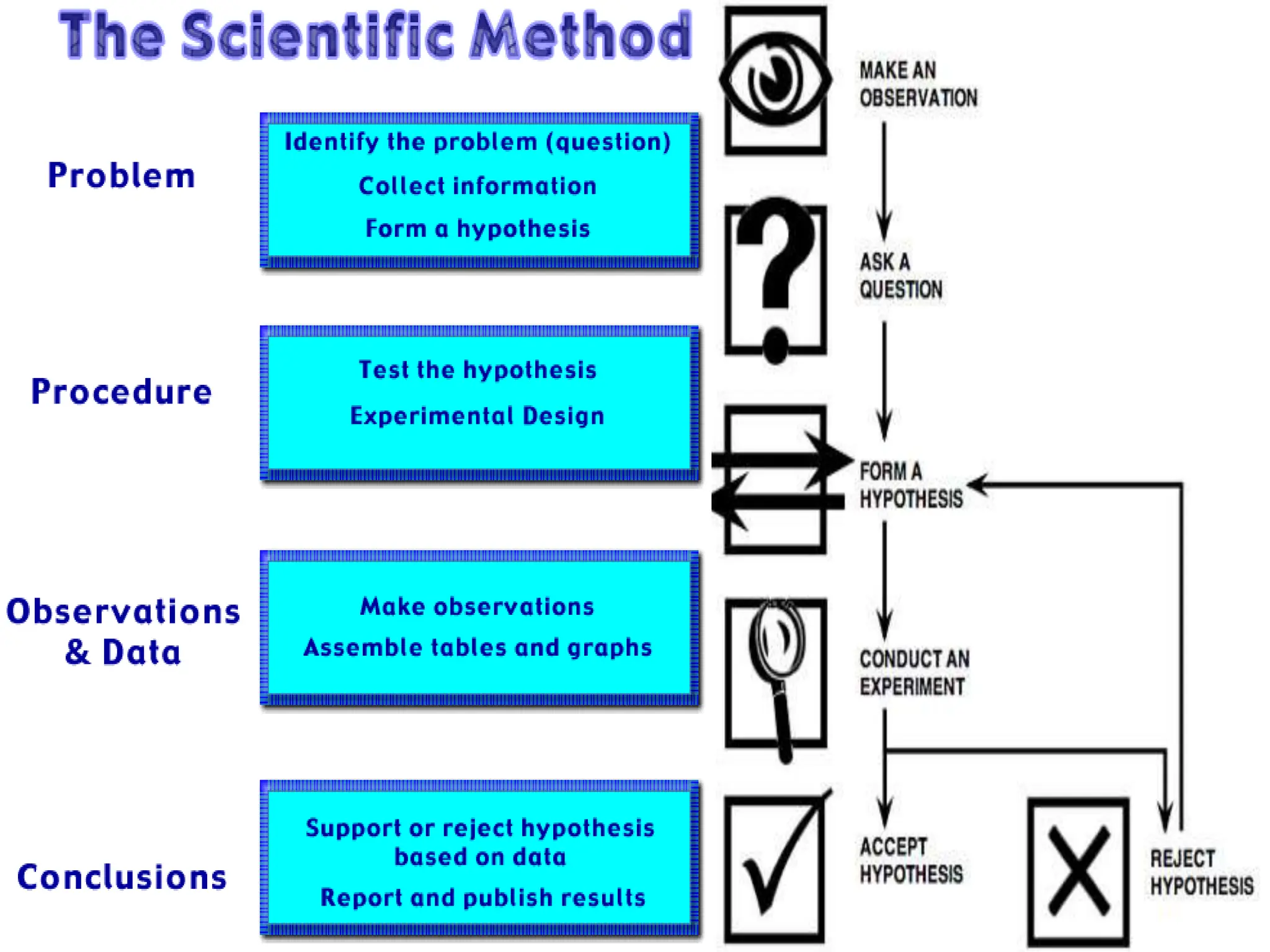
• A hypothesis or a theory is a starting point. This may
  be an inference made when a person observes
  something in the known world, and sets out to test
  whether the hypothesis or inference holds up, one is
  beginning to employ the scientific method, a way to
  prove an inference as correct or incorrect..
Works Cited
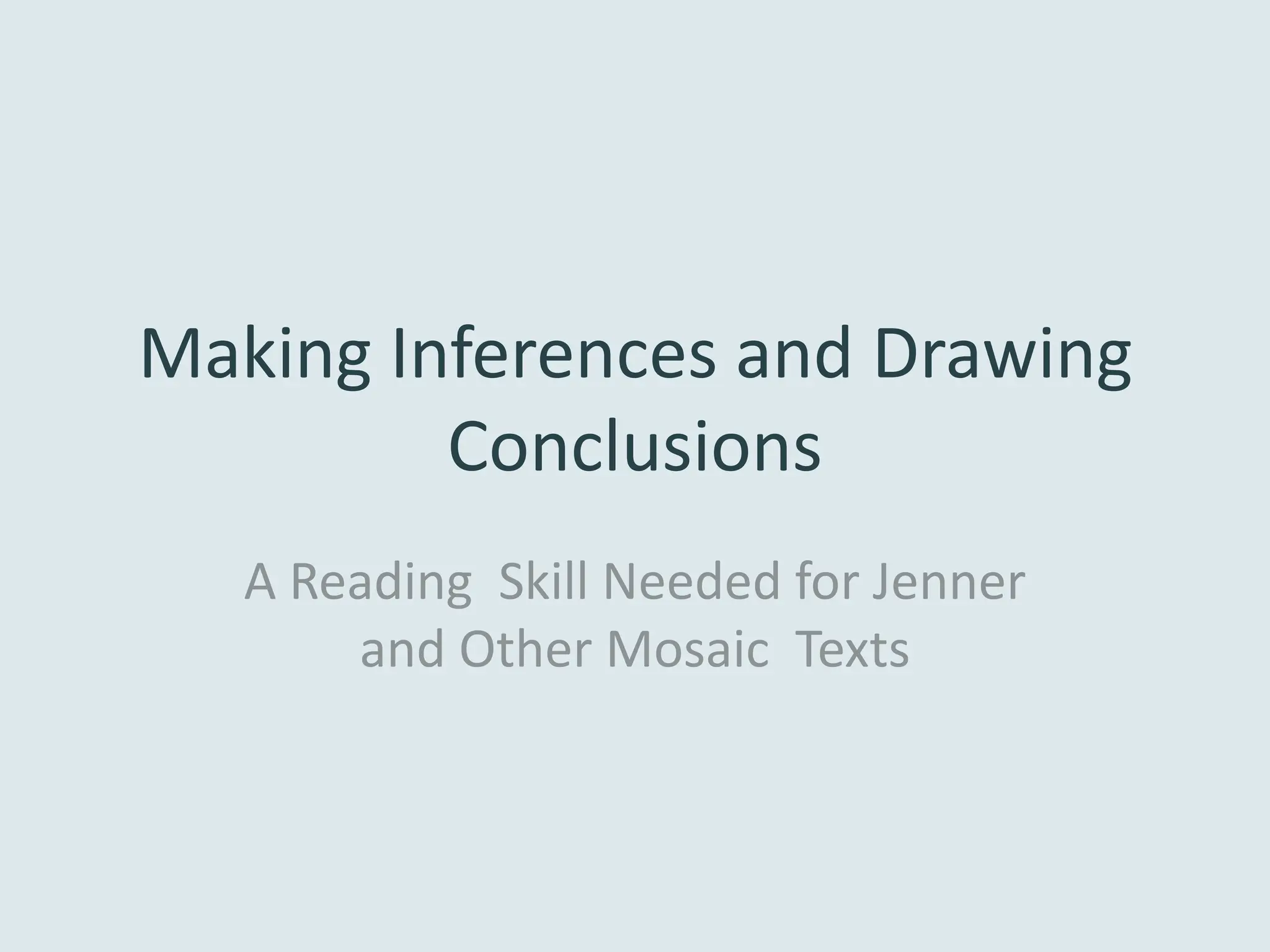
• http://www.criticalreading.com/inference_prc
• http://www.criticalreading.com/inference_an
  alysis.htmess.htm
• http://www.wisegeek.com/in-science-what-is-
  an-inference.htm
• http://www.sciencebuddies.org/science-fair-
  projects/project_scientific_method.shtml

Making Inferences and Drawing Conclusions

  • 1.
    Making Inferences andDrawing Conclusions A Reading Skill Needed for Jenner and Other Mosaic Texts
  • 2.
  • 3.
    Definition of Inferences • Inference is a mental process by which we reach a conclusion based on specific evidence. Inferences are the stock and trade of detectives examining clues, of doctors diagnosing diseases, and of car mechanics repairing engine problems. We infer motives, purpose, and intentions. • We engage in inference every day. We interpret actions to be examples of behavior characteristics, intents, or expressions of particular feelings. We infer it is raining when we see someone with an open umbrella. We infer people are thirsty if they ask for a glass of water. We infer that evidence in a text is authoritative when it is attributed to a scholar in the field. • We want to find significance. We listen to remarks, and want to make sense of them. What might the speaker mean? Why is he or she saying that? We go beyond specific remarks to underlying significance or broader meaning. When we read that someone cheated on his or her income taxes, we might take that as an example of financial ingenuity, daring, or stupidity. We seek purposes and reasons. • Inferences are not random. While they may come about mysteriously with a sudden jump of recognition, a sense of "Ah ha!," inferences are very orderly. Inferences may be guesses, but they are educated guesses based on supporting evidence. The evidence seems to require that we reach a specific conclusion.
  • 4.
    Inference and Analysis •Inferences are based on evidence. To infer, we must collect evidence. Evidence is collected by the process of analysis. • Analysis is a particular form of investigation. In general usage, analysis refers to any close, careful, or systematic examination. In the discussion here, the term “analysis“ is used in its more technical meaning. • Analysis is a process of investigating something by breaking it into parts for closer examination. Complex topics are broken down into simpler ones. Intricate patterns are broken down into less complicated elements. A problem is simplified by limiting the amount that must be examined at any one time. • The goal of analysis is not simply to discover parts within the whole, but to understand the whole. Once the parts are identified, analysis then seeks to determine how those parts are related. • In the analytic model, the whole is seen as greater than the sum of its parts.
  • 5.
    Science and Inferences •In science, an inference refers to reasonable conclusions or possible hypotheses drawn from a small sampling of data based upon repeated observations. • Scientists make inferences all the time. The inference can take several forms. • A hypothesis or a theory is a starting point. This may be an inference made when a person observes something in the known world, and sets out to test whether the hypothesis or inference holds up, one is beginning to employ the scientific method, a way to prove an inference as correct or incorrect..
  • 7.
    Works Cited • http://www.criticalreading.com/inference_prc •http://www.criticalreading.com/inference_an alysis.htmess.htm • http://www.wisegeek.com/in-science-what-is- an-inference.htm • http://www.sciencebuddies.org/science-fair- projects/project_scientific_method.shtml