What is this?
   This presentation is one of five presentations outlining our understanding of
   Generational perspectives


1. The Theory of Generations

2. Boomers

3. Generation X

4. Generation Y, or Millenials

5. Applying generational perspectives to Marketing
The theory of
generations
introduction
   Overview

   How generations differ from lifestages

   Identifying generations

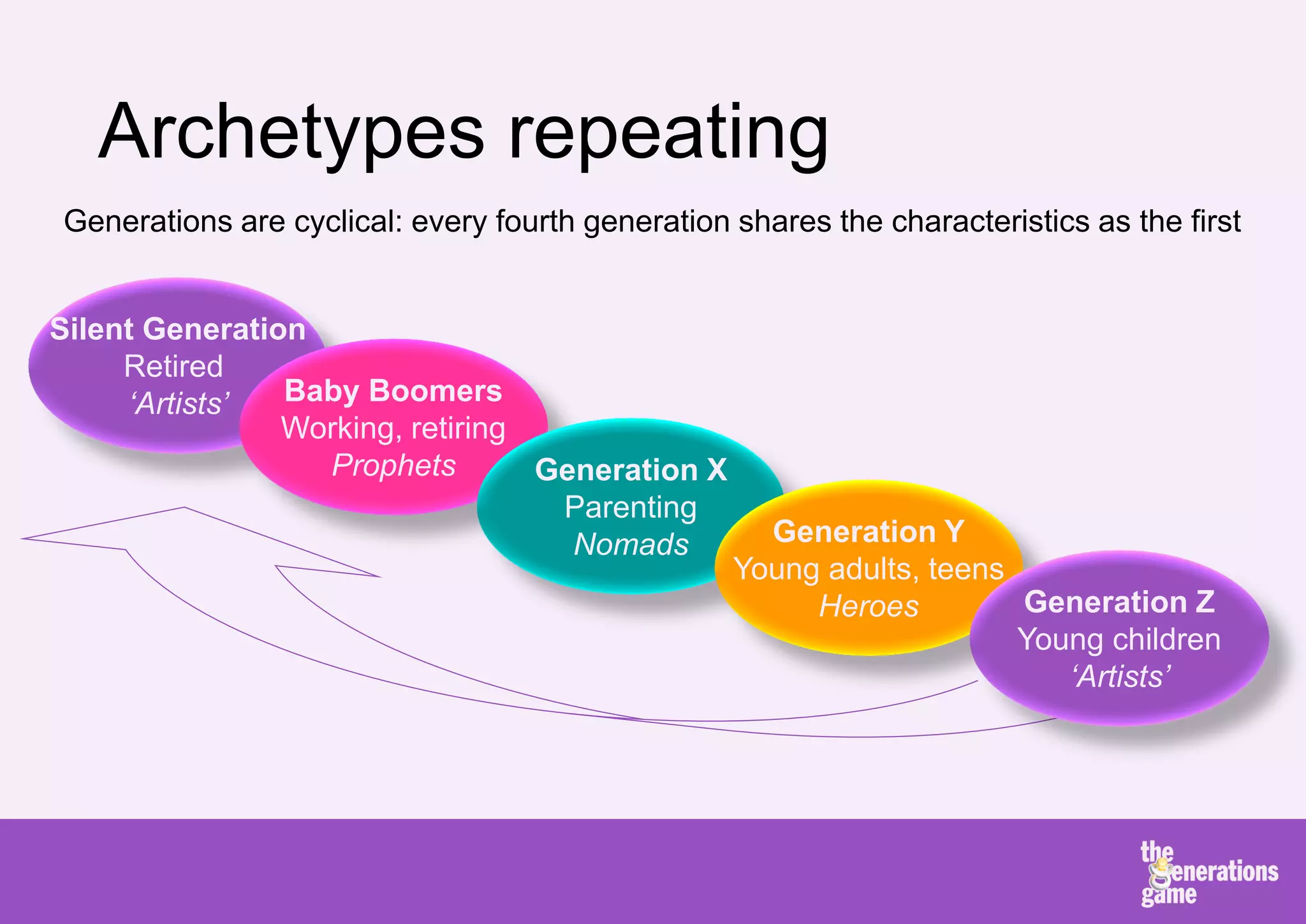
   Generations repeating themselves

   National Mood

   Summary
Overview
Understanding Generations is not an exact science

The boundaries between generations are blurred

The insights are not always clear cut

There are plenty of hypotheses
Overview
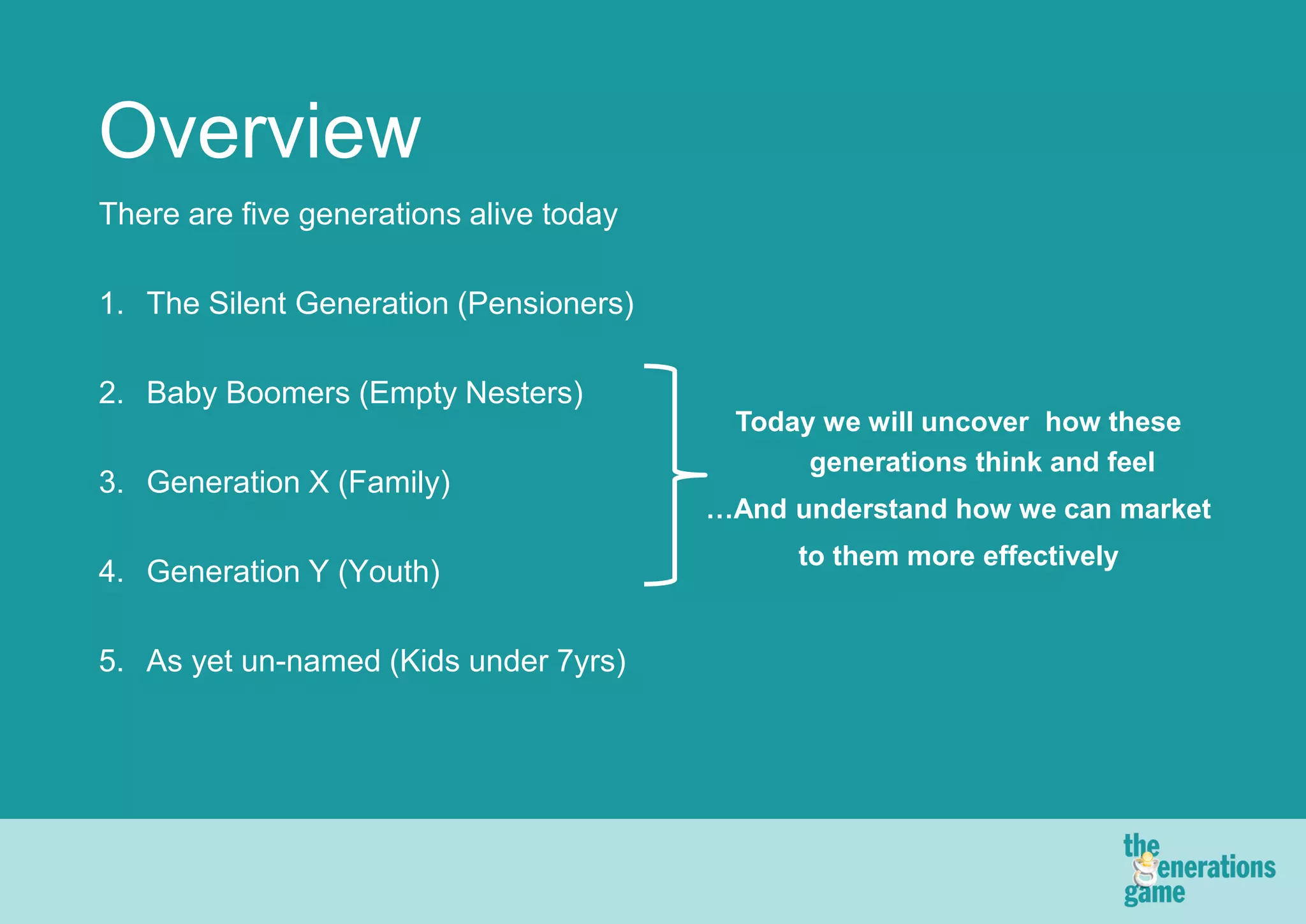
There are five generations alive today

1. The Silent Generation (Pensioners)

2. Baby Boomers (Empty Nesters)
                                          Today we will uncover how these
                                               generations think and feel
3. Generation X (Family)
                                         …And understand how we can market
                                               to them more effectively
4. Generation Y (Youth)

5. As yet un-named (Kids under 7yrs)
How generations differ
from lifestages
Trains and stations
•   Picture a lifecycle track, birth as the origin and death the destination

•   There are a number of generations, or trains, running at any one time

•   Some trains are just beginning

•   Some are reaching the end of the line

•   Each train carries passengers that are alike

•   But each train looks very different
Trains and stations
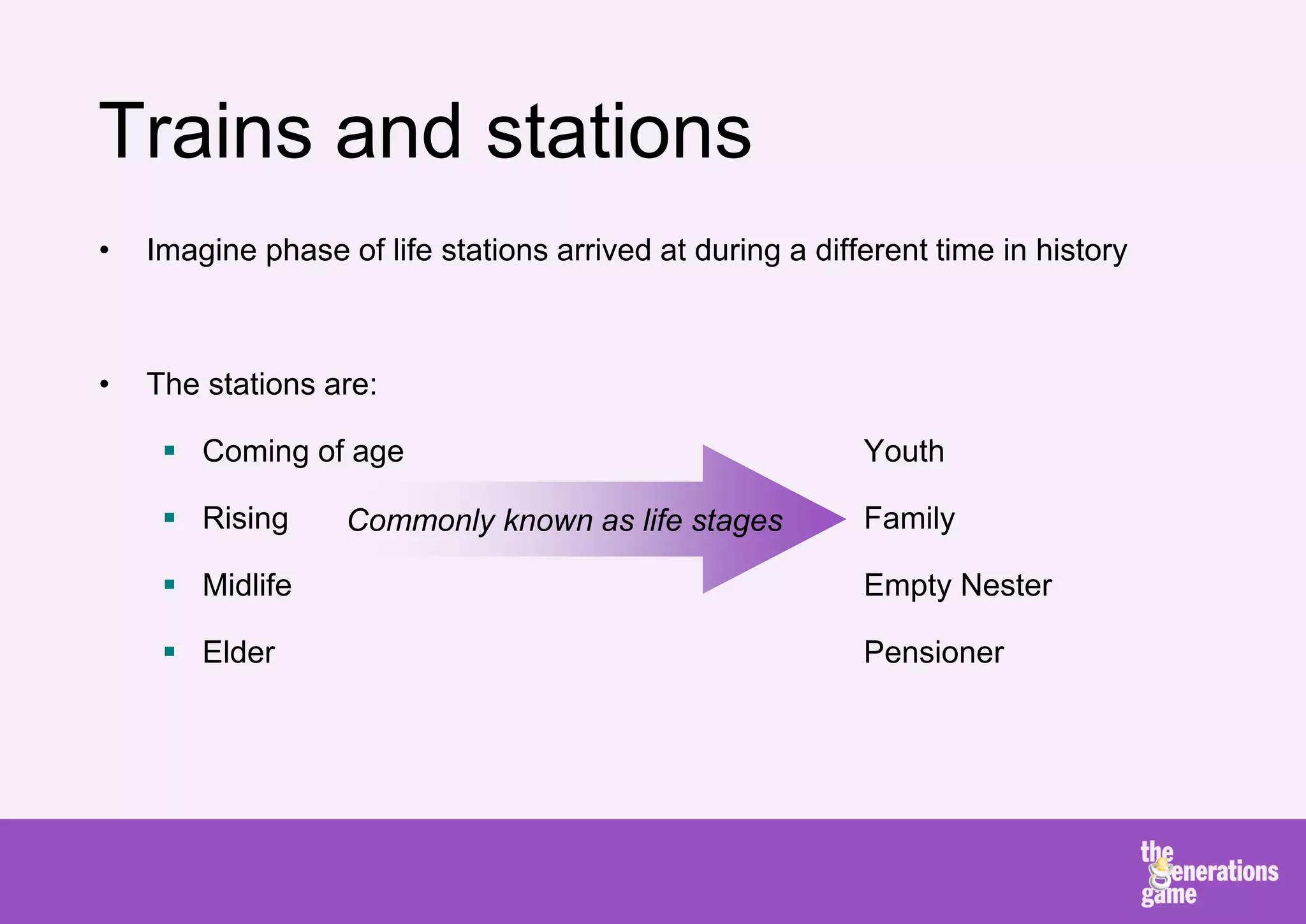
•   Imagine phase of life stations arrived at during a different time in history


•   The stations are:

      Coming of age                                       Youth

      Rising      Commonly known as life stages           Family

      Midlife                                             Empty Nester

      Elder                                               Pensioner
Key station: Coming of age
•   Of all stations, the first is the most influential

•   Coming of age: Childhood, adolescence and early youth

•   At this station a set of collective behavioural traits, attitudes and beliefs

    have been formed

•   These ‘perspectives’ later express themselves throughout the rest of the

    journey
How does coming of age manifest in
later life?
•   How children are raised affect how they later parent

•   How students are taught affects how they learn

•   How young people are managed affects how they lead

•   How society feels about children affects their confidence

•   How they are sold to affects how they feel about corporations

•   How authorities operate affects how institutionalised they are
How are generations different
from lifestage?

    Lifestages are transient

 Generational perspectives stay
         with us for life
How generations are
identified
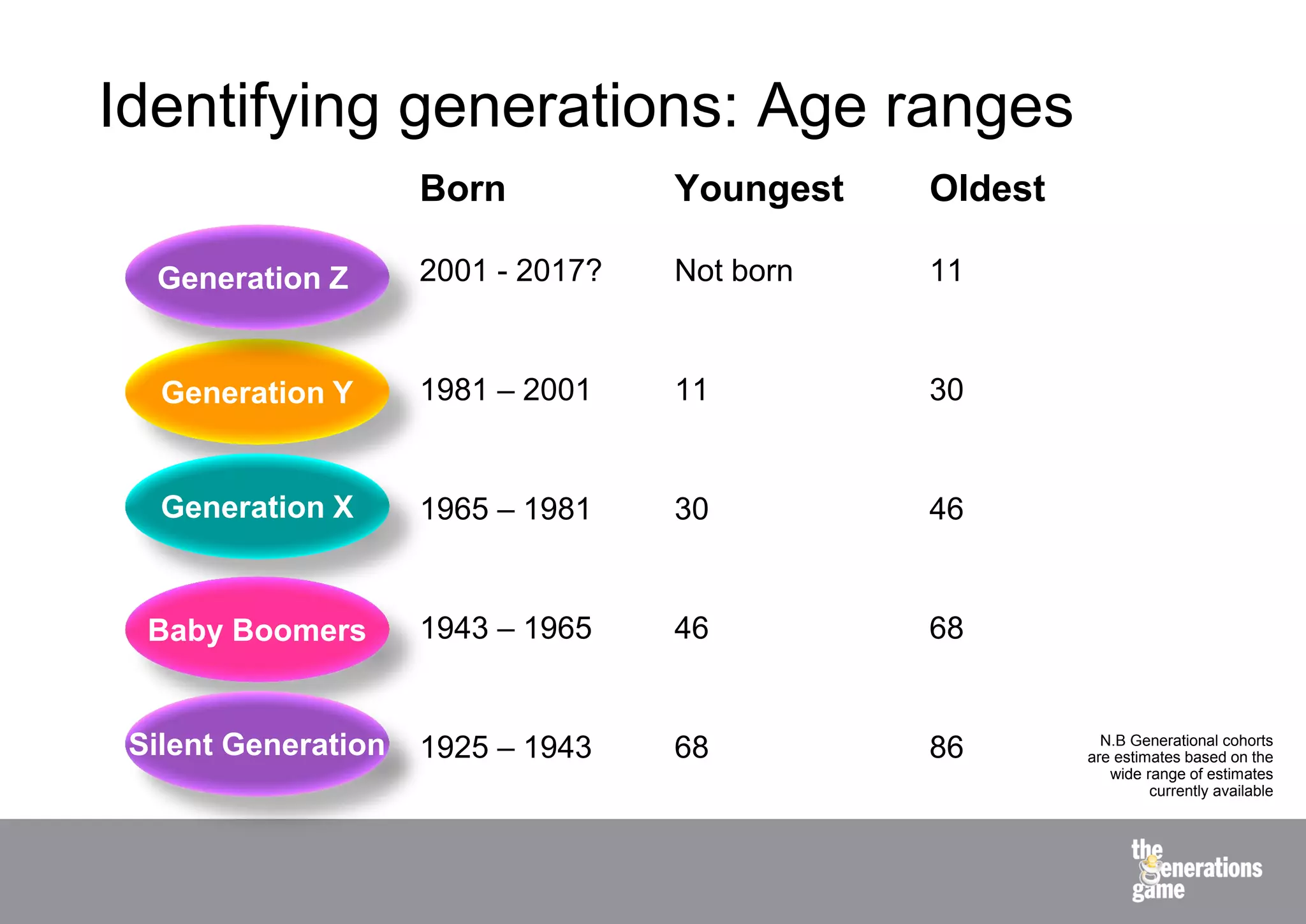
Identifying generations: Age ranges
                     Born           Youngest   Oldest

  Generation Z       2001 - 2017?   Not born   11


   Generation Y      1981 – 2001    11         30


   Generation X      1965 – 1981    30         46


  Baby Boomers       1943 – 1965    46         68


 Silent Generation   1925 – 1943    68         86         N.B Generational cohorts
                                                        are estimates based on the
                                                           wide range of estimates
                                                                 currently available
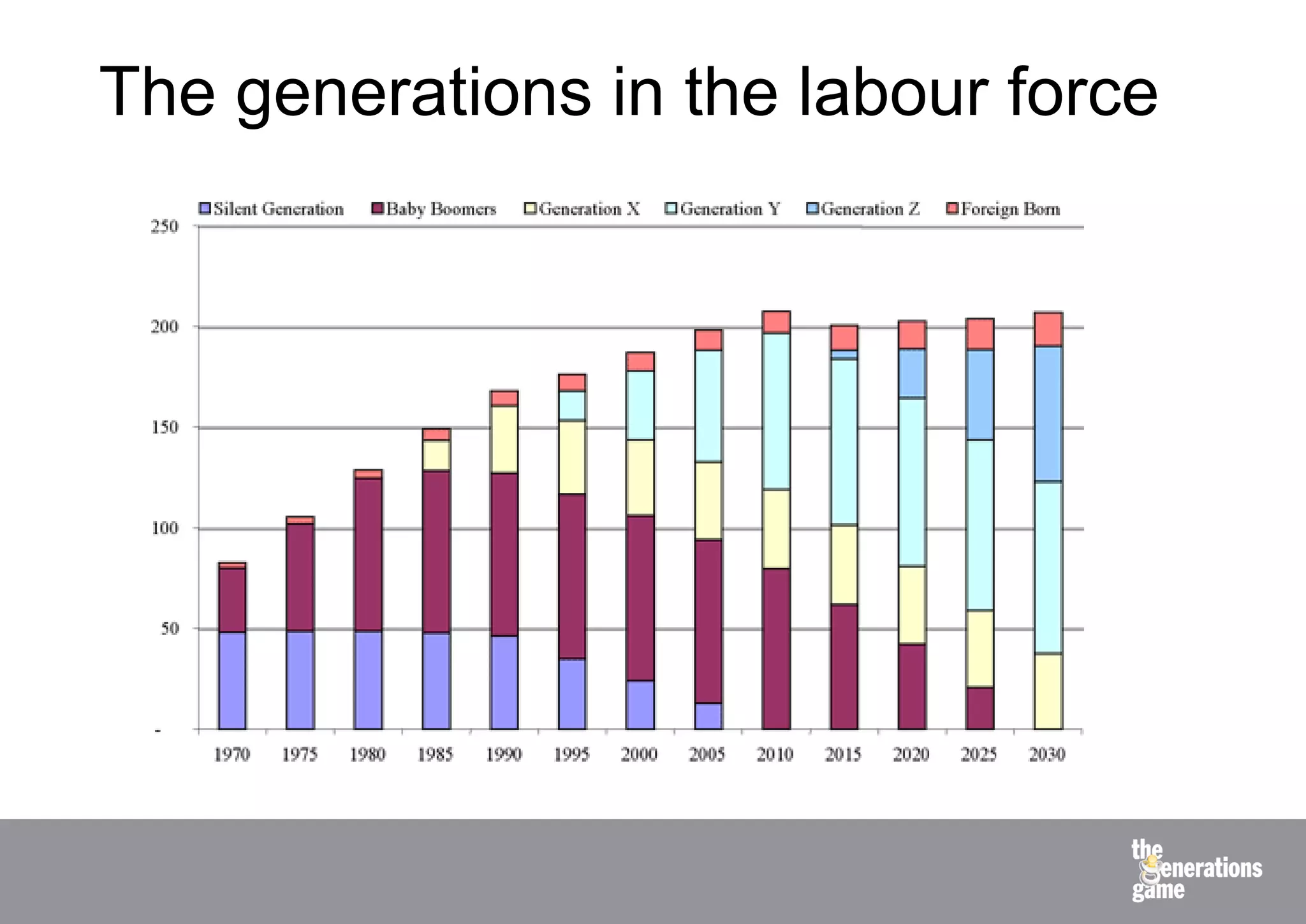
The generations in the labour force
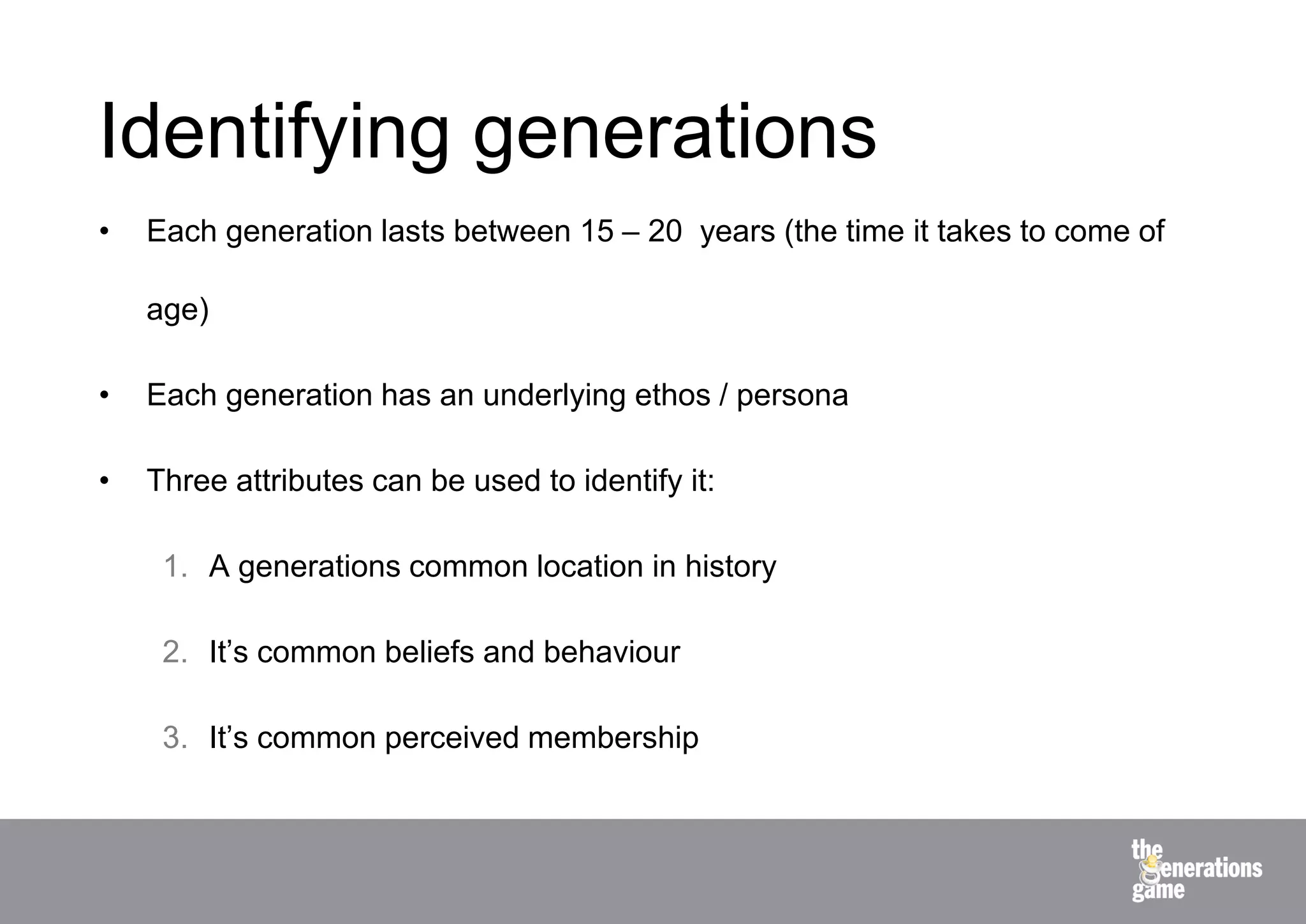
Identifying generations
•   Each generation lasts between 15 – 20 years (the time it takes to come of

    age)

•   Each generation has an underlying ethos / persona

•   Three attributes can be used to identify it:

     1. A generations common location in history

     2. It’s common beliefs and behaviour

     3. It’s common perceived membership
1. Common location

      “History shapes each generation depending on
      what phase of life it occupies as it encounters
     key historical events - a period of crisis will leave
      an impression on children that is different from
           the one it leaves on midlife leaders ”

                        Julian Marias
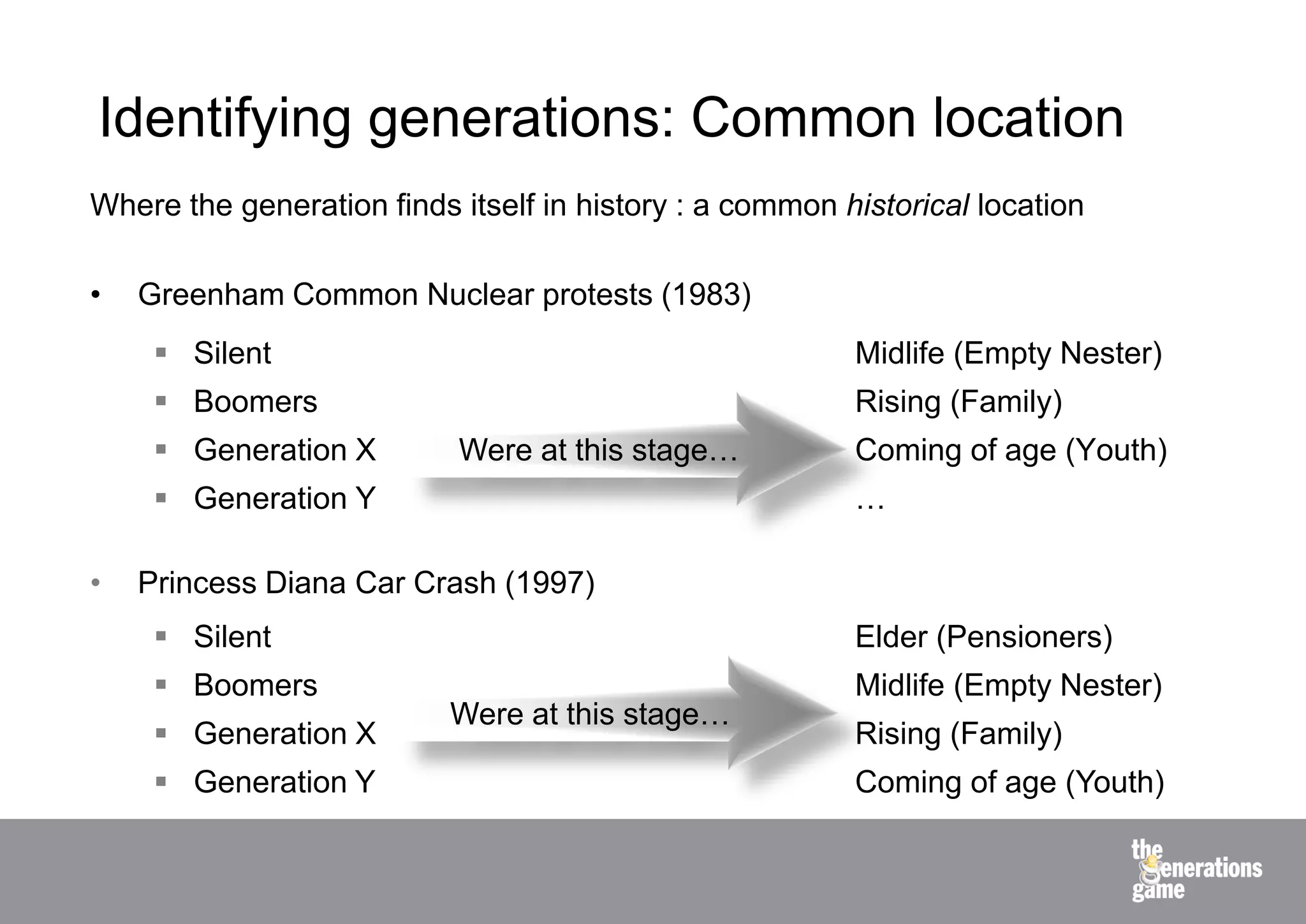
Identifying generations: Common location
Where the generation finds itself in history : a common historical location

•   Greenham Common Nuclear protests (1983)
      Silent                                            Midlife (Empty Nester)
      Boomers                                           Rising (Family)
      Generation X        Were at this stage…           Coming of age (Youth)
      Generation Y                                      …

•   Princess Diana Car Crash (1997)
      Silent                                            Elder (Pensioners)
      Boomers                                           Midlife (Empty Nester)
                           Were at this stage…
      Generation X                                      Rising (Family)
      Generation Y                                      Coming of age (Youth)
2. Common beliefs and behaviours


        “In 2001, 8.3 per cent (4.9 million) of the total
      population of the UK were born overseas. This is
     almost double the proportion in 1951 (4.2 per cent) ”

           ONS Population and Migration Archive
Common beliefs and behaviours
•   How a generation’s members are different from people born at another time
•   Census reports, opinion surveys, educational tests, crime records
•   Provide evidence of beliefs and behaviours
        careers
        children
        gender roles
        financial security
        marriage
        materialism
        culture
3. Common perceived membership


     “I can’t excuse what boomers did with sex and drugs
                   when they were kids ”

           Michael Eliason, 17, Millennials Rising
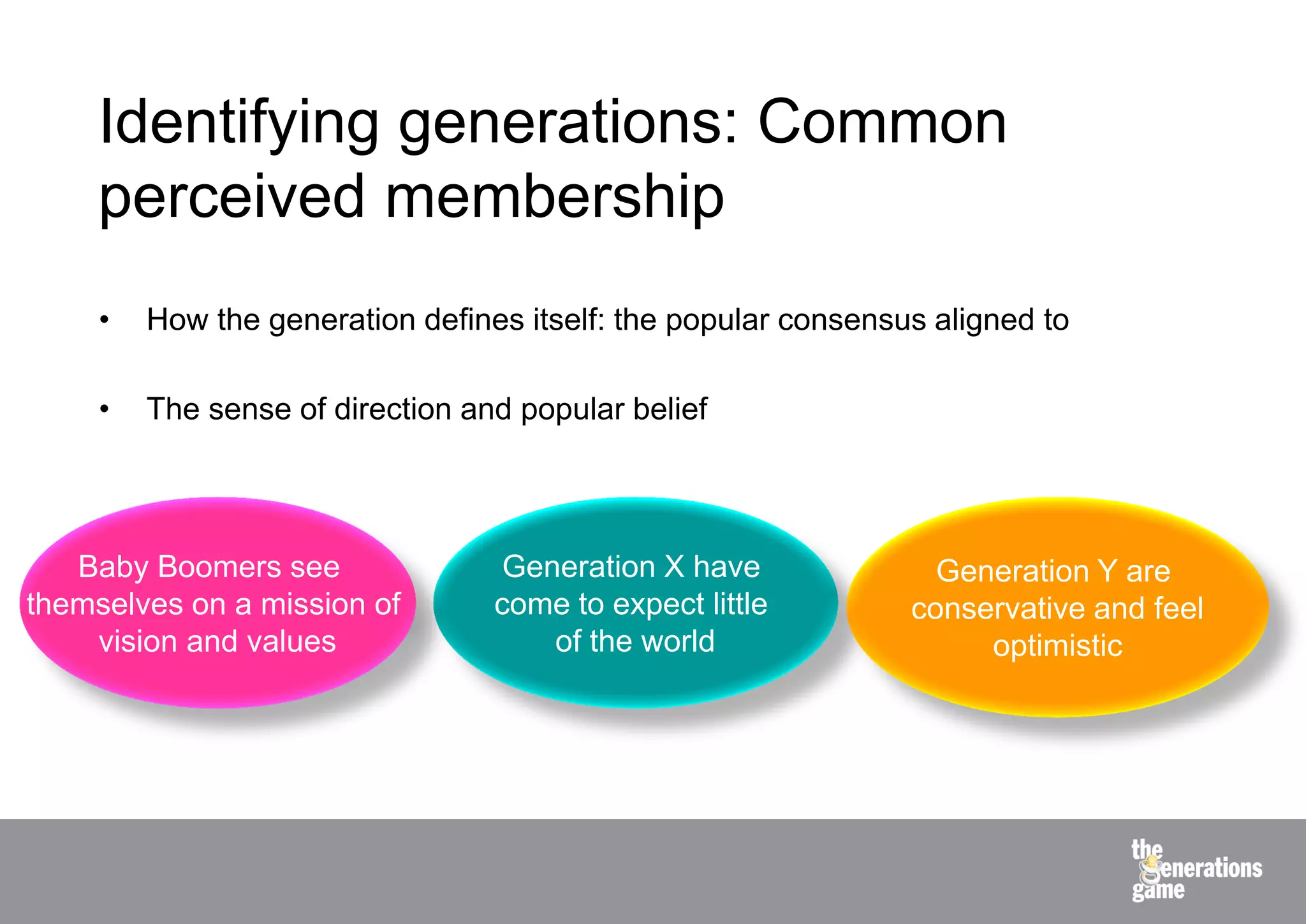
Identifying generations: Common
    perceived membership
     •   How the generation defines itself: the popular consensus aligned to

     •   The sense of direction and popular belief


   Baby Boomers see                Generation X have              Generation Y are
themselves on a mission of        come to expect little         conservative and feel
    vision and values                 of the world                   optimistic
Generations repeating
themselves
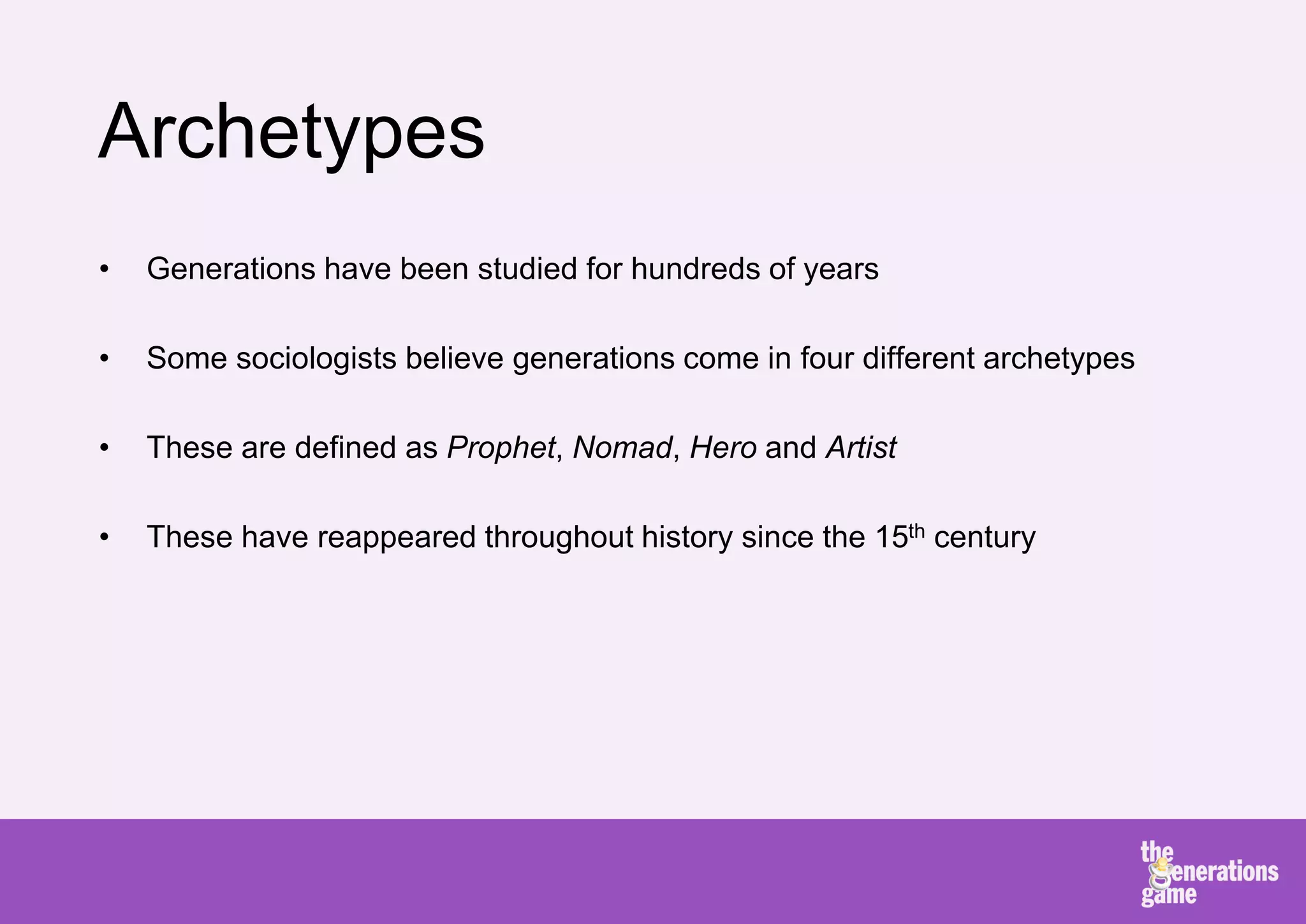
Archetypes
•   Generations have been studied for hundreds of years

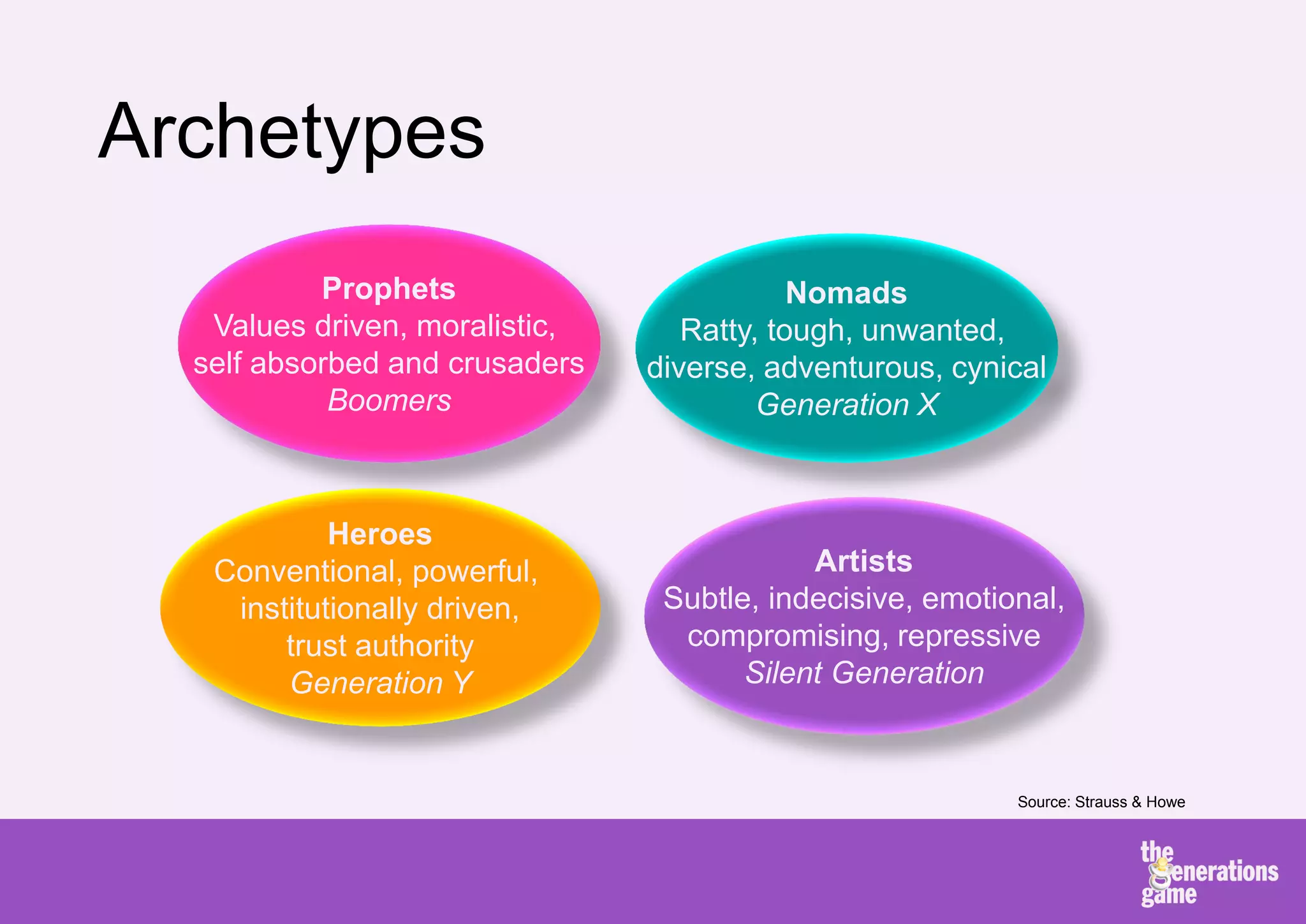
•   Some sociologists believe generations come in four different archetypes

•   These are defined as Prophet, Nomad, Hero and Artist

•   These have reappeared throughout history since the 15th century
Archetypes repeating
Generations are cyclical: every fourth generation shares the characteristics as the first


Silent Generation
     Retired
     ‘Artists’  Baby Boomers
                Working, retiring
                  Prophets        Generation X
                                   Parenting
                                    Nomads          Generation Y
                                                  Young adults, teens
                                                       Heroes         Generation Z
                                                                      Young children
                                                                         ‘Artists’
Archetypes
           Prophets                         Nomads
   Values driven, moralistic,      Ratty, tough, unwanted,
  self absorbed and crusaders   diverse, adventurous, cynical
            Boomers                      Generation X


            Heroes
   Conventional, powerful,                  Artists
    institutionally driven,      Subtle, indecisive, emotional,
        trust authority           compromising, repressive
        Generation Y                   Silent Generation


                                                           Source: Strauss & Howe
How do generations affect
us?
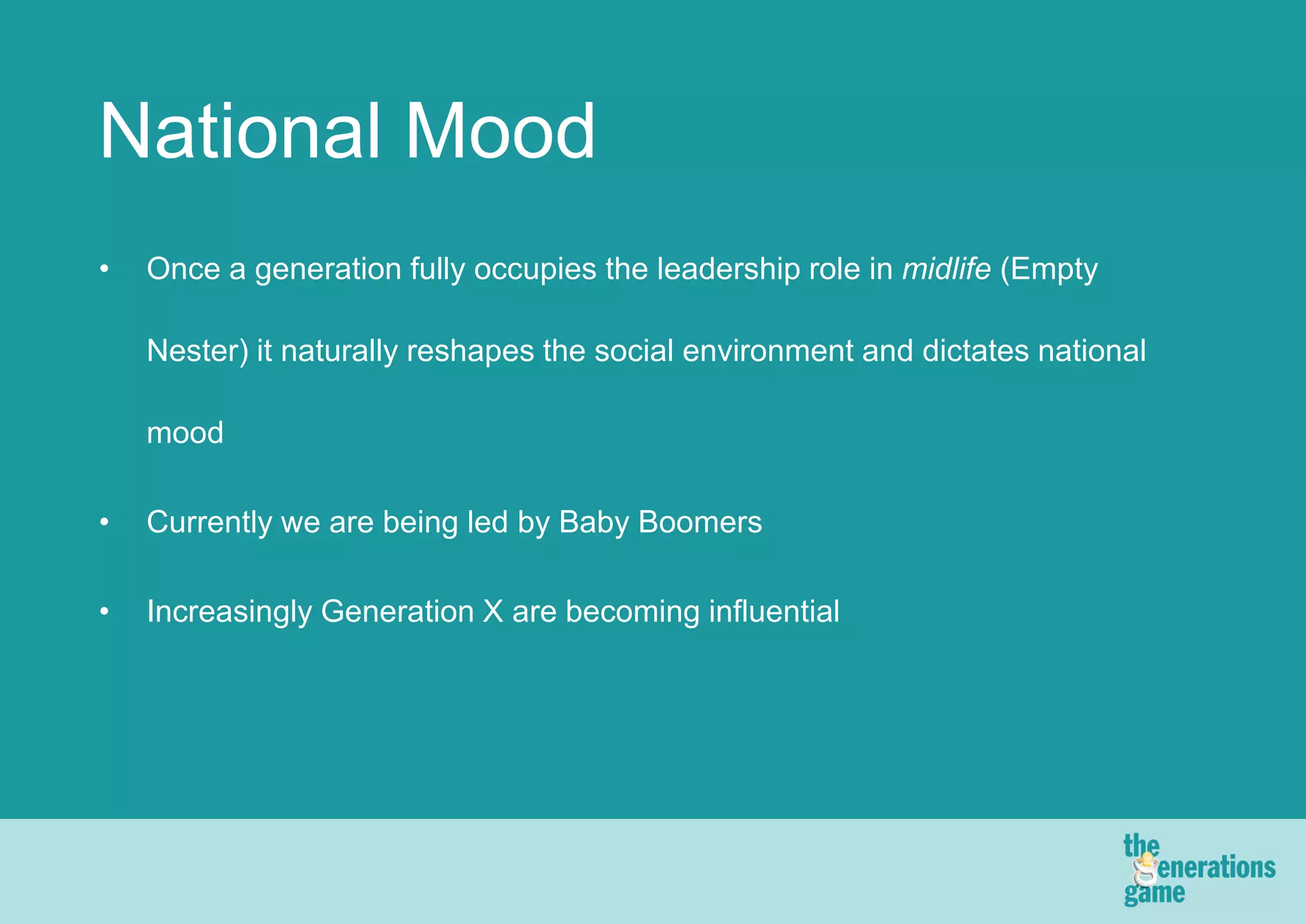
National Mood
•   Once a generation fully occupies the leadership role in midlife (Empty

    Nester) it naturally reshapes the social environment and dictates national

    mood

•   Currently we are being led by Baby Boomers

•   Increasingly Generation X are becoming influential
National Mood: Turnings
•   What does history tell us about the mood of a nation?

•   Sociologists see cycles of national mood that repeat themselves again and

    again

•   These cycles are sometimes referred to as Turnings
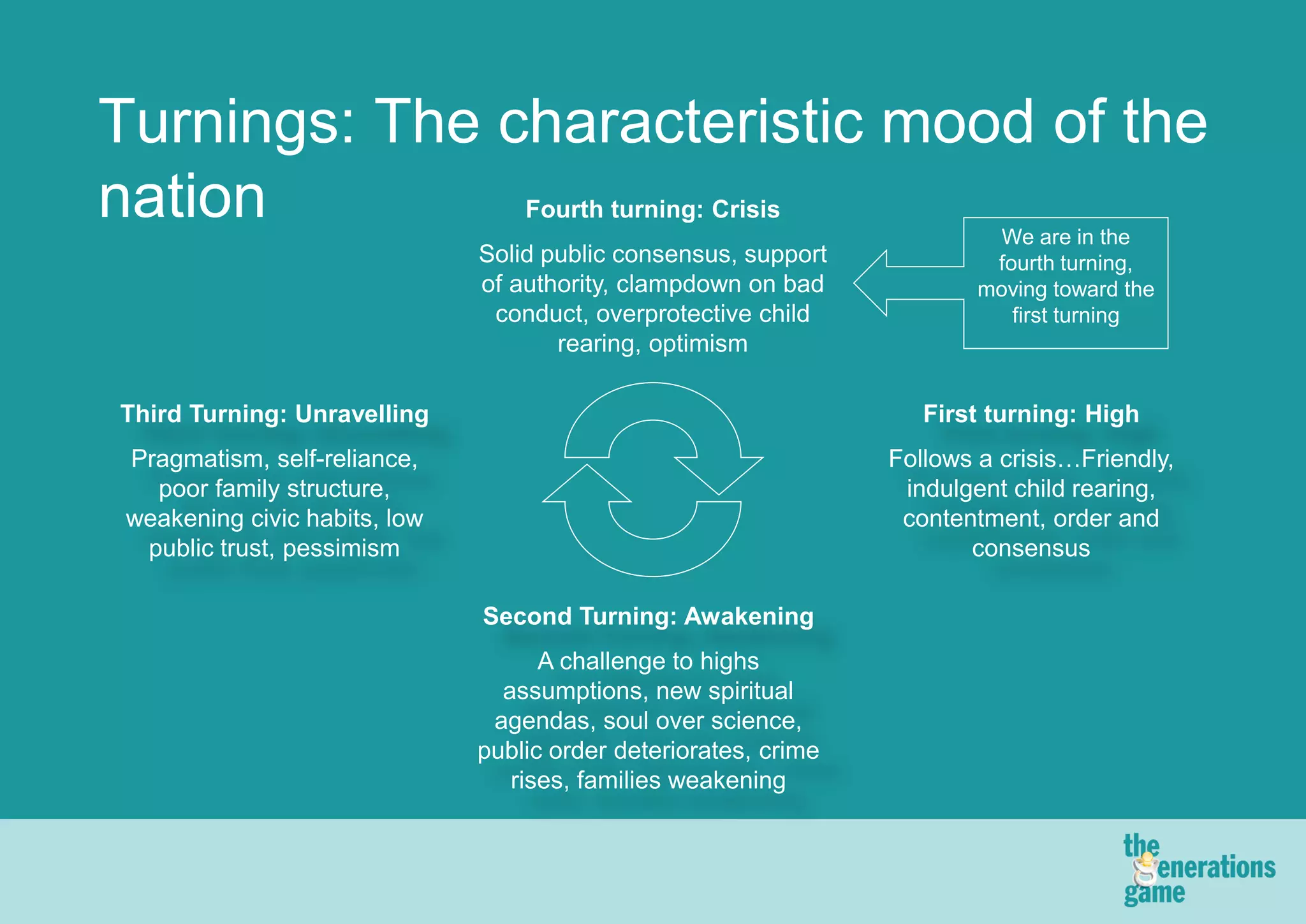
Turnings: The characteristic mood of the
nation                             Fourth turning: Crisis
                                                                            We are in the
                               Solid public consensus, support             fourth turning,
                               of authority, clampdown on bad             moving toward the
                                conduct, overprotective child                first turning
                                      rearing, optimism

Third Turning: Unravelling                                           First turning: High
 Pragmatism, self-reliance,                                       Follows a crisis…Friendly,
   poor family structure,                                          indulgent child rearing,
 weakening civic habits, low                                       contentment, order and
  public trust, pessimism                                                consensus

                               Second Turning: Awakening
                                     A challenge to highs
                                 assumptions, new spiritual
                                agendas, soul over science,
                               public order deteriorates, crime
                                  rises, families weakening
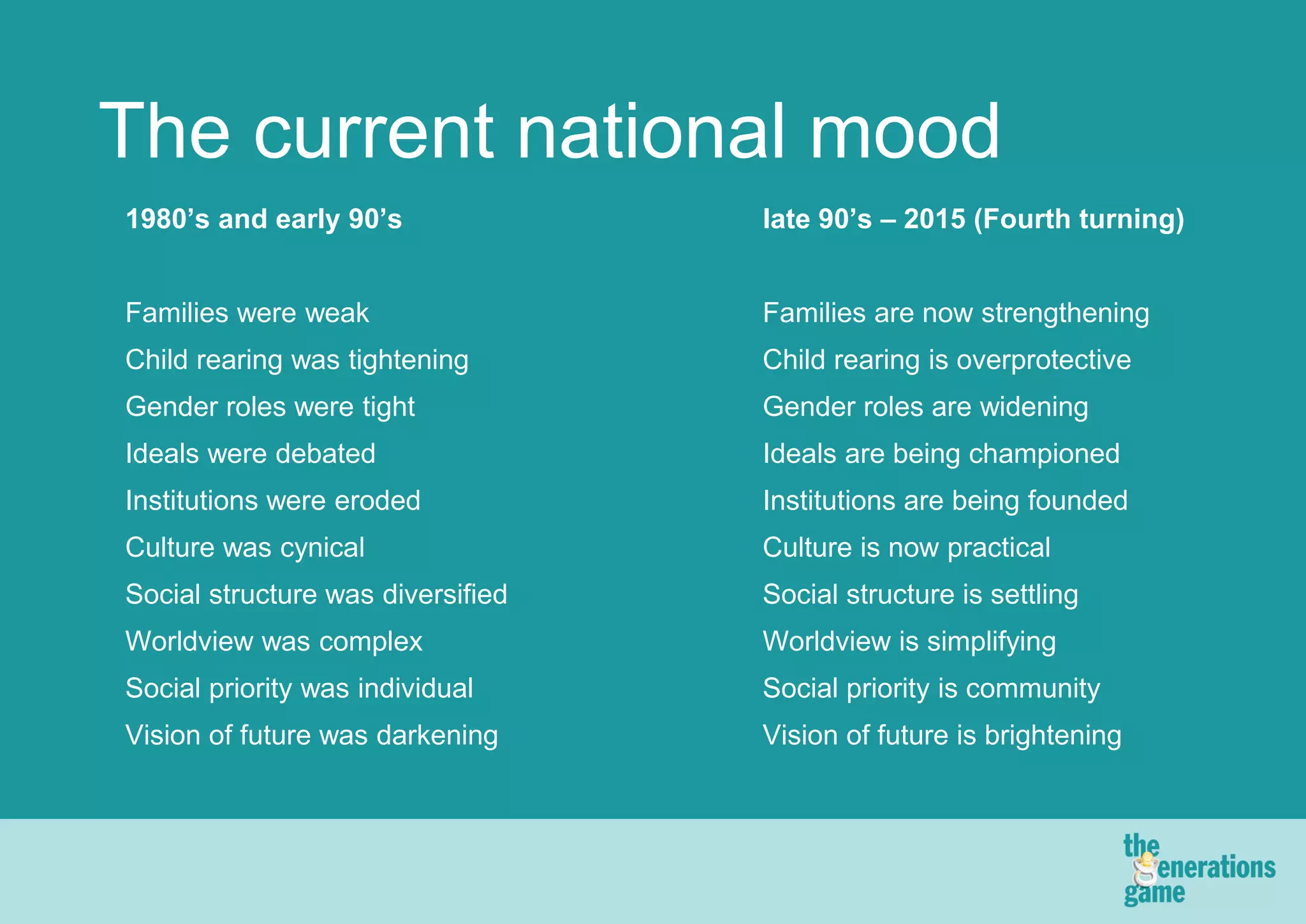
The current national mood
1980’s and early 90’s              late 90’s – 2015 (Fourth turning)


Families were weak                 Families are now strengthening
Child rearing was tightening       Child rearing is overprotective
Gender roles were tight            Gender roles are widening
Ideals were debated                Ideals are being championed
Institutions were eroded           Institutions are being founded
Culture was cynical                Culture is now practical
Social structure was diversified   Social structure is settling
Worldview was complex              Worldview is simplifying
Social priority was individual     Social priority is community
Vision of future was darkening     Vision of future is brightening
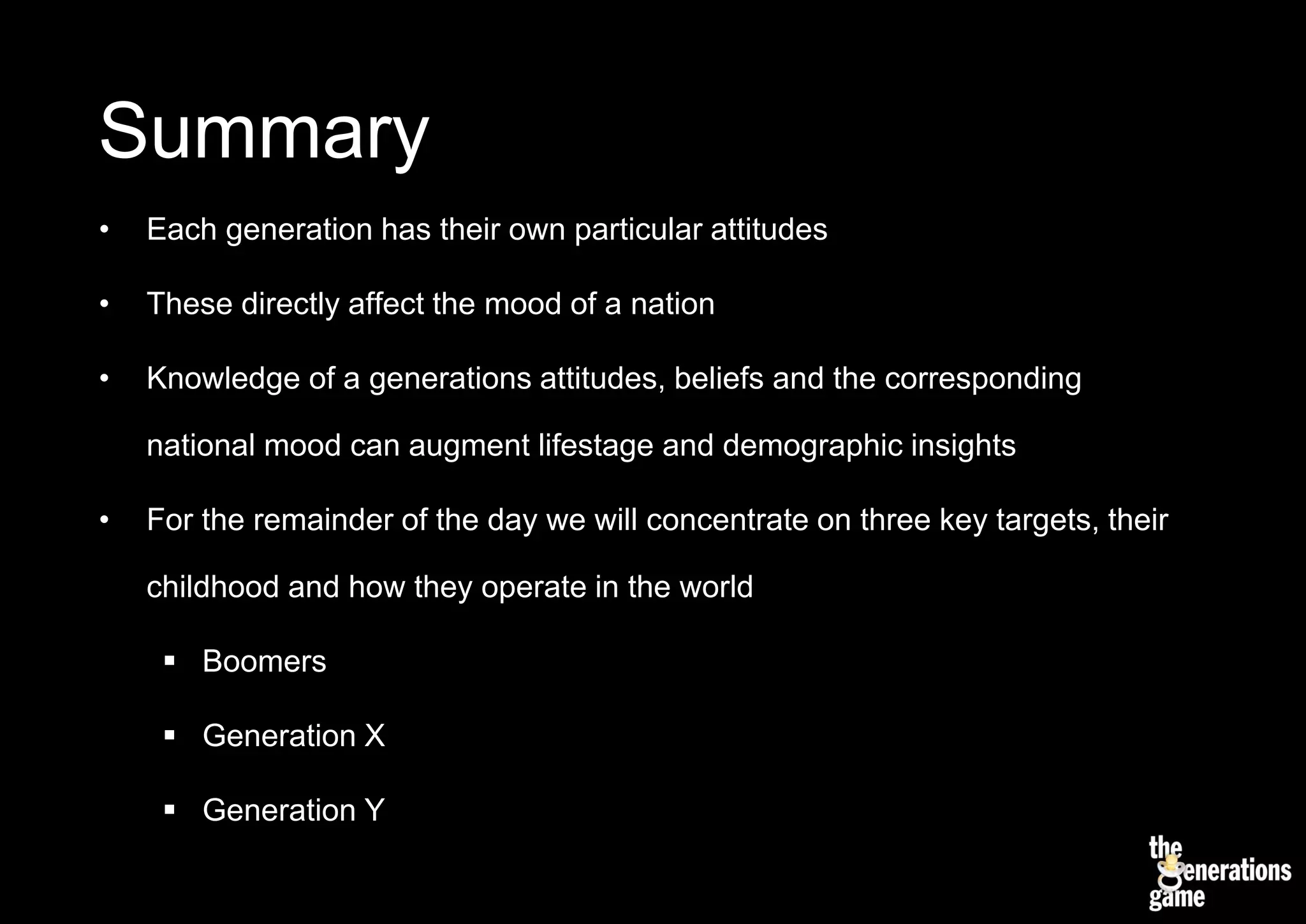
Summary
•   Each generation has their own particular attitudes

•   These directly affect the mood of a nation

•   Knowledge of a generations attitudes, beliefs and the corresponding

    national mood can augment lifestage and demographic insights

•   For the remainder of the day we will concentrate on three key targets, their

    childhood and how they operate in the world

      Boomers

      Generation X

      Generation Y

Presentation 1: The Generations Presentation 1 introduction

  • 2.
    What is this? This presentation is one of five presentations outlining our understanding of Generational perspectives 1. The Theory of Generations 2. Boomers 3. Generation X 4. Generation Y, or Millenials 5. Applying generational perspectives to Marketing
  • 3.
  • 4.
    introduction  Overview  How generations differ from lifestages  Identifying generations  Generations repeating themselves  National Mood  Summary
  • 5.
    Overview Understanding Generations isnot an exact science The boundaries between generations are blurred The insights are not always clear cut There are plenty of hypotheses
  • 6.
    Overview There are fivegenerations alive today 1. The Silent Generation (Pensioners) 2. Baby Boomers (Empty Nesters) Today we will uncover how these generations think and feel 3. Generation X (Family) …And understand how we can market to them more effectively 4. Generation Y (Youth) 5. As yet un-named (Kids under 7yrs)
  • 7.
  • 8.
    Trains and stations • Picture a lifecycle track, birth as the origin and death the destination • There are a number of generations, or trains, running at any one time • Some trains are just beginning • Some are reaching the end of the line • Each train carries passengers that are alike • But each train looks very different
  • 9.
    Trains and stations • Imagine phase of life stations arrived at during a different time in history • The stations are:  Coming of age Youth  Rising Commonly known as life stages Family  Midlife Empty Nester  Elder Pensioner
  • 10.
    Key station: Comingof age • Of all stations, the first is the most influential • Coming of age: Childhood, adolescence and early youth • At this station a set of collective behavioural traits, attitudes and beliefs have been formed • These ‘perspectives’ later express themselves throughout the rest of the journey
  • 11.
    How does comingof age manifest in later life? • How children are raised affect how they later parent • How students are taught affects how they learn • How young people are managed affects how they lead • How society feels about children affects their confidence • How they are sold to affects how they feel about corporations • How authorities operate affects how institutionalised they are
  • 12.
    How are generationsdifferent from lifestage? Lifestages are transient Generational perspectives stay with us for life
  • 13.
  • 14.
    Identifying generations: Ageranges Born Youngest Oldest Generation Z 2001 - 2017? Not born 11 Generation Y 1981 – 2001 11 30 Generation X 1965 – 1981 30 46 Baby Boomers 1943 – 1965 46 68 Silent Generation 1925 – 1943 68 86 N.B Generational cohorts are estimates based on the wide range of estimates currently available
  • 15.
    The generations inthe labour force
  • 16.
    Identifying generations • Each generation lasts between 15 – 20 years (the time it takes to come of age) • Each generation has an underlying ethos / persona • Three attributes can be used to identify it: 1. A generations common location in history 2. It’s common beliefs and behaviour 3. It’s common perceived membership
  • 17.
    1. Common location “History shapes each generation depending on what phase of life it occupies as it encounters key historical events - a period of crisis will leave an impression on children that is different from the one it leaves on midlife leaders ” Julian Marias
  • 18.
    Identifying generations: Commonlocation Where the generation finds itself in history : a common historical location • Greenham Common Nuclear protests (1983)  Silent Midlife (Empty Nester)  Boomers Rising (Family)  Generation X Were at this stage… Coming of age (Youth)  Generation Y … • Princess Diana Car Crash (1997)  Silent Elder (Pensioners)  Boomers Midlife (Empty Nester) Were at this stage…  Generation X Rising (Family)  Generation Y Coming of age (Youth)
  • 19.
    2. Common beliefsand behaviours “In 2001, 8.3 per cent (4.9 million) of the total population of the UK were born overseas. This is almost double the proportion in 1951 (4.2 per cent) ” ONS Population and Migration Archive
  • 20.
    Common beliefs andbehaviours • How a generation’s members are different from people born at another time • Census reports, opinion surveys, educational tests, crime records • Provide evidence of beliefs and behaviours  careers  children  gender roles  financial security  marriage  materialism  culture
  • 21.
    3. Common perceivedmembership “I can’t excuse what boomers did with sex and drugs when they were kids ” Michael Eliason, 17, Millennials Rising
  • 22.
    Identifying generations: Common perceived membership • How the generation defines itself: the popular consensus aligned to • The sense of direction and popular belief Baby Boomers see Generation X have Generation Y are themselves on a mission of come to expect little conservative and feel vision and values of the world optimistic
  • 23.
  • 24.
    Archetypes • Generations have been studied for hundreds of years • Some sociologists believe generations come in four different archetypes • These are defined as Prophet, Nomad, Hero and Artist • These have reappeared throughout history since the 15th century
  • 25.
    Archetypes repeating Generations arecyclical: every fourth generation shares the characteristics as the first Silent Generation Retired ‘Artists’ Baby Boomers Working, retiring Prophets Generation X Parenting Nomads Generation Y Young adults, teens Heroes Generation Z Young children ‘Artists’
  • 26.
    Archetypes Prophets Nomads Values driven, moralistic, Ratty, tough, unwanted, self absorbed and crusaders diverse, adventurous, cynical Boomers Generation X Heroes Conventional, powerful, Artists institutionally driven, Subtle, indecisive, emotional, trust authority compromising, repressive Generation Y Silent Generation Source: Strauss & Howe
  • 27.
  • 28.
    National Mood • Once a generation fully occupies the leadership role in midlife (Empty Nester) it naturally reshapes the social environment and dictates national mood • Currently we are being led by Baby Boomers • Increasingly Generation X are becoming influential
  • 29.
    National Mood: Turnings • What does history tell us about the mood of a nation? • Sociologists see cycles of national mood that repeat themselves again and again • These cycles are sometimes referred to as Turnings
  • 30.
    Turnings: The characteristicmood of the nation Fourth turning: Crisis We are in the Solid public consensus, support fourth turning, of authority, clampdown on bad moving toward the conduct, overprotective child first turning rearing, optimism Third Turning: Unravelling First turning: High Pragmatism, self-reliance, Follows a crisis…Friendly, poor family structure, indulgent child rearing, weakening civic habits, low contentment, order and public trust, pessimism consensus Second Turning: Awakening A challenge to highs assumptions, new spiritual agendas, soul over science, public order deteriorates, crime rises, families weakening
  • 31.
    The current nationalmood 1980’s and early 90’s late 90’s – 2015 (Fourth turning) Families were weak Families are now strengthening Child rearing was tightening Child rearing is overprotective Gender roles were tight Gender roles are widening Ideals were debated Ideals are being championed Institutions were eroded Institutions are being founded Culture was cynical Culture is now practical Social structure was diversified Social structure is settling Worldview was complex Worldview is simplifying Social priority was individual Social priority is community Vision of future was darkening Vision of future is brightening
  • 32.
    Summary • Each generation has their own particular attitudes • These directly affect the mood of a nation • Knowledge of a generations attitudes, beliefs and the corresponding national mood can augment lifestage and demographic insights • For the remainder of the day we will concentrate on three key targets, their childhood and how they operate in the world  Boomers  Generation X  Generation Y