SMOKE & MIRRORS:
ADVANCED VOLUMETRIC EFFECTS FOR GAMES
Simon Green, Nuttapong Chentanez
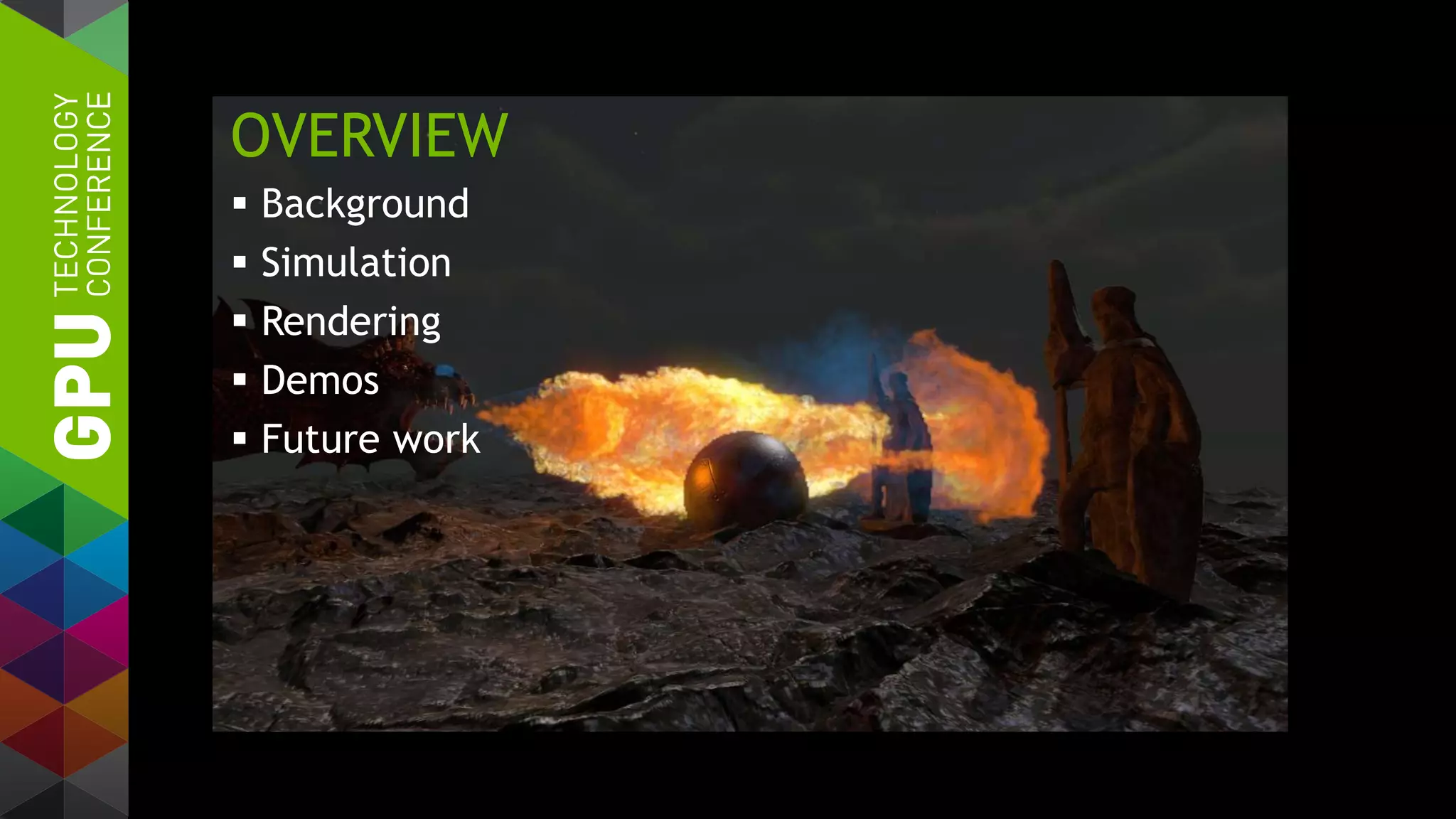
OVERVIEW
 Background
 Simulation
 Rendering
 Demos
 Future work
WHAT IS FLAMEWORKS?
 A system for adding volumetric fire and smoke effects to
games
 Part of the NVIDIA GameWorks family of visual effects
libraries
 Combines
— Efficient grid-based fluid simulator
— High quality volume rendering
 Inspired by ILM Plume, FumeFX, Maya Fluids, Houdini Pyro
— But real-time!
GOALS
High quality
Fast, efficient, scalable
Simple, easy to integrate into games
Customizable
SIMULATION
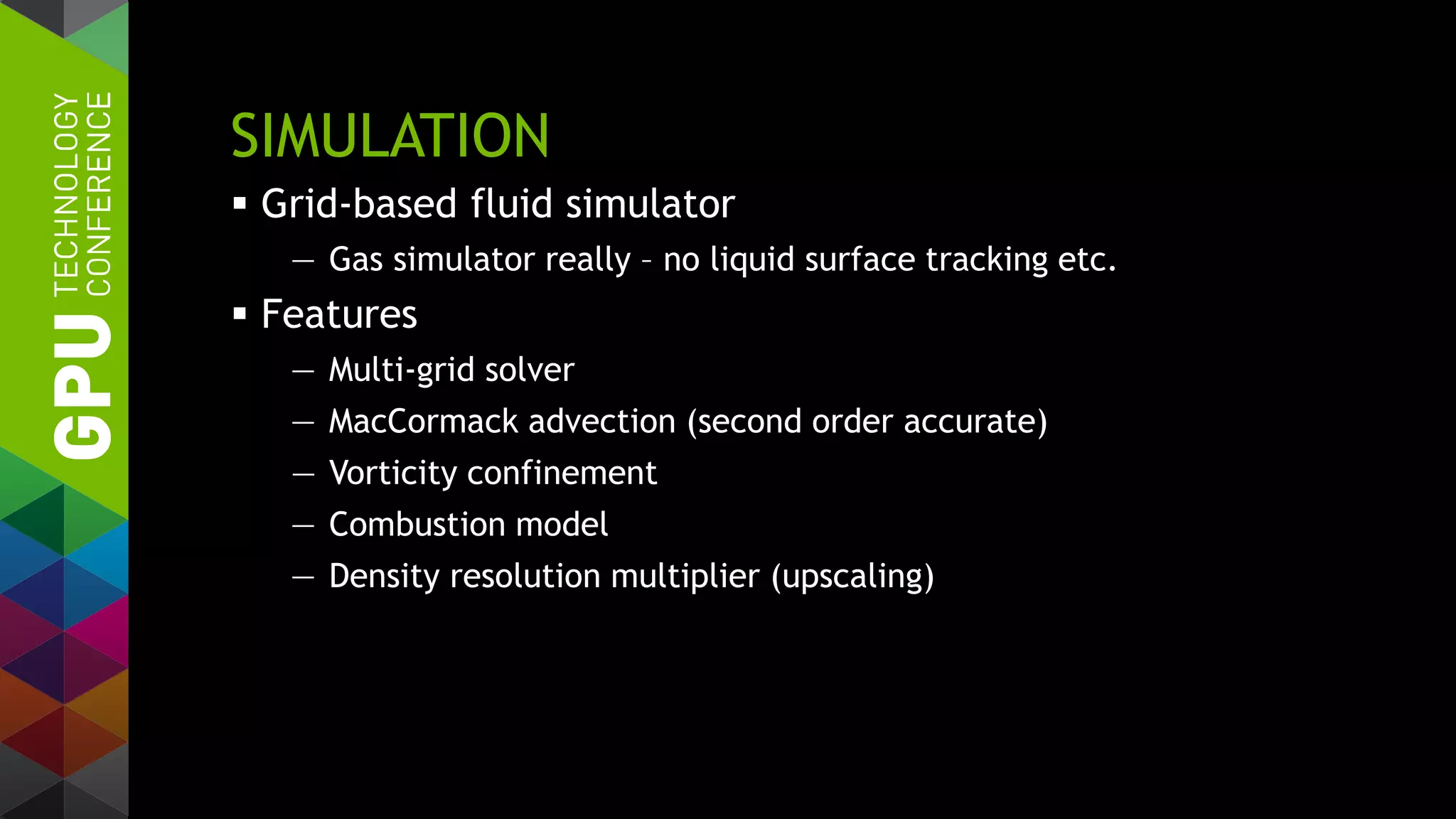
 Grid-based fluid simulator
— Gas simulator really – no liquid surface tracking etc.
 Features
— Multi-grid solver
— MacCormack advection (second order accurate)
— Vorticity confinement
— Combustion model
— Density resolution multiplier (upscaling)
SIMULATION
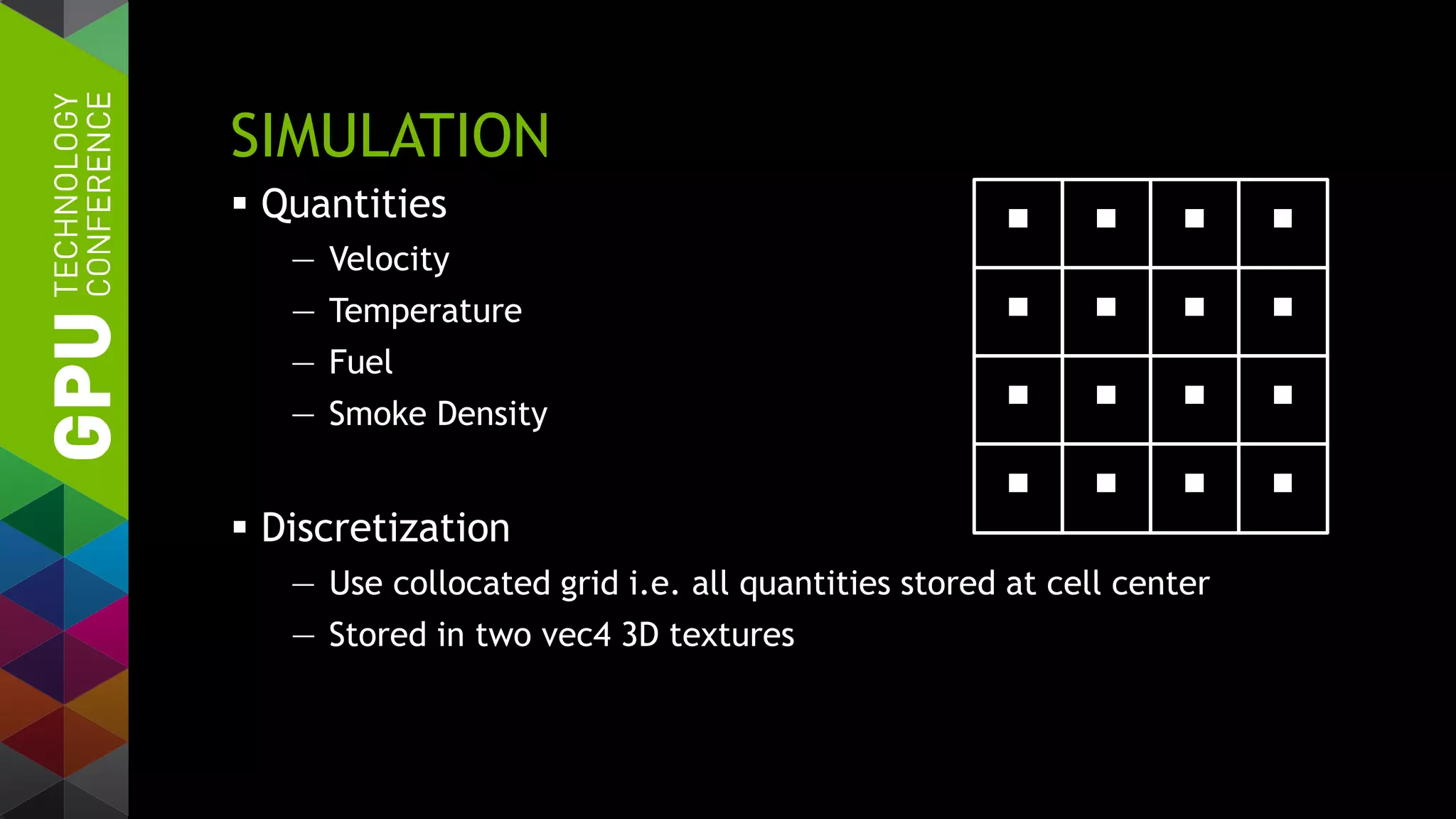
 Quantities
— Velocity
— Temperature
— Fuel
— Smoke Density
 Discretization
— Use collocated grid i.e. all quantities stored at cell center
— Stored in two vec4 3D textures
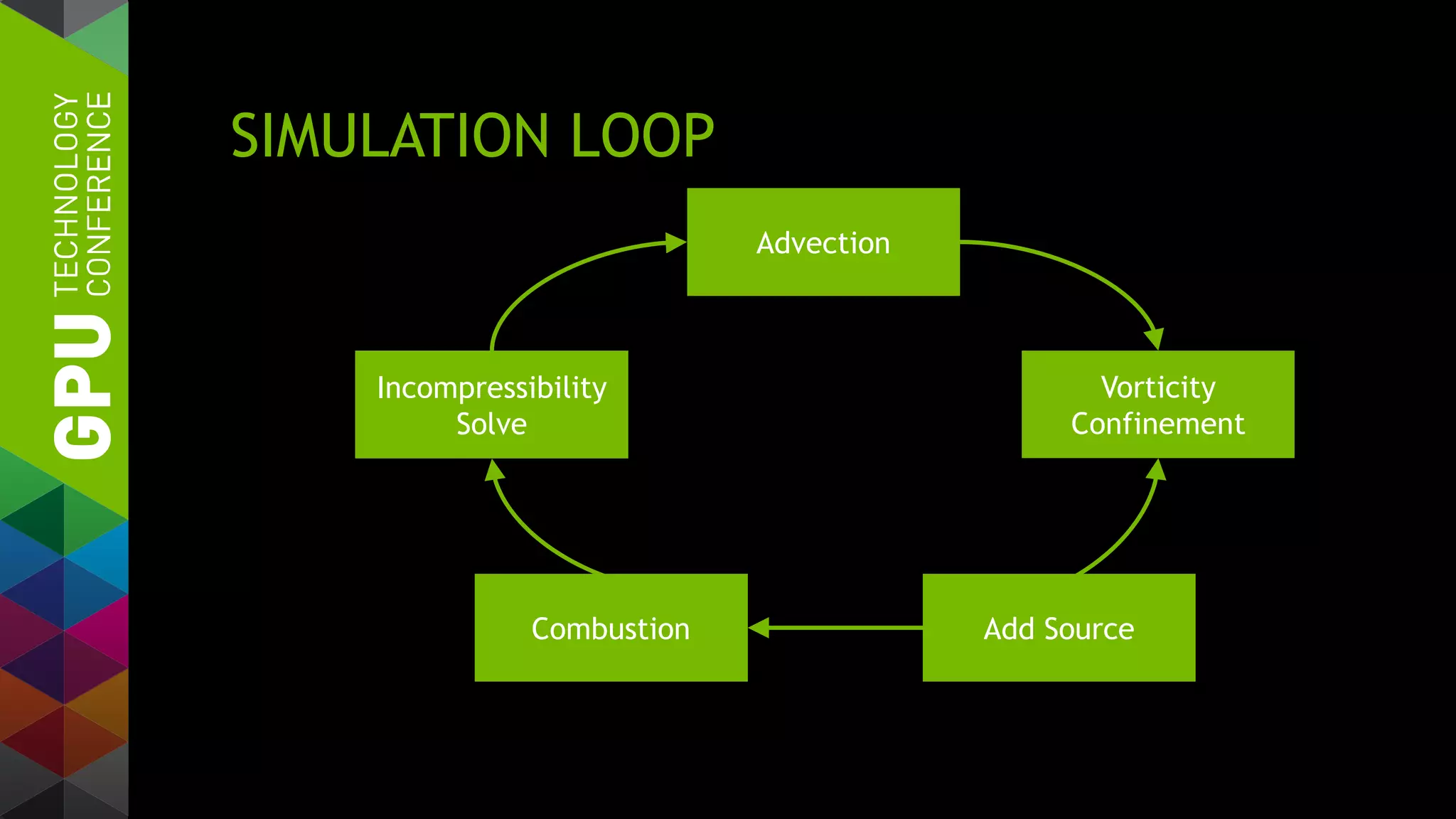
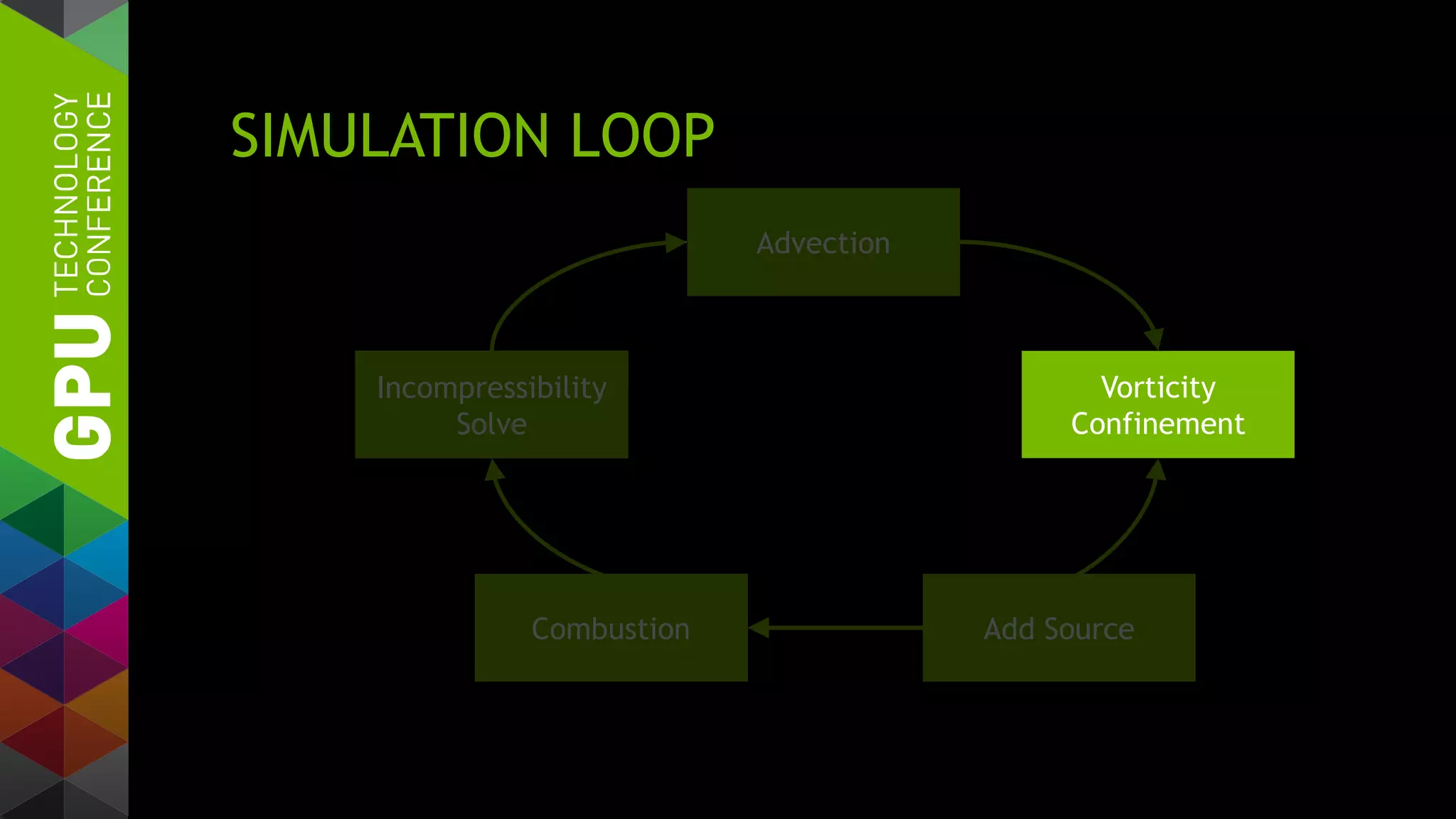
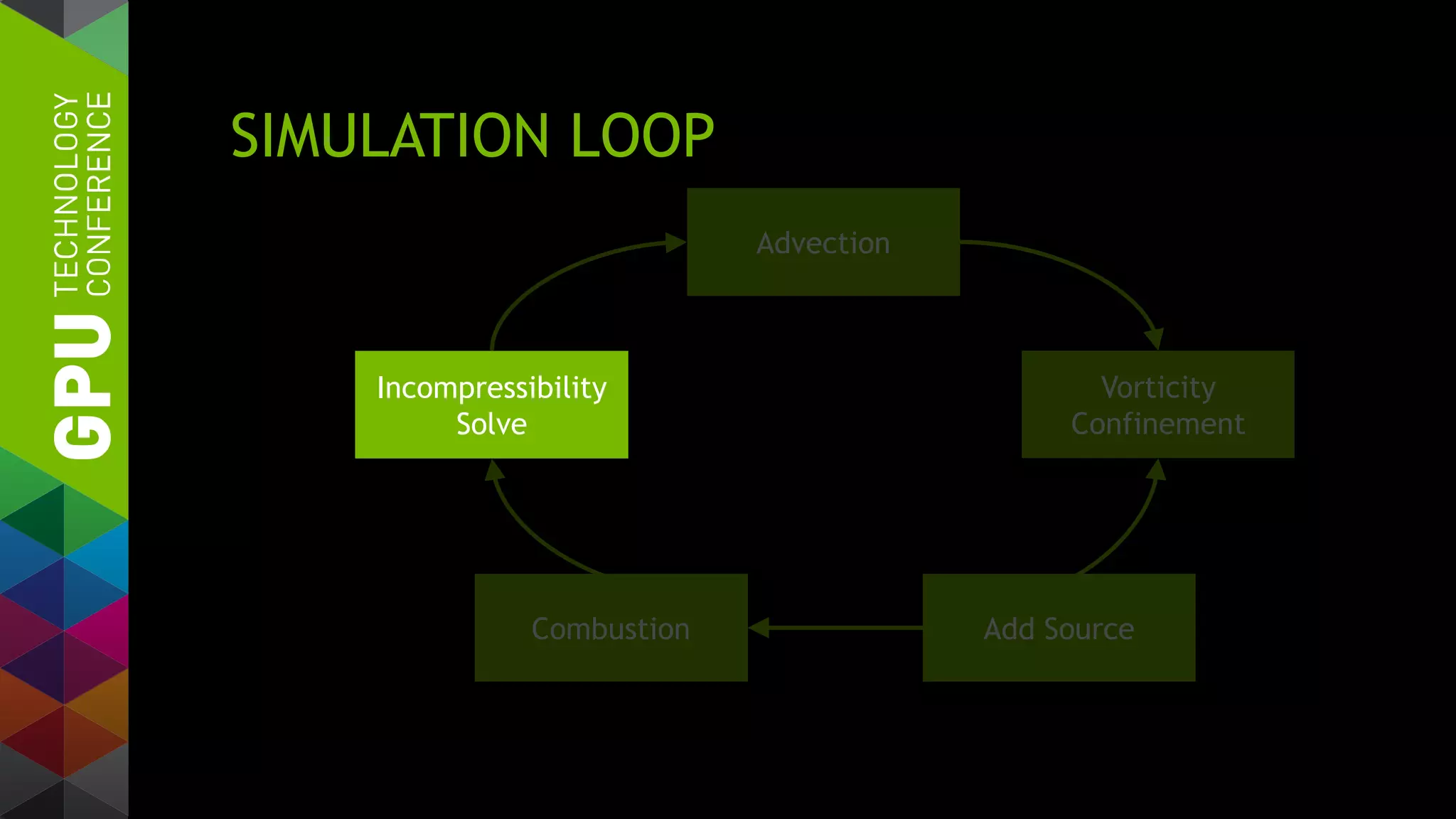
SIMULATION LOOP
Incompressibility
Solve
Advection
Vorticity
Confinement
Add SourceCombustion
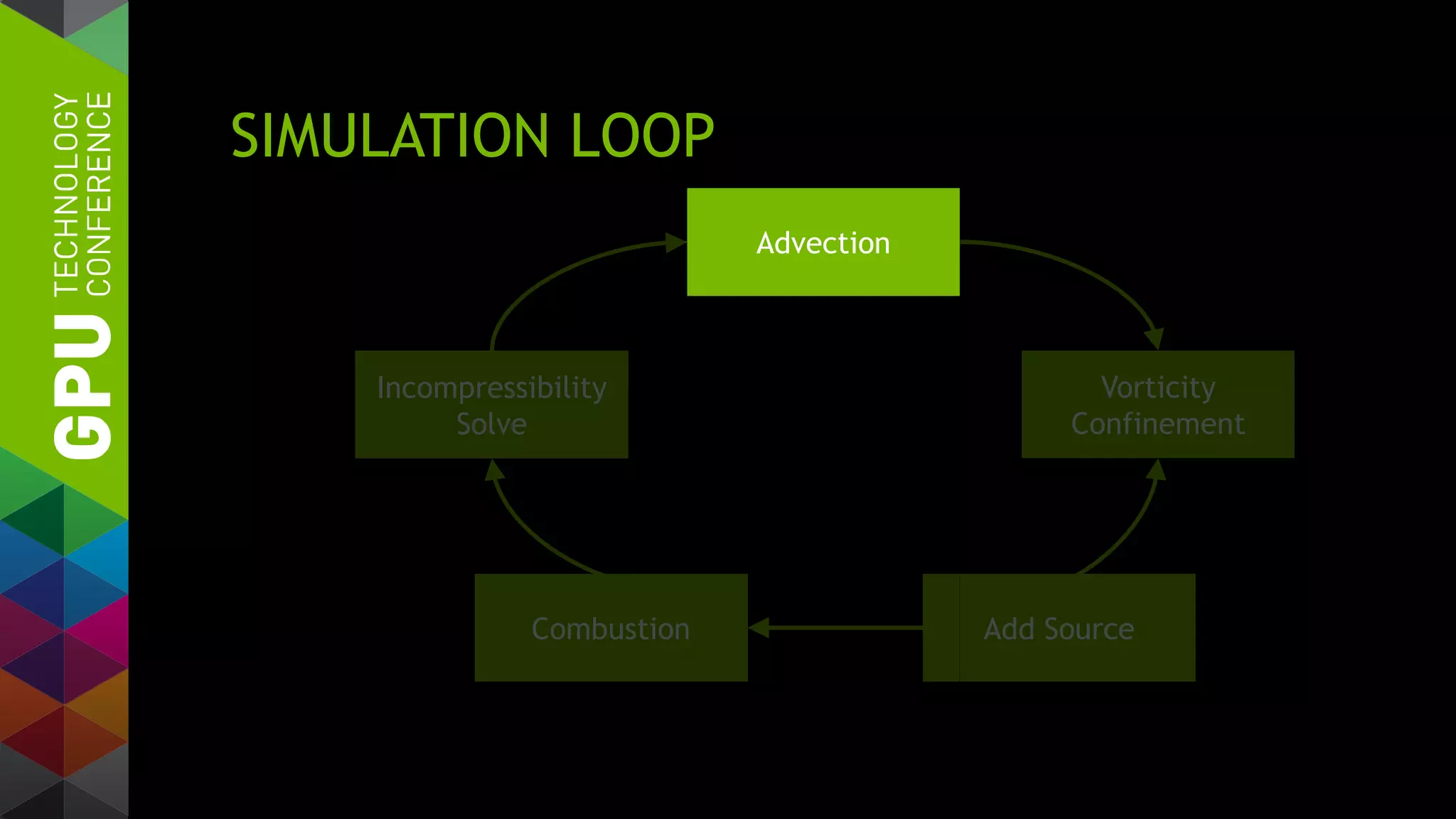
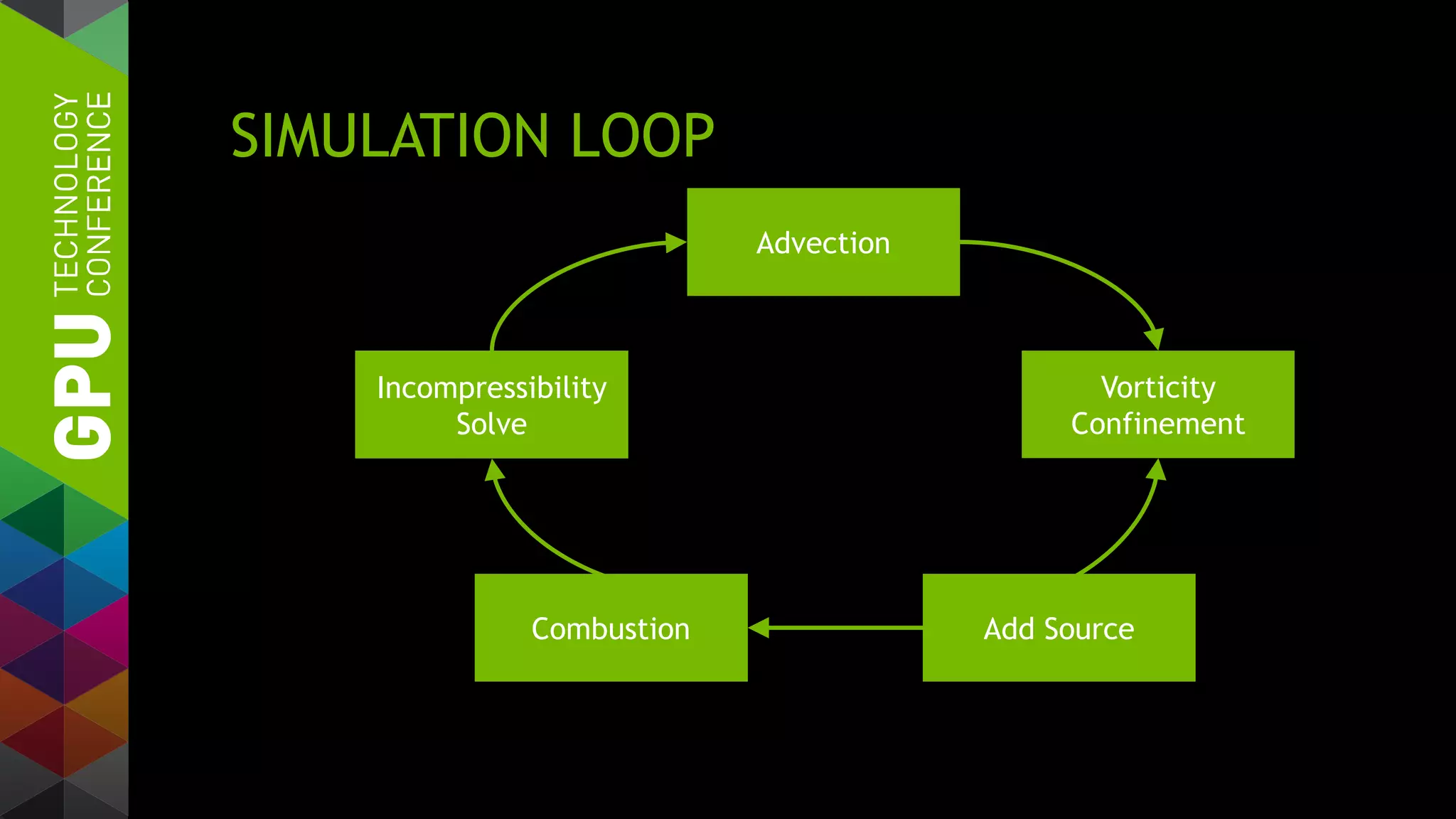
SIMULATION LOOP
Incompressibility
Solve
Advection
Vorticity
Confinement
Add SourceCombustion
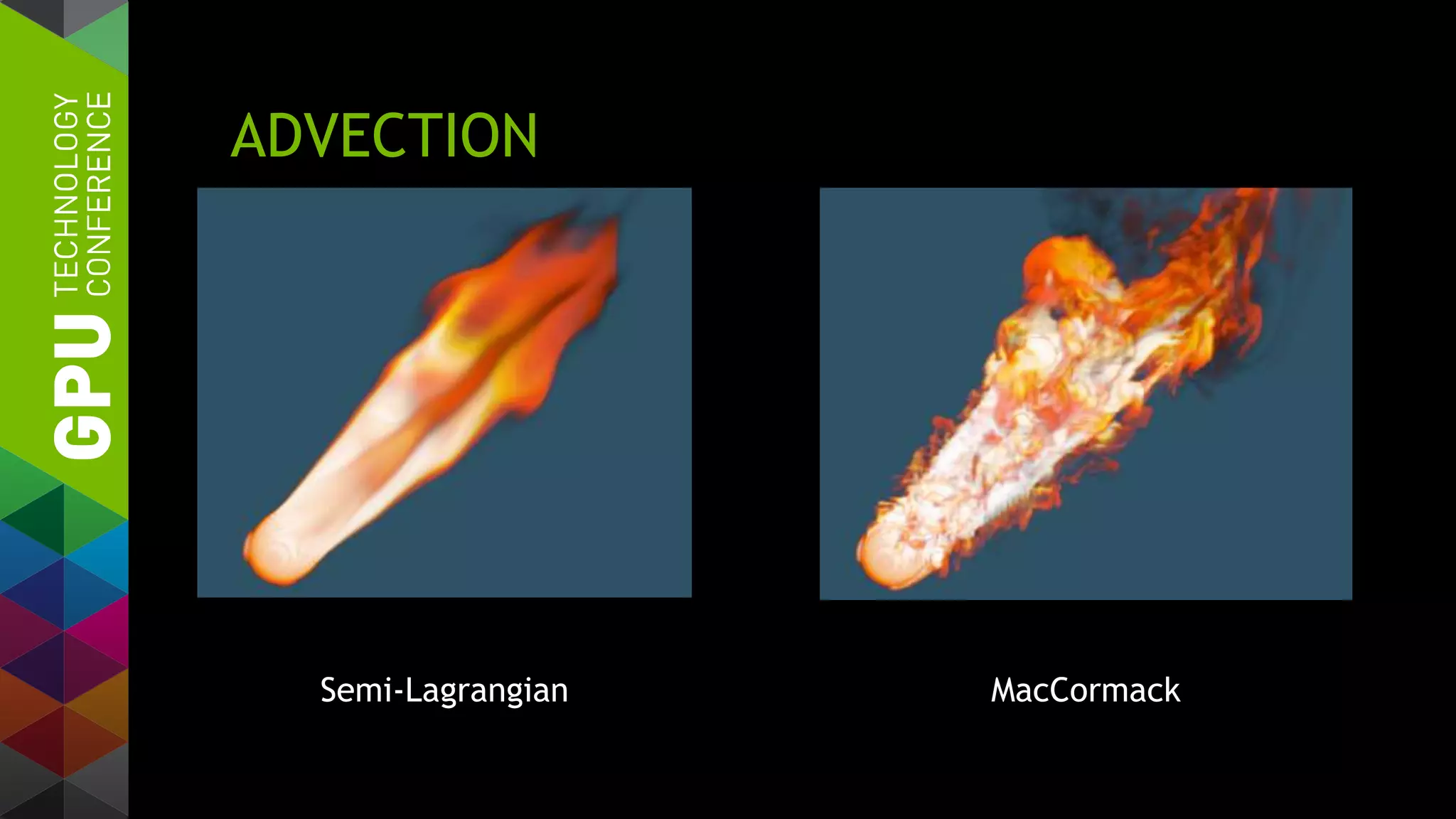
ADVECTION
 Fluid physical quantities such as temperature, density
etc. are moved by fluid velocity
— Fluid velocity itself is also moved by fluid velocity!
 Semi-Lagrangian Method [Stam 99]
— Start at a cell center
— Trace velocity field backward in time
— Interpolate quantity from grid
 Tri-Linear interpolation
 Optionally, move fuel at faster speed
ADVECTION
 Semi-Lagrangian method is first order accurate
— Causes a lot of numerical diffusion
— Smoke and flame smooth out
— Small scale details disappear
— Vortices disappear
 Use Modified MacCormack Method [Selle et al. 08]
— For temperature, density, fuel only
— Second order accurate
— Tracing backward and then forward in time to estimate the error
— Subtract the estimated error off to get a more accurate answer
ADVECTION
Semi-Lagrangian MacCormack
SIMULATION LOOP
Incompressibility
Solve
Advection
Vorticity
Confinement
Add SourceCombustion
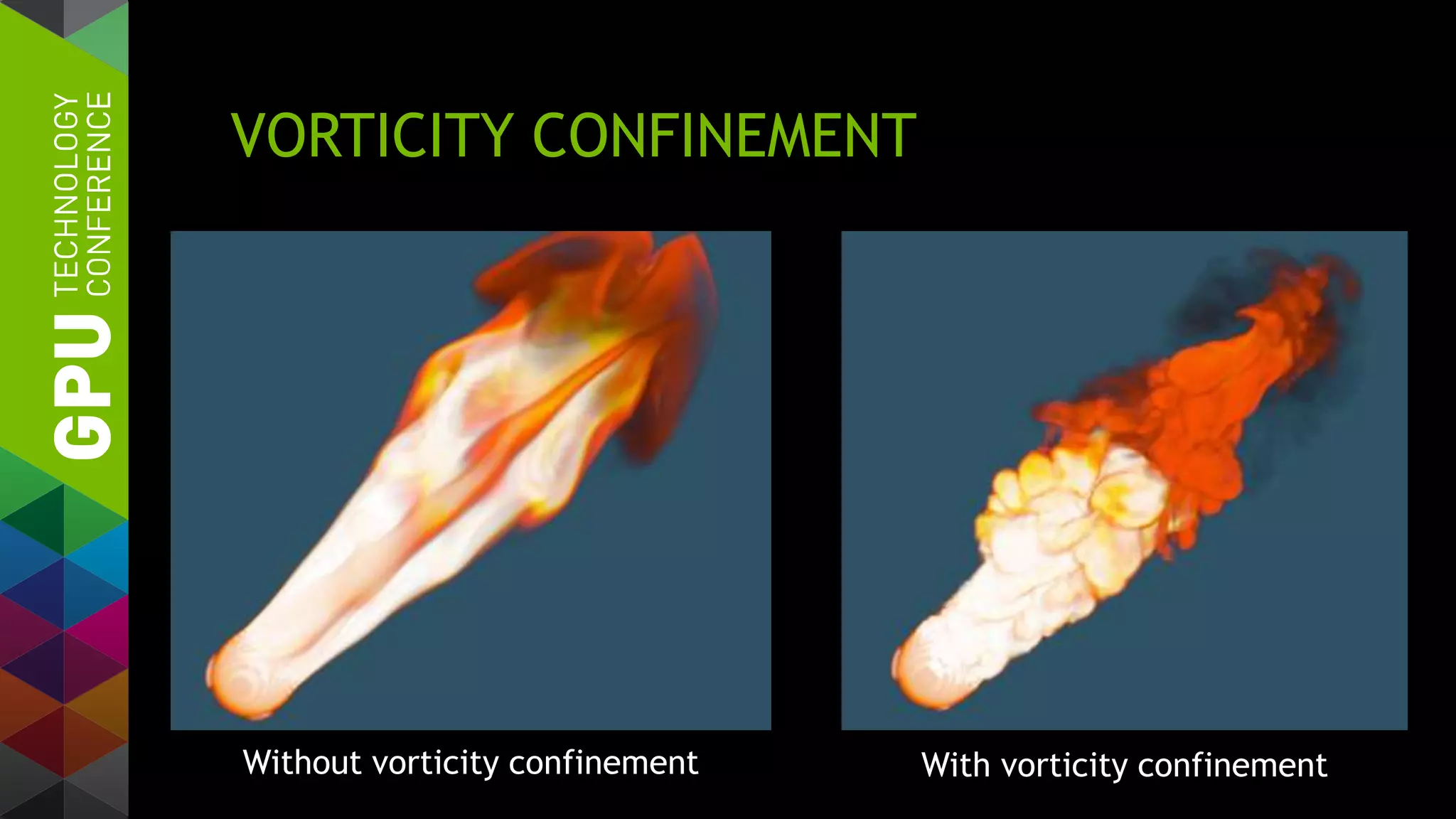
VORTICITY CONFINEMENT
 Identify where vortices are, then add force to amplify them
[Fedkiw et al. 01]
Before After* *exaggerated for visualization purpose
VORTICITY CONFINEMENT
Without vorticity confinement With vorticity confinement
SIMULATION LOOP
Incompressibility
Solve
Advection
Vorticity
Confinement
Add SourceCombustion
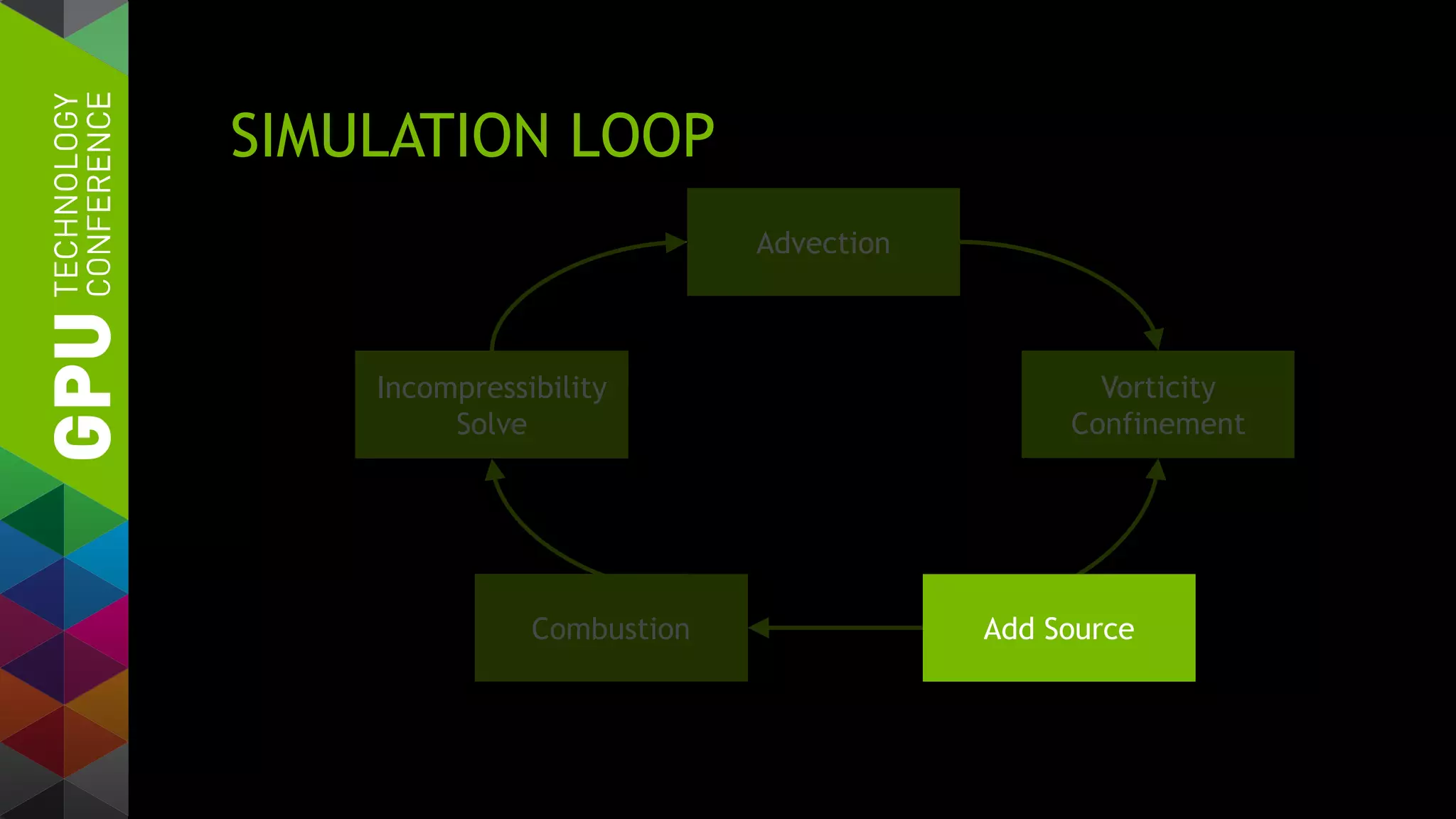
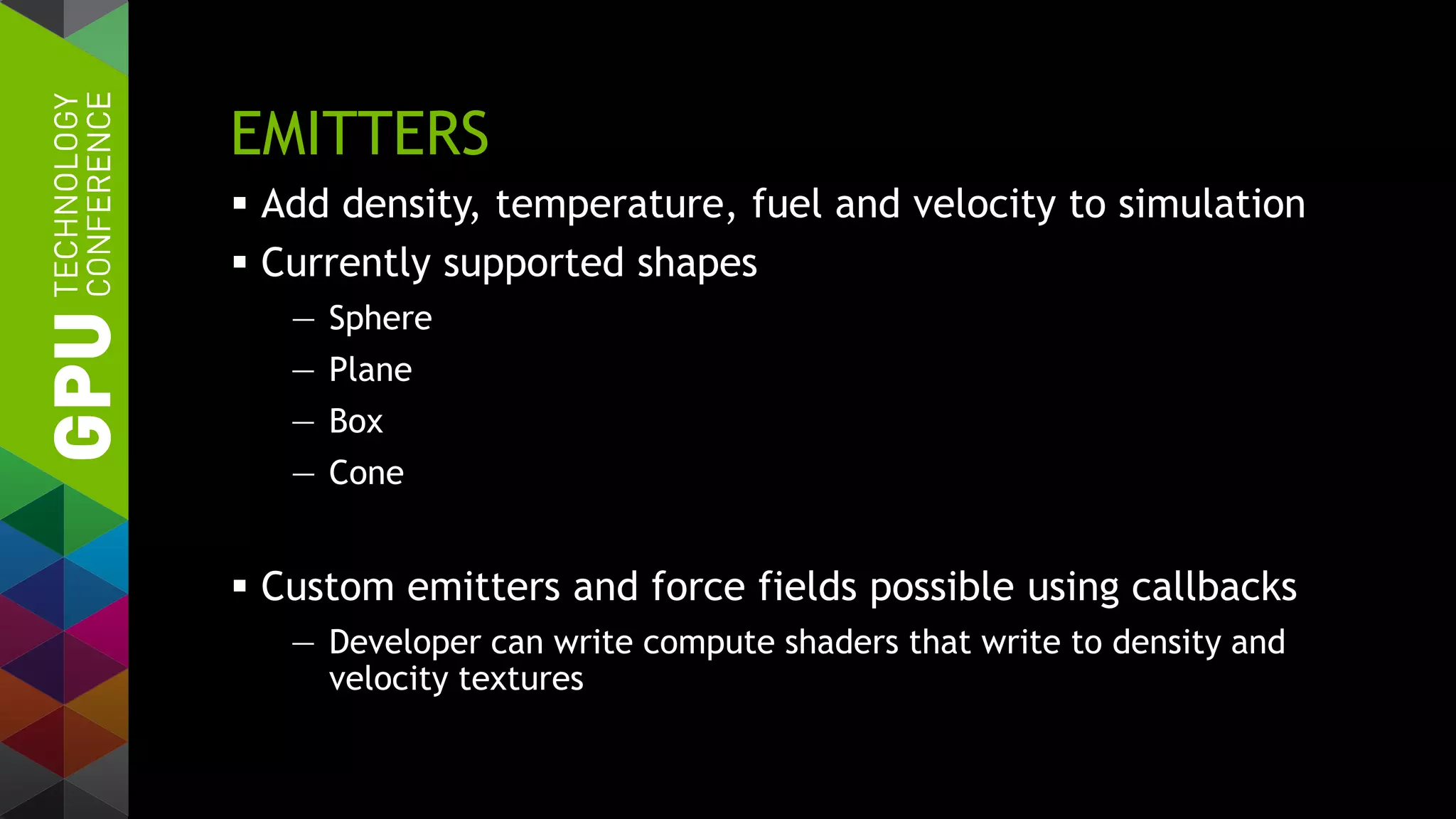
EMITTERS
 Add density, temperature, fuel and velocity to simulation
 Currently supported shapes
— Sphere
— Plane
— Box
— Cone
 Custom emitters and force fields possible using callbacks
— Developer can write compute shaders that write to density and
velocity textures
CUSTOM EMITTER HLSL EXAMPLE
Texture3D<float4> srcTex : register (t0);
RWTexture3D<float4> dstTex : register (u0);
[numthreads(THREADS_X, THREADS_Y, THREADS_Z)]
void DensityEmitter(uint3 i : SV_DispatchThreadID)
{
// read existing data at this cell
float4 d = srcTex[i];
float3 p = voxelToWorld(i);
float r= length(p – emitterPos);
if (r < emitterRadius) {
d.x += smoothstep(emitterRadius, emitterInnerRadius, r);
};
// write new data
dstTex[i] = d;
}
COMBUSTION MODEL
 If temperature is above ignition temp and there is fuel,
combustion occurs:
— Consumes fuel
— Increases temperature
— Generates expansion by modifying simulation
divergence [Feldman & O’Brien 03]
— Temperature causes upwards buoyancy
 Optionally have temperature cooling
— Cooling rate proportional to temperaturek
— k = 4 is commonly used in practice
SIMULATION LOOP
Incompressibility
Solve
Advection
Vorticity
Confinement
Add SourceCombustion
INCOMPRESSIBILITY SOLVER
 Goal: Make velocity field divergence free
 Why?
— Incompressible fluid -> divergence free velocity field
— Responsible for swirling motion commonly associated with fluid
— Conserves mass
 How?
— Compute a pressure field whose gradient canceled out divergence of
velocity field [Stam 99]
— Pressure field is the solution to a linear system
SOLVING LINEAR SYSTEM
 Geometric multi-grid
— Open boundary on top, sides
— Closed boundary on bottom
— Ignores internal obstacles
 Use Iterate Orthogonal Projection (IOP) [Molemaker et al. 08],
to enforce solid boundary condition for internal obstacles
— Set the normal component of fluid velocity to that of solid
— Do multi-grid
— Set the normal component of fluid velocity to that of solid
— (can repeat for more accurate solution)
SIMULATION LOOP
Incompressibility
Solve
Advection
Vorticity
Confinement
Add SourceCombustion
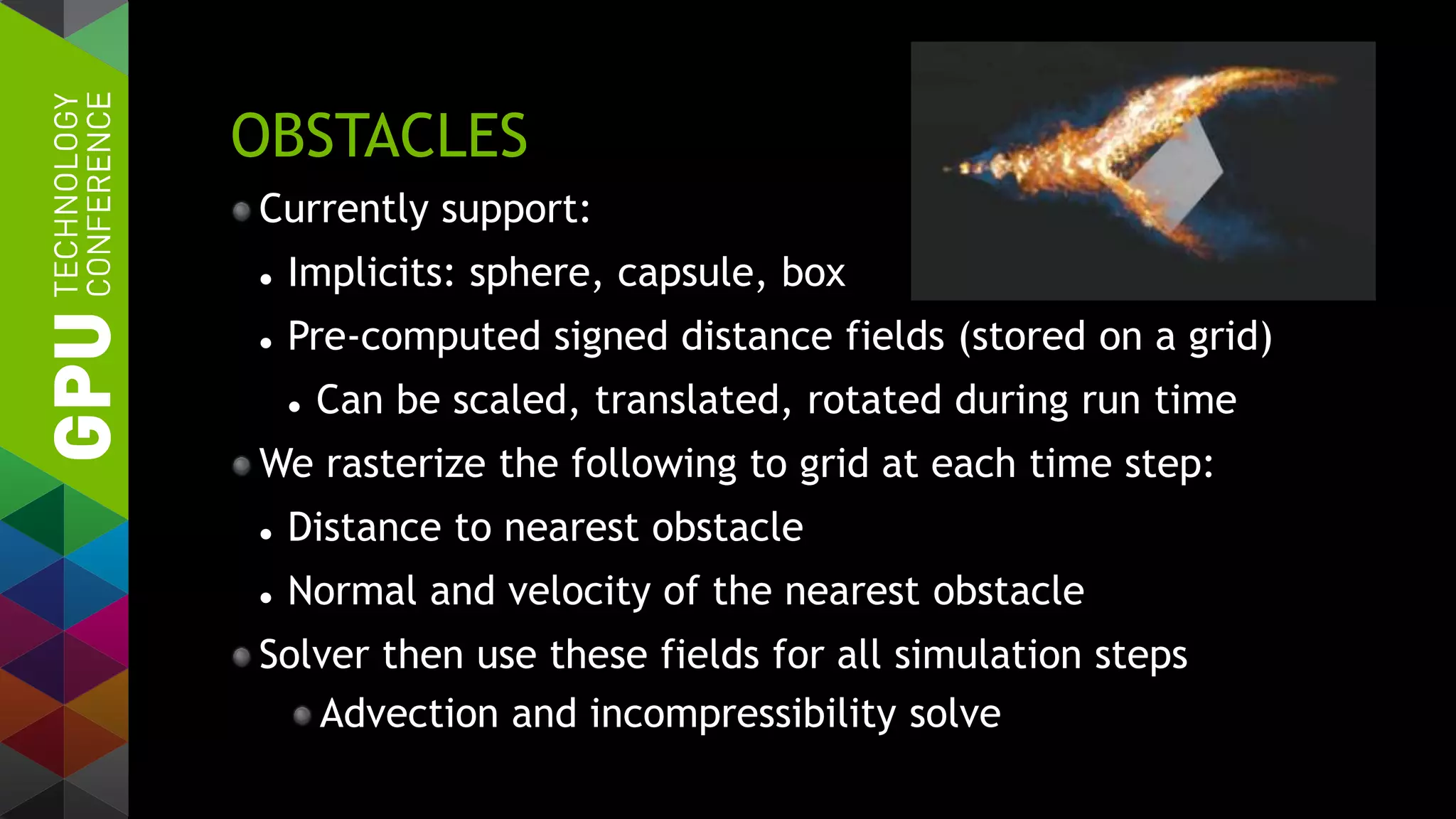
OBSTACLES
Currently support:
 Implicits: sphere, capsule, box
 Pre-computed signed distance fields (stored on a grid)
 Can be scaled, translated, rotated during run time
We rasterize the following to grid at each time step:
 Distance to nearest obstacle
 Normal and velocity of the nearest obstacle
Solver then use these fields for all simulation steps
Advection and incompressibility solve
MOVING GRID
 Grid can be translated to follow moving objects
 Basically adds opposite velocity during advection
 Currently grid is always axis-aligned
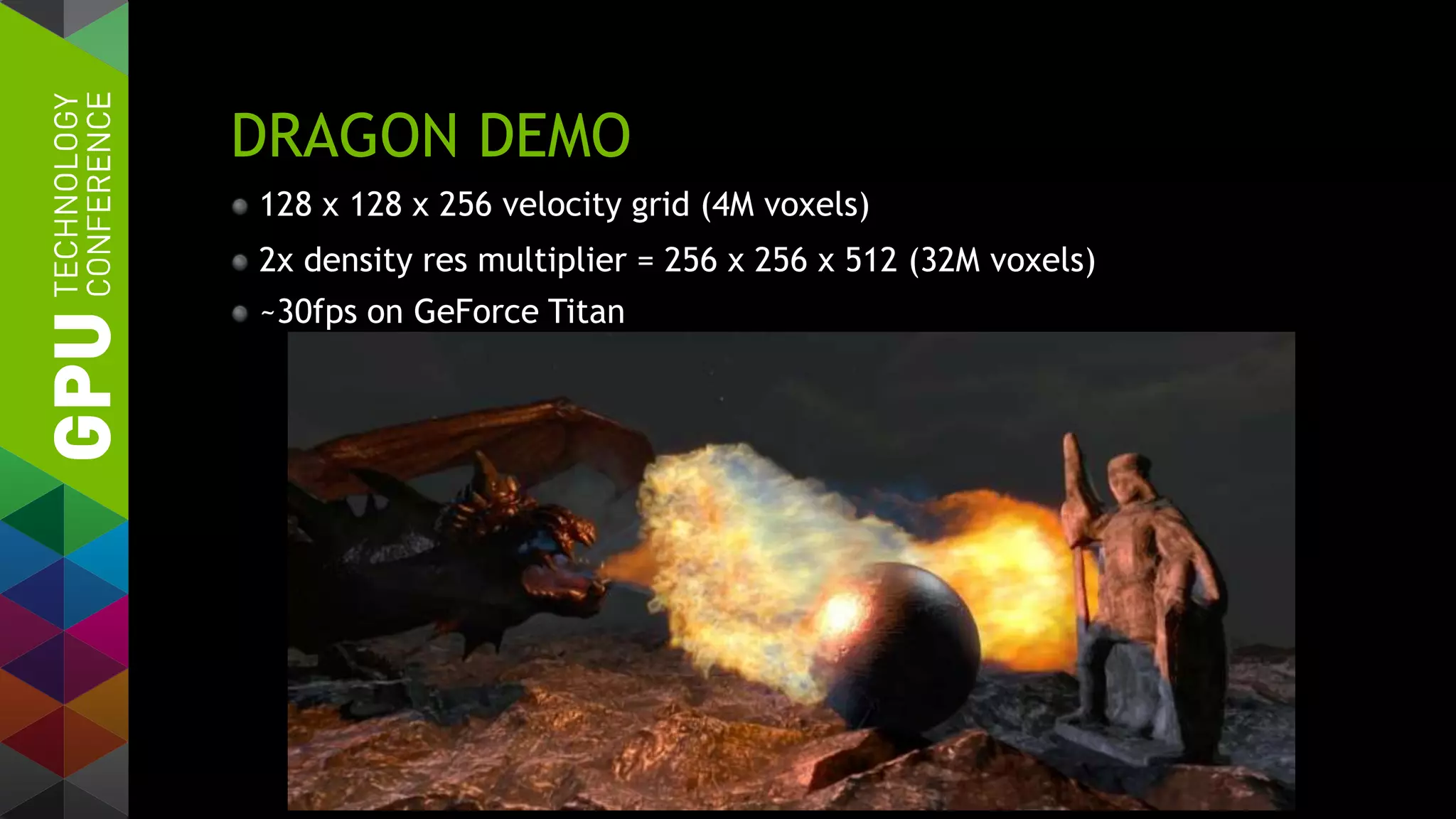
DRAGON DEMO
128 x 128 x 256 velocity grid (4M voxels)
2x density res multiplier = 256 x 256 x 512 (32M voxels)
~30fps on GeForce Titan
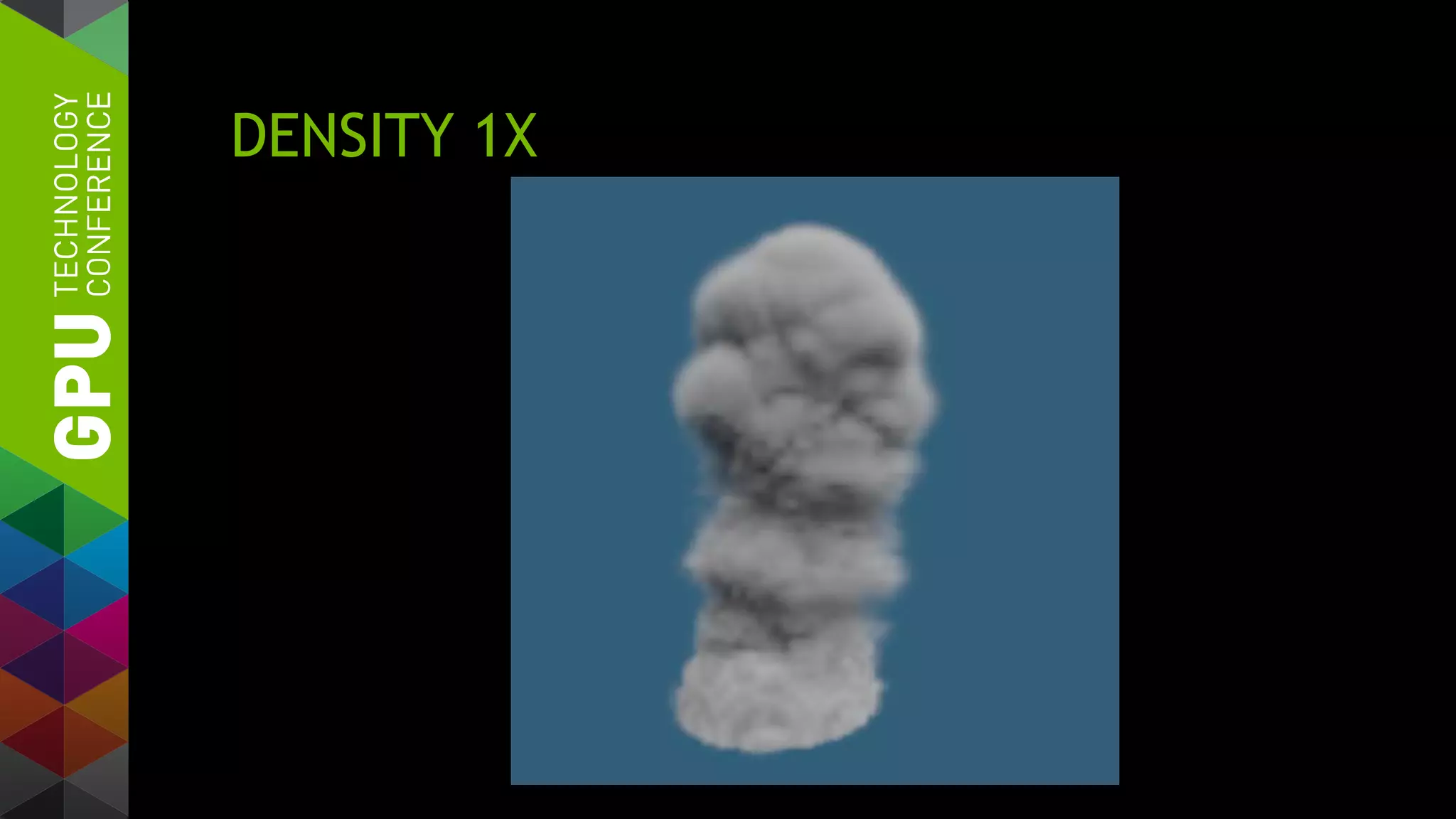
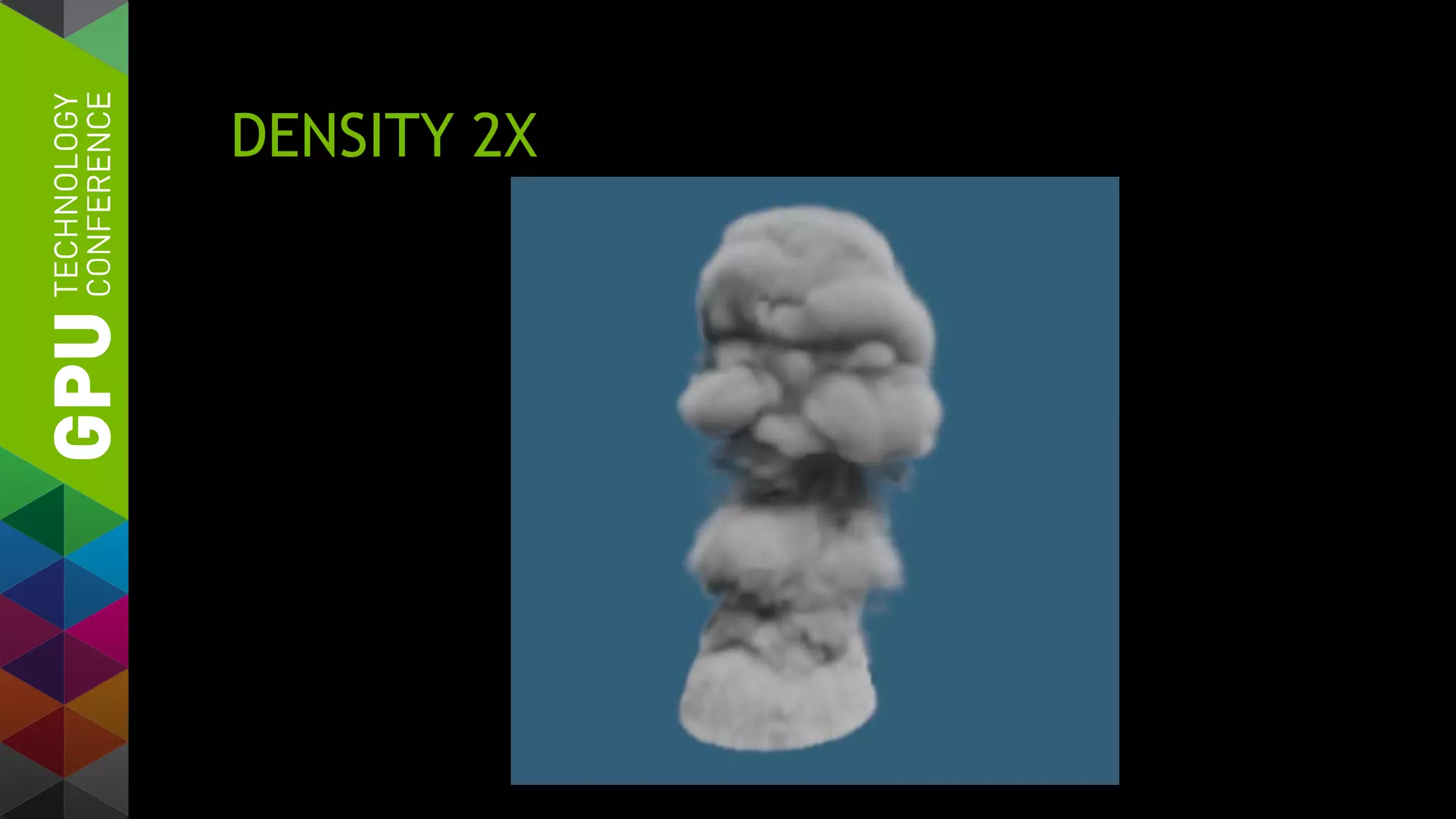
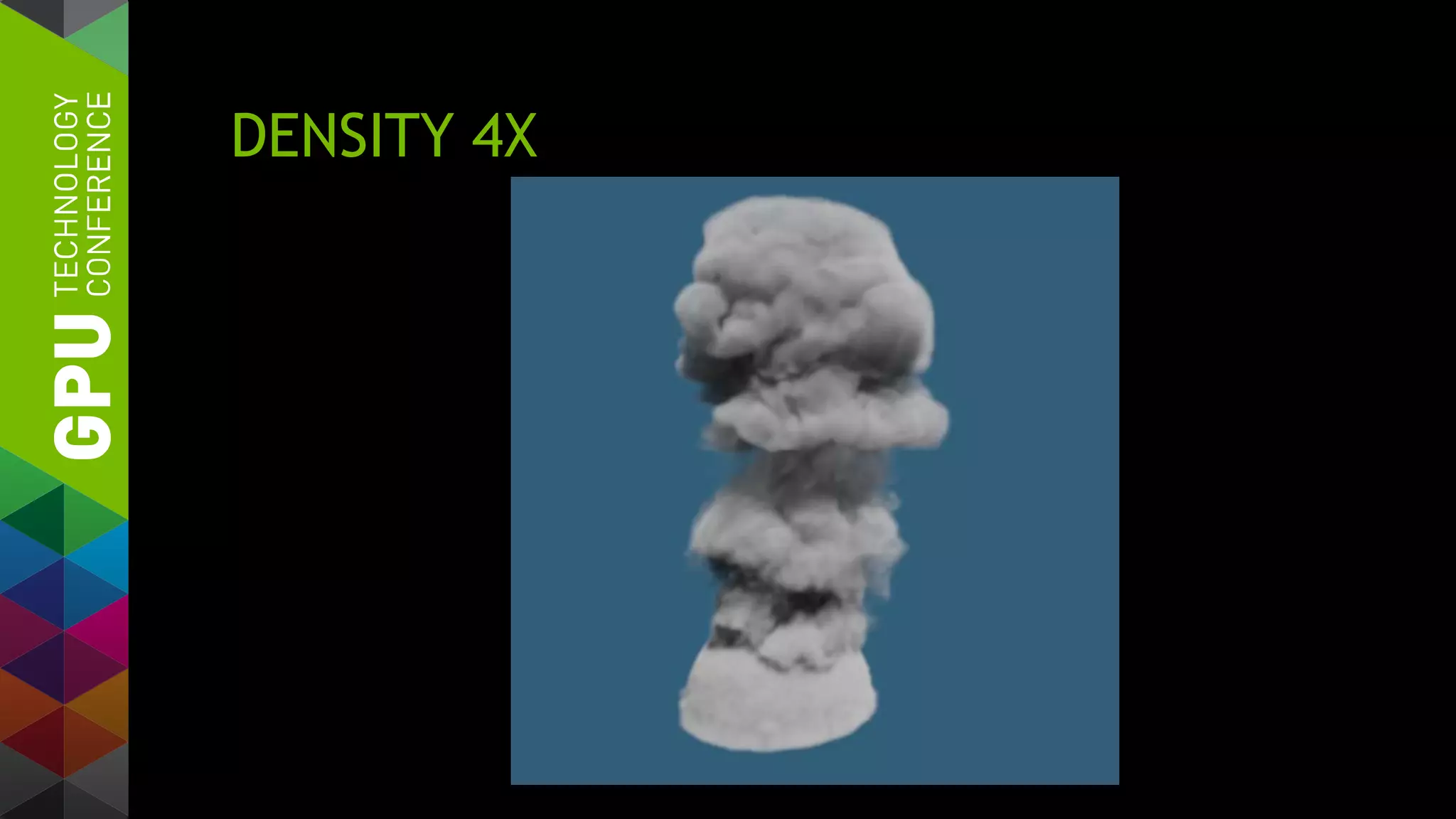
HIGH-RES DENSITY
 Density grid can be stored at higher resolution than velocity
— Usually 2x or 4x resolution
 Improves performance since velocity solver is main bottleneck
 Velocities are interpolated during density advection
— Not strictly correct since interpolated velocities aren’t divergence-
free
— But looks fine
DENSITY 1X
DENSITY 2X
DENSITY 4X
RENDERING OPTIONS
—Particles
 Advect particles through velocity field from simulation
 Render as point sprites
 Requires depth sorting for correct bending
—Iso-surface rendering
 Using marching cubes or ray marching to extract surface
—Volume Rendering
 Highest quality option
VOLUME RENDERING
Separate part of FlameWorks
Optional - developers are free to do their own rendering
Implemented using ray-marching in pixel shader
Features
Color mapping
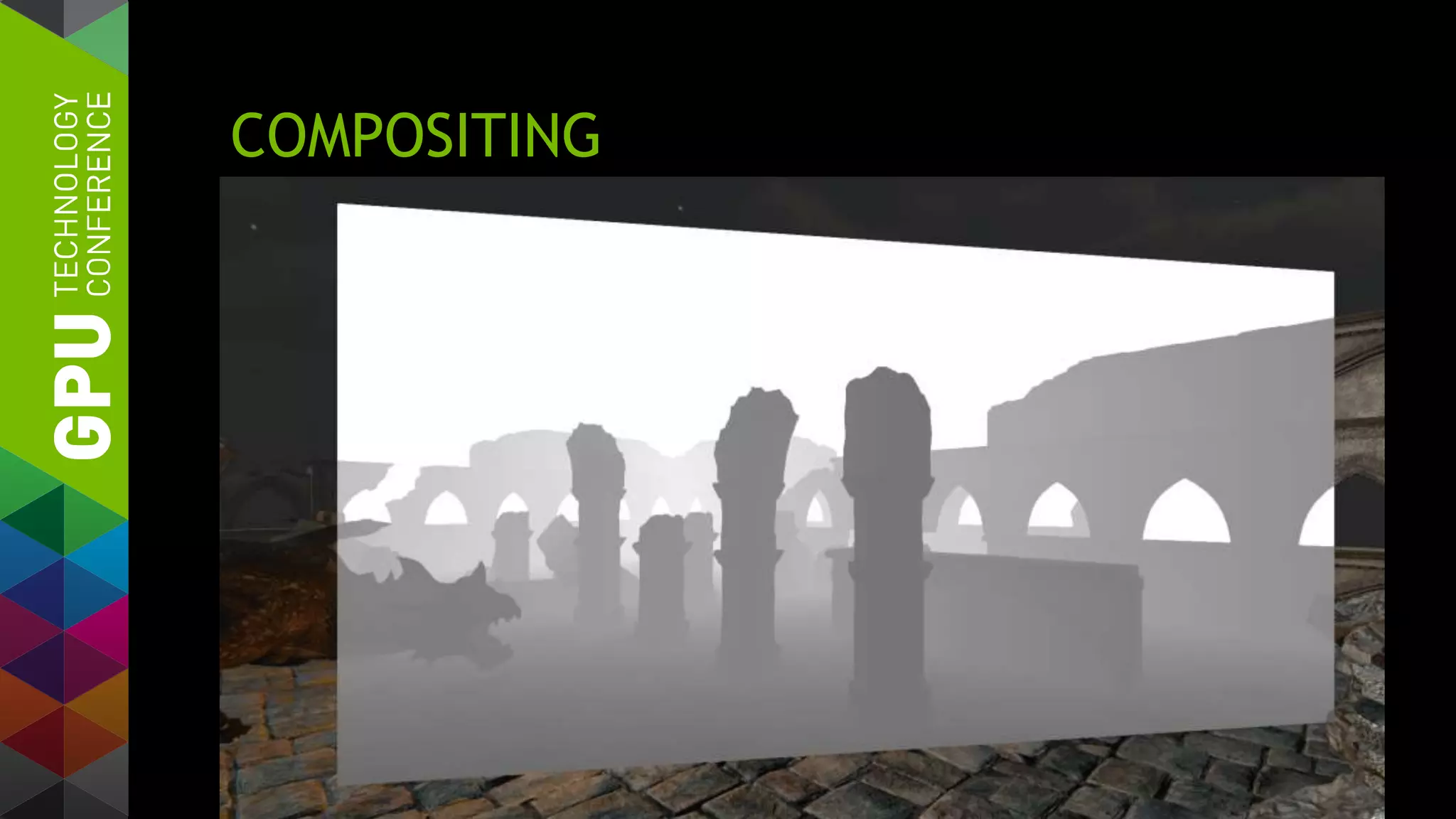
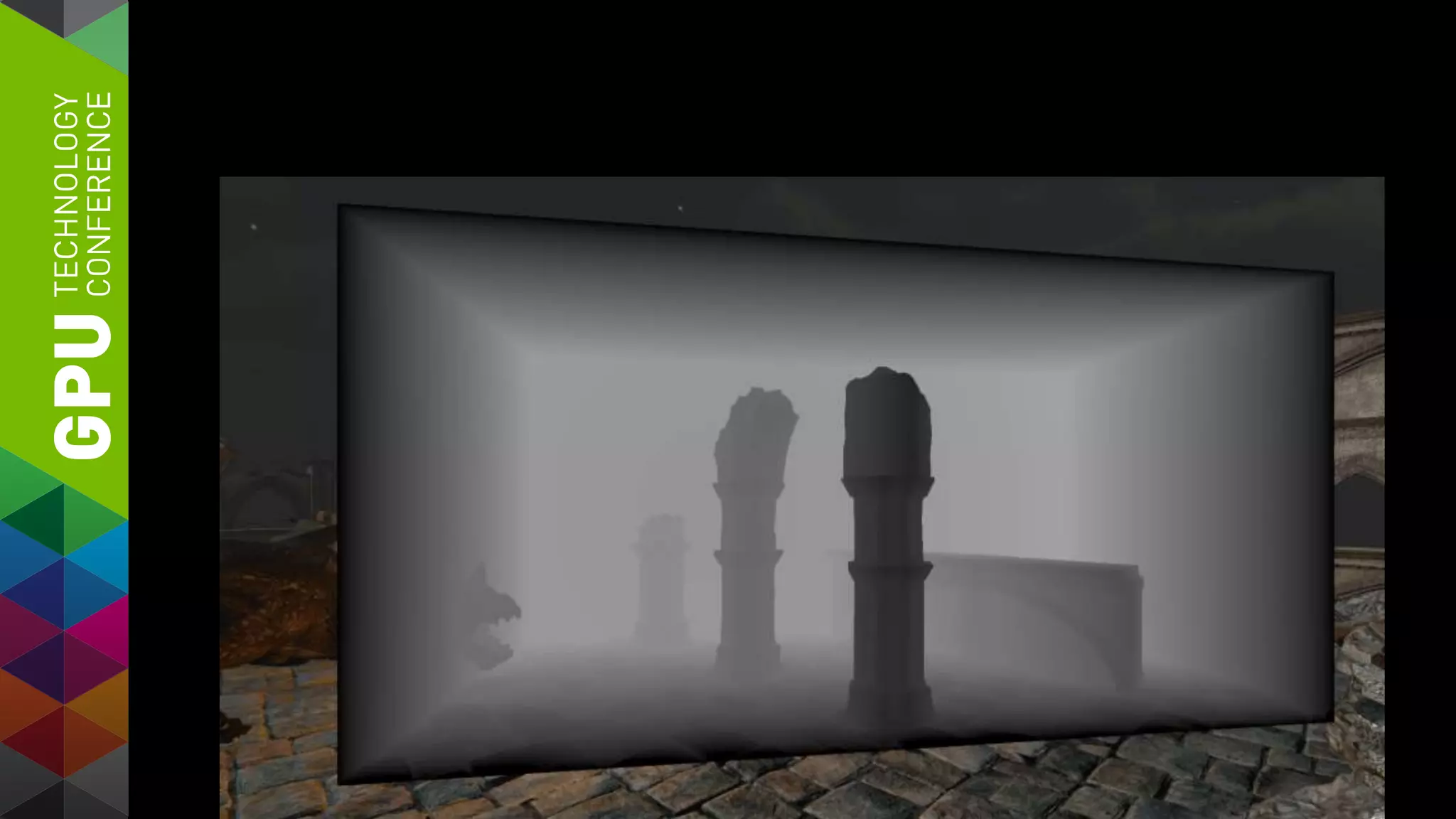
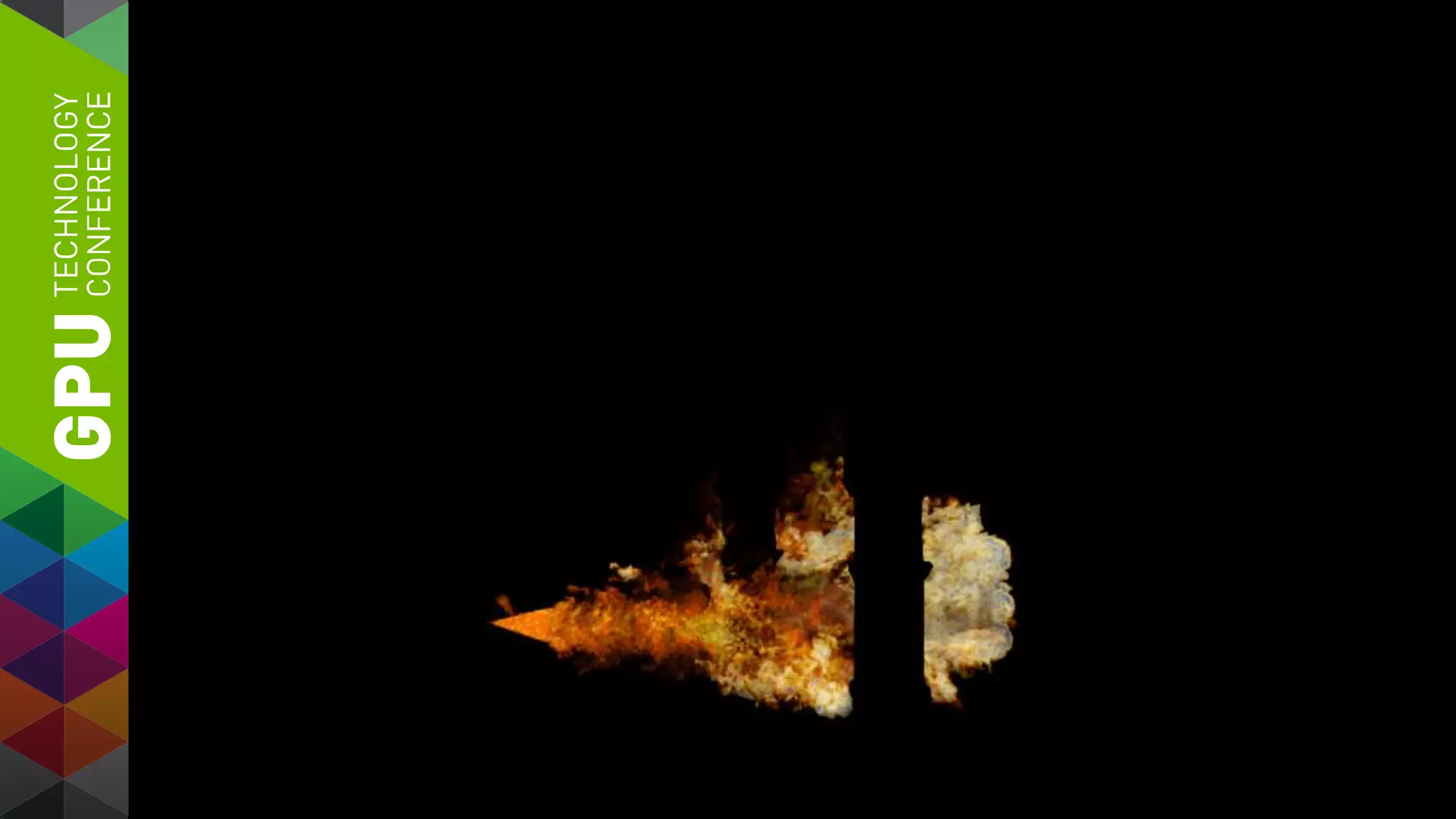
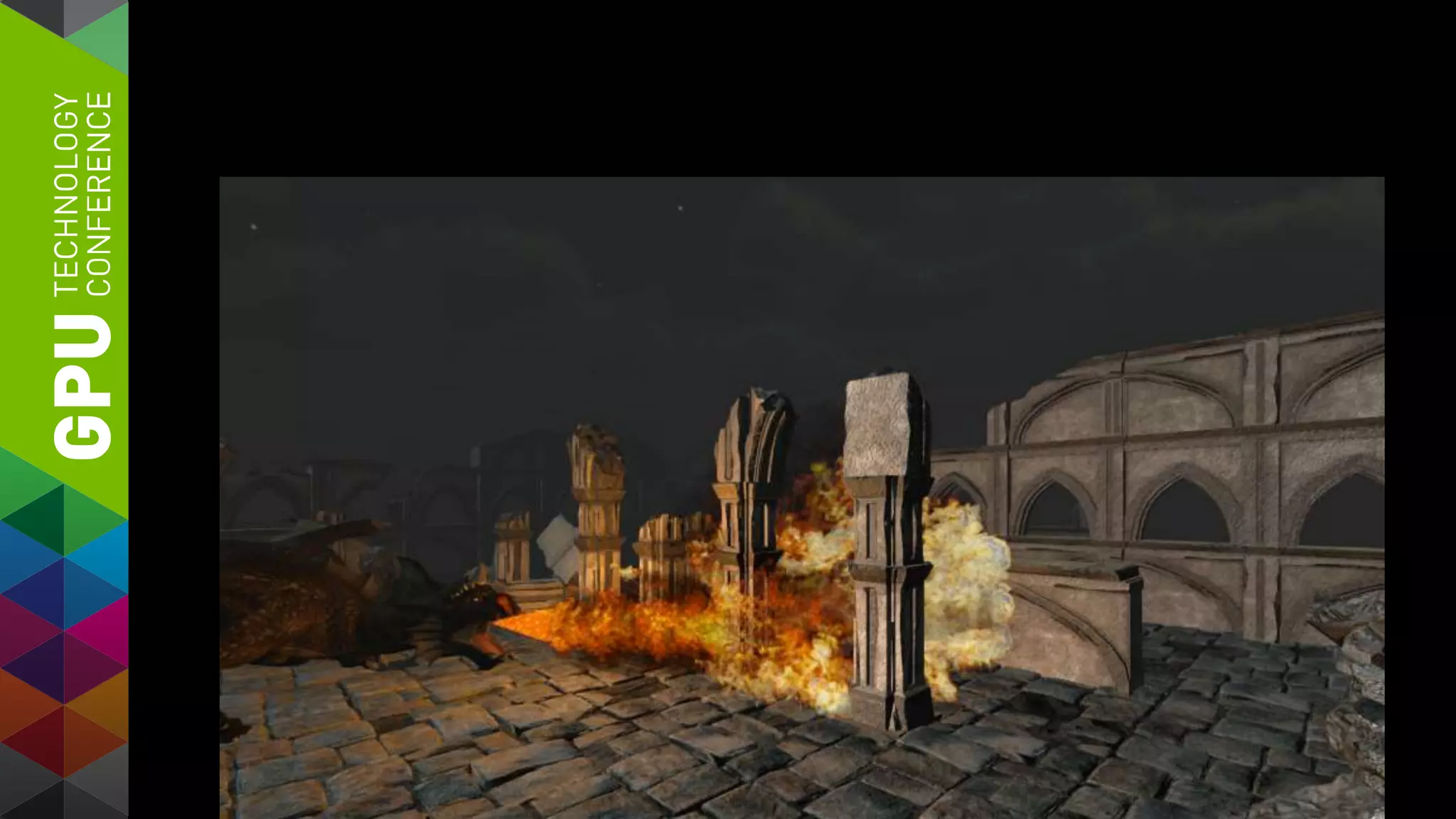
Depth compositing
Down-sampled rendering with up-sampling
Empty space skipping
Edge fading
Heat Haze
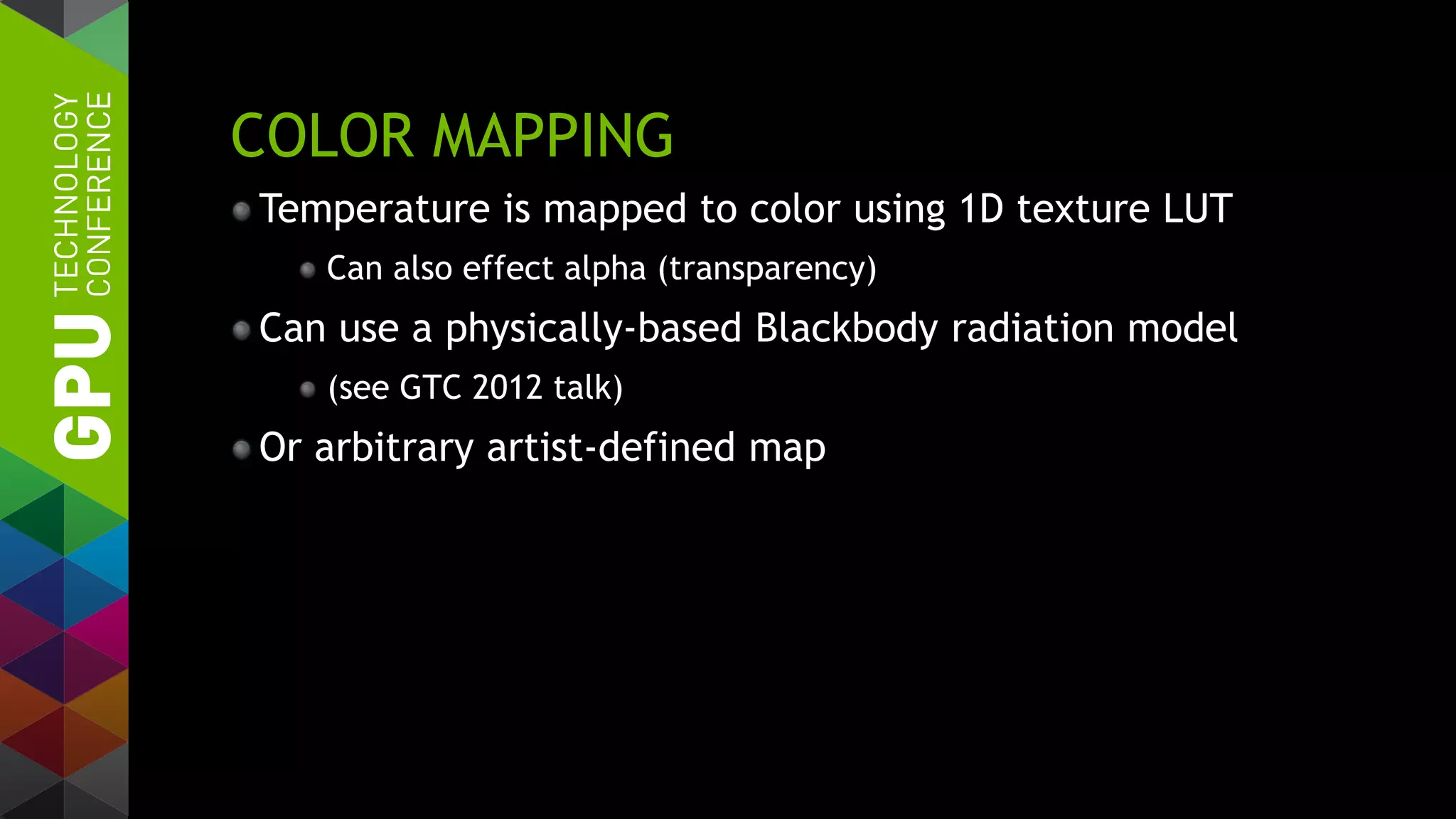
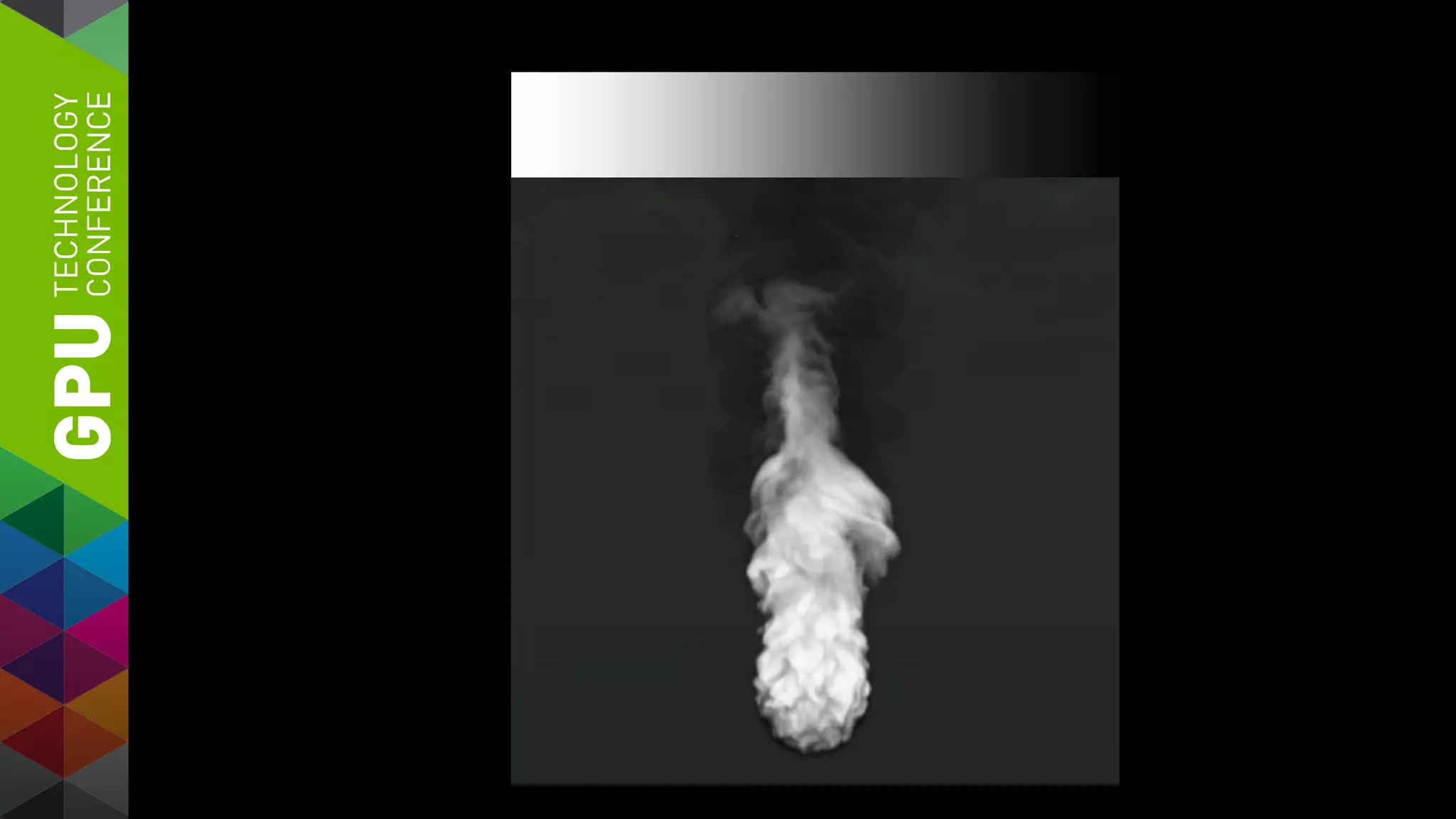
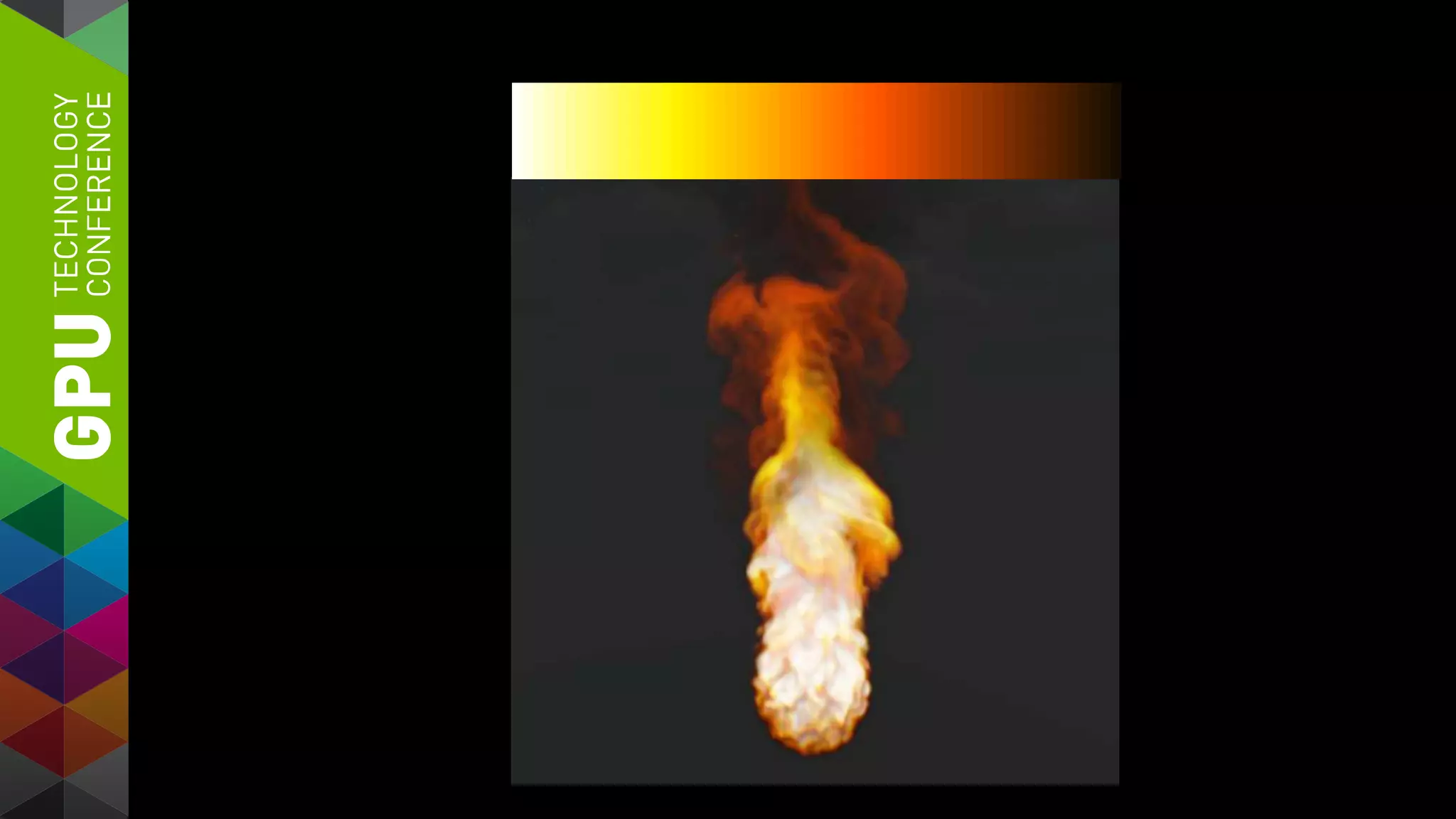
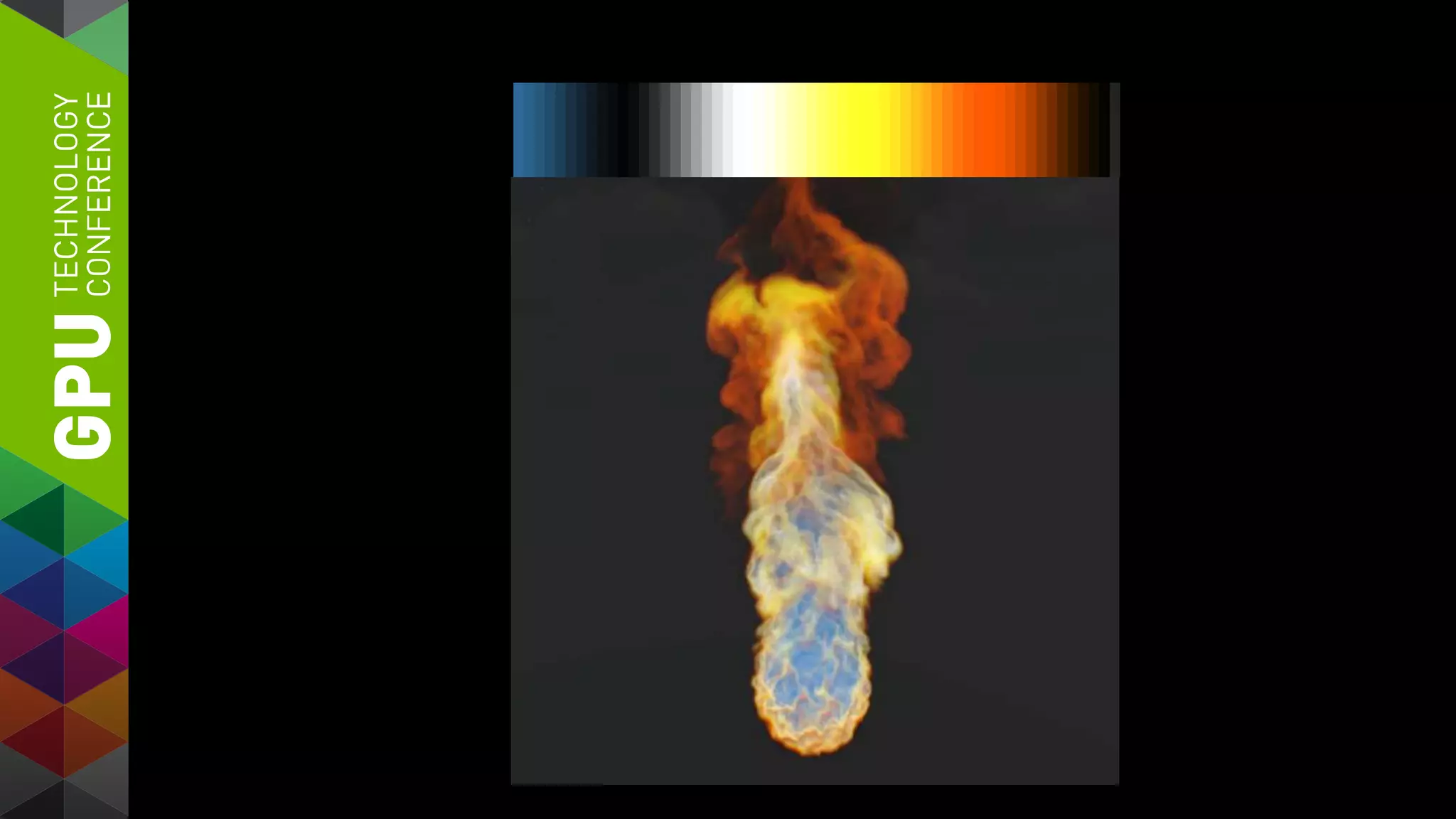
COLOR MAPPING
Temperature is mapped to color using 1D texture LUT
Can also effect alpha (transparency)
Can use a physically-based Blackbody radiation model
(see GTC 2012 talk)
Or arbitrary artist-defined map
COMPOSITING
HEAT HAZE
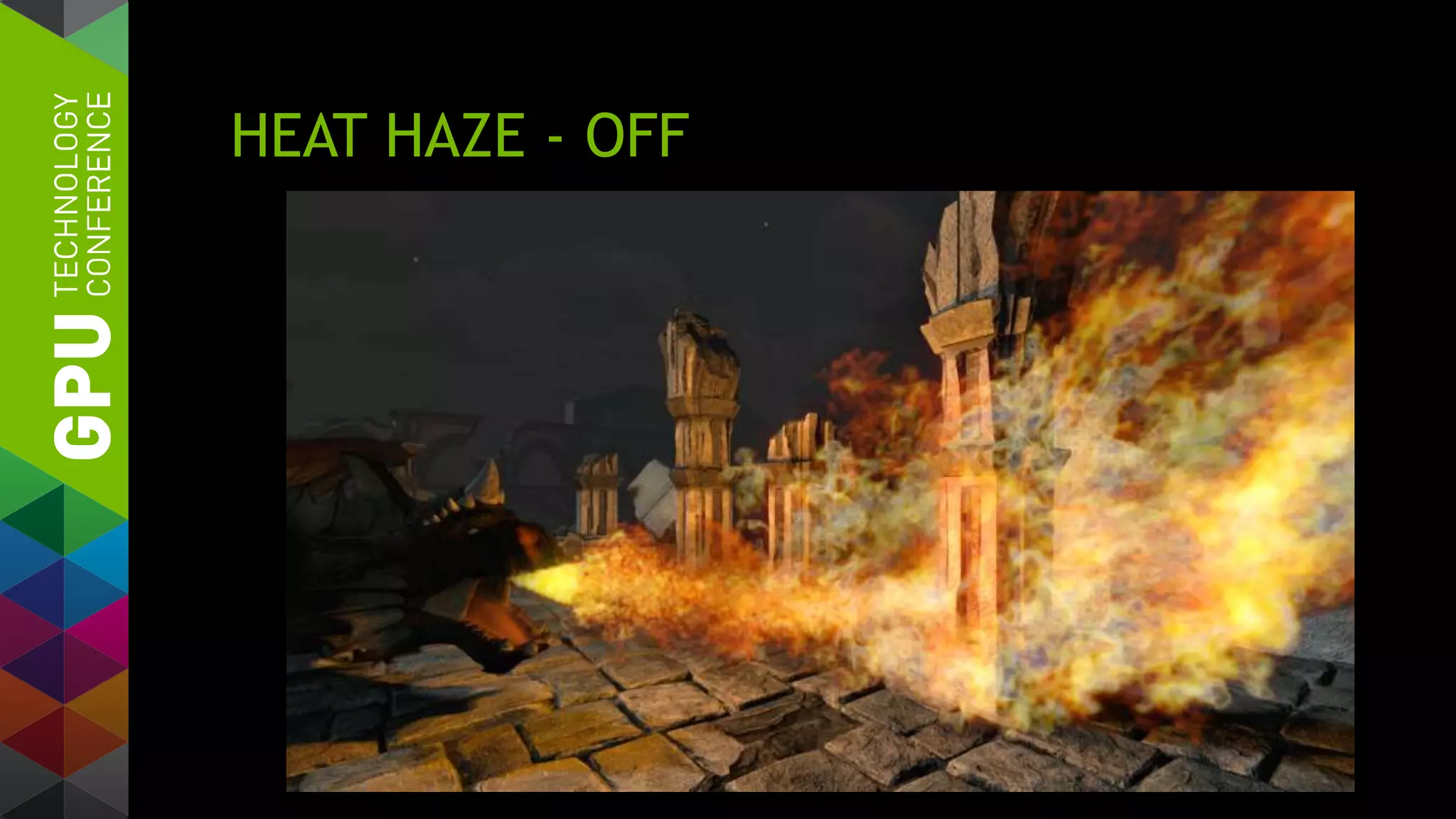
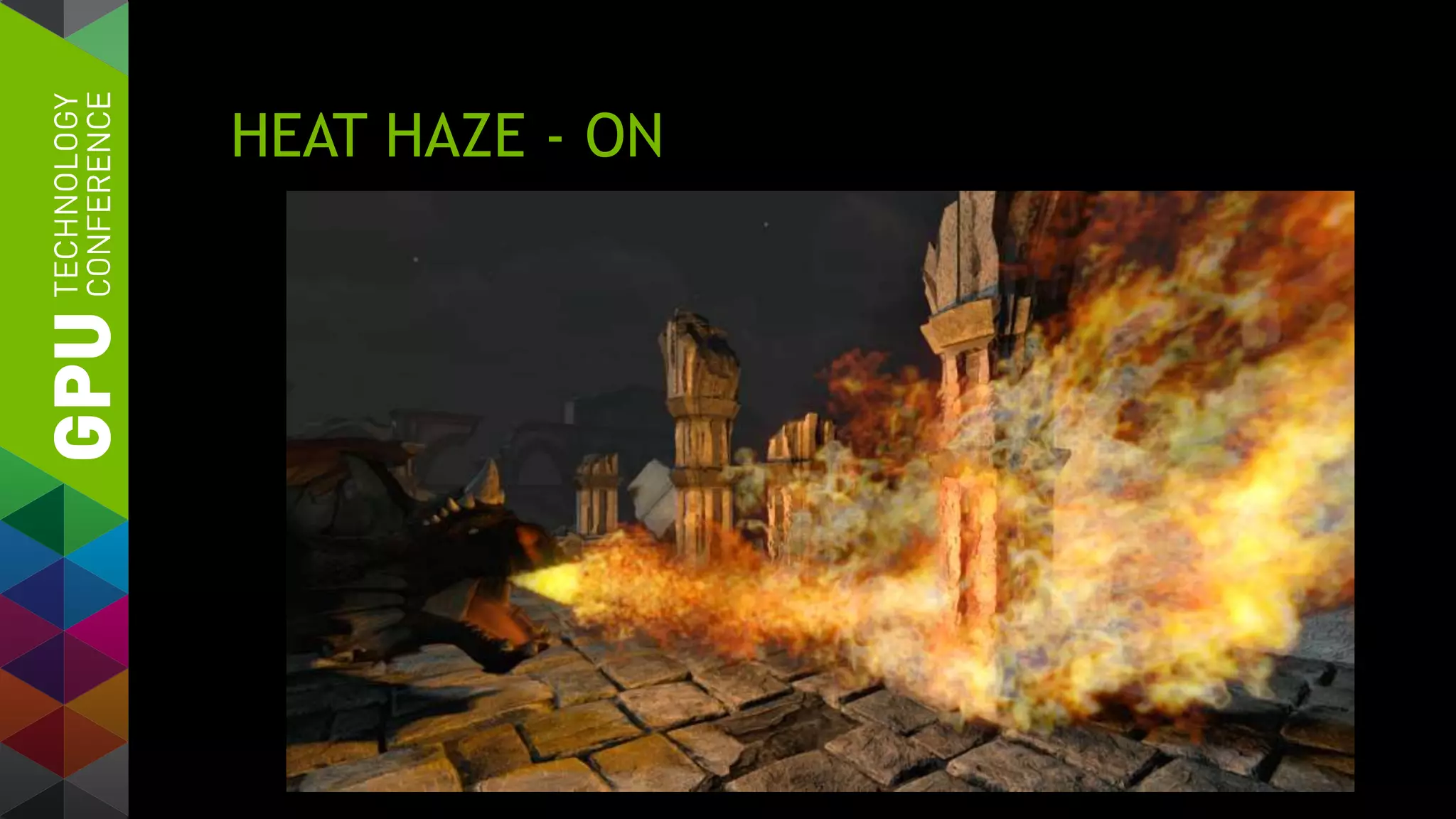
 Adds to perception of heat
 Offset background lookup based on gradient of temperature
(or just luminance) in screen space
HEAT HAZE - OFF
HEAT HAZE - ON
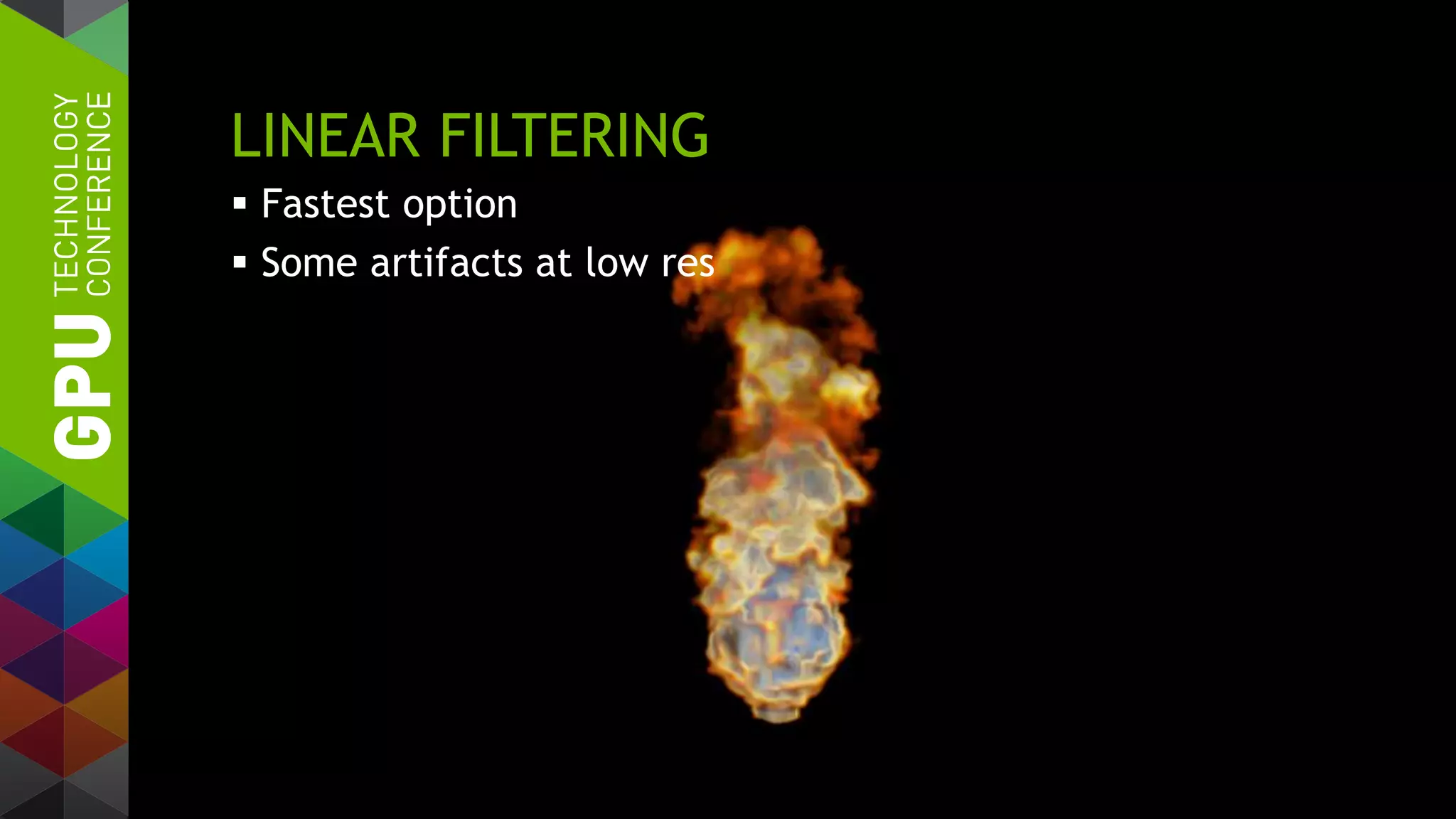
LINEAR FILTERING
 Fastest option
 Some artifacts at low res
CUBIC FILTERING
 Smoother
— Blurs some details
 Uses 8 bilinear lookups
— [Sigg & Hadwiger 05]
 But ~8 times more expensive
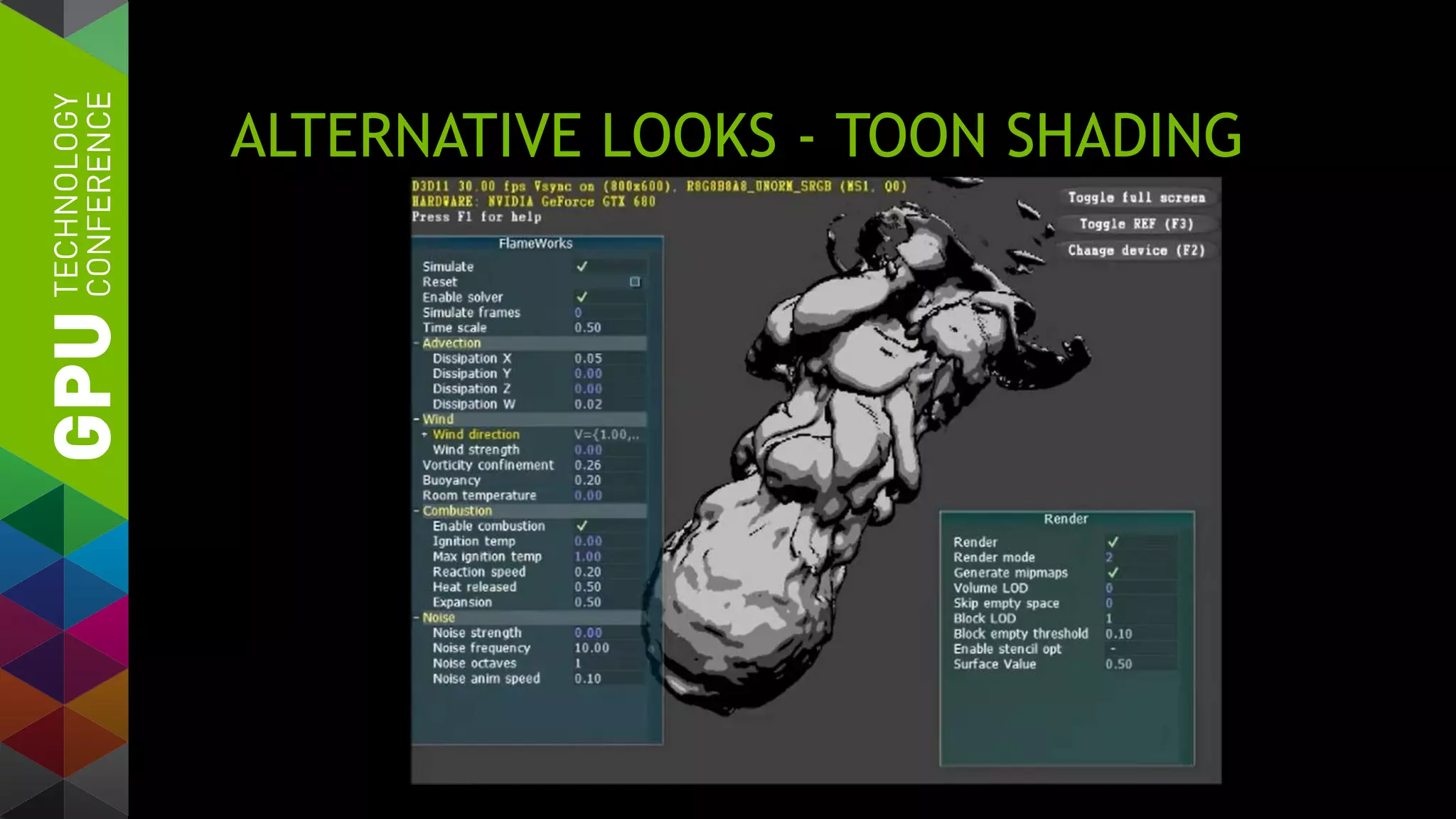
ALTERNATIVE LOOKS - TOON SHADING
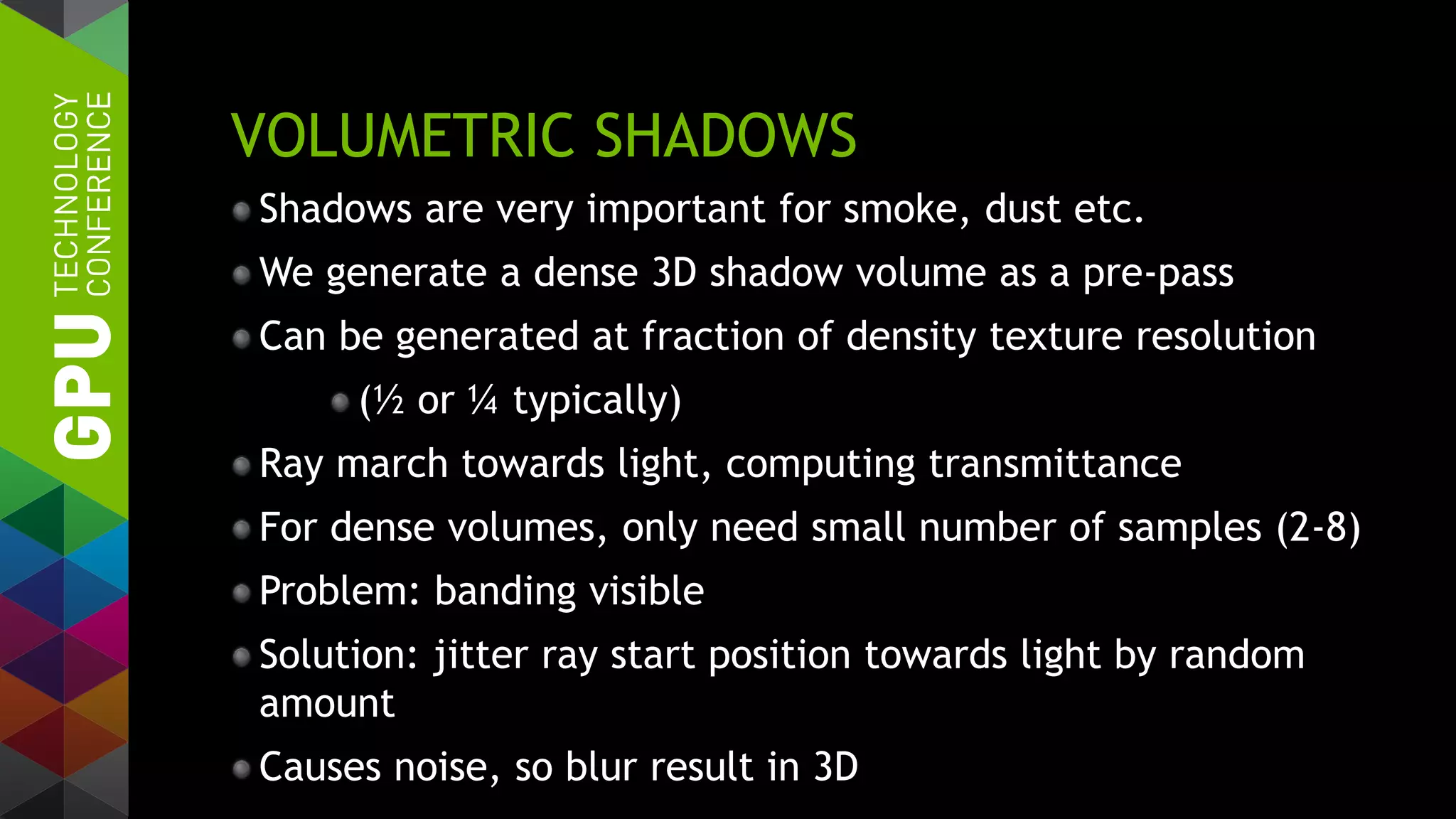
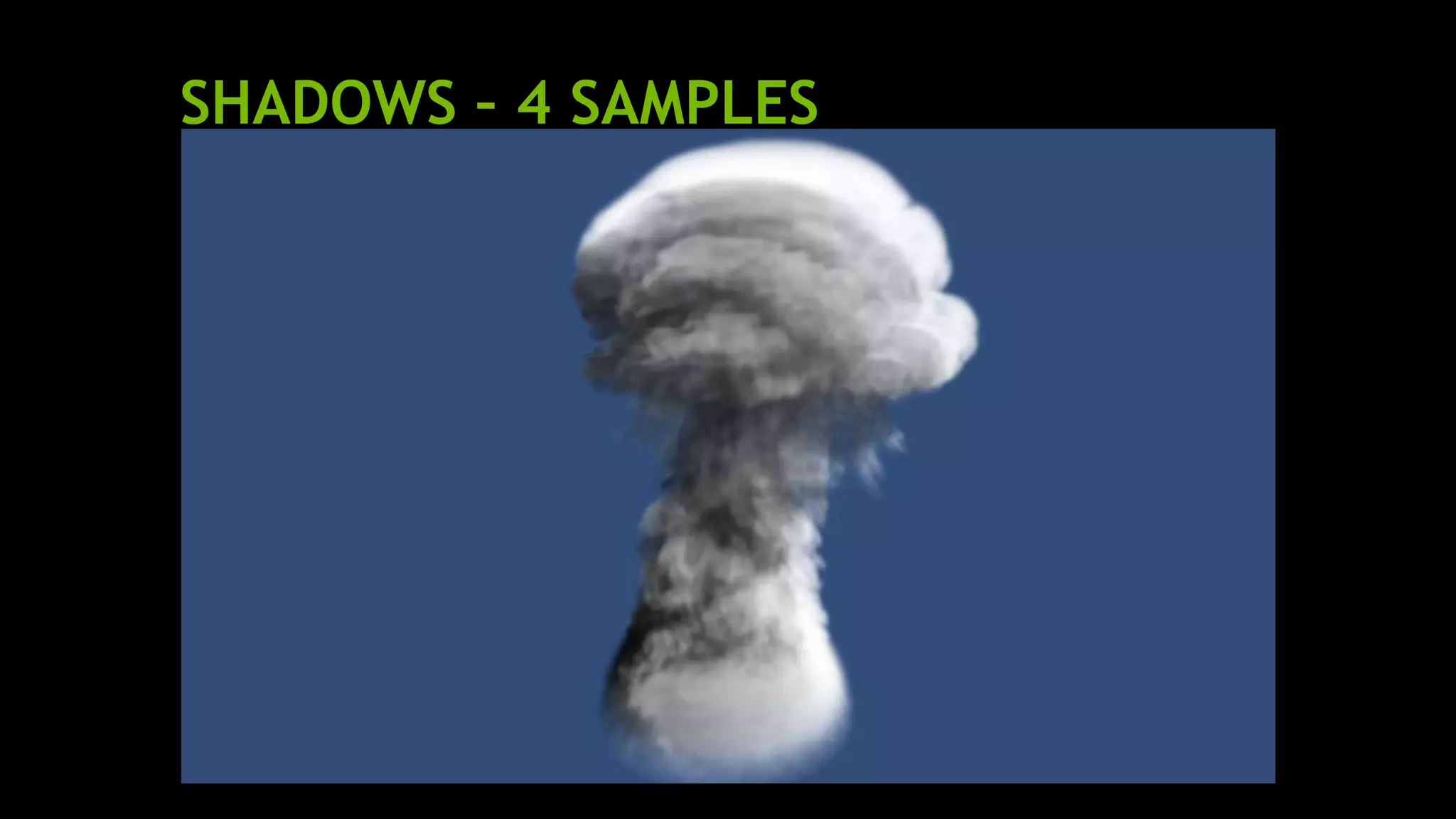
VOLUMETRIC SHADOWS
Shadows are very important for smoke, dust etc.
We generate a dense 3D shadow volume as a pre-pass
Can be generated at fraction of density texture resolution
(½ or ¼ typically)
Ray march towards light, computing transmittance
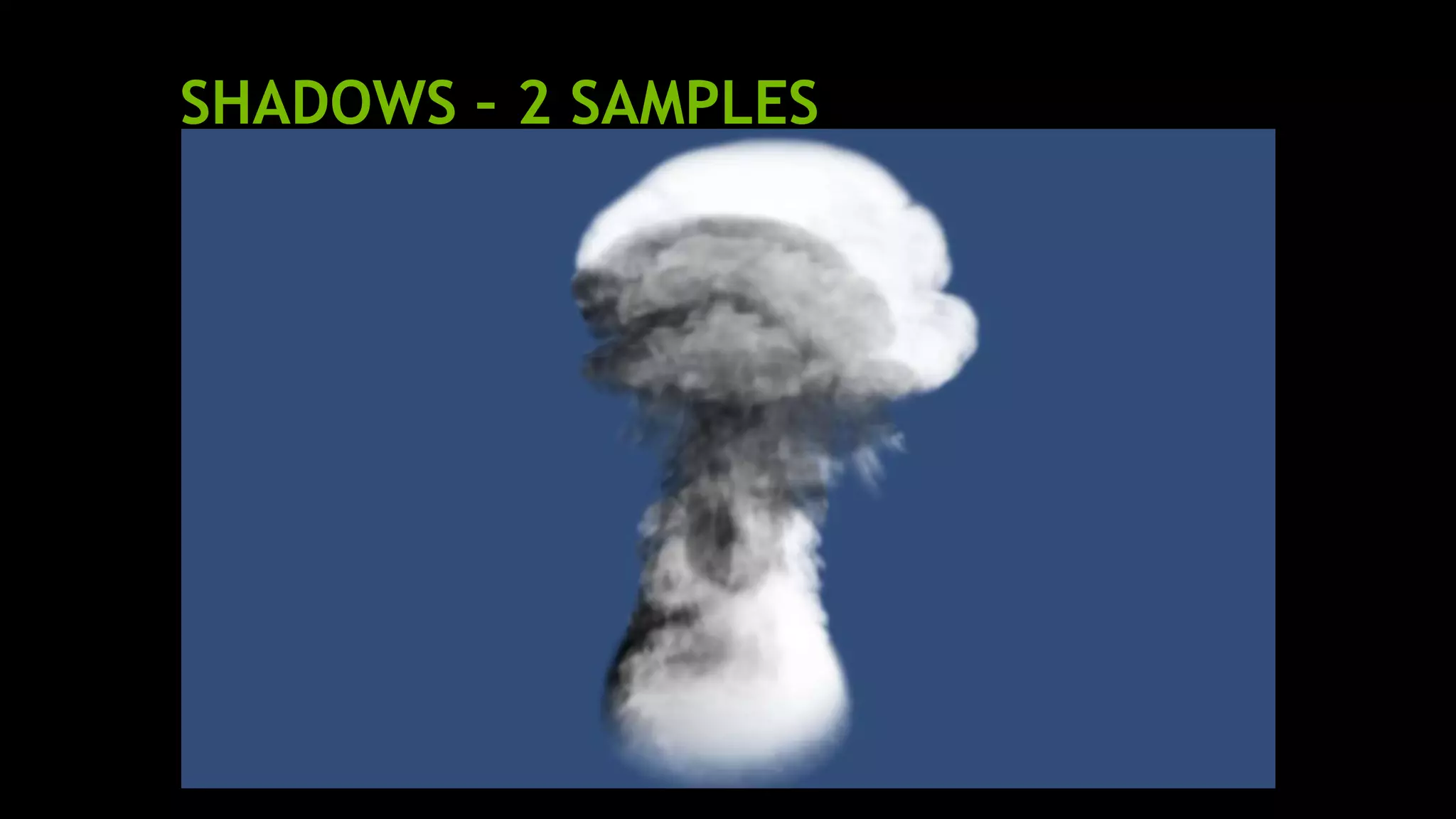
For dense volumes, only need small number of samples (2-8)
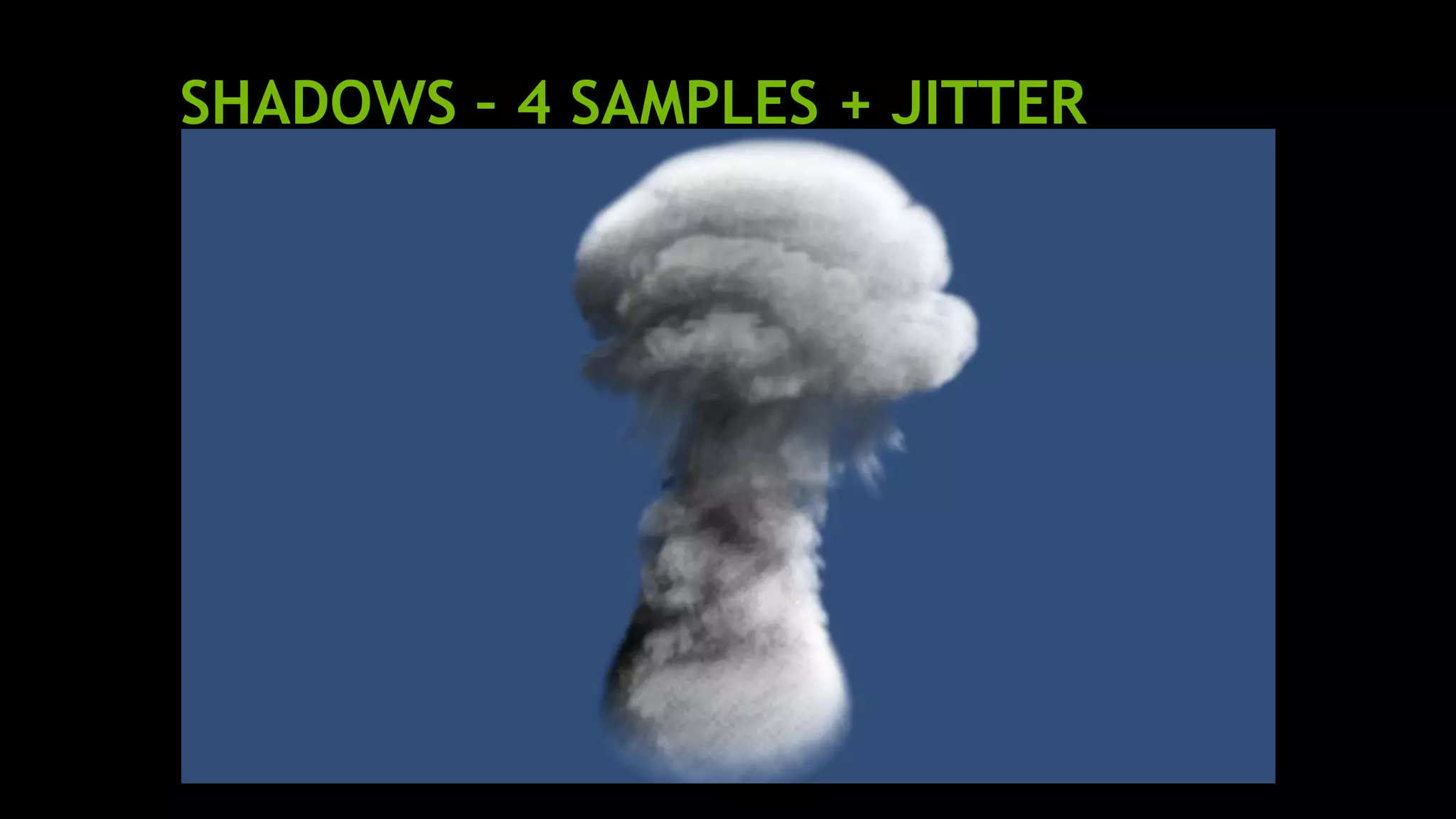
Problem: banding visible
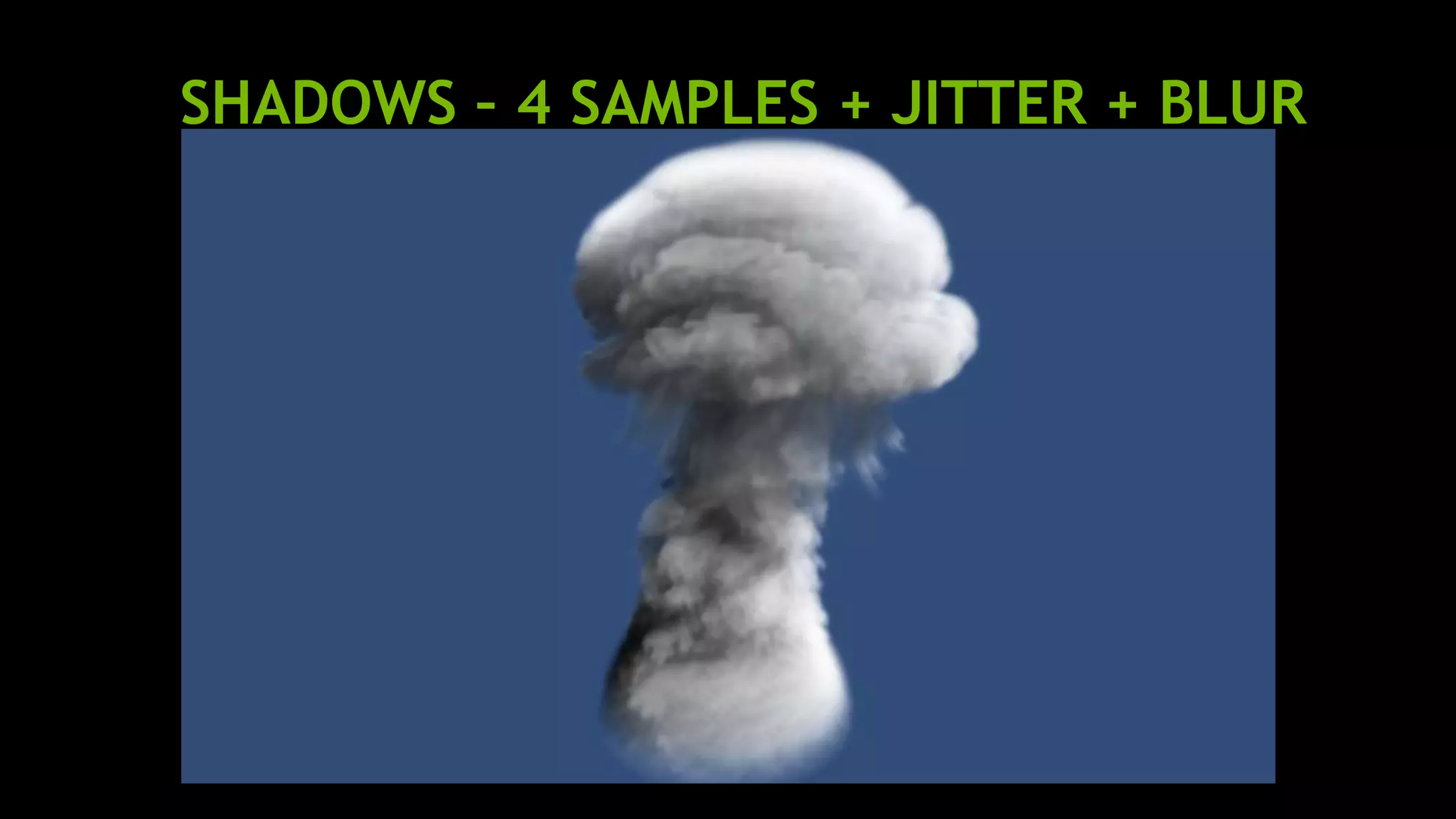
Solution: jitter ray start position towards light by random
amount
Causes noise, so blur result in 3D
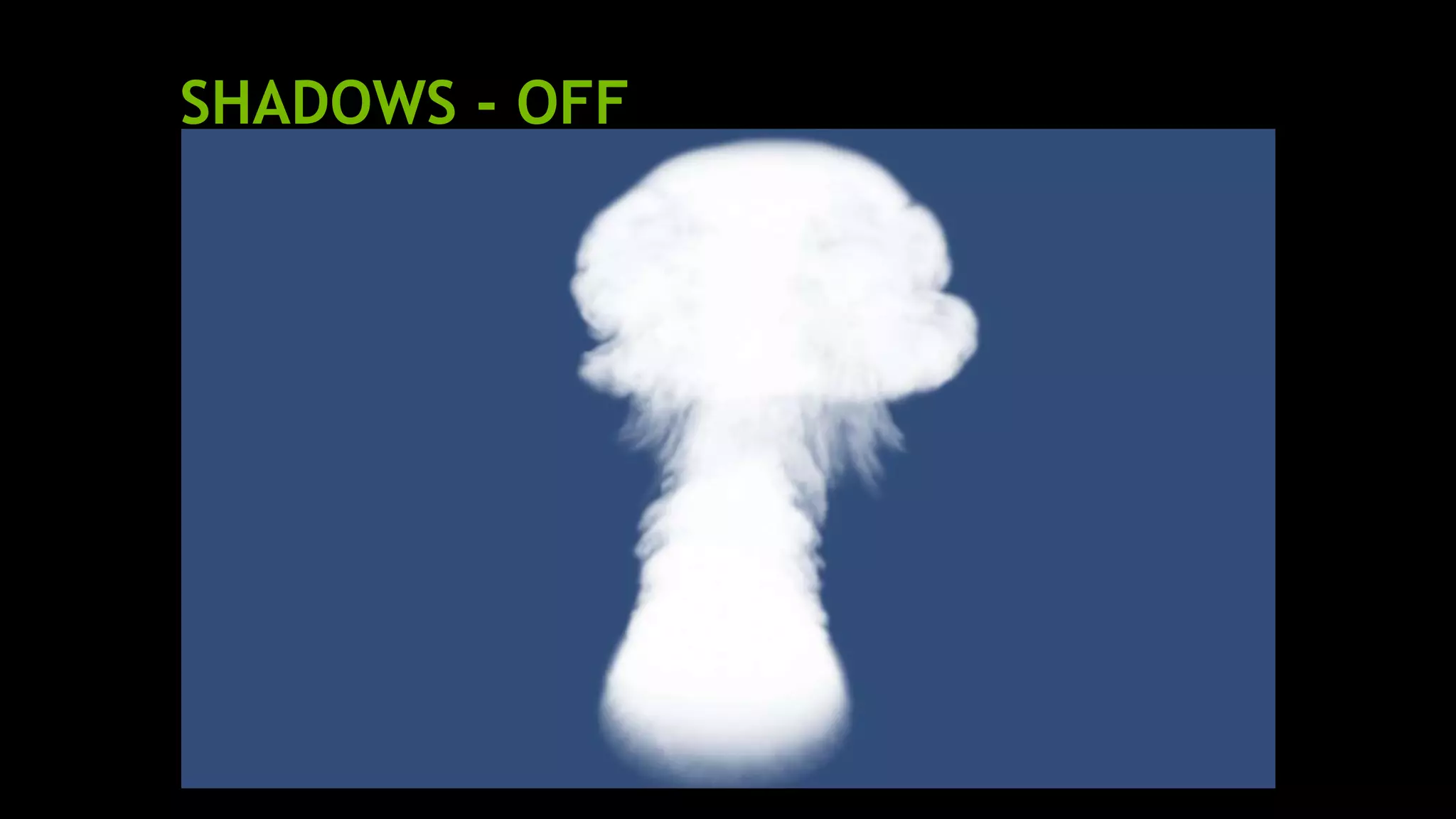
SHADOWS - OFF
SHADOWS – 2 SAMPLES
SHADOWS – 4 SAMPLES
SHADOWS – 4 SAMPLES + JITTER
SHADOWS – 4 SAMPLES + JITTER + BLUR
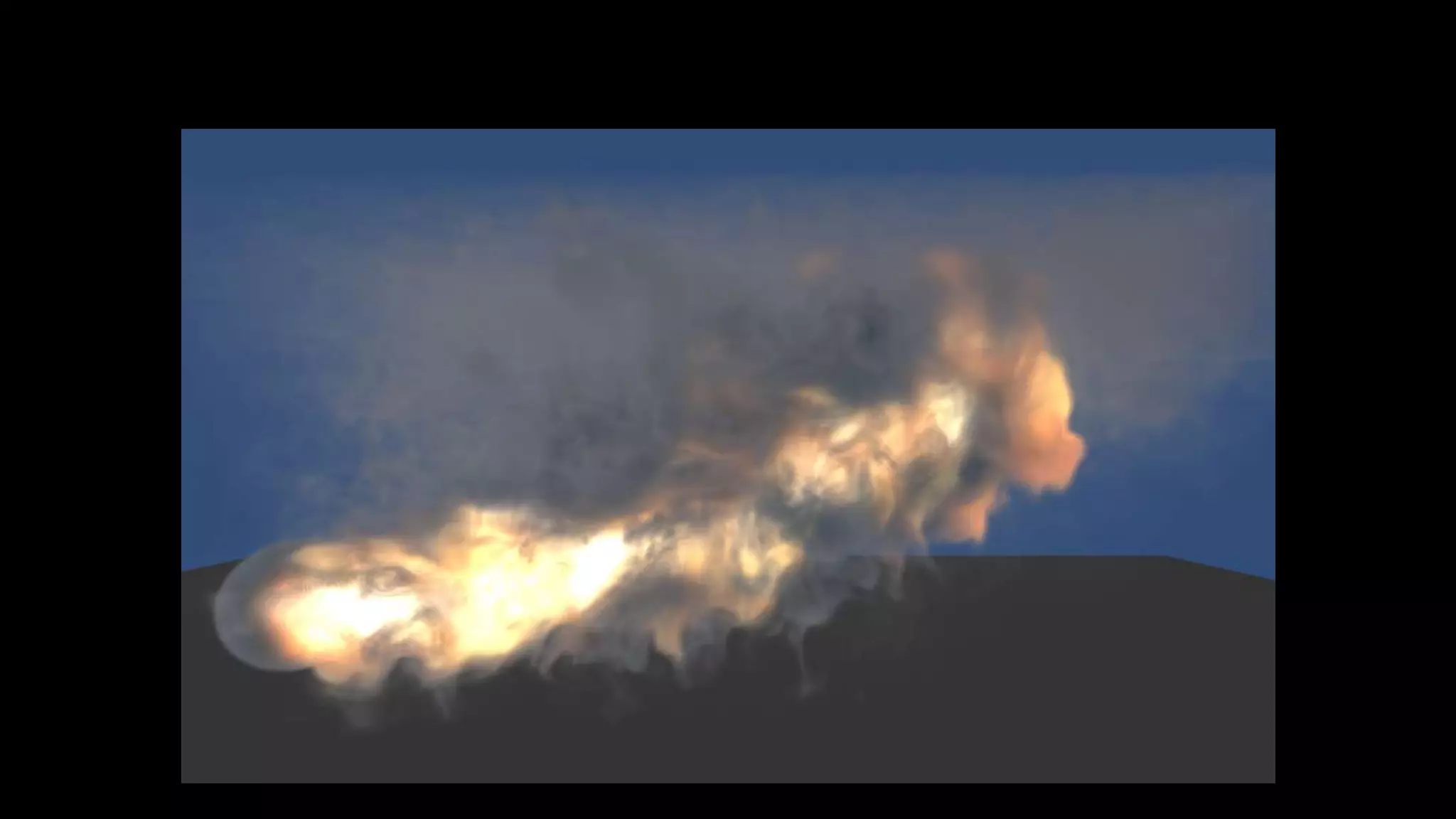
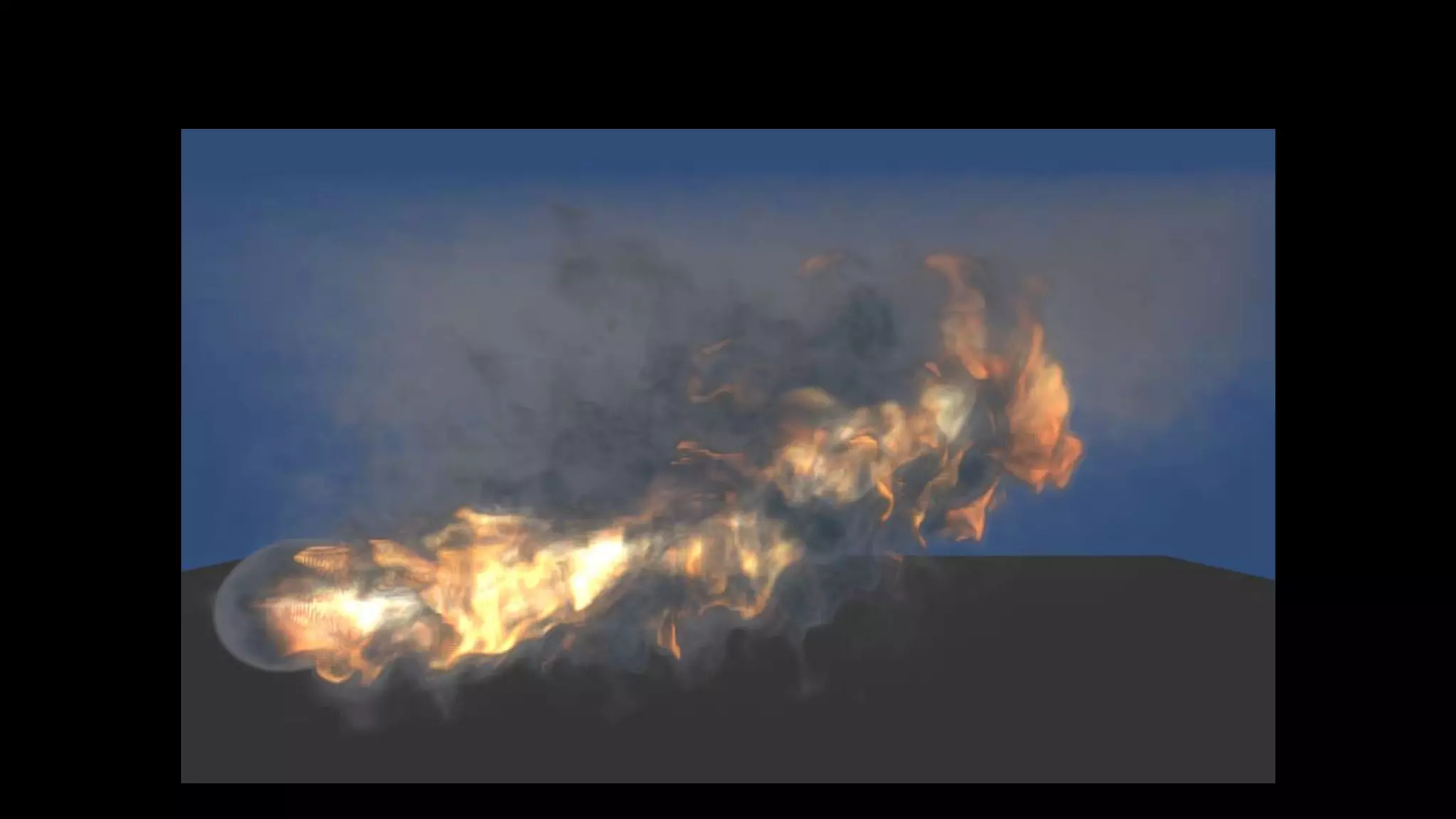
VOLUME SCATTERING APPROXIMATION
 Scattering is an important effect for smoky volumes
 Simple approximation:
— Evaluate lighting (emission) to 3D texture
— (High dynamic range is important)
— Blur texture in 3 dimensions
 Separable blur
— Read blurred texture during ray march
 Mix with original
 Similar to Crytek light propagation volumes
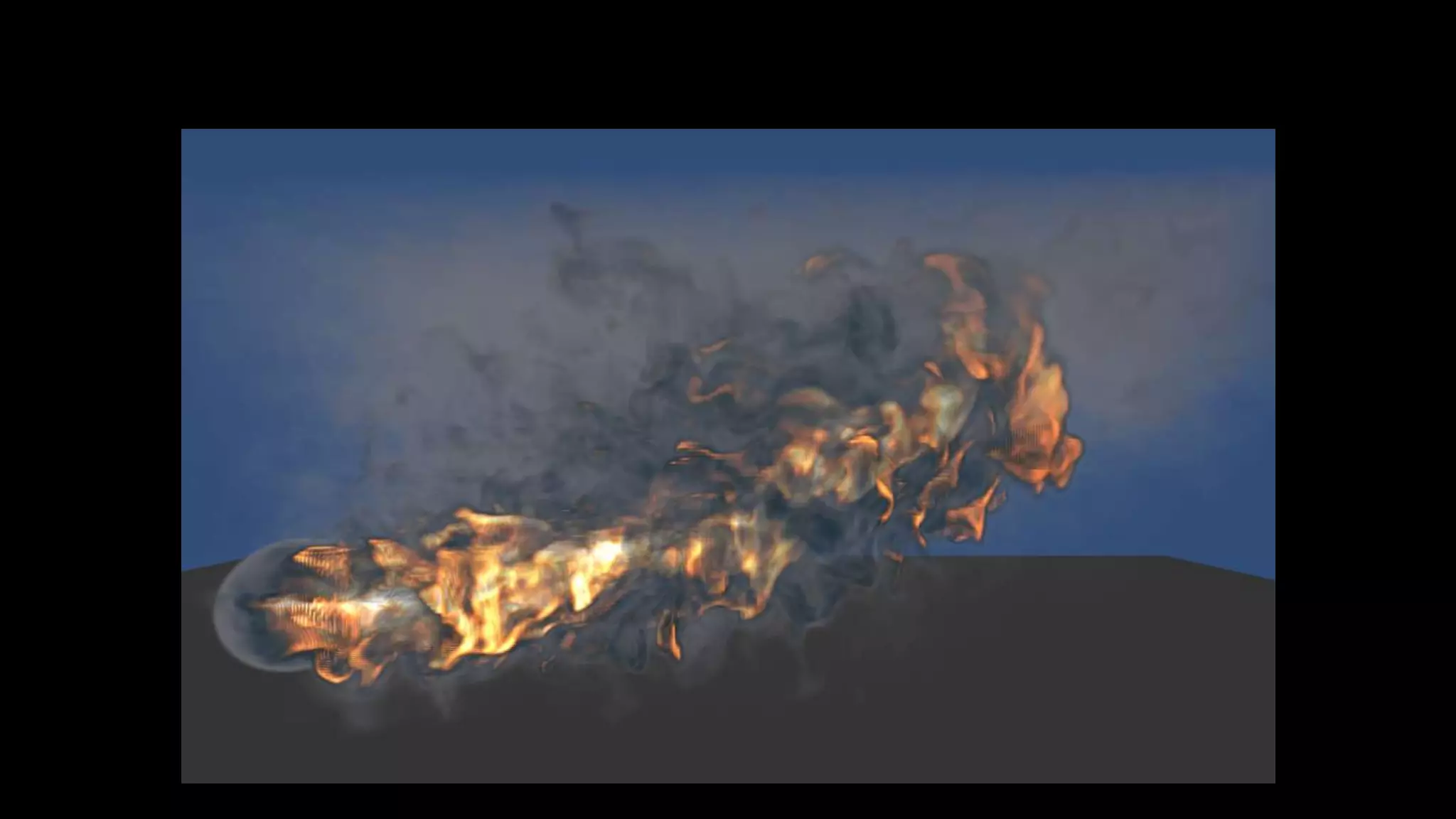
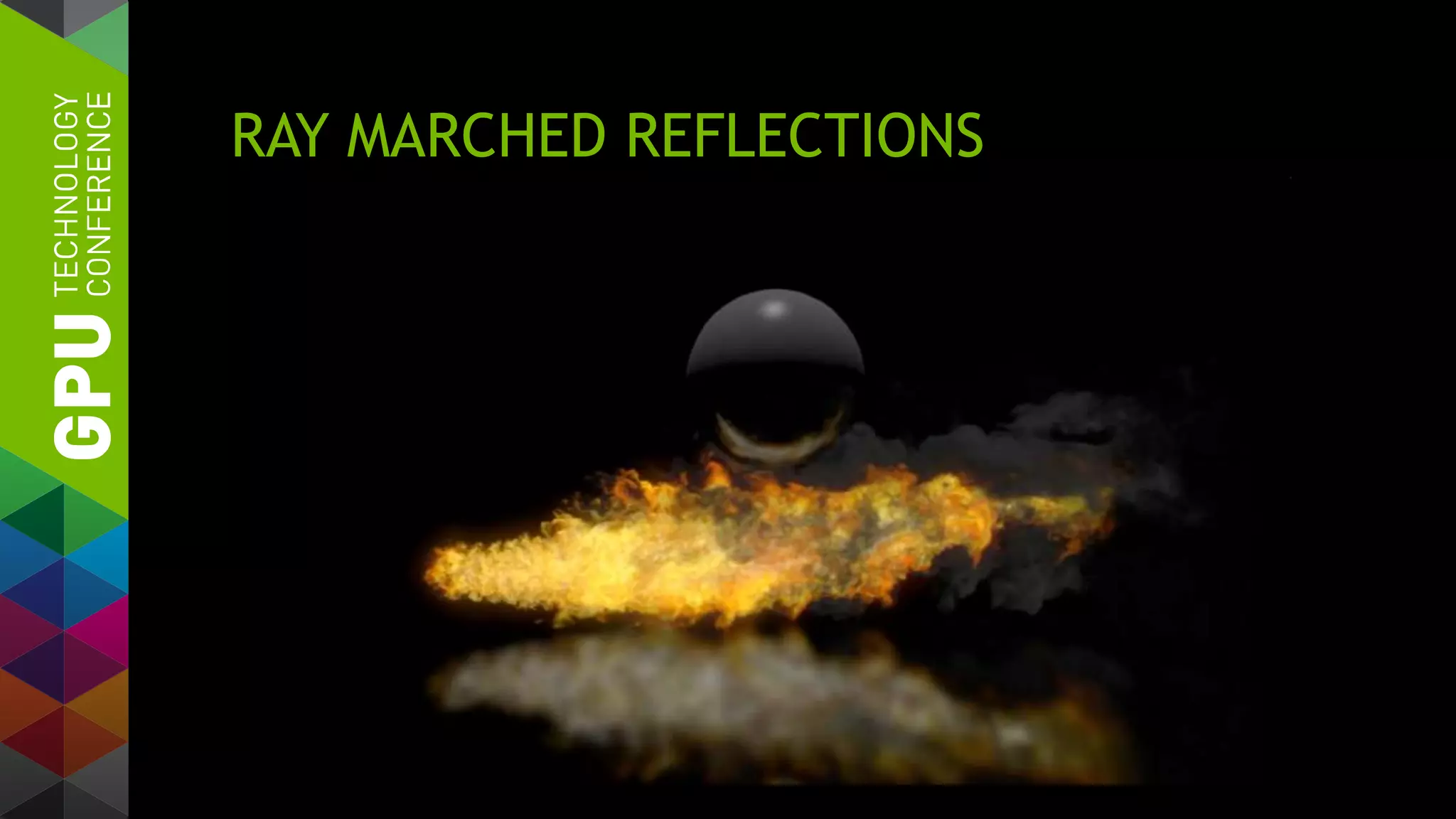
REFLECTIONS
 Easy to cast arbitrary rays though volumes
 E.g. Reflections of fire in other objects
 Calculate reflection ray, intersect with volume bounding box,
then ray march through volume
 Can use a down-sampled volume (mipmaps) for blurry
reflections
RAY MARCHED REFLECTIONS
TEXTURE COORDINATE ADVECTION
 For low resolution sims, procedural texturing can be useful to
add detail
 Advect 3D texture coordinates, use to add procedural noise to
density/temperature
— Use a simplified version of “Advected Textures” [Neyret 03]
 Advect several sets of 3D texture coordinates
— Coordinates blur out over time
— So regenerate periodically
— Blend between results of looking up in each texture, to achieve
smooth results
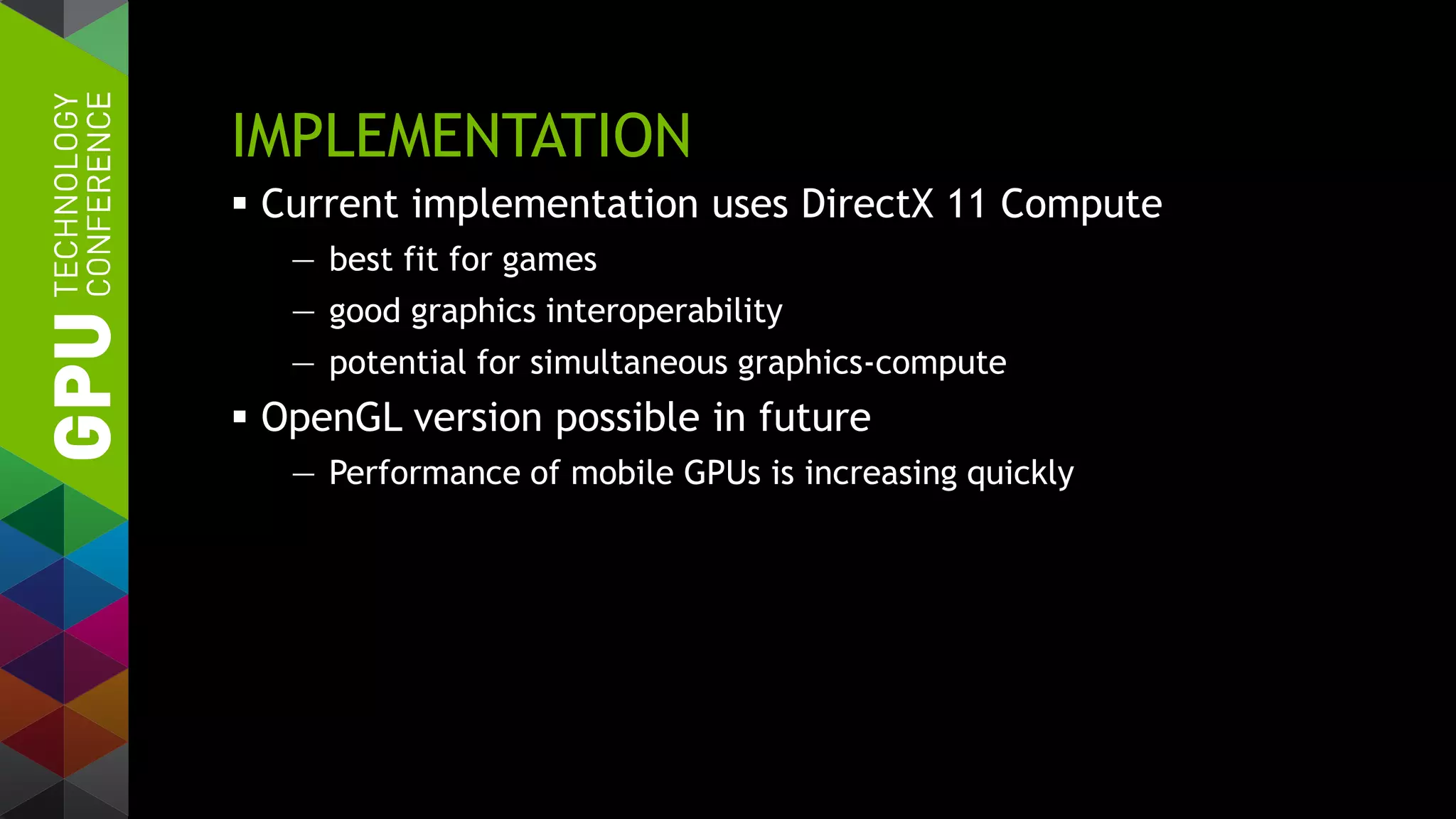
IMPLEMENTATION
 Current implementation uses DirectX 11 Compute
— best fit for games
— good graphics interoperability
— potential for simultaneous graphics-compute
 OpenGL version possible in future
— Performance of mobile GPUs is increasing quickly
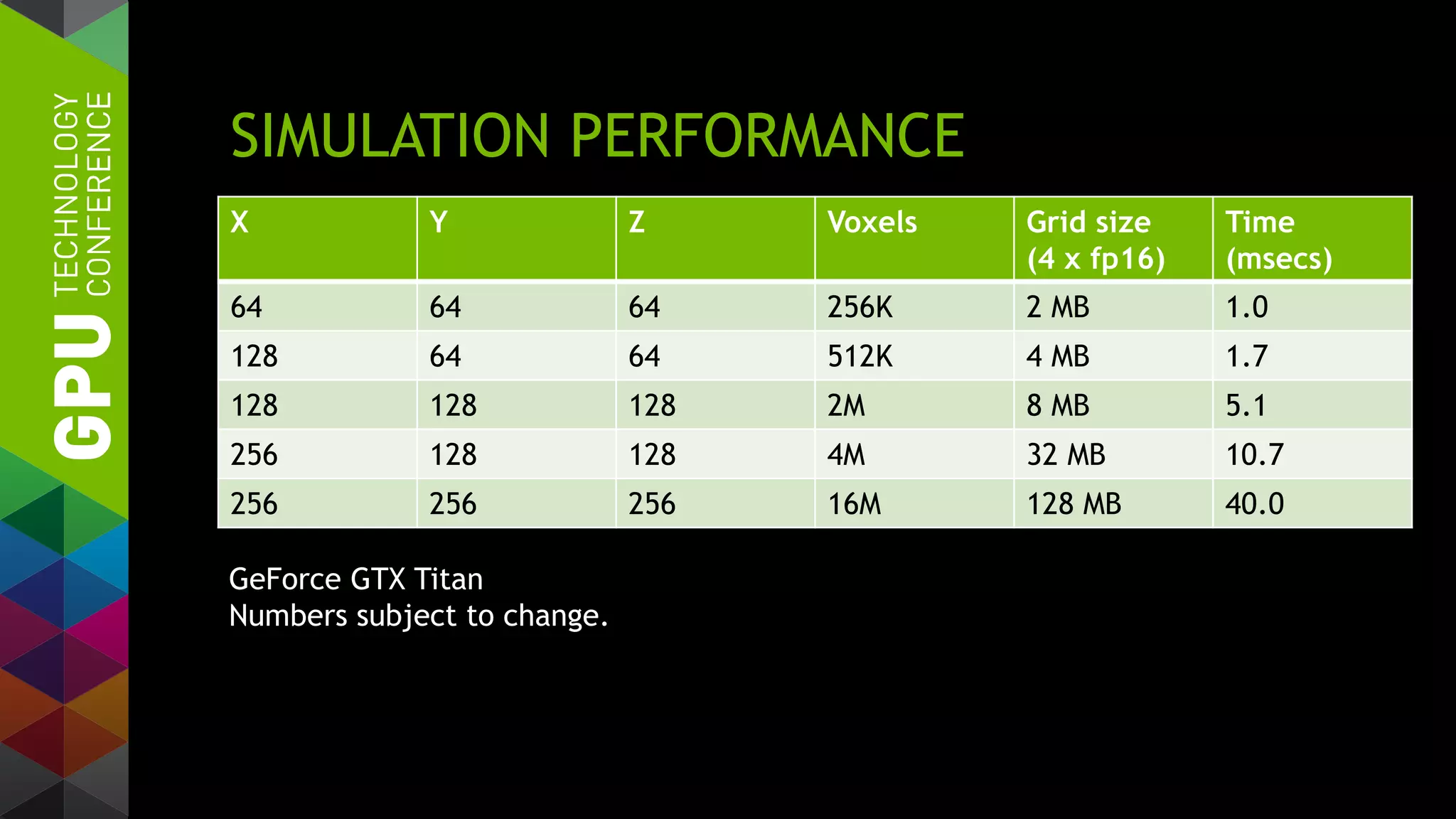
SIMULATION PERFORMANCE
X Y Z Voxels Grid size
(4 x fp16)
Time
(msecs)
64 64 64 256K 2 MB 1.0
128 64 64 512K 4 MB 1.7
128 128 128 2M 8 MB 5.1
256 128 128 4M 32 MB 10.7
256 256 256 16M 128 MB 40.0
GeForce GTX Titan
Numbers subject to change.
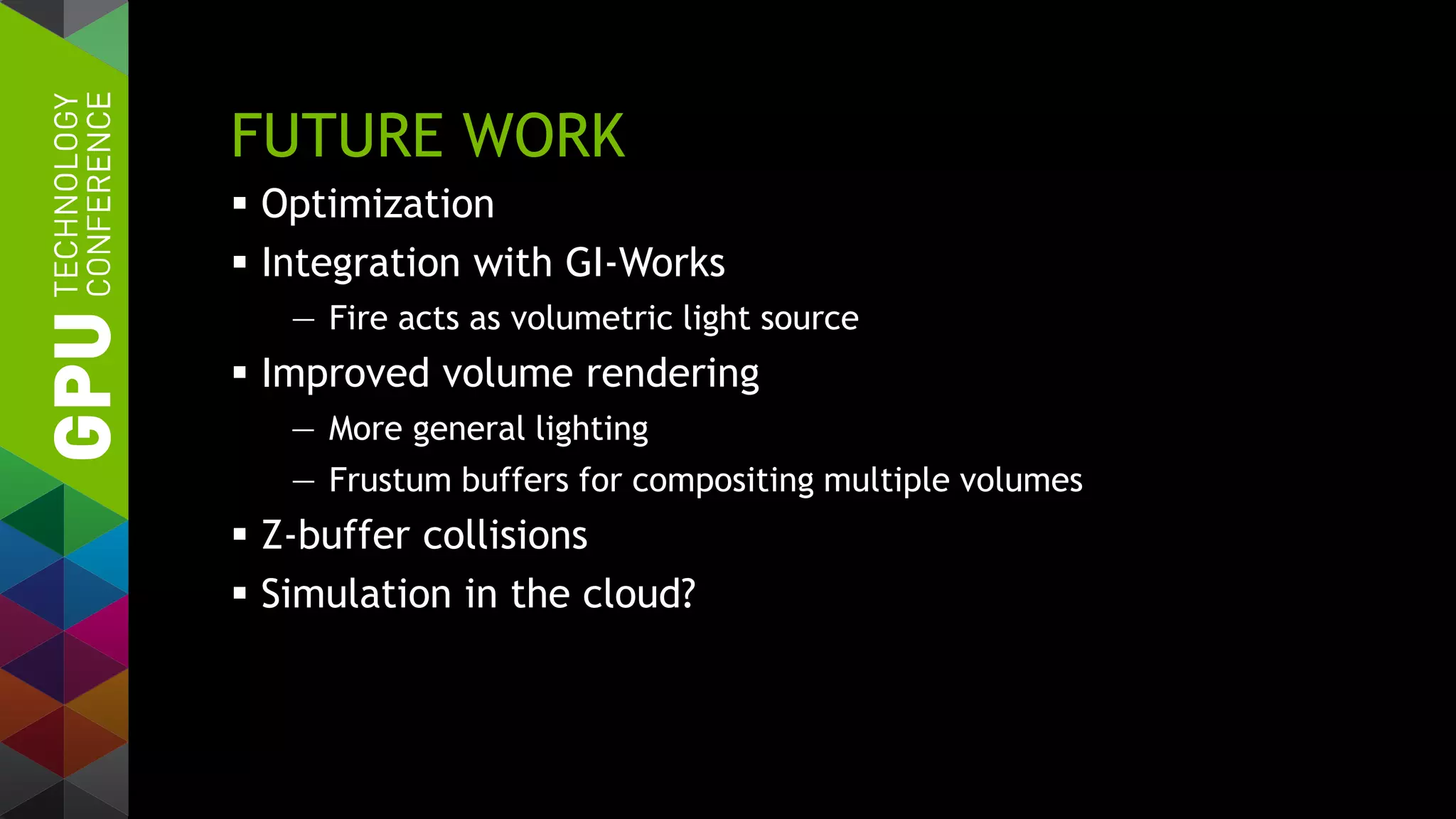
FUTURE WORK
 Optimization
 Integration with GI-Works
— Fire acts as volumetric light source
 Improved volume rendering
— More general lighting
— Frustum buffers for compositing multiple volumes
 Z-buffer collisions
 Simulation in the cloud?
QUESTIONS?
 Twitter: @simesgreen
REFERENCES
 Stable Fluids by Stam J. 1999
 Visual Simulation of Smoke by Fedkiw R., Stam J.and Jensen W. H. 2001
 Animating Suspended Particle Explosions by Feldman B. and O’Brien J. 2003
 Advected Textures by Fabrice N. 2003
 Fast Third-Order Texture Filtering by Sigg C. and Hadwiger M. 2005
 Low Viscosity Flow Simulations for Animation by Molemaker J., Cohen M. J., Patel
S. and Noh J. 2008
 An Unconditionally Stable MacCormack Method by Selle A., Fedkiw R., Kim B., Liu
Y. and Rossignac J. 2008
 Water Flow in Portal 2 by Vlachos A. 2010
 Flame On: Real-Time Fire Simulation for Video Games by Green S. 2012

FlameWorks GTC 2014

  • 1.
    SMOKE & MIRRORS: ADVANCEDVOLUMETRIC EFFECTS FOR GAMES Simon Green, Nuttapong Chentanez
  • 2.
    OVERVIEW  Background  Simulation Rendering  Demos  Future work
  • 3.
    WHAT IS FLAMEWORKS? A system for adding volumetric fire and smoke effects to games  Part of the NVIDIA GameWorks family of visual effects libraries  Combines — Efficient grid-based fluid simulator — High quality volume rendering  Inspired by ILM Plume, FumeFX, Maya Fluids, Houdini Pyro — But real-time!
  • 4.
    GOALS High quality Fast, efficient,scalable Simple, easy to integrate into games Customizable
  • 5.
    SIMULATION  Grid-based fluidsimulator — Gas simulator really – no liquid surface tracking etc.  Features — Multi-grid solver — MacCormack advection (second order accurate) — Vorticity confinement — Combustion model — Density resolution multiplier (upscaling)
  • 6.
    SIMULATION  Quantities — Velocity —Temperature — Fuel — Smoke Density  Discretization — Use collocated grid i.e. all quantities stored at cell center — Stored in two vec4 3D textures
  • 7.
  • 8.
  • 9.
    ADVECTION  Fluid physicalquantities such as temperature, density etc. are moved by fluid velocity — Fluid velocity itself is also moved by fluid velocity!  Semi-Lagrangian Method [Stam 99] — Start at a cell center — Trace velocity field backward in time — Interpolate quantity from grid  Tri-Linear interpolation  Optionally, move fuel at faster speed
  • 10.
    ADVECTION  Semi-Lagrangian methodis first order accurate — Causes a lot of numerical diffusion — Smoke and flame smooth out — Small scale details disappear — Vortices disappear  Use Modified MacCormack Method [Selle et al. 08] — For temperature, density, fuel only — Second order accurate — Tracing backward and then forward in time to estimate the error — Subtract the estimated error off to get a more accurate answer
  • 11.
  • 12.
  • 13.
    VORTICITY CONFINEMENT  Identifywhere vortices are, then add force to amplify them [Fedkiw et al. 01] Before After* *exaggerated for visualization purpose
  • 14.
    VORTICITY CONFINEMENT Without vorticityconfinement With vorticity confinement
  • 15.
  • 16.
    EMITTERS  Add density,temperature, fuel and velocity to simulation  Currently supported shapes — Sphere — Plane — Box — Cone  Custom emitters and force fields possible using callbacks — Developer can write compute shaders that write to density and velocity textures
  • 17.
    CUSTOM EMITTER HLSLEXAMPLE Texture3D<float4> srcTex : register (t0); RWTexture3D<float4> dstTex : register (u0); [numthreads(THREADS_X, THREADS_Y, THREADS_Z)] void DensityEmitter(uint3 i : SV_DispatchThreadID) { // read existing data at this cell float4 d = srcTex[i]; float3 p = voxelToWorld(i); float r= length(p – emitterPos); if (r < emitterRadius) { d.x += smoothstep(emitterRadius, emitterInnerRadius, r); }; // write new data dstTex[i] = d; }
  • 18.
    COMBUSTION MODEL  Iftemperature is above ignition temp and there is fuel, combustion occurs: — Consumes fuel — Increases temperature — Generates expansion by modifying simulation divergence [Feldman & O’Brien 03] — Temperature causes upwards buoyancy  Optionally have temperature cooling — Cooling rate proportional to temperaturek — k = 4 is commonly used in practice
  • 19.
  • 20.
    INCOMPRESSIBILITY SOLVER  Goal:Make velocity field divergence free  Why? — Incompressible fluid -> divergence free velocity field — Responsible for swirling motion commonly associated with fluid — Conserves mass  How? — Compute a pressure field whose gradient canceled out divergence of velocity field [Stam 99] — Pressure field is the solution to a linear system
  • 21.
    SOLVING LINEAR SYSTEM Geometric multi-grid — Open boundary on top, sides — Closed boundary on bottom — Ignores internal obstacles  Use Iterate Orthogonal Projection (IOP) [Molemaker et al. 08], to enforce solid boundary condition for internal obstacles — Set the normal component of fluid velocity to that of solid — Do multi-grid — Set the normal component of fluid velocity to that of solid — (can repeat for more accurate solution)
  • 22.
  • 23.
    OBSTACLES Currently support:  Implicits:sphere, capsule, box  Pre-computed signed distance fields (stored on a grid)  Can be scaled, translated, rotated during run time We rasterize the following to grid at each time step:  Distance to nearest obstacle  Normal and velocity of the nearest obstacle Solver then use these fields for all simulation steps Advection and incompressibility solve
  • 24.
    MOVING GRID  Gridcan be translated to follow moving objects  Basically adds opposite velocity during advection  Currently grid is always axis-aligned
  • 25.
    DRAGON DEMO 128 x128 x 256 velocity grid (4M voxels) 2x density res multiplier = 256 x 256 x 512 (32M voxels) ~30fps on GeForce Titan
  • 26.
    HIGH-RES DENSITY  Densitygrid can be stored at higher resolution than velocity — Usually 2x or 4x resolution  Improves performance since velocity solver is main bottleneck  Velocities are interpolated during density advection — Not strictly correct since interpolated velocities aren’t divergence- free — But looks fine
  • 27.
  • 28.
  • 29.
  • 30.
    RENDERING OPTIONS —Particles  Advectparticles through velocity field from simulation  Render as point sprites  Requires depth sorting for correct bending —Iso-surface rendering  Using marching cubes or ray marching to extract surface —Volume Rendering  Highest quality option
  • 31.
    VOLUME RENDERING Separate partof FlameWorks Optional - developers are free to do their own rendering Implemented using ray-marching in pixel shader Features Color mapping Depth compositing Down-sampled rendering with up-sampling Empty space skipping Edge fading Heat Haze
  • 32.
    COLOR MAPPING Temperature ismapped to color using 1D texture LUT Can also effect alpha (transparency) Can use a physically-based Blackbody radiation model (see GTC 2012 talk) Or arbitrary artist-defined map
  • 36.
  • 40.
    HEAT HAZE  Addsto perception of heat  Offset background lookup based on gradient of temperature (or just luminance) in screen space
  • 41.
  • 42.
  • 43.
    LINEAR FILTERING  Fastestoption  Some artifacts at low res
  • 44.
    CUBIC FILTERING  Smoother —Blurs some details  Uses 8 bilinear lookups — [Sigg & Hadwiger 05]  But ~8 times more expensive
  • 45.
    ALTERNATIVE LOOKS -TOON SHADING
  • 46.
    VOLUMETRIC SHADOWS Shadows arevery important for smoke, dust etc. We generate a dense 3D shadow volume as a pre-pass Can be generated at fraction of density texture resolution (½ or ¼ typically) Ray march towards light, computing transmittance For dense volumes, only need small number of samples (2-8) Problem: banding visible Solution: jitter ray start position towards light by random amount Causes noise, so blur result in 3D
  • 47.
  • 48.
  • 49.
  • 50.
    SHADOWS – 4SAMPLES + JITTER
  • 51.
    SHADOWS – 4SAMPLES + JITTER + BLUR
  • 52.
    VOLUME SCATTERING APPROXIMATION Scattering is an important effect for smoky volumes  Simple approximation: — Evaluate lighting (emission) to 3D texture — (High dynamic range is important) — Blur texture in 3 dimensions  Separable blur — Read blurred texture during ray march  Mix with original  Similar to Crytek light propagation volumes
  • 56.
    REFLECTIONS  Easy tocast arbitrary rays though volumes  E.g. Reflections of fire in other objects  Calculate reflection ray, intersect with volume bounding box, then ray march through volume  Can use a down-sampled volume (mipmaps) for blurry reflections
  • 57.
  • 58.
    TEXTURE COORDINATE ADVECTION For low resolution sims, procedural texturing can be useful to add detail  Advect 3D texture coordinates, use to add procedural noise to density/temperature — Use a simplified version of “Advected Textures” [Neyret 03]  Advect several sets of 3D texture coordinates — Coordinates blur out over time — So regenerate periodically — Blend between results of looking up in each texture, to achieve smooth results
  • 59.
    IMPLEMENTATION  Current implementationuses DirectX 11 Compute — best fit for games — good graphics interoperability — potential for simultaneous graphics-compute  OpenGL version possible in future — Performance of mobile GPUs is increasing quickly
  • 60.
    SIMULATION PERFORMANCE X YZ Voxels Grid size (4 x fp16) Time (msecs) 64 64 64 256K 2 MB 1.0 128 64 64 512K 4 MB 1.7 128 128 128 2M 8 MB 5.1 256 128 128 4M 32 MB 10.7 256 256 256 16M 128 MB 40.0 GeForce GTX Titan Numbers subject to change.
  • 61.
    FUTURE WORK  Optimization Integration with GI-Works — Fire acts as volumetric light source  Improved volume rendering — More general lighting — Frustum buffers for compositing multiple volumes  Z-buffer collisions  Simulation in the cloud?
  • 62.
  • 63.
    REFERENCES  Stable Fluidsby Stam J. 1999  Visual Simulation of Smoke by Fedkiw R., Stam J.and Jensen W. H. 2001  Animating Suspended Particle Explosions by Feldman B. and O’Brien J. 2003  Advected Textures by Fabrice N. 2003  Fast Third-Order Texture Filtering by Sigg C. and Hadwiger M. 2005  Low Viscosity Flow Simulations for Animation by Molemaker J., Cohen M. J., Patel S. and Noh J. 2008  An Unconditionally Stable MacCormack Method by Selle A., Fedkiw R., Kim B., Liu Y. and Rossignac J. 2008  Water Flow in Portal 2 by Vlachos A. 2010  Flame On: Real-Time Fire Simulation for Video Games by Green S. 2012