Starring:
The Chain as “itself”

The Theory of Chains
Some (possibly overly simplistic but hopefully not too
condescending) stories to help us think
about what we are here for…
Part 1
The fable of the two mules

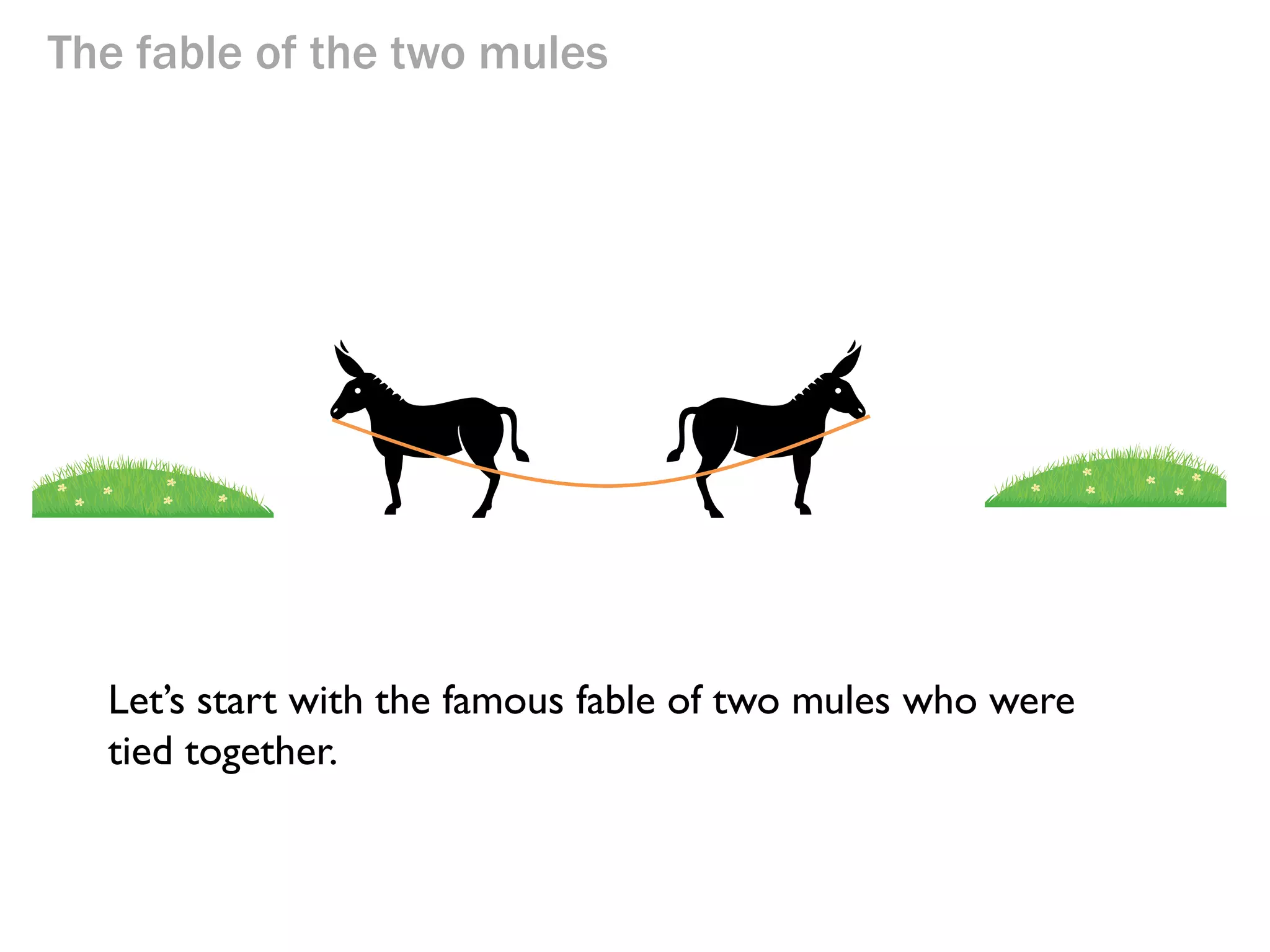
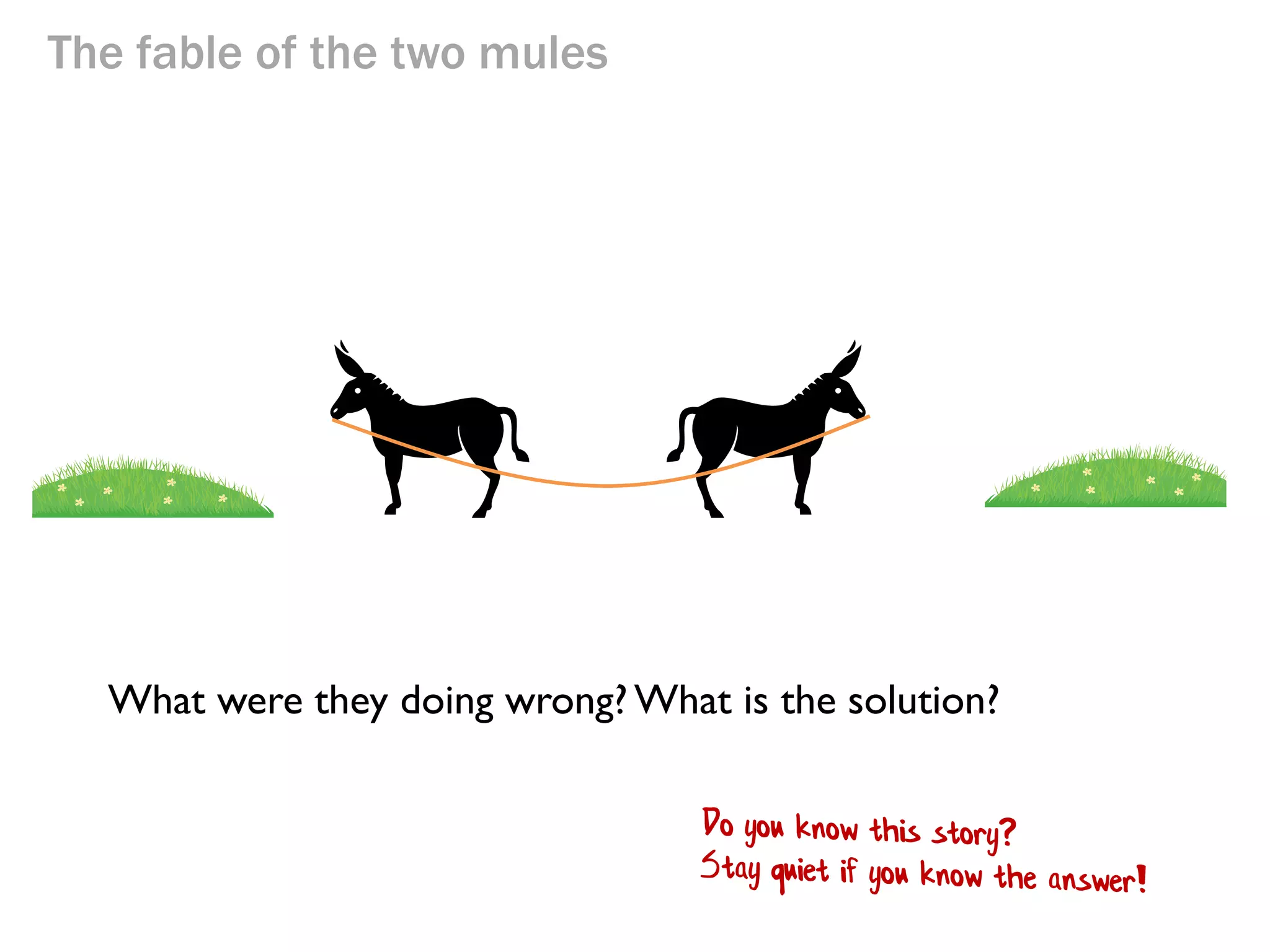
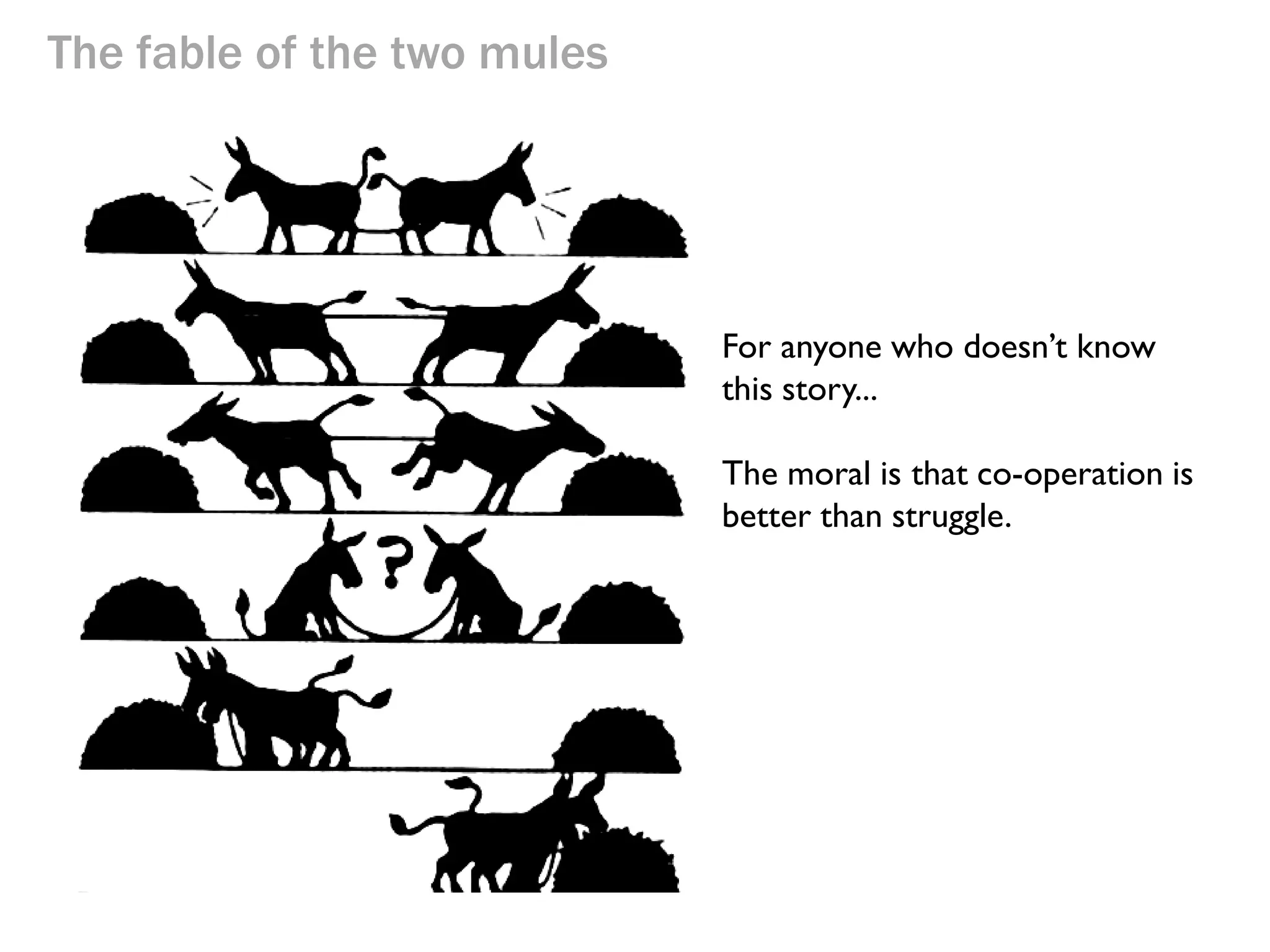
Let’s start with the famous fable of two mules who were
tied together.
The fable of the two mules

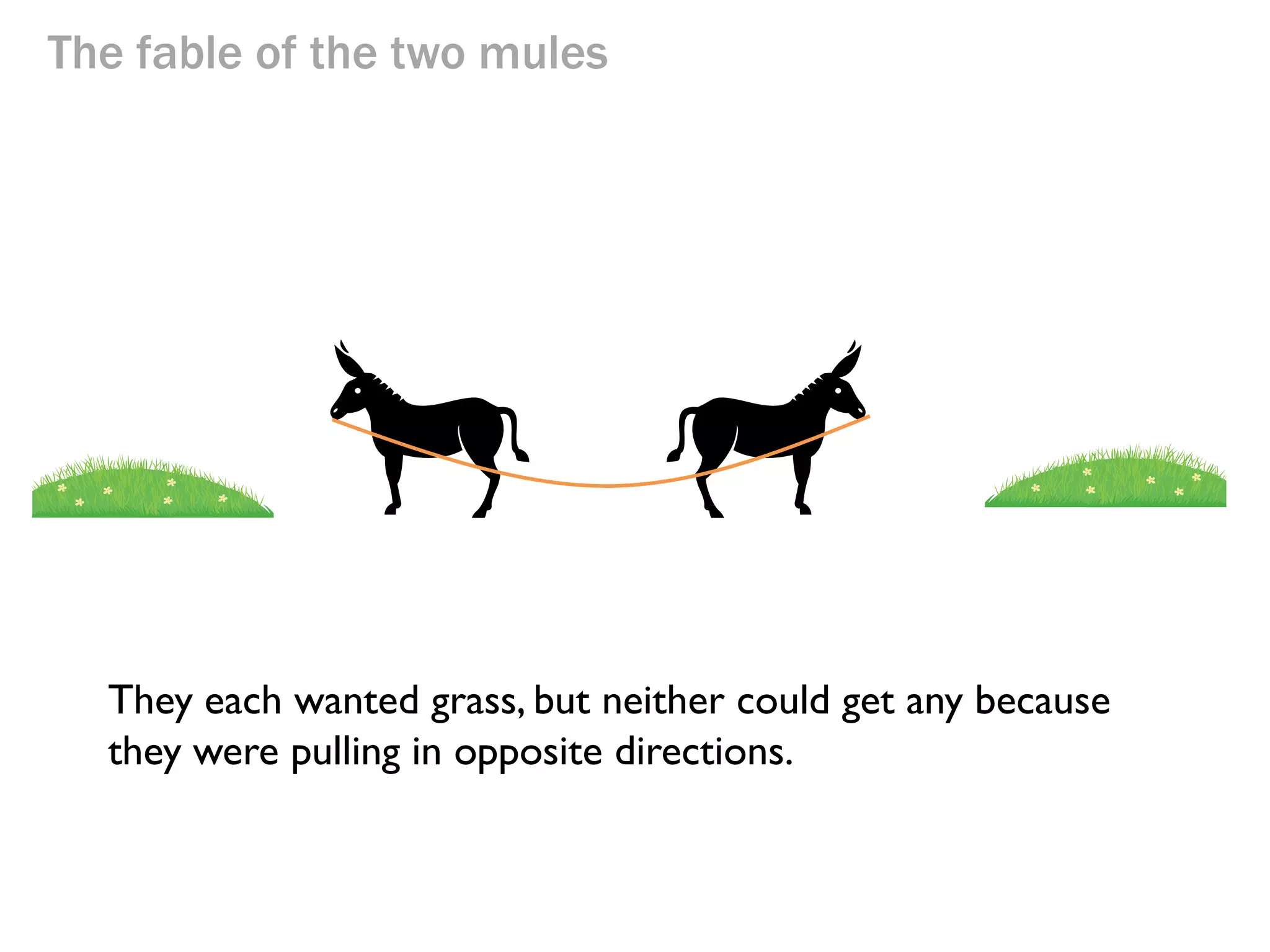
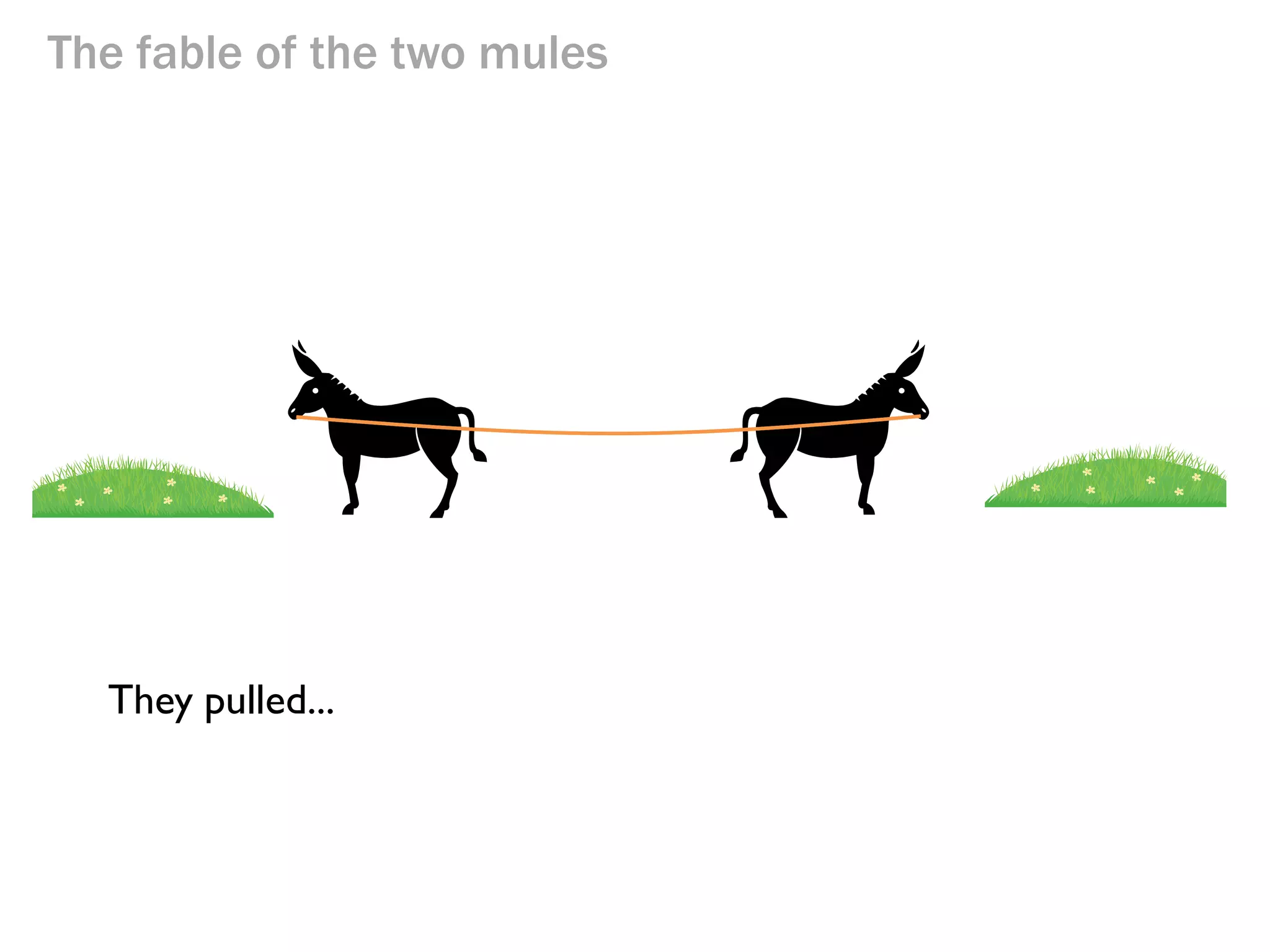
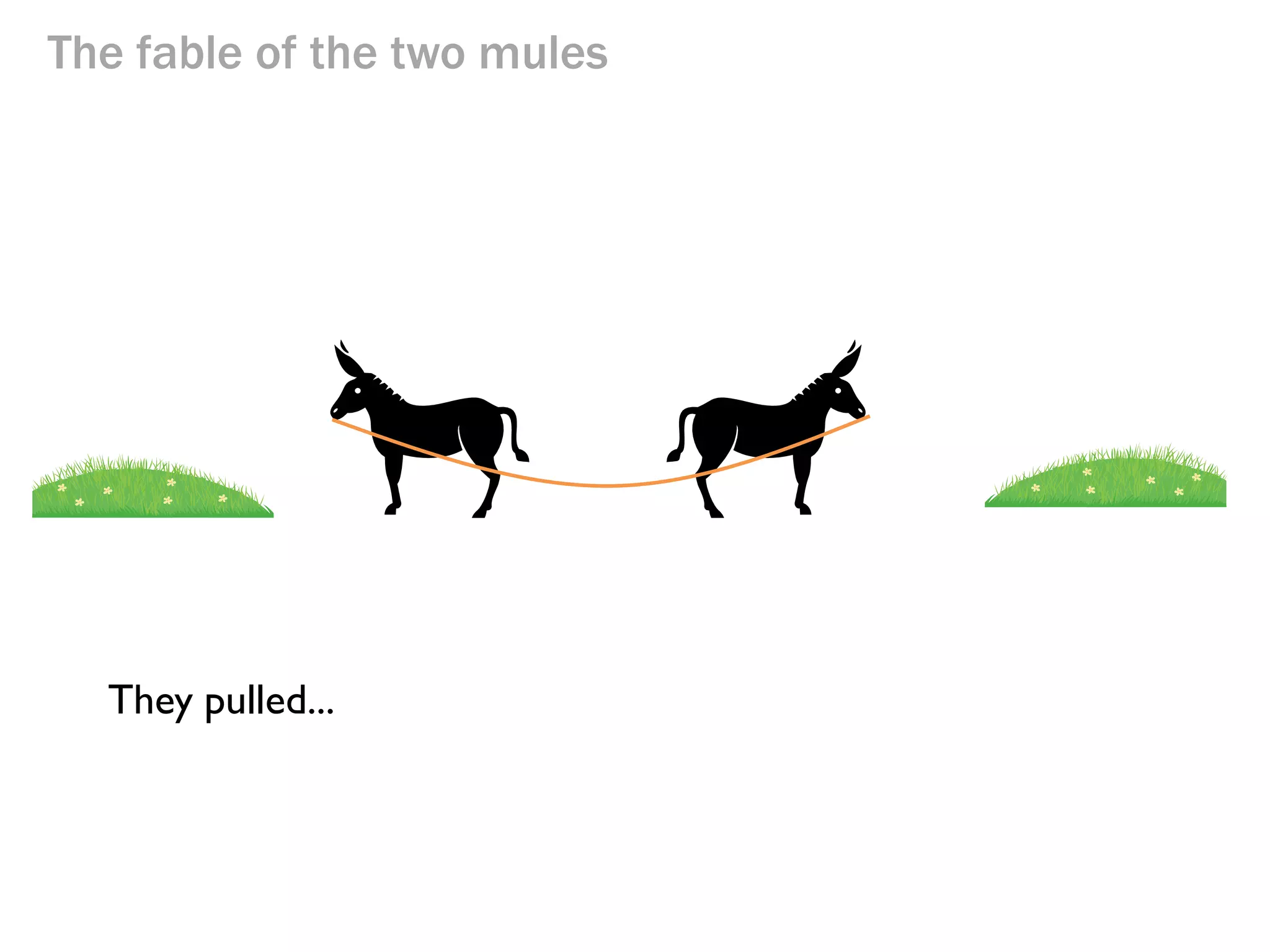
They each wanted grass, but neither could get any because
they were pulling in opposite directions.
The fable of the two mules

They pulled...
The fable of the two mules

They pulled...
The fable of the two mules

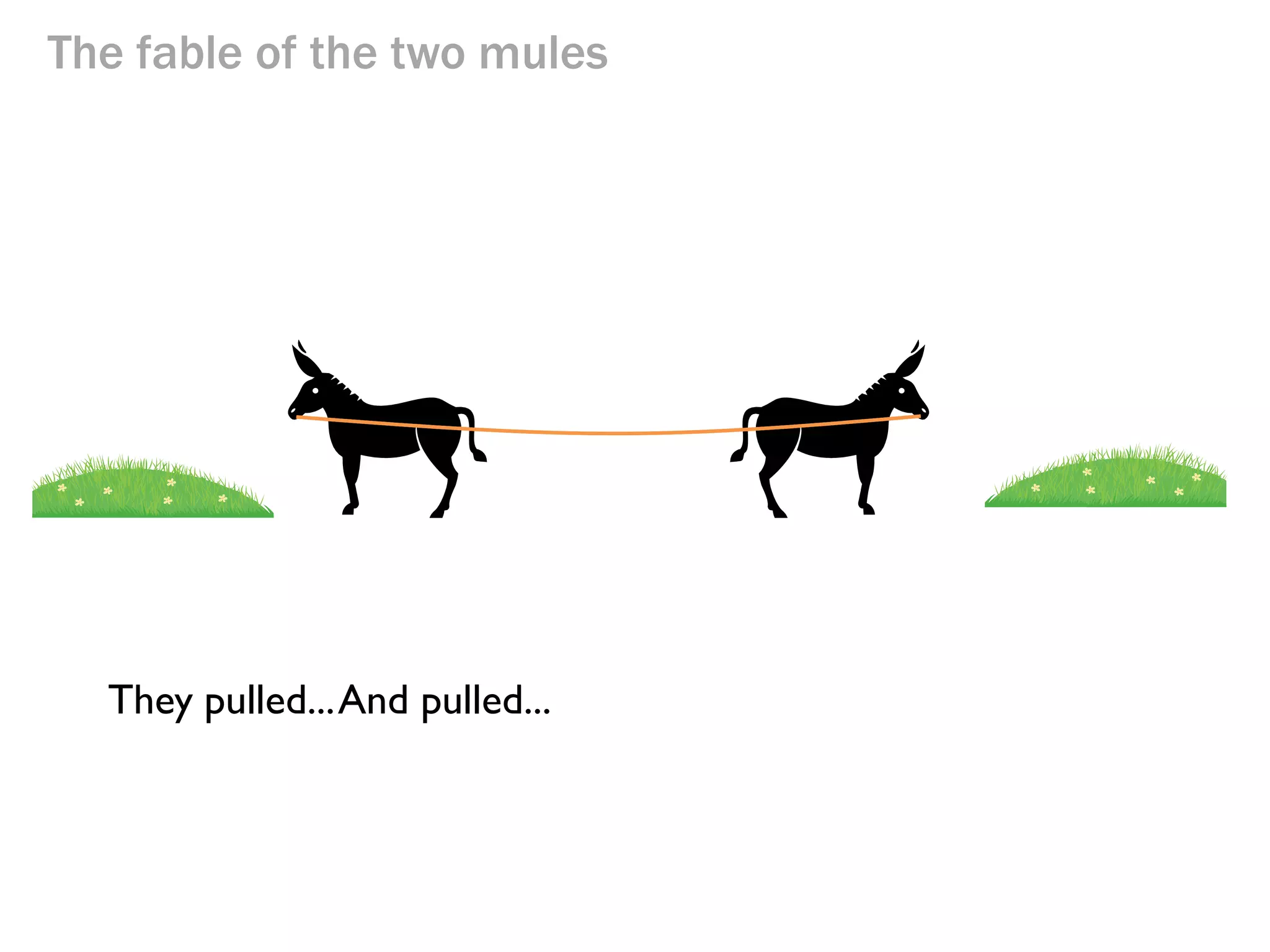
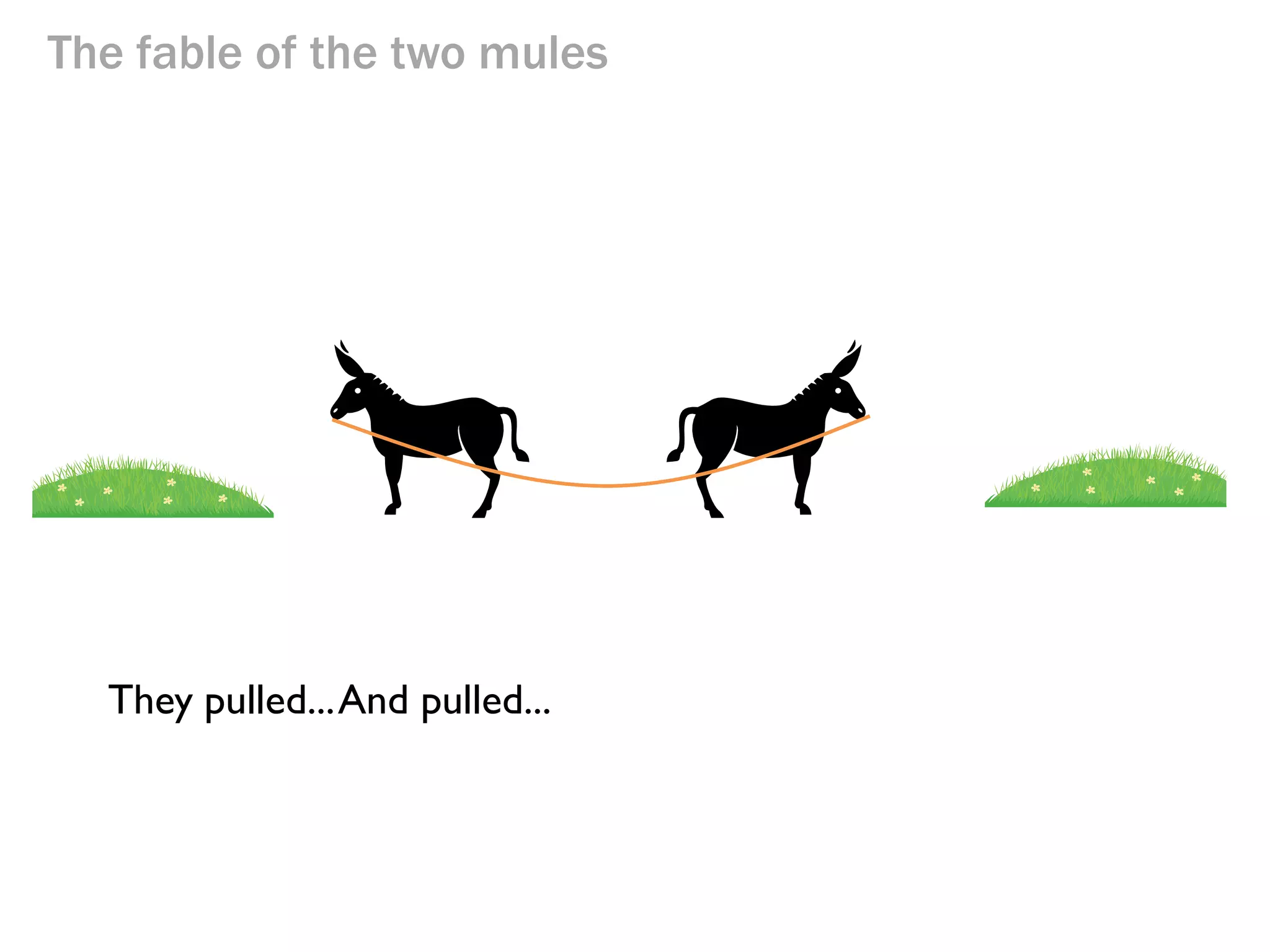
They pulled... And pulled...
The fable of the two mules

They pulled... And pulled...
The fable of the two mules

What were they doing wrong? What is the solution?
The fable of the two mules

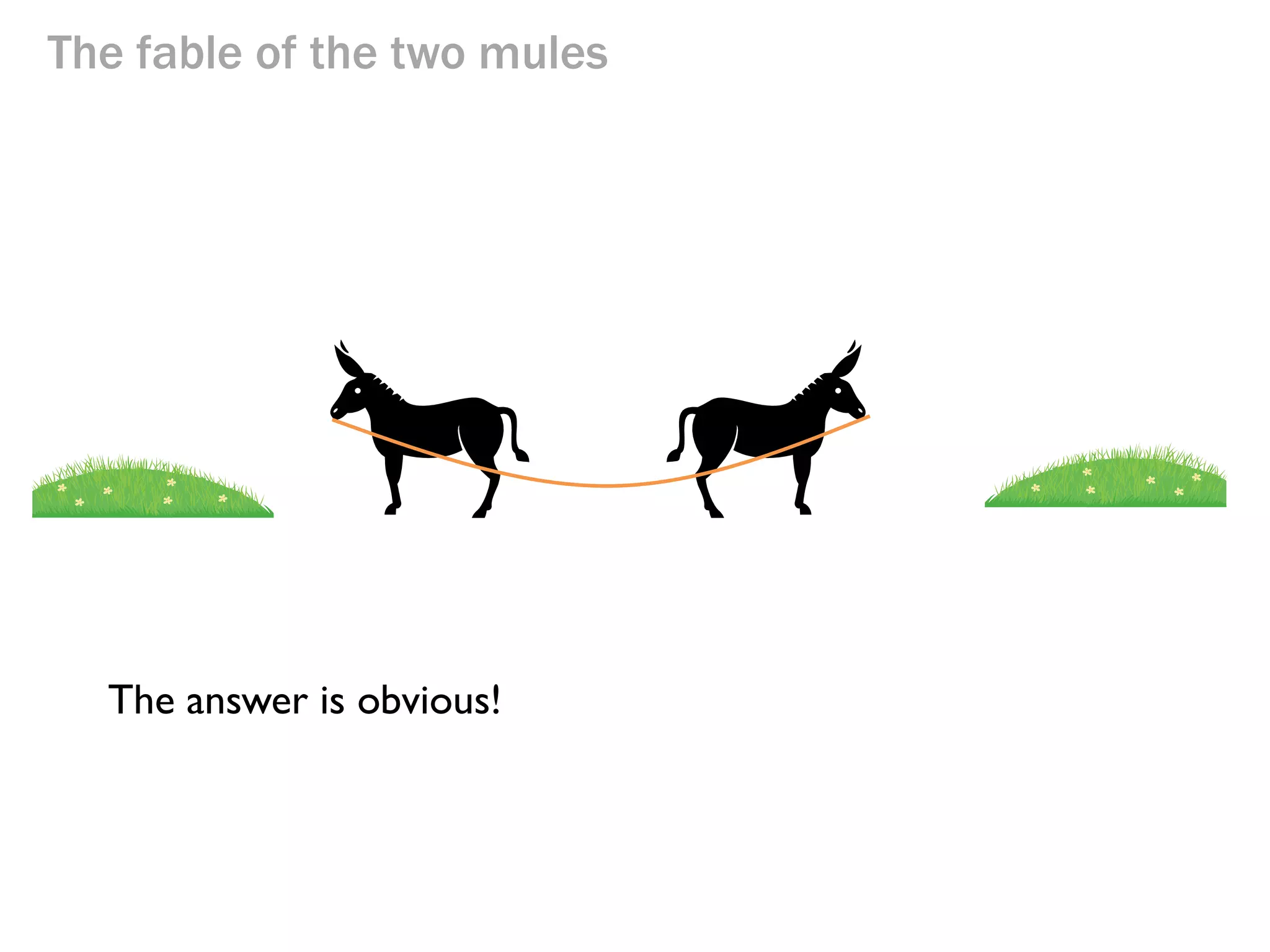
The answer is obvious!
The fable of the two mules

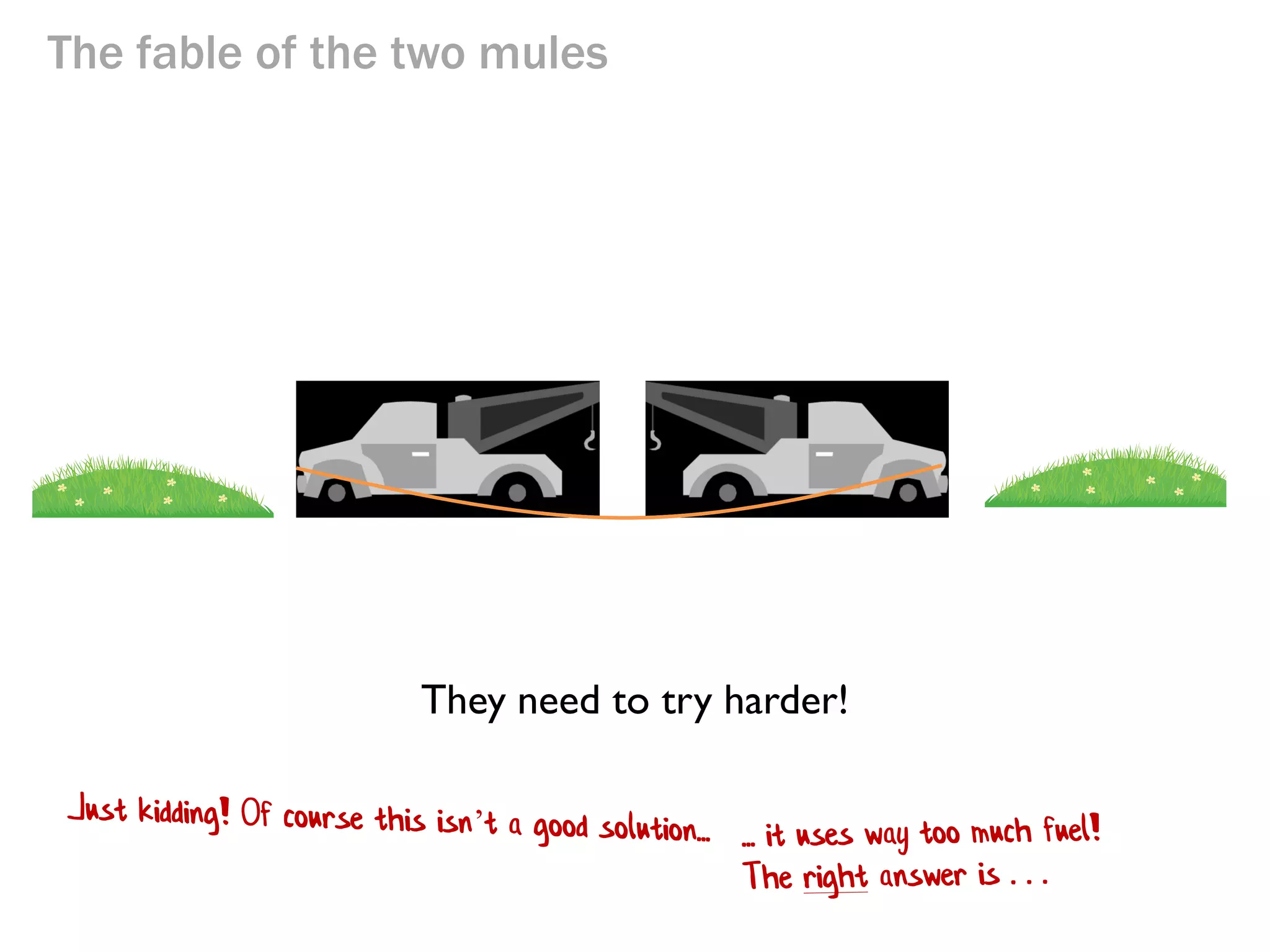
They need to try harder!
The fable of the two mules

They need to try harder!
The fable of the two mules

They need to try harder!
The fable of the two mules

They need to try harder!
The fable of the two mules

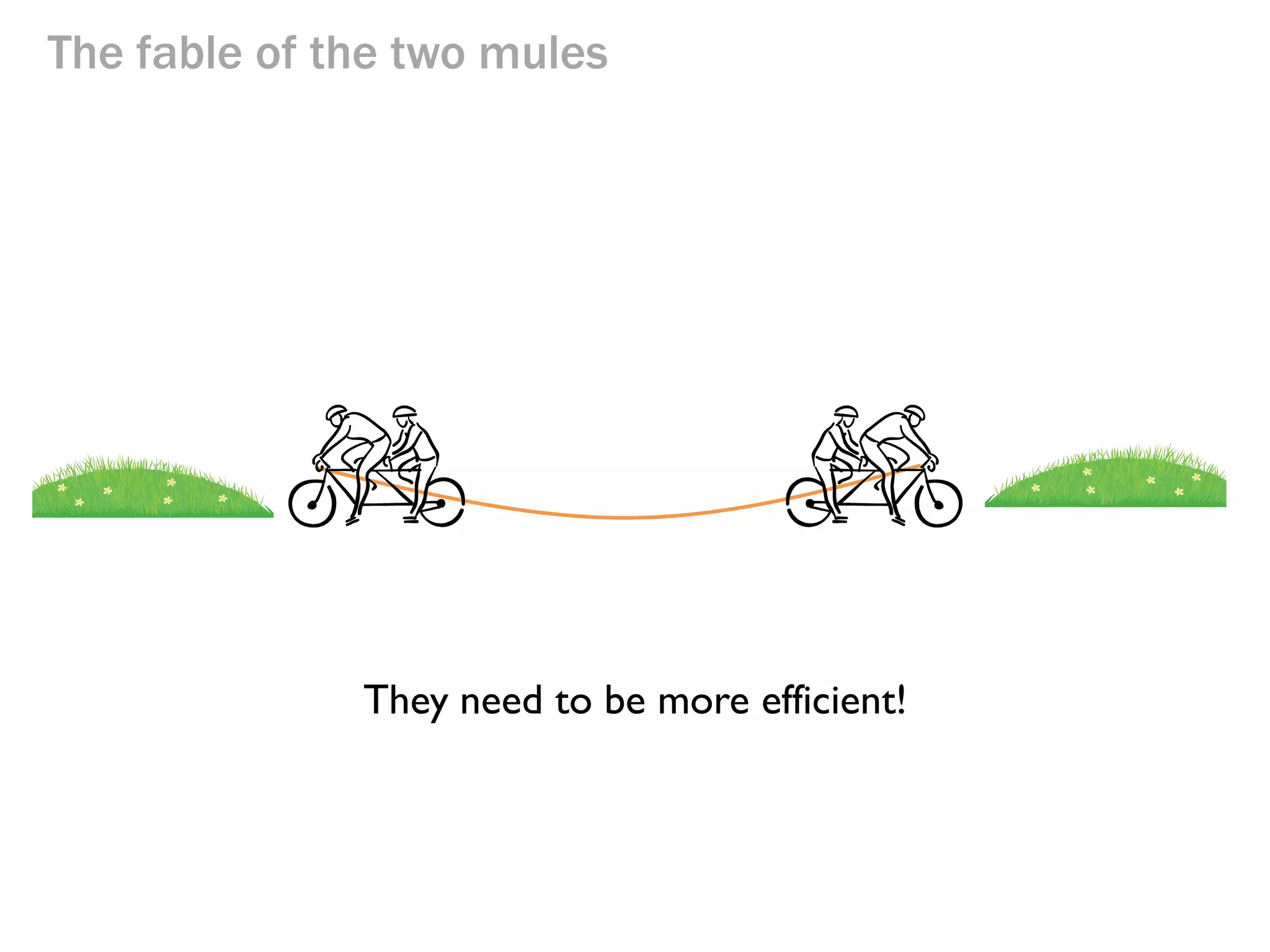
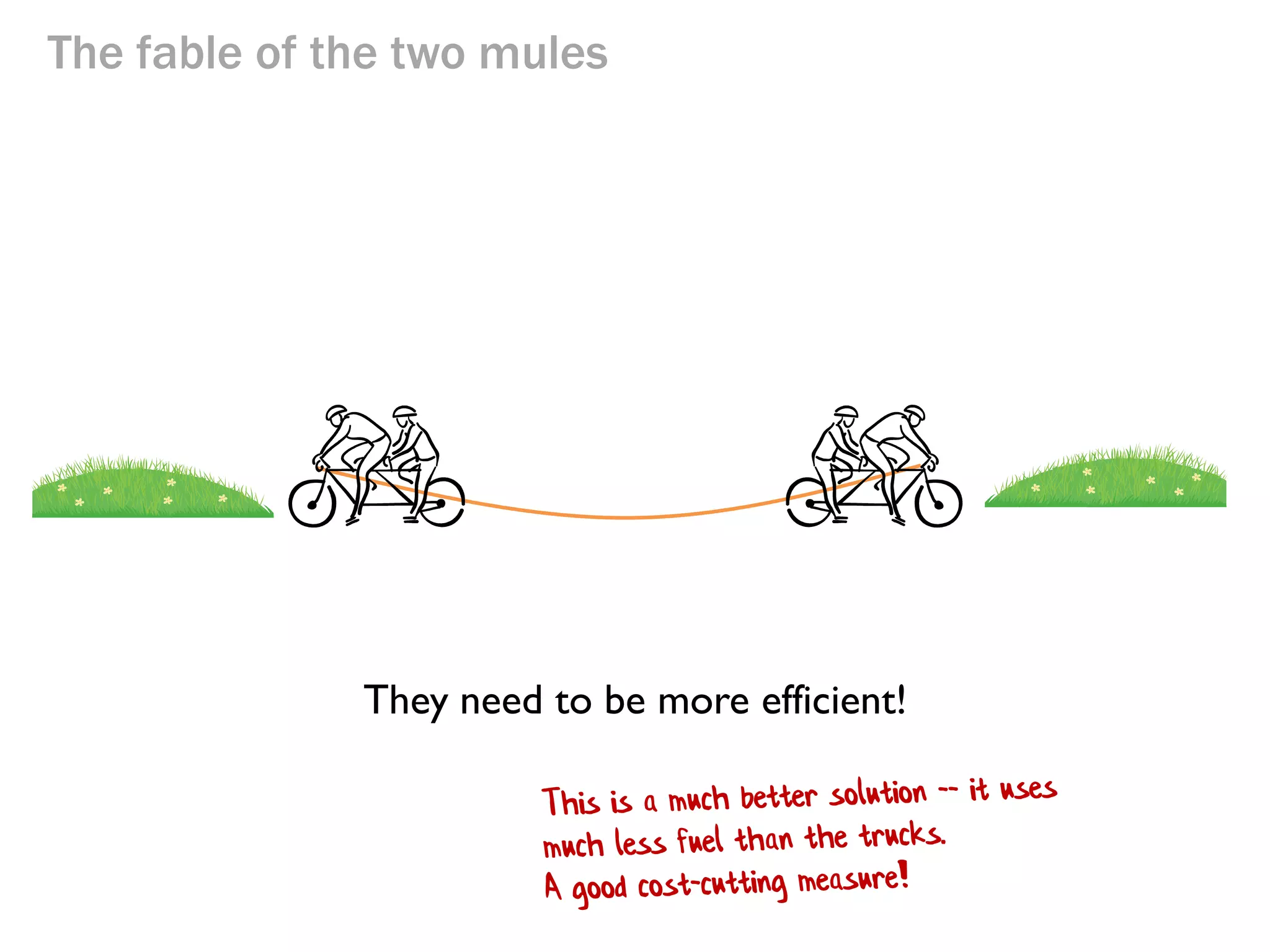
They need to be more efficient!
The fable of the two mules

They need to be more efficient!
The fable of the two mules

They need to be more efficient!
The fable of the two mules

For anyone who doesn’t know
this story...
The moral is that co-operation is
better than struggle.
The fable of the two mules

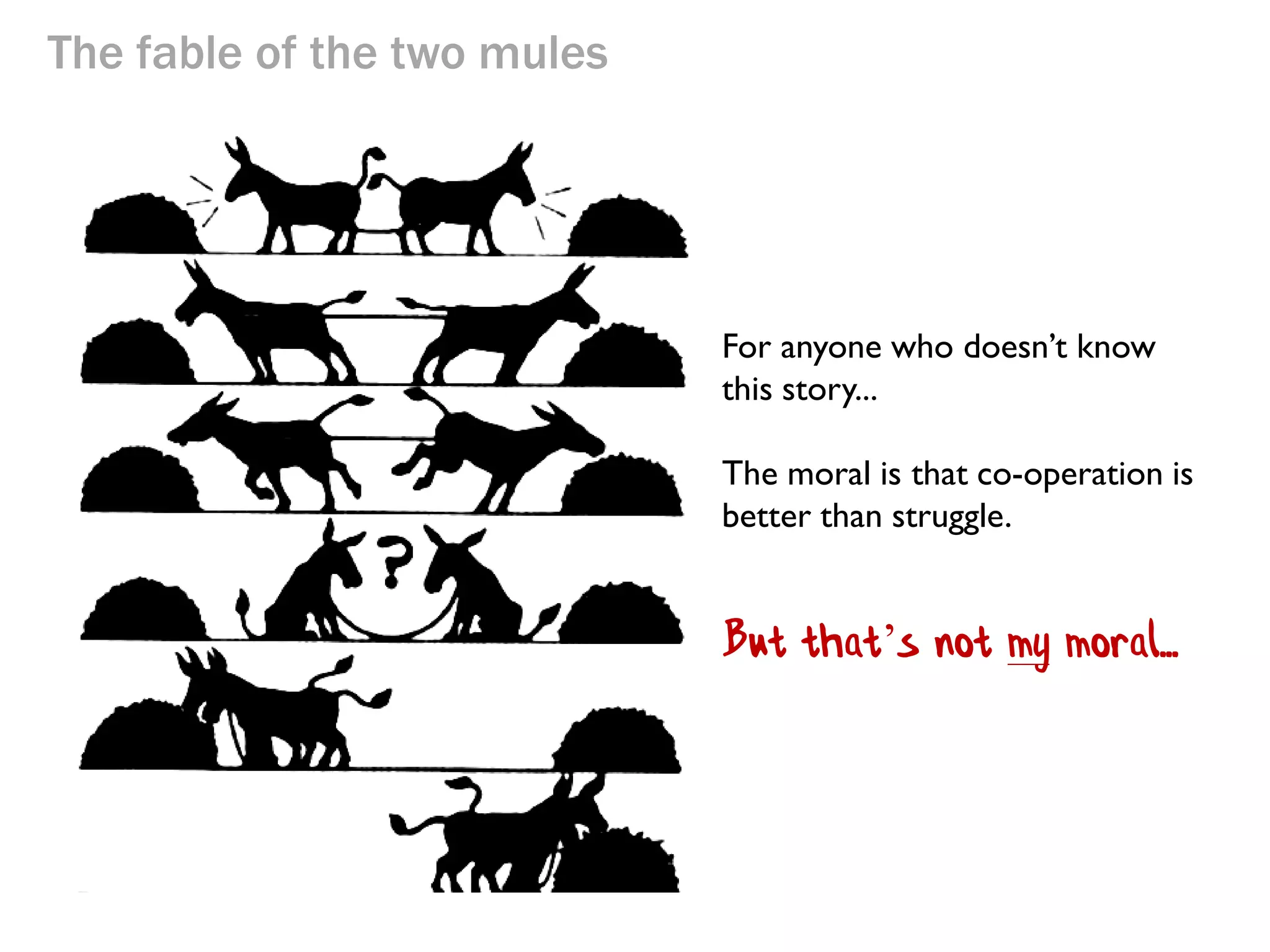
For anyone who doesn’t know
this story...
The moral is that co-operation is
better than struggle.

But that’s not my moral...
Part II
Efficiency vs. Effectiveness
Efficiency

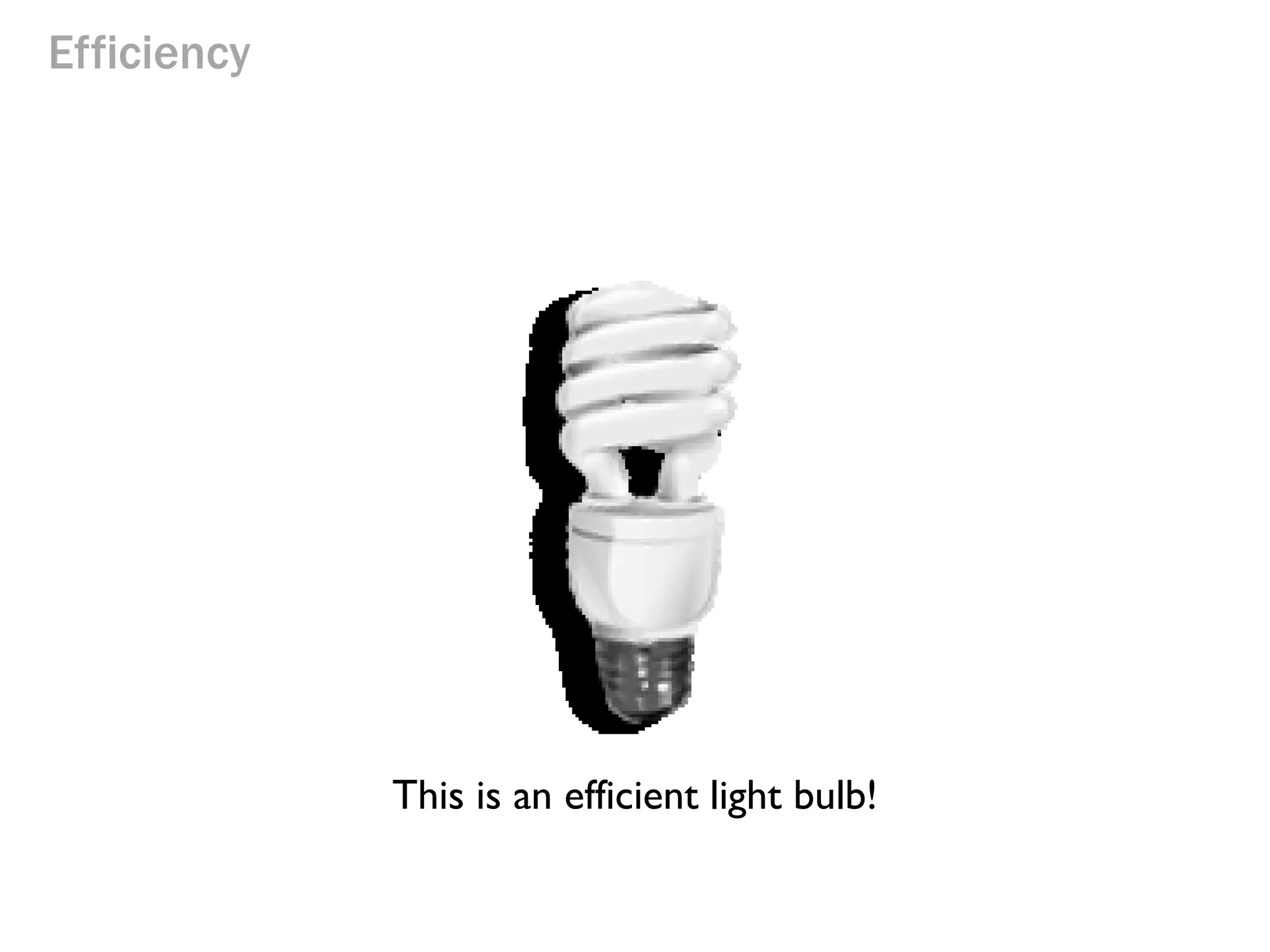
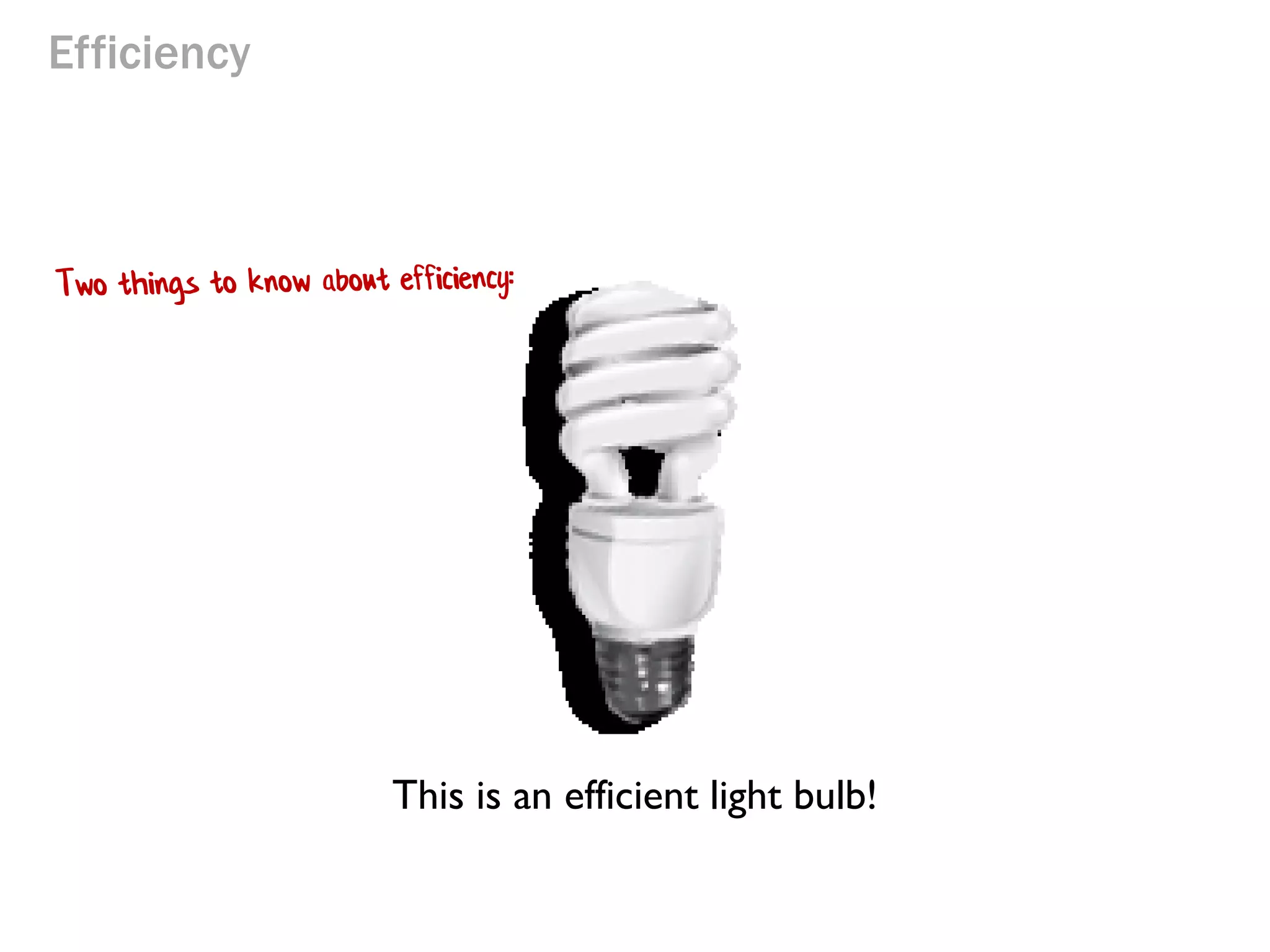
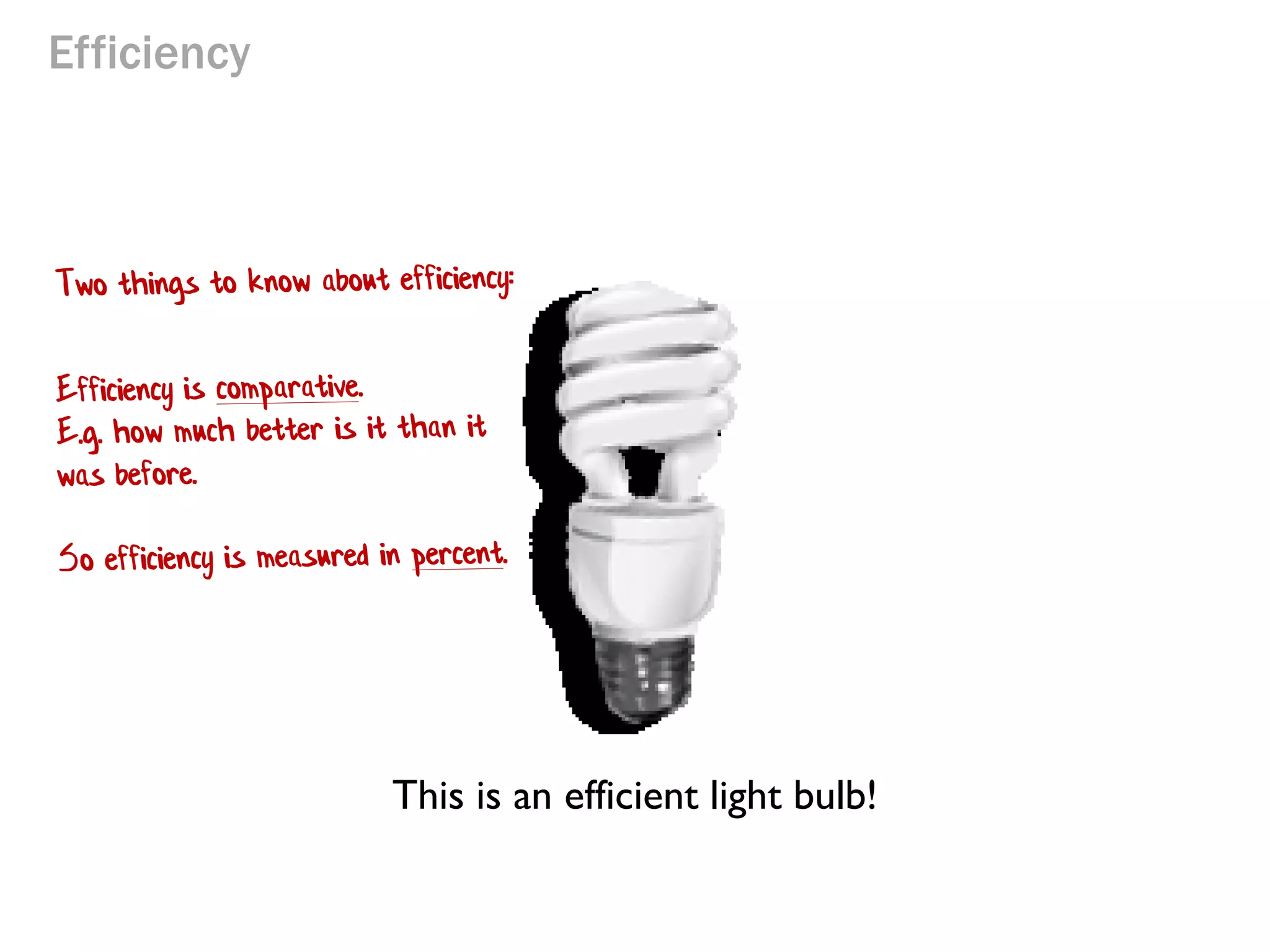
This is an efficient light bulb!
Efficiency

This is an efficient light bulb!
Efficiency

This is an efficient light bulb!
Effectiveness

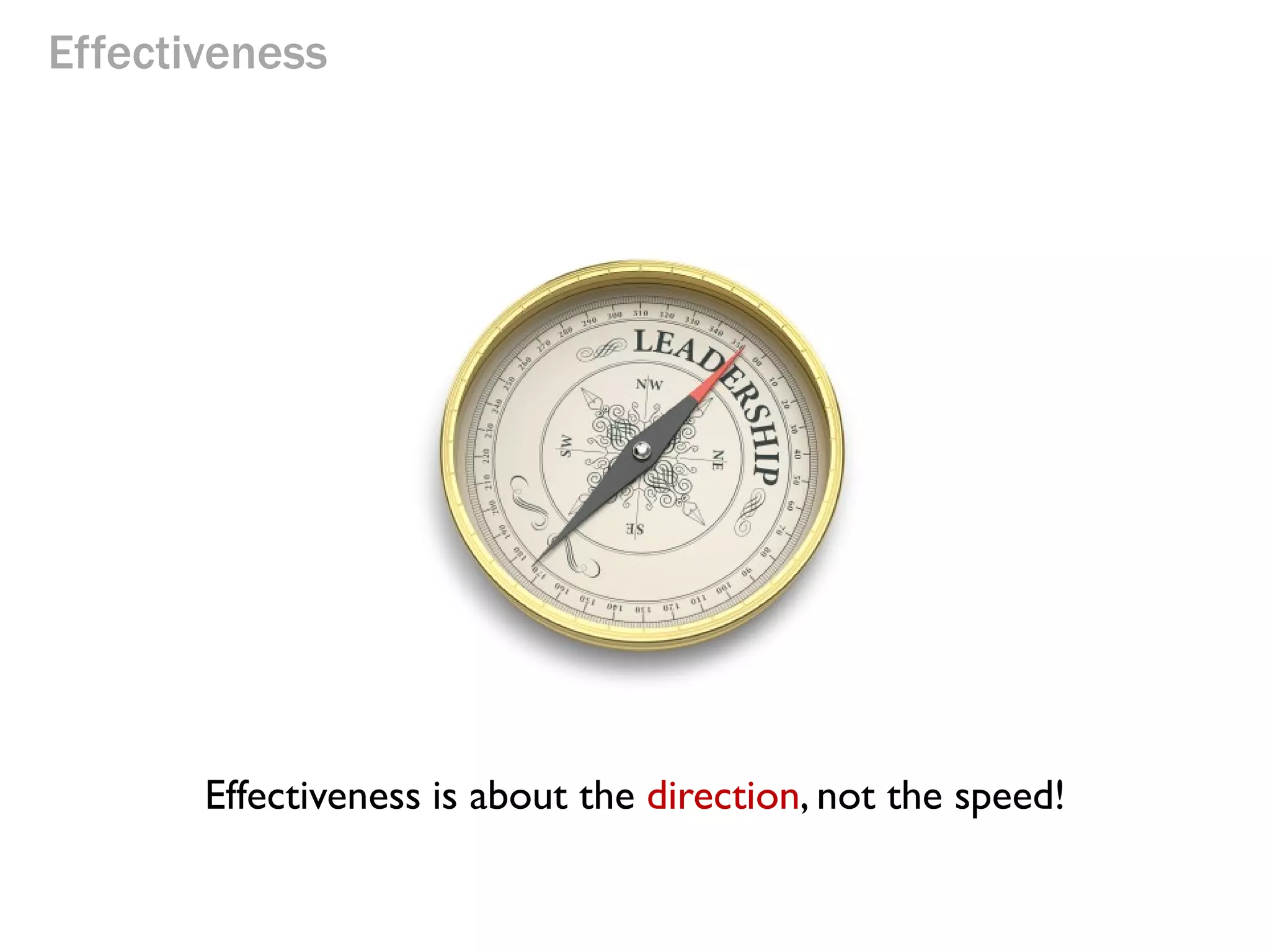
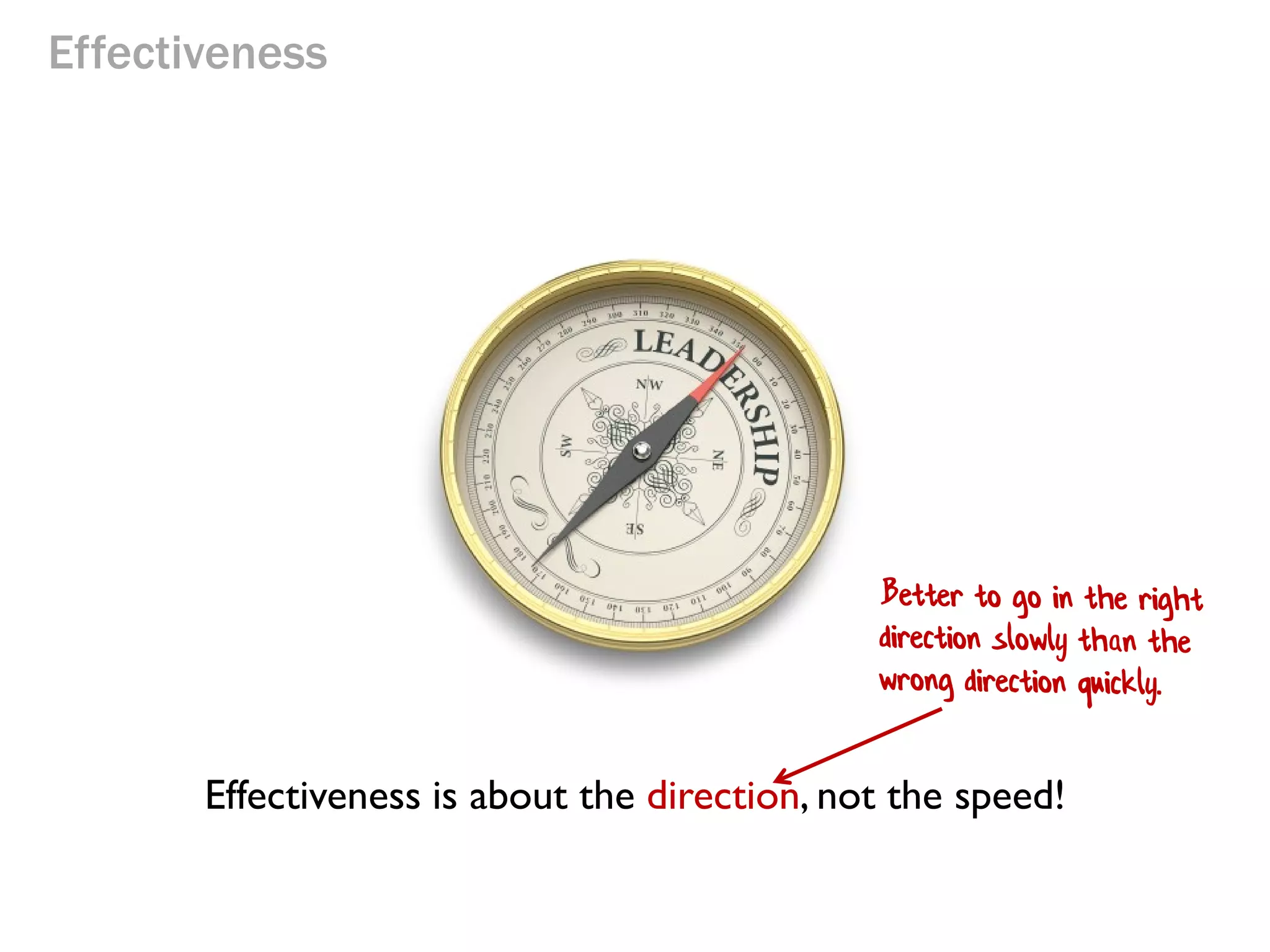
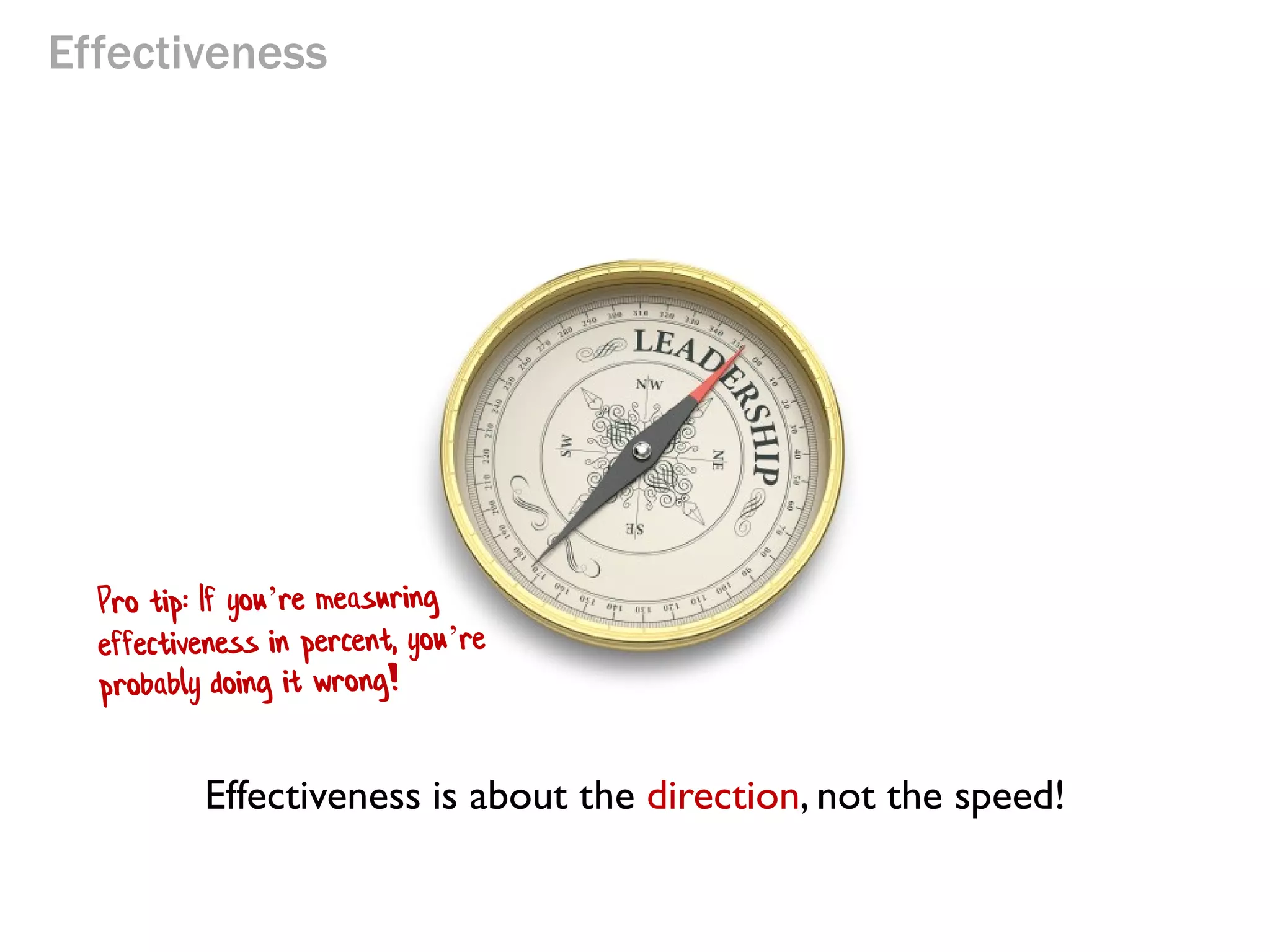
Effectiveness is about the direction, not the speed!
Effectiveness

Effectiveness is about the direction, not the speed!
Effectiveness

Effectiveness is about the direction, not the speed!
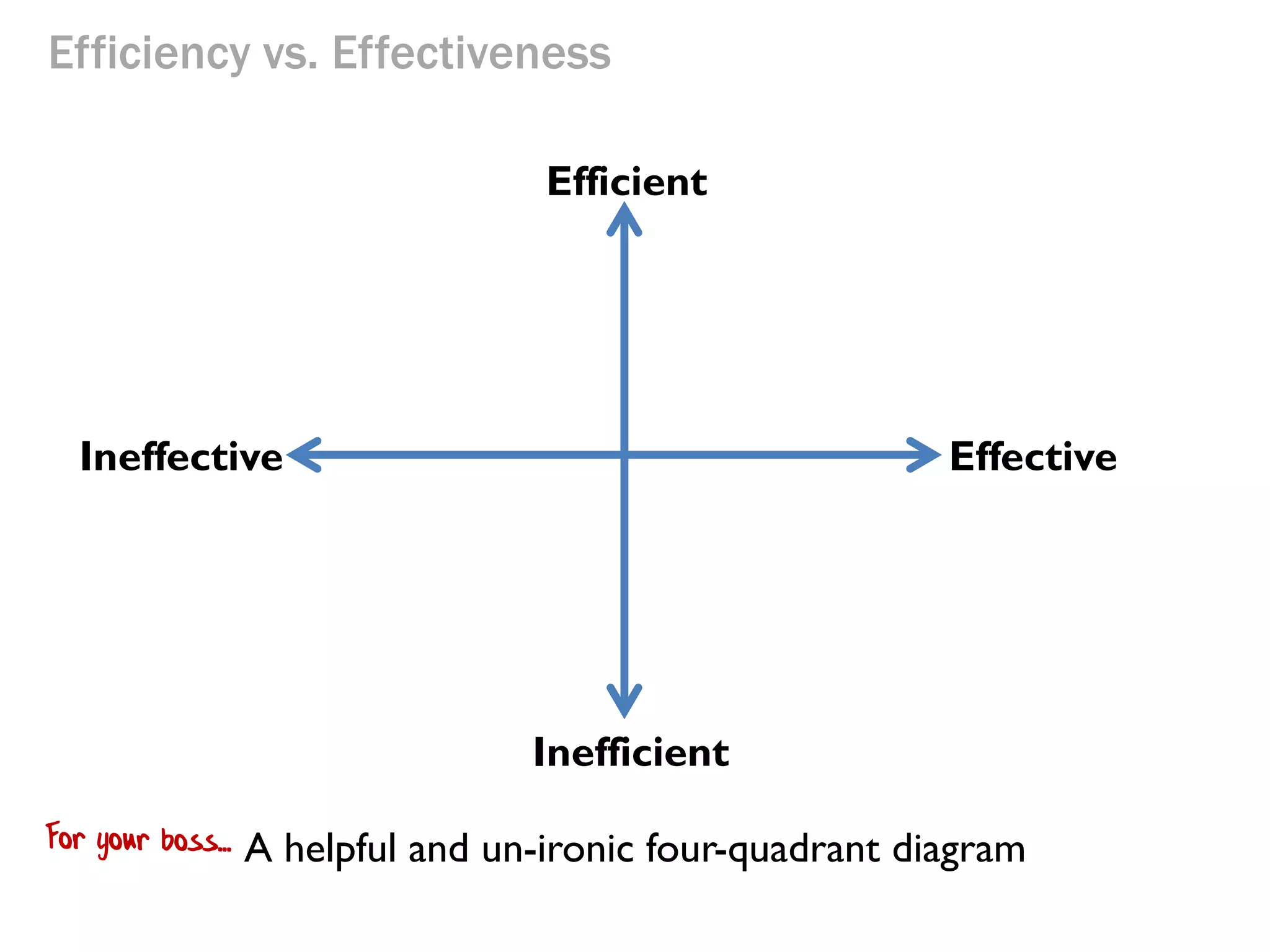
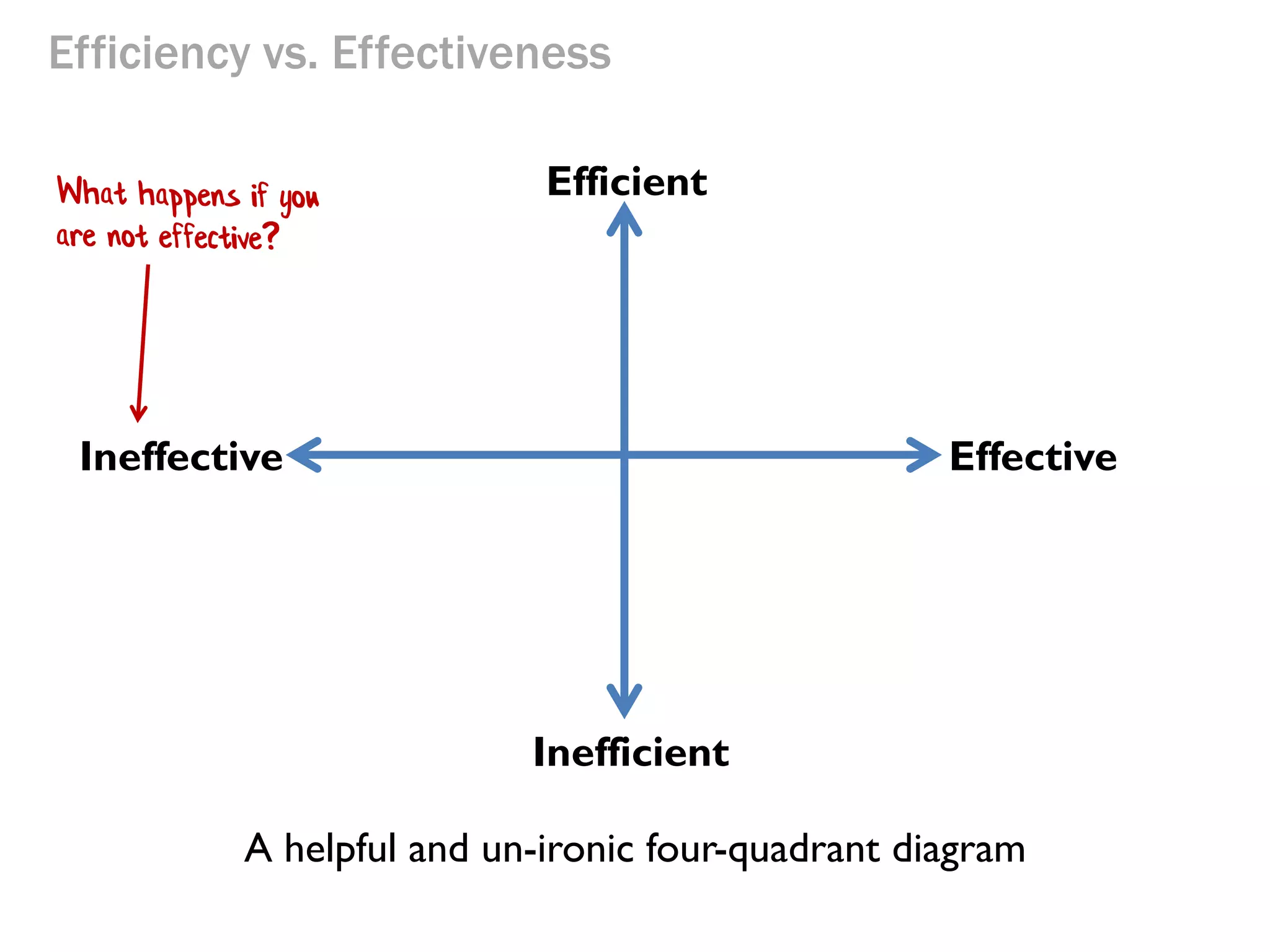
Efficiency vs. Effectiveness
Efficient

Ineffective

Effective

Inefficient
A helpful and un-ironic four-quadrant diagram
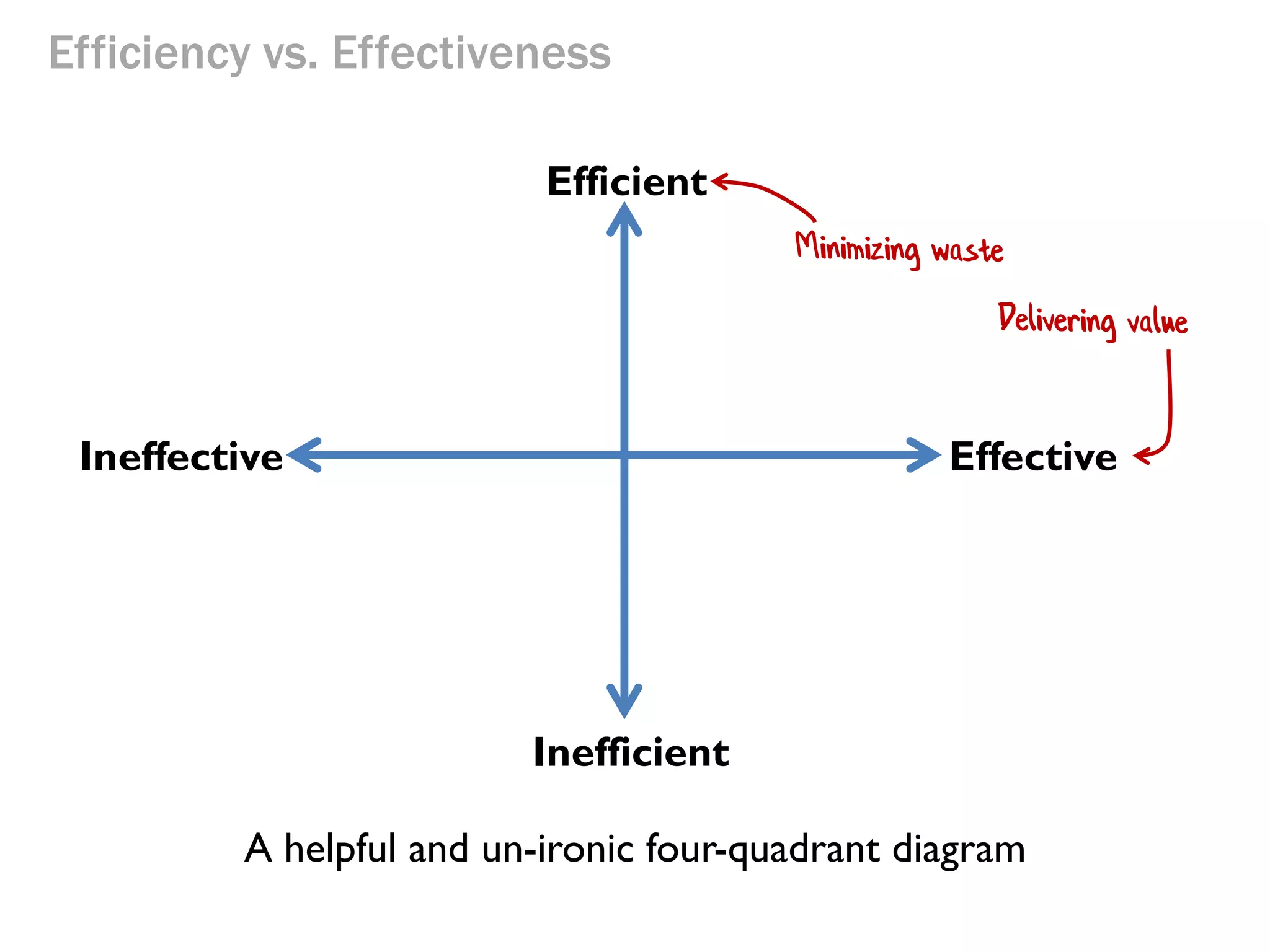
Efficiency vs. Effectiveness
Efficient

Ineffective

Effective

Inefficient
A helpful and un-ironic four-quadrant diagram
Efficiency vs. Effectiveness
Efficient

Ineffective

Effective

Inefficient
A helpful and un-ironic four-quadrant diagram
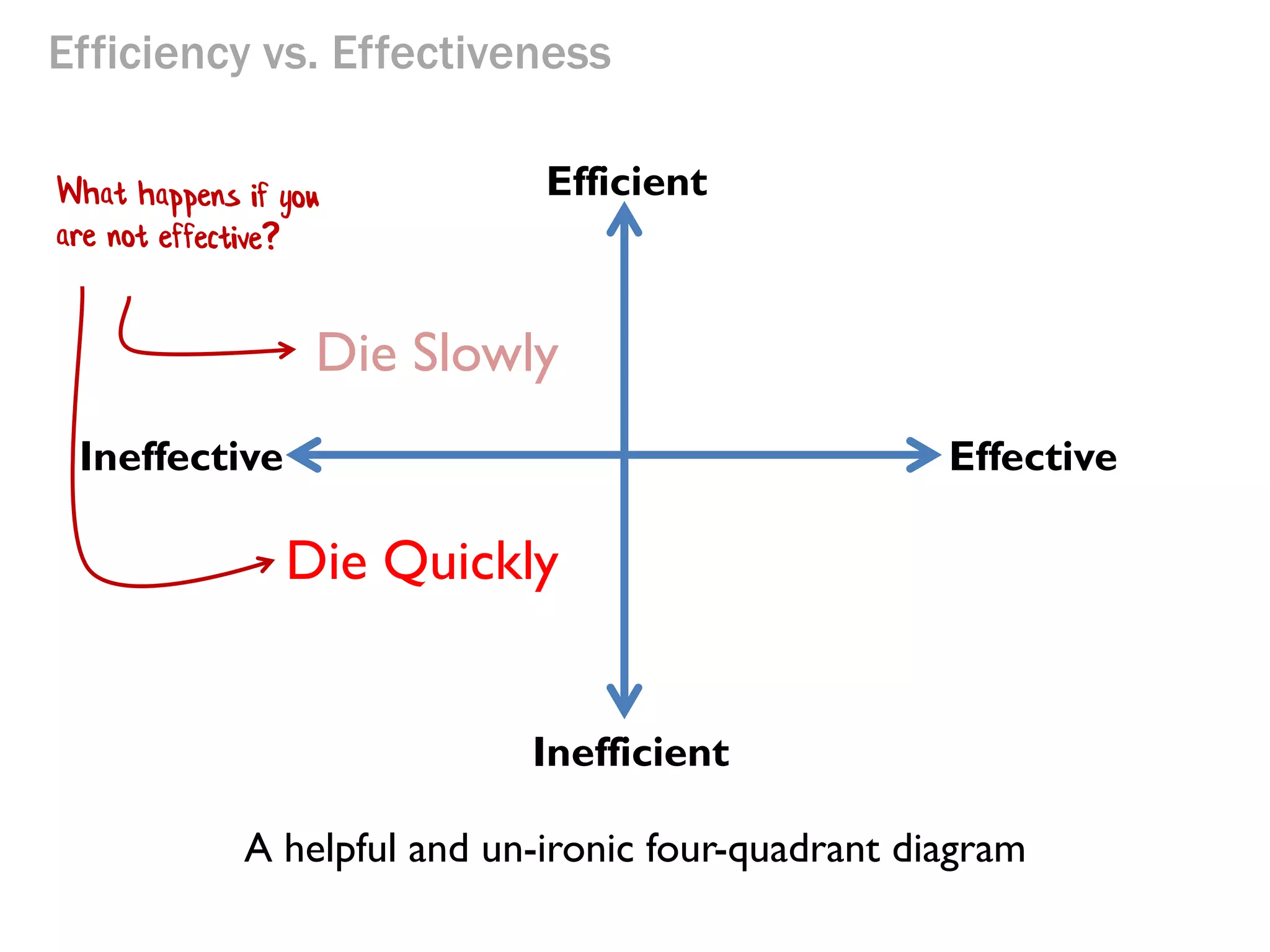
Efficiency vs. Effectiveness
Efficient

Die Slowly
Ineffective

Effective

Die Quickly
Inefficient
A helpful and un-ironic four-quadrant diagram
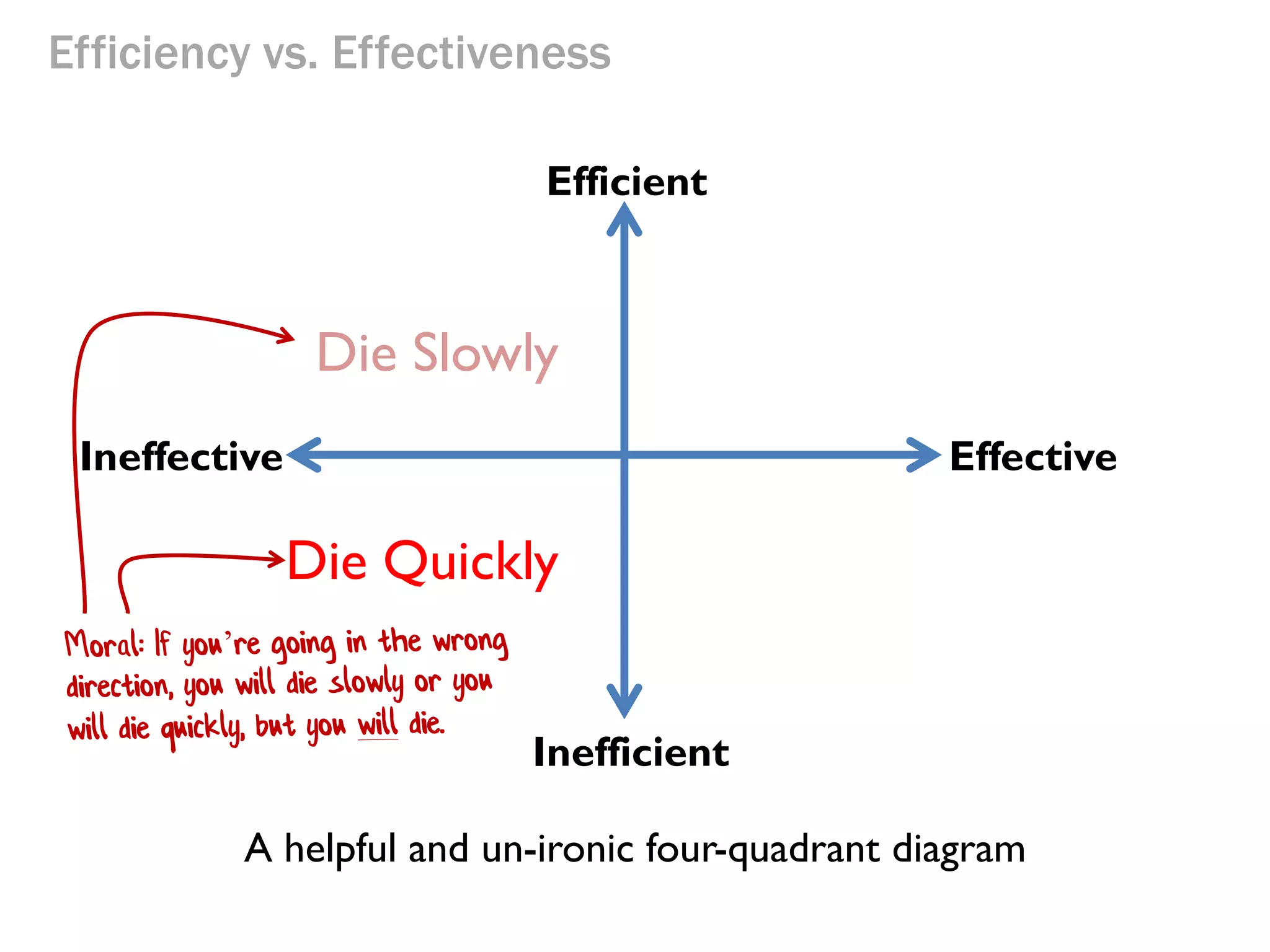
Efficiency vs. Effectiveness
Efficient

Die Slowly
Ineffective

Effective

Die Quickly
Inefficient
A helpful and un-ironic four-quadrant diagram
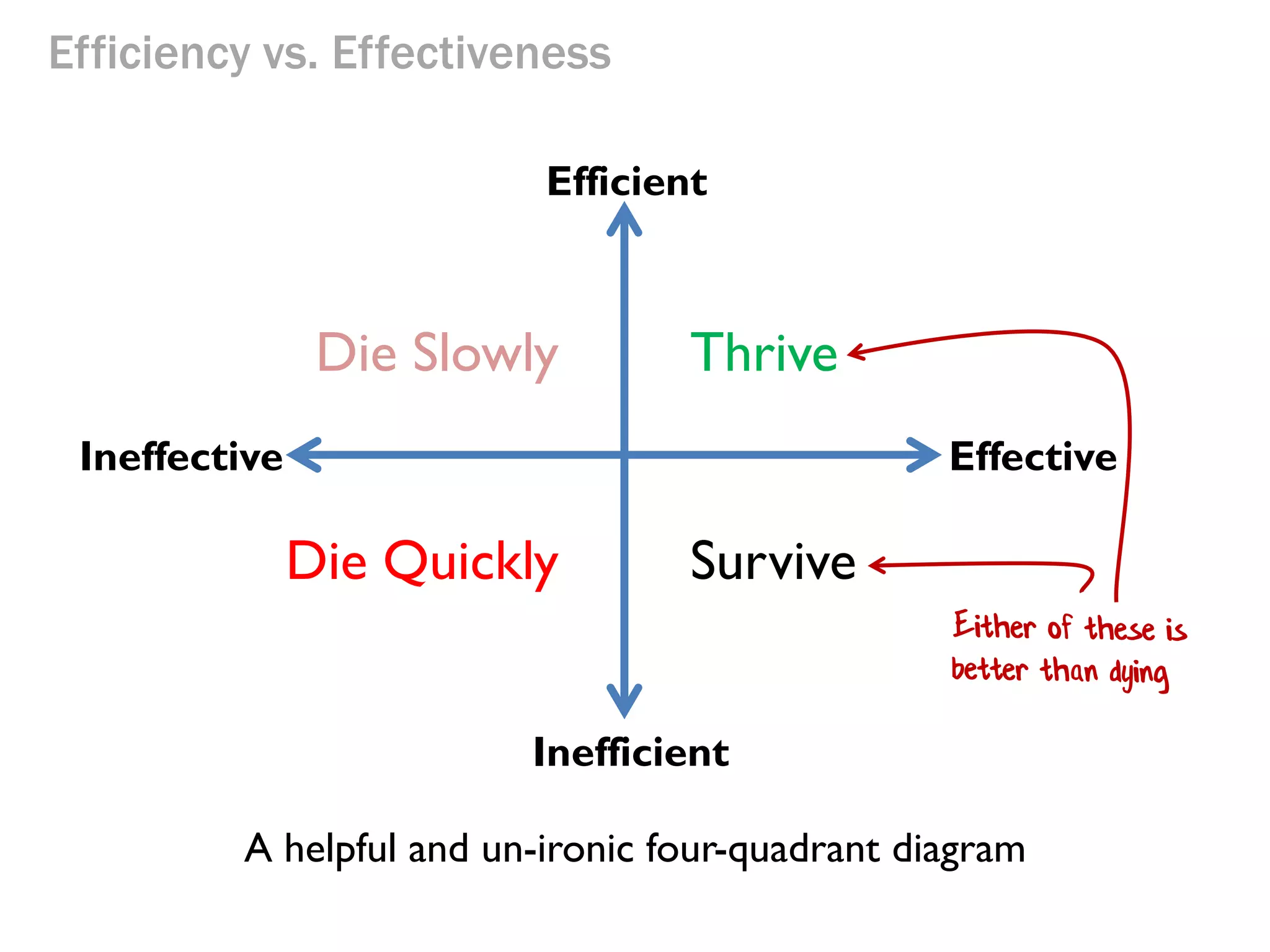
Efficiency vs. Effectiveness
Efficient

Die Slowly

Thrive

Ineffective

Effective

Die Quickly

Survive

Inefficient
A helpful and un-ironic four-quadrant diagram
Efficiency vs. Effectiveness

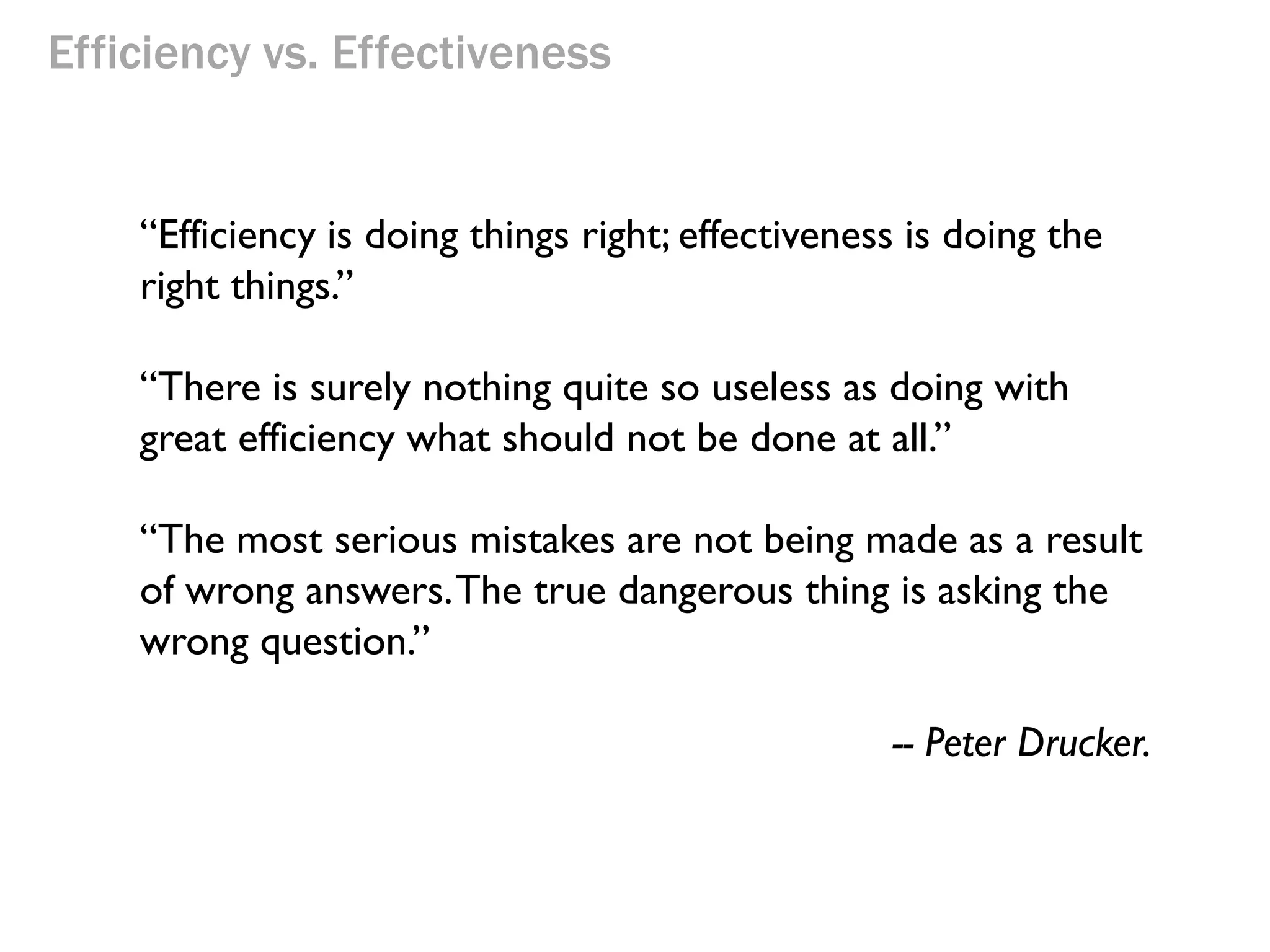
“Efficiency is doing things right; effectiveness is doing the
right things.”
“There is surely nothing quite so useless as doing with
great efficiency what should not be done at all.”

“The most serious mistakes are not being made as a result
of wrong answers. The true dangerous thing is asking the
wrong question.”
-- Peter Drucker.
Part III
The Chain
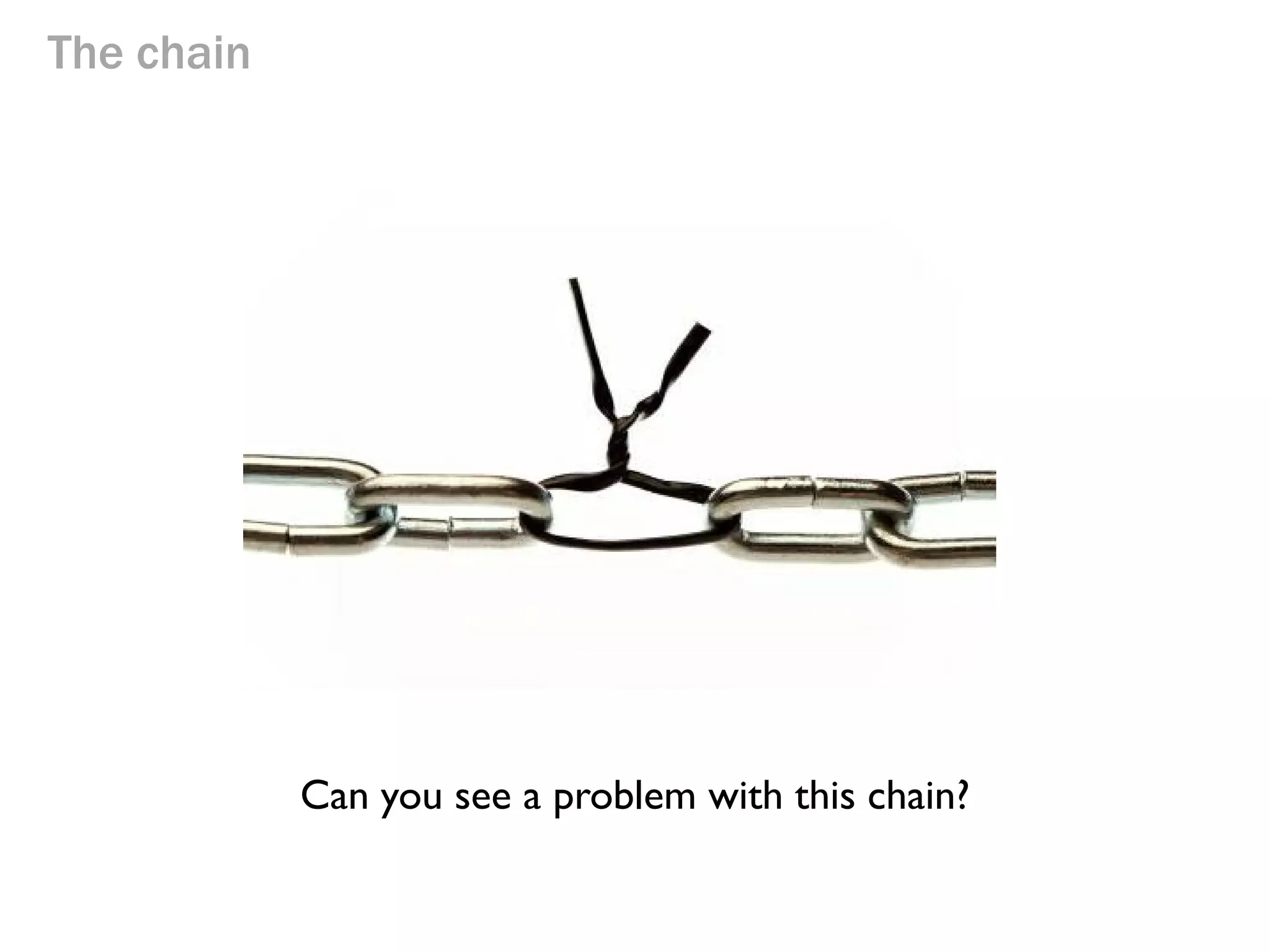
The chain

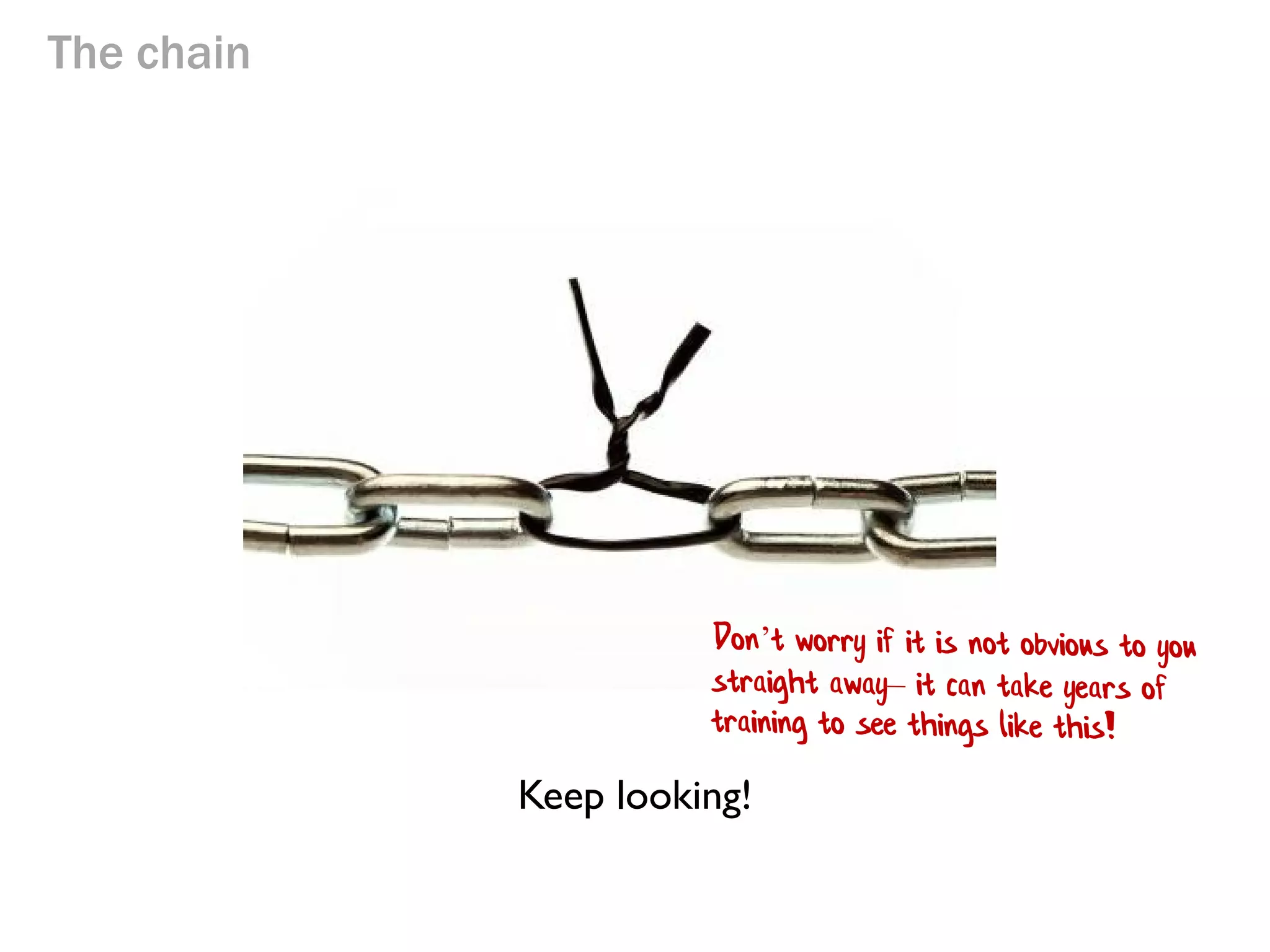
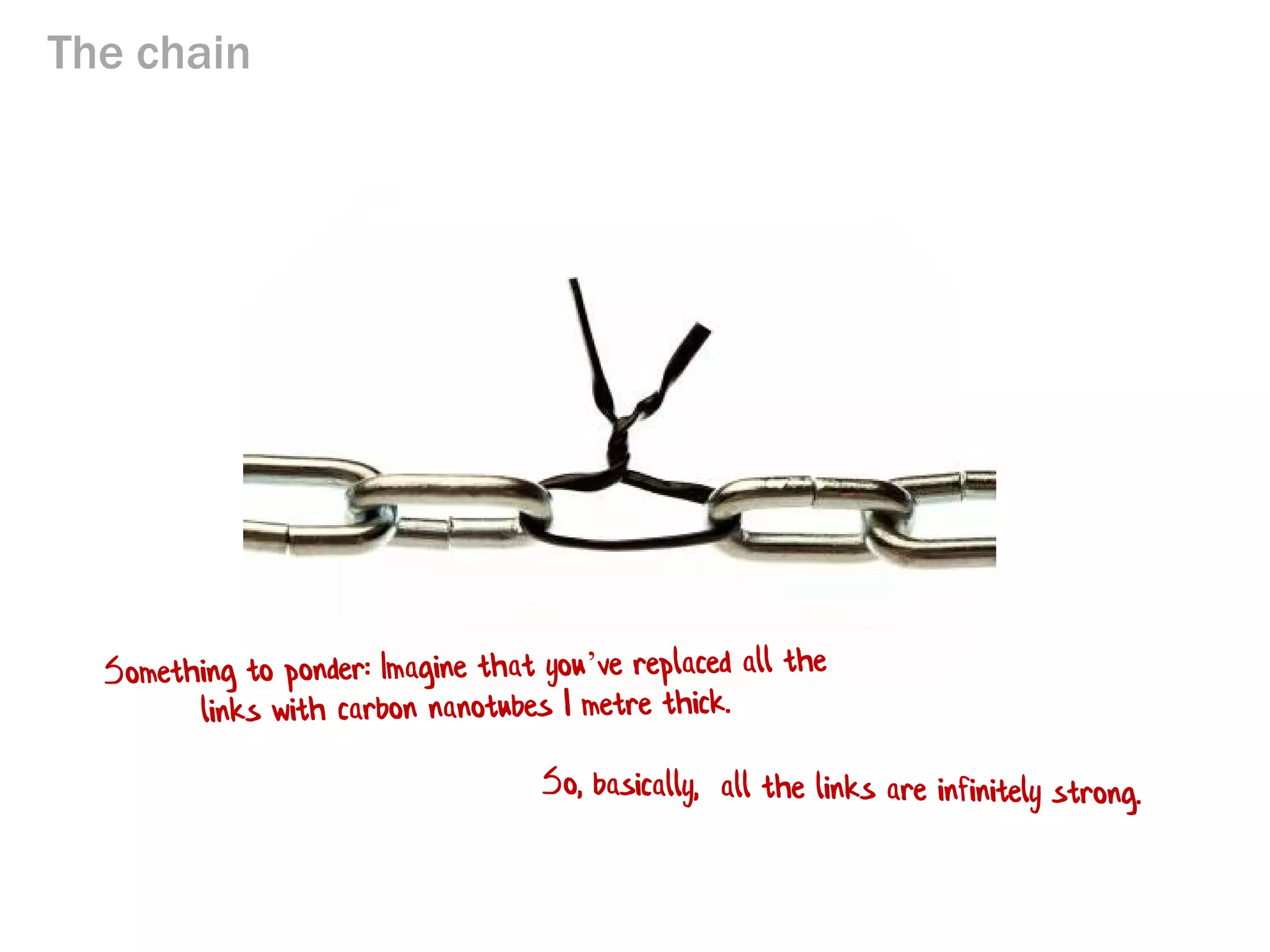
Can you see a problem with this chain?
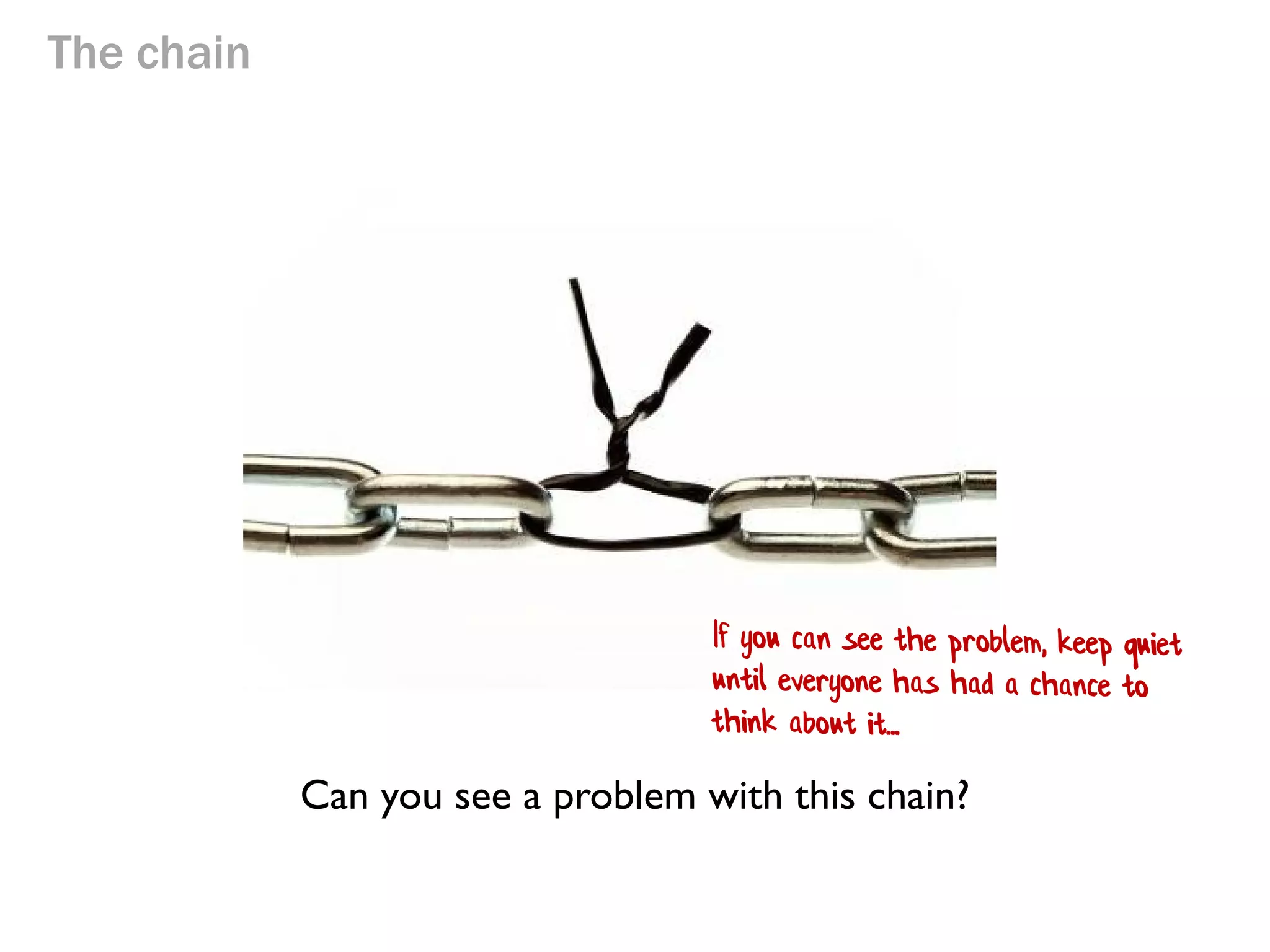
The chain

Can you see a problem with this chain?
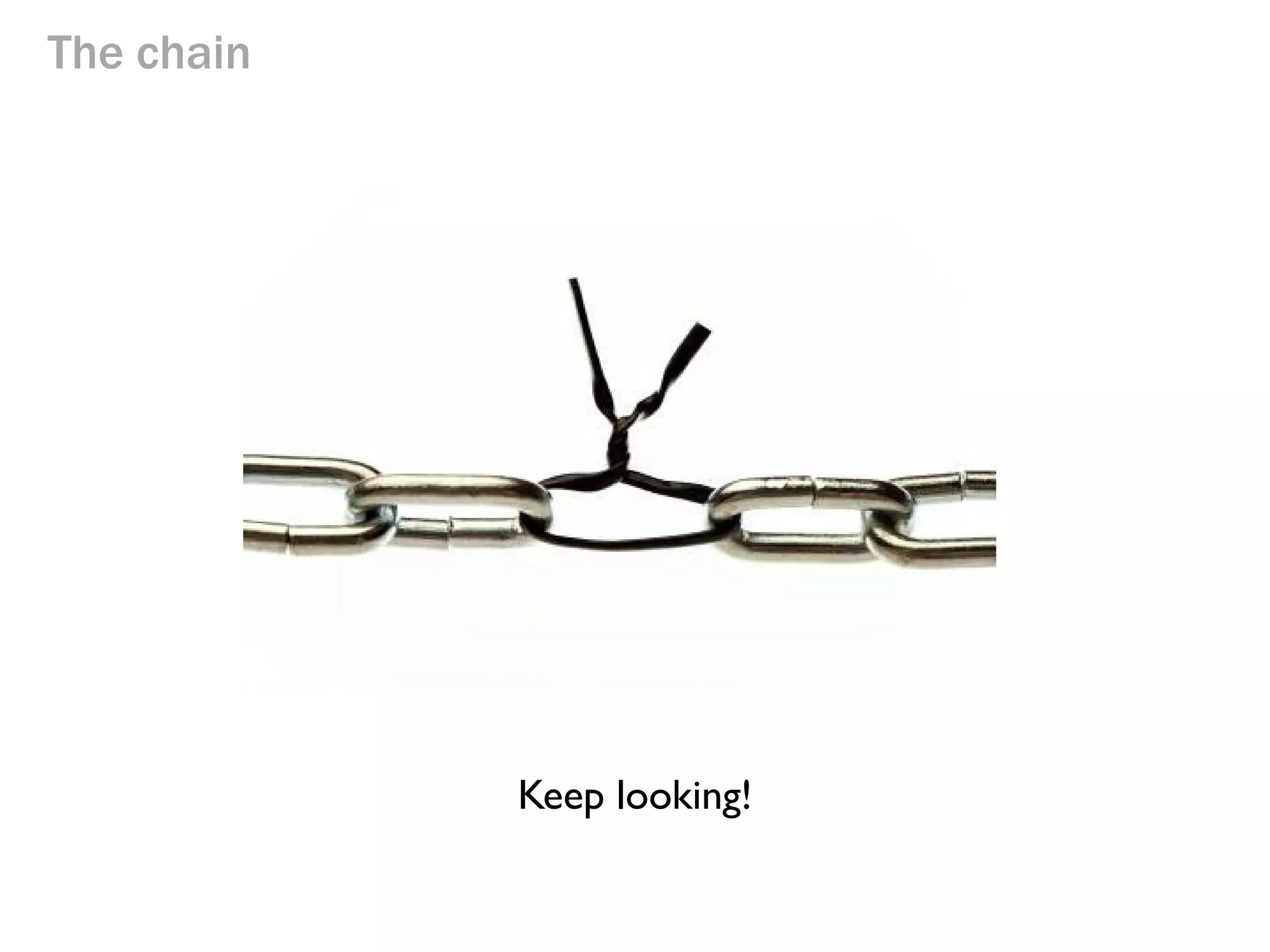
The chain

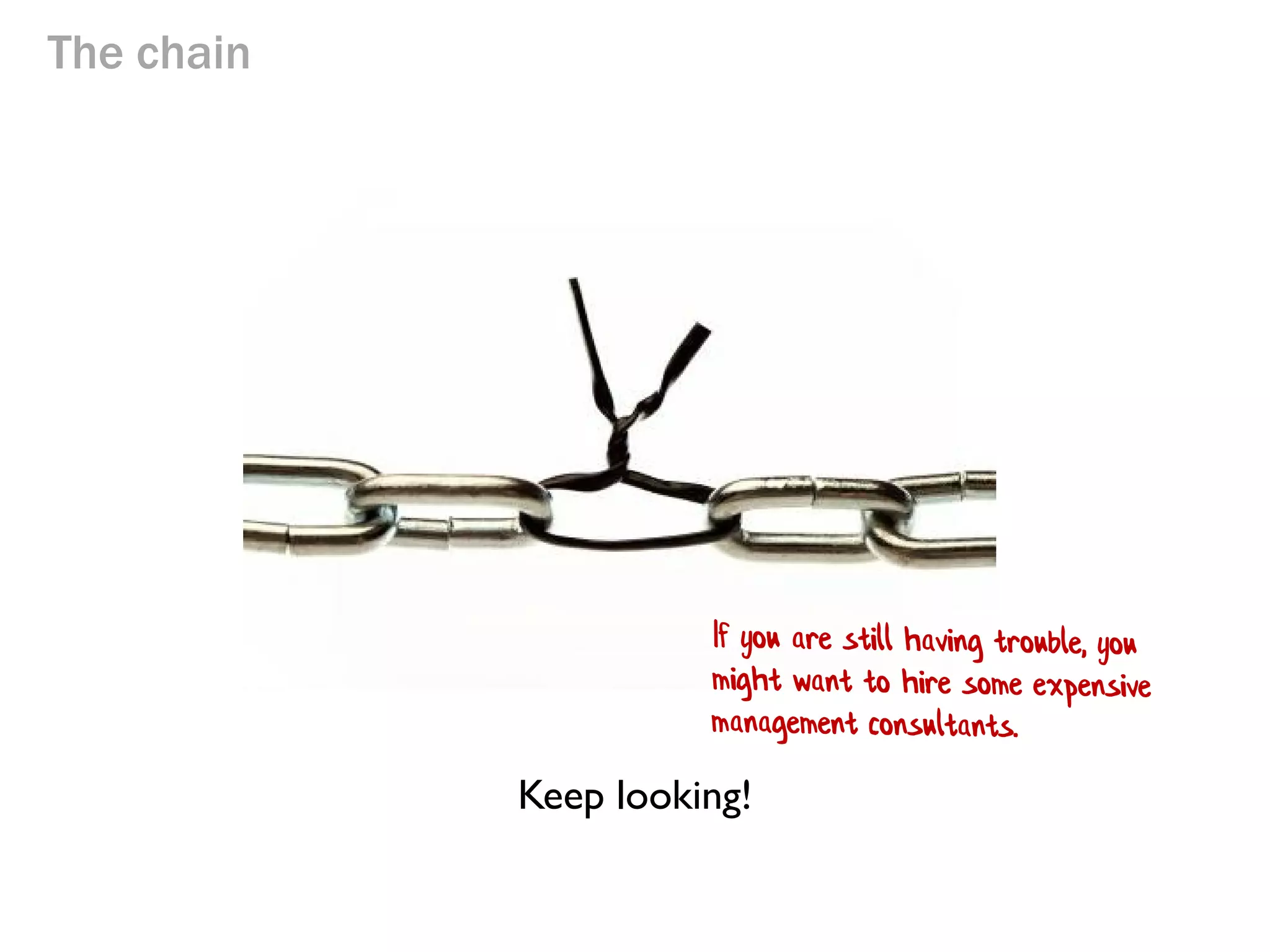
Keep looking!
The chain

Keep looking!
The chain

Keep looking!
The chain

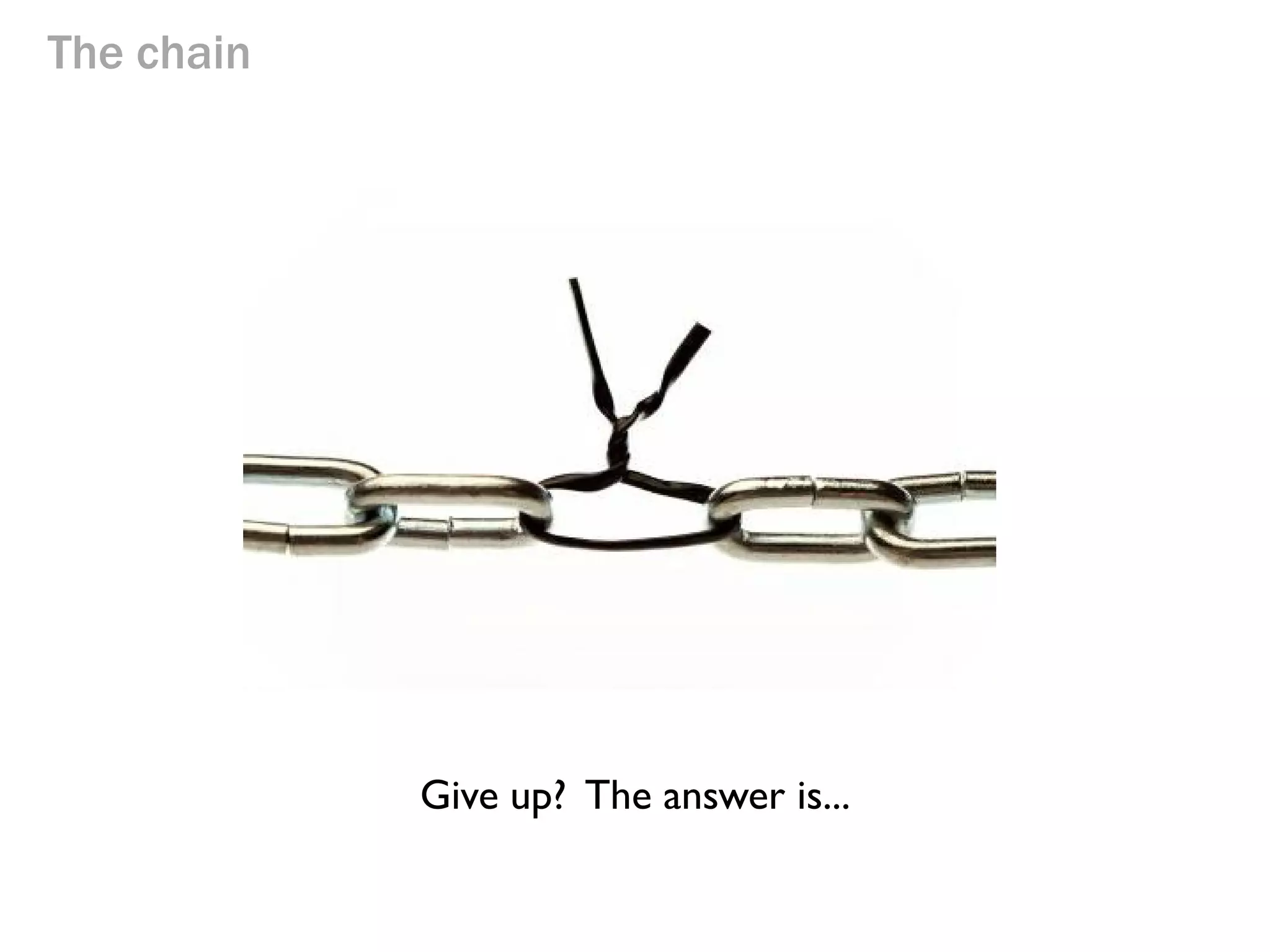
Give up? The answer is...
The chain

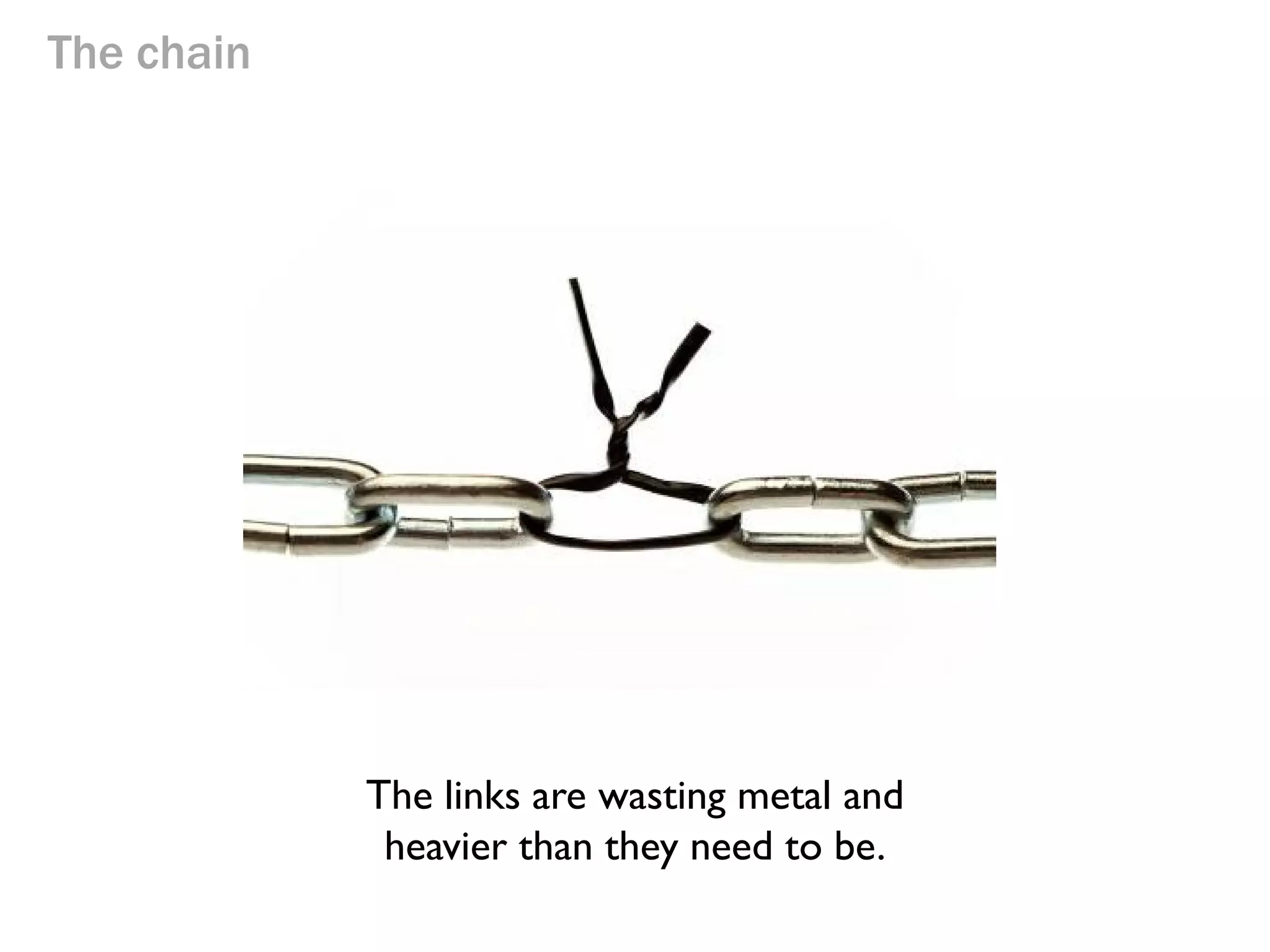
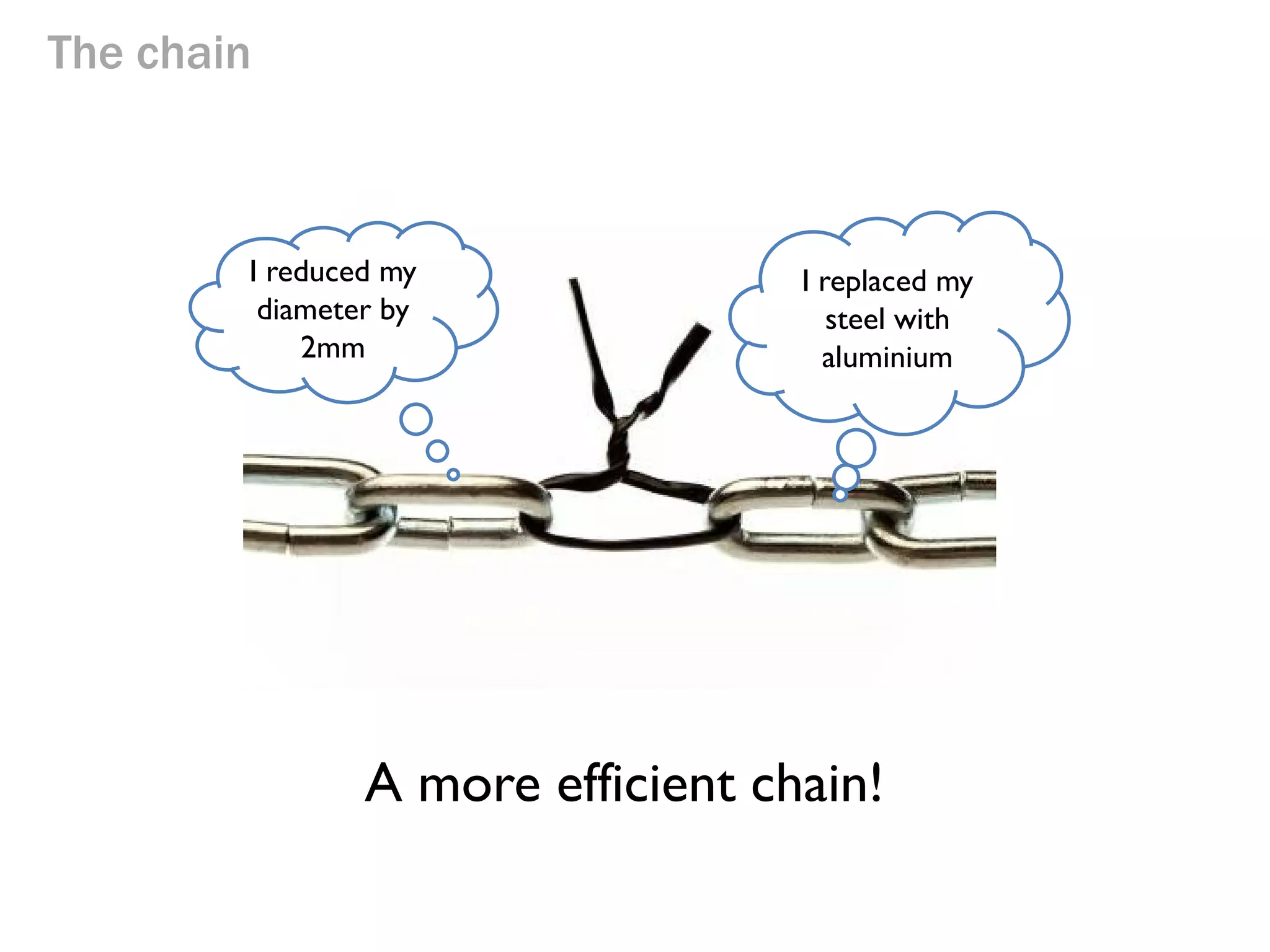
The links are wasting metal and
heavier than they need to be.
The chain

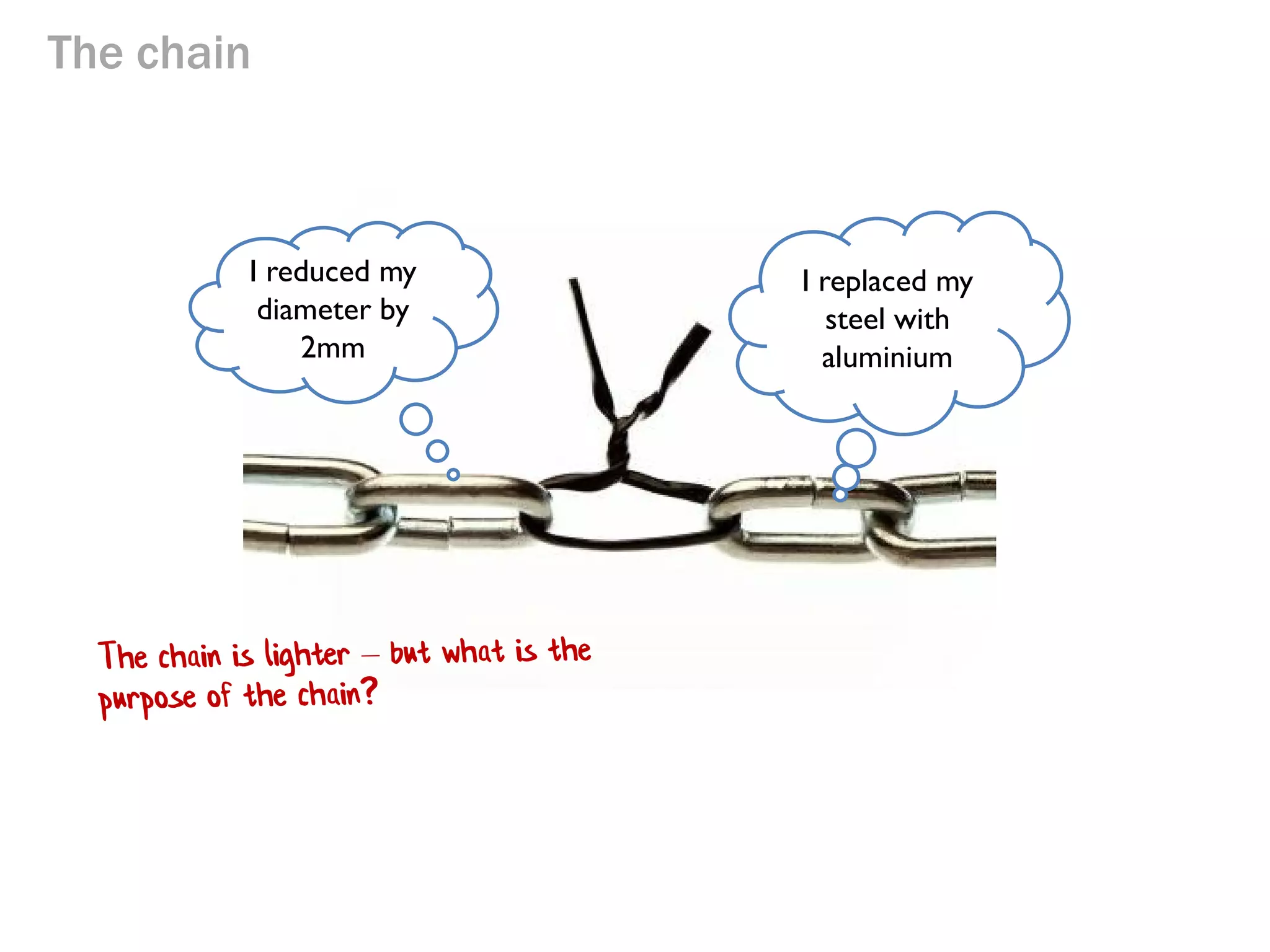
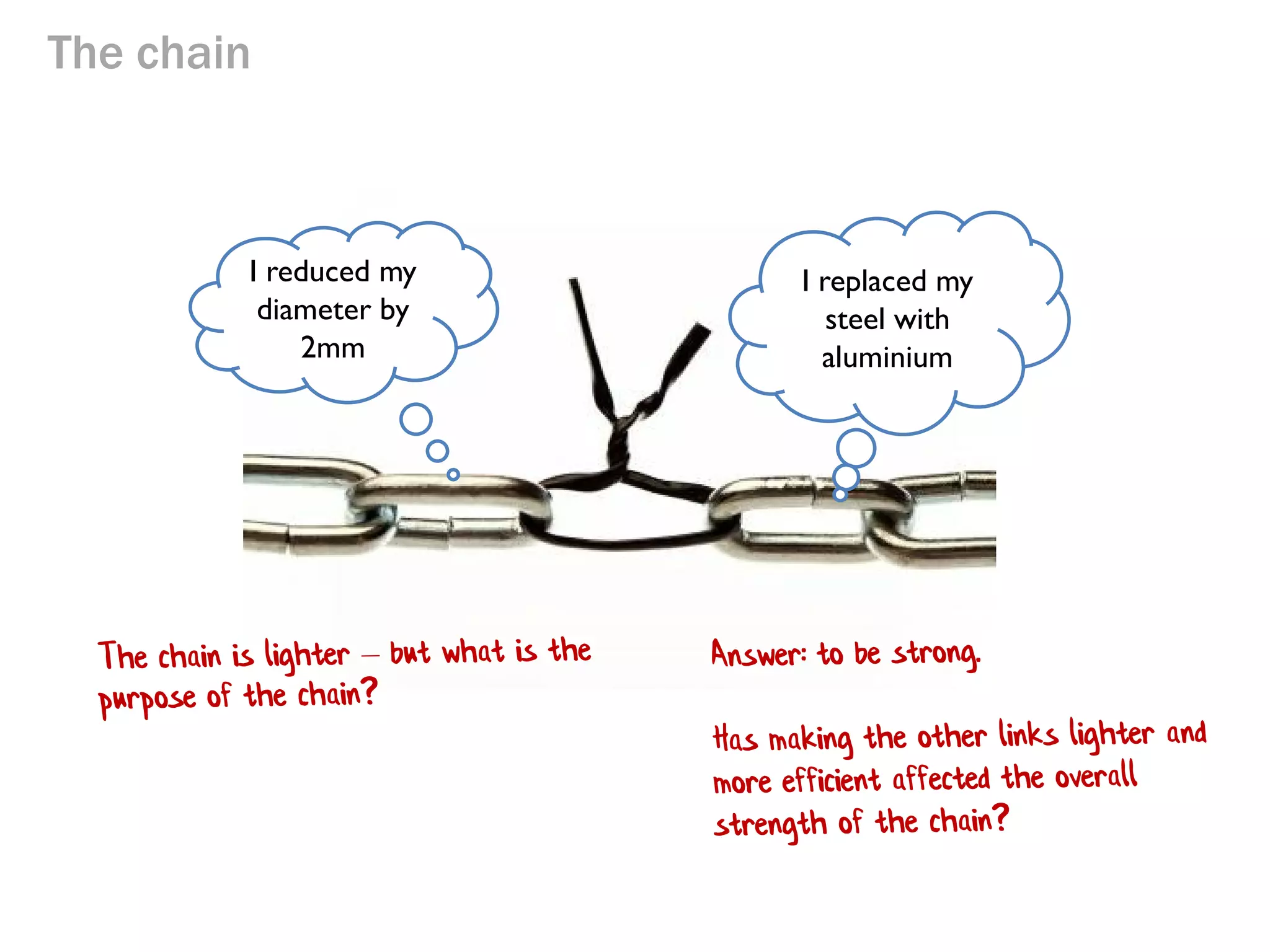
I reduced my
diameter by
2mm

I replaced my
steel with
aluminium

A more efficient chain!
The chain

I reduced my
diameter by
2mm

I replaced my
steel with
aluminium
The chain

I reduced my
diameter by
2mm

I replaced my
steel with
aluminium
Time for the first
overly-simplistic
business analogy....
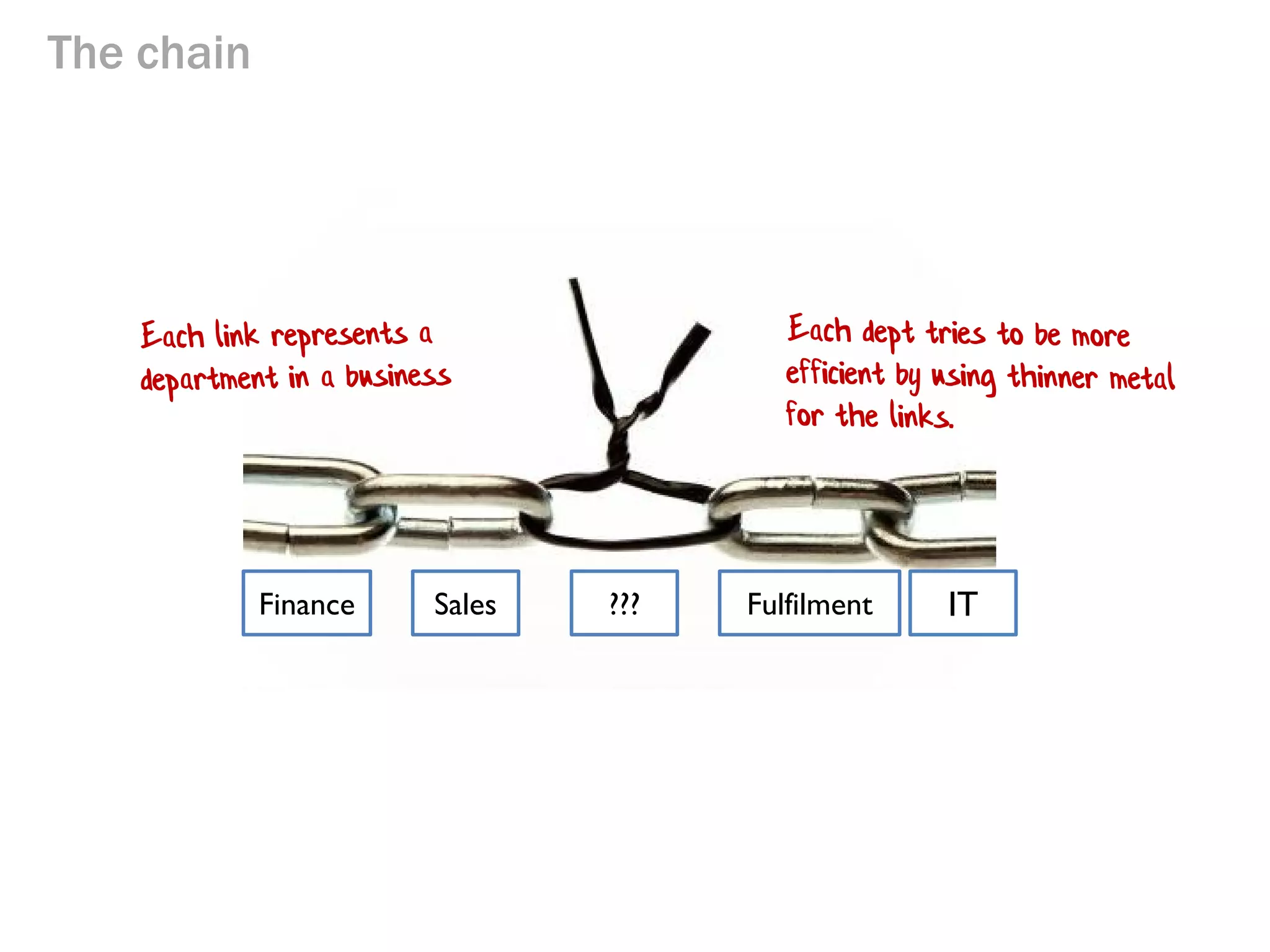
The chain

Finance

Sales

???

Fulfilment

IT
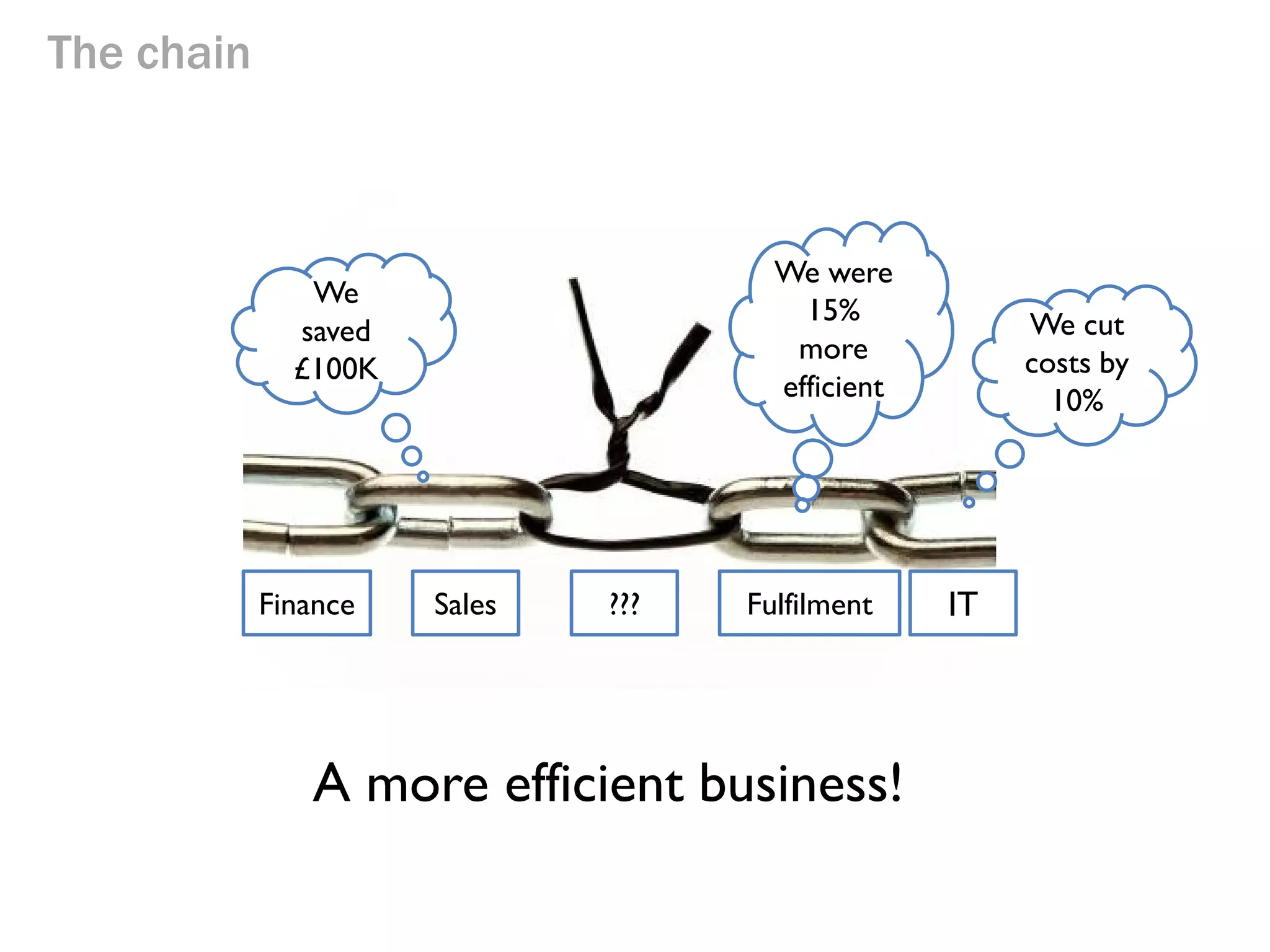
The chain

We were
15%
more
efficient

We
saved
£100K

Finance

Sales

???

Fulfilment

A more efficient business!

We cut
costs by
10%

IT
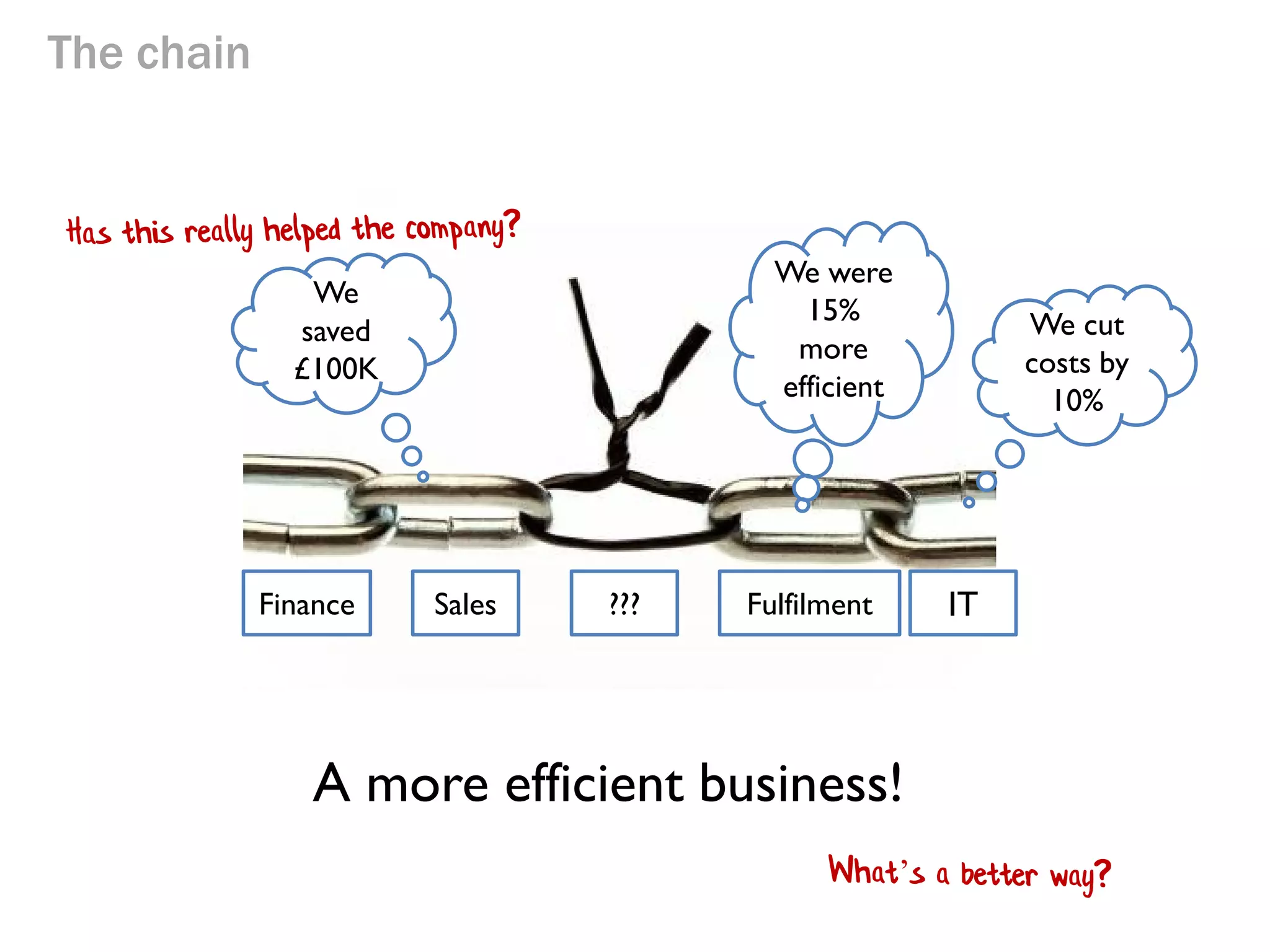
The chain

We were
15%
more
efficient

We
saved
£100K

Finance

Sales

???

Fulfilment

A more efficient business!

We cut
costs by
10%

IT
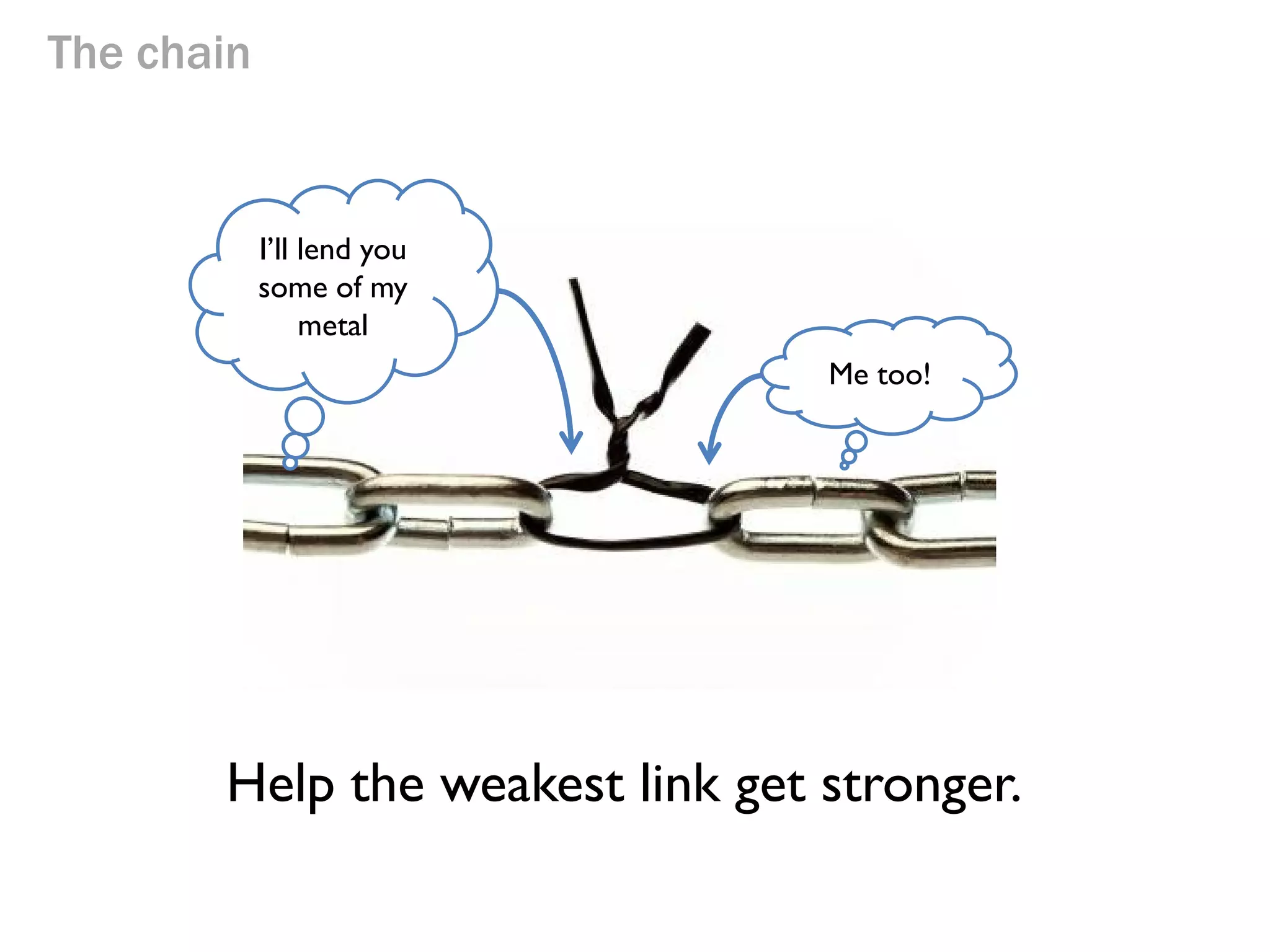
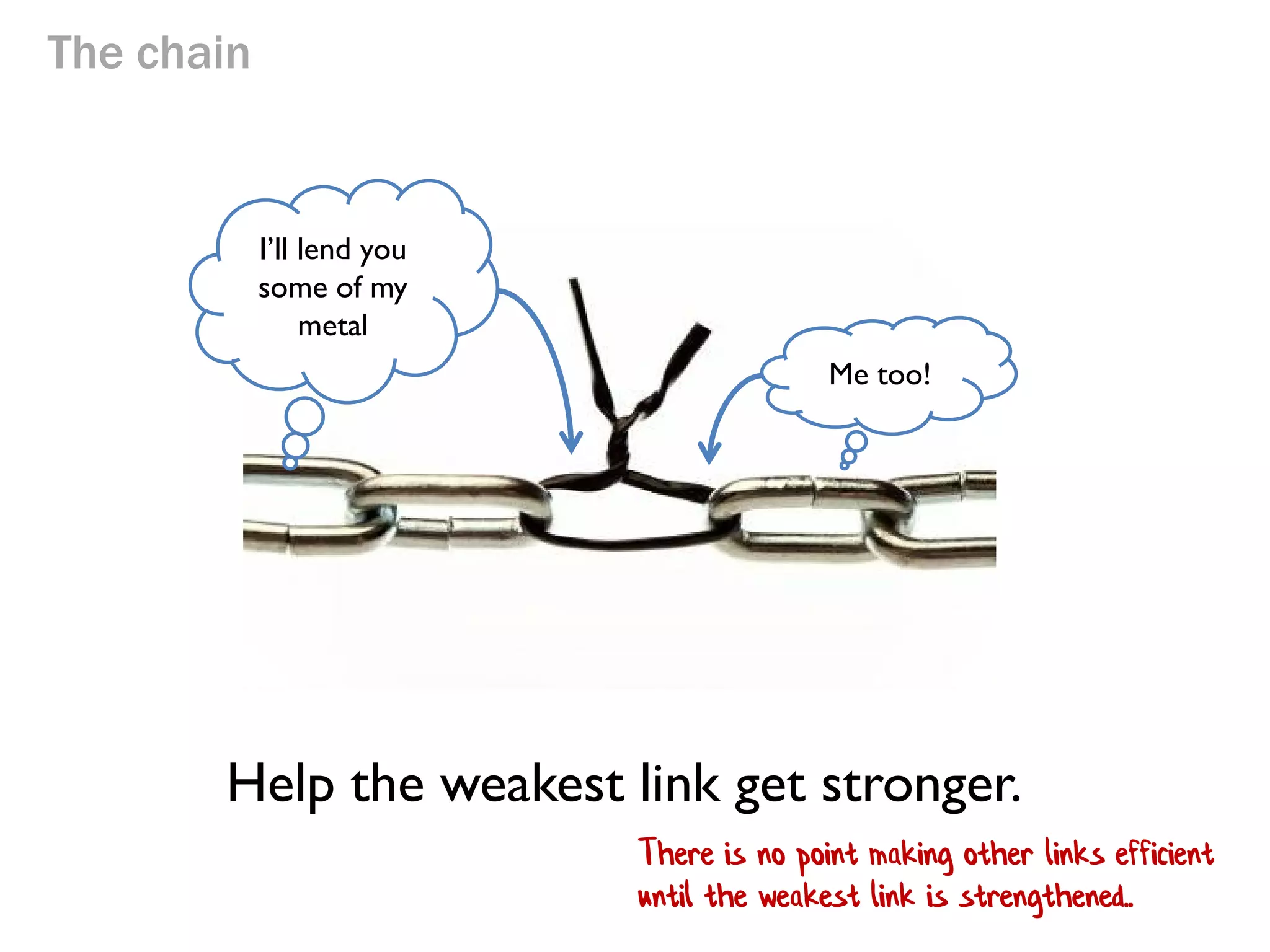
The chain

I’ll lend you
some of my
metal
Me too!

Help the weakest link get stronger.
The chain

I’ll lend you
some of my
metal
Me too!

Help the weakest link get stronger.
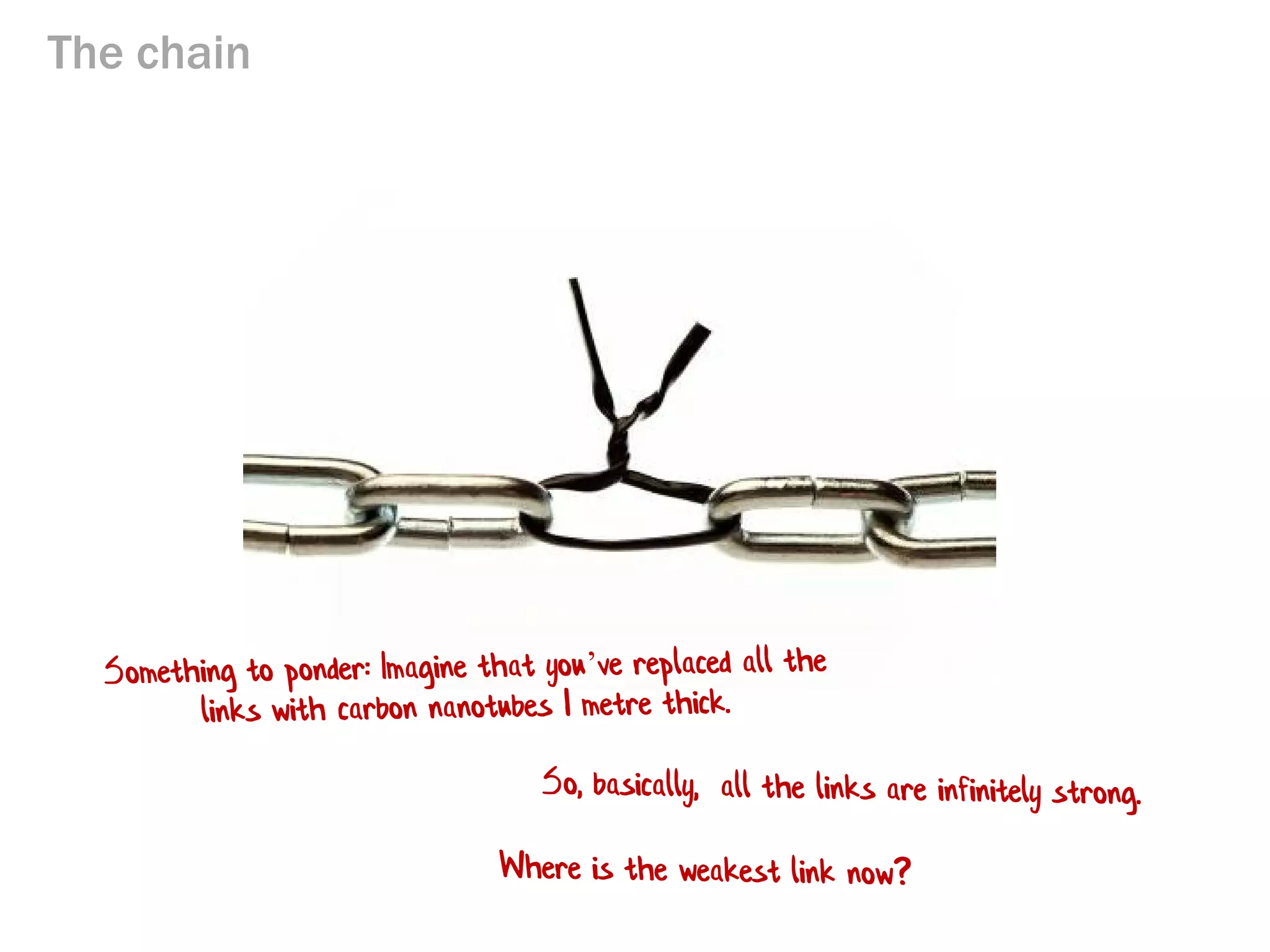
There is no point making other links efficient
until the weakest link is strengthened..
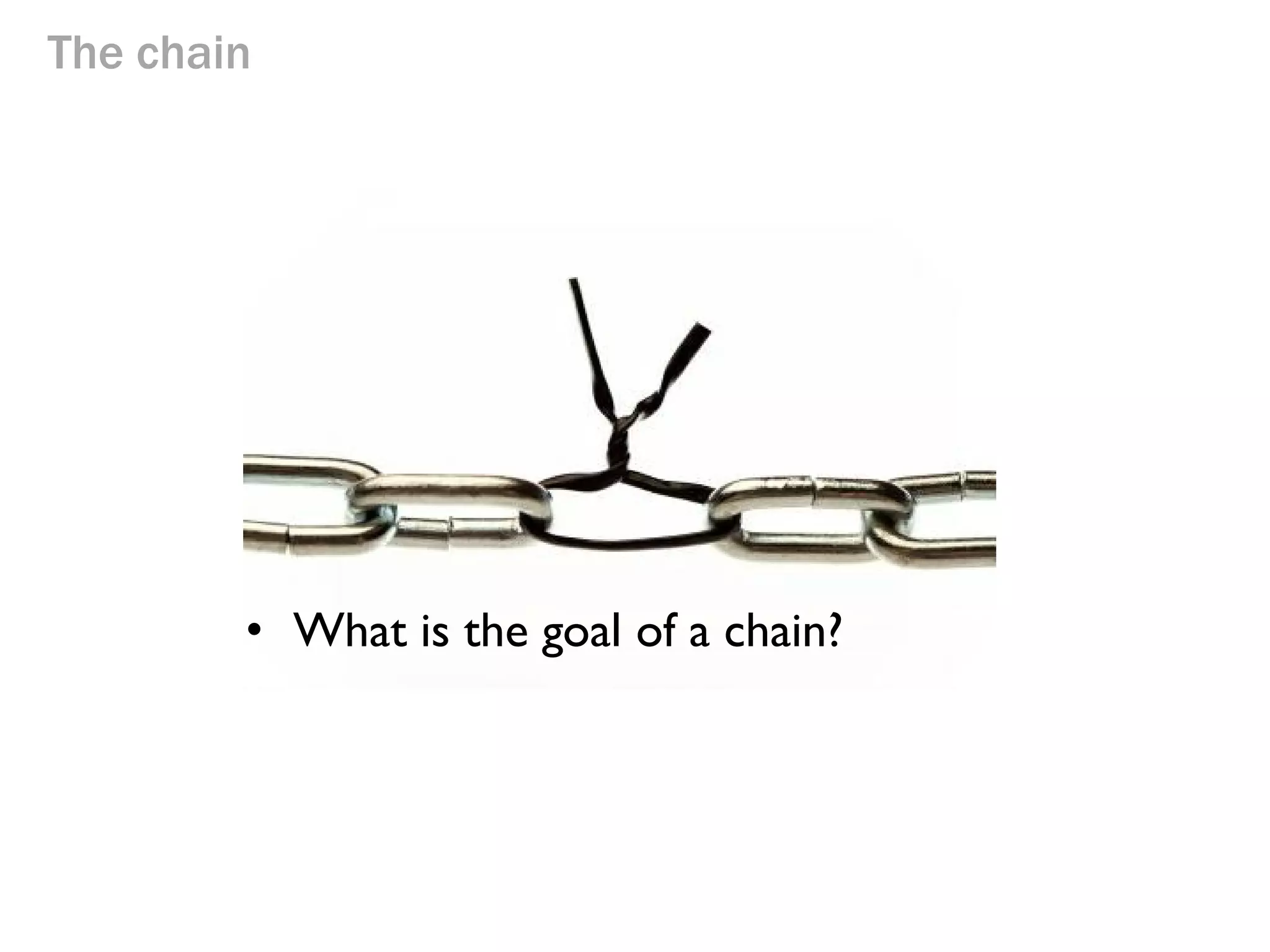
The chain

• What is the goal of a chain?
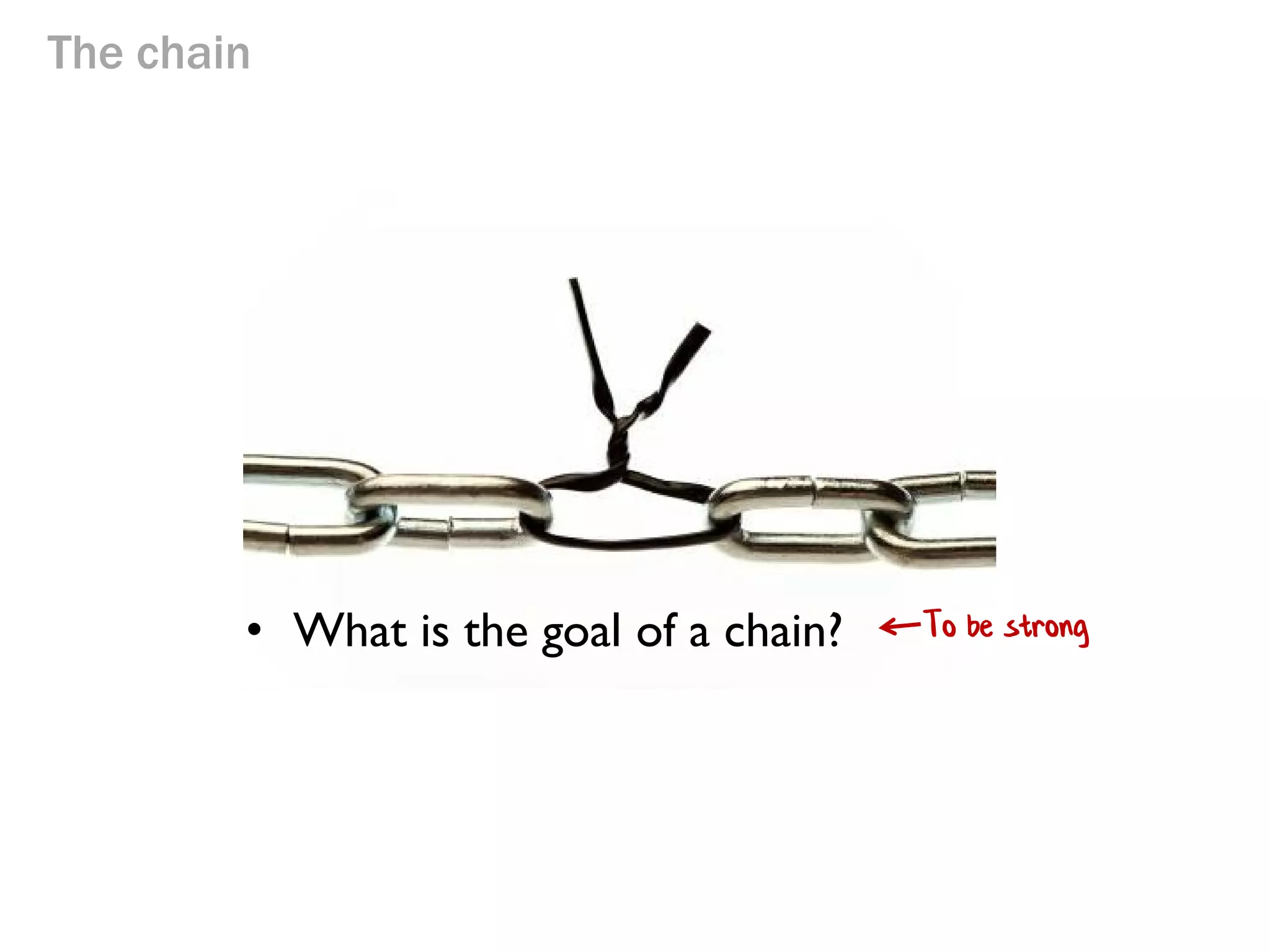
The chain

• What is the goal of a chain?

To be strong
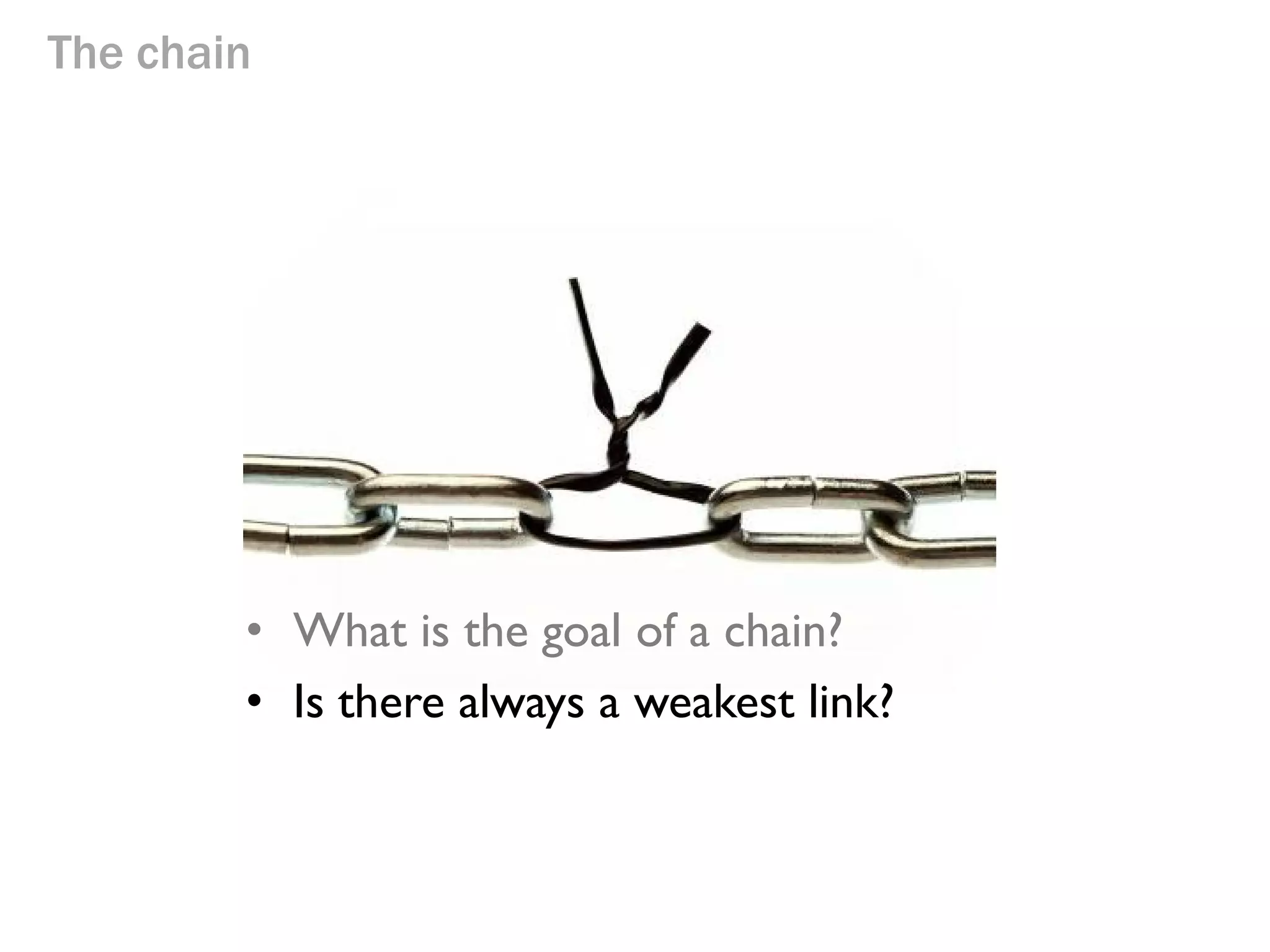
The chain

• What is the goal of a chain?
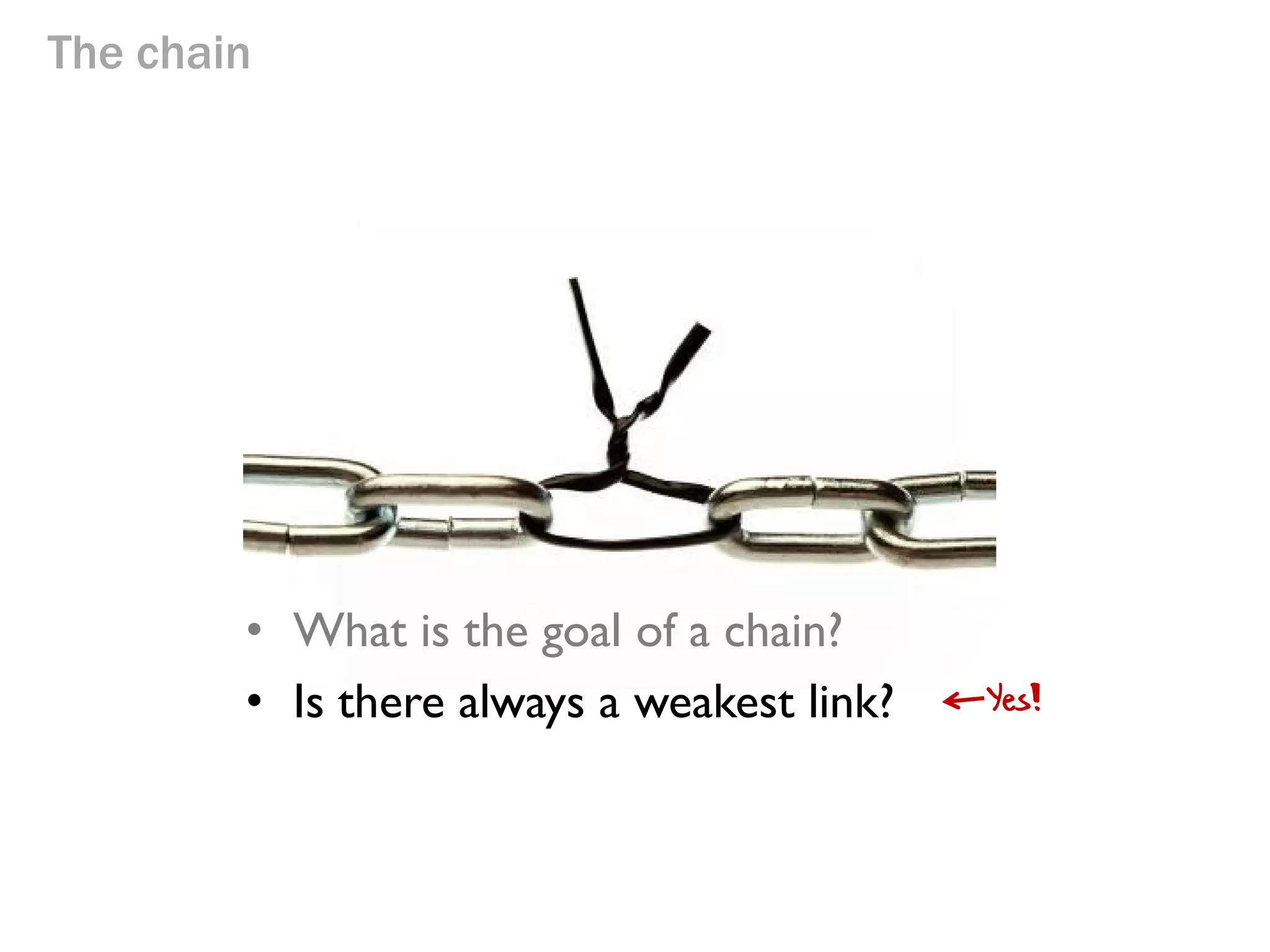
• Is there always a weakest link?
The chain

• What is the goal of a chain?
• Is there always a weakest link?

Yes!
The chain

• What is the goal of a chain?
• Is there always a weakest link?
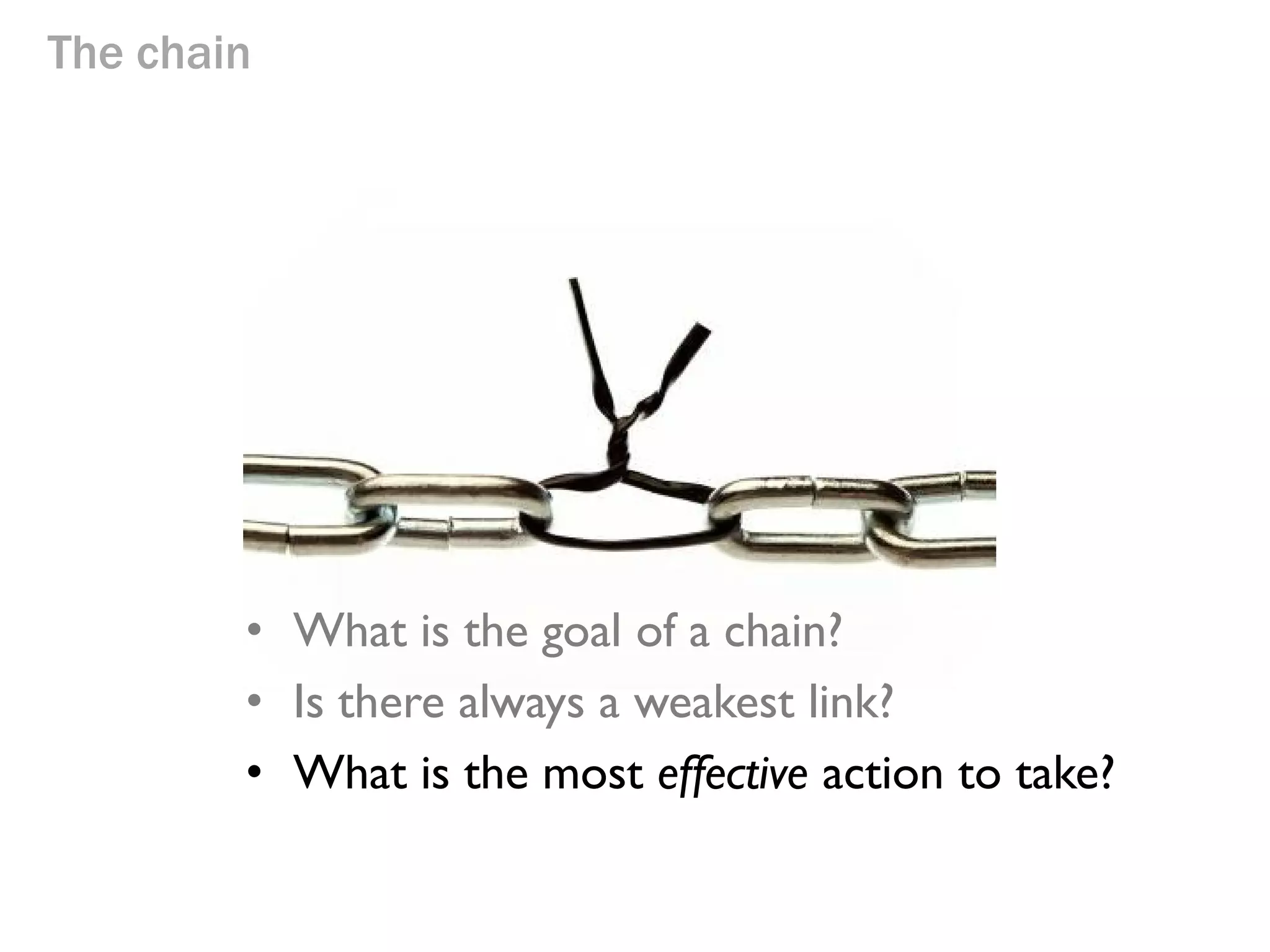
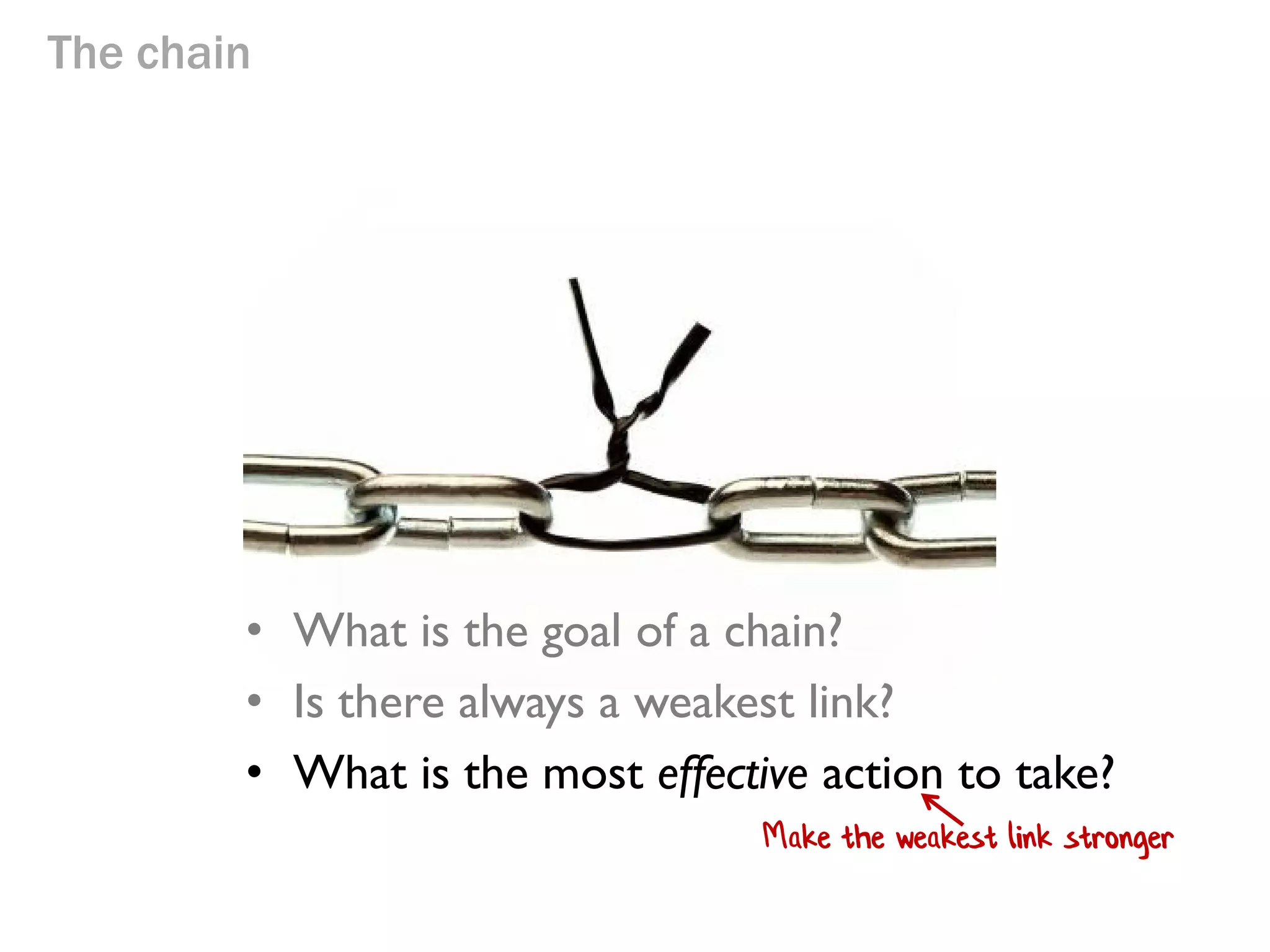
• What is the most effective action to take?
The chain

• What is the goal of a chain?
• Is there always a weakest link?
• What is the most effective action to take?
Make the weakest link stronger
The chain
The chain
The chain
Part IV
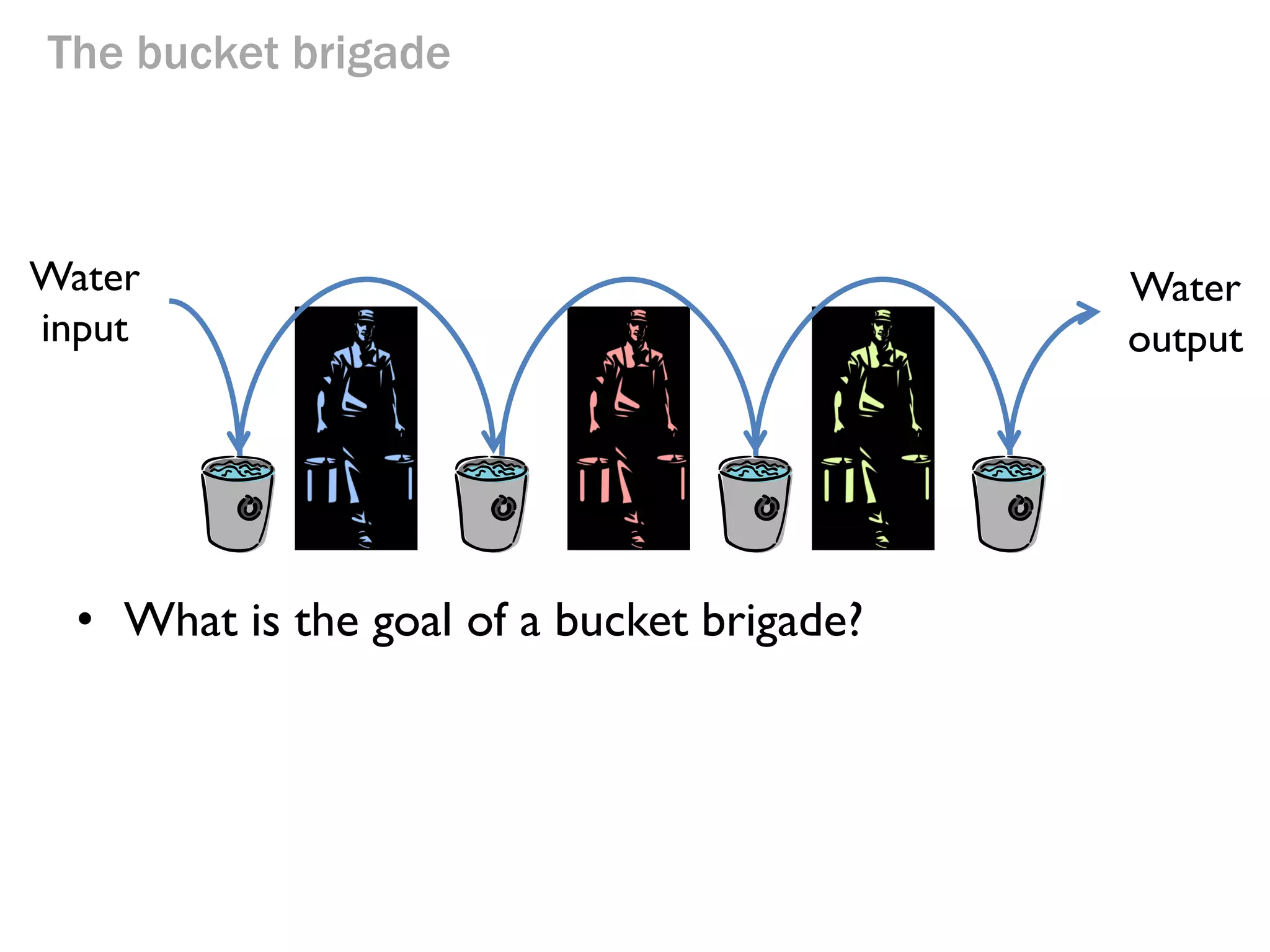
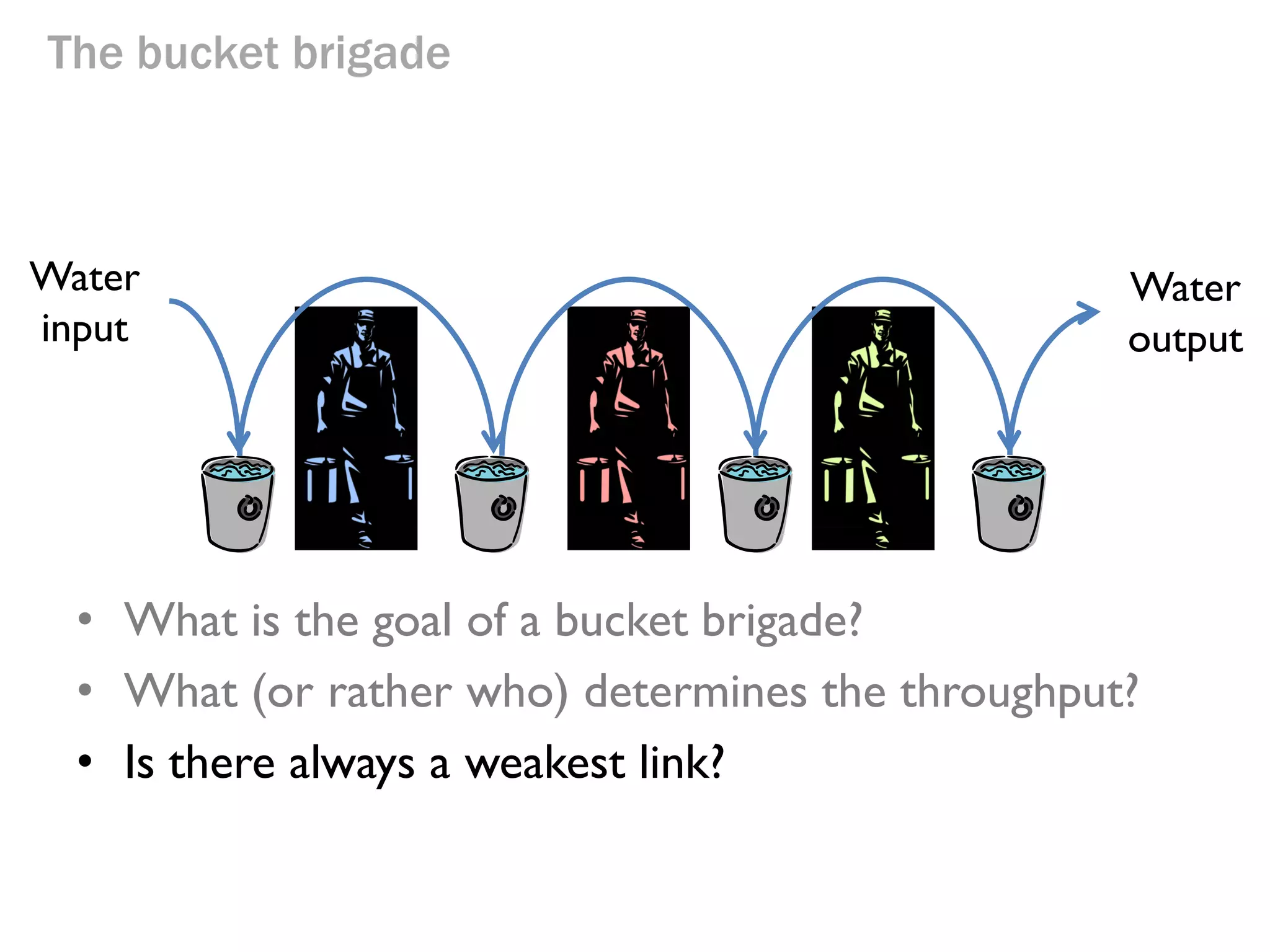
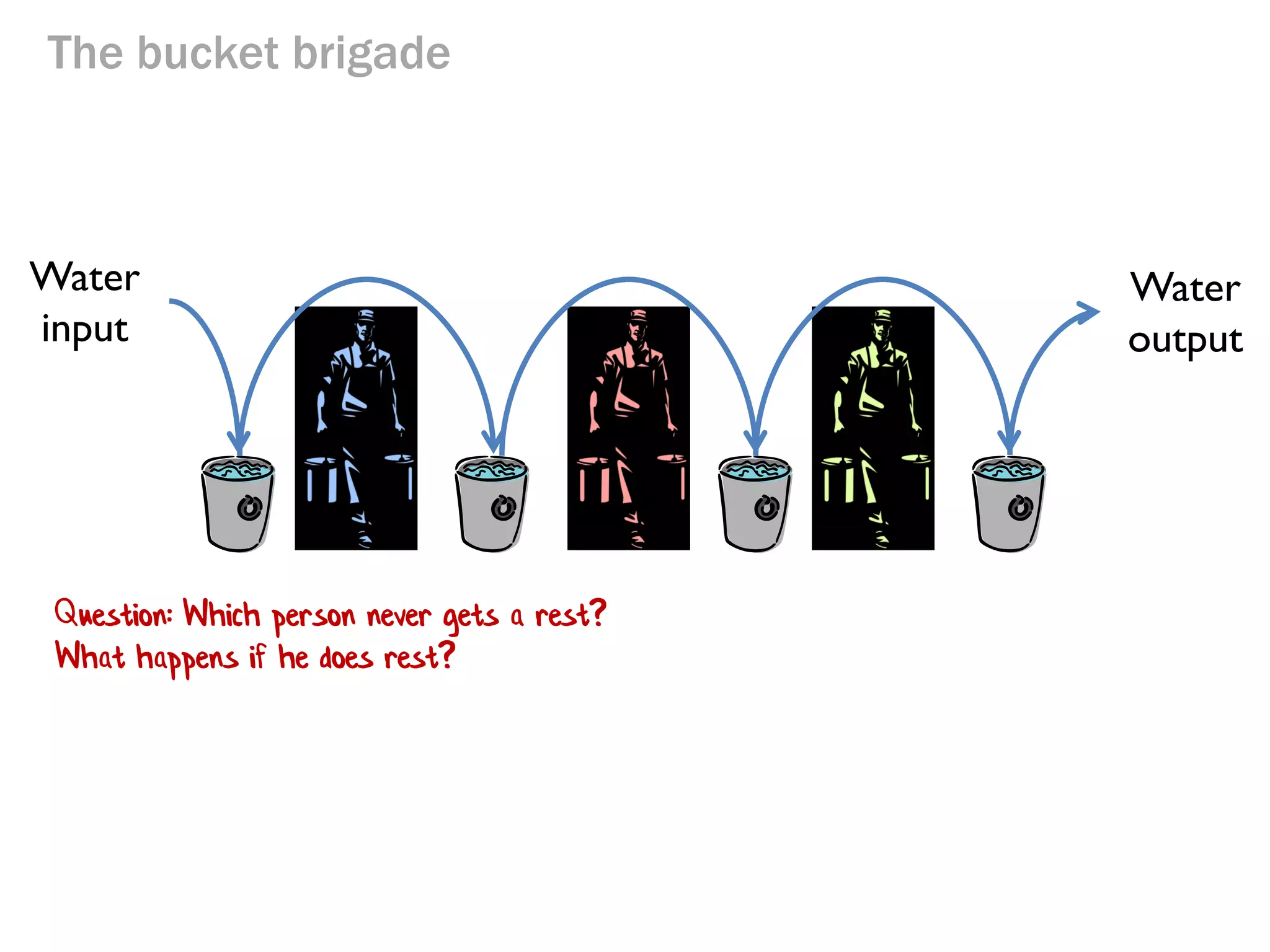
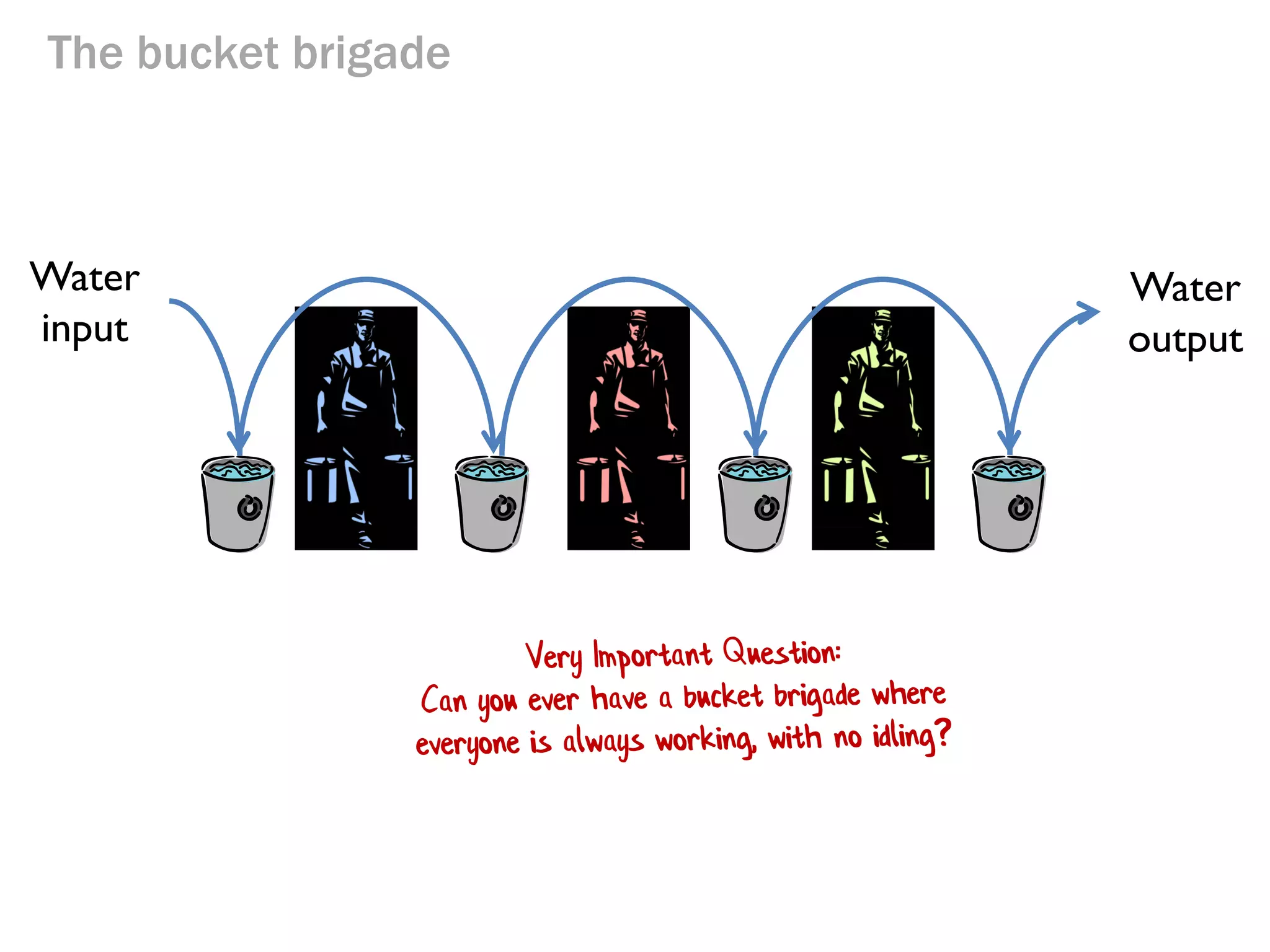
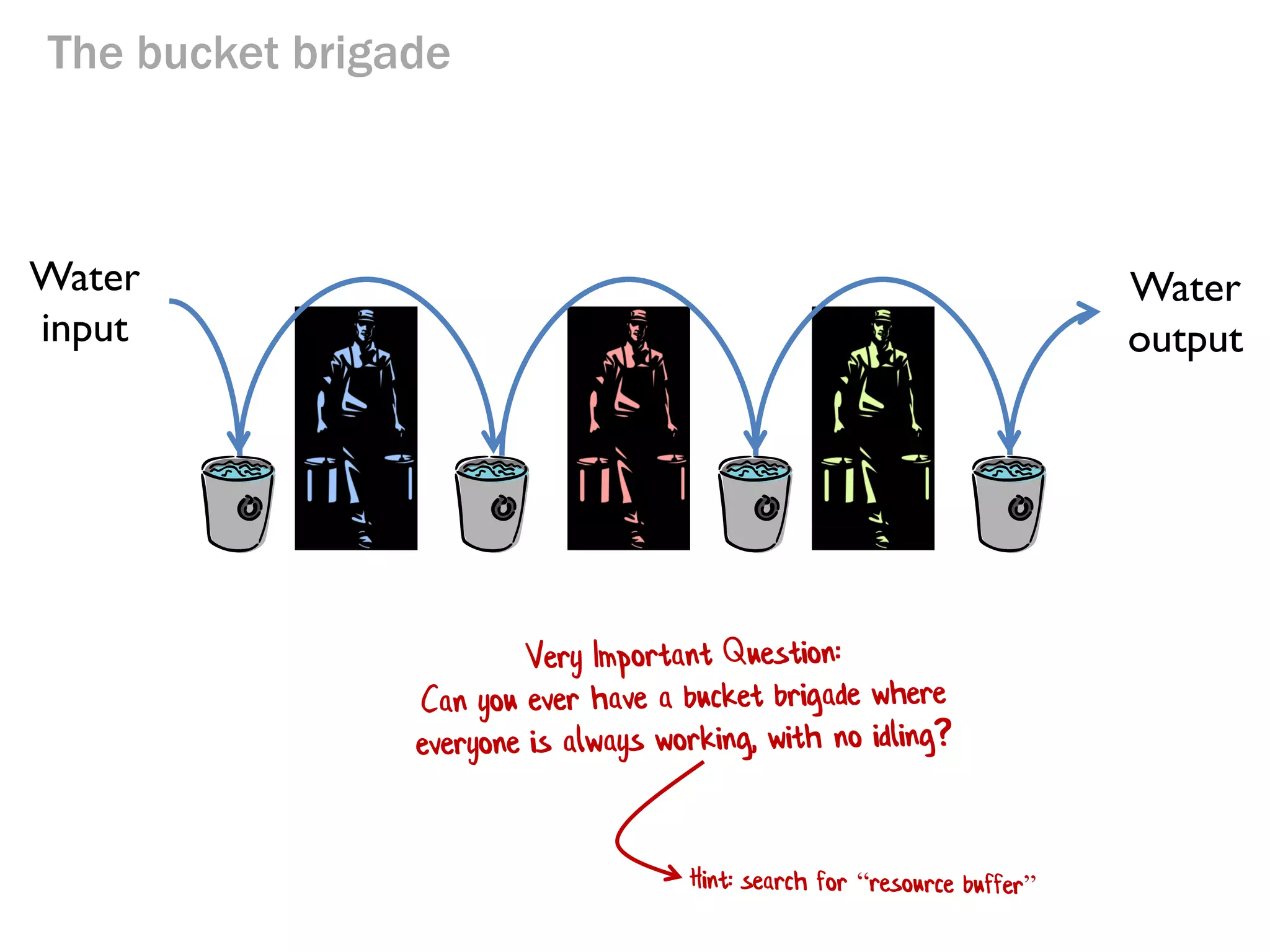
The bucket brigade
The bucket brigade
The bucket brigade

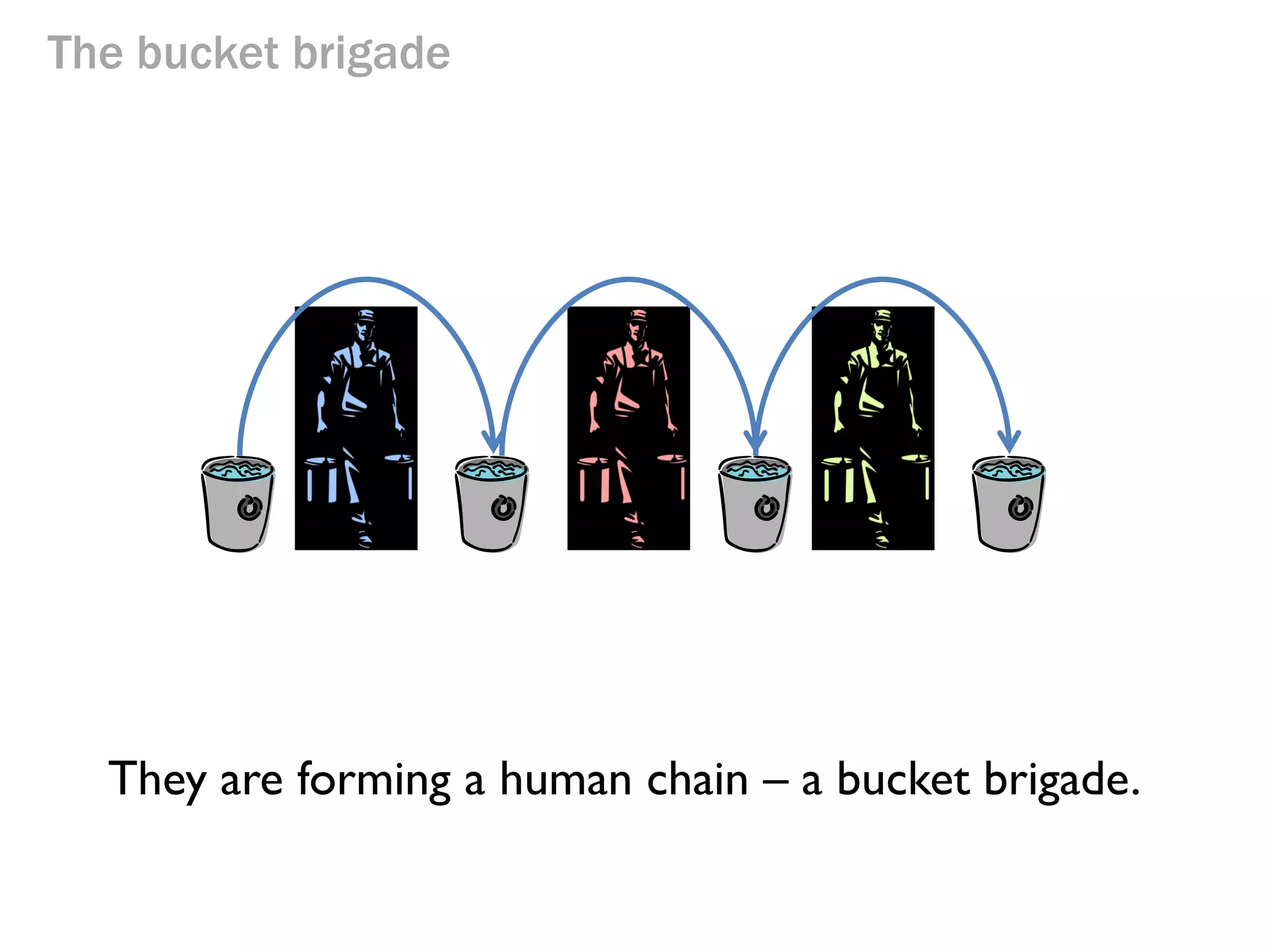
Meet Mr. Blue.
The bucket brigade

Meet Mr. Blue. And Mr Pink.
The bucket brigade

Meet Mr. Blue. And Mr Pink. And Mr Green.
The bucket brigade

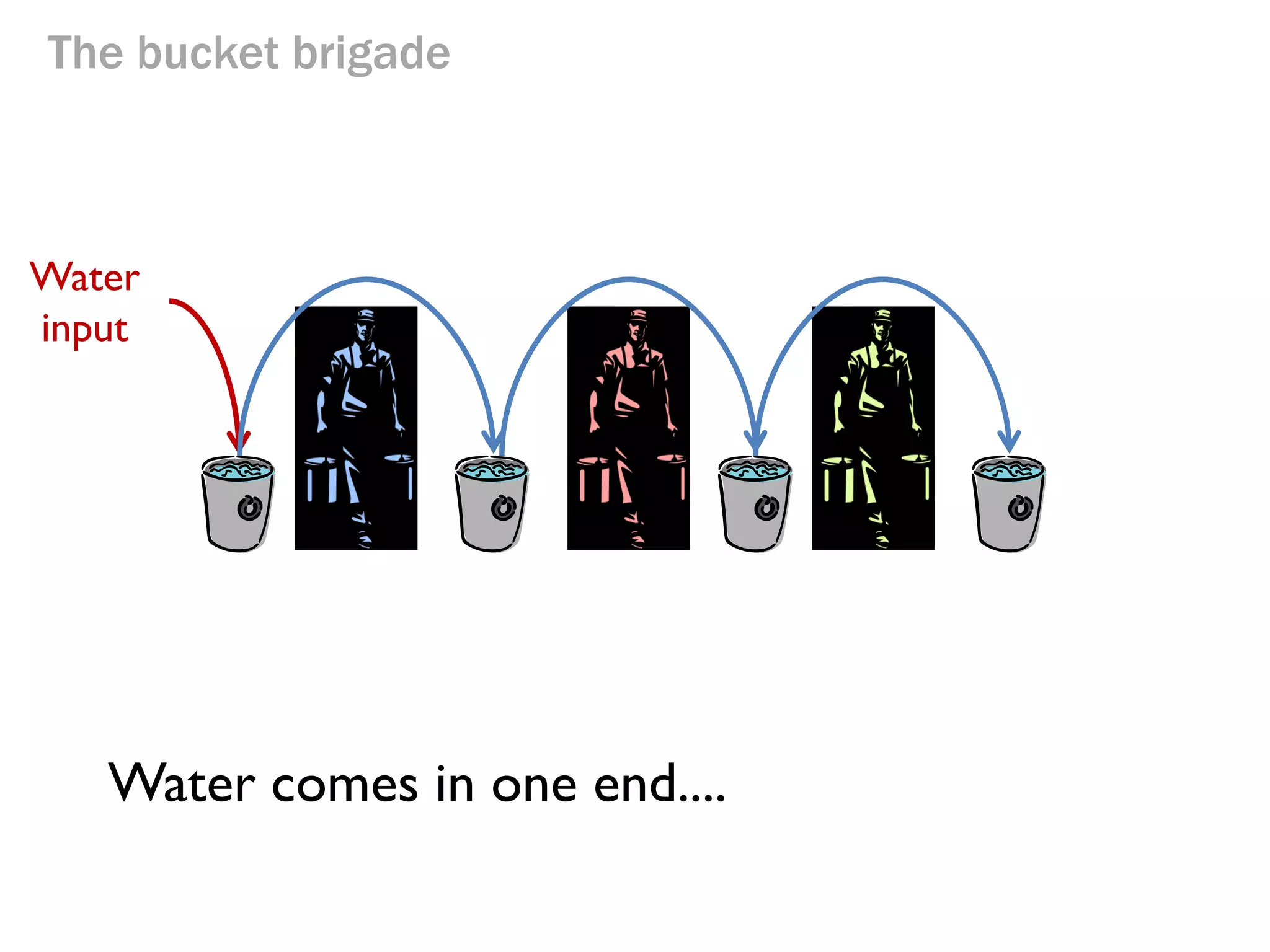
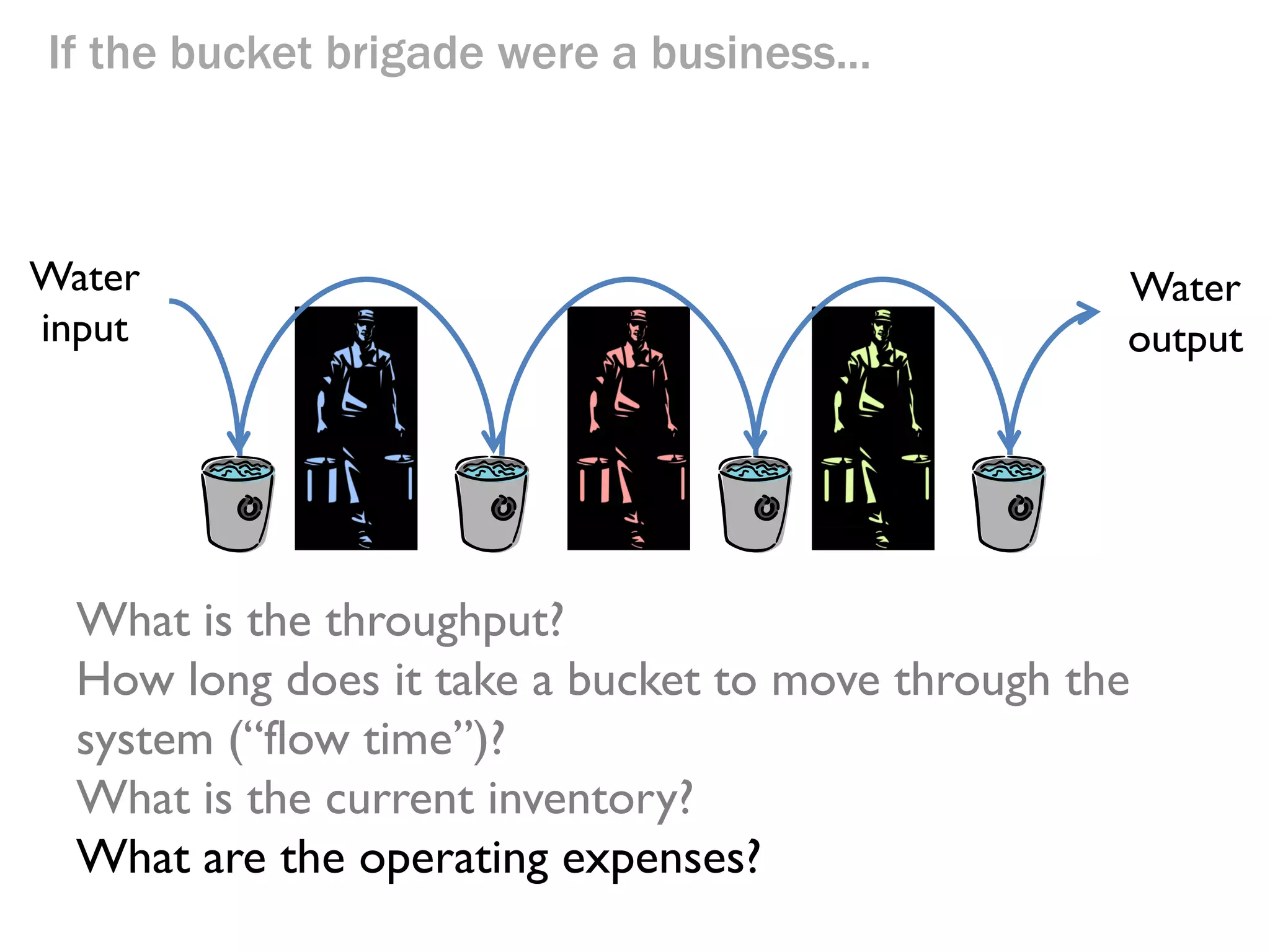
They are forming a human chain – a bucket brigade.
The bucket brigade

Water
input

Water comes in one end....
The bucket brigade

Water
input

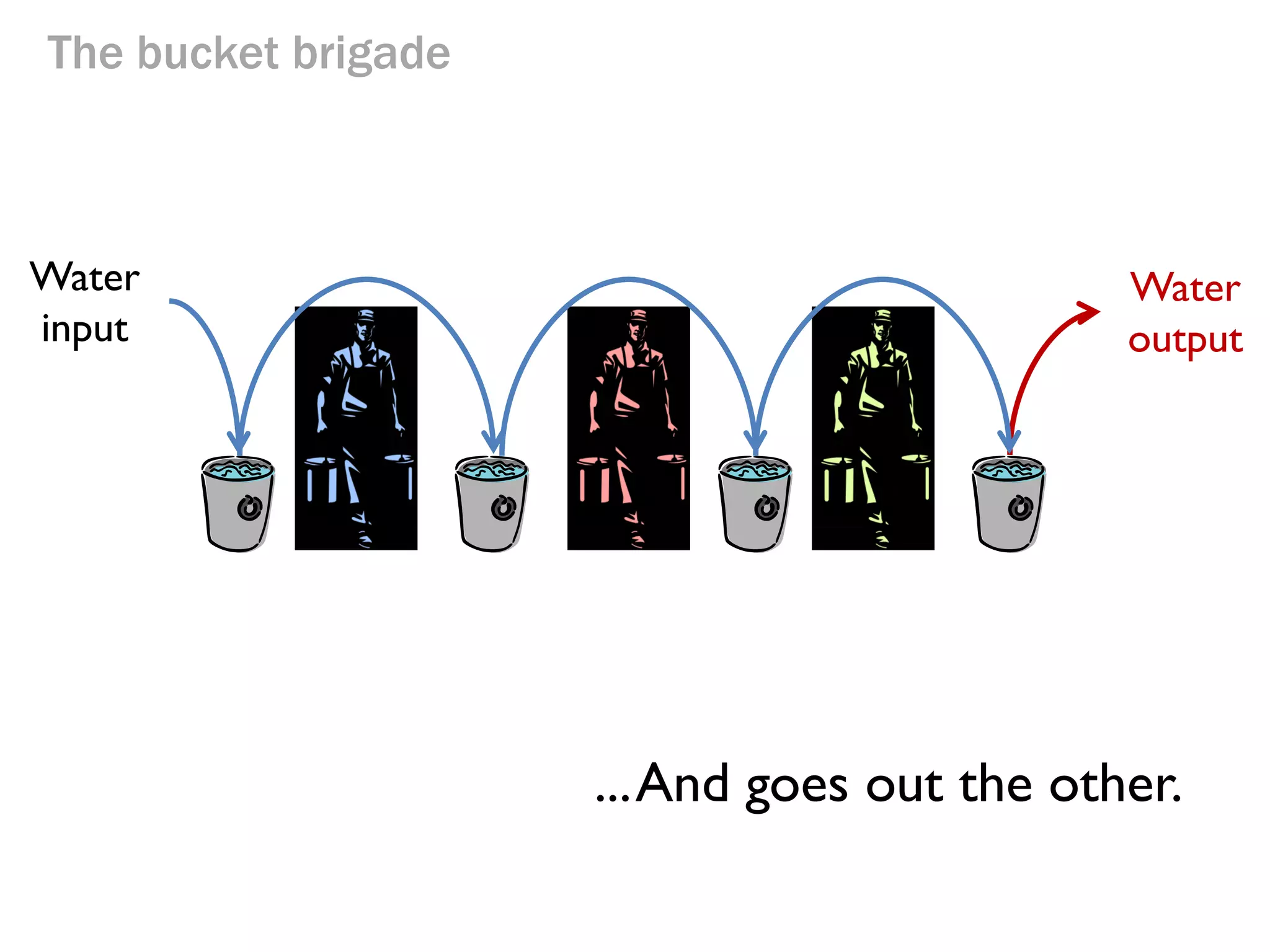
Water
output

... And goes out the other.
The bucket brigade

Water
input

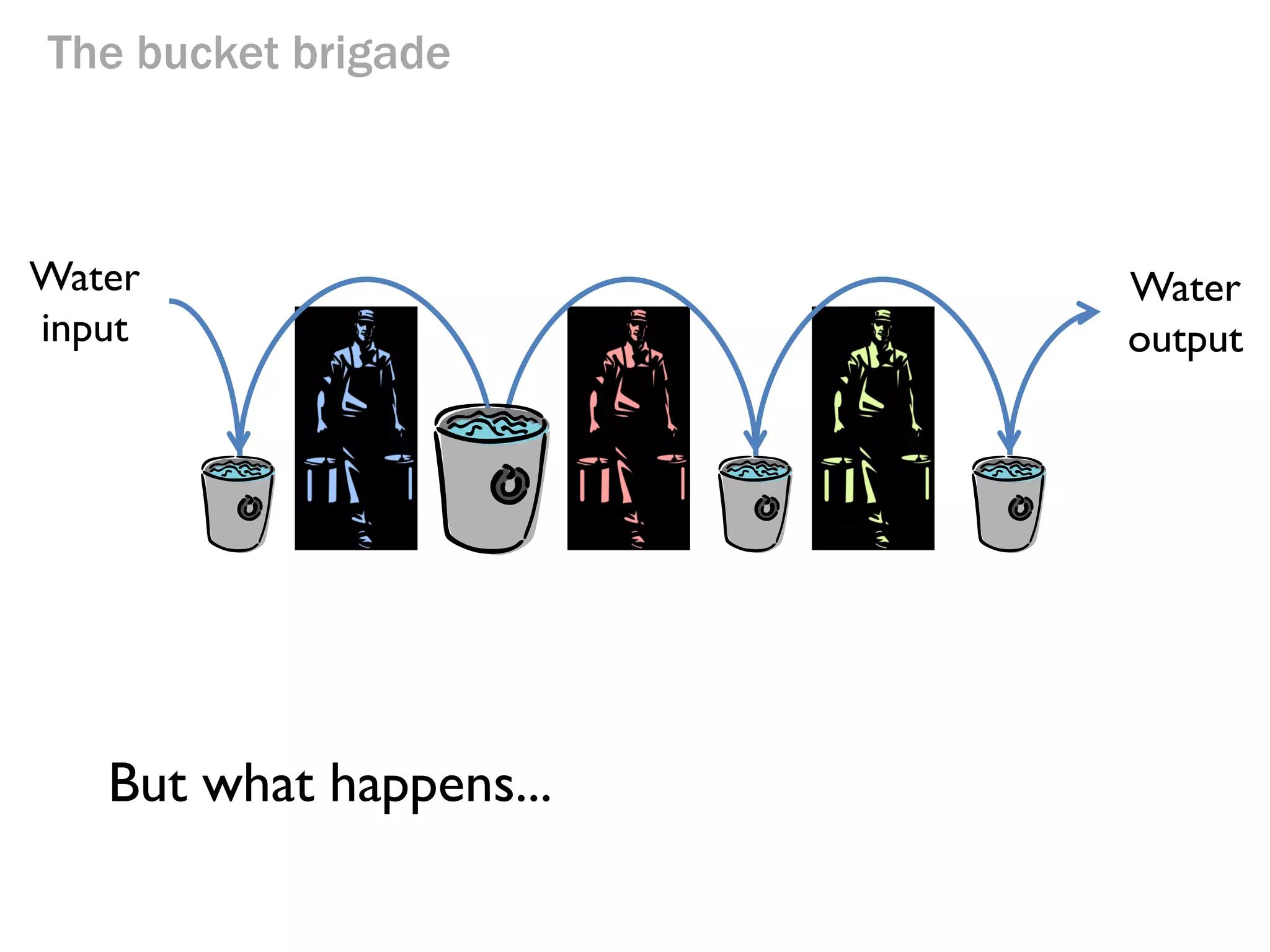
But what happens...

Water
output
The bucket brigade

Water
input

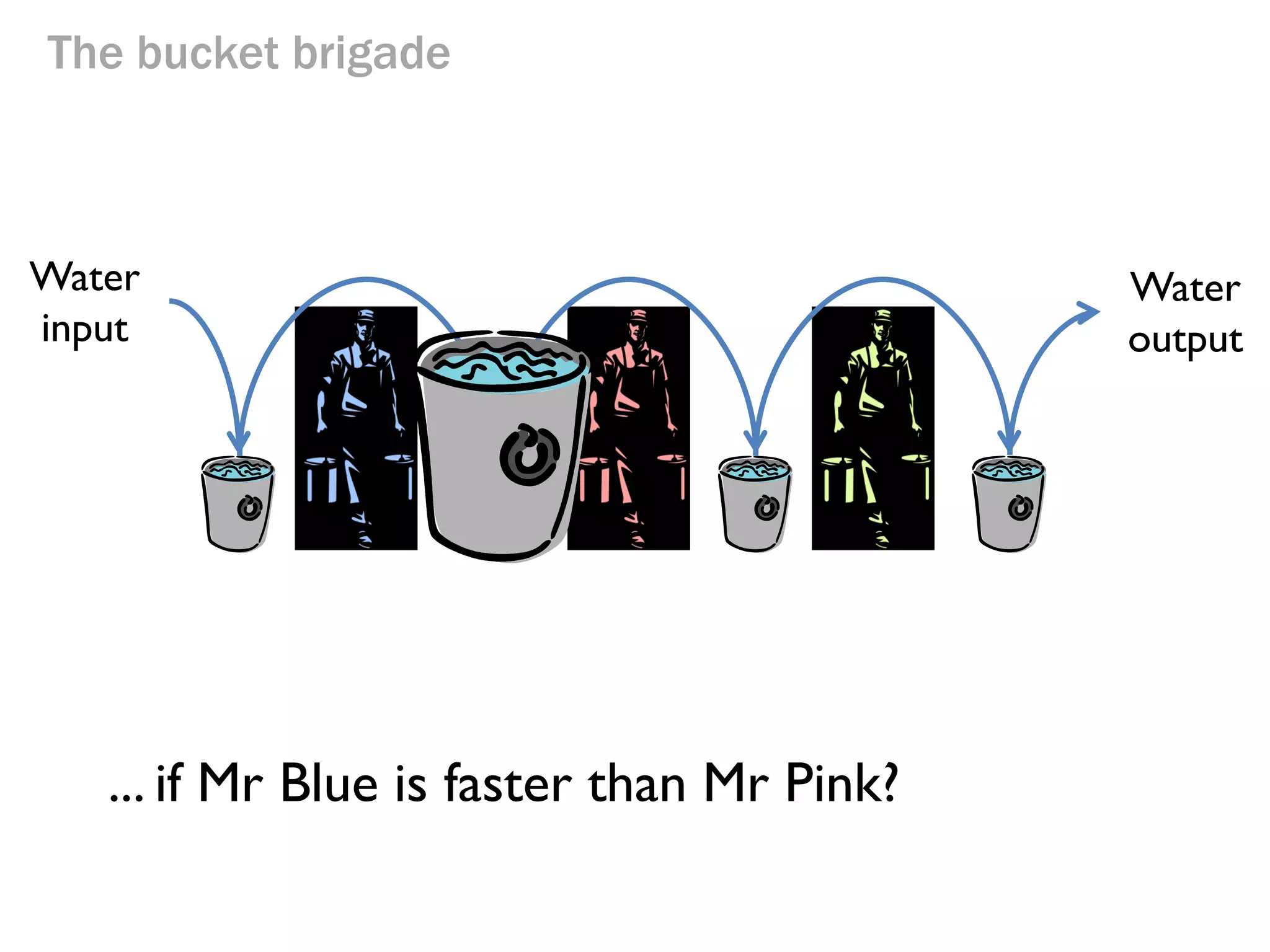
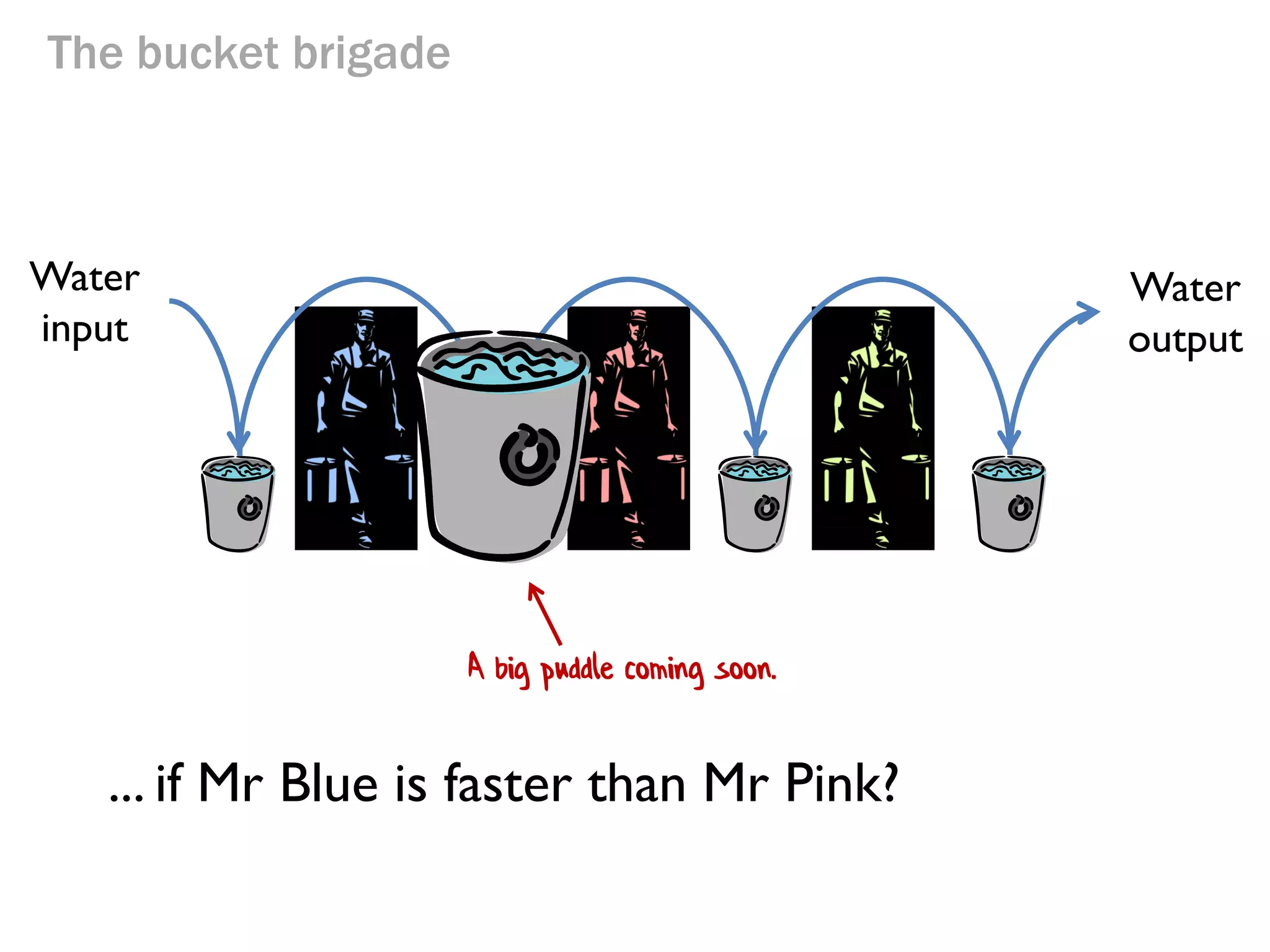
... if Mr Blue is faster than Mr Pink?

Water
output
The bucket brigade

Water
input

Water
output

A big puddle coming soon.

... if Mr Blue is faster than Mr Pink?
The bucket brigade

Water
input

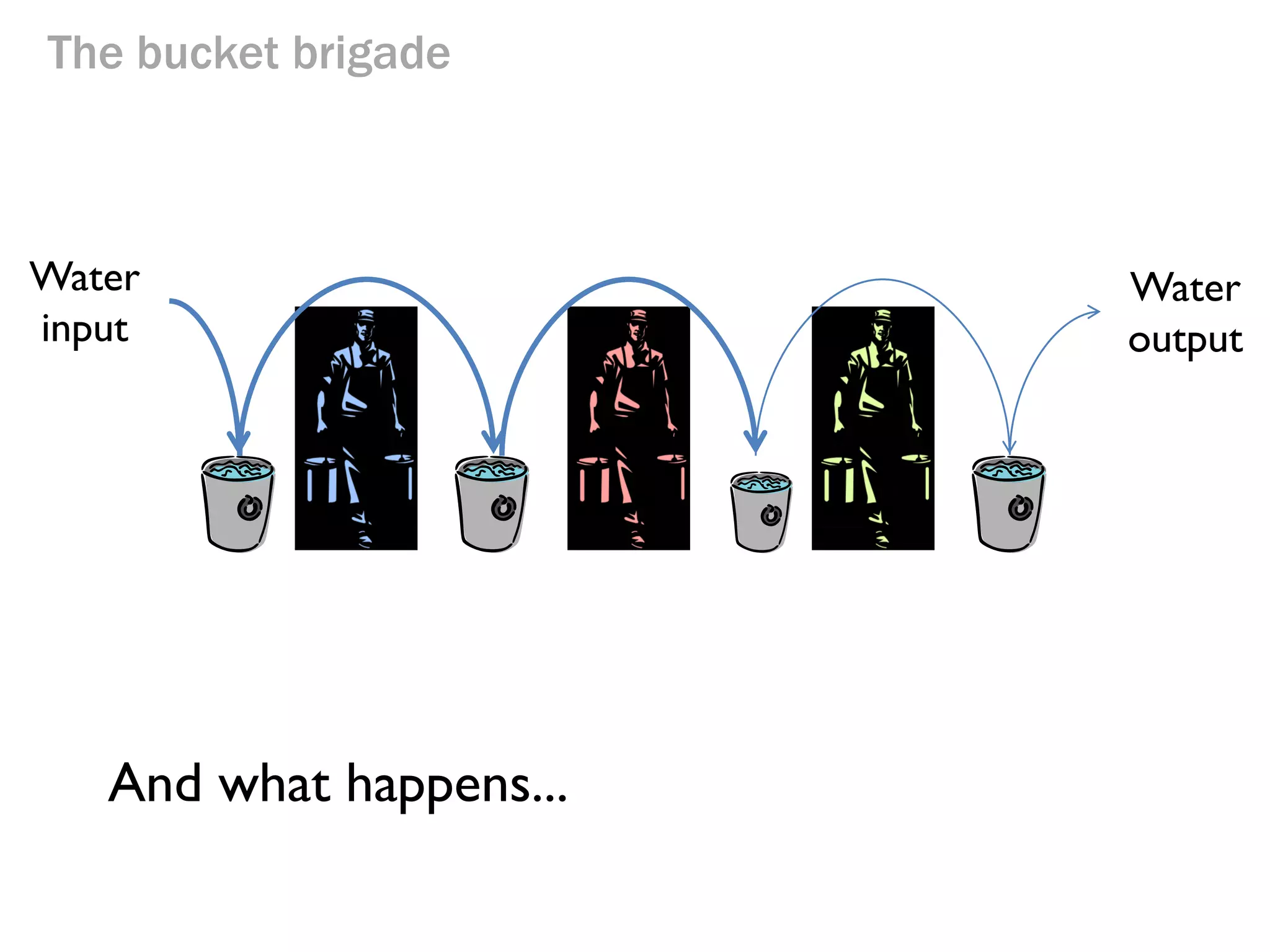
And what happens...

Water
output
The bucket brigade

Water
input

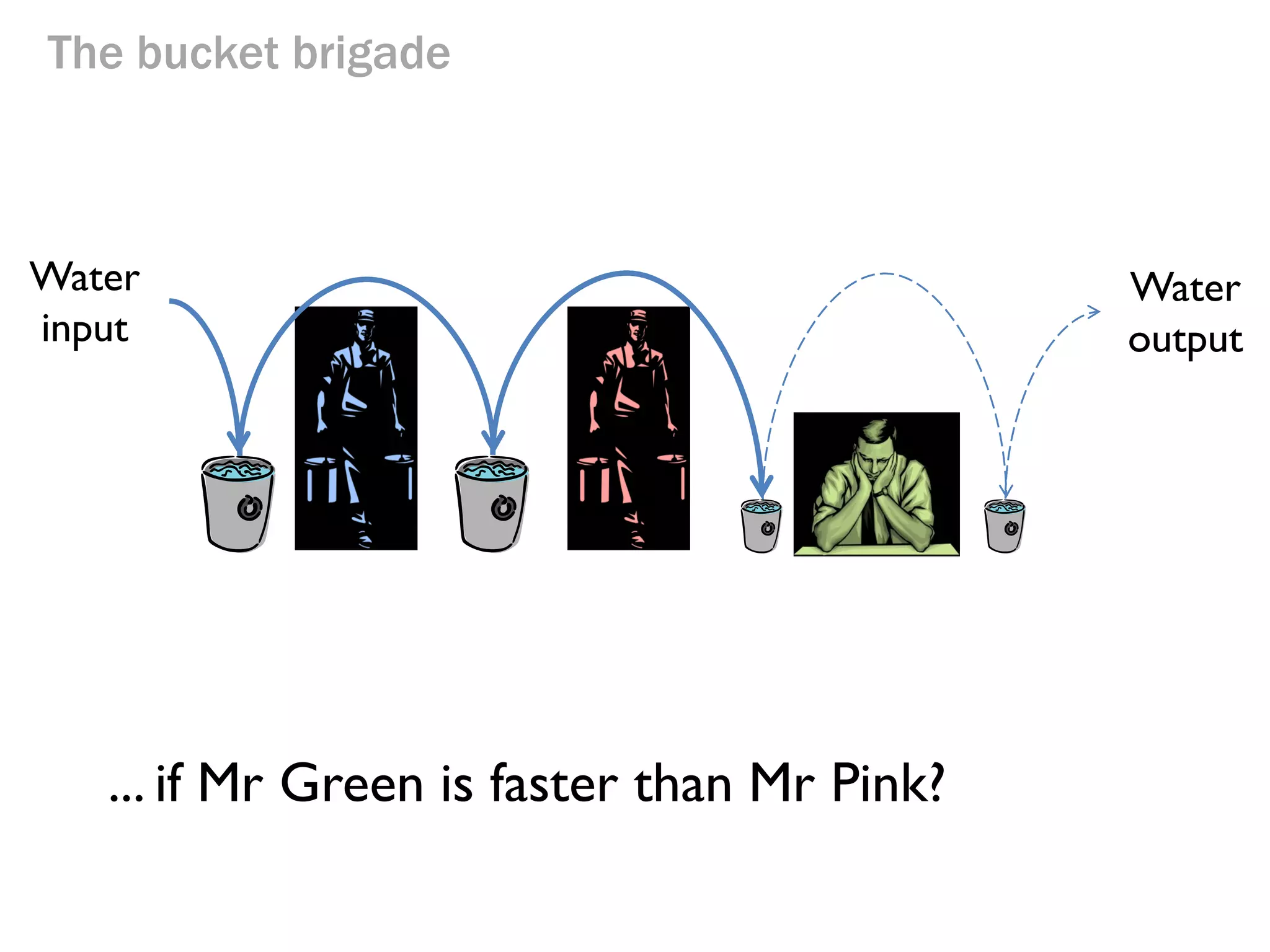
... if Mr Green is faster than Mr Pink?

Water
output
The bucket brigade

Water
input

Water
output

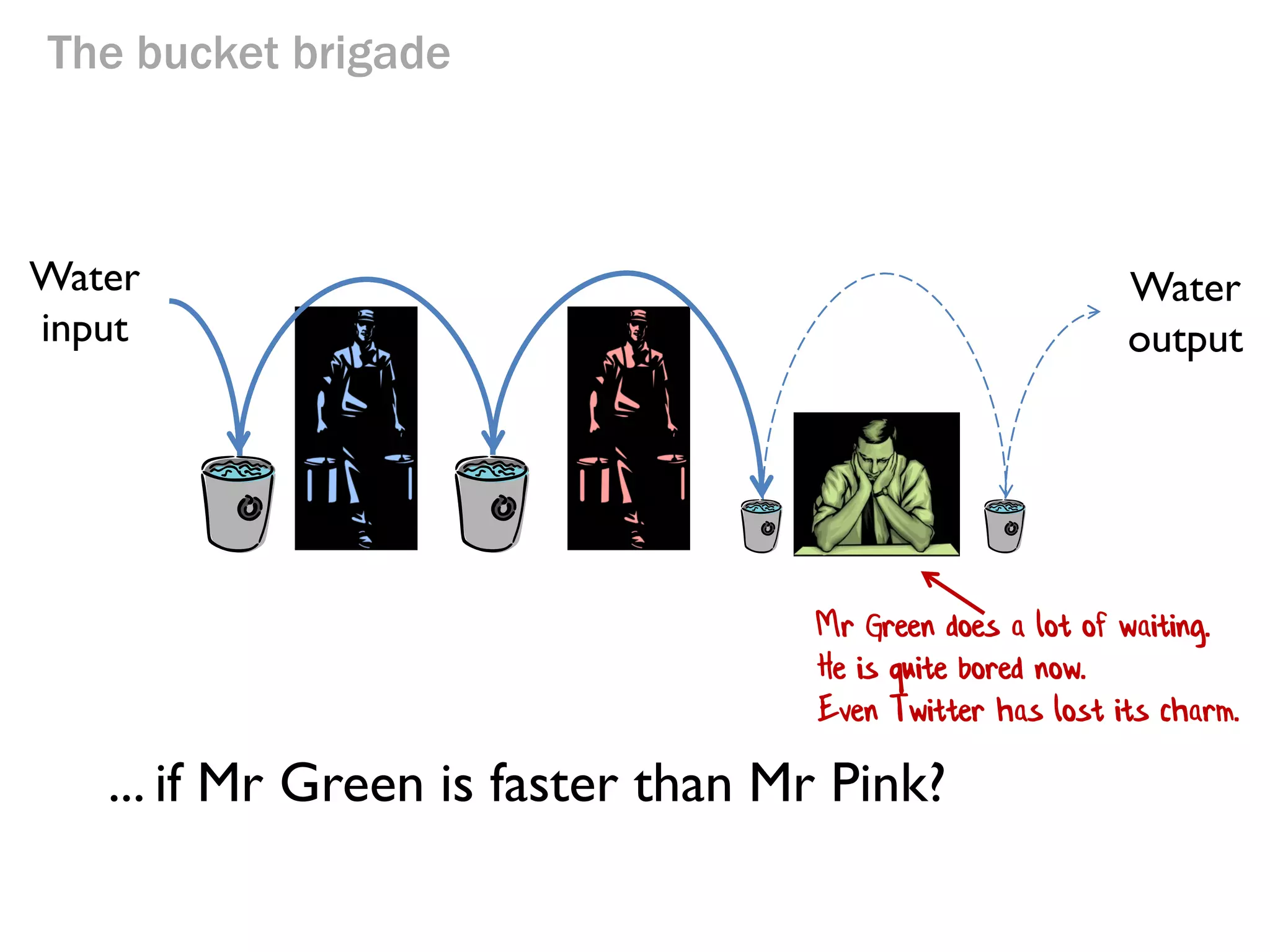
Mr Green does a lot of waiting.
He is quite bored now.
Even Twitter has lost its charm.

... if Mr Green is faster than Mr Pink?
The bucket brigade

Water
input

• What is the goal of a bucket brigade?

Water
output
The bucket brigade

Water
input

Water
output

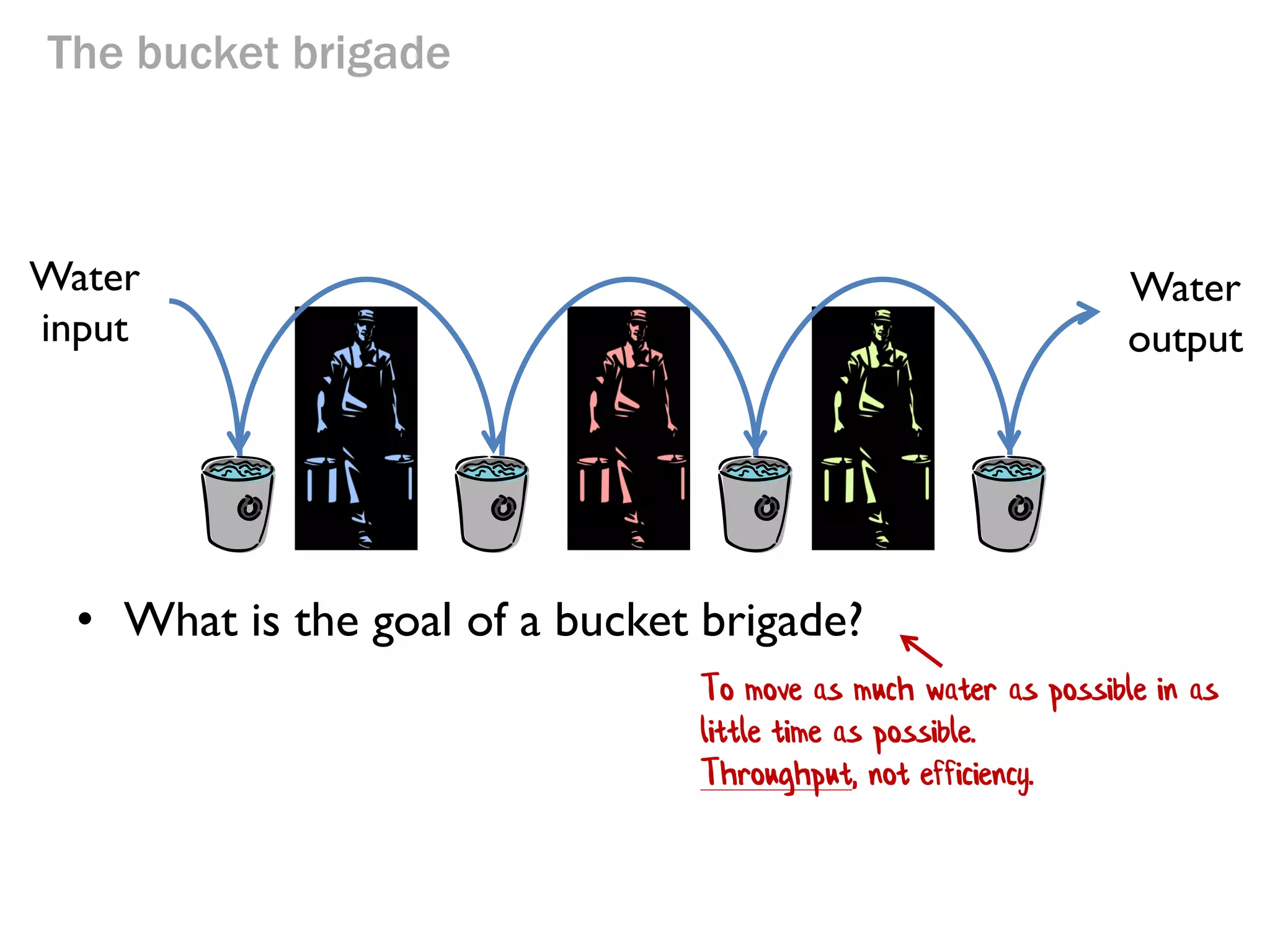
• What is the goal of a bucket brigade?
To move as much water as possible in as
little time as possible.
Throughput, not efficiency.
The bucket brigade

Water
input

Water
output

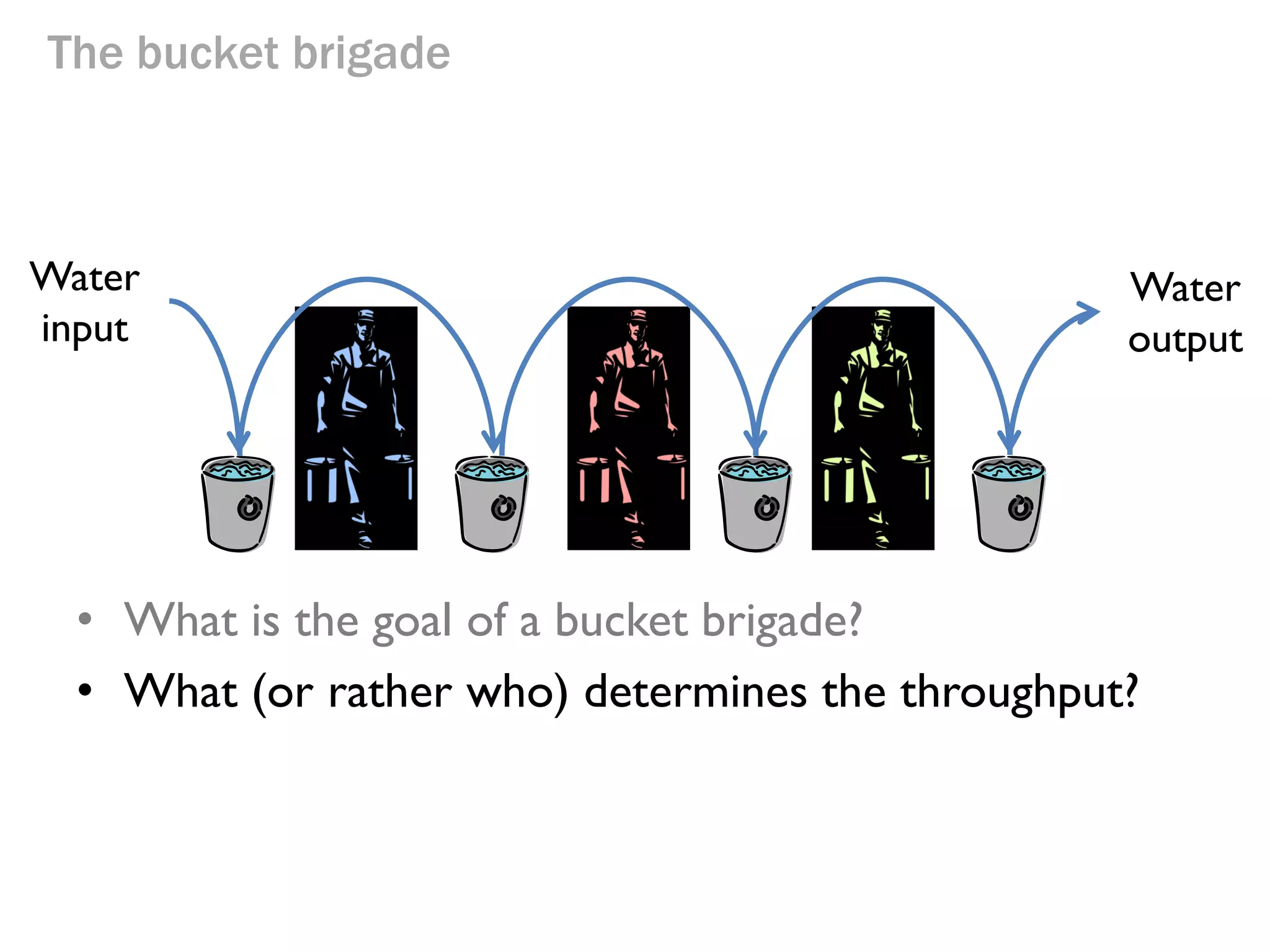
• What is the goal of a bucket brigade?
• What (or rather who) determines the throughput?
The bucket brigade

Water
input

Water
output

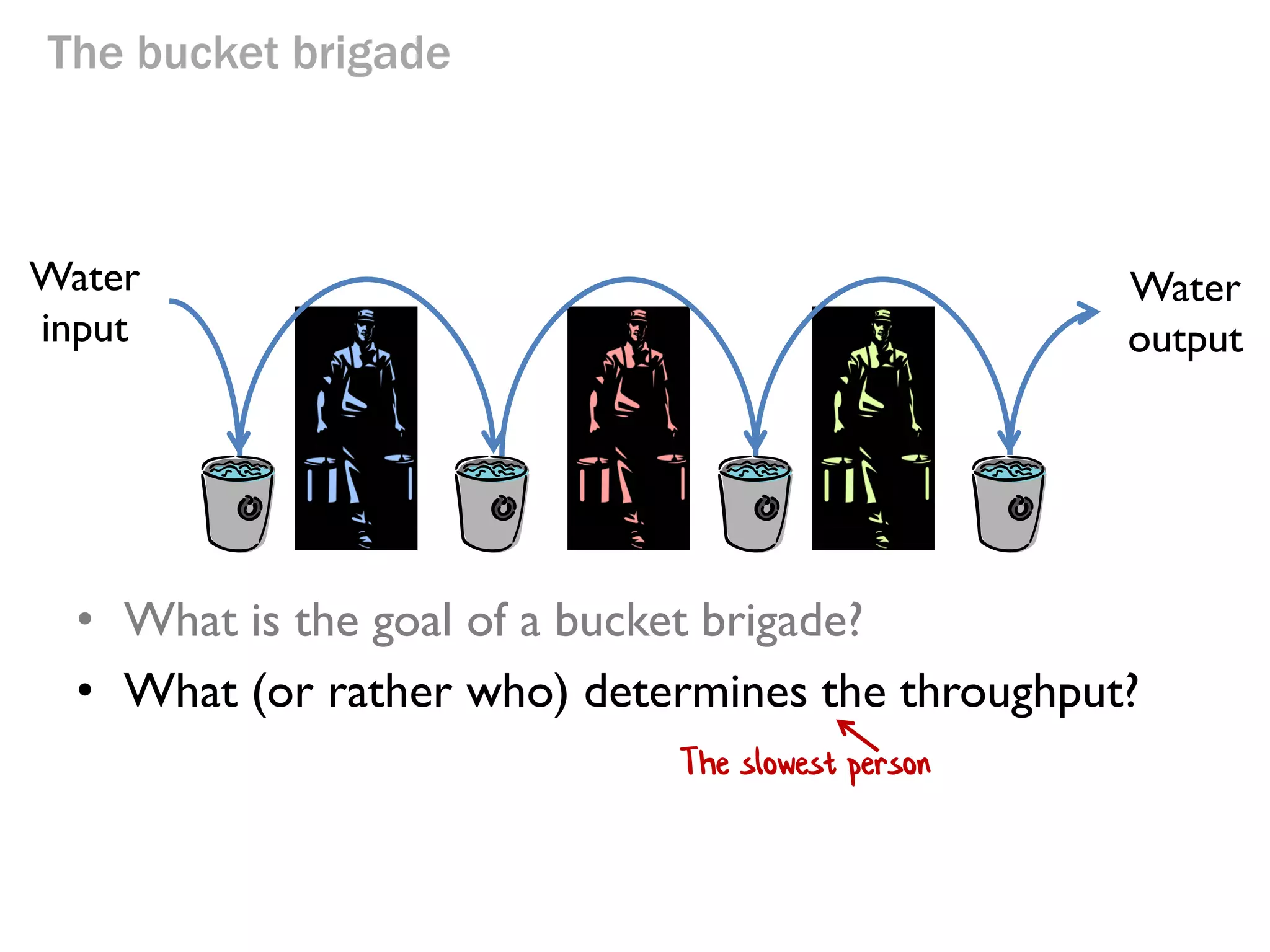
• What is the goal of a bucket brigade?
• What (or rather who) determines the throughput?
The slowest person
The bucket brigade

Water
input

Water
output

• What is the goal of a bucket brigade?
• What (or rather who) determines the throughput?
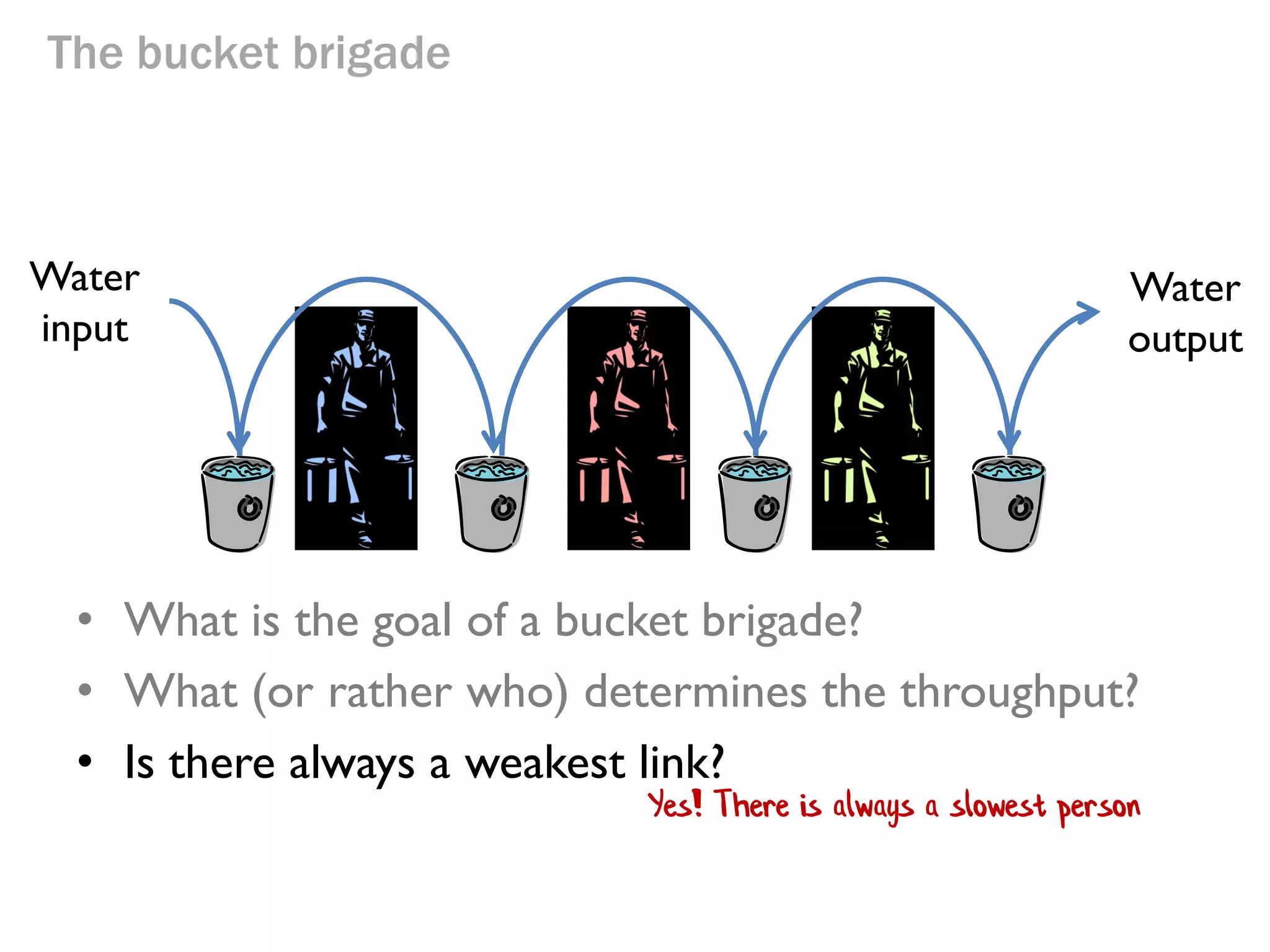
• Is there always a weakest link?
The bucket brigade

Water
input

Water
output

• What is the goal of a bucket brigade?
• What (or rather who) determines the throughput?
• Is there always a weakest link?

Yes! There is always a slowest person
The bucket brigade

Water
input

•
•
•
•

Water
output

What is the goal of a bucket brigade?
What (or rather who) determines the throughput?
Is there always a weakest link?
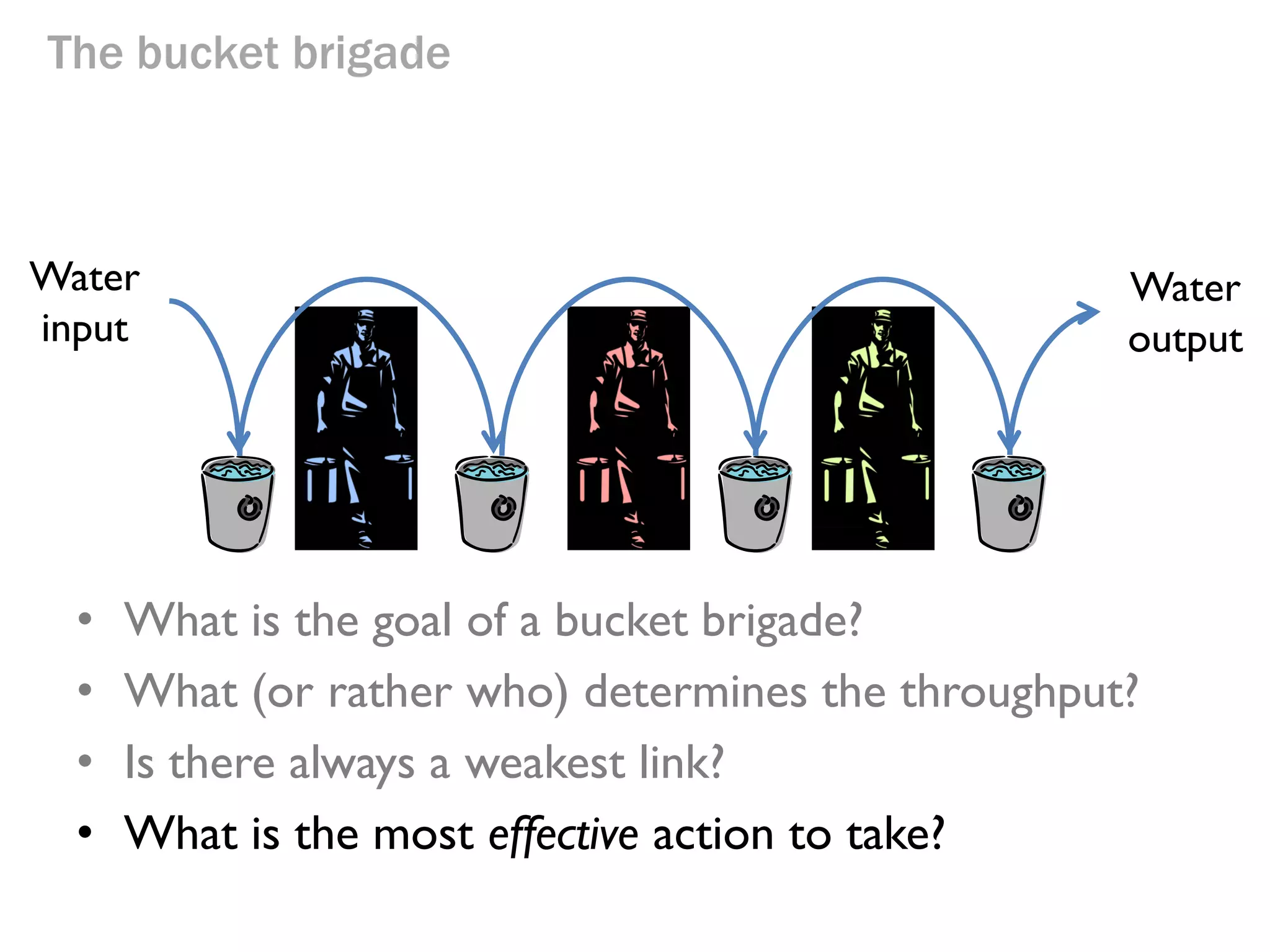
What is the most effective action to take?
The bucket brigade

Water
input

•
•
•
•

Water
output

What is the goal of a bucket brigade?
What (or rather who) determines the throughput?
Is there always a weakest link?
What is the most effective action to take?
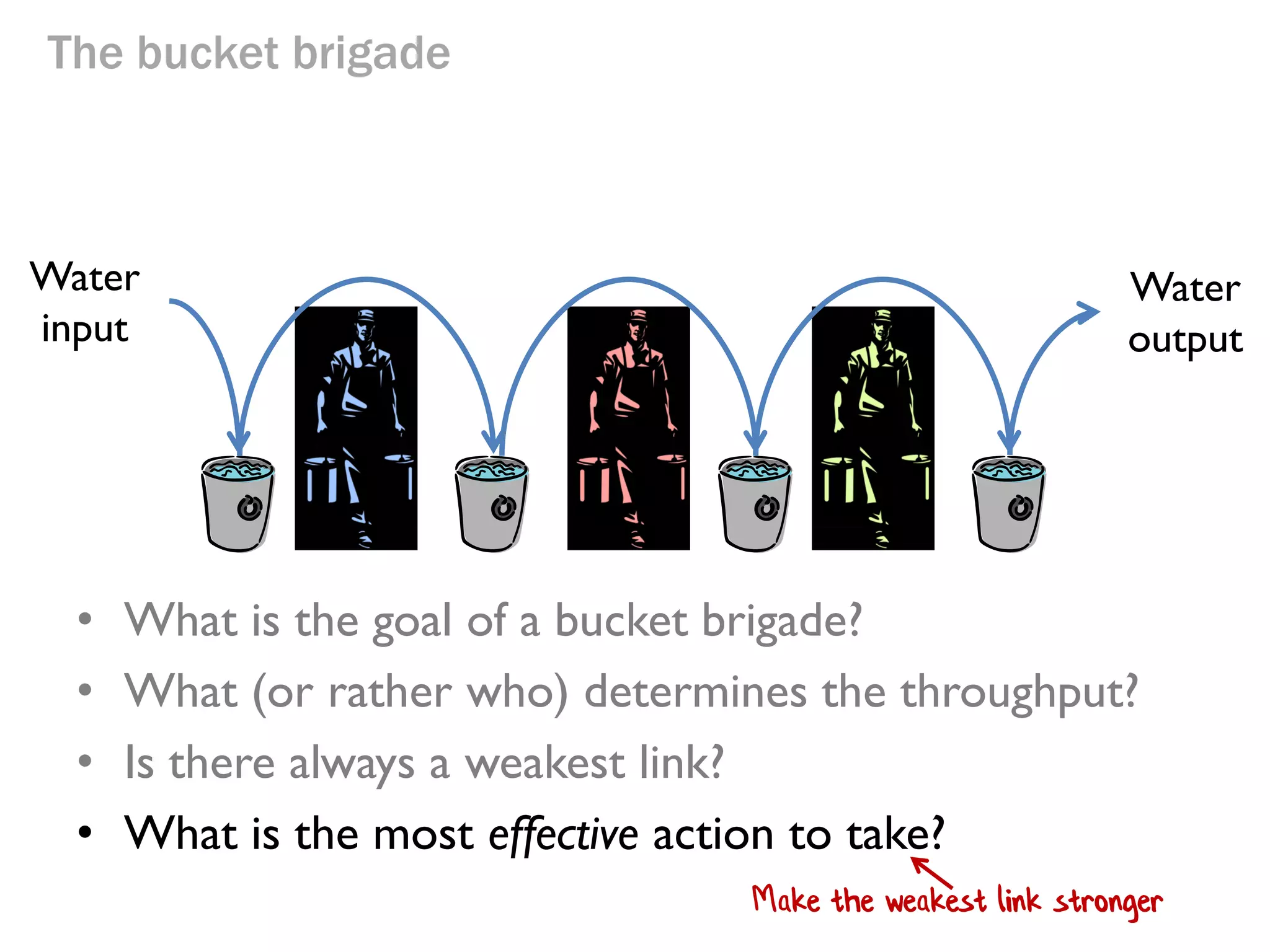
Make the weakest link stronger
The bucket brigade

Water
input

•
•
•
•

Water
output

What is the goal of a bucket brigade?
What (or rather who) determines the throughput?
Make the slowest person faster
Is there always a weakest link?
What is the most effective action to take?
Make the weakest link stronger
The bucket brigade

Water
input

Question: Which person never gets a rest?
What happens if he does rest?

Water
output
The bucket brigade

Water
input

Water
output

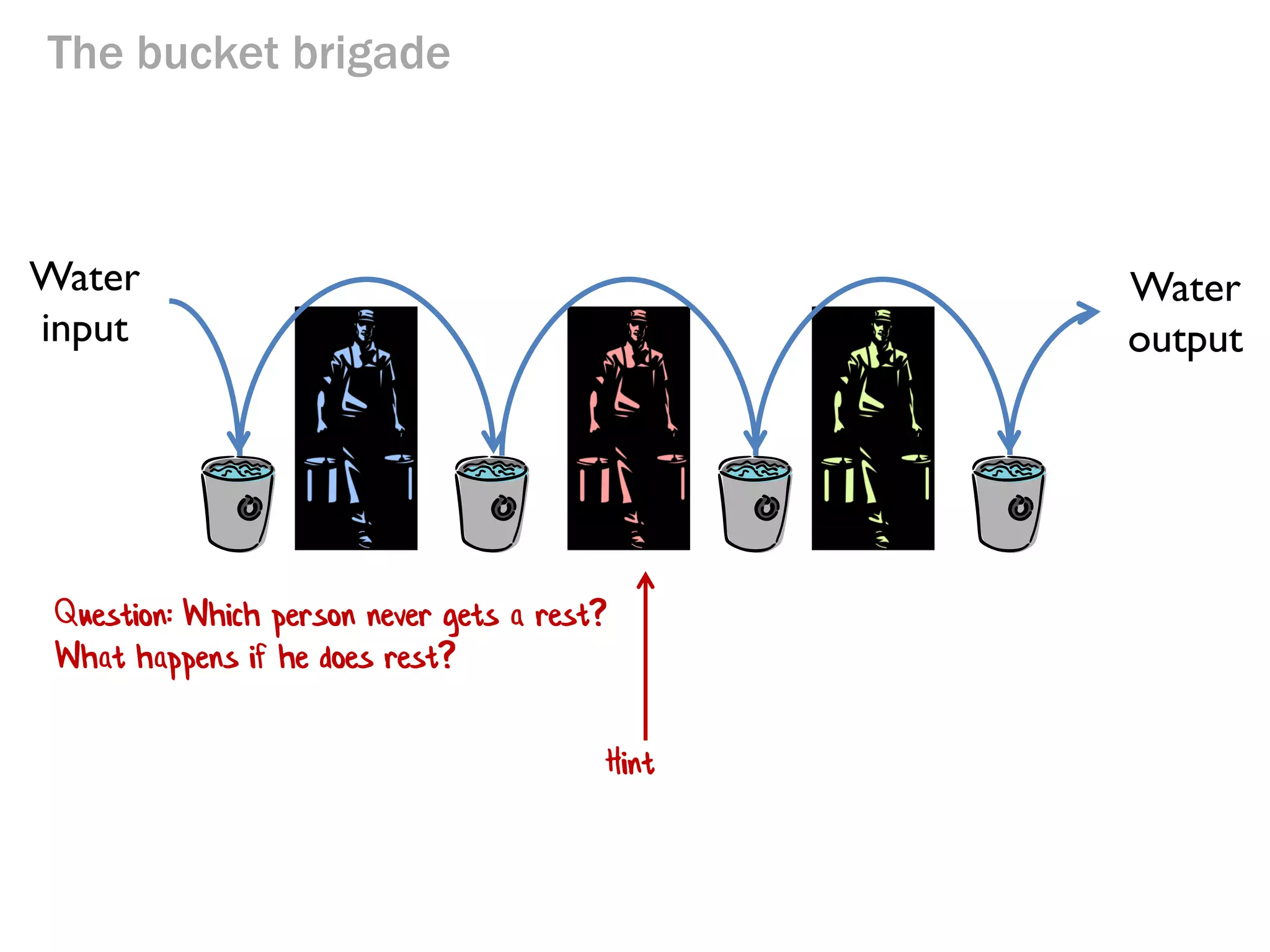
Question: Which person never gets a rest?
What happens if he does rest?

Hint
The bucket brigade

Water
input

Water
output

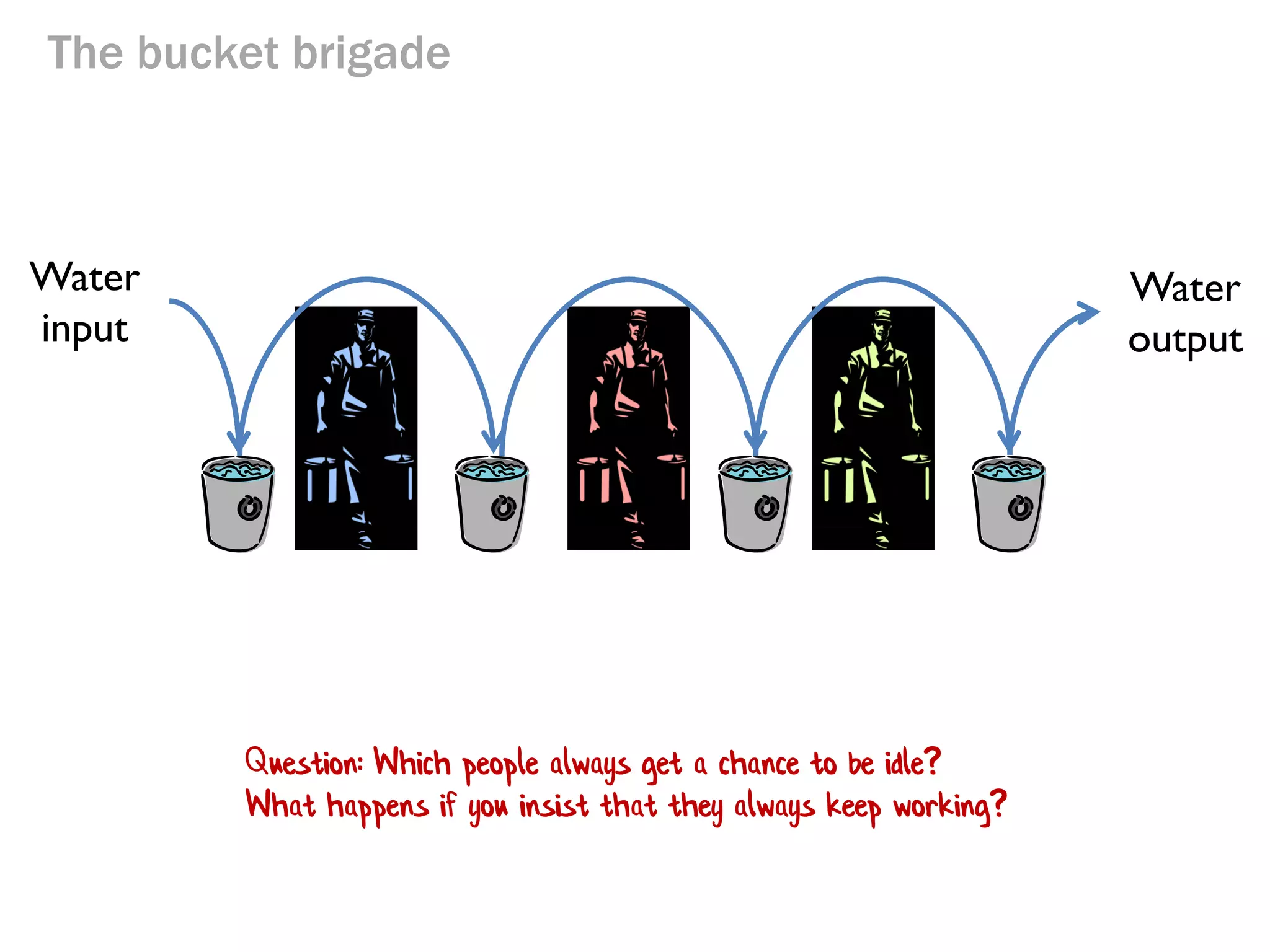
Question: Which people always get a chance to be idle?
What happens if you insist that they always keep working?
The bucket brigade

Water
input

Water
output

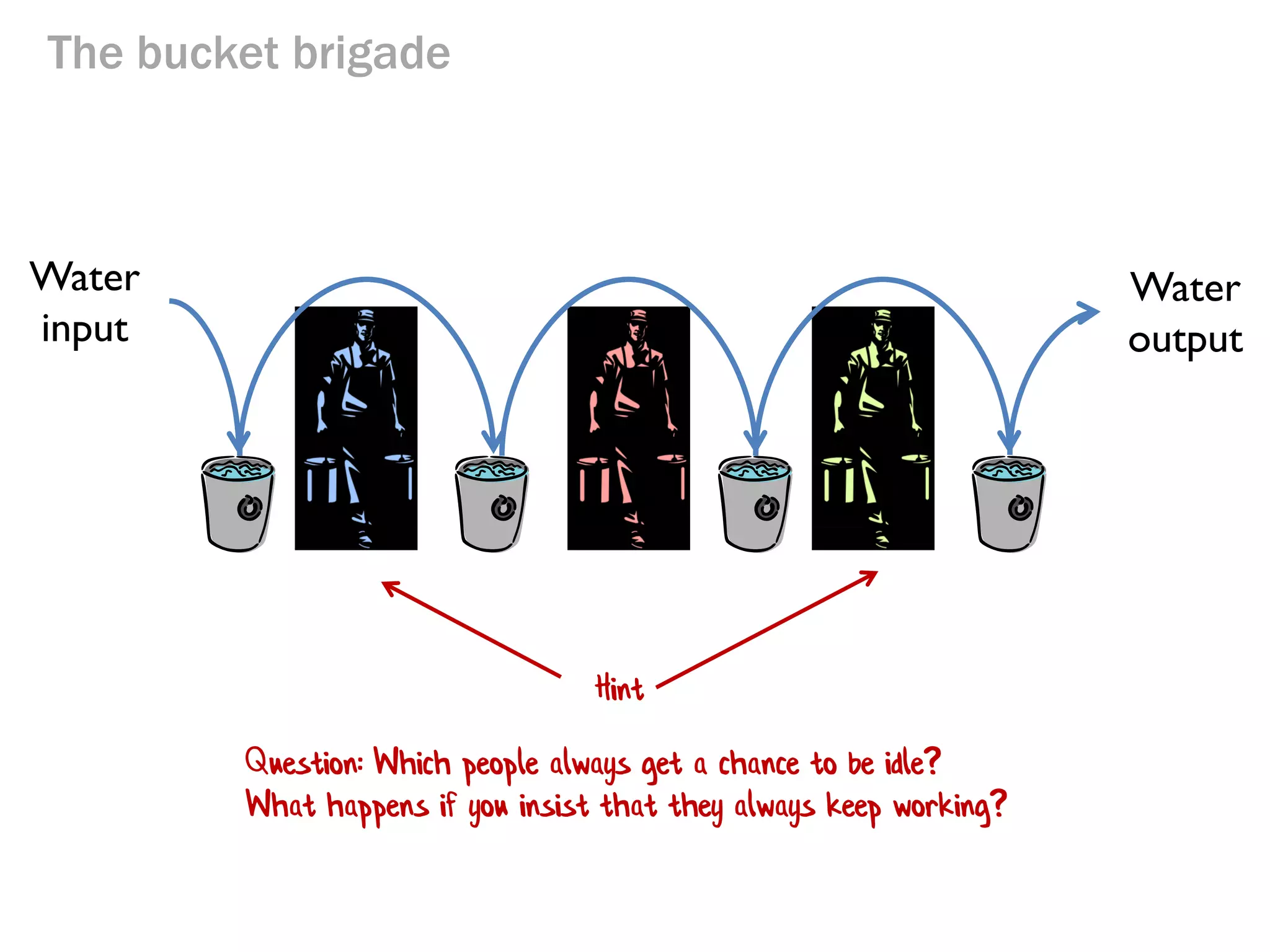
Hint

Question: Which people always get a chance to be idle?
What happens if you insist that they always keep working?
The bucket brigade

Water
input

Water
output
The bucket brigade

Water
input

Water
output
Part V
What is the goal of a business?
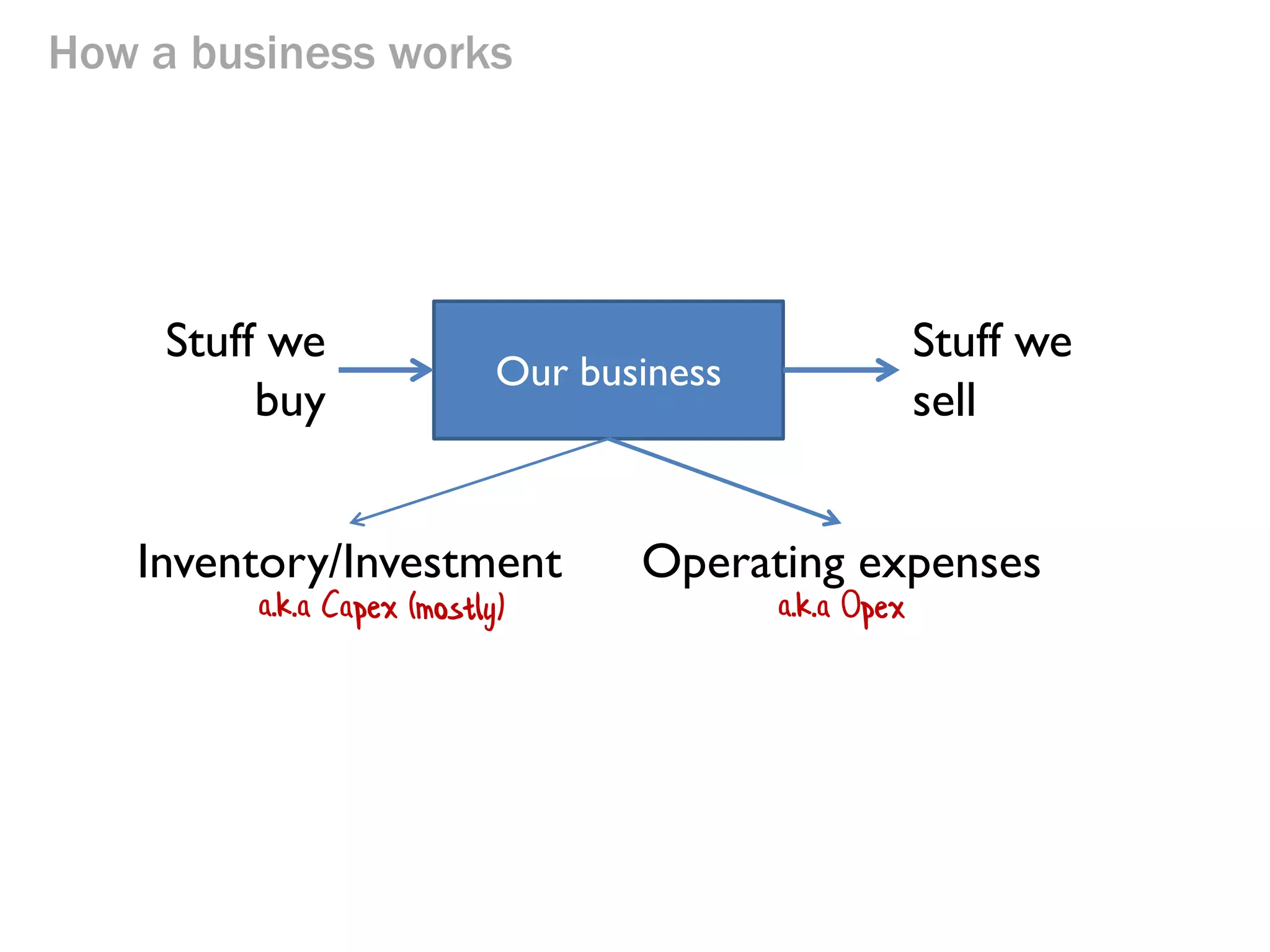
How a business works

Stuff we
buy

Our business

Inventory/Investment

Stuff we
sell

Operating expenses
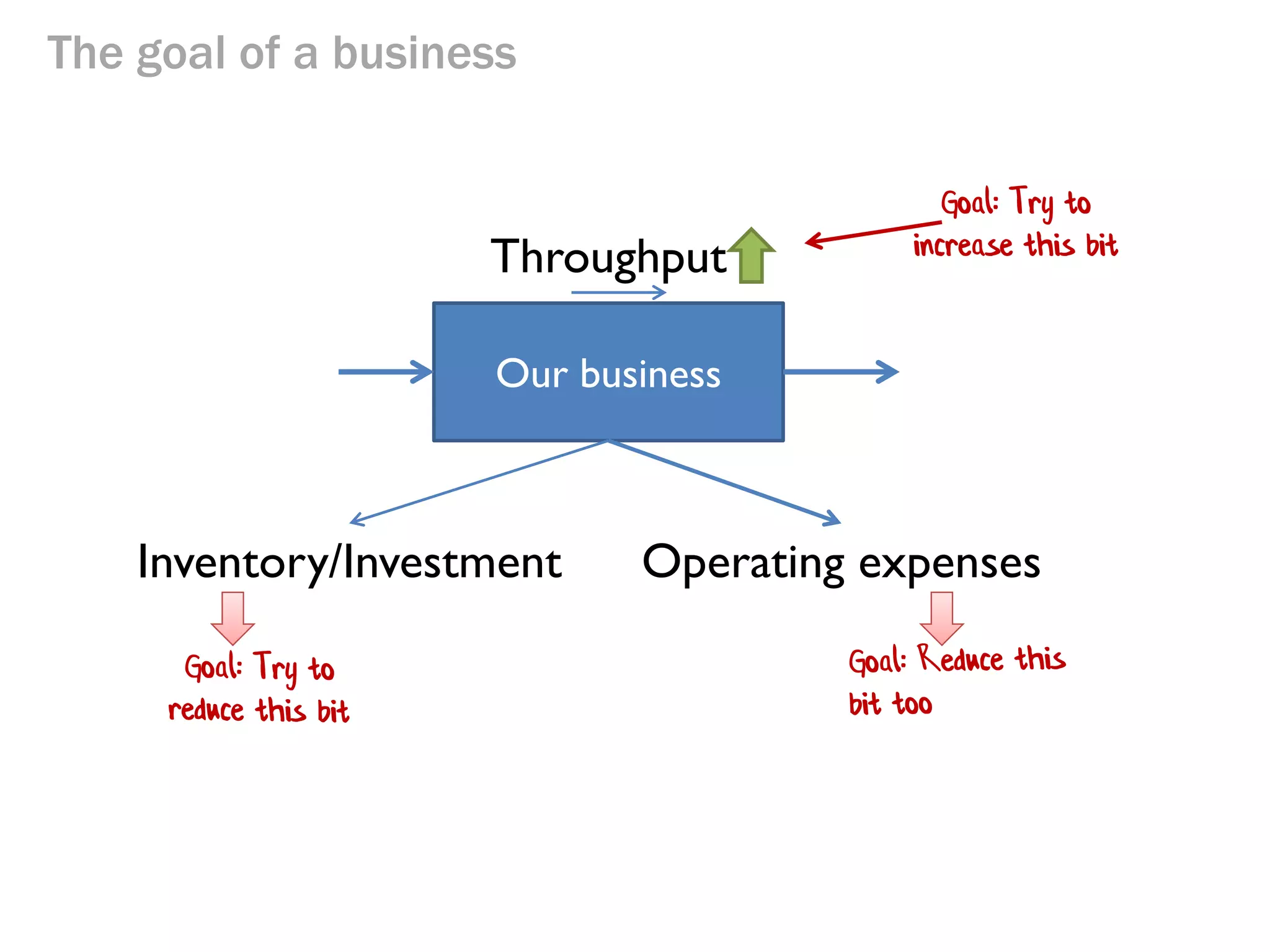
The goal of a business

Throughput

Goal: Try to
increase this bit

Our business

Inventory/Investment

Operating expenses
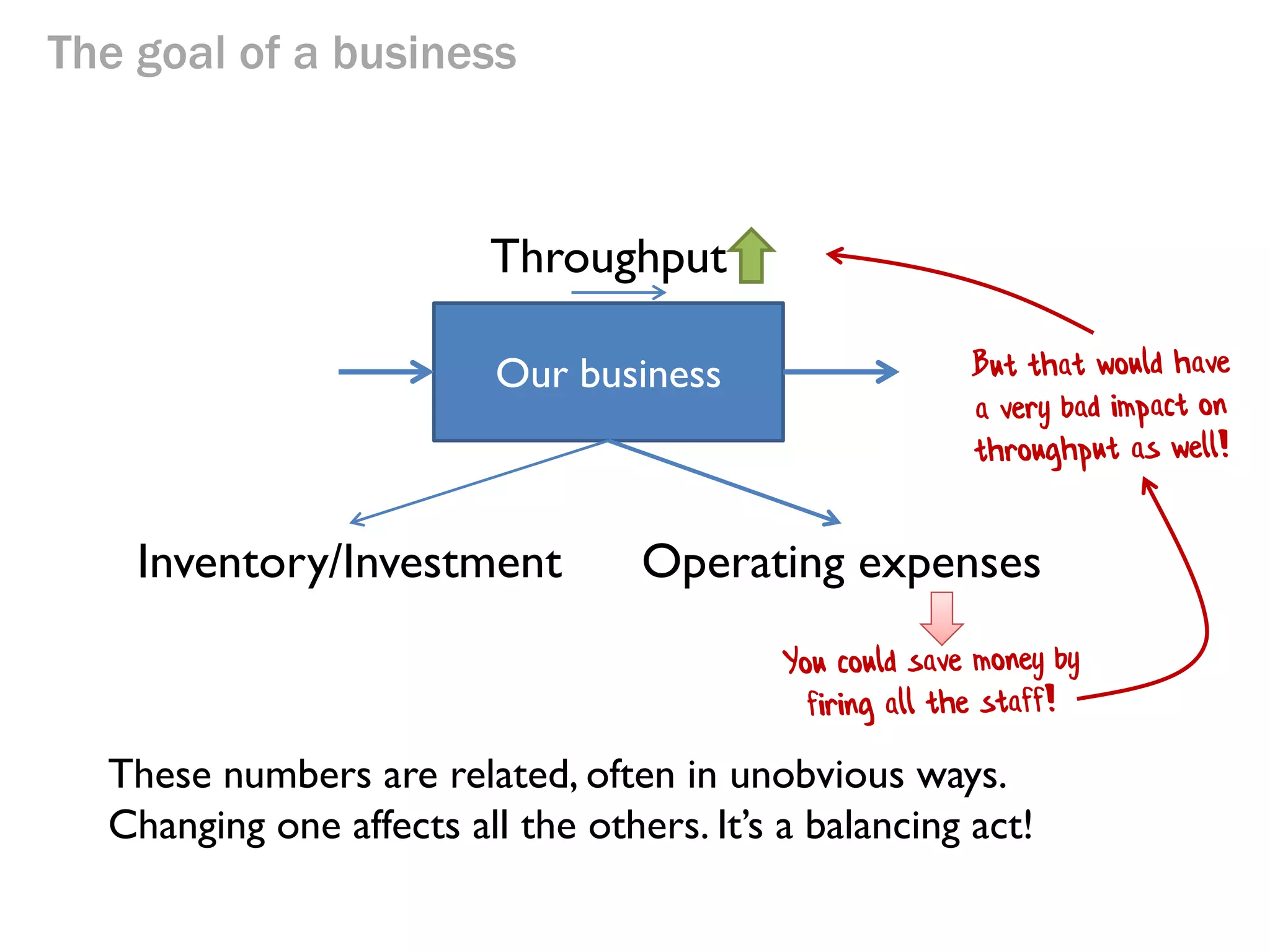
The goal of a business

Throughput
Our business

Inventory/Investment

Operating expenses

These numbers are related, often in unobvious ways.
Changing one affects all the others. It’s a balancing act!
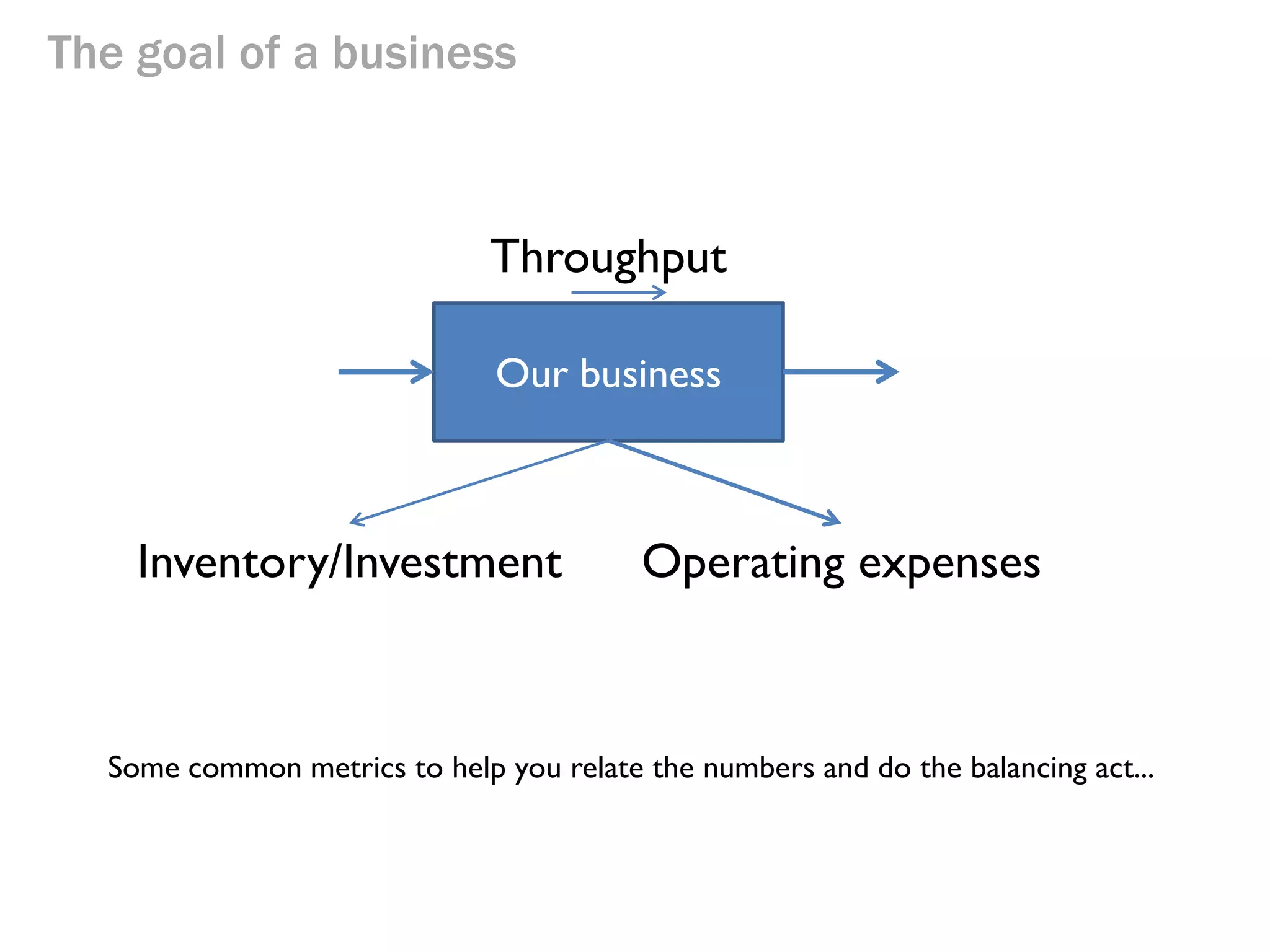
The goal of a business

Throughput
Our business

Inventory/Investment

Operating expenses

Some common metrics to help you relate the numbers and do the balancing act...
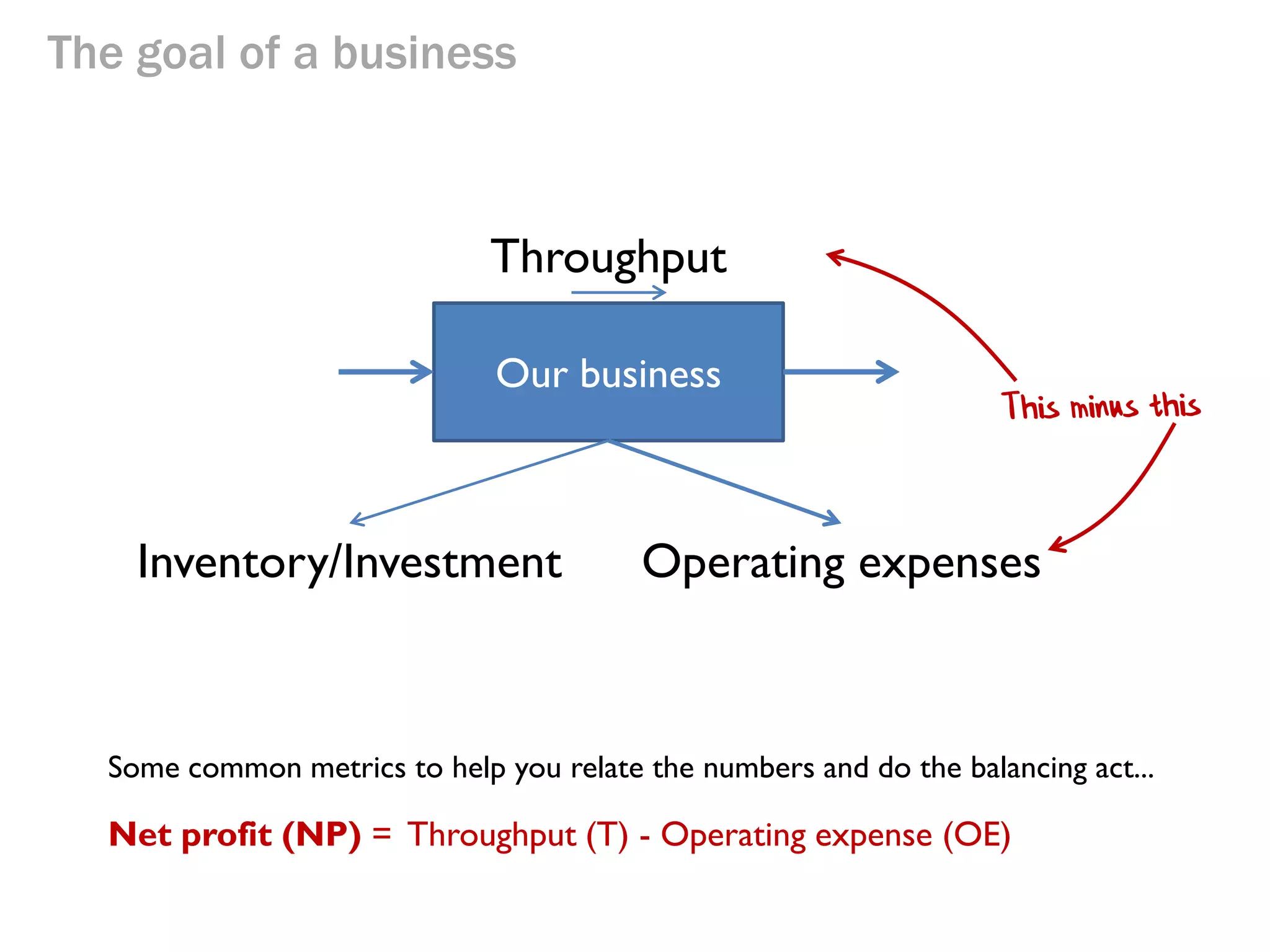
The goal of a business

Throughput
Our business

Inventory/Investment

Operating expenses

Some common metrics to help you relate the numbers and do the balancing act...

Net profit (NP) = Throughput (T) - Operating expense (OE)
The goal of a business

Throughput
Our business

Inventory/Investment

Operating expenses

Some common metrics to help you relate the numbers and do the balancing act...

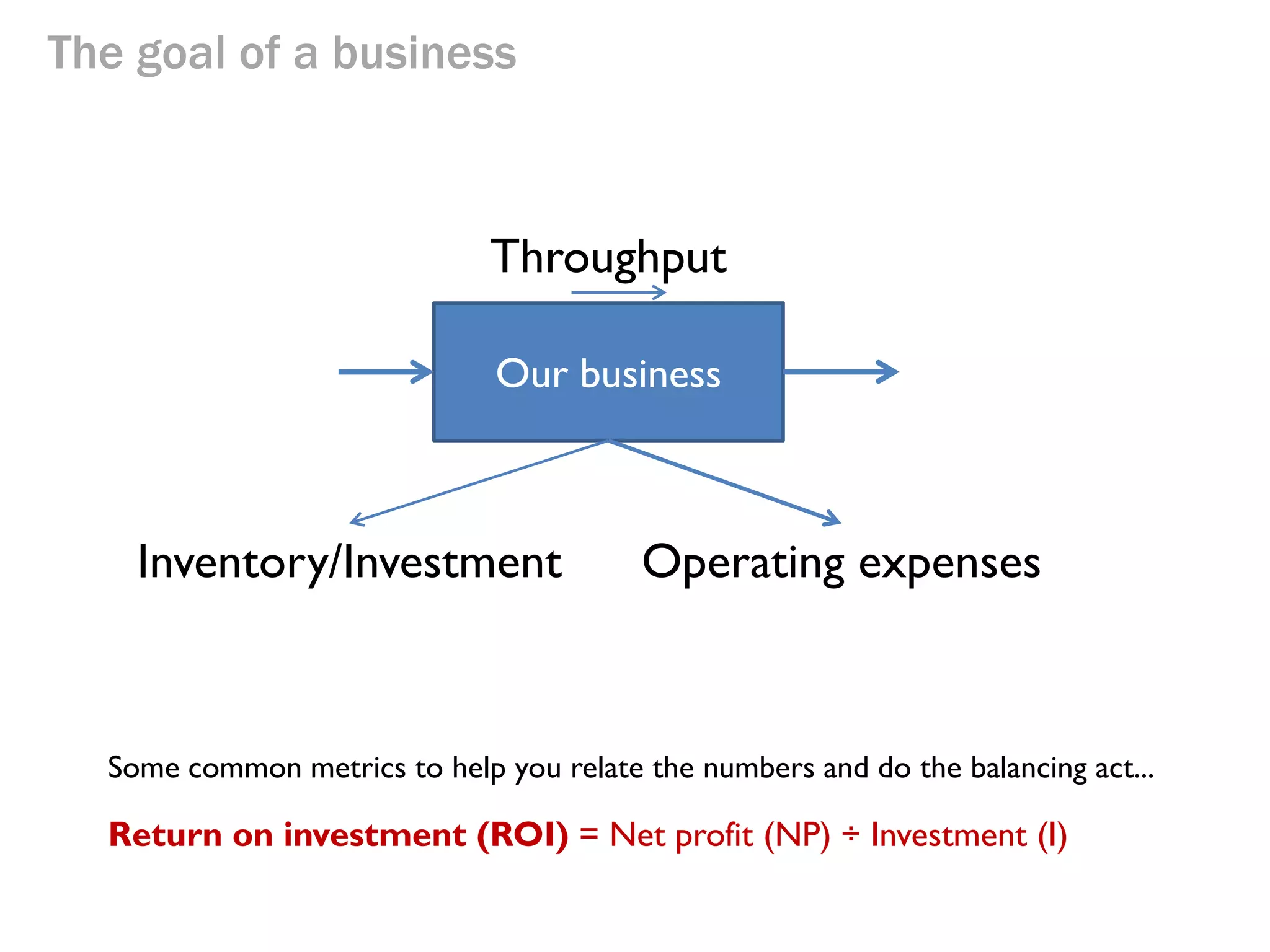
Return on investment (ROI) = Net profit (NP) ÷ Investment (I)
The goal of a business

Throughput
Our business

Inventory/Investment

Operating expenses

Some common metrics to help you relate the numbers and do the balancing act...

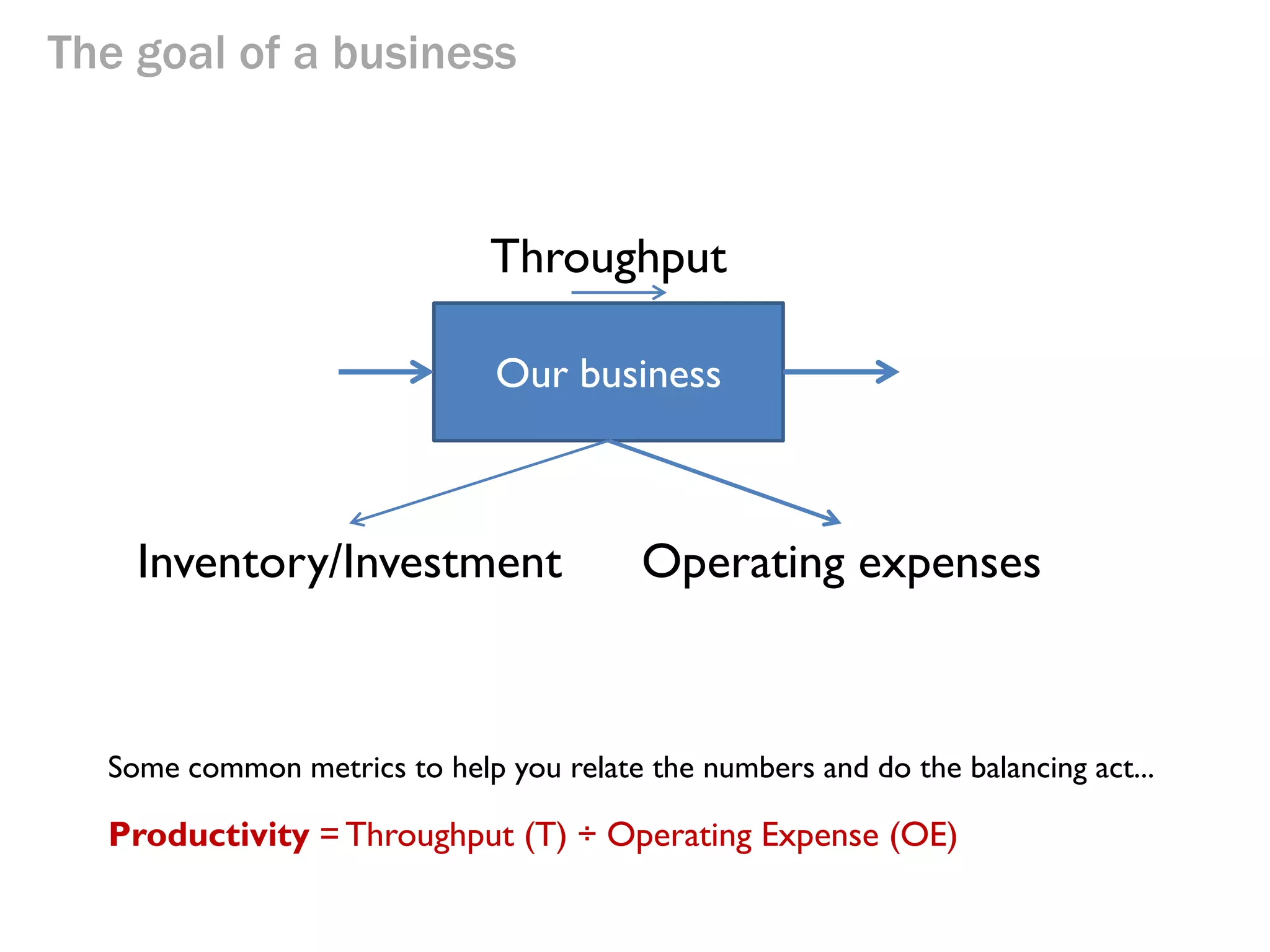
Productivity = Throughput (T) ÷ Operating Expense (OE)
The goal of a business

Throughput
Our business

Inventory/Investment

Operating expenses

Some common metrics to help you relate the numbers and do the balancing act...

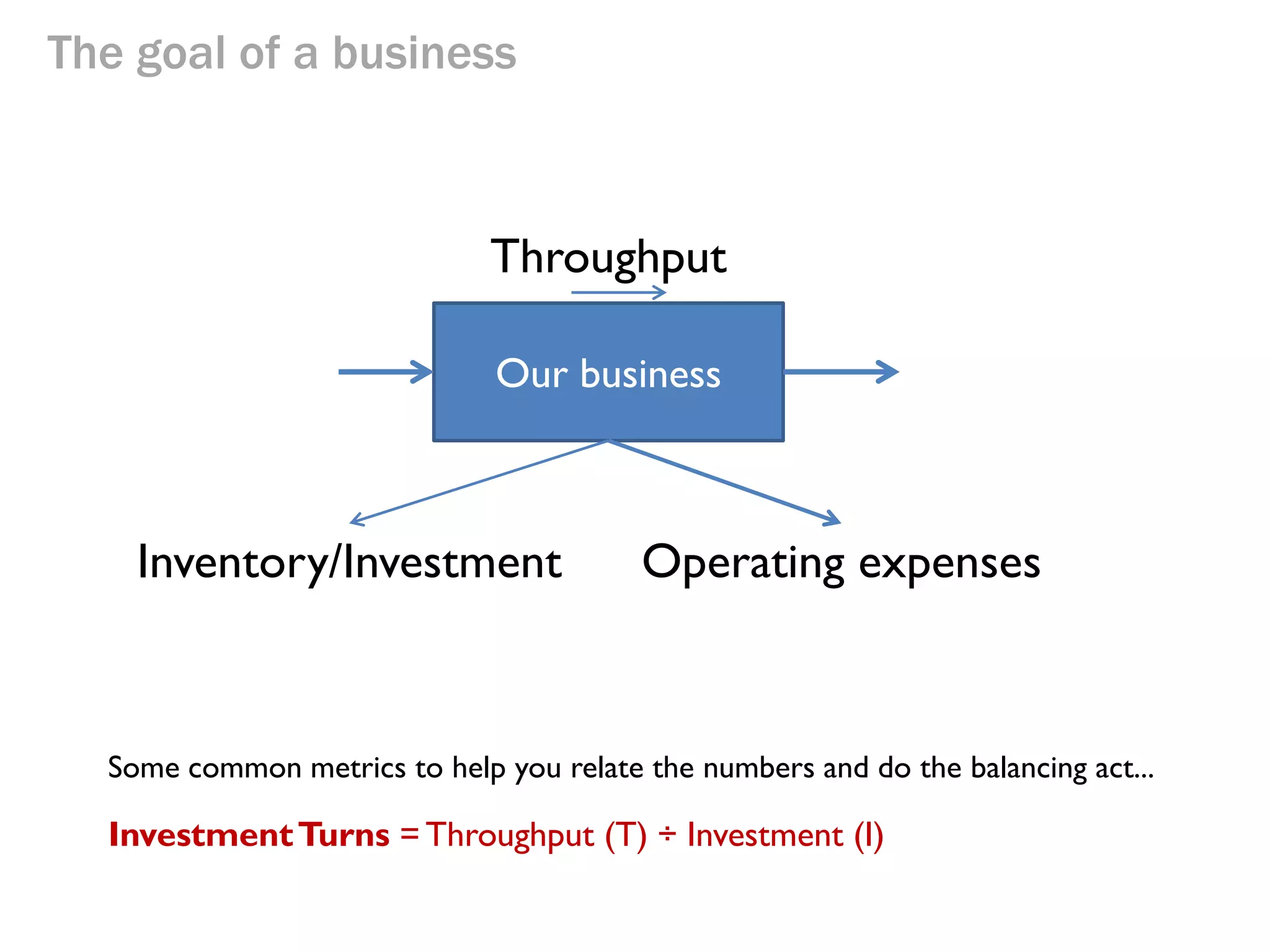
Investment Turns = Throughput (T) ÷ Investment (I)
What if a bucket brigade
was like a business?
Another overly-simplistic
business analogy....
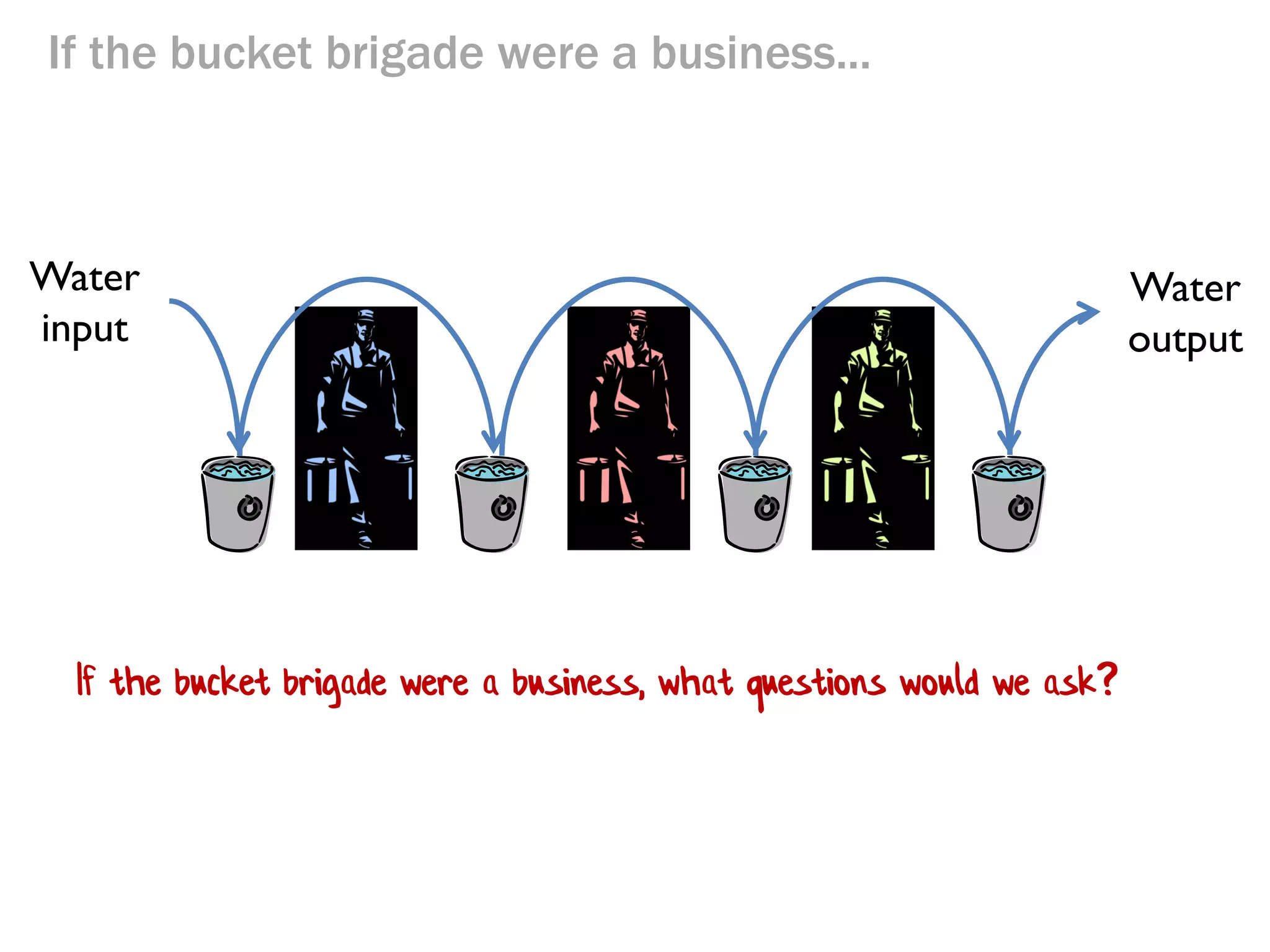
If the bucket brigade were a business...

Water
input

If the bucket brigade were a business, what questions would we ask?

Water
output
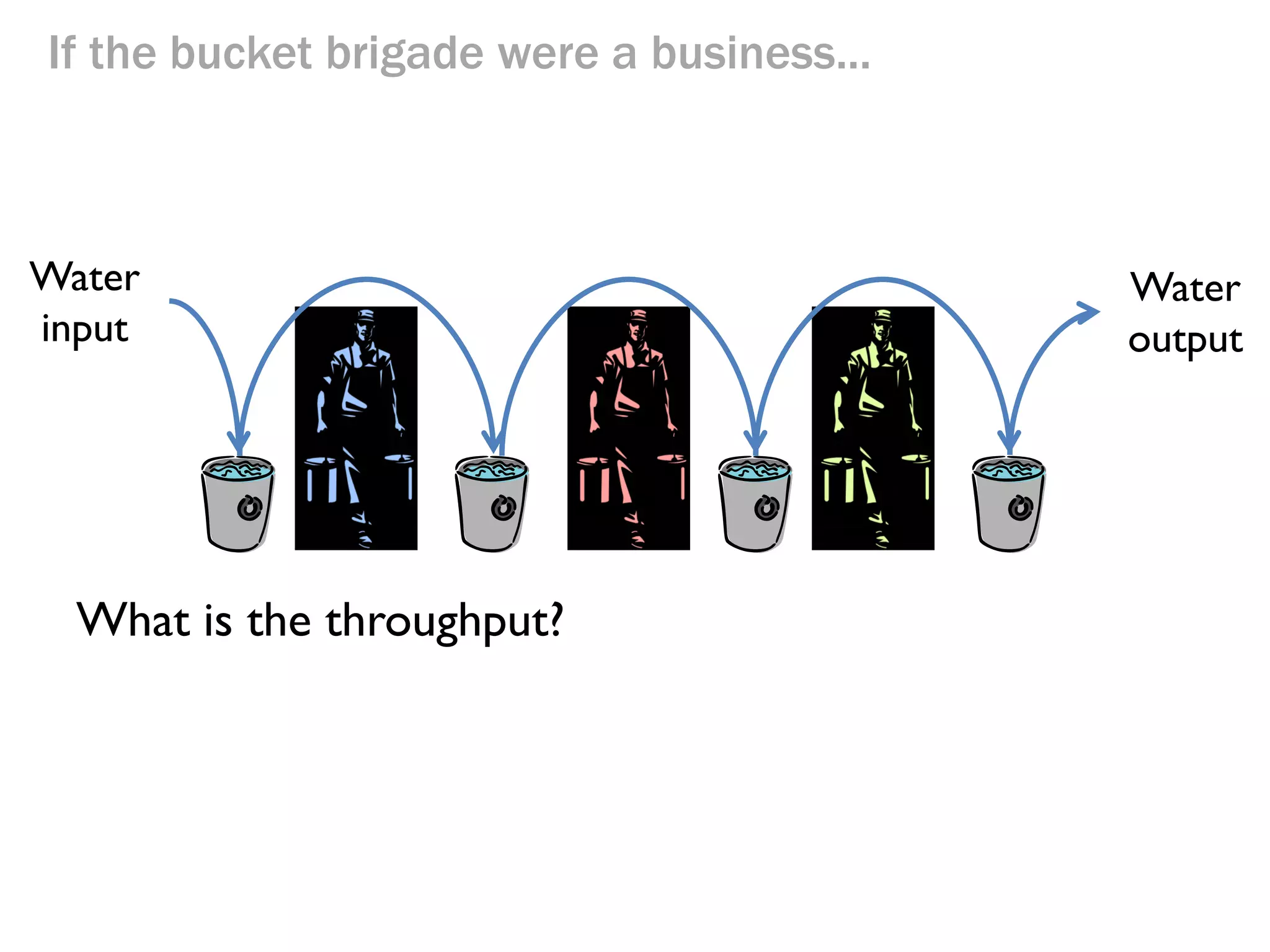
If the bucket brigade were a business...

Water
input

What is the throughput?

Water
output
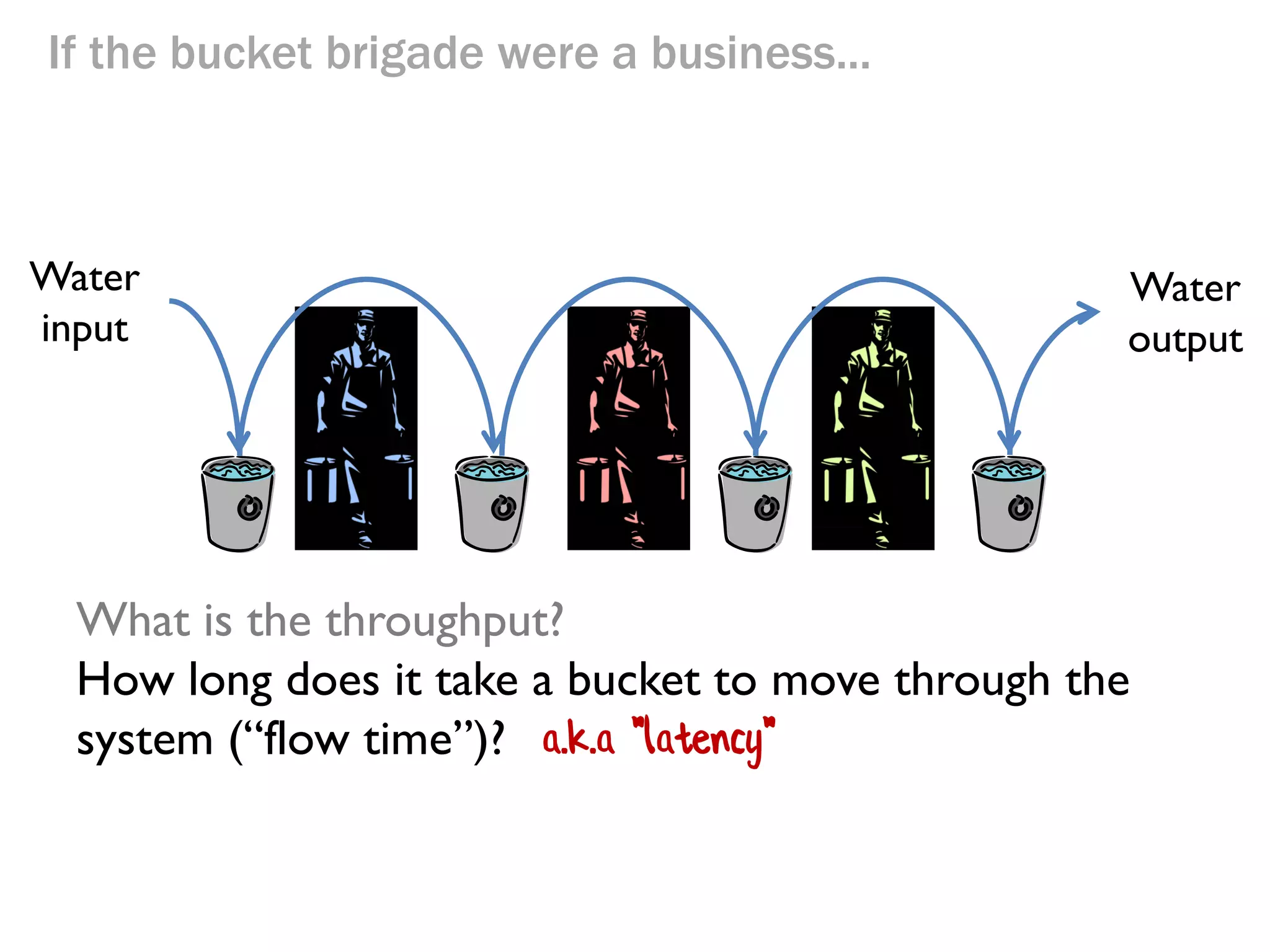
If the bucket brigade were a business...

Water
input

Water
output

What is the throughput?
How long does it take a bucket to move through the
system (“flow time”)? a.k.a "latency"
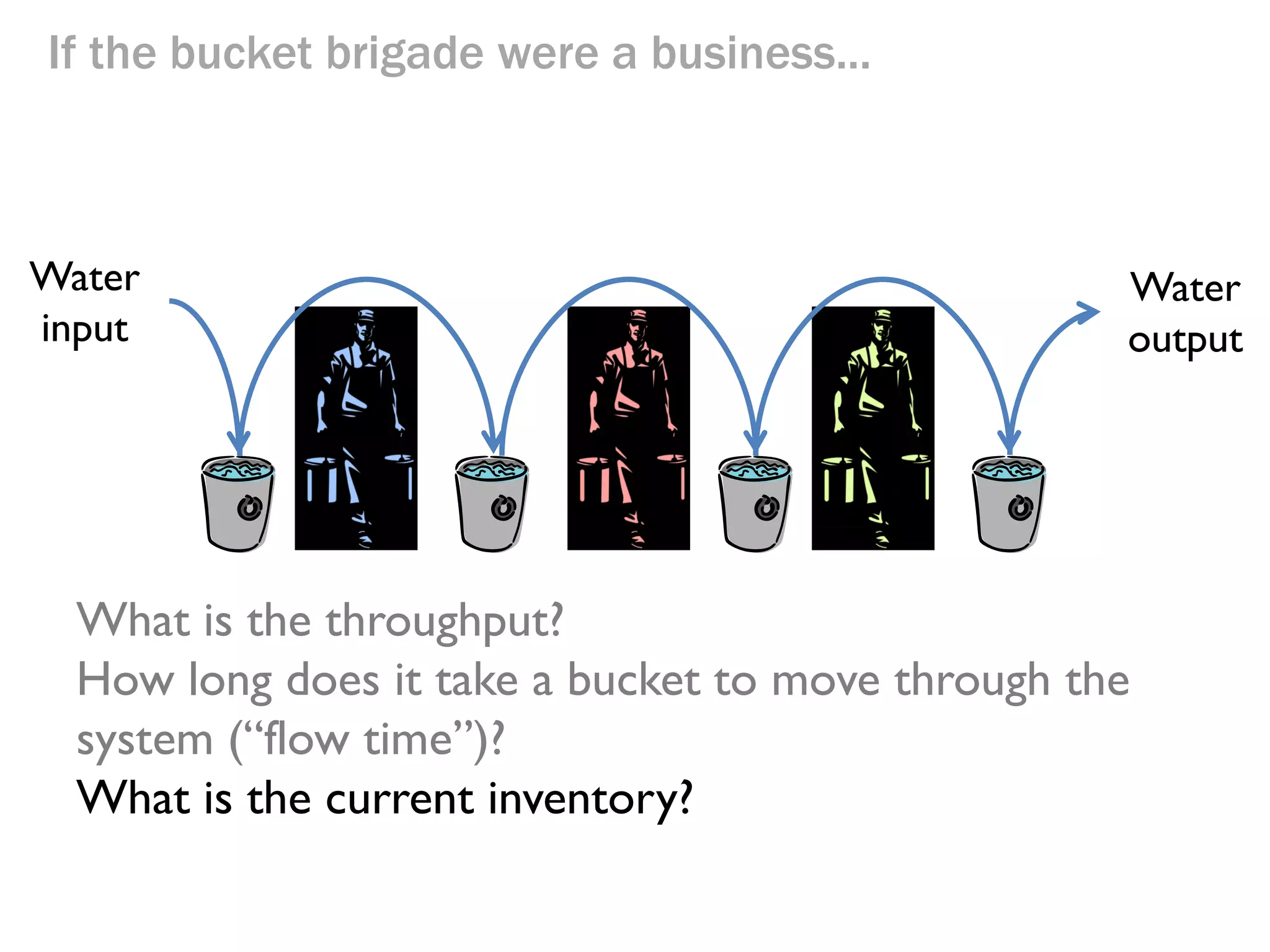
If the bucket brigade were a business...

Water
input

Water
output

What is the throughput?
How long does it take a bucket to move through the
system (“flow time”)?
What is the current inventory?
If the bucket brigade were a business...

Water
input

Water
output

What is the throughput?
How long does it take a bucket to move through the
system (“flow time”)?
What is the current inventory?
What are the operating expenses?
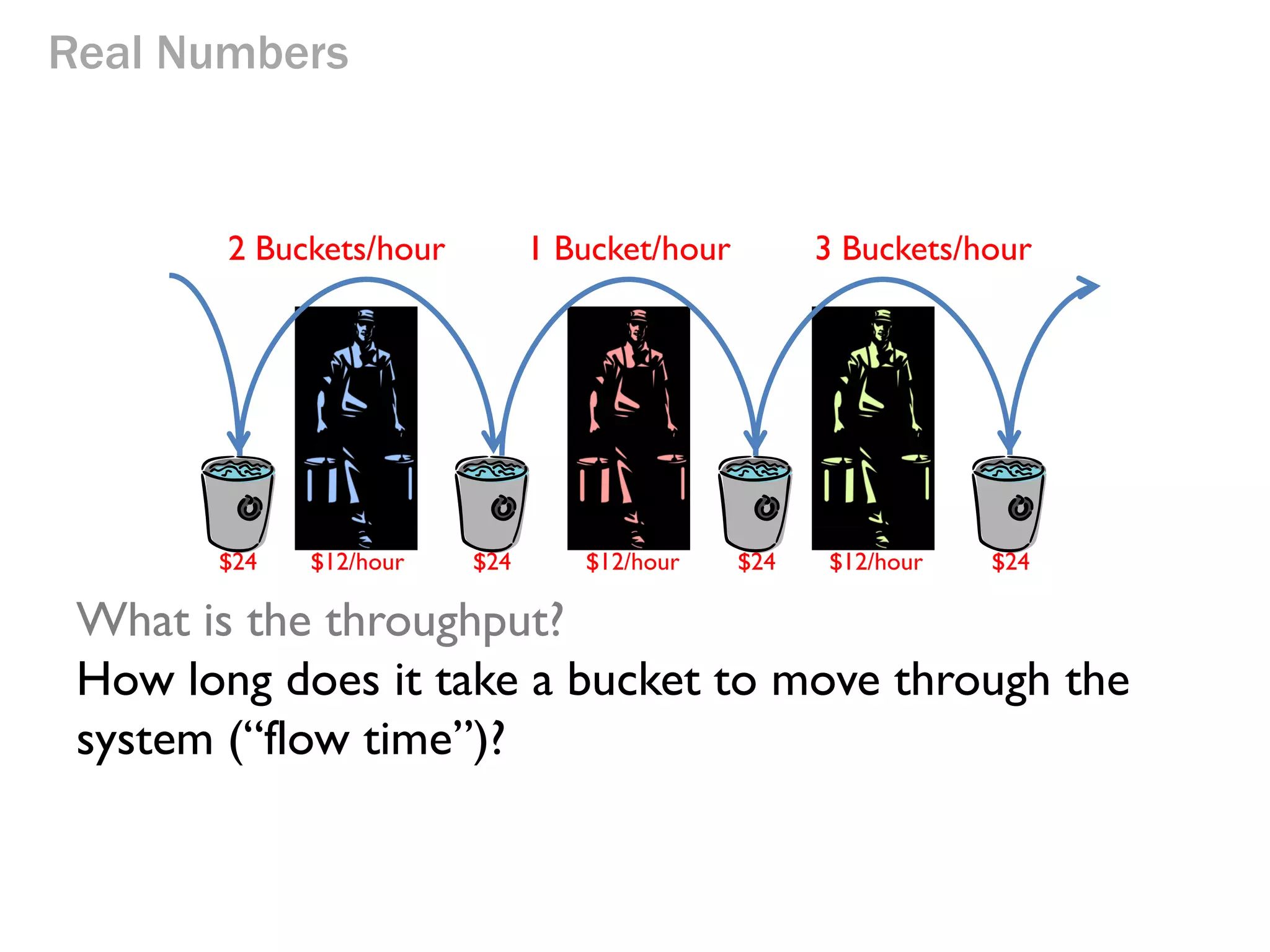
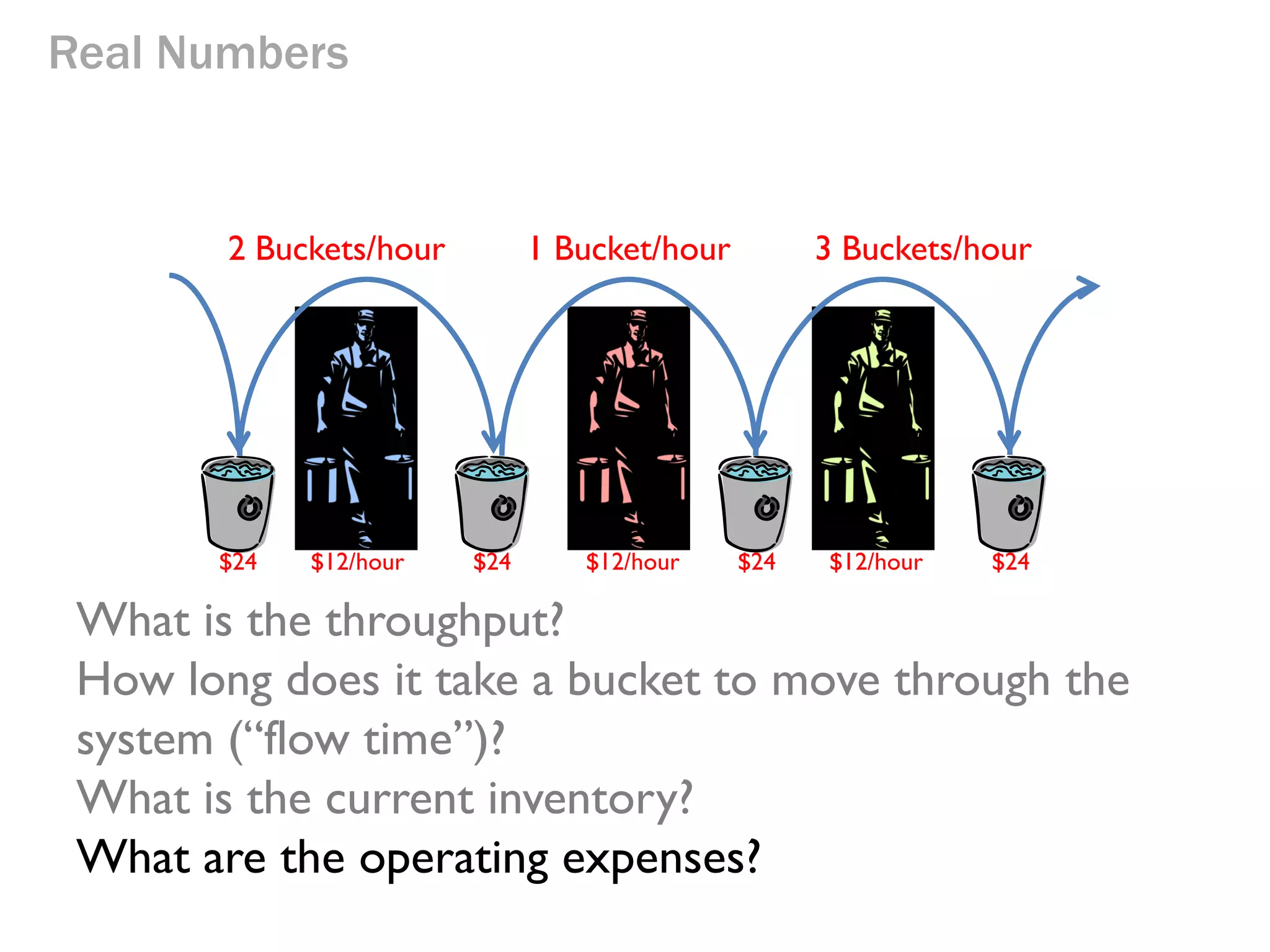
Real Numbers
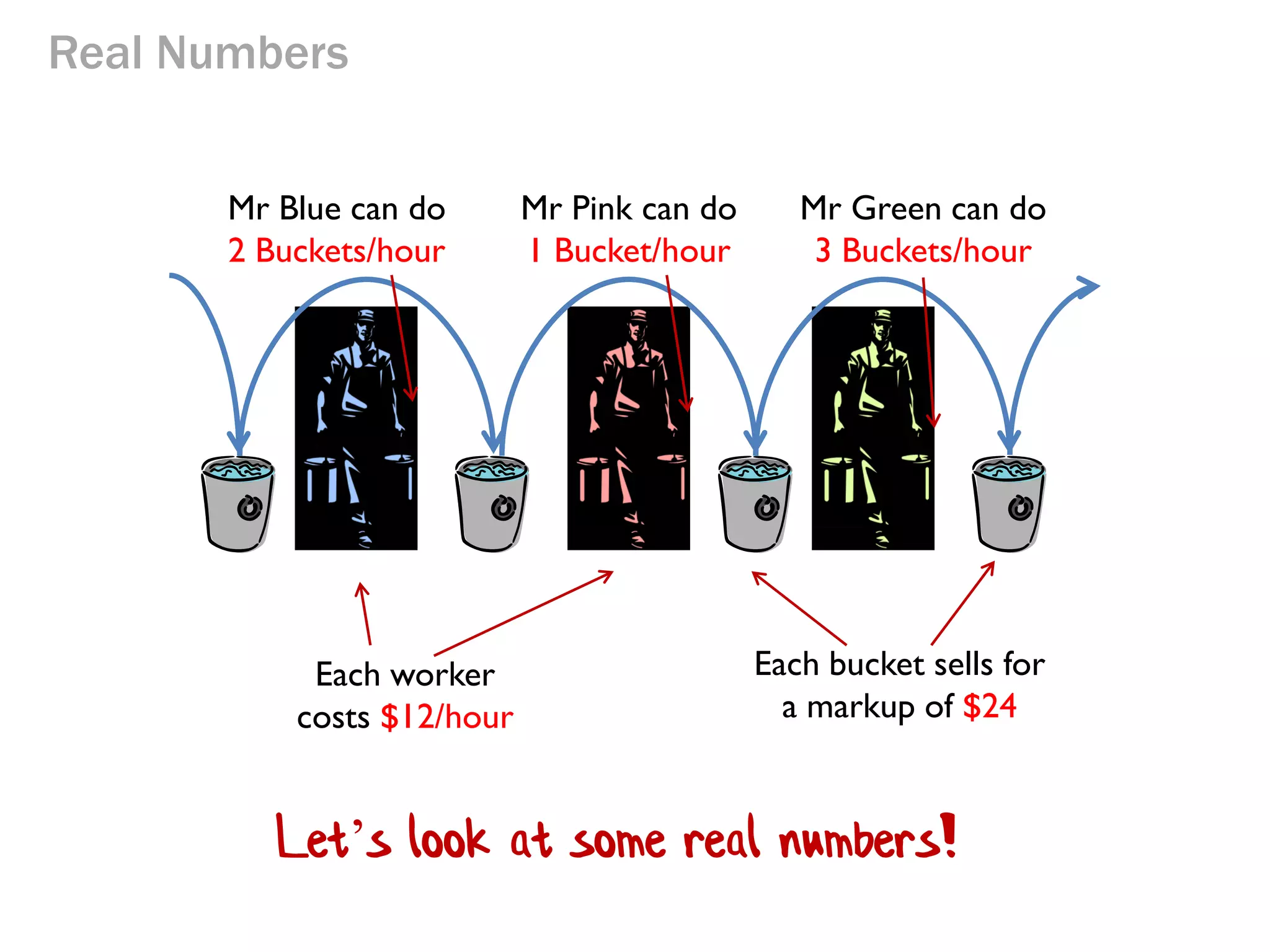
Mr Blue can do
2 Buckets/hour

Each worker
costs $12/hour

Mr Pink can do
1 Bucket/hour

Mr Green can do
3 Buckets/hour

Each bucket sells for
a markup of $24

Let’s look at some real numbers!
Real Numbers

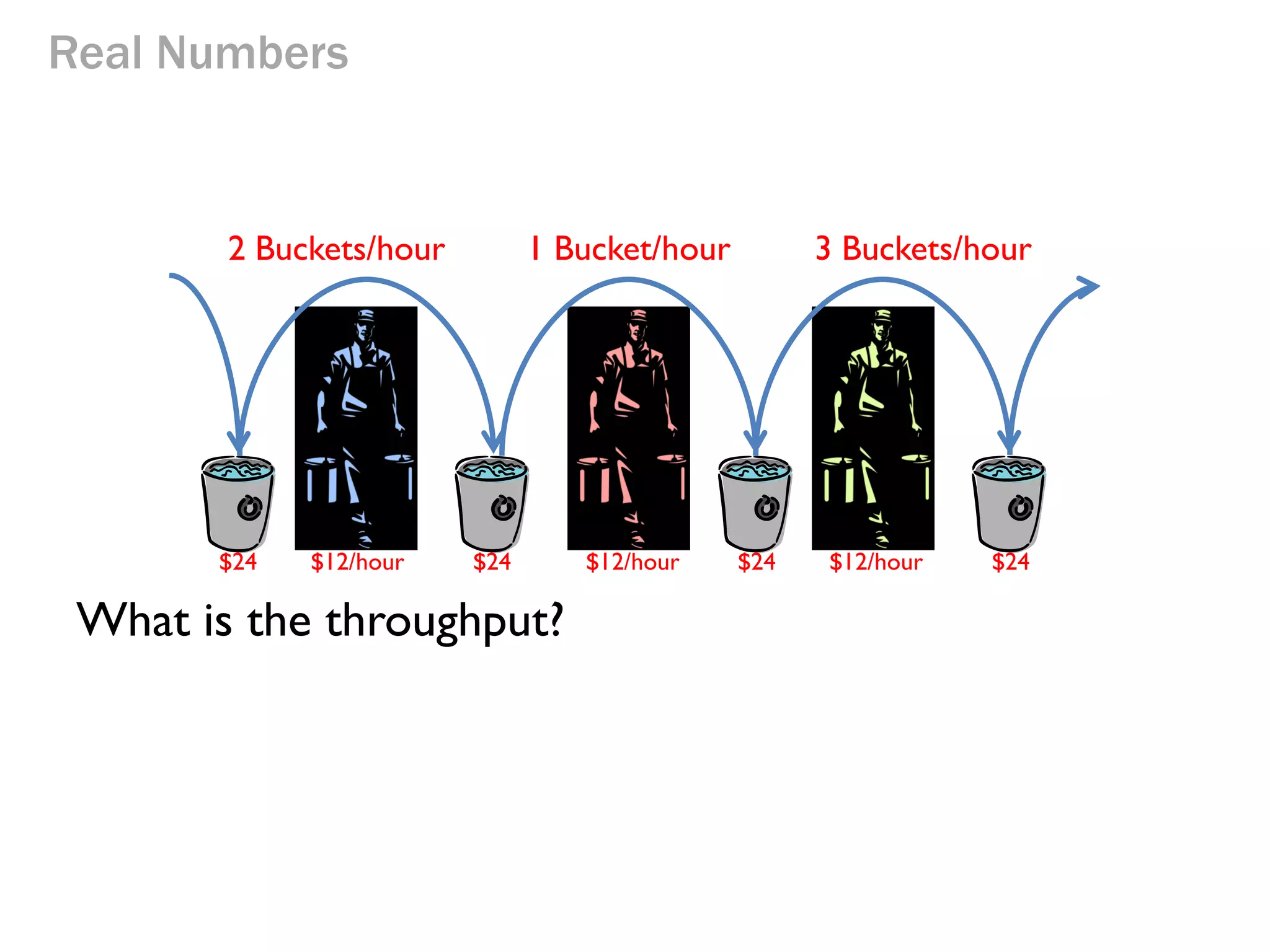
2 Buckets/hour

$24

$12/hour

1 Bucket/hour

$24

What is the throughput?

$12/hour

3 Buckets/hour

$24

$12/hour

$24
Real Numbers

2 Buckets/hour

$24

$12/hour

1 Bucket/hour

$24

$12/hour

3 Buckets/hour

$24

$12/hour

$24

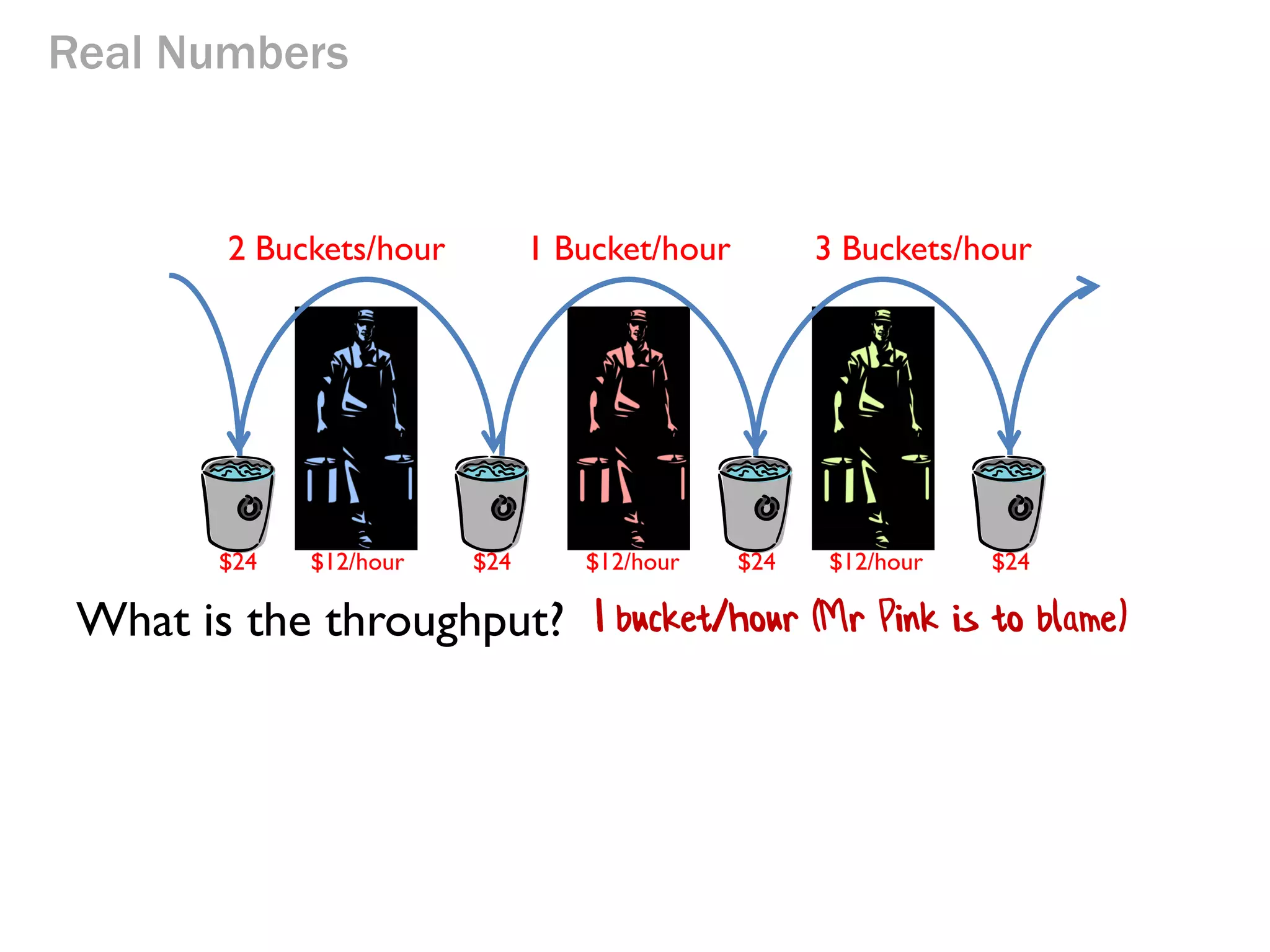
What is the throughput? 1 bucket/hour (Mr Pink is to blame)
Real Numbers

2 Buckets/hour

$24

$12/hour

1 Bucket/hour

$24

$12/hour

3 Buckets/hour

$24

$12/hour

$24

What is the throughput?
How long does it take a bucket to move through the
system (“flow time”)?
Real Numbers

2 Buckets/hour

$24

$12/hour

1 Bucket/hour

$24

$12/hour

3 Buckets/hour

$24

$12/hour

$24

What is the throughput?
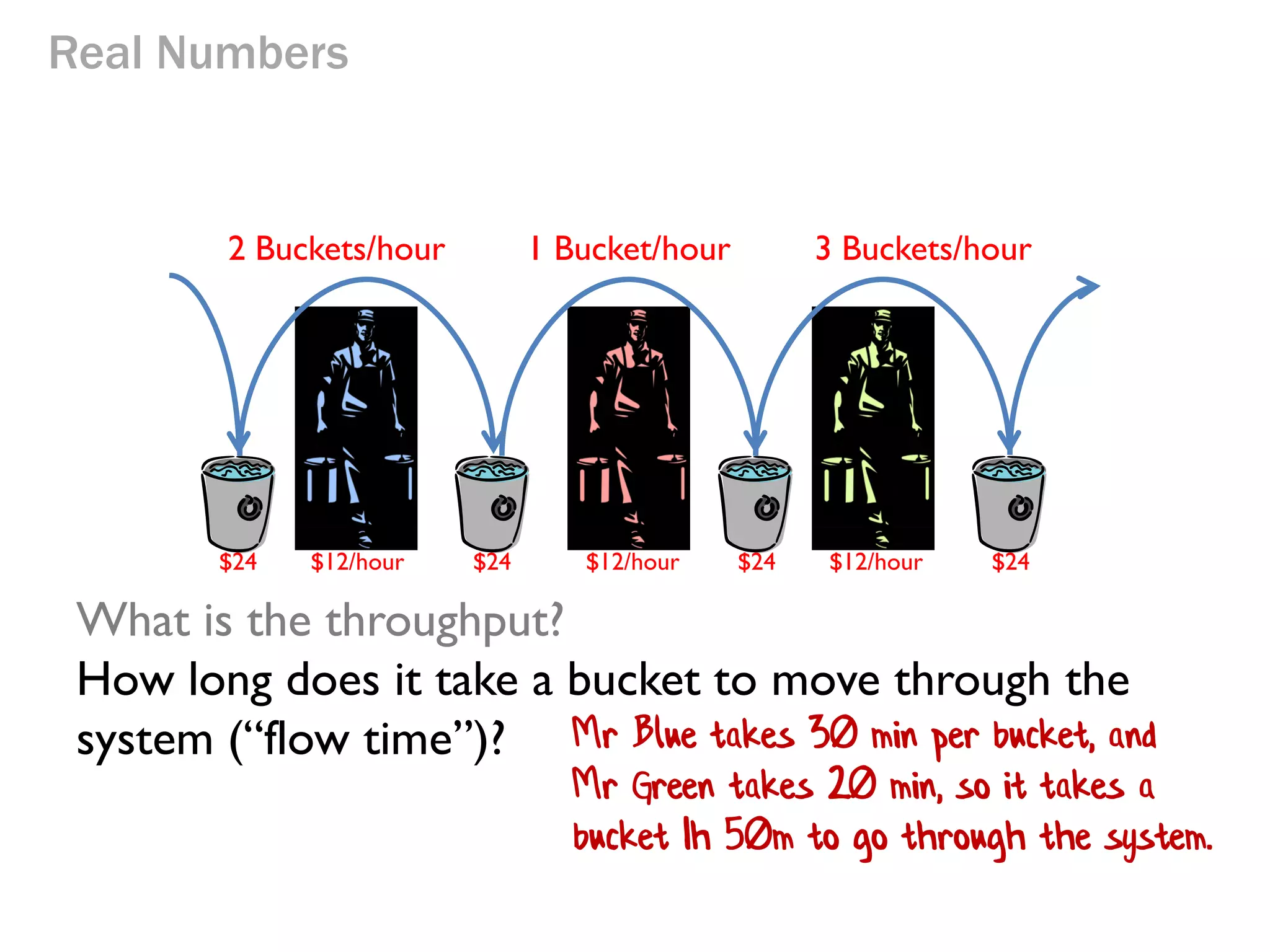
How long does it take a bucket to move through the
system (“flow time”)? Mr Blue takes 30 min per bucket, and

Mr Green takes 20 min, so it takes a
bucket 1h 50m to go through the system.
Real Numbers

2 Buckets/hour

$24

$12/hour

1 Bucket/hour

$24

$12/hour

3 Buckets/hour

$24

$12/hour

$24

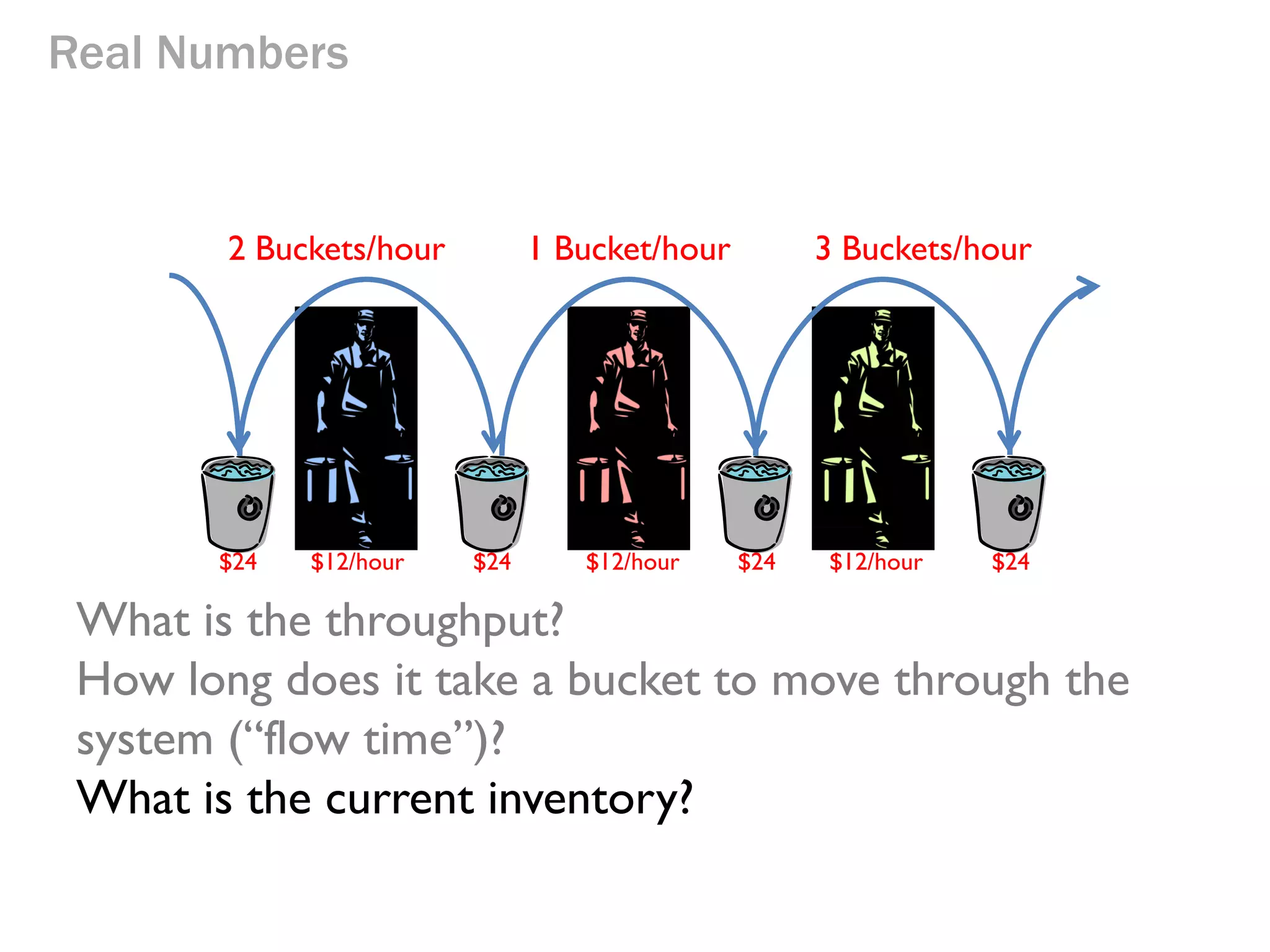
What is the throughput?
How long does it take a bucket to move through the
system (“flow time”)?
What is the current inventory?
Real Numbers

2 Buckets/hour

$24

$12/hour

1 Bucket/hour

$24

$12/hour

3 Buckets/hour

$24

$12/hour

$24

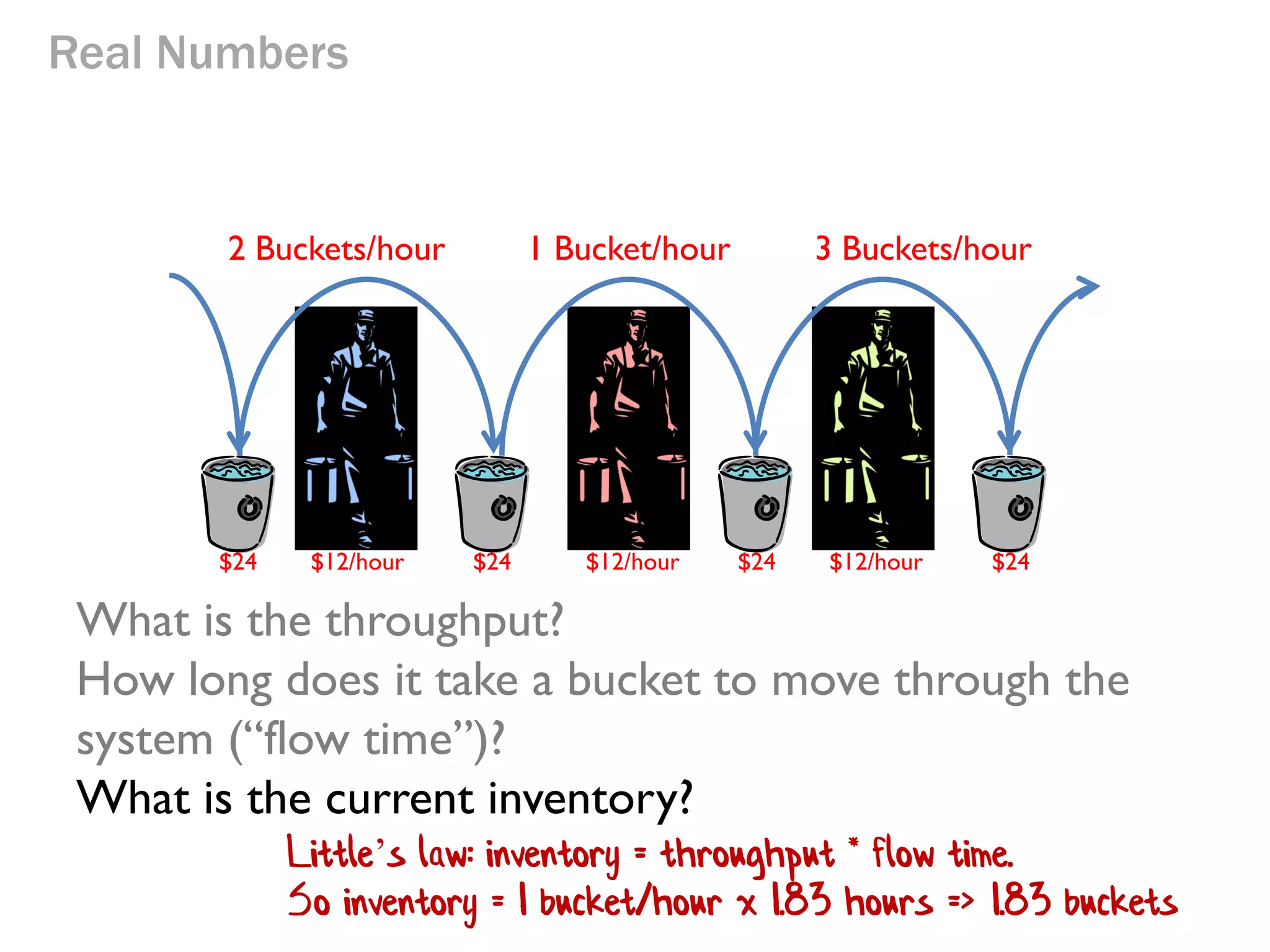
What is the throughput?
How long does it take a bucket to move through the
system (“flow time”)?
What is the current inventory?
Little’s law: inventory = throughput * flow time.
So inventory = 1 bucket/hour x 1.83 hours => 1.83 buckets
Real Numbers

2 Buckets/hour

$24

$12/hour

1 Bucket/hour

$24

$12/hour

3 Buckets/hour

$24

$12/hour

$24

What is the throughput?
How long does it take a bucket to move through the
system (“flow time”)?
What is the current inventory?
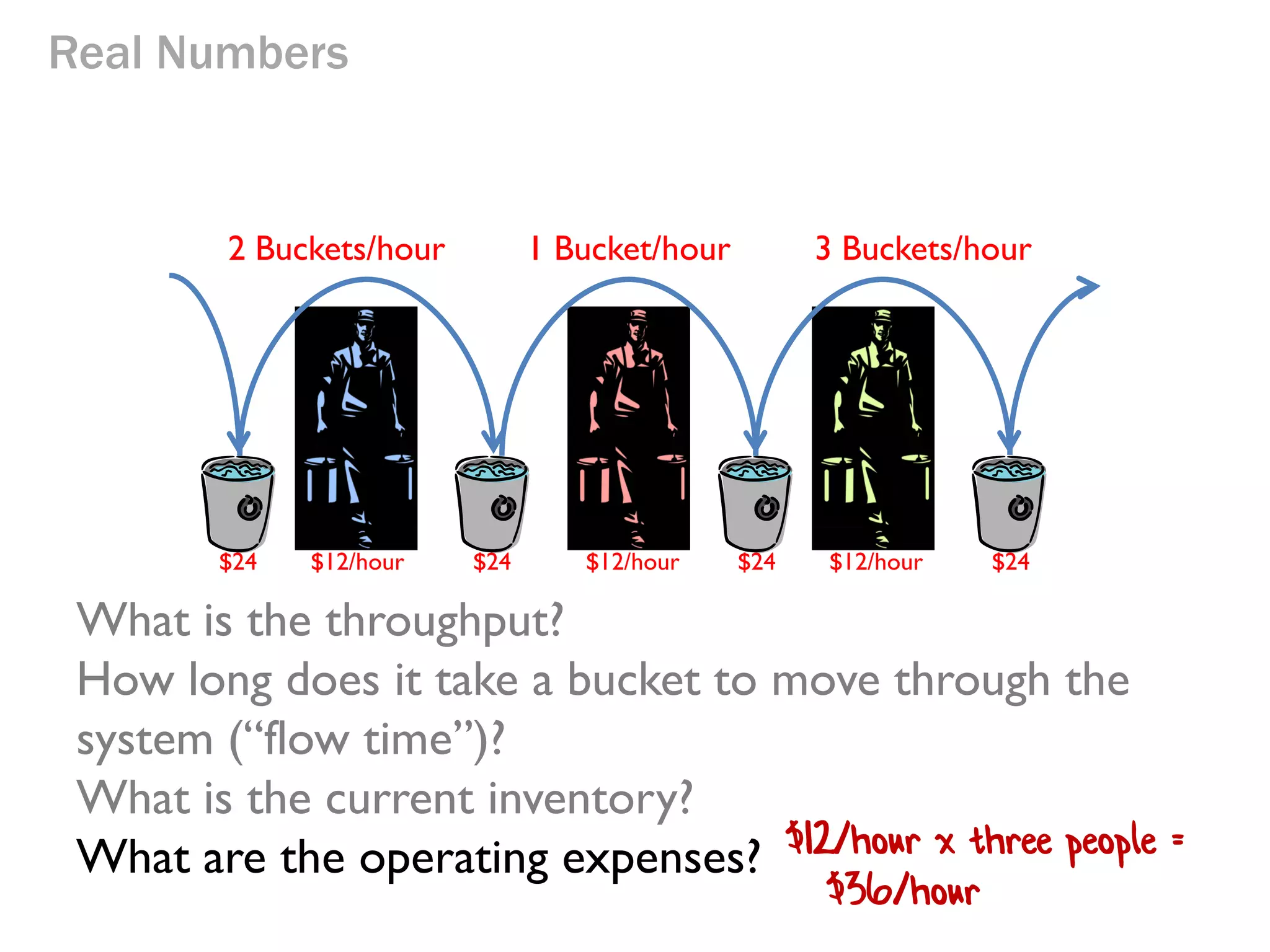
What are the operating expenses?
Real Numbers

2 Buckets/hour

$24

$12/hour

1 Bucket/hour

$24

$12/hour

3 Buckets/hour

$24

$12/hour

$24

What is the throughput?
How long does it take a bucket to move through the
system (“flow time”)?
What is the current inventory?
What are the operating expenses? $12/hour x three people =
$36/hour
Real Numbers

2 Buckets/hour

$24

$12/hour

1 Bucket/hour

$24

$12/hour

3 Buckets/hour

$24

$12/hour

$24

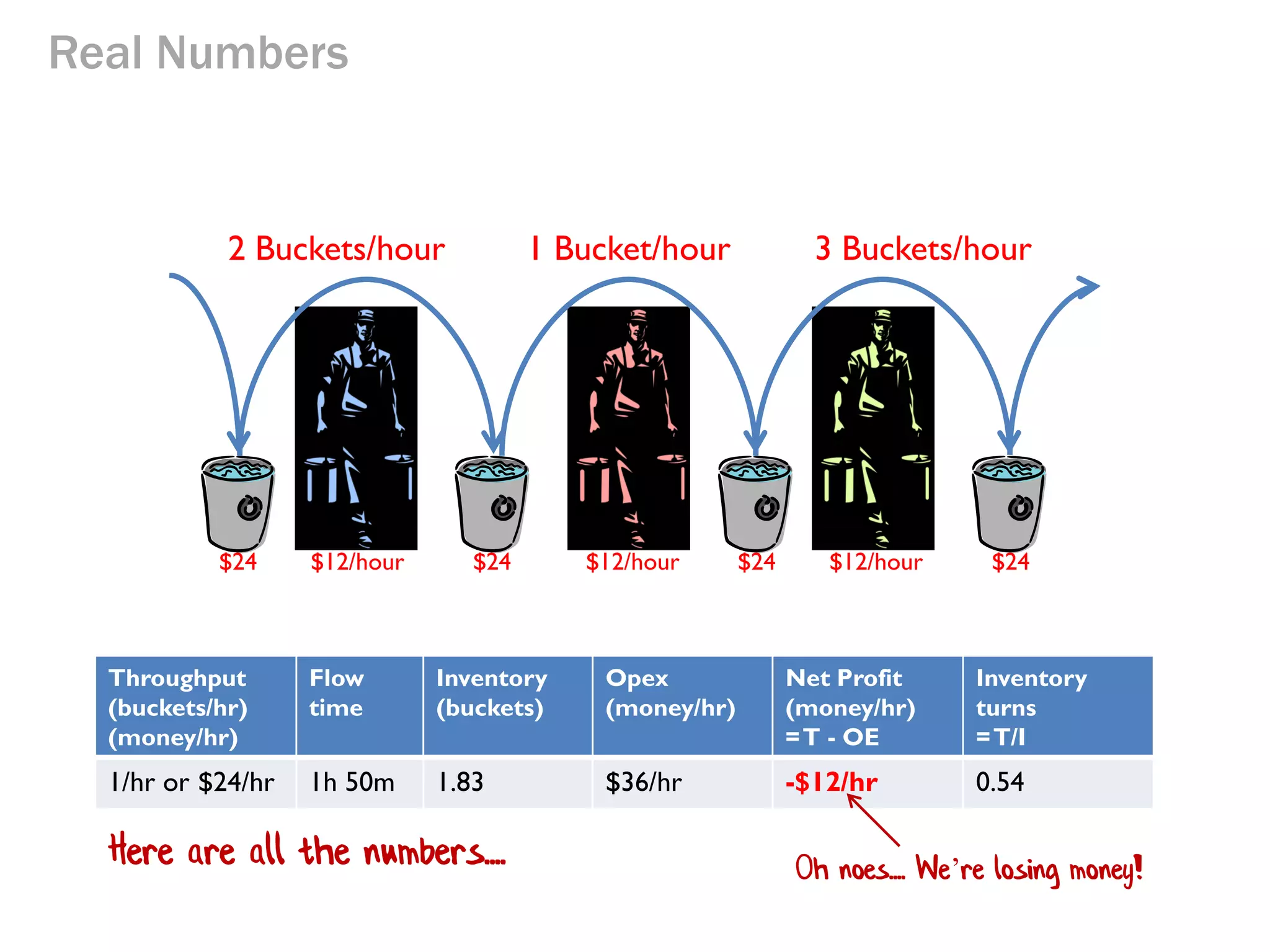
Throughput
(buckets/hr)
(money/hr)

Flow
time

Inventory
(buckets)

Opex
(money/hr)

Net Profit
(money/hr)
= T - OE

Inventory
turns
= T/I

1/hr or $24/hr

1h 50m

1.83

$36/hr

-$12/hr

0.54

Here are all the numbers....

Oh noes.... We’re losing money!
Real Numbers
We’re losing money – what should we do?
Real Numbers
We’re losing money – what should we do?
Let’s step back and look at the problem...
Real Numbers
We’re losing money – what should we do?
Let’s step back and look at the problem...
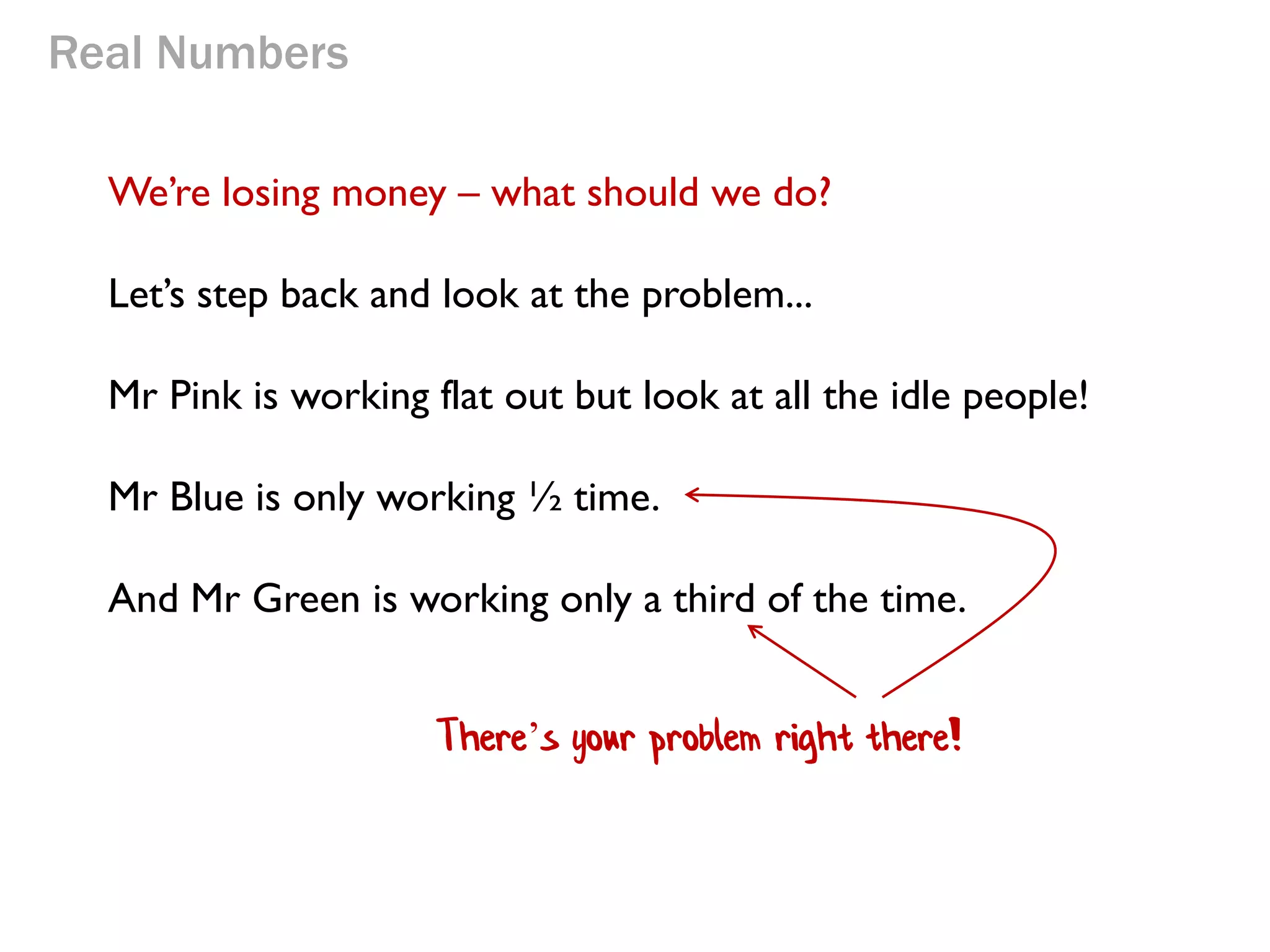
Mr Pink is working flat out but look at all the idle people!
Mr Blue is only working ½ time.
And Mr Green is working only a third of the time. Lazy sod!
Real Numbers
We’re losing money – what should we do?
Let’s step back and look at the problem...
Mr Pink is working flat out but look at all the idle people!
Mr Blue is only working ½ time.
And Mr Green is working only a third of the time.

There’s your problem right there!
Real Numbers
What to do?
Option 1: Panic!
Real Numbers
What to do?
Option 1: Panic!
Option 1: Reduce wages or staff (helps with operating expenses)
Especially the lazy ones like Mr Pink...
Real Numbers
What to do?
Option 1: Reduce wages or staff (helps with operating expenses)
Option 2: Hire extra people (helps with throughput, maybe?)
Real Numbers
What to do?
Option 1: Reduce wages or staff (helps with operating expenses)
Option 2: Hire extra people (helps with throughput, maybe?)

Option 3: Change the process (but how?)
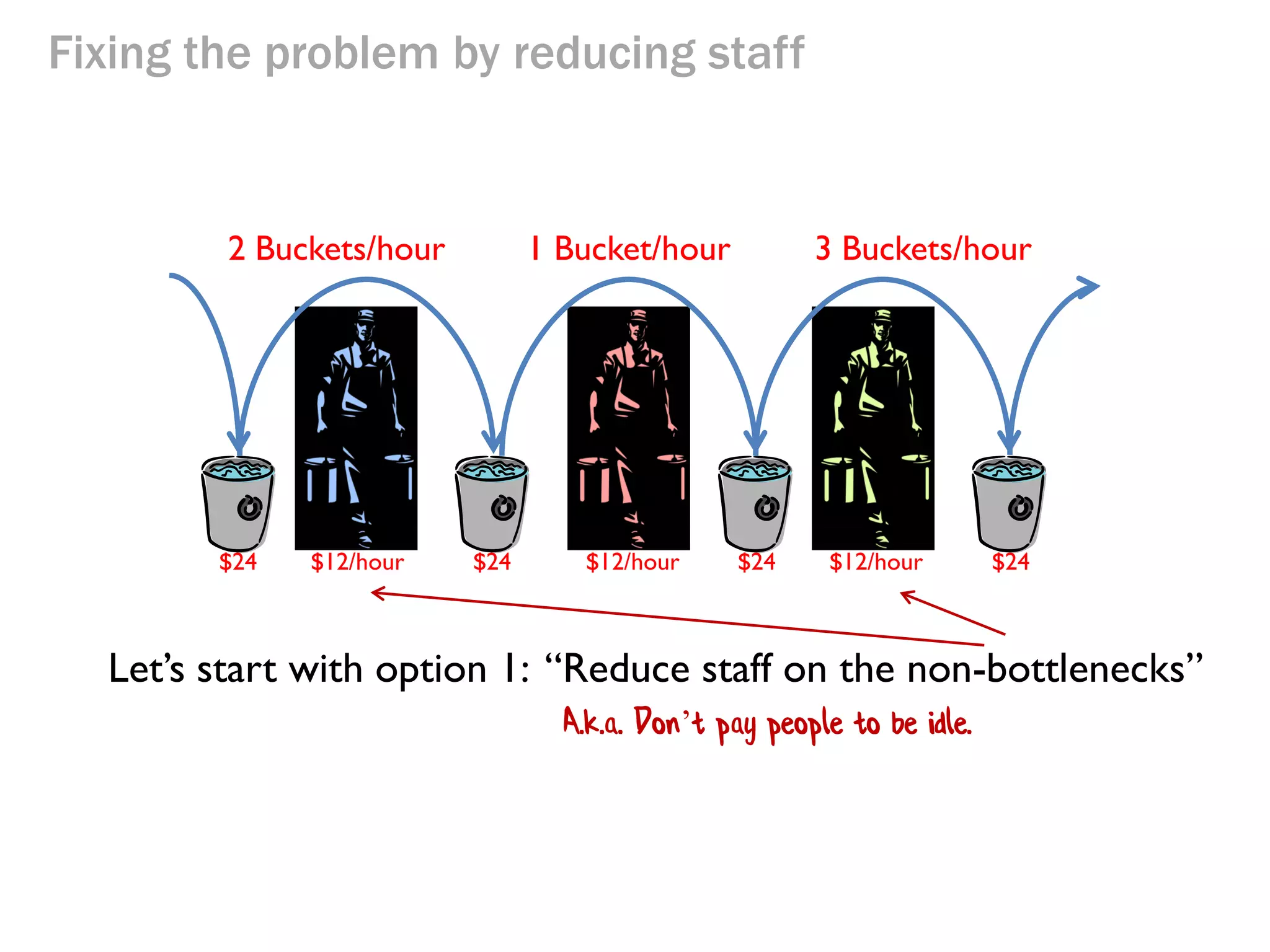
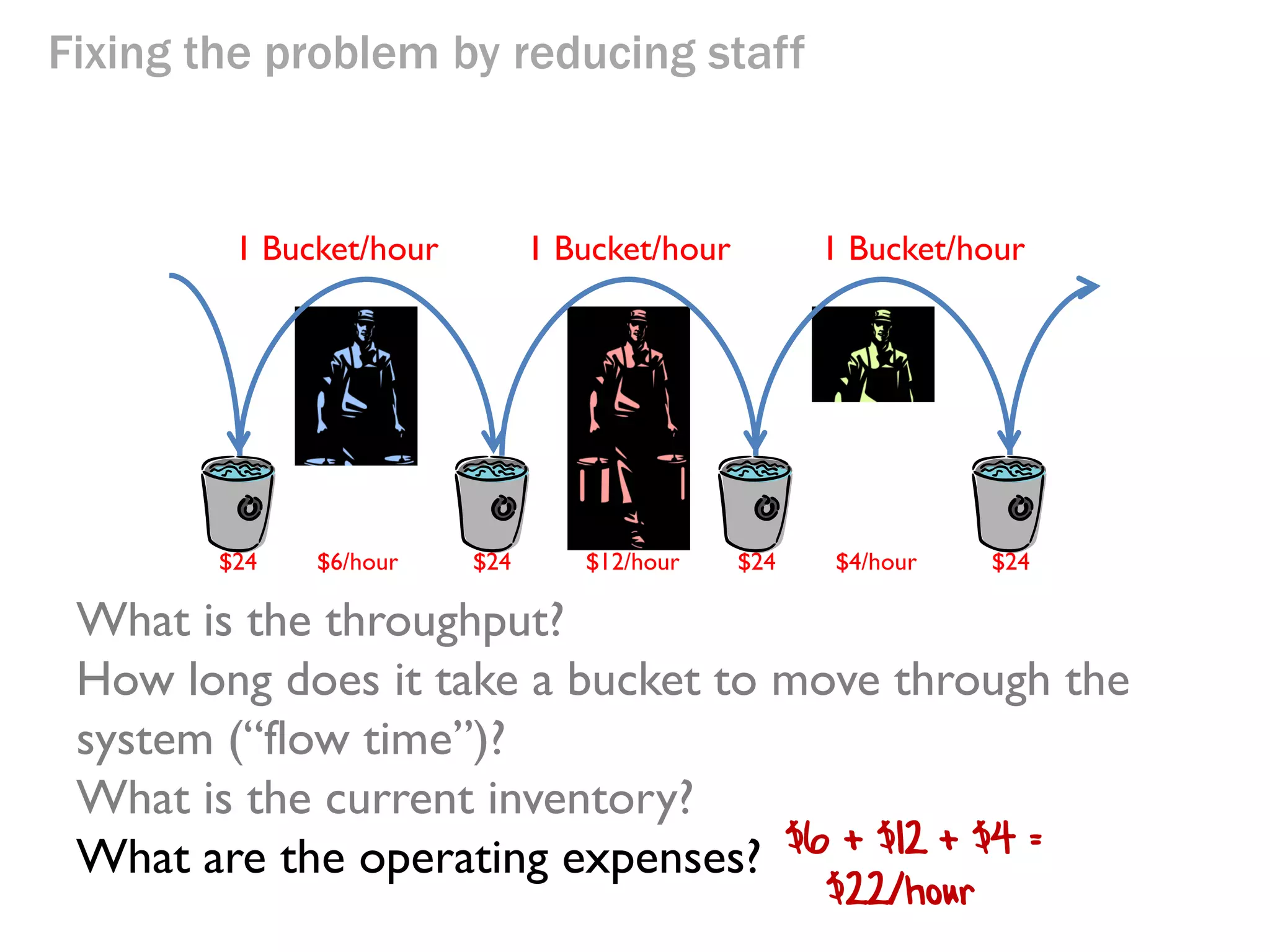
Fixing the problem by reducing staff

2 Buckets/hour

$24

$12/hour

1 Bucket/hour

$24

$12/hour

3 Buckets/hour

$24

$12/hour

$24

Let’s start with option 1: “Reduce staff on the non-bottlenecks”
A.k.a. Don’t pay people to be idle.
Fixing the problem by reducing staff

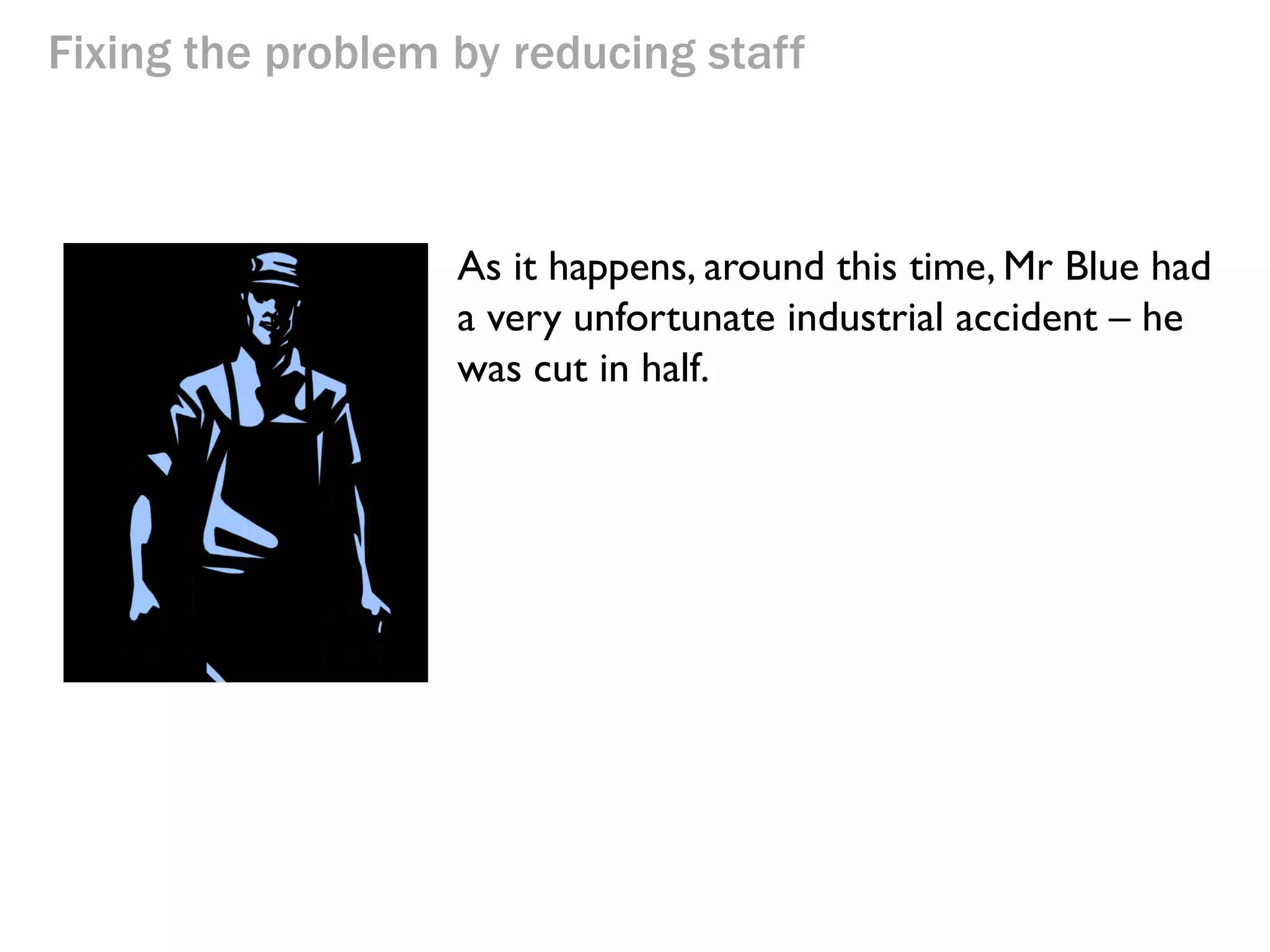
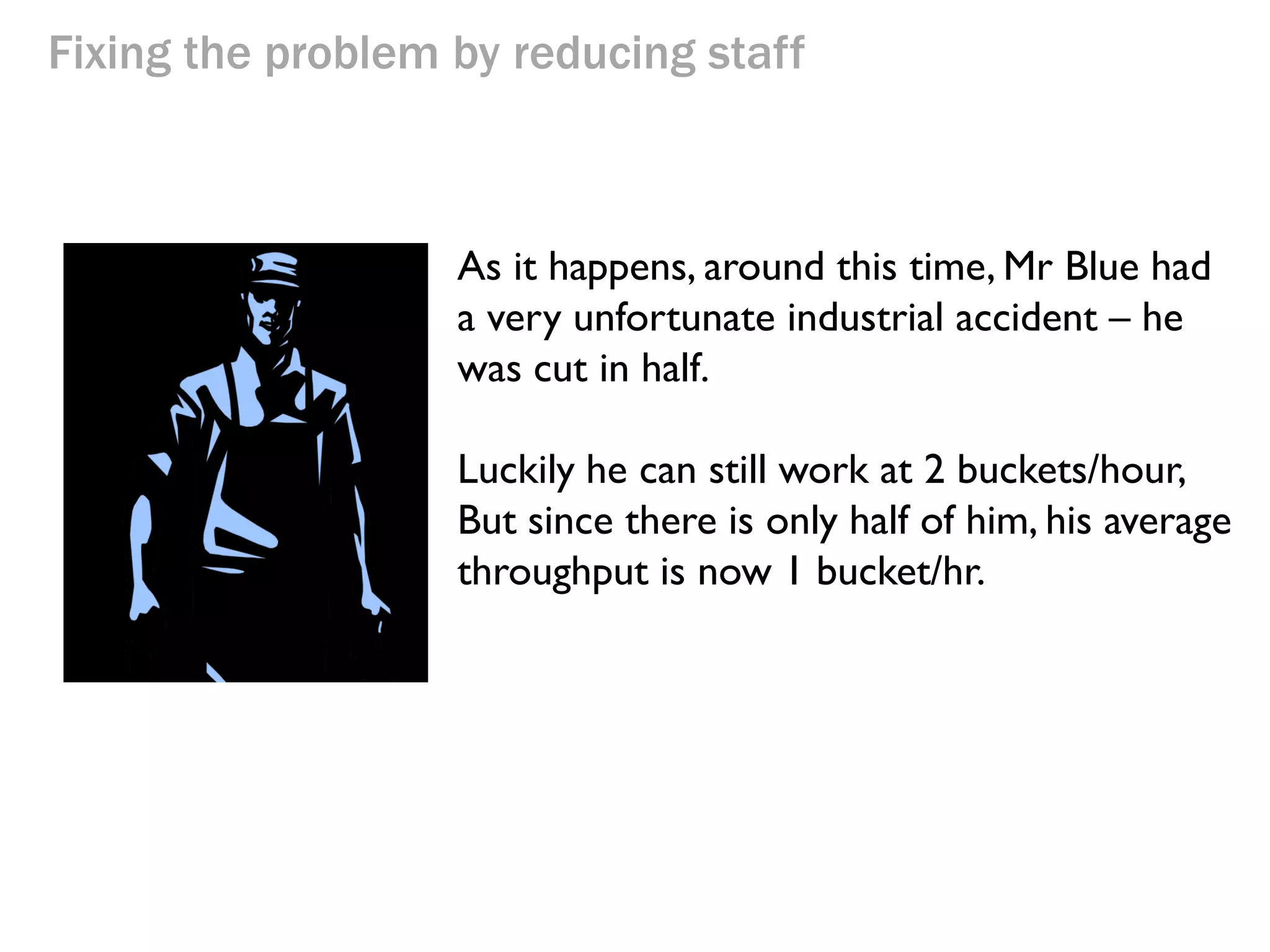
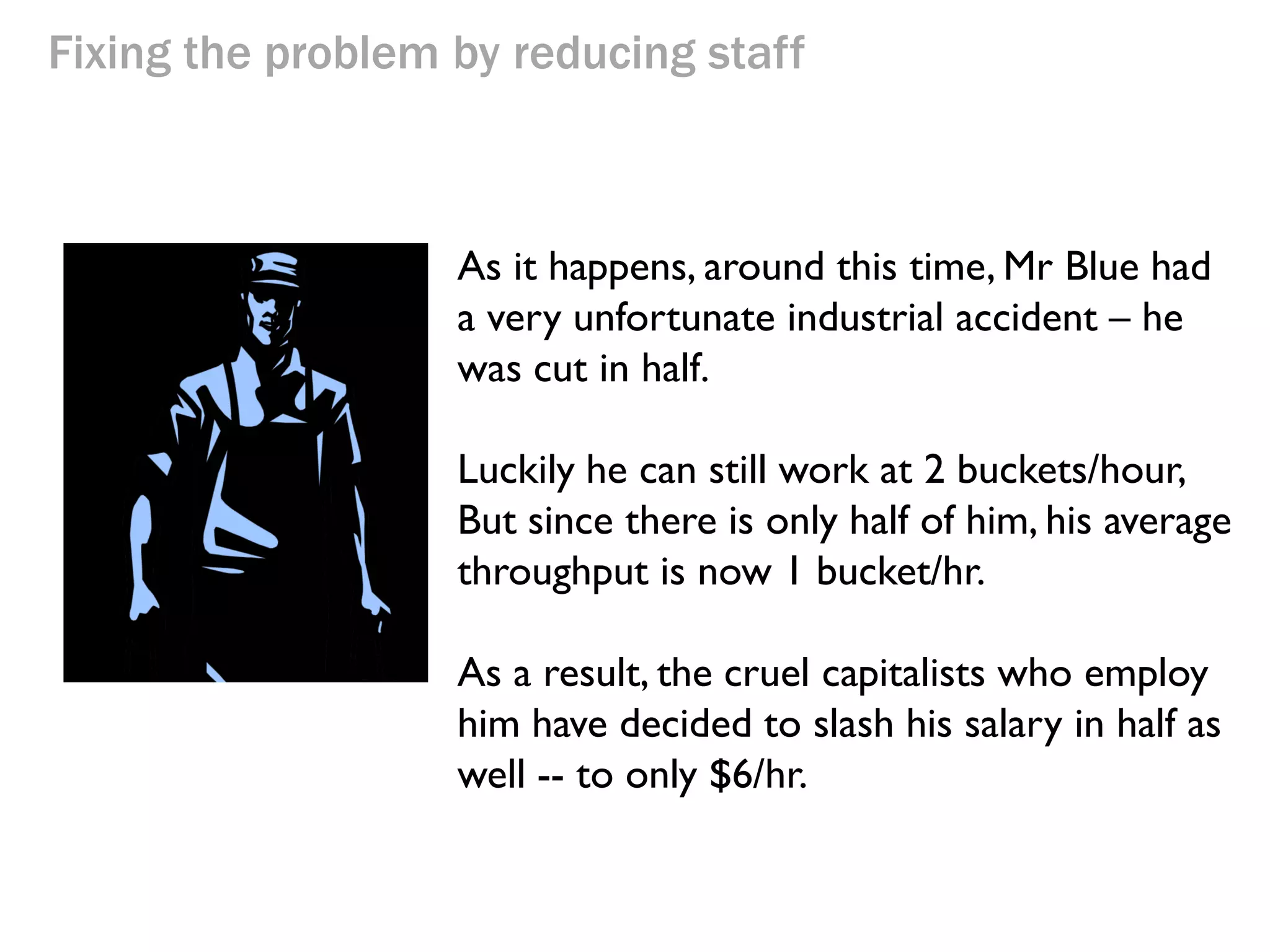
As it happens, around this time, Mr Blue had
a very unfortunate industrial accident – he
was cut in half.
Fixing the problem by reducing staff

As it happens, around this time, Mr Blue had
a very unfortunate industrial accident – he
was cut in half.
Luckily he can still work at 2 buckets/hour,
But since there is only half of him, his average
throughput is now 1 bucket/hr.
Fixing the problem by reducing staff

As it happens, around this time, Mr Blue had
a very unfortunate industrial accident – he
was cut in half.
Luckily he can still work at 2 buckets/hour,
But since there is only half of him, his average
throughput is now 1 bucket/hr.
As a result, the cruel capitalists who employ
him have decided to slash his salary in half as
well -- to only $6/hr.
Fixing the problem by reducing staff

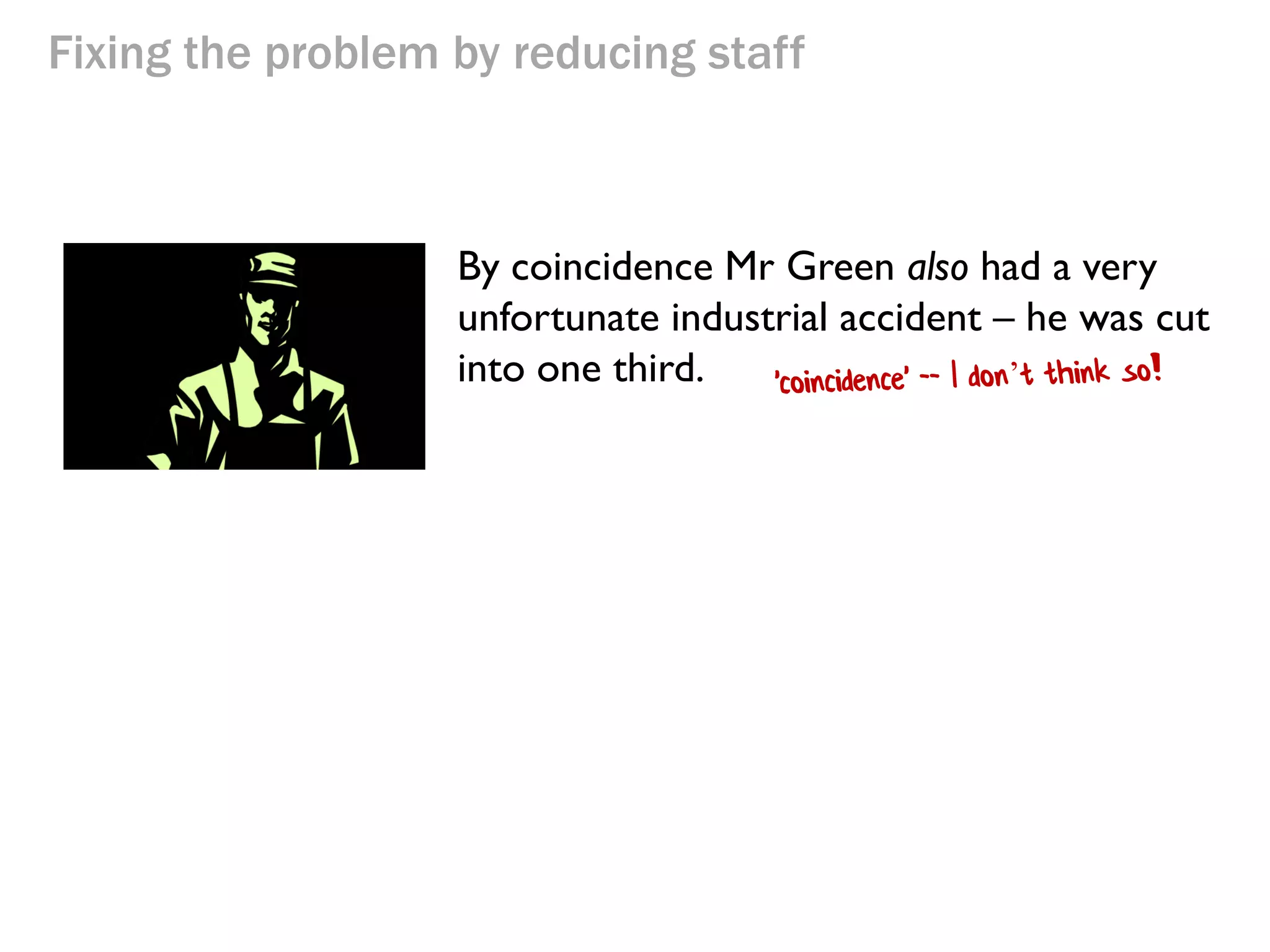
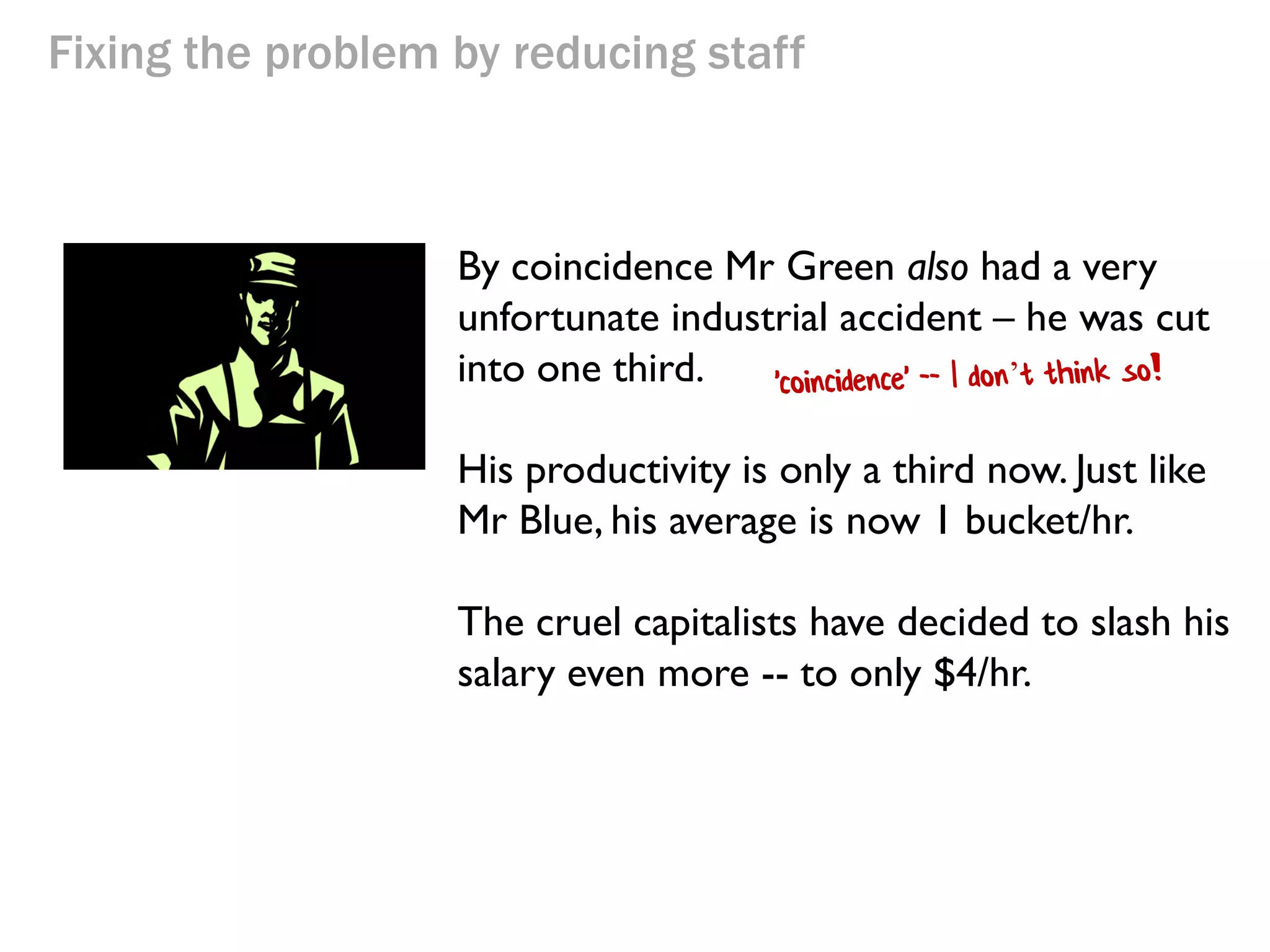
By coincidence Mr Green also had a very
unfortunate industrial accident – he was cut
into one third.
Fixing the problem by reducing staff

By coincidence Mr Green also had a very
unfortunate industrial accident – he was cut
into one third.
Fixing the problem by reducing staff

By coincidence Mr Green also had a very
unfortunate industrial accident – he was cut
into one third.
His productivity is only a third now. Just like
Mr Blue, his average is now 1 bucket/hr.
The cruel capitalists have decided to slash his
salary even more -- to only $4/hr.
Fixing the problem by reducing staff

1 Bucket/hour

$24

$6/hour

1 Bucket/hour

$24

$12/hour

1 Bucket/hour

$24

$4/hour

$24

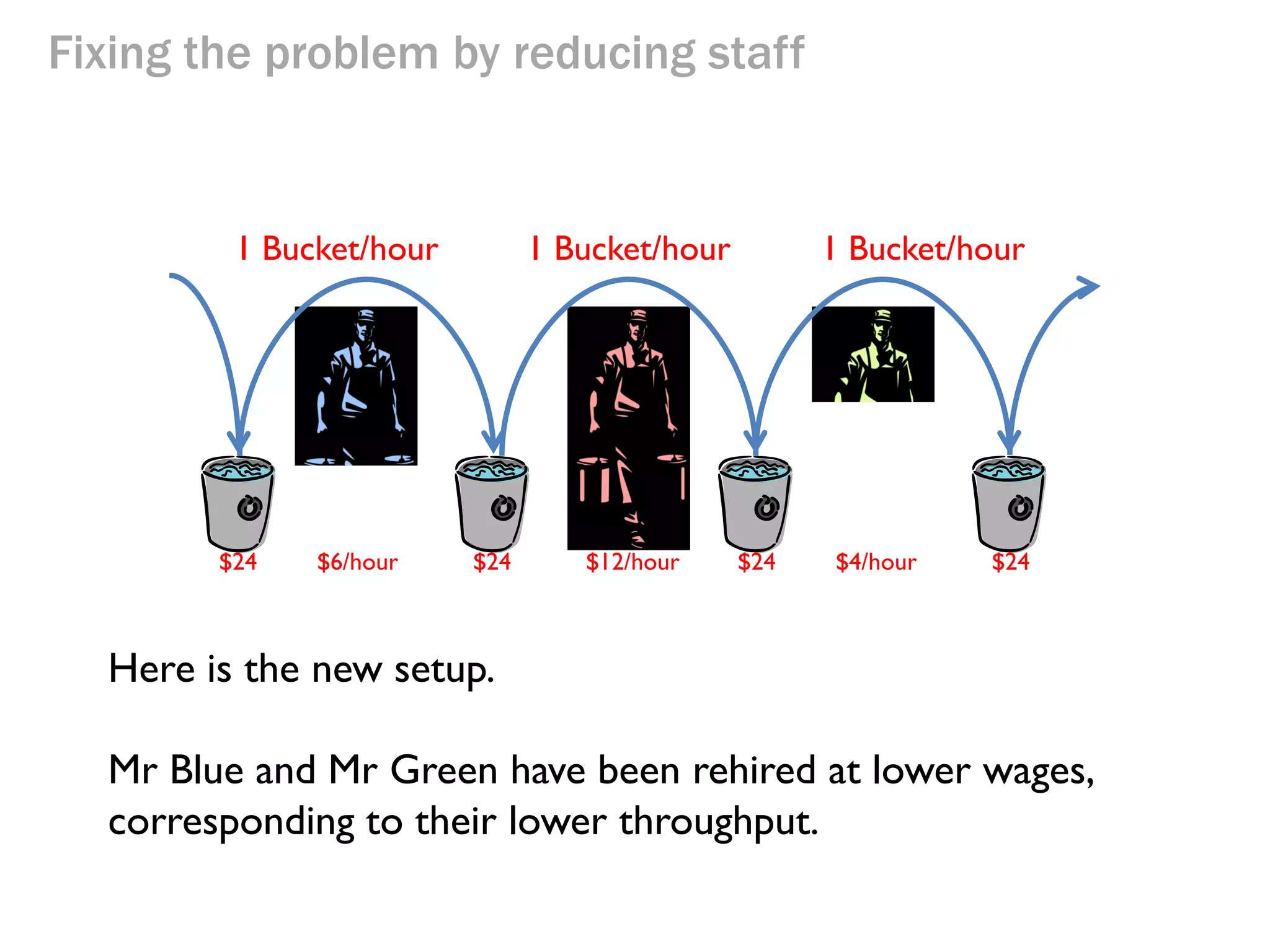
Here is the new setup.

Mr Blue and Mr Green have been rehired at lower wages,
corresponding to their lower throughput.
Fixing the problem by reducing staff

1 Bucket/hour

$24

$6/hour

1 Bucket/hour

$24

$12/hour

1 Bucket/hour

$24

$4/hour

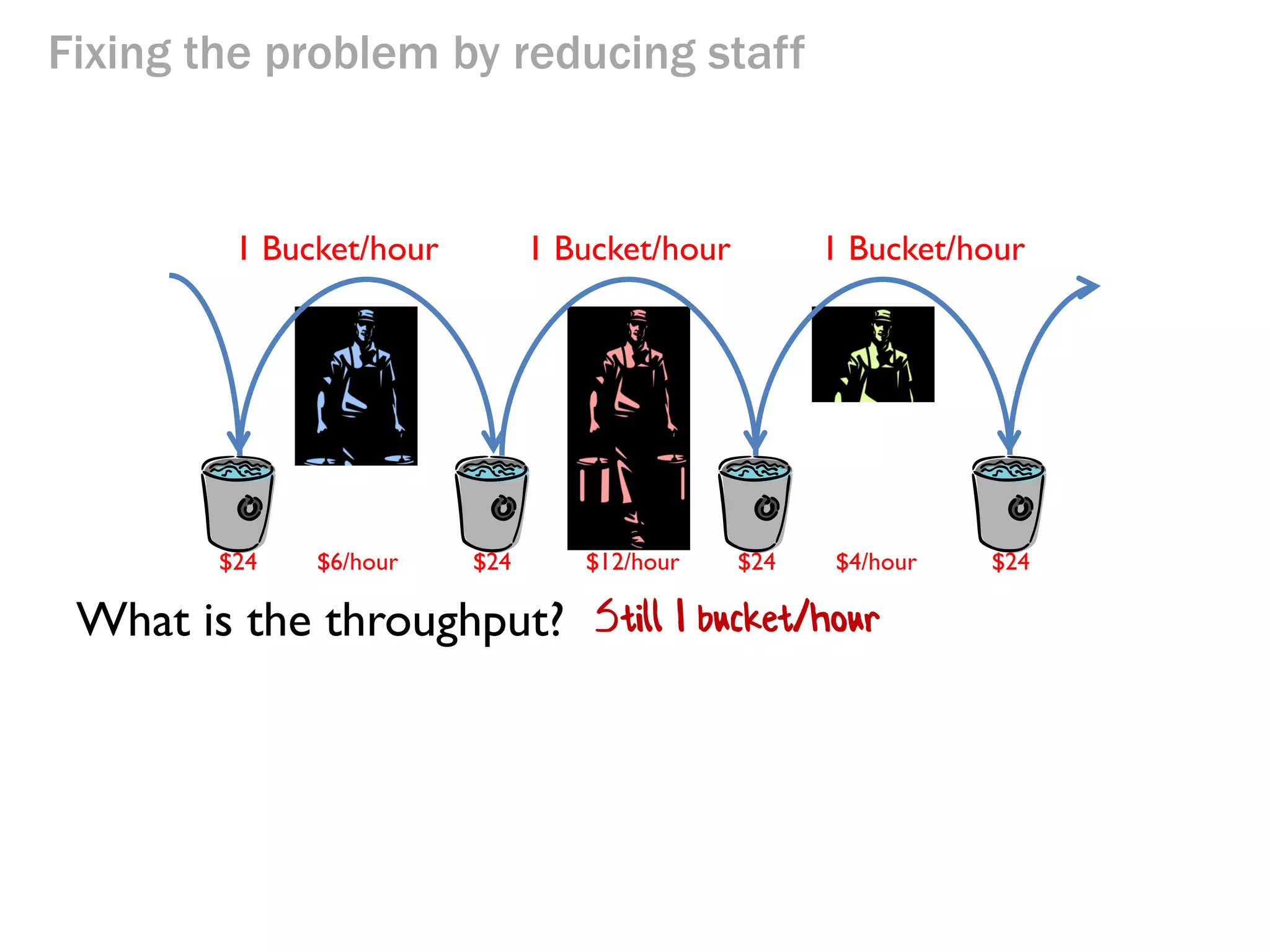
What is the throughput? Still 1 bucket/hour

$24
Fixing the problem by reducing staff

1 Bucket/hour

$24

$6/hour

1 Bucket/hour

$24

$12/hour

1 Bucket/hour

$24

$4/hour

$24

What is the throughput?
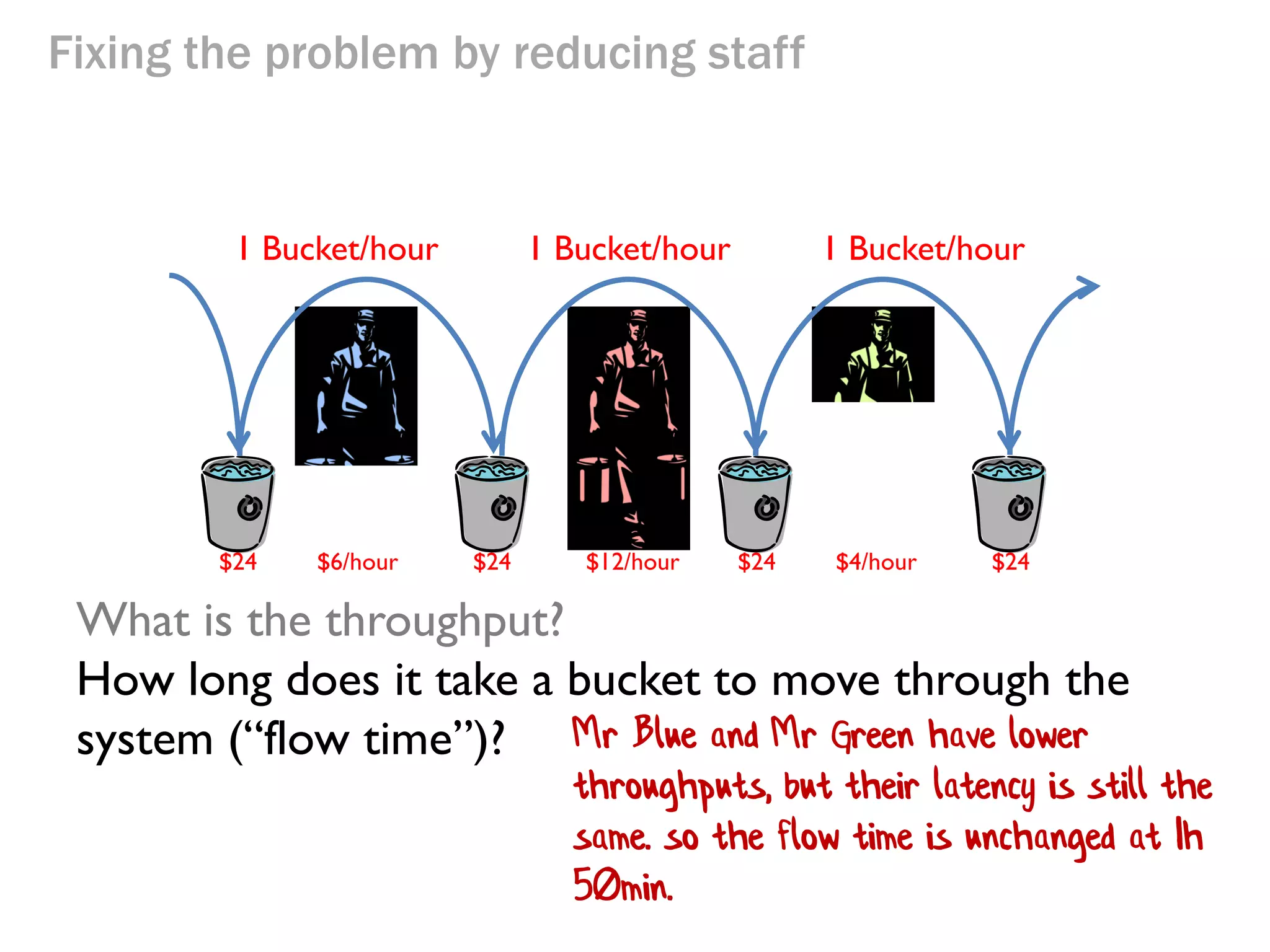
How long does it take a bucket to move through the
system (“flow time”)? Mr Blue and Mr Green have lower

throughputs, but their latency is still the
same. so the flow time is unchanged at 1h
50min.
Fixing the problem by reducing staff

1 Bucket/hour

$24

$6/hour

1 Bucket/hour

$24

$12/hour

1 Bucket/hour

$24

$4/hour

$24

What is the throughput?
How long does it take a bucket to move through the
system (“flow time”)?
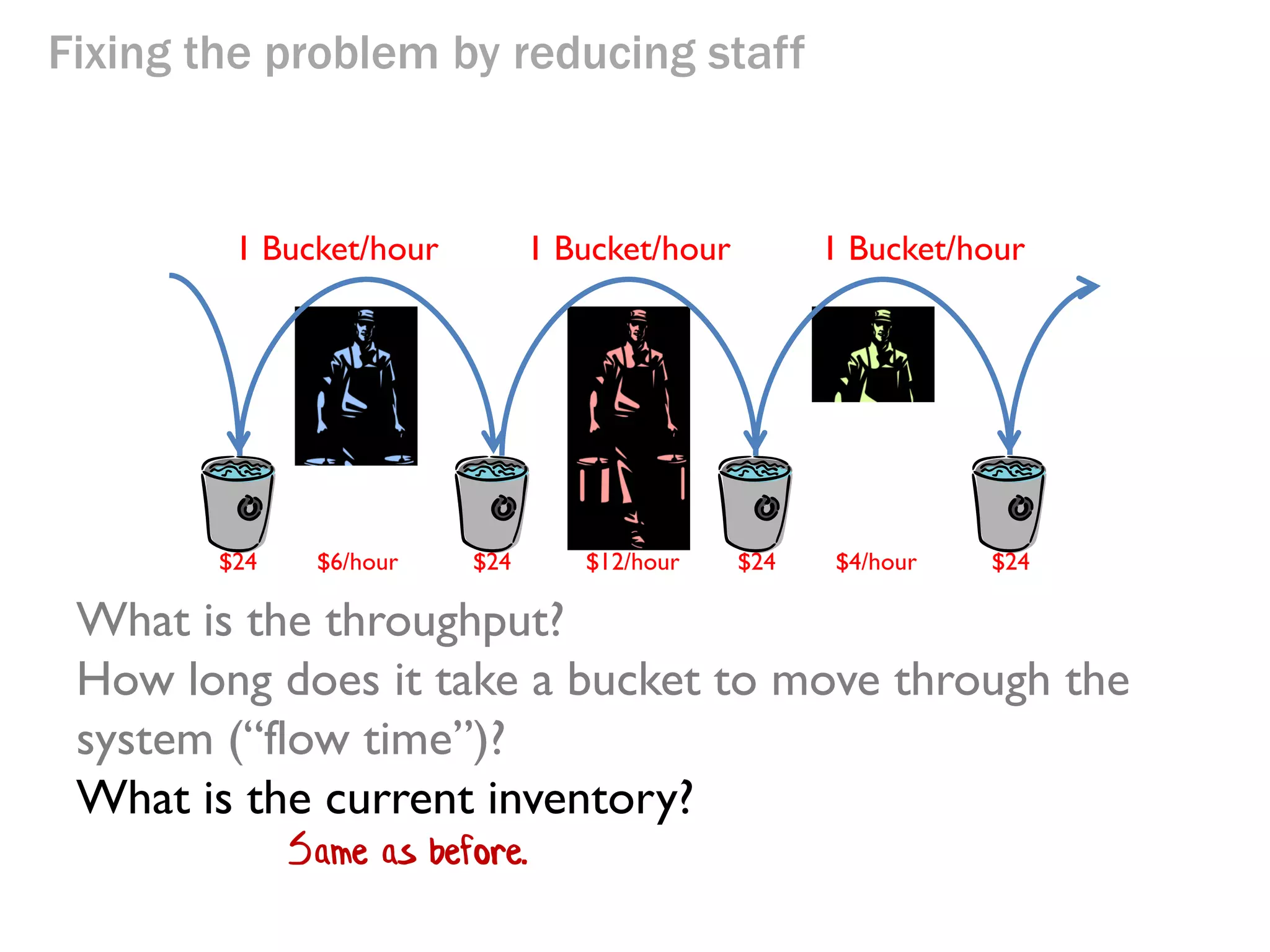
What is the current inventory?
Same as before.
Fixing the problem by reducing staff

1 Bucket/hour

$24

$6/hour

1 Bucket/hour

$24

$12/hour

1 Bucket/hour

$24

$4/hour

$24

What is the throughput?
How long does it take a bucket to move through the
system (“flow time”)?
What is the current inventory?
What are the operating expenses? $6 + $12 + $4 =
$22/hour
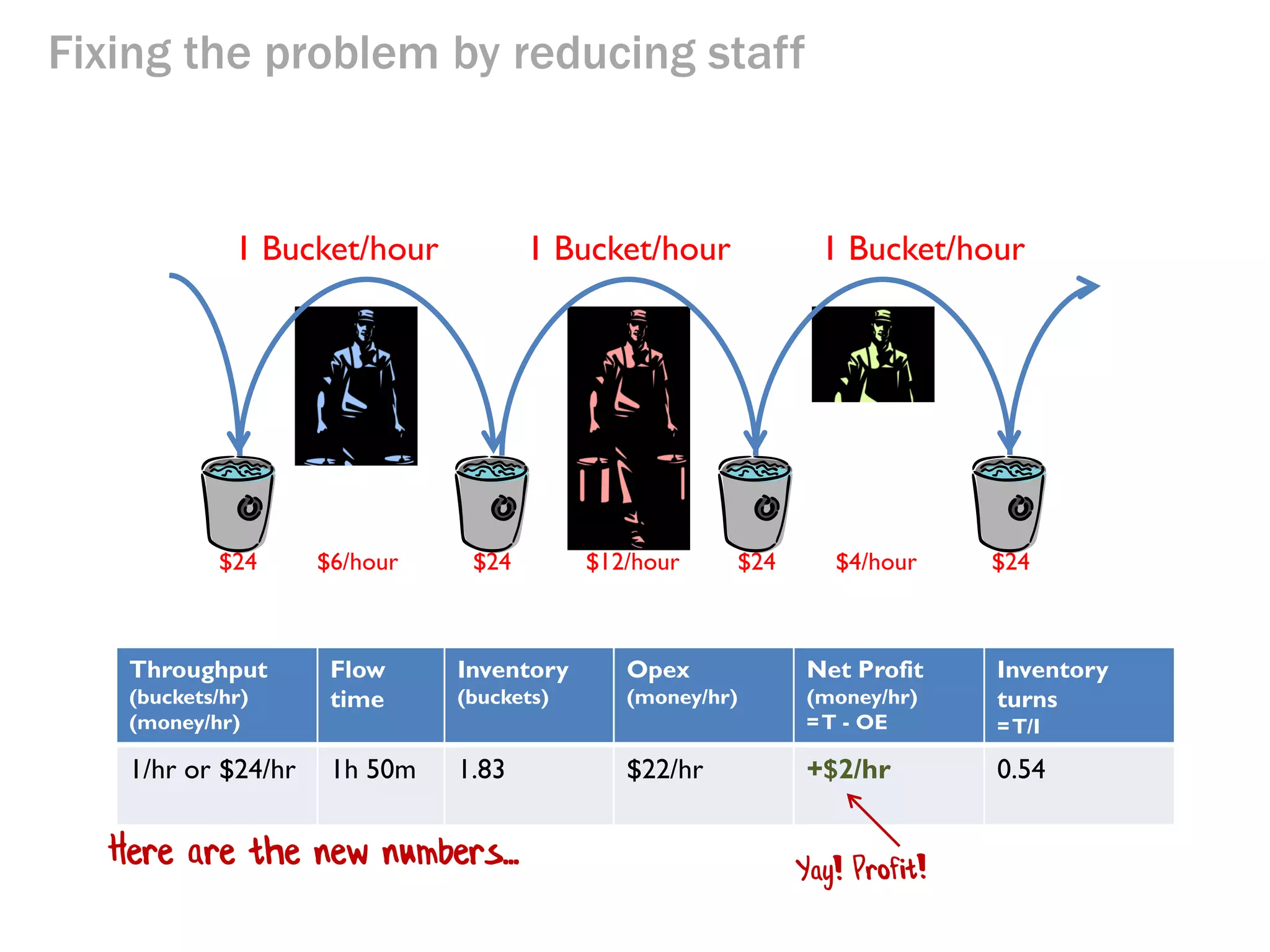
Fixing the problem by reducing staff

1 Bucket/hour

$24

Throughput
(buckets/hr)
(money/hr)

1/hr or $24/hr

$6/hour

Flow
time

1h 50m

1 Bucket/hour

$24

$12/hour

1 Bucket/hour

$24

$4/hour

Inventory

Opex

Net Profit

(buckets)

(money/hr)

(money/hr)
= T - OE

1.83

Here are the new numbers...

$22/hr

+$2/hr

$24

Inventory
turns
= T/I

0.54
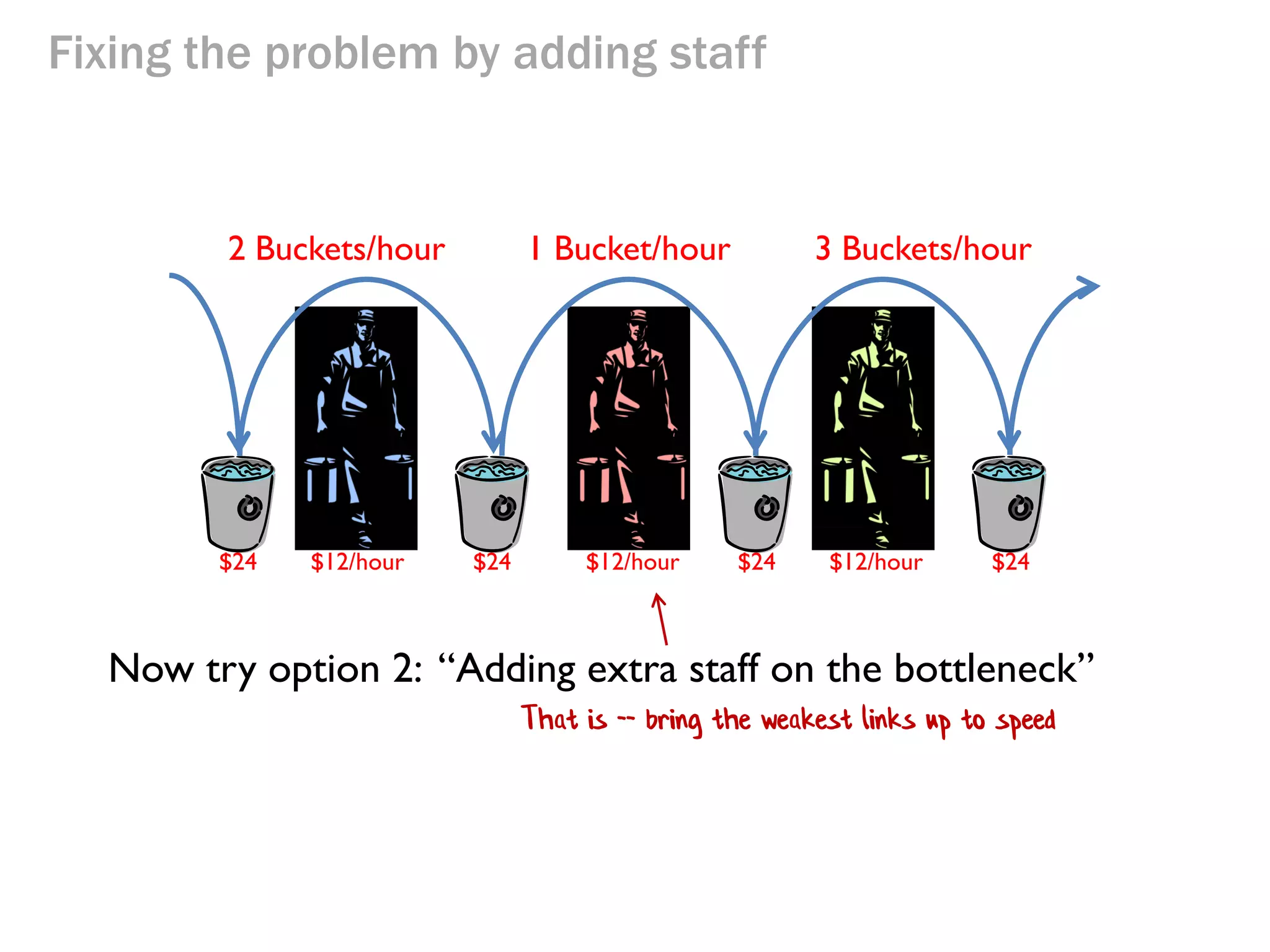
Fixing the problem by adding staff

2 Buckets/hour

$24

$12/hour

1 Bucket/hour

$24

$12/hour

3 Buckets/hour

$24

$12/hour

$24

Now try option 2: “Adding extra staff on the bottleneck”
That is -- bring the weakest links up to speed
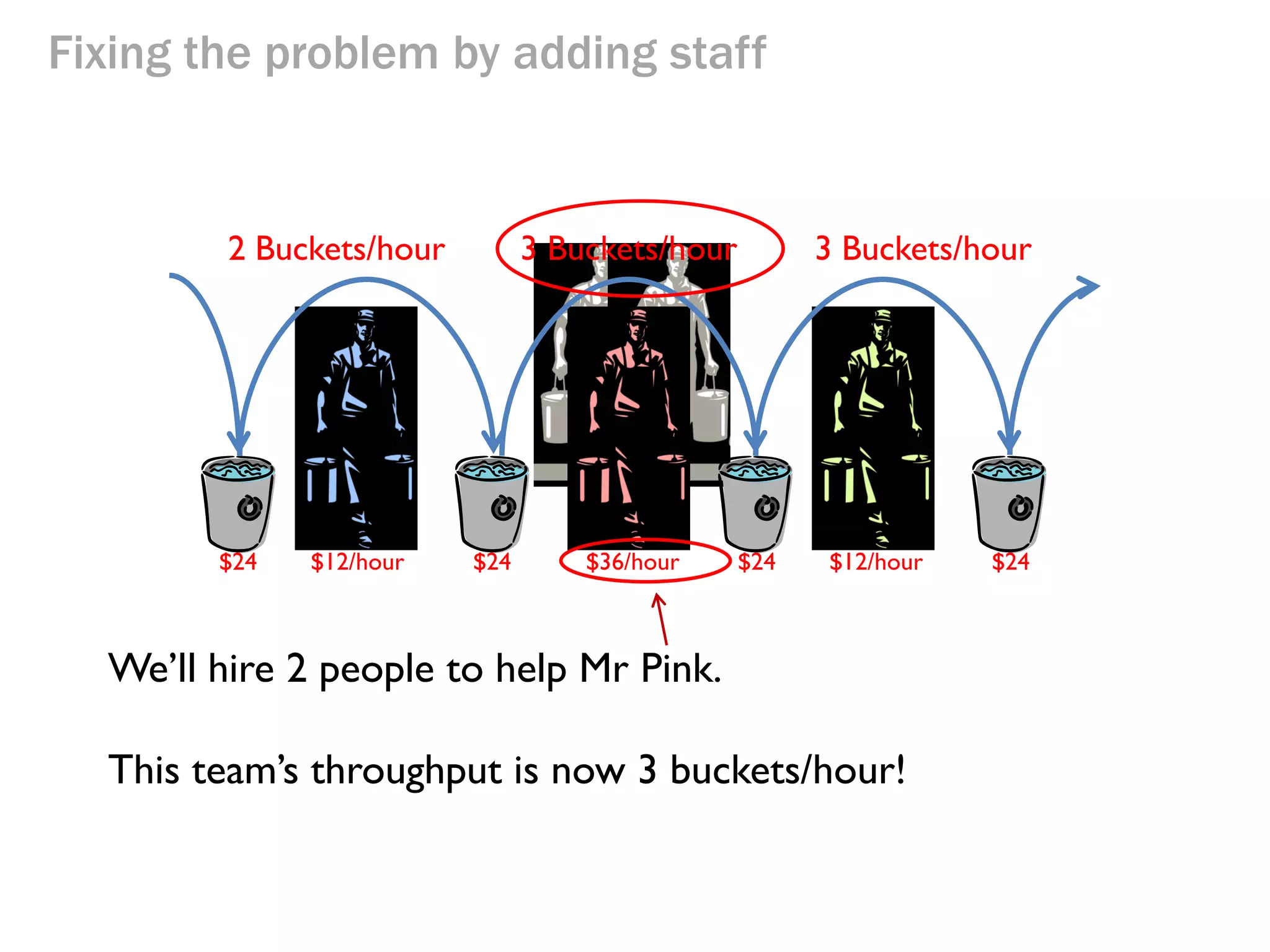
Fixing the problem by adding staff

2 Buckets/hour

$24

$12/hour

3 Buckets/hour

$24

$36/hour

3 Buckets/hour

$24

$12/hour

We’ll hire 2 people to help Mr Pink.

This team’s throughput is now 3 buckets/hour!

$24
Fixing the problem by adding staff

2 Buckets/hour

$24

$12/hour

3 Buckets/hour

$24

$36/hour

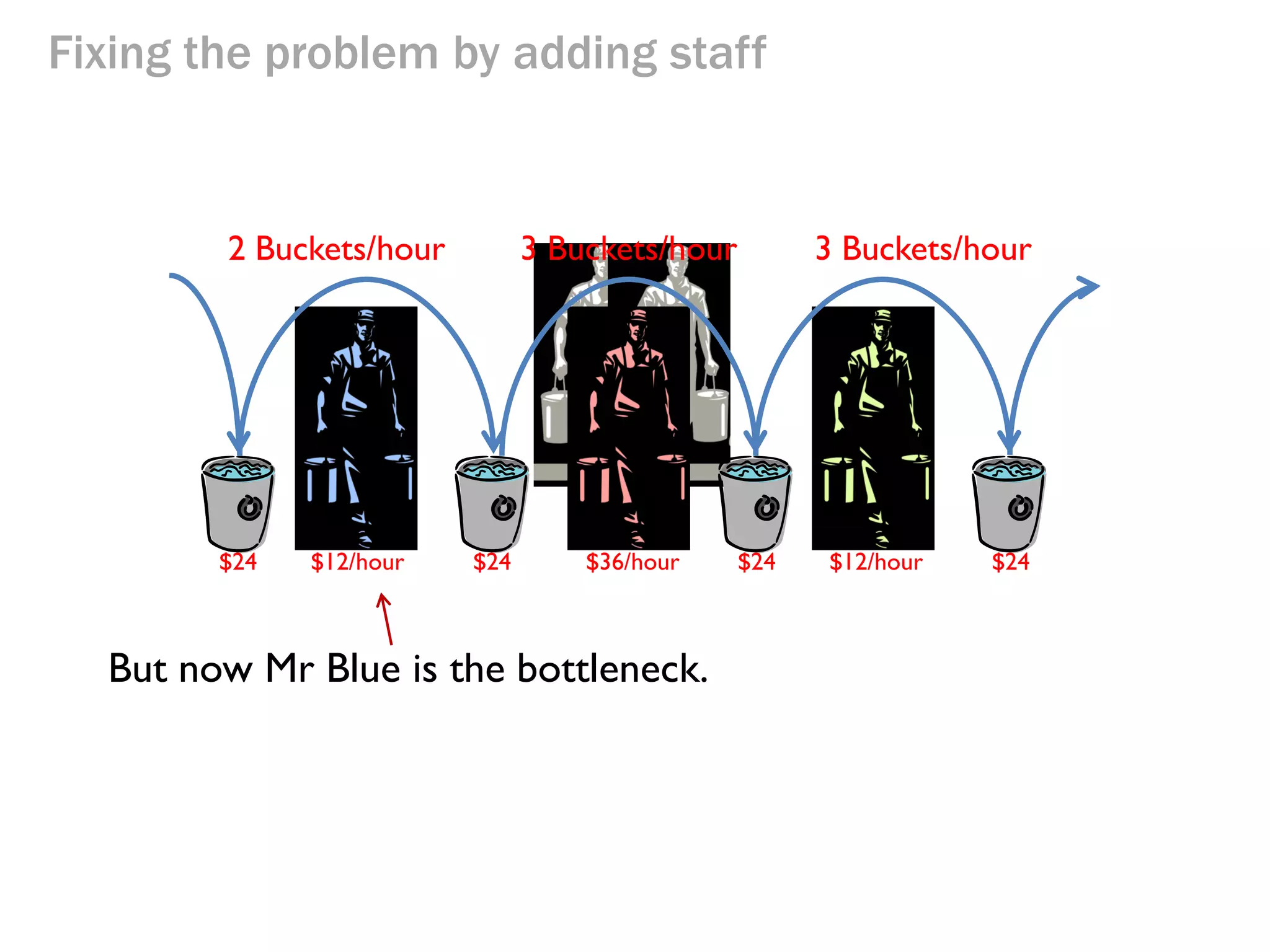
But now Mr Blue is the bottleneck.

3 Buckets/hour

$24

$12/hour

$24
Fixing the problem by adding staff

2 Buckets/hour

$24

$12/hour

3 Buckets/hour

$24

$36/hour

3 Buckets/hour

$24

$12/hour

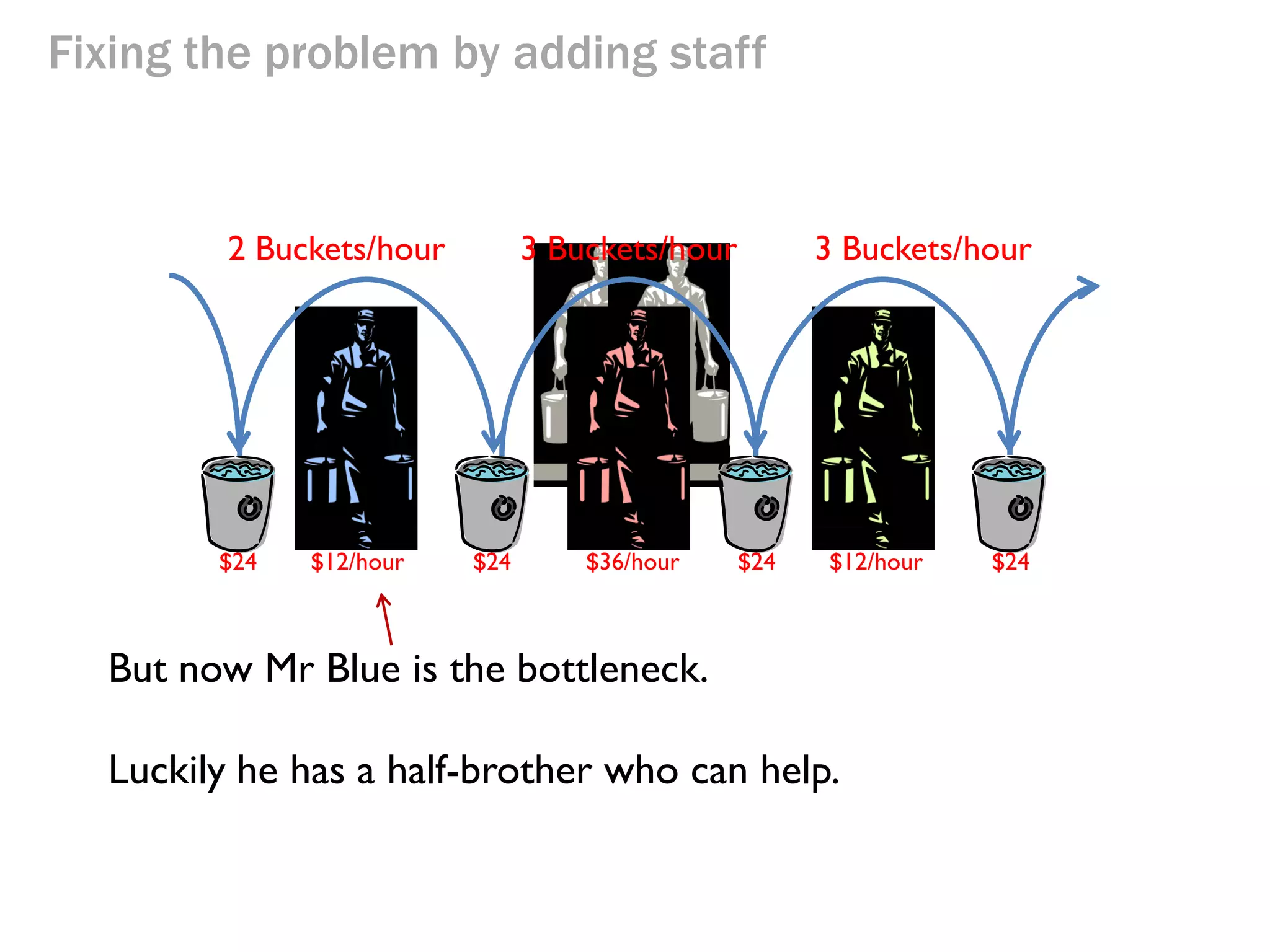
But now Mr Blue is the bottleneck.

Luckily he has a half-brother who can help.

$24
Fixing the problem by adding staff

2 Buckets/hour

$24

$12/hour

3 Buckets/hour

$24

$36/hour

3 Buckets/hour

$24

$12/hour

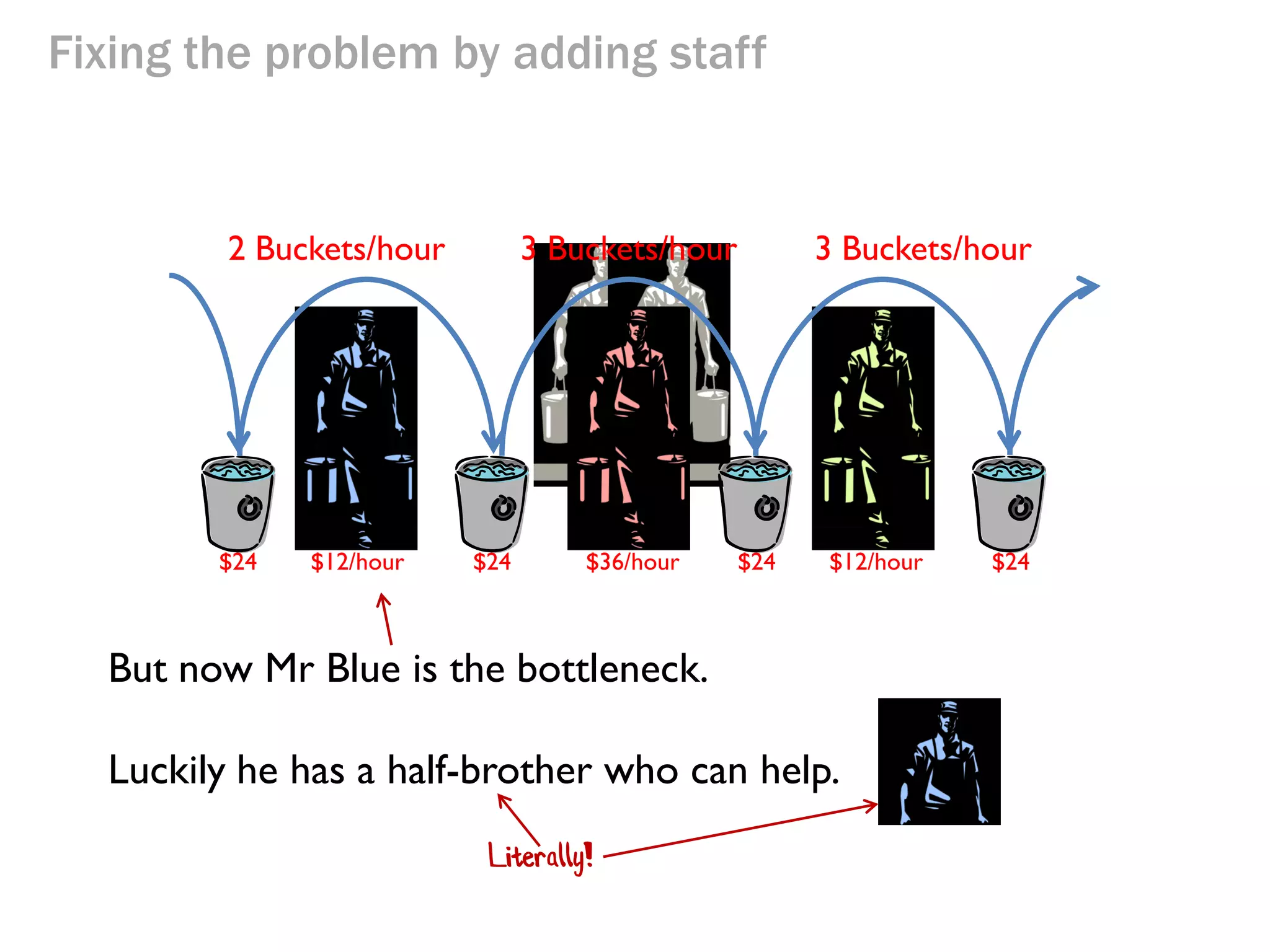
But now Mr Blue is the bottleneck.

Luckily he has a half-brother who can help.
Literally!

$24
Fixing the problem by adding staff

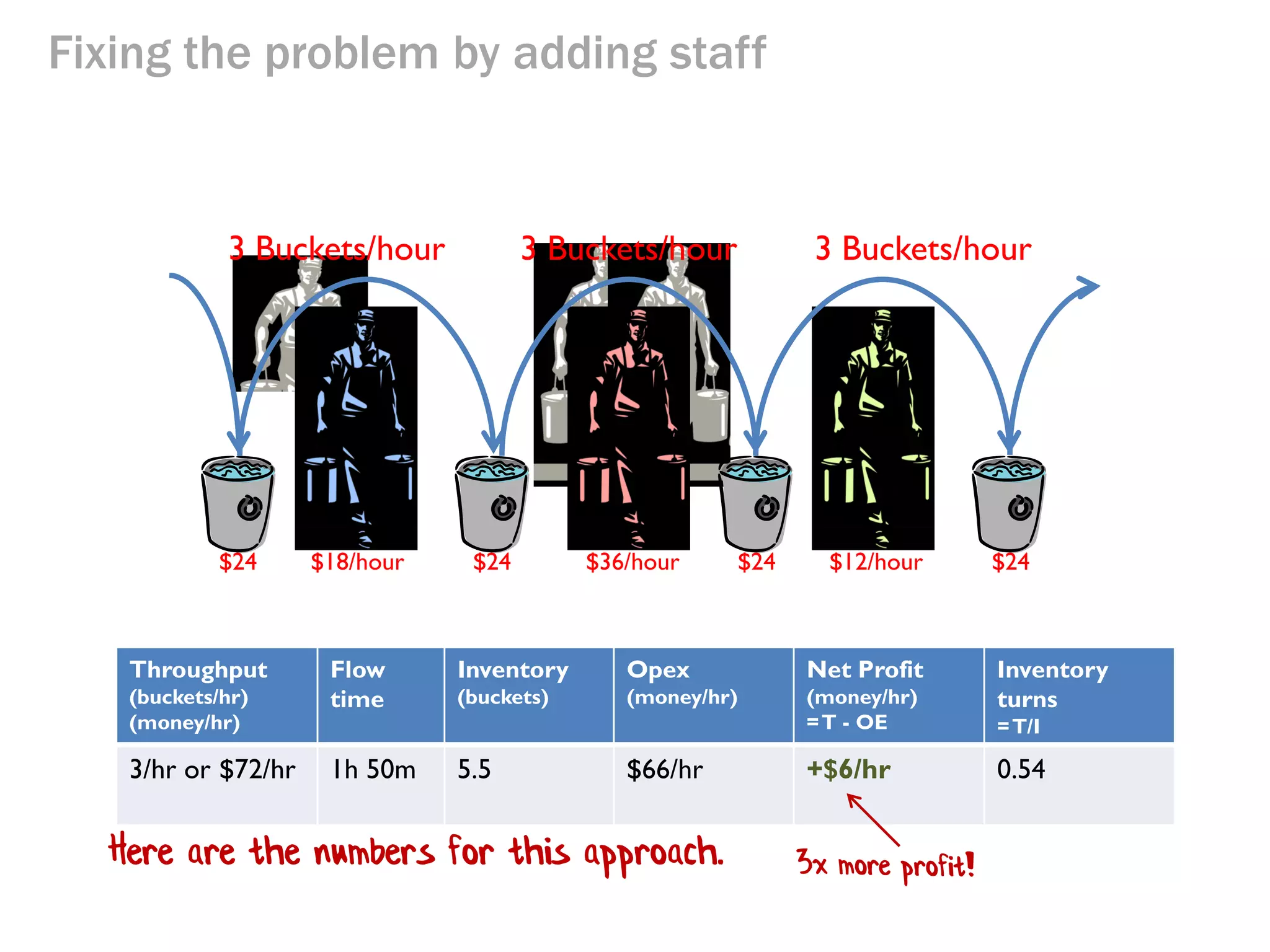
3 Buckets/hour

$24

$18/hour

3 Buckets/hour

$24

$36/hour

3 Buckets/hour

$24

$12/hour

$24

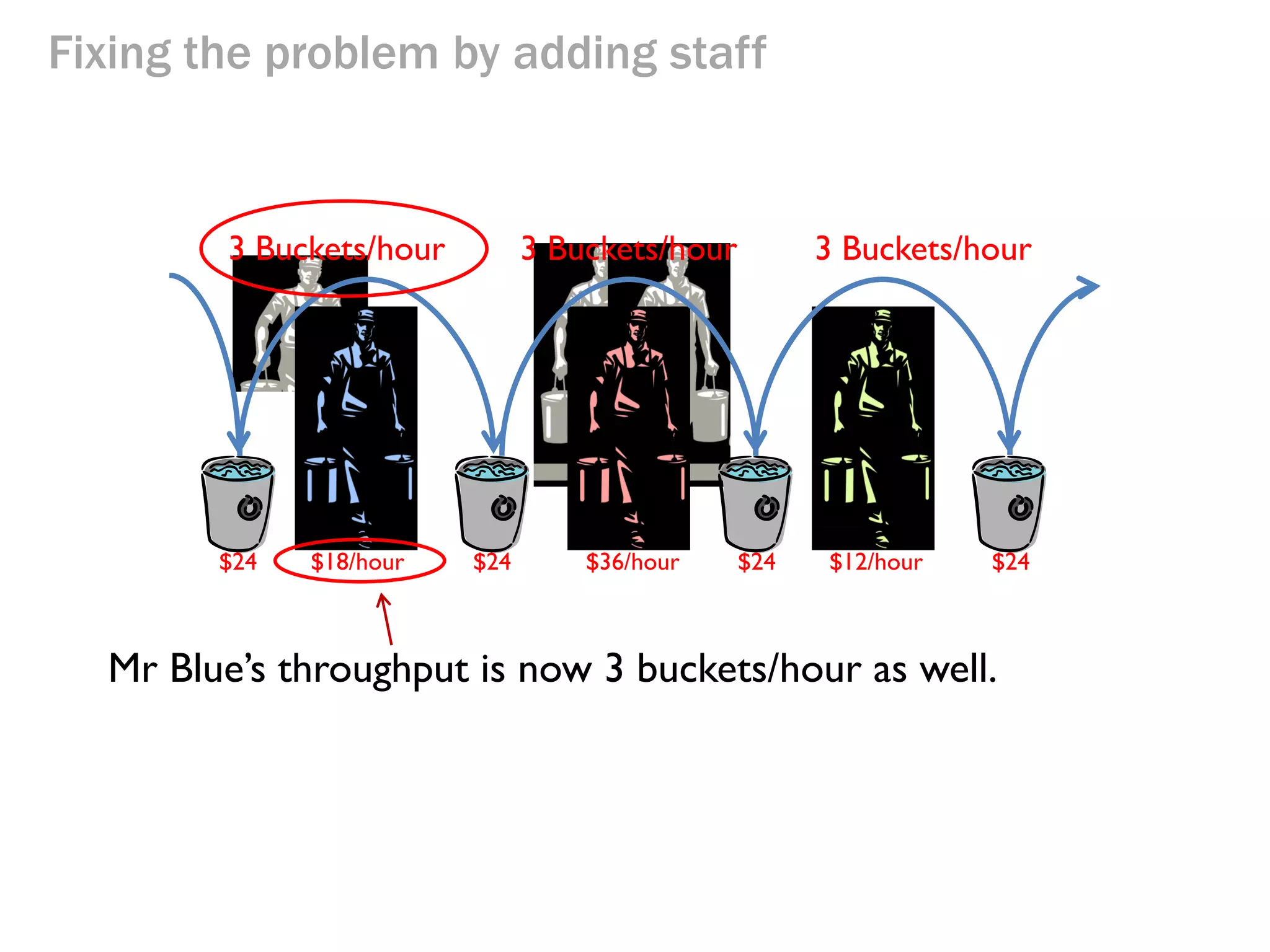
Mr Blue’s throughput is now 3 buckets/hour as well.
Fixing the problem by adding staff

3 Buckets/hour

$24

Throughput
(buckets/hr)
(money/hr)

3/hr or $72/hr

$18/hour

Flow
time

1h 50m

3 Buckets/hour

$24

$36/hour

3 Buckets/hour

$24

$12/hour

Inventory

Opex

Net Profit

(buckets)

(money/hr)

(money/hr)
= T - OE

5.5

$66/hr

Here are the numbers for this approach.

+$6/hr

$24

Inventory
turns
= T/I

0.54
Fixing the problem by adding staff

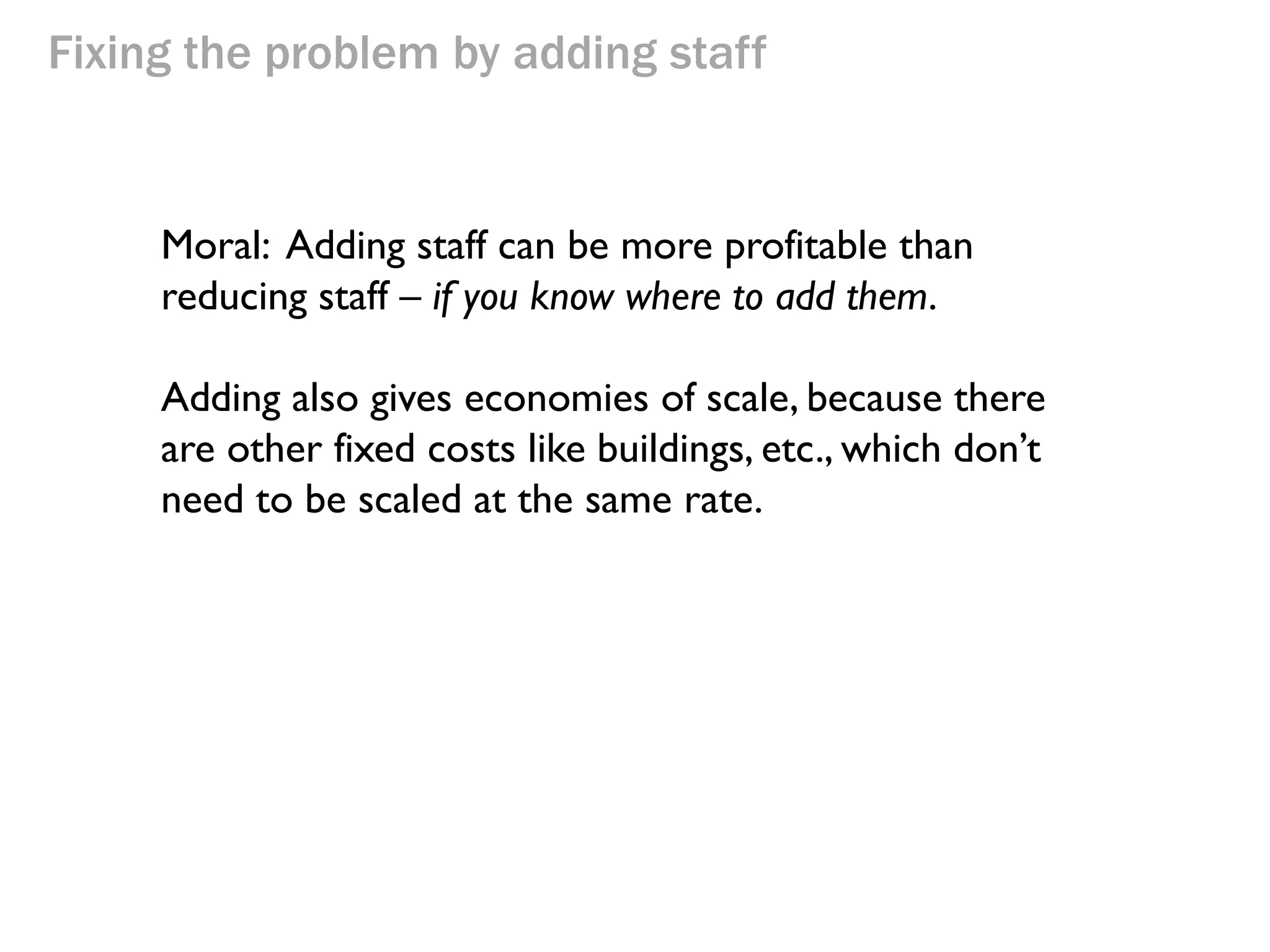
Moral: Adding staff can be more profitable than
reducing staff – if you know where to add them.
Adding also gives economies of scale, because there
are other fixed costs like buildings, etc., which don’t
need to be scaled at the same rate.
Fixing the problem by adding staff

Moral: Adding staff can be more profitable than
reducing staff – if you know where to add them.
Adding also gives economies of scale, because there
are other fixed costs like buildings, etc., which don’t
need to be scaled at the same rate.
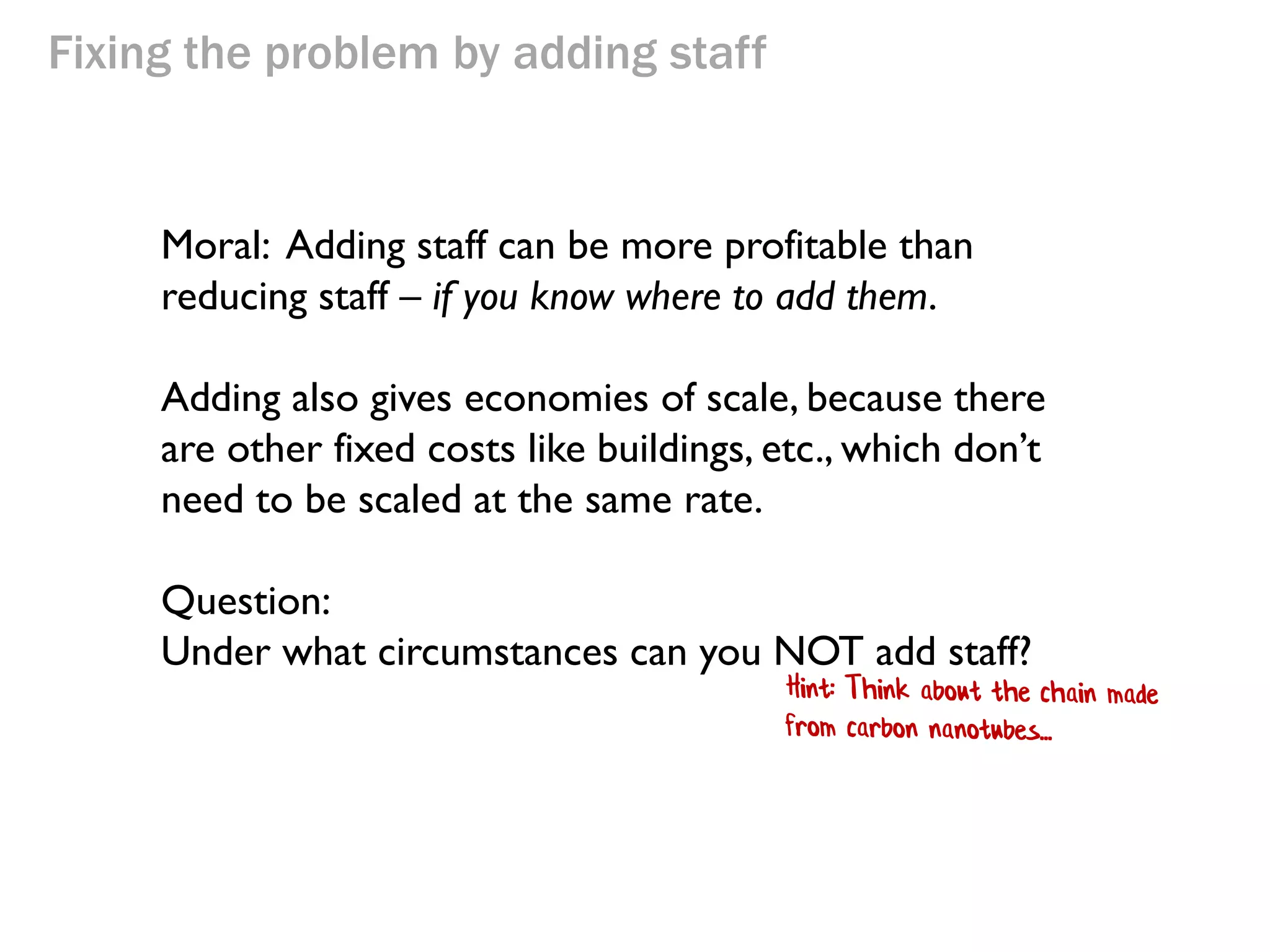
Question:
Under what circumstances can you NOT add staff?
Fixing the problem by adding staff

Moral: Adding staff can be more profitable than
reducing staff – if you know where to add them.
Adding also gives economies of scale, because there
are other fixed costs like buildings, etc., which don’t
need to be scaled at the same rate.

But can we do even better?
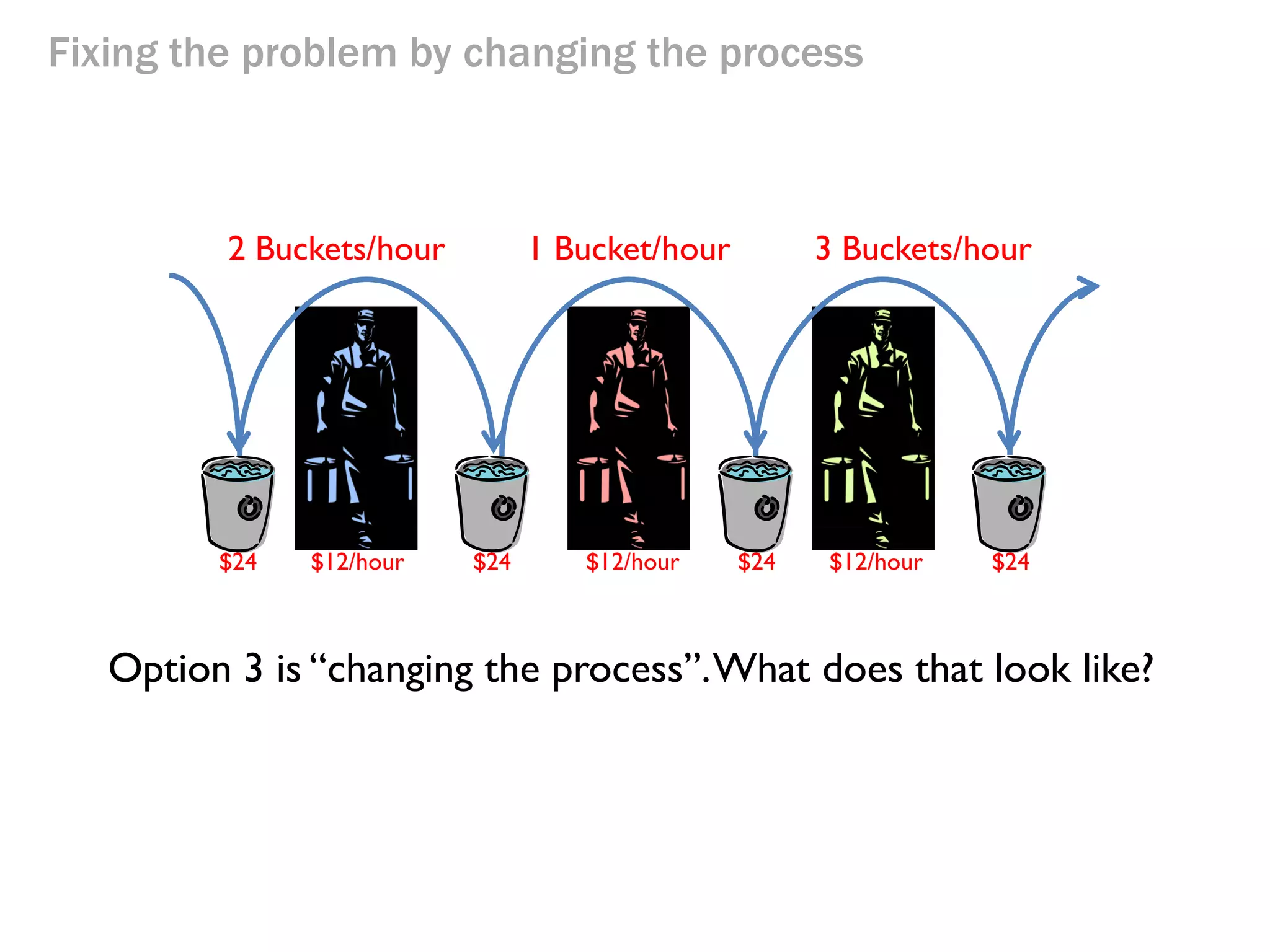
Fixing the problem by changing the process

2 Buckets/hour

$24

$12/hour

1 Bucket/hour

$24

$12/hour

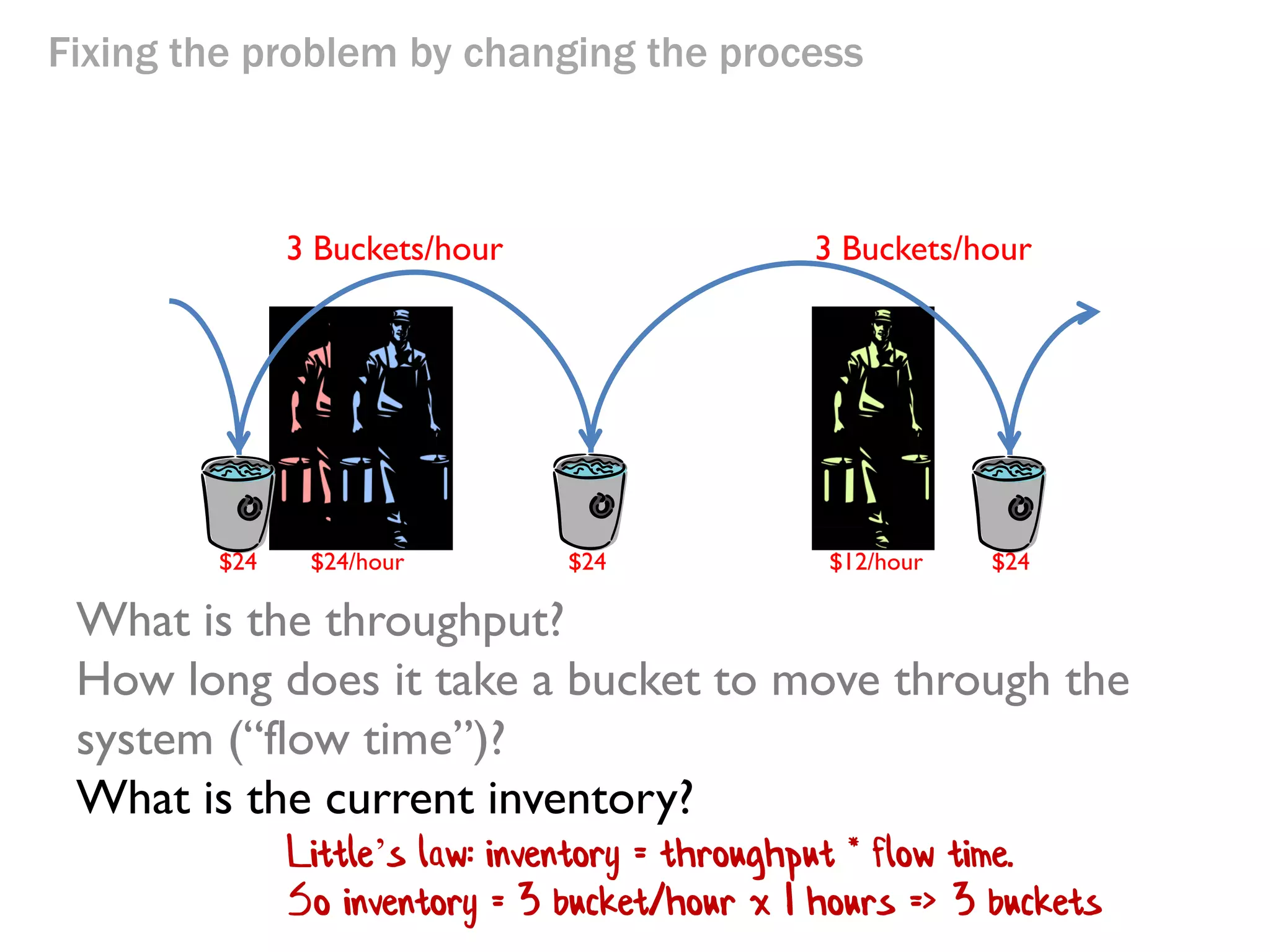
3 Buckets/hour

$24

$12/hour

$24

Option 3 is “changing the process”. What does that look like?
Fixing the problem by changing the process

2 Buckets/hour

$24

$12/hour

1 Bucket/hour

$24

$12/hour

3 Buckets/hour

$24

$12/hour

$24

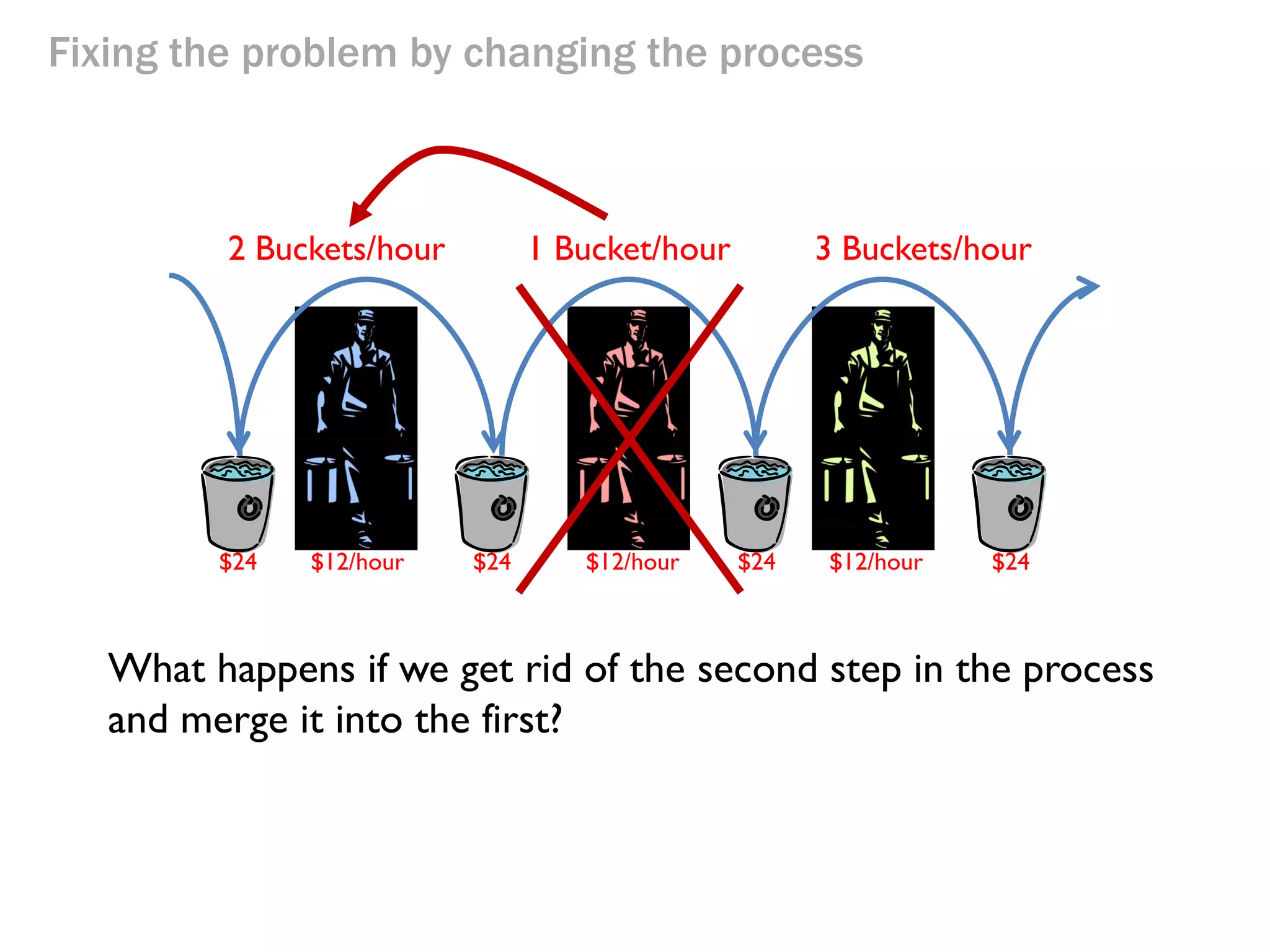
What happens if we get rid of the second step in the process
and merge it into the first?
Fixing the problem by changing the process

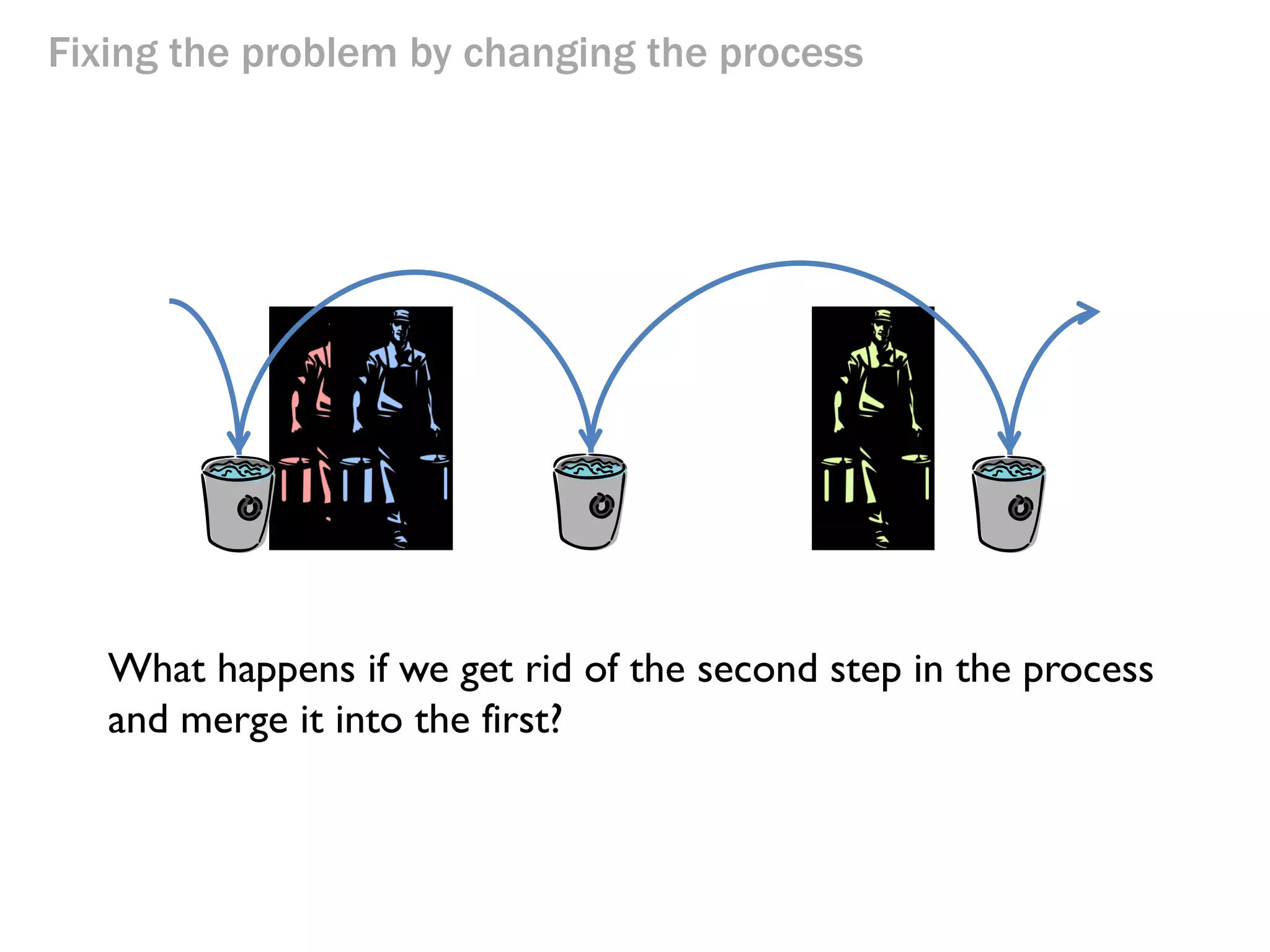
What happens if we get rid of the second step in the process
and merge it into the first?
Fixing the problem by changing the process

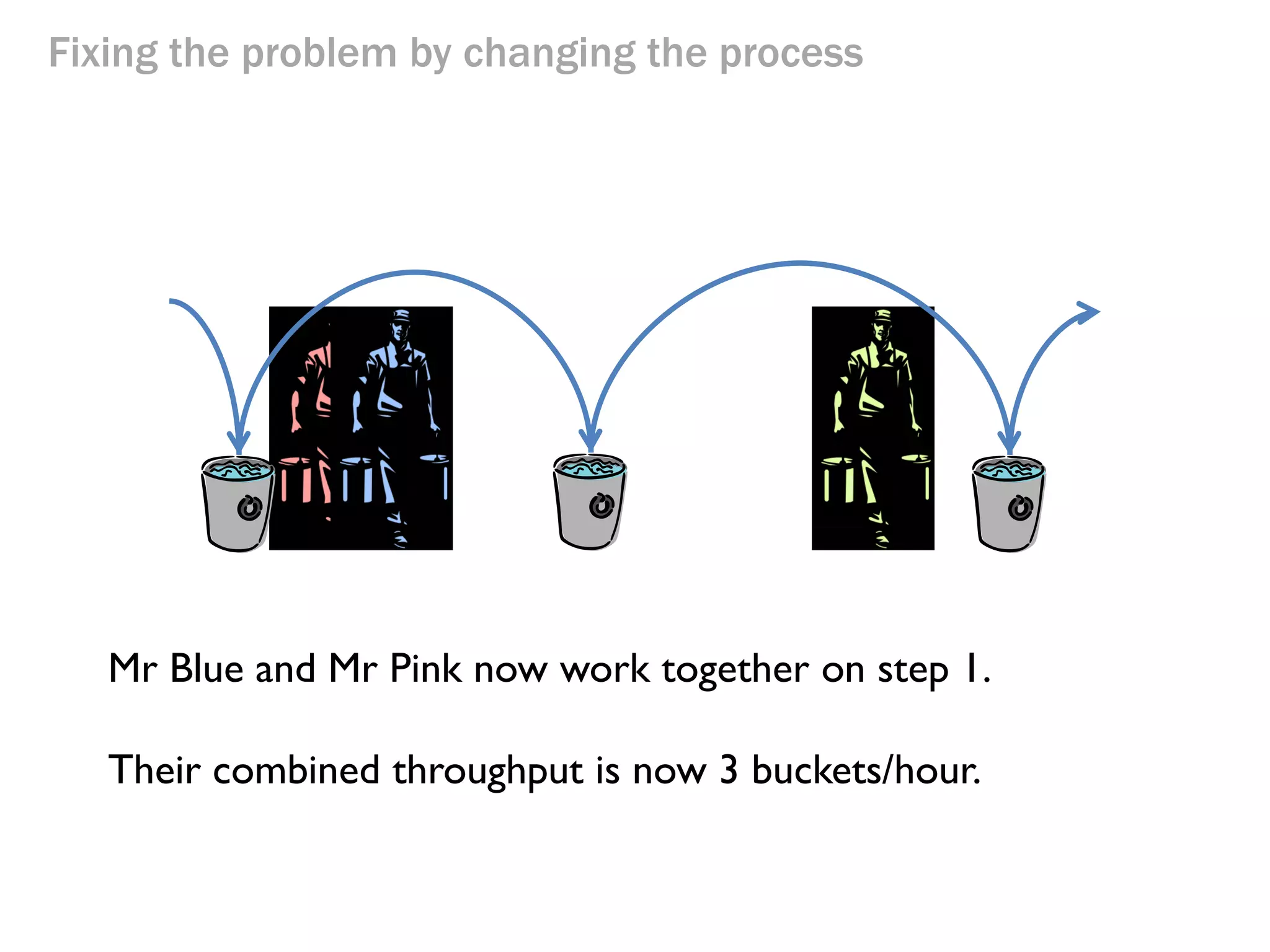
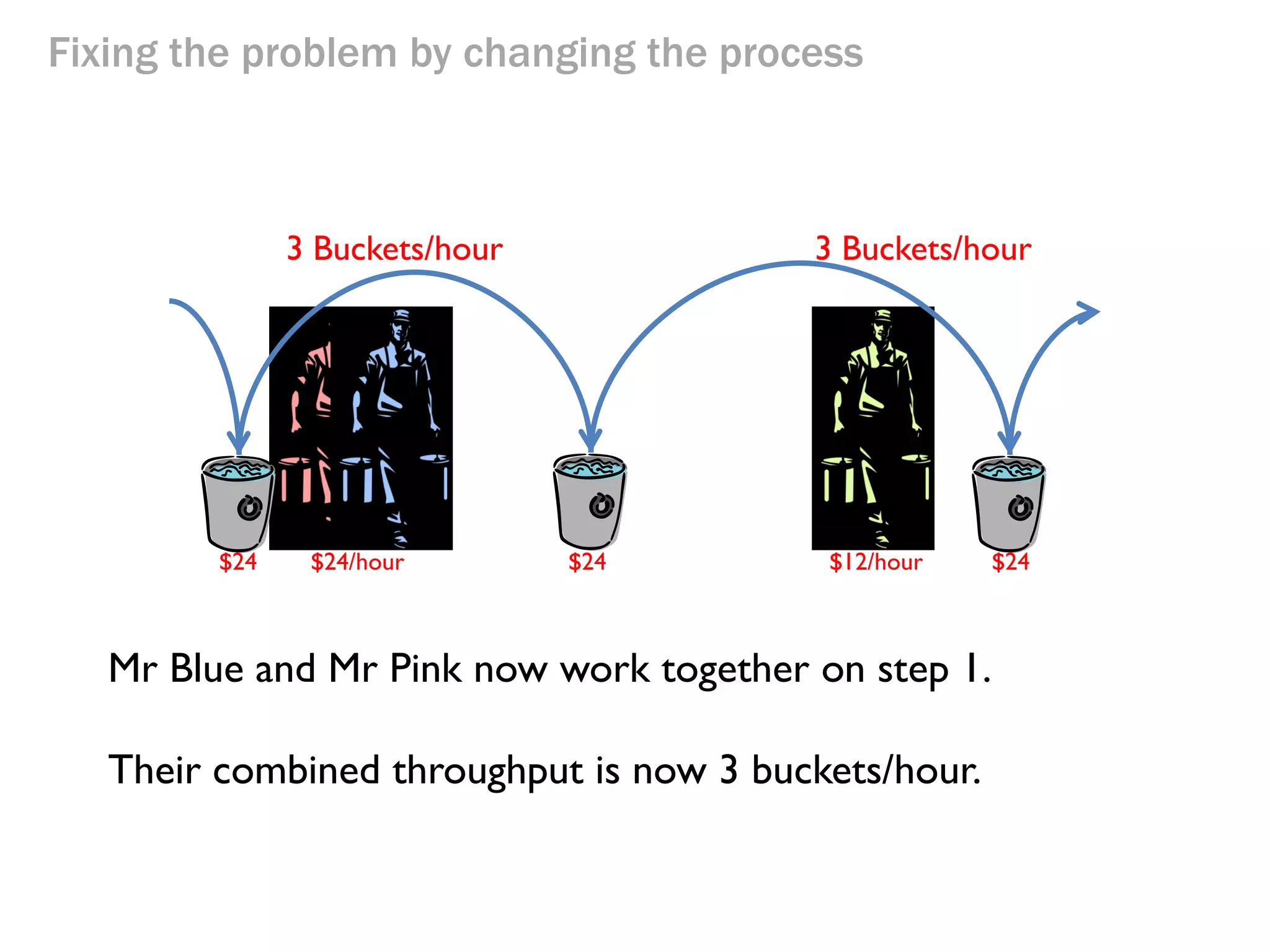
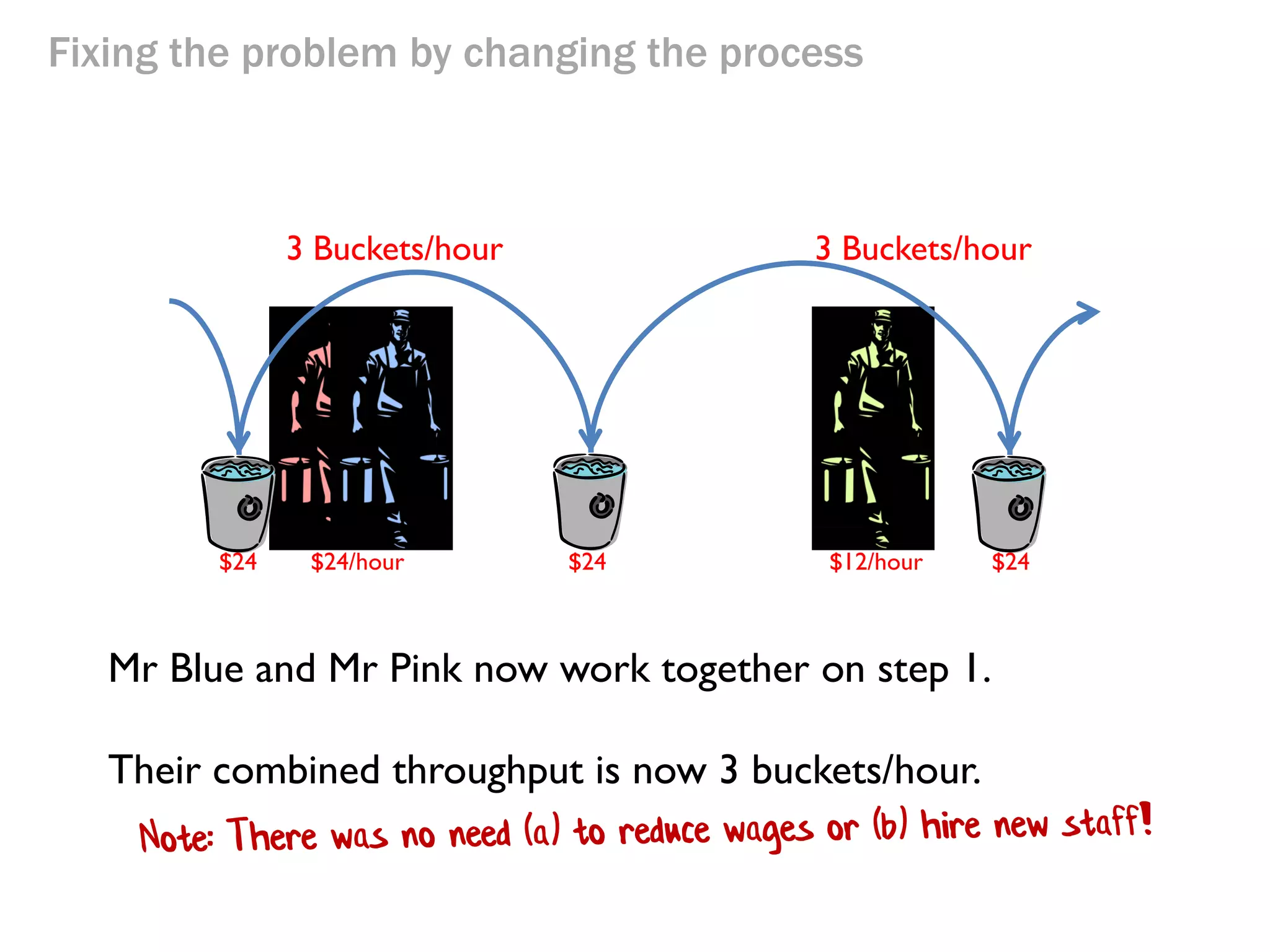
Mr Blue and Mr Pink now work together on step 1.

Their combined throughput is now 3 buckets/hour.
Fixing the problem by changing the process

3 Buckets/hour

$24

$12/hour

$12/hour

3 Buckets/hour

$24

$12/hour

Mr Blue and Mr Pink now work together on step 1.

Their combined throughput is now 3 buckets/hour.

$24
Fixing the problem by changing the process

3 Buckets/hour

$24

$12/hour

$12/hour

3 Buckets/hour

$24

$12/hour

Mr Blue and Mr Pink now work together on step 1.

Their combined throughput is now 3 buckets/hour.

$24
Fixing the problem by changing the process

3 Buckets/hour

$24

$12/hour

$12/hour

3 Buckets/hour

$24

$12/hour

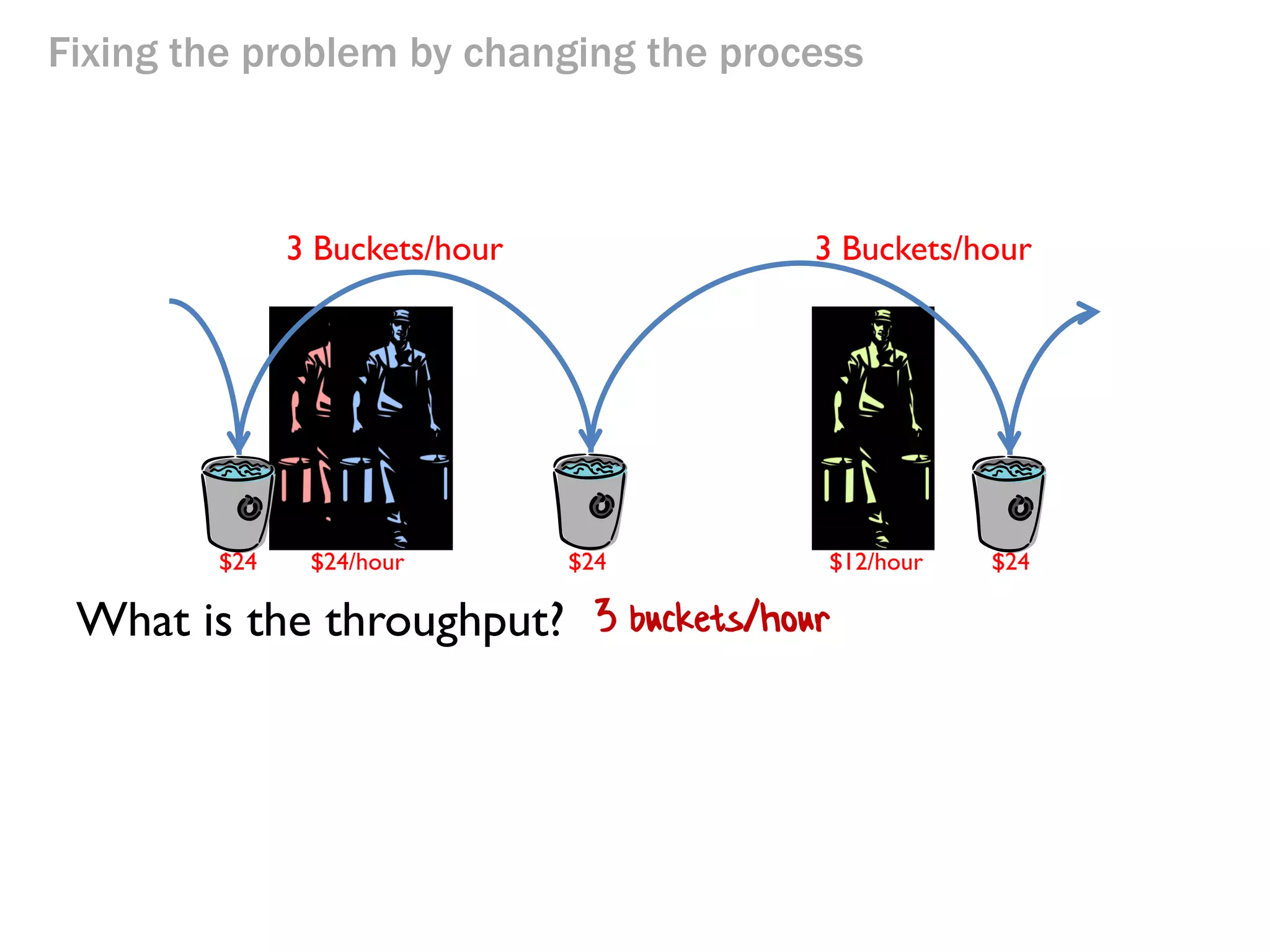
What is the throughput? 3 buckets/hour

$24
Fixing the problem by changing the process

3 Buckets/hour

$24

$12/hour

$12/hour

3 Buckets/hour

$24

$12/hour

$24

What is the throughput?
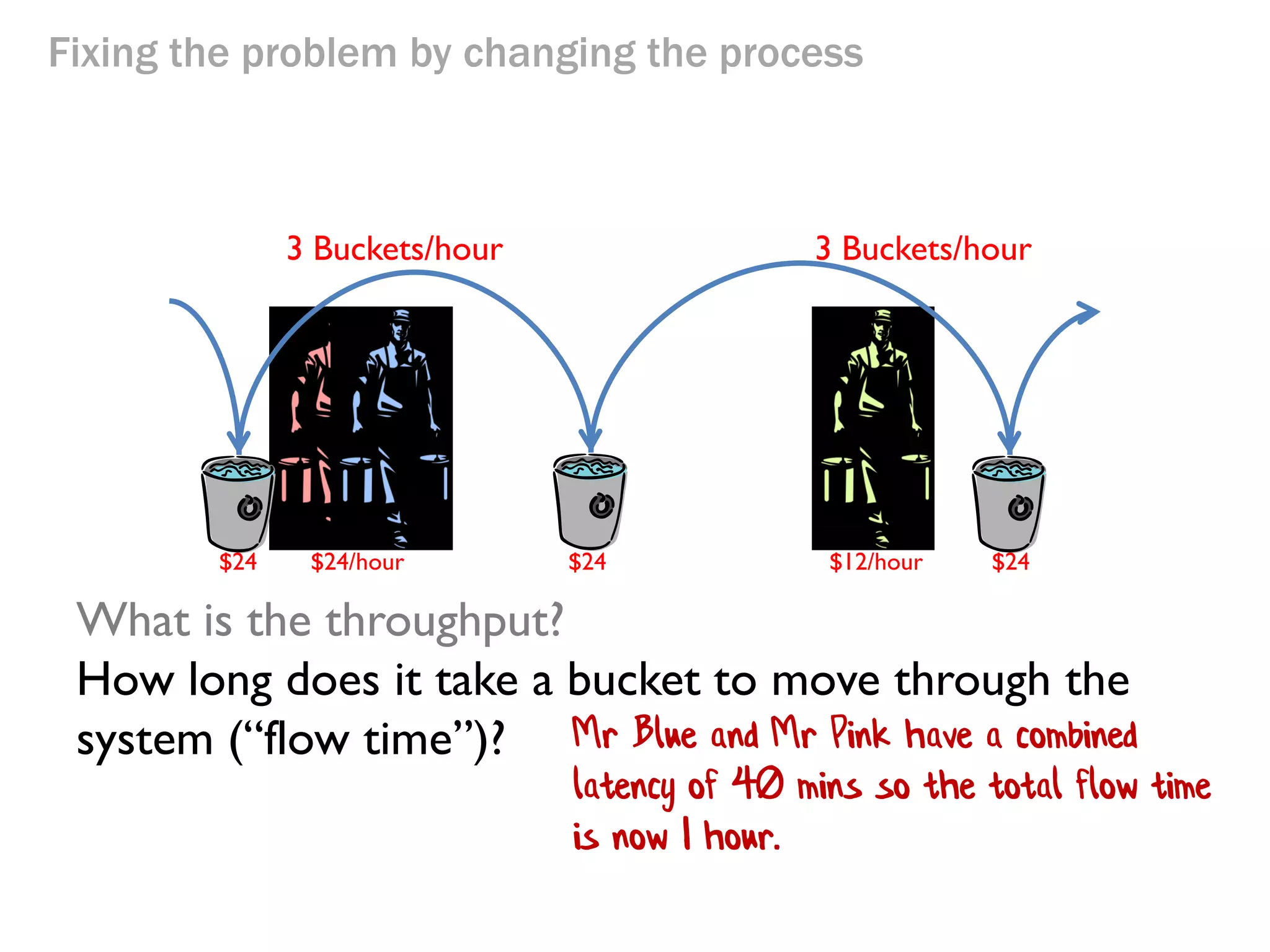
How long does it take a bucket to move through the
system (“flow time”)? Mr Blue and Mr Pink have a combined

latency of 40 mins so the total flow time
is now 1 hour.
Fixing the problem by changing the process

3 Buckets/hour

$24

$12/hour

$12/hour

3 Buckets/hour

$24

$12/hour

$24

What is the throughput?
How long does it take a bucket to move through the
system (“flow time”)?
What is the current inventory?
Little’s law: inventory = throughput * flow time.
So inventory = 3 bucket/hour x 1 hours => 3 buckets
Fixing the problem by changing the process

3 Buckets/hour

$24

$12/hour

$12/hour

3 Buckets/hour

$24

$12/hour

$24

What is the throughput?
How long does it take a bucket to move through the
system (“flow time”)?
What is the current inventory?
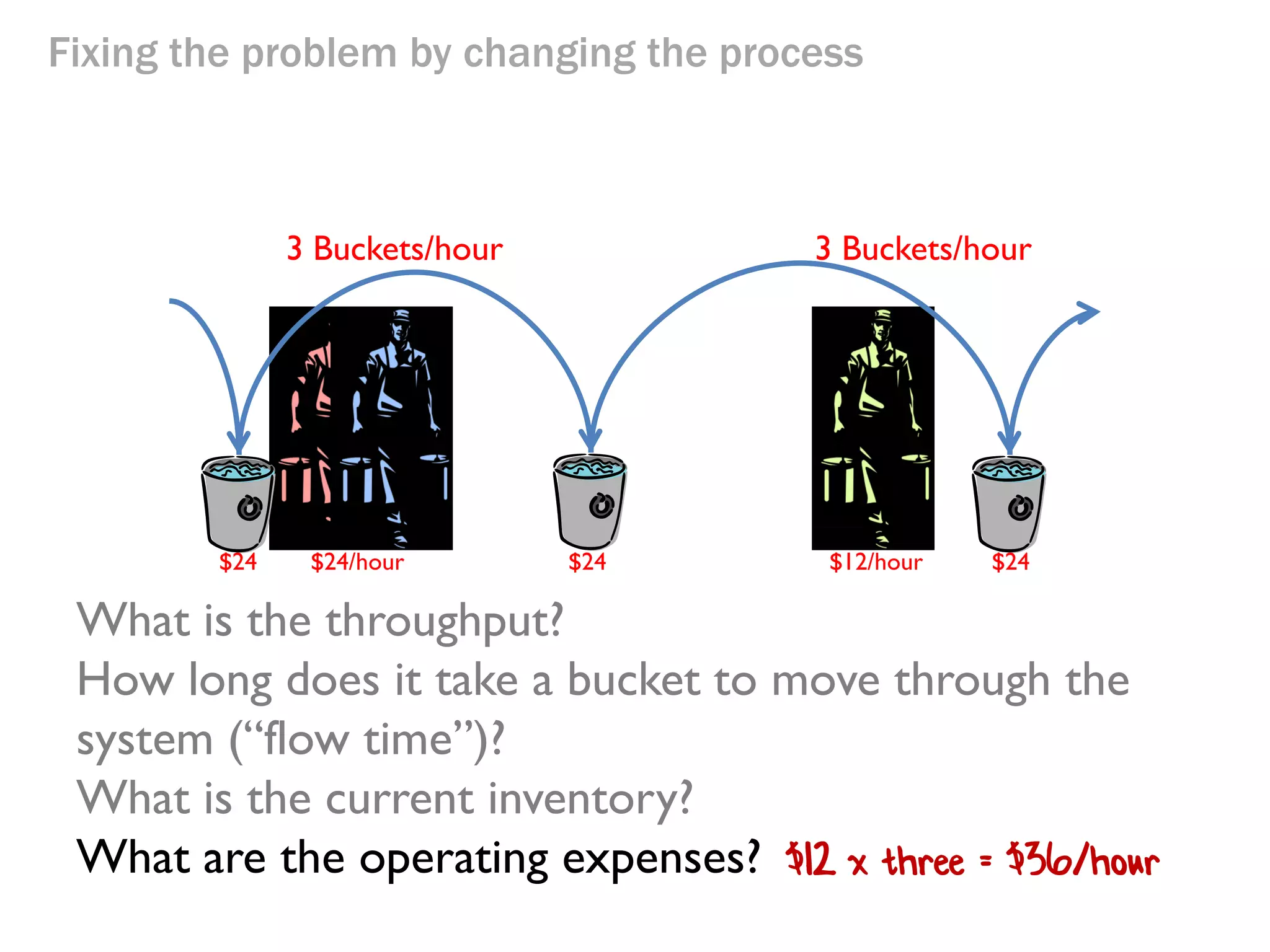
What are the operating expenses? $12 x three = $36/hour
Fixing the problem by changing the process

3 Buckets/hour

$24

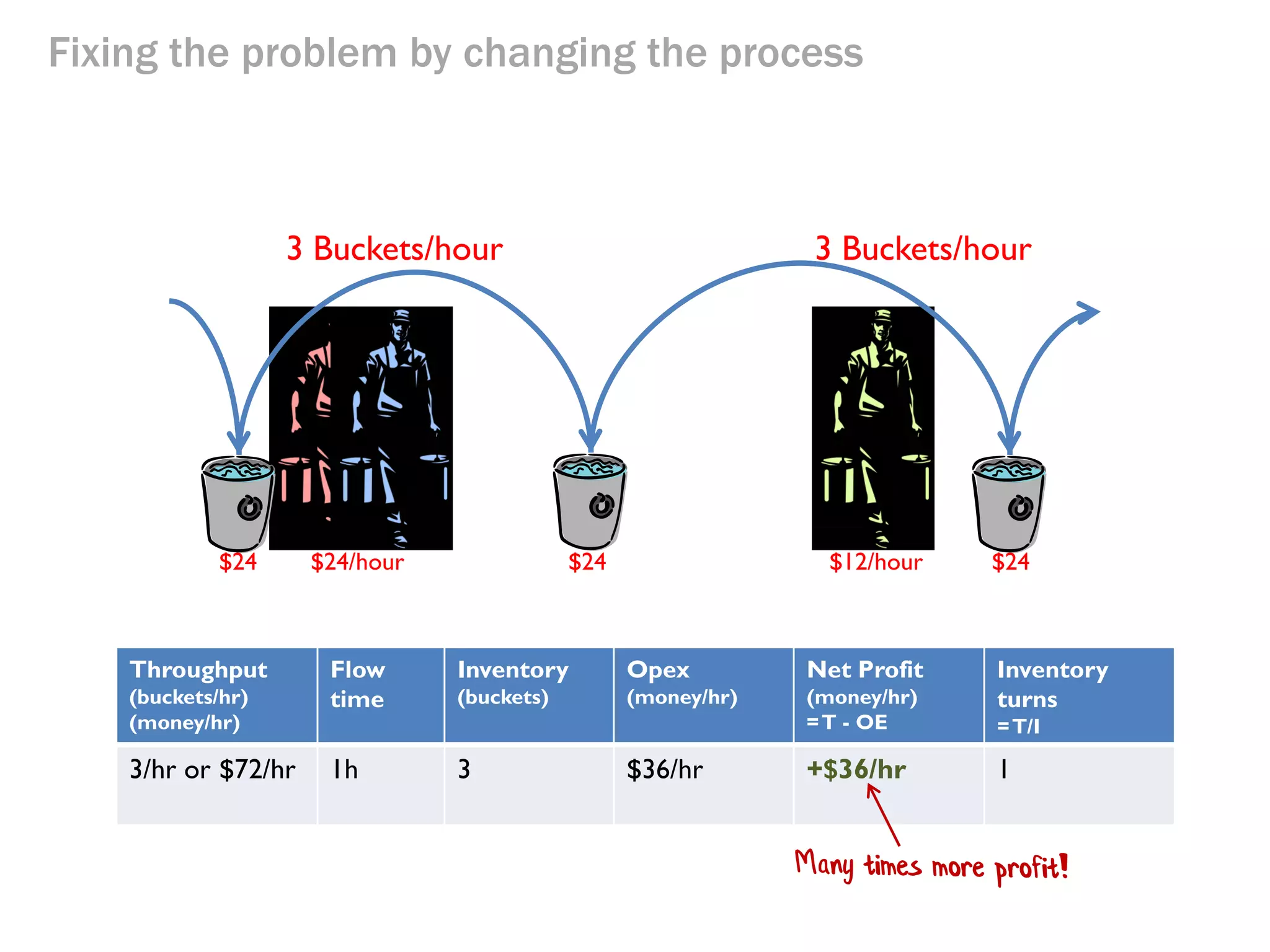
Throughput
(buckets/hr)
(money/hr)

3/hr or $72/hr

$12/hour

Flow
time

1h

$12/hour

3 Buckets/hour

$24

$12/hour

Inventory

Opex

Net Profit

(buckets)

(money/hr)

(money/hr)
= T - OE

3

$36/hr

+$36/hr

$24

Inventory
turns
= T/I

1
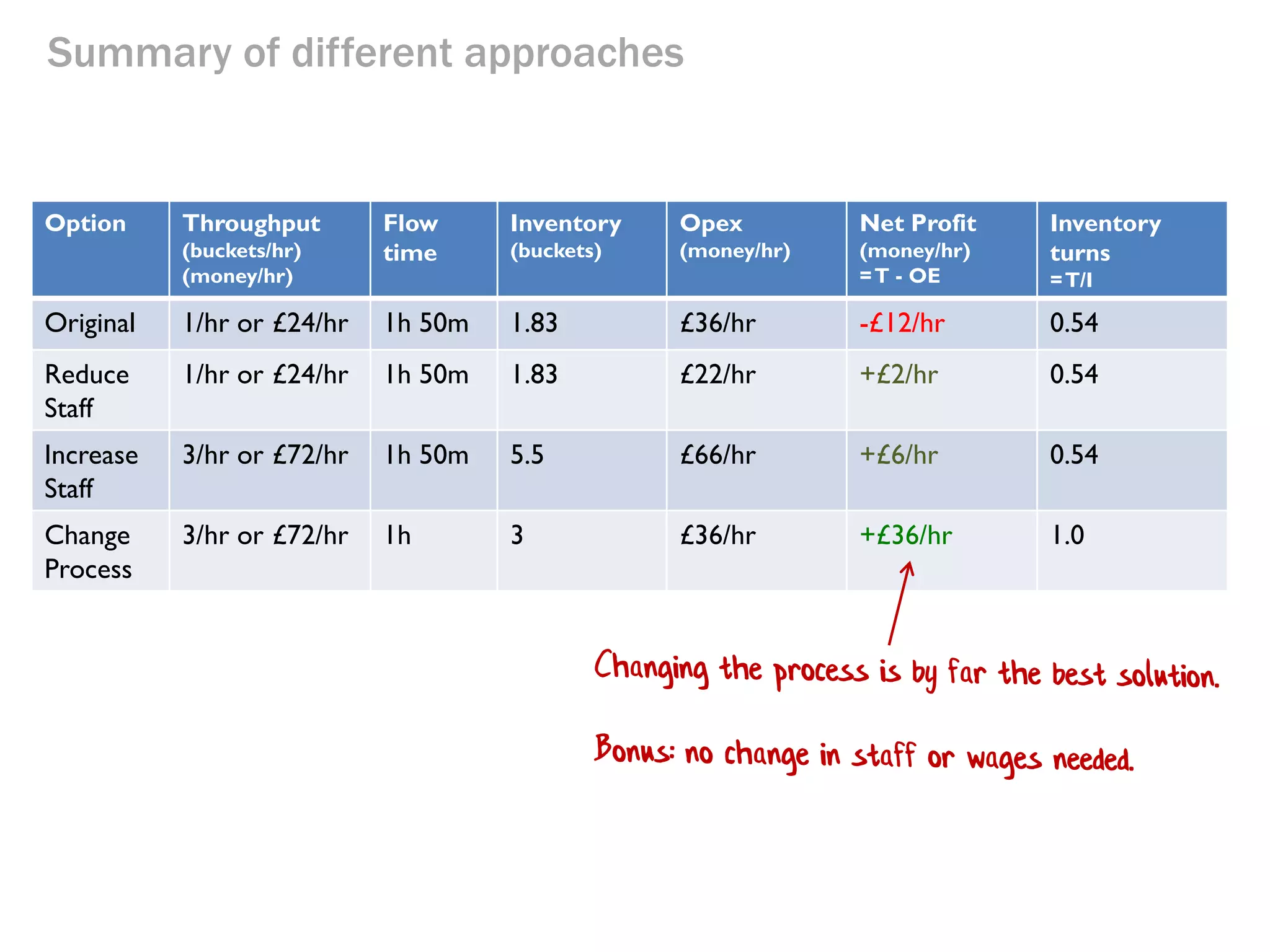
Summary of different approaches

Option

Throughput
(buckets/hr)
(money/hr)

Flow
time

Inventory

Opex

Net Profit

(buckets)

(money/hr)

(money/hr)
= T - OE

Inventory
turns
= T/I

Original

1/hr or £24/hr

1h 50m

1.83

£36/hr

-£12/hr

0.54

Reduce
Staff

1/hr or £24/hr

1h 50m

1.83

£22/hr

+£2/hr

0.54

Increase
Staff

3/hr or £72/hr

1h 50m

5.5

£66/hr

+£6/hr

0.54

Change
Process

3/hr or £72/hr

1h

3

£36/hr

+£36/hr

1.0
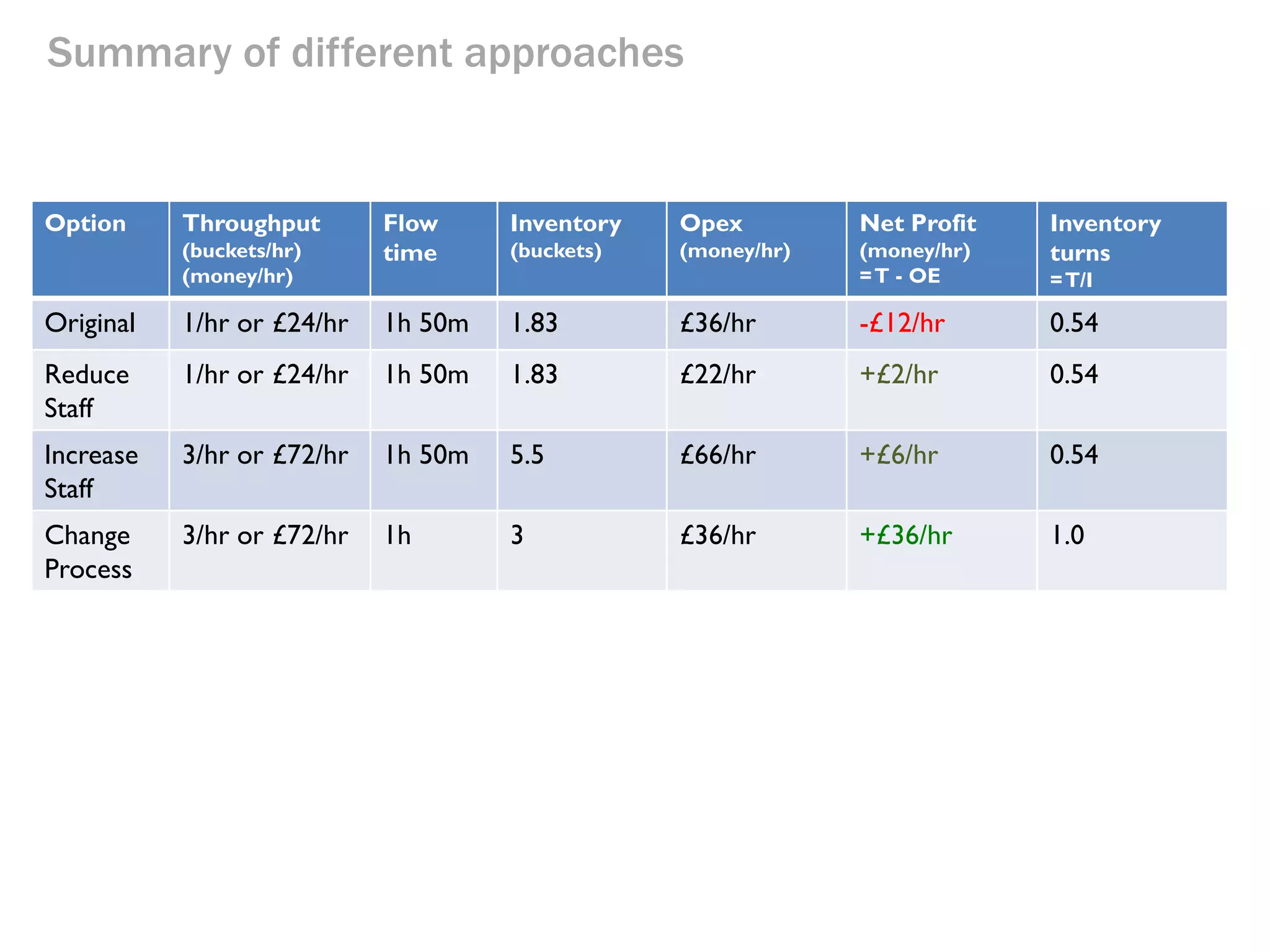
Summary of different approaches

Option

Throughput
(buckets/hr)
(money/hr)

Flow
time

Inventory

Opex

Net Profit

(buckets)

(money/hr)

(money/hr)
= T - OE

Inventory
turns
= T/I

Original

1/hr or £24/hr

1h 50m

1.83

£36/hr

-£12/hr

0.54

Reduce
Staff

1/hr or £24/hr

1h 50m

1.83

£22/hr

+£2/hr

0.54

Increase
Staff

3/hr or £72/hr

1h 50m

5.5

£66/hr

+£6/hr

0.54

Change
Process

3/hr or £72/hr

1h

3

£36/hr

+£36/hr

1.0
Summary of different approaches

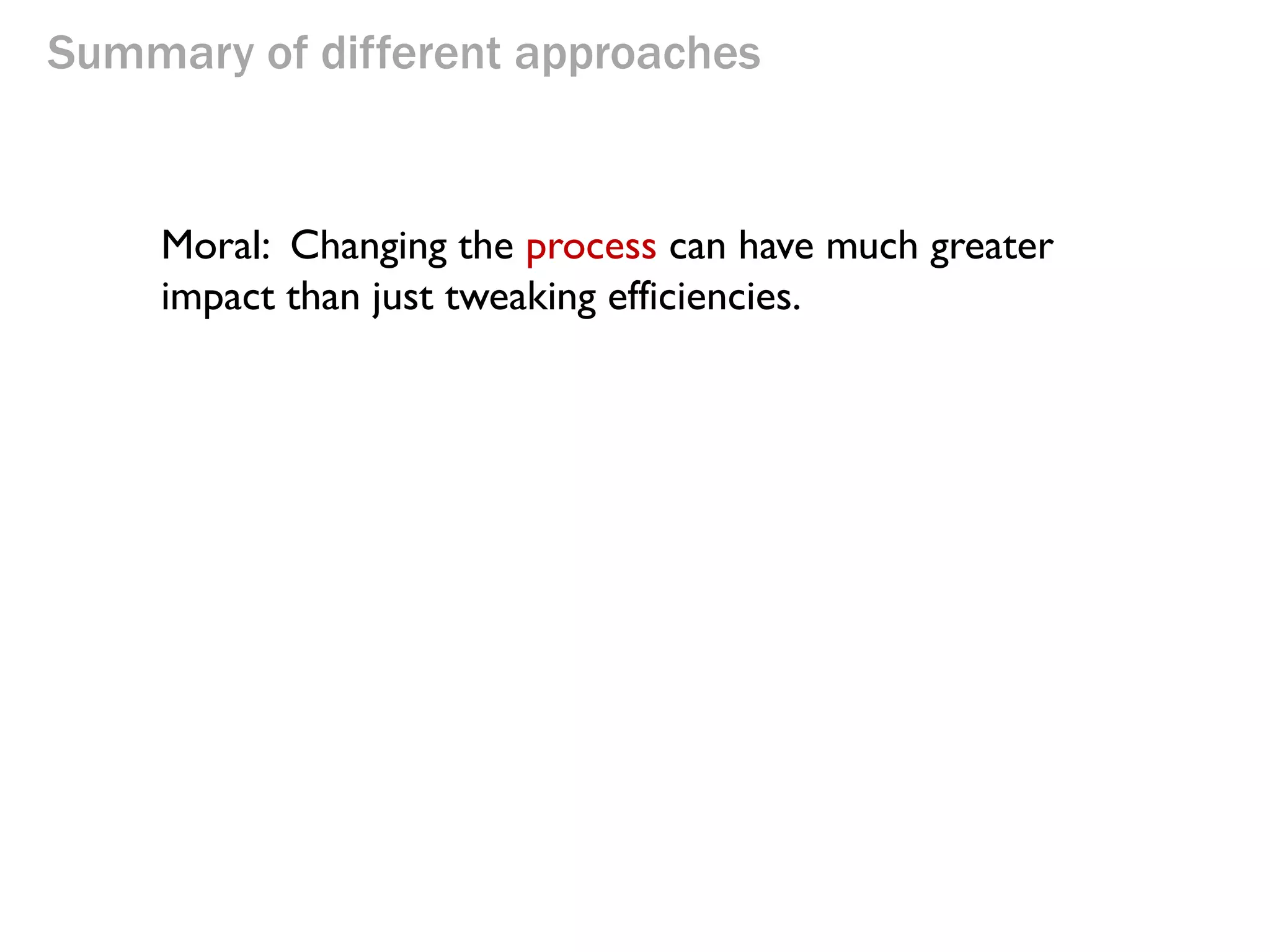
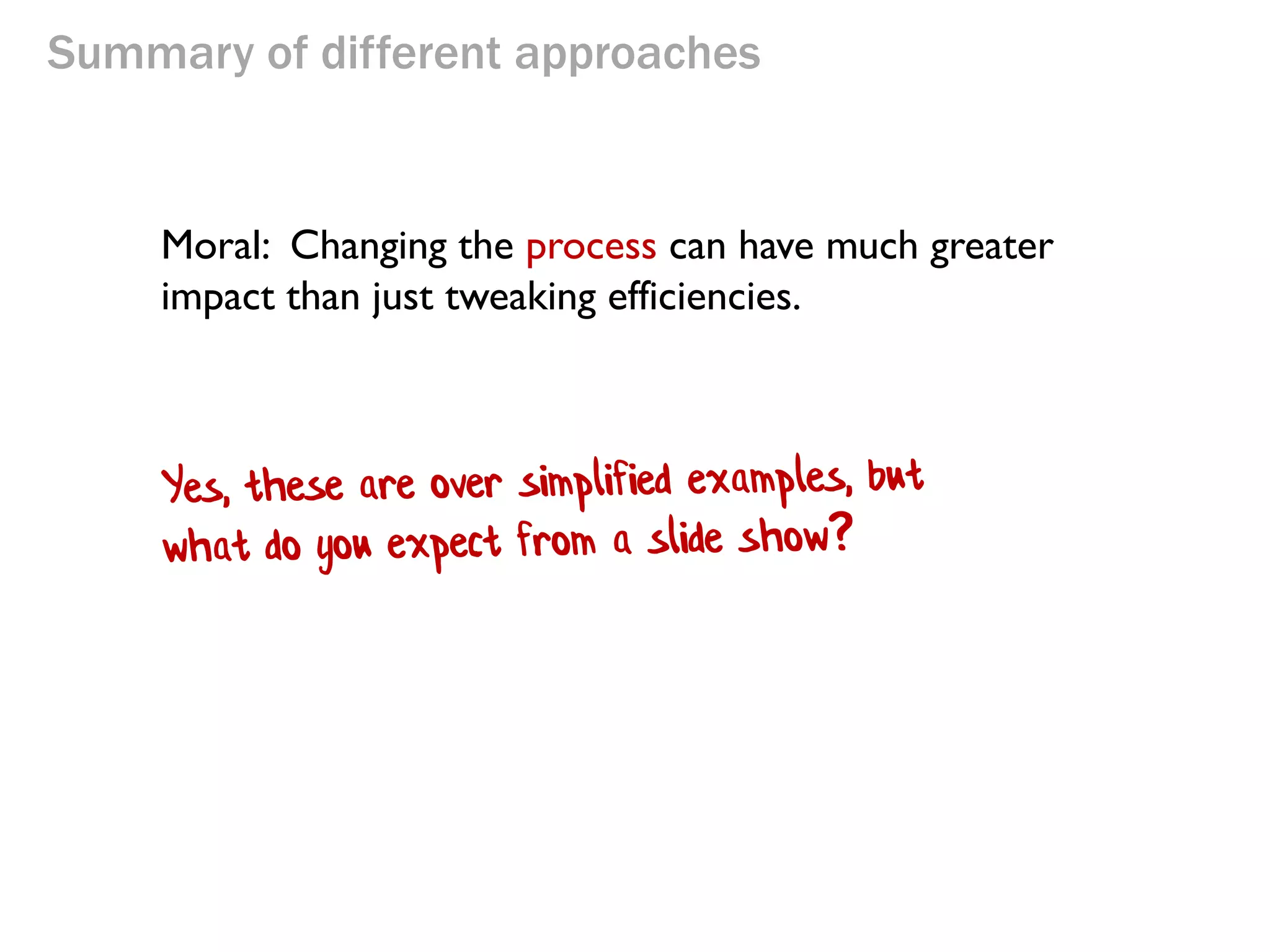
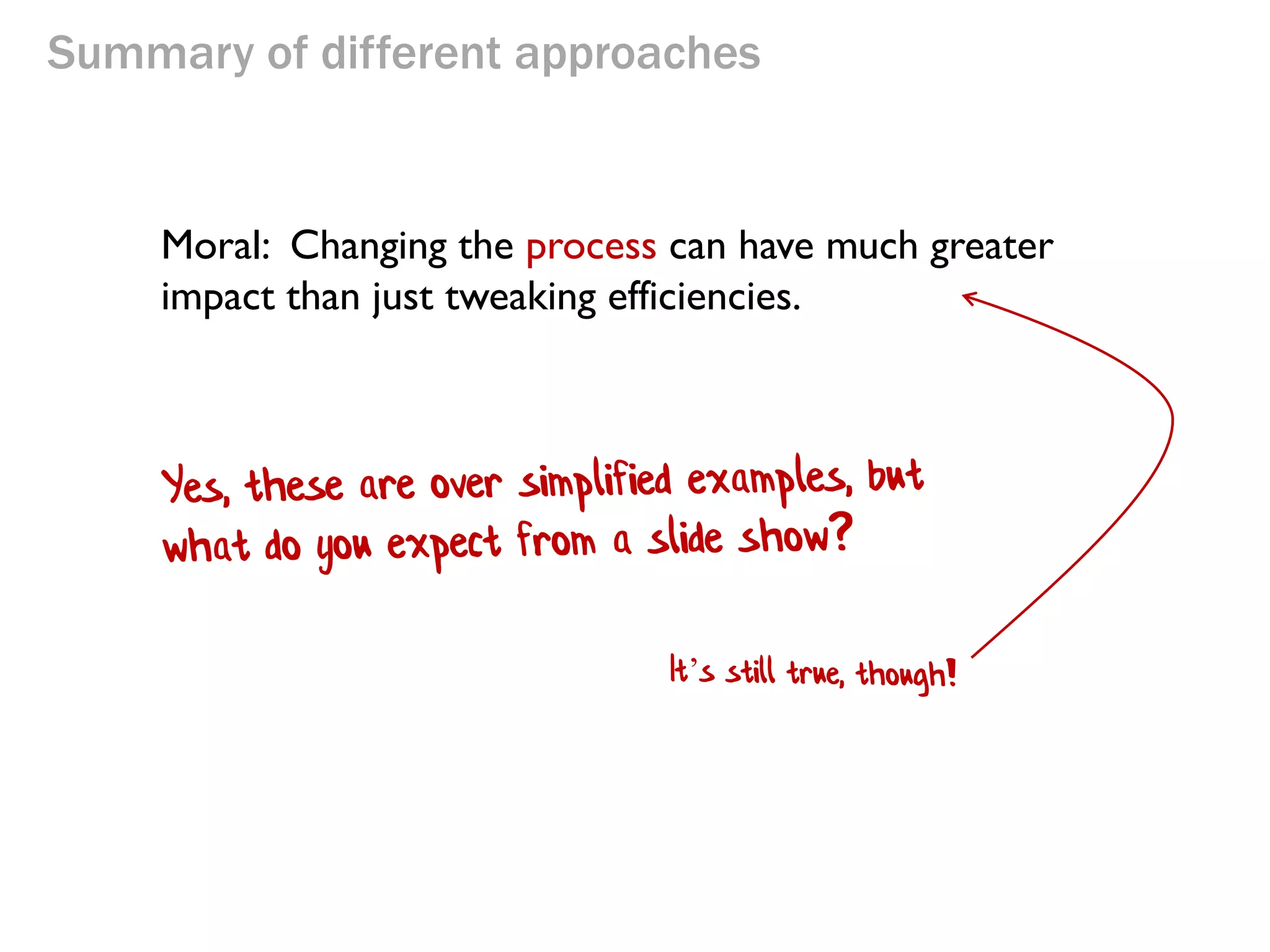
Moral: Changing the process can have much greater
impact than just tweaking efficiencies.
Summary of different approaches

Moral: Changing the process can have much greater
impact than just tweaking efficiencies.
Summary of different approaches

Moral: Changing the process can have much greater
impact than just tweaking efficiencies.
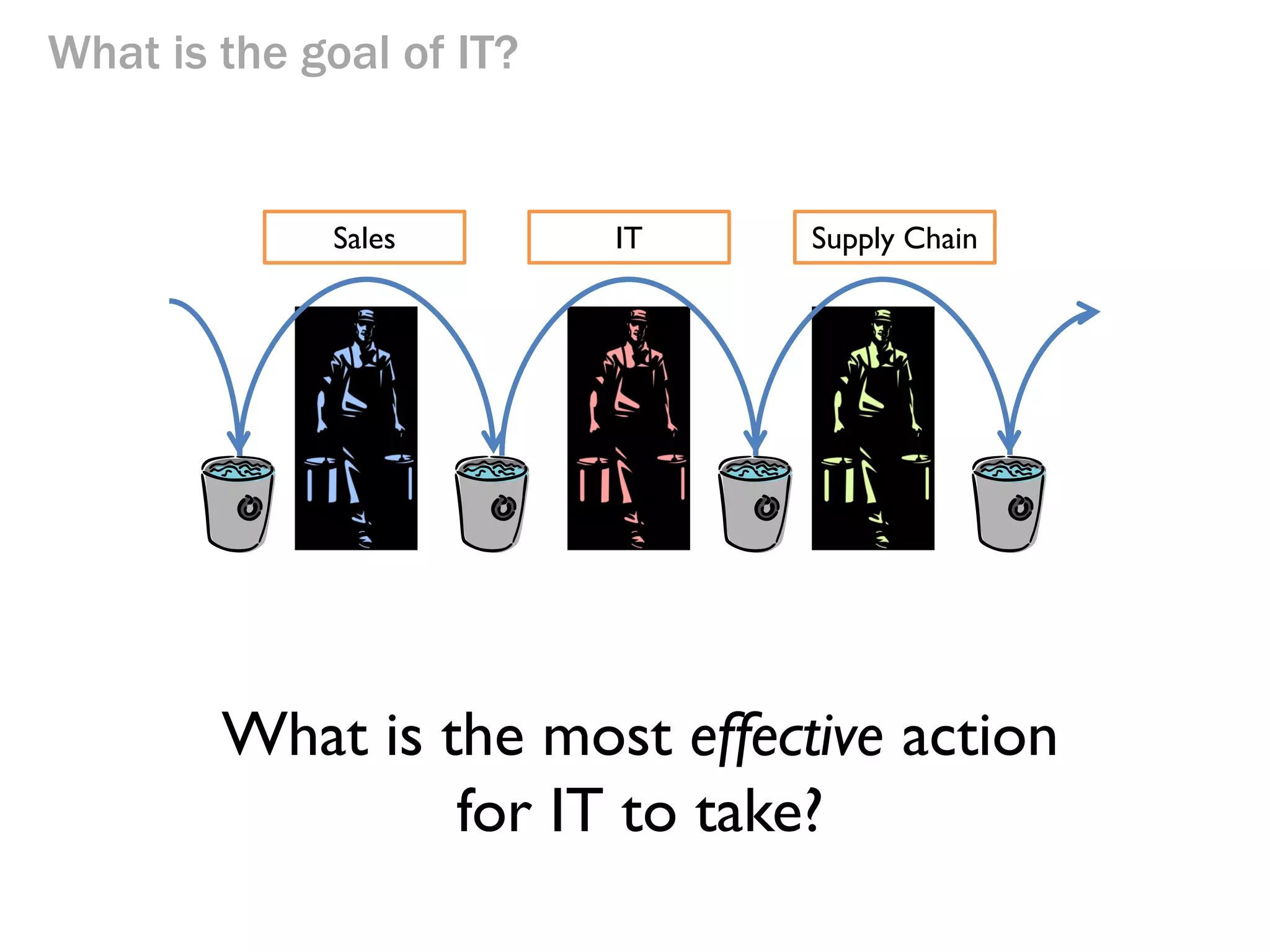
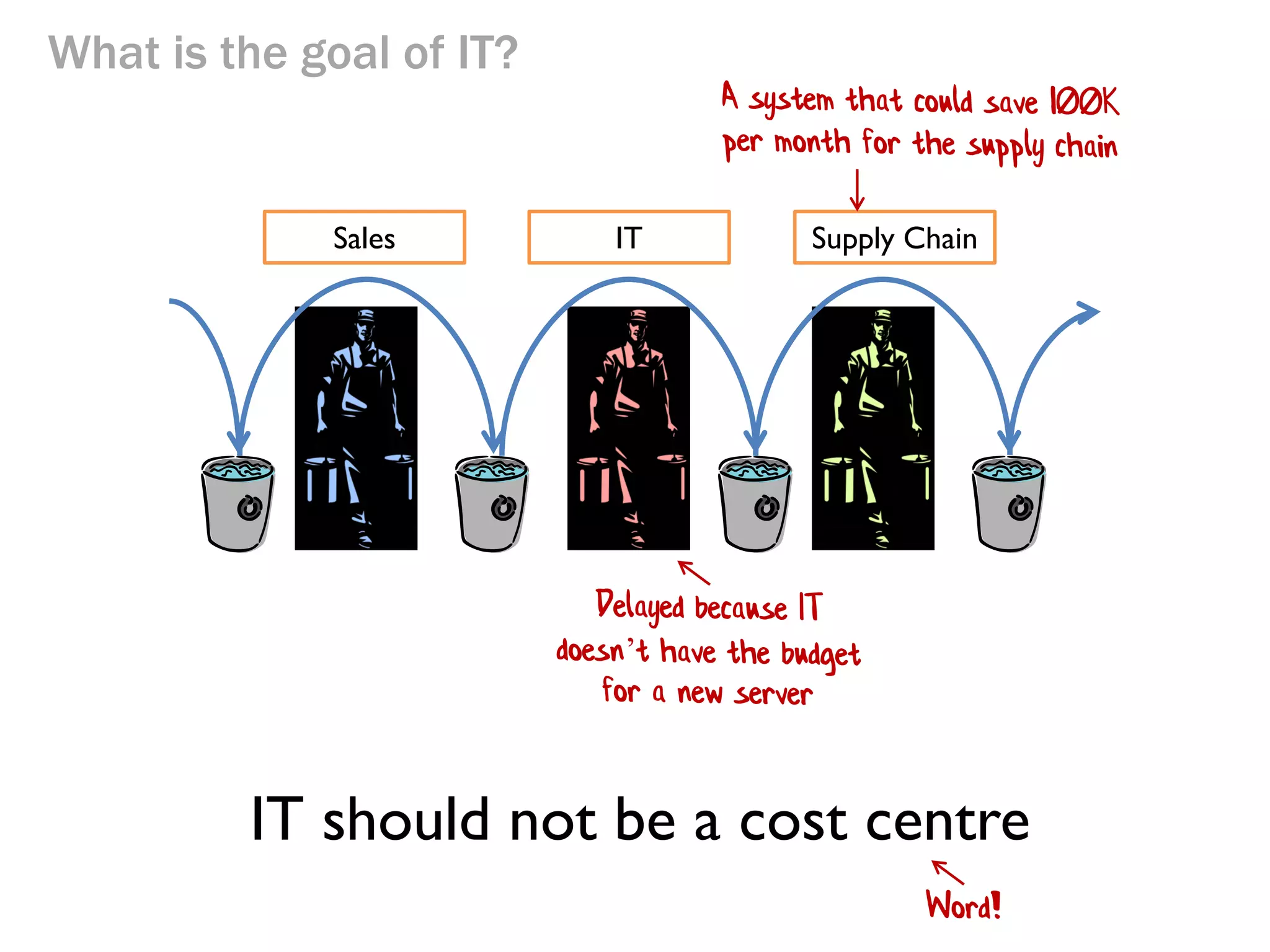
What is the goal of IT?

Sales

IT

Supply Chain

What is the most effective action
for IT to take?
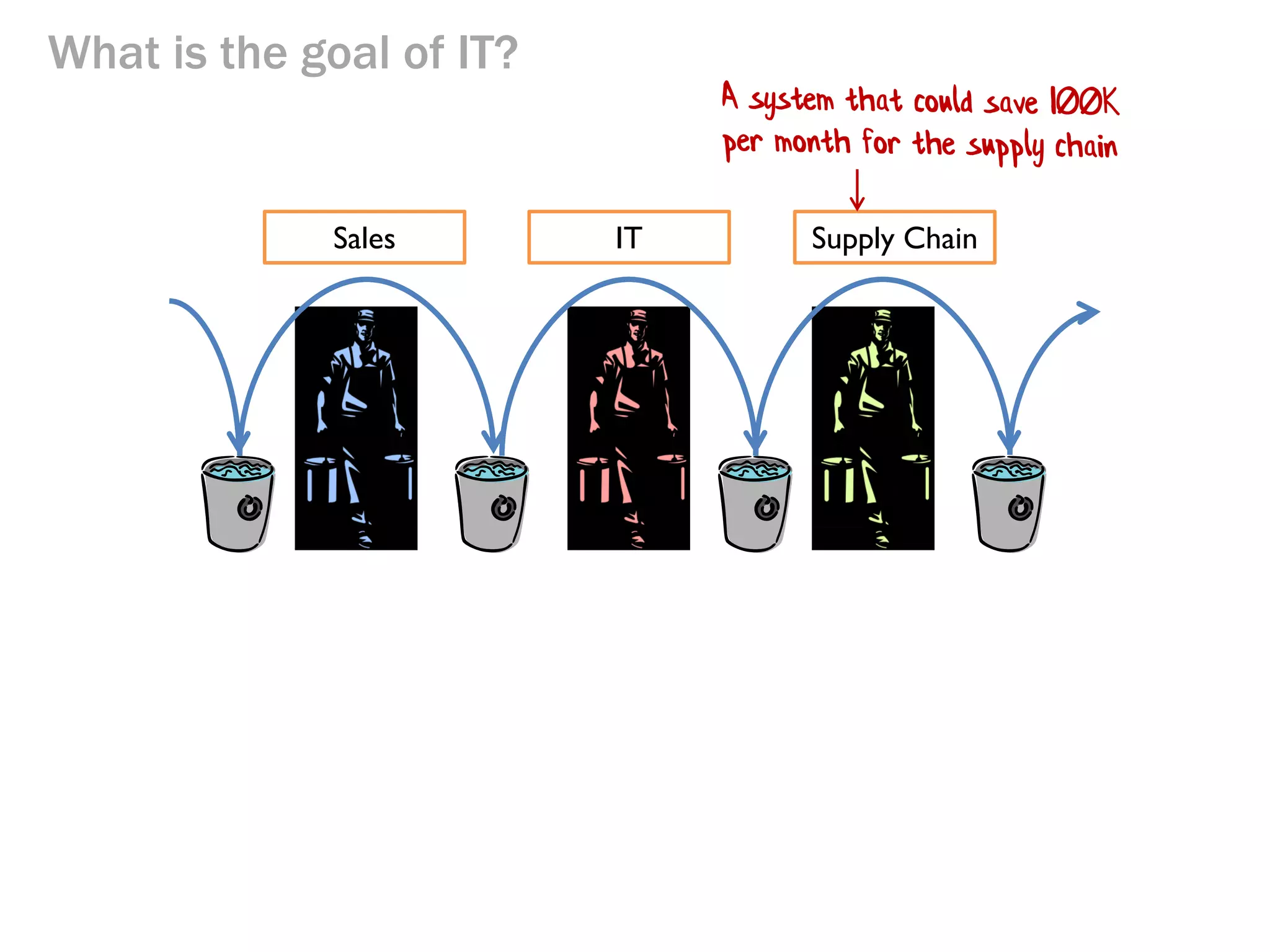
What is the goal of IT?

Sales

IT

Supply Chain
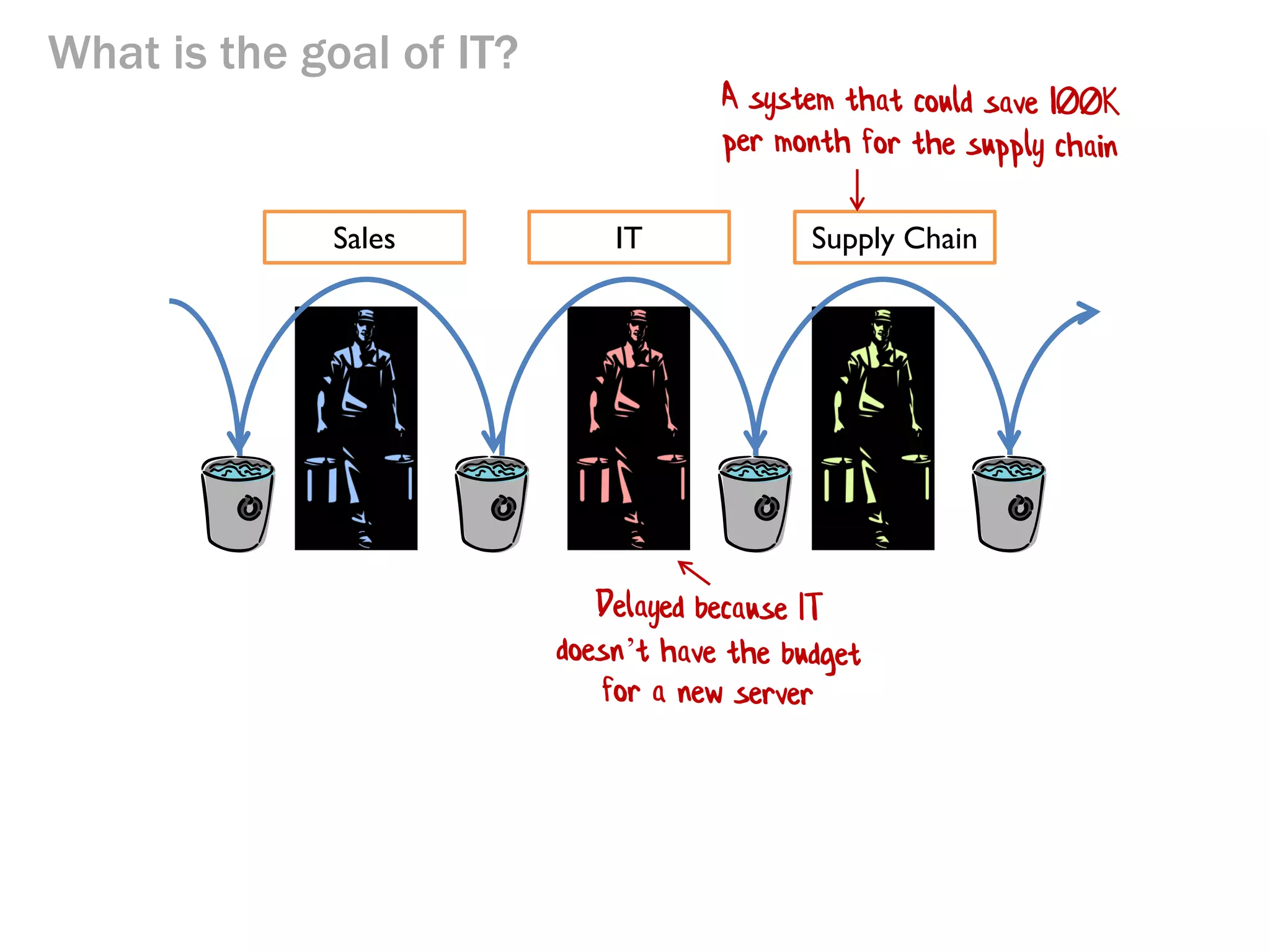
What is the goal of IT?

Sales

IT

Supply Chain
What is the goal of IT?

Sales

IT

Supply Chain

IT should not be a cost centre
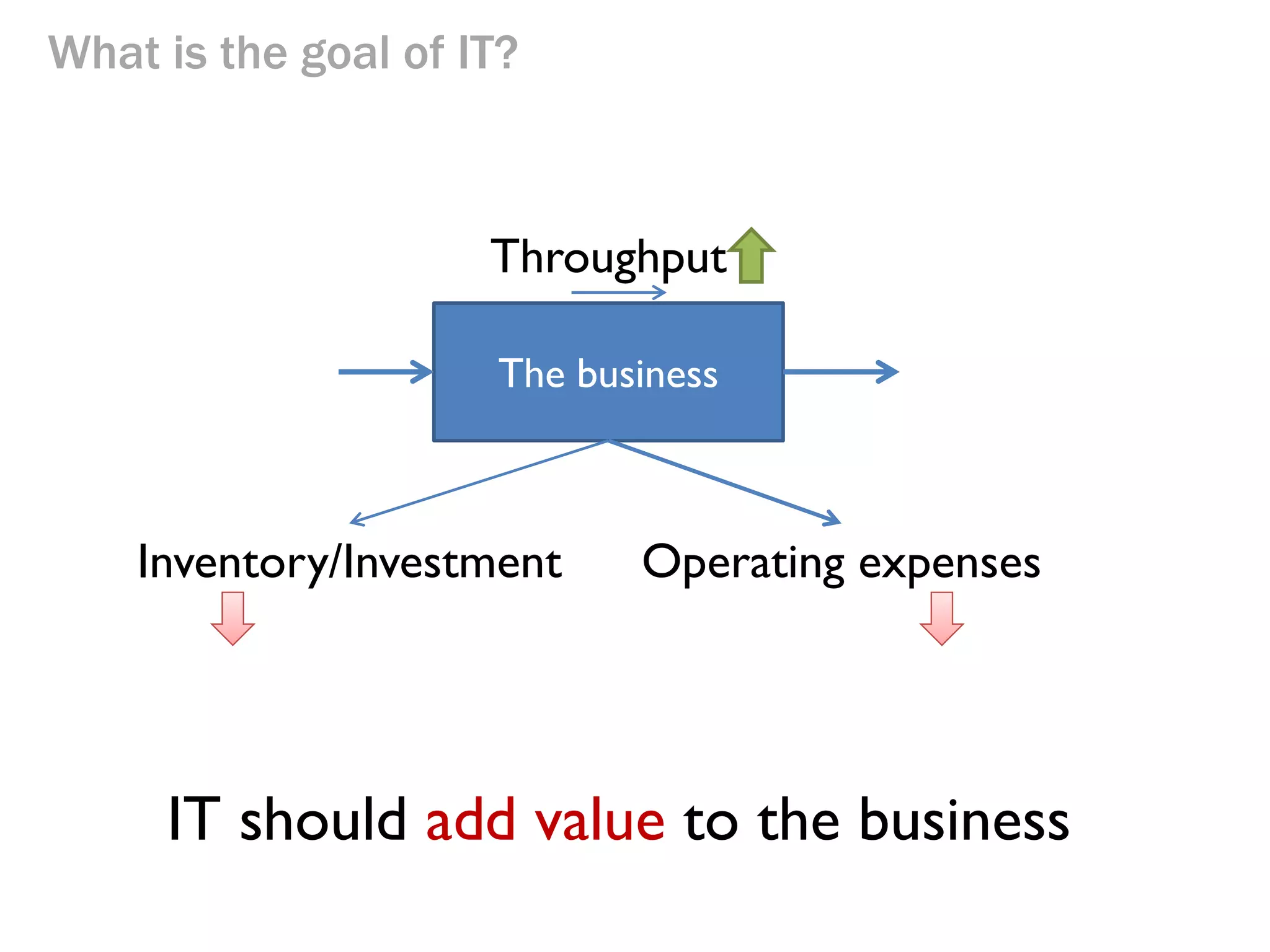
What is the goal of IT?

Throughput
The business

Inventory/Investment

Operating expenses

IT should add value to the business
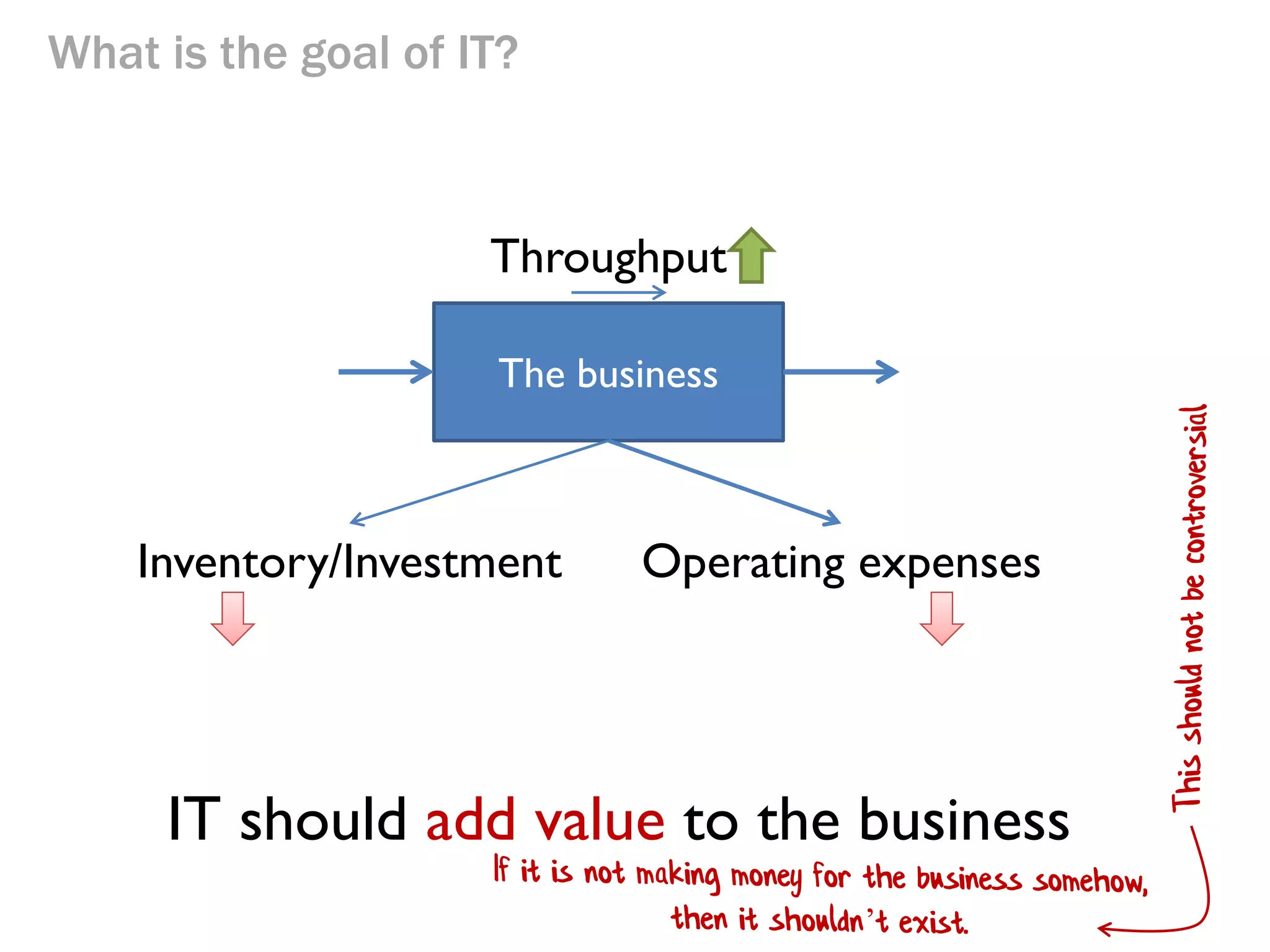
What is the goal of IT?

Throughput
The business

Inventory/Investment

Operating expenses

IT should add value to the business
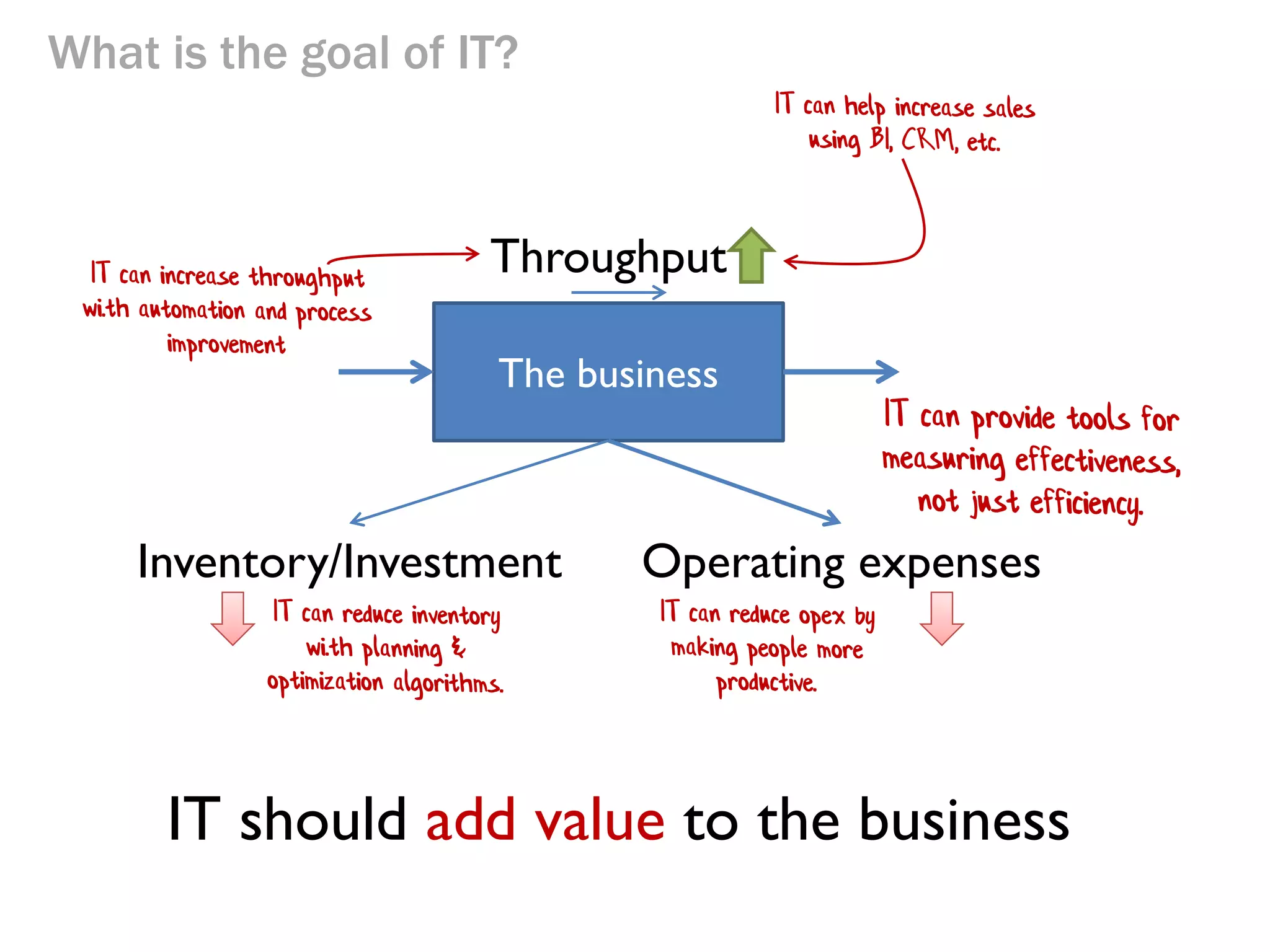
What is the goal of IT?

Throughput
The business

Inventory/Investment

Operating expenses

IT should add value to the business
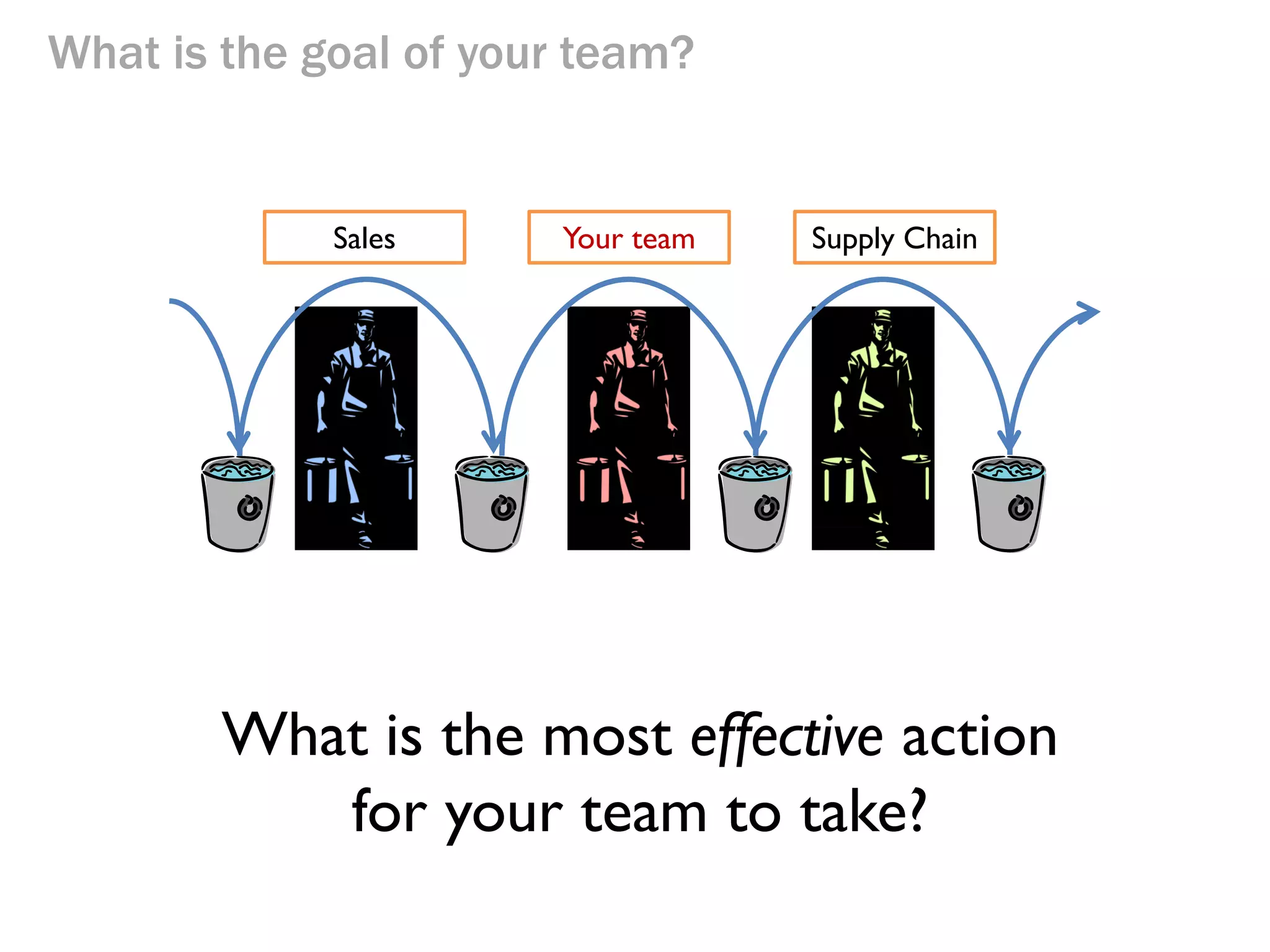
What is the goal of your team?

Sales

Your team

Supply Chain

What is the most effective action
for your team to take?
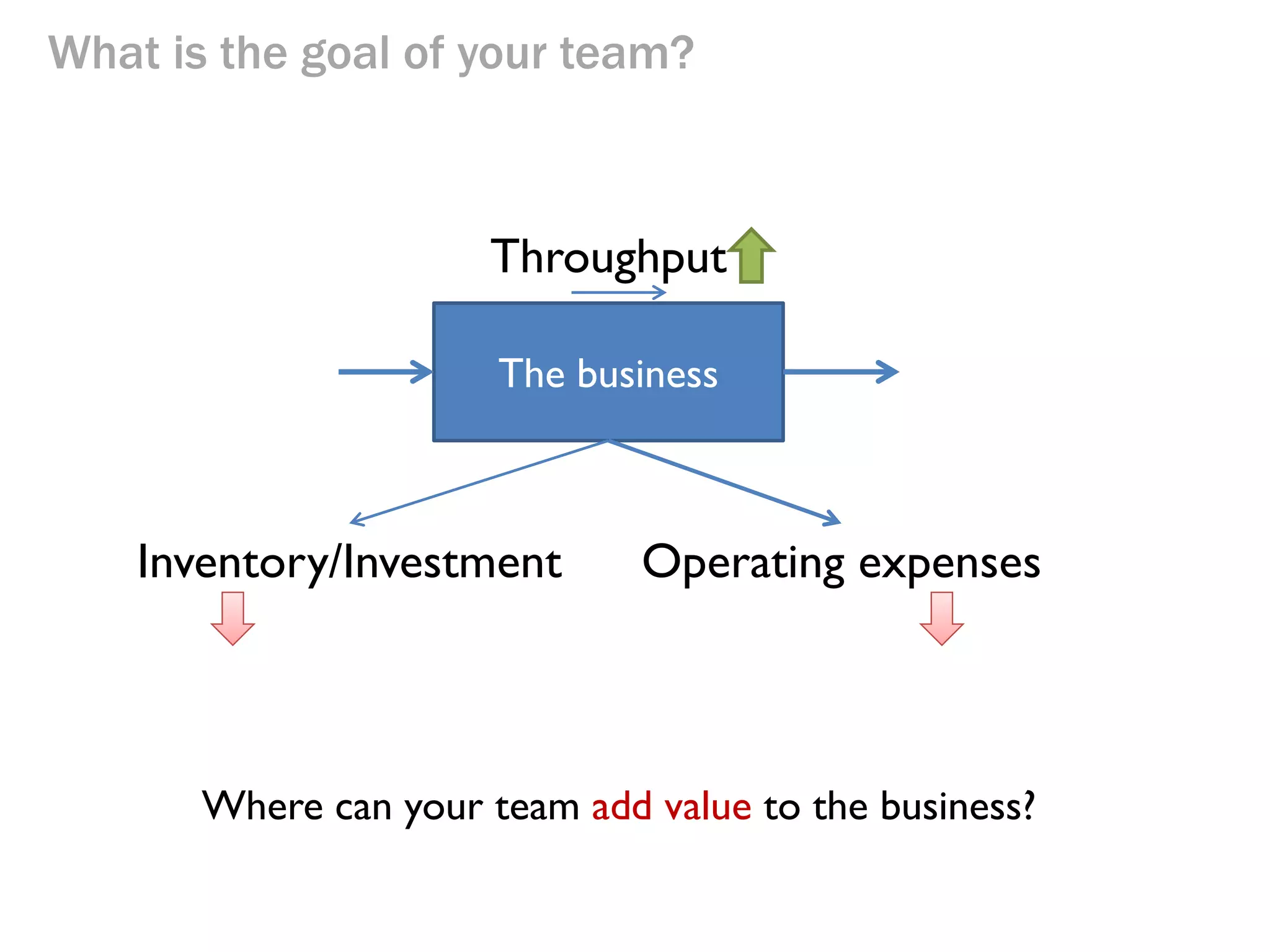
What is the goal of your team?

Throughput
The business

Inventory/Investment

Operating expenses

Where can your team add value to the business?
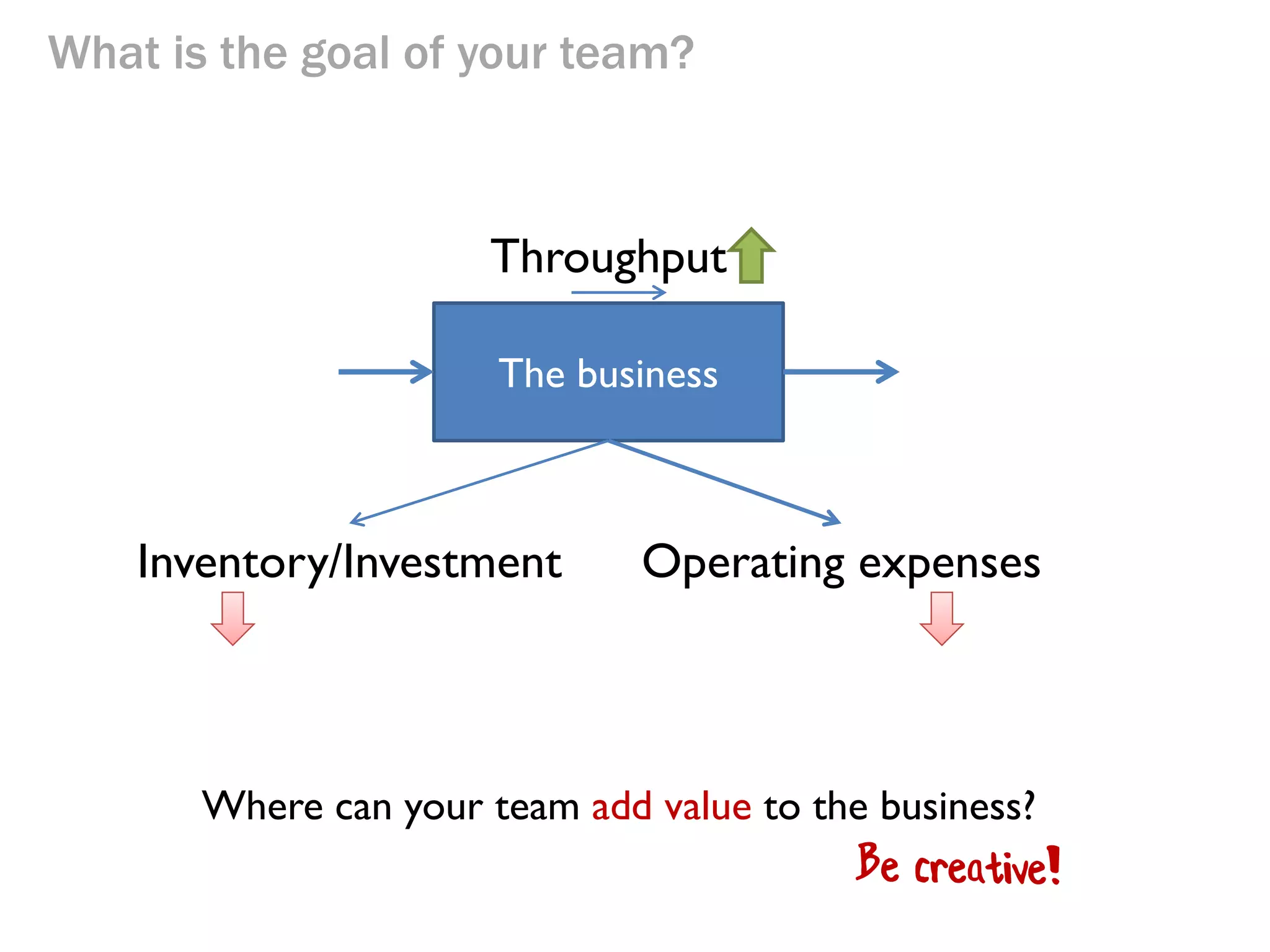
What is the goal of your team?

Throughput
The business

Inventory/Investment

Operating expenses

Where can your team add value to the business?
What is the goal of your team?
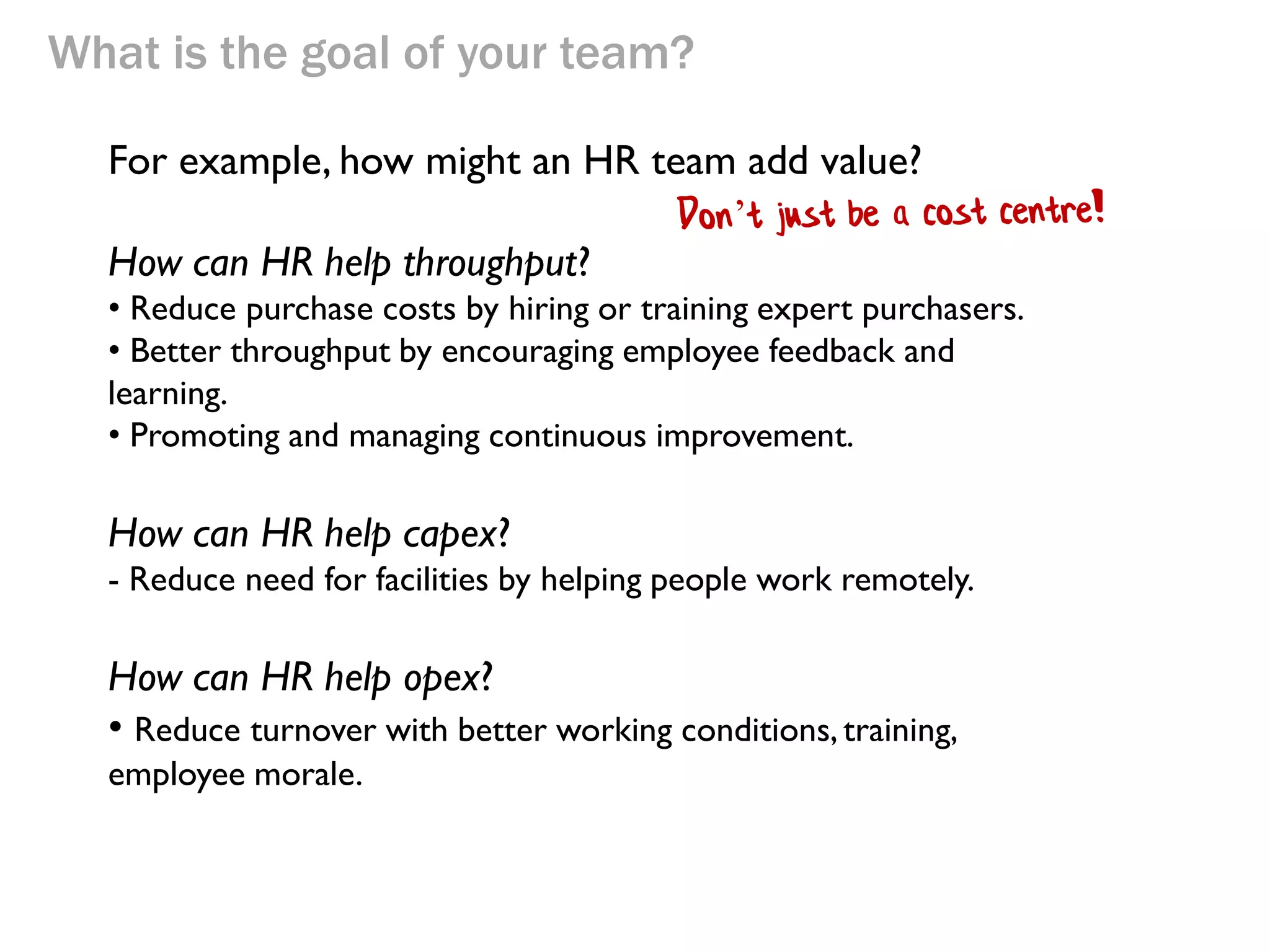
For example, how might an HR team add value?
What is the goal of your team?
For example, how might an HR team add value?
How can HR help throughput?
• Reduce purchase costs by hiring or training expert purchasers.
• Better throughput by encouraging employee feedback and
learning.
• Promoting and managing continuous improvement.

How can HR help capex?
- Reduce need for facilities by helping people work remotely.

How can HR help opex?
• Reduce turnover with better working conditions, training,
employee morale.
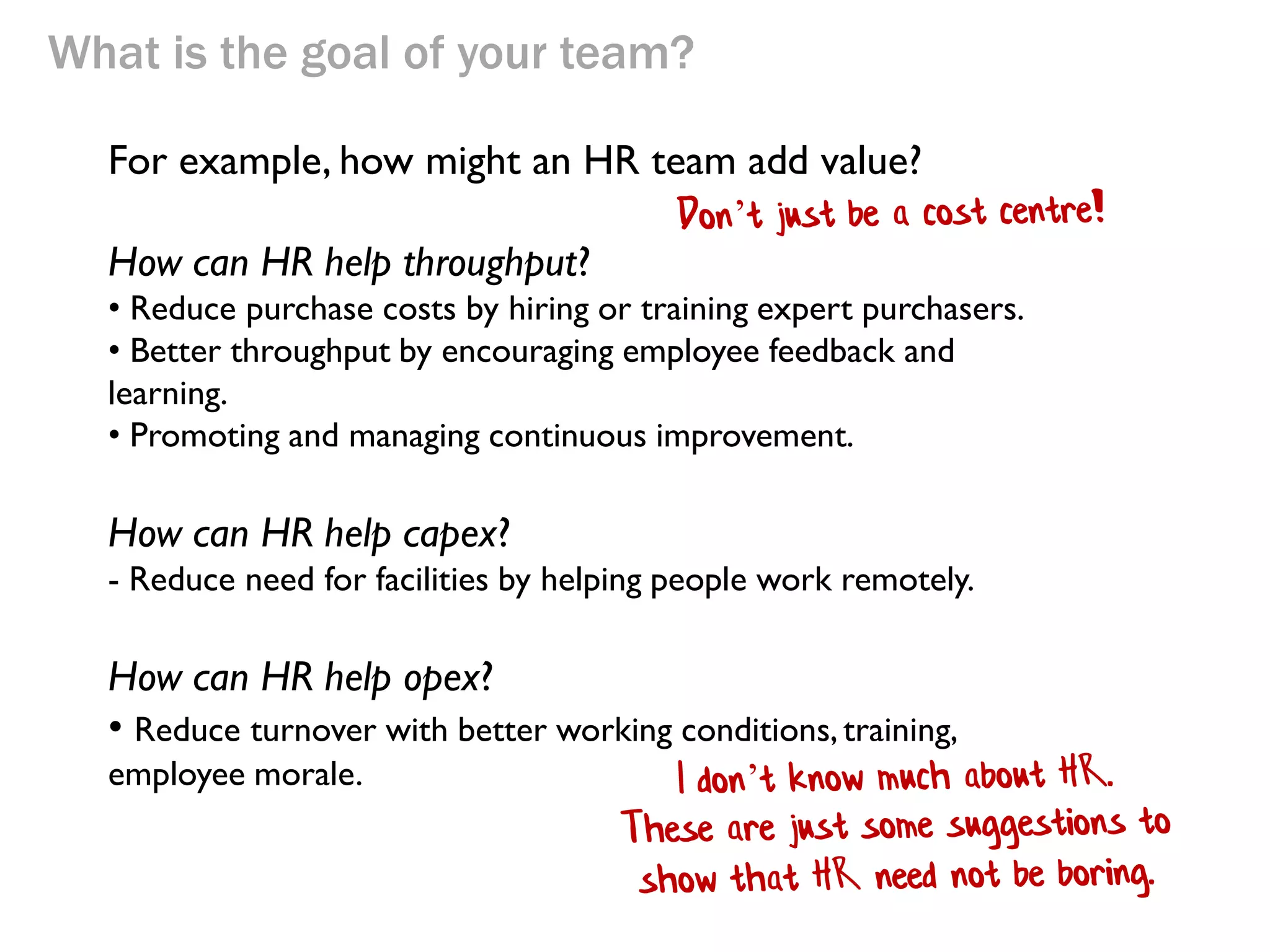
What is the goal of your team?
For example, how might an HR team add value?
How can HR help throughput?
• Reduce purchase costs by hiring or training expert purchasers.
• Better throughput by encouraging employee feedback and
learning.
• Promoting and managing continuous improvement.

How can HR help capex?
- Reduce need for facilities by helping people work remotely.

How can HR help opex?
• Reduce turnover with better working conditions, training,
employee morale.
What next?
What next?

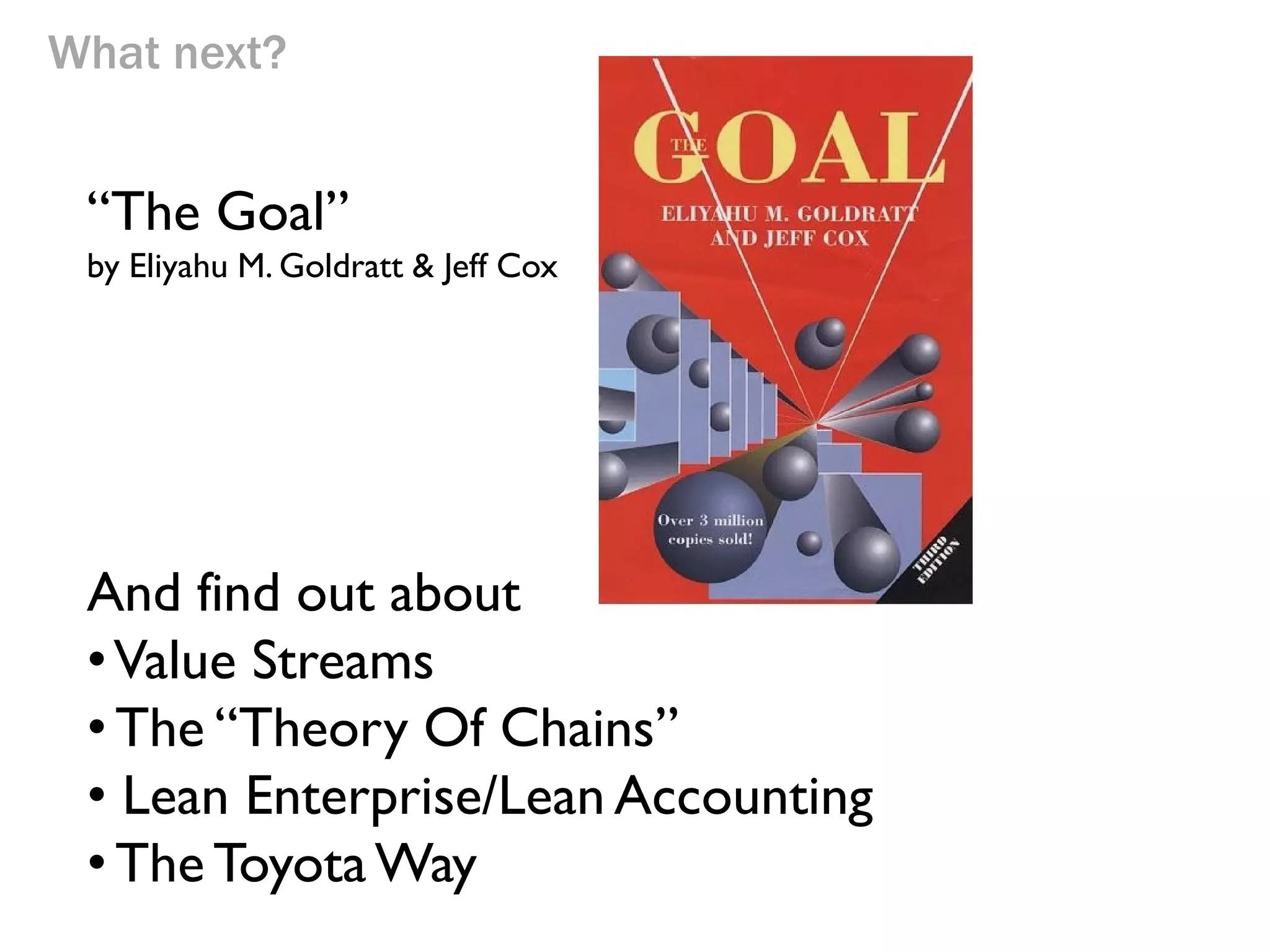
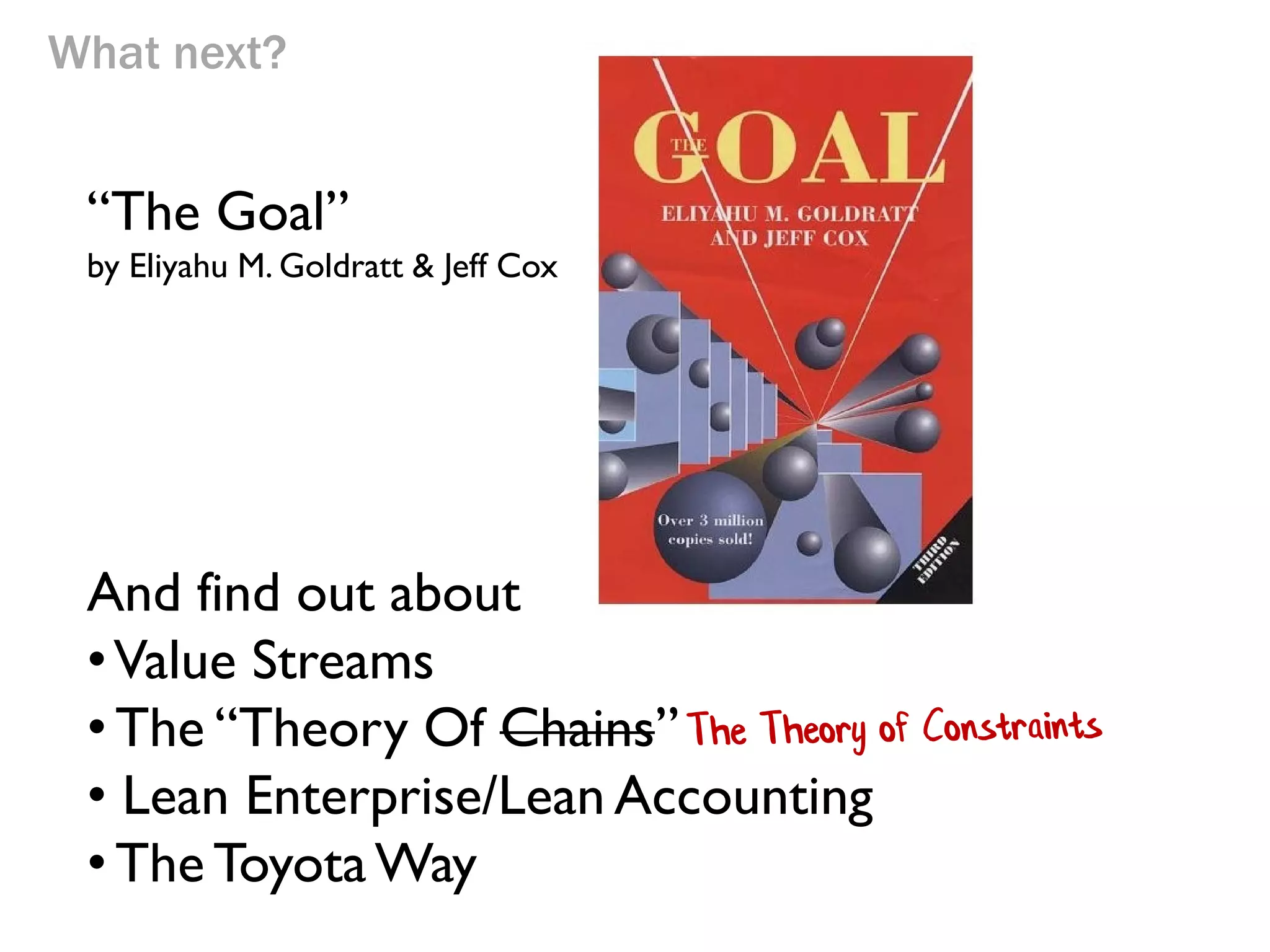
“The Goal”
by Eliyahu M. Goldratt & Jeff Cox

And find out about
• Value Streams
• The “Theory Of Chains”
• Lean Enterprise/Lean Accounting
• The Toyota Way
What next?

“The Goal”
by Eliyahu M. Goldratt & Jeff Cox

And find out about
• Value Streams
• The “Theory Of Chains”
• Lean Enterprise/Lean Accounting
• The Toyota Way
Thank you!
Contact me @ScottWlaschin

The Theory of Chains

  • 1.
    Starring: The Chain as“itself” The Theory of Chains
  • 2.
    The Theory ofChains Some (possibly overly simplistic but hopefully not too condescending) stories to help us think about what we are here for…
  • 3.
    Part 1 The fableof the two mules
  • 4.
    The fable ofthe two mules Let’s start with the famous fable of two mules who were tied together.
  • 5.
    The fable ofthe two mules They each wanted grass, but neither could get any because they were pulling in opposite directions.
  • 6.
    The fable ofthe two mules They pulled...
  • 7.
    The fable ofthe two mules They pulled...
  • 8.
    The fable ofthe two mules They pulled... And pulled...
  • 9.
    The fable ofthe two mules They pulled... And pulled...
  • 10.
    The fable ofthe two mules What were they doing wrong? What is the solution?
  • 11.
    The fable ofthe two mules The answer is obvious!
  • 12.
    The fable ofthe two mules They need to try harder!
  • 13.
    The fable ofthe two mules They need to try harder!
  • 14.
    The fable ofthe two mules They need to try harder!
  • 15.
    The fable ofthe two mules They need to try harder!
  • 16.
    The fable ofthe two mules They need to be more efficient!
  • 17.
    The fable ofthe two mules They need to be more efficient!
  • 18.
    The fable ofthe two mules They need to be more efficient!
  • 19.
    The fable ofthe two mules For anyone who doesn’t know this story... The moral is that co-operation is better than struggle.
  • 20.
    The fable ofthe two mules For anyone who doesn’t know this story... The moral is that co-operation is better than struggle. But that’s not my moral...
  • 21.
  • 22.
    Efficiency This is anefficient light bulb!
  • 23.
    Efficiency This is anefficient light bulb!
  • 24.
    Efficiency This is anefficient light bulb!
  • 25.
    Effectiveness Effectiveness is aboutthe direction, not the speed!
  • 26.
    Effectiveness Effectiveness is aboutthe direction, not the speed!
  • 27.
    Effectiveness Effectiveness is aboutthe direction, not the speed!
  • 28.
  • 29.
  • 30.
  • 31.
    Efficiency vs. Effectiveness Efficient DieSlowly Ineffective Effective Die Quickly Inefficient A helpful and un-ironic four-quadrant diagram
  • 32.
    Efficiency vs. Effectiveness Efficient DieSlowly Ineffective Effective Die Quickly Inefficient A helpful and un-ironic four-quadrant diagram
  • 33.
    Efficiency vs. Effectiveness Efficient DieSlowly Thrive Ineffective Effective Die Quickly Survive Inefficient A helpful and un-ironic four-quadrant diagram
  • 34.
    Efficiency vs. Effectiveness “Efficiencyis doing things right; effectiveness is doing the right things.” “There is surely nothing quite so useless as doing with great efficiency what should not be done at all.” “The most serious mistakes are not being made as a result of wrong answers. The true dangerous thing is asking the wrong question.” -- Peter Drucker.
  • 35.
  • 36.
    The chain Can yousee a problem with this chain?
  • 37.
    The chain Can yousee a problem with this chain?
  • 38.
  • 39.
  • 40.
  • 41.
    The chain Give up?The answer is...
  • 42.
    The chain The linksare wasting metal and heavier than they need to be.
  • 43.
    The chain I reducedmy diameter by 2mm I replaced my steel with aluminium A more efficient chain!
  • 44.
    The chain I reducedmy diameter by 2mm I replaced my steel with aluminium
  • 45.
    The chain I reducedmy diameter by 2mm I replaced my steel with aluminium
  • 46.
    Time for thefirst overly-simplistic business analogy....
  • 47.
  • 48.
  • 49.
  • 50.
    The chain I’ll lendyou some of my metal Me too! Help the weakest link get stronger.
  • 51.
    The chain I’ll lendyou some of my metal Me too! Help the weakest link get stronger. There is no point making other links efficient until the weakest link is strengthened..
  • 52.
    The chain • Whatis the goal of a chain?
  • 53.
    The chain • Whatis the goal of a chain? To be strong
  • 54.
    The chain • Whatis the goal of a chain? • Is there always a weakest link?
  • 55.
    The chain • Whatis the goal of a chain? • Is there always a weakest link? Yes!
  • 56.
    The chain • Whatis the goal of a chain? • Is there always a weakest link? • What is the most effective action to take?
  • 57.
    The chain • Whatis the goal of a chain? • Is there always a weakest link? • What is the most effective action to take? Make the weakest link stronger
  • 58.
  • 59.
  • 60.
  • 61.
  • 62.
  • 63.
  • 64.
    The bucket brigade MeetMr. Blue. And Mr Pink.
  • 65.
    The bucket brigade MeetMr. Blue. And Mr Pink. And Mr Green.
  • 66.
    The bucket brigade Theyare forming a human chain – a bucket brigade.
  • 67.
  • 68.
  • 69.
    The bucket brigade Water input Butwhat happens... Water output
  • 70.
    The bucket brigade Water input ...if Mr Blue is faster than Mr Pink? Water output
  • 71.
    The bucket brigade Water input Water output Abig puddle coming soon. ... if Mr Blue is faster than Mr Pink?
  • 72.
    The bucket brigade Water input Andwhat happens... Water output
  • 73.
    The bucket brigade Water input ...if Mr Green is faster than Mr Pink? Water output
  • 74.
    The bucket brigade Water input Water output MrGreen does a lot of waiting. He is quite bored now. Even Twitter has lost its charm. ... if Mr Green is faster than Mr Pink?
  • 75.
    The bucket brigade Water input •What is the goal of a bucket brigade? Water output
  • 76.
    The bucket brigade Water input Water output •What is the goal of a bucket brigade? To move as much water as possible in as little time as possible. Throughput, not efficiency.
  • 77.
    The bucket brigade Water input Water output •What is the goal of a bucket brigade? • What (or rather who) determines the throughput?
  • 78.
    The bucket brigade Water input Water output •What is the goal of a bucket brigade? • What (or rather who) determines the throughput? The slowest person
  • 79.
    The bucket brigade Water input Water output •What is the goal of a bucket brigade? • What (or rather who) determines the throughput? • Is there always a weakest link?
  • 80.
    The bucket brigade Water input Water output •What is the goal of a bucket brigade? • What (or rather who) determines the throughput? • Is there always a weakest link? Yes! There is always a slowest person
  • 81.
    The bucket brigade Water input • • • • Water output Whatis the goal of a bucket brigade? What (or rather who) determines the throughput? Is there always a weakest link? What is the most effective action to take?
  • 82.
    The bucket brigade Water input • • • • Water output Whatis the goal of a bucket brigade? What (or rather who) determines the throughput? Is there always a weakest link? What is the most effective action to take? Make the weakest link stronger
  • 83.
    The bucket brigade Water input • • • • Water output Whatis the goal of a bucket brigade? What (or rather who) determines the throughput? Make the slowest person faster Is there always a weakest link? What is the most effective action to take? Make the weakest link stronger
  • 84.
    The bucket brigade Water input Question:Which person never gets a rest? What happens if he does rest? Water output
  • 85.
    The bucket brigade Water input Water output Question:Which person never gets a rest? What happens if he does rest? Hint
  • 86.
    The bucket brigade Water input Water output Question:Which people always get a chance to be idle? What happens if you insist that they always keep working?
  • 87.
    The bucket brigade Water input Water output Hint Question:Which people always get a chance to be idle? What happens if you insist that they always keep working?
  • 88.
  • 89.
  • 90.
    Part V What isthe goal of a business?
  • 91.
    How a businessworks Stuff we buy Our business Inventory/Investment Stuff we sell Operating expenses
  • 92.
    The goal ofa business Throughput Goal: Try to increase this bit Our business Inventory/Investment Operating expenses
  • 93.
    The goal ofa business Throughput Our business Inventory/Investment Operating expenses These numbers are related, often in unobvious ways. Changing one affects all the others. It’s a balancing act!
  • 94.
    The goal ofa business Throughput Our business Inventory/Investment Operating expenses Some common metrics to help you relate the numbers and do the balancing act...
  • 95.
    The goal ofa business Throughput Our business Inventory/Investment Operating expenses Some common metrics to help you relate the numbers and do the balancing act... Net profit (NP) = Throughput (T) - Operating expense (OE)
  • 96.
    The goal ofa business Throughput Our business Inventory/Investment Operating expenses Some common metrics to help you relate the numbers and do the balancing act... Return on investment (ROI) = Net profit (NP) ÷ Investment (I)
  • 97.
    The goal ofa business Throughput Our business Inventory/Investment Operating expenses Some common metrics to help you relate the numbers and do the balancing act... Productivity = Throughput (T) ÷ Operating Expense (OE)
  • 98.
    The goal ofa business Throughput Our business Inventory/Investment Operating expenses Some common metrics to help you relate the numbers and do the balancing act... Investment Turns = Throughput (T) ÷ Investment (I)
  • 99.
    What if abucket brigade was like a business? Another overly-simplistic business analogy....
  • 100.
    If the bucketbrigade were a business... Water input If the bucket brigade were a business, what questions would we ask? Water output
  • 101.
    If the bucketbrigade were a business... Water input What is the throughput? Water output
  • 102.
    If the bucketbrigade were a business... Water input Water output What is the throughput? How long does it take a bucket to move through the system (“flow time”)? a.k.a "latency"
  • 103.
    If the bucketbrigade were a business... Water input Water output What is the throughput? How long does it take a bucket to move through the system (“flow time”)? What is the current inventory?
  • 104.
    If the bucketbrigade were a business... Water input Water output What is the throughput? How long does it take a bucket to move through the system (“flow time”)? What is the current inventory? What are the operating expenses?
  • 105.
    Real Numbers Mr Bluecan do 2 Buckets/hour Each worker costs $12/hour Mr Pink can do 1 Bucket/hour Mr Green can do 3 Buckets/hour Each bucket sells for a markup of $24 Let’s look at some real numbers!
  • 106.
    Real Numbers 2 Buckets/hour $24 $12/hour 1Bucket/hour $24 What is the throughput? $12/hour 3 Buckets/hour $24 $12/hour $24
  • 107.
    Real Numbers 2 Buckets/hour $24 $12/hour 1Bucket/hour $24 $12/hour 3 Buckets/hour $24 $12/hour $24 What is the throughput? 1 bucket/hour (Mr Pink is to blame)
  • 108.
    Real Numbers 2 Buckets/hour $24 $12/hour 1Bucket/hour $24 $12/hour 3 Buckets/hour $24 $12/hour $24 What is the throughput? How long does it take a bucket to move through the system (“flow time”)?
  • 109.
    Real Numbers 2 Buckets/hour $24 $12/hour 1Bucket/hour $24 $12/hour 3 Buckets/hour $24 $12/hour $24 What is the throughput? How long does it take a bucket to move through the system (“flow time”)? Mr Blue takes 30 min per bucket, and Mr Green takes 20 min, so it takes a bucket 1h 50m to go through the system.
  • 110.
    Real Numbers 2 Buckets/hour $24 $12/hour 1Bucket/hour $24 $12/hour 3 Buckets/hour $24 $12/hour $24 What is the throughput? How long does it take a bucket to move through the system (“flow time”)? What is the current inventory?
  • 111.
    Real Numbers 2 Buckets/hour $24 $12/hour 1Bucket/hour $24 $12/hour 3 Buckets/hour $24 $12/hour $24 What is the throughput? How long does it take a bucket to move through the system (“flow time”)? What is the current inventory? Little’s law: inventory = throughput * flow time. So inventory = 1 bucket/hour x 1.83 hours => 1.83 buckets
  • 112.
    Real Numbers 2 Buckets/hour $24 $12/hour 1Bucket/hour $24 $12/hour 3 Buckets/hour $24 $12/hour $24 What is the throughput? How long does it take a bucket to move through the system (“flow time”)? What is the current inventory? What are the operating expenses?
  • 113.
    Real Numbers 2 Buckets/hour $24 $12/hour 1Bucket/hour $24 $12/hour 3 Buckets/hour $24 $12/hour $24 What is the throughput? How long does it take a bucket to move through the system (“flow time”)? What is the current inventory? What are the operating expenses? $12/hour x three people = $36/hour
  • 114.
    Real Numbers 2 Buckets/hour $24 $12/hour 1Bucket/hour $24 $12/hour 3 Buckets/hour $24 $12/hour $24 Throughput (buckets/hr) (money/hr) Flow time Inventory (buckets) Opex (money/hr) Net Profit (money/hr) = T - OE Inventory turns = T/I 1/hr or $24/hr 1h 50m 1.83 $36/hr -$12/hr 0.54 Here are all the numbers.... Oh noes.... We’re losing money!
  • 115.
    Real Numbers We’re losingmoney – what should we do?
  • 116.
    Real Numbers We’re losingmoney – what should we do? Let’s step back and look at the problem...
  • 117.
    Real Numbers We’re losingmoney – what should we do? Let’s step back and look at the problem... Mr Pink is working flat out but look at all the idle people! Mr Blue is only working ½ time. And Mr Green is working only a third of the time. Lazy sod!
  • 118.
    Real Numbers We’re losingmoney – what should we do? Let’s step back and look at the problem... Mr Pink is working flat out but look at all the idle people! Mr Blue is only working ½ time. And Mr Green is working only a third of the time. There’s your problem right there!
  • 119.
    Real Numbers What todo? Option 1: Panic!
  • 120.
    Real Numbers What todo? Option 1: Panic! Option 1: Reduce wages or staff (helps with operating expenses) Especially the lazy ones like Mr Pink...
  • 121.
    Real Numbers What todo? Option 1: Reduce wages or staff (helps with operating expenses) Option 2: Hire extra people (helps with throughput, maybe?)
  • 122.
    Real Numbers What todo? Option 1: Reduce wages or staff (helps with operating expenses) Option 2: Hire extra people (helps with throughput, maybe?) Option 3: Change the process (but how?)
  • 123.
    Fixing the problemby reducing staff 2 Buckets/hour $24 $12/hour 1 Bucket/hour $24 $12/hour 3 Buckets/hour $24 $12/hour $24 Let’s start with option 1: “Reduce staff on the non-bottlenecks” A.k.a. Don’t pay people to be idle.
  • 124.
    Fixing the problemby reducing staff As it happens, around this time, Mr Blue had a very unfortunate industrial accident – he was cut in half.
  • 125.
    Fixing the problemby reducing staff As it happens, around this time, Mr Blue had a very unfortunate industrial accident – he was cut in half. Luckily he can still work at 2 buckets/hour, But since there is only half of him, his average throughput is now 1 bucket/hr.
  • 126.
    Fixing the problemby reducing staff As it happens, around this time, Mr Blue had a very unfortunate industrial accident – he was cut in half. Luckily he can still work at 2 buckets/hour, But since there is only half of him, his average throughput is now 1 bucket/hr. As a result, the cruel capitalists who employ him have decided to slash his salary in half as well -- to only $6/hr.
  • 127.
    Fixing the problemby reducing staff By coincidence Mr Green also had a very unfortunate industrial accident – he was cut into one third.
  • 128.
    Fixing the problemby reducing staff By coincidence Mr Green also had a very unfortunate industrial accident – he was cut into one third.
  • 129.
    Fixing the problemby reducing staff By coincidence Mr Green also had a very unfortunate industrial accident – he was cut into one third. His productivity is only a third now. Just like Mr Blue, his average is now 1 bucket/hr. The cruel capitalists have decided to slash his salary even more -- to only $4/hr.
  • 130.
    Fixing the problemby reducing staff 1 Bucket/hour $24 $6/hour 1 Bucket/hour $24 $12/hour 1 Bucket/hour $24 $4/hour $24 Here is the new setup. Mr Blue and Mr Green have been rehired at lower wages, corresponding to their lower throughput.
  • 131.
    Fixing the problemby reducing staff 1 Bucket/hour $24 $6/hour 1 Bucket/hour $24 $12/hour 1 Bucket/hour $24 $4/hour What is the throughput? Still 1 bucket/hour $24
  • 132.
    Fixing the problemby reducing staff 1 Bucket/hour $24 $6/hour 1 Bucket/hour $24 $12/hour 1 Bucket/hour $24 $4/hour $24 What is the throughput? How long does it take a bucket to move through the system (“flow time”)? Mr Blue and Mr Green have lower throughputs, but their latency is still the same. so the flow time is unchanged at 1h 50min.
  • 133.
    Fixing the problemby reducing staff 1 Bucket/hour $24 $6/hour 1 Bucket/hour $24 $12/hour 1 Bucket/hour $24 $4/hour $24 What is the throughput? How long does it take a bucket to move through the system (“flow time”)? What is the current inventory? Same as before.
  • 134.
    Fixing the problemby reducing staff 1 Bucket/hour $24 $6/hour 1 Bucket/hour $24 $12/hour 1 Bucket/hour $24 $4/hour $24 What is the throughput? How long does it take a bucket to move through the system (“flow time”)? What is the current inventory? What are the operating expenses? $6 + $12 + $4 = $22/hour
  • 135.
    Fixing the problemby reducing staff 1 Bucket/hour $24 Throughput (buckets/hr) (money/hr) 1/hr or $24/hr $6/hour Flow time 1h 50m 1 Bucket/hour $24 $12/hour 1 Bucket/hour $24 $4/hour Inventory Opex Net Profit (buckets) (money/hr) (money/hr) = T - OE 1.83 Here are the new numbers... $22/hr +$2/hr $24 Inventory turns = T/I 0.54
  • 136.
    Fixing the problemby adding staff 2 Buckets/hour $24 $12/hour 1 Bucket/hour $24 $12/hour 3 Buckets/hour $24 $12/hour $24 Now try option 2: “Adding extra staff on the bottleneck” That is -- bring the weakest links up to speed
  • 137.
    Fixing the problemby adding staff 2 Buckets/hour $24 $12/hour 3 Buckets/hour $24 $36/hour 3 Buckets/hour $24 $12/hour We’ll hire 2 people to help Mr Pink. This team’s throughput is now 3 buckets/hour! $24
  • 138.
    Fixing the problemby adding staff 2 Buckets/hour $24 $12/hour 3 Buckets/hour $24 $36/hour But now Mr Blue is the bottleneck. 3 Buckets/hour $24 $12/hour $24
  • 139.
    Fixing the problemby adding staff 2 Buckets/hour $24 $12/hour 3 Buckets/hour $24 $36/hour 3 Buckets/hour $24 $12/hour But now Mr Blue is the bottleneck. Luckily he has a half-brother who can help. $24
  • 140.
    Fixing the problemby adding staff 2 Buckets/hour $24 $12/hour 3 Buckets/hour $24 $36/hour 3 Buckets/hour $24 $12/hour But now Mr Blue is the bottleneck. Luckily he has a half-brother who can help. Literally! $24
  • 141.
    Fixing the problemby adding staff 3 Buckets/hour $24 $18/hour 3 Buckets/hour $24 $36/hour 3 Buckets/hour $24 $12/hour $24 Mr Blue’s throughput is now 3 buckets/hour as well.
  • 142.
    Fixing the problemby adding staff 3 Buckets/hour $24 Throughput (buckets/hr) (money/hr) 3/hr or $72/hr $18/hour Flow time 1h 50m 3 Buckets/hour $24 $36/hour 3 Buckets/hour $24 $12/hour Inventory Opex Net Profit (buckets) (money/hr) (money/hr) = T - OE 5.5 $66/hr Here are the numbers for this approach. +$6/hr $24 Inventory turns = T/I 0.54
  • 143.
    Fixing the problemby adding staff Moral: Adding staff can be more profitable than reducing staff – if you know where to add them. Adding also gives economies of scale, because there are other fixed costs like buildings, etc., which don’t need to be scaled at the same rate.
  • 144.
    Fixing the problemby adding staff Moral: Adding staff can be more profitable than reducing staff – if you know where to add them. Adding also gives economies of scale, because there are other fixed costs like buildings, etc., which don’t need to be scaled at the same rate. Question: Under what circumstances can you NOT add staff?
  • 145.
    Fixing the problemby adding staff Moral: Adding staff can be more profitable than reducing staff – if you know where to add them. Adding also gives economies of scale, because there are other fixed costs like buildings, etc., which don’t need to be scaled at the same rate. But can we do even better?
  • 146.
    Fixing the problemby changing the process 2 Buckets/hour $24 $12/hour 1 Bucket/hour $24 $12/hour 3 Buckets/hour $24 $12/hour $24 Option 3 is “changing the process”. What does that look like?
  • 147.
    Fixing the problemby changing the process 2 Buckets/hour $24 $12/hour 1 Bucket/hour $24 $12/hour 3 Buckets/hour $24 $12/hour $24 What happens if we get rid of the second step in the process and merge it into the first?
  • 148.
    Fixing the problemby changing the process What happens if we get rid of the second step in the process and merge it into the first?
  • 149.
    Fixing the problemby changing the process Mr Blue and Mr Pink now work together on step 1. Their combined throughput is now 3 buckets/hour.
  • 150.
    Fixing the problemby changing the process 3 Buckets/hour $24 $12/hour $12/hour 3 Buckets/hour $24 $12/hour Mr Blue and Mr Pink now work together on step 1. Their combined throughput is now 3 buckets/hour. $24
  • 151.
    Fixing the problemby changing the process 3 Buckets/hour $24 $12/hour $12/hour 3 Buckets/hour $24 $12/hour Mr Blue and Mr Pink now work together on step 1. Their combined throughput is now 3 buckets/hour. $24
  • 152.
    Fixing the problemby changing the process 3 Buckets/hour $24 $12/hour $12/hour 3 Buckets/hour $24 $12/hour What is the throughput? 3 buckets/hour $24
  • 153.
    Fixing the problemby changing the process 3 Buckets/hour $24 $12/hour $12/hour 3 Buckets/hour $24 $12/hour $24 What is the throughput? How long does it take a bucket to move through the system (“flow time”)? Mr Blue and Mr Pink have a combined latency of 40 mins so the total flow time is now 1 hour.
  • 154.
    Fixing the problemby changing the process 3 Buckets/hour $24 $12/hour $12/hour 3 Buckets/hour $24 $12/hour $24 What is the throughput? How long does it take a bucket to move through the system (“flow time”)? What is the current inventory? Little’s law: inventory = throughput * flow time. So inventory = 3 bucket/hour x 1 hours => 3 buckets
  • 155.
    Fixing the problemby changing the process 3 Buckets/hour $24 $12/hour $12/hour 3 Buckets/hour $24 $12/hour $24 What is the throughput? How long does it take a bucket to move through the system (“flow time”)? What is the current inventory? What are the operating expenses? $12 x three = $36/hour
  • 156.
    Fixing the problemby changing the process 3 Buckets/hour $24 Throughput (buckets/hr) (money/hr) 3/hr or $72/hr $12/hour Flow time 1h $12/hour 3 Buckets/hour $24 $12/hour Inventory Opex Net Profit (buckets) (money/hr) (money/hr) = T - OE 3 $36/hr +$36/hr $24 Inventory turns = T/I 1
  • 157.
    Summary of differentapproaches Option Throughput (buckets/hr) (money/hr) Flow time Inventory Opex Net Profit (buckets) (money/hr) (money/hr) = T - OE Inventory turns = T/I Original 1/hr or £24/hr 1h 50m 1.83 £36/hr -£12/hr 0.54 Reduce Staff 1/hr or £24/hr 1h 50m 1.83 £22/hr +£2/hr 0.54 Increase Staff 3/hr or £72/hr 1h 50m 5.5 £66/hr +£6/hr 0.54 Change Process 3/hr or £72/hr 1h 3 £36/hr +£36/hr 1.0
  • 158.
    Summary of differentapproaches Option Throughput (buckets/hr) (money/hr) Flow time Inventory Opex Net Profit (buckets) (money/hr) (money/hr) = T - OE Inventory turns = T/I Original 1/hr or £24/hr 1h 50m 1.83 £36/hr -£12/hr 0.54 Reduce Staff 1/hr or £24/hr 1h 50m 1.83 £22/hr +£2/hr 0.54 Increase Staff 3/hr or £72/hr 1h 50m 5.5 £66/hr +£6/hr 0.54 Change Process 3/hr or £72/hr 1h 3 £36/hr +£36/hr 1.0
  • 159.
    Summary of differentapproaches Moral: Changing the process can have much greater impact than just tweaking efficiencies.
  • 160.
    Summary of differentapproaches Moral: Changing the process can have much greater impact than just tweaking efficiencies.
  • 161.
    Summary of differentapproaches Moral: Changing the process can have much greater impact than just tweaking efficiencies.
  • 162.
    What is thegoal of IT?
  • 163.
    What is thegoal of IT? Sales IT Supply Chain What is the most effective action for IT to take?
  • 164.
    What is thegoal of IT? Sales IT Supply Chain
  • 165.
    What is thegoal of IT? Sales IT Supply Chain
  • 166.
    What is thegoal of IT? Sales IT Supply Chain IT should not be a cost centre
  • 167.
    What is thegoal of IT? Throughput The business Inventory/Investment Operating expenses IT should add value to the business
  • 168.
    What is thegoal of IT? Throughput The business Inventory/Investment Operating expenses IT should add value to the business
  • 169.
    What is thegoal of IT? Throughput The business Inventory/Investment Operating expenses IT should add value to the business
  • 170.
    What is thegoal of your team?
  • 171.
    What is thegoal of your team? Sales Your team Supply Chain What is the most effective action for your team to take?
  • 172.
    What is thegoal of your team? Throughput The business Inventory/Investment Operating expenses Where can your team add value to the business?
  • 173.
    What is thegoal of your team? Throughput The business Inventory/Investment Operating expenses Where can your team add value to the business?
  • 174.
    What is thegoal of your team? For example, how might an HR team add value?
  • 175.
    What is thegoal of your team? For example, how might an HR team add value? How can HR help throughput? • Reduce purchase costs by hiring or training expert purchasers. • Better throughput by encouraging employee feedback and learning. • Promoting and managing continuous improvement. How can HR help capex? - Reduce need for facilities by helping people work remotely. How can HR help opex? • Reduce turnover with better working conditions, training, employee morale.
  • 176.
    What is thegoal of your team? For example, how might an HR team add value? How can HR help throughput? • Reduce purchase costs by hiring or training expert purchasers. • Better throughput by encouraging employee feedback and learning. • Promoting and managing continuous improvement. How can HR help capex? - Reduce need for facilities by helping people work remotely. How can HR help opex? • Reduce turnover with better working conditions, training, employee morale.
  • 177.
  • 178.
    What next? “The Goal” byEliyahu M. Goldratt & Jeff Cox And find out about • Value Streams • The “Theory Of Chains” • Lean Enterprise/Lean Accounting • The Toyota Way
  • 179.
    What next? “The Goal” byEliyahu M. Goldratt & Jeff Cox And find out about • Value Streams • The “Theory Of Chains” • Lean Enterprise/Lean Accounting • The Toyota Way
  • 180.
    Thank you! Contact me@ScottWlaschin