June 2003


                      A AND AS LEVEL


                    MARKING SCHEME


                    MAXIMUM MARK: 90


            SYLLABUS/COMPONENT: 9691/01, 5216/01
                       COMPUTING
                       Written Paper 1
Page 1                          Mark Scheme                           Syllabus   Paper
                             A AND AS LEVEL – JUNE 2003                    9691        1


1 (a)   - OS controls operation of system/hardware
        - Applications software allows the system to do something useful             (2)

  (b)   - File handling
        - Copy/move/delete
        - Anti virus software
        - To protect files from attack by virus
        - Defragmentation
        - To keep files sensibly arranged on the hard drive
        - Format
        - To divide surface of drive into smaller areas to aid storage
        (1 per -, max 6)                                                             (6)


2 (a)   (i)     Jobs collected together for processing at a later time
        (ii)    Output produced quickly enough to affect the next input
        (iii)   User has direct contact with processor
        (iv)    User cannot communicate directly with processor                      (4)

  (b)   - Real time
        - E.g. turning the wheel must turn the car immediately
        - On line
        - Otherwise system cannot be real time                                       (4)

  (c)   - Sharing of software and data files
        - Sharing of hardware, e.g. printers
        - Communication
        - Security of files more of a problem
        (1 per -, max 3)                                                             (3)


3 (a)   (i)     Incorrect use of language, e.g. PLINT instead of PRINT
        (ii)    A mistake in the structure of the solution, e.g. a jump goes to
                the wrong line
        (iii)   Inappropriate arithmetic is used, e.g. division by 0
                is attempted                                                         (6)

  (b)   - Translator diagnostics
        - Produced when wrong programming used
        - Gives position and explanation of error
        - Cross-referencing
        - Used when program modularised
        - To check use of variables
        - Trace routines
        - Follow value of variable
        - To give clue as to where error occurs
        - Variable dump
        - Prints values of all variables
        - At given point in program
        (1 per -, max 2 per type, max 4)                                             (4)


                 © University of Cambridge Local Examinations Syndicate 2003
Page 2                        Mark Scheme                          Syllabus   Paper
                           A AND AS LEVEL – JUNE 2003                   9691        1


4 (a)   - Data enters at one end (of a stack)
        - Leaves at the same end
        - Hence 'last in, first out'
        (1 per -, max 2)                                                          (2)

  (b)


        SP                       ARRAY
        (1)                        (1)
                  STACK


                                                                                  (2)


5 (a)   - Uses all 7 digits
        - Creates >2000 results
        - Highlight the danger of multiplying by zero                             (2)

  (b)    Any two 7 digit numbers that cause a clash                               (1)

  (c)   - Search serially from hash value
        - Until vacant location found
        - Mention of circular reference
        - If the memory locations become full, use a bucket
        - Use bucket to place duplicates in
        - In serial form
        - Pointer to bucket from hashed location
        - Use hashed location as start of linked list
        - Ensure end of list with null value of pointer
        (1 per -, max 2 methods, max 4)                                           (4)


6 (a)   (i)   To manage the execution of instructions
              By running a clock
              To decode instructions
        (ii) To store OS
              To store those parts of applications programs currently running
              To store data currently in use
        (iii) Part of processor where data is processed/manipulated
              All I/O must pass through here
        (1 per -, max 2, 2, 2, max 6)                                             (6)

  (b)   - Main memory transitory, secondary storage is (semi-)permanent
        - Processor can only use data/instructions that are in main memory
        - Main memory in processor, secondary storage not
        (1 per - max 2)                                                            (2)


              © University of Cambridge Local Examinations Syndicate 2003
Page 3                         Mark Scheme                          Syllabus    Paper
                              A AND AS LEVEL – JUNE 2003                   9691         1


7 (a)     - Serial is the transmission of data one bit at a time/through one wire
          - Parallel is the transmission of data more than one bit at a time/many wires
          - Simplex is the transmission of data in one direction only
          - Duplex is the transmission of data in both directions simultaneously      (4)

    (b)   - Extra bit on each data-byte that
          - Does not transmit data
          - Makes number of ones in a byte be always even or always odd
          - Error in the transmission of a bit will make the even/odd wrong
          - Problem of two errors in one byte not being found
          - Parity block
          (1 per -, max 4)                                                           (4)


8         - College authorities are the experts in the problem
          - SA is the expert with computers
          - The two need to pool resources to come up with a clear definition
          - Agree the outcomes so that when the system is implemented there are a
            set of criteria to judge it by
          (1 per -, max 4)                                                       (4)


9 (a)     - Corporate colour scheme
          - Languages to be used
          - What information should be on
          - Should the site be two way/students allowed to enroll
          - Size of the site
          - What links should there be?
          (1 per -, max 4)                                                           (4)

    (b)   - Presentation software
          - Talks to large groups
          - DTP
          - Produce newsletter/advertising material
          - Word processor
          - Mail merged personal letters/junk mail
          - Database
          - To store lists of the recipients of the junk mail
          (1 per -, max 4)                                                           (4)


10        A description of:
          - Passwords
          - Hierarchy
          - Only allow some staff to access student files
          - Only some machines able to access
          - Physical location of these machines
          - Physical lock on machines
          - Encrypted data in files
          - Firewall if connected to the Internet
          (1 per -, max 5)                                                           (5)


                 © University of Cambridge Local Examinations Syndicate 2003
Page 4                       Mark Scheme                            Syllabus   Paper
                           A AND AS LEVEL – JUNE 2003                     9691        1


11      (i)   Dual input of data
              Two inputs are compared by the system
              And any discrepancies reported (and not stored.)
              Data input once, either printed out or checked on screen
              Errors corrected
        (ii) Rules given to processor
              Only accept A,B,C,D,E,F,G
              Any other input rejected.
              Drop-down list/radio buttons
              Provides only valid inputs
              So no other validation required
        (1 per -, max 6)                                                            (6)


12      Enrolment:
        - Data input on line
        - Individual records validated
        - Speed mismatch implications
        - Indexes updated immediately

        Exam grades:
        - Data input twice
        - Off line
        - Run as a batch
        - At otherwise downtime
        (1 per -, max 6)                                                            (6)


13      - Day to day information supplied to teachers
        - About abilities of students
        - Class lists
        - Middle managers
        - E.g. departmental exam results
        - Strategic information
        - Supplied to Principal
        - E.g. overall exam results to compare performance of departments
        - Comparison of grades year on year
        (1 per -, max 5)                                                            (5)

                                                                     TOTAL           90


              © University of Cambridge Local Examinations Syndicate 2003
June 2003


                      A AND AS LEVEL


                    MARKING SCHEME


                    MAXIMUM MARK: 60


            SYLLABUS/COMPONENT: 9691/02, 5217/01
                        COMPUTING
                       Practical Tasks
Page 1                        Mark Scheme                           Syllabus     Paper
                          A AND AS LEVEL – JUNE 2003                    9691          2


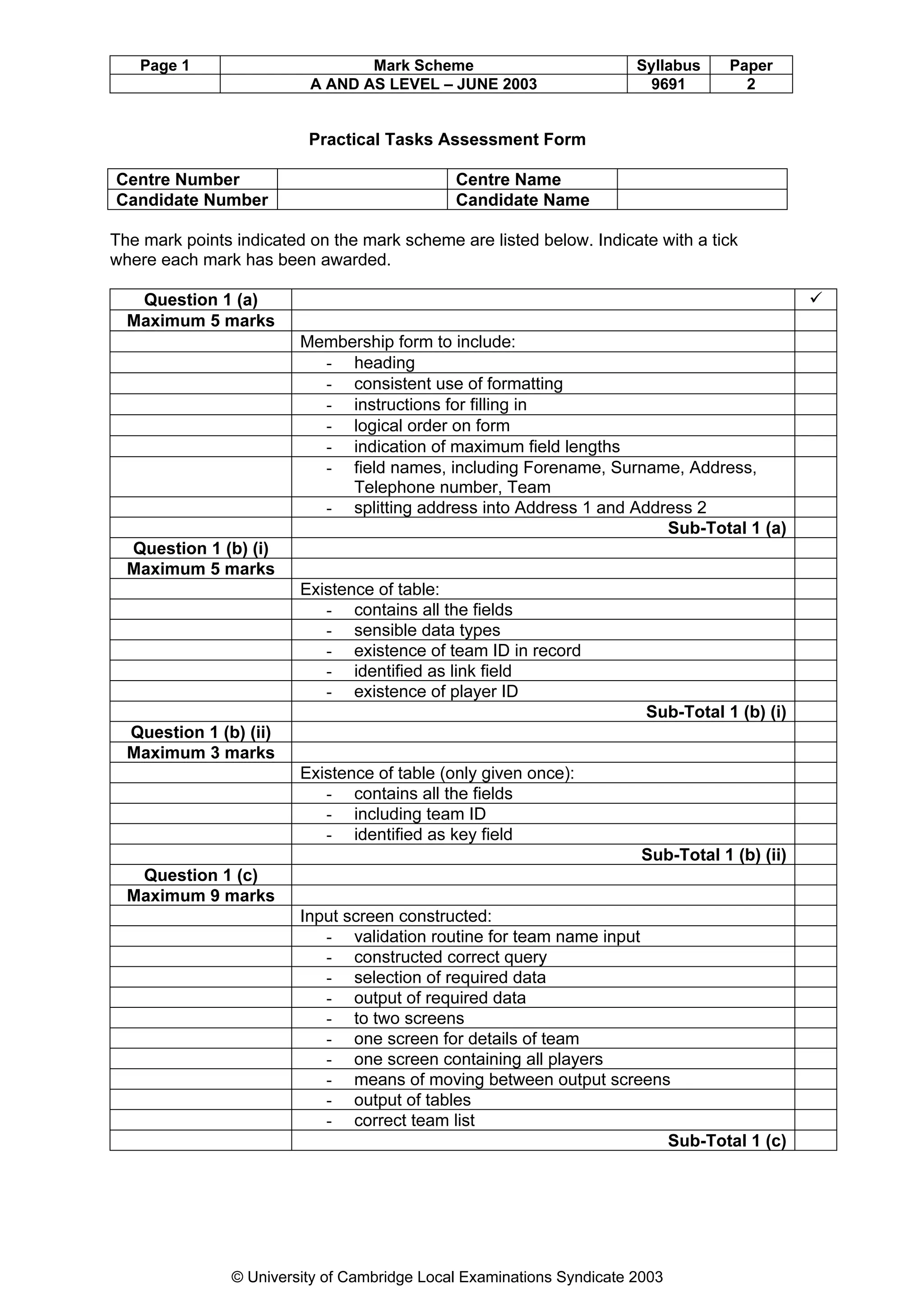
                          Practical Tasks Assessment Form

Centre Number                                 Centre Name
Candidate Number                              Candidate Name

The mark points indicated on the mark scheme are listed below. Indicate with a tick
where each mark has been awarded.

   Question 1 (a)                                                                              ü
  Maximum 5 marks
                         Membership form to include:
                           - heading
                           - consistent use of formatting
                           - instructions for filling in
                           - logical order on form
                           - indication of maximum field lengths
                           - field names, including Forename, Surname, Address,
                              Telephone number, Team
                           - splitting address into Address 1 and Address 2
                                                                      Sub-Total 1 (a)
  Question 1 (b) (i)
  Maximum 5 marks
                         Existence of table:
                            - contains all the fields
                            - sensible data types
                            - existence of team ID in record
                            - identified as link field
                            - existence of player ID
                                                                        Sub-Total 1 (b) (i)
  Question 1 (b) (ii)
  Maximum 3 marks
                         Existence of table (only given once):
                            - contains all the fields
                            - including team ID
                            - identified as key field
                                                                        Sub-Total 1 (b) (ii)
   Question 1 (c)
  Maximum 9 marks
                         Input screen constructed:
                            - validation routine for team name input
                            - constructed correct query
                            - selection of required data
                            - output of required data
                            - to two screens
                            - one screen for details of team
                            - one screen containing all players
                            - means of moving between output screens
                            - output of tables
                            - correct team list
                                                                     Sub-Total 1 (c)


                © University of Cambridge Local Examinations Syndicate 2003
Page 2                       Mark Scheme                           Syllabus      Paper
                       A AND AS LEVEL – JUNE 2003                    9691           2


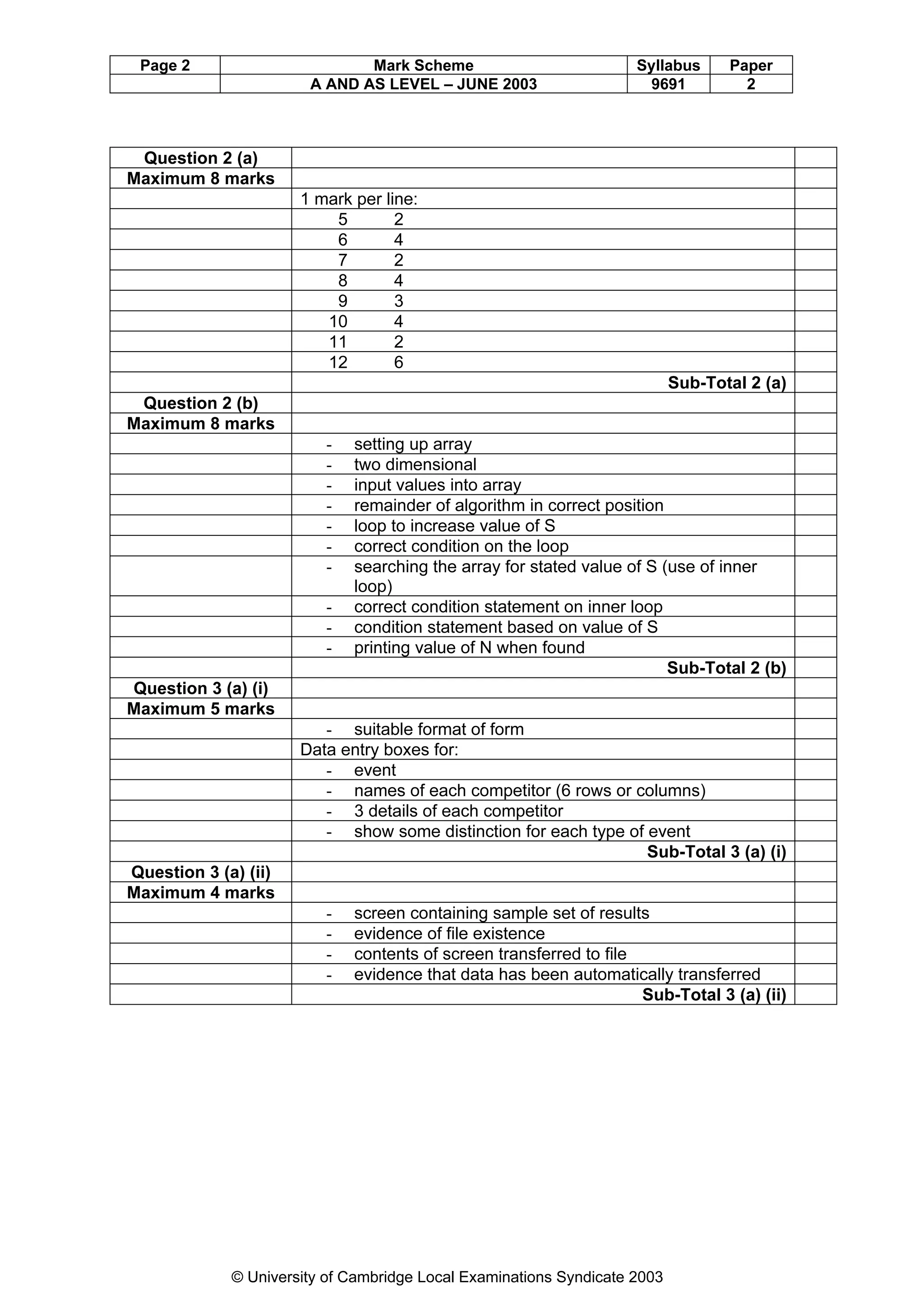
 Question 2 (a)
Maximum 8 marks
                      1 mark per line:
                          5        2
                          6        4
                          7        2
                          8        4
                          9        3
                         10        4
                         11        2
                         12        6
                                                                           Sub-Total 2 (a)
 Question 2 (b)
Maximum 8 marks
                         -   setting up array
                         -   two dimensional
                         -   input values into array
                         -   remainder of algorithm in correct position
                         -   loop to increase value of S
                         -   correct condition on the loop
                         -   searching the array for stated value of S (use of inner
                             loop)
                         -   correct condition statement on inner loop
                         -   condition statement based on value of S
                         -   printing value of N when found
                                                                        Sub-Total 2 (b)
Question 3 (a) (i)
Maximum 5 marks
                         - suitable format of form
                      Data entry boxes for:
                         - event
                         - names of each competitor (6 rows or columns)
                         - 3 details of each competitor
                         - show some distinction for each type of event
                                                                  Sub-Total 3 (a) (i)
Question 3 (a) (ii)
Maximum 4 marks
                         -   screen containing sample set of results
                         -   evidence of file existence
                         -   contents of screen transferred to file
                         -   evidence that data has been automatically transferred
                                                                    Sub-Total 3 (a) (ii)


             © University of Cambridge Local Examinations Syndicate 2003
Page 3                    Mark Scheme                           Syllabus    Paper
                    A AND AS LEVEL – JUNE 2003                    9691         2


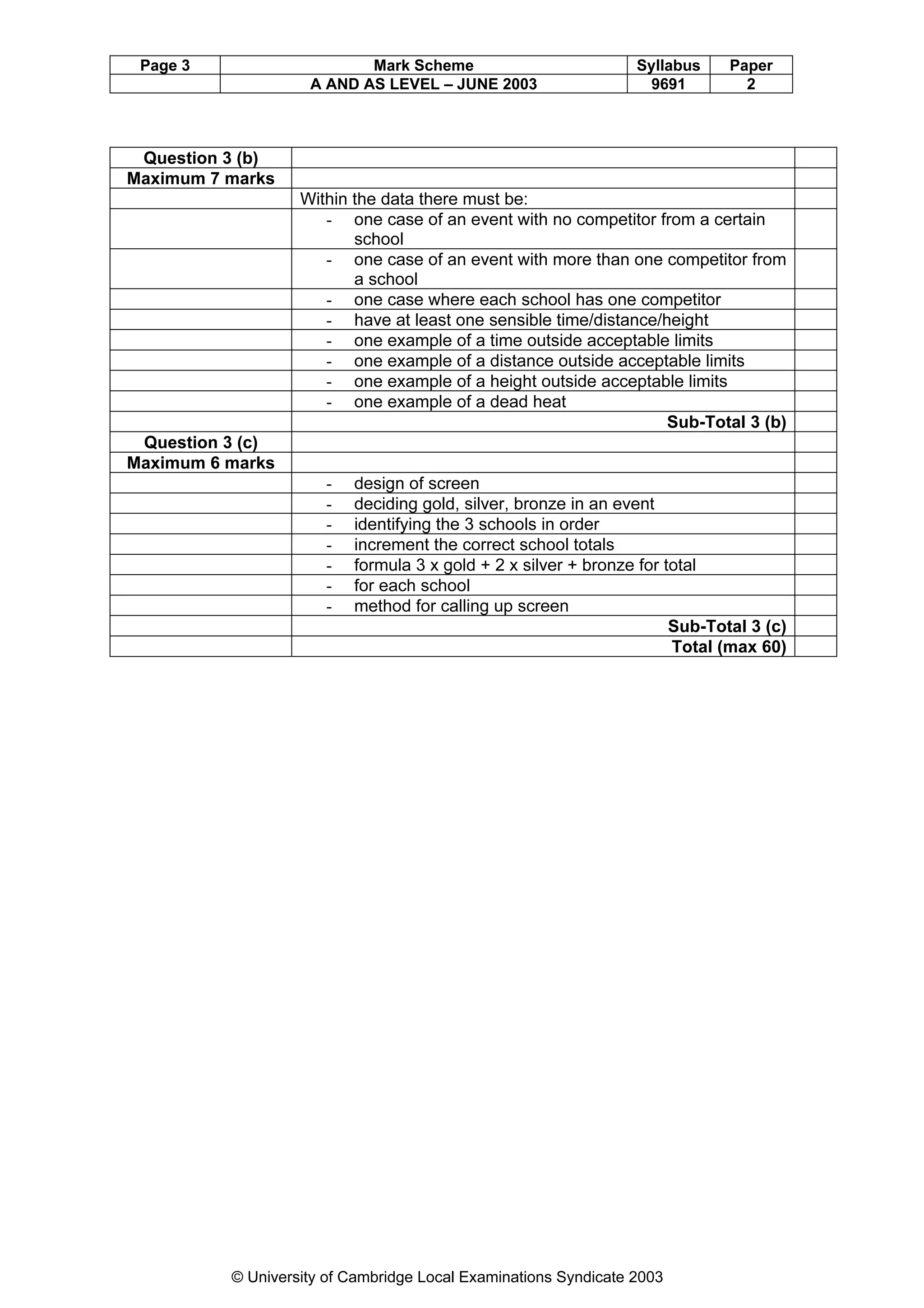
 Question 3 (b)
Maximum 7 marks
                   Within the data there must be:
                      - one case of an event with no competitor from a certain
                          school
                      - one case of an event with more than one competitor from
                          a school
                      - one case where each school has one competitor
                      - have at least one sensible time/distance/height
                      - one example of a time outside acceptable limits
                      - one example of a distance outside acceptable limits
                      - one example of a height outside acceptable limits
                      - one example of a dead heat
                                                                  Sub-Total 3 (b)
 Question 3 (c)
Maximum 6 marks
                      -   design of screen
                      -   deciding gold, silver, bronze in an event
                      -   identifying the 3 schools in order
                      -   increment the correct school totals
                      -   formula 3 x gold + 2 x silver + bronze for total
                      -   for each school
                      -   method for calling up screen
                                                                      Sub-Total 3 (c)
                                                                      Total (max 60)


          © University of Cambridge Local Examinations Syndicate 2003
June 2003


                  A AND AS LEVEL


                MARKING SCHEME


                MAXIMUM MARK: 90


        SYLLABUS/COMPONENT: 9691/03, 5218/01
                   COMPUTING
                   Written Paper 3
Page 1                         Mark Scheme                              Syllabus   Paper
                            A AND AS LEVEL – JUNE 2003                       9691        3


1    (a) The sequence will have to be interpreted 2000 times/this will include all
         stages, such as checking
         Compiled version needs no further translation
                                                                                        (2)

     (b) Removes spaces/white space/tabs
         Removes comments
         Checked validity of reserved words
         Tokenises reserved words
         Tokenises operators
         Checks validity of symbols/variable names
         Creates the symbol table
         (1 each, max 4)

                                                                                        (4)


                                                                           Total = 6 marks


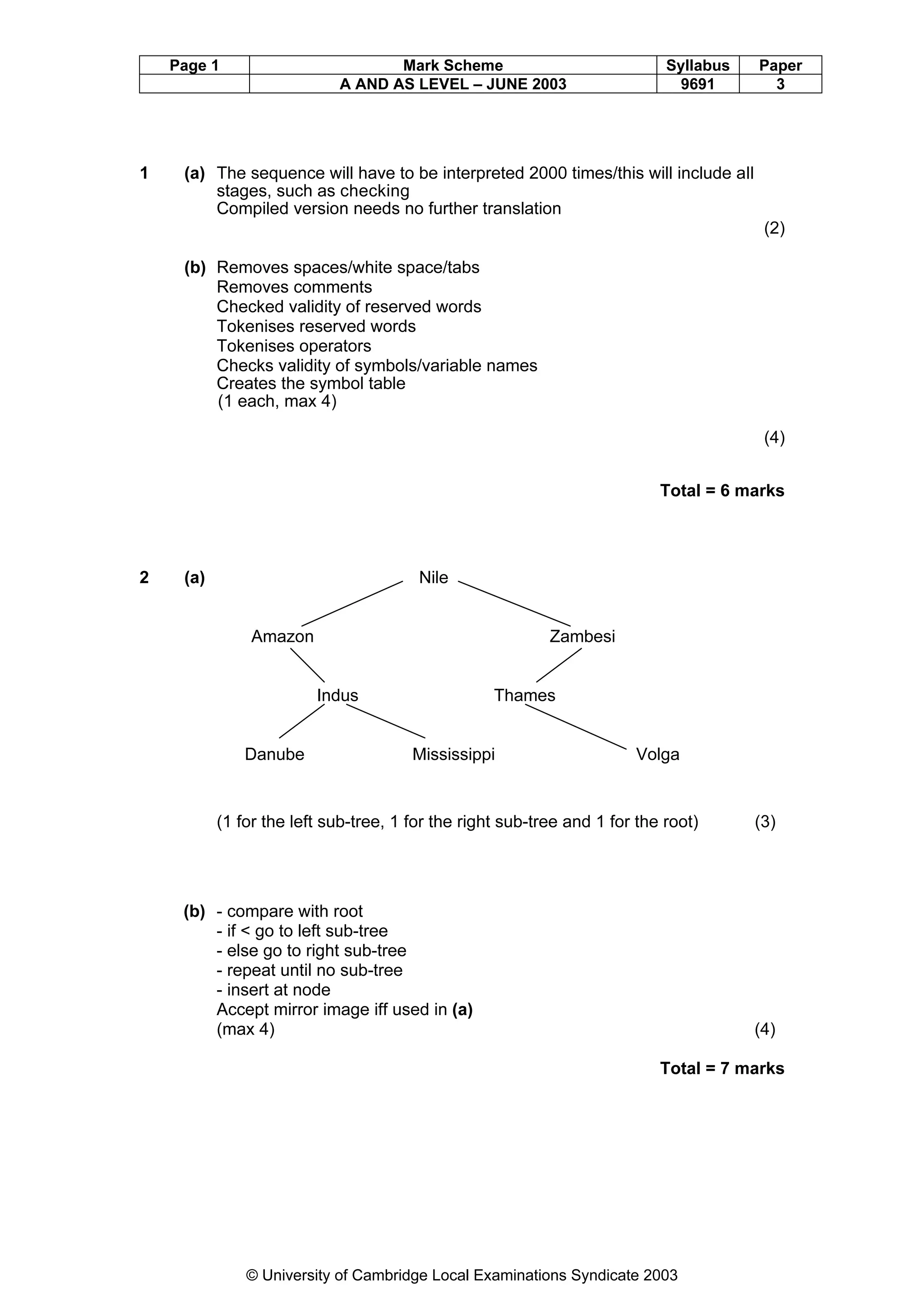
2    (a)                                Nile


                Amazon                                     Zambesi


                         Indus                     Thames


               Danube                  Mississippi                     Volga


           (1 for the left sub-tree, 1 for the right sub-tree and 1 for the root)      (3)


     (b) - compare with root
         - if < go to left sub-tree
         - else go to right sub-tree
         - repeat until no sub-tree
         - insert at node
         Accept mirror image iff used in (a)
         (max 4)                                                                       (4)

                                                                           Total = 7 marks


               © University of Cambridge Local Examinations Syndicate 2003
Page 2                      Mark Scheme                           Syllabus   Paper
                         A AND AS LEVEL – JUNE 2003                    9691        3


3        - Passwords
         - Encryption
         - Firewall
         - Screen cables
         - Use fibre optics
         - Microwave links
         - Secure channels
         - Entry codes to rooms
         - Any physical check (palm, eye) – monitor personnel in building
         - Monitor system access
         - Hierarchy of passwords
         - Physical locks on computers
         - Duplicate processors/servers
         - Back ups
         - In a different place
         - RO files
         - Use of packet switching rather than circuit switching
         - Use of anti-virus software
         - Locking RW privilege to files
         (1 per point, max 9)                                                    (9)

                                                                     Total = 9 marks


4        - Contents of PC copied into MAR/address of instruction in MAR
         - Contents copied from address into MDR/instruction held in MAR
         - Contents of MDR copied into CIR/instruction is put in CIR
         - Contents of CIR decoded
         - The number/25 from CIR copied into MDR
         - Contents of MDR copied into accumulator/25 is placed in accumulator
         - Incrementing PC at any stage
         max 6                                                                 (6)

                                                                     Total = 6 marks


5    (a) - Produces re-usable code
         - By creating a class library
         - Inheritance
         - To produce new objects
         - Encapsulation of data
         - To protect data integrity
         - Polymorphism
         - To use different versions of the same method (in different classes)
         - Structure of data and the code in a class may be altered
         - Without affecting programs that use the class
         - Without affecting other classes
         - Message passing between classes
         (max 6)                                                                 (6)


             © University of Cambridge Local Examinations Syndicate 2003
Page 3                       Mark Scheme                           Syllabus      Paper
                          A AND AS LEVEL – JUNE 2003                    9691           3


     (b) (i) A template for creating objects (that share a common behaviour and
             common structure)                                                  (1)

         (ii) A class that inherits the structure and methods of another class       (1)

         (iii) A class that passes down its attributes and methods                   (1)

                                                                       Total = 9 marks


6    (a) - Set of rules...
         - To allow communication between devices/computers/machines
                                                                                     (2)

     (b) - Standard file formats...
         - To allow files produced on one machine to be understood on another
         - ISDN/other communication standard
         - Standard method of communication digital
         - OSI/TCP (IP)
         - Involves layering protocol
         - To allow changes in layers
         (1 per -, max 6)                                                     (6)

     (c) - Voice mail...
         - (Using digital systems) to leave spoken messages
         - Email
         - Send and receive messages (irrespective of geographical location)
         - Digital telephone system...
         - To automate customer enquiries (and direct them)
         - Video conferencing...
         - To allow conferences between employees without the need for a physical
           presence
         - Electronic data interchange
         - Allows sharing of data across system while being protected
         - Send and receive attachments
         - Confirm receipt of message
         (1 per-, max 8)                                                       (8)


7        - Safety
         - Testing acceptable parameters in an industrial reaction
         - The effects of a test which passed safety limits in real life may put lives in
           danger
         - Impossibility
         - Training astronauts to work on the surface of Mars...
         - Such a task is not possible in real life because astronauts have not been
           to other planets
         - Time
         - Testing what will be the outcome of breeding a plant for 100 generations...
         - In real life, 100 life cycles of a plant will take 100 years to test
         - Isolation from external factors
         - Growing crystals to study behaviour...
         - Too easy for material to be contaminated in real life
         (1 per -, max 9)                                                             (9)


             © University of Cambridge Local Examinations Syndicate 2003
Page 4                       Mark Scheme                            Syllabus     Paper
                          A AND AS LEVEL – JUNE 2003                     9691          3


8    (i) - Old and new systems both used on all data
         - Example where it is essential that no errors arise in the new system,
           e.g. changing the software that produces student exam grades
         - Errors can be found in new system before it starts to operate              (3)

     (ii) - One part or module of old system is changed to new while remainder
            stays on old
          - Complex system with easily identified modules, e.g. control of a chemical
            plant may involve one reaction being switched to the new system first so
            that it can be monitored separately
          - Allows tight monitoring of new system with limited resources/training
            of personnel                                                           (3)


     (iii) - One complete system, representative of whole system is switched while
             remainder remains on old/prototyping
           - Any system comprising a number of matching systems, e.g. a college
              record keeping system may alter one year group to ensure
             it works before changing the others
           - Allows system to be tested with/while risking a limited volume of
             data                                                                 (3)


9        - Current cycle is completed
         - Priority of interrupt compared with current job

         If higher:
         - Contents of special registers saved/job placed in blocked state/in ready Q
         - Interrupt/program for execution of interrupt, is identified/vectored interrupt
           used
         - Interrupt serviced by running program
         - On completion values of special registers from original program area
           replaced/original job restored

         If lower:
         - Interrupt allocated position in job queue...
         - According to priorities
         - Current job continues with next cycle
         (1 per -, max 6)                                                             (6)


             © University of Cambridge Local Examinations Syndicate 2003
Page 5                        Mark Scheme                            Syllabus   Paper
                            A AND AS LEVEL – JUNE 2003                     9691        3


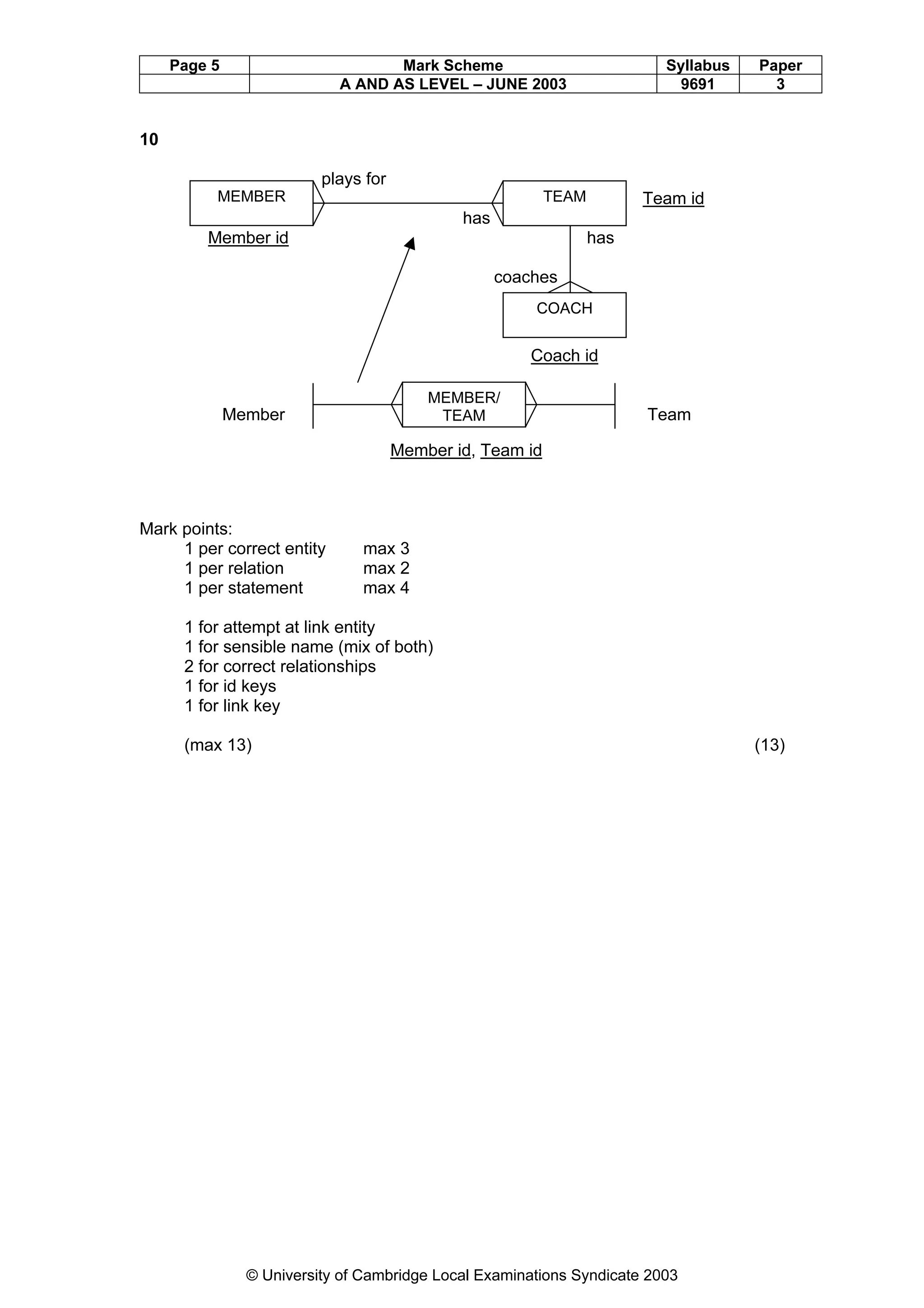
10

                          plays for
          MEMBER                                           TEAM         Team id
                                              has
         Member id                                                has

                                                    coaches
                                                        COACH


                                                        Coach id

                                          MEMBER/
              Member                       TEAM                         Team

                                      Member id, Team id


Mark points:
     1 per correct entity      max 3
     1 per relation            max 2
     1 per statement           max 4

      1 for attempt at link entity
      1 for sensible name (mix of both)
      2 for correct relationships
      1 for id keys
      1 for link key

      (max 13)                                                                       (13)


                © University of Cambridge Local Examinations Syndicate 2003

June 03 MS1

  • 1.
    June 2003 A AND AS LEVEL MARKING SCHEME MAXIMUM MARK: 90 SYLLABUS/COMPONENT: 9691/01, 5216/01 COMPUTING Written Paper 1
  • 2.
    Page 1 Mark Scheme Syllabus Paper A AND AS LEVEL – JUNE 2003 9691 1 1 (a) - OS controls operation of system/hardware - Applications software allows the system to do something useful (2) (b) - File handling - Copy/move/delete - Anti virus software - To protect files from attack by virus - Defragmentation - To keep files sensibly arranged on the hard drive - Format - To divide surface of drive into smaller areas to aid storage (1 per -, max 6) (6) 2 (a) (i) Jobs collected together for processing at a later time (ii) Output produced quickly enough to affect the next input (iii) User has direct contact with processor (iv) User cannot communicate directly with processor (4) (b) - Real time - E.g. turning the wheel must turn the car immediately - On line - Otherwise system cannot be real time (4) (c) - Sharing of software and data files - Sharing of hardware, e.g. printers - Communication - Security of files more of a problem (1 per -, max 3) (3) 3 (a) (i) Incorrect use of language, e.g. PLINT instead of PRINT (ii) A mistake in the structure of the solution, e.g. a jump goes to the wrong line (iii) Inappropriate arithmetic is used, e.g. division by 0 is attempted (6) (b) - Translator diagnostics - Produced when wrong programming used - Gives position and explanation of error - Cross-referencing - Used when program modularised - To check use of variables - Trace routines - Follow value of variable - To give clue as to where error occurs - Variable dump - Prints values of all variables - At given point in program (1 per -, max 2 per type, max 4) (4) © University of Cambridge Local Examinations Syndicate 2003
  • 3.
    Page 2 Mark Scheme Syllabus Paper A AND AS LEVEL – JUNE 2003 9691 1 4 (a) - Data enters at one end (of a stack) - Leaves at the same end - Hence 'last in, first out' (1 per -, max 2) (2) (b) SP ARRAY (1) (1) STACK (2) 5 (a) - Uses all 7 digits - Creates >2000 results - Highlight the danger of multiplying by zero (2) (b) Any two 7 digit numbers that cause a clash (1) (c) - Search serially from hash value - Until vacant location found - Mention of circular reference - If the memory locations become full, use a bucket - Use bucket to place duplicates in - In serial form - Pointer to bucket from hashed location - Use hashed location as start of linked list - Ensure end of list with null value of pointer (1 per -, max 2 methods, max 4) (4) 6 (a) (i) To manage the execution of instructions By running a clock To decode instructions (ii) To store OS To store those parts of applications programs currently running To store data currently in use (iii) Part of processor where data is processed/manipulated All I/O must pass through here (1 per -, max 2, 2, 2, max 6) (6) (b) - Main memory transitory, secondary storage is (semi-)permanent - Processor can only use data/instructions that are in main memory - Main memory in processor, secondary storage not (1 per - max 2) (2) © University of Cambridge Local Examinations Syndicate 2003
  • 4.
    Page 3 Mark Scheme Syllabus Paper A AND AS LEVEL – JUNE 2003 9691 1 7 (a) - Serial is the transmission of data one bit at a time/through one wire - Parallel is the transmission of data more than one bit at a time/many wires - Simplex is the transmission of data in one direction only - Duplex is the transmission of data in both directions simultaneously (4) (b) - Extra bit on each data-byte that - Does not transmit data - Makes number of ones in a byte be always even or always odd - Error in the transmission of a bit will make the even/odd wrong - Problem of two errors in one byte not being found - Parity block (1 per -, max 4) (4) 8 - College authorities are the experts in the problem - SA is the expert with computers - The two need to pool resources to come up with a clear definition - Agree the outcomes so that when the system is implemented there are a set of criteria to judge it by (1 per -, max 4) (4) 9 (a) - Corporate colour scheme - Languages to be used - What information should be on - Should the site be two way/students allowed to enroll - Size of the site - What links should there be? (1 per -, max 4) (4) (b) - Presentation software - Talks to large groups - DTP - Produce newsletter/advertising material - Word processor - Mail merged personal letters/junk mail - Database - To store lists of the recipients of the junk mail (1 per -, max 4) (4) 10 A description of: - Passwords - Hierarchy - Only allow some staff to access student files - Only some machines able to access - Physical location of these machines - Physical lock on machines - Encrypted data in files - Firewall if connected to the Internet (1 per -, max 5) (5) © University of Cambridge Local Examinations Syndicate 2003
  • 5.
    Page 4 Mark Scheme Syllabus Paper A AND AS LEVEL – JUNE 2003 9691 1 11 (i) Dual input of data Two inputs are compared by the system And any discrepancies reported (and not stored.) Data input once, either printed out or checked on screen Errors corrected (ii) Rules given to processor Only accept A,B,C,D,E,F,G Any other input rejected. Drop-down list/radio buttons Provides only valid inputs So no other validation required (1 per -, max 6) (6) 12 Enrolment: - Data input on line - Individual records validated - Speed mismatch implications - Indexes updated immediately Exam grades: - Data input twice - Off line - Run as a batch - At otherwise downtime (1 per -, max 6) (6) 13 - Day to day information supplied to teachers - About abilities of students - Class lists - Middle managers - E.g. departmental exam results - Strategic information - Supplied to Principal - E.g. overall exam results to compare performance of departments - Comparison of grades year on year (1 per -, max 5) (5) TOTAL 90 © University of Cambridge Local Examinations Syndicate 2003
  • 7.
    June 2003 A AND AS LEVEL MARKING SCHEME MAXIMUM MARK: 60 SYLLABUS/COMPONENT: 9691/02, 5217/01 COMPUTING Practical Tasks
  • 8.
    Page 1 Mark Scheme Syllabus Paper A AND AS LEVEL – JUNE 2003 9691 2 Practical Tasks Assessment Form Centre Number Centre Name Candidate Number Candidate Name The mark points indicated on the mark scheme are listed below. Indicate with a tick where each mark has been awarded. Question 1 (a) ü Maximum 5 marks Membership form to include: - heading - consistent use of formatting - instructions for filling in - logical order on form - indication of maximum field lengths - field names, including Forename, Surname, Address, Telephone number, Team - splitting address into Address 1 and Address 2 Sub-Total 1 (a) Question 1 (b) (i) Maximum 5 marks Existence of table: - contains all the fields - sensible data types - existence of team ID in record - identified as link field - existence of player ID Sub-Total 1 (b) (i) Question 1 (b) (ii) Maximum 3 marks Existence of table (only given once): - contains all the fields - including team ID - identified as key field Sub-Total 1 (b) (ii) Question 1 (c) Maximum 9 marks Input screen constructed: - validation routine for team name input - constructed correct query - selection of required data - output of required data - to two screens - one screen for details of team - one screen containing all players - means of moving between output screens - output of tables - correct team list Sub-Total 1 (c) © University of Cambridge Local Examinations Syndicate 2003
  • 9.
    Page 2 Mark Scheme Syllabus Paper A AND AS LEVEL – JUNE 2003 9691 2 Question 2 (a) Maximum 8 marks 1 mark per line: 5 2 6 4 7 2 8 4 9 3 10 4 11 2 12 6 Sub-Total 2 (a) Question 2 (b) Maximum 8 marks - setting up array - two dimensional - input values into array - remainder of algorithm in correct position - loop to increase value of S - correct condition on the loop - searching the array for stated value of S (use of inner loop) - correct condition statement on inner loop - condition statement based on value of S - printing value of N when found Sub-Total 2 (b) Question 3 (a) (i) Maximum 5 marks - suitable format of form Data entry boxes for: - event - names of each competitor (6 rows or columns) - 3 details of each competitor - show some distinction for each type of event Sub-Total 3 (a) (i) Question 3 (a) (ii) Maximum 4 marks - screen containing sample set of results - evidence of file existence - contents of screen transferred to file - evidence that data has been automatically transferred Sub-Total 3 (a) (ii) © University of Cambridge Local Examinations Syndicate 2003
  • 10.
    Page 3 Mark Scheme Syllabus Paper A AND AS LEVEL – JUNE 2003 9691 2 Question 3 (b) Maximum 7 marks Within the data there must be: - one case of an event with no competitor from a certain school - one case of an event with more than one competitor from a school - one case where each school has one competitor - have at least one sensible time/distance/height - one example of a time outside acceptable limits - one example of a distance outside acceptable limits - one example of a height outside acceptable limits - one example of a dead heat Sub-Total 3 (b) Question 3 (c) Maximum 6 marks - design of screen - deciding gold, silver, bronze in an event - identifying the 3 schools in order - increment the correct school totals - formula 3 x gold + 2 x silver + bronze for total - for each school - method for calling up screen Sub-Total 3 (c) Total (max 60) © University of Cambridge Local Examinations Syndicate 2003
  • 11.
    June 2003 A AND AS LEVEL MARKING SCHEME MAXIMUM MARK: 90 SYLLABUS/COMPONENT: 9691/03, 5218/01 COMPUTING Written Paper 3
  • 12.
    Page 1 Mark Scheme Syllabus Paper A AND AS LEVEL – JUNE 2003 9691 3 1 (a) The sequence will have to be interpreted 2000 times/this will include all stages, such as checking Compiled version needs no further translation (2) (b) Removes spaces/white space/tabs Removes comments Checked validity of reserved words Tokenises reserved words Tokenises operators Checks validity of symbols/variable names Creates the symbol table (1 each, max 4) (4) Total = 6 marks 2 (a) Nile Amazon Zambesi Indus Thames Danube Mississippi Volga (1 for the left sub-tree, 1 for the right sub-tree and 1 for the root) (3) (b) - compare with root - if < go to left sub-tree - else go to right sub-tree - repeat until no sub-tree - insert at node Accept mirror image iff used in (a) (max 4) (4) Total = 7 marks © University of Cambridge Local Examinations Syndicate 2003
  • 13.
    Page 2 Mark Scheme Syllabus Paper A AND AS LEVEL – JUNE 2003 9691 3 3 - Passwords - Encryption - Firewall - Screen cables - Use fibre optics - Microwave links - Secure channels - Entry codes to rooms - Any physical check (palm, eye) – monitor personnel in building - Monitor system access - Hierarchy of passwords - Physical locks on computers - Duplicate processors/servers - Back ups - In a different place - RO files - Use of packet switching rather than circuit switching - Use of anti-virus software - Locking RW privilege to files (1 per point, max 9) (9) Total = 9 marks 4 - Contents of PC copied into MAR/address of instruction in MAR - Contents copied from address into MDR/instruction held in MAR - Contents of MDR copied into CIR/instruction is put in CIR - Contents of CIR decoded - The number/25 from CIR copied into MDR - Contents of MDR copied into accumulator/25 is placed in accumulator - Incrementing PC at any stage max 6 (6) Total = 6 marks 5 (a) - Produces re-usable code - By creating a class library - Inheritance - To produce new objects - Encapsulation of data - To protect data integrity - Polymorphism - To use different versions of the same method (in different classes) - Structure of data and the code in a class may be altered - Without affecting programs that use the class - Without affecting other classes - Message passing between classes (max 6) (6) © University of Cambridge Local Examinations Syndicate 2003
  • 14.
    Page 3 Mark Scheme Syllabus Paper A AND AS LEVEL – JUNE 2003 9691 3 (b) (i) A template for creating objects (that share a common behaviour and common structure) (1) (ii) A class that inherits the structure and methods of another class (1) (iii) A class that passes down its attributes and methods (1) Total = 9 marks 6 (a) - Set of rules... - To allow communication between devices/computers/machines (2) (b) - Standard file formats... - To allow files produced on one machine to be understood on another - ISDN/other communication standard - Standard method of communication digital - OSI/TCP (IP) - Involves layering protocol - To allow changes in layers (1 per -, max 6) (6) (c) - Voice mail... - (Using digital systems) to leave spoken messages - Email - Send and receive messages (irrespective of geographical location) - Digital telephone system... - To automate customer enquiries (and direct them) - Video conferencing... - To allow conferences between employees without the need for a physical presence - Electronic data interchange - Allows sharing of data across system while being protected - Send and receive attachments - Confirm receipt of message (1 per-, max 8) (8) 7 - Safety - Testing acceptable parameters in an industrial reaction - The effects of a test which passed safety limits in real life may put lives in danger - Impossibility - Training astronauts to work on the surface of Mars... - Such a task is not possible in real life because astronauts have not been to other planets - Time - Testing what will be the outcome of breeding a plant for 100 generations... - In real life, 100 life cycles of a plant will take 100 years to test - Isolation from external factors - Growing crystals to study behaviour... - Too easy for material to be contaminated in real life (1 per -, max 9) (9) © University of Cambridge Local Examinations Syndicate 2003
  • 15.
    Page 4 Mark Scheme Syllabus Paper A AND AS LEVEL – JUNE 2003 9691 3 8 (i) - Old and new systems both used on all data - Example where it is essential that no errors arise in the new system, e.g. changing the software that produces student exam grades - Errors can be found in new system before it starts to operate (3) (ii) - One part or module of old system is changed to new while remainder stays on old - Complex system with easily identified modules, e.g. control of a chemical plant may involve one reaction being switched to the new system first so that it can be monitored separately - Allows tight monitoring of new system with limited resources/training of personnel (3) (iii) - One complete system, representative of whole system is switched while remainder remains on old/prototyping - Any system comprising a number of matching systems, e.g. a college record keeping system may alter one year group to ensure it works before changing the others - Allows system to be tested with/while risking a limited volume of data (3) 9 - Current cycle is completed - Priority of interrupt compared with current job If higher: - Contents of special registers saved/job placed in blocked state/in ready Q - Interrupt/program for execution of interrupt, is identified/vectored interrupt used - Interrupt serviced by running program - On completion values of special registers from original program area replaced/original job restored If lower: - Interrupt allocated position in job queue... - According to priorities - Current job continues with next cycle (1 per -, max 6) (6) © University of Cambridge Local Examinations Syndicate 2003
  • 16.
    Page 5 Mark Scheme Syllabus Paper A AND AS LEVEL – JUNE 2003 9691 3 10 plays for MEMBER TEAM Team id has Member id has coaches COACH Coach id MEMBER/ Member TEAM Team Member id, Team id Mark points: 1 per correct entity max 3 1 per relation max 2 1 per statement max 4 1 for attempt at link entity 1 for sensible name (mix of both) 2 for correct relationships 1 for id keys 1 for link key (max 13) (13) © University of Cambridge Local Examinations Syndicate 2003