CyberAgent,	Inc.	
新参者は如何にして新たな
グループになじむのか?		
ソーシャルゲームにおける分析事例	
株式会社 サイバーエージェント	
	技術本部 秋葉原ラボ 	
	 	高野雅典,	和田計也,	福田一郎	
1	
WEBDB	Forum	2015
CyberAgent,	Inc.	
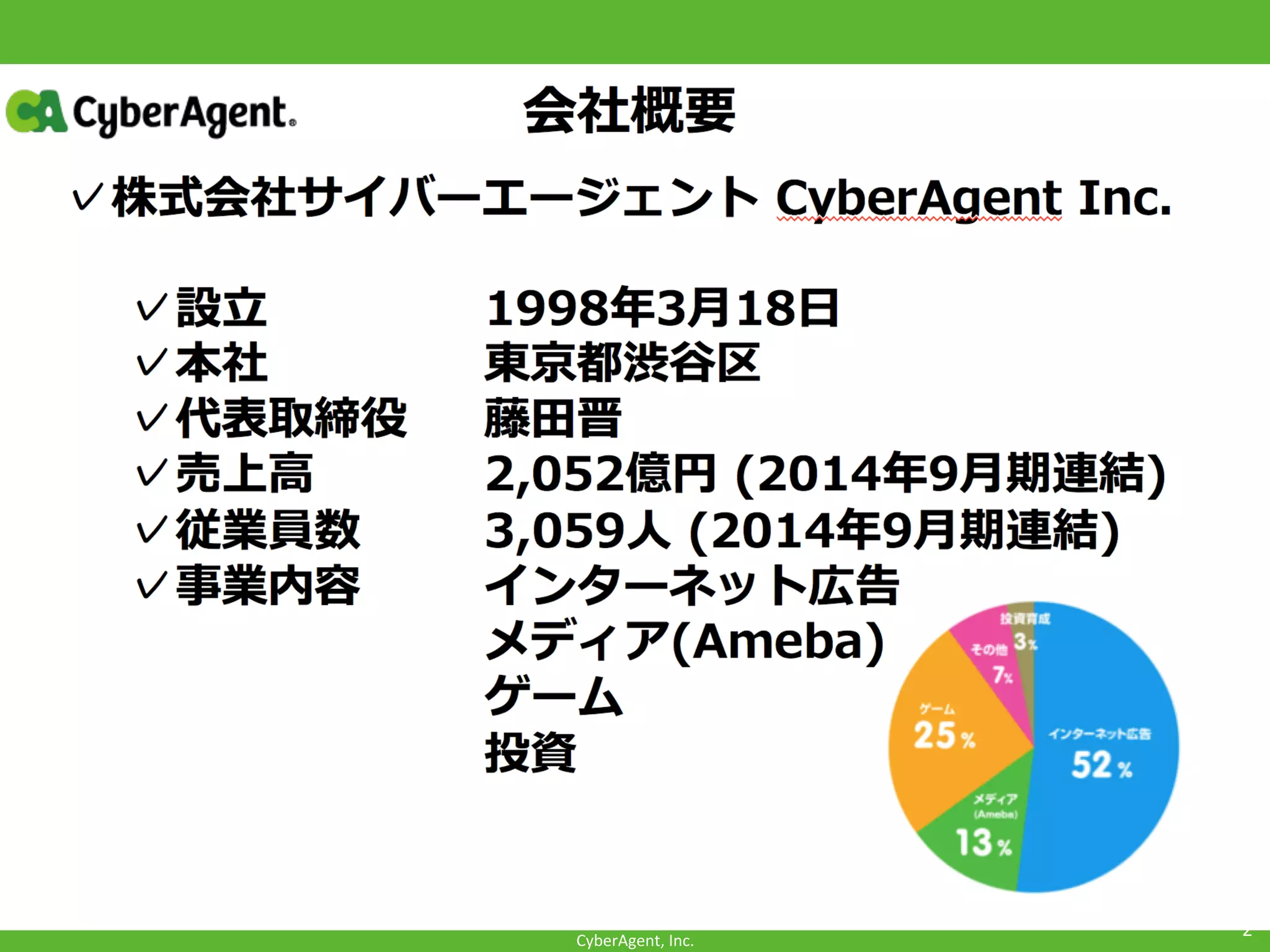
2
CyberAgent,	Inc.	


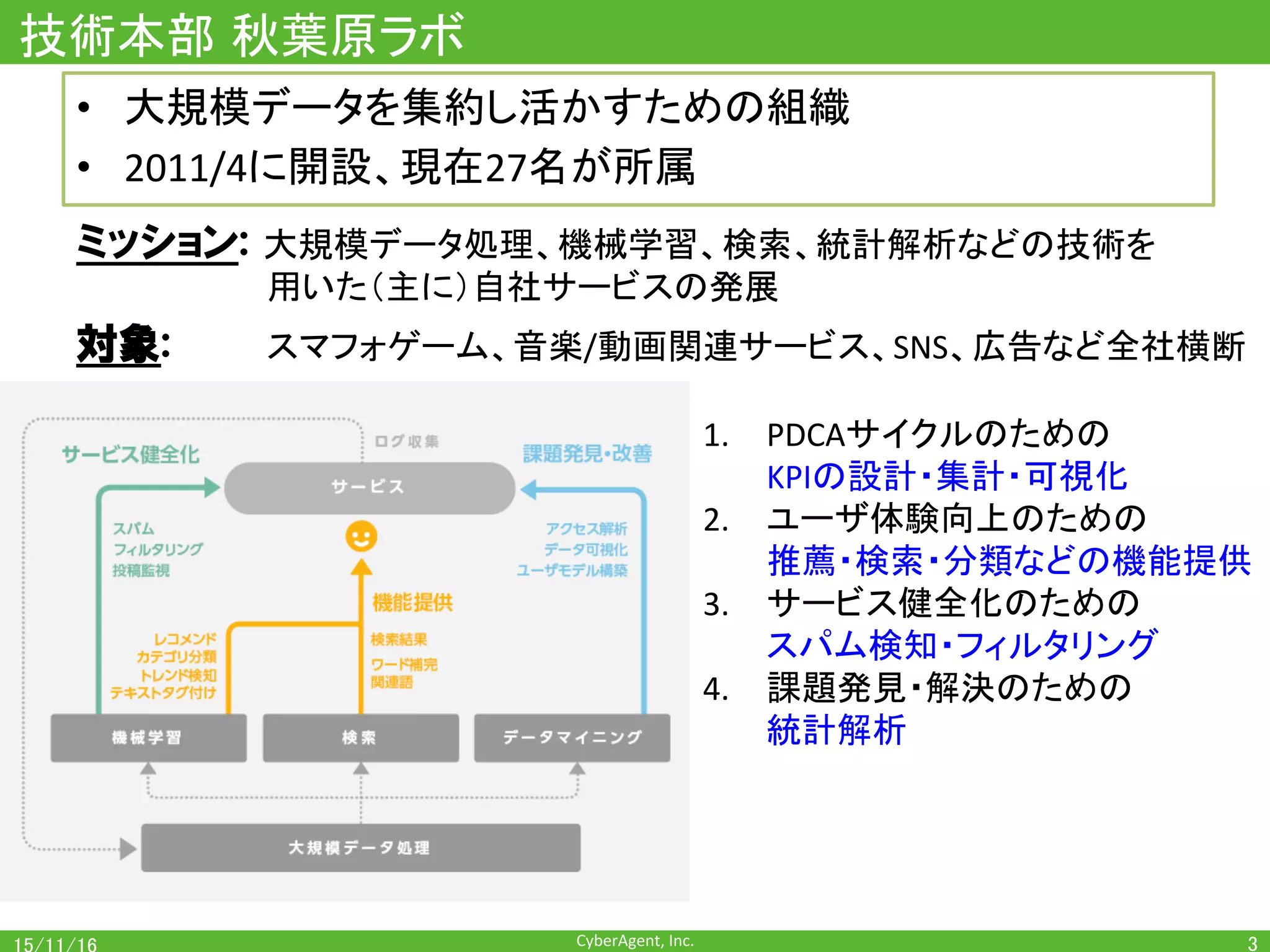
技術本部 秋葉原ラボ	
ミッション: 大規模データ処理、機械学習、検索、統計解析などの技術を	
	 	 	用いた(主に)自社サービスの発展	
対象: スマフォゲーム、音楽/動画関連サービス、SNS、広告など全社横断	
	
	
3	
•  大規模データを集約し活かすための組織	
•  2011/4に開設、現在27名が所属	
1.  PDCAサイクルのための	
KPIの設計・集計・可視化	
2.  ユーザ体験向上のための	
推薦・検索・分類などの機能提供	
3.  サービス健全化のための	
スパム検知・フィルタリング	
4.  課題発見・解決のための	
統計解析
CyberAgent,	Inc.	
サイバーエージェント 技術本部 秋葉原ラボ	
4	
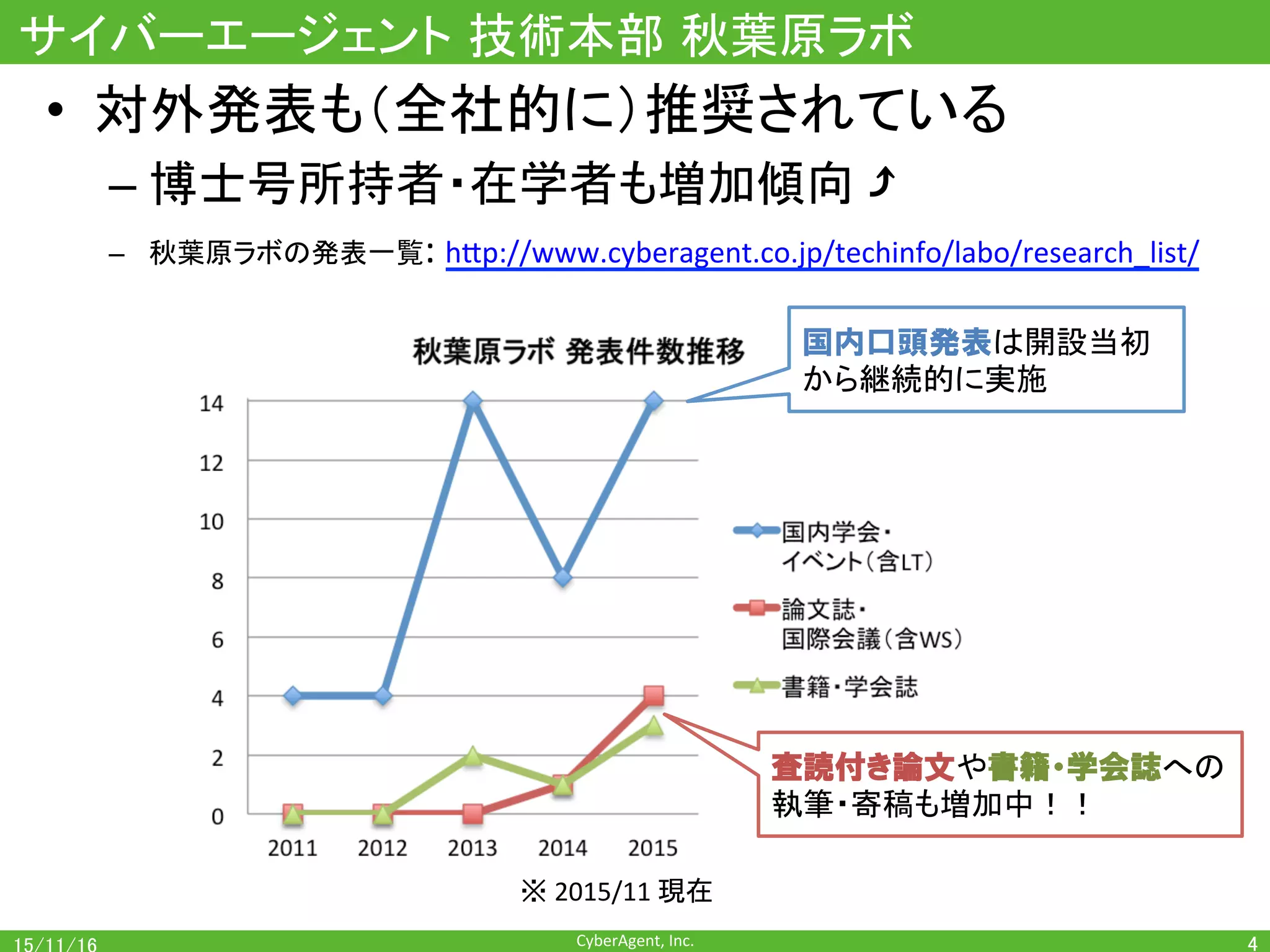
国内口頭発表は開設当初
から継続的に実施	
査読付き論文や書籍・学会誌への	
執筆・寄稿も増加中!!	
•  対外発表も(全社的に)推奨されている	
– 博士号所持者・在学者も増加傾向 ⤴	
–  秋葉原ラボの発表一覧:	hEp://www.cyberagent.co.jp/techinfo/labo/research_list/	
※	2015/11	現在
CyberAgent,	Inc.	
新参者は如何にして新たな
グループになじむのか?		
ソーシャルゲームにおける分析事例	
株式会社 サイバーエージェント	
	技術本部 秋葉原ラボ 	
	 	高野雅典,	和田計也,	福田一郎	
5	
WEBDB	Forum	2015	
本題
CyberAgent,	Inc.	
CooperaOve	Behavior	
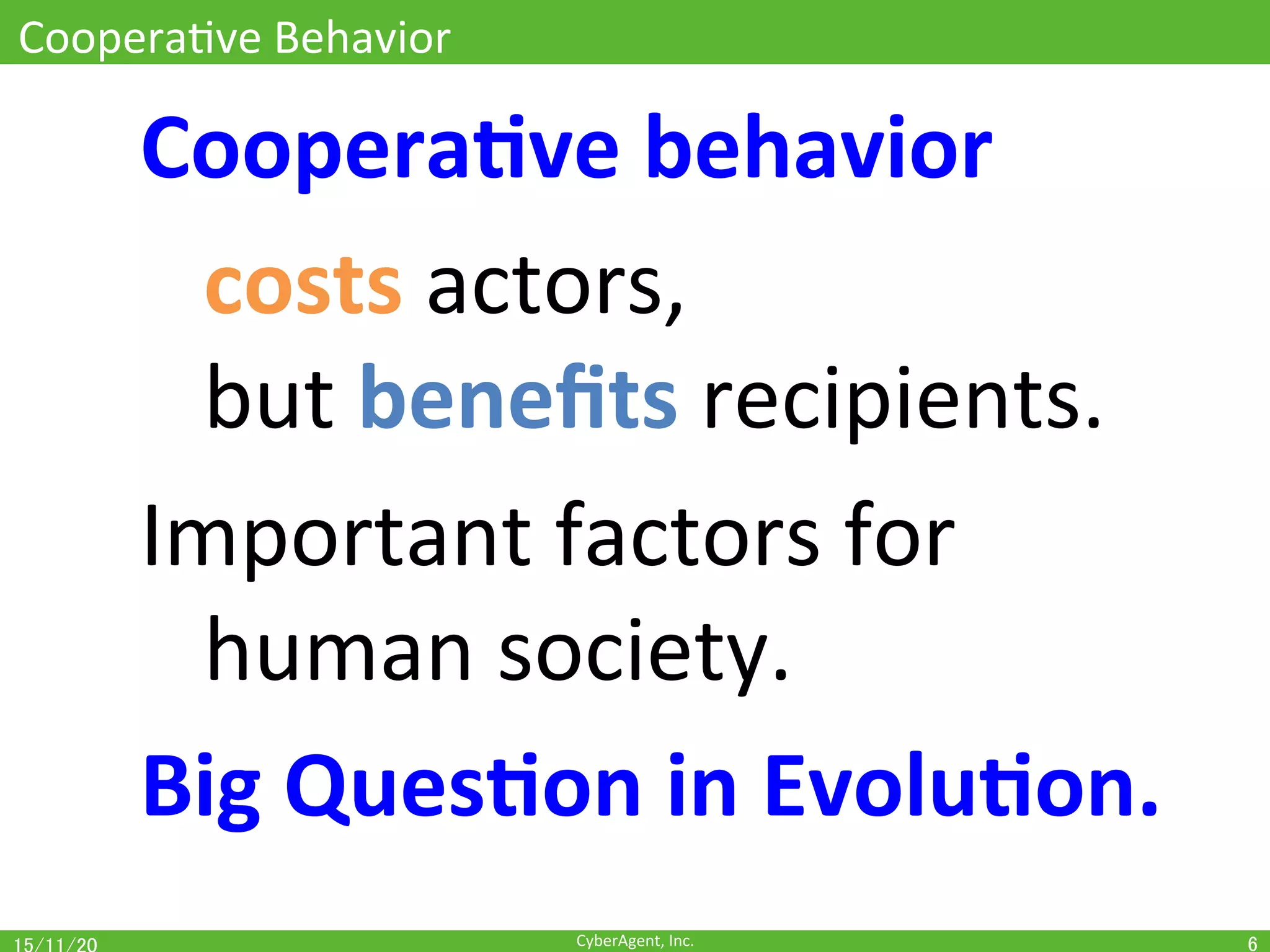
Coopera(ve	behavior	
	costs	actors,	
	but	benefits	recipients.	
Important	factors	for		
	human	society.	
Big	Ques(on	in	Evolu(on.	
6
CyberAgent,	Inc.	
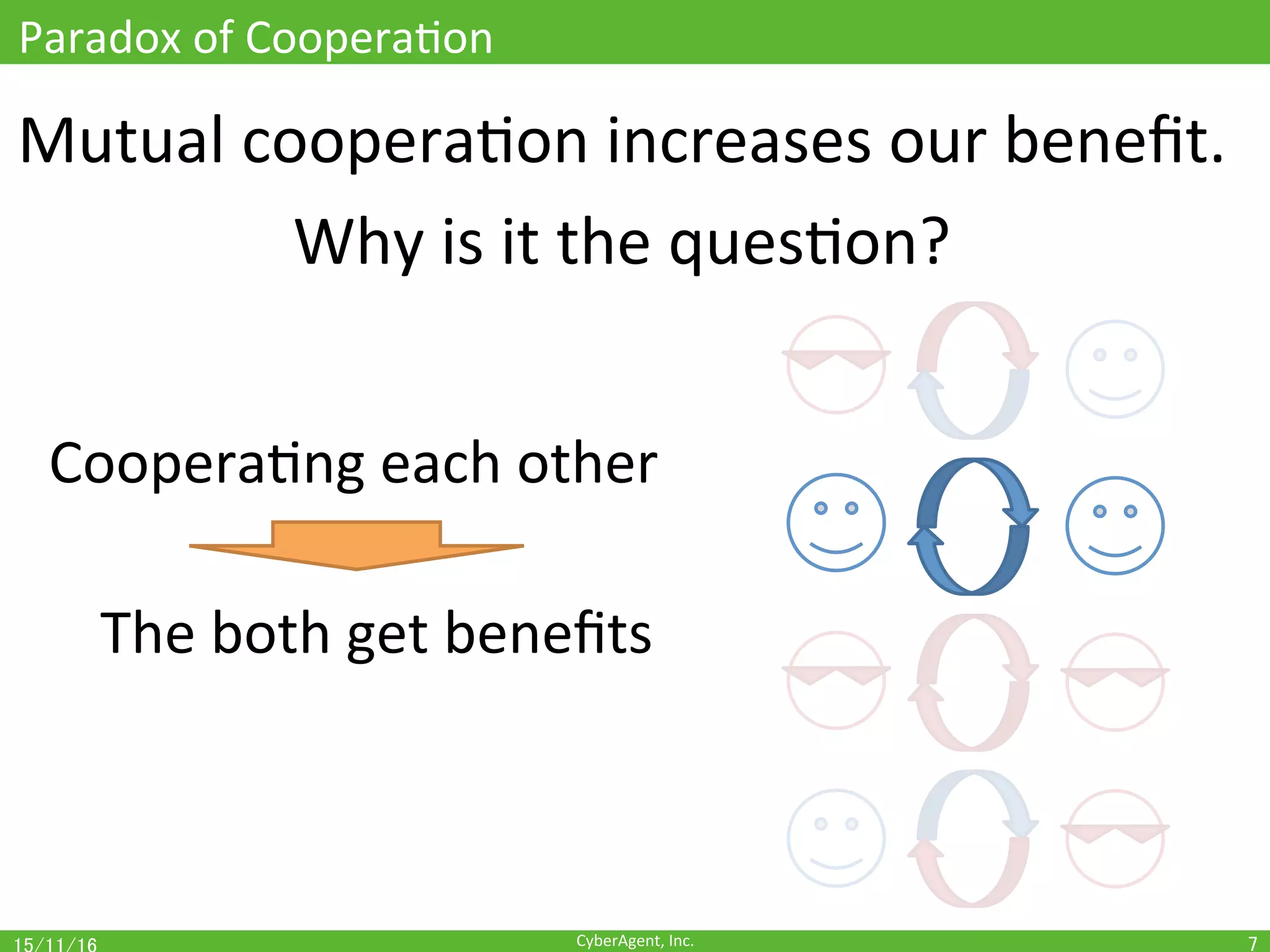
Paradox	of	CooperaOon	
Mutual	cooperaOon	increases	our	benefit.	
Why	is	it	the	quesOon?	
7	
CooperaOng	each	other	
The	both	get	benefits
CyberAgent,	Inc.	
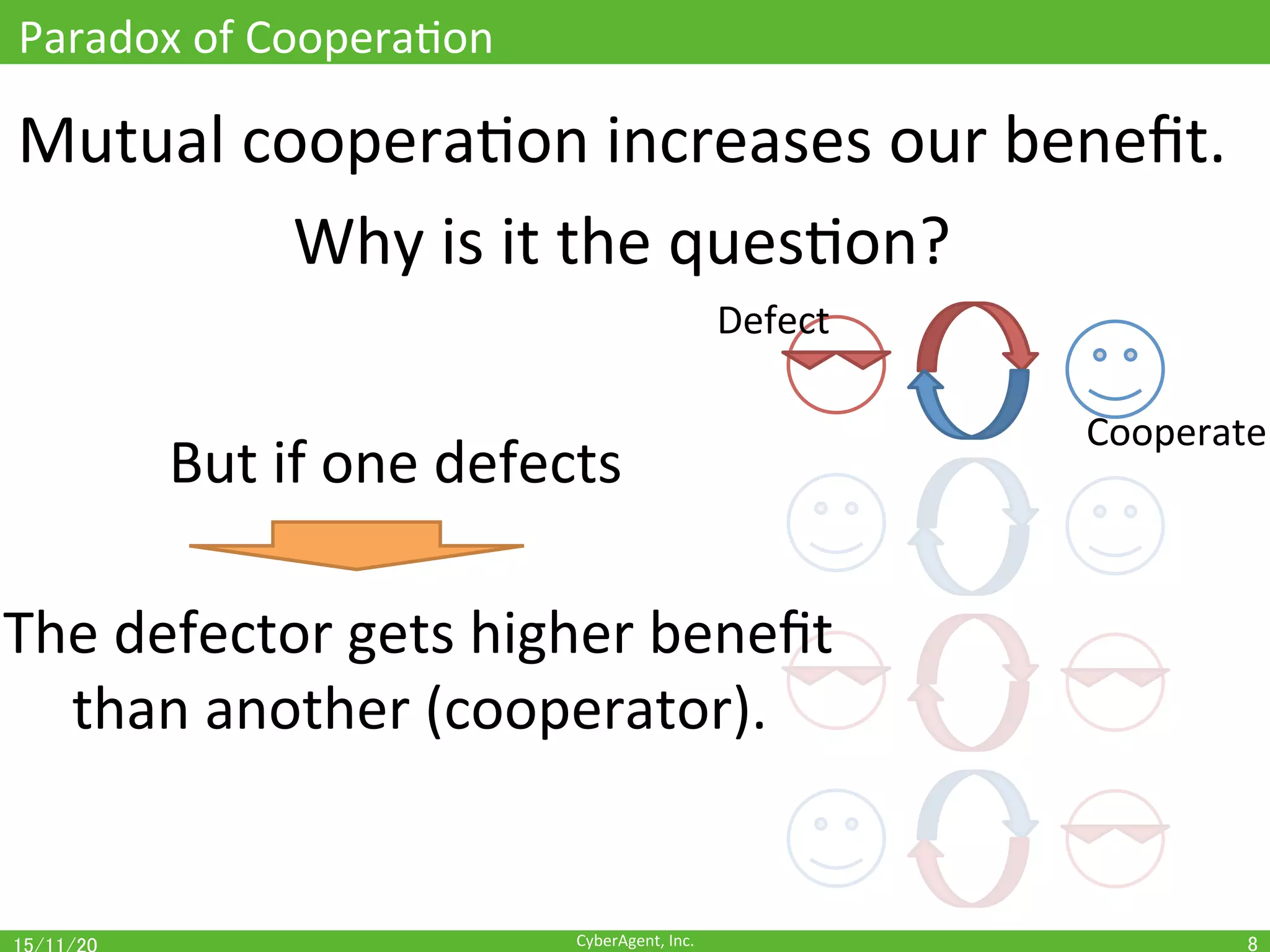
Paradox	of	CooperaOon	
Mutual	cooperaOon	increases	our	benefit.	
Why	is	it	the	quesOon?	
8	
But	if	one	defects	
The	defector	gets	higher	benefit		
than	another	(cooperator).	
Defect	
Cooperate
CyberAgent,	Inc.	
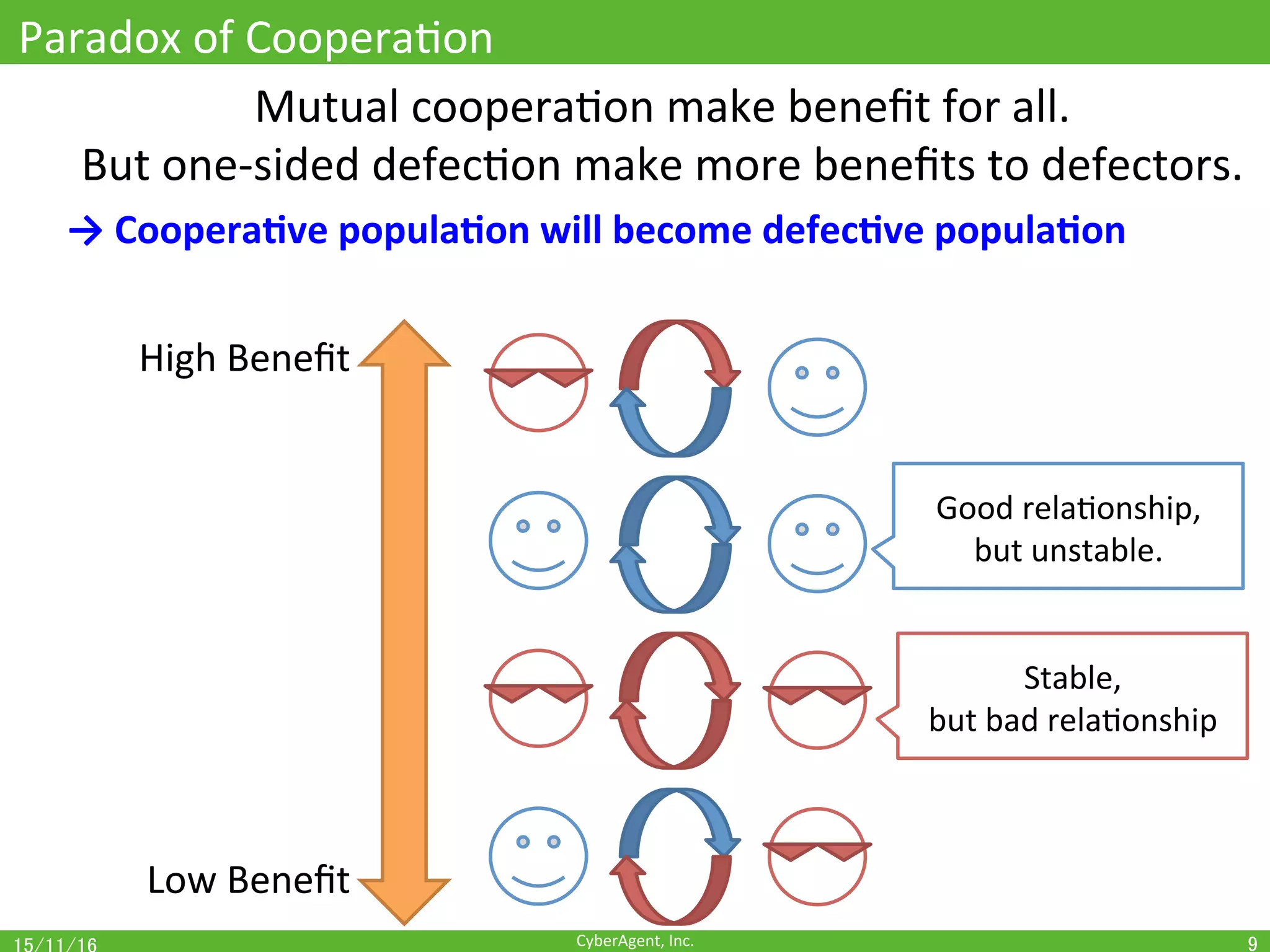
Paradox	of	CooperaOon	
Mutual	cooperaOon	make	benefit	for	all.	
But	one-sided	defecOon	make	more	benefits	to	defectors.	
→	Coopera(ve	popula(on	will	become	defec(ve	popula(on	
9	
High	Benefit	
Low	Benefit	
Good	relaOonship,		
but	unstable.	
Stable,		
but	bad	relaOonship
CyberAgent,	Inc.	
Paradox	of	CooperaOon	
However,		
	we	cooperate	each	other	
	
Human	should	have	goEen	
	coopera(on	mechanisms	
	during	the	evoluOonary	 	
	process	 10
CyberAgent,	Inc.	
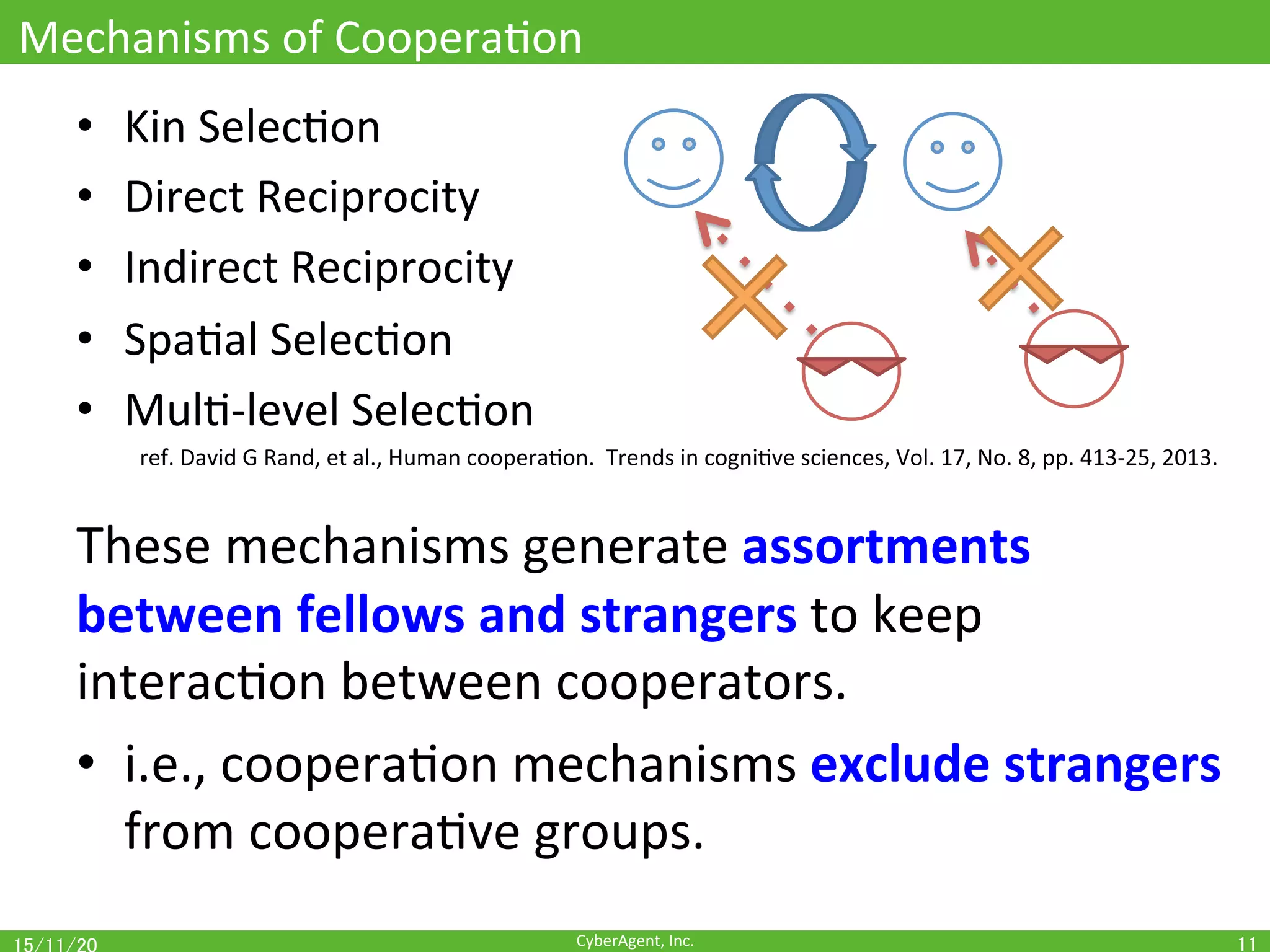
Mechanisms	of	CooperaOon	
•  Kin	SelecOon	
•  Direct	Reciprocity	
•  Indirect	Reciprocity	
•  SpaOal	SelecOon	
•  MulO-level	SelecOon	
	ref.	David	G	Rand,	et	al.,	Human	cooperaOon.		Trends	in	cogniOve	sciences,	Vol.	17,	No.	8,	pp.	413-25,	2013.	
	
These	mechanisms	generate	assortments	
between	fellows	and	strangers	to	keep	
interacOon	between	cooperators.	
•  i.e.,	cooperaOon	mechanisms	exclude	strangers	
from	cooperaOve	groups.	
11
CyberAgent,	Inc.	
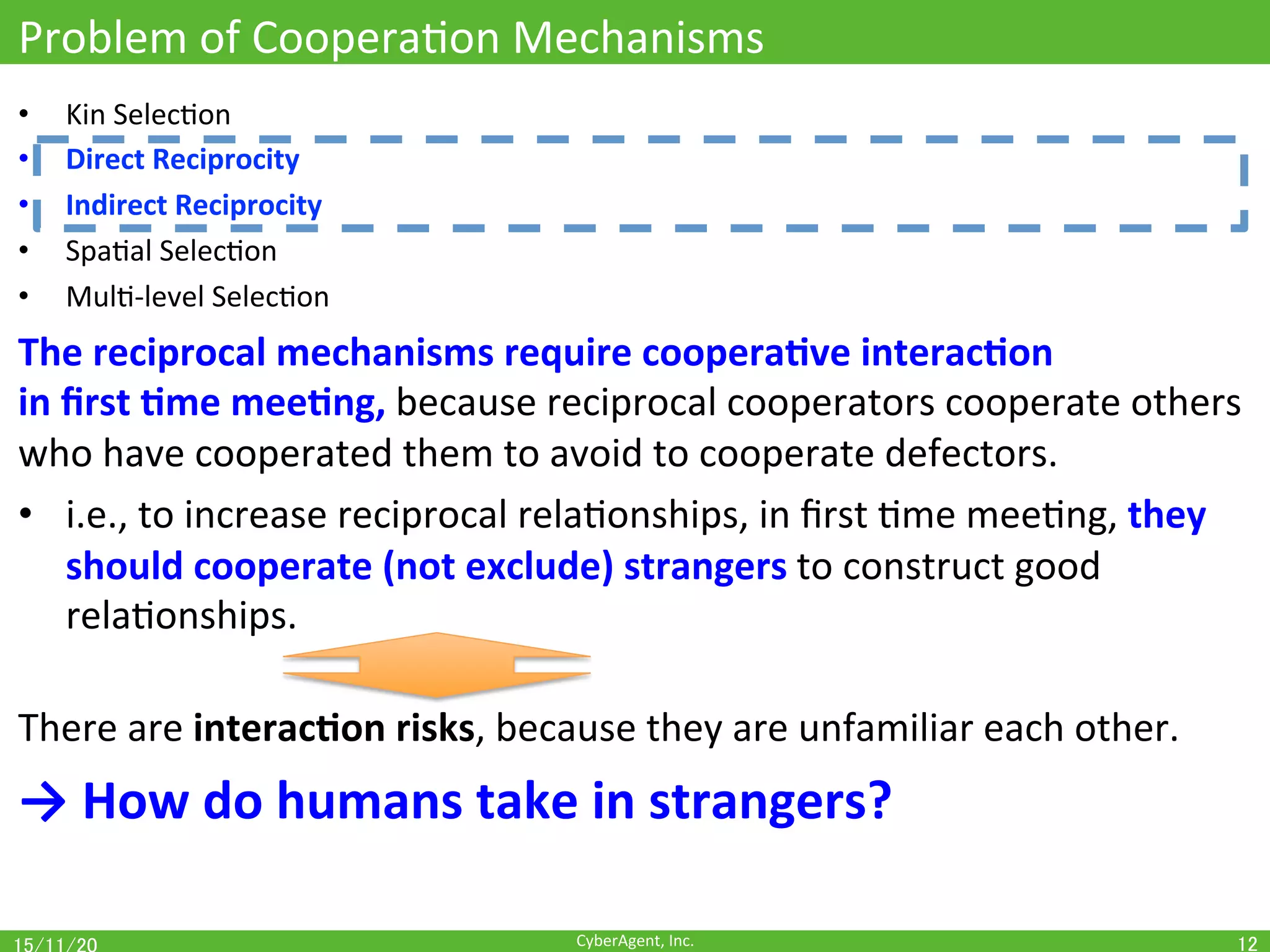
Problem	of	CooperaOon	Mechanisms	
•  Kin	SelecOon	
•  Direct	Reciprocity	
•  Indirect	Reciprocity	
•  SpaOal	SelecOon	
•  MulO-level	SelecOon	
The	reciprocal	mechanisms	require	coopera(ve	interac(on		
in	first	(me	mee(ng,	because	reciprocal	cooperators	cooperate	others	
who	have	cooperated	them	to	avoid	to	cooperate	defectors.	
•  i.e.,	to	increase	reciprocal	relaOonships,	in	first	Ome	meeOng,	they	
should	cooperate	(not	exclude)	strangers	to	construct	good	
relaOonships.	
	
There	are	interac(on	risks,	because	they	are	unfamiliar	each	other.	
→	How	do	humans	take	in	strangers?	
12
CyberAgent,	Inc.	
Our	Approach	
We	approached	this	problem		
based	on	data	analysis	of	a	social	network	game.	
Social	Network	Game	(SNG):		
•  One	type	of	the	Online	Games.	
•  A	lot	of	players.	
•  Players	belong	to	groups	(tens	of	players),	
they	cooperate	in	the	groups,	and	compete	
with	all	others.	
13
CyberAgent,	Inc.	
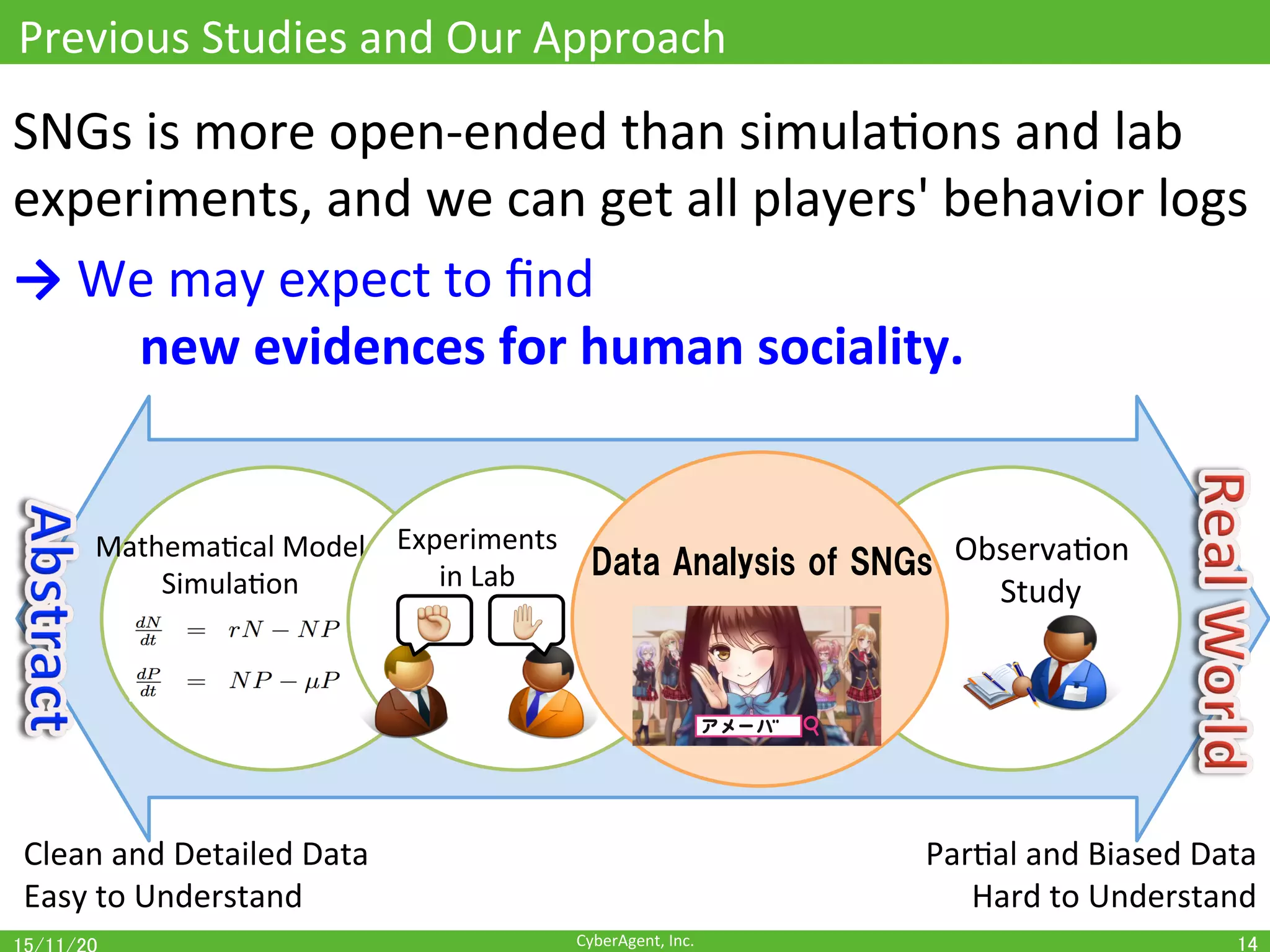
Previous	Studies	and	Our	Approach	
14	
ParOal	and	Biased	Data	
Hard	to	Understand	
Clean	and	Detailed	Data	
Easy	to	Understand	
MathemaOcal	Model	
SimulaOon	
Experiments		
in	Lab	
✊	 ✋	
Data Analysis of SNGs ObservaOon		
Study	
SNGs	is	more	open-ended	than	simulaOons	and	lab	
experiments,	and	we	can	get	all	players'	behavior	logs	
→	We	may	expect	to	find		
	 	new	evidences	for	human	sociality.
CyberAgent,	Inc.	
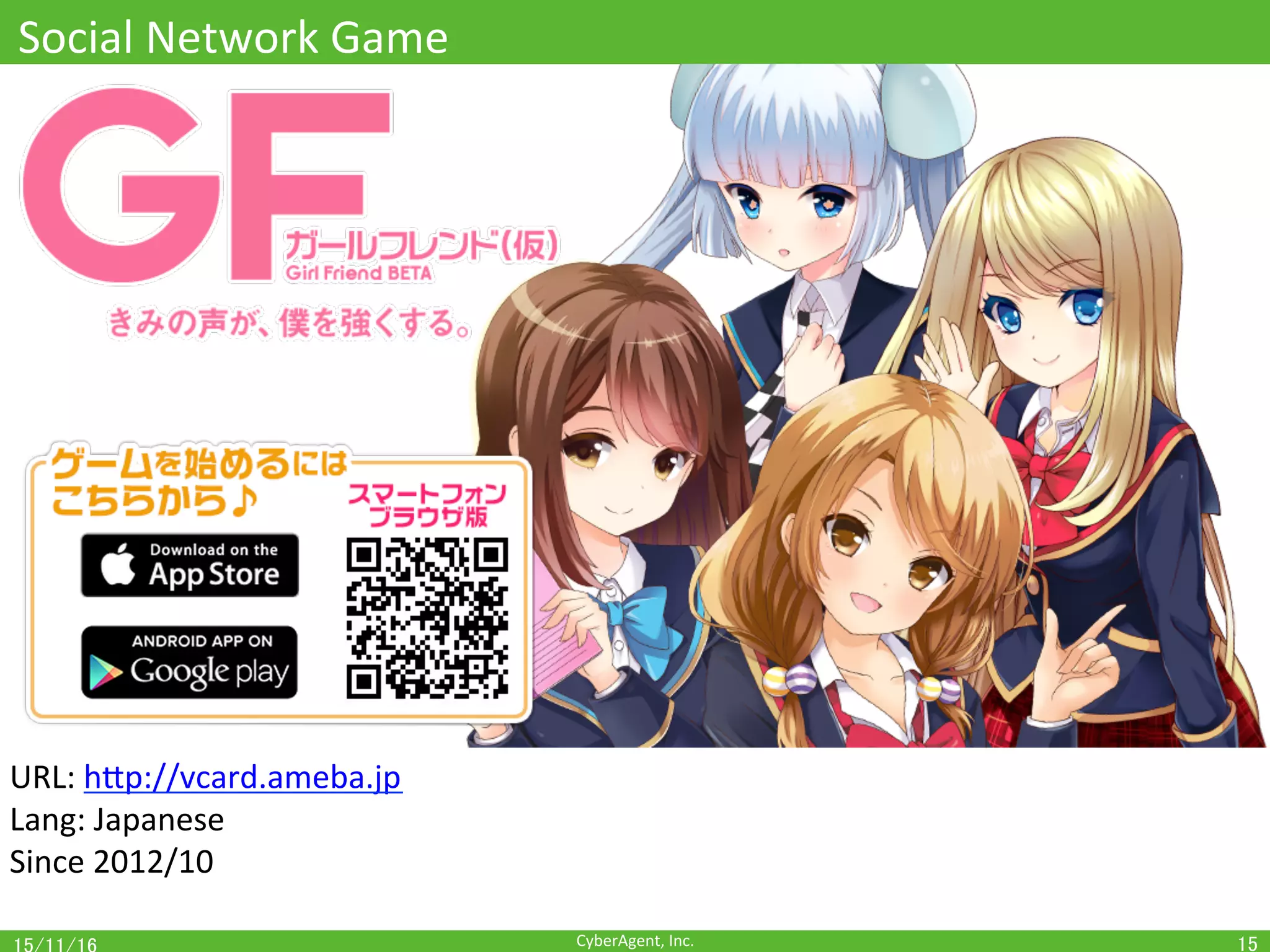
Social	Network	Game	
15	
URL:	hEp://vcard.ameba.jp	
Lang:	Japanese	
Since	2012/10
CyberAgent,	Inc.	
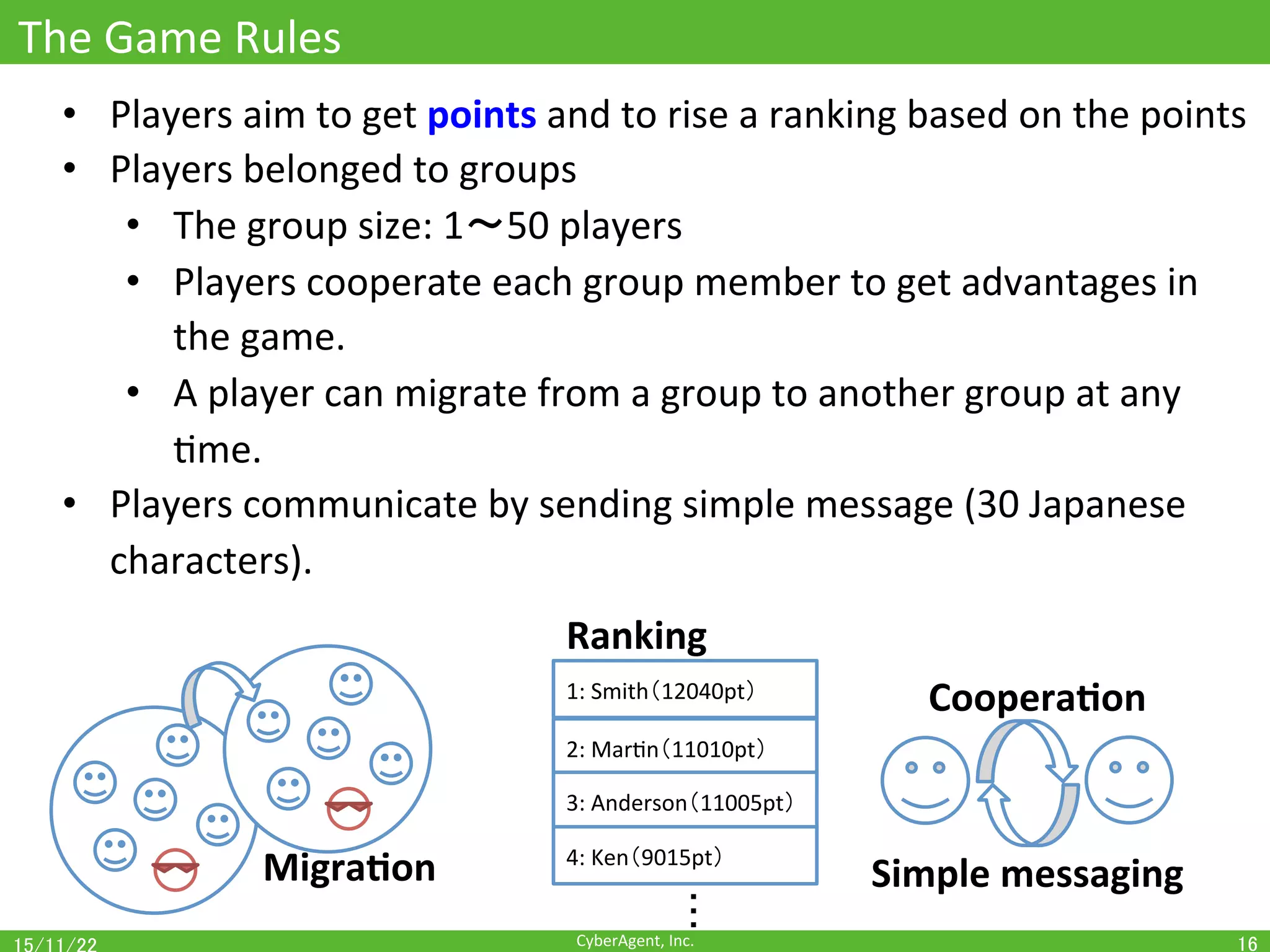
The	Game	Rules	
16	
•  Players	aim	to	get	points	and	to	rise	a	ranking	based	on	the	points		
•  Players	belonged	to	groups	
•  The	group	size:	1〜50	players	
•  Players	cooperate	each	group	member	to	get	advantages	in	
the	game.	
•  A	player	can	migrate	from	a	group	to	another	group	at	any	
Ome.	
•  Players	communicate	by	sending	simple	message	(30	Japanese	
characters).	
1:	Smith(12040pt)	
2:	MarOn(11010pt)	
3:	Anderson(11005pt)	
4:	Ken(9015pt)	
・・・	
Migra(on	
Ranking	
Simple	messaging	
Coopera(on
CyberAgent,	Inc.	
CooperaOve	Behavior	
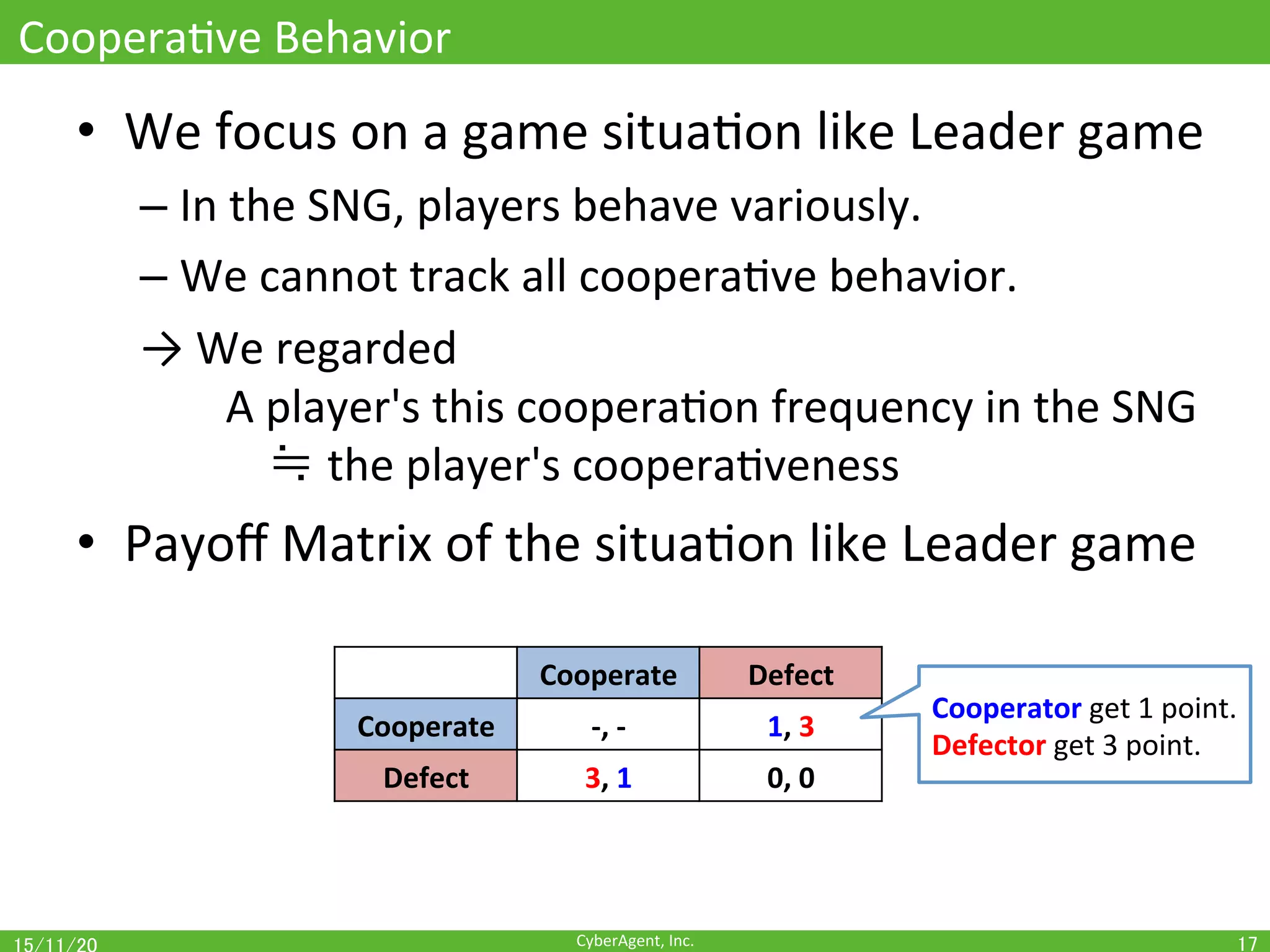
•  We	focus	on	a	game	situaOon	like	Leader	game	
– In	the	SNG,	players	behave	variously.	
– We	cannot	track	all	cooperaOve	behavior.	
→	We	regarded	
			A	player's	this	cooperaOon	frequency	in	the	SNG	
	 	≒	the	player's	cooperaOveness	
•  Payoff	Matrix	of	the	situaOon	like	Leader	game	
17	
Cooperate	 Defect	
Cooperate	 -,	-	 1,	3	
Defect	 3,	1	 0,	0	
Cooperator	get	1	point.	
Defector	get	3	point.
CyberAgent,	Inc.	
InteracOon	of	First	Time	MeeOng	
•  A	player	can	migrate	from	a	group	to	another	group	at	
any	Ome.	
•  We	observed	players'	behavior	at	the	ajer	migraOon	
–  Did	the	newcomers	blend	into	a	new	group	members?	
–  How	did	the	newcomers	interact	with	the	the	group	
members?	
–  How	did	the	newcomers	react	to	the	group	members'	
behavior?	
•  In	our	previous	works,	we	showed	
–  Cooperators	constructed	reciprocal	relaOonships	in	their	
groups.	
•  Masanori	Takano,	Kazuya	Wada,	and	Ichiro	Fukuda,	"Reciprocal	Altruism-based	CooperaOon	in	a	
Social	Network	Game",	New	GeneraOon	CompuOng	(in	press).		hEp://arxiv.org/abs/1510.06197	
18
CyberAgent,	Inc.	
Results	
19	
WEBDB	Forum	2015
CyberAgent,	Inc.	
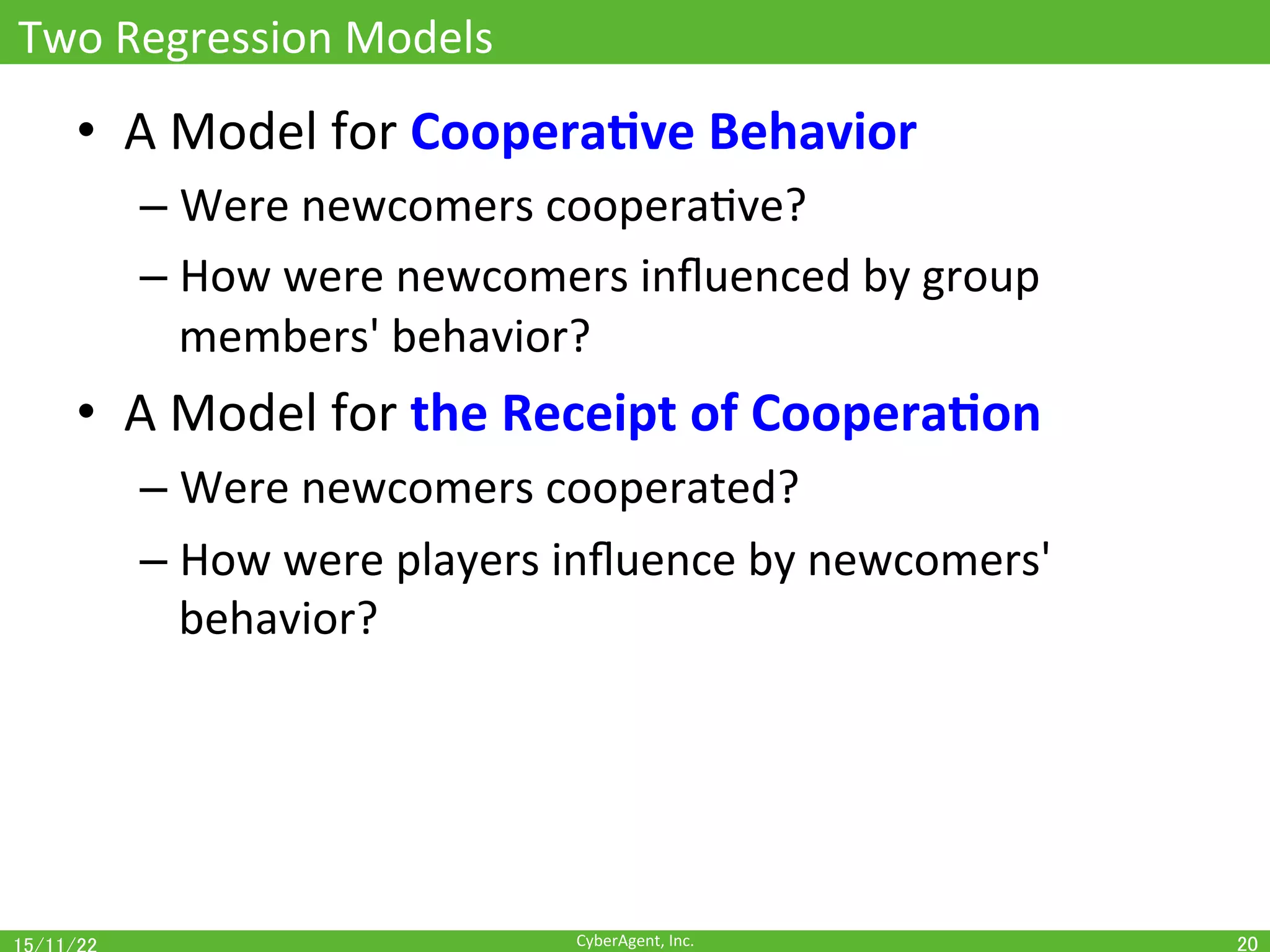
Two	Regression	Models	
•  A	Model	for	Coopera(ve	Behavior	
– Were	newcomers	cooperaOve?	
– How	were	newcomers	influenced	by	group	
members'	behavior?	
•  A	Model	for	the	Receipt	of	Coopera(on	
– Were	newcomers	cooperated?	
– How	were	players	influence	by	newcomers'	
behavior?	
20
CyberAgent,	Inc.	
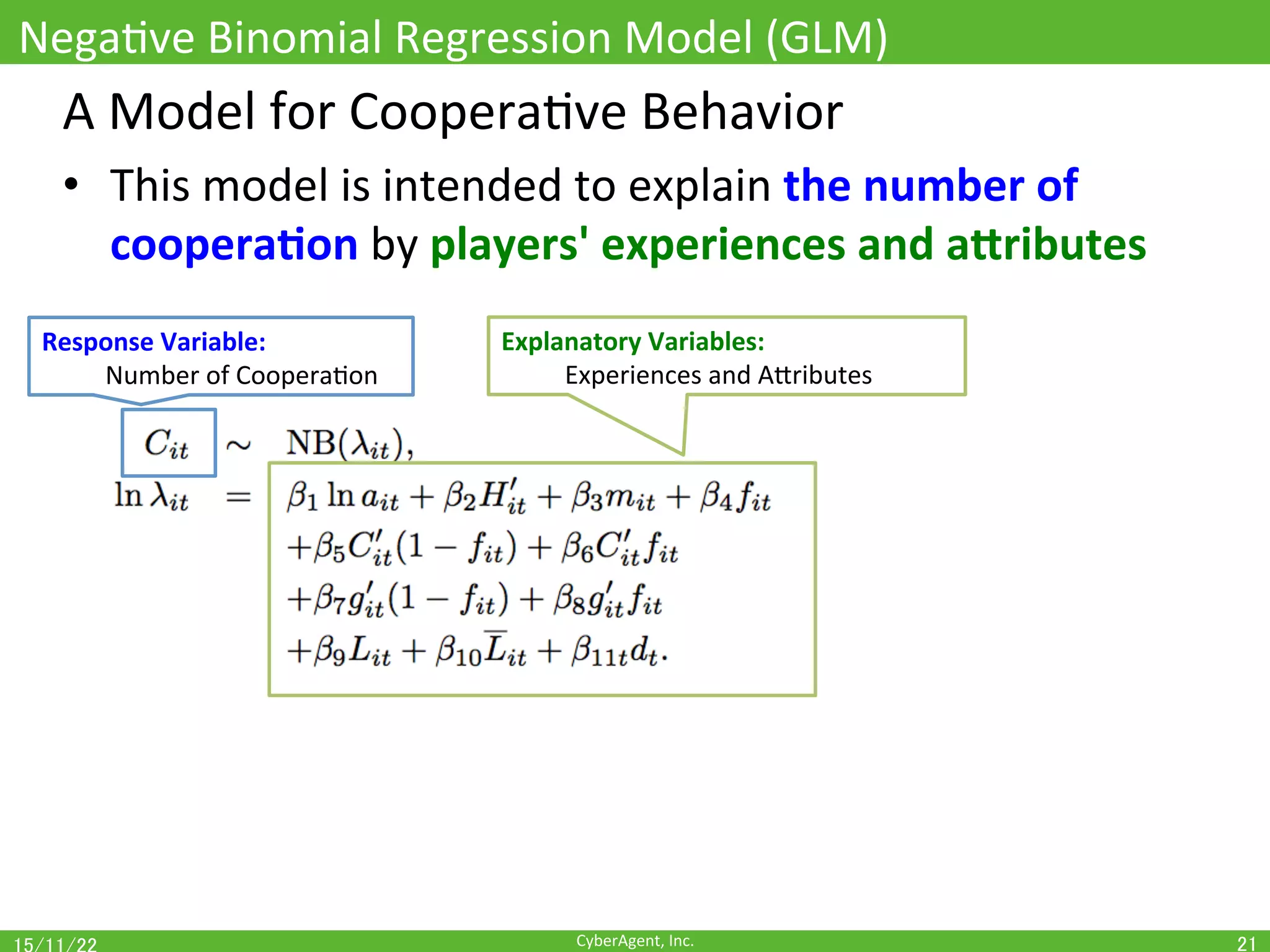
NegaOve	Binomial	Regression	Model	(GLM)	
21	
A	Model	for	CooperaOve	Behavior	
•  This	model	is	intended	to	explain	the	number	of	
coopera(on	by	players'	experiences	and	aUributes	
Response	Variable:		
	Number	of	CooperaOon	
Explanatory	Variables:		
	Experiences	and	AEributes
CyberAgent,	Inc.	
NegaOve	Binomial	Regression	Model	(GLM)	
22	
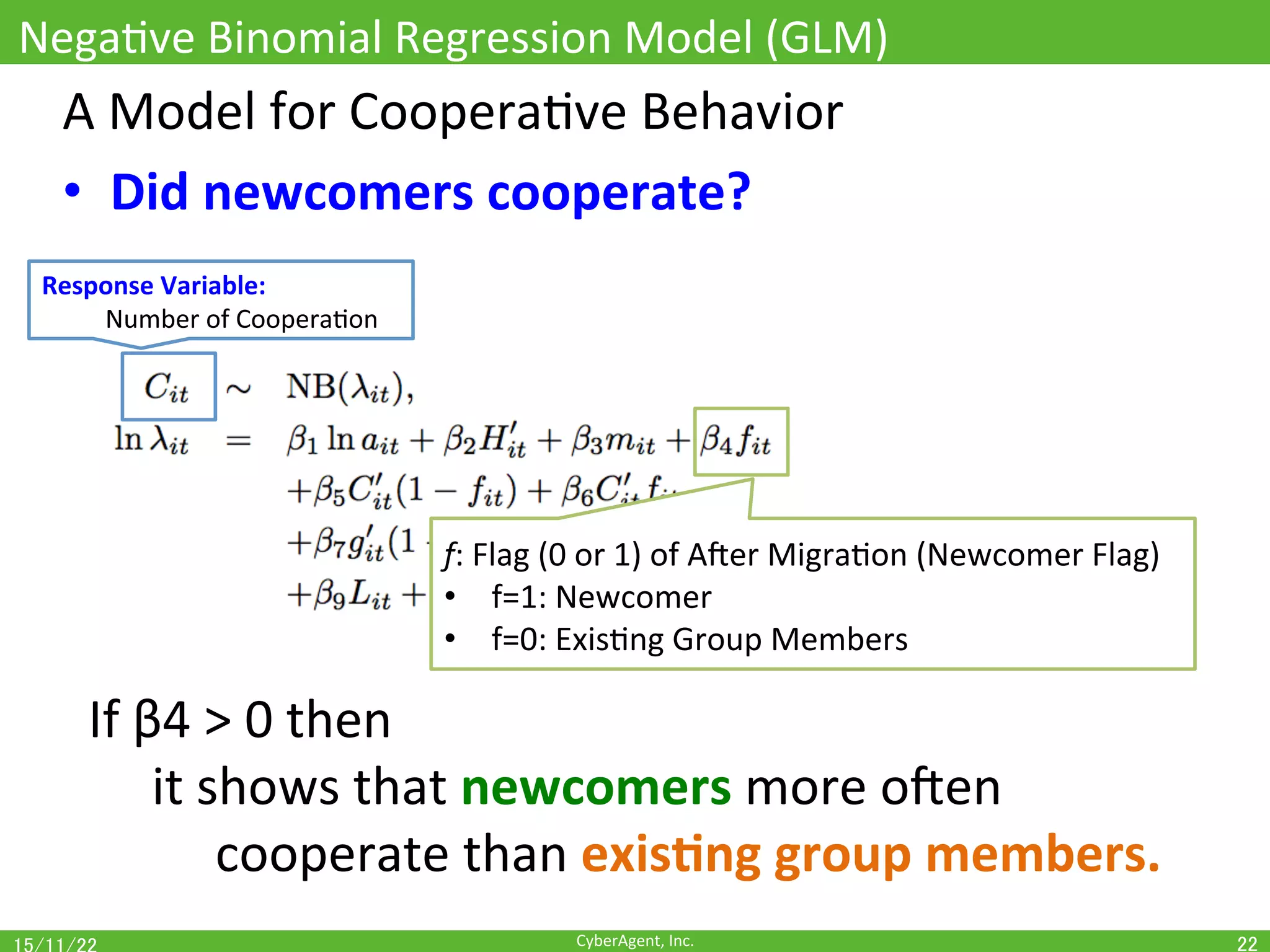
A	Model	for	CooperaOve	Behavior	
•  Did	newcomers	cooperate?	
Response	Variable:		
	Number	of	CooperaOon	
f:	Flag	(0	or	1)	of	Ajer	MigraOon	(Newcomer	Flag)	
•  f=1:	Newcomer	
•  f=0:	ExisOng	Group	Members	
If	β4	>	0	then		
	it	shows	that	newcomers	more	ojen	
	 	cooperate	than	exis(ng	group	members.
CyberAgent,	Inc.	
NegaOve	Binomial	Regression	Model	(GLM)	
23	
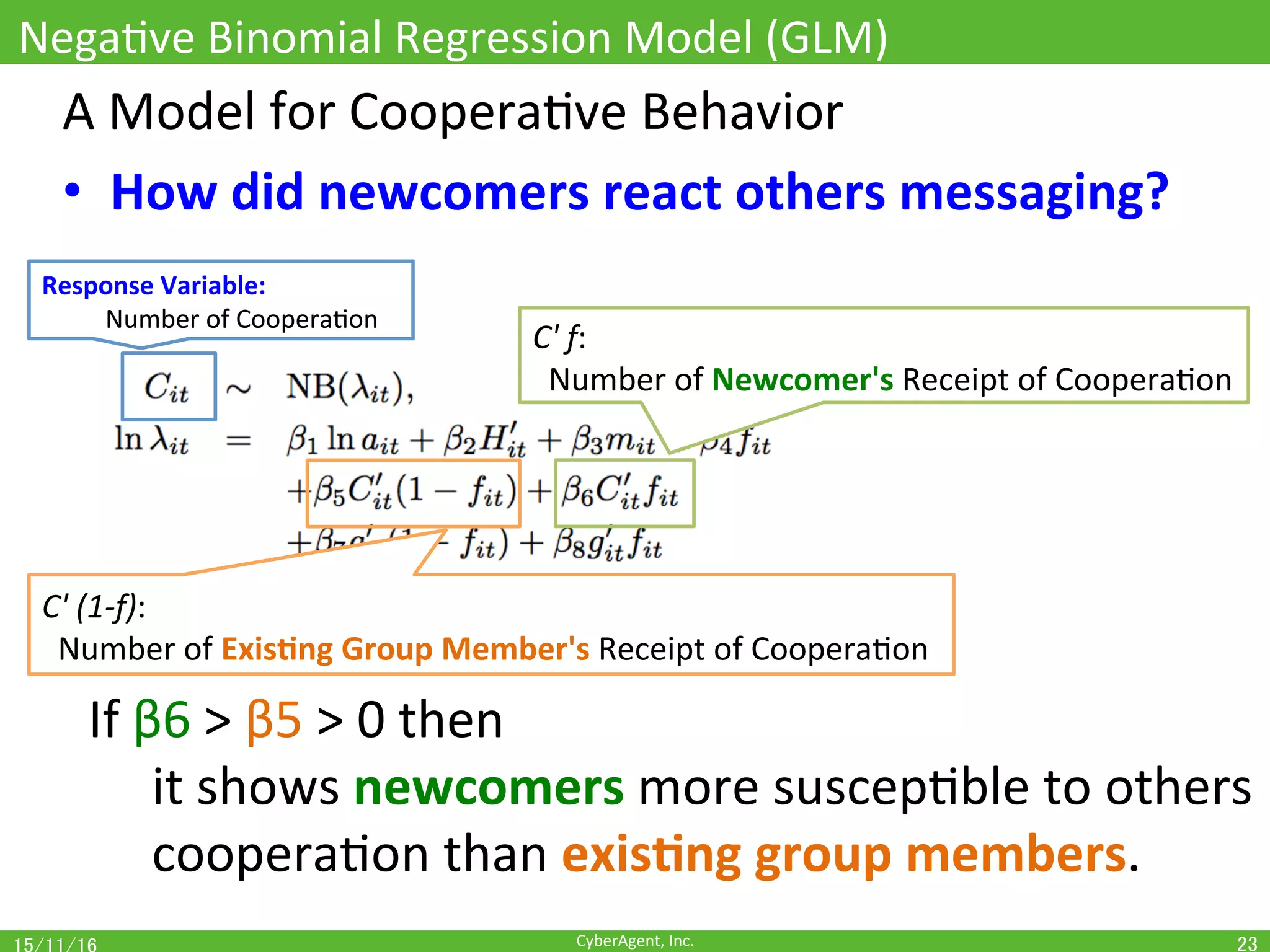
A	Model	for	CooperaOve	Behavior	
•  How	did	newcomers	react	others	messaging?	
Response	Variable:		
	Number	of	CooperaOon	
C'	(1-f):		
		Number	of	Exis(ng	Group	Member's	Receipt	of	CooperaOon	
If	β6	>	β5	>	0	then	
	it	shows	newcomers	more	suscepOble	to	others		
	cooperaOon	than	exis(ng	group	members.	
C'	f:		
		Number	of	Newcomer's	Receipt	of	CooperaOon
CyberAgent,	Inc.	
NegaOve	Binomial	Regression	Model	(GLM)	
24	
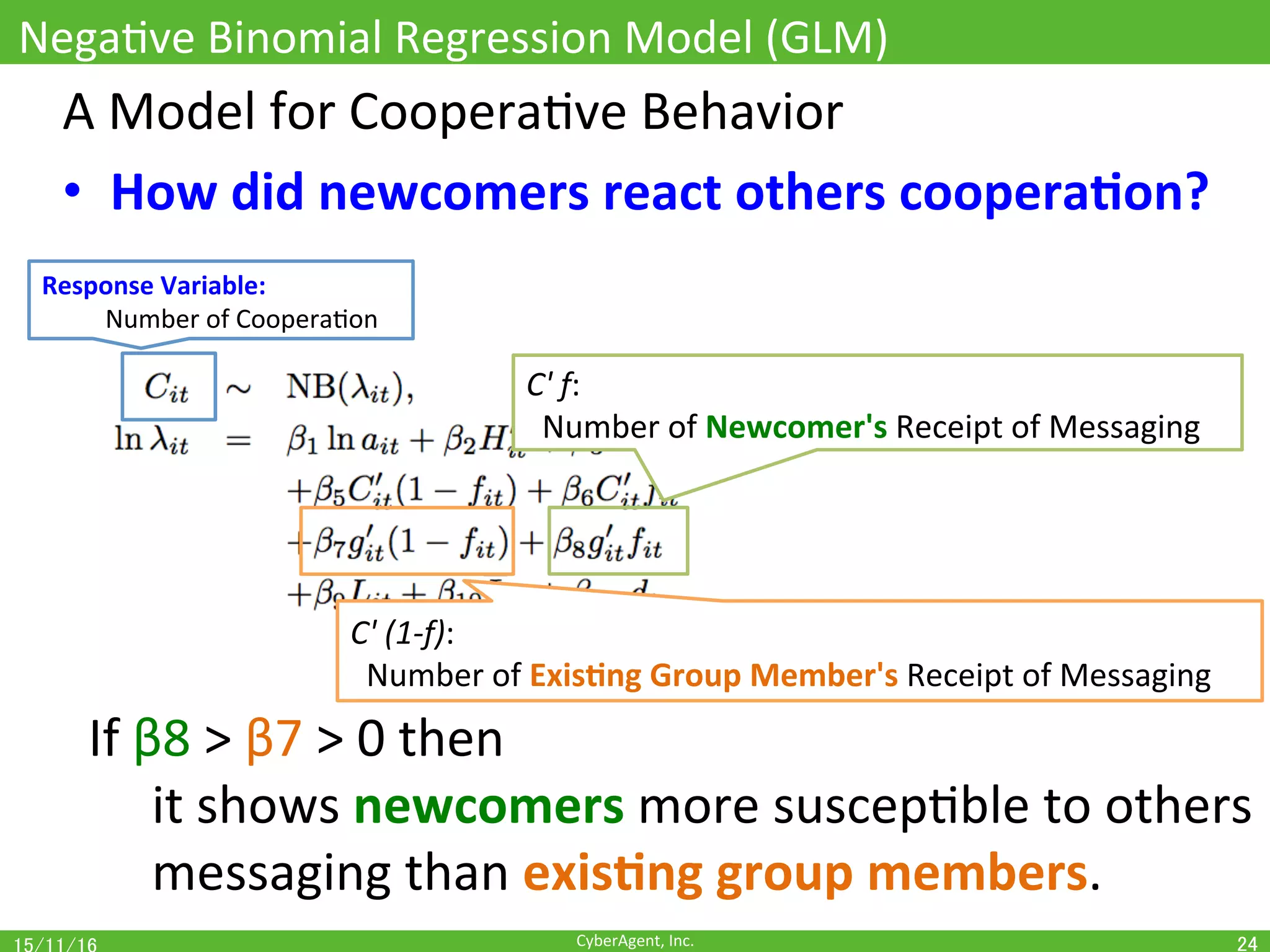
A	Model	for	CooperaOve	Behavior	
•  How	did	newcomers	react	others	coopera(on?	
Response	Variable:		
	Number	of	CooperaOon	
C'	(1-f):		
		Number	of	Exis(ng	Group	Member's	Receipt	of	Messaging	
If	β8	>	β7	>	0	then	
	it	shows	newcomers	more	suscepOble	to	others		
	messaging	than	exis(ng	group	members.	
C'	f:		
		Number	of	Newcomer's	Receipt	of	Messaging
CyberAgent,	Inc.	
NegaOve	Binomial	Regression	Model	(GLM)	
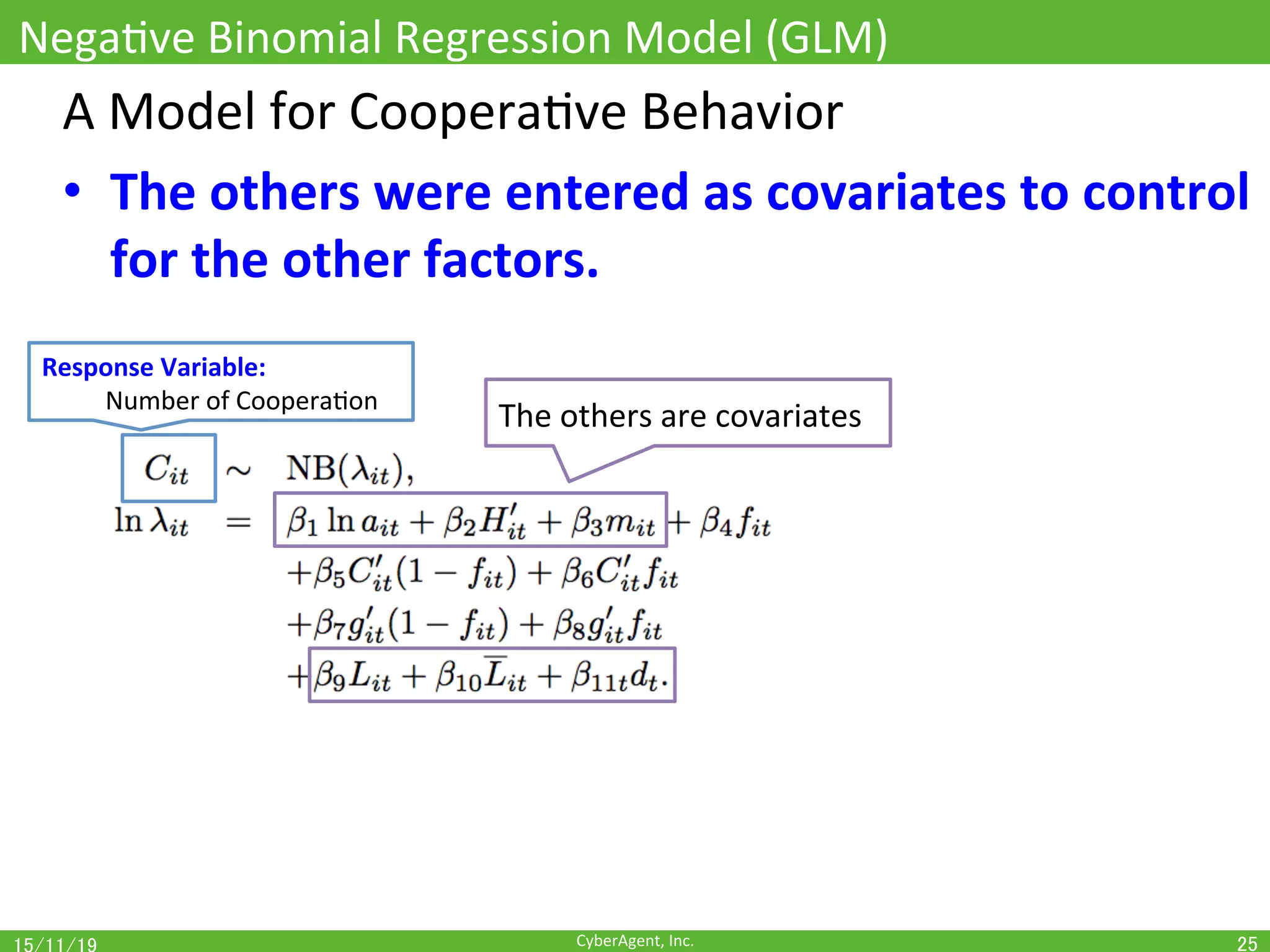
25	
A	Model	for	CooperaOve	Behavior	
•  The	others	were	entered	as	covariates	to	control	
for	the	other	factors.	
Response	Variable:		
	Number	of	CooperaOon	
The	others	are	covariates
CyberAgent,	Inc.	
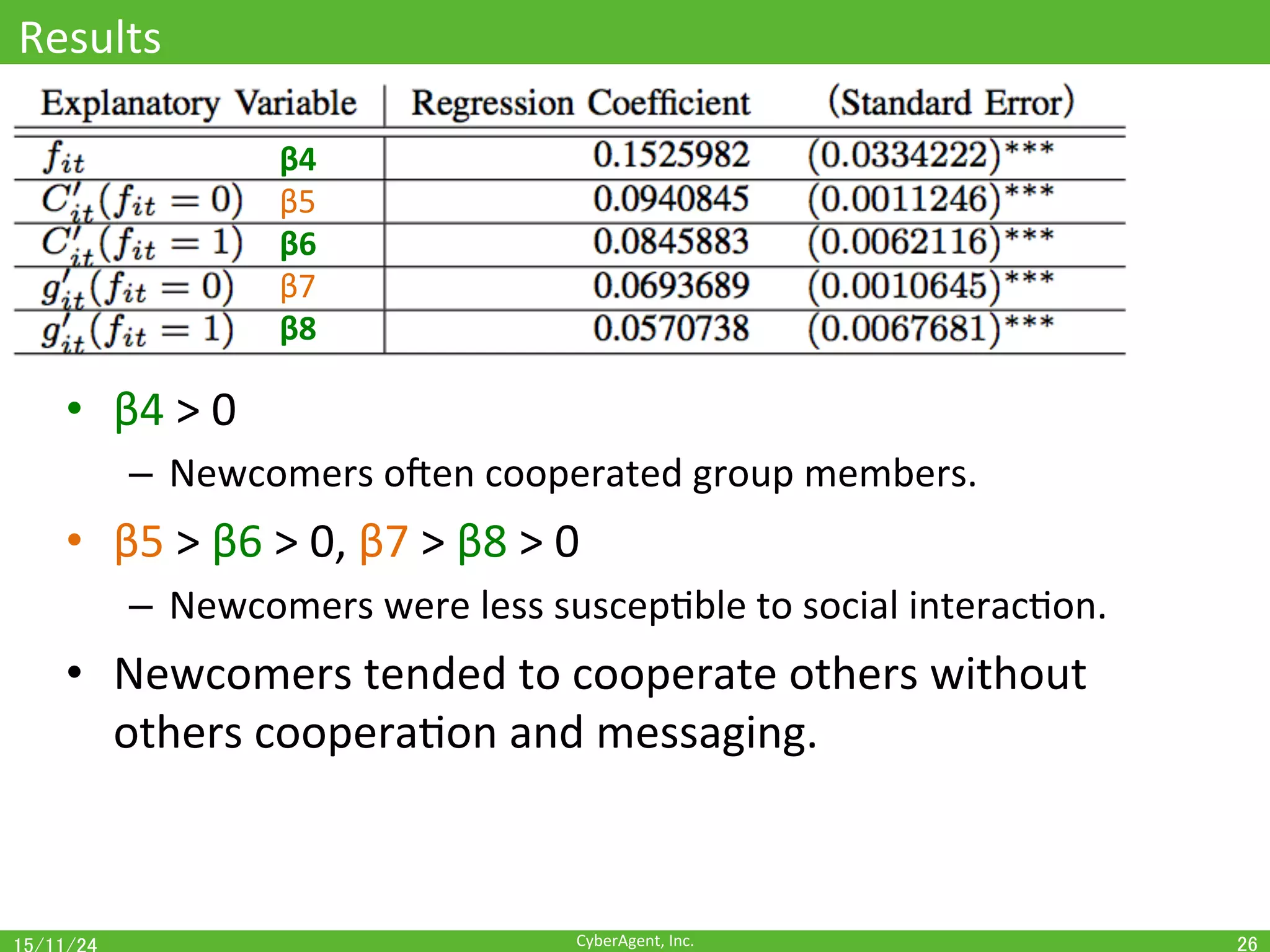
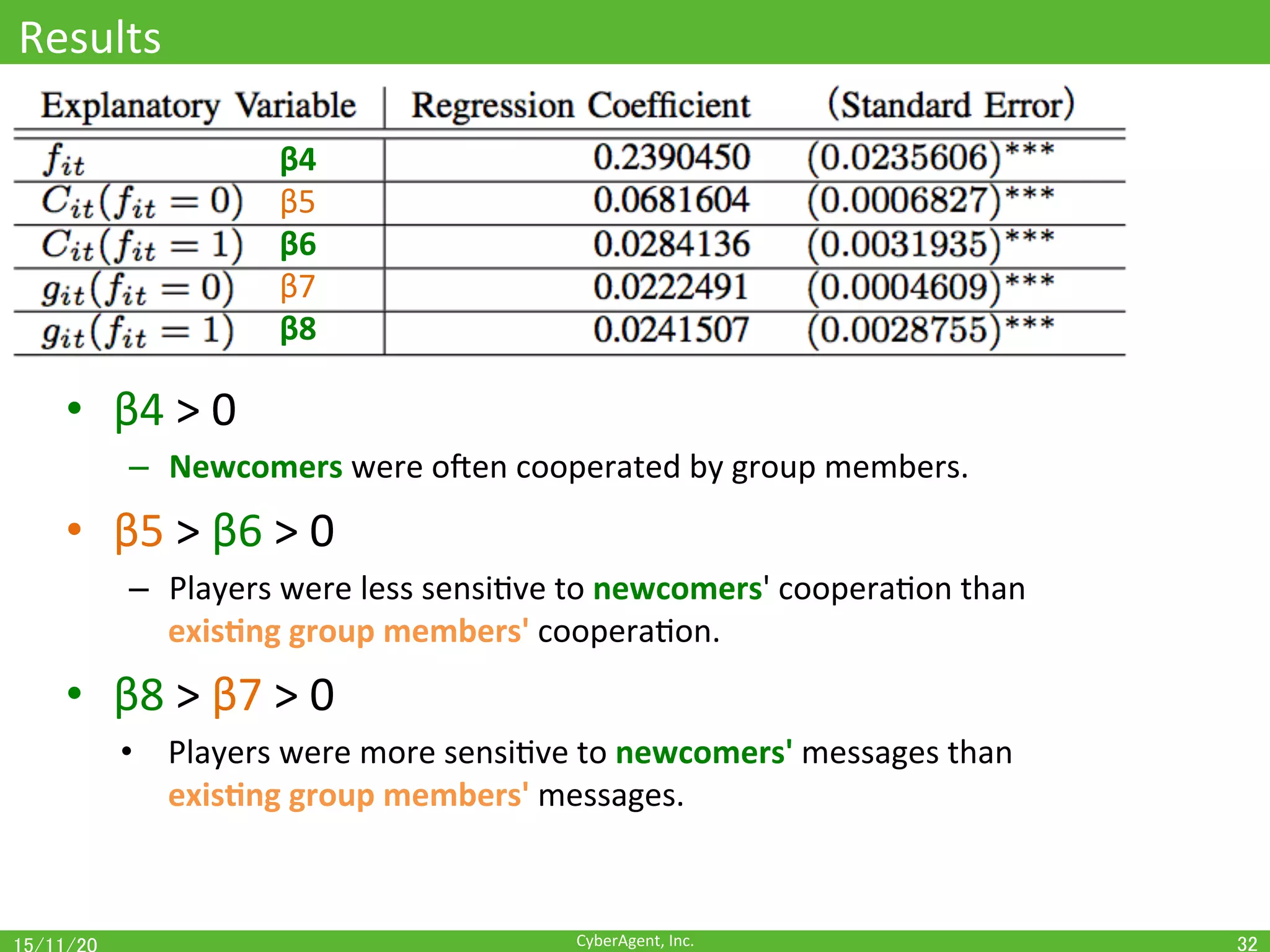
Results	
•  β4	>	0	
–  Newcomers	ojen	cooperated	group	members.	
•  β5	>	β6	>	0,	β7	>	β8	>	0	
–  Newcomers	were	less	suscepOble	to	social	interacOon.	
•  Newcomers	tended	to	cooperate	others	without	
others	cooperaOon	and	messaging.	
26	
β4	
β5	
β6	
β7	
β8
CyberAgent,	Inc.	
NegaOve	Binomial	Regression	Model	(GLM)	
27	
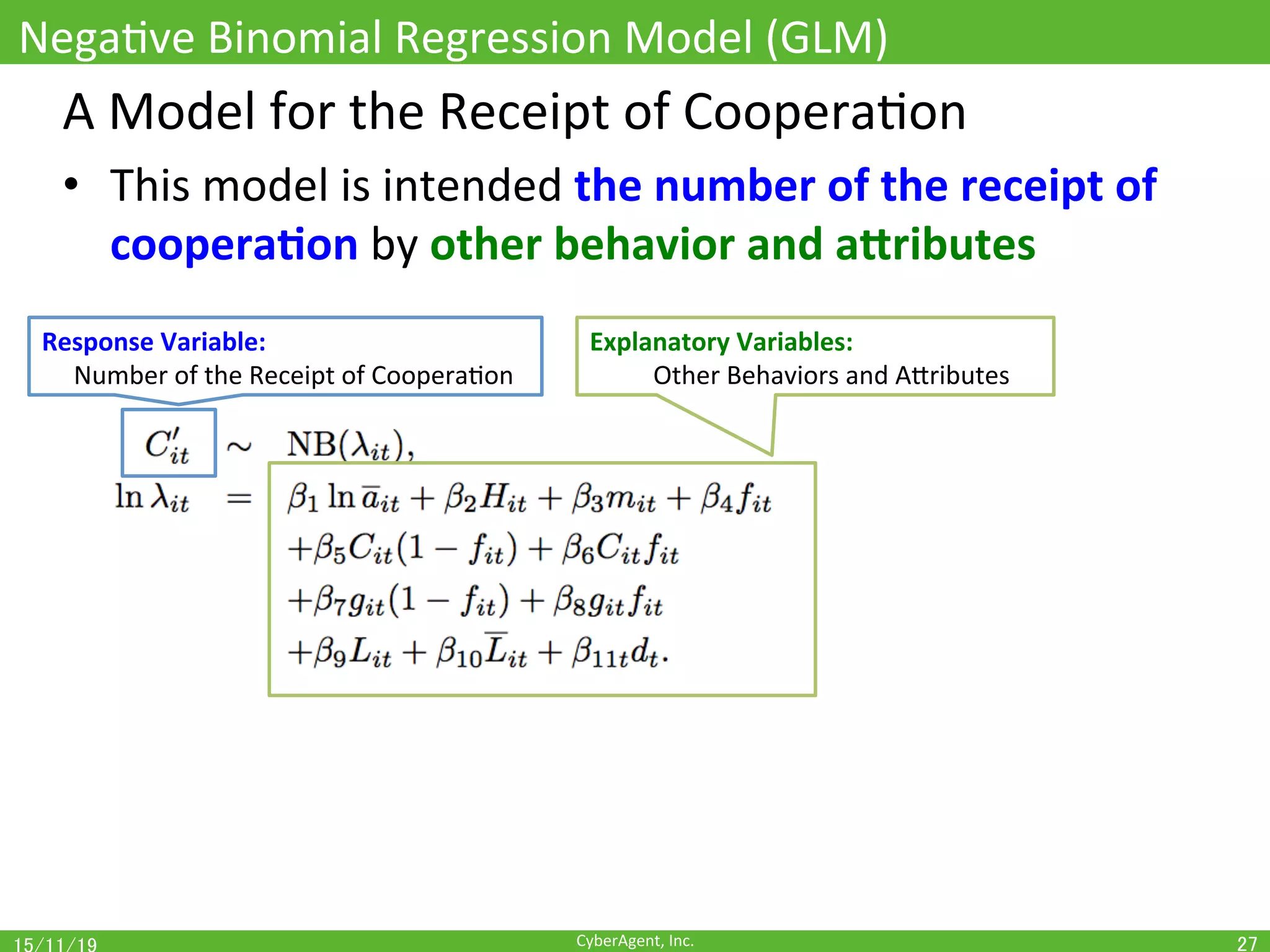
A	Model	for	the	Receipt	of	CooperaOon	
•  This	model	is	intended	the	number	of	the	receipt	of	
coopera(on	by	other	behavior	and	aUributes	
Response	Variable:		
					Number	of	the	Receipt	of	CooperaOon	
Explanatory	Variables:		
	Other	Behaviors	and	AEributes
CyberAgent,	Inc.	
Response	Variable:		
					Number	of	the	Receipt	of	CooperaOon	
NegaOve	Binomial	Regression	Model	(GLM)	
28	
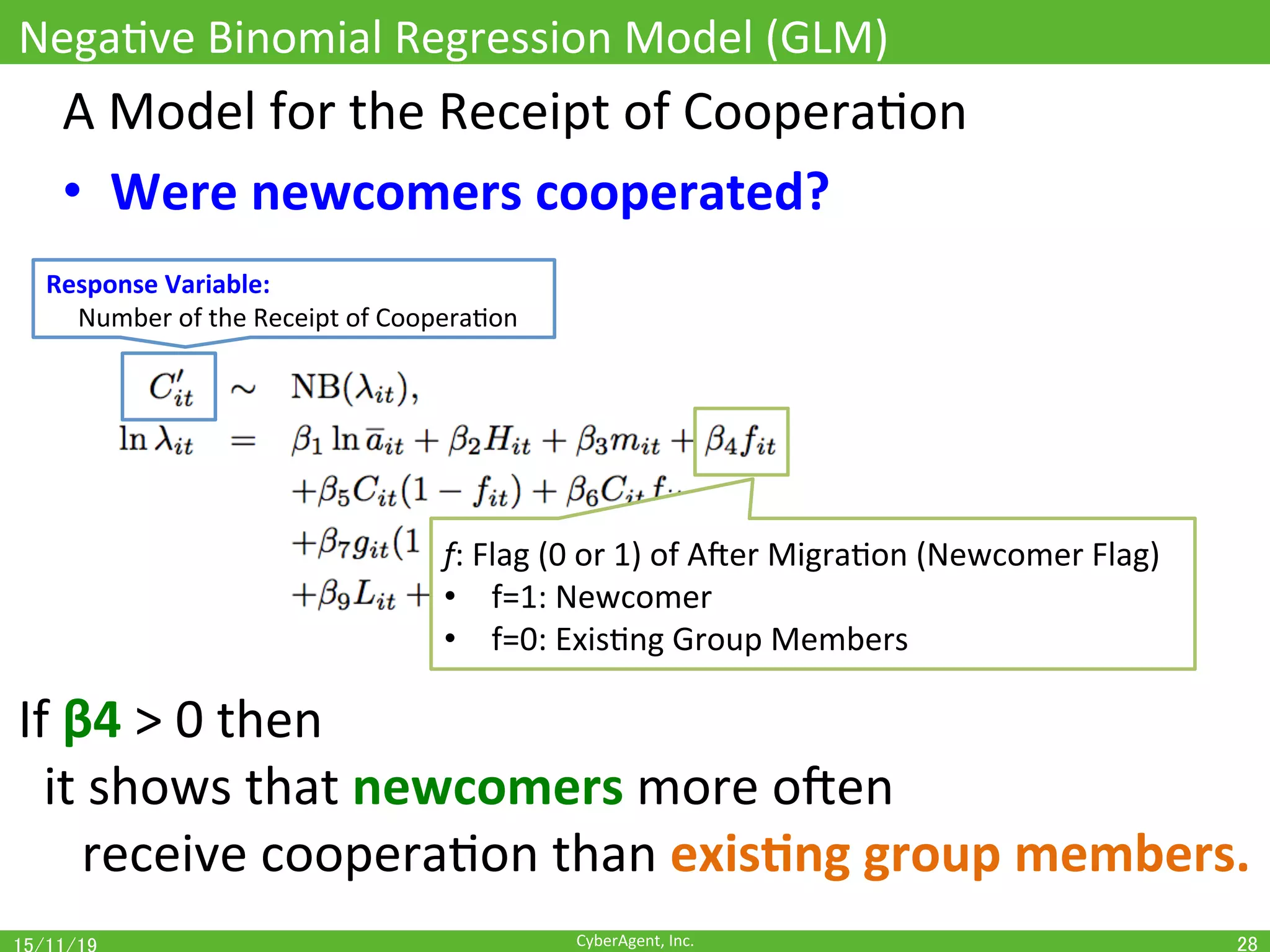
A	Model	for	the	Receipt	of	CooperaOon	
•  Were	newcomers	cooperated?	
f:	Flag	(0	or	1)	of	Ajer	MigraOon	(Newcomer	Flag)	
•  f=1:	Newcomer	
•  f=0:	ExisOng	Group	Members	
If	β4	>	0	then		
		it	shows	that	newcomers	more	ojen	
	receive	cooperaOon	than	exis(ng	group	members.
CyberAgent,	Inc.	
NegaOve	Binomial	Regression	Model	(GLM)	
29	
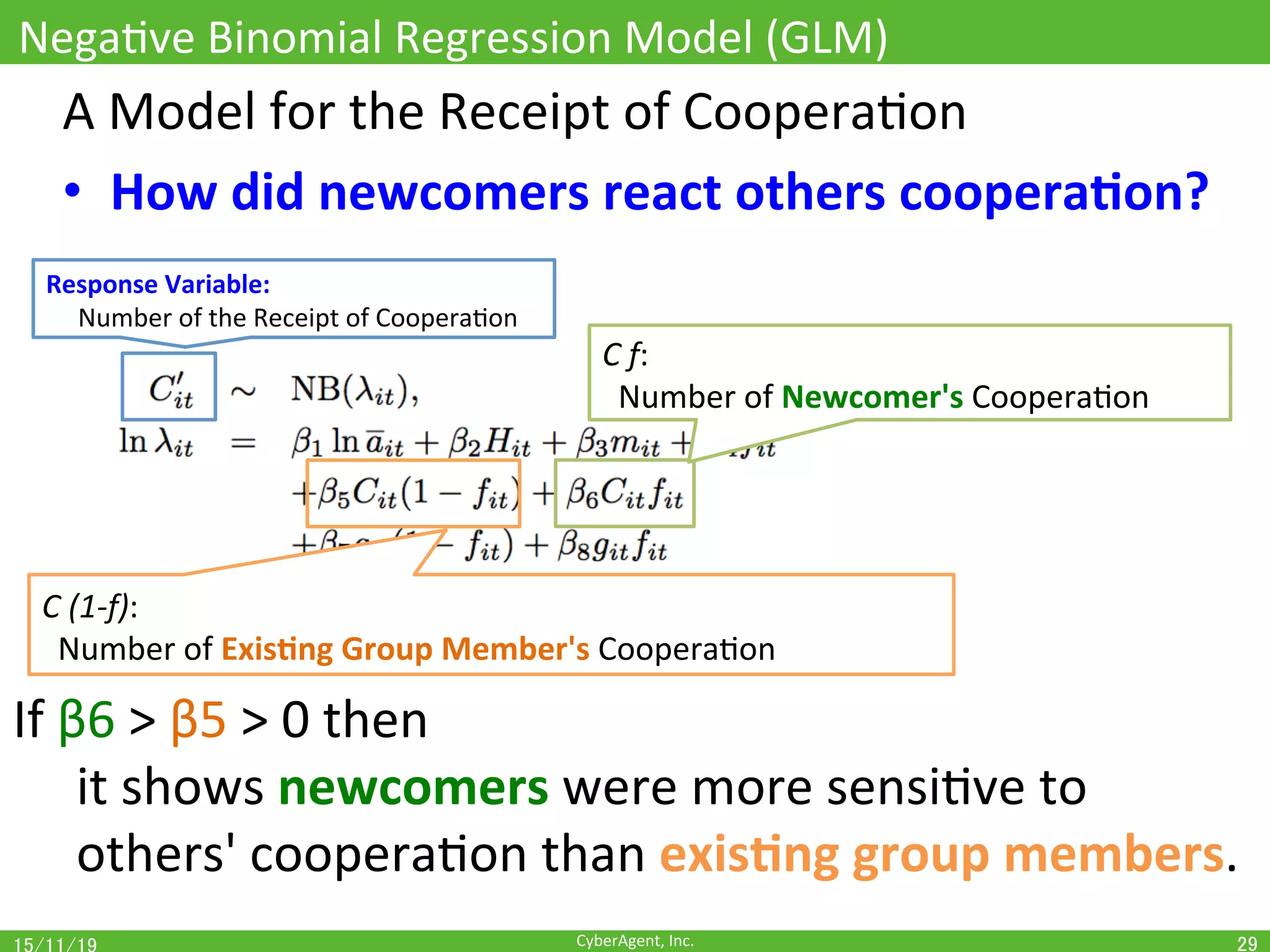
A	Model	for	the	Receipt	of	CooperaOon	
•  How	did	newcomers	react	others	coopera(on?	
C	(1-f):		
		Number	of	Exis(ng	Group	Member's	CooperaOon	
If	β6	>	β5	>	0	then	
	it	shows	newcomers	were	more	sensiOve	to		
	others'	cooperaOon	than	exis(ng	group	members.	
C	f:		
		Number	of	Newcomer's	CooperaOon	
Response	Variable:		
					Number	of	the	Receipt	of	CooperaOon
CyberAgent,	Inc.	
NegaOve	Binomial	Regression	Model	(GLM)	
30	
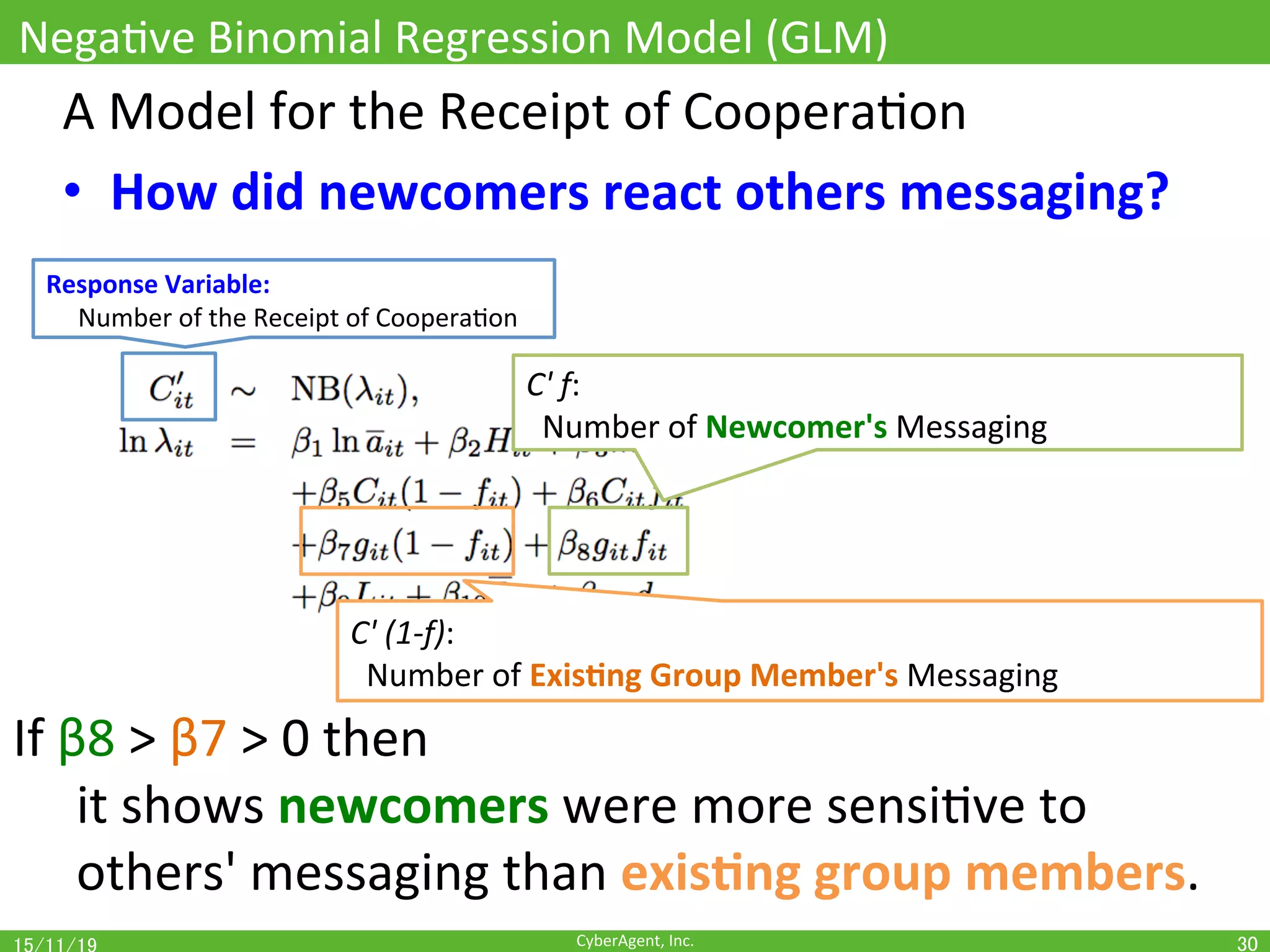
A	Model	for	the	Receipt	of	CooperaOon	
•  How	did	newcomers	react	others	messaging?	
C'	(1-f):		
		Number	of	Exis(ng	Group	Member's	Messaging	
If	β8	>	β7	>	0	then 		
	it	shows	newcomers	were	more	sensiOve	to		
	others'	messaging	than	exis(ng	group	members.	
C'	f:		
		Number	of	Newcomer's	Messaging	
Response	Variable:		
					Number	of	the	Receipt	of	CooperaOon
CyberAgent,	Inc.	
NegaOve	Binomial	Regression	Model	(GLM)	
31	
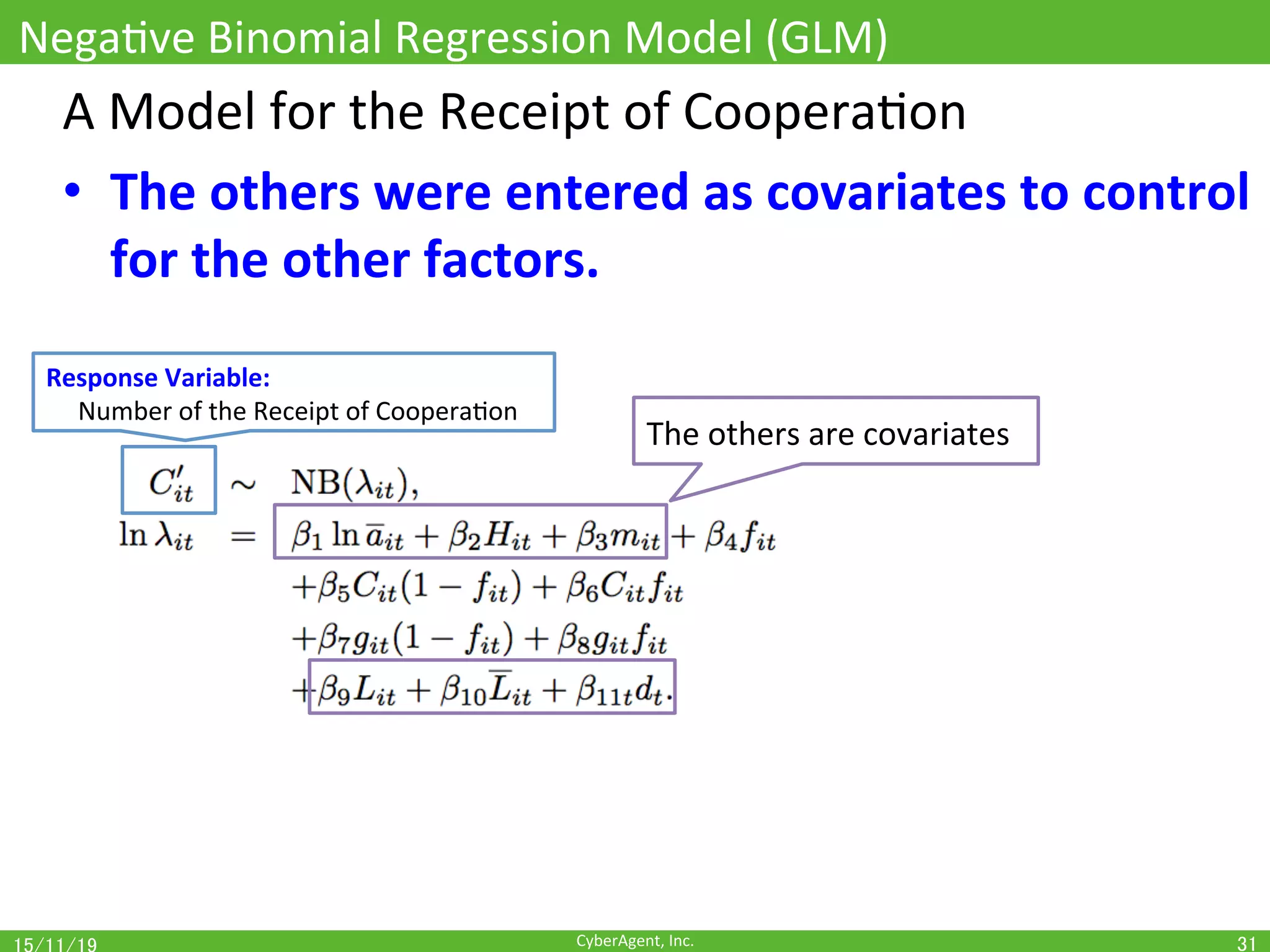
A	Model	for	the	Receipt	of	CooperaOon	
•  The	others	were	entered	as	covariates	to	control	
for	the	other	factors.	
The	others	are	covariates	
Response	Variable:		
					Number	of	the	Receipt	of	CooperaOon
CyberAgent,	Inc.	
Results	
•  β4	>	0		
–  Newcomers	were	ojen	cooperated	by	group	members.	
•  β5	>	β6	>	0	
–  Players	were	less	sensiOve	to	newcomers'	cooperaOon	than		
exis(ng	group	members'	cooperaOon.	
•  β8	>	β7	>	0	
•  Players	were	more	sensiOve	to	newcomers'	messages	than		
exis(ng	group	members'	messages.	
32	
β4	
β5	
β6	
β7	
β8
CyberAgent,	Inc.	
Summary	
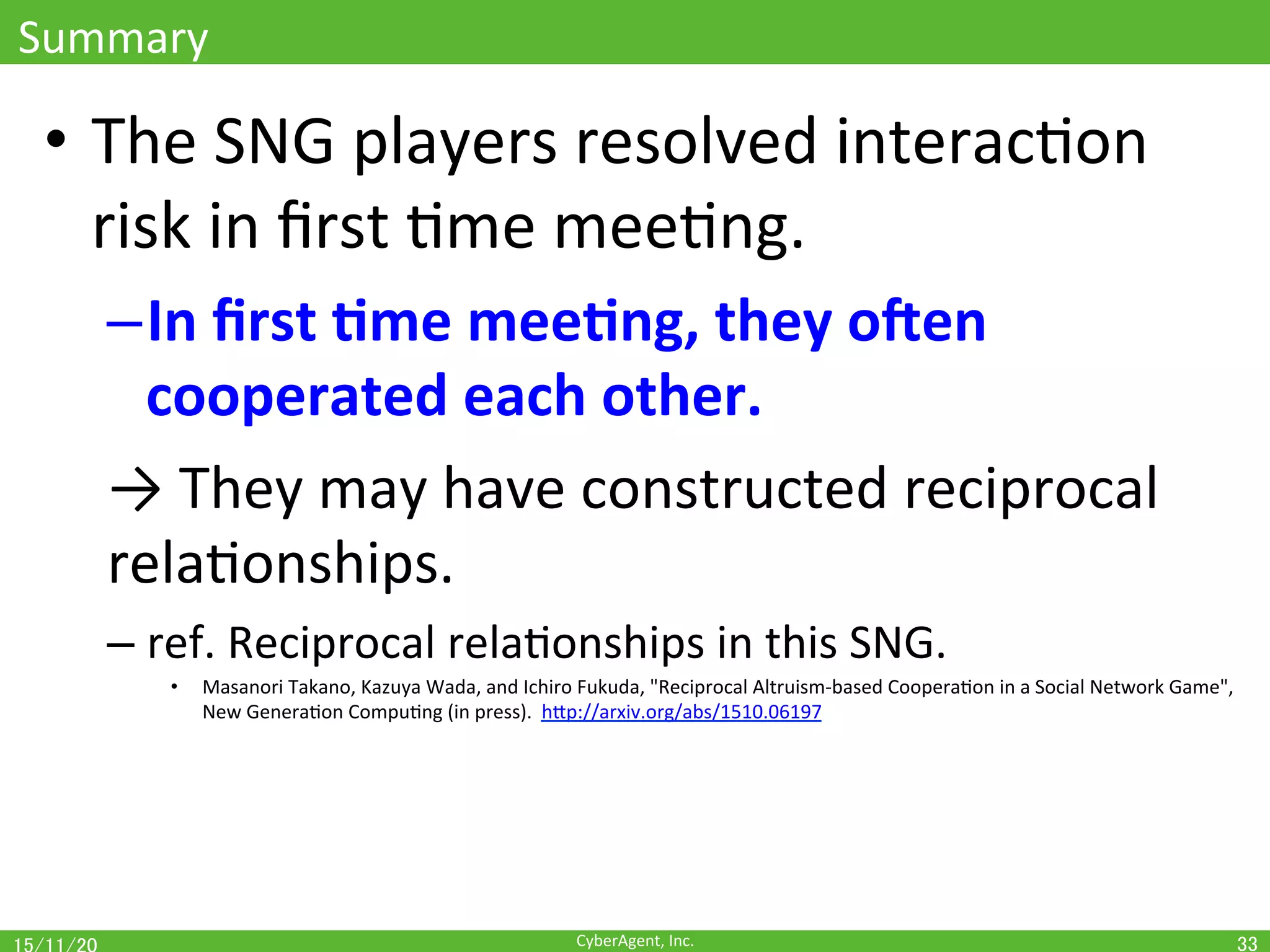
•  The	SNG	players	resolved	interacOon	
risk	in	first	Ome	meeOng.	
– In	first	(me	mee(ng,	they	oen	
cooperated	each	other.	
→	They	may	have	constructed	reciprocal	
relaOonships.	
– ref.	Reciprocal	relaOonships	in	this	SNG.	
•  Masanori	Takano,	Kazuya	Wada,	and	Ichiro	Fukuda,	"Reciprocal	Altruism-based	CooperaOon	in	a	Social	Network	Game",	
New	GeneraOon	CompuOng	(in	press).		hEp://arxiv.org/abs/1510.06197	
33
CyberAgent,	Inc.	
Summary	
•  The	difference	between	newcomers	and	exis(ng	
group	members	in	messaging		
– Players	were	more	sensiOve	newcomers'	messaging	
than	exis(ng	members'	messaging.	
– The	messaging	may	have	worked	as	social	grooming	
•  Social	grooming	is	tool	to	make	and	maintain	social	
relaOonships.	
•  It	includes	cooperaOon,	unproducOve	conversaOons	(gossips),	
and	various	social	behaviors.	
Especially	in	first	(me	mee(ng,	social	grooming	was	
important	to	resolve	the	risk	in	first	(me	mee(ng.	
34

新参者は如何にして新たなグループになじむのか? ソーシャルゲームにおける分析事例 | WEBDB Forum 2015