EVALUATION  PRACTICES IN THE FRENCH THIRD SECTOR ORGANIZATIONS Ivalua seminar Barcelona  November 3rd, 2011
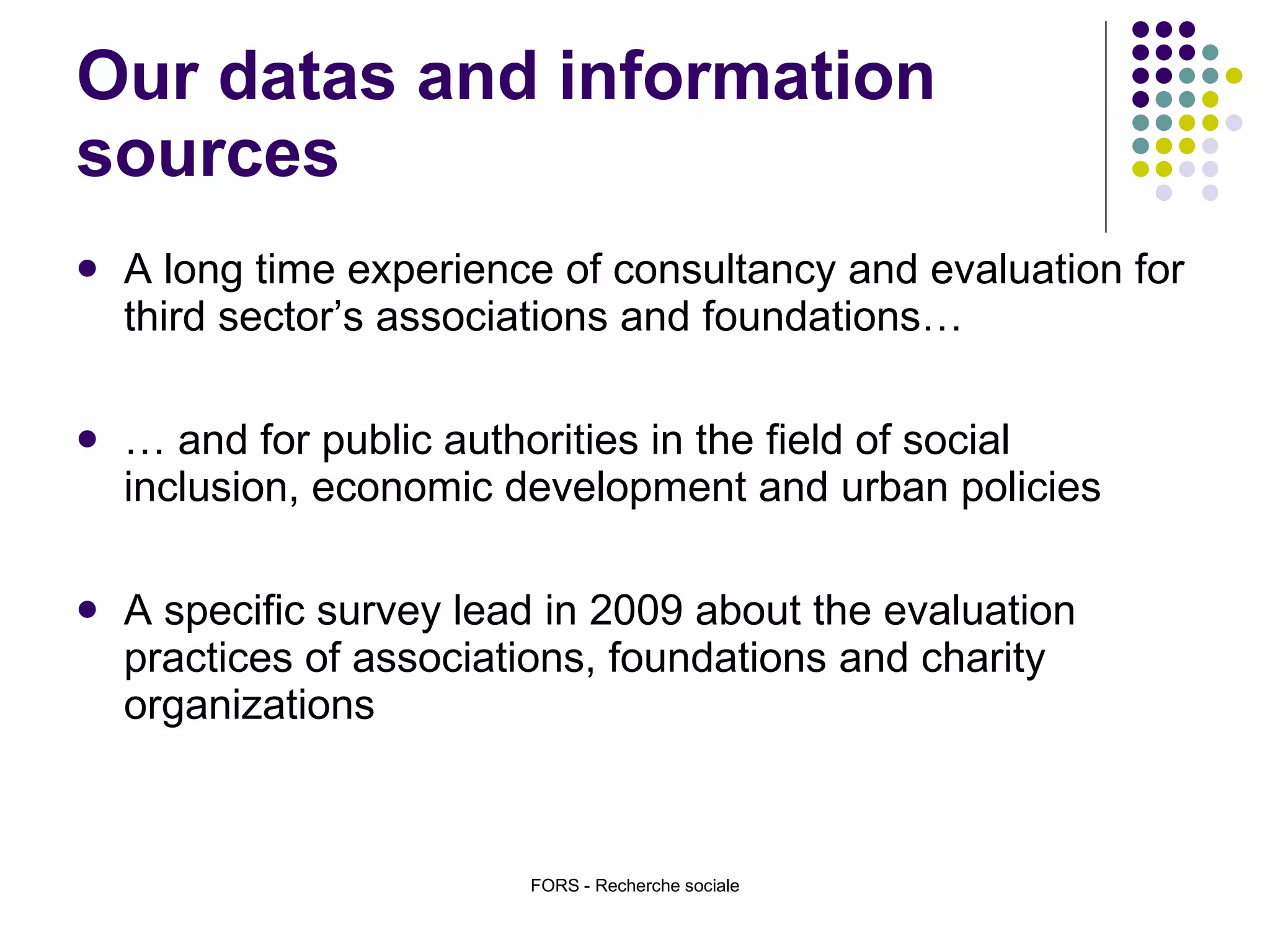
Our datas and information sources A long time experience of consultancy and evaluation for third sector ’ s associations and foundations…  …  and for public authorities in the field of social inclusion, economic development and urban policies A specific survey lead in 2009 about the evaluation practices of associations, foundations and charity organizations FORS - Recherche sociale
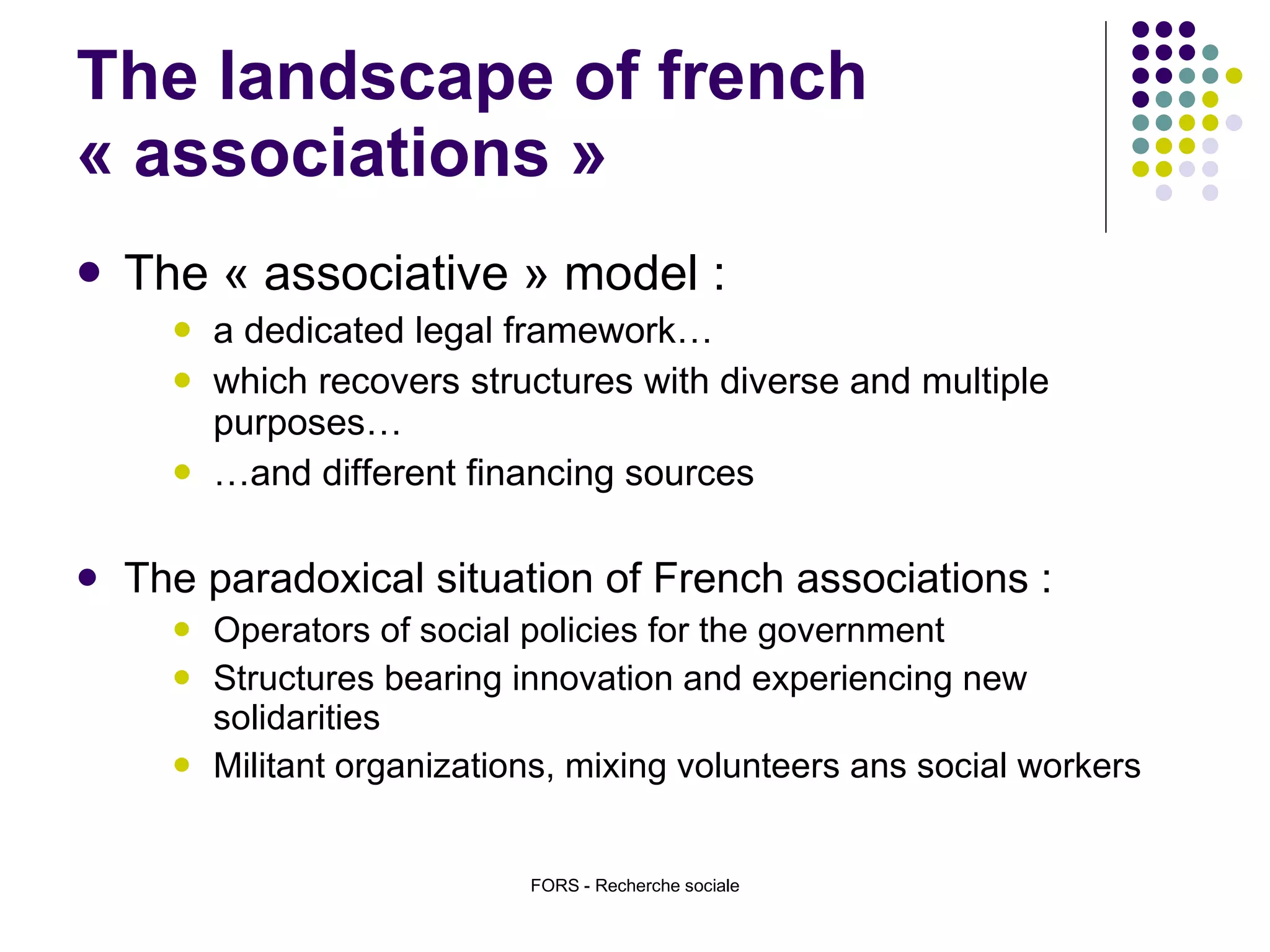
The landscape of french « associations » The « associative » model :  a dedicated legal framework…  which recovers structures with diverse and multiple purposes… … and different financing sources The paradoxical situation of French associations :  Operators of social policies for the government  Structures bearing innovation and experiencing new solidarities Militant organizations, mixing volunteers ans social workers  FORS - Recherche sociale
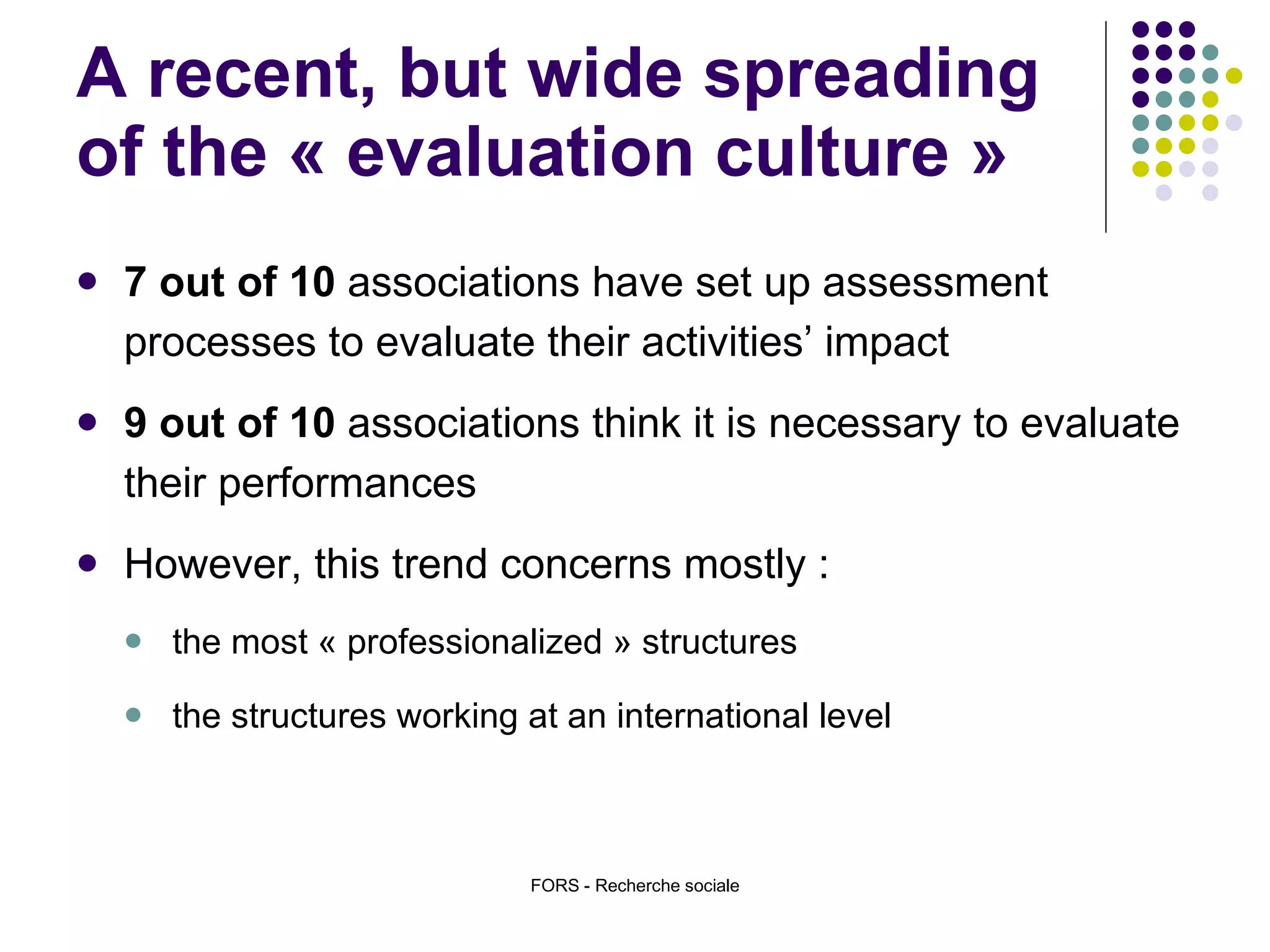
A recent, but wide spreading of the « evaluation culture » 7 out of 10  associations have set up assessment processes to evaluate their activities’ impact 9 out of 10  associations think it is necessary to evaluate their performances However, this trend concerns mostly : the most « professionalized » structures  the structures working at an international level FORS - Recherche sociale
A strong impulse of financing actors A growing pressure from the public financing institutions Calls for tenders with more and more normative specifications which include an evaluation clause A diffusion of the evaluation culture promoted by  the european programs  Private financiers : from « donation » to « investment » Organizations subjected to multiple controls FORS - Recherche sociale
The impact of the 2002 « social modernization law » An impulse for the professionalization of associations and foundations  The obligation of assessment  New financing frameworks :  From perennial subventions to temporary measures A need for « rentability »?  FORS - Recherche sociale
Evaluation of performance and voluntary work : a delicate balance Volunteers are sometimes reluctant to the evaluation principle Organizational and practical issues : The absence of hierarchical frameworks The level of training of the volunteers Management constraints likely to discourage the volunteers Is it possible to « professionalize » the volonteers without « killing the volontary work »?  FORS - Recherche sociale
A large range of evaluation practices… but sometimes a lack of methodological framework Associations are sometimes reluctant to consider the link between results and costs How to assess the « human dimension »?  A persistent confusion between « evaluation », « control » and « quantitative assessment » of the results  FORS - Recherche sociale
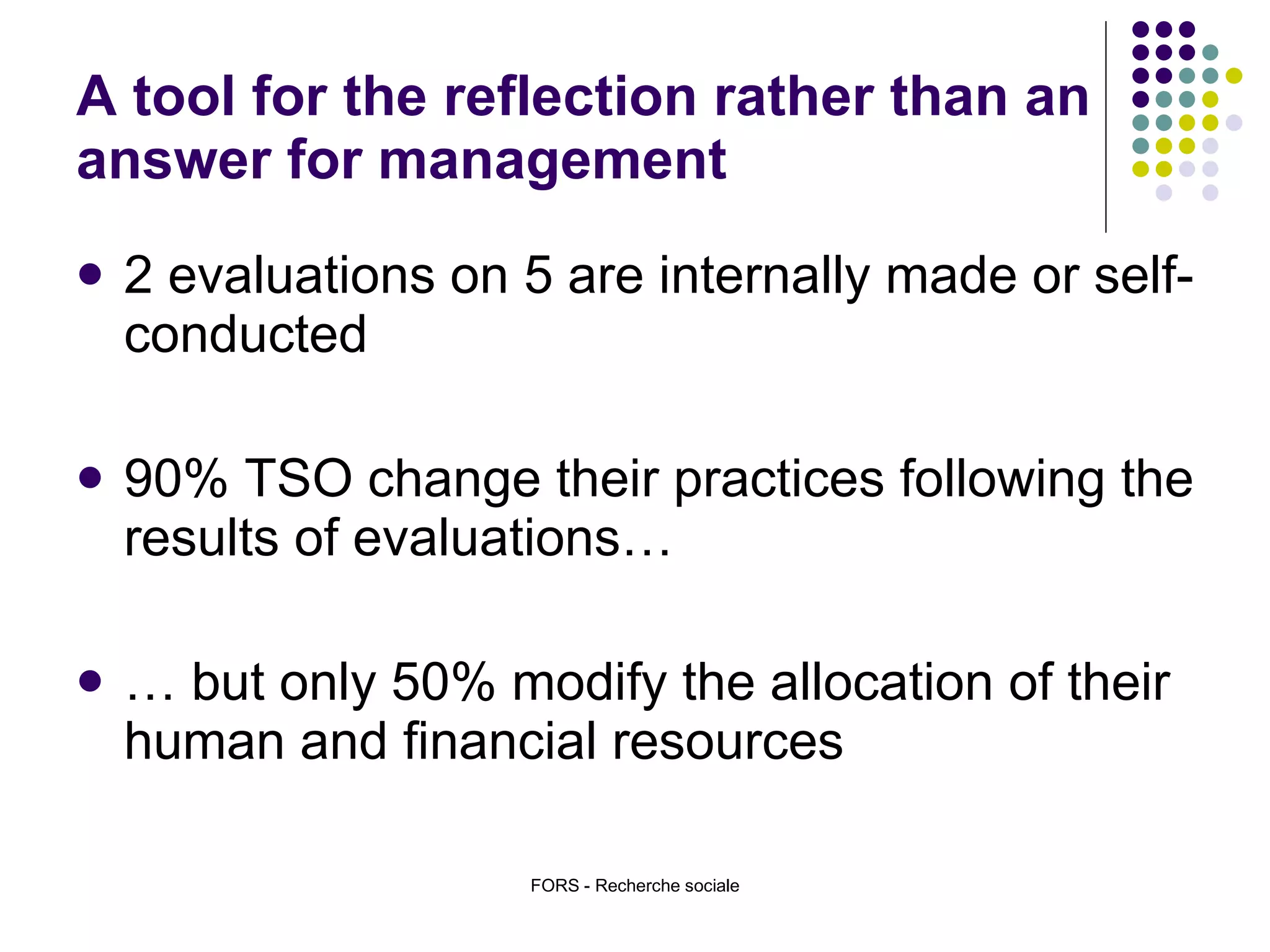
A tool for the reflection rather than an answer for management 2 evaluations on 5 are internally made or self-conducted 90% TSO change their practices following the results of evaluations… …  but only 50% modify the allocation of their human and financial resources FORS - Recherche sociale
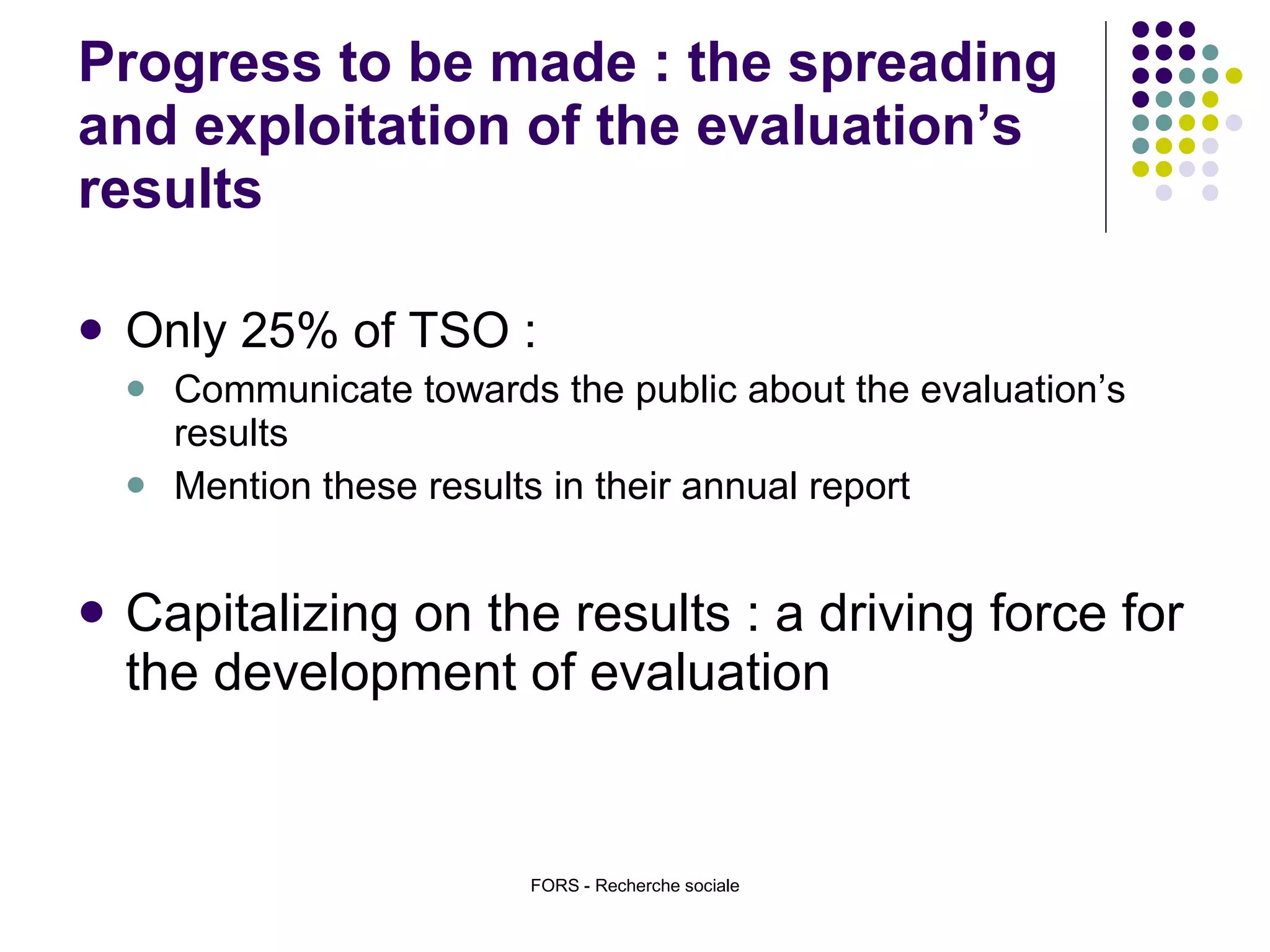
Progress to be made : the spreading  and exploitation of the evaluation’s results Only 25% of TSO : Communicate towards the public about the evaluation’s results Mention these results in their annual report Capitalizing on the results : a driving force for the development of evaluation  FORS - Recherche sociale
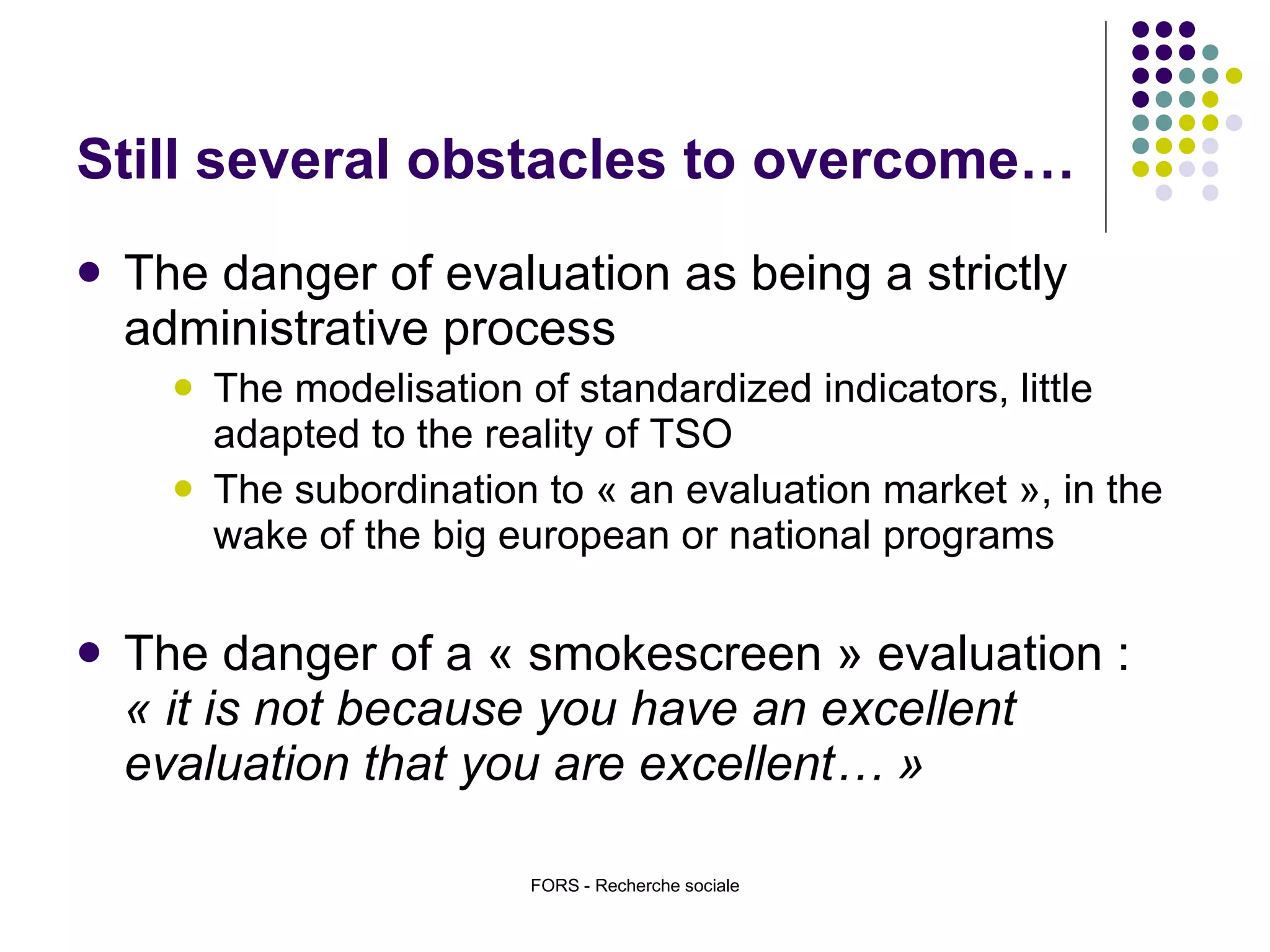
Still several obstacles to overcome… The danger of evaluation as being a strictly administrative process The modelisation of standardized indicators, little adapted to the reality of TSO  The subordination to « an evaluation market », in the wake of the big european or national programs The danger of a « smokescreen » evaluation :  « it is not because you have an excellent evaluation that you are excellent… » FORS - Recherche sociale
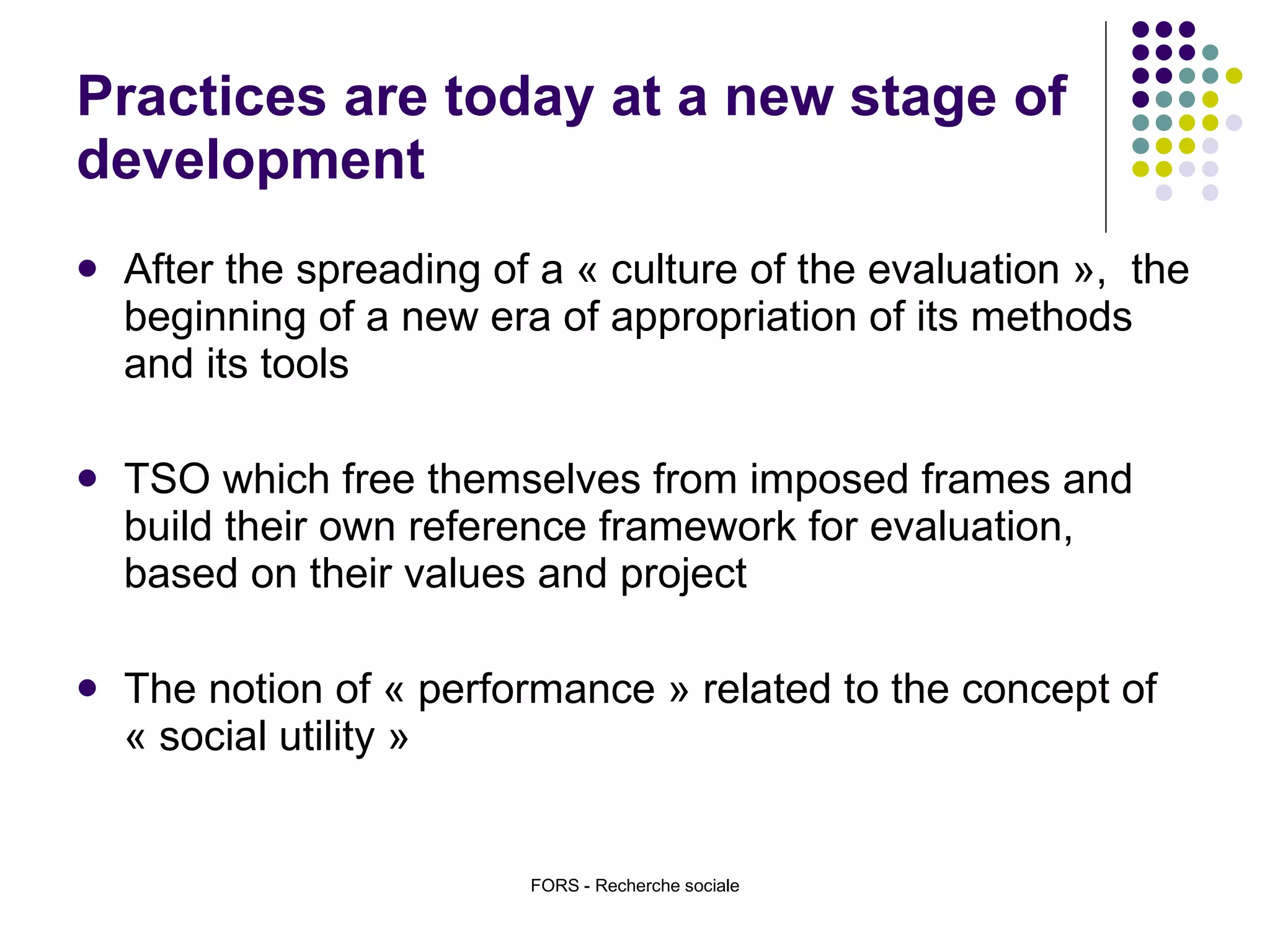
Practices are today at a new stage of development After the spreading of a « culture of the evaluation »,  the beginning of a new era of appropriation of its methods and its tools TSO which free themselves from imposed frames and build their own reference framework for evaluation, based on their values and project The notion of « performance » related to the concept of « social utility » FORS - Recherche sociale

Evaluation practices in the french third sector organizations/ Florence Brunet

  • 1.
    EVALUATION PRACTICESIN THE FRENCH THIRD SECTOR ORGANIZATIONS Ivalua seminar Barcelona November 3rd, 2011
  • 2.
    Our datas andinformation sources A long time experience of consultancy and evaluation for third sector ’ s associations and foundations… … and for public authorities in the field of social inclusion, economic development and urban policies A specific survey lead in 2009 about the evaluation practices of associations, foundations and charity organizations FORS - Recherche sociale
  • 3.
    The landscape offrench « associations » The « associative » model : a dedicated legal framework… which recovers structures with diverse and multiple purposes… … and different financing sources The paradoxical situation of French associations : Operators of social policies for the government Structures bearing innovation and experiencing new solidarities Militant organizations, mixing volunteers ans social workers FORS - Recherche sociale
  • 4.
    A recent, butwide spreading of the « evaluation culture » 7 out of 10 associations have set up assessment processes to evaluate their activities’ impact 9 out of 10 associations think it is necessary to evaluate their performances However, this trend concerns mostly : the most « professionalized » structures the structures working at an international level FORS - Recherche sociale
  • 5.
    A strong impulseof financing actors A growing pressure from the public financing institutions Calls for tenders with more and more normative specifications which include an evaluation clause A diffusion of the evaluation culture promoted by the european programs Private financiers : from « donation » to « investment » Organizations subjected to multiple controls FORS - Recherche sociale
  • 6.
    The impact ofthe 2002 « social modernization law » An impulse for the professionalization of associations and foundations The obligation of assessment New financing frameworks : From perennial subventions to temporary measures A need for « rentability »? FORS - Recherche sociale
  • 7.
    Evaluation of performanceand voluntary work : a delicate balance Volunteers are sometimes reluctant to the evaluation principle Organizational and practical issues : The absence of hierarchical frameworks The level of training of the volunteers Management constraints likely to discourage the volunteers Is it possible to « professionalize » the volonteers without « killing the volontary work »? FORS - Recherche sociale
  • 8.
    A large rangeof evaluation practices… but sometimes a lack of methodological framework Associations are sometimes reluctant to consider the link between results and costs How to assess the « human dimension »? A persistent confusion between « evaluation », « control » and « quantitative assessment » of the results FORS - Recherche sociale
  • 9.
    A tool forthe reflection rather than an answer for management 2 evaluations on 5 are internally made or self-conducted 90% TSO change their practices following the results of evaluations… … but only 50% modify the allocation of their human and financial resources FORS - Recherche sociale
  • 10.
    Progress to bemade : the spreading and exploitation of the evaluation’s results Only 25% of TSO : Communicate towards the public about the evaluation’s results Mention these results in their annual report Capitalizing on the results : a driving force for the development of evaluation FORS - Recherche sociale
  • 11.
    Still several obstaclesto overcome… The danger of evaluation as being a strictly administrative process The modelisation of standardized indicators, little adapted to the reality of TSO The subordination to « an evaluation market », in the wake of the big european or national programs The danger of a « smokescreen » evaluation : « it is not because you have an excellent evaluation that you are excellent… » FORS - Recherche sociale
  • 12.
    Practices are todayat a new stage of development After the spreading of a « culture of the evaluation », the beginning of a new era of appropriation of its methods and its tools TSO which free themselves from imposed frames and build their own reference framework for evaluation, based on their values and project The notion of « performance » related to the concept of « social utility » FORS - Recherche sociale