ETHICS FOR OUR ORGANIZATION 2010
by I. Myers Lavant
OUR CODE OF ETHICS MISSION:
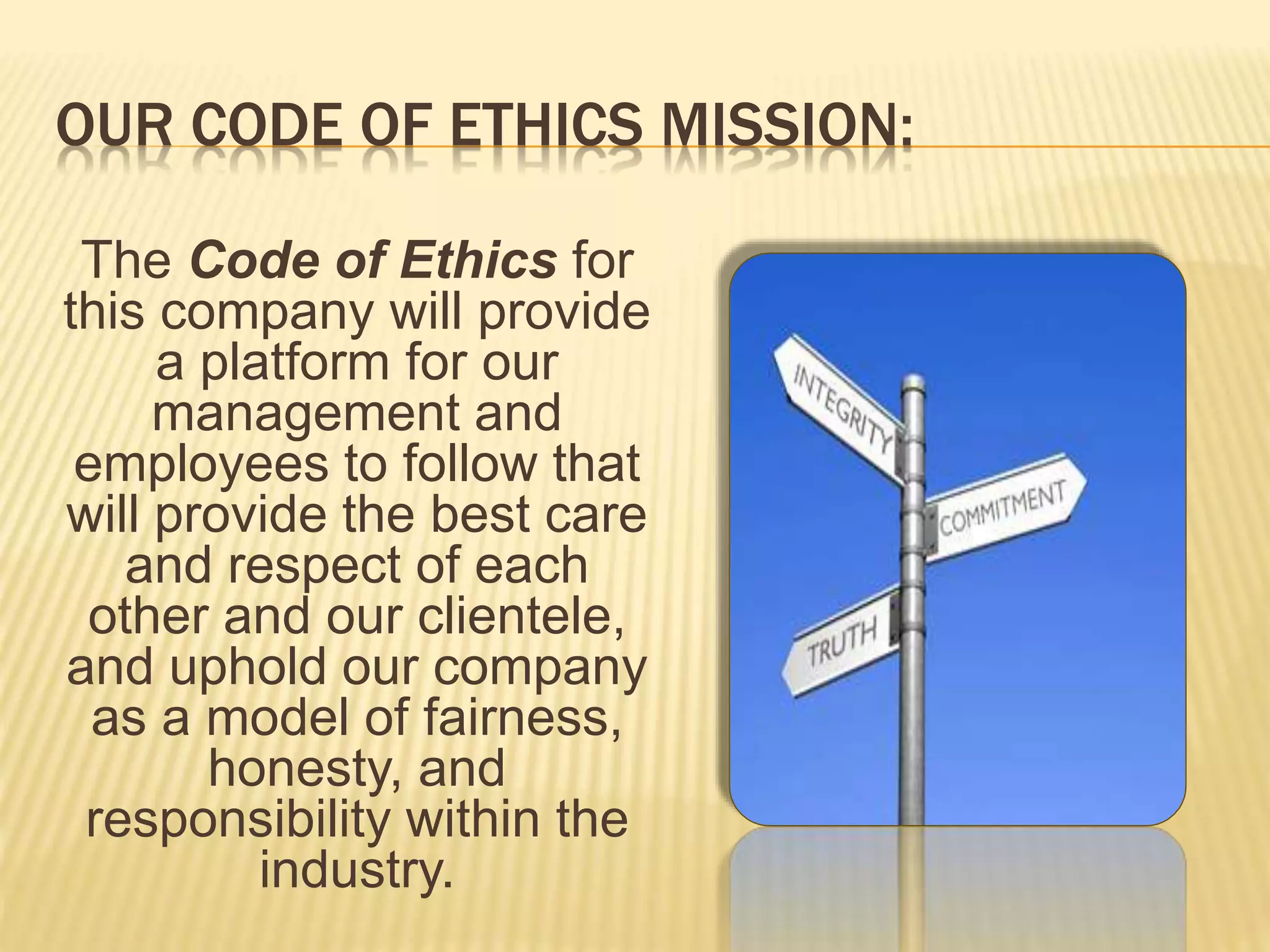
The Code of Ethics for
this company will provide
a platform for our
management and
employees to follow that
will provide the best care
and respect of each
other and our clientele,
and uphold our company
as a model of fairness,
honesty, and
responsibility within the
industry.
PATHWAY TO SUCCESS:
This organization will follow these declarations, which
will coincide with every ethically, morally, socially, and
legally correct standard in the industry.
Every employee attends a rigorous training session in
ethics and will be tested thereafter. Our Code of Ethics is
bound to every employee, including management, as
meeting our ethical goals are important to the company.
Members who violate and cannot meet these standards
will be terminated. These provisions were drawn in order
for this company to operate within the realms of the law.
ACHIEVING ETHICAL GREATNESS:
Each manager will be required to
complete two hours of each:
 cultural diversity training
 anti-discrimination training
 company code of ethics training
 company handbook training
 employee evaluation training
Our employees will be required to
complete one hour of each:
 cultural diversity training
 company code of ethics training
 company handbook training
THE REVIEW PROCESS:
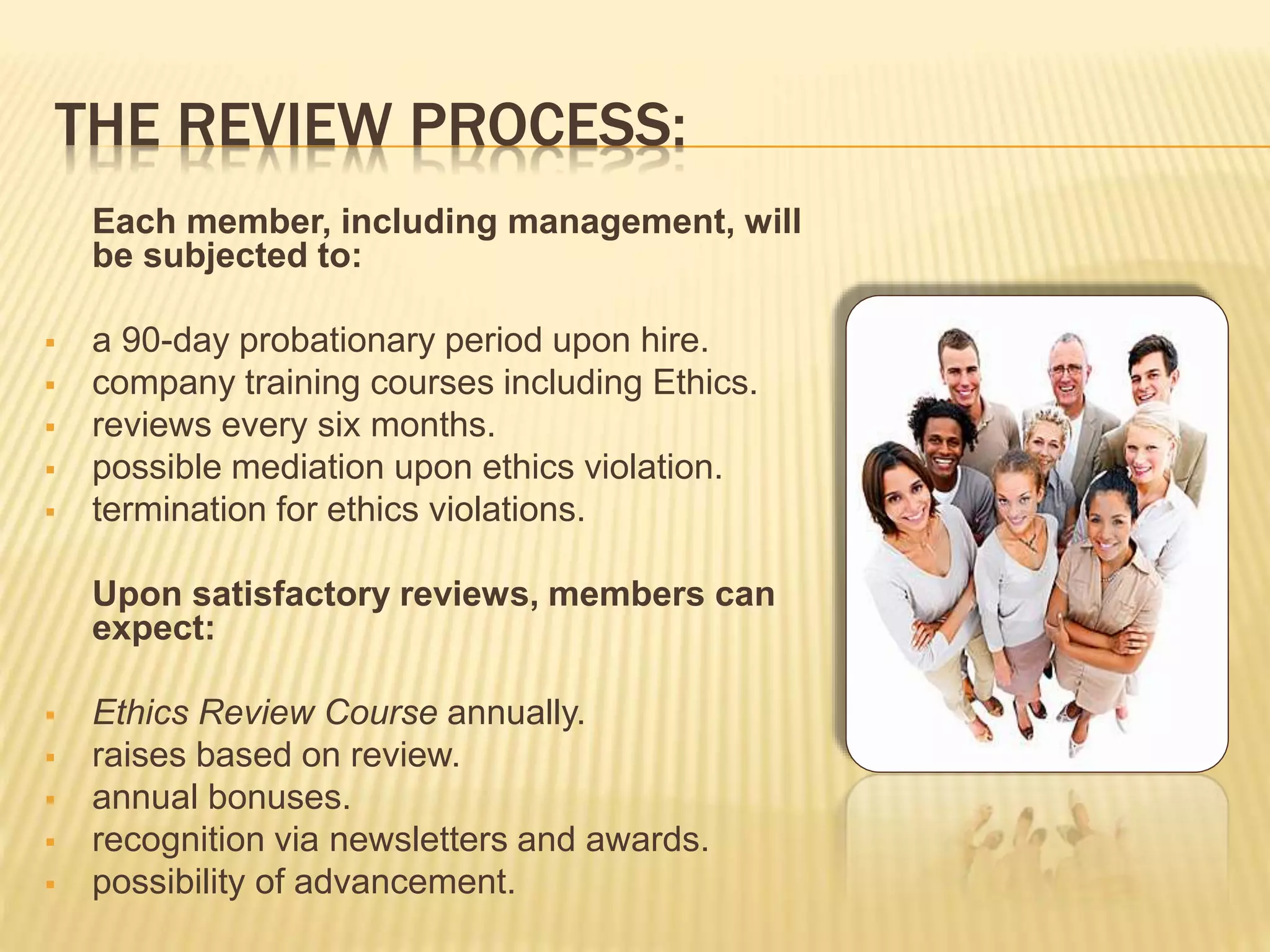
Each member, including management, will
be subjected to:
 a 90-day probationary period upon hire.
 company training courses including Ethics.
 reviews every six months.
 possible mediation upon ethics violation.
 termination for ethics violations.
Upon satisfactory reviews, members can
expect:
 Ethics Review Course annually.
 raises based on review.
 annual bonuses.
 recognition via newsletters and awards.
 possibility of advancement.
RECOGNIZING VIOLATIONS:
Steps to Recognizing Ethical
Issues:
 Recognizing that an ethical issue has
been breached.
 Gathering evidence concerning the
ethics breach.
 Analyzing the evidence impartially
using the company Code of Ethics.
 Enforcing and making a determination
according to the Code of Ethics.
 Using the breach to improve the
company’s ethics training courses.
 Annually reviewing the company Code
of Ethics.
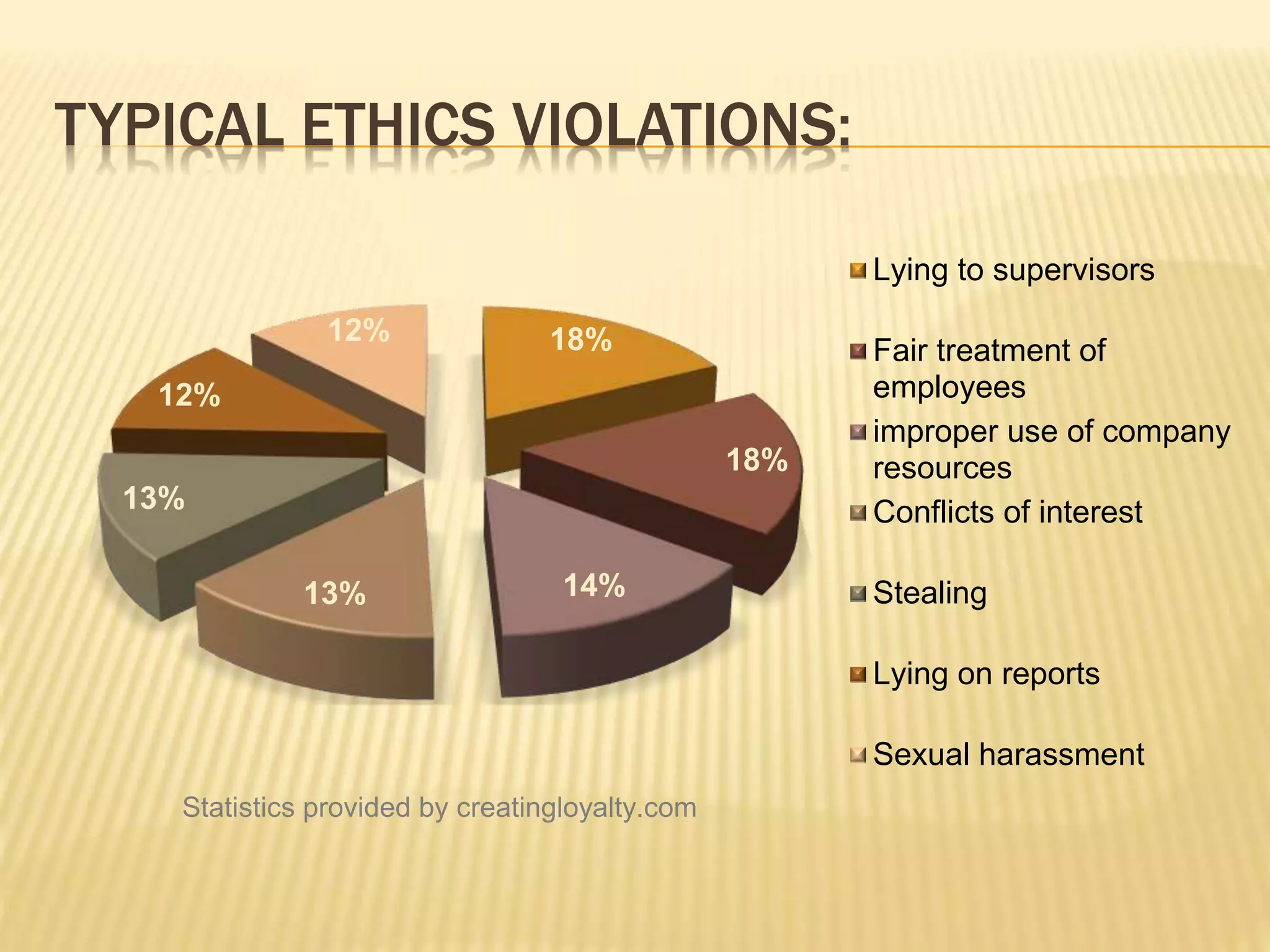
TYPICAL ETHICS VIOLATIONS:
18%
18%
14%13%
13%
12%
12%
Lying to supervisors
Fair treatment of
employees
improper use of company
resources
Conflicts of interest
Stealing
Lying on reports
Sexual harassment
Statistics provided by creatingloyalty.com
CODE OF ETHICS:
This is the Code of Ethics our member are expected to
uphold when interacting with the clients:
 To conduct business with our clients professionally
always.
 To perform our jobs with the competency the clients
deserve and expect.
 To earn, value, and maintain a relationship with our clients
based on respect.
 To earn the trust and patronage of our clients by giving
fair and truthful service.
 To quickly aid the needs of our clients efficiently.
 To give the best values to our clients through fair prices
and great service.
CODE OF ETHICS:
This is the Code of Ethics our member are expected to
uphold when interacting with other members:
 To conduct perform with our co-workers professionally
always.
 To perform our jobs with the competency, as we may help
our company and co-workers thrive.
 To earn, value, and maintain a relationship with our co-
workers and supervisors based on respect.
 To earn the trust of our company and its members by
giving being faithful, loyal, and truthful at all times.
 To quickly aid the needs of our company and co-workers
efficiently.
REPORTING ETHICS VIOLATIONS:
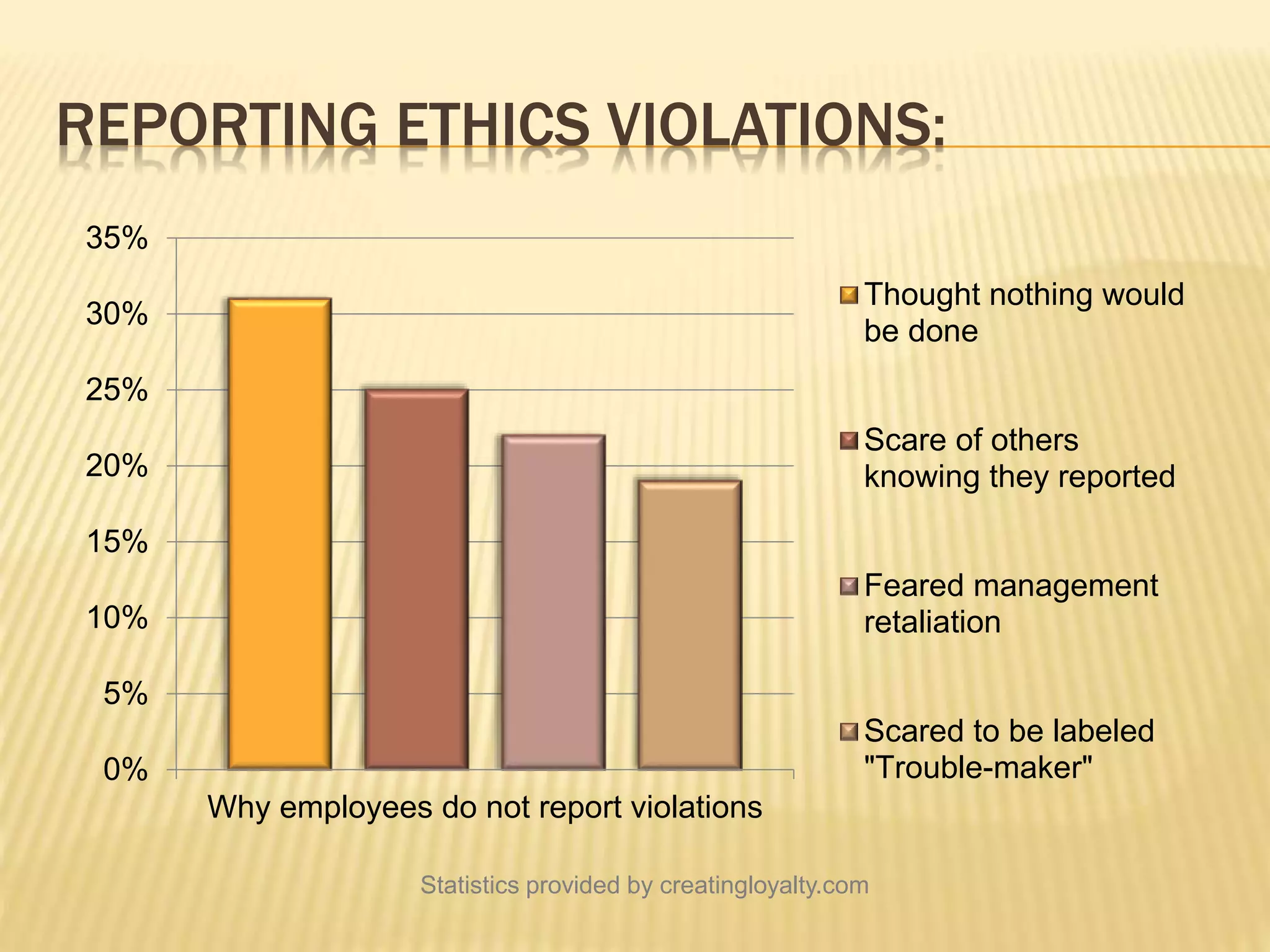
Statistics provided by creatingloyalty.com
0%
5%
10%
15%
20%
25%
30%
35%
Why employees do not report violations
Thought nothing would
be done
Scare of others
knowing they reported
Feared management
retaliation
Scared to be labeled
"Trouble-maker"
REPORTING ETHICS VIOLATIONS:
Steps to reporting ethics
violations:
 Contact your immediate
supervisor.
 Call the Company Ethics
Hotline.
 Send an email to the
Company Fraud and Ethics
Department.
 Contact your local Department
of Labor.
 Contact the Equal
Employment Opportunity
Commission (EEOC).
REFERENCES:
U.S. Equal Employment Opportunity Commission. (2009). Federal
Laws Prohibiting Job Discrimination Questions And
Answers. Retrieved from January 16th, 2010 from
http://www.eeoc.gov/facts/qanda.html
(2010). The First Time Manager Dilemma, How Do You Gain
Respect?. Retrieved on January 14, 2010 from
http://askthemanager.com/2008/08/the-first-time-manager-
dilemma-how-do-you-gain-respect/
Walker Information. (2010). Creating Loyalty Library. Retrieved
February 15, 2010 from
http://www.creatingloyalty.com/story.cfm?article_id=165

Week 9 Final Ethics Program Presentation

  • 1.
    ETHICS FOR OURORGANIZATION 2010 by I. Myers Lavant
  • 2.
    OUR CODE OFETHICS MISSION: The Code of Ethics for this company will provide a platform for our management and employees to follow that will provide the best care and respect of each other and our clientele, and uphold our company as a model of fairness, honesty, and responsibility within the industry.
  • 3.
    PATHWAY TO SUCCESS: Thisorganization will follow these declarations, which will coincide with every ethically, morally, socially, and legally correct standard in the industry. Every employee attends a rigorous training session in ethics and will be tested thereafter. Our Code of Ethics is bound to every employee, including management, as meeting our ethical goals are important to the company. Members who violate and cannot meet these standards will be terminated. These provisions were drawn in order for this company to operate within the realms of the law.
  • 4.
    ACHIEVING ETHICAL GREATNESS: Eachmanager will be required to complete two hours of each:  cultural diversity training  anti-discrimination training  company code of ethics training  company handbook training  employee evaluation training Our employees will be required to complete one hour of each:  cultural diversity training  company code of ethics training  company handbook training
  • 5.
    THE REVIEW PROCESS: Eachmember, including management, will be subjected to:  a 90-day probationary period upon hire.  company training courses including Ethics.  reviews every six months.  possible mediation upon ethics violation.  termination for ethics violations. Upon satisfactory reviews, members can expect:  Ethics Review Course annually.  raises based on review.  annual bonuses.  recognition via newsletters and awards.  possibility of advancement.
  • 6.
    RECOGNIZING VIOLATIONS: Steps toRecognizing Ethical Issues:  Recognizing that an ethical issue has been breached.  Gathering evidence concerning the ethics breach.  Analyzing the evidence impartially using the company Code of Ethics.  Enforcing and making a determination according to the Code of Ethics.  Using the breach to improve the company’s ethics training courses.  Annually reviewing the company Code of Ethics.
  • 7.
    TYPICAL ETHICS VIOLATIONS: 18% 18% 14%13% 13% 12% 12% Lyingto supervisors Fair treatment of employees improper use of company resources Conflicts of interest Stealing Lying on reports Sexual harassment Statistics provided by creatingloyalty.com
  • 8.
    CODE OF ETHICS: Thisis the Code of Ethics our member are expected to uphold when interacting with the clients:  To conduct business with our clients professionally always.  To perform our jobs with the competency the clients deserve and expect.  To earn, value, and maintain a relationship with our clients based on respect.  To earn the trust and patronage of our clients by giving fair and truthful service.  To quickly aid the needs of our clients efficiently.  To give the best values to our clients through fair prices and great service.
  • 9.
    CODE OF ETHICS: Thisis the Code of Ethics our member are expected to uphold when interacting with other members:  To conduct perform with our co-workers professionally always.  To perform our jobs with the competency, as we may help our company and co-workers thrive.  To earn, value, and maintain a relationship with our co- workers and supervisors based on respect.  To earn the trust of our company and its members by giving being faithful, loyal, and truthful at all times.  To quickly aid the needs of our company and co-workers efficiently.
  • 10.
    REPORTING ETHICS VIOLATIONS: Statisticsprovided by creatingloyalty.com 0% 5% 10% 15% 20% 25% 30% 35% Why employees do not report violations Thought nothing would be done Scare of others knowing they reported Feared management retaliation Scared to be labeled "Trouble-maker"
  • 11.
    REPORTING ETHICS VIOLATIONS: Stepsto reporting ethics violations:  Contact your immediate supervisor.  Call the Company Ethics Hotline.  Send an email to the Company Fraud and Ethics Department.  Contact your local Department of Labor.  Contact the Equal Employment Opportunity Commission (EEOC).
  • 12.
    REFERENCES: U.S. Equal EmploymentOpportunity Commission. (2009). Federal Laws Prohibiting Job Discrimination Questions And Answers. Retrieved from January 16th, 2010 from http://www.eeoc.gov/facts/qanda.html (2010). The First Time Manager Dilemma, How Do You Gain Respect?. Retrieved on January 14, 2010 from http://askthemanager.com/2008/08/the-first-time-manager- dilemma-how-do-you-gain-respect/ Walker Information. (2010). Creating Loyalty Library. Retrieved February 15, 2010 from http://www.creatingloyalty.com/story.cfm?article_id=165

Editor's Notes

  • #3 Our Code of Ethics is combined with our company mission statement because it is our goal to operate this company with the veil of ethics covering our thoughts and actions at all times. Knowing that people = profits, it is our first priority to take care of the people.
  • #4 When you develop a code of ethics and the members follow this code, it is easy to stay lawful. Training the employees about the laws that govern this company will help them to operate in ways that are not only morally correct, but legally correct. If those employees cannot uphold the laws of the company, they obviously cannot uphold the laws of the land. These employees will need to be dealt with accordingly. This will be address later in the presentation.
  • #5 We require more training for our management team because they are the first line of company members who are responsible for exemplifying ethical and moral behavior. The company code of ethics training and handbook training will ensure that the management is familiar and thoroughly knowledgeable of the laws that govern the company. Cultural diversity and anti-discrimination training will help the management treat employees with fairness and compassion. It is proven that the management needs to understand the value of the employee. It is the job of the management to make employees understand that management is the support, they are the superstars. (How Does A Young Manager Gain Respect?, para. 3). Management needs to be trained by the company to know, exhibit, respect, and enforce the laws that govern the company. Employees are also required to attend training sessions. Workers will learn about cultural diversity so that they may be better able to understand different co-workers with different ethnic and social background. This will help them to better respect one another. Also workers will learn about the company code of ethics and handbook so that they may know the laws that govern the company. Training them ensures management that all workers are knowledgeable and thereby, accountable for ethics violations. Both management and employees will be trained and tested thoroughly upon completion of each training course.
  • #6 By the end of the 90-day probationary period, each member of management will have completed the entire set of classes concerning ethics, diversity, the company code of ethics, anti-discrimination and how to perform employee evaluations properly. The management reviews will be done via their own peers within the management department or by the company executives, depending on their role and rank within the company. If a member of the company violates any part of the company handbook or code of ethics, they will be subjected to mediation. This mediation is a fact-finding meeting between the parties involved in an ethics violation and their accusers. This mediation’s results could end with the member being demoted, fined, suspended indefinitely, criminally charged, and/or even terminated. If a member violates the company handbook or code of ethics a second time, they will be terminated immediately. The Ethics Review Course is a summarized one hour course consisting of all the training every member had when they were hired. Raises and annual bonuses are based on company growth and earnings. The company growth and earning are published in the monthly newsletter that is given to every employee. In this newsletter, employees will also be listed and acknowledged for their achievements and hard work. In addition, this company believes in the advancement of ALL its workers and hiring within the company for management positions.
  • #7 The first step in preventing ethical violations is to recognize when an ethical violation has occurred. Future violations can be adverted because management will have recognized the issues that are present in the company due to previous violations. Changes in the company handbook and code of ethics can be made at that time if necessary.
  • #8 This chart represents a listing of the most common types of ethics violations that occur within the workplace.
  • #11 These are the most common reasons that someone would not report and ethics violation. Helpful Information: Company Ethics Hotline: 1-800-555-STOP Company Fraud and Ethics Department email: fraudandethicsdept@company.com EEOC: info@eeoc.gov
  • #12 The company handbook shows that the company has anti-retaliation and right to privacy policies. Therefore, when reporting an ethics violation to a supervisor, even if it is concerning another supervisor, there are guidelines set to protect you. The supervisor who gathers the information from you is not at liberty to discuss the information that you have shared about the ethics violation. In addition, the member who is accused of the ethics violation, including members of management, are not allowed to use retaliation tactics within the company. Those tactics can be anything from giving their accuser grief on the job to suspensions, and even termination. These are forbidden. When all else fails, a member may contact the Company Ethics Hotline at 1-800-555-STOP. There are operators on the phone who will take your complaint and forward it to upper management. If a member is still unsatisfied, we encourage that employee to contact the Department of Labor or the EEOC. This company strives to operate within the parameters of the law and beyond. We encourage outside investigation, as it keeps the company targeted towards excellence.