The High Road A values based communications framework for progressive economics Dan Ancona May 2007 Revision
Part I: Values
What we stand for Dems at  -28  in 2005 Despite lots of interesting discussions[1] we’ve made close to zero progress communicating this to the general public. [1] Some can be found here:  http:// www.dkosopedia.com/wiki/Progressive
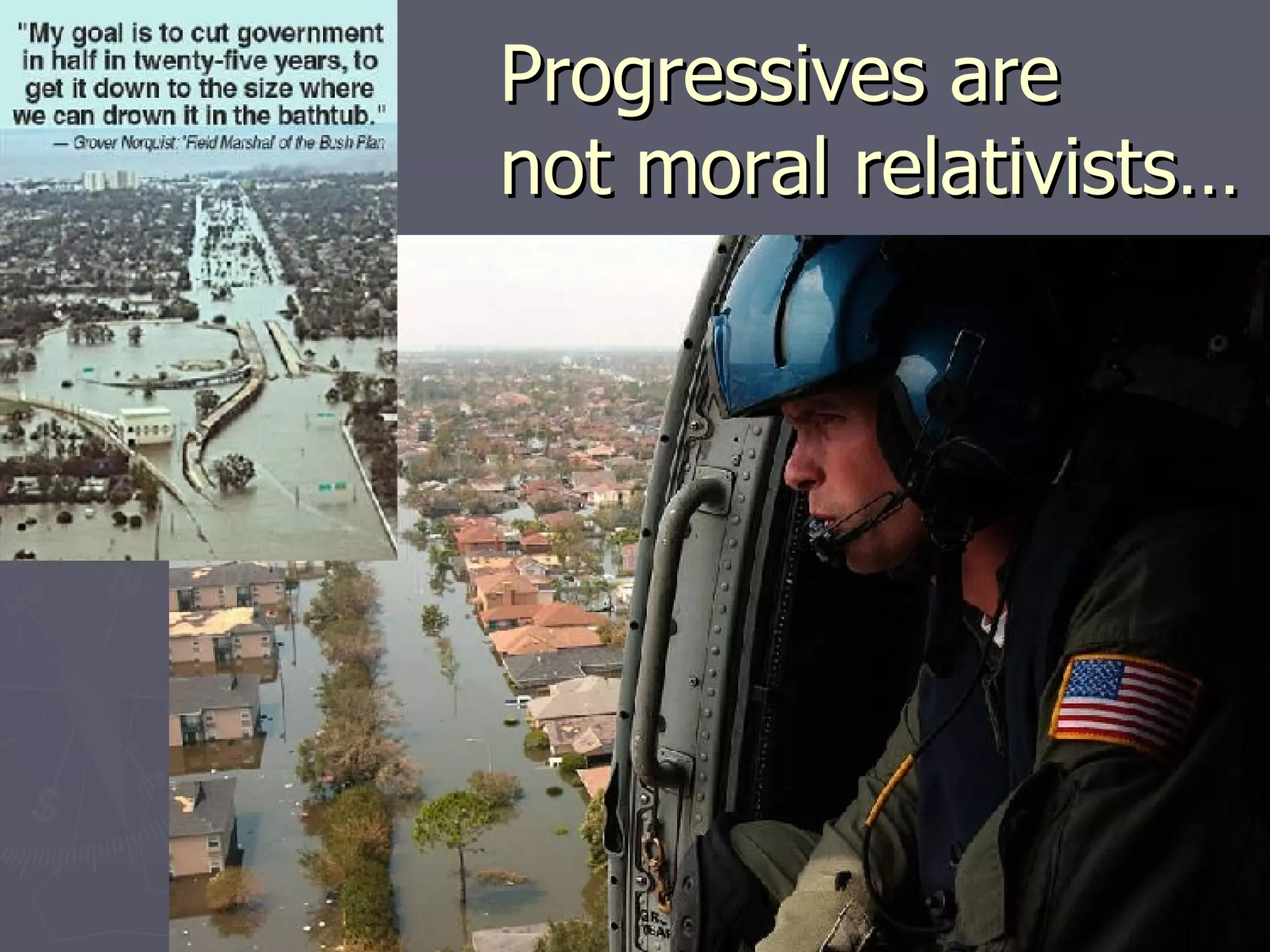
Progressives are not moral relativists…
we value   INTERDEPENDENCE   and   SUBSTANTIAL FREEDOM Advantages: No mushy, confusing and inaccurate family metaphors. No trace of moral relativism. Historically grounded. Simple. Easily memorized. Relatively complete. Dovetails nicely with common good and other frameworks. Disadvantages: They own the word “freedom,” and “interdependence” is an unfamiliar term. Conservatives are mainly about defending moral orders and expanding the freedom that comes from property rights. (i.e. stuff) Progressives are mainly about realizing interdependence and expanding substantial freedom. (i.e. cognitive liberty)
Realizing interdependence The “ethic of connectedness” (Bill Bradley) that city dwellers share is why cities are so blue. Land use is  incredibly  important. (c.f. Kirwan Institute) See also:  http:// en.wikipedia.org/wiki/Interdependence (a.k.a. solidarity, a.k.a. why cities are so blue) “ Injustice anywhere is a threat to justice everywhere. We are caught in an inescapable network of mutuality, tied in a single garment of destiny.” –MLK “ When we try to pick out anything by itself, we find it hitched to everything else in the Universe.” – John Muir
Expanding substantial freedom We’re starting to take it back: Amartya Sen  Development as Freedom George Lakoff  Whose freedom anyway? Paul Starr  Freedom’s Power John Schwartz  Freedom Reclaimed The Opportunity Agenda Many other books, organizations and efforts Substantial freedom is the opportunity we have as humans to realize our full potential. It can not be optimized individually. This is what takes a village. (or better yet, a city) This is why conservatism doesn’t work.
Russell Kirk’s 10 Conservative Principles… and ours More:  http://speakoutca.org/archives/2006/06/foundations_iii.php democratizing wealth and power reconciling permanence unleashing passions restraining passions social justice and grace voluntary community substantial freedom and cognitive liberty freedom and property hope imperfectability celebrating diversity variety curiosity and wonder prudence ethic of connectedness principle of prescription questioning authority, thinking critically custom, convention, continuity expanding substantial freedom preserving moral orders
Part II: The High Road
Landscape The Economic Policy Institute's  Agenda for Shared Prosperity The Center for Community Change, especially their  Taproots  and  Movement Vision  projects The Drum Major Institute's  Middle Class Squeeze 2007 The Third Way's  The New Rules Economy   Demos'  Economic Opportunity Program The Opportunity Agenda, in particular their  Six Core Values The Campaign for America's Future  Straight Talk Citizens for Tax Justice's  Talking Taxes The Brookings Institutions'  Hamilton Project Tens of thousands of pages of outstanding, thorough and inspiring research – that the vast majority of voters find utterly incomprehensible.
Hunger for a New Story The food is terrible. And such small portions! GQR 3/7/07:  http://democracycorps.com/reports/analyses/Democracy_Corps_February_28_2007_Graphs.pdf Voters disapprove of government performance... ... and solid majorities want more  involvement
To tell that story, we need common principles » secure basic freedoms » invest in people and the future » democratize economic power » build the green economy » housebreak capitalism » globalize this approach  This is the 2 nd  and a ½ way. It has a name, and a small enough number of points that they can be remembered easily after 2 glasses of wine.
FDR's Four Freedoms and his  Economic Bill of Rights  are good templates for this: housing, health care, useful work, education, and basic economic security are all basic rights that the federal government can and absolutely should play a role in securing. Without a basic level of security, people can't even get to the kind of freedom and opportunity that is so central to progressivism: the freedom that is the fruit of cognitive liberty, the potential to develop one's self as fully as possible. Securing these basic freedoms is the aim of social justice and it is the heart of the high road.  Secure basic freedoms .
Invest in people . To compete in the 21st century, we need to take our education and research system to the next level. Financial resources aren't the only thing the system needs, but they are certainly part of it. There is a bottom-line rationale for beating structural racism and fairly distributing educational resources and opportunity; simply, it’s because tax cuts don't create jobs, people do. The job creating leaders of tomorrow will be new immigrants and inner-city kids,  if  we give them a chance. Pics: see  http://www.wired.com/wired/archive/13.04/robot.html
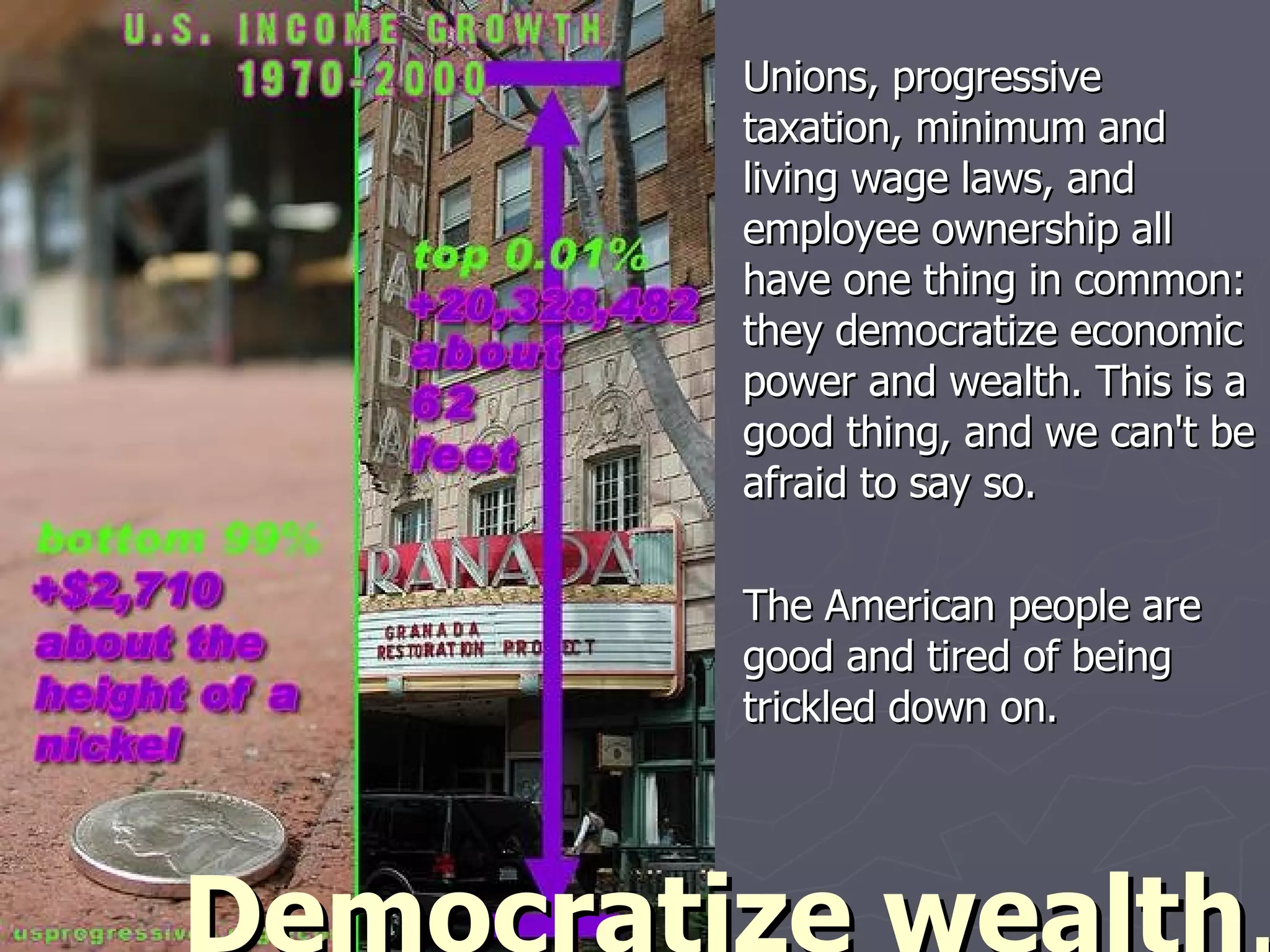
Unions, progressive taxation, minimum and living wage laws, and employee ownership all have one thing in common: they democratize economic power and wealth. This is a good thing, and we can't be afraid to say so. The American people are good and tired of being trickled down on. Democratize wealth .
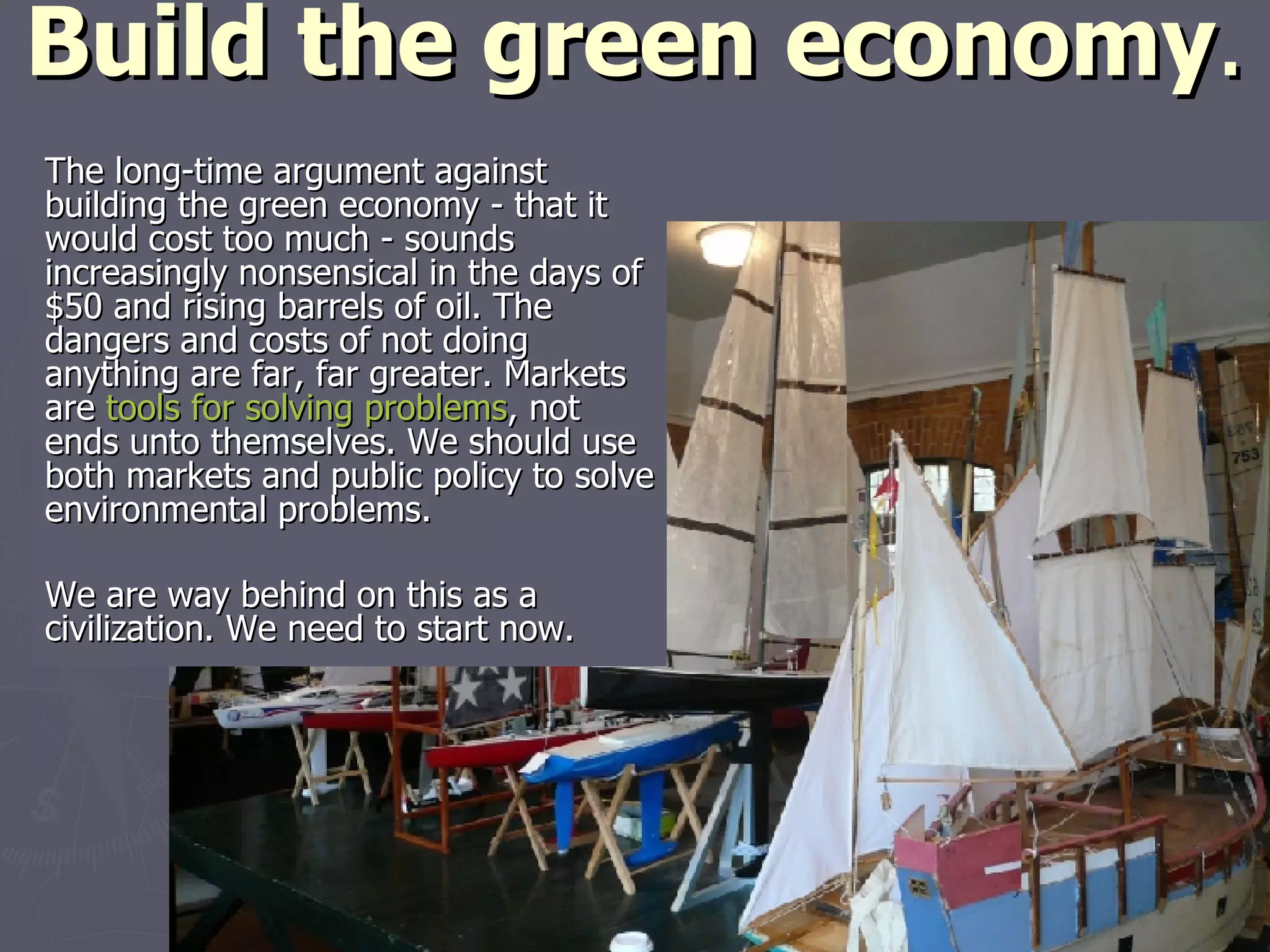
Build the green economy . The long-time argument against building the green economy - that it would cost too much - sounds increasingly nonsensical in the days of $50 and rising barrels of oil. The dangers and costs of not doing anything are far, far greater. Markets are  tools for solving problems , not ends unto themselves. We should use both markets and public policy to solve environmental problems. We are way behind on this as a civilization. We need to start now.
Housebreak capitalism . Capitalism is just like a puppy: it's great, but it has a tendency to make messes. An American Prospect article last May used just the right frame for how to approach this:  it needs to be housebroken . The right wing is always accusing us of trying to kill the puppy, but this is an absurd argument. Progressives are fine with capitalism, at least until we come up with something better, and the search for that something better is a critical part of the movement and the research it's engaged in. But in the meantime, it's time to stop having to clean capitalism's messes off the rug. To do this, we need to rebuild people’s trust in government. This won’t be easy. The first step is to stop reinforcing right wing, anti-government frames.
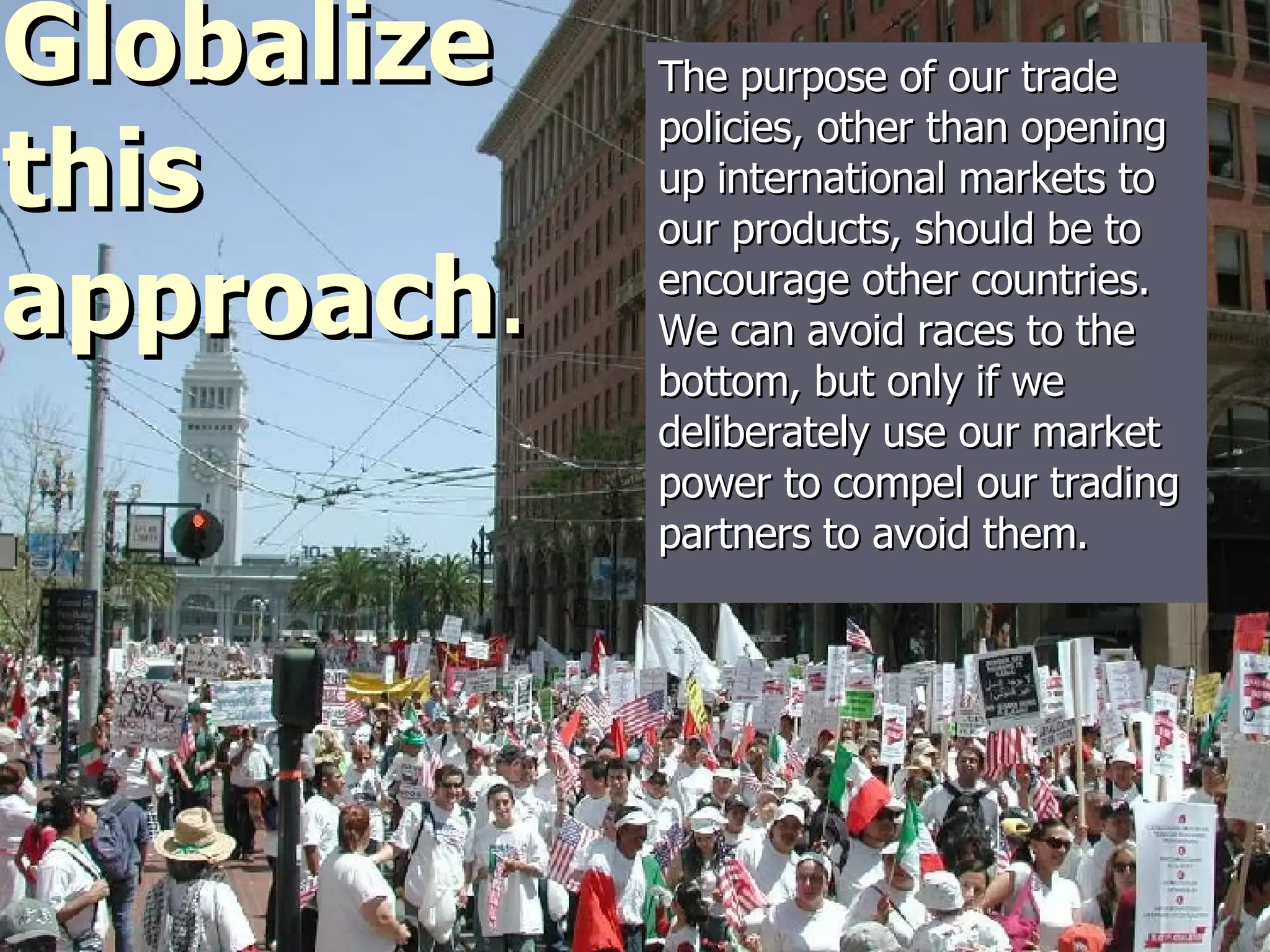
The purpose of our trade policies, other than opening up international markets to our products, should be to encourage other countries. We can avoid races to the bottom, but only if we deliberately use our market power to compel our trading partners to avoid them.  Globalize this approach .
Conclusions We need to come to agreement on some of the basics and how we talk about them. This is – perhaps unfortunately, since we love to disagree - critical to our effectiveness as a movement. The good news is we can still disagree like crazy on everything else, from research to policy to implementation to tactics.
Contact Dan Ancona [email_address] 415.373.8972 Thanks! http://creativecommons.org/licenses/by-sa/3.0/

High Road

  • 1.
    The High RoadA values based communications framework for progressive economics Dan Ancona May 2007 Revision
  • 2.
  • 3.
    What we standfor Dems at -28 in 2005 Despite lots of interesting discussions[1] we’ve made close to zero progress communicating this to the general public. [1] Some can be found here: http:// www.dkosopedia.com/wiki/Progressive
  • 4.
    Progressives are notmoral relativists…
  • 5.
    we value INTERDEPENDENCE and SUBSTANTIAL FREEDOM Advantages: No mushy, confusing and inaccurate family metaphors. No trace of moral relativism. Historically grounded. Simple. Easily memorized. Relatively complete. Dovetails nicely with common good and other frameworks. Disadvantages: They own the word “freedom,” and “interdependence” is an unfamiliar term. Conservatives are mainly about defending moral orders and expanding the freedom that comes from property rights. (i.e. stuff) Progressives are mainly about realizing interdependence and expanding substantial freedom. (i.e. cognitive liberty)
  • 6.
    Realizing interdependence The“ethic of connectedness” (Bill Bradley) that city dwellers share is why cities are so blue. Land use is incredibly important. (c.f. Kirwan Institute) See also: http:// en.wikipedia.org/wiki/Interdependence (a.k.a. solidarity, a.k.a. why cities are so blue) “ Injustice anywhere is a threat to justice everywhere. We are caught in an inescapable network of mutuality, tied in a single garment of destiny.” –MLK “ When we try to pick out anything by itself, we find it hitched to everything else in the Universe.” – John Muir
  • 7.
    Expanding substantial freedomWe’re starting to take it back: Amartya Sen Development as Freedom George Lakoff Whose freedom anyway? Paul Starr Freedom’s Power John Schwartz Freedom Reclaimed The Opportunity Agenda Many other books, organizations and efforts Substantial freedom is the opportunity we have as humans to realize our full potential. It can not be optimized individually. This is what takes a village. (or better yet, a city) This is why conservatism doesn’t work.
  • 8.
    Russell Kirk’s 10Conservative Principles… and ours More: http://speakoutca.org/archives/2006/06/foundations_iii.php democratizing wealth and power reconciling permanence unleashing passions restraining passions social justice and grace voluntary community substantial freedom and cognitive liberty freedom and property hope imperfectability celebrating diversity variety curiosity and wonder prudence ethic of connectedness principle of prescription questioning authority, thinking critically custom, convention, continuity expanding substantial freedom preserving moral orders
  • 9.
    Part II: TheHigh Road
  • 10.
    Landscape The EconomicPolicy Institute's Agenda for Shared Prosperity The Center for Community Change, especially their Taproots and Movement Vision projects The Drum Major Institute's Middle Class Squeeze 2007 The Third Way's The New Rules Economy Demos' Economic Opportunity Program The Opportunity Agenda, in particular their Six Core Values The Campaign for America's Future Straight Talk Citizens for Tax Justice's Talking Taxes The Brookings Institutions' Hamilton Project Tens of thousands of pages of outstanding, thorough and inspiring research – that the vast majority of voters find utterly incomprehensible.
  • 11.
    Hunger for aNew Story The food is terrible. And such small portions! GQR 3/7/07: http://democracycorps.com/reports/analyses/Democracy_Corps_February_28_2007_Graphs.pdf Voters disapprove of government performance... ... and solid majorities want more involvement
  • 12.
    To tell thatstory, we need common principles » secure basic freedoms » invest in people and the future » democratize economic power » build the green economy » housebreak capitalism » globalize this approach This is the 2 nd and a ½ way. It has a name, and a small enough number of points that they can be remembered easily after 2 glasses of wine.
  • 13.
    FDR's Four Freedomsand his Economic Bill of Rights are good templates for this: housing, health care, useful work, education, and basic economic security are all basic rights that the federal government can and absolutely should play a role in securing. Without a basic level of security, people can't even get to the kind of freedom and opportunity that is so central to progressivism: the freedom that is the fruit of cognitive liberty, the potential to develop one's self as fully as possible. Securing these basic freedoms is the aim of social justice and it is the heart of the high road. Secure basic freedoms .
  • 14.
    Invest in people. To compete in the 21st century, we need to take our education and research system to the next level. Financial resources aren't the only thing the system needs, but they are certainly part of it. There is a bottom-line rationale for beating structural racism and fairly distributing educational resources and opportunity; simply, it’s because tax cuts don't create jobs, people do. The job creating leaders of tomorrow will be new immigrants and inner-city kids, if we give them a chance. Pics: see http://www.wired.com/wired/archive/13.04/robot.html
  • 15.
    Unions, progressive taxation,minimum and living wage laws, and employee ownership all have one thing in common: they democratize economic power and wealth. This is a good thing, and we can't be afraid to say so. The American people are good and tired of being trickled down on. Democratize wealth .
  • 16.
    Build the greeneconomy . The long-time argument against building the green economy - that it would cost too much - sounds increasingly nonsensical in the days of $50 and rising barrels of oil. The dangers and costs of not doing anything are far, far greater. Markets are tools for solving problems , not ends unto themselves. We should use both markets and public policy to solve environmental problems. We are way behind on this as a civilization. We need to start now.
  • 17.
    Housebreak capitalism .Capitalism is just like a puppy: it's great, but it has a tendency to make messes. An American Prospect article last May used just the right frame for how to approach this: it needs to be housebroken . The right wing is always accusing us of trying to kill the puppy, but this is an absurd argument. Progressives are fine with capitalism, at least until we come up with something better, and the search for that something better is a critical part of the movement and the research it's engaged in. But in the meantime, it's time to stop having to clean capitalism's messes off the rug. To do this, we need to rebuild people’s trust in government. This won’t be easy. The first step is to stop reinforcing right wing, anti-government frames.
  • 18.
    The purpose ofour trade policies, other than opening up international markets to our products, should be to encourage other countries. We can avoid races to the bottom, but only if we deliberately use our market power to compel our trading partners to avoid them. Globalize this approach .
  • 19.
    Conclusions We needto come to agreement on some of the basics and how we talk about them. This is – perhaps unfortunately, since we love to disagree - critical to our effectiveness as a movement. The good news is we can still disagree like crazy on everything else, from research to policy to implementation to tactics.
  • 20.
    Contact Dan Ancona[email_address] 415.373.8972 Thanks! http://creativecommons.org/licenses/by-sa/3.0/