1
An application of Basic Formal Ontology to
the Ontology of Services and Commodities
Barry Smith and Wolfgang Grassl
http://ifomis.org/bfo/
Basic Formal Ontology
rests on a top-level distinction among all entities
between (roughly) things and processes
things are material entities, they continue to
exist through time
processes are not made of material parts; they
occur through time, cycling through a succession
of phases
For BFO
• both commodities and services are entities
with economic value
• commodities are things (CONTINUANTS)
• services are processes (they are processes in
which production and consumption coincide)
(OCCURRENTS)
4
Music
• Consumer’s perspective
• Producer’s perspective
• Taxation authority’s perspective
• What is a music CD, which (in olden times)
people used to buy in stores?
5
Is it a commodity? (because it
is a physical object)
• Or is it a service? (because it is a
musical performance?)
6
A similar problem with outsourcing
• Many manufacturing companies used to do
everything in-house.
• Now many outsource as much as possible: janitors,
accounting, data processing, sales, human resources,
etc.
• Before these jobs were counted as manufacturing
because they were employees of manufacturing
companies. Now, since the same jobs are part of an
out-sourcing firm, they are considered service jobs
7
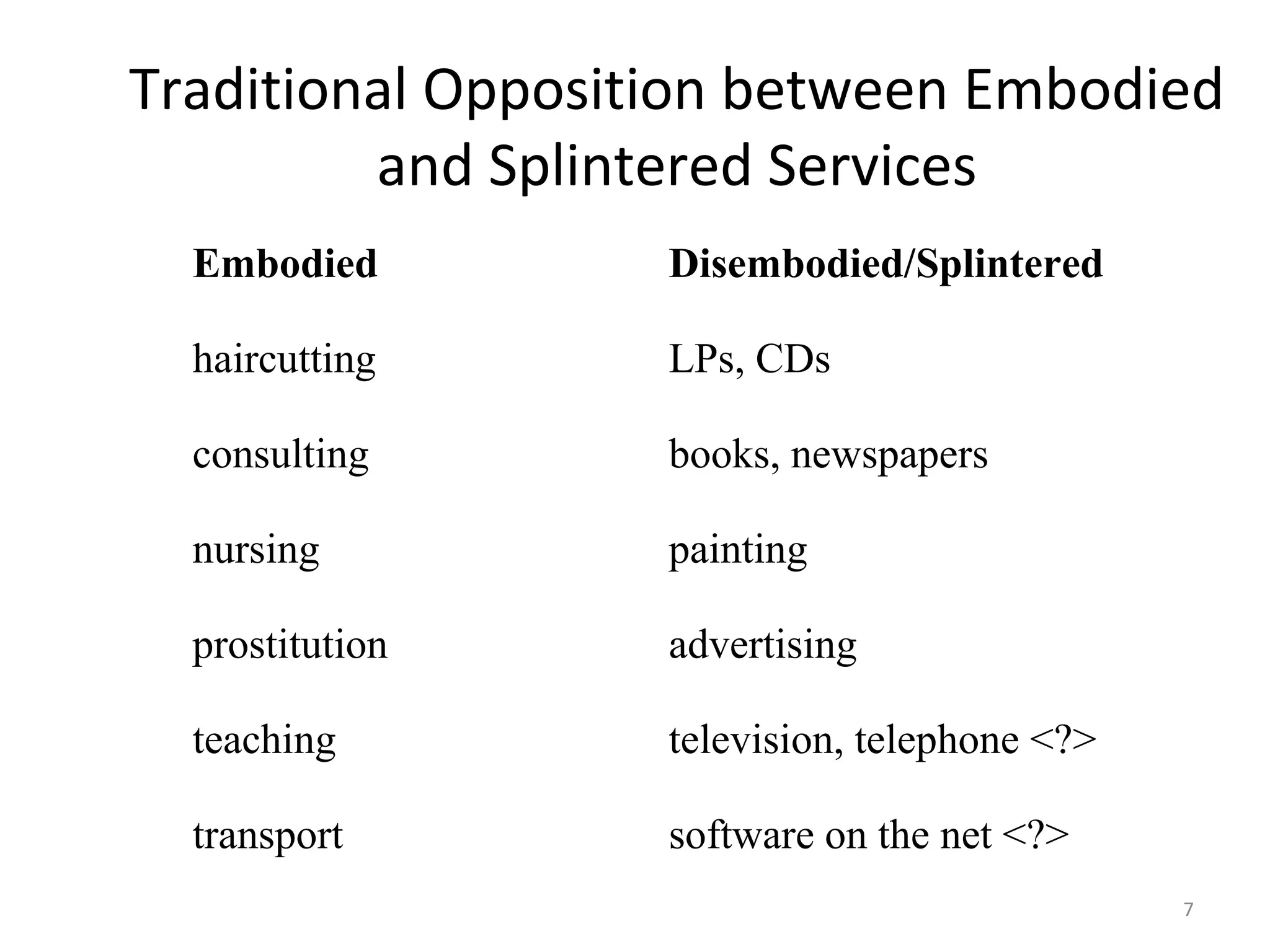
Traditional Opposition between Embodied
and Splintered Services
Embodied Disembodied/Splintered
haircutting LPs, CDs
consulting books, newspapers
nursing painting
prostitution advertising
teaching television, telephone <?>
transport software on the net <?>
8
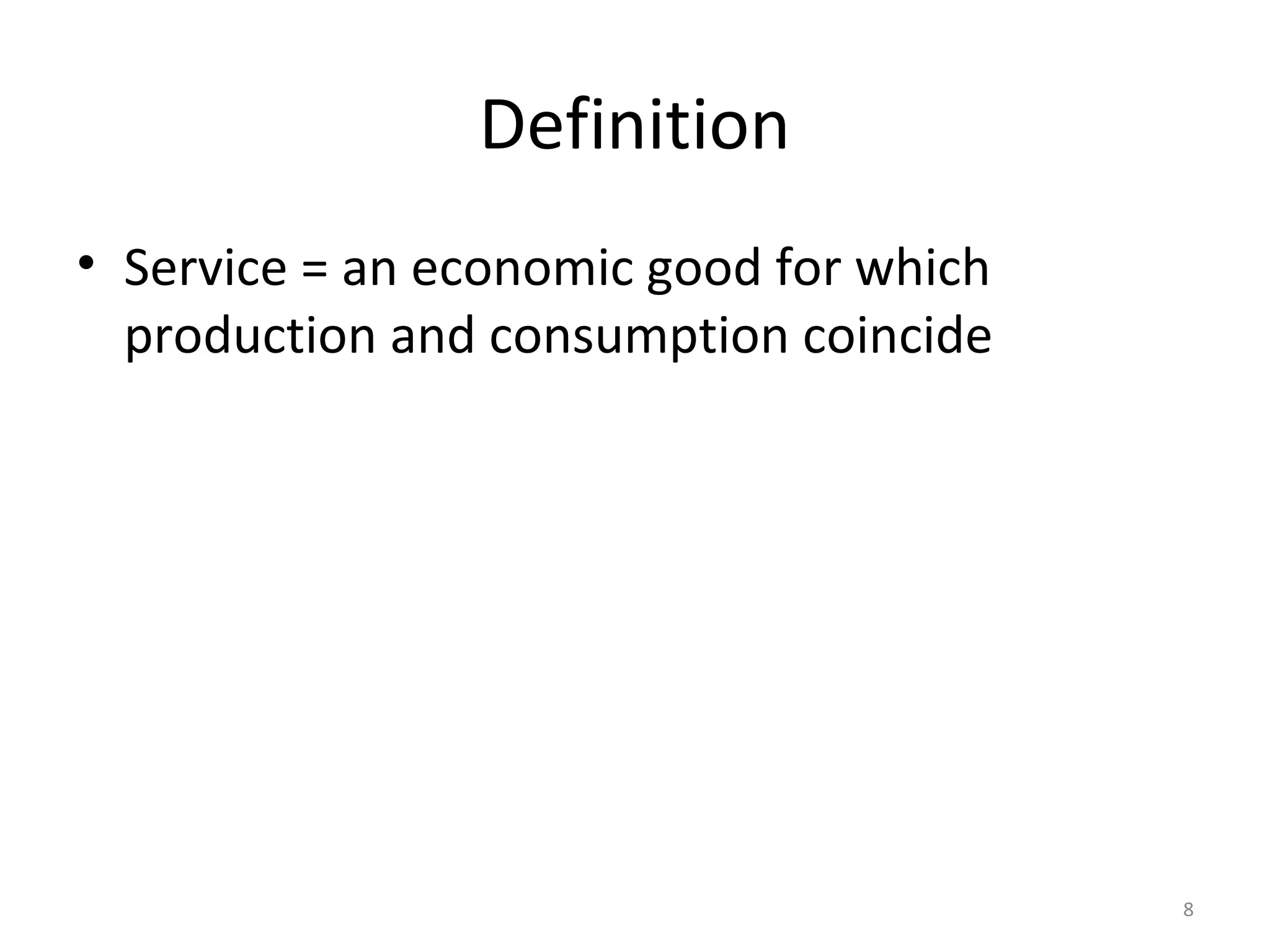
Definition
• Service = an economic good for which
production and consumption coincide
9
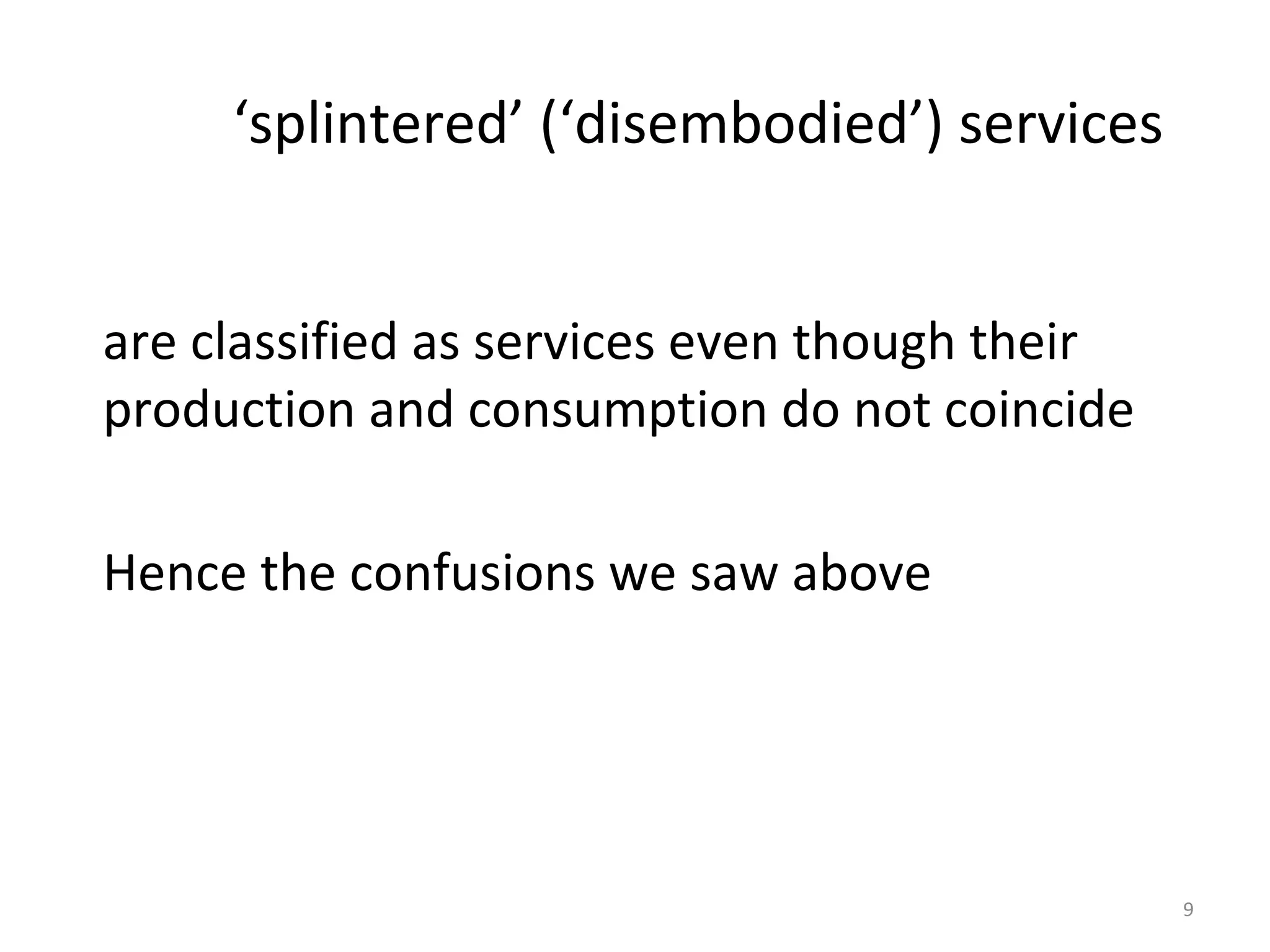
‘splintered’ (‘disembodied’) services
are classified as services even though their
production and consumption do not coincide
Hence the confusions we saw above
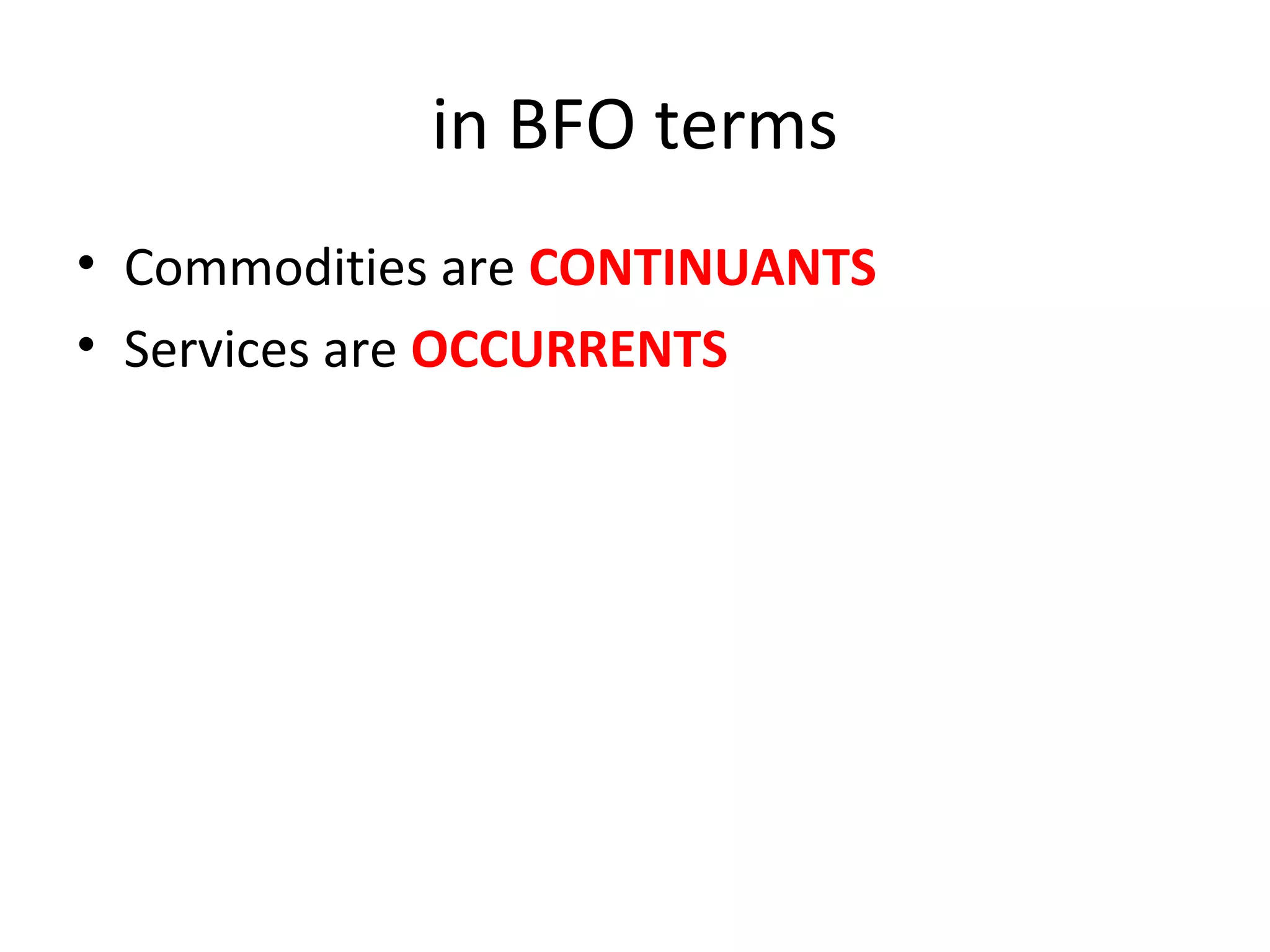
in BFO terms
• Commodities are CONTINUANTS
• Services are OCCURRENTS
11
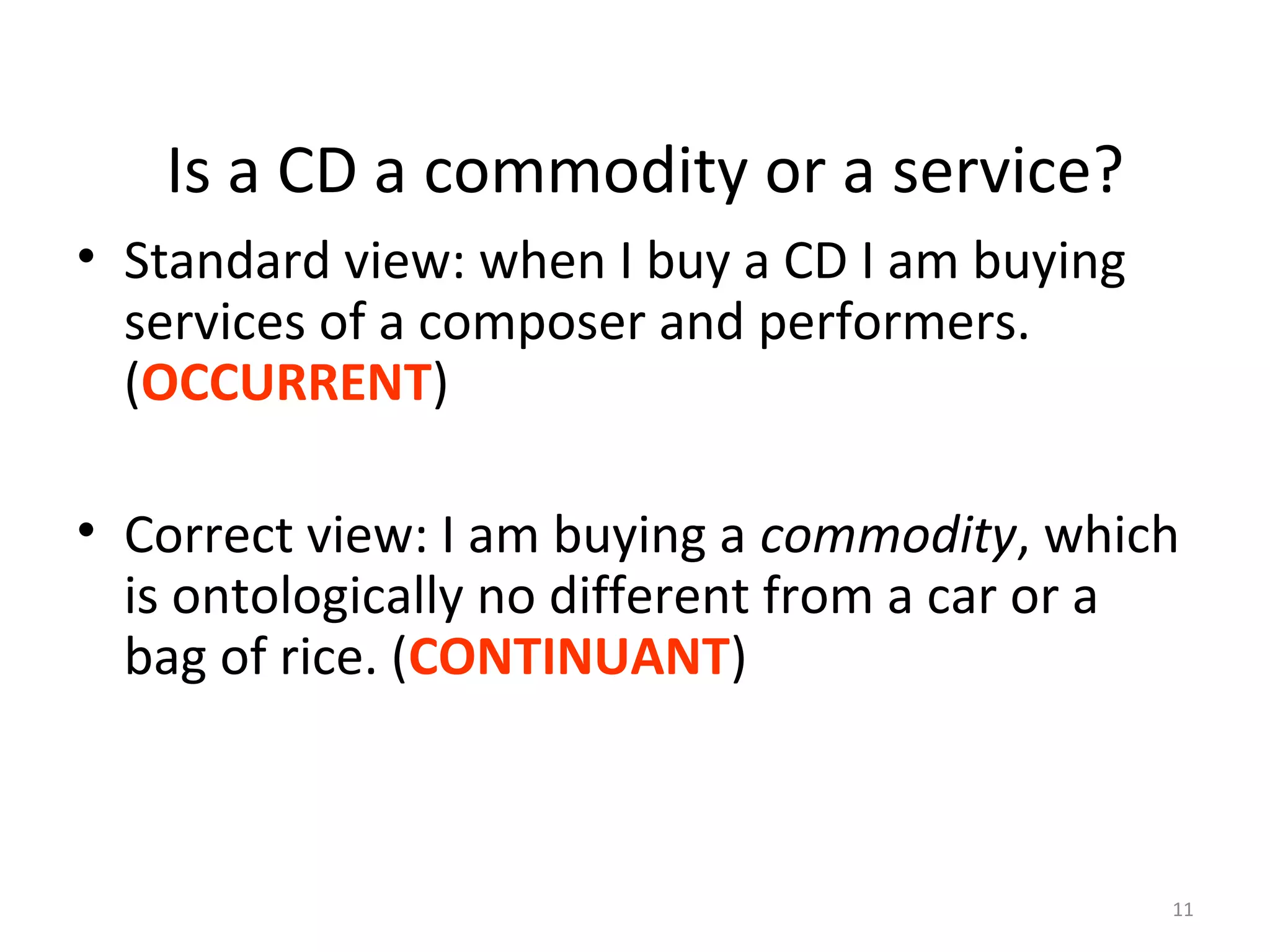
Is a CD a commodity or a service?
• Standard view: when I buy a CD I am buying
services of a composer and performers.
(OCCURRENT)
• Correct view: I am buying a commodity, which
is ontologically no different from a car or a
bag of rice. (CONTINUANT)
12
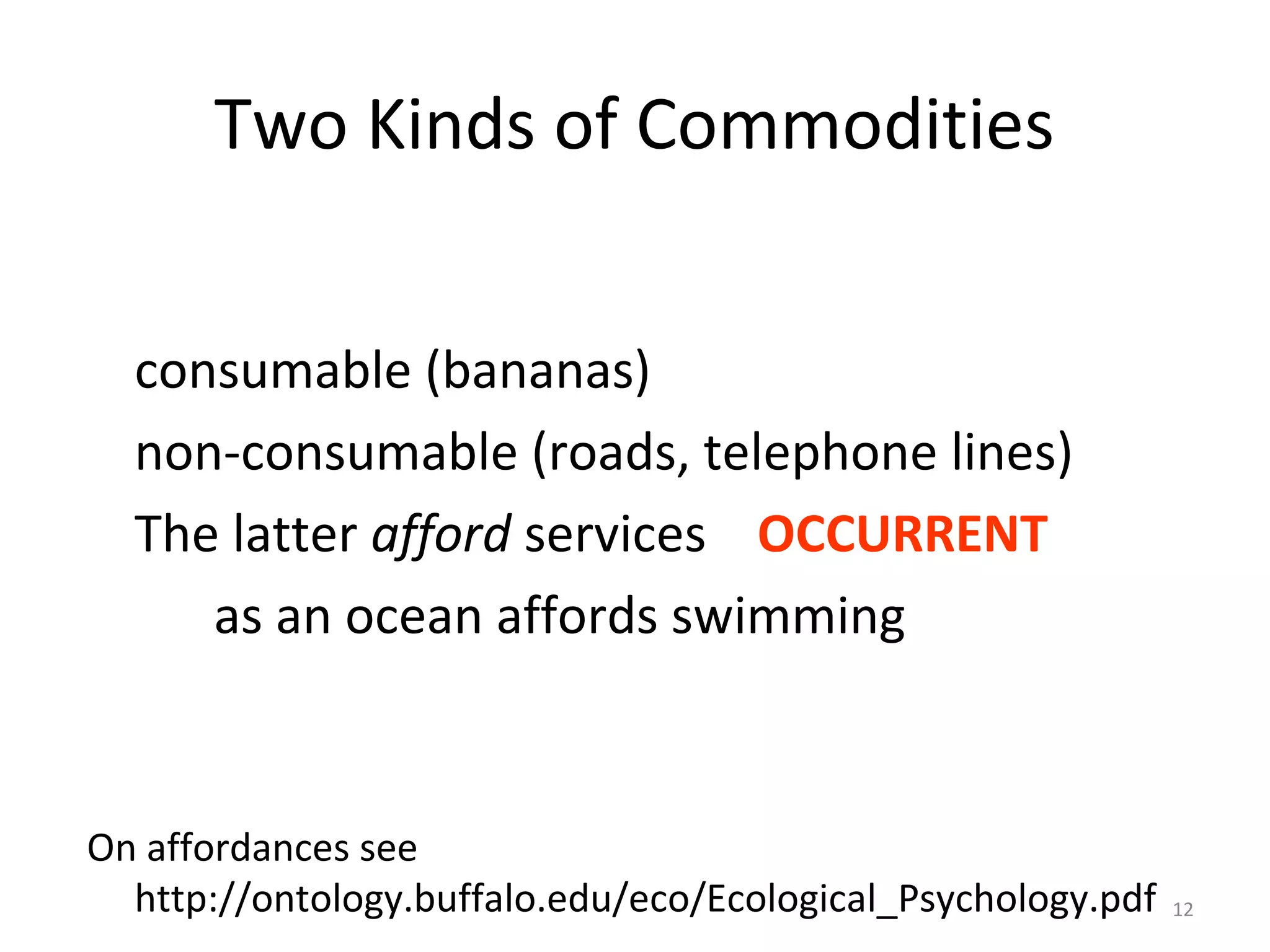
Two Kinds of Commodities
consumable (bananas)
non-consumable (roads, telephone lines)
The latter afford services OCCURRENT
as an ocean affords swimming
On affordances see
http://ontology.buffalo.edu/eco/Ecological_Psychology.pdf
13
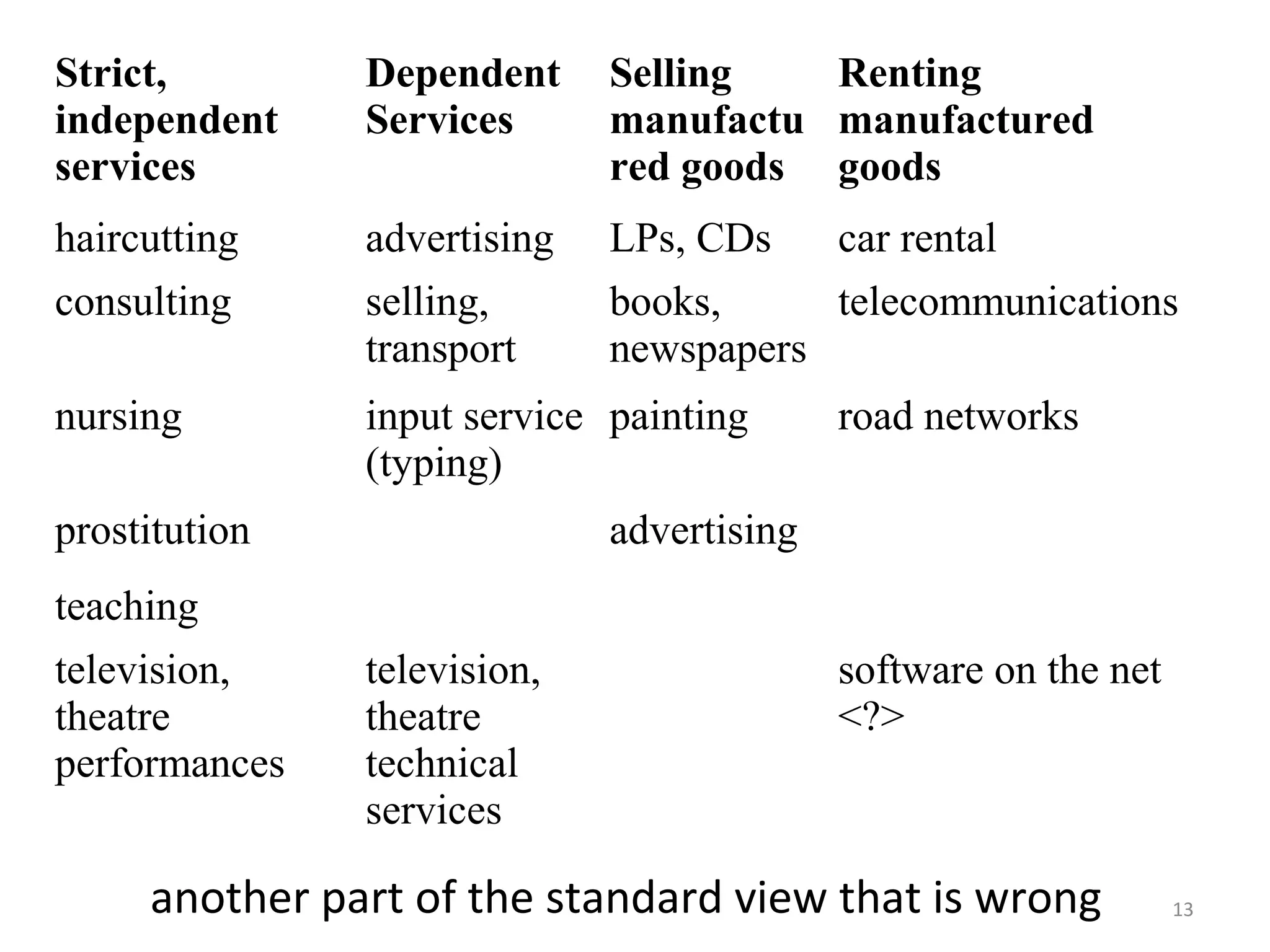
Strict,
independent
services
Dependent
Services
Selling
manufactu
red goods
Renting
manufactured
goods
haircutting advertising LPs, CDs car rental
consulting selling,
transport
books,
newspapers
telecommunications
nursing input service
(typing)
painting road networks
prostitution advertising
teaching
television,
theatre
performances
television,
theatre
technical
services
software on the net
<?>
another part of the standard view that is wrong
14
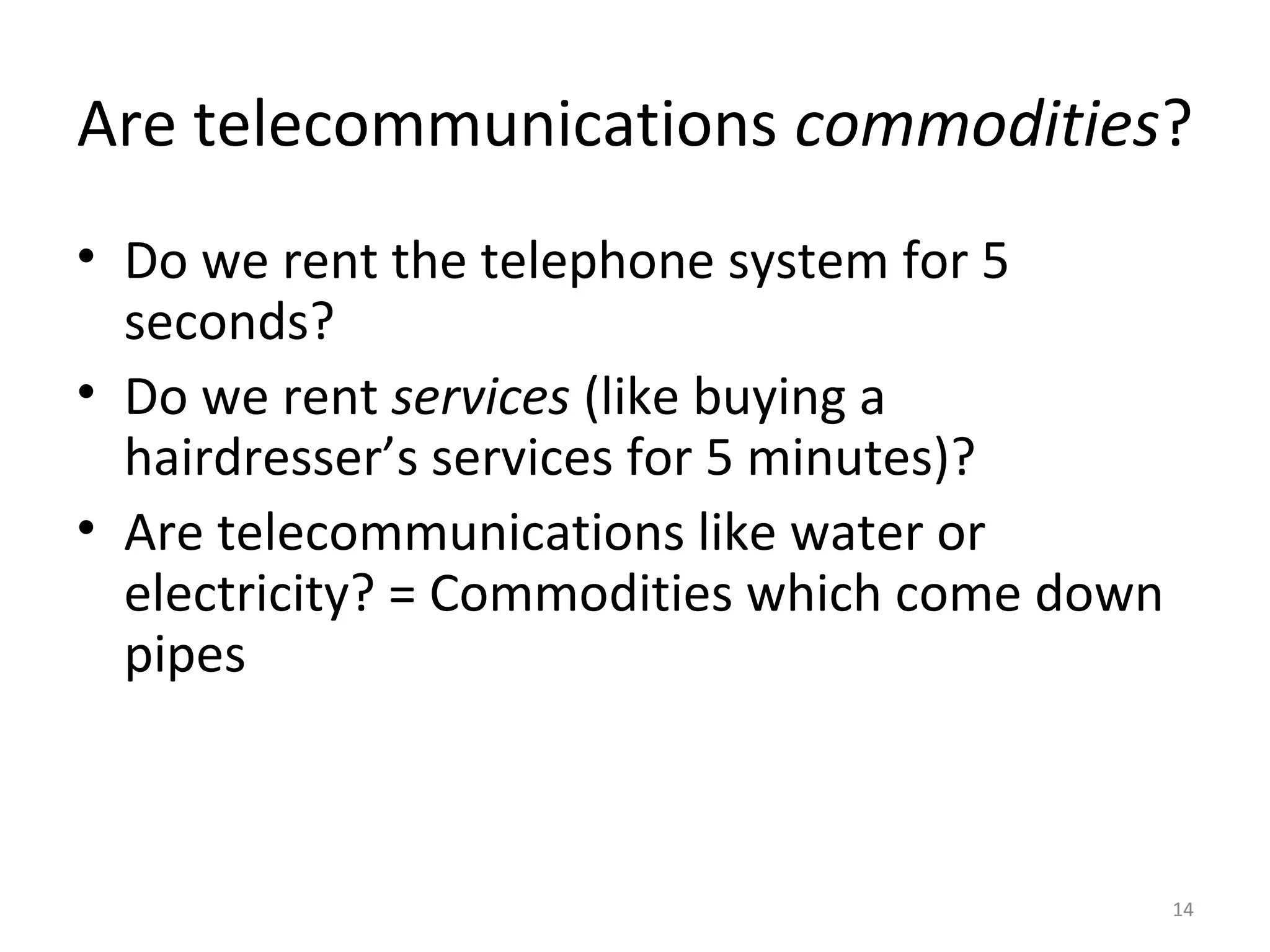
Are telecommunications commodities?
• Do we rent the telephone system for 5
seconds?
• Do we rent services (like buying a
hairdresser’s services for 5 minutes)?
• Are telecommunications like water or
electricity? = Commodities which come down
pipes
15
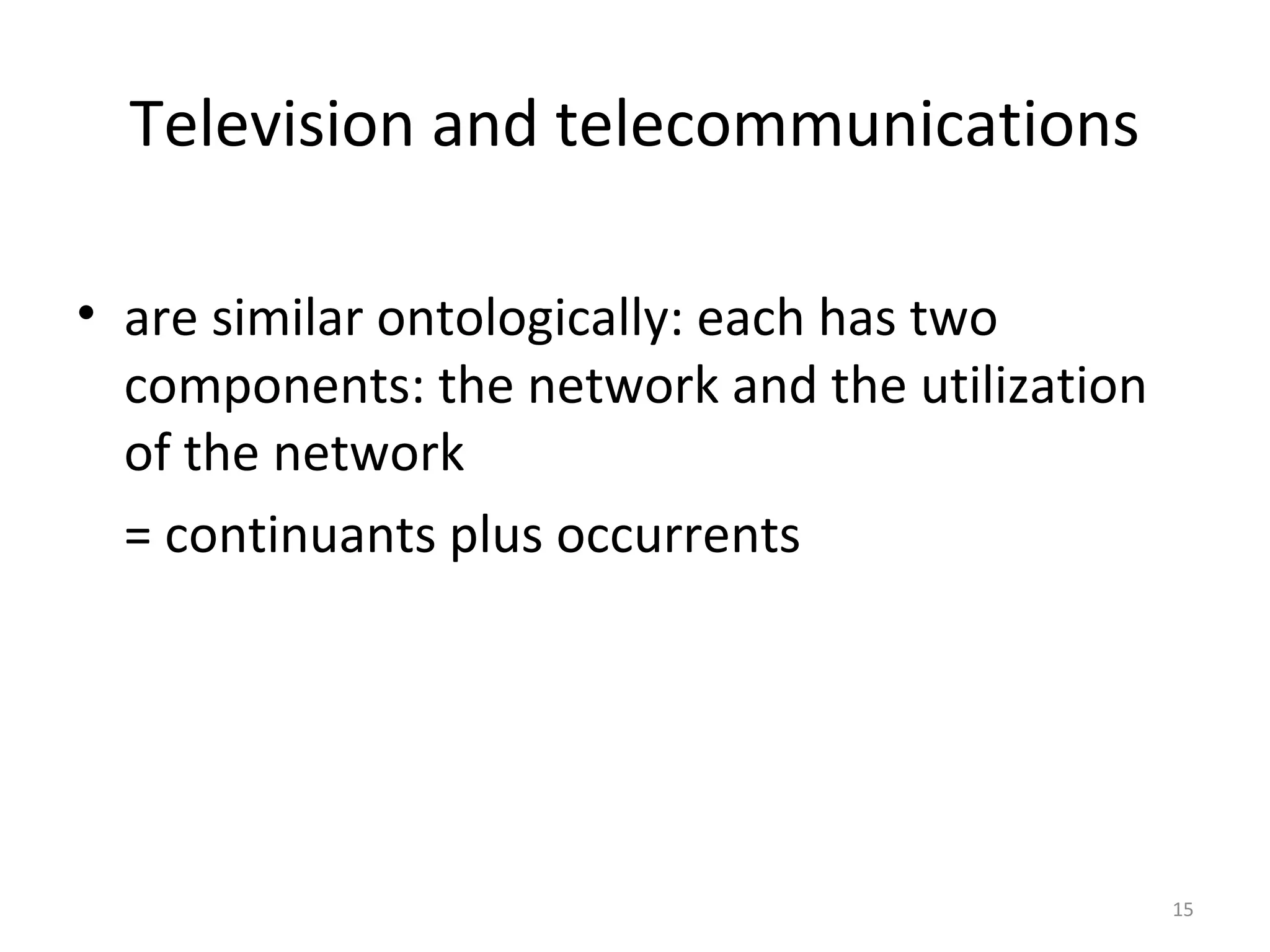
Television and telecommunications
• are similar ontologically: each has two
components: the network and the utilization
of the network
= continuants plus occurrents
16
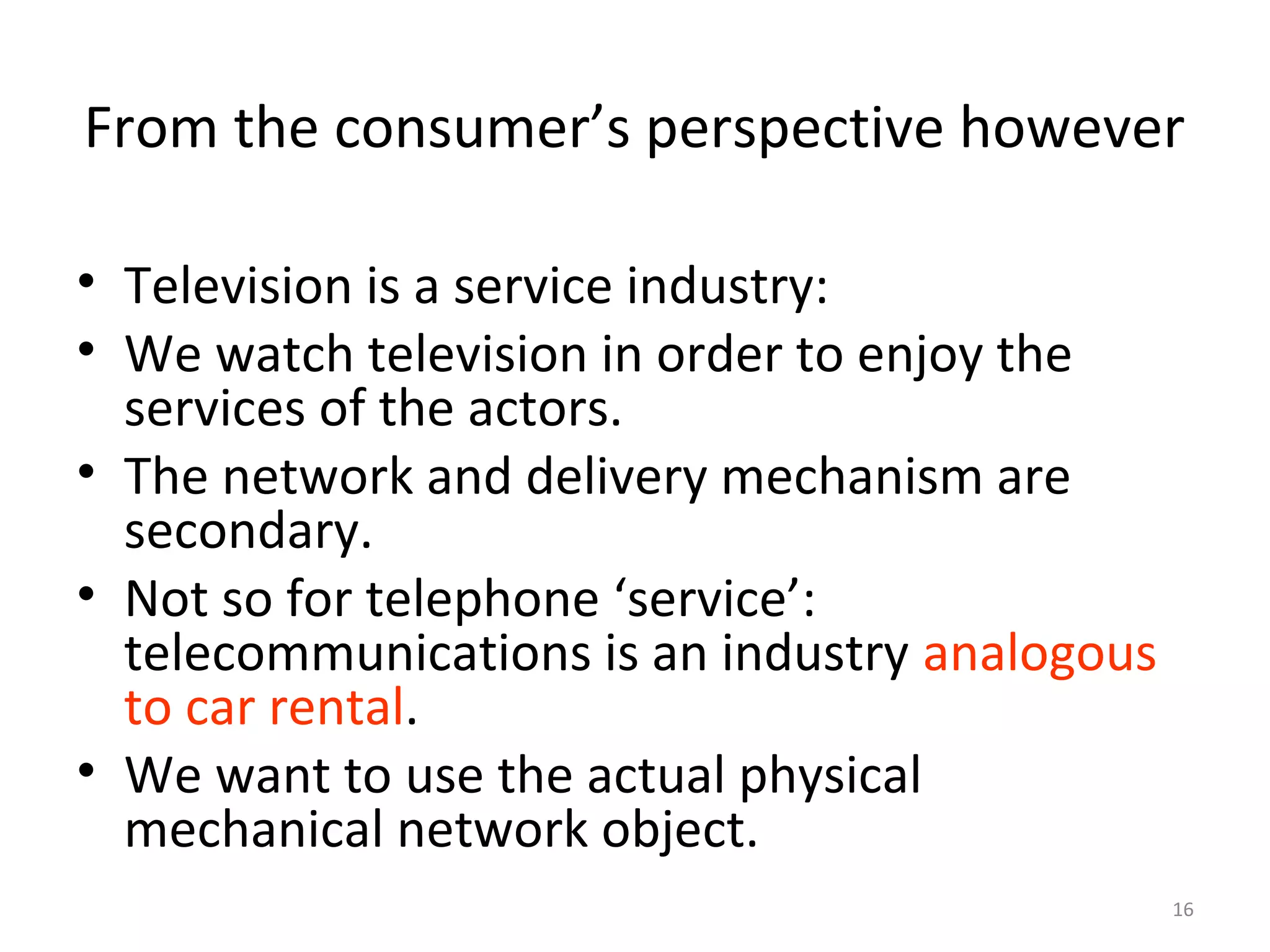
From the consumer’s perspective however
• Television is a service industry:
• We watch television in order to enjoy the
services of the actors.
• The network and delivery mechanism are
secondary.
• Not so for telephone ‘service’:
telecommunications is an industry analogous
to car rental.
• We want to use the actual physical
mechanical network object.
17
Car rental is like home rental
• it is the purchase of an object for a certain
time.
18
Phone sex,
• like other stuff which comes down the phone
line, is a service.
• But the telecommunication system itself is a
commodity, which we rent in just the same
way that we rent a free-standing public
telephone in an airport.
• You still pay for your telephone connection
when no one is using the line.
19
Is software a service
• When you buy a piece of shrink-wrapped
software you sign a license agreement. Is this
renting software?
• Are things any different if you download the
software from the internet?
• If it becomes unusable after 30 days?
20
Dependent services
• What of:
Transport services
Insurance services
Protection services (army services)
Buying and selling services
?
21
For services
production and consumption coincide both
spatially and temporally
Therefore
–services are characterized by the fact that
renting is impossible.
Services can only be purchased.
See
Wolfgang Grassl,
“The Reality of Brands: Towards an
Ontology of Marketing”
American Journal of Economics and Sociology,
58, 1999, 313-359
http://papers.ssrn.com/sol3/Delivery.cfm/SSRN_ID1646137_code116609.pdf?abstr
23
An adequate ontology of the marketing
phenomenon:
must include three categories:
Substances (things, commodities, manufactured
goods)
Processes (also called events: services)
Settings (environments, niches, contexts, situations)
See: http://ontology.buffalo.edu/smith/articles/napflion.pdf
Barry Smith,
Objects and Their Environments: From
Aristotle to Ecological Psychology
in A. Frank, J. Raper and J.-P. Cheylan (eds.), The
Life and Motion of Socio-Economic Units,
London: Taylor and Francis, 2001, 9–97.
•http://ontology.buffalo.edu/smith/articles/napflion
25
The value of a commodity
• is dependent upon the setting in which it
exists at the moment of purchase.
• The value of a service is dependent upon the
setting in which it exists at the moment of
delivery.
26
Telephones
• are physical goods. They have traditionally
been regarded as services because they afford
usage (they have the dispositional property of
providing services).
• The traditional categorization is erroneous,
because this dispositional property applies no
less to cars, pianos, rice.
27
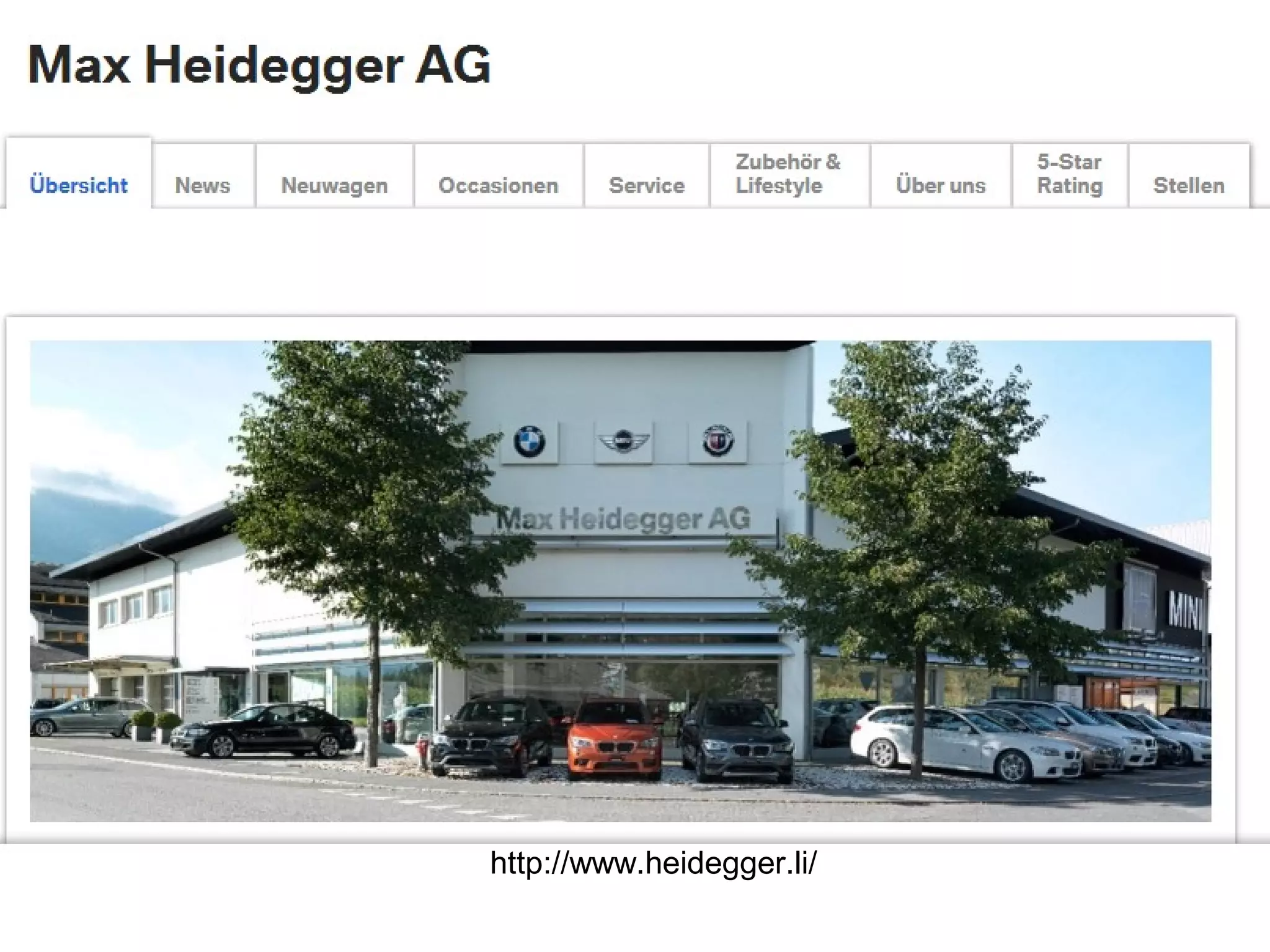
Settings
• the ensemble of environmental features
within which a purchase is made
(environmental features which are relevant to
the purchase).
• CONSIDER: BUYING A CAR
http://www.heidegger.li/
29
A CD is a commodity
• because one can either buy it or rent it.
30
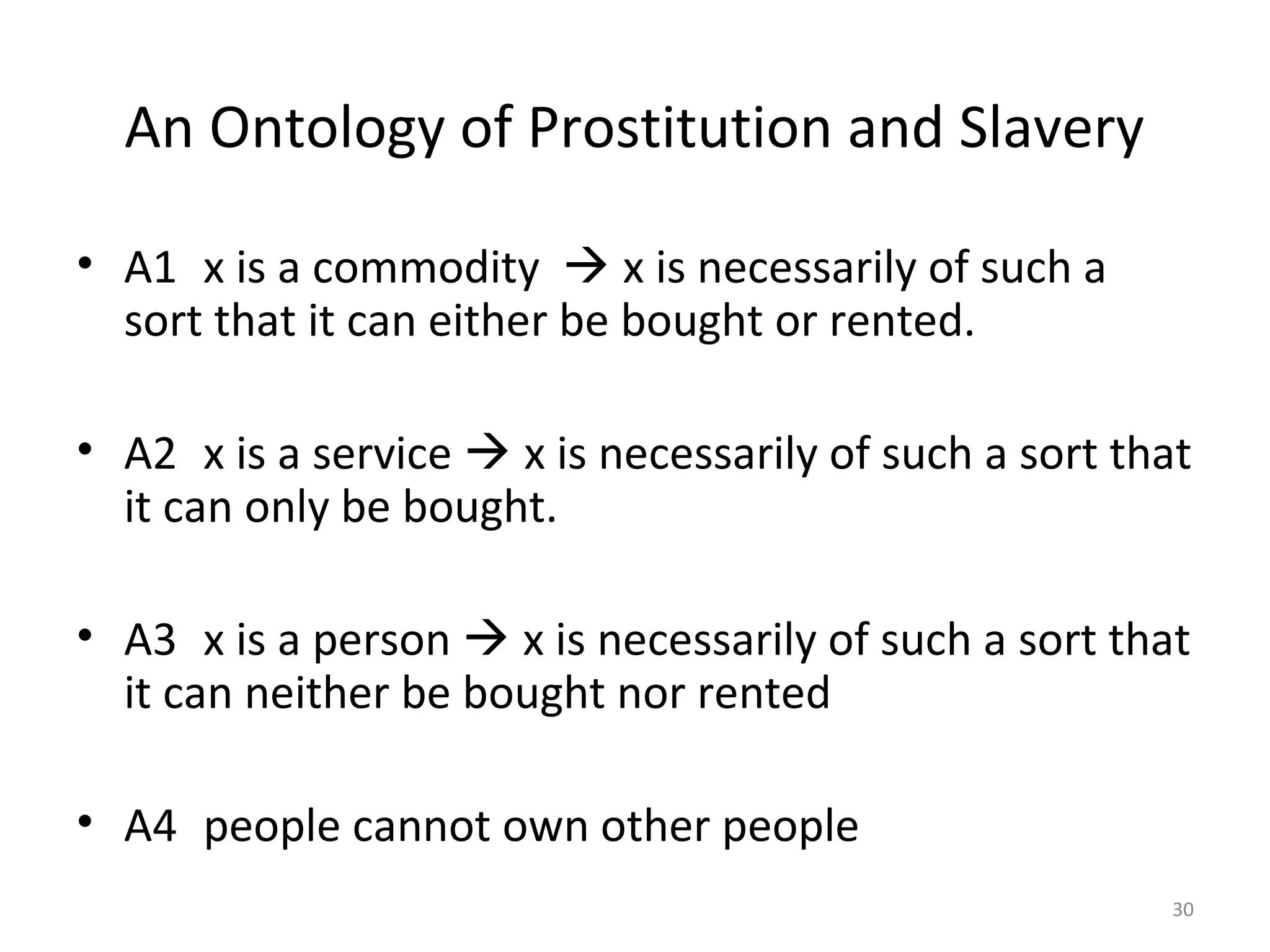
An Ontology of Prostitution and Slavery
• A1 x is a commodity  x is necessarily of such a
sort that it can either be bought or rented.
• A2 x is a service  x is necessarily of such a sort that
it can only be bought.
• A3 x is a person  x is necessarily of such a sort that
it can neither be bought nor rented
• A4 people cannot own other people
31
Can you rent potatoes?
• Renting has to do with control, with power
over that which is rented
• Ownership can survive without control.
32
Definition of renting
• x rents y to z : x owns y and x allows z to use y for limited
time in exchange for recompense proportionate to the
length of time involved.
• (There is an assumption that y will be available for
multiple time periods.)
• Theorem: There is nothing which can only be rented.
• Proof: From the definition of renting, and the assumption
that people cannot own other people.
33
Services can never be assets
• Assets can always be depreciated.
• People cannot be depreciated. People cannot be
assets
• Know-how is an asset. You can buy know-how (like
brand equity)
• Know-how (like human capital in general) is a
CONTINUANT entity
• Application of know-how is an OCCURRENT entity
(a process)
34
Definition of buying
• What does it mean to buy a commodity?
• There is a transfer of property rights. There
does not have to be any physical dislocation
or removal.
• What does it mean to buy a service?
35
You cannot rent people
• What is involved in employing people? Do you buy
their labour or do you rent their labour.
• Marx: the commonsensical view according to which
we can rent or hire bodyguards is mistaken. We do
not rent bodyguards; we buy the services of
bodyguards for given time periods. (See also escort
agencies.)
• Why is this ontologically different from renting?
• Because when you rent something, this thing exists
for a period of time beyond the rental time, and can
in principle be rented again. Services, however, are
time-perishable.
36
Counter-argument
• Surely you can rent a bodyguard, because the
bodyguard exists for a longer period of time
than the time in which you rent him.
• No: you buy the services of the person
37
More on the ontology of services
• A service is the actualization of a disposition.
Therefore you cannot render the same service
twice.
• (Type-token distinction. Every haircut is
unique.)
38
Acts vs. Products
• The service is the act, not the product
• The service is the haircutting, it is not the
result (a pattern in the hair on your head)
39
BFO categories we need
1. CONTINUANT entities
Examples
Persons
Material things such as laptops
Portions of stuff such as water or oil
40
More BFO CONTINUANT entities
• qualities
examples:
the pattern of hair on your head that is an outcome of the
haircutting process
the pattern of connectedness of the plumbing system in your
house that is an outcome of the plumbing process
• dispositions
example:
your knowledge of Greek that is the outcome of a teaching
process
41
Settings (more CONTINUANT entities)
• of purchase
• of delivery (for commodities)
• of use (for commodities)
• of delivery (for services)
• of assessment for tax purposes (of
commodities and services ...)
42
Settings
• Axiom: When you buy a service you also buy a
delivery setting.
• And the delivery setting has the same
temporal extent as the service itself.
(Hairdressers)
• The delivery setting for commodities is
transient. They bring you the car and leave.
43
The Ontology of Real Estate
• Can you buy a setting?
• When you buy real estate, you buy a house
and you also buy its setting. Real estate is like
services in that its setting endures for as long
as it does.
• Adam Smith: real estate is the only economic
good that is not perishable.
See
Barry Smith and Leonardo Zaibert,
The Metaphysics of Real Estate,
Topoi, 20: 2 (September 2001), 161–172
http://ontology.buffalo.edu/smith/articles/lz.htm

An application of Basic Formal Ontology to the Ontology of Services and Commodities

  • 1.
    1 An application ofBasic Formal Ontology to the Ontology of Services and Commodities Barry Smith and Wolfgang Grassl http://ifomis.org/bfo/
  • 2.
    Basic Formal Ontology restson a top-level distinction among all entities between (roughly) things and processes things are material entities, they continue to exist through time processes are not made of material parts; they occur through time, cycling through a succession of phases
  • 3.
    For BFO • bothcommodities and services are entities with economic value • commodities are things (CONTINUANTS) • services are processes (they are processes in which production and consumption coincide) (OCCURRENTS)
  • 4.
    4 Music • Consumer’s perspective •Producer’s perspective • Taxation authority’s perspective • What is a music CD, which (in olden times) people used to buy in stores?
  • 5.
    5 Is it acommodity? (because it is a physical object) • Or is it a service? (because it is a musical performance?)
  • 6.
    6 A similar problemwith outsourcing • Many manufacturing companies used to do everything in-house. • Now many outsource as much as possible: janitors, accounting, data processing, sales, human resources, etc. • Before these jobs were counted as manufacturing because they were employees of manufacturing companies. Now, since the same jobs are part of an out-sourcing firm, they are considered service jobs
  • 7.
    7 Traditional Opposition betweenEmbodied and Splintered Services Embodied Disembodied/Splintered haircutting LPs, CDs consulting books, newspapers nursing painting prostitution advertising teaching television, telephone <?> transport software on the net <?>
  • 8.
    8 Definition • Service =an economic good for which production and consumption coincide
  • 9.
    9 ‘splintered’ (‘disembodied’) services areclassified as services even though their production and consumption do not coincide Hence the confusions we saw above
  • 10.
    in BFO terms •Commodities are CONTINUANTS • Services are OCCURRENTS
  • 11.
    11 Is a CDa commodity or a service? • Standard view: when I buy a CD I am buying services of a composer and performers. (OCCURRENT) • Correct view: I am buying a commodity, which is ontologically no different from a car or a bag of rice. (CONTINUANT)
  • 12.
    12 Two Kinds ofCommodities consumable (bananas) non-consumable (roads, telephone lines) The latter afford services OCCURRENT as an ocean affords swimming On affordances see http://ontology.buffalo.edu/eco/Ecological_Psychology.pdf
  • 13.
    13 Strict, independent services Dependent Services Selling manufactu red goods Renting manufactured goods haircutting advertisingLPs, CDs car rental consulting selling, transport books, newspapers telecommunications nursing input service (typing) painting road networks prostitution advertising teaching television, theatre performances television, theatre technical services software on the net <?> another part of the standard view that is wrong
  • 14.
    14 Are telecommunications commodities? •Do we rent the telephone system for 5 seconds? • Do we rent services (like buying a hairdresser’s services for 5 minutes)? • Are telecommunications like water or electricity? = Commodities which come down pipes
  • 15.
    15 Television and telecommunications •are similar ontologically: each has two components: the network and the utilization of the network = continuants plus occurrents
  • 16.
    16 From the consumer’sperspective however • Television is a service industry: • We watch television in order to enjoy the services of the actors. • The network and delivery mechanism are secondary. • Not so for telephone ‘service’: telecommunications is an industry analogous to car rental. • We want to use the actual physical mechanical network object.
  • 17.
    17 Car rental islike home rental • it is the purchase of an object for a certain time.
  • 18.
    18 Phone sex, • likeother stuff which comes down the phone line, is a service. • But the telecommunication system itself is a commodity, which we rent in just the same way that we rent a free-standing public telephone in an airport. • You still pay for your telephone connection when no one is using the line.
  • 19.
    19 Is software aservice • When you buy a piece of shrink-wrapped software you sign a license agreement. Is this renting software? • Are things any different if you download the software from the internet? • If it becomes unusable after 30 days?
  • 20.
    20 Dependent services • Whatof: Transport services Insurance services Protection services (army services) Buying and selling services ?
  • 21.
    21 For services production andconsumption coincide both spatially and temporally Therefore –services are characterized by the fact that renting is impossible. Services can only be purchased.
  • 22.
    See Wolfgang Grassl, “The Realityof Brands: Towards an Ontology of Marketing” American Journal of Economics and Sociology, 58, 1999, 313-359 http://papers.ssrn.com/sol3/Delivery.cfm/SSRN_ID1646137_code116609.pdf?abstr
  • 23.
    23 An adequate ontologyof the marketing phenomenon: must include three categories: Substances (things, commodities, manufactured goods) Processes (also called events: services) Settings (environments, niches, contexts, situations) See: http://ontology.buffalo.edu/smith/articles/napflion.pdf
  • 24.
    Barry Smith, Objects andTheir Environments: From Aristotle to Ecological Psychology in A. Frank, J. Raper and J.-P. Cheylan (eds.), The Life and Motion of Socio-Economic Units, London: Taylor and Francis, 2001, 9–97. •http://ontology.buffalo.edu/smith/articles/napflion
  • 25.
    25 The value ofa commodity • is dependent upon the setting in which it exists at the moment of purchase. • The value of a service is dependent upon the setting in which it exists at the moment of delivery.
  • 26.
    26 Telephones • are physicalgoods. They have traditionally been regarded as services because they afford usage (they have the dispositional property of providing services). • The traditional categorization is erroneous, because this dispositional property applies no less to cars, pianos, rice.
  • 27.
    27 Settings • the ensembleof environmental features within which a purchase is made (environmental features which are relevant to the purchase). • CONSIDER: BUYING A CAR
  • 28.
  • 29.
    29 A CD isa commodity • because one can either buy it or rent it.
  • 30.
    30 An Ontology ofProstitution and Slavery • A1 x is a commodity  x is necessarily of such a sort that it can either be bought or rented. • A2 x is a service  x is necessarily of such a sort that it can only be bought. • A3 x is a person  x is necessarily of such a sort that it can neither be bought nor rented • A4 people cannot own other people
  • 31.
    31 Can you rentpotatoes? • Renting has to do with control, with power over that which is rented • Ownership can survive without control.
  • 32.
    32 Definition of renting •x rents y to z : x owns y and x allows z to use y for limited time in exchange for recompense proportionate to the length of time involved. • (There is an assumption that y will be available for multiple time periods.) • Theorem: There is nothing which can only be rented. • Proof: From the definition of renting, and the assumption that people cannot own other people.
  • 33.
    33 Services can neverbe assets • Assets can always be depreciated. • People cannot be depreciated. People cannot be assets • Know-how is an asset. You can buy know-how (like brand equity) • Know-how (like human capital in general) is a CONTINUANT entity • Application of know-how is an OCCURRENT entity (a process)
  • 34.
    34 Definition of buying •What does it mean to buy a commodity? • There is a transfer of property rights. There does not have to be any physical dislocation or removal. • What does it mean to buy a service?
  • 35.
    35 You cannot rentpeople • What is involved in employing people? Do you buy their labour or do you rent their labour. • Marx: the commonsensical view according to which we can rent or hire bodyguards is mistaken. We do not rent bodyguards; we buy the services of bodyguards for given time periods. (See also escort agencies.) • Why is this ontologically different from renting? • Because when you rent something, this thing exists for a period of time beyond the rental time, and can in principle be rented again. Services, however, are time-perishable.
  • 36.
    36 Counter-argument • Surely youcan rent a bodyguard, because the bodyguard exists for a longer period of time than the time in which you rent him. • No: you buy the services of the person
  • 37.
    37 More on theontology of services • A service is the actualization of a disposition. Therefore you cannot render the same service twice. • (Type-token distinction. Every haircut is unique.)
  • 38.
    38 Acts vs. Products •The service is the act, not the product • The service is the haircutting, it is not the result (a pattern in the hair on your head)
  • 39.
    39 BFO categories weneed 1. CONTINUANT entities Examples Persons Material things such as laptops Portions of stuff such as water or oil
  • 40.
    40 More BFO CONTINUANTentities • qualities examples: the pattern of hair on your head that is an outcome of the haircutting process the pattern of connectedness of the plumbing system in your house that is an outcome of the plumbing process • dispositions example: your knowledge of Greek that is the outcome of a teaching process
  • 41.
    41 Settings (more CONTINUANTentities) • of purchase • of delivery (for commodities) • of use (for commodities) • of delivery (for services) • of assessment for tax purposes (of commodities and services ...)
  • 42.
    42 Settings • Axiom: Whenyou buy a service you also buy a delivery setting. • And the delivery setting has the same temporal extent as the service itself. (Hairdressers) • The delivery setting for commodities is transient. They bring you the car and leave.
  • 43.
    43 The Ontology ofReal Estate • Can you buy a setting? • When you buy real estate, you buy a house and you also buy its setting. Real estate is like services in that its setting endures for as long as it does. • Adam Smith: real estate is the only economic good that is not perishable.
  • 44.
    See Barry Smith andLeonardo Zaibert, The Metaphysics of Real Estate, Topoi, 20: 2 (September 2001), 161–172 http://ontology.buffalo.edu/smith/articles/lz.htm