ABSTRACTS


                       Leading the Way in Pain Control:

                    A MECC-ONS Course for Oncology Nurses


What Are We Aiming At? Palliative Care in the Middle East                 References:
                                                                          1. World Health Organization—WHO definition of palliative care.
Michael Silbermann. MECC.                                                     Available at: http//www.who.int/cancer/palliative/definition/en.
The World Health Organization defines palliative as ‘‘An approach
                                                                              Accessed October 19, 2008.
that improves the quality of life of patients and their families facing
                                                                          2. Steinhauser	 KE, Christakis NA, Clipp EC, et al. Factors
the problems associated with life-threatening illness, through the            considered important at the end of life by patients, family,
prevention and relief of suffering by means of early identification             physicians, and other care providers. JAMA. 2000;284:2476–2482.
and impeccable assessment and treatment of pain and other                 3. Teno JM, Casey VA, Welch LC, Edgman-Levitan S. Patient-
problems, physical, psychosocial and spiritual.’’1                            focused, family centered end-of-life medical care: views of the
Today, we have arrived at the stage where one can start the                   guidelines and bereaved family members. J Pain Symptom
evolution of quality measurement in palliative care practice both in
                                                                              Manage. 2001;22:738–751.
hospital-based palliative care units and in hospices. It has become       4.	 Teno JM, Connor SR. Referring a patient and family to high-
apparent, through surveys of healthcare professionals, seriously              quality palliative care at the close of life. JAMA. 2009;301:
ill patients, and family members, that several domains were                   651–659.
validated.2 Nearly 70% of reviewed citations agreed on the
importance of the domains of symptom palliation, emotional
support, promoting shared decision-making and advance care                Healing Cancer Pain
planning, meeting the needs of patients and those who care for
                                                                          Ann Berger, MSN, MD. Chief Pain and Palliative Care, National
them, addressing grief and spirituality, and coordination of care.3
                                                                          Institutes of Health, Clinical Center, Bethesda, MD.
A useful mnemonic is the 3 Cs: high-quality care is ‘‘competent,’’
                                                                          Great strides have been made in the treatment of the preponder­
‘‘compassionate,’’ and ‘‘coordinated.’’ A competent case involves
                                                                          ance of cancers in recent decades, to the extent that virtually 50%
an interdisciplinary team that provides evidence-based symptom
                                                                          of persons who develop cancer can be cured. Whether a cancer can
palliation and psychological support in the key domains of physical
                                                                          be cured or whether one can hope only for limited remission, what
comfort: psychological support, social support, bereavement
                                                                          the patient feels most acutely are the physical, psychosocial, and
services, and life closure, including spirituality and transcendence.
                                                                          spiritual symptoms associated with the cancer and its treatment.
Too often, seriously ill people feel as though they are lost among
                                                                          The prevalence of pain and inadequate control measures in patients
myriad specialists focused on body organs, with no physician
                                                                          with cancer is well documented. Pain is a huge quality of life issue.
specifically charged with providing critical assistance and ensuring
                                                                          The consequences of pain are many, including depression, decreased
continuity and coordination of the plan of care at the stages of the
                                                                          socialization, agitation, fatigue, sleep disturbances, and more visits to
disease trajectory.3 Seriously ill patients and their families need to
                                                                          the doctor and hospital.
know whom they can call for help, what they should monitor, and
                                                                          Total pain is made up of more than just physical pain. Total pain
when they should call; in short, there should be an orchestrated
                                                                          can involve a physical component and a suffering component.
and clear plan of follow-up. Compassionate care treats the patient
                                                                          Suffering involves psychologic and coping factors, social support,
and family with respect, honors cultural traditions, and provides
                                                                          loss issues, fear of death, financial concerns, and spiritual, meaning
holistic care. Care is coordination across the setting of care and the
                                                                          of life concerns. Most patients with pain from cancer have both
disease trajectory.
                                                                          physical pain and suffering. Although pain has been described in
Hospital-based palliative care programs often lack the extensive
                                                                          the literature for centuries, and has been one of medicine’s greatest
use of volunteers as do hospice programs use to extend their staff
                                                                          mysteries, it still remains a challenge for healthcare professionals to
services. Furthermore, hospice programs are mandated to provide
                                                                          provide the best of care for the patient and his/her family.
12 months of bereavement follow-up to every family they serve.
                                                                          For pain management to be effective, a palliative care, integrative
A high-quality hospice program is required to have an inter­
                                                                          approach should be used. The palliative care, integrative approach
disciplinary team of physicians, nurses, and volunteers; bereave­
                                                                          includes the use of a nurturing, interdisciplinary team to treat both
ment services; available rehabilitative services including speech,
                                                                          the physical pain and the suffering associated with the pain. The
physical, and occupational therapies; short-term in-patient care;
                                                                          team includes the patient, family, physicians, nurses, social workers,
and home health aides. A high-quality hospice program will, at the
                                                                          spiritual ministry, pharmacists, counselors, dieticians, psychiatrists,
close of life, comprehensively assess patient pain to understand its
                                                                          physical therapists, occupational therapists, and volunteers. Many
cause and both pharmacologic and nonpharmacologic approaches
                                                                          nonpharmacologic methods such as art, music, massage, reiki, pet
to its management, including the appropriate use of adjuvant
                                                                          therapy, relaxation, guided imagery, hypnosis, biofeedback, and
medications such as gabapentin for neuropathic pain. At times,
                                                                          spiritual counseling can help to relieve pain and suffering. It is
palliative sedation is the only possible means of symptom relief.
                                                                          important that all members of the care team communicate and work
Furthermore, palliative care programs must manifest understand­
                                                                          together to relieve and comfort the patient and improve his or her
ing and respect of the unique values of the patient’s culture. In
                                                                          quality of life. The goal needs to be to treat mind-body-and-spirit,
addition, supporting families and friends in their caregiving role is
                                                                          understanding that cure may or may not be possible but that one
essential. Evidence of families frequently taking patients to and
                                                                          can always help to heal a patient. No matter what the reason for the
from the emergency department may highlight inadequate family
                                                                          pain, it is important for the care team to realize that they may not
education and lack of on-call staff to consult with and support
                                                                          be able to add days to someone’s life, but that they can add life to
at-home symptom management.
                                                                          someone’s days.
Be it in a hospital environment, hospice or home care setting,
palliative care at the close of life needs to be patient-focused and
family-centered.
This abstract is based on the excellent publication of Teno et al.4       Neuropathic Assessment and Management Among Cancer
The authors’ observations, judgment and analysis could serve as a         Patients
basis for multiple new programs in developing countries eager to          Hiba Badran. Chemotherapy Clinic, King Hussein Cancer Center,
bring palliative care services to the best reachable levels.              Amman, Jordan.


J Pediatr Hematol Oncol      �   Volume 31, Number 8, August 2009	                                            www.jpho-online.com |          605
Abstracts	                                                                   J Pediatr Hematol Oncol    �   Volume 31, Number 8, August 2009


During my duty as a registered nurse in the outpatient                      non-pharmacologic interventions that can be provided by other
chemotherapy clinics, I have frequently encountered patients                disciplines.
who often verbalize ‘‘weird feelings’’ and numbness in their                References:
hands or legs. Quite often I have overheard my colleagues                   1. Dworkin RH, O’Connor AB, Backonja M, et al. Pharmacologic
instructing patients to do different exercises to diffuse the tingling           management of neuropathic pain: evidence-based recommenda­
sensations.                                                                    tions. Pain. 2007;132:237–251.
The body’s nervous system is divided into 2 major systems: the              2. Institute for Clinical Systems Improvement (ICSI). Assessment
central nervous system and the peripheral nervous system.                      and Management of Chronic Pain. Bloomington, MN: Institute
The peripheral nervous system is also divided into 2 major parts:              for Clinical Systems Improvement (ICSI); 2008:84.
the somatic nervous system and the autonomic nervous system.
The somatic nervous system consists of peripheral nerve fibers that
send sensory information to the central nervous system and motor            Pediatric Intensive Care Unit, King Abdullah University
nerve fibers that send signals to the skeletal muscle. The autonomic         Hospital
nervous system controls the smooth muscle of the viscera (internal          Abdel Rahman E. Alkhalouf, MSN, RN. School of Nursing, Jordan
organs) and glands (www.cancercare.com).                                    University of Science and Technology, Irbid, Jordan.
Peripheral neuropathy results from some type of damage to the               The Pediatric Intensive Care Unit (PICU) was established on
peripheral nerves. Certain chemotherapy drugs can cause peripheral          September 3, 2003 on the fourth floor, wing C with potential
neuropathy, such as vinca alkaloids (vincristine), cisplatin, paclitaxel,   capacity of 10 beds. Actually, it is operating now with only six
and the podophyllotoxins (etoposide and tenoposide). Other drugs            beds. It is the only tertiary PICU in the north of Jordan dealing
used to treat cancer, such as thalidomide and interferon, also can          with both medical and surgical patients.
cause peripheral neuropathy (www.chemocare.com). Unfortunately,             The unit received patients ranging from the age of one month to
on the basis of my observation in my clinical area, many nurses know        less than 13 years old. Severely ill patients are admitted based on
this fact since their field of expertise is in chemotherapy administra­      the decision of medical personnel, or are medical and surgical cases.
tion, but assessing such a complaint is almost always not considered        Patients from other hospitals as well as any unit in King Abdullah
by the nurses as a type of pain that needs proper assessment and            University Hospital are also received, which is inconsistent with
subsequently appropriate management that should involve pharmaco­           hospital policy.
logic and non-pharmacologic interventions.                                  The staff and team of PICU are committed to providing all that an
A proper assessment of neuropathic pain is not just grading it by a         intensive care patient may need and holistic care to the patients and
valid assessment tool for scaling. As a standard of management, it          family. They provide optimal management and monitoring for all
should also focus on exploring possible reasons and any underlying          critical ill cases.
conditions which might be causing the pain. Any existing                    Goals:
treatments that can have possible side effects of neuropathy should          1. Improvement in general health and well-being of patients and
be explored. Finally, an evaluation should be made of the impact of             families who require critical sophisticated care.
such a complaint on the quality of life, such as sleeping, eating and       2. Participation in interdisciplinary care for all specialties treated
other activities of daily life.                                                 except for pediatrics.
Adoption of a clear guideline that addresses a special type of pain         3. Management of patient care appropriately through the acute
can be very beneficial in keeping nurses on track as they realize an             and chronic phase of illness.
anticipated pathway for a predicted side effect, the mere presence of        4. Establishment of a communication channel with the other
which can be an alerting sign for an existing problem that is more              health sectors regarding the cases referred.
common that expected, and then a follow-up evaluation should be             Provision of attending and/or pediatric resident support for all the
carried out to establish the effectiveness of the intervention. Nurses       above services 24 hours a day, 7 days a week. Nursing services are
have a very vital role to play in being the patients’ advocates, and        available 24 hours a day, 7 days per week. The extent to which the
can alleviate the problem that patients have by the following               level of care or services is provided meets the patients’ needs.
techniques2:                                                                Staffing needs are based on the volume and acuity of the patients.
1. General history: medical, surgical, and drug use.                        The available staff are scheduled and adjusted from day to day to
2. General physical examination, looking for possible reversible            meet the unit demands.
   causes.                                                                  On admission, the patient must be connected to a cardiac monitor
3. Impact of such pain on the quality of daily living and ability to        and initial invasive and noninvasive hemodynamic monitoring is
   perform different functions.                                              initiated. Then assessment of the patient is performed and planning
4. To use a valid, reliable tool that can aid nurses in scoring the         of nursing care takes place. It depends on the current situation of
   baseline of the neuropathic pain and later on keep track of the          the patient, by looking for the desired outcomes in a systematic
   effectiveness the interventions for follow-up.                            way.
5. And finally, and I would like	 to add this from a personal                Standards or Guidelines For Practice:
   experience: raising the level of awareness among nurses with             Hospital policies and procedures.
   regard to the everyday words that lay people use to describe             Internal policies and procedures.
   what we ( health-care professionals) term as neuropathic pain.           International guidelines.
   From my experience, words such as ‘‘ tingling, numbness, weird           Extent to Which Level of Care or Service Provided Meets the
   or funny feelings, electrical shots, burning like chilies, and y there   Patients Needs: At the hospital level, surveys of patients are
   are ants all over my hands!) are often overlooked by many nurses         conducted every 6 months to evaluate patient satisfaction. A
   as descriptive words of the nature of neuropathic pain, and an           patient’s comments and concerns are included in future planning.
   expected downside of chemotherapy treatments. All of this should         Performance Improvement Activities:
   be addressed through continuous education for the nurses,                In-service education.
   and later on nurses can transfer this information to patients            FOCUS-PDCA.
   through patient education activity to emphasize the importance           In-service education.
   of reporting such a symptom and its severity to health-care
   providers.
As a first step, by carrying out all of these recommendations, if            King Hussein Cancer Center: From Good to Great
executed, a proper screening of neuropathic pain can take place,            Majeda Afeef Al-Ruzzieh, RN, MSN and Maha Badawi Alwawi,
and at a later stage evaluating the effectiveness of interventions           RN. King Hussein Cancer Center, Al-Jubeiha, Amman, Jordan.
for our populations according to drug availability and resources            King Hussein Cancer Center (KHCC) was founded in 1997 as
can take place, also never underestimating the contribution of              Al-Amal Cancer Center in Amman–Jordan, and was restructured


606 | www.jpho-online.com	                                                                          r   2009 Lippincott Williams & Wilkins
J Pediatr Hematol Oncol   �   Volume 31, Number 8, August 2009	                                                                      Abstracts


as KHCC at the beginning of 2003, with a total capacity of 124            follow up patients on a daily basis, and provide immediate care in
beds. KHCC became one of the leading regional medical facilities          the event of an emergency related to pain therapy.
in the Middle East, providing comprehensive cancer care to both           By May 1996, we developed a 34-hour Pain Management Course
adult and pediatric patients.                                             for nurses. In January 1997, we formed a pain management
KHCC aims to deliver the latest in cancer treatment to patients,          committee with regular meetings once a month to discuss pain
actively promoting awareness and educational programs for early           management concerns in the clinical areas. In January 2001, we
detection and prevention of cancer, as well as training and research      conducted a National Pain Workshop with participation of
to decrease mortality and alleviate the suffering that results from        international speakers.
cancer. KHCC treats over 3400 new patients yearly from Jordan             Pain Management Nursing: I worked as a pain management nurse
and surrounding countries through the use of clinical practice            from 1993 to 2003. My role has involved the following
guidelines. Patients are kept actively involved in treatment              responsibilities:
decisions and plan of care.                                               1. Making daily ward rounds to visit patients in pain to ensure
KHCC is also leading the efforts to establish the first regional Cancer         effectiveness and safety of pain treatment.
Control Program. This program will work at reducing the incidence         2. Coordinating	 teaching programmes by conducting lectures,
of common cancers in Jordan through public education, early                   promoting causes, speaking at conferences, developing patient
detection, and primary prevention. The fully operational National             information booklets and giving lectures to doctors on palliative
Program for Breast Cancer Screening and Diagnosis established in              care and the use of different therapies.
2006 and the Smoking Cessation Program established in 2008 are            3. Introducing and	 ensuring the safe and effective use of new
core components of this developing program. In addition to standard           methods of pain relief, such as epidurals, patient-controlled
diagnostic and therapeutic services offered at any cancer center,              analgesia, and continuous intravenous infusion of opioids, in
KHCC elected to focus on other aspects of cancer care such as                 clinical areas.
psychosocial oncology, pain management, physical therapy, nutri­          4. Conducting pain management audits annually and researches
tional services, child education, play therapy, and palliative/hospice        give the results to all the concerned staff. This has led to focus
care. These areas are often neglected, and their role is under­               on the improvement of care and patient satisfaction.
estimated. KHCC was a pioneer in Jordan in establishing a culturally      5. Developing	 pain management materials such as policies,
sensitive palliative and hospice care program, which included a               procedures, guidelines, standards, and forms, and publishing
unique home care service. It offered care to nearly 500 patients in            guidelines for doctors, nurses, and patients. Introducing pain
2008. The program focuses on managing symptoms of terminally ill              assessment scales to assess and evaluate the effectiveness of
cancer patients and addressing the sensitive issues of end of life care       treatment.
through an interdisciplinary approach (physicians, nurses, social         Achievements: We educated approximately 300 nurses on the
worker, nutritionist, pharmacist, and chaplain).                          subject of pain management. They later became pain management
KHCC earned national and international recognition by receiving           liaison nurses of their allocated areas. We prepared a great deal of
Joint Commission International Accreditation including JCIA—              pain management educational material for nurses, doctors, and
first institution in Jordan—(February 22, 2006), Joint Commission          patients. The most important achievement is that through
International Disease Specific Accreditation in 2007, Hazardous            educating nurses and doctors we have improved the management
Analysis and Critical Control Point Systems and Guidelines for its        of pain for patients with sickle cell disease, cancer, postoperative,
application in 2008, and Safety and the Occupational Health               pediatric, labor, and chronic pain at SQUH and other hospitals in
Excellence Award (Social Security Corporation-Jordan in 2008).            Oman. Annual patient audits have indicated that the patients are
KHCC is a clear example of an institution steadily progressing on         satisfied with the manner in which the staff control their pain and
the path of excellence, growing from good to great and realizing          symptoms.
that the greatest opportunity for growth and impact lies in
capitalizing on individuals’ natural talents and investing in them
while staying committed to maintaining a clear mission and vision.
                                                                          MECC-ONS Conference on Pain Management: Pain
                                                                          Assessment Tools
                                                                          A. Babgi, PhD, RN, A. Al Jafferri, BSN, RN, and F. Fallatah,
Contributions and Achievements in Pain Management                         BSN, RN. KAMC-WR, Jeddah, Saudi Arabia.
Services at Sultan Qaboos University Hospital                             Introduction and Background: Patients vary in diagnosis, stage of
Salma Said Mahfudh, SRN, Obstetric, Pain Management Certifi­               disease, their responses to pain and interventions, and pain
cates. Sultan Qaboos University Hospital, Al Khodh, Sultanate of          management. The pain sensed by patients with life-limiting/life­
Oman.                                                                     threatening conditions is a crucial issue that requires adequate
I come from the Sultanate of Oman. I work at Sultan Qaboos                management. As of now, there are a number of patients whose pain
University Hospital (SQUH), which is part of the College of               is not under control because of undertreatment resulting from
Medicine and Health Sciences of Sultan Qaboos University. SQUH            inadequate pain assessment. The pain in the majority of these
was officially opened in February 1990. It is an educational                patients (80% to 90%) can be controlled if an extra step was taken
and medical institution, and has a total bed capacity of 553.             to conduct comprehensive pain assessment by using valid and
SQUH performs 5 main functions: teaching medical and nursing              reliable tools appropriate for the patient’s population being
students, training undergraduate and postgraduate students,               assessed.
providing tertiary medical care, and research. The hospital was           To formulate a pain management plan of care, an assessment is
ISO-accredited in 2005, and is planning to apply for JCI                  paramount in identifying the pain syndrome or the cause of pain.
accreditation in 2009. The services offered include medical,               Pain is defined by the International Association for the Study of
surgical, pediatrics, obstetrics, gynecology, neonatology, psychia­       Pain as the ‘‘unpleasant sensory and emotional experience
try, cardiothoracic, hematology, oncology, intensive care, accident       associated with actual or potential tissue damage, or described in
and emergency, operating theaters, day care, and orthopedics.             terms of such damage.’’ To assess pain, it is very important to
Neurology will begin in 2009. The unique services of SQUH                 know what the different types of pain are.
include a bone marrow transplant unit and cord blood bank, a              Pain can be classified on the basis of ‘‘duration’’ as acute or
family and community medicine unit, clinical physiology and               chronic, or on ‘‘inferred pathophysiology’’ as nocieceptive pain
nuclear therapy—iodine 131.                                               (somatic or visceral) and neuropathic pain (peripherally generated
Pain Management Service: The Pain Management Service of                   or centrally generated). The pain assessment and management plan
SQUH began in January 1993. The purpose of the service is to              will depend on both classifications.
provide effective and continuous pain relief for hospital-referred         A comprehensive assessment addresses each type of pain and
patients. The goal is to provide 24 hour management of pain,              includes the following: detailed history, including an assessment of

r   2009 Lippincott Williams & Wilkins	                                                                     www.jpho-online.com |        607
Abstracts	                                                                 J Pediatr Hematol Oncol    �   Volume 31, Number 8, August 2009


the pain intensity and its characteristics; a physical examination        Neuropathic Pain Scale Assessment Tool: The recently developed
with pertinent neurologic examination; a psychosocial and cultural        Neuropathic Pain Scale provides information about the type and
assessment; and appropriate diagnostic workup to determine the            degree of sensations experienced by patients with neuropathic pain.
cause of pain.                                                            It evaluates 8 common qualities of neuropathic pain (ie, sharp, dull,
Methods: Use of extant literature review on pain assessment and           hot, cold, sensitive, itchy, and deep vs. surface pain). The patient
management methods to explore reliable methods to assess pain             rates each item on a scale from 0 to 10, with 0 for none and 10 for
comprehensively in various patient populations.                           the ‘‘most imaginable.’’ The choice of tool and the general
Results: The literature was reviewed thoroughly to explore the most       approach to assessment should reflect the suffering of the patient
popular and reliable pain assessment methods. It was noted and            and his/her special needs. Assessment of pain should be conducted
agreed upon in a number of studies that a clinical approach to pain       at regular intervals to monitor any changes in pain after analgesics
assessment and management was recommended by the Agency for               administration or modification of the pain management plan. The
Health Care, Policy, and Research, which is currently known as the        assessment should be individualized and documented in order for
Agency for Health Care Research and Quality. The clinical                 the entire multidisciplinary team members to have an under­
approach was summarized in ‘‘ABCDE’’ format, highlighting the             standing of problems associated with pain. In addition, assessment
following:                                                                is conducted with each new report of pain.
1. Ask about pain regularly: Assess pain and associated symptoms          Conclusions: In agreement with the literature reviewed, pain is
    systematically.                                                       considered the fifth vital sign. Proper assessment for patients
2. Believe patient and family reports of pain and what relieves the       suffering from pain will guide the pain management care plan for
    pain.                                                                 those patients. Those healthcare professionals working with
3. Choose pain-control options appropriate for the patient, family,       patients on the frontline are responsible for identifying the most
    and setting.                                                          appropriate and reliable tools for conducting comprehensive and
4. Deliver interventions in a timely, logical, coordinated manner.        holistic assessments of pain, as well as selecting the most
5. Empower patients and their families. Enable patients to control        appropriate tool for the population being assessed, that is, elderly,
    their course as much as possible.                                     cognitively impaired, or pediatric patients. Being able to do so will
When conducting the assessment, the information can be gathered           assure that these patients receive the best quality care resulting
from observations, interviews with patient and family or significant       from comprehensive pain assessment and management.
others, review of medical data, and feedback from other healthcare
providers.
Pain is a multidimensional human experience that requires compre­
hensive, holistic evaluation. To assess pain comprehensively, there
                                                                          Inauguration and Development of Pediatric Palliative Care
is a need to find valid and reliable tools that will guide the pain
management plan of care. Pain assessment tools are classified as           Service at the National Cancer Institute, Cairo University,
unidimensional, multidimensional, and neuropathic.                        Egypt
Unidimensional Pain Assessment Tools: These pain assessment tools         Hany Abd El-Rahman, MD and Maha Hussein, MD. Pediatric
include scales that use numeric, verbal, or visual rating scales or       Oncology Department, National Cancer Institute, Cairo University,
descriptors to measure or monitor pain or pain relief. Examples           Egypt.
include the numeric rating scale, the visual analog scale, and            Introduction: Palliative care was defined by the World Health
categorical scales.                                                       Organization in 2002 as an ‘‘approach that improves the quality of
(a) Numeric Rating Scale: The most commonly used rating scale             life of patients and their families facing the problem associated with
     using a 0-to-10 scale or a 0-to-5 scale, with 0 representing ‘‘no    life-threatening illness, through the prevention and relief of
     pain at all’’ and 5 or 10 representing ‘‘the worst imaginable        suffering by means of early identification and impeccable assess­
     pain.’’                                                              ment and treatment of pain and other problems, physical,
(b) Visual Analog Scale: This scale consists of a numerated line,         psychosocial, and spiritual.’’ The National Cancer Institute
     with anchors at either end: ‘‘no pain’’ at one end and ‘‘the worst   (NCI) is the largest comprehensive cancer center in Egypt. In
     imaginable pain’’ on the other end. The patient places a mark        2008, 20,000 new patients visited NCI, including 2000 pediatric
     on the line, which the clinician then measures with a ruler and      cancer patients.
     assigns a score indicating the patient’s pain intensity.             Despite recent advances in cancer treatment, approximately 22%
(c) Categorical Scales: These scales provide a simple means to rate       of children diagnosed with cancer eventually die of their disease,
     pain intensity using verbal or visual descriptors of the pain.       and this percentage is much higher in developing countries; this
     Examples of these scales include the Faces Pain Scale for            makes palliative care an expected standard of care in all cancer
     Adults and Children, and the Wong-Baker Faces Rating Scale           centers.
     for children.                                                        Design and Methods: Here we describe the palliative care activity
                                                                          at the Pediatric Oncology Department, NCI, Cairo University.
Multidimensional Pain Assessment Tools: Multidimensional tools            From December 2007 to February 2009, 33 patients were referred
provide important information with regard to the pain character­          to the clinic. All of them had been treated in the past in the same
istics and effects on the patient’s daily life and activities. Examples    department, and the decision to discontinue active treatment
include an initial pain assessment tool, a brief pain inventory, and a    was taken by 2 senior staff members. The service was first a part of
McGill pain questionnaire.                                                the Pediatric Outpatient clinic, but with the intention to upgrade
(a) Initial Pain Assessment Tool: This tool provides information          the level of care, it was moved to a larger separate room that
     with regard to the characteristics of the pain, the patient’s        integrated multidisciplinary specialties to offer better, faster, and
     expressions of pain, and the effects of the pain on the patient’s     more specified service. The pain management team, radiotherapist,
     life in the form of a diagram that indicates the location of pain;   specialized nurses, and social worker were all grouped in the new
     a scale to rate pain intensity; and a space to document              location, and different aspects of the patients’ needs were taken into
     additional comments and management plans.                            consideration, including physical, psychological, social, and financial
(b) Brief Pain Inventory: This tool is easy to use and quantifies both     demand.
     pain intensity and associated disability. It consists of a series    Results: Thirty-three patients were referred to the clinic during the
     of questions that address aspects of the pain experienced over       period between December 2007 and February 2009. They were 24
     24 hours.                                                            men and 9 women (ratio 2.6:1), their age ranged from 3 to 25 years
(c)	 McGill Pain Questionnaire: This tool is one of the most              and the original diagnosis was a solid tumor in 60% and
     extensively used and tested multidimensional scales, and             hematologic malignancy in 40%. The most commonly encountered
     assesses pain in 3 dimensions: sensory, affective, and evaluative,    malignancies were neuroblastoma and acute myeloid leukemia
     on the basis of words that patients select to describe their pain.   (21% each). All patients were progressive and/or resistant to at


608 | www.jpho-online.com	                                                                        r   2009 Lippincott Williams & Wilkins
J Pediatr Hematol Oncol   �   Volume 31, Number 8, August 2009                                                                         Abstracts


least 2 lines of anticancer treatment (range: 2 to 4 lines). Excluding    group of cancer patients, their families, and friends. It provides
patients who are still alive and currently being treated at the clinic,   services to more than 3500 cancer patients and their families every
the duration of the patients’ visits to the clinic ranged between         year. The Association depends on fundraising events and public
1 and 8 months with an average of 2.8 months. Medical care                donations. Its mission is to create a better quality of life for cancer
provided at the clinic included pain management (57%), blood              patients and their families and to promote awareness with regard to
and platelets transfusion (60% and 30%, respectively), infection          cancer prevention and control.
control (63%), chemotherapy (93%), radiotherapy (27%), surgical           The Association also organizes and hosts conferences and
consultation and wound care (15%), tapping of effusion (3%),               seminars. In addition, funding for postgraduate studies in the
and supportive measures (81%). One patient (3%) received meta­            fields of cancer, palliative care, and other related subjects is also
iodo-benzyl-guanidine therapy and another one underwent renal             provided to its healthcare professionals.
dialysis for acute renal failure. The chemotherapeutic agents used        PASYKAF has been involved in the research program DITIS, an
were mostly oral VP16 (54%), followed by hydroxyurea (25%),               ehealth telehomecare project, and is about to commence an
oral cyclophosphamide (12%), and a combination of vincristine,            evaluation of its services. A rolling audit and evaluation will
steroids, and 6 mercaptopurine (9%). Supportive care given                commence this year with its new database, PASYKAF patient
according to the patient’s condition included antipyretics, gastric       management system, allowing us to assess and audit, evaluate and
protectors, antiemetics, nutritional support, vitamins, antispasmo­       continually improve services and education of staff in the particular
dics, antitussive, laxatives, and anticonvulsants.                        areas required.
Conclusions: Palliative care has become an integrated activity of the     Our services, which are provided in the districts of Nicosia,
Pediatric Oncology Department of the National Cancer Institute,           Limassol, Paphos, Larnaca and Amochostos, are free of charge to
Egypt. Our goal is to give better support to our end of life patients,    all adults with a cancer diagnosis, at any stage of the disease, and
with a type of care adapted to our community.                             are concerned with the care of patients and their families within the
                                                                          community. The staff, which totals 50, includes a full multi­
                                                                          disciplinary team of nurses, social workers, physiotherapists,
                                                                          psychologists, psychotherapists, doctors, volunteers, and adminis­
Egyptian Nurses’ Perceptions of Palliative Cancer Care and                tration. Services include home care, psychosocial support, bus
Patient Needs                                                             transport to main oncology hospitals, day care, breast and
Nagwa Elkateb, Mona Elshatter, Amira Abulkhyer, Souad Hashem,             lymphoedema clinics, and soon to be commenced bereavement
and Gaber Maher. National Cancer Institute, Cairo University, Cairo,      support groups.
Egypt.                                                                    Owing to the fact that this association was founded by cancer
Background: Palliative care is a model of care that provides              patients, it has always focused on psychological support, for the
coordinated physical, emotional, and spiritual support not only for       patients, their families and healthcare professionals. Weekly
patients who have advanced and incurable disease, but also for            multidisciplinary meetings and monthly staff debriefings by a
those who require symptom relief during complications from which          psychologist from another town are held. In addition, nurses are
they will recover. It is a proactive form of care that seeks to           offered a extra day off monthly (in recognition of the stress that can
maximize quality of life for patients and families. The perceptions       affect them) and, in an effort to make stress-reducing improve­
and levels of experience of healthcare professionals may affect            ments, a 6-monthly rolling burnout inventory is carried out to
continuity of care.                                                       allow staff to assess their own well-being and the Association to
Objectives: (1) To assess nurses’ knowledge about palliative care;        receive feedback. Family leave to care for sick relatives is also
(2) to assess nurses’ perceptions and attitudes with regard to            available, thus recognizing that we need to look after our own
palliative care; and (3) to evaluate concordance between different         before we look after others. Finally and very importantly, the day-
specialties and levels of education and experience.                       to-day support of team members for each other is nurtured and
Methods: A convenience sample included 50 nurses recruited from           encouraged.
different cancer settings at the National Cancer Institute, Cairo          The Cyprus Association of Cancer Patients and Friends continues
University, Egypt, including medical and surgical oncology, critical      to strive to improve services, and in so doing, the next step will be
care, and palliative care units.                                          to try and increase hours of service to our patients and their
Tools: (1) The questionnaire completed by nurses included                 families.
demographic characteristics, knowledge with regard to the goals
of palliative care, the roles of nurses and other health professionals,
patients needs, types of facilities and settings needed, and problems
and obstacles that may be present. (2) A checklist for recording          Magnitude of Cancer in Alamal Oncology Unit, Aden,
activities performed for assigned patients.
Results: The preliminary results showed that nurses have different
                                                                          Yemen
perceptions of palliative care. Nurses showed lack of knowledge           Gamal Abdul Hamid*, Safa Shukry*, and Mazen Aboodw.
about palliative care, and the majority expressed the opinion that        *Alamal Oncology Unit; and w Pathology Department, Aden
shortage in staff and heavy workloads may be obstacles. In                 University, Yemen.
addition, there was a significant difference between the perceptions        Alamal Oncology Unit was established in December 2007 in Aden
and attitudes of nurses working in palliative care settings compared      to care for cancer patients and to record their cases in the hospital-
with those working in other specialties.                                  based cancer registry.
Conclusions: Palliative care is an important specialty, and educa­        There were 526 cases registered at the Alamal Oncology Unit
tional programs should be conducted for nurses with regard to the         during the period between January 2008 and December 2008. All
principles of palliative care. Guidelines should be developed to          cases were histopathology confirmed.
match the needs of the local setting.                                     Results: There were 225 men (42.8%) and 301 women (57.1%). The
                                                                          most common sites in both sexes were digestive organs (22.4%),
                                                                          breast (20.9%), lymphatic system (18.3%), head and neck (10.5%),
                                                                          and female genital organs (9.3%). The age group with more cancer
                                                                          presentation was 50 to 59 years in both sexes. Men were more
The Cyprus Association of Cancer Patients and Friends                     affected between 50 and 69 years of age, mostly with colorectal and
Home Care Service                                                         stomach cancers, and women between 40 and 49 years of age,
Jo Christodoulou, Yolanda Kading, and Barbara Pitsillides.                mostly with breast cancers.
Cyprus.                                                                   The mortality rate was high for acute leukemia (23/28), lung cancer
The Cyprus Association of Cancer Patients and Friends                     (7/14), liver cancer (7/17), pancreatic cancer (5/16), nonhodgkin lym­
(PASYKAF) is a registered charity. It was founded in 1986 by a            phoma (9/62), colorectal cancer (7/53), and nasopharynx cancer (7/32).

r   2009 Lippincott Williams & Wilkins                                                                       www.jpho-online.com |         609
Abstracts	                                                                J Pediatr Hematol Oncol    �   Volume 31, Number 8, August 2009


Conclusion: The gastrointestinal tract, breast and lymphatic system      The nurses’ areas of responsibility were many, including the
are the most common sites affected, and the 50-to-59 year age             following:
group is the most commonly affected.                                      1. Promoting procedures	 for ongoing diagnostics (less bureau­
Recommendation: Urgent approval of national cancer control                   cracy).
strategy and improvement in the early detection of cancer and            2. Choosing	 care venue according to patient’s wishes, medical
establishment of cancer centers to cover the governorates of                 status, and type of care.
Yemen.                                                                   3. Educating the patient before treatment about characteristics and
                                                                             side effects, treating side effects identified by multidisciplinary
                                                                             team and in collaboration with the inpatient staff, and
                                                                             preventing unnecessary admissions.
Breast Cancer in Limited Resource Center                                 4. Supporting the patient and family. This is a dominant factor.
Gamal Abdul Hamid*, Nadeem M. Saeedw, Reem Amin*, and                        Symptoms such as pain and fatigue, as correlated in the
Safa Shukry*. *Hematology-Oncology, Al-Gamhouria Teaching                    literature, were important. Mental symptoms, such as anxiety
Hospital; and w National Oncology Centre, Sana’a, Yemen.                     and depression, could not be ignored.
Aim of Study: We studied breast cancer in Yemeni patients to             Ethical issues such as truth-telling, location of death, nutrition and
determine the pattern of cancer, to compare the results with those       hydration, and ventilation surfaced in some cases.
from other parts of the world and to outline the experience of           Conclusions: Early acquaintance with the patient and family has
Alamal Oncology Unit over 1 year.                                        proven to be beneficial in coping, lessening uncertainty, and
Materials and Methods: The study was carried out by using data on        improving quality of life for the patient.
patients registered at Al-Amal Oncology Unit during the period           Empowerment of the patient or his family members is important in
between January and December 2008. The data analyzed included            achieving symptom control.
age, sex, type of cancer treatment and outcome.                          The nurse coordinator in oncology enabled physicians to be more
Results: One hundred and ten patients were registered. One               involved in the care of oncologic patients.
hundred and nine patients were female (99.1%) and 1 was male.            Managing the care of oncologic patients by using this model
Ninety percent of the patients presented with evidence of                achieves several goals at the same time, including proactively
metastasis. The histology of the breast shows 69.1 of infiltrating        initiating nursing treatment, managing chronic illness, and keeping
ductal carcinoma. The age group most affected was 40 to 49 years,         the patient, his needs and as well as his family’s in the center.
followed by 50 to 59 and 30 to 39 years. Of the 85 (93.5%) patients
operated on by general surgeons, most of whom did not have
operation notes and/or the histopathologic reports, and when these
were available, they were often of poor quality.
Conclusions: Most breast cancer patients in Yemen are diagnosed          Unique Treatment in the Department of Pediatric Hemato­
in advanced stages because they are unaware of the disease and           oncology
because of the absence of a comprehensive control program.               Christine Ashkar, BA, RN, Ruti Ofir, MA, RN, and Myriam
Recommendations: (1) Establishment of a comprehensive cancer             Ben-Arush, MD, Staff of the Department of Pediatric Hemato­
control program and (2) The immediate establishment of Aden              oncology. Meyer Children’s Hospital, Rambam Health Care
Cancer Centre.                                                           Campus, Haifa, Israel.
                                                                         The Department of Pediatric Hemato-oncology is 1 of 6 depart­
                                                                         ments in Meyer Children’s Hospital, and includes Emergency
                                                                         Medicine, Pediatrics A and B, Hemato-oncology, Surgery,
Community Oncologic Nursing                                              Neonatal Intensive Care, and Intensive Care. The Department of
Abu Rkih Riad. Maccabi Health Services, Central District, Israel.        Hemato-oncology contains a hospitalization unit, bone marrow
Background: Cancer patients and their families face uncertainty          transplantation unit, day care unit, follow-up short-term and long-
and chaos on a daily basis. The need has arisen to provide               term survivor clinic, and a hostel for families. The Department
information and professional guidance to lessen anxiety and              diagnoses 80 new children per year, from newborn until 20 years of
provide support.                                                         age, from Hadera in the center to the northern border, and treats
Supporting patients and their families is an important and               patients from Russia and the Palestinian Authority. The Depart­
inseparable part of the nurse’s role in managing chronic illness in      ment treats children suffering from oncologic and hematologic
general and cancer in particular.                                        diseases such as leukemia, thalassemia, and autoimmune defi­
Implementing the palliative model is the main approach to                ciency. Treatment includes chemotherapy and radiotherapy accor­
providing holistic care, and treating the patient and family as a        ding to national and international protocols. There are 14 beds in
unit. The approach is feasible from diagnoses until the end of life,     10 rooms for hospitalization, and 4 rooms for bone marrow
and focuses on quality of life and prevention of suffering, in            transplantation. The hemato-oncology multidisciplinary team
addition to providing support to patients and their families. It is      includes 8 professional doctors, 2 interning doctors, physiothera­
possible to implement this approach in hospital and at home              pists, dieticians, and 33 registered nurses certified through an
(community).                                                             oncology course, some of whom have BA and MA degrees. There is
Rational: Nursing is an important discipline in managing chronic         a also coordinator nurse. At present, 3 nurses are studying for an
illness, and one of the roles of nursing is coordination between the     MA. Some nurses have special training in holistic treatments such
various carers. The need for this coordination is significant with        as shiatsu, healing, and reflexology. Various nurses speak Hebrew,
regard to cancer: patients spend considerable time looking for           Arabic, and Russian. There are 2 unskilled assistants, 4 social
information about the disease, treatments, and carers, and they          workers who speak Hebrew and Arabic, 1 psychologist, 2 art and
therefore need a coordinator who will guide and accompany them,          music therapists, and 4 administrative staff. The teaching staff
and prevent unnecessary bureaucratic procedures.                         includes 4 teachers, a school counselor, national service staff, and
Procedure: Approaching the physicians in clinics through a               volunteers.
coordinator or interpreter who would explain the service and then        The responsibilities of the nursing staff are as follows:
make it possible to contact the clinic nurse. The service is provided    1. Giving appropriate, high-quality nursing treatment according to
to patients in various stages of their disease, and is adjusted to the      nursing principles.
needs identified. The nurse performs preliminary assessments,             2. Providing treatment that takes into consideration the unique­
identifies problems, and plans interventions, all in collaboration           ness of the child and the adult.
with the patient and various carers.                                     3. Perceiving the child and his family as a unit.
Results: The procedure involved around 50 patients in various            4. Recognizing the child’s right to know about his illness according
stages of disease.                                                          to his level of understanding and perception of his illness.


610 | www.jpho-online.com	                                                                       r   2009 Lippincott Williams & Wilkins
J Pediatr Hematol Oncol   �   Volume 31, Number 8, August 2009	                                                                        Abstracts


5. Providing general and continuing treatment through a multi­            coordinator, physicians (oncologists and pain care specialists), a
    disciplinary team, taking into consideration the biopsychosocial      spiritual support giver, a social worker, psychologists, a dietitian,
    aspects of the child and his family during diagnosis, treatment,      and a secretary. Services offered included symptom control;
    and follow-up.                                                        attention at the end of life; psychological and spiritual support;
6. Enabling constant communication with the responsible bodies            referral for economic support; and follow-up of patients at home,
    within the framework of the hospital and the community.               other hospitals or in hospice settings. Subsequently, services such
7. Providing ongoing professional development.                            as dietary consultation and the integration of complementary
8. Providing ongoing training	 to the staff and absorbing new              medicine have been added.
    nurses on the ward.                                                   Throughout the years, the palliative care nurse coordinator has
9. The ward serves as a clinical field for nursing students, oncology      been the leader in the development of the service. She serves as the
    courses, and emergency unit courses, and for research and             team coordinator, and delivers hands-on patient care and follow-
    professional upgrading.                                               up and promotes staff and student education. She is available
The nursing staff underwent formal and practical training to               24 hours per day to both patients and staff, often being called upon
provide treatment to the oncologic child. A number of practical           to give her expert advice during the evenings and nights. The
areas received special attention:                                         coordinator’s other responsibilities include (1) coordinating be­
(a) Enabling the treatment of a child who underwent bone marrow           tween the service and the community, (2) initiating and carrying
     transplant: we designed a special role for a coordinator nurse.      out research projects, and (3) ongoing professional updating
     Her function is to escort the child and his family from              including active participation in local and worldwide conferences
     admission through discharge.                                         and courses.
(b) The palliative range: we developed a working group and chose          In the future, the service hopes to establish a bereavement program
     a nurse for the palliative role.                                     and additional training programs for staff. It is hoped that a
(c) The training field, including the oncology staff and staff in other      psychiatrist will be added to the staff and that communication with
     wards of the children’s hospital.                                    services offered in the community will be improved.
 In addition, we developed a class activity to enable the child to
return to his educational framework. The staff accompanied the
patients on excursions in the country and abroad.
My Education: RN, BA in Health Administration Management. I               When Can We Teach Palliative Care at Hebron University?
have 12 years of seniority in the oncology ward, working shifts,
                                                                          Nemeh K. Manasrah. Hebron University, West Bank.
usually as a leading nurse.
                                                                          Introduction: Palliative care (PC) is a crucial concern in the care of
My Role: Over the last 2 years, I developed a training program to
                                                                          oncology patients, and it becomes important for nursing students
upgrade the strategic treatment of the oncologic child in our ward
                                                                          to study this area. Unfortunately, PC is not included in the general
and in all the children’s wards with which we have a treatment
                                                                          nursing curriculum in our faculty. I feel that early education in this
relationship. From the first diagnosis and throughout all the
                                                                          field is valuable, on the basis of my experience at the first
oncology treatments, the child undergoes examinations in different
                                                                          conference that was held by Middle East Cancer Consortium with
wards and sometimes has an infection that requires hospitalization in
                                                                          regard to PC. As we do not work with this issue in our region, I
another ward because of a lack of available beds. Consequently, we
                                                                          decided to introduce PC in our nursing program, which will change
saw the opportunity to develop a training program that involves all
                                                                          many attitudes and affect our future at Hebron University.
the related wards. The exposure of the partly unskilled staff to the
                                                                          Aim: To collect data and obtain more information by introducing
oncologic child and his family is defined as requiring special needs.
                                                                          the PC program into the nursing curriculum by next year, thereby
This finding led us to build a forum that deals with the means to train
                                                                          increasing the level of teaching and learning among nursing
the staff of the entire hospital in matters relating to the oncologic
                                                                          students at Hebron University.
child and his family. The team is made up of 7 nurses: the head nurse
of the Children’s Hospital, the leading hematologic nurse, one
representative from each of 4 wards, and me. At the beginning of the
project, I met the head nurses from all the involved wards to identify
the needs of each. According to these needs, we organized a seminar       Al-Sadeel Society for Palliative Care for Cancer Patients
on oncology for nurses. The plan under discussion involves                Amal D. Khleif, RN, BSN, ON and Ferial Al Khateeb, BSN,
developing one protocol to deal with each specific activity, such as       MSN. Al-Sadeel Society, Bethlehem, West Bank, Palestinian
central catheters. This includes the development of methods and           National Authority.
implications of unskilled nurses in different wards, and training them     Statistics revealed 8106 new cancer cases (2000 to 2005) in the West
in specific activities. An oncologic classifier was created in each ward    Bank (with 948 cancer cases in Bethlehem district), with 3471
as source of specific protocols and educational material for the           deaths. This is an indicator of the problem of high mortality rates
oncologic child’s needs. The purpose of this role is continue to          among cancer patients in Palestine, which means that most cancer
identify all new nurses’ needs and act accordingly. We propose to         patients are diagnosed at the end stage of the disease (5550 cases,
assemble a protocol for the child newly diagnosed with a large            representing 68% of total cases), This indicates that these patients
malignant mass, and to prepare an internal transfer form for all          are not diagnosed early enough and are no longer in need of
children in the hospital. We expect this project to unify all the teams   curative care, but rather of palliative care to live comfortably and
and serve to benefit all the children in our care.                         free of pain.
                                                                          The shortage of healthcare facilities available to serve these patients
                                                                          and their families (1 major center in Bethlehem, 2 major centers in
                                                                          Jerusalem and Nablus, and 2 in Gaza); the limited services (75 beds
Work of the Oncology Palliative Care Nurse Coordinator                    for oncology patients in Ministry of Health hospitals, representing
Anat Omer, RN, BA. Rambam Health Care Campus, Haifa, Israel.              2.7% of total beds, 22 of which are in the Bethlehem area) that
The Rambam Health Care Campus in Haifa, Israel is the major               provide only treatment of the disease, without focusing on the need
tertiary care hospital for Northern Israel, and serves a population       for palliative care and early detection of cancer; and lack of
of over 1.5 million people. The oncology institute of the campus          knowledge, education and training among healthcare professionals
was opened in 1980. Today, the institute consists of 2 in-patient         with regard to early detection, public awareness, and palliative care
units, an outpatient clinic, and a day care center.                       for cancer patients, as well as the absence of home care services
In 2002, the palliative care service was established within the           (governmental and private), indicates the need for palliative care in
oncology institute, with a staff of one palliative care nurse              parallel with curative care to improve quality of life for patients
coordinator and one pain care specialist physician. Over time,            and their families. The number of assigned beds to cancer patients
staff was added and today consists of a palliative care nurse              in government hospitals in Nablus, Bethlehem, East Jerusalem, and

r   2009 Lippincott Williams & Wilkins	                                                                      www.jpho-online.com |         611
Abstracts	                                                                J Pediatr Hematol Oncol    �   Volume 31, Number 8, August 2009


Gaza are limited, and encounter many obstacles and inspection            Participants: Eighty health providers were included (60 nurses and
barriers, especially Augusta Victoria Hospital (located in East          20 doctors) who regularly involved in the care of children at
Jerusalem).                                                              Makassed Hospital.
Al-Sadeel Society is the only registered Palliative Care Society in      Results: Most health providers (75%) do not use the formal pain
Palestine, and dedicates its efforts to education and training programs   assessment and techniques when assessing children’s pain; although
in palliative care issues, and providing home-based palliative care      on the contrary, nearly the same percentage of providers confide
services to cancer patients and their families, in addition to           they assess and reassess the presence of pain in children. Sixty
establishing the first nonprofit hospice center in the long term.          percent of them do not use anesthesia creams for invasive
Al-Sadeel Society is the first and only registered Palliative Care        procedures, most of them include the comfort and the presence
Society in the Palestinian National Authority. The Society’s vision      of pain in their documentation. About 87.5% give narcotics that
is that life is a gift from God, and therefore it should be kept         were ordered Pro re natal, 28.9% of health care providers do not
pain-free as much as possible by using updated knowledge and             think they can control pain in children, also 24% of the sample
skills. The Society’s activities aim to be free and affordable to         could not judge. There is a concern about pain control in half of the
patients who need them, and not only to those who are able to pay        sample. About 58.8% of health providers are afraid of the risk of
for them.                                                                addiction when giving medicine. In addition, 47.4% of the sample
The mission of Al-Sadeel Society is to alleviate the pain and            do not use nonpharmacologic approaches. About 77.2% of health
suffering of terminally ill cancer patients by providing professional     providers involve parents in pain reporting and relieve measures,
nursing and palliative care along with care to the families by means     and 66.3% of them think they have enough information regarding
of medical, social, emotional, and psychological approaches. In this     drug side effect than with old medication. 62.5% Think that the
way, we wish to provide comfort until the very end of life and to        presence of parents is necessary to reduce the pain in children
preserve the dignity of the suffering patient.                            during procedure.
The strategic plan of Al-Sadeel Society is to create a home-based        Conclusions: Health providers should have knowledge about how
palliative care and hospice center. Moreover, the Society plans to       to use suitable pain assessment tools and how to apply
become the leading organization in the education and training of         pharmacologic and nonpharmacologic techniques
palliative and hospice care in the Bethlehem area and the
Palestinian National Authority at large.
The overall goal of the Al-Sadeel Society is to maintain quality of
life for the terminally ill cancer patient within the family. This can   A Glance at Ibn-Sina College of Nursing and Midwifery
be achieved through:                                                     Fatemah Yaser Abu Abed, BSN. High Diploma in Neonates MSN
1. spreading	 awareness among the public with regard to the              in Environmental Health Science Nursing, Ibn-Sina College,
    importance of early detection to decease the burden of the           Ramallah, The Palestinian Authority.
    disease on the community;                                            Ibn-Sina College was established in 1971. It had been offering a
2. training professionals and educating caregivers and the public;       3-year nursing diploma and 2-year midwifery program until 1996,
3. home-based hospice and palliative care and supplies availability;     the same year as the establishment of the National Palestinian
4.	 psychosocial and emotional support for the patient and the family    Authority. It is worth mentioning that the old college consisted of
    through the use of support groups and survivor volunteers;           2 branches: one for female students, in Ramallah, and the other for
5. collaborating with other organizations in the field of cancer care;    male students, in Bethlehem. When the administrative affairs were
6. developing projects related to palliative care services.              handed over to the Palestinian Authority, both branches were
A needs assessment survey for palliative care in West Bank               merged under the supervision of Nursing Education and Training
hospitals was conducted by the Society. Analysis proved the critical     Department of the Ministry of Health. In 1997, the college
need for affordable palliative care services in all West Bank             program was developed to grant its students a bachelor degree in
districts. We intended to begin in Bethlehem, where most of the          either nursing or midwifery. The college philosophy aims at
volunteers are from. The Society conducted an initial workshop to        improving the quality of health services in Palestine by preparing
introduce the palliative care idea in Palestine, where the recom­        and rearing a generation of nurses and midwives who are equipped
mendations were as follows:                                              with all the latest information, recognizable skills, and required
(a) The need for better quality care for cancer patients.                ethics to behave in a professional manner. Indeed, the adminis­
(b) The need for training of health professionals in palliative care.    trators of our college continue to do their best to achieve the
(c) The importance of networking and cooperation between the             following objectives:
     national nongovernmental organizations and the Ministry of          1. To update the educational curriculum in accordance with World
     Health.                                                                Health Organization recommendations.
(d) The need for public awareness with regard to the early detection     2. To support the infrastructure of the college to fulfill the need for
     of cancer, especially breast cancer.                                   training and educating students, focusing on preparing labora­
(e) The need for national policy and standards for palliative care          tories for simulation.
     and opioids legislations.                                           3. To recruit	 a new blood faculty and enhance its professional
(f) The importance of baseline data and research.                           development by affording all possible opportunities to exchange
(g) The need for interdisciplinary team work on the issue of cancer.        experiences and knowledge with other colleges and universities.
(h) Palliative	 care education within the curricula of schools of        By the year 1998, a program to upgrade the skills of RNs-BSNs
     health.                                                             was developed to grant a bachelor degree in nursing to its former
                                                                         diploma graduates (3 y) as an initial step in staff nursing
                                                                         development at government hospitals after finishing the required
                                                                         (51) credit hours.Ibn-Sina College encourages its students to
Pain Assessment in Children at Makassed Hospital From                    achieve academic excellence and creates an inner ego supervision
Health Providers Perspective                                             besides the sense of social awareness and cooperative spirit toward
Ibtisam M. Ghrayeb, RN, PGD. Pediatric Intensive Care Unit,              their clients. Incentives are offered to students to conform to Ibn-
Makassed Hospital, East Jerusalem, Palestine.                            Sina College’s rules and mission by offering a hostel for female
Objectives: This study is aimed at evaluating pain assessment in
        students who live outside Ramallah, in addition to granting free
children at Makassed Hospital from health providers’ perspective.
       health insurance, free transportation to all clinical sites inside
Design: Self-report questionnaire consists of 11 items.
                 Ramallah, and low tuition fees (5 JD per credit hour for those who
Setting: All departments that are regularly involved in the care of
     commit to working in government hospitals postgraduation and
the pediatric age group at Makassed Hospital are Pediatric
              15 JD per credit hour if they do not commit to working in a
Intensive Care Unit, Neonatal Intensive Care Unit, Pediatric,
           governmental hospital following their graduation). In 2005, a new
Open Heart, and others.
                                                 postgraduate diploma in Community Midwifery was introduced to


612 | www.jpho-online.com	                                                                       r   2009 Lippincott Williams & Wilkins
J Pediatr Hematol Oncol    �   Volume 31, Number 8, August 2009                                                                        Abstracts


the college for the bachelor-registered nurses. It is 18 months long       Pain is variable, and therefore the clinician must evaluate pain
and consists of alternating blocks of classes and clinical experiences     carefully.
covering antenatal, normal pregnancy, complicated pregnancy,               The acute pain service team in our hospital consists of an
well baby and sick newborn topics. Another higher diploma                  anesthesiologist and a pain nurse. The team makes clinical rounds,
program in Anesthesia Nursing (2 years)—was offered to bachelor             visiting each patient twice a day, in the morning and afternoon.
registered nurses in 2007, under the sponsorship of the under­             After the admission of the patient to the ward, clinical rounds are
secretary of the Ministry of Health and General Consul of France           repeated every 2 hours during the first 8 hours and every 4 hours
in Jerusalem. Currently, the college is about to introduce 2 new           thereafter. During these rounds, Visual Analogue Scores are
higher diploma programs, one in mental health and the other in             recorded such as coughing and any other side effects associated
neonatology.                                                               with the medication.
Finally, Ibn-Sina College has special laboratories both for its            The analgesic protocol has been written according to the type of
undergraduate program in Nursing and Midwifery and for                     surgery (Table 1). The surgical team has been informed of the
postgraduate programs such as Anesthesia Nursing. Its library              protocols.
contains a wide variety of updated audio and visual educational
materials provided by the Ministry of Health, WHO, UNFPA, and
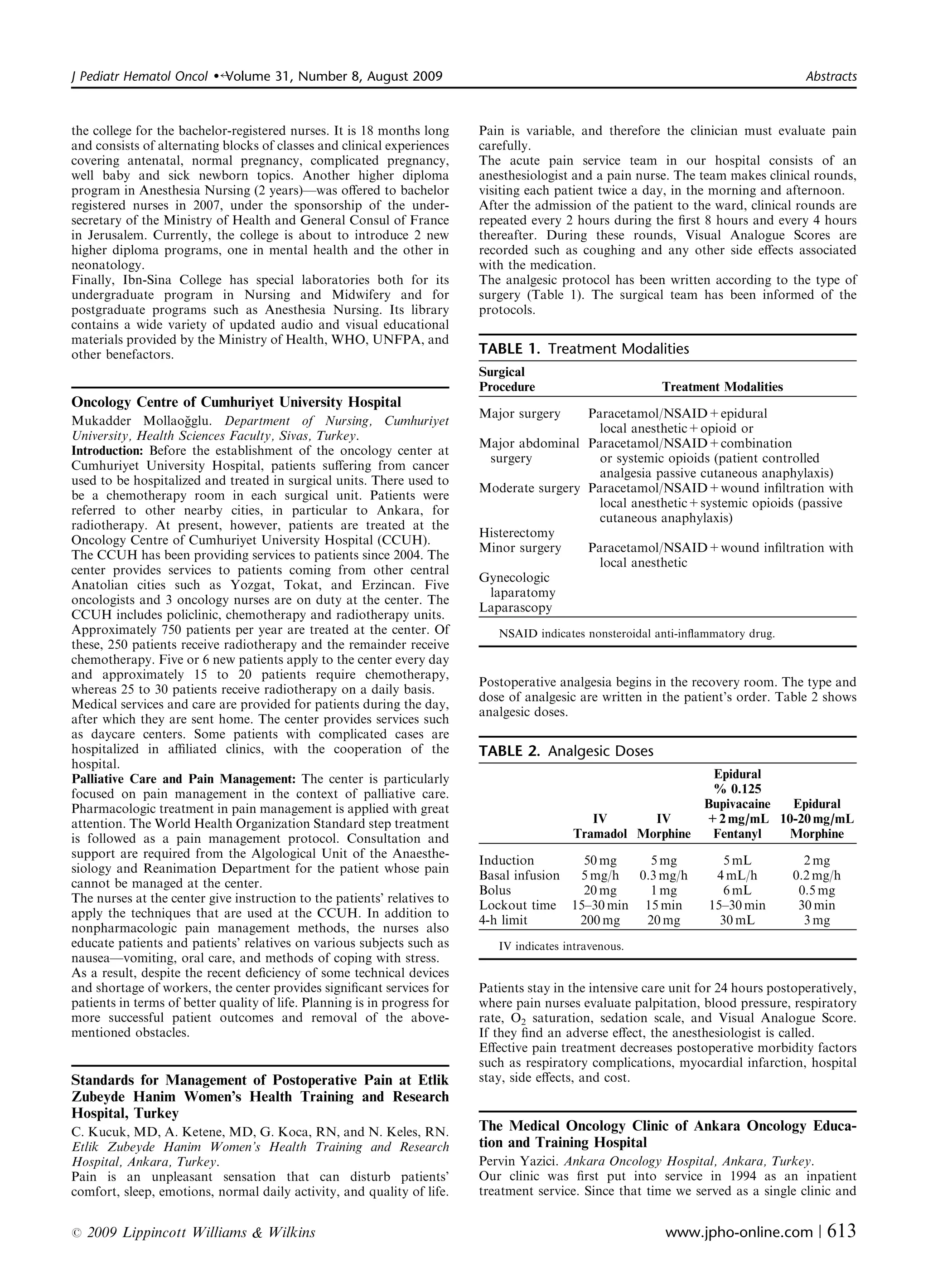
other benefactors.                                                         TABLE 1. Treatment Modalities
                                                                           Surgical
                                                                           Procedure                        Treatment Modalities
Oncology Centre of Cumhuriyet University Hospital
                                                                           Major surgery    Paracetamol/NSAID+epidural
Mukadder Mollaogglu. Department of Nursing, Cumhuriyet
                      ˘
                                                                                              local anesthetic+opioid or
University, Health Sciences Faculty, Sivas, Turkey.
                                                                           Major abdominal Paracetamol/NSAID+combination
Introduction: Before the establishment of the oncology center at
                                                                            surgery           or systemic opioids (patient controlled
Cumhuriyet University Hospital, patients suffering from cancer
                                                                                              analgesia passive cutaneous anaphylaxis)
used to be hospitalized and treated in surgical units. There used to
                                                                           Moderate surgery Paracetamol/NSAID+wound infiltration with
be a chemotherapy room in each surgical unit. Patients were
                                                                                              local anesthetic+systemic opioids (passive
referred to other nearby cities, in particular to Ankara, for
                                                                                              cutaneous anaphylaxis)
radiotherapy. At present, however, patients are treated at the
                                                                           Histerectomy
Oncology Centre of Cumhuriyet University Hospital (CCUH).
                                                                           Minor surgery    Paracetamol/NSAID+wound infiltration with
The CCUH has been providing services to patients since 2004. The
                                                                                              local anesthetic
center provides services to patients coming from other central
                                                                           Gynecologic
Anatolian cities such as Yozgat, Tokat, and Erzincan. Five
                                                                            laparatomy
oncologists and 3 oncology nurses are on duty at the center. The
                                                                           Laparascopy
CCUH includes policlinic, chemotherapy and radiotherapy units.
Approximately 750 patients per year are treated at the center. Of             NSAID indicates nonsteroidal anti-inflammatory drug.
these, 250 patients receive radiotherapy and the remainder receive
chemotherapy. Five or 6 new patients apply to the center every day
and approximately 15 to 20 patients require chemotherapy,
                                                                           Postoperative analgesia begins in the recovery room. The type and
whereas 25 to 30 patients receive radiotherapy on a daily basis.
                                                                           dose of analgesic are written in the patient’s order. Table 2 shows
Medical services and care are provided for patients during the day,
                                                                           analgesic doses.
after which they are sent home. The center provides services such
as daycare centers. Some patients with complicated cases are
hospitalized in affiliated clinics, with the cooperation of the              TABLE 2. Analgesic Doses
hospital.
Palliative Care and Pain Management: The center is particularly                                                      Epidural
focused on pain management in the context of palliative care.                                                        % 0.125
Pharmacologic treatment in pain management is applied with great                                                    Bupivacaine Epidural
attention. The World Health Organization Standard step treatment                               IV      IV           +2 mg/mL 10-20 mg/mL
is followed as a pain management protocol. Consultation and                                 Tramadol Morphine        Fentanyl   Morphine
support are required from the Algological Unit of the Anaesthe­
                                                                           Induction      50 mg     5 mg                5 mL           2 mg
siology and Reanimation Department for the patient whose pain
                                                                           Basal infusion 5 mg/h  0.3 mg/h            4 mL/h         0.2 mg/h
cannot be managed at the center.
                                                                           Bolus          20 mg     1 mg                6 mL          0.5 mg
The nurses at the center give instruction to the patients’ relatives to
                                                                           Lockout time 15–30 min 15 min             15–30 min        30 min
apply the techniques that are used at the CCUH. In addition to
                                                                           4-h limit      200 mg   20 mg               30 mL           3 mg
nonpharmacologic pain management methods, the nurses also
educate patients and patients’ relatives on various subjects such as          IV indicates intravenous.
nausea—vomiting, oral care, and methods of coping with stress.
As a result, despite the recent deficiency of some technical devices
and shortage of workers, the center provides significant services for       Patients stay in the intensive care unit for 24 hours postoperatively,
patients in terms of better quality of life. Planning is in progress for   where pain nurses evaluate palpitation, blood pressure, respiratory
more successful patient outcomes and removal of the above-                 rate, O2 saturation, sedation scale, and Visual Analogue Score.
mentioned obstacles.                                                       If they find an adverse effect, the anesthesiologist is called.
                                                                           Effective pain treatment decreases postoperative morbidity factors
                                                                           such as respiratory complications, myocardial infarction, hospital
Standards for Management of Postoperative Pain at Etlik                    stay, side effects, and cost.
Zubeyde Hanim Women’s Health Training and Research
Hospital, Turkey
C. Kucuk, MD, A. Ketene, MD, G. Koca, RN, and N. Keles, RN.                The Medical Oncology Clinic of Ankara Oncology Educa­
Etlik Zubeyde Hanim Women’s Health Training and Research                   tion and Training Hospital
Hospital, Ankara, Turkey.                                                  Pervin Yazici. Ankara Oncology Hospital, Ankara, Turkey.
Pain is an unpleasant sensation that can disturb patients’                 Our clinic was first put into service in 1994 as an inpatient
comfort, sleep, emotions, normal daily activity, and quality of life.      treatment service. Since that time we served as a single clinic and


r   2009 Lippincott Williams & Wilkins                                                                       www.jpho-online.com |         613
Abstracts	                                                                    J Pediatr Hematol Oncol     �   Volume 31, Number 8, August 2009


then in February 2009, the second clinic of oncology was added
              provides consultation services to other clinics to adjust the treatment
into service.
                                                               plans of inpatients who experience pain related to their underlying
The director of our clinic is the chief medical doctor (assistant
           disease.
professor) and the other medical staff are 2 medical oncologists,
            Between January 2007 and December 2008, 671 patients were
4 fellow medical doctors, and 5 nurses.
                                     admitted to the Pain and Palliative Care Clinic. Of these, only
1. Number of beds in our clinic: 18.                                         43 patients had noncancer diseases. Among the remaining
2. Number of hospitalized patients in our clinic in 2008: 1425.              628 cases, gastrointestinal system cancer incidence was 47%,
3. Number of patients that died in our clinic in 2008: 29.                   genitourinary system cancer 14%, lung cancer 14%, head and neck
4. Educational status of our nurses: Two of them graduated from a            cancer 10%, breast cancer 7%, and other cancers 8%. Two
    health care professional college, 3 graduated from nurse health          hundred and seventy-two patients suffered from a terminal event.
    care high school, and 3 are certificated for chemotherapy                 Pain was the most common symptom at admission. Ninety-nine
    application.                                                             percent of the patients presented with pain.
5. Topics of study in the in-service education program for nurses,           In our service optimum pain control is achieved by:
    2008: maintenance of the Porth catheter, maintenance of the              1. Formulating an individualized treatment plan specific to each
    Hickmann catheter, communication with the patients, gastro­                 patient’s needs, using a combination of pain management
    enteritis, resistant microorganisms in hospitals and safety                 strategies such as nonpharmacologic methods, pharmacother­
    precautions, oral chemotherapy agents, employee safety, muco­               apy, nerve blocks, implants, and other procedural pain manage­
    sitis, and pain management in cancer patients.                              ment techniques (eg, neurolytic blocks).
In our clinic the procedures listed below are routinely applied:             2. Practicing with a continuum of care approach beginning with a
(a) Adjuvant, neoadjuvant, or concomitant (with radiotherapy) or                comprehensive assessment using frequent reassessment to adjust
     palliative care planned.                                                   treatment plans when necessary, based on disease progression,
(b) Patients with neutropenia are treated intensively according to              side effects, and/or other factors.
     new infectious disease guidelines.                                      3. Assessing each patient through	 a multidisciplinary approach
(c) Blood	 and blood products replacements according to the                     involving professionals from various disciplines, including
     Hemotolog guidelines.                                                      psychiatry and neurosurgery.
(d) Further determination of the priming cancer of unknown origin.           4. As oncology nurses, we actively involve all patients and their
(e) Biopsies and arrangements of bone morrow transplantation.                   family caregivers in the development of a pain and palliative
(f) Best supportive care of patients has been routinely provided in             management plan of care and encourage open communication
     our clinic.                                                                for the reporting of pain at all times.
 Our clinical approach and practice for palliative patient care are:
� We give information to family and relatives of patients with
   poor prognosis.
� Patients’ need for palliative care, taken to noiseless rooms.              Pain Management in Cancer Patients and Nurses’ Respon­
� Nutrition support: If a patient is able to take orally, we give            sibility
   nutrition diets according to clinical dietician’s suggestion. If          Muruvvet Eken, RN. Medicine Department of Obstetrics and
                                                                                 ¨ ¨
   patient cannot take food orally, we support our patient with              Gynecology, Ankara University, Ankara, Turkey.
   parenteral nutrition after suggestions from the nutrition unit.           Introduction: Many definitions of ‘‘pain’’ have been provided from
� Pain palliation: Nonsteroidal anti-inflammatory drugs are used              past till today. Pain is a hard concept to comprehend. The lexical
   for mild pain and we use suggestions of the pain and palliative           meaning of the Latin term is defined as punishment, torture, and
   unit’s physiciansfor drastic (heavy) pain (half-opioid+adjuvants          avengement. According to McCaffery, ‘‘Pain is what the patient says
   or opioid+adjuvants).                                                     it is.’’ Whenever a patient mentions that he or she has pain, and no
                                                                             matter where the pain is, it exists and one is supposed to believe it
                                                                             without questioning. It is not the responsibility of the patient to prove
                                                                             that he or she has pain. It is the responsibility of the nurse to
Cancer Pain Management in Palliative Care Patients                           acknowledge the patient’s declaration of pain. Whatever the cause of
Hale Duran Tan, RN and Hulya Kafali, RN. Pain and Palliative
                                  ¨                                          the pain, it affects the person both physiologically and psychologi­
Care Clinic, Ankara Oncology Education and Teaching Hospital,                cally. Some patients may find it hard to express their feeling of pain;
Ankara, Turkey.                                                              finding a solution for this is the duty of the nurse. The nurse may use
The Pain and Palliative Care Clinic at Ankara Oncology Hospital              visual or oral scales that are developed for evaluating the patient’s
was organized in July 2007. We have 18 patient beds in our clinic.           pain, or may seek collaboration with the patient’s family and friends.
After evaluating the patients at Pain Polyclinic and Nutrition               A patient whose pain has been assessed appropriately is 90% healed
Polyclinic, they are admitted to the clinic for further treatment. Our       from the pain with a simple pharmacologic treatment. For pain
team includes 5 experienced anesthesiologists, 2 anesthesiology              management, nonpharmacologic methods and pharmacologic treat­
residents, 9 nurses, a dietitian, social workers, a psychologist, and        ment have been developed. When a patient’s pain ceases, his or her
physical therapist.                                                          quality of life will be enhanced, too. Assessment and management of
The mission of the clinic is to prevent or treat as early as possible the    pain are the duty of the nurse, who has many means of observing and
symptoms of a disease, the side effects caused by the treatment of a          evaluating the patient. Much responsibility falls on nurses, in matters
disease, and the psychological, social, and spiritual problems related       of appropriate assessment, application of treatment after the
to a disease or its treatment. Palliative care is appropriate at any stage   assessment, and observation of the treatment’s efficiency. For pain
in an illness, regardless of prognosis, and it can be delivered alongside    management, doctor, nurse, patient, and the patient’s relatives have
curative treatments. Palliative care can be integrated with medical          to collaborate. If that collaboration is achieved, pain is not an
care intended to cure the disease, and is not intended to be used            unmanageable problem.1–7
only when a patient has terminal disease. In fact, more patients each        Conclusions: As a conclusion, we can summarize the ABC of pain
year are cancer survivors, but many cancer survivors suffer from              management in cancer patients as follows:
chronic pain as a result of the surgery, radiation, or chemotherapy          1. Ask: Ask regularly about the pain.
necessary to cure their cancer. These patients also can benefit from          2. Assess: Assess the pain systematically.
palliative care. We have one of the largest cancer rehabilitation            3. Believe: Believe the impact and intensity of a patient’s pain.
programs in Turkey, with medical experts in medical oncology,                4. Choose: Choose pain-control therapies that are appropriate for
radiation oncology, anesthesiology, physical medicine, psychology,                the patient.
psychiatry, and other disciplines as needed, working together to             5. Deliver: Deliver therapies regularly and on time.
assess and manage severe cancer-related symptoms. Our clinic also            ‘‘Pain relief is a deific art’’ (Hippocrates).


614 | www.jpho-online.com	                                                                            r   2009 Lippincott Williams & Wilkins
J Pediatr Hematol Oncol   �   Volume 31, Number 8, August 2009	                                                                      Abstracts


References:                                                              cancer patients in Hacettepe University Hospitals by a multi­
1. Evlice YE,	 ve Uguz S¸. Pain. Available at: http://lokman.cu.
                      ˘                                                  disciplinary team named ‘Wish Trip’ therapy.
   edu.tr/anesthesiology/galenus/02.htm. 2006.                           Materials and Methods: To determine the present situation for pain
                         ¨
2. Doc¸ N. Suleyman Ozyalc¸in; Istanbul University, Faculty of
                ¨                                                        management, data inscription form was applied to 102 cancer
   Medicine, Department of Anesthesiology, Branch of Algology.           patients who were hospitalized in our hospital, especially the clinics
3. Hacettepe University Oncology Hospital, Oncological Nursing           that are frequently used for these patients. In addition, 46 nurses
   Basic Cancer Education Course Book, Ankara, 2007.                     and 31 doctors filled the questionnaire including education after
4. Koeller	 JM. Understanding cancer pain. Am J Hospital                 graduation, the routine for using pain scale, information level for
   Pharmacy. 1990.                                                       medicine, and side effects. Fifty patients having cancer pain filled
    ¨
                           ˙
5. Ozkan A. Ankara University Ibn-i Sina Hospital, Department            another questionnaire for information, attitude, and behaviors
   of Medical Oncology, 2004.
                                           related to pain.
6. Theobold D. Cancer pain, fatigue, distress, and insomnia in           Results: Fifty percent of patients of the sample group had pain
   cancer patients. Clinical Cornerstone. 2004.                          in last the 24 hours. About 96.8% of the doctors and 58% of
7. Yalc¸in S¸. Pain Management and Quality of Life in Cancer, ESO        the nurses had no education after graduation. Sixty-two percent
   Society of Oncological Nurses Course Booklet. Ankara, 1999.           of the doctors and 61% of the nurses had no routine practice for
                                                                         using the pain scale. A majority (42%) of the 50 patients who had
                                                                         cancer pain and had used the detailed questionnaire had severe
                                                                         pain (Visual Analogue Scale 7 to 8), 8% of them had very severe
Evaluating Analgesic Treatment Administered to Elderly
                                                                         pain (Visual Analogue Scale 9 to 10).
Patients Hospitalized at a University Hospital Oncology                  Conclusions and Suggestions: It is concluded that cancer patients do
Clinic in the Context of the ‘‘WHO Cancer Pain Relief                    experience pain; there is an inefficacy in controlling cancer pain;
Programme’’: A Retrospective Study                                       and there are differences between the approaches for pain control.
Ertemur Esra, RN*, Erden Yuceerw, and Tarakc¸ioglu Gul Hatice,
        ¨                        ¨                     ˘      ¨          Goals were established and reason analysis applied, thus leading to
RN*. *Hacettepe University Oncology Hospital; and w Gazi                 suggestions for the development of solutions. It was evaluated that
University Health Faculty, Nursing Department, Ankara, Turkey.           the primary solution would be to establish a procedure of pain
Every year 6 million people are diagnosed with cancer and 4 million      control management; therefore, ‘‘The Procedure of Approach for
people die because of this illness. In addition, pain occurs in 70% of   Patients with Pain’’ was developed. Pain assessment was used for
the progressive cancer cases. This ratio reaches up to 90% in the        every patient in our hospital, and suitable procedures were
terminal phase. Three million people are estimated to complain of        designed. Two nurses were delegated to the Pain Unit. Lectures
pain originated from cancer. On account of this reason, cancer pain      on pain management were included to the orientation programs for
is medically and socially an important problem. However, if              doctors and nurses who were going to start work at the Hacettepe
present drug and treatment models are accurately used, much of           University Hospitals. The brochure for cancer patients and their
the pain from cancer can be relieved.                                    careers was improved.
The Cancer Pain Relief Program was created by the World Health
Organization (WHO) to develop pain treatment in cancer patients.
The aim of the program is to generalize pain treatment in cancer
patients all over the world. Each step of the program consists of3       An Experience of Palliative Care Course in the Under­
steps, including different combinations of analgesic drugs. In slight     graduate Nursing Education Program in Turkey
pain, first-step treatment is administered, which includes nonopioid      Sultan Kav, RN, PhD, Seyda Okdem, RN, PhD, and
and nonsteroidal antiinflamatuary drugs. If the severity of the pain      Lale Buyukgonenc, RN, PhD. Department of Nursing, Baskent
increases, the second step is weak opioids added to the treatment.       University Faculty of Health Sciences, Ankara, Turkey.
In the third step, strong opioids are used for uncontrollable severe     Baskent University School of Nursing was founded in 1994 and has
pains. In all steps, adjuvant drugs such as neuroleptics, anti-          continued since 2000 as the Nursing and Health Services
convulsants, antidepressants, and corticosteroids can be added to        Department under the Health Sciences Faculty. Our baccalaureate
the treatment.                                                           nursing program is the first such program in a faculty in Turkey.
Studies show that with this program 70% to 90% of pain in cancer         The curriculum includes a 1-year preparation and 4-year bacca­
patients can be relieved. This program is based on taking optimal        laureate education program and is different from traditional
results for the painful period of the illness and aims to prevent        nursing programs. Within this system, subjects are spread out over
unnecessary and extra drug taking or to have pain that can be            the school years as separate modules. The subjects follow a list
relieved. The relieving of pain by preventing unnecessary and extra      according the life periods, from the protection and improvement of
drug taking is a feature of this programme, which is closely related     health to the care of individuals with health problems, and from
to elderly patients for whom pharmacotherapy is chosen as an             simple health problems to complex health problems. The purpose
analgesic treatment. As pharmacotherapy can have cognitive,              of the nursing program is to prepare students to be able to take new
physiologic, and functional effects on elderly people, it is useful to    roles within the multidisciplinary team and continually changing
know the strategies used for cancer pain relief in these people.         health system and to develop their problem-solving and critical
For this reason, analgesic treatments administered to cancer             thinking skills.
patients 60 years and older for last 1 year were reviewed and            Palliative care is a holistic and to meeting the physical, emotional,
applications were evaluated based on the content of WHO Cancer           practical, and spiritual needs of patients and families coping with
Pain Relief Program. The results show that half of the pains             advanced illness. It is an important aspect of nursing because
(51.6%) were not treated and when it was treated, the treatment          comfort and quality of life are the patient’s goals. However,
was not appropriate according to the WHO Cancer Pain Relief              palliative and end-of-life care issues have traditionally not been in
Program.                                                                 nursing school curricula. We have developed this as an elective
                                                                         course in the undergraduate program, which is the first course on
                                                                         this subject in Turkey.
An Approach for Pain Relief in Cancer Patients                           The overall objectives of the course are:
Makbule Uzer*, Aysegul Doganw, Neslihan Ekerw, and                       1. Defining	 palliative care, related concepts, principles, and
Umuda Yolculukz. *Adult Hospital Pain Unit; w Adult Hospital                services.
Chemotherapy Education and Application in Gynecological Onco­            2. Identifying the needs of the patient and family based on the
logy; and zHospital Improvement Team, Hacettepe University,                 quality-of-life concept.
Ankara, Turkey.                                                          3. Assessment and management of pain and common symptoms.
Aim: This study was planned to specify the inefficacy and the              4. Understanding of the concepts of loss, grief, and bereavement.
differences between the approaches of pain control in inpatient           5. Discussing ethical and legal issues.

r   2009 Lippincott Williams & Wilkins	                                                                    www.jpho-online.com |         615
Abstracts	                                                               J Pediatr Hematol Oncol     �   Volume 31, Number 8, August 2009


This elective course has been running from 2005, for third- and         in-service education; and nearly all of them (95%) stated that
fourth-year students. The content of the course is given in 14 weeks    their knowledge level was adequate. Mean nursing experience
(32 h; 2 hours per week) of classroom instructions, video               was 2.5 ± 1.9 years; the mean working experience in their clinic
demonstration of a palliative care unit, and case presentations.        was 1.9 ± 1.2 years; mean number of patients per working day was
Until now a total of 73 students have enrolled and successfully         8 ± 1.9. The difficulties identified by nurses related to pain
completed the course. This course is conducted by 3 faculty             assessment included ‘‘communication problems with patients’’ and
members who have different backgrounds and a guest who has               ‘‘explaining the scale.’’ It was observed that the majority of the nurses
experience with palliative care. Evaluation for the course includes     asked about pain status (92%), location (84%), and severity (76%);
midterm and final examination and also students’ participation in        used pain scale appropriately (76%); and 96% of them documented
discussions and case presentations.                                     the results of their evaluation. However, other aspects of pain
Main topics are:                                                        assessment such as characteristics, duration, contributing factors, and
(a)	 Palliative care; definition and related concepts; principles,       behavioral responses wererarely evaluated. According to the results
    nursing role.                                                       obtained from the Pain knowledge and Attitudes Questionnaire; out
(b) End-of-life care.                                                   of the 16 questions assessed, the mean number of correctly answered
(c) Multidisciplinary approach and role of team members.                questions was 6.2 ± 2.1 with the range of 2 to 10, which shows a
(d) Individual assessment based on quality-of-life concept.             significant gap between knowledge and attitudes.
(e) Pain management.                                                    Conclusions: Although the sample size was very small and could not
(f) Symptom management.                                                 be generalized, these findings support the fact that nursing
(g) Preparation and care for the time of death.                         education and practice both need to promote knowledge of pain
(h) Loss, grief, and bereavement.                                       and pain management, and also empathy and empathic commu­
(i) Communication and cultural aspects.                                 nication in relation to pain.1–4
(j) Ethical issues and decision making.                                 References:
Students rated the course as beneficial and stated that they felt        1. Akbas¸ M, Oztunc¸ G. Examination of knowledge about and
more confident with symptom assessment during their clinical                 nursing interventions for the care of patients in pain of nurses
practice; it helped them to recognize their attitudes regarding death       who work at Cukurova University medical faculty Balcali
and eased their fear related to care of a dying patient. We are             hospital. Pain Manag Nurs. 2008;9:88–95.
revising our program based on students’ feedback and are plann­         2. Aslan FE, Badir A, Selimen D. How do intensive care nurses
ing to enhance it with clinical observations at a palliative care           assess patients’ pain?. Nurs Crit Care. 2003;8:62–67.
unit. A survey for assessing the impact of the course on the                 ¨
                                                                        3. Ozer S, Akyurek B, Basbakkal Z. Hemsirelerin ag
 ile ilgili
                                                                                            ¨            ¸                ¸          ˘ ri
student practice and their attitudes toward care of dying is being          bilgi, davranis¸
 ve klinik karar verme yeteneklerinin incelenmesi.
planned.                                                                    Agri. 2006;18:36–43.
                                                                        4. Yildirim YK, Cicek F, Uyar M. Knowledge and attitudes of
                                                                            Turkish oncology nurses about cancer pain management. Pain
                                                                            Manag Nurs. 2008;9:17–25.
Nurses’ Approach Toward Pain Assessment at Baskent
University Hospital
Sultan Kav, RN, PhD*, Aysun Ceylan, RNw, Azize Karahan, RN,
PhD*, and Nurdan Kural, RNw. *Department of Nursing, Baskent            Basic Pain Education for Oncology Nurses in Turkey
University, Faculty of Health Sciences; and w Baskent University        Ayfer Elc¸igil. Department of Oncology Nursing, Dokuz Eylul
Ankara Hospital, Ankara, Turkey.                                        University School of Nursing, Izmir, Turkey.
Introduction: Baskent University Ankara Hospital was founded in         Pain in Cancer Patients: Pain is a significant symptom that affects
1985, with a 60-bed capacity, and has now been expanded to a 300­       quality of life. Untreated pain can have deleterious effects on
bed capacity (65 of which are intensive care unit beds) and             cardiovascular, pulmonary, gastrointestinal, and immunologic
currently 330 nurses are employed. In the nursing services, the         functioning, which can result in delayed recovery, prolonged
goals are to provide individualized and quality patient care in a       hospitalization, and worsening illness. The majority of patients
professional setting, to have continuous quality improvement, and       with cancer, who are terminally ill, require pain relief. The
to provide a quality educational environment for students. The          patient has the right to appropriate management of pain. The
management of nursing services was restructured in 2006 and has         appropriate assessment and management of pain is also a pro­
been integrated with the Nursing School for transferring nursing        fessional and ethical responsibility. The nurse has the obligation to
research into practice.                                                 maintain current knowledge in pain assessment and management.
Aim: The purpose of this study was to determine nurses’ knowl­          Beyond that, the institution has the responsibility to ensure
edge, attitude, and practices related to pain assessment and to         appropriate patient care and to take measures to ensure staff
identify the difficulties that they face.                                 competency.
Methods: This descriptive and observational study was conducted         Although advances in pain management have been made, there is
at Baskent University Ankara Hospital. The sample consisted of 25       need for improvement. Pain is still undertreated and many patients
nurses who worked in the medical, surgical, and pediatrics units        report moderate-to-severe pain. These barriers surrounding pain
and gave direct patient care. The nurses are grouped according to       management may prevent the timely and appropriate education of
the number of working years and then selected randomly.                 health workers. Since January 2001, the Joint Commission on
Data were collected using                                               Accreditation of Healthcare Organizations pain management
1. A	 27-item questionnaire (open-ended and multiple-choice             standards required that providers be educated in the assessment
   questions related to demographics, pain knowledge and educa­         and management of pain.
   tion, how they feel about their competence in pain assessment        The oncology nurse is most often in the best position to assess the
   and pain control, and the difficulties they faced).                    need for pain control and management to provide comfort and
2. Pain Knowledge and Attitudes Questionnaire	 (developed by            support to the patients and their families. Education of the patients
   McCaffrey and Ferrell; translated and adapted into Turkish by         and their families with regard to appropriate use of medications is a
   Ozer et al, 2006).                                                   major role of nursing. Therefore, the nurse must be well educated
3. Observation guide.                                                   about pain assessment and management.
Each nurse was observed at least 3 times on different days and in        Several studies have demonstrated a deficiency in knowledge and
different shifts; then they were interviewed after the final              attitudes regarding pain management among hospital nurses,
observation and asked to fill the questionnaires.                        which can directly affect the effectiveness of pain management for
Results: Most of the nurses had a baccalaureate degree; received        patients. In the United States, health care professionals lack
education on pain management during orientation (58%) and               accurate pain knowledge, and their inappropriate attitudes toward


616 | www.jpho-online.com	                                                                       r   2009 Lippincott Williams & Wilkins
J Pediatr Hematol Oncol   �   Volume 31, Number 8, August 2009	                                                                 Abstracts


cancer pain and use of analgesics have been recognized as major       6. Zhang CH, Hsu L, Zou BR, et al. Effects of a pain education
barriers to managing pain.                                               program on nurses’ pain knowledge, attitudes and pain
After realizing that insufficient knowledge of nurses plays an             assessment practices in China. J Pain Symptom Manage. 2008;
important role in pain management, many countries have                   36:e616–e627.
developed pain education programs. In addition, effects of these
programs on the attitudes of nurses have been investigated.
Educational programs on pain have been shown to be effective in
improving the pain knowledge and attitudes of nurses, and             Role of the Nurse in Pain Management for the Child With
assessment and pain management in patients.1–4                        Cancer in End-of-life Care
Pain Education for Oncology Nurses in Turkey: There have been         Ayfer Elc¸igil. Oncology Nursing Department, Dokuz Eylul Univer­
very few studies on the pain knowledge and attitudes toward pain      sity School of Nursing, Izmir, Turkey.
management of nurses in Turkey. There has been only 1 study on        Pain in children who are dying of cancer can be complex and
the knowledge of oncologic pain in nurses. Kuzeyli et al5 found       challenging to manage. Pain is now recognized as a significant
that oncologic nurses had insufficient knowledge of pain.               debilitating symptom that affects the quality of life of the children
In Turkey, education on pain and pain management is offered in         and their families. Although advances in pain management have
undergraduate nursing programs; however, this is not enough. In       been made, there is still a need for improvement.
fact, pain education in undergraduate nursing programs provides       Effective pain management is essential in the care of any child with
only general information about pain. The terms ‘‘palliative care’’    cancer and their families. The pediatric palliative care nurse has a
and pain management in patients who need palliative care have just    vital role to provide comfort and support to the patients and their
started to be discussed. Sufficient education on pain management in     families. Pediatric palliative care nurses take care of the children
patients who need palliative care, is not offered in undergraduate     who have pain by using nursing care plans. The nurse collects data,
nursing programs.                                                     identifies expected outcomes, identifies and performs interventions,
There are only 2 nursing schools in Turkey offering a master’s         and evaluates all pain management interventions.
program in oncology nursing. The curricula of the master’s            Nursing Care Plan for Children With Pain
program at these schools are directed toward cancer nursing in        Assessment: The pediatric palliative care nurse systematically and
general. Pain education is discussed in detail. However, a limited    continually collects data regarding pain. Pain is both a sensory and
number of students receive this education. There is no educational    emotional experience. For this reason, several different assessment
program for palliative care nursing or pediatric oncology and         strategies are needed to provide qualitative and quantitative
palliative care nursing. Palliative care nursing should be incorpo­   information about pain. The pediatric palliative care nurse collects
rated into the nursing curricula. Comprehensive pain management       data that lead to the development of an appropriate care plan.
education should be offered by both undergraduate and graduate         Diagnosis: The pediatric palliative care nurse analyzes assessment
nursing programs.                                                     data for determining nursing diagnosis.
Curricula of the nursing schools offering basic nursing education      Outcome Identification: The pediatric palliative care nurse identifies
should include the following topics concerning pain management:       expected outcomes individualized to the children and their families.
1. Physiology of pain.                                                Expected outcomes include the identification of appropriate
2. Etiology of cancer pain.                                           methods for pain management and the child/family’s ability to
3. Barriers to effective pain management.                              communicate the child’s level of comfort to the health care team.
4. Pain assessment.                                                   Planning: The pediatric palliative care nurse develops an indivi­
5. Pain management.                                                   dualized and holistic plan of care to attain expected outcomes. The
       (a) Pharmacologic pain management.                             interventions should be based on current knowledge of pain
       (b) Nonpharmacologic pain interventions: complementary         assessment and management in children.
           and alternative medicine.                                  Implementation: The pediatric palliative care nurse implements the
6. Management of complex pain problems.                               plan of care to achieve the identified expected outcomes for the
7. Procedure-related pain management.                                 patient. The interventions are congruent with the nurse’s assess­
8. Special considerations for the dying child.                        ment of the child’s age and cognitive ability. Interventions may
9. Ethical and cultural issues in pain management.                    include the delivery of pain medications, nonpharmacologic
Nursing students should be able to follow the results of pain         approaches, and education of the child and family.
research after they graduate and start working and the institutions   Evaluation: The pediatric palliative care nurse systematically and
where they work should provide in-service training for most recent    regularly evaluates the child’s responses to interventions to
pain knowledge and pain management strategies and enable them         determine progress. It is vital that the nurse evaluate all pain
to provide evidence-based care. In addition, hospitals should         management interventions. The pediatric palliative care nurse uses
encourage their nursing staff to attend seminars, workshops, and       his/her many roles when she takes care of the children and their
congresses about pain.6                                               families by using nursing care plans.
                                                                      The Nurse’s Role in Pain Management
References:                                                           Care: The pediatric palliative care nurse cares for patients
1. ANA.	 (2001b). Position statement: pain management and             continuously, 24 hours a day. The nurse takes care of the children,
   control of distressing symptoms in dying patients. Retrieved       making sure that they are comfortable, seeing that they get enough
   July 21, 2004 from http://www.ana.org/readroom/position/           fluids and nourishment, and helping them rest and sleep. The nurse
   ethics/etpain.htm                                                  not only takes care of the children but also gives comfort and
2. Lai YH, Chen ML, Tsai LY, et al. Are	 nurses prepared to           support to the patient and his or her family. When the patient
   manage cancer pain? A national survey of nurses’ knowledge         cannot recover, the nurse helps to make sure that the death is
   about pain control in Taiwan. J Pain Symptom Manage.               peaceful and without pain.
   2003;26:e1016–e1025.                                               Treatment: The pediatric palliative care nurse carries out the
3. Lin CC, Chou PL, Wu SL, et al. Long-term effectiveness of a         treatments prescribed for the patient. The primary goal of pain
   patient and family pain education program on overcoming            management is consistent and the complete control of pain through
   barriers to management of cancer pain. Pain. 2006;122:271–281.     the use of appropriate analgesic and adjuvant medications, and
4. Turner LC. Basic Pain Education	 for Nurses. Available at:         nonpharmacologic interventions as well. The nurse also monitors the
   http://nursing.ucsfmedicalcenter.org/PainService/Documents/        patient’s progress to make sure that recovery has no complications.
   BasicPainEducationforNurses.pdf.                                   Education: Children and parents need information and education
5. Yildirim Kuzeyli Y, Cicek F, Uyar M. Knowledge and attitudes       regarding all aspects of pain management at the end of life. The
   of Turkish oncology nurses about cancer pain management.           nurse often has a better opportunity than any other member of the
   Pain Manag Nurs. 2008;9:17–25.                                     health care team to spend the necessary time with patients and their

r   2009 Lippincott Williams & Wilkins	                                                                www.jpho-online.com |        617
Abstracts	                                                                 J Pediatr Hematol Oncol      �   Volume 31, Number 8, August 2009


families to develop the required rapport for effective educational         staff members are 2 specialists in pediatric oncology, 2 fellows, and
efforts. The information and education should be age appropriate,          9 nurses. Two other people work as cleaners in our clinic.
individualized, and given in language the child and parents can           Osteosarcoma and Ewing sarcoma constitute the majority of the
comprehend. The timing, quantity, and quality of the information          cases treated in our clinic. Four hundred and fifty patients were
must depend on the needs and desires of the child and the parents.        treated in our clinic in the last year. Our pediatric oncology clinic also
Education includes information about pain.                                serves with an outpatient examination room for the follow-up of
Coordinate: The pediatric palliative care nurse should use strategies     patients with an annual application number of 1380. There is an
to make sure that pain management is a multidisciplinary concern.         outpatient chemotherapy room with 30 special chairs for chemother­
In taking care of patients, the nurse collaborates with other             apy administration in our hospital. However, as our chemotherapy
members of the health care team. The nurse works closely with the         regimens are completely different for adults, we always prefer to
doctor, and also with other nurses, physical therapists, and any          administer chemotherapeutics in our clinic. The number of
other professionals involved in the patient’s care.                       chemotherapy administrations in our clinic is 1100 per year. One
Research: The pediatric palliative care nurse is responsible and          hundred and forty patients with chemotherapy-related neutropenia
accountable for ensuring that the child receives appropriate              were isolated and treated in our clinic during the last year.
evidence-based nursing assessment and intervention, which effec­           A primary school was founded in our clinic in 1994 to serve the
tively treats the child’s pain and meets the recognized standard of       children while they were hospitalized. Three primary school
care. The nurse should be knowledgeable about pain assessment,            teachers and 1 social worker who specialized in child growth are
pharmacologic and nonpharmacologic therapies, and barriers to             the staff in our school. The teaching program is in accordance with
effective pain management. Thus, the nurse has to monitor the              the educational level of the children, and activities such as drawing,
researches and innovations on pain management.                            handicrafts to improve hand skills, and computer education are
Counseling: The pediatric palliative care nurse offers counseling that     taught to them. These people are also regularly involved in social
helps the child and his family to reduce pain, develop relaxation         activities such as cinema, theater, and picnics.
skills, manage anger more effectively, sleep better, and reduce stress.    Three nurses have graduated from nursing schools of different
Advocacy: This advocacy is a part of the nurse’s caring and a part of     universities and 6 from high schools of nursing. Five nurses have got
the closeness and trust between nurse and child. When a child is ill      a certificate in chemotherapy administration. All nurses in our clinic
and has pain he or she is more vulnerable. The nurse tries to protect     were given an in-hospital nursing educational program mainly on
the patient against anything that might be harmful and painful. The       pediatric cancers, neutropenic patient and catheter care, nutrition of
nurse protects the patient’s dignity and tries to save the patient from   children with cancer, blood transfusion reactions, and mucositis care
embarrassment or shame. The nurse should demonstrate respect for          during their first year in our clinic. An educational program in the
the child’s wishes, communicate effectively and compassionately, with      clinic is carried on with the pediatric oncologists and when the subject
him and his family and protect the patient’s privacy.1–4                  is related to nursing care, the nurses also attend these meetings. The
References:                                                               nurses also attended annual National Cancer and Pediatric Oncology
1. Hockenberry-Eaton	 M, Barrera P, Brown M, et al. Pain                  congresses as speakers or panelists. The nurses were also provided
   Management in Children With Cancer. Austin Tx: Texas Cancer            with information on pain, pain assessment, and pain management.
   Council. 1999.                                                         The children and their families are always evaluated on the
2. Walker SM. Pain in	 children: recent advances and ongoing              knowledge of pain upon admission to the clinic. The relationship
   challenges. Br J Anaesthesia. 2008;101:101–110.                        between social and psychologic factors of pain is also evaluated.
3. McCleary	 L, Ellis JA, Rowley B. Evaluation of the pain                Patients are encouraged to report to their nurse or doctor when
   resource nurse role: a resource for improving pediatric pain           pain occurs. Their responses about severity on a scale of 0 to 10,
   management. Pain Manag Nurs. 2004;5:29–36.                             localization, and duration are recorded on the patient’s vital signs
4. Ellis JA, O’Connor BV, Cappelli M, et al. Pain in hospitalized         sheet. Painful procedures such as bone marrow aspiration or
   pediatric patients: How are we doing? Clin J Pain. 2002;18:            intrathecal drug administration are always performed under
   262–269.                                                               sufficient sedation.
                                                                          Patients with severe pain are evaluated by the team dealing with
                                                                          pain management. There is an outpatient pain management unit
Pediatric Oncology Clinic of Ankara Oncology Education                    and palliative care service in our hospital. Six physicians from the
and Training Hospital                                                     anesthesiology department are specially involved in pain manage­
Nurseven Karaman, RN, MSc. Nursing Director of the Pediatric              ment and they also use the World Health Organization’s 3-step
Oncology Clinic, Ankara Hospital, Ankara, Turkey.                         approach. The first step is the use of acetaminophen, aspirin, or
The Pediatric Oncology Clinic of Ankara Oncology Education                another nonsteroidal anti-inflammatory drug for mild-to-moderate
and Training Hospital was founded in 1993. The clinic with 20 beds        pain. When pain persists or increases, an opioid such as codeine is
in 11 rooms is located in a separate building, apart from main            added to the nonsteroidal anti-inflammatory drug. Opioids are
building. Two rooms with single beds are reserved for isolation           often administered in combinations with acetaminophen or aspirin.
of patients with neutropenia. The other 9 rooms with 2 beds               When higher doses of opioid are necessary, the third step is used
each are used for the medical care of patients. The director of           and the drugs are replaced with more potent opioids such as
our clinic is a professor of pediatric oncology and the other medical     morphine and fentanyl.


618 | www.jpho-online.com	                                                                          r   2009 Lippincott Williams & Wilkins

Leading The Way 2009

  • 1.
    ABSTRACTS Leading the Way in Pain Control: A MECC-ONS Course for Oncology Nurses What Are We Aiming At? Palliative Care in the Middle East References: 1. World Health Organization—WHO definition of palliative care. Michael Silbermann. MECC. Available at: http//www.who.int/cancer/palliative/definition/en. The World Health Organization defines palliative as ‘‘An approach Accessed October 19, 2008. that improves the quality of life of patients and their families facing 2. Steinhauser KE, Christakis NA, Clipp EC, et al. Factors the problems associated with life-threatening illness, through the considered important at the end of life by patients, family, prevention and relief of suffering by means of early identification physicians, and other care providers. JAMA. 2000;284:2476–2482. and impeccable assessment and treatment of pain and other 3. Teno JM, Casey VA, Welch LC, Edgman-Levitan S. Patient- problems, physical, psychosocial and spiritual.’’1 focused, family centered end-of-life medical care: views of the Today, we have arrived at the stage where one can start the guidelines and bereaved family members. J Pain Symptom evolution of quality measurement in palliative care practice both in Manage. 2001;22:738–751. hospital-based palliative care units and in hospices. It has become 4. Teno JM, Connor SR. Referring a patient and family to high- apparent, through surveys of healthcare professionals, seriously quality palliative care at the close of life. JAMA. 2009;301: ill patients, and family members, that several domains were 651–659. validated.2 Nearly 70% of reviewed citations agreed on the importance of the domains of symptom palliation, emotional support, promoting shared decision-making and advance care Healing Cancer Pain planning, meeting the needs of patients and those who care for Ann Berger, MSN, MD. Chief Pain and Palliative Care, National them, addressing grief and spirituality, and coordination of care.3 Institutes of Health, Clinical Center, Bethesda, MD. A useful mnemonic is the 3 Cs: high-quality care is ‘‘competent,’’ Great strides have been made in the treatment of the preponder­ ‘‘compassionate,’’ and ‘‘coordinated.’’ A competent case involves ance of cancers in recent decades, to the extent that virtually 50% an interdisciplinary team that provides evidence-based symptom of persons who develop cancer can be cured. Whether a cancer can palliation and psychological support in the key domains of physical be cured or whether one can hope only for limited remission, what comfort: psychological support, social support, bereavement the patient feels most acutely are the physical, psychosocial, and services, and life closure, including spirituality and transcendence. spiritual symptoms associated with the cancer and its treatment. Too often, seriously ill people feel as though they are lost among The prevalence of pain and inadequate control measures in patients myriad specialists focused on body organs, with no physician with cancer is well documented. Pain is a huge quality of life issue. specifically charged with providing critical assistance and ensuring The consequences of pain are many, including depression, decreased continuity and coordination of the plan of care at the stages of the socialization, agitation, fatigue, sleep disturbances, and more visits to disease trajectory.3 Seriously ill patients and their families need to the doctor and hospital. know whom they can call for help, what they should monitor, and Total pain is made up of more than just physical pain. Total pain when they should call; in short, there should be an orchestrated can involve a physical component and a suffering component. and clear plan of follow-up. Compassionate care treats the patient Suffering involves psychologic and coping factors, social support, and family with respect, honors cultural traditions, and provides loss issues, fear of death, financial concerns, and spiritual, meaning holistic care. Care is coordination across the setting of care and the of life concerns. Most patients with pain from cancer have both disease trajectory. physical pain and suffering. Although pain has been described in Hospital-based palliative care programs often lack the extensive the literature for centuries, and has been one of medicine’s greatest use of volunteers as do hospice programs use to extend their staff mysteries, it still remains a challenge for healthcare professionals to services. Furthermore, hospice programs are mandated to provide provide the best of care for the patient and his/her family. 12 months of bereavement follow-up to every family they serve. For pain management to be effective, a palliative care, integrative A high-quality hospice program is required to have an inter­ approach should be used. The palliative care, integrative approach disciplinary team of physicians, nurses, and volunteers; bereave­ includes the use of a nurturing, interdisciplinary team to treat both ment services; available rehabilitative services including speech, the physical pain and the suffering associated with the pain. The physical, and occupational therapies; short-term in-patient care; team includes the patient, family, physicians, nurses, social workers, and home health aides. A high-quality hospice program will, at the spiritual ministry, pharmacists, counselors, dieticians, psychiatrists, close of life, comprehensively assess patient pain to understand its physical therapists, occupational therapists, and volunteers. Many cause and both pharmacologic and nonpharmacologic approaches nonpharmacologic methods such as art, music, massage, reiki, pet to its management, including the appropriate use of adjuvant therapy, relaxation, guided imagery, hypnosis, biofeedback, and medications such as gabapentin for neuropathic pain. At times, spiritual counseling can help to relieve pain and suffering. It is palliative sedation is the only possible means of symptom relief. important that all members of the care team communicate and work Furthermore, palliative care programs must manifest understand­ together to relieve and comfort the patient and improve his or her ing and respect of the unique values of the patient’s culture. In quality of life. The goal needs to be to treat mind-body-and-spirit, addition, supporting families and friends in their caregiving role is understanding that cure may or may not be possible but that one essential. Evidence of families frequently taking patients to and can always help to heal a patient. No matter what the reason for the from the emergency department may highlight inadequate family pain, it is important for the care team to realize that they may not education and lack of on-call staff to consult with and support be able to add days to someone’s life, but that they can add life to at-home symptom management. someone’s days. Be it in a hospital environment, hospice or home care setting, palliative care at the close of life needs to be patient-focused and family-centered. This abstract is based on the excellent publication of Teno et al.4 Neuropathic Assessment and Management Among Cancer The authors’ observations, judgment and analysis could serve as a Patients basis for multiple new programs in developing countries eager to Hiba Badran. Chemotherapy Clinic, King Hussein Cancer Center, bring palliative care services to the best reachable levels. Amman, Jordan. J Pediatr Hematol Oncol � Volume 31, Number 8, August 2009 www.jpho-online.com | 605
  • 2.
    Abstracts J Pediatr Hematol Oncol � Volume 31, Number 8, August 2009 During my duty as a registered nurse in the outpatient non-pharmacologic interventions that can be provided by other chemotherapy clinics, I have frequently encountered patients disciplines. who often verbalize ‘‘weird feelings’’ and numbness in their References: hands or legs. Quite often I have overheard my colleagues 1. Dworkin RH, O’Connor AB, Backonja M, et al. Pharmacologic instructing patients to do different exercises to diffuse the tingling management of neuropathic pain: evidence-based recommenda­ sensations. tions. Pain. 2007;132:237–251. The body’s nervous system is divided into 2 major systems: the 2. Institute for Clinical Systems Improvement (ICSI). Assessment central nervous system and the peripheral nervous system. and Management of Chronic Pain. Bloomington, MN: Institute The peripheral nervous system is also divided into 2 major parts: for Clinical Systems Improvement (ICSI); 2008:84. the somatic nervous system and the autonomic nervous system. The somatic nervous system consists of peripheral nerve fibers that send sensory information to the central nervous system and motor Pediatric Intensive Care Unit, King Abdullah University nerve fibers that send signals to the skeletal muscle. The autonomic Hospital nervous system controls the smooth muscle of the viscera (internal Abdel Rahman E. Alkhalouf, MSN, RN. School of Nursing, Jordan organs) and glands (www.cancercare.com). University of Science and Technology, Irbid, Jordan. Peripheral neuropathy results from some type of damage to the The Pediatric Intensive Care Unit (PICU) was established on peripheral nerves. Certain chemotherapy drugs can cause peripheral September 3, 2003 on the fourth floor, wing C with potential neuropathy, such as vinca alkaloids (vincristine), cisplatin, paclitaxel, capacity of 10 beds. Actually, it is operating now with only six and the podophyllotoxins (etoposide and tenoposide). Other drugs beds. It is the only tertiary PICU in the north of Jordan dealing used to treat cancer, such as thalidomide and interferon, also can with both medical and surgical patients. cause peripheral neuropathy (www.chemocare.com). Unfortunately, The unit received patients ranging from the age of one month to on the basis of my observation in my clinical area, many nurses know less than 13 years old. Severely ill patients are admitted based on this fact since their field of expertise is in chemotherapy administra­ the decision of medical personnel, or are medical and surgical cases. tion, but assessing such a complaint is almost always not considered Patients from other hospitals as well as any unit in King Abdullah by the nurses as a type of pain that needs proper assessment and University Hospital are also received, which is inconsistent with subsequently appropriate management that should involve pharmaco­ hospital policy. logic and non-pharmacologic interventions. The staff and team of PICU are committed to providing all that an A proper assessment of neuropathic pain is not just grading it by a intensive care patient may need and holistic care to the patients and valid assessment tool for scaling. As a standard of management, it family. They provide optimal management and monitoring for all should also focus on exploring possible reasons and any underlying critical ill cases. conditions which might be causing the pain. Any existing Goals: treatments that can have possible side effects of neuropathy should 1. Improvement in general health and well-being of patients and be explored. Finally, an evaluation should be made of the impact of families who require critical sophisticated care. such a complaint on the quality of life, such as sleeping, eating and 2. Participation in interdisciplinary care for all specialties treated other activities of daily life. except for pediatrics. Adoption of a clear guideline that addresses a special type of pain 3. Management of patient care appropriately through the acute can be very beneficial in keeping nurses on track as they realize an and chronic phase of illness. anticipated pathway for a predicted side effect, the mere presence of 4. Establishment of a communication channel with the other which can be an alerting sign for an existing problem that is more health sectors regarding the cases referred. common that expected, and then a follow-up evaluation should be Provision of attending and/or pediatric resident support for all the carried out to establish the effectiveness of the intervention. Nurses above services 24 hours a day, 7 days a week. Nursing services are have a very vital role to play in being the patients’ advocates, and available 24 hours a day, 7 days per week. The extent to which the can alleviate the problem that patients have by the following level of care or services is provided meets the patients’ needs. techniques2: Staffing needs are based on the volume and acuity of the patients. 1. General history: medical, surgical, and drug use. The available staff are scheduled and adjusted from day to day to 2. General physical examination, looking for possible reversible meet the unit demands. causes. On admission, the patient must be connected to a cardiac monitor 3. Impact of such pain on the quality of daily living and ability to and initial invasive and noninvasive hemodynamic monitoring is perform different functions. initiated. Then assessment of the patient is performed and planning 4. To use a valid, reliable tool that can aid nurses in scoring the of nursing care takes place. It depends on the current situation of baseline of the neuropathic pain and later on keep track of the the patient, by looking for the desired outcomes in a systematic effectiveness the interventions for follow-up. way. 5. And finally, and I would like to add this from a personal Standards or Guidelines For Practice: experience: raising the level of awareness among nurses with Hospital policies and procedures. regard to the everyday words that lay people use to describe Internal policies and procedures. what we ( health-care professionals) term as neuropathic pain. International guidelines. From my experience, words such as ‘‘ tingling, numbness, weird Extent to Which Level of Care or Service Provided Meets the or funny feelings, electrical shots, burning like chilies, and y there Patients Needs: At the hospital level, surveys of patients are are ants all over my hands!) are often overlooked by many nurses conducted every 6 months to evaluate patient satisfaction. A as descriptive words of the nature of neuropathic pain, and an patient’s comments and concerns are included in future planning. expected downside of chemotherapy treatments. All of this should Performance Improvement Activities: be addressed through continuous education for the nurses, In-service education. and later on nurses can transfer this information to patients FOCUS-PDCA. through patient education activity to emphasize the importance In-service education. of reporting such a symptom and its severity to health-care providers. As a first step, by carrying out all of these recommendations, if King Hussein Cancer Center: From Good to Great executed, a proper screening of neuropathic pain can take place, Majeda Afeef Al-Ruzzieh, RN, MSN and Maha Badawi Alwawi, and at a later stage evaluating the effectiveness of interventions RN. King Hussein Cancer Center, Al-Jubeiha, Amman, Jordan. for our populations according to drug availability and resources King Hussein Cancer Center (KHCC) was founded in 1997 as can take place, also never underestimating the contribution of Al-Amal Cancer Center in Amman–Jordan, and was restructured 606 | www.jpho-online.com r 2009 Lippincott Williams & Wilkins
  • 3.
    J Pediatr HematolOncol � Volume 31, Number 8, August 2009 Abstracts as KHCC at the beginning of 2003, with a total capacity of 124 follow up patients on a daily basis, and provide immediate care in beds. KHCC became one of the leading regional medical facilities the event of an emergency related to pain therapy. in the Middle East, providing comprehensive cancer care to both By May 1996, we developed a 34-hour Pain Management Course adult and pediatric patients. for nurses. In January 1997, we formed a pain management KHCC aims to deliver the latest in cancer treatment to patients, committee with regular meetings once a month to discuss pain actively promoting awareness and educational programs for early management concerns in the clinical areas. In January 2001, we detection and prevention of cancer, as well as training and research conducted a National Pain Workshop with participation of to decrease mortality and alleviate the suffering that results from international speakers. cancer. KHCC treats over 3400 new patients yearly from Jordan Pain Management Nursing: I worked as a pain management nurse and surrounding countries through the use of clinical practice from 1993 to 2003. My role has involved the following guidelines. Patients are kept actively involved in treatment responsibilities: decisions and plan of care. 1. Making daily ward rounds to visit patients in pain to ensure KHCC is also leading the efforts to establish the first regional Cancer effectiveness and safety of pain treatment. Control Program. This program will work at reducing the incidence 2. Coordinating teaching programmes by conducting lectures, of common cancers in Jordan through public education, early promoting causes, speaking at conferences, developing patient detection, and primary prevention. The fully operational National information booklets and giving lectures to doctors on palliative Program for Breast Cancer Screening and Diagnosis established in care and the use of different therapies. 2006 and the Smoking Cessation Program established in 2008 are 3. Introducing and ensuring the safe and effective use of new core components of this developing program. In addition to standard methods of pain relief, such as epidurals, patient-controlled diagnostic and therapeutic services offered at any cancer center, analgesia, and continuous intravenous infusion of opioids, in KHCC elected to focus on other aspects of cancer care such as clinical areas. psychosocial oncology, pain management, physical therapy, nutri­ 4. Conducting pain management audits annually and researches tional services, child education, play therapy, and palliative/hospice give the results to all the concerned staff. This has led to focus care. These areas are often neglected, and their role is under­ on the improvement of care and patient satisfaction. estimated. KHCC was a pioneer in Jordan in establishing a culturally 5. Developing pain management materials such as policies, sensitive palliative and hospice care program, which included a procedures, guidelines, standards, and forms, and publishing unique home care service. It offered care to nearly 500 patients in guidelines for doctors, nurses, and patients. Introducing pain 2008. The program focuses on managing symptoms of terminally ill assessment scales to assess and evaluate the effectiveness of cancer patients and addressing the sensitive issues of end of life care treatment. through an interdisciplinary approach (physicians, nurses, social Achievements: We educated approximately 300 nurses on the worker, nutritionist, pharmacist, and chaplain). subject of pain management. They later became pain management KHCC earned national and international recognition by receiving liaison nurses of their allocated areas. We prepared a great deal of Joint Commission International Accreditation including JCIA— pain management educational material for nurses, doctors, and first institution in Jordan—(February 22, 2006), Joint Commission patients. The most important achievement is that through International Disease Specific Accreditation in 2007, Hazardous educating nurses and doctors we have improved the management Analysis and Critical Control Point Systems and Guidelines for its of pain for patients with sickle cell disease, cancer, postoperative, application in 2008, and Safety and the Occupational Health pediatric, labor, and chronic pain at SQUH and other hospitals in Excellence Award (Social Security Corporation-Jordan in 2008). Oman. Annual patient audits have indicated that the patients are KHCC is a clear example of an institution steadily progressing on satisfied with the manner in which the staff control their pain and the path of excellence, growing from good to great and realizing symptoms. that the greatest opportunity for growth and impact lies in capitalizing on individuals’ natural talents and investing in them while staying committed to maintaining a clear mission and vision. MECC-ONS Conference on Pain Management: Pain Assessment Tools A. Babgi, PhD, RN, A. Al Jafferri, BSN, RN, and F. Fallatah, Contributions and Achievements in Pain Management BSN, RN. KAMC-WR, Jeddah, Saudi Arabia. Services at Sultan Qaboos University Hospital Introduction and Background: Patients vary in diagnosis, stage of Salma Said Mahfudh, SRN, Obstetric, Pain Management Certifi­ disease, their responses to pain and interventions, and pain cates. Sultan Qaboos University Hospital, Al Khodh, Sultanate of management. The pain sensed by patients with life-limiting/life­ Oman. threatening conditions is a crucial issue that requires adequate I come from the Sultanate of Oman. I work at Sultan Qaboos management. As of now, there are a number of patients whose pain University Hospital (SQUH), which is part of the College of is not under control because of undertreatment resulting from Medicine and Health Sciences of Sultan Qaboos University. SQUH inadequate pain assessment. The pain in the majority of these was officially opened in February 1990. It is an educational patients (80% to 90%) can be controlled if an extra step was taken and medical institution, and has a total bed capacity of 553. to conduct comprehensive pain assessment by using valid and SQUH performs 5 main functions: teaching medical and nursing reliable tools appropriate for the patient’s population being students, training undergraduate and postgraduate students, assessed. providing tertiary medical care, and research. The hospital was To formulate a pain management plan of care, an assessment is ISO-accredited in 2005, and is planning to apply for JCI paramount in identifying the pain syndrome or the cause of pain. accreditation in 2009. The services offered include medical, Pain is defined by the International Association for the Study of surgical, pediatrics, obstetrics, gynecology, neonatology, psychia­ Pain as the ‘‘unpleasant sensory and emotional experience try, cardiothoracic, hematology, oncology, intensive care, accident associated with actual or potential tissue damage, or described in and emergency, operating theaters, day care, and orthopedics. terms of such damage.’’ To assess pain, it is very important to Neurology will begin in 2009. The unique services of SQUH know what the different types of pain are. include a bone marrow transplant unit and cord blood bank, a Pain can be classified on the basis of ‘‘duration’’ as acute or family and community medicine unit, clinical physiology and chronic, or on ‘‘inferred pathophysiology’’ as nocieceptive pain nuclear therapy—iodine 131. (somatic or visceral) and neuropathic pain (peripherally generated Pain Management Service: The Pain Management Service of or centrally generated). The pain assessment and management plan SQUH began in January 1993. The purpose of the service is to will depend on both classifications. provide effective and continuous pain relief for hospital-referred A comprehensive assessment addresses each type of pain and patients. The goal is to provide 24 hour management of pain, includes the following: detailed history, including an assessment of r 2009 Lippincott Williams & Wilkins www.jpho-online.com | 607
  • 4.
    Abstracts J Pediatr Hematol Oncol � Volume 31, Number 8, August 2009 the pain intensity and its characteristics; a physical examination Neuropathic Pain Scale Assessment Tool: The recently developed with pertinent neurologic examination; a psychosocial and cultural Neuropathic Pain Scale provides information about the type and assessment; and appropriate diagnostic workup to determine the degree of sensations experienced by patients with neuropathic pain. cause of pain. It evaluates 8 common qualities of neuropathic pain (ie, sharp, dull, Methods: Use of extant literature review on pain assessment and hot, cold, sensitive, itchy, and deep vs. surface pain). The patient management methods to explore reliable methods to assess pain rates each item on a scale from 0 to 10, with 0 for none and 10 for comprehensively in various patient populations. the ‘‘most imaginable.’’ The choice of tool and the general Results: The literature was reviewed thoroughly to explore the most approach to assessment should reflect the suffering of the patient popular and reliable pain assessment methods. It was noted and and his/her special needs. Assessment of pain should be conducted agreed upon in a number of studies that a clinical approach to pain at regular intervals to monitor any changes in pain after analgesics assessment and management was recommended by the Agency for administration or modification of the pain management plan. The Health Care, Policy, and Research, which is currently known as the assessment should be individualized and documented in order for Agency for Health Care Research and Quality. The clinical the entire multidisciplinary team members to have an under­ approach was summarized in ‘‘ABCDE’’ format, highlighting the standing of problems associated with pain. In addition, assessment following: is conducted with each new report of pain. 1. Ask about pain regularly: Assess pain and associated symptoms Conclusions: In agreement with the literature reviewed, pain is systematically. considered the fifth vital sign. Proper assessment for patients 2. Believe patient and family reports of pain and what relieves the suffering from pain will guide the pain management care plan for pain. those patients. Those healthcare professionals working with 3. Choose pain-control options appropriate for the patient, family, patients on the frontline are responsible for identifying the most and setting. appropriate and reliable tools for conducting comprehensive and 4. Deliver interventions in a timely, logical, coordinated manner. holistic assessments of pain, as well as selecting the most 5. Empower patients and their families. Enable patients to control appropriate tool for the population being assessed, that is, elderly, their course as much as possible. cognitively impaired, or pediatric patients. Being able to do so will When conducting the assessment, the information can be gathered assure that these patients receive the best quality care resulting from observations, interviews with patient and family or significant from comprehensive pain assessment and management. others, review of medical data, and feedback from other healthcare providers. Pain is a multidimensional human experience that requires compre­ hensive, holistic evaluation. To assess pain comprehensively, there Inauguration and Development of Pediatric Palliative Care is a need to find valid and reliable tools that will guide the pain management plan of care. Pain assessment tools are classified as Service at the National Cancer Institute, Cairo University, unidimensional, multidimensional, and neuropathic. Egypt Unidimensional Pain Assessment Tools: These pain assessment tools Hany Abd El-Rahman, MD and Maha Hussein, MD. Pediatric include scales that use numeric, verbal, or visual rating scales or Oncology Department, National Cancer Institute, Cairo University, descriptors to measure or monitor pain or pain relief. Examples Egypt. include the numeric rating scale, the visual analog scale, and Introduction: Palliative care was defined by the World Health categorical scales. Organization in 2002 as an ‘‘approach that improves the quality of (a) Numeric Rating Scale: The most commonly used rating scale life of patients and their families facing the problem associated with using a 0-to-10 scale or a 0-to-5 scale, with 0 representing ‘‘no life-threatening illness, through the prevention and relief of pain at all’’ and 5 or 10 representing ‘‘the worst imaginable suffering by means of early identification and impeccable assess­ pain.’’ ment and treatment of pain and other problems, physical, (b) Visual Analog Scale: This scale consists of a numerated line, psychosocial, and spiritual.’’ The National Cancer Institute with anchors at either end: ‘‘no pain’’ at one end and ‘‘the worst (NCI) is the largest comprehensive cancer center in Egypt. In imaginable pain’’ on the other end. The patient places a mark 2008, 20,000 new patients visited NCI, including 2000 pediatric on the line, which the clinician then measures with a ruler and cancer patients. assigns a score indicating the patient’s pain intensity. Despite recent advances in cancer treatment, approximately 22% (c) Categorical Scales: These scales provide a simple means to rate of children diagnosed with cancer eventually die of their disease, pain intensity using verbal or visual descriptors of the pain. and this percentage is much higher in developing countries; this Examples of these scales include the Faces Pain Scale for makes palliative care an expected standard of care in all cancer Adults and Children, and the Wong-Baker Faces Rating Scale centers. for children. Design and Methods: Here we describe the palliative care activity at the Pediatric Oncology Department, NCI, Cairo University. Multidimensional Pain Assessment Tools: Multidimensional tools From December 2007 to February 2009, 33 patients were referred provide important information with regard to the pain character­ to the clinic. All of them had been treated in the past in the same istics and effects on the patient’s daily life and activities. Examples department, and the decision to discontinue active treatment include an initial pain assessment tool, a brief pain inventory, and a was taken by 2 senior staff members. The service was first a part of McGill pain questionnaire. the Pediatric Outpatient clinic, but with the intention to upgrade (a) Initial Pain Assessment Tool: This tool provides information the level of care, it was moved to a larger separate room that with regard to the characteristics of the pain, the patient’s integrated multidisciplinary specialties to offer better, faster, and expressions of pain, and the effects of the pain on the patient’s more specified service. The pain management team, radiotherapist, life in the form of a diagram that indicates the location of pain; specialized nurses, and social worker were all grouped in the new a scale to rate pain intensity; and a space to document location, and different aspects of the patients’ needs were taken into additional comments and management plans. consideration, including physical, psychological, social, and financial (b) Brief Pain Inventory: This tool is easy to use and quantifies both demand. pain intensity and associated disability. It consists of a series Results: Thirty-three patients were referred to the clinic during the of questions that address aspects of the pain experienced over period between December 2007 and February 2009. They were 24 24 hours. men and 9 women (ratio 2.6:1), their age ranged from 3 to 25 years (c) McGill Pain Questionnaire: This tool is one of the most and the original diagnosis was a solid tumor in 60% and extensively used and tested multidimensional scales, and hematologic malignancy in 40%. The most commonly encountered assesses pain in 3 dimensions: sensory, affective, and evaluative, malignancies were neuroblastoma and acute myeloid leukemia on the basis of words that patients select to describe their pain. (21% each). All patients were progressive and/or resistant to at 608 | www.jpho-online.com r 2009 Lippincott Williams & Wilkins
  • 5.
    J Pediatr HematolOncol � Volume 31, Number 8, August 2009 Abstracts least 2 lines of anticancer treatment (range: 2 to 4 lines). Excluding group of cancer patients, their families, and friends. It provides patients who are still alive and currently being treated at the clinic, services to more than 3500 cancer patients and their families every the duration of the patients’ visits to the clinic ranged between year. The Association depends on fundraising events and public 1 and 8 months with an average of 2.8 months. Medical care donations. Its mission is to create a better quality of life for cancer provided at the clinic included pain management (57%), blood patients and their families and to promote awareness with regard to and platelets transfusion (60% and 30%, respectively), infection cancer prevention and control. control (63%), chemotherapy (93%), radiotherapy (27%), surgical The Association also organizes and hosts conferences and consultation and wound care (15%), tapping of effusion (3%), seminars. In addition, funding for postgraduate studies in the and supportive measures (81%). One patient (3%) received meta­ fields of cancer, palliative care, and other related subjects is also iodo-benzyl-guanidine therapy and another one underwent renal provided to its healthcare professionals. dialysis for acute renal failure. The chemotherapeutic agents used PASYKAF has been involved in the research program DITIS, an were mostly oral VP16 (54%), followed by hydroxyurea (25%), ehealth telehomecare project, and is about to commence an oral cyclophosphamide (12%), and a combination of vincristine, evaluation of its services. A rolling audit and evaluation will steroids, and 6 mercaptopurine (9%). Supportive care given commence this year with its new database, PASYKAF patient according to the patient’s condition included antipyretics, gastric management system, allowing us to assess and audit, evaluate and protectors, antiemetics, nutritional support, vitamins, antispasmo­ continually improve services and education of staff in the particular dics, antitussive, laxatives, and anticonvulsants. areas required. Conclusions: Palliative care has become an integrated activity of the Our services, which are provided in the districts of Nicosia, Pediatric Oncology Department of the National Cancer Institute, Limassol, Paphos, Larnaca and Amochostos, are free of charge to Egypt. Our goal is to give better support to our end of life patients, all adults with a cancer diagnosis, at any stage of the disease, and with a type of care adapted to our community. are concerned with the care of patients and their families within the community. The staff, which totals 50, includes a full multi­ disciplinary team of nurses, social workers, physiotherapists, psychologists, psychotherapists, doctors, volunteers, and adminis­ Egyptian Nurses’ Perceptions of Palliative Cancer Care and tration. Services include home care, psychosocial support, bus Patient Needs transport to main oncology hospitals, day care, breast and Nagwa Elkateb, Mona Elshatter, Amira Abulkhyer, Souad Hashem, lymphoedema clinics, and soon to be commenced bereavement and Gaber Maher. National Cancer Institute, Cairo University, Cairo, support groups. Egypt. Owing to the fact that this association was founded by cancer Background: Palliative care is a model of care that provides patients, it has always focused on psychological support, for the coordinated physical, emotional, and spiritual support not only for patients, their families and healthcare professionals. Weekly patients who have advanced and incurable disease, but also for multidisciplinary meetings and monthly staff debriefings by a those who require symptom relief during complications from which psychologist from another town are held. In addition, nurses are they will recover. It is a proactive form of care that seeks to offered a extra day off monthly (in recognition of the stress that can maximize quality of life for patients and families. The perceptions affect them) and, in an effort to make stress-reducing improve­ and levels of experience of healthcare professionals may affect ments, a 6-monthly rolling burnout inventory is carried out to continuity of care. allow staff to assess their own well-being and the Association to Objectives: (1) To assess nurses’ knowledge about palliative care; receive feedback. Family leave to care for sick relatives is also (2) to assess nurses’ perceptions and attitudes with regard to available, thus recognizing that we need to look after our own palliative care; and (3) to evaluate concordance between different before we look after others. Finally and very importantly, the day- specialties and levels of education and experience. to-day support of team members for each other is nurtured and Methods: A convenience sample included 50 nurses recruited from encouraged. different cancer settings at the National Cancer Institute, Cairo The Cyprus Association of Cancer Patients and Friends continues University, Egypt, including medical and surgical oncology, critical to strive to improve services, and in so doing, the next step will be care, and palliative care units. to try and increase hours of service to our patients and their Tools: (1) The questionnaire completed by nurses included families. demographic characteristics, knowledge with regard to the goals of palliative care, the roles of nurses and other health professionals, patients needs, types of facilities and settings needed, and problems and obstacles that may be present. (2) A checklist for recording Magnitude of Cancer in Alamal Oncology Unit, Aden, activities performed for assigned patients. Results: The preliminary results showed that nurses have different Yemen perceptions of palliative care. Nurses showed lack of knowledge Gamal Abdul Hamid*, Safa Shukry*, and Mazen Aboodw. about palliative care, and the majority expressed the opinion that *Alamal Oncology Unit; and w Pathology Department, Aden shortage in staff and heavy workloads may be obstacles. In University, Yemen. addition, there was a significant difference between the perceptions Alamal Oncology Unit was established in December 2007 in Aden and attitudes of nurses working in palliative care settings compared to care for cancer patients and to record their cases in the hospital- with those working in other specialties. based cancer registry. Conclusions: Palliative care is an important specialty, and educa­ There were 526 cases registered at the Alamal Oncology Unit tional programs should be conducted for nurses with regard to the during the period between January 2008 and December 2008. All principles of palliative care. Guidelines should be developed to cases were histopathology confirmed. match the needs of the local setting. Results: There were 225 men (42.8%) and 301 women (57.1%). The most common sites in both sexes were digestive organs (22.4%), breast (20.9%), lymphatic system (18.3%), head and neck (10.5%), and female genital organs (9.3%). The age group with more cancer presentation was 50 to 59 years in both sexes. Men were more The Cyprus Association of Cancer Patients and Friends affected between 50 and 69 years of age, mostly with colorectal and Home Care Service stomach cancers, and women between 40 and 49 years of age, Jo Christodoulou, Yolanda Kading, and Barbara Pitsillides. mostly with breast cancers. Cyprus. The mortality rate was high for acute leukemia (23/28), lung cancer The Cyprus Association of Cancer Patients and Friends (7/14), liver cancer (7/17), pancreatic cancer (5/16), nonhodgkin lym­ (PASYKAF) is a registered charity. It was founded in 1986 by a phoma (9/62), colorectal cancer (7/53), and nasopharynx cancer (7/32). r 2009 Lippincott Williams & Wilkins www.jpho-online.com | 609
  • 6.
    Abstracts J Pediatr Hematol Oncol � Volume 31, Number 8, August 2009 Conclusion: The gastrointestinal tract, breast and lymphatic system The nurses’ areas of responsibility were many, including the are the most common sites affected, and the 50-to-59 year age following: group is the most commonly affected. 1. Promoting procedures for ongoing diagnostics (less bureau­ Recommendation: Urgent approval of national cancer control cracy). strategy and improvement in the early detection of cancer and 2. Choosing care venue according to patient’s wishes, medical establishment of cancer centers to cover the governorates of status, and type of care. Yemen. 3. Educating the patient before treatment about characteristics and side effects, treating side effects identified by multidisciplinary team and in collaboration with the inpatient staff, and preventing unnecessary admissions. Breast Cancer in Limited Resource Center 4. Supporting the patient and family. This is a dominant factor. Gamal Abdul Hamid*, Nadeem M. Saeedw, Reem Amin*, and Symptoms such as pain and fatigue, as correlated in the Safa Shukry*. *Hematology-Oncology, Al-Gamhouria Teaching literature, were important. Mental symptoms, such as anxiety Hospital; and w National Oncology Centre, Sana’a, Yemen. and depression, could not be ignored. Aim of Study: We studied breast cancer in Yemeni patients to Ethical issues such as truth-telling, location of death, nutrition and determine the pattern of cancer, to compare the results with those hydration, and ventilation surfaced in some cases. from other parts of the world and to outline the experience of Conclusions: Early acquaintance with the patient and family has Alamal Oncology Unit over 1 year. proven to be beneficial in coping, lessening uncertainty, and Materials and Methods: The study was carried out by using data on improving quality of life for the patient. patients registered at Al-Amal Oncology Unit during the period Empowerment of the patient or his family members is important in between January and December 2008. The data analyzed included achieving symptom control. age, sex, type of cancer treatment and outcome. The nurse coordinator in oncology enabled physicians to be more Results: One hundred and ten patients were registered. One involved in the care of oncologic patients. hundred and nine patients were female (99.1%) and 1 was male. Managing the care of oncologic patients by using this model Ninety percent of the patients presented with evidence of achieves several goals at the same time, including proactively metastasis. The histology of the breast shows 69.1 of infiltrating initiating nursing treatment, managing chronic illness, and keeping ductal carcinoma. The age group most affected was 40 to 49 years, the patient, his needs and as well as his family’s in the center. followed by 50 to 59 and 30 to 39 years. Of the 85 (93.5%) patients operated on by general surgeons, most of whom did not have operation notes and/or the histopathologic reports, and when these were available, they were often of poor quality. Conclusions: Most breast cancer patients in Yemen are diagnosed Unique Treatment in the Department of Pediatric Hemato­ in advanced stages because they are unaware of the disease and oncology because of the absence of a comprehensive control program. Christine Ashkar, BA, RN, Ruti Ofir, MA, RN, and Myriam Recommendations: (1) Establishment of a comprehensive cancer Ben-Arush, MD, Staff of the Department of Pediatric Hemato­ control program and (2) The immediate establishment of Aden oncology. Meyer Children’s Hospital, Rambam Health Care Cancer Centre. Campus, Haifa, Israel. The Department of Pediatric Hemato-oncology is 1 of 6 depart­ ments in Meyer Children’s Hospital, and includes Emergency Medicine, Pediatrics A and B, Hemato-oncology, Surgery, Community Oncologic Nursing Neonatal Intensive Care, and Intensive Care. The Department of Abu Rkih Riad. Maccabi Health Services, Central District, Israel. Hemato-oncology contains a hospitalization unit, bone marrow Background: Cancer patients and their families face uncertainty transplantation unit, day care unit, follow-up short-term and long- and chaos on a daily basis. The need has arisen to provide term survivor clinic, and a hostel for families. The Department information and professional guidance to lessen anxiety and diagnoses 80 new children per year, from newborn until 20 years of provide support. age, from Hadera in the center to the northern border, and treats Supporting patients and their families is an important and patients from Russia and the Palestinian Authority. The Depart­ inseparable part of the nurse’s role in managing chronic illness in ment treats children suffering from oncologic and hematologic general and cancer in particular. diseases such as leukemia, thalassemia, and autoimmune defi­ Implementing the palliative model is the main approach to ciency. Treatment includes chemotherapy and radiotherapy accor­ providing holistic care, and treating the patient and family as a ding to national and international protocols. There are 14 beds in unit. The approach is feasible from diagnoses until the end of life, 10 rooms for hospitalization, and 4 rooms for bone marrow and focuses on quality of life and prevention of suffering, in transplantation. The hemato-oncology multidisciplinary team addition to providing support to patients and their families. It is includes 8 professional doctors, 2 interning doctors, physiothera­ possible to implement this approach in hospital and at home pists, dieticians, and 33 registered nurses certified through an (community). oncology course, some of whom have BA and MA degrees. There is Rational: Nursing is an important discipline in managing chronic a also coordinator nurse. At present, 3 nurses are studying for an illness, and one of the roles of nursing is coordination between the MA. Some nurses have special training in holistic treatments such various carers. The need for this coordination is significant with as shiatsu, healing, and reflexology. Various nurses speak Hebrew, regard to cancer: patients spend considerable time looking for Arabic, and Russian. There are 2 unskilled assistants, 4 social information about the disease, treatments, and carers, and they workers who speak Hebrew and Arabic, 1 psychologist, 2 art and therefore need a coordinator who will guide and accompany them, music therapists, and 4 administrative staff. The teaching staff and prevent unnecessary bureaucratic procedures. includes 4 teachers, a school counselor, national service staff, and Procedure: Approaching the physicians in clinics through a volunteers. coordinator or interpreter who would explain the service and then The responsibilities of the nursing staff are as follows: make it possible to contact the clinic nurse. The service is provided 1. Giving appropriate, high-quality nursing treatment according to to patients in various stages of their disease, and is adjusted to the nursing principles. needs identified. The nurse performs preliminary assessments, 2. Providing treatment that takes into consideration the unique­ identifies problems, and plans interventions, all in collaboration ness of the child and the adult. with the patient and various carers. 3. Perceiving the child and his family as a unit. Results: The procedure involved around 50 patients in various 4. Recognizing the child’s right to know about his illness according stages of disease. to his level of understanding and perception of his illness. 610 | www.jpho-online.com r 2009 Lippincott Williams & Wilkins
  • 7.
    J Pediatr HematolOncol � Volume 31, Number 8, August 2009 Abstracts 5. Providing general and continuing treatment through a multi­ coordinator, physicians (oncologists and pain care specialists), a disciplinary team, taking into consideration the biopsychosocial spiritual support giver, a social worker, psychologists, a dietitian, aspects of the child and his family during diagnosis, treatment, and a secretary. Services offered included symptom control; and follow-up. attention at the end of life; psychological and spiritual support; 6. Enabling constant communication with the responsible bodies referral for economic support; and follow-up of patients at home, within the framework of the hospital and the community. other hospitals or in hospice settings. Subsequently, services such 7. Providing ongoing professional development. as dietary consultation and the integration of complementary 8. Providing ongoing training to the staff and absorbing new medicine have been added. nurses on the ward. Throughout the years, the palliative care nurse coordinator has 9. The ward serves as a clinical field for nursing students, oncology been the leader in the development of the service. She serves as the courses, and emergency unit courses, and for research and team coordinator, and delivers hands-on patient care and follow- professional upgrading. up and promotes staff and student education. She is available The nursing staff underwent formal and practical training to 24 hours per day to both patients and staff, often being called upon provide treatment to the oncologic child. A number of practical to give her expert advice during the evenings and nights. The areas received special attention: coordinator’s other responsibilities include (1) coordinating be­ (a) Enabling the treatment of a child who underwent bone marrow tween the service and the community, (2) initiating and carrying transplant: we designed a special role for a coordinator nurse. out research projects, and (3) ongoing professional updating Her function is to escort the child and his family from including active participation in local and worldwide conferences admission through discharge. and courses. (b) The palliative range: we developed a working group and chose In the future, the service hopes to establish a bereavement program a nurse for the palliative role. and additional training programs for staff. It is hoped that a (c) The training field, including the oncology staff and staff in other psychiatrist will be added to the staff and that communication with wards of the children’s hospital. services offered in the community will be improved. In addition, we developed a class activity to enable the child to return to his educational framework. The staff accompanied the patients on excursions in the country and abroad. My Education: RN, BA in Health Administration Management. I When Can We Teach Palliative Care at Hebron University? have 12 years of seniority in the oncology ward, working shifts, Nemeh K. Manasrah. Hebron University, West Bank. usually as a leading nurse. Introduction: Palliative care (PC) is a crucial concern in the care of My Role: Over the last 2 years, I developed a training program to oncology patients, and it becomes important for nursing students upgrade the strategic treatment of the oncologic child in our ward to study this area. Unfortunately, PC is not included in the general and in all the children’s wards with which we have a treatment nursing curriculum in our faculty. I feel that early education in this relationship. From the first diagnosis and throughout all the field is valuable, on the basis of my experience at the first oncology treatments, the child undergoes examinations in different conference that was held by Middle East Cancer Consortium with wards and sometimes has an infection that requires hospitalization in regard to PC. As we do not work with this issue in our region, I another ward because of a lack of available beds. Consequently, we decided to introduce PC in our nursing program, which will change saw the opportunity to develop a training program that involves all many attitudes and affect our future at Hebron University. the related wards. The exposure of the partly unskilled staff to the Aim: To collect data and obtain more information by introducing oncologic child and his family is defined as requiring special needs. the PC program into the nursing curriculum by next year, thereby This finding led us to build a forum that deals with the means to train increasing the level of teaching and learning among nursing the staff of the entire hospital in matters relating to the oncologic students at Hebron University. child and his family. The team is made up of 7 nurses: the head nurse of the Children’s Hospital, the leading hematologic nurse, one representative from each of 4 wards, and me. At the beginning of the project, I met the head nurses from all the involved wards to identify the needs of each. According to these needs, we organized a seminar Al-Sadeel Society for Palliative Care for Cancer Patients on oncology for nurses. The plan under discussion involves Amal D. Khleif, RN, BSN, ON and Ferial Al Khateeb, BSN, developing one protocol to deal with each specific activity, such as MSN. Al-Sadeel Society, Bethlehem, West Bank, Palestinian central catheters. This includes the development of methods and National Authority. implications of unskilled nurses in different wards, and training them Statistics revealed 8106 new cancer cases (2000 to 2005) in the West in specific activities. An oncologic classifier was created in each ward Bank (with 948 cancer cases in Bethlehem district), with 3471 as source of specific protocols and educational material for the deaths. This is an indicator of the problem of high mortality rates oncologic child’s needs. The purpose of this role is continue to among cancer patients in Palestine, which means that most cancer identify all new nurses’ needs and act accordingly. We propose to patients are diagnosed at the end stage of the disease (5550 cases, assemble a protocol for the child newly diagnosed with a large representing 68% of total cases), This indicates that these patients malignant mass, and to prepare an internal transfer form for all are not diagnosed early enough and are no longer in need of children in the hospital. We expect this project to unify all the teams curative care, but rather of palliative care to live comfortably and and serve to benefit all the children in our care. free of pain. The shortage of healthcare facilities available to serve these patients and their families (1 major center in Bethlehem, 2 major centers in Jerusalem and Nablus, and 2 in Gaza); the limited services (75 beds Work of the Oncology Palliative Care Nurse Coordinator for oncology patients in Ministry of Health hospitals, representing Anat Omer, RN, BA. Rambam Health Care Campus, Haifa, Israel. 2.7% of total beds, 22 of which are in the Bethlehem area) that The Rambam Health Care Campus in Haifa, Israel is the major provide only treatment of the disease, without focusing on the need tertiary care hospital for Northern Israel, and serves a population for palliative care and early detection of cancer; and lack of of over 1.5 million people. The oncology institute of the campus knowledge, education and training among healthcare professionals was opened in 1980. Today, the institute consists of 2 in-patient with regard to early detection, public awareness, and palliative care units, an outpatient clinic, and a day care center. for cancer patients, as well as the absence of home care services In 2002, the palliative care service was established within the (governmental and private), indicates the need for palliative care in oncology institute, with a staff of one palliative care nurse parallel with curative care to improve quality of life for patients coordinator and one pain care specialist physician. Over time, and their families. The number of assigned beds to cancer patients staff was added and today consists of a palliative care nurse in government hospitals in Nablus, Bethlehem, East Jerusalem, and r 2009 Lippincott Williams & Wilkins www.jpho-online.com | 611
  • 8.
    Abstracts J Pediatr Hematol Oncol � Volume 31, Number 8, August 2009 Gaza are limited, and encounter many obstacles and inspection Participants: Eighty health providers were included (60 nurses and barriers, especially Augusta Victoria Hospital (located in East 20 doctors) who regularly involved in the care of children at Jerusalem). Makassed Hospital. Al-Sadeel Society is the only registered Palliative Care Society in Results: Most health providers (75%) do not use the formal pain Palestine, and dedicates its efforts to education and training programs assessment and techniques when assessing children’s pain; although in palliative care issues, and providing home-based palliative care on the contrary, nearly the same percentage of providers confide services to cancer patients and their families, in addition to they assess and reassess the presence of pain in children. Sixty establishing the first nonprofit hospice center in the long term. percent of them do not use anesthesia creams for invasive Al-Sadeel Society is the first and only registered Palliative Care procedures, most of them include the comfort and the presence Society in the Palestinian National Authority. The Society’s vision of pain in their documentation. About 87.5% give narcotics that is that life is a gift from God, and therefore it should be kept were ordered Pro re natal, 28.9% of health care providers do not pain-free as much as possible by using updated knowledge and think they can control pain in children, also 24% of the sample skills. The Society’s activities aim to be free and affordable to could not judge. There is a concern about pain control in half of the patients who need them, and not only to those who are able to pay sample. About 58.8% of health providers are afraid of the risk of for them. addiction when giving medicine. In addition, 47.4% of the sample The mission of Al-Sadeel Society is to alleviate the pain and do not use nonpharmacologic approaches. About 77.2% of health suffering of terminally ill cancer patients by providing professional providers involve parents in pain reporting and relieve measures, nursing and palliative care along with care to the families by means and 66.3% of them think they have enough information regarding of medical, social, emotional, and psychological approaches. In this drug side effect than with old medication. 62.5% Think that the way, we wish to provide comfort until the very end of life and to presence of parents is necessary to reduce the pain in children preserve the dignity of the suffering patient. during procedure. The strategic plan of Al-Sadeel Society is to create a home-based Conclusions: Health providers should have knowledge about how palliative care and hospice center. Moreover, the Society plans to to use suitable pain assessment tools and how to apply become the leading organization in the education and training of pharmacologic and nonpharmacologic techniques palliative and hospice care in the Bethlehem area and the Palestinian National Authority at large. The overall goal of the Al-Sadeel Society is to maintain quality of life for the terminally ill cancer patient within the family. This can A Glance at Ibn-Sina College of Nursing and Midwifery be achieved through: Fatemah Yaser Abu Abed, BSN. High Diploma in Neonates MSN 1. spreading awareness among the public with regard to the in Environmental Health Science Nursing, Ibn-Sina College, importance of early detection to decease the burden of the Ramallah, The Palestinian Authority. disease on the community; Ibn-Sina College was established in 1971. It had been offering a 2. training professionals and educating caregivers and the public; 3-year nursing diploma and 2-year midwifery program until 1996, 3. home-based hospice and palliative care and supplies availability; the same year as the establishment of the National Palestinian 4. psychosocial and emotional support for the patient and the family Authority. It is worth mentioning that the old college consisted of through the use of support groups and survivor volunteers; 2 branches: one for female students, in Ramallah, and the other for 5. collaborating with other organizations in the field of cancer care; male students, in Bethlehem. When the administrative affairs were 6. developing projects related to palliative care services. handed over to the Palestinian Authority, both branches were A needs assessment survey for palliative care in West Bank merged under the supervision of Nursing Education and Training hospitals was conducted by the Society. Analysis proved the critical Department of the Ministry of Health. In 1997, the college need for affordable palliative care services in all West Bank program was developed to grant its students a bachelor degree in districts. We intended to begin in Bethlehem, where most of the either nursing or midwifery. The college philosophy aims at volunteers are from. The Society conducted an initial workshop to improving the quality of health services in Palestine by preparing introduce the palliative care idea in Palestine, where the recom­ and rearing a generation of nurses and midwives who are equipped mendations were as follows: with all the latest information, recognizable skills, and required (a) The need for better quality care for cancer patients. ethics to behave in a professional manner. Indeed, the adminis­ (b) The need for training of health professionals in palliative care. trators of our college continue to do their best to achieve the (c) The importance of networking and cooperation between the following objectives: national nongovernmental organizations and the Ministry of 1. To update the educational curriculum in accordance with World Health. Health Organization recommendations. (d) The need for public awareness with regard to the early detection 2. To support the infrastructure of the college to fulfill the need for of cancer, especially breast cancer. training and educating students, focusing on preparing labora­ (e) The need for national policy and standards for palliative care tories for simulation. and opioids legislations. 3. To recruit a new blood faculty and enhance its professional (f) The importance of baseline data and research. development by affording all possible opportunities to exchange (g) The need for interdisciplinary team work on the issue of cancer. experiences and knowledge with other colleges and universities. (h) Palliative care education within the curricula of schools of By the year 1998, a program to upgrade the skills of RNs-BSNs health. was developed to grant a bachelor degree in nursing to its former diploma graduates (3 y) as an initial step in staff nursing development at government hospitals after finishing the required (51) credit hours.Ibn-Sina College encourages its students to Pain Assessment in Children at Makassed Hospital From achieve academic excellence and creates an inner ego supervision Health Providers Perspective besides the sense of social awareness and cooperative spirit toward Ibtisam M. Ghrayeb, RN, PGD. Pediatric Intensive Care Unit, their clients. Incentives are offered to students to conform to Ibn- Makassed Hospital, East Jerusalem, Palestine. Sina College’s rules and mission by offering a hostel for female Objectives: This study is aimed at evaluating pain assessment in students who live outside Ramallah, in addition to granting free children at Makassed Hospital from health providers’ perspective. health insurance, free transportation to all clinical sites inside Design: Self-report questionnaire consists of 11 items. Ramallah, and low tuition fees (5 JD per credit hour for those who Setting: All departments that are regularly involved in the care of commit to working in government hospitals postgraduation and the pediatric age group at Makassed Hospital are Pediatric 15 JD per credit hour if they do not commit to working in a Intensive Care Unit, Neonatal Intensive Care Unit, Pediatric, governmental hospital following their graduation). In 2005, a new Open Heart, and others. postgraduate diploma in Community Midwifery was introduced to 612 | www.jpho-online.com r 2009 Lippincott Williams & Wilkins
  • 9.
    J Pediatr HematolOncol � Volume 31, Number 8, August 2009 Abstracts the college for the bachelor-registered nurses. It is 18 months long Pain is variable, and therefore the clinician must evaluate pain and consists of alternating blocks of classes and clinical experiences carefully. covering antenatal, normal pregnancy, complicated pregnancy, The acute pain service team in our hospital consists of an well baby and sick newborn topics. Another higher diploma anesthesiologist and a pain nurse. The team makes clinical rounds, program in Anesthesia Nursing (2 years)—was offered to bachelor visiting each patient twice a day, in the morning and afternoon. registered nurses in 2007, under the sponsorship of the under­ After the admission of the patient to the ward, clinical rounds are secretary of the Ministry of Health and General Consul of France repeated every 2 hours during the first 8 hours and every 4 hours in Jerusalem. Currently, the college is about to introduce 2 new thereafter. During these rounds, Visual Analogue Scores are higher diploma programs, one in mental health and the other in recorded such as coughing and any other side effects associated neonatology. with the medication. Finally, Ibn-Sina College has special laboratories both for its The analgesic protocol has been written according to the type of undergraduate program in Nursing and Midwifery and for surgery (Table 1). The surgical team has been informed of the postgraduate programs such as Anesthesia Nursing. Its library protocols. contains a wide variety of updated audio and visual educational materials provided by the Ministry of Health, WHO, UNFPA, and other benefactors. TABLE 1. Treatment Modalities Surgical Procedure Treatment Modalities Oncology Centre of Cumhuriyet University Hospital Major surgery Paracetamol/NSAID+epidural Mukadder Mollaogglu. Department of Nursing, Cumhuriyet ˘ local anesthetic+opioid or University, Health Sciences Faculty, Sivas, Turkey. Major abdominal Paracetamol/NSAID+combination Introduction: Before the establishment of the oncology center at surgery or systemic opioids (patient controlled Cumhuriyet University Hospital, patients suffering from cancer analgesia passive cutaneous anaphylaxis) used to be hospitalized and treated in surgical units. There used to Moderate surgery Paracetamol/NSAID+wound infiltration with be a chemotherapy room in each surgical unit. Patients were local anesthetic+systemic opioids (passive referred to other nearby cities, in particular to Ankara, for cutaneous anaphylaxis) radiotherapy. At present, however, patients are treated at the Histerectomy Oncology Centre of Cumhuriyet University Hospital (CCUH). Minor surgery Paracetamol/NSAID+wound infiltration with The CCUH has been providing services to patients since 2004. The local anesthetic center provides services to patients coming from other central Gynecologic Anatolian cities such as Yozgat, Tokat, and Erzincan. Five laparatomy oncologists and 3 oncology nurses are on duty at the center. The Laparascopy CCUH includes policlinic, chemotherapy and radiotherapy units. Approximately 750 patients per year are treated at the center. Of NSAID indicates nonsteroidal anti-inflammatory drug. these, 250 patients receive radiotherapy and the remainder receive chemotherapy. Five or 6 new patients apply to the center every day and approximately 15 to 20 patients require chemotherapy, Postoperative analgesia begins in the recovery room. The type and whereas 25 to 30 patients receive radiotherapy on a daily basis. dose of analgesic are written in the patient’s order. Table 2 shows Medical services and care are provided for patients during the day, analgesic doses. after which they are sent home. The center provides services such as daycare centers. Some patients with complicated cases are hospitalized in affiliated clinics, with the cooperation of the TABLE 2. Analgesic Doses hospital. Palliative Care and Pain Management: The center is particularly Epidural focused on pain management in the context of palliative care. % 0.125 Pharmacologic treatment in pain management is applied with great Bupivacaine Epidural attention. The World Health Organization Standard step treatment IV IV +2 mg/mL 10-20 mg/mL is followed as a pain management protocol. Consultation and Tramadol Morphine Fentanyl Morphine support are required from the Algological Unit of the Anaesthe­ Induction 50 mg 5 mg 5 mL 2 mg siology and Reanimation Department for the patient whose pain Basal infusion 5 mg/h 0.3 mg/h 4 mL/h 0.2 mg/h cannot be managed at the center. Bolus 20 mg 1 mg 6 mL 0.5 mg The nurses at the center give instruction to the patients’ relatives to Lockout time 15–30 min 15 min 15–30 min 30 min apply the techniques that are used at the CCUH. In addition to 4-h limit 200 mg 20 mg 30 mL 3 mg nonpharmacologic pain management methods, the nurses also educate patients and patients’ relatives on various subjects such as IV indicates intravenous. nausea—vomiting, oral care, and methods of coping with stress. As a result, despite the recent deficiency of some technical devices and shortage of workers, the center provides significant services for Patients stay in the intensive care unit for 24 hours postoperatively, patients in terms of better quality of life. Planning is in progress for where pain nurses evaluate palpitation, blood pressure, respiratory more successful patient outcomes and removal of the above- rate, O2 saturation, sedation scale, and Visual Analogue Score. mentioned obstacles. If they find an adverse effect, the anesthesiologist is called. Effective pain treatment decreases postoperative morbidity factors such as respiratory complications, myocardial infarction, hospital Standards for Management of Postoperative Pain at Etlik stay, side effects, and cost. Zubeyde Hanim Women’s Health Training and Research Hospital, Turkey C. Kucuk, MD, A. Ketene, MD, G. Koca, RN, and N. Keles, RN. The Medical Oncology Clinic of Ankara Oncology Educa­ Etlik Zubeyde Hanim Women’s Health Training and Research tion and Training Hospital Hospital, Ankara, Turkey. Pervin Yazici. Ankara Oncology Hospital, Ankara, Turkey. Pain is an unpleasant sensation that can disturb patients’ Our clinic was first put into service in 1994 as an inpatient comfort, sleep, emotions, normal daily activity, and quality of life. treatment service. Since that time we served as a single clinic and r 2009 Lippincott Williams & Wilkins www.jpho-online.com | 613
  • 10.
    Abstracts J Pediatr Hematol Oncol � Volume 31, Number 8, August 2009 then in February 2009, the second clinic of oncology was added provides consultation services to other clinics to adjust the treatment into service. plans of inpatients who experience pain related to their underlying The director of our clinic is the chief medical doctor (assistant disease. professor) and the other medical staff are 2 medical oncologists, Between January 2007 and December 2008, 671 patients were 4 fellow medical doctors, and 5 nurses. admitted to the Pain and Palliative Care Clinic. Of these, only 1. Number of beds in our clinic: 18. 43 patients had noncancer diseases. Among the remaining 2. Number of hospitalized patients in our clinic in 2008: 1425. 628 cases, gastrointestinal system cancer incidence was 47%, 3. Number of patients that died in our clinic in 2008: 29. genitourinary system cancer 14%, lung cancer 14%, head and neck 4. Educational status of our nurses: Two of them graduated from a cancer 10%, breast cancer 7%, and other cancers 8%. Two health care professional college, 3 graduated from nurse health hundred and seventy-two patients suffered from a terminal event. care high school, and 3 are certificated for chemotherapy Pain was the most common symptom at admission. Ninety-nine application. percent of the patients presented with pain. 5. Topics of study in the in-service education program for nurses, In our service optimum pain control is achieved by: 2008: maintenance of the Porth catheter, maintenance of the 1. Formulating an individualized treatment plan specific to each Hickmann catheter, communication with the patients, gastro­ patient’s needs, using a combination of pain management enteritis, resistant microorganisms in hospitals and safety strategies such as nonpharmacologic methods, pharmacother­ precautions, oral chemotherapy agents, employee safety, muco­ apy, nerve blocks, implants, and other procedural pain manage­ sitis, and pain management in cancer patients. ment techniques (eg, neurolytic blocks). In our clinic the procedures listed below are routinely applied: 2. Practicing with a continuum of care approach beginning with a (a) Adjuvant, neoadjuvant, or concomitant (with radiotherapy) or comprehensive assessment using frequent reassessment to adjust palliative care planned. treatment plans when necessary, based on disease progression, (b) Patients with neutropenia are treated intensively according to side effects, and/or other factors. new infectious disease guidelines. 3. Assessing each patient through a multidisciplinary approach (c) Blood and blood products replacements according to the involving professionals from various disciplines, including Hemotolog guidelines. psychiatry and neurosurgery. (d) Further determination of the priming cancer of unknown origin. 4. As oncology nurses, we actively involve all patients and their (e) Biopsies and arrangements of bone morrow transplantation. family caregivers in the development of a pain and palliative (f) Best supportive care of patients has been routinely provided in management plan of care and encourage open communication our clinic. for the reporting of pain at all times. Our clinical approach and practice for palliative patient care are: � We give information to family and relatives of patients with poor prognosis. � Patients’ need for palliative care, taken to noiseless rooms. Pain Management in Cancer Patients and Nurses’ Respon­ � Nutrition support: If a patient is able to take orally, we give sibility nutrition diets according to clinical dietician’s suggestion. If Muruvvet Eken, RN. Medicine Department of Obstetrics and ¨ ¨ patient cannot take food orally, we support our patient with Gynecology, Ankara University, Ankara, Turkey. parenteral nutrition after suggestions from the nutrition unit. Introduction: Many definitions of ‘‘pain’’ have been provided from � Pain palliation: Nonsteroidal anti-inflammatory drugs are used past till today. Pain is a hard concept to comprehend. The lexical for mild pain and we use suggestions of the pain and palliative meaning of the Latin term is defined as punishment, torture, and unit’s physiciansfor drastic (heavy) pain (half-opioid+adjuvants avengement. According to McCaffery, ‘‘Pain is what the patient says or opioid+adjuvants). it is.’’ Whenever a patient mentions that he or she has pain, and no matter where the pain is, it exists and one is supposed to believe it without questioning. It is not the responsibility of the patient to prove that he or she has pain. It is the responsibility of the nurse to Cancer Pain Management in Palliative Care Patients acknowledge the patient’s declaration of pain. Whatever the cause of Hale Duran Tan, RN and Hulya Kafali, RN. Pain and Palliative ¨ the pain, it affects the person both physiologically and psychologi­ Care Clinic, Ankara Oncology Education and Teaching Hospital, cally. Some patients may find it hard to express their feeling of pain; Ankara, Turkey. finding a solution for this is the duty of the nurse. The nurse may use The Pain and Palliative Care Clinic at Ankara Oncology Hospital visual or oral scales that are developed for evaluating the patient’s was organized in July 2007. We have 18 patient beds in our clinic. pain, or may seek collaboration with the patient’s family and friends. After evaluating the patients at Pain Polyclinic and Nutrition A patient whose pain has been assessed appropriately is 90% healed Polyclinic, they are admitted to the clinic for further treatment. Our from the pain with a simple pharmacologic treatment. For pain team includes 5 experienced anesthesiologists, 2 anesthesiology management, nonpharmacologic methods and pharmacologic treat­ residents, 9 nurses, a dietitian, social workers, a psychologist, and ment have been developed. When a patient’s pain ceases, his or her physical therapist. quality of life will be enhanced, too. Assessment and management of The mission of the clinic is to prevent or treat as early as possible the pain are the duty of the nurse, who has many means of observing and symptoms of a disease, the side effects caused by the treatment of a evaluating the patient. Much responsibility falls on nurses, in matters disease, and the psychological, social, and spiritual problems related of appropriate assessment, application of treatment after the to a disease or its treatment. Palliative care is appropriate at any stage assessment, and observation of the treatment’s efficiency. For pain in an illness, regardless of prognosis, and it can be delivered alongside management, doctor, nurse, patient, and the patient’s relatives have curative treatments. Palliative care can be integrated with medical to collaborate. If that collaboration is achieved, pain is not an care intended to cure the disease, and is not intended to be used unmanageable problem.1–7 only when a patient has terminal disease. In fact, more patients each Conclusions: As a conclusion, we can summarize the ABC of pain year are cancer survivors, but many cancer survivors suffer from management in cancer patients as follows: chronic pain as a result of the surgery, radiation, or chemotherapy 1. Ask: Ask regularly about the pain. necessary to cure their cancer. These patients also can benefit from 2. Assess: Assess the pain systematically. palliative care. We have one of the largest cancer rehabilitation 3. Believe: Believe the impact and intensity of a patient’s pain. programs in Turkey, with medical experts in medical oncology, 4. Choose: Choose pain-control therapies that are appropriate for radiation oncology, anesthesiology, physical medicine, psychology, the patient. psychiatry, and other disciplines as needed, working together to 5. Deliver: Deliver therapies regularly and on time. assess and manage severe cancer-related symptoms. Our clinic also ‘‘Pain relief is a deific art’’ (Hippocrates). 614 | www.jpho-online.com r 2009 Lippincott Williams & Wilkins
  • 11.
    J Pediatr HematolOncol � Volume 31, Number 8, August 2009 Abstracts References: cancer patients in Hacettepe University Hospitals by a multi­ 1. Evlice YE, ve Uguz S¸. Pain. Available at: http://lokman.cu. ˘ disciplinary team named ‘Wish Trip’ therapy. edu.tr/anesthesiology/galenus/02.htm. 2006. Materials and Methods: To determine the present situation for pain ¨ 2. Doc¸ N. Suleyman Ozyalc¸in; Istanbul University, Faculty of ¨ management, data inscription form was applied to 102 cancer Medicine, Department of Anesthesiology, Branch of Algology. patients who were hospitalized in our hospital, especially the clinics 3. Hacettepe University Oncology Hospital, Oncological Nursing that are frequently used for these patients. In addition, 46 nurses Basic Cancer Education Course Book, Ankara, 2007. and 31 doctors filled the questionnaire including education after 4. Koeller JM. Understanding cancer pain. Am J Hospital graduation, the routine for using pain scale, information level for Pharmacy. 1990. medicine, and side effects. Fifty patients having cancer pain filled ¨ ˙ 5. Ozkan A. Ankara University Ibn-i Sina Hospital, Department another questionnaire for information, attitude, and behaviors of Medical Oncology, 2004. related to pain. 6. Theobold D. Cancer pain, fatigue, distress, and insomnia in Results: Fifty percent of patients of the sample group had pain cancer patients. Clinical Cornerstone. 2004. in last the 24 hours. About 96.8% of the doctors and 58% of 7. Yalc¸in S¸. Pain Management and Quality of Life in Cancer, ESO the nurses had no education after graduation. Sixty-two percent Society of Oncological Nurses Course Booklet. Ankara, 1999. of the doctors and 61% of the nurses had no routine practice for using the pain scale. A majority (42%) of the 50 patients who had cancer pain and had used the detailed questionnaire had severe pain (Visual Analogue Scale 7 to 8), 8% of them had very severe Evaluating Analgesic Treatment Administered to Elderly pain (Visual Analogue Scale 9 to 10). Patients Hospitalized at a University Hospital Oncology Conclusions and Suggestions: It is concluded that cancer patients do Clinic in the Context of the ‘‘WHO Cancer Pain Relief experience pain; there is an inefficacy in controlling cancer pain; Programme’’: A Retrospective Study and there are differences between the approaches for pain control. Ertemur Esra, RN*, Erden Yuceerw, and Tarakc¸ioglu Gul Hatice, ¨ ¨ ˘ ¨ Goals were established and reason analysis applied, thus leading to RN*. *Hacettepe University Oncology Hospital; and w Gazi suggestions for the development of solutions. It was evaluated that University Health Faculty, Nursing Department, Ankara, Turkey. the primary solution would be to establish a procedure of pain Every year 6 million people are diagnosed with cancer and 4 million control management; therefore, ‘‘The Procedure of Approach for people die because of this illness. In addition, pain occurs in 70% of Patients with Pain’’ was developed. Pain assessment was used for the progressive cancer cases. This ratio reaches up to 90% in the every patient in our hospital, and suitable procedures were terminal phase. Three million people are estimated to complain of designed. Two nurses were delegated to the Pain Unit. Lectures pain originated from cancer. On account of this reason, cancer pain on pain management were included to the orientation programs for is medically and socially an important problem. However, if doctors and nurses who were going to start work at the Hacettepe present drug and treatment models are accurately used, much of University Hospitals. The brochure for cancer patients and their the pain from cancer can be relieved. careers was improved. The Cancer Pain Relief Program was created by the World Health Organization (WHO) to develop pain treatment in cancer patients. The aim of the program is to generalize pain treatment in cancer patients all over the world. Each step of the program consists of3 An Experience of Palliative Care Course in the Under­ steps, including different combinations of analgesic drugs. In slight graduate Nursing Education Program in Turkey pain, first-step treatment is administered, which includes nonopioid Sultan Kav, RN, PhD, Seyda Okdem, RN, PhD, and and nonsteroidal antiinflamatuary drugs. If the severity of the pain Lale Buyukgonenc, RN, PhD. Department of Nursing, Baskent increases, the second step is weak opioids added to the treatment. University Faculty of Health Sciences, Ankara, Turkey. In the third step, strong opioids are used for uncontrollable severe Baskent University School of Nursing was founded in 1994 and has pains. In all steps, adjuvant drugs such as neuroleptics, anti- continued since 2000 as the Nursing and Health Services convulsants, antidepressants, and corticosteroids can be added to Department under the Health Sciences Faculty. Our baccalaureate the treatment. nursing program is the first such program in a faculty in Turkey. Studies show that with this program 70% to 90% of pain in cancer The curriculum includes a 1-year preparation and 4-year bacca­ patients can be relieved. This program is based on taking optimal laureate education program and is different from traditional results for the painful period of the illness and aims to prevent nursing programs. Within this system, subjects are spread out over unnecessary and extra drug taking or to have pain that can be the school years as separate modules. The subjects follow a list relieved. The relieving of pain by preventing unnecessary and extra according the life periods, from the protection and improvement of drug taking is a feature of this programme, which is closely related health to the care of individuals with health problems, and from to elderly patients for whom pharmacotherapy is chosen as an simple health problems to complex health problems. The purpose analgesic treatment. As pharmacotherapy can have cognitive, of the nursing program is to prepare students to be able to take new physiologic, and functional effects on elderly people, it is useful to roles within the multidisciplinary team and continually changing know the strategies used for cancer pain relief in these people. health system and to develop their problem-solving and critical For this reason, analgesic treatments administered to cancer thinking skills. patients 60 years and older for last 1 year were reviewed and Palliative care is a holistic and to meeting the physical, emotional, applications were evaluated based on the content of WHO Cancer practical, and spiritual needs of patients and families coping with Pain Relief Program. The results show that half of the pains advanced illness. It is an important aspect of nursing because (51.6%) were not treated and when it was treated, the treatment comfort and quality of life are the patient’s goals. However, was not appropriate according to the WHO Cancer Pain Relief palliative and end-of-life care issues have traditionally not been in Program. nursing school curricula. We have developed this as an elective course in the undergraduate program, which is the first course on this subject in Turkey. An Approach for Pain Relief in Cancer Patients The overall objectives of the course are: Makbule Uzer*, Aysegul Doganw, Neslihan Ekerw, and 1. Defining palliative care, related concepts, principles, and Umuda Yolculukz. *Adult Hospital Pain Unit; w Adult Hospital services. Chemotherapy Education and Application in Gynecological Onco­ 2. Identifying the needs of the patient and family based on the logy; and zHospital Improvement Team, Hacettepe University, quality-of-life concept. Ankara, Turkey. 3. Assessment and management of pain and common symptoms. Aim: This study was planned to specify the inefficacy and the 4. Understanding of the concepts of loss, grief, and bereavement. differences between the approaches of pain control in inpatient 5. Discussing ethical and legal issues. r 2009 Lippincott Williams & Wilkins www.jpho-online.com | 615
  • 12.
    Abstracts J Pediatr Hematol Oncol � Volume 31, Number 8, August 2009 This elective course has been running from 2005, for third- and in-service education; and nearly all of them (95%) stated that fourth-year students. The content of the course is given in 14 weeks their knowledge level was adequate. Mean nursing experience (32 h; 2 hours per week) of classroom instructions, video was 2.5 ± 1.9 years; the mean working experience in their clinic demonstration of a palliative care unit, and case presentations. was 1.9 ± 1.2 years; mean number of patients per working day was Until now a total of 73 students have enrolled and successfully 8 ± 1.9. The difficulties identified by nurses related to pain completed the course. This course is conducted by 3 faculty assessment included ‘‘communication problems with patients’’ and members who have different backgrounds and a guest who has ‘‘explaining the scale.’’ It was observed that the majority of the nurses experience with palliative care. Evaluation for the course includes asked about pain status (92%), location (84%), and severity (76%); midterm and final examination and also students’ participation in used pain scale appropriately (76%); and 96% of them documented discussions and case presentations. the results of their evaluation. However, other aspects of pain Main topics are: assessment such as characteristics, duration, contributing factors, and (a) Palliative care; definition and related concepts; principles, behavioral responses wererarely evaluated. According to the results nursing role. obtained from the Pain knowledge and Attitudes Questionnaire; out (b) End-of-life care. of the 16 questions assessed, the mean number of correctly answered (c) Multidisciplinary approach and role of team members. questions was 6.2 ± 2.1 with the range of 2 to 10, which shows a (d) Individual assessment based on quality-of-life concept. significant gap between knowledge and attitudes. (e) Pain management. Conclusions: Although the sample size was very small and could not (f) Symptom management. be generalized, these findings support the fact that nursing (g) Preparation and care for the time of death. education and practice both need to promote knowledge of pain (h) Loss, grief, and bereavement. and pain management, and also empathy and empathic commu­ (i) Communication and cultural aspects. nication in relation to pain.1–4 (j) Ethical issues and decision making. References: Students rated the course as beneficial and stated that they felt 1. Akbas¸ M, Oztunc¸ G. Examination of knowledge about and more confident with symptom assessment during their clinical nursing interventions for the care of patients in pain of nurses practice; it helped them to recognize their attitudes regarding death who work at Cukurova University medical faculty Balcali and eased their fear related to care of a dying patient. We are hospital. Pain Manag Nurs. 2008;9:88–95. revising our program based on students’ feedback and are plann­ 2. Aslan FE, Badir A, Selimen D. How do intensive care nurses ing to enhance it with clinical observations at a palliative care assess patients’ pain?. Nurs Crit Care. 2003;8:62–67. unit. A survey for assessing the impact of the course on the ¨ 3. Ozer S, Akyurek B, Basbakkal Z. Hemsirelerin ag ile ilgili ¨ ¸ ¸ ˘ ri student practice and their attitudes toward care of dying is being bilgi, davranis¸ ve klinik karar verme yeteneklerinin incelenmesi. planned. Agri. 2006;18:36–43. 4. Yildirim YK, Cicek F, Uyar M. Knowledge and attitudes of Turkish oncology nurses about cancer pain management. Pain Manag Nurs. 2008;9:17–25. Nurses’ Approach Toward Pain Assessment at Baskent University Hospital Sultan Kav, RN, PhD*, Aysun Ceylan, RNw, Azize Karahan, RN, PhD*, and Nurdan Kural, RNw. *Department of Nursing, Baskent Basic Pain Education for Oncology Nurses in Turkey University, Faculty of Health Sciences; and w Baskent University Ayfer Elc¸igil. Department of Oncology Nursing, Dokuz Eylul Ankara Hospital, Ankara, Turkey. University School of Nursing, Izmir, Turkey. Introduction: Baskent University Ankara Hospital was founded in Pain in Cancer Patients: Pain is a significant symptom that affects 1985, with a 60-bed capacity, and has now been expanded to a 300­ quality of life. Untreated pain can have deleterious effects on bed capacity (65 of which are intensive care unit beds) and cardiovascular, pulmonary, gastrointestinal, and immunologic currently 330 nurses are employed. In the nursing services, the functioning, which can result in delayed recovery, prolonged goals are to provide individualized and quality patient care in a hospitalization, and worsening illness. The majority of patients professional setting, to have continuous quality improvement, and with cancer, who are terminally ill, require pain relief. The to provide a quality educational environment for students. The patient has the right to appropriate management of pain. The management of nursing services was restructured in 2006 and has appropriate assessment and management of pain is also a pro­ been integrated with the Nursing School for transferring nursing fessional and ethical responsibility. The nurse has the obligation to research into practice. maintain current knowledge in pain assessment and management. Aim: The purpose of this study was to determine nurses’ knowl­ Beyond that, the institution has the responsibility to ensure edge, attitude, and practices related to pain assessment and to appropriate patient care and to take measures to ensure staff identify the difficulties that they face. competency. Methods: This descriptive and observational study was conducted Although advances in pain management have been made, there is at Baskent University Ankara Hospital. The sample consisted of 25 need for improvement. Pain is still undertreated and many patients nurses who worked in the medical, surgical, and pediatrics units report moderate-to-severe pain. These barriers surrounding pain and gave direct patient care. The nurses are grouped according to management may prevent the timely and appropriate education of the number of working years and then selected randomly. health workers. Since January 2001, the Joint Commission on Data were collected using Accreditation of Healthcare Organizations pain management 1. A 27-item questionnaire (open-ended and multiple-choice standards required that providers be educated in the assessment questions related to demographics, pain knowledge and educa­ and management of pain. tion, how they feel about their competence in pain assessment The oncology nurse is most often in the best position to assess the and pain control, and the difficulties they faced). need for pain control and management to provide comfort and 2. Pain Knowledge and Attitudes Questionnaire (developed by support to the patients and their families. Education of the patients McCaffrey and Ferrell; translated and adapted into Turkish by and their families with regard to appropriate use of medications is a Ozer et al, 2006). major role of nursing. Therefore, the nurse must be well educated 3. Observation guide. about pain assessment and management. Each nurse was observed at least 3 times on different days and in Several studies have demonstrated a deficiency in knowledge and different shifts; then they were interviewed after the final attitudes regarding pain management among hospital nurses, observation and asked to fill the questionnaires. which can directly affect the effectiveness of pain management for Results: Most of the nurses had a baccalaureate degree; received patients. In the United States, health care professionals lack education on pain management during orientation (58%) and accurate pain knowledge, and their inappropriate attitudes toward 616 | www.jpho-online.com r 2009 Lippincott Williams & Wilkins
  • 13.
    J Pediatr HematolOncol � Volume 31, Number 8, August 2009 Abstracts cancer pain and use of analgesics have been recognized as major 6. Zhang CH, Hsu L, Zou BR, et al. Effects of a pain education barriers to managing pain. program on nurses’ pain knowledge, attitudes and pain After realizing that insufficient knowledge of nurses plays an assessment practices in China. J Pain Symptom Manage. 2008; important role in pain management, many countries have 36:e616–e627. developed pain education programs. In addition, effects of these programs on the attitudes of nurses have been investigated. Educational programs on pain have been shown to be effective in improving the pain knowledge and attitudes of nurses, and Role of the Nurse in Pain Management for the Child With assessment and pain management in patients.1–4 Cancer in End-of-life Care Pain Education for Oncology Nurses in Turkey: There have been Ayfer Elc¸igil. Oncology Nursing Department, Dokuz Eylul Univer­ very few studies on the pain knowledge and attitudes toward pain sity School of Nursing, Izmir, Turkey. management of nurses in Turkey. There has been only 1 study on Pain in children who are dying of cancer can be complex and the knowledge of oncologic pain in nurses. Kuzeyli et al5 found challenging to manage. Pain is now recognized as a significant that oncologic nurses had insufficient knowledge of pain. debilitating symptom that affects the quality of life of the children In Turkey, education on pain and pain management is offered in and their families. Although advances in pain management have undergraduate nursing programs; however, this is not enough. In been made, there is still a need for improvement. fact, pain education in undergraduate nursing programs provides Effective pain management is essential in the care of any child with only general information about pain. The terms ‘‘palliative care’’ cancer and their families. The pediatric palliative care nurse has a and pain management in patients who need palliative care have just vital role to provide comfort and support to the patients and their started to be discussed. Sufficient education on pain management in families. Pediatric palliative care nurses take care of the children patients who need palliative care, is not offered in undergraduate who have pain by using nursing care plans. The nurse collects data, nursing programs. identifies expected outcomes, identifies and performs interventions, There are only 2 nursing schools in Turkey offering a master’s and evaluates all pain management interventions. program in oncology nursing. The curricula of the master’s Nursing Care Plan for Children With Pain program at these schools are directed toward cancer nursing in Assessment: The pediatric palliative care nurse systematically and general. Pain education is discussed in detail. However, a limited continually collects data regarding pain. Pain is both a sensory and number of students receive this education. There is no educational emotional experience. For this reason, several different assessment program for palliative care nursing or pediatric oncology and strategies are needed to provide qualitative and quantitative palliative care nursing. Palliative care nursing should be incorpo­ information about pain. The pediatric palliative care nurse collects rated into the nursing curricula. Comprehensive pain management data that lead to the development of an appropriate care plan. education should be offered by both undergraduate and graduate Diagnosis: The pediatric palliative care nurse analyzes assessment nursing programs. data for determining nursing diagnosis. Curricula of the nursing schools offering basic nursing education Outcome Identification: The pediatric palliative care nurse identifies should include the following topics concerning pain management: expected outcomes individualized to the children and their families. 1. Physiology of pain. Expected outcomes include the identification of appropriate 2. Etiology of cancer pain. methods for pain management and the child/family’s ability to 3. Barriers to effective pain management. communicate the child’s level of comfort to the health care team. 4. Pain assessment. Planning: The pediatric palliative care nurse develops an indivi­ 5. Pain management. dualized and holistic plan of care to attain expected outcomes. The (a) Pharmacologic pain management. interventions should be based on current knowledge of pain (b) Nonpharmacologic pain interventions: complementary assessment and management in children. and alternative medicine. Implementation: The pediatric palliative care nurse implements the 6. Management of complex pain problems. plan of care to achieve the identified expected outcomes for the 7. Procedure-related pain management. patient. The interventions are congruent with the nurse’s assess­ 8. Special considerations for the dying child. ment of the child’s age and cognitive ability. Interventions may 9. Ethical and cultural issues in pain management. include the delivery of pain medications, nonpharmacologic Nursing students should be able to follow the results of pain approaches, and education of the child and family. research after they graduate and start working and the institutions Evaluation: The pediatric palliative care nurse systematically and where they work should provide in-service training for most recent regularly evaluates the child’s responses to interventions to pain knowledge and pain management strategies and enable them determine progress. It is vital that the nurse evaluate all pain to provide evidence-based care. In addition, hospitals should management interventions. The pediatric palliative care nurse uses encourage their nursing staff to attend seminars, workshops, and his/her many roles when she takes care of the children and their congresses about pain.6 families by using nursing care plans. The Nurse’s Role in Pain Management References: Care: The pediatric palliative care nurse cares for patients 1. ANA. (2001b). Position statement: pain management and continuously, 24 hours a day. The nurse takes care of the children, control of distressing symptoms in dying patients. Retrieved making sure that they are comfortable, seeing that they get enough July 21, 2004 from http://www.ana.org/readroom/position/ fluids and nourishment, and helping them rest and sleep. The nurse ethics/etpain.htm not only takes care of the children but also gives comfort and 2. Lai YH, Chen ML, Tsai LY, et al. Are nurses prepared to support to the patient and his or her family. When the patient manage cancer pain? A national survey of nurses’ knowledge cannot recover, the nurse helps to make sure that the death is about pain control in Taiwan. J Pain Symptom Manage. peaceful and without pain. 2003;26:e1016–e1025. Treatment: The pediatric palliative care nurse carries out the 3. Lin CC, Chou PL, Wu SL, et al. Long-term effectiveness of a treatments prescribed for the patient. The primary goal of pain patient and family pain education program on overcoming management is consistent and the complete control of pain through barriers to management of cancer pain. Pain. 2006;122:271–281. the use of appropriate analgesic and adjuvant medications, and 4. Turner LC. Basic Pain Education for Nurses. Available at: nonpharmacologic interventions as well. The nurse also monitors the http://nursing.ucsfmedicalcenter.org/PainService/Documents/ patient’s progress to make sure that recovery has no complications. BasicPainEducationforNurses.pdf. Education: Children and parents need information and education 5. Yildirim Kuzeyli Y, Cicek F, Uyar M. Knowledge and attitudes regarding all aspects of pain management at the end of life. The of Turkish oncology nurses about cancer pain management. nurse often has a better opportunity than any other member of the Pain Manag Nurs. 2008;9:17–25. health care team to spend the necessary time with patients and their r 2009 Lippincott Williams & Wilkins www.jpho-online.com | 617
  • 14.
    Abstracts J Pediatr Hematol Oncol � Volume 31, Number 8, August 2009 families to develop the required rapport for effective educational staff members are 2 specialists in pediatric oncology, 2 fellows, and efforts. The information and education should be age appropriate, 9 nurses. Two other people work as cleaners in our clinic. individualized, and given in language the child and parents can Osteosarcoma and Ewing sarcoma constitute the majority of the comprehend. The timing, quantity, and quality of the information cases treated in our clinic. Four hundred and fifty patients were must depend on the needs and desires of the child and the parents. treated in our clinic in the last year. Our pediatric oncology clinic also Education includes information about pain. serves with an outpatient examination room for the follow-up of Coordinate: The pediatric palliative care nurse should use strategies patients with an annual application number of 1380. There is an to make sure that pain management is a multidisciplinary concern. outpatient chemotherapy room with 30 special chairs for chemother­ In taking care of patients, the nurse collaborates with other apy administration in our hospital. However, as our chemotherapy members of the health care team. The nurse works closely with the regimens are completely different for adults, we always prefer to doctor, and also with other nurses, physical therapists, and any administer chemotherapeutics in our clinic. The number of other professionals involved in the patient’s care. chemotherapy administrations in our clinic is 1100 per year. One Research: The pediatric palliative care nurse is responsible and hundred and forty patients with chemotherapy-related neutropenia accountable for ensuring that the child receives appropriate were isolated and treated in our clinic during the last year. evidence-based nursing assessment and intervention, which effec­ A primary school was founded in our clinic in 1994 to serve the tively treats the child’s pain and meets the recognized standard of children while they were hospitalized. Three primary school care. The nurse should be knowledgeable about pain assessment, teachers and 1 social worker who specialized in child growth are pharmacologic and nonpharmacologic therapies, and barriers to the staff in our school. The teaching program is in accordance with effective pain management. Thus, the nurse has to monitor the the educational level of the children, and activities such as drawing, researches and innovations on pain management. handicrafts to improve hand skills, and computer education are Counseling: The pediatric palliative care nurse offers counseling that taught to them. These people are also regularly involved in social helps the child and his family to reduce pain, develop relaxation activities such as cinema, theater, and picnics. skills, manage anger more effectively, sleep better, and reduce stress. Three nurses have graduated from nursing schools of different Advocacy: This advocacy is a part of the nurse’s caring and a part of universities and 6 from high schools of nursing. Five nurses have got the closeness and trust between nurse and child. When a child is ill a certificate in chemotherapy administration. All nurses in our clinic and has pain he or she is more vulnerable. The nurse tries to protect were given an in-hospital nursing educational program mainly on the patient against anything that might be harmful and painful. The pediatric cancers, neutropenic patient and catheter care, nutrition of nurse protects the patient’s dignity and tries to save the patient from children with cancer, blood transfusion reactions, and mucositis care embarrassment or shame. The nurse should demonstrate respect for during their first year in our clinic. An educational program in the the child’s wishes, communicate effectively and compassionately, with clinic is carried on with the pediatric oncologists and when the subject him and his family and protect the patient’s privacy.1–4 is related to nursing care, the nurses also attend these meetings. The References: nurses also attended annual National Cancer and Pediatric Oncology 1. Hockenberry-Eaton M, Barrera P, Brown M, et al. Pain congresses as speakers or panelists. The nurses were also provided Management in Children With Cancer. Austin Tx: Texas Cancer with information on pain, pain assessment, and pain management. Council. 1999. The children and their families are always evaluated on the 2. Walker SM. Pain in children: recent advances and ongoing knowledge of pain upon admission to the clinic. The relationship challenges. Br J Anaesthesia. 2008;101:101–110. between social and psychologic factors of pain is also evaluated. 3. McCleary L, Ellis JA, Rowley B. Evaluation of the pain Patients are encouraged to report to their nurse or doctor when resource nurse role: a resource for improving pediatric pain pain occurs. Their responses about severity on a scale of 0 to 10, management. Pain Manag Nurs. 2004;5:29–36. localization, and duration are recorded on the patient’s vital signs 4. Ellis JA, O’Connor BV, Cappelli M, et al. Pain in hospitalized sheet. Painful procedures such as bone marrow aspiration or pediatric patients: How are we doing? Clin J Pain. 2002;18: intrathecal drug administration are always performed under 262–269. sufficient sedation. Patients with severe pain are evaluated by the team dealing with pain management. There is an outpatient pain management unit Pediatric Oncology Clinic of Ankara Oncology Education and palliative care service in our hospital. Six physicians from the and Training Hospital anesthesiology department are specially involved in pain manage­ Nurseven Karaman, RN, MSc. Nursing Director of the Pediatric ment and they also use the World Health Organization’s 3-step Oncology Clinic, Ankara Hospital, Ankara, Turkey. approach. The first step is the use of acetaminophen, aspirin, or The Pediatric Oncology Clinic of Ankara Oncology Education another nonsteroidal anti-inflammatory drug for mild-to-moderate and Training Hospital was founded in 1993. The clinic with 20 beds pain. When pain persists or increases, an opioid such as codeine is in 11 rooms is located in a separate building, apart from main added to the nonsteroidal anti-inflammatory drug. Opioids are building. Two rooms with single beds are reserved for isolation often administered in combinations with acetaminophen or aspirin. of patients with neutropenia. The other 9 rooms with 2 beds When higher doses of opioid are necessary, the third step is used each are used for the medical care of patients. The director of and the drugs are replaced with more potent opioids such as our clinic is a professor of pediatric oncology and the other medical morphine and fentanyl. 618 | www.jpho-online.com r 2009 Lippincott Williams & Wilkins